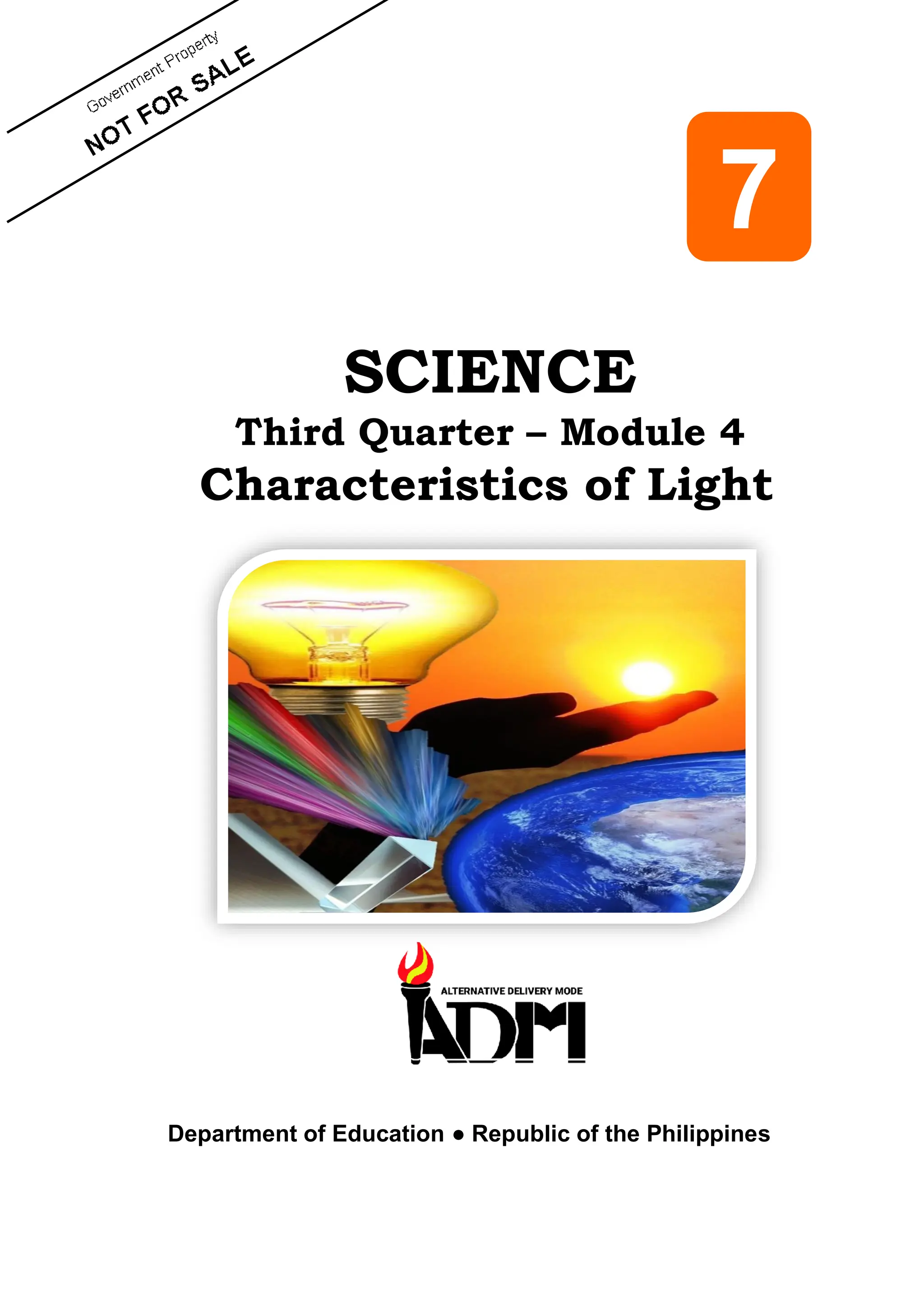
SCIENCE
Third Quarter – Module 4
Characteristics of Light
Department of Education ● Republic of the Philippines
7
Science – Grade 7
Alternative Delivery Mode
Third Quarter – Module 4: Characteristics of Light
First Edition, 2020
Republic Act 8293, Section 176 states that: No copyright shall subsist in any work of
the Government of the Philippines. However, prior approval of the government agency
or office wherein the work is created shall be necessary for exploitation of such work
for profit. Such agency or office may, among other things, impose as a condition the
payment of royalties.
Borrowed materials (i.e., songs, stories, poems, pictures, photos, brand names,
trademarks, etc.) included in this module are owned by their respective copyright
holders. Every effort has been exerted to locate and seek permission to use these
materials from their respective copyright owners. The publisher and authors do not
represent nor claim ownership over them.
Published by the Department of Education
Regional Director: Dr. Arturo B. Bayocot, CESO III
Asst. Regional Director: Dr. Victor G. De Gracia Jr., CESO V
Development Team of the Module
Author/s: Michael O. Sabayton
Reviewers: Gloria V. Salvacion Norlyn L. Lobido
Mitzie Marish L. Bocayong Ron Chiryl P. Sejalbo
Evaluators: Marecel B. Compania Emmie J. Prince
Ivan M. Guillena Rolando T. Luna
Carmen S. Madrio Marisol P. Moreno
Rizza Mae L. Serino Janeth D. Arabes
Michelle S. Balat
Illustrator and Layout Artist: Spark Erl E. Balicog Remegio C. Adlaon Jr.
Management Team
Chairperson: Dr. Arturo B. Bayocot, CESO III
Regional Director
Co-Chairpersons: Dr. Victor G. De Gracia Jr. CESO V
Asst. Regional Director
Edwin R. Maribojoc, EdD, CESO VI
Schools Division Superintendent
Myra P. Mebato,PhD, CESE
Assistant Schools Division Superintendent
Mala Epra B. Magnaong, Chief ES, CLMD
Members Neil A. Improgo, EPS-LRMS
Bienvenido U. Tagolimot, Jr., EPS-ADM
Samuel C. Silacan, EdD, CID Chief
Marites A. Caguindangan, EPS - Science
Rone Ray M. Portacion, EdD, EPS – LRMS
Asela I. Elumbareng, EdD, PSDS
Nelia T. Lanzaderas, PhD, Principal III/District In-charge
Agnes P. Gonzales, PDO II
Vilma M. Inso, Librarian II
Printed in the Philippines by
Department of Education – Region 10
Office Address: Zone 1, Deped Building, Masterson Avenue, Upper Balulang,
Cagayan de Oro City
Contact Number: (088) 880 7072
E-mail Address: region10@deped.gov.ph
Science
Third Quarter – Module 4
Characteristics of Light
Department of Education ● Republic of the Philippines
7
This instructional material was collaboratively developed
and reviewed by educators from public schools. We encourage
teachers and other education stakeholders to email their feedback,
comments, and recommendations to the Department of Education
- Region 10 at region10@deped.gov.ph.
Your feedback and recommendations are highly valued.
iv
Introductory Message
For the Learner
Welcome to the Science 7 Alternative Delivery Mode (ADM) Module on
Characteristics of Light!
Light is tremendously important especially to humans. Without light, your
eyes would not be able to see different images or things. Through light, you can
detect different wavelengths to help you study the Earth and the Universe.
This module was designed to provide you with fun and meaningful
opportunities for guided and independent learning at your own pace and time.
You will be enabled to process the contents of the learning resource while being
an active learner.
This module has the following parts and corresponding icons:
What I Need to
Know
This gives you an idea of the skills or
competencies you are expected to learn
in the module.
What I Know
This part includes an activity that aims to
check what you already know about the
lesson to take. If you get all the answers
correct (100%), you may decide to skip
this module.
What’s In
This is a brief drill or review to help you
link the current lesson with the previous
one.
What’s New
In this portion, the new lesson will be
introduced to you in various ways such
as a story, a song, a poem, a problem
opener, an activity or a situation.
What is It
This section provides a brief discussion
of the lesson. This aims to help you
discover and understand new concepts
and skills.
v
What’s More
This comprises activities for independent
practice to solidify your understanding
and skills of the topic.
What I Have
Learned
This icon will help you to process what
you have learned from the lesson.
What I Can Do
This section provides an activity which
will help you transfer your new
knowledge or skill into real life situations
or concerns.
Assessment
This is a task which aims to evaluate your
level of mastery in achieving the learning
competency.
Additional Activities
In this portion, another activity will be
given to you to enrich your knowledge or
skill of the lesson learned. This also
tends the retention of learned concepts.
Answer Key
This contains answers to all activities in
the module.
At the end of this module you will also find:
The following are some reminders in using this module:
1. Use the module with care. Do not put unnecessary mark/s on any part
of the module. Use your Science activity notebook in answering the
exercises.
2. Don’t forget to answer What I Know before moving on to the other
activities included in the module.
3. Read the instructions carefully before doing each task.
4. Observe honesty and integrity in doing the tasks and checking your
answers.
5. Finish the task at hand before proceeding to the next.
References This is a list of all sources used in
developing this module.
vi
6. Return this module to your teacher/facilitator once you are through with
it.
If you encounter any difficulty in answering the tasks in this module, do
not hesitate to consult your teacher or facilitator. Always bear in mind that you
are not alone.
We hope that through this material, you will experience meaningful
learning and gain a deep understanding of the relevant competencies. You can
do it!
vii
Table of Contents
What I Need to Know - - - - - - - - - - - - - - - - 1
What I Know - - - - - - - - - - - - - - - - 2
What’s In - - - - - - - - - - - - - - - - 4
What’s New - - - - - - - - - - - - - - - - 5
What is It - - - - - - - - - - - - - - - - 6
What’s More - - - - - - - - - - - - - - - - 9
What I Have Learned - - - - - - - - - - - - - - - - 10
What I Can Do - - - - - - - - - - - - - - - - 11
Assessment - - - - - - - - - - - - - - - - 14
Additional Activities - - - - - - - - - - - - - - - - 16
Answer Key - - - - - - - - - - - - - - - - 17
References - - - - - - - - - - - - - - - - 18
1
What I Need to Know
What does light really mean? Light is an electromagnetic wave
composed of photons. It behaves as both waves and particles at the same time.
It plays a vital role in our daily lives. Without light, people would not be able to
appreciate and recognize the beauty of nature and distinguish the different
colors of picture or canvass around us.
Light has its own characteristics that people should know. It travels in a
straight line through a material. Through its characteristics, you can detect
different wavelengths and frequency to help you to study the Earth and the
Universe.
After going through this module, you are expected to explain color and
intensity of light in terms of its wave characteristics.
Specifically, you are also expected to:
1. explain the characteristics of light; and
2. create a color spectrum wheel.
Through this module, we anticipate that you will widen your endurance
in understanding and analyzing what you are reading because this module was
carefully intended and written with you in mind. It is here to assist you to master
the nature of Physics. The scope of this module permits it to be utilized in many
different learning situations. The language used recognizes the diverse
vocabulary level of students. Follow the directions in the activities and answer
the given test and exercises properly.
2
What I Know
Directions: Choose the letter of the best answer. Write your answer in
your Science activity notebook.
1. ROYGBIV is the basic component of visible light. Which color of light
carries the highest energy?
A. Green B. Orange C. Red D. Violet
2. Light is an electromagnetic wave. Which characteristic is common to all
electromagnetic waves in a vacuum?
A. Amplitude B. Frequency C. Speed D. Wavelength
3. How will you compare red light and violet light in a vacuum?
A. Both travel in different speed.
B. Both travel at the same speed.
C. Both have the same frequency.
D. Both have the same wavelength.
4. Which of the following is a proof that light travels in a straight line?
A. Formation of clouds C. Formation of rainbows
B. Formation of colors D. Formation of shadow
5. In the visible spectrum, which color has the longest wavelength?
A. Blue B. Green C. Red D. Violet
6. How does light travel?
A. In a curve line until it hits an object
B. In a straight line until it hits an object
C. By refracting through space until it is absorbed
D. By reflecting through space until it is transmitted
7. What will happen to the energy of the pure spectral colors when the
frequency increases?
A. Decreases C. Remains the same
B. Increases D. Increase then decrease
8. In the visible spectrum, which color has the shortest wavelength?
A. Blue B. Green C. Red D. Violet
3
9. What will happen to the wavelength of the pure spectral colors when the
frequency increases?
A. Decreases C. Remains the same
B. Increases D. Increase then decrease
10.ROYGBIV is the basic component of visible light. Which color of light
carries the lowest energy?
A. Green B. Orange C. Red D. Violet
11.Which of the following describes that light has the highest energy?
A. lowest frequency C. shortest wavelength
B. longest wavelength D. intermediate frequency
12.What will happen to the frequencies of the pure spectral colors when the
wavelengths decrease?
A. Decreases C. Remains the same
B. Increases D. Increase then decrease
13.Which of the following characteristics of visible light describes the height
of the amplitude?
A. Brightness B. Darkness C. Dimness D. Dullness
14.Which of the following is NOT a pure spectral color?
A. Blue B. Red C. Yellow D. White
15.What type of energy can you see with your eyes?
A. Electrical Energy C. Sound Energy
B. Light Energy D. Thermal Energy
4
Lesson
1
Characteristics of Light
What’s In
Activity 1: Complete Me!
Directions: Complete the statement below by choosing the appropriate word
found in the word box. Write your answer in your Science activity
notebook.
WORD BOX
decibel intensity noise vibration
energy longitudinal pitch volume
frequency louder vacuum water
1. The speed of the vibration is called _______.
2. The loudness or softness of a sound is _______.
3. Sound is a form of _______.
4. A back and forth movement that produces sound is called a _______.
5. Sound waves are _______ waves.
6. The higher the amplitude, the _______the sound.
7. The standard unit of sound is _______.
8. Sound can travel in all media but not in _______.
9. A distorted sound which is not pleasing to the senses is _______.
10. The higher the frequency, the higher is the _______of the sound produced.
5
What’s New
Activity 2: Observe Me!
Directions: Read the paragraph and answer the questions in your Science
activity notebook.
A rainbow is a multicolored arc made by light striking water droplets. It is
the result of the refraction and reflection of light. Both refraction and reflection
are phenomena that involve a change in a wave's direction. A refracted wave
may appear "bent", while a reflected wave might seem to "bounce back" from
a surface or other wave front. The appearance of a rainbow depends on where
you're standing and where the sun (or other source of light) is shining. The
colors on a primary rainbow are always in order of their wavelength, from
longest to shortest: red, orange, yellow, green, blue, indigo and violet
(ROYGBIV). This is also known as visible light which is one of the regions of
the electromagnetic spectrum.
Guide Questions:
1. Based on the paragraph above, how is a rainbow formed?
2. What are the colors of the rainbow?
6
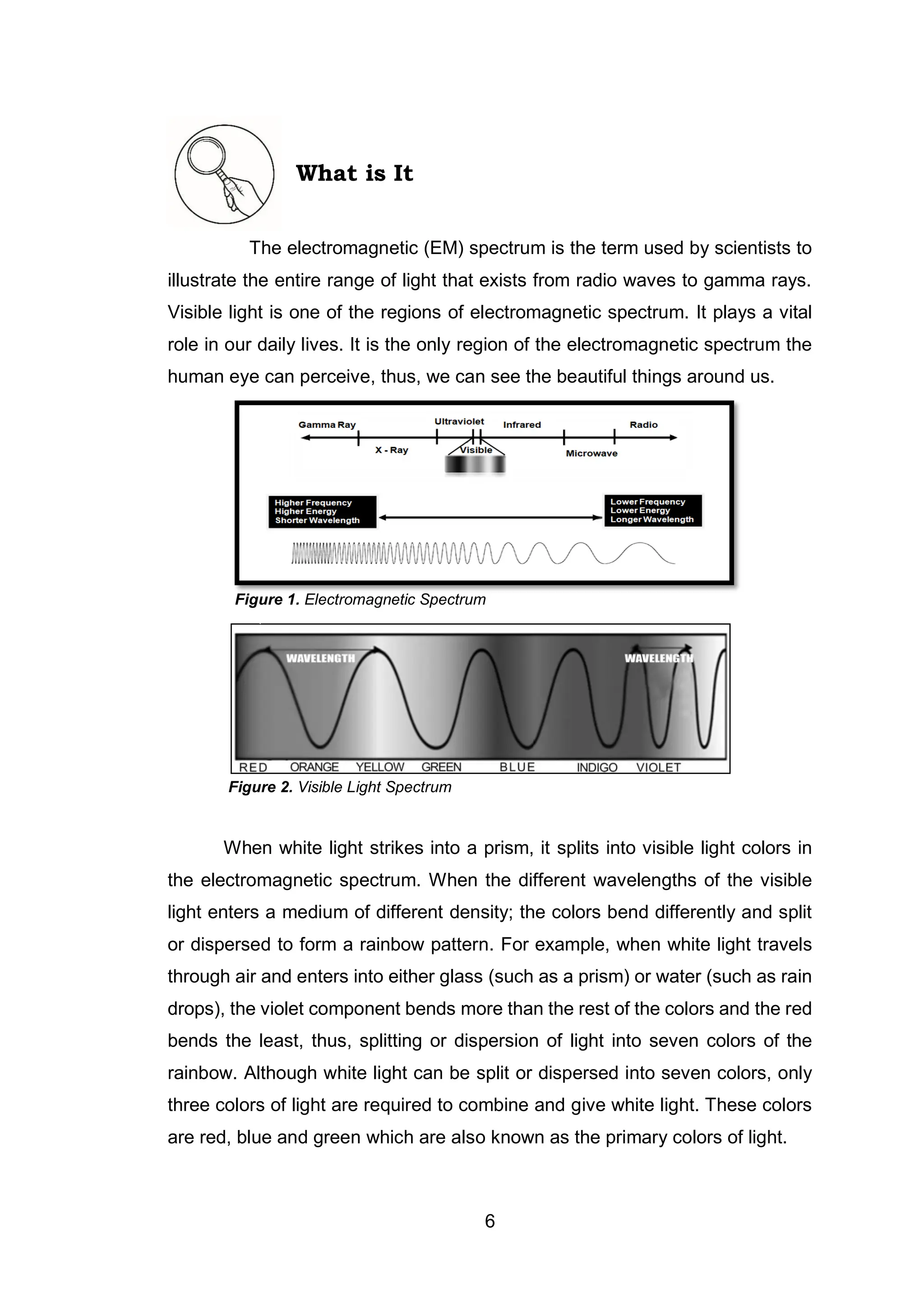
The electromagnetic (EM) spectrum is the term used by scientists to
illustrate the entire range of light that exists from radio waves to gamma rays.
Visible light is one of the regions of electromagnetic spectrum. It plays a vital
role in our daily lives. It is the only region of the electromagnetic spectrum the
human eye can perceive, thus, we can see the beautiful things around us.
Figure 1. Electromagnetic Spectrum
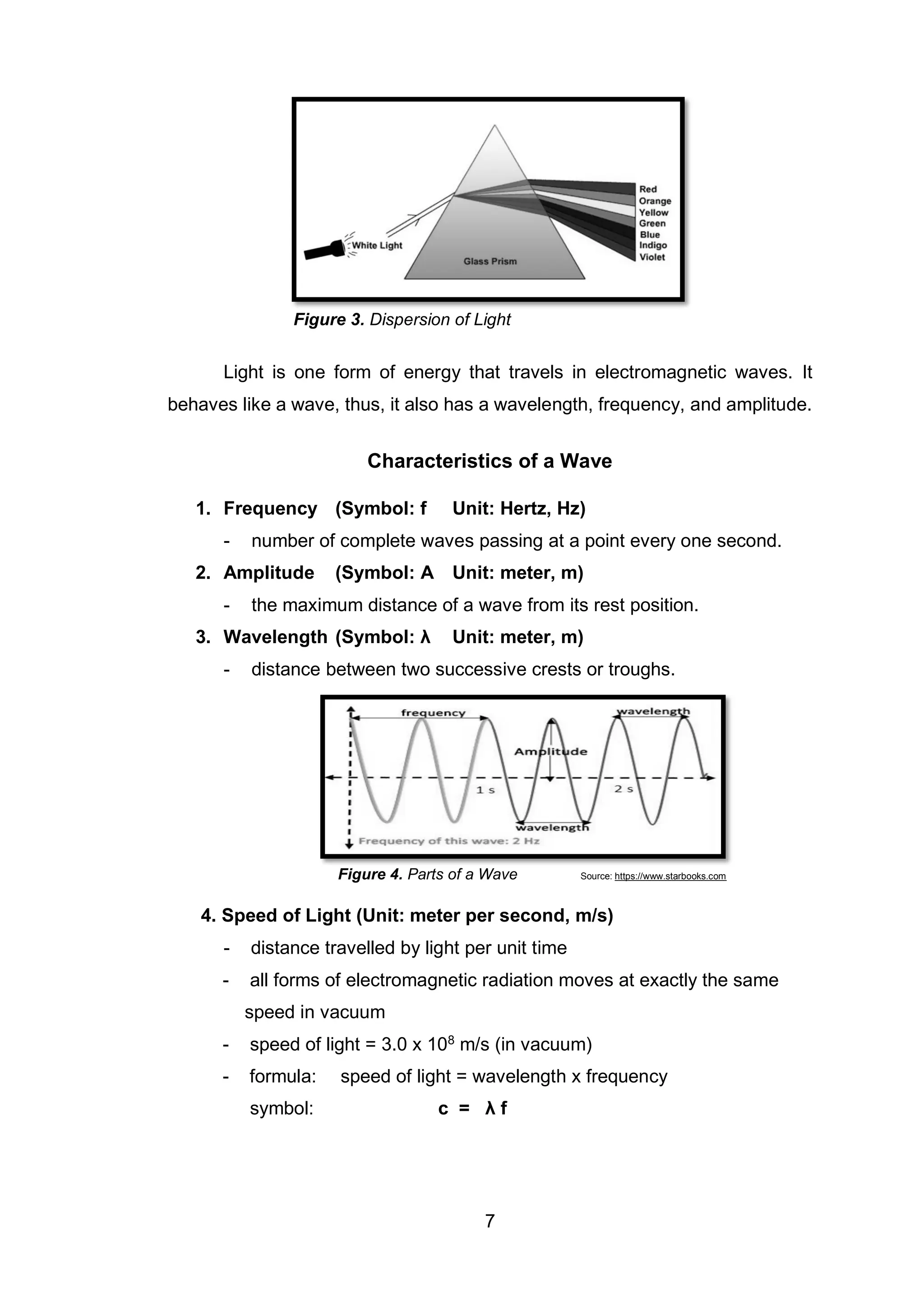
Figure 2. Visible Light Spectrum
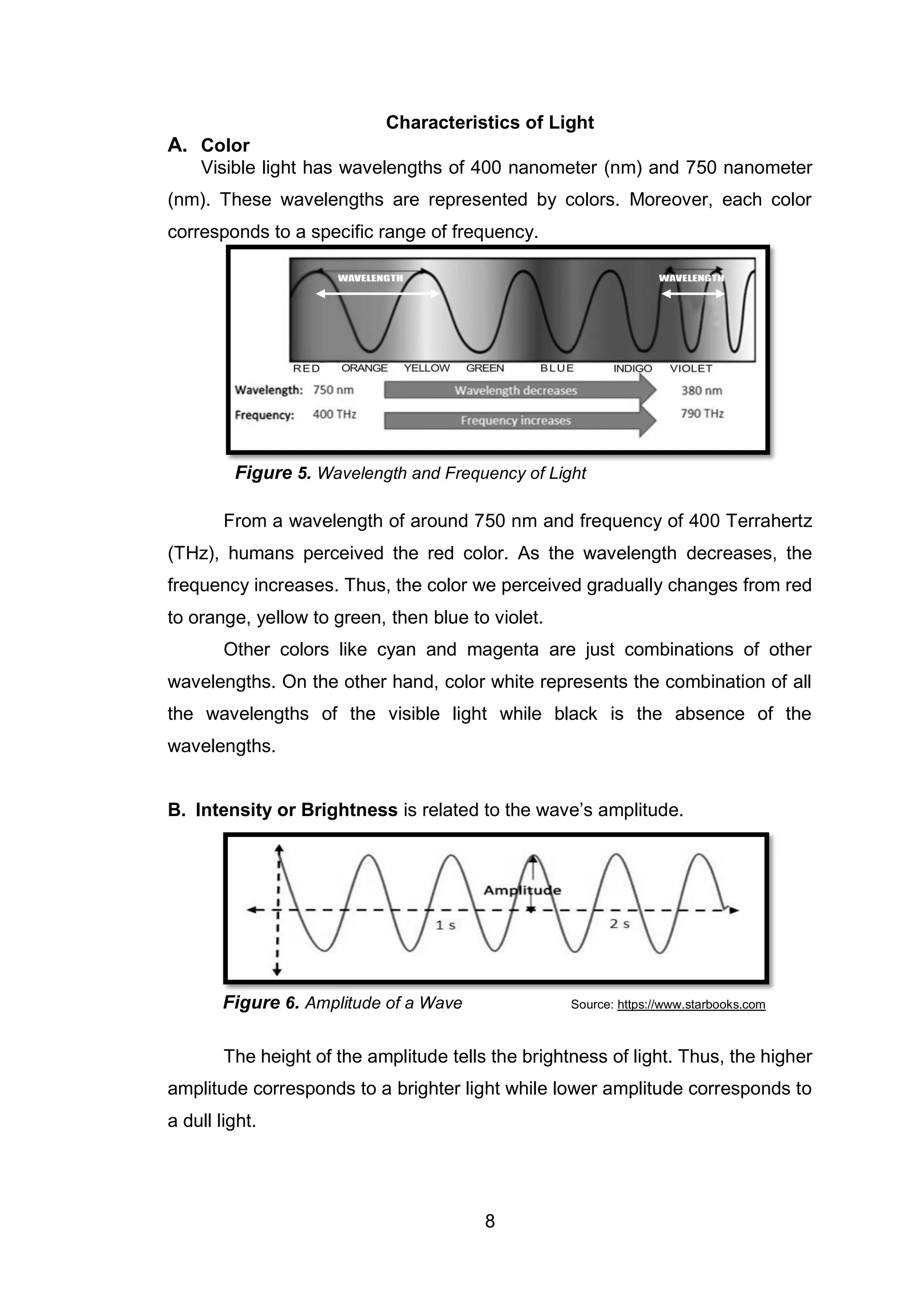
When white light strikes into a prism, it splits into visible light colors in
the electromagnetic spectrum. When the different wavelengths of the visible
light enters a medium of different density; the colors bend differently and split
or dispersed to form a rainbow pattern. For example, when white light travels
through air and enters into either glass (such as a prism) or water (such as rain
drops), the violet component bends more than the rest of the colors and the red
bends the least, thus, splitting or dispersion of light into seven colors of the
rainbow. Although white light can be split or dispersed into seven colors, only
three colors of light are required to combine and give white light. These colors
are red, blue and green which are also known as the primary colors of light.
What is It
7
Figure 3. Dispersion of Light
Light is one form of energy that travels in electromagnetic waves. It
behaves like a wave, thus, it also has a wavelength, frequency, and amplitude.
Characteristics of a Wave
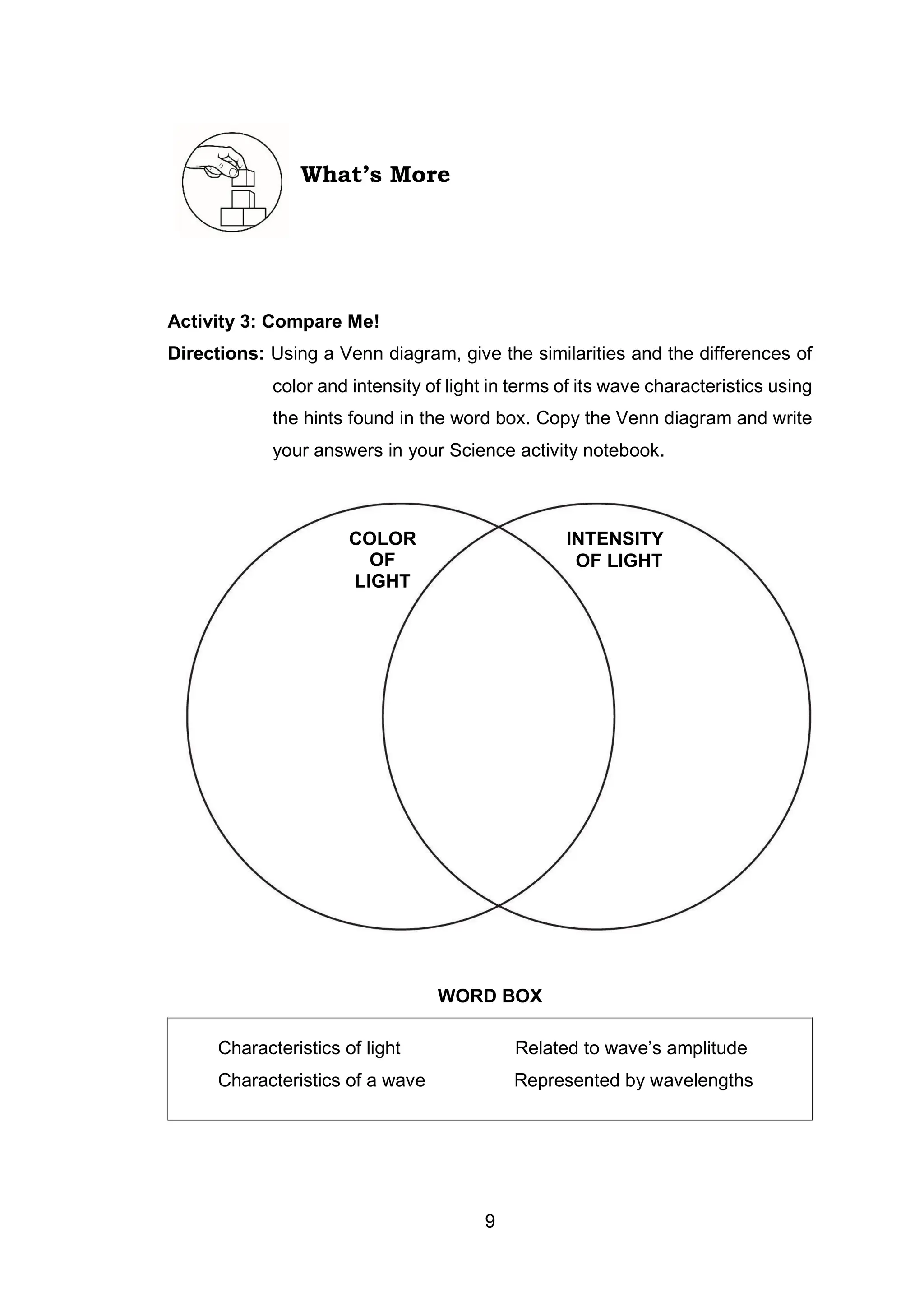
1. Frequency (Symbol: f Unit: Hertz, Hz)
- number of complete waves passing at a point every one second.
2. Amplitude (Symbol: A Unit: meter, m)
- the maximum distance of a wave from its rest position.
3. Wavelength (Symbol: λ Unit: meter, m)
- distance between two successive crests or troughs.
Figure 4. Parts of a Wave Source: https://www.starbooks.com
4. Speed of Light (Unit: meter per second, m/s)
- distance travelled by light per unit time
- all forms of electromagnetic radiation moves at exactly the same
speed in vacuum
- speed of light = 3.0 x 10⁸
m/s (in vacuum)
- formula: speed of light = wavelength x frequency
symbol: c = λ f
8
Characteristics of Light
A. Color
Visible light has wavelengths of 400 nanometer (nm) and 750 nanometer
(nm). These wavelengths are represented by colors. Moreover, each color
corresponds to a specific range of frequency.
From a wavelength of around 750 nm and frequency of 400 Terrahertz
(THz), humans perceived the red color. As the wavelength decreases, the
frequency increases. Thus, the color we perceived gradually changes from red
to orange, yellow to green, then blue to violet.
Other colors like cyan and magenta are just combinations of other
wavelengths. On the other hand, color white represents the combination of all
the wavelengths of the visible light while black is the absence of the
wavelengths.
B. Intensity or Brightness is related to the wave’s amplitude.
Figure 6. Amplitude of a Wave Source: https://www.starbooks.com
The height of the amplitude tells the brightness of light. Thus, the higher
amplitude corresponds to a brighter light while lower amplitude corresponds to
a dull light.
Figure 5. Wavelength and Frequency of Light
9
Activity 3: Compare Me!
Directions: Using a Venn diagram, give the similarities and the differences of
color and intensity of light in terms of its wave characteristics using
the hints found in the word box. Copy the Venn diagram and write
your answers in your Science activity notebook.
WORD BOX
Characteristics of light Related to wave’s amplitude
Characteristics of a wave Represented by wavelengths
What’s More
COLOR
OF
LIGHT
INTENSITY
OF LIGHT
10
Good job! You can now proceed to the next activity.
What I Have Learned
Activity 4: Match Me!
Directions: Match column A with the correct answer on column B. Write your
answers in your Science activity notebook.
COLUMN A COLUMN B
1. The characteristic of light that is related to the A. Red
wave’s amplitude B. Increases
2. Number of complete waves passing C. Lower
at a point every one second D. Frequency
3. Amplitude that corresponds to a dull light E. Intensity
4. Behaves like a wave F. Light
5. The maximum distance of a wave G. White
from its rest position H. Black
6. The absence of the wavelengths I. Wavelength
7. Distance between two successive J. Higher
crests or troughs K. Amplitude
8. The combination of all the wavelengths L. Decreases
of the visible light M. Colors
9. Amplitude that corresponds to a brighter light
10. Represented by wavelengths
Wow! Amazing! You have done it well.
11
What I Can Do
Activity 5: Create Me!
Directions: Read and follow the procedures to create your own Color Spectrum
Wheel using the given pattern. Answer the guide questions in
your Science activity notebook.
Materials:
Color Spectrum Wheel Pattern
Cardboard or Illustration Board
White Screen
Button Fastener
Glue or Paste
Scissors or Cutter
Procedure:
Part 1: Color Wheel
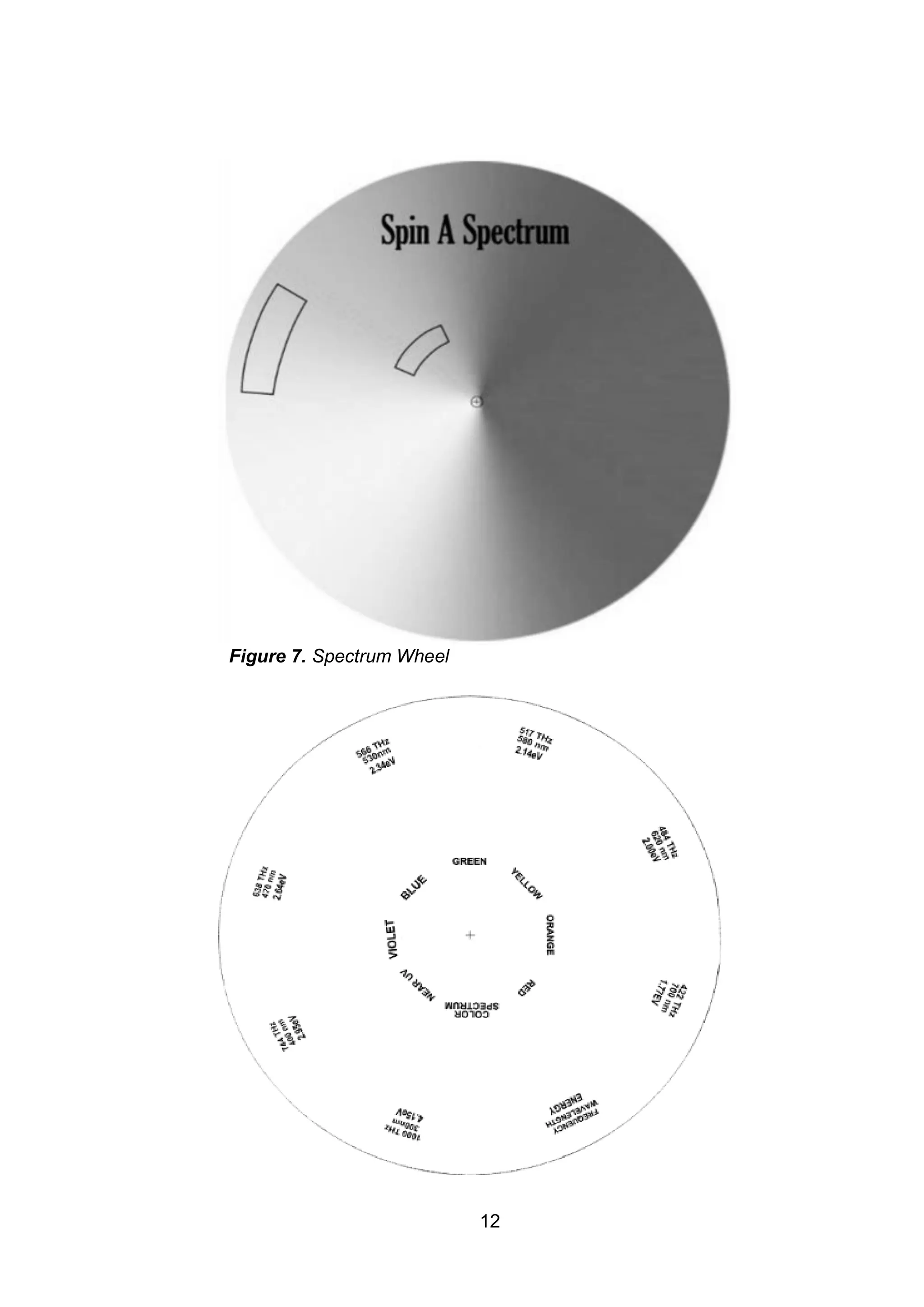
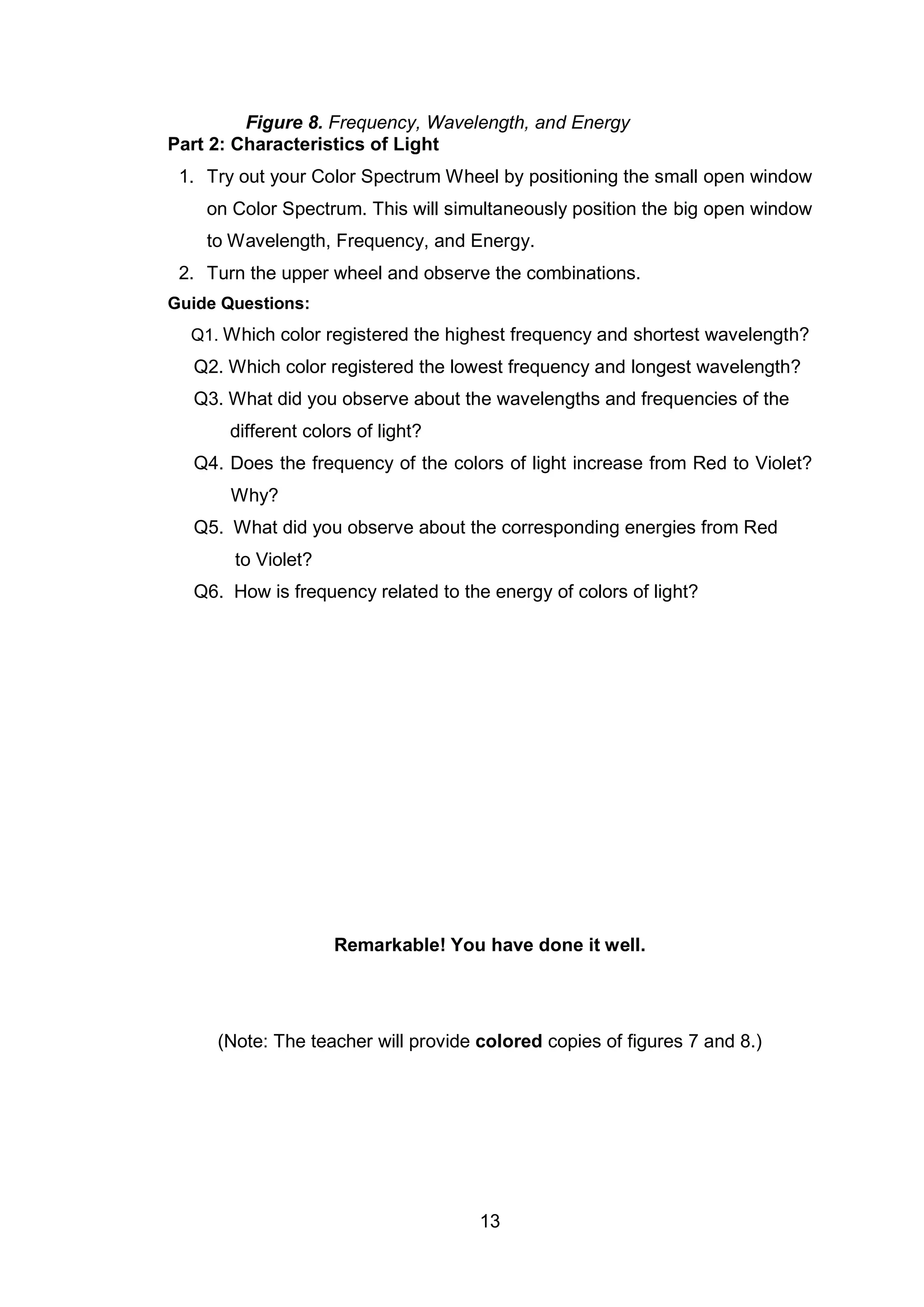
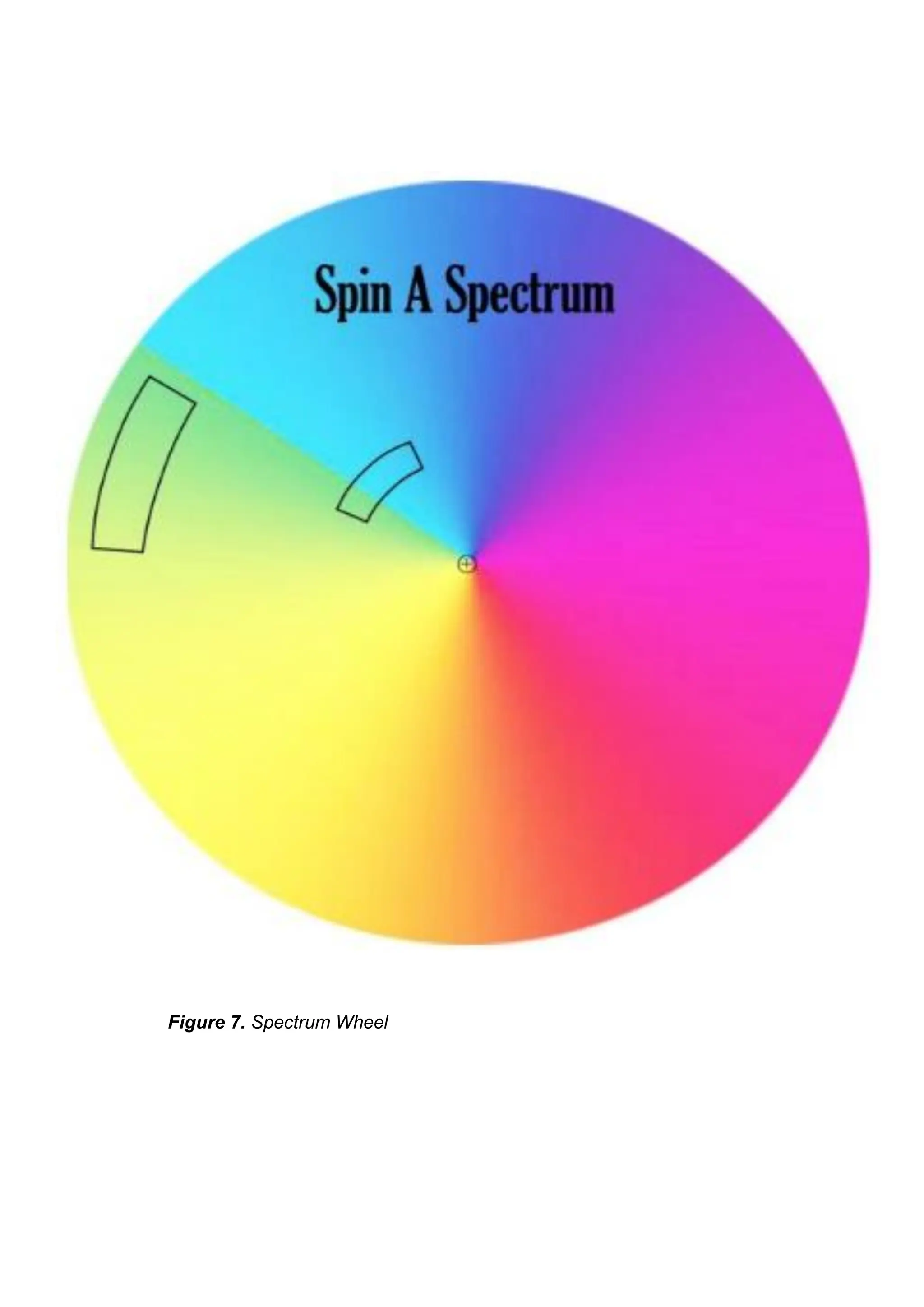
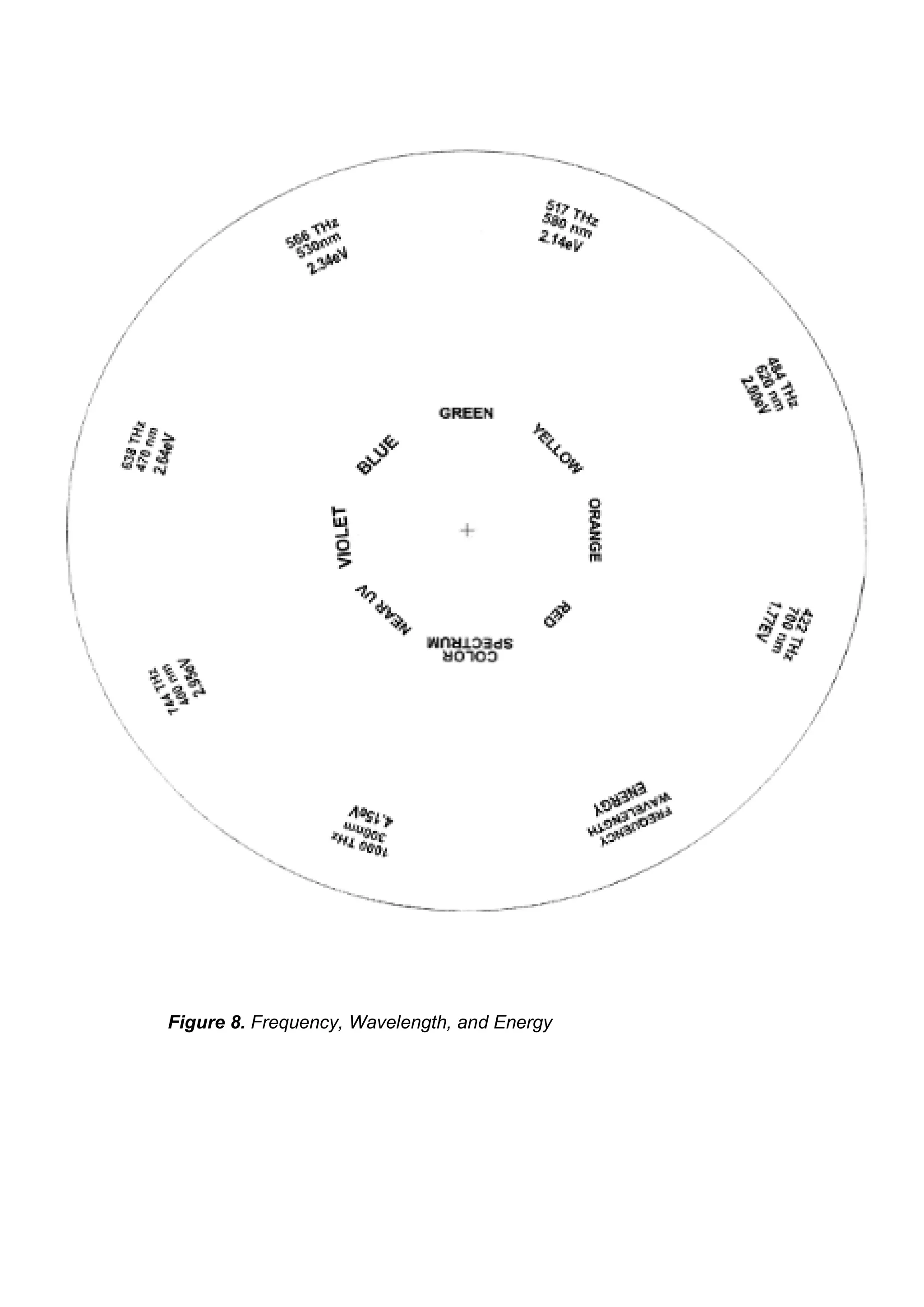
1. Cut the two art files that make up the wheel provided to you by your teacher.
(similar to figures 7 and 8)
2. Cut along the lines drawn on top of the wheel. Cut the 2 sides as shown.
The small window near the center of the wheel should be completely cut out
and removed.
3. Punch a hole at the center of the two wheels. You may use a button fastener
to secure the two wheels together one on top of the other, but they should
be free to rotate relative to each other.
4. When you see a portion of the color spectrum that shows up in the small
open window, you can see the value of "Frequency, Wavelength, Energy"
that corresponds to the portion in the big open window. Then you can say
that you have done it right.
TAKE
CARE!
Handle all sharp
objects with
care.
12
Figure 7. Spectrum Wheel
13
Figure 8. Frequency, Wavelength, and Energy
Part 2: Characteristics of Light
1. Try out your Color Spectrum Wheel by positioning the small open window
on Color Spectrum. This will simultaneously position the big open window
to Wavelength, Frequency, and Energy.
2. Turn the upper wheel and observe the combinations.
Guide Questions:
Q1. Which color registered the highest frequency and shortest wavelength?
Q2. Which color registered the lowest frequency and longest wavelength?
Q3. What did you observe about the wavelengths and frequencies of the
different colors of light?
Q4. Does the frequency of the colors of light increase from Red to Violet?
Why?
Q5. What did you observe about the corresponding energies from Red
to Violet?
Q6. How is frequency related to the energy of colors of light?
Remarkable! You have done it well.
(Note: The teacher will provide colored copies of figures 7 and 8.)
14
Assessment
Multiple Choice. Choose the letter of the correct answer. Write your answer in
your Science activity notebook.
1. In the visible light, which color has the longest wavelength?
A. Blue B. Green C. Red D. Violet
2. What will happen to the frequency of the pure spectral colors when the
wavelength increases?
A. Decrease C. Remains the same
B. Increase D. Increase then decrease
3. What will happen to the wavelengths of the colors if the frequencies
decrease?
A. Decrease C. Remains the same
B. Increase D. Increase then decrease
4. What type of energy can you sense with your eyes?
A. Electrical energy C. Sound energy
B. Light energy D. Thermal energy
5. What characteristic of visible light describes the height of the amplitude?
A. Brightness B. Darkness C. Dimness D. Dullness
6. ROYGBIV is the basic component of white light. Which color of light
carries the highest frequency?
A. Green B. Orange C. Red D. Violet
7. Which of the following is a proof that light travels in a straight line?
A. Formation of clouds C. Formation of rainbows
B. Formation of colors D. Formation of shadow
8. Light is an electromagnetic wave. Which characteristic is common in all
electromagnetic waves in a vacuum?
A. Amplitude B. Frequency C. Speed D. Wavelength
9. Which of the following are the primary colors in the visible light?
A. Blue, green, yellow C. Red, orange, blue
B. Red, green, blue D. White, black, red
15
10. Which of the following group of colors of the visible light is listed from
lowest to highest frequency?
A. Blue, green, red C. Red, violet, green
B. Green, blue, red D. Red, green, violet
11. Which of the following group of colors of the visible light is listed from
shortest to longest wavelength?
A. Blue, green, red C. Violet, green, red
B. Green, blue, red D. Violet, red, green
12. In the visible spectrum, which color has the shortest wavelength?
A. Blue B. Green C. Red D. Violet
13. _______ amplitude corresponds to a brighter light.
A. Higher B. Lower C. Smaller D. The same
14. Which of the following is NOT a pure spectral color?
A. Blue B. Red C. Yellow D. White
15. _______ amplitude corresponds to a dull light.
A. Higher B. Lower C. Smaller D. The same
16
Additional Activities
Activity 5: Answer Me!
Directions: Make a reflection after knowing the characteristics of light based
on the guide question below. Write your answer in your Science
activity notebook.
Guide Question:
1. How do the characteristics of light relate to your own personal experience?
Rubric for Scoring:
Basis 3 2 1
Content Ideas presented
are clear and
focused.
Ideas presented
are not well
defined.
Ideas have no
clear sense of
purpose.
Organization Information is
relevant and
presented in
logical order.
Information is
somewhat
relevant.
Information is not
relevant.
Word choice The choice of
words is
accurate.
The choice of
words is
somewhat
accurate.
The choice of
words is not
accurate.
Mechanics Spelling and
punctuations are
all correct.
Only few errors
in spelling and
punctuations are
observed.
Distracting errors
in spelling and
punctuations are
observed
Congratulations! You have completed the lesson about light. Good luck
in your journey on the next lessons in exploring the wonders of Science.
17
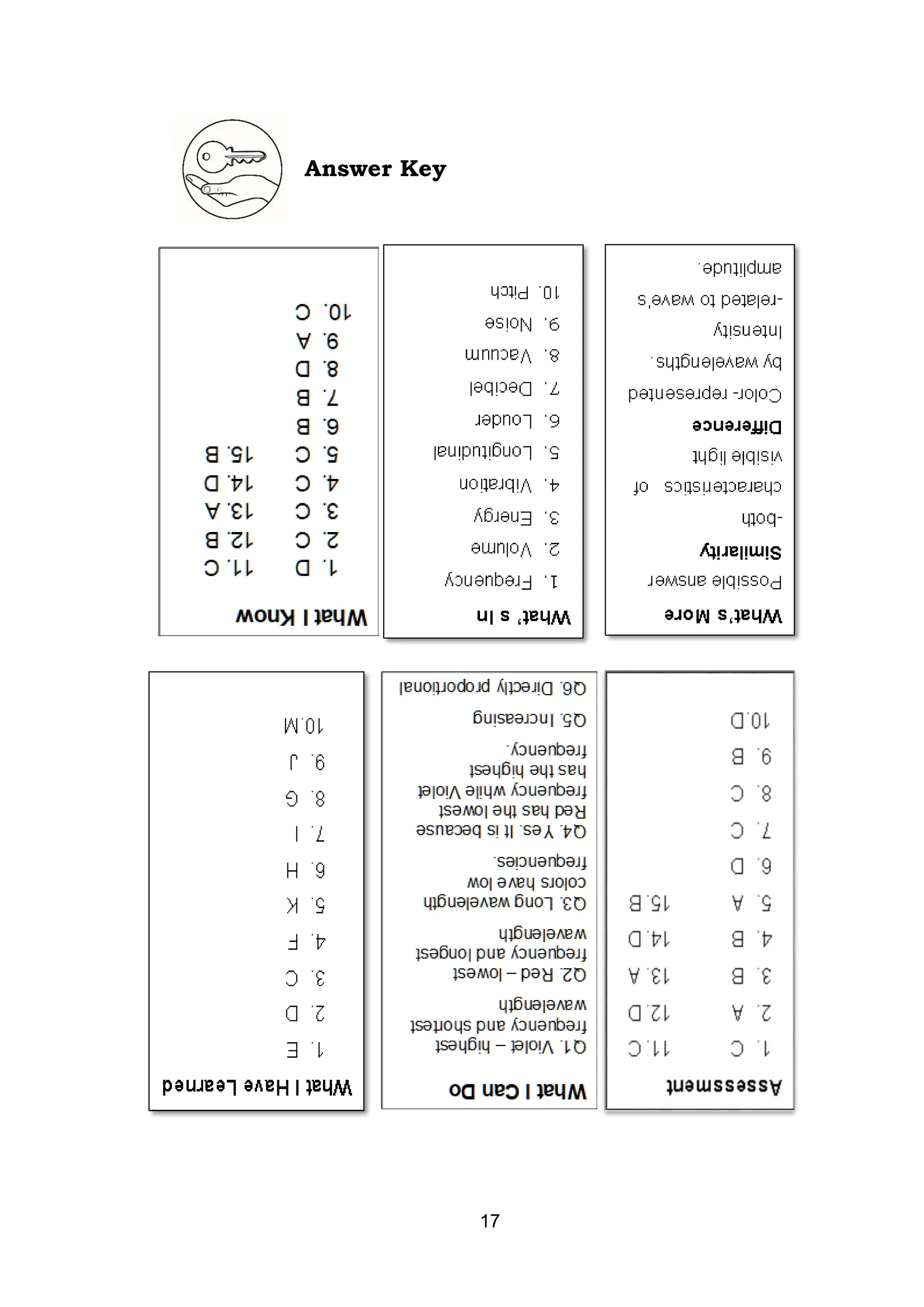
Answer Key
18
References
BOOKS
Asuncion, Alvie J.,et al.,Science Learn's Material for Grade 7.Pasig City.
Department of Education, 2017.
Acosta, Herma D.,et al.,Science Learner's Materials for Grade 10. Pasig
City.Department of Education, 2015.
INTERNET SOURCES
Study.com. 2003-2020.https://study.com/academy/practice/quiz-worksheet-
characteristics-of-light.html. (accessed June 8, 2020).
Weebly.com.http://science4th.weebly.com/uploads/4/2/0/3/42032351/
sound_energy.pdf. (accessed June 5, 2020)
Dochub.com.https://dochub.com/eveliasadullo/mqNjP3BVWre8yYK9yGzLkp/
module-6-colors-of-light-g8?pg=8. (accessed June 10, 2020).
STARBOOKS. https://www.starbooks.com. (accessed June 8 2020).
Smale, Dr. Alan. NASA. November 14, 2014.
https://imagine.gsfc.nasa.gov/science/toolbox/emspectrum1.html
(accessed July 20, 2020).
Crockett, Christopher. EarthSky. September 7, 2019.
https://earthsky.org/space/what-is-the-electromagnetic-spectrum
(accessed July 21, 2020).
19
Subramaniam, Ganesh. Quora. March 10, 2017. https://www.quora.com/How-
is-white-light-divided-into-many-coloured-light-rays-What-happens-
internally (accessed July 21, 2020).
Canva. www.canva.com. (accessed July 1, 2020).
Brainly. https://brainly.ph/question/6499269 (accessed July 1, 2020)
Scribd. https://www.scribd.com/document/434231006/3rd-quater-periodical-
test-in-tle8 (accessed July 8, 2020)
National Geographic. https://www.nationalgeographic.org/media/rainbow-
serpent/ (accessed June 28, 2020)
Figure 7. Spectrum Wheel
Figure 8. Frequency, Wavelength, and Energy
For inquiries or feedback, please write or call:
Department of Education – Region 10
Zone 1, DepEd Building Masterson Avenue, Upper Balulang
Cagayan de Oro City, 9000
Telefax: (088) 880 7072
E-mail Address: region10@deped.govph

Science7_Q3_M4_v4.pdfScience7_Q3_M2_v4.pdf

  • 1.
    SCIENCE Third Quarter –Module 4 Characteristics of Light Department of Education ● Republic of the Philippines 7
  • 2.
    Science – Grade7 Alternative Delivery Mode Third Quarter – Module 4: Characteristics of Light First Edition, 2020 Republic Act 8293, Section 176 states that: No copyright shall subsist in any work of the Government of the Philippines. However, prior approval of the government agency or office wherein the work is created shall be necessary for exploitation of such work for profit. Such agency or office may, among other things, impose as a condition the payment of royalties. Borrowed materials (i.e., songs, stories, poems, pictures, photos, brand names, trademarks, etc.) included in this module are owned by their respective copyright holders. Every effort has been exerted to locate and seek permission to use these materials from their respective copyright owners. The publisher and authors do not represent nor claim ownership over them. Published by the Department of Education Regional Director: Dr. Arturo B. Bayocot, CESO III Asst. Regional Director: Dr. Victor G. De Gracia Jr., CESO V Development Team of the Module Author/s: Michael O. Sabayton Reviewers: Gloria V. Salvacion Norlyn L. Lobido Mitzie Marish L. Bocayong Ron Chiryl P. Sejalbo Evaluators: Marecel B. Compania Emmie J. Prince Ivan M. Guillena Rolando T. Luna Carmen S. Madrio Marisol P. Moreno Rizza Mae L. Serino Janeth D. Arabes Michelle S. Balat Illustrator and Layout Artist: Spark Erl E. Balicog Remegio C. Adlaon Jr. Management Team Chairperson: Dr. Arturo B. Bayocot, CESO III Regional Director Co-Chairpersons: Dr. Victor G. De Gracia Jr. CESO V Asst. Regional Director Edwin R. Maribojoc, EdD, CESO VI Schools Division Superintendent Myra P. Mebato,PhD, CESE Assistant Schools Division Superintendent Mala Epra B. Magnaong, Chief ES, CLMD Members Neil A. Improgo, EPS-LRMS Bienvenido U. Tagolimot, Jr., EPS-ADM Samuel C. Silacan, EdD, CID Chief Marites A. Caguindangan, EPS - Science Rone Ray M. Portacion, EdD, EPS – LRMS Asela I. Elumbareng, EdD, PSDS Nelia T. Lanzaderas, PhD, Principal III/District In-charge Agnes P. Gonzales, PDO II Vilma M. Inso, Librarian II Printed in the Philippines by Department of Education – Region 10 Office Address: Zone 1, Deped Building, Masterson Avenue, Upper Balulang, Cagayan de Oro City Contact Number: (088) 880 7072 E-mail Address: region10@deped.gov.ph
  • 3.
    Science Third Quarter –Module 4 Characteristics of Light Department of Education ● Republic of the Philippines 7 This instructional material was collaboratively developed and reviewed by educators from public schools. We encourage teachers and other education stakeholders to email their feedback, comments, and recommendations to the Department of Education - Region 10 at region10@deped.gov.ph. Your feedback and recommendations are highly valued.
  • 4.
    iv Introductory Message For theLearner Welcome to the Science 7 Alternative Delivery Mode (ADM) Module on Characteristics of Light! Light is tremendously important especially to humans. Without light, your eyes would not be able to see different images or things. Through light, you can detect different wavelengths to help you study the Earth and the Universe. This module was designed to provide you with fun and meaningful opportunities for guided and independent learning at your own pace and time. You will be enabled to process the contents of the learning resource while being an active learner. This module has the following parts and corresponding icons: What I Need to Know This gives you an idea of the skills or competencies you are expected to learn in the module. What I Know This part includes an activity that aims to check what you already know about the lesson to take. If you get all the answers correct (100%), you may decide to skip this module. What’s In This is a brief drill or review to help you link the current lesson with the previous one. What’s New In this portion, the new lesson will be introduced to you in various ways such as a story, a song, a poem, a problem opener, an activity or a situation. What is It This section provides a brief discussion of the lesson. This aims to help you discover and understand new concepts and skills.
  • 5.
    v What’s More This comprisesactivities for independent practice to solidify your understanding and skills of the topic. What I Have Learned This icon will help you to process what you have learned from the lesson. What I Can Do This section provides an activity which will help you transfer your new knowledge or skill into real life situations or concerns. Assessment This is a task which aims to evaluate your level of mastery in achieving the learning competency. Additional Activities In this portion, another activity will be given to you to enrich your knowledge or skill of the lesson learned. This also tends the retention of learned concepts. Answer Key This contains answers to all activities in the module. At the end of this module you will also find: The following are some reminders in using this module: 1. Use the module with care. Do not put unnecessary mark/s on any part of the module. Use your Science activity notebook in answering the exercises. 2. Don’t forget to answer What I Know before moving on to the other activities included in the module. 3. Read the instructions carefully before doing each task. 4. Observe honesty and integrity in doing the tasks and checking your answers. 5. Finish the task at hand before proceeding to the next. References This is a list of all sources used in developing this module.
  • 6.
    vi 6. Return thismodule to your teacher/facilitator once you are through with it. If you encounter any difficulty in answering the tasks in this module, do not hesitate to consult your teacher or facilitator. Always bear in mind that you are not alone. We hope that through this material, you will experience meaningful learning and gain a deep understanding of the relevant competencies. You can do it!
  • 7.
    vii Table of Contents WhatI Need to Know - - - - - - - - - - - - - - - - 1 What I Know - - - - - - - - - - - - - - - - 2 What’s In - - - - - - - - - - - - - - - - 4 What’s New - - - - - - - - - - - - - - - - 5 What is It - - - - - - - - - - - - - - - - 6 What’s More - - - - - - - - - - - - - - - - 9 What I Have Learned - - - - - - - - - - - - - - - - 10 What I Can Do - - - - - - - - - - - - - - - - 11 Assessment - - - - - - - - - - - - - - - - 14 Additional Activities - - - - - - - - - - - - - - - - 16 Answer Key - - - - - - - - - - - - - - - - 17 References - - - - - - - - - - - - - - - - 18
  • 8.
    1 What I Needto Know What does light really mean? Light is an electromagnetic wave composed of photons. It behaves as both waves and particles at the same time. It plays a vital role in our daily lives. Without light, people would not be able to appreciate and recognize the beauty of nature and distinguish the different colors of picture or canvass around us. Light has its own characteristics that people should know. It travels in a straight line through a material. Through its characteristics, you can detect different wavelengths and frequency to help you to study the Earth and the Universe. After going through this module, you are expected to explain color and intensity of light in terms of its wave characteristics. Specifically, you are also expected to: 1. explain the characteristics of light; and 2. create a color spectrum wheel. Through this module, we anticipate that you will widen your endurance in understanding and analyzing what you are reading because this module was carefully intended and written with you in mind. It is here to assist you to master the nature of Physics. The scope of this module permits it to be utilized in many different learning situations. The language used recognizes the diverse vocabulary level of students. Follow the directions in the activities and answer the given test and exercises properly.
  • 9.
    2 What I Know Directions:Choose the letter of the best answer. Write your answer in your Science activity notebook. 1. ROYGBIV is the basic component of visible light. Which color of light carries the highest energy? A. Green B. Orange C. Red D. Violet 2. Light is an electromagnetic wave. Which characteristic is common to all electromagnetic waves in a vacuum? A. Amplitude B. Frequency C. Speed D. Wavelength 3. How will you compare red light and violet light in a vacuum? A. Both travel in different speed. B. Both travel at the same speed. C. Both have the same frequency. D. Both have the same wavelength. 4. Which of the following is a proof that light travels in a straight line? A. Formation of clouds C. Formation of rainbows B. Formation of colors D. Formation of shadow 5. In the visible spectrum, which color has the longest wavelength? A. Blue B. Green C. Red D. Violet 6. How does light travel? A. In a curve line until it hits an object B. In a straight line until it hits an object C. By refracting through space until it is absorbed D. By reflecting through space until it is transmitted 7. What will happen to the energy of the pure spectral colors when the frequency increases? A. Decreases C. Remains the same B. Increases D. Increase then decrease 8. In the visible spectrum, which color has the shortest wavelength? A. Blue B. Green C. Red D. Violet
  • 10.
    3 9. What willhappen to the wavelength of the pure spectral colors when the frequency increases? A. Decreases C. Remains the same B. Increases D. Increase then decrease 10.ROYGBIV is the basic component of visible light. Which color of light carries the lowest energy? A. Green B. Orange C. Red D. Violet 11.Which of the following describes that light has the highest energy? A. lowest frequency C. shortest wavelength B. longest wavelength D. intermediate frequency 12.What will happen to the frequencies of the pure spectral colors when the wavelengths decrease? A. Decreases C. Remains the same B. Increases D. Increase then decrease 13.Which of the following characteristics of visible light describes the height of the amplitude? A. Brightness B. Darkness C. Dimness D. Dullness 14.Which of the following is NOT a pure spectral color? A. Blue B. Red C. Yellow D. White 15.What type of energy can you see with your eyes? A. Electrical Energy C. Sound Energy B. Light Energy D. Thermal Energy
  • 11.
    4 Lesson 1 Characteristics of Light What’sIn Activity 1: Complete Me! Directions: Complete the statement below by choosing the appropriate word found in the word box. Write your answer in your Science activity notebook. WORD BOX decibel intensity noise vibration energy longitudinal pitch volume frequency louder vacuum water 1. The speed of the vibration is called _______. 2. The loudness or softness of a sound is _______. 3. Sound is a form of _______. 4. A back and forth movement that produces sound is called a _______. 5. Sound waves are _______ waves. 6. The higher the amplitude, the _______the sound. 7. The standard unit of sound is _______. 8. Sound can travel in all media but not in _______. 9. A distorted sound which is not pleasing to the senses is _______. 10. The higher the frequency, the higher is the _______of the sound produced.
  • 12.
    5 What’s New Activity 2:Observe Me! Directions: Read the paragraph and answer the questions in your Science activity notebook. A rainbow is a multicolored arc made by light striking water droplets. It is the result of the refraction and reflection of light. Both refraction and reflection are phenomena that involve a change in a wave's direction. A refracted wave may appear "bent", while a reflected wave might seem to "bounce back" from a surface or other wave front. The appearance of a rainbow depends on where you're standing and where the sun (or other source of light) is shining. The colors on a primary rainbow are always in order of their wavelength, from longest to shortest: red, orange, yellow, green, blue, indigo and violet (ROYGBIV). This is also known as visible light which is one of the regions of the electromagnetic spectrum. Guide Questions: 1. Based on the paragraph above, how is a rainbow formed? 2. What are the colors of the rainbow?
  • 13.
    6 The electromagnetic (EM)spectrum is the term used by scientists to illustrate the entire range of light that exists from radio waves to gamma rays. Visible light is one of the regions of electromagnetic spectrum. It plays a vital role in our daily lives. It is the only region of the electromagnetic spectrum the human eye can perceive, thus, we can see the beautiful things around us. Figure 1. Electromagnetic Spectrum Figure 2. Visible Light Spectrum When white light strikes into a prism, it splits into visible light colors in the electromagnetic spectrum. When the different wavelengths of the visible light enters a medium of different density; the colors bend differently and split or dispersed to form a rainbow pattern. For example, when white light travels through air and enters into either glass (such as a prism) or water (such as rain drops), the violet component bends more than the rest of the colors and the red bends the least, thus, splitting or dispersion of light into seven colors of the rainbow. Although white light can be split or dispersed into seven colors, only three colors of light are required to combine and give white light. These colors are red, blue and green which are also known as the primary colors of light. What is It
  • 14.
    7 Figure 3. Dispersionof Light Light is one form of energy that travels in electromagnetic waves. It behaves like a wave, thus, it also has a wavelength, frequency, and amplitude. Characteristics of a Wave 1. Frequency (Symbol: f Unit: Hertz, Hz) - number of complete waves passing at a point every one second. 2. Amplitude (Symbol: A Unit: meter, m) - the maximum distance of a wave from its rest position. 3. Wavelength (Symbol: λ Unit: meter, m) - distance between two successive crests or troughs. Figure 4. Parts of a Wave Source: https://www.starbooks.com 4. Speed of Light (Unit: meter per second, m/s) - distance travelled by light per unit time - all forms of electromagnetic radiation moves at exactly the same speed in vacuum - speed of light = 3.0 x 10⁸ m/s (in vacuum) - formula: speed of light = wavelength x frequency symbol: c = λ f
  • 15.
    8 Characteristics of Light A.Color Visible light has wavelengths of 400 nanometer (nm) and 750 nanometer (nm). These wavelengths are represented by colors. Moreover, each color corresponds to a specific range of frequency. From a wavelength of around 750 nm and frequency of 400 Terrahertz (THz), humans perceived the red color. As the wavelength decreases, the frequency increases. Thus, the color we perceived gradually changes from red to orange, yellow to green, then blue to violet. Other colors like cyan and magenta are just combinations of other wavelengths. On the other hand, color white represents the combination of all the wavelengths of the visible light while black is the absence of the wavelengths. B. Intensity or Brightness is related to the wave’s amplitude. Figure 6. Amplitude of a Wave Source: https://www.starbooks.com The height of the amplitude tells the brightness of light. Thus, the higher amplitude corresponds to a brighter light while lower amplitude corresponds to a dull light. Figure 5. Wavelength and Frequency of Light
  • 16.
    9 Activity 3: CompareMe! Directions: Using a Venn diagram, give the similarities and the differences of color and intensity of light in terms of its wave characteristics using the hints found in the word box. Copy the Venn diagram and write your answers in your Science activity notebook. WORD BOX Characteristics of light Related to wave’s amplitude Characteristics of a wave Represented by wavelengths What’s More COLOR OF LIGHT INTENSITY OF LIGHT
  • 17.
    10 Good job! Youcan now proceed to the next activity. What I Have Learned Activity 4: Match Me! Directions: Match column A with the correct answer on column B. Write your answers in your Science activity notebook. COLUMN A COLUMN B 1. The characteristic of light that is related to the A. Red wave’s amplitude B. Increases 2. Number of complete waves passing C. Lower at a point every one second D. Frequency 3. Amplitude that corresponds to a dull light E. Intensity 4. Behaves like a wave F. Light 5. The maximum distance of a wave G. White from its rest position H. Black 6. The absence of the wavelengths I. Wavelength 7. Distance between two successive J. Higher crests or troughs K. Amplitude 8. The combination of all the wavelengths L. Decreases of the visible light M. Colors 9. Amplitude that corresponds to a brighter light 10. Represented by wavelengths Wow! Amazing! You have done it well.
  • 18.
    11 What I CanDo Activity 5: Create Me! Directions: Read and follow the procedures to create your own Color Spectrum Wheel using the given pattern. Answer the guide questions in your Science activity notebook. Materials: Color Spectrum Wheel Pattern Cardboard or Illustration Board White Screen Button Fastener Glue or Paste Scissors or Cutter Procedure: Part 1: Color Wheel 1. Cut the two art files that make up the wheel provided to you by your teacher. (similar to figures 7 and 8) 2. Cut along the lines drawn on top of the wheel. Cut the 2 sides as shown. The small window near the center of the wheel should be completely cut out and removed. 3. Punch a hole at the center of the two wheels. You may use a button fastener to secure the two wheels together one on top of the other, but they should be free to rotate relative to each other. 4. When you see a portion of the color spectrum that shows up in the small open window, you can see the value of "Frequency, Wavelength, Energy" that corresponds to the portion in the big open window. Then you can say that you have done it right. TAKE CARE! Handle all sharp objects with care.
  • 19.
  • 20.
    13 Figure 8. Frequency,Wavelength, and Energy Part 2: Characteristics of Light 1. Try out your Color Spectrum Wheel by positioning the small open window on Color Spectrum. This will simultaneously position the big open window to Wavelength, Frequency, and Energy. 2. Turn the upper wheel and observe the combinations. Guide Questions: Q1. Which color registered the highest frequency and shortest wavelength? Q2. Which color registered the lowest frequency and longest wavelength? Q3. What did you observe about the wavelengths and frequencies of the different colors of light? Q4. Does the frequency of the colors of light increase from Red to Violet? Why? Q5. What did you observe about the corresponding energies from Red to Violet? Q6. How is frequency related to the energy of colors of light? Remarkable! You have done it well. (Note: The teacher will provide colored copies of figures 7 and 8.)
  • 21.
    14 Assessment Multiple Choice. Choosethe letter of the correct answer. Write your answer in your Science activity notebook. 1. In the visible light, which color has the longest wavelength? A. Blue B. Green C. Red D. Violet 2. What will happen to the frequency of the pure spectral colors when the wavelength increases? A. Decrease C. Remains the same B. Increase D. Increase then decrease 3. What will happen to the wavelengths of the colors if the frequencies decrease? A. Decrease C. Remains the same B. Increase D. Increase then decrease 4. What type of energy can you sense with your eyes? A. Electrical energy C. Sound energy B. Light energy D. Thermal energy 5. What characteristic of visible light describes the height of the amplitude? A. Brightness B. Darkness C. Dimness D. Dullness 6. ROYGBIV is the basic component of white light. Which color of light carries the highest frequency? A. Green B. Orange C. Red D. Violet 7. Which of the following is a proof that light travels in a straight line? A. Formation of clouds C. Formation of rainbows B. Formation of colors D. Formation of shadow 8. Light is an electromagnetic wave. Which characteristic is common in all electromagnetic waves in a vacuum? A. Amplitude B. Frequency C. Speed D. Wavelength 9. Which of the following are the primary colors in the visible light? A. Blue, green, yellow C. Red, orange, blue B. Red, green, blue D. White, black, red
  • 22.
    15 10. Which ofthe following group of colors of the visible light is listed from lowest to highest frequency? A. Blue, green, red C. Red, violet, green B. Green, blue, red D. Red, green, violet 11. Which of the following group of colors of the visible light is listed from shortest to longest wavelength? A. Blue, green, red C. Violet, green, red B. Green, blue, red D. Violet, red, green 12. In the visible spectrum, which color has the shortest wavelength? A. Blue B. Green C. Red D. Violet 13. _______ amplitude corresponds to a brighter light. A. Higher B. Lower C. Smaller D. The same 14. Which of the following is NOT a pure spectral color? A. Blue B. Red C. Yellow D. White 15. _______ amplitude corresponds to a dull light. A. Higher B. Lower C. Smaller D. The same
  • 23.
    16 Additional Activities Activity 5:Answer Me! Directions: Make a reflection after knowing the characteristics of light based on the guide question below. Write your answer in your Science activity notebook. Guide Question: 1. How do the characteristics of light relate to your own personal experience? Rubric for Scoring: Basis 3 2 1 Content Ideas presented are clear and focused. Ideas presented are not well defined. Ideas have no clear sense of purpose. Organization Information is relevant and presented in logical order. Information is somewhat relevant. Information is not relevant. Word choice The choice of words is accurate. The choice of words is somewhat accurate. The choice of words is not accurate. Mechanics Spelling and punctuations are all correct. Only few errors in spelling and punctuations are observed. Distracting errors in spelling and punctuations are observed Congratulations! You have completed the lesson about light. Good luck in your journey on the next lessons in exploring the wonders of Science.
  • 24.
  • 25.
    18 References BOOKS Asuncion, Alvie J.,etal.,Science Learn's Material for Grade 7.Pasig City. Department of Education, 2017. Acosta, Herma D.,et al.,Science Learner's Materials for Grade 10. Pasig City.Department of Education, 2015. INTERNET SOURCES Study.com. 2003-2020.https://study.com/academy/practice/quiz-worksheet- characteristics-of-light.html. (accessed June 8, 2020). Weebly.com.http://science4th.weebly.com/uploads/4/2/0/3/42032351/ sound_energy.pdf. (accessed June 5, 2020) Dochub.com.https://dochub.com/eveliasadullo/mqNjP3BVWre8yYK9yGzLkp/ module-6-colors-of-light-g8?pg=8. (accessed June 10, 2020). STARBOOKS. https://www.starbooks.com. (accessed June 8 2020). Smale, Dr. Alan. NASA. November 14, 2014. https://imagine.gsfc.nasa.gov/science/toolbox/emspectrum1.html (accessed July 20, 2020). Crockett, Christopher. EarthSky. September 7, 2019. https://earthsky.org/space/what-is-the-electromagnetic-spectrum (accessed July 21, 2020).
  • 26.
    19 Subramaniam, Ganesh. Quora.March 10, 2017. https://www.quora.com/How- is-white-light-divided-into-many-coloured-light-rays-What-happens- internally (accessed July 21, 2020). Canva. www.canva.com. (accessed July 1, 2020). Brainly. https://brainly.ph/question/6499269 (accessed July 1, 2020) Scribd. https://www.scribd.com/document/434231006/3rd-quater-periodical- test-in-tle8 (accessed July 8, 2020) National Geographic. https://www.nationalgeographic.org/media/rainbow- serpent/ (accessed June 28, 2020)
  • 27.
  • 28.
    Figure 8. Frequency,Wavelength, and Energy
  • 29.
    For inquiries orfeedback, please write or call: Department of Education – Region 10 Zone 1, DepEd Building Masterson Avenue, Upper Balulang Cagayan de Oro City, 9000 Telefax: (088) 880 7072 E-mail Address: region10@deped.govph