YEAR 6 YEARLY PLAN

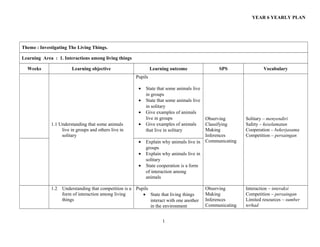
Theme : Investigating The Living Things.
Learning Area : 1. Interactions among living things
Weeks

Learning objective

Learning outcome

SPS

Vocabulary

Pupils
•
•
•
1.1 Understanding that some animals
live in groups and others live in
solitary

•
•
•
•

1.2

State that some animals live
in groups
State that some animals live
in solitary
Give examples of animals
live in groups
Give examples of animals
that live in solitary
Explain why animals live in
groups
Explain why animals live in
solitary
State cooperation is a form
of interaction among
animals

Understanding that competition is a Pupils
form of interaction among living
• State that living things
things
interact with one another
in the environment
1

Observing
Classifying
Making
Inferences
Communicating

Solitary – menyendiri
Safety – keselamatan
Cooperation – bekerjasama
Competition – persaingan

Observing
Making
Inferences
Communicating

Interaction – interaksi
Competition – persaingan
Limited resources – sumber
terhad
YEAR 6 YEARLY PLAN

Territory – wilayah
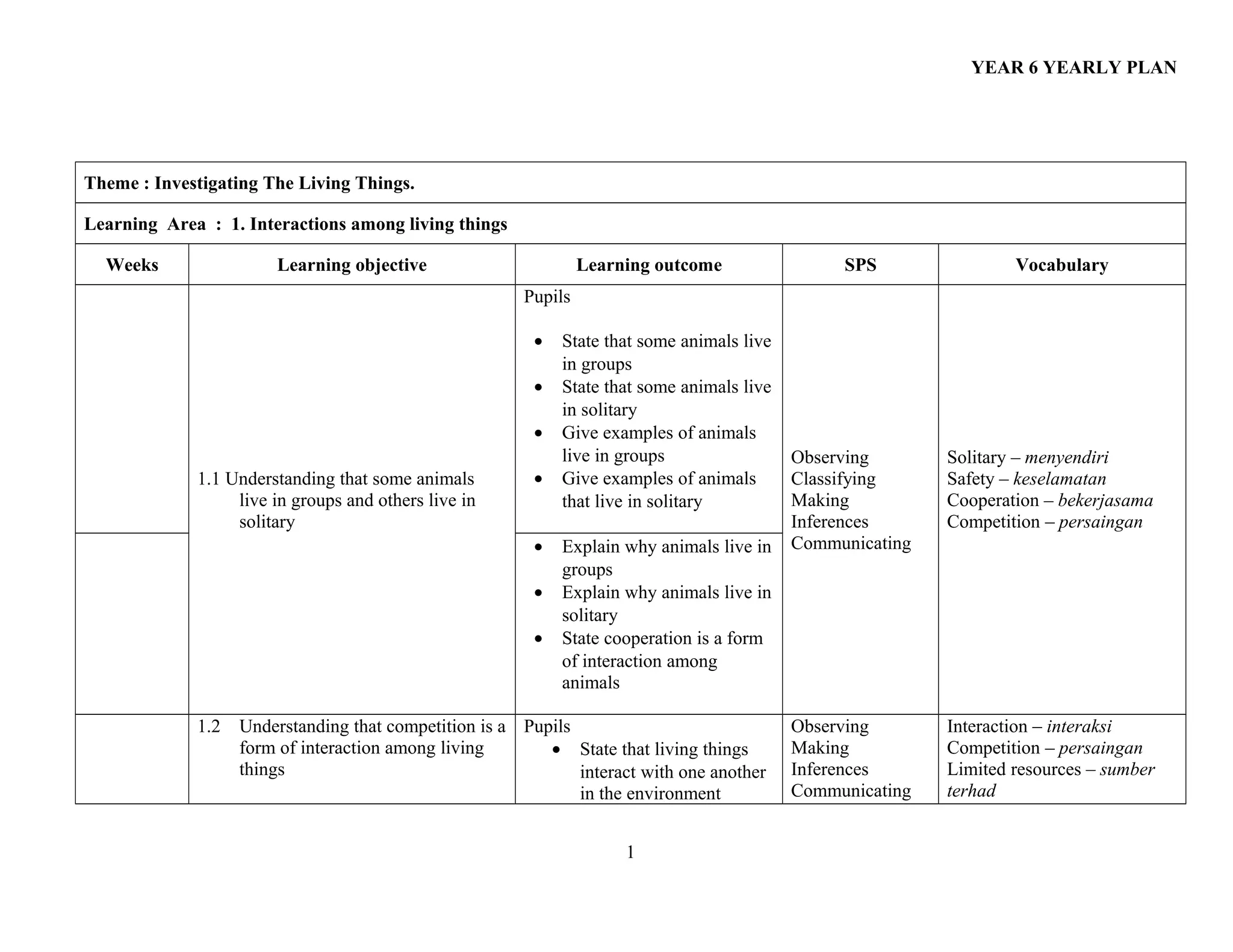
Theme : Investigating The Living Things.
Learning Area : 1. Interactions among living things
Weeks

Learning objective

Learning outcome

SPS

•

1.2

1.3

State that the competition
is a form of interaction
• List the factors that
animals compete for
Understanding that competition is a
• Give reasons why
form of interaction among living
animals compete
things
• List factors that plants
compete for
Give reasons why plants
compete with each other
Understanding the responsibility of Pupils
human beings in protecting
• Give examples of extinct
endangered species
animal
• Give examples of
endangered animal
• Give examples of
endangered plant
• Explain why certain
animals or plants are
facing the threat of
extinction
• Suggest way to prevent
animals and plants from
2

Vocabulary
Breeding –
pembiakan
Mate – pasangan
Defend –
mempertahankan
Space – ruang
Shelter – tempat
perlindungan

Observing
Predicting
Making Inferences
Communicating

Rafflesia – bunga
pakma
Hornbill – burung
enggang
Conservation –
pemuliharaan
Protection –
perlindungan
Endangered –
terancam
Extinct – pupus
Excessive –
berleluasa
YEAR 6 YEARLY PLAN

extinction

Threat – ancaman
Logging –
pembalakan
Consume –
menggunakan
Enforcement penguatkuasaan

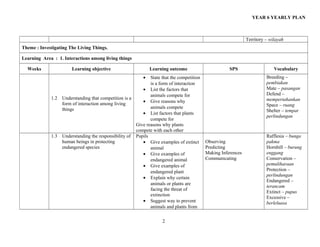
Theme : Investigating The Living Things.
Learning Area : 1. Interactions among living things
Weeks

Learning objective

Learning outcome
Pupils
•

1.4 Knowing the impact of human
activities on environment

•

•

Give examples of
environmental
destruction caused by
human
Explain how human
activities cause
environmental
destruction.
Predict what will happen
to the Earth if human
activities are not
controlled.

3

SPS
Predicting
Classifying
Observing
Making Inferences
Making Hipoteses

Vocabulary
YEAR 6 YEARLY PLAN

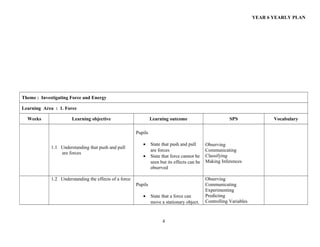
Theme : Investigating Force and Energy
Learning Area : 1. Force
Weeks

Learning objective

Learning outcome

SPS

Pupils
1.1 Understanding that push and pull
are forces

•
•

State that push and pull
are forces
State that force cannot be
seen but its effects can be
observed

1.2 Understanding the effects of a force
Pupils
•

State that a force can
move a stationary object.

4

Observing
Communicating
Classifying
Making Inferences

Observing
Communicating
Experimenting
Predicting
Controlling Variables

Vocabulary
YEAR 6 YEARLY PLAN

•
•

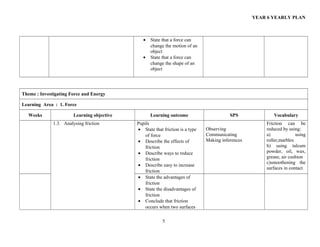
State that a force can
change the motion of an
object
State that a force can
change the shape of an
object

Theme : Investigating Force and Energy
Learning Area : 1. Force
Weeks

Learning objective
1.3. Analysing friction

Learning outcome
Pupils
• State that friction is a type
of force
• Describe the effects of
friction
• Describe ways to reduce
friction
• Describe easy to increase
friction
• State the advantages of
friction
• State the disadvantages of
friction
• Conclude that friction
occurs when two surfaces
5

SPS
Observing
Communicating
Making inferences

Vocabulary
Friction can be
reduced by using:
a)
using
roller,marbles
b) using talcum
powder, oil, wax,
grease, air cushion
c)smoothening the
surfaces in contact
YEAR 6 YEARLY PLAN

•

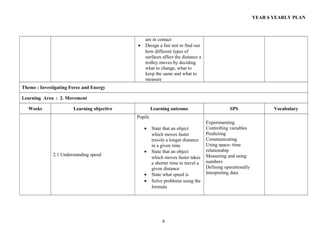
are in contact
Design a fair test to find out
how different types of
surfaces affect the distance a
trolley moves by deciding
what to change, what to
keep the same and what to
measure

Theme : Investigating Force and Energy
Learning Area : 2. Movement
Weeks

Learning objective

Learning outcome

SPS

Pupils
•

2.1 Understanding speed

•

•
•

State that an object
which moves faster
travels a longer distance
in a given time
State that an object
which moves faster takes
a shorter time to travel a
given distance
State what speed is
Solve problems using the
formula

6

Experimenting
Controlling variables
Predicting
Communicating
Using space- time
relationship
Measuring and using
numbers
Defining operationally
Interpreting data

Vocabulary
YEAR 6 YEARLY PLAN

Theme : Investigating Materials
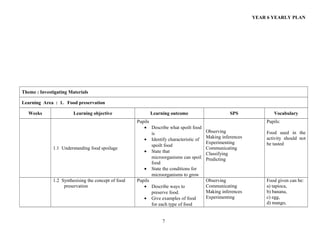
Learning Area : 1. Food preservation
Weeks

Learning objective

1.1 Understanding food spoilage

1.2 Synthesising the concept of food
preservation

Learning outcome
Pupils
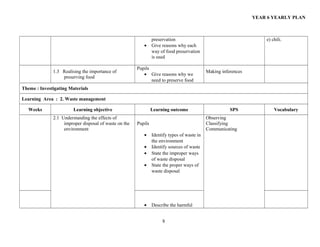
• Describe what spoilt food
is
• Identify characteristic of
spoilt food
• State that
microorganisms can spoil
food
• State the conditions for
microorganisms to grow
Pupils
• Describe ways to
preserve food.
• Give examples of food
for each type of food
7

SPS

Vocabulary
Pupils:

Observing
Making inferences
Experimenting
Communicating
Classifying
Predicting

Food used in the
activity should not
be tasted

Observing
Communicating
Making inferences
Experimenting

Food given can be:
a) tapioca,
b) banana,
c) egg,
d) mango,
YEAR 6 YEARLY PLAN

•

1.3 Realising the importance of
preserving food

preservation
Give reasons why each
way of food preservation
is used

Pupils
• Give reasons why we
need to preserve food

e) chili.

Making inferences

Theme : Investigating Materials
Learning Area : 2. Waste management
Weeks

Learning objective
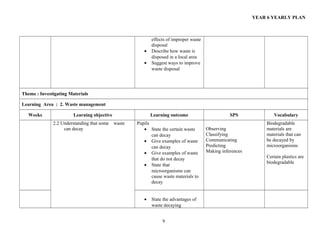
2.1 Understanding the effects of
improper disposal of waste on the
environment

Learning outcome

Observing
Classifying
Communicating

Pupils
•
•
•
•

•

SPS

Identify types of waste in
the environment
Identify sources of waste
State the improper ways
of waste disposal
State the proper ways of
waste disposal

Describe the harmful
8

Vocabulary
YEAR 6 YEARLY PLAN

•
•

effects of improper waste
disposal
Describe how waste is
disposed in a local area
Suggest ways to improve
waste disposal

Theme : Investigating Materials
Learning Area : 2. Waste management
Weeks

Learning objective
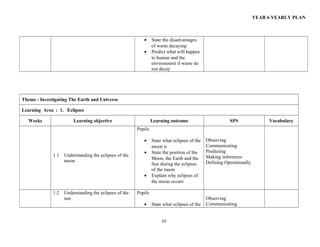
2.2 Understanding that some
can decay

Learning outcome
waste

Pupils
• State the certain waste
can decay
• Give examples of waste
can decay
• Give examples of waste
that do not decay
• State that
microorganisms can
cause waste materials to
decay
•

State the advantages of
waste decaying
9

SPS
Observing
Classifying
Communicating
Predicting
Making inferences

Vocabulary
Biodegradable
materials are
materials that can
be decayed by
microorganisms
Certain plastics are
biodegradable
YEAR 6 YEARLY PLAN

•
•

State the disadvantages
of waste decaying
Predict what will happen
to human and the
environment if waste do
not decay

Theme : Investigating The Earth and Universe
Learning Area : 1. Eclipses
Weeks

Learning objective

Learning outcome

SPS

Pupils
•
1.1

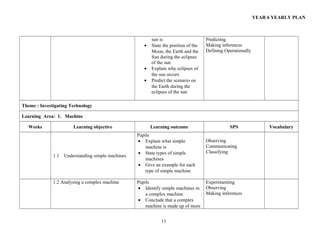
Understanding the eclipses of the
moon

•

•
1.2

Understanding the eclipses of the
sun

State what eclipses of the
moon is
State the position of the
Moon, the Earth and the
Sun during the eclipses
of the moon
Explain why eclipses of
the moon occurs

Observing
Communicating
Predicting
Making inferences
Defining Operationally

Pupils
•

State what eclipses of the
10

Observing
Communicating

Vocabulary
YEAR 6 YEARLY PLAN

•

•
•

sun is
State the position of the
Moon, the Earth and the
Sun during the eclipses
of the sun
Explain why eclipses of
the sun occurs
Predict the scenario on
the Earth during the
eclipses of the sun

Predicting
Making inferences
Defining Operationally

Theme : Investigating Technology
Learning Area: 1. Machine
Weeks

Learning objective

1.1

Understanding simple machines

1.2 Analysing a complex machine

Learning outcome
Pupils
• Explain what simple
machine is
• State types of simple
machines
• Give an example for each
type of simple machine
Pupils
• Identify simple machines in
a complex machine
• Conclude that a complex
machine is made up of more
11

SPS
Observing
Communicating
Classifying

Experimenting
Observing
Making inferences

Vocabulary
YEAR 6 YEARLY PLAN

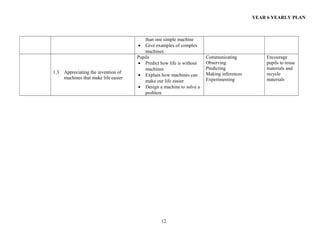
1.3

Appreciating the invention of
machines that make life easier

than one simple machine
• Give examples of complex
machines
Pupils
• Predict how life is without
machines
• Explain how machines can
make our life easier
• Design a machine to solve a
problem

12

Communicating
Observing
Predicting
Making inferences
Experimenting

Encourage
pupils to reuse
materials and
recycle
materials

Science yearly plan year 6

  • 1.
    YEAR 6 YEARLYPLAN Theme : Investigating The Living Things. Learning Area : 1. Interactions among living things Weeks Learning objective Learning outcome SPS Vocabulary Pupils • • • 1.1 Understanding that some animals live in groups and others live in solitary • • • • 1.2 State that some animals live in groups State that some animals live in solitary Give examples of animals live in groups Give examples of animals that live in solitary Explain why animals live in groups Explain why animals live in solitary State cooperation is a form of interaction among animals Understanding that competition is a Pupils form of interaction among living • State that living things things interact with one another in the environment 1 Observing Classifying Making Inferences Communicating Solitary – menyendiri Safety – keselamatan Cooperation – bekerjasama Competition – persaingan Observing Making Inferences Communicating Interaction – interaksi Competition – persaingan Limited resources – sumber terhad
  • 2.
    YEAR 6 YEARLYPLAN Territory – wilayah Theme : Investigating The Living Things. Learning Area : 1. Interactions among living things Weeks Learning objective Learning outcome SPS • 1.2 1.3 State that the competition is a form of interaction • List the factors that animals compete for Understanding that competition is a • Give reasons why form of interaction among living animals compete things • List factors that plants compete for Give reasons why plants compete with each other Understanding the responsibility of Pupils human beings in protecting • Give examples of extinct endangered species animal • Give examples of endangered animal • Give examples of endangered plant • Explain why certain animals or plants are facing the threat of extinction • Suggest way to prevent animals and plants from 2 Vocabulary Breeding – pembiakan Mate – pasangan Defend – mempertahankan Space – ruang Shelter – tempat perlindungan Observing Predicting Making Inferences Communicating Rafflesia – bunga pakma Hornbill – burung enggang Conservation – pemuliharaan Protection – perlindungan Endangered – terancam Extinct – pupus Excessive – berleluasa
  • 3.
    YEAR 6 YEARLYPLAN extinction Threat – ancaman Logging – pembalakan Consume – menggunakan Enforcement penguatkuasaan Theme : Investigating The Living Things. Learning Area : 1. Interactions among living things Weeks Learning objective Learning outcome Pupils • 1.4 Knowing the impact of human activities on environment • • Give examples of environmental destruction caused by human Explain how human activities cause environmental destruction. Predict what will happen to the Earth if human activities are not controlled. 3 SPS Predicting Classifying Observing Making Inferences Making Hipoteses Vocabulary
  • 4.
    YEAR 6 YEARLYPLAN Theme : Investigating Force and Energy Learning Area : 1. Force Weeks Learning objective Learning outcome SPS Pupils 1.1 Understanding that push and pull are forces • • State that push and pull are forces State that force cannot be seen but its effects can be observed 1.2 Understanding the effects of a force Pupils • State that a force can move a stationary object. 4 Observing Communicating Classifying Making Inferences Observing Communicating Experimenting Predicting Controlling Variables Vocabulary
  • 5.
    YEAR 6 YEARLYPLAN • • State that a force can change the motion of an object State that a force can change the shape of an object Theme : Investigating Force and Energy Learning Area : 1. Force Weeks Learning objective 1.3. Analysing friction Learning outcome Pupils • State that friction is a type of force • Describe the effects of friction • Describe ways to reduce friction • Describe easy to increase friction • State the advantages of friction • State the disadvantages of friction • Conclude that friction occurs when two surfaces 5 SPS Observing Communicating Making inferences Vocabulary Friction can be reduced by using: a) using roller,marbles b) using talcum powder, oil, wax, grease, air cushion c)smoothening the surfaces in contact
  • 6.
    YEAR 6 YEARLYPLAN • are in contact Design a fair test to find out how different types of surfaces affect the distance a trolley moves by deciding what to change, what to keep the same and what to measure Theme : Investigating Force and Energy Learning Area : 2. Movement Weeks Learning objective Learning outcome SPS Pupils • 2.1 Understanding speed • • • State that an object which moves faster travels a longer distance in a given time State that an object which moves faster takes a shorter time to travel a given distance State what speed is Solve problems using the formula 6 Experimenting Controlling variables Predicting Communicating Using space- time relationship Measuring and using numbers Defining operationally Interpreting data Vocabulary
  • 7.
    YEAR 6 YEARLYPLAN Theme : Investigating Materials Learning Area : 1. Food preservation Weeks Learning objective 1.1 Understanding food spoilage 1.2 Synthesising the concept of food preservation Learning outcome Pupils • Describe what spoilt food is • Identify characteristic of spoilt food • State that microorganisms can spoil food • State the conditions for microorganisms to grow Pupils • Describe ways to preserve food. • Give examples of food for each type of food 7 SPS Vocabulary Pupils: Observing Making inferences Experimenting Communicating Classifying Predicting Food used in the activity should not be tasted Observing Communicating Making inferences Experimenting Food given can be: a) tapioca, b) banana, c) egg, d) mango,
  • 8.
    YEAR 6 YEARLYPLAN • 1.3 Realising the importance of preserving food preservation Give reasons why each way of food preservation is used Pupils • Give reasons why we need to preserve food e) chili. Making inferences Theme : Investigating Materials Learning Area : 2. Waste management Weeks Learning objective 2.1 Understanding the effects of improper disposal of waste on the environment Learning outcome Observing Classifying Communicating Pupils • • • • • SPS Identify types of waste in the environment Identify sources of waste State the improper ways of waste disposal State the proper ways of waste disposal Describe the harmful 8 Vocabulary
  • 9.
    YEAR 6 YEARLYPLAN • • effects of improper waste disposal Describe how waste is disposed in a local area Suggest ways to improve waste disposal Theme : Investigating Materials Learning Area : 2. Waste management Weeks Learning objective 2.2 Understanding that some can decay Learning outcome waste Pupils • State the certain waste can decay • Give examples of waste can decay • Give examples of waste that do not decay • State that microorganisms can cause waste materials to decay • State the advantages of waste decaying 9 SPS Observing Classifying Communicating Predicting Making inferences Vocabulary Biodegradable materials are materials that can be decayed by microorganisms Certain plastics are biodegradable
  • 10.
    YEAR 6 YEARLYPLAN • • State the disadvantages of waste decaying Predict what will happen to human and the environment if waste do not decay Theme : Investigating The Earth and Universe Learning Area : 1. Eclipses Weeks Learning objective Learning outcome SPS Pupils • 1.1 Understanding the eclipses of the moon • • 1.2 Understanding the eclipses of the sun State what eclipses of the moon is State the position of the Moon, the Earth and the Sun during the eclipses of the moon Explain why eclipses of the moon occurs Observing Communicating Predicting Making inferences Defining Operationally Pupils • State what eclipses of the 10 Observing Communicating Vocabulary
  • 11.
    YEAR 6 YEARLYPLAN • • • sun is State the position of the Moon, the Earth and the Sun during the eclipses of the sun Explain why eclipses of the sun occurs Predict the scenario on the Earth during the eclipses of the sun Predicting Making inferences Defining Operationally Theme : Investigating Technology Learning Area: 1. Machine Weeks Learning objective 1.1 Understanding simple machines 1.2 Analysing a complex machine Learning outcome Pupils • Explain what simple machine is • State types of simple machines • Give an example for each type of simple machine Pupils • Identify simple machines in a complex machine • Conclude that a complex machine is made up of more 11 SPS Observing Communicating Classifying Experimenting Observing Making inferences Vocabulary
  • 12.
    YEAR 6 YEARLYPLAN 1.3 Appreciating the invention of machines that make life easier than one simple machine • Give examples of complex machines Pupils • Predict how life is without machines • Explain how machines can make our life easier • Design a machine to solve a problem 12 Communicating Observing Predicting Making inferences Experimenting Encourage pupils to reuse materials and recycle materials