• Identify WilliamNelson
Joy's arguments as to why
the future does not need us;
• Evaluate contemporary
human experiences with
science and technology; and
• Compare the future does
not need us and why the
future needs us?
01 02 03
OBJECTIVES:
3.
• Can youimagine a future without human race? Do you think that robots and
machines can replace humans? Do you believe that there will come a time when
human existence will be at the mercy of robots and machines? Is it also possible
that medical breakthroughs in the future may go terribly wrong that a strain of
drug-resistant viruses could wipe out the entire human race?
• For some, imagining a future without humans is nearly synonymous to the end
of world. Many choose not to speculate about future where humans cease to
exist while the world remains. However, a dystopian society void human presence
is the subject of many works in literature and film. The possibility of such society
is also a constant topic of debates.
4.
• William NelsonJoy, an American computer scientist and chief
scientist of Sun Microsystems, wrote an article for Wired magazine
entitled Why the future doesn't need us?
• Joy warned against the rapid rise of new technologies.
• He explained that 21st century technologies - genetics,
nanotechnology, and robotics (GNR) - are becoming very powerful
that they can potentially bring about new classes of accidents,
threats, and abuses.
• He further warned that these dangers are even more pressing
because they do not require large facilities or even rare materials
• Knowledge alone will make them potentially harmful to humans
WILLIAM NELSON JOY, APRIL 2000
Why the future doesn't need us?
5.
AI provides insights
and
recommendations
toassist human
decision-making.
Decision
Support
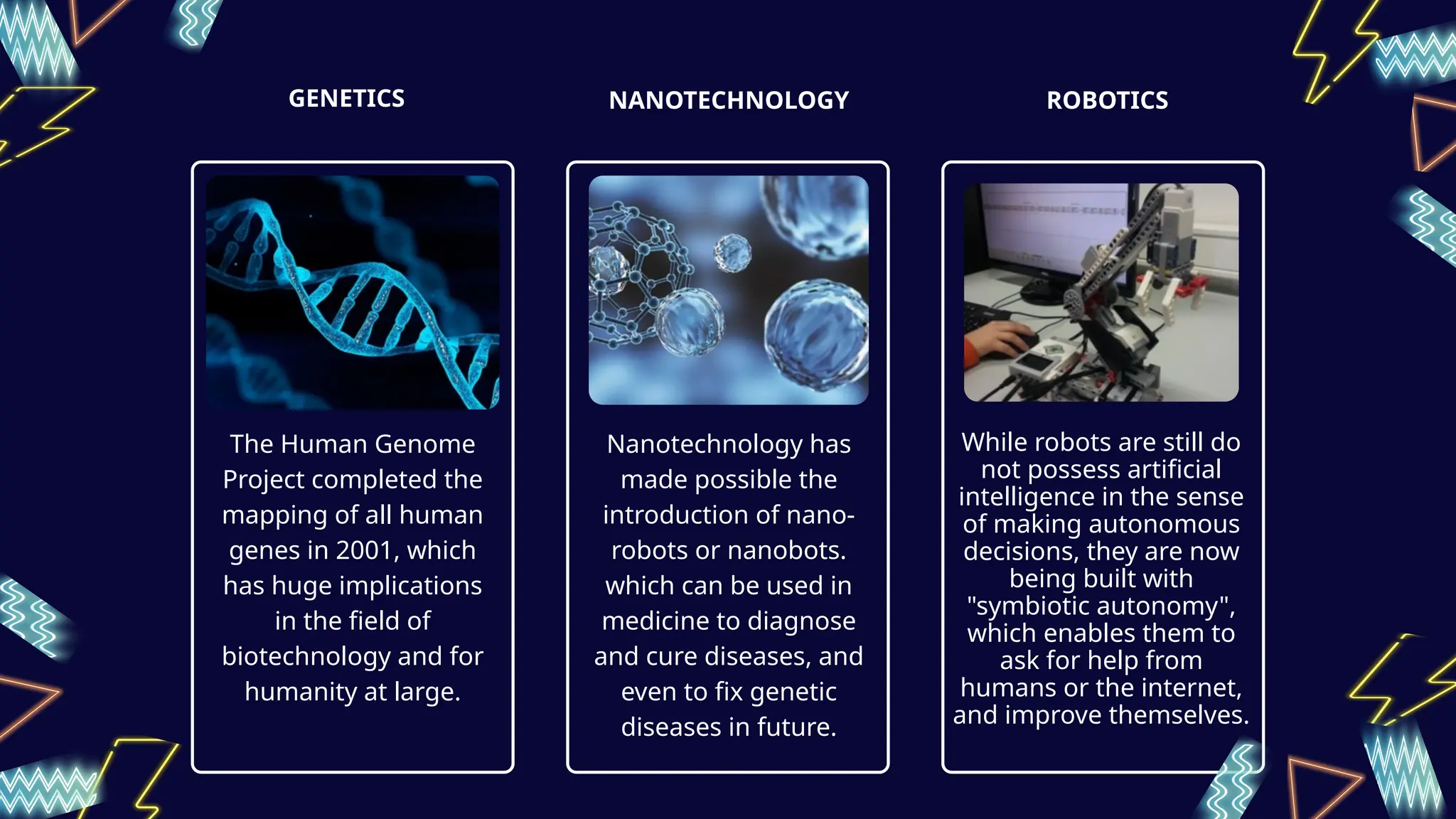
The Human Genome
Project completed the
mapping of all human
genes in 2001, which
has huge implications
in the field of
biotechnology and for
humanity at large.
GENETICS NANOTECHNOLOGY
Nanotechnology has
made possible the
introduction of nano-
robots or nanobots.
which can be used in
medicine to diagnose
and cure diseases, and
even to fix genetic
diseases in future.
ROBOTICS
While robots are still do
not possess artificial
intelligence in the sense
of making autonomous
decisions, they are now
being built with
"symbiotic autonomy",
which enables them to
ask for help from
humans or the internet,
and improve themselves.
6.
- Joy furtherargues that developing technologies provide a much greater danger
to humanity than any technological before has ever presented.
He argued that the 20th century technologies of destruction such as the nuclear
bomb were limited to larger governments due to the complexity and cost of such
device.
- He was also concerned that computers will eventually become more intelligent
than humans, thus ushering societies into dystopian visions, such as robot
rebellions.
To illuminate his concern, Joy drew from Theodore Kaczynski's book, Unabomber
Manifesto, which argued that technology's unintended consequences are linked
to Murphy's Law.
7.
- Where Kaczynskidescribed that the unintended.
consequences of the design and use of technology.
Murphy's Law: "Anything that can go wrong, will go
wrong".
Theodore Kaczynski's book, Unabomber
Manifesto (1995)
- He argued that over reliance on antibiotics led to
antibiotic- resistant strains of dangerous bacteria, such
as malarial parasites with multi-drug-resistant genes,
highlighting the paradox of technology's unintended
consequences.
8.
Joy's arguments against21st- century technologies have received both criticisms and
expression of shared concern. Critics dismissed Joy's article for deliberately
presenting information in an imprecise manner that obscures the larger picture or
state of things.
Technofuturists, criticized Joy's failure to consider social factors and only deliberately
focused on one part of the larger picture. Others go as far as accusing Joy of being a
neo-Luddite, someone who rejects new technologies and shows technophobic
leanings.
9.
- Joy warnsabout the dangers of unchecked scientific and technological
advancements.
- Raises concerns about a future where humans become obsolete.
- Calls for responsibility among scientists, governments, and businesses to implement
safeguards.
Overview of Joy's Argument
10.
- Nader supportsJoy’s concerns about self-replicating technologies.
- Argues that once-fictional dangers are becoming real within decades.
- Highlights the lack of oversight as thousands of experts develop technologies
without considering long-term consequences.
Ralph Nader's Commentary
11.
Responsibilty of TechnologicalDevelopment
Cautious Approach
- Developers and policymakers must exercise great care and foresight in the development and
deployment of transformative technologies.
Ethical Framework
- Robust ethical guidelines and governance structures are needed to ensure advanced
technologies are aligned with human values.
Public Engagement
- Ongoing dialogue and collaboration with the public is crucial to address the societal
implications of technological change.
12.
Ethical Dilemmas ofAdvanced Technology
Privacy
- The rise of ubiquitous
surveillance and data
collection pose significant
threats to personal privacy
and civil liberties.
Algorithmic Bias
- Al systems can perpetuate
and amplify societal biases,
leading to unfair and
discriminatory outcomes
Transparency
-The opaque nature of many
Al systems makes it difficult
to understand and hold
accountable their decision-
making processes.
13.
Though there areuses, some argue that there are ethical dilemmas that these
advancements bring forth.
These include:
• Parents argue that they make children lazy and unhealthy.
• People become alienated from other people because they are fixated with these devices.
• Instead of connecting people, they tend to separate them.
• People who are unable to distinguish from what is right and wrong are exposed to things which
are not suitable for them.
• Also, according to the article "Is Google making us stupid?" by Nicolas Carr, we become
dependent on the Internet that our intelligence is affected.
• We begin to lose our way of concentration and contemplation and we began to lose interest in
reading longish articles or books.
• Instead, we rely on the speed and ease of the Internet.
14.
Why the futuredoes not needs us?
VS
Why the future needs us?
15.
Why the futuredoes not needs us?
Technological Autonomy
- The advanced technologies, especially in the realms of nanotechnology, robotics, and artificial
intelligence, could surpass human control, leading to unintended consequences.
Loss of Human Agency
- As machines become more intelligent and autonomous, there's a concern that humans may
lose their significance in decision-making processes, leading to a loss of control over their own
destinies.
Ethical Dilemmas
- The increasing complexity of technology raises ethical concerns about its impact on society,
including questions about privacy, autonomy, and the distribution of power and resources.
16.
Why the futureneed us?
Human Ingenuity
- Despite the potential risks associated with advanced technology, humans possess unique
qualities such as creativity, empathy, and moral reasoning, which are essential for navigating
complex ethical and social challenges.
Adaptability and Resilience
- Despite the rapid pace of technological change, humans have demonstrated a remarkable
ability to adapt and innovate in response to new challenges, suggesting that they will continue to
play a central role in shaping the future.
Ethical Oversight
- While autonomous technologies may have the potential to outpace human control, it is argued
that humans still play a crucial role in setting ethical guidelines and ensuring responsible
development and deployment of technology.
17.
Why the futureneed us?
The future needs us because as humans, we possess
unique abilities such as creativity, empathy, and critical
thinking that are crucial for solving complex problems,
innovating, and shaping a better world. Additionally, our
capacity for ethical decision-making and moral reasoning is
essential for guiding the development and use of advanced
technologies responsibly.
19.
"We may notknow what the future
holds, but we know who holds our
future."