WHEN TECHNOLOGY AND
HUMANITY CROSS
Introduction
• The ever-growing society has made people see technology as some form of
necessity.
• Technology-comes from the Greek word techne and logos which mean art and
word.
• Technology means a discourse on arts.
• It first appeared in the 17th century where the concept was only used to talk about
the arts, specifically applied arts.
• Concepts like machine and tools were also attached to the word which is the more
popular sense of the concept nowadays.
• A number of technological devices can be easily found inside the home, the most
accessible place to anyone.
• It can also be easily inferred that these technological devices are some of the most
popular and most commonly used types of devices across all age groups.
• People all over the world use these technologies every day to accomplish different
purposes.
TELEVISION SETS, MOBILE PHONES, COMPUTERS
AND HUMANITY
TELEVISION
• According to Kantar Media, one of the most trusted television audience measurement
providers, in the Philippines, 92% of urban homes and 70% of rural homes own at least
one television set.
• In addition to this, Kantar Media also reported that in the Philippines, the current
count of households with television set already reached 15. 135 million (Noda, 2012).
• Television was a product of different experiments by various people.
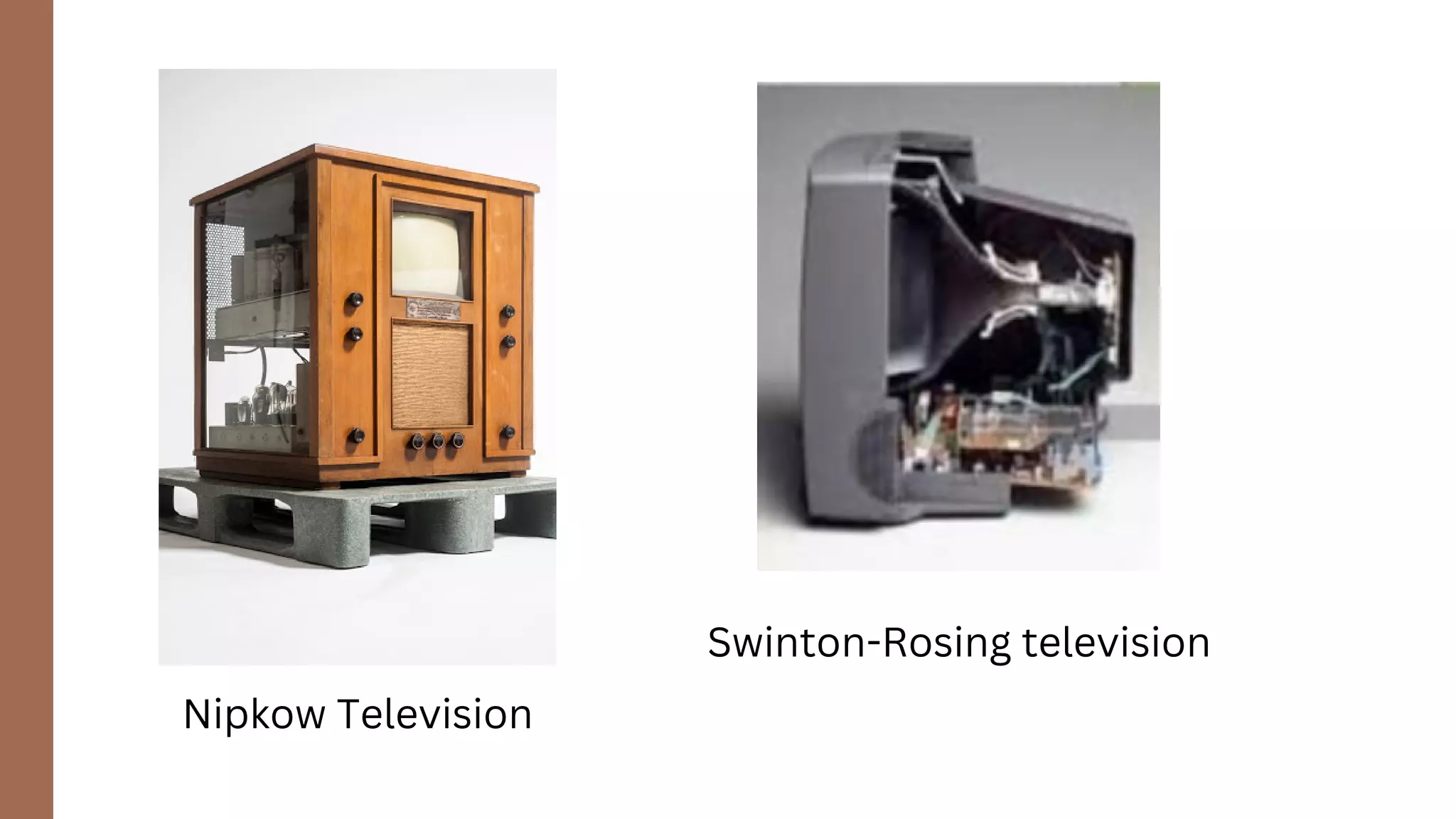
Paul Gottlieb Nipkow, a German student, in the late 1800s was successful in his
attempt to send images through wires with the aid of a rotating disk.
This invention was the called “electric telescope” that had 18 lines of resolution.
In 1907, two inventors, Alan Archibald Campbell-Swinton who was an English
This success story gave rise to two types of television systems, namely, mechanical
and electronic television (Jezek, n.d.).
scientist and Boris Rosing who was a Russian scientist, created a new system of
television by using cathode ray tube in addition to the mechanical scanner system.
Nipkow Television
Swinton-Rosing television
MOBILE PHONES
• Mobile phones have a very interesting background story.
• On April 3, 1973 Martin Cooper, a senior engineer at Motorola, made the world’s
first mobile phone call.
• The mobile phone used by Cooper weighed 1.1 kilograms and measured 228.6 x
127 x 44.4 mm.
• This kind of device was capable of a 30 minute talk time.
• However, it took 10 hours to charge.
• In 1983, Motorola made their first commercial mobile phone
available to the public.
• It was known as the Motorola DynaTAC8000X (Goodwin, 2016)
COMPUTERS AND LAPTOPS
• It was Charles Babbage, a 19th century English Mathematics professor,
who designed the which was used as the basic framework of the
computers even until the present time.
• In general, computers can be classified in three generations.
• Each generation of the computer was used for a certain period of time
and each gave people a new and improved version of the previous one
(Steitz, n.d.)
• The first true portable computer was released in April 1981.
• It was called the Osborne 1 (Orfano, 2011)
• A typical household owns at least four of the following devices: a mobile phone (89%),
smartphone (53 %), tablet (14 %), desktop ( 39 %), laptop or netbooks (37 %), and smart TV (4 %)
( Philstar, 2013)
• These data prove the deep-seated fascination of Filipinos to different technological devices.
Here are some facts about Filipinos and their use of gadgets and the
Internet:
• Mobile phone subscription is at 119 million.
• Filipinos spend approximately 3.2 hours on mobile and 5.2 hours on desktop daily.
• Currently, the Philippines has one of the highest digital populations in the world.
• There are now 47 million active Facebook accounts in the Philippines.
The Philippines is the fastest-growing application market in Southeast Asia.
Roles Played by These Technological Advancements
advertisements and information dissemination
recreational activity and good stress reliever
good platform for different propagandas and
advocacies
good way to bond with one's family members
Television
communication
surf the internet
take pictures
Other applications like music player, calendar, radio
and among others.
Mobile Phones
surf the internet and communication
use for job
play games
watch movie etc.
Personal computers and laptops
It was the recklessness and overconfidence of the adults that cause the character change in
children.
• First dilemma, people who develop different kinds of sickness because of too much use of
technological devices.
• Second dilemma, the people in the scientific world nor the children are blameworthy because first,
the children are not yet capable of rationally deciding for themselves what is good and what is bad.
Second even the creators of these technologies went out of their way to inform children of the pros
and cons of these technological contributions, it would still be useless because the children have no
capacity to understand them yet.
Ethical Dilemma Faced by These Technological
Advancements
• Another great product of the innovative minds of the people is the robot.
• Robots are now widely used. Ex. There are so called service robots. These particular
robots do specific tasks but focus mainly in assisting their masters in their everyday
tasks.
• The International Federation of Robotics (IFR) and United Nations Economic
Commission for Europe (UNECE) made it their task to formulate a working definition for
service robots.
Robotics and Humanity
• A robot is an actuated mechanism programmable in two or more axes with a degree of
autonomy, moving within its environment, to perform intended tasks.
• A service robot is a robot that performs useful tasks for humans or equipment excluding
industrial automation application.
• A personal service robot or a service robot for personal use is a robot used for a
noncommercial task, usually by laypersons. Ex. Domestic servant robot, automated wheelchair,
personal mobility assist robot, and pet exercising robot.
• A professional service robot or a service robot for professional use is a robot used for a
commercial task, usually operated by a properly trained operator.
A preliminary extract of the relevant definition is
(IFR, 2012):
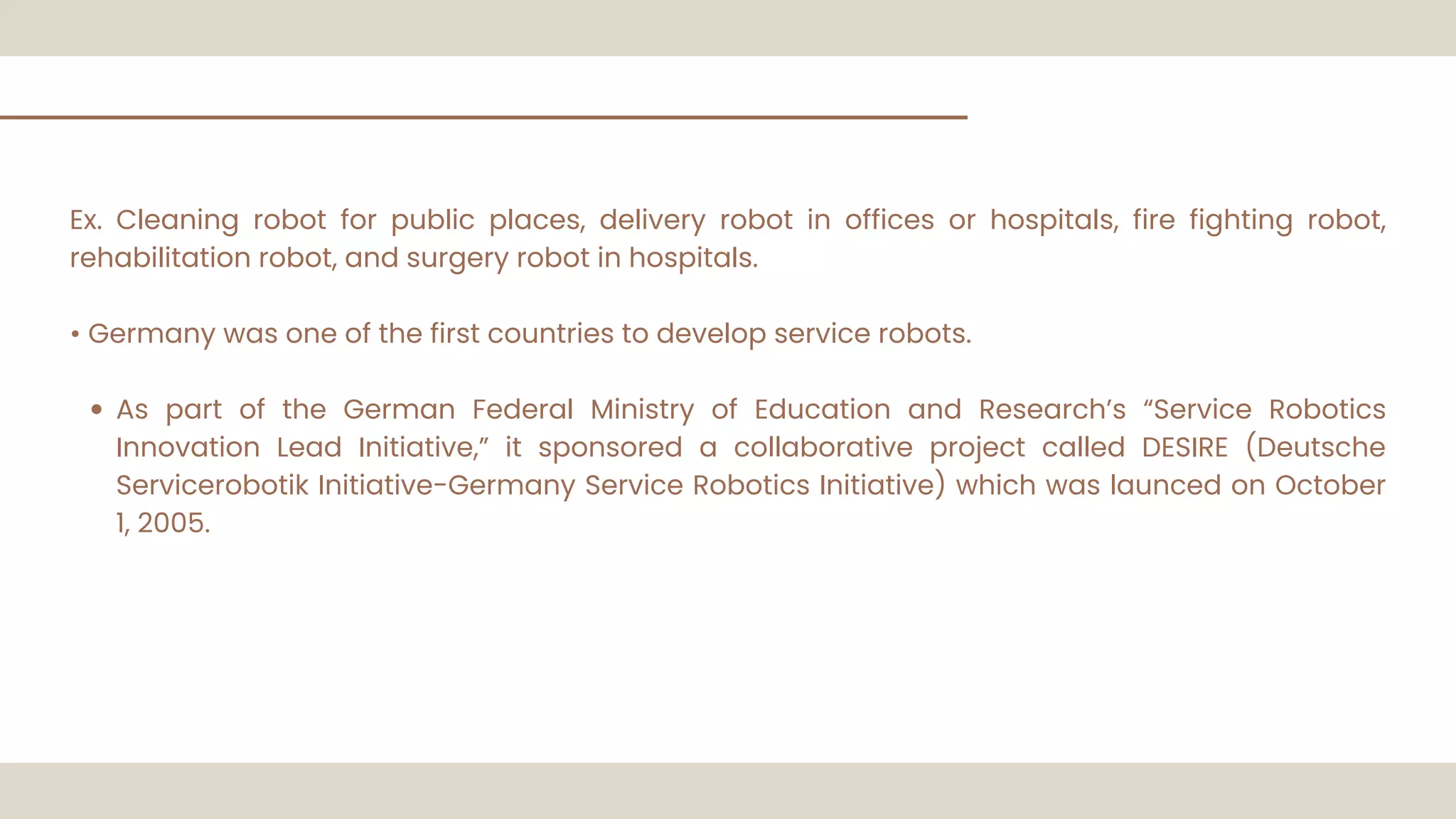
As part of the German Federal Ministry of Education and Research’s “Service Robotics
Innovation Lead Initiative,” it sponsored a collaborative project called DESIRE (Deutsche
Servicerobotik Initiative-Germany Service Robotics Initiative) which was launced on October
1, 2005.
Ex. Cleaning robot for public places, delivery robot in offices or hospitals, fire fighting robot,
rehabilitation robot, and surgery robot in hospitals.
• Germany was one of the first countries to develop service robots.
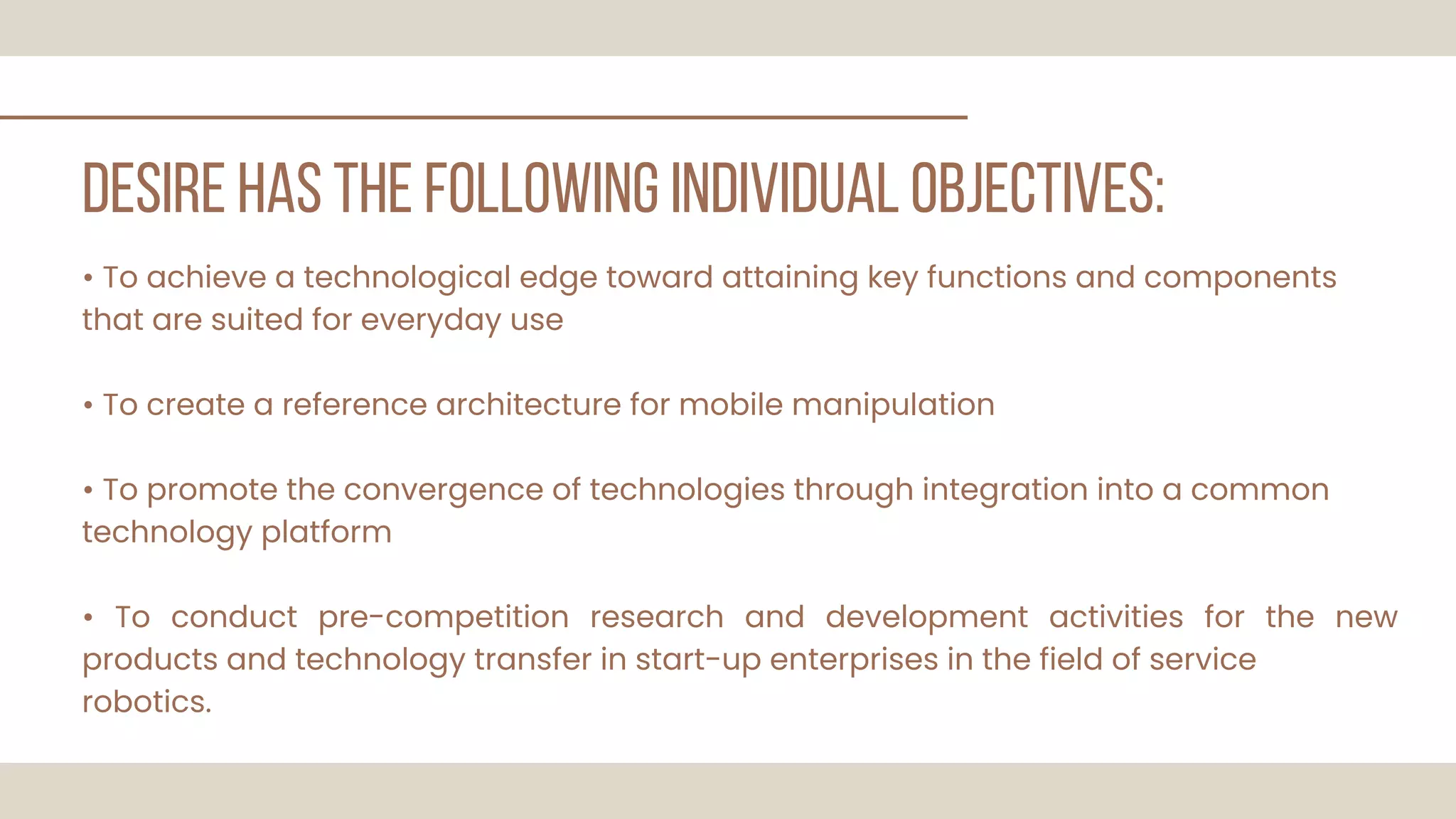
• To achieve a technological edge toward attaining key functions and components
that are suited for everyday use
• To create a reference architecture for mobile manipulation
• To promote the convergence of technologies through integration into a common
technology platform
• To conduct pre-competition research and development activities for the new
products and technology transfer in start-up enterprises in the field of service
robotics.
DESIRE has the following individual objectives:
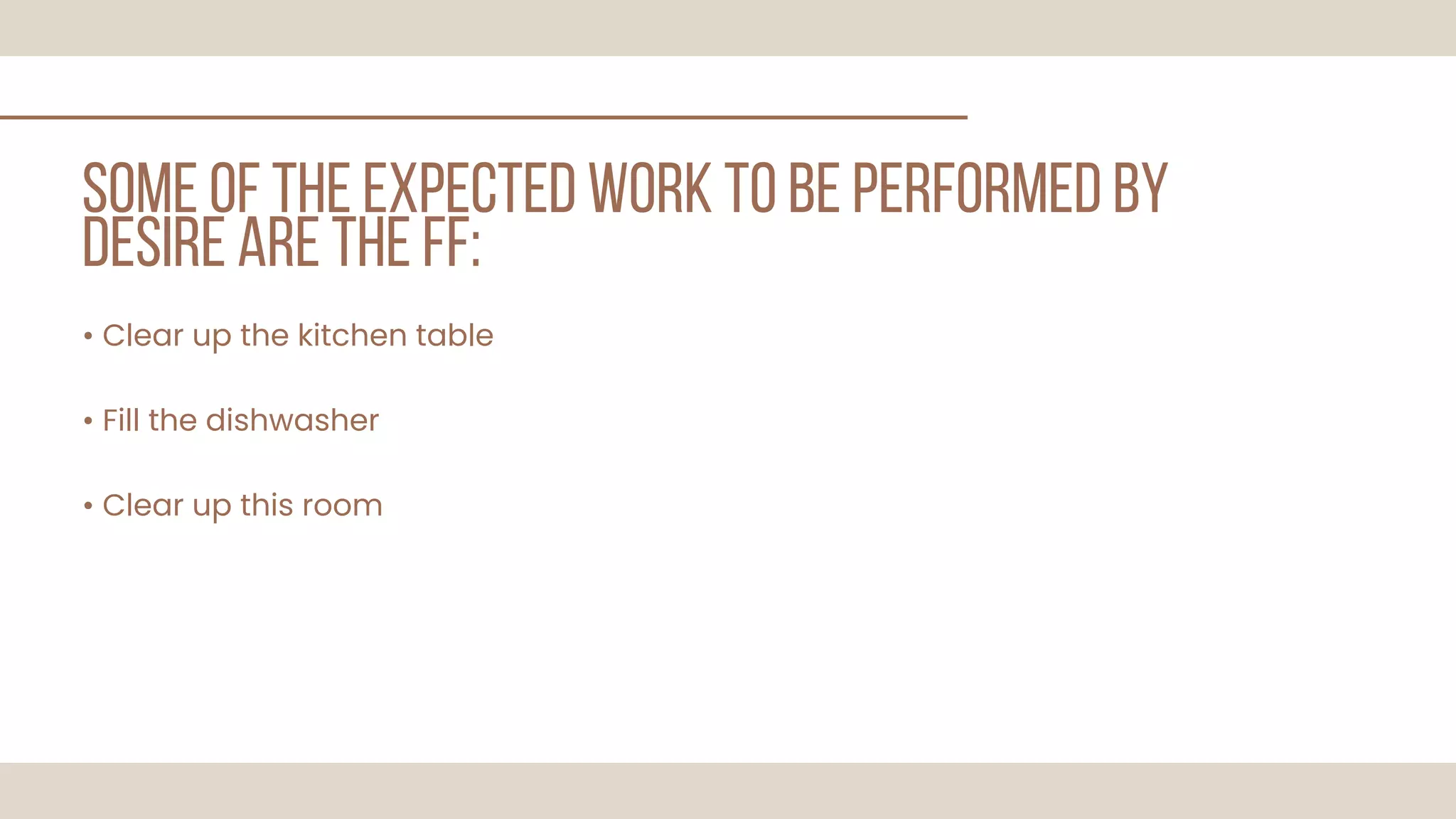
• Clear up the kitchen table
• Fill the dishwasher
• Clear up this room
Some of the expected work to be performed by
DESIRE are the ff:
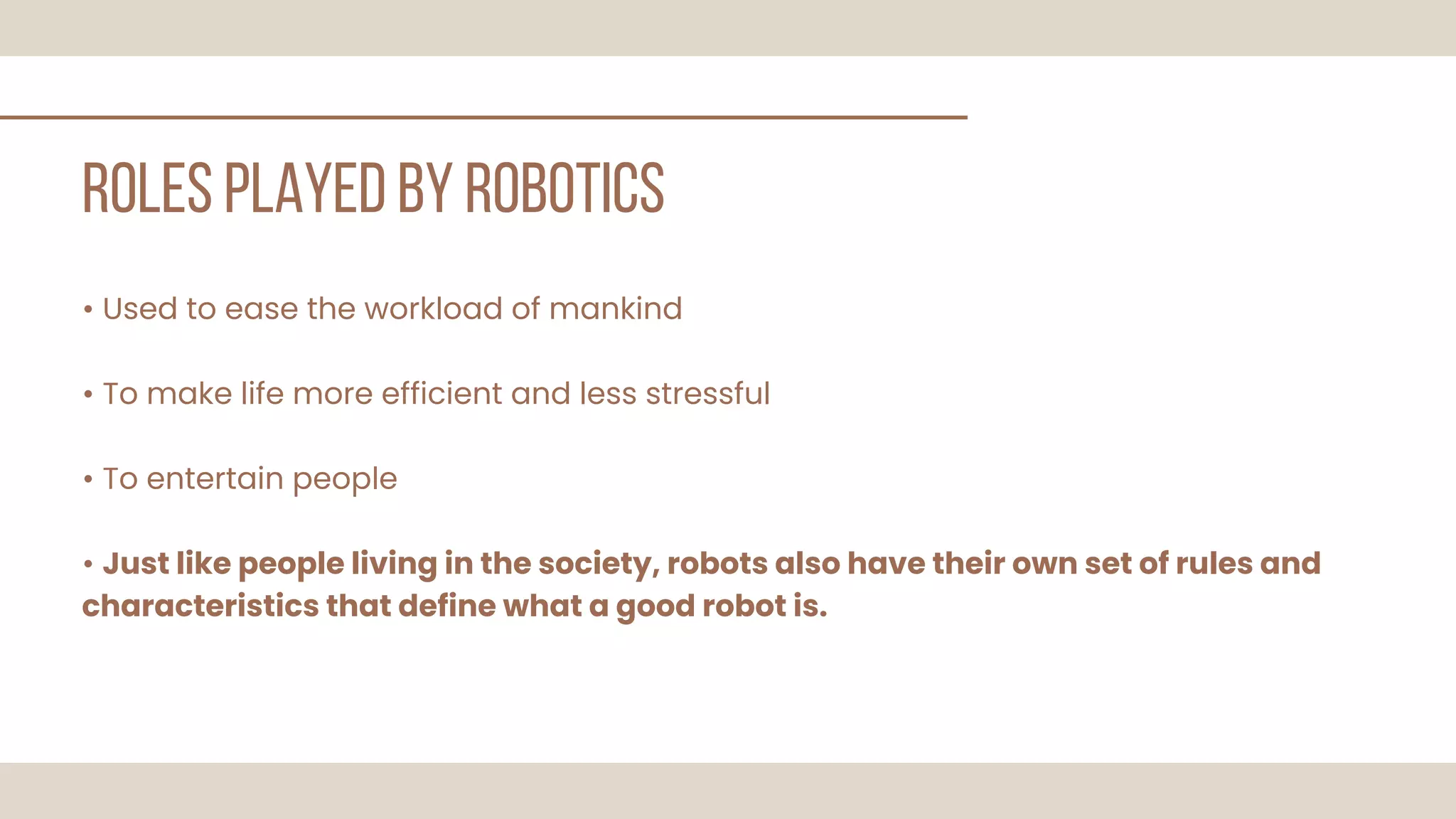
• Used to ease the workload of mankind
• To make life more efficient and less stressful
• To entertain people
• Just like people living in the society, robots also have their own set of rules and
characteristics that define what a good robot is.
Roles Played by Robotics
These laws were formulated by Isaac Asimov back in the 1940’s, when he was
thinking of the ethical consequences of robots.
These are the following (Standford, n.d.):
• Law One: A robot may not injure a human being or, through inaction, allow a human
being to come to harm.
• Law Two: A robot must obey the orders given it by human beings except where such
orders would conflict with the First Law.
• Law Three: A robot must protect its own existence as long as such protection does
not conflict with the First or Second Law.
• Safety
• Emotional component
• Partial autonomy includes active human-robot interaction
• Full autonomy excludes active human-robot interaction
Ethical Dilemma/s Faced by Robotics

WHEN TECHNOLOGY AND HUMANITY CROSS.pdf

  • 1.
  • 2.
    Introduction • The ever-growingsociety has made people see technology as some form of necessity. • Technology-comes from the Greek word techne and logos which mean art and word. • Technology means a discourse on arts. • It first appeared in the 17th century where the concept was only used to talk about the arts, specifically applied arts. • Concepts like machine and tools were also attached to the word which is the more popular sense of the concept nowadays.
  • 3.
    • A numberof technological devices can be easily found inside the home, the most accessible place to anyone. • It can also be easily inferred that these technological devices are some of the most popular and most commonly used types of devices across all age groups. • People all over the world use these technologies every day to accomplish different purposes. TELEVISION SETS, MOBILE PHONES, COMPUTERS AND HUMANITY
  • 4.
    TELEVISION • According toKantar Media, one of the most trusted television audience measurement providers, in the Philippines, 92% of urban homes and 70% of rural homes own at least one television set. • In addition to this, Kantar Media also reported that in the Philippines, the current count of households with television set already reached 15. 135 million (Noda, 2012). • Television was a product of different experiments by various people.
  • 5.
    Paul Gottlieb Nipkow,a German student, in the late 1800s was successful in his attempt to send images through wires with the aid of a rotating disk. This invention was the called “electric telescope” that had 18 lines of resolution. In 1907, two inventors, Alan Archibald Campbell-Swinton who was an English This success story gave rise to two types of television systems, namely, mechanical and electronic television (Jezek, n.d.). scientist and Boris Rosing who was a Russian scientist, created a new system of television by using cathode ray tube in addition to the mechanical scanner system.
  • 6.
  • 7.
    MOBILE PHONES • Mobilephones have a very interesting background story. • On April 3, 1973 Martin Cooper, a senior engineer at Motorola, made the world’s first mobile phone call. • The mobile phone used by Cooper weighed 1.1 kilograms and measured 228.6 x 127 x 44.4 mm.
  • 8.
    • This kindof device was capable of a 30 minute talk time. • However, it took 10 hours to charge. • In 1983, Motorola made their first commercial mobile phone available to the public. • It was known as the Motorola DynaTAC8000X (Goodwin, 2016)
  • 9.
    COMPUTERS AND LAPTOPS •It was Charles Babbage, a 19th century English Mathematics professor, who designed the which was used as the basic framework of the computers even until the present time. • In general, computers can be classified in three generations. • Each generation of the computer was used for a certain period of time and each gave people a new and improved version of the previous one (Steitz, n.d.) • The first true portable computer was released in April 1981. • It was called the Osborne 1 (Orfano, 2011)
  • 10.
    • A typicalhousehold owns at least four of the following devices: a mobile phone (89%), smartphone (53 %), tablet (14 %), desktop ( 39 %), laptop or netbooks (37 %), and smart TV (4 %) ( Philstar, 2013) • These data prove the deep-seated fascination of Filipinos to different technological devices.
  • 11.
    Here are somefacts about Filipinos and their use of gadgets and the Internet: • Mobile phone subscription is at 119 million. • Filipinos spend approximately 3.2 hours on mobile and 5.2 hours on desktop daily. • Currently, the Philippines has one of the highest digital populations in the world. • There are now 47 million active Facebook accounts in the Philippines. The Philippines is the fastest-growing application market in Southeast Asia.
  • 12.
    Roles Played byThese Technological Advancements advertisements and information dissemination recreational activity and good stress reliever good platform for different propagandas and advocacies good way to bond with one's family members Television
  • 13.
    communication surf the internet takepictures Other applications like music player, calendar, radio and among others. Mobile Phones
  • 14.
    surf the internetand communication use for job play games watch movie etc. Personal computers and laptops
  • 15.
    It was therecklessness and overconfidence of the adults that cause the character change in children. • First dilemma, people who develop different kinds of sickness because of too much use of technological devices. • Second dilemma, the people in the scientific world nor the children are blameworthy because first, the children are not yet capable of rationally deciding for themselves what is good and what is bad. Second even the creators of these technologies went out of their way to inform children of the pros and cons of these technological contributions, it would still be useless because the children have no capacity to understand them yet. Ethical Dilemma Faced by These Technological Advancements
  • 16.
    • Another greatproduct of the innovative minds of the people is the robot. • Robots are now widely used. Ex. There are so called service robots. These particular robots do specific tasks but focus mainly in assisting their masters in their everyday tasks. • The International Federation of Robotics (IFR) and United Nations Economic Commission for Europe (UNECE) made it their task to formulate a working definition for service robots. Robotics and Humanity
  • 17.
    • A robotis an actuated mechanism programmable in two or more axes with a degree of autonomy, moving within its environment, to perform intended tasks. • A service robot is a robot that performs useful tasks for humans or equipment excluding industrial automation application. • A personal service robot or a service robot for personal use is a robot used for a noncommercial task, usually by laypersons. Ex. Domestic servant robot, automated wheelchair, personal mobility assist robot, and pet exercising robot. • A professional service robot or a service robot for professional use is a robot used for a commercial task, usually operated by a properly trained operator. A preliminary extract of the relevant definition is (IFR, 2012):
  • 18.
    As part ofthe German Federal Ministry of Education and Research’s “Service Robotics Innovation Lead Initiative,” it sponsored a collaborative project called DESIRE (Deutsche Servicerobotik Initiative-Germany Service Robotics Initiative) which was launced on October 1, 2005. Ex. Cleaning robot for public places, delivery robot in offices or hospitals, fire fighting robot, rehabilitation robot, and surgery robot in hospitals. • Germany was one of the first countries to develop service robots.
  • 19.
    • To achievea technological edge toward attaining key functions and components that are suited for everyday use • To create a reference architecture for mobile manipulation • To promote the convergence of technologies through integration into a common technology platform • To conduct pre-competition research and development activities for the new products and technology transfer in start-up enterprises in the field of service robotics. DESIRE has the following individual objectives:
  • 20.
    • Clear upthe kitchen table • Fill the dishwasher • Clear up this room Some of the expected work to be performed by DESIRE are the ff:
  • 21.
    • Used toease the workload of mankind • To make life more efficient and less stressful • To entertain people • Just like people living in the society, robots also have their own set of rules and characteristics that define what a good robot is. Roles Played by Robotics
  • 22.
    These laws wereformulated by Isaac Asimov back in the 1940’s, when he was thinking of the ethical consequences of robots. These are the following (Standford, n.d.): • Law One: A robot may not injure a human being or, through inaction, allow a human being to come to harm. • Law Two: A robot must obey the orders given it by human beings except where such orders would conflict with the First Law. • Law Three: A robot must protect its own existence as long as such protection does not conflict with the First or Second Law.
  • 23.
    • Safety • Emotionalcomponent • Partial autonomy includes active human-robot interaction • Full autonomy excludes active human-robot interaction Ethical Dilemma/s Faced by Robotics