Instructor: Gavin Malala
HISTORICAL ANTECEDENTS OF
SCIENCE AND TECHNOLOGY
HISTORY OF SCIENCE AND
TECHNOLOGY
IN THE PHILIPPINES
 Science and technology in the Philippines had
experienced periods of intense growth as well
as long periods of stagnation.
 The main managing agency responsible for
science and technology is the Department of
Science and Technology.
 Numerous national scientists have contributed
in different fields of science including Fe del
Mundo in the field of Pediatrics, Eduardo
Quisumbing in the field of Plant taxonomy,
Gavino Trono in the field of tropical marine
Phycology, Maria Orosa in the field of Food
technology and many more
PRE-SPANISH ERA
 Even before the colonization by
the Spaniards in the Philippine
islands, the natives of the
archipelago already had
practices linked to science and
technology.
 Filipinos were already aware of
the medicinal and therapeutic
properties of plants and the
methods of extracting medicine
from herbs.
 They already had an alphabet,
number system, a weighing and
measuring system and a
calendar. Filipinos were already
engaged in farming,
shipbuilding, mining and
weaving.
 The Banaue Rice Terraces are
among the sophisticated
products of engineering by pre-
Spanish era Filipinos.
SPANISH COLONIAL ERA
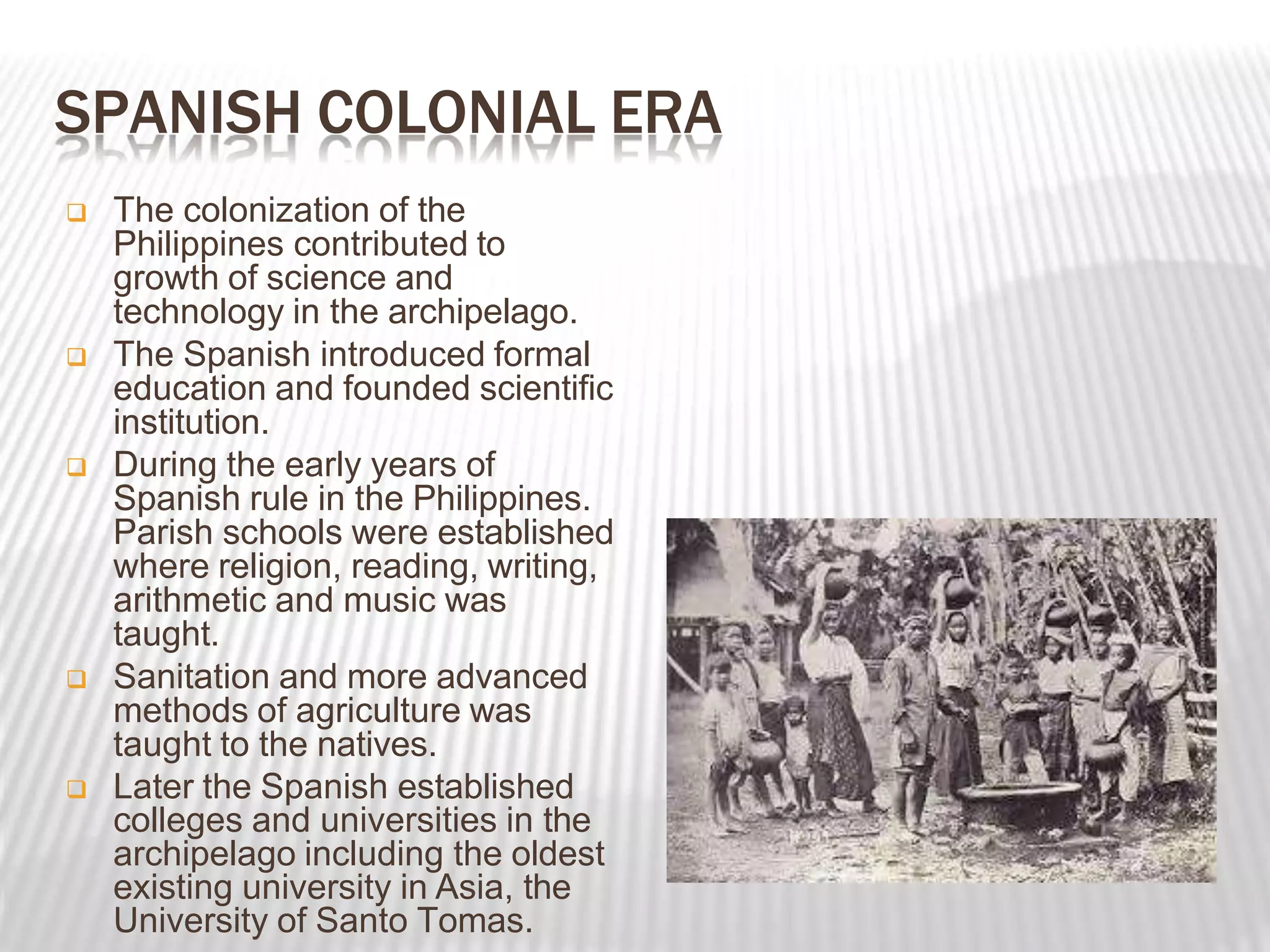
 The colonization of the
Philippines contributed to
growth of science and
technology in the archipelago.
 The Spanish introduced formal
education and founded scientific
institution.
 During the early years of
Spanish rule in the Philippines.
Parish schools were established
where religion, reading, writing,
arithmetic and music was
taught.
 Sanitation and more advanced
methods of agriculture was
taught to the natives.
 Later the Spanish established
colleges and universities in the
archipelago including the oldest
existing university in Asia, the
University of Santo Tomas.
🞭 The Galleon Trade have
accounted in the Philippine
colonial economy.
🞭 Trade was given more focus
by the Spaniard colonial
authorities due to the
prospects of big profits.
🞭 Agriculture and industrial
development on the other
hand were relatively
neglected.
🞭 The opening of the Suez
Canal saw the influx of
European visitors to the
Spanish colony and some
🞭 Filipinos were able to study
in Europe who were
probably influenced by the
rapid development of
scientific ideals brought by
the Age of Enlightenment.
AMERICAN PERIOD
 The progress of science and technology in the
Philippines continued under American rule of the
islands.
 On July 1, 1901 The Philippine Commission
established the Bureau of Government
Laboratories which was placed under the
Department of Interior. The Bureau replaced the
Laboratorio Municipal, which was established
under the Spanish colonial era. The Bureau dealt
with the study of tropical diseases and laboratory
projects.
 On October 26, 1905, the Bureau of Government
Laboratories was replaced by the Bureau of
Science and on December 8, 1933, the National
Research Council of the Philippines was
established.
 The Bureau of Science became the primary
POST COMMONWEALTH-ERA
🞭 During the 1970s, which was under the time of
Ferdinand Marcos' presidency, the importance
given to science grew.
🞭 Under the 1973 Philippine Constitution, Article XV,
Section 1, the government's role in supporting
scientific research and invention was
acknowledged.
🞭 In 1974, a science development program was
included in the government's Four-Year
Development Plan which covers the years 1974-
1978.
🞭 Funding for science was also increased.[4] The
National Science Development Board was replaced
by the National Science and Technology Authority
under Executive Order No. 784. A Scientific Career
in the civil service was introiduced in 1983.
AMERICAN PERIOD
 Science during the American period was inclined towards
agriculture, food processing, forestry, medicine and
pharmacy. Not much focus was given on the development of
industrial technology due to free trade policy with the United
States which nurtured an economy geared towards
agriculture and trade.[4]
 In 1946 the Bureau of Science was replaced by the Institute
of Science. In a report by the US Economic Survey to the
Philippines in 1950, there is a lack of basic information which
were necessities to the country's industries, lack of support
of experimental work and minimal budget for scientific
research and low salaries of scientists employed by the
government. In 1958, during the regime of President Carlos
P. Garcia, the Philippine Congress passed the Science Act of
1958 which established the National Science Development
POST COMMONWEALTH-ERA
 In 1986, during Corazon Aquino's presidency, the
National Science and Technology Authority was
replaced by the Department of Science and
Technology, giving science and technology a
representation in the cabinet.
 Under the Medium Term Philippine Development Plan
for the years 1987-1992, science and technology's
role in economic recovery and sustained economic
growth was highlighted.
 During Corazon Aquino's State of the Nation Address
in 1990, she said that science and technology
development shall be one of the top three priorities of
the government towards an economic recovery.
POST COMMONWEALTH-ERA
 In August 8, 1988, Corazon Aquino created the
Presidential Task Force for Science and
Technology which came up with the first Science
and Technology Master Plan or STMP. The goal of
STMP was for the Philippines to achieve newly
industrialized country status by the year 2000.
 The Congress did not put much priority in handling
bills related to science and technology. The Senate
Committee on Science and Technology was one of
the committees that handles the least amount of
bills for deliberation.
POST COMMONWEALTH-ERA
 Former Science and Technology secretary,
Ceferin Follosco, reported that the budget
allocation for science and technology was
increased to 1.054 billion pesos in 1989 from
the previous year's 464 million pesos.
 However, due to the Asian financial crisis,
budget allocation for the years 1990 and 1991
were trimmed down to 920 and 854 million
pesos respectively. Budget allocation were
increased to 1.7 billion pesos in 1992
PARADIGM SHIFTS IN HISTORY
 a typical example or pattern of something.
 a distinct set of concepts or thought patterns,
including theories, research methods, postulates,
and standards for what constitutes legitimate
contributions to a field.
WHAT IS A PARADIGM SHIFT?
 a fundamental change in approach or underlying
assumptions.
 a concept identified by the American physicist and
philosopher Thomas Kuhn
 a fundamental change in the basic concepts and
experimental practices of a scientific discipline. Kuhn
presented his notion of a paradigm shift in his influential
book The Structure of Scientific Revolutions (1962).
WHY ARE PARADIGM SHIFTS IMPORTANT?
 Paradigm shift is another
expression for more
significant changes
within belief systems.
 Within philosophy of
science this concept is
sometimes considered
important and is
sometimes given great
attention within
education.
PARADIGM SHIFTS IN HISTORY
HISTORICAL EXAMPLES OF PARADIGMS
SOCIETY / ETHICS
 Slavery is acceptable to now
slavery being unacceptable
 Role of Children in Society -
Child labor was, now is not
acceptable
 ·Male Superiority - Beating
wives was, now is not
acceptable
 Reading and the Control
over information - Invention
of the printing press (& other
major inventions) allowed for
the elites control over
reading / writing to end.
 The Reformation- broke
monopoly of Catholic
Church and Christian's
"relationship" with God.
NATURAL SCIENCES
 Darwin’s theory of evolution
 Plate Tectonics— create a physical model of the
Earth's structure
 Albert Einstein’s space-time is not fixed or objective—
subject to observer’s state of motion relative to other
object.
HUMAN SCIENCES
 Psychology: Sigmund
Freud—we are not
fully in control of our
behavior—a
subconscious part
operate
 Economics—
government
intervention in
economy is now
accepted.
THE ARTS
 The Realist paradigm: the purpose of art
is to copy reality.
 Shakespeare's impact on drama / theater
 Jazz & rock revolutionizing music
BIBLIOGRAPHY
o http://changingminds.org/explanations/research/articles/kuhn
_paradigm.htm
o https://www.uky.edu/~eushe2/Pajares/Kuhn.html
o https://en.wikipedia.org/wiki/The_Structure_of_Scientific_Re
volutions#/media/File:Structure-of-scientific-rev
o http://www.thwink.org/sustain/glossary/KuhnCycle.htm
o http://noteshelf.org/thomas-kuhn-paradigm-theory/
o http://www.thwink.org/sustain/glossary/Pre-science.htm
o http://www.thwink.org/sustain/glossary/KuhnCycle.htm
o http://www.thwink.org/sustain/glossary/ModelCrisis.htm
o http://www.thwink.org/sustain/glossary/ModelRevolution.htm

STS-3.pptx

  • 1.
    Instructor: Gavin Malala HISTORICALANTECEDENTS OF SCIENCE AND TECHNOLOGY
  • 2.
    HISTORY OF SCIENCEAND TECHNOLOGY IN THE PHILIPPINES
  • 3.
     Science andtechnology in the Philippines had experienced periods of intense growth as well as long periods of stagnation.  The main managing agency responsible for science and technology is the Department of Science and Technology.  Numerous national scientists have contributed in different fields of science including Fe del Mundo in the field of Pediatrics, Eduardo Quisumbing in the field of Plant taxonomy, Gavino Trono in the field of tropical marine Phycology, Maria Orosa in the field of Food technology and many more
  • 4.
    PRE-SPANISH ERA  Evenbefore the colonization by the Spaniards in the Philippine islands, the natives of the archipelago already had practices linked to science and technology.  Filipinos were already aware of the medicinal and therapeutic properties of plants and the methods of extracting medicine from herbs.  They already had an alphabet, number system, a weighing and measuring system and a calendar. Filipinos were already engaged in farming, shipbuilding, mining and weaving.  The Banaue Rice Terraces are among the sophisticated products of engineering by pre- Spanish era Filipinos.
  • 5.
    SPANISH COLONIAL ERA The colonization of the Philippines contributed to growth of science and technology in the archipelago.  The Spanish introduced formal education and founded scientific institution.  During the early years of Spanish rule in the Philippines. Parish schools were established where religion, reading, writing, arithmetic and music was taught.  Sanitation and more advanced methods of agriculture was taught to the natives.  Later the Spanish established colleges and universities in the archipelago including the oldest existing university in Asia, the University of Santo Tomas.
  • 6.
    🞭 The GalleonTrade have accounted in the Philippine colonial economy. 🞭 Trade was given more focus by the Spaniard colonial authorities due to the prospects of big profits. 🞭 Agriculture and industrial development on the other hand were relatively neglected. 🞭 The opening of the Suez Canal saw the influx of European visitors to the Spanish colony and some 🞭 Filipinos were able to study in Europe who were probably influenced by the rapid development of scientific ideals brought by the Age of Enlightenment.
  • 7.
    AMERICAN PERIOD  Theprogress of science and technology in the Philippines continued under American rule of the islands.  On July 1, 1901 The Philippine Commission established the Bureau of Government Laboratories which was placed under the Department of Interior. The Bureau replaced the Laboratorio Municipal, which was established under the Spanish colonial era. The Bureau dealt with the study of tropical diseases and laboratory projects.  On October 26, 1905, the Bureau of Government Laboratories was replaced by the Bureau of Science and on December 8, 1933, the National Research Council of the Philippines was established.  The Bureau of Science became the primary
  • 8.
    POST COMMONWEALTH-ERA 🞭 Duringthe 1970s, which was under the time of Ferdinand Marcos' presidency, the importance given to science grew. 🞭 Under the 1973 Philippine Constitution, Article XV, Section 1, the government's role in supporting scientific research and invention was acknowledged. 🞭 In 1974, a science development program was included in the government's Four-Year Development Plan which covers the years 1974- 1978. 🞭 Funding for science was also increased.[4] The National Science Development Board was replaced by the National Science and Technology Authority under Executive Order No. 784. A Scientific Career in the civil service was introiduced in 1983.
  • 9.
    AMERICAN PERIOD  Scienceduring the American period was inclined towards agriculture, food processing, forestry, medicine and pharmacy. Not much focus was given on the development of industrial technology due to free trade policy with the United States which nurtured an economy geared towards agriculture and trade.[4]  In 1946 the Bureau of Science was replaced by the Institute of Science. In a report by the US Economic Survey to the Philippines in 1950, there is a lack of basic information which were necessities to the country's industries, lack of support of experimental work and minimal budget for scientific research and low salaries of scientists employed by the government. In 1958, during the regime of President Carlos P. Garcia, the Philippine Congress passed the Science Act of 1958 which established the National Science Development
  • 10.
    POST COMMONWEALTH-ERA  In1986, during Corazon Aquino's presidency, the National Science and Technology Authority was replaced by the Department of Science and Technology, giving science and technology a representation in the cabinet.  Under the Medium Term Philippine Development Plan for the years 1987-1992, science and technology's role in economic recovery and sustained economic growth was highlighted.  During Corazon Aquino's State of the Nation Address in 1990, she said that science and technology development shall be one of the top three priorities of the government towards an economic recovery.
  • 11.
    POST COMMONWEALTH-ERA  InAugust 8, 1988, Corazon Aquino created the Presidential Task Force for Science and Technology which came up with the first Science and Technology Master Plan or STMP. The goal of STMP was for the Philippines to achieve newly industrialized country status by the year 2000.  The Congress did not put much priority in handling bills related to science and technology. The Senate Committee on Science and Technology was one of the committees that handles the least amount of bills for deliberation.
  • 12.
    POST COMMONWEALTH-ERA  FormerScience and Technology secretary, Ceferin Follosco, reported that the budget allocation for science and technology was increased to 1.054 billion pesos in 1989 from the previous year's 464 million pesos.  However, due to the Asian financial crisis, budget allocation for the years 1990 and 1991 were trimmed down to 920 and 854 million pesos respectively. Budget allocation were increased to 1.7 billion pesos in 1992
  • 13.
  • 14.
     a typicalexample or pattern of something.  a distinct set of concepts or thought patterns, including theories, research methods, postulates, and standards for what constitutes legitimate contributions to a field.
  • 15.
    WHAT IS APARADIGM SHIFT?  a fundamental change in approach or underlying assumptions.  a concept identified by the American physicist and philosopher Thomas Kuhn  a fundamental change in the basic concepts and experimental practices of a scientific discipline. Kuhn presented his notion of a paradigm shift in his influential book The Structure of Scientific Revolutions (1962).
  • 16.
    WHY ARE PARADIGMSHIFTS IMPORTANT?  Paradigm shift is another expression for more significant changes within belief systems.  Within philosophy of science this concept is sometimes considered important and is sometimes given great attention within education.
  • 17.
  • 18.
  • 19.
    SOCIETY / ETHICS Slavery is acceptable to now slavery being unacceptable  Role of Children in Society - Child labor was, now is not acceptable  ·Male Superiority - Beating wives was, now is not acceptable  Reading and the Control over information - Invention of the printing press (& other major inventions) allowed for the elites control over reading / writing to end.  The Reformation- broke monopoly of Catholic Church and Christian's "relationship" with God.
  • 20.
    NATURAL SCIENCES  Darwin’stheory of evolution  Plate Tectonics— create a physical model of the Earth's structure  Albert Einstein’s space-time is not fixed or objective— subject to observer’s state of motion relative to other object.
  • 21.
    HUMAN SCIENCES  Psychology:Sigmund Freud—we are not fully in control of our behavior—a subconscious part operate  Economics— government intervention in economy is now accepted.
  • 22.
    THE ARTS  TheRealist paradigm: the purpose of art is to copy reality.  Shakespeare's impact on drama / theater  Jazz & rock revolutionizing music
  • 23.
    BIBLIOGRAPHY o http://changingminds.org/explanations/research/articles/kuhn _paradigm.htm o https://www.uky.edu/~eushe2/Pajares/Kuhn.html ohttps://en.wikipedia.org/wiki/The_Structure_of_Scientific_Re volutions#/media/File:Structure-of-scientific-rev o http://www.thwink.org/sustain/glossary/KuhnCycle.htm o http://noteshelf.org/thomas-kuhn-paradigm-theory/ o http://www.thwink.org/sustain/glossary/Pre-science.htm o http://www.thwink.org/sustain/glossary/KuhnCycle.htm o http://www.thwink.org/sustain/glossary/ModelCrisis.htm o http://www.thwink.org/sustain/glossary/ModelRevolution.htm