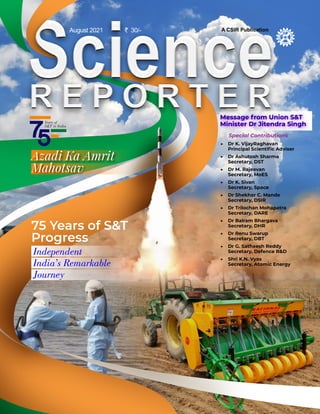
August 2021 30/- A CSIR Publication
▶
▶ Dr K. VijayRaghavan
Principal Scientific Adviser
▶
▶ Dr Ashutosh Sharma
Secretary, DST
▶
▶ Dr M. Rajeevan
Secretary, MoES
▶
▶ Dr K. Sivan
Secretary, Space
▶
▶ Dr Shekhar C. Mande
Secretary, DSIR
▶
▶ Dr Trilochan Mohapatra
Secretary, DARE
▶
▶ Dr Balram Bhargava
Secretary, DHR
▶
▶ Dr Renu Swarup
Secretary, DBT
▶
▶ Dr G. Satheesh Reddy
Secretary, Defence R&D
▶
▶ Shri K.N. Vyas
Secretary, Atomic Energy
Special Contributions
75 Years of S&T
Progress
Independent
India’s Remarkable
Journey
Azadi Ka Amrit
Mahotsav
Message from Union S&T
Minister Dr Jitendra Singh
Science
R E P O R T E R
Science
R E P O R T E R
Vol. 58 No. 8 August 2021 ISSN: 2582-6492 (Online) ISSN 0036-8512 (Print)
National Institute of Science Communication and Policy Research (NIScPR)
Council of Scientific & Industrial Research (CSIR)
Celebrating 75 Years of India’s
S&T Journey
Major Recent Contributions of
DST
Ashutosh Sharma, Akhilesh Gupta &
Jenice Jean Goveas
SPECIAL
CONTRIBUTIONS
16
Message from Union S&T
Minister Dr Jitendra Singh
8
Some Leaders Who Helped
Shape Science in India
And Who Left Us Recently
K. VijayRaghavan
9
From Sounding Rocket to
Launch Vehicles
Achievements of Department of
Space
K. Sivan
24
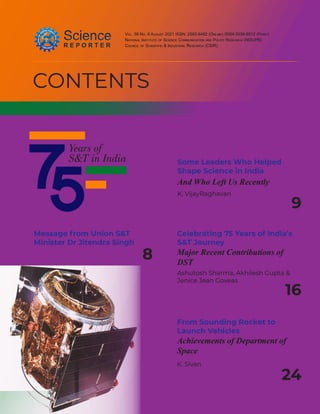
CONTENTS
Changing the Tide in Public
Health Systems in 75 Years
Role of ICMR
Balram Bhargava & Rajni Kant
32 The Journey of Building
Defence Technological
Capability
G. Satheesh Reddy
57
Indian Agriculture
Journey from Begging
Bowl to Sustainable Food
Security
Trilochan Mohapatra
& P.K. Rout
63
DBT
Building a Strong Biotechnology
Research & Translation
Ecosystem
Renu Swarup
& A. Vamsi Krishna
70
Reforms & Action Points to
Strengthen STI Ecosystem in
India
Ashok A. Sonkusare, Seepana Mohit
Rao & Neeraj Sinha
77
75 Years of India’s
Independence and
80 Years of CSIR
Shekhar C. Mande, Geetha Vani
Rayasam & G. Mahesh
38
Department of Atomic Energy
A Proud Symbol of AatmaNirbhar
Bharat
K.N. Vyas & M. Ramanamurthi
45
Ministry of Earth Sciences
Contributing Towards a Weather-
ready & Climate-smart India
M. Rajeevan, Gopal Iyengar
& Bhavya Khanna
51
DIRECTOR
DR RANJANA AGGARWAL
EDITOR
HASAN JAWAID KHAN
ASSISTANT EDITOR
SONALI NAGAR
MEHER WAN
LAYOUT & DESIGN
NEERU VIJAN
MANENDER SINGH
PRODUCTION
ASHWANI KUMAR BRAHMI
ARUN UNIYAL
ANIL KUMAR
BUSINESS DEVELOPMENT
DR MOHAMMAD RAIS
Science Reporter is published monthly by the National Institute of Science Communication and Policy Research (NIScPR), CSIR,
Dr K S Krishnan Marg, New Delhi-110 012. NIScPR assumes no responsibility for statements and opinions advanced by the authors or for any claims made in the
advertisements published in Science Reporter.
		 For Editorial Queries: Ph.: 91-011-25848702; Email: sr@niscair.res.in; Fax: 91-011-25847062
		 For Sales & Subscription Related Queries: Ph.: 91-011-25841647, 25846301 Extn. 289; Email: sales@niscair.res.in ; rs@niscair.res.in
		 For Advertisement Related Queries: Ph.: 91-011-25843359,291; Email: sales@niscair.res.in; Website: http://www.niscair.res.in
		Subscription: Inland: 1 yr: Rs 300/-; 2 yrs: Rs 570/-; 3 yrs: Rs 810/- Foreign: 1 yr (Air Mail): US $ 90 (Annual)
© National Institute of Science Communication and Policy Research (NIScPR)
COVER DESIGN
MANENDER SINGH
August 2021 | Science Reporter | 7
EVERY time an Indian spacecraft soars into the skies or a long-range indigenous missile
hits its target several kilometres away with pinpoint accuracy, our hearts fill with pride.
India-made spacecraft and missiles have become symbols of the grand success of science
and technology in a country that gained independence just about seven decades back. But,
beyond spacecraft and missiles, there is much more to the success in science and technology
that India has achieved despite battling several odds.
And so, it is with the intention of showcasing just a snapshot of the achievements of
the Indian scientific community and scientific institutions during the past seven decades
that this special issue is being brought out. The issue has been planned on the occasion of
the initiation of the year-long programme by the Government of India – Azadi ka Amrit
Mahotsav – to commemorate 75 years of India’s Independence.
At the time of Independence, India inherited a shattered economy, no worthwhile
infrastructure for the development of science and technology, no sound industrial base,
abysmally low agricultural production and almost non-existent health services. Imported
foodgrains fed the people. Famines were chronic. The country led a “ship to mouth”
existence.
However, today as we initiate the celebrations of 75 years of the country’s independence,
we look back with pride at the innumerable occasions when India’s scientists innovated,
devised ingenious processes, and came up with practical solutions for the industry on one side
of the spectrum and the country’s rural and remote areas on the other end of the spectrum.
Most of us have heard these success stories…these are stories that cannot be forgotten…
these are stories that swell our chests with pride every time we hear them.
For instance, when multinationals tried to make us believe that powdered milk food could
not be made from buffalo milk, Indian scientists came up with the technology of spray-drying
fat-rich buffalo milk which could then be converted to powdered milk food. Similarly, when
denied the services of a top-end supercomputer for research and meteorological purposes,
India developed its own supercomputers that today compete with the global best at a fraction
of the cost. The space story is not much different. Despite technology denials at various
points of time, the Indian space programme has notched up enviable successes placing it
among the top space programmes in the world.
This special issue of Science Reporter centred round the theme “75 Years of S&T in India
– Retrospect and Prospects” is not an exhaustive account of the successes and achievements
of the Indian scientific community and scientific institutions, but strives to provide a glimpse
into some of the innumerable S&T developments in the country after independence.
We are indeed grateful to the Hon’ble Union Minister for S&T Dr Jitendra Singh for
graciously agreeing to write a message for the special issue. We are also grateful to the
Principal Scientific Adviser to the Government of India and nine science Secretaries to the
Government of India – DST, DBT, Earth Sciences, Space, Health, DSIR, Atomic Energy,
Defence, and Agriculture – for honouring our request and supporting our endeavour to
come out with a publication to showcase India’s S&T prowess.
Editorial
Science
R E P O R T ER
Science
R E P O R T ER
Hasan Jawaid Khan
INDIA’S 75 YEARS S&T
JOURNEY
8 | Science Reporter | August 2021
MESSAGE
Dr Jitendra Singh
Minister of State (Independent Charge)
Science & Technology
Minister of State (Independent Charge)
Earth Sciences
Minister of State PMO, Personnel, Public
Grievances, Pensions, Atomic Energy
and Space
Dr Jitendra Singh
INDIA has had an ancient scientific legacy spanning fields such as astronomy, medicine, surgery,
mathematics, metallurgy — some of it documented, much of it undocumented. After years of being
under foreign rule, it was this embedded scientific spirit and technological acumen of India’s scientists,
technologists, science administrators and policymakers that helped the country catapult itself to
becoming a world scientific power to reckon with so soon after it gained independence in 1947.
Today, as we enter into the 75th
year of India’s Independence, it is appropriate that we appreciate,
assess and evaluate our scientific prowess and achievements. Some recent global indicators are
especially noteworthy. India today has attained the 3rd
global ranking in terms of research publications
and is globally at number 9 in the quality of research publications in the world’s reputed and
recognised SCI Journals. The country has featured within the top 50 innovative economies globally
(at 48th
rank) as per Global Innovation Index (GII). India has also been consistently making its
presence felt as a member of leading international scientific coalitions – in fields such as Artificial
Intelligence, Astronomy,  Solar Energy, Climate Research, and as amply demonstrated recently,
in global vaccine research, development and supply. India was even elected as Chair of the World
Health Organization’s (WHO) Executive Board recently.
While these developments are indeed praiseworthy and make us feel proud, there is still much
that awaits for the country to be achieved. The role of the Indian scientific community and its
scientific institutions is precisely cut out — to make the country truly “AatmaNirbhar” and come
up with scientific and technological solutions to problems that not only Indians face but also ones
that plague the global citizens. The time is opportune for this to happen — the present government
has given a special filip to S&T in keeping with Prime Minister Shri Narendra Modi’s special focus
on Science and Technology.
However, for this to happen, the Indian scientific establishment will have to reorient its
functioning. I have said this at many fora and would like to reiterate once again that the scientists of
different Ministries and Departments should further enhance collaboration in the field of Research
& Development so that our dependence on imports can be reduced considerably. Science Ministries
and Departments should stop working in isolation and enter into active collaborations to make the
scientific endeavour more citizen-centric. And today, with several industries and corporate houses
engaging in excellent R&D, the scientific institutions should actively look for and further streamline
and strengthen collaborations and networking with them.
The celebration of the 75th year of India’s Independence should be an occasion for the scientific
enterprise in the country to resolve to come together to work for the country’s progress. It is, however,
also an occasion to celebrate what science and scientists have contributed to India all these years.
And so, I congratulate Science Reporter and the CSIR-National Institute of Science Communication
and Policy Research (CSIR-NIScPR) for putting together this special issue that seeks to showcase
the growth of India’s scientific institutions during the past 75 years and the excellent contribution
of the Indian scientific community to the country’s progress.
I take this opportunity to wish India’s scientists and scientific establishments more strength in
the days and years to come.
August 2021 | Science Reporter | 9
Prof. K. VijayRaghavan
Principal Scientific Adviser
to the Government of India
AND WHO LEFT
US RECENTLY
SOME LEADERS
WHO HELPED
SHAPE SCIENCE
IN INDIA
T
HE COVID-19 pandemic has
wreaked havoc in India and all
over the world. Many scientists
passed away in 2020 and 2021; some
due to COVID-19 complications and
some due to other causes. When we
lose people in our communities, we
always meet to share memories and
to grieve. This pandemic has not only
killed many but has also disrupted our
grieving and mourning and made these
a remote exercise. We should not let
this de-humanising of interactions —
a compulsion of the times — become
the new normal. It is important that
we remember each of these lives and
celebrate them while mourning their
departure and being supportive of
family and friends. It is in that spirit that
this collection — not comprehensive,
not complete — is to be viewed.
I would like to acknowledge the
support and efforts of my colleagues
Dr H.S. Sudhira, Gubbilabs, Dr Siuli
Mitra, and Dr Shailja Vaidya Gupta for
the concept and content.
The Prime Minister Shri Narendra
Modi, when he addressed the nation
during Mann Ki Baat on National
Science Day 2021 said:
Prof. Shashikumar
Madhusudan Chitre
(7 May 1936-11 January 2021)
Prof. Shashikumar Madhusudan
Chitre, known as Kumar Chitre to his
friends, was born in Bandra, Mumbai
(then Bombay) in 1936. He did his
schooling in Mumbai itself and went to
obtain a B.A. in Mathematics from the
Elphinstone College, Mumbai, in 1956.
He then won the Duke of Edinburgh
Scholarship to study at Cambridge, St.
Peter’s College (Peterhouse) where he
obtained the Mathematical Tripos in
1959. While at Peterhouse, he wrote
an essay on “Why are sunspots dark?”
for his final Tripos. Reading this, Fred
Hoyle suggested he develop this into a
PhD thesis and this earmarked a life-
long affair with the Sun. For his PhD,
he moved to Churchill College and was
neighbours with Stephen Hawking.
Here are a few who left us but not
before they gave us lessons, we will live
by and not without leaving an impact on
the global scientific community.
“The way we know of other
scientists of the world, in the
same way, we should also
know about the scientists of
India... I definitely would
want that our youth know,
understand and read a lot
about the history of science
of India; about our scientists
as well.”
10 | Science Reporter | August 2021
His PhD thesis was on the structure of
Sunspots with Fred Hoyle.
Chitre then worked as a Lecturer
at the University of Leeds and then
went to Caltech for his post-doctoral
research. While at Caltech, a meeting
with S.K. Bhattacharjee, a nuclear
physicist from TIFR, resulted in him
applying to TIFR for a position in
1966, the year when Homi Bhabha had
passed away in an accident. However,
Prof. MGK Menon, the Director of
TIFR then, offered him a position and
Chitre came back to Mumbai in 1967 to
spend the rest of his life.
During his career at TIFR,
he primarily worked on the
magnetohydrodynamics of the Sun.
One of the major contributions from
his group was in the mapping of
differential rotation of the solar interior
and the measurement of heavy element
abundances in the solar interior. He was
also interested in gravitational lensing
and carried out studies through his
students. During his research career,
he collaborated with his colleagues at
TIFR and abroad as well.
After his retirement at TIFR as a
Senior Professor in 2001, he shifted
his focus to science communication
and outreach. He was instrumental in
setting up the Centre for Excellence
in Basic Sciences, for which he was
the Academic Chairperson, until his
demise. Chitre received numerous
honours during his vast career. He was
a Fellow of the Third World Academy
of Sciences, Royal Astronomical
Society, and all three Indian science
academies. He also served as the
President of the Astronomical Society
of India. He was also awarded the
Padma Bhushan in 2012. Chitre also
served on the board of Trustees of JN
Tata Trust and worked as an Honorary
Executive Director of Homi Bhabha
Fellowship Council. Chitre died on 11
January 2021, aged 84.
Prof. Roddam Narasimha
(20 July 1933-14 December 2020)
Prof. Roddam Narasimha was an
eminent scientist who worked on
aerospace and particularly on fluid
dynamics. He was also referred to as
Roddam in professional circles and
Simha in family circles. He was the
eldest son of RL Narasimhaiah and
Leelavati. His father was a professor in
Physics at Bengaluru’s Central College
and among one of the early science
communicators in Kannada. His father
had a significant influence on Roddam.
His younger brother, Prof. RR Simha
was a mathematician and a faculty at
TIFR, Mumbai. He is also known
for his work on Simha – Narasimhan
measures on Riemann surfaces.
Narasimha studied in Acharya
Pathashala, Bengaluru, the same school
where Prof. CNR Rao also studied as
batchmates. He later went on to obtain
a Bachelor of Engineering degree
in Mechanical Engineering from the
University Visvesvaraya College of
Engineering in Bengaluru. After his
graduation, he was initially unsure and
one visit to IISc (then, Tata Institute)
changed the course of his life. When
he visited for the first time, he was
mesmerized with the Spitfire aircraft
that was on display in front of the
Department of Aerospace at IISc, which
‘Kumar’ Chitre was a scholar, scientist, and a thoughtful colleague. There
was, and still is, collegiality, and only a modest level of hierarchy at the [Tata
Institute of Fundamental Research] and, much interaction over tea, across
disciplines. Kumar nucleated these with his understated wit and insights.
At a personal level, I owe him a lot. My Molecular Biology Unit PhD
interview, which had him on the panel, focused on fluid mechanics, of which
I had a very modest understanding; and not on biology, of which I had no
training, poor knowledge, and no understanding.
My fortuitous entry into TIFR, a scientific paradise, a biology questioner
would not have permitted, was facilitated by this gentle and understanding
interviewer… A big loss.
-	 Prof. K. VijayRaghavan tweeted
helped him to resolve his decision to
pursue studies at IISc. He obtained a
Master's (then, Diploma) in 1955 and
worked under Prof. Satish Dhawan. On
Prof. Dhawan’s insistence, he went to
Caltech to pursue his doctoral research
under Hans Liepmann, which he
obtained in 1961. He returned to IISc
August 2021 | Science Reporter | 11
in 1962 as a faculty that he remained
until his retirement in 1999. While at
IISc, he was instrumental in setting up
the Centre for Atmospheric Sciences
(now, Centre for Atmospheric and
Oceanic Sciences) in the early 1980s.
His interest in the atmosphere, and
more particularly the monsoon and
clouds, continued to drive his research
interests till his final years.
While being the Professor at IISc,
he served as the Director of CSIR-
National Aerospace Laboratories
(NAL) on deputation from 1984-1993.
Post his retirement from IISc, he
served as the Director of the National
Institute of Advanced Studies until
2004. He was then affiliated with the
Jawaharlal Nehru Centre for Advanced
Scientific Research (JNCASR), where
he continued his research. During all
these years, he published extensively.
He also served as a visiting faculty and
held various positions during his career.
While at the CSIR-National
Aerospace Laboratories, he was
instrumental in setting up of a parallel
computing system, which was not
conceived hitherto, to solve several
computational problems. He also
offered critical support to ISRO,
particularly in investigating failures of
certain launch vehicles, which greatly
helped in their rectification later. He
was also a member of the Indian Space
Commission.
He was awarded the Padma
Vibhushan, India's second-highest
civilian award, in 2013.
He passed away on 14 December
2020, after a brief illness.
Dr V. Shanta
(11 March 1927-19 January 2021)
Dr V. Shanta was an Indian oncologist
well known for her efforts in making
cancer treatment affordable. She was the
chairperson of Adyar Cancer Institute,
Chennai. She has been associated with
the Adyar Cancer Institute since 1955,
holding several positions including
that of the Director during 1980-1997.
She has also contributed her efforts
as a member of many national and
international committees.
Dr Shanta was born on 11 March
1927, in Chennai in an illustrious
family that boasted of two Nobel
Laureates, C.V. Raman (grand uncle)
and S. Chandrasekar (uncle). She
studied at the National Girls High
School, Chennai. Completing her pre-
university course at Presidency College
in Madras, India, Dr Shanta went on
to pursue her ambition to become a
doctor. She then graduated in MBBS
in 1949, and MD in obstetrics and
gynaecology in 1955. A chance meeting
during her last year of MBBS drew her
towards cancer. But the key moment
was when Dr Muthulakshmi Reddy,
the first woman house surgeon in India,
set up the cancer centre in Chennai.
She was looking for a medical officer
and Dr Shanta jumped in.
And the rest is history.
Dr Shanta dedicated all
her life at the Cancer
Institute to support
cancer patients, studying
the disease, its detection,
and its treatment.
Dr Shanta was
elected as a fellow of
the National Academy
of Medical Sciences.
She has received several
accolades in recognition
for her work including
the Magsaysay Award
(2005) and Padma
Vibhushan (2016).
Dr Shanta died on
19 January 2021, aged 93
years.
“Deeply pained by the demise of noted aerospace scientist Prof. Roddam
Narasimha today who contributed immensely to space technology. His
research in parallel processing, aerospace electronics, surface technologies,
and computational fluid dynamics, leadership at National Aerospace
Laboratories, and policy contributions to aerospace technology proved to
be the stepping-stones to make India self-reliant in civil aviation. Indian
science is indebted for his remarkable contributions to many of India’s
major scientific programs from issues of climate change, the design and
development of civilian aircraft programs, and of the Light Combat Aircraft,
Tejas. His passing away creates a void in the scientific community globally
and in India.”
-	 Prof. K. VijayRaghavan wrote in his obituary for Prof. Narasimha
“Dr V. Shanta, Chairperson of the Adyar Cancer Institute, Chennai passed
away early this morning. She will be greatly missed by the cancer care and
research community all over the world and the many tens of thousands of lives she
has impacted. At 93, Dr Shanta was active to the end. A month ago, she wrote to
a science agency on a matter related to the cancer institute and was pleased that
it was resolved. Her attention to detail, and caring were legendary. The great
institution she has built will live and grow.”
-	 Prof. K. VijayRaghavan tweeted
12 | Science Reporter | August 2021
Prof. Khadg Singh Valdiya
(20 March 1937-29 September 2020)
Prof. Khadg Singh Valdiya or
KS Valdiya as he was popularly
referred to, was a leading Indian
geologist, educationist, and science
communicator. He was popular for
his contribution to an understanding of
Indian geodynamics.
Valdiya was born to Dev Singh
Valdiya and Nanda Valdiya on 20 March
1937 in Kalaw, now in Myanmar. His
he taught and researched various
institutions including Wadia Institute
of Himalayan Geology, Jawaharlal
Nehru Centre for Advanced Scientific
Research (JNCASR), and Kumaon
University. He also served as the Vice-
Chancellor of Kumaon University.
Valdiya was instrumental in the
establishment of several key geological
institutions in India, notably, Wadia
Institute of Himalayan Geology,
Central Himalayan Environmental
Association, Nainital, G.B. Pant
Institute of Himalayan Environment and
Development, Almora, and the Geology
Department at Kumaon University.
He was elected as a Fellow of the
Third World Academy of Sciences,
Geological Society of India, Geological
Society of America, Geological Society
of Nepal, and all three Indian science
academies. During his scientific career,
he extensively published many journal
articles and authored many books. He
was conferred with Padma Bhushan by
the Government of India.
Valdiya’s key contribution
was on understanding Himalayan
geology. His studies have greatly
contributed to the understanding of the
paleogeography of the region and shed
light on geodynamics. This resulted
in providing a more detailed account
of the evolutionary history of the
Himalayas. A synthesis of his work on
geodynamics has led him to author a
very popular book called, The Making
of India: Geodynamic Evolution.
During the latter part of his life,
he had dedicated himself to science
communication. He was actively
involved in science outreach activities
to popularize science among young
students, particularly in his home state
of Uttarakhand.
He passed away on 29 September
2020.
Prof. M.S. Narasimhan
(7 June 1932-15 May 2021)
Dr Narasimhan was a renowned
mathematician who carved a niche for
himself through some of his seminal
contributions in the field of algebraic
and differential geometry.
“With the passing of Khadg Singh Valdiya, we have lost a Himalayan scholar
and a scholar of Himalayan proportions. Born in Myanmar he returned to his
native Pithoragarh and then studied at Lucknow University where he completed
his Ph.D.
Valdiya was a geologist focusing on sediments and tectonics. His research
interests were wide. He helped establish and grow the best geology institutions
in the country and found a welcoming research abode after retirement [from
JNCASR], where he continued to be productive.
An abiding interest of his research was the origin of the Himalayas and the
origin of the Himalayan rivers in general and the Ganga in particular.”
-	 Prof. K. VijayRaghavan tweeted
family moved back to Pithoragarh
in Uttarakhand where he did his
schooling. He obtained his BSc, MSc,
and PhD from Lucknow University. He
then joined there as a faculty in 1957.
He was a Fulbright Scholar during
1965-66, during which he was at Johns
Hopkins University. During his career,
Narasimhan was born into a family
hailing from the North Arcot district in
Tamil Nadu. He was the eldest of five
siblings. He completed his schooling
and joined Loyola College in Chennai
for his Bachelor’s degree. He then
joined the Tata Institute of Fundamental
Research (TIFR), Mumbai for his
doctoral studies in 1953. He obtained
his doctorate from the University of
Mumbai in 1960 under the guidance of
K. S. Chandrasekharan, a well-known
mathematician working on number
theory. He then joined as a faculty at
the TIFR in 1960.
Narasimhan’s major contributions
are in the field of algebraic and
differential geometry, more specifically
in the field of vector bundles. His
August 2021 | Science Reporter | 13
work with C.S. Seshadri, an Indian
mathematician, on unitary and stable
bundles, the Narasimhan-Seshadri
theorem, is considered a pioneering
work and has significant applications
in gauge theory and conformal field
theory used in mathematical physics.
Narasimhan also characterised
real analytical functions, these are
functions with derivatives of all orders
that obey Taylor’s series--via Cauchy
type inequalities. With S. Ramanan,
another Indian mathematician, he
worked on the proof of the existence of
universal connections, generalization of
well-known results on the existence of
universal bundles in topology. He also
collaborated with mathematician Prof.
R. R. Simha, another TIFR faculty
(younger brother of Professor Roddam
Narasimha) to prove the existence
of moduli of general type complex
structures on a real analytic manifold.
These measures were called Simha–
Narasimhan measures on Riemann
surfaces.
Narasimhan played a key role
in the development of mathematics
in India. He was the first Chairman
of the National Board for Higher
Mathematics. He was elected as a
Fellow of the Royal Society. He was
also a Fellow of all the three science
academies in India. He was a recipient
of the French National Order of Merit
(1989) and the Padma Bhushan award
in 1990. To date, he is the only Indian
to win the King Faisal International
Prize for Science from Saudi Arabia,
which he received jointly with Simon
Donaldson of Imperial College.
Narasimhan passed away on 15
May 2021 in Bangalore, aged 88 years.
Prof. Munirathna
Anandakrishnan
(12 July 1928-29 May 2021)
Prof. Munirathna Anandakrishnan was
an engineer, educationist, and science
administrator. He was the chairperson
of the Indian Institute of Technology,
Kanpur, and a former Vice-Chancellor
of Anna University. He also served as
an Advisor to the Government of Tamil
Nadu on Information Technology and
e-Governance.
Anandakrishnan was born in Tamil
Nadu. He obtained his Bachelor of
Engineering in Civil Engineering from
the College of Engineering, Guindy,
Madras University, Chennai in 1952.
He went on to obtain a Master's degree
in 1957 and a PhD in Civil Engineering
in 1960 from the University of
Minnesota.
Anandakrishnan returned to
India in 1962 and worked briefly at
the Central Road Research Institute,
New Delhi. After working for a year,
he joined as a member of the faculty
of civil engineering at the Indian
Institute of Technology, Kanpur (IIT
Kanpur) where he worked till 1974.
He held various positions at IIT
Kanpur including the Chairman of
the Department of Civil Engineering,
Dean, and Acting Director.
Anandakrishnan moved to the
USA in 1974 to work as a Science
Counsellor at the Indian Embassy
in Washington DC, on deputation
from the Department of Science and
Technology. He then joined the United
Nations Commission on Science and
Technology for Development (CSTD)
as the Chief of New Technologies at
the Office of Science and Technology
(OST), where he served until his
retirement in 1989. While at UN, he
was also the Deputy Director of CSTD
and served as the secretary of the
UN Advisory Committee on Science
and Technology for Development.
Anandakrishnan returned to India in
1990 to become the Vice-Chancellor of
Anna University, which he served until
1996.
Anandakrishnan has received
several awards and honours for his
services. Notable among them is Padma
Shri in 2002 and the Distinguished
Leader Award by the University
of Minnesota in 2003. He was also
conferred the Commander of the
National Order of Scientific Merit by
the Government of Brazil in 1996.
Anandakrishnan was also elected as
a Fellow of the National Academy of
Sciences, India, Institution of Engineers
(India), and the Indian Society of
Technical Education.
He passed away on 29 May 2021,
aged 92 years.
Dr Srikumar Banerjee
(25 April 1946-23 May 2021)
Dr Srikumar Banerjee was the former
Chairperson of the Atomic Energy
Commission of India and the former
Secretary of the Department of Atomic
Energy, Government of India. He was
well-known as a metallurgical engineer
by training.
Banerjee obtained his B.Tech. with
honours in Metallurgical Engineering
from the Indian Institute of Technology,
Kharagpur in 1967. He then went to
attend the Training School at Bhabha
“Prof. M. Anandakrishnan’s passing is a loss for engineering. Felled by COVID
at age 92, his brisk stride, sharp mind, infectious cheerfulness, all shook others
from sluggishness. Son of a brick-layer, Head of Civil Eng, [IIT Kanpur], VC of
[Anna University], a caring teacher is gone.”
-	 Prof. K. VijayRaghavan tweeted
14 | Science Reporter | August 2021
Atomic Research Centre (BARC).
Soon after, in 1968 he formally started
his career there with the Metallurgy
Division at BARC and went on to
become its Director during 2004-2010.
Earlier in 1974, for the work he
carried out at BARC, he was awarded
the PhD in Metallurgical Engineering
from IIT Kharagpur. In the latter part
of his career, he also served as DAE
Homi Bhabha Chair Professor at
BARC. Banerjee held various visiting
positions abroad at the University
of Sussex, Brighton, England, Max-
Planck-Institut für Metallforschung, the
University of Cincinnati, and the Ohio
State University, USA.
He also served as the Chairman, the
Board of Governors of IIT Kharagpur
during 2014-2017. He was elected
as a fellow of the Indian Academy
of Sciences, National Academy
of Sciences, India, and the Indian
National Academy of Engineering. He
received numerous recognitions for
his work and contribution to services.
Dr Banerjee was awarded the Shanti
Swarup Bhatnagar Prize for Science
and Technology in Engineering Science
(1989) and Padma Shri in 2005.
Banerjee passed away during the
early hours of 23 May 2021 due to a
heart attack.
Dr Nandivada Rathnashree
(26 November 1963-9 May 2021)
Dr Rathnashree was an avid astronomer
and science communicator. She was
the Director of Nehru Planetarium
where she started her career as a senior
educator. Earlier she was trained in
theoretical astrophysics.
Rathnashree was born in
Hyderabad on 26 November 1963. After
her schooling in Kendriya Vidyalaya
(1981), she studied at the University
College for Women in Hyderabad. She
obtained her Master’s in 1986 from
Hyderabad Central University. She then
joined for her doctoral research at the
Tata Institute of Fundamental Research
with the theoretical astrophysicist Prof.
Alak Ray. She received
her PhD in 1992 for the
work on binary stars.
She was a postdoctoral
fellow at the University
of Vermont, USA
during 1992-1994,
where she worked on
pulsar observations
using the Arecibo
radio-telescope. During
1994-1996, she was a
postdoctoral fellow at
the Raman Research
Institute in Bengaluru.
R a t h n a s h r e e
moved to New Delhi
in 1996 as a Senior
Planetarium Educator at
the Nehru Planetarium.
“Dr Srikumar Banerjee’s passing is too sudden, too soon. Former Chairman
of the Atomic Energy Commission [DAE, India], his interests straddled the
most fundamental to the most applied. In every discussion, his astute leadership
ensured that there was more light and no heat.”
-	 Prof. K. VijayRaghavan tweeted
Soon, in 1999, she also became its
Director. Since then, she was a force
to reckon with for numerous activities
on astronomy outreach, that not only
impacted within the National Capital
Region, but across the country.
Rathnashree’s key contribution
has been towards the preservation of
the Jantar Mantar observatories of Raja
Sawai Jai Singh. She and her team have
been instrumental in enabling these
accessible to the general public. She
firmly believed that astronomy outreach
carried out at archeo-astronomy heritage
sites and through archeo-astronomy
instruments, had immense potential for
wider communication and appreciation.
Rathnashree and her students have
extensively worked in the cleaning and
“Rathnashree’s key contribution has been towards the preservation
of the Jantar Mantar observatories of Raja Sawai Jai Singh. She and
her team have been instrumental in enabling these accessible to
the general public.”
August 2021 | Science Reporter | 15
gyro-radiation model, a model that
considers radiation from electrons
whose speeds are much smaller than the
speed of light, to explain microwave
solar emissions. Several observations
made by him and his students provide
independent support for the Big Bang
model of the Universe.
Swarup was born in 1929 at
Thakurdwara, Uttar Pradesh. He came
from a relatively wealthy family. He
had an early education in English and
many other subjects.
Swarup went on to obtain a
Bachelor’s (1948) and Master’s degree
(1950) in Physics from the Allahabad
University. After his Master’s, he
restoring of some of the Jantar Mantar
instruments, apart from creating a host
of outreach collaterals to train tour
guides in both Jaipur and New Delhi.
She has also written extensively on the
mathematics behind these instruments.
Acknowledging her role in
these, the Archaeological Survey of
India appointed her to the committee
overseeing the restoration of Jantar
Mantar in New Delhi. Rathnashree
also worked with the National Council
of Science Museums advising them
on astronomy-related exhibits and
activities at various science centres.
Rathnashree passed away on 9
May 2021.
Prof. Govind Swarup
(23 March 1929–7 September 2020)
Prof. Govind Swarup, a radio
astronomer, discovered the ‘type-U’
solar bursts. He also developed the
joined the CSIR-National Physical
Laboratory in New Delhi (1950-53).
A fellowship he chanced upon led him
to work at CSIRO in Australia during
1953-1955. He returned to India in 1955
and was back at NPL till 1956. He then
proceeded to pursue doctoral research at
Stanford University which he obtained
in 1960. He was an Assistant Professor
at Stanford University from 1961-1963.
His notable contribution has been
to initiate and start the radio astronomy
program and activities in India. With
his brief stints at CSIRO, Australia,
and while at Stanford University, USA,
he had the urge to establish something
similar back home. He and a few of
his colleagues wrote to about five key
organisations in India about this. And
the most encouraging one was from Dr
Homi Bhabha who was the Director of
TIFR, Mumbai. This prompted Prof.
Swarup to return to India in 1963 while
joining as a Reader at TIFR in 1965.
Swarup is known for building
the Ooty Radio Telescope (ORT)
on the hillslopes of Ooty and the
Giant Metrewave Radio Telescope
(GMRT) near Pune. These ingenious,
economical, and powerful observational
facilities are used not just by Indian
scientists, but also by scientists from 31
countries the world over.
A recipient of the Padma Shri, and
a Lifetime Achievement Award from
the Department of Atomic Energy,
Prof. Swarup was a promoter of an all-
inclusive approach to teaching science.
The proposal that he made along with
Prof. V. G. Bhide for a 5-year integrated
program for an intensive education in
science led to the establishment of the
Indian Institutes of Science Education
and Research (IISERs).
Prof. Govind Swarup passed away
on 7 September 2020.
“Professor Govind Swarup was an exceptional scientist. His pioneering works in
radio astronomy have attained global commendation. Anguished by his passing
away. My thoughts are with his near and dear ones.”
-	 Shri Narendra Modi, Prime Minister of India tweeted
With Professor Govind Swarup’s demise, the world of astronomy has lost a
great scientist, institution-, and telescope-builder. Ever-smiling, not one to take
a no for anything he wanted to be done, he took on many impossible tasks,
inspired colleagues to accomplish them.
-	 Prof. K. VijayRaghavan tweeted
16 | Science Reporter | August 2021
Major Recent Contributions
of Department of Science &
Technology
CELEBRATING
75 YEARS OF INDIA’S
S&T JOURNEY
The Prologue
India being the cradle of one of the
oldest civilisations in the world,
has a tradition that is embedded in
science and technology. Ancient
Indian land well balanced the wisdom
and knowledge of sages and seers, of
rishis and researchers, of scholars and
scientists whose scientific knowledge
is preserved in the Vedas, Ayurveda
and our other ancient granthas. Today
many centuries later, and 75 years
after achieving independence, India
has come a long way as she gears
up to provide and deploy high-tech
solutions in several key areas including
education, healthcare, transport,
etc. to all citizens, reaching even the
marginalised communities.
S&T in India Post-independence
Travelling back in time along the
eventful lane of India’s S&T ecosystem,
flashes in to the mind’s eye several
milestones that directed our nation to
the significant global position that we
are in today. The stalwarts who stand
out include Pandit Jawaharlal Nehru,
the first PM of India, who initiated
several reforms in higher education
and science and technology and was
particularly instrumental in setting up
the Indian Institutes of Technology.
The first one was inaugurated on
18 August 1951 at Kharagpur by India’s
then Minister of Education, Maulana
Abul Kalam Azad.
India propelled herself into the
domain of space right from the 1960s
and through diplomatic ties with the
Soviet Union planted the seed of the
Indian Space Research Organisation,
simultaneously advancing nuclear
capability which was jubilantly
demonstrated through the first nuclear
test explosion on 18 May 1974 at
Pokhran.
All along the past 75 years, India
held on to S&T as the magic wand
that transformed an economically
beleaguered country, handed over to
Indians from the shackles of the British,
to a world leader that we are today.
India’s S&T journey has been no less
than a rollercoaster ride, and the real
drivers of India’s S&T ecosystem have
been the well-paced National Science
Policies.
Science Policies Propelling
India’s S&T Growth
The Science Policy Resolution 1958
captured the vision of India as a
welfare state and largely emphasised
basic research in almost every field of
science. It was instrumental in building
and nourishing the science ecosystem
in India through science education
and research. It provided the required
directions to set up organisations like
Defence Research and Development
Organization (DRDO-1958), the
Department of Electronics (DOE-
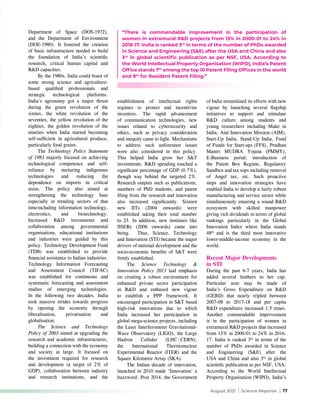
1971), the Department of Science
& Technology (DST-1971), the
Ashutosh Sharma
Secretary to Government
of India, Department of
Science & Technology
Akhilesh Gupta
Senior Advisor
Department of Science &
Technology
Jenice Jean Goveas
DST Post Doctoral Policy
Fellow
August 2021 | Science Reporter | 17
Department of Space (DOS-1972),
and the Department of Environment
(DOE-1980). It fostered the creation
of basic infrastructure needed to build
the foundation of India’s scientific
research, critical human capital and
R&D capacities.
By the 1980s, India could boast of
some strong science and agriculture-
based qualified professionals and
strategic technological platforms.
India’s agronomy got a major thrust
during the green revolution of the
sixties, the white revolution of the
seventies, the yellow revolution of the
eighties, the golden revolution of the
nineties when India started becoming
self-sufficient in agricultural produce,
particularly food grains.
The Technology Policy Statement
of 1983 majorly focused on achieving
technological competence and self-
reliance by nurturing indigenous
technologies and reducing the
dependence on imports in critical
areas. The policy also aimed at
strengthening the technology base
especially in trending sectors of that
time 
including information technology,
electronics, and biotechnology.
Increased R&D investments and
collaboration among governmental
organisations, educational institutions
and industries were guided by this
policy. Technology Development Fund
(TDB) was established to provide
financial assistance to Indian industries.
Technology Information Forecasting
and Assessment Council (TIFAC)
was established for continuous and
systematic forecasting and assessment
studies of emerging technologies.
In the following two decades, India
took massive strides towards progress
by opening the economy through
liberalisation, privatisation and
globalisation.
The Science and Technology
Policy of 2003 aimed at upgrading the
research and academic infrastructures,
building a connection with the economy
and society at large. It focused on
the investment required for research
and development (a target of 2% of
GDP), collaboration between industry
and research institutions, and the
establishment of intellectual rights
regimes to protect and incentivise
inventors. The rapid advancement
of communication technologies, new
issues related to cybersecurity and
ethics, such as privacy consideration
and inequity came to light. Mechanisms
to address such unforeseen issues
were also considered in this policy.
This helped India grow her S&T
investments. R&D spending touched a
significant percentage of GDP (0.7%),
though way behind the targeted 2%.
Research outputs such as publications,
numbers of PhD students, and patent
filing from the research and innovation
also increased significantly. Sixteen
new IITs (2004 onwards) were
established taking their total number
to 23. In addition, new institutes like
IISERs (2006 onwards) came into
being. Thus, Science, Technology
and Innovation (STI) became the major
drivers of national development and the
socio-economic benefits of S&T were
firmly established.
The Science Technology &
Innovation Policy 2013 laid emphasis
on creating a robust environment for
enhanced private sector participation
in R&D and enthused new vigour
to establish a PPP framework. It
encouraged participation in S&T based
high-risk innovations due to which
India increased her participation in
global mega-science projects, including
the Laser Interferometer Gravitational-
Wave Observatory (LIGO), the Large
Hadron Collider (LHC - CERN),
the International Thermonuclear
Experimental Reactor (ITER) and the
Square Kilometre Array (SKA).
The Indian decade of innovation,
launched in 2010 made ‘Innovation’ a
buzzword. Post 2014, the Government
of India streamlined its efforts with new
vigour by launching several flagship
initiatives to support and stimulate
R&D culture among students and
young researchers including Make in
India, Atal Innovation Mission (AIM),
Start-Up India, Stand-Up India, Fund
of Funds for Start-ups (FFS), Pradhan
Mantri MUDRA Yojana (PMMY),
E-Business portal, introduction of
the Patent Box Regime, Regulatory
Sandbox and tax sops including removal
of Angel tax, etc. Such proactive
steps and innovation strategies have
enabled India to develop a fairly robust
manufacturing and service sector while
simultaneously ensuring a sound R&D
ecosystem with skilled manpower
giving rich dividends in terms of global
rankings particularly in the Global
Innovation Index where India stands
48th
and is the third most innovative
lower-middle-income economy in the
world.
Recent Major Developments
in STI
During the past 6-7 years, India has
added several feathers to her cap.
Particular note may be made of
India’s Gross Expenditure on R&D
(GERD) that nearly tripled between
2007-08 to 2017-18 and per capita
R&D expenditure increased 1.5 times.
Another commendable improvement
is in the participation of women in
extramural R&D projects that increased
from 13% in 2000-01 to 24% in 2016-
17. India is ranked 3rd
in terms of the
number of PhDs awarded in Science
and Engineering (S&E) after the
USA and China and also 3rd
in global
scientific publication as per NSF, USA.
According to the World Intellectual
Property Organisation (WIPO), India’s
“There is commendable improvement in the participation of
women in extramural R&D projects from 13% in 2000-01 to 24% in
2016-17. India is ranked 3rd
in terms of the number of PhDs awarded
in Science and Engineering (S&E) after the USA and China and also
3rd
in global scientific publication as per NSF, USA. According to
the World Intellectual Property Organisation (WIPO), India’s Patent
Office stands 7th
among the top 10 Patent Filing Offices in the world
and 9th
for Resident Patent Filing.”
18 | Science Reporter | August 2021
Patent Office stands 7th
among the top
10 Patent Filing Offices in the world
and 9th
for Resident Patent Filing.
Some of India’s biggest milestones
have been in space exploration. India’s
achievements have skyrocketed from
the successful launch of India's first
satellite Aryabhatta in 1975 to the
Mars Orbiter Mission (MOM) or
Mangalyaan in 2013 followed by the
Chandrayaan programme and the most
awaited manned Gaganyaan mission.
These achievements speak volumes of
the exceptional scientists of the likes of
Dr APJ Abdul Kalam who have left an
indelible mark in the sands of time.
In the nuclear arena, India
exploded the country's first nuclear test
Operation Smiling Buddha in 1974 and
there has been no looking back ever
since in exploring nuclear energy for
peaceful purposes. India has made her
presence felt from pole to pole, with the
Indian Antarctic Programme launched
in 1981 and several subsequent missions
to Dakshin Gangotri. India’s Arctic
observation station IndARC was set up
in 2015, halfway between Norway and
the North Pole.
Today, India is actively engaged
in emerging technologies such as
Nanotechnology, Artificial Intelligence,
Robotics, Augmented and Virtual
Reality, Internet of Things and so on.
In drug manufacturing, India through
her generic lifesaving drugs has
become the pharmacy of the world in
supplying affordable medicines. As the
COVID-19 pandemic forces the world
to realign in terms of various sectors, the
Indian scientific ecosystem is gearing
up to receive yet another pathbreaking
national Science, Technology and
Innovation Policy (STIP-2021) shortly.
The clarion call by our Hon'ble PM
Shri Narendra Modi to build an Atma
Nirbhar Bharat further emphasises how
essential technology indigenisation is
for us to truly be free and independent.
Self-reliance in S&T is the way forward
for India to ensure a hassle-free journey
ahead.
Major Recent Initiatives and Missions
of DST
The Department of Science and
Technology (DST) established in the
year 1971, has the mandate to diversify
and strengthen S&T activities in the
country. Since its inception, DST has
played a pivotal role in coordinating
and integrating S&T areas across the
ministries and associated departments,
S&T institutions, academia, and
industry, regionally and globally.
DST has made great efforts in
taking science to society, ensuring last-
mile connectivity, and has successfully
catered to the application of S&T for
the weaker sections, women, and other
disadvantaged sections of the society.
DST is striding ahead with an extensive
network of programmes and facilitating
schemes to promote research and
development in areas of national
importance.
The Department of Science
& Technology is one of the key
government departments contributing
significantly to scientific research in the
country. As the largest extra-mural STI
funding agency in the country, DST
is boosting India’s entire innovation
value chain comprising researchers,
entrepreneurs, academic and research
institutes, startups, industry, and so
on. The last seven years witnessed
the impactful initiatives undertaken by
DST to steer the innovative culture in
the country.
Today, DST has a portfolio of
exhilarating programmes and schemes
which are significantly elevating the
STI ecosystem. DST’s investment in
the S&T system more than doubled
in the last seven years from about Rs
2900 Cr in 2014-15 to Rs 6072 Cr in
2021-22.
Major Initiatives Impacting STI
Ecosystem
Some of the milestone initiatives of
DST during the last seven years are the
following:
	Attracting and promoting
innovation pursuits: Innovation
in Science Pursuit for Inspired
Research (INSPIRE), a flagship
programme of DST, has been
successfully implemented to attract
and promote a scientific talent base
in the country. INSPIRE-MANAK
(Million Minds Augmenting
National Aspirations and
Knowledge) awards were launched
in 2018 to further facilitate young
school children to take up science
and innovative projects.
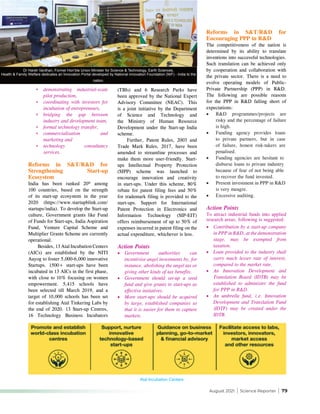
Image credit: DST
“As the largest extra-mural
STI funding agencies in the
country, DST is boosting
India’s entire innovation value
chain comprising researchers,
entrepreneurs, academic and
research institutes, startups,
industry, and so on.”
	Boosting innovation and startup
activity: A national programme
titled NIDHI (National Initiative
for Developing & Harnessing
Innovations), which addresses the
entire value chain of Innovations,
has been launched. NIDHI
significantly impacted India’s
innovation ecosystem by nurturing
3,681 startups through a network
of 153 incubators created by DST,
which generated 65,864 jobs as
cumulative direct employment,
creating a wealth of Rs 27,262
crores and generated 1,992
intellectual properties. NIDHI's
collective strength and power, its
incubator network, and its startups
were tested successfully during
the COVID-19 pandemic through
the ‘Centre for Augmenting WAR
with COVID-19 Health Crisis
August 2021 | Science Reporter | 19
(CAWACH)’ programme by
supporting various solutions to
resolve the COVID crisis.
•	 Three Centres of Excellence
(CoE) for ‘Climate Research’
were established in Himalayan
Universities in Kashmir and
the North Eastern States of
Sikkim and Assam to lead
climate change research.
•	 The Survey of India (SoI), a
subordinate Department under
DST, has embarked on a
pan-India geospatial mapping
of the country and launched
web portals to facilitate the
access of the digital map
or data to every citizen of
the country and help centre
and state organisations in
decision making, planning,
monitoring, and governance.
	Providing state-of-the-art
facilities to researchers:
Sophisticated Analytical &
Technical Help Institutes (SATHI)
centres to house major analytical
instruments have been established
to provide standard services of
high-end analytical testing, thus
reducing dependency on foreign
sources. The DST has set up three
such centres at IIT Kharagpur, IIT
Delhi, and BHU under the SATHI
programme.
	Reversing brain drain to brain
gain: Several overseas doctoral
and post-doctoral fellowships have
been introduced to reverse the
culture of brain drain to brain gain.
Additionally, through its milestone
initiative ‘VAJRA’, DST brings
the best of global science and
scientists to India, including NRIs.
Image credit: http://www.nidhi-
eir.in/about.php
Courtesy: DST
Image credit: https://vajra-india.in/
	Cyber-Physical Systems: DST
has launched ‘A National Mission
on Interdisciplinary Cyber-
Physical Systems’ at a total outlay
of Rs 3660 Cr for five years to
create a strong foundation and a
seamless ecosystem for cyber-
physical systems and technologies
[like Artificial Intelligence
(AI), Robotics, Internet of
Things (IoT)] encompassing
knowledge generation, human
resource development, research,
technology, and product
development, innovation, and
commercialisation.
	Aligning with national agenda:
•	 DST has enrolled new
initiatives such as Super
Computing Mission;
Advanced Manufacturing;
Waste Management, and
Science and Technology
of Yoga and Meditation
(SATYAM) to boost the
country’s prowess through
STI.
•	 DST also initiated a Mission
Innovation Programme with
smart grid and off-grid to
develop domain-specific
leadership of India.
•	 DST support through thematic
programmes on Clean Energy
and Water, Nano Science and
Technology, Climate Change
Research, and outreach has
led to excellent progress in
these thematic areas.
	Empowering women scientists:
To address gender imbalance,
a new scheme viz. KIRAN was
launched, and a pilot scheme
Vigyan Jyoti was tested on a limited
scale and duration to attract and
encourage young women to take up
science. DST has also undertaken
an implementation plan for Gender
Advancement for Transforming
Institutions (GATI), urging higher
education and research institutions
to support diversity, inclusion, and
equity. In addition, the Science
and Engineering Research Board
(SERB), a Statutory body of the
DST, launched SERB-POWER
(Promoting Opportunities for
Women in Exploratory Research)
in 2020 to mitigate gender disparity
in science and engineering research
funding in Indian academic
institutions and R&D laboratories.
	Communicating science: An
internet-based dedicated Science
Channel and an hourly daily
programme on Doordarshan
(DD Science) were launched in
early 2019. In addition, schemes
such as ‘AWSAR’ empower
the young to take up science by
encouraging young scientists to
“To address gender imbalance,
a new scheme viz. KIRAN was
launched, and a pilot scheme
Vigyan Jyoti was tested on a
limited scale and duration to
attract and encourage young
women to take up science.”
20 | Science Reporter | August 2021
write popular science articles
on their research pursuits.
	Inter-ministerial collaborations:
DST is actively collaborating
with different ministries to
promote national STI. It has
partnered with the Ministry of
Education (MoE) under a 50:50
partnership to implement the
IMPRINT (Impacting Research
Innovation and Technology)
programme to address and provide
solutions to the most relevant
engineering challenges faced
by the nation. In association
with the Ministry of Railways,
DST has rolled out the Railway
Innovation Mission to support
the first phase of cyber-physical
industry 4.0 implementation
for the modern coach factory.
	Building international networks:
New international S&T
collaboration to connect with the
best global science was initiated
that includes participation in
‘Thirty Meter Telescope Project’
and ‘India-Israel Industrial R&D
and Technological Innovation
fund’ established by DST in recent
years.
Major Success Stories During
2020
The significant challenges that 2020 put
before the world helped India emerge
as a forerunner in underscoring the
critical role of science and technology
in bringing positive transformations for
a safe, secure and better society well
prepared for the future. DST has played
a facilitative role in pushing S&T to
become the core of decision making,
claiming increased media space and
gaining public trust.
	India’s ranking in publications,
R&D & innovations has risen
exponentially: India is placed
3rd
among countries in scientific
publication as per the NSF
database. The country has featured
within the top 50 innovative
economies globally (at 48th
 rank),
as per Global Innovation Index
(GII). It has also reached 3rd
position in term of the number of
PhDs, in size of Higher Education
System, as well as in terms of the
number of Startups.
	4 S&T related policies
formulated
•	 5th
Science, Technology, and
Innovation Policy (STIP)
creating India’s vision for STI
led economic growth.
•	 Liberalised Geospatial
Guidelines and Policy for
acquiring and producing
Geospatial Data and
Geospatial Data Services and
mapping.
•	 Guidelines on Scientific Social
Responsibility empowering
the society.
•	 Policy on Scientific Research
Infrastructure Sharing
Maintenance and Networks
(SRIMAN) for facilitating
creation, use, access,
maintenance and disposal of
R&D infrastructure.
	2 National Missions in new and
emerging areas launched
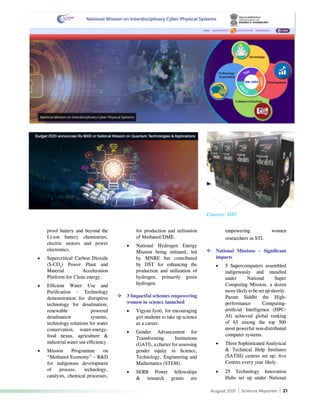
•	 National Mission on
Interdisciplinary Cyber-
Physical Systems (ICPS)
— technology development
in the areas of Artificial
Intelligence, Industry 4.0,
Robotics, Sensors, IoT, etc.
for rapid economic growth.
•	 National Mission on Quantum
Technology and Applications
(NM-QTA), for R&D to
manufacture in Quantum
Technologies and related
areas being launched.
	Mission mode programmes
initiated
•	 Sophisticated Analytical &
Technical Help Institutes
(SATHI) – to build a shared,
professionally managed, S&T
infrastructure for industry,
MSMEs and Startups.
•	 Scientific and Useful Profound
Research Advancement
(SUPRA) – to encourage and
develop projects that seek
new scientific breakthroughs
based on risk taking, profound
thinking, long-term impact on
our fundamental research.
•	 Technology Mission on
Electric Mobility & Storage
– R&D for tropical climate-
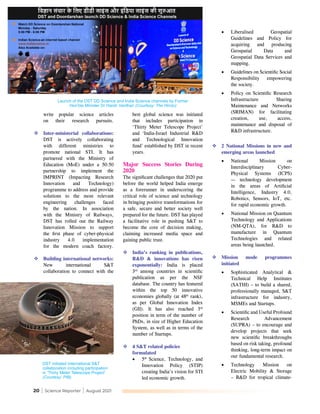
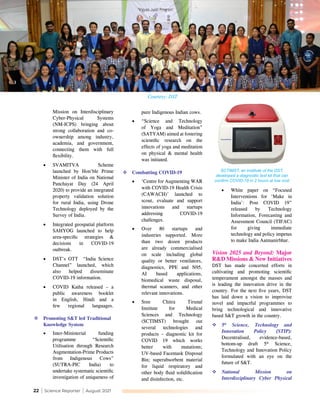
Launch of the DST DD Science and India Science channels by Former
Hon’ble Minister Dr Harsh Vardhan (Courtesy: The Hindu)
DST initiated international S&T
collaboration including participation
in ‘Thirty Meter Telescope Project’
(Courtesy: PIB)
August 2021 | Science Reporter | 21
proof battery and beyond the
Li-ion battery chemistries,
electric motors and power
electronics.
•	 Supercritical Carbon Dioxide
(S-CO2
) Power Plant and
Material Acceleration
Platform for Clean energy.
•	 Efficient Water Use and
Purification – Technology
demonstration for disruptive
technology for desalination,
renewable powered
desalination systems,
technology solutions for water
conservation, water-energy-
food nexus, agriculture &
industrial water use efficiency.
•	 Mission Programme on
“Methanol Economy” – R&D
for indigenous development
of process, technology,
catalysts, chemical processes,
for production and utilisation
of Methanol/DME.
•	 National Hydrogen Energy
Mission being initiated, led
by MNRE but contributed
by DST for enhancing the
production and utilization of
hydrogen, primarily green
hydrogen.
	3 Impactful schemes empowering
women in science launched
•	 Vigyan Jyoti, for encouraging
girl students to take up science
as a career.
•	 Gender Advancement for
Transforming Institutions
(GATI), a charter for assessing
gender equity in Science,
Technology, Engineering and
Mathematics (STEM).
•	 SERB Power fellowships
& research grants are
empowering women
researchers in STI.
	National Missions – Significant
impacts
•	 5 Supercomputers assembled
indigenously and installed
under National Super
Computing Mission, a dozen
more likely to be set up shortly.
Param Siddhi the High-
performance Computing-
artificial Intelligence (HPC-
AI) achieved global ranking
of 63 among the top 500
most powerful non-distributed
computer systems.
•	 Three Sophisticated Analytical
& Technical Help Institutes
(SATHI) centres set up; five
Centres every year likely.
•	 25 Technology Innovation
Hubs set up under National
Courtesy: DST
22 | Science Reporter | August 2021
Mission on Interdisciplinary
Cyber-Physical Systems
(NM-ICPS) bringing about
strong collaboration and co-
ownership among industry,
academia, and government,
connecting them with full
flexibility.
•	 SVAMITVA Scheme
launched by Hon’ble Prime
Minister of India on National
Panchayat Day (24 April
2020) to provide an integrated
property validation solution
for rural India, using Drone
Technology deployed by the
Survey of India.
•	 Integrated geospatial platform
SAHYOG launched to help
area-specific strategies &
decisions in COVID-19
outbreak.
•	 DST’s OTT “India Science
Channel” launched, which
also helped disseminate
COVID-19 information.
•	 COVID Katha released – a
public awareness booklet
in English, Hindi and a
few regional languages.
	Promoting S&T led Traditional
Knowledge System
•	 Inter-Ministerial funding
programme “Scientific
Utilisation through Research
Augmentation-Prime Products
from Indigenous Cows”
(SUTRA-PIC India) to
undertake systematic scientific
investigation of uniqueness of
pure Indigenous Indian cows.
•	 “Science and Technology
of Yoga and Meditation”
(SATYAM) aimed at fostering
scientific research on the
effects of yoga and meditation
on physical & mental health
was initiated.
	Combatting COVID-19
•	 ‘Centre for Augmenting WAR
with COVID-19 Health Crisis
(CAWACH)’ launched to
scout, evaluate and support
innovations and startups
addressing COVID-19
challenges.
•	 Over 80 startups and
industries supported. More
than two dozen products
are already commercialised
on scale including global
quality or better ventilators,
diagnostics, PPE and N95,
AI based applications,
biomedical waste disposal,
thermal scanners, and other
relevant innovations.
•	 Sree Chitra Tirunal
Institute for Medical
Sciences and Technology
(SCTIMST) brought out
several technologies and
products – diagnostic kit for
COVID 19 which works
better with mutations;
UV-based Facemask Disposal
Bin; superabsorbent material
for liquid respiratory and
other body fluid solidification
and disinfection, etc.
•	 White paper on “Focused
Interventions for ‘Make in
India’: Post COVID 19”
released by Technology
Information, Forecasting and
Assessment Council (TIFAC)
for giving immediate
technology and policy impetus
to make India Aatmanirbhar.
Vision 2025 and Beyond: Major
R&D Missions & New Initiatives
DST has made concerted efforts in
cultivating and promoting scientific
temperament amongst the masses and
is leading the innovation drive in the
country. For the next five years, DST
has laid down a vision to improvise
novel and impactful programmes to
bring technological and innovative
based S&T growth in the country.
	5th
Science, Technology and
Innovation Policy (STIP):
Decentralised, evidence-based,
bottom-up draft 5th
Science,
Technology and Innovation Policy
formulated with an eye on the
future of S&T.
	National Mission on
Interdisciplinary Cyber Physical
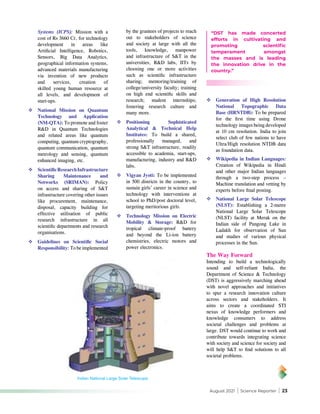
SCTIMST, an Institute of the DST,
developed a diagnostic test kit that can
confirm COVID-19 in 2 hours at low cost
Courtesy: DST
August 2021 | Science Reporter | 23
Systems (ICPS): Mission with a
cost of Rs 3660 Cr, for technology
development in areas like
Artificial Intelligence, Robotics,
Sensors, Big Data Analytics,
geographical information systems,
advanced materials manufacturing
via invention of new products
and services, creation of
skilled young human resource at
all levels, and development of
start-ups.
	National Mission on Quantum
Technology and Application
(NM-QTA): To promote and foster
R&D in Quantum Technologies
and related areas like quantum
computing, quantum cryptography,
quantum communication, quantum
metrology and sensing, quantum
enhanced imaging, etc.
	ScientificResearchInfrastructure
Sharing Maintenance and
Networks (SRIMAN): Policy
on access and sharing of S&T
infrastructure covering other issues
like procurement, maintenance,
disposal, capacity building for
effective utilisation of public
research infrastructure in all
scientific departments and research
organisations.
	Guidelines on Scientific Social
Responsibility: To be implemented
	Generation of High Resolution
National Topographic Data
Base (HRNTDB): To be prepared
for the first time using Drone
technology images being developed
at 10 cm resolution. India to join
select club of few nations to have
Ultra/High resolution NTDB data
as foundation data.
	Wikipedia in Indian Languages:
Creation of Wikipedia in Hindi
and other major Indian languages
through a two-step process –
Machine translation and vetting by
experts before final posting.
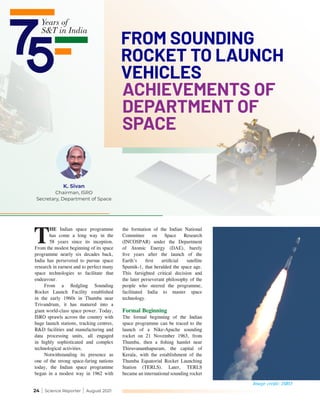
	National Large Solar Telescope
(NLST): Establishing a 2-metre
National Large Solar Telescope
(NLST) facility at Merak on the
Indian side of Pangong Lake in
Ladakh for observation of Sun
and studies of various physical
processes in the Sun.
The Way Forward
Intending to build a technologically
sound and self-reliant India, the
Department of Science & Technology
(DST) is aggressively marching ahead
with novel approaches and initiatives
to spur a research innovation culture
across sectors and stakeholders. It
aims to create a coordinated STI
nexus of knowledge performers and
knowledge consumers to address
societal challenges and problems at
large. DST would continue to work and
contribute towards integrating science
with society and science for society and
will help S&T to find solutions to all
societal problems.
Indian National Large Solar Telescope
“DST has made concerted
efforts in cultivating and
promoting scientific
temperament amongst
the masses and is leading
the innovation drive in the
country.”
by the grantees of projects to reach
out to stakeholders of science
and society at large with all the
tools, knowledge, manpower
and infrastructure of S&T in the
universities, R&D labs, IITs by
choosing one or more activities
such as scientific infrastructure
sharing; mentoring/training of
college/university faculty; training
on high end scientific skills and
research; student internships;
fostering research culture and
many more.
	Positioning Sophisticated
Analytical & Technical Help
Institutes: To build a shared,
professionally managed, and
strong S&T infrastructure, readily
accessible to academia, start-ups,
manufacturing, industry and R&D
labs.
	Vigyan Jyoti: To be implemented
in 500 districts in the country, to
sustain girls’ career in science and
technology with interventions at
school to PhD/post doctoral level,
targeting meritorious girls.
	Technology Mission on Electric
Mobility & Storage: R&D for
tropical climate-proof battery
and beyond the Li-ion battery
chemistries, electric motors and
power electronics.
24 | Science Reporter | August 2021
FROM SOUNDING
ROCKET TO LAUNCH
VEHICLES
ACHIEVEMENTS OF
DEPARTMENT OF
SPACE
K. Sivan
Chairman, ISRO
Secretary, Department of Space
T
HE Indian space programme
has come a long way in the
58 years since its inception.
From the modest beginning of its space
programme nearly six decades back,
India has persevered to pursue space
research in earnest and to perfect many
space technologies to facilitate that
endeavour.
From a fledgling Sounding
Rocket Launch Facility established
in the early 1960s in Thumba near
Trivandrum, it has matured into a
giant world-class space power. Today,
ISRO sprawls across the country with
huge launch stations, tracking centres,
R&D facilities and manufacturing and
data processing units, all engaged
in highly sophisticated and complex
technological activities.
Notwithstanding its presence as
one of the strong space-faring nations
today, the Indian space programme
began in a modest way in 1962 with
the formation of the Indian National
Committee on Space Research
(INCOSPAR) under the Department
of Atomic Energy (DAE), barely
five years after the launch of the
Earth’s first artificial satellite
Sputnik-1, that heralded the space age.
This farsighted critical decision and
the later perseverant philosophy of the
people who steered the programme,
facilitated India to master space
technology.
Formal Beginning
The formal beginning of the Indian
space programme can be traced to the
launch of a Nike-Apache sounding
rocket on 21 November 1963, from
Thumba, then a fishing hamlet near
Thiruvananthapuram, the capital of
Kerala, with the establishment of the
Thumba Equatorial Rocket Launching
Station (TERLS). Later, TERLS
became an international sounding rocket
Image credit: ISRO
A
P
P
L
E
S
a
t
e
l
l
i
t
e
August 2021 | Science Reporter | 25
in the former Soviet Union. Aryabhata
laid the firm foundation for the later
immensely successful Indian satellite
programme. Bhaskara 1 and 2, the
two experimental earth observation
satellites, provided the rich experience
and the confidence to build complex
operational remote sensing satellites.
Today, India is a world leader in the
satellite-based remote sensing area.
Additionally, APPLE, India’s
first experimental communication
satellite, though launched by the
European Ariane rocket, reached its
final geosynchronous orbital home in
June 1981 with the help of a rocket
motor developed in India. Aryabhata,
the two Bhaskaras, as well as APPLE
were launched free of cost, which
reflects India’s successful international
space cooperation policy. In the recent
past, India has not only flown foreign
scientific instruments on-board Indian
spacecraft but has also launched them.
Besides taking a leap into the
domain of satellites, ISRO conducted
two significant experiments in the 70s
– Satellite Instructional Television
Experiment (SITE) and Satellite
Telecommunication Experimental
Project (STEP) – to obtain hands-
on experience on the utilisation of
launching facility and such rockets
were launched for upper atmospheric,
geomagnetic and space research by
many countries.
It was at this time Dr Vikram
Sarabhai, the architect of the Indian
space programme, set up a Space
Science and Technology Centre at
Thumba for the development of
technologies necessary for space
research. In 1969, the Indian Space
Research Organisation, better known
by its ubiquitous acronym ISRO,
satellites for television broadcasting and
telecommunication. The experiment
became a tool for mass education
through various programmes designed
exclusively for the project.
SITE was conducted for a period
of one year, covering more than 2400
villages in 20 districts of six Indian
states and territories (Andhra Pradesh,
Bihar, Karnataka, Madhya Pradesh,
Orissa, and Rajasthan). SITE was
followed by STEP and conceived
as a sequel to SITE. STEP was for
telecommunication experiments and
was conducted for a period of 13 hours
every day for a little over two years.
And, it was in this decade that
ISRO developed its first Satellite
Launch Vehicle SLV-3, which had
its successful launch on 18 July 1980
thrusting India into the select league
of six countries with the capability to
launch satellites on their own.
The Experimentation Phase
The 1980s were times for
experimentation for launch vehicle
technologies to demonstrate the
country’s ability to develop Augmented
Satellite Launch Vehicle (ASLV) with a
payload capability of 150 kg into Low
Earth Orbit, a more capable launch
vehicle compared to SLV-3 which was
capable of putting a 40 kg satellite into
a low earth orbit.
During the same period, ISRO
acquired extensive experience in
the design, development, building,
launching and in-orbit maintenance
of a variety of satellites including
communication and remote sensing
satellites. INSAT-1B, India’s first
multipurpose operational satellite
launched in 1983, demonstrated the
country’s ability to bring about a
Dr Vikram Sarabhai – Architect of India’s
space programme
Apple Satellite
was formed. Government of India
constituted the Space Commission and
established the Department of Space
(DOS) in 1972 and brought ISRO under
DOS in the same year.
Today, with a total workforce of
over 17,000, ISRO’s establishments are
functioning in many parts of the country
with each concentrating on a specific
area. The country’s public as well as
private sector industries are playing a
crucial role in our space programme.
Besides, academic institutions have
also contributed to the Indian space
endeavour.
The Learning Phase
The 70s were the learning phase during
which many experimental satellites
were built, including India’s first
satellite Aryabhata, which was launched
on 19 April 1975 from a launch centre
“Today, with a total
workforce of over 17,000,
ISRO’s establishments are
functioning in many parts
of the country with each
concentrating on a specific
area.
“The world got an inkling
of India’s ability to design,
build and maintain a complex
remote sensing satellite in
1988 when IRS-1A, the first
operational satellite built in
India, started imaging the
earth from orbit.”
APPLE Satellite
26 | Science Reporter | August 2021
rapid and major revolution in India’s
telecommunications, television
broadcasting and weather forecasting.
Today, communication satellites
are an integral part of our economic
infrastructure.
The world got an inkling of India’s
ability to design, build and maintain
a complex remote sensing satellite in
1988 when IRS-1A, the first operational
satellite built in India, started imaging
the earth from orbit. The images sent
by satellite circling the Earth from its
900-km-high polar orbit were utilised
in such diverse fields as agriculture,
groundwater prospecting, mineral
survey, forestry, etc.
The Growth Phase
During the 1990s, ISRO began building
the INSAT-2 series of multipurpose
satellites indigenously. At the same
time, systematic usage of imagery from
our remote sensing satellites for tasks
like crop yield estimation, groundwater
and mineral prospecting, forest survey,
urban sprawl monitoring and wasteland
classification and fisheries development,
began.
Today, India has a fleet of
advanced remote sensing satellites
equipped with high resolution and
multispectral cameras dedicated to
cartography, resource survey and
ocean and atmospheric applications.
Apart from these, polar orbit based
observation satellites, weather watching
satellites INSAT-3D and INSAT-3DR –
circling the earth in the 36,000 km high
geosynchronous orbit, are providing
valuable inputs for weather forecasting.
The Indian National Satellite
(INSAT) system today is one of the
largest domestic communication
satellite systems in the Asia-Pacific
region and has become an integral
part of our telecommunications
and TV broadcasting infrastructure
including DTH services driving the
country’s communications revolution.
Besides, our geostationary satellites
are providing vital inputs to the task
of nationwide weather forecasting,
especially in the provision of advance
warning of cyclones, saving lives and
mitigating the loss of property. One of
them carries a satellite-aided Search-
and-Rescue transponder and has helped
in speedy rescue of people in distress in
the open seas.
High throughput satellites such as
GSAT-11, GSAT-29 and GSAT-19 are
supporting the Digital India campaign
by boosting broadband connectivity
to the rural and inaccessible Gram
Panchayats in the country. The
transponders on these satellites will
also bridge the digital divide of users
including those in Jammu & Kashmir
and North-Eastern regions of India.
Perfecting the launch vehicle
technology is an immensely difficult
and challenging task, which only a
few countries possess. Till now ISRO
has developed five launch vehicles
(SLV-3, ASLV, PSLV, GSLV and
GSLV Mk III, which is also known as
LVM3) and mastered the technology of
rockets that use solid, liquid as well as
cryogenic propellants.
Polar Satellite Launch Vehicle
(PSLV) is the third generation launch
vehicle of India. It is the first Indian
launch vehicle to be equipped with
liquid stages. With 51 successful flights
over the years, PSLV has emerged as
the reliable and versatile workhorse
launch vehicle of India. In fact, it has
launched 342 foreign satellites as on
22 June 2021 and has carved out a
niche in the commercial satellite launch
arena.
On 15 February 2017, PSLV
created a world record by successfully
placing 104 satellites in orbit during a
single launch. Well, as numbers go, it
was undoubtedly a record, but the real
significance is the immense confidence
reposed by foreign countries, including
the USA, in the capability of ISRO. This
success was the result of meticulous
planning and flawless execution of the
mission by ISRO.
Expanding the Horizon
In the early 21st
century, the Indian
launch vehicle programme has ventured
beyond the PSLV resulting in the
development of the Geosynchronous
Satellite Launch Vehicle (GSLV) with
more payload capability, efficiency
and sophistication. GSLV, with the
capability to launch 2-ton satellites
into Geosynchronous Transfer Orbit
(GTO), employs cryogenic propulsion
technology in its third stage.
Geosynchronous Satellite Launch
Vehicle Mark II (GSLV Mk II) is the
fourth generation launch vehicle having
three stages (including the cryogenic
upper stage) with four liquid strap-ons.
Cryogenic technology involves storage
of liquid hydrogen & liquid oxygen
Communication satellites (Image credit: ISRO)
August 2021 | Science Reporter | 27
at very low temperatures. Materials
used to operate at these very low
temperatures, chilling processes, and
interplay of engine parameters make
the development of cryogenic stage a
very challenging and complex task.
With the successful qualification of
the indigenously developed Cryogenic
Upper Stage (CUS) in the GSLV-D5
flight on 5 January 2014, ISRO
demonstrated its mastery of cryogenic
rocket propulsion. Since January 2014,
the vehicle has achieved six consecutive
successes.
GSLV Mk III, India’s fifth-
generation satellite launch vehicle
has two solid strap-ons, a core liquid
booster and a cryogenic upper stage.
The vehicle is designed to carry 4-ton
class of satellites into Geosynchronous
Transfer Orbit (GTO) or about 10 tons
to Low Earth Orbit (LEO). LVM3-X/
CARE Mission, the first experimental
suborbital flight of GSLV Mk III
on 18 December 2014 injected the
Crew Module Atmospheric Re-entry
Experiment (CARE) in December
2014. The CARE module began
its return journey and a little later,
re-entered the earth’s atmosphere. It
was successfully recovered over the
Bay of Bengal about 20 minutes after
its launch.
Subsequently, after two successful
developmental flights and with the
successful injection of Chandrayaan-2
into the Earth Parking Orbit in July
2019, GSLV Mk III successfully
entered into its operational phase.
Besides these, India’s Reusable
Launch Vehicle Technology
Demonstrator (RLV TD) was
successfully flight tested in May
2016 and several critical technologies
were successfully validated. The
first experimental mission of ISRO’s
Supersonic Combustion Ramjet
(SCRAMJET) engine towards the
realisation of air breathing propulsion
system was also successfully conducted
in August 2016. With this, India
became the fourth country to flight test
the SCRAMJET engine.
The Indian space programme has
always focused on the development
and utilisation of space technologies
to achieve overall development of
the country. Despite its emphasis on
applications, ISRO has pursued many
space science projects in earnest to
perform meaningful exploration of
space. India’s first satellite Aryabhata
was a scientific satellite.
After Aryabhata, ISRO entered
into the realm of science missions
again with a unique mission that caught
the attention of the world – the Space
Capsule Recovery Experiment-1
(SRE-1). Launched by PSLV in
January 2007, SRE-1 with its scientific
experiments orbited the Earth for 12
days and was successfully de-orbited
and recovered over the Bay of Bengal.
This proved several technologies
necessary for reusable launch vehicles
and human spaceflight.
Venturing into Space
The space science missions of India –
Chandrayaan-1, Mars Orbiter Mission,
Astrosat and Chandrayaan-2 – have
caught the attention of millions of
Indians as well as the outside world.
Launched by PSLV on
22 October 2008, the 1380 kg
Chandrayaan-1 spacecraft was
successfully navigated to the Moon in
three weeks and was put into an orbit
around the moon. On 14 November
2008, when a TV set sized ‘Moon Impact
Probe’ separated from Chandrayaan-1
spacecraft and successfully impacted on
the surface of the Moon, India became
the fourth country to send a probe to the
lunar surface after the United States,
the Soviet Union and Japan and the fifth
individual country to put a spacecraft
into an orbit around the Moon. Later,
when Chandrayaan-1 conclusively
discovered water molecules on the
lunar surface, it was widely hailed as a
pathbreaking discovery.
Encouraged by the success of
Chandrayaan-1, ISRO endeavoured
SRE-1 (Image credit:
commons.wikimedia.org)
“The space science missions
of India – Chandrayaan-1, Mars
Orbiter Mission, Astrosat and
Chandrayaan-2 – have caught
the attention of millions of
Indians as well as the outside
world.”
28 | Science Reporter | August 2021
AstroSat (Image Credit: isro.gov.in) Chandrayaan-2 (Image credit:
Wikimedia Commons)
to realise the Mars Orbiter Mission
for demonstrating India’s capability to
build, launch and navigate an unmanned
spacecraft to Mars. Launched by PSLV
on 5 November 2013, the 1340 kg
Mars Orbiter Spacecraft encountered
Mars on 24 September 2014. With this,
ISRO became the fourth space agency
to successfully send a spacecraft to
Mars orbit. Achieving success in the
first such mission itself is yet another
accomplishment of ISRO.
AstroSat launched by PSLV in
September 2015 is the first dedicated
Indian astronomy mission aimed at
studying celestial sources in X-ray,
optical and UV spectral bands
simultaneously. AstroSat recently made
a major breakthrough by discovering
one of the earliest galaxies in extreme-
Ultraviolet light.
The Chandrayaan-2 mission,
India’s second mission to the moon, was
successfully launched on 22 July 2019.
Chandrayaan-2 Orbiter spacecraft
was placed in its intended orbit. The
eight instruments onboard the Orbiter
are continuously providing useful
science data which will enrich our
understanding of the Moon’s evolution
and mapping of the minerals and water
molecules in the Polar regions.
Having successfully built many
communications, meteorological
(weather monitoring), remote
sensing and scientific satellites, ISRO
has successfully established and
operationalised the Navigation with
Indian Constellation (NavIC), with eight
satellites in orbit, which are providing
accurate position, navigation and time
information to users in India and its
surroundings. Further, through GPS
Aided GEO Augmented Navigation
(GAGAN), ISRO is providing satellite-
based navigation services with accuracy
and integrity required for civil aviation
applications and to provide better
Air Traffic Management over Indian
Airspace.
Apart from this, ISRO has
also facilitated students in building
and launching satellites for various
applications. So far, 14 student satellites
have been launched by ISRO.
Human Space Flight Endeavour
The “Gaganyaan Programme”
approved by the Government of India in
2018 is a point of inflexion in the growth
profile of India's space endeavour.
With the Gaganyaan Programme, a
new vertical has been created within
ISRO, and a new ISRO centre namely
Human Spaceflight Centre (HSFC) was
established on 10 January 2019 and
started functioning.
Gaganyaan is a national programme
wherein ISRO is leveraging the domain
expertise of various national agencies
like Indian Armed Forces, DRDO
labs, CSIR labs, academic institutions,
Indian maritime agencies, and industry
“The crew selection and basic
space flight training of four
astronaut trainees for the
Gaganyaan project have been
completed at the Gagarin
Cosmonaut Training Centre
(GCTC), Russia and ISRO are
gearing up for the mission-
specific training in India.”
Mars Orbiter Mission Spacecraft (Image Credit: isro.gov.in)
August 2021 | Science Reporter | 29
Inauguration of Human Space Flight Centre
(Image credit: ISRO)
Inauguration of NSIL by Dr K. Kasturirangan,
former Chairman, ISRO (Image credit: ISRO)
partners. MoUs/contracts are also in
effect with concerned participating
agencies. ISRO has organised various
Industry meets and workshops to apprise
the industries about the requirements of
Gaganyaan.
The crew selection and basic space
flight training of four astronaut trainees
have been completed at the Gagarin
Cosmonaut Training Centre (GCTC),
Russia and ISRO are gearing up for the
mission-specific training in India. The
preliminary design of major subsystems
has been completed and ISRO has
entered into the realisation phase. The
test plan for various systems is also
finalised.
ISRO has initiated the process of
encouraging micro-gravity research in
academic institutes. Five microgravity
experiment proposals have been
shortlisted for flying in Gaganyaan
unmanned flights. ISRO will be
supporting the activities of payload
design and qualification.
In addition, to meet the
programmatic schedule targets, foreign
collaboration is being planned in
areas that require establishing large
infrastructure and long lead research
and development. The major areas of
collaborations are astronaut training,
life support systems, spacesuit, wind
tunnel testing, flight surgeon training,
etc. ISRO has entered into contracts and
agreements with various international
agencies like M/s Glavkosmos Russia;
NRC Canada; INCAS Romania, and
CNES France. In the framework
of ISRO-CNES collaboration, a
three-week training programme for
flight surgeons was conducted at ISRO.
An International Symposium on
Human Spaceflight and Exploration
was organised by ISRO in Association
with the International Academy
of Astronautics (IAA) to bring
together national and international
experts, scientists, professionals and
academicians for the exchange of
technical information and policy details
on human space flights.
Space Technology
As a collaborator with industries,
over the last five decades, ISRO has
been successful in the development
of indigenous end-to-end capability in
space technology and space activities.
This has also led to growth in Indian
industries, with more than 500 MSMEs,
PSUs and large private industries
contributing significantly to the Indian
space programme. The involvement
of industries in space activities has
created jobs for around 45,000 people
in the country. Many sectors like
defence production, telecom, materials,
chemicals and precision engineering
have benefitted from this exercise.
Space-based applications/services
over the years have grown much
more than originally envisaged. Many
new applications are being developed
worldwide to meet the growing user
demands and requirements. The
activities are on a growth trajectory
with huge commercial potential. In
India, many Non-Government-Private-
Entities (NGPEs) have started engaging
in space activities for commercial
gains. Many start-ups and industries
have started making launch vehicles
and satellites and are eager to provide
space-based services. Participation of
NGPEs including academic institutions,
start-ups and industries in end-to-end
space activities is expected to expand
the space economy.
In order to enhance the diffusion
of space technology and boost the
space economy within the country, the
participation of private companies in
space activities needs to be encouraged.
The Government of India announced
reforms for opening up the space sector
to private entities by the creation of
the Indian National Space Promotion
and Authorization Centre (IN-SPACe)
under the Department of Space (DOS).
IN-SPACe will encourage, promote
and hand-hold the private sector for
their participation in the Space sector.
IN-SPACe has already promoted
and hand-held four student satellites,
which were successfully launched by
PSLV-C51.
To enable enhanced participation
of Indian Industries in taking up
high-tech space-related activities, the
Government of India on 6 March 2019
incorporated NewSpace India Limited
(NSIL), a wholly-owned Central Public
Sector Enterprise (CPSE), under the
administrative control of the Department
of Space. NSIL is the commercial arm
of ISRO with the primary responsibility
30 | Science Reporter | August 2021
During UNNATI programme 2019
of enabling Indian industries to take up
high technology space-related activities.
With the expansion of the space
sector to private entities, Government
of India enhanced the role and scope of
NSILtoencompassmoreresponsibilities
in the primary business areas and
widen the scope. The revised mandate
broadly covers (i) Owning satellites for
Earth observation and communication
applications; (ii) Providing space-based
Earth observation and communication
services; (iii) Building and launching.
Building Human Resources
Towards capacity building in human
resources and to meet the growing
demands of the Indian Space
Programme, the Indian Institute of
Space Science and Technology (IIST),
a deemed university, was established
at Thiruvananthapuram in 2007. The
institute offers Bachelor’s Degree in
Space Technology with specialisation
in Aerospace Engineering and
Electronics & Communication and
Masters Programme in areas of space
technology.
ISRO is also developing systematic
capacity enhancement plans at
individual, organisational, institutional,
industrial and user/community levels.
Various training and development
activities are envisaged through both
centralised and decentralised systems.
The scheme of Centralised Induction
Training Programme for newly joined
scientists/engineers, introduced during
2002, is aimed at introducing the newly
recruited engineers to the ISRO systems
by providing exposure to the ISRO
programmes, achievements, rules,
regulations, systems, processes, etc.
Similar Centralised Induction Training
programmes are being provided to
Office Assistants and Junior Personal
Assistants in Administrative areas.
During the 50th
anniversary of
the United Nations Conference on
the Exploration and Peaceful uses of
Outer Space (UNISPACE+50), India
announced a capacity building training
programme UNNATI (UNispace
Nanosatellite Assembly & Training by
ISRO) on Nanosatellite development
in three batches for international
participants from countries around
the world. The course comprises of a
combination of theoretical coursework
and hands-on training. As part of the
theoretical coursework, the participants
are taken through basics of satellite
technology(Module1)andnanosatellites
(Module 2). The participants would
be introduced to the design aspects
of satellites, the various subsystems
of a satellite and their functionality,
configuration evolution and post-launch
mission operations. As part of the
hands-on training, all participants are
introduced to Assembly, Integration
and Testing (AIT) of Nanosatellites in
the labs of URSC.
The first batch of UNNATI
Programme was conducted from 15
January to 15 March 2019 with 29
participants from 17 countries and the
second batch was conducted from 15
October to 15 December 2020 with 30
participants from 16 countries.
Geared for Future Challenges
The Indian space programme has many
challenges ahead. There are plans
to build heavier and more capable
and efficient satellites. And, space
science missions like Chandrayaan-3,
Aditya-L1, Mission to Venus to further
explore the solar system, are in progress.
Pursuit of research and development
activities pertaining to small satellite
launch vehicle, air-breathing rocket
propulsion and demonstration of
reusable rocket technology, are also
progressing.
The space programme in the
country is poised for several major
breakthroughs in the development
of advanced technology needed for
the realisation of the future launch
vehicle and spacecraft missions in
the coming years. Efforts are on to
establish the necessary infrastructure
for casting large boosters, liquid-
propellant engines, heavy cryo-
boosters for advanced heavier
launchers and missions in the area of
remote sensing, communications and
navigational satellites as well as space
science systems. Necessary ground
infrastructure for providing mission
support during the launch phase and in-
orbit support for the planned missions
is under realisation.
The continuing expansion of space
applications programmes like Village
Resources Centres, telemedicine, tele-
education, disaster management support
and outreach through Direct-To-Home
television, reiterates the increasing
role played by the Indian space
systems in providing direct benefits to
society.
The Indian space programme
continues to pursue successful goals
on all fronts in meeting the objectives
of achieving self-reliance in space
technology and its applications for
national development.
32 | Science Reporter | August 2021
I
NDIA has witnessed substantial
achievements in population health
improvement during the last seven
decades. One of the key developments
is the improvement in life expectancy
at birth, which has increased from 32
years in 1947 to 69.4 years in 2021 –
more than double increase in the last
seven decades. The marked reduction
in Maternal Mortality from 2000 per
100,000 live birth to 113 and Infant
Mortality from 145 per 1000 live birth
to 28.7 is again a testament to the
tremendous progress in Indian medical
research and health interventions.
The country has also been able to
eliminate diseases like small pox, polio,
Yaws, guinea-worm and neonatal
tetanus through consistent research and
ground level implementation. Diseases
like cholera, leprosy, tuberculosis,
malaria, kala-zar, lymphatic
filariasis, which used to cause serious
concern, have now been controlled
to a significant degree and are being
targeted for elimination.
In recent years, the unfolding of
Mission Indradhanush and schemes
like Swachch Bharat, Ujjawala Yojna,
Ayushman Bharat and Poshan Abhiyan
are going to have tremendous impact on
various health indicators.
Equitable Access to Healthcare
The public health landscape of a state,
nation or country is ever evolving.
There is always a need to balance
the research efforts between various
fields, with the existing availability of
resources to achieve equitable access
to healthcare and health services. The
Mission DELHI: Tackling heart attack within the first 30 minutes
Dr Balram Bhargava
Secretary, Department of Health Research (DHR)
& Director General, Indian Council of Medical
Research (ICMR)
Dr Rajni Kant
Director, ICMR-Regional Medical Research Centre,
Gorakhpur
Scientist G & Head, Research Management, Policy,
Planning and Coordination (RMPPC), ICMR Hqrs
Role of Indian Council of
Medical Research (ICMR)
CHANGING
THE TIDE IN PUBLIC
HEALTH SYSTEMS
IN 75 YEARS
August 2021 | Science Reporter | 33
Indian Research Fund Association
(IRFA) was established with this
purpose before independence, in 1911.
The primary objective of the IRFA was
to carry out medical research in tropical
diseases like malaria, tuberculosis and
plague.
Post-independence, the Indian
Research Fund Association was
renamed as the Indian Council of
Medical Research (ICMR), under the
aegis of the Ministry of Health and
Family Welfare. ICMR, in its new
avatar, has grown into a pan-India
organisation with 27 institutes, over
a hundred field Stations/Units and a
network of laboratories.
As the leading medical research
institute in India, ICMR has become the
apex body for planning, formulation,
coordination, implementation and
promotion of biomedical research.
ICMR today carries out pioneering
work in areas of epidemic monitoring
government programmes and medical
protocols.
ICMR is supporting Ayushman
Bharat and ensuring a sustainable
and cost-effective model through
its ongoing programmes like health
technology assessment, standard
treatment workflows and national list
of essential medicines and diagnostics.
These programmes would serve as an
important tool in prioritising national
health spending and providing a
uniform guideline to ensure quality
healthcare services across the nation.
The health research infrastructure
built by ICMR has been critical in
turning around the country’s health
indicators, reduce the spread of
infectious diseases, combat non-
communicable diseases, save lives and
reduce the impact of health challenges.
The lead taken by the Council in India’s
expertise to state health ministries and
departments.
ICMR also consistently
collaborates with international partners
to exchange ideas and work jointly on
major research programmes thereby
contributing to both extramural as well
as intramural research in India. ICMR
research programme are aligned with
national health priorities and meant to
serve the people of India.
Viral Outbreaks and Epidemics
Epidemics come at a great economic
and social cost, not to mention loss
of precious human lives. India has
witnessed a multitude of epidemics
ranging from water-borne diseases
like cholera and vector-borne diseases
like malaria. Epidemic containment
and providing cure to the affected
incurs great economic cost and
loss of productivity. ICMR has led
surveillance of critical diseases,
conducted investigations and developed
evidence to tackle numerous outbreaks
and epidemics.
The organisation has contributed to the
study of various virus-induced diseases
like acute hemorrhagic conjunctivitis,
rabies, polio, etc. ICMR also played
a prominent role in India’s biggest
public health achievement of control
and eventual elimination of polio. The
country which was once the epicenter
of polio in the world has now officially
eliminated the disease.
Post H1N1 outbreak, ICMR
recognised the gap and took lead to
become self-sufficient in tackling the
emerging and reemerging infectious
diseases. It set up a network of Viral
Diagnostic and Research laboratories
(VRDL) across the country.
ICMR also set up Asia’s first BSL-4
laboratory to conduct research on the
and control, maternal and child
health, nutrition, lifestyle diseases
and occupational health. The research
carried out by the various ICMR
institutes forms the basis of various
research response to the COVID-19
pandemic is an example of ICMR’s
commitment in the area. In addition to
developing the nation’s first indigenous
vaccine against COVID-19, ICMR has
made and approved testing kits, built
a network of laboratories across the
country with over 2600 labs, developed
COVID-19 protocols, conducted sero-
surveys and essentially informed the
policy response for the disease in India.
In addition to this, to achieve
the goal of improving the healthcare
system in the country through research
programmes, ICMR encourages
capacity building. Through its research
grants and fellowships, the organisation
supports innovative research in the field
of medicine. The 27 institutes under
the umbrella of ICMR cover medical
research at a pan-India level and
offer both region and disease-specific
Team working in COVID testing
Scientists working in High Containment
Facility at NIV, Pune
ICMR team conducting COVID-19
Sero-survey
Mobile Stroke Unit: Providing treatment
at the doorstep
34 | Science Reporter | August 2021
most infectious viruses in a contained
environment. The combination of BSL-4
with a vast network of VRDL has
resulted in successful investigation and
containment of CCHF, Nipah & Zika.
Not even one sample was sent outside
the country.
During the COVID-19 pandemic
too, these proved to be an asset in
establishing the diagnosis of the novel
Coronavirus as well as isolating and
culturing it for developing a vaccine.
ICMR has also geared up to be
future ready. An international platform
‘RESEARCH – Regional Enabler for
South East Asia Research Collaboration
for Health’ in collaboration with WHO
and 10 other countries of South-Asian
region has been set up to effectively
combat emerging and re-emerging
infectious diseases in South East Asia
region as well as to tackle cross border
infections. With increased interaction
between humans and animals – domestic
and wild, and influenced by climate
change, human health can no longer
be seen in isolation. To understand the
complexities between animal health,
human health and the environment,
a National Institute for One Health is
being set up at Nagpur. The Institute
will address the issue of zoonosis and
anti-microbial resistance through inter-
sectoral collaboration.
Communicable Diseases
Millions of lives in India have been
lost due to communicable diseases like
malaria, cholera, Kala azar and HIV in
the past. Over the years, ICMR through
its various research institutes has been
working to tackle major communicable
diseases in the country, with proven
success.
ICMR pioneered the
development of commercial diagnostic
kits against dengue and chikungunya,
direct antibody tests for early diagnosis
of Kala-azar and timely development
of vaccines against the Kyasanur
Forest Disease (KFD) and Japanese
Encephalitis. ICMR also demonstrated
for the first time that home-based
treatment is as successful as hospital-
based treatment for tuberculosis. The
Council further simplified tuberculosis
treatment by laying the foundation of
the Directly Observed Treatment Short
Course (DOTS) in 1964. Recently,
ICMR has developed TruNAT, a cost
effective, PHC friendly diagnostic for
TB that has been recommended by
WHO after successful multi-country
trial. The same platform has also been
deployed for Point-of-Care testing in
Nipah, Leptospirosis & COVID-19.
Other communicable diseases
like Malaria, Leprosy, Lymphatic
filariasis and Cholera have also
been under the purview of the
organisation’s research areas. Several
malaria elimination demonstration
projects (Konkan Railways, CCMP
in Odisha, MEP in Mandla) have
successfully shown 85-90% decrease
in malaria cases. To combat death and
illness caused due to diarrhea, ICMR
demonstrated the efficacy of Oral
Rehydration Therapy. It established
that Home Available Fluids (HAF)
such as sherbet or tender coconut water
and pressed rice water were effective.
Following the successful
elimination of polio in India, ICMR
is now working towards eliminating
diseases like Kala-azar, filariasis,
leprosy, malaria and tuberculosis in
mission mode by setting up multi-
stakeholder platforms, India TB
Research Consortium (ITRC) and
Malaria Elimination Research Alliance
(MERA) India. Over these years,
ICMR has continued to perform
research and develop strategies for
treatment, prevention and control of
enteric infections and HIV/AIDS that
threaten the nation’s health.
There has been continuous influx of
evidence into national policy decisions,
be it the malaria drug policy change in
North-East (due to demonstration of
rising resistance towards Chloroquine)
or addition of triple drug therapy for
accelerated elimination of lymphatic
filariasis from the hotspot-areas of the
country.
Non-Communicable Diseases
Non-communicable Diseases (NCDs)
are not contagious, but they pose a
Asia’s First BSL-4 laboratory at ICMR-NIV,
Pune – played a pivotal role in tackling
COVID-19, Nipah, Zika and other viral
outbreaks
Environmental surveillance for viral
outbreak by NIV team
Community based survey for epidemiological study in vector borne diseases
August 2021 | Science Reporter | 35
great risk to the overall wellbeing of
the society. In the recent past, such
diseases have grown exponentially. The
burden of non-communicable diseases
weighs heavily, since they can go
undiagnosed and lead to severe decline
in individual productivity and even
death. Early detection and prevention
of non-communicable disease is one of
the key focus areas of ICMR.
ICMR has dedicated institutes
to carry out research on various non-
communicable diseases like cancer,
environmental and occupational
hazards, disease informatics and
implementation research. ICMR
also maintains national registries for
cancer, stroke, cardiovascular diseases,
diabetes, etc. Due to the efforts of the
national cancer registry programme,
cancer has been made a notifiable
disease in 12 states.
ICMR’s researches have often
shape health policy mechanisms. For
example, an India State-Level Disease
Burden Initiative was launched in
collaboration between ICMR, the
Public Health Foundation of India
(PHFI), Institute for Health Metrics and
Evaluation (IHME), and senior experts
and stakeholders from nearly a hundred
institutions across India. The data
estimates were based on the analysis
of all identifiable epidemiological data
from India over a quarter of a century,
led by ICMR and the collateral aided
in informing health planning to reduce
health inequalities prevalent amongst
states in India. This study led to the
identification of the rising burden of
NCDs thus guiding states to develop
more nuanced policies.
In another major initiative,
ICMR along with the Cardiology and
Emergency Medicine departments of
All India Institute of Medical Sciences
(AIIMS), launched a pilot project called
Mission DELHI (Delhi Emergency Life
Heart Attack Initiative) where people
would be able to call prescribed toll-
free numbers for a motorbike-borne
emergency medical assistance unit in
the eventuality of a heart attack or chest
pain.
ICMR has also successfully
initiated mechanisms to provide stroke
treatment through state-of-the-art
Mobile Stroke Unit (MSU) in Tezpur
and Dibrugarh area of Assam, India.
The MSU was a commendable piece of
work in light of the ongoing pandemic.
Nutrition
ICMR has also made salient
contributions in nutrition, like
assessment of nutritive values of
commonly consumed Indian foods and
studies of nutrient deficiency disorders.
It has led intensive work in areas like
iodine deficiency, anaemia, night
blindness where it has addressed gaps
in diagnostics and affordable treatment
mechanisms to tackle the diseases
paving the way for implementation of
national programmes in these areas.
ICMR dispelled the myth that
protein deficiency is the main reason
for malnutrition and highlighted
calorie gap as the actual bottleneck
in Protein Energy Malnutrition
(PEM). The organisation also laid the
foundations for Recommended Dietary
Allowances (RDA) which is used as
guiding information for RDA values
by government organisations and other
statutory bodies till date.
ICMR has pioneered other inspiring
work in the field of nutrition – from
assessing dietary intake of individuals,
households and nutritional profiles
of different communities through
periodic surveys to developing simple
and sensitive biochemical indicators
for assessment of vitamin nutritive
and pathogenic mechanisms of various
nutritional deficiency syndromes, to
identifying and establishing growth
norms for Indian children and even
generating database on nutritive values
of over 650 Indian foods, which is
used by various national organisations,
planners and academic research
institutions. Now it is working in close
partnership with the National Nutrition
Mission to improve nutrition related
deficiencies across India.
Reproductive, Maternal and
Child Health
India has a high burden of morbidity
and mortality in women, children and
infants. ICMR has pioneered exemplary
research in maternal and child health.
In 1981, ICMR pioneered in vitro
fertilization and successfully supported
the delivery of the first Test Tube baby
in India – Harsha – on 6 August 1986.
This was a landmark step in the field of
infertility treatment and placed India on
the world map in the arena of assisted
reproductive technologies.
ICMR has also developed effective
indigenous diagnostic kits for the
detection of Chlamydia trachomatis,
pregnancy detection, sperm quality
assessment and fertility assessment
tests to assist quick diagnosis and
intervention. A quarter of India’s
population constitutes adolescents.
Majority of young and growing
children have poor or limited
knowledge and lack of awareness on
sexual and reproductive health. The
ICMR-NIRRH, Mumbai, developed
service delivery models for adolescent
reproductive and sexual health and
guidelines on sexually transmitted
infections, to help build awareness
among the youth of the country.
First scientifically documented Test Tube
Baby Harsha – a contribution of ICMRNIIRH
in collaboration with KEM Hospital,
Mumbai
Field Station at Sagar (Shimoga) in
Karnataka for study of KFD
36 | Science Reporter | August 2021
ICMR’s contribution in last 75 years
S.No. Activities Relevance
1. Network of 27 disease-specific
institutes and more than 100 field
Stations/Units
•	 Evaluation of new drugs, insecticides, vaccines, devices, diagnostic kits & other
interventions relevant for every corner of the country
2. Clinical Trial Registry – India
(CTRI)
•	 Registers clinical trials conducted in India to improve transparency and accountability,
ensure conformation to accepted ethical standards and reporting of all relevant results
of the trials.
•	 ICMR also provides ethical guidelines for clinical trials
3. National Cancer Registry Programme •	 Generate reliable data on the magnitude and pattern of cancer in India
•	 Undertake epidemiological studies based on results of registry data
•	 Help in designing, planning, monitoring and evaluation of cancer control activities
under the National Cancer Control Programme (NCCP)
•	 Develop training programmes in cancer registration and epidemiology
4. Surveillance networks (IDSP,
rotavirus, polio, Antimicrobial
resistance, etc.)
•	 Generate timely and geographically representative data on the clinical, epidemiological,
and pathological features of several diseases in Indian population
5. Nutrition •	 Identified priority areas, conducted research in a multicentre mode and found effective,
practical, economically viable and sustainable solutions for nutrition related problems
•	 Nutritive value of Indian Foods and Food Fortification are landmark achievements
of ICMR.
6. Support in outbreak/epidemics/
pandemics/National Emergencies
•	 Leading the fight against COVID-19
•	 Successful containment of Nipah and Zika Virus
•	 Surveillance of health impact due to Indian Ocean Tsunami in 2004 (NIE, NIRT,
NICED, CRME, VCRC, RMRC-PB)
•	 Environment and health impact assessment for Bhopal Gas Tragedy, 1984 (NIOH,
NIMS, BHRMC, NIP, NICPR)
•	 Earthquake in Gujarat, 2001 (NIMR, DMRC)
•	 Supercyclone in Odisha, 1999 (NIMR)
7. Inputs for policy implementation •	 Covaxin for COVID-19
•	 DOTS for Tuberculosis
•	 UMDT for Leprosy
•	 Malaria Drug Policy in North-East
•	 ORS implementation in diarrhea
8. Guidelines/Regulations •	 National Guidelines for Accreditation, Supervision and Regulation of ART Clinics
in India
•	 Ethical Guidelines for Biomedical Research on Human Participants
•	 Guidelines for Good Clinical Laboratory Practices
•	 Guidelines for Safety Assessment of Foods Derived from Genetically Engineered
Plants
•	 Intellectual Property Rights Policy
•	 Guidelines for Stem Cell Research
•	 Dietary Guidelines for Indians
9. Isolation/characterisation of new
pathogens
•	 Asia’s first BSL-4 laboratory developed
•	 Cholera strain O139
•	 Kyasanur forest disease (KFD)
•	 Leptospirosis
•	 Paragonimiasis
10. Research support to Medical Colleges •	 Funds majority of research in medical colleges
•	 Short Term Studentship Program to promote interest and aptitude for research among
medical undergraduates
11. Capacity building •	 Generate and nurture human resources for health research activities through
fellowships (JRF, SRF, RA, STS) and trainings/workshops
August 2021 | Science Reporter | 37
ICMR has also been a pioneer
in the validation of contraceptive
methods for incorporation in national
programme. It has also led decisive
work in contraception and family
planning including research on efficacy
of postpartum Intrauterine Devices
(IUDs), evaluation of improved
contraceptive implants, among others.
Promoting Health Research and
Ethical Practices
Across all these years, ICMR has
paid close attention to ensuring and
promoting ethical practices in medical
and health research by means of correct
biosafety infrastructure, capacity
building of doctors and scientists and
much more. ICMR’s guidelines related
to ethical standards for human research
are well recognizsed. The Central
Ethics Committee on Human Research,
a national level committee chaired by
distinguished luminaries, has played a
critical role in guiding ICMR policy
and overcoming complex ethical
challenges.
It has now become mandatory to
follow the National Ethical Guidelines
for Biomedical & Health Research
and to register ethics committees
with the Department of Health
Research under the New Drugs &
Clinical Trial Rules, 2019. The
ICMR Bioethics Unit at NCDIR,
Bengaluru, has been recognized as
the first centre in WHO South-East
Asia Region to become a WHO
Collaborating Centre for Strengthening
Ethics in Biomedical Research.
Recently, ICMR added another feather
to its cap when in April 2020, India
became one of the first countries in the
world to release Guidelines for Ethics
Committees reviewing research during
the COVID-19 pandemic.
Regional Health Issues and Tribal
Health
Habitat shapes our lives and the food
we eat. Rural and urban habitats
influence our diet and lifestyle, which
in turn impacts our overall health and
susceptibility to particular illness or
disease. In India, apart from rural and
urban habitats, some communities also
live in isolated remote with varying
terrains and ecosystems. Such tribal
people have different health care needs.
ICMR conducts research on health
issues of the tribal populations of the
country, including nutritional disorders,
common communicable and non-
communicable diseases, environmental
health problems, etc. ICMR played a
pivotal role in addressing the problem
of fluorosis in the tribal hinterland of
Madhya Pradesh leading to a drastic
decrease from 51% prevalence of
disease to 2.6% post-intervention.
ICMR also has four Regional
Medical Research Centres (RMRC) at
Gorakhpur, Port Blair, Dibrugarh and
Bhubaneshwar. These regional centres
work towards regional health challenges
in these areas. For instance, the JE/AES
disease, which was claiming the lives of
thousands of children in the Gorakhpur
area, now with a combination of
ICMR research and state-led initiatives
has been drastically reduced. In the
Andamans, ICMR helped in diagnosis
and control of leptospirosis (earlier
known as Andaman Haemorrhagic
Fever), a zoonotic infection that
was haunting the island. Similarly,
lymphatic filariasis is on the verge of
elimination from Nancowry Islands due
to the implementation of DEC-fortified
salts.
Committed to Research
Since its inception, ICMR has been an
enabler of success for improved and
accessible health systems across the
nation. Through its research capacity
and several areas of expertise, it has
played a pivotal role in establishing
evidence-based theories and diagnostics
that have directly impacted government
schemes as well.
The apex organisation has been
instrumental in improving the health
landscape of the country over the years
and ever since Independence. ICMR is
committed to strengthen its research
to benefit the society in the future too.
Community study in nutrition during
the 1960s
Demonstration by VCRC staff on the use
of Insecticide treated Bed Nets for personal
protection to the community in a tribal
village in Koraput District, Odisha
Laboratory facility at RMRC, Port Blair, Andaman & Nicobar
38 | Science Reporter | August 2021
S
EVENTY-FIVE years of Indian
independence, being celebrated
nationwide as Azadi ka Amrit
Mahotsav, is a momentous occasion
for every Indian citizen. This is an
occasion to remember and reflect on
the sacrifices made by the millions
of Indians in attaining our freedom.
It also is a time to look back at the
achievements and progress that we
have made in these seventy-five years
gone by. It is also an opportunity to
envision a future that will have, among
other things, science, scientific and
traditional values at the core of India’s
development in the coming years.
India has made giant strides in
its 75 years in almost all sectors. Be
it health, education, transportation,
communication, agriculture, science,
and many other sectors, India has done
very well. That said, there is always
scope for improvement, and we need
to take giant strides forward. India has
a teeming youth population that allows
the nation to dream of a vibrant future.
It is a future that is laced with the raw
energy and sparkling enthusiasm of the
youth of this country.
CSIR, the early years
The science and technology ecosystem
of India, primarily shaped by the efforts
and programmes of the Ministry of
Science and Technology, has done
exceedingly well in embedding science
into the nation’s development. And
when one speaks of science in India,
the Council of Scientific and Industrial
Research or CSIR is inextricably
linked to the hundreds of technologies
that CSIR has given to the nation.
The 75th
year of Indian independence
is even more special to CSIR because
CSIR enters its 80 years of gloriously
serving the Indian society through S&T
interventions.
The CSIR came into operation on
26 September 1942. Dr S.S. Bhatnagar,
the first Director-General of CSIR,
is revered as the father of research
laboratories in India. In 1943, the
Governing Body of CSIR approved
a proposal of Dr S.S. Bhatnagar to
establish five national laboratories —
the National Chemical Laboratory,
the National Physical Laboratory, the
Fuel Research Station, the Glass &
Ceramics Research Institute and the
National Metallurgical Laboratory.
Today, thirty-seven CSIR laboratories,
including the 12 laboratories founded
by Dr S.S. Bhatnagar, play a vital
role in India’s science and technology
programmes.
Sinceearlytimes,scientificresearch
for technology development that can
catalyse the growth of Indian industries
was embedded in CSIR’s operations.
CSIR and its laboratories have evolved
hundreds of technologies and products
founded on science, scientific principles
and scientific values. And many of these
technological developments have come
in the face of challenges and regimes of
technology denials to India.
Although a large part of the CSIR
budget comes from public funding,
75 YEARS
OF INDIA’S
INDEPENDENCE
AND 80 YEARS OF
CSIR
G. Mahesh
Senior Principal Scientist
Council of Scientific & Industrial
Research
Geetha Vani Rayasam
Senior Principal Scientist
Council of Scientific & Industrial
Research
Shekhar C. Mande
Secretary, Department of
Scientific & Industrial Research
Director-General, Council of
Scientific & Industrial Research
August 2021 | Science Reporter | 39
CSIR-IICT developed a cost-effective process for Favipiravir
considerable financial resources are
raised from other sources, especially
industries. When CSIR was established
in 1942, CSIR appealed to the society
for funding it, and the public donated
a sum of Rs 44,000, which was a big
sum of money at that time. This might
be perhaps the earliest crowdsourcing
of its kind to fund scientific research
and development. Even at that point in
time, industrial houses like Tata helped
CSIR by funding. It is a matter of pride
that CSIR partners with these and other
industries to this day. Several decades
later, CSIR and Cipla would give the
world several low-cost anti-HIV drugs,
and CSIR and TATA would develop a
novel COVID-19 diagnostic kit.
Laying the foundation with
basic research and industry
association
Investment in basic science is essential.
The fruits of such investment can be
reaped in the form of technologies
at the right time. The most recent
story that exemplifies this is FNCAS9
Editor-Limited Uniform Detection
Assay (FELUDA), CSIR’s COVID-19
CRISPR-Cas based diagnostic kit.
The CSIR-Institute of Genomics and
Integrative Biology (CSIR-IGIB) had
been working on the CRISPR-Cas
based diagnostic kit for sickle cell
anaemia for quite some time. When
COVID-19 hit, the CSIR-IGIB team
could quickly reorient this technique
for developing a COVID-19 diagnostic
kit. Not just developing the technology,
but in partnership with TATA, CSIR
has been able to go through the value
chain to deliver the product in a record
time to the market.
CSIR has had a long and fruitful
association with a large number of
industries. During the most difficult
and critical time when the COVID-19
pandemic hit India last year, CSIR
laboratories churned out nearly one
hundred COVID-19 technologies in
a short span of six months. What is
important is, CSIR laboratories were
able to transfer over 60 technologies to
many industries.
CSIR has had a long association
with the pharmaceutical companies, and
it takes pride in being the fountainhead
of the generic pharma industry in
the country. India produced some of
the most affordable anti-HIV drugs.
The credit for this goes to two of the
CSIR laboratories, the CSIR-National
Chemical Laboratory (CSIR-NCL) and
the CSIR-Indian Institute of Chemical
Technology (CSIR-IICT) that made the
drug formulation process very cheap
and handheld the pharma industry to
manufacture the drugs at low cost and
CSIR went global with these drugs.
History repeated itself when during the
COVID-19 pandemic last year, CSIR-
IICT developed a cost-effective process
for Favipiravir, and the process was
transferred to Cipla. The drug was
brought into the market in a quick time.
India has a rich legacy of
traditional knowledge. Many of the
ancient medical practices have been
documented. However, these need to
be validated from a modern scientific
perspective. In this regard, CSIR
has been involved in clinical trials of
several ayurvedic formulations, and
we have introduced several plant-
based drugs. It is a matter of pride
that during COVID-19, the first-ever
phytopharmaceutical clinical trial was
brought forth by CSIR in collaboration
with Sun Pharma and the International
Centre for Genetic Engineering and
Biotechnology (ICGEB).
CSIR today is at the forefront to
examine traditional medicines from the
modern and scientific perspective, and
the clinical trials in progress along with
the Ministry of AYUSH will go a long
way in validating the Indian systems
of medicines such as those from the
Ayurveda, Siddha and others from a
modern scientific perspective.
Technologies of the early years
CSIR, being one of the earliest S&T
organisations in the country, was
naturally bound to the challenges that
a newly independent country faced.
CSIR needed to participate in all those
challenges. For example, when the
Green Revolution was happening,
one of the immediate challenges
was mechanisation in agricultural
operations. The CSIR-Central
Mechanical Engineering Research
Institute (CSIR-CMERI) in Durgapur
FELUDA, CSIR’s COVID-19 CRISPR-Cas based diagnostic kit
40 | Science Reporter | August 2021
During 1980, an era of technology
denials, India faced difficulties
purchasing supercomputers for
academic and weather forecasting
purposes. CSIR took upon the
challenge, and the denial saw the
arrival of CSIR’s supercomputer. In
1986, the CSIR-National Aeronautical
Laboratory (now National Aerospace
Laboratories) initiated the Flosolver
project, a parallel computing product
for computational fluid dynamics. This
outstanding effort had a far-reaching
impact on how the world looked at
India in that era of technology denials.
CSIR’s Central Mechanical
Engineering Research Institute in
Durgapur played a vital role in
designing the Mark II hand pump to
draw groundwater. The installation of
lakhs of Mark II pumps alleviated the
problem of drinking water in many
rural areas. To this day, this CSIR
technology quenches the thirst of
people in rural areas.
CSIR and innovations
India is a land of innovations. We see
innovations all around us. From school
children to the elderly, we have seen
many examples of simple contraptions
devised primarily to ease the way of
doing things. Some of these frugal
innovations serve immense practical
purposes. On the other hand, science
and technology-led innovations are also
fundamental to any society. We have
witnessed such S&T based innovations
in various sectors, including strategic
sectors such as space and defence.
Recently, CSIR-Centre for Cellular
and Molecular Biology (CSIR-CCMB),
in collaboration with the Indian Institute
of Rice Research (IIRR), developed
an improved variety of Samba Masuri
rice with low Glycemic Index (GI) and
blight resistance. Rice with low GI is
considered suitable for people with
diabetes. Consumption of food with low
GI results in the slow release of glucose
into the bloodstream, reducing the ill
effects of diabetes. The CCMB-IRRI
rice variety has the lowest GI of 50.99
against the usual 53 to 70 in several rice
varieties. And being blight-resistant, it
has a better yield and being a suitable
grain type; the variety has enhanced its
market potential and profit for farmers.
During the COVID-19 induced
lockdown, when the farmers had
difficulty transporting their produce
to the vegetable markets or mandis,
CSIR developed the Kisan Sabha App
that connects the farmers directly with
the transporters. The two key partners,
the transporter and the farmers are
connected directly without middlemen.
Available in twelve Indian languages,
this has brought about efficiency in
the movement of agricultural produce
and, without the middlemen, the profit
margins of both the farmers and the
transporters have increased.
India is the third country in the
world to have its indigenous probe
for DNA fingerprinting. It is a matter
of pride that the DNA fingerprinting
technology was developed by CSIR’s
Centre for Cellular and Molecular
Biology. The technology has enabled
made the first tractor, the 20 HP
Swaraj, licensed to Punjab Tractor Ltd.
Likewise, when agri-pesticides had
to be made, the CSIR-Indian Institute
of Chemical Technology (formerly
RRL, Hyderabad) produced several
pesticides. These are a couple of
integral roles that CSIR played during
the Green Revolution.
CSIR’s indelible voters’ ink is
an oft-told story, one that will always
remain a cherished contribution of
CSIR, not just because of its innovation
but because it touches every voting
adult in this greatest of democracies.
Beginning with leaving an indelible
mark on the fingers, hundreds of
CSIR products and technologies have
footprints on the lives of every Indian.
In the 1970s and 1980s, when
the buffalo milk had to be converted
into powder form for transportation
and as baby food, the CSIR-Central
Food Technological Research Institute
(CSIR-CFTRI) developed the required
technology. That was a path-breaking
innovation, and many do not realise
that the Amul milk powder that is so
widely used to feed infants is based on
a CSIR technology.
Swaraj tractor built by CSIR-CMERI
Indelible voters’ ink
¯
A CSIR innovation
CSIR’s Kisan Sabha App connects farmers directly to transporters
August 2021 | Science Reporter | 41
providing justice to people, including
those in many high profile criminal
cases. Due to CCMB’s efforts, the
Centre for DNA Fingerprinting
and Diagnostics (CDFD) under the
Department of Biotechnology came into
being.
To detect adulteration in milk,
CSIR-Central Electronics Engineering
Research Institute (CSIR-CEERI)
has developed Ksheer Scanner. CSIR
also has a technology for detecting
adulteration in mustard oil. CSIR gave
the world, Saheli, the first non-steroidal
once-a-week oral contraceptive pill.
The pill is part of India’s family
planning programme and is exported to
several countries globally.
Parboiling of rice is an ancient
traditional process of India. As we
know, the parboiling of rice has many
advantages. It reduces grain breakage
during milling, greatly improves the
vitamins and other nutrients in the
polished rice grain, increases the oil in
the bran, reduces proneness to insect
infestation, changes the rice’s cooking
and eating quality, and reduces the
rice’s quality loss of nutrients during
cooking. The technology for parboiling
and drying plant – 4 tonnages per hour
(TPH) capacity has been developed
at CSIR-Central Food Technological
Research Institute, Mysore, using the
appropriate equipment for optimal
product recovery of the right quality.
The CSIR Heeng Story
In the year 2020, CSIR introduced the
cultivation of asafoetida or heeng in
India for the first time. Despite India
being the largest consumer of heeng
globally, this household spice is not
cultivated in India and is imported from
Afghanistan, Iran and other countries.
CSIR’s Institute of Himalayan
Bioresource Technology (CSIR-
IHBT) carried out ecological niche
modelling to investigate landscapes
that meet the ecological requirements
of the asafoetida plant. Based on these
studies, the Institute identified Ladakh,
Himachal Pradesh, Jammu & Kashmir,
and Uttarakhand as suitable regions for
heeng cultivation in India.
The challenging process of
introducing the plant in India began in
2017. CSIR-IHBT contacted several
countries for obtaining the requisite
plant material. The ICAR’s National
Bureau of Plant Genetic Resources
(NBPGR) issued an import permit for
bringing the heeng seeds to India. After
that, several scientific interventions
were introduced by CSIR-IHBT right
from germination through nursery
raising and transplantation and field
trials in different locations. The
Institute did hydroponic cultivation
and mass propagation of heeng using
tissue culture techniques. Molecular
and biochemical studies such as DNA
barcoding for authentication of the
plant species, volatile compounds and
metabolites profiling were also carried
out.
Be it COVID-19 technologies
or the introduction of heeng, CSIR is
focused on the nation’s Atmanirbhar
Bharat vision.
Aroma mission of CSIR
A more recent contribution of CSIR
that has touched the lives of thousands
of farmers, improving their profit and
creating hundreds of entrepreneurs is
the Aroma Mission. CSIR introduced
and hand-held the cultivation of
medicinal and aromatic plants in many
Ksheer Scanner developed by CSIR-CEERI for checking milk adulteration
The Aroma Mission of CSIR has improved farmers’ incomes
42 | Science Reporter | August 2021
regions of the country, including the
remote northeast regions and facilitated
setting up distillation units for farmers
to produce the aromatic oils.
CSIR also played a vital role in
mentha, lavender and saffron cultivation
in the country. The Aroma Mission has
been a very successful programme of
the country that, in the coming years,
will pan out across the country and
have hundreds of acres and thousands
of farmers cultivating and producing
medicinal and aromatic plants and
developing plant-based products thus
enabling higher earnings and profits.
Intellectual property and
traditional knowledge
traditional knowledge concerning neem,
turmeric, basmati and so on, India, led
by CSIR, fought nothing less than a
battle to prevent the misappropriation
of India’s traditional knowledge.
This also led CSIR to set up the
Traditional Knowledge Digital Library
(TKDL), which now has been twenty
years in existence. TKDL continues to
document India’s traditional knowledge
and pushes back or fights any attempt
by anyone to appropriate India’s ancient
expertise as their own.
CSIR and the strategic sectors
Defence and space are two exceedingly
important strategic sectors that have
implications for national security as
well. While India has very efficient
and dedicated space and defence
programmes and systems, institutions
such as the CSIR also contributed to
these sectors.
Head-Up Display (HUD) is
an essential aid to aircraft pilots,
especially in fighter aircraft. It is a
transparent display that presents data
without requiring the pilot to look
away from their usual viewpoint.
HUD displays flight information such
as altitude, airspeed, angle of attack,
navigation, weapon aiming and other
flight information in the collimated
form so that the pilot can view the
information with his head “up” and
looking forward, instead of looking
down on other instruments mounted in
the cockpit. This high-tech system has
been developed by the CSIR-Central
Scientific Instruments Organisation
(CSIR-CSIO) in Chandigarh. CSIO
began developing the technology from
scratch after the UK, USA, France, and
Israel declined to share it with India.
This technology was first adapted for
the indigenous light combat aircraft
Tejas.
And talking of lightweight combat
aircraft, one of the challenges in the
aircraft industry has been to lower
the aircraft’s weight. This is done
by using lightweight materials such as
composites. It is no small achievement
that Tejas, the light Indian aircraft,
comprises composite materials that are
45% of its weight. Out of this, about
25% was designed and developed at
CSIR-National Aerospace Laboratories
(CSIR-NAL). Over the years, CSIR-
NAL has developed many other critical
technologies for Tejas and the aviation
sector in general.
Autoclaves are required to
manufacture superior quality structural
components containing high fibre
volume fraction and low void content.
The autoclave is a pressure vessel that
provides the curing conditions for the
composite where vacuum, pressure,
heat-up rate and cure temperature are
controlled. High processing pressures
allow the moulding of thicker sections
of complex shapes. Honeycomb
sandwich structures can also be made
to a high standard, typically at lower
pressures.
CSIR-NAL has successfully
developed state-of-art Indigenous
Autoclave Technology to process
advanced lightweight composites
integral to modern-day civil and
military airframes. The autoclaves’ size
ranges from smaller lab-scale to very
large sizes up to 5m working dia and
12m working length. These meet the
requirements of the aerospace industry,
research and educational institutes.
In the last 7-8 years, several
autoclaves have been supplied to
various organisations in the strategic
sector and academic institutions. About
500 million rupees worth of business
has been generated as of date. The
autoclave technology has successfully
In the 1990s, CSIR, through its
rather aggressive intellectual property
protection efforts, laid the foundation
of IP protection in the country.
CSIR, while carrying out cutting-
edge scientific research, is also very
mindful of the traditional systems and
the ancient scientific knowledge of this
country. When attempts were made
to misappropriate some of India’s
Tejas, light-weight combat aircraft, developed by CSIR-NAL
TKDL developed by CSIR documents
India’s traditional knowledge
August 2021 | Science Reporter | 43
promoted the local ecosystem,
mitigating imports and creating millions
of employment man-hours.
Large sums of money are spent
every year on aviation fuel. To lower
the cost and also reduce pollution,
CSIR has been working on developing
biofuel. In December 2018, the Indian
Airforce Pilots flew India’s first
military flight using blended bio-jet
fuel. The fuel, made from Jatropha oil,
was processed at CSIR-Indian Institute
of Petroleum (CSIR-IIP), Dehradun. It
was a proud moment for CSIR and the
country when the first biofuel flight of
the Indian Air Force did a flypast on
India’s Republic Day in 2019. Biofuel
technology holds a lot of promise as it
is carbon-neutral, reduces air pollution,
and is likely to bring down import bills
on crude oil.
From space to the seas
The year 2021 marks India’s 40th
scientific expedition to Antarctica. The
Indian journey marks four decades of
the country’s scientific endeavour to the
southern white continent. The Indian
Antarctic expeditions began in 1981.
As we know, the Indian Antarctic
programme built three permanent
research base stations in Antarctica
— named Dakshin Gangotri, Maitri,
and Bharati. As of today, Maitri and
Bharati are operational.
Currently, the National Centre for
Polar and Ocean Research (NCPOR),
Goa, manages the Indian Antarctic
programme. However, we might
recall that the first Indian expedition to
Antarctica was launched from CSIR-
National Institute of Oceanography
(NIO), Goa, which comprised 21
scientists and support staff led by
Dr S.Z. Qasim, the then Director
for the CSIR-National Institute of
Oceanography.
CSIR-National Institute of
Oceanography has been undertaking
scientific expeditions in the oceans for
several decades now. Even during the
ongoing COVID-stricken year, CSIR-
NIO undertook the largest scientific
expeditions ever with 30 scientists that
will cover 11,000 nautical miles in 90
days aboard the NIO research vessel
Sindhu Sadhana.
CSIR and the leather sector
The leather industry occupies
prominence in the Indian economy
because of its massive potential for
employment, growth and exports. The
leather and footwear industry directly
employs approximately 4.5 million
people, with more than 30% being
women. The CSIR-Central Leather
Research Institute (CSIR-CLRI) has
interwoven its research efforts to meet
industry training needs since the time
industry was operating in the cottage
sector. The Institute has given several
technologies to the leather sector.
Some of the latest technologies include
waterless chrome tanning process,
electro-oxidation based zero wastewater
discharge, smart leathers, compost for
agricultural applications, product for
dry tanning, high-value collagenous
products and activated carbon from
trimming and fleshing wastes,
preservation-cum-unhairing process
and biogas for energy conservation.
The transfer of such technologies to the
leather and leather product industries
(existing and start-ups) has increased
the existing employee base and new job
creation.
Science and the public
Apart from its intense R&D efforts,
CSIR has been engaged in inculcating
scientific temper in school children.
The CSIR’s Jigyasa program is a
unique platform for bringing scientists
and teachers to nurturing young minds.
This program envisages opening up the
national scientific facilities to school
children, enabling CSIR scientific
knowledgebase and facility to be utilised
by schoolchildren. This model of
engaging school children also has been
extended to other schools in addition to
KVS. To date, over 3,00,000 school
students have participated in the Jigyasa
programme.
The engagement of scientists and
scientific institutions with the public is
vital. It is the duty and responsibility
of scientists to communicate and share
their scientific research with their peers
and the public. The citizens have a
right to know, and importantly, such
communication efforts can inspire the
younger generation to take up science.
CSIR is conscious of these facts
and has a system in place for public
engagement and outreach. During
the COVID-19 pandemic, outreach
became a regular feature, and we had
numerous webinars in several Indian
languages that addressed various
aspects of COVID-19. We received
very favourable responses from the
public. Recently, we have initiated a
webinar series that is showcasing the
CRIR-NIO’s RV Sindhu Sadhana undertook the largest scientific expedition recently
44 | Science Reporter | August 2021
success stories of CSIR. We plan to
showcase at least 80 success stories as
a part of the Azadi ka Amrit Mahotsav
celebrations.
Fostering and catalysing
technology development
In addition to doing its research and
technology development, CSIR fosters
and catalyses technology development
by researchers and technologists in
other organisations. This is done
through the different programmes. One
such programme is the New Millennium
Indian Technology Leadership Initiative
(NMITLI). NMITLI seeks to catalyse
innovation centred scientific and
technological developments as a vehicle
to attain for Indian industry a global
leadership position, in selected niche
areas in a true “Team India” spirit,
by synergising the best competencies
of publicly funded R&D institutions,
academia and private industry.
This most extensive public-private
partnership R&D programme in the
country has given numerous innovative
technologies.
A recent innovation has been the
development of dental implants. Under
the NMITLI funded programme,
researchers from the Maulana Azad
Institute of Dental Sciences and
the Indian Institute of Technology
developed dental implants that cost half
the price of the imported implants.
CSIR-Central Salt and Marine
Chemicals Research Institute’s spent
wash management technology that
recovers potash, a beneficial fertiliser,
from the waste of sugarcane processing
industries has also been noteworthy.
This waste to wealth technology of
CSIR-CSMCRI not only recovers
valuable fertiliser but also lowers
pollution and even yields cattle feed.
With CSIR entering its 80th
year
of existence, it is only natural that
many CSIR institutes and laboratories
are celebrating their own milestones.
Earlier this year, CSIR-National
Physical Laboratory (NPL) celebrated
its 75th
anniversary. Shri Narendra
Modi, Honourable Prime Minister,
graced the celebratory event and gave
his inaugural address. CSIR-NPL has
been the standards bearer of the country
and, on its 75th
anniversary, dedicated
the National Atomic Timescale and
Bhartiya Nirdeshak Dravya Pranali
(Indian Reference Materials) to the
Nation.
It is indeed heartening that CSIR
has been receiving the support and
patronage of India’s highest offices.
Such support strengthened by the
decades of solid and long-lasting
partnerships with Indian industries and
the acknowledgement of the public
of CSIR’s contributions has kept the
wheels of CSIR rolling for 80 long
years now.
The contributions of CSIR to the
nation are so vast and varied that the
likelihood of a direct or indirect CSIR
footprint in any sphere is very high.
Solid waste management, electricity
generation from vegetable or plant
wastes, environmental protection, mine
safety, construction of low-cost hazard
resistant houses, unravelling India’s
underwater cultural heritage, one could
go on.
Needless to say, CSIR has played
a significant role in the 75 years of
Indian independence. It is difficult to
recount all the manifold contributions
of CSIR of its last eighty or so years in
a few pages. In recent years, we have
initiated steps to transform CSIR into
a globally competitive organisation.
The transformation entails a series
of essential changes to align to
the changing times and fulfil new
societal needs. Earlier this year, two
national institutes, the CSIR-National
Institute of Science Communication
and Information Resources (CSIR-
NISCAIR) and the CSIR-National
Institute of Science, Technology
and Development Studies (CSIR-
NISTADS) were merged to form the
CSIR-National Institute of Science
Communication and Policy Research
(CSIR-NIScPR). The creation of
the new entity will strengthen S&T
communication and S&T policy
research in the country.
It is a long road ahead for CSIR,
but what is certain is that a New CSIR
for a New India will continue to play
a critical role in India’s science and
technology ecosystem for many more
decades to come.
Students interacting with former S&T Minister and President of India as a part of Jigyasa programme
August 2021 | Science Reporter | 45
A
S the country approaches
the 75th
Anniversary of her
independence, it is indeed
an occasion to celebrate and rejoice
in her growth, progress, triumphs
and achievements. Much has been
accomplished in this long march after
her rebirth, rising from the ashes of a
fledgling and impoverished nation to
become one of the largest economies of
the world.
This task of nation-building has
been a multi-pronged effort, facilitated
by a sustained pursuit of growth across
agricultural, infrastructural, energy,
industrial, health and educational
sectors amongst many others. The green
revolution has made the nation self-
sufficient in food grain production and
visionary infrastructural developments
have made it an industrial powerhouse.
The nation today generates surplus
electricity and a vast network of
educational institutions have created a
large pool of trained and expert human
resources in science, technology,
arts, social sciences, management,
humanities and many other domains.
Science and technology have
played a pivotal role behind every facet
of the growth and transformation of the
nation over the last 75 years. Realising
that the socio-economic progress of the
nation hinges upon a robust science
and technology infrastructure, a large
spectrum of science and technology
institutes and centres, including the
Department of Atomic Energy (DAE),
were set up across the country covering
a gamut of domains requiring rapid
progress, in order to propel the nation
forward on a path of growth and
development.
The Birth of DAE
Atomic Energy Commission was
constituted in 1948 soon after
independance and the Department of
Atomic Energy was established in 1954.
The mission statement of DAE is “To
harness the power of the atom towards
enhancing energy security, health
security, food security and national
security and to carry out developments
and innovations in the use of Nuclear
and Radiation Technology leading to
economic and social benefits to the
nation and a better quality of life to its
citizens”.
Dr Homi Bhabha during the construction
phase of AEET
Dr M. Ramanamurthi
Raja Ramanna Fellow, DAE
Shri K.N. Vyas
Secretary, Department of Atomic
Energy; Chairman, Atomic
Energy Commission
DEPARTMENT OF
ATOMIC ENERGY
A PROUD SYMBOL
OF AATMANIRBHAR
BHARAT
46 | Science Reporter | August 2021
aspects of our diverse contributions
shall be touched upon in this article to
provide glimpses of our vast range of
activities and achievements.
Reactor Technology
Electricity is one of the foremost
requirementstoruntheengineofgrowth.
In the early days of the nuclear energy
journey, many nations understood the
importance of this powerful source of
energy and embarked on nuclear energy
programmes on a massive scale. India
too decided to include nuclear energy
in the energy basket of the nation to
augment electricity production in the
country.
The journey to master the
technology began in right earnest with
the setting up of the first research
reactor in India and Asia – the Apsara
“As of today, it is estimated
that the use of nuclear energy
avoids carbon emissions
roughly equivalent to
removing one-third of all cars
from the world’s roads.”
reactor at Trombay in 1956. Built in
a short span of one year, this reactor
gave the confidence, set the tone and
provided the thrust for sustained
growth of the Indian nuclear sector
thereafter. A second research reactor
CIRUS was built in 1960 and two
power reactors were commissioned at
Tarapur soon after. Two more research
reactors Dhruva and Apsara-U as well
as 22 power reactors have since been
constructed, commissioned and being
operated by DAE. Six power reactors
are under construction and several
more are in the pipeline.
Radioisotopes produced in
research reactors Dhruva and Apsara
(U) are the key requirements in almost
all applications of radiation technology
– healthcare, agriculture and food
preservation. Dhruva is the workhorse
for the production of radioisotopes in
the country. In addition to radioisotope
production, material irradiation
and neutron radiography facilities
in the research reactors support the
power programme towards material
characterisation and diagnostics.
It is important to mention that
nuclear power plants produce no
greenhouse gas emissions during
operation, and over the course of their
life-cycle, they produce only 33% of the
emissions per unit of electricity when
compared with solar and 4% when
compared to thermal power plants. As
of today, it is estimated that the use of
nuclear energy avoids carbon emissions
roughly equivalent to removing one-
third of all cars from the world’s roads. 
Right since its inception, the
visionary founder Dr Homi Jehangir
Bhabha had the foresight to realise that
the nation would need to be self-reliant
in this sphere in order to gain complete
mastery over the technology and forge
an independent path. However, the
foundations for science and technology
R&D were poorly developed in the
country at that stage. DAE, therefore,
embarked on R&D programmes in
numerous disciplines to support its
programmes and has today emerged
into a distinctive organisation, not only
as a hub for R&D in all aspects of the
nuclear fuel cycle but also for carrying
out pioneering cutting-edge research
work in associated areas of relevance.
Over the decades, this blend of
activities and disciplines has led to the
creation of several world-class institutes
and units of DAE, comprising a vast
network of 30 research centres, public
sector units, aided institutes and service
organisationsaroundthecountry,having
footprints spanning across multiple
sectors such as energy, healthcare,
agriculture, food preservation, drinking
water, environment, etc. A few salient
Panoramic view of research reactors CIRUS and DHRUVA
Kakrapar Atomic Power Station – Site view
August 2021 | Science Reporter | 47
Healthcare
There is minimal awareness of the
enormous contributions being made
by DAE in the healthcare sector of
the country. Nuclear Medicine is a
branch of medicine requiring the use
of specialised pharmaceuticals known
as radiopharmaceuticals, which are
drugs tagged with radioactive elements
and used for diagnostic as well as
therapeutic purposes. Millions of
procedures are being carried out every
year using radiopharmaceuticals.
The diagnostic procedures
produce functional imaging of the
organ after the radiopharmaceutical is
administered. This is akin to an online
live image of the functioning organ
such as heart, brain, kidneys, liver,
etc., enabling precise pinpointing
of the malfunctioning segment of an
organ, aiding in accurate diagnosis
and therapy. Nuclear medicine
procedures can diagnose abnormalities
in the early stages of diseases such as
cancer, neurological disorders and
heart ailments, facilitating timely
commencement of treatment. Just as
novel drugs for better outcomes are
being continuously developed by the
pharma industry, DAE is involved in
“The cost for eye and liver
cancer treatment in the
country is expected to be
considerably lowered with the
availability of these new-age
procedures at an affordable
cost.”
Sl. No. Product Name Application
1.
99m
Tc-Hynic-TOC/HYNIC-
TATE
Neuroendocrine tumour imaging
2. 99m
Tc-HSA-Nanocolloid
Detection of sentinel nodes in
breast and other cancers
3. 99m
Tc-UBI (29-41) Infection imaging
4.
99m
Tc-HYNIC-
[cyclo(RGDfk)]2
Malignant tumour imaging
5. 18
F-FDG Cancer diagnosis
6. Na18
F Bone imaging
7. 18
F-FLT Tumour proliferation marker
8.
68
Ga-DOTA-TOC/DOTA-
TATE/DOTA-NOC
Neuroendocrine tumor imaging
9. 68
Ga-PSMA-11 Prostate cancer imaging
10. 64
CuCl2
Cancer imaging & 64
Cu-
radiopharmaceutical preparation
11.
131
I-Lipiodol/188
Re-DEDC-
Lipiodol
Liver cancer therapy
12.
188
Re-HEDP/177
Lu-
EDTMP/177
Lu-DOTMP
Bone pain palliation
13. 177
Lu-DOTA-TATE Neuroendocrine cancer therapy
14.
177
Lu-Hydroxyapatite/90
Y-
Hydroxyapatite
Radiation synovectomy
15. 177
Lu-PSMA-617 Prostate cancer therapy
the development of novel organ and
disease-specific radiopharmaceuticals
for improved outcomes. DAE
formulates radiopharmaceuticals,
coordinates clinical trials, creates
harmonised protocols and provides
imaging services at its centres.
Cancer therapy is an important
wing of DAE operations. Tata Memorial
Centre (TMC) under the aegis of DAE
is a pioneer in cancer research and
treatment in the country. Radiation
therapy, as well as radiopharmaceutical
formulations, are extensively used at
these and other cancer centres of DAE
and more than 5 lakh patients receive
treatment every year.
Radiation therapy is carried out
with external beams of radiation –
usually from a 60
Co source as well as by
placing sealed radiation sources close
to the tumour sites to facilitate higher
radiation dose deliveries. This type of
internal beam radiotherapy is known
as Brachytherapy (Brachy in Greek
means ‘short distance’). Therapeutic
radiopharmaceuticals are designed
to deliver doses of ionising radiation
to specific disease sites and are used
extensively in treatments of thyroid and
neuroendocrine tumours as well as for
bone pain palliation. The radiochemical
Table 1: Recently developed Radiochemicals/
Radiopharmaceuticals/Freeze-dried kits
APSARA (U) during the stage of final com-
missioning
Eye Plaque developed for the treatment of
eye cancer
48 | Science Reporter | August 2021
“All diagnostic and treatment
procedures at DAE centres are
provided at a fraction of the
cost incurred at privately run
establishments, making them
affordable to a large section of
the society.”
moiety makes the drug molecule more
potent and helps in reducing the
cycles of cancer treatment required
to be administered, alleviating patient
distress. 
ThedevelopmentofRuthenium-106
plaques for the treatment of eye
cancer and Yttrium-labelled glass
microspheres (named BhabhaSphere)
for the treatment of liver cancer are two
recent noteworthy developments. The
production of Ru-106 eye plaques and
Yttrium labelled glass microspheres
require specialised skills and expertise
making them expensive in the
international market. These are low-
cost import substitutes, costing about
one-tenth of the equivalent imported
products. Their use has been cleared
by the regulatory authority and several
patients have received treatment at
TMH with excellent outcomes. The cost
for eye and liver cancer treatment in the
country is expected to be considerably
lowered with the availability of these
new-age procedures at an affordable
cost.
The recent commissioning of
India’s largest medical cyclotron
facility in Kolkata, Cyclone-30 has
enhanced the capability of DAE to
produce cyclotron-based radioisotopes
for healthcare applications. Production
and regular supply of 18
F-FDG (PET
detection of cancers) have been initiated
from Cyclone-30 to cater to the need
of this extremely important short-lived
radiopharmaceutical in the eastern
region of our country. Gallium-68 is
being produced in the country for the
first time using this medical cyclotron.
Gallium-based radiochemicals such
as 68
GaCl3
 (PET radionuclide used for
imaging of neuroendocrine cancers,
prostate cancer, etc.) and 201
TlCl
(myocardial perfusion imaging agent)
for clinical utilisation are in the process
of obtaining regulatory clearance.
Equipment for robotic surgeries,
DNA microanalysis, early-stage cancer
detection equipment, teletherapy
machines, a blood irradiator using Cs-
137, and a radioisotope extracted from
nuclear waste have also emerged from
the R&D efforts at DAE centres.
All diagnostic and treatment
procedures at DAE centres are provided
at a fraction of the cost incurred at
privately run establishments, making
them affordable to a large section of the
society.
Nuclear Agriculture
Biological systems continuously
undergo mutations on a very slow
time scale, governed by environmental
conditions or on exposure to extraneous
influences. However, direct exposure
to ionising radiations such as gamma
rays from a radioisotope can induce
accelerated mutations.
The Bhabha Atomic Research
Centre (BARC) has an extensive
programme on creating induced
mutations in various crops, a technique
knownasmutationbreeding.Themethod
involves exposing seeds to controlled
dose of gamma radiation, leading to
favourable as well as unfavourable
mutations in them. Seeds with desirable
traits are selected and multiplied.
Extensive field trials are carried out
in collaboration with state agricultural
universities like Indira Gandhi Krishi
Vishwavidyalaya (IGKV), Raipur, Dr
Panjabrao Deshmukh Krishi Vidyapeeth
(DPDKV), Akola and many others.
The seeds are eventually released
for cultivation by the State Variety
Release Committee and notified by
the Central Crop Variety Release and
Notification Committee, Ministry
of Agriculture & Farmers’ Welfare,
Government of India. Forty-nine
Trombay crop varieties including
groundnut, rice, mustard, mung
bean, and cowpea with improved
characteristics like higher yield, early
maturity, improved disease resistance,
drought tolerance, etc., have been
S.No. Crop No. of Varieties Released
1. Groundnut 15
2. Soybean 2
3. Mustard 4
4. Sunflower 1
5. Linseed 1
6. Mungbean 8
7. Urdbean 5
8. Pigeon pea 5
9. Cowpea 2
10. Paddy 5
11. Jute 1
Total 49
Cobalt Teletherapy machine – Bhabhatron
Table 2: Trombay varieties released & notified
August 2021 | Science Reporter | 49
developed using the radiation-induced
mutation breeding techniques and are
cultivated extensively in the country.
In recognition of their exceptional
contributions to mutation breeding
programmes, the mutation breeding
team of BARC has been conferred the
‘Outstanding Achievement Award’ by
IAEA in 2021.
Food Preservation
Pest infestation, contamination and
mould infestation are major problems
faced by the agricultural sector, leading
to substantial losses to the extent of
20-30% of the produce. Prevention of
post-harvest spoilage is, therefore, a
national imperative.
Food preservation is conventionally
carried out using chemical additives
such as sorbates, benzoates, parabens,
sulphites, nitrites, nitrates, etc.
Radiation processing provides a
healthy and eco-friendly solution to
this problem as it eliminates the use
of chemicals in food preservation. The
method involves exposure of food and
agricultural commodities to measured
doses of gamma radiation. This process
results in favourable outcomes such as
disinfestation of pests, delayed ripening,
inhibition of sprouting and elimination
of pathogens and microorganisms
causing spoilage. Radiation processing
is the only method of killing pathogens
in raw and frozen food.
The radiation beam produces its
effect by merely depositing its energy
and does not lead to any radioactivity
being generated in the target material.
Radiation processing of food is a method
approved by various organisations
such as IAEA, WHO, FAO and
FSSAI. DAE has developed irradiation
technology for the preservation of fruits,
vegetables, pulses, spices, seafood, etc.
by radiation processing and transferred
the technology to private entrepreneurs.
Several such commercially operated
facilities are available around the
country.
India is the second largest fruits
and vegetables and third largest fish
producer in the world. However, a
substantial portion of the produce gets
wasted due to the spoilage caused by the
lack of cold chain facilities for storage
and transport. An important recent
contribution to the food preservation
agenda has been the development of
a liquid nitrogen-based system for
refrigerated transport of vegetables,
fruits, seafood, etc.
Liquid nitrogen is a by-product
of oxygen generation plants used
extensively in industrial and medical
sectors. A large untapped capacity,
therefore, exists in the country for the
generation of liquid nitrogen, making it
relatively inexpensive. The technology
is also an environmentally friendly
solution since the use of diesel or CFC
gases has been completely eliminated.
These refrigerated vans or reefers
as they are known, have been named
SHIVAY (Sheetal Vahak Yantra). A
significant advantage of SHIVAYs is
that they possess multimodal logistical
flexibility, being customisable to suit
the mode of transport available at the
sourcing location of the merchandise –
railways, roadways or waterways.
The systems require minimum
maintenance due to very few moving
parts and are therefore rugged enough
to be deployed even on rough road
conditions. An incubation agreement
has been signed with Tata Motors
“A recent contribution to
food preservation is the
development of a liquid
nitrogen-based system for
refrigerated transport of
vegetables, fruits, seafood,
etc. improving the economics
and profitability for growers,
farmers and traders.”
Limited (TML) to jointly develop
SHIVAYs for vehicular applications.
This technology, when extensively
deployed, will substantially reduce
wastage and not only improve the
economics and profitability for the
growers, farmers and traders but
also benefit the eventual end-users.
An upgraded version of the system,
“SHIVAY-V”, has been designed for
reaching even lower temperatures of up
to -70°C and can be used for storage
and transport of vaccines requiring such
low temperatures.
In addition to the technologies
detailed above, several other products
and applications to serve the agriculture
and food sector have emerged over the
years, such as solar dryers, disinfectors,
soil testing kits and various kinds of
food processing techniques.
Technologies for Smart Cities
One of the objectives of the smart
cities mission is to provide clean and
sustainable environment through the
application of ‘smart solutions’. DAE
has developed a bouquet of technologies
which can be deployed to meet this
objective.
Liquid nitrogen based Reefer undergoing road trials
View of a bay in food irradiation facility
50 | Science Reporter | August 2021
Sludge Hygenisation: This is a
dual-purpose technology for the
hygenisation of sewage sludge as
well as for its conversion to organic
fertiliser. Dried sewage sludge is
irradiated with gamma rays to eliminate
pathogens and dormant seeds. The
irradiated sludge is then enriched with
micronutrients by inoculation with Bio-
NPK and used as fertiliser. A plant has
been commissioned by the Ahmedabad
Municipal Corporation.
Hybrid Granular Sequencing
Batch Reactor (HgSBR) for Sewage
Treatment: Wastewater contains
fibrous impurities, known as floccular
mass, making it difficult to purify
and recirculate. DAE has developed a
treatment technology for the conversion
of floccular mass to granular mass
(contaminants aggregated into larger
particles) which settle at the bottom of
the tank. Pure water is decanted and can
be reused for industrial consumption.
These plants incur considerably lower
operational and maintenance costs as
compared to a conventional sewage
treatment plant. A 150 KLD plant
has been recently commissioned at
Kalpakkam, Tamil Nadu. A large 1500
KLD plant at Kalpakkam and a 40 KLD
plant at RVNL, New Delhi, are under
construction.
Nisargruna: Nisargruna (repaying
our debt to nature) is an organic
waste management technology for the
treatment of biodegradable waste such
as food waste, municipal waste, abattoir
waste, dung, etc. Pathogen and weed
free carbon-rich manure and biogas
are useful by-products. The technology
has a modular design and is, therefore,
scalable from 10-100 kg/day, making
it amenable for installations in small as
well as large establishments generating
such waste. Biogas equivalent to 2 LPG
cylinders can be generated from each
metric tonne of waste.
Plasma Pyrolysis: Graphite-based
plasma pyrolysis system has been
developed for the thermal disintegration
of organic mass into hydrogen, CO2
and lower hydrocarbons. Almost 99%
of organic mass gets converted into
combustible and toxic molecules are
completely eliminated. Plasma pyrolysis
is approved under the Gazette of India
for safe disposal of Bio-Medical Waste.
Water Purification: DAE has
developed low-cost water purification
systems using membrane filters for
ultrafiltration of impurities. These
systems require no electricity and call
for minimum maintenance, thereby
making them rugged and versatile.
Technology has been transferred to
several entrepreneurs and the systems
are commercially available and in wide
use.
Water Desalination: A technology for
the desalination of seawater has been
developed using nuclear waste heat.
Two such plants have been set up at
Kalpakkam and are supplying potable
water to the nearby township. The
freshwater resources of the country are
rapidly depleting due to overuse and
seawater desalination technologies will
be required to be increasingly deployed
in the future. This technology provides
a cost-effective and viable solution and
can be considered as a technology for
the future.
Looking Ahead
The motto of DAE is ‘Atoms in
the Service of the Nation’ and the
organisation has lived up to this mandate
by delivering numerous pioneering
and one-of-its-kind technologies to the
nation. Work on serving and building
upon this mandate continues unabated,
by way of enhancing capacities and
developing innovative technologies for
the nuclear sector as well as for societal
benefits.
Increasingradioisotopesproduction
is essential towards the expansion of
several societal applications and the
department is actively working towards
augmenting this capacity by building
reactors in the PPP mode
Eight cancer hospitals have been
brought into the DAE fold and several
new ones are under construction.
A National Cancer Grid has been
established to link major cancer
centres, research institutes, patient
groups and charitable institutions
across India for establishing uniform
norms for prevention, diagnosis
and treatment of cancer, providing
specialised training and education in
oncology and facilitating collaborative
research on cancer. This is expected
to lead to a sharing of the knowledge
and harmonisation of diagnosis and
treatment protocols across the country.
DAE has thrived over the decades
by building an R&D ecosystem
facilitating a continuous update of its
knowledge base. The Homi Bhabha
National Institute (HBNI), a ‘Deemed
to be University’, was established
under its aegis in 2005 to provide a
platform for further strengthening
the R&D infrastructure. HBNI is an
umbrella institute of 11 DAE units
and constituent institutions primarily
focussing on educational, research and
developmental activities in the sphere
of nuclear sciences and engineering and
cutting-edge basic and applied research.
Within a span of 16 years, HBNI has
established itself as a high-quality
research institute accredited by NAAC
and its research activities have yielded
rich dividends towards enhancing our
capabilities in several domains.
DAE has attained the stature of a
premier institution in the country by the
dint of hard work supported by a strong
organisational culture, state-of-the-art
infrastructure, motivated workforce
and pathways to excellence forged over
six decades of its existence and will
continue to deliver yeoman service to
the nation in the future.
Biomethanation plant Nisargruna
August 2021 | Science Reporter | 51
F
ROM urban dwellers who
google weather forecasts, air
quality updates, and information
on earthquakes, to rural habitants who
require information about monsoons,
ocean state forecasts, alerts for
tsunamis and extreme weather, from
researchers who seek a once-in-a-
lifetime opportunity of exploring
Antarctic and Arctic to those who aspire
to implement innovative solutions for
societal benefit, the Ministry of Earth
Sciences (MoES) touches the everyday
lives of crores of Indians.
MoES came into being in 2006, it is
the youngest of all scientific ministries
in India. MoES, known earlier as the
Department of Ocean Development
(DOD; 1981-2005), was granted the
mandate of providing services for
weather, climate, ocean and coastal
state, hydrology, seismology, and
natural hazards; sustainable exploration
and harnessing of marine resources;
and exploring the three poles of
the Earth (the Arctic, Antarctic and
Himalayas). In a relatively short span
of four decades, the contributions from
MoES (and erstwhile DOD) to India’s
bright and better future are many,
unique, and significant.
Weather, Climate & Ocean
Forecasts – Among the Best in
the World
MoES has tremendously improved
forecasts of monsoon, weather,
Doppler Weather Radars at Mumbai and in Sonmarg, Jammu & Kashmir
climate, and ocean state in the country.
Improvements in monsoon, weather,
and climate forecasts have been
possible as part of a targeted activity
of the MoES called the National
Monsoon Mission (NMM). Today,
India is a world leader in monsoon,
weather and climate prediction tools.
Accurate prediction tools are necessary
to address sectors such as agriculture,
water, health, and energy vital to the
economy.
Dr Bhavya Khanna
Scientist D (Communication
in science)
Dr M. Rajeevan
Secretary, Ministry of Earth
Sciences
CONTRIBUTING
TOWARDS A
WEATHER-READY &
CLIMATE-SMART INDIA
MINISTRY OF EARTH
SCIENCES
Dr Gopal Iyengar
Scientist G & Adviser, MoES
52 | Science Reporter | August 2021
Delhi, was released more than a week
before the cyclone hit the Indian coast.
An Integrated Flood Warning
System is now available for Chennai
and Mumbai. Forecasts on areas of
inundation during the floods caused
by high rainfall are also provided to
state governments. Systems for flash
flood guidance and air quality early
warning are available in the country.
These warning systems aid disaster
management authorities to initiate
timely action and reduce impending
damage to life and property.
For ocean state forecasts,
INDOFOS (INDian Ocean FOrecasting
System) set up by MoES at the Indian
National Centre for Ocean Information
Services (INCOIS), Hyderabad, can
predict height, direction and period
of waves, sea surface currents and
temperature, wind speed and direction,
and astronomical tides and oil-spill
trajectory in the Indian Ocean, well
in advance with a lead time of 5 to 7
days. This information is beneficial
for maritime communities such as
fisherfolk, Indian Navy, Indian Coast
Guard, merchant and passenger shipping
agencies, offshore oil and gas exploration
industries, research organisations and
coastal communities. For example, high
tide forecasts help fisherfolk plan their
trips and avoid impending dangers.
The development of a Small
Vessel Advisory Services System and
India has a wide network of
Doppler Weather Radars (DWRs)
covering almost all major cities, metros,
coastal areas, and ports. DWRs are
highly specialised radars for weather
monitoring that can provide real-time
data on rainfall, wind, storm, etc. The
Ministry is installing radars at various
locations in the country including the
Andaman and Nicobar Islands, metros
(Delhi, Mumbai, Kolkata), central
and NW Himalayas. Over the years,
the MoES has also been using satellite
data from both Indian and international
institutions to improve weather
prediction significantly.
A recent survey by the National
Council of Applied and Economic
Research (NCAER) found that an
investment of nearly 1,000 crores
in the Monsoon Mission (MM) and
High-Performance Computing of
MoES has yielded almost fifty-fold
gains to farmers, livestock owners and
fisherfolk in the country. Today, India
has expertise in providing accurate
monsoon forecasts for as long as three
weeks in advance, that too at a seasonal
time scale, covering almost the entire
span of the country.
In addition, the country is equipped
to forecast extreme weather events such
as cyclones with a lead time of up to
10 days. For example, the forecast of
cyclone YAAS in May 2021 by India
Meteorological Department, New
Swell Surge Forecast System is the
latest feather in the cap of MoES ocean
state forecast services. Additionally,
special ocean state forecasts are
supplied to neighbouring countries
such as Comoros, Madagascar,
Maldives, Mozambique, Seychelles
and Sri Lanka.
By developing and implementing
next-generation computer models
and technologies such as artificial
intelligence and machine learning, the
MoES aims to equip India in predicting
extreme weather events such as heavy
rainfall, cyclones, floods, heatwaves,
etc., in much advance, at various time
scales and geographical spreads.
Ocean S&T Services
India enjoys a unique opportunity
to harness oceanic resources with
a long coastline of ~7,200 km,
a dedicated space in the Central
Indian Ocean, and an extended
exclusive economic zone of over
2 million square kilometres.
To best utilise this opportunity,
MoES, with its institutes including
the National Institute of Ocean
Technology (NIOT) and the
National Centre for Coastal
Research (NCCR) in Chennai,
has been working tirelessly to
develop and implement reliable
technologies for harnessing
oceanic resources for the country.
Forecasts of monsoon 2021 (left) and cyclone YAAS that occurred in May 2021 (right) were released by the India Meteorological
Department (IMD) with a significant lead time on the latest modes of digital/social media
August 2021 | Science Reporter | 53
NIOT has been conducting
several societal and capacity building
programmes, some in very niche areas
of ocean technology, such as marine
infrastructure. In collaboration with
NCCR, NIOT has worked towards
protecting shores from erosion and
harnessing renewable energy from
waves, tides, and offshore winds in
the past decade. Several innovative
and scientifically benefitting products
have been developed or indigenised
in these years, such as wave-energy
powered navigational buoys and off-
grid turbines. Beaches at Pondicherry
and Kadalur, Periyakuppam that
were lost in the recent past have been
restored because of the meticulous
efforts of MoES along with the local
governing bodies. MoES even supports
other countries such as Vietnam to
implement effective measures to restore
lost beaches.
NIOT and INCOIS have set
up an Ocean Observation Network
(OON) to facilitate real-time in-situ
oceanographic data of the world’s
oceans. At present, OON consists of a
vast network of several high-end types
of equipment such as buoys, moorings,
drifters, ship-board automated weather
stations, etc., along the Indian coast.
Amongst the most life-transforming
technologies implemented by MoES
is the low-temperature thermal
desalination technology set up in
Lakshadweep. The water plants convert
salty seawater into potable water for
islanders. As a result, incidents of
water-borne illnesses have reduced in
the Lakshadweep islands. It is pertinent
to note that these water plants run
entirely on renewable energy, hence,
the water produced is cost-effective and
sustainable. MoES is now working on
setting up more such plants in other
locations of India.
In the last decade, MoES has
implemented projects on open sea-cage
culture and production of biodiesel
from microalgae. These technologies
have improved the livelihoods of coastal
dwellers tremendously. Almost every
day, about 7 lakh fisherfolk families
receive advisories on the Potential
Fishing Zone (PFZ), a flagship
programme of MoES that directly
benefits coastal communities. The PFZ
advisories help them to locate areas
of abundant fish in the ocean. PFZ
advisories are disseminated through
mobile apps, SMS alerts, social media,
and helpline numbers.
A Search and Rescue Aid Tool
(SARAT) with a mobile app is in
place to track lost objects and persons
in the sea. Other useful mobile apps
such as Damini to issue lighting alerts,
Meghdoot to issue weather advisories
to farmers, and the Mausam, Umang,
and RAIN-ALARM apps for updates
on weather are also available.
NIOT has begun work to develop a
deep seabed crawler, remotely operated
deep-water vehicle, in-situ soil tester,
unmanned submersible, and deep-
ocean drill. Together, this equipment
can help in mining nodules of high-
value metals from the seabed and locate
hydrothermal sulphide sites in the
southern Indian Ocean.
Another very useful technology
under development is a manned
submersible that can transport up to
three humans with equipment to a depth
of up to six kilometres below the sea
surface. Futuristic research projects
on underwater acoustics are in the
pipeline. Underwater acoustics is the
study of sound waves travelling inside
water. Such projects can help develop
innovative underwater instruments and
sensors for imaging, detecting, and
characterising ambient noise in Indian
waters. These would be particularly
useful for sectors such as defence.
MoES, through the National
Centre for Coastal Research (NCCR),
Chennai, works on unique aspects of
coastal science such as monitoring water
quality, marine litter and pollution, and
diversity and health of coral reefs at
the Gulf of Mannar. Data from these
studies are vital for managing strategic
areas of India’s blue economy, such
as conserving coastal ecosystems and
marine spatial planning.
In June 2021, the Cabinet approved
the Deep Ocean Mission, a unique
flagship programme of the MoES,
making India a world leader in ocean
science and technology. It will expand
An open sea cage is nearly 9 metres wide moored to a suitable location in the sea (left). The cage is used to culture marine fish in a
controlled yet natural sea environment (middle). Fishes are harvested when the desired size is attained (right) and sold in the open market.
Puducherry had almost no beach in 2016, although sea walls were present that protected
the coastline (left). The beach was restored by the meticulous efforts of the MoES and
growing in 2020 to nearly a kilometre (right).
54 | Science Reporter | August 2021
the exploration and utilisation of deep-
sea resources even further for societally
benefitting activities. The aim also
is to make India self-reliant in ocean
technology, create more jobs in this
field, and enhance the capacity building
of institutions working in this sector.
Research at the Earth’s Poles
The National Centre for Polar and
Ocean Research (NCPOR), Goa — an
autonomous institute under the MoES,
is the only organisation in India that
provides opportunities to researchers
for conducting field experiments at
the Earth’s poles (the Arctic in the
north and Antarctic in the south).
The polar expeditions coordinated
by MoES help execute specialised
scientific projects at the Earth’s poles,
which seems impossible elsewhere in
the country.
NCPOR administers the Indian
Antarctic Programme and maintains
three permanent Indian research
stations in Antarctica (Dakshin
Gangotri since 1984, Maitreyi since
1989, and Bharati since 2012) making
cutting-edge polar research possible.
Notably, India is among the few
countries to have multiple year-round
research bases in Antarctica. So far,
NCPOR has successfully concluded
41 scientific expeditions to the
southernmost continent.
Moreover, India is also a
consultative party to the Antarctic
Treaty System, implying that it
has the right to participate in the
decision-making processes in the
yearly Antarctic Treaty Consultative
Meetings. India is also a member of
many international bodies that govern
Antarctic science and policy.
In the Arctic, India has held an
Indian Arctic station called Himadri at
Svalbard, Norway, since 2008. It has
been a member of the International
Arctic Science Committee since 2012
and was granted an Observer status in
the Arctic Council in 2013. NCPOR
has deployed a moored observatory
called IndARC since 2014 in the
Kongsfjorden fjord, halfway between
Norway and the North Pole, to monitor
the upper ocean. The country has
benefited by coordinating visits of
nearly 200 scientists to the Arctic,
which has yielded more than 100
research publications on Arctic science.
NCPOR has also initiated a
programme to understand the complex
behaviour of Himalayan glaciers. The
Himalayan Cryosphere Programme
operatesthrougharesearchstationcalled
Himansh in the western Himalayas.
The programme has monitored six
Himalayan glaciers spread across
230 square km in the Chandra basin.
NCPOR has collaborated with several
Indian universities and institutes
under the Himalayan Cryospheric
Observation and Modeling (HiCOM)
programme to collect information on
glacier melt, snowmelt, rainfall, etc. In
the future, HiCOM would also monitor
the thickness of glaciers and glacier
lakes in India.
In the Southern Ocean, India has
actively pursued research since 2004. It
launched a multidisciplinary and multi-
institutional annual expedition from
Mauritius to Prytz Bay in Antarctica
to collect data on the upper Southern
Ocean and atmosphere. This research
has helped improve the understanding
of factors affecting climate change and
significantly increased India’s scientific
publications in this area.
Low-temperature thermal desalination water plant set up in Lakshadweep islands by MoES
converts seawater to potable water for islanders
Bharati in Antarctica (left), Himadri in the Arctic (middle), and Himansh in the Himalayas (right) are research stations set up by MoES to
provide unique opportunities for scientific research at the Earth’s poles.
August 2021 | Science Reporter | 55
Making India Tsunami-ready
The great Indian tsunami of 2004 caused
enormous damage to life and property
in many south-east Asian countries,
including India. Today, thanks to
MoES, our country is equipped with
a state-of-art tsunami early warning
system that can issue a tsunami alert
with a lead time of nearly ten minutes
before a tsunami-genic earthquake
occurs in the Indian ocean.
The Indian Tsunami Early
Warning Centre (ITEWC), set up by
MoES at the Indian National Centre for
Ocean Information Services (INCOIS),
Hyderabad, is among the world’s
best. ITEWC has provided timely
tsunami advisories to stakeholders,
including the public and disaster
management authorities, for a decade
now. Between 2014 and March 2021,
ITEWC monitored 234 tsunami-
related earthquakes of magnitude ≥6.5
and provided timely tsunami-related
advisories and warnings. ITEWC
is designated as a Tsunami Service
Provider for the Indian Ocean region by
the Intergovernmental Oceanographic
Commission (IOC) of UNESCO and
provides advisories to 25 Indian Ocean
rim countries. Scientists from INCOIS
are contributing members of the
Intergovernmental Coordination Group
for the Indian Ocean Tsunami Warning
and Mitigation System towards
improving global tsunami services.
Although ITEWC is primarily
focused on monitoring and warning
tsunamis, it also plays a vital role
in providing technical inputs and
creating community awareness and
preparedness. It conducts regular
capacity building activities such as
Tsunami Standard Operating Procedure
workshops, training, and sensitisation
modules for disaster management
officers and hosts regional workshops
and training for Indian Ocean member
states.
In 2020, two villages in Odisha
(Venkatraipur in district Ganjam and
Noliasahi in district Jagatsingpur) had
implemented the INCOIS Tsunami
Ready programme and become
Tsunami Ready Communities. They
were certified by IOC-UNESCO as
Tsunami Ready. India has become the
first country to implement the Tsunami
Ready programme in the Indian Ocean
Region with this recognition. INCOIS
has also recently completed mapping
of highly tsunami vulnerable coastal
regions using 3D Global Information
System (GIS) techniques and is now
moving towards hosting a dedicated
24X7 tsunami web portal.
Cutting-edge Research on
Climate Change
Climate change scientists utilise Earth
System Models (ESMs) that integrate
interactions among the Earth system
components such as atmosphere, ocean,
land, cryosphere and biosphere, and
predict climate under a wide variety
of conditions. ESMs are being used in
recent times to understand the impact of
human-induced perturbations (such as
greenhouse gas and aerosol emissions,
land use and land cover changes, etc.)
on the global climate system.
The MoES has developed an
advanced ESM facility at the Indian
Institute of Tropical Meteorology
(IITM), Pune, called IITM-ESM.
It has a global climate modelling
framework that allows ultra-modern
studies on climate change, including
deriving climate projections for the
future. Notably, IITM-ESM is the first
climate model from South Asia that
has contributed to the sixth assessment
report of the Intergovernmental Panel
on Climate Change. In the next five
to seven years, MoES plans to set up
a next-generation IITM-ESM. It would
improve numerical modelling, climate
change assessments, and prediction of
monsoons manifold.
Expanding Seismology Research
The National Centre for Seismology
(NCS) in New Delhi is equipped to
collect real-time data and accurate
information on earthquakes, such as
their location and depth. The data is
disseminated within a few minutes to
the public and stakeholders through the
The Indian Tsunami Early Warning Centre (ITEWC) set up by MoES at the Indian National Centre for Ocean Information Services
(INCOIS), Hyderabad (left) and a buoy moored in the ocean for collecting data on tsunamigenic earthquakes (right)
Location of the 3 km deep borehole at Gothane, Karad (marked as a red dot on the map) in
Maharashtra (left) and the drilling site of the BGRL near Koyna (right)
56 | Science Reporter | August 2021
exploratory project at IITM that
examines which clouds can be used to
enhance rainfall and how should they
be seeded to make it rain in a drought-
prone area. Cloud seeding uses few
(that is, two to four) cylindrical flares
containing calcium chloride transported
into the cloud using an aircraft. At the
cloud base, the aircraft burns these
flares within 6-8 minutes. The burning
of flares releases Calcium chloride
molecules inside the cloud, which settles
on the water vapour molecules in the
cloud, causing the clouds to downpour.
The feasibility of using cloud seeding
to enhance rainfall in tropical regions
such as India was unknown until the
recent past.
In Munnar, Kerala, the MoES
maintains India’s highest cloud physics
observatory at an altitude of 1820
metres above sea level. The observatory
is equipped to study cloud physics
which would improve understanding of
thunderstorms, lightning, and mountain
weather in a big way.
The Indian leadership has always
maintained that science must be
strongly inclined to service citizens.
The father of our nation, Gandhi Ji,
considered science without humanity
a sin. Shri Jawahar Lal Nehru, first
Prime Minister of India and a strong
protagonist of scientific temper in the
Indian society, advocated science for
societal benefit. The current Prime
Minister of India, Shri Narendra Modi,
has insisted that science must meet
the rising aspirations of Indians. The
MoES, through its socially benefiting
services and achievements, strives to
live up to goals set by the visionary
leadership of India for a bright and
better future.
latest digital communication modes,
including social media.
MoES has a network of 115
stations across the country called the
National Seismic Network to monitor
earthquakes and provide valuable
information about their distribution,
type, and risk in various settings. A
uniqueprojectoftheNCSisthescientific
deep drilling in Koyna, Maharashtra,
to address specific questions around
the physics of earthquakes. A deep
borehole laboratory called Borehole
Geophysics Laboratory (BGRL) set up
in 2015 near Koyna, is equipped with
specialised equipment, nearly 4 km into
the Earth’s interior to understand what
makes Koyna a hub for seismological
activity. Very few countries have
such an elaborate facility to study
earthquakes.
Studies undertaken by MoES in
BGRL have shown that earthquake
activity in Koyna is modulated by the
annual monsoon loading and post-
monsoon unloading cycles of the Sivaji
Sagar reservoir. Although it was known
that frequent earthquakes in Koyna
began after the impoundment of the
Sivaji Sagar reservoir in 1962 but what
causes the earthquakes was unknown.
In the coming years, scientific deep
drilling will expand to up to 7 km
below the Earth’s surface. This would
facilitate detailed observations of
changes in physical and mechanical
properties of rocks at a depth where
the energy that causes earthquakes
is released. The knowledge gained
from this project will help understand
triggered earthquake activity in India
and other parts of the world.
An important offshoot of the
BGRL project is the study of life under
extreme conditions. Drilling through the
deep Earth has provided an opportunity
to discover microbial life that can
withstand temperatures of nearly 80
degrees Celsius. This interdisciplinary
research aims to unravel subsurface
microbial diversity and aids the global
quest of understanding the limits of life,
mechanisms of microbial interaction
with the environment, their adaptation
and their function in this planet and
beyond.
Mitigating Water Scarcity
Several areas in our country are battling
drought or water scarcity. How useful
would it be to make clouds pour in
regions that are water tense? The Indian
Institute of Tropical Meteorology
(IITM) in Pune, an institute under
MoES, has been working on a
unique project called CAIPEEX that
aims to enhance rainfall in drought-
prone regions by using an innovative
technique called cloud seeding.
CAIPEEX or Cloud Aerosol
Interaction and Precipitation
Enhancement Experiment, is a special
The highest Cloud Physics Laboratory of India at Munnar, Kerala, set up by the National
Centre for Earth Science Studies (NCESS), Thiruvananthapuram, an institute under MoES
A cloud raining after cloud seeding experiment as part of CAIPEEX IV and the aircraft used for seeding the cloud. The rainfall after cloud
seeding was measured through a network of automatic rain gauges placed on the ground surface in Solapur, Maharashtra.
August 2021 | Science Reporter | 57
P
ROGRESS in science and
technology is the very foundation
of enhancing the comprehensive
national power of the country and
strengthening national security in every
domain. The technological backbone of
any armed force of a nation is indigenous
defence research and development.
In India, the Defence Research and
Development Organisation (DRDO)
has played a pivotal role in developing
defence systems encompassing
advanced technologies and providing
critical fighting capabilities to the
armed forces.
The genesis of DRDO can be
linked to the creation of the Directorate
of Technical Development (DTD)
in 1945 – post World War II. Two
years later, India became independent
leading to the appointment of the
Scientific Advisor to the Prime
Minister. Establishment of the Defence
Science Organisation (DSO) happened
in 1948 and under this first laboratory
was created in 1950. In 1958, the
Defence Research and Development
Organisation (DRDO) was formed by
merging DSO and DTD, with Scientific
Adviser to Raksha Mantri as its Head.
DRDO had 10 laboratories at that time.
Today, DRDO has grown into a
leader in the domain of strategic systems
and other defence technologies. Starting
from the design of simple equipment to
the development of the most advanced
systems DRDO has continued its
quest for indigenous defence systems
development. From the first grant of
Rs 15 Lakh in 1950 and a yearly budget
allocation of Rs 3.17 Crore in 1961-62,
DRDO now has a budget allocation of
about Rs 20,000 Crore for the fiscal
year 2021-22. In spite of the denials
and embargos from various control
regimes, DRDO has been persistently
moving in the direction of defence
technology growth.
In the process of developing
contemporary and advanced systems
for defence, DRDO has acquired
a large number of inherent diverse
technical capabilities. These include
design, development and integration
of highly complex systems using
cutting-edge technologies. DRDO
has across various domains of
defence applications – Aeronautics,
Combat Vehicles, Naval Systems,
Missiles, Armaments, Electronics,
Engineering Systems, Instrumentation,
Information Systems, Special
Materials, Life Sciences, Advanced
Computing, Warfare Simulation and
Training.
Missiles, Armament and
Ammunition
Starting from the mid-eighties of the
previous century, the technology
demonstration of ballistic missiles
has culminated into India’s missile
deterrence programme consisting of
Prithvi and Agni series of ballistic
missiles meeting different ranges and
requirements. India is the seventh
country in the world to have long-range
ballistic missiles.
India is also the fifth country
in the world to have developed an
indigenous ballistic missile defence
programme. Ballistic Missile Defence
systems to intercept targets in exo-
and endo-atmospheres are designed
and developed by DRDO. Mission
Shakti, the anti-satellite technology is a
milestone towards building the Nation’s
strength to defend its space assets. India
is the fourth nation in the world to have
demonstrated this capability based on
indigenous technology.
The development of Air-to-Air,
Surface-to-Air, Anti-Tank Missiles,
THE JOURNEY OF
BUILDING DEFENCE
TECHNOLOGICAL
CAPABILITY
Dr G. Satheesh Reddy
Secretary, Department of Defence
Research & Development
and Chairman, DRDO
58 | Science Reporter | August 2021
Smart Bombs, Guided Rockets, Air
launched Missiles and Anti-Radiation
missiles for different segments of
defence operations has not only
enhanced our defence capability but
given a big boost to our international
image and also saved a large share of
foreign exchange.
‘Astra’, the first indigenous
beyond visual range air-to-air missile
has enabled India to join the select
group of nations that possess a weapon
of this capability and performance.
After integration with Su-30MKI
aircraft, it is planned to be integrated on
the indigenous Tejas, upgraded Mirage
2000 and MiG-29 fighter aircrafts.
Astra Mk-2 with two-pulse
propulsion is being developed to
further enhance the kill zone of Astra
Mk-1 missile. Astra Mk-2 will achieve
a longer kill range, one of the highest
amongst all air-to-air beyond visual
range missiles available across the
world thus far. To further increase
the ‘kill range’ to nearly double of the
Mk-2 and ensure the wider ‘no escape
zone’, DRDO has successfully tested
and validated the solid fuel ducted
ramjet propulsion technology.
BrahMos is the fastest supersonic
cruise missile of its kind in the
world that can be launched from the
ground, aircraft and ship. The latest
development is that an air-launched
variant of BrahMos became operational
on Su-30MKI fighters of Indian Air
Force.
Akash Surface-to-Air Missile
(SAM) is deployed with the Indian Air
Force and Indian Army to defend the
air space of the country. quick reaction
SAM has been developed for mobile
air defence applications, which will
enter into production shortly. DRDO
in partnership with Israeli Aerospace
Industries has developed medium range
surface to air missile with a longer kill
range for the tri-services application.
Akash-NG SAM is being designed
and developed for providing air
defence cover against fighter aircrafts,
helicopters, UAVs, sub-sonic cruise
missiles and low radar signatures
targets. Long Range Surface-to-Air
Missile is being taken up by DRDO
to increase the air defence against air
threats emanating from longer ranges.
DRDO has also developed the
smart anti-airfield weapon, which is a
state-of-the-art deep-penetration and
high explosive glide bomb designed
to target runways of an airfield from
stand-off distance with great precision.
New generation anti-radiation
missile called Rudram series, air-to-
ground, long-range, precision, stand-
off supersonic weapons are being
developed for varying ranges for
launching from the aircrafts of IAF.
Multiple missiles for Navy are
being developed. These include
helicopter-launched short range naval
anti-ship missile and aircraft launched
medium range anti ship missile. Only
USA, Russia and China have the
capability to launch anti-ship missiles.
The long range anti-ship missile
is a land launched medium-range anti-
ship missile, which will be able to
target naval surface targets. Extended
range anti-submarine rocket is a ship-
launched rocket being developed by
DRDO for anti-submarine warfare.
Long Range long range land attack
cruise missile is being developed with
launching capability from ship and land
platforms against land targets.
Third generation fire and forget
anti-tank missile Nag and Helina
helicopter launched anti-tank missile
are equipped with an infra red imaging
seeker with ‘Lock-on Before Launch’
capability. Man-Portable Anti-Tank
Guided Missile (MPATGM) is in
advanced stage of development. In
addition, the laser guided anti tank
missile for MBT is in final stages of
development.
Stand-off Anti-Tank (SANT)
Missile is a helicopter launched anti-
tank missile equipped with an active
radar seeker with ‘Lock-on Before
Launch’ capability.
India has been building many
systems for the Indian Army. The Main
Battle Tank (MBT) Arjun has been
Agni
Astra
‘‘DRDO has delivered multiple
bridging systems to the Indian
Army which are deployed at
strategic locations.’’
ASAT Interceptor
August 2021 | Science Reporter | 59
developed by DRDO for the Army
keeping in view Indian conditions.
The tank has been in service with the
Indian Army since 2004 and Arjun
MK-1(A) is being inducted with many
improvements over Arjun MK-1.
The New Generation Main Battle
Tank (NG-MBT) is envisaged as the
futuristic MBT of the Indian Army.
It will be a medium tank powered by
1500 HP engine and armed with a
125 mm smoothbore gun. Allelectric
turret drive, explosive reactive armour
and active protection system are being
developed for the new generation of
tanks.
DRDO has delivered multiple
bridging systems to the Indian Army
which are deployed at strategic
locations. Recently, Mountain Foot
Over Bridge has been developed and
will be shortly delivered for active use
in the field by production agency.
Pinaka free flight rocket system
has been the workhorse artillery
weapon for the Indian Army for many
years. Pinaka rockets are launched
from a multi-barrel rocket launcher
which has the capability to launch a
salvo of rockets. DRDO has developed
the extended range Pinaka-ER with
improved propulsion and new warhead
configurations.
ATAGS 155 mm gun has been
developed with the longest firing
range in the world. 155 mm shells
also have been developed for ATAGS
indigenously so that there will not
be any deficiency. The gun can fire
existing ammunition being used by
erstwhile Bofors and other guns.
An advanced version of the hand
grenade, Multi-Mode Hand Grenade,
with several security features has been
developed and is being produced in
large numbers by Ordnance Factory
and private industry. DRDO has also
designed  5.56x30 mm Joint Venture
Protective Carbine (JVPC) which
has features like high reliability, low
recoil, retractable butt, ergonomic
design, single hand firing capability,
and multiple Picatinny rails.
Unmanned Aerial Vehicles
(UAVs)
DRDO developed UAV Lakshya has
been proven and is being successfully
utilised by the Services. It is a cost-
effective re-usable subsonic aerial
target system powered by a gas turbine
engine and launched either from land or
ship.
Nishantisamulti-missionUAVwith
day/night capability used for battlefield
surveillance and reconnaissance, target
tracking & localisation, and artillery
fire correction. A sophisticated image
processing system is used for analysing
the images transmitted from the UAV.
Rustom-I is an all composite, 800
kg class remotely piloted aircraft system
having capabilities of Intelligence,
Surveillance, Reconnaissance, Target
Acquisition/Tracking and Image
Exploitation. Rustom-I is the first
Indian remotely piloted system to
have conventional take-off and landing
capability. It has autonomous flight
mode and Get-to-Home features.
Rustom-II is a platform
being developed for long duration
surveillance and reconnaissance, target
identification, target tracking and
battlefield damage assessment. It can
carry a variety of various electro-optical
and intelligence payloads. This will
provide continuous wide area coverage
and yet be able to identify small targets.
Another multi-mission UAV is being
developed to carry out Intelligence,
Surveillance, and Reconnaissance (ISR)
roles.
Abhyas being developed is
expendable, low cost, high speed
unmanned aerial target fitted with
sensors and is GPS enabled. It will
have onboard actuators, a flight control
computer and a miss distance indicator.
In addition, supersonic aerial targetis
also under development.
Fighter Aircrafts
Developing fighter aircrafts is an
extremely complex process involving
cutting-edge technologies in numerous
fields. First Technology Demonstrator
of Tejas, flew its maiden flight on
4 January 2001. Since then, Tejas
prototypes and limited series production
aircraft flew over 4,400 development
flight test sorties culminating in
“India is the 7th country in
the world to have long-range
ballistic missiles; 5th in the
world to have developed an
indigenous ballistic missile
defence programme and 4th
nation in the world to have
demonstrated anti-satellite
technology.”
Brahmos
Abhyas
Akash-NG
60 | Science Reporter | August 2021
to reach the level of manufacturing
to meet the stringent quality
assurance requirements specified for
aviation equipment. This is a major
contribution towards self-reliance in
the manufacturing of the product and
its life-cycle support. LCA project has
made India ‘AtmaNirbhar’ in most
contemporary technologies related to
fighter aircrafts.
DRDO has started the design and
development of the next-gen fighter
aircraft LCA Tejas Mk-2, the 4.5+
generation multi-role fighter aircraft.
Tejas Mk-2 will incorporate more
weapon stations capable of carrying
higher weapon load compared to Mk-1
and retractable air-to-air refuelling
probe.
Advanced Medium Combat
Aircraft (AMCA) is India’s Fifth
Generation Stealth Fighter Aircraft
(FGFA) and is being developed
indigenously by DRDO. Only USA,
Russia and China have so far developed
FGFA. AMCA will include every
advanced stealth technology. The
aircraft will be equipped with state-of-
the-art indigenous radar, inbuilt feature
for passive detection of aircraft and
internally mounted electronic warfare
suite. AMCA will be a twin-engine
fighter primarily designed for stealth
to enable it to penetrate deep inside
enemy territory and attack heavily
defended targets with the help of net
its initial operational clearance in
December 2013 and final operational
clearance in February 2019. Tejas
development timelines achieved by
India are comparable with those of
many other contemporary aircraft
designed elsewhere in the world.
Tejas Mk-1 is an all-weather
multi-role fighter capable of carrying
close combat and beyond visual range
air-to-air missiles coupled with multi-
mode air-interception radar for the air
defence role. It is capable of delivering
all types of conventional bombs and
Laser Guided Bombs in the ground
attack role. Tejas Mk-1 is the smallest
and lightest in its class of contemporary
supersonic combat fighter aircrafts.
The aircraft is equipped with advanced
avionics systems and sensors for an
excellent flying experience.
Technologies for deck-
based landing and take-off have
been successfully developed and
demonstrated as part of the LCA-
Navy programme. Two prototypes of
the Naval version of the LCA, Navy
Trainer and Navy Fighter, successfully
undertook maiden arrested landing
and ski-jump take-off onboard INS
Vikramaditya in January 2020. Both
the aircrafts conducted a total of 18
ski-jump take-offs and 18 arrested
landing onboard INS Vikramaditya
in five days. DRDO has nurtured
and hand held the Indian industry
centric warfare operations and data
fusion based enhanced situational
awarenessfor the pilot.
Radars and Surveillance
Systems
The contribution of DRDO in
improving the air defence ground
environmental system of the Nation
is immense. Many radars have been
designed and developed by DRDO,
which are network ready.
Weapon locating radar called
Swathi to identify the location of hostile
artillery, mortars and rocket launchers,
based on the projectile trajectory has
been developed exclusively for army
applications. This radar has got export
orders also. Battle field surveillance
radar has been developed for frontline
units of the Indian Army and hundreds
of these radars are already being used
in the field. Low level tracking radar
for applications in mountains has been
developed and is being used by the
Indian Army.
Through wall imaging radar, a
sensor used for detection and location
of static and moving targets, especially
human beings behind walls, is under
development. foliage penetration radar
is under development for detection of
personnel and vehicles hiding behind
camouflaged tree and forest cover for
low-intensity conflict. Many of the
DRDO developed radars are integrated
to provide a composite air situation
picture to display and control every
airborne platform over the entire Indian
airspace including the island territories.
The lower range ‘Aslesha’ low
level light weight radar can be carried
by two people. It can also be carried
under slung below a helicopter. These
radars are deployed to plug gaps in the
air defence surveillance especially in
mountainous and remote areas.
LCA- Tejas
‘‘DRDO has started the design
and development of the next-
gen fighter aircraft design
of LCA Tejas Mk-2, the 4.5+
generation multi-role fighter
aircraft.’’
August 2021 | Science Reporter | 61
‘Arudhra’ medium powered and
‘Ashwini’ low level tracking radars are
in final stages of testing and will be used
for providing air defence surveillance
in three dimensions at different ranges.
These will be configured specifically
for use in mountain regions to ensure
maximum coverage.
Active electronically scanned
array based indigenously developed
‘Uttam’ radar for fighter aircraft has
been flight tested on the LCA aircraft.
The performance of the radar is
very promising. Uttam radar will be
equipped in Tejas and AMCA fighters.
Two indigenously developed
‘Netra’ Airborne Early Warning
& Control (AEW&C) aircrafts are
operating with IAF. ‘Netra’ AEW&C
aircraft are equipped with indigenously
developed mission systems for air
situation picture of the battlefield.
DRDO developed ground based
mobile electronic systems having
electronic surveillance measures and
communication surveillance measures
have been deployed.
Tripod mounted compact Anti-
Drone system integrated with jammer,
electro-optical tracking system, and
radar was successfully demonstrated
during August 2020. Detection,
jamming, and destruction of Drones
were successfully demonstrated. The
system was deployed for security
during Republic Day celebrations 2021. 
The laser dazzler developed by
DRDO is used as a non-lethal method
for warning and stopping suspicious
vehicles/boats/aircraft/UAVs from
approaching secured areas during both
day and night. It is capable of dazzle
and thereby suppresses the person’s/
optical sensor’s actions with disability
glare in case of non-compliance to
orders. It also dazzles and distracts
aircraft/UAVs.
Electronic Warfare Systems
Electronic Warfare (EW) plays a crucial
role in modern day air combat. Several
elements of EW self-protection suite
developed by DRDO are installed on
IAF fighter and transport aircraft and
helicopters. These are radar warning
receivers, countermeasures dispensing
system, missile approach warning
system, jammers etc. DRDO has
developed software defined radios in 5
form-factors to provide wireless secure
communication capability to both
mobile and fixed forces as required by
the Indian Navy.
Naval Systems and Applications
DRDO has worked on the development
of materials for the construction of
naval platforms. High strength steels
for the construction of submarine hulls
have been developed. Henceforth, all
Indian submarines will be made with
Indian steel. Besides, for shipbuilding
DRDO has developed steel plates that
are about one fourth to one eighth the
cost of imported plates.
Some other technologies
developed by DRDO include titanium
sponge produced indigenously from the
sands of Kerala; rubber tiles to reduce
transmitted noise for submarines; epoxy
putty for fixing the tiles; air independent
propulsion system that enhances the
submerged endurance of the submarine.
DRDO is in advanced stage of
development of submarine periscope.
Submarine hoistable masts for
periscope, radar and communication
antennae are also being developed.
DRDO is developing a universal
vertical launcher capable of launching
all the indigenous missiles onboard
Indian Naval Ships.
Sonars developed by DRDO are
in use in various ships and submarines
of the Indian Navy. The Sonar suites
are being productionised by M/s BEL.
Sonar domes and sonobuoys developed
by DRDO are also being used by the
Indian Navy.
Underwater Weapons and
Countermeasure Systems
DRDO has developed multi-purpose
torpedoes along with Torpedo fire
control systems for the Indian Navy.
Advanced light weight torpedo is an
anti-submarine, electrically propelled,
self-homing torpedo which can be
launched from ship and rotary-wing
aircraft. Varunastra is ship launched,
heavy weight, electrically-propelled,
anti-submarine torpedo capable of
targeting quiet submarines, both in
deep and shallow waters in an intense
countermeasure environment.
Electrical heavy weight torpedo,
a new generation torpedo that can
be launched from both ships and
submarines for anti-submarine warfare,
is under development. Jalastra, a
AEW&C (Netra) Anti-Drone System
“An Anti-Drone system
integrated with jammer,
electro-optical tracking
system and radar was
deployed for security during
the 2021 Republic Day
celebrations.”
62 | Science Reporter | August 2021
medium weight torpedo capable of
being launched from naval platforms, is
also under development.
For launching light weight
torpedoes from onboard Indian
ships with anti-submarine warfare
role, DRDO has developed triple
tube launchers, which are being
productionised by the private industry
and are deployed on many Indian Navy
Ships.
Mareech advanced torpedo
defence system is a torpedo detection
and countermeasure system capable
of detecting, confusing, diverting and
decoying incoming torpedoes. DRDO
has also demonstrated missile assisted
release of light weight anti-submarine
torpedo system for underwater warfare
operations far beyond torpedo range.
Other Systems
Advanced support systems have been
developed by DRDO to enhance
survivability, sustainability, mobility,
performance and habitability of soldiers
in extreme & toxic environments,
high altitudes, deserts, underwater,
aerospace, closed micro-environments
of ships, aircrafts and areas of low
intensity conflicts. Some examples
are life support systems (i.e., Oxygen
Support System, Protective clothing
& equipment) and communication
Systems.
Heavy drop parachutes, Combat
Free Fall systems and a number of other
personnel parachutes are being used by
the Parachute Regiment and Special
Forces for combat/special missions at
about 30,000 ft. Pilot parachutes for
Mig-21, Mig-27, MiG-29, Su-30 MKI,
Jaguar and Mirage-2000 have also been
indigenised.
State-of-the-art food technologies
including post-harvest technology;
ready-to-eat food products; packaging
systems and processing technologies
for fresh and processed food for Armed
Forces have been developed. Glacier
caps, face masks, jackets, glacier
gaiters, gloves, ponchos for protection
of head from cold in Glacier region are
being used by Indian Army.
Technologies have been developed
related to protection against explosives
and fire. Advanced oxidation process
technology is developed for the
treatment of toxic and hazardous
effluents. Stabilisation/solidification
technology is developed for the
disposal of toxic heavy metals and other
concentrated toxic/hazardous organic
wastes. DRDO has also developed
precipitative, adsorptive and electro-
chemical techniques for the treatment
of heavy metals and polyurea based
polymeric coatings for blast mitigation.
DRDO is also equipped with
many advanced test facilities for the
development of defence technologies.
Hypersonic wind tunnel test facility,
shore-based test facility, manoeuvring
basin, EMI/EMC setups, shock and
vibration setups for various parameters,
aeronautical test range and many
other facilities are also being used by
Indian industry for making the defence
systems.
Glorious History & Bright
Future
During the journey of 63 years after its
inception, DRDO has been continuously
developing defence systems for the
Nation, often in collaboration with
various R&D laboratories.
While a brief glimpse of some of
the systems has been provided here,
there are many other systems that have
been developed and deployed in the
service of the nation.
DRDO is working on upcoming
technologies like Quantum,
Hypersonics, advanced materials for
defence applications, network enabled
defence systems and AI for defence.
and Artificial Intelligence for Defence.
Hypersonic Technology Demonstrator
Vehicle (HSDTV) has been successfully
tested last year, making India the
fourth country in the world to have
demonstrated this technology. DRDO
laboratories are working on a well
laid out plan for the next generation
of missiles, aircrafts, tanks, sensors,
underwater systems and armaments.
While close hand-holding of
DRDO with Indian industry partners
has helped spawn a robust defence
industry in the country, DRDO is
promoting innovation in startups and
students through its various schemes.
DRDO of the 21st
century is taking up
challenging assignments with an eye on
the future defence preparedness of the
country.
Hypersonic Technology
Demonstrator Vehicle
Hypersonic Wind Tunnel
“While close hand-holding of
DRDO with Indian industry
partners has helped spawn
a robust defence industry
in the country, DRDO is also
promoting innovation in
startups and students through
its various schemes.”
August 2021 | Science Reporter | 63
INDIAN
AGRICULTURE
JOURNEY FROM
BEGGING BOWL TO
SUSTAINABLE FOOD
SECURITY
Dr Trilochan Mohapatra
Secretary, Department of Agricultural
Research and Education (DARE)
Director-General, Indian Council of
Agricultural Research (ICAR)
Dr P.K. Rout
Principal Scientist
Office of Secretary (DARE) and
DG (ICAR)
“The growth of other sectors
and overall economy depends
on the performance of
agriculture to a considerable
extent. Because of these
reasons agriculture continues
to be the dominant sector in
the Indian Economy.”
“C
IVILISATION, as it
is known today, could
not have evolved, nor
can it survive, without an adequate
food supply” – this quote by Norman
Borlaug underlines the importance of
agriculture for mankind.
The Indian situation amply testifies
to this eminent quote. We have made
significant strides to attain and sustain
food self-sufficiency. Today, Indian
agriculture is rapidly transforming
with the technological infusion, policy
reforms, fast-changing food habits
and growing trade opportunities.
Agricultural growth is critical for
sustainable and inclusive economic
growth.
Indian Agriculture and rural
life have undergone tremendous
transformation since independence.
Agricultural development is an
integral part of overall economic
growth and was the main source of
national income and occupation at the
time of Independence. It contributed
about 50 per cent to India’s national
income and around 72 per cent of total
working population was engaged in
agriculture at that time. Although the
contribution of agriculture to national
GDP is decreasing over the years, it
is important that the growth of other
sectors and overall economy depends
on the performance of agriculture to a
considerable extent. Because of these
reasons agriculture continues to be the
dominant sector in the Indian Economy.
At the present juncture, when
the entire economy shrank due to the
COVID-19 pandemic, the agricultural
sector registered growth and
agricultural production also continued
to grow like past years. Agriculture has
sustained its growth momentum despite
a slowdown in the economy – the sector
grew by 4% during the year 2019-20.
India has 159.7 million hectares of
arable land (second largest after the US)
and experiences all the 15 prominent
climates existing across continents and
has 46 out of 60 soil types that are there
in the world.
64 | Science Reporter | August 2021
and frontier areas to offer solutions
to problems relating to agriculture.
The research is carried out through a
chain of 102 ICAR institutes, 71 All
India Coordinated Research Projects, 3
Central Agricultural Universities, and
67 State Agricultural Universities.
ICAR has focussed on different
aspects of Agricultural Research such
as food security and supply; food,
nutrition and human health promotion
and next-generation food system;
climate and energy needs; sustainable
use of natural resources; food safety;
small business innovation and product
development; agricultural education
and workforce development and
working towards rural prosperity.
Agricultural Revolutions in
India
ICAR has played a pioneering role in
ushering the Green Revolution and
subsequent developments in agriculture
in India through its research and
technology development, thus making a
visible impact on national food security.
The introduction, development and
widespread adoption of semi-dwarf,
The post-Independence journey
of Indian Agriculture has been quite
impressive despite several limiting
factors such as uncertainties of weather,
declining soil health, increasing
atmospheric temperature and emergence
of more virulent pests and pathogens.
Our food-grain production has crossed
the 300 million-ton mark during
2020-21. Technological advancements
in agriculture have been influential in
driving changes in the farm sector.
Although the amount of land and labour
used in farming declined, the total farm
output increased more than 5 times
between 1950-51 and 2020. Similarly,
the yield (kg/ha) has increased about
four times during the same period.
Agricultural Research System
India has one of the largest and well-
coordinated public agricultural research
systems in the world. The Indian
Council of Agricultural Research
(ICAR) is an autonomous organisation
under the Department of Agricultural
Research and Education (DARE),
Ministry of Agriculture and Farmers
Welfare, Government of India. ICAR
was established on 16 July 1929 as a
registered society under the Societies
Registration Act, 1860.
The historical development of
agricultural research goes back to
the year 1869, when the Imperial
Bacteriological Laboratory was
established in Pune, which was
subsequently shifted to Mukteshwar
(Uttar Pradesh) and now is part of the
Indian Veterinary Research Institute,
Izatnagar, Bareilly. The Imperial
Agricultural Research Institute was
established at Pusa, a village in the
Darbhanga district of Bihar in 1905
with donations from Henry Phipps
of the USA. There was a disastrous
earthquake in 1936 and the institute
was shifted to New Delhi, and today it
is known as the Pusa Institute (Indian
Agricultural Research Institute). ICAR
was established in the year 1929.
ICAR is responsible for planning,
coordinating and promoting agricultural
research, technology development,
knowledge dissemination and education
in the country. It also coordinates policy
development in agricultural research,
education and extension and manages
agricultural education to enable
quality human resource development.
Its institutes cover a broad range of
categories: crops, horticulture, natural
resources, agricultural engineering,
veterinary and animal science, and
fisheries. ICAR also supports a network
of 723 entities known as Krishi Vigyan
Kendras (KVKs) and responsible for
frontline extension for technology
application, adoption, knowledge
management and capacity development
for Agri-based Rural Development.
This 90-year-old organisation
has played a major role in promoting
excellence in higher education in
agriculture and coordinating education
in all State Agricultural Universities
(SAUs) and Central Agricultural
Universities (CAUs). ICAR is directly
involved in undertaking fundamental as
well as applied research in traditional
The Indian Agricultural Research Institute (IARI), Pusa, New Delhi
“India has 159.7 million
hectares of arable land
(second largest after the US)
and experiences all the 15
prominent climates existing
across continents and has 46
out of 60 soil-types that are
there in the world.”
August 2021 | Science Reporter | 65
productivity enhancement, and
management of natural resources.
Genetic enhancement is a major option
to bridge the demand and supply gap
under normal situations as well as
under stressful environments. Research
has contributed towards the genetic
alteration of crops, improving soil
productivity and controlling weeds and
pests.
Our research programme focussed
on cereals, oilseeds, pulses, fibre
crops, forage crops, sugar crops, and
horticultural crops. The new varieties
not only give higher yield but also
tolerate various biotic and abiotic
stresses due to environmental factors.
The enhancement of productivity,
as well as nutrient content, has also
assumed significance in more recent
years.
In this direction, ICAR has
released 5999 varieties for cereals,
oilseeds, pulses, fibre crops, forage
crops, sugar crops and other crops.
This list includes 55 varieties developed
through marker-assisted selection to
fulfil various requirements of farmers.
Short-duration varieties of paddy such
as PR 121 and PR 126 need 15-25%
lesser irrigation than long-duration
varieties like PUSA 44 and thus reduce
water footprint.
photo-insensitive, input-responsive
and high yielding varieties of wheat
and rice in the late 1960s brought an
unprecedented transformation in the
national agricultural economy and food
security, under the leadership of ICAR.
In just four years, 1966 to 1970,
India’s wheat production doubled,
from 11 million tons to over 21 million
tons. This was termed the “Green
Revolution” by William Gaud of the
USAID in 1968, and the same year, the
government of India commemorated it
by issuing a postal stamp. About 80%
of the production gains were attributed
to yield enhancements, underpinning
the driving role of technology. This
transformed the nation from a state of
Green revolution postal stamp
Honourable Prime Minister of India dedicating 17 biofortified
varieties to the nation
ship-to-mouth in the 1960s to the state
of Right to Food today.
Enhancing Productivity
At the time of independence, the
challenge was to provide adequate food
to our growing population. Today,
the challenge is to provide safer and
nutritious food to promote better
health. The world is undergoing several
transformative changes such as growing
population, changing lifestyles,
expanding urbanisation and accelerated
climate vagaries that are throwing new
challenges for the national agricultural
research system.
In the Indian context, the key issues
affecting agricultural productivity
include decreasing sizes of agricultural
land holdings, continued dependence
on the monsoon, inadequate access
to irrigation, imbalanced use of soil
nutrients resulting in loss of fertility
of soil, uneven access to modern
technology in parts of the country, lack
of access to formal agricultural credit,
limited procurement of food grains by
government agencies, and failure to
provide remunerative prices to farmers.
Crop Production
ICAR played a significant role in
technology development enabling
66 | Science Reporter | August 2021
During the past five-six years, 71
biofortified varieties in different crops
were developed to provide nutritious
food and address the problem of
malnutrition in our country. These
crops are naturally biofortified with
vitamins, minerals and amino acids and
have reduced level of anti-nutritional
factors. Honourable Prime Minister of
India dedicated 17 biofortified varieties
to the nation in October 2020. These
varieties have been brought under
the seed chain to make biofortified
foodgrains available to the public
distribution system. It is estimated
that the biofortified crop varieties are
grown in more than 4 million ha in the
country.
ICAR has emphasised on
developing good agricultural practices,
precision farming, regional crop
plans, climate-resilient and water-
economising technologies to enhance
productivity and income security to
farmers. Stress tolerance traits such as
disease resistance, drought tolerance
and submergence tolerance were
transferred to high yielding crops
resilient to adverse climatic variations.
About 1020 climate-resilient varieties
that withstand various biotic and abiotic
stresses in different climatic and soil
types have been developed during the
period 2015-2021.
ICARhasfocusedresearchonAgri-
Genomics and genome editing. Genome
editing is a precision mutagenesis
tool for genetic improvement of
crops. Transgene-free genome-edited
mega rice cultivar MUT1010 with
enhanced yield and stress tolerance
was developed by editing four different
genes. Reference genomes sequence of
wheat, pigeon pea and jute has been
developed. Development of 50K SNP
Chip for rice has been developed to be
used for marker-assisted breeding of
rice.
ICAR works on various
horticultural crops such as fruits,
vegetables, flowers, spices, plantation
crops, and medicinal and aromatic
plants. A total of 1,596 high-yielding
varieties and hybrids of horticultural
crops (fruits, vegetables, ornamental
plants, plantation and spices, medicinal
and aromatic plants and mushrooms)
have been developed. As a result, the
productivity of horticultural crops like
banana, grapes, potato, onion, cassava,
cardamom, ginger, turmeric has
increased significantly.
Quality standard for export
purpose has been developed for apple,
mango, grape, banana, orange, guava,
litchi, papaya, pineapple, sapota, onion,
potato, tomato, pea, and cauliflower.
By using biotechnological tools,
transgenics in brinjal and tomato have
been developed. Improved techniques
for the production of disease-free
quality planting material have been
developed for citrus, banana, guava,
potato, cassava and sweet potato.
Micro-propagation techniques have
been standardised for various fruits,
spices and other vegetative propagated
plants and widely utilised for rapid and
mass multiplication of various species.
Organic farming, coastal agriculture
“A major contribution of
ICAR is the eradication of
Rinderpest disease from
the country. Rinderpest was
declared eradicated in 2011,
making it the first animal
disease to be eliminated in
the history of humankind.
For centuries, Rinderpest
caused the death of millions
of cattle, buffalo, yak and wild
animals, leading to famine
and starvation.”
Soil health cards have been prepared and
distributed to farmers by ICAR
August 2021 | Science Reporter | 67
and Island ecosystem have been
addressed to enhance productivity and
manage carbon emissions in the region.
Integrated Pest Management (IPM)
was adopted as a major thrust area of
crop protection. IPM aims at minimal
use of hazardous chemical pesticides
by using alternate pest control methods
and techniques. Bacillus and neem-
based pesticides are being granted
regular registration status under the
Insecticides Act, 1968. IPM modules
have been used for pest management
in Basmati rice (Export quality),
cotton, vegetables, fruits, pulses and
oilseed. Implementation of ICT based
pest monitoring is being carried out in
pulses.
ICAR has revolutionised quality
seed production and strengthened the
system to address farmers’ needs.
Seed hubs for pulses (more than 150),
oilseed (more than 35) and millet were
established in SAUs, ICAR Institutes
and KVKs for accelerated production
within a specific time frame.
Land use maps and soil survey
maps have been prepared for effective
land utilisation for sustainable use of
natural resources. Soil resource maps
of the country (1:1 million scale),
states (1:250,000 scale) and 55 districts
(1:50,000 scale); soil degradation map
of the country (1:4.4 million scale)
and state soil erosion maps (1:250,000
scale) have been prepared and are being
used by various agencies.
Animal Husbandry
Animal husbandry is an integral part
of our agricultural system and animal
genetic resources are our traditional
strength. ICAR focuses on several
species like cattle, buffaloes, goat,
sheep, camel, pig, horse, donkey, yak,
mithun, poultry, and duck. It carries out
basic and strategic research in cutting-
edge technologies in animal genetics
and breeding, nutrition, physiology and
reproduction, animal health and animal
products technology.
The focussed research areas in
animal science include germplasm
conservation and improvement,
livestock nutrition, preventive health
care, vaccine production and handling
emerging diseases, and milk and
meat product development. The
livestock population of India has been
characterised in their natural home
tracts to identify and register 197 breeds
and get them notified in The Gazette of
India. This includes 50 breeds of cattle,
17 breeds of buffaloes, 34 breeds of
goats, 44 breeds of sheep, 9 breeds of
camel, 7 breeds of horses, 19 breeds of
chicken and 3 breeds of dog.
Vaccines and diagnostics have
been developed for the effective control
of livestock diseases. Vaccines/vaccine
candidates developed include H5N2
DIVA marker vaccine against Avian
Influenza virus, Sheep pox vaccine
(Srinagar strain), VLP based IBD
vaccine for poultry, Classical Swine
Fever live attenuated vaccine, Equine
Influenza vaccine for respiratory
viral infections, brucella vaccine
and Thermo-tolerant type ‘O’ FMD
Vaccine candidate.
Milk Revolution
During the 1950s and 1960s, India was
a milk deficit nation and was importing
milk/milk powder. Operation flood was
launched to expand dairy cooperatives
and infrastructure development. The
dairy industry is growing steadily at
6.4%, well above the global annual
growth rate of 2.2%. The per capita
availability of milk in the country
increased to 394 gm/day in 2018-19,
which is much higher than the world
average of 294 gm/day.
Genetic improvement of livestock
species is being carried out to
increase production performance with
respect to milk yield, body growth
and reproductive performance. The
conservation of animal and avian
genetic resources is the priority of
ICAR and several breeds of cattle,
goat, sheep, camel and poultry have
been conserved in their original habitat
as well as in the form of embryo, semen
and DNA. Production of cloned buffalo
calves has been carried out from dead
progeny-tested buffalo bull (from
seminal plasma-derived somatic cell)
and Wild buffalo through inter-species
cloning.
Fisheries
Blue Revolution has enhanced fish
production and has made India the
second largest fish producing country in
the world. To diversify fish production
at commercial scale, breeding and
seed production technology of several
food fishes and ornamental fishes
has been developed. A genetically
improved uniform rohu called Jayanti
Rohu with 17% higher growth
realisation per generation was
developed through systematic selective
breeding.
Species diversification of
freshwater aquaculture for over a dozen
“Poultry is one of the fastest-
growing segments of the
agricultural sector in India
with around 8% growth rate
per annum. India is one of the
world’s largest producers of
eggs and broiler meat.”
Happy Seeder (Source: Wikipedia)
68 | Science Reporter | August 2021
important fish species such as carps and
freshwater prawns has been successful
including packages of practices of their
breeding and seed production. Marine
cage-culture has been used for farming
high-value fish species and technical
support has been provided to install
cages along the Indian coasts. Similarly,
several value-added fish products,
products of aquaculture importance and
nutraceuticals from seaweeds have been
developed.
Mechanisation and Digitisation
of Agriculture
Farm implements and machines
were developed for improving farm
mechanisation in the country to save
time and labour, reduce drudgery, cut
down production cost, reduce post-
harvest losses and boost crop output
and farm income.
Precision machinery has been
developed for efficient agricultural
operations in irrigated, rain-fed and hill
agriculture, horticulture, livestock and
fisheries production. The machineries
are fuel-efficient and designed to meet
our social and environmental conditions
(small land holdings, difficult terrain
and different farming systems).
Since women are the main
workforce of agriculture, machines
like maize-sheller, okra-picker, etc.
have also been developed keeping
in mind their specific requirements.
Energy management and utilisation
of conventional and non-conventional
energy sources in agricultural
production and processing activities are
some of the focussed areas of current
research.
ICAR has developed 210
technologies/implements/ machines
and about 23197 prototypes of farm
machines. A mechanised solution was
also provided for rice crop residue
burning leading to reduction in fire
events from 127774 in 2016 to 61332
(about 52%) during 2019 through
in-situ residue management using a
machine called Happy Seeder.
ICAR vigorously pursued the
deployment of digital platforms in
agriculture and the application of ICT
for farmer’s empowerment. More than
180 mobile apps have been developed
on different aspects of farm and
farmer-related services. KVKs are also
providing mobile agro-advisories and
other services to farmers. KVKs have
even been linked with common service
centres to provide demand-driven
information and services to farmers.
Education and Innovation
Agricultural education is being
promoted by ICAR by establishing new
central agricultural universities. The
accreditation of SAUs is being carried
out to enhance the quality of education
and standards in SAUs. National
Higher Agricultural Education Project
(NHAEP) is being implemented to
provide training to students and faculty
members in cutting edge technologies
and emerging areas of science.
ICAR has also established
the Netaji Subhash International
“ICAR has played a major
role in promoting excellence
in higher education in
agriculture and coordinating
education in all state
agricultural universities
and central agricultural
universities”
ICAR is deploying digital platforms in
agriculture for farmer’s empowerment
August 2021 | Science Reporter | 69
Fellowship for overseas doctoral
degree programme. IARI-Jharkhand
and IARI-Assam have been established
in Jharkhand and Assam, respectively.
Rajendra Agricultural University,
Samastipur, Bihar was upgraded to
Rajendra Prasad Central Agricultural
University for enhancing education
quality in Eastern India.
ICAR has also been engaged
in the development of efficient and
effective technology transfer systems
for shortening the time lag between
technology generation and adoption.
The motto of the Council, “Agri Search
with a Human Touch” speaks volumes
of the importance that the Council
attaches to transfer of technology
to the major stakeholder — the
farming community. Similarly, ICAR
established 50 Agribusiness Incubators
(ABI) since 2016 and supported 1476
start-ups/entrepreneurs/incubatees
during 2014-20.
ICAR Technologies – Making
Impact
Basmati rice is a highly valued
agricultural commodity in the
international market for its cooking and
eating quality. About 90% of Basmati
rice trade in overseas market is shared
by India.
USA Basmati 1121 semi-dwarf
variety was developed by ICAR-IARI
in 2003. It has an advantage over
traditional basmati varieties which were
tall, prone to lodging, photoperiod
sensitive and low-yielding. This variety
has extra-long slender grains (cooked
length up to 22 mm), pleasant aroma
and requires less cooking time. It gives
an average yield of 4.0 t/ha over 2.5
t/ha of traditional basmati varieties.
Consequently, export earnings from
Basmati varieties increased nearly
six-fold, from Rs. 5,573 crores
in 2006-07 to Rs.32,806 crore in
2018-19 (at 2018 prices). The annual
export earnings from PB-1121 are
estimated at Rs.19,939 crore (i.e.
US$ 2926.7 million) during Triennium
Ending (TE) 2018-19.
HD 2967 is a semi-dwarf wheat
variety developed by ICAR-IARI.
It was first released for the North-
Western Plains Zone (NWPZ) during
the year 2011 and later extended
for cultivation in the North Eastern
Plains Zone (NEPZ) in 2014-15. This
variety gives an average grain yield of
5.04 t/ha in NWPZ and 4.54 t/ha in
NEPZ. The total economic surplus
generated from HD 2967 is estimated at
Rs. 62,405 crore (at 2018 prices) during
the past eight years (2011-2018). The
total economic surplus generated from
this variety was estimated at Rs.12,889
crore for TE 2018-19 (at 2018 prices).
India is the largest producer of
pomegranate in the world with nearly
86% of area under Bhagwa variety
(2.05 lakh ha). The annual economic
benefit for the year 2017-18 is Rs 9,617
crores at 2018 prices. Bhagwa variety
holds a major share in the pomegranate
exports from India. On the export
front, pomegranate export earnings
increased from Rs 21 crore from
10,315 MT in 2003-04 to Rs 688.47
crore (98.98 million US$) from 6.78
lakh MT. The direct total economic
surplus/benefits since the adoption
of dogridge rootstock for raising
grape crops was 15,212 crores during
1996-97 to 2017-18 (at 2018 prices).
The economic surplus for the year 2017-
18 was Rs.1,721.6 crore. Exports of
fresh grapes earned a foreign exchange
of US$ 334.91 million (Rs.2,335 crore)
while the value of export of raisins was
the US$ 26.217 million during 2018.
Nearly 90% of these exports are based
on the fruits obtained from grapes
raised on dogridge rootstock.
Future Perspective
The Food and Agriculture Organisation
(FAO) of the United Nations defines
food security as a situation where all
“The Prime Minister has
envisioned making India a
USD 5-trillion economy by
2024-25. The agriculture
sector is aiming to contribute
at least USD 1 trillion and to
provide a momentum to our
economic development.”
people have, at all times, physical and
economic access to sufficient, safe and
nutritious food that meets the dietary
needs and food preferences for a
healthy and active life. According to
FAO estimates in The State of Food
Security and Nutrition in the World,
2020 report, 189.2 million people are
undernourished in India.
Mainstreaming of biofortified
crops and consumption of more fruits
and vegetables would be desirable for
better nutrition outcomes. Economy
and Ecology should move together. The
major priorities for India are to adopt a
comprehensive strategy for enhancing
public expenditure on agricultural
research and education, processing,
market infrastructure and market
intelligence. The digital revolution
has opened new windows for Indian
farmers. Technologies like precision
agriculture, e-extension, drone-led
operations, smart warehousing and
transport optimisation, real-time yield
estimation and price information,
credit and insurance management
and e-marketing have proven their
applicability in making agriculture
predictable and profitable.
ICAR is also gearing up research to
limit carbon emission in agriculture to
fulfil our global commitment. The multi-
dimensionality of doubling farmers’
income necessitates transforming
agriculture from a production-
centric to a holistic agri-food system.
Research reorientation now demands
greater thrust on innovation to bridge
knowledge and technology gaps to
address supply chain management in
agriculture.
The Prime Minister has envisioned
making India a USD 5-trillion economy
by 2024-25. The agriculture sector
is aiming to contribute at least USD
1 trillion and to provide momentum
to our economic development. The
slogan of Jai Jawan, Jai Kisan, Jai
Vigyan encourages agricultural science
and technology to remain globally
competitive as well as achieving the
goal of Atmanirbhar Bharat.
70 | Science Reporter | August 2021
DEPARTMENT OF
BIOTECHNOLOGY
Dr Renu Swarup
Secretary
Department of Biotechnology (DBT)
Dr A. Vamsi Krishna
Scientist-E
DBT
I
NDIA was one of the first countries
to establish an independent
Department of Biotechnology
under the Ministry of Science and
Technology in 1986. This was a
major step in promoting bioscience
research, translational education
and entrepreneurship. The National
Biotechnology Development Board was
established in 1982 followed by the
launching of post-graduate programme
in 6 universities in 1985, establishing
the National Institute of Immunology
(DBT-NII) as well as the Biotechnology
Information System Network and many
mission programmes on Agriculture
and Medical Biotechnology. The
focus has been on the generation of
skilled workforce, biotech products,
processes and technologies to enhance
efficiency, productivity, safety and
cost-effectiveness of agriculture, food
and nutritional security; affordable
health and wellness; environmental
safety; clean energy and biofuel; and
bio-manufacturing. Emphasis has been
laid on technology-oriented research to
improve the lives of millions.
Atal Jai Anusandhan Biotech
UNaTI (Undertaking Nationally
relevant Technology Innovation)
Mission
Atal Jai Anusandhan Biotech UNaTI
(Undertaking Nationally relevant
Technology Innovation) Mission
was launched in February 2019 with
a major focus on improved agric
ulture, affordable healthcare, clean
energy and cutting-edge frontier
science. A brief on the UNaTI mission
is enumerated below:
GARBH-ini a unique pregnancy cohort
comprising more than 8000 women was
established to study Pre Term Birth
(PTB).
AMR Mission will assure readiness
for diagnostics, therapeutics and
preventive measures against drug-
resistant microbes. A National AMR-
specific Pathogen priority list for India
to prioritise R&D work in AMR was
developed in collaboration with WHO,
Country Office, New Delhi.
Ind-CEPI Mission is an India-centric
collaborative mission aligned to the
global initiatives of CEPI (Coalition of
Epidemic Preparedness Innovations)
being implemented at BIRAC. Under
this mission, an eCourse Series
“Strengthening Clinical Trial Research
Capacity in Neighbouring Countries”
benefitted more than 750 participants
from neighbouring countries like
Afghanistan, Bangladesh, Bhutan,
Maldives, Mauritius, Nepal and
Srilanka.
UNATI Mission Clean Technologies
for Swachh Bharat: DBT has
developed various technology
platforms designed to convert different
solid, liquid and gaseous wastes into
renewable fuels, energy and useful
Building a strong
Biotechnology Research and
Translation Ecosystem
August 2021 | Science Reporter | 71
products such as food, feed, polymers
and chemicals. Ten promising clean
technologies were identified for
demonstration at different sites across
India, in collaboration with local
stakeholders such as municipalities.
The identified technologies include
bio-methanation, constructed wetland,
bio-toilets, chemical & membrane-free
water purification, etc.
Fortified Wheat Nutritional
Improvement: Anthocyanin rich
biofortified coloured wheat lines
were developed by National Agri-
Food Biotechnology Institute (NABI),
Mohali. 18 MoUs with companies
from 9 states and Non-Disclosure
Agreements with 9 companies from 4
States involved in contract farming and
making food products were signed.
Building a strong Biotech
Foundation
Setting up Institutions and COE’s
The early emphasis was also on the
strengthening of scientific infrastructure
in the country. The institutions which
had a strong culture of bioscience
research such as IISC-Bangalore,
TIFR-Mumbai, CCMB-Hyderabad,
MKU-Madurai, etc. were fortified with
the latest scientific infrastructure. To
support research in biotechnology, DBT
established 16 Autonomous institutions.
DBT has also established PSUs, Bharat
Immunologicals and Biologicals and
the Indian Vaccines Corporation
limited (IVCOL) in 1989 and BIRAC
in 2012. Further, to boost research
in the University system and in other
institutions, a Centre of Excellence
scheme was initiated in 2007-08 to
cover basic research, translational
science and Industrial partnership. A
total of 75 COEs were established.
These are all theme based centres
focussing on translational research.
Creating a Strong Human Resource
and Infrastructure Base
DBT gave emphasis to training and
skilling to the next generation of
biotechnologists. PG programme was
expanded to cover 29 Universities by
1995, which helped to create a critical
mass of biotechnologists to bridge the
gap with the western world. The PG
programme is now operative in 70
Universities. 240 UG colleges accorded
Star college status benefitting 131867
students and setting up 39559 faculties.
DBT-JRF programme provided
attractive fellowships to students
across the country to pursue doctoral
studies. On the other hand, the
DBT-RA programme provided an
excellent platform to PhD holders
to do advanced research towards
their development as independent
researchers. Ramalingaswamy
fellowship has reversed brain drain by
attracting 487 fellows so far, out of
which 261 fellows sought regular faculty
positions. BIOCARE programme was
instrumental in the enhancement of
participation of women in science by
supporting over 200 young women
scientists.
Skill Vigyan Programme for entry-
level students (10+2 and Graduates
in Biotechnology) in partnership
with State Councils of Science &
Technology has been implemented
in Arunachal Pradesh, Himachal
Pradesh, Meghalaya, Odisha, Punjab,
Uttarakhand, Karnataka, Telangana,
and Andhra Pradesh. Our target is to
cover all States and UTs by 2022.
The Scientific Infrastructure
Access for Harnessing Academia
University Research Joint Collaboration
(SAHAJ) programme has created a
72 | Science Reporter | August 2021
“National Service Facility/Research
Resource/Platform” and facilitated
access to resources that could not be
provided by any single researcher's
laboratory or scientific department.
The response to SAHAJ portal has been
immense and can be witnessed from the
fact that 2.40 lakhs users have accessed
the equipment/services listed under the
SAHAJ portal since its inception and
Rs 18.32 crores was generated.
National Genomics Core with its
hub in NIBMG-Kalyani, and centres in
CDFD-Hyderabad, and the University
of Allahabad was established to
provide consultancy and services to
the academia, clinics and the industry
using high-throughput sequencers and
high-density microarrays in human-,
bacterial- and meta-genomics.
Nine Biotech Parks were
established in the States of Uttar
Pradesh, Tamil Nadu (2 parks),
Karnataka, Kerala, Telangana, Assam,
Jammu & Kashmir, Chhattisgarh.
Discovery, Knowledge
Generation & Cutting Edge
Research
This programme entails nurturing of
basic research to create a knowledge-
driven biotech sector across different
cutting edge areas along with
interdisciplinary research; Continued
support to the pan India BTIS-
Network and R&D in Theoretical
& Computational Biology along
with the establishment of a National
Biological Data Centre; Development
of newer tools for genome editing as
well as the application of such tools
to address specific unmet needs in a
wide range of areas through nano-
based interventions and development of
protein nanomedicine.
DBT-IISc Partnership Programme
Phase-II at IISc, Bengaluru, supports
biology research and human resource
training and has resulted in more than
240 articles, filing of 3 International
and 6 National patents and development
of 4 technologies. Confocal
microscopes, biocore facility, mass
spectrometry facility, central animal
facility, biosafety level-3, SPR facility,
X-ray Crystallography facility and
fluorescence-activated cell sorter are a
part of this programme support.
Biotechnology Information System
Network (BTIsNET) was established
in 1986 to provide information
resources on genetic data, bibliographic
references, and management
information. DBT established a
supercomputing facility for in-silico
studies in genomics, proteomics and
drug design at IIT, Delhi. BTIsNET
has now been expanded and structured
into Thematic Verticals to connect
Bioinformatics databases to a national
mission. More than 1280 articles have
been published and 56 patents have been
filed. Nearly 9000 manpower have been
trained including JRF/SRF and RA. A
‘Supercomputer’ facility established
at IIT Delhi has also benefitted the
scientific community.
Considering the need for proper
data storage, data analysis, data sharing
for the first time Indian Biological Data
Centre (IBDC) was established. This
is the first of its kind in the country.
The IBDC will enable life science
researchers to deposit biological data in
August 2021 | Science Reporter | 73
a central repository and thus safeguard
data generated using public resources
from loss.
A novel protein nanomedicine
formulation was developed with tunable
pharmacokinetic and biodistribution
properties achieved through gold
(Au) cluster doping technology.
Nano Pharma and Nano Agriculture
have been released to give a renewed
impetus to product development as well
as innovation.
Biotech Interventions for
Agriculture Sector
Agriculture Biotechnology
programmes support understanding
of complex biological problems as
well as translational research for the
development of improved crop varieties
in terms of yield, better adaptability to
abiotic/biotic stresses and improved
nutritional parameters. Genomic
selection and Speed Breeding Facility
was supported at IRRI, Varanasi, a first
of its kind facility in India to facilitate
faster genetic gains through speed
breeding for generation advancement.
Crop genetic resources are being
characterised phenotypically and
genotypically for approximately 70000
accessions pertaining to rice, wheat,
pulses and oilseeds for gene discovery.
National Genotyping and Genomics
Facility (NGGF) anchored at DBT-
NIPGR, New Delhi was established
as a single-window service system for
advanced genomics technology services
that could positively influence the
Indian seed industry.
Several new crop varieties
including Maize (14), Rice (5), Wheat
(4), Soybean (1) have been released.
Some of the examples include bacterial
blight resistant Samba Mahsuri Rice,
high nutrient fortified maize, rice
with high zinc content, bread wheat &
durum wheat with high yield & micro-
nutrient concentration. Samba Mahsuri
improved variety is grown in 90,000
hectares in 4 states and more than
80,000 farmers. A high yielding variety
of Chickpea ICCV 93954 has been
developed with 13-20% enhancement
of yield as well as 15% increase in
protein content.
Animal Biotechnology, Animal
Health and Aquaculture: The world’s
first IVF buffalo calf (PRATHAM) was
born at NDRI Karnal in 1992. Kits for
the detection of pregnancy in buffalo
were also developed. Embryo transfer
technology (ETT) was standardized in
cattle, buffalo, goat, equine, camel,
mithun and yak. ETT has been adopted
by various organizations including
Animal Husbandry Department, Govt.
of India; NDDB; BAIF for producing
elite animals. 3 ETT centres and 14
regional ET labs in different parts of
the country were established. ETT
demonstration activities at the farmer’s
level produced a number of cattle and
buffalo calves. Efforts towards vaccine
development yielded “Improved
brucella vaccine”.
Translational Research Platform
for Veterinary Biologicals (TRPVB)
established in TANUVAS has been a
game-changer in Veterinary Medicine.
TRPVB has commercialised 46 products
through technology transfer to industries
and has several products/technologies
ready for commercialisation.
On the aquaculture front, gene
encoding major capsid protein of
nodavirus was used to produce the
recombinant vaccine, a bioprocess
to enhance the level of essential
omega 3 fatty acid, and a process
was developed to isolate the protein
protease inhibitor from marine
bacteria Oceanimonas sp. BPMS22.
Affordable Health Care
Providing affordable healthcare for
all is the goal of the programme.
The emphasis is on the promotion of
Biomedical research, understanding
the causes of human diseases such as
non-communicable diseases, emerging
infections, anti-microbial resistance,
genetic disorders, maternal and child
health, nutrition issues at the genetic
and molecular level, early detection,
preventive measures, development
of vaccines, innovative tools and
therapies, healthcare delivery systems
and development of products for
medical applications.
Early research programmes
resulted in the development of rapid
detection HIV diagnostic kit by
PGIMER-Chandigarh, NII-Delhi,
Cancer Research Institute Mumbai.
A vaccine for multibacillary leprosy
based on Mycobacterium indicuspranii
(MIP) was developed by NII.
Fungisome, a liposomal formulation of
AmphotericinB,iscompletelydesigned,
developed and commercialized in India.
ROTAVAC® was introduced
through the EPI programme in 9 States,
and there was a renewed focus on the
development of Dengue, TB, Malaria,
Chikungunya and Influenza vaccines.
National Biopharma Mission, the first-
ever Industry-Academia mission has
supported 11 vaccine candidates for
Flu, Cholera, Dengue, Pneumonia, and
COVID.
74 | Science Reporter | August 2021
GARBH-ini (interdisciplinary
Group for Advanced Research in BirtH
outcomes — a DBT India Initiative)
has established a unique pregnancy
cohort comprising over 8000 women
to study Pre Term Birth (PTB) in 6800
pregnant women, of 12.5% PTBs in
the enrolled cohort, 9.5% of PTBs
attributed to exposure to indoor air
pollution; 7.4% attributed to maternal
underweight. Indigenous technology
for Fortified Rice Premix consisting of
Iron, Vitamin B12 and Folic acid for
addressal of anemia was developed.
Finding solutions to pre-term birth,
development of technologies for bed to
bed transfer of patients, ICU simulator,
therapeutic chair for cerebral palsy
patients, setting up of Kalam Institute of
Health Technology (KIHT) to facilitate
focused research on critical components
pertaining to medical devices were also
carried out.
Sohumforearlydetectionofhearing
impairment in children; NeoBreath,
a foot-operated Resuscitation Device
helping Neonatal care; Sishunetra, a
first of its kind and a low-cost wide-field
eye screening device for premature and
term infants; device to manage faecal
incontinence useful in ICUs etc. were
some of the devices developed.
Non-synonymous somatic
mutations in genes of arachidonic
acid metabolism (AAM) pathway
act as natural inhibitors and increase
the post-treatment survival of oral
cancer patients. Kits for diagnosis of
TB, dengue and Chikungunya were
developed, and AMR mission and
Mission for Next-Generation Treatment
for Snakebite were launched.
Pan India Genome project to
catalogue genetic variation in the
Indian population and establishment
of NIDAN kendras for management of
inherited diseases was launched, 34000
pregnant women and 16000 newborn
babies from 7 aspirational districts were
screened.
Environment, Clean Energy
– Key leads, Technologies,
Products
Emphasis is being given to the
development of cost-effective biofuel
technologies and technologies/
processes for waste management and
environmental improvement.
Oil Zapper technology that can
degrade petroleum oil and sludge was
developed, used in the oil fields of
Kuwait for the clean-up of around 2.5
sq. km area. Based on this technology,
OTBL, a joint venture of ONGC and
TERI was set up which has a current
value of Rs 100 crores.
10 ton/day biomass demonstration
facility based on the novel DBT-ICT
Lignocellulosic Ethanol Technology
was established. 2G ethanol technology
has been successfully demonstrated
at 5T/day using rice straw & cotton
straw. A new technology to remediate
pollution from wastewater of sugar
or distillery industry and use it for
enhanced production of algal biofuel
was developed.	
Mission Innovation (MI), a
global initiative of 22 countries and
the European Union to accelerate
global clean energy, innovation was
announced in Paris on November 30th
,
2015. First Clean Energy International
Incubator has been set up under Mission
Innovation.
Sustainable Bioresources
Bioresources and Secondary Agriculture
for biomass biotransformation,
bioresource systems analysis and
technologies associated with conversion
production of value-added products and
processes from natural resources are
being supported.
Two tissue culture pilot plant
facilities were established at TERI
New Delhi and NCL Pune with the
focus on several important plant species
such as Teak, Eucalyptus, Cardamom,
Vanilla, Apple, black pepper etc. By
the year 2000, the capacity of both
the facilities was scaled up to produce
more than 2 million plants. In 1999,
a National Bioresource Development
Board (NDBD) was established as
per Cabinet Approval with a mandate
for conservation and sustainable of
bioresources.
In the National Centre for
Microbial Resource (NCMR) more
than 1.8 lakhs microorganisms have
been deposited and it is the largest
culture collection in the world and
lifted India to 3rd
place among countries
among collection of microbes. Indian
Bioresource Information Network
(IBIN) established to provide relevant
information on bio-resources of the
country has information available on
28,734 plant species; 1,303 birds;
August 2021 | Science Reporter | 75
330 fellowships spread across 121
institutions in 43 cities in the last seven
years.
Societal Programmes and
Biotech-KISAN:
Societal programmes have created
platform for self-employment
generation among the target population
by diffusion of proven and field-tested
technologies through demonstration,
training and extension activities.
Biotech-KISAN has linked the farmers
with the latest scientific innovations to
enhance agricultural production and
increasing farmers income.
DBT has set up 15 Bioresource
centers so far and the 5 new Rural
Bioresource Complexes would benefit
4000 individuals from the SC/ST
community, rural unemployed youth
and women folk from the Aspirational
Districts of Yadgir, Akola & Washim,
Virudhnagar, Vizianagram and
Kadapa. Biofortified antioxidant rich
coloured wheat cultivation under
organic and agronomic supplementation
(Fe, Zn, Protein) implemented in the
Aspirational District of Moga and
Ferozepur, Punjab has helped farmers
to garner Rs 2000 to Rs 4000 higher
income per acre after the sale of their
produce. Extramural support would
benefit around 20,000 individuals
(8518 from Aspirational Districts)
from rural areas, Aspirational districts,
womenfolk, youth, SC/ST and socially
backward communities.
Biotech-KISAN has created a platform
in each of the 15 agro-climatic
zones of the country to connect
farmers and scientists to promote
222 amphibians; 175 lizards; 127
mammals; 203 snakes; 39 turtles; 672
fish; 1,075 mollusc; 72 prawns; 2043
butterflies; 471 lichens; 4350 marine
animals; 19,926 microbes; 4,634 pests;
23 lab animals; 7 domestic animals;
232 parasites; 295 predators and 5
silkworms. Furthermore, through
collaboration with the Department of
Space 84% of the Country’s forest
cover has been characterized. National
Certification System for Tissue Culture
Raised Plants (NCS-TCP) has certified
513.3 Million and 1,71,100 ha were
covered in terms of gross certified
volume.
Technology agreement was signed
between DBT-ICGEB and industry
partner – M/s Sun Pharmaceuticals
to take forward the research lead
developed (most bioactive extract from
a medicinal plant) towards development
of an anti-dengue drug both in AYUSH
and phytopharmaceutical mode.
Building a strong Innovation
based and start-up Ecosystem
Biotechnology Industry Research
Assistant Council (BIRAC) has
supported technology-driven 1000+
Entrepreneurs, Startups and SMEs
through various operational models
of cooperation. A network of 60 Bio-
incubators have been built, creating an
incubation space of 6,40,349 + sq. ft.
with high-end infrastructure providing
access to instrumentation, technical,
IP, legal and business mentorship
for biotech startups. BIRAC has
helped innovators to create a pool of
intellectual wealth (297+ IPs filed)
and has supported the launch of 150
products and technologies in the market.
BIRAC’s Incubation Centre BioNEST
Network provides the critical nurturing
ground for the Biotech Startups across
the country. The number of startups is
expected to grow to 10,000 by 2024.
International Partnerships
16 bilateral/multilateral cooperation’s
are currently active. Biomedical
Research Career Programme (BRCP),
and Wellcome Trust (WT)/DBT
India Alliance has recommended
BIRAC Impact
76 | Science Reporter | August 2021
agriculture innovation and take the
new interventions to the farmers and
farms, increasing farm income and
covers 105 Aspirational Districts in the
country. 65 interventions for the benefit
of the farming community have been
introduced and over 75000 farmers
have been benefitted so far.
NER Programmes
DBT has given special emphasis
to NER to prop up the research
infrastructure and the R&D landscape
across the region. 10% of the years
budget is spent on R&D activities
in NER. Sophisticated biotech
infrastructural facilities were created
at NRC on Mithun at Jharnapani,
Medziphema (Nagaland) and NRC on
Yak at Dirang (Arunachal Pradesh).
More than 670 twinning projects
have been implemented, advanced
research infrastructure created,
Seeds of pengba (2 million spawn)
and pabda (20 thousand fingerlings)
were provided to farmers in Tripura,
technology developed for the breeding
of 3 commercially viable fish species
in NER, 2700 farmers and 48 small
scale entrepreneurs have been trained
in mushroom cultivation in Bodoland
District of Assam, 15 biofertilizer
formulations and 10 biopesticides
were generated and transferred to five
companies/firms for commercialization,
3 promising drought-tolerant lines in
Ranjit background (rice) along with 6
QTLs for drought tolerance have been
identified etc.
Translational and Bio
Manufacturing Hub – Case
Study COVID
The Department of Biotechnology
(DBT) initiated an integrated response
to overcome the unprecedented
COVID-19 pandemic encompassing the
development of indigenous vaccines,
novel point-of-care diagnostics and
therapeutic formulations, establishment
of research resources and offering
services. DBT-BIRAC Research
Consortium was launched and over 100
projects are being supported. More than
50 startups have developed innovative
products for COVID-19.
“Mission COVID Suraksha
— The Indian COIVD-19 Vaccine
development Mission” is supporting
5 vaccine candidates and 19 clinical
trial sites along with ramping up
of Covaxin production. COVID-19
testing is being supplemented through
21 cities/regional clusters, more than
52.01 lakh samples tested as on date
across the hubs. The first infectious
disease mobile laboratory (I-Lab) was
developed and deployed for COVID
testing in inaccessible areas. More than
21935 samples were tested in I-lab.
For indigenous manufacture of
reagents, components for biomedical
research and to promote import
substitution and exports, National
Biomedical Resource Indigenization
Consortium (NBRIC) a ‘Make in India’
initiative has been launched.
Manufacturing facility set up at
Andhra Med Tech Zone (AMTZ) has
so far manufactured 575 lakh tests of
RT-PCR( >10 Lakh diagnostic kits/
day), 3.5 lakh Covid-ELISA tests,
11 lakh Viral Transport Media kits,
3000 IR thermometers, 2000 Pulse
oximeters and 6000 ventilators.50
BioNEST incubators spread across the
country have responded to the Covid
situation and collectively this network
has nurtured 100+ Startup solutions for
Covid.
To enable the seamless supply of
samples for COVID-19 research and
innovation 4 Biorepositories have been
established at DBT AIs, viz., THSTI,
Faridabad (for clinical samples), RCB,
Faridabad (viral repository), ILS,
Bhubaneshwar and inStem, Bengaluru,
(for oro/nasopharyngeal swabs, sputum,
blood, urine and stool samples).
DBT facility at ILBS New Delhi also
functioning as a Biorepository. Over
5000 COVID-19 samples have been
stored in THSTI biobank.
Support has been provided under
PM-CARES funds to NCCS, Pune and
NIAB Hyderabad to reduce the burden
on Central Drugs Laboratory, Kasauli,
for batch testing and quality control of
vaccines. The facility at NCCS, Pune
has been notified as Central Drugs
Laboratory for testing and lot release
of COVID-19 vaccines. On the other
hand, the facility at NIAB, Hyderabad
is likely to receive necessary notification
shortly.
To respond to the need of the
hour, a rapid response regulatory
framework has been put in placeto
support researchers and industries
involved in research on COVID-19.
Biosafety Regulations for COVID-19,
in close coordination with CDSCO,
for facilitating expedited approvals/
clearances and a Rapid Response
Regulatory Framework for COVID 19
Vaccine development has been issued.
Pan-India 1000 SARS-CoV-2 RNA
genome sequencing consortium was
initiated by DBT-AIs which completed
the initial goal of sequencing of 1000
SARS-CoV-2 genomes. The Indian
SARS-CoV-2 Genomic Consortium
(INSACOG) has been launched to
ascertain the status of new variants
of SARS-CoV-2. This consortium
consists of 28 labs across the country.
INSACOG labs have received around
20000 samples from across India for
sequencing and more than 10,000
sequences have been analysed to detect
Variants of Concern (VoCs) such as
B.1.1.7, B.1.351, P.1, and Variant
of Interest such as B.1.617 and other
emerging Variants of Interest (VoIs).
DBT-BIRAC supported anti-viral
drug – Virafin (pegylated interferon
alpha-2b) – developed by ZydusCadila,
has recently been accorded restricted
emergency use approval, for treatment
of moderate COVID-19.
The Department has unveiled the
National Biotechnology Development
Strategy (NDBS) through stakeholder
consultations. Steps are being taken
to achieve the target of 150 Billion
$ Indian Biotechnology economy by
2025.
Newly Built DBT-NCCS Central Drugs
Laboratory for COVID-19 Vaccine Testing
August 2021 | Science Reporter | 77
I
NDIA of the 21st
century is an
emerging country with an aspiration
of faster, sustainable and inclusive
growth. As Science and Technology
(S&T) emerges globally as one of
the major drivers of socio-economic
development, it has to play a major role
in achieving the desired goals.
The country offers a unique
opportunity in the form of the large
demographic dividend and a huge
talent pool for national development
through its excellence, relevance and
performance. In the fast-growing Indian
economy, there is an increasing demand
for scientific inputs for problems in a
variety of socio-economic, industrial
and strategic sectors. It is high time that
India, as a fast-growing nation, converts
those challenges into opportunities.
To achieve this, several S&T
interventions are required. Some of
the emerging challenges being faced by
the S&T sector include low investment
in R&D; inadequate linkages amongst
the academia, the researchers and the
industry; weak innovation ecosystem
to convert ideas into useful acceptable
products and processes; poor coupling
between technology and trade; low base
of full-time equivalent scientists per
million populations, etc.
The following reforms are needed
to strengthen our science, technology
and innovation ecosystem.
Reforms in S&T for Societal
Development
Science & Technology/Research &
Development must be geared up for
solving national problems by providing
clean and potable water, enhancing
food productivity and nutritional
values, providing affordable healthcare
solutions, energy security, tackling
climate change and National security
through S&T interventions. Such
measures are necessary, particularly
because the mere development of
technologies and technology solutions
are not adequate to solve major national
problems.
The delivery of R&D outputs and
linkages with the user community are
essential. End-to-End solutions, based
on technologies, call for strong internal
linkages amongst the Indian science
sector as well as with relevant socio-
economic ministries of both the central
and the state governments.
Action Points
•	 A suitable oversight and monitoring
mechanism may be formed to
oversee the implementing sector-
specific R&D mission programmes/
projects.
•	 Six sector-specific Task Forces on
R&D mission on water, agriculture,
health, energy, climate change
and National security may be
constituted.
Reforms in S&T/R&D for
Global Impact
India ranks at the 6th
position in scientific
publications and 10th
in patents, which
includes only resident applications.
Shri Neeraj Sinha
Senior Adviser (S&T), NITI Aayog
Shri Seepana Mohit Rao
Young Professional, NITI Aayog
Dr Ashok A. Sonkusare
Dy. Adviser (S&T), NITI Aayog
REFORMS AND
ACTION POINTS
TO STRENGTHEN
SCIENCE,
TECHNOLOGY
AND INNOVATION
ECOSYSTEM IN INDIA
78 | Science Reporter | August 2021
The total number of patent applications
filed by scientists and inventors in India
increased to 61,788 in FY 2018-19 (up
to December 2018) from 47,857 in the
FY 2017-18. India ranks at the 12th
position in the Nature Index in 2020
(https://www.natureindex.com/annual-
tables/2020/country/all), based on
counts of high-quality research outputs
in natural sciences. India improved its
rank on the Global Innovation Index
for the second year consecutively.
From being ranked at the 81st
position
in 2015, India improved its ranking to
52nd
in 2019 and further to 48th
in 2020.
This shows that Indian R&D has the
potential to make a global impact.
Action Points
•	 Increase public investment in R&D
and encourage the private sector to
invest in R&D.
•	 Double the present strength of the
total number of full-time equivalent
of R&D personnel.
•	 Focus R&D on emerging disruptive
technologies like big data,
automation, AI, IoT, Blockchain,
Cyber Security, Micro-Electro-
Mechanical Systems (MEMS),
Nanotechnology, Biotechnology,
Energy Storage, Genetics, 3-D
printing, etc.
•	 Formulate mission-mode
projects on National Mission on
Interdisciplinary Cyber-physical
Systems and National Mission
on Quantum Technologies and
Applications.
•	 Identify global issues and initiate
global collaborative R&D
leveraging mechanisms like
Global Innovation and Technology
Alliance, Department of Science
and Technology.
Reforms in S&T/R&D for
Breaking Silos, Infusing Team
Spirit & Competitiveness
There is a need to work in the mission
mode, as an integrated S&T community,
and fill the translational gaps through
definite goals. It has become imperative
to bring in more synergy between the
Government, the public and the private
institutions also. It is envisaged that
different departments/laboratories will
work together on identified projects and
ensure that not only is the technology
developed, but it is also transformed
to reach the targeted segment of the
society.
Science and Technology (DST),
Government of India, for identifying
sectoral S&T interventions.
•	 User Ministries to contribute 1% of
their budget to a non-lapsable fund
operated by an Inter-Ministerial
body for merit-based R&D funding
of socially relevant technologies.
•	 Identify major areas of S&T
interventions for addressing
national priorities during the next
3-5 years.
•	 Identify futuristic S&T areas for
international competitiveness.
•	 Pursue technology development in
areas identified in the Technology
Vision 2035 of the Technology
Information, Forecasting and
Assessment Council (TIFAC).
Reform in S&T/R&D
for Commercialisation of
Technologies Developed in
Government Laboratories
Some institutions have in-house
mechanisms for technology transfer.
However, there is a need to set up a
dedicated institution for technology
transfer. This will take care of the
sourcing, designing, packaging,
consultancy, field verification,
marketing, backup support and
dissemination of technology, etc.
Action Points
•	 Ensure industry partnership right
from the conceptualisation stage of
technology development projects.
•	 Create a comprehensive National
Technology Portal of indigenous
technologies available for
commercialisation. The National
Innovation Foundation has recently
launched the National Innovation
Portal, which includes grassroot
innovations which are ready for
commercialisation. This portal can
be scaled up and its focus may be
elevated to include all the national
innovations ready for technology
translation.	 		
•	 Create an empowered Technology
Commercialisation Cell/Value
Addition Centre in each lab, with
an appropriate budget, for:
*	 up-scaling the technologies,
Action Points
•	 Identify multi-agency S&T missions.
•	 Sign MoUs between S&T
departments/labs/institutions and
universitiestofacilitatecollaborative
and interdisciplinary R&D.
•	 Create mechanism for mobility of
scientists from R&D labs/academic
institutions to industry and vice
versa.
•	 Create a common portal for facilities
available in each lab and academic
institutions for sharing them with
the research community.
•	 Revive S&T Advisory Committees
(STACs) in each Ministry and Inter-
Sectoral S&T Advisory Committee
(ISSTACs) of the Department of
August 2021 | Science Reporter | 79
*	 demonstrating industrial-scale
pilot production,
*	 coordinating with investors for
incubation of entrepreneurs,
*	 bridging the gap between
industry and development team,
*	 formal technology transfer,
*	 commercialisation and
marketing and
*	 technology consultancy
services.
Reforms in S&T/R&D for
Strengthening Start-up
Ecosystem
India has been ranked 20th
among
100 countries, based on the strength
of its start-up ecosystem in the year
2020 (https://www.startupblink.com/
startups/india). To develop the Start-up
culture, Government grants like Fund
of Funds for Start-ups, India Aspiration
Fund, Venture Capital Scheme and
Multiplier Grants Scheme are currently
operational.
Besides, 13 Atal Incubation Centers
(AICs) are established by the NITI
Aayog to foster 5,000-6,000 innovative
Startups. 1500+ start-ups have been
incubated in 13 AICs in the first phase,
with close to 10% focusing on women
empowerment. 5,415 schools have
been selected till March 2019, and a
target of 10,000 schools has been set
for establishing Atal Tinkering Labs by
the end of 2020. 13 Start-up Centres,
16 Technology Business Incubators
(TBIs) and 6 Research Parks have
been approved by the National Expert
Advisory Committee (NEAC). This
is a joint initiative by the Department
of Science and Technology and
the Ministry of Human Resource
Development under the Start-up India
scheme.
Further, Patent Rules, 2003 and
Trade Mark Rules, 2017, have been
amended to streamline processes and
make them more user-friendly. Start-
ups Intellectual Property Protection
(SIPP) scheme was launched to
encourage innovation and creativity
in start-ups. Under this scheme, 80%
rebate for patent filing fees and 50%
for trademark filing is provided to the
start-ups. Support for International
Patent Protection in Electronics and
Information Technology (SIP-EIT)
offers reimbursement of up to 50% of
expenses incurred in patent filing on the
actual expenditure, whichever is less.
Action Points
•	 Government authorities can
incentivise angel investments by, for
instance, abolishing the angel tax or
giving other kinds of tax benefits.
•	 Government should set-up a seed
fund and give grants to start-ups as
effective initiatives.
•	 More start-ups should be acquired
by large, established companies so
that it is easier for them to capture
markets.
Reforms in S&T/R&D for
Encouraging PPP in R&D
The competitiveness of the nation is
determined by its ability to translate
inventions into successful technologies.
Such translation can be achieved only
by cooperation and collaboration with
the private sector. There is a need to
evolve operating models of Public-
Private Partnership (PPP) in R&D.
The following are possible reasons
for the PPP in R&D falling short of
expectations:
•	 R&D programmes/projects are
risky and the percentage of failure
is high.
•	 Funding agency provides loans
to private partners, but in case
of failure, honest risk-takers are
penalised.
•	 Funding agencies are hesitant to
disburse loans to private industry
because of fear of not being able
to recover the fund invested.
•	 Present investment in PPP in R&D
is very meagre.
•	 Excessive auditing.
Action Points
To attract industrial funds into applied
research areas, following is suggested:
•	 Contribution by a start-up company
in PPP in R&D, at the demonstration
stage, may be exempted from
taxation.
•	 Loan provided to the industry shall
carry much lesser rate of interest,
compared to the market rate.
•	 An Innovation Development and
Translation Board (IDTB) may be
established to administer the fund
for PPP in R&D.
•	 An umbrella fund, i.e. Innovation
Development and Translation Fund
(IDTF) may be created under the
IDTB.
Atal Incubation Centers
Dr Harsh Vardhan, Former Hon’ble Union Minister for Science & Technology, Earth Sciences,
Health & Family Welfare dedicates an Innovation Portal developed by National innovation Foundation (NIF) - India to the
nation.
80 | Science Reporter | August 2021
•	 Funds under PPP should be non-
lapsable.
•	 Intellectual Property (IP) should be
exclusively licensed to the industry,
and the Industry concerned will
commercialise the product within a
specified time scale.
Reforms in S&T/R&D Sector for
Improving S&T Management
System
It has to be recognized that scientific
research flourishes in a more relaxed
ambience when administrative and
financial support system is more a
facilitator than a controller. Autonomy,
freedom for individual ideas, flexibility
to carry forward promising ideas in
a selective manner, in a framework
driven by peers, liberal funding, a
responsive engagement with academic,
societal and industrial domains and
sustained collaborative exchange with
similar high-quality international
research programmes, are key features
of a conducive ecosystem for research.
Development of technology, in
addition, needs a more organised and
coordinated effort by different groups
across disciplines with a strategic
vision to create conditions favourable
for translation and growth of a specific
innovation and technology.
Action Points
•	 An Apex Body may be constituted
which could perform the following
functions:
>
> critical evaluation of the present
state of S&T in India,
>
> S&T Policy planning,
>
> assessing future S&T needs,
>
> sociological study of the impact
of S&T,
>
> funding R&D in priority, new
and emerging areash
•	 Get rid of the “bureaucratic” mindset
of unmindful control in a creative
R&D environment and ensure
meaningful public accountability
and facilitating governance system.
Increase R&D Investment
India’s R&D investment has shown a
consistent growth trend over the years,
but as a fraction of the true GDP, the
public expenditure has been stagnant at
0.6% to 0.7% of GDP for the past two
decades. India’s R&D expenditure, as
a fraction of the GDP, is nominal as
compared to countries such as the US
(2.8%), China (2.1%), Israel (4.3%)
and Korea (4.2%) (http://psa.gov.in/
sites/default/files/pdf/RD-book-for-
WEB.pdf). The R&D expenditure
in India has mainly derived from the
Central Government, with marginal
contributions from the states and the
private sector. This is one of the biggest
hurdles for India, which is hampering
returns from S&T in India.
Action Points
•	 Increase R&D investment to at least
2% of GDP.
•	 Encourage private sector to
contribute to R&D investment.
Substantial Increase in Full-
Time Researchers per Million
The UNESCO Institute of Statistics 2019
states that the number of researchers
per million population in India stands
at 156, which is considerably low
as compared to US (~4200), China
(~1200), Canada (4300) (http://uis.
unesco.org/en/news/rd-data-release).
The scarcity of researchers in India is
a barrier to India’s R&D growth and
could prove to be a major challenge,
considering factors such as high-quality
research opportunities aboard, limited
incentives and dearth of high impact
research in India.
Action Points
•	 Provide researchers an Income Tax-
free salary.
•	 Initiate scholarships and research
grants for researchers.
•	 Provide career path for researchers.
Reforms Required in
Biotechnology Sector
Biotechnology is a sunrise industry
having the potential to provide solutions
to a variety of societal challenges.
India’s bio-economy valued at $ 62.5
Billion in FY 2019-20 (Indian Bio-
economy Report 2020; ABLE)
and expected to be $128 Billion
Industry by 2025 (https://birac.nic.
in/webcontent/1594624763_india_
bioeconomy_rep.pdf). Therefore, the
Biotech Sector can play an important
role in pushing the economy on a high
growth path for which the following
reforms are required:
•	 Improvement in research facilities
and world-class Clinical Trial
Infrastructure.
•	 Increase in Government spending
on R&D and medical infrastructure.
•	 Fund Small and Medium
Enterprises (SMEs) and start-ups in
Biotechnology.
•	 Offer tax holidays for R&D-related
income.
•	 Extend Tax breaks to cover R&D
expenses of Indian companies
outside India, as well as spending
on the cost of patent filings, clinical
development, drug discovery, and
licensing.
•	 Extend R&D tax credits available
to biopharmaceutical companies
to contract research organisations
and companies in other sectors of
biotechnology.
•	 Appropriate steps need to be taken
to minimise the go-to-market time
for Biotech products by fast-tracking
approval mechanism for testing and
validating these bio-products in
consultation with the Department of
Biotechnology.
•	 Appoint more number of Patent
examiners to reduce patent
processing time and workload
on existing examiners and also
establish specialised courts or
benches to address Intellectual
Property-related matters.
•	 Incentivize the return of Indian
students and professionals who
are working abroad in the field of
biotechnology.
August 2021 | Science Reporter | 81
•	 Create a not-for-profit research
organisation focusing on genomics
R&D to better understand the
biological characteristics and
their variations for development of
more accurate healthcare or other
protection solutions.
•	 Establish an independent office for
drug review process, which can
serve as the single-point-of-contact
for the process of drug review
and guide companies through the
process, and resolve their problems.
•	 Curtail the number of procedures
required for starting a business and
obtaining construction permits and
make the process of land acquisition
simpler.
•	 Promote mobility of researchers/
scientists between industry and
academia.
•	 Develop Indian standards and
certifying products, which could
instill faith in indigenous products,
by ensuring the effectiveness and
quality of the said product.
•	 Promote internships,
apprenticeships, and other part-
time opportunities for researchers
by universities and research
institutions to provide them the
necessary industry exposure.
•	 Encourage Import substitution by
creating local vendor network,
policy drive for indigenous
production of raw materials,
reagents, components for achieving
100% Made in India value-added
final products.
•	 Encourage MNCs to bring
novel biotech products, future
technologies to India by differentially
incentivizing them over regular FDI
for routine manufacturing.
•	 Upgrade testing labs to bring them
at par with global standards to shun
perceptions of low-quality goods.
•	 Continue to work on India-centric
epidemic preparedness through
the rapid development of vaccines,
supporting the development of
Indian vaccines in line with
the Coalition for Innovation in
Epidemic Preparedness (CEPI)
global initiative.
•	 Industry, Academia and Government
to work together towards military
applications of synthetic biology
and Genetic Engineering.
Reforms Required in IT Sector
India’s IT industry contributed around
7.7 per cent to the country’s GDP and
is expected to contribute 10 per cent
of India’s GDP by 2025. The IT-BPM
sector in India stood at US$ 177 billion
in 2019 witnessing a growth of 6.1 per
cent year-on-year and is estimated that
the size of the industry will grow to
US$ 350 billion by 2025.
India has become the digital
capabilities hub of the world with
around 75 per cent of global digital
talent present in the country (https://
indiainvestmentgrid.gov.in/sectors/
information-technology). Indian IT
& ITeS companies have set up over
1,000 global delivery centres in about
80 countries across the world. The
computer software and hardware sector
•	 Build capabilities for real-time data
visualization and data analytics
within India.
•	 Realise the vision of broadband for
everyone and provide affordable
high speed Internet to everyone by
2025.
•	 Scale up the Government
e-Marketplace.
•	 Introduce technology-enabled
remote healthcare in public and
private health centres and hospitals.
•	 Build vibrant electronic device
manufacturing ecosystems
encompassing assembly,
components, and design for
smartphones, LED and LCD
televisions and set-top boxes, LED
lights, sensors, medical electronic
devices, among other goods.
•	 Revitalize ‘Make in India’ policy
to address the challenges in
public procurement of indigenous
technologies/products in order to
strengthen India’s manufacturing
sector.
Reforms in S&T Sector for
COVID-19 like Situation
In view of the recent situation where
rapid transmission of COVID-19
brought about disruption in
unimaginable ways, India needs to
brace itself for stressful times ahead and
bring necessary reforms to withstand
the economic turmoil, which is widely
expected in the coming months. The
existence of S&T capabilities has
never been so crucial for a nation. It
has presented institutions with a great
opportunity to work together for a
common cause.
Organisations such as the
Defence Research and Development
Organization (DRDO), the Council
of Scientific and Industrial Research
(CSIR), Indian Council of Medical
Research and Indian Institute of
Technology have shown remarkable
swiftness in responding to the critical
situation, by continuously striving to
bring scientific interventions. In the
same light, the following measures may
be taken in the S&T sector to leverage
this situation for economic benefits:
in India attracted cumulative Foreign
Direct Investment (FDI) inflows worth
US$ 39.47 billion between April 2000
and June 2019 and ranks second in
inflow of FDI. Keeping in view the
above, the IT sector has the potential
to push the economy on high growth
path for which the following reforms
are required:
•	 Concerted R&D efforts towards
new and emerging areas such
as Artificial Intelligence (AI),
analytics, automation, cloud,
cybersecurity, mobile, etc.
•	 Create state-of-the-art cybersecurity
and data protection frameworks.
•	 Prepare a roadmap to expand and
upscale the infrastructure related to
cybersecurity as well as multi-cloud
computing for widespread adoption
of work-from-home policy.
82 | Science Reporter | August 2021
Image credit: DBT
•	 India has a great economic
opportunity to leverage the existing
infrastructure to manufacture
Personal Protective Equipments
(PPEs) and export PPEs for
domestic and global consumption,
which has evolved as a key concern
across different countries in the
present time. A dedicated program
on manufacturing of PPEs in
coordination with different line
ministries such as the Ministry of
Textile and Ministry of Health and
Family Welfare may be initiated.
•	 Promoting R&D in Mission mode in
potential areas such as alternative
fabrics/materials/designs for PPEs,
low-cost test kits, therapeutic drugs,
medical devices etc. Specific public
sector enterprises could be identified
to manufacture these products
in scale for indigenous adoption
contributing to import substitutions.
•	 Appropriate mechanisms need to be
developed to fast track prototyping,
testing, validation and clinical
trials of medical devices such as
ventilators, splitters, etc. High-
quality standards have to be ensured
to enable acceptance from global
markets. The Member (Health)
and Member (S&T) who have been
driving the efforts on promoting
manufacturing of medical devices
need to be continued.
•	 Appropriate management
of medical waste is crucial.
Manufacturing incinerators and
development of alternative waste
management disposal systems
would not only ensure proper
disposal of biomedical wastes
related to COVID-19 in India,
it could also reduce the cost of
disposal of biomedical waste.
It also presents an opportunity
to serve the global demand for
biomedical waste disposal systems.
•	 Recently ICMR has approved testing
facilities in CSIR laboratories
for COVID-19, to assist testing
and containment of the novel
coronavirus. As Laboratories/
R&D Institutions under the S&T
departments are located in almost
all regions of India, measures
like mandatory basic training to
JRF/SRF to be given on handling
equipments/procedures to support
health emergencies like Covid-19.
•	 A Futuristic Technology Division
may be set up under each R&D
Institution to keep a vigil on
probable issues/emergencies that
might arise in the future and to
address the same, in collaboration
with various scientific/medical
departments.
•	 Due impetus needs to be given to
R&D and promotion of technical
textiles which include protective
clothing, sports gears, medical
equipment and consumables,
etc. Presently most technical
textiles are imported. Indigenous
manufacturing of these products
will reduce India’s dependency on
imports while boosting production
in India.

Science - India Scenario

  • 1.
    August 2021 30/-A CSIR Publication ▶ ▶ Dr K. VijayRaghavan Principal Scientific Adviser ▶ ▶ Dr Ashutosh Sharma Secretary, DST ▶ ▶ Dr M. Rajeevan Secretary, MoES ▶ ▶ Dr K. Sivan Secretary, Space ▶ ▶ Dr Shekhar C. Mande Secretary, DSIR ▶ ▶ Dr Trilochan Mohapatra Secretary, DARE ▶ ▶ Dr Balram Bhargava Secretary, DHR ▶ ▶ Dr Renu Swarup Secretary, DBT ▶ ▶ Dr G. Satheesh Reddy Secretary, Defence R&D ▶ ▶ Shri K.N. Vyas Secretary, Atomic Energy Special Contributions 75 Years of S&T Progress Independent India’s Remarkable Journey Azadi Ka Amrit Mahotsav Message from Union S&T Minister Dr Jitendra Singh
  • 2.
    Science R E PO R T E R Science R E P O R T E R Vol. 58 No. 8 August 2021 ISSN: 2582-6492 (Online) ISSN 0036-8512 (Print) National Institute of Science Communication and Policy Research (NIScPR) Council of Scientific & Industrial Research (CSIR) Celebrating 75 Years of India’s S&T Journey Major Recent Contributions of DST Ashutosh Sharma, Akhilesh Gupta & Jenice Jean Goveas SPECIAL CONTRIBUTIONS 16 Message from Union S&T Minister Dr Jitendra Singh 8 Some Leaders Who Helped Shape Science in India And Who Left Us Recently K. VijayRaghavan 9 From Sounding Rocket to Launch Vehicles Achievements of Department of Space K. Sivan 24 CONTENTS
  • 3.
    Changing the Tidein Public Health Systems in 75 Years Role of ICMR Balram Bhargava & Rajni Kant 32 The Journey of Building Defence Technological Capability G. Satheesh Reddy 57 Indian Agriculture Journey from Begging Bowl to Sustainable Food Security Trilochan Mohapatra & P.K. Rout 63 DBT Building a Strong Biotechnology Research & Translation Ecosystem Renu Swarup & A. Vamsi Krishna 70 Reforms & Action Points to Strengthen STI Ecosystem in India Ashok A. Sonkusare, Seepana Mohit Rao & Neeraj Sinha 77 75 Years of India’s Independence and 80 Years of CSIR Shekhar C. Mande, Geetha Vani Rayasam & G. Mahesh 38 Department of Atomic Energy A Proud Symbol of AatmaNirbhar Bharat K.N. Vyas & M. Ramanamurthi 45 Ministry of Earth Sciences Contributing Towards a Weather- ready & Climate-smart India M. Rajeevan, Gopal Iyengar & Bhavya Khanna 51
  • 4.
    DIRECTOR DR RANJANA AGGARWAL EDITOR HASANJAWAID KHAN ASSISTANT EDITOR SONALI NAGAR MEHER WAN LAYOUT & DESIGN NEERU VIJAN MANENDER SINGH PRODUCTION ASHWANI KUMAR BRAHMI ARUN UNIYAL ANIL KUMAR BUSINESS DEVELOPMENT DR MOHAMMAD RAIS Science Reporter is published monthly by the National Institute of Science Communication and Policy Research (NIScPR), CSIR, Dr K S Krishnan Marg, New Delhi-110 012. NIScPR assumes no responsibility for statements and opinions advanced by the authors or for any claims made in the advertisements published in Science Reporter. For Editorial Queries: Ph.: 91-011-25848702; Email: sr@niscair.res.in; Fax: 91-011-25847062 For Sales & Subscription Related Queries: Ph.: 91-011-25841647, 25846301 Extn. 289; Email: sales@niscair.res.in ; rs@niscair.res.in For Advertisement Related Queries: Ph.: 91-011-25843359,291; Email: sales@niscair.res.in; Website: http://www.niscair.res.in Subscription: Inland: 1 yr: Rs 300/-; 2 yrs: Rs 570/-; 3 yrs: Rs 810/- Foreign: 1 yr (Air Mail): US $ 90 (Annual) © National Institute of Science Communication and Policy Research (NIScPR) COVER DESIGN MANENDER SINGH August 2021 | Science Reporter | 7 EVERY time an Indian spacecraft soars into the skies or a long-range indigenous missile hits its target several kilometres away with pinpoint accuracy, our hearts fill with pride. India-made spacecraft and missiles have become symbols of the grand success of science and technology in a country that gained independence just about seven decades back. But, beyond spacecraft and missiles, there is much more to the success in science and technology that India has achieved despite battling several odds. And so, it is with the intention of showcasing just a snapshot of the achievements of the Indian scientific community and scientific institutions during the past seven decades that this special issue is being brought out. The issue has been planned on the occasion of the initiation of the year-long programme by the Government of India – Azadi ka Amrit Mahotsav – to commemorate 75 years of India’s Independence. At the time of Independence, India inherited a shattered economy, no worthwhile infrastructure for the development of science and technology, no sound industrial base, abysmally low agricultural production and almost non-existent health services. Imported foodgrains fed the people. Famines were chronic. The country led a “ship to mouth” existence. However, today as we initiate the celebrations of 75 years of the country’s independence, we look back with pride at the innumerable occasions when India’s scientists innovated, devised ingenious processes, and came up with practical solutions for the industry on one side of the spectrum and the country’s rural and remote areas on the other end of the spectrum. Most of us have heard these success stories…these are stories that cannot be forgotten… these are stories that swell our chests with pride every time we hear them. For instance, when multinationals tried to make us believe that powdered milk food could not be made from buffalo milk, Indian scientists came up with the technology of spray-drying fat-rich buffalo milk which could then be converted to powdered milk food. Similarly, when denied the services of a top-end supercomputer for research and meteorological purposes, India developed its own supercomputers that today compete with the global best at a fraction of the cost. The space story is not much different. Despite technology denials at various points of time, the Indian space programme has notched up enviable successes placing it among the top space programmes in the world. This special issue of Science Reporter centred round the theme “75 Years of S&T in India – Retrospect and Prospects” is not an exhaustive account of the successes and achievements of the Indian scientific community and scientific institutions, but strives to provide a glimpse into some of the innumerable S&T developments in the country after independence. We are indeed grateful to the Hon’ble Union Minister for S&T Dr Jitendra Singh for graciously agreeing to write a message for the special issue. We are also grateful to the Principal Scientific Adviser to the Government of India and nine science Secretaries to the Government of India – DST, DBT, Earth Sciences, Space, Health, DSIR, Atomic Energy, Defence, and Agriculture – for honouring our request and supporting our endeavour to come out with a publication to showcase India’s S&T prowess. Editorial Science R E P O R T ER Science R E P O R T ER Hasan Jawaid Khan INDIA’S 75 YEARS S&T JOURNEY
  • 5.
    8 | ScienceReporter | August 2021 MESSAGE Dr Jitendra Singh Minister of State (Independent Charge) Science & Technology Minister of State (Independent Charge) Earth Sciences Minister of State PMO, Personnel, Public Grievances, Pensions, Atomic Energy and Space Dr Jitendra Singh INDIA has had an ancient scientific legacy spanning fields such as astronomy, medicine, surgery, mathematics, metallurgy — some of it documented, much of it undocumented. After years of being under foreign rule, it was this embedded scientific spirit and technological acumen of India’s scientists, technologists, science administrators and policymakers that helped the country catapult itself to becoming a world scientific power to reckon with so soon after it gained independence in 1947. Today, as we enter into the 75th year of India’s Independence, it is appropriate that we appreciate, assess and evaluate our scientific prowess and achievements. Some recent global indicators are especially noteworthy. India today has attained the 3rd global ranking in terms of research publications and is globally at number 9 in the quality of research publications in the world’s reputed and recognised SCI Journals. The country has featured within the top 50 innovative economies globally (at 48th rank) as per Global Innovation Index (GII). India has also been consistently making its presence felt as a member of leading international scientific coalitions – in fields such as Artificial Intelligence, Astronomy,  Solar Energy, Climate Research, and as amply demonstrated recently, in global vaccine research, development and supply. India was even elected as Chair of the World Health Organization’s (WHO) Executive Board recently. While these developments are indeed praiseworthy and make us feel proud, there is still much that awaits for the country to be achieved. The role of the Indian scientific community and its scientific institutions is precisely cut out — to make the country truly “AatmaNirbhar” and come up with scientific and technological solutions to problems that not only Indians face but also ones that plague the global citizens. The time is opportune for this to happen — the present government has given a special filip to S&T in keeping with Prime Minister Shri Narendra Modi’s special focus on Science and Technology. However, for this to happen, the Indian scientific establishment will have to reorient its functioning. I have said this at many fora and would like to reiterate once again that the scientists of different Ministries and Departments should further enhance collaboration in the field of Research & Development so that our dependence on imports can be reduced considerably. Science Ministries and Departments should stop working in isolation and enter into active collaborations to make the scientific endeavour more citizen-centric. And today, with several industries and corporate houses engaging in excellent R&D, the scientific institutions should actively look for and further streamline and strengthen collaborations and networking with them. The celebration of the 75th year of India’s Independence should be an occasion for the scientific enterprise in the country to resolve to come together to work for the country’s progress. It is, however, also an occasion to celebrate what science and scientists have contributed to India all these years. And so, I congratulate Science Reporter and the CSIR-National Institute of Science Communication and Policy Research (CSIR-NIScPR) for putting together this special issue that seeks to showcase the growth of India’s scientific institutions during the past 75 years and the excellent contribution of the Indian scientific community to the country’s progress. I take this opportunity to wish India’s scientists and scientific establishments more strength in the days and years to come.
  • 6.
    August 2021 |Science Reporter | 9 Prof. K. VijayRaghavan Principal Scientific Adviser to the Government of India AND WHO LEFT US RECENTLY SOME LEADERS WHO HELPED SHAPE SCIENCE IN INDIA T HE COVID-19 pandemic has wreaked havoc in India and all over the world. Many scientists passed away in 2020 and 2021; some due to COVID-19 complications and some due to other causes. When we lose people in our communities, we always meet to share memories and to grieve. This pandemic has not only killed many but has also disrupted our grieving and mourning and made these a remote exercise. We should not let this de-humanising of interactions — a compulsion of the times — become the new normal. It is important that we remember each of these lives and celebrate them while mourning their departure and being supportive of family and friends. It is in that spirit that this collection — not comprehensive, not complete — is to be viewed. I would like to acknowledge the support and efforts of my colleagues Dr H.S. Sudhira, Gubbilabs, Dr Siuli Mitra, and Dr Shailja Vaidya Gupta for the concept and content. The Prime Minister Shri Narendra Modi, when he addressed the nation during Mann Ki Baat on National Science Day 2021 said: Prof. Shashikumar Madhusudan Chitre (7 May 1936-11 January 2021) Prof. Shashikumar Madhusudan Chitre, known as Kumar Chitre to his friends, was born in Bandra, Mumbai (then Bombay) in 1936. He did his schooling in Mumbai itself and went to obtain a B.A. in Mathematics from the Elphinstone College, Mumbai, in 1956. He then won the Duke of Edinburgh Scholarship to study at Cambridge, St. Peter’s College (Peterhouse) where he obtained the Mathematical Tripos in 1959. While at Peterhouse, he wrote an essay on “Why are sunspots dark?” for his final Tripos. Reading this, Fred Hoyle suggested he develop this into a PhD thesis and this earmarked a life- long affair with the Sun. For his PhD, he moved to Churchill College and was neighbours with Stephen Hawking. Here are a few who left us but not before they gave us lessons, we will live by and not without leaving an impact on the global scientific community. “The way we know of other scientists of the world, in the same way, we should also know about the scientists of India... I definitely would want that our youth know, understand and read a lot about the history of science of India; about our scientists as well.”
  • 7.
    10 | ScienceReporter | August 2021 His PhD thesis was on the structure of Sunspots with Fred Hoyle. Chitre then worked as a Lecturer at the University of Leeds and then went to Caltech for his post-doctoral research. While at Caltech, a meeting with S.K. Bhattacharjee, a nuclear physicist from TIFR, resulted in him applying to TIFR for a position in 1966, the year when Homi Bhabha had passed away in an accident. However, Prof. MGK Menon, the Director of TIFR then, offered him a position and Chitre came back to Mumbai in 1967 to spend the rest of his life. During his career at TIFR, he primarily worked on the magnetohydrodynamics of the Sun. One of the major contributions from his group was in the mapping of differential rotation of the solar interior and the measurement of heavy element abundances in the solar interior. He was also interested in gravitational lensing and carried out studies through his students. During his research career, he collaborated with his colleagues at TIFR and abroad as well. After his retirement at TIFR as a Senior Professor in 2001, he shifted his focus to science communication and outreach. He was instrumental in setting up the Centre for Excellence in Basic Sciences, for which he was the Academic Chairperson, until his demise. Chitre received numerous honours during his vast career. He was a Fellow of the Third World Academy of Sciences, Royal Astronomical Society, and all three Indian science academies. He also served as the President of the Astronomical Society of India. He was also awarded the Padma Bhushan in 2012. Chitre also served on the board of Trustees of JN Tata Trust and worked as an Honorary Executive Director of Homi Bhabha Fellowship Council. Chitre died on 11 January 2021, aged 84. Prof. Roddam Narasimha (20 July 1933-14 December 2020) Prof. Roddam Narasimha was an eminent scientist who worked on aerospace and particularly on fluid dynamics. He was also referred to as Roddam in professional circles and Simha in family circles. He was the eldest son of RL Narasimhaiah and Leelavati. His father was a professor in Physics at Bengaluru’s Central College and among one of the early science communicators in Kannada. His father had a significant influence on Roddam. His younger brother, Prof. RR Simha was a mathematician and a faculty at TIFR, Mumbai. He is also known for his work on Simha – Narasimhan measures on Riemann surfaces. Narasimha studied in Acharya Pathashala, Bengaluru, the same school where Prof. CNR Rao also studied as batchmates. He later went on to obtain a Bachelor of Engineering degree in Mechanical Engineering from the University Visvesvaraya College of Engineering in Bengaluru. After his graduation, he was initially unsure and one visit to IISc (then, Tata Institute) changed the course of his life. When he visited for the first time, he was mesmerized with the Spitfire aircraft that was on display in front of the Department of Aerospace at IISc, which ‘Kumar’ Chitre was a scholar, scientist, and a thoughtful colleague. There was, and still is, collegiality, and only a modest level of hierarchy at the [Tata Institute of Fundamental Research] and, much interaction over tea, across disciplines. Kumar nucleated these with his understated wit and insights. At a personal level, I owe him a lot. My Molecular Biology Unit PhD interview, which had him on the panel, focused on fluid mechanics, of which I had a very modest understanding; and not on biology, of which I had no training, poor knowledge, and no understanding. My fortuitous entry into TIFR, a scientific paradise, a biology questioner would not have permitted, was facilitated by this gentle and understanding interviewer… A big loss. - Prof. K. VijayRaghavan tweeted helped him to resolve his decision to pursue studies at IISc. He obtained a Master's (then, Diploma) in 1955 and worked under Prof. Satish Dhawan. On Prof. Dhawan’s insistence, he went to Caltech to pursue his doctoral research under Hans Liepmann, which he obtained in 1961. He returned to IISc
  • 8.
    August 2021 |Science Reporter | 11 in 1962 as a faculty that he remained until his retirement in 1999. While at IISc, he was instrumental in setting up the Centre for Atmospheric Sciences (now, Centre for Atmospheric and Oceanic Sciences) in the early 1980s. His interest in the atmosphere, and more particularly the monsoon and clouds, continued to drive his research interests till his final years. While being the Professor at IISc, he served as the Director of CSIR- National Aerospace Laboratories (NAL) on deputation from 1984-1993. Post his retirement from IISc, he served as the Director of the National Institute of Advanced Studies until 2004. He was then affiliated with the Jawaharlal Nehru Centre for Advanced Scientific Research (JNCASR), where he continued his research. During all these years, he published extensively. He also served as a visiting faculty and held various positions during his career. While at the CSIR-National Aerospace Laboratories, he was instrumental in setting up of a parallel computing system, which was not conceived hitherto, to solve several computational problems. He also offered critical support to ISRO, particularly in investigating failures of certain launch vehicles, which greatly helped in their rectification later. He was also a member of the Indian Space Commission. He was awarded the Padma Vibhushan, India's second-highest civilian award, in 2013. He passed away on 14 December 2020, after a brief illness. Dr V. Shanta (11 March 1927-19 January 2021) Dr V. Shanta was an Indian oncologist well known for her efforts in making cancer treatment affordable. She was the chairperson of Adyar Cancer Institute, Chennai. She has been associated with the Adyar Cancer Institute since 1955, holding several positions including that of the Director during 1980-1997. She has also contributed her efforts as a member of many national and international committees. Dr Shanta was born on 11 March 1927, in Chennai in an illustrious family that boasted of two Nobel Laureates, C.V. Raman (grand uncle) and S. Chandrasekar (uncle). She studied at the National Girls High School, Chennai. Completing her pre- university course at Presidency College in Madras, India, Dr Shanta went on to pursue her ambition to become a doctor. She then graduated in MBBS in 1949, and MD in obstetrics and gynaecology in 1955. A chance meeting during her last year of MBBS drew her towards cancer. But the key moment was when Dr Muthulakshmi Reddy, the first woman house surgeon in India, set up the cancer centre in Chennai. She was looking for a medical officer and Dr Shanta jumped in. And the rest is history. Dr Shanta dedicated all her life at the Cancer Institute to support cancer patients, studying the disease, its detection, and its treatment. Dr Shanta was elected as a fellow of the National Academy of Medical Sciences. She has received several accolades in recognition for her work including the Magsaysay Award (2005) and Padma Vibhushan (2016). Dr Shanta died on 19 January 2021, aged 93 years. “Deeply pained by the demise of noted aerospace scientist Prof. Roddam Narasimha today who contributed immensely to space technology. His research in parallel processing, aerospace electronics, surface technologies, and computational fluid dynamics, leadership at National Aerospace Laboratories, and policy contributions to aerospace technology proved to be the stepping-stones to make India self-reliant in civil aviation. Indian science is indebted for his remarkable contributions to many of India’s major scientific programs from issues of climate change, the design and development of civilian aircraft programs, and of the Light Combat Aircraft, Tejas. His passing away creates a void in the scientific community globally and in India.” - Prof. K. VijayRaghavan wrote in his obituary for Prof. Narasimha “Dr V. Shanta, Chairperson of the Adyar Cancer Institute, Chennai passed away early this morning. She will be greatly missed by the cancer care and research community all over the world and the many tens of thousands of lives she has impacted. At 93, Dr Shanta was active to the end. A month ago, she wrote to a science agency on a matter related to the cancer institute and was pleased that it was resolved. Her attention to detail, and caring were legendary. The great institution she has built will live and grow.” - Prof. K. VijayRaghavan tweeted
  • 9.
    12 | ScienceReporter | August 2021 Prof. Khadg Singh Valdiya (20 March 1937-29 September 2020) Prof. Khadg Singh Valdiya or KS Valdiya as he was popularly referred to, was a leading Indian geologist, educationist, and science communicator. He was popular for his contribution to an understanding of Indian geodynamics. Valdiya was born to Dev Singh Valdiya and Nanda Valdiya on 20 March 1937 in Kalaw, now in Myanmar. His he taught and researched various institutions including Wadia Institute of Himalayan Geology, Jawaharlal Nehru Centre for Advanced Scientific Research (JNCASR), and Kumaon University. He also served as the Vice- Chancellor of Kumaon University. Valdiya was instrumental in the establishment of several key geological institutions in India, notably, Wadia Institute of Himalayan Geology, Central Himalayan Environmental Association, Nainital, G.B. Pant Institute of Himalayan Environment and Development, Almora, and the Geology Department at Kumaon University. He was elected as a Fellow of the Third World Academy of Sciences, Geological Society of India, Geological Society of America, Geological Society of Nepal, and all three Indian science academies. During his scientific career, he extensively published many journal articles and authored many books. He was conferred with Padma Bhushan by the Government of India. Valdiya’s key contribution was on understanding Himalayan geology. His studies have greatly contributed to the understanding of the paleogeography of the region and shed light on geodynamics. This resulted in providing a more detailed account of the evolutionary history of the Himalayas. A synthesis of his work on geodynamics has led him to author a very popular book called, The Making of India: Geodynamic Evolution. During the latter part of his life, he had dedicated himself to science communication. He was actively involved in science outreach activities to popularize science among young students, particularly in his home state of Uttarakhand. He passed away on 29 September 2020. Prof. M.S. Narasimhan (7 June 1932-15 May 2021) Dr Narasimhan was a renowned mathematician who carved a niche for himself through some of his seminal contributions in the field of algebraic and differential geometry. “With the passing of Khadg Singh Valdiya, we have lost a Himalayan scholar and a scholar of Himalayan proportions. Born in Myanmar he returned to his native Pithoragarh and then studied at Lucknow University where he completed his Ph.D. Valdiya was a geologist focusing on sediments and tectonics. His research interests were wide. He helped establish and grow the best geology institutions in the country and found a welcoming research abode after retirement [from JNCASR], where he continued to be productive. An abiding interest of his research was the origin of the Himalayas and the origin of the Himalayan rivers in general and the Ganga in particular.” - Prof. K. VijayRaghavan tweeted family moved back to Pithoragarh in Uttarakhand where he did his schooling. He obtained his BSc, MSc, and PhD from Lucknow University. He then joined there as a faculty in 1957. He was a Fulbright Scholar during 1965-66, during which he was at Johns Hopkins University. During his career, Narasimhan was born into a family hailing from the North Arcot district in Tamil Nadu. He was the eldest of five siblings. He completed his schooling and joined Loyola College in Chennai for his Bachelor’s degree. He then joined the Tata Institute of Fundamental Research (TIFR), Mumbai for his doctoral studies in 1953. He obtained his doctorate from the University of Mumbai in 1960 under the guidance of K. S. Chandrasekharan, a well-known mathematician working on number theory. He then joined as a faculty at the TIFR in 1960. Narasimhan’s major contributions are in the field of algebraic and differential geometry, more specifically in the field of vector bundles. His
  • 10.
    August 2021 |Science Reporter | 13 work with C.S. Seshadri, an Indian mathematician, on unitary and stable bundles, the Narasimhan-Seshadri theorem, is considered a pioneering work and has significant applications in gauge theory and conformal field theory used in mathematical physics. Narasimhan also characterised real analytical functions, these are functions with derivatives of all orders that obey Taylor’s series--via Cauchy type inequalities. With S. Ramanan, another Indian mathematician, he worked on the proof of the existence of universal connections, generalization of well-known results on the existence of universal bundles in topology. He also collaborated with mathematician Prof. R. R. Simha, another TIFR faculty (younger brother of Professor Roddam Narasimha) to prove the existence of moduli of general type complex structures on a real analytic manifold. These measures were called Simha– Narasimhan measures on Riemann surfaces. Narasimhan played a key role in the development of mathematics in India. He was the first Chairman of the National Board for Higher Mathematics. He was elected as a Fellow of the Royal Society. He was also a Fellow of all the three science academies in India. He was a recipient of the French National Order of Merit (1989) and the Padma Bhushan award in 1990. To date, he is the only Indian to win the King Faisal International Prize for Science from Saudi Arabia, which he received jointly with Simon Donaldson of Imperial College. Narasimhan passed away on 15 May 2021 in Bangalore, aged 88 years. Prof. Munirathna Anandakrishnan (12 July 1928-29 May 2021) Prof. Munirathna Anandakrishnan was an engineer, educationist, and science administrator. He was the chairperson of the Indian Institute of Technology, Kanpur, and a former Vice-Chancellor of Anna University. He also served as an Advisor to the Government of Tamil Nadu on Information Technology and e-Governance. Anandakrishnan was born in Tamil Nadu. He obtained his Bachelor of Engineering in Civil Engineering from the College of Engineering, Guindy, Madras University, Chennai in 1952. He went on to obtain a Master's degree in 1957 and a PhD in Civil Engineering in 1960 from the University of Minnesota. Anandakrishnan returned to India in 1962 and worked briefly at the Central Road Research Institute, New Delhi. After working for a year, he joined as a member of the faculty of civil engineering at the Indian Institute of Technology, Kanpur (IIT Kanpur) where he worked till 1974. He held various positions at IIT Kanpur including the Chairman of the Department of Civil Engineering, Dean, and Acting Director. Anandakrishnan moved to the USA in 1974 to work as a Science Counsellor at the Indian Embassy in Washington DC, on deputation from the Department of Science and Technology. He then joined the United Nations Commission on Science and Technology for Development (CSTD) as the Chief of New Technologies at the Office of Science and Technology (OST), where he served until his retirement in 1989. While at UN, he was also the Deputy Director of CSTD and served as the secretary of the UN Advisory Committee on Science and Technology for Development. Anandakrishnan returned to India in 1990 to become the Vice-Chancellor of Anna University, which he served until 1996. Anandakrishnan has received several awards and honours for his services. Notable among them is Padma Shri in 2002 and the Distinguished Leader Award by the University of Minnesota in 2003. He was also conferred the Commander of the National Order of Scientific Merit by the Government of Brazil in 1996. Anandakrishnan was also elected as a Fellow of the National Academy of Sciences, India, Institution of Engineers (India), and the Indian Society of Technical Education. He passed away on 29 May 2021, aged 92 years. Dr Srikumar Banerjee (25 April 1946-23 May 2021) Dr Srikumar Banerjee was the former Chairperson of the Atomic Energy Commission of India and the former Secretary of the Department of Atomic Energy, Government of India. He was well-known as a metallurgical engineer by training. Banerjee obtained his B.Tech. with honours in Metallurgical Engineering from the Indian Institute of Technology, Kharagpur in 1967. He then went to attend the Training School at Bhabha “Prof. M. Anandakrishnan’s passing is a loss for engineering. Felled by COVID at age 92, his brisk stride, sharp mind, infectious cheerfulness, all shook others from sluggishness. Son of a brick-layer, Head of Civil Eng, [IIT Kanpur], VC of [Anna University], a caring teacher is gone.” - Prof. K. VijayRaghavan tweeted
  • 11.
    14 | ScienceReporter | August 2021 Atomic Research Centre (BARC). Soon after, in 1968 he formally started his career there with the Metallurgy Division at BARC and went on to become its Director during 2004-2010. Earlier in 1974, for the work he carried out at BARC, he was awarded the PhD in Metallurgical Engineering from IIT Kharagpur. In the latter part of his career, he also served as DAE Homi Bhabha Chair Professor at BARC. Banerjee held various visiting positions abroad at the University of Sussex, Brighton, England, Max- Planck-Institut für Metallforschung, the University of Cincinnati, and the Ohio State University, USA. He also served as the Chairman, the Board of Governors of IIT Kharagpur during 2014-2017. He was elected as a fellow of the Indian Academy of Sciences, National Academy of Sciences, India, and the Indian National Academy of Engineering. He received numerous recognitions for his work and contribution to services. Dr Banerjee was awarded the Shanti Swarup Bhatnagar Prize for Science and Technology in Engineering Science (1989) and Padma Shri in 2005. Banerjee passed away during the early hours of 23 May 2021 due to a heart attack. Dr Nandivada Rathnashree (26 November 1963-9 May 2021) Dr Rathnashree was an avid astronomer and science communicator. She was the Director of Nehru Planetarium where she started her career as a senior educator. Earlier she was trained in theoretical astrophysics. Rathnashree was born in Hyderabad on 26 November 1963. After her schooling in Kendriya Vidyalaya (1981), she studied at the University College for Women in Hyderabad. She obtained her Master’s in 1986 from Hyderabad Central University. She then joined for her doctoral research at the Tata Institute of Fundamental Research with the theoretical astrophysicist Prof. Alak Ray. She received her PhD in 1992 for the work on binary stars. She was a postdoctoral fellow at the University of Vermont, USA during 1992-1994, where she worked on pulsar observations using the Arecibo radio-telescope. During 1994-1996, she was a postdoctoral fellow at the Raman Research Institute in Bengaluru. R a t h n a s h r e e moved to New Delhi in 1996 as a Senior Planetarium Educator at the Nehru Planetarium. “Dr Srikumar Banerjee’s passing is too sudden, too soon. Former Chairman of the Atomic Energy Commission [DAE, India], his interests straddled the most fundamental to the most applied. In every discussion, his astute leadership ensured that there was more light and no heat.” - Prof. K. VijayRaghavan tweeted Soon, in 1999, she also became its Director. Since then, she was a force to reckon with for numerous activities on astronomy outreach, that not only impacted within the National Capital Region, but across the country. Rathnashree’s key contribution has been towards the preservation of the Jantar Mantar observatories of Raja Sawai Jai Singh. She and her team have been instrumental in enabling these accessible to the general public. She firmly believed that astronomy outreach carried out at archeo-astronomy heritage sites and through archeo-astronomy instruments, had immense potential for wider communication and appreciation. Rathnashree and her students have extensively worked in the cleaning and “Rathnashree’s key contribution has been towards the preservation of the Jantar Mantar observatories of Raja Sawai Jai Singh. She and her team have been instrumental in enabling these accessible to the general public.”
  • 12.
    August 2021 |Science Reporter | 15 gyro-radiation model, a model that considers radiation from electrons whose speeds are much smaller than the speed of light, to explain microwave solar emissions. Several observations made by him and his students provide independent support for the Big Bang model of the Universe. Swarup was born in 1929 at Thakurdwara, Uttar Pradesh. He came from a relatively wealthy family. He had an early education in English and many other subjects. Swarup went on to obtain a Bachelor’s (1948) and Master’s degree (1950) in Physics from the Allahabad University. After his Master’s, he restoring of some of the Jantar Mantar instruments, apart from creating a host of outreach collaterals to train tour guides in both Jaipur and New Delhi. She has also written extensively on the mathematics behind these instruments. Acknowledging her role in these, the Archaeological Survey of India appointed her to the committee overseeing the restoration of Jantar Mantar in New Delhi. Rathnashree also worked with the National Council of Science Museums advising them on astronomy-related exhibits and activities at various science centres. Rathnashree passed away on 9 May 2021. Prof. Govind Swarup (23 March 1929–7 September 2020) Prof. Govind Swarup, a radio astronomer, discovered the ‘type-U’ solar bursts. He also developed the joined the CSIR-National Physical Laboratory in New Delhi (1950-53). A fellowship he chanced upon led him to work at CSIRO in Australia during 1953-1955. He returned to India in 1955 and was back at NPL till 1956. He then proceeded to pursue doctoral research at Stanford University which he obtained in 1960. He was an Assistant Professor at Stanford University from 1961-1963. His notable contribution has been to initiate and start the radio astronomy program and activities in India. With his brief stints at CSIRO, Australia, and while at Stanford University, USA, he had the urge to establish something similar back home. He and a few of his colleagues wrote to about five key organisations in India about this. And the most encouraging one was from Dr Homi Bhabha who was the Director of TIFR, Mumbai. This prompted Prof. Swarup to return to India in 1963 while joining as a Reader at TIFR in 1965. Swarup is known for building the Ooty Radio Telescope (ORT) on the hillslopes of Ooty and the Giant Metrewave Radio Telescope (GMRT) near Pune. These ingenious, economical, and powerful observational facilities are used not just by Indian scientists, but also by scientists from 31 countries the world over. A recipient of the Padma Shri, and a Lifetime Achievement Award from the Department of Atomic Energy, Prof. Swarup was a promoter of an all- inclusive approach to teaching science. The proposal that he made along with Prof. V. G. Bhide for a 5-year integrated program for an intensive education in science led to the establishment of the Indian Institutes of Science Education and Research (IISERs). Prof. Govind Swarup passed away on 7 September 2020. “Professor Govind Swarup was an exceptional scientist. His pioneering works in radio astronomy have attained global commendation. Anguished by his passing away. My thoughts are with his near and dear ones.” - Shri Narendra Modi, Prime Minister of India tweeted With Professor Govind Swarup’s demise, the world of astronomy has lost a great scientist, institution-, and telescope-builder. Ever-smiling, not one to take a no for anything he wanted to be done, he took on many impossible tasks, inspired colleagues to accomplish them. - Prof. K. VijayRaghavan tweeted
  • 13.
    16 | ScienceReporter | August 2021 Major Recent Contributions of Department of Science & Technology CELEBRATING 75 YEARS OF INDIA’S S&T JOURNEY The Prologue India being the cradle of one of the oldest civilisations in the world, has a tradition that is embedded in science and technology. Ancient Indian land well balanced the wisdom and knowledge of sages and seers, of rishis and researchers, of scholars and scientists whose scientific knowledge is preserved in the Vedas, Ayurveda and our other ancient granthas. Today many centuries later, and 75 years after achieving independence, India has come a long way as she gears up to provide and deploy high-tech solutions in several key areas including education, healthcare, transport, etc. to all citizens, reaching even the marginalised communities. S&T in India Post-independence Travelling back in time along the eventful lane of India’s S&T ecosystem, flashes in to the mind’s eye several milestones that directed our nation to the significant global position that we are in today. The stalwarts who stand out include Pandit Jawaharlal Nehru, the first PM of India, who initiated several reforms in higher education and science and technology and was particularly instrumental in setting up the Indian Institutes of Technology. The first one was inaugurated on 18 August 1951 at Kharagpur by India’s then Minister of Education, Maulana Abul Kalam Azad. India propelled herself into the domain of space right from the 1960s and through diplomatic ties with the Soviet Union planted the seed of the Indian Space Research Organisation, simultaneously advancing nuclear capability which was jubilantly demonstrated through the first nuclear test explosion on 18 May 1974 at Pokhran. All along the past 75 years, India held on to S&T as the magic wand that transformed an economically beleaguered country, handed over to Indians from the shackles of the British, to a world leader that we are today. India’s S&T journey has been no less than a rollercoaster ride, and the real drivers of India’s S&T ecosystem have been the well-paced National Science Policies. Science Policies Propelling India’s S&T Growth The Science Policy Resolution 1958 captured the vision of India as a welfare state and largely emphasised basic research in almost every field of science. It was instrumental in building and nourishing the science ecosystem in India through science education and research. It provided the required directions to set up organisations like Defence Research and Development Organization (DRDO-1958), the Department of Electronics (DOE- 1971), the Department of Science & Technology (DST-1971), the Ashutosh Sharma Secretary to Government of India, Department of Science & Technology Akhilesh Gupta Senior Advisor Department of Science & Technology Jenice Jean Goveas DST Post Doctoral Policy Fellow
  • 14.
    August 2021 |Science Reporter | 17 Department of Space (DOS-1972), and the Department of Environment (DOE-1980). It fostered the creation of basic infrastructure needed to build the foundation of India’s scientific research, critical human capital and R&D capacities. By the 1980s, India could boast of some strong science and agriculture- based qualified professionals and strategic technological platforms. India’s agronomy got a major thrust during the green revolution of the sixties, the white revolution of the seventies, the yellow revolution of the eighties, the golden revolution of the nineties when India started becoming self-sufficient in agricultural produce, particularly food grains. The Technology Policy Statement of 1983 majorly focused on achieving technological competence and self- reliance by nurturing indigenous technologies and reducing the dependence on imports in critical areas. The policy also aimed at strengthening the technology base especially in trending sectors of that time  including information technology, electronics, and biotechnology. Increased R&D investments and collaboration among governmental organisations, educational institutions and industries were guided by this policy. Technology Development Fund (TDB) was established to provide financial assistance to Indian industries. Technology Information Forecasting and Assessment Council (TIFAC) was established for continuous and systematic forecasting and assessment studies of emerging technologies. In the following two decades, India took massive strides towards progress by opening the economy through liberalisation, privatisation and globalisation. The Science and Technology Policy of 2003 aimed at upgrading the research and academic infrastructures, building a connection with the economy and society at large. It focused on the investment required for research and development (a target of 2% of GDP), collaboration between industry and research institutions, and the establishment of intellectual rights regimes to protect and incentivise inventors. The rapid advancement of communication technologies, new issues related to cybersecurity and ethics, such as privacy consideration and inequity came to light. Mechanisms to address such unforeseen issues were also considered in this policy. This helped India grow her S&T investments. R&D spending touched a significant percentage of GDP (0.7%), though way behind the targeted 2%. Research outputs such as publications, numbers of PhD students, and patent filing from the research and innovation also increased significantly. Sixteen new IITs (2004 onwards) were established taking their total number to 23. In addition, new institutes like IISERs (2006 onwards) came into being. Thus, Science, Technology and Innovation (STI) became the major drivers of national development and the socio-economic benefits of S&T were firmly established. The Science Technology & Innovation Policy 2013 laid emphasis on creating a robust environment for enhanced private sector participation in R&D and enthused new vigour to establish a PPP framework. It encouraged participation in S&T based high-risk innovations due to which India increased her participation in global mega-science projects, including the Laser Interferometer Gravitational- Wave Observatory (LIGO), the Large Hadron Collider (LHC - CERN), the International Thermonuclear Experimental Reactor (ITER) and the Square Kilometre Array (SKA). The Indian decade of innovation, launched in 2010 made ‘Innovation’ a buzzword. Post 2014, the Government of India streamlined its efforts with new vigour by launching several flagship initiatives to support and stimulate R&D culture among students and young researchers including Make in India, Atal Innovation Mission (AIM), Start-Up India, Stand-Up India, Fund of Funds for Start-ups (FFS), Pradhan Mantri MUDRA Yojana (PMMY), E-Business portal, introduction of the Patent Box Regime, Regulatory Sandbox and tax sops including removal of Angel tax, etc. Such proactive steps and innovation strategies have enabled India to develop a fairly robust manufacturing and service sector while simultaneously ensuring a sound R&D ecosystem with skilled manpower giving rich dividends in terms of global rankings particularly in the Global Innovation Index where India stands 48th and is the third most innovative lower-middle-income economy in the world. Recent Major Developments in STI During the past 6-7 years, India has added several feathers to her cap. Particular note may be made of India’s Gross Expenditure on R&D (GERD) that nearly tripled between 2007-08 to 2017-18 and per capita R&D expenditure increased 1.5 times. Another commendable improvement is in the participation of women in extramural R&D projects that increased from 13% in 2000-01 to 24% in 2016- 17. India is ranked 3rd in terms of the number of PhDs awarded in Science and Engineering (S&E) after the USA and China and also 3rd in global scientific publication as per NSF, USA. According to the World Intellectual Property Organisation (WIPO), India’s “There is commendable improvement in the participation of women in extramural R&D projects from 13% in 2000-01 to 24% in 2016-17. India is ranked 3rd in terms of the number of PhDs awarded in Science and Engineering (S&E) after the USA and China and also 3rd in global scientific publication as per NSF, USA. According to the World Intellectual Property Organisation (WIPO), India’s Patent Office stands 7th among the top 10 Patent Filing Offices in the world and 9th for Resident Patent Filing.”
  • 15.
    18 | ScienceReporter | August 2021 Patent Office stands 7th among the top 10 Patent Filing Offices in the world and 9th for Resident Patent Filing. Some of India’s biggest milestones have been in space exploration. India’s achievements have skyrocketed from the successful launch of India's first satellite Aryabhatta in 1975 to the Mars Orbiter Mission (MOM) or Mangalyaan in 2013 followed by the Chandrayaan programme and the most awaited manned Gaganyaan mission. These achievements speak volumes of the exceptional scientists of the likes of Dr APJ Abdul Kalam who have left an indelible mark in the sands of time. In the nuclear arena, India exploded the country's first nuclear test Operation Smiling Buddha in 1974 and there has been no looking back ever since in exploring nuclear energy for peaceful purposes. India has made her presence felt from pole to pole, with the Indian Antarctic Programme launched in 1981 and several subsequent missions to Dakshin Gangotri. India’s Arctic observation station IndARC was set up in 2015, halfway between Norway and the North Pole. Today, India is actively engaged in emerging technologies such as Nanotechnology, Artificial Intelligence, Robotics, Augmented and Virtual Reality, Internet of Things and so on. In drug manufacturing, India through her generic lifesaving drugs has become the pharmacy of the world in supplying affordable medicines. As the COVID-19 pandemic forces the world to realign in terms of various sectors, the Indian scientific ecosystem is gearing up to receive yet another pathbreaking national Science, Technology and Innovation Policy (STIP-2021) shortly. The clarion call by our Hon'ble PM Shri Narendra Modi to build an Atma Nirbhar Bharat further emphasises how essential technology indigenisation is for us to truly be free and independent. Self-reliance in S&T is the way forward for India to ensure a hassle-free journey ahead. Major Recent Initiatives and Missions of DST The Department of Science and Technology (DST) established in the year 1971, has the mandate to diversify and strengthen S&T activities in the country. Since its inception, DST has played a pivotal role in coordinating and integrating S&T areas across the ministries and associated departments, S&T institutions, academia, and industry, regionally and globally. DST has made great efforts in taking science to society, ensuring last- mile connectivity, and has successfully catered to the application of S&T for the weaker sections, women, and other disadvantaged sections of the society. DST is striding ahead with an extensive network of programmes and facilitating schemes to promote research and development in areas of national importance. The Department of Science & Technology is one of the key government departments contributing significantly to scientific research in the country. As the largest extra-mural STI funding agency in the country, DST is boosting India’s entire innovation value chain comprising researchers, entrepreneurs, academic and research institutes, startups, industry, and so on. The last seven years witnessed the impactful initiatives undertaken by DST to steer the innovative culture in the country. Today, DST has a portfolio of exhilarating programmes and schemes which are significantly elevating the STI ecosystem. DST’s investment in the S&T system more than doubled in the last seven years from about Rs 2900 Cr in 2014-15 to Rs 6072 Cr in 2021-22. Major Initiatives Impacting STI Ecosystem Some of the milestone initiatives of DST during the last seven years are the following:  Attracting and promoting innovation pursuits: Innovation in Science Pursuit for Inspired Research (INSPIRE), a flagship programme of DST, has been successfully implemented to attract and promote a scientific talent base in the country. INSPIRE-MANAK (Million Minds Augmenting National Aspirations and Knowledge) awards were launched in 2018 to further facilitate young school children to take up science and innovative projects. Image credit: DST “As the largest extra-mural STI funding agencies in the country, DST is boosting India’s entire innovation value chain comprising researchers, entrepreneurs, academic and research institutes, startups, industry, and so on.”  Boosting innovation and startup activity: A national programme titled NIDHI (National Initiative for Developing & Harnessing Innovations), which addresses the entire value chain of Innovations, has been launched. NIDHI significantly impacted India’s innovation ecosystem by nurturing 3,681 startups through a network of 153 incubators created by DST, which generated 65,864 jobs as cumulative direct employment, creating a wealth of Rs 27,262 crores and generated 1,992 intellectual properties. NIDHI's collective strength and power, its incubator network, and its startups were tested successfully during the COVID-19 pandemic through the ‘Centre for Augmenting WAR with COVID-19 Health Crisis
  • 16.
    August 2021 |Science Reporter | 19 (CAWACH)’ programme by supporting various solutions to resolve the COVID crisis. • Three Centres of Excellence (CoE) for ‘Climate Research’ were established in Himalayan Universities in Kashmir and the North Eastern States of Sikkim and Assam to lead climate change research. • The Survey of India (SoI), a subordinate Department under DST, has embarked on a pan-India geospatial mapping of the country and launched web portals to facilitate the access of the digital map or data to every citizen of the country and help centre and state organisations in decision making, planning, monitoring, and governance.  Providing state-of-the-art facilities to researchers: Sophisticated Analytical & Technical Help Institutes (SATHI) centres to house major analytical instruments have been established to provide standard services of high-end analytical testing, thus reducing dependency on foreign sources. The DST has set up three such centres at IIT Kharagpur, IIT Delhi, and BHU under the SATHI programme.  Reversing brain drain to brain gain: Several overseas doctoral and post-doctoral fellowships have been introduced to reverse the culture of brain drain to brain gain. Additionally, through its milestone initiative ‘VAJRA’, DST brings the best of global science and scientists to India, including NRIs. Image credit: http://www.nidhi- eir.in/about.php Courtesy: DST Image credit: https://vajra-india.in/  Cyber-Physical Systems: DST has launched ‘A National Mission on Interdisciplinary Cyber- Physical Systems’ at a total outlay of Rs 3660 Cr for five years to create a strong foundation and a seamless ecosystem for cyber- physical systems and technologies [like Artificial Intelligence (AI), Robotics, Internet of Things (IoT)] encompassing knowledge generation, human resource development, research, technology, and product development, innovation, and commercialisation.  Aligning with national agenda: • DST has enrolled new initiatives such as Super Computing Mission; Advanced Manufacturing; Waste Management, and Science and Technology of Yoga and Meditation (SATYAM) to boost the country’s prowess through STI. • DST also initiated a Mission Innovation Programme with smart grid and off-grid to develop domain-specific leadership of India. • DST support through thematic programmes on Clean Energy and Water, Nano Science and Technology, Climate Change Research, and outreach has led to excellent progress in these thematic areas.  Empowering women scientists: To address gender imbalance, a new scheme viz. KIRAN was launched, and a pilot scheme Vigyan Jyoti was tested on a limited scale and duration to attract and encourage young women to take up science. DST has also undertaken an implementation plan for Gender Advancement for Transforming Institutions (GATI), urging higher education and research institutions to support diversity, inclusion, and equity. In addition, the Science and Engineering Research Board (SERB), a Statutory body of the DST, launched SERB-POWER (Promoting Opportunities for Women in Exploratory Research) in 2020 to mitigate gender disparity in science and engineering research funding in Indian academic institutions and R&D laboratories.  Communicating science: An internet-based dedicated Science Channel and an hourly daily programme on Doordarshan (DD Science) were launched in early 2019. In addition, schemes such as ‘AWSAR’ empower the young to take up science by encouraging young scientists to “To address gender imbalance, a new scheme viz. KIRAN was launched, and a pilot scheme Vigyan Jyoti was tested on a limited scale and duration to attract and encourage young women to take up science.”
  • 17.
    20 | ScienceReporter | August 2021 write popular science articles on their research pursuits.  Inter-ministerial collaborations: DST is actively collaborating with different ministries to promote national STI. It has partnered with the Ministry of Education (MoE) under a 50:50 partnership to implement the IMPRINT (Impacting Research Innovation and Technology) programme to address and provide solutions to the most relevant engineering challenges faced by the nation. In association with the Ministry of Railways, DST has rolled out the Railway Innovation Mission to support the first phase of cyber-physical industry 4.0 implementation for the modern coach factory.  Building international networks: New international S&T collaboration to connect with the best global science was initiated that includes participation in ‘Thirty Meter Telescope Project’ and ‘India-Israel Industrial R&D and Technological Innovation fund’ established by DST in recent years. Major Success Stories During 2020 The significant challenges that 2020 put before the world helped India emerge as a forerunner in underscoring the critical role of science and technology in bringing positive transformations for a safe, secure and better society well prepared for the future. DST has played a facilitative role in pushing S&T to become the core of decision making, claiming increased media space and gaining public trust.  India’s ranking in publications, R&D & innovations has risen exponentially: India is placed 3rd among countries in scientific publication as per the NSF database. The country has featured within the top 50 innovative economies globally (at 48th  rank), as per Global Innovation Index (GII). It has also reached 3rd position in term of the number of PhDs, in size of Higher Education System, as well as in terms of the number of Startups.  4 S&T related policies formulated • 5th Science, Technology, and Innovation Policy (STIP) creating India’s vision for STI led economic growth. • Liberalised Geospatial Guidelines and Policy for acquiring and producing Geospatial Data and Geospatial Data Services and mapping. • Guidelines on Scientific Social Responsibility empowering the society. • Policy on Scientific Research Infrastructure Sharing Maintenance and Networks (SRIMAN) for facilitating creation, use, access, maintenance and disposal of R&D infrastructure.  2 National Missions in new and emerging areas launched • National Mission on Interdisciplinary Cyber- Physical Systems (ICPS) — technology development in the areas of Artificial Intelligence, Industry 4.0, Robotics, Sensors, IoT, etc. for rapid economic growth. • National Mission on Quantum Technology and Applications (NM-QTA), for R&D to manufacture in Quantum Technologies and related areas being launched.  Mission mode programmes initiated • Sophisticated Analytical & Technical Help Institutes (SATHI) – to build a shared, professionally managed, S&T infrastructure for industry, MSMEs and Startups. • Scientific and Useful Profound Research Advancement (SUPRA) – to encourage and develop projects that seek new scientific breakthroughs based on risk taking, profound thinking, long-term impact on our fundamental research. • Technology Mission on Electric Mobility & Storage – R&D for tropical climate- Launch of the DST DD Science and India Science channels by Former Hon’ble Minister Dr Harsh Vardhan (Courtesy: The Hindu) DST initiated international S&T collaboration including participation in ‘Thirty Meter Telescope Project’ (Courtesy: PIB)
  • 18.
    August 2021 |Science Reporter | 21 proof battery and beyond the Li-ion battery chemistries, electric motors and power electronics. • Supercritical Carbon Dioxide (S-CO2 ) Power Plant and Material Acceleration Platform for Clean energy. • Efficient Water Use and Purification – Technology demonstration for disruptive technology for desalination, renewable powered desalination systems, technology solutions for water conservation, water-energy- food nexus, agriculture & industrial water use efficiency. • Mission Programme on “Methanol Economy” – R&D for indigenous development of process, technology, catalysts, chemical processes, for production and utilisation of Methanol/DME. • National Hydrogen Energy Mission being initiated, led by MNRE but contributed by DST for enhancing the production and utilization of hydrogen, primarily green hydrogen.  3 Impactful schemes empowering women in science launched • Vigyan Jyoti, for encouraging girl students to take up science as a career. • Gender Advancement for Transforming Institutions (GATI), a charter for assessing gender equity in Science, Technology, Engineering and Mathematics (STEM). • SERB Power fellowships & research grants are empowering women researchers in STI.  National Missions – Significant impacts • 5 Supercomputers assembled indigenously and installed under National Super Computing Mission, a dozen more likely to be set up shortly. Param Siddhi the High- performance Computing- artificial Intelligence (HPC- AI) achieved global ranking of 63 among the top 500 most powerful non-distributed computer systems. • Three Sophisticated Analytical & Technical Help Institutes (SATHI) centres set up; five Centres every year likely. • 25 Technology Innovation Hubs set up under National Courtesy: DST
  • 19.
    22 | ScienceReporter | August 2021 Mission on Interdisciplinary Cyber-Physical Systems (NM-ICPS) bringing about strong collaboration and co- ownership among industry, academia, and government, connecting them with full flexibility. • SVAMITVA Scheme launched by Hon’ble Prime Minister of India on National Panchayat Day (24 April 2020) to provide an integrated property validation solution for rural India, using Drone Technology deployed by the Survey of India. • Integrated geospatial platform SAHYOG launched to help area-specific strategies & decisions in COVID-19 outbreak. • DST’s OTT “India Science Channel” launched, which also helped disseminate COVID-19 information. • COVID Katha released – a public awareness booklet in English, Hindi and a few regional languages.  Promoting S&T led Traditional Knowledge System • Inter-Ministerial funding programme “Scientific Utilisation through Research Augmentation-Prime Products from Indigenous Cows” (SUTRA-PIC India) to undertake systematic scientific investigation of uniqueness of pure Indigenous Indian cows. • “Science and Technology of Yoga and Meditation” (SATYAM) aimed at fostering scientific research on the effects of yoga and meditation on physical & mental health was initiated.  Combatting COVID-19 • ‘Centre for Augmenting WAR with COVID-19 Health Crisis (CAWACH)’ launched to scout, evaluate and support innovations and startups addressing COVID-19 challenges. • Over 80 startups and industries supported. More than two dozen products are already commercialised on scale including global quality or better ventilators, diagnostics, PPE and N95, AI based applications, biomedical waste disposal, thermal scanners, and other relevant innovations. • Sree Chitra Tirunal Institute for Medical Sciences and Technology (SCTIMST) brought out several technologies and products – diagnostic kit for COVID 19 which works better with mutations; UV-based Facemask Disposal Bin; superabsorbent material for liquid respiratory and other body fluid solidification and disinfection, etc. • White paper on “Focused Interventions for ‘Make in India’: Post COVID 19” released by Technology Information, Forecasting and Assessment Council (TIFAC) for giving immediate technology and policy impetus to make India Aatmanirbhar. Vision 2025 and Beyond: Major R&D Missions & New Initiatives DST has made concerted efforts in cultivating and promoting scientific temperament amongst the masses and is leading the innovation drive in the country. For the next five years, DST has laid down a vision to improvise novel and impactful programmes to bring technological and innovative based S&T growth in the country.  5th Science, Technology and Innovation Policy (STIP): Decentralised, evidence-based, bottom-up draft 5th Science, Technology and Innovation Policy formulated with an eye on the future of S&T.  National Mission on Interdisciplinary Cyber Physical SCTIMST, an Institute of the DST, developed a diagnostic test kit that can confirm COVID-19 in 2 hours at low cost Courtesy: DST
  • 20.
    August 2021 |Science Reporter | 23 Systems (ICPS): Mission with a cost of Rs 3660 Cr, for technology development in areas like Artificial Intelligence, Robotics, Sensors, Big Data Analytics, geographical information systems, advanced materials manufacturing via invention of new products and services, creation of skilled young human resource at all levels, and development of start-ups.  National Mission on Quantum Technology and Application (NM-QTA): To promote and foster R&D in Quantum Technologies and related areas like quantum computing, quantum cryptography, quantum communication, quantum metrology and sensing, quantum enhanced imaging, etc.  ScientificResearchInfrastructure Sharing Maintenance and Networks (SRIMAN): Policy on access and sharing of S&T infrastructure covering other issues like procurement, maintenance, disposal, capacity building for effective utilisation of public research infrastructure in all scientific departments and research organisations.  Guidelines on Scientific Social Responsibility: To be implemented  Generation of High Resolution National Topographic Data Base (HRNTDB): To be prepared for the first time using Drone technology images being developed at 10 cm resolution. India to join select club of few nations to have Ultra/High resolution NTDB data as foundation data.  Wikipedia in Indian Languages: Creation of Wikipedia in Hindi and other major Indian languages through a two-step process – Machine translation and vetting by experts before final posting.  National Large Solar Telescope (NLST): Establishing a 2-metre National Large Solar Telescope (NLST) facility at Merak on the Indian side of Pangong Lake in Ladakh for observation of Sun and studies of various physical processes in the Sun. The Way Forward Intending to build a technologically sound and self-reliant India, the Department of Science & Technology (DST) is aggressively marching ahead with novel approaches and initiatives to spur a research innovation culture across sectors and stakeholders. It aims to create a coordinated STI nexus of knowledge performers and knowledge consumers to address societal challenges and problems at large. DST would continue to work and contribute towards integrating science with society and science for society and will help S&T to find solutions to all societal problems. Indian National Large Solar Telescope “DST has made concerted efforts in cultivating and promoting scientific temperament amongst the masses and is leading the innovation drive in the country.” by the grantees of projects to reach out to stakeholders of science and society at large with all the tools, knowledge, manpower and infrastructure of S&T in the universities, R&D labs, IITs by choosing one or more activities such as scientific infrastructure sharing; mentoring/training of college/university faculty; training on high end scientific skills and research; student internships; fostering research culture and many more.  Positioning Sophisticated Analytical & Technical Help Institutes: To build a shared, professionally managed, and strong S&T infrastructure, readily accessible to academia, start-ups, manufacturing, industry and R&D labs.  Vigyan Jyoti: To be implemented in 500 districts in the country, to sustain girls’ career in science and technology with interventions at school to PhD/post doctoral level, targeting meritorious girls.  Technology Mission on Electric Mobility & Storage: R&D for tropical climate-proof battery and beyond the Li-ion battery chemistries, electric motors and power electronics.
  • 21.
    24 | ScienceReporter | August 2021 FROM SOUNDING ROCKET TO LAUNCH VEHICLES ACHIEVEMENTS OF DEPARTMENT OF SPACE K. Sivan Chairman, ISRO Secretary, Department of Space T HE Indian space programme has come a long way in the 58 years since its inception. From the modest beginning of its space programme nearly six decades back, India has persevered to pursue space research in earnest and to perfect many space technologies to facilitate that endeavour. From a fledgling Sounding Rocket Launch Facility established in the early 1960s in Thumba near Trivandrum, it has matured into a giant world-class space power. Today, ISRO sprawls across the country with huge launch stations, tracking centres, R&D facilities and manufacturing and data processing units, all engaged in highly sophisticated and complex technological activities. Notwithstanding its presence as one of the strong space-faring nations today, the Indian space programme began in a modest way in 1962 with the formation of the Indian National Committee on Space Research (INCOSPAR) under the Department of Atomic Energy (DAE), barely five years after the launch of the Earth’s first artificial satellite Sputnik-1, that heralded the space age. This farsighted critical decision and the later perseverant philosophy of the people who steered the programme, facilitated India to master space technology. Formal Beginning The formal beginning of the Indian space programme can be traced to the launch of a Nike-Apache sounding rocket on 21 November 1963, from Thumba, then a fishing hamlet near Thiruvananthapuram, the capital of Kerala, with the establishment of the Thumba Equatorial Rocket Launching Station (TERLS). Later, TERLS became an international sounding rocket Image credit: ISRO A P P L E S a t e l l i t e
  • 22.
    August 2021 |Science Reporter | 25 in the former Soviet Union. Aryabhata laid the firm foundation for the later immensely successful Indian satellite programme. Bhaskara 1 and 2, the two experimental earth observation satellites, provided the rich experience and the confidence to build complex operational remote sensing satellites. Today, India is a world leader in the satellite-based remote sensing area. Additionally, APPLE, India’s first experimental communication satellite, though launched by the European Ariane rocket, reached its final geosynchronous orbital home in June 1981 with the help of a rocket motor developed in India. Aryabhata, the two Bhaskaras, as well as APPLE were launched free of cost, which reflects India’s successful international space cooperation policy. In the recent past, India has not only flown foreign scientific instruments on-board Indian spacecraft but has also launched them. Besides taking a leap into the domain of satellites, ISRO conducted two significant experiments in the 70s – Satellite Instructional Television Experiment (SITE) and Satellite Telecommunication Experimental Project (STEP) – to obtain hands- on experience on the utilisation of launching facility and such rockets were launched for upper atmospheric, geomagnetic and space research by many countries. It was at this time Dr Vikram Sarabhai, the architect of the Indian space programme, set up a Space Science and Technology Centre at Thumba for the development of technologies necessary for space research. In 1969, the Indian Space Research Organisation, better known by its ubiquitous acronym ISRO, satellites for television broadcasting and telecommunication. The experiment became a tool for mass education through various programmes designed exclusively for the project. SITE was conducted for a period of one year, covering more than 2400 villages in 20 districts of six Indian states and territories (Andhra Pradesh, Bihar, Karnataka, Madhya Pradesh, Orissa, and Rajasthan). SITE was followed by STEP and conceived as a sequel to SITE. STEP was for telecommunication experiments and was conducted for a period of 13 hours every day for a little over two years. And, it was in this decade that ISRO developed its first Satellite Launch Vehicle SLV-3, which had its successful launch on 18 July 1980 thrusting India into the select league of six countries with the capability to launch satellites on their own. The Experimentation Phase The 1980s were times for experimentation for launch vehicle technologies to demonstrate the country’s ability to develop Augmented Satellite Launch Vehicle (ASLV) with a payload capability of 150 kg into Low Earth Orbit, a more capable launch vehicle compared to SLV-3 which was capable of putting a 40 kg satellite into a low earth orbit. During the same period, ISRO acquired extensive experience in the design, development, building, launching and in-orbit maintenance of a variety of satellites including communication and remote sensing satellites. INSAT-1B, India’s first multipurpose operational satellite launched in 1983, demonstrated the country’s ability to bring about a Dr Vikram Sarabhai – Architect of India’s space programme Apple Satellite was formed. Government of India constituted the Space Commission and established the Department of Space (DOS) in 1972 and brought ISRO under DOS in the same year. Today, with a total workforce of over 17,000, ISRO’s establishments are functioning in many parts of the country with each concentrating on a specific area. The country’s public as well as private sector industries are playing a crucial role in our space programme. Besides, academic institutions have also contributed to the Indian space endeavour. The Learning Phase The 70s were the learning phase during which many experimental satellites were built, including India’s first satellite Aryabhata, which was launched on 19 April 1975 from a launch centre “Today, with a total workforce of over 17,000, ISRO’s establishments are functioning in many parts of the country with each concentrating on a specific area. “The world got an inkling of India’s ability to design, build and maintain a complex remote sensing satellite in 1988 when IRS-1A, the first operational satellite built in India, started imaging the earth from orbit.” APPLE Satellite
  • 23.
    26 | ScienceReporter | August 2021 rapid and major revolution in India’s telecommunications, television broadcasting and weather forecasting. Today, communication satellites are an integral part of our economic infrastructure. The world got an inkling of India’s ability to design, build and maintain a complex remote sensing satellite in 1988 when IRS-1A, the first operational satellite built in India, started imaging the earth from orbit. The images sent by satellite circling the Earth from its 900-km-high polar orbit were utilised in such diverse fields as agriculture, groundwater prospecting, mineral survey, forestry, etc. The Growth Phase During the 1990s, ISRO began building the INSAT-2 series of multipurpose satellites indigenously. At the same time, systematic usage of imagery from our remote sensing satellites for tasks like crop yield estimation, groundwater and mineral prospecting, forest survey, urban sprawl monitoring and wasteland classification and fisheries development, began. Today, India has a fleet of advanced remote sensing satellites equipped with high resolution and multispectral cameras dedicated to cartography, resource survey and ocean and atmospheric applications. Apart from these, polar orbit based observation satellites, weather watching satellites INSAT-3D and INSAT-3DR – circling the earth in the 36,000 km high geosynchronous orbit, are providing valuable inputs for weather forecasting. The Indian National Satellite (INSAT) system today is one of the largest domestic communication satellite systems in the Asia-Pacific region and has become an integral part of our telecommunications and TV broadcasting infrastructure including DTH services driving the country’s communications revolution. Besides, our geostationary satellites are providing vital inputs to the task of nationwide weather forecasting, especially in the provision of advance warning of cyclones, saving lives and mitigating the loss of property. One of them carries a satellite-aided Search- and-Rescue transponder and has helped in speedy rescue of people in distress in the open seas. High throughput satellites such as GSAT-11, GSAT-29 and GSAT-19 are supporting the Digital India campaign by boosting broadband connectivity to the rural and inaccessible Gram Panchayats in the country. The transponders on these satellites will also bridge the digital divide of users including those in Jammu & Kashmir and North-Eastern regions of India. Perfecting the launch vehicle technology is an immensely difficult and challenging task, which only a few countries possess. Till now ISRO has developed five launch vehicles (SLV-3, ASLV, PSLV, GSLV and GSLV Mk III, which is also known as LVM3) and mastered the technology of rockets that use solid, liquid as well as cryogenic propellants. Polar Satellite Launch Vehicle (PSLV) is the third generation launch vehicle of India. It is the first Indian launch vehicle to be equipped with liquid stages. With 51 successful flights over the years, PSLV has emerged as the reliable and versatile workhorse launch vehicle of India. In fact, it has launched 342 foreign satellites as on 22 June 2021 and has carved out a niche in the commercial satellite launch arena. On 15 February 2017, PSLV created a world record by successfully placing 104 satellites in orbit during a single launch. Well, as numbers go, it was undoubtedly a record, but the real significance is the immense confidence reposed by foreign countries, including the USA, in the capability of ISRO. This success was the result of meticulous planning and flawless execution of the mission by ISRO. Expanding the Horizon In the early 21st century, the Indian launch vehicle programme has ventured beyond the PSLV resulting in the development of the Geosynchronous Satellite Launch Vehicle (GSLV) with more payload capability, efficiency and sophistication. GSLV, with the capability to launch 2-ton satellites into Geosynchronous Transfer Orbit (GTO), employs cryogenic propulsion technology in its third stage. Geosynchronous Satellite Launch Vehicle Mark II (GSLV Mk II) is the fourth generation launch vehicle having three stages (including the cryogenic upper stage) with four liquid strap-ons. Cryogenic technology involves storage of liquid hydrogen & liquid oxygen Communication satellites (Image credit: ISRO)
  • 24.
    August 2021 |Science Reporter | 27 at very low temperatures. Materials used to operate at these very low temperatures, chilling processes, and interplay of engine parameters make the development of cryogenic stage a very challenging and complex task. With the successful qualification of the indigenously developed Cryogenic Upper Stage (CUS) in the GSLV-D5 flight on 5 January 2014, ISRO demonstrated its mastery of cryogenic rocket propulsion. Since January 2014, the vehicle has achieved six consecutive successes. GSLV Mk III, India’s fifth- generation satellite launch vehicle has two solid strap-ons, a core liquid booster and a cryogenic upper stage. The vehicle is designed to carry 4-ton class of satellites into Geosynchronous Transfer Orbit (GTO) or about 10 tons to Low Earth Orbit (LEO). LVM3-X/ CARE Mission, the first experimental suborbital flight of GSLV Mk III on 18 December 2014 injected the Crew Module Atmospheric Re-entry Experiment (CARE) in December 2014. The CARE module began its return journey and a little later, re-entered the earth’s atmosphere. It was successfully recovered over the Bay of Bengal about 20 minutes after its launch. Subsequently, after two successful developmental flights and with the successful injection of Chandrayaan-2 into the Earth Parking Orbit in July 2019, GSLV Mk III successfully entered into its operational phase. Besides these, India’s Reusable Launch Vehicle Technology Demonstrator (RLV TD) was successfully flight tested in May 2016 and several critical technologies were successfully validated. The first experimental mission of ISRO’s Supersonic Combustion Ramjet (SCRAMJET) engine towards the realisation of air breathing propulsion system was also successfully conducted in August 2016. With this, India became the fourth country to flight test the SCRAMJET engine. The Indian space programme has always focused on the development and utilisation of space technologies to achieve overall development of the country. Despite its emphasis on applications, ISRO has pursued many space science projects in earnest to perform meaningful exploration of space. India’s first satellite Aryabhata was a scientific satellite. After Aryabhata, ISRO entered into the realm of science missions again with a unique mission that caught the attention of the world – the Space Capsule Recovery Experiment-1 (SRE-1). Launched by PSLV in January 2007, SRE-1 with its scientific experiments orbited the Earth for 12 days and was successfully de-orbited and recovered over the Bay of Bengal. This proved several technologies necessary for reusable launch vehicles and human spaceflight. Venturing into Space The space science missions of India – Chandrayaan-1, Mars Orbiter Mission, Astrosat and Chandrayaan-2 – have caught the attention of millions of Indians as well as the outside world. Launched by PSLV on 22 October 2008, the 1380 kg Chandrayaan-1 spacecraft was successfully navigated to the Moon in three weeks and was put into an orbit around the moon. On 14 November 2008, when a TV set sized ‘Moon Impact Probe’ separated from Chandrayaan-1 spacecraft and successfully impacted on the surface of the Moon, India became the fourth country to send a probe to the lunar surface after the United States, the Soviet Union and Japan and the fifth individual country to put a spacecraft into an orbit around the Moon. Later, when Chandrayaan-1 conclusively discovered water molecules on the lunar surface, it was widely hailed as a pathbreaking discovery. Encouraged by the success of Chandrayaan-1, ISRO endeavoured SRE-1 (Image credit: commons.wikimedia.org) “The space science missions of India – Chandrayaan-1, Mars Orbiter Mission, Astrosat and Chandrayaan-2 – have caught the attention of millions of Indians as well as the outside world.”
  • 25.
    28 | ScienceReporter | August 2021 AstroSat (Image Credit: isro.gov.in) Chandrayaan-2 (Image credit: Wikimedia Commons) to realise the Mars Orbiter Mission for demonstrating India’s capability to build, launch and navigate an unmanned spacecraft to Mars. Launched by PSLV on 5 November 2013, the 1340 kg Mars Orbiter Spacecraft encountered Mars on 24 September 2014. With this, ISRO became the fourth space agency to successfully send a spacecraft to Mars orbit. Achieving success in the first such mission itself is yet another accomplishment of ISRO. AstroSat launched by PSLV in September 2015 is the first dedicated Indian astronomy mission aimed at studying celestial sources in X-ray, optical and UV spectral bands simultaneously. AstroSat recently made a major breakthrough by discovering one of the earliest galaxies in extreme- Ultraviolet light. The Chandrayaan-2 mission, India’s second mission to the moon, was successfully launched on 22 July 2019. Chandrayaan-2 Orbiter spacecraft was placed in its intended orbit. The eight instruments onboard the Orbiter are continuously providing useful science data which will enrich our understanding of the Moon’s evolution and mapping of the minerals and water molecules in the Polar regions. Having successfully built many communications, meteorological (weather monitoring), remote sensing and scientific satellites, ISRO has successfully established and operationalised the Navigation with Indian Constellation (NavIC), with eight satellites in orbit, which are providing accurate position, navigation and time information to users in India and its surroundings. Further, through GPS Aided GEO Augmented Navigation (GAGAN), ISRO is providing satellite- based navigation services with accuracy and integrity required for civil aviation applications and to provide better Air Traffic Management over Indian Airspace. Apart from this, ISRO has also facilitated students in building and launching satellites for various applications. So far, 14 student satellites have been launched by ISRO. Human Space Flight Endeavour The “Gaganyaan Programme” approved by the Government of India in 2018 is a point of inflexion in the growth profile of India's space endeavour. With the Gaganyaan Programme, a new vertical has been created within ISRO, and a new ISRO centre namely Human Spaceflight Centre (HSFC) was established on 10 January 2019 and started functioning. Gaganyaan is a national programme wherein ISRO is leveraging the domain expertise of various national agencies like Indian Armed Forces, DRDO labs, CSIR labs, academic institutions, Indian maritime agencies, and industry “The crew selection and basic space flight training of four astronaut trainees for the Gaganyaan project have been completed at the Gagarin Cosmonaut Training Centre (GCTC), Russia and ISRO are gearing up for the mission- specific training in India.” Mars Orbiter Mission Spacecraft (Image Credit: isro.gov.in)
  • 26.
    August 2021 |Science Reporter | 29 Inauguration of Human Space Flight Centre (Image credit: ISRO) Inauguration of NSIL by Dr K. Kasturirangan, former Chairman, ISRO (Image credit: ISRO) partners. MoUs/contracts are also in effect with concerned participating agencies. ISRO has organised various Industry meets and workshops to apprise the industries about the requirements of Gaganyaan. The crew selection and basic space flight training of four astronaut trainees have been completed at the Gagarin Cosmonaut Training Centre (GCTC), Russia and ISRO are gearing up for the mission-specific training in India. The preliminary design of major subsystems has been completed and ISRO has entered into the realisation phase. The test plan for various systems is also finalised. ISRO has initiated the process of encouraging micro-gravity research in academic institutes. Five microgravity experiment proposals have been shortlisted for flying in Gaganyaan unmanned flights. ISRO will be supporting the activities of payload design and qualification. In addition, to meet the programmatic schedule targets, foreign collaboration is being planned in areas that require establishing large infrastructure and long lead research and development. The major areas of collaborations are astronaut training, life support systems, spacesuit, wind tunnel testing, flight surgeon training, etc. ISRO has entered into contracts and agreements with various international agencies like M/s Glavkosmos Russia; NRC Canada; INCAS Romania, and CNES France. In the framework of ISRO-CNES collaboration, a three-week training programme for flight surgeons was conducted at ISRO. An International Symposium on Human Spaceflight and Exploration was organised by ISRO in Association with the International Academy of Astronautics (IAA) to bring together national and international experts, scientists, professionals and academicians for the exchange of technical information and policy details on human space flights. Space Technology As a collaborator with industries, over the last five decades, ISRO has been successful in the development of indigenous end-to-end capability in space technology and space activities. This has also led to growth in Indian industries, with more than 500 MSMEs, PSUs and large private industries contributing significantly to the Indian space programme. The involvement of industries in space activities has created jobs for around 45,000 people in the country. Many sectors like defence production, telecom, materials, chemicals and precision engineering have benefitted from this exercise. Space-based applications/services over the years have grown much more than originally envisaged. Many new applications are being developed worldwide to meet the growing user demands and requirements. The activities are on a growth trajectory with huge commercial potential. In India, many Non-Government-Private- Entities (NGPEs) have started engaging in space activities for commercial gains. Many start-ups and industries have started making launch vehicles and satellites and are eager to provide space-based services. Participation of NGPEs including academic institutions, start-ups and industries in end-to-end space activities is expected to expand the space economy. In order to enhance the diffusion of space technology and boost the space economy within the country, the participation of private companies in space activities needs to be encouraged. The Government of India announced reforms for opening up the space sector to private entities by the creation of the Indian National Space Promotion and Authorization Centre (IN-SPACe) under the Department of Space (DOS). IN-SPACe will encourage, promote and hand-hold the private sector for their participation in the Space sector. IN-SPACe has already promoted and hand-held four student satellites, which were successfully launched by PSLV-C51. To enable enhanced participation of Indian Industries in taking up high-tech space-related activities, the Government of India on 6 March 2019 incorporated NewSpace India Limited (NSIL), a wholly-owned Central Public Sector Enterprise (CPSE), under the administrative control of the Department of Space. NSIL is the commercial arm of ISRO with the primary responsibility
  • 27.
    30 | ScienceReporter | August 2021 During UNNATI programme 2019 of enabling Indian industries to take up high technology space-related activities. With the expansion of the space sector to private entities, Government of India enhanced the role and scope of NSILtoencompassmoreresponsibilities in the primary business areas and widen the scope. The revised mandate broadly covers (i) Owning satellites for Earth observation and communication applications; (ii) Providing space-based Earth observation and communication services; (iii) Building and launching. Building Human Resources Towards capacity building in human resources and to meet the growing demands of the Indian Space Programme, the Indian Institute of Space Science and Technology (IIST), a deemed university, was established at Thiruvananthapuram in 2007. The institute offers Bachelor’s Degree in Space Technology with specialisation in Aerospace Engineering and Electronics & Communication and Masters Programme in areas of space technology. ISRO is also developing systematic capacity enhancement plans at individual, organisational, institutional, industrial and user/community levels. Various training and development activities are envisaged through both centralised and decentralised systems. The scheme of Centralised Induction Training Programme for newly joined scientists/engineers, introduced during 2002, is aimed at introducing the newly recruited engineers to the ISRO systems by providing exposure to the ISRO programmes, achievements, rules, regulations, systems, processes, etc. Similar Centralised Induction Training programmes are being provided to Office Assistants and Junior Personal Assistants in Administrative areas. During the 50th anniversary of the United Nations Conference on the Exploration and Peaceful uses of Outer Space (UNISPACE+50), India announced a capacity building training programme UNNATI (UNispace Nanosatellite Assembly & Training by ISRO) on Nanosatellite development in three batches for international participants from countries around the world. The course comprises of a combination of theoretical coursework and hands-on training. As part of the theoretical coursework, the participants are taken through basics of satellite technology(Module1)andnanosatellites (Module 2). The participants would be introduced to the design aspects of satellites, the various subsystems of a satellite and their functionality, configuration evolution and post-launch mission operations. As part of the hands-on training, all participants are introduced to Assembly, Integration and Testing (AIT) of Nanosatellites in the labs of URSC. The first batch of UNNATI Programme was conducted from 15 January to 15 March 2019 with 29 participants from 17 countries and the second batch was conducted from 15 October to 15 December 2020 with 30 participants from 16 countries. Geared for Future Challenges The Indian space programme has many challenges ahead. There are plans to build heavier and more capable and efficient satellites. And, space science missions like Chandrayaan-3, Aditya-L1, Mission to Venus to further explore the solar system, are in progress. Pursuit of research and development activities pertaining to small satellite launch vehicle, air-breathing rocket propulsion and demonstration of reusable rocket technology, are also progressing. The space programme in the country is poised for several major breakthroughs in the development of advanced technology needed for the realisation of the future launch vehicle and spacecraft missions in the coming years. Efforts are on to establish the necessary infrastructure for casting large boosters, liquid- propellant engines, heavy cryo- boosters for advanced heavier launchers and missions in the area of remote sensing, communications and navigational satellites as well as space science systems. Necessary ground infrastructure for providing mission support during the launch phase and in- orbit support for the planned missions is under realisation. The continuing expansion of space applications programmes like Village Resources Centres, telemedicine, tele- education, disaster management support and outreach through Direct-To-Home television, reiterates the increasing role played by the Indian space systems in providing direct benefits to society. The Indian space programme continues to pursue successful goals on all fronts in meeting the objectives of achieving self-reliance in space technology and its applications for national development.
  • 28.
    32 | ScienceReporter | August 2021 I NDIA has witnessed substantial achievements in population health improvement during the last seven decades. One of the key developments is the improvement in life expectancy at birth, which has increased from 32 years in 1947 to 69.4 years in 2021 – more than double increase in the last seven decades. The marked reduction in Maternal Mortality from 2000 per 100,000 live birth to 113 and Infant Mortality from 145 per 1000 live birth to 28.7 is again a testament to the tremendous progress in Indian medical research and health interventions. The country has also been able to eliminate diseases like small pox, polio, Yaws, guinea-worm and neonatal tetanus through consistent research and ground level implementation. Diseases like cholera, leprosy, tuberculosis, malaria, kala-zar, lymphatic filariasis, which used to cause serious concern, have now been controlled to a significant degree and are being targeted for elimination. In recent years, the unfolding of Mission Indradhanush and schemes like Swachch Bharat, Ujjawala Yojna, Ayushman Bharat and Poshan Abhiyan are going to have tremendous impact on various health indicators. Equitable Access to Healthcare The public health landscape of a state, nation or country is ever evolving. There is always a need to balance the research efforts between various fields, with the existing availability of resources to achieve equitable access to healthcare and health services. The Mission DELHI: Tackling heart attack within the first 30 minutes Dr Balram Bhargava Secretary, Department of Health Research (DHR) & Director General, Indian Council of Medical Research (ICMR) Dr Rajni Kant Director, ICMR-Regional Medical Research Centre, Gorakhpur Scientist G & Head, Research Management, Policy, Planning and Coordination (RMPPC), ICMR Hqrs Role of Indian Council of Medical Research (ICMR) CHANGING THE TIDE IN PUBLIC HEALTH SYSTEMS IN 75 YEARS
  • 29.
    August 2021 |Science Reporter | 33 Indian Research Fund Association (IRFA) was established with this purpose before independence, in 1911. The primary objective of the IRFA was to carry out medical research in tropical diseases like malaria, tuberculosis and plague. Post-independence, the Indian Research Fund Association was renamed as the Indian Council of Medical Research (ICMR), under the aegis of the Ministry of Health and Family Welfare. ICMR, in its new avatar, has grown into a pan-India organisation with 27 institutes, over a hundred field Stations/Units and a network of laboratories. As the leading medical research institute in India, ICMR has become the apex body for planning, formulation, coordination, implementation and promotion of biomedical research. ICMR today carries out pioneering work in areas of epidemic monitoring government programmes and medical protocols. ICMR is supporting Ayushman Bharat and ensuring a sustainable and cost-effective model through its ongoing programmes like health technology assessment, standard treatment workflows and national list of essential medicines and diagnostics. These programmes would serve as an important tool in prioritising national health spending and providing a uniform guideline to ensure quality healthcare services across the nation. The health research infrastructure built by ICMR has been critical in turning around the country’s health indicators, reduce the spread of infectious diseases, combat non- communicable diseases, save lives and reduce the impact of health challenges. The lead taken by the Council in India’s expertise to state health ministries and departments. ICMR also consistently collaborates with international partners to exchange ideas and work jointly on major research programmes thereby contributing to both extramural as well as intramural research in India. ICMR research programme are aligned with national health priorities and meant to serve the people of India. Viral Outbreaks and Epidemics Epidemics come at a great economic and social cost, not to mention loss of precious human lives. India has witnessed a multitude of epidemics ranging from water-borne diseases like cholera and vector-borne diseases like malaria. Epidemic containment and providing cure to the affected incurs great economic cost and loss of productivity. ICMR has led surveillance of critical diseases, conducted investigations and developed evidence to tackle numerous outbreaks and epidemics. The organisation has contributed to the study of various virus-induced diseases like acute hemorrhagic conjunctivitis, rabies, polio, etc. ICMR also played a prominent role in India’s biggest public health achievement of control and eventual elimination of polio. The country which was once the epicenter of polio in the world has now officially eliminated the disease. Post H1N1 outbreak, ICMR recognised the gap and took lead to become self-sufficient in tackling the emerging and reemerging infectious diseases. It set up a network of Viral Diagnostic and Research laboratories (VRDL) across the country. ICMR also set up Asia’s first BSL-4 laboratory to conduct research on the and control, maternal and child health, nutrition, lifestyle diseases and occupational health. The research carried out by the various ICMR institutes forms the basis of various research response to the COVID-19 pandemic is an example of ICMR’s commitment in the area. In addition to developing the nation’s first indigenous vaccine against COVID-19, ICMR has made and approved testing kits, built a network of laboratories across the country with over 2600 labs, developed COVID-19 protocols, conducted sero- surveys and essentially informed the policy response for the disease in India. In addition to this, to achieve the goal of improving the healthcare system in the country through research programmes, ICMR encourages capacity building. Through its research grants and fellowships, the organisation supports innovative research in the field of medicine. The 27 institutes under the umbrella of ICMR cover medical research at a pan-India level and offer both region and disease-specific Team working in COVID testing Scientists working in High Containment Facility at NIV, Pune ICMR team conducting COVID-19 Sero-survey Mobile Stroke Unit: Providing treatment at the doorstep
  • 30.
    34 | ScienceReporter | August 2021 most infectious viruses in a contained environment. The combination of BSL-4 with a vast network of VRDL has resulted in successful investigation and containment of CCHF, Nipah & Zika. Not even one sample was sent outside the country. During the COVID-19 pandemic too, these proved to be an asset in establishing the diagnosis of the novel Coronavirus as well as isolating and culturing it for developing a vaccine. ICMR has also geared up to be future ready. An international platform ‘RESEARCH – Regional Enabler for South East Asia Research Collaboration for Health’ in collaboration with WHO and 10 other countries of South-Asian region has been set up to effectively combat emerging and re-emerging infectious diseases in South East Asia region as well as to tackle cross border infections. With increased interaction between humans and animals – domestic and wild, and influenced by climate change, human health can no longer be seen in isolation. To understand the complexities between animal health, human health and the environment, a National Institute for One Health is being set up at Nagpur. The Institute will address the issue of zoonosis and anti-microbial resistance through inter- sectoral collaboration. Communicable Diseases Millions of lives in India have been lost due to communicable diseases like malaria, cholera, Kala azar and HIV in the past. Over the years, ICMR through its various research institutes has been working to tackle major communicable diseases in the country, with proven success. ICMR pioneered the development of commercial diagnostic kits against dengue and chikungunya, direct antibody tests for early diagnosis of Kala-azar and timely development of vaccines against the Kyasanur Forest Disease (KFD) and Japanese Encephalitis. ICMR also demonstrated for the first time that home-based treatment is as successful as hospital- based treatment for tuberculosis. The Council further simplified tuberculosis treatment by laying the foundation of the Directly Observed Treatment Short Course (DOTS) in 1964. Recently, ICMR has developed TruNAT, a cost effective, PHC friendly diagnostic for TB that has been recommended by WHO after successful multi-country trial. The same platform has also been deployed for Point-of-Care testing in Nipah, Leptospirosis & COVID-19. Other communicable diseases like Malaria, Leprosy, Lymphatic filariasis and Cholera have also been under the purview of the organisation’s research areas. Several malaria elimination demonstration projects (Konkan Railways, CCMP in Odisha, MEP in Mandla) have successfully shown 85-90% decrease in malaria cases. To combat death and illness caused due to diarrhea, ICMR demonstrated the efficacy of Oral Rehydration Therapy. It established that Home Available Fluids (HAF) such as sherbet or tender coconut water and pressed rice water were effective. Following the successful elimination of polio in India, ICMR is now working towards eliminating diseases like Kala-azar, filariasis, leprosy, malaria and tuberculosis in mission mode by setting up multi- stakeholder platforms, India TB Research Consortium (ITRC) and Malaria Elimination Research Alliance (MERA) India. Over these years, ICMR has continued to perform research and develop strategies for treatment, prevention and control of enteric infections and HIV/AIDS that threaten the nation’s health. There has been continuous influx of evidence into national policy decisions, be it the malaria drug policy change in North-East (due to demonstration of rising resistance towards Chloroquine) or addition of triple drug therapy for accelerated elimination of lymphatic filariasis from the hotspot-areas of the country. Non-Communicable Diseases Non-communicable Diseases (NCDs) are not contagious, but they pose a Asia’s First BSL-4 laboratory at ICMR-NIV, Pune – played a pivotal role in tackling COVID-19, Nipah, Zika and other viral outbreaks Environmental surveillance for viral outbreak by NIV team Community based survey for epidemiological study in vector borne diseases
  • 31.
    August 2021 |Science Reporter | 35 great risk to the overall wellbeing of the society. In the recent past, such diseases have grown exponentially. The burden of non-communicable diseases weighs heavily, since they can go undiagnosed and lead to severe decline in individual productivity and even death. Early detection and prevention of non-communicable disease is one of the key focus areas of ICMR. ICMR has dedicated institutes to carry out research on various non- communicable diseases like cancer, environmental and occupational hazards, disease informatics and implementation research. ICMR also maintains national registries for cancer, stroke, cardiovascular diseases, diabetes, etc. Due to the efforts of the national cancer registry programme, cancer has been made a notifiable disease in 12 states. ICMR’s researches have often shape health policy mechanisms. For example, an India State-Level Disease Burden Initiative was launched in collaboration between ICMR, the Public Health Foundation of India (PHFI), Institute for Health Metrics and Evaluation (IHME), and senior experts and stakeholders from nearly a hundred institutions across India. The data estimates were based on the analysis of all identifiable epidemiological data from India over a quarter of a century, led by ICMR and the collateral aided in informing health planning to reduce health inequalities prevalent amongst states in India. This study led to the identification of the rising burden of NCDs thus guiding states to develop more nuanced policies. In another major initiative, ICMR along with the Cardiology and Emergency Medicine departments of All India Institute of Medical Sciences (AIIMS), launched a pilot project called Mission DELHI (Delhi Emergency Life Heart Attack Initiative) where people would be able to call prescribed toll- free numbers for a motorbike-borne emergency medical assistance unit in the eventuality of a heart attack or chest pain. ICMR has also successfully initiated mechanisms to provide stroke treatment through state-of-the-art Mobile Stroke Unit (MSU) in Tezpur and Dibrugarh area of Assam, India. The MSU was a commendable piece of work in light of the ongoing pandemic. Nutrition ICMR has also made salient contributions in nutrition, like assessment of nutritive values of commonly consumed Indian foods and studies of nutrient deficiency disorders. It has led intensive work in areas like iodine deficiency, anaemia, night blindness where it has addressed gaps in diagnostics and affordable treatment mechanisms to tackle the diseases paving the way for implementation of national programmes in these areas. ICMR dispelled the myth that protein deficiency is the main reason for malnutrition and highlighted calorie gap as the actual bottleneck in Protein Energy Malnutrition (PEM). The organisation also laid the foundations for Recommended Dietary Allowances (RDA) which is used as guiding information for RDA values by government organisations and other statutory bodies till date. ICMR has pioneered other inspiring work in the field of nutrition – from assessing dietary intake of individuals, households and nutritional profiles of different communities through periodic surveys to developing simple and sensitive biochemical indicators for assessment of vitamin nutritive and pathogenic mechanisms of various nutritional deficiency syndromes, to identifying and establishing growth norms for Indian children and even generating database on nutritive values of over 650 Indian foods, which is used by various national organisations, planners and academic research institutions. Now it is working in close partnership with the National Nutrition Mission to improve nutrition related deficiencies across India. Reproductive, Maternal and Child Health India has a high burden of morbidity and mortality in women, children and infants. ICMR has pioneered exemplary research in maternal and child health. In 1981, ICMR pioneered in vitro fertilization and successfully supported the delivery of the first Test Tube baby in India – Harsha – on 6 August 1986. This was a landmark step in the field of infertility treatment and placed India on the world map in the arena of assisted reproductive technologies. ICMR has also developed effective indigenous diagnostic kits for the detection of Chlamydia trachomatis, pregnancy detection, sperm quality assessment and fertility assessment tests to assist quick diagnosis and intervention. A quarter of India’s population constitutes adolescents. Majority of young and growing children have poor or limited knowledge and lack of awareness on sexual and reproductive health. The ICMR-NIRRH, Mumbai, developed service delivery models for adolescent reproductive and sexual health and guidelines on sexually transmitted infections, to help build awareness among the youth of the country. First scientifically documented Test Tube Baby Harsha – a contribution of ICMRNIIRH in collaboration with KEM Hospital, Mumbai Field Station at Sagar (Shimoga) in Karnataka for study of KFD
  • 32.
    36 | ScienceReporter | August 2021 36 | Science Reporter | August 2021 ICMR’s contribution in last 75 years S.No. Activities Relevance 1. Network of 27 disease-specific institutes and more than 100 field Stations/Units • Evaluation of new drugs, insecticides, vaccines, devices, diagnostic kits & other interventions relevant for every corner of the country 2. Clinical Trial Registry – India (CTRI) • Registers clinical trials conducted in India to improve transparency and accountability, ensure conformation to accepted ethical standards and reporting of all relevant results of the trials. • ICMR also provides ethical guidelines for clinical trials 3. National Cancer Registry Programme • Generate reliable data on the magnitude and pattern of cancer in India • Undertake epidemiological studies based on results of registry data • Help in designing, planning, monitoring and evaluation of cancer control activities under the National Cancer Control Programme (NCCP) • Develop training programmes in cancer registration and epidemiology 4. Surveillance networks (IDSP, rotavirus, polio, Antimicrobial resistance, etc.) • Generate timely and geographically representative data on the clinical, epidemiological, and pathological features of several diseases in Indian population 5. Nutrition • Identified priority areas, conducted research in a multicentre mode and found effective, practical, economically viable and sustainable solutions for nutrition related problems • Nutritive value of Indian Foods and Food Fortification are landmark achievements of ICMR. 6. Support in outbreak/epidemics/ pandemics/National Emergencies • Leading the fight against COVID-19 • Successful containment of Nipah and Zika Virus • Surveillance of health impact due to Indian Ocean Tsunami in 2004 (NIE, NIRT, NICED, CRME, VCRC, RMRC-PB) • Environment and health impact assessment for Bhopal Gas Tragedy, 1984 (NIOH, NIMS, BHRMC, NIP, NICPR) • Earthquake in Gujarat, 2001 (NIMR, DMRC) • Supercyclone in Odisha, 1999 (NIMR) 7. Inputs for policy implementation • Covaxin for COVID-19 • DOTS for Tuberculosis • UMDT for Leprosy • Malaria Drug Policy in North-East • ORS implementation in diarrhea 8. Guidelines/Regulations • National Guidelines for Accreditation, Supervision and Regulation of ART Clinics in India • Ethical Guidelines for Biomedical Research on Human Participants • Guidelines for Good Clinical Laboratory Practices • Guidelines for Safety Assessment of Foods Derived from Genetically Engineered Plants • Intellectual Property Rights Policy • Guidelines for Stem Cell Research • Dietary Guidelines for Indians 9. Isolation/characterisation of new pathogens • Asia’s first BSL-4 laboratory developed • Cholera strain O139 • Kyasanur forest disease (KFD) • Leptospirosis • Paragonimiasis 10. Research support to Medical Colleges • Funds majority of research in medical colleges • Short Term Studentship Program to promote interest and aptitude for research among medical undergraduates 11. Capacity building • Generate and nurture human resources for health research activities through fellowships (JRF, SRF, RA, STS) and trainings/workshops
  • 33.
    August 2021 |Science Reporter | 37 ICMR has also been a pioneer in the validation of contraceptive methods for incorporation in national programme. It has also led decisive work in contraception and family planning including research on efficacy of postpartum Intrauterine Devices (IUDs), evaluation of improved contraceptive implants, among others. Promoting Health Research and Ethical Practices Across all these years, ICMR has paid close attention to ensuring and promoting ethical practices in medical and health research by means of correct biosafety infrastructure, capacity building of doctors and scientists and much more. ICMR’s guidelines related to ethical standards for human research are well recognizsed. The Central Ethics Committee on Human Research, a national level committee chaired by distinguished luminaries, has played a critical role in guiding ICMR policy and overcoming complex ethical challenges. It has now become mandatory to follow the National Ethical Guidelines for Biomedical & Health Research and to register ethics committees with the Department of Health Research under the New Drugs & Clinical Trial Rules, 2019. The ICMR Bioethics Unit at NCDIR, Bengaluru, has been recognized as the first centre in WHO South-East Asia Region to become a WHO Collaborating Centre for Strengthening Ethics in Biomedical Research. Recently, ICMR added another feather to its cap when in April 2020, India became one of the first countries in the world to release Guidelines for Ethics Committees reviewing research during the COVID-19 pandemic. Regional Health Issues and Tribal Health Habitat shapes our lives and the food we eat. Rural and urban habitats influence our diet and lifestyle, which in turn impacts our overall health and susceptibility to particular illness or disease. In India, apart from rural and urban habitats, some communities also live in isolated remote with varying terrains and ecosystems. Such tribal people have different health care needs. ICMR conducts research on health issues of the tribal populations of the country, including nutritional disorders, common communicable and non- communicable diseases, environmental health problems, etc. ICMR played a pivotal role in addressing the problem of fluorosis in the tribal hinterland of Madhya Pradesh leading to a drastic decrease from 51% prevalence of disease to 2.6% post-intervention. ICMR also has four Regional Medical Research Centres (RMRC) at Gorakhpur, Port Blair, Dibrugarh and Bhubaneshwar. These regional centres work towards regional health challenges in these areas. For instance, the JE/AES disease, which was claiming the lives of thousands of children in the Gorakhpur area, now with a combination of ICMR research and state-led initiatives has been drastically reduced. In the Andamans, ICMR helped in diagnosis and control of leptospirosis (earlier known as Andaman Haemorrhagic Fever), a zoonotic infection that was haunting the island. Similarly, lymphatic filariasis is on the verge of elimination from Nancowry Islands due to the implementation of DEC-fortified salts. Committed to Research Since its inception, ICMR has been an enabler of success for improved and accessible health systems across the nation. Through its research capacity and several areas of expertise, it has played a pivotal role in establishing evidence-based theories and diagnostics that have directly impacted government schemes as well. The apex organisation has been instrumental in improving the health landscape of the country over the years and ever since Independence. ICMR is committed to strengthen its research to benefit the society in the future too. Community study in nutrition during the 1960s Demonstration by VCRC staff on the use of Insecticide treated Bed Nets for personal protection to the community in a tribal village in Koraput District, Odisha Laboratory facility at RMRC, Port Blair, Andaman & Nicobar
  • 34.
    38 | ScienceReporter | August 2021 S EVENTY-FIVE years of Indian independence, being celebrated nationwide as Azadi ka Amrit Mahotsav, is a momentous occasion for every Indian citizen. This is an occasion to remember and reflect on the sacrifices made by the millions of Indians in attaining our freedom. It also is a time to look back at the achievements and progress that we have made in these seventy-five years gone by. It is also an opportunity to envision a future that will have, among other things, science, scientific and traditional values at the core of India’s development in the coming years. India has made giant strides in its 75 years in almost all sectors. Be it health, education, transportation, communication, agriculture, science, and many other sectors, India has done very well. That said, there is always scope for improvement, and we need to take giant strides forward. India has a teeming youth population that allows the nation to dream of a vibrant future. It is a future that is laced with the raw energy and sparkling enthusiasm of the youth of this country. CSIR, the early years The science and technology ecosystem of India, primarily shaped by the efforts and programmes of the Ministry of Science and Technology, has done exceedingly well in embedding science into the nation’s development. And when one speaks of science in India, the Council of Scientific and Industrial Research or CSIR is inextricably linked to the hundreds of technologies that CSIR has given to the nation. The 75th year of Indian independence is even more special to CSIR because CSIR enters its 80 years of gloriously serving the Indian society through S&T interventions. The CSIR came into operation on 26 September 1942. Dr S.S. Bhatnagar, the first Director-General of CSIR, is revered as the father of research laboratories in India. In 1943, the Governing Body of CSIR approved a proposal of Dr S.S. Bhatnagar to establish five national laboratories — the National Chemical Laboratory, the National Physical Laboratory, the Fuel Research Station, the Glass & Ceramics Research Institute and the National Metallurgical Laboratory. Today, thirty-seven CSIR laboratories, including the 12 laboratories founded by Dr S.S. Bhatnagar, play a vital role in India’s science and technology programmes. Sinceearlytimes,scientificresearch for technology development that can catalyse the growth of Indian industries was embedded in CSIR’s operations. CSIR and its laboratories have evolved hundreds of technologies and products founded on science, scientific principles and scientific values. And many of these technological developments have come in the face of challenges and regimes of technology denials to India. Although a large part of the CSIR budget comes from public funding, 75 YEARS OF INDIA’S INDEPENDENCE AND 80 YEARS OF CSIR G. Mahesh Senior Principal Scientist Council of Scientific & Industrial Research Geetha Vani Rayasam Senior Principal Scientist Council of Scientific & Industrial Research Shekhar C. Mande Secretary, Department of Scientific & Industrial Research Director-General, Council of Scientific & Industrial Research
  • 35.
    August 2021 |Science Reporter | 39 CSIR-IICT developed a cost-effective process for Favipiravir considerable financial resources are raised from other sources, especially industries. When CSIR was established in 1942, CSIR appealed to the society for funding it, and the public donated a sum of Rs 44,000, which was a big sum of money at that time. This might be perhaps the earliest crowdsourcing of its kind to fund scientific research and development. Even at that point in time, industrial houses like Tata helped CSIR by funding. It is a matter of pride that CSIR partners with these and other industries to this day. Several decades later, CSIR and Cipla would give the world several low-cost anti-HIV drugs, and CSIR and TATA would develop a novel COVID-19 diagnostic kit. Laying the foundation with basic research and industry association Investment in basic science is essential. The fruits of such investment can be reaped in the form of technologies at the right time. The most recent story that exemplifies this is FNCAS9 Editor-Limited Uniform Detection Assay (FELUDA), CSIR’s COVID-19 CRISPR-Cas based diagnostic kit. The CSIR-Institute of Genomics and Integrative Biology (CSIR-IGIB) had been working on the CRISPR-Cas based diagnostic kit for sickle cell anaemia for quite some time. When COVID-19 hit, the CSIR-IGIB team could quickly reorient this technique for developing a COVID-19 diagnostic kit. Not just developing the technology, but in partnership with TATA, CSIR has been able to go through the value chain to deliver the product in a record time to the market. CSIR has had a long and fruitful association with a large number of industries. During the most difficult and critical time when the COVID-19 pandemic hit India last year, CSIR laboratories churned out nearly one hundred COVID-19 technologies in a short span of six months. What is important is, CSIR laboratories were able to transfer over 60 technologies to many industries. CSIR has had a long association with the pharmaceutical companies, and it takes pride in being the fountainhead of the generic pharma industry in the country. India produced some of the most affordable anti-HIV drugs. The credit for this goes to two of the CSIR laboratories, the CSIR-National Chemical Laboratory (CSIR-NCL) and the CSIR-Indian Institute of Chemical Technology (CSIR-IICT) that made the drug formulation process very cheap and handheld the pharma industry to manufacture the drugs at low cost and CSIR went global with these drugs. History repeated itself when during the COVID-19 pandemic last year, CSIR- IICT developed a cost-effective process for Favipiravir, and the process was transferred to Cipla. The drug was brought into the market in a quick time. India has a rich legacy of traditional knowledge. Many of the ancient medical practices have been documented. However, these need to be validated from a modern scientific perspective. In this regard, CSIR has been involved in clinical trials of several ayurvedic formulations, and we have introduced several plant- based drugs. It is a matter of pride that during COVID-19, the first-ever phytopharmaceutical clinical trial was brought forth by CSIR in collaboration with Sun Pharma and the International Centre for Genetic Engineering and Biotechnology (ICGEB). CSIR today is at the forefront to examine traditional medicines from the modern and scientific perspective, and the clinical trials in progress along with the Ministry of AYUSH will go a long way in validating the Indian systems of medicines such as those from the Ayurveda, Siddha and others from a modern scientific perspective. Technologies of the early years CSIR, being one of the earliest S&T organisations in the country, was naturally bound to the challenges that a newly independent country faced. CSIR needed to participate in all those challenges. For example, when the Green Revolution was happening, one of the immediate challenges was mechanisation in agricultural operations. The CSIR-Central Mechanical Engineering Research Institute (CSIR-CMERI) in Durgapur FELUDA, CSIR’s COVID-19 CRISPR-Cas based diagnostic kit
  • 36.
    40 | ScienceReporter | August 2021 During 1980, an era of technology denials, India faced difficulties purchasing supercomputers for academic and weather forecasting purposes. CSIR took upon the challenge, and the denial saw the arrival of CSIR’s supercomputer. In 1986, the CSIR-National Aeronautical Laboratory (now National Aerospace Laboratories) initiated the Flosolver project, a parallel computing product for computational fluid dynamics. This outstanding effort had a far-reaching impact on how the world looked at India in that era of technology denials. CSIR’s Central Mechanical Engineering Research Institute in Durgapur played a vital role in designing the Mark II hand pump to draw groundwater. The installation of lakhs of Mark II pumps alleviated the problem of drinking water in many rural areas. To this day, this CSIR technology quenches the thirst of people in rural areas. CSIR and innovations India is a land of innovations. We see innovations all around us. From school children to the elderly, we have seen many examples of simple contraptions devised primarily to ease the way of doing things. Some of these frugal innovations serve immense practical purposes. On the other hand, science and technology-led innovations are also fundamental to any society. We have witnessed such S&T based innovations in various sectors, including strategic sectors such as space and defence. Recently, CSIR-Centre for Cellular and Molecular Biology (CSIR-CCMB), in collaboration with the Indian Institute of Rice Research (IIRR), developed an improved variety of Samba Masuri rice with low Glycemic Index (GI) and blight resistance. Rice with low GI is considered suitable for people with diabetes. Consumption of food with low GI results in the slow release of glucose into the bloodstream, reducing the ill effects of diabetes. The CCMB-IRRI rice variety has the lowest GI of 50.99 against the usual 53 to 70 in several rice varieties. And being blight-resistant, it has a better yield and being a suitable grain type; the variety has enhanced its market potential and profit for farmers. During the COVID-19 induced lockdown, when the farmers had difficulty transporting their produce to the vegetable markets or mandis, CSIR developed the Kisan Sabha App that connects the farmers directly with the transporters. The two key partners, the transporter and the farmers are connected directly without middlemen. Available in twelve Indian languages, this has brought about efficiency in the movement of agricultural produce and, without the middlemen, the profit margins of both the farmers and the transporters have increased. India is the third country in the world to have its indigenous probe for DNA fingerprinting. It is a matter of pride that the DNA fingerprinting technology was developed by CSIR’s Centre for Cellular and Molecular Biology. The technology has enabled made the first tractor, the 20 HP Swaraj, licensed to Punjab Tractor Ltd. Likewise, when agri-pesticides had to be made, the CSIR-Indian Institute of Chemical Technology (formerly RRL, Hyderabad) produced several pesticides. These are a couple of integral roles that CSIR played during the Green Revolution. CSIR’s indelible voters’ ink is an oft-told story, one that will always remain a cherished contribution of CSIR, not just because of its innovation but because it touches every voting adult in this greatest of democracies. Beginning with leaving an indelible mark on the fingers, hundreds of CSIR products and technologies have footprints on the lives of every Indian. In the 1970s and 1980s, when the buffalo milk had to be converted into powder form for transportation and as baby food, the CSIR-Central Food Technological Research Institute (CSIR-CFTRI) developed the required technology. That was a path-breaking innovation, and many do not realise that the Amul milk powder that is so widely used to feed infants is based on a CSIR technology. Swaraj tractor built by CSIR-CMERI Indelible voters’ ink ¯ A CSIR innovation CSIR’s Kisan Sabha App connects farmers directly to transporters
  • 37.
    August 2021 |Science Reporter | 41 providing justice to people, including those in many high profile criminal cases. Due to CCMB’s efforts, the Centre for DNA Fingerprinting and Diagnostics (CDFD) under the Department of Biotechnology came into being. To detect adulteration in milk, CSIR-Central Electronics Engineering Research Institute (CSIR-CEERI) has developed Ksheer Scanner. CSIR also has a technology for detecting adulteration in mustard oil. CSIR gave the world, Saheli, the first non-steroidal once-a-week oral contraceptive pill. The pill is part of India’s family planning programme and is exported to several countries globally. Parboiling of rice is an ancient traditional process of India. As we know, the parboiling of rice has many advantages. It reduces grain breakage during milling, greatly improves the vitamins and other nutrients in the polished rice grain, increases the oil in the bran, reduces proneness to insect infestation, changes the rice’s cooking and eating quality, and reduces the rice’s quality loss of nutrients during cooking. The technology for parboiling and drying plant – 4 tonnages per hour (TPH) capacity has been developed at CSIR-Central Food Technological Research Institute, Mysore, using the appropriate equipment for optimal product recovery of the right quality. The CSIR Heeng Story In the year 2020, CSIR introduced the cultivation of asafoetida or heeng in India for the first time. Despite India being the largest consumer of heeng globally, this household spice is not cultivated in India and is imported from Afghanistan, Iran and other countries. CSIR’s Institute of Himalayan Bioresource Technology (CSIR- IHBT) carried out ecological niche modelling to investigate landscapes that meet the ecological requirements of the asafoetida plant. Based on these studies, the Institute identified Ladakh, Himachal Pradesh, Jammu & Kashmir, and Uttarakhand as suitable regions for heeng cultivation in India. The challenging process of introducing the plant in India began in 2017. CSIR-IHBT contacted several countries for obtaining the requisite plant material. The ICAR’s National Bureau of Plant Genetic Resources (NBPGR) issued an import permit for bringing the heeng seeds to India. After that, several scientific interventions were introduced by CSIR-IHBT right from germination through nursery raising and transplantation and field trials in different locations. The Institute did hydroponic cultivation and mass propagation of heeng using tissue culture techniques. Molecular and biochemical studies such as DNA barcoding for authentication of the plant species, volatile compounds and metabolites profiling were also carried out. Be it COVID-19 technologies or the introduction of heeng, CSIR is focused on the nation’s Atmanirbhar Bharat vision. Aroma mission of CSIR A more recent contribution of CSIR that has touched the lives of thousands of farmers, improving their profit and creating hundreds of entrepreneurs is the Aroma Mission. CSIR introduced and hand-held the cultivation of medicinal and aromatic plants in many Ksheer Scanner developed by CSIR-CEERI for checking milk adulteration The Aroma Mission of CSIR has improved farmers’ incomes
  • 38.
    42 | ScienceReporter | August 2021 regions of the country, including the remote northeast regions and facilitated setting up distillation units for farmers to produce the aromatic oils. CSIR also played a vital role in mentha, lavender and saffron cultivation in the country. The Aroma Mission has been a very successful programme of the country that, in the coming years, will pan out across the country and have hundreds of acres and thousands of farmers cultivating and producing medicinal and aromatic plants and developing plant-based products thus enabling higher earnings and profits. Intellectual property and traditional knowledge traditional knowledge concerning neem, turmeric, basmati and so on, India, led by CSIR, fought nothing less than a battle to prevent the misappropriation of India’s traditional knowledge. This also led CSIR to set up the Traditional Knowledge Digital Library (TKDL), which now has been twenty years in existence. TKDL continues to document India’s traditional knowledge and pushes back or fights any attempt by anyone to appropriate India’s ancient expertise as their own. CSIR and the strategic sectors Defence and space are two exceedingly important strategic sectors that have implications for national security as well. While India has very efficient and dedicated space and defence programmes and systems, institutions such as the CSIR also contributed to these sectors. Head-Up Display (HUD) is an essential aid to aircraft pilots, especially in fighter aircraft. It is a transparent display that presents data without requiring the pilot to look away from their usual viewpoint. HUD displays flight information such as altitude, airspeed, angle of attack, navigation, weapon aiming and other flight information in the collimated form so that the pilot can view the information with his head “up” and looking forward, instead of looking down on other instruments mounted in the cockpit. This high-tech system has been developed by the CSIR-Central Scientific Instruments Organisation (CSIR-CSIO) in Chandigarh. CSIO began developing the technology from scratch after the UK, USA, France, and Israel declined to share it with India. This technology was first adapted for the indigenous light combat aircraft Tejas. And talking of lightweight combat aircraft, one of the challenges in the aircraft industry has been to lower the aircraft’s weight. This is done by using lightweight materials such as composites. It is no small achievement that Tejas, the light Indian aircraft, comprises composite materials that are 45% of its weight. Out of this, about 25% was designed and developed at CSIR-National Aerospace Laboratories (CSIR-NAL). Over the years, CSIR- NAL has developed many other critical technologies for Tejas and the aviation sector in general. Autoclaves are required to manufacture superior quality structural components containing high fibre volume fraction and low void content. The autoclave is a pressure vessel that provides the curing conditions for the composite where vacuum, pressure, heat-up rate and cure temperature are controlled. High processing pressures allow the moulding of thicker sections of complex shapes. Honeycomb sandwich structures can also be made to a high standard, typically at lower pressures. CSIR-NAL has successfully developed state-of-art Indigenous Autoclave Technology to process advanced lightweight composites integral to modern-day civil and military airframes. The autoclaves’ size ranges from smaller lab-scale to very large sizes up to 5m working dia and 12m working length. These meet the requirements of the aerospace industry, research and educational institutes. In the last 7-8 years, several autoclaves have been supplied to various organisations in the strategic sector and academic institutions. About 500 million rupees worth of business has been generated as of date. The autoclave technology has successfully In the 1990s, CSIR, through its rather aggressive intellectual property protection efforts, laid the foundation of IP protection in the country. CSIR, while carrying out cutting- edge scientific research, is also very mindful of the traditional systems and the ancient scientific knowledge of this country. When attempts were made to misappropriate some of India’s Tejas, light-weight combat aircraft, developed by CSIR-NAL TKDL developed by CSIR documents India’s traditional knowledge
  • 39.
    August 2021 |Science Reporter | 43 promoted the local ecosystem, mitigating imports and creating millions of employment man-hours. Large sums of money are spent every year on aviation fuel. To lower the cost and also reduce pollution, CSIR has been working on developing biofuel. In December 2018, the Indian Airforce Pilots flew India’s first military flight using blended bio-jet fuel. The fuel, made from Jatropha oil, was processed at CSIR-Indian Institute of Petroleum (CSIR-IIP), Dehradun. It was a proud moment for CSIR and the country when the first biofuel flight of the Indian Air Force did a flypast on India’s Republic Day in 2019. Biofuel technology holds a lot of promise as it is carbon-neutral, reduces air pollution, and is likely to bring down import bills on crude oil. From space to the seas The year 2021 marks India’s 40th scientific expedition to Antarctica. The Indian journey marks four decades of the country’s scientific endeavour to the southern white continent. The Indian Antarctic expeditions began in 1981. As we know, the Indian Antarctic programme built three permanent research base stations in Antarctica — named Dakshin Gangotri, Maitri, and Bharati. As of today, Maitri and Bharati are operational. Currently, the National Centre for Polar and Ocean Research (NCPOR), Goa, manages the Indian Antarctic programme. However, we might recall that the first Indian expedition to Antarctica was launched from CSIR- National Institute of Oceanography (NIO), Goa, which comprised 21 scientists and support staff led by Dr S.Z. Qasim, the then Director for the CSIR-National Institute of Oceanography. CSIR-National Institute of Oceanography has been undertaking scientific expeditions in the oceans for several decades now. Even during the ongoing COVID-stricken year, CSIR- NIO undertook the largest scientific expeditions ever with 30 scientists that will cover 11,000 nautical miles in 90 days aboard the NIO research vessel Sindhu Sadhana. CSIR and the leather sector The leather industry occupies prominence in the Indian economy because of its massive potential for employment, growth and exports. The leather and footwear industry directly employs approximately 4.5 million people, with more than 30% being women. The CSIR-Central Leather Research Institute (CSIR-CLRI) has interwoven its research efforts to meet industry training needs since the time industry was operating in the cottage sector. The Institute has given several technologies to the leather sector. Some of the latest technologies include waterless chrome tanning process, electro-oxidation based zero wastewater discharge, smart leathers, compost for agricultural applications, product for dry tanning, high-value collagenous products and activated carbon from trimming and fleshing wastes, preservation-cum-unhairing process and biogas for energy conservation. The transfer of such technologies to the leather and leather product industries (existing and start-ups) has increased the existing employee base and new job creation. Science and the public Apart from its intense R&D efforts, CSIR has been engaged in inculcating scientific temper in school children. The CSIR’s Jigyasa program is a unique platform for bringing scientists and teachers to nurturing young minds. This program envisages opening up the national scientific facilities to school children, enabling CSIR scientific knowledgebase and facility to be utilised by schoolchildren. This model of engaging school children also has been extended to other schools in addition to KVS. To date, over 3,00,000 school students have participated in the Jigyasa programme. The engagement of scientists and scientific institutions with the public is vital. It is the duty and responsibility of scientists to communicate and share their scientific research with their peers and the public. The citizens have a right to know, and importantly, such communication efforts can inspire the younger generation to take up science. CSIR is conscious of these facts and has a system in place for public engagement and outreach. During the COVID-19 pandemic, outreach became a regular feature, and we had numerous webinars in several Indian languages that addressed various aspects of COVID-19. We received very favourable responses from the public. Recently, we have initiated a webinar series that is showcasing the CRIR-NIO’s RV Sindhu Sadhana undertook the largest scientific expedition recently
  • 40.
    44 | ScienceReporter | August 2021 success stories of CSIR. We plan to showcase at least 80 success stories as a part of the Azadi ka Amrit Mahotsav celebrations. Fostering and catalysing technology development In addition to doing its research and technology development, CSIR fosters and catalyses technology development by researchers and technologists in other organisations. This is done through the different programmes. One such programme is the New Millennium Indian Technology Leadership Initiative (NMITLI). NMITLI seeks to catalyse innovation centred scientific and technological developments as a vehicle to attain for Indian industry a global leadership position, in selected niche areas in a true “Team India” spirit, by synergising the best competencies of publicly funded R&D institutions, academia and private industry. This most extensive public-private partnership R&D programme in the country has given numerous innovative technologies. A recent innovation has been the development of dental implants. Under the NMITLI funded programme, researchers from the Maulana Azad Institute of Dental Sciences and the Indian Institute of Technology developed dental implants that cost half the price of the imported implants. CSIR-Central Salt and Marine Chemicals Research Institute’s spent wash management technology that recovers potash, a beneficial fertiliser, from the waste of sugarcane processing industries has also been noteworthy. This waste to wealth technology of CSIR-CSMCRI not only recovers valuable fertiliser but also lowers pollution and even yields cattle feed. With CSIR entering its 80th year of existence, it is only natural that many CSIR institutes and laboratories are celebrating their own milestones. Earlier this year, CSIR-National Physical Laboratory (NPL) celebrated its 75th anniversary. Shri Narendra Modi, Honourable Prime Minister, graced the celebratory event and gave his inaugural address. CSIR-NPL has been the standards bearer of the country and, on its 75th anniversary, dedicated the National Atomic Timescale and Bhartiya Nirdeshak Dravya Pranali (Indian Reference Materials) to the Nation. It is indeed heartening that CSIR has been receiving the support and patronage of India’s highest offices. Such support strengthened by the decades of solid and long-lasting partnerships with Indian industries and the acknowledgement of the public of CSIR’s contributions has kept the wheels of CSIR rolling for 80 long years now. The contributions of CSIR to the nation are so vast and varied that the likelihood of a direct or indirect CSIR footprint in any sphere is very high. Solid waste management, electricity generation from vegetable or plant wastes, environmental protection, mine safety, construction of low-cost hazard resistant houses, unravelling India’s underwater cultural heritage, one could go on. Needless to say, CSIR has played a significant role in the 75 years of Indian independence. It is difficult to recount all the manifold contributions of CSIR of its last eighty or so years in a few pages. In recent years, we have initiated steps to transform CSIR into a globally competitive organisation. The transformation entails a series of essential changes to align to the changing times and fulfil new societal needs. Earlier this year, two national institutes, the CSIR-National Institute of Science Communication and Information Resources (CSIR- NISCAIR) and the CSIR-National Institute of Science, Technology and Development Studies (CSIR- NISTADS) were merged to form the CSIR-National Institute of Science Communication and Policy Research (CSIR-NIScPR). The creation of the new entity will strengthen S&T communication and S&T policy research in the country. It is a long road ahead for CSIR, but what is certain is that a New CSIR for a New India will continue to play a critical role in India’s science and technology ecosystem for many more decades to come. Students interacting with former S&T Minister and President of India as a part of Jigyasa programme
  • 41.
    August 2021 |Science Reporter | 45 A S the country approaches the 75th Anniversary of her independence, it is indeed an occasion to celebrate and rejoice in her growth, progress, triumphs and achievements. Much has been accomplished in this long march after her rebirth, rising from the ashes of a fledgling and impoverished nation to become one of the largest economies of the world. This task of nation-building has been a multi-pronged effort, facilitated by a sustained pursuit of growth across agricultural, infrastructural, energy, industrial, health and educational sectors amongst many others. The green revolution has made the nation self- sufficient in food grain production and visionary infrastructural developments have made it an industrial powerhouse. The nation today generates surplus electricity and a vast network of educational institutions have created a large pool of trained and expert human resources in science, technology, arts, social sciences, management, humanities and many other domains. Science and technology have played a pivotal role behind every facet of the growth and transformation of the nation over the last 75 years. Realising that the socio-economic progress of the nation hinges upon a robust science and technology infrastructure, a large spectrum of science and technology institutes and centres, including the Department of Atomic Energy (DAE), were set up across the country covering a gamut of domains requiring rapid progress, in order to propel the nation forward on a path of growth and development. The Birth of DAE Atomic Energy Commission was constituted in 1948 soon after independance and the Department of Atomic Energy was established in 1954. The mission statement of DAE is “To harness the power of the atom towards enhancing energy security, health security, food security and national security and to carry out developments and innovations in the use of Nuclear and Radiation Technology leading to economic and social benefits to the nation and a better quality of life to its citizens”. Dr Homi Bhabha during the construction phase of AEET Dr M. Ramanamurthi Raja Ramanna Fellow, DAE Shri K.N. Vyas Secretary, Department of Atomic Energy; Chairman, Atomic Energy Commission DEPARTMENT OF ATOMIC ENERGY A PROUD SYMBOL OF AATMANIRBHAR BHARAT
  • 42.
    46 | ScienceReporter | August 2021 aspects of our diverse contributions shall be touched upon in this article to provide glimpses of our vast range of activities and achievements. Reactor Technology Electricity is one of the foremost requirementstoruntheengineofgrowth. In the early days of the nuclear energy journey, many nations understood the importance of this powerful source of energy and embarked on nuclear energy programmes on a massive scale. India too decided to include nuclear energy in the energy basket of the nation to augment electricity production in the country. The journey to master the technology began in right earnest with the setting up of the first research reactor in India and Asia – the Apsara “As of today, it is estimated that the use of nuclear energy avoids carbon emissions roughly equivalent to removing one-third of all cars from the world’s roads.” reactor at Trombay in 1956. Built in a short span of one year, this reactor gave the confidence, set the tone and provided the thrust for sustained growth of the Indian nuclear sector thereafter. A second research reactor CIRUS was built in 1960 and two power reactors were commissioned at Tarapur soon after. Two more research reactors Dhruva and Apsara-U as well as 22 power reactors have since been constructed, commissioned and being operated by DAE. Six power reactors are under construction and several more are in the pipeline. Radioisotopes produced in research reactors Dhruva and Apsara (U) are the key requirements in almost all applications of radiation technology – healthcare, agriculture and food preservation. Dhruva is the workhorse for the production of radioisotopes in the country. In addition to radioisotope production, material irradiation and neutron radiography facilities in the research reactors support the power programme towards material characterisation and diagnostics. It is important to mention that nuclear power plants produce no greenhouse gas emissions during operation, and over the course of their life-cycle, they produce only 33% of the emissions per unit of electricity when compared with solar and 4% when compared to thermal power plants. As of today, it is estimated that the use of nuclear energy avoids carbon emissions roughly equivalent to removing one- third of all cars from the world’s roads.  Right since its inception, the visionary founder Dr Homi Jehangir Bhabha had the foresight to realise that the nation would need to be self-reliant in this sphere in order to gain complete mastery over the technology and forge an independent path. However, the foundations for science and technology R&D were poorly developed in the country at that stage. DAE, therefore, embarked on R&D programmes in numerous disciplines to support its programmes and has today emerged into a distinctive organisation, not only as a hub for R&D in all aspects of the nuclear fuel cycle but also for carrying out pioneering cutting-edge research work in associated areas of relevance. Over the decades, this blend of activities and disciplines has led to the creation of several world-class institutes and units of DAE, comprising a vast network of 30 research centres, public sector units, aided institutes and service organisationsaroundthecountry,having footprints spanning across multiple sectors such as energy, healthcare, agriculture, food preservation, drinking water, environment, etc. A few salient Panoramic view of research reactors CIRUS and DHRUVA Kakrapar Atomic Power Station – Site view
  • 43.
    August 2021 |Science Reporter | 47 Healthcare There is minimal awareness of the enormous contributions being made by DAE in the healthcare sector of the country. Nuclear Medicine is a branch of medicine requiring the use of specialised pharmaceuticals known as radiopharmaceuticals, which are drugs tagged with radioactive elements and used for diagnostic as well as therapeutic purposes. Millions of procedures are being carried out every year using radiopharmaceuticals. The diagnostic procedures produce functional imaging of the organ after the radiopharmaceutical is administered. This is akin to an online live image of the functioning organ such as heart, brain, kidneys, liver, etc., enabling precise pinpointing of the malfunctioning segment of an organ, aiding in accurate diagnosis and therapy. Nuclear medicine procedures can diagnose abnormalities in the early stages of diseases such as cancer, neurological disorders and heart ailments, facilitating timely commencement of treatment. Just as novel drugs for better outcomes are being continuously developed by the pharma industry, DAE is involved in “The cost for eye and liver cancer treatment in the country is expected to be considerably lowered with the availability of these new-age procedures at an affordable cost.” Sl. No. Product Name Application 1. 99m Tc-Hynic-TOC/HYNIC- TATE Neuroendocrine tumour imaging 2. 99m Tc-HSA-Nanocolloid Detection of sentinel nodes in breast and other cancers 3. 99m Tc-UBI (29-41) Infection imaging 4. 99m Tc-HYNIC- [cyclo(RGDfk)]2 Malignant tumour imaging 5. 18 F-FDG Cancer diagnosis 6. Na18 F Bone imaging 7. 18 F-FLT Tumour proliferation marker 8. 68 Ga-DOTA-TOC/DOTA- TATE/DOTA-NOC Neuroendocrine tumor imaging 9. 68 Ga-PSMA-11 Prostate cancer imaging 10. 64 CuCl2 Cancer imaging & 64 Cu- radiopharmaceutical preparation 11. 131 I-Lipiodol/188 Re-DEDC- Lipiodol Liver cancer therapy 12. 188 Re-HEDP/177 Lu- EDTMP/177 Lu-DOTMP Bone pain palliation 13. 177 Lu-DOTA-TATE Neuroendocrine cancer therapy 14. 177 Lu-Hydroxyapatite/90 Y- Hydroxyapatite Radiation synovectomy 15. 177 Lu-PSMA-617 Prostate cancer therapy the development of novel organ and disease-specific radiopharmaceuticals for improved outcomes. DAE formulates radiopharmaceuticals, coordinates clinical trials, creates harmonised protocols and provides imaging services at its centres. Cancer therapy is an important wing of DAE operations. Tata Memorial Centre (TMC) under the aegis of DAE is a pioneer in cancer research and treatment in the country. Radiation therapy, as well as radiopharmaceutical formulations, are extensively used at these and other cancer centres of DAE and more than 5 lakh patients receive treatment every year. Radiation therapy is carried out with external beams of radiation – usually from a 60 Co source as well as by placing sealed radiation sources close to the tumour sites to facilitate higher radiation dose deliveries. This type of internal beam radiotherapy is known as Brachytherapy (Brachy in Greek means ‘short distance’). Therapeutic radiopharmaceuticals are designed to deliver doses of ionising radiation to specific disease sites and are used extensively in treatments of thyroid and neuroendocrine tumours as well as for bone pain palliation. The radiochemical Table 1: Recently developed Radiochemicals/ Radiopharmaceuticals/Freeze-dried kits APSARA (U) during the stage of final com- missioning Eye Plaque developed for the treatment of eye cancer
  • 44.
    48 | ScienceReporter | August 2021 “All diagnostic and treatment procedures at DAE centres are provided at a fraction of the cost incurred at privately run establishments, making them affordable to a large section of the society.” moiety makes the drug molecule more potent and helps in reducing the cycles of cancer treatment required to be administered, alleviating patient distress.  ThedevelopmentofRuthenium-106 plaques for the treatment of eye cancer and Yttrium-labelled glass microspheres (named BhabhaSphere) for the treatment of liver cancer are two recent noteworthy developments. The production of Ru-106 eye plaques and Yttrium labelled glass microspheres require specialised skills and expertise making them expensive in the international market. These are low- cost import substitutes, costing about one-tenth of the equivalent imported products. Their use has been cleared by the regulatory authority and several patients have received treatment at TMH with excellent outcomes. The cost for eye and liver cancer treatment in the country is expected to be considerably lowered with the availability of these new-age procedures at an affordable cost. The recent commissioning of India’s largest medical cyclotron facility in Kolkata, Cyclone-30 has enhanced the capability of DAE to produce cyclotron-based radioisotopes for healthcare applications. Production and regular supply of 18 F-FDG (PET detection of cancers) have been initiated from Cyclone-30 to cater to the need of this extremely important short-lived radiopharmaceutical in the eastern region of our country. Gallium-68 is being produced in the country for the first time using this medical cyclotron. Gallium-based radiochemicals such as 68 GaCl3  (PET radionuclide used for imaging of neuroendocrine cancers, prostate cancer, etc.) and 201 TlCl (myocardial perfusion imaging agent) for clinical utilisation are in the process of obtaining regulatory clearance. Equipment for robotic surgeries, DNA microanalysis, early-stage cancer detection equipment, teletherapy machines, a blood irradiator using Cs- 137, and a radioisotope extracted from nuclear waste have also emerged from the R&D efforts at DAE centres. All diagnostic and treatment procedures at DAE centres are provided at a fraction of the cost incurred at privately run establishments, making them affordable to a large section of the society. Nuclear Agriculture Biological systems continuously undergo mutations on a very slow time scale, governed by environmental conditions or on exposure to extraneous influences. However, direct exposure to ionising radiations such as gamma rays from a radioisotope can induce accelerated mutations. The Bhabha Atomic Research Centre (BARC) has an extensive programme on creating induced mutations in various crops, a technique knownasmutationbreeding.Themethod involves exposing seeds to controlled dose of gamma radiation, leading to favourable as well as unfavourable mutations in them. Seeds with desirable traits are selected and multiplied. Extensive field trials are carried out in collaboration with state agricultural universities like Indira Gandhi Krishi Vishwavidyalaya (IGKV), Raipur, Dr Panjabrao Deshmukh Krishi Vidyapeeth (DPDKV), Akola and many others. The seeds are eventually released for cultivation by the State Variety Release Committee and notified by the Central Crop Variety Release and Notification Committee, Ministry of Agriculture & Farmers’ Welfare, Government of India. Forty-nine Trombay crop varieties including groundnut, rice, mustard, mung bean, and cowpea with improved characteristics like higher yield, early maturity, improved disease resistance, drought tolerance, etc., have been S.No. Crop No. of Varieties Released 1. Groundnut 15 2. Soybean 2 3. Mustard 4 4. Sunflower 1 5. Linseed 1 6. Mungbean 8 7. Urdbean 5 8. Pigeon pea 5 9. Cowpea 2 10. Paddy 5 11. Jute 1 Total 49 Cobalt Teletherapy machine – Bhabhatron Table 2: Trombay varieties released & notified
  • 45.
    August 2021 |Science Reporter | 49 developed using the radiation-induced mutation breeding techniques and are cultivated extensively in the country. In recognition of their exceptional contributions to mutation breeding programmes, the mutation breeding team of BARC has been conferred the ‘Outstanding Achievement Award’ by IAEA in 2021. Food Preservation Pest infestation, contamination and mould infestation are major problems faced by the agricultural sector, leading to substantial losses to the extent of 20-30% of the produce. Prevention of post-harvest spoilage is, therefore, a national imperative. Food preservation is conventionally carried out using chemical additives such as sorbates, benzoates, parabens, sulphites, nitrites, nitrates, etc. Radiation processing provides a healthy and eco-friendly solution to this problem as it eliminates the use of chemicals in food preservation. The method involves exposure of food and agricultural commodities to measured doses of gamma radiation. This process results in favourable outcomes such as disinfestation of pests, delayed ripening, inhibition of sprouting and elimination of pathogens and microorganisms causing spoilage. Radiation processing is the only method of killing pathogens in raw and frozen food. The radiation beam produces its effect by merely depositing its energy and does not lead to any radioactivity being generated in the target material. Radiation processing of food is a method approved by various organisations such as IAEA, WHO, FAO and FSSAI. DAE has developed irradiation technology for the preservation of fruits, vegetables, pulses, spices, seafood, etc. by radiation processing and transferred the technology to private entrepreneurs. Several such commercially operated facilities are available around the country. India is the second largest fruits and vegetables and third largest fish producer in the world. However, a substantial portion of the produce gets wasted due to the spoilage caused by the lack of cold chain facilities for storage and transport. An important recent contribution to the food preservation agenda has been the development of a liquid nitrogen-based system for refrigerated transport of vegetables, fruits, seafood, etc. Liquid nitrogen is a by-product of oxygen generation plants used extensively in industrial and medical sectors. A large untapped capacity, therefore, exists in the country for the generation of liquid nitrogen, making it relatively inexpensive. The technology is also an environmentally friendly solution since the use of diesel or CFC gases has been completely eliminated. These refrigerated vans or reefers as they are known, have been named SHIVAY (Sheetal Vahak Yantra). A significant advantage of SHIVAYs is that they possess multimodal logistical flexibility, being customisable to suit the mode of transport available at the sourcing location of the merchandise – railways, roadways or waterways. The systems require minimum maintenance due to very few moving parts and are therefore rugged enough to be deployed even on rough road conditions. An incubation agreement has been signed with Tata Motors “A recent contribution to food preservation is the development of a liquid nitrogen-based system for refrigerated transport of vegetables, fruits, seafood, etc. improving the economics and profitability for growers, farmers and traders.” Limited (TML) to jointly develop SHIVAYs for vehicular applications. This technology, when extensively deployed, will substantially reduce wastage and not only improve the economics and profitability for the growers, farmers and traders but also benefit the eventual end-users. An upgraded version of the system, “SHIVAY-V”, has been designed for reaching even lower temperatures of up to -70°C and can be used for storage and transport of vaccines requiring such low temperatures. In addition to the technologies detailed above, several other products and applications to serve the agriculture and food sector have emerged over the years, such as solar dryers, disinfectors, soil testing kits and various kinds of food processing techniques. Technologies for Smart Cities One of the objectives of the smart cities mission is to provide clean and sustainable environment through the application of ‘smart solutions’. DAE has developed a bouquet of technologies which can be deployed to meet this objective. Liquid nitrogen based Reefer undergoing road trials View of a bay in food irradiation facility
  • 46.
    50 | ScienceReporter | August 2021 Sludge Hygenisation: This is a dual-purpose technology for the hygenisation of sewage sludge as well as for its conversion to organic fertiliser. Dried sewage sludge is irradiated with gamma rays to eliminate pathogens and dormant seeds. The irradiated sludge is then enriched with micronutrients by inoculation with Bio- NPK and used as fertiliser. A plant has been commissioned by the Ahmedabad Municipal Corporation. Hybrid Granular Sequencing Batch Reactor (HgSBR) for Sewage Treatment: Wastewater contains fibrous impurities, known as floccular mass, making it difficult to purify and recirculate. DAE has developed a treatment technology for the conversion of floccular mass to granular mass (contaminants aggregated into larger particles) which settle at the bottom of the tank. Pure water is decanted and can be reused for industrial consumption. These plants incur considerably lower operational and maintenance costs as compared to a conventional sewage treatment plant. A 150 KLD plant has been recently commissioned at Kalpakkam, Tamil Nadu. A large 1500 KLD plant at Kalpakkam and a 40 KLD plant at RVNL, New Delhi, are under construction. Nisargruna: Nisargruna (repaying our debt to nature) is an organic waste management technology for the treatment of biodegradable waste such as food waste, municipal waste, abattoir waste, dung, etc. Pathogen and weed free carbon-rich manure and biogas are useful by-products. The technology has a modular design and is, therefore, scalable from 10-100 kg/day, making it amenable for installations in small as well as large establishments generating such waste. Biogas equivalent to 2 LPG cylinders can be generated from each metric tonne of waste. Plasma Pyrolysis: Graphite-based plasma pyrolysis system has been developed for the thermal disintegration of organic mass into hydrogen, CO2 and lower hydrocarbons. Almost 99% of organic mass gets converted into combustible and toxic molecules are completely eliminated. Plasma pyrolysis is approved under the Gazette of India for safe disposal of Bio-Medical Waste. Water Purification: DAE has developed low-cost water purification systems using membrane filters for ultrafiltration of impurities. These systems require no electricity and call for minimum maintenance, thereby making them rugged and versatile. Technology has been transferred to several entrepreneurs and the systems are commercially available and in wide use. Water Desalination: A technology for the desalination of seawater has been developed using nuclear waste heat. Two such plants have been set up at Kalpakkam and are supplying potable water to the nearby township. The freshwater resources of the country are rapidly depleting due to overuse and seawater desalination technologies will be required to be increasingly deployed in the future. This technology provides a cost-effective and viable solution and can be considered as a technology for the future. Looking Ahead The motto of DAE is ‘Atoms in the Service of the Nation’ and the organisation has lived up to this mandate by delivering numerous pioneering and one-of-its-kind technologies to the nation. Work on serving and building upon this mandate continues unabated, by way of enhancing capacities and developing innovative technologies for the nuclear sector as well as for societal benefits. Increasingradioisotopesproduction is essential towards the expansion of several societal applications and the department is actively working towards augmenting this capacity by building reactors in the PPP mode Eight cancer hospitals have been brought into the DAE fold and several new ones are under construction. A National Cancer Grid has been established to link major cancer centres, research institutes, patient groups and charitable institutions across India for establishing uniform norms for prevention, diagnosis and treatment of cancer, providing specialised training and education in oncology and facilitating collaborative research on cancer. This is expected to lead to a sharing of the knowledge and harmonisation of diagnosis and treatment protocols across the country. DAE has thrived over the decades by building an R&D ecosystem facilitating a continuous update of its knowledge base. The Homi Bhabha National Institute (HBNI), a ‘Deemed to be University’, was established under its aegis in 2005 to provide a platform for further strengthening the R&D infrastructure. HBNI is an umbrella institute of 11 DAE units and constituent institutions primarily focussing on educational, research and developmental activities in the sphere of nuclear sciences and engineering and cutting-edge basic and applied research. Within a span of 16 years, HBNI has established itself as a high-quality research institute accredited by NAAC and its research activities have yielded rich dividends towards enhancing our capabilities in several domains. DAE has attained the stature of a premier institution in the country by the dint of hard work supported by a strong organisational culture, state-of-the-art infrastructure, motivated workforce and pathways to excellence forged over six decades of its existence and will continue to deliver yeoman service to the nation in the future. Biomethanation plant Nisargruna
  • 47.
    August 2021 |Science Reporter | 51 F ROM urban dwellers who google weather forecasts, air quality updates, and information on earthquakes, to rural habitants who require information about monsoons, ocean state forecasts, alerts for tsunamis and extreme weather, from researchers who seek a once-in-a- lifetime opportunity of exploring Antarctic and Arctic to those who aspire to implement innovative solutions for societal benefit, the Ministry of Earth Sciences (MoES) touches the everyday lives of crores of Indians. MoES came into being in 2006, it is the youngest of all scientific ministries in India. MoES, known earlier as the Department of Ocean Development (DOD; 1981-2005), was granted the mandate of providing services for weather, climate, ocean and coastal state, hydrology, seismology, and natural hazards; sustainable exploration and harnessing of marine resources; and exploring the three poles of the Earth (the Arctic, Antarctic and Himalayas). In a relatively short span of four decades, the contributions from MoES (and erstwhile DOD) to India’s bright and better future are many, unique, and significant. Weather, Climate & Ocean Forecasts – Among the Best in the World MoES has tremendously improved forecasts of monsoon, weather, Doppler Weather Radars at Mumbai and in Sonmarg, Jammu & Kashmir climate, and ocean state in the country. Improvements in monsoon, weather, and climate forecasts have been possible as part of a targeted activity of the MoES called the National Monsoon Mission (NMM). Today, India is a world leader in monsoon, weather and climate prediction tools. Accurate prediction tools are necessary to address sectors such as agriculture, water, health, and energy vital to the economy. Dr Bhavya Khanna Scientist D (Communication in science) Dr M. Rajeevan Secretary, Ministry of Earth Sciences CONTRIBUTING TOWARDS A WEATHER-READY & CLIMATE-SMART INDIA MINISTRY OF EARTH SCIENCES Dr Gopal Iyengar Scientist G & Adviser, MoES
  • 48.
    52 | ScienceReporter | August 2021 Delhi, was released more than a week before the cyclone hit the Indian coast. An Integrated Flood Warning System is now available for Chennai and Mumbai. Forecasts on areas of inundation during the floods caused by high rainfall are also provided to state governments. Systems for flash flood guidance and air quality early warning are available in the country. These warning systems aid disaster management authorities to initiate timely action and reduce impending damage to life and property. For ocean state forecasts, INDOFOS (INDian Ocean FOrecasting System) set up by MoES at the Indian National Centre for Ocean Information Services (INCOIS), Hyderabad, can predict height, direction and period of waves, sea surface currents and temperature, wind speed and direction, and astronomical tides and oil-spill trajectory in the Indian Ocean, well in advance with a lead time of 5 to 7 days. This information is beneficial for maritime communities such as fisherfolk, Indian Navy, Indian Coast Guard, merchant and passenger shipping agencies, offshore oil and gas exploration industries, research organisations and coastal communities. For example, high tide forecasts help fisherfolk plan their trips and avoid impending dangers. The development of a Small Vessel Advisory Services System and India has a wide network of Doppler Weather Radars (DWRs) covering almost all major cities, metros, coastal areas, and ports. DWRs are highly specialised radars for weather monitoring that can provide real-time data on rainfall, wind, storm, etc. The Ministry is installing radars at various locations in the country including the Andaman and Nicobar Islands, metros (Delhi, Mumbai, Kolkata), central and NW Himalayas. Over the years, the MoES has also been using satellite data from both Indian and international institutions to improve weather prediction significantly. A recent survey by the National Council of Applied and Economic Research (NCAER) found that an investment of nearly 1,000 crores in the Monsoon Mission (MM) and High-Performance Computing of MoES has yielded almost fifty-fold gains to farmers, livestock owners and fisherfolk in the country. Today, India has expertise in providing accurate monsoon forecasts for as long as three weeks in advance, that too at a seasonal time scale, covering almost the entire span of the country. In addition, the country is equipped to forecast extreme weather events such as cyclones with a lead time of up to 10 days. For example, the forecast of cyclone YAAS in May 2021 by India Meteorological Department, New Swell Surge Forecast System is the latest feather in the cap of MoES ocean state forecast services. Additionally, special ocean state forecasts are supplied to neighbouring countries such as Comoros, Madagascar, Maldives, Mozambique, Seychelles and Sri Lanka. By developing and implementing next-generation computer models and technologies such as artificial intelligence and machine learning, the MoES aims to equip India in predicting extreme weather events such as heavy rainfall, cyclones, floods, heatwaves, etc., in much advance, at various time scales and geographical spreads. Ocean S&T Services India enjoys a unique opportunity to harness oceanic resources with a long coastline of ~7,200 km, a dedicated space in the Central Indian Ocean, and an extended exclusive economic zone of over 2 million square kilometres. To best utilise this opportunity, MoES, with its institutes including the National Institute of Ocean Technology (NIOT) and the National Centre for Coastal Research (NCCR) in Chennai, has been working tirelessly to develop and implement reliable technologies for harnessing oceanic resources for the country. Forecasts of monsoon 2021 (left) and cyclone YAAS that occurred in May 2021 (right) were released by the India Meteorological Department (IMD) with a significant lead time on the latest modes of digital/social media
  • 49.
    August 2021 |Science Reporter | 53 NIOT has been conducting several societal and capacity building programmes, some in very niche areas of ocean technology, such as marine infrastructure. In collaboration with NCCR, NIOT has worked towards protecting shores from erosion and harnessing renewable energy from waves, tides, and offshore winds in the past decade. Several innovative and scientifically benefitting products have been developed or indigenised in these years, such as wave-energy powered navigational buoys and off- grid turbines. Beaches at Pondicherry and Kadalur, Periyakuppam that were lost in the recent past have been restored because of the meticulous efforts of MoES along with the local governing bodies. MoES even supports other countries such as Vietnam to implement effective measures to restore lost beaches. NIOT and INCOIS have set up an Ocean Observation Network (OON) to facilitate real-time in-situ oceanographic data of the world’s oceans. At present, OON consists of a vast network of several high-end types of equipment such as buoys, moorings, drifters, ship-board automated weather stations, etc., along the Indian coast. Amongst the most life-transforming technologies implemented by MoES is the low-temperature thermal desalination technology set up in Lakshadweep. The water plants convert salty seawater into potable water for islanders. As a result, incidents of water-borne illnesses have reduced in the Lakshadweep islands. It is pertinent to note that these water plants run entirely on renewable energy, hence, the water produced is cost-effective and sustainable. MoES is now working on setting up more such plants in other locations of India. In the last decade, MoES has implemented projects on open sea-cage culture and production of biodiesel from microalgae. These technologies have improved the livelihoods of coastal dwellers tremendously. Almost every day, about 7 lakh fisherfolk families receive advisories on the Potential Fishing Zone (PFZ), a flagship programme of MoES that directly benefits coastal communities. The PFZ advisories help them to locate areas of abundant fish in the ocean. PFZ advisories are disseminated through mobile apps, SMS alerts, social media, and helpline numbers. A Search and Rescue Aid Tool (SARAT) with a mobile app is in place to track lost objects and persons in the sea. Other useful mobile apps such as Damini to issue lighting alerts, Meghdoot to issue weather advisories to farmers, and the Mausam, Umang, and RAIN-ALARM apps for updates on weather are also available. NIOT has begun work to develop a deep seabed crawler, remotely operated deep-water vehicle, in-situ soil tester, unmanned submersible, and deep- ocean drill. Together, this equipment can help in mining nodules of high- value metals from the seabed and locate hydrothermal sulphide sites in the southern Indian Ocean. Another very useful technology under development is a manned submersible that can transport up to three humans with equipment to a depth of up to six kilometres below the sea surface. Futuristic research projects on underwater acoustics are in the pipeline. Underwater acoustics is the study of sound waves travelling inside water. Such projects can help develop innovative underwater instruments and sensors for imaging, detecting, and characterising ambient noise in Indian waters. These would be particularly useful for sectors such as defence. MoES, through the National Centre for Coastal Research (NCCR), Chennai, works on unique aspects of coastal science such as monitoring water quality, marine litter and pollution, and diversity and health of coral reefs at the Gulf of Mannar. Data from these studies are vital for managing strategic areas of India’s blue economy, such as conserving coastal ecosystems and marine spatial planning. In June 2021, the Cabinet approved the Deep Ocean Mission, a unique flagship programme of the MoES, making India a world leader in ocean science and technology. It will expand An open sea cage is nearly 9 metres wide moored to a suitable location in the sea (left). The cage is used to culture marine fish in a controlled yet natural sea environment (middle). Fishes are harvested when the desired size is attained (right) and sold in the open market. Puducherry had almost no beach in 2016, although sea walls were present that protected the coastline (left). The beach was restored by the meticulous efforts of the MoES and growing in 2020 to nearly a kilometre (right).
  • 50.
    54 | ScienceReporter | August 2021 the exploration and utilisation of deep- sea resources even further for societally benefitting activities. The aim also is to make India self-reliant in ocean technology, create more jobs in this field, and enhance the capacity building of institutions working in this sector. Research at the Earth’s Poles The National Centre for Polar and Ocean Research (NCPOR), Goa — an autonomous institute under the MoES, is the only organisation in India that provides opportunities to researchers for conducting field experiments at the Earth’s poles (the Arctic in the north and Antarctic in the south). The polar expeditions coordinated by MoES help execute specialised scientific projects at the Earth’s poles, which seems impossible elsewhere in the country. NCPOR administers the Indian Antarctic Programme and maintains three permanent Indian research stations in Antarctica (Dakshin Gangotri since 1984, Maitreyi since 1989, and Bharati since 2012) making cutting-edge polar research possible. Notably, India is among the few countries to have multiple year-round research bases in Antarctica. So far, NCPOR has successfully concluded 41 scientific expeditions to the southernmost continent. Moreover, India is also a consultative party to the Antarctic Treaty System, implying that it has the right to participate in the decision-making processes in the yearly Antarctic Treaty Consultative Meetings. India is also a member of many international bodies that govern Antarctic science and policy. In the Arctic, India has held an Indian Arctic station called Himadri at Svalbard, Norway, since 2008. It has been a member of the International Arctic Science Committee since 2012 and was granted an Observer status in the Arctic Council in 2013. NCPOR has deployed a moored observatory called IndARC since 2014 in the Kongsfjorden fjord, halfway between Norway and the North Pole, to monitor the upper ocean. The country has benefited by coordinating visits of nearly 200 scientists to the Arctic, which has yielded more than 100 research publications on Arctic science. NCPOR has also initiated a programme to understand the complex behaviour of Himalayan glaciers. The Himalayan Cryosphere Programme operatesthrougharesearchstationcalled Himansh in the western Himalayas. The programme has monitored six Himalayan glaciers spread across 230 square km in the Chandra basin. NCPOR has collaborated with several Indian universities and institutes under the Himalayan Cryospheric Observation and Modeling (HiCOM) programme to collect information on glacier melt, snowmelt, rainfall, etc. In the future, HiCOM would also monitor the thickness of glaciers and glacier lakes in India. In the Southern Ocean, India has actively pursued research since 2004. It launched a multidisciplinary and multi- institutional annual expedition from Mauritius to Prytz Bay in Antarctica to collect data on the upper Southern Ocean and atmosphere. This research has helped improve the understanding of factors affecting climate change and significantly increased India’s scientific publications in this area. Low-temperature thermal desalination water plant set up in Lakshadweep islands by MoES converts seawater to potable water for islanders Bharati in Antarctica (left), Himadri in the Arctic (middle), and Himansh in the Himalayas (right) are research stations set up by MoES to provide unique opportunities for scientific research at the Earth’s poles.
  • 51.
    August 2021 |Science Reporter | 55 Making India Tsunami-ready The great Indian tsunami of 2004 caused enormous damage to life and property in many south-east Asian countries, including India. Today, thanks to MoES, our country is equipped with a state-of-art tsunami early warning system that can issue a tsunami alert with a lead time of nearly ten minutes before a tsunami-genic earthquake occurs in the Indian ocean. The Indian Tsunami Early Warning Centre (ITEWC), set up by MoES at the Indian National Centre for Ocean Information Services (INCOIS), Hyderabad, is among the world’s best. ITEWC has provided timely tsunami advisories to stakeholders, including the public and disaster management authorities, for a decade now. Between 2014 and March 2021, ITEWC monitored 234 tsunami- related earthquakes of magnitude ≥6.5 and provided timely tsunami-related advisories and warnings. ITEWC is designated as a Tsunami Service Provider for the Indian Ocean region by the Intergovernmental Oceanographic Commission (IOC) of UNESCO and provides advisories to 25 Indian Ocean rim countries. Scientists from INCOIS are contributing members of the Intergovernmental Coordination Group for the Indian Ocean Tsunami Warning and Mitigation System towards improving global tsunami services. Although ITEWC is primarily focused on monitoring and warning tsunamis, it also plays a vital role in providing technical inputs and creating community awareness and preparedness. It conducts regular capacity building activities such as Tsunami Standard Operating Procedure workshops, training, and sensitisation modules for disaster management officers and hosts regional workshops and training for Indian Ocean member states. In 2020, two villages in Odisha (Venkatraipur in district Ganjam and Noliasahi in district Jagatsingpur) had implemented the INCOIS Tsunami Ready programme and become Tsunami Ready Communities. They were certified by IOC-UNESCO as Tsunami Ready. India has become the first country to implement the Tsunami Ready programme in the Indian Ocean Region with this recognition. INCOIS has also recently completed mapping of highly tsunami vulnerable coastal regions using 3D Global Information System (GIS) techniques and is now moving towards hosting a dedicated 24X7 tsunami web portal. Cutting-edge Research on Climate Change Climate change scientists utilise Earth System Models (ESMs) that integrate interactions among the Earth system components such as atmosphere, ocean, land, cryosphere and biosphere, and predict climate under a wide variety of conditions. ESMs are being used in recent times to understand the impact of human-induced perturbations (such as greenhouse gas and aerosol emissions, land use and land cover changes, etc.) on the global climate system. The MoES has developed an advanced ESM facility at the Indian Institute of Tropical Meteorology (IITM), Pune, called IITM-ESM. It has a global climate modelling framework that allows ultra-modern studies on climate change, including deriving climate projections for the future. Notably, IITM-ESM is the first climate model from South Asia that has contributed to the sixth assessment report of the Intergovernmental Panel on Climate Change. In the next five to seven years, MoES plans to set up a next-generation IITM-ESM. It would improve numerical modelling, climate change assessments, and prediction of monsoons manifold. Expanding Seismology Research The National Centre for Seismology (NCS) in New Delhi is equipped to collect real-time data and accurate information on earthquakes, such as their location and depth. The data is disseminated within a few minutes to the public and stakeholders through the The Indian Tsunami Early Warning Centre (ITEWC) set up by MoES at the Indian National Centre for Ocean Information Services (INCOIS), Hyderabad (left) and a buoy moored in the ocean for collecting data on tsunamigenic earthquakes (right) Location of the 3 km deep borehole at Gothane, Karad (marked as a red dot on the map) in Maharashtra (left) and the drilling site of the BGRL near Koyna (right)
  • 52.
    56 | ScienceReporter | August 2021 exploratory project at IITM that examines which clouds can be used to enhance rainfall and how should they be seeded to make it rain in a drought- prone area. Cloud seeding uses few (that is, two to four) cylindrical flares containing calcium chloride transported into the cloud using an aircraft. At the cloud base, the aircraft burns these flares within 6-8 minutes. The burning of flares releases Calcium chloride molecules inside the cloud, which settles on the water vapour molecules in the cloud, causing the clouds to downpour. The feasibility of using cloud seeding to enhance rainfall in tropical regions such as India was unknown until the recent past. In Munnar, Kerala, the MoES maintains India’s highest cloud physics observatory at an altitude of 1820 metres above sea level. The observatory is equipped to study cloud physics which would improve understanding of thunderstorms, lightning, and mountain weather in a big way. The Indian leadership has always maintained that science must be strongly inclined to service citizens. The father of our nation, Gandhi Ji, considered science without humanity a sin. Shri Jawahar Lal Nehru, first Prime Minister of India and a strong protagonist of scientific temper in the Indian society, advocated science for societal benefit. The current Prime Minister of India, Shri Narendra Modi, has insisted that science must meet the rising aspirations of Indians. The MoES, through its socially benefiting services and achievements, strives to live up to goals set by the visionary leadership of India for a bright and better future. latest digital communication modes, including social media. MoES has a network of 115 stations across the country called the National Seismic Network to monitor earthquakes and provide valuable information about their distribution, type, and risk in various settings. A uniqueprojectoftheNCSisthescientific deep drilling in Koyna, Maharashtra, to address specific questions around the physics of earthquakes. A deep borehole laboratory called Borehole Geophysics Laboratory (BGRL) set up in 2015 near Koyna, is equipped with specialised equipment, nearly 4 km into the Earth’s interior to understand what makes Koyna a hub for seismological activity. Very few countries have such an elaborate facility to study earthquakes. Studies undertaken by MoES in BGRL have shown that earthquake activity in Koyna is modulated by the annual monsoon loading and post- monsoon unloading cycles of the Sivaji Sagar reservoir. Although it was known that frequent earthquakes in Koyna began after the impoundment of the Sivaji Sagar reservoir in 1962 but what causes the earthquakes was unknown. In the coming years, scientific deep drilling will expand to up to 7 km below the Earth’s surface. This would facilitate detailed observations of changes in physical and mechanical properties of rocks at a depth where the energy that causes earthquakes is released. The knowledge gained from this project will help understand triggered earthquake activity in India and other parts of the world. An important offshoot of the BGRL project is the study of life under extreme conditions. Drilling through the deep Earth has provided an opportunity to discover microbial life that can withstand temperatures of nearly 80 degrees Celsius. This interdisciplinary research aims to unravel subsurface microbial diversity and aids the global quest of understanding the limits of life, mechanisms of microbial interaction with the environment, their adaptation and their function in this planet and beyond. Mitigating Water Scarcity Several areas in our country are battling drought or water scarcity. How useful would it be to make clouds pour in regions that are water tense? The Indian Institute of Tropical Meteorology (IITM) in Pune, an institute under MoES, has been working on a unique project called CAIPEEX that aims to enhance rainfall in drought- prone regions by using an innovative technique called cloud seeding. CAIPEEX or Cloud Aerosol Interaction and Precipitation Enhancement Experiment, is a special The highest Cloud Physics Laboratory of India at Munnar, Kerala, set up by the National Centre for Earth Science Studies (NCESS), Thiruvananthapuram, an institute under MoES A cloud raining after cloud seeding experiment as part of CAIPEEX IV and the aircraft used for seeding the cloud. The rainfall after cloud seeding was measured through a network of automatic rain gauges placed on the ground surface in Solapur, Maharashtra.
  • 53.
    August 2021 |Science Reporter | 57 P ROGRESS in science and technology is the very foundation of enhancing the comprehensive national power of the country and strengthening national security in every domain. The technological backbone of any armed force of a nation is indigenous defence research and development. In India, the Defence Research and Development Organisation (DRDO) has played a pivotal role in developing defence systems encompassing advanced technologies and providing critical fighting capabilities to the armed forces. The genesis of DRDO can be linked to the creation of the Directorate of Technical Development (DTD) in 1945 – post World War II. Two years later, India became independent leading to the appointment of the Scientific Advisor to the Prime Minister. Establishment of the Defence Science Organisation (DSO) happened in 1948 and under this first laboratory was created in 1950. In 1958, the Defence Research and Development Organisation (DRDO) was formed by merging DSO and DTD, with Scientific Adviser to Raksha Mantri as its Head. DRDO had 10 laboratories at that time. Today, DRDO has grown into a leader in the domain of strategic systems and other defence technologies. Starting from the design of simple equipment to the development of the most advanced systems DRDO has continued its quest for indigenous defence systems development. From the first grant of Rs 15 Lakh in 1950 and a yearly budget allocation of Rs 3.17 Crore in 1961-62, DRDO now has a budget allocation of about Rs 20,000 Crore for the fiscal year 2021-22. In spite of the denials and embargos from various control regimes, DRDO has been persistently moving in the direction of defence technology growth. In the process of developing contemporary and advanced systems for defence, DRDO has acquired a large number of inherent diverse technical capabilities. These include design, development and integration of highly complex systems using cutting-edge technologies. DRDO has across various domains of defence applications – Aeronautics, Combat Vehicles, Naval Systems, Missiles, Armaments, Electronics, Engineering Systems, Instrumentation, Information Systems, Special Materials, Life Sciences, Advanced Computing, Warfare Simulation and Training. Missiles, Armament and Ammunition Starting from the mid-eighties of the previous century, the technology demonstration of ballistic missiles has culminated into India’s missile deterrence programme consisting of Prithvi and Agni series of ballistic missiles meeting different ranges and requirements. India is the seventh country in the world to have long-range ballistic missiles. India is also the fifth country in the world to have developed an indigenous ballistic missile defence programme. Ballistic Missile Defence systems to intercept targets in exo- and endo-atmospheres are designed and developed by DRDO. Mission Shakti, the anti-satellite technology is a milestone towards building the Nation’s strength to defend its space assets. India is the fourth nation in the world to have demonstrated this capability based on indigenous technology. The development of Air-to-Air, Surface-to-Air, Anti-Tank Missiles, THE JOURNEY OF BUILDING DEFENCE TECHNOLOGICAL CAPABILITY Dr G. Satheesh Reddy Secretary, Department of Defence Research & Development and Chairman, DRDO
  • 54.
    58 | ScienceReporter | August 2021 Smart Bombs, Guided Rockets, Air launched Missiles and Anti-Radiation missiles for different segments of defence operations has not only enhanced our defence capability but given a big boost to our international image and also saved a large share of foreign exchange. ‘Astra’, the first indigenous beyond visual range air-to-air missile has enabled India to join the select group of nations that possess a weapon of this capability and performance. After integration with Su-30MKI aircraft, it is planned to be integrated on the indigenous Tejas, upgraded Mirage 2000 and MiG-29 fighter aircrafts. Astra Mk-2 with two-pulse propulsion is being developed to further enhance the kill zone of Astra Mk-1 missile. Astra Mk-2 will achieve a longer kill range, one of the highest amongst all air-to-air beyond visual range missiles available across the world thus far. To further increase the ‘kill range’ to nearly double of the Mk-2 and ensure the wider ‘no escape zone’, DRDO has successfully tested and validated the solid fuel ducted ramjet propulsion technology. BrahMos is the fastest supersonic cruise missile of its kind in the world that can be launched from the ground, aircraft and ship. The latest development is that an air-launched variant of BrahMos became operational on Su-30MKI fighters of Indian Air Force. Akash Surface-to-Air Missile (SAM) is deployed with the Indian Air Force and Indian Army to defend the air space of the country. quick reaction SAM has been developed for mobile air defence applications, which will enter into production shortly. DRDO in partnership with Israeli Aerospace Industries has developed medium range surface to air missile with a longer kill range for the tri-services application. Akash-NG SAM is being designed and developed for providing air defence cover against fighter aircrafts, helicopters, UAVs, sub-sonic cruise missiles and low radar signatures targets. Long Range Surface-to-Air Missile is being taken up by DRDO to increase the air defence against air threats emanating from longer ranges. DRDO has also developed the smart anti-airfield weapon, which is a state-of-the-art deep-penetration and high explosive glide bomb designed to target runways of an airfield from stand-off distance with great precision. New generation anti-radiation missile called Rudram series, air-to- ground, long-range, precision, stand- off supersonic weapons are being developed for varying ranges for launching from the aircrafts of IAF. Multiple missiles for Navy are being developed. These include helicopter-launched short range naval anti-ship missile and aircraft launched medium range anti ship missile. Only USA, Russia and China have the capability to launch anti-ship missiles. The long range anti-ship missile is a land launched medium-range anti- ship missile, which will be able to target naval surface targets. Extended range anti-submarine rocket is a ship- launched rocket being developed by DRDO for anti-submarine warfare. Long Range long range land attack cruise missile is being developed with launching capability from ship and land platforms against land targets. Third generation fire and forget anti-tank missile Nag and Helina helicopter launched anti-tank missile are equipped with an infra red imaging seeker with ‘Lock-on Before Launch’ capability. Man-Portable Anti-Tank Guided Missile (MPATGM) is in advanced stage of development. In addition, the laser guided anti tank missile for MBT is in final stages of development. Stand-off Anti-Tank (SANT) Missile is a helicopter launched anti- tank missile equipped with an active radar seeker with ‘Lock-on Before Launch’ capability. India has been building many systems for the Indian Army. The Main Battle Tank (MBT) Arjun has been Agni Astra ‘‘DRDO has delivered multiple bridging systems to the Indian Army which are deployed at strategic locations.’’ ASAT Interceptor
  • 55.
    August 2021 |Science Reporter | 59 developed by DRDO for the Army keeping in view Indian conditions. The tank has been in service with the Indian Army since 2004 and Arjun MK-1(A) is being inducted with many improvements over Arjun MK-1. The New Generation Main Battle Tank (NG-MBT) is envisaged as the futuristic MBT of the Indian Army. It will be a medium tank powered by 1500 HP engine and armed with a 125 mm smoothbore gun. Allelectric turret drive, explosive reactive armour and active protection system are being developed for the new generation of tanks. DRDO has delivered multiple bridging systems to the Indian Army which are deployed at strategic locations. Recently, Mountain Foot Over Bridge has been developed and will be shortly delivered for active use in the field by production agency. Pinaka free flight rocket system has been the workhorse artillery weapon for the Indian Army for many years. Pinaka rockets are launched from a multi-barrel rocket launcher which has the capability to launch a salvo of rockets. DRDO has developed the extended range Pinaka-ER with improved propulsion and new warhead configurations. ATAGS 155 mm gun has been developed with the longest firing range in the world. 155 mm shells also have been developed for ATAGS indigenously so that there will not be any deficiency. The gun can fire existing ammunition being used by erstwhile Bofors and other guns. An advanced version of the hand grenade, Multi-Mode Hand Grenade, with several security features has been developed and is being produced in large numbers by Ordnance Factory and private industry. DRDO has also designed  5.56x30 mm Joint Venture Protective Carbine (JVPC) which has features like high reliability, low recoil, retractable butt, ergonomic design, single hand firing capability, and multiple Picatinny rails. Unmanned Aerial Vehicles (UAVs) DRDO developed UAV Lakshya has been proven and is being successfully utilised by the Services. It is a cost- effective re-usable subsonic aerial target system powered by a gas turbine engine and launched either from land or ship. Nishantisamulti-missionUAVwith day/night capability used for battlefield surveillance and reconnaissance, target tracking & localisation, and artillery fire correction. A sophisticated image processing system is used for analysing the images transmitted from the UAV. Rustom-I is an all composite, 800 kg class remotely piloted aircraft system having capabilities of Intelligence, Surveillance, Reconnaissance, Target Acquisition/Tracking and Image Exploitation. Rustom-I is the first Indian remotely piloted system to have conventional take-off and landing capability. It has autonomous flight mode and Get-to-Home features. Rustom-II is a platform being developed for long duration surveillance and reconnaissance, target identification, target tracking and battlefield damage assessment. It can carry a variety of various electro-optical and intelligence payloads. This will provide continuous wide area coverage and yet be able to identify small targets. Another multi-mission UAV is being developed to carry out Intelligence, Surveillance, and Reconnaissance (ISR) roles. Abhyas being developed is expendable, low cost, high speed unmanned aerial target fitted with sensors and is GPS enabled. It will have onboard actuators, a flight control computer and a miss distance indicator. In addition, supersonic aerial targetis also under development. Fighter Aircrafts Developing fighter aircrafts is an extremely complex process involving cutting-edge technologies in numerous fields. First Technology Demonstrator of Tejas, flew its maiden flight on 4 January 2001. Since then, Tejas prototypes and limited series production aircraft flew over 4,400 development flight test sorties culminating in “India is the 7th country in the world to have long-range ballistic missiles; 5th in the world to have developed an indigenous ballistic missile defence programme and 4th nation in the world to have demonstrated anti-satellite technology.” Brahmos Abhyas Akash-NG
  • 56.
    60 | ScienceReporter | August 2021 to reach the level of manufacturing to meet the stringent quality assurance requirements specified for aviation equipment. This is a major contribution towards self-reliance in the manufacturing of the product and its life-cycle support. LCA project has made India ‘AtmaNirbhar’ in most contemporary technologies related to fighter aircrafts. DRDO has started the design and development of the next-gen fighter aircraft LCA Tejas Mk-2, the 4.5+ generation multi-role fighter aircraft. Tejas Mk-2 will incorporate more weapon stations capable of carrying higher weapon load compared to Mk-1 and retractable air-to-air refuelling probe. Advanced Medium Combat Aircraft (AMCA) is India’s Fifth Generation Stealth Fighter Aircraft (FGFA) and is being developed indigenously by DRDO. Only USA, Russia and China have so far developed FGFA. AMCA will include every advanced stealth technology. The aircraft will be equipped with state-of- the-art indigenous radar, inbuilt feature for passive detection of aircraft and internally mounted electronic warfare suite. AMCA will be a twin-engine fighter primarily designed for stealth to enable it to penetrate deep inside enemy territory and attack heavily defended targets with the help of net its initial operational clearance in December 2013 and final operational clearance in February 2019. Tejas development timelines achieved by India are comparable with those of many other contemporary aircraft designed elsewhere in the world. Tejas Mk-1 is an all-weather multi-role fighter capable of carrying close combat and beyond visual range air-to-air missiles coupled with multi- mode air-interception radar for the air defence role. It is capable of delivering all types of conventional bombs and Laser Guided Bombs in the ground attack role. Tejas Mk-1 is the smallest and lightest in its class of contemporary supersonic combat fighter aircrafts. The aircraft is equipped with advanced avionics systems and sensors for an excellent flying experience. Technologies for deck- based landing and take-off have been successfully developed and demonstrated as part of the LCA- Navy programme. Two prototypes of the Naval version of the LCA, Navy Trainer and Navy Fighter, successfully undertook maiden arrested landing and ski-jump take-off onboard INS Vikramaditya in January 2020. Both the aircrafts conducted a total of 18 ski-jump take-offs and 18 arrested landing onboard INS Vikramaditya in five days. DRDO has nurtured and hand held the Indian industry centric warfare operations and data fusion based enhanced situational awarenessfor the pilot. Radars and Surveillance Systems The contribution of DRDO in improving the air defence ground environmental system of the Nation is immense. Many radars have been designed and developed by DRDO, which are network ready. Weapon locating radar called Swathi to identify the location of hostile artillery, mortars and rocket launchers, based on the projectile trajectory has been developed exclusively for army applications. This radar has got export orders also. Battle field surveillance radar has been developed for frontline units of the Indian Army and hundreds of these radars are already being used in the field. Low level tracking radar for applications in mountains has been developed and is being used by the Indian Army. Through wall imaging radar, a sensor used for detection and location of static and moving targets, especially human beings behind walls, is under development. foliage penetration radar is under development for detection of personnel and vehicles hiding behind camouflaged tree and forest cover for low-intensity conflict. Many of the DRDO developed radars are integrated to provide a composite air situation picture to display and control every airborne platform over the entire Indian airspace including the island territories. The lower range ‘Aslesha’ low level light weight radar can be carried by two people. It can also be carried under slung below a helicopter. These radars are deployed to plug gaps in the air defence surveillance especially in mountainous and remote areas. LCA- Tejas ‘‘DRDO has started the design and development of the next- gen fighter aircraft design of LCA Tejas Mk-2, the 4.5+ generation multi-role fighter aircraft.’’
  • 57.
    August 2021 |Science Reporter | 61 ‘Arudhra’ medium powered and ‘Ashwini’ low level tracking radars are in final stages of testing and will be used for providing air defence surveillance in three dimensions at different ranges. These will be configured specifically for use in mountain regions to ensure maximum coverage. Active electronically scanned array based indigenously developed ‘Uttam’ radar for fighter aircraft has been flight tested on the LCA aircraft. The performance of the radar is very promising. Uttam radar will be equipped in Tejas and AMCA fighters. Two indigenously developed ‘Netra’ Airborne Early Warning & Control (AEW&C) aircrafts are operating with IAF. ‘Netra’ AEW&C aircraft are equipped with indigenously developed mission systems for air situation picture of the battlefield. DRDO developed ground based mobile electronic systems having electronic surveillance measures and communication surveillance measures have been deployed. Tripod mounted compact Anti- Drone system integrated with jammer, electro-optical tracking system, and radar was successfully demonstrated during August 2020. Detection, jamming, and destruction of Drones were successfully demonstrated. The system was deployed for security during Republic Day celebrations 2021.  The laser dazzler developed by DRDO is used as a non-lethal method for warning and stopping suspicious vehicles/boats/aircraft/UAVs from approaching secured areas during both day and night. It is capable of dazzle and thereby suppresses the person’s/ optical sensor’s actions with disability glare in case of non-compliance to orders. It also dazzles and distracts aircraft/UAVs. Electronic Warfare Systems Electronic Warfare (EW) plays a crucial role in modern day air combat. Several elements of EW self-protection suite developed by DRDO are installed on IAF fighter and transport aircraft and helicopters. These are radar warning receivers, countermeasures dispensing system, missile approach warning system, jammers etc. DRDO has developed software defined radios in 5 form-factors to provide wireless secure communication capability to both mobile and fixed forces as required by the Indian Navy. Naval Systems and Applications DRDO has worked on the development of materials for the construction of naval platforms. High strength steels for the construction of submarine hulls have been developed. Henceforth, all Indian submarines will be made with Indian steel. Besides, for shipbuilding DRDO has developed steel plates that are about one fourth to one eighth the cost of imported plates. Some other technologies developed by DRDO include titanium sponge produced indigenously from the sands of Kerala; rubber tiles to reduce transmitted noise for submarines; epoxy putty for fixing the tiles; air independent propulsion system that enhances the submerged endurance of the submarine. DRDO is in advanced stage of development of submarine periscope. Submarine hoistable masts for periscope, radar and communication antennae are also being developed. DRDO is developing a universal vertical launcher capable of launching all the indigenous missiles onboard Indian Naval Ships. Sonars developed by DRDO are in use in various ships and submarines of the Indian Navy. The Sonar suites are being productionised by M/s BEL. Sonar domes and sonobuoys developed by DRDO are also being used by the Indian Navy. Underwater Weapons and Countermeasure Systems DRDO has developed multi-purpose torpedoes along with Torpedo fire control systems for the Indian Navy. Advanced light weight torpedo is an anti-submarine, electrically propelled, self-homing torpedo which can be launched from ship and rotary-wing aircraft. Varunastra is ship launched, heavy weight, electrically-propelled, anti-submarine torpedo capable of targeting quiet submarines, both in deep and shallow waters in an intense countermeasure environment. Electrical heavy weight torpedo, a new generation torpedo that can be launched from both ships and submarines for anti-submarine warfare, is under development. Jalastra, a AEW&C (Netra) Anti-Drone System “An Anti-Drone system integrated with jammer, electro-optical tracking system and radar was deployed for security during the 2021 Republic Day celebrations.”
  • 58.
    62 | ScienceReporter | August 2021 medium weight torpedo capable of being launched from naval platforms, is also under development. For launching light weight torpedoes from onboard Indian ships with anti-submarine warfare role, DRDO has developed triple tube launchers, which are being productionised by the private industry and are deployed on many Indian Navy Ships. Mareech advanced torpedo defence system is a torpedo detection and countermeasure system capable of detecting, confusing, diverting and decoying incoming torpedoes. DRDO has also demonstrated missile assisted release of light weight anti-submarine torpedo system for underwater warfare operations far beyond torpedo range. Other Systems Advanced support systems have been developed by DRDO to enhance survivability, sustainability, mobility, performance and habitability of soldiers in extreme & toxic environments, high altitudes, deserts, underwater, aerospace, closed micro-environments of ships, aircrafts and areas of low intensity conflicts. Some examples are life support systems (i.e., Oxygen Support System, Protective clothing & equipment) and communication Systems. Heavy drop parachutes, Combat Free Fall systems and a number of other personnel parachutes are being used by the Parachute Regiment and Special Forces for combat/special missions at about 30,000 ft. Pilot parachutes for Mig-21, Mig-27, MiG-29, Su-30 MKI, Jaguar and Mirage-2000 have also been indigenised. State-of-the-art food technologies including post-harvest technology; ready-to-eat food products; packaging systems and processing technologies for fresh and processed food for Armed Forces have been developed. Glacier caps, face masks, jackets, glacier gaiters, gloves, ponchos for protection of head from cold in Glacier region are being used by Indian Army. Technologies have been developed related to protection against explosives and fire. Advanced oxidation process technology is developed for the treatment of toxic and hazardous effluents. Stabilisation/solidification technology is developed for the disposal of toxic heavy metals and other concentrated toxic/hazardous organic wastes. DRDO has also developed precipitative, adsorptive and electro- chemical techniques for the treatment of heavy metals and polyurea based polymeric coatings for blast mitigation. DRDO is also equipped with many advanced test facilities for the development of defence technologies. Hypersonic wind tunnel test facility, shore-based test facility, manoeuvring basin, EMI/EMC setups, shock and vibration setups for various parameters, aeronautical test range and many other facilities are also being used by Indian industry for making the defence systems. Glorious History & Bright Future During the journey of 63 years after its inception, DRDO has been continuously developing defence systems for the Nation, often in collaboration with various R&D laboratories. While a brief glimpse of some of the systems has been provided here, there are many other systems that have been developed and deployed in the service of the nation. DRDO is working on upcoming technologies like Quantum, Hypersonics, advanced materials for defence applications, network enabled defence systems and AI for defence. and Artificial Intelligence for Defence. Hypersonic Technology Demonstrator Vehicle (HSDTV) has been successfully tested last year, making India the fourth country in the world to have demonstrated this technology. DRDO laboratories are working on a well laid out plan for the next generation of missiles, aircrafts, tanks, sensors, underwater systems and armaments. While close hand-holding of DRDO with Indian industry partners has helped spawn a robust defence industry in the country, DRDO is promoting innovation in startups and students through its various schemes. DRDO of the 21st century is taking up challenging assignments with an eye on the future defence preparedness of the country. Hypersonic Technology Demonstrator Vehicle Hypersonic Wind Tunnel “While close hand-holding of DRDO with Indian industry partners has helped spawn a robust defence industry in the country, DRDO is also promoting innovation in startups and students through its various schemes.”
  • 59.
    August 2021 |Science Reporter | 63 INDIAN AGRICULTURE JOURNEY FROM BEGGING BOWL TO SUSTAINABLE FOOD SECURITY Dr Trilochan Mohapatra Secretary, Department of Agricultural Research and Education (DARE) Director-General, Indian Council of Agricultural Research (ICAR) Dr P.K. Rout Principal Scientist Office of Secretary (DARE) and DG (ICAR) “The growth of other sectors and overall economy depends on the performance of agriculture to a considerable extent. Because of these reasons agriculture continues to be the dominant sector in the Indian Economy.” “C IVILISATION, as it is known today, could not have evolved, nor can it survive, without an adequate food supply” – this quote by Norman Borlaug underlines the importance of agriculture for mankind. The Indian situation amply testifies to this eminent quote. We have made significant strides to attain and sustain food self-sufficiency. Today, Indian agriculture is rapidly transforming with the technological infusion, policy reforms, fast-changing food habits and growing trade opportunities. Agricultural growth is critical for sustainable and inclusive economic growth. Indian Agriculture and rural life have undergone tremendous transformation since independence. Agricultural development is an integral part of overall economic growth and was the main source of national income and occupation at the time of Independence. It contributed about 50 per cent to India’s national income and around 72 per cent of total working population was engaged in agriculture at that time. Although the contribution of agriculture to national GDP is decreasing over the years, it is important that the growth of other sectors and overall economy depends on the performance of agriculture to a considerable extent. Because of these reasons agriculture continues to be the dominant sector in the Indian Economy. At the present juncture, when the entire economy shrank due to the COVID-19 pandemic, the agricultural sector registered growth and agricultural production also continued to grow like past years. Agriculture has sustained its growth momentum despite a slowdown in the economy – the sector grew by 4% during the year 2019-20. India has 159.7 million hectares of arable land (second largest after the US) and experiences all the 15 prominent climates existing across continents and has 46 out of 60 soil types that are there in the world.
  • 60.
    64 | ScienceReporter | August 2021 and frontier areas to offer solutions to problems relating to agriculture. The research is carried out through a chain of 102 ICAR institutes, 71 All India Coordinated Research Projects, 3 Central Agricultural Universities, and 67 State Agricultural Universities. ICAR has focussed on different aspects of Agricultural Research such as food security and supply; food, nutrition and human health promotion and next-generation food system; climate and energy needs; sustainable use of natural resources; food safety; small business innovation and product development; agricultural education and workforce development and working towards rural prosperity. Agricultural Revolutions in India ICAR has played a pioneering role in ushering the Green Revolution and subsequent developments in agriculture in India through its research and technology development, thus making a visible impact on national food security. The introduction, development and widespread adoption of semi-dwarf, The post-Independence journey of Indian Agriculture has been quite impressive despite several limiting factors such as uncertainties of weather, declining soil health, increasing atmospheric temperature and emergence of more virulent pests and pathogens. Our food-grain production has crossed the 300 million-ton mark during 2020-21. Technological advancements in agriculture have been influential in driving changes in the farm sector. Although the amount of land and labour used in farming declined, the total farm output increased more than 5 times between 1950-51 and 2020. Similarly, the yield (kg/ha) has increased about four times during the same period. Agricultural Research System India has one of the largest and well- coordinated public agricultural research systems in the world. The Indian Council of Agricultural Research (ICAR) is an autonomous organisation under the Department of Agricultural Research and Education (DARE), Ministry of Agriculture and Farmers Welfare, Government of India. ICAR was established on 16 July 1929 as a registered society under the Societies Registration Act, 1860. The historical development of agricultural research goes back to the year 1869, when the Imperial Bacteriological Laboratory was established in Pune, which was subsequently shifted to Mukteshwar (Uttar Pradesh) and now is part of the Indian Veterinary Research Institute, Izatnagar, Bareilly. The Imperial Agricultural Research Institute was established at Pusa, a village in the Darbhanga district of Bihar in 1905 with donations from Henry Phipps of the USA. There was a disastrous earthquake in 1936 and the institute was shifted to New Delhi, and today it is known as the Pusa Institute (Indian Agricultural Research Institute). ICAR was established in the year 1929. ICAR is responsible for planning, coordinating and promoting agricultural research, technology development, knowledge dissemination and education in the country. It also coordinates policy development in agricultural research, education and extension and manages agricultural education to enable quality human resource development. Its institutes cover a broad range of categories: crops, horticulture, natural resources, agricultural engineering, veterinary and animal science, and fisheries. ICAR also supports a network of 723 entities known as Krishi Vigyan Kendras (KVKs) and responsible for frontline extension for technology application, adoption, knowledge management and capacity development for Agri-based Rural Development. This 90-year-old organisation has played a major role in promoting excellence in higher education in agriculture and coordinating education in all State Agricultural Universities (SAUs) and Central Agricultural Universities (CAUs). ICAR is directly involved in undertaking fundamental as well as applied research in traditional The Indian Agricultural Research Institute (IARI), Pusa, New Delhi “India has 159.7 million hectares of arable land (second largest after the US) and experiences all the 15 prominent climates existing across continents and has 46 out of 60 soil-types that are there in the world.”
  • 61.
    August 2021 |Science Reporter | 65 productivity enhancement, and management of natural resources. Genetic enhancement is a major option to bridge the demand and supply gap under normal situations as well as under stressful environments. Research has contributed towards the genetic alteration of crops, improving soil productivity and controlling weeds and pests. Our research programme focussed on cereals, oilseeds, pulses, fibre crops, forage crops, sugar crops, and horticultural crops. The new varieties not only give higher yield but also tolerate various biotic and abiotic stresses due to environmental factors. The enhancement of productivity, as well as nutrient content, has also assumed significance in more recent years. In this direction, ICAR has released 5999 varieties for cereals, oilseeds, pulses, fibre crops, forage crops, sugar crops and other crops. This list includes 55 varieties developed through marker-assisted selection to fulfil various requirements of farmers. Short-duration varieties of paddy such as PR 121 and PR 126 need 15-25% lesser irrigation than long-duration varieties like PUSA 44 and thus reduce water footprint. photo-insensitive, input-responsive and high yielding varieties of wheat and rice in the late 1960s brought an unprecedented transformation in the national agricultural economy and food security, under the leadership of ICAR. In just four years, 1966 to 1970, India’s wheat production doubled, from 11 million tons to over 21 million tons. This was termed the “Green Revolution” by William Gaud of the USAID in 1968, and the same year, the government of India commemorated it by issuing a postal stamp. About 80% of the production gains were attributed to yield enhancements, underpinning the driving role of technology. This transformed the nation from a state of Green revolution postal stamp Honourable Prime Minister of India dedicating 17 biofortified varieties to the nation ship-to-mouth in the 1960s to the state of Right to Food today. Enhancing Productivity At the time of independence, the challenge was to provide adequate food to our growing population. Today, the challenge is to provide safer and nutritious food to promote better health. The world is undergoing several transformative changes such as growing population, changing lifestyles, expanding urbanisation and accelerated climate vagaries that are throwing new challenges for the national agricultural research system. In the Indian context, the key issues affecting agricultural productivity include decreasing sizes of agricultural land holdings, continued dependence on the monsoon, inadequate access to irrigation, imbalanced use of soil nutrients resulting in loss of fertility of soil, uneven access to modern technology in parts of the country, lack of access to formal agricultural credit, limited procurement of food grains by government agencies, and failure to provide remunerative prices to farmers. Crop Production ICAR played a significant role in technology development enabling
  • 62.
    66 | ScienceReporter | August 2021 During the past five-six years, 71 biofortified varieties in different crops were developed to provide nutritious food and address the problem of malnutrition in our country. These crops are naturally biofortified with vitamins, minerals and amino acids and have reduced level of anti-nutritional factors. Honourable Prime Minister of India dedicated 17 biofortified varieties to the nation in October 2020. These varieties have been brought under the seed chain to make biofortified foodgrains available to the public distribution system. It is estimated that the biofortified crop varieties are grown in more than 4 million ha in the country. ICAR has emphasised on developing good agricultural practices, precision farming, regional crop plans, climate-resilient and water- economising technologies to enhance productivity and income security to farmers. Stress tolerance traits such as disease resistance, drought tolerance and submergence tolerance were transferred to high yielding crops resilient to adverse climatic variations. About 1020 climate-resilient varieties that withstand various biotic and abiotic stresses in different climatic and soil types have been developed during the period 2015-2021. ICARhasfocusedresearchonAgri- Genomics and genome editing. Genome editing is a precision mutagenesis tool for genetic improvement of crops. Transgene-free genome-edited mega rice cultivar MUT1010 with enhanced yield and stress tolerance was developed by editing four different genes. Reference genomes sequence of wheat, pigeon pea and jute has been developed. Development of 50K SNP Chip for rice has been developed to be used for marker-assisted breeding of rice. ICAR works on various horticultural crops such as fruits, vegetables, flowers, spices, plantation crops, and medicinal and aromatic plants. A total of 1,596 high-yielding varieties and hybrids of horticultural crops (fruits, vegetables, ornamental plants, plantation and spices, medicinal and aromatic plants and mushrooms) have been developed. As a result, the productivity of horticultural crops like banana, grapes, potato, onion, cassava, cardamom, ginger, turmeric has increased significantly. Quality standard for export purpose has been developed for apple, mango, grape, banana, orange, guava, litchi, papaya, pineapple, sapota, onion, potato, tomato, pea, and cauliflower. By using biotechnological tools, transgenics in brinjal and tomato have been developed. Improved techniques for the production of disease-free quality planting material have been developed for citrus, banana, guava, potato, cassava and sweet potato. Micro-propagation techniques have been standardised for various fruits, spices and other vegetative propagated plants and widely utilised for rapid and mass multiplication of various species. Organic farming, coastal agriculture “A major contribution of ICAR is the eradication of Rinderpest disease from the country. Rinderpest was declared eradicated in 2011, making it the first animal disease to be eliminated in the history of humankind. For centuries, Rinderpest caused the death of millions of cattle, buffalo, yak and wild animals, leading to famine and starvation.” Soil health cards have been prepared and distributed to farmers by ICAR
  • 63.
    August 2021 |Science Reporter | 67 and Island ecosystem have been addressed to enhance productivity and manage carbon emissions in the region. Integrated Pest Management (IPM) was adopted as a major thrust area of crop protection. IPM aims at minimal use of hazardous chemical pesticides by using alternate pest control methods and techniques. Bacillus and neem- based pesticides are being granted regular registration status under the Insecticides Act, 1968. IPM modules have been used for pest management in Basmati rice (Export quality), cotton, vegetables, fruits, pulses and oilseed. Implementation of ICT based pest monitoring is being carried out in pulses. ICAR has revolutionised quality seed production and strengthened the system to address farmers’ needs. Seed hubs for pulses (more than 150), oilseed (more than 35) and millet were established in SAUs, ICAR Institutes and KVKs for accelerated production within a specific time frame. Land use maps and soil survey maps have been prepared for effective land utilisation for sustainable use of natural resources. Soil resource maps of the country (1:1 million scale), states (1:250,000 scale) and 55 districts (1:50,000 scale); soil degradation map of the country (1:4.4 million scale) and state soil erosion maps (1:250,000 scale) have been prepared and are being used by various agencies. Animal Husbandry Animal husbandry is an integral part of our agricultural system and animal genetic resources are our traditional strength. ICAR focuses on several species like cattle, buffaloes, goat, sheep, camel, pig, horse, donkey, yak, mithun, poultry, and duck. It carries out basic and strategic research in cutting- edge technologies in animal genetics and breeding, nutrition, physiology and reproduction, animal health and animal products technology. The focussed research areas in animal science include germplasm conservation and improvement, livestock nutrition, preventive health care, vaccine production and handling emerging diseases, and milk and meat product development. The livestock population of India has been characterised in their natural home tracts to identify and register 197 breeds and get them notified in The Gazette of India. This includes 50 breeds of cattle, 17 breeds of buffaloes, 34 breeds of goats, 44 breeds of sheep, 9 breeds of camel, 7 breeds of horses, 19 breeds of chicken and 3 breeds of dog. Vaccines and diagnostics have been developed for the effective control of livestock diseases. Vaccines/vaccine candidates developed include H5N2 DIVA marker vaccine against Avian Influenza virus, Sheep pox vaccine (Srinagar strain), VLP based IBD vaccine for poultry, Classical Swine Fever live attenuated vaccine, Equine Influenza vaccine for respiratory viral infections, brucella vaccine and Thermo-tolerant type ‘O’ FMD Vaccine candidate. Milk Revolution During the 1950s and 1960s, India was a milk deficit nation and was importing milk/milk powder. Operation flood was launched to expand dairy cooperatives and infrastructure development. The dairy industry is growing steadily at 6.4%, well above the global annual growth rate of 2.2%. The per capita availability of milk in the country increased to 394 gm/day in 2018-19, which is much higher than the world average of 294 gm/day. Genetic improvement of livestock species is being carried out to increase production performance with respect to milk yield, body growth and reproductive performance. The conservation of animal and avian genetic resources is the priority of ICAR and several breeds of cattle, goat, sheep, camel and poultry have been conserved in their original habitat as well as in the form of embryo, semen and DNA. Production of cloned buffalo calves has been carried out from dead progeny-tested buffalo bull (from seminal plasma-derived somatic cell) and Wild buffalo through inter-species cloning. Fisheries Blue Revolution has enhanced fish production and has made India the second largest fish producing country in the world. To diversify fish production at commercial scale, breeding and seed production technology of several food fishes and ornamental fishes has been developed. A genetically improved uniform rohu called Jayanti Rohu with 17% higher growth realisation per generation was developed through systematic selective breeding. Species diversification of freshwater aquaculture for over a dozen “Poultry is one of the fastest- growing segments of the agricultural sector in India with around 8% growth rate per annum. India is one of the world’s largest producers of eggs and broiler meat.” Happy Seeder (Source: Wikipedia)
  • 64.
    68 | ScienceReporter | August 2021 important fish species such as carps and freshwater prawns has been successful including packages of practices of their breeding and seed production. Marine cage-culture has been used for farming high-value fish species and technical support has been provided to install cages along the Indian coasts. Similarly, several value-added fish products, products of aquaculture importance and nutraceuticals from seaweeds have been developed. Mechanisation and Digitisation of Agriculture Farm implements and machines were developed for improving farm mechanisation in the country to save time and labour, reduce drudgery, cut down production cost, reduce post- harvest losses and boost crop output and farm income. Precision machinery has been developed for efficient agricultural operations in irrigated, rain-fed and hill agriculture, horticulture, livestock and fisheries production. The machineries are fuel-efficient and designed to meet our social and environmental conditions (small land holdings, difficult terrain and different farming systems). Since women are the main workforce of agriculture, machines like maize-sheller, okra-picker, etc. have also been developed keeping in mind their specific requirements. Energy management and utilisation of conventional and non-conventional energy sources in agricultural production and processing activities are some of the focussed areas of current research. ICAR has developed 210 technologies/implements/ machines and about 23197 prototypes of farm machines. A mechanised solution was also provided for rice crop residue burning leading to reduction in fire events from 127774 in 2016 to 61332 (about 52%) during 2019 through in-situ residue management using a machine called Happy Seeder. ICAR vigorously pursued the deployment of digital platforms in agriculture and the application of ICT for farmer’s empowerment. More than 180 mobile apps have been developed on different aspects of farm and farmer-related services. KVKs are also providing mobile agro-advisories and other services to farmers. KVKs have even been linked with common service centres to provide demand-driven information and services to farmers. Education and Innovation Agricultural education is being promoted by ICAR by establishing new central agricultural universities. The accreditation of SAUs is being carried out to enhance the quality of education and standards in SAUs. National Higher Agricultural Education Project (NHAEP) is being implemented to provide training to students and faculty members in cutting edge technologies and emerging areas of science. ICAR has also established the Netaji Subhash International “ICAR has played a major role in promoting excellence in higher education in agriculture and coordinating education in all state agricultural universities and central agricultural universities” ICAR is deploying digital platforms in agriculture for farmer’s empowerment
  • 65.
    August 2021 |Science Reporter | 69 Fellowship for overseas doctoral degree programme. IARI-Jharkhand and IARI-Assam have been established in Jharkhand and Assam, respectively. Rajendra Agricultural University, Samastipur, Bihar was upgraded to Rajendra Prasad Central Agricultural University for enhancing education quality in Eastern India. ICAR has also been engaged in the development of efficient and effective technology transfer systems for shortening the time lag between technology generation and adoption. The motto of the Council, “Agri Search with a Human Touch” speaks volumes of the importance that the Council attaches to transfer of technology to the major stakeholder — the farming community. Similarly, ICAR established 50 Agribusiness Incubators (ABI) since 2016 and supported 1476 start-ups/entrepreneurs/incubatees during 2014-20. ICAR Technologies – Making Impact Basmati rice is a highly valued agricultural commodity in the international market for its cooking and eating quality. About 90% of Basmati rice trade in overseas market is shared by India. USA Basmati 1121 semi-dwarf variety was developed by ICAR-IARI in 2003. It has an advantage over traditional basmati varieties which were tall, prone to lodging, photoperiod sensitive and low-yielding. This variety has extra-long slender grains (cooked length up to 22 mm), pleasant aroma and requires less cooking time. It gives an average yield of 4.0 t/ha over 2.5 t/ha of traditional basmati varieties. Consequently, export earnings from Basmati varieties increased nearly six-fold, from Rs. 5,573 crores in 2006-07 to Rs.32,806 crore in 2018-19 (at 2018 prices). The annual export earnings from PB-1121 are estimated at Rs.19,939 crore (i.e. US$ 2926.7 million) during Triennium Ending (TE) 2018-19. HD 2967 is a semi-dwarf wheat variety developed by ICAR-IARI. It was first released for the North- Western Plains Zone (NWPZ) during the year 2011 and later extended for cultivation in the North Eastern Plains Zone (NEPZ) in 2014-15. This variety gives an average grain yield of 5.04 t/ha in NWPZ and 4.54 t/ha in NEPZ. The total economic surplus generated from HD 2967 is estimated at Rs. 62,405 crore (at 2018 prices) during the past eight years (2011-2018). The total economic surplus generated from this variety was estimated at Rs.12,889 crore for TE 2018-19 (at 2018 prices). India is the largest producer of pomegranate in the world with nearly 86% of area under Bhagwa variety (2.05 lakh ha). The annual economic benefit for the year 2017-18 is Rs 9,617 crores at 2018 prices. Bhagwa variety holds a major share in the pomegranate exports from India. On the export front, pomegranate export earnings increased from Rs 21 crore from 10,315 MT in 2003-04 to Rs 688.47 crore (98.98 million US$) from 6.78 lakh MT. The direct total economic surplus/benefits since the adoption of dogridge rootstock for raising grape crops was 15,212 crores during 1996-97 to 2017-18 (at 2018 prices). The economic surplus for the year 2017- 18 was Rs.1,721.6 crore. Exports of fresh grapes earned a foreign exchange of US$ 334.91 million (Rs.2,335 crore) while the value of export of raisins was the US$ 26.217 million during 2018. Nearly 90% of these exports are based on the fruits obtained from grapes raised on dogridge rootstock. Future Perspective The Food and Agriculture Organisation (FAO) of the United Nations defines food security as a situation where all “The Prime Minister has envisioned making India a USD 5-trillion economy by 2024-25. The agriculture sector is aiming to contribute at least USD 1 trillion and to provide a momentum to our economic development.” people have, at all times, physical and economic access to sufficient, safe and nutritious food that meets the dietary needs and food preferences for a healthy and active life. According to FAO estimates in The State of Food Security and Nutrition in the World, 2020 report, 189.2 million people are undernourished in India. Mainstreaming of biofortified crops and consumption of more fruits and vegetables would be desirable for better nutrition outcomes. Economy and Ecology should move together. The major priorities for India are to adopt a comprehensive strategy for enhancing public expenditure on agricultural research and education, processing, market infrastructure and market intelligence. The digital revolution has opened new windows for Indian farmers. Technologies like precision agriculture, e-extension, drone-led operations, smart warehousing and transport optimisation, real-time yield estimation and price information, credit and insurance management and e-marketing have proven their applicability in making agriculture predictable and profitable. ICAR is also gearing up research to limit carbon emission in agriculture to fulfil our global commitment. The multi- dimensionality of doubling farmers’ income necessitates transforming agriculture from a production- centric to a holistic agri-food system. Research reorientation now demands greater thrust on innovation to bridge knowledge and technology gaps to address supply chain management in agriculture. The Prime Minister has envisioned making India a USD 5-trillion economy by 2024-25. The agriculture sector is aiming to contribute at least USD 1 trillion and to provide momentum to our economic development. The slogan of Jai Jawan, Jai Kisan, Jai Vigyan encourages agricultural science and technology to remain globally competitive as well as achieving the goal of Atmanirbhar Bharat.
  • 66.
    70 | ScienceReporter | August 2021 DEPARTMENT OF BIOTECHNOLOGY Dr Renu Swarup Secretary Department of Biotechnology (DBT) Dr A. Vamsi Krishna Scientist-E DBT I NDIA was one of the first countries to establish an independent Department of Biotechnology under the Ministry of Science and Technology in 1986. This was a major step in promoting bioscience research, translational education and entrepreneurship. The National Biotechnology Development Board was established in 1982 followed by the launching of post-graduate programme in 6 universities in 1985, establishing the National Institute of Immunology (DBT-NII) as well as the Biotechnology Information System Network and many mission programmes on Agriculture and Medical Biotechnology. The focus has been on the generation of skilled workforce, biotech products, processes and technologies to enhance efficiency, productivity, safety and cost-effectiveness of agriculture, food and nutritional security; affordable health and wellness; environmental safety; clean energy and biofuel; and bio-manufacturing. Emphasis has been laid on technology-oriented research to improve the lives of millions. Atal Jai Anusandhan Biotech UNaTI (Undertaking Nationally relevant Technology Innovation) Mission Atal Jai Anusandhan Biotech UNaTI (Undertaking Nationally relevant Technology Innovation) Mission was launched in February 2019 with a major focus on improved agric ulture, affordable healthcare, clean energy and cutting-edge frontier science. A brief on the UNaTI mission is enumerated below: GARBH-ini a unique pregnancy cohort comprising more than 8000 women was established to study Pre Term Birth (PTB). AMR Mission will assure readiness for diagnostics, therapeutics and preventive measures against drug- resistant microbes. A National AMR- specific Pathogen priority list for India to prioritise R&D work in AMR was developed in collaboration with WHO, Country Office, New Delhi. Ind-CEPI Mission is an India-centric collaborative mission aligned to the global initiatives of CEPI (Coalition of Epidemic Preparedness Innovations) being implemented at BIRAC. Under this mission, an eCourse Series “Strengthening Clinical Trial Research Capacity in Neighbouring Countries” benefitted more than 750 participants from neighbouring countries like Afghanistan, Bangladesh, Bhutan, Maldives, Mauritius, Nepal and Srilanka. UNATI Mission Clean Technologies for Swachh Bharat: DBT has developed various technology platforms designed to convert different solid, liquid and gaseous wastes into renewable fuels, energy and useful Building a strong Biotechnology Research and Translation Ecosystem
  • 67.
    August 2021 |Science Reporter | 71 products such as food, feed, polymers and chemicals. Ten promising clean technologies were identified for demonstration at different sites across India, in collaboration with local stakeholders such as municipalities. The identified technologies include bio-methanation, constructed wetland, bio-toilets, chemical & membrane-free water purification, etc. Fortified Wheat Nutritional Improvement: Anthocyanin rich biofortified coloured wheat lines were developed by National Agri- Food Biotechnology Institute (NABI), Mohali. 18 MoUs with companies from 9 states and Non-Disclosure Agreements with 9 companies from 4 States involved in contract farming and making food products were signed. Building a strong Biotech Foundation Setting up Institutions and COE’s The early emphasis was also on the strengthening of scientific infrastructure in the country. The institutions which had a strong culture of bioscience research such as IISC-Bangalore, TIFR-Mumbai, CCMB-Hyderabad, MKU-Madurai, etc. were fortified with the latest scientific infrastructure. To support research in biotechnology, DBT established 16 Autonomous institutions. DBT has also established PSUs, Bharat Immunologicals and Biologicals and the Indian Vaccines Corporation limited (IVCOL) in 1989 and BIRAC in 2012. Further, to boost research in the University system and in other institutions, a Centre of Excellence scheme was initiated in 2007-08 to cover basic research, translational science and Industrial partnership. A total of 75 COEs were established. These are all theme based centres focussing on translational research. Creating a Strong Human Resource and Infrastructure Base DBT gave emphasis to training and skilling to the next generation of biotechnologists. PG programme was expanded to cover 29 Universities by 1995, which helped to create a critical mass of biotechnologists to bridge the gap with the western world. The PG programme is now operative in 70 Universities. 240 UG colleges accorded Star college status benefitting 131867 students and setting up 39559 faculties. DBT-JRF programme provided attractive fellowships to students across the country to pursue doctoral studies. On the other hand, the DBT-RA programme provided an excellent platform to PhD holders to do advanced research towards their development as independent researchers. Ramalingaswamy fellowship has reversed brain drain by attracting 487 fellows so far, out of which 261 fellows sought regular faculty positions. BIOCARE programme was instrumental in the enhancement of participation of women in science by supporting over 200 young women scientists. Skill Vigyan Programme for entry- level students (10+2 and Graduates in Biotechnology) in partnership with State Councils of Science & Technology has been implemented in Arunachal Pradesh, Himachal Pradesh, Meghalaya, Odisha, Punjab, Uttarakhand, Karnataka, Telangana, and Andhra Pradesh. Our target is to cover all States and UTs by 2022. The Scientific Infrastructure Access for Harnessing Academia University Research Joint Collaboration (SAHAJ) programme has created a
  • 68.
    72 | ScienceReporter | August 2021 “National Service Facility/Research Resource/Platform” and facilitated access to resources that could not be provided by any single researcher's laboratory or scientific department. The response to SAHAJ portal has been immense and can be witnessed from the fact that 2.40 lakhs users have accessed the equipment/services listed under the SAHAJ portal since its inception and Rs 18.32 crores was generated. National Genomics Core with its hub in NIBMG-Kalyani, and centres in CDFD-Hyderabad, and the University of Allahabad was established to provide consultancy and services to the academia, clinics and the industry using high-throughput sequencers and high-density microarrays in human-, bacterial- and meta-genomics. Nine Biotech Parks were established in the States of Uttar Pradesh, Tamil Nadu (2 parks), Karnataka, Kerala, Telangana, Assam, Jammu & Kashmir, Chhattisgarh. Discovery, Knowledge Generation & Cutting Edge Research This programme entails nurturing of basic research to create a knowledge- driven biotech sector across different cutting edge areas along with interdisciplinary research; Continued support to the pan India BTIS- Network and R&D in Theoretical & Computational Biology along with the establishment of a National Biological Data Centre; Development of newer tools for genome editing as well as the application of such tools to address specific unmet needs in a wide range of areas through nano- based interventions and development of protein nanomedicine. DBT-IISc Partnership Programme Phase-II at IISc, Bengaluru, supports biology research and human resource training and has resulted in more than 240 articles, filing of 3 International and 6 National patents and development of 4 technologies. Confocal microscopes, biocore facility, mass spectrometry facility, central animal facility, biosafety level-3, SPR facility, X-ray Crystallography facility and fluorescence-activated cell sorter are a part of this programme support. Biotechnology Information System Network (BTIsNET) was established in 1986 to provide information resources on genetic data, bibliographic references, and management information. DBT established a supercomputing facility for in-silico studies in genomics, proteomics and drug design at IIT, Delhi. BTIsNET has now been expanded and structured into Thematic Verticals to connect Bioinformatics databases to a national mission. More than 1280 articles have been published and 56 patents have been filed. Nearly 9000 manpower have been trained including JRF/SRF and RA. A ‘Supercomputer’ facility established at IIT Delhi has also benefitted the scientific community. Considering the need for proper data storage, data analysis, data sharing for the first time Indian Biological Data Centre (IBDC) was established. This is the first of its kind in the country. The IBDC will enable life science researchers to deposit biological data in
  • 69.
    August 2021 |Science Reporter | 73 a central repository and thus safeguard data generated using public resources from loss. A novel protein nanomedicine formulation was developed with tunable pharmacokinetic and biodistribution properties achieved through gold (Au) cluster doping technology. Nano Pharma and Nano Agriculture have been released to give a renewed impetus to product development as well as innovation. Biotech Interventions for Agriculture Sector Agriculture Biotechnology programmes support understanding of complex biological problems as well as translational research for the development of improved crop varieties in terms of yield, better adaptability to abiotic/biotic stresses and improved nutritional parameters. Genomic selection and Speed Breeding Facility was supported at IRRI, Varanasi, a first of its kind facility in India to facilitate faster genetic gains through speed breeding for generation advancement. Crop genetic resources are being characterised phenotypically and genotypically for approximately 70000 accessions pertaining to rice, wheat, pulses and oilseeds for gene discovery. National Genotyping and Genomics Facility (NGGF) anchored at DBT- NIPGR, New Delhi was established as a single-window service system for advanced genomics technology services that could positively influence the Indian seed industry. Several new crop varieties including Maize (14), Rice (5), Wheat (4), Soybean (1) have been released. Some of the examples include bacterial blight resistant Samba Mahsuri Rice, high nutrient fortified maize, rice with high zinc content, bread wheat & durum wheat with high yield & micro- nutrient concentration. Samba Mahsuri improved variety is grown in 90,000 hectares in 4 states and more than 80,000 farmers. A high yielding variety of Chickpea ICCV 93954 has been developed with 13-20% enhancement of yield as well as 15% increase in protein content. Animal Biotechnology, Animal Health and Aquaculture: The world’s first IVF buffalo calf (PRATHAM) was born at NDRI Karnal in 1992. Kits for the detection of pregnancy in buffalo were also developed. Embryo transfer technology (ETT) was standardized in cattle, buffalo, goat, equine, camel, mithun and yak. ETT has been adopted by various organizations including Animal Husbandry Department, Govt. of India; NDDB; BAIF for producing elite animals. 3 ETT centres and 14 regional ET labs in different parts of the country were established. ETT demonstration activities at the farmer’s level produced a number of cattle and buffalo calves. Efforts towards vaccine development yielded “Improved brucella vaccine”. Translational Research Platform for Veterinary Biologicals (TRPVB) established in TANUVAS has been a game-changer in Veterinary Medicine. TRPVB has commercialised 46 products through technology transfer to industries and has several products/technologies ready for commercialisation. On the aquaculture front, gene encoding major capsid protein of nodavirus was used to produce the recombinant vaccine, a bioprocess to enhance the level of essential omega 3 fatty acid, and a process was developed to isolate the protein protease inhibitor from marine bacteria Oceanimonas sp. BPMS22. Affordable Health Care Providing affordable healthcare for all is the goal of the programme. The emphasis is on the promotion of Biomedical research, understanding the causes of human diseases such as non-communicable diseases, emerging infections, anti-microbial resistance, genetic disorders, maternal and child health, nutrition issues at the genetic and molecular level, early detection, preventive measures, development of vaccines, innovative tools and therapies, healthcare delivery systems and development of products for medical applications. Early research programmes resulted in the development of rapid detection HIV diagnostic kit by PGIMER-Chandigarh, NII-Delhi, Cancer Research Institute Mumbai. A vaccine for multibacillary leprosy based on Mycobacterium indicuspranii (MIP) was developed by NII. Fungisome, a liposomal formulation of AmphotericinB,iscompletelydesigned, developed and commercialized in India. ROTAVAC® was introduced through the EPI programme in 9 States, and there was a renewed focus on the development of Dengue, TB, Malaria, Chikungunya and Influenza vaccines. National Biopharma Mission, the first- ever Industry-Academia mission has supported 11 vaccine candidates for Flu, Cholera, Dengue, Pneumonia, and COVID.
  • 70.
    74 | ScienceReporter | August 2021 GARBH-ini (interdisciplinary Group for Advanced Research in BirtH outcomes — a DBT India Initiative) has established a unique pregnancy cohort comprising over 8000 women to study Pre Term Birth (PTB) in 6800 pregnant women, of 12.5% PTBs in the enrolled cohort, 9.5% of PTBs attributed to exposure to indoor air pollution; 7.4% attributed to maternal underweight. Indigenous technology for Fortified Rice Premix consisting of Iron, Vitamin B12 and Folic acid for addressal of anemia was developed. Finding solutions to pre-term birth, development of technologies for bed to bed transfer of patients, ICU simulator, therapeutic chair for cerebral palsy patients, setting up of Kalam Institute of Health Technology (KIHT) to facilitate focused research on critical components pertaining to medical devices were also carried out. Sohumforearlydetectionofhearing impairment in children; NeoBreath, a foot-operated Resuscitation Device helping Neonatal care; Sishunetra, a first of its kind and a low-cost wide-field eye screening device for premature and term infants; device to manage faecal incontinence useful in ICUs etc. were some of the devices developed. Non-synonymous somatic mutations in genes of arachidonic acid metabolism (AAM) pathway act as natural inhibitors and increase the post-treatment survival of oral cancer patients. Kits for diagnosis of TB, dengue and Chikungunya were developed, and AMR mission and Mission for Next-Generation Treatment for Snakebite were launched. Pan India Genome project to catalogue genetic variation in the Indian population and establishment of NIDAN kendras for management of inherited diseases was launched, 34000 pregnant women and 16000 newborn babies from 7 aspirational districts were screened. Environment, Clean Energy – Key leads, Technologies, Products Emphasis is being given to the development of cost-effective biofuel technologies and technologies/ processes for waste management and environmental improvement. Oil Zapper technology that can degrade petroleum oil and sludge was developed, used in the oil fields of Kuwait for the clean-up of around 2.5 sq. km area. Based on this technology, OTBL, a joint venture of ONGC and TERI was set up which has a current value of Rs 100 crores. 10 ton/day biomass demonstration facility based on the novel DBT-ICT Lignocellulosic Ethanol Technology was established. 2G ethanol technology has been successfully demonstrated at 5T/day using rice straw & cotton straw. A new technology to remediate pollution from wastewater of sugar or distillery industry and use it for enhanced production of algal biofuel was developed. Mission Innovation (MI), a global initiative of 22 countries and the European Union to accelerate global clean energy, innovation was announced in Paris on November 30th , 2015. First Clean Energy International Incubator has been set up under Mission Innovation. Sustainable Bioresources Bioresources and Secondary Agriculture for biomass biotransformation, bioresource systems analysis and technologies associated with conversion production of value-added products and processes from natural resources are being supported. Two tissue culture pilot plant facilities were established at TERI New Delhi and NCL Pune with the focus on several important plant species such as Teak, Eucalyptus, Cardamom, Vanilla, Apple, black pepper etc. By the year 2000, the capacity of both the facilities was scaled up to produce more than 2 million plants. In 1999, a National Bioresource Development Board (NDBD) was established as per Cabinet Approval with a mandate for conservation and sustainable of bioresources. In the National Centre for Microbial Resource (NCMR) more than 1.8 lakhs microorganisms have been deposited and it is the largest culture collection in the world and lifted India to 3rd place among countries among collection of microbes. Indian Bioresource Information Network (IBIN) established to provide relevant information on bio-resources of the country has information available on 28,734 plant species; 1,303 birds;
  • 71.
    August 2021 |Science Reporter | 75 330 fellowships spread across 121 institutions in 43 cities in the last seven years. Societal Programmes and Biotech-KISAN: Societal programmes have created platform for self-employment generation among the target population by diffusion of proven and field-tested technologies through demonstration, training and extension activities. Biotech-KISAN has linked the farmers with the latest scientific innovations to enhance agricultural production and increasing farmers income. DBT has set up 15 Bioresource centers so far and the 5 new Rural Bioresource Complexes would benefit 4000 individuals from the SC/ST community, rural unemployed youth and women folk from the Aspirational Districts of Yadgir, Akola & Washim, Virudhnagar, Vizianagram and Kadapa. Biofortified antioxidant rich coloured wheat cultivation under organic and agronomic supplementation (Fe, Zn, Protein) implemented in the Aspirational District of Moga and Ferozepur, Punjab has helped farmers to garner Rs 2000 to Rs 4000 higher income per acre after the sale of their produce. Extramural support would benefit around 20,000 individuals (8518 from Aspirational Districts) from rural areas, Aspirational districts, womenfolk, youth, SC/ST and socially backward communities. Biotech-KISAN has created a platform in each of the 15 agro-climatic zones of the country to connect farmers and scientists to promote 222 amphibians; 175 lizards; 127 mammals; 203 snakes; 39 turtles; 672 fish; 1,075 mollusc; 72 prawns; 2043 butterflies; 471 lichens; 4350 marine animals; 19,926 microbes; 4,634 pests; 23 lab animals; 7 domestic animals; 232 parasites; 295 predators and 5 silkworms. Furthermore, through collaboration with the Department of Space 84% of the Country’s forest cover has been characterized. National Certification System for Tissue Culture Raised Plants (NCS-TCP) has certified 513.3 Million and 1,71,100 ha were covered in terms of gross certified volume. Technology agreement was signed between DBT-ICGEB and industry partner – M/s Sun Pharmaceuticals to take forward the research lead developed (most bioactive extract from a medicinal plant) towards development of an anti-dengue drug both in AYUSH and phytopharmaceutical mode. Building a strong Innovation based and start-up Ecosystem Biotechnology Industry Research Assistant Council (BIRAC) has supported technology-driven 1000+ Entrepreneurs, Startups and SMEs through various operational models of cooperation. A network of 60 Bio- incubators have been built, creating an incubation space of 6,40,349 + sq. ft. with high-end infrastructure providing access to instrumentation, technical, IP, legal and business mentorship for biotech startups. BIRAC has helped innovators to create a pool of intellectual wealth (297+ IPs filed) and has supported the launch of 150 products and technologies in the market. BIRAC’s Incubation Centre BioNEST Network provides the critical nurturing ground for the Biotech Startups across the country. The number of startups is expected to grow to 10,000 by 2024. International Partnerships 16 bilateral/multilateral cooperation’s are currently active. Biomedical Research Career Programme (BRCP), and Wellcome Trust (WT)/DBT India Alliance has recommended BIRAC Impact
  • 72.
    76 | ScienceReporter | August 2021 agriculture innovation and take the new interventions to the farmers and farms, increasing farm income and covers 105 Aspirational Districts in the country. 65 interventions for the benefit of the farming community have been introduced and over 75000 farmers have been benefitted so far. NER Programmes DBT has given special emphasis to NER to prop up the research infrastructure and the R&D landscape across the region. 10% of the years budget is spent on R&D activities in NER. Sophisticated biotech infrastructural facilities were created at NRC on Mithun at Jharnapani, Medziphema (Nagaland) and NRC on Yak at Dirang (Arunachal Pradesh). More than 670 twinning projects have been implemented, advanced research infrastructure created, Seeds of pengba (2 million spawn) and pabda (20 thousand fingerlings) were provided to farmers in Tripura, technology developed for the breeding of 3 commercially viable fish species in NER, 2700 farmers and 48 small scale entrepreneurs have been trained in mushroom cultivation in Bodoland District of Assam, 15 biofertilizer formulations and 10 biopesticides were generated and transferred to five companies/firms for commercialization, 3 promising drought-tolerant lines in Ranjit background (rice) along with 6 QTLs for drought tolerance have been identified etc. Translational and Bio Manufacturing Hub – Case Study COVID The Department of Biotechnology (DBT) initiated an integrated response to overcome the unprecedented COVID-19 pandemic encompassing the development of indigenous vaccines, novel point-of-care diagnostics and therapeutic formulations, establishment of research resources and offering services. DBT-BIRAC Research Consortium was launched and over 100 projects are being supported. More than 50 startups have developed innovative products for COVID-19. “Mission COVID Suraksha — The Indian COIVD-19 Vaccine development Mission” is supporting 5 vaccine candidates and 19 clinical trial sites along with ramping up of Covaxin production. COVID-19 testing is being supplemented through 21 cities/regional clusters, more than 52.01 lakh samples tested as on date across the hubs. The first infectious disease mobile laboratory (I-Lab) was developed and deployed for COVID testing in inaccessible areas. More than 21935 samples were tested in I-lab. For indigenous manufacture of reagents, components for biomedical research and to promote import substitution and exports, National Biomedical Resource Indigenization Consortium (NBRIC) a ‘Make in India’ initiative has been launched. Manufacturing facility set up at Andhra Med Tech Zone (AMTZ) has so far manufactured 575 lakh tests of RT-PCR( >10 Lakh diagnostic kits/ day), 3.5 lakh Covid-ELISA tests, 11 lakh Viral Transport Media kits, 3000 IR thermometers, 2000 Pulse oximeters and 6000 ventilators.50 BioNEST incubators spread across the country have responded to the Covid situation and collectively this network has nurtured 100+ Startup solutions for Covid. To enable the seamless supply of samples for COVID-19 research and innovation 4 Biorepositories have been established at DBT AIs, viz., THSTI, Faridabad (for clinical samples), RCB, Faridabad (viral repository), ILS, Bhubaneshwar and inStem, Bengaluru, (for oro/nasopharyngeal swabs, sputum, blood, urine and stool samples). DBT facility at ILBS New Delhi also functioning as a Biorepository. Over 5000 COVID-19 samples have been stored in THSTI biobank. Support has been provided under PM-CARES funds to NCCS, Pune and NIAB Hyderabad to reduce the burden on Central Drugs Laboratory, Kasauli, for batch testing and quality control of vaccines. The facility at NCCS, Pune has been notified as Central Drugs Laboratory for testing and lot release of COVID-19 vaccines. On the other hand, the facility at NIAB, Hyderabad is likely to receive necessary notification shortly. To respond to the need of the hour, a rapid response regulatory framework has been put in placeto support researchers and industries involved in research on COVID-19. Biosafety Regulations for COVID-19, in close coordination with CDSCO, for facilitating expedited approvals/ clearances and a Rapid Response Regulatory Framework for COVID 19 Vaccine development has been issued. Pan-India 1000 SARS-CoV-2 RNA genome sequencing consortium was initiated by DBT-AIs which completed the initial goal of sequencing of 1000 SARS-CoV-2 genomes. The Indian SARS-CoV-2 Genomic Consortium (INSACOG) has been launched to ascertain the status of new variants of SARS-CoV-2. This consortium consists of 28 labs across the country. INSACOG labs have received around 20000 samples from across India for sequencing and more than 10,000 sequences have been analysed to detect Variants of Concern (VoCs) such as B.1.1.7, B.1.351, P.1, and Variant of Interest such as B.1.617 and other emerging Variants of Interest (VoIs). DBT-BIRAC supported anti-viral drug – Virafin (pegylated interferon alpha-2b) – developed by ZydusCadila, has recently been accorded restricted emergency use approval, for treatment of moderate COVID-19. The Department has unveiled the National Biotechnology Development Strategy (NDBS) through stakeholder consultations. Steps are being taken to achieve the target of 150 Billion $ Indian Biotechnology economy by 2025. Newly Built DBT-NCCS Central Drugs Laboratory for COVID-19 Vaccine Testing
  • 73.
    August 2021 |Science Reporter | 77 I NDIA of the 21st century is an emerging country with an aspiration of faster, sustainable and inclusive growth. As Science and Technology (S&T) emerges globally as one of the major drivers of socio-economic development, it has to play a major role in achieving the desired goals. The country offers a unique opportunity in the form of the large demographic dividend and a huge talent pool for national development through its excellence, relevance and performance. In the fast-growing Indian economy, there is an increasing demand for scientific inputs for problems in a variety of socio-economic, industrial and strategic sectors. It is high time that India, as a fast-growing nation, converts those challenges into opportunities. To achieve this, several S&T interventions are required. Some of the emerging challenges being faced by the S&T sector include low investment in R&D; inadequate linkages amongst the academia, the researchers and the industry; weak innovation ecosystem to convert ideas into useful acceptable products and processes; poor coupling between technology and trade; low base of full-time equivalent scientists per million populations, etc. The following reforms are needed to strengthen our science, technology and innovation ecosystem. Reforms in S&T for Societal Development Science & Technology/Research & Development must be geared up for solving national problems by providing clean and potable water, enhancing food productivity and nutritional values, providing affordable healthcare solutions, energy security, tackling climate change and National security through S&T interventions. Such measures are necessary, particularly because the mere development of technologies and technology solutions are not adequate to solve major national problems. The delivery of R&D outputs and linkages with the user community are essential. End-to-End solutions, based on technologies, call for strong internal linkages amongst the Indian science sector as well as with relevant socio- economic ministries of both the central and the state governments. Action Points • A suitable oversight and monitoring mechanism may be formed to oversee the implementing sector- specific R&D mission programmes/ projects. • Six sector-specific Task Forces on R&D mission on water, agriculture, health, energy, climate change and National security may be constituted. Reforms in S&T/R&D for Global Impact India ranks at the 6th position in scientific publications and 10th in patents, which includes only resident applications. Shri Neeraj Sinha Senior Adviser (S&T), NITI Aayog Shri Seepana Mohit Rao Young Professional, NITI Aayog Dr Ashok A. Sonkusare Dy. Adviser (S&T), NITI Aayog REFORMS AND ACTION POINTS TO STRENGTHEN SCIENCE, TECHNOLOGY AND INNOVATION ECOSYSTEM IN INDIA
  • 74.
    78 | ScienceReporter | August 2021 The total number of patent applications filed by scientists and inventors in India increased to 61,788 in FY 2018-19 (up to December 2018) from 47,857 in the FY 2017-18. India ranks at the 12th position in the Nature Index in 2020 (https://www.natureindex.com/annual- tables/2020/country/all), based on counts of high-quality research outputs in natural sciences. India improved its rank on the Global Innovation Index for the second year consecutively. From being ranked at the 81st position in 2015, India improved its ranking to 52nd in 2019 and further to 48th in 2020. This shows that Indian R&D has the potential to make a global impact. Action Points • Increase public investment in R&D and encourage the private sector to invest in R&D. • Double the present strength of the total number of full-time equivalent of R&D personnel. • Focus R&D on emerging disruptive technologies like big data, automation, AI, IoT, Blockchain, Cyber Security, Micro-Electro- Mechanical Systems (MEMS), Nanotechnology, Biotechnology, Energy Storage, Genetics, 3-D printing, etc. • Formulate mission-mode projects on National Mission on Interdisciplinary Cyber-physical Systems and National Mission on Quantum Technologies and Applications. • Identify global issues and initiate global collaborative R&D leveraging mechanisms like Global Innovation and Technology Alliance, Department of Science and Technology. Reforms in S&T/R&D for Breaking Silos, Infusing Team Spirit & Competitiveness There is a need to work in the mission mode, as an integrated S&T community, and fill the translational gaps through definite goals. It has become imperative to bring in more synergy between the Government, the public and the private institutions also. It is envisaged that different departments/laboratories will work together on identified projects and ensure that not only is the technology developed, but it is also transformed to reach the targeted segment of the society. Science and Technology (DST), Government of India, for identifying sectoral S&T interventions. • User Ministries to contribute 1% of their budget to a non-lapsable fund operated by an Inter-Ministerial body for merit-based R&D funding of socially relevant technologies. • Identify major areas of S&T interventions for addressing national priorities during the next 3-5 years. • Identify futuristic S&T areas for international competitiveness. • Pursue technology development in areas identified in the Technology Vision 2035 of the Technology Information, Forecasting and Assessment Council (TIFAC). Reform in S&T/R&D for Commercialisation of Technologies Developed in Government Laboratories Some institutions have in-house mechanisms for technology transfer. However, there is a need to set up a dedicated institution for technology transfer. This will take care of the sourcing, designing, packaging, consultancy, field verification, marketing, backup support and dissemination of technology, etc. Action Points • Ensure industry partnership right from the conceptualisation stage of technology development projects. • Create a comprehensive National Technology Portal of indigenous technologies available for commercialisation. The National Innovation Foundation has recently launched the National Innovation Portal, which includes grassroot innovations which are ready for commercialisation. This portal can be scaled up and its focus may be elevated to include all the national innovations ready for technology translation. • Create an empowered Technology Commercialisation Cell/Value Addition Centre in each lab, with an appropriate budget, for: * up-scaling the technologies, Action Points • Identify multi-agency S&T missions. • Sign MoUs between S&T departments/labs/institutions and universitiestofacilitatecollaborative and interdisciplinary R&D. • Create mechanism for mobility of scientists from R&D labs/academic institutions to industry and vice versa. • Create a common portal for facilities available in each lab and academic institutions for sharing them with the research community. • Revive S&T Advisory Committees (STACs) in each Ministry and Inter- Sectoral S&T Advisory Committee (ISSTACs) of the Department of
  • 75.
    August 2021 |Science Reporter | 79 * demonstrating industrial-scale pilot production, * coordinating with investors for incubation of entrepreneurs, * bridging the gap between industry and development team, * formal technology transfer, * commercialisation and marketing and * technology consultancy services. Reforms in S&T/R&D for Strengthening Start-up Ecosystem India has been ranked 20th among 100 countries, based on the strength of its start-up ecosystem in the year 2020 (https://www.startupblink.com/ startups/india). To develop the Start-up culture, Government grants like Fund of Funds for Start-ups, India Aspiration Fund, Venture Capital Scheme and Multiplier Grants Scheme are currently operational. Besides, 13 Atal Incubation Centers (AICs) are established by the NITI Aayog to foster 5,000-6,000 innovative Startups. 1500+ start-ups have been incubated in 13 AICs in the first phase, with close to 10% focusing on women empowerment. 5,415 schools have been selected till March 2019, and a target of 10,000 schools has been set for establishing Atal Tinkering Labs by the end of 2020. 13 Start-up Centres, 16 Technology Business Incubators (TBIs) and 6 Research Parks have been approved by the National Expert Advisory Committee (NEAC). This is a joint initiative by the Department of Science and Technology and the Ministry of Human Resource Development under the Start-up India scheme. Further, Patent Rules, 2003 and Trade Mark Rules, 2017, have been amended to streamline processes and make them more user-friendly. Start- ups Intellectual Property Protection (SIPP) scheme was launched to encourage innovation and creativity in start-ups. Under this scheme, 80% rebate for patent filing fees and 50% for trademark filing is provided to the start-ups. Support for International Patent Protection in Electronics and Information Technology (SIP-EIT) offers reimbursement of up to 50% of expenses incurred in patent filing on the actual expenditure, whichever is less. Action Points • Government authorities can incentivise angel investments by, for instance, abolishing the angel tax or giving other kinds of tax benefits. • Government should set-up a seed fund and give grants to start-ups as effective initiatives. • More start-ups should be acquired by large, established companies so that it is easier for them to capture markets. Reforms in S&T/R&D for Encouraging PPP in R&D The competitiveness of the nation is determined by its ability to translate inventions into successful technologies. Such translation can be achieved only by cooperation and collaboration with the private sector. There is a need to evolve operating models of Public- Private Partnership (PPP) in R&D. The following are possible reasons for the PPP in R&D falling short of expectations: • R&D programmes/projects are risky and the percentage of failure is high. • Funding agency provides loans to private partners, but in case of failure, honest risk-takers are penalised. • Funding agencies are hesitant to disburse loans to private industry because of fear of not being able to recover the fund invested. • Present investment in PPP in R&D is very meagre. • Excessive auditing. Action Points To attract industrial funds into applied research areas, following is suggested: • Contribution by a start-up company in PPP in R&D, at the demonstration stage, may be exempted from taxation. • Loan provided to the industry shall carry much lesser rate of interest, compared to the market rate. • An Innovation Development and Translation Board (IDTB) may be established to administer the fund for PPP in R&D. • An umbrella fund, i.e. Innovation Development and Translation Fund (IDTF) may be created under the IDTB. Atal Incubation Centers Dr Harsh Vardhan, Former Hon’ble Union Minister for Science & Technology, Earth Sciences, Health & Family Welfare dedicates an Innovation Portal developed by National innovation Foundation (NIF) - India to the nation.
  • 76.
    80 | ScienceReporter | August 2021 • Funds under PPP should be non- lapsable. • Intellectual Property (IP) should be exclusively licensed to the industry, and the Industry concerned will commercialise the product within a specified time scale. Reforms in S&T/R&D Sector for Improving S&T Management System It has to be recognized that scientific research flourishes in a more relaxed ambience when administrative and financial support system is more a facilitator than a controller. Autonomy, freedom for individual ideas, flexibility to carry forward promising ideas in a selective manner, in a framework driven by peers, liberal funding, a responsive engagement with academic, societal and industrial domains and sustained collaborative exchange with similar high-quality international research programmes, are key features of a conducive ecosystem for research. Development of technology, in addition, needs a more organised and coordinated effort by different groups across disciplines with a strategic vision to create conditions favourable for translation and growth of a specific innovation and technology. Action Points • An Apex Body may be constituted which could perform the following functions: > > critical evaluation of the present state of S&T in India, > > S&T Policy planning, > > assessing future S&T needs, > > sociological study of the impact of S&T, > > funding R&D in priority, new and emerging areash • Get rid of the “bureaucratic” mindset of unmindful control in a creative R&D environment and ensure meaningful public accountability and facilitating governance system. Increase R&D Investment India’s R&D investment has shown a consistent growth trend over the years, but as a fraction of the true GDP, the public expenditure has been stagnant at 0.6% to 0.7% of GDP for the past two decades. India’s R&D expenditure, as a fraction of the GDP, is nominal as compared to countries such as the US (2.8%), China (2.1%), Israel (4.3%) and Korea (4.2%) (http://psa.gov.in/ sites/default/files/pdf/RD-book-for- WEB.pdf). The R&D expenditure in India has mainly derived from the Central Government, with marginal contributions from the states and the private sector. This is one of the biggest hurdles for India, which is hampering returns from S&T in India. Action Points • Increase R&D investment to at least 2% of GDP. • Encourage private sector to contribute to R&D investment. Substantial Increase in Full- Time Researchers per Million The UNESCO Institute of Statistics 2019 states that the number of researchers per million population in India stands at 156, which is considerably low as compared to US (~4200), China (~1200), Canada (4300) (http://uis. unesco.org/en/news/rd-data-release). The scarcity of researchers in India is a barrier to India’s R&D growth and could prove to be a major challenge, considering factors such as high-quality research opportunities aboard, limited incentives and dearth of high impact research in India. Action Points • Provide researchers an Income Tax- free salary. • Initiate scholarships and research grants for researchers. • Provide career path for researchers. Reforms Required in Biotechnology Sector Biotechnology is a sunrise industry having the potential to provide solutions to a variety of societal challenges. India’s bio-economy valued at $ 62.5 Billion in FY 2019-20 (Indian Bio- economy Report 2020; ABLE) and expected to be $128 Billion Industry by 2025 (https://birac.nic. in/webcontent/1594624763_india_ bioeconomy_rep.pdf). Therefore, the Biotech Sector can play an important role in pushing the economy on a high growth path for which the following reforms are required: • Improvement in research facilities and world-class Clinical Trial Infrastructure. • Increase in Government spending on R&D and medical infrastructure. • Fund Small and Medium Enterprises (SMEs) and start-ups in Biotechnology. • Offer tax holidays for R&D-related income. • Extend Tax breaks to cover R&D expenses of Indian companies outside India, as well as spending on the cost of patent filings, clinical development, drug discovery, and licensing. • Extend R&D tax credits available to biopharmaceutical companies to contract research organisations and companies in other sectors of biotechnology. • Appropriate steps need to be taken to minimise the go-to-market time for Biotech products by fast-tracking approval mechanism for testing and validating these bio-products in consultation with the Department of Biotechnology. • Appoint more number of Patent examiners to reduce patent processing time and workload on existing examiners and also establish specialised courts or benches to address Intellectual Property-related matters. • Incentivize the return of Indian students and professionals who are working abroad in the field of biotechnology.
  • 77.
    August 2021 |Science Reporter | 81 • Create a not-for-profit research organisation focusing on genomics R&D to better understand the biological characteristics and their variations for development of more accurate healthcare or other protection solutions. • Establish an independent office for drug review process, which can serve as the single-point-of-contact for the process of drug review and guide companies through the process, and resolve their problems. • Curtail the number of procedures required for starting a business and obtaining construction permits and make the process of land acquisition simpler. • Promote mobility of researchers/ scientists between industry and academia. • Develop Indian standards and certifying products, which could instill faith in indigenous products, by ensuring the effectiveness and quality of the said product. • Promote internships, apprenticeships, and other part- time opportunities for researchers by universities and research institutions to provide them the necessary industry exposure. • Encourage Import substitution by creating local vendor network, policy drive for indigenous production of raw materials, reagents, components for achieving 100% Made in India value-added final products. • Encourage MNCs to bring novel biotech products, future technologies to India by differentially incentivizing them over regular FDI for routine manufacturing. • Upgrade testing labs to bring them at par with global standards to shun perceptions of low-quality goods. • Continue to work on India-centric epidemic preparedness through the rapid development of vaccines, supporting the development of Indian vaccines in line with the Coalition for Innovation in Epidemic Preparedness (CEPI) global initiative. • Industry, Academia and Government to work together towards military applications of synthetic biology and Genetic Engineering. Reforms Required in IT Sector India’s IT industry contributed around 7.7 per cent to the country’s GDP and is expected to contribute 10 per cent of India’s GDP by 2025. The IT-BPM sector in India stood at US$ 177 billion in 2019 witnessing a growth of 6.1 per cent year-on-year and is estimated that the size of the industry will grow to US$ 350 billion by 2025. India has become the digital capabilities hub of the world with around 75 per cent of global digital talent present in the country (https:// indiainvestmentgrid.gov.in/sectors/ information-technology). Indian IT & ITeS companies have set up over 1,000 global delivery centres in about 80 countries across the world. The computer software and hardware sector • Build capabilities for real-time data visualization and data analytics within India. • Realise the vision of broadband for everyone and provide affordable high speed Internet to everyone by 2025. • Scale up the Government e-Marketplace. • Introduce technology-enabled remote healthcare in public and private health centres and hospitals. • Build vibrant electronic device manufacturing ecosystems encompassing assembly, components, and design for smartphones, LED and LCD televisions and set-top boxes, LED lights, sensors, medical electronic devices, among other goods. • Revitalize ‘Make in India’ policy to address the challenges in public procurement of indigenous technologies/products in order to strengthen India’s manufacturing sector. Reforms in S&T Sector for COVID-19 like Situation In view of the recent situation where rapid transmission of COVID-19 brought about disruption in unimaginable ways, India needs to brace itself for stressful times ahead and bring necessary reforms to withstand the economic turmoil, which is widely expected in the coming months. The existence of S&T capabilities has never been so crucial for a nation. It has presented institutions with a great opportunity to work together for a common cause. Organisations such as the Defence Research and Development Organization (DRDO), the Council of Scientific and Industrial Research (CSIR), Indian Council of Medical Research and Indian Institute of Technology have shown remarkable swiftness in responding to the critical situation, by continuously striving to bring scientific interventions. In the same light, the following measures may be taken in the S&T sector to leverage this situation for economic benefits: in India attracted cumulative Foreign Direct Investment (FDI) inflows worth US$ 39.47 billion between April 2000 and June 2019 and ranks second in inflow of FDI. Keeping in view the above, the IT sector has the potential to push the economy on high growth path for which the following reforms are required: • Concerted R&D efforts towards new and emerging areas such as Artificial Intelligence (AI), analytics, automation, cloud, cybersecurity, mobile, etc. • Create state-of-the-art cybersecurity and data protection frameworks. • Prepare a roadmap to expand and upscale the infrastructure related to cybersecurity as well as multi-cloud computing for widespread adoption of work-from-home policy.
  • 78.
    82 | ScienceReporter | August 2021 Image credit: DBT • India has a great economic opportunity to leverage the existing infrastructure to manufacture Personal Protective Equipments (PPEs) and export PPEs for domestic and global consumption, which has evolved as a key concern across different countries in the present time. A dedicated program on manufacturing of PPEs in coordination with different line ministries such as the Ministry of Textile and Ministry of Health and Family Welfare may be initiated. • Promoting R&D in Mission mode in potential areas such as alternative fabrics/materials/designs for PPEs, low-cost test kits, therapeutic drugs, medical devices etc. Specific public sector enterprises could be identified to manufacture these products in scale for indigenous adoption contributing to import substitutions. • Appropriate mechanisms need to be developed to fast track prototyping, testing, validation and clinical trials of medical devices such as ventilators, splitters, etc. High- quality standards have to be ensured to enable acceptance from global markets. The Member (Health) and Member (S&T) who have been driving the efforts on promoting manufacturing of medical devices need to be continued. • Appropriate management of medical waste is crucial. Manufacturing incinerators and development of alternative waste management disposal systems would not only ensure proper disposal of biomedical wastes related to COVID-19 in India, it could also reduce the cost of disposal of biomedical waste. It also presents an opportunity to serve the global demand for biomedical waste disposal systems. • Recently ICMR has approved testing facilities in CSIR laboratories for COVID-19, to assist testing and containment of the novel coronavirus. As Laboratories/ R&D Institutions under the S&T departments are located in almost all regions of India, measures like mandatory basic training to JRF/SRF to be given on handling equipments/procedures to support health emergencies like Covid-19. • A Futuristic Technology Division may be set up under each R&D Institution to keep a vigil on probable issues/emergencies that might arise in the future and to address the same, in collaboration with various scientific/medical departments. • Due impetus needs to be given to R&D and promotion of technical textiles which include protective clothing, sports gears, medical equipment and consumables, etc. Presently most technical textiles are imported. Indigenous manufacturing of these products will reduce India’s dependency on imports while boosting production in India.