•Life has been
increasingly influenced
    by Science and
   Technology in the
attempt to transformed
        societies.
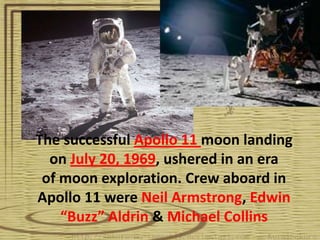
The successful Apollo 11 moon landing
  on July 20, 1969, ushered in an era
 of moon exploration. Crew aboard in
Apollo 11 were Neil Armstrong, Edwin
    “Buzz” Aldrin & Michael Collins
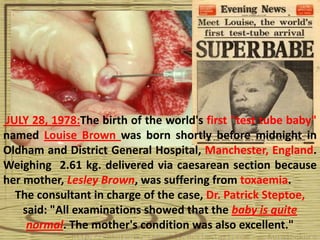
JULY 28, 1978:The birth of the world's first "test tube baby"
named Louise Brown was born shortly before midnight in
Oldham and District General Hospital, Manchester, England.
Weighing 2.61 kg. delivered via caesarean section because
her mother, Lesley Brown, was suffering from toxaemia.
  The consultant in charge of the case, Dr. Patrick Steptoe,
    said: "All examinations showed that the baby is quite
     normal. The mother's condition was also excellent."
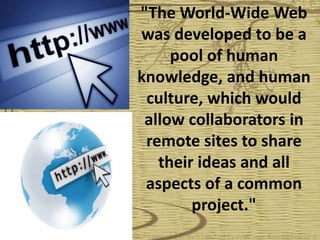
"The World-Wide Web
was developed to be a
     pool of human
knowledge, and human
 culture, which would
 allow collaborators in
 remote sites to share
   their ideas and all
 aspects of a common
        project."
The amount of scientific and
technological knowledge which exists is
 more than enough to provide humans
 with a decent standard of living yet we
   see a lot of people living in poverty.
  There is also sufficient technology to
 produce enough food for all yet many
are hungry and suffer from malnutrition.
  It cannot solve the basic problems of
        food, health, and shelter.
• Science and technology has its
 own great advantages. It has such
advantages which can even help us
  to establish life in other planets.
•It is carrying the advantages which
     have helped us to revive our
    life style and also the physical
    environment in which we live.
•Invention of mobile is advantageous to us in
sense that we can talk to from any part of the
world. Such mobiles have developed that we
 can see the person to whom we are talking.
This is known as video calling. It is also one of
 great advantages of science and technology
        to us. Finding of internet is also
 advantageous to us in the way that what we
   want can easily be searched on website.
• It made our lives easier, like the invention of
multiple technologies have decreased manual
work, the time of processes, and overall
productivity.
• The use of technology in agriculture has
increased our output and time-management
productivity.
•The development of technology in kitchens,
beauty parlours, and research labs and in all
fields of life has become ever the necessity of
man, and a key part of our lives.
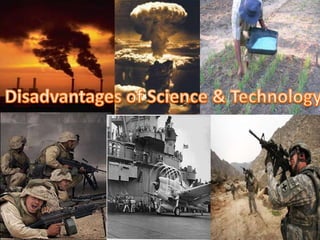
•Technology used in wars for example man invented the
atomic bomb that destroyed the nagasaki and hiroshima
in japan as a result many innocent people die and suffer
for that wrong usage of technology but now a days many
countries are continue making dangerous weapons using
their modern technology especially those who are belong
to the first countries or rich countries.
• Because of science and technology many factories were
built and these factories pollutes our environment as a
result we are suffering from a climate change example of
it are the large ice from the north pole and south pole are
melting and the sea level is rising and if we ignore the
happenings in our world we people living on this world
will suffer it.
•Technology also affect us humans because we
became lazy and don't work because we depend
on the computers.

•Animals disturbed from their habitats because
we are cutting trees and making them buildings
and everything.
The World is Understandable
Science presumes that the things and
events in the universe occur in consistent
patterns that are comprehensible
through careful, systematic study.
Scientists believe that through the use of
the intellect, and with the aid of
instruments that extend the senses,
people can discover patterns in all of
nature.
•Science also assumes that the
universe is, as its name implies, a vast
single system in which the basic rules
are everywhere the same.

•Knowledge gained from studying one
part of the universe is applicable to
other parts.
For instance, the same principles of
motion and gravitation that explains
the motion of falling objects on the
surface of the earth also explain the
motion of the moon and the planets.
Scientific Knowledge is Durable
Although scientists reject the notion of
attaining absolute truth and accept
some uncertainty as part of nature,
most scientific knowledge is durable.
The modification of ideas, rather than
their outright rejection, is the norm in
science, as powerful constructs tend to
survive and grow more precise and to
become widely accepted.
For example, in formulating the theory of
relativity, Albert Einstein did not discard the
Newtonian laws of motion but rather showed
them to be only an approximation of limited
application     within     a    more    general
concept. Moreover, the growing ability of
scientists to make accurate predictions about
natural phenomena provides convincing
evidence that we really are gaining in our
understanding of how the world works.
Continuity and stability are as characteristic of
science as change is, and confidence is as
prevalent as tentativeness.
Science cannot provide complete answers to all questions
  There are many matters that cannot usefully be examined in
  a scientific way. There are, for instance, beliefs that—by
  their very nature—cannot be proved or disproved (such as
  the existence of supernatural powers and beings, or the
  true purposes of life). In other cases, a scientific approach
  that may be valid is likely to be rejected as irrelevant by
  people who hold to certain beliefs (such as in miracles,
  fortune-telling, astrology, and superstition). Nor do
  scientists have the means to settle issues concerning good
  and evil, although they can sometimes contribute to the
  discussion of such issues by identifying the likely
  consequences of particular actions, which may be helpful in
  weighing alternatives.
All Technologies Involve Control
All systems, from the simplest to the most complex, require control to
keep them operating properly. The essence of control is comparing
information about what is happening with what we want to happen
and then making appropriate adjustments. Control typically requires
feedback (from sensors or other sources of information) and logical
comparisons of that information to instructions (and perhaps to other
data input)—and a means for activating changes. For example, a
baking oven is a fairly simple system that compares the information
from a temperature sensor to a control setting and turns the heating
element up or down to keep the temperature within a small range.
An automobile is a more complex system, made up of subsystems for
controlling engine temperature, combustion rate, direction, speed,
and so forth, and for changing them when the immediate
circumstances or instructions change. Miniaturized electronics makes
possible logical control in a great variety of technical systems. Almost
all but the simplest household appliances used today include
microprocessors to control their performance.
As controls increase in complexity, they too require
coordination, which means additional layers of
control. Improvement in rapid communication and
rapid processing of information makes possible very
elaborate systems of control. Yet all technological
systems include human as well as mechanical or
electronic components. Even the most automatic
system requires human control at some point—to
program the built-in control elements, monitor them,
take over from them when they malfunction, and
change them when the purposes of the system change.
The ultimate control lies with people who understand
in some depth what the purpose and nature of the
control process are and the context within which the
process operates.
Technologies Always Have Side Effects
In addition to its intended benefits, every design is likely to
have unintended side effects in its production and application.
On the one hand, there may be unexpected benefits. For
example, working conditions may become safer when materials
are molded rather than stamped, and materials designed for
space satellites may prove useful in consumer products. On the
other hand, substances or processes involved in production
may harm production workers or the public in general; for
example, sitting in front of a computer may strain the user's
eyes and lead to isolation from other workers. And jobs may be
affected—by increasing employment for people involved in the
new technology, decreasing employment for others involved in
the old technology, and changing the nature of the work people
must do in their jobs.
It is not only large technologies—nuclear
reactors or agriculture—that are prone to side
effects, but also the small, everyday ones. The
effects of ordinary technologies may be
individually small but collectively significant.
Refrigerators, for example, have had a
predictably favorable impact on diet and on
food distribution systems. Because there are so
many refrigerators, however, the tiny leakage of
a gas used in their cooling systems may have
substantial adverse effects on the earth's
atmosphere.
Some side effects are unexpected because of a lack of
interest or resources to predict them. But many are not
predictable even in principle because of the sheer
complexity of technological systems and the
inventiveness of people in finding new applications.
Some unexpected side effects may turn out to be
ethically, aesthetically, or economically unacceptable to a
substantial fraction of the population, resulting in conflict
between groups in the community. To minimize such side
effects, planners are turning to systematic risk analysis.
For example, many communities require by law that
environmental impact studies be made before they will
consider giving approval for the introduction of a new
hospital, factory, highway, waste-disposal system,
shopping mall, or other structure.
All Technological Systems Can Fail
Most modern technological systems, from transistor radios
to airliners, have been engineered and produced to be
remarkably reliable. Failure is rare enough to be surprising.
Yet the larger and more complex a system is, the more ways
there are in which it can go wrong—and the more
widespread the possible effects of failure. A system or
device may fail for different reasons: because some part
fails, because some part is not well matched to some other,
or because the design of the system is not adequate for all
the conditions under which it is used. One hedge against
failure is overdesign—that is, for example, making
something stronger or bigger than is likely to be necessary.
Another hedge is redundancy—that is, building in one
backup system or more to take over in case the primary one
fails.
If failure of a system would have very costly
consequences, the system may be designed so that its
most likely way of failing would do the least harm.
Examples of such "fail-safe" designs are bombs that
cannot explode when the fuse malfunctions;
automobile windows that shatter into blunt, connected
chunks rather than into sharp, flying fragments; and a
legal system in which uncertainty leads to acquittal
rather than conviction. Other means of reducing the
likelihood of failure include improving the design by
collecting more data, accommodating more variables,
building more realistic working models, running
computer simulations of the design longer, imposing
tighter quality control, and building in controls to sense
and correct problems as they develop.
All of the means of preventing or minimizing failure are
likely to increase cost. But no matter what precautions
are taken or resources invested, risk of technological
failure can never be reduced to zero. Analysis of risk,
therefore, involves estimating a probability of
occurrence for every undesirable outcome that can be
foreseen—and also estimating a measure of the harm
that would be done if it did occur. The expected
importance of each risk is then estimated by combining
its probability and its measure of harm. The relative risk
of different designs can then be compared in terms of
the combined probable harm resulting from each.
Scientific Facts
    •An observation that has
 been confirmed repeatedly and
       is accepted as true
    •Scientific facts are verified by
       repeatable experiments
Scientific Concepts
  • These are ideas that combine
  several facts or observations. A
concept is an “observed regularity
       in events or objects”
Scientific Theories
     • Theories are developed to explain
  concepts or other observed regularities.
         These are proven hypothesis
   • It comprises a collection of concepts,
 including abstractions of observable phen
              omena expressed
   as quantifiable properties that express
   relationships between observations of
                such concepts.
Scientific Laws
• are statements generally accepted to
be true, universal, and absolute. They
 can be expressed in terms of a single
  mathematical equation. They don’t
   really need any complex external
proofs; they are accepted at face value
  based upon the fact that they have
   always been observed to be true.
• A formal statement   about
such a phenomenon.

Science and technology

  • 2.
    •Life has been increasinglyinfluenced by Science and Technology in the attempt to transformed societies.
  • 3.
    The successful Apollo11 moon landing on July 20, 1969, ushered in an era of moon exploration. Crew aboard in Apollo 11 were Neil Armstrong, Edwin “Buzz” Aldrin & Michael Collins
  • 4.
    JULY 28, 1978:Thebirth of the world's first "test tube baby" named Louise Brown was born shortly before midnight in Oldham and District General Hospital, Manchester, England. Weighing 2.61 kg. delivered via caesarean section because her mother, Lesley Brown, was suffering from toxaemia. The consultant in charge of the case, Dr. Patrick Steptoe, said: "All examinations showed that the baby is quite normal. The mother's condition was also excellent."
  • 5.
    "The World-Wide Web wasdeveloped to be a pool of human knowledge, and human culture, which would allow collaborators in remote sites to share their ideas and all aspects of a common project."
  • 6.
    The amount ofscientific and technological knowledge which exists is more than enough to provide humans with a decent standard of living yet we see a lot of people living in poverty. There is also sufficient technology to produce enough food for all yet many are hungry and suffer from malnutrition. It cannot solve the basic problems of food, health, and shelter.
  • 10.
    • Science andtechnology has its own great advantages. It has such advantages which can even help us to establish life in other planets. •It is carrying the advantages which have helped us to revive our life style and also the physical environment in which we live.
  • 11.
    •Invention of mobileis advantageous to us in sense that we can talk to from any part of the world. Such mobiles have developed that we can see the person to whom we are talking. This is known as video calling. It is also one of great advantages of science and technology to us. Finding of internet is also advantageous to us in the way that what we want can easily be searched on website.
  • 12.
    • It madeour lives easier, like the invention of multiple technologies have decreased manual work, the time of processes, and overall productivity. • The use of technology in agriculture has increased our output and time-management productivity. •The development of technology in kitchens, beauty parlours, and research labs and in all fields of life has become ever the necessity of man, and a key part of our lives.
  • 14.
    •Technology used inwars for example man invented the atomic bomb that destroyed the nagasaki and hiroshima in japan as a result many innocent people die and suffer for that wrong usage of technology but now a days many countries are continue making dangerous weapons using their modern technology especially those who are belong to the first countries or rich countries. • Because of science and technology many factories were built and these factories pollutes our environment as a result we are suffering from a climate change example of it are the large ice from the north pole and south pole are melting and the sea level is rising and if we ignore the happenings in our world we people living on this world will suffer it.
  • 15.
    •Technology also affectus humans because we became lazy and don't work because we depend on the computers. •Animals disturbed from their habitats because we are cutting trees and making them buildings and everything.
  • 17.
    The World isUnderstandable Science presumes that the things and events in the universe occur in consistent patterns that are comprehensible through careful, systematic study. Scientists believe that through the use of the intellect, and with the aid of instruments that extend the senses, people can discover patterns in all of nature.
  • 18.
    •Science also assumesthat the universe is, as its name implies, a vast single system in which the basic rules are everywhere the same. •Knowledge gained from studying one part of the universe is applicable to other parts.
  • 19.
    For instance, thesame principles of motion and gravitation that explains the motion of falling objects on the surface of the earth also explain the motion of the moon and the planets.
  • 20.
    Scientific Knowledge isDurable Although scientists reject the notion of attaining absolute truth and accept some uncertainty as part of nature, most scientific knowledge is durable. The modification of ideas, rather than their outright rejection, is the norm in science, as powerful constructs tend to survive and grow more precise and to become widely accepted.
  • 21.
    For example, informulating the theory of relativity, Albert Einstein did not discard the Newtonian laws of motion but rather showed them to be only an approximation of limited application within a more general concept. Moreover, the growing ability of scientists to make accurate predictions about natural phenomena provides convincing evidence that we really are gaining in our understanding of how the world works. Continuity and stability are as characteristic of science as change is, and confidence is as prevalent as tentativeness.
  • 22.
    Science cannot providecomplete answers to all questions There are many matters that cannot usefully be examined in a scientific way. There are, for instance, beliefs that—by their very nature—cannot be proved or disproved (such as the existence of supernatural powers and beings, or the true purposes of life). In other cases, a scientific approach that may be valid is likely to be rejected as irrelevant by people who hold to certain beliefs (such as in miracles, fortune-telling, astrology, and superstition). Nor do scientists have the means to settle issues concerning good and evil, although they can sometimes contribute to the discussion of such issues by identifying the likely consequences of particular actions, which may be helpful in weighing alternatives.
  • 24.
    All Technologies InvolveControl All systems, from the simplest to the most complex, require control to keep them operating properly. The essence of control is comparing information about what is happening with what we want to happen and then making appropriate adjustments. Control typically requires feedback (from sensors or other sources of information) and logical comparisons of that information to instructions (and perhaps to other data input)—and a means for activating changes. For example, a baking oven is a fairly simple system that compares the information from a temperature sensor to a control setting and turns the heating element up or down to keep the temperature within a small range. An automobile is a more complex system, made up of subsystems for controlling engine temperature, combustion rate, direction, speed, and so forth, and for changing them when the immediate circumstances or instructions change. Miniaturized electronics makes possible logical control in a great variety of technical systems. Almost all but the simplest household appliances used today include microprocessors to control their performance.
  • 25.
    As controls increasein complexity, they too require coordination, which means additional layers of control. Improvement in rapid communication and rapid processing of information makes possible very elaborate systems of control. Yet all technological systems include human as well as mechanical or electronic components. Even the most automatic system requires human control at some point—to program the built-in control elements, monitor them, take over from them when they malfunction, and change them when the purposes of the system change. The ultimate control lies with people who understand in some depth what the purpose and nature of the control process are and the context within which the process operates.
  • 26.
    Technologies Always HaveSide Effects In addition to its intended benefits, every design is likely to have unintended side effects in its production and application. On the one hand, there may be unexpected benefits. For example, working conditions may become safer when materials are molded rather than stamped, and materials designed for space satellites may prove useful in consumer products. On the other hand, substances or processes involved in production may harm production workers or the public in general; for example, sitting in front of a computer may strain the user's eyes and lead to isolation from other workers. And jobs may be affected—by increasing employment for people involved in the new technology, decreasing employment for others involved in the old technology, and changing the nature of the work people must do in their jobs.
  • 27.
    It is notonly large technologies—nuclear reactors or agriculture—that are prone to side effects, but also the small, everyday ones. The effects of ordinary technologies may be individually small but collectively significant. Refrigerators, for example, have had a predictably favorable impact on diet and on food distribution systems. Because there are so many refrigerators, however, the tiny leakage of a gas used in their cooling systems may have substantial adverse effects on the earth's atmosphere.
  • 28.
    Some side effectsare unexpected because of a lack of interest or resources to predict them. But many are not predictable even in principle because of the sheer complexity of technological systems and the inventiveness of people in finding new applications. Some unexpected side effects may turn out to be ethically, aesthetically, or economically unacceptable to a substantial fraction of the population, resulting in conflict between groups in the community. To minimize such side effects, planners are turning to systematic risk analysis. For example, many communities require by law that environmental impact studies be made before they will consider giving approval for the introduction of a new hospital, factory, highway, waste-disposal system, shopping mall, or other structure.
  • 29.
    All Technological SystemsCan Fail Most modern technological systems, from transistor radios to airliners, have been engineered and produced to be remarkably reliable. Failure is rare enough to be surprising. Yet the larger and more complex a system is, the more ways there are in which it can go wrong—and the more widespread the possible effects of failure. A system or device may fail for different reasons: because some part fails, because some part is not well matched to some other, or because the design of the system is not adequate for all the conditions under which it is used. One hedge against failure is overdesign—that is, for example, making something stronger or bigger than is likely to be necessary. Another hedge is redundancy—that is, building in one backup system or more to take over in case the primary one fails.
  • 30.
    If failure ofa system would have very costly consequences, the system may be designed so that its most likely way of failing would do the least harm. Examples of such "fail-safe" designs are bombs that cannot explode when the fuse malfunctions; automobile windows that shatter into blunt, connected chunks rather than into sharp, flying fragments; and a legal system in which uncertainty leads to acquittal rather than conviction. Other means of reducing the likelihood of failure include improving the design by collecting more data, accommodating more variables, building more realistic working models, running computer simulations of the design longer, imposing tighter quality control, and building in controls to sense and correct problems as they develop.
  • 31.
    All of themeans of preventing or minimizing failure are likely to increase cost. But no matter what precautions are taken or resources invested, risk of technological failure can never be reduced to zero. Analysis of risk, therefore, involves estimating a probability of occurrence for every undesirable outcome that can be foreseen—and also estimating a measure of the harm that would be done if it did occur. The expected importance of each risk is then estimated by combining its probability and its measure of harm. The relative risk of different designs can then be compared in terms of the combined probable harm resulting from each.
  • 32.
    Scientific Facts •An observation that has been confirmed repeatedly and is accepted as true •Scientific facts are verified by repeatable experiments
  • 33.
    Scientific Concepts • These are ideas that combine several facts or observations. A concept is an “observed regularity in events or objects”
  • 34.
    Scientific Theories • Theories are developed to explain concepts or other observed regularities. These are proven hypothesis • It comprises a collection of concepts, including abstractions of observable phen omena expressed as quantifiable properties that express relationships between observations of such concepts.
  • 35.
    Scientific Laws • arestatements generally accepted to be true, universal, and absolute. They can be expressed in terms of a single mathematical equation. They don’t really need any complex external proofs; they are accepted at face value based upon the fact that they have always been observed to be true.
  • 36.
    • A formalstatement about such a phenomenon.