The Myth of the “Modern First-Class Nation:”
Egotism and Uncertainty in the Allied Intelligence
Assessment of Imperial Japan, 1931-1941
Joshua Schwartz
Senior Honors Thesis
Presented to the Department of History
Weinberg College of Arts and Sciences
Northwestern University
In Partial Fulfillment
Of the Requirements for the Degree
Honors in History
May 7, 2015
Advisor: Laura Hein
Seminar Director: Michael Allen
 
Abstract
Popular understanding of Imperial Japan’s simultaneous attacks on Pearl Harbor, the
Philippines and Malaya in December 1941 is that they were a complete surprise. In my thesis, I
challenge this narrative by showing that American and British military intelligence officers and
attachés commissioned to assess the Japanese threat to Western interests in the Far East regularly
contemplated the possibility of an attack on these positions, particularly after Japan’s instigation
of war with China in July 1937. Using the troop attachment reports of American and British
Japanese-language officers who trained with and observed Japanese forces from 1931 to 1941, I
unravel the evolution of Allied perceptions of Japanese combat efficiency and argue that
preoccupation with Western concepts of war blinded the Allies to the full extent of Japan’s
military capabilities. I highlight the uncertainty, indecision and inconsistency of Allied statesmen
and military commanders in their assessments of Japan’s intentions, suggesting that
policymakers were equally at fault in underestimating the immediacy of the Japanese threat.
Based on this analysis, I find that Allied military intelligence in the Far East during the interwar
period functioned as an echo chamber, in which low-level and high-level officials tacitly enabled
each others’ overconfident assessments and faulty conclusions. While other scholars attribute
Allied unpreparedness in December 1941 to racial prejudice, bureaucratic deficiency or lack of
resources, I assert that military egotism and the unpredictability of Japanese foreign policy
caused the Allies to underestimate Imperial Japan before the initial battles of World War II in the
Pacific.
Key Terms: Allied Intelligence in the Far East, Imperial Japan, Interwar Period, Military
Doctrine, Threat Assessment
 
Acknowledgements
I am extremely grateful to all those who helped me produce this work. I
would first like to thank my advisor, Professor Laura Hein, whose guidance and
criticism led me to sharpen my focus and better engage my material throughout the
research and writing process. Her thorough advice and revisions have clarified my
understanding of historical scholarship and pushed me to become a more analytical
thinker and writer. Furthermore, I would like to thank my seminar director,
Professor Michael Allen, who challenged me to expand the scope of my project
and identify its wider historical implications. I owe my interest in the subject
matter of this thesis to Dr. Alessio Patalano and Dr. Marcus Faulkner, who I
studied with at King’s College London. I would also like to acknowledge
Northwestern University’s Office of the Provost and the Undergraduate Research
Grant Program for providing me with funding to conduct research at the United
Kingdom National Archives in London.
I am indebted to many friends who have graciously served as my sounding
board over the past year. To my peers in the thesis seminar, thank you for your
support, criticism and camaraderie. To my housemates, especially Ben Bernstein,
thank you for hashing out ideas with me late at night. To Josh Boxerman, thank
you for sifting through centuries of history with me over the past four years,
especially in this last year. It has been an unforgettable experience and a real
pleasure.
Lastly, I would like to dedicate this work to my parents, Paul and Simi
Schwartz, who have always supported me, encouraged my passions and taught me
to do what I love and make a difference in the world.
 
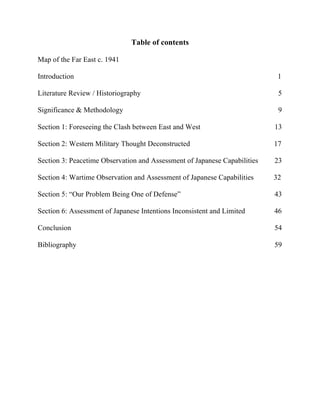
Table of contents
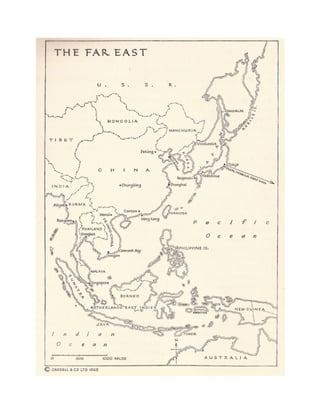
Map of the Far East c. 1941
Introduction 1
Literature Review / Historiography 5
Significance & Methodology 9
Section 1: Foreseeing the Clash between East and West 13
Section 2: Western Military Thought Deconstructed 17
Section 3: Peacetime Observation and Assessment of Japanese Capabilities 23
Section 4: Wartime Observation and Assessment of Japanese Capabilities 32
Section 5: “Our Problem Being One of Defense” 43
Section 6: Assessment of Japanese Intentions Inconsistent and Limited 46
Conclusion 54
Bibliography 59
 
  1	
  
Introduction
In his fireside chat with the American people on December 9, 1941, President Roosevelt
declared, “And now Japan has attacked Malaya and Thailand—and the United States—without
warning.”1
Emphasizing Japanese deceit throughout the speech, President Roosevelt described
the Japanese attacks on Pearl Harbor, the Philippines and Malaya, which sparked World War II
in the Pacific, as a complete surprise. It was inconceivable that the Japanese, perceived as
racially and technologically inferior, had initiated and were winning a total war against both the
most powerful empire in the world and the emerging military force in the Pacific. This is how the
Allied defeats of December 1941 are traditionally understood in popular culture.
Analysis of Allied intelligence in the Pacific prior to December 1941 shows something
quite different. Joseph Grew, U.S. Ambassador in Tokyo, informed his government of rumors of
a “surprise mass attack on Pearl Harbor” as early as January 27, 1941.2
On November 15, 1941,
U.S. Army Chief of Staff General George Marshall announced in a secret conference that the
U.S. was “on the brink of war with the Japanese” and that the Japanese were preparing to attack
the Philippines.3
British military intelligence was likewise anticipating a Japanese assault on
Malaya by November 1941.4
Thus, it is clear that American and British intelligence personnel
warned policymakers about the possibility of an attack on these positions.
In fact, American and British military intelligence officers had been assessing the threat
that Imperial Japan posed to Western interests in Asia and the Pacific since the end of the First


1
Franklin D. Roosevelt, “Fireside Chat,” December 9, 1941, online by Gerhard Peters and John T. Woolley, The
American Presidency Project, http://www.presidency.ucsb.edu/ws/?pid=16056.
2
Joseph C. Grew, Ten Years in Japan: A Contemporary Record Drawn from the Diaries and Private and Official
Papers of Joseph C. Grew, United States Ambassador to Japan 1932-1942 (New York: Simon and Schuster, 1944),
368.
3
Larry I. Bland, ed., The Papers of George Catlett Marshall vol. 2: “We Cannot Delay,” July 1, 1939—December
6, 1941 (Baltimore and London: The Johns Hopkins University Press, 1986), 676-681.
4
Peter Lowe, “Great Britain’s Assessment of Japan before the Outbreak of the Pacific War,” in Knowing One’s
Enemies: Intelligence Assessment before the Two World Wars, ed. Ernest R. May (Princeton: Princeton University
Press, 1984), 471.
  2	
  
World War, paying particular attention to the modernization and development of Japan’s armed
forces. Because Japanese aggression in the region had the potential to disrupt the free trade to
which they had become accustomed in China, the United States and Great Britain looked upon
Japan’s economic and military expansion with considerable unease. As early as 1921, leaders of
the American Army and Navy had designated Japan as “the most probable enemy” in the
Pacific.5
Consequently, the Allies made gathering intelligence on Japanese military capabilities
and intentions a high priority.
The intelligence cycle, the infrastructure through which intelligence was gathered,
analyzed and distributed, began at the lowest level with Japanese-language officers who served
as assistants to the American and British military attachés in Tokyo. They produced an
abundance of intelligence on Japanese forces in the form of translated “press reports, training
pamphlets and technical manuals.”6
During the early 1920s, the United States and Great Britain
reached agreements with Japan that “allowed [their] officers to be seconded” to Japanese army
units over the course of the next twenty years.7
These attachments allowed Allied language-
officers to observe Japanese peacetime training for months at a time, after which they produced
combat efficiency reports for the military attachés’ review. After Japan’s full-scale invasion of
China in July 1937, they began producing reports on the wartime training and operations of the
Japanese. The military attachés then transmitted the reports and their conclusions to G-2, the
U.S. War Department’s military intelligence branch in Washington, DC,8
and MI2c, the British


5
Louis Morton, Strategy and Command: The First Two Years (Washington, DC: Office of the Chief of Military
History, Dept. of the Army;, 1962), 27.
6
Thomas G. Mahnken, Uncovering Ways of War: U.S. Intelligence and Foreign Military Innovation, 1918-1941
(Ithaca and London: Cornell University Press, 2002), 30.
7
Ibid., 35, 44.
8
Bruce W. Bidwell, History of the Military Intelligence Division, Department of the Army General Staff: 1775-1941
(Frederick, Maryland: University Publications of America, 1986), 116. G-2, formally known as the Military
Intelligence Division, was established in February 1918.
  3	
  
military intelligence branch responsible for East Asia in London.9
Often times, the American and
British ambassadors in Tokyo took stock of their military attachés’ reports before they were
passed on to G-2 and MI2c. G-2 and MI2c collated, analyzed and distributed the intelligence
assessments to senior statesmen and military commanders in the U.S. War and State
Departments and the British War and Foreign Offices. American and British officers were never
attached to Japanese naval units, so the naval attachés in Tokyo sent their own intelligence
reports to the Office of Naval Intelligence in Washington, DC, and the Naval Intelligence
Division in London. These offices then communicated with senior officials in the U.S.
Department of the Navy and the British Admiralty.1011
Through this intelligence cycle, the Allies formulated their perceptions of Japanese
military capabilities and intentions during the interwar period. Unfortunately, they failed to
anticipate both the intensity and the immediacy of Japan’s strikes on Pearl Harbor, the
Philippines and Malaya, proving that the conclusions drawn from Allied assessments of the
Japanese were wrong. How did this happen? What were the elements that American and British
intelligence focused on and conveyed in their assessments of the Japanese? What were the
factors that led the American and British military establishments to prioritize these particular
elements of warfare? How did American and British policymakers and war planners respond to
the intelligence produced on the ground in Japan?
In answering these questions, I will uncover how the Allies came to underestimate the
ability of the Japanese to accomplish their military goals in East Asia and the Pacific from 1931


9
Antony Best, “Constructing an Image: British Intelligence and Whitehall’s Perception of Japan, 1931-1939,”
Intelligence and National Security 11:3 (1996): 404.
10
Mahnken, Uncovering Ways of War, 26-28. See Figure 2 – Organization of the Military Intelligence Division,
1938.
11
Antony Best, British Intelligence and the Japanese Challenge in Asia, 1914-1941 (Houndmills, Basingstoke,
Hampshire: Palgrave/Macmillan, 2002), 7. See Figure 2 - Intelligence flow into and around Whitehall, 1941.
  4	
  
to December 1941. I argue that Allied underestimation of Japanese military capabilities can be
attributed to egotism and their misperception of Japanese intentions to uncertainty. Explaining
how these features led both intelligence on the ground and senior policymakers and war planners
to accept each other’s overconfident or inconclusive assessments, I conclude that Allied
intelligence operated as an echo chamber prior to December 1941.
With regard to assessment of Japanese capabilities, I will show that the American and
British Japanese-language officers producing troop attachment reports rarely strayed from their
established conception of the most important elements of warfare, which focused on
concentrated implementation of firepower, in both attack and defense, and coordination between
different branches of the armed services. When they did, they accurately highlighted offensive
spirit, adaptability and mobilization for war as key Japanese strengths. However, these were
usually overshadowed by evidence of Japanese weakness in the elements that the Allies
considered most conducive to victory in war. Thus, I suggest that the Allies’ refusal to reevaluate
their understanding of modern combat had more sway over their perceptions of Japanese military
capabilities than did the actual observations of Japanese troops, tactics and operations in the
build-up to December 1941. This proved costly because it prevented the Allies from adapting to
the major tactical and technological innovations that the Japanese honed after July 1937 in the
Second-Sino Japanese War.
Discussing the Allies’ inability to gauge Japanese intentions, I will emphasize that
military intelligence assessments, which minimized the possibility of a Japanese attack on Allied
strongholds in Southeast Asia, were inconsistent with the conclusions of Allied civilian leaders,
who made no definitive predictions. The trend of Japanese expansion between July 1937 and
December 1941 contradicted successive Japanese governments’ outward attempts to de-escalate
  5	
  
tensions in the Pacific through diplomacy, making it difficult to accurately gauge the future of
Japanese foreign policy. Furthermore, the Allies were not able to get a solid sense of the
tendencies of the Japanese government because it dissolved and reconfigured so frequently and
unexpectedly. Consequently, they were forced into a reactive stance contingent upon the
development of Japanese domestic politics and its effect on foreign policy. Based on this
evidence, I will contend that the Allies begrudgingly knew that the critical information they
needed to accurately assess Japanese intentions was very much up in the air and completely out
of their hands.
Literature Review / Historiography
Only a small number of scholars have published work evaluating the effect of
intelligence on Allied military unpreparedness and foreign policy in the Pacific before December
1941. While some highlight the cultural pitfalls of American and British military intelligence
during the interwar period, others argue that bureaucratic and structural deficiencies caused the
initial Allied defeats in Southeast Asia. In this regard, Antony Best, whose work focuses on
British intelligence based out of Singapore, points to two main shortcomings — “the continual
lack of resources available for intelligence” and “the damage caused by the various rivalries that
existed between the intelligence-providers themselves and with and between their customers.”12
Douglas Ford reaches similar conclusions in his exploration of American intelligence based out
of the Philippines. He explains that the Allies’ top priority was protecting the Western
Hemisphere, “[securing] the Atlantic sea lanes and [maintaining] the British Isles as a base for
operations against German-occupied Europe,” so fortifying their positions in Southeast Asia was


12
Ibid., 192.
  6	
  
a costly gamble, in terms of manpower and war materiel, that they were not wiling to take.
Furthermore, both the Americans and British judged it likely that those positions would be lost in
the event of war given their proximity to the overwhelming Japanese force in the region; they
would have to be retaken.13
Thus, these scholars argue that the Allies considered Japanese
attacks on Singapore and the Philippines highly probable, though they were not sure when or
with what level of force and efficiency the Japanese would strike. They also highlight Allied
acknowledgement and acceptance of the major obstacles to the defense of their positions in
Southeast Asia.
The rivalries that hampered the efforts of American and British intelligence mostly
stemmed from bureaucratic discord internal to each country. Best explains that the British
“Foreign Office’s antagonism towards what it perceived as any attempt by another department to
construct an alternative channel of political reporting on events in East Asia” postponed the
establishment of desperately needed “regional combined intelligence bureau” until 1935, when
the Far East Combined Bureau (FECB) was launched in Hong Kong.14
The fact that no
diplomatic representatives from the Foreign Office were in place at the FECB to draw political
insight from the military intelligence reports on Japan further highlights the damaging role of
bureaucratic infighting in the British military establishment.15
Ford argues that military
intelligence was the least established and valued branch within the U.S. War Department General
Staff, trailing behind the War Plans, Purchase and Supply, Storage and Traffic, and Operations
Divisions.16
G-2 officers “often felt segregated from their counterparts;” therefore, they withheld
“knowledge of their own activities from nonintelligence personnel,” which in turn led army


13
Douglas Ford, “‘The Best Equipped Army in Asia?’: U.S. Military Intelligence and the Imperial Japanese Army
before the Pacific War, 1919-1941,” International Journal of Intelligence and CounterIntelligence 21:1 (2007): 91.
14
Best, British Intelligence and the Japanese Challenge in Asia, 1914-1941, 193.
15
Ibid.
16
Bidwell, History of the Military Intelligence Division, 116.
  7	
  
officials to distrust G-2 and discount the “important role that intelligence could play in
operational planning and the development of tactical doctrine.”17
In both cases, bureaucratic
strife prevented the effective collection, analysis, dissemination and implementation of
intelligence available to American and British officers on the ground in Japan.
On the other hand, Thomas Mahnken, who has written extensively on American efforts to
detect foreign military innovation during the interwar period, refutes these bureaucratic and
structural arguments and claims that U.S. intelligence was able to produce a “surprisingly good”
estimate of Japanese forces, despite its “limited funds” and disjointed infrastructure.18
John
Ferris affirms this position in his study of British intelligence, stating, “The War Office’s
assessment was not grossly inaccurate.”19
While these scholars recognize that gathering
intelligence on Japanese capabilities became progressively more difficult throughout the 1930s,
especially as Japan’s military secrecy laws became more stringent and foreign observers were
increasingly barred from direct observation of Japanese maneuvers, they stipulate that the Allies’
“greatest failure was not [their] inability to verify attaché reports, but rather [their] willingness to
dismiss even the possibility that Japan had developed innovative technology” that could
seriously threaten Allied positions in Southeast Asia.20
Thus, Mahnken and Ferris contend that
Allied inflexibility, predicated on a refusal to accept that Japanese innovation could dictate the
course and nature of modern warfare, was the underlying cause of unpreparedness. These
historians assert that insufficient allocation of resources to intelligence and garrisons in the Far


17
Ford, “‘The Best Equipped Army in Asia?’: U.S. Military Intelligence and the Imperial Japanese Army before the
Pacific War, 1919-1941,” 104.
18
Mahnken, Uncovering Ways of War, 19.
19
John Ferris, “‘Worthy of Some Better Enemy?’: The British Estimate of the Imperial Japanese Army 1919-41, and
the Fall of Singapore,” Canadian Journal of History (August 1993): 256.
20
Mahnken, Uncovering Ways of War, 84.
  8	
  
East, shoddy training of forces in the Pacific and interagency rivalries were merely expressions
of this deeper issue. My argument aligns with this train of thought.
If the problem with Allied intelligence was a failure to recognize the extent of Japanese
military capabilities, one might assume that racial prejudice was the most influential cultural
force at play. Indeed, civilian leaders and military men regularly discussed the Japanese and
other non-whites in terms of national characteristics during the interwar period, comparing these
qualities to those of peoples of the West.21
John Dower, one of the foremost experts on Japanese-
American relations before, during and after World War II, asserts that racism drove the Allies to
misperceive Japanese combat efficiency despite the success of their operations in China
throughout the 1930s. Engaging in what Dower refers to as a “failure of imagination,” the Allies
closed themselves off to the possibility that the “little yellow sons-of-bitches” could defeat them
in battle.22
When General A.E. Percival informed “the civilian colonial governor of
Singapore…that the Japanese had commenced hostilities by attacking Kota Bharu on the
northeast coast of the Malay Peninsula” on December 8, 1941, the latter calmly replied, “Well, I
suppose you’ll shove the little men off!”23
After weeks of fighting, the Japanese scored a
decisive victory against the British in Malaya, showing the inconsistency between the governor’s
perceptions and the reality of Japanese military capabilities. This case and many others like it
show that racism did significantly minimize the Japanese threat in Western eyes.
While I agree with Dower’s construction of an Allied “failure of imagination,” I do not
believe that it can be attributed to racism alone. Mahnken argues that underestimation of the
enemy often occurs, regardless of racism, through three patterns that pertain to all intelligence


21
Best, British Intelligence and the Japanese Challenge in Asia, 1914-1941, 194.
22
John W. Dower, Cultures of War: Pearl Harbor, Hiroshima, 9-11, Iraq (New York: W.W. Norton, 2010), 43.
23
John W. Dower, War Without Mercy: Race and Power in the Pacific War (New York: Pantheon Books, 1986),
100.
  9	
  
agencies — they are “more inclined to monitor the development of established weapons than to
search for new military systems,” they “pay more attention to technology and doctrine that have
been demonstrated in war than to those that have not seen combat,” and they more easily
“identify innovations in areas that [their] own services are exploring than those they have not
examined, are not interested in, or have rejected.”24
He suggests that it is typical for intelligence
agencies to operate on “preconceptions” that run “the risk of mirror-imaging.”25
Thus, Mahnken
believes that past and present military experience, or lack thereof, were as much a source of
Allied inflexibility and minimization of the Japanese threat as was racism.
Significance & Methodology
While my assertion that the Allies were preoccupied with the combat elements that they
deemed decisive is not new, I am adding to the existing scholarship by pinpointing exactly how
the Allies’ “immutable principles of war,” which I will detail shortly, were reflected in the
reports produced by American and British intelligence between 1931 and December 1941.26
Furthermore, I am uncovering the story of a less well-known and glamorous community tasked
with confronting the rise of Japan— intelligence officers. Analysis of this community is
particularly interesting because it demonstrates that race was perhaps not the main factor
producing Allied perceptions of the Japanese as “lesser men” before December 1941.27
Situating
the story of intelligence officers in relation to the drama of American and British statesmen,
military commanders and ambassadors magnifies an often unexamined aspect of the decade


24
Mahnken, Uncovering Ways of War, 4.
25
Ibid., 84.
26
Combat Methods of the Japanese, 14 April 1933, MID 2023-898/7, Roll 23, M1216, RG 165, National Archives
at College Park, MD (hereafter NACP).
27
Dower, War Without Mercy, 94-117.
 10	
  
preceding the Pacific War. Thus, my thesis adds a fresh lens to the body of knowledge that
analyzes Allied intelligence in the Far East and American and British decision-making during the
interwar period. I build on intelligence concepts put forward by Thomas Mahnken and differ
from John Dower in my explanation of the Allied “failure of imagination.” My work will appeal
to people interested in military history, diplomatic history, intelligence history and cultural
history.
From Section 1 to Section 4, I will analyze the evolution of American and British
perceptions of Japanese capabilities from 1931 to December 1941. Primarily using the troop
attachment reports of American and British Japanese-language officers who trained with and
observed Japanese army units, I will show that Japanese experience in the Second Sino-Japanese
War, which began in July 1937, led the Allies to rate Japanese combat efficiency more highly
than ever before. However, the conclusions derived from these more favorable assessments
downplayed the magnitude of the threat posed by Japan and, despite new information, were no
different from the conclusions reached before July 1937. While American and British
intelligence correspondents observed and acknowledged Japanese technological innovation,
improved implementation of advanced weaponry and tactics and heavy mobilization, they
consistently reported that the Japanese, even with these strengths, would not be able to defeat a
well-trained and well-equipped American or British force in Southeast Asia. Therefore, it is clear
that they disregarded the elements of Japan’s arsenal that made the Japanese most threatening. In
conclusion, I will show that the Allies were no closer to understanding the extent of Japan’s
military capacity on the eve of the December 1941 attacks than they were at any point in the
previous decade.
 11	
  
In Sections 5 and 6, I will examine Allied assessments of Japanese intentions between
1939 and December 1941. Drawing on the correspondence of American and British political
leaders, military commanders and ambassadors, I will argue that Allied assessments of Japan’s
capabilities produced the wrong conclusions regarding her intentions. Based on their
underestimation of Japanese capabilities, military intelligence doubted that Japan would attack
Allied positions in Southeast Asia until she had remedied her combat deficiencies. I will also
show that Allied civilian leaders were not convinced by these assessments because Japan’s
continued aggression, particularly her occupation of French Indochina in July 1941, and
deteriorating diplomatic relations with the West indicated that Japan was highly unpredictable.
They further struggled to determine how or when Japan would act because there was no
consistency in Japan’s foreign policy or stability within her domestic politics. Appeasement did
not help the Allies narrow the range of Japanese intentions, but neither did policies of deterrence,
which lacked credibility of force. Throughout this discussion, I will highlight the inconsistency
and uncertainty that characterized Allied assessments of Japanese intentions.
This thesis is relevant today because military establishments and intelligence
communities still exhibit cultural and structural deficiencies that lead them to misinterpret
foreign military cultures and underestimate the capabilities of their enemies. Thus, my research
sheds light on an intelligence phenomenon that has persisted within military establishments from
the interwar period until today. The case of Allied intelligence in the Far East prior to December
1941 suggests that armies and military intelligence do not adapt and rectify their faults unless
prompted by combat experience that radically redefines the way in which they view their own
efficiency. Considering this, the self-substantiating myth of the “modern first-class nation,” to
which the Americans and British subscribed during the interwar period, is that its combat
 12	
  
efficiency is so sound that it does not need to reevaluate itself even as the landscape of modern
warfare rapidly changes.28


28
Combat Methods of the Japanese, 14 April 1933, MID 2023-898/7, Roll 23, M1216, RG 165, NACP.
 13	
  
Foreseeing the Clash between East and West
On December 27, 1932, the American naval attaché in Tokyo, Captain Isaac C. Johnson
Jr., sent a foreboding memo to the Office of Naval Intelligence (ONI) in Washington, DC. The
memo contained the translation of a lecture on the prospect of war between Japan and the United
States delivered by retired Imperial Japanese Navy Captain K. Midzuno. Considering “the course
a possible war between the two nations would take,” Captain Midzuno asserted, “The first step
taken by Japan would be the invasion of the Philippines.” He also stated that Japan “might stage
a surprise attack against Hawaii,” which could neutralize the American fleet at Pearl Harbor and
secure Japanese sea-lanes in the Pacific and Southeast Asia during a protracted war. The success
of this operation, however, depended on airpower because attacking “the fleet behind the
impregnable fortress at Pearl Harbor from the sea would be impossible.” By this, Captain
Midzuno meant that relatively close-range naval bombardment from capital ships would rid the
Japanese of the element of surprise, which they would need to overcome the numerical
advantage of the U.S. Pacific Fleet at Pearl Harbor. He concluded that “the use of aircraft
carriers is absolutely essential” since the “permanence of present day aircraft…does not allow
our planes to take direct flights form their bases in the South Seas, to say nothing of flights from
Japan proper.”29
In December 1941, his predictions became reality. Aircraft carriers provided the
Japanese with the range they needed to strike hard while avoiding American counterattack.
Although the Imperial Japanese Army and Navy did not possess the capabilities or force
level to launch these assaults when Captain Midzuno delivered his lecture in late 1932, the
contingency plans spelled out in his statements became the operational framework through which


29
Lecture Given by Captain K. Midzuno (Retired) IJN, 27 December 1932, Register No. 20330-B, C-10-f, Box 495,
Naval Attaché Reports 1886-1939, RG 38, National Archives Building, Washington, DC (hereafter NAB). This
memo was forwarded to G-2 in Washington. NAB
 14	
  
they successfully attacked Pearl Harbor and the American and British strongholds in the
Philippines and Malaya in December 1941. Even before then, in July 1938, Captain Harold M.
Bemis, the U.S. naval attaché in Tokyo, affirmed Captain Midzuno’s predictions. In a report to
ONI on the state of affairs in Japanese-occupied Shanghai, which had been engulfed by war
since the beginning of Japan’s full-scale invasion of China in July 1937, he concluded, “The
Japanese are going places. For the present the United States has not much to fear. But when
Japan has consolidated her gains in China several years hence a clash with her is inevitable. This
will occur at the first point where our interests oppose each other. At the present moment such
point appears to be the Philippines.”30
Substantiating Captain Midzuno’s insistence on the critical role of aircraft carriers,
Captain Bemis emphasized Japanese naval aviation as the innovation that had the most success
in the early stages of the Second Sino-Japanese War. After another visit to Shanghai in
November 1938, he wrote, “No other first class Naval Power has had similar war experience or
anything even approaching what Japan has enjoyed…From August 12th
1937 her naval aircraft
have been continuously employed in combat operations… …Her aircraft have engaged in every
type of offensive and defensive warfare…observation, bombing, strafing, protection of bombing
squadrons and support of ground forces…Where, before the war, it could truthfully be stated that
Japanese naval aircraft were several years behind our own, it would be most unwise for a nation
to hold such an opinion today.”31
This reveals that American intelligence marked the beginning
of the Second-Sino Japanese War in July 1937 as a major turning point, after which Japanese


30
Tokyo Naval Attaché’s Second Visit to Shanghai (June 1938), 11 July 1938, Register No. 22420-B, F-6-e, Box
856, Naval Attaché Reports 1886-1939, RG 38, NAB. This memo was forwarded to the military attaché in Tokyo,
the naval attaché in Peiping, the Commander-in-Chief of the Asiatic Fleet and G-2 in Washington.
31
Tokyo Naval Attaché’s Third Visit to Shanghai (November 1938), 28 November 1938, Register No. 22420-B, F-
6-e, Box 856, Naval Attaché Reports 1886-1939, RG 38, NAB. This memo was distributed to ONI, the military
attaché in Tokyo, the naval attaché in Peiping, the Commander-in-Chief of the Asiatic Fleet and G-2 in Washington.
 15	
  
military and naval efficiency and innovation increased dramatically. British intelligence
assessments of Japan also noted this shift, and they were generally consistent with the American
assessments throughout the interwar period.32
Despite his recognition of the significance of Japanese naval aviation, Captain Bemis
made two critical mistakes that expose his appraisal of it, as well as Allied understanding of
naval aviation more broadly, as insufficient. First, he assumed that Japan would hesitate to attack
“beyond supporting distance of her strategically excellent geographical position,” the waters
“encompassed by Japan proper and its many outlying islands from which her fleet would have
the support of aircraft and submarines operating from numerous mobile and immobile air and
submarine bases.”33
Consequently, he gauged that Hong Kong, Singapore, the Dutch East Indies,
the Philippines, Borneo, Guam and the Aleutian Islands were open to attack, which was correct.
In May 1940, the General Officer Commanding Malaya confirmed this view in a report to MI2c
and the War Office. He warned, “(The) establishment of Japanese in Dutch East Indies within
bombing range of Singapore makes Defence of repair facilities of Naval base under present
circumstances more than doubtful. Nor could we resist massive landings from troop carrying
aircraft.”34
However, Captain Bemis erred in doubting the vulnerability of the very distant
Hawaiian Islands. Based on this conclusion, he predicted that the Japanese would “concentrate
upon building mobile seaplane units rather than upon the more expensive and vulnerable carrier
type.”35
He was wrong in assessing both Japanese capacity and intentions. The Imperial Japanese


32
In this section of his work, Dower highlights the consistency of American and British underestimation of the
Japanese, writing, “The contempt for Japanese capabilities prior to the actual outbreak of war was shared equally by
the English and the Americans.” War Without Mercy, 99.
33
Tokyo Naval Attaché’s Third Visit to Shanghai (November 1938), 28 November 1938, Naval Attaché Reports
1886-1939, RG 38, NAB.
34
General Officer Commanding Malaya to War Office, 13 May 1940, WO 208/1459, The National Archives of the
United Kingdom (hereafter TNA).
35
Tokyo Naval Attaché’s Third Visit to Shanghai (November 1938), 28 November 1938, Naval Attaché Reports
1886-1939, RG 38, NAB.
 16	
  
Navy attacked Pearl Harbor far from its base of operations after constructing and concentrating
the largest fleet of aircraft carriers in existence.
While Captain Bemis’ underestimation of Japan’s capabilities and intentions pertained
more to the attack on Pearl Harbor than to those on the Philippines and Malaya, it epitomized
Allied assessments of Japan prior to the onslaught in December 1941. Importantly, it supports
Mahnken’s claim that intelligence agencies more easily “identify innovations in areas that (their)
own services are exploring than those they have not examined, are not interested in, or have
rejected.”36
While Allied intelligence officials on the ground in Japan and China became
increasingly aware of Japan’s increasing military capabilities, particularly unprecedented
combined army-navy operations and carrier aviation, after July 1937, they stood by their
outdated conception of warfare and did not modify their tactical doctrine to account for the
techniques that the Japanese had demonstrated integral to modern combat. Because of this, they
failed to realize that these advances assured the Japanese of their own combat efficiency, ruling
out the possibility that Japan would even consider instigating war against the Allies.
The Allies did not seriously consider the potency and immediacy of the Japanese threat to
their positions in Southeast Asia and the Pacific before 1941 because they made blanket
assessments that did not account for cases in which the Japanese could or would act outside the
constraints that the Allies had set as the limits of potential Japanese action. Captain Bemis’ belief
that the Imperial Japanese Navy would not venture far from her home waters proves this. Thus,
we see that the Allies approached a highly variable and unpredictable geopolitical situation with
an unwarranted degree of inflexibility. In order to understand how this happened and why Allied
intelligence was so obstinate, we must first determine the aspects of Allied military doctrine that
most influenced their perceptions of Japanese combat efficiency.


36
Ibid., 4.
 17	
  
Western Military Thought Deconstructed
Douglas Ford asserts, “American interwar doctrine was not significantly shaped by
perceptions of Japanese military capabilities. A more realistic contention is that inadequate
intelligence led the U.S. Army establishment to believe that its existing methods were sound.”37
So what exactly were these “existing methods,” and where did they come from? Analyzing the
type of intelligence that the U.S. War Department wanted from its officers attached to Japanese
units is a good first step to answering these questions.
Before his six-month attachment to the 25th
Infantry Regiment in June 1931, Captain
Allender Swift received an explicit list of items on which he was to gather intelligence. The
questionnaire requested information on the peacetime and wartime organization of the infantry
brigade; the ability and initiative of commissioned officers, warrant officers and enlisted
personnel; the regimental supply system; the presence of motor transportation or animal
transportation within the infantry regiment; the amount and type of ammunition carried in
combat; and the tactical employment of infantry weapons and their coordination with other
combat arms (artillery, antitank defense, antiaircraft defense, armor).38
This request shows that
U.S. doctrine was predicated on technological and materiel factors, meaning that what the
Japanese brought to the battlefield and how they used it were considered most important in the
Allied estimation of Japanese combat efficiency. The pressing request for technical reporting on
Japanese materiel, employment of firepower and coordination of combat branches diverted
attention from the significance of information on the quality of Japanese morale and discipline,


37
Ford, “‘The Best Equipped Army in Asia?’: U.S. Military Intelligence and the Imperial Japanese Army before the
Pacific War, 1919-1941,” 88-89.
38
Assignment of Captain Allender Swift, 3 June 1931, MID 2023-836/7, Roll 22, M1216, RG 165, NACP. G-2
Executive Officer W.H. Simpson issued the questionnaire.
 18	
  
which the Japanese considered most vital to their combat efficiency.39
British officers attached to
Japanese units reported on almost all the same aspects of Japan’s armed forces.
G-2’s April 1933 assessment of Japanese combat methods is perhaps even more useful
for examining Allied military thought during the interwar period because it provides a historical
analysis and critique of Japanese tactical doctrine from the time of the Russo-Japanese War. Due
to “a firm conviction that the man on foot is more mobile and effective than any machine yet
invented and that the infantry bayonet assault is a necessary final act to destroy enemy
resistance,” G-2 explained, “the offensive of the Japanese infantry is now characterized by
rapidity in advancing the attack (generally 100 yards in 2 to 2.5 minutes).” Japanese tactical
doctrine was “based largely upon the principles of offensive, movement, and surprise,” while
“very little emphasis (was) placed upon time and space factors with the result that concentration
of effort is impossible, even when attempted.”40
By this, G-2 meant that the Japanese often
sacrificed effective implementation of an attack for the sudden delivery of it. In other words, G-2
highlighted the logistical pitfalls of the Japanese desire to close quickly with their enemies. The
Japanese established wide fronts in order to draw the enemy’s main force in a frontal assault
while sending other troops to envelop the enemy on its flanks or at the rear, but their maneuvers
were often disjointed and lacked the concentration of troops to decisively finish enemy forces
and defend their own men. Furthermore, Japanese “resistance to a strong counter attack would be
weak” because their lines were often spread too thin.41
Lieutenant J.D.P. Chapman, Royal
Engineers, provided a similar assessment of the Japanese attack after his attachment to the 13th


39
Edward J. Drea, In the Service of the Emperor: Essays on the Imperial Japanese Army (Lincoln and London:
University of Nebraska Press, 1998), 60.
40
Combat Methods of the Japanese, 14 April 1933, MID 2023-898/7, Roll 23, M1216, RG 165, NACP.
41
Tactics of Japanese Infantry Regiment, 1 March 1932, MID 2023-836/8, Roll 22, M1216, RG 165, NACP. This
report was forwarded to G-2 in the U.S. War Department by American military attaché in Tokyo J.G. McIlroy.
 19	
  
Infantry Regiment in 1934.42
These assessments show that the Americans and British correctly
gauged that the Japanese focused too much on maintaining the initiative and achieving objectives
through bold maneuver.
Meanwhile, Allied intelligence maintained that American and British forces put weight
on “the offensive, movement, and surprise” as well as on the “other six of the so-called
‘immutable principles of war,’ that is: objective, mass, economy of force, security, simplicity and
cooperation.”43
These, they believed, enabled their troops to gradually erode enemy strength
without risking their lives in disjointed attacks. By directing machine gun and artillery fire
against a target until it was neutralized, American and British troops could accomplish their
objectives one by one. Furthermore, amassing their forces and methodically moving through the
battlefield allowed them to employ firepower more efficiently than was possible through the
piece-meal maneuvers of the Japanese. Through security and simplicity, they placed a high
emphasis on employment of firepower in defense, which maximized the potential of their troops
by keeping them alive longer. These were the elements that the Allies believed were necessary
for the effective execution of a battle plan, and their absence from Japanese tactical doctrine led
the Allies to henceforth brand Japanese combat efficiency as inherently inferior to their own.
The Allies’ unyielding faith in these “incontrovertible military principles,”44
as G-2’s
1933 report described them, was born out of their experiences in WWI, “when enemy defenses
were penetrated by infantry units working in conjunction with artillery support.” Although Allied
military doctrine had not been proven effective since 1918, the Americans and British had been
experimenting with armored warfare and air support to back up infantry and artillery units


42
Report on Attachment to the 13th
Infantry Regiment, Kumamoto, 7 March 1935, WO 106/5656, TNA. Lieutenant
J.D.P. Chapman, Royal Engineers, served in the 13th
Infantry Regiment from 1 September to 30 November 1934.
His report was sent to MI2c from the British military attaché and ambassador in Tokyo.
43
Combat Methods of the Japanese, 14 April 1933, MID 2023-898/7, Roll 23, M1216, RG 165, NACP.
44
Ibid.
 20	
  
throughout the interwar period; these exercises convinced them of the validity and potential
efficacy of already established military principles augmented by advanced weaponry.45
As proof of the superiority of the “Western military conception,” G-2 cited Japan’s
efforts to modernize its army through technological innovation after the First World War. G-2
went so far as to contend that “it is probable that the Japanese army would have been eventually
completely westernized,” by becoming more proficient with modern weaponry, if not for its
overwhelming success in the Manchurian and Shanghai operations of the early 1930s. Correctly
assessing that Chinese resistance in these campaigns was “characterized by indifferent
leadership, faulty organization and poor and insufficient equipment,” akin to the Russian forces
that were defeated by Japan in 1905, G-2 stipulated that Japan’s easy victories resulted in a firm
conviction in “the invincibility of her military forces…over-confidence in her peculiar
organization and methods, and a corresponding contempt and disregard of those sponsored in
Europe and the United States.” According to G-2, well-disciplined Japanese units with superior
weaponry were able to overwhelm Chinese forces despite the drawbacks of Japan’s overly
aggressive and risky tactical doctrine; this resulted “in the loss of incentive in Japan to proceed
with the acceptance” of the “western military ideas” articulated above. The report concluded,
“The only real method of arriving at an understanding of the present day combat methods of the
Japanese is to…determine how much change has taken place in her combat doctrine” since the
Russo-Japanese War and ascertain “how correct or faulty this doctrine is in comparison with
western ideas.”46
Assessing the Manchurian and Shanghai campaigns quite differently, British intelligence
contended that the Japanese army had not been modernizing since 1918 and had actually


45
Ford, “‘The Best Equipped Army in Asia?’: U.S. Military Intelligence and the Imperial Japanese Army before the
Pacific War, 1919-1941,” 110.
46
Combat Methods of the Japanese, 14 April 1933, MID 2023-898/7, Roll 23, M1216, RG 165, NACP.
 21	
  
performed poorly in these assaults, exhibiting tendencies that “would be heavily punished if it
were fighting a modern Western force.”47
By this, they meant that the Japanese had not modified
their offensive tactical doctrine to mitigate their infantry losses to Chinese machine gun defenses.
Although the Americans believed that the Japanese performed relatively well in these operations,
they too concluded that the methods employed by the Japanese “would be unsuccessful against a
modern first-class nation equipped, organized, and led according to present day Occidental
military ideas.”48
Thus, we see that the Americans and British reached the same conclusion even
though their assessments of Japanese combat efficiency against the Chinese were inconsistent.
This evidence is particularly informative because it shows that Allied conclusions regarding
Japan’s combat efficiency were always constructed with Western military doctrine in mind as the
standard for successful modern warfare. Because the Japanese were deficient in “objective, mass,
economy of force, security, simplicity and cooperation,”49
which their operations in the early
1930s confirmed, they posed no real threat to the Allied forces that abided by these principles of
war. Furthermore, this evidence suggests the Allies made the false assumption that the next
major war would be fought and won according to the principles that proved conclusive in WWI.
Even worse, they failed to recognize the glaring double standard by which they were
operating — that their victory in WWI had lulled them into a false sense of security with regard
to military ideas that had not been proven since 1918, and never in the Pacific. Coordinating
combat branches, providing security for troops and methodically moving through a battlefield to
accomplish objectives were not going to be nearly as achievable in the jungles and islands of
Southeast Asia as they were on the plains of Europe. This shows that overconfidence may have
characterized the Allies more than the Japanese in the 1930s. The Japanese at least had victories


47
Best, British Intelligence and the Japanese Challenge in Asia, 1914-1941, 100
48
Combat Methods of the Japanese, 14 April 1933, MID 2023-898/7, Roll 23, M1216, RG 165, NACP.
49
Ibid.
 22	
  
against the Chinese to legitimate confidence in their military capabilities. These, however, were
discounted by the Allies because they viewed the Chinese as even less militarily competent than
the Japanese, which G-2’s 1933 report demonstrated. Thus, we see that preoccupation with their
own forces and ideas, which proved successful in the past, led the Allied military intelligence
establishments to inflexibly assess Japanese military innovation and capabilities until the attacks
of December 1941 shattered the illusion of Western military superiority.
As Dower put it, “The factual trappings of such smug overconfidence are noteworthy.
Prejudice masqueraded as fact. It rested on innumerable minuscule and presumedly empirical
observations. Thus, Westerners did not simply dismiss the Japanese out of hand as militarily
incompetent. They ‘knew’ that the Japanese were not a serious threat because it had been
reported over and over again that they could neither shoot, sail, nor fly.”50
While Dower’s
argument stems from the lens of racial prejudice, it resonates with my contention regarding
doctrinal preoccupation. Designating their military doctrine as absolute truth, the Allies
demonstrated blatant egotism. The “empirical” evidence of Japanese inefficiency that they
produced reinforced their belief that the Japanese could not match up to them. In the next two
sections, we will see this evidence in the intelligence reports of American and British officers
who served with or observed Japanese units before December 1941.


50
Dower, War Without Mercy, 102.
 23	
  
Peacetime Observation and Assessment of Japanese Capabilities
Strict adherence to Western military ideas characterized almost all of the American and
British troop attachment reports prior to July 1937. In 1933, G-2 criticized the Japanese for
deficiency in almost all of the “immutable principles.” It claimed, “In the eagerness of the
infantry to close with the enemy in the bayonet assault little appreciation is shown of fire power
in attack or defense, the necessity for artillery support its given little weight, skill in planning an
attack is sacrificed to speed in execution, and little attention is paid to battle reconnaissance or to
contact between units…Attack formations of Japanese infantry lack depth and driving power.”51
Lieutenant F.J.C. Piggott, who was attached to the 2nd
Infantry Regiment, Imperial Guards
Division, from March to June 1937, reported, “They realize the power of automatic weapons in
the defence, and have given their infantry the guns requisite to cope with the situation. But I do
not think they are very happy in their compromise between speed in seizing the initiative by
attacking, and subduing the enemy fire first. In my opinion, insufficient time is given for
supporting fire to have an effect, as a result of which it is probable that they will have very heavy
casualties, their attacks will be pinned down, and the initiative lost.”52
Lieutenant Piggott’s
assessment revealed that the Japanese use of modern firepower had improved markedly from
earlier in the decade. More importantly, however, he also correctly predicted that Japan’s
maintenance of a rigid and archaic offensive doctrine would prevent its armed forces from
capitalizing on the advantages it gained through advanced weaponry. Later on in the Pacific War,
this crippled Japan’s ability to outlast the Allies in close-range combat engagements.


51
Combat Methods of the Japanese, 14 April 1933, MID 2023-898/7, Roll 23, M1216, RG 165, NACP.
52
Report on Attachment to the 2nd
Infantry Regiment of the Guards Division, Tokyo, 1 November 1937, WO
106/5656, TNA. Lieutenant F.J.C. Piggott, Queen’s Royal Regiment, served in the 2nd
Infantry Regiment, Imperial
Guards Division from 29 March to 30 June 1937. This report was passed from the military attaché in Tokyo to the
Ambassador Robert L. Craigie, who forwarded it to Foreign Secretary Anthony Eden.
 24	
  
The Allies also documented slow progress in terms of Japan’s ability to modernize its
war materiel and implement it to the full extent. The Japanese army’s misuse of artillery in its
assault on Shanghai in 1932 illustrated this well. In an attack on March 1, two hours of artillery
fire preceded the main thrust by infantry. Much of this artillery fire was aimed at the rear of the
Chinese defenses, but it was wasted because “there was nothing in those areas at which to
shoot.” Based on this observation, G-2 concluded, “The present day Japanese army is weak in
artillery, not only because of lack of material, but also because of insufficient knowledge of the
technique and tactic of this arm.”53
Assessing Japanese infantry in 1932, the American military
attaché wrote that rifle marksmanship and employment of machine guns for “interlocking bands
of fire, mutual support and protective lines” were also neglected.54
The Japanese army’s
application of fire was not conducive to suppressing the enemy and giving infantry a chance to
approach the enemy without sustaining serious casualties. After his attachment to the 2nd
Heavy
Field Artillery Regiment, Captain Robert Pape similarly stressed that the army failed to achieve
“the full benefit” of the mobility and flexibility of the Japanese Howitzer regiments because of
the slow “animal transportation by which ammunition supply is maintained.”55
These
observations substantiated Allied views that the Japanese were incapable of operating with
economy of force.
In early 1935, Lieutenant Chapman challenged this by contending that the Japanese fully
realized “the strength given to the defence by modern automatic weapons,”56
but American
military attaché William Crane stipulated that “tactical training has not kept pace with recent


53
Combat Methods of the Japanese, 14 April 1933, MID 2023-898/7, Roll 23, M1216, RG 165, NACP.
54
Tactics of Japanese Infantry Regiment, 1 March 1932, MID 2023-836/8, Roll 22, M1216, RG 165, NACP.
55
Combatant Arms- 2nd
Heavy Field Artillery Regiment (Troop Attachment Report of Captain Robin B. Pape), 12
May 1936, MID 2023-976/1, Roll 25, M1216, RG 165, NACP. Captain Pape began his six-month attachment in
September 1935.
56
Report on Attachment to the 13th
Infantry Regiment, Kumamoto, 7 March 1935, WO 106/5656, TNA.
 25	
  
improvements and increases in materiel” after observing the Japanese army’s Special Grand
Maneuvers of 1936.57
In other words, Crane doubted Japan’s recognition or employment of
automatic weapons in the defense. Extrapolating from Lieutenant Piggott’s assessment of the 2nd
Infantry Regiment, the British military attaché affirmed Crane’s words, stating, “At the moment
their tactics are still largely theoretical, and the officers do not seem as yet to be able to use their
weapons to the best advantage.”58
Thus, it appears that Lieutenant Chapman’s positive appraisal
of Japan’s implementation of weaponry was not representative of the analyses emerging from
Allied intelligence offices in Tokyo before July 1937. However, after observing Japan’s
increasingly effective employment of modern weaponry in the Second Sino-Japanese War, both
American and British intelligence revised their initial assessments to be more in line with
Lieutenant Chapman’s.
Inefficient implementation of weaponry was exacerbated by extremely poor cooperation
between Japan’s various combat arms, and the Americans and British accurately assessed this.
Especially glaring was the lack of coordination between infantry and artillery. In 1931, Captain
Swift explained that the glorification of the Japanese infantry impeded the effectiveness of
artillery in the attack. He stated, “As a result, the artillery commander makes a laudable attempt
to place his support at the disposal of the infantry commander, who usually fails to use it to the
best advantage.”59
Captain M.W. Pettigrew, who was attached to the Imperial Guard Field
Artillery Regiment from August 1934 to January 1935, attributed failed coordination of infantry
and artillery to a different cause — materiel deficiencies. He wrote, “A true estimate of the


57
Maneuvers – Special Grand Maneuvers – 1936, 29 January 1937, Report No. 8630, MID 2023, M1216, RG 165,
NACP. Military Attaché William C. Crane distributed this to G-2 in Washington and the naval attaché in Tokyo.
58
Military Attaché Tokyo Report No. 25, 1 November 1937, WO 106/5656, TNA. This message from the military
attaché to the ambassador in Tokyo was copied to the Directorate of Military Operations and Intelligence, a
department of the War Office, in London.
59
Tactics of Japanese Infantry Regiment, 1 March 1932, MID 2023-836/8, Roll 22, M1216, RG, 165, NACP.
 26	
  
probable efficiency of their artillery-infantry liaison system is also rendered more difficult by the
fact that neither the artillery nor the infantry at present possesses its full complement of radio
sets.”60
Captain Pettigrew’s observation complicated the simple “infantry first” argument posed
by Captain Swift, but both were probably true. In 1937, Lieutenant Piggott highlighted that in the
“new Infantry Training that was issued at the end of December 1936, co-operation is given
special emphasis,” but he too thought that cooperation was “largely theoretical” and “saw no
practical example in the field” up to Battalion Training. He continued, “Cooperation with
machine guns, infantry artillery, artillery proper, engineers and tanks is studied during Company
training,” but “during field training no tanks or artillery or engineers appeared.”61
This suggests
that just before the Sino-Japanese War the Allies correctly assessed that the Japanese were still
incapable of effectively integrating the numerous arms of its arsenal and maximizing its combat
efficiency.
Despite harping on the sluggishness of Japanese modernization and tactical development,
American and British intelligence officers consistently recognized three Japanese strengths that
could have highlighted the full extent of Japan’s military capabilities had they not been
overshadowed by Allied military egotism, which stemmed from the Allies’ fixation on their own
military doctrine.
First, they often praised the Japanese for their ability to adapt quickly. Tracking the
changes that were made between the “last attachment of a British officer to an Infantry
Regiment…in 1931,” the British military attaché wrote in 1935 that there was “growth both in


60
Troop Attachment Report Captain M.W. Pettigrew, 9 April 1935, MID 2023-959/3, Roll 24, M1216, RG 165,
NACP. Captain Pettigrew was attached to the Imperial Guard Field Artillery Regiment from 1 August 1934 to 31
January 1935.
61
Report on Attachment to the 2nd
Infantry Regiment of the Guards Division, Tokyo, 1 November 1937, WO
106/5656, TNA.
 27	
  
new equipment and in tactical ideas born of the Manchurian and Shanghai Incidents.”62
G-2
reached a similar conclusion in 1933 — “It redounds to the credit of the Japanese leaders that as
soon as the fact was recognized that even against inferior enemies [the Chinese] modern
equipment and methods are more efficacious than those of the pre-World War era, funds were
demanded, and steps have been taken to rapidly modernize the army.”63
Both of these examples
directly refute earlier contentions that Japan’s capabilities had experienced little improvement
since the Russo-Japanese War.
Speaking specifically to Japanese artillery, Captain Pettigrew claimed, “The
improvements in materiel and equipment…will continue to progress rapidly. The military have
for the past several years been writing their own ticket for the budget, and they are not blind to
their deficiencies. In the artillery, the changes that will probably occur in the near future…will
give them a divisional artillery not greatly inferior in strength to the standard of foreign
countries.”64
Captain F.P. Munson, who was attached to the 10th
Field Artillery Regiment,
predicted that “participation in warfare would quickly bring the field artillery to a modern state
of combat efficiency.”65
Focusing on infantry, the British military attaché wrote just before July
1937, “Japanese tactical ideas are now just beginning to emerge from the transitional stage, and
the efficiency of the infantry arm will increase as the teaching of the high commanders are
practised more by the juniors.”66
The major outlier on this issue was 1st
Lieutenant Doud, who in
March 1935 claimed that “the Japanese are slow to change and they would probably suffer very


62
Military Attaché Tokyo Report No. 7, 7 March 1935, WO 106/5656, TNA.
63
Combat Methods of the Japanese, 14 April 1933, MID 2023-898/7, Roll 23, M1216, RG 165, NACP.
64
Troop Attachment Report Captain M.W. Pettigrew, 9 April 1935, MID 2023-959/3, Roll 24, M1216, RG 165,
NACP.
65
Combatant Arms- 10th
Field Artillery Regiment (Troop Attachment Report of Captain F.P. Munson), 15 July
1936, MID 2023-977/1, Roll 25, M1216, RG, 165, NACP. Captain Munson’s six-month attachment began in
September 1935.
66
Military Attaché Tokyo Report No. 25, 1 November 1937, WO 106/5656, TNA.
 28	
  
heavy losses before changing either their organization or tactics.”67
While his analysis stood
apart from the rest, it was consistent with observation of other aspects of Japanese activity that
reflected resistance to change. Although generally overlooked, positive assessments of Japanese
adaptability proved true over the course of the 1930s, especially during the Sino-Japanese War,
and technological adaptability and innovation proved decisive in enabling the Japanese to
overwhelm the Allies in December 1941.
The other two strengths that American and British intelligence noted were the Japanese
military’s success in night training and operations and unparalleled mobilization apparatus.
Recognizing night attacks as the “principal means of applying the principle of surprise” and
thereby securing “advantages which will more than balance their shortcomings in other
directions,” Japanese forces routinely practiced them and employed them during the Manchurian
and Shanghai campaigns.68
Captain Swift found that the Japanese “have an uncanny sense of
direction and they can conduct an operation over strange ground by means of a map and put their
units in the proper place at the proper time.” “Wherever possible,” he stipulated, “they staged a
dawn attack, which, of course, called for many night movements in preparation.”69
Almost six
years later, Lieutenant Piggott reported, “They are extremely silent in movement, and take great
care to keep contact.”70
While night operations comprised one of Japan’s greatest tactical strengths, mobilization
was the operational strength that most concerned American and British intelligence. In 1933, G-2


67
Troop Attachment Report 1st
Lieutenant Harold Doud, 26 March 1935, MID 2023-961/1, Roll 24, M1216, RG
165, NACP. 1st
Lieutenant Doud began his six-month attachment to Second Company, Seventh Infantry Regiment
in Kanazawa on 23 July 1934.
68
Combat Methods of the Japanese, 14 April 1933, MID 2023-898/7, Roll 23, M1216, RG 165, NACP.
69
Captain Swift’s Report on Attachment to Japanese Regiment, 15 April 1932, MID 2023-836/9, Roll 22, M1216,
RG 165, NACP.
70
Report on Attachment to the 2nd
Infantry Regiment of the Guards Division, Tokyo, 1 November 1937, WO
106/5656, TNA.
 29	
  
made the obvious and accurate claim that “trained military manpower (was) the cheapest and
most plentiful of Japan’s military resources, and is a factor which will give her a tremendous
initial advantage over any enemy less fortunately prepared in this respect.”71
In 1934, Lieutenant
Chapman observed the shortage of regular officers in the 13th
Infantry Regiment, which
indicated the serious expansion “which the Army has undergone lately.”72
However, the
Japanese army’s expansion was the lesser of two factors that made Japanese mobilization so
threatening to the Allies.
The more important factor was their “conception of the objective of training,” which
Captain Pettigrew contended kept the reserves filled with officers and men “who are thoroughly
trained for duty in war.”73
Qualifying this, Captain Pape wrote, “Additional regiments…could
readily be raised to keep step with increase in number of divisions in wartime, but the later
regiments would be inferior in effectiveness of fire, particularly in the technical conduct of fire”
if “officers with active service experience, and the more promising noncommissioned officers,
had been exhausted.”74
Thus, he cast doubt on the ability of the Japanese to maintain a high
standard for reserves in wartime. While Captain Pettigrew rightly asserted that the Japanese were
able to fill their ranks with seasoned veterans who could raise the standard of new recruits,
Captain Pape correctly pointed out that this was dependent on a finite amount of officers that
would likely dwindle during war.
The slight difference in these assessments suggests that the Allies were well aware of
both the short-term and long-term implications of Japanese mobilization. In the short-term, the


71
Combat Methods of the Japanese, 14 April 1933, MID 2023-898/7, Roll 23, M1216, RG 165, NACP.
72
Report on Attachment to the 13th
Infantry Regiment, Kumamoto, 7 March 1935, WO 106/5656, TNA.
73
Troop Attachment Report Captain M.W. Pettigrew, 9 April 1935, MID 2023-959/3, Roll 24, M1216, RG 165,
NACP.
74
Combatant Arms- 2nd
Heavy Field Artillery Regiment (Troop Attachment Report of Captain Robin B. Pape), 12
May 1936, MID 2023-976/1, Roll 25, M1216, RG 165, NACP.
 30	
  
Japanese would be able to amass a large and highly trained force ready for war in Southeast
Asia. In December 1941, highly efficient mobilization was one of the key factors that enabled
the Japanese to overwhelm Allied forces in the Philippines and Malaya, so Allied intelligence
got this right. In the long-term, the efficacy of Japanese mobilization would diminish.
Throughout the Pacific War, the Japanese officer corps suffered great losses and the quality of
Japanese troops deteriorated as a result, which Allied intelligence also predicted. Despite this, we
must keep in mind that the limits of Japanese mobilization were not confirmed until well into the
Pacific War, when the Japanese experienced more strain than ever before, so the Allies had little
reason to count on them materializing before then.
The observations I have described thus far comprised the main components of Japanese
capabilities and tactics that influenced Allied perceptions of Japanese combat efficiency. Despite
their acknowledgement of adaptability, night operations, mobilization and aggressive spirit as
factors that could bode well for the Japanese in war, Allied intelligence officers generally
concluded that the Japanese military would not be able to match up against American or British
forces. G-2’s 1933 assessment claimed that a “Japanese army, organized, trained, and equipped
as at present would probably be no match for an American army corps” because “defects in both
conception and execution of most of the tactical operations of the Japanese…would operate to
destroy the advantages of these methods in modern warfare against a well equipped and well
trained enemy.”75
On the eve of the Sino-Japanese War in July 1937, Lieutenant Piggott arrived
at a similar evaluation, giving the “Japanese Infantry 70 per cent marks for general all-round
efficiency and readiness for war assuming the standard of Western European armies to be 100
per cent.” Based on this assessment, he concluded, “Today the army is, admittedly, not ready to


75
Combat Methods of the Japanese, 14 April 1933, MID 2023-898/7, Roll 23, M1216, RG 165, NACP.
 31	
  
take the field. In five years it is expected to be so.”76
He was obviously wrong, proving that the
Allies did not come to make more accurate assessments of Japanese capabilities even as they saw
gradual improvements over the course of the 1930s.
Some people, such as Captain Pettigrew, credited Japanese units with a degree of combat
efficiency that could rival Western forces, but most were like American military attaché William
Crane, who refuted this assessment in a report summary. Crane wrote, “There is no doubt of the
many excellent qualities of the individual Japanese soldier and of the mobility and careful
training along certain lines of units, but deficient communications facilities and training,
weakness in the selection of positions and inexperience in the direction and conduct of fire
except under the simplest conditions necessarily detract materially from the field artillery’s
combat efficiency when compared to modern, well trained artillery.”77
This is clear evidence of a
senior intelligence officer exclusively focusing on Japanese weaknesses due to his preoccupation
with Western military thought’s standard of efficient combat.
The final conclusions shared by the reports I have referenced were that Japan’s military
capabilities were developed in order “to cope with Japan’s probable enemies on the mainland of
Asia”78
and that the Japanese were “well trained along lines which makes [them] able to operate
successfully against poorly trained and poorly equipped Chinese armies.”79
These assessments
were correct, and they indicate that the Allies found even more fault with Chinese combat
efficiency than they did with that of the Japanese. More importantly, they enable us to deduce an
explanation as to how the Allies blindly maintained their faith in Western military superiority.


76
Report on Attachment to the 2nd
Infantry Regiment of the Guards Division, Tokyo, 1 November 1937, WO
106/5656, TNA.
77
Troop Attachment Report Captain M.W. Pettigrew, 9 April 1935, MID 2023-959/3, Roll 24, M1216, RG 165,
NACP.
78
Combat Methods of the Japanese, 14 April 1933, MID 2023-898/7, Roll 23, M1216, RG 165, NACP.
79
Troop Attachment Report 1st
Lieutenant Harold Doud, 26 March 1935, MID 2023-961/1, Roll 24, M1216, RG
165, NACP.
 32	
  
By July 1937, the Americans and British had not yet seen the Japanese face an enemy that the
Allies considered comparable to themselves. Consequently, they had no reliable criteria with
which to judge the full extent of Japanese capacity and were “more likely to fall back on
preconceptions in order to clear away their uncertainties.”80
Between July 1937 and December
1941, Japan’s punching bag in Asia, the Chinese, did not change, and uncertainties regarding
Japanese military capacity persisted. Unfortunately for the Allies, this meant that there was
nothing to shake them from the perception that Japan’s military capabilities were inferior to their
own.
Wartime Observation and Assessment of Japanese Capabilities
Japan’s full-scale invasion of China in July 1937 and the success of her campaigns
thereafter gave the Japanese an unprecedented level of combat experience that led American and
British intelligence to consider Japanese combat efficiency with greater scrutiny than ever
before. Japan’s amphibious operations, the first since the “disastrous landings at Gallipoli” in
WWI, awakened the Allied military establishments to the reality that Japanese forces had
surpassed them technologically, with amphibious landing craft and advanced carrier aviation,
and operationally, through effective implementation of this materiel in night assaults.81
Furthermore, the Japanese made considerable improvements in their implementation of advanced
weaponry and cooperation between arms, especially in 1940 and 1941. Thus, experience in war
remedied many of the deficiencies commented on by the Allies before July 1937. Despite this,
the conclusions drawn from observation of Japanese units and operations during the Second


80
Ford, “‘The Best Equipped Army in Asia?’: U.S. Military Intelligence and the Imperial Japanese Army before the
Pacific War, 1919-1941,” 87.
81
Mahnken, Uncovering Ways of War, 166.
 33	
  
Sino-Japanese War were no different from those reached prior to it — the Allies underestimated
the full extent of Japan’s military capabilities. The deep roots of Allied military egotism explain
the inconsistency between the observations and conclusions of American and British intelligence
officers. Until the Japanese overwhelmed American and British forces in December 1941, the
Allies held on to their belief that the Japanese were still not up to the standard of Western forces
and consequently not a serious threat to Allied positions in Southeast Asia and the Pacific.
The success of Japan’s combined operations, which consisted of joint army-navy
landings, engendered a new style of warfare in the Pacific that the Allies only adopted months
after the defeats of December 1941. American Marine Corps 1st
Lieutenant Victor H. Krulak,
who observed Japan’s initial landings at Liuho and Hangchow Bay, near Shanghai, in August
and early November 1937 described it in detail. “At Liuho,” he wrote, “the first wave was all
embarked at about midnight, at which time the naval gunfire preparation began. The assault
wave, organized in a simple line of boats, was started for the beach after the heavy preparation
had been in progress for about an hour. As the boats neared the beach, the heavy gunfire lifted to
targets further inland, while the shallow draft river gunboats which had taken anchorage close
inshore opened fire on the immediate beach defenses…Meeting little opposition, the Japanese
forces extended their beach head until, by dawn, they had an estimated 5,000 men ashore, and
also a few batteries of regimental artillery. As soon as there was sufficient daylight, aircraft from
carriers and from Tsungming Island was very active bombing and strafing the defenses, with
considerable effect.”82


82
Report on Japanese Assault Landing Operations Shanghai Area 1937, 18 March 1938, Box 77, Office of Naval
Intelligence Monograph Files – Japan – 1939-46, RG 38, NACP. This report was prepared by First Lieutenant
Victor H. Krulak, Assistant R-2 Fourth Marines and reviewed by Captain Ronald A. Boone, R-2 Second Marine
Brigade.
 34	
  
At Hangchow Bay, “the landing was precipitated by alert Japanese shore-side
intelligence” and no effort was made to “shell the beach.” In fact, the first Japanese units
“arrived at the beach without a shot having been fired,” and by daybreak “planes from Shanghai
were in the air over the area, bombing and strafing Chinese forces of the 36th
division” before
they could mount an adequate defense.83
As Krulak noted, surprise was the “guiding
fundamental” in both these operations, which the Japanese achieved by having their “transports
and naval vessels” take up “their positions during the hours of darkness prior to midnight.”84
In
light of their success in these and subsequent combined operations against China, the Japanese
followed a similar tactical and operational framework in their landings at Malaya and the
Philippines on December 8, 1941.85
British intelligence in Shanghai also commented on Japanese landings carried out in the
Yangtze Valley between August 1937 and January 1938. They reported, “In this respect
[combined operations], the Japanese have had far more practice than ourselves, both in peace and
war, and we probably have to learn from them, as exemplified by their building up of a military
landing craft service quite unbeknown to the outside world.”86
Based on these observations and
evaluations, it is clear the Japanese had developed cooperation between their larger services to a
degree that the Allies had not anticipated before 1938. However, recognition of this did not mean
that the Allies suddenly felt that the Japanese could overwhelm them. In fact, the Shanghai report
later pointed out that “they [the Japanese] have never had to encounter aerial or naval opposition
in combined operations, so it is difficult to forecast what would happen if they did.”87
Thus, the


83
Ibid.
84
Ibid.
85
Louis Morton, The Fall of the Philippines (Washington, DC: Office of the Chief of Military History, Dept. of the
Army;, 1953), 77-88.
86
“Operations and Activities of the Japanese Army in Yangtze Valley, August 1937 to January 1938,” enclosed in
G.S.‘I’ Shanghai Memo No. 24/124, 7 February 1938, WO 208/1445, TNA.
87
Ibid.
 35	
  
gap between Chinese and Japanese combat efficiency, which widened year after year, was still
preventing the Allies from seeing that the Second Sino-Japanese War was in fact an accurate
barometer of Japanese military capabilities.
British observations of Japanese assaults in the Yamchow Area, West Kwangtung, in
November 1939 further substantiate this point. Two years into the war, British intelligence
identified a pattern that clearly indicated the modus operandi of Japanese landings. In July 1940,
the Shanghai general intelligence staff recorded that the November 1939 “landings were affected
over a wide front at numerous beaches or landing points. By this means not only was the speed
of disembarkation increased but also the principle of a rapid advance in depth with a view to
disorganising the defence more easily attained.”88
While acknowledging this strength, they noted
“the great difficulty of centralized control once the landings had been started” as the major
disadvantage of the wide frontage. However, they also stressed that “it may be accepted that the
Japanese will always try to create a situation whereby prospective landings will not be strongly
opposed and for this purpose will land at unexpected places, including violation of neutral
territory, if necessary, and at unexpected times and seasons.”89
In an annex to the weekly
intelligence summary for the week beginning December 3, 1941, just before the Japanese assault
on Allied positions on December 8, the British military attaché affirmed “avoidance of strong
enemy concentrations” and “striking at weak points (which their well organized intelligence
system enables them to discover accurately)” as paramount to the ability of Japanese forces to
attain their objectives with “small loss.” He also indicated their superiority in combined
operations by highlighting “the suitability of the Japanese landing equipment, the thoroughness


88
“Japanese Army Landing Yamchow Area, West Kwangtung, November 1939,” enclosed in G.S.‘I’ Shanghai
Memo No. 12/132/30, 24 July 1940, WO 208/1421, TNA. This report was distributed to the Under Secretary of
State in the War Office, General Staff (Intelligence) Hong Kong, General Staff (Intelligence) Singapore and the
military attaché in Tokyo.
89
Ibid.
 36	
  
of their preparations, including air and water reconnaissance, practice landing operations,
detailed administrative arrangement (and) preservation of secrecy.”90
This evidence shows that the Allies were well aware that Japanese combined landing
operations posed the biggest threat to the security of their positions in Southeast Asia and the
Pacific. But again, Japan’s combat efficiency was still open to serious criticism because Japanese
landings had been “carried out in the face of an enemy either totally unprepared or insufficiently
equipped with aeroplanes and artillery.”91
Faced with this incomplete or contradictory
information, American and British intelligence officers relied on their preconceptions of modern
war to “fill in gaps in their understanding of foreign practices.” As Mahnken puts it, “they paid
attention to the facts that were in accord with US practice and ignored the rest.”92
This suggests
that the Allies miscalculated Japan’s full military capacity because they were not genuinely
contemplating the efficacy of combat elements that were outside their own conception of war.
Allied intelligence witnessed and documented Japanese combined landing operations augmented
by carrier aviation, but they did not consider them an authentic indication of what the next global
conflict would be like. Meanwhile, that same self-absorption led American and British
intelligence officers to overestimate the capabilities and war readiness of their own forces.
While combined operations expanded the Japanese arsenal and pointed to an increase in
combat efficiency, the core elements of Japanese military doctrine remained the same and
actually qualified these improvements. Emphasis on the attack characterized Japanese infantry
operations in the Sino-Japanese War just as it had before July 1937. In the war’s initial months,
Captain Merritt B. Booth, who was attached to the 27th
Infantry Regiment based out of


90
Annex to Weekly Intelligence Summary for Period 1800 hrs. 3.12.41 to 1800 hrs. 10.12.41, December 1941, WO
208/1445, TNA.
91
Ibid.
92
Mahnken, Uncovering Ways of War, 169.
 37	
  
Hokkaido, reported, “Japanese Infantry tactical principles…put their reliance on aggressiveness,
speed, surprise, and assault with the bayonet. The Japanese look upon fire power principally as a
defense measure which is of only secondary importance in attack.”93
Thus, he communicated
that the Japanese were still not employing firepower efficiently months into the war with China.
In April 1938, British intelligence in Shanghai reported that the Japanese were “prone to attack
on a wide front, but instead of carrying out a genuine flanking or encircling movement, the line
of advance of all columns tends to converge directly on the first objective.” While this
accomplished the goal of decisively targeting part of the enemy force with maximum manpower
and speed, British intelligence pointed out that Japanese infantry “not only fail to encircle the
enemy, but leave themselves open to a counter flanking movement should the defending force
attempt to make one.”94
In the same vein, Captain Maxwell D. Taylor reported in April 1939 that
“Japanese regulations and their application suggest an over-willingness to engage in piece-meal
action.”95
This evidence exposed rashness and poor planning in combat, tendencies that the
Allies had identified in Japan’s peacetime organization before July 1937. The fact that these
deficiencies were not remedied after over a year and a half of fighting the Chinese reinforced
Allied contentions regarding Japanese combat inferiority.
On the other hand, Allied intelligence made it clear that the Japanese army’s
implementation of advanced weaponry was improving year after year, thereby maximizing the
potential of its offensive tactical doctrine. Citing new developments that called the efficiency of


93
Combatant Arms- 27th
Infantry Regiment (Troop Attachment Report of Captain Merritt B. Booth), 27 January
1938, MID 2023-948/37, Roll 24, M1216, RG 165, NACP. Captain Booth began his attachment with the 38th
Infantry Regiment on 15 August 1937. He was reassigned to the 27th
Infantry Regiment on 29 August 1937 and
served until 15 December 1937.
94
“Operations and Activities of the Japanese Army in Yangtze Valley, August 1937 to January 1938,” enclosed in
G.S.‘I’ Shanghai Memo No. 24/124, 7 February 1938, WO 208/1445, TNA.
95
Tactical Doctrine of the Japanese Army, 1 April 1939, MID 2023-1005, Roll 25, M1216, RG 165, NACP.
Prepared by Captain Maxwell D. Taylor, Field Artillery, this report was sent to G-2 in the Department by American
military attaché in Tokyo Harry I.T. Creswell.
 38	
  
Japanese infantry into question, British intelligence in Shanghai reported in 1938 the “general
tendency to let Armored Fighting Vehicles (tanks), artillery and aircraft do work which might be
done by infantry.”96
At this early point in the Sino-Japanese War, observations like this were
framed as indications of Japanese incompetence. By December 1941, however, the British
military attaché interpreted them as signs of a maturing Japanese infantry and better coordination
between the various arms of the Japanese military. He claimed that infantry tendencies to “avoid
hand-to-hand fighting and to dig in prematurely when checked by artillery or machine gun fire”
were actually “common sense principles of the Modern Battlefield which have been forced upon
all infantry by the great fire effect of modern weapons.”97
He saw progress in what was
previously viewed as weakness, accurately perceiving Japanese combat improvement.
The British military attaché also wrote, “Their poor showing on many operations may be
attributed to the fact that they realise the war with China is an easy one and that there is no
necessity for them to get killed when tanks, aeroplanes, and artillery can do the job instead.”98
Thus, he questioned whether the Japanese were even putting their full effort into the fighting
against the Chinese, yet another possible reason for Allied rejection of the Sino-Japanese War as
an accurate benchmark of Japanese capabilities. This case is unique, however, because it
suggests that Allied intelligence ruled out the Sino-Japanese War as a reliable measure of
Japanese combat efficiency even when assessment of Japan’s forces was somewhat favorable.
The catalyst behind Japan’s shift toward a more mechanized style of warfare, which
American and British intelligence noted between the end of 1939 and December 1941, was the
major defeat she suffered to the Russians during the Nomonhan Incident, a battle that raged from


96
“Operations and Activities of the Japanese Army in Yangtze Valley, August 1937 to January 1938,” enclosed in
G.S.‘I’ Shanghai Memo No. 24/124, 7 February 1938, WO 208/1445, TNA.
97
Annex to Weekly Intelligence Summary for Period 1800 hrs. 3.12.41 to 1800 hrs. 10.12.41, December 1941, WO
208/1445, TNA.
98
Ibid.
 39	
  
May to August 1939 on the border between Mongolia and Japanese-occupied northern China.
According to the British military attaché’s annual report on the Japanese army for 1939, the clash
started when Russian-affiliated “Outer Mongolian forces” encroached on the border. It ended in
a Japanese tactical defeat, the “outstanding feature of the last phase” being “the superiority of the
Russian Outer-Mongolian forces in mechanized and motorized columns which apparently proved
superior to the Japanese largely unmechanized forces.” The British military attaché concluded,
“The Japanese forces found themselves, for the first time, opposed by a highly mobile
mechanized enemy who proved too strong for them.”99
Analysis of the battle’s details proves that the result was unsurprising. Japan’s tactical
and materiel deficiencies, which the Allies had been harping on since the early 1930s, were
rampant. Japanese infantrymen without antitank guns were unable to “defend themselves against
the concerted armor onslaught;” Japanese tanks conducted ineffective “piecemeal attacks
because of poor command and control procedures;” “Soviet tanks and armored cars
counterattacked the flanks of the northern Japanese pincer;” and “Soviet antitank guns and
entrenched infantry” turned back relentless Japanese infantry advances.100
This proved the
assessment that the Japanese could not defeat well-equipped and well-trained Western forces,
which the Soviets embodied, to be correct, further entrenching Allied military egotism and
inflexibility. Considering that the Americans and British likely viewed the Soviet mechanized
forces as comparable to their own and the Nomonhan Incident as consistent with their conception
of modern warfare, it is likely that they regarded the battle as a highly reliable criterion for
assessing Japanese combat efficiency. Thus, the Soviets’ overwhelming victory likely reinforced


99
Annual Report for 1939, 7 February 1940, WO 208/1445, TNA. This report was distributed by the British military
attaché in Tokyo to the Director of Military Intelligence in the War Office and Ambassador Craigie. It was copied to
General Officer Commanding Malaya Command, General Officer Commanding China Command and General Staff
(Intelligence) Shanghai.
100
Drea, In the Service of the Emperor, 2.
 40	
  
the Allies in the superiority of Western forces and military doctrine and insured that they would
continue to underestimate Japanese capabilities in the years to come.
After the Nomonhan Incident, the Japanese War Minister publicly declared his intent to
remedy the deficiencies that marred Japanese forces in the battle. According to the British
military attaché, he stressed “the necessity for qualitative as well as quantitative re-organization
of the Army,” specifically mentioning “armament replenishment.”101
While military historian
Edward Drea argues that Japanese materiel reform and development never reached the level set
out in the post-combat critiques,102
the British military attaché assessed that the Japanese had
produced an estimated 3,000 tanks by December 1941.103
Even though they were “not quite yet
up to the Russian standards and numbers in the Far East,” Japanese armored and mechanized
units reflected the army’s new focus on the integration of advanced war materiel and infantry,
and the Allies documented this. They also observed it in the attachment of “army co-operation
(air) squadrons” to infantry divisions and the “close support of the infantry by dive bombing”
during the latter half of the Sino-Japanese War.104
Despite clear signs of increased combat efficiency, technological innovation, successful
implementation of advanced weaponry and heavy mobilization, American and British
intelligence still reached conclusions that minimized the Japanese threat between July 1937 and
December 1941. However, outliers to this trend did persist, presenting Japanese tenacity and
perseverance as the most representative elements of their military capacity. In January 1938,
Captain Booth mentioned that it would be difficult for the Japanese to overcome the tactical
pitfalls of overemphasis on the attack, but he concluded that “the Gods of War have always


101
Annual Report for 1939, 7 February 1940, WO 208/1445, TNA.
102
Drea, In the Service of the Emperor, 1-13.
103
Annex to Weekly Intelligence Summary for Period 1800 hrs. 3.12.41 to 1800 hrs. 10.12.41, December 1941, WO
208/1445, TNA.
104
Annual Report for 1939, 7 February 1940, WO 208/1445, TNA.
 41	
  
smiled upon the Japanese” and that “it is reasonable to suppose that when the opposition requires
different measures they again will be prepared, or if not prepared they will avoid becoming
engaged while handicapped.”105
In April 1939, Captain Taylor acknowledged that “many of the
weak points of Japanese tactics” resulted from the fact that they were “underarmed by Western
standards of comparison.” However, he also pointed out that the “division which started the
China Incident will not be the division of a future war” because the Japanese were “making great
efforts” to correct their deficiencies in “aviation, mechanization, and motorization.”106
The
improvement of Japanese combat efficiency and materiel between the time of their troop
attachments and December 1941 substantiated their conclusions.
Unfortunately, these cautionary assessments were overshadowed by less favorable
estimations of Japanese capabilities. MI2c’s April 1938 assessment concluded, “They are
gaining good war experience, but on the other hand, they are getting continuous and deceptive
‘bad training,’ in that they can afford to make mistakes against the Chinese which would cost
them dear against well trained and well led opponents of another nationality.”107
The Japanese
defeat at Nomonhan in late 1939 confirmed this, luring the Allies into a false sense of security
regarding the superiority of their forces and the inferiority of Japan’s forces. Presumably days
before the Japanese onslaught in Southeast Asia and the Pacific began, the British military
attaché stressed “Japan’s ability to mobilize quickly, her ability to maintain secrecy, her reserves
of trained men, her practical knowledge of the terrain, and her recent experience in landing
operations” as critical factors for “assessing the value for war of the Japanese Army.” However,
his final words were as follows — “The Japanese Army is a formidable fighting machine but


105
Combatant Arms- 27th
Infantry Regiment (Troop Attachment Report of Captain Merritt B. Booth), 27 January
1938, MID 2023-948/37, Roll 24, M1216, RG 165, NACP.
106
Tactical Doctrine of the Japanese Army, 1 April 1939, MID 2023-1005, Roll 25, M1216, RG 165, NACP.
107
MI2 Register No. 344, 8 April 1938, WO 208/1445, TNA.
 42	
  
probably has not yet reached the efficiency of the major western armies. It is, however, trained
for and will probably only be required to fight in Eastern Asia where it will have inherent
advantages over an opponent.”108
These conclusions were hardly any different from those reached before July 1937. They
reveal that the Allies judged the Japanese military to be inferior to American and British forces
without explicitly stating how Japanese weaknesses were more indicative of their combat
efficiency than were the materiel and tactical strengths demonstrated between July 1937 and
December 1941. Allied intelligence saw the Japanese consistently overpower the Chinese, but
underrated this achievement because the Chinese were also well below the Western military
standard. They demonstrated inflexibility by failing to consider that the new combat elements the
Japanese unleashed in the Pacific after July 1937 had redefined the standards of modern warfare.
Allied intelligence officers in the Far East were never able to gauge the full extent of Japan’s
military capabilities because they only viewed them through a lens of Western doctrinal thought.
Consequently, they were steadfast in their belief that Japanese strengths, particularly combined
landing operations and carrier aviation, were not enough to win a war. While this proved true in
the end, Japanese strengths were certainly enough to start a war. This leads us to the issue of
Allied assessment of Japanese intentions, the other factor responsible for American and British
unpreparedness in December 1941 and the focus of the next two sections.


108
Annex to Weekly Intelligence Summary for Period 1800 hrs. 3.12.41 to 1800 hrs. 10.12.41, December 1941, WO
208/1445, TNA.
 43	
  
“Our Problem Being One of Defense”109
Sir Robert Brooke-Popham did not waste any time initiating defense preparations for
Singapore and other British strongholds in Malaya after his appointment as Commander-in-
Chief, Far East, in November 1940. On December 7, he communicated to the British Chiefs of
Staff, the empire’s most senior military personnel, his opinion that the British government should
notify Japan that an attack on the Netherlands East Indies would draw British forces to the Dutch
defense. In his opinion, the Japanese would interpret appeasement as weakness and continue on
with their expansionist foreign policy unless checked by a semblance of British strength.
Consequently, he recommended that a larger garrison be established in Malaya. With this in
mind, the British Chiefs of Staff met on January 13, 1941, only to be faced with a memo from
Prime Minister Winston Churchill expressing his disapproval of the “diversion of forces to the
Far East” and his contention that the “political situation in that area did not at that time warrant
the maintenance there of large forces.” Churchill doubted the prospect of tensions in Southeast
Asia escalating to the point of war because the Japanese were a “cautious people” who were
“unlikely to commit a large portion of their fleet so far away from their home waters” out of fear
of overexposure to the “American fleet in the Pacific.” Accepting the “anxieties” of a weaker
position in Malaya, Churchill established a reactive precedent by which the dispatch of “naval,
military and air reinforcements” to the Far East was contingent upon Japan committing an overt
act of war.110
At the same time that these exchanges were taking place in British circles, Joseph C.
Grew, the American ambassador in Tokyo, and President Franklin D. Roosevelt were having an


109
President Roosevelt to the Ambassador in Japan (Grew), 21 January 1941, Foreign Relations of the United States
Diplomatic Papers, 1941, Vol. 4, The Far East (Washington: U.S. Government Printing Office, 1956), 6-8,
http://digital.library.wisc.edu/1711.dl/FRUS.FRUS1941v04.
110
S. Woodburn Kirby, Singapore: The Chain of Disaster (London: Cassell, 1971), 63-65.
 44	
  
almost identical conversation. On December 14, 1940, Ambassador Grew wrote, “Dear Frank: I
would give a great deal to know your mind about Japan and all her works. It seems to me to be
increasingly clear that we are bound to have a showdown some day, and the principal question at
issue is whether it is to our advantage to have that showdown sooner or to have it later…A
progressively firm policy on our part will entail inevitable risks…but in my opinion those risks
are less in degree than the far greater future dangers which we would face if we were to follow a
policy of laissez-faire…It is important constantly to bear in mind the fact that if we take
measures ‘short of war’ with no real intention to carry those measures to their final conclusion if
necessary, such lack of intention will be all too obvious to the Japanese who will proceed
undeterred, and even with greater incentive, on their way.”111
On January 21, 1941, President
Roosevelt responded. He explained, “We must…recognize that our interests are menaced both in
Europe and in the Far East…Our strategy of self-defense must be a global strategy which takes
account of every front and takes advantage of every opportunity to contribute to our total
security…In conclusion, I must emphasize that, our problem being one of defense, we can not
lay down hard and fast plans. As each new development occurs we must, in the light of the
circumstances then existing, decide when and where and how we can most effectively marshal
and make use of our resources.”112
While Roosevelt’s evasion of definite action in the Far East
was extremely unsatisfying for Ambassador Grew, it resembled Churchill’s position almost to a
point and is indicative of the hesitancy with which the Allies conducted their relations with the
Japanese prior to December 1941.


111
The Ambassador in Japan (Grew) to President Roosevelt, 14 December 1940, Foreign Relations of the United
States Diplomatic Papers, 1940, Vol. 4, The Far East (Washington: U.S. Government Printing Office, 1955), 469-
471, http://digital.library.wisc.edu/1711.dl/FRUS.FRUS1940v04.
112
President Roosevelt to the Ambassador in Japan (Grew), 21 January 1941, Foreign Relations of the United States
Diplomatic Papers, 1941, Vol. 4, The Far East, 6-8.
 45	
  
The task of gauging Japan’s intentions became an increasingly pressing matter for the
Allies as Japanese military capabilities improved year by year over the course of the Sino-
Japanese War. As the above anecdotes convey, the highest echelon of Allied policymakers failed
to anticipate and prepare for the immediacy of Japan’s conquest of Southeast Asia even as some
of their most reliable representatives in the region raised the alarms. This suggests that the task
of gauging Japan’s intentions also became increasingly difficult in the build-up to December
1941. Many factors hampered accurate assessment of Japan’s intentions. Military intelligence
doubted the possibility of a Japanese attack on Allied positions in Southeast Asia as long as
Japanese forces were occupied in China and still exhibiting tactical and materiel deficiencies.
The instability of Japanese domestic politics made it almost impossible for Allied intelligence,
particularly the ambassadors in Tokyo, to foresee Japan’s foreign policy intentions. Meanwhile,
senior Allied statesmen and military commanders found themselves stuck between a rock and a
hard place when they weighed their ability to exert some sort of influence over Japanese
behavior. On one hand, they did not want to appease the Japanese because it could indicate
weakness and further propel Japanese expansion. On the other hand, they could not effectively
deter Japan with a credible display of force because they were incapable and unwilling to
transfer significant military resources, reserved for the European War, from the Atlantic to the
Pacific. Consequently, they were unable to narrow the range of possible Japanese actions
through any activity of their own. The result of all this was Allied uncertainty regarding Japanese
intentions. Overconfident military assessments complicated inconclusive political assessments,
forcing the Allies into an indecisive and reactive stance, which both Churchill and Roosevelt
demonstrated. As much as Sir Brooke-Popham and Ambassador Grew stressed the imminence of
 46	
  
the Japanese threat, there were too many unknowns at play. Consequently, senior Allied officials
could not definitively determine if or when Japan would actually attack.
Assessment of Japanese Intentions Inconsistent and Limited
The critical point to keep in mind while examining Allied assessments of Japanese
intentions is that they were inconsistent and limited. Many military and civilian leaders in the
Allied intelligence establishment opposed the alarmist sentiment of Sir Brooke-Popham and
Ambassador Grew. Prime Minister Churchill and the Foreign Office’s emphatic opposition to
British ambassador in Tokyo Sir Robert Craigie, who also “understood with reasonable accuracy
the menace Japan posed and was often critical of the policies pursued by both the British and
American governments,” lends credence to this point.113
As I argued in the previous sections, preoccupation with Western standards of modern
warfare prevented the Allies from accurately appreciating the extent of Japan’s military
capabilities. Some Allied military officials, such as American military attaché Harry Creswell,
doubted Japan’s intention to start a war with the Allies in Southeast Asia based on this
underestimation. In 1939, Creswell wrote, “It is not logical to believe that the Japanese army will
attempt the conduct of any future war without remedying to whatever degree possible the present
numerical inadequacies in certain of their equipment.”114
Because their understanding of
Japanese combat efficiency exclusively focused on Japanese weakness, intelligence officers like
Creswell were naturally going to reach the wrong conclusion regarding Japanese intentions.
In February 1940, the British military attaché in Tokyo pointed out an entirely different
reason that may have led the Allies to question the immediacy of a Japanese attack. He wrote,


113
Lowe, “Great Britain’s Assessment of Japan before the Outbreak of the Pacific War,” 473.
114
Tactical Doctrine of the Japanese Army, 1 April 1939, MID 2023-1005, Roll 25, M1216, RG 165, NACP.
 47	
  
“The uncertainty of the world situation as a result of the European War, the attitude of the United
States, the economic situation in Japan and the ever present danger of war with Russia, make a
reduction of its commitments in China a matter of supreme importance to the Japanese Army and
it is certain that the Army will strive, politically and militarily, to bring about some sort of
settlement in China which will permit a measure of withdrawal and allow it to address itself to
the task of recuperation and re-organization in preparation for possibly greater tasks.”115
Considering this, we see that the Japanese army’s heavy commitments and protracted war in
China may have led Allied intelligence to view Japan’s instigation of a conflict against them as
dependent on the conclusion of the China conflict. Because the Japanese had yet to secure a
decisive victory over the Chinese by December 1941, the Allies may have had good reason to
reject alarmist sentiment regarding Japanese intentions to attack them.
Either way, these military assessments reveal a particularly narrow appraisal of Japanese
intentions. The officials making these assessments operated on the assumption that the Japanese
would behave rationally insomuch as rational action meant avoiding a war against the Allies that
the Japanese were not certain to win. Thus, we see yet another aspect of Allied military egotism.
Rational action could just as much have directed the Japanese to assault Allied positions in
Southeast Asia as a means of carving out a wide defensive zone for themselves, but military
intelligence does not seem to have considered this because of its preconceived notions of
Western military superiority.
While Allied military personnel reached inaccurate conclusions regarding Japanese
intentions from a particularly narrow perspective, senior level statesmen and policymakers made
similarly inaccurate or inconclusive assessments from a broad geopolitical outlook.
“Determining world strategy at a time when our resources were so stretched,” as British Foreign


115
Annual Report for 1939, 7 February 1940, WO 208/1445, TNA.
 48	
  
Secretary Anthony Eden described the Allied predicament before December 1941, involved
adapting to an extremely volatile and unpredictable Japanese political environment.116
Consequently, it was very difficult for the Allies to predict Japan’s course of action and deter
further aggression. Secret testimony by U.S. Secretary of War Stimson and General Marshall,
released in an “off-the-record” conversation in March 1941, encapsulated the situation best—
Japan’s intentions were “a question mark.”117
The U.S. State Department’s Division of Far Eastern Affairs revealed the inconclusive
nature of political assessments of Japanese intentions in a memorandum written on April 14,
1941. It theorized, “With events in Europe transpiring with kaleidoscopic rapidity, repercussions
of those events are bound to be felt in the Far East. Japan’s interests, in the eyes of its
Government and people, lie in a change in the status quo. Japan may be expected to continue its
careful opportunistic policy pari passu with developments in Europe until such time as a more
attractive alternative is presented. If Japan can be led to believe without question that the United
States is able to resist and will resist by active intervention with its armed forces any aggression
against British or Netherlands possessions in the Far East, Japan would hesitate to attack those
areas.”118
This quote is particularly informative because it shows that overconfidence in Allied
capabilities was present even when the Allies considered that Japan would threaten them. In this
memo, the U.S. State Department declared its belief that concerted Allied political pressure, in
conjunction with a credible display of force, could definitively force the Japanese into
submission. Concern that Japan would carry on her aggression in spite of increased Allied


116
Anthony Eden, The Reckoning: The Memoirs of Anthony Eden, Earl of Avon (Boston: Houghton Mifflin, 1965),
359.
117
Dower, War Without Mercy, 109.
118
Memorandum Prepared in the Division of Far Eastern Affairs, 14 April 1941, Foreign Relations of the United
States Diplomatic Papers, 1941, Vol. 4, The Far East (Washington: U.S. Government Printing Office, 1956), 150-
152, http://digital.library.wisc.edu/1711.dl/FRUS.FRUS1941v04.
 49	
  
pressure is surprisingly absent. This indicates that the State Department was not genuinely
assessing the future implications of present Japanese action, but rather focusing on ways in
which the Allies could dictate Japan’s behavior.
In another instance, the Allies acknowledged that they did not control cause-and-effect in
the Pacific, which exposes the inconsistency of their assessments of Japanese intentions as well
as the capriciousness of the framework through which they reached these assessments. In
September 1941, Foreign Secretary Eden wrote, “A display of firmness is more likely to deter
Japan from war than to provoke her to it.”119
Later, in a Defence Committee meeting on October
17, 1941, he proposed the dispatch of naval reinforcements to the Far East. The British
Admiralty supported this action, recommending the dispatch of “half a dozen of our older and
slower capital ships.” Thus, their instinct was to pursue “active intervention” against Japan.
However, they quickly dropped this conviction after Prime Minister Churchill pointed out the
negative ramifications of deterrence, claiming that “the presence of one modern capital ship in
Far Eastern waters” could destabilize Anglo-Japanese relations and escalate tensions to the point
of war. By this, he meant that the British show of force would likely incense the Japanese and
make them more hostile. After considering this, both Secretary Eden and the Admiralty yielded.
Compromising, they agreed to send two outdated ships, Repulse and Prince of Wales, to bolster
the garrison at Singapore.120
Churchill’s restraint and Eden and the Admiralty’s acceptance of a
smaller commitment of reinforcements to Southeast Asia suggest that the British understood the
implications of Japan’s track record of aggression by late 1941. Unlike the State Department’s
Division of Far Eastern Affairs in April 1941, the British policymakers in this example grappled
with the reality of conditions in Southeast Asia and rejected optimistic assessments that Japan


119
Eden, The Reckoning, 363.
120
Ibid., 364.
 50	
  
did not intend to start a war. America’s similarly lackluster reinforcement of the Philippines in
late 1941 indicates that U.S. officials shared this pessimistic appraisal of Japan’s intention to
attack Allied positions in Southeast Asia.
While British commitments in the Atlantic influenced Churchill’s rejection of the initial
proposal, the truth of the matter was that the Allies had no exact way of knowing how Japan
would act because Japanese foreign policy was so erratic and the government itself so
unstable.121
After the Japanese ambassador in London left for a visit home on June 13, 1941,
Eden wrote, “Said au revoir to Shigemitsu who is returning to Japan on a visit. I fear that it may
be ‘good-bye,’ not because I think war with Japan any more probable than it has been for many
months, but because Japanese Ambassadors who have friendly feelings toward this country, as
Shigemitsu certainly has, have a knack of not returning.”122
As Eden’s words imply, diplomatic
progress made with one set of Japanese officials could easily be undone. In a report to Secretary
of State Hull in November 1941, Ambassador Grew documented the recent timeline of Japanese
unpredictability. He wrote, “In Japan the pro-Axis elements gained power following last year’s
German victories in Western Europe; then Japanese doubt of ultimate German victory was
created by Germany’s failure to invade the British Isles, this factor helping to reinforce the
moderate elements; and finally Germany’s attack on the Soviet Union upset the expectation of
continued Russo-German peace and made the Japanese realize that those who took Japan into the
Tripartite Alliance had misled Japan. An attempt to correct the error of 1940 may be found in the
efforts to adjust Japanese relations with the United States and thereby to lead the way to
conclusion of peace with China, made by Prince Konoye and promised by the Tojo cabinet.”123
President Roosevelt’s January 1941 prediction that the Allies would have to react to “each new


121
Ibid.
122
Ibid., 360.
123
Grew, Ten Years in Japan, 467-470.
 51	
  
development” in Japan seemed to resonate in the diplomatic sphere as much as it did in the
military sphere.
The events that followed the Japanese government’s final realignment before the start of
the Pacific War epitomized this. Before General Hideki Tojo succeeded Prince Konoye as Prime
Minister in October 1941, Prince Konoye offered to “meet the President of the United States on
American soil,” a proposal “generally approved, even among the military, in view of the absolute
necessity of arriving at a settlement with the United States because of the economic situation.”124
Japan sought to overturn American, British and Dutch sanctions that had been strangling her
economy since the army’s deep push into French Indochina in July 1941. On October 16, two
weeks after U.S. Ambassador Grew recorded this Japanese display of goodwill, Prince Konoye
caved to political pressure from the increasingly aggressive military clique and resigned, ending
talk of a Japanese meeting with President Roosevelt.125
After World War II ended, British
Ambassador Craigie reflected, “The contrast between Konoye and his successor could not have
been greater: where before there had been subtlety, knowledge of the world, breadth of vision
and vacillation, there was now directness, insularity, narrowness of outlook, decisiveness.” He
continued, “Ominous as were the circumstances in which the new Cabinet came to be formed
and the antecedents of its leading members, there was one thing about it which seemed to me
more ominous still. Normally the post of Prime Minister is only open to Generals and Admirals
on the retired list; General Tojo remained on the active list and, if only by this act, demonstrated
the intention of the Army to take open control of the government of the country.”126
Craigie’s
words convey the drastic nature of this political change, which marked the breaking point in


124
Ibid., 446-447. Ambassador Grew’s October 1, 1941 diary entry was entitled “Japan’s Hopes for Peace Still
Rise.”
125
Ibid., 456. Ambassador Grew’s October 16, 1941 diary entry was entitled “The Konoye Cabinet Falls.”
126
Robert Craigie, Behind the Japanese Mask (London and New York: Hutchinson, 1945), 127-128.
 52	
  
Japan’s relations with the Allies. Tojo’s refusal to halt Japanese expansion in China and
withdraw from French Indochina in November 1941, which the Allies demanded in exchange for
the lifting of sanctions, precipitated the end of negotiations as well as Japan’s decision for war
against the Allies.
This evidence suggests that fluctuations within Japan’s government added significantly to
the Allies’ inability to gauge Japanese intentions. While self-referential military and political
assessments concluded that rational action would prevent the Japanese from instigating a war
against the Allies, these fluctuations and more critical assessments left the Allies quite unclear as
to how Japan would act. Ambassador Grew communicated this to the Secretary of State on
November 3, 1941. He wrote:
The Ambassador emphasizes that, in the above discussion of this grave,
momentous subject, he is out of touch with the intentions and thoughts of the
administration thereon, and he does not at all mean to imply that Washington is pursuing
an undeliberated policy. Nor does he intend to advocate for a single moment any
‘appeasement’ of Japan by the United States or recession in the slightest degree by the
United States Government from the fundamental principles laid down as a basis for the
conduct and adjustment of international relations, American relations with Japan
included. There should be no compromise with principles, though methods may be
flexible. The Ambassador’s purpose is only to ensure against the United States becoming
involved in a war with Japan because of any possible misconception of Japan’s capacity
to rush headlong into a suicidal struggle with the United States. While national sanity
dictates against such action, Japanese sanity cannot be measured by American standards
of logic.
The Ambassador…points out the shortsightedness of underestimating Japan’s
obvious preparations to implement an alternative program in the event the peace program
fails. He adds that similarly it would be shortsighted for American policy to be based on
the belief that Japanese preparations are no more than saber rattling, merely intended to
give moral support to the high pressure diplomacy of Japan. Action by Japan which
might render unavoidable an armed conflict with the United States may come with
dangerous and dramatic suddenness.127
Thus, he stressed that Japan might well be intending to start a war, but he was not sure of
it. Faced with this incomplete information, Allied officials seeking to assess Japan’s intentions


127
Grew, Ten Years in Japan, 467-470.
 53	
  
had their hands tied. Consequently, they fell back on that which allowed their forces to operate
most efficiently with the resources they had available in Southeast Asia. They judged that being
reactive and defensive was better than being proactive and risking a war at one of the end world
while there was already one taking place at the other.
 54	
  
Conclusion
Looking back on the principal reasons behind the success of Japan’s initial attack on
American, British and Dutch possessions in the Pacific, U.S. Marine Corps Lieutenant-Colonel
Ronald A. Boone wrote, “The blame for our failure to prepare ourselves goes much further back
than to our limited peace-time armed services; it goes right back to our people and their
representatives who either failed or refused to understand Japan’s plans for aggression…One of
these factors was the superficiality of evaluation of Japanese strength. Premature ‘general
deductions,’ for instance, were made by the British after scanty surveys of their first encounters
with Japanese landing forces in Malaya. It is significant that these ‘deductions,’ in spite of the
British inability to keep the Japanese from landing and moving rapidly inland, were boastful and
void of any real lesson learned.” While conveniently failing to blame American personnel in
Southeast Asia for reaching similar conclusions, Lieutenant-Colonel Boone posited that material
deficiencies were not the root cause of Allied unpreparedness in Southeast Asia in December
1941. He attributed it to the “people and their representatives” and, implicitly, to a culture that
overestimated its own fighting strength and underestimated that of the Japanese.
At the end of his report, Boone concluded, “It should be said that given time for
preparation and the proper implements of war to match those of the Japanese, our forces have
proved themselves equal to the task of stopping Japanese landings as witnessed by operations at
Midway, in the Solomons and in southeastern New Guinea, in August and September of 1942.
Our troops, with proper air support, have been able to land successfully against well established
Japanese opposition.” The glaring difference between this conclusion and those reached prior to
December 1941 is that Boone credited the Japanese with a high level of combat efficiency and
war readiness that American forces had to match in order to stand a chance against their enemy.
 55	
  
Before December 1941, Allied assessments suggested the opposite — that Japanese forces had
yet to match the standard of Western armies— but, as Boone stated, these conclusions were
unfounded. Interestingly, Boone’s report is marked with a giant “X” through the words, and
“OMIT” appears twice in the margins. Considering that he sent the report in full, these revisions
may have been made by the Office of Naval Intelligence or an affiliate in Washington, DC. If so,
they would suggest that members of the Allied military establishment were opposed to critical
self-reflection during the war just as they were before it. Either way, Boone’s reflection proves
that the Allied military establishments thought themselves exceptional before December 1941.128
Assured in their conception of warfare by success in World War I, but also by the
Japanese defeat at Nomonhan in late 1939, Allied military intelligence, from Japanese-language
officers all the way up to the Chiefs of Staff, overwhelmingly fell into a false sense of security
regarding the defensibility of their positions in Southeast Asia. The course of the war and the
Allies’ gradual disintegration of the Japanese war machine proved them right, but the string of
Allied losses in December 1941 and early 1942 exposed Allied underestimation of Japan’s
ability to strike fast and hard through combined army-navy landing operations. Considering that
the Allies had watched the Japanese do exactly that to the Chinese since the outbreak of the
Second Sino-Japanese War in July 1937, this might seem surprising. However, the reality of the
situation was that the Allies did not fully internalize the major changes that the Japanese had
introduced to modern warfare through successful implementation of amphibious operations
predicated on air superiority from aircraft carriers. American and British troop attachment
reports and military attaché assessments reveal that the Allies were preoccupied with the
elements of warfare that they believed determined success in combat. Even after Japan’s marked


128
Japanese Landing Tactics, Box 77, Office of Naval Intelligence Monograph Files – Japan – 1939-46, RG 38,
NACP. This report was written some time between September 1942 and the Japanese surrender in August 1945.
 56	
  
increase in combat efficiency after July 1937, Allied intelligence still would not budge because
Japanese success came against the Chinese, a lesser adversary. The Allies did not gauge the full
potential of Japanese military innovation because they still felt that they were the preeminent
military entity in the Pacific. The reality was that the Japanese had been gradually conquering
East Asia and the Pacific since the early 1930s. Unfortunately, Allied self-absorption and
military egotism obscured this truth and made it of secondary importance.
While military assessments assumed that the Japanese would not instigate a war that they
could not without a doubt win, political assessments were less conclusive and actually quite
uncertain about Japanese intentions. The instability of Japanese domestic politics made it
impossible to predict Japanese intentions because peaceful precedents set by one government
were frequently and rapidly overturned. Successive Japanese governments entered into talks with
the United States with the end goal of de-escalating tensions, but their refusal to halt their
campaign in China and advance into Southeast Asia showed they were not genuinely committed
to the negotiations. Consequently, senior level military commanders and policymakers, including
President Roosevelt and Prime Minister Churchill, were stuck between policies of appeasement
that they did not want to pursue and policies of deterrence to which they could not fully commit,
on account of the European War’s drain on their military resources. The combination of these
factors forced the Allies into an unsatisfying reactive stance. As President Roosevelt told
Ambassador Grew in January 1941, “We can not lay down hard and fast plans.”129
Despite their
effort to gauge the immediacy of Japanese intentions, the Allies faced a multitude of obstacles
that were too difficult to manage and overcome.


129
President Roosevelt to the Ambassador in Japan (Grew), 21 January 1941, Foreign Relations of the United States
Diplomatic Papers, 1941, Vol. 4, The Far East, 6-8.
 57	
  
While it is not entirely clear that intelligence from Japan and China reached the highest
echelons of Allied policymaking or that it had any impact on Allied defense preparations in
Southeast Asia, the fact that neither intelligence on the ground nor policymakers and war
planners in Washington, DC, and London regarded the Japanese threat with more urgency points
to tacit acceptance of each other’s distinct appraisals. Underestimation and overconfidence from
low-level intelligence officers and uncertainty and paralysis from high-level politicians and
commanders suggest that there was little pressure on either end of the spectrum to be self-
critical. The latter did not receive enough reports to make them more worried about Japanese
intentions, and the former did not receive alarmist instructions regarding observation of Japanese
combat efficiency. We cannot definitively say which came first, which suggests that the
producers and consumers of Allied intelligence may have been operating as a self-gratifying
echo chamber prior to December 1941. While their assessments proved correct in the long run,
the Allies, handicapped by insufficient and stretched military resources, perpetuated their own
egotism and resignation, which proved costly in December 1941 and the proceeding months.
Japan’s victories in the early stages of the Pacific War shook the Allies from this echo
chamber and forced them to reevaluate and revamp their armed forces. While her defeat in 1945
substantiated many of the Allied intelligence assessments from before December 1941, Imperial
Japan lost to an Allied force that was radically different from the force she initially attacked. The
Americans and British expanded their armies, but more importantly they adapted to the realities
of modern warfare, which the Japanese had been doing since the beginning of the Second Sino-
Japanese War. Before December 1941, intelligence officers charged with assessing Japanese
capabilities were generally overconfident, while senior political leaders and military
commanders assessing Japanese intentions were conflicted and uncertain. Only after catastrophe
 58	
  
struck did they take a thorough look at themselves and realize the extent to which they were
unprepared for war in the Pacific. While intelligence has the potential to enhance security
measures by drawing attention to vulnerability, in this case it did the opposite. Intelligence
actually detracted from Allied security in the Pacific by leading them to misperceive key factors
that made them vulnerable.
 59	
  
Bibliography
Map
Eden, Anthony. The Reckoning: The Memoirs of Anthony Eden, Earl of Avon.
Boston: Houghton Mifflin, 1965. 355.
Primary Sources
Bland, Larry I., ed. The Papers of George Catlett Marshall vol. 2: “We Cannot Delay,”
July 1, 1939—December 6, 1941. Baltimore and London: The Johns Hopkins University
Press, 1986.
Craigie, Robert. Behind the Japanese Mask. London and New York: Hutchinson, 1945.
Eden, Anthony. The Reckoning: The Memoirs of Anthony Eden, Earl of Avon. Boston:
Houghton Mifflin, 1965.
Grew, Joseph C. Ten Years in Japan: A Contemporary Record Drawn from the Diaries
and Private and Official Papers of Joseph C. Grew, United States Ambassador to Japan
1932-1942. New York: Simon and Schuster, 1944.
National Archives Building, Washington, DC (NAB). Record Group 38 (Records of the Office
of the Chief of Naval Operations), Naval Attaché Reports 1886-1939.
National Archives at College Park, MD (NACP). Record Group 38 (Records of the Office of the
Chief of Naval Operations), Office of Naval Intelligence Monograph Files – Japan –
1939-46.
———. Record Group 165 (Records of the War Department General and Special Staffs),
M1216: Correspondence of the Military Intelligence Division Relating to General,
Political, Economic, and Military Conditions in Japan, 1918-1941.
Roosevelt, Franklin D. “Fireside Chat,” December 9, 1941. Online by Gerhard Peters and John
T. Woolley. The American Presidency Project.
http://www.presidency.ucsb.edu/ws/?pid=16056.
The National Archives of the UK (TNA). War Office (WO) 106/5656: Handbook of the
Japanese Army – Part 3: Strength, Administration and Organisation of the Army; Reports
on Attachments to Infantry Units by British Language Officers, 1929 January – 1939
September.
———. War Office (WO) 208/1421: Handbook of the Japanese Army – Part 5: Tactics and
Training – Combined Operations; Opposed Landings, 1938 May – 1942 December.
 60	
  
———. War Office (WO) 208/1445: Handbook of the Japanese Army – Part 6: Value for War –
General Policy; Reports from British Military Attachés, 1939 January – 1941 December.
———. War Office (WO) 208/1459: Handbook of the Japanese Army – Part 7: Employment in
War – War Plans; Hong Kong and Singapore, 1938 February – 1940 November.
United States Department of State. Foreign Relations of the United States Diplomatic Papers,
1940, Vol. 4, The Far East. Washington: U.S. Government Printing Office, 1955.
http://digital.library.wisc.edu/1711.dl/FRUS.FRUS1940v04.
———. Foreign Relations of the United States Diplomatic Papers, 1941, Vol. 4, The Far East.
Washington: U.S. Government Printing Office, 1956.
http://digital.library.wisc.edu/1711.dl/FRUS.FRUS1941v04.
Secondary Sources
Best, Antony. “Constructing an Image: British Intelligence and Whitehall’s Perception of
Japan, 1931-1939.” Intelligence and National Security 11:3 (1996): 403-423.
———. British Intelligence and the Japanese Challenge in Asia, 1914-1941.
Houndmills, Basingstoke, Hampshire: Palgrave/Macmillan, 2002.
Bidwell, Bruce W. History of the Military Intelligence Division, Department of the Army
General Staff: 1775-1941. Frederick, Maryland: University Publications of America,
1986.
Dower, John W. Cultures of War: Pearl Harbor, Hiroshima, 9-11, Iraq. New York:
W.W. Norton, 2010.
———. War Without Mercy: Race and Power in the Pacific War. New York:
Pantheon Books, 1986.
Drea, Edward J. In the Service of the Emperor: Essays on the Imperial Japanese Army.
Lincoln and London: University of Nebraska Press, 1998.
Ferris, John. “‘Worthy of Some Better Enemy?’: The British Estimate of the Imperial
Japanese Army 1919-41, and the Fall of Singapore.” Canadian Journal of History
(August 1993): 223-256.
Ford, Douglas. “‘The Best Equipped Army in Asia?’: U.S. Military Intelligence and the
Imperial Japanese Army before the Pacific War, 1919-1941.” International Journal of
Intelligence and CounterIntelligence 21:1 (2007): 86-121.
 61	
  
Kirby, S. Woodburn. Singapore: The Chain of Disaster. London: Cassell, 1971.
Lowe, Peter. “Great Britain’s Assessment of Japan before the Outbreak of the Pacific
War.” In Knowing One’s Enemies: Intelligence Assessment before the Two World Wars,
edited by Ernest R. May, 456-475. Princeton: Princeton University Press, 1984.
Mahnken, Thomas G. Uncovering Ways of War: U.S. Intelligence and Foreign Military
Innovation, 1918-1941. Ithaca and London: Cornell University Press, 2002.
Morton, Louis. Strategy and Command: The First Two Years. Washington, DC: Office
of the Chief of Military History, Dept. of the Army;, 1962.
———. The Fall of the Philippines. Washington, DC: Office of the Chief of Military History,
Dept. of the Army;, 1953.

Schwartz_Thesis

  • 1.
      The Myth ofthe “Modern First-Class Nation:” Egotism and Uncertainty in the Allied Intelligence Assessment of Imperial Japan, 1931-1941 Joshua Schwartz Senior Honors Thesis Presented to the Department of History Weinberg College of Arts and Sciences Northwestern University In Partial Fulfillment Of the Requirements for the Degree Honors in History May 7, 2015 Advisor: Laura Hein Seminar Director: Michael Allen
  • 2.
      Abstract Popular understanding ofImperial Japan’s simultaneous attacks on Pearl Harbor, the Philippines and Malaya in December 1941 is that they were a complete surprise. In my thesis, I challenge this narrative by showing that American and British military intelligence officers and attachés commissioned to assess the Japanese threat to Western interests in the Far East regularly contemplated the possibility of an attack on these positions, particularly after Japan’s instigation of war with China in July 1937. Using the troop attachment reports of American and British Japanese-language officers who trained with and observed Japanese forces from 1931 to 1941, I unravel the evolution of Allied perceptions of Japanese combat efficiency and argue that preoccupation with Western concepts of war blinded the Allies to the full extent of Japan’s military capabilities. I highlight the uncertainty, indecision and inconsistency of Allied statesmen and military commanders in their assessments of Japan’s intentions, suggesting that policymakers were equally at fault in underestimating the immediacy of the Japanese threat. Based on this analysis, I find that Allied military intelligence in the Far East during the interwar period functioned as an echo chamber, in which low-level and high-level officials tacitly enabled each others’ overconfident assessments and faulty conclusions. While other scholars attribute Allied unpreparedness in December 1941 to racial prejudice, bureaucratic deficiency or lack of resources, I assert that military egotism and the unpredictability of Japanese foreign policy caused the Allies to underestimate Imperial Japan before the initial battles of World War II in the Pacific. Key Terms: Allied Intelligence in the Far East, Imperial Japan, Interwar Period, Military Doctrine, Threat Assessment
  • 3.
      Acknowledgements I am extremelygrateful to all those who helped me produce this work. I would first like to thank my advisor, Professor Laura Hein, whose guidance and criticism led me to sharpen my focus and better engage my material throughout the research and writing process. Her thorough advice and revisions have clarified my understanding of historical scholarship and pushed me to become a more analytical thinker and writer. Furthermore, I would like to thank my seminar director, Professor Michael Allen, who challenged me to expand the scope of my project and identify its wider historical implications. I owe my interest in the subject matter of this thesis to Dr. Alessio Patalano and Dr. Marcus Faulkner, who I studied with at King’s College London. I would also like to acknowledge Northwestern University’s Office of the Provost and the Undergraduate Research Grant Program for providing me with funding to conduct research at the United Kingdom National Archives in London. I am indebted to many friends who have graciously served as my sounding board over the past year. To my peers in the thesis seminar, thank you for your support, criticism and camaraderie. To my housemates, especially Ben Bernstein, thank you for hashing out ideas with me late at night. To Josh Boxerman, thank you for sifting through centuries of history with me over the past four years, especially in this last year. It has been an unforgettable experience and a real pleasure. Lastly, I would like to dedicate this work to my parents, Paul and Simi Schwartz, who have always supported me, encouraged my passions and taught me to do what I love and make a difference in the world.
  • 4.
      Table of contents Mapof the Far East c. 1941 Introduction 1 Literature Review / Historiography 5 Significance & Methodology 9 Section 1: Foreseeing the Clash between East and West 13 Section 2: Western Military Thought Deconstructed 17 Section 3: Peacetime Observation and Assessment of Japanese Capabilities 23 Section 4: Wartime Observation and Assessment of Japanese Capabilities 32 Section 5: “Our Problem Being One of Defense” 43 Section 6: Assessment of Japanese Intentions Inconsistent and Limited 46 Conclusion 54 Bibliography 59
  • 5.
  • 6.
      1   Introduction Inhis fireside chat with the American people on December 9, 1941, President Roosevelt declared, “And now Japan has attacked Malaya and Thailand—and the United States—without warning.”1 Emphasizing Japanese deceit throughout the speech, President Roosevelt described the Japanese attacks on Pearl Harbor, the Philippines and Malaya, which sparked World War II in the Pacific, as a complete surprise. It was inconceivable that the Japanese, perceived as racially and technologically inferior, had initiated and were winning a total war against both the most powerful empire in the world and the emerging military force in the Pacific. This is how the Allied defeats of December 1941 are traditionally understood in popular culture. Analysis of Allied intelligence in the Pacific prior to December 1941 shows something quite different. Joseph Grew, U.S. Ambassador in Tokyo, informed his government of rumors of a “surprise mass attack on Pearl Harbor” as early as January 27, 1941.2 On November 15, 1941, U.S. Army Chief of Staff General George Marshall announced in a secret conference that the U.S. was “on the brink of war with the Japanese” and that the Japanese were preparing to attack the Philippines.3 British military intelligence was likewise anticipating a Japanese assault on Malaya by November 1941.4 Thus, it is clear that American and British intelligence personnel warned policymakers about the possibility of an attack on these positions. In fact, American and British military intelligence officers had been assessing the threat that Imperial Japan posed to Western interests in Asia and the Pacific since the end of the First                                                                                                                 1 Franklin D. Roosevelt, “Fireside Chat,” December 9, 1941, online by Gerhard Peters and John T. Woolley, The American Presidency Project, http://www.presidency.ucsb.edu/ws/?pid=16056. 2 Joseph C. Grew, Ten Years in Japan: A Contemporary Record Drawn from the Diaries and Private and Official Papers of Joseph C. Grew, United States Ambassador to Japan 1932-1942 (New York: Simon and Schuster, 1944), 368. 3 Larry I. Bland, ed., The Papers of George Catlett Marshall vol. 2: “We Cannot Delay,” July 1, 1939—December 6, 1941 (Baltimore and London: The Johns Hopkins University Press, 1986), 676-681. 4 Peter Lowe, “Great Britain’s Assessment of Japan before the Outbreak of the Pacific War,” in Knowing One’s Enemies: Intelligence Assessment before the Two World Wars, ed. Ernest R. May (Princeton: Princeton University Press, 1984), 471.
  • 7.
      2   WorldWar, paying particular attention to the modernization and development of Japan’s armed forces. Because Japanese aggression in the region had the potential to disrupt the free trade to which they had become accustomed in China, the United States and Great Britain looked upon Japan’s economic and military expansion with considerable unease. As early as 1921, leaders of the American Army and Navy had designated Japan as “the most probable enemy” in the Pacific.5 Consequently, the Allies made gathering intelligence on Japanese military capabilities and intentions a high priority. The intelligence cycle, the infrastructure through which intelligence was gathered, analyzed and distributed, began at the lowest level with Japanese-language officers who served as assistants to the American and British military attachés in Tokyo. They produced an abundance of intelligence on Japanese forces in the form of translated “press reports, training pamphlets and technical manuals.”6 During the early 1920s, the United States and Great Britain reached agreements with Japan that “allowed [their] officers to be seconded” to Japanese army units over the course of the next twenty years.7 These attachments allowed Allied language- officers to observe Japanese peacetime training for months at a time, after which they produced combat efficiency reports for the military attachés’ review. After Japan’s full-scale invasion of China in July 1937, they began producing reports on the wartime training and operations of the Japanese. The military attachés then transmitted the reports and their conclusions to G-2, the U.S. War Department’s military intelligence branch in Washington, DC,8 and MI2c, the British                                                                                                                 5 Louis Morton, Strategy and Command: The First Two Years (Washington, DC: Office of the Chief of Military History, Dept. of the Army;, 1962), 27. 6 Thomas G. Mahnken, Uncovering Ways of War: U.S. Intelligence and Foreign Military Innovation, 1918-1941 (Ithaca and London: Cornell University Press, 2002), 30. 7 Ibid., 35, 44. 8 Bruce W. Bidwell, History of the Military Intelligence Division, Department of the Army General Staff: 1775-1941 (Frederick, Maryland: University Publications of America, 1986), 116. G-2, formally known as the Military Intelligence Division, was established in February 1918.
  • 8.
      3   militaryintelligence branch responsible for East Asia in London.9 Often times, the American and British ambassadors in Tokyo took stock of their military attachés’ reports before they were passed on to G-2 and MI2c. G-2 and MI2c collated, analyzed and distributed the intelligence assessments to senior statesmen and military commanders in the U.S. War and State Departments and the British War and Foreign Offices. American and British officers were never attached to Japanese naval units, so the naval attachés in Tokyo sent their own intelligence reports to the Office of Naval Intelligence in Washington, DC, and the Naval Intelligence Division in London. These offices then communicated with senior officials in the U.S. Department of the Navy and the British Admiralty.1011 Through this intelligence cycle, the Allies formulated their perceptions of Japanese military capabilities and intentions during the interwar period. Unfortunately, they failed to anticipate both the intensity and the immediacy of Japan’s strikes on Pearl Harbor, the Philippines and Malaya, proving that the conclusions drawn from Allied assessments of the Japanese were wrong. How did this happen? What were the elements that American and British intelligence focused on and conveyed in their assessments of the Japanese? What were the factors that led the American and British military establishments to prioritize these particular elements of warfare? How did American and British policymakers and war planners respond to the intelligence produced on the ground in Japan? In answering these questions, I will uncover how the Allies came to underestimate the ability of the Japanese to accomplish their military goals in East Asia and the Pacific from 1931                                                                                                                 9 Antony Best, “Constructing an Image: British Intelligence and Whitehall’s Perception of Japan, 1931-1939,” Intelligence and National Security 11:3 (1996): 404. 10 Mahnken, Uncovering Ways of War, 26-28. See Figure 2 – Organization of the Military Intelligence Division, 1938. 11 Antony Best, British Intelligence and the Japanese Challenge in Asia, 1914-1941 (Houndmills, Basingstoke, Hampshire: Palgrave/Macmillan, 2002), 7. See Figure 2 - Intelligence flow into and around Whitehall, 1941.
  • 9.
      4   toDecember 1941. I argue that Allied underestimation of Japanese military capabilities can be attributed to egotism and their misperception of Japanese intentions to uncertainty. Explaining how these features led both intelligence on the ground and senior policymakers and war planners to accept each other’s overconfident or inconclusive assessments, I conclude that Allied intelligence operated as an echo chamber prior to December 1941. With regard to assessment of Japanese capabilities, I will show that the American and British Japanese-language officers producing troop attachment reports rarely strayed from their established conception of the most important elements of warfare, which focused on concentrated implementation of firepower, in both attack and defense, and coordination between different branches of the armed services. When they did, they accurately highlighted offensive spirit, adaptability and mobilization for war as key Japanese strengths. However, these were usually overshadowed by evidence of Japanese weakness in the elements that the Allies considered most conducive to victory in war. Thus, I suggest that the Allies’ refusal to reevaluate their understanding of modern combat had more sway over their perceptions of Japanese military capabilities than did the actual observations of Japanese troops, tactics and operations in the build-up to December 1941. This proved costly because it prevented the Allies from adapting to the major tactical and technological innovations that the Japanese honed after July 1937 in the Second-Sino Japanese War. Discussing the Allies’ inability to gauge Japanese intentions, I will emphasize that military intelligence assessments, which minimized the possibility of a Japanese attack on Allied strongholds in Southeast Asia, were inconsistent with the conclusions of Allied civilian leaders, who made no definitive predictions. The trend of Japanese expansion between July 1937 and December 1941 contradicted successive Japanese governments’ outward attempts to de-escalate
  • 10.
      5   tensionsin the Pacific through diplomacy, making it difficult to accurately gauge the future of Japanese foreign policy. Furthermore, the Allies were not able to get a solid sense of the tendencies of the Japanese government because it dissolved and reconfigured so frequently and unexpectedly. Consequently, they were forced into a reactive stance contingent upon the development of Japanese domestic politics and its effect on foreign policy. Based on this evidence, I will contend that the Allies begrudgingly knew that the critical information they needed to accurately assess Japanese intentions was very much up in the air and completely out of their hands. Literature Review / Historiography Only a small number of scholars have published work evaluating the effect of intelligence on Allied military unpreparedness and foreign policy in the Pacific before December 1941. While some highlight the cultural pitfalls of American and British military intelligence during the interwar period, others argue that bureaucratic and structural deficiencies caused the initial Allied defeats in Southeast Asia. In this regard, Antony Best, whose work focuses on British intelligence based out of Singapore, points to two main shortcomings — “the continual lack of resources available for intelligence” and “the damage caused by the various rivalries that existed between the intelligence-providers themselves and with and between their customers.”12 Douglas Ford reaches similar conclusions in his exploration of American intelligence based out of the Philippines. He explains that the Allies’ top priority was protecting the Western Hemisphere, “[securing] the Atlantic sea lanes and [maintaining] the British Isles as a base for operations against German-occupied Europe,” so fortifying their positions in Southeast Asia was                                                                                                                 12 Ibid., 192.
  • 11.
      6   acostly gamble, in terms of manpower and war materiel, that they were not wiling to take. Furthermore, both the Americans and British judged it likely that those positions would be lost in the event of war given their proximity to the overwhelming Japanese force in the region; they would have to be retaken.13 Thus, these scholars argue that the Allies considered Japanese attacks on Singapore and the Philippines highly probable, though they were not sure when or with what level of force and efficiency the Japanese would strike. They also highlight Allied acknowledgement and acceptance of the major obstacles to the defense of their positions in Southeast Asia. The rivalries that hampered the efforts of American and British intelligence mostly stemmed from bureaucratic discord internal to each country. Best explains that the British “Foreign Office’s antagonism towards what it perceived as any attempt by another department to construct an alternative channel of political reporting on events in East Asia” postponed the establishment of desperately needed “regional combined intelligence bureau” until 1935, when the Far East Combined Bureau (FECB) was launched in Hong Kong.14 The fact that no diplomatic representatives from the Foreign Office were in place at the FECB to draw political insight from the military intelligence reports on Japan further highlights the damaging role of bureaucratic infighting in the British military establishment.15 Ford argues that military intelligence was the least established and valued branch within the U.S. War Department General Staff, trailing behind the War Plans, Purchase and Supply, Storage and Traffic, and Operations Divisions.16 G-2 officers “often felt segregated from their counterparts;” therefore, they withheld “knowledge of their own activities from nonintelligence personnel,” which in turn led army                                                                                                                 13 Douglas Ford, “‘The Best Equipped Army in Asia?’: U.S. Military Intelligence and the Imperial Japanese Army before the Pacific War, 1919-1941,” International Journal of Intelligence and CounterIntelligence 21:1 (2007): 91. 14 Best, British Intelligence and the Japanese Challenge in Asia, 1914-1941, 193. 15 Ibid. 16 Bidwell, History of the Military Intelligence Division, 116.
  • 12.
      7   officialsto distrust G-2 and discount the “important role that intelligence could play in operational planning and the development of tactical doctrine.”17 In both cases, bureaucratic strife prevented the effective collection, analysis, dissemination and implementation of intelligence available to American and British officers on the ground in Japan. On the other hand, Thomas Mahnken, who has written extensively on American efforts to detect foreign military innovation during the interwar period, refutes these bureaucratic and structural arguments and claims that U.S. intelligence was able to produce a “surprisingly good” estimate of Japanese forces, despite its “limited funds” and disjointed infrastructure.18 John Ferris affirms this position in his study of British intelligence, stating, “The War Office’s assessment was not grossly inaccurate.”19 While these scholars recognize that gathering intelligence on Japanese capabilities became progressively more difficult throughout the 1930s, especially as Japan’s military secrecy laws became more stringent and foreign observers were increasingly barred from direct observation of Japanese maneuvers, they stipulate that the Allies’ “greatest failure was not [their] inability to verify attaché reports, but rather [their] willingness to dismiss even the possibility that Japan had developed innovative technology” that could seriously threaten Allied positions in Southeast Asia.20 Thus, Mahnken and Ferris contend that Allied inflexibility, predicated on a refusal to accept that Japanese innovation could dictate the course and nature of modern warfare, was the underlying cause of unpreparedness. These historians assert that insufficient allocation of resources to intelligence and garrisons in the Far                                                                                                                 17 Ford, “‘The Best Equipped Army in Asia?’: U.S. Military Intelligence and the Imperial Japanese Army before the Pacific War, 1919-1941,” 104. 18 Mahnken, Uncovering Ways of War, 19. 19 John Ferris, “‘Worthy of Some Better Enemy?’: The British Estimate of the Imperial Japanese Army 1919-41, and the Fall of Singapore,” Canadian Journal of History (August 1993): 256. 20 Mahnken, Uncovering Ways of War, 84.
  • 13.
      8   East,shoddy training of forces in the Pacific and interagency rivalries were merely expressions of this deeper issue. My argument aligns with this train of thought. If the problem with Allied intelligence was a failure to recognize the extent of Japanese military capabilities, one might assume that racial prejudice was the most influential cultural force at play. Indeed, civilian leaders and military men regularly discussed the Japanese and other non-whites in terms of national characteristics during the interwar period, comparing these qualities to those of peoples of the West.21 John Dower, one of the foremost experts on Japanese- American relations before, during and after World War II, asserts that racism drove the Allies to misperceive Japanese combat efficiency despite the success of their operations in China throughout the 1930s. Engaging in what Dower refers to as a “failure of imagination,” the Allies closed themselves off to the possibility that the “little yellow sons-of-bitches” could defeat them in battle.22 When General A.E. Percival informed “the civilian colonial governor of Singapore…that the Japanese had commenced hostilities by attacking Kota Bharu on the northeast coast of the Malay Peninsula” on December 8, 1941, the latter calmly replied, “Well, I suppose you’ll shove the little men off!”23 After weeks of fighting, the Japanese scored a decisive victory against the British in Malaya, showing the inconsistency between the governor’s perceptions and the reality of Japanese military capabilities. This case and many others like it show that racism did significantly minimize the Japanese threat in Western eyes. While I agree with Dower’s construction of an Allied “failure of imagination,” I do not believe that it can be attributed to racism alone. Mahnken argues that underestimation of the enemy often occurs, regardless of racism, through three patterns that pertain to all intelligence                                                                                                                 21 Best, British Intelligence and the Japanese Challenge in Asia, 1914-1941, 194. 22 John W. Dower, Cultures of War: Pearl Harbor, Hiroshima, 9-11, Iraq (New York: W.W. Norton, 2010), 43. 23 John W. Dower, War Without Mercy: Race and Power in the Pacific War (New York: Pantheon Books, 1986), 100.
  • 14.
      9   agencies— they are “more inclined to monitor the development of established weapons than to search for new military systems,” they “pay more attention to technology and doctrine that have been demonstrated in war than to those that have not seen combat,” and they more easily “identify innovations in areas that [their] own services are exploring than those they have not examined, are not interested in, or have rejected.”24 He suggests that it is typical for intelligence agencies to operate on “preconceptions” that run “the risk of mirror-imaging.”25 Thus, Mahnken believes that past and present military experience, or lack thereof, were as much a source of Allied inflexibility and minimization of the Japanese threat as was racism. Significance & Methodology While my assertion that the Allies were preoccupied with the combat elements that they deemed decisive is not new, I am adding to the existing scholarship by pinpointing exactly how the Allies’ “immutable principles of war,” which I will detail shortly, were reflected in the reports produced by American and British intelligence between 1931 and December 1941.26 Furthermore, I am uncovering the story of a less well-known and glamorous community tasked with confronting the rise of Japan— intelligence officers. Analysis of this community is particularly interesting because it demonstrates that race was perhaps not the main factor producing Allied perceptions of the Japanese as “lesser men” before December 1941.27 Situating the story of intelligence officers in relation to the drama of American and British statesmen, military commanders and ambassadors magnifies an often unexamined aspect of the decade                                                                                                                 24 Mahnken, Uncovering Ways of War, 4. 25 Ibid., 84. 26 Combat Methods of the Japanese, 14 April 1933, MID 2023-898/7, Roll 23, M1216, RG 165, National Archives at College Park, MD (hereafter NACP). 27 Dower, War Without Mercy, 94-117.
  • 15.
     10   preceding thePacific War. Thus, my thesis adds a fresh lens to the body of knowledge that analyzes Allied intelligence in the Far East and American and British decision-making during the interwar period. I build on intelligence concepts put forward by Thomas Mahnken and differ from John Dower in my explanation of the Allied “failure of imagination.” My work will appeal to people interested in military history, diplomatic history, intelligence history and cultural history. From Section 1 to Section 4, I will analyze the evolution of American and British perceptions of Japanese capabilities from 1931 to December 1941. Primarily using the troop attachment reports of American and British Japanese-language officers who trained with and observed Japanese army units, I will show that Japanese experience in the Second Sino-Japanese War, which began in July 1937, led the Allies to rate Japanese combat efficiency more highly than ever before. However, the conclusions derived from these more favorable assessments downplayed the magnitude of the threat posed by Japan and, despite new information, were no different from the conclusions reached before July 1937. While American and British intelligence correspondents observed and acknowledged Japanese technological innovation, improved implementation of advanced weaponry and tactics and heavy mobilization, they consistently reported that the Japanese, even with these strengths, would not be able to defeat a well-trained and well-equipped American or British force in Southeast Asia. Therefore, it is clear that they disregarded the elements of Japan’s arsenal that made the Japanese most threatening. In conclusion, I will show that the Allies were no closer to understanding the extent of Japan’s military capacity on the eve of the December 1941 attacks than they were at any point in the previous decade.
  • 16.
     11   In Sections5 and 6, I will examine Allied assessments of Japanese intentions between 1939 and December 1941. Drawing on the correspondence of American and British political leaders, military commanders and ambassadors, I will argue that Allied assessments of Japan’s capabilities produced the wrong conclusions regarding her intentions. Based on their underestimation of Japanese capabilities, military intelligence doubted that Japan would attack Allied positions in Southeast Asia until she had remedied her combat deficiencies. I will also show that Allied civilian leaders were not convinced by these assessments because Japan’s continued aggression, particularly her occupation of French Indochina in July 1941, and deteriorating diplomatic relations with the West indicated that Japan was highly unpredictable. They further struggled to determine how or when Japan would act because there was no consistency in Japan’s foreign policy or stability within her domestic politics. Appeasement did not help the Allies narrow the range of Japanese intentions, but neither did policies of deterrence, which lacked credibility of force. Throughout this discussion, I will highlight the inconsistency and uncertainty that characterized Allied assessments of Japanese intentions. This thesis is relevant today because military establishments and intelligence communities still exhibit cultural and structural deficiencies that lead them to misinterpret foreign military cultures and underestimate the capabilities of their enemies. Thus, my research sheds light on an intelligence phenomenon that has persisted within military establishments from the interwar period until today. The case of Allied intelligence in the Far East prior to December 1941 suggests that armies and military intelligence do not adapt and rectify their faults unless prompted by combat experience that radically redefines the way in which they view their own efficiency. Considering this, the self-substantiating myth of the “modern first-class nation,” to which the Americans and British subscribed during the interwar period, is that its combat
  • 17.
     12   efficiency isso sound that it does not need to reevaluate itself even as the landscape of modern warfare rapidly changes.28                                                                                                                 28 Combat Methods of the Japanese, 14 April 1933, MID 2023-898/7, Roll 23, M1216, RG 165, NACP.
  • 18.
     13   Foreseeing theClash between East and West On December 27, 1932, the American naval attaché in Tokyo, Captain Isaac C. Johnson Jr., sent a foreboding memo to the Office of Naval Intelligence (ONI) in Washington, DC. The memo contained the translation of a lecture on the prospect of war between Japan and the United States delivered by retired Imperial Japanese Navy Captain K. Midzuno. Considering “the course a possible war between the two nations would take,” Captain Midzuno asserted, “The first step taken by Japan would be the invasion of the Philippines.” He also stated that Japan “might stage a surprise attack against Hawaii,” which could neutralize the American fleet at Pearl Harbor and secure Japanese sea-lanes in the Pacific and Southeast Asia during a protracted war. The success of this operation, however, depended on airpower because attacking “the fleet behind the impregnable fortress at Pearl Harbor from the sea would be impossible.” By this, Captain Midzuno meant that relatively close-range naval bombardment from capital ships would rid the Japanese of the element of surprise, which they would need to overcome the numerical advantage of the U.S. Pacific Fleet at Pearl Harbor. He concluded that “the use of aircraft carriers is absolutely essential” since the “permanence of present day aircraft…does not allow our planes to take direct flights form their bases in the South Seas, to say nothing of flights from Japan proper.”29 In December 1941, his predictions became reality. Aircraft carriers provided the Japanese with the range they needed to strike hard while avoiding American counterattack. Although the Imperial Japanese Army and Navy did not possess the capabilities or force level to launch these assaults when Captain Midzuno delivered his lecture in late 1932, the contingency plans spelled out in his statements became the operational framework through which                                                                                                                 29 Lecture Given by Captain K. Midzuno (Retired) IJN, 27 December 1932, Register No. 20330-B, C-10-f, Box 495, Naval Attaché Reports 1886-1939, RG 38, National Archives Building, Washington, DC (hereafter NAB). This memo was forwarded to G-2 in Washington. NAB
  • 19.
     14   they successfullyattacked Pearl Harbor and the American and British strongholds in the Philippines and Malaya in December 1941. Even before then, in July 1938, Captain Harold M. Bemis, the U.S. naval attaché in Tokyo, affirmed Captain Midzuno’s predictions. In a report to ONI on the state of affairs in Japanese-occupied Shanghai, which had been engulfed by war since the beginning of Japan’s full-scale invasion of China in July 1937, he concluded, “The Japanese are going places. For the present the United States has not much to fear. But when Japan has consolidated her gains in China several years hence a clash with her is inevitable. This will occur at the first point where our interests oppose each other. At the present moment such point appears to be the Philippines.”30 Substantiating Captain Midzuno’s insistence on the critical role of aircraft carriers, Captain Bemis emphasized Japanese naval aviation as the innovation that had the most success in the early stages of the Second Sino-Japanese War. After another visit to Shanghai in November 1938, he wrote, “No other first class Naval Power has had similar war experience or anything even approaching what Japan has enjoyed…From August 12th 1937 her naval aircraft have been continuously employed in combat operations… …Her aircraft have engaged in every type of offensive and defensive warfare…observation, bombing, strafing, protection of bombing squadrons and support of ground forces…Where, before the war, it could truthfully be stated that Japanese naval aircraft were several years behind our own, it would be most unwise for a nation to hold such an opinion today.”31 This reveals that American intelligence marked the beginning of the Second-Sino Japanese War in July 1937 as a major turning point, after which Japanese                                                                                                                 30 Tokyo Naval Attaché’s Second Visit to Shanghai (June 1938), 11 July 1938, Register No. 22420-B, F-6-e, Box 856, Naval Attaché Reports 1886-1939, RG 38, NAB. This memo was forwarded to the military attaché in Tokyo, the naval attaché in Peiping, the Commander-in-Chief of the Asiatic Fleet and G-2 in Washington. 31 Tokyo Naval Attaché’s Third Visit to Shanghai (November 1938), 28 November 1938, Register No. 22420-B, F- 6-e, Box 856, Naval Attaché Reports 1886-1939, RG 38, NAB. This memo was distributed to ONI, the military attaché in Tokyo, the naval attaché in Peiping, the Commander-in-Chief of the Asiatic Fleet and G-2 in Washington.
  • 20.
     15   military andnaval efficiency and innovation increased dramatically. British intelligence assessments of Japan also noted this shift, and they were generally consistent with the American assessments throughout the interwar period.32 Despite his recognition of the significance of Japanese naval aviation, Captain Bemis made two critical mistakes that expose his appraisal of it, as well as Allied understanding of naval aviation more broadly, as insufficient. First, he assumed that Japan would hesitate to attack “beyond supporting distance of her strategically excellent geographical position,” the waters “encompassed by Japan proper and its many outlying islands from which her fleet would have the support of aircraft and submarines operating from numerous mobile and immobile air and submarine bases.”33 Consequently, he gauged that Hong Kong, Singapore, the Dutch East Indies, the Philippines, Borneo, Guam and the Aleutian Islands were open to attack, which was correct. In May 1940, the General Officer Commanding Malaya confirmed this view in a report to MI2c and the War Office. He warned, “(The) establishment of Japanese in Dutch East Indies within bombing range of Singapore makes Defence of repair facilities of Naval base under present circumstances more than doubtful. Nor could we resist massive landings from troop carrying aircraft.”34 However, Captain Bemis erred in doubting the vulnerability of the very distant Hawaiian Islands. Based on this conclusion, he predicted that the Japanese would “concentrate upon building mobile seaplane units rather than upon the more expensive and vulnerable carrier type.”35 He was wrong in assessing both Japanese capacity and intentions. The Imperial Japanese                                                                                                                 32 In this section of his work, Dower highlights the consistency of American and British underestimation of the Japanese, writing, “The contempt for Japanese capabilities prior to the actual outbreak of war was shared equally by the English and the Americans.” War Without Mercy, 99. 33 Tokyo Naval Attaché’s Third Visit to Shanghai (November 1938), 28 November 1938, Naval Attaché Reports 1886-1939, RG 38, NAB. 34 General Officer Commanding Malaya to War Office, 13 May 1940, WO 208/1459, The National Archives of the United Kingdom (hereafter TNA). 35 Tokyo Naval Attaché’s Third Visit to Shanghai (November 1938), 28 November 1938, Naval Attaché Reports 1886-1939, RG 38, NAB.
  • 21.
     16   Navy attackedPearl Harbor far from its base of operations after constructing and concentrating the largest fleet of aircraft carriers in existence. While Captain Bemis’ underestimation of Japan’s capabilities and intentions pertained more to the attack on Pearl Harbor than to those on the Philippines and Malaya, it epitomized Allied assessments of Japan prior to the onslaught in December 1941. Importantly, it supports Mahnken’s claim that intelligence agencies more easily “identify innovations in areas that (their) own services are exploring than those they have not examined, are not interested in, or have rejected.”36 While Allied intelligence officials on the ground in Japan and China became increasingly aware of Japan’s increasing military capabilities, particularly unprecedented combined army-navy operations and carrier aviation, after July 1937, they stood by their outdated conception of warfare and did not modify their tactical doctrine to account for the techniques that the Japanese had demonstrated integral to modern combat. Because of this, they failed to realize that these advances assured the Japanese of their own combat efficiency, ruling out the possibility that Japan would even consider instigating war against the Allies. The Allies did not seriously consider the potency and immediacy of the Japanese threat to their positions in Southeast Asia and the Pacific before 1941 because they made blanket assessments that did not account for cases in which the Japanese could or would act outside the constraints that the Allies had set as the limits of potential Japanese action. Captain Bemis’ belief that the Imperial Japanese Navy would not venture far from her home waters proves this. Thus, we see that the Allies approached a highly variable and unpredictable geopolitical situation with an unwarranted degree of inflexibility. In order to understand how this happened and why Allied intelligence was so obstinate, we must first determine the aspects of Allied military doctrine that most influenced their perceptions of Japanese combat efficiency.                                                                                                                 36 Ibid., 4.
  • 22.
     17   Western MilitaryThought Deconstructed Douglas Ford asserts, “American interwar doctrine was not significantly shaped by perceptions of Japanese military capabilities. A more realistic contention is that inadequate intelligence led the U.S. Army establishment to believe that its existing methods were sound.”37 So what exactly were these “existing methods,” and where did they come from? Analyzing the type of intelligence that the U.S. War Department wanted from its officers attached to Japanese units is a good first step to answering these questions. Before his six-month attachment to the 25th Infantry Regiment in June 1931, Captain Allender Swift received an explicit list of items on which he was to gather intelligence. The questionnaire requested information on the peacetime and wartime organization of the infantry brigade; the ability and initiative of commissioned officers, warrant officers and enlisted personnel; the regimental supply system; the presence of motor transportation or animal transportation within the infantry regiment; the amount and type of ammunition carried in combat; and the tactical employment of infantry weapons and their coordination with other combat arms (artillery, antitank defense, antiaircraft defense, armor).38 This request shows that U.S. doctrine was predicated on technological and materiel factors, meaning that what the Japanese brought to the battlefield and how they used it were considered most important in the Allied estimation of Japanese combat efficiency. The pressing request for technical reporting on Japanese materiel, employment of firepower and coordination of combat branches diverted attention from the significance of information on the quality of Japanese morale and discipline,                                                                                                                 37 Ford, “‘The Best Equipped Army in Asia?’: U.S. Military Intelligence and the Imperial Japanese Army before the Pacific War, 1919-1941,” 88-89. 38 Assignment of Captain Allender Swift, 3 June 1931, MID 2023-836/7, Roll 22, M1216, RG 165, NACP. G-2 Executive Officer W.H. Simpson issued the questionnaire.
  • 23.
     18   which theJapanese considered most vital to their combat efficiency.39 British officers attached to Japanese units reported on almost all the same aspects of Japan’s armed forces. G-2’s April 1933 assessment of Japanese combat methods is perhaps even more useful for examining Allied military thought during the interwar period because it provides a historical analysis and critique of Japanese tactical doctrine from the time of the Russo-Japanese War. Due to “a firm conviction that the man on foot is more mobile and effective than any machine yet invented and that the infantry bayonet assault is a necessary final act to destroy enemy resistance,” G-2 explained, “the offensive of the Japanese infantry is now characterized by rapidity in advancing the attack (generally 100 yards in 2 to 2.5 minutes).” Japanese tactical doctrine was “based largely upon the principles of offensive, movement, and surprise,” while “very little emphasis (was) placed upon time and space factors with the result that concentration of effort is impossible, even when attempted.”40 By this, G-2 meant that the Japanese often sacrificed effective implementation of an attack for the sudden delivery of it. In other words, G-2 highlighted the logistical pitfalls of the Japanese desire to close quickly with their enemies. The Japanese established wide fronts in order to draw the enemy’s main force in a frontal assault while sending other troops to envelop the enemy on its flanks or at the rear, but their maneuvers were often disjointed and lacked the concentration of troops to decisively finish enemy forces and defend their own men. Furthermore, Japanese “resistance to a strong counter attack would be weak” because their lines were often spread too thin.41 Lieutenant J.D.P. Chapman, Royal Engineers, provided a similar assessment of the Japanese attack after his attachment to the 13th                                                                                                                 39 Edward J. Drea, In the Service of the Emperor: Essays on the Imperial Japanese Army (Lincoln and London: University of Nebraska Press, 1998), 60. 40 Combat Methods of the Japanese, 14 April 1933, MID 2023-898/7, Roll 23, M1216, RG 165, NACP. 41 Tactics of Japanese Infantry Regiment, 1 March 1932, MID 2023-836/8, Roll 22, M1216, RG 165, NACP. This report was forwarded to G-2 in the U.S. War Department by American military attaché in Tokyo J.G. McIlroy.
  • 24.
     19   Infantry Regimentin 1934.42 These assessments show that the Americans and British correctly gauged that the Japanese focused too much on maintaining the initiative and achieving objectives through bold maneuver. Meanwhile, Allied intelligence maintained that American and British forces put weight on “the offensive, movement, and surprise” as well as on the “other six of the so-called ‘immutable principles of war,’ that is: objective, mass, economy of force, security, simplicity and cooperation.”43 These, they believed, enabled their troops to gradually erode enemy strength without risking their lives in disjointed attacks. By directing machine gun and artillery fire against a target until it was neutralized, American and British troops could accomplish their objectives one by one. Furthermore, amassing their forces and methodically moving through the battlefield allowed them to employ firepower more efficiently than was possible through the piece-meal maneuvers of the Japanese. Through security and simplicity, they placed a high emphasis on employment of firepower in defense, which maximized the potential of their troops by keeping them alive longer. These were the elements that the Allies believed were necessary for the effective execution of a battle plan, and their absence from Japanese tactical doctrine led the Allies to henceforth brand Japanese combat efficiency as inherently inferior to their own. The Allies’ unyielding faith in these “incontrovertible military principles,”44 as G-2’s 1933 report described them, was born out of their experiences in WWI, “when enemy defenses were penetrated by infantry units working in conjunction with artillery support.” Although Allied military doctrine had not been proven effective since 1918, the Americans and British had been experimenting with armored warfare and air support to back up infantry and artillery units                                                                                                                 42 Report on Attachment to the 13th Infantry Regiment, Kumamoto, 7 March 1935, WO 106/5656, TNA. Lieutenant J.D.P. Chapman, Royal Engineers, served in the 13th Infantry Regiment from 1 September to 30 November 1934. His report was sent to MI2c from the British military attaché and ambassador in Tokyo. 43 Combat Methods of the Japanese, 14 April 1933, MID 2023-898/7, Roll 23, M1216, RG 165, NACP. 44 Ibid.
  • 25.
     20   throughout theinterwar period; these exercises convinced them of the validity and potential efficacy of already established military principles augmented by advanced weaponry.45 As proof of the superiority of the “Western military conception,” G-2 cited Japan’s efforts to modernize its army through technological innovation after the First World War. G-2 went so far as to contend that “it is probable that the Japanese army would have been eventually completely westernized,” by becoming more proficient with modern weaponry, if not for its overwhelming success in the Manchurian and Shanghai operations of the early 1930s. Correctly assessing that Chinese resistance in these campaigns was “characterized by indifferent leadership, faulty organization and poor and insufficient equipment,” akin to the Russian forces that were defeated by Japan in 1905, G-2 stipulated that Japan’s easy victories resulted in a firm conviction in “the invincibility of her military forces…over-confidence in her peculiar organization and methods, and a corresponding contempt and disregard of those sponsored in Europe and the United States.” According to G-2, well-disciplined Japanese units with superior weaponry were able to overwhelm Chinese forces despite the drawbacks of Japan’s overly aggressive and risky tactical doctrine; this resulted “in the loss of incentive in Japan to proceed with the acceptance” of the “western military ideas” articulated above. The report concluded, “The only real method of arriving at an understanding of the present day combat methods of the Japanese is to…determine how much change has taken place in her combat doctrine” since the Russo-Japanese War and ascertain “how correct or faulty this doctrine is in comparison with western ideas.”46 Assessing the Manchurian and Shanghai campaigns quite differently, British intelligence contended that the Japanese army had not been modernizing since 1918 and had actually                                                                                                                 45 Ford, “‘The Best Equipped Army in Asia?’: U.S. Military Intelligence and the Imperial Japanese Army before the Pacific War, 1919-1941,” 110. 46 Combat Methods of the Japanese, 14 April 1933, MID 2023-898/7, Roll 23, M1216, RG 165, NACP.
  • 26.
     21   performed poorlyin these assaults, exhibiting tendencies that “would be heavily punished if it were fighting a modern Western force.”47 By this, they meant that the Japanese had not modified their offensive tactical doctrine to mitigate their infantry losses to Chinese machine gun defenses. Although the Americans believed that the Japanese performed relatively well in these operations, they too concluded that the methods employed by the Japanese “would be unsuccessful against a modern first-class nation equipped, organized, and led according to present day Occidental military ideas.”48 Thus, we see that the Americans and British reached the same conclusion even though their assessments of Japanese combat efficiency against the Chinese were inconsistent. This evidence is particularly informative because it shows that Allied conclusions regarding Japan’s combat efficiency were always constructed with Western military doctrine in mind as the standard for successful modern warfare. Because the Japanese were deficient in “objective, mass, economy of force, security, simplicity and cooperation,”49 which their operations in the early 1930s confirmed, they posed no real threat to the Allied forces that abided by these principles of war. Furthermore, this evidence suggests the Allies made the false assumption that the next major war would be fought and won according to the principles that proved conclusive in WWI. Even worse, they failed to recognize the glaring double standard by which they were operating — that their victory in WWI had lulled them into a false sense of security with regard to military ideas that had not been proven since 1918, and never in the Pacific. Coordinating combat branches, providing security for troops and methodically moving through a battlefield to accomplish objectives were not going to be nearly as achievable in the jungles and islands of Southeast Asia as they were on the plains of Europe. This shows that overconfidence may have characterized the Allies more than the Japanese in the 1930s. The Japanese at least had victories                                                                                                                 47 Best, British Intelligence and the Japanese Challenge in Asia, 1914-1941, 100 48 Combat Methods of the Japanese, 14 April 1933, MID 2023-898/7, Roll 23, M1216, RG 165, NACP. 49 Ibid.
  • 27.
     22   against theChinese to legitimate confidence in their military capabilities. These, however, were discounted by the Allies because they viewed the Chinese as even less militarily competent than the Japanese, which G-2’s 1933 report demonstrated. Thus, we see that preoccupation with their own forces and ideas, which proved successful in the past, led the Allied military intelligence establishments to inflexibly assess Japanese military innovation and capabilities until the attacks of December 1941 shattered the illusion of Western military superiority. As Dower put it, “The factual trappings of such smug overconfidence are noteworthy. Prejudice masqueraded as fact. It rested on innumerable minuscule and presumedly empirical observations. Thus, Westerners did not simply dismiss the Japanese out of hand as militarily incompetent. They ‘knew’ that the Japanese were not a serious threat because it had been reported over and over again that they could neither shoot, sail, nor fly.”50 While Dower’s argument stems from the lens of racial prejudice, it resonates with my contention regarding doctrinal preoccupation. Designating their military doctrine as absolute truth, the Allies demonstrated blatant egotism. The “empirical” evidence of Japanese inefficiency that they produced reinforced their belief that the Japanese could not match up to them. In the next two sections, we will see this evidence in the intelligence reports of American and British officers who served with or observed Japanese units before December 1941.                                                                                                                 50 Dower, War Without Mercy, 102.
  • 28.
     23   Peacetime Observationand Assessment of Japanese Capabilities Strict adherence to Western military ideas characterized almost all of the American and British troop attachment reports prior to July 1937. In 1933, G-2 criticized the Japanese for deficiency in almost all of the “immutable principles.” It claimed, “In the eagerness of the infantry to close with the enemy in the bayonet assault little appreciation is shown of fire power in attack or defense, the necessity for artillery support its given little weight, skill in planning an attack is sacrificed to speed in execution, and little attention is paid to battle reconnaissance or to contact between units…Attack formations of Japanese infantry lack depth and driving power.”51 Lieutenant F.J.C. Piggott, who was attached to the 2nd Infantry Regiment, Imperial Guards Division, from March to June 1937, reported, “They realize the power of automatic weapons in the defence, and have given their infantry the guns requisite to cope with the situation. But I do not think they are very happy in their compromise between speed in seizing the initiative by attacking, and subduing the enemy fire first. In my opinion, insufficient time is given for supporting fire to have an effect, as a result of which it is probable that they will have very heavy casualties, their attacks will be pinned down, and the initiative lost.”52 Lieutenant Piggott’s assessment revealed that the Japanese use of modern firepower had improved markedly from earlier in the decade. More importantly, however, he also correctly predicted that Japan’s maintenance of a rigid and archaic offensive doctrine would prevent its armed forces from capitalizing on the advantages it gained through advanced weaponry. Later on in the Pacific War, this crippled Japan’s ability to outlast the Allies in close-range combat engagements.                                                                                                                 51 Combat Methods of the Japanese, 14 April 1933, MID 2023-898/7, Roll 23, M1216, RG 165, NACP. 52 Report on Attachment to the 2nd Infantry Regiment of the Guards Division, Tokyo, 1 November 1937, WO 106/5656, TNA. Lieutenant F.J.C. Piggott, Queen’s Royal Regiment, served in the 2nd Infantry Regiment, Imperial Guards Division from 29 March to 30 June 1937. This report was passed from the military attaché in Tokyo to the Ambassador Robert L. Craigie, who forwarded it to Foreign Secretary Anthony Eden.
  • 29.
     24   The Alliesalso documented slow progress in terms of Japan’s ability to modernize its war materiel and implement it to the full extent. The Japanese army’s misuse of artillery in its assault on Shanghai in 1932 illustrated this well. In an attack on March 1, two hours of artillery fire preceded the main thrust by infantry. Much of this artillery fire was aimed at the rear of the Chinese defenses, but it was wasted because “there was nothing in those areas at which to shoot.” Based on this observation, G-2 concluded, “The present day Japanese army is weak in artillery, not only because of lack of material, but also because of insufficient knowledge of the technique and tactic of this arm.”53 Assessing Japanese infantry in 1932, the American military attaché wrote that rifle marksmanship and employment of machine guns for “interlocking bands of fire, mutual support and protective lines” were also neglected.54 The Japanese army’s application of fire was not conducive to suppressing the enemy and giving infantry a chance to approach the enemy without sustaining serious casualties. After his attachment to the 2nd Heavy Field Artillery Regiment, Captain Robert Pape similarly stressed that the army failed to achieve “the full benefit” of the mobility and flexibility of the Japanese Howitzer regiments because of the slow “animal transportation by which ammunition supply is maintained.”55 These observations substantiated Allied views that the Japanese were incapable of operating with economy of force. In early 1935, Lieutenant Chapman challenged this by contending that the Japanese fully realized “the strength given to the defence by modern automatic weapons,”56 but American military attaché William Crane stipulated that “tactical training has not kept pace with recent                                                                                                                 53 Combat Methods of the Japanese, 14 April 1933, MID 2023-898/7, Roll 23, M1216, RG 165, NACP. 54 Tactics of Japanese Infantry Regiment, 1 March 1932, MID 2023-836/8, Roll 22, M1216, RG 165, NACP. 55 Combatant Arms- 2nd Heavy Field Artillery Regiment (Troop Attachment Report of Captain Robin B. Pape), 12 May 1936, MID 2023-976/1, Roll 25, M1216, RG 165, NACP. Captain Pape began his six-month attachment in September 1935. 56 Report on Attachment to the 13th Infantry Regiment, Kumamoto, 7 March 1935, WO 106/5656, TNA.
  • 30.
     25   improvements andincreases in materiel” after observing the Japanese army’s Special Grand Maneuvers of 1936.57 In other words, Crane doubted Japan’s recognition or employment of automatic weapons in the defense. Extrapolating from Lieutenant Piggott’s assessment of the 2nd Infantry Regiment, the British military attaché affirmed Crane’s words, stating, “At the moment their tactics are still largely theoretical, and the officers do not seem as yet to be able to use their weapons to the best advantage.”58 Thus, it appears that Lieutenant Chapman’s positive appraisal of Japan’s implementation of weaponry was not representative of the analyses emerging from Allied intelligence offices in Tokyo before July 1937. However, after observing Japan’s increasingly effective employment of modern weaponry in the Second Sino-Japanese War, both American and British intelligence revised their initial assessments to be more in line with Lieutenant Chapman’s. Inefficient implementation of weaponry was exacerbated by extremely poor cooperation between Japan’s various combat arms, and the Americans and British accurately assessed this. Especially glaring was the lack of coordination between infantry and artillery. In 1931, Captain Swift explained that the glorification of the Japanese infantry impeded the effectiveness of artillery in the attack. He stated, “As a result, the artillery commander makes a laudable attempt to place his support at the disposal of the infantry commander, who usually fails to use it to the best advantage.”59 Captain M.W. Pettigrew, who was attached to the Imperial Guard Field Artillery Regiment from August 1934 to January 1935, attributed failed coordination of infantry and artillery to a different cause — materiel deficiencies. He wrote, “A true estimate of the                                                                                                                 57 Maneuvers – Special Grand Maneuvers – 1936, 29 January 1937, Report No. 8630, MID 2023, M1216, RG 165, NACP. Military Attaché William C. Crane distributed this to G-2 in Washington and the naval attaché in Tokyo. 58 Military Attaché Tokyo Report No. 25, 1 November 1937, WO 106/5656, TNA. This message from the military attaché to the ambassador in Tokyo was copied to the Directorate of Military Operations and Intelligence, a department of the War Office, in London. 59 Tactics of Japanese Infantry Regiment, 1 March 1932, MID 2023-836/8, Roll 22, M1216, RG, 165, NACP.
  • 31.
     26   probable efficiencyof their artillery-infantry liaison system is also rendered more difficult by the fact that neither the artillery nor the infantry at present possesses its full complement of radio sets.”60 Captain Pettigrew’s observation complicated the simple “infantry first” argument posed by Captain Swift, but both were probably true. In 1937, Lieutenant Piggott highlighted that in the “new Infantry Training that was issued at the end of December 1936, co-operation is given special emphasis,” but he too thought that cooperation was “largely theoretical” and “saw no practical example in the field” up to Battalion Training. He continued, “Cooperation with machine guns, infantry artillery, artillery proper, engineers and tanks is studied during Company training,” but “during field training no tanks or artillery or engineers appeared.”61 This suggests that just before the Sino-Japanese War the Allies correctly assessed that the Japanese were still incapable of effectively integrating the numerous arms of its arsenal and maximizing its combat efficiency. Despite harping on the sluggishness of Japanese modernization and tactical development, American and British intelligence officers consistently recognized three Japanese strengths that could have highlighted the full extent of Japan’s military capabilities had they not been overshadowed by Allied military egotism, which stemmed from the Allies’ fixation on their own military doctrine. First, they often praised the Japanese for their ability to adapt quickly. Tracking the changes that were made between the “last attachment of a British officer to an Infantry Regiment…in 1931,” the British military attaché wrote in 1935 that there was “growth both in                                                                                                                 60 Troop Attachment Report Captain M.W. Pettigrew, 9 April 1935, MID 2023-959/3, Roll 24, M1216, RG 165, NACP. Captain Pettigrew was attached to the Imperial Guard Field Artillery Regiment from 1 August 1934 to 31 January 1935. 61 Report on Attachment to the 2nd Infantry Regiment of the Guards Division, Tokyo, 1 November 1937, WO 106/5656, TNA.
  • 32.
     27   new equipmentand in tactical ideas born of the Manchurian and Shanghai Incidents.”62 G-2 reached a similar conclusion in 1933 — “It redounds to the credit of the Japanese leaders that as soon as the fact was recognized that even against inferior enemies [the Chinese] modern equipment and methods are more efficacious than those of the pre-World War era, funds were demanded, and steps have been taken to rapidly modernize the army.”63 Both of these examples directly refute earlier contentions that Japan’s capabilities had experienced little improvement since the Russo-Japanese War. Speaking specifically to Japanese artillery, Captain Pettigrew claimed, “The improvements in materiel and equipment…will continue to progress rapidly. The military have for the past several years been writing their own ticket for the budget, and they are not blind to their deficiencies. In the artillery, the changes that will probably occur in the near future…will give them a divisional artillery not greatly inferior in strength to the standard of foreign countries.”64 Captain F.P. Munson, who was attached to the 10th Field Artillery Regiment, predicted that “participation in warfare would quickly bring the field artillery to a modern state of combat efficiency.”65 Focusing on infantry, the British military attaché wrote just before July 1937, “Japanese tactical ideas are now just beginning to emerge from the transitional stage, and the efficiency of the infantry arm will increase as the teaching of the high commanders are practised more by the juniors.”66 The major outlier on this issue was 1st Lieutenant Doud, who in March 1935 claimed that “the Japanese are slow to change and they would probably suffer very                                                                                                                 62 Military Attaché Tokyo Report No. 7, 7 March 1935, WO 106/5656, TNA. 63 Combat Methods of the Japanese, 14 April 1933, MID 2023-898/7, Roll 23, M1216, RG 165, NACP. 64 Troop Attachment Report Captain M.W. Pettigrew, 9 April 1935, MID 2023-959/3, Roll 24, M1216, RG 165, NACP. 65 Combatant Arms- 10th Field Artillery Regiment (Troop Attachment Report of Captain F.P. Munson), 15 July 1936, MID 2023-977/1, Roll 25, M1216, RG, 165, NACP. Captain Munson’s six-month attachment began in September 1935. 66 Military Attaché Tokyo Report No. 25, 1 November 1937, WO 106/5656, TNA.
  • 33.
     28   heavy lossesbefore changing either their organization or tactics.”67 While his analysis stood apart from the rest, it was consistent with observation of other aspects of Japanese activity that reflected resistance to change. Although generally overlooked, positive assessments of Japanese adaptability proved true over the course of the 1930s, especially during the Sino-Japanese War, and technological adaptability and innovation proved decisive in enabling the Japanese to overwhelm the Allies in December 1941. The other two strengths that American and British intelligence noted were the Japanese military’s success in night training and operations and unparalleled mobilization apparatus. Recognizing night attacks as the “principal means of applying the principle of surprise” and thereby securing “advantages which will more than balance their shortcomings in other directions,” Japanese forces routinely practiced them and employed them during the Manchurian and Shanghai campaigns.68 Captain Swift found that the Japanese “have an uncanny sense of direction and they can conduct an operation over strange ground by means of a map and put their units in the proper place at the proper time.” “Wherever possible,” he stipulated, “they staged a dawn attack, which, of course, called for many night movements in preparation.”69 Almost six years later, Lieutenant Piggott reported, “They are extremely silent in movement, and take great care to keep contact.”70 While night operations comprised one of Japan’s greatest tactical strengths, mobilization was the operational strength that most concerned American and British intelligence. In 1933, G-2                                                                                                                 67 Troop Attachment Report 1st Lieutenant Harold Doud, 26 March 1935, MID 2023-961/1, Roll 24, M1216, RG 165, NACP. 1st Lieutenant Doud began his six-month attachment to Second Company, Seventh Infantry Regiment in Kanazawa on 23 July 1934. 68 Combat Methods of the Japanese, 14 April 1933, MID 2023-898/7, Roll 23, M1216, RG 165, NACP. 69 Captain Swift’s Report on Attachment to Japanese Regiment, 15 April 1932, MID 2023-836/9, Roll 22, M1216, RG 165, NACP. 70 Report on Attachment to the 2nd Infantry Regiment of the Guards Division, Tokyo, 1 November 1937, WO 106/5656, TNA.
  • 34.
     29   made theobvious and accurate claim that “trained military manpower (was) the cheapest and most plentiful of Japan’s military resources, and is a factor which will give her a tremendous initial advantage over any enemy less fortunately prepared in this respect.”71 In 1934, Lieutenant Chapman observed the shortage of regular officers in the 13th Infantry Regiment, which indicated the serious expansion “which the Army has undergone lately.”72 However, the Japanese army’s expansion was the lesser of two factors that made Japanese mobilization so threatening to the Allies. The more important factor was their “conception of the objective of training,” which Captain Pettigrew contended kept the reserves filled with officers and men “who are thoroughly trained for duty in war.”73 Qualifying this, Captain Pape wrote, “Additional regiments…could readily be raised to keep step with increase in number of divisions in wartime, but the later regiments would be inferior in effectiveness of fire, particularly in the technical conduct of fire” if “officers with active service experience, and the more promising noncommissioned officers, had been exhausted.”74 Thus, he cast doubt on the ability of the Japanese to maintain a high standard for reserves in wartime. While Captain Pettigrew rightly asserted that the Japanese were able to fill their ranks with seasoned veterans who could raise the standard of new recruits, Captain Pape correctly pointed out that this was dependent on a finite amount of officers that would likely dwindle during war. The slight difference in these assessments suggests that the Allies were well aware of both the short-term and long-term implications of Japanese mobilization. In the short-term, the                                                                                                                 71 Combat Methods of the Japanese, 14 April 1933, MID 2023-898/7, Roll 23, M1216, RG 165, NACP. 72 Report on Attachment to the 13th Infantry Regiment, Kumamoto, 7 March 1935, WO 106/5656, TNA. 73 Troop Attachment Report Captain M.W. Pettigrew, 9 April 1935, MID 2023-959/3, Roll 24, M1216, RG 165, NACP. 74 Combatant Arms- 2nd Heavy Field Artillery Regiment (Troop Attachment Report of Captain Robin B. Pape), 12 May 1936, MID 2023-976/1, Roll 25, M1216, RG 165, NACP.
  • 35.
     30   Japanese wouldbe able to amass a large and highly trained force ready for war in Southeast Asia. In December 1941, highly efficient mobilization was one of the key factors that enabled the Japanese to overwhelm Allied forces in the Philippines and Malaya, so Allied intelligence got this right. In the long-term, the efficacy of Japanese mobilization would diminish. Throughout the Pacific War, the Japanese officer corps suffered great losses and the quality of Japanese troops deteriorated as a result, which Allied intelligence also predicted. Despite this, we must keep in mind that the limits of Japanese mobilization were not confirmed until well into the Pacific War, when the Japanese experienced more strain than ever before, so the Allies had little reason to count on them materializing before then. The observations I have described thus far comprised the main components of Japanese capabilities and tactics that influenced Allied perceptions of Japanese combat efficiency. Despite their acknowledgement of adaptability, night operations, mobilization and aggressive spirit as factors that could bode well for the Japanese in war, Allied intelligence officers generally concluded that the Japanese military would not be able to match up against American or British forces. G-2’s 1933 assessment claimed that a “Japanese army, organized, trained, and equipped as at present would probably be no match for an American army corps” because “defects in both conception and execution of most of the tactical operations of the Japanese…would operate to destroy the advantages of these methods in modern warfare against a well equipped and well trained enemy.”75 On the eve of the Sino-Japanese War in July 1937, Lieutenant Piggott arrived at a similar evaluation, giving the “Japanese Infantry 70 per cent marks for general all-round efficiency and readiness for war assuming the standard of Western European armies to be 100 per cent.” Based on this assessment, he concluded, “Today the army is, admittedly, not ready to                                                                                                                 75 Combat Methods of the Japanese, 14 April 1933, MID 2023-898/7, Roll 23, M1216, RG 165, NACP.
  • 36.
     31   take thefield. In five years it is expected to be so.”76 He was obviously wrong, proving that the Allies did not come to make more accurate assessments of Japanese capabilities even as they saw gradual improvements over the course of the 1930s. Some people, such as Captain Pettigrew, credited Japanese units with a degree of combat efficiency that could rival Western forces, but most were like American military attaché William Crane, who refuted this assessment in a report summary. Crane wrote, “There is no doubt of the many excellent qualities of the individual Japanese soldier and of the mobility and careful training along certain lines of units, but deficient communications facilities and training, weakness in the selection of positions and inexperience in the direction and conduct of fire except under the simplest conditions necessarily detract materially from the field artillery’s combat efficiency when compared to modern, well trained artillery.”77 This is clear evidence of a senior intelligence officer exclusively focusing on Japanese weaknesses due to his preoccupation with Western military thought’s standard of efficient combat. The final conclusions shared by the reports I have referenced were that Japan’s military capabilities were developed in order “to cope with Japan’s probable enemies on the mainland of Asia”78 and that the Japanese were “well trained along lines which makes [them] able to operate successfully against poorly trained and poorly equipped Chinese armies.”79 These assessments were correct, and they indicate that the Allies found even more fault with Chinese combat efficiency than they did with that of the Japanese. More importantly, they enable us to deduce an explanation as to how the Allies blindly maintained their faith in Western military superiority.                                                                                                                 76 Report on Attachment to the 2nd Infantry Regiment of the Guards Division, Tokyo, 1 November 1937, WO 106/5656, TNA. 77 Troop Attachment Report Captain M.W. Pettigrew, 9 April 1935, MID 2023-959/3, Roll 24, M1216, RG 165, NACP. 78 Combat Methods of the Japanese, 14 April 1933, MID 2023-898/7, Roll 23, M1216, RG 165, NACP. 79 Troop Attachment Report 1st Lieutenant Harold Doud, 26 March 1935, MID 2023-961/1, Roll 24, M1216, RG 165, NACP.
  • 37.
     32   By July1937, the Americans and British had not yet seen the Japanese face an enemy that the Allies considered comparable to themselves. Consequently, they had no reliable criteria with which to judge the full extent of Japanese capacity and were “more likely to fall back on preconceptions in order to clear away their uncertainties.”80 Between July 1937 and December 1941, Japan’s punching bag in Asia, the Chinese, did not change, and uncertainties regarding Japanese military capacity persisted. Unfortunately for the Allies, this meant that there was nothing to shake them from the perception that Japan’s military capabilities were inferior to their own. Wartime Observation and Assessment of Japanese Capabilities Japan’s full-scale invasion of China in July 1937 and the success of her campaigns thereafter gave the Japanese an unprecedented level of combat experience that led American and British intelligence to consider Japanese combat efficiency with greater scrutiny than ever before. Japan’s amphibious operations, the first since the “disastrous landings at Gallipoli” in WWI, awakened the Allied military establishments to the reality that Japanese forces had surpassed them technologically, with amphibious landing craft and advanced carrier aviation, and operationally, through effective implementation of this materiel in night assaults.81 Furthermore, the Japanese made considerable improvements in their implementation of advanced weaponry and cooperation between arms, especially in 1940 and 1941. Thus, experience in war remedied many of the deficiencies commented on by the Allies before July 1937. Despite this, the conclusions drawn from observation of Japanese units and operations during the Second                                                                                                                 80 Ford, “‘The Best Equipped Army in Asia?’: U.S. Military Intelligence and the Imperial Japanese Army before the Pacific War, 1919-1941,” 87. 81 Mahnken, Uncovering Ways of War, 166.
  • 38.
     33   Sino-Japanese Warwere no different from those reached prior to it — the Allies underestimated the full extent of Japan’s military capabilities. The deep roots of Allied military egotism explain the inconsistency between the observations and conclusions of American and British intelligence officers. Until the Japanese overwhelmed American and British forces in December 1941, the Allies held on to their belief that the Japanese were still not up to the standard of Western forces and consequently not a serious threat to Allied positions in Southeast Asia and the Pacific. The success of Japan’s combined operations, which consisted of joint army-navy landings, engendered a new style of warfare in the Pacific that the Allies only adopted months after the defeats of December 1941. American Marine Corps 1st Lieutenant Victor H. Krulak, who observed Japan’s initial landings at Liuho and Hangchow Bay, near Shanghai, in August and early November 1937 described it in detail. “At Liuho,” he wrote, “the first wave was all embarked at about midnight, at which time the naval gunfire preparation began. The assault wave, organized in a simple line of boats, was started for the beach after the heavy preparation had been in progress for about an hour. As the boats neared the beach, the heavy gunfire lifted to targets further inland, while the shallow draft river gunboats which had taken anchorage close inshore opened fire on the immediate beach defenses…Meeting little opposition, the Japanese forces extended their beach head until, by dawn, they had an estimated 5,000 men ashore, and also a few batteries of regimental artillery. As soon as there was sufficient daylight, aircraft from carriers and from Tsungming Island was very active bombing and strafing the defenses, with considerable effect.”82                                                                                                                 82 Report on Japanese Assault Landing Operations Shanghai Area 1937, 18 March 1938, Box 77, Office of Naval Intelligence Monograph Files – Japan – 1939-46, RG 38, NACP. This report was prepared by First Lieutenant Victor H. Krulak, Assistant R-2 Fourth Marines and reviewed by Captain Ronald A. Boone, R-2 Second Marine Brigade.
  • 39.
     34   At HangchowBay, “the landing was precipitated by alert Japanese shore-side intelligence” and no effort was made to “shell the beach.” In fact, the first Japanese units “arrived at the beach without a shot having been fired,” and by daybreak “planes from Shanghai were in the air over the area, bombing and strafing Chinese forces of the 36th division” before they could mount an adequate defense.83 As Krulak noted, surprise was the “guiding fundamental” in both these operations, which the Japanese achieved by having their “transports and naval vessels” take up “their positions during the hours of darkness prior to midnight.”84 In light of their success in these and subsequent combined operations against China, the Japanese followed a similar tactical and operational framework in their landings at Malaya and the Philippines on December 8, 1941.85 British intelligence in Shanghai also commented on Japanese landings carried out in the Yangtze Valley between August 1937 and January 1938. They reported, “In this respect [combined operations], the Japanese have had far more practice than ourselves, both in peace and war, and we probably have to learn from them, as exemplified by their building up of a military landing craft service quite unbeknown to the outside world.”86 Based on these observations and evaluations, it is clear the Japanese had developed cooperation between their larger services to a degree that the Allies had not anticipated before 1938. However, recognition of this did not mean that the Allies suddenly felt that the Japanese could overwhelm them. In fact, the Shanghai report later pointed out that “they [the Japanese] have never had to encounter aerial or naval opposition in combined operations, so it is difficult to forecast what would happen if they did.”87 Thus, the                                                                                                                 83 Ibid. 84 Ibid. 85 Louis Morton, The Fall of the Philippines (Washington, DC: Office of the Chief of Military History, Dept. of the Army;, 1953), 77-88. 86 “Operations and Activities of the Japanese Army in Yangtze Valley, August 1937 to January 1938,” enclosed in G.S.‘I’ Shanghai Memo No. 24/124, 7 February 1938, WO 208/1445, TNA. 87 Ibid.
  • 40.
     35   gap betweenChinese and Japanese combat efficiency, which widened year after year, was still preventing the Allies from seeing that the Second Sino-Japanese War was in fact an accurate barometer of Japanese military capabilities. British observations of Japanese assaults in the Yamchow Area, West Kwangtung, in November 1939 further substantiate this point. Two years into the war, British intelligence identified a pattern that clearly indicated the modus operandi of Japanese landings. In July 1940, the Shanghai general intelligence staff recorded that the November 1939 “landings were affected over a wide front at numerous beaches or landing points. By this means not only was the speed of disembarkation increased but also the principle of a rapid advance in depth with a view to disorganising the defence more easily attained.”88 While acknowledging this strength, they noted “the great difficulty of centralized control once the landings had been started” as the major disadvantage of the wide frontage. However, they also stressed that “it may be accepted that the Japanese will always try to create a situation whereby prospective landings will not be strongly opposed and for this purpose will land at unexpected places, including violation of neutral territory, if necessary, and at unexpected times and seasons.”89 In an annex to the weekly intelligence summary for the week beginning December 3, 1941, just before the Japanese assault on Allied positions on December 8, the British military attaché affirmed “avoidance of strong enemy concentrations” and “striking at weak points (which their well organized intelligence system enables them to discover accurately)” as paramount to the ability of Japanese forces to attain their objectives with “small loss.” He also indicated their superiority in combined operations by highlighting “the suitability of the Japanese landing equipment, the thoroughness                                                                                                                 88 “Japanese Army Landing Yamchow Area, West Kwangtung, November 1939,” enclosed in G.S.‘I’ Shanghai Memo No. 12/132/30, 24 July 1940, WO 208/1421, TNA. This report was distributed to the Under Secretary of State in the War Office, General Staff (Intelligence) Hong Kong, General Staff (Intelligence) Singapore and the military attaché in Tokyo. 89 Ibid.
  • 41.
     36   of theirpreparations, including air and water reconnaissance, practice landing operations, detailed administrative arrangement (and) preservation of secrecy.”90 This evidence shows that the Allies were well aware that Japanese combined landing operations posed the biggest threat to the security of their positions in Southeast Asia and the Pacific. But again, Japan’s combat efficiency was still open to serious criticism because Japanese landings had been “carried out in the face of an enemy either totally unprepared or insufficiently equipped with aeroplanes and artillery.”91 Faced with this incomplete or contradictory information, American and British intelligence officers relied on their preconceptions of modern war to “fill in gaps in their understanding of foreign practices.” As Mahnken puts it, “they paid attention to the facts that were in accord with US practice and ignored the rest.”92 This suggests that the Allies miscalculated Japan’s full military capacity because they were not genuinely contemplating the efficacy of combat elements that were outside their own conception of war. Allied intelligence witnessed and documented Japanese combined landing operations augmented by carrier aviation, but they did not consider them an authentic indication of what the next global conflict would be like. Meanwhile, that same self-absorption led American and British intelligence officers to overestimate the capabilities and war readiness of their own forces. While combined operations expanded the Japanese arsenal and pointed to an increase in combat efficiency, the core elements of Japanese military doctrine remained the same and actually qualified these improvements. Emphasis on the attack characterized Japanese infantry operations in the Sino-Japanese War just as it had before July 1937. In the war’s initial months, Captain Merritt B. Booth, who was attached to the 27th Infantry Regiment based out of                                                                                                                 90 Annex to Weekly Intelligence Summary for Period 1800 hrs. 3.12.41 to 1800 hrs. 10.12.41, December 1941, WO 208/1445, TNA. 91 Ibid. 92 Mahnken, Uncovering Ways of War, 169.
  • 42.
     37   Hokkaido, reported,“Japanese Infantry tactical principles…put their reliance on aggressiveness, speed, surprise, and assault with the bayonet. The Japanese look upon fire power principally as a defense measure which is of only secondary importance in attack.”93 Thus, he communicated that the Japanese were still not employing firepower efficiently months into the war with China. In April 1938, British intelligence in Shanghai reported that the Japanese were “prone to attack on a wide front, but instead of carrying out a genuine flanking or encircling movement, the line of advance of all columns tends to converge directly on the first objective.” While this accomplished the goal of decisively targeting part of the enemy force with maximum manpower and speed, British intelligence pointed out that Japanese infantry “not only fail to encircle the enemy, but leave themselves open to a counter flanking movement should the defending force attempt to make one.”94 In the same vein, Captain Maxwell D. Taylor reported in April 1939 that “Japanese regulations and their application suggest an over-willingness to engage in piece-meal action.”95 This evidence exposed rashness and poor planning in combat, tendencies that the Allies had identified in Japan’s peacetime organization before July 1937. The fact that these deficiencies were not remedied after over a year and a half of fighting the Chinese reinforced Allied contentions regarding Japanese combat inferiority. On the other hand, Allied intelligence made it clear that the Japanese army’s implementation of advanced weaponry was improving year after year, thereby maximizing the potential of its offensive tactical doctrine. Citing new developments that called the efficiency of                                                                                                                 93 Combatant Arms- 27th Infantry Regiment (Troop Attachment Report of Captain Merritt B. Booth), 27 January 1938, MID 2023-948/37, Roll 24, M1216, RG 165, NACP. Captain Booth began his attachment with the 38th Infantry Regiment on 15 August 1937. He was reassigned to the 27th Infantry Regiment on 29 August 1937 and served until 15 December 1937. 94 “Operations and Activities of the Japanese Army in Yangtze Valley, August 1937 to January 1938,” enclosed in G.S.‘I’ Shanghai Memo No. 24/124, 7 February 1938, WO 208/1445, TNA. 95 Tactical Doctrine of the Japanese Army, 1 April 1939, MID 2023-1005, Roll 25, M1216, RG 165, NACP. Prepared by Captain Maxwell D. Taylor, Field Artillery, this report was sent to G-2 in the Department by American military attaché in Tokyo Harry I.T. Creswell.
  • 43.
     38   Japanese infantryinto question, British intelligence in Shanghai reported in 1938 the “general tendency to let Armored Fighting Vehicles (tanks), artillery and aircraft do work which might be done by infantry.”96 At this early point in the Sino-Japanese War, observations like this were framed as indications of Japanese incompetence. By December 1941, however, the British military attaché interpreted them as signs of a maturing Japanese infantry and better coordination between the various arms of the Japanese military. He claimed that infantry tendencies to “avoid hand-to-hand fighting and to dig in prematurely when checked by artillery or machine gun fire” were actually “common sense principles of the Modern Battlefield which have been forced upon all infantry by the great fire effect of modern weapons.”97 He saw progress in what was previously viewed as weakness, accurately perceiving Japanese combat improvement. The British military attaché also wrote, “Their poor showing on many operations may be attributed to the fact that they realise the war with China is an easy one and that there is no necessity for them to get killed when tanks, aeroplanes, and artillery can do the job instead.”98 Thus, he questioned whether the Japanese were even putting their full effort into the fighting against the Chinese, yet another possible reason for Allied rejection of the Sino-Japanese War as an accurate benchmark of Japanese capabilities. This case is unique, however, because it suggests that Allied intelligence ruled out the Sino-Japanese War as a reliable measure of Japanese combat efficiency even when assessment of Japan’s forces was somewhat favorable. The catalyst behind Japan’s shift toward a more mechanized style of warfare, which American and British intelligence noted between the end of 1939 and December 1941, was the major defeat she suffered to the Russians during the Nomonhan Incident, a battle that raged from                                                                                                                 96 “Operations and Activities of the Japanese Army in Yangtze Valley, August 1937 to January 1938,” enclosed in G.S.‘I’ Shanghai Memo No. 24/124, 7 February 1938, WO 208/1445, TNA. 97 Annex to Weekly Intelligence Summary for Period 1800 hrs. 3.12.41 to 1800 hrs. 10.12.41, December 1941, WO 208/1445, TNA. 98 Ibid.
  • 44.
     39   May toAugust 1939 on the border between Mongolia and Japanese-occupied northern China. According to the British military attaché’s annual report on the Japanese army for 1939, the clash started when Russian-affiliated “Outer Mongolian forces” encroached on the border. It ended in a Japanese tactical defeat, the “outstanding feature of the last phase” being “the superiority of the Russian Outer-Mongolian forces in mechanized and motorized columns which apparently proved superior to the Japanese largely unmechanized forces.” The British military attaché concluded, “The Japanese forces found themselves, for the first time, opposed by a highly mobile mechanized enemy who proved too strong for them.”99 Analysis of the battle’s details proves that the result was unsurprising. Japan’s tactical and materiel deficiencies, which the Allies had been harping on since the early 1930s, were rampant. Japanese infantrymen without antitank guns were unable to “defend themselves against the concerted armor onslaught;” Japanese tanks conducted ineffective “piecemeal attacks because of poor command and control procedures;” “Soviet tanks and armored cars counterattacked the flanks of the northern Japanese pincer;” and “Soviet antitank guns and entrenched infantry” turned back relentless Japanese infantry advances.100 This proved the assessment that the Japanese could not defeat well-equipped and well-trained Western forces, which the Soviets embodied, to be correct, further entrenching Allied military egotism and inflexibility. Considering that the Americans and British likely viewed the Soviet mechanized forces as comparable to their own and the Nomonhan Incident as consistent with their conception of modern warfare, it is likely that they regarded the battle as a highly reliable criterion for assessing Japanese combat efficiency. Thus, the Soviets’ overwhelming victory likely reinforced                                                                                                                 99 Annual Report for 1939, 7 February 1940, WO 208/1445, TNA. This report was distributed by the British military attaché in Tokyo to the Director of Military Intelligence in the War Office and Ambassador Craigie. It was copied to General Officer Commanding Malaya Command, General Officer Commanding China Command and General Staff (Intelligence) Shanghai. 100 Drea, In the Service of the Emperor, 2.
  • 45.
     40   the Alliesin the superiority of Western forces and military doctrine and insured that they would continue to underestimate Japanese capabilities in the years to come. After the Nomonhan Incident, the Japanese War Minister publicly declared his intent to remedy the deficiencies that marred Japanese forces in the battle. According to the British military attaché, he stressed “the necessity for qualitative as well as quantitative re-organization of the Army,” specifically mentioning “armament replenishment.”101 While military historian Edward Drea argues that Japanese materiel reform and development never reached the level set out in the post-combat critiques,102 the British military attaché assessed that the Japanese had produced an estimated 3,000 tanks by December 1941.103 Even though they were “not quite yet up to the Russian standards and numbers in the Far East,” Japanese armored and mechanized units reflected the army’s new focus on the integration of advanced war materiel and infantry, and the Allies documented this. They also observed it in the attachment of “army co-operation (air) squadrons” to infantry divisions and the “close support of the infantry by dive bombing” during the latter half of the Sino-Japanese War.104 Despite clear signs of increased combat efficiency, technological innovation, successful implementation of advanced weaponry and heavy mobilization, American and British intelligence still reached conclusions that minimized the Japanese threat between July 1937 and December 1941. However, outliers to this trend did persist, presenting Japanese tenacity and perseverance as the most representative elements of their military capacity. In January 1938, Captain Booth mentioned that it would be difficult for the Japanese to overcome the tactical pitfalls of overemphasis on the attack, but he concluded that “the Gods of War have always                                                                                                                 101 Annual Report for 1939, 7 February 1940, WO 208/1445, TNA. 102 Drea, In the Service of the Emperor, 1-13. 103 Annex to Weekly Intelligence Summary for Period 1800 hrs. 3.12.41 to 1800 hrs. 10.12.41, December 1941, WO 208/1445, TNA. 104 Annual Report for 1939, 7 February 1940, WO 208/1445, TNA.
  • 46.
     41   smiled uponthe Japanese” and that “it is reasonable to suppose that when the opposition requires different measures they again will be prepared, or if not prepared they will avoid becoming engaged while handicapped.”105 In April 1939, Captain Taylor acknowledged that “many of the weak points of Japanese tactics” resulted from the fact that they were “underarmed by Western standards of comparison.” However, he also pointed out that the “division which started the China Incident will not be the division of a future war” because the Japanese were “making great efforts” to correct their deficiencies in “aviation, mechanization, and motorization.”106 The improvement of Japanese combat efficiency and materiel between the time of their troop attachments and December 1941 substantiated their conclusions. Unfortunately, these cautionary assessments were overshadowed by less favorable estimations of Japanese capabilities. MI2c’s April 1938 assessment concluded, “They are gaining good war experience, but on the other hand, they are getting continuous and deceptive ‘bad training,’ in that they can afford to make mistakes against the Chinese which would cost them dear against well trained and well led opponents of another nationality.”107 The Japanese defeat at Nomonhan in late 1939 confirmed this, luring the Allies into a false sense of security regarding the superiority of their forces and the inferiority of Japan’s forces. Presumably days before the Japanese onslaught in Southeast Asia and the Pacific began, the British military attaché stressed “Japan’s ability to mobilize quickly, her ability to maintain secrecy, her reserves of trained men, her practical knowledge of the terrain, and her recent experience in landing operations” as critical factors for “assessing the value for war of the Japanese Army.” However, his final words were as follows — “The Japanese Army is a formidable fighting machine but                                                                                                                 105 Combatant Arms- 27th Infantry Regiment (Troop Attachment Report of Captain Merritt B. Booth), 27 January 1938, MID 2023-948/37, Roll 24, M1216, RG 165, NACP. 106 Tactical Doctrine of the Japanese Army, 1 April 1939, MID 2023-1005, Roll 25, M1216, RG 165, NACP. 107 MI2 Register No. 344, 8 April 1938, WO 208/1445, TNA.
  • 47.
     42   probably hasnot yet reached the efficiency of the major western armies. It is, however, trained for and will probably only be required to fight in Eastern Asia where it will have inherent advantages over an opponent.”108 These conclusions were hardly any different from those reached before July 1937. They reveal that the Allies judged the Japanese military to be inferior to American and British forces without explicitly stating how Japanese weaknesses were more indicative of their combat efficiency than were the materiel and tactical strengths demonstrated between July 1937 and December 1941. Allied intelligence saw the Japanese consistently overpower the Chinese, but underrated this achievement because the Chinese were also well below the Western military standard. They demonstrated inflexibility by failing to consider that the new combat elements the Japanese unleashed in the Pacific after July 1937 had redefined the standards of modern warfare. Allied intelligence officers in the Far East were never able to gauge the full extent of Japan’s military capabilities because they only viewed them through a lens of Western doctrinal thought. Consequently, they were steadfast in their belief that Japanese strengths, particularly combined landing operations and carrier aviation, were not enough to win a war. While this proved true in the end, Japanese strengths were certainly enough to start a war. This leads us to the issue of Allied assessment of Japanese intentions, the other factor responsible for American and British unpreparedness in December 1941 and the focus of the next two sections.                                                                                                                 108 Annex to Weekly Intelligence Summary for Period 1800 hrs. 3.12.41 to 1800 hrs. 10.12.41, December 1941, WO 208/1445, TNA.
  • 48.
     43   “Our ProblemBeing One of Defense”109 Sir Robert Brooke-Popham did not waste any time initiating defense preparations for Singapore and other British strongholds in Malaya after his appointment as Commander-in- Chief, Far East, in November 1940. On December 7, he communicated to the British Chiefs of Staff, the empire’s most senior military personnel, his opinion that the British government should notify Japan that an attack on the Netherlands East Indies would draw British forces to the Dutch defense. In his opinion, the Japanese would interpret appeasement as weakness and continue on with their expansionist foreign policy unless checked by a semblance of British strength. Consequently, he recommended that a larger garrison be established in Malaya. With this in mind, the British Chiefs of Staff met on January 13, 1941, only to be faced with a memo from Prime Minister Winston Churchill expressing his disapproval of the “diversion of forces to the Far East” and his contention that the “political situation in that area did not at that time warrant the maintenance there of large forces.” Churchill doubted the prospect of tensions in Southeast Asia escalating to the point of war because the Japanese were a “cautious people” who were “unlikely to commit a large portion of their fleet so far away from their home waters” out of fear of overexposure to the “American fleet in the Pacific.” Accepting the “anxieties” of a weaker position in Malaya, Churchill established a reactive precedent by which the dispatch of “naval, military and air reinforcements” to the Far East was contingent upon Japan committing an overt act of war.110 At the same time that these exchanges were taking place in British circles, Joseph C. Grew, the American ambassador in Tokyo, and President Franklin D. Roosevelt were having an                                                                                                                 109 President Roosevelt to the Ambassador in Japan (Grew), 21 January 1941, Foreign Relations of the United States Diplomatic Papers, 1941, Vol. 4, The Far East (Washington: U.S. Government Printing Office, 1956), 6-8, http://digital.library.wisc.edu/1711.dl/FRUS.FRUS1941v04. 110 S. Woodburn Kirby, Singapore: The Chain of Disaster (London: Cassell, 1971), 63-65.
  • 49.
     44   almost identicalconversation. On December 14, 1940, Ambassador Grew wrote, “Dear Frank: I would give a great deal to know your mind about Japan and all her works. It seems to me to be increasingly clear that we are bound to have a showdown some day, and the principal question at issue is whether it is to our advantage to have that showdown sooner or to have it later…A progressively firm policy on our part will entail inevitable risks…but in my opinion those risks are less in degree than the far greater future dangers which we would face if we were to follow a policy of laissez-faire…It is important constantly to bear in mind the fact that if we take measures ‘short of war’ with no real intention to carry those measures to their final conclusion if necessary, such lack of intention will be all too obvious to the Japanese who will proceed undeterred, and even with greater incentive, on their way.”111 On January 21, 1941, President Roosevelt responded. He explained, “We must…recognize that our interests are menaced both in Europe and in the Far East…Our strategy of self-defense must be a global strategy which takes account of every front and takes advantage of every opportunity to contribute to our total security…In conclusion, I must emphasize that, our problem being one of defense, we can not lay down hard and fast plans. As each new development occurs we must, in the light of the circumstances then existing, decide when and where and how we can most effectively marshal and make use of our resources.”112 While Roosevelt’s evasion of definite action in the Far East was extremely unsatisfying for Ambassador Grew, it resembled Churchill’s position almost to a point and is indicative of the hesitancy with which the Allies conducted their relations with the Japanese prior to December 1941.                                                                                                                 111 The Ambassador in Japan (Grew) to President Roosevelt, 14 December 1940, Foreign Relations of the United States Diplomatic Papers, 1940, Vol. 4, The Far East (Washington: U.S. Government Printing Office, 1955), 469- 471, http://digital.library.wisc.edu/1711.dl/FRUS.FRUS1940v04. 112 President Roosevelt to the Ambassador in Japan (Grew), 21 January 1941, Foreign Relations of the United States Diplomatic Papers, 1941, Vol. 4, The Far East, 6-8.
  • 50.
     45   The taskof gauging Japan’s intentions became an increasingly pressing matter for the Allies as Japanese military capabilities improved year by year over the course of the Sino- Japanese War. As the above anecdotes convey, the highest echelon of Allied policymakers failed to anticipate and prepare for the immediacy of Japan’s conquest of Southeast Asia even as some of their most reliable representatives in the region raised the alarms. This suggests that the task of gauging Japan’s intentions also became increasingly difficult in the build-up to December 1941. Many factors hampered accurate assessment of Japan’s intentions. Military intelligence doubted the possibility of a Japanese attack on Allied positions in Southeast Asia as long as Japanese forces were occupied in China and still exhibiting tactical and materiel deficiencies. The instability of Japanese domestic politics made it almost impossible for Allied intelligence, particularly the ambassadors in Tokyo, to foresee Japan’s foreign policy intentions. Meanwhile, senior Allied statesmen and military commanders found themselves stuck between a rock and a hard place when they weighed their ability to exert some sort of influence over Japanese behavior. On one hand, they did not want to appease the Japanese because it could indicate weakness and further propel Japanese expansion. On the other hand, they could not effectively deter Japan with a credible display of force because they were incapable and unwilling to transfer significant military resources, reserved for the European War, from the Atlantic to the Pacific. Consequently, they were unable to narrow the range of possible Japanese actions through any activity of their own. The result of all this was Allied uncertainty regarding Japanese intentions. Overconfident military assessments complicated inconclusive political assessments, forcing the Allies into an indecisive and reactive stance, which both Churchill and Roosevelt demonstrated. As much as Sir Brooke-Popham and Ambassador Grew stressed the imminence of
  • 51.
     46   the Japanesethreat, there were too many unknowns at play. Consequently, senior Allied officials could not definitively determine if or when Japan would actually attack. Assessment of Japanese Intentions Inconsistent and Limited The critical point to keep in mind while examining Allied assessments of Japanese intentions is that they were inconsistent and limited. Many military and civilian leaders in the Allied intelligence establishment opposed the alarmist sentiment of Sir Brooke-Popham and Ambassador Grew. Prime Minister Churchill and the Foreign Office’s emphatic opposition to British ambassador in Tokyo Sir Robert Craigie, who also “understood with reasonable accuracy the menace Japan posed and was often critical of the policies pursued by both the British and American governments,” lends credence to this point.113 As I argued in the previous sections, preoccupation with Western standards of modern warfare prevented the Allies from accurately appreciating the extent of Japan’s military capabilities. Some Allied military officials, such as American military attaché Harry Creswell, doubted Japan’s intention to start a war with the Allies in Southeast Asia based on this underestimation. In 1939, Creswell wrote, “It is not logical to believe that the Japanese army will attempt the conduct of any future war without remedying to whatever degree possible the present numerical inadequacies in certain of their equipment.”114 Because their understanding of Japanese combat efficiency exclusively focused on Japanese weakness, intelligence officers like Creswell were naturally going to reach the wrong conclusion regarding Japanese intentions. In February 1940, the British military attaché in Tokyo pointed out an entirely different reason that may have led the Allies to question the immediacy of a Japanese attack. He wrote,                                                                                                                 113 Lowe, “Great Britain’s Assessment of Japan before the Outbreak of the Pacific War,” 473. 114 Tactical Doctrine of the Japanese Army, 1 April 1939, MID 2023-1005, Roll 25, M1216, RG 165, NACP.
  • 52.
     47   “The uncertaintyof the world situation as a result of the European War, the attitude of the United States, the economic situation in Japan and the ever present danger of war with Russia, make a reduction of its commitments in China a matter of supreme importance to the Japanese Army and it is certain that the Army will strive, politically and militarily, to bring about some sort of settlement in China which will permit a measure of withdrawal and allow it to address itself to the task of recuperation and re-organization in preparation for possibly greater tasks.”115 Considering this, we see that the Japanese army’s heavy commitments and protracted war in China may have led Allied intelligence to view Japan’s instigation of a conflict against them as dependent on the conclusion of the China conflict. Because the Japanese had yet to secure a decisive victory over the Chinese by December 1941, the Allies may have had good reason to reject alarmist sentiment regarding Japanese intentions to attack them. Either way, these military assessments reveal a particularly narrow appraisal of Japanese intentions. The officials making these assessments operated on the assumption that the Japanese would behave rationally insomuch as rational action meant avoiding a war against the Allies that the Japanese were not certain to win. Thus, we see yet another aspect of Allied military egotism. Rational action could just as much have directed the Japanese to assault Allied positions in Southeast Asia as a means of carving out a wide defensive zone for themselves, but military intelligence does not seem to have considered this because of its preconceived notions of Western military superiority. While Allied military personnel reached inaccurate conclusions regarding Japanese intentions from a particularly narrow perspective, senior level statesmen and policymakers made similarly inaccurate or inconclusive assessments from a broad geopolitical outlook. “Determining world strategy at a time when our resources were so stretched,” as British Foreign                                                                                                                 115 Annual Report for 1939, 7 February 1940, WO 208/1445, TNA.
  • 53.
     48   Secretary AnthonyEden described the Allied predicament before December 1941, involved adapting to an extremely volatile and unpredictable Japanese political environment.116 Consequently, it was very difficult for the Allies to predict Japan’s course of action and deter further aggression. Secret testimony by U.S. Secretary of War Stimson and General Marshall, released in an “off-the-record” conversation in March 1941, encapsulated the situation best— Japan’s intentions were “a question mark.”117 The U.S. State Department’s Division of Far Eastern Affairs revealed the inconclusive nature of political assessments of Japanese intentions in a memorandum written on April 14, 1941. It theorized, “With events in Europe transpiring with kaleidoscopic rapidity, repercussions of those events are bound to be felt in the Far East. Japan’s interests, in the eyes of its Government and people, lie in a change in the status quo. Japan may be expected to continue its careful opportunistic policy pari passu with developments in Europe until such time as a more attractive alternative is presented. If Japan can be led to believe without question that the United States is able to resist and will resist by active intervention with its armed forces any aggression against British or Netherlands possessions in the Far East, Japan would hesitate to attack those areas.”118 This quote is particularly informative because it shows that overconfidence in Allied capabilities was present even when the Allies considered that Japan would threaten them. In this memo, the U.S. State Department declared its belief that concerted Allied political pressure, in conjunction with a credible display of force, could definitively force the Japanese into submission. Concern that Japan would carry on her aggression in spite of increased Allied                                                                                                                 116 Anthony Eden, The Reckoning: The Memoirs of Anthony Eden, Earl of Avon (Boston: Houghton Mifflin, 1965), 359. 117 Dower, War Without Mercy, 109. 118 Memorandum Prepared in the Division of Far Eastern Affairs, 14 April 1941, Foreign Relations of the United States Diplomatic Papers, 1941, Vol. 4, The Far East (Washington: U.S. Government Printing Office, 1956), 150- 152, http://digital.library.wisc.edu/1711.dl/FRUS.FRUS1941v04.
  • 54.
     49   pressure issurprisingly absent. This indicates that the State Department was not genuinely assessing the future implications of present Japanese action, but rather focusing on ways in which the Allies could dictate Japan’s behavior. In another instance, the Allies acknowledged that they did not control cause-and-effect in the Pacific, which exposes the inconsistency of their assessments of Japanese intentions as well as the capriciousness of the framework through which they reached these assessments. In September 1941, Foreign Secretary Eden wrote, “A display of firmness is more likely to deter Japan from war than to provoke her to it.”119 Later, in a Defence Committee meeting on October 17, 1941, he proposed the dispatch of naval reinforcements to the Far East. The British Admiralty supported this action, recommending the dispatch of “half a dozen of our older and slower capital ships.” Thus, their instinct was to pursue “active intervention” against Japan. However, they quickly dropped this conviction after Prime Minister Churchill pointed out the negative ramifications of deterrence, claiming that “the presence of one modern capital ship in Far Eastern waters” could destabilize Anglo-Japanese relations and escalate tensions to the point of war. By this, he meant that the British show of force would likely incense the Japanese and make them more hostile. After considering this, both Secretary Eden and the Admiralty yielded. Compromising, they agreed to send two outdated ships, Repulse and Prince of Wales, to bolster the garrison at Singapore.120 Churchill’s restraint and Eden and the Admiralty’s acceptance of a smaller commitment of reinforcements to Southeast Asia suggest that the British understood the implications of Japan’s track record of aggression by late 1941. Unlike the State Department’s Division of Far Eastern Affairs in April 1941, the British policymakers in this example grappled with the reality of conditions in Southeast Asia and rejected optimistic assessments that Japan                                                                                                                 119 Eden, The Reckoning, 363. 120 Ibid., 364.
  • 55.
     50   did notintend to start a war. America’s similarly lackluster reinforcement of the Philippines in late 1941 indicates that U.S. officials shared this pessimistic appraisal of Japan’s intention to attack Allied positions in Southeast Asia. While British commitments in the Atlantic influenced Churchill’s rejection of the initial proposal, the truth of the matter was that the Allies had no exact way of knowing how Japan would act because Japanese foreign policy was so erratic and the government itself so unstable.121 After the Japanese ambassador in London left for a visit home on June 13, 1941, Eden wrote, “Said au revoir to Shigemitsu who is returning to Japan on a visit. I fear that it may be ‘good-bye,’ not because I think war with Japan any more probable than it has been for many months, but because Japanese Ambassadors who have friendly feelings toward this country, as Shigemitsu certainly has, have a knack of not returning.”122 As Eden’s words imply, diplomatic progress made with one set of Japanese officials could easily be undone. In a report to Secretary of State Hull in November 1941, Ambassador Grew documented the recent timeline of Japanese unpredictability. He wrote, “In Japan the pro-Axis elements gained power following last year’s German victories in Western Europe; then Japanese doubt of ultimate German victory was created by Germany’s failure to invade the British Isles, this factor helping to reinforce the moderate elements; and finally Germany’s attack on the Soviet Union upset the expectation of continued Russo-German peace and made the Japanese realize that those who took Japan into the Tripartite Alliance had misled Japan. An attempt to correct the error of 1940 may be found in the efforts to adjust Japanese relations with the United States and thereby to lead the way to conclusion of peace with China, made by Prince Konoye and promised by the Tojo cabinet.”123 President Roosevelt’s January 1941 prediction that the Allies would have to react to “each new                                                                                                                 121 Ibid. 122 Ibid., 360. 123 Grew, Ten Years in Japan, 467-470.
  • 56.
     51   development” inJapan seemed to resonate in the diplomatic sphere as much as it did in the military sphere. The events that followed the Japanese government’s final realignment before the start of the Pacific War epitomized this. Before General Hideki Tojo succeeded Prince Konoye as Prime Minister in October 1941, Prince Konoye offered to “meet the President of the United States on American soil,” a proposal “generally approved, even among the military, in view of the absolute necessity of arriving at a settlement with the United States because of the economic situation.”124 Japan sought to overturn American, British and Dutch sanctions that had been strangling her economy since the army’s deep push into French Indochina in July 1941. On October 16, two weeks after U.S. Ambassador Grew recorded this Japanese display of goodwill, Prince Konoye caved to political pressure from the increasingly aggressive military clique and resigned, ending talk of a Japanese meeting with President Roosevelt.125 After World War II ended, British Ambassador Craigie reflected, “The contrast between Konoye and his successor could not have been greater: where before there had been subtlety, knowledge of the world, breadth of vision and vacillation, there was now directness, insularity, narrowness of outlook, decisiveness.” He continued, “Ominous as were the circumstances in which the new Cabinet came to be formed and the antecedents of its leading members, there was one thing about it which seemed to me more ominous still. Normally the post of Prime Minister is only open to Generals and Admirals on the retired list; General Tojo remained on the active list and, if only by this act, demonstrated the intention of the Army to take open control of the government of the country.”126 Craigie’s words convey the drastic nature of this political change, which marked the breaking point in                                                                                                                 124 Ibid., 446-447. Ambassador Grew’s October 1, 1941 diary entry was entitled “Japan’s Hopes for Peace Still Rise.” 125 Ibid., 456. Ambassador Grew’s October 16, 1941 diary entry was entitled “The Konoye Cabinet Falls.” 126 Robert Craigie, Behind the Japanese Mask (London and New York: Hutchinson, 1945), 127-128.
  • 57.
     52   Japan’s relationswith the Allies. Tojo’s refusal to halt Japanese expansion in China and withdraw from French Indochina in November 1941, which the Allies demanded in exchange for the lifting of sanctions, precipitated the end of negotiations as well as Japan’s decision for war against the Allies. This evidence suggests that fluctuations within Japan’s government added significantly to the Allies’ inability to gauge Japanese intentions. While self-referential military and political assessments concluded that rational action would prevent the Japanese from instigating a war against the Allies, these fluctuations and more critical assessments left the Allies quite unclear as to how Japan would act. Ambassador Grew communicated this to the Secretary of State on November 3, 1941. He wrote: The Ambassador emphasizes that, in the above discussion of this grave, momentous subject, he is out of touch with the intentions and thoughts of the administration thereon, and he does not at all mean to imply that Washington is pursuing an undeliberated policy. Nor does he intend to advocate for a single moment any ‘appeasement’ of Japan by the United States or recession in the slightest degree by the United States Government from the fundamental principles laid down as a basis for the conduct and adjustment of international relations, American relations with Japan included. There should be no compromise with principles, though methods may be flexible. The Ambassador’s purpose is only to ensure against the United States becoming involved in a war with Japan because of any possible misconception of Japan’s capacity to rush headlong into a suicidal struggle with the United States. While national sanity dictates against such action, Japanese sanity cannot be measured by American standards of logic. The Ambassador…points out the shortsightedness of underestimating Japan’s obvious preparations to implement an alternative program in the event the peace program fails. He adds that similarly it would be shortsighted for American policy to be based on the belief that Japanese preparations are no more than saber rattling, merely intended to give moral support to the high pressure diplomacy of Japan. Action by Japan which might render unavoidable an armed conflict with the United States may come with dangerous and dramatic suddenness.127 Thus, he stressed that Japan might well be intending to start a war, but he was not sure of it. Faced with this incomplete information, Allied officials seeking to assess Japan’s intentions                                                                                                                 127 Grew, Ten Years in Japan, 467-470.
  • 58.
     53   had theirhands tied. Consequently, they fell back on that which allowed their forces to operate most efficiently with the resources they had available in Southeast Asia. They judged that being reactive and defensive was better than being proactive and risking a war at one of the end world while there was already one taking place at the other.
  • 59.
     54   Conclusion Looking backon the principal reasons behind the success of Japan’s initial attack on American, British and Dutch possessions in the Pacific, U.S. Marine Corps Lieutenant-Colonel Ronald A. Boone wrote, “The blame for our failure to prepare ourselves goes much further back than to our limited peace-time armed services; it goes right back to our people and their representatives who either failed or refused to understand Japan’s plans for aggression…One of these factors was the superficiality of evaluation of Japanese strength. Premature ‘general deductions,’ for instance, were made by the British after scanty surveys of their first encounters with Japanese landing forces in Malaya. It is significant that these ‘deductions,’ in spite of the British inability to keep the Japanese from landing and moving rapidly inland, were boastful and void of any real lesson learned.” While conveniently failing to blame American personnel in Southeast Asia for reaching similar conclusions, Lieutenant-Colonel Boone posited that material deficiencies were not the root cause of Allied unpreparedness in Southeast Asia in December 1941. He attributed it to the “people and their representatives” and, implicitly, to a culture that overestimated its own fighting strength and underestimated that of the Japanese. At the end of his report, Boone concluded, “It should be said that given time for preparation and the proper implements of war to match those of the Japanese, our forces have proved themselves equal to the task of stopping Japanese landings as witnessed by operations at Midway, in the Solomons and in southeastern New Guinea, in August and September of 1942. Our troops, with proper air support, have been able to land successfully against well established Japanese opposition.” The glaring difference between this conclusion and those reached prior to December 1941 is that Boone credited the Japanese with a high level of combat efficiency and war readiness that American forces had to match in order to stand a chance against their enemy.
  • 60.
     55   Before December1941, Allied assessments suggested the opposite — that Japanese forces had yet to match the standard of Western armies— but, as Boone stated, these conclusions were unfounded. Interestingly, Boone’s report is marked with a giant “X” through the words, and “OMIT” appears twice in the margins. Considering that he sent the report in full, these revisions may have been made by the Office of Naval Intelligence or an affiliate in Washington, DC. If so, they would suggest that members of the Allied military establishment were opposed to critical self-reflection during the war just as they were before it. Either way, Boone’s reflection proves that the Allied military establishments thought themselves exceptional before December 1941.128 Assured in their conception of warfare by success in World War I, but also by the Japanese defeat at Nomonhan in late 1939, Allied military intelligence, from Japanese-language officers all the way up to the Chiefs of Staff, overwhelmingly fell into a false sense of security regarding the defensibility of their positions in Southeast Asia. The course of the war and the Allies’ gradual disintegration of the Japanese war machine proved them right, but the string of Allied losses in December 1941 and early 1942 exposed Allied underestimation of Japan’s ability to strike fast and hard through combined army-navy landing operations. Considering that the Allies had watched the Japanese do exactly that to the Chinese since the outbreak of the Second Sino-Japanese War in July 1937, this might seem surprising. However, the reality of the situation was that the Allies did not fully internalize the major changes that the Japanese had introduced to modern warfare through successful implementation of amphibious operations predicated on air superiority from aircraft carriers. American and British troop attachment reports and military attaché assessments reveal that the Allies were preoccupied with the elements of warfare that they believed determined success in combat. Even after Japan’s marked                                                                                                                 128 Japanese Landing Tactics, Box 77, Office of Naval Intelligence Monograph Files – Japan – 1939-46, RG 38, NACP. This report was written some time between September 1942 and the Japanese surrender in August 1945.
  • 61.
     56   increase incombat efficiency after July 1937, Allied intelligence still would not budge because Japanese success came against the Chinese, a lesser adversary. The Allies did not gauge the full potential of Japanese military innovation because they still felt that they were the preeminent military entity in the Pacific. The reality was that the Japanese had been gradually conquering East Asia and the Pacific since the early 1930s. Unfortunately, Allied self-absorption and military egotism obscured this truth and made it of secondary importance. While military assessments assumed that the Japanese would not instigate a war that they could not without a doubt win, political assessments were less conclusive and actually quite uncertain about Japanese intentions. The instability of Japanese domestic politics made it impossible to predict Japanese intentions because peaceful precedents set by one government were frequently and rapidly overturned. Successive Japanese governments entered into talks with the United States with the end goal of de-escalating tensions, but their refusal to halt their campaign in China and advance into Southeast Asia showed they were not genuinely committed to the negotiations. Consequently, senior level military commanders and policymakers, including President Roosevelt and Prime Minister Churchill, were stuck between policies of appeasement that they did not want to pursue and policies of deterrence to which they could not fully commit, on account of the European War’s drain on their military resources. The combination of these factors forced the Allies into an unsatisfying reactive stance. As President Roosevelt told Ambassador Grew in January 1941, “We can not lay down hard and fast plans.”129 Despite their effort to gauge the immediacy of Japanese intentions, the Allies faced a multitude of obstacles that were too difficult to manage and overcome.                                                                                                                 129 President Roosevelt to the Ambassador in Japan (Grew), 21 January 1941, Foreign Relations of the United States Diplomatic Papers, 1941, Vol. 4, The Far East, 6-8.
  • 62.
     57   While itis not entirely clear that intelligence from Japan and China reached the highest echelons of Allied policymaking or that it had any impact on Allied defense preparations in Southeast Asia, the fact that neither intelligence on the ground nor policymakers and war planners in Washington, DC, and London regarded the Japanese threat with more urgency points to tacit acceptance of each other’s distinct appraisals. Underestimation and overconfidence from low-level intelligence officers and uncertainty and paralysis from high-level politicians and commanders suggest that there was little pressure on either end of the spectrum to be self- critical. The latter did not receive enough reports to make them more worried about Japanese intentions, and the former did not receive alarmist instructions regarding observation of Japanese combat efficiency. We cannot definitively say which came first, which suggests that the producers and consumers of Allied intelligence may have been operating as a self-gratifying echo chamber prior to December 1941. While their assessments proved correct in the long run, the Allies, handicapped by insufficient and stretched military resources, perpetuated their own egotism and resignation, which proved costly in December 1941 and the proceeding months. Japan’s victories in the early stages of the Pacific War shook the Allies from this echo chamber and forced them to reevaluate and revamp their armed forces. While her defeat in 1945 substantiated many of the Allied intelligence assessments from before December 1941, Imperial Japan lost to an Allied force that was radically different from the force she initially attacked. The Americans and British expanded their armies, but more importantly they adapted to the realities of modern warfare, which the Japanese had been doing since the beginning of the Second Sino- Japanese War. Before December 1941, intelligence officers charged with assessing Japanese capabilities were generally overconfident, while senior political leaders and military commanders assessing Japanese intentions were conflicted and uncertain. Only after catastrophe
  • 63.
     58   struck didthey take a thorough look at themselves and realize the extent to which they were unprepared for war in the Pacific. While intelligence has the potential to enhance security measures by drawing attention to vulnerability, in this case it did the opposite. Intelligence actually detracted from Allied security in the Pacific by leading them to misperceive key factors that made them vulnerable.
  • 64.
     59   Bibliography Map Eden, Anthony.The Reckoning: The Memoirs of Anthony Eden, Earl of Avon. Boston: Houghton Mifflin, 1965. 355. Primary Sources Bland, Larry I., ed. The Papers of George Catlett Marshall vol. 2: “We Cannot Delay,” July 1, 1939—December 6, 1941. Baltimore and London: The Johns Hopkins University Press, 1986. Craigie, Robert. Behind the Japanese Mask. London and New York: Hutchinson, 1945. Eden, Anthony. The Reckoning: The Memoirs of Anthony Eden, Earl of Avon. Boston: Houghton Mifflin, 1965. Grew, Joseph C. Ten Years in Japan: A Contemporary Record Drawn from the Diaries and Private and Official Papers of Joseph C. Grew, United States Ambassador to Japan 1932-1942. New York: Simon and Schuster, 1944. National Archives Building, Washington, DC (NAB). Record Group 38 (Records of the Office of the Chief of Naval Operations), Naval Attaché Reports 1886-1939. National Archives at College Park, MD (NACP). Record Group 38 (Records of the Office of the Chief of Naval Operations), Office of Naval Intelligence Monograph Files – Japan – 1939-46. ———. Record Group 165 (Records of the War Department General and Special Staffs), M1216: Correspondence of the Military Intelligence Division Relating to General, Political, Economic, and Military Conditions in Japan, 1918-1941. Roosevelt, Franklin D. “Fireside Chat,” December 9, 1941. Online by Gerhard Peters and John T. Woolley. The American Presidency Project. http://www.presidency.ucsb.edu/ws/?pid=16056. The National Archives of the UK (TNA). War Office (WO) 106/5656: Handbook of the Japanese Army – Part 3: Strength, Administration and Organisation of the Army; Reports on Attachments to Infantry Units by British Language Officers, 1929 January – 1939 September. ———. War Office (WO) 208/1421: Handbook of the Japanese Army – Part 5: Tactics and Training – Combined Operations; Opposed Landings, 1938 May – 1942 December.
  • 65.
     60   ———. WarOffice (WO) 208/1445: Handbook of the Japanese Army – Part 6: Value for War – General Policy; Reports from British Military Attachés, 1939 January – 1941 December. ———. War Office (WO) 208/1459: Handbook of the Japanese Army – Part 7: Employment in War – War Plans; Hong Kong and Singapore, 1938 February – 1940 November. United States Department of State. Foreign Relations of the United States Diplomatic Papers, 1940, Vol. 4, The Far East. Washington: U.S. Government Printing Office, 1955. http://digital.library.wisc.edu/1711.dl/FRUS.FRUS1940v04. ———. Foreign Relations of the United States Diplomatic Papers, 1941, Vol. 4, The Far East. Washington: U.S. Government Printing Office, 1956. http://digital.library.wisc.edu/1711.dl/FRUS.FRUS1941v04. Secondary Sources Best, Antony. “Constructing an Image: British Intelligence and Whitehall’s Perception of Japan, 1931-1939.” Intelligence and National Security 11:3 (1996): 403-423. ———. British Intelligence and the Japanese Challenge in Asia, 1914-1941. Houndmills, Basingstoke, Hampshire: Palgrave/Macmillan, 2002. Bidwell, Bruce W. History of the Military Intelligence Division, Department of the Army General Staff: 1775-1941. Frederick, Maryland: University Publications of America, 1986. Dower, John W. Cultures of War: Pearl Harbor, Hiroshima, 9-11, Iraq. New York: W.W. Norton, 2010. ———. War Without Mercy: Race and Power in the Pacific War. New York: Pantheon Books, 1986. Drea, Edward J. In the Service of the Emperor: Essays on the Imperial Japanese Army. Lincoln and London: University of Nebraska Press, 1998. Ferris, John. “‘Worthy of Some Better Enemy?’: The British Estimate of the Imperial Japanese Army 1919-41, and the Fall of Singapore.” Canadian Journal of History (August 1993): 223-256. Ford, Douglas. “‘The Best Equipped Army in Asia?’: U.S. Military Intelligence and the Imperial Japanese Army before the Pacific War, 1919-1941.” International Journal of Intelligence and CounterIntelligence 21:1 (2007): 86-121.
  • 66.
     61   Kirby, S.Woodburn. Singapore: The Chain of Disaster. London: Cassell, 1971. Lowe, Peter. “Great Britain’s Assessment of Japan before the Outbreak of the Pacific War.” In Knowing One’s Enemies: Intelligence Assessment before the Two World Wars, edited by Ernest R. May, 456-475. Princeton: Princeton University Press, 1984. Mahnken, Thomas G. Uncovering Ways of War: U.S. Intelligence and Foreign Military Innovation, 1918-1941. Ithaca and London: Cornell University Press, 2002. Morton, Louis. Strategy and Command: The First Two Years. Washington, DC: Office of the Chief of Military History, Dept. of the Army;, 1962. ———. The Fall of the Philippines. Washington, DC: Office of the Chief of Military History, Dept. of the Army;, 1953.