Attack  on Pearl Harbor
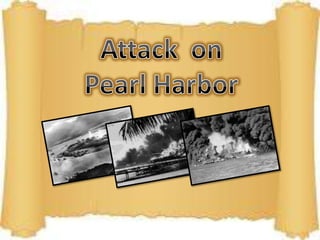
Attack on PEARL HARBOR The attack on Pearl Harbor happened Sunday morning, December 7, 1941 at 7:55 a.m. (Hawaii time). It was a surprise attack from the Japanese Navy that shocked the United States .
The attack on Pearl Harbor was the start of WWIIBefore the AttackSeptember 1940 -- The U.S. placed an embargo on Japan by prohibiting exports of steel, scrap iron, and aviation fuel to Japan, due to Japan's takeover of northern French Indochina. 
April 1941 -- The Japanese signed a neutrality treaty with the Soviet Union to help prevent an attack from that direction if they were to go to war with Britain or the U.S. while taking a bigger bite out of Southeast Asia. 
June 1941 through the end of July 1941 -- Japan occupied southern Indochina. Two days later, the U.S., Britain, and the Netherlands froze Japanese assets. This prevented Japan from buying oil, which would, in time, cripple its army and make its navy and air force completely useless. Toward the end of 1941 -- With the Soviets seemingly on the verge of defeat by the Axis powers, Japan seized the opportunity to try to take the oil resources of Southeast Asia. The U.S. wanted to stop Japanese expansion but the American people were not willing to go to war to stop it.  The U.S. demanded that Japan withdraw from China and Indochina, but would have settled for a token withdrawal and a promise not to take more territory. 
Prior to December 1941, Japan pursued two simultaneous courses: try to get the oil embargo lifted on terms that would still let them take the territory they wanted, and to prepare for war. December 7, 1941the attack only lasted 90 minutes
  2, 386 Americans died, including 57 civilians
  1, 139 Americans were wounded
  18 ships were sunk, including battleships
  Japan lost only 29 aircrafts, 5 tiny submarines and 65 menReasons of bombingPres. Roosevelt banning all exports of scrap, iron, steel and oil to Japan.
 Japan had lost more than 90% of oil supply
 the belief that Japan was becoming encircled by Western powers

Attack on Pearl Harbor

  • 1.
    Attack onPearl Harbor
  • 2.
    Attack on PEARLHARBOR The attack on Pearl Harbor happened Sunday morning, December 7, 1941 at 7:55 a.m. (Hawaii time). It was a surprise attack from the Japanese Navy that shocked the United States .
  • 3.
    The attack onPearl Harbor was the start of WWIIBefore the AttackSeptember 1940 -- The U.S. placed an embargo on Japan by prohibiting exports of steel, scrap iron, and aviation fuel to Japan, due to Japan's takeover of northern French Indochina. 
  • 4.
    April 1941 --The Japanese signed a neutrality treaty with the Soviet Union to help prevent an attack from that direction if they were to go to war with Britain or the U.S. while taking a bigger bite out of Southeast Asia. 
  • 5.
    June 1941 throughthe end of July 1941 -- Japan occupied southern Indochina. Two days later, the U.S., Britain, and the Netherlands froze Japanese assets. This prevented Japan from buying oil, which would, in time, cripple its army and make its navy and air force completely useless. Toward the end of 1941 -- With the Soviets seemingly on the verge of defeat by the Axis powers, Japan seized the opportunity to try to take the oil resources of Southeast Asia. The U.S. wanted to stop Japanese expansion but the American people were not willing to go to war to stop it.  The U.S. demanded that Japan withdraw from China and Indochina, but would have settled for a token withdrawal and a promise not to take more territory. 
  • 6.
    Prior to December1941, Japan pursued two simultaneous courses: try to get the oil embargo lifted on terms that would still let them take the territory they wanted, and to prepare for war. December 7, 1941the attack only lasted 90 minutes
  • 7.
    2,386 Americans died, including 57 civilians
  • 8.
    1,139 Americans were wounded
  • 9.
    18ships were sunk, including battleships
  • 10.
    Japanlost only 29 aircrafts, 5 tiny submarines and 65 menReasons of bombingPres. Roosevelt banning all exports of scrap, iron, steel and oil to Japan.
  • 11.
    Japan hadlost more than 90% of oil supply
  • 12.
    the beliefthat Japan was becoming encircled by Western powers