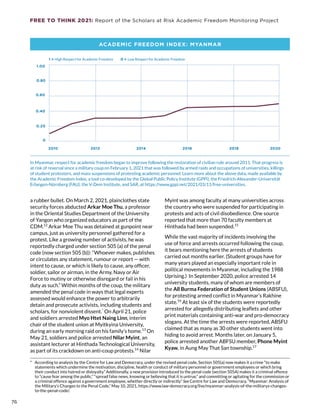
2021 Report of the Scholars at Risk
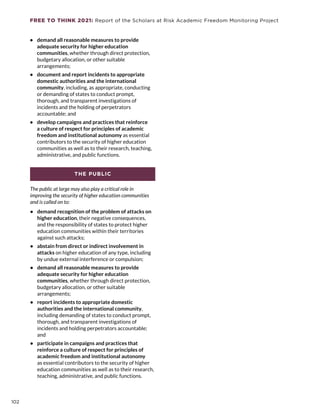
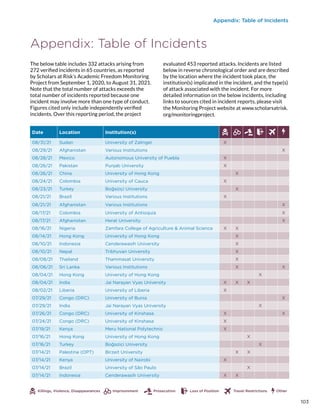
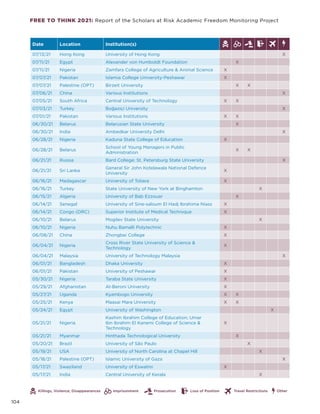
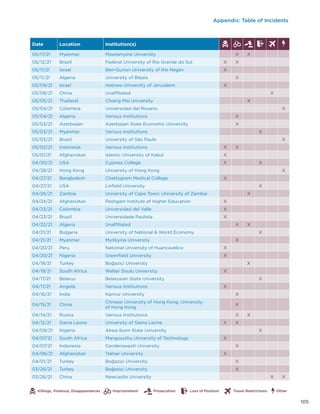
Academic Freedom Monitoring Project
Free to Think
ACKNOWLEDGEMENTS
Scholars at Risk (SAR) gratefully acknowledges the members of higher education
communities worldwide who have inspired us through their courage and dedication.
We acknowledge especially the researchers contributing to the Academic Freedom
Monitoring Project by reporting and analyzing incidents, and helping to develop
advocacy responses, and to our volunteer reviewers who provided important feedback
on the country profiles included in this edition of Free to Think. We thank the Office
of the Provost and New York University for hosting SAR, as well as the many other
member institutions, associations, partners, and individuals that contribute to our
work beyond the monitoring project. These include especially the Vivian G. Prins
Foundation for core support for services for threatened and refugee scholars, the
National Endowment for Democracy, the Open Society Foundations, the Andrew W.
Mellon Foundation, the Charles Koch Foundation, the Henry Luce Foundation, the
Carnegie Corporation of New York, the Winston Foundation, the Fritt Ord Foundation,
the Microsoft Corporation, our anonymous donors, the members of SAR’s Board and
Ambassadors Council, and the many friends of SAR who help us each day to protect
more scholars.
This report is the result of research conducted by the monitoring project and our
publication partners, and thus may not reflect the views of individual network
members, institutions, or participating individuals. SAR invites comments on this
report or inquiries about our work at scholarsatrisk@nyu.edu.
SAR depends on the generous financial support of friends inside and outside
higher education communities to sustain our work. Gifts of any size are gratefully
appreciated, including matching gifts and bequests.
To donate, please visit www.scholarsatrisk.org/give-today.
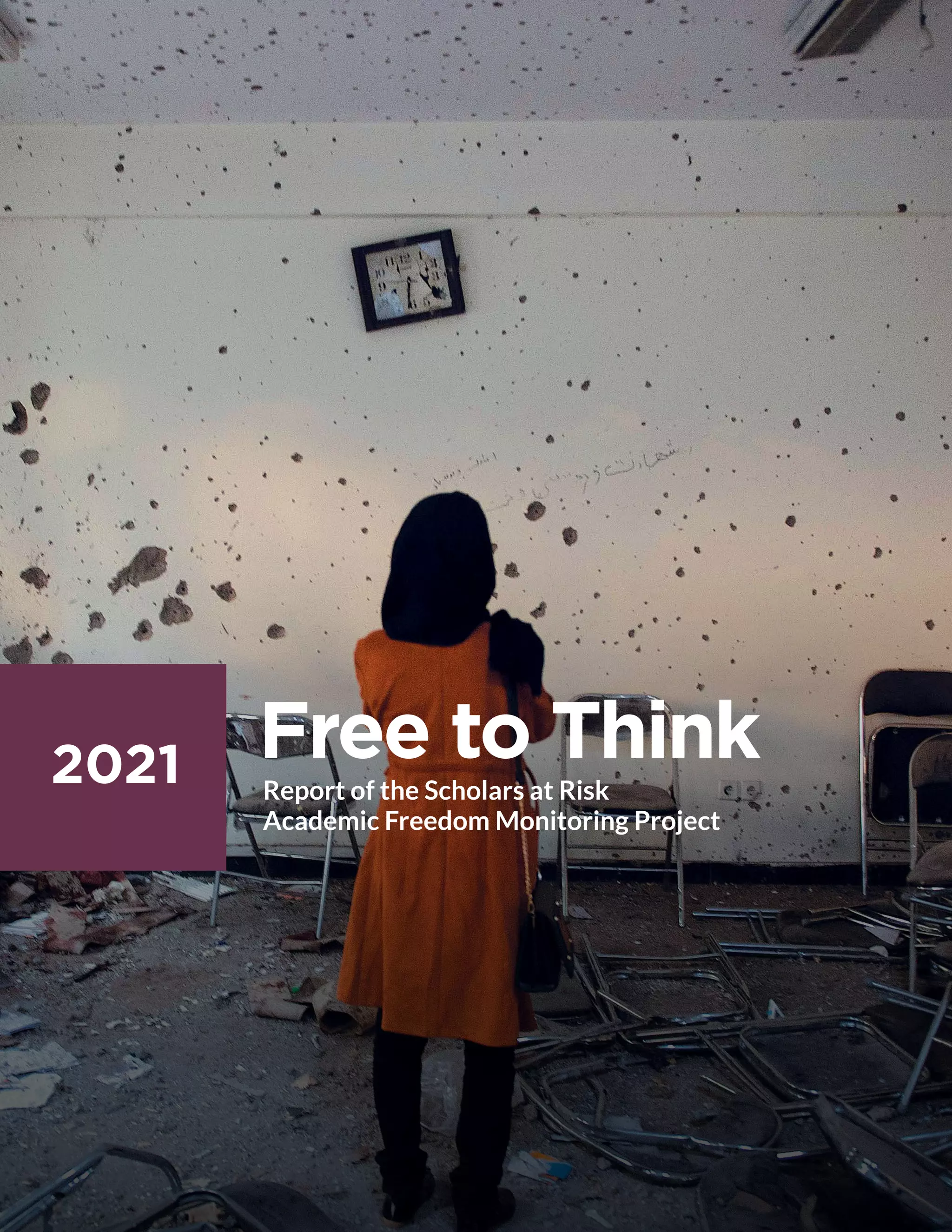
COVER: A student looks at a classroom at Kabul University following a violent attack by gunmen on
November 2, 2020, that left 22 dead and 50 injured.
Photo: Farzana Wahidy/The New York Times/Redux
December 2021
ISBN 979-8-9851764-0-7
© Scholars at Risk 2021. All rights reserved.
For use or information, contact Scholars at Risk at scholarsatrisk@nyu.edu.
Report graphics and layout by Susannah Hainley (www.shainley.com).
TABLE OF CONTENTS
Executive Summary 	 3 
Call to Action 	 7
Academic Freedom and Its Protection Under International Law	 13
Attacks on Higher Education Communities and Academic Freedom 	 17
Scholars in Prison 	 36
Regional Pressures on Higher Education 	 41
	 Afghanistan 	 42
	Bangladesh 	 46
	 Belarus 	 49
	 Brazil	 53
	 China 	 57
	 Hong Kong 	 62
	 India 	 67
	 Israel and the Occupied Palestinian Territory 	 7 1
	 Myanmar 	 75
	 Nigeria 	 79
	 Pakistan	 8 1
	 South Africa 	 84
	 Thailand 	 86
	 Turkey 	 89
	 United States 	 93
	 Zimbabwe 	 98
Recommendations 	 100
Appendix: Table of Incidents 	 103
Appendix: Academic Freedom Monitoring Project Methodology 	 110
SAR Publications & Resources 	 112
Free to Think 2021
2
Executive Summary
Around the world, higher education
communities are overwhelmed by frequent
attacks on scholars, students, staff, and
their institutions. State and non-state
actors, including armed militant and
extremist groups, police and military forces,
government authorities, off-campus groups,
and even members of higher education
communities, among others, carry out
these attacks, which often result in deaths,
injuries, and deprivations of liberty. Beyond
their harm to the individuals and institutions
directly targeted, these attacks undermine
entire higher education systems, by
impairing the quality of teaching, research,
and discourse on campus and constricting
society’s space to think, question, and
share ideas. Ultimately, they impact all of
us, by damaging higher education’s unique
capacity to drive the social, political,
cultural, and economic development from
which we all benefit.
Through its Academic Freedom Monitoring Project,
Scholars at Risk (SAR) responds to these attacks by
identifying and tracking key incidents, with the aim of
protecting vulnerable individuals, raising awareness,
encouraging accountability, and promoting dialogue
and understanding that can help prevent future
threats. Since 2015, SAR has been publishing Free to
Think, a series of annual reports analyzing attacks on
higher education communities around the world.
Free to Think 2021 documents 332 attacks on higher
education communities in 65 countries and territories.
This year was marked by the ongoing COVID-19
pandemic, which has claimed more than five million
lives. For higher education, the pandemic continued to
disrupt academic activity, keeping many institutions
in remote states of operation and suspending most
academic travel. For scholars and students, the
pandemic also continued to raise questions, concerns,
and criticisms about state responses to public health
crises, government accountability, and societal
inequities. Scholars and students took on these issues
in the classroom and more public venues, in-person
and online, asserting their academic freedom and
their rights to freedoms of expression and assembly.
They also responded to acute and more long-standing
political conflicts, from Myanmar’s coup to the steady
erosion of human rights in Turkey, demanding civilian-
led government and the protection of fundamental
freedoms. Frequently, however, individuals and groups
opposed to their questions and ideas sought to silence
them.
Armed groups and individuals carried out severe,
violent attacks on higher education communities.
These included attacks in countries experiencing
extremism or conflict, where higher education
communities may be targeted as perceived symbols
of state authority or sources of opposition to radical
ideologies. They also included attacks targeting
individual scholars or students, intended to retaliate
against or deter academic activity and expression.
Individual scholars were assassinated, and scores
of students and university personnel were killed in
attacks targeting campus communities in Afghanistan,
where the Taliban has since taken control of the
country after ousting its civilian government. In
Nigeria, armed groups carried out deadly attacks
and raids on higher education campuses, often in
an attempt to abduct students and personnel. In
Myanmar, soldiers and police used brutal force to
quash students protesting the February 1 military
coup and to take over campuses for military gain.
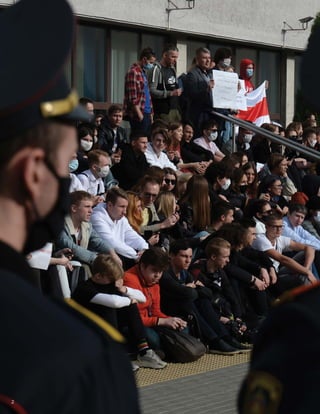
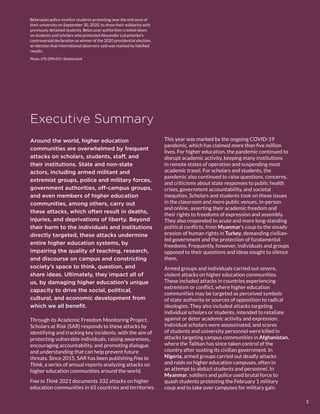
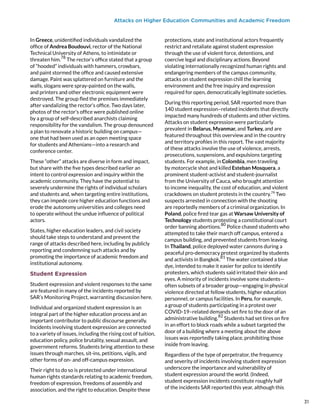
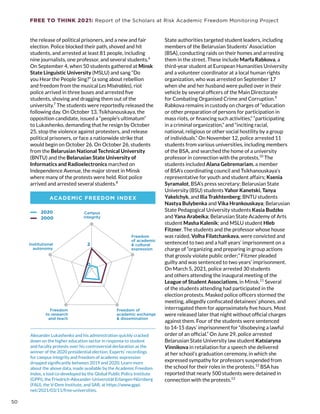
Belarusian police monitor students protesting near the entrance of
their university on September 30, 2020, to show their solidarity with
previously detained students. Belarusian authorities cracked down
on students and scholars who protested Alexander Lukashenko’s
controversial declaration as winner of the 2020 presidential election,
an election that international observers said was marked by falsified
results.
Photo: STR/​EPA-EFE/​Shutterstock
3
FREE TO THINK 2021: Report of the Scholars at Risk Academic Freedom Monitoring Project
State authorities detained, prosecuted, and used
other coercive legal measures to punish and restrict
scholars’ and students’ research, teaching, and
extramural expression and associations, often under
laws or on grounds ostensibly related to national
security, terrorism, sedition, and defamation. In
Brazil, the Attorney General and a Supreme Court
Justice used their positions to take action against
academic speech that found fault with their work.
In India, authorities are prosecuting more than a
dozen scholars and students under the country’s
anti-terrorism laws, in an apparent act of retaliation
against their expression and views critical of Prime
Minister Narendra Modi and his administration. In
Hong Kong, scholars and students continued to fear
the threat of prosecution under the Beijing-imposed
National Security Law, which is expected to chill a
wide range of academic activity and discourse.
Higher education officials suspended, fired, and
took other disciplinary actions against faculty and
students for their academic work and extramural
expressive activities, including expression critical of
their institutions and participation in protests and
social movements. In Bangladesh, scholars were fired
over public expression critical of political figures. In
Belarus, academics and students were suspended
and dismissed after Alexander Lukashenko demanded
their expulsion for protesting an election that has
been widely criticized for falsified results.
Governments restricted and frustrated academics’
and students’ freedom of movement through
targeted actions and policies and practices that limit
the academic movement of entire communities of
students and scholars. This has often included the
denial of visas, deportations of students, and the
blacklisting of scholars. Over the past year, China’s
government issued sanctions against select scholars,
researchers, and institutions in the European Union,
the United Kingdom, and the United States, in
apparent retaliation for research that displeased
the government. Meanwhile, Israel’s government
continues to maintain policies and practices that
severely restrict academic movement in and out of
the Occupied Palestinian Territory. These actions
frustrate the free flow of ideas across borders that is
essential to quality higher education and to building
global understanding and cooperation.
Attacks on student expression remained an all-too-
frequent subset of reported incidents. In the past year,
SAR reported on more than 140 incidents involving
attacks on student expression, including violent
attacks, arrests and prosecutions, and disciplinary
measures. In the Occupied Palestinian Territory,
Pakistan, South Africa, Thailand, and Zimbabwe,
students frequently faced arrest, prosecution, and
the use of force in connection with protests and other
expressive activity over a range of issues, including
access to education, demands for a democratic society,
and accountability for past injustices.
Legislative and administrative
actions by state authorities and
lawmakers threatened the autonomy
and academic freedom of entire
higher education communities.
Turkey’s president appointed a
political ally as rector at one of the
country’s top institutions, Boğaziçi
University, prompting months of
protests decrying the government’s
erosion of institutional autonomy. In
the United States, state legislatures
advanced and in some cases secured
passage of bills that would ban topics
and areas of academic discussion
in classrooms, most notably critical
race theory.
Free to Think 2021 reflects a fraction
of attacks on higher education that
have occurred over the past year.
These attacks demonstrate the range
of tactics by diverse actors seeking
to punish and silence scholars,
students, and other members of
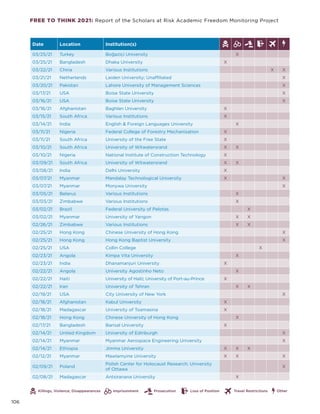
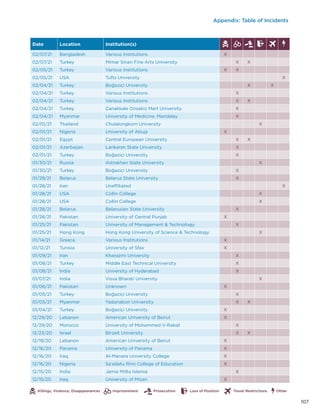
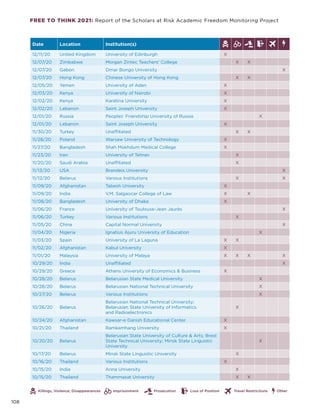
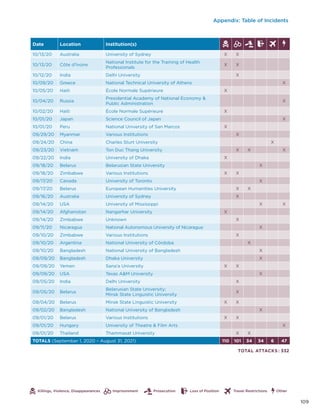
REPORTED ATTACKS ON HIGHER EDUCATION
September 1, 2020 – August 31, 2021
Killings, Violence, Disappearance 	 110
Imprisonment 	 101
Prosecution 	 34
Loss of Position 	 34
Travel Restrictions 	 6
Other 	 47
TOTAL	 332
4
Executive Summary
higher education communities exercising their right
to ideas. They discourage research, teaching, and
discussion. They undermine universities, colleges, and
research institutions attempting to provide solutions
to problems that impact everyone, from COVID-19
to climate change. They impede the ability of higher
education to help shape tomorrow’s leaders. We must
defend against these attacks. We must strengthen
and promote academic freedom and quality higher
education. Our future depends on it.
Scholars at Risk calls on states, higher education
communities, and civil society around the world
to respond to these attacks: to reject violence and
coercion aimed at restricting inquiry and expression;
to protect threatened scholars, students, and higher
education institutions; and to reaffirm publicly their
commitment to academic freedom and support for
the principles that critical discourse is not disloyalty,
that ideas are not crimes, and that everyone must be
free to think, question, and share their ideas.
5
6
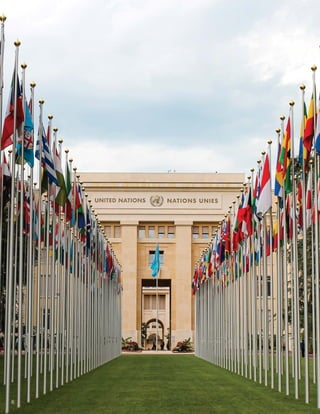
Through the United Nations and other intergovernmental
organizations, Scholars at Risk works to promote protections for
academic freedom, institutional autonomy, and related higher
education values.
Photo: Mathias P.R. Reding / Unsplash.com
Call to Action
*  Please contact scholarsatrisk@nyu.edu to learn more about the activities noted here as well as other initiatives, and to propose new ideas for
actions and partnerships.
From January 2011 through August 2021,
Scholars at Risk (SAR) reported 2,150
attacks on higher education communities in
113 countries and territories. These attacks
punish scholars and students for their ideas
and status within the sector, and they chill
academic freedom across entire university
communities, undermining everyone’s
freedom to think and ask questions.
States, higher education communities, and civil
society have a responsibility to take action to protect
higher education and the free exchange of ideas.
While action may look different for different parties,
everyone has the capacity to help. In addition to
the recommendations contained at the end of this
report, SAR invites readers to consider the following
opportunities for action and to propose their own
novel approaches.*
Intergovernmental Organizations
Intergovernmental, regional, and supranational bodies
should develop policies, structures, and guidelines to
protect and promote academic freedom regionally
and globally. For example, in October 2020, Research
Ministers of the European Union and the European
Commissioner for Innovation, Research, Culture,
Education and Youth endorsed the Bonn Declaration
on “Freedom of Scientific Research,” which includes
a commitment to strengthen academic freedom and
institutional autonomy and encourages research
organizations “to promote and anchor the principles of
academic freedom in their international relationships.”
Similarly, the Inter-American Commission on Human
Rights (IACHR), in coordination with a Specialized
Academic Network of university and NGO partners,
is developing a set of Inter-American Principles on
Academic Freedom and University Autonomy, as well
as a system of indicators to measure the impact of the
norms, principles, and recommendations of the IACHR
in this area.1
States should join together, including through
multistate bodies, to provide funding opportunities
to support higher education institutions and NGOs
seeking to help at-risk scholars and students.
Inspireurope, for example, is a European Union–funded
initiative led by SAR Europe to support, promote, and
integrate researchers at risk in Europe. In particular,
Inspireurope is calling for a dedicated EU fellowship
scheme to support researchers at risk.2
States
States should raise awareness of attacks on higher
education by publicly acknowledging them, including
through written statements.
Governments should assess their own country’s
respect for academic freedom by consulting the
Academic Freedom Index (AFi), a research tool
measuring levels of respect for academic freedom
in 175 countries and territories.3
 States should
consult Free Universities: Putting the Academic Freedom
Index Into Action, a joint report by the Global Public
Policy Institute and SAR that introduces the AFi,
for guidance on interpreting and using the data to
safeguard and strengthen respect for academic
freedom and institutional autonomy, and to improve
higher education quality.4
7
FREE TO THINK 2021: Report of the Scholars at Risk Academic Freedom Monitoring Project
States should highlight attacks on higher education
within their own reporting on human rights issues,
nationally and internationally. The United States
Department of State, for example, includes a section
on “Academic Freedom and Cultural Events” within
their annual Country Reports on Human Rights
Practices.5
States should publicly commit to protecting higher
education from attack by endorsing the Safe Schools
Declaration,6
 through which states express political
support for and commit to implementing the Guidelines
for Protecting Schools and Universities from Military
Use During Armed Conflict, and encouraging peers to
do the same.*
 States that have already endorsed the
Declaration—112 as of this report—should encourage
the rest of the international community to take this
step.
States should further express concern about attacks
on higher education communities through inquiries
posed to other states regarding national conditions for
academic freedom and higher education. For example,
the United Nations’ Universal Periodic Review, a
process that involves a review of the human rights
records of all UN Member States, invites states to
comment on or inquire into other states’ efforts to
protect higher education communities. In February
2020, for example, six states made recommendations
regarding academic freedom and protections for
academics as part of Turkey’s review.7
States should also review reports on topics
related to academic freedom and share findings
with government counterparts and the public.
For example, the UN Special Rapporteur on the
Protection and Promotion of the Right to Freedom
of Opinion and Expression presented a report on
academic freedom to the 75
th 
Session of the General
Assembly in October 2020.8
 The report describes
the legal framework around academic freedom,
the various forms of restrictions and attacks on
academic freedom, and recommendations for states,
*  States can also implement the Principles of State Responsibility to Protect Higher Education from Attack, through which states commit to
protecting higher education from present and future attacks and publicize their efforts to do so. See http://www.protectingeducation.
org/sites/default/files/documents/principles_of_state_responsibility_to_protect_higher_education_from_attack.pdf; and http://www.
protectingeducation.org/sites/default/files/documents/guide_to_implementing_principles.pdf.
†  In Germany, the Alexander von Humboldt Foundation partnered with the Federal Foreign Office and a number of philanthropic organizations
to fund two-year fellowships for at-risk scholars through the Philipp Schwartz Initiative. Also in Germany, the Federal Foreign Office and the
German Academic Exchange Service founded the Hilde Domin Programme, a scholarship initiative for students and doctoral candidates who
are denied the opportunity to study at home. In France, through the PAUSE program (National Program for the Urgent Aid and Reception
of Scientists in Exile), the Ministry for Education and Research, Collège de France, and the Chancellery of Parisian Universities provide
support to higher education establishments and public research organizations that host scientists at risk. In Norway, following the efforts
of the Norwegian Students’ and Academics’ International Assistance Fund and the National Union of Students in Norway, the Norwegian
Ministry of Foreign Affairs funded the Students-at-Risk program, which enables at-risk students to pursue degrees in Norway. In Canada, the
Government-Assisted Refugees Program, under which refugees are selected for relocation to and granted permanent residence in Canada,
has established a dedicated refugee stream for human rights defenders, including scholars, who are fleeing persecution in their home
country.
international organizations, the higher education
community, and civil society. States should work with
civil society and intergovernmental organizations
to respond to and implement this report’s
recommendations.
Where possible, states should establish funding
mechanisms to support at-risk or displaced scholars
and students. Several national efforts—the Philipp
Schwartz Initiative and the Hilde Domin Programme
in Germany, the PAUSE program in France, the
Students-at-Risk program in Norway, and a human
rights defenders stream of the Government-Assisted
Refugees Program in Canada—offer direct funding to
scholars and students to continue their academic work
in safety.†
Higher education institutions
Universities, colleges, and community colleges
should join the SAR Network to demonstrate
solidarity for colleagues worldwide who suffer direct
attacks, and to contribute to efforts to address the
causes of and the fallout from attacks on higher
education.
Institutions should support scholars impacted by
attacks by offering temporary positions of academic
refuge to these individuals through SAR, the
Council for At-Risk Academics (Cara), the Institute
of International Education’s Scholar Rescue Fund
(IIE-SRF), PAUSE, the Philipp Schwartz Initiative,
or similar programs. For example, in August 2021,
hundreds of institutions concerned about colleagues
in Afghanistan pledged to offer positions to scholars
seeking safety. Institutions can also offer remote
fellowships to scholars unable to travel at this time, as
Carleton University in Canada has done recently for
three scholars from Turkey.
Leaders of higher education institutions
should condemn attacks on the sector, regardless
of where they occur. In doing so, higher education
leaders prevent the normalization of attacks, signaling
8
8
Call to Action
that an attack on one scholar is an attack on all.
Institutions should promote understanding and
respect for core higher education values like
academic freedom, institutional autonomy,
accountability, equitable access, and social
responsibility, including by proactively developing a
set of ritualizing practices on their campuses. This
means creating and repeating regular, visible, and
meaningful opportunities for everyone to discuss
these values and their meaning in practice in the
community. SAR can help with materials for trainings
and workshops on academic freedom.
Higher education institutions and national and
regional higher education networks, such as national
SAR sections,9
 should also speak out about attacks
and the need to protect at-risk scholars, including
by addressing concerns to relevant state and non-
state stakeholders. For example, in April 2021,
leaders of three European universities issued a joint
statement calling for the immediate release of Dr.
Ahmadreza Djalali,10
a wrongfully imprisoned scholar
in Iran.11
In August, following the Taliban’s takeover of
Afghanistan, SAR Canada issued a statement urging
the Canadian government and higher education
institutions to “take action to secure the lives and
careers of Afghanistan’s scholars, students, and civil
society actors.”12
Associations and societies
Associations and societies should seek opportunities
to engage displaced or at-risk scholars in their
activities. The Middle East Studies Association
(MESA), for example, offers Global Academy
Scholarships to displaced scholars from the MENA
region who are currently located in North America.
Scholarship recipients receive professional
development training, collaborate on research with
MENA-focused scholars in North America, and receive
sponsorship to attend MESA’s annual meeting.13
Associations and societies should encourage research
into the root causes of attacks on higher education
and efforts to protect academic freedom. They can
include the issue on the agendas of regional and
annual meetings, form committees to address attacks,
and develop their own research. The Association for
Asian Studies, for example, will be releasing a new
volume as part of their Asia Shorts series focused on
academic freedom. The publication, New Threats to
Academic Freedom in Asia, will be published in 2022,
following a virtual roundtable on the topic.14
The
Royal Netherlands Academy of Arts and Sciences
(KNAW) published a report, Academic Freedom in the
Netherlands, which discusses the responsibilities of
scientists, states, and others in conducting academic
research and inquiry.15
The German Academic
Exchange Council (DAAD) developed a guide for
universities and research institutions to assess
prospects and risks related to international academic
cooperation under complex conditions.16
 The
Magna Charta Observatory launched a new
version of the Magna Charta Universitatum, the
MCU 2020, which acknowledges the increasingly
global role of universities and their accompanying
responsibilities.17
 In 2020, the European University
Association, as part of the EU-funded Inspireurope
project coordinated by SAR Europe, mapped existing
support in Europe for researchers at risk. The findings
of this mapping report are now informing policy
recommendations to the EU and national governments
on how to improve support for researchers at risk.18
Faculty and students
Faculty, staff, and students should learn more about
academic freedom, including by enrolling in the free
online course, “Dangerous Questions: Why Academic
Freedom Matters,” which explores the meaning of
academic freedom and how it relates to other core
higher education values.19
Law faculty can lead Academic Freedom Legal Clinics,
through which students engage with practical and
theoretical issues relating to academic freedom and
responses to attacks on higher education. Clinics have
developed submissions for the UN Working Group
on Arbitrary Detention, the UN Universal Periodic
Review process, the European Court of Human Rights,
and the Inter-American Commission on Human Rights,
among others.20
Faculty can also lead Student Advocacy Seminars,
through which students conduct research and
advocacy in support of a wrongfully imprisoned
scholar or student. By engaging in these experiential
activities, faculty train the next generation of human
rights and higher education defenders through hands-
on research and advocacy work.21
 
Faculty and researchers can support at-risk or
displaced scholars on campus by serving on a SAR
committee at their institution, through which they
provide assistance to hosted scholars and seek
opportunities to engage them in on-campus activities.
Student groups and academic departments can invite
threatened scholars to speak to the campus
community, including virtually, through the Vivian
G. Prins/Scholars at Risk Speaker Series, a speakers’
9
9
FREE TO THINK 2021: Report of the Scholars at Risk Academic Freedom Monitoring Project
bureau that provides higher education institutions
the opportunity to learn from current and formerly
at-risk scholars.22
Media
The media has a central role in raising awareness
about the phenomenon of attacks on the higher
education sector through investigative reporting,
interviews, and public discussions.
In addition to documenting attacks, members of the
press can explain the causes and impacts of such
attacks beyond their direct victims, including impacts
on cross-border education and research, and on the
economic, political, and security conditions in the
countries and territories in which attacks occur.
Press and artistic freedom advocates can partner
with SAR on advocacy initiatives that seek greater
protections for the intellectual, creative, and
expressive freedoms these groups need to thrive.
Civil society and the public
Attacks on higher education shrink the space for
everyone to think, question, and share ideas. Civil
society and members of the public should actively
support academic freedom. For example, the UK-
based Academic Freedom and Internationalisation
Working Group is a coalition of concerned academics,
members of the All-Party Parliamentary Human Rights
Group, and relevant civil society representatives
focused on strengthening protection for academic
freedom and scholars exercising it within the context
of the internationalization of UK higher education.23
Civil society and the public should learn more
about academic freedom. One way is by enrolling
in “Dangerous Questions: Why Academic Freedom
Matters,” a free online course.24
Those in industry or other nonacademic research
careers can offer expertise and employment
opportunities to displaced scholars through
programs, trainings, and workshops such as those
organized by Inspireurope.
Everyone can play a key awareness-raising role over
social media by sharing this report, using the hashtags
#AcademicFreedom and #Fre2Think2021 in their
posts, following @ScholarsAtRisk on Twitter and
Facebook, and reposting SAR’s social media posts.
***
Protecting academic freedom and higher education
communities from attacks demands the ingenuity
and engagement of all sectors of society. SAR
calls on everyone to join us in protecting those at
risk, promoting academic freedom, and defending
everyone’s freedom to think, question, and share
ideas.
ENDNOTES
1.	 See Organization of American States, “IACHR presents the
projects of the Specialized Academic Network for Technical
Cooperation,” http://www.oas.org/en/IACHR/jsForm/?File=/
en/iachr/media_center/PReleases/2021/140.asp (June 1,
2021).
2.	 See SAR Europe, “Inspireurope,” https://www.
maynoothuniversity.ie/sar-europe/inspireurope.
3.	 Data generated by the AFi is available at: https://www.v-dem.
net/en/analysis/.
4.	 See Katrin Kinzelbach, Ilyas Saliba, Janika Spannagel, and
Robert Quinn, Free Universities: Putting the Academic Freedom
Index Into Action (March 2021), https://www.gppi.net/media/
KinzelbachEtAl_2021_Free_Universities_AFi-2020.pdf; and
Global Public Policy Institute, “The Academic Freedom Index
Explained,” August 10, 2021, https://www.youtube.com/
watch?v=kOTPYMUU-xQ.
5.	 For more details and for the most recent set of reports, see
https://www.state.gov/reports-bureau-of-democracy-human-
rights-and-labor/country-reports-on-human-rights-practices/.
6.	 See Global Coalition to Protect Education from Attack
(GCPEA), “Safe Schools Declaration and Guidelines on Military
Use,” https://protectingeducation.org/gcpea-publications/safe-
schools-declaration-and-guidelines-on-military-use/.
7.	 See UN Human Rights Council, “Report of the Working Group
on the Universal Periodic Review, Turkey,” March 24, 2020,
available at https://undocs.org/A/HRC/44/14; conclusions and/
or recommendations at paras. 45.97 (Canada); 45.209 (Haiti);
45.157 (Norway); 45.179 (Peru); 45.151 (United States); and
45.94 (Uruguay).
8.	 David Kaye, “Report of the Special Rapporteur on the
promotion and protection of the right to freedom of opinion
and expression, David Kaye,” July 28, 2020, available in Arabic,
Chinese, English, French, Russian, and Spanish at https://
digitallibrary.un.org/record/3883914?ln=en.
9.	 See https://www.scholarsatrisk.org/sar-sections/.
10.	 See p. 36.
11.	 For a copy of the joint statement, see https://www.
scholarsatrisk.org/2021/04/universities-call-for-dr-
ahmadreza-djalalis-release/.
12.	 SAR Canada, “Scholars at Risk Canada issues a statement
on the situation in Afghanistan,” August 27, 2021, https://
www.scholarsatrisk.org/sections/sar-canada/section-news/
scholars-at-risk-canada-issues-a-statement-on-the-situation-
in-afghanistan/.
13.	 For more information on MESA’s Global Academy Scholarships,
see https://mesana.org/advocacy/global-academy.
14.	 See Association for Asian Studies, ““New Threats to Academic
Freedom in Asia” Roundtable,” https://www.asianstudies.org/
conferences/workshops/new-threats-to-academic-freedom-
in-asia-workshop/.
15.	 To read the report in Dutch, see https://knaw.nl/nl/actueel/
publicaties/academische-vrijheid-in-nederland. An English–
language summary is also available.
10
10
Call to Action
16.	 For more information on DAAD’s guide, see https://www.daad.
de/de/infos-services-fuer-hochschulen/kompetenzzentrum/
risiko-und-sicherheitsmanagement/.
17.	 See The Magna Charta Observatory, “MCU 2020,” http://www.
magna-charta.org/magna-charta-universitatum/mcu-2020.
18.	 See Researchers at Risk, “Mapping Europe’s Response,” https://
eua.eu/resources/publications/947:researchers-at-risk-
mapping-europe%E2%80%99s-response.html.
19.	 The online course was created by SAR and the University of
Oslo as part of an Erasmus
+
-funded “Academic Refuge” project.
Learn more about the course at https://www.futurelearn.com/
courses/academic-freedom.
20.	 See Third Party Intervention in Telek, Şar and Kivilcim v.
Turkey, European Court of Human Rights, https://hrc.ugent.be/
wp-content/uploads/2019/10/Telek-tpi.pdf; and Amicus Brief
in Urrutia Laubreaux Vs. Chile, Inter-American Court of Human
Rights, https://cdp-hrc.uottawa.ca/sites/cdp-hrc.uottawa.ca/
files/amicus-_corte_idh_caso_urrutia_vs._chile_febrero_2020_
hrrec.pdf (in Spanish). SAR gratefully acknowledges the
invaluable contributions of our long-time clinical partners,
including Ghent University (Belgium), the University of Turino
(Italy), the University of Dundee (UK), McGill University
(Canada), the University of Nottingham (UK), the University
of Ghana, and University of Ottawa’s Human Rights Research
and Education Center (HRREC). In addition to clinical projects,
the HRREC has partnered with SAR and the University of
Monterrey, Mexico to develop and co-lead the Americas Hub,
a growing, hemisphere-wide effort aimed at advocacy and
networking in support of academic freedom at the regional,
national, and institutional levels.
21.	 Learn more about the Legal Clinic program at https://www.
scholarsatrisk.org/actions/academic-freedom-legal-clinics/,
and the Student Advocacy Seminar program at https://www.
scholarsatrisk.org/actions/student-advocacy-seminars/.
22.	 Invite one of these scholars to speak to your campus
community: https://www.scholarsatrisk.org/actions/speaker-
series/.
23.	 See School of Advanced Study Human Rights Consortium,
“Academic Freedom and Internationalisation Working Group,”
https://hrc.sas.ac.uk/networks/academic-freedom-and-
internationalisation-working-group.
24.	 Visit https://www.futurelearn.com/courses/academic-
freedom.
11
11
12
Governments, human rights institutions, courts, and the higher
education sector should embrace existing protections for academic
freedom under international law, and continue to develop standards
that safeguard academic freedom at the national level.
Photo: Emil Widlund / Unsplash.com
Academic Freedom and Its Protection
Under International Law
Academic freedom is legally grounded
in multiple international human rights
standards. It is fully and independently
grounded in freedom of opinion and
expression, the right to education, and the
right to the benefits of science, respectively,
and has elements of freedom of association,
freedom of movement, and other rights.
Numerous international statements from
state sources reaffirm the right of academic
freedom under these standards.
At the international level, protections for academic
freedom begin within the documents collectively
known as the International Bill of Human Rights:
the Universal Declaration of Human Rights, the
International Covenant on Civil and Political Rights
(ICCPR), and the International Covenant on Economic,
Social, and Cultural Rights (ICESCR). Specifically, ICCPR
Article 19(2) protects the right of everyone to hold
opinions without interference and:
the freedom to seek, receive, and impart information and
ideas of all kinds, regardless of frontiers, either orally,
in writing or in print, in the form of art, or through any
other media of [one’s] choice.
The United Nations (UN) Human Rights Committee
has stated that the right includes teaching and public
commentary by researchers.1
ICESCR Article 13 guarantees the right to education.
The Committee on Economic, Social and Cultural Rights
(CESCR) has explicitly found that the right to education
“can only be enjoyed if accompanied by the academic
freedom of staff and students.”2
 The CESCR further
stated:
Members of the academic community, individually or
collectively, are free to pursue, develop and transmit
knowledge and ideas, through research, teaching,
study, discussion, documentation, production, creation
or writing. Academic freedom includes the liberty
of individuals to express freely opinions about the
institution or system in which they work, to fulfill their
functions without discrimination or fear of repression by
the State or any other actor, to participate in professional
or representative academic bodies, and to enjoy all the
internationally recognized human rights applicable to
other individuals in the same jurisdiction.
ICESCR Article 15(3) protects the right to the benefits
of scientific progress and requires state parties to
“respect the freedom indispensable for scientific
research and creative activity.” According to the CESCR,
states have “a positive duty to actively promote the
advancement of science through, inter alia, education
and investment in science and technology.”3
 The
Committee continues:
This includes approving policies and regulations
which foster scientific research, allocating appropriate
resources in the budgets and, in general, creating
an enabling and participatory environment for the
conservation, development and diffusion of science
and technology. This implies inter alia protection and
promotion of academic and scientific freedom, including
freedoms of expression and to seek, receive and impart
scientific information, freedom of association and
movement; guarantees for equal access and participation
of all public and private actors; and capacity-building
and education.
International bodies have elaborated on the broad
protections laid out in these core documents. Most
especially, UNESCO’s 1997 Recommendation
concerning the Status of Higher-Education Teaching
Personnel (RSHETP) articulates academic freedom to
include, among other things, the
freedom of teaching and discussion, freedom in carrying
out research and disseminating and publishing the
results thereof, freedom [of higher education personnel]
to express freely their opinion about the institution or
system in which they work, freedom from institutional
censorship and freedom to participate in professional or
representative academic bodies.4
13
FREE TO THINK 2021: Report of the Scholars at Risk Academic Freedom Monitoring Project
In order for academic freedom to be meaningfully
realized, higher education institutions must be
grounded in certain core values that support the
quality of research, teaching, and learning. In addition
to academic freedom, these core values include
institutional autonomy, accountability, equitable
access, and social responsibility.
UNESCO’s 1997 Recommendation defines 
institutional autonomy as:
that degree of self-governance necessary for effective
decision making by institutions of higher education
regarding their academic work, standards, management
and related activities consistent with systems of public
accountability, especially in respect of funding provided
by the state, and respect for academic freedom and
human rights.5
Accountability is the institutionalization of clear and
transparent systems, structures, or mechanisms by
which the state, higher education professionals, staff,
students, and the wider society may evaluate—with
due respect for academic freedom and institutional
autonomy—the quality and performance of higher
education communities.6
 It includes, inter alia:
“effective communication to the public concerning the
nature of their educational mission;” “effective support
of academic freedom and fundamental human rights;”
and “ensuring high quality education for as many
academically qualified individuals as possible subject to
the constraints of the resources available to them.”
The CESCR states, in relation to university autonomy,
that self-governance:
must be consistent with systems of public accountability,
especially in respect of funding provided by the State.
Given the substantial public investments made in higher
education, an appropriate balance has to be struck
between institutional autonomy and accountability.
While there is no single model, institutional
arrangements should be fair, just and equitable, and as
transparent and participatory as possible.7
Equitable access is derived from ICESCR Article 13(2)
(c), which provides that “higher education shall be
made equally accessible to all, on the basis of capacity,
by every appropriate means, and in particular by the
progressive introduction of free education...”8
The CESCR has elaborated on this position, stating:
“[e]ducational institutions and programmes have to
be accessible to everyone, without discrimination,
within the jurisdiction of the State party...”9
 and noting
further that accessibility includes three overlapping
dimensions: non-discrimination and equal treatment,
physical accessibility, and economic accessibility.
The UNESCO RSHETP echoes this equality principle,
providing:
Access to the higher education academic profession
should be based solely on appropriate academic
qualifications, competence and experience and be equal
for all members of society without any discrimination.10
Social responsibility is the duty of members of the
higher education community to use the freedoms and
opportunities afforded by state and public respect
for academic freedom and institutional autonomy in
a manner consistent with the obligation to seek and
impart truth, according to ethical and professional
standards, and to respond to contemporary problems
and needs of all members of society. The UNESCO
RSHETP states:
Higher-education teaching personnel should recognize
that the exercise of rights carries with it special
duties and responsibilities, including the obligation to
respect the academic freedom of other members of the
academic community and to ensure the fair discussion
of contrary views. Academic freedom carries with it the
duty to use that freedom in a manner consistent with
the scholarly obligation to base research on an honest
search for truth. Teaching, research and scholarship
should be conducted in full accordance with ethical and
professional standards and should, where appropriate,
respond to contemporary problems facing society as
well as preserve the historical and cultural heritage of
the world.11
Under existing international human rights standards,
states have affirmative obligations (positive and
negative) to protect and promote academic freedom.
These include obligations to: refrain from direct
or complicit involvement in violations of academic
freedom; protect higher education communities
against such violations; support victims of such
violations; deter future violations, including by
investigating violations and holding perpetrators
accountable; promote the exercise of academic
freedom, including by supporting higher education
and international research cooperation; and promote
greater understanding of academic freedom and its
benefit to society.12
Jurisprudence around academic freedom and its
components has developed within regional bodies
including the European Parliament13
 and the European
Court of Human Rights (ECtHR),14
 the Inter-American
Commission on Human Rights (IACHR),15
 and the
African Commission on Human and People’s Rights
(ACHPR).16
Complementing this jurisprudence
are recognitions of academic freedom in state
constitutions, national laws, decisions, and regulations,
as well as in higher education policies and practices
14
14
Academic Freedom and Its Protection Under International Law
at the sectoral and institutional levels. As of 2020, 80
countries and territories had constitutional provisions
that explicitly or implicitly protect academic freedom.17
Public affirmations and commitments to academic
freedom and related rights also strengthen support for
this right. For example, in October 2020, the European
Union’s Research Ministers and the European
Commissioner for Innovation, Research, Culture,
Education, and Youth issued the Bonn Declaration
on Freedom of Scientific Research, which recognizes
freedom of scientific research as “a universal
right and public good,” and a “core principle of the
European Union and as such anchored in the Charter
of Fundamental Rights of the EU.”18
Collectively,
these demonstrate broad recognition of the right to
academic freedom.
States, national human rights institutions, courts,
and the higher education sector should embrace this
recognition and continue to develop pro–academic
freedom standards and practices, applying them
wherever possible at the national and local levels, and
explicitly acknowledging the grounding of academic
freedom within international human rights standards.
ENDNOTES
1.	 UN Human Rights Committee, General Comment No. 34:
Freedoms of opinion and expression (Article 19), September
12, 2011, paras. 11-12 and 30, https://digitallibrary.un.org/
record/715606?ln=en.
2.	 ESCR, General Comment No. 13: The Right to Education
(Article 13), December 8, 1999, para. 38, https://www.refworld.
org/pdfid/4538838c22.pdf.
3.	 Ibid, para. 46.
4.	 UNESCO, “Recommendation concerning the Status of Higher-
Education Teaching Personnel,” November 11, 1997, para. 27,
http://portal.unesco.org/en/ev.php-URL_ID=13144&URL_
DO=DO_TOPIC&URL_SECTION=201.html.
5.	 Ibid, para. 17.
6.	 Ibid, paras. 22-24.
7.	 See CESCR (1999), para. 40. See also RSHETP, para. 22 (a), (c), (d).
8.	 See ICESCR, Article 13(2)(c). See also UNESCO, “Convention
against Discrimination in Education 1960,” December 14,
1960, available at http://portal.unesco.org/en/ev.php-URL_
ID=12949&URL_DO=DO_TOPIC&URL_SECTION=201.html.
9.	 See CESCR (1999), paras. 6(b), 31-37.
10.	 See RSHETP, para. 25.
11.	 See RSHETP, para. 33.
12.	 See ICCPR, Art. 2(1); RSHETP, paras. 17-19; UNESCO,
“Recommendation on Science and Scientific Researchers,”
November 13, 2017, paras. 32-33; Global Coalition to Protect
Education from Attack (GCPEA), Principles of State Responsibility
to Protect Higher Education from Attack, available at https://
protectingeducation.org/wp-content/uploads/documents/
documents_principles_of_state_responsibility_to_protect_
higher_education_from_attack.pdf; GCPEA, “Safe Schools
Declaration,” https://protectingeducation.org/wp-content/
uploads/documents/documents_safe_schools_declaration-
final.pdf; and GCPEA, Guidelines for Protecting Schools and
Universities from Military Use During Armed Conflict, https://
protectingeducation.org/wp-content/uploads/documents/
documents_guidelines_en.pdf.
13.	 European Parliament, “Recommendation of 29 November 2018
to the Council, the Commission and the Vice-President of the
Commission / High Representative of the Union for Foreign
Affairs and Security Policy on Defence of academic freedom in
the EU’s external action (2018/2117(INI)),” November 29, 2018,
available at https://www.europarl.europa.eu/doceo/document/
TA-8-2018-0483_EN.html.
14.	 ECtHR, Sorguç v. Turkey, June 23, 2009, no. 17089/03, para. 35
(defining academic freedom as comprising “academics’ freedom
to express freely their opinion about the institution or system
in which they work and freedom to distribute knowledge and
truth without restriction”); ECtHR, Riolo v. Italy, July 27, 2008,
no. 42211/07, para. 63 (publication of an academic work in
a newspaper entitled the applicant to the same level of free
expression protection as that afforded to journalists); ECtHR
(Grand Chamber), Aksu v. Turkey, 15 March 2012, nos. 4149/04
and 41029/04, para. 71 (holding that ECtHR case law required
the court “to submit to careful scrutiny any restrictions on the
freedom of academics to carry out research and to publish
their findings.”); ECtHR, Mustafa Erdoğan and Others v. Turkey
(2014), supra n. 19, para. 40 (“[Academic freedom] is not
restricted to academic or scientific research, but also extends
to the academics’ freedom to express freely their views and
opinions, even if controversial or unpopular, in the areas of their
research, professional expertise and competence. This may
include an examination of the functioning of public institutions
in a given political system, and a criticism thereof.”); and ECtHR,
Kula v. Turkey, June 19, 2018, no. 20233/06, paras. 38-39
(holding that expression by an academic on a television program
“unquestionably concerns his academic freedom, which should
guarantee freedom of expression and of action, freedom to
disseminate information and freedom to ‘conduct research
and distribute knowledge and truth without restriction,’” and,
further, that even a modest sanction under these circumstances
could result in a “chilling effect” on academic freedom).
15.	 ACHR, “Gross human rights violations in the context of
social protests in Nicaragua,” June 21, 2018, paras. 170-171;
IACHR, “IACHR Observes Persistent Human Rights Issues in
Venezuela,” April 5, 2019, https://www.oas.org/en/iachr/media_
center/PReleases/2019/091.asp (expressing concern about
attacks on professors and students, and stating that “academic
freedom [and institutional autonomy] are crucial pillars to
strengthen democratic structures and prevent politically driven
pressures and interventions.”).
16.	 Kenneth Good v. Republic of Botswana, 313/05, (May 2010) at
paras. 199-200 (holding that “[t]he expulsion of a non-national
legal resident in a country, for simply expressing their views,
especially within the course of their profession, is a flagrant
violation of [freedom of expression]... The opinions and views
expressed [resulting in expulsion are] critical comments that are
expected from an academician of the field”).
17.	 Filtering for the variable, “v2caprotac,” in the 2020 V-Dem
dataset, available at https://www.v-dem.net/en/data/data/v-
dem-dataset-v111/.
18.	 See “Bonn Declaration on Freedom of Scientific Research,”
available at https://www.bmbf.de/files/10_2_2_Bonn_
Declaration_en_final.pdf.
15
15
16
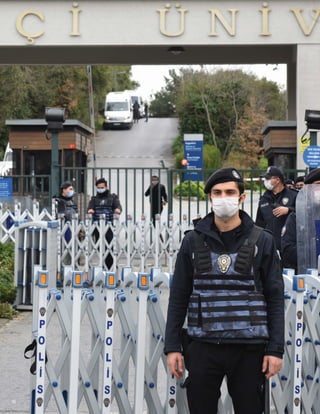
Turkish anti-riot police guard the main gate of the Boğaziçi University
campus in Istanbul. Starting in early January 2021, students and faculty
began protesting President Recep Tayyip Erdoğan’s appointment of
Melih Bulu, a political ally, as the new rector of Boğaziçi, one of Turkey’s
top universities.
Photo: IV. andromeda / Shutterstock.com
Attacks on Higher Education
Communities and Academic Freedom
SAR’s Academic Freedom Monitoring
Project (the “Monitoring Project”) identifies
key types of attacks on higher education
communities with the goal of raising
awareness of the problem, ending the
isolation of survivors of attacks, promoting
accountability, and mitigating, deterring, or
otherwise preventing future incidents.
This year’s report relies on data collected from
September 2020 to August 2021 and includes 332
attacks arising from 272 verified incidents in 65
countries. Sadly, this data sample reflects only a small
subset of all attacks on higher education during that
time. Given the limited resources available, the scope,
variety, and complexity of attacks occurring, and
a common fear among survivors to report attacks,
it should be noted that these figures represent
only a fraction of the total number of attacks. A
comprehensive accounting is not yet possible. Rather,
this report analyzes reported incidents for recurring
themes, regional trends, and common factors that
warrant deeper attention from stakeholders, especially
states, higher education leaders, the media, and civil
society.
For the purpose of this report, “attacks” on higher
education include threats or deliberate use of
violent or coercive force against higher education
institutions and their members, including leadership,
administrators, academic and other staff, and
students. They include intentional acts resulting in
wrongful death, physical harm, loss of liberty, or loss
of professional standing, or resulting in damage or
destruction of higher education institutions, facilities,
or equipment. This definition also includes deliberate
acts of coercion, intimidation, or threats of harm
that undermine institutional autonomy, academic
freedom, and educational functions, but it does not
generally include other infringements of these values
and functions which lack these violent or coercive
dimensions.
Whatever the types of incidents and wherever
they occur, they share common negative outcomes:
they undermine the security of higher education
institutions and personnel, including those directly
targeted and those intimidated or silenced by attacks
on others. They impose restrictions on access to higher
education by targeted and vulnerable individuals and
groups. They undermine research, teaching, and public
discourse, eroding not only academic quality but social,
political, economic, and cultural development. And
insofar as higher education contributes to pedagogy,
materials, and teacher training, attacks on higher
education can undermine education at all levels. They
contribute to “brain drain,” the flight of scholars and
students, as well as to “brain drag,” the “lost personal,
professional, and creative productivity that would
have been, but for the rational fear of retaliation,”
1
undermining national investments in education and
exacerbating inequities within the local and global
knowledge economies. They disrupt increasingly
important flows of higher education staff, students,
and research between countries, depriving everyone
of the fullest benefits of cross-border intellectual
exchange and research.
The Monitoring Project organizes documented
attacks into six categories: killings, violence, and
disappearances; wrongful imprisonment; wrongful
prosecution; loss of position and expulsion from study;
17
FREE TO THINK 2021: Report of the Scholars at Risk Academic Freedom Monitoring Project
improper travel restrictions; and other severe or
systemic issues. This chapter provides an overview of
the typology of attacks, using Monitoring Project data
from this reporting period to highlight relevant issues
of concern, including attacks on student expression
that figure into many of the incidents SAR reports.
This overview is followed by profiles of countries and
territories where SAR has reported higher frequencies
of attacks or broad systemic pressures that directly
restrict the academic freedom of large numbers of
scholars and students in a given location.
Killings, Violence, and Disappearances
Violent attacks on scholars, students, staff, and their
institutions are one of the most serious threats to
the higher education sector. Campus-wide attacks,
targeted killings, lethal force against student
protesters, and threats of violence result in loss of
lives and injuries to many, compromise the safety of
entire campuses, and incite fear in faculty, students,
administrators, and society at large. This, in turn,
can restrict access to higher education, threaten the
functioning of the higher education space, and chill
academic freedom. Since the Monitoring Project’s
inception in 2011, SAR has documented 630 violent
attacks, including 110 that occurred during this
reporting period.
Individuals and groups regularly carry out attacks on
higher education communities with the intention of
killing or injuring multiple faculty, students, and staff,
often indiscriminately. These violent attacks may
intentionally target specific institutions or individuals.
They may target institutions as proxies for state
authority or as a symbol of a modern, education-
based society. Or they may be opportunistic acts
aimed at taking advantage of university and college
campuses and facilities as places where groups of
people gather according to predictable schedules,
especially when inadequate steps are taken to provide
for the security of campuses, classrooms, transports,
and dormitories.
In Afghanistan,
*
for example, at least three gunmen
stormed Kabul University, detonating explosive
devices and opening fire.
2
22 people were killed and
50 were injured in the attack. At least 20 students and
faculty were taken hostage, while others attempted
to escape by scaling campus walls. Officials from an
Afghan affiliate of the Islamic State of Iraq and the
*  See profile containing additional information on Afghanistan on p. 42.
†  See profile containing additional information on Nigeria on p. 79.
‡  For more discussion of the impact of armed conflict on Yemen’s higher education community, see SAR, Free to Think 2020 (November 2021),
pp. 31-37, https://www.scholarsatrisk.org/wp-content/uploads/2020/11/Scholars-at-Risk-Free-to-Think-2020.pdf.
Levant (ISIL) claimed responsibility for the attack.
Days earlier, an ISIL affiliate also claimed responsibility
for a suicide bombing outside the Kawsar-e Danish
Education Center, in Kabul, which left 24 dead and
57 injured.
3
Students between the ages of 15 and 26
were waiting to enter the center, which offers tutoring
for students preparing for higher education.
In Bangladesh, as many as 50 people raided a private
dormitory rented to Barisol University students. They
violently beat students, leaving at 13 hospitalized.
4
Sources suggest that the attack was in retaliation for
a protest students held one day earlier, during which
they demanded the arrest of transit workers accused
of attacking two classmates.
In Nigeria,†
gunmen attacked the Nuhu Bamalli
Polytechnic (NPU), leaving at least one student dead.
5
During this reporting period, armed groups carried
out seven raids and attacks at educational institutions
in the Northern parts of Nigeria, often abducting
students and staff and holding them for ransom.
Sources indicate that at least two lecturers were
kidnapped in the NPU incident.
Targeted killings include those aiming to silence
particular individuals because of the content of their
research, teaching, writing, or public expression, or
simply for their identity as scholars or students.
In Iraq, Ahmed al-Sharifi, a professor at Al-Manara
University College in the city of Amara, was shot and
killed by unidentified gunmen who fled the scene.
6
The motive for the killing was not publicly reported.
The Iraqi High Commission for Human Rights issued a
statement in response to the assassination warning of
a possible “series of assassinations” of Iraqi scholars
and demanding that the government pass legislation
to protect them.
7
In Yemen, unidentified assailants shot and killed
Khalid al-Hameidi, dean of the University of Aden’s
College of Education, in Al-Dhali.
8
Al-Hameidi, who
sources described as a secular thinker and a known
critic of Islamic extremists, was traveling to the
college when at least two assailants opened fire on
him. No group claimed responsibility for the shooting.
Outspoken scholars have faced heightened risk in
Yemen since a war broke out in 2015 between Houthi
rebels and national and international government
forces.
‡
18
18
Attacks on Higher Education Communities and Academic Freedom
Scholars and students also routinely face threats of
violence designed to punish, block, or otherwise alter
their research, teaching, studies, or public expression.
In Malaysia, student members of the University of
Malaya Association of New Youth (UMANY) received
threatening messages and phone calls, including
threats to rape, kill, and throw acid on them and
their families.
9
UMANY members had published an
online statement opposing the king’s rejection of the
government’s proposed response to the COVID-19
pandemic. The statement was met with criticism
from supporters of the monarchy and resulted in a
university disciplinary investigation and a separate
criminal investigation.
In Peru, National University of San Marcos
archaeologist Ruth Shady reported being the
subject of violent threats by individuals apparently
seeking to occupy an archaeological site where she
was overseeing research.
10
After the COVID-19
coronavirus spread to Peru, a group of individuals,
described as “land traffickers” and “squatters,”
raided, occupied, and destroyed artifacts in the Caral
Architectural Zone, which contains ancient ruins Shady
uncovered in 1994. Shady reported that she and her
colleagues, as well as her lawyer, began receiving death
threats intended to dissuade them from carrying out
their fieldwork. Shady reported that they poisoned and
killed her dog “as a warning.”
11
The use of violent and especially lethal force,
particularly the use of live ammunition, by state and
private security forces against student protesters
is also of particular concern to higher education
communities.
In Haiti, Grégory Saint-Hilaire, a student from the
University of Haiti, was shot and killed during a
protest over education policy issues.
12
Students were
protesting at the National Palace, located across from
the campus, when police fired tear gas. Witnesses
alleged that a palace guard shot Saint-Hilaire in the
back. He was hospitalized but succumbed to his
wounds.
In Madagascar, gendarme forces opened fire amidst
clashes with student protesters from the University
of Toamasina, striking at least one student.
13
Students were protesting outside the university
gates, demanding the payment of scholarships, when
gendarmes appeared and began using tear gas before
resorting to live ammunition. Johanelle Jacques
Michel, a 23-year-old economics student, died after
being shot in the leg during the protest.
While state and private university security forces have
a responsibility to ensure security and safety, they
must also exercise restraint and respond to student
expression and protest activities in an appropriate and
proportional manner, emphasizing de-escalation and
consistent with recognized international human rights
standards. Security forces should not use weapons
when responding to nonviolent student expression.
Lethal force against nonviolent student expression is
never justified.
SAR condemns targeted, violent attacks on higher
education communities, threats of violence, and
the use of lethal force against student protesters.
SAR calls on state authorities to investigate these
incidents, to make every effort to hold perpetrators
accountable, and to ensure the security of all members
of the community. State authorities must publicize
investigations and accountability measures, so as to
reach constituents, positively influence state and non-
state actors, and make these measures effective. SAR
also calls on higher education institutions and civil
society to press state authorities for greater protection
and accountability, and to contribute to efforts to
understand and reinforce principles of autonomy and
academic freedom.
Wrongful Imprisonment and Prosecution
Scholars and students bring attention to a variety of
important issues through their academic work, inquiry,
expression, and associations. They may question the
authorities and dominant discourse. In an effort to
maintain power and control, state authorities often
attempt to silence them with a range of coercive legal
measures, including criminal investigations, arrests,
prosecutions, and imprisonment. Since the Monitoring
Project’s inception, SAR has documented more than
700 incidents involving wrongful imprisonment
or prosecution, 111 of which occurred during this
reporting period.
Imprisonments and prosecutions of scholars and
students are wrongful when intended to punish,
deter, or impede nonviolent academic activity or
the exercise of other protected rights, including
freedoms of expression, association, or assembly. Such
prosecutions are typically brought under laws aimed
at restricting critical inquiry and expression. These
include especially opaque and overbroad blasphemy,
lèse-majesté, civil and criminal defamation, sedition,
espionage, national security, and terrorism laws
that make illegal the mere expression of opinions or
ideas on certain topics, without any link to violent
or otherwise criminal acts or intentions whatsoever.
Such laws raise concern for entire higher education
communities in that they sanction and impose artificial
19
19
FREE TO THINK 2021: Report of the Scholars at Risk Academic Freedom Monitoring Project
boundaries on research, teaching, publications,
and discussion, undermining quality, creativity, and
innovation that can benefit society at large.
*
Scholars
have also faced legal actions brought under other
laws of general application, including, for example,
those proscribing financial impropriety, corruption, or
immorality. Wrongful prosecutions under these laws
damage the reputation of the targeted individuals and
isolate them from their institutions, colleagues, and
other sources of professional and personal support.
In many cases, legal proceedings and prosecutions
of scholars and students involve forced confessions,
fabricated evidence, arbitrary charges, and lengthy
prison sentences or harsh penalties. Trials may be
repeatedly delayed or held in secret or closed-door
proceedings, denying access to media and family. Such
actions raise serious due process concerns.
Lecturers, researchers, and other academic personnel
are routinely investigated, prosecuted, imprisoned,
and subjected to other legal actions for a wide
range of academic conduct as well as their public
views, associations, and ideas. Public criticism of
governments or political leaders, and other forms of
dissent—whether in academic or other contexts—
are frequently the apparent basis for such actions.
The examples below from this reporting period
demonstrate the diversity of bases for coercive legal
actions and the range of actions taken to silence and
punish scholars.
In Algeria, a court sentenced Said Djabelkhir, a
professor specializing in Islam, to three years’
imprisonment on charges stemming from social
media comments.
14
Djabelkhir published three
Facebook posts, in which he described certain hadiths
(reports of statements by the prophet Muhammad) as
“apocryphal,” called some stories in the Qur’an “myths,”
and made comparisons between the Islamic holiday
Eid al-Adha and the Berber new year celebration,
according to Amnesty International. A professor at
the University of Sidi Bel Abbès reportedly filed a
complaint against Djabelkhir for the posts, describing
them as offensive to Islam. Djabelkhir said during
his trial that the posts were “academic reflections.”
Djabelkhir’s appeal to reverse the conviction and
sentencing is ongoing as of this report.
The Attorney General (AG) for Brazil filed a criminal
complaint against Conrado Hübner Mendes, a legal
scholar at the University of São Paulo (USP), over
*  Even if they were narrowly drafted, limited in use, and conscientiously applied through fair and transparent legal proceedings fully compliant
with recognized human rights standards, such laws would still impose a significant chill on academic freedom, free expression, and other
rights. In practice, however, such limits are never in place.
†  See section on “Student Expression” on p. 31.
public comments he made about the AG over social
media and in a column for the newspaper Folha de
São Paulo.
15
Mendes criticized the work of the AG,
Antônio Augusto Brandão de Aras, describing him as
a “servant of the president [Jair Bolsonaro].” A federal
court ultimately rejected the criminal complaint, which
accused Mendes of slander, libel, and defamation. In
addition to the criminal complaint, Aras also filed a
complaint with USP’s ethics committee, demanding an
investigation into Mendes.
16
In Vietnam, Pham Dinh Quy, a professor at Ton Duc
Thang University in the Vietnamese province of
Dak Lak, was arrested and prosecuted for articles
he published criticizing a local Communist Party
official.
17
In print and online media, Pham alleged
that local Communist Party head Bui Van Cuong had
plagiarized his doctoral thesis. Pham was formally
arrested and charged with slander under Article
156 of the Vietnamese Penal Code. In addition,
Pham’s articles were taken down from the Journal of
Environment and Society, the online publication where
they had been posted. The publication was reportedly
fined 50 million Vietnamese dong (about $2,200 USD),
and its print version was suspended for two months.
If convicted, Pham faces fines and a maximum of two
years in prison.
In Yemen, Houthi soldiers detained Sana’a University
psychology professor Adnan Abdul Qadir Al-
Sharjabi at an undisclosed location.
18
Al-Sharjabi was
taken into custody upon arrival at the university to
administer a final exam. According to family, Houthi
forces raided his home and confiscated his laptop and
a flash drive. Houthi forces, who claim de facto control
over Sana’a, did not disclose the basis for detaining
Al-Sharjabi. On October 6, after nearly one month in
detention, Houthi forces released Al-Sharjabi from
custody. Al-Sharjabi was reportedly denied medical
care while in Houthi custody and was in poor health
at the time of his release. On November 1, he died
as a result of heart- and lung-related complications.
Over the past six years, the war in Yemen has had
a disastrous impact on the local higher education
community, including the imprisonment of a growing
number of scholars and students.19
Higher education students are also routinely detained,
arrested, and subjected to criminal investigations for
participating in on- and off-campus protest activities,
for online speech, and for their associations.†
20
20
Attacks on Higher Education Communities and Academic Freedom
In Côte d’Ivoire, police arrested 24 students of
the National Institute for the Training of Health
Professionals (INFAS) peacefully protesting for the
payment of their scholarships.
20
Students marched to
the teaching hospital in Bouaké to demand that INFAS
pay 10 months’ worth of scholarships that had not
been disbursed and to make calls for other demands
relating to interns’ compensation and the system of
degrees awarded to students. Police on the scene fired
tear gas and detained 24. The students were released
the next day.
In Egypt, authorities arrested Ahmed Samir Santawy,
a second-year master’s student in sociology and
cultural anthropology at the Central European
University (CEU) in Austria, in apparent retaliation for
his research on women’s rights, including reproductive
rights.
21
Police held Santawy incommunicado for
five days, during which he said he was beaten and
interrogated about his studies and social media
activity. Santawy, an Egyptian citizen, had been
questioned repeatedly by Egyptian border officials
since September 2019 when he began his studies at
CEU and would travel between Austria and Egypt for
family visits. Five months after Santawy’s arrest, on
June 22, the State Security Emergency Misdemeanor
Court sentenced him to 4 years’ imprisonment and a
fine of 500 pounds for publishing “false news.” Verdicts
given by the State Security Emergency Courts cannot
be appealed. On June 23, Santawy began a hunger
strike in protest of his conviction.
In Iran, a court convicted and sentenced University
of Tehran student Leila Hosseinzadeh to five years’
imprisonment and a two-year ban on internet
activities, in apparent retaliation for her nonviolent
activism.
22
Hosseinzadeh is a student union activist
who has previously faced arrest and prosecution
for her protest activities.
23
In this latest incident,
Revolutionary Court Branch 28 charged Hosseinzadeh
with “assembly and collusion to act against national
security,” for her participation in a demonstration
celebrating the birthday of imprisoned student-activist
Mohammad Sharifi Mogadam. Authorities alleged that
demonstrators, who protested peacefully outside the
Sharif University of Technology, chanted anthems of
the banned communist party.
In Russia, police arrested four students from the
Higher School of Economics and Moscow State
University of Civil Engineering in connection with a
video they had posted to an online student magazine
known as Doxa.
24
In the video, the students, who
are editors of Doxa, appealed to students to not fear
*  Learn more about these and other scholars represented in SAR’s Scholars in Prison Project on p. 36.
expulsion from their institutions for participating
in protests in support of opposition leader Alexei
Navalny. A Russian media and communications agency
had ordered the students to remove the video in
January. The students complied with the demand, but
they later filed a lawsuit against the same agency. In
April, police carried out searches of the Doxa office
and the students’ homes before arresting them on
charges of “involving minors in committing illegal
actions.” The students were placed under house arrest,
without internet access , and were barred contact with
anyone other than their lawyers and families, unless
approved by the state. If convicted, they could face up
to three years’ imprisonment.
Scholars and students who have been arrested or
convicted and sentenced to time in prison may be
held in overcrowded cells or solitary confinement,
denied access to appropriate medical care, family, or
legal counsel, and subjected to lengthy interrogations,
abuse, and torture. Throughout the ongoing COVID-19
pandemic, advocates have been especially concerned
about the health and well-being of wrongfully
imprisoned scholars and students, in particular those
who are elderly or have conditions that elevate
their risk of contracting or suffering from the virus.
Concerns about torture, denied medical care, and
the threat of COVID-19 were evident in the above-
mentioned cases of Yemeni Professor Adnan Abdul
Qadir Al-Sharjabi and Egyptian graduate student
Ahmed Samir Santawy. They have also manifested in
other cases of scholars on whose behalf SAR conducts
advocacy, including Bahraini mechanical engineering
lecturer Abduljalil Al-Singace, Indian scholar of English
Literature Gokarakonda Naga (G.N.) Saibaba, Iranian-
Swedish scholar of disaster medicine Ahmadreza
Djalali, Iranian researcher and wildlife conservationist
Niloufar Bayani, and Emirati economist Nasser bin
Ghaith, among others.*
The incidents described above provide a disturbing
accounting of the range of punitive legal actions
scholars and students often suffer in connection
with their research, publications, expressive activity,
and associations. Such actions can leave them with
physical and emotional scars and, in some cases,
destroyed careers. Beyond the immediate harm to
those individual scholars and students, wrongful
imprisonments and prosecutions send a message to
higher education communities and society at large
that expressing ideas or raising questions can result
in grave consequences. As a result, society risks
losing the benefits of a diverse community of scholars
21
21
FREE TO THINK 2021: Report of the Scholars at Risk Academic Freedom Monitoring Project
and students, free to carry out their work or share
their thoughts, without fear of punishment by state
authorities.
SAR urges state authorities around the world to
release scholars and students imprisoned for their
academic work or the nonviolent exercise of other
protected human rights. With particular concern over
the heightened risk COVID-19 presents incarcerated
populations, SAR calls on state authorities to release
immediately wrongfully imprisoned scholars and
students, especially those who have health conditions
that elevate their level of risk or who are being held
in unsanitary or crowded conditions. Pending this,
states must uphold their obligations under domestic
and international law, including those related to due
process and the humane treatment of prisoners. SAR
further urges state authorities to drop prosecutions
against scholars in connection with nonviolent
academic or expressive activity, to review laws that
have been used wrongfully to prosecute scholars and
students, and to amend or repeal them as necessary,
to ensure that scholars can think, question, and share
ideas without fear of retribution.
Loss of Position
Higher education and state authorities punish, deter,
and restrict the exercise of academic freedom and
other protected rights of scholars and students
through employment or administrative actions. These
include the loss of position by demotion, suspensions,
and denial of promotions or other benefits to scholars,
and permanent or temporary expulsion of students
from courses of study, programs, and facilities. Since
the Monitoring Project’s inception, SAR has reported
213 incidents involving permanent or temporary loss
of position or threats of the same.
Disciplinary actions may be openly acknowledged as
punishing or attempting to block academic speech or
conduct, including statements made in the classroom
or on campus, writings (including newspaper columns,
letters, blogs, and social media), research, participation
in professional or student associations, union activity,
or criticism of higher education or state leadership or
policy. State or university officials may also attribute
the action to regular administrative or employment
decisions having nothing to do with academic content
or conduct, such as budget cuts or lack of demand, or
*  This presents significant challenges in reporting, given the need to look for evidence of pretext by examining the timing of the action, its
context, any history or pattern of similar actions against the victim(s) or others, the fairness and transparency of any process leading to the
action, and any available statements and supporting information from the parties involved, witnesses, and independent experts.
†  See profile containing additional information on Belarus on p. 49.
‡  See profile containing additional information on Myanmar on p. 75.
§  See profile containing additional information on Turkey on p. 89.
allegations of poor performance, violation of policy,
violation of terms of employment or admission, fraud
or other dishonest or inappropriate behavior; they
may also provide no explanation.
*
It is important to
note the role of government and political figures in
such incidents, where these external actors publicly
and privately exert pressure on higher education
administrations to secure the removal of particular
scholars or students from the campus community.
In some cases, as discussed in profiles of Belarus,
†
Myanmar,
‡
and Turkey,
§
state and military leaders
pushed for mass dismissals and suspensions of
students and scholars for their peaceful dissent. The
below examples from this reporting period illustrate a
range of actions taken against lecturers, researchers,
and other academic personnel.
In Bangladesh, Dhaka University (DU) fired professor
Morshed Hasan Khan in apparent retaliation
for a newspaper article he wrote about the late
Bangladeshi President Ziaur Rahman in March
2018.
25
Khan, a professor in the Faculty of Business
Studies, authored an op-ed about the Bangladesh
War of Independence that sparked protests by the
Bangladesh Chhatra League, a student wing of the
country’s ruling party, the Awami League. On April
2, 2018, DU suspended Khan from his academic and
administrative duties for “distorting the liberation war
history” and “disrespecting the father of the nation
[the late President] Sheikh Mujibur Rahman.” DU
ultimately fired him on grounds of “moral turpitude”
or “inefficiency” following the results of a tribunal
that was not tasked with reviewing these allegations
and that denied Khan representation during hearings.
On the same day of his dismissal, a student filed a
complaint of “sedition” against Khan with a court in
Dhaka.
In Bulgaria, the University of National and World
Economy (UNWE) fired professor Martin Osikovski
for publicly criticizing a visit by the Prime Minister
Bokyo Borissov to the institution in April 2021.
26
Prime Minister Borissov, a member of the conservative
political party Citizens for European Development
of Bulgaria (GERB), visited the university for a public
appearance and to meet with UNWE’s rector just
before the country’s parliamentary elections. Reacting
to the visit, Osikovski stated over Facebook that he
believed the university’s autonomy was being violated,
22
22
Attacks on Higher Education Communities and Academic Freedom
claiming that its campus was becoming a television
set for the ruling party, GERB, to host an election
event on the last day of a political campaign. He also
said that he would resign from several of his positions
at the university in protest of the prime minister’s
visit. Roughly two weeks later, after the university
requested a written explanation for the post, Osikovski
was dismissed from his teaching position at the
university for violating Article 190 (abusing the trust
of the employer) and Article 187 (abuse of trust and
damage to the good name of the enterprise) of the
Labor Code and Article 16 of the UNWE administrative
code, which obliges university employees to preserve
the prestige, not discredit, and be loyal to the
university. Following international outcry, UNWE
revoked the dismissal and reinstated Osikovski.
In India, the Central University of Kerala suspended
Gilbert Sebastian, an assistant professor in the
Department of International Relations, for describing
the Rashtriya Swayamsevak Sang (RSS), a political
organization connected with the country’s ruling
party, as “proto-fascist” during a lecture.
27
Sebastian
allegedly said this in a virtual session of a course he
teaches on “fascism and Nazism,” during which he
also allegedly referred to other political figures and
governments that could be considered examples of
proto-fascists, including the Spanish general Francisco
Franco and the apartheid government of South Africa.
Members of a student wing of the RSS had reportedly
complained to the university about Sebastian’s
remarks.
In Nicaragua, the National Autonomous University of
Nicaragua summarily terminated 13 professors and 2
administrators in the Faculty of Dentistry, in apparent
retaliation for their participation in a union election.
28
The terminations came one week after the university
council authorized the dean to “sanction, suspend,
or cancel appointments of academic, administrative,
and service personnel, as well as to expel members of
the student community,” whose actions “threaten the
peace.” While the university did not provide an official
explanation for the terminations, the professors and
administrators alleged that the decision was related to
their participation in a recent faculty union election.
According to the professors, the Faculty of Dentistry
was the only school in which members of the ruling
Sandinista National Liberation Front did not win
the union election, and it was the only school whose
candidates were not identified by party affiliation. The
election occurred one day before the terminations.
In Turkey, a government body declined to certify
*  See profile containing additional information on the United States on p. 93.
the equivalence of a scholar’s doctoral degree that
they obtained in the United States, a decision that
effectively bars them from academic employment
in the country.29
The Interuniversity Board
(“Üniversitelerarası Kurul” or “ÜAK”), a state authority
that determines whether internationally-educated
applicants obtained their degree through formal
education and whether the university that granted
the degree is recognized in Turkey, rejected the
application of Mehmet Baki Deniz, who obtained his
doctoral degree in sociology from the State University
of New York Binghamton (SUNY-Binghamton). In
May 2020, Deniz submitted to ÜAK the requisite
materials for degree certification, including his
thesis, titled “Who Rules Turkey Between 1980 and
2008? Business Power and the Rise of Authoritarian
Populism.”30
In their June 2021 decision declining to
certify Deniz’s PhD, the Board cited “the content and
subject” of the thesis, without providing any further
explanation. Without the certification of his PhD, Deniz
is effectively unable to find academic employment in
Turkey. Deniz’s lawyer has since appealed the ÜAK’s
decision with Turkey’s Council of State (“Danıştay”),
the highest administrative court, claiming that it
violates Article 27 of Turkey’s constitution, which
protects “the right to study and teach, express, and
disseminate science and the arts, and to carry out
research in these fields freely.”31
In the United States (US),
*
at Texas A&M University,
sociology professor Wendy Leo Moore was
suspended for two days without pay for participating
in a nationwide “Scholar Strike for Social Justice” on
September 8–9, 2020.
32
Participating professors
agreed to stop their classes and focus instead on racial
justice-related activities. Moore, who has taught
courses on racial and ethnic relations, and whose
research interests include critical race theory and race,
class, and gender, indicated that she planned to join
the Scholar Strike. Prior to the event, the university
system’s chief legal officer reportedly announced that
participation would be deemed a violation of Texas
state law prohibiting strikes by public employees. In
response to Professor Moore’s announcement that
she planned to participate in the event, her dean
reported her to the university’s provost, leading
to concerns that she could be terminated. She was
ultimately suspended for two days without pay. In
the state of Mississippi, the state auditor called on a
state university to dismiss a professor, James Thomas,
for his participation in the same strike.
33
The auditor
eventually subpoenaed the university, demanding
Thomas’s emails, course schedules, class rosters,
23
23
FREE TO THINK 2021: Report of the Scholars at Risk Academic Freedom Monitoring Project
and other materials pertaining to his courses. At the
University of North Carolina, Chapel Hill, the Board of
Trustees declined to grant tenure to Nikole Hannah-
Jones, a Pulitzer Prize-winning journalist hired for a
traditionally tenured position in the university’s school
of journalism, as a result of external pressures from
prominent donor Walter Hussman Jr. and political
figures.34
Those outside actors were especially critical
of Hannah-Jones’s leading work on The New York Times’
1619 Project, an in-depth examination of the impact
of slavery in the US. Following extensive criticism and
protests in and outside academia, the Board ultimately
voted in favor of offering Jones tenure. Jones
ultimately declined the offer and took up a tenured
position at Howard University instead.
Students also face similar reprisals for expressive
activity. Retaliations of this type, of course, have
lasting negative impacts on the students they affect:
even if they are permitted to enroll elsewhere, other
institutions may be hesitant to accept them, fearing
government reprisals if they do so, and as a result, the
students’ future prospects are reduced.
In Hong Kong,
*
two students were suspended by the
Hong Kong University of Science and Technology
(HKUST) for organizing a memorial commemorating
the life of a student who died during one of the 2019
pro-democracy protests.
35
The deceased student,
Alex Chow Tsz-lok, fell from the third floor of a parking
garage during a police intervention at one of the
protests on November 4, 2019. His death sparked
outrage and was followed by intensifying protests
and police violence. In May 2020, the HKUST Student
Union held a memorial on campus to mark six months
since Chow’s death. On January 25, 2021, HKUST
suspended Donald Mak Ka-chun, the student union’s
president, and Lo Kai-ho, the vice-president, for
one semester for holding the memorial during the
COVID-19 pandemic and allegedly refusing to remove
protest materials from campus notice boards and a
campus path. HKUST issued letters to Mak, Lo, and
four other student union members, barring them from
athletic facilities and amenities for the semester and
ordering them to serve 75 hours of community service.
Scholars and students have come under heightened
pressure in Hong Kong following Beijing’s imposition of
a controversial and sweeping National Security Law in
June 2020.
In Nigeria, Ignatius Ajuru University of Education
summarily suspended two students, Chibuzor
Remmy and Sunday Idongesit Okpokpo, for social
media activity.
36
The university accused Remmy and
*  See profile containing additional information on Hong Kong on p. 62.
Okpokpo of “incit[ing] students” and “creat[ing] panic
and confusion” based on comments calling on students
to protest there being only one bank on campus,
and suggesting the cancellation of the final year
examination and matriculation ceremony. Two days
later, Okpokpo’s lawyer reported that the university
lifted the suspension against both students after he
appeared on a Nigerian radio show advocating for
the students and promising legal action against the
university.
In Russia, Astrakhan State University (ASU) expelled
three students for participating in a January 23
protest in support of imprisoned opposition politician
Alexei Navalny.
37
Protests over Navalny’s arrest swept
Russia. Russian authorities declared that the protests
were unauthorized, and detained and took legal action
against students and many others who participated.
Following the January 23 protest, ASU’s rector
announced over social media that he signed orders
to expel three students: Alexander Mochalov, Vera
Inozemtseva, and Violetta Emelianenko. Inozemtseva,
a master’s student at ASU, said she learned of the
expulsion through friends who had seen the rector’s
social media post.
Expulsions, dismissals, suspensions, and other forms
of professional retaliation or silencing can have a
corrosive effect on institutional autonomy, academic
freedom, and free expression generally. They can
encourage self-censorship and even contribute to
brain drain, as scholars and students seek more fair
and transparent environments in which to conduct
their research, teaching, and studying. They can also
leave individuals isolated and vulnerable to more
extreme forms of attack, including arrest, prosecution,
and violence. Early attention to dismissals and
expulsions may then help to forestall these attacks.
Finally, to the extent that these forms of attacks are
intended to silence critics and, in the case of students,
eliminate their potential for effective criticism and
dissent in the future, these forms of attacks threaten
the foundations of democratic society and warrant a
robust response.
To safeguard academic freedom and institutional
autonomy and to maintain the highest standards
of quality education, SAR calls on higher education
leaders and state authorities to refrain from taking or
compelling disciplinary actions intended to punish or
restrict the exercise of academic freedom and other
protected rights. SAR further calls on higher education
leaders and administrators to ensure faculty and
students due process in all disciplinary proceedings.
24
24
Attacks on Higher Education Communities and Academic Freedom
Travel Restrictions
Freedom of movement is fundamental to quality higher
education, advancing the exchange of new ideas and
bolstering international academic collaborations to
address the world’s problems. However, scholars’
and students’ international and intrastate mobility
is routinely threatened by state actors seeking to
limit the flow of knowledge. Governments deny
scholars and students entry, deport members of the
academic community, and enact policies that seek to
or unintentionally limit or frustrate academic travel,
including for fieldwork, conferences, study abroad, and
to take up employment offers. Since the Monitoring
Project’s inception, SAR has reported 88 incidents
involving travel restrictions that have directly impacted
thousands of scholars and students.
To be clear, states have the right to control entry into
their territories; however, they must do so consistent
with their obligations under domestic and international
law. Restrictions on travel intended to limit particular
academic content or conduct, or that of particular
scholars or students, may violate academic freedom,
freedom of expression, and other internationally
recognized freedoms. Indeed, Article 19 of the
International Covenant on Civil and Political Rights
(ICCPR) speaks directly to this issue, providing that
the right to freedom of expression “shall include [the]
freedom to seek, receive, and impart information and
ideas of all kinds, regardless of frontiers…” (emphasis
added).
Thus, while states may restrict travel to protect
national security and public health, and to support
other legitimate state interests, policy-level decisions
intended to restrict or frustrate access to higher
education, or that have a disproportionate impact
on higher education, may violate state obligations
to protect the right to education and freedom of
expression. Likewise, policies or restrictions aimed at
retaliating against or preventing academic inquiry or
expression may violate academic freedom.
Given the extensive disruption to international scholar
and student mobility due to the COVID-19 pandemic,
SAR reported few particularized incidents involving
travel restrictions over the past year. Targeted travel
restrictions highlighted in past editions of Free to
Think have included Cameroon state officials blocking
Patrice Nganang, a US-based scholar, from leaving
the country, arresting him, and ultimately blacklisting
him from Cameroon for writing an article critical
of the government;38
India issuing deportation
orders to three international students for their
alleged participation in protests over a controversial
immigration law;39
Russia denying entry to French
sociologist Carine Clément, who was to participate
in a conference on protest movements;40
and
Zambia’s government detaining and deporting Patrick
Lumumba, a Kenyan law professor, who was invited
to deliver a lecture on Chinese-African relations, a
potentially sensitive topic given the government’s
apparent reliance on Chinese loans.41
These earlier
incidents serve as a reminder of the types of travel
restrictions scholars and students may see more
frequently, once global academic travel more fully
resumes.
While typical travel incidents were not frequently
reported this year, SAR documented four incidents
that involved China’s government, and one incident
involving Egypt’s government, both restricting entry
to or exit from their respective territories.
In September 2020, Chinese authorities announced
that two Australian scholars, Clive Hamilton and Alex
Joske, were banned from entering China in apparent
retaliation for their academic work.
42
Hamilton and
Joske have both researched and published on matters
relating to China’s influence over Australian and
other international affairs. The Chinese Communist
Party–backed newspaper Global Times reported that
Hamilton and Joske were banned from entering China
under the Exit and Entry Administration Law. At the
time of the report, neither Hamilton nor Joske were in
China or had plans to visit the country.
In March 2021, China’s Ministry of Foreign Affairs
announced travel bans that targeted three scholars
from the European Union (EU) and the United
Kingdom (UK): Adrian Zenz, senior fellow in China
Studies at the Victims of Communism Memorial
Foundation, located in the United States; Bjorn
Jerdén, director of the Swedish National China
Centre at the Swedish Institute of International
Affairs; and Jo Smith Finley, reader in Chinese
Studies at Newcastle University.
43
The restrictions
were in apparent retaliation for the scholars’
academic research regarding China, including about
human rights violations in China’s Xinjiang Uyghur
Autonomous Region—the basis of earlier sanctions
imposed on Chinese officials by the EU and UK.
44
On May 8, Chinese authorities barred human rights
lawyer Lu Siwei from leaving the country and traveling
to the US to undertake an academic fellowship, on
national security grounds.45
The restrictions on Lu’s
exit appeared to have been based on his support for a
Hong Kong pro-democracy activist who was detained
after attempting to flee the special administrative
region. When Lu attempted to board a flight to
25
25
FREE TO THINK 2021: Report of the Scholars at Risk Academic Freedom Monitoring Project
the US, where he was to commence an academic
fellowship funded by the US Department of State,
Chinese immigration officials held him for two hours
and told him that he would be unable to travel to the
US because he “may endanger national security or
interests.”
On May 24, Egyptian authorities barred Walid
Salem (first name also transliterated as “Waleed”)
from traveling to the US, to resume his doctoral
studies at the University of Washington.
46
Salem
was arrested in May 2018, added to State Security
Case 441/2018, and held in “pre-trial” detention for
roughly seven months, apparently for his research
regarding Egypt’s judiciary. SAR understands that
he was charged alongside bloggers, journalists, and
filmmakers with joining a terrorist organization and
spreading false news to undermine national interests.
The case never went to trial. In May 2020, Salem
attempted to travel back to the US to resume his
studies, but security personnel prevented him from
boarding and confiscated his passport. The security
personnel did not provide a basis for denying Salem
travel outside Egypt. In May 2021, while apparently
no longer under a travel ban, he again sought to travel
to the US. However, on May 23, one day before he
was scheduled to depart, security authorities had
re-instituted the ban on his travel after learning of his
plan to return to the US.
Governments also use broad restrictions on movement
that limit academic activity and the cross-border
exchange of ideas for entire communities of scholars
and students. As discussed in Free to Think 2020,
the governments of Israel and Turkey have enacted
some of the most severe restrictions on scholars’ and
students’ travel.
In the Occupied Palestinian Territory (OPT), the
government of Israel continues to impose on scholars
and students an array of policies that restrict their
movement. These include long-standing restrictions,
such as checkpoints and travel permits imposed on all
Palestinians, as well as targeted pressures that directly
impact the global academic community. For example,
Israeli authorities have obstructed international
scholars’ travel to the West Bank by denying visa
renewal requests, despite their holding long-term
university appointments and not posing a credible
security risk, and through severe administrative
hurdles, including fluctuating visa documentation
requirements, restrictions on movement within
the West Bank, demands for financial bonds of up
to 80,000 ILS (roughly USD $25,000), and a lack of
transparency regarding the application of visa-related
rules.47
These restrictions prevented international
scholars from taking up or resuming appointments
at universities in the West Bank, including at Birzeit
University, which reported a third of its international
faculty missing from campus by the start of the 2019-
2020 academic year due to visa-related difficulties.
48
By the start of the 2021 academic year, a Birzeit
contact reported that two international faculty were
denied entry and that some international faculty were
forced to leave the OPT due to nonrenewal of their
visas.49
International scholars and students may also be
barred entry to Israel, and by extension the Palestinian
territories, under a law enacted by the Knesset, Israel’s
legislature, in 2017. The legislation, which amended
the Entry into Israel Law, gives the Ministry of the
Interior discretion to deny entry to any non-citizen
or non-permanent resident “who knowingly issues a
public call for boycotting Israel that, given the content
of the call and the circumstances in which it was
issued, has a reasonable possibility of leading to the
imposition of a boycott—if the issuer was aware of this
possibility.50
For Palestinian scholars and students in
the West Bank, East Jerusalem, and Gaza, checkpoints,
roadblocks, the separation wall, and the opaque and
lengthy processing of travel permits restrict their travel
within the OPT, into Israel, and abroad, constricting
their ability to study, teach, research, and exchange
ideas with colleagues within and outside the OPT.
Israel’s border restrictions also impede the importation
of equipment, books, and school materials that quality
higher education requires.
51
Travel restrictions limiting
the flow of scholars, students, and academic materials
in and out of the OPT constrict the meaningful exercise
of the right to education and academic freedom.
Moreover, such broad barriers to movement threaten
the long-term development of quality higher education
in the OPT and, by consequence, Palestinians’
scientific, social, and economic progress.
In Turkey, many higher education personnel and
civil servants remain unable to travel internationally
after the government cancelled their passports
for expressive activity and alleged affiliations with
groups disfavored by the government.
52
In July 2016,
President Recep Tayyip Erdoğan declared a state of
emergency following a violent coup attempt. Under
the state of emergency, the government issued a
series of decrees that, among other things, sanctioned
more than 125,000 civil servants, including academics
and other university personnel, accused of having
affiliations with Fethullah Gülen, a Muslim cleric who
the Turkish government claims coordinated the coup
attempt. Among the dismissed were 406 signatories to
the Academics for Peace petition, which condemned
the Turkish government’s anti-terrorism policies in
26
26
Attacks on Higher Education Communities and Academic Freedom
the predominantly Kurdish southeastern part of the
country and urged state authorities to resume peace
negotiations. Faculty and other university personnel
named in the decrees were dismissed from their
positions, barred from future civil service posts, and
put under an international travel ban; spouses of those
individuals were also subject to a travel ban. By July 8,
2018, more than 7,500 university personnel had been
sanctioned by the emergency decrees. Being named in
the decrees has effectively amounted to blacklisting
within much of Turkish society.
*
Unable to obtain
academic employment (or any state employment) in
Turkey or seek overseas academic work, scholars and
others targeted by the decrees have described being
subjected to a “civil death.” In October 2019, a law was
passed that would ostensibly allow dismissed scholars
(and other civil servants) to apply for new passports,
but scholars have described a burdensome and
exceedingly narrow pathway for successfully regaining
travel privileges.
†
In the United States, a 2017 executive order (Order
No. 13780), issued by former President Donald
Trump, that restricted travel from six Muslim-
majority countries remained in effect until January
20, 2021, when President Joe Biden revoked the
order. The order initially targeted Iran, Libya, Somalia,
Sudan, Syria, and Yemen, six countries that, prior
to the executive order, collectively sent more than
17,500 students and scholars to the US, according
to data compiled by the Institute of International
Education.
53
Eight more countries—Chad, Eritrea,
Kyrgyzstan, Myanmar, Nigeria, North Korea, Tanzania,
and Venezuela—were later added to the list. Human
rights and higher education groups condemned and
filed legal challenges opposing the order, commonly
referred to as the “Muslim Ban,” on grounds that it
discriminated against Muslims and did little to address
national security concerns, the purported intent of
the Trump administration. The order was particularly
punitive for scholars and students from the countries
listed, as it impeded their ability to enroll in or work at
US–based higher education institutions or participate
in international academic and scientific conferences in
the US.
*  While the decrees only bar future employment within public higher education institutions, private institutions, generally speaking, will not
consider applicants named in the decrees.
†  The law stipulated conditions for potential applicants: they must not have been convicted in connection with a case related to the basis
of their dismissal or, if convicted, their sentence must have been executed or fully postponed; and they cannot be the subject of an
ongoing administrative or criminal investigation in connection with the basis of their dismissal (See “Passport Law No. 5682,” Additional
Article 7, https://www.mevzuat.gov.tr/MevzuatMetin/1.3.5682.pdf. Note: a translation is available via the Human Rights Foundation of
Turkey, “Academics for Peace: Report on the Current Situation,” August 24, 2020, https://tihvakademi.org/wp-content/uploads/2020/09/
AfP_Current_Situation_August_2020.pdf.) It is unclear how many dismissed academics have successfully appealed and are eligible for new
passports. Scholars may be acquitted of one charge (e.g., membership with a Gülen–affiliated organization) only to be charged with another
(e.g., membership in a terrorist organization), thus making them ineligible for a new passport. Those eligible may also face a lengthy, opaque
process applying to Turkey’s Passport Commission, which may base their decision on the advice of prosecutors, police, and the university
from which they were dismissed.
Finally, it bears mentioning here the ongoing impact
of the global COVID-19 pandemic on the ability of
scholars and students to engage in international
academic travel. As COVID-19 rapidly spread in
early 2020, governments around the world began
enacting strict restrictions on in-bound travel, often
limiting entry to citizens and permanent residents and
requiring self-quarantine upon arrival. Meanwhile,
most higher education institutions suspended on-
campus activities, transitioning to virtual learning,
and in many cases called on scholars and students
abroad to return home. Orders to halt travel and
shelter in place, while necessary to control the spread
of COVID-19, resulted in systemwide disruptions to
research, teaching, conferences, and other academic
activities that benefit from, if not depend on, freedom
of movement.
Healthy societies require the free movement of
scholars, students, and their ideas. Restrictions on
academic travel—whether they involve interstate or
intrastate travel, denial of exit or entry, or policies
that limit the movement of entire classes of higher
education personnel—repress and often penalize
the international exchange of ideas that is a hallmark
of modern academia. SAR calls upon state and
international authorities to adopt and respect policies
that fully protect the right to academic travel, including
the “freedom to seek, receive and impart information
and ideas of all kinds, regardless of frontiers.”
54
 State
authorities should not deny scholars and students
entry or exit visas, cancel their passports, force their
return to their home countries, or otherwise attempt
to impede or interfere with academic expression or
conduct.
Other
The enumerated types of attacks discussed above
capture the most severe incidents (killings, violence,
disappearances; prosecution and imprisonment) and
those which, despite the difficulty in documenting
them, likely impact the widest numbers of scholars
and students (loss of position/expulsion; travel
restrictions). The “other” type captures incidents
that do not fall squarely within these but may
27
27
FREE TO THINK 2021: Report of the Scholars at Risk Academic Freedom Monitoring Project
nevertheless significantly impair higher education
functions, academic freedom, and the rights of
members of higher education communities. Forms of
“other” attacks typically include military raids on and
occupations of higher education facilities; legislative
and administrative actions that erode institutional
autonomy; systematic or repeated harassment
intended to intimidate and undermine the academic
freedom of scholars, students, and other personnel
but lacking the overt element of violence or coercion
present in the enumerated type discussed earlier;
and efforts to restrict or otherwise impede higher
education events. Since the Monitoring Project’s
inception, SAR has reported 252 “other” incidents,
including 47 during this reporting period.
Military, paramilitary, or organized criminal groups
targeting, occupying, or using higher education
facilities during or outside of conflict can disrupt or
completely impede education in the short term. These
include using higher education facilities as barracks,
weapons caches, firing ranges, and interrogation
and detention centers. These incidents also include
attempts by such groups to silence dissent by simply
entering or maintaining a presence on campuses.
Such acts undermine the autonomy of the university,
academic freedom, and an institution’s ability to
function.
In Myanmar, for example, military raids and campus
occupations became widespread following a military
coup that took place on February 1, 2021. On March 7,
soldiers violently took over the campus of Mandalay
Technological University (MTU) in an apparent
effort to use the campus for military purposes and
to quash anti-coup protest activities.
55
In the early
morning hours, soldiers arrived at MTU’s front gate
and demanded use of the campus as a base. When
MTU staff declined to comply, more soldiers arrived
and troops soon after began firing tear gas and rubber
bullets in an effort to take the campus by force. Several
members of the MTU community were injured as a
result.
University closures may also constitute attacks
when states or higher education leaders forcibly or
arbitrarily shut down individual institutions or entire
higher education systems to punish, deter, or impede
academic speech, content, or conduct, or otherwise to
sanction members of the higher education community
for their exercise of protected rights. Closures are
often linked to student protests or strikes over higher
education policies or reforms, or to general public
protests or unrest. They are often justified on grounds
of protecting individuals and property from harm.
Such justifications should be examined for pretext
where the real reason for the closure may be to
silence dissent, avoid embarrassment of university
or state leaders, and exclude or eliminate student
leaders. The latter is particularly true when closures
are accompanied by dismissals, expulsions, arrests,
or prosecutions of scholars and students. But even in
circumstances where they are a response to legitimate
security concerns and not aimed at restricting
expression, closures are an extreme measure which
may protect lives and property but fail to protect
higher education as an open, functioning space for
research, teaching, and learning.
In Gabon, for example, gendarme forces closed
the campus of Omar Bongo University (UOB) and
prevented students and personnel from entering,
in an apparent effort to restrict student protests on
campus.56
Students had been holding off-campus
protests and peaceful acts of civil disobedience,
including blocking traffic, over faculty salary payments
that were being withheld. Gendarmes were stationed
at the UOB university gates and refused entry to
university staff and students. The General Secretary of
UOB told one news outlet that she was denied entry
to the university and had not been informed of the
gendarmes’ presence before arriving on campus.
In Turkey, the administration of Boğaziçi University
sealed off access to its campus in an apparent effort to
restrict protest activities that would mark six months
of demonstrations against a controversial rector
appointment at the university.
57
Police have used force
and arrested peaceful demonstrators in many of the
protests. On July 3, 2021, the rector’s office announced
that university entrances would be restricted until
Monday, July 5, at 7 PM local time, citing unspecified
“safety and health risks.” Turkey’s University Faculty
Members Association released a statement calling the
campus closure a “constitutional crime.”
58
Through the use of legislative and administrative
powers, governments have attempted to shut down,
exile, or undermine the autonomy of private and public
higher education institutions.
In Hungary, on September 1, 2020, a law went
into force transferring control of the University of
Theatre and Film Arts in Budapest to a group of
private individuals connected to Prime Minister
Viktor Orbán.59
The university had been a public
institution with decision-making authority vested
in an independent senate. The legislation, passed
by Prime Minister Orbán’s government in 2020,
transferred ownership over the university to a private
foundation whose members are closely tied to the
28
28
Attacks on Higher Education Communities and Academic Freedom
prime minister. In addition, Hungary’s Ministry of
Technology and Information appointed five new
members to the university’s board of trustees and
rejected the appointment of members proposed by the
university’s senate. In effect, the legislation and the
ministry’s decision stripped significant financial and
administrative control from the university and gave it
to the Orbán government and its allies. The passage of
the law resulted in protests and student occupations
of campus buildings and led university administrators
and teaching staff to resign in protest. On April 27,
Hungarian Parliament signed a law that transferred
the control of another 11 public universities to similar
private foundations run by Orbán’s allies and with
little public oversight.60
Changes to the law would
require a two-thirds vote in Parliament, making a
reversal highly unlikely, if not impossible, under the
current government. Concerns over the government’s
approach to higher education had become highly
apparent in 2017, when it passed an amendment to
the Higher Education Law that forced the Central
European University—founded by philanthropist
George Soros, a frequent target of Prime Minister
Orbán—to move most of its operations out of the
country, to Austria.61
In Russia, the Prosecutor-General’s Office designated
Bard College, a US-based higher education institution,
an “undesirable foreign organization,” claiming the
college “represents a threat to the constitutional
order and security of the Russian Federation.”
62
Russia’s law on “undesirable” organizations, passed
in May 2015, seeks to limit the influence of nonprofit
and nongovernmental organizations that receive
foreign funding, namely from the European Union
and the US.
63
Bard College, which, since 1994, has
had a dual-degree program with St. Petersburg State
University (SPbU), is the first international higher
education institution to be deemed “undesirable”
under the law. Following the announcement, SPbU
annulled its relationship with Bard, as any individuals
working on behalf of the college are subject to fines
and imprisonment.
In Turkey, President Recep Tayyip Erdoğan used his
authority to appoint state university rectors to place a
political ally in the rector’s seat of Istanbul’s Boğaziçi
University, an institution known for its progressive
culture and academic excellence. According to a
report published by the Turkish Academy of Sciences,
Boğaziçi was the most “academically productive public
university in Turkey,”64
and, by virtue of its academic
reputation and diversity, had been seen as having
avoided some of the worst impacts of government
pressures imposed on the country’s higher education
institutions.
65
In the past, under Turkish law, rectors
were appointed only after being elected by tenured and
tenure-track academic faculty and then presented to
the country’s president for appointment. In November
2016, however, amidst the state of emergency enacted
in response to the failed coup attempt of July of that
year, President Erdoğan issued an emergency decree
that removed university faculty from the rector
appointment process, placing it in the hands of the
presidency and the Turkish Higher Education Council
(YÖK). The UN Office of the High Commissioner for
Human Rights (OHCHR) noted that this decree (among
others) constitutes “omnibus legislation and regulate[s]
various matters which seem unrelated to any threat to
national security,”
66
and endorsed the view, asserted
by the Council of Europe’s Venice Commission, that
the decree did not necessarily appear to have “a link
to the management of the state of emergency.”
67
After the state of emergency was lifted in 2018,
the government placed the appointment of rectors
permanently into the hands of the president and YÖK.
While President Erdoğan’s past appointments raised
concerns and protests, the protests at Boğaziçi over
the appointment of Melih Bulu, a former politician and
member of the ruling Justice and Development Party
(AKP) were the most intense. The appointment was
widely seen as a major encroachment on the school’s
ability to function autonomously. Boğaziçi faculty and
students condemned the appointment, stating that it
violated the school’s autonomy, academic freedom,
and democratic values. Students and faculty frequently
protested the appointment; police often responded
to protests with arrests and the use of force. On July
15, President Erdoğan issued a decree ordering Bulu’s
dismissal and replacing him with Mehmet Naci İnci, a
member of the Faculty of Science and Literature, as the
university’s acting rector. Bulu’s removal did not cure
concerns over leadership and the state of institutional
autonomy at Boğaziçi. In the weeks that followed,
faculty and students protested İnci, who quickly
fired two faculty members who had been critical of
university leadership and were vocal supporters of
student protesters. Erdoğan eventually appointed İnci
as rector, despite 95 percent of faculty opposing him in
an internal vote.
68
Other attacks may include the cancellation of academic
events, or efforts to cancel the same by state officials,
university leaders, or other outside actors, in order to
restrict or deter discussion or the exchange of ideas
and information.
In Hong Kong, university administrators at Hong Kong
Baptist University (HKBU) canceled the World Press
Photo 2020 exhibition days before it was scheduled
29
29
FREE TO THINK 2021: Report of the Scholars at Risk Academic Freedom Monitoring Project
to open to the public.
69
The exhibition, which was
scheduled to launch on March 1, was intended to
showcase “the best visual journalism,” and included
images of the 2019 pro-democracy demonstrations in
Hong Kong, a highly sensitive topic given the political
context. In an email announcing the exhibition’s
cancellation, the university cited “campus safety and
security, and the need to maintain pandemic control.”
70
In Malaysia, officials at the University of Technology
Malaysia (UTM) ordered the cancellation of a
discussion on intercultural dances.
71
Datuk Ramli
Ibrahim, a Malay choreographer and classical dancer
known for his work in Hindu dance, was invited by a
student group to give a virtual talk on dance and race.
According to a statement issued by the university,
UTM’s Islamic Centre Officials advised that the event
should not go forward, citing the “suitability of the
program.”72
UTM’s statement referred to guidelines
requiring that such events are subject to the Islamic
Centre’s approval.
Since the start of the COVID-19 pandemic, SAR
began reporting incidents of outside actors entering
online classes, meetings, and other events to interject
disruptive, harassing, offensive, or intimidating
content, comments, or images. These incidents,
popularly referred to as “Zoombombings,”
*
typically
involve individuals targeting events held by minorities
or focused on issues relating to minority rights, with
the use of hateful, racist, homophobic, pornographic,
and anti-Semitic language and/or imagery.
In France, for example, anti-Semitic and misogynistic
images and messaging were used to hijack a virtual
conference on feminist movements hosted by the
University of Toulouse-Jean Jaurès.
73
During one of
the first sessions, participants and organizers reported
seeing a spike in attendees, some of whom used anti-
Semitic and other offensive pseudonyms to identify
themselves. Shortly thereafter, those same users began
showing anti-Semitic, sexist, and other violent imagery
on the screen. The sudden hijacking of the platform
forced conference organizers to end the discussion
and reschedule the rest of the event. Organizers later
reported that news of the conference had been shared
weeks earlier to an online forum known to host far-
right, misogynistic discussions.
In the United States, unidentified individuals used
racist and derogatory language and imagery to disrupt
and shut down online events hosted by groups at the
City University of New York (CUNY).74
On February
*  The term derives from “photo-bombing,” (appearing uninvited behind or in front of someone whose photograph is being taken) and the
popular videoconference platform Zoom.
19, 2021, a student-led group, the Macaulay Diversity
Initiative, hosted a virtual “Diversity Through Hair”
event to celebrate Black History Month. Over 100
people registered for the event. Shortly after the event
began, as many as 20 individuals began disrupting it,
first by playing loud music with racial slurs, then by
writing racist slurs into the chat feature and chanting
the same through their microphones. The event
was ended after roughly 10 minutes. In a statement
following the incident, CUNY’s chancellor reported a
series of similar attacks targeting online events that
celebrated Black History Month.
Non-state actors also engage in acts of harassment
targeting members of the higher education
community. Such harassment aims to deter scholars
and students from expressing themselves and
conducting their work. It can also have a severe
psychological effect on those targeted and their
families.
In the Netherlands, two Dutch scholars, Leiden
University professor Nadia Bouras and historian
Geert Mak, reported being intimidated as part of a
campaign organized by a right-wing online activist
group known as “Vizier op Links.”
75
 The anonymous
group describes itself as being committed to breaking
up the “left hegemony” by exposing “leftist” members
of society and “mapping left-wing networks.” They
operate across social media, targeting public figures
they deem “leftist” and revealing personal, sensitive
information pertaining to the individuals online, a
practice known as “doxxing.” Bouras, who specializes
in Moroccan immigration to the Netherlands, tweeted
a photo of a sticker left on the outside of her private
home that read, “Observed location. This location is
being observed by followers of Vizier op Links. Go to
vizieroplinks.org to share tips and get a view of leftist
activists.”
76
Bouras said she filed a report with the
local police and described feeling intimidated and
shocked by the act, and that it was frightening to her
children. Vizier op Links also published online photos
of historian Geert Mak’s home. Mak, who had recently
given a televised lecture warning about the dangers
of modern-day fascism, later allegedly received
messages from “angry people” threatening to go to his
home. Around the same time as these incidents, a right-
wing populist party known as Forum for Democracy
established a “hotline” to expose left-wing biases
on university campuses, according to Times Higher
Education.77
30
30
Attacks on Higher Education Communities and Academic Freedom
In Greece, unidentified individuals vandalized the
office of Andrea Boudouvi, rector of the National
Technical University of Athens, to intimidate or
threaten him.
78
The rector’s office stated that a group
of “hooded” individuals with hammers, crowbars,
and paint stormed the office and caused extensive
damage. Paint was splattered on furniture and the
walls, slogans were spray-painted on the walls,
and printers and other electronic equipment were
destroyed. The group fled the premises immediately
after vandalizing the rector’s office. Two days later,
photos of the rector’s office were published online
by a group of self-described anarchists claiming
responsibility for the vandalism. The group denounced
a plan to renovate a historic building on campus—
one that had been used as an open meeting space
for students and Athenians—into a research and
conference center.
These “other” attacks are diverse in form and impact,
but share with the five types described earlier an
intent to control expression and inquiry within the
academic community. They have the potential to
severely undermine the rights of individual scholars
and students and, when targeting entire institutions,
they can impede core higher education functions and
erode the autonomy universities and colleges need
to operate without the undue influence of political
actors.
States, higher education leaders, and civil society
should take steps to understand and prevent the
range of attacks described here, including by publicly
reporting and condemning such attacks and by
promoting the importance of academic freedom and
institutional autonomy.
Student Expression
Student expression and violent responses to the same
are featured in many of the incidents reported by
SAR’s Monitoring Project, warranting discussion here.
Individual and organized student expression is an
integral part of the higher education process and an
important contributor to public discourse generally.
Incidents involving student expression are connected
to a variety of issues, including the rising cost of tuition,
education policy, police brutality, sexual assault, and
government reforms. Students bring attention to these
issues through marches, sit-ins, petitions, vigils, and
other forms of on- and off-campus expression.
Their right to do so is protected under international
human rights standards relating to academic freedom,
freedom of expression, freedoms of assembly and
association, and the right to education. Despite these
protections, state and institutional actors frequently
restrict and retaliate against student expression
through the use of violent force, detentions, and
coercive legal and disciplinary actions. Beyond
violating internationally recognized human rights and
endangering members of the campus community,
attacks on student expression chill the learning
environment and the free inquiry and expression
required for open, democratically legitimate societies.
During this reporting period, SAR reported more than
140 student expression–related incidents that directly
impacted many hundreds of students and other victims.
Attacks on student expression were particularly
prevalent in Belarus, Myanmar, and Turkey, and are
featured throughout this overview and in the country
and territory profiles in this report. The vast majority
of these attacks involve the use of violence, arrests,
prosecutions, suspensions, and expulsions targeting
students. For example, in Colombia, men traveling
by motorcycle shot and killed Esteban Mosquera, a
prominent student-activist and student-journalist
from the University of Cauca, who brought attention
to income inequality, the cost of education, and violent
crackdowns on student protests in the country.79
Two
suspects arrested in connection with the shooting
are reportedly members of a criminal organization. In
Poland, police fired tear gas at Warsaw University of
Technology students protesting a constitutional court
order banning abortions.
80
Police chased students who
attempted to take their march off campus, entered a
campus building, and prevented students from leaving.
In Thailand, police deployed water cannons during a
peaceful pro-democracy protest organized by students
and activists in Bangkok.
81
The water contained a blue
dye, intended to make it easier for police to identify
protesters, which students said irritated their skin and
eyes. A minority of incidents involve some students—
often subsets of a broader group—engaging in physical
violence directed at fellow students, higher education
personnel, or campus facilities. In Peru, for example,
a group of students participating in a protest over
COVID-19–related demands set fire to the door of an
administrative building.
82
Students had set tires on fire
in an effort to block roads while a subset targeted the
door of a building where a meeting about the above
issues was reportedly taking place, prohibiting those
inside from leaving.
Regardless of the type of perpetrator, the frequency
and severity of incidents involving student expression
underscore the importance and vulnerability of
student expression around the world. (Indeed,
student expression incidents constitute roughly half
of the incidents SAR reported this year, although this
31
31
FREE TO THINK 2021: Report of the Scholars at Risk Academic Freedom Monitoring Project
may reflect in part greater visibility and reporting
on attacks on students relative to other attacks.)
Understanding student expression—its forms,
presence around the globe, and significance to
education and society—and working to protect it is
essential to ensuring quality higher education that
provides the maximum societal benefit.
SAR condemns violent and coercive attacks
against students, from whatever source. SAR urges
governments and higher education leaders to ensure
that security officials, both state and private, exercise
restraint and respond to student expression and
protest activities in an appropriate and proportional
manner, focused on de-escalation and consistent with
recognized international human rights standards.
States should not use weapons when responding to
nonviolent student expression.
*
If force is necessary,
as a last resort to maintain safety, it must be
proportionate and limited, so as to reduce unnecessary
risk of harm to protesting students and others.
State authorities must further ensure appropriate
protections for nonviolent student expression—
especially when on a campus or in an academic
setting. SAR calls on state authorities to immediately
release students in custody and drop any charges
that stem from their peaceful academic or expressive
activity. SAR urges higher education leaders to refrain
from taking disciplinary actions against students
in retaliation for or to restrict nonviolent student
expression, inquiry, assembly, or association.
SAR also calls on students engaged in expressive
activity, on or off campus, to do so consistent with
higher education values and human rights principles.
This includes abstaining from using physical violence
to advance the objectives of student expression.
Members of higher education communities and civil
society should commit to respecting the campus space,
both physical and virtual, as a safe, free space, where
ideas can be expressed and debated without fear of
physical harm or undue restriction.
*  The use of less-lethal weapons, including tear gas and baton, while less dangerous than more lethal alternatives, such as firearms,
may nevertheless result in injuries and fatalities, especially when used improperly. See Office of the United Nations Office of the High
Commissioner for Human Rights, “Guidance on Less-Lethal Weapons in Law Enforcement,” 2020, https://www.ohchr.org/Documents/
HRBodies/CCPR/LLW_Guidance.pdf.
ENDNOTES
1.	 Robert Quinn, “Academic Self-Censorship Is a ‘Brain Drag’
on Arab Universities and Societies,” Al-Fanar Media, April 18,
2021, https://www.al-fanarmedia.org/2021/04/academic-self-
censorship-is-a-brain-drag-on-arab-universities-and-societies/.
2.	 SAR Academic Freedom Monitoring Project (AFMP),
November 2, 2020, https://www.scholarsatrisk.org/
report/2020-11-02-kabul-university/.
3.	 SAR AFMP, October 24, 2020, https://www.scholarsatrisk.org/
report/2020-10-24-kawsar-e-danish-educational-center/.
4.	 SAR AFMP, February 17, 2021, https://www.scholarsatrisk.
org/report/2021-02-17-barisal-university/.
5.	 SAR AFMP, June 10, 2021, https://www.scholarsatrisk.org/
report/2021-06-10-nuhu-bamalli-polytechnic/.
6.	 SAR AFMP, December 16, 2020, https://www.scholarsatrisk.
org/report/2020-12-16-al-manara-university-college/.
7.	 “Iraq: ‘Series of assassinations’ feared after professor killed,”
Al Jazeera, December 17, 2020, https://www.aljazeera.com/
news/2020/12/17/iraqs-human-rights-commission-slam-
killing-of-prominent-academic.
8.	 SAR AFMP, December 5, 2020, https://www.scholarsatrisk.org/
report/2020-12-05-university-of-aden/.
9.	 SAR AFMP, November 1, 2020, https://www.scholarsatrisk.
org/report/2020-11-01-university-of-malaya/.
10.	 SAR AFMP, October 10, 2020, https://www.scholarsatrisk.org/
report/2020-10-01-national-university-of-san-marcos/.
11.	 Dan Collyns, “Squatters issue death threats to archaeologist
who discovered oldest city in the Americas,” The Guardian,
January 3, 2021, https://www.theguardian.com/world/2021/
jan/03/squatters-ancient-ruins-peru-death-threats-
archeologist-caral.
12.	 SAR AFMP, October 2, 2020, https://www.scholarsatrisk.org/
report/2020-10-02-ecole-normale-superieure/.
13.	 SAR AFMP, February 18, 2021, https://www.scholarsatrisk.
org/report/2021-02-18-university-of-toamasina/.
14.	 SAR AFMP, April 22, 2021, https://www.scholarsatrisk.org/
report/2021-04-22-unaffiliated/.
15.	 SAR AFMP, May 20, 2021, https://www.scholarsatrisk.org/
report/2021-05-20-university-of-sao-paulo/.
16.	 SAR AFMP, May 3, 2021, https://www.scholarsatrisk.org/
report/2021-05-03-university-of-sao-paulo/.
17.	 SAR AFMP, September 23, 2020, https://www.scholarsatrisk.
org/report/2020-09-23-ton-duc-thang-university/.
18.	 SAR AFMP, September 9, 2020, https://www.scholarsatrisk.
org/report/2020-09-09-sanaa-university/.
19.	 See SAR, Free to Think 2020 (November 2020), pp. 31-37,
https://www.scholarsatrisk.org/resources/free-to-think-2020/.
20.	 SAR AFMP, October 13, 2020, https://www.scholarsatrisk.
org/report/2020-10-13-national-institute-for-the-training-of-
health-professionals/.
21.	 SAR AFMP, February 1, 2021, https://www.scholarsatrisk.
org/report/2021-02-01-central-european-university/. See
also Santawy’s profile on SAR’s website, at: https://www.
scholarsatrisk.org/actions/ahmed-samir-santawy-egypt/.
22.	 SAR AFMP, February 22, 2021, https://www.scholarsatrisk.
org/report/2021-02-22-university-of-tehran/.
23.	 SAR AFMP, March 11, 2018, https://www.scholarsatrisk.org/
report/2018-03-11-university-of-tehran/.
24.	 SAR AFMP, April 14, 2021, https://www.scholarsatrisk.org/
report/2021-04-14-various/.
25.	 SAR AFMP, September 9, 2020, https://www.scholarsatrisk.
org/report/2020-09-09-dhaka-university/.
26.	 SAR AFMP, April 21, 2021, https://www.scholarsatrisk.
org/report/2021-04-21-university-of-national-and-world-
economy/.
32
32
Attacks on Higher Education Communities and Academic Freedom
27.	 SAR AFMP, May 17, 2021, https://www.scholarsatrisk.org/
report/2021-05-17-central-university-of-kerala/.
28.	 SAR AFMP, September 11, 2020, https://www.scholarsatrisk.
org/report/2020-09-11-national-autonomous-university-of-
nicaragua/.
29.	 SAR AFMP, June 16, 2021, https://www.scholarsatrisk.
org/report/2021-06-16-state-university-of-new-york-at-
binghamton/.
30.	 See Mehmet Baki Deniz, “Who Rules Turkey Between 1980 and
2008? Business Power and the Rise of Authoritarian Populism,”
November 20, 2019, ProQuest Document ID: 2379638069.
31.	 Constitution of Turkey (2017), Article 27, available at https://
www.constituteproject.org/constitution/Turkey_2017.pdf.
32.	 SAR AFMP, September 9, 2020, https://www.scholarsatrisk.
org/report/2020-09-09-texas-am-university/.
33.	 SAR AFMP, September 14, 2020, https://www.scholarsatrisk.
org/report/2020-09-14-university-of-mississippi/.
34.	 SAR AFMP, May 19, 2021, https://www.scholarsatrisk.org/
report/2021-05-19-university-of-north-carolina-at-chapel-
hill/.
35.	 SAR AFMP, January 25, 2021, https://www.scholarsatrisk.org/
report/2021-01-25-hong-kong-university-of-science-and-
technology/.
36.	 SAR AFMP, November 4, 2020, https://www.scholarsatrisk.
org/report/2020-11-04-ignatius-ajuru-university-of-
education/.
37.	 SAR AFMP, January 30, 2020, https://www.scholarsatrisk.org/
report/2021-01-30-astrakhan-state-university/.
38.	 SAR AFMP, December 7, 2017, https://www.scholarsatrisk.org/
report/2017-12-07-suny-stony-brook/.
39.	 SAR AFMP, December 24, 2019, https://www.scholarsatrisk.
org/report/2019-12-24-indian-institute-of-technology-
madras/; SAR AFMP, February 14, 2020, https://www.
scholarsatrisk.org/report/2020-02-14-visva-bharati-
university/; and SAR AFMP, February 22, 2020, https://www.
scholarsatrisk.org/report/2020-02-22-jadavpur-university/.
40.	 SAR AFMP, November 27, 2019, https://www.scholarsatrisk.
org/report/2019-11-27-ecole-des-hautes-etudes-en-sciences-
sociales/.
41.	 SAR AFMP, September 29, 2018, https://www.scholarsatrisk.
org/report/2018-09-28-kabarak-university/.
42.	 SAR AFMP, September 24, 2020, https://www.scholarsatrisk.
org/report/2020-09-24-charles-sturt-university/.
43.	 SAR AFMP, March 22, 2021, https://www.scholarsatrisk.org/
report/2021-03-22-various-institutions/; and SAR AFMP,
March 26, 2020, https://www.scholarsatrisk.org/report/2021-
03-26-newcastle-university/.
44.	 See SAR, Obstacles to Excellence: Academic Freedom and China’s
Quest for World-Class Universities (September 2019), pp. 44-47,
https://www.scholarsatrisk.org/wp-content/uploads/2019/09/
Scholars-at-Risk-Obstacles-to-Excellence_EN.pdf.
45.	 SAR AFMP, May 8, 2020, https://www.scholarsatrisk.org/
report/2021-05-08-unaffiliated/.
46.	 SAR AFMP, May 24, 2021, https://www.scholarsatrisk.org/
report/2021-05-24-university-of-washington/.
47.	 See SAR, “Concerns About Restrictions on Scholars’ Ability to
Travel to the West Bank,” September 5, 2019, https://www.
scholarsatrisk.org/2019/09/concerns-about-restrictions-on-
scholars-ability-to-travel-to-the-west-bank/.
48.	 Birzeit University, “UPDATE: Birzeit University continues to
lose international faculty as Israel persists in discriminatory
policy,” November 14, 2019, https://www.birzeit.edu/en/
news/update-birzeit-university-continues-lose-international-
faculty-israel-persists-discriminatory.
49.	 Email from Birzeit University contact, September 16, 2021.
50.	 “Media: Israel OK’s bill banning foreign boycott activists,”
Associated Press, March 6, 2017, https://apnews.com/article/
f29a2581d0b54c6a81016b4491fffb96.
51.	 Alison Abbott, “In the Palestinian territories, science struggles
against all odds,” Nature, November 14, 2018, https://www.
nature.com/articles/d41586-018-07350-9.
52.	 SAR monitoring reports documenting the emergency decrees
can be found at: https://www.scholarsatrisk.org/report/2016-
09-01-various/; https://www.scholarsatrisk.org/report/2016-
10-29-all-turkish-higher-education-institutions/; https://www.
scholarsatrisk.org/report/2016-11-22-various-institutions/;
https://www.scholarsatrisk.org/report/2017-01-06-various-
institutions/; https://www.scholarsatrisk.org/report/2017-
02-07-various-institutions/; https://www.scholarsatrisk.
org/report/2017-04-29-various-institutions/; https://www.
scholarsatrisk.org/report/2017-07-14-various-institutions/;
https://www.scholarsatrisk.org/report/2017-08-25-various-
institutions/; https://www.scholarsatrisk.org/report/2017-
12-24-various-institutions/; https://www.scholarsatrisk.org/
report/2018-01-12-various-institutions/; and https://www.
scholarsatrisk.org/report/2018-07-08-various-institutions/.
53.	 Institute of International Education, “Open Doors,” https://
www.iie.org/Research-and-Insights/Open-Doors.
54.	 See Article 19 in “International Covenant on Civil and Political
Rights,” December 19, 1966, https://www.ohchr.org/en/
professionalinterest/pages/ccpr.aspx.
55.	 SAR AFMP, March 7, 2021, https://www.scholarsatrisk.org/
report/2021-03-07-mandalay-technological-university/.
56.	 SAR AFMP, December 7, 2020, https://www.scholarsatrisk.
org/report/2020-12-07-universite-omar-bongo/.
57.	 SAR AFMP, July 3, 2021, https://www.scholarsatrisk.org/
report/2021-07-03-bogazici-university/.
58.	 “Istanbul’s Boğaziçi University under siege, educators say,”
Ahval, July 5, 2021, https://ahvalnews.com/bogazici-university/
istanbuls-bogazici-university-under-siege-educators-say.
59.	 SAR AFMP, September 1, 2020, https://www.scholarsatrisk.
org/report/2020-09-01-university-of-theatre-and-film-arts/.
60.	 Benjamin Novak, “Hungary Transfers 11 Universities to
Foundations Led by Orban Allies,” The New York Times, April 27,
2021, https://www.nytimes.com/2021/04/27/world/europe/
hungary-universities-orban.html.
61.	 SAR AFMP, April 10, 2017, https://www.scholarsatrisk.org/
report/2017-04-10-central-european-university/.
62.	 SAR AFMP, June 21, 2021, https://www.scholarsatrisk.org/
report/2021-06-21-st-petersburg-state-university/.
63.	 “Russian Bill Approved Expanding ‘Undesirable’ Organizations
Law,” Radio Free Europe / Radio Liberty, June 9, 2021, https://
www.rferl.org/a/russian-lawmakers-bill-undesirable-
organizations/31298911.html.
64.	 Middle East Studies Association, “Ongoing erosion of the
autonomy of Turkish public universities due to Erdogan’s
unilateral appointments of university presidents,” January 20,
2021, https://mesana.org/advocacy/committee-on-academic-
freedom/2021/01/20/ongoing-erosion-of-the-autonomy-
of-turkish-public-universities-due-to-erdogans-unilateral-
appointments-of-university-presidents.
65.	 Ayla Jean Yackley, “Turkish university protests continue over
Erdogan-appointed rector,” Politico, January 15, 2021, https://
www.politico.eu/article/turkey-university-rector-melih-bulu-
33
33
FREE TO THINK 2021: Report of the Scholars at Risk Academic Freedom Monitoring Project
protests-recep-tayyip-erdogan/.
66.	 Office of the United Nations High Commissioner for Human
Rights, “Report on the impact of the state of emergency on
human rights in Turkey, including an update on the South-
East,” March 2018, https://www.ohchr.org/Documents/
Countries/TR/2018-03-19_Second_OHCHR_Turkey_Report.
pdf.
67.	 Council of Europe, Venice Commission Opinion No. 865
/ 2016, November 10, 2016, https://www.venice.coe.
int/webforms/documents/default.aspx?pdffile=CDL-
REF(2016)061-e.
68.	 “Fresh protests at Boğaziçi University as Erdoğan appoints
new rector,” Bianet, August 23, 2021, https://m.bianet.org/
english/education/249201-fresh-protests-at-bogazici-
university-as-erdogan-appoints-new-rector.
69.	 SAR AFMP, February 25, 2021, https://www.scholarsatrisk.
org/report/2021-02-25-hong-kong-baptist-university/.
70.	 “Hong Kong Baptist University cancels World Press Photo
exhibition citing ‘safety and security’ concerns,” Hong
Kong Free Press, February 26, 2021, https://hongkongfp.
com/2021/02/26/breaking-hong-kong-baptist-university-
cancels-world-press-photo-exhibition-citing-safety-and-
security-concerns/.
71.	 SAR AFMP, June 4, https://www.scholarsatrisk.org/
report/2021-06-04-university-of-technology-malaysia/.
72.	 University of Technology Malaysia, “Pembatalan Program
Perkongsian Seni Tarian Merentas Bangsa – Minggu Seni Tun
Tazak 2021 (MISTAR ‘21),” June 6, 2021, https://news.utm.my/
ms/2021/06/pembatalan-program-seni-tarian-rentas-bangsa-
mistar21/.
73.	 SAR AFMP, November 6, 2020, https://www.scholarsatrisk.
org/report/2020-11-06-university-of-toulouse-jean-jaures/.
74.	 SAR AFMP, February 19, 2021, https://www.scholarsatrisk.
org/report/2021-02-19-city-university-of-new-york/.
75.	 SAR AFMP, March 21, 2021, https://www.scholarsatrisk.org/
report/2021-03-21-leiden-university-unaffiliated/.
76.	 “Harassment charges filed after Leiden professor finds anti-left
sticker on home,” NL Times, March 22, 2021, https://nltimes.
nl/2021/03/22/harassment-charges-filed-leiden-professor-
finds-anti-left-sticker-home.
77.	 John Morgan, “Dutch populists seek reports of ‘left
indoctrination’ on campuses,” Times Higher Education, April 1,
2019, https://www.timeshighereducation.com/news/dutch-
populists-seek-reports-left-indoctrination-campuses.
78.	 SAR AFMP, October 9, 2020, https://www.scholarsatrisk.org/
report/2020-10-9-national-technical-university-of-athens/.
79.	 SAR AFMP, August 24, 2021, https://www.scholarsatrisk.org/
report/2021-08-24-university-of-cauca/.
80.	 SAR AFMP, November 28, 2020, https://www.scholarsatrisk.
org/report/2020-11-28-warsaw-university-of-technology/.
81.	 SAR AFMP, October 16, 2020, https://www.scholarsatrisk.org/
report/2020-10-16-various/.
82.	 SAR AFMP, April 20, 2021, https://www.scholarsatrisk.org/
report/2021-04-20-national-university-of-huancavelica/.
34
34
Attacks on Higher Education Communities and Academic Freedom
35
35
FREE TO THINK 2021: Report of the Scholars at Risk Academic Freedom Monitoring Project
These include the 11 cases
described here. Collectively,
these individuals, imprisoned
for their peaceful academic
and expressive activities, are
subjected to judicial harassment,
unfair or inadequate legal
proceedings, lengthy sentences,
abuse and torture in custody, and
denial of access to legal counsel,
appropriate medical care, or
family, among other forms of
mistreatment. Concerns over
the treatment of imprisoned
scholars and students have been
heightened during the COVID-19
pandemic, given the unhygienic
and crowded conditions in many
prisons and added restrictions
on visits, implemented to adhere
to social distancing measures.
These practices result in serious
damage to their physical and
psychological well-being, and
that of their family members. But
the effects go beyond directly
targeted scholars, students,
and their families, putting their
academic colleagues on watch
and sending a message to the
higher education community and
society at large that expressing
ideas or raising questions can
result in grave consequences.
SAR’s Scholars in Prison Project
drives advocacy efforts on behalf
of these scholars and students.
Its goals are to garner public
support within and outside the
higher education community,
to urge state authorities to
uphold legal obligations related
to humane treatment and due
process, to send a message to
those imprisoned that they are
not forgotten but rather have
the backing of an international
community of colleagues and
friends, and ultimately to secure
their release. With participants
from SAR’s Student Advocacy
Seminars and Academic Freedom
Legal Clinics, SAR sections,
and partner organizations,
SAR advocates on behalf of
imprisoned scholars by raising
their cases with responsible
governments and other
international stakeholders,
issuing public letters of appeal
and statements, organizing social
media campaigns, and building
awareness through the press,
among other actions. SAR invites
everyone to join in advocating on
behalf of wrongfully imprisoned
scholars and students.
SAR monitors and advocates on behalf of
wrongfully imprisoned scholars and students.
Scholars in Prison
FREE TO THINK 2021: Report of the Scholars at Risk Academic Freedom Monitoring Project
36
Wrongful Imprisonment and Prosecution of Scholars
Mechanical Engineering | Bahrain
Dr. Al-Singace is a scholar of mechanical engineering
and a former fellow at Stanford University’s Center
on Democracy Development and the Rule of Law, In
March 2011, he was sentenced to life imprisonment in
connection with his pro-democracy and human rights
activism. Dr. Al-Singace reports that he has repeatedly
been denied access to medical care for pre-existing
health conditions, including post-polio syndrome, and
medical issues sustained from alleged torture. On
July 8, 2021, Dr. Al-Singace began a hunger strike to
protest ill treatment and demand prison authorities
return a book that he wrote while in prison and that
was subsequently confiscated.
Engineering | Bahrain
Professor Al-Halwachi is a scholar of engineering
who was arrested in a house raid in September 2014.
Professor Al-Halwachi was a founding member of the
Islamic Action Society, a political society that called
for democratic reform and that the government
effectively dissolved in 2012. In March 2017, he
was sentenced to 10 years in prison for “possession
of a weapon,” a charge he denies, and “insulting the
judiciary,” for raising due process and prison abuse
concerns in court. Professor Al-Halwachi reports that
he has been denied access to medical care, improved
visitation access, and the freedom to practice his faith
in prison.
Khalil Al-Halwachi
Various Fields | Belarus
Yahor Kanetski (l) of Belarusian State University
and Marfa Rabkova (r) of the European Humanities
University are among hundreds of students who have
been arrested and prosecuted since August 2020
for their participation in nationwide protests over
Alexander Lukashenko’s controversial declaration of
victory in the 2020 presidential election. International
observers found the election to be marked by
widespread fraud. Rabkova remains in Minsk Detention
Center No. 1, awaiting trial. On July 16, 2021, Kanetski
was sentenced to two and a half years’ imprisonment
on a charge of “organizing and preparing in group
actions that grossly violate public order.”
Detained Belarusian Students
Abdul Jalil Al-Singace
Economics | China
Professor Tohti, an economics professor and public
intellectual, promoted dialogue between Uyghur
and Han Chinese through his website, “Uighurbiz.
net,” and through proposals he submitted to the
Chinese government. On January 15, 2014, police
raided Professor Tohti’s home and seized his personal
belongings and arrested him. In September 2014, the
Urumqi Intermediate Court convicted him of separatism
and sentenced him to life imprisonment. The charge
apparently stemmed from his academic work and
expression, including lectures, articles, and interviews.
Prison authorities have denied him access to family
visits and, since 2017, have not disclosed Professor’s
Tohti’s whereabouts or well-being.
Ilham Tohti
Scholars in Prison
37
FREE TO THINK 2021: Report of the Scholars at Risk Academic Freedom Monitoring Project
Various Fields | China
Since 2017, scholars and students in China’s Xinjiang
Uyghur Autonomous Region have been reported
missing or detained, including at so-called “re-
education camps.” Their detentions appear connected
to a campaign by Chinese authorities targeting
ethnic and religious minority communities, including
Uyghurs, Kyrgyz, and Kazakhs. Geography scholar
Tashpolat Tiyip (l), Uyghur studies scholar Rahile
Dawut (c), and literary scholar Abdulqadir Jalaleddin
(r) are among them. Authorities have not disclosed
the whereabouts or well-being of the scholars and
students and have reportedly prosecuted detainees
through closed-door trials, during which detainees
have been denied access to legal counsel and forced to
retroactively choose a crime.
Sociology and Social Anthropology | Egypt
Ahmed Samir Santawy is a post–graduate student
at Central European University in Vienna, Austria,
who was arrested on February 1, 2020, in apparent
retaliation for his nonviolent research on women’s
rights in Egypt. On June 22, 2021, the State Security
Emergency Misdemeanor Court sentenced Santawy to
four years in prison and a fine of 500 Egyptian pounds
for spreading “false news and statements abroad
about the domestic situation of Egypt.” The conviction
is reportedly based on social media posts critical of
Egypt’s human rights record. Santawy has denied
writing the posts. Verdicts given by State Security
Emergency Courts cannot be appealed.
Women and Gender Studies | Egypt
Patrick George Zaki is pursuing an Erasmus Mundus–
funded Master’s Degree in Women and Gender Studies
at the University of Bologna. Zaki also conducts
research and advocacy on gender issues and human
rights for the Cairo-based Egyptian Initiative for
Personal Rights. Zaki has been detained in Egypt
since February 7, 2020, in apparent retaliation for his
peaceful research. On September 13, 2021, authorities
charged Zaki with “spreading false news inside and
outside of the country,” apparently based on an article
he wrote about his experiences as a Coptic Egyptian.
Zaki’s trial is scheduled to resume on December 7.
Patrick George Zaki
English Literature | India
Professor Saibaba is an English literature professor who
has been imprisoned since 2014 in apparent connection
to his activism on behalf of vulnerable groups in India.
On March 7, 2017, Professor Saibaba was wrongfully
convicted and sentenced to life in prison on terrorism
charges. Professor Saibaba suffers from at least 19
medical conditions, including post-polio syndrome,
and has reported being repeatedly denied appropriate
medical care. In February 2021, Professor Saibaba
tested positive for COVID-19. He was taken to a
hospital for treatment by a prison doctor and was put in
solitary confinement after returning to prison.
Gokarakonda Naga Saibaba
Ahmed Samir Santawy
Scholars & Students Imprisoned in Xinjiang
FREE TO THINK 2021: Report of the Scholars at Risk Academic Freedom Monitoring Project
38
Scholars in Prison
Disaster Medicine | Iran
Dr. Djalali is scholar of disaster medicine who was
arrested while visiting Iran to participate in a series
of academic workshops. In October 2017, after more
than 17 months in jail, Dr. Djalali was convicted and
sentenced to death for “corruption on earth,” a charge
that appears to relate to his ties to the international
academic community. Dr. Djalali has spent significant
lengths of time in solitary confinement while awaiting
the execution of his sentence. Since he was placed
in solitary confinement, Dr. Djalali’s health has
deteriorated rapidly and he has reported being denied
access to medical care, his lawyer, and his family.
Biology | Iran
Niloufar Bayani is a conservationist who was arrested
in January 2018 alongside eight of her colleagues on
charges of espionage while conducting field research
on Asiatic cheetahs for the Persian Wildlife Heritage
Foundation. On November 23, 2019, authorities
convicted and sentenced Bayani to 10 years in prison
on charges of “contacts with the US enemy state” and
“gaining illegitimate income,” in apparent retaliation for
her ties to the international academic community and
her time working at the UN Environment Programme.
On August 11, 2021, Bayani was temporarily released
on medical grounds after testing positive for COVID-19
the previous week.
Ahmadreza Djalali
Economics | United Arab Emirates
Dr. bin Ghaith is an economist, former lecturer at
the University of Paris IV Abu Dhabi, and prominent
human rights defender who was arrested in 2015.
Dr. bin Ghaith was convicted and sentenced to 10
years in prison in 2017 on charges stemming from a
series of tweets in which he reportedly criticized the
Egyptian government’s human rights record. Since his
imprisonment, Dr. bin Ghaith has undertaken several
hunger strikes to protest his sentence, ill-treatment,
and torture in prison. Despite his drastically worsening
health, Dr. bin Ghaith reports that he has been denied
medical care, including his blood pressure medication.
Nasser bin Ghaith
Niloufar Bayani
Support
Imprisoned
Scholars and
Students
Learn more about ways to support
imprisoned scholars and students,
including through letter-writing,
social media campaigns, and
Student Advocacy Seminars.
VISIT:
www.scholarsatrisk.org/action/
scholarsin-prison-project
39
40
Regional Pressures on Higher Education
*  These profiles were selected and produced based on incidents SAR verified no later than September 30, 2021. As such, at the time of this
report’s publication, SAR’s Monitoring Project data may indicate countries or territories not profiled in this report, where five or more
incidents during the reporting period were ultimately verified.
†  See table of incidents on p. 103.
‡  On October 1, 2020, it was reported that Prime Minister Yoshihide Suga rejected the appointment of six scholars to the Science Council
of Japan, whose members are drawn from Japan’s academic and scientific communities, and which is responsible for making policy
recommendations to the government. Reports suggest that the decision to reject the appointments was made on political grounds. See SAR
AFMP, October 1, 2020, https://www.scholarsatrisk.org/report/2020-10-01-various-institutions/. 
§  On February 14, 2020, an online University of Edinburgh student event was hijacked and interrupted by racist slurs, homophobic slogans,
and pornography. See SAR AFMP, February 14, 2021, https://www.scholarsatrisk.org/report/2021-02-14-university-of-edinburgh/.
¶  On 1 February 2021, police detained four student activists protesting in front of Lankaran State University over complaints about alleged
exam score irregularities. See SAR AFMP, February 1, 2021, https://www.scholarsatrisk.org/report/2021-02-01-lankaran-state-university/.
** On November 20, 2020, Saudi authorities reportedly arrested prominent Uyghur religious scholar Aimidoula Waili at the request of Chinese
authorities. See SAR AFMP, November 20, 2021, https://www.scholarsatrisk.org/report/2020-11-20-unaffiliated/.
††  See SAR, “Academic Freedom Monitoring Project Index,” https://www.scholarsatrisk.org/academic-freedom-monitoring-project-index/.
‡‡  See Katrin Kinzelbach, Ilyas Saliba, Janika Spannagel, and Robert Quinn, Free Universities: Putting the Academic Freedom Index into Action
(March 11, 2021), https://www.gppi.net/2021/03/11/free-universities.
§§  Learn more about submitting incident information to SAR at https://www.scholarsatrisk.org/actions/academic-freedom-monitoring-
project/.
Attacks on higher education communities
occur across the globe. They violate the
rights of those targeted and they have the
potential to limit academic freedom and
the right to education for large numbers of
scholars and students at higher education
institutions worldwide. Countries and
territories suffering from heightened attacks
and pressures warrant the attention of the
international community.
In this edition of Free to Think, Scholars at Risk (SAR)
reported 332 attacks on higher education communities
in 65 countries and territories around the world,
from September 2020 to August 2021. In this section,
SAR profiles countries and territories with at least
five verified incidents.*
Countries and territories
not profiled in Free to Think 2021 are not necessarily
free of attacks on higher education communities or
restraints on the right to academic freedom. This
year’s Monitoring Project data†
shows attacks in
societies considered to be open and with functioning
democracies, like Japan‡
and the United Kingdom,§
as well as in closed societies with more authoritative
governments, like Azerbaijan¶
and Saudi Arabia.**
Given resource constraints and challenges in gathering
and verifying information, this report features only a
representative sample of the global state of attacks on
higher education.
Readers interested in learning more about attacks on
higher education and academic freedom conditions
around the world are encouraged to review
national-level incident data on SAR’s website††
and
to explore expert-produced findings on respect for
academic freedom at the national level using the
Academic Freedom Index, a tool co-developed by the
Global Public Policy Institute (GPPi), the Friedrich-
Alexander-Universität Erlangen-Nürnberg (FAU), the
V-Dem Institute, and SAR.‡‡
SAR invites readers to
contribute information on attacks on higher education
communities wherever and whenever they occur.§§
By
building a more comprehensive dataset, SAR can more
effectively expose this global phenomenon and work
with governments, higher education communities,
and civil society to protect higher education from
attack and to promote academic freedom, institutional
autonomy, and related higher education values.
On July 7, 2021, student protesters in Yangon, Myanmar, participate
in a demonstration against a military coup that began on February 1.
The protesters also marked the 59th
anniversary of a brutal military
crackdown on student protests at Yangon University in 1962.
Photo: Myat Thu Kyaw / ​NurPhoto / ​Shutterstock.com
41
FREE TO THINK 2021: Report of the Scholars at Risk Academic Freedom Monitoring Project
Afghanistan
In Afghanistan, Scholars at Risk (SAR)
reported targeted killings of scholars and
violent attacks against higher education
institutions that left scores dead and
injured. The withdrawal of United States and
coalition military troops and the Taliban’s
rapid takeover of Afghanistan intensified
insecurity in the country and left students,
scholars, and their institutions in grave
danger of physical harm and deprivation
of their rights to education and academic
freedom.
Afghanistan is bound by national and international
legal instruments that provide protections for
academic freedom and higher education generally.
Afghanistan is a party to the International Covenant on
Civil and Political Rights (ICCPR), which provides for
the right to freedom of opinion and expression (Article
19), and the International Covenant on Economic,
Social, and Cultural Rights (ICESCR), which provides
for the right to education (Article 13) and calls on
state parties to “respect the freedom indispensable
for scientific research and creative activity” (Article
15(3)). Full exercise of academic freedom depends
also on respect for institutional autonomy, defined
as “that degree of self-governance necessary for
effective decision making by institutions of higher
education regarding their academic work, standards,
management and related activities consistent with
systems of public accountability, especially in respect
of funding provided by the state, and respect for
academic freedom and human rights.”1
Afghanistan’s
constitution contains limited protections for academic
freedom, particularly Article 17, which stipulates that
“the state shall […] encourage and protect scientific
research in all fields, publicizing their results for
effective use in accordance with the provisions of the
law,” and the right to education, which is provided
in Article 43: “Education is the right of all citizens of
Afghanistan, which shall be offered up to the B.A. level
in the state educational institutes free of charge by
the state.”2
In 2015, Afghanistan endorsed the Safe
Schools Declaration, an “inter-governmental political
commitment to protect students, teachers, schools,
and universities from the worst effects of armed
conflict.”3
During this reporting period, SAR reported lethal,
targeted attacks on higher education communities
that resulted in the deaths of more than 55 scholars
and students. Some of the attacks from this reporting
period fit a years-long pattern of the Taliban and
the Islamic State of Khorasan Province (IS-K), an
Afghan affiliate of the Islamic State of Iraq and the
Levant (ISIL), targeting higher education institutions,
scholars, and students, with a subset of these attacks
appearing to target higher education communities with
concentrated populations of Hazaras, a persecuted
ethnic minority community in Afghanistan. With
the US government’s announcement to withdraw
troops from Afghanistan by September 11, 2021,
concerns about the impact of instability and conflict
on the local higher education community heightened.
The announcement to withdraw troops coincided
with increases in Taliban military actions against
government forces and in territories under Taliban
control.4
In August 2021, the Taliban gained control of
many cities and provinces, even as the US and other
governments continued to withdraw troops from
the country. On August 15, within hours of President
Ashraf Ghani fleeing Afghanistan, the Taliban took
over Kabul and the presidential palace prompting
thousands of Afghan civilians to rush to Hamid Karzai
International Airport seeking flights out of the country.
Most were unsuccessful and many, including scholars
and students, went into hiding, fearing persecution by
the Taliban.
In the year preceding the Taliban’s takeover, SAR
reported targeting killings of individual scholars,
including shootings and one car bombing. On
September 14, 2020, unidentified individuals shot
and killed Adam Khan Mulatar, a professor of Pashto
literature at Nangarhar University, while he was on his
way to the university.5
Mubasher Muslimyar, a lecturer
of Islamic law at Kabul University was killed alongside
one other person when an explosive device attached to
his car was detonated near the university, on February
18, 2021.6
On April 24, unidentified gunmen shot and
killed Rafi Osmani, a lecturer at Peshgam Institute of
Higher Education, while he was on his way to campus.7
In a similar attack on May 1, gunmen shot and killed
Mahmoud al-Rahman, a professor at the Islamic
University in Kabul, in the early morning hours before
fleeing the scene.8
The killings of Osmani and al-
Rahman occurred during an apparent spike in targeted
attacks that followed President Biden’s call for the
withdrawal of US troops.
Extremist groups and unidentified individuals
carried out violent attacks on campuses and vehicles
transporting groups of students and university
42
Regional Pressures on Higher Education
personnel. On October 24, 2020, a suicide bomber
detonated his suicide vest outside the Kawsar-e
Danish Educational Center in Kabul, which offers
tutoring for students preparing for higher education.9
At least 24 students were killed and 57 injured.
IS-K claimed responsibility for the attack. After the
bombing, the center reportedly increased security,
including by requiring students to undergo body
searches, setting up security checkpoints, and
instituting a ban on backpacks.10
On November 2,
2020, at least three gunmen stormed Kabul University
(KU), where they detonated explosives and opened fire
on students and other members of KU’s community.11
The gunmen took at least 20 students and professors
hostage, holding them in classrooms while Afghan and
US forces arrived on the campus and engaged in an
hours-long gunfight. At least 22 people were killed and
50 more were injured. Here, too, the Afghan affiliate of
ISIL claimed responsibility for this attack.12
One week
after the attack on KU, an explosive was detonated
near the entrance of Tabesh University. Sources
indicate that the attack targeted a student known
to be a leader in the Islamist political organization
Hezb-e-Islami. That student was killed and at least
five others were injured in the attack.13
On March 16,
2021, unidentified gunmen opened fire on a Baghlan
University bus taking students and faculty from the
Faculty of Agriculture to the main campus. The driver
and a student were killed and at least six faculty
members were hospitalized for injuries sustained
from the attack.14
And on May 29, a remote-controlled
explosive device attached to a minibus carrying
students and faculty from Al-Beroni University
detonated, killing at least 4, including 2 lecturers, and
injuring 17 others, including the university’s dean.15
No
group claimed responsibility for the attacks on March
16 and May 29. Reporting on victims of the attacks
indicate that many suffer from complications such
as anxiety and insomnia, and fear attending class or
taking transport to school, with some abandoning their
studies following such attacks.16
In at least one incident this year, police and student
protesters clashed violently. On April 6, 2021, students
from Takhar University blocked a highway in a protest
demanding the resumption of classes after faculty
began a strike over housing issues.17
Police deployed
to the scene, and clashes with students broke out. Live
ammunition was reportedly fired, though protesters
and a police spokesperson have offered conflicting
reports, with the former claiming that police forces
opened fire on protesters and the latter claiming that
protesters had fired shots. At least four people were
reportedly injured in the clashes. Students allege that
one student died from his injuries, although the local
hospital denied that there were deaths related to
the protest.
The Taliban’s takeover of the country raises serious
concerns over long–term access to education and
academic freedom, especially for female students and
scholars.
On August 14, one day before the takeover of Kabul,
officials at the American University of Afghanistan
(AUAF) shut down their campus. They destroyed
documents and digital file storage and took down
the university’s website to protect AUAF community
members from retaliatory attacks from Taliban forces.
Meanwhile, Victoria Fontan, a professor and vice-
president of the university, raced to help students
flee the country. Fontan reported that the Taliban had
threatened her colleagues and female students.18
The
next day, Taliban soldiers occupied the AUAF campus,
replacing the university flag with their own.
On August 17, it was reported that Taliban forces
barred female students and instructors from entering
the Herat University campus.19
Days later, Taliban
In Afghanistan, respect for academic freedom grew considerably
from 2000, when the Taliban last governed the country, to 2020,
a year prior to the withdrawal of United States and coalition
forces. The Taliban’s return to power is expected to severely
undermine academic freedom and the right to education. Learn
more about the above data, made available by the Academic
Freedom Index, a tool co-developed by the Global Public Policy
Institute (GPPi), the Friedrich-Alexander-Universität Erlangen-
Nürnberg (FAU), the V-Dem Institute, and SAR, at https://www.
gppi.net/2021/03/11/free-universities.
ACADEMIC FREEDOM INDEX
0
2
Campus
integrity
Institutional
autonomy
Freedom
to research
and teach
Freedom of
academic exchange
 dissemination
Freedom
of academic
 cultural
expression
2000
2020
43
FREE TO THINK 2021: Report of the Scholars at Risk Academic Freedom Monitoring Project
officials in Herat ordered a ban on the co-education of
men and women at public and private universities in
the province.20
On August 29, co-education was banned across the
country. Abdul Baqi Haqqani, a senior Taliban member
appointed as acting minister of higher education,
ordered the segregation of female students and faculty
from their male counterparts.21
He later announced
that female students would be required to wear
hijabs on campuses and that the Taliban would review
subjects taught on campus, with the aim of “creat[ing]
a reasonable and Islamic curriculum that is in line with
our Islamic, national and historical values and, on the
other hand, be able to compete with other countries.”22
Taliban officials also told reporters that women would
need to be accompanied by a mahram, a male guardian,
for any travel longer than two days, raising concern
over the ability of female students and scholars to
travel long distances for their studies or research.23
Women in Herat province told researchers with
Human Rights Watch and the San Jose State University
Human Rights Institute that Taliban soldiers had
stopped them in public spaces, including universities,
for being outside without a mahram and “barred them
from going about their business.”24
While some private
universities resumed academic activity on September
6, in compliance with the gender segregation order,
most universities remained closed during most of the
month of September, apparently due to challenges with
implementing the coeducation ban.25
The Taliban’s takeover of the country is also likely
to result in major changes to university leadership,
priorities, and values. On September 21, Education
Minister Haqqani announced the appointment of
Mohammad Ashraf Ghairat as the new chancellor
of Kabul University, replacing Mohammad Osman
Babury, a professor of pharmacognosy and a former
Acting Minister of Higher Education.26
According to
University World News, dozens of Kabul University
professors threatened to resign in protest of the
news, and a faculty union demanded the Minister
reconsider the appointment of Ghairat, who holds only
a bachelor’s degree.27
By late October, the Minister
reversed course and replaced Ghairat with Osama
Aziz, a senior member of the law faculty at Kabul
University.28
Haqqani also raised concerns when he
reportedly stated in a meeting with Kabul University
faculty that university graduates from the past 20
years were “of no use” and that those with graduate
degrees in “modern studies” are less valuable than
those who studied in religious schools.29
The financial sustainability of Afghanistan’s higher
education sector remains a serious concern. Since
2001, international donors largely financed the
Ministry of Higher Education and, by extension, public
universities.30
Farhat Asif, the president of the Institute
of Peace and Diplomatic Studies raised concerns
that foreign donors and partners will likely cut aid to
Afghanistan and disengage from higher education
institutions if the Taliban implements discriminatory
policies against women.31
Budget cuts will likely have a
lasting negative impact on various academic disciplines
and women’s access to higher education. Scholars of
the natural sciences, law, and other disciplines that the
Taliban may find out of line with their interpretation of
Islam, fear not only for their personal safety but that
their research projects and academic departments
may also be defunded.32
Moreover, the lack of funding
needed to implement gender segregation may leave
countless women without meaningful access to higher
education.
***
Years of instability, conflict, and the Taliban’s rapid
return to power has been nothing short of devastating
for Afghan society and the country’s higher education
community. Targeted, violent, extremist attacks on
higher education communities, scholars, and students,
not only result in the terrible loss of life and injuries;
such attacks target the core values of higher education,
including academic freedom, the free exchange of
ideas, institutional autonomy, and social responsibility.
These attacks raise concern that armed groups seeking
power, including the Taliban and IS-K, intentionally
target higher education communities both as proxies
of governments they seek to oust and because they
represent a knowledge-driven, future version of
Afghanistan that is contrary to their ideology. These
attacks and the policies and practices imposed by
armed groups, especially the Taliban, that restrict
access to education and academic freedom risk
irreparable harm to current and future generations of
students, scholars, and leaders of Afghanistan.
SAR calls on state authorities in Afghanistan to take
all available steps to ensure the security of higher
education communities and their members, protect
everyone’s right to education and academic freedom,
regardless of gender, sexual orientation, religion,
or ethnicity, and deter future attacks, including by
investigating incidents and holding perpetrators
accountable, consistent with internationally
recognized standards. SAR calls on higher education
leaders and civil society in Afghanistan to help
safeguard the higher education space, protect scholars
44
Regional Pressures on Higher Education
and students, and promote academic freedom and
institutional autonomy, by pressing state authorities
for greater protection and accountability. SAR calls on
states outside Afghanistan, especially those that have
withdrawn forces, to maintain their commitment and
support for Afghan higher education and civil society
generally, so as to preserve as much as possible the
gains in higher education made over the past twenty
years, including by assisting at-risk and displaced
scholars and students.
ENDNOTES
1.	 See UNESCO, “Recommendation concerning the Status
of Higher-Education Teaching Personnel,” November 11,
1997, para. 17, http://portal.unesco.org/en/ev.php-URL_
ID=13144URL_DO=DO_TOPICURL_SECTION=201.html.
2.	 See Afghanistan’s Constitution of 2004, available at https://
www.constituteproject.org/constitution/Afghanistan_2004.
pdf?lang=en.
3.	 Global Coalition to Protect Education from Attack, “Safe
Schools Declaration Endorsements,” available at https://ssd.
protectingeducation.org/endorsement/.
4.	 Lindsay Maizland, “The Taliban in Afghanistan,” Council on
Foreign Relations, March 15, 2021, https://www.cfr.org/
backgrounder/taliban-afghanistan.
5.	 SAR Academic Freedom Monitoring Project (SAR AFMP),
September 14, 2020, https://www.scholarsatrisk.org/
report/2020-09-14-nangarhar-university/.
6.	 SAR AFMP, February 18, 2021, https://www.scholarsatrisk.org/
report/2021-02-18-kabul-university/.
7.	 SAR AFMP, April 24, 2021, https://www.scholarsatrisk.org/
report/2021-04-24-peshgam-institute-of-higher-education/.
8.	 SAR AFMP, May 1, 2021, https://www.scholarsatrisk.org/
report/2021-05-01-islamic-university-of-kabul/.
9.	 SAR AFMP, October 24, 2020, https://www.scholarsatrisk.org/
report/2020-10-24-kawsar-e-danish-educational-center/.
10.	 David Zucchino and Fahim Abed, “Even Suicide Bombings Can’t
Keep These Students From School,” The New York Times, March
22, 2021, https://www.nytimes.com/2021/03/20/world/asia/
hazara-bombings-schools.html.
11.	 SAR AFMP, November 2, 2020, https://www.scholarsatrisk.org/
report/2020-11-02-kabul-university/.
12.	 Thomas Gibbons-Neff and Fatima Faizi, “Gunmen Storm Kabul
University, Killing at Least 19,” The New York Times, November
21, 2020, https://www.nytimes.com/2020/11/02/world/asia/
kabul-university-attack.html.
13.	 SAR AFMP, November 9, 2020, https://www.scholarsatrisk.org/
report/2020-11-09-tabesh-university/
14.	 SAR AFMP, March 16, 2021, https://www.scholarsatrisk.org/
report/2021-03-16-baghlan-university/.
15.	 SAR AFMP, May 29, 2021, https://www.scholarsatrisk.org/
report/2021-05-29-al-beroni-university/.
16.	 For further information on the impact of the attacks, see David
Zucchino and Fahim Abed, “Even Suicide Bombings,” March
22, 2021; and “Bombers aim for buses in new tactic to spread
death and fear in Afghanistan,” Reuters, June 3, 2021, https://
www.reuters.com/world/bombers-aim-buses-new-tactic-
spread-death-fear-afghanistan-2021-06-03/.
17.	 SAR AFMP, April 6, 2021, https://www.scholarsatrisk.org/
report/2020-04-06-takhar-university/.
18.	 Pierre Ferreiro, “Afghanistan : Victoria Fontan, le visage de la
communauté française présente à Kaboul,” La Dépêche, August
16, 2021, https://www.ladepeche.fr/2021/08/16/portrait-
afghanistan-victoria-fontan-le-visage-de-la-communaute-
francaise-presente-a-kaboul-9734719.php.
19.	 SAR AFMP, April 17, 2021, https://www.scholarsatrisk.org/
report/2021-08-17-herat-university/
20.	 SAR AFMP, August 21, 2021, https://www.scholarsatrisk.org/
report/2021-08-21-various/.
21.	 SAR AFMP, August 29, 2021, https://www.scholarsatrisk.org/
report/2021-08-29-various/.
22.	 Afghanistan: Taliban announce new rules for female students,”
BBC, September 12, 2021, https://www.bbc.com/news/world-
asia-58537081.
23.	 Matthieu Aikins, Jim Huylebroek, “The Taliban wants to
forget the past, a leader tells The Times, but there will be
some restrictions,” The News York Times, August 25, 2021,
https://www.nytimes.com/2021/08/25/world/asia/taliban-
spokesman-interview.html.
24.	 Human Rights Watch, “Afghanistan: Taliban Abuses Cause
Widespread Fear,” September 23, 2021, https://www.hrw.
org/news/2021/09/23/afghanistan-taliban-abuses-cause-
widespread-fear.
25.	 Shadi Khan Saif, “Kabul University chancellor replaced
by Taliban’s choice,” University World News, September
24, 2021, https://www.universityworldnews.com/post.
php?story=20210924142132914.
26.	 Ibid.
27.	 Ibid.
28.	 Shadi Khan Saif, “Taliban reversal on appointment of
Kabul University head,” University World News, October
28, 2021, https://www.universityworldnews.com/post.
php?story=2021102814291582.
29.	 Najibullah Lalzoy, “School graduates of 2000-2020, of no use:
Taliban’s higher education minister,” Khaama Press Agency,
October 4, 2021, https://www.khaama.com/school-graduates-
of-2000-2020-of-no-use-talibans-higher-education-
minister-643643/
30.	 Smriti Mallapaty, “Afghanistan’s terrifies scientists predict huge
research losses,” Nature, August 27, 2021, https://www.nature.
com/articles/d41586-021-02353-5.
31.	 Ameen Amjad Khan, “HE aid programmes and HE progress
at risk under Taliban” University World News, September
10, 2021, https://www.universityworldnews.com/post.
php?story=20210910085905897.
32.	 Rebecca Trager, “Science and research ‘are dead’ in
Afghanistan,” Chemistry World, September 8, 2021, https://
www.chemistryworld.com/news/science-and-research-are-
dead-in-afghanistan/4014357.article.
45
FREE TO THINK 2021: Report of the Scholars at Risk Academic Freedom Monitoring Project
Bangladesh
In Bangladesh, Scholars at Risk (SAR)
reported scholars terminated for public
expression critical of government figures
and the use of violence by police and
civilians to restrict and retaliate against
student expression.
Bangladesh is bound by national and international legal
instruments that provide protections for academic
freedom and higher education generally. Bangladesh
is a party to the International Covenant on Civil and
Political Rights (ICCPR), which provides for the right
to freedom of opinion and expression (Article 19), and
the International Covenant on Economic, Social, and
Cultural Rights (ICESCR), which provides for the right
to education (Article 13) and calls on state parties
to “respect the freedom indispensable for scientific
research and creative activity” (Article 15(3)). Full
exercise of academic freedom depends also on respect
for institutional autonomy, defined as “that degree
of self-governance necessary for effective decision
making by institutions of higher education regarding
their academic work, standards, management and
related activities consistent with systems of public
accountability, especially in respect of funding
provided by the state, and respect for academic
freedom and human rights.”1
Bangladesh’s constitution
provides for freedom of thought and expression
(Article 39), freedom of association (Article 38), and
freedom of assembly (Article 37), albeit with some
important caveats.*
Bangladesh’s constitution does not
provide explicit protections for academic freedom.
During this reporting period, attacks on scholars and
students in Bangladesh targeted expression critical
of current and former government officials, political
figures, and higher education institutions. Universities
took disciplinary action against scholars for their public
views about political figures. Police and civilians used
violent force against students peacefully protesting
issues ranging from universities’ handling of the
COVID-19 pandemic to a state visit of Bangladesh by
India’s prime minister. The incidents from this period
underscore risks scholars and students in the local
higher education community face for peaceful dissent.
*  Article 39(2) stipulates that “freedom of thought and conscience, and of speech” is “subject to any reasonable restrictions imposed by law
in the interests of […] decency or morality.” Similarly, Article 38, stipulates that citizens’ “right to form associations or unions [is] subject
to any reasonable restrictions imposed by morality or public order.” See Constitution of Bangladesh (2014), available at https://www.
constituteproject.org/constitution/Bangladesh_2014.pdf.
In two incidents from this reporting period, higher
education institutions terminated scholars for public
expression critical of political figures.
University of Dhaka (DU) professor Morshed Hasan
Khan was fired for a newspaper article he wrote in
March 2018 about the Bangladesh Liberation War of
1971 and the role of the country’s first president, Ziaur
Rahman.2
DU suspended Khan for the article shortly
after its publication, saying that Khan “distort[ed]
the liberation war history” and “disrespect[ed] the
father of the nation.” After ordering Khan suspended,
DU established a committee to investigate the
allegations. In February 2020, DU informed Khan
of the creation of a tribunal that would consider the
allegations and asked him to respond to the allegations
within seven days. Khan reportedly responded to the
allegations. On September 9, 2020, DU dismissed
Khan for “moral turpitude” or “inefficiency.” Amnesty
International reported procedural flaws in DU’s
disciplinary proceedings, including that Khan was
denied a representative during proceedings and
that the allegations noted in their decision (“moral
turpitude” or “inefficiency”) do not relate to the original
allegations brought against him. Khan challenged the
dismissal with a writ petition to Bangladesh’s High
Court, which subsequently ordered the university to
explain the legal basis for the decision to fire him.3
In
addition to the university disciplinary action, Khan has
faced criminal charges of sedition for the March 2018
article.4
In September 2020, AKM Wahiduzzaman, an assistant
professor of geography at the National University of
Bangladesh, was dismissed for alleged Facebook posts
published in 2013 about the country’s prime minister,
Sheikh Hasina, and her family.5
A leader of a local
group supportive of the ruling party filed a complaint
about the alleged posts, which, according to Human
Rights Watch (HRW), questioned the capabilities of
the prime minister and her children, criticized the
organization of an upcoming election, and suggested
that relatives of the prime minister collaborated with
the Pakistani military during the Liberation War of
1971.6
Wahiduzzaman, a critic of the government,
told HRW that he did not author the posts and that
they were published under a “fake account.” Shortly
thereafter, Wahiduzzaman was arrested and held in
custody for a month and suspended from his position.
In March 2014, he was charged under Bangladesh’s
Information and Communication Technology Act, for
46
Regional Pressures on Higher Education
“publishing fake, obscene or defaming information in
electronic form.”*
In May 2016, Wahiduzzaman fled
the country fearing further persecution. In a statement
announcing the dismissal in September 2020, the
university cited allegations of “negligence of duty,”
“misconduct,” “absconding,” and “fraud.” According to
a report from Amnesty International, Wahiduzzaman
claimed that he was denied an opportunity to defend
himself. Amnesty’s report also noted that the dismissal
violated the university’s “service rules,” which require
“a stay on any penalty of the university if the issue is
pending trial at the court.”
The use of force, violent clashes, and arrests of
student protesters threatened student expression in
Bangladesh.
On November 8, 2020, police clashed with students of
medicine during a protest at the University of Dhaka
(DU).7
The students had blocked an intersection as part
of protests demanding tuition fee reductions and the
suspension of in-person exams in light of the ongoing
COVID-19 pandemic. Police chased after students
in an apparent attempt to disperse them, prompting
clashes between both sides. Also at DU, on March 25,
2021, alleged members of the Bangladesh Chhatra
League (BCL), the student wing of the ruling political
party, attacked students protesting the visit of India’s
prime minister, Narendra Modi.8
Prime Minister
Modi’s visit, set to mark Bangladesh’s 50 years of
independence, sparked countrywide protests. Many
protesters accused him of stoking communal violence
against Muslims in India. Students at DU staged a
protest on campus on March 25, the day before Prime
Minister Modi was scheduled to arrive in the country.
Alleged BCL members reportedly used bricks and
sticks to attack the student protesters, who were
marching on campus and planning to burn an effigy
of Modi. The attack led to clashes and running battles
between the alleged BCL members and protesters.
At least 14 people, including students and several
journalists covering the protest, were injured during
the protest.
On November 27, alleged staff members of Shah
Mokhdum Medical College attacked a group of
students on campus.9
The students were reportedly on
campus to witness the visit of a team of government
officials who were to inspect the college, which had
*  “Punishment for publishing fake, obscene or defaming information in electronic form.-- (1) If any person deliberately publishes or transmits
or causes to be published or transmitted in the website or in electronic form any material which is fake and obscene or its effect is such as to
tend to deprave and corrupt persons who are likely, having regard to all relevant circumstances, to read, see or hear the matter contained
or embodied in it, or causes to deteriorate or creates possibility to deteriorate law and order, prejudice the image of the State or person
or causes to hurt or may hurt religious belief or instigate against any person or organization, then this activity of his will be regarded
as an offence.” See Information and Communication Technology Act of 2006, Section 57, available at https://samsn.ifj.org/wp-content/
uploads/2015/07/Bangladesh-ICT-Act-2006.pdf.
been closed for weeks for not meeting government
standards. The closure came after roughly one year
of inquiries and demands for improvements by
government officials and students. Students told
news outlets that they were initially denied entry, but
eventually allowed onto campus. Some of the students
were reportedly photographing equipment that they
alleged had been rented by the college in advance of
the inspection—this, they claim, had become a common
practice at the college—when alleged staff members
began beating them with bamboo sticks and metal
rods. The assailants reportedly locked the gates during
the attack. Police were called to the scene and took at
least 11 students to a hospital for treatment.
On February 7, 2021, police in Dhaka attacked
students with batons during a protest over higher
education policies.10
Students from various universities
under the name of “General Students of Polytechnic”
gathered at an intersection to raise a four-point
charter of demands, including a 50 percent waiver
of tuition fees during COVID-19 and an increase in
student enrollment at technical universities. Police
reportedly beat students with batons and arrested five
of them.
On February 17, 2021, at least 25 Barisal University
students were attacked by a large group in retaliation
for a student protest that took place one day prior.11
Students had protested outside a local bus terminal
in response to news that two classmates were
attacked by transit workers. The students blockaded
the terminal for two hours and demanded the
perpetrators’ arrest. Students ended their protest
after police arrested one of the transit workers. That
night, at roughly 1 AM, as many as 50 individuals raided
a private residence hall, which rents out lodgings to
Barisal University students. Students report that
the assailants, who they allege were transit workers,
wielded rods, sticks, and other objects. At least 13
students injured in the attack were hospitalized. The
attack resulted in a series of student demonstrations
demanding accountability and security for residence
halls.
And on June 1, alleged BCL members attacked
members of the Jatiyatabadi Chhatra Dal (JCD), the
student wing of the Bangladesh Nationalist Party
(BNP) on the DU campus.12
JCD members were
47
FREE TO THINK 2021: Report of the Scholars at Risk Academic Freedom Monitoring Project
commemorating the anniversary of the death of Ziaur
Rahman, the country’s first president and BNP’s
founder. Alleged BCL members attacked the students
as they prepared to hand out materials and food. At
least 20 students were injured.
***
SAR is concerned about attacks on scholars’ and
students’ peaceful, expressive activity in Bangladesh.
Arrests, disciplinary actions, and violence intended to
restrict or retaliate against such conduct undermine
academic freedom and higher education’s capacity
to facilitate the exchange of ideas and the pursuit
of truth. Scholars and students in Bangladesh must
have academic freedom and the ability to share ideas
without fear of retribution in order to address issues of
the day and move society forward.
SAR calls on state authorities in Bangladesh to commit
to protecting and promoting academic freedom and
institutional autonomy, and to refrain from the use
of force and coercive legal actions in connection with
scholars’ and students’ nonviolent exercise of the rights
to freedom of expression and freedom of assembly.
SAR calls on higher education authorities, likewise,
to protect academic freedom and to refrain from
disciplinary actions that punish scholars for nonviolent
expressive activity. International governments and
higher education stakeholders are also called to urge
their Bangladeshi counterparts to take the above
actions.
ENDNOTES
1.	 See UNESCO, “Recommendation concerning the Status
of Higher-Education Teaching Personnel,” November 11,
1997, para. 17, http://portal.unesco.org/en/ev.php-URL_
ID=13144URL_DO=DO_TOPICURL_SECTION=201.html.
2.	 SAR AFMP, September 9, 2020, https://www.scholarsatrisk.
org/report/2020-09-09-dhaka-university/.
3.	 “HC questions legality of DU teacher’s termination,” The Daily
Star, June 8, 2021, https://www.thedailystar.net/law-our-
rights/law-news/news/hc-questions-legality-du-teachers-
termination-2107117.
4.	 See SAR Academic Freedom Monitoring Project (AFMP), April
2, 2018, https://www.scholarsatrisk.org/report/2018-04-02-
dhaka-university/.
5.	 SAR AFMP, September 10, 2020, https://www.scholarsatrisk.
org/report/2020-09-10-national-university-of-bangladesh/.
6.	 Human Rights Watch, “No Place for Criticism: Bangladesh
Crackdown on Social Media Commentary,” May 9, 2018,
https://www.hrw.org/report/2018/05/09/no-place-criticism/
bangladesh-crackdown-social-media-commentary/.
7.	 SAR AFMP, November 8, 2020, https://www.scholarsatrisk.
org/report/2020-11-08-university-of-dhaka/.
8.	 SAR AFMP, March 25, 2021, https://www.scholarsatrisk.org/
report/2021-03-25-dhaka-university/.
9.	 SAR AFMP, November 27, 2020, https://www.scholarsatrisk.
org/report/2020-11-27-shah-mokhdum-medical-college/.
10.	 SAR AFMP, February 7, 2021, https://www.scholarsatrisk.org/
report/2021-02-07-various/.
11.	 SAR AFMP, February 17, 2021, https://www.scholarsatrisk.
org/report/2021-02-17-barisal-university/.
12.	 SAR AFMP, June 1, 2021, https://www.scholarsatrisk.org/
report/2021-06-01-dhaka-university/.
48
Regional Pressures on Higher Education
Belarus
In Belarus, Scholars at Risk (SAR) reported
the use of excessive force and arrests of
students and scholars during national
demonstrations over the disputed results
of the 2020 presidential election. State
authorities also arrested student leaders
and faculty in targeted raids. Infringing on
university autonomy, the government of
Alexander Lukashenko replaced rectors and
other administrative staff at higher education
institutions based on political considerations
and called on universities to expel students
and faculty who participated in or supported
the protests.
Belarus is bound by national and international legal
instruments that provide protections for academic
freedom and higher education generally. Belarus is a
party to several applicable international human rights
instruments including the International Covenant on
Civil and Political Rights (ICCPR), which provides for
the right to freedom of opinion and expression (Article
19), and the International Covenant on Economic,
Social, and Cultural Rights (ICESCR), which provides
for the right to education (Article 13) and calls on
State parties to “respect the freedom indispensable
for scientific research and creative activity” (Article
15(3)). Full exercise of academic freedom depends
also on respect for institutional autonomy, defined
as “that degree of self-governance necessary for
effective decision making by institutions of higher
education regarding their academic work, standards,
management and related activities consistent with
systems of public accountability, especially in respect
of funding provided by the state, and respect for
academic freedom and human rights.”1
Belarus, as a
participant to the Bologna Process, committed in the
2018 Paris Communiqué to protecting and promoting
*  Regarding the right to education, Article 49 provides that “secondary specialized and higher education shall be accessible to all in accordance
with the capabilities of each individual. Everyone may, on a competitive basis, obtain the appropriate education at state educational
establishments free of charge.” See Constitution of the Republic of Belarus (1994), available at https://www.wipo.int/edocs/lexdocs/laws/en/
by/by016en.pdf.
†  Ibid. Regarding freedom of opinion and expression, Article 33 provides that “everyone is guaranteed freedom of thoughts and beliefs and
their free expression. No one shall be forced to express one’s beliefs or to deny them.” Article 35 provides for freedom of assembly: “The
freedom to hold assemblies, rallies, street marches, demonstrations and pickets that do not disturb law and order or violate the rights of
other citizens of the Republic of Belarus, shall be guaranteed by the State.”
‡  In addition to the below examples, see SAR AFMP, September 5, 2020, https://www.scholarsatrisk.org/report/2020-09-05-belarusian-state-
university-minsk-state-linguistic-university/; and SAR AFMP, October 17, 2020, https://www.scholarsatrisk.org/report/2020-10-17-minsk-
state-linguistic-university/.
academic freedom and institutional autonomy, among
other fundamental values, in the European Higher
Education Area.2
Belarus’s constitution also provides
protections for academic freedom, including Article
51, which provides that “freedom of artistic, scientific
and creativity and teaching shall be guaranteed,” and
the right to education (Article 49).*
As it relates to
discussion of protests and other political expression
of scholars and students, it bears mentioning that
Belarus’s constitution further provides for freedom
of expression (Article 33) and freedom of assembly
(Article 35).†
Attacks against students and scholars grew in August
2020, when students and other young activists
organized mass demonstrations across the country
to protest the results of the presidential election.
The Central Election Commission reported that
Lukashenko won the presidency with more than 80
percent of the vote. The election results have been
widely disputed, with election workers charging that
the election was marked by widespread fraud.3
The
European Union refused to recognize the “falsified”
results and described the election as neither free
nor fair.4
The opposition candidate, Sviatlana
Tsikhanouskaya, who ran for election in place of her
husband Siarhei Tsikhanouski (who was arrested in
May 2020), was forced to flee to Lithuania due to
mounting threats she and her children were facing.
Belarusian authorities cracked down on students
and others protesting the election results, often
resorting to the use of force and arrests. Meanwhile,
Lukashenko took drastic steps to reshape higher
education, including by replacing rectors, deans, and
other administrators at prominent higher education
institutions where protests were held and calling for
the expulsion of students and faculty who participated
in the protests.5
Police responding to elections protests on and
off university campuses frequently detained and
arrested students and other peaceful protesters.‡
On September 1, the start of the academic year, up
to 5,000 students from universities across Minsk
walked out of their classes to march to the Ministry of
Education to demand the resignation of Lukashenko,
49
FREE TO THINK 2021: Report of the Scholars at Risk Academic Freedom Monitoring Project
the release of political prisoners, and a new and fair
election. Police blocked their path, shoved and hit
students, and arrested at least 81 people, including
nine journalists, one professor, and several students.6
On September 4, when 50 students gathered at Minsk
State Linguistic University (MSLU) and sang “Do
you Hear the People Sing?” (a song about rebellion
and freedom from the musical Les Misérables), riot
police arrived in three buses and arrested five
students, shoving and dragging them out of the
university.7
The students were reportedly released the
following day. On October 13, Tsikhanouskaya, the
opposition candidate, issued a “people’s ultimatum”
to Lukashenko, demanding that he resign by October
25, stop the violence against protesters, and release
political prisoners, or face a nationwide strike that
would begin on October 26. On October 26, students
from the Belarusian National Technical University
(BNTU) and the Belarusian State University of
Informatics and Radioelectronics marched on
Independence Avenue, the major street in Minsk
where many of the protests were held. Riot police
arrived and arrested several students.8
State authorities targeted student leaders, including
members of the Belarusian Students’ Association
(BSA), conducting raids on their homes and arresting
them in the street. These include Marfa Rabkova, a
third-year student at European Humanities University
and a volunteer coordinator at a local human rights
organization, who was arrested on September 17
when she and her husband were pulled over in their
vehicle by several officers of the Main Directorate
for Combating Organised Crime and Corruption.9
Rabkova remains in custody on charges of “education
or other preparation of persons for participation in
mass riots, or financing such activities,” “participating
in a criminal organization,” and “inciting racial,
national, religious or other social hostility by a group
of individuals.” On November 12, police arrested 11
students from various universities, including members
of the BSA, and searched the home of a university
professor in connection with the protests.10
The
students included Alana Gebremariam, a member
of BSA’s coordinating council and Tsikhanouskaya’s
representative for youth and student affairs; Ksenia
Syramalot, BSA’s press secretary; Belarusian State
University (BSU) students Yahor Kanetski, Tanya
Yakelchyk, and Ilia Trakhtenberg; BNTU students
Nastya Bulybenka and Vika Hrankouskaya; Belarusian
State Pedagogical University students Kasia Budzko
and Yana Arabeika; Belarusian State Academy of Arts
student Masha Kalenik; and MSLU student Hleb
Fitzner. The students and the professor whose house
was raided, Volha Filatchankava, were convicted and
sentenced to two and a half years’ imprisonment on a
charge of “organizing and preparing in group actions
that grossly violate public order;” Fitzner pleaded
guilty and was sentenced to two years’ imprisonment.
On March 5, 2021, police arrested 30 students
and others attending the inaugural meeting of the
League of Student Associations, in Minsk.11
Several
of the students attending had participated in the
election protests. Masked police officers stormed the
meeting, allegedly confiscated detainees’ phones, and
interrogated them for approximately five hours. Most
were released later that night without official charges
against them. Four of the students were sentenced
to 14-15 days’ imprisonment for “disobeying a lawful
order of an official.” On June 29, police arrested
Belarusian State University law student Katsiaryna
Vinnikova in retaliation for a speech she delivered
at her school’s graduation ceremony, in which she
expressed sympathy for professors suspended from
the school for their roles in the protests.12
BSA has
reported that nearly 500 students were detained in
connection with the protests.13
Alexander Lukashenko and his administration quickly cracked
down on the higher education sector in response to student
and faculty protests over his controversial declaration as the
winner of the 2020 presidential election. Experts’ recordings
for campus integrity and freedom of academic expression
dropped significantly between 2019 and 2020. Learn more
about the above data, made available by the Academic Freedom
Index, a tool co-developed by the Global Public Policy Institute
(GPPi), the Friedrich-Alexander-Universität Erlangen-Nürnberg
(FAU), the V-Dem Institute, and SAR, at https://www.gppi.
net/2021/03/11/free-universities.
2000
2020
0
2
Campus
integrity
Institutional
autonomy
Freedom
to research
and teach
Freedom of
academic exchange
 dissemination
Freedom
of academic
 cultural
expression
ACADEMIC FREEDOM INDEX
50
Regional Pressures on Higher Education
Police also arrested scholars in apparent connection
to the elections protests. Two professors at the
Belarusian State University (BSU) were arrested
as part of an apparent effort to deter protests
over Lukashenko’s visit to the campus on January
29, 2021. Police arrested Volha Kavaleuskaya, a
professor of geology, one day before the visit.14
Kavaleuskaya was convicted of “disobedience to a
lawful order or demand of an official in the exercise
of his official powers” and “organizing or participating
in unsanctioned mass events,” and sentenced to 25
days’ imprisonment. The morning of Lukashenko’s
visit, police arrested Pavel Piatrou, a professor
in BSU’s Department of Physical Electronics and
Nanotechnologies, at his home.15
On February 1,
Petlov was convicted of “disobedience to a lawful
order or demand of an official in the exercise of
his official power” and sentenced to 15 days’
imprisonment. On June 30, 2021, Minsk airport
authorities detained Tatisana Kuzina, co-founder and
researcher at the School of Young Managers in Public
Administration.16
Kouzina was accused of “conspiracy
or other actions aimed at seizing state power,” and
“calls for actions aimed at damaging the national
security of the Republic of Belarus.”
University administrators, apparently under
pressure from Lukashenko’s administration, ordered
suspensions and dismissals to punish and deter
faculty and students from participating in the protest
movement. For example, BSU terminated physics
scholar Sviatlana Volchak in apparent retaliation for
her role as an organizer in the protest movement.17
Volchak was the coordinator of the strike committee
at BSU, which authored a petition demanding that
the university take action to end violence against
protesters, secure the release of political prisoners,
and support fair elections. On August 28, 2020,
when the strike committee submitted its petition,
police arrested Volchak and her husband.18
Volchak
was released on September 12 and planned to
resume teaching on September 15. The university
terminated Volchak on September 18, citing her
absence on September 14, even though Volchak made
arrangements with a colleague to teach her class that
day. In late October, Lukashenko replaced rectors
at three universities—Belarusian State University of
Culture and Arts, Brest State Technical University, and
MSLU—after stating that “university rectors are not
doing enough” regarding clamping down on protest
activity.19
Starting on October 27, universities began
expelling students and faculty in response to orders
from Lukashenko.20
This included the expulsion of as
many as 30 students from Belarusian State Medical
University21
(19 of whom were later reinstated) and
32 students from BNTU.22
In June 2021, Mogilev
State University forced three professors—Aliaksandr
Aheeu, Ihar Sharukha, and Vital Evmenkov—to resign,
apparently for their public expression and alleged
participation in the protests.23
One scholar, Alena
Laeyuskaya, a civil law professor at BSU, was denied
renewal of her contract, apparently because her son, a
lawyer, represented an imprisoned, former presidential
candidate.24
Available data indicates that as many as
160 students were expelled and more than 50 faculty
dismissed in connection with the protest movement.25
***
The use of force, arrests, other coercive legal actions,
and university disciplinary actions against students and
scholars peacefully protesting a fraudulent election
and the detention of their colleagues shrinks the
space for ideas and questions in Belarusian society.
These actions threaten the entire higher education
community in Belarus, limiting everyone’s right to
academic freedom and the societal benefit derived
from open university environments that promote the
free flow of ideas. The freedom of Belarusian higher
education institutions to operate independently,
without political considerations, was clearly attacked
when Lukashenko moved to replace university leaders
and administrators with political appointees and called
on university officials to expel students and faculty
participating in protests. Taken together, these actions
clearly violate institutional autonomy, undermine the
right to academic freedom, and raise serious concern
for the future of the Belarusian higher education
sector.
SAR calls on state authorities in Belarus to refrain
from the use of force against peaceful protesters;
release wrongfully imprisoned students and scholars;
drop charges resulting from their peaceful exercise
of the right to freedom of expression and freedom
of assembly; and respect universities’ institutional
autonomy by refraining from intervening in or ordering
disciplinary matters. SAR calls on higher education
institutions in Belarus to refrain from and reverse
disciplinary actions taken against students and
faculty in connection to their nonviolent expressive
activity and associations. SAR further calls on the
international community, including governments and
higher education stakeholders, to press the Belarusian
government and higher education partners to take
the above actions and to support at-risk scholars
and students from Belarus through whatever means
possible.
51
FREE TO THINK 2021: Report of the Scholars at Risk Academic Freedom Monitoring Project
ENDNOTES
1.	 See UNESCO, “Recommendation concerning the Status
of Higher-Education Teaching Personnel,” November 11,
1997, para. 17, http://portal.unesco.org/en/ev.php-URL_
ID=13144URL_DO=DO_TOPICURL_SECTION=201.html.
2.	 European Higher Education Area, “PARIS Communiqué,” May
25, 2018, https://www.ehea.info/media.ehea.info/file/2018_
Paris/77/1/EHEAParis2018_Communique_final_952771.pdf.
3.	 Kostya Manenkov and Daria Litvinova, “Belarus poll workers
describe fraud in Aug. 9 election,” Associated Press, September
1, 2020, https://apnews.com/article/international-news-ap-
top-news-europe-72e43a8b9e4c56362d4c1d6393bd54fb.
4.	 Council of the European Union, “Belarus: Declaration by the
High Representative on behalf of the European Union on the
so-called ‘inauguration’ of Aleksandr Lukashenko,” September
24, 2020, https://www.consilium.europa.eu/en/press/press-
releases/2020/09/24/belarus-declaration-by-the-high-
representative-on-behalf-of-the-european-union-on-the-so-
called-inauguration-of-aleksandr-lukashenko/.
5.	 SAR Academic Freedom Monitoring Project (AFMP), October
27, 2020, https://www.scholarsatrisk.org/report/2020-10-27-
various-institutions/.
6.	 SAR AFMP, September 1, 2020, https://www.scholarsatrisk.
org/report/2020-09-01-various/.
7.	 SAR AFMP, September 4, 2020, https://www.scholarsatrisk.
org/report/2020-09-04-minsk-state-linguistic-university/.
8.	 SAR AFMP October 26, 2020, https://www.scholarsatrisk.
org/report/2020-10-26-belarusian-national-technical-
university-belarusian-state-university-of-informatics-and-
radioelectronics/.
9.	 SAR AFMP, September 2020, https://www.scholarsatrisk.org/
report/2020-09-17-european-humanities-university/.
10.	 SAR AFMP, November 12, 2020, https://www.scholarsatrisk.
org/report/2020-11-12-bashkir-state-pedagogical-
university-belarusian-state-university-of-informatics-and-
radioelectronics/.
11.	 SAR AFMP, March 5, 2021, https://www.scholarsatrisk.org/
report/2021-03-05-various/.
12.	 SAR AFMP, June 30, 2021, https://www.scholarsatrisk.org/
report/2021-06-30-belarusian-state-university/.
13.	 Belarusian Students’ Association (BSA), “Repressions against
students: study year results,” June 28, 2021, https://zbsunion.
by/en/news/pressure_on_students (accessed on August 10,
2021).
14.	 SAR AFMP, January 28, 2021, https://www.scholarsatrisk.org/
report/belarusian-state-university-2021-01-28/.
15.	 SAR AFMP, January 29, 2021, https://www.scholarsatrisk.org/
report/2021-01-29-belarusian-state-university.
16.	 SAR AFMP, June 28, 2021, https://www.scholarsatrisk.org/
report/2021-06-28-school-of-young-managers-in-public-
administration/.
17.	 SAR AFMP, September 18, 2020, https://www.scholarsatrisk.
org/report/2020-09-18-belarusian-state-university/.
18.	 SAR AFMP, August 28, 2020, https://www.scholarsatrisk.org/
report/2020-08-28-belarusian-state-university/.
19.	 SAR AFMP, October 20, 2020, https://www.scholarsatrisk.
org/report/2020-10-20-minsk-state-linguistic-university-
belarusian-state-university-of-culture-and-arts-brest-state-
technical-university/.
20.	 SAR AFMP, October 27, 2020, https://www.scholarsatrisk.org/
report/2020-10-27-various-institutions/.
21.	 SAR AFMP, October 28, 2020, https://www.scholarsatrisk.org/
report/2020-10-28-belarusian-state-medical-university/.
22.	 SAR AFMP, October 28, 2020, https://www.scholarsatrisk.org/
report/2020-10-28-belarusian-national-technical-university/.
23.	 SAR AFMP, June 10, 2021, https://www.scholarsatrisk.org/
report/2021-06-10-mogilev-state-university/.
24.	 SAR AFMP, April 17, 2021, https://www.scholarsatrisk.org/
report/2021-04-17-belarusian-state-university/.
25.	 BSA (June 28, 2021); Belarusian Independent Bologna
Committee, “Pressure on Academia. Update from 06.07,” July
6, 2021, http://bolognaby.org/index.php/en/141-news-and-
events-en/843-ts-sk-na-akadem-yu-2.
52
Regional Pressures on Higher Education
Brazil
In Brazil, Scholars at Risk (SAR) reported
the use of executive powers to undermine
university autonomy, legal actions intended
to retaliate against academic expression, and
violence that threatens the safety of higher
education communities.
Brazil is bound by national and international legal
instruments that provide protections for academic
freedom and higher education generally. Brazil is
a party to the International Covenant on Civil and
Political Rights (ICCPR), which provides for the
right to freedom of opinion and expression (Article
19), and the International Covenant on Economic,
Social, and Cultural Rights (ICESCR), which provides
for the right to education (Article 13) and calls on
state parties to “respect the freedom indispensable
for scientific research and creative activity” (Article
15(3)). Full exercise of academic freedom depends
also on respect for institutional autonomy, defined
as “that degree of self-governance necessary for
effective decision making by institutions of higher
education regarding their academic work, standards,
management and related activities consistent
with systems of public accountability, especially in
respect of funding provided by the state, and respect
for academic freedom and human rights.”
1
Brazil’s
constitution provides explicit protections for academic
freedom, noting that “[t]eaching shall be provided on
the basis of…” the “freedom to learn, teach, research
and express thoughts, art and knowledge” (Article
206.2) and institutional autonomy (Articles 206 and
207), noting that “[u]niversities enjoy autonomy
with respect to didactic, scientific and administrative
matters, as well as autonomy in financial and
patrimonial management, and shall comply with the
principle of the inseparability of teaching, research
and extension” (Article 207).
2
*  In 2019 and 2020, President Bolsonaro issued two provisional measures (PMs) intended to provide the executive branch enhanced control
over the appointment of leadership at the country’s 16 federal universities. Provisional measures can be issued by the president under urgent
or exceptional circumstances. Provisional measures go into effect immediately upon being issued; however, Congress has the ability to
approve, amend, or reject the provisional measure within 120 days. If not approved within 120 days, a provisional measure lapses and loses
its validity. PM 914/2019, issued on December 24, 2019, officially rejected a tradition, dating back to 2003, of Brazil’s President choosing
rector nominees that won the most votes by faculty, staff, and students. Under PM 914, the president would be able to pick freely among the
top three candidates, referred to as the “triple list.” PM 914 also imposed on federal universities a weighted system for the voting of rector
nominees. PM 914 lapsed on June 1, 2020, losing the force of law. On June 10, amidst rapid escalation of the COVID-19 pandemic in Brazil,
President Bolsonaro issued PM 979/2020 (PM 979), which would give the Minister of Education the authority to designate rectors and vice-
rectors pro tempore at federal universities, without consulting those same institutions. Within two days, however, the president of Brazil’s
Congress rejected PM 979 on the basis that it violated university autonomy. See “Legislative and Administrative Threats to Institutional
Autonomy and Academic Freedom,” in SAR, Free to Think 2020 (November 2020), pp. 98-99, https://www.scholarsatrisk.org/resources/free-
to-think-2020/.
Since Brazil’s 2018 presidential election, academic
freedom and the country’s higher education
community have come under intense pressure.
President Jair Bolsonaro has frequently used
inflammatory rhetoric to disparage scholars and
academic institutions. Through executive orders
and the powers of his ministers, the Bolsonaro
administration has also sought to punish and seek
greater control over higher education institutions. His
former minister of education, Abraham Weintraub,
declared budget cuts targeting three federal
universities that he accused of promoting “disorder”
and holding partisan gatherings on their campuses,
prompting outrage that the ministry was selectively
punishing universities on ideological grounds.
3
Budget
cuts were then extended to all federally funded
universities. President Bolsonaro has also issued
emergency decrees aimed at giving himself and his
minister of education greater power in the rector
appointment process and altering federal universities’
own system of rector elections.
*
Although those
decrees were met with opposition and ultimately
rejected by Congress, Bolsonaro has nevertheless
aggressively used his authority in the university rector
appointment process, often ignoring top candidates
nominated by university faculty, staff, and students,
and instead choosing individuals with whom he is
politically aligned. In December 2020, Justice Luiz
Edson Fachin of Brazil’s Federal Supreme Court
declined a Bar Association request for an injunction
requiring that the president observe a “decades
long tradition” of choosing as rector the first-place
candidate from among the “triple list,” the top-three
candidates nominated by members of the university
community. The justice, instead, ordered that
appointees only be among the top three.
4
By February
2021, the Court had overruled Fachin’s injunction, on
grounds that federal law already required what the
justice had ordered and that the same law, Federal
Law 9.192/1995, was the subject of a pending action
in federal court.
5
As of this writing, Bolsonaro has
appointed 20 rectors who faculty, staff, and students
did not recognize as their first choice.
6
53
FREE TO THINK 2021: Report of the Scholars at Risk Academic Freedom Monitoring Project
Individual scholars and students have suffered a range
of attacks, threats, and harassment on the basis of
their work, views, and identities since 2018.
7
During
the reporting period, Brazilian state authorities and
public officials sought to punish individual scholars for
their public expression through legal actions and by
putting pressure on university actors.
On March 2, 2021, the former rector of Federal
University of Pelotas (UFPel) and epidemiologist
Pedro Rodrigues Curi Hallal and his colleague
Eraldo dos Santos Pinheiro were subject to criminal
investigation and public sanction in retaliation for
their public criticisms of President Bolsonaro’s role
in the rector appointment process. In UFPel’s 2021
rector elections, the university’s academic community
voted overwhelmingly for Pinheiro to succeed Hallal
as rector for the 2021-24 period. President Bolsonaro
instead appointed one of Pinheiro’s opponents in
the election, Isabela Fernandes Andrade. At an
official, online UFPel event on January 7, 2021, Hallal
and Pinheiro called Bolsonaro’s appointment of
Andrade “a blow to the academic community,” stated
that the president was a defender of torture, and
alleged he was responsible for creating instability at
universities. Hallal further stated that the university
would do everything in its power to appeal President
Bolsonaro’s decision. Federal Deputy Bibo Nunes
opened a federal investigation into the comments
with the Comptroller General of the Union (CGU)
of Brazil, stating that he intended to have Hallal
dismissed from his position. On March 2, the CGU
ruled out any serious infractions; however, both Hallal
and Pinheiro signed so-called Conduct Adjustment
Agreements (“TACs”), extrajudicial modes of dispute
resolution under which so-called “aggressors” commit
to some change in behavior, and are subject to
legal sanction if they do not meet those conditions.
According to their TACs, which were signed under
unclear circumstances, Hallal and Pinheiro had made
“a disrespectful statement directed at the President of
the Republic,” in their “workplace.” Under the terms of
the TACs, neither professor could breach Article 117,
V, of Law 8112, which prohibits public officials from
“promoting expressions of appreciation or disapproval
in the workplace,” for a two-year period. During this
timeframe, neither professor will be permitted to
criticize President Bolsonaro at a university event.
In May 2021, University of São Paulo’s (USP) law
professor Conrado Hübner Mendes faced the first
in a series of attacks for opinion articles he wrote.
On May 3, 2021, Brazil’s Attorney General (AG)
filed a complaint with the USP’s ethics committee
demanding an investigation into Mendes over public
comments he made about the AG over social media
and in a column for the newspaper, Folha de São Paulo.8
Mendes had criticized the work of the AG, Antônio
Augusto Brandão de Aras, in a column entitled “Aras
is Bolsonaro’s anteroom at the International Criminal
ACADEMIC FREEDOM INDEX: BRAZIL
The 2018 presidential elections marked a drastic turning point for academic freedom in Brazil. Under the government of President
Jair Bolsonaro, Brazil’s scholars and students have faced threats and harassment based on their views and identities, legal actions for
their academic expression, and an erosion of institutional autonomy, especially in the rector appointments process. Learn more about
the above data, made available by the Academic Freedom Index, a tool co-developed by the Global Public Policy Institute (GPPi), the
Friedrich-Alexander-Universität Erlangen-Nürnberg (FAU), the V-Dem Institute, and SAR, at https://www.gppi.net/2021/03/11/free-
universities.
2010 2012 2014 2016 2018 2020
0 = Low Respect for Academic Freedom
1 = High Respect for Academic Freedom
0
1.00
0.20
0.60
0.40
0.80
54
Regional Pressures on Higher Education
Court.” In a series of tweets, Mendes also described
Aras as a “servant of the president,” and alleged
that some of the AG’s legal omissions were for the
benefit of Bolsonaro. In his complaint to the ethics
committee, Aras accused Mendes of violating Articles
5, 6, and 7 of USP’s Code of Ethics, which state that
USP community members have a duty to encourage
“respect for the truth,” act “in a manner compatible
with morality,” and refrain from “disseminating
information in a sensational, promotional or untrue
manner.”
9
USP’s ethics committee has yet to announce
whether they will take any punitive actions against
Mendes. In addition to the complaint to the ethics
committee, AG Aras also filed a criminal complaint
against Mendes, accusing him of committing
slander, libel, and defamation in connection with the
aforementioned expressive activity.
10
Aras’ lawyers
argued that Mendes did not limit himself to criticism of
Aras, but also accused the AG of being untruthful in his
actions, which could be considered libelous. On June
10, the public prosecutor overseeing the case voted
in favor of continuing the investigation into Mendes’
comments. As of July 1, the case s ongoing. In a third
attack on Mendes, Federal Supreme Court Justice
Kássio Nunes Marques submitted a complaint to AG
Aras, demanding a criminal investigation into the
USP professor for a separate op-ed.
11
Justice Nunes
Marques accused Mendes of making “false and/or
harmful” statements in an April 6 article in Folha de São
Paulo entitled, “O STF come o pão que o STF amassou”
(roughly translated as “The [Supreme Federal Court]
eats the bread that the [Supreme Federal Court]
kneaded”).
12
In the article, Mendes criticized Justice
Nunes Marques for allowing large religious gatherings
during the COVID-19 pandemic. Justice Nunes
Marques claimed that the article could be considered
slander, libel, and defamation, and requested that the
AG investigate and hold Mendes criminally liable.
Violence also continues to threaten members of
Brazil’s higher education community, on and off-
campus.
At the Universidade Paulista, for example, an
improvised explosive device was discovered in a
bathroom, forcing students and faculty to evacuate
shortly before an exam was to be administered.13
Military police isolated the area and examined and
neutralized the object, which was found to have an
amount of gunpowder similar to explosive devices
used to detonate ATMs. The university believed the
device was placed in that location in order to cause
“turmoil” for the students taking the exam.
On May 12, Municipal Guards, a local state security
force, forcibly arrested three Federal University of Rio
Grande do Sul (UFRGS) students during a nonviolent
protest over cuts to higher education spending by
Education Minister Milton Ribeiro.
14
A small group of
UFRGS students had gathered outside the entrance of
a radio station, where Ribeiro was scheduled to give
an interview, and chanted in protest of the spending
cuts. As Ribeiro approached the entrance, members
of his entourage, including staff and personal guards,
physically engaged with and pushed out of the way
some of the protesters. In the street, municipal guards
attempted to disperse protesters by firing ammunition
toward the ground, using pepper spray, and pushing
protesters. Few protesters were in the street and
reports and video of the protest do not suggest that
students were acting violently or irresponsibly. The
commander of the Municipal Guard in Porto Alegre,
Marcelo Nascimento, stated that the weapons were
loaded with non-lethal ammunition in order to
“scatter” the protesters.
***
SAR remains deeply concerned about the state of
academic freedom in Brazil. Frequent attempts to
skirt the will of faculty, staff, and students in the
rector appointment process represent a dangerous
departure from the democratic traditions and norms
of Brazil’s federal university community and threaten
further politicization of the country’s higher education
sector. Legal actions intended to punish scholars
for their views and opinions undermine the sector’s
ability to inquire and share ideas. Violence directed
at campuses or student protesters also undermines
academic freedom and reduces the degree to which
higher education institutions serve as spaces for free
and open discourse.
SAR calls on state authorities in Brazil to respect,
protect, and promote academic freedom, including
ensuring the autonomy of university communities to
determine and oversee the appointment of leadership,
refraining from direct or indirect attacks on academic
expression or other nonviolent expressive activity
by scholars and students, and ensuring the safety
and security of higher education communities. SAR
further calls on government and higher education
leaders around the world to call on their Brazilian
counterparts to press for the above measures.
55
FREE TO THINK 2021: Report of the Scholars at Risk Academic Freedom Monitoring Project
ENDNOTES
1.	 See UNESCO, “Recommendation concerning the Status
of Higher-Education Teaching Personnel,” November 11,
1997, para. 17, http://portal.unesco.org/en/ev.php-URL_
ID=13144URL_DO=DO_TOPICURL_SECTION=201.html.
2.	 Constitution of Brazil (2017), available at https://www.
constituteproject.org/constitution/Brazil_2017.pdf.
3.	 “MEC cortará verba de universidade e já mira UnB, UFF
e UFBA,” R7, April 30, 2019, https://noticias.r7.com/
educacao/mec-cortara-verba-de-universidade-e-ja-
mira-unb-uff-e-ufba-30042019; Diane Jeantet, “Brazil
plans to slash funding of universities by 30 percent,”
Associated Press, May 1, 2019, https://apnews.com/
article/45c37c7b100048f0819571ca60e866ef; Elizabeth
Redden, “In Brazil, a Hostility to Academe,” Inside Higher Ed, May
6, 2019, https://www.insidehighered.com/news/2019/05/06/
far-right-government-brazil-slashes-university-funding-
threatens-cuts-philosophy-and.
4.	 James Angelo, “Nomeação de reitores deve respeitar lista
tríplice, decide Fachin,” Consultor Jurídico, December 10, 2021,
https://www.conjur.com.br/2020-dez-10/nomeacao-reitores-
respeitar-lista-triplice-decide-fachin. See also “Lei Nº 9.192, de
21 de Dezembro de 1995,” Article 1, available at http://www.
planalto.gov.br/ccivil_03/leis/l9192.htm.
5.	 Danilo Vital, “STF derruba cautelar que obriga escolha de reitor
mais votado da lista tríplice,” Consultor Jurídico, February 6,
2021, https://www.conjur.com.br/2021-fev-06/stf-derruba-
cautelar-obriga-escolha-reitor-votado.
6.	 Soraya Soubhi Smaili, “Listas tríplices e escolha de reitores:
por que são vitais para a universidade?” Metrópoles, October
3, 2021, https://www.metropoles.com/ponto-de-vista/listas-
triplices-e-escolha-de-reitores-por-que-sao-vitais-para-a-
universidade.
7.	 See “Assault on Brazil’s Higher Education Space,” in SAR, Free
to Think 2019 (November 2019), pp. 54-57, https://www.
scholarsatrisk.org/wp-content/uploads/2020/01/Scholars-at-
Risk-Free-to-Think-2019.pdf.
8.	 SAR Academic Freedom Monitoring Project (AFMP), May 3,
2021, https://www.scholarsatrisk.org/report/2021-05-03-
university-of-sao-paulo/.
9.	 See USP’s Code of Ethics (in Portuguese), at http://www.leginf.
usp.br/?resolucao=resolucao-no-4871-de-22-de-outubro-
de-2001.
10.	 SAR AFMP, May 20, 2021, https://www.scholarsatrisk.org/
report/2021-05-20-university-of-sao-paulo/.
11.	 SAR AFMP, July 14, 2021, https://www.scholarsatrisk.org/
report/2021-07-14-university-of-sao-paulo/.
12.	 See Conrado Hübner Mendes, “O STF come o pão que o STF
amassou,” Folha de São Paulo, April 6, 2021, https://www1.folha.
uol.com.br/colunas/conrado-hubner-mendes/2021/04/o-stf-
come-o-pao-que-o-stf-amassou.shtml.
13.	 SAR AFMP, April 23, 2021, https://www.scholarsatrisk.org/
report/2021-04-23-universidade-paulista/.
14.	 SAR AFMP, May 12, 2021, https://www.scholarsatrisk.org/
report/05-12-2021-federal-university-of-rio-grande-do-sul/.
56
Regional Pressures on Higher Education
China
In China, Scholars at Risk (SAR) reported
the ongoing imprisonment and prosecution
of scholars for their political views and
expressive activity, the continued detention
of scholars belonging to ethnic minority
communities, the use of travel restrictions
and other sanctions to restrict the academic
freedom of local and international scholars
and academic institutions, and the use
of regulatory powers in ways that risk
constricting academic research, teaching,
and expression.
China is bound by national and international legal
instruments that provide protections for academic
freedom and higher education generally. China has
ratified the International Covenant on Economic,
Social, and Cultural Rights (ICESCR), which provides
for the right to education (Article 13) and calls on
state parties to “respect the freedom indispensable
for scientific research and creative activity” (Article
15(3)). While China has not ratified the International
Covenant on Civil and Political Rights (ICCPR),
which provides for freedom of expression (Article
19), as a state signatory, it is still obligated to act
in good faith and not to defeat the purposes of the
treaty. Full exercise of academic freedom depends
also on respect for institutional autonomy, defined
as “that degree of self-governance necessary for
effective decision making by institutions of higher
education regarding their academic work, standards,
management and related activities consistent
with systems of public accountability, especially
in respect of funding provided by the state, and
*  Article 35 provides that Chinese citizens “enjoy freedom of speech, of the press, of assembly, of association, of procession and of
demonstration.” Article 46 provides citizens’ “duty as well as the right to receive education,” and recognizes that the “State promotes the all-
round development of children and young people, morally, intellectually and physically.” Article 47 provides that citizens “have the freedom
to engage in scientific research, literary and artistic creation and other cultural pursuits.” Also according to Article 47, “[t]he State encourages
and assists creative endeavors conducive to the interests of the people that are made by citizens engaged in education, science, technology,
literature, art and other cultural work.”
†  Article 9 provides that “Citizens shall, in accordance with law, enjoy the right to receive higher education.” According to Article 10, “The State,
in accordance with law, ensures the freedoms of scientific research, literary and artistic creation and other cultural activities conducted in
higher education institutions. Research, literary and artistic creation and other cultural activities in higher education institutions shall be
conducted in compliance with law.” And several other articles support higher education institutions’ independence in organizing academic
offerings (Article 33), managing curriculum and course materials (Article 34), and conducting research (Article 35).
‡  For example, China’s Higher Education Law contains provisions that require higher education institutions’ adherence to the Chinese
Communist Party’s ideology and that grant the Party control over universities. Provisions in China’s Constitution and Penal Code have also
been used to punish and restrict legitimate academic content and conduct.
§  For an in-depth review of these attacks and pressures in China, Hong Kong, Macau, and where China’s higher education community engages
internationally, see SAR, Obstacles to Excellence: Academic Freedom and China’s Quest for World-Class Universities (September 2019), https://
www.scholarsatrisk.org/resources/obstacles-to-excellence-academic-freedom-chinas-quest-for-world-class-universities.
respect for academic freedom and human rights.”1
China’s constitution contains provisions from
which protections for academic freedom may be
independently and interdependently derived,*
and
China’s Higher Education Law also contains provisions
that support the same;†
however, these are also in
tension with other constitutional provisions and other
legal instruments that limit academic expression and
inquiry, and institutional autonomy.‡
Especially since current President Xi Jinping rose to
power in 2013, China’s higher education community
has seen frequent attacks and pressures on academic
freedom.§
These have occurred alongside government
efforts to further develop higher education institutions
that can compete with international counterparts
and to control sensitive narratives and debates to
advantage the Party-state. Actions frequently used
in the past to restrict academic freedom and punish
activity that the Party-state finds objectionable,
including the use of detentions, prosecutions, travel
restrictions, and university disciplinary measures,
continued into this reporting period.
Chinese authorities continue to arrest, prosecute,
and imprison scholars and students in connection
with their academic and expressive activities. On
May 9, 2021, after roughly two years in state custody,
Yuan Keqin, a Chinese professor of history at Japan’s
Hokkaido University of Education (HUE), finally met
with legal counsel for the first time.2
Yuan was detained
along with his wife during a trip to China to attend his
mother’s funeral. Authorities released Yuan’s wife and
allowed her to travel back to Japan on the condition
that she come back to China with Yuan’s phone, laptop,
and academic materials. Yuan reportedly is being tried
on espionage-related charges, the bases of which are
unknown. On May 27, 2021, Yang Hengjun, a writer
and visiting scholar at Columbia University, in the
United States (US), was tried for espionage.3
Yang,
an Australian citizen who once worked for China’s
57
FREE TO THINK 2021: Report of the Scholars at Risk Academic Freedom Monitoring Project
2000 2004 2008 2012 2016 2020
0 = Low Respect for Academic Freedom
1 = High Respect for Academic Freedom
0
1.00
0.20
0.60
0.40
0.80
State Security Ministry, was arrested in January 2019
during a visit with family.4
He has reportedly been
denied access to family and legal counsel. Australia’s
ambassador to China was denied access to Yang’s
one-day trial, which was held behind closed doors.5
On August 26, authorities detained Fang Ran, a
PhD candidate in the sociology department of the
University of Hong Kong (HKU).6
Fang researches
labor movements and labor empowerment in mainland
China, according to his profile on HKU’s website,7
and
had reportedly been studying conditions at factories
in Shenzhen prior to being detained. He was taken
into custody while in his hometown of Nanning, in
Guangxi Province, and is reportedly being held under
residential surveillance at a designated location, a
form of detention outside state facilities that allows
authorities to deny detainees access to legal counsel.
Fang’s father announced news of his son’s detention
over social media, claiming that he was accused of
“incitement to subvert state power.” According to a
report by the South China Morning Post, Fang was often
“invited for tea,” a euphemism for informal questioning
by state security personnel.8
Legal scholar and human
rights lawyer Xu Zhiyong remains in jail after being
detained on February 15, 2020.9
Authorities detained
Xu as part of an effort to silence a group of lawyers
and dissidents who met in December 2019 to discuss
human rights and political developments in China.
Xu, who has reportedly been tortured while in state
custody,10
has since been charged with “subversion
of state power,” which carries a sentence of 15 years
to life imprisonment.11
Prominent economist Ilham
Tohti continues to serve a life sentence in prison on
separatism-related charges. For years, Tohti published
writings and promoted dialogue that sought to raise
awareness of issues facing the minority Uyghur
community.
In China’s Xinjiang Uyghur Autonomous Region
(XUAR), an unknown number of scholars and
students remain missing or in state custody,
with some reportedly being held in so-called “re-
education camps.” They appear to be victims of a
broader crackdown on ethnic and religious minority
communities in the XUAR, including the Uyghur,
Kyrgyz, and Kazakh communities, of which more
than one million are reported to be missing and
suspected to be in state custody. Reports indicate
that detainees have been subjected to physical and
psychological abuse, including beatings, solitary
confinement, sterilization, and sexual harassment;
they are also reportedly forced to recite CCP anthems,
attend indoctrination classes, and consume pork and
alcohol, in contravention of their religious beliefs.12
Observance of religious practices and communications
with family outside China appear to have frequently
served as bases for detention. Some incidents involving
scholars suggest that one’s relationship with, or views
regarding, the Chinese Communist Party (CCP) have
ACADEMIC FREEDOM INDEX: CHINA
In mainland China, respect for academic freedom has suffered over the last 10 years. China’s so-called “Great Firewall,” censorship
of publications, prosecutions and imprisonments of scholars and students, and restrictions on academics’ entry to and exit from the
country have constricted higher education’s ability to pursue truth and freely share ideas. Learn more about the above data, made
available by the Academic Freedom Index, a tool co-developed by the Global Public Policy Institute (GPPi), the Friedrich-Alexander-
Universität Erlangen-Nürnberg (FAU), the V-Dem Institute, and SAR, at https://www.gppi.net/2021/03/11/free-universities.
58
Regional Pressures on Higher Education
also served as the basis for detentions. Prominent
scholars disappeared and suspected of being in state
custody include, to name a few, Rahile Dawut, a world-
renowned ethnographer and scholar of Uyghur studies
at Xinjiang University who disappeared in December
2017;13
Tashpolat Tiyip, the former president of
XJU and a scholar of geography who was detained in
March 2017, convicted of “separatism,” and issued a
suspended death sentence following a “secret” trial;14
and Abdulqadir Jalaleddin, a poet and professor of
literature at Xinjiang Pedagogical University, who
was arrested in a January 2018 raid on his home.15
In November 2020, SAR named Dawut the recipient
of the Courage to Think Award, recognizing her “for
her own work, as well as that of all the scholars and
students of the Xinjiang Uyghur Autonomous Region,
who together struggle for academic freedom and
freedom of opinion, expression, belief, association, and
movement.”16
Chinese authorities have used travel restrictions in an
effort to restrict academic travel into and out of the
country. On September 24, 2020, Chinese authorities
announced that two Australian scholars, Clive
Hamilton and Alex Joske, were banned from entering
China in apparent retaliation for their academic work.17
Hamilton, a professor of public ethics at Charles Sturt
University, and Joske, an analyst at the Australian
Strategic Policy Institute’s International Cyber Policy
Centre, have both conducted considerable research
on China’s foreign influence. The CCP-backed paper
The Global Times reported that Hamilton and Joske
were banned from entering China under the Exit and
Entry Administration Law. On May 8, 2021, Chinese
officials denied rights lawyer Lu Siwei exit from
China to travel to the United States for an academic
fellowship. Lu, whose law license was revoked months
earlier for supporting a jailed Hong Kong democracy
activist, had been granted a Humphrey Fellowship, a
US State Department-funded fellowship awarded to
mid-career professionals from designated countries
“undergoing development or political transition”
who have demonstrated leadership and “dedication
to public service.” In stopping Lu from boarding his
flight, Chinese officials told Lu that he “may endanger
national security or interests.” In April 2019, another
Chinese human rights lawyer, Chen Jiangang, was
also denied travel to the US for the same fellowship
program.18
Sanctions, including travel restrictions, were also
used by the Chinese government to punish and
restrict overseas academic research and expression
by scholars outside the PRC. On March 22 and 26,
Chinese officials targeted scholars from the European
Union and the United Kingdom with travel restrictions
and other sanctions for their research, teaching,
and public discourse about China, including the
aforementioned human rights violations in the XUAR.19
Björn Jerdén, director of the Swedish National China
Centre at the Swedish Institute of International
Affairs; Jo Smith Finley, reader in Chinese Studies at
Newcastle University, UK; and Adrian Zenz, senior
fellow in China Studies at the Victims of Communism
Memorial Foundation, in the US, were banned entry
to China, issued a freeze on assets held in China, and
barred from collaboration with Chinese counterparts.
Germany’s Mercator Institute for China Studies was
also sanctioned among several institutions and political
bodies in the EU and UK, including, for example, the
Alliance of Democracies Foundation, in Denmark,
and the European Parliament’s Subcommittee on
Human Rights. The sanctions, which also targeted
elected officials in the EU and UK, appeared to serve
as retaliation for sanctions those governments issued
against Chinese officials in response to human rights
violations in the XUAR that Zenz and others have
studied. Chinese companies in the XUAR have also
filed a civil lawsuit against Zenz, demanding that he
University autonomy and the freedom of scholars and students
to teach, learn, and share ideas has decreased substantially
over the past 20 years in China, according to experts informing
the Academic Freedom Index. Learn more about the above
data, made available by the Academic Freedom Index, a tool
co-developed by the Global Public Policy Institute (GPPi), the
Friedrich-Alexander-Universität Erlangen-Nürnberg (FAU), the
V-Dem Institute, and SAR, at https://www.gppi.net/2021/03/11/
free-universities.
2000
2020
0
2
Campus
integrity
Institutional
autonomy
Freedom
to research
and teach
Freedom of
academic exchange
 dissemination
Freedom
of academic
 cultural
expression
ACADEMIC FREEDOM INDEX
59
FREE TO THINK 2021: Report of the Scholars at Risk Academic Freedom Monitoring Project
“apologize, restore their reputation and compensate
for their losses” in connection with his research on the
XUAR.20
On July 23, China issued sanctions against
a number of individuals in the US, including Human
Rights Watch’s China Director, Sophie Richardson,
who holds a PhD and who has led extensive research
efforts into human rights abuses in China, including
academic freedom violations.21
A statement issued by
China’s Ministry of Foreign Affairs did not specify what
the sanctions entailed, but noted that they were in
response to sanctions issued by the US against Chinese
officials as well as an advisory the US government
issued warning business about the risks of conducting
work in Hong Kong.
Over the past year, the government used its regulatory
powers in ways that restrict academic freedom. In
December 2020, the Ministry of Education issued a
notice informing scholars in the social sciences and
philosophy to not “degrade or vilify China intentionally
in pursuit of international publication.”22
The order
was part of a series of 10 requirements intended
to reform higher education evaluation methods
that have for years focused on quantity-oriented
indicators of research. The notice did not specify what
“intentionally” degrading or vilifying China meant,
but raises the risk of academics being punished for
research that could be considered critical of the Party-
state. In April 2021, the government launched a hotline
intended for reporting online content that distorts,
criticizes, or defames the Chinese Communist Party
and its history.23
The Cyberspace Administration of
China established the hotline to root out “historical
nihilism.”24
Scholars and students expressing and
sharing ideas in virtual classrooms, conferences,
through blogs, and social media, whether in and outside
China, could be subject to repercussions if reported to
the hotline.
***
Academic freedom and institutional autonomy are
severely restricted in China. Arrests, prosecutions,
university disciplinary actions, travel restrictions, and
other coercive actions continue to be used to constrict
scholars’ and students’ speech and their collaborations
with peers. Such practices erode the conditions
required of quality, world-class universities where
scholars and students can explore ideas and questions
freely, without fear of reprisal.
SAR calls on Chinese state authorities to refrain from
the use of coercive legal and extralegal actions against
scholars and students for their nonviolent exercise
of academic freedom and other protected rights;
release wrongfully imprisoned students and scholars;
and cease “re-education” efforts. SAR also calls on
the Chinese government to drop sanctions against
overseas scholars, repeal new and existing regulations
and laws that undermine academic freedom or revise
them to conform to international standards relating to
academic freedom. SAR further calls on governments
and higher education communities outside China to
urge China’s government to take the above actions and
to ensure that academic exchanges and partnerships
with Chinese counterparts uphold human rights
and the highest standards of academic freedom and
institutional autonomy.
ENDNOTES
1.	 See UNESCO, “Recommendation concerning the Status
of Higher-Education Teaching Personnel,” November 11,
1997, para. 17, http://portal.unesco.org/en/ev.php-URL_
ID=13144URL_DO=DO_TOPICURL_SECTION=201.html.
2.	 “Son of detained Chinese scholar of Japan univ. calls for his
release,” Kyodo News, May 31, 2021, https://english.kyodonews.
net/news/2021/05/72bd4fbce9b1-son-of-detained-
chinese-scholar-of-japan-univ-calls-for-his-release.html.
For background on this case, see SAR AFMP, May 29, 2019,
https://www.scholarsatrisk.org/report/2019-05-29-hokkaido-
university-of-education/.
3.	 Kirsty Needham and Cate Cadell, “China keeps diplomats out
of espionage trial of Australian Yang Hengjun,” Reuters, May
27, 2021, https://www.reuters.com/world/australian-yang-
hengjun-face-court-beijing-espionage-charges-2021-05-26/.
4.	 SAR Academic Freedom Monitoring Project (AFMP), January
23, 2019, https://www.scholarsatrisk.org/report/2019-01-23-
columbia-university/.
5.	 Ben Doherty, “‘They tortured me,’ Australian Yang Hengjun
says as he awaits verdict after trial in China,” The Guardian, May
30, 2021, https://www.theguardian.com/world/2021/may/31/
they-tortured-me-australian-yang-hengjun-says-as-he-awaits-
verdict-after-trial-in-china.
6.	 SAR AFMP, August 26, 2021, https://www.scholarsatrisk.org/
report/2021-08-26-university-of-hong-kong/.
7.	 See Fang Ran’s profile at https://sociology.hku.hk/people/fang-
ran/.
8.	 Mimi Lau and Jack Lau, “Fang Ran: the haunting case of the
Hong Kong labour rights researcher held in China,” South China
Morning Post, September 11, 2021, https://www.scmp.com/
news/china/article/3148386/fang-ran-haunting-case-hong-
kong-labour-rights-researcher-held-china.
9.	 SAR AFMP, February 15, 2020, https://www.scholarsatrisk.
org/report/2020-02-15-unaffiliated/.
10.	 Amnesty International, “China: Further Information: Activist
Subjected to Torture and Charged with Subversion: Xu
Zhiyong,” February 26, 2021, https://www.amnesty.org/en/
documents/asa17/3753/2021/en/.
11.	 For a copy of the indictment, translated into English, see
China Change, “Indictment of Citizens Movement Advocate
Xu Zhiyong — A Full Translation,” October 6, 2021, https://
chinachange.org/2021/10/06/indictment-of-citizens-
movement-advocate-xu-zhiyong-a-full-translation/.
12.	 Simon Denyer, “Former inmates of China’s Muslim
‘reeducation’ camps tell of brainwashing, torture,”
60
Regional Pressures on Higher Education
The Washington Post, May 17, 2018, https://www.
washingtonpost.com/world/asia_pacific/former-inmates-
of-chinas-muslim-re-education-camps-tellof-brainwashing-
torture/2018/05/16/32b330e8-5850-11e8-8b92-
45fdd7aaef3c_story.html?utm_term=.7a734591bcb6.
13.	 SAR AFMP, December 1, 2017, https://www.scholarsatrisk.
org/report/2017-12-01-xinjiang-university/.
14.	 SAR AFMP, October 4, 2018, https://www.scholarsatrisk.org/
report/2018-10-04-unaffiliated/.
15.	 SAR AFMP, January 28, 2018, https://www.scholarsatrisk.org/
report/2018-01-29-xinjiang-pedagogical-university/.
16.	 SAR, “Rahile Dawut honored with Courage to Think Award,”
November 10, 2020, https://www.scholarsatrisk.org/2020/11/
rahile-dawut-to-receive-courage-to-think-award/.
17.	 SAR AFMP, September 24, 2020, https://www.scholarsatrisk.
org/report/2020-09-24-charles-sturt-university/.
18.	 SAR AFMP, April 1, 2019, https://www.scholarsatrisk.org/
report/2019-04-01-unknown-institution/.
19.	 SAR AFMP, March 22, 2021, https://www.scholarsatrisk.org/
report/2021-03-22-various-institutions/; and SAR AFMP,
March 26, 2021, https://www.scholarsatrisk.org/report/2021-
03-26-newcastle-university/.
20.	 Zhang Han and Fan Lingzhi, “Xinjiang companies,
individuals sue rumormonger Adrian Zenz for reputational,
economic losses,” Global Times, March 9, 2021, https://
www.globaltimes.cn/page/202103/1217877.shtml;
Yojana Sharma, “US-based academic faces lawsuit for
research into Uighurs,” University World News, March
10, 2021, https://www.universityworldnews.com/post.
php?story=20210310133012408.
21.	 Ministry of Foreign Affairs of the People’s Republic of China,
“Foreign Ministry Spokesperson’s Remarks on China’s
Decision to Impose Sanctions on Relevant US Individuals and
Entity,” July 23, 2021, https://www.fmprc.gov.cn/mfa_eng/
xwfw_665399/s2510_665401/2535_665405/t1894670.
shtml.
22.	 “教育部印发
《关于破除高校哲学社会科学研究评价
中
“唯论文”
不良导向的若干意见》
的通知,” Ministry of
Education, December 7, 2020, http://www.gov.cn/zhengce/
zhengceku/2020-12/15/content_5569588.htm; Jing
Liu, “Stop ‘vilifying’ China, Beijing tells social scientists,”
Times Higher Education, January 4, 2021, https://www.
timeshighereducation.com/news/stop-vilifying-china-beijing-
tells-social-scientists.
23.	 Reporting Center of the Cyberspace Administration of China, “
举报网上历史虚无主义错误言论请到
“12377”
——举报中心
“涉
历史虚无主义有害信息举报专区”
上线,”
中央网信办举报中心,”
April 9, 2021, https://www.12377.cn/wxxx/2021/fc6eb910_
web.html; Cate Cadell, “China launches hotline for netizens
to report ‘illegal’ history comments,” Reuters, April 11, 2021,
https://www.reuters.com/world/china/china-launches-hotline-
netizens-report-illegal-history-comments-2021-04-11/; Joyce
Lau, “Historians concerned as China launches ‘distortion’
hotline,” Times Higher Education, April 16, 2021, https://www.
timeshighereducation.com/news/historians-concerned-china-
launches-distortion-hotline.
24.	 Reporting Center of the Cyberspace Administration of China
(April 9, 2021).
61
FREE TO THINK 2021: Report of the Scholars at Risk Academic Freedom Monitoring Project
Hong Kong
In the Hong Kong Special Administrative
Region (HKSAR), Scholars at Risk (SAR)
reported a continuation of arrests,
prosecutions, and university disciplinary
actions targeting outspoken scholars and
students since the 2019 pro-democracy
protest movement. University officials
took actions to cancel campus events and
effectively cut ties with student unions.
Meanwhile the Beijing-imposed National
Security Law continues to raise serious
concerns about restrictions on academic
freedom, among other rights.
The HKSAR is bound by national and international
legal instruments that provide protections for
academic freedom. Since the 1997 transition of Hong
Kong’s sovereignty from the United Kingdom to China,
Hong Kong has remained a party to the International
Covenant on Civil and Political Rights (ICCPR), which
provides for freedom of opinion and expression (Article
19), and the International Covenant on Economic,
Social, and Cultural Rights (ICESCR), which provides
for the right to education (Article 13) and calls on
state parties to “respect the freedom indispensable
for scientific research and creative activity” (Article
15(3)). Full exercise of academic freedom depends
also on respect for institutional autonomy, defined
as “that degree of self-governance necessary for
effective decision making by institutions of higher
education regarding their academic work, standards,
management and related activities consistent
with systems of public accountability, especially in
respect of funding provided by the state, and respect
for academic freedom and human rights.”1
Hong
Kong’s Basic Law, popularly referred to as its “mini
constitution,” provides protections for academic
freedom, institutional autonomy.*
Article 27 of the
Basic Law also provides for freedoms of expression
and assembly, both particularly relevant to incidents
involving student and scholar political expression
discussed here.
*  Hong Kong’s Basic Law includes guarantees that higher education institutions in the region “may retain their autonomy and enjoy academic
freedom,” (Article 137) that “Hong Kong residents shall have freedom to engage in academic research, literary and artistic creation, and
other cultural activities,” (Article 34) and that the HKSAR “shall, on its own, formulate policies on the development and improvement of
education, including policies regarding the educational system and its administration, the language of instruction, the allocation of funds, the
examination system, the system of academic awards and the recognition of educational qualifications” (Article 136).
Over the past year, particularized attacks, broad
pressures on higher education communities, and public
concerns regarding the same frequently related to
the controversial National Security Law (NSL). The
NSL was drafted by China’s central government and
imposed on Hong Kong in June 2020. It purports to
“safeguard national security” and punish “offences of
secession, subversion, organisation and perpetration
of terrorist activities, and collusion with a foreign
country or with external elements to endanger
national security in relation to the Hong Kong Special
Administrative Region.” The law claims jurisdiction
outside the PRC, stipulating in Article 38 that its
application extends to “offences [. . .] committed against
the [HKSAR] from outside the Region,” including
offences committed by non-residents of the HKSAR
and non-citizens of the PRC. Those convicted under the
NSL, may face lengthy prison sentences, including, in
“grave” cases, life imprisonment.
Under the NSL, higher education institutions, like
their primary and secondary school counterparts,
are required to promote national security education,
including through curricula that educate students
on the NSL, and should prepare to “prevent and
suppress” activities that run counter to the NSL.2
In
November 2020, the National Security Department set
up a “tip line” for citizens to report alleged violations
of the NSL.3
A report by The Atlantic noted that a
postgraduate student at the University of Hong
Kong (HKU) had reported two academics from that
institution to the tip line for reasons that were not
mentioned in the report.4
In March 2021, Hong Kong’s
University Grants Committee reminded leaders of
public universities of their responsibility to uphold
the legal requirements of the NSL, raising concerns
that funding may depend on their enforcement of and
education regarding the NSL.5
In July, it was reported
that three universities in Kong Kong, including Hong
Kong Baptist University (HKBU), Hong Polytechnic
University, and Lingnan University, would require
teaching of the NSL to undergraduate students.6
Local and international human rights experts and
scholars have raised concerns over a severe chilling
effect the NSL would have on academic freedom
and other expressive activity. A May 2021 survey
conducted by the Hong Kong Public Opinion Research
Institute found that, among 7,216 Hong Kong residents
polled, nearly 60% thought the NSL restricted
62
Regional Pressures on Higher Education
1998 2000 2002 2004 2006 2008 2010 2012 2014 2016 2018 2020
0 = Low Respect for Academic Freedom
1 = High Respect for Academic Freedom
0
1.00
0.20
0.60
0.40
0.80
academic freedom, while 45% believed that higher
education institutions were not making efforts to
protect academic freedom.7
Students and scholars have been arrested and
prosecuted, including under the NSL, for their
expressive activities. On December 7, 2020, police
arrested one current student and five recent graduates
of the Chinese University of Hong Kong (CUHK) for
their alleged participation in a protest on November
19.8
Authorities charged them with “inciting secession”
under the NSL for participating in a commencement
day march and rally on the CUHK campus, during
which pro-democracy and pro-independence themes
were chanted and displayed on banners. Another
CUHK student accused of participating in the same
commencement day protest was arrested in Hong
Kong on February 18, 2021.9
The student, whose
name was not disclosed in news reports, was charged
with “participating in an unauthorized assembly” and
“incitement to secession.” CUHK leadership reportedly
called on Hong Kong’s National Security Police to
investigate the protest.10
Although most prosecutions of scholars and
students under the NSL have not advanced very far,
prosecutions of prominent government critics and
pro-democracy figures—including, for example, Apple
Daily founder Jimmy Lai and barristers Margaret Ng
and Martin Lee, among others—accelerated in 2020
and 2021, suggesting a likelihood of more aggressive
use of the NSL or other laws against members of
higher education communities who continue to assert
their academic freedom and right to freedom of
expression.11
University administrations used disciplinary measures
to punish expression they considered objectionable.
Suspensions were ordered for two Hong Kong
University of Science and Technology (HKUST)
students who helped to organize an on-campus
memorial to mark six months since the death of Alex
Chow Tsz-lok, a classmate who died during a police
intervention at one of the 2019 pro-democracy
protests.12
Donald Mak Ka-chun, the president of the
student union, and Lo Kai-ho, the vice-president of the
student union, were suspended for one semester for
holding the memorial during the COVID-19 pandemic
and allegedly refusing to remove event materials and
slogans from campus notice boards and a campus path.
Mak responded to the alleged violations by stating
that the student union enforced strict social distancing
measures at the memorial, including providing
temperature checks and hand sanitizer to attendees.
University authorities took actions to cancel campus
events they suspected of triggering NSL violations.
In February 2021, HKU pressured its student union
ACADEMIC FREEDOM INDEX: HONG KONG
Over the past decade, China’s Central Government has sought to increase its control over the Hong Kong Special Administrative
Region, including the region’s higher education community. Hong Kong authorities have prosecuted prominent scholars for views
critical of their leadership and of the Central Government, cracked down on student protesters through the use of force, investigations,
and arrests, and quickly worked with Beijing to enforce a controversial National Security Law, imposed on the region in 2020, that
effectively criminalizes a wide range of expressive activity. Learn more about the above data, made available by the Academic Freedom
Index, a tool co-developed by the Global Public Policy Institute (GPPi), the Friedrich-Alexander-Universität Erlangen-Nürnberg (FAU),
the V-Dem Institute, and SAR, at https://www.gppi.net/2021/03/11/free-universities.
63
FREE TO THINK 2021: Report of the Scholars at Risk Academic Freedom Monitoring Project
to cancel screenings of Lost in the Fumes, a 2016
documentary about HKU graduate Edward Leung, who
was imprisoned for his pro-independence activism.
According to the Hong Kong Free Press, university
officials urged the students to cancel viewings of
the documentary, scheduled to begin on February
3, 2021, stating in one informal communication that
slogans uttered in the documentary would invite
“undesirable attention of opposition party and law
enforcement agencies” and that the showings would
“expose” the student union to “extremely high risk.”13
Students showed the film despite HKU’s warning. At
HKBU, administrators ordered the cancellation of an
international photo exhibition that featured photos of
scenes from the 2019 pro-democracy protests. HKBU
cited “campus safety and security, and the need to
maintain pandemic control” in its decision to cancel the
World Press Photo exhibition, just two days before its
opening on March 1.14
The exhibition was ultimately
hosted at an outside institution.
Three of Hong Kong’s leading universities sanctioned
their student unions, based on the views and
expressions of union members and leadership. On
February 25, CUHK’s administration took action
against its student union, suspending its practice of
collecting student union fees on behalf of the union,
requiring the union to register as an independent
society or company and assume its own legal
responsibility, suspending certain members of the
union’s executive committee from their ex-officio
positions in all CUHK committees, and withholding
CUHK’s administrative support to the union’s
executive committee and the provision of venues for
its activities.15
The university alleged that members
of the union’s cabinet made potentially “unlawful
remarks” as candidates, apparently referring to
comments about “national security matters,” and
made “false allegations against [CUHK].”16
Days later,
cabinet members announced their resignation, saying
that they had lost their mandate after withdrawing
their election manifesto and citing death threats and
harassment they and their family members were
subjected to following the university’s announcement.
Roughly two months later, on April 28, HKU took
action against its student union (HKUSU) on similar
grounds.17
Weeks earlier, the HKUSU had issued
an open letter to HKU’s president, stating concerns
over the mandated national security education and
how it was to be implemented. People’s Daily, which
is backed by the Chinese Communist Party, attacked
the students’ letter with an article describing the
HKUSU as a “malignant tumour,” and claiming that the
union had “discredited” national security education
and “reached a point where it has to be controlled
as it has been testing the bottom line crazily.” HKU’s
administration moved to “stop collecting membership
fees on behalf of the HKUSU, cease providing financial
management services for [HKUSU],” and “enforce
its management rights over the offices and other
facilities currently used by HKUSU.” The administration
described the union as “increasingly politicized.” Three
months later, on July 13, the university announced that
it officially de-recognized HKUSU and commenced an
investigation into the union’s council, in response to a
declaration the union passed on July 7 that expressed
sympathy for a man who killed himself after stabbing
a Hong Kong police officer.18
The union’s leadership
apologized, withdrew the declaration, and resigned
shortly after facing criticism for its publication.19
Hong
Kong Chief Executive Carrie Lam condemned the
union’s declaration and called on the university to take
action against the students.20
Days after the union
was de-recognized, police launched an investigation
and carried out a search of the union’s offices.21
Hong Kong’s Police Commissioner later said that the
declaration may have violated the NSL.22
On August 4,
the university barred students who attended the July
7 meeting from entering the HKU campus.23
Police
later arrested four HKUSU members under the NSL
for attending the meeting.24
Concerns over political
actions against a student union were also raised at
HKBU, where on July 26 administrators announced
that they would no longer collect membership fees
on behalf of the union. 25
The decision, announced
the same day that NSL education would become
mandatory, raised concerns among union leadership
that it would seriously hinder its ability to raise funds
and attract members. HKBU’s president said that he
had always disagreed with the practice of universities
collecting membership fees on behalf of unions.26
***
Hong Kong’s academic freedom reached a new point of
vulnerability following Beijing’s imposition of the NSL.
The new law and the apparent growing acquiescence
of local government officials and higher education
leaders to the mainland government, as evidenced
by a continuing trend of arrests, prosecutions, and
university disciplinary measures intended to punish
ideas, risk further eroding Hong Kong’s status as a
leading global hub for academic and scientific activity
and exchange, isolating the region and its higher
education community, to everyone’s detriment.
SAR calls on Hong Kong and mainland Chinese
authorities to immediately release scholars, students,
and others who have been arrested and are being
prosecuted under the NSL and other laws for peaceful,
64
Regional Pressures on Higher Education
expressive activity; repeal or, at a minimum, revise the
NSL to conform to international standards of academic
freedom, freedom of expression, due process,
and other fundamental human rights; ensure that
university governance and disciplinary proceedings
are free of political considerations; and promote the
academic freedom and institutional autonomy of Hong
Kong’s higher education community. SAR further calls
on the international higher education community
and governments to press Hong Kong and mainland
authorities to take the above actions immediately,
respect academic freedom and institutional autonomy
in the HKSAR, and ensure that all partnerships with
counterparts in the region respect academic freedom
and institutional autonomy.
8.	 SAR Academic Freedom Monitoring Project (AFMP),
December 7, 2020, https://www.scholarsatrisk.org/
report/2020-12-07-chinese-university-of-hong-kong/.
9.	 SAR AFMP, February 18, 2021, https://www.scholarsatrisk.org/
report/2021-02-18-chinese-university-of-hong-kong/.
10.	 “Another arrest over CUHK graduation protest,” RTHK,
February 18, 2021, https://news.rthk.hk/rthk/en/component/
k2/1576292-20210218.htm.
11.	 Lai, Lee, and Ng were among nine individuals sentenced to
prison in April 2021 in connection with their participation
in pro-democracy protests in 2019. See Emily Feng, “9 Hong
Kong Pro-Democracy Activists Sentenced For 2019 Protests,”
National Public Radio, April 16, 2021, https://www.npr.
org/2021/04/16/987959427/9-hong-kong-pro-democracy-
activists-sentenced-for-2019-protests.
12.	 SAR AFMP, January 25, 2021, https://www.scholarsatrisk.org/
report/2021-01-25-hong-kong-university-of-science-and-
technology/.
13.	 Selina Cheng, “Security law: University of Hong Kong warns
students to axe film screening about jailed activist Edward
Leung, union vows to proceed,” Hong Kong Free Press, February
3, 2021, https://hongkongfp.com/2021/02/03/security-
law-university-of-hong-kong-warns-students-to-axe-film-
screening-about-jailed-activist-edward-leung-union-vows-to-
proceed/.
14.	 “Hong Kong university scraps World Press Photo exhibit
over ‘safety’ fears,” Agence France Presse, February 26, 2021,
https://news.yahoo.com/hong-kong-university-scraps-
world-082211177.html.
15.	 SAR AFMP, February 25, 2021, https://www.scholarsatrisk.org/
report/2021-02-25-chinese-university-of-hong-kong/.
16.	 Chinese University of Hong Kong, “CUHK Statement on the
Cabinet of the CUSU Executive Committee,” February 25,
2021, https://www.cpr.cuhk.edu.hk/en/announcement/cuhk-
statement-on-the-cabinet-of-the-cusu-executive-committee/.
17.	 SAR AFMP, April 28, 2021, https://www.scholarsatrisk.org/
report/2021-04-28-university-of-hong-kong/.
18.	 SAR AFMP, July 13, 2021, https://www.scholarsatrisk.org/
report/2021-07-13-university-of-hong-kong/; University
of Hong Kong, “Statement by the University of Hong Kong
concerning the HKUSU Council incident,” July 13, 2021,
https://www.hku.hk/press/press-releases/detail/23017.html.
19.	 Candice Chau, “HKU Student Union leaders quit and apologise
after gov’t says mourning man who stabbed police officer
akin to terrorism,” Hong Kong Free Press, https://hongkongfp.
com/2021/07/09/student-union-mourning-for-man-who-
stabbed-policeman-is-akin-to-supporting-terrorism-says-
hong-kong-govt/.
20.	 Rhoda Kwan, “University of Hong Kong axes all links to
student union, hours after chief exec. urges further action
over ‘mourning’ row,” Hong Kong Free Press, July 13, 2021,
https://hongkongfp.com/2021/07/13/university-of-hong-
kong-axes-all-links-to-student-union-hours-after-chief-exec-
urges-further-action-over-mourning-row/; “Action must
be taken against HKU students: Carrie Lam,” RTHK, July 13,
2021, https://news.rthk.hk/rthk/en/component/k2/1600511-
20210713.htm.
21.	 SAR AFMP, July 16, 2021, https://www.scholarsatrisk.org/
report/2021-07-16-university-of-hong-kong/.
22.	 Candice Chau, “HKU student union may have violated security
law for thanking police attacker, says Hong Kong top cop,”
Hong Kong Free Press, July 19, 2021, https://hongkongfp.
ENDNOTES
1.	 See UNESCO, “Recommendation concerning the Status
of Higher-Education Teaching Personnel,” November 11,
1997, para. 17, http://portal.unesco.org/en/ev.php-URL_
ID=13144URL_DO=DO_TOPICURL_SECTION=201.html.
2.	 Chan Ho-him, “Hong Kong’s public universities should reflect
national security law in curricula by new academic year, be
ready to ‘suppress’ acts that violate it: education minister,”
South China Morning Post, March 5, 2021, https://www.scmp.
com/news/hong-kong/education/article/3124228/hong-
kongs-public-universities-must-reflect-national.
3.	 Christy Leung, “Hong Kong’s controversial national security
law tip line gets 10,000 messages in first week of operation,”
South China Morning Post, https://www.scmp.com/news/
hong-kong/law-and-crime/article/3109867/hong-kongs-
controversial-national-security-law-tip.
4.	 Timothy McLaughlin, “How Academic Freedom Ends,”
The Atlantic, June 6, 2021, https://www.theatlantic.
com/international/archive/2021/06/china-hong-kong-
freedom/619088/.
5.	 Mimi Leung and Yojana Sharma, “Universities pressed to
implement ‘security law’ education,” University World News,
March 24, 2021, https://www.universityworldnews.com/post.
php?story=20210324074153521; “要求國安教育納大學必修
 教資會:
有責任提醒大學法律要求,
實行方式由大學作主,” The
Stand News, May 24, 2021, https://beta.thestandnews.com/
politics/要求國安教育納大學必修-教資會-有責任提醒大學法律
要求-實行方式由大學作主.
6.	 Chan Ho-Him, “At least 3 Hong Kong universities make
national security education compulsory for students,” South
China Morning Post, July 26, 2021, https://www.scmp.com/
news/hong-kong/education/article/3142592/hong-kong-
baptist-university-makes-national-security; “Three unis
to include national security education in curriculum,” The
Standard, July 27, 2021, https://www.thestandard.com.hk/
breaking-news/section/4/177621/Three-unis-to-include-
national-security-education-in-curriculum.
7.	 “Hong Kong polls: Nearly 60% say National Security Law
restricts academic freedom, scholars worry about fleeing,”
Voice of America, May 25, 2021, https://www.voachinese.com/a/
hk-survey-shows-60-say-national-security-law-affected-
academic-freedom-20210514/5890945.html.
65
FREE TO THINK 2021: Report of the Scholars at Risk Academic Freedom Monitoring Project
com/2021/07/19/hku-student-union-may-have-violated-
security-law-for-thanking-police-attacker-says-hong-kong-
top-cop/.
23.	 SAR AFMP, August 4, 2021, https://www.scholarsatrisk.org/
report/2021-08-04-university-of-hong-kong/.
24.	 SAR AFMP, August 14, 2021, https://www.scholarsatrisk.org/
report/2021-08-14-university-of-hong-kong/.
25.	 “Baptist University denies severing ties with students,” RTHK,
July 26, 2021, https://news.rthk.hk/rthk/en/component/
k2/1602615-20210726.htm; Rhoda Kwan, “Hong Kong Baptist
University announces mandatory national security classes,
stops collecting student union fees,” Hong Kong Free Press, July
27, 2021, https://hongkongfp.com/2021/07/27/hong-kong-
baptist-university-announces-mandatory-national-security-
classes-stops-collecting-student-union-fees/.
26.	 Ibid.
66
Regional Pressures on Higher Education
India
In India, Scholars at Risk (SAR) reported
state authorities frequently cracking down
on the higher education sector, including by
using force against and detaining students,
faculty, and staff participating in peaceful
protests on- and off-campus, prosecuting
dissident academics under the country’s
anti-terrorism law, and using regulatory
powers to restrict academic freedom.
University administrations also took aim at
scholars through suspensions and efforts to
force resignations.
India is bound by national and international legal
instruments that provide protections for academic
freedom. India is a party to international human rights
instruments including the International Covenant on
Civil and Political Rights (ICCPR), which provides for
freedom of opinion and expression (Article 19), and
the International Covenant on Economic, Social, and
Cultural Rights (ICESCR), which provides for the right
to education (Article 13) and calls on state parties
to “respect the freedom indispensable for scientific
research and creative activity” (Article 15(3)). Full
exercise of academic freedom depends also on respect
for institutional autonomy, defined as “that degree
of self-governance necessary for effective decision
making by institutions of higher education regarding
their academic work, standards, management and
related activities consistent with systems of public
accountability, especially in respect of funding
provided by the state, and respect for academic
freedom and human rights.”1
India’s constitution
provides for freedoms of expression, assembly, and
association (Article 19), but contains no explicit
protection for academic or scientific freedom.2
Attacks on higher education in India documented
this year fall against the backdrop of a years-long
crackdown on dissent under the ruling Hindu-
nationalist Bharatiya Janata Party (BJP) and
Prime Minister Narendra Modi. This crackdown
was heightened during the 2019-2020 reporting
period, when students and faculty came under
attack for protesting the passage of a controversial
and discriminatory citizenship law known as the
Citizenship Amendment Act (CAA) and for their
criticism of the government more generally. Such
repression continued this year, with more students and
scholars facing arrest, prosecution, and disciplinary
action. As discussed in Free to Think 2020, cuts to
internet service in Jammu and Kashmir, which began in
August 2019 following the revocation that month of its
special administrative status, continued to negatively
impact academic activity. A proposal to revise
existing guidelines on civil servants’ participation in
international online events also threatened to restrict
scholars’ freedom to engage with their peers around
the world.
SAR reported detentions, arrests, and the use of force
against students, faculty, and staff participating in
on- and off-campus protests.3
On September 5, 2020,
for example, police detained more than 100 Delhi
University faculty and staff peacefully protesting
unpaid salaries.4
Police claimed that the protesting
faculty and staff did not have permission to hold the
event on campus. Those detained were released
later that day. On December 15, a group of students
and family members of a prominent former student-
activist were detained near the Jamia Millia Islamia
(JMI) campus during a vigil held to mark one year
since a violent police crackdown at JMI,5
when police
raided the campus and beat and detained at least 50
students protesting the CAA.6
Those detained at the
vigil were reportedly taken to an undisclosed location
and released hours later. And on February 23, 2021,
at least 15 Dhanamanjuri University students were
injured during a protest demanding the resumption of
college classes amid a faculty strike.7
Police intervened
and began firing tear gas at students when the students
attempted to exit campus and march towards the State
Assembly to continue their protest. Clashes broke out
between police and some of the students, leading the
former to baton-charge students and discharge more
tear gas.
State authorities continue to investigate, prosecute,
and scholars and students for their public expression
and associations. For example, on November 9, 2020,
police opened a criminal investigation into Shilpa
Singh, a professor of political science at the V.M.
Salgaocar College of Law, for Facebook comments
about conservative religious practices in India.8
The
police investigation was based on a first information
report (FIR) filed by Rajiv Jha, a member of a far-right
Hindu-nationalist group, who complained that Singh
“pass[ed] derogatory comments on social media
mocking Hindu religion, traditions, faith, and beliefs.”
Jha posted the FIR to Facebook, which reportedly
resulted in frequent harassment and violent threats
against Singh, who later publicly stated that comments
in her initial post had been taken out of context. About
one month after the investigation opened, a court
67
FREE TO THINK 2021: Report of the Scholars at Risk Academic Freedom Monitoring Project
2010 2012 2014 2016 2018 2020
0 = Low Respect for Academic Freedom
1 = High Respect for Academic Freedom
0
1.00
0.20
0.60
0.40
0.80
granted Singh anticipatory bail and ordered her to
refrain from “posting any instigating post spreading
hatred and enmity between the religions and classes.”
A number of scholars and students remain in state
custody or under investigation for their expression,
views, and associations. These include Anand
Teltumbde,9
Asif Iqbal Tanha,10
Devangana Kalita,11
Gokarakonda Naga (G.N.) Saibaba,12
Hany Babu,13
Meeran Haider,14
Natasha Narwal,15
Rona Wilson,16
Safoora Zargar,17
Sharjeel Imam,18
Shoma Sen,19
and
Varavara Rao.20
Most of these scholars and students
have been accused of violating the Unlawful Activities
(Prevention) Act (UAPA), a law purportedly intended to
prevent acts of terrorism and other national security
threats, but that has frequently been used to punish
and silence human rights activists, political opposition,
and other expression or activities the government finds
displeasing. Babu, Rao, Sen, Teltumbde, and Wilson
were jailed under the UAPA based on allegations that
they instigated violent clashes at the 2018 Bhima
Koregaon memorial, which commemorated an 1818
battle in which Dalit soldiers of the British army fought
upper-caste Hindus. Evidence used to support the
allegations has been called into question for its veracity
and relevance; it reportedly includes files that were
planted on one defendant’s computer. The scholars
implicated in the case are known for their human rights
and anti-caste activism. At the close of this reporting
period, Kalita, Narwal, Tanha, and Zargar—students
arrested for their peaceful activism against the CAA—
were out on bail but continued to face charges.
Higher education institutions retaliated against
scholars through suspensions and other pressures.
On January 7, 2021, Visva-Bharati University
(VBU) suspended economics professor Sudipta
Bhattacharyya, in apparent retaliation for his
expression critical of a hiring decision at VBU and his
inquiry into a conversation the vice-chancellor claimed
to have had with the renowned economist Amartya
Sen.21
The university said that Bhattacharyya “ma[de]
derogatory remarks” and “circulat[ed] a complaint
against a colleague.”22
News of the suspension order
prompted student protests and a petition signed by
more than 500 academics. On May 17, the Central
University of Kerala (CUK) suspended Gilbert
Sebastian, an assistant professor in the Department
of International Relations, for describing the Rashtriya
Swayamsevak Sangh (RSS), a Hindu-nationalist
organization connected to India’s ruling party, as a
“proto-fascist” group.23
Sebastian allegedly said this
during a virtual session of a course he teaches on
“fascism and Nazism,” during which he also allegedly
referred to other political figures and governments
that could be considered examples of proto-fascists,
including the Spanish general Francisco Franco and
the apartheid government of South Africa. Members
of a student wing of the RSS, known as the Akhil
Bharatiya Vidyarthi Parishad, complained to the
ACADEMIC FREEDOM INDEX: INDIA
India has experienced a significant drop in national respect for academic freedom since 2014. That year, Narendra Modi came to power
as prime minister and the Bharatiya Janata Party (BJP) took control of India’s Parliament. State and higher education actors have used
arrests, prosecutions, dismissals, and other coercive means to punish and silence scholars and students whose academic work, views, or
associations the government finds displeasing. Learn more about the above data, made available by the Academic Freedom Index, a tool
co-developed by the Global Public Policy Institute (GPPi), the Friedrich-Alexander-Universität Erlangen-Nürnberg (FAU), the V-Dem
Institute, and SAR, at https://www.gppi.net/2021/03/11/free-universities.
68
Regional Pressures on Higher Education
university about Sebastian’s remarks. At Ashoka
University, a vice-chancellor’s sudden resignation
raised serious concerns over scholars’ ability to think
freely. Pratap Bhanu Mehta, a political scientist and
the vice-chancellor of Ashoka University from 2017
to 2019, wrote in a resignation that he was considered
by the university’s founders to be a “political liability,”
apparently due to his writings, saying “My public
writing in support of a politics that tries to honour
constitutional values of freedom and equal respect
for all citizens is perceived to carry risks for the
university.”24
Protests and international outcry
followed news of his resignation.25
One of Mehta’s
close friends and a colleague at Ashoka, economist
Arvind Subramanian, resigned in protest two days
later, citing a shrinking space for academic freedom.26
During this reporting period, Indian authorities used
regulatory powers to restrict academic exchange. On
January 15, 2021, India’s Ministry of Education (MoE),
in consultation with the Ministry of External Affairs
(MEA), announced guidelines for how publicly funded
higher education institutions and their members hold
online virtual conferences, seminars, and trainings.27
According to the guidelines, state institutions, including
public universities, organizing any international online
event must seek the advance approval of the MEA,
which is instructed to ensure that the event’s subject
matter “is not related to security of State, Border,
North East States, [the Union Territory] of [Jammu
and Kashmir], Ladakh or any other issues which are
clearly/purely related to India’s internal matter/s.” The
guidelines called for “appropriate level of scrutiny to be
exercised to identify the nature and sensitivity of data /
contents of presentations / information to be shared by
the Indian delegation” and required the MEA’s advance
approval of event participants. Given the dependence
of scholars, students, and their institutions on virtual
meeting platforms due to the ongoing COVID-19
pandemic, members of the academic community raised
concerns that the guidelines would severely hamper
international academic exchange.28
On February 25,
the government announced that the new guidelines
no longer applied to the higher education sector.29
At the same time, however, existing guidelines from
2008 continue to require clearance from the MEA in
the organizing of non-virtual international academic
events, including “all events related to security of State,
Border, North East States, [Jammu and Kashmir] or any
other issues which are clearly/purely related to India’s
internal matters;” “events having foreign funding and
sponsorship;” and “events involving sensitive subjects
(political, scientific, technical, commercial, personal)
with provisions for sharing of data in any form.”
As described in Free to Think 2020, scholars, students,
and society generally in Jammu and Kashmir
continued to suffer from state-ordered restrictions
on telecommunications that significantly impeded
academic activity. Drastic cuts to internet service,
along with a heightened security lockdown, were
imposed on Jammu and Kashmir in August 2019 after
India’s Parliament voted to revoke the region’s special
status, which had offered some limited autonomy.
Scholars and students had lodged complaints that they
were unable to access research and learning materials,
to submit academic works, register for academic
programs, or apply for scholarships.30
Internet speed
was intermittently increased and throttled back
over the course of the year. By February 2021, state
authorities announced that internet connectivity
would be fully restored.31
Concerns have also been
raised about scholars’ and students’ ability to research
and discuss Jammu and Kashmir, a sensitive topic in
India. In June 2021, officials at the Tata Institute of
Social Sciences (TISS) launched an inquiry when social
media users expressed outrage over a screenshot of
a master’s student’s dissertation which referred to
“India Occupied Kashmir” in the title.32
TISS issued
a statement in response to the backlash saying that
the institute “does not endorse the title” and that
“Necessary action has been initiated for fact finding.”33
***
SAR remains deeply concerned about actions taken
and policies enforced by the Indian authorities that
undermine academic freedom and institutional
autonomy. Such actions and policies jeopardize the
conditions India’s higher education communities
require for quality research, teaching, and discourse.
Imprisoning and taking disciplinary actions against
scholars and students for their ideas and restricting
the academic activity of entire communities of scholars
and students have a chilling effect on the sector’s
ability to understand and seek to resolve problems of
the day. Ultimately, they deny everyone—in and outside
India—the scientific, cultural, political, and economic
benefits of a strong, healthy state of academic freedom.
SAR calls on Indian state authorities to safeguard and
promote academic freedom, including by releasing and
dropping prosecutions of scholars and students based
on nonviolent academic or expressive activity and
alleged associations; repealing the Unlawful Activities
(Prevention) Act and similar legislation, or revising the
same in order to ensure compliance with obligations
under its constitution and international human rights
law; removing existing restrictions and refraining
from future restrictions on international academic
69
FREE TO THINK 2021: Report of the Scholars at Risk Academic Freedom Monitoring Project
conferences, meetings, and other forms of scholarly
exchange; and ensuring the autonomy and functioning
of higher education institutions in Jammu and Kashmir,
including by maintaining access to high-speed internet.
SAR further calls on the higher education communities
in and outside India, as well as international
governments, to press Indian state authorities to take
the above steps.
ENDNOTES
1.	 See UNESCO, “Recommendation concerning the Status
of Higher-Education Teaching Personnel,” November 11,
1997, para. 17, http://portal.unesco.org/en/ev.php-URL_
ID=13144URL_DO=DO_TOPICURL_SECTION=201.html.
2.	 See Constitution of India (2015), available at https://www.
constituteproject.org/constitution/India_2015.pdf?lang=en.
3.	 Additional incidents include: SAR AFMP, October 12, 2020,
https://www.scholarsatrisk.org/report/2020-10-12-delhi-
university/; and SAR AFMP, January 8, 2021, https://www.
scholarsatrisk.org/report/2021-01-08-university-of-
hyderabad/.
4.	 SAR Academic Freedom Monitoring Project (AFMP),
September 5, 2020, https://www.scholarsatrisk.org/
report/2020-09-05-delhi-university/.
5.	 SAR AFMP, December 15, 2020, https://www.scholarsatrisk.
org/report/2020-12-15-jamia-millia-islamia/.
6.	 SAR AFMP, December 15, 2019, https://www.scholarsatrisk.
org/report/2019-12-15-jamia-millia-islamia/.
7.	 SAR AFMP, February 23, 2021, https://www.scholarsatrisk.
org/report/2021-02-23-dhanamanjuri-university/.
8.	 SAR AFMP, November 9, 2020, https://www.scholarsatrisk.
org/report/2020-11-09-v-m-salgaocar-college-of-law/.
9.	 SAR AFMP, April 14, 2020, https://www.scholarsatrisk.org/
report/2020-04-14-goa-institute-of-management/.
10.	 SAR AFMP, May 17, 2020, https://www.scholarsatrisk.org/
report/2020-05-17-jamia-millia-islamia/.
11.	 SAR AFMP, May 23, 2020, https://www.scholarsatrisk.org/
report/2020-05-23-jawaharlal-nehru-university/.
12.	 SAR AFMP, May 9, 2014, https://www.scholarsatrisk.org/
report/2014-05-09-delhi-university/.
13.	 SAR AFMP, July 28, 2020, https://www.scholarsatrisk.org/
report/2020-07-28-delhi-university/.
14.	 SAR AFMP, April 1, 2020, https://www.scholarsatrisk.org/
report/2020-04-01-jamia-millia-islamia/.
15.	 SAR AFMP, May 23, 2020, https://www.scholarsatrisk.org/
report/2020-05-23-jawaharlal-nehru-university/.
16.	 SAR AFMP, June 6, 2018, https://www.scholarsatrisk.org/
report/2018-06-06-rashtrasant-tukadoji-maharaj-nagpur-
university/.
17.	 SAR AFMP, April 10, 2020, https://www.scholarsatrisk.org/
report/2020-04-10-jamia-millia-islamia/.
18.	 SAR AFMP, January 28, 2020, https://www.scholarsatrisk.org/
report/2020-01-28-jawaharlal-nehru-university/.
19.	 SAR AFMP, June 6, 2018, https://www.scholarsatrisk.org/
report/2018-06-06-rashtrasant-tukadoji-maharaj-nagpur-
university/.
20.	 See Frontline Defenders, “Varavara Rao,” https://
frontlinedefenders.org/en/profile/varavara-rao/.
21.	 SAR AFMP, January 7, 2021, https://www.scholarsatrisk.org/
report/2021-01-07-visva-bharati-university/.
22.	 “Kolkata: “VBU suspends prof after colleague’s complaint,”
Indian Express, January 9, 2021, https://indianexpress.com/
article/cities/kokata/kolkata-vbu-suspends-prof-after-
colleagues-complaint-7139009/.
23.	 SAR AFMP, May 17, 2020, https://www.scholarsatrisk.org/
report/2020-05-17-central-university-of-kerala/.
24.	 Ritika Chopra, “Ashoka row: Over 150 academicians from
Harvard, Yale and Oxford come out in support of Pratap Bhanu
Mehta,” Indian Express, March 20, 2021, https://indianexpress.
com/article/india/pratap-bhanu-mehta-ashoka-university-
support-7236366/.
25.	 Ibid; Alasdair Pal and Anand Katakam, “Students protest
at elite Indian university as academics quit amid row over
freedoms,” Reuters, March 18, 2021, https://www.reuters.
com/article/india-university/students-protest-at-elite-indian-
university-as-academics-quit-amid-row-over-freedoms-
idUSKBN2BA1GB.
26.	 Ritika Chopra, “Full text of resignation letter: Two days
after PB Mehta’s exit, economist Arvind Subramanian quits
Ashoka University,” Indian Express, March 18, 2021, https://
indianexpress.com/article/india/arvind-subramanian-ashoka-
university-pb-mehta-7233744/.,
27.	 Shuriah Niazi, “New ministry rules set curbs on academic
freedom online,” University World News, February 3,
2021, https://www.universityworldnews.com/post.
php?story=20210203072713445.
28.	 Ibid.
29.	 “Now, colleges do NOT need prior permission from MEA to
hold webinars, after academia protest,” Edex Live, February
25, 2021, https://www.edexlive.com/news/2021/feb/25/now-
colleges-do-not-need-prior-permission-from-mea-to-hold-
webinars-after-academia-protest-18529.html.
30.	 See “India’s Clampdown on Dissent,” in SAR, Free to Think
2020, pp. 51-51, https://scholarsatrisk.org/wp-content/
uploads/2020/11/Scholars-at-Risk-Free-to-Think-2020.pdf/.
31.	 Deeptiman Tiwary, Arun Sharma, and Naveed Iqbal, “18
months after split, downgrade, 4G mobile Internet back
in JK,” The Indian Express, February 6, 2021, https://
indianexpress.com/article/india/jammu-kashmir-internet-
services-restored-7176371/.
32.	 The full title of the dissertation, according to the screenshot,
is “Engendering Conflict: Understanding the Impact of
Militarization, Conflict and Pandemic-induced Lockdown
on Domestic Violence in India Occupied Kashmir.” See “TISS
Orders Inquiry Against Student for Using ‘India Occupied
Kashmir’ in Dissertation Title,” The Wire, June 21, 2021, https://
thewire.in/education/tiss-orders-inquiry-against-student-for-
using-india-occupied-kashmir-in-dissertation-title.
33.	 @TISSpeak, June 19, 2021, https://twitter.com/TISSpeak/
status/1406141706815217665.
70
Regional Pressures on Higher Education
Israel and the
Occupied
Palestinian Territory
In Israel and the Occupied Palestinian
Territory (OPT), Scholars at Risk (SAR)
reported the disastrous impact of armed
conflict on higher education communities,
clashes during campus protests, arbitrary
arrests of Palestinian student-activists by
the Israel Defense Forces (IDF), and the
continuation of systematic restrictions on
academic travel imposed by the Israeli
government.
The Israeli government is bound by domestic law
and international legal instruments that provide
protections for academic freedom and higher
education generally, including the International
Covenant on Civil and Political Rights (ICCPR), which
provides for the right to freedom of opinion and
expression (Article 19), and the International Covenant
on Economic, Social, and Cultural Rights (ICESCR),
which provides for the right to education (Article 13)
and calls on state parties to “respect the freedom
indispensable for scientific research and creative
activity” (Article 15(3)). Full exercise of academic
freedom depends also on respect for institutional
autonomy, defined as “that degree of self-governance
necessary for effective decision making by institutions
of higher education regarding their academic work,
standards, management and related activities
consistent with systems of public accountability,
especially in respect of funding provided by the
state, and respect for academic freedom and human
rights.”1
Israel lacks a formal constitution and does not
explicitly provide for academic freedom or freedom of
expression in its Basic Laws, though Israel’s Supreme
Court has interpreted the Basic Law: Human Dignity
and Liberty as including freedom of expression and has
*  The Fourth Geneva Convention relative to the Protection of Civilian Persons in Time of War states in Article 94 that “[t]he Detaining Power
shall encourage intellectual, educational and recreational pursuits” and that “[i]t shall take all practicable measures to ensure the exercise
thereof, in particular by providing suitable premises. All possible facilities shall be granted to internees to continue their studies or to take up
new subjects. The education of children and young people shall be ensured; they shall be allowed to attend schools either within the place of
internment or outside.” And whereby higher education institutions are considered civilian objects, Article 58 of Additional Protocol 1 of the
Fourth Geneva Convention relative to the Protection of Victims of International Armed Conflicts states that parties to a conflict “shall, to
the maximum extent feasible[. . .], endeavor to remove the civilian population, individual civilians and civilian objects under their control from
the vicinity of military objectives; avoid locating military objectives within or near densely populated areas; [and] take the other necessary
precautions to protect the civilian population, individual civilians and civilian objects under their control against the dangers resulting from
military operations.” For further reading, see Global Coalition to Protect Education from Attack, Lessons in War 2015: Military Use of Schools
and Universities during Armed Conflict (2015), http://protectingeducation.org/wp-content/uploads/documents/documents_lessons_in_
war_2015.pdf.
advanced some protections for the same through case
law.2
Israel’s occupation of the Palestinian territories
of Gaza and the West Bank and the intensified armed
conflict that occurred during this reporting period
warrant reminders that all parties, including occupying
forces and armed groups, have obligations to safeguard
the right to education and to take all reasonable
measures to protect higher education communities
from attack and the effects of armed conflict, including
the destruction and/or military use or occupation
of higher education facilities.*
To that end, Israel has
not yet endorsed the Safe Schools Declaration, “an
inter-governmental political commitment to protect
students, teachers, schools, and universities from the
worst effects of armed conflict.”3
During this reporting period, SAR noted a continuation
of attacks and broad pressures on the Palestinian
higher education community. These included reports
of Israeli forces arresting and detaining Palestinian
students in connection with their affiliations with
campus student groups, and the maintenance of
Israeli-imposed restrictions on movement in and out
of the OPT that severely hinder scholars and students’
enjoyment of the right to education and academic
freedom. Weeks of intense, armed conflict between
Israeli forces, Hamas, and other armed groups in May
2021 were particularly damaging for higher education
communities in the OPT.
On May 10, 2021, fighting broke out between Israeli
forces and Palestinian militant groups, notably
Hamas, following weeks of heightened tensions in
East Jerusalem. In the lead-up to the fighting, Israeli
forces raided the al-Aqsa mosque, considered one of
the holiest sites in Islam. Tensions also stemmed from
Israeli settlers’ efforts to evict Palestinian residents
in East Jerusalem’s Sheikh Jarrah neighborhood. The
evictions prompted protests at the Hebrew University
of Jerusalem and Ben-Gurion University of the Negev,
which were marked by clashes between opposing
student groups and police.4
Ground fighting and volleys of airstrikes and rocket fire
between Israeli forces and militant groups in the OPT
resulted in a significant number of casualties. By the
71
FREE TO THINK 2021: Report of the Scholars at Risk Academic Freedom Monitoring Project
time a ceasefire was agreed to on May 21, the UN Office
for the Coordination of Humanitarian Affairs reported
253 Palestinians killed and over 1,900 injured, and 12
Israelis and foreign nationals killed and 710 injured.5
A
Palestinian professor protesting the evictions in Sheikh
Jarrah and a student protesting the Israeli military
actions were among those killed and injured.6
The conflict also had a considerable impact on
the security and functioning of Palestinian higher
education institutions. In Gaza, universities were
forced to temporarily suspend academic activities
due to the fighting.7
In one incident, on May 18, an
Israeli airstrike targeted and destroyed a seven-story
building containing educational facilities used by and
affiliated with the Islamic University of Gaza.8
Israeli
forces reportedly ordered tenants to evacuate the
Kahil Building shortly before the airstrike. Sources
did not indicate the basis for targeting the building,
including whether any military targets were housed
within it. Facilities affiliated with Al-Aqsa University
were also damaged by airstrikes into Gaza, and the use
of tear gas canisters and sound bombs resulted in a fire
that destroyed a building on the campus of Al-Quds
University, according to a report by Al-Fanar Media.9
Arrests and imprisonments of Palestinian student
activists by Israeli forces continued, as in previous
reporting periods. In many cases, authorities detained
and prosecuted students for their affiliation with
on-campus organizations, including student councils,
which often serve as crucial venues for young
Palestinians to voice concerns and opinions on politics
and other important matters. For students at Birzeit
University, the risk of arrest and prosecution for such
affiliations has been especially intense. On October
21, 2020, the Israel Defense Forces (IDF) classified
the Democratic Progressive Student Pole (DPSP),
the campus student wing of the Popular Front for the
Liberation of Palestine, as an “unlawful association.”10
The IDF’s announcement raised concerns that the
decision would further threaten student expression
and enable IDF to carry out more arbitrary raids and
arrests of students in the West Bank.11
On December 23, 2020, the Israeli Ofer Military
Court convicted and sentenced Birzeit University
student Elia Abu Hijleh to 11 months’ imprisonment
on charges of belonging to a “prohibited student
group.”12
The IDF had arrested Hijleh in a July 1 raid
on her home in Ramallah. During this reporting period,
two more Birzeit students who were being held on
similar charges—Ruba Assi and Layan Kayed—were
sentenced to 16–18 months’ imprisonment and fines
ranging from $900–1,300 USD.13
On July 7, the IDF detained Layan Nasir, a nutrition
student at Birzeit, based on her alleged membership in
a prohibited student organization.14
IDF forces raided
Nasir’s family home, detained her, and brought her
to the Ofer Military Camp, where they interrogated
her before taking her to Damon Prison on July 14.
On August 26, Nasir was released on 24,000 ILS bail
(roughly $7,500 USD).
On July 14, the IDF detained at least 30 Birzeit
students returning from a visit to the family of
Muntaser Shalabi, a US-Palestinian national detained
and accused of killing an Israeli citizen in May 2020.15
The students visited Shalabi’s family following the
demolition of his home by Israeli forces. The IDF had
stopped a bus carrying the students in a village near
Ramallah, blindfolded them, and took them to an
unknown location. The IDF released at least 10 of the
students on July 14 and 15, while 14 students were
brought to two separate detention facilities. As of the
end of this reporting period, the 14 students remained
in Israeli custody without having had a court hearing.
The IDF accused the students of being part of a Hamas
student organization.
As of August 2021, the Right to Education Campaign,
a group established at Birzeit University, reported
that 58 of its students were arrested by Israeli
forces between September 2020 and July 2021 and
that 80 students, including students detained prior
to September 2020, remained in Israeli detention
facilities.16
Beyond Birzeit University, the Middle East
Studies Association’s (MESA) Committee on Academic
Freedom has reported that Israeli authorities continue
to detain more than 300 Palestinian students.17
Israeli state authorities continue to impose on scholars
and students an array of policies that restrict their
movement in and out of the OPT. These include
longstanding restrictions, such as checkpoints
and travel permits imposed on all Palestinians, as
well as targeted pressures that directly impact the
international academic community.
For example, as reported in years past, Israeli
authorities have obstructed international scholars’
travel to the West Bank by denying visa renewal
requests, despite their holding long-term university
appointments and not posing a credible security risk,
and through severe administrative hurdles, including
fluctuating visa documentation requirements,
restrictions on movement within the West Bank,
demands for financial bonds of up to 80,000 ILS
(roughly $25,000 USD), and a lack of transparency
regarding the application of visa-related rules.18
These
restrictions prevented international scholars from
72
Regional Pressures on Higher Education
taking up or resuming appointments at universities in
the West Bank, including at Birzeit University, which
reported a third of its international faculty missing
from campus by the start of the 2019-2020 academic
year due to visa-related difficulties.19
By the start of
the 2021 academic year, a Birzeit contact reported that
two international faculty were denied entry and that
some international faculty were forced to leave the
OPT due to nonrenewal of their visas.20
International scholars and students may also be
barred entry to Israel, and by extension the Palestinian
territories, under a law enacted by the Knesset, Israel’s
legislature, in 2017. The legislation, which amended the
Entry into Israel Law, gives the Ministry of the Interior
discretion to deny entry to any non-citizen or non-
permanent resident “who knowingly issues a public
call for boycotting Israel that, given the content of the
call and the circumstances in which it was issued, has
a reasonable possibility of leading to the imposition of
a boycott—if the issuer was aware of this possibility.”21
In October 2018, a student from the United States was
denied entry to Israel, where she was to complete her
graduate studies, based on accusations that she was
involved in boycott-related activities; the Supreme
Court later reversed the ban on her entry, permitting
her to commence her studies.22
For Palestinian scholars and students in the West Bank,
East Jerusalem, and Gaza, checkpoints, roadblocks,
the separation wall, and the opaque and lengthy
processing of travel permits restrict their travel within
the OPT, into Israel, and abroad, constricting their
ability to study, teach, research, and exchange ideas
with colleagues within and outside the OPT. Israel’s
border restrictions also impede the importation of
equipment, books, and school materials that quality
higher education requires.23
***
Armed conflict, arrests, the use of force against
student-activists, and discriminatory restrictions on
freedom of movement have taken a drastic toll on
scholars’ and students’ academic freedom and their
right to education. For those in the OPT especially,
attacks and policies that hinder academic freedom
threaten efforts to develop quality higher education
and, by consequence, Palestinians’ scientific, social,
and economic progress. Israeli authorities have a
responsibility to ensure safety and security, but
they must also endeavor to safeguard and promote
academic freedom and quality higher education for all
students and scholars.
SAR calls on Israeli authorities and all parties to
armed conflict to ensure compliance with recognized
international human rights law and humanitarian
law standards, including those relating to academic
freedom, the right to education, freedom of expression,
freedom of association, and freedom of assembly. SAR
calls on Israeli authorities to take actions to ensure
students’ and scholars’ freedom of movement, to
ensure that they obtain greater access to academic
institutions within and outside Israel and the OPT.
SAR calls on all state and non-state armed forces
operating in Israel and the OPT to take measures
to ensure security of higher education institutions,
to refrain from unlawful entry onto campus, and to
ensure that any security-related actions on campus
are proportional and necessary, and comply fully
with applicable international human rights and
humanitarian law standards.
ENDNOTES
1.	 See UNESCO, “Recommendation concerning the Status
of Higher-Education Teaching Personnel,” November 11,
1997, para. 17, http://portal.unesco.org/en/ev.php-URL_
ID=13144URL_DO=DO_TOPICURL_SECTION=201.html.
2.	 See HCJ 73/53, Kol Ha’am v. Minister of Interior, October 16,
1953, as presented by Columbia Global Freedom of Expression,
at https://globalfreedomofexpression.columbia.edu/cases/
israel-kolhaam/; HCJ 6126/94, Szenes v. Broadcasting
Authority, July 26, 1999, as presented by the Israeli Supreme
Court Project of Cardozo Law School, at https://versa.
cardozo.yu.edu/opinions/szenes-v-broadcasting-authority;
and HCJ 316/03, Bakri v. Israel Film Council, November
11, 2003, as presented by Columbia Global Freedom of
Expression, at https://globalfreedomofexpression.columbia.
edu/cases/bakri-v-israel-film-council/. For discussion of the
protection of freedom of expression in Israel, see also Adam
Shinar, “Freedom of Expression in Israel: Origins, Evolution,
Revolution and Regression,” in Oxford Handbook on the Israeli
Constitution (Aharon Barak, Barak Medina, and Yaniv Roznai,
eds.) (forthcoming), available at https://dx.doi.org/10.2139/
ssrn.3876035.
3.	 Global Coalition to Protect Education from Attack, “Safe
Schools Declaration Endorsements,” available at https://ssd.
protectingeducation.org/endorsement/.
4.	 SAR Academic Freedom Monitoring Project (AFMP), May 9,
2021, https://www.scholarsatrisk.org/report/2021-05-09-
hebrew-university-of-jerusalem/; SAR AFMP, May 11, 2021,
https://www.scholarsatrisk.org/report/2021-05-11-ben-
gurion-university-of-the-negev/.
5.	 OCHA, “Gaza Strip: Escalation of Hostilities,” May 25, 2021,
https://www.ochaopt.org/sites/default/files/gaza_escalation_
of_hostilities_may_2021.pdf.
6.	 Birzeit University, “Israeli forces kill student, arrest 11 during
peaceful assemblies,” June 5, 2021, https://www.birzeit.edu/
en/news/israeli-forces-kill-student-arrest-11-during-peaceful-
assemblies; Middle East Studies Association (MESA), “Letter
Protesting the Killing of Fadi Washaha and Ongoing Targeting
73
FREE TO THINK 2021: Report of the Scholars at Risk Academic Freedom Monitoring Project
of Palestinian Students,” June 28, 2021, https://mesana.org/
advocacy/committee-on-academic-freedom/2021/06/28/
letter-protesting-the-killing-of-fadi-washaha-and-ongoing-
targeting-of-palestinian-students.
7.	 Amr El-Tohamy, “Palestine’s Education Institutions Are Victims
of Conflict Again,” Al-Fanar Media, May 18, 2021, https://www.
al-fanarmedia.org/2021/05/palestines-education-institutions-
are-victims-of-conflict-again/; Joyce Lau, “Universities bombed
and shuttered in Gaza conflict,” Times Higher Education, May
22, 2021, https://www.timeshighereducation.com/news/
universities-bombed-and-shuttered-gaza-conflict.
8.	 SAR AFMP, May 18, 2021, https://www.scholarsatrisk.org/
report/2021-05-18-islamic-university-of-gaza/
9.	 Amr El-Tohamy, “Palestine’s Education Institutions Are Victims
of Conflict Again,” May 18, 2021.
10.	 Saad Hasan, “How Israeli military courts jeopardise the future
of Palestinian students,” TRT World, June 2, 2021, https://
www.trtworld.com/magazine/how-israeli-military-courts-
jeopardise-the-future-of-palestinian-students-47190.
11.	 Al-Haq, “Israel’s Designation of the Democratic Progressive
Student Pole an ‘Unlawful Association’ Is Another
Manifestation of its Apartheid Regime,” December 8,
2020, https://www.alhaq.org/palestinian-human-rights-
organizations-council/17626.html.
12.	 SAR AFMP, December 23, 2020, https://www.scholarsatrisk.
org/report/2020-12-23-birzeit-university/.
13.	 Saad Hasan, “How Israeli military courts,” June 2, 2021; Right
to Education Campaign, 2020-2021 Violations against Birzeit
University Students’ Right to Education (August 2021).
14.	 SAR AFMP, July 7, 2021, https://www.scholarsatrisk.org/
report/2021-07-07-birzeit-university/.
15.	 SAR AFMP, July 14, 2021, https://www.scholarsatrisk.org/
report/2021-07-14-birzeit-university/.
16.	 Right to Education Campaign (August 2021).
17.	 MESA, “Letter Protesting Israeli Army Arrest of 45 Palestinian
University Students, and Ongoing Detention of 15 after a
Solidarity Visit to a Demolished Home in Turmus ‘Aya,” July 21,
2021, https://mesana.org/advocacy/committee-on-academic-
freedom/2021/07/21/letter-protesting-israeli-army-arrest-of-
45-palestinian-university-students-and-ongoing-detention-of-
15-after-solidarity-visit-to-demolished-home-in-turmus-aya.
18.	 See SAR, “Concerns About Restrictions on Scholars’ Ability to
Travel to the West Bank,” September 5, 2019, https://www.
scholarsatrisk.org/2019/09/concerns-about-restrictions-on-
scholars-ability-to-travel-to-the-west-bank/.
19.	 Birzeit University, “UPDATE: Birzeit University continues to
lose international faculty as Israel persists in discriminatory
policy,” November 14, 2019, https://www.birzeit.edu/en/
news/update-birzeit-university-continues-lose-international-
faculty-israel-persists-discriminatory.
20.	 Email from Birzeit University contact, September 16, 2021.
21.	 “Media: Israel OK’s bill banning foreign boycott activists,”
Associated Press, March 6, 2017, https://apnews.com/article/
f29a2581d0b54c6a81016b4491fffb96.
22.	 SAR AFMP, October 2, 2018, https://www.scholarsatrisk.org/
report/2018-10-02-hebrew-university/.
23.	 Alison Abbott, “In the Palestinian territories, science struggles
against all odds,” Nature, November 14, 2018, https://www.
nature.com/articles/d41586-018-07350-9.
74
Regional Pressures on Higher Education
Myanmar
In Myanmar, Scholars at Risk (SAR) reported
an intense and prolonged crackdown
on the higher education community in
connection with a military coup. Military and
police forces frequently used violent force,
detentions, and prosecutions to restrict
and retaliate against students and scholars
protesting the coup. Higher education
campuses were raided and occupied by
military forces in an effort to quash dissent
and establish military control over those
institutions. Thousands of academics
and other higher education personnel
were suspended from their positions for
protesting the coup.
Myanmar is bound by national and international legal
instruments that provide protections for academic
freedom. At the international level, Myanmar has
ratified the International Covenant on Economic,
Social, and Cultural Rights (ICESCR), which provides
for the right to education (Article 13) and calls on
state parties to “respect the freedom indispensable
for scientific research and creative activity” (Article
15(3)). Myanmar has not signed the International
Covenant on Civil and Political Rights (ICCPR), which
provides for freedom of opinion and expression
(Article 19), an essential component of academic
freedom. Full exercise of academic freedom depends
also on respect for institutional autonomy, defined
as “that degree of self-governance necessary for
effective decision making by institutions of higher
education regarding their academic work, standards,
management and related activities consistent with
systems of public accountability, especially in respect
of funding provided by the state, and respect for
academic freedom and human rights.”1
Myanmar’s
constitution, which was largely drafted by the military,
provides that “every citizen, in accordance with the
educational policy laid down by the Union: (a) has the
right to education […] [and] (c) have [sic] the right to
conduct scientific research, explore science, work with
creativity and write to develop the arts and conduct
research…” (Article 366 (a) and (c)),2
while provisions
*  According to the Academic Freedom Index (AFi), respect for academic freedom in Myanmar grew from a score of 0.04 (the lowest
tier), in 2009, to 0.49 (the middle tier), in 2020. More information about the AFi can be found here: https://www.gppi.net/media/
KinzelbachEtAl_2021_Free_Universities_AFi-2020.pdf.
for freedoms of expression, association, and assembly
have considerable limitations.3
Considering the military
coup and ongoing armed conflict in the country, it
warrants noting here that Myanmar has not endorsed
the Safe Schools Declaration, an “inter-governmental
political commitment to protect students, teachers,
schools, and universities from the worst effects of
armed conflict.”4
Respect for academic freedom in Myanmar began
to improve following the restoration of civilian rule
around 2011.*
That progress has been jeopardized by
a February 1, 2021 coup, in which the military, which
controlled the country from 1961 to 2011, rejected
the results of a November 2020 election awarding the
vast majority of seats in parliament to the National
League for Democracy (NLD), led by Myanmar’s
State Counsellor Aung San Suu Kyi. Rather than turn
over power, they arrested Suu Kyi and top members
of her party, as well as Sean Turnell, an Australian
economist and academic who advised Suu Kyi.5
The
military announced that it would run the country for
the next year. Protests, many organized and led by
students and academics, erupted around the country,
condemning the military coup and demanding a return
to a democratic state. Military and police forces
were brutal in their efforts to quash the protests and
cement their control, detaining thousands, killing
hundreds, and injuring many more. Security forces
took particular aim at students, scholars, and their
higher education institutions, occupying campuses and
coercing personnel to report to work under the threat
of suspension and dismissal.
Violent force was used by military and police in their
efforts to restrict protest activities, leaving more than
1,100 dead,6
including Yadanabon University student
Ma Kyal Sin7
and medical student Khant Nyar Hein,8
both shot during protests. More than 8,500 people,
including university students and faculty, have been
detained and arrested for their participation in the
protests and a civil disobedience movement (CDM)
that called for general strikes.9
Three days after the
coup began, police carried out arrests at the University
of Medicine, in Mandalay, where students and other
activists protested outside the campus gates, holding
signs and chanting slogans against the coup.10
Police
fired rubber bullets at and beat students protesting in
front of the Mawlamyine University campus.11
Police
ordered them to disperse, fired “warning shots” in the
air, and then charged at the protesters. At least 14
were arrested and one student was reported injured by
75
FREE TO THINK 2021: Report of the Scholars at Risk Academic Freedom Monitoring Project
a rubber bullet. On March 2, 2021, plainclothes state
security forces abducted Arkar Moe Thu, a professor
in the Oriental Studies Department of the University
of Yangon who organized educators as part of the
CDM.12
Arkar Moe Thu was detained at gunpoint near
campus, just as university personnel gathered for a
protest. Like a growing number of activists, he was
reportedly charged under section 505 (a) of the penal
code (now section 505 (b)): “Whoever makes, publishes
or circulates any statement, rumour or report — with
intent to cause, or which is likely to cause, any officer,
soldier, sailor or airman, in the Army, Navy or Air
Force to mutiny or otherwise disregard or fail in his
duty as such.” Within months of the coup, the military
amended the penal code in ways that legal experts
assessed would enhance the power to arbitrarily
detain and prosecute activists, including students and
scholars, for nonviolent dissent.*
On April 21, police
and soldiers arrested Myo Htet Naing Linn, interim
chair of the student union at Myitkyina University,
during an early morning raid on his family’s home.13
On
May 21, soldiers and police arrested Nilar Myint, an
assistant lecturer at Hinthada Technological University,
as part of its crackdown on anti-coup protests.14
Nilar
*  According to analysis by the Centre for Law and Democracy, under the revised penal code, Section 505(a) now makes it a crime “to make
statements which undermine the motivation, discipline, health or conduct of military personnel or government employees or which bring
their conduct into hatred or disloyalty.” Additionally, a new provision introduced to the penal code (section 505A) makes it a criminal offence
to “cause fear among the public,” “spread false news, knowing or believing that it is untrue,” and committing or agitating for the commission or
a criminal offence against a government employee, whether directly or indirectly.” See Centre for Law and Democracy, “Myanmar: Analysis of
the Military’s Changes to the Penal Code,” May 10, 2021, https://www.law-democracy.org/live/myanmar-analysis-of-the-militarys-changes-
to-the-penal-code/.
Myint was among faculty at many universities across
the country who were suspended for participating in
protests and acts of civil disobedience. One source
reported that more than 70 faculty members at
Hinthada had been suspended.15
While the vast majority of incidents involving the
use of force and arrests occurred following the coup,
it bears mentioning here the arrests of students
carried out months earlier. (Student groups have for
many years played an especially important role in
political movements in Myanmar, including the 1988
Uprising.) In September 2020, police arrested 14
university students, many of whom are members of
the All Burma Federation of Student Unions (ABSFU),
for protesting armed conflict in Myanmar’s Rakhine
state.16
At least six of the students were reportedly
arrested for allegedly distributing leaflets and other
print materials containing anti-war and pro-democracy
slogans. At the time the arrests were reported, ABSFU
claimed that as many as 30 other students went into
hiding to avoid arrest. Months later, on January 5,
police arrested another ABFSU member, Phone Myint
Kyaw, in Aung May That San township.17
2010 2012 2014 2016 2018 2020
0 = Low Respect for Academic Freedom
1 = High Respect for Academic Freedom
0
1.00
0.20
0.60
0.40
0.80
ACADEMIC FREEDOM INDEX: MYANMAR
In Myanmar, respect for academic freedom began to improve following the restoration of civilian rule around 2011. That progress is
at risk of reversal since a military coup on February 1, 2021 that was followed by armed raids and occupations of universities, killings
of student protesters, and mass suspensions of protesting academic personnel. Learn more about the above data, made available by
the Academic Freedom Index, a tool co-developed by the Global Public Policy Institute (GPPi), the Friedrich-Alexander-Universität
Erlangen-Nürnberg (FAU), the V-Dem Institute, and SAR, at https://www.gppi.net/2021/03/11/free-universities.
76
Regional Pressures on Higher Education
Since early on in the coup, military forces raided
and took control of a number of higher education
campuses, in apparent efforts to stop anti-coup
activism and to assert control over those facilities,
including to use them for military purposes. On
February 14, as many as 20 soldiers raided the
Myanmar Aerospace Engineering University.18
A
student who witnessed the raid reported that soldiers
threatened faculty and staff who confronted them,
saying that they should “behave intelligently” and
not do anything to harm the military’s reputation.
On March 7, at Mandalay Technological University,
soldiers demanded faculty and staff turn over the
campus for the military to use as a base.19
When
personnel refused to comply, more soldiers arrived
and fired tear gas and rubber bullets to force their
entry. That same day, police and soldiers raided
Monywa University, where university personnel and
locals had been protesting the coup.20
The Armed
Conflict Location and Event Data Project has collected
reports of military forces raiding and/or occupying
the campuses of at least seven more universities
in early March, including Yandanabon University,
Mawlamyine University, Kyaukse University,
Tawma University, Hakha University, Yenangyaung
University, and Pakokku University.21
Mass suspensions were also used by the military
to punish anti-coup protesters and further exert
control over higher education institutions. On May
11, Reuters reported that more than 11,000 higher
education faculty and staff were suspended, according
to information provided by the Myanmar Teachers’
Federation. By May 23, that number reached nearly
20,000.22
The suspensions targeted personnel who
participated in a nationwide strike, part of the CDM.
In the weeks ahead of the Reuters report, the military
ordered faculty, staff, and students to return to
campuses around the country for in-person learning,
after more than a year of class suspensions and some
remote learning due to the COVID-19 pandemic.23
The military commanded university administrators to
provide lists of faculty who were reported absent from
their duties on May 3.24
Faculty and staff were further
ordered to end their participation in the CDM and to
sign a pledge committing to refraining from future
participation in the CDM.25
Overseas scholars and students from Myanmar were
also targeted by the military-controlled government. In
Australia, for example, staff from Myanmar’s embassy
in Canberra reportedly issued letters to Myanmar
government employees studying on Australian-funded
scholarships, demanding that they pledge loyalty and
promise not to participate in the CDM (as was asked
of faculty back in Myanmar) or “incite anyone to
participate.”26
Failure to reply to this request or giving
false information would result in “punishment under
existing laws and rules,” according to the Australian
Broadcasting Corporation, which obtained a copy of the
letter.27
SAR understands from scholars supporting
colleagues in Myanmar that the government has taken
disciplinary actions against overseas civil servants
enrolled in PhD programs who have expressed support
for the CDM, in some cases ordering them to return
to Myanmar or ordering the revocation of their
government scholarships.
***
The use of force, arrests, mass suspensions and
dismissals, campus raids and occupations, and other
coercive legal actions by the military and police
against students and scholars represent a resounding
attack on the human rights, academic freedom, and
institutional autonomy of Myanmar’s higher education
community. University students, faculty, and staff, like
all people in Myanmar, have the right to peacefully
express themselves, including through assemblies and
associations, and must be able to exercise such rights
without fear of violent or career-ending retribution.
SAR calls on military and police forces in Myanmar to
immediately refrain from the use of force, detentions,
and arrests against protesters; refrain from raiding
and occupying educational facilities and other civilian
structures; and remove military and police forces
currently occupying the same facilities and structures.
SAR urges the military to swiftly restore democratic,
civilian-led government and rule of law in Myanmar,
and protect and promote human rights, including
academic freedom, and other conditions needed for
quality higher education and the free exchange of
ideas. SAR further calls on international government
and higher education leaders to support Myanmar’s
higher education community by pressing Myanmar’s
military to take the above actions, including through
appropriate sanctions, and to take all available action
to assist at-risk scholars and students, including
through temporary hosting arrangements and
government support for the same.
ENDNOTES
1.	 See UNESCO, “Recommendation concerning the Status
of Higher-Education Teaching Personnel,” November 11,
1997, para. 17, http://portal.unesco.org/en/ev.php-URL_
ID=13144URL_DO=DO_TOPICURL_SECTION=201.html.
2.	 See Constitution of the Republic of the Union of Myanmar
(2008), available at https://www.burmalibrary.org/docs5/
Myanmar_Constitution-2008-en.pdf.
77
FREE TO THINK 2021: Report of the Scholars at Risk Academic Freedom Monitoring Project
3.	 See Article 354: “Every citizen shall be at liberty in the exercise
of the following rights, if not contrary to the laws, enacted for
Union security, prevalence of law and order, community peace
and tranquility or public order and morality.”
4.	 Global Coalition to Protect Education from Attack, “Safe
Schools Declaration Endorsements,” available at https://ssd.
protectingeducation.org/endorsement/.
5.	 Grant Peck, “Myanmar trial of Australian advisor to Suu Kyi still
not set,” Associated Press, June 23, 2021, https://apnews.com/
article/aung-san-suu-kyi-myanmar-australia-trials-business-
081dc1ceb6268c13735e4ce31a990fcd.
6.	 Assistance Association for Political Prisoners (AAPP), “Daily
Briefing in Relation to the Military Coup,” September 30, 2021,
https://aappb.org/?p=17934.
7.	 Naw Say Phaw Waa, “Students, protesters undaunted
despite deaths in crackdown,” University World News, March
5, 2021, https://www.universityworldnews.com/post.
php?story=20210305141315863.
8.	 “Myanmar’s dead rises, as firemen flee the
country,” Reuters via Yahoo! News, March 16, 2021,
https://news.yahoo.com/myanmar-dead-rises-firemen-
flee-171355841.html.
9.	 AAPP (September 30, 2021).
10.	 SAR Academic Freedom Monitoring Project (AFMP), February
4, 2021, https://www.scholarsatrisk.org/report/2021-02-04-
university-of-medicine-mandalay/.
11.	 SAR AFMP, February 12, 2021, https://www.scholarsatrisk.org/
report/2021-02-12-mawlamyine-university/.
12.	 SAR AFMP, March 2, 2021, https://www.scholarsatrisk.org/
report/2021-03-02-university-of-yangon/.
13.	 SAR AFMP, April 21, 2021, https://www.scholarsatrisk.org/
report/2021-04-21-myitkyina-university/.
14.	 SAR AFMP, May 21, 2021, https://www.scholarsatrisk.org/
report/2021-05-21-hinthada-technological-university/.
15.	 “Assistant Lecturer, Department of Civil Engineering, Hinthada
University of Technology arrested,” Democratic Voice of Burma,
May 21, 2021, http://burmese.dvb.no/archives/465012.
16.	 SAR AFMP, September 29, 2020, https://www.scholarsatrisk.
org/report/2020-09-29-various-institutions/.
17.	 SAR AFMP, January 5, 2021, https://www.scholarsatrisk.org/
report/2021-01-05-yadanabon-university/.
18.	 SAR AFMP, February 14, 0221, https://www.scholarsatrisk.
org/report/2021-02-14-myanmar-aerospace-engineering-
university/.
19.	 SAR AFMP, March 7, 2021, https://www.scholarsatrisk.org/
report/2021-03-07-mandalay-technological-university/.
20.	 SAR AFMP, March 7, 2021, https://www.scholarsatrisk.org/
report/2021-03-07-monywa-university/.
21.	 To learn more about and access data from the Armed Conflict
Location and Event Data project, visit https://acleddata.com/.
22.	 “More than 125,000 Myanmar teachers suspended for
opposing coup,” Reuters, May 22, 2021, https://www.reuters.
com/world/asia-pacific/more-than-125000-myanmar-
teachers-suspended-opposing-coup-2021-05-23/.
23.	 Naw Say Phaw Waa, “Junta announces a return to
classes – but not normality,” University World News,
April 23, 2021, https://www.universityworldnews.
com/post.php?story=20210423115051629; Naw
Say Phaw Waa, “Military re-opens universities but
few students attend,” University World News, May 7,
2021, https://www.universityworldnews.com/post.
php?story=20210506230745241.
24.	 “Myanmar Junta Suspends Over 1,600 Educators for Refusing
to Work,” The Irrawaddy, May 8, 2021, https://www.irrawaddy.
com/news/burma/myanmar-junta-suspends-over-1600-
educators-for-refusing-to-work.html.
25.	 Naw Say Phaw Waa, “Junta announces a return to classes,”
April 23, 2021.
26.	 Stephen Dziedzic, “Myanmar students in Australia accuse
embassy of intimidation,” Australian Broadcasting Corporation,
June 28, 2021, https://www.abc.net.au/news/2021-06-
28/myanmar-students-in-australia-accuse-embassy-of-
intimidation/100249258.
27.	 Ibid.
78
Regional Pressures on Higher Education
Nigeria
In Nigeria, Scholars at Risk (SAR) reported
non-state actors carrying out attacks and
raids on higher education institutions.
Student expression was also threatened by
police using force against peaceful student
protests and suspensions targeting students’
social media activity.
Nigeria is bound by national and international legal
instruments protecting academic freedom. Nigeria
is a party to the International Covenant on Civil
and Political Rights (ICCPR), which provides for
freedom of opinion and expression (Article 19), and
the International Covenant on Economic, Social, and
Cultural Rights (ICESCR), which provides for the right
to education (Article 13) and calls on state parties
to “respect the freedom indispensable for scientific
research and creative activity” (Article 15(3)). Full
exercise of academic freedom depends also on respect
for institutional autonomy, defined as “that degree
of self-governance necessary for effective decision
making by institutions of higher education regarding
their academic work, standards, management and
related activities consistent with systems of public
accountability, especially in respect of funding
provided by the state, and respect for academic
freedom and human rights.”1
Nigeria’s constitution also
contains provisions that support academic freedom
and related rights relevant to incidents reported here,
including explicit protections for the right to education
(Article 38), freedom of opinion and expression (Article
39), and freedom of assembly (Article 40).2
In March
2019, Nigeria endorsed the Safe Schools Declaration,
an “inter-governmental political commitment to
protect students, teachers, schools, and universities
from the worst effects of armed conflict.”3
Over the past year, Nigeria saw an intense surge
in attacks and abductions targeting education
institutions, particularly in the country’s northern
region. Attacks had been prevalent in the region in
recent years, especially at the University of Maiduguri,
where SAR has reported eight attacks since 2017.
Boko Haram, a terrorist organization based in northern
Nigeria, claimed responsibility for a number of those
attacks. Armed criminal groups seeking ransom appear
to be responsible for many of the recent attacks and
kidnappings. Roughly 1,000 students and staff from
primary to higher education institutions have been
abducted since December 2020.4
Education facilities
have often been shuttered as a preventative measure,
while the government has struggled to prevent
additional incidents. Amidst the heightened insecurity
posed by attacks and abductions, increasing university
tuition fees at some institutions regularly prompted
protests by students.
In March 2021, SAR began reporting armed groups
carrying out violent attacks and raids at higher
education institutions in the northern region of
Nigeria. More than 90 higher education students
and personnel were abducted and at least 11 people
were killed in connection with these incidents. On
March 10, 2021, a group of five gunmen stormed
the National Institute of Construction Technology,
situated in Uromi, and abducted a student and staff
member.5
Security forces were able to secure their
release six days later after tracking them to a forest.
One day after the raid in Uromi, gunmen attacked
the Federal College of Forestry Mechanisation
and abducted 39 students and staff members.6
The gunmen had breached the college’s perimeter
at roughly 11:30 PM and began opening fire. The
abducted students and staff were released by May
5. On April 20, an armed raid on the Greenfield
University campus resulted in 20 students kidnapped
and an employee killed.7
Five of the abducted students
were reported dead on April 26. The remaining
students were released by May 30 after a ransom was
paid to their captors.8
On May 30, gunmen raided
Taraba State University and kidnapped Umar Buba,
head of the university’s Faculty of Agriculture and a
former dean of student affairs. He was released on
June 3.9
On July 11, gunmen raided Zamfara College
of Agriculture and Animal Sciences (ZCAAS) and
kidnapped the provost, Habibu Bukullu.10
The gunmen
released him days later, though it is unclear whether
a ransom was paid. The next month, on August 16, a
group of unidentified gunmen again raided ZCAAS,
killing a police officer and two campus security guards,
and kidnapping 15 students and 4 staff members.11
The students were reportedly released on August
27. It is unclear whether the staff members were also
released.
Over the past year, SAR has also reported attacks on
student expression in Nigeria. These have included
the use of violent force and arrests by state security
forces during student protests, as well as disciplinary
measures by university administrators. On November
4, 2020, Ignatius Ajuru University of Education
summarily suspended two students, Chibuzor Remmy
and Sunday Idongesit Okpokpo, for alleged social
media posts calling on classmates to protest issues
relating to access to banking on campus and calling for
79
FREE TO THINK 2021: Report of the Scholars at Risk Academic Freedom Monitoring Project
the cancellation of examinations and a matriculation
ceremony.12
The university lifted the suspensions after
a lawyer representing one of the students denounced
the disciplinary action during a radio appearance. On
December 16, police fired tear gas at students from
the Sa’adatu Rimi College of Education peacefully
protesting a sudden closure of the university following
a reported uptick in COVID-19 cases and abductions
of secondary school students by Boko Haram.13
The
students had been turned away from the college by
security guards, who also used tear gas against them.
Tear gas was also deployed on February 1, 2021,
when unidentified state security forces attempted
to disperse a group of University of Abuja students
peacefully protesting a reported 100 percent increase
in tuition fees.14
The students, who were protesting
along an expressway near the campus, were also
reportedly beaten with batons. At Kaduna State
College of Education, on June 28, 2021, state security
forces clashed with students protesting against school
tuition fee increases.15
Two students were reportedly
struck by stray bullets from security forces and
died from their injuries. College officials suspended
academic activities following the clashes.
***
Violent attacks, raids on campuses, and abductions
of students and staff, the use of force by police and
other security forces against student protesters, and
disciplinary measures intended to punish nonviolent
student expression undermine the right to education
and academic freedom, as well as institutional
autonomy and the peaceful exchange of ideas. Such
attacks violate higher education’s core values and
constrain the sector’s ability to serve society.
SAR calls on state authorities in Nigeria to take all
available steps to respond to and prevent raids and
violent attacks on campuses, including by securing
the safe return of missing students and staff and
holding perpetrators accountable. SAR also calls on
state and higher education authorities to respect
and promote academic freedom and institutional
autonomy, including by refraining from the use of force
or disciplinary measures against nonviolent student
expression.
ENDNOTES
1.	 See UNESCO, “Recommendation concerning the Status
of Higher-Education Teaching Personnel,” November 11,
1997, para. 17, http://portal.unesco.org/en/ev.php-URL_
ID=13144URL_DO=DO_TOPICURL_SECTION=201.html.
2.	 See Constitution of Nigeria (2011), available at https://www.
constituteproject.org/constitution/Nigeria_2011.pdf?lang=en.
3.	 Global Coalition to Protect Education from Attack, “Safe
Schools Declaration Endorsements,” available at https://ssd.
protectingeducation.org/endorsement/.
4.	 Garba Muhammad, “Kidnapped Nigerian students freed after
ransom paid - school, parent,” Reuters, July 9, 2021, https://
www.reuters.com/world/africa/kidnapped-nigerian-students-
freed-after-ransom-paid-school-parent-2021-07-09/; Jariel
Arvin, “How kidnap-for-ransom became the ‘most lucrative
industry in Nigeria,’” Vox, August 2, 2021, https://www.vox.
com/22596198/students-nigeria-profit-kidnapping.
5.	 SAR Academic Freedom Monitoring Project (AFMP), March
10, 2021, https://www.scholarsatrisk.org/report/2021-03-10-
national-institute-of-construction-technology/.
6.	 SAR AFMP, March 11, https://www.scholarsatrisk.
org/report/2021-03-11-federal-college-of-forestry-
mechanisation/.
7.	 SAR AFMP, April 20, 2021, https://www.scholarsatrisk.org/
report/2021-04-20-greenfield-university/.
8.	 Sheedah Lawal, “14 Abducted Greenfield University Students,
Staff Released,” Information Nigeria, May 30, 2021, https://
www.informationng.com/2021/05/14-abducted-greenfield-
university-students-staff-released.html.
9.	 SAR AFMP, May 30, 2021, https://www.scholarsatrisk.org/
report/2021-05-30-taraba-state-university/.
10.	 SAR AFMP, July 11, 2021, https://www.scholarsatrisk.org/
report/2021-07-11-zamfara-college-of-agriculture-and-
animal-science/.
11.	 SAR AFMP, August 16, 2021, https://www.scholarsatrisk.
org/report/2021-08-16-zamfara-college-of-agriculture-and-
animal-science/.
12.	 SAR AFMP, November 4, 2020, https://www.scholarsatrisk.
org/report/2020-11-04-ignatius-ajuru-university-of-
education/.
13.	 SAR AFMP, December 16, 2020, https://www.scholarsatrisk.
org/report/2020-12-16-saadatu-rimi-college-of-education/.
14.	 SAR AFMP, February 1, 2021, https://www.scholarsatrisk.org/
report/2021-02-01-university-of-abuja/.
15.	 SAR AFMP, June 28, 2021, https://www.scholarsatrisk.org/
report/2021-06-28-kaduna-state-college-of-education/.
80
Regional Pressures on Higher Education
Pakistan
In Pakistan, Scholars at Risk (SAR) reported
state security forces’ use of violent force
against and arrests of students participating
in protest activities, and efforts to shut
down university events, while the country’s
blasphemy law continues to threaten
academic freedom.
Pakistan is bound by national and international legal
instruments that provide protections for academic
freedom and higher education generally. Pakistan
is a party to the International Covenant on Civil
and Political Rights (ICCPR), which provides for the
right to freedom of opinion and expression (Article
19), and the International Covenant on Economic,
Social, and Cultural Rights (ICESCR), which provides
for the right to education (Article 13) and calls on
state parties to “respect the freedom indispensable
for scientific research and creative activity” (Article
15(3)). Full exercise of academic freedom depends
also on respect for institutional autonomy, defined
as “that degree of self-governance necessary for
effective decision making by institutions of higher
education regarding their academic work, standards,
management and related activities consistent with
systems of public accountability, especially in respect
of funding provided by the state, and respect for
academic freedom and human rights.”1
While Pakistan’s
constitution does not provide any explicit protection
for academic freedom, it provides that the state shall
“make technical and professional education generally
available and higher education equally accessible to
all on the basis of merit” (Article 37(c)). 2
Pakistan’s
constitution provides protections for freedoms
of expression (Article 19), assembly (Article 16),
and association (Article 17), albeit with vague and
concerning caveats.*
During this reporting period, SAR documented police
and security guards using violent force and arresting
students, faculty, and staff during on- and off-campus
protests. Students protested in response to decisions
by higher education officials to hold in-person exams
amidst the COVID-19 pandemic, but also policies
relating to foreign degree recognition, tuition fees, and
higher education spending.
*  According to Article 19 of Pakistan’s Constitution, “Every citizen shall have the right to freedom of speech and expression, and there shall be
freedom of the press, subject to any reasonable restrictions imposed by law in the interest of the glory of Islam or the integrity, security or defence of
Pakistan or any part thereof, friendly relations with foreign States, public order, decency or morality, or in relation to contempt of court, commission
of or incitement to an offence” (emphasis added). Article 17 provides that, “Every citizen shall have the right to form associations or unions,
subject to any reasonable restrictions imposed by law in the interest of sovereignty or integrity of Pakistan, public order or morality” (emphasis added).
See Constitution of Pakistan (2015), available at https://www.constituteproject.org/constitution/Pakistan_2015.pdf.
Outside the Pakistan Medical Commission (PMC), on
January 6, 2021, police used batons and water cannons
against medical school students and recent graduates
protesting the PMC’s decision to refuse to recognize
medical school diplomas issued by 21 universities in
Kyrgyzstan and Uzbekistan.3
Protesters rallied outside
the PMC building in Islamabad, but then moved on to
a major highway, bringing traffic to a halt. When some
of the protesters allegedly threw stones at police who
arrived on the scene to order their dispersal, police
charged with batons and fired water cannons. An
unspecified number of protesters, including a leader of
the Foreign Medical Graduates group, were arrested
and released later that day.
In Lahore, police beat and arrested students from the
University of Management and Technology during
a demonstration protesting the education minister’s
announcement that all university exams would be
held on campus.4
Classes were held virtually prior to
the announcement. When the Progressive Students’
Collective (PSC), a left-wing student group, protested
the announcement just outside UMT, police intervened
and beat student protesters with batons, leaving
several hospitalized, including PSC’s president, Zubair
Siddiqui. He was also arrested for his participation in
the protest.
The next day, at the University of Central Punjab,
also in Lahore, security guards clashed violently
with students protesting the in-person examination
announcement.5
Hundreds of students staged a sit-in
outside the university gates, which security guards
kept closed, and asked to meet with the university
administration regarding the examinations. Tensions
grew when a subset of protesters kicked and threw
stones at the gate. At one point, the gates opened and
security guards charged with batons and beat students
back, while some students reportedly threw stones
in return. At least 36 students were detained by the
police at the protest site; more students were arrested
in the subsequent days.
At the University of Peshawar (UoP), on June 1, police
fired tear gas and used batons against faculty and staff
during a demonstration at the University of Peshawar
(UoP).6
Faculty and staff from multiple universities
held a protest at UoP to demand the establishment of
provincial higher education commissions, the reversal
of a reduction in salaries for employees, an increased
81
FREE TO THINK 2021: Report of the Scholars at Risk Academic Freedom Monitoring Project
budget for higher education, and the removal of hikes
in student fees. Police reportedly beat the protesters
with batons and fired tear gas into the crowd, injuring
several. Police also detained eight protesters for
allegedly blocking the road.
On July 1, outside the Higher Education Commission,
police used force against and briefly detained students
from several universities protesting in-person exams
and demanding the resignation of Pakistan’s education
minister.7
Hundreds of students had gathered for the
protest, which blocked traffic on a main road. Police
reportedly baton-charged students in an effort to
remove them from the street. A dozen students were
detained and later released.
And at the Islamia College Peshawar, on July 7 2021,
police fired tear gas and used batons against students
protesting an increase in student fees and demanding
the replacement of the registrar and treasurer.8
Students marched through a main road in Peshawar,
blocking traffic. Police reportedly fired tear gas and
hit students with batons in an apparent attempt to
disperse them. At least 12 students were reportedly
injured.
University administrators and students took action in
two instances to shut down events, apparently based
on their substantive focus.
On March 20, 2021, the Lahore University of
Management Sciences (LUMS) cancelled a five-
day online conference commemorating the 50
th
anniversary of the Bangladesh War of Liberation,
which led to the secession of East Pakistan to form
Bangladesh and left millions dead, injured, and
displaced.9
News of the conference, titled, “War,
Violence, and Memory: Commemorating 50 Years
of the 1971 War,” and cosponsored by the School
of Humanities and Social Sciences at LUMS and the
National Institute of Pakistan Studies at Quaid-i-
Azam University, reportedly generated considerable
criticism over social media. LUMS did not publicly
announce the cancellation, but, according to student
journalists at LUMS, the dean’s office emailed members
of the campus community, stating that the event was
cancelled due to “unavoidable circumstances.”10
At Punjab University, on August 26, alleged members
of the Islami Jamiat-e-Talaba (IJT), one of the largest
student organizations in Pakistan and the student
wing of the Islamist political party Jamaat-e-Islami,
attacked members of a Progressive Students Collective
(PSC) hosting a “study circle” on the Taliban’s rise in
*  For further discussion of blasphemy and academic freedom in Pakistan, see SAR’s submission to the Third Cycle of the Universal Periodic
Review of Pakistan (2017), at https://www.scholarsatrisk.org/resources/pakistan-upr-submission-third-cycle/.
Afghanistan.11
A PSC official told one news outlet,
VoicePK, that IJT members started threatening his
group shortly after the study circle was announced.
The alleged IJT members reportedly attempted to stop
the study circle, engaging in a verbal altercation with
PSC members, and then began beating them with rods
and sticks. PSC members allege that campus security
guards failed to stop the IJT members from attacking
them. At least two PSC members were injured. An IJT
spokesperson at Punjab University denied allegations
that his group was involved in the attack.
A law criminalizing blasphemy continues to pose
a severe threat to scholars and students, among
other members of Pakistan’s civil society, and their
ability to carry out academic work. Section 295-C
of the Penal Code carries the death sentence or
life imprisonment for anyone who “by words, either
spoken or written, or by visible representation or by
any imputation, innuendo, or insinuation, directly or
indirectly, defiles the sacred name of the Holy Prophet
Muhammad (peace be upon him).”12
Section 295-C’s
vague language and absence of an intent element has
raised concerns over its potential to punish and deter
a wide range of expression.*
In April 2017, a mob
brutally murdered Mashal Khan, a journalism student
at Abdul Wali Khan University, based on accusations
that he published blasphemous content on a Facebook
page.13
A police investigation found that the rumors
of blasphemy were spread to incite violence against
him in apparent retaliation for issues he had raised at
the university. Junaid Hafeez, a graduate student and
adjunct lecturer at Bahauddin Zakariya University,
remains in prison after being convicted and sentenced
to death for blasphemy in December 2019. Authorities
arrested Hafeez in 2013 after a student, who was
allegedly affiliated with the IJT, circulated a leaflet
accusing Hafeez of making blasphemous statements
on Facebook.14
The leaflets prompted students to
gather on campus and demand Hafeez’s execution. In
2014, gunmen shot and killed Hafeez’s lawyer, Rashid
Rehman, for agreeing to represent him.15
***
Attacks on student expression and academic events,
arrests of student protesters, and the blasphemy
law raise grave concerns over the state of academic
freedom in Pakistan. Violence, coercion, and statutes
criminalizing nonviolent expressive activity impede the
pursuit of truth and the development and exchange
of new ideas. Members of Pakistan’s higher education
community must have academic freedom, institutional
82
Regional Pressures on Higher Education
autonomy, and a commitment by state and university
officials to uphold the same, in order to carry out their
work and provide society the benefits of quality higher
education and scholarly exchange.
SAR calls on state authorities in Pakistan to commit
to protecting and promoting academic freedom and
institutional autonomy, and to refrain from the use of
force, arrests, imprisonment, and the death sentence
in connection with students’ and scholars’ nonviolent
exercise of the rights to freedom of expression and
freedom of assembly. SAR further calls on state
authorities to revise Section 295-C of the Penal Code
to include an intent requirement, and specific and
focused evidentiary and due-process requirements
for all blasphemy prosecutions. SAR calls on higher
education authorities likewise to protect academic
freedom, including by ensuring that faculty and
students can inquire and discuss issues of the day
without interference. International governments and
higher education stakeholders are called on to urge
Pakistani counterparts to take the above actions.
ENDNOTES
1.	 See UNESCO, “Recommendation concerning the Status
of Higher-Education Teaching Personnel,” November 11,
1997, para. 17, http://portal.unesco.org/en/ev.php-URL_
ID=13144URL_DO=DO_TOPICURL_SECTION=201.html.
2.	 Constitution of Pakistan (2015), available at https://www.
constituteproject.org/constitution/Pakistan_2015.pdf.
3.	 SAR Academic Freedom Monitoring Project (AFMP), January
6, 2021, https://www.scholarsatrisk.org/report/2021-01-06-
unknown/.
4.	 SAR AFMP, January 25, 2021, https://www.scholarsatrisk.
org/report/2021-01-25-university-of-management-and-
technology/.
5.	 SAR AFMP, January 26, 2021, https://www.scholarsatrisk.org/
report/2020-01-26-university-of-central-punjab/.
6.	 SAR AFMP, June 1, 2021, https://www.scholarsatrisk.org/
report/2021-06-01-university-of-peshawar/.
7.	 SAR AFMP, July 1, 2021, https://www.scholarsatrisk.org/
report/2021-07-01-various/.
8.	 SAR AFMP, July 7, 2021, https://www.scholarsatrisk.org/
report/2021-07-07-islamia-college-peshawar/.
9.	 SAR AFMP, March 20, 2021, https://www.scholarsatrisk.
org/report/2021-03-20-lahore-university-of-management-
sciences.
10.	 Zoha Fareed Chishti, Aiza Nadeem, and Zainaab Basil, “(No)
Memory of War and Violence: Conference Series on 1971
War Cancelled,” The LUMS Post, September 13, 2021, https://
dailystudent.lums.edu.pk/index.php/2021/09/13/no-memory-
of-war-and-violence-conference-series-on-1971-war-
cancelled/.
11.	 SAR AFMP, August 26, 2021, https://www.scholarsatrisk.org/
report/2021-08-26-punjab-university/.
12.	 See “Section 295-C. Use of derogatory remarks, etc., in
respect of the Holy Prophet,” in the Pakistan Penal Code
(1860), available at https://www.ilo.org/dyn/natlex/docs/
ELECTRONIC/64050/88951/F1412088581/PAK64050%20
2017.pdf.
13.	 SAR AFMP, April 13, 2017, https://www.scholarsatrisk.org/
report/2017-04-13-abdul-wali-khan-university/.
14.	 SAR AFMP, April 17, 2014, https://www.scholarsatrisk.org/
report/2014-04-17-bahauddin-zakariya-university-multan-
pakistan/.
15.	 SAR AFMP, May 7, 2021, https://www.scholarsatrisk.org/
report/2014-05-07-bahauddin-zakariya-university-multan-
pakistan/.
83
FREE TO THINK 2021: Report of the Scholars at Risk Academic Freedom Monitoring Project
South Africa
In South Africa, Scholars at Risk (SAR)
reported repeated violent clashes between
police, private security forces, and students
protesting on- and off-campus over access
to higher education.
South Africa is bound by national and international
legal instruments that provide protections for
academic freedom. South Africa is a party to the
International Covenant on Civil and Political Rights
(ICCPR), which provides for freedom of opinion and
expression (Article 19), and the International Covenant
on Economic, Social, and Cultural Rights (ICESCR),
which provides for the right to education (Article 13)
and calls on state parties to “respect the freedom
indispensable for scientific research and creative
activity” (Article 15(3)). Full exercise of academic
freedom depends also on respect for institutional
autonomy, defined as “that degree of self-governance
necessary for effective decision making by institutions
of higher education regarding their academic work,
standards, management and related activities
consistent with systems of public accountability,
especially in respect of funding provided by the state,
and respect for academic freedom and human rights.”1
South Africa’s constitution explicitly recognizes the
right to academic freedom (Article 16(1)(d)) and the
right to education (Article 21(1)).2
As it relates to a
number of incidents discussed here, South Africa’s
constitution also provides for freedoms of expression
(Article 16), assembly, picket, and petition (Article 17),
and association (Article 18).3
Incidents reported during this period centered around
student protests over access to higher education. In
March 2021, fees protests erupted after the Higher
Education Minister announced a massive funding
shortfall that would severely impede many students’
ability to commence or resume their studies, especially
those who had historical debt. In their protests,
students demanded the government increase funding
for higher education and cancel historical debts.
Protests over the cost of education in South Africa
have become a routine fixture since the Fees Must Fall
movement of 2015, when students across the country
demanded a reduction in tuition fees. During the 2021
protests, clashes frequently broke out between police,
private security forces, and students.
Protests and the police response were particularly
intense at the University of Witwatersrand (Wits), in
Johannesburg. On March 9, 2021, police used force
against students protesting at Wits.4
Some of the
students had reportedly blockaded a road near campus
with burning tires. Police reportedly responded by
firing rubber bullets to disperse students. Police also
arrested one student.
On March 10, police killed a bystander during their
response to another protest at Wits.5
Students
peacefully protested on a street just outside the
Braamfontein campus gates. Police arrived on the
scene, fired rubber bullets, and used stun grenades
against the students. In firing rubber bullets, officers
struck a bystander, identified as Mthokozisi Ntumba
(a Wits alumnus), in the chest, killing him. Ntumba
had just exited a local medical clinic and was not
participating in the protest. Authorities later arrested
and charged four police officers with murder.
At the University of the Free State, police used stun
grenades and beat one student while responding to a
campus protest on March 11.6
Police also arrested 24
students for blocking a road leading to campus.
On March 15, police fired tear gas and water cannons
to disperse student protesters in the neighboring
area of Wits’s Braamfontein campus.7
Some of the
protesters had reportedly attempted to occupy a
nearby highway using burning tires. Police fired a water
cannon and launched tear gas in response. Reporters
covering the protest on live television reported that,
amid the police response, a young woman, apparently a
student, was shot in the leg by a rubber bullet, leaving
a deep flesh wound. She was later transported to a
hospital.
At the Mangosuthu University of Technology, on April
7, police fired water cannons at student protesters who
attempted to block a highway outside the university
gates.8
Eventually, the protesters retreated behind
the campus gates, but police continued to fire water
cannons in an apparent effort to remove them from
campus. One student was reportedly arrested for
public violence.
At Walter Sisulu University, administrators announced
that the university would be shut down due to violence
that broke out amid protests on April 19.9
Police
alleged that students had set fire to a nyala, an armored
police vehicle, that officers brought onto campus
in their response to the protests. Clashes between
students and police resulted in injuries to officers,
including one who was hospitalized. A university
spokesperson claimed that students looted the
cafeteria and set fire to a university bus. One student
was arrested for public violence.
84
Regional Pressures on Higher Education
Nearly three months later, on July 5, police fired
stun grenades to disperse students protesting at the
Central University of Technology.10
The students held
a vigil the night before to protest allowances provided
by the National Student Financial Aid Scheme that had
not been disbursed. Some of the students slept outside
the campus overnight while others returned the next
morning to continue protesting. Police posted to
campus reportedly used stun grenades and, according
to one student, fired rubber bullets, apparently in
an effort to disperse students during the second day
of the protest. Police also arrested two students for
allegedly breaching COVID-19 regulations.
***
SAR is concerned by the use of force by South African
police in response to nonviolent student protests. The
use of force and arrests to restrict or punish nonviolent
student expression undermines academic freedom
and other protected human rights, including especially
freedom of expression and freedom of assembly.
Student expression is a fundamental aspect of quality
higher expression and democratically legitimate
societies. SAR is also concerned by violence initiated
by subsets of student protesters, which threatens the
safety of the campus community.
SAR calls on state authorities in South Africa to
protect and promote student expression and
academic freedom. SAR reminds state authorities
that, while police and other state security forces
have a responsibility to maintain order and security,
they must exercise restraint and ensure that their
response is proportionate, does not threaten the
safety of students and other civilians, and is not used
to restrict or retaliate against nonviolent expressive
activity. Likewise, while students have rights to
freedom of expression and freedom of assembly, they
are reminded to exercise those rights responsibly and
refrain from violence.
ENDNOTES
1.	 See UNESCO, “Recommendation concerning the Status
of Higher-Education Teaching Personnel,” November 11,
1997, para. 17, http://portal.unesco.org/en/ev.php-URL_
ID=13144URL_DO=DO_TOPICURL_SECTION=201.html.
2.	 Constitution of South Africa (2012), available at https://www.
constituteproject.org/constitution/South_Africa_2012.pdf.
3.	 Ibid.
4.	 SAR Academic Freedom Monitoring Project (AFMP), March
9, 2021, https://www.scholarsatrisk.org/report/2021-03-09-
university-of-witwatersrand/.
5.	 SAR AFMP, March 10, 2021, https://www.scholarsatrisk.org/
report/2021-03-10-university-of-witwatersrand/.
6.	 SAR AFMP, March 11, 2021, https://www.scholarsatrisk.org/
report/2021-03-11-university-of-the-free-state/.
7.	 SAR AFMP, March 15, 2021, https://www.scholarsatrisk.org/
report/2021-03-15-various-institutions/.
8.	 SAR AFMP, April 7, 2021, https://www.scholarsatrisk.org/
report/2021-04-07-mangosuthu-university-of-technology/.
9.	 SAR AFMP, April 19, 2021 https://www.scholarsatrisk.org/
report/2021-04-19-walter-sisulu-university/.
10.	 SAR AFMP, July 5, 2021, https://www.scholarsatrisk.org/
report/2021-07-05-central-university-of-technology/.
85
FREE TO THINK 2021: Report of the Scholars at Risk Academic Freedom Monitoring Project
Thailand
In Thailand, Scholars at Risk (SAR) reported
state authorities using arrests, prosecutions,
and other actions to punish nonviolent
student expression critical of the monarchy
and demanding democratic reforms.
Scholars and intellectuals also experienced
legal pressure for their academic work
about the monarchy. Thailand’s lèse-majesté
law remains a serious threat to academic
freedom and other rights of the higher
education community.
Thailand is bound by national and international legal
instruments that provide protections for academic
freedom. Thailand is a party to the International
Covenant on Civil and Political Rights (ICCPR), which
provides for the right to freedom of expression (Article
19), and the International Covenant on Economic,
Social, and Cultural Rights (ICESCR), which provides
for the right to education (Article 13) and calls on
state parties to “respect the freedom indispensable
for scientific research and creative activity” (Article
15(3)). Full exercise of academic freedom depends
also on respect for institutional autonomy, defined
as “that degree of self-governance necessary for
effective decision making by institutions of higher
education regarding their academic work, standards,
management and related activities consistent
with systems of public accountability, especially
in respect of funding provided by the state, and
respect for academic freedom and human rights.”1
Thailand’s constitution, despite an explicit reference
to and protection of academic freedom and freedom
of expression, contains significant, concerning
limitations.*
Thai authorities continue to punish and apply
pressure on scholars, students, and other members
of the higher education community. Such attacks and
pressures have frequently stemmed from expression
and inquiry considered to be critical of the monarchy
and, more recently, student-led protests demanding
*  According to Section 34 of Thailand’s constitution, “A person shall enjoy the liberty to express opinions, make speeches, write, print, publicise
and express by other means. The restriction of such liberty shall not be imposed, except by virtue of the provisions of law specifically enacted
for the purpose of maintaining the security of the State, protecting the rights or liberties of other persons, maintaining public order or good
morals, or protecting the health of the people...Academic freedom shall be protected. However, the exercise of such freedom shall not be
contrary to the duties of the Thai people or good morals, and shall respect and not obstruct the different views of another person.” See
Constitution of Thailand (2017), available at https://www.constituteproject.org/constitution/Thailand_2017.pdf?lang=en.
†  “Whoever, defames, insults or threatens the King, the Queen, the Heir-apparent or the Regent, shall be punished with imprisonment of three
to fifteen years.” See Criminal Code of Thailand, Section 112, available at https://library.siam-legal.com/thai-law/criminal-code-royal-family-
sections-107-112/.
democratic reforms. In July 2020, Thailand’s Free
Youth Movement, an organization of anti-government
student activists, held a “Free Youth” rally that marked
the start of a string of nationwide protests demanding
democratic reforms, the resignation of Prime Minister
Prayut Chan-o-cha and his cabinet, the drafting of
a new constitution based on the will of the people,
and an end to the repression of critics of the Thai
monarchy. By August 2020, a fourth demand—reform
of the monarchy—had been added. The government
and supporters of the monarchy have used physical and
coercive legal force to oppose the student movement.
Thailand’s lèse-majesté law (Section 112 of the criminal
code), which criminalizes insulting and defaming the
royal family, has been routinely used against student
activists.†
The law has long been employed to restrict
academic inquiry and expression.2
Over the past year, Thai authorities summoned,
arrested, and prosecuted students for peaceful protest
activities, social media, and artistic expression. These
actions often targeted students connected to the
Free Youth and related groups, such as the United
Front of Thammasat and Demonstration and the
Ratsadorn group. Some of the activists targeted by
authorities included Thammasat University students
Jutatip Sirikhan, Panusaya “Rung” Sithijirawattanakul,
Parit “Penguin” Chiwarak, Sirichai Nathuang, and
Nathchanon Pairoj; Ramkhamhaeng University
student Panupong Jadnok; and Chiang Mai University
students, Yotsunthon Ruttapradit and Withaya
Khlangnin. Police arrested Sirikhan, a leader in the
Free Youth Movement and a former president of the
Student Union of Thailand, for her participation in
and organization of a rally on July 18 that kicked off
the movement, charging her with “breaching internal
security and COVID-19 regulations” and sedition.3
Likewise, Nathchanon was charged with violating
an Emergency Decree that limited public gatherings
for his role in the protests.4
On May 5, Thai police
summoned Yotsunthon and Withaya on charges of
lèse-majesté and violating the 1979 Flag Act, which
criminalizes using any means to disrespect the flag,
for exhibiting an art installation during an on-campus
protest deemed to be critical of the monarchy.5
The
artwork featured a mannequin draped in plastic wrap,
with white and red stripes on both sides, to resemble
86
Regional Pressures on Higher Education
the Thai flag, but with the mannequin situated where
a blue stripe, which represents the monarchy, would
have normally been marked. Students were invited to
write messages on the red and white stripes of the
art piece. Panusaya, the spokesperson for the Student
Union of Thailand, was initially charged with sedition
in connection with reading a declaration and a list of
demands for democratic reform at a rally. She was
later indicted on charges of lèse-majesté for speeches,
protests, and postings on Facebook, including a
letter addressed to King Vachiralongkorn and a post
criticizing the government’s use of water cannons
against protesters.6
Parit, leader of the United Front of
Thammasat and Demonstration Group, and Panupong
were arrested on charges of sedition, assembly
with intention to cause violence, violating a ban on
public gatherings, and other offenses after giving a
series of anti-government speeches at student-led
protests. They were later indicted on multiple counts
of lèse-majesté, some of which were related to anti-
government social media posts.7
As of August 2021,
Parit, Panusaya, and Panupong were each charged
with lèse-majesté in 20, 9, and 8 cases, respectively.
In and outside Thailand, human rights groups
raised concerns over students and other activists
being denied bail and detained amid the COVID-19
pandemic. These include Panupong, Panusaya, and
Parit, who were repeatedly denied bail and began
hunger strikes in protest of their indefinite detentions.8
Following protests over the bail denial and the
students’ worsening health, Panusaya and Parit were
granted bail on May 6 and May 11, respectively.9
Panupong also remained detained despite testing
positive and being hospitalized for COVID-19. He was
released on bail on June 1.10
SAR reported on two violent incidents occurring during
pro-democracy student protests. On October 21, 2020,
clashes broke out on the Ramkhamhaeng University
campus when student members of the Ramkhamhaeng
Network for Democracy (RND) were confronted by
a group of royalists who came to counter-protest in
support of the monarchy.11
According to witnesses,
members of both groups began throwing water bottles
and other objects at each other. An alleged royalist
reportedly threw a large speaker at Thitima Butdee,
a student leader for RND, injuring her. The clash
came several days after an October 16 protest held in
Bangkok, where police deployed water cannons against
roughly 2,000 students and civilians who gathered to
protest the government.12
Police forces used water
containing blue dye to identify and arrest protesters
more easily. Three protesters and five police officers
were injured in the protest.
Academic work regarding the monarchy was also
the subject of a civil suit and university investigation
during this reporting period. On March 5, 2021, a civil
defamation suit seeking more than USD $1.5 million
in damages was filed against Suan Sunandha Rajabhat
ACADEMIC FREEDOM INDEX: THAILAND
2010 2012 2014 2016 2018 2020
0 = Low Respect for Academic Freedom
1 = High Respect for Academic Freedom
0
1.00
0.20
0.60
0.40
0.80
When the NCPO, the military junta that ruled Thailand from 2014 to 2019, took power, respect for academic freedom in Thailand
dropped from 0.52 in 2013 to 0.15, in the lowest tier of countries. Despite the March 2019 election and a transition away from military
rule, experts have not reported an improvement in respect for academic freedom. Learn more about the above data, made available
by the Academic Freedom Index, a tool co-developed by the Global Public Policy Institute (GPPi), the Friedrich-Alexander-Universität
Erlangen-Nürnberg (FAU), the V-Dem Institute, and SAR, at https://www.gppi.net/2021/03/11/free-universities.
87
FREE TO THINK 2021: Report of the Scholars at Risk Academic Freedom Monitoring Project
University professor Nattapoll Chaiching and four
others over his writings on relations between US and
Thai security forces and the state of the royal family
following the end of Thailand’s absolute monarchy
in 1932.13
The plaintiff, M.R. Priyanandana Rangsit,
complained that a mistake found in Nattapoll’s PhD
thesis defamed her father, Prince Rangsit, a member
of the royal family. The mistake—noting that Prince
Rangsit interfered in the government by attending a
cabinet meeting while serving as Regent—was first
investigated by Chulalongkorn University (CU) officials
in 2018. CU officials found that the mistake was not
intentional, but nevertheless froze public access
to Nattapoll’s thesis. (Access to the thesis remains
restricted to this day.) In 2020, Nattapoll published
a revised version of his thesis in book form, striking
misread evidence that was the cause of the mistake.
The book sold widely, apparently owing to the ongoing
pro-democracy protests, and, despite the corrections
made to it, prompted renewed criticism and calls by
royalist academics for CU to investigate Nattapoll
as well as the above-mentioned lawsuit filed by M.R.
Priyanandana Rangsit. The university commenced
a new investigation in February 2021; the results
could lead to the revocation of Nattapoll’s degree.14
Nattapoll’s thesis advisor, Kullada Kesboonchu-
Mead, and three current and former staff from the
publishing house that released the book, are listed as
codefendants in the lawsuit.
***
Arrests and prosecutions intended to restrict and
punish peaceful student expression undermine
academic freedom and the role universities play in
functioning democracies. They chill academic inquiry
and expression, depriving society of the benefits
of higher education and research. For Thai higher
education and society generally to flourish, students
and academics must have the freedom to peacefully
voice dissent, ask questions, and conduct academic
research without fear of coercive legal action.
SAR calls on state authorities in Thailand to release
and drop charges against wrongfully imprisoned
student activists; repeal the lèse-majesté law; amend
the sedition law in compliance with international
human rights standards; and draft legislation to
ensure greater protection of academic freedom,
consistent with international human rights and higher
education standards and principles. SAR also calls on
the international higher education community and
government leaders to press Thai authorities to take
the above actions and to support at-risk scholars and
students in Thailand.
ENDNOTES
1.	 See UNESCO, “Recommendation concerning the Status
of Higher-Education Teaching Personnel,” November 11,
1997, para. 17, http://portal.unesco.org/en/ev.php-URL_
ID=13144URL_DO=DO_TOPICURL_SECTION=201.html.
2.	 See SAR’s Submission to Third Cycle of the Universal
Periodic Review of Thailand (March 2021), at https://www.
scholarsatrisk.org/wp-content/uploads/2021/03/Thailand-
UPR-Submission-.pdf.
3.	 SAR Academic Freedom Monitoring Project (AFMP),
September 1, 2020, https://www.scholarsatrisk.org/
report/2020-09-01-thammasat-university/.
4.	 SAR AFMP, October 15, 2020, https://www.scholarsatrisk.org/
report/2020-10-15-thammasat-university/.
5.	 SAR AFMP, May 5, 2021, https://www.scholarsatrisk.org/
report/2021-05-05-chiang-mai-university/.
6.	 Ibid.
7.	 “Three Thai Protest Leaders Re-Arrested, One Carried From
Van,” Reuters, October 30, 2020, https://www.usnews.com/
news/world/articles/2020-10-30/three-thai-protest-leaders-
re-arrested-one-carried-from-van.
8.	 SAR, “Grant Thai students the right to bail,” May 5, 2021,
https://www.scholarsatrisk.org/2021/05/grant-thai-students-
the-right-to-bail/.
9.	 “Thai student jailed for insulting king gets bail, others denied,”
Reuters, May 6, 2021, https://www.reuters.com/world/asia-
pacific/thai-activist-lawyer-contracts-covid-19-while-jailed-
charge-insulting-king-2021-05-06/; “Thai court grants bail to 2
protest leaders in jail for royal insults,” Reuters, May 11, 2021,
https://www.reuters.com/world/asia-pacific/thai-court-grants-
bail-2-protest-leaders-jail-royal-insults-2021-05-11/.
10.	 Panarat Thepgumpanat, “Thailand reports record COVID-19
infections after prison clusters,” Reuters, May 13, 2021, https://
www.reuters.com/world/asia-pacific/thailand-reports-record-
covid-19-infections-after-prison-clusters-2021-05-13/.
11.	 SAR AFMP, October 21, 2020, https://www.scholarsatrisk.org/
report/2020-10-21-ramkhamhaeng-university/.
12.	 SAR AFMP, October 16, 2020, https://www.scholarsatrisk.org/
report/2020-10-16-various/.
13.	 Thongchai Winichakul and Tyrell Haberkorn, “A censored
thesis then a defamation lawsuit: academic freedom in
Thailand,” New Mandela, March 19, 2021, https://www.
newmandala.org/a-censored-thesis-then-a-defamation-
lawsuit-on-publication-academic-freedom-in-thailand/;
Association of Asian Studies (AAS), “AAS Statement on
Academic Freedom in Thailand,” April 7, 2021, https://www.
asianstudies.org/aas-statement-on-academic-freedom-in-
thailand/; PEN International, “Thailand: Government expands
use of legal system against critics, criminalising peaceful
expression,” April 20, 2021, https://pen-international.org/fr/
nouvelles/thailand-government-expands-use-of-legal-system-
against-critics-criminalising-peaceful-expression.
14.	 SAR AFMP, February 1, 2021, https://www.scholarsatrisk.org/
report/2021-02-01-chulalongkorn-university/.
88
Regional Pressures on Higher Education
Turkey
In Turkey, Scholars at Risk (SAR) reported
a continuation of severe pressures on
academic freedom, institutional autonomy,
and scholar and student expression more
generally. These included the appointment
of a university rector based on apparent
political considerations, efforts to
restrict student protests, and arrests and
prosecutions of students and scholars.
Turkey is bound by national and international legal
instruments that provide protections for academic
freedom. Turkey is a party to the International
Covenant on Civil and Political Rights (ICCPR), which
provides for freedom of opinion and expression (Article
19), and the International Covenant on Economic,
Social, and Cultural Rights (ICESCR), which provides
for the right to education (Article 13) and calls on
state parties to “respect the freedom indispensable
for scientific research and creative activity” (Article
15(3)). Full exercise of academic freedom depends
also on respect for institutional autonomy, defined
as “that degree of self-governance necessary for
effective decision making by institutions of higher
education regarding their academic work, standards,
management and related activities consistent with
systems of public accountability, especially in respect
of funding provided by the state, and respect for
academic freedom and human rights.”1
Domestic
Turkish law also recognizes academic freedom
and related rights, including universities’ right to
administrative and academic autonomy.2
Turkey’s
constitution explicitly recognizes the right to “study
and teach, express, and disseminate science and the
arts, and to carry out research in these fields freely”
(Article 27) and the right to education (Article 42).3
As it relates to a number of incidents discussed here,
Turkey’s Constitution also provides for freedoms of
expression (Article 26), association (Article 33), and
assembly (Article 34), albeit with some caveats.*
*  For example, with regard to freedom of expression and dissemination of thought, Article 26 stipulates, “The exercise of these freedoms may
be restricted for the purposes of national security, public order, public safety, safeguarding the basic characteristics of the Republic and the
indivisible integrity of the State with its territory and nation, preventing crime, punishing offenders, withholding information duly classified
as a state secret, protecting the reputation or rights and private and family life of others, or protecting professional secrets as prescribed by
law, or ensuring the proper functioning of the judiciary.” Articles 33 and 34 contain similar national security–related caveats.
†  Many dismissed academics were forced to take on menial work to support themselves and their families. In March 2021, one such scholar,
bioengineering professor Mustafa Çamaş, was killed in an accident on a construction site where he was working as a laborer. See “Dismissed
academic turned laborer killed in construction site accident,” Turkish Minute, March 25, 2021, https://turkishminute.com/2021/03/25/
dismissed-academic-laborer-killed-construction-site-accident/.
Turkey’s higher education community continues
to suffer the devastating effects of a series of
crackdowns, beginning early in 2016 with sweeping
retaliation against academic signatories to a petition
demanding an end to Turkey’s harsh policies in the
southeastern Kurdish region of the country (the
“Academics for Peace” petition), and continuing with
the government’s response to a failed coup attempt
in July of that year. As previously reported, actions
and policies targeting the higher education space
following those events include criminal investigations,
arrests, and prosecutions of scholars, university staff,
and students; government-mandated terminations of
more than 6,000 higher education personnel; forced
closure of universities; international travel bans
targeting affected scholars and their families; and
other restrictions amounting to what became known
as “civil death” for many of these scholars—an end to
their academic careers and their inability to start over
elsewhere.†
This reporting period also saw a significant
number of arrests of and attacks on nonviolent student
protesters and other members of the higher education
community. Several of these protests were in response
to the installation, by Turkey’s president, Recep
Tayyip Erdoğan, of a political ally as rector of Boğaziçi
University, one of the country’s top institutions.
On January 1, President Recep Tayyip Erdoğan
appointed new rectors to five universities, including
most notably Istanbul’s Boğaziçi University, an
institution internationally known for its progressive
culture and academic excellence. According to a
report published by the Turkish Academy of Sciences,
Boğaziçi was the most “academically productive public
university in Turkey,”4
and, by virtue of its academic
reputation and diversity, had been seen as having
avoided some of the worst impacts of government
pressures imposed on the country’s higher education
institutions since 2016.5
In the past, under Turkish law,
rectors were appointed only after being elected by
tenured and tenure-track academic faculty and then
presented to the country’s president for appointment.
On October 29, 2016, however, amidst the state of
emergency enacted in response to the failed coup
attempt of July of that year, President Erdoğan issued
emergency decree No. 676, which removed university
faculty from the rector appointment process, placing it
89
FREE TO THINK 2021: Report of the Scholars at Risk Academic Freedom Monitoring Project
in the hands of the presidency and the Turkish Higher
Education Council (YÖK). The UN Office of the High
Commissioner for Human Rights (OHCHR) noted
that this decree (among others) constitutes “omnibus
legislation and regulate[s] various matters which seem
unrelated to any threat to national security,”6
and
endorsed the view, asserted by the Council of Europe’s
Venice Commission, that the decree did not necessarily
appear to have “a link to the management of the
state of emergency.”7
After the state of emergency
was lifted in 2018, President Erdoğan again used
executive powers to amend the appointment process
by issuing a decree that removed YÖK and making the
presidency the sole authority to appoint rectors at
state universities. While past appointments have raised
concerns and protests, at no point has such protest
been as intense when Erdoğan unilaterally appointed
Melih Bulu, a former politician, member of the ruling
Justice and Development Party (AKP), and a political
ally, as rector of Boğaziçi University. The decision was
swiftly condemned by Boğaziçi faculty and students,
who stated that it violated institutional autonomy,
academic freedom, and democratic values. Critics of
the appointment also raised serious concerns about
Bulu’s qualifications and integrity as an academic,
citing reports that he plagiarized his doctoral thesis.8
The appointment of Bulu sparked a series of protests
that lasted through the spring. Police routinely
responded to the protests with force and arrests.9
On
January 4, hundreds of Boğaziçi University students
and faculty boycotted classes, which were being
held online due to the COVID-19 pandemic, and
gathered to protest the appointment in front of the
South Campus. Police responded by firing tear gas
and rubber bullets at the students and clashing with
them.10
The following day, authorities reportedly
raided the homes of 24 individuals alleged to have
participated in the protest, taking 17 people into
custody, and reportedly another 14 on January 6. The
protesters were reportedly strip-searched during their
detentions and faced potential charges of violating
Law No. 2911 on Meetings and Demonstrations and
resisting arrest (although they do not appear to have
been charged). They were reportedly released on
January 7.11
On January 8, at the Middle East Technical
University, police violently arrested 17 more students
protesting against the Boğaziçi appointment.12
On
February 1, students, faculty, and others gathered
on the Boğaziçi campus shortly after an order by the
Istanbul governor’s office banning protest activities
for a month. Police detained 108 people outside
the university gates, and another 51 on campus.13
Although most were released about a day later, 97
protesters were later indicted on charges of violating
Law No. 2911.14
Another 71 students were detained in
connection with protest activities on February 4 and 5, in
Bursa,15
Çanakkale,16
Konak,17
and Samsun.18
On July 15, President Erdoğan issued a presidential
decree ordering Bulu’s dismissal and replacing him
with Mehmet Naci İnci, a member of the Faculty of
2010 2012 2014 2016 2018 2020
0 = Low Respect for Academic Freedom
1 = High Respect for Academic Freedom
0
1.00
0.20
0.60
0.40
0.80
ACADEMIC FREEDOM INDEX: TURKEY
In Turkey, respect for academic freedom dropped steeply amid sweeping attacks on scholars and students ordered by President Recep
Tayyip Erdoğan’s government, including summary dismissals, arrests, prosecutions, and travel restrictions targeting scholars, staff, and
students for public expression or alleged affiliations with groups disfavored by the government. Learn more about the above data, made
available by the Academic Freedom Index, a tool co-developed by the Global Public Policy Institute (GPPi), the Friedrich-Alexander-
Universität Erlangen-Nürnberg (FAU), the V-Dem Institute, and SAR, at https://www.gppi.net/2021/03/11/free-universities.
90
Regional Pressures on Higher Education
Science and Literature, as acting rector of Boğaziçi
University. Reporting by Reuters suggests that
YÖK sought Bulu’s dismissal at least in part due to
shortcomings in his work as rector.19
Shortly after
Bulu’s removal, the Acting Rector terminated the
contract of Can Candan, a filmmaker and a lecturer
in the Department of Western Languages and
Literatures.20
Candan was publicly supportive of
and documented the student protests over Bulu’s
appointment as rector. İnci noted in his termination
letter that Candan was the subject of a disciplinary
investigation for expression critical of the university.
İnci also declined to approve courses scheduled to
be taught by Feyzi Erçin, a lawyer and a part-time
lecturer in the same department, who was also
critical of the university administration and who
supported students during the protests.21
On August
20, Erdoğan appointed İnci as rector, a decision that
prompted renewed protests by faculty and students
who expressed outraged that the president ignored an
internal vote that found 95 percent of faculty opposed
to İnci for the rectorship.22
The past year also saw prosecutions of scholars and
students. For example, on November 30, 2020, Vedat
Demir, a former Istanbul University communications
scholar who was arrested following the July 2016
coup attempt, was sentenced to six years and seven
months in prison for “membership in an armed
terrorist organization.” Authorities accused him of
being a member of the Gülenist movement. The
evidentiary bases for the conviction reportedly
included Demir’s possession of five US one-dollar
bills, personal notes, WhatsApp messages with other
academics, and articles Demir authored. The hearing
reportedly lasted minutes and Demir’s lawyer was
not permitted to speak.23
On January 30, 2021, five
Boğaziçi University students were arrested for their
alleged involvement in an art exhibition on campus
that included a poster displaying the Kaaba, a sacred
Muslim shrine in Mecca, Saudi Arabia, alongside
LGBTQ+ pride flags, a mythical half-woman, half-
snake figure found in Middle Eastern folklore, and
an explanatory text challenging traditional gender
roles. An Islamic group on campus complained about
the poster, leading police to search the offices of the
university’s fine arts and LGBTQ+ student clubs. Police
arrested the five students on charges of “incitement
to hatred” and “insulting religious values.”24
Following
the arrests, Interior Minister Suleyman Soylu tweeted
that “LGBT perverts” had been detained in connection
with the exhibition. And on February 7, 2021, police
arrested Mimar Sinan Fine Arts University student
Beyza Buldağ, in connection with a Twitter account
she allegedly administered, which posted an open
letter addressed to President Erdoğan demanding the
release of detained protesters and the resignation
of Melih Bulu. She was later transferred to Istanbul
and formally charged with “provoking the public to
enmity, hatred and hostility” and “provoking to commit
crimes.”25
 
In one incident reported to SAR, a higher education
body known as the Interuniversity Board declined
to certify the equivalence of a scholar’s US doctoral
degree, apparently based on the board’s disagreement
with the subject and contents of the scholar’s thesis.26
The Interuniversity Board (“Üniversitelerarası Kurul” or
“ÜAK”) certifies international education credentials by
determining whether candidates obtained their degree
through formal education and whether the university
that granted the degree is recognized in Turkey. In
2019, the State University of New York Binghamton
(SUNY-Binghamton) granted a PhD in sociology to
Mehmet Baki Deniz. In May 2020, Deniz submitted to
ÜAK the requisite materials for degree certification,
including his thesis, titled “Who Rules Turkey Between
1980 and 2008? Business Power and the Rise of
Authoritarian Populism.”27
In their June 2021 decision
declining to certify Deniz’s PhD, the Board cited “the
content and subject” of the thesis, without providing
any further explanation. Without the certification of
his PhD, Deniz is effectively unable to find academic
employment in Turkey. Deniz’s lawyer has since
appealed the ÜAK’s decision with Turkey’s Council
of State (“Danıştay”), the highest administrative
court, claiming that it violates Article 27 of Turkey’s
constitution, which protects “the right to study and
teach, express, and disseminate science and the
arts, and to carry out research in these fields freely.”
Commenting on ÜAK’s rejection, the Human Rights
Foundation of Turkey raised concern that “researchers
from Turkey who did a PhD abroad will have to choose
between self-censorship to write mediocre theses
to be approved by the ÜAK and not returning to
Turkey.”28
***
It has been more than five years since Turkish
authorities began a nationwide campaign of attacks
on scholars, students, and staff for their opinions and
alleged associations. Political actors and state officials
continue to intervene in university affairs. Authorities
continue to use force, arrests, prosecutions, and
regulatory powers against scholars and students.
Travel restrictions and employment bans under the
guise of national security measures continue to freeze
out academics across the country looking to pursue
91
FREE TO THINK 2021: Report of the Scholars at Risk Academic Freedom Monitoring Project
their work. Turkey’s higher education community and
their academic freedom remain in a state of paralysis.29
SAR renews its calls on Turkey’s government to
reverse the harm done to Turkey’s higher education
community between 2016 and the present, including
by reversing and rectifying prosecutions, terminations,
travel restrictions, and other state actions that were
conducted in violation of applicable human rights
standards. SAR calls on Turkish authorities to refrain
from the use of force, arrests, and prosecution against
scholars and students for nonviolent exercise of the
rights to academic freedom and freedom of expression,
and to respect the autonomy of Turkey’s higher
education institutions, including by restoring the role
of faculty in the rector appointment process. SAR
further calls upon the global academic community and
higher education leaders around the world to publicly
express, on all possible platforms, their concerns
about academic freedom in Turkey, convey their
criticisms to Turkey’s Higher Education Council (YÖK),
offer support to scholars who have been wrongfully
dismissed from their positions or who are the subject
of wrongful prosecutions, and uncompromisingly
insist on academic freedom as a condition of their
partnership with Turkish institutions.
ENDNOTES
1.	 See UNESCO, “Recommendation concerning the Status
of Higher-Education Teaching Personnel,” November 11,
1997, para. 17, http://portal.unesco.org/en/ev.php-URL_
ID=13144URL_DO=DO_TOPICURL_SECTION=201.html.
2.	 Fatma Nevra Seggie and Veysel Gokbel, Academic Freedom in
Turkey: from Past to Present (June 2014), pp. 18-22.
3.	 ConstitutionoftheRepublicofTurkey(1982),availableathttps://
www.constituteproject.org/constitution/Turkey_2017.pdf?lang=en.
4.	 Middle East Studies Association, “Ongoing erosion of the
autonomy of Turkish public universities due to Erdoğan’s
unilateral appointments of university presidents,” January 20,
2021, https://mesana.org/advocacy/committee-on-academic-
freedom/2021/01/20/ongoing-erosion-of-the-autonomy-
of-turkish-public-universities-due-to-erdogans-unilateral-
appointments-of-university-presidents.
5.	 Ayla Jean Yackley, “Turkish university protests continue over
Erdogan-appointed rector,” Politico, January 15, 2021, https://
www.politico.eu/article/turkey-university-rector-melih-bulu-
protests-recep-tayyip-erdogan/.
6.	 UN OHCHR, “Report on the impact of the state of emergency on
human rights in Turkey, including an update on the South-East,”
March 2018, https://www.ohchr.org/Documents/Countries/
TR/2018-03-19_Second_OHCHR_Turkey_Report.pdf.
7.	 Council of Europe, Venice Commission Opinion No. 865 / 2016,
November 10, 2016, https://www.venice.coe.int/webforms/
documents/default.aspx?pdffile=CDL-REF(2016)061-e.
8.	 “Erdoğan-appointed rector plagiarised parts of his dissertation
- fact-checking website,” Ahval, January 15, 2021, https://
ahvalnews.com/bogazici-university/erdogan-appointed-rector-
plagiarised-parts-his-dissertation-fact-checking.
9.	 In addition to the incidents described below, see SAR
Academic Freedom Monitoring Project (AFMP), November 6,
2020, https://www.scholarsatrisk.org/report/2020-11-06-
various-institutions/; SAR AFMP, March 25, 2021, https://
www.scholarsatrisk.org/report/2021-03-25-bogazici-
university/; SAR AFMP, March 26, 2021, https://www.
scholarsatrisk.org/report/2021-03-26-bogazici-university/;
and SAR AFMP, April 1, 2021, https://www.scholarsatrisk.org/
report/2021-04-01-bogazici-university/.
10.	 SAR AFMP, January 4, 2021, https://www.scholarsatrisk.org/
report/2021-01-04-bogazici-university/
11.	 SAR AFMP, January 5, 2021, https://www.scholarsatrisk.org/
report/2021-01-05-bogazici-university/
12.	 SAR AFMP, January 8, 2021, https://www.scholarsatrisk.org/
report/2021-01-08-middle-east-technical-university/.
13.	 SAR AFMP, February 1, 2021, https://www.scholarsatrisk.org/
report/2021-02-01-bogazici-university/.
14.	 SAR AFMP, April 19, 2021, https://www.scholarsatrisk.org/
report/2021-04-19-bogazici-university/.
15.	 SAR AFMP, February 4, 2021, https://www.scholarsatrisk.org/
report/2021-02-04-various-bursa/.
16.	 SAR AFMP, February 4, 2021, https://www.scholarsatrisk.org/
report/2021-02-04-canakkale-onsekiz-mart-university/.
17.	 SAR AFMP, February 5, 2021, https://www.scholarsatrisk.org/
report/2021-02-05-various/.
18.	 SAR AFMP, February 4, 2021, https://www.scholarsatrisk.org/
report/2021-02-04-various/.
19.	 Daren Butler and Ali Kucukgocmen, “Turkey university
protests not over despite rector’s dismissal,” Reuters, July 16,
2021, https://www.reuters.com/world/middle-east/turkey-
university-protests-not-over-activists-say-2021-07-16/.
20.	 SAR AFMP, July 16, 2021, https://www.scholarsatrisk.org/
report/2021-07-16-bogazici-university/.
21.	 Dilek Şen, “Appointed vice rector of Boğaziçi doesn’t approve
Feyzi Erçin’s course,” Bianet, May 31, 2021, https://bianet.org/
english/education/244887-appointed-vice-rector-of-bogazici-
doesn-t-approve-feyzi-ercin-s-course.
22.	 “Fresh protests at Boğaziçi University as Erdoğan appoints
new rector,” Bianet, August 23, 2021, https://m.bianet.org/
english/education/249201-fresh-protests-at-bogazici-
university-as-erdogan-appoints-new-rector.
23.	 SAR AFMP, November 30, 2020, https://www.scholarsatrisk.
org/report/2020-11-30-unaffiliated/.
24.	 SAR AFMP, January 30, 2021, https://www.scholarsatrisk.org/
report/2021-01-30-bogazici-university/.
25.	 SAR AFMP, February 7, 2021, https://www.scholarsatrisk.org/
report/2021-02-07-mimar-sinan-fine-arts-university/.
26.	 SAR AFMP, June 16, 2021, https://www.scholarsatrisk.org/
report/2021-06-16-state-university-of-new-york-at-binghamton/.
27.	 See Mehmet Baki Deniz, “Who Rules Turkey Between 1980 and
2008? Business Power and the Rise of Authoritarian Populism,”
November 20, 2019, ProQuest Document ID: 2379638069.
28.	 “‘Failure to recognize PhD degree’s equivalence in Turkey aims
to censor,’” Bianet, September 10, 2021, https://m.bianet.org/
english/education/250034-failure-to-recognize-phd-degree-s-
equivalence-in-turkey-aims-to-censor.
29.	 See Human Rights Foundation of Turkey, “The University Under
Siege: Turkey’s Academic Community in Paralysis,” in SAR,
Free to Think 2020 (November 2020), pp. 69-73, https://www.
scholarsatrisk.org/resources/free-to-think-2020/.
92
Regional Pressures on Higher Education
United States
In the United States (US), Scholars at Risk
(SAR) reported targeted harassment and
disruption of online university events;
pressures on individual scholars from
political actors outside universities and
from universities themselves; political and
legislative attacks that seek to ban the
teaching of particular scholarly doctrines;
and travel restrictions, investigations, and
prosecutions that undermine academic
freedom for US-based and international
scholars and students.
The US is bound by national and international legal
instruments that provide protections for academic
freedom. The US is a party to the International
Covenant on Civil and Political Rights (ICCPR), which
provides for freedom of opinion and expression (Article
19). The US is a signatory to, but has not ratified, the
International Covenant on Economic, Social, and
Cultural Rights (ICESCR), which provides for the right
to education (Article 13) and calls on state parties
to “respect the freedom indispensable for scientific
research and creative activity” (Article 15(3)). Full
exercise of academic freedom depends also on respect
for institutional autonomy, defined as “that degree
of self-governance necessary for effective decision
making by institutions of higher education regarding
their academic work, standards, management and
related activities consistent with systems of public
accountability, especially in respect of funding
provided by the state, and respect for academic
freedom and human rights.”1
The First Amendment
of the US Constitution likewise protects freedom
of expression, and the US Supreme Court has long
recognized that academic freedom falls squarely within
the First Amendment’s protections. Those protections
include both the right to the free exchange of ideas among
professors and students, and university autonomy.2
During this reporting period, universities and
colleges in the US were politicized in significant
and concerning ways. As much academic activity
and events remained online, targeted harassment
of students and professors in the form of so-called
“Zoom-bombings”—the effective hijacking of online
classes, meetings, ceremonies, and other events in
which outside actors interject disruptive, harassing,
offensive, or intimidating content, comments, or
images—continued. Individual professors suffered
retaliation for publicized instances of classroom
expression. And political figures—including the former
president, Donald Trump, and a number of state
lawmakers—sought to ban or otherwise punish the
teaching of particular academic material or doctrines,
or individuals associated with them.
As the COVID-19 pandemic continued and worsened
in the US in the fall and winter of the 2020-2021
academic year, much of university life continued
online. Universities made apparent progress in
developing security protocols and training members
of their communities to prevent or minimize Zoom-
bombings. However, Zoom-bombing continued
to pose a threat to the university space, including
in several incidents reported by SAR. At Brandeis
University, multiple individuals disrupted a panel
discussion titled “Cultural Genocide: An Overview of
Uyghurs in Xinjiang, China,” focusing on the Chinese
government’s treatment of the Uyghur population.3
Before it began, the panel was the subject of a
coordinated letter campaign, charging that it would
be biased. Shortly after the panel started, attendees
began disrupting it, playing the Chinese National
Anthem over their speakers and writing messages such
as “FAKE NEWS” and “bullsh*t” over the presenters’
slides. At Tufts University, a public colloquium on
“Diversity Equity and Inclusion in STEM” was disrupted
during a presentation by Karl Reid, the executive
director of the National Society of Black Engineers,
when an unidentified individual took control of the
screen and wrote a racist term across the slides.4
Reid turned off the shared display screen and finished
his presentation. The university police department
subsequently launched an investigation. At the City
University of New York (CUNY), a virtual event
celebrating Black History Month titled, “Diversity
Through Hair,” was forced to shut down when as
many as 20 individuals began disrupting it, first by
playing loud, racist music, and then writing racist slurs
into the chat feature and chanting the slurs through
their microphones.5
According to CUNY’s chancellor,
several online events celebrating Black History Month
were similarly targeted.6
SAR has previously reported with concern instances
of growing politicization of higher education, including
efforts to inspire students to monitor and report their
professors’ classroom conduct to parties outside of
the higher education sector. During this reporting
period, SAR found a number of apparently politically
motivated actions targeting individual scholars at US
higher education institutions, including suspensions,
dismissals, and external attempts to pressure
93
FREE TO THINK 2021: Report of the Scholars at Risk Academic Freedom Monitoring Project
universities to take similar actions.
On September 8-9, 2020, professors around the
United States participated in a national “Scholar Strike
for Social Justice,” agreeing to stop their classes and
focus instead on racial justice-related teaching and
activities. Mississippi State Auditor Shad White called
for the dismissal of James Thomas, a professor of
sociology at the University of Mississippi, after he
participated in the strike.7
White’s rationale was that
the strike constituted a work stoppage by a public
employee, illegal under state law. On September 14,
White sent a letter to the university recommending
Thomas’s termination. He later subpoenaed the
university, demanding, among other things, Thomas’s
class rosters, emails, and class schedules. Similarly,
at Texas AM University, authorities suspended
sociology professor Wendy Leo Moore for two days
without pay after she participated in the strike, on
grounds she had violated a Texas law prohibiting
“an organized work stoppage against the state or
a political subdivision of the state.”8
At Cypress
College, in California, adjunct professor Faryha Salim
was placed on administrative leave—purportedly for
her safety—after a heated, in-class exchange with a
student about so-called “cancel culture” and the role
of police in US society. 9
The student shared a video
of the exchange with a reporter from the conservative
publication The Daily Wire, and the video was uploaded
on YouTube, leading to calls for disciplinary action
against Salim. Violent threats were also directed at
Salim and the college. At Collin College in Texas,
professors Audra Heaslip and Suzanne Jones learned
in January 2021 that their teaching contracts would
not be renewed based on the objections of senior
administration officials.10
The stated reasons for the
decisions included the professors’ leadership in an
academic union and their private and public criticism
of the college’s handling of the COVID-19 pandemic.
A third Collin College professor, Lora Burnett, was
fired one month later, also in apparent retaliation
for expression critical of the college’s COVID-19
response.11
And at Linfield University, in April 2021,
Daniel Pollack-Pelzner, a tenured English professor,
was summarily terminated after he publicly advocated
on behalf of students and faculty who complained
about alleged sexual abuse by members of the
university’s Board of Trustees.12
Pollack-Pelzner also
accused the university president and chair of the
*  It is important to note that President Trump and other politicians employ the label “critical race theory” broadly, going well beyond any
definition that members of the academic movement of the same name would recognize. Kimberlé Crenshaw, a critical race theorist and a
law professor at the University of California Los Angeles and Columbia University, has stated, “They’ve lumped everything together: critical
race theory, the 1619 project, whiteness studies, talking about white privilege,” . . . “What they have in common is they are discourses
that refuse to participate in the lie that America has triumphantly overcome its racist history, that everything is behind us. None of these
projects accept that it’s all behind us.” See Fabiola Cineas, “Critical Race Theory, and Trump’s War On It, Explained,” Vox, September 24,
2020, https://www.vox.com/2020/9/24/21451220/critical-race-theory-diversity-training-trump.
board of trustees of making anti-Semitic remarks.
Among the most prominent pressures on higher
education during this reporting period was a series
of political efforts targeting specific academic
doctrines, or the individuals who purportedly teach
them. These pressures came alongside claims,
often by conservative political actors, of left-wing
“indoctrination” within US higher education. In July
2020, then-President Donald Trump threatened to
pull federal funding for higher education institutions
that were engaged in what he called “radical left
indoctrination.”13
Beginning in September 2020,
he then targeted critical race theory, a decades-old
academic movement focusing on the relationship
between race, racism, and power.*
On September 22,
he issued Executive Order 13950 instructing federal
agencies and contractors to cease diversity trainings
that focused on “critical race theory,” “white privilege,”
and other ideas which he declared were “divisive” and
“un-American.”14
He also denounced The New York
Times’ 1619 Project, an in-depth examination of the
impact of slavery in the US.
President Trump’s successor, President Joe Biden,
rescinded Trump’s Executive Order 13950 when
he took office in January 2021. But in the months
that followed, legislators in several US states began
advancing legislation effectively banning critical race
theory, The 1619 Project, and other ideas related
to race and gender on higher education campuses,
as well as in secondary and primary education.
For example, in Idaho, a law was passed that
explicitly identified critical race theory as a threat to
fundamental rights such as freedom of inquiry and
expression, and respect for the dignity of others, and
banned educational institutions from spending money
teaching the “tenets” of critical race theory and related
ideas.15
On March 17, Idaho’s State Legislature voted
to cut over $400,000 from Boise State University
(BSU), specifically targeting the university’s social
justice programs.16
The bill also requires BSU,
University of Idaho, Idaho State University, and Lewis-
Clark State College to report to the Joint Finance-
Appropriations Committee that no funds from student
tuition or the general budget were used to “support
social justice ideology student activities, clubs, events
and organizations on campus.”17
In Oklahoma, a
law was signed on May 10, prohibiting educational
94
Regional Pressures on Higher Education
institutions from teaching a range of broadly defined
race- and gender-related concepts, including that of
unconscious bias, or that “an individual, by virtue of
his or her race or sex, bears responsibility for actions
committed in the past by other members of the same
race or sex.”18
Following passage of the Oklahoma
bill, Oklahoma City Community College “paused”
a course on race and ethnicity out of concern that
discussions of concepts like white privilege would run
afoul of the law.19
The school later lifted the “pause,”
but introduced new course offerings so that students
would not need to take the course in order to fill
a requirement.20
Legislation proposed in Missouri
defined critical race theory broadly to include any
teaching about systemic racism, specifically forbade
certain curricula including The New York Times’ 1619
Project, and proposed to strip state funding from
schools and universities that transgress the law.21
Legislation proposed in Louisiana,22
New Hampshire,23
and Rhode Island24
would ban the teaching of “divisive
concepts,” such as the idea that systemic racism
exists. And in Florida, the governor signed a law that,
among other things, requires state higher education
institutions to survey annually “intellectual freedom
and viewpoint diversity”*
and permits students to
record video or audio of class lectures, without their
lecturer’s consent, in connection with complaints to
their higher education institution or “as evidence in,
or in preparation for, a criminal or civil proceeding”
involving the same.25
The legislation drew a number
of concerns, including that it could chill rather than
protect scholar and student speech, and that the
survey results may be used to punish institutions.26
Around the time the governor signed the legislation,
Wilton Simpson, the Republican president of the state
senate, claimed that universities lacked a “diversity
of thought” and that there appeared to be “socialism
factories” in the public university system.27
Nikole Hannah-Jones, a Pulitzer Prize–winning
journalist and creator of the abovementioned 1619
Project, was denied tenure at the University of North
Carolina-Chapel Hill (UNC), despite support from
faculty and a school leader, raising grave questions
about politicization of the appointment process and
other external influence over the same.28
Hannah-
Jones was offered the Knight Chair in Race and
Investigative Journalism, a historically tenured
position, at UNC’s Hussman School of Journalism
*  According to the law, the survey is to be selected or designed by the state’s Board of Education and the state university system’s Board
of Governors and should consider “the extent to which competing ideas and perspectives are presented and members of the college
community, including students, faculty, and staff, feel free to express their beliefs and viewpoints on campus and in the classroom.” The law
prohibits students who make recordings of lectures from publishing those same recordings without the faculty member’s consent; however,
this aspect of the law raises concerns that third parties may nevertheless attempt to publish those same recordings. See Florida State
Legislature, House Bill No. 233, 2021 Regular Session, available at http://laws.flrules.org/2021/159.
and Media. The school’s dean reportedly stated that
Hannah-Jones had gained “enthusiastic support”
from the school’s faculty and tenure committee.
Conservative political actors and organizations
expressed public and private criticism about the
job offer. Months before news of the appointment
even went public, major donor Walter Hussman Jr
(the school’s namesake), reportedly emailed multiple
administrators, including the university’s chancellor
and the school’s dean, describing “concerns” he had
about Hannah-Jones’ hiring. In one email, Hussman
stated, “I worry about the controversy of tying the
UNC journalism school to the 1619 Project,” and that
“based on her own words, many will conclude she is
trying to push an agenda, and they will assume she is
manipulating historical facts to support it.”29
According
to Hannah-Jones’ lawyers, the Board of Trustees
declined twice, without explanation, to conduct a vote
on whether to grant her tenure. In February 2021,
the university reportedly offered her a fixed, five-year
appointment after which she could be considered for
tenure, which Hannah-Jones initially accepted. On
June 30, in the face of widespread media attention,
the board met and voted 9-4 in favor of approving
Hannah-Jones for tenure. However, roughly one
week later, Hannah-Jones formally declined to take
the tenured position at UNC and accepted a tenured
faculty role at Howard University instead.
Restrictions on the inbound academic travel of entire
classes of scholars or students, part of an executive
order issued by former President Trump in 2017,
continued into this reporting period. The order
initially targeted Iran, Libya, Somalia, Sudan, Syria,
and Yemen, six countries that, prior to the executive
order, collectively sent more than 17,500 students
and scholars to the US, according to data compiled
by the Institute of International Education.
30
Eight
more countries—Chad, Eritrea, Kyrgyzstan, Myanmar,
Nigeria, North Korea, Tanzania, and Venezuela—were
later added to the list. Human rights and higher
education groups condemned the executive order and
filed legal challenges, on grounds that it discriminated
against Muslims and did little to address national
security concerns, the purported intent of the Trump
administration. The order was particularly punitive
for scholars and students from the countries listed,
as it impeded their ability to enroll in or work at US-
based higher education institutions, or participate in
95
FREE TO THINK 2021: Report of the Scholars at Risk Academic Freedom Monitoring Project
international academic and scientific conferences in
the US. In January 2021, President Joe Biden revoked
the order shortly after his inauguration. By August
2021, most inbound travel remained limited as part of
the government’s COVID-19 response.
Over the last year, serious concerns were raised
over the US Department of Justice’s (DoJ) efforts
to counter economic espionage and intellectual
property theft through a program known as the China
Initiative. The DoJ established the China Initiative in
2018, amid intense scrutiny of China by the Trump
administration and growing restrictions on the inbound
travel of Chinese scholars and students to the US.
Agents pursuing cases under the China Initiative have
investigated professors, researchers, and students—
labeled as so-called “non-traditional collectors”—for
allegedly engaging in intellectual property theft
and withholding affiliations with academic and
scientific institutions in China.31
More than a dozen
scholars have been arrested and charged under the
China Initiative since it was established, including
Anming Hu, a University of Tennessee researcher
with expertise in nanotechnology.32
The Federal
Bureau of Investigation (FBI) accused Hu of hiding his
affiliation with the Beijing University of Technology
while seeking funding from the National Aeronautics
and Space Administration (NASA). In February 2020,
Hu was indicted on three counts of “wire fraud” and
three counts of “making false statements.” In court
proceedings, Hu’s lawyer presented evidence that
Hu provided the University of Tennessee and NASA
documentation of his affiliation with the Beijing
University of Technology.33
A federal agent working
on the case told jurors that the FBI had put Hu under
surveillance for two years after he declined to accept
a proposal to engage in espionage activities on behalf
of the US government.34
In June 2021, jurors declared
that they could not reach a verdict in Hu’s case,
prompting US District Court Judge Thomas Varlan
to declare a mistrial.35
Federal prosecutors prepared
to retry Hu; however, on September 9, Judge Varlan
acquitted Hu of all counts of wire fraud and making
false statements.36
One day before Hu’s acquittal, a
group of 177 Stanford University faculty members
published an open letter to the US Attorney General,
Merrick Garland, noting that most alleged crimes
prosecuted under the China Initiative have “nothing
to do with scientific espionage or intellectual property
theft,” but rather—as in the cases of Hu and others,
including Massachusetts Institute of Technology
researcher Gang Chen—allegations of misconduct,
“such as failure to disclose foreign appointments or
funding.”37
In some of these cases, the group wrote,
“normal academic activities that we all do, such as
serving as referees and writing recommendation
letters, are adduced as evidence of ‘extensive dealings
with [China].’” The Stanford faculty members, along
with other groups, have also raised concerns that the
China Initiative perpetuates racial profiling of scholars
of Chinese and Asian descent in the US and risks
undermining academic freedom, international scholarly
collaboration, and ultimately US competitiveness in
scientific research.38
***
State attempts to limit the scope of teaching, research,
and discussion in higher education institutions and
targeted harassment of scholars and students encroach
on both individual academic freedom and on the
autonomy of the higher education sector. Broad-brush
travel restrictions that directly impact large numbers
of international scholars and students and investigative
programs that appear to target scholars and students
based on their racial or ethnic background or ancestry
also undermine individual academic freedom as well as
everyone’s enjoyment of the benefits of international
academic work and exchange. Scholars, students, and
their higher education institutions require academic
freedom and institutional autonomy to learn, teach,
and expand society’s understanding of pressing issues.
SAR calls on US lawmakers and other political actors
to refrain from efforts to dictate the content of
teaching or research, including through legislative,
executive, or private actions. Laws, regulations, and
government programs relating to higher education
must comport with international human rights and
higher education standards and principles relating to
academic freedom and institutional autonomy. SAR
further calls on same state authorities, lawmakers,
and political actors to promote academic freedom
and institutional autonomy. SAR also urges higher
education stakeholders, including institutional leaders
and associations, to promote and demand respect for
institutional autonomy and the academic freedom
of their scholars and students, including by publicly
advocating against external pressures on academic
activity, including any such legislative or administrative
actions.
ENDNOTES
1.	 See UNESCO, “Recommendation concerning the Status
of Higher-Education Teaching Personnel,” November 11,
1997, para. 17, http://portal.unesco.org/en/ev.php-URL_
ID=13144URL_DO=DO_TOPICURL_SECTION=201.html.
2.	 See Board of Regents of Univ. of Wis. System v. Southworth,
529 U.S. 217 (2000), J. Souter, concurring.
3.	 SAR Academic Freedom Monitoring Project (AFMP),
November 13, 2020, https://www.scholarsatrisk.org/
report/2020-11-13-brandeis-university/.
96
Regional Pressures on Higher Education
4.	 SAR AFMP, February 5, 2021, https://www.scholarsatrisk.org/
report/2021-02-04-tufts-university/.
5.	 SAR AFMP, February 11, 2021, https://www.scholarsatrisk.
org/report/2021-02-19-city-university-of-new-york/.
6.	 City University of New York, “Statement by Chancellor
Matos Rodríguez Regarding Bias Attacks on Virtual Diversity
Events,” February 19, 2021, https://www1.cuny.edu/mu/
forum/2021/02/19/statement-by-chancellor-matos-
rodriguez-regarding-bias-attacks-on-virtual-diversity-events/.
7.	 SAR AFMP, September 14, 2020, https://www.scholarsatrisk.
org/report/2020-09-14-university-of-mississippi/.
8.	 SAR AFMP, September 9, 2020, https://www.scholarsatrisk.
org/report/2020-09-09-texas-am-university/.
9.	 SAR AFMP, April 30, 2021, https://www.scholarsatrisk.org/
report/2021-04-30-cypress-college/.
10.	 SAR AFMP, January 28, 2021, https://www.scholarsatrisk.
org/report/2021-01-28-collin-college/ and https://www.
scholarsatrisk.org/report/2021-01-28-collin-college-2/.
11.	 SAR AFMP, February 25, 2021, https://www.scholarsatrisk.
org/report/2021-02-25-collin-college/.
12.	 SAR AFMP, April 27, 2021, https://www.scholarsatrisk.org/
report/2021-04-27-linfield-university/.
13.	 Jeanine Santucci, “Trump asks Treasury Department to review
universities’ tax exemption over ‘Radical Left Indoctrination,’”
USA Today, July 10, 2020, https://www.usatoday.com/story/
news/politics/2020/07/10/trump-accuses-colleges-radical-
left-indoctrination-threatens-tax-exemption/5415908002/.
14.	 The White House, “Executive Order on Combating Race and Sex
Stereotyping,” September 22, 2021, https://trumpwhitehouse.
archives.gov/presidential-actions/executive-order-combating-
race-sex-stereotyping/; Fabiola Cineas, “Critical Race Theory,
and Trump’s War On It, Explained,” Vox, September 24, 2020,
https://www.vox.com/2020/9/24/21451220/critical-race-
theory-diversity-training-trump.
15.	 Idaho State Legislature, House Bill No. 377, April 28,
2021, https://legislature.idaho.gov/wp-content/uploads/
sessioninfo/2021/legislation/H0377.pdf.
16.	 SAR AFMP, March 17, 2021, https://www.scholarsatrisk.org/
report/2021-03-17-boise-state-university/.
17.	 Kevin Richert, “‘We are left with no other option:’ Lawmakers
cut into Boise State’s budget,” Idaho Ed News, March 3, 2021,
https://www.idahoednews.org/legislature/we-are-left-with-
no-other-option-lawmakers-cut-into-boise-states-budget/.
18.	 Oklahoma State Legislature, House Bill No. 1775, http://
webserver1.lsb.state.ok.us/cf_pdf/2021-22%20ENR/hB/
HB1775%20ENR.PDF.
19.	 Hannah Knowles, “Critical race theory ban leads Oklahoma
college to cancel class that taught ‘white privilege,’” The
Washington Post, May 29, 2021, https://www.washingtonpost.
com/education/2021/05/29/oklahoma-critical-race-theory-ban/.
20.	 Scott Jaschik, “Community College Ends ‘Pause’ for Course
on Race,” Inside Higher Ed, June 7, 2021, https://www.
insidehighered.com/quicktakes/2021/06/07/community-
college-ends-%E2%80%98pause%E2%80%99-course-race.
21.	 Missouri State Legislature, House Bill No. 952, 101
st
General
Assembly, https://www.house.mo.gov/billtracking/bills211/
hlrbillspdf/2087H.02C.pdf
22.	 LouisianaStateLegislature,HouseBillNo.564,2021Regular
Session,https://legis.la.gov/legis/ViewDocument.aspx?d=1211990.
23.	 New Hampshire State Legislature, House Bill No. 544, 2021
Regular Session, https://legiscan.com/NH/text/HB544/
id/2238380.
24.	 Rhode Island State Legislature, House Bill No. 6070, 2021
Regular Session, http://webserver.rilin.state.ri.us/BillText/
BillText21/HouseText21/H6070.pdf.
25.	 Florida State Legislature, House Bill No. 233, 2021 Regular
Session, http://laws.flrules.org/2021/159.
26.	 Ana Ceballos, “State university faculty, students to be surveyed
on beliefs,” Tampa Bay Times, June 22, 2021, https://www.
tampabay.com/news/florida-politics/2021/06/22/state-
university-faculty-students-to-be-surveyed-on-beliefs/; Emma
Pettit, “Florida Law Will Require Public Colleges to Survey for
‘Intellectual Freedom’ and ‘Viewpoint Diversity,’” Chronicle of
Higher Education, June 23, 2021, https://www.chronicle.com/
article/florida-law-will-require-public-colleges-to-survey-for-
intellectual-freedom-and-viewpoint-diversity.
27.	 Ceballos, “State university faculty,” June 22, 2021.
28.	 SAR AFMP, May 19, 2021, https://www.scholarsatrisk.org/
report/2021-05-19-university-of-north-carolina-at-chapel-hill/.
29.	 John Drescher, “Nikole Hannah-Jones, a Mega-Donor, and the
Future of Journalism,” The Assembly, May 30, 2021, https://
www.theassemblync.com/long-form/nikole-hannah-jones-a-
mega-donor-and-the-future-of-journalism/.
30.	 Institute of International Education, “Open Doors,” https://
www.iie.org/Research-and-Insights/Open-Doors.
31.	 US Department of Justice, “Information about the Department
of Justice’s China Initiative and a compilation of China-related
prosecutions since 2018,” June 14, 2021, https://www.justice.
gov/nsd/information-about-department-justice-s-china-
initiative-and-compilation-china-related.
32.	 Paul Basken, “China spying case ends as US judge acquits
Anming Hu,” Times Higher Education, September 10, 2021,
https://www.timeshighereducation.com/news/china-
spying-case-ends-us-judge-acquits-anming-hu; Nathan
M Greenfield, “Professor acquittal – Is China Initiative
out of control?” University World News, September 25,
2021, https://www.universityworldnews.com/post.
php?story=20210924083109792.
33.	 Jamie Satterfield, “University of Tennessee assured NASA
that professor had no prohibited ties to China,” Knoxville News
Sentinel, June 8, 2021, https://www.knoxnews.com/story/
news/crime/2021/06/08/university-of-tennessee-assured-
nasa-professor-no-prohibited-ties-china/7598606002/; Paul
Basken, “China spying case,” September 10, 2021.
34.	 Ibid.
35.	 “Mistrial declared in case of University of Tennessee prof,”
Associated Press, June 16, 2021, https://apnews.com/article/
university-of-tennessee-tennessee-business-education-97a0d
d7a2c1e20ee5a3bc56f71953d9c.
36.	 Ibid.
37.	 “Winds of Freedom,” September 8, 2021, https://sites.google.
com/view/winds-of-freedom.
38.	 See Asian Americans Advancing Justice, Brennan Center for
Justice, APA Justice, “Letter to President-elect Joe Biden,”
January 5, 2021, https://advancingjustice-aajc.org/sites/default/
files/2021-01/Letter%20to%20President-elect%20Biden%20
Re%20the%20China%20Initiative.pdf; Representative Ted
Lieu, “Rep. Lieu and 90 Members of Congress Urge DOJ Probe
into Alleged Racial Profiling of Asians,” July 30, 2021, https://
lieu.house.gov/media-center/press-releases/rep-lieu-and-90-
members-congress-urge-doj-probe-alleged-racial-profiling; APA
Justice, Letter to Judge Thomas A. Varlan, August 20, 2021,
https://www.apajustice.org/uploads/1/1/5/7/115708039/
judgevarlan_20210820final.pdf.
97
FREE TO THINK 2021: Report of the Scholars at Risk Academic Freedom Monitoring Project
Zimbabwe
In Zimbabwe, Scholars at Risk (SAR)
reported arrests and prosecutions of
students in connection with nonviolent
expressive activity, including protests over
the imprisonment of student leaders. In at
least one incident, unidentified individuals
attacked a group of student union members.
Zimbabwe is bound by national and international legal
instruments that provide protections for academic
freedom. Zimbabwe is a party to the International
Covenant on Civil and Political Rights (ICCPR), which
provides for freedom of opinion and expression
(Article 19), and the International Covenant on
Economic, Social, and Cultural Rights (ICESCR),
which provides for the right to education (Article 13)
and calls on state parties to “respect the freedom
indispensable for scientific research and creative
activity” (Article 15(3)). Full exercise of academic
freedom depends also on respect for institutional
autonomy, defined as “that degree of self-governance
necessary for effective decision making by institutions
of higher education regarding their academic work,
standards, management and related activities
consistent with systems of public accountability,
especially in respect of funding provided by the state,
and respect for academic freedom and human rights.”1
Zimbabwe’s constitution explicitly recognizes the right
to academic freedom (Article 61(1)(c)) and the right to
education (Article 75(1)).2
As it relates to a number of
incidents discussed here, Zimbabwe’s constitution also
provides for freedom of expression (Article 61), and
freedom of assembly and association (Article 58).3
SAR has previously reported the use of arrests and
other legal actions against Zimbabwean students for
their protest activities. During this reporting period,
students protested the abduction of a journalism
student, the jailing of student-activists, and university
policies relating to the impact of the COVID-19
pandemic. Authorities carried out arrests of students
for alleged crimes against public order, in particular
for violating Section 37 of the Criminal Law Act (CLA):
participating in a gathering with intent to promote
public violence, breaches of the peace or bigotry.4
The
arrests and use of force appear to fit a pattern of state
actions in Zimbabwe targeting political opponents and
other critics of the government.
On September 10, 2020, police arrested Takudzwa
Ngadziore, president of the Zimbabwe National
Students Union (ZINASU), for his role in organizing a
protest over the abduction of a journalism student,
Tawanda Muchehiwa.5
 On September 8, Ngadziore
and other students peacefully protested outside the
Impala Car Rental offices in Harare to demand that the
company respond to allegations that its vehicles were
used by state security agents to abduct Muchehiwa.
On September 10, as Ngadziore left a court for a
hearing on charges stemming from an unrelated
incident, police arrested him for violating Section 37 of
the CLA, in connection with the September 8 protest.
On September 14, police briefly arrested nine students
who protested outside a courthouse in support of
Ngadziore.6
On September 18, following Ngadziore’s
release, a group of unidentified individuals assaulted
Ngadziore, other ZINASU members, and journalists
during a press conference held again near the Impala
Car rental offices.7
The assailants abducted Ngadziore
before bringing him to the police station, where police
took Ngadziore back into custody. On October 16,
Ngadziore was released on bail and ordered to stay
at least 500 meters away from the Impala Car Rental
offices, report to the police station every week, and
refrain from participating in public gatherings.
On December 7, police arrested nine students at
Morgan Zintec Teachers’ College in an apparent effort
to restrict a campus gathering.8
Students had gathered
on campus to draft a petition protesting a university
decision that would require students to repeat the
2019-2020 academic year due to the COVID-19
pandemic. The students were charged under Section
37 and later released on bail.
On February 26, 2021, police arrested six student
leaders for their participation in a press conference
demanding the release of a jailed student leader named
Makomborero Haruzivishe.9
Haruzivishe, a member
of the opposition party Movement for Democratic
Change Alliance, was arrested on charges of incitement
and resisting arrest in connection with his political
expression. Following the press conference, police
arrested six student leaders in attendance. Three of
the students—Liam Kanhenga, Paidamoyo Masaraure,
and Pritchard Paradzayi—were charged with not
wearing masks, while three others—Tapiwanashe
Chiriga, Takudzwa Ngadziore, and Nancy Njenge—
were charged with public violence. As of this report,
authorities have not provided an evidentiary basis for
the charges of public violence. Kanhenga, Masaraure,
and Paradzayi were reportedly fined before they were
released later that day. Njenge was released on bail the
following morning.
98
Regional Pressures on Higher Education
On March 3, authorities arrested four students and
a journalist participating in a protest calling for a fair
bail ruling for Chiriga and Ngadziore.10
Chiriga and
Ngadziore were reportedly scheduled to have a bail
hearing on March 1; however, authorities postponed
the hearing to March 4. Students held a protest at
the Harare Magistrate’s Court in response to the bail
postponement and demanded that authorities provide
a fair bail hearing. On March 4, following their arrest,
the students—Falon Dunga, Pritchard Paradzayi,
Glown Magaya, and Allan Chipoyi—were charged
with participating in a gathering with intent to cause
public violence, according to University World News.11
Authorities did not provide an evidentiary basis for the
charges. Authorities released the students two days
later.
***
SAR is concerned about the frequent use of arrests
and prosecutions against students in Zimbabwe.
These actions have apparently been taken in an effort
to restrict or retaliate against nonviolent student
expression. As a party to the International Covenant on
Civil and Political Rights, Zimbabwe has a responsibility
to protect and refrain from limiting or punishing
students’ nonviolent exercise of the rights to freedom
of expression and freedom of assembly. Attacks on
student expression undermine the conditions needed
for quality higher education and democratic society
more generally.
SAR calls on Zimbabwean authorities to refrain
from actions that restrict or punish peaceful student
expression and to demonstrate a commitment to
academic freedom and quality higher education
by protecting and promoting student expression.
SAR further calls on higher education leaders in
Zimbabwe and governments around the world to call
on Zimbabwean state authorities to protect student
expression and academic freedom.
ENDNOTES
1.	 See UNESCO, “Recommendation concerning the Status
of Higher-Education Teaching Personnel,” November 11,
1997, para. 17, http://portal.unesco.org/en/ev.php-URL_
ID=13144URL_DO=DO_TOPICURL_SECTION=201.html.
2.	 Constitution of Zimbabwe (2013), available at https://www.
constituteproject.org/constitution/Zimbabwe_2013.pdf.
3.	 Ibid.
4.	 See Criminal Law (Codification and Reform) Act of 2004,
available at https://zimlii.org/zw/legislation/act/2004/23.
5.	 SAR Academic Freedom Monitoring Project (AFMP),
September 10, 2020, https://www.scholarsatrisk.org/
report/2020-09-10-various/.
6.	 SAR AFMP, September 14, 2020, https://www.scholarsatrisk.
org/report/2020-09-14-unknown/.
7.	 SAR AFMP, September 18, 2020, https://www.scholarsatrisk.
org/report/2020-09-18-various/.
8.	 SAR AFMP, December 7, 2020, https://www.scholarsatrisk.org/
report/2020-12-07-morgan-zintec-teachers-college/.
9.	 SAR AFMP, February 26, 2021, https://www.scholarsatrisk.
org/report/2021-02-26-midlands-state-university-womens-
university-in-africa-chinhoyi-university-of-technology/.
10.	 SAR AFMP, March 3, 2021, https://www.scholarsatrisk.org/
report/2021-03-03-various/.
11.	 Prince Gora, “More student activists arrested and
detained in Zimbabwe,” University World News, March
8, 2021, https://www.universityworldnews.com/post.
php?story=20210308090021290.
99
FREE TO THINK 2021: Report of the Scholars at Risk Academic Freedom Monitoring Project
Recommendations
*  Robert Quinn, “Academic Self-Censorship Is a ‘Brain Drag’ on Arab
Universities and Societies,” Al-Fanar Media, April 18, 2021, https://
www.al-fanarmedia.org/2021/04/academic-self-censorship-is-a-
brain-drag-on-arab-universities-and-societies/.
The data reflected in Free to Think 2021 presents a
distressing phenomenon of attacks on higher education
communities around the world. Violent attacks on the
university space; imprisonments and prosecutions;
the use of force against students; terminations and
expulsions; travel restrictions; threats to institutional
autonomy; and other pressures violate the rights and
safety of countless individuals and undermine the role
of higher education in society.
Whatever the types of attack and wherever they occur,
these attacks share significant negative outcomes:
they undermine the security of higher education
institutions and personnel, including those directly
targeted and those intimidated or silenced by attacks
on others. They impose restrictions on access to higher
education by targeted and vulnerable individuals and
groups. They undermine research, teaching, and public
discourse, eroding not only academic quality but social,
political, economic, and cultural development. And
insofar as higher education contributes to pedagogy,
materials, and teacher training, attacks on higher
education can undermine education at all levels. They
contribute to “brain drain” and “brain drag,” the “lost
personal, professional, and creative productivity
that would have been, but for the rational fear of
retaliation,”*
undermining national investments in
education and exacerbating inequities within the global
knowledge economy. Finally, they disrupt increasingly
important flows of higher education staff, students, and
research between countries, depriving everyone the
fullest benefits of cross-border exchange and research.
Recognizing these incidents—despite variations in
target, type of attack, and location—as a single global
phenomenon is a critical first step in devising solutions.
The next step is to encourage a robust response at
the international and state levels, from within higher
education itself and from civil society and the public
at large.
The international community should adopt in appropriate
resolutions, statements, and plans of action, clear public
recognition of:
•	 the problem of attacks on higher education and
their negative consequences in lives lost, harms to
individuals and communities, and damage to the
research, teaching, and public functions of higher
education;
•	 the responsibility of states to protect higher
education communities within their territories
against such attacks, including responsibilities to
abstain from direct or complicit involvement in
such attacks within or outside their territories,
to assist victims, and to prevent and deter future
attacks, including by conducting prompt, thorough,
and transparent investigations of attacks and
holding perpetrators accountable; and
•	 the responsibility of states to respect and
safeguard academic freedom and institutional
autonomy as essential contributors to the security
of higher education communities as well as to
the research, teaching, and administrative quality
necessary for higher education to most effectively
serve society.
Responsible states should undertake, through their
ministries and other relevant agencies, and through their
inter-state relations should encourage other states also,
to ensure the security of higher education communities
and more specifically to:
•	 recognize publicly the problem of attacks on
higher education, their negative consequences,
and the responsibility of states to protect higher
education communities within their territories
against such attacks;
•	 abstain from direct or indirect involvement in
attacks on higher education of any type, including
by undue external interference or compulsion;
•	 release scholars and students wrongfully
imprisoned for their exercise of academic freedom
or constituent rights; ensure the right to due
process, medical care, legal counsel, and access to
family for those in state custody;
•	 lift restrictions on the travel, movement, or
residence of scholars, students, and other higher
education personnel, and refrain from future
INTERNATIONAL COMMUNITY
RESPONSIBLE STATES
100
Recommendations
The higher education sector, including administrators,
scholars, students, and staff, should:
•	 demand recognition of the problem of attacks on
higher education, their negative consequences,
and the responsibility of states to protect higher
education communities within their territories
against such attacks;
•	 assist states in reviewing national laws and
policies, with due regard for the values essential
to quality higher education—especially academic
freedom and institutional autonomy—to ensure
that higher education communities are protected
under law and free from improper external
interference, insecurity, or intimidation;
Civil society can play a critical role in improving the
security of higher education communities and should:
•	 demand recognition of the problem of attacks on
higher education, their negative consequences,
and the responsibility of states to protect higher
education communities within their territories
against such attacks;
•	 assist in reviewing national laws and policies,
with due regard for the values essential to quality
higher education—especially academic freedom
and institutional autonomy—to ensure that higher
education communities are protected under law
and free from improper external interference,
insecurity, or intimidation;
•	 abstain from direct or indirect involvement in
attacks on higher education of any type, including
by undue external interference or compulsion;
HIGHER EDUCATION SECTOR
CIVIL SOCIETY
restrictions that are based on nonviolent academic
conduct, expression, or associations;
•	 conduct prompt, thorough and transparent
investigations of attacks and hold perpetrators
accountable through proceedings that meet
internationally recognized standards;
•	 provide adequate security for higher education
communities, whether through direct protection,
budgetary allocation, or other arrangement
consistent with principles of institutional
autonomy;
•	 ensure the security and integrity of virtual higher
education spaces for faculty and students, and
hold accountable individuals and groups that
attempt to violate those spaces;
•	 review national laws—in cooperation with their
higher education sector and with due regard for
the values essential to quality higher education,
especially institutional autonomy and academic
freedom—to ensure that higher education
communities are protected under law and free
from improper external interference, insecurity,
or intimidation; and repeal or amend these, as
necessary, to ensure institutional autonomy and
the security of higher education communities and
to protect scholars’ and students’ right to academic
freedom; and
•	 develop policies and practices that reinforce
academic freedom and institutional autonomy
as essential contributors to the security of higher
education communities, as well as to their research,
teaching, administrative, and public functions.
•	 abstain from direct or indirect involvement in
attacks on higher education of any type, including
by undue external interference or compulsion;
•	 take all reasonable measures to provide adequate
security for the members of their communities,
whether through direct protection, budgetary
allocation, or other suitable arrangements;
•	 ensure the security and integrity of virtual higher
education spaces for faculty and students, and hold
accountable individuals and groups that attempt to
violate these spaces;
•	 document and report incidents to appropriate
state and civil society partners, including, as
appropriate, conducting or demanding of states
to conduct prompt, thorough, and transparent
investigations of incidents and holding perpetrators
accountable;
•	 develop policies and practices that reinforce
a culture of respect for principles of academic
freedom and institutional autonomy as essential
contributors to security and to research, teaching,
administrative, and public functions, including
practices within higher education communities
themselves and regular engagements with states,
civil society, and the public at large; and
•	 assist threatened scholars and students, including
by offering on-campus and virtual opportunities for
research, teaching, and study, extending access to
online resources, and providing career advice and
referrals.
101
FREE TO THINK 2021: Report of the Scholars at Risk Academic Freedom Monitoring Project
•	 demand all reasonable measures to provide
adequate security for higher education
communities, whether through direct protection,
budgetary allocation, or other suitable
arrangements;
•	 document and report incidents to appropriate
domestic authorities and the international
community, including, as appropriate, conducting
or demanding of states to conduct prompt,
thorough, and transparent investigations of
incidents and the holding of perpetrators
accountable; and
•	 develop campaigns and practices that reinforce
a culture of respect for principles of academic
freedom and institutional autonomy as essential
contributors to the security of higher education
communities as well as to their research, teaching,
administrative, and public functions.
The public at large may also play a critical role in
improving the security of higher education communities
and is called on to:
•	 demand recognition of the problem of attacks on
higher education, their negative consequences,
and the responsibility of states to protect higher
education communities within their territories
against such attacks;
•	 abstain from direct or indirect involvement in
attacks on higher education of any type, including
by undue external interference or compulsion;
•	 demand all reasonable measures to provide
adequate security for higher education
communities, whether through direct protection,
budgetary allocation, or other suitable
arrangements;
•	 report incidents to appropriate domestic
authorities and the international community,
including demanding of states to conduct prompt,
thorough, and transparent investigations of
incidents and holding perpetrators accountable;
and
•	 participate in campaigns and practices that
reinforce a culture of respect for principles of
academic freedom and institutional autonomy
as essential contributors to the security of higher
education communities as well as to their research,
teaching, administrative, and public functions.
THE PUBLIC
102
Appendix: Table of Incidents
The below table includes 332 attacks arising from
272 verified incidents in 65 countries, as reported
by Scholars at Risk’s Academic Freedom Monitoring
Project from September 1, 2020, to August 31, 2021.
Note that the total number of attacks exceeds the
total number of incidents reported because one
incident may involve more than one type of conduct.
Figures cited only include independently verified
incidents. Over this reporting period, the project
evaluated 453 reported attacks. Incidents are listed
below in reverse chronological order and are described
by the location where the incident took place, the
institution(s) implicated in the incident, and the type(s)
of attack associated with the incident. For more
detailed information on the below incidents, including
links to sources cited in incident reports, please visit
the Monitoring Project website at www.scholarsatrisk.
org/monitoringproject.
Killings, Violence, Disappearances Other
Imprisonment Prosecution Loss of Position Travel Restrictions
Date Location Institution(s)
08/31/21 Sudan University of Zalingei X
08/29/21 Afghanistan Various Institutions X
08/28/21 Mexico Autonomous University of Puebla X
08/26/21 Pakistan Punjab University X
08/26/21 China University of Hong Kong X
08/24/21 Colombia University of Cauca X
08/23/21 Turkey Boğaziçi University X
08/21/21 Brazil Various Institutions X
08/21/21 Afghanistan Various Institutions X
08/17/21 Colombia University of Antioquia X
08/17/21 Afghanistan Herat University X
08/16/21 Nigeria Zamfara College of Agriculture  Animal Science X X
08/14/21 Hong Kong  University of Hong Kong X
08/10/21 Indonesia Cenderawasih University X
08/10/21 Nepal Tribhuvan University X
08/08/21 Thailand Thammasat University X
08/06/21 Sri Lanka Various Institutions X X
08/04/21 Hong Kong  University of Hong Kong X
08/04/21 India Jai Narayan Vyas University X X X
08/02/21 Liberia University of Liberia X
07/29/21 Congo (DRC) University of Bunia X
07/29/21 India Jai Narayan Vyas University X
07/26/21 Congo (DRC) University of Kinshasa X X
07/24/21 Congo (DRC) University of Kinshasa X
07/19/21 Kenya Meru National Polytechnic X
07/16/21 Hong Kong  University of Hong Kong X
07/16/21 Turkey Boğaziçi University X
07/14/21 Palestine (OPT) Birzeit University X X
07/14/21 Kenya University of Nairobi X
07/14/21 Brazil University of São Paulo X
07/14/21 Indonesia Cenderawasih University X X
103
FREE TO THINK 2021: Report of the Scholars at Risk Academic Freedom Monitoring Project
Killings, Violence, Disappearances Other
Imprisonment Prosecution Loss of Position Travel Restrictions
Date Location Institution(s)
07/13/21 Hong Kong  University of Hong Kong X
07/11/21 Egypt Alexander von Humboldt Foundation X
07/11/21 Nigeria Zamfara College of Agriculture  Animal Science X
07/07/21 Pakistan Islamia College University-Peshawar X
07/07/21 Palestine (OPT) Birzeit University X X
07/06/21 China Various Institutions X
07/05/21 South Africa Central University of Technology X X
07/03/21 Turkey Boğaziçi University X
07/01/21 Pakistan Various Institutions X X
06/30/21 Belarus Belarusian State University X
06/30/21 India Ambedkar University Delhi X
06/28/21 Nigeria Kaduna State College of Education X
06/28/21 Belarus
School of Young Managers in Public
Administration
X X
06/21/21 Russia Bard College; St. Petersburg State University X
06/21/21 Sri Lanka
General Sir John Kotelawala National Defence
University
X
06/16/21 Madagascar University of Toliara X
06/16/21 Turkey State University of New York at Binghamton X
06/15/21 Algeria University of Bab Ezzouar X
06/14/21 Senegal University of Sine-saloum El Hadj Ibrahima Niass X
06/14/21 Congo (DRC) Superior Institute of Medical Technique X
06/10/21 Belarus Mogilev State University X
06/10/21 Nigeria Nuhu Bamalli Polytechnic X
06/08/21 China Zhongbei College X
06/04/21 Nigeria
Cross River State University of Science 
Technology
X
06/04/21 Malaysia University of Technology Malaysia X
06/01/21 Bangladesh Dhaka University X
06/01/21 Pakistan University of Peshawar X
05/30/21 Nigeria Taraba State University X
05/29/21 Afghanistan Al-Beroni University X
05/27/21 Uganda Kyambogo University X X
05/25/21 Kenya Maasai Mara University X X
05/24/21 Egypt University of Washington X
05/21/21 Nigeria
Kashim Ibrahim College of Education; Umar
Ibn Ibrahim El Kanemi College of Science 
Technology
X
05/21/21 Myanmar Hinthada Technological University X
05/20/21 Brazil University of São Paulo X
05/19/21 USA University of North Carolina at Chapel Hill X
05/18/21 Palestine (OPT) Islamic University of Gaza X
05/17/21 Swaziland University of Eswatini X
05/17/21 India Central University of Kerala X
104
Appendix: Table of Incidents
Date Location Institution(s)
05/17/21 Myanmar Mawlamyine University X X
05/12/21 Brazil Federal University of Rio Grande do Sul X X
05/11/21 Israel Ben-Gurion University of the Negev X
05/11/21 Algeria University of Béjaïa X
05/09/21 Israel Hebrew University of Jerusalem X
05/08/21 China Unaffiliated X
05/05/21 Thailand Chiang Mai University X
05/04/21 Colombia Universidad del Rosario X
05/04/21 Algeria Various Institutions X
05/03/21 Azerbaijan Azerbaijan State Economic University X
05/03/21 Myanmar Various Institutions X
05/03/21 Brazil University of São Paulo X
05/02/21 Indonesia Various Institutions X X
05/01/21 Afghanistan Islamic University of Kabul X
04/30/21 USA Cypress College X X
04/28/21 Hong Kong  University of Hong Kong X
04/27/21 Bangladesh Chattogram Medical College X
04/27/21 USA Linfield University X
04/26/21 Zambia University of Cape Town; University of Zambia X
04/24/21 Afghanistan Peshgam Institute of Higher Education X
04/23/21 Colombia Universidad del Valle X
04/23/21 Brazil Universidade Paulista X
04/22/21 Algeria Unaffiliated X X
04/21/21 Bulgaria University of National  World Economy X
04/21/21 Myanmar Myitkyina University X
04/20/21 Peru National University of Huancavelica X
04/20/21 Nigeria Greenfield University X
04/19/21 Turkey Boğaziçi University X
04/19/21 South Africa Walter Sisulu University X
04/17/21 Belarus Belarusian State University X
04/17/21 Angola Various Institutions X
04/16/21 India Kannur University X
04/15/21 China
Chinese University of Hong Kong; University
of Hong Kong
X
04/14/21 Russia Various Institutions X X
04/12/21 Sierra Leone University of Sierra Leone X X
04/09/21 Nigeria Akwa Ibom State University X
04/07/21 South Africa Mangosuthu University of Technology X
04/07/21 Indonesia Cenderawasih University X
04/06/21 Afghanistan Takhar University X
04/01/21 Turkey Boğaziçi University X
03/26/21 Turkey Boğaziçi University X
03/26/21 China Newcastle University X X
Killings, Violence, Disappearances Other
Imprisonment Prosecution Loss of Position Travel Restrictions
105
FREE TO THINK 2021: Report of the Scholars at Risk Academic Freedom Monitoring Project
Date Location Institution(s)
03/25/21 Turkey Boğaziçi University X
03/25/21 Bangladesh Dhaka University X
03/22/21 China Various Institutions X X
03/21/21 Netherlands Leiden University; Unaffiliated X
03/20/21 Pakistan Lahore University of Management Sciences X
03/17/21 USA Boise State University X
03/16/21 USA Boise State University X
03/16/21 Afghanistan Baghlan University X
03/15/21 South Africa Various Institutions X
03/14/21 India English  Foreign Languages University X
03/11/21 Nigeria Federal College of Forestry Mechanisation X
03/11/21 South Africa University of the Free State X
03/10/21 South Africa University of Witwatersrand X X
03/10/21 Nigeria National Institute of Construction Technology X
03/09/21 South Africa University of Witwatersrand X X
03/08/21 India Delhi University X
03/07/21 Myanmar Mandalay Technological University X X
03/07/21 Myanmar Monywa University X
03/05/21 Belarus Various Institutions X
03/03/21 Zimbabwe Various Institutions X
03/02/21 Brazil Federal University of Pelotas X
03/02/21 Myanmar University of Yangon X X
02/26/21 Zimbabwe Various Institutions X X
02/25/21 Hong Kong  Chinese University of Hong Kong X
02/25/21 Hong Kong  Hong Kong Baptist University X
02/25/21 USA Collin College X
02/23/21 Angola Kimpa Vita University X
02/23/21 India Dhanamanjuri University X
02/22/21 Angola University Agostinho Neto X
02/22/21 Haiti University of Haiti; University of Port-au-Prince X
02/22/21 Iran University of Tehran X X
02/19/21 USA City University of New York X
02/18/21 Afghanistan Kabul University X
02/18/21 Madagascar University of Toamasina X
02/18/21 Hong Kong  Chinese University of Hong Kong X
02/17/21 Bangladesh Barisal University X
02/14/21 United Kingdom University of Edinburgh X
02/14/21 Myanmar Myanmar Aerospace Engineering University X
02/14/21 Ethiopia Jimma University X X X
02/12/21 Myanmar Mawlamyine University X X X
02/09/21 Poland
Polish Center for Holocaust Research; University
of Ottawa
X
02/08/21 Madagascar Antsiranana University X
Killings, Violence, Disappearances Other
Imprisonment Prosecution Loss of Position Travel Restrictions
106
Appendix: Table of Incidents
Date Location Institution(s)
02/07/21 Bangladesh Various Institutions X
02/07/21 Turkey Mimar Sinan Fine Arts University X X
02/05/21 Turkey Various Institutions X X
02/05/21 USA Tufts University X
02/04/21 Turkey Boğaziçi University X X
02/04/21 Turkey Various Institutions X
02/04/21 Turkey Various Institutions X X
02/04/21 Turkey Çanakkale Onsekiz Mart University X
02/04/21 Myanmar University of Medicine, Mandalay X
02/01/21 Thailand Chulalongkorn University X
02/01/21 Nigeria University of Abuja X
02/01/21 Egypt Central European University X X
02/01/21 Azerbaijan Lankaran State University X
02/01/21 Turkey Boğaziçi University X
01/30/21 Russia Astrakhan State University X
01/30/21 Turkey Boğaziçi University X
01/29/21 Belarus Belarus State University X
01/28/21 Iran Unaffiliated X
01/28/21 USA Collin College X
01/28/21 Belarus Belarusian State University X
01/26/21 Pakistan University of Central Punjab X
01/25/21 Pakistan University of Management  Technology X
01/25/21 Hong Kong  Hong Kong University of Science  Technology X
01/14/21 Greece Various Institutions X
01/12/21 Tunisia University of Sfax X
01/09/21 Iran Kharazmi University X
01/08/21 Turkey Middle East Technical University X
01/08/21 India University of Hyderabad X
01/07/21 India Visva Bharati University X
01/06/21 Pakistan Unknown X
01/05/21 Turkey Boğaziçi University X
01/05/21 Myanmar Yadanabon University X X
01/04/21 Turkey Boğaziçi University X
12/29/20 Lebanon American University of Beirut X
12/29/20 Morocco University of Mohammed V-Rabat X
12/23/20 Israel Birzeit University X X
12/19/20 Lebanon American University of Beirut X
12/16/20 Panama University of Panama X
12/16/20 Iraq Al-Manara University College X
12/16/20 Nigeria Sa’adatu Rimi College of Education X
12/15/20 India Jamia Millia Islamia X
12/15/20 Iraq University of Misan X
Killings, Violence, Disappearances Other
Imprisonment Prosecution Loss of Position Travel Restrictions
107
FREE TO THINK 2021: Report of the Scholars at Risk Academic Freedom Monitoring Project
Date Location Institution(s)
12/11/20 United Kingdom University of Edinburgh X
12/07/20 Zimbabwe Morgan Zintec Teachers' College X X
12/07/20 Gabon Omar Bongo University X
12/07/20 Hong Kong  Chinese University of Hong Kong X X
12/05/20 Yemen University of Aden X
12/03/20 Kenya University of Nairobi X
12/02/20 Kenya Karatina University X
12/02/20 Lebanon Saint Joseph University X
12/01/20 Russia Peoples' Friendship University of Russia X
12/01/20 Lebanon Saint Joseph University X
11/30/20 Turkey Unaffiliated X X
11/28/20 Poland Warsaw University of Technology X
11/27/20 Bangladesh Shah Mokhdum Medical College X
11/23/20 Iran University of Tehran X
11/20/20 Saudi Arabia Unaffiliated X
11/13/20 USA Brandeis University X
11/12/20 Belarus Various Institutions X X
11/09/20 Afghanistan Tabesh University X
11/09/20 India V.M. Salgaocar College of Law X X
11/08/20 Bangladesh University of Dhaka X
11/06/20 France University of Toulouse-Jean Jaurès X
11/06/20 Turkey Various Institutions X
11/05/20 China Capital Normal University X
11/04/20 Nigeria Ignatius Ajuru University of Education X
11/03/20 Spain University of La Laguna X X
11/02/20 Afghanistan Kabul University X
11/01/20 Malaysia University of Malaya X X X X
10/29/20 India Unaffiliated X
10/29/20 Greece Athens University of Economics  Business X
10/28/20 Belarus Belarusian State Medical University X
10/28/20 Belarus Belarusian National Technical University X
10/27/20 Belarus Various Institutions X
10/26/20 Belarus
Belarusian National Technical University;
Belarusian State University of Informatics
and Radioelectronics
X
10/24/20 Afghanistan Kawsar-e Danish Educational Center X
10/21/20 Thailand Ramkamhang University X
10/20/20 Belarus
Belarusian State University of Culture  Arts; Brest
State Technical University; Minsk State Linguistic
University
X
10/17/20 Belarus Minsk State Linguistic University X
10/16/20 Thailand Various Institutions X
10/15/20 India Anna University X
10/15/20 Thailand Thammasat University X X
Killings, Violence, Disappearances Other
Imprisonment Prosecution Loss of Position Travel Restrictions
108
Appendix: Table of Incidents
Date Location Institution(s)
10/13/20 Australia University of Sydney X X
10/13/20 Côte d'Ivoire
National Institute for the Training of Health
Professionals
X X
10/12/20 India Delhi University X
10/09/20 Greece National Technical University of Athens X
10/05/20 Haiti École Normale Supérieure X
10/04/20 Russia
Presidential Academy of National Economy 
Public Administration
X
10/02/20 Haiti École Normale Supérieure X
10/01/20 Japan Science Council of Japan X
10/01/20 Peru National University of San Marcos X
09/29/20 Myanmar Various Institutions X
09/24/20 China Charles Sturt University X
09/23/20 Vietnam Ton Duc Thang University X X X
09/22/20 India University of Dhaka X
09/18/20 Belarus Belarusian State University X
09/18/20 Zimbabwe Various Institutions X X
09/17/20 Canada University of Toronto X
09/17/20 Belarus European Humanities University X X
09/16/20 Australia University of Sydney X
09/14/20 USA University of Mississippi X X
09/14/20 Afghanistan Nangarhar University X
09/14/20 Zimbabwe Unknown X
09/11/20 Nicaragua National Autonomous University of Nicaragua X
09/10/20 Zimbabwe Various Institutions X
09/10/20 Argentina National University of Córdoba X
09/10/20 Bangladesh National University of Bangladesh X
09/09/20 Bangladesh Dhaka University X
09/09/20 Yemen Sana'a University X X
09/09/20 USA Texas AM University X
09/05/20 India Delhi University X
09/05/20 Belarus
Belarusian State University;
Minsk State Linguistic University
X
09/04/20 Belarus Minsk State Linguistic University X X
09/02/20 Bangladesh National University of Bangladesh X
09/01/20 Belarus Various Institutions X X
09/01/20 Hungary University of Theatre  Film Arts X
09/01/20 Thailand Thammasat University X X
TOTALS (September 1, 2020 – August 31, 2021) 110 101 34 34 6 47
TOTAL ATTACKS : 332
Killings, Violence, Disappearances Other
Imprisonment Prosecution Loss of Position Travel Restrictions
109
FREE TO THINK 2021: Report of the Scholars at Risk Academic Freedom Monitoring Project
Appendix: Academic Freedom
Monitoring Project Methodology
The Scholars at Risk (SAR) Academic
Freedom Monitoring Project aims to identify,
assess, and track incidents involving one
or more of six types of conduct that may
constitute violations of academic freedom
and/or the human rights of members of
higher education communities.
The Monitoring Project is led by SAR staff working
in partnership with higher education professionals,
researchers, students participating in SAR’s Academic
Freedom Legal Clinics, and advocates around the
world serving as volunteer researchers. Anonymity
of researchers is maintained where warranted by
personal security or other concerns.
Monitoring Project staff and volunteer researchers
identify and research incidents based on a system
developed by SAR. Volunteer researchers may focus
on researching a particular country or region for
which they have expertise. All reports are reviewed
by SAR secretariat staff before they are published to
the Monitoring Project website. Volunteers also work
with SAR to advise and develop advocacy responses
to patterns of attacks found at the country level as
well as severe, acute pressures on higher education
communities.
The Monitoring Project reports incidents involving six
types of conduct:
Killings/Violence/Disappearances: Relevant
incidents include killings and disappearances either in
retaliation for particular academic content or conduct,
or the targeting of members of higher education
communities, including higher education leaders,
faculty, staff, and students. Disappearance includes
arrest, detention, abduction, or other deprivation
of liberty by government or quasi-government
officials, or by groups or individuals acting on behalf
of, or with support, consent, or acquiescence of the
government, followed by a refusal to disclose the fate
or whereabouts of the persons concerned or a refusal
to acknowledge the deprivation of their liberty,
which places such persons outside the protection of
the law. Violence includes violent physical assaults
causing serious harm to individual members of higher
education communities, including beatings, shootings,
or other injuries with weapons, and torture, as well as
threats of violence.
Wrongful Imprisonment: Relevant incidents
include the arrest, interrogation, detention, and/
or prosecution of scholars, students, or other
members of higher education communities on false
or otherwise wrongful grounds or charges, directly
relating to, or in retaliation for, the expression of
academic opinions or other professional or student
activity, as well as in retaliation against other exercise
of fundamental human rights, including freedom of
expression and freedom of association. The latter
may include incidents of scholars, students, or other
members of higher education communities engaging
in protected free expression, such as writing a letter
to a newspaper or participating in a protest rally, even
if such letter or rally is unrelated to the individual’s
higher education sector status. (These incidents may
not qualify as violations of academic freedom directly,
but may still constitute violations of the human rights
of members of higher education communities which
in turn may indirectly impair academic freedom.)
Wrongful Prosecution: Relevant incidents include
administrative, civil, or criminal proceedings against
higher education leaders, academic and nonacademic
staff, or higher education students involving false
or otherwise wrongful grounds or charges directly
relating to, or in retaliation for, the expression
of academic opinions or other professional or
student activity, or in retaliation for other exercise
of fundamental human rights including freedom
of expression and freedom of association. (Note
that charges may be grounded in local law but
nevertheless violate recognized international human
rights standards because they punish protected
activity.) Relevant incidents may also include, among
others, proceedings for so-called “reputational
harms” (e.g. ‘insulting the State’ or ‘offending
national leaders’) which may subject individuals to
substantial monetary penalties or imprisonment,
restrictions on travel during pendency of any action
or after conviction, bankruptcy, loss of political rights
(including right to hold or run for elective office)
and loss of position at state enterprises, including
universities. Also included should be documented
incidents where state or other entities use the threat
of defamation or similar legal action to intimidate
and silence academic personnel or students, even
110
Appendix: Academic Freedom Monitoring Project Methodology
if such an action is never formally commenced (e.g.,
a state minister makes a public speech threatening
prosecution of a scholar or expulsion of students
for publishing an article). Such proceedings may be
brought on behalf of individuals and institutions
including governments and other state entities
(such as the military), officials, private citizens, state
religions, and nations themselves. When reporting
on incidents of this type, researchers are encouraged
to identify and if possible attach copies of the
legal provisions providing the basis for any charges
or threatened charges and evidence, such as any
photographs of incidents or copies of any allegedly
offending statements or publications.
Travel Restrictions: Relevant incidents include
improper travel restrictions on higher education
leaders, academic and nonacademic staff, and higher
education students in connection with academic
content or conduct. These include, but are not limited
to, legal, administrative, or physical restrictions
on travel within a state; restrictions on travel
between states; arbitrary restrictions on a scholar or
student’s ability to obtain a visa or other entry or exit
documents; denial of future permissions for travel;
and retaliation for attempting to travel or after return
from travel. Travel restrictions may be imposed by
government authorities of the scholar or student’s
home state, government authorities of the state
to be visited, and/or higher education institutions,
leadership or professional associations.
Loss of Position: Relevant incidents involving higher
education leaders or academic staff include discharge,
demotion, loss of promotion or other professional
penalty for a scholar’s academic work and exercise of
other fundamental human rights, including statements
made in the classroom, writings, research, professional
association/union activity, engagement with (and
criticism of) higher education leadership or education
policy, etc. Relevant incidents involving students
include dismissal or expulsion from studies based
on academic work or student activities, including
statements made in the classroom, writings, research,
student association/union activity, engagement with
(and criticism of) higher education leadership or
education policy, etc. The offending penalties may
be imposed by state authorities, higher education
institutions, or other higher education-related
authorities.
Other Incidents: Researchers are encouraged to
report incidents which do not fit squarely within one
or more of the five defined types of conduct yet are
of such importance, scale, scope, and/or duration
that they have already, or have the potential to impair
significantly higher education functions, academic
freedom, or the exercise of human rights by members
of higher education communities. Such incidents may
include occupation or closing of higher education
campuses; destruction of higher education facilities,
materials, or infrastructures; systematic or prolonged
harassment or threats against members of higher
education communities; systematic limits on access
to higher education; and/or systematic discrimination
based on gender, race or other grounds in access to,
employment within, or other elements relating to
higher education. The “other” type acknowledges that
it is not easy to anticipate all relevant types of attacks
that the Monitoring Project might expose and leaves
room for researchers to include significant incidents
that do not fit squarely elsewhere. Over time, regular
reports of similar kinds of conduct in the “other” type
may justify adding an additional delimited type.
Volunteer researchers submit reports to SAR on a
rolling basis. Volunteers are encouraged to focus on
the defined types of attacks, but are also instructed
to exercise an “inclusion preference,” reporting
corroborated incidents that may be difficult to fit
within the aforementioned types, but that raise
significant concerns about the security and freedom
of higher education communities. This allows the
broadest collection of initial data, data that over time
will help support analysis of scope and frequency. In
all cases, SAR staff provide a secondary level of review
and work within the limits of available resources,
and with individual monitors, to corroborate
reported incidents and to evaluate when an incident
rises to the level of reportable “attack” for project
purposes. Sources typically include local, national,
and international media outlets and, where possible,
primary sources such as interviews with victims,
witnesses, or bystanders, and court, government,
or university documents. Incidents corroborated by
sufficient reliable sources are deemed “verified” and
published as warranting public attention, including
via email digests, website, social media, and summary
reports.
Incident reports, links, and references are provided
to assist users in evaluating alleged reports and
do not necessarily represent the views of SAR,
volunteer researchers, or respective members and
partners of the SAR Network. SAR will not knowingly
report or disseminate information that is false or
uncorroborated. SAR welcomes submissions of
additional corroborating, clarifying, or contradictory
information that may be used to further research or
otherwise improve data reported.
111
SAR Publications and Materials
How to Host
Handbook
Student Advocacy
Seminars Handbook
Scholar
Guide
Speaker Series
Handbook
Free to Think
2019
Free to Think
2018
Free to Think
2017
Free to Think
2020
Intellectual-HRDs  Claims
for Academic Freedom
Under Human Rights Law
Dangerous Questions:
Why Academic
Freedom Matters
Promoting Higher
Education Values:
A Guide for Discussion
Obstacles to Excellence:
Academic Freedom 
China’s Quest for World-
Class Universities
112
THOUSANDS OF EDUCATORS AND ACADEMICS are killed,
imprisoned, attacked, or threatened around the world each year because
of what they teach, write, or say. This is dangerous for all of us. It not
only destroys lives, but it also denies everyone the benefit of expert
knowledge, destabilizes vulnerable societies, and cripples the healthy
public discourse that sustains democracy.
Scholars at Risk (SAR) is an international network of over 500 higher
education institutions and thousands of individuals in more than 40
countries that is leading the charge in protecting and offering sanctuary
to threatened scholars and students. Our mission is to protect higher
education communities and their members from violent and coercive
attacks, and by doing so to expand the space in society for reason and
evidence-based approaches to resolving conflicts and solving problems.
We meet this mission through direct protection of individuals, advocacy
aimed at preventing attacks and increasing accountability, and research
and learning initiatives that promote academic freedom and related
values.
Institutions and individuals are invited to take part in this important
work by joining the network, offering to host at-risk scholars, organizing
campus events, advocating on behalf of imprisoned academics and
students, conducting research through SAR’s Academic Freedom
Monitoring Project and working groups, proposing your own projects,
and donating to SAR to sustain these activities. To learn more about SAR
activities, network membership, or how you or your institution might
benefit, please visit:
www.scholarsatrisk.org
9 798985 176407
90000
ISBN 979-8-9851764-0-7
protection advocacy learning
Scholars at Risk is an independent not-for-profit
corporation hosted at New York University
www.scholarsatrisk.org
+1-212-998-2179 (tel) | scholarsatrisk@nyu.edu
411 Lafayette Street, 3rd
Floor, New York, NY, 10003 USA
@ScholarsAtRisk #Free2Think2021

Scholars at-risk-free-to-think-2021

  • 1.
    2021 Report ofthe Scholars at Risk Academic Freedom Monitoring Project Free to Think
  • 2.
    ACKNOWLEDGEMENTS Scholars at Risk(SAR) gratefully acknowledges the members of higher education communities worldwide who have inspired us through their courage and dedication. We acknowledge especially the researchers contributing to the Academic Freedom Monitoring Project by reporting and analyzing incidents, and helping to develop advocacy responses, and to our volunteer reviewers who provided important feedback on the country profiles included in this edition of Free to Think. We thank the Office of the Provost and New York University for hosting SAR, as well as the many other member institutions, associations, partners, and individuals that contribute to our work beyond the monitoring project. These include especially the Vivian G. Prins Foundation for core support for services for threatened and refugee scholars, the National Endowment for Democracy, the Open Society Foundations, the Andrew W. Mellon Foundation, the Charles Koch Foundation, the Henry Luce Foundation, the Carnegie Corporation of New York, the Winston Foundation, the Fritt Ord Foundation, the Microsoft Corporation, our anonymous donors, the members of SAR’s Board and Ambassadors Council, and the many friends of SAR who help us each day to protect more scholars. This report is the result of research conducted by the monitoring project and our publication partners, and thus may not reflect the views of individual network members, institutions, or participating individuals. SAR invites comments on this report or inquiries about our work at scholarsatrisk@nyu.edu. SAR depends on the generous financial support of friends inside and outside higher education communities to sustain our work. Gifts of any size are gratefully appreciated, including matching gifts and bequests. To donate, please visit www.scholarsatrisk.org/give-today. COVER: A student looks at a classroom at Kabul University following a violent attack by gunmen on November 2, 2020, that left 22 dead and 50 injured. Photo: Farzana Wahidy/The New York Times/Redux December 2021 ISBN 979-8-9851764-0-7 © Scholars at Risk 2021. All rights reserved. For use or information, contact Scholars at Risk at scholarsatrisk@nyu.edu. Report graphics and layout by Susannah Hainley (www.shainley.com).
  • 3.
    TABLE OF CONTENTS ExecutiveSummary 3  Call to Action 7 Academic Freedom and Its Protection Under International Law 13 Attacks on Higher Education Communities and Academic Freedom 17 Scholars in Prison 36 Regional Pressures on Higher Education 41 Afghanistan 42 Bangladesh 46 Belarus 49 Brazil 53 China 57 Hong Kong 62 India 67 Israel and the Occupied Palestinian Territory 7 1 Myanmar 75 Nigeria 79 Pakistan 8 1 South Africa 84 Thailand 86 Turkey 89 United States 93 Zimbabwe 98 Recommendations 100 Appendix: Table of Incidents 103 Appendix: Academic Freedom Monitoring Project Methodology 110 SAR Publications & Resources 112 Free to Think 2021
  • 4.
  • 5.
    Executive Summary Around theworld, higher education communities are overwhelmed by frequent attacks on scholars, students, staff, and their institutions. State and non-state actors, including armed militant and extremist groups, police and military forces, government authorities, off-campus groups, and even members of higher education communities, among others, carry out these attacks, which often result in deaths, injuries, and deprivations of liberty. Beyond their harm to the individuals and institutions directly targeted, these attacks undermine entire higher education systems, by impairing the quality of teaching, research, and discourse on campus and constricting society’s space to think, question, and share ideas. Ultimately, they impact all of us, by damaging higher education’s unique capacity to drive the social, political, cultural, and economic development from which we all benefit. Through its Academic Freedom Monitoring Project, Scholars at Risk (SAR) responds to these attacks by identifying and tracking key incidents, with the aim of protecting vulnerable individuals, raising awareness, encouraging accountability, and promoting dialogue and understanding that can help prevent future threats. Since 2015, SAR has been publishing Free to Think, a series of annual reports analyzing attacks on higher education communities around the world. Free to Think 2021 documents 332 attacks on higher education communities in 65 countries and territories. This year was marked by the ongoing COVID-19 pandemic, which has claimed more than five million lives. For higher education, the pandemic continued to disrupt academic activity, keeping many institutions in remote states of operation and suspending most academic travel. For scholars and students, the pandemic also continued to raise questions, concerns, and criticisms about state responses to public health crises, government accountability, and societal inequities. Scholars and students took on these issues in the classroom and more public venues, in-person and online, asserting their academic freedom and their rights to freedoms of expression and assembly. They also responded to acute and more long-standing political conflicts, from Myanmar’s coup to the steady erosion of human rights in Turkey, demanding civilian- led government and the protection of fundamental freedoms. Frequently, however, individuals and groups opposed to their questions and ideas sought to silence them. Armed groups and individuals carried out severe, violent attacks on higher education communities. These included attacks in countries experiencing extremism or conflict, where higher education communities may be targeted as perceived symbols of state authority or sources of opposition to radical ideologies. They also included attacks targeting individual scholars or students, intended to retaliate against or deter academic activity and expression. Individual scholars were assassinated, and scores of students and university personnel were killed in attacks targeting campus communities in Afghanistan, where the Taliban has since taken control of the country after ousting its civilian government. In Nigeria, armed groups carried out deadly attacks and raids on higher education campuses, often in an attempt to abduct students and personnel. In Myanmar, soldiers and police used brutal force to quash students protesting the February 1 military coup and to take over campuses for military gain. Belarusian police monitor students protesting near the entrance of their university on September 30, 2020, to show their solidarity with previously detained students. Belarusian authorities cracked down on students and scholars who protested Alexander Lukashenko’s controversial declaration as winner of the 2020 presidential election, an election that international observers said was marked by falsified results. Photo: STR/​EPA-EFE/​Shutterstock 3
  • 6.
    FREE TO THINK2021: Report of the Scholars at Risk Academic Freedom Monitoring Project State authorities detained, prosecuted, and used other coercive legal measures to punish and restrict scholars’ and students’ research, teaching, and extramural expression and associations, often under laws or on grounds ostensibly related to national security, terrorism, sedition, and defamation. In Brazil, the Attorney General and a Supreme Court Justice used their positions to take action against academic speech that found fault with their work. In India, authorities are prosecuting more than a dozen scholars and students under the country’s anti-terrorism laws, in an apparent act of retaliation against their expression and views critical of Prime Minister Narendra Modi and his administration. In Hong Kong, scholars and students continued to fear the threat of prosecution under the Beijing-imposed National Security Law, which is expected to chill a wide range of academic activity and discourse. Higher education officials suspended, fired, and took other disciplinary actions against faculty and students for their academic work and extramural expressive activities, including expression critical of their institutions and participation in protests and social movements. In Bangladesh, scholars were fired over public expression critical of political figures. In Belarus, academics and students were suspended and dismissed after Alexander Lukashenko demanded their expulsion for protesting an election that has been widely criticized for falsified results. Governments restricted and frustrated academics’ and students’ freedom of movement through targeted actions and policies and practices that limit the academic movement of entire communities of students and scholars. This has often included the denial of visas, deportations of students, and the blacklisting of scholars. Over the past year, China’s government issued sanctions against select scholars, researchers, and institutions in the European Union, the United Kingdom, and the United States, in apparent retaliation for research that displeased the government. Meanwhile, Israel’s government continues to maintain policies and practices that severely restrict academic movement in and out of the Occupied Palestinian Territory. These actions frustrate the free flow of ideas across borders that is essential to quality higher education and to building global understanding and cooperation. Attacks on student expression remained an all-too- frequent subset of reported incidents. In the past year, SAR reported on more than 140 incidents involving attacks on student expression, including violent attacks, arrests and prosecutions, and disciplinary measures. In the Occupied Palestinian Territory, Pakistan, South Africa, Thailand, and Zimbabwe, students frequently faced arrest, prosecution, and the use of force in connection with protests and other expressive activity over a range of issues, including access to education, demands for a democratic society, and accountability for past injustices. Legislative and administrative actions by state authorities and lawmakers threatened the autonomy and academic freedom of entire higher education communities. Turkey’s president appointed a political ally as rector at one of the country’s top institutions, Boğaziçi University, prompting months of protests decrying the government’s erosion of institutional autonomy. In the United States, state legislatures advanced and in some cases secured passage of bills that would ban topics and areas of academic discussion in classrooms, most notably critical race theory. Free to Think 2021 reflects a fraction of attacks on higher education that have occurred over the past year. These attacks demonstrate the range of tactics by diverse actors seeking to punish and silence scholars, students, and other members of REPORTED ATTACKS ON HIGHER EDUCATION September 1, 2020 – August 31, 2021 Killings, Violence, Disappearance 110 Imprisonment 101 Prosecution 34 Loss of Position 34 Travel Restrictions 6 Other 47 TOTAL 332 4
  • 7.
    Executive Summary higher educationcommunities exercising their right to ideas. They discourage research, teaching, and discussion. They undermine universities, colleges, and research institutions attempting to provide solutions to problems that impact everyone, from COVID-19 to climate change. They impede the ability of higher education to help shape tomorrow’s leaders. We must defend against these attacks. We must strengthen and promote academic freedom and quality higher education. Our future depends on it. Scholars at Risk calls on states, higher education communities, and civil society around the world to respond to these attacks: to reject violence and coercion aimed at restricting inquiry and expression; to protect threatened scholars, students, and higher education institutions; and to reaffirm publicly their commitment to academic freedom and support for the principles that critical discourse is not disloyalty, that ideas are not crimes, and that everyone must be free to think, question, and share their ideas. 5
  • 8.
  • 9.
    Through the UnitedNations and other intergovernmental organizations, Scholars at Risk works to promote protections for academic freedom, institutional autonomy, and related higher education values. Photo: Mathias P.R. Reding / Unsplash.com Call to Action *  Please contact scholarsatrisk@nyu.edu to learn more about the activities noted here as well as other initiatives, and to propose new ideas for actions and partnerships. From January 2011 through August 2021, Scholars at Risk (SAR) reported 2,150 attacks on higher education communities in 113 countries and territories. These attacks punish scholars and students for their ideas and status within the sector, and they chill academic freedom across entire university communities, undermining everyone’s freedom to think and ask questions. States, higher education communities, and civil society have a responsibility to take action to protect higher education and the free exchange of ideas. While action may look different for different parties, everyone has the capacity to help. In addition to the recommendations contained at the end of this report, SAR invites readers to consider the following opportunities for action and to propose their own novel approaches.* Intergovernmental Organizations Intergovernmental, regional, and supranational bodies should develop policies, structures, and guidelines to protect and promote academic freedom regionally and globally. For example, in October 2020, Research Ministers of the European Union and the European Commissioner for Innovation, Research, Culture, Education and Youth endorsed the Bonn Declaration on “Freedom of Scientific Research,” which includes a commitment to strengthen academic freedom and institutional autonomy and encourages research organizations “to promote and anchor the principles of academic freedom in their international relationships.” Similarly, the Inter-American Commission on Human Rights (IACHR), in coordination with a Specialized Academic Network of university and NGO partners, is developing a set of Inter-American Principles on Academic Freedom and University Autonomy, as well as a system of indicators to measure the impact of the norms, principles, and recommendations of the IACHR in this area.1 States should join together, including through multistate bodies, to provide funding opportunities to support higher education institutions and NGOs seeking to help at-risk scholars and students. Inspireurope, for example, is a European Union–funded initiative led by SAR Europe to support, promote, and integrate researchers at risk in Europe. In particular, Inspireurope is calling for a dedicated EU fellowship scheme to support researchers at risk.2 States States should raise awareness of attacks on higher education by publicly acknowledging them, including through written statements. Governments should assess their own country’s respect for academic freedom by consulting the Academic Freedom Index (AFi), a research tool measuring levels of respect for academic freedom in 175 countries and territories.3  States should consult Free Universities: Putting the Academic Freedom Index Into Action, a joint report by the Global Public Policy Institute and SAR that introduces the AFi, for guidance on interpreting and using the data to safeguard and strengthen respect for academic freedom and institutional autonomy, and to improve higher education quality.4 7
  • 10.
    FREE TO THINK2021: Report of the Scholars at Risk Academic Freedom Monitoring Project States should highlight attacks on higher education within their own reporting on human rights issues, nationally and internationally. The United States Department of State, for example, includes a section on “Academic Freedom and Cultural Events” within their annual Country Reports on Human Rights Practices.5 States should publicly commit to protecting higher education from attack by endorsing the Safe Schools Declaration,6  through which states express political support for and commit to implementing the Guidelines for Protecting Schools and Universities from Military Use During Armed Conflict, and encouraging peers to do the same.*  States that have already endorsed the Declaration—112 as of this report—should encourage the rest of the international community to take this step. States should further express concern about attacks on higher education communities through inquiries posed to other states regarding national conditions for academic freedom and higher education. For example, the United Nations’ Universal Periodic Review, a process that involves a review of the human rights records of all UN Member States, invites states to comment on or inquire into other states’ efforts to protect higher education communities. In February 2020, for example, six states made recommendations regarding academic freedom and protections for academics as part of Turkey’s review.7 States should also review reports on topics related to academic freedom and share findings with government counterparts and the public. For example, the UN Special Rapporteur on the Protection and Promotion of the Right to Freedom of Opinion and Expression presented a report on academic freedom to the 75 th  Session of the General Assembly in October 2020.8  The report describes the legal framework around academic freedom, the various forms of restrictions and attacks on academic freedom, and recommendations for states, *  States can also implement the Principles of State Responsibility to Protect Higher Education from Attack, through which states commit to protecting higher education from present and future attacks and publicize their efforts to do so. See http://www.protectingeducation. org/sites/default/files/documents/principles_of_state_responsibility_to_protect_higher_education_from_attack.pdf; and http://www. protectingeducation.org/sites/default/files/documents/guide_to_implementing_principles.pdf. †  In Germany, the Alexander von Humboldt Foundation partnered with the Federal Foreign Office and a number of philanthropic organizations to fund two-year fellowships for at-risk scholars through the Philipp Schwartz Initiative. Also in Germany, the Federal Foreign Office and the German Academic Exchange Service founded the Hilde Domin Programme, a scholarship initiative for students and doctoral candidates who are denied the opportunity to study at home. In France, through the PAUSE program (National Program for the Urgent Aid and Reception of Scientists in Exile), the Ministry for Education and Research, Collège de France, and the Chancellery of Parisian Universities provide support to higher education establishments and public research organizations that host scientists at risk. In Norway, following the efforts of the Norwegian Students’ and Academics’ International Assistance Fund and the National Union of Students in Norway, the Norwegian Ministry of Foreign Affairs funded the Students-at-Risk program, which enables at-risk students to pursue degrees in Norway. In Canada, the Government-Assisted Refugees Program, under which refugees are selected for relocation to and granted permanent residence in Canada, has established a dedicated refugee stream for human rights defenders, including scholars, who are fleeing persecution in their home country. international organizations, the higher education community, and civil society. States should work with civil society and intergovernmental organizations to respond to and implement this report’s recommendations. Where possible, states should establish funding mechanisms to support at-risk or displaced scholars and students. Several national efforts—the Philipp Schwartz Initiative and the Hilde Domin Programme in Germany, the PAUSE program in France, the Students-at-Risk program in Norway, and a human rights defenders stream of the Government-Assisted Refugees Program in Canada—offer direct funding to scholars and students to continue their academic work in safety.† Higher education institutions Universities, colleges, and community colleges should join the SAR Network to demonstrate solidarity for colleagues worldwide who suffer direct attacks, and to contribute to efforts to address the causes of and the fallout from attacks on higher education. Institutions should support scholars impacted by attacks by offering temporary positions of academic refuge to these individuals through SAR, the Council for At-Risk Academics (Cara), the Institute of International Education’s Scholar Rescue Fund (IIE-SRF), PAUSE, the Philipp Schwartz Initiative, or similar programs. For example, in August 2021, hundreds of institutions concerned about colleagues in Afghanistan pledged to offer positions to scholars seeking safety. Institutions can also offer remote fellowships to scholars unable to travel at this time, as Carleton University in Canada has done recently for three scholars from Turkey. Leaders of higher education institutions should condemn attacks on the sector, regardless of where they occur. In doing so, higher education leaders prevent the normalization of attacks, signaling 8 8
  • 11.
    Call to Action thatan attack on one scholar is an attack on all. Institutions should promote understanding and respect for core higher education values like academic freedom, institutional autonomy, accountability, equitable access, and social responsibility, including by proactively developing a set of ritualizing practices on their campuses. This means creating and repeating regular, visible, and meaningful opportunities for everyone to discuss these values and their meaning in practice in the community. SAR can help with materials for trainings and workshops on academic freedom. Higher education institutions and national and regional higher education networks, such as national SAR sections,9  should also speak out about attacks and the need to protect at-risk scholars, including by addressing concerns to relevant state and non- state stakeholders. For example, in April 2021, leaders of three European universities issued a joint statement calling for the immediate release of Dr. Ahmadreza Djalali,10 a wrongfully imprisoned scholar in Iran.11 In August, following the Taliban’s takeover of Afghanistan, SAR Canada issued a statement urging the Canadian government and higher education institutions to “take action to secure the lives and careers of Afghanistan’s scholars, students, and civil society actors.”12 Associations and societies Associations and societies should seek opportunities to engage displaced or at-risk scholars in their activities. The Middle East Studies Association (MESA), for example, offers Global Academy Scholarships to displaced scholars from the MENA region who are currently located in North America. Scholarship recipients receive professional development training, collaborate on research with MENA-focused scholars in North America, and receive sponsorship to attend MESA’s annual meeting.13 Associations and societies should encourage research into the root causes of attacks on higher education and efforts to protect academic freedom. They can include the issue on the agendas of regional and annual meetings, form committees to address attacks, and develop their own research. The Association for Asian Studies, for example, will be releasing a new volume as part of their Asia Shorts series focused on academic freedom. The publication, New Threats to Academic Freedom in Asia, will be published in 2022, following a virtual roundtable on the topic.14 The Royal Netherlands Academy of Arts and Sciences (KNAW) published a report, Academic Freedom in the Netherlands, which discusses the responsibilities of scientists, states, and others in conducting academic research and inquiry.15 The German Academic Exchange Council (DAAD) developed a guide for universities and research institutions to assess prospects and risks related to international academic cooperation under complex conditions.16  The Magna Charta Observatory launched a new version of the Magna Charta Universitatum, the MCU 2020, which acknowledges the increasingly global role of universities and their accompanying responsibilities.17  In 2020, the European University Association, as part of the EU-funded Inspireurope project coordinated by SAR Europe, mapped existing support in Europe for researchers at risk. The findings of this mapping report are now informing policy recommendations to the EU and national governments on how to improve support for researchers at risk.18 Faculty and students Faculty, staff, and students should learn more about academic freedom, including by enrolling in the free online course, “Dangerous Questions: Why Academic Freedom Matters,” which explores the meaning of academic freedom and how it relates to other core higher education values.19 Law faculty can lead Academic Freedom Legal Clinics, through which students engage with practical and theoretical issues relating to academic freedom and responses to attacks on higher education. Clinics have developed submissions for the UN Working Group on Arbitrary Detention, the UN Universal Periodic Review process, the European Court of Human Rights, and the Inter-American Commission on Human Rights, among others.20 Faculty can also lead Student Advocacy Seminars, through which students conduct research and advocacy in support of a wrongfully imprisoned scholar or student. By engaging in these experiential activities, faculty train the next generation of human rights and higher education defenders through hands- on research and advocacy work.21   Faculty and researchers can support at-risk or displaced scholars on campus by serving on a SAR committee at their institution, through which they provide assistance to hosted scholars and seek opportunities to engage them in on-campus activities. Student groups and academic departments can invite threatened scholars to speak to the campus community, including virtually, through the Vivian G. Prins/Scholars at Risk Speaker Series, a speakers’ 9 9
  • 12.
    FREE TO THINK2021: Report of the Scholars at Risk Academic Freedom Monitoring Project bureau that provides higher education institutions the opportunity to learn from current and formerly at-risk scholars.22 Media The media has a central role in raising awareness about the phenomenon of attacks on the higher education sector through investigative reporting, interviews, and public discussions. In addition to documenting attacks, members of the press can explain the causes and impacts of such attacks beyond their direct victims, including impacts on cross-border education and research, and on the economic, political, and security conditions in the countries and territories in which attacks occur. Press and artistic freedom advocates can partner with SAR on advocacy initiatives that seek greater protections for the intellectual, creative, and expressive freedoms these groups need to thrive. Civil society and the public Attacks on higher education shrink the space for everyone to think, question, and share ideas. Civil society and members of the public should actively support academic freedom. For example, the UK- based Academic Freedom and Internationalisation Working Group is a coalition of concerned academics, members of the All-Party Parliamentary Human Rights Group, and relevant civil society representatives focused on strengthening protection for academic freedom and scholars exercising it within the context of the internationalization of UK higher education.23 Civil society and the public should learn more about academic freedom. One way is by enrolling in “Dangerous Questions: Why Academic Freedom Matters,” a free online course.24 Those in industry or other nonacademic research careers can offer expertise and employment opportunities to displaced scholars through programs, trainings, and workshops such as those organized by Inspireurope. Everyone can play a key awareness-raising role over social media by sharing this report, using the hashtags #AcademicFreedom and #Fre2Think2021 in their posts, following @ScholarsAtRisk on Twitter and Facebook, and reposting SAR’s social media posts. *** Protecting academic freedom and higher education communities from attacks demands the ingenuity and engagement of all sectors of society. SAR calls on everyone to join us in protecting those at risk, promoting academic freedom, and defending everyone’s freedom to think, question, and share ideas. ENDNOTES 1. See Organization of American States, “IACHR presents the projects of the Specialized Academic Network for Technical Cooperation,” http://www.oas.org/en/IACHR/jsForm/?File=/ en/iachr/media_center/PReleases/2021/140.asp (June 1, 2021). 2. See SAR Europe, “Inspireurope,” https://www. maynoothuniversity.ie/sar-europe/inspireurope. 3. Data generated by the AFi is available at: https://www.v-dem. net/en/analysis/. 4. See Katrin Kinzelbach, Ilyas Saliba, Janika Spannagel, and Robert Quinn, Free Universities: Putting the Academic Freedom Index Into Action (March 2021), https://www.gppi.net/media/ KinzelbachEtAl_2021_Free_Universities_AFi-2020.pdf; and Global Public Policy Institute, “The Academic Freedom Index Explained,” August 10, 2021, https://www.youtube.com/ watch?v=kOTPYMUU-xQ. 5. For more details and for the most recent set of reports, see https://www.state.gov/reports-bureau-of-democracy-human- rights-and-labor/country-reports-on-human-rights-practices/. 6. See Global Coalition to Protect Education from Attack (GCPEA), “Safe Schools Declaration and Guidelines on Military Use,” https://protectingeducation.org/gcpea-publications/safe- schools-declaration-and-guidelines-on-military-use/. 7. See UN Human Rights Council, “Report of the Working Group on the Universal Periodic Review, Turkey,” March 24, 2020, available at https://undocs.org/A/HRC/44/14; conclusions and/ or recommendations at paras. 45.97 (Canada); 45.209 (Haiti); 45.157 (Norway); 45.179 (Peru); 45.151 (United States); and 45.94 (Uruguay). 8. David Kaye, “Report of the Special Rapporteur on the promotion and protection of the right to freedom of opinion and expression, David Kaye,” July 28, 2020, available in Arabic, Chinese, English, French, Russian, and Spanish at https:// digitallibrary.un.org/record/3883914?ln=en. 9. See https://www.scholarsatrisk.org/sar-sections/. 10. See p. 36. 11. For a copy of the joint statement, see https://www. scholarsatrisk.org/2021/04/universities-call-for-dr- ahmadreza-djalalis-release/. 12. SAR Canada, “Scholars at Risk Canada issues a statement on the situation in Afghanistan,” August 27, 2021, https:// www.scholarsatrisk.org/sections/sar-canada/section-news/ scholars-at-risk-canada-issues-a-statement-on-the-situation- in-afghanistan/. 13. For more information on MESA’s Global Academy Scholarships, see https://mesana.org/advocacy/global-academy. 14. See Association for Asian Studies, ““New Threats to Academic Freedom in Asia” Roundtable,” https://www.asianstudies.org/ conferences/workshops/new-threats-to-academic-freedom- in-asia-workshop/. 15. To read the report in Dutch, see https://knaw.nl/nl/actueel/ publicaties/academische-vrijheid-in-nederland. An English– language summary is also available. 10 10
  • 13.
    Call to Action 16. For more information on DAAD’s guide, see https://www.daad. de/de/infos-services-fuer-hochschulen/kompetenzzentrum/ risiko-und-sicherheitsmanagement/. 17. See The Magna Charta Observatory, “MCU 2020,” http://www. magna-charta.org/magna-charta-universitatum/mcu-2020. 18. See Researchers at Risk, “Mapping Europe’s Response,” https:// eua.eu/resources/publications/947:researchers-at-risk- mapping-europe%E2%80%99s-response.html. 19. The online course was created by SAR and the University of Oslo as part of an Erasmus + -funded “Academic Refuge” project. Learn more about the course at https://www.futurelearn.com/ courses/academic-freedom. 20. See Third Party Intervention in Telek, Şar and Kivilcim v. Turkey, European Court of Human Rights, https://hrc.ugent.be/ wp-content/uploads/2019/10/Telek-tpi.pdf; and Amicus Brief in Urrutia Laubreaux Vs. Chile, Inter-American Court of Human Rights, https://cdp-hrc.uottawa.ca/sites/cdp-hrc.uottawa.ca/ files/amicus-_corte_idh_caso_urrutia_vs._chile_febrero_2020_ hrrec.pdf (in Spanish). SAR gratefully acknowledges the invaluable contributions of our long-time clinical partners, including Ghent University (Belgium), the University of Turino (Italy), the University of Dundee (UK), McGill University (Canada), the University of Nottingham (UK), the University of Ghana, and University of Ottawa’s Human Rights Research and Education Center (HRREC). In addition to clinical projects, the HRREC has partnered with SAR and the University of Monterrey, Mexico to develop and co-lead the Americas Hub, a growing, hemisphere-wide effort aimed at advocacy and networking in support of academic freedom at the regional, national, and institutional levels. 21. Learn more about the Legal Clinic program at https://www. scholarsatrisk.org/actions/academic-freedom-legal-clinics/, and the Student Advocacy Seminar program at https://www. scholarsatrisk.org/actions/student-advocacy-seminars/. 22. Invite one of these scholars to speak to your campus community: https://www.scholarsatrisk.org/actions/speaker- series/. 23. See School of Advanced Study Human Rights Consortium, “Academic Freedom and Internationalisation Working Group,” https://hrc.sas.ac.uk/networks/academic-freedom-and- internationalisation-working-group. 24. Visit https://www.futurelearn.com/courses/academic- freedom. 11 11
  • 14.
  • 15.
    Governments, human rightsinstitutions, courts, and the higher education sector should embrace existing protections for academic freedom under international law, and continue to develop standards that safeguard academic freedom at the national level. Photo: Emil Widlund / Unsplash.com Academic Freedom and Its Protection Under International Law Academic freedom is legally grounded in multiple international human rights standards. It is fully and independently grounded in freedom of opinion and expression, the right to education, and the right to the benefits of science, respectively, and has elements of freedom of association, freedom of movement, and other rights. Numerous international statements from state sources reaffirm the right of academic freedom under these standards. At the international level, protections for academic freedom begin within the documents collectively known as the International Bill of Human Rights: the Universal Declaration of Human Rights, the International Covenant on Civil and Political Rights (ICCPR), and the International Covenant on Economic, Social, and Cultural Rights (ICESCR). Specifically, ICCPR Article 19(2) protects the right of everyone to hold opinions without interference and: the freedom to seek, receive, and impart information and ideas of all kinds, regardless of frontiers, either orally, in writing or in print, in the form of art, or through any other media of [one’s] choice. The United Nations (UN) Human Rights Committee has stated that the right includes teaching and public commentary by researchers.1 ICESCR Article 13 guarantees the right to education. The Committee on Economic, Social and Cultural Rights (CESCR) has explicitly found that the right to education “can only be enjoyed if accompanied by the academic freedom of staff and students.”2  The CESCR further stated: Members of the academic community, individually or collectively, are free to pursue, develop and transmit knowledge and ideas, through research, teaching, study, discussion, documentation, production, creation or writing. Academic freedom includes the liberty of individuals to express freely opinions about the institution or system in which they work, to fulfill their functions without discrimination or fear of repression by the State or any other actor, to participate in professional or representative academic bodies, and to enjoy all the internationally recognized human rights applicable to other individuals in the same jurisdiction. ICESCR Article 15(3) protects the right to the benefits of scientific progress and requires state parties to “respect the freedom indispensable for scientific research and creative activity.” According to the CESCR, states have “a positive duty to actively promote the advancement of science through, inter alia, education and investment in science and technology.”3  The Committee continues: This includes approving policies and regulations which foster scientific research, allocating appropriate resources in the budgets and, in general, creating an enabling and participatory environment for the conservation, development and diffusion of science and technology. This implies inter alia protection and promotion of academic and scientific freedom, including freedoms of expression and to seek, receive and impart scientific information, freedom of association and movement; guarantees for equal access and participation of all public and private actors; and capacity-building and education. International bodies have elaborated on the broad protections laid out in these core documents. Most especially, UNESCO’s 1997 Recommendation concerning the Status of Higher-Education Teaching Personnel (RSHETP) articulates academic freedom to include, among other things, the freedom of teaching and discussion, freedom in carrying out research and disseminating and publishing the results thereof, freedom [of higher education personnel] to express freely their opinion about the institution or system in which they work, freedom from institutional censorship and freedom to participate in professional or representative academic bodies.4 13
  • 16.
    FREE TO THINK2021: Report of the Scholars at Risk Academic Freedom Monitoring Project In order for academic freedom to be meaningfully realized, higher education institutions must be grounded in certain core values that support the quality of research, teaching, and learning. In addition to academic freedom, these core values include institutional autonomy, accountability, equitable access, and social responsibility. UNESCO’s 1997 Recommendation defines  institutional autonomy as: that degree of self-governance necessary for effective decision making by institutions of higher education regarding their academic work, standards, management and related activities consistent with systems of public accountability, especially in respect of funding provided by the state, and respect for academic freedom and human rights.5 Accountability is the institutionalization of clear and transparent systems, structures, or mechanisms by which the state, higher education professionals, staff, students, and the wider society may evaluate—with due respect for academic freedom and institutional autonomy—the quality and performance of higher education communities.6  It includes, inter alia: “effective communication to the public concerning the nature of their educational mission;” “effective support of academic freedom and fundamental human rights;” and “ensuring high quality education for as many academically qualified individuals as possible subject to the constraints of the resources available to them.” The CESCR states, in relation to university autonomy, that self-governance: must be consistent with systems of public accountability, especially in respect of funding provided by the State. Given the substantial public investments made in higher education, an appropriate balance has to be struck between institutional autonomy and accountability. While there is no single model, institutional arrangements should be fair, just and equitable, and as transparent and participatory as possible.7 Equitable access is derived from ICESCR Article 13(2) (c), which provides that “higher education shall be made equally accessible to all, on the basis of capacity, by every appropriate means, and in particular by the progressive introduction of free education...”8 The CESCR has elaborated on this position, stating: “[e]ducational institutions and programmes have to be accessible to everyone, without discrimination, within the jurisdiction of the State party...”9  and noting further that accessibility includes three overlapping dimensions: non-discrimination and equal treatment, physical accessibility, and economic accessibility. The UNESCO RSHETP echoes this equality principle, providing: Access to the higher education academic profession should be based solely on appropriate academic qualifications, competence and experience and be equal for all members of society without any discrimination.10 Social responsibility is the duty of members of the higher education community to use the freedoms and opportunities afforded by state and public respect for academic freedom and institutional autonomy in a manner consistent with the obligation to seek and impart truth, according to ethical and professional standards, and to respond to contemporary problems and needs of all members of society. The UNESCO RSHETP states: Higher-education teaching personnel should recognize that the exercise of rights carries with it special duties and responsibilities, including the obligation to respect the academic freedom of other members of the academic community and to ensure the fair discussion of contrary views. Academic freedom carries with it the duty to use that freedom in a manner consistent with the scholarly obligation to base research on an honest search for truth. Teaching, research and scholarship should be conducted in full accordance with ethical and professional standards and should, where appropriate, respond to contemporary problems facing society as well as preserve the historical and cultural heritage of the world.11 Under existing international human rights standards, states have affirmative obligations (positive and negative) to protect and promote academic freedom. These include obligations to: refrain from direct or complicit involvement in violations of academic freedom; protect higher education communities against such violations; support victims of such violations; deter future violations, including by investigating violations and holding perpetrators accountable; promote the exercise of academic freedom, including by supporting higher education and international research cooperation; and promote greater understanding of academic freedom and its benefit to society.12 Jurisprudence around academic freedom and its components has developed within regional bodies including the European Parliament13  and the European Court of Human Rights (ECtHR),14  the Inter-American Commission on Human Rights (IACHR),15  and the African Commission on Human and People’s Rights (ACHPR).16 Complementing this jurisprudence are recognitions of academic freedom in state constitutions, national laws, decisions, and regulations, as well as in higher education policies and practices 14 14
  • 17.
    Academic Freedom andIts Protection Under International Law at the sectoral and institutional levels. As of 2020, 80 countries and territories had constitutional provisions that explicitly or implicitly protect academic freedom.17 Public affirmations and commitments to academic freedom and related rights also strengthen support for this right. For example, in October 2020, the European Union’s Research Ministers and the European Commissioner for Innovation, Research, Culture, Education, and Youth issued the Bonn Declaration on Freedom of Scientific Research, which recognizes freedom of scientific research as “a universal right and public good,” and a “core principle of the European Union and as such anchored in the Charter of Fundamental Rights of the EU.”18 Collectively, these demonstrate broad recognition of the right to academic freedom. States, national human rights institutions, courts, and the higher education sector should embrace this recognition and continue to develop pro–academic freedom standards and practices, applying them wherever possible at the national and local levels, and explicitly acknowledging the grounding of academic freedom within international human rights standards. ENDNOTES 1. UN Human Rights Committee, General Comment No. 34: Freedoms of opinion and expression (Article 19), September 12, 2011, paras. 11-12 and 30, https://digitallibrary.un.org/ record/715606?ln=en. 2. ESCR, General Comment No. 13: The Right to Education (Article 13), December 8, 1999, para. 38, https://www.refworld. org/pdfid/4538838c22.pdf. 3. Ibid, para. 46. 4. UNESCO, “Recommendation concerning the Status of Higher- Education Teaching Personnel,” November 11, 1997, para. 27, http://portal.unesco.org/en/ev.php-URL_ID=13144&URL_ DO=DO_TOPIC&URL_SECTION=201.html. 5. Ibid, para. 17. 6. Ibid, paras. 22-24. 7. See CESCR (1999), para. 40. See also RSHETP, para. 22 (a), (c), (d). 8. See ICESCR, Article 13(2)(c). See also UNESCO, “Convention against Discrimination in Education 1960,” December 14, 1960, available at http://portal.unesco.org/en/ev.php-URL_ ID=12949&URL_DO=DO_TOPIC&URL_SECTION=201.html. 9. See CESCR (1999), paras. 6(b), 31-37. 10. See RSHETP, para. 25. 11. See RSHETP, para. 33. 12. See ICCPR, Art. 2(1); RSHETP, paras. 17-19; UNESCO, “Recommendation on Science and Scientific Researchers,” November 13, 2017, paras. 32-33; Global Coalition to Protect Education from Attack (GCPEA), Principles of State Responsibility to Protect Higher Education from Attack, available at https:// protectingeducation.org/wp-content/uploads/documents/ documents_principles_of_state_responsibility_to_protect_ higher_education_from_attack.pdf; GCPEA, “Safe Schools Declaration,” https://protectingeducation.org/wp-content/ uploads/documents/documents_safe_schools_declaration- final.pdf; and GCPEA, Guidelines for Protecting Schools and Universities from Military Use During Armed Conflict, https:// protectingeducation.org/wp-content/uploads/documents/ documents_guidelines_en.pdf. 13. European Parliament, “Recommendation of 29 November 2018 to the Council, the Commission and the Vice-President of the Commission / High Representative of the Union for Foreign Affairs and Security Policy on Defence of academic freedom in the EU’s external action (2018/2117(INI)),” November 29, 2018, available at https://www.europarl.europa.eu/doceo/document/ TA-8-2018-0483_EN.html. 14. ECtHR, Sorguç v. Turkey, June 23, 2009, no. 17089/03, para. 35 (defining academic freedom as comprising “academics’ freedom to express freely their opinion about the institution or system in which they work and freedom to distribute knowledge and truth without restriction”); ECtHR, Riolo v. Italy, July 27, 2008, no. 42211/07, para. 63 (publication of an academic work in a newspaper entitled the applicant to the same level of free expression protection as that afforded to journalists); ECtHR (Grand Chamber), Aksu v. Turkey, 15 March 2012, nos. 4149/04 and 41029/04, para. 71 (holding that ECtHR case law required the court “to submit to careful scrutiny any restrictions on the freedom of academics to carry out research and to publish their findings.”); ECtHR, Mustafa Erdoğan and Others v. Turkey (2014), supra n. 19, para. 40 (“[Academic freedom] is not restricted to academic or scientific research, but also extends to the academics’ freedom to express freely their views and opinions, even if controversial or unpopular, in the areas of their research, professional expertise and competence. This may include an examination of the functioning of public institutions in a given political system, and a criticism thereof.”); and ECtHR, Kula v. Turkey, June 19, 2018, no. 20233/06, paras. 38-39 (holding that expression by an academic on a television program “unquestionably concerns his academic freedom, which should guarantee freedom of expression and of action, freedom to disseminate information and freedom to ‘conduct research and distribute knowledge and truth without restriction,’” and, further, that even a modest sanction under these circumstances could result in a “chilling effect” on academic freedom). 15. ACHR, “Gross human rights violations in the context of social protests in Nicaragua,” June 21, 2018, paras. 170-171; IACHR, “IACHR Observes Persistent Human Rights Issues in Venezuela,” April 5, 2019, https://www.oas.org/en/iachr/media_ center/PReleases/2019/091.asp (expressing concern about attacks on professors and students, and stating that “academic freedom [and institutional autonomy] are crucial pillars to strengthen democratic structures and prevent politically driven pressures and interventions.”). 16. Kenneth Good v. Republic of Botswana, 313/05, (May 2010) at paras. 199-200 (holding that “[t]he expulsion of a non-national legal resident in a country, for simply expressing their views, especially within the course of their profession, is a flagrant violation of [freedom of expression]... The opinions and views expressed [resulting in expulsion are] critical comments that are expected from an academician of the field”). 17. Filtering for the variable, “v2caprotac,” in the 2020 V-Dem dataset, available at https://www.v-dem.net/en/data/data/v- dem-dataset-v111/. 18. See “Bonn Declaration on Freedom of Scientific Research,” available at https://www.bmbf.de/files/10_2_2_Bonn_ Declaration_en_final.pdf. 15 15
  • 18.
  • 19.
    Turkish anti-riot policeguard the main gate of the Boğaziçi University campus in Istanbul. Starting in early January 2021, students and faculty began protesting President Recep Tayyip Erdoğan’s appointment of Melih Bulu, a political ally, as the new rector of Boğaziçi, one of Turkey’s top universities. Photo: IV. andromeda / Shutterstock.com Attacks on Higher Education Communities and Academic Freedom SAR’s Academic Freedom Monitoring Project (the “Monitoring Project”) identifies key types of attacks on higher education communities with the goal of raising awareness of the problem, ending the isolation of survivors of attacks, promoting accountability, and mitigating, deterring, or otherwise preventing future incidents. This year’s report relies on data collected from September 2020 to August 2021 and includes 332 attacks arising from 272 verified incidents in 65 countries. Sadly, this data sample reflects only a small subset of all attacks on higher education during that time. Given the limited resources available, the scope, variety, and complexity of attacks occurring, and a common fear among survivors to report attacks, it should be noted that these figures represent only a fraction of the total number of attacks. A comprehensive accounting is not yet possible. Rather, this report analyzes reported incidents for recurring themes, regional trends, and common factors that warrant deeper attention from stakeholders, especially states, higher education leaders, the media, and civil society. For the purpose of this report, “attacks” on higher education include threats or deliberate use of violent or coercive force against higher education institutions and their members, including leadership, administrators, academic and other staff, and students. They include intentional acts resulting in wrongful death, physical harm, loss of liberty, or loss of professional standing, or resulting in damage or destruction of higher education institutions, facilities, or equipment. This definition also includes deliberate acts of coercion, intimidation, or threats of harm that undermine institutional autonomy, academic freedom, and educational functions, but it does not generally include other infringements of these values and functions which lack these violent or coercive dimensions. Whatever the types of incidents and wherever they occur, they share common negative outcomes: they undermine the security of higher education institutions and personnel, including those directly targeted and those intimidated or silenced by attacks on others. They impose restrictions on access to higher education by targeted and vulnerable individuals and groups. They undermine research, teaching, and public discourse, eroding not only academic quality but social, political, economic, and cultural development. And insofar as higher education contributes to pedagogy, materials, and teacher training, attacks on higher education can undermine education at all levels. They contribute to “brain drain,” the flight of scholars and students, as well as to “brain drag,” the “lost personal, professional, and creative productivity that would have been, but for the rational fear of retaliation,” 1 undermining national investments in education and exacerbating inequities within the local and global knowledge economies. They disrupt increasingly important flows of higher education staff, students, and research between countries, depriving everyone of the fullest benefits of cross-border intellectual exchange and research. The Monitoring Project organizes documented attacks into six categories: killings, violence, and disappearances; wrongful imprisonment; wrongful prosecution; loss of position and expulsion from study; 17
  • 20.
    FREE TO THINK2021: Report of the Scholars at Risk Academic Freedom Monitoring Project improper travel restrictions; and other severe or systemic issues. This chapter provides an overview of the typology of attacks, using Monitoring Project data from this reporting period to highlight relevant issues of concern, including attacks on student expression that figure into many of the incidents SAR reports. This overview is followed by profiles of countries and territories where SAR has reported higher frequencies of attacks or broad systemic pressures that directly restrict the academic freedom of large numbers of scholars and students in a given location. Killings, Violence, and Disappearances Violent attacks on scholars, students, staff, and their institutions are one of the most serious threats to the higher education sector. Campus-wide attacks, targeted killings, lethal force against student protesters, and threats of violence result in loss of lives and injuries to many, compromise the safety of entire campuses, and incite fear in faculty, students, administrators, and society at large. This, in turn, can restrict access to higher education, threaten the functioning of the higher education space, and chill academic freedom. Since the Monitoring Project’s inception in 2011, SAR has documented 630 violent attacks, including 110 that occurred during this reporting period. Individuals and groups regularly carry out attacks on higher education communities with the intention of killing or injuring multiple faculty, students, and staff, often indiscriminately. These violent attacks may intentionally target specific institutions or individuals. They may target institutions as proxies for state authority or as a symbol of a modern, education- based society. Or they may be opportunistic acts aimed at taking advantage of university and college campuses and facilities as places where groups of people gather according to predictable schedules, especially when inadequate steps are taken to provide for the security of campuses, classrooms, transports, and dormitories. In Afghanistan, * for example, at least three gunmen stormed Kabul University, detonating explosive devices and opening fire. 2 22 people were killed and 50 were injured in the attack. At least 20 students and faculty were taken hostage, while others attempted to escape by scaling campus walls. Officials from an Afghan affiliate of the Islamic State of Iraq and the *  See profile containing additional information on Afghanistan on p. 42. †  See profile containing additional information on Nigeria on p. 79. ‡  For more discussion of the impact of armed conflict on Yemen’s higher education community, see SAR, Free to Think 2020 (November 2021), pp. 31-37, https://www.scholarsatrisk.org/wp-content/uploads/2020/11/Scholars-at-Risk-Free-to-Think-2020.pdf. Levant (ISIL) claimed responsibility for the attack. Days earlier, an ISIL affiliate also claimed responsibility for a suicide bombing outside the Kawsar-e Danish Education Center, in Kabul, which left 24 dead and 57 injured. 3 Students between the ages of 15 and 26 were waiting to enter the center, which offers tutoring for students preparing for higher education. In Bangladesh, as many as 50 people raided a private dormitory rented to Barisol University students. They violently beat students, leaving at 13 hospitalized. 4 Sources suggest that the attack was in retaliation for a protest students held one day earlier, during which they demanded the arrest of transit workers accused of attacking two classmates. In Nigeria,† gunmen attacked the Nuhu Bamalli Polytechnic (NPU), leaving at least one student dead. 5 During this reporting period, armed groups carried out seven raids and attacks at educational institutions in the Northern parts of Nigeria, often abducting students and staff and holding them for ransom. Sources indicate that at least two lecturers were kidnapped in the NPU incident. Targeted killings include those aiming to silence particular individuals because of the content of their research, teaching, writing, or public expression, or simply for their identity as scholars or students. In Iraq, Ahmed al-Sharifi, a professor at Al-Manara University College in the city of Amara, was shot and killed by unidentified gunmen who fled the scene. 6 The motive for the killing was not publicly reported. The Iraqi High Commission for Human Rights issued a statement in response to the assassination warning of a possible “series of assassinations” of Iraqi scholars and demanding that the government pass legislation to protect them. 7 In Yemen, unidentified assailants shot and killed Khalid al-Hameidi, dean of the University of Aden’s College of Education, in Al-Dhali. 8 Al-Hameidi, who sources described as a secular thinker and a known critic of Islamic extremists, was traveling to the college when at least two assailants opened fire on him. No group claimed responsibility for the shooting. Outspoken scholars have faced heightened risk in Yemen since a war broke out in 2015 between Houthi rebels and national and international government forces. ‡ 18 18
  • 21.
    Attacks on HigherEducation Communities and Academic Freedom Scholars and students also routinely face threats of violence designed to punish, block, or otherwise alter their research, teaching, studies, or public expression. In Malaysia, student members of the University of Malaya Association of New Youth (UMANY) received threatening messages and phone calls, including threats to rape, kill, and throw acid on them and their families. 9 UMANY members had published an online statement opposing the king’s rejection of the government’s proposed response to the COVID-19 pandemic. The statement was met with criticism from supporters of the monarchy and resulted in a university disciplinary investigation and a separate criminal investigation. In Peru, National University of San Marcos archaeologist Ruth Shady reported being the subject of violent threats by individuals apparently seeking to occupy an archaeological site where she was overseeing research. 10 After the COVID-19 coronavirus spread to Peru, a group of individuals, described as “land traffickers” and “squatters,” raided, occupied, and destroyed artifacts in the Caral Architectural Zone, which contains ancient ruins Shady uncovered in 1994. Shady reported that she and her colleagues, as well as her lawyer, began receiving death threats intended to dissuade them from carrying out their fieldwork. Shady reported that they poisoned and killed her dog “as a warning.” 11 The use of violent and especially lethal force, particularly the use of live ammunition, by state and private security forces against student protesters is also of particular concern to higher education communities. In Haiti, Grégory Saint-Hilaire, a student from the University of Haiti, was shot and killed during a protest over education policy issues. 12 Students were protesting at the National Palace, located across from the campus, when police fired tear gas. Witnesses alleged that a palace guard shot Saint-Hilaire in the back. He was hospitalized but succumbed to his wounds. In Madagascar, gendarme forces opened fire amidst clashes with student protesters from the University of Toamasina, striking at least one student. 13 Students were protesting outside the university gates, demanding the payment of scholarships, when gendarmes appeared and began using tear gas before resorting to live ammunition. Johanelle Jacques Michel, a 23-year-old economics student, died after being shot in the leg during the protest. While state and private university security forces have a responsibility to ensure security and safety, they must also exercise restraint and respond to student expression and protest activities in an appropriate and proportional manner, emphasizing de-escalation and consistent with recognized international human rights standards. Security forces should not use weapons when responding to nonviolent student expression. Lethal force against nonviolent student expression is never justified. SAR condemns targeted, violent attacks on higher education communities, threats of violence, and the use of lethal force against student protesters. SAR calls on state authorities to investigate these incidents, to make every effort to hold perpetrators accountable, and to ensure the security of all members of the community. State authorities must publicize investigations and accountability measures, so as to reach constituents, positively influence state and non- state actors, and make these measures effective. SAR also calls on higher education institutions and civil society to press state authorities for greater protection and accountability, and to contribute to efforts to understand and reinforce principles of autonomy and academic freedom. Wrongful Imprisonment and Prosecution Scholars and students bring attention to a variety of important issues through their academic work, inquiry, expression, and associations. They may question the authorities and dominant discourse. In an effort to maintain power and control, state authorities often attempt to silence them with a range of coercive legal measures, including criminal investigations, arrests, prosecutions, and imprisonment. Since the Monitoring Project’s inception, SAR has documented more than 700 incidents involving wrongful imprisonment or prosecution, 111 of which occurred during this reporting period. Imprisonments and prosecutions of scholars and students are wrongful when intended to punish, deter, or impede nonviolent academic activity or the exercise of other protected rights, including freedoms of expression, association, or assembly. Such prosecutions are typically brought under laws aimed at restricting critical inquiry and expression. These include especially opaque and overbroad blasphemy, lèse-majesté, civil and criminal defamation, sedition, espionage, national security, and terrorism laws that make illegal the mere expression of opinions or ideas on certain topics, without any link to violent or otherwise criminal acts or intentions whatsoever. Such laws raise concern for entire higher education communities in that they sanction and impose artificial 19 19
  • 22.
    FREE TO THINK2021: Report of the Scholars at Risk Academic Freedom Monitoring Project boundaries on research, teaching, publications, and discussion, undermining quality, creativity, and innovation that can benefit society at large. * Scholars have also faced legal actions brought under other laws of general application, including, for example, those proscribing financial impropriety, corruption, or immorality. Wrongful prosecutions under these laws damage the reputation of the targeted individuals and isolate them from their institutions, colleagues, and other sources of professional and personal support. In many cases, legal proceedings and prosecutions of scholars and students involve forced confessions, fabricated evidence, arbitrary charges, and lengthy prison sentences or harsh penalties. Trials may be repeatedly delayed or held in secret or closed-door proceedings, denying access to media and family. Such actions raise serious due process concerns. Lecturers, researchers, and other academic personnel are routinely investigated, prosecuted, imprisoned, and subjected to other legal actions for a wide range of academic conduct as well as their public views, associations, and ideas. Public criticism of governments or political leaders, and other forms of dissent—whether in academic or other contexts— are frequently the apparent basis for such actions. The examples below from this reporting period demonstrate the diversity of bases for coercive legal actions and the range of actions taken to silence and punish scholars. In Algeria, a court sentenced Said Djabelkhir, a professor specializing in Islam, to three years’ imprisonment on charges stemming from social media comments. 14 Djabelkhir published three Facebook posts, in which he described certain hadiths (reports of statements by the prophet Muhammad) as “apocryphal,” called some stories in the Qur’an “myths,” and made comparisons between the Islamic holiday Eid al-Adha and the Berber new year celebration, according to Amnesty International. A professor at the University of Sidi Bel Abbès reportedly filed a complaint against Djabelkhir for the posts, describing them as offensive to Islam. Djabelkhir said during his trial that the posts were “academic reflections.” Djabelkhir’s appeal to reverse the conviction and sentencing is ongoing as of this report. The Attorney General (AG) for Brazil filed a criminal complaint against Conrado Hübner Mendes, a legal scholar at the University of São Paulo (USP), over *  Even if they were narrowly drafted, limited in use, and conscientiously applied through fair and transparent legal proceedings fully compliant with recognized human rights standards, such laws would still impose a significant chill on academic freedom, free expression, and other rights. In practice, however, such limits are never in place. †  See section on “Student Expression” on p. 31. public comments he made about the AG over social media and in a column for the newspaper Folha de São Paulo. 15 Mendes criticized the work of the AG, Antônio Augusto Brandão de Aras, describing him as a “servant of the president [Jair Bolsonaro].” A federal court ultimately rejected the criminal complaint, which accused Mendes of slander, libel, and defamation. In addition to the criminal complaint, Aras also filed a complaint with USP’s ethics committee, demanding an investigation into Mendes. 16 In Vietnam, Pham Dinh Quy, a professor at Ton Duc Thang University in the Vietnamese province of Dak Lak, was arrested and prosecuted for articles he published criticizing a local Communist Party official. 17 In print and online media, Pham alleged that local Communist Party head Bui Van Cuong had plagiarized his doctoral thesis. Pham was formally arrested and charged with slander under Article 156 of the Vietnamese Penal Code. In addition, Pham’s articles were taken down from the Journal of Environment and Society, the online publication where they had been posted. The publication was reportedly fined 50 million Vietnamese dong (about $2,200 USD), and its print version was suspended for two months. If convicted, Pham faces fines and a maximum of two years in prison. In Yemen, Houthi soldiers detained Sana’a University psychology professor Adnan Abdul Qadir Al- Sharjabi at an undisclosed location. 18 Al-Sharjabi was taken into custody upon arrival at the university to administer a final exam. According to family, Houthi forces raided his home and confiscated his laptop and a flash drive. Houthi forces, who claim de facto control over Sana’a, did not disclose the basis for detaining Al-Sharjabi. On October 6, after nearly one month in detention, Houthi forces released Al-Sharjabi from custody. Al-Sharjabi was reportedly denied medical care while in Houthi custody and was in poor health at the time of his release. On November 1, he died as a result of heart- and lung-related complications. Over the past six years, the war in Yemen has had a disastrous impact on the local higher education community, including the imprisonment of a growing number of scholars and students.19 Higher education students are also routinely detained, arrested, and subjected to criminal investigations for participating in on- and off-campus protest activities, for online speech, and for their associations.† 20 20
  • 23.
    Attacks on HigherEducation Communities and Academic Freedom In Côte d’Ivoire, police arrested 24 students of the National Institute for the Training of Health Professionals (INFAS) peacefully protesting for the payment of their scholarships. 20 Students marched to the teaching hospital in Bouaké to demand that INFAS pay 10 months’ worth of scholarships that had not been disbursed and to make calls for other demands relating to interns’ compensation and the system of degrees awarded to students. Police on the scene fired tear gas and detained 24. The students were released the next day. In Egypt, authorities arrested Ahmed Samir Santawy, a second-year master’s student in sociology and cultural anthropology at the Central European University (CEU) in Austria, in apparent retaliation for his research on women’s rights, including reproductive rights. 21 Police held Santawy incommunicado for five days, during which he said he was beaten and interrogated about his studies and social media activity. Santawy, an Egyptian citizen, had been questioned repeatedly by Egyptian border officials since September 2019 when he began his studies at CEU and would travel between Austria and Egypt for family visits. Five months after Santawy’s arrest, on June 22, the State Security Emergency Misdemeanor Court sentenced him to 4 years’ imprisonment and a fine of 500 pounds for publishing “false news.” Verdicts given by the State Security Emergency Courts cannot be appealed. On June 23, Santawy began a hunger strike in protest of his conviction. In Iran, a court convicted and sentenced University of Tehran student Leila Hosseinzadeh to five years’ imprisonment and a two-year ban on internet activities, in apparent retaliation for her nonviolent activism. 22 Hosseinzadeh is a student union activist who has previously faced arrest and prosecution for her protest activities. 23 In this latest incident, Revolutionary Court Branch 28 charged Hosseinzadeh with “assembly and collusion to act against national security,” for her participation in a demonstration celebrating the birthday of imprisoned student-activist Mohammad Sharifi Mogadam. Authorities alleged that demonstrators, who protested peacefully outside the Sharif University of Technology, chanted anthems of the banned communist party. In Russia, police arrested four students from the Higher School of Economics and Moscow State University of Civil Engineering in connection with a video they had posted to an online student magazine known as Doxa. 24 In the video, the students, who are editors of Doxa, appealed to students to not fear *  Learn more about these and other scholars represented in SAR’s Scholars in Prison Project on p. 36. expulsion from their institutions for participating in protests in support of opposition leader Alexei Navalny. A Russian media and communications agency had ordered the students to remove the video in January. The students complied with the demand, but they later filed a lawsuit against the same agency. In April, police carried out searches of the Doxa office and the students’ homes before arresting them on charges of “involving minors in committing illegal actions.” The students were placed under house arrest, without internet access , and were barred contact with anyone other than their lawyers and families, unless approved by the state. If convicted, they could face up to three years’ imprisonment. Scholars and students who have been arrested or convicted and sentenced to time in prison may be held in overcrowded cells or solitary confinement, denied access to appropriate medical care, family, or legal counsel, and subjected to lengthy interrogations, abuse, and torture. Throughout the ongoing COVID-19 pandemic, advocates have been especially concerned about the health and well-being of wrongfully imprisoned scholars and students, in particular those who are elderly or have conditions that elevate their risk of contracting or suffering from the virus. Concerns about torture, denied medical care, and the threat of COVID-19 were evident in the above- mentioned cases of Yemeni Professor Adnan Abdul Qadir Al-Sharjabi and Egyptian graduate student Ahmed Samir Santawy. They have also manifested in other cases of scholars on whose behalf SAR conducts advocacy, including Bahraini mechanical engineering lecturer Abduljalil Al-Singace, Indian scholar of English Literature Gokarakonda Naga (G.N.) Saibaba, Iranian- Swedish scholar of disaster medicine Ahmadreza Djalali, Iranian researcher and wildlife conservationist Niloufar Bayani, and Emirati economist Nasser bin Ghaith, among others.* The incidents described above provide a disturbing accounting of the range of punitive legal actions scholars and students often suffer in connection with their research, publications, expressive activity, and associations. Such actions can leave them with physical and emotional scars and, in some cases, destroyed careers. Beyond the immediate harm to those individual scholars and students, wrongful imprisonments and prosecutions send a message to higher education communities and society at large that expressing ideas or raising questions can result in grave consequences. As a result, society risks losing the benefits of a diverse community of scholars 21 21
  • 24.
    FREE TO THINK2021: Report of the Scholars at Risk Academic Freedom Monitoring Project and students, free to carry out their work or share their thoughts, without fear of punishment by state authorities. SAR urges state authorities around the world to release scholars and students imprisoned for their academic work or the nonviolent exercise of other protected human rights. With particular concern over the heightened risk COVID-19 presents incarcerated populations, SAR calls on state authorities to release immediately wrongfully imprisoned scholars and students, especially those who have health conditions that elevate their level of risk or who are being held in unsanitary or crowded conditions. Pending this, states must uphold their obligations under domestic and international law, including those related to due process and the humane treatment of prisoners. SAR further urges state authorities to drop prosecutions against scholars in connection with nonviolent academic or expressive activity, to review laws that have been used wrongfully to prosecute scholars and students, and to amend or repeal them as necessary, to ensure that scholars can think, question, and share ideas without fear of retribution. Loss of Position Higher education and state authorities punish, deter, and restrict the exercise of academic freedom and other protected rights of scholars and students through employment or administrative actions. These include the loss of position by demotion, suspensions, and denial of promotions or other benefits to scholars, and permanent or temporary expulsion of students from courses of study, programs, and facilities. Since the Monitoring Project’s inception, SAR has reported 213 incidents involving permanent or temporary loss of position or threats of the same. Disciplinary actions may be openly acknowledged as punishing or attempting to block academic speech or conduct, including statements made in the classroom or on campus, writings (including newspaper columns, letters, blogs, and social media), research, participation in professional or student associations, union activity, or criticism of higher education or state leadership or policy. State or university officials may also attribute the action to regular administrative or employment decisions having nothing to do with academic content or conduct, such as budget cuts or lack of demand, or *  This presents significant challenges in reporting, given the need to look for evidence of pretext by examining the timing of the action, its context, any history or pattern of similar actions against the victim(s) or others, the fairness and transparency of any process leading to the action, and any available statements and supporting information from the parties involved, witnesses, and independent experts. †  See profile containing additional information on Belarus on p. 49. ‡  See profile containing additional information on Myanmar on p. 75. §  See profile containing additional information on Turkey on p. 89. allegations of poor performance, violation of policy, violation of terms of employment or admission, fraud or other dishonest or inappropriate behavior; they may also provide no explanation. * It is important to note the role of government and political figures in such incidents, where these external actors publicly and privately exert pressure on higher education administrations to secure the removal of particular scholars or students from the campus community. In some cases, as discussed in profiles of Belarus, † Myanmar, ‡ and Turkey, § state and military leaders pushed for mass dismissals and suspensions of students and scholars for their peaceful dissent. The below examples from this reporting period illustrate a range of actions taken against lecturers, researchers, and other academic personnel. In Bangladesh, Dhaka University (DU) fired professor Morshed Hasan Khan in apparent retaliation for a newspaper article he wrote about the late Bangladeshi President Ziaur Rahman in March 2018. 25 Khan, a professor in the Faculty of Business Studies, authored an op-ed about the Bangladesh War of Independence that sparked protests by the Bangladesh Chhatra League, a student wing of the country’s ruling party, the Awami League. On April 2, 2018, DU suspended Khan from his academic and administrative duties for “distorting the liberation war history” and “disrespecting the father of the nation [the late President] Sheikh Mujibur Rahman.” DU ultimately fired him on grounds of “moral turpitude” or “inefficiency” following the results of a tribunal that was not tasked with reviewing these allegations and that denied Khan representation during hearings. On the same day of his dismissal, a student filed a complaint of “sedition” against Khan with a court in Dhaka. In Bulgaria, the University of National and World Economy (UNWE) fired professor Martin Osikovski for publicly criticizing a visit by the Prime Minister Bokyo Borissov to the institution in April 2021. 26 Prime Minister Borissov, a member of the conservative political party Citizens for European Development of Bulgaria (GERB), visited the university for a public appearance and to meet with UNWE’s rector just before the country’s parliamentary elections. Reacting to the visit, Osikovski stated over Facebook that he believed the university’s autonomy was being violated, 22 22
  • 25.
    Attacks on HigherEducation Communities and Academic Freedom claiming that its campus was becoming a television set for the ruling party, GERB, to host an election event on the last day of a political campaign. He also said that he would resign from several of his positions at the university in protest of the prime minister’s visit. Roughly two weeks later, after the university requested a written explanation for the post, Osikovski was dismissed from his teaching position at the university for violating Article 190 (abusing the trust of the employer) and Article 187 (abuse of trust and damage to the good name of the enterprise) of the Labor Code and Article 16 of the UNWE administrative code, which obliges university employees to preserve the prestige, not discredit, and be loyal to the university. Following international outcry, UNWE revoked the dismissal and reinstated Osikovski. In India, the Central University of Kerala suspended Gilbert Sebastian, an assistant professor in the Department of International Relations, for describing the Rashtriya Swayamsevak Sang (RSS), a political organization connected with the country’s ruling party, as “proto-fascist” during a lecture. 27 Sebastian allegedly said this in a virtual session of a course he teaches on “fascism and Nazism,” during which he also allegedly referred to other political figures and governments that could be considered examples of proto-fascists, including the Spanish general Francisco Franco and the apartheid government of South Africa. Members of a student wing of the RSS had reportedly complained to the university about Sebastian’s remarks. In Nicaragua, the National Autonomous University of Nicaragua summarily terminated 13 professors and 2 administrators in the Faculty of Dentistry, in apparent retaliation for their participation in a union election. 28 The terminations came one week after the university council authorized the dean to “sanction, suspend, or cancel appointments of academic, administrative, and service personnel, as well as to expel members of the student community,” whose actions “threaten the peace.” While the university did not provide an official explanation for the terminations, the professors and administrators alleged that the decision was related to their participation in a recent faculty union election. According to the professors, the Faculty of Dentistry was the only school in which members of the ruling Sandinista National Liberation Front did not win the union election, and it was the only school whose candidates were not identified by party affiliation. The election occurred one day before the terminations. In Turkey, a government body declined to certify *  See profile containing additional information on the United States on p. 93. the equivalence of a scholar’s doctoral degree that they obtained in the United States, a decision that effectively bars them from academic employment in the country.29 The Interuniversity Board (“Üniversitelerarası Kurul” or “ÜAK”), a state authority that determines whether internationally-educated applicants obtained their degree through formal education and whether the university that granted the degree is recognized in Turkey, rejected the application of Mehmet Baki Deniz, who obtained his doctoral degree in sociology from the State University of New York Binghamton (SUNY-Binghamton). In May 2020, Deniz submitted to ÜAK the requisite materials for degree certification, including his thesis, titled “Who Rules Turkey Between 1980 and 2008? Business Power and the Rise of Authoritarian Populism.”30 In their June 2021 decision declining to certify Deniz’s PhD, the Board cited “the content and subject” of the thesis, without providing any further explanation. Without the certification of his PhD, Deniz is effectively unable to find academic employment in Turkey. Deniz’s lawyer has since appealed the ÜAK’s decision with Turkey’s Council of State (“Danıştay”), the highest administrative court, claiming that it violates Article 27 of Turkey’s constitution, which protects “the right to study and teach, express, and disseminate science and the arts, and to carry out research in these fields freely.”31 In the United States (US), * at Texas A&M University, sociology professor Wendy Leo Moore was suspended for two days without pay for participating in a nationwide “Scholar Strike for Social Justice” on September 8–9, 2020. 32 Participating professors agreed to stop their classes and focus instead on racial justice-related activities. Moore, who has taught courses on racial and ethnic relations, and whose research interests include critical race theory and race, class, and gender, indicated that she planned to join the Scholar Strike. Prior to the event, the university system’s chief legal officer reportedly announced that participation would be deemed a violation of Texas state law prohibiting strikes by public employees. In response to Professor Moore’s announcement that she planned to participate in the event, her dean reported her to the university’s provost, leading to concerns that she could be terminated. She was ultimately suspended for two days without pay. In the state of Mississippi, the state auditor called on a state university to dismiss a professor, James Thomas, for his participation in the same strike. 33 The auditor eventually subpoenaed the university, demanding Thomas’s emails, course schedules, class rosters, 23 23
  • 26.
    FREE TO THINK2021: Report of the Scholars at Risk Academic Freedom Monitoring Project and other materials pertaining to his courses. At the University of North Carolina, Chapel Hill, the Board of Trustees declined to grant tenure to Nikole Hannah- Jones, a Pulitzer Prize-winning journalist hired for a traditionally tenured position in the university’s school of journalism, as a result of external pressures from prominent donor Walter Hussman Jr. and political figures.34 Those outside actors were especially critical of Hannah-Jones’s leading work on The New York Times’ 1619 Project, an in-depth examination of the impact of slavery in the US. Following extensive criticism and protests in and outside academia, the Board ultimately voted in favor of offering Jones tenure. Jones ultimately declined the offer and took up a tenured position at Howard University instead. Students also face similar reprisals for expressive activity. Retaliations of this type, of course, have lasting negative impacts on the students they affect: even if they are permitted to enroll elsewhere, other institutions may be hesitant to accept them, fearing government reprisals if they do so, and as a result, the students’ future prospects are reduced. In Hong Kong, * two students were suspended by the Hong Kong University of Science and Technology (HKUST) for organizing a memorial commemorating the life of a student who died during one of the 2019 pro-democracy protests. 35 The deceased student, Alex Chow Tsz-lok, fell from the third floor of a parking garage during a police intervention at one of the protests on November 4, 2019. His death sparked outrage and was followed by intensifying protests and police violence. In May 2020, the HKUST Student Union held a memorial on campus to mark six months since Chow’s death. On January 25, 2021, HKUST suspended Donald Mak Ka-chun, the student union’s president, and Lo Kai-ho, the vice-president, for one semester for holding the memorial during the COVID-19 pandemic and allegedly refusing to remove protest materials from campus notice boards and a campus path. HKUST issued letters to Mak, Lo, and four other student union members, barring them from athletic facilities and amenities for the semester and ordering them to serve 75 hours of community service. Scholars and students have come under heightened pressure in Hong Kong following Beijing’s imposition of a controversial and sweeping National Security Law in June 2020. In Nigeria, Ignatius Ajuru University of Education summarily suspended two students, Chibuzor Remmy and Sunday Idongesit Okpokpo, for social media activity. 36 The university accused Remmy and *  See profile containing additional information on Hong Kong on p. 62. Okpokpo of “incit[ing] students” and “creat[ing] panic and confusion” based on comments calling on students to protest there being only one bank on campus, and suggesting the cancellation of the final year examination and matriculation ceremony. Two days later, Okpokpo’s lawyer reported that the university lifted the suspension against both students after he appeared on a Nigerian radio show advocating for the students and promising legal action against the university. In Russia, Astrakhan State University (ASU) expelled three students for participating in a January 23 protest in support of imprisoned opposition politician Alexei Navalny. 37 Protests over Navalny’s arrest swept Russia. Russian authorities declared that the protests were unauthorized, and detained and took legal action against students and many others who participated. Following the January 23 protest, ASU’s rector announced over social media that he signed orders to expel three students: Alexander Mochalov, Vera Inozemtseva, and Violetta Emelianenko. Inozemtseva, a master’s student at ASU, said she learned of the expulsion through friends who had seen the rector’s social media post. Expulsions, dismissals, suspensions, and other forms of professional retaliation or silencing can have a corrosive effect on institutional autonomy, academic freedom, and free expression generally. They can encourage self-censorship and even contribute to brain drain, as scholars and students seek more fair and transparent environments in which to conduct their research, teaching, and studying. They can also leave individuals isolated and vulnerable to more extreme forms of attack, including arrest, prosecution, and violence. Early attention to dismissals and expulsions may then help to forestall these attacks. Finally, to the extent that these forms of attacks are intended to silence critics and, in the case of students, eliminate their potential for effective criticism and dissent in the future, these forms of attacks threaten the foundations of democratic society and warrant a robust response. To safeguard academic freedom and institutional autonomy and to maintain the highest standards of quality education, SAR calls on higher education leaders and state authorities to refrain from taking or compelling disciplinary actions intended to punish or restrict the exercise of academic freedom and other protected rights. SAR further calls on higher education leaders and administrators to ensure faculty and students due process in all disciplinary proceedings. 24 24
  • 27.
    Attacks on HigherEducation Communities and Academic Freedom Travel Restrictions Freedom of movement is fundamental to quality higher education, advancing the exchange of new ideas and bolstering international academic collaborations to address the world’s problems. However, scholars’ and students’ international and intrastate mobility is routinely threatened by state actors seeking to limit the flow of knowledge. Governments deny scholars and students entry, deport members of the academic community, and enact policies that seek to or unintentionally limit or frustrate academic travel, including for fieldwork, conferences, study abroad, and to take up employment offers. Since the Monitoring Project’s inception, SAR has reported 88 incidents involving travel restrictions that have directly impacted thousands of scholars and students. To be clear, states have the right to control entry into their territories; however, they must do so consistent with their obligations under domestic and international law. Restrictions on travel intended to limit particular academic content or conduct, or that of particular scholars or students, may violate academic freedom, freedom of expression, and other internationally recognized freedoms. Indeed, Article 19 of the International Covenant on Civil and Political Rights (ICCPR) speaks directly to this issue, providing that the right to freedom of expression “shall include [the] freedom to seek, receive, and impart information and ideas of all kinds, regardless of frontiers…” (emphasis added). Thus, while states may restrict travel to protect national security and public health, and to support other legitimate state interests, policy-level decisions intended to restrict or frustrate access to higher education, or that have a disproportionate impact on higher education, may violate state obligations to protect the right to education and freedom of expression. Likewise, policies or restrictions aimed at retaliating against or preventing academic inquiry or expression may violate academic freedom. Given the extensive disruption to international scholar and student mobility due to the COVID-19 pandemic, SAR reported few particularized incidents involving travel restrictions over the past year. Targeted travel restrictions highlighted in past editions of Free to Think have included Cameroon state officials blocking Patrice Nganang, a US-based scholar, from leaving the country, arresting him, and ultimately blacklisting him from Cameroon for writing an article critical of the government;38 India issuing deportation orders to three international students for their alleged participation in protests over a controversial immigration law;39 Russia denying entry to French sociologist Carine Clément, who was to participate in a conference on protest movements;40 and Zambia’s government detaining and deporting Patrick Lumumba, a Kenyan law professor, who was invited to deliver a lecture on Chinese-African relations, a potentially sensitive topic given the government’s apparent reliance on Chinese loans.41 These earlier incidents serve as a reminder of the types of travel restrictions scholars and students may see more frequently, once global academic travel more fully resumes. While typical travel incidents were not frequently reported this year, SAR documented four incidents that involved China’s government, and one incident involving Egypt’s government, both restricting entry to or exit from their respective territories. In September 2020, Chinese authorities announced that two Australian scholars, Clive Hamilton and Alex Joske, were banned from entering China in apparent retaliation for their academic work. 42 Hamilton and Joske have both researched and published on matters relating to China’s influence over Australian and other international affairs. The Chinese Communist Party–backed newspaper Global Times reported that Hamilton and Joske were banned from entering China under the Exit and Entry Administration Law. At the time of the report, neither Hamilton nor Joske were in China or had plans to visit the country. In March 2021, China’s Ministry of Foreign Affairs announced travel bans that targeted three scholars from the European Union (EU) and the United Kingdom (UK): Adrian Zenz, senior fellow in China Studies at the Victims of Communism Memorial Foundation, located in the United States; Bjorn Jerdén, director of the Swedish National China Centre at the Swedish Institute of International Affairs; and Jo Smith Finley, reader in Chinese Studies at Newcastle University. 43 The restrictions were in apparent retaliation for the scholars’ academic research regarding China, including about human rights violations in China’s Xinjiang Uyghur Autonomous Region—the basis of earlier sanctions imposed on Chinese officials by the EU and UK. 44 On May 8, Chinese authorities barred human rights lawyer Lu Siwei from leaving the country and traveling to the US to undertake an academic fellowship, on national security grounds.45 The restrictions on Lu’s exit appeared to have been based on his support for a Hong Kong pro-democracy activist who was detained after attempting to flee the special administrative region. When Lu attempted to board a flight to 25 25
  • 28.
    FREE TO THINK2021: Report of the Scholars at Risk Academic Freedom Monitoring Project the US, where he was to commence an academic fellowship funded by the US Department of State, Chinese immigration officials held him for two hours and told him that he would be unable to travel to the US because he “may endanger national security or interests.” On May 24, Egyptian authorities barred Walid Salem (first name also transliterated as “Waleed”) from traveling to the US, to resume his doctoral studies at the University of Washington. 46 Salem was arrested in May 2018, added to State Security Case 441/2018, and held in “pre-trial” detention for roughly seven months, apparently for his research regarding Egypt’s judiciary. SAR understands that he was charged alongside bloggers, journalists, and filmmakers with joining a terrorist organization and spreading false news to undermine national interests. The case never went to trial. In May 2020, Salem attempted to travel back to the US to resume his studies, but security personnel prevented him from boarding and confiscated his passport. The security personnel did not provide a basis for denying Salem travel outside Egypt. In May 2021, while apparently no longer under a travel ban, he again sought to travel to the US. However, on May 23, one day before he was scheduled to depart, security authorities had re-instituted the ban on his travel after learning of his plan to return to the US. Governments also use broad restrictions on movement that limit academic activity and the cross-border exchange of ideas for entire communities of scholars and students. As discussed in Free to Think 2020, the governments of Israel and Turkey have enacted some of the most severe restrictions on scholars’ and students’ travel. In the Occupied Palestinian Territory (OPT), the government of Israel continues to impose on scholars and students an array of policies that restrict their movement. These include long-standing restrictions, such as checkpoints and travel permits imposed on all Palestinians, as well as targeted pressures that directly impact the global academic community. For example, Israeli authorities have obstructed international scholars’ travel to the West Bank by denying visa renewal requests, despite their holding long-term university appointments and not posing a credible security risk, and through severe administrative hurdles, including fluctuating visa documentation requirements, restrictions on movement within the West Bank, demands for financial bonds of up to 80,000 ILS (roughly USD $25,000), and a lack of transparency regarding the application of visa-related rules.47 These restrictions prevented international scholars from taking up or resuming appointments at universities in the West Bank, including at Birzeit University, which reported a third of its international faculty missing from campus by the start of the 2019- 2020 academic year due to visa-related difficulties. 48 By the start of the 2021 academic year, a Birzeit contact reported that two international faculty were denied entry and that some international faculty were forced to leave the OPT due to nonrenewal of their visas.49 International scholars and students may also be barred entry to Israel, and by extension the Palestinian territories, under a law enacted by the Knesset, Israel’s legislature, in 2017. The legislation, which amended the Entry into Israel Law, gives the Ministry of the Interior discretion to deny entry to any non-citizen or non-permanent resident “who knowingly issues a public call for boycotting Israel that, given the content of the call and the circumstances in which it was issued, has a reasonable possibility of leading to the imposition of a boycott—if the issuer was aware of this possibility.50 For Palestinian scholars and students in the West Bank, East Jerusalem, and Gaza, checkpoints, roadblocks, the separation wall, and the opaque and lengthy processing of travel permits restrict their travel within the OPT, into Israel, and abroad, constricting their ability to study, teach, research, and exchange ideas with colleagues within and outside the OPT. Israel’s border restrictions also impede the importation of equipment, books, and school materials that quality higher education requires. 51 Travel restrictions limiting the flow of scholars, students, and academic materials in and out of the OPT constrict the meaningful exercise of the right to education and academic freedom. Moreover, such broad barriers to movement threaten the long-term development of quality higher education in the OPT and, by consequence, Palestinians’ scientific, social, and economic progress. In Turkey, many higher education personnel and civil servants remain unable to travel internationally after the government cancelled their passports for expressive activity and alleged affiliations with groups disfavored by the government. 52 In July 2016, President Recep Tayyip Erdoğan declared a state of emergency following a violent coup attempt. Under the state of emergency, the government issued a series of decrees that, among other things, sanctioned more than 125,000 civil servants, including academics and other university personnel, accused of having affiliations with Fethullah Gülen, a Muslim cleric who the Turkish government claims coordinated the coup attempt. Among the dismissed were 406 signatories to the Academics for Peace petition, which condemned the Turkish government’s anti-terrorism policies in 26 26
  • 29.
    Attacks on HigherEducation Communities and Academic Freedom the predominantly Kurdish southeastern part of the country and urged state authorities to resume peace negotiations. Faculty and other university personnel named in the decrees were dismissed from their positions, barred from future civil service posts, and put under an international travel ban; spouses of those individuals were also subject to a travel ban. By July 8, 2018, more than 7,500 university personnel had been sanctioned by the emergency decrees. Being named in the decrees has effectively amounted to blacklisting within much of Turkish society. * Unable to obtain academic employment (or any state employment) in Turkey or seek overseas academic work, scholars and others targeted by the decrees have described being subjected to a “civil death.” In October 2019, a law was passed that would ostensibly allow dismissed scholars (and other civil servants) to apply for new passports, but scholars have described a burdensome and exceedingly narrow pathway for successfully regaining travel privileges. † In the United States, a 2017 executive order (Order No. 13780), issued by former President Donald Trump, that restricted travel from six Muslim- majority countries remained in effect until January 20, 2021, when President Joe Biden revoked the order. The order initially targeted Iran, Libya, Somalia, Sudan, Syria, and Yemen, six countries that, prior to the executive order, collectively sent more than 17,500 students and scholars to the US, according to data compiled by the Institute of International Education. 53 Eight more countries—Chad, Eritrea, Kyrgyzstan, Myanmar, Nigeria, North Korea, Tanzania, and Venezuela—were later added to the list. Human rights and higher education groups condemned and filed legal challenges opposing the order, commonly referred to as the “Muslim Ban,” on grounds that it discriminated against Muslims and did little to address national security concerns, the purported intent of the Trump administration. The order was particularly punitive for scholars and students from the countries listed, as it impeded their ability to enroll in or work at US–based higher education institutions or participate in international academic and scientific conferences in the US. *  While the decrees only bar future employment within public higher education institutions, private institutions, generally speaking, will not consider applicants named in the decrees. †  The law stipulated conditions for potential applicants: they must not have been convicted in connection with a case related to the basis of their dismissal or, if convicted, their sentence must have been executed or fully postponed; and they cannot be the subject of an ongoing administrative or criminal investigation in connection with the basis of their dismissal (See “Passport Law No. 5682,” Additional Article 7, https://www.mevzuat.gov.tr/MevzuatMetin/1.3.5682.pdf. Note: a translation is available via the Human Rights Foundation of Turkey, “Academics for Peace: Report on the Current Situation,” August 24, 2020, https://tihvakademi.org/wp-content/uploads/2020/09/ AfP_Current_Situation_August_2020.pdf.) It is unclear how many dismissed academics have successfully appealed and are eligible for new passports. Scholars may be acquitted of one charge (e.g., membership with a Gülen–affiliated organization) only to be charged with another (e.g., membership in a terrorist organization), thus making them ineligible for a new passport. Those eligible may also face a lengthy, opaque process applying to Turkey’s Passport Commission, which may base their decision on the advice of prosecutors, police, and the university from which they were dismissed. Finally, it bears mentioning here the ongoing impact of the global COVID-19 pandemic on the ability of scholars and students to engage in international academic travel. As COVID-19 rapidly spread in early 2020, governments around the world began enacting strict restrictions on in-bound travel, often limiting entry to citizens and permanent residents and requiring self-quarantine upon arrival. Meanwhile, most higher education institutions suspended on- campus activities, transitioning to virtual learning, and in many cases called on scholars and students abroad to return home. Orders to halt travel and shelter in place, while necessary to control the spread of COVID-19, resulted in systemwide disruptions to research, teaching, conferences, and other academic activities that benefit from, if not depend on, freedom of movement. Healthy societies require the free movement of scholars, students, and their ideas. Restrictions on academic travel—whether they involve interstate or intrastate travel, denial of exit or entry, or policies that limit the movement of entire classes of higher education personnel—repress and often penalize the international exchange of ideas that is a hallmark of modern academia. SAR calls upon state and international authorities to adopt and respect policies that fully protect the right to academic travel, including the “freedom to seek, receive and impart information and ideas of all kinds, regardless of frontiers.” 54  State authorities should not deny scholars and students entry or exit visas, cancel their passports, force their return to their home countries, or otherwise attempt to impede or interfere with academic expression or conduct. Other The enumerated types of attacks discussed above capture the most severe incidents (killings, violence, disappearances; prosecution and imprisonment) and those which, despite the difficulty in documenting them, likely impact the widest numbers of scholars and students (loss of position/expulsion; travel restrictions). The “other” type captures incidents that do not fall squarely within these but may 27 27
  • 30.
    FREE TO THINK2021: Report of the Scholars at Risk Academic Freedom Monitoring Project nevertheless significantly impair higher education functions, academic freedom, and the rights of members of higher education communities. Forms of “other” attacks typically include military raids on and occupations of higher education facilities; legislative and administrative actions that erode institutional autonomy; systematic or repeated harassment intended to intimidate and undermine the academic freedom of scholars, students, and other personnel but lacking the overt element of violence or coercion present in the enumerated type discussed earlier; and efforts to restrict or otherwise impede higher education events. Since the Monitoring Project’s inception, SAR has reported 252 “other” incidents, including 47 during this reporting period. Military, paramilitary, or organized criminal groups targeting, occupying, or using higher education facilities during or outside of conflict can disrupt or completely impede education in the short term. These include using higher education facilities as barracks, weapons caches, firing ranges, and interrogation and detention centers. These incidents also include attempts by such groups to silence dissent by simply entering or maintaining a presence on campuses. Such acts undermine the autonomy of the university, academic freedom, and an institution’s ability to function. In Myanmar, for example, military raids and campus occupations became widespread following a military coup that took place on February 1, 2021. On March 7, soldiers violently took over the campus of Mandalay Technological University (MTU) in an apparent effort to use the campus for military purposes and to quash anti-coup protest activities. 55 In the early morning hours, soldiers arrived at MTU’s front gate and demanded use of the campus as a base. When MTU staff declined to comply, more soldiers arrived and troops soon after began firing tear gas and rubber bullets in an effort to take the campus by force. Several members of the MTU community were injured as a result. University closures may also constitute attacks when states or higher education leaders forcibly or arbitrarily shut down individual institutions or entire higher education systems to punish, deter, or impede academic speech, content, or conduct, or otherwise to sanction members of the higher education community for their exercise of protected rights. Closures are often linked to student protests or strikes over higher education policies or reforms, or to general public protests or unrest. They are often justified on grounds of protecting individuals and property from harm. Such justifications should be examined for pretext where the real reason for the closure may be to silence dissent, avoid embarrassment of university or state leaders, and exclude or eliminate student leaders. The latter is particularly true when closures are accompanied by dismissals, expulsions, arrests, or prosecutions of scholars and students. But even in circumstances where they are a response to legitimate security concerns and not aimed at restricting expression, closures are an extreme measure which may protect lives and property but fail to protect higher education as an open, functioning space for research, teaching, and learning. In Gabon, for example, gendarme forces closed the campus of Omar Bongo University (UOB) and prevented students and personnel from entering, in an apparent effort to restrict student protests on campus.56 Students had been holding off-campus protests and peaceful acts of civil disobedience, including blocking traffic, over faculty salary payments that were being withheld. Gendarmes were stationed at the UOB university gates and refused entry to university staff and students. The General Secretary of UOB told one news outlet that she was denied entry to the university and had not been informed of the gendarmes’ presence before arriving on campus. In Turkey, the administration of Boğaziçi University sealed off access to its campus in an apparent effort to restrict protest activities that would mark six months of demonstrations against a controversial rector appointment at the university. 57 Police have used force and arrested peaceful demonstrators in many of the protests. On July 3, 2021, the rector’s office announced that university entrances would be restricted until Monday, July 5, at 7 PM local time, citing unspecified “safety and health risks.” Turkey’s University Faculty Members Association released a statement calling the campus closure a “constitutional crime.” 58 Through the use of legislative and administrative powers, governments have attempted to shut down, exile, or undermine the autonomy of private and public higher education institutions. In Hungary, on September 1, 2020, a law went into force transferring control of the University of Theatre and Film Arts in Budapest to a group of private individuals connected to Prime Minister Viktor Orbán.59 The university had been a public institution with decision-making authority vested in an independent senate. The legislation, passed by Prime Minister Orbán’s government in 2020, transferred ownership over the university to a private foundation whose members are closely tied to the 28 28
  • 31.
    Attacks on HigherEducation Communities and Academic Freedom prime minister. In addition, Hungary’s Ministry of Technology and Information appointed five new members to the university’s board of trustees and rejected the appointment of members proposed by the university’s senate. In effect, the legislation and the ministry’s decision stripped significant financial and administrative control from the university and gave it to the Orbán government and its allies. The passage of the law resulted in protests and student occupations of campus buildings and led university administrators and teaching staff to resign in protest. On April 27, Hungarian Parliament signed a law that transferred the control of another 11 public universities to similar private foundations run by Orbán’s allies and with little public oversight.60 Changes to the law would require a two-thirds vote in Parliament, making a reversal highly unlikely, if not impossible, under the current government. Concerns over the government’s approach to higher education had become highly apparent in 2017, when it passed an amendment to the Higher Education Law that forced the Central European University—founded by philanthropist George Soros, a frequent target of Prime Minister Orbán—to move most of its operations out of the country, to Austria.61 In Russia, the Prosecutor-General’s Office designated Bard College, a US-based higher education institution, an “undesirable foreign organization,” claiming the college “represents a threat to the constitutional order and security of the Russian Federation.” 62 Russia’s law on “undesirable” organizations, passed in May 2015, seeks to limit the influence of nonprofit and nongovernmental organizations that receive foreign funding, namely from the European Union and the US. 63 Bard College, which, since 1994, has had a dual-degree program with St. Petersburg State University (SPbU), is the first international higher education institution to be deemed “undesirable” under the law. Following the announcement, SPbU annulled its relationship with Bard, as any individuals working on behalf of the college are subject to fines and imprisonment. In Turkey, President Recep Tayyip Erdoğan used his authority to appoint state university rectors to place a political ally in the rector’s seat of Istanbul’s Boğaziçi University, an institution known for its progressive culture and academic excellence. According to a report published by the Turkish Academy of Sciences, Boğaziçi was the most “academically productive public university in Turkey,”64 and, by virtue of its academic reputation and diversity, had been seen as having avoided some of the worst impacts of government pressures imposed on the country’s higher education institutions. 65 In the past, under Turkish law, rectors were appointed only after being elected by tenured and tenure-track academic faculty and then presented to the country’s president for appointment. In November 2016, however, amidst the state of emergency enacted in response to the failed coup attempt of July of that year, President Erdoğan issued an emergency decree that removed university faculty from the rector appointment process, placing it in the hands of the presidency and the Turkish Higher Education Council (YÖK). The UN Office of the High Commissioner for Human Rights (OHCHR) noted that this decree (among others) constitutes “omnibus legislation and regulate[s] various matters which seem unrelated to any threat to national security,” 66 and endorsed the view, asserted by the Council of Europe’s Venice Commission, that the decree did not necessarily appear to have “a link to the management of the state of emergency.” 67 After the state of emergency was lifted in 2018, the government placed the appointment of rectors permanently into the hands of the president and YÖK. While President Erdoğan’s past appointments raised concerns and protests, the protests at Boğaziçi over the appointment of Melih Bulu, a former politician and member of the ruling Justice and Development Party (AKP) were the most intense. The appointment was widely seen as a major encroachment on the school’s ability to function autonomously. Boğaziçi faculty and students condemned the appointment, stating that it violated the school’s autonomy, academic freedom, and democratic values. Students and faculty frequently protested the appointment; police often responded to protests with arrests and the use of force. On July 15, President Erdoğan issued a decree ordering Bulu’s dismissal and replacing him with Mehmet Naci İnci, a member of the Faculty of Science and Literature, as the university’s acting rector. Bulu’s removal did not cure concerns over leadership and the state of institutional autonomy at Boğaziçi. In the weeks that followed, faculty and students protested İnci, who quickly fired two faculty members who had been critical of university leadership and were vocal supporters of student protesters. Erdoğan eventually appointed İnci as rector, despite 95 percent of faculty opposing him in an internal vote. 68 Other attacks may include the cancellation of academic events, or efforts to cancel the same by state officials, university leaders, or other outside actors, in order to restrict or deter discussion or the exchange of ideas and information. In Hong Kong, university administrators at Hong Kong Baptist University (HKBU) canceled the World Press Photo 2020 exhibition days before it was scheduled 29 29
  • 32.
    FREE TO THINK2021: Report of the Scholars at Risk Academic Freedom Monitoring Project to open to the public. 69 The exhibition, which was scheduled to launch on March 1, was intended to showcase “the best visual journalism,” and included images of the 2019 pro-democracy demonstrations in Hong Kong, a highly sensitive topic given the political context. In an email announcing the exhibition’s cancellation, the university cited “campus safety and security, and the need to maintain pandemic control.” 70 In Malaysia, officials at the University of Technology Malaysia (UTM) ordered the cancellation of a discussion on intercultural dances. 71 Datuk Ramli Ibrahim, a Malay choreographer and classical dancer known for his work in Hindu dance, was invited by a student group to give a virtual talk on dance and race. According to a statement issued by the university, UTM’s Islamic Centre Officials advised that the event should not go forward, citing the “suitability of the program.”72 UTM’s statement referred to guidelines requiring that such events are subject to the Islamic Centre’s approval. Since the start of the COVID-19 pandemic, SAR began reporting incidents of outside actors entering online classes, meetings, and other events to interject disruptive, harassing, offensive, or intimidating content, comments, or images. These incidents, popularly referred to as “Zoombombings,” * typically involve individuals targeting events held by minorities or focused on issues relating to minority rights, with the use of hateful, racist, homophobic, pornographic, and anti-Semitic language and/or imagery. In France, for example, anti-Semitic and misogynistic images and messaging were used to hijack a virtual conference on feminist movements hosted by the University of Toulouse-Jean Jaurès. 73 During one of the first sessions, participants and organizers reported seeing a spike in attendees, some of whom used anti- Semitic and other offensive pseudonyms to identify themselves. Shortly thereafter, those same users began showing anti-Semitic, sexist, and other violent imagery on the screen. The sudden hijacking of the platform forced conference organizers to end the discussion and reschedule the rest of the event. Organizers later reported that news of the conference had been shared weeks earlier to an online forum known to host far- right, misogynistic discussions. In the United States, unidentified individuals used racist and derogatory language and imagery to disrupt and shut down online events hosted by groups at the City University of New York (CUNY).74 On February *  The term derives from “photo-bombing,” (appearing uninvited behind or in front of someone whose photograph is being taken) and the popular videoconference platform Zoom. 19, 2021, a student-led group, the Macaulay Diversity Initiative, hosted a virtual “Diversity Through Hair” event to celebrate Black History Month. Over 100 people registered for the event. Shortly after the event began, as many as 20 individuals began disrupting it, first by playing loud music with racial slurs, then by writing racist slurs into the chat feature and chanting the same through their microphones. The event was ended after roughly 10 minutes. In a statement following the incident, CUNY’s chancellor reported a series of similar attacks targeting online events that celebrated Black History Month. Non-state actors also engage in acts of harassment targeting members of the higher education community. Such harassment aims to deter scholars and students from expressing themselves and conducting their work. It can also have a severe psychological effect on those targeted and their families. In the Netherlands, two Dutch scholars, Leiden University professor Nadia Bouras and historian Geert Mak, reported being intimidated as part of a campaign organized by a right-wing online activist group known as “Vizier op Links.” 75  The anonymous group describes itself as being committed to breaking up the “left hegemony” by exposing “leftist” members of society and “mapping left-wing networks.” They operate across social media, targeting public figures they deem “leftist” and revealing personal, sensitive information pertaining to the individuals online, a practice known as “doxxing.” Bouras, who specializes in Moroccan immigration to the Netherlands, tweeted a photo of a sticker left on the outside of her private home that read, “Observed location. This location is being observed by followers of Vizier op Links. Go to vizieroplinks.org to share tips and get a view of leftist activists.” 76 Bouras said she filed a report with the local police and described feeling intimidated and shocked by the act, and that it was frightening to her children. Vizier op Links also published online photos of historian Geert Mak’s home. Mak, who had recently given a televised lecture warning about the dangers of modern-day fascism, later allegedly received messages from “angry people” threatening to go to his home. Around the same time as these incidents, a right- wing populist party known as Forum for Democracy established a “hotline” to expose left-wing biases on university campuses, according to Times Higher Education.77 30 30
  • 33.
    Attacks on HigherEducation Communities and Academic Freedom In Greece, unidentified individuals vandalized the office of Andrea Boudouvi, rector of the National Technical University of Athens, to intimidate or threaten him. 78 The rector’s office stated that a group of “hooded” individuals with hammers, crowbars, and paint stormed the office and caused extensive damage. Paint was splattered on furniture and the walls, slogans were spray-painted on the walls, and printers and other electronic equipment were destroyed. The group fled the premises immediately after vandalizing the rector’s office. Two days later, photos of the rector’s office were published online by a group of self-described anarchists claiming responsibility for the vandalism. The group denounced a plan to renovate a historic building on campus— one that had been used as an open meeting space for students and Athenians—into a research and conference center. These “other” attacks are diverse in form and impact, but share with the five types described earlier an intent to control expression and inquiry within the academic community. They have the potential to severely undermine the rights of individual scholars and students and, when targeting entire institutions, they can impede core higher education functions and erode the autonomy universities and colleges need to operate without the undue influence of political actors. States, higher education leaders, and civil society should take steps to understand and prevent the range of attacks described here, including by publicly reporting and condemning such attacks and by promoting the importance of academic freedom and institutional autonomy. Student Expression Student expression and violent responses to the same are featured in many of the incidents reported by SAR’s Monitoring Project, warranting discussion here. Individual and organized student expression is an integral part of the higher education process and an important contributor to public discourse generally. Incidents involving student expression are connected to a variety of issues, including the rising cost of tuition, education policy, police brutality, sexual assault, and government reforms. Students bring attention to these issues through marches, sit-ins, petitions, vigils, and other forms of on- and off-campus expression. Their right to do so is protected under international human rights standards relating to academic freedom, freedom of expression, freedoms of assembly and association, and the right to education. Despite these protections, state and institutional actors frequently restrict and retaliate against student expression through the use of violent force, detentions, and coercive legal and disciplinary actions. Beyond violating internationally recognized human rights and endangering members of the campus community, attacks on student expression chill the learning environment and the free inquiry and expression required for open, democratically legitimate societies. During this reporting period, SAR reported more than 140 student expression–related incidents that directly impacted many hundreds of students and other victims. Attacks on student expression were particularly prevalent in Belarus, Myanmar, and Turkey, and are featured throughout this overview and in the country and territory profiles in this report. The vast majority of these attacks involve the use of violence, arrests, prosecutions, suspensions, and expulsions targeting students. For example, in Colombia, men traveling by motorcycle shot and killed Esteban Mosquera, a prominent student-activist and student-journalist from the University of Cauca, who brought attention to income inequality, the cost of education, and violent crackdowns on student protests in the country.79 Two suspects arrested in connection with the shooting are reportedly members of a criminal organization. In Poland, police fired tear gas at Warsaw University of Technology students protesting a constitutional court order banning abortions. 80 Police chased students who attempted to take their march off campus, entered a campus building, and prevented students from leaving. In Thailand, police deployed water cannons during a peaceful pro-democracy protest organized by students and activists in Bangkok. 81 The water contained a blue dye, intended to make it easier for police to identify protesters, which students said irritated their skin and eyes. A minority of incidents involve some students— often subsets of a broader group—engaging in physical violence directed at fellow students, higher education personnel, or campus facilities. In Peru, for example, a group of students participating in a protest over COVID-19–related demands set fire to the door of an administrative building. 82 Students had set tires on fire in an effort to block roads while a subset targeted the door of a building where a meeting about the above issues was reportedly taking place, prohibiting those inside from leaving. Regardless of the type of perpetrator, the frequency and severity of incidents involving student expression underscore the importance and vulnerability of student expression around the world. (Indeed, student expression incidents constitute roughly half of the incidents SAR reported this year, although this 31 31
  • 34.
    FREE TO THINK2021: Report of the Scholars at Risk Academic Freedom Monitoring Project may reflect in part greater visibility and reporting on attacks on students relative to other attacks.) Understanding student expression—its forms, presence around the globe, and significance to education and society—and working to protect it is essential to ensuring quality higher education that provides the maximum societal benefit. SAR condemns violent and coercive attacks against students, from whatever source. SAR urges governments and higher education leaders to ensure that security officials, both state and private, exercise restraint and respond to student expression and protest activities in an appropriate and proportional manner, focused on de-escalation and consistent with recognized international human rights standards. States should not use weapons when responding to nonviolent student expression. * If force is necessary, as a last resort to maintain safety, it must be proportionate and limited, so as to reduce unnecessary risk of harm to protesting students and others. State authorities must further ensure appropriate protections for nonviolent student expression— especially when on a campus or in an academic setting. SAR calls on state authorities to immediately release students in custody and drop any charges that stem from their peaceful academic or expressive activity. SAR urges higher education leaders to refrain from taking disciplinary actions against students in retaliation for or to restrict nonviolent student expression, inquiry, assembly, or association. SAR also calls on students engaged in expressive activity, on or off campus, to do so consistent with higher education values and human rights principles. This includes abstaining from using physical violence to advance the objectives of student expression. Members of higher education communities and civil society should commit to respecting the campus space, both physical and virtual, as a safe, free space, where ideas can be expressed and debated without fear of physical harm or undue restriction. *  The use of less-lethal weapons, including tear gas and baton, while less dangerous than more lethal alternatives, such as firearms, may nevertheless result in injuries and fatalities, especially when used improperly. See Office of the United Nations Office of the High Commissioner for Human Rights, “Guidance on Less-Lethal Weapons in Law Enforcement,” 2020, https://www.ohchr.org/Documents/ HRBodies/CCPR/LLW_Guidance.pdf. ENDNOTES 1. Robert Quinn, “Academic Self-Censorship Is a ‘Brain Drag’ on Arab Universities and Societies,” Al-Fanar Media, April 18, 2021, https://www.al-fanarmedia.org/2021/04/academic-self- censorship-is-a-brain-drag-on-arab-universities-and-societies/. 2. SAR Academic Freedom Monitoring Project (AFMP), November 2, 2020, https://www.scholarsatrisk.org/ report/2020-11-02-kabul-university/. 3. SAR AFMP, October 24, 2020, https://www.scholarsatrisk.org/ report/2020-10-24-kawsar-e-danish-educational-center/. 4. SAR AFMP, February 17, 2021, https://www.scholarsatrisk. org/report/2021-02-17-barisal-university/. 5. SAR AFMP, June 10, 2021, https://www.scholarsatrisk.org/ report/2021-06-10-nuhu-bamalli-polytechnic/. 6. SAR AFMP, December 16, 2020, https://www.scholarsatrisk. org/report/2020-12-16-al-manara-university-college/. 7. “Iraq: ‘Series of assassinations’ feared after professor killed,” Al Jazeera, December 17, 2020, https://www.aljazeera.com/ news/2020/12/17/iraqs-human-rights-commission-slam- killing-of-prominent-academic. 8. SAR AFMP, December 5, 2020, https://www.scholarsatrisk.org/ report/2020-12-05-university-of-aden/. 9. SAR AFMP, November 1, 2020, https://www.scholarsatrisk. org/report/2020-11-01-university-of-malaya/. 10. SAR AFMP, October 10, 2020, https://www.scholarsatrisk.org/ report/2020-10-01-national-university-of-san-marcos/. 11. Dan Collyns, “Squatters issue death threats to archaeologist who discovered oldest city in the Americas,” The Guardian, January 3, 2021, https://www.theguardian.com/world/2021/ jan/03/squatters-ancient-ruins-peru-death-threats- archeologist-caral. 12. SAR AFMP, October 2, 2020, https://www.scholarsatrisk.org/ report/2020-10-02-ecole-normale-superieure/. 13. SAR AFMP, February 18, 2021, https://www.scholarsatrisk. org/report/2021-02-18-university-of-toamasina/. 14. SAR AFMP, April 22, 2021, https://www.scholarsatrisk.org/ report/2021-04-22-unaffiliated/. 15. SAR AFMP, May 20, 2021, https://www.scholarsatrisk.org/ report/2021-05-20-university-of-sao-paulo/. 16. SAR AFMP, May 3, 2021, https://www.scholarsatrisk.org/ report/2021-05-03-university-of-sao-paulo/. 17. SAR AFMP, September 23, 2020, https://www.scholarsatrisk. org/report/2020-09-23-ton-duc-thang-university/. 18. SAR AFMP, September 9, 2020, https://www.scholarsatrisk. org/report/2020-09-09-sanaa-university/. 19. See SAR, Free to Think 2020 (November 2020), pp. 31-37, https://www.scholarsatrisk.org/resources/free-to-think-2020/. 20. SAR AFMP, October 13, 2020, https://www.scholarsatrisk. org/report/2020-10-13-national-institute-for-the-training-of- health-professionals/. 21. SAR AFMP, February 1, 2021, https://www.scholarsatrisk. org/report/2021-02-01-central-european-university/. See also Santawy’s profile on SAR’s website, at: https://www. scholarsatrisk.org/actions/ahmed-samir-santawy-egypt/. 22. SAR AFMP, February 22, 2021, https://www.scholarsatrisk. org/report/2021-02-22-university-of-tehran/. 23. SAR AFMP, March 11, 2018, https://www.scholarsatrisk.org/ report/2018-03-11-university-of-tehran/. 24. SAR AFMP, April 14, 2021, https://www.scholarsatrisk.org/ report/2021-04-14-various/. 25. SAR AFMP, September 9, 2020, https://www.scholarsatrisk. org/report/2020-09-09-dhaka-university/. 26. SAR AFMP, April 21, 2021, https://www.scholarsatrisk. org/report/2021-04-21-university-of-national-and-world- economy/. 32 32
  • 35.
    Attacks on HigherEducation Communities and Academic Freedom 27. SAR AFMP, May 17, 2021, https://www.scholarsatrisk.org/ report/2021-05-17-central-university-of-kerala/. 28. SAR AFMP, September 11, 2020, https://www.scholarsatrisk. org/report/2020-09-11-national-autonomous-university-of- nicaragua/. 29. SAR AFMP, June 16, 2021, https://www.scholarsatrisk. org/report/2021-06-16-state-university-of-new-york-at- binghamton/. 30. See Mehmet Baki Deniz, “Who Rules Turkey Between 1980 and 2008? Business Power and the Rise of Authoritarian Populism,” November 20, 2019, ProQuest Document ID: 2379638069. 31. Constitution of Turkey (2017), Article 27, available at https:// www.constituteproject.org/constitution/Turkey_2017.pdf. 32. SAR AFMP, September 9, 2020, https://www.scholarsatrisk. org/report/2020-09-09-texas-am-university/. 33. SAR AFMP, September 14, 2020, https://www.scholarsatrisk. org/report/2020-09-14-university-of-mississippi/. 34. SAR AFMP, May 19, 2021, https://www.scholarsatrisk.org/ report/2021-05-19-university-of-north-carolina-at-chapel- hill/. 35. SAR AFMP, January 25, 2021, https://www.scholarsatrisk.org/ report/2021-01-25-hong-kong-university-of-science-and- technology/. 36. SAR AFMP, November 4, 2020, https://www.scholarsatrisk. org/report/2020-11-04-ignatius-ajuru-university-of- education/. 37. SAR AFMP, January 30, 2020, https://www.scholarsatrisk.org/ report/2021-01-30-astrakhan-state-university/. 38. SAR AFMP, December 7, 2017, https://www.scholarsatrisk.org/ report/2017-12-07-suny-stony-brook/. 39. SAR AFMP, December 24, 2019, https://www.scholarsatrisk. org/report/2019-12-24-indian-institute-of-technology- madras/; SAR AFMP, February 14, 2020, https://www. scholarsatrisk.org/report/2020-02-14-visva-bharati- university/; and SAR AFMP, February 22, 2020, https://www. scholarsatrisk.org/report/2020-02-22-jadavpur-university/. 40. SAR AFMP, November 27, 2019, https://www.scholarsatrisk. org/report/2019-11-27-ecole-des-hautes-etudes-en-sciences- sociales/. 41. SAR AFMP, September 29, 2018, https://www.scholarsatrisk. org/report/2018-09-28-kabarak-university/. 42. SAR AFMP, September 24, 2020, https://www.scholarsatrisk. org/report/2020-09-24-charles-sturt-university/. 43. SAR AFMP, March 22, 2021, https://www.scholarsatrisk.org/ report/2021-03-22-various-institutions/; and SAR AFMP, March 26, 2020, https://www.scholarsatrisk.org/report/2021- 03-26-newcastle-university/. 44. See SAR, Obstacles to Excellence: Academic Freedom and China’s Quest for World-Class Universities (September 2019), pp. 44-47, https://www.scholarsatrisk.org/wp-content/uploads/2019/09/ Scholars-at-Risk-Obstacles-to-Excellence_EN.pdf. 45. SAR AFMP, May 8, 2020, https://www.scholarsatrisk.org/ report/2021-05-08-unaffiliated/. 46. SAR AFMP, May 24, 2021, https://www.scholarsatrisk.org/ report/2021-05-24-university-of-washington/. 47. See SAR, “Concerns About Restrictions on Scholars’ Ability to Travel to the West Bank,” September 5, 2019, https://www. scholarsatrisk.org/2019/09/concerns-about-restrictions-on- scholars-ability-to-travel-to-the-west-bank/. 48. Birzeit University, “UPDATE: Birzeit University continues to lose international faculty as Israel persists in discriminatory policy,” November 14, 2019, https://www.birzeit.edu/en/ news/update-birzeit-university-continues-lose-international- faculty-israel-persists-discriminatory. 49. Email from Birzeit University contact, September 16, 2021. 50. “Media: Israel OK’s bill banning foreign boycott activists,” Associated Press, March 6, 2017, https://apnews.com/article/ f29a2581d0b54c6a81016b4491fffb96. 51. Alison Abbott, “In the Palestinian territories, science struggles against all odds,” Nature, November 14, 2018, https://www. nature.com/articles/d41586-018-07350-9. 52. SAR monitoring reports documenting the emergency decrees can be found at: https://www.scholarsatrisk.org/report/2016- 09-01-various/; https://www.scholarsatrisk.org/report/2016- 10-29-all-turkish-higher-education-institutions/; https://www. scholarsatrisk.org/report/2016-11-22-various-institutions/; https://www.scholarsatrisk.org/report/2017-01-06-various- institutions/; https://www.scholarsatrisk.org/report/2017- 02-07-various-institutions/; https://www.scholarsatrisk. org/report/2017-04-29-various-institutions/; https://www. scholarsatrisk.org/report/2017-07-14-various-institutions/; https://www.scholarsatrisk.org/report/2017-08-25-various- institutions/; https://www.scholarsatrisk.org/report/2017- 12-24-various-institutions/; https://www.scholarsatrisk.org/ report/2018-01-12-various-institutions/; and https://www. scholarsatrisk.org/report/2018-07-08-various-institutions/. 53. Institute of International Education, “Open Doors,” https:// www.iie.org/Research-and-Insights/Open-Doors. 54. See Article 19 in “International Covenant on Civil and Political Rights,” December 19, 1966, https://www.ohchr.org/en/ professionalinterest/pages/ccpr.aspx. 55. SAR AFMP, March 7, 2021, https://www.scholarsatrisk.org/ report/2021-03-07-mandalay-technological-university/. 56. SAR AFMP, December 7, 2020, https://www.scholarsatrisk. org/report/2020-12-07-universite-omar-bongo/. 57. SAR AFMP, July 3, 2021, https://www.scholarsatrisk.org/ report/2021-07-03-bogazici-university/. 58. “Istanbul’s Boğaziçi University under siege, educators say,” Ahval, July 5, 2021, https://ahvalnews.com/bogazici-university/ istanbuls-bogazici-university-under-siege-educators-say. 59. SAR AFMP, September 1, 2020, https://www.scholarsatrisk. org/report/2020-09-01-university-of-theatre-and-film-arts/. 60. Benjamin Novak, “Hungary Transfers 11 Universities to Foundations Led by Orban Allies,” The New York Times, April 27, 2021, https://www.nytimes.com/2021/04/27/world/europe/ hungary-universities-orban.html. 61. SAR AFMP, April 10, 2017, https://www.scholarsatrisk.org/ report/2017-04-10-central-european-university/. 62. SAR AFMP, June 21, 2021, https://www.scholarsatrisk.org/ report/2021-06-21-st-petersburg-state-university/. 63. “Russian Bill Approved Expanding ‘Undesirable’ Organizations Law,” Radio Free Europe / Radio Liberty, June 9, 2021, https:// www.rferl.org/a/russian-lawmakers-bill-undesirable- organizations/31298911.html. 64. Middle East Studies Association, “Ongoing erosion of the autonomy of Turkish public universities due to Erdogan’s unilateral appointments of university presidents,” January 20, 2021, https://mesana.org/advocacy/committee-on-academic- freedom/2021/01/20/ongoing-erosion-of-the-autonomy- of-turkish-public-universities-due-to-erdogans-unilateral- appointments-of-university-presidents. 65. Ayla Jean Yackley, “Turkish university protests continue over Erdogan-appointed rector,” Politico, January 15, 2021, https:// www.politico.eu/article/turkey-university-rector-melih-bulu- 33 33
  • 36.
    FREE TO THINK2021: Report of the Scholars at Risk Academic Freedom Monitoring Project protests-recep-tayyip-erdogan/. 66. Office of the United Nations High Commissioner for Human Rights, “Report on the impact of the state of emergency on human rights in Turkey, including an update on the South- East,” March 2018, https://www.ohchr.org/Documents/ Countries/TR/2018-03-19_Second_OHCHR_Turkey_Report. pdf. 67. Council of Europe, Venice Commission Opinion No. 865 / 2016, November 10, 2016, https://www.venice.coe. int/webforms/documents/default.aspx?pdffile=CDL- REF(2016)061-e. 68. “Fresh protests at Boğaziçi University as Erdoğan appoints new rector,” Bianet, August 23, 2021, https://m.bianet.org/ english/education/249201-fresh-protests-at-bogazici- university-as-erdogan-appoints-new-rector. 69. SAR AFMP, February 25, 2021, https://www.scholarsatrisk. org/report/2021-02-25-hong-kong-baptist-university/. 70. “Hong Kong Baptist University cancels World Press Photo exhibition citing ‘safety and security’ concerns,” Hong Kong Free Press, February 26, 2021, https://hongkongfp. com/2021/02/26/breaking-hong-kong-baptist-university- cancels-world-press-photo-exhibition-citing-safety-and- security-concerns/. 71. SAR AFMP, June 4, https://www.scholarsatrisk.org/ report/2021-06-04-university-of-technology-malaysia/. 72. University of Technology Malaysia, “Pembatalan Program Perkongsian Seni Tarian Merentas Bangsa – Minggu Seni Tun Tazak 2021 (MISTAR ‘21),” June 6, 2021, https://news.utm.my/ ms/2021/06/pembatalan-program-seni-tarian-rentas-bangsa- mistar21/. 73. SAR AFMP, November 6, 2020, https://www.scholarsatrisk. org/report/2020-11-06-university-of-toulouse-jean-jaures/. 74. SAR AFMP, February 19, 2021, https://www.scholarsatrisk. org/report/2021-02-19-city-university-of-new-york/. 75. SAR AFMP, March 21, 2021, https://www.scholarsatrisk.org/ report/2021-03-21-leiden-university-unaffiliated/. 76. “Harassment charges filed after Leiden professor finds anti-left sticker on home,” NL Times, March 22, 2021, https://nltimes. nl/2021/03/22/harassment-charges-filed-leiden-professor- finds-anti-left-sticker-home. 77. John Morgan, “Dutch populists seek reports of ‘left indoctrination’ on campuses,” Times Higher Education, April 1, 2019, https://www.timeshighereducation.com/news/dutch- populists-seek-reports-left-indoctrination-campuses. 78. SAR AFMP, October 9, 2020, https://www.scholarsatrisk.org/ report/2020-10-9-national-technical-university-of-athens/. 79. SAR AFMP, August 24, 2021, https://www.scholarsatrisk.org/ report/2021-08-24-university-of-cauca/. 80. SAR AFMP, November 28, 2020, https://www.scholarsatrisk. org/report/2020-11-28-warsaw-university-of-technology/. 81. SAR AFMP, October 16, 2020, https://www.scholarsatrisk.org/ report/2020-10-16-various/. 82. SAR AFMP, April 20, 2021, https://www.scholarsatrisk.org/ report/2021-04-20-national-university-of-huancavelica/. 34 34
  • 37.
    Attacks on HigherEducation Communities and Academic Freedom 35 35
  • 38.
    FREE TO THINK2021: Report of the Scholars at Risk Academic Freedom Monitoring Project These include the 11 cases described here. Collectively, these individuals, imprisoned for their peaceful academic and expressive activities, are subjected to judicial harassment, unfair or inadequate legal proceedings, lengthy sentences, abuse and torture in custody, and denial of access to legal counsel, appropriate medical care, or family, among other forms of mistreatment. Concerns over the treatment of imprisoned scholars and students have been heightened during the COVID-19 pandemic, given the unhygienic and crowded conditions in many prisons and added restrictions on visits, implemented to adhere to social distancing measures. These practices result in serious damage to their physical and psychological well-being, and that of their family members. But the effects go beyond directly targeted scholars, students, and their families, putting their academic colleagues on watch and sending a message to the higher education community and society at large that expressing ideas or raising questions can result in grave consequences. SAR’s Scholars in Prison Project drives advocacy efforts on behalf of these scholars and students. Its goals are to garner public support within and outside the higher education community, to urge state authorities to uphold legal obligations related to humane treatment and due process, to send a message to those imprisoned that they are not forgotten but rather have the backing of an international community of colleagues and friends, and ultimately to secure their release. With participants from SAR’s Student Advocacy Seminars and Academic Freedom Legal Clinics, SAR sections, and partner organizations, SAR advocates on behalf of imprisoned scholars by raising their cases with responsible governments and other international stakeholders, issuing public letters of appeal and statements, organizing social media campaigns, and building awareness through the press, among other actions. SAR invites everyone to join in advocating on behalf of wrongfully imprisoned scholars and students. SAR monitors and advocates on behalf of wrongfully imprisoned scholars and students. Scholars in Prison FREE TO THINK 2021: Report of the Scholars at Risk Academic Freedom Monitoring Project 36
  • 39.
    Wrongful Imprisonment andProsecution of Scholars Mechanical Engineering | Bahrain Dr. Al-Singace is a scholar of mechanical engineering and a former fellow at Stanford University’s Center on Democracy Development and the Rule of Law, In March 2011, he was sentenced to life imprisonment in connection with his pro-democracy and human rights activism. Dr. Al-Singace reports that he has repeatedly been denied access to medical care for pre-existing health conditions, including post-polio syndrome, and medical issues sustained from alleged torture. On July 8, 2021, Dr. Al-Singace began a hunger strike to protest ill treatment and demand prison authorities return a book that he wrote while in prison and that was subsequently confiscated. Engineering | Bahrain Professor Al-Halwachi is a scholar of engineering who was arrested in a house raid in September 2014. Professor Al-Halwachi was a founding member of the Islamic Action Society, a political society that called for democratic reform and that the government effectively dissolved in 2012. In March 2017, he was sentenced to 10 years in prison for “possession of a weapon,” a charge he denies, and “insulting the judiciary,” for raising due process and prison abuse concerns in court. Professor Al-Halwachi reports that he has been denied access to medical care, improved visitation access, and the freedom to practice his faith in prison. Khalil Al-Halwachi Various Fields | Belarus Yahor Kanetski (l) of Belarusian State University and Marfa Rabkova (r) of the European Humanities University are among hundreds of students who have been arrested and prosecuted since August 2020 for their participation in nationwide protests over Alexander Lukashenko’s controversial declaration of victory in the 2020 presidential election. International observers found the election to be marked by widespread fraud. Rabkova remains in Minsk Detention Center No. 1, awaiting trial. On July 16, 2021, Kanetski was sentenced to two and a half years’ imprisonment on a charge of “organizing and preparing in group actions that grossly violate public order.” Detained Belarusian Students Abdul Jalil Al-Singace Economics | China Professor Tohti, an economics professor and public intellectual, promoted dialogue between Uyghur and Han Chinese through his website, “Uighurbiz. net,” and through proposals he submitted to the Chinese government. On January 15, 2014, police raided Professor Tohti’s home and seized his personal belongings and arrested him. In September 2014, the Urumqi Intermediate Court convicted him of separatism and sentenced him to life imprisonment. The charge apparently stemmed from his academic work and expression, including lectures, articles, and interviews. Prison authorities have denied him access to family visits and, since 2017, have not disclosed Professor’s Tohti’s whereabouts or well-being. Ilham Tohti Scholars in Prison 37
  • 40.
    FREE TO THINK2021: Report of the Scholars at Risk Academic Freedom Monitoring Project Various Fields | China Since 2017, scholars and students in China’s Xinjiang Uyghur Autonomous Region have been reported missing or detained, including at so-called “re- education camps.” Their detentions appear connected to a campaign by Chinese authorities targeting ethnic and religious minority communities, including Uyghurs, Kyrgyz, and Kazakhs. Geography scholar Tashpolat Tiyip (l), Uyghur studies scholar Rahile Dawut (c), and literary scholar Abdulqadir Jalaleddin (r) are among them. Authorities have not disclosed the whereabouts or well-being of the scholars and students and have reportedly prosecuted detainees through closed-door trials, during which detainees have been denied access to legal counsel and forced to retroactively choose a crime. Sociology and Social Anthropology | Egypt Ahmed Samir Santawy is a post–graduate student at Central European University in Vienna, Austria, who was arrested on February 1, 2020, in apparent retaliation for his nonviolent research on women’s rights in Egypt. On June 22, 2021, the State Security Emergency Misdemeanor Court sentenced Santawy to four years in prison and a fine of 500 Egyptian pounds for spreading “false news and statements abroad about the domestic situation of Egypt.” The conviction is reportedly based on social media posts critical of Egypt’s human rights record. Santawy has denied writing the posts. Verdicts given by State Security Emergency Courts cannot be appealed. Women and Gender Studies | Egypt Patrick George Zaki is pursuing an Erasmus Mundus– funded Master’s Degree in Women and Gender Studies at the University of Bologna. Zaki also conducts research and advocacy on gender issues and human rights for the Cairo-based Egyptian Initiative for Personal Rights. Zaki has been detained in Egypt since February 7, 2020, in apparent retaliation for his peaceful research. On September 13, 2021, authorities charged Zaki with “spreading false news inside and outside of the country,” apparently based on an article he wrote about his experiences as a Coptic Egyptian. Zaki’s trial is scheduled to resume on December 7. Patrick George Zaki English Literature | India Professor Saibaba is an English literature professor who has been imprisoned since 2014 in apparent connection to his activism on behalf of vulnerable groups in India. On March 7, 2017, Professor Saibaba was wrongfully convicted and sentenced to life in prison on terrorism charges. Professor Saibaba suffers from at least 19 medical conditions, including post-polio syndrome, and has reported being repeatedly denied appropriate medical care. In February 2021, Professor Saibaba tested positive for COVID-19. He was taken to a hospital for treatment by a prison doctor and was put in solitary confinement after returning to prison. Gokarakonda Naga Saibaba Ahmed Samir Santawy Scholars & Students Imprisoned in Xinjiang FREE TO THINK 2021: Report of the Scholars at Risk Academic Freedom Monitoring Project 38
  • 41.
    Scholars in Prison DisasterMedicine | Iran Dr. Djalali is scholar of disaster medicine who was arrested while visiting Iran to participate in a series of academic workshops. In October 2017, after more than 17 months in jail, Dr. Djalali was convicted and sentenced to death for “corruption on earth,” a charge that appears to relate to his ties to the international academic community. Dr. Djalali has spent significant lengths of time in solitary confinement while awaiting the execution of his sentence. Since he was placed in solitary confinement, Dr. Djalali’s health has deteriorated rapidly and he has reported being denied access to medical care, his lawyer, and his family. Biology | Iran Niloufar Bayani is a conservationist who was arrested in January 2018 alongside eight of her colleagues on charges of espionage while conducting field research on Asiatic cheetahs for the Persian Wildlife Heritage Foundation. On November 23, 2019, authorities convicted and sentenced Bayani to 10 years in prison on charges of “contacts with the US enemy state” and “gaining illegitimate income,” in apparent retaliation for her ties to the international academic community and her time working at the UN Environment Programme. On August 11, 2021, Bayani was temporarily released on medical grounds after testing positive for COVID-19 the previous week. Ahmadreza Djalali Economics | United Arab Emirates Dr. bin Ghaith is an economist, former lecturer at the University of Paris IV Abu Dhabi, and prominent human rights defender who was arrested in 2015. Dr. bin Ghaith was convicted and sentenced to 10 years in prison in 2017 on charges stemming from a series of tweets in which he reportedly criticized the Egyptian government’s human rights record. Since his imprisonment, Dr. bin Ghaith has undertaken several hunger strikes to protest his sentence, ill-treatment, and torture in prison. Despite his drastically worsening health, Dr. bin Ghaith reports that he has been denied medical care, including his blood pressure medication. Nasser bin Ghaith Niloufar Bayani Support Imprisoned Scholars and Students Learn more about ways to support imprisoned scholars and students, including through letter-writing, social media campaigns, and Student Advocacy Seminars. VISIT: www.scholarsatrisk.org/action/ scholarsin-prison-project 39
  • 42.
  • 43.
    Regional Pressures onHigher Education *  These profiles were selected and produced based on incidents SAR verified no later than September 30, 2021. As such, at the time of this report’s publication, SAR’s Monitoring Project data may indicate countries or territories not profiled in this report, where five or more incidents during the reporting period were ultimately verified. †  See table of incidents on p. 103. ‡  On October 1, 2020, it was reported that Prime Minister Yoshihide Suga rejected the appointment of six scholars to the Science Council of Japan, whose members are drawn from Japan’s academic and scientific communities, and which is responsible for making policy recommendations to the government. Reports suggest that the decision to reject the appointments was made on political grounds. See SAR AFMP, October 1, 2020, https://www.scholarsatrisk.org/report/2020-10-01-various-institutions/.  §  On February 14, 2020, an online University of Edinburgh student event was hijacked and interrupted by racist slurs, homophobic slogans, and pornography. See SAR AFMP, February 14, 2021, https://www.scholarsatrisk.org/report/2021-02-14-university-of-edinburgh/. ¶  On 1 February 2021, police detained four student activists protesting in front of Lankaran State University over complaints about alleged exam score irregularities. See SAR AFMP, February 1, 2021, https://www.scholarsatrisk.org/report/2021-02-01-lankaran-state-university/. ** On November 20, 2020, Saudi authorities reportedly arrested prominent Uyghur religious scholar Aimidoula Waili at the request of Chinese authorities. See SAR AFMP, November 20, 2021, https://www.scholarsatrisk.org/report/2020-11-20-unaffiliated/. ††  See SAR, “Academic Freedom Monitoring Project Index,” https://www.scholarsatrisk.org/academic-freedom-monitoring-project-index/. ‡‡  See Katrin Kinzelbach, Ilyas Saliba, Janika Spannagel, and Robert Quinn, Free Universities: Putting the Academic Freedom Index into Action (March 11, 2021), https://www.gppi.net/2021/03/11/free-universities. §§  Learn more about submitting incident information to SAR at https://www.scholarsatrisk.org/actions/academic-freedom-monitoring- project/. Attacks on higher education communities occur across the globe. They violate the rights of those targeted and they have the potential to limit academic freedom and the right to education for large numbers of scholars and students at higher education institutions worldwide. Countries and territories suffering from heightened attacks and pressures warrant the attention of the international community. In this edition of Free to Think, Scholars at Risk (SAR) reported 332 attacks on higher education communities in 65 countries and territories around the world, from September 2020 to August 2021. In this section, SAR profiles countries and territories with at least five verified incidents.* Countries and territories not profiled in Free to Think 2021 are not necessarily free of attacks on higher education communities or restraints on the right to academic freedom. This year’s Monitoring Project data† shows attacks in societies considered to be open and with functioning democracies, like Japan‡ and the United Kingdom,§ as well as in closed societies with more authoritative governments, like Azerbaijan¶ and Saudi Arabia.** Given resource constraints and challenges in gathering and verifying information, this report features only a representative sample of the global state of attacks on higher education. Readers interested in learning more about attacks on higher education and academic freedom conditions around the world are encouraged to review national-level incident data on SAR’s website†† and to explore expert-produced findings on respect for academic freedom at the national level using the Academic Freedom Index, a tool co-developed by the Global Public Policy Institute (GPPi), the Friedrich- Alexander-Universität Erlangen-Nürnberg (FAU), the V-Dem Institute, and SAR.‡‡ SAR invites readers to contribute information on attacks on higher education communities wherever and whenever they occur.§§ By building a more comprehensive dataset, SAR can more effectively expose this global phenomenon and work with governments, higher education communities, and civil society to protect higher education from attack and to promote academic freedom, institutional autonomy, and related higher education values. On July 7, 2021, student protesters in Yangon, Myanmar, participate in a demonstration against a military coup that began on February 1. The protesters also marked the 59th anniversary of a brutal military crackdown on student protests at Yangon University in 1962. Photo: Myat Thu Kyaw / ​NurPhoto / ​Shutterstock.com 41
  • 44.
    FREE TO THINK2021: Report of the Scholars at Risk Academic Freedom Monitoring Project Afghanistan In Afghanistan, Scholars at Risk (SAR) reported targeted killings of scholars and violent attacks against higher education institutions that left scores dead and injured. The withdrawal of United States and coalition military troops and the Taliban’s rapid takeover of Afghanistan intensified insecurity in the country and left students, scholars, and their institutions in grave danger of physical harm and deprivation of their rights to education and academic freedom. Afghanistan is bound by national and international legal instruments that provide protections for academic freedom and higher education generally. Afghanistan is a party to the International Covenant on Civil and Political Rights (ICCPR), which provides for the right to freedom of opinion and expression (Article 19), and the International Covenant on Economic, Social, and Cultural Rights (ICESCR), which provides for the right to education (Article 13) and calls on state parties to “respect the freedom indispensable for scientific research and creative activity” (Article 15(3)). Full exercise of academic freedom depends also on respect for institutional autonomy, defined as “that degree of self-governance necessary for effective decision making by institutions of higher education regarding their academic work, standards, management and related activities consistent with systems of public accountability, especially in respect of funding provided by the state, and respect for academic freedom and human rights.”1 Afghanistan’s constitution contains limited protections for academic freedom, particularly Article 17, which stipulates that “the state shall […] encourage and protect scientific research in all fields, publicizing their results for effective use in accordance with the provisions of the law,” and the right to education, which is provided in Article 43: “Education is the right of all citizens of Afghanistan, which shall be offered up to the B.A. level in the state educational institutes free of charge by the state.”2 In 2015, Afghanistan endorsed the Safe Schools Declaration, an “inter-governmental political commitment to protect students, teachers, schools, and universities from the worst effects of armed conflict.”3 During this reporting period, SAR reported lethal, targeted attacks on higher education communities that resulted in the deaths of more than 55 scholars and students. Some of the attacks from this reporting period fit a years-long pattern of the Taliban and the Islamic State of Khorasan Province (IS-K), an Afghan affiliate of the Islamic State of Iraq and the Levant (ISIL), targeting higher education institutions, scholars, and students, with a subset of these attacks appearing to target higher education communities with concentrated populations of Hazaras, a persecuted ethnic minority community in Afghanistan. With the US government’s announcement to withdraw troops from Afghanistan by September 11, 2021, concerns about the impact of instability and conflict on the local higher education community heightened. The announcement to withdraw troops coincided with increases in Taliban military actions against government forces and in territories under Taliban control.4 In August 2021, the Taliban gained control of many cities and provinces, even as the US and other governments continued to withdraw troops from the country. On August 15, within hours of President Ashraf Ghani fleeing Afghanistan, the Taliban took over Kabul and the presidential palace prompting thousands of Afghan civilians to rush to Hamid Karzai International Airport seeking flights out of the country. Most were unsuccessful and many, including scholars and students, went into hiding, fearing persecution by the Taliban. In the year preceding the Taliban’s takeover, SAR reported targeting killings of individual scholars, including shootings and one car bombing. On September 14, 2020, unidentified individuals shot and killed Adam Khan Mulatar, a professor of Pashto literature at Nangarhar University, while he was on his way to the university.5 Mubasher Muslimyar, a lecturer of Islamic law at Kabul University was killed alongside one other person when an explosive device attached to his car was detonated near the university, on February 18, 2021.6 On April 24, unidentified gunmen shot and killed Rafi Osmani, a lecturer at Peshgam Institute of Higher Education, while he was on his way to campus.7 In a similar attack on May 1, gunmen shot and killed Mahmoud al-Rahman, a professor at the Islamic University in Kabul, in the early morning hours before fleeing the scene.8 The killings of Osmani and al- Rahman occurred during an apparent spike in targeted attacks that followed President Biden’s call for the withdrawal of US troops. Extremist groups and unidentified individuals carried out violent attacks on campuses and vehicles transporting groups of students and university 42
  • 45.
    Regional Pressures onHigher Education personnel. On October 24, 2020, a suicide bomber detonated his suicide vest outside the Kawsar-e Danish Educational Center in Kabul, which offers tutoring for students preparing for higher education.9 At least 24 students were killed and 57 injured. IS-K claimed responsibility for the attack. After the bombing, the center reportedly increased security, including by requiring students to undergo body searches, setting up security checkpoints, and instituting a ban on backpacks.10 On November 2, 2020, at least three gunmen stormed Kabul University (KU), where they detonated explosives and opened fire on students and other members of KU’s community.11 The gunmen took at least 20 students and professors hostage, holding them in classrooms while Afghan and US forces arrived on the campus and engaged in an hours-long gunfight. At least 22 people were killed and 50 more were injured. Here, too, the Afghan affiliate of ISIL claimed responsibility for this attack.12 One week after the attack on KU, an explosive was detonated near the entrance of Tabesh University. Sources indicate that the attack targeted a student known to be a leader in the Islamist political organization Hezb-e-Islami. That student was killed and at least five others were injured in the attack.13 On March 16, 2021, unidentified gunmen opened fire on a Baghlan University bus taking students and faculty from the Faculty of Agriculture to the main campus. The driver and a student were killed and at least six faculty members were hospitalized for injuries sustained from the attack.14 And on May 29, a remote-controlled explosive device attached to a minibus carrying students and faculty from Al-Beroni University detonated, killing at least 4, including 2 lecturers, and injuring 17 others, including the university’s dean.15 No group claimed responsibility for the attacks on March 16 and May 29. Reporting on victims of the attacks indicate that many suffer from complications such as anxiety and insomnia, and fear attending class or taking transport to school, with some abandoning their studies following such attacks.16 In at least one incident this year, police and student protesters clashed violently. On April 6, 2021, students from Takhar University blocked a highway in a protest demanding the resumption of classes after faculty began a strike over housing issues.17 Police deployed to the scene, and clashes with students broke out. Live ammunition was reportedly fired, though protesters and a police spokesperson have offered conflicting reports, with the former claiming that police forces opened fire on protesters and the latter claiming that protesters had fired shots. At least four people were reportedly injured in the clashes. Students allege that one student died from his injuries, although the local hospital denied that there were deaths related to the protest. The Taliban’s takeover of the country raises serious concerns over long–term access to education and academic freedom, especially for female students and scholars. On August 14, one day before the takeover of Kabul, officials at the American University of Afghanistan (AUAF) shut down their campus. They destroyed documents and digital file storage and took down the university’s website to protect AUAF community members from retaliatory attacks from Taliban forces. Meanwhile, Victoria Fontan, a professor and vice- president of the university, raced to help students flee the country. Fontan reported that the Taliban had threatened her colleagues and female students.18 The next day, Taliban soldiers occupied the AUAF campus, replacing the university flag with their own. On August 17, it was reported that Taliban forces barred female students and instructors from entering the Herat University campus.19 Days later, Taliban In Afghanistan, respect for academic freedom grew considerably from 2000, when the Taliban last governed the country, to 2020, a year prior to the withdrawal of United States and coalition forces. The Taliban’s return to power is expected to severely undermine academic freedom and the right to education. Learn more about the above data, made available by the Academic Freedom Index, a tool co-developed by the Global Public Policy Institute (GPPi), the Friedrich-Alexander-Universität Erlangen- Nürnberg (FAU), the V-Dem Institute, and SAR, at https://www. gppi.net/2021/03/11/free-universities. ACADEMIC FREEDOM INDEX 0 2 Campus integrity Institutional autonomy Freedom to research and teach Freedom of academic exchange dissemination Freedom of academic cultural expression 2000 2020 43
  • 46.
    FREE TO THINK2021: Report of the Scholars at Risk Academic Freedom Monitoring Project officials in Herat ordered a ban on the co-education of men and women at public and private universities in the province.20 On August 29, co-education was banned across the country. Abdul Baqi Haqqani, a senior Taliban member appointed as acting minister of higher education, ordered the segregation of female students and faculty from their male counterparts.21 He later announced that female students would be required to wear hijabs on campuses and that the Taliban would review subjects taught on campus, with the aim of “creat[ing] a reasonable and Islamic curriculum that is in line with our Islamic, national and historical values and, on the other hand, be able to compete with other countries.”22 Taliban officials also told reporters that women would need to be accompanied by a mahram, a male guardian, for any travel longer than two days, raising concern over the ability of female students and scholars to travel long distances for their studies or research.23 Women in Herat province told researchers with Human Rights Watch and the San Jose State University Human Rights Institute that Taliban soldiers had stopped them in public spaces, including universities, for being outside without a mahram and “barred them from going about their business.”24 While some private universities resumed academic activity on September 6, in compliance with the gender segregation order, most universities remained closed during most of the month of September, apparently due to challenges with implementing the coeducation ban.25 The Taliban’s takeover of the country is also likely to result in major changes to university leadership, priorities, and values. On September 21, Education Minister Haqqani announced the appointment of Mohammad Ashraf Ghairat as the new chancellor of Kabul University, replacing Mohammad Osman Babury, a professor of pharmacognosy and a former Acting Minister of Higher Education.26 According to University World News, dozens of Kabul University professors threatened to resign in protest of the news, and a faculty union demanded the Minister reconsider the appointment of Ghairat, who holds only a bachelor’s degree.27 By late October, the Minister reversed course and replaced Ghairat with Osama Aziz, a senior member of the law faculty at Kabul University.28 Haqqani also raised concerns when he reportedly stated in a meeting with Kabul University faculty that university graduates from the past 20 years were “of no use” and that those with graduate degrees in “modern studies” are less valuable than those who studied in religious schools.29 The financial sustainability of Afghanistan’s higher education sector remains a serious concern. Since 2001, international donors largely financed the Ministry of Higher Education and, by extension, public universities.30 Farhat Asif, the president of the Institute of Peace and Diplomatic Studies raised concerns that foreign donors and partners will likely cut aid to Afghanistan and disengage from higher education institutions if the Taliban implements discriminatory policies against women.31 Budget cuts will likely have a lasting negative impact on various academic disciplines and women’s access to higher education. Scholars of the natural sciences, law, and other disciplines that the Taliban may find out of line with their interpretation of Islam, fear not only for their personal safety but that their research projects and academic departments may also be defunded.32 Moreover, the lack of funding needed to implement gender segregation may leave countless women without meaningful access to higher education. *** Years of instability, conflict, and the Taliban’s rapid return to power has been nothing short of devastating for Afghan society and the country’s higher education community. Targeted, violent, extremist attacks on higher education communities, scholars, and students, not only result in the terrible loss of life and injuries; such attacks target the core values of higher education, including academic freedom, the free exchange of ideas, institutional autonomy, and social responsibility. These attacks raise concern that armed groups seeking power, including the Taliban and IS-K, intentionally target higher education communities both as proxies of governments they seek to oust and because they represent a knowledge-driven, future version of Afghanistan that is contrary to their ideology. These attacks and the policies and practices imposed by armed groups, especially the Taliban, that restrict access to education and academic freedom risk irreparable harm to current and future generations of students, scholars, and leaders of Afghanistan. SAR calls on state authorities in Afghanistan to take all available steps to ensure the security of higher education communities and their members, protect everyone’s right to education and academic freedom, regardless of gender, sexual orientation, religion, or ethnicity, and deter future attacks, including by investigating incidents and holding perpetrators accountable, consistent with internationally recognized standards. SAR calls on higher education leaders and civil society in Afghanistan to help safeguard the higher education space, protect scholars 44
  • 47.
    Regional Pressures onHigher Education and students, and promote academic freedom and institutional autonomy, by pressing state authorities for greater protection and accountability. SAR calls on states outside Afghanistan, especially those that have withdrawn forces, to maintain their commitment and support for Afghan higher education and civil society generally, so as to preserve as much as possible the gains in higher education made over the past twenty years, including by assisting at-risk and displaced scholars and students. ENDNOTES 1. See UNESCO, “Recommendation concerning the Status of Higher-Education Teaching Personnel,” November 11, 1997, para. 17, http://portal.unesco.org/en/ev.php-URL_ ID=13144URL_DO=DO_TOPICURL_SECTION=201.html. 2. See Afghanistan’s Constitution of 2004, available at https:// www.constituteproject.org/constitution/Afghanistan_2004. pdf?lang=en. 3. Global Coalition to Protect Education from Attack, “Safe Schools Declaration Endorsements,” available at https://ssd. protectingeducation.org/endorsement/. 4. Lindsay Maizland, “The Taliban in Afghanistan,” Council on Foreign Relations, March 15, 2021, https://www.cfr.org/ backgrounder/taliban-afghanistan. 5. SAR Academic Freedom Monitoring Project (SAR AFMP), September 14, 2020, https://www.scholarsatrisk.org/ report/2020-09-14-nangarhar-university/. 6. SAR AFMP, February 18, 2021, https://www.scholarsatrisk.org/ report/2021-02-18-kabul-university/. 7. SAR AFMP, April 24, 2021, https://www.scholarsatrisk.org/ report/2021-04-24-peshgam-institute-of-higher-education/. 8. SAR AFMP, May 1, 2021, https://www.scholarsatrisk.org/ report/2021-05-01-islamic-university-of-kabul/. 9. SAR AFMP, October 24, 2020, https://www.scholarsatrisk.org/ report/2020-10-24-kawsar-e-danish-educational-center/. 10. David Zucchino and Fahim Abed, “Even Suicide Bombings Can’t Keep These Students From School,” The New York Times, March 22, 2021, https://www.nytimes.com/2021/03/20/world/asia/ hazara-bombings-schools.html. 11. SAR AFMP, November 2, 2020, https://www.scholarsatrisk.org/ report/2020-11-02-kabul-university/. 12. Thomas Gibbons-Neff and Fatima Faizi, “Gunmen Storm Kabul University, Killing at Least 19,” The New York Times, November 21, 2020, https://www.nytimes.com/2020/11/02/world/asia/ kabul-university-attack.html. 13. SAR AFMP, November 9, 2020, https://www.scholarsatrisk.org/ report/2020-11-09-tabesh-university/ 14. SAR AFMP, March 16, 2021, https://www.scholarsatrisk.org/ report/2021-03-16-baghlan-university/. 15. SAR AFMP, May 29, 2021, https://www.scholarsatrisk.org/ report/2021-05-29-al-beroni-university/. 16. For further information on the impact of the attacks, see David Zucchino and Fahim Abed, “Even Suicide Bombings,” March 22, 2021; and “Bombers aim for buses in new tactic to spread death and fear in Afghanistan,” Reuters, June 3, 2021, https:// www.reuters.com/world/bombers-aim-buses-new-tactic- spread-death-fear-afghanistan-2021-06-03/. 17. SAR AFMP, April 6, 2021, https://www.scholarsatrisk.org/ report/2020-04-06-takhar-university/. 18. Pierre Ferreiro, “Afghanistan : Victoria Fontan, le visage de la communauté française présente à Kaboul,” La Dépêche, August 16, 2021, https://www.ladepeche.fr/2021/08/16/portrait- afghanistan-victoria-fontan-le-visage-de-la-communaute- francaise-presente-a-kaboul-9734719.php. 19. SAR AFMP, April 17, 2021, https://www.scholarsatrisk.org/ report/2021-08-17-herat-university/ 20. SAR AFMP, August 21, 2021, https://www.scholarsatrisk.org/ report/2021-08-21-various/. 21. SAR AFMP, August 29, 2021, https://www.scholarsatrisk.org/ report/2021-08-29-various/. 22. Afghanistan: Taliban announce new rules for female students,” BBC, September 12, 2021, https://www.bbc.com/news/world- asia-58537081. 23. Matthieu Aikins, Jim Huylebroek, “The Taliban wants to forget the past, a leader tells The Times, but there will be some restrictions,” The News York Times, August 25, 2021, https://www.nytimes.com/2021/08/25/world/asia/taliban- spokesman-interview.html. 24. Human Rights Watch, “Afghanistan: Taliban Abuses Cause Widespread Fear,” September 23, 2021, https://www.hrw. org/news/2021/09/23/afghanistan-taliban-abuses-cause- widespread-fear. 25. Shadi Khan Saif, “Kabul University chancellor replaced by Taliban’s choice,” University World News, September 24, 2021, https://www.universityworldnews.com/post. php?story=20210924142132914. 26. Ibid. 27. Ibid. 28. Shadi Khan Saif, “Taliban reversal on appointment of Kabul University head,” University World News, October 28, 2021, https://www.universityworldnews.com/post. php?story=2021102814291582. 29. Najibullah Lalzoy, “School graduates of 2000-2020, of no use: Taliban’s higher education minister,” Khaama Press Agency, October 4, 2021, https://www.khaama.com/school-graduates- of-2000-2020-of-no-use-talibans-higher-education- minister-643643/ 30. Smriti Mallapaty, “Afghanistan’s terrifies scientists predict huge research losses,” Nature, August 27, 2021, https://www.nature. com/articles/d41586-021-02353-5. 31. Ameen Amjad Khan, “HE aid programmes and HE progress at risk under Taliban” University World News, September 10, 2021, https://www.universityworldnews.com/post. php?story=20210910085905897. 32. Rebecca Trager, “Science and research ‘are dead’ in Afghanistan,” Chemistry World, September 8, 2021, https:// www.chemistryworld.com/news/science-and-research-are- dead-in-afghanistan/4014357.article. 45
  • 48.
    FREE TO THINK2021: Report of the Scholars at Risk Academic Freedom Monitoring Project Bangladesh In Bangladesh, Scholars at Risk (SAR) reported scholars terminated for public expression critical of government figures and the use of violence by police and civilians to restrict and retaliate against student expression. Bangladesh is bound by national and international legal instruments that provide protections for academic freedom and higher education generally. Bangladesh is a party to the International Covenant on Civil and Political Rights (ICCPR), which provides for the right to freedom of opinion and expression (Article 19), and the International Covenant on Economic, Social, and Cultural Rights (ICESCR), which provides for the right to education (Article 13) and calls on state parties to “respect the freedom indispensable for scientific research and creative activity” (Article 15(3)). Full exercise of academic freedom depends also on respect for institutional autonomy, defined as “that degree of self-governance necessary for effective decision making by institutions of higher education regarding their academic work, standards, management and related activities consistent with systems of public accountability, especially in respect of funding provided by the state, and respect for academic freedom and human rights.”1 Bangladesh’s constitution provides for freedom of thought and expression (Article 39), freedom of association (Article 38), and freedom of assembly (Article 37), albeit with some important caveats.* Bangladesh’s constitution does not provide explicit protections for academic freedom. During this reporting period, attacks on scholars and students in Bangladesh targeted expression critical of current and former government officials, political figures, and higher education institutions. Universities took disciplinary action against scholars for their public views about political figures. Police and civilians used violent force against students peacefully protesting issues ranging from universities’ handling of the COVID-19 pandemic to a state visit of Bangladesh by India’s prime minister. The incidents from this period underscore risks scholars and students in the local higher education community face for peaceful dissent. *  Article 39(2) stipulates that “freedom of thought and conscience, and of speech” is “subject to any reasonable restrictions imposed by law in the interests of […] decency or morality.” Similarly, Article 38, stipulates that citizens’ “right to form associations or unions [is] subject to any reasonable restrictions imposed by morality or public order.” See Constitution of Bangladesh (2014), available at https://www. constituteproject.org/constitution/Bangladesh_2014.pdf. In two incidents from this reporting period, higher education institutions terminated scholars for public expression critical of political figures. University of Dhaka (DU) professor Morshed Hasan Khan was fired for a newspaper article he wrote in March 2018 about the Bangladesh Liberation War of 1971 and the role of the country’s first president, Ziaur Rahman.2 DU suspended Khan for the article shortly after its publication, saying that Khan “distort[ed] the liberation war history” and “disrespect[ed] the father of the nation.” After ordering Khan suspended, DU established a committee to investigate the allegations. In February 2020, DU informed Khan of the creation of a tribunal that would consider the allegations and asked him to respond to the allegations within seven days. Khan reportedly responded to the allegations. On September 9, 2020, DU dismissed Khan for “moral turpitude” or “inefficiency.” Amnesty International reported procedural flaws in DU’s disciplinary proceedings, including that Khan was denied a representative during proceedings and that the allegations noted in their decision (“moral turpitude” or “inefficiency”) do not relate to the original allegations brought against him. Khan challenged the dismissal with a writ petition to Bangladesh’s High Court, which subsequently ordered the university to explain the legal basis for the decision to fire him.3 In addition to the university disciplinary action, Khan has faced criminal charges of sedition for the March 2018 article.4 In September 2020, AKM Wahiduzzaman, an assistant professor of geography at the National University of Bangladesh, was dismissed for alleged Facebook posts published in 2013 about the country’s prime minister, Sheikh Hasina, and her family.5 A leader of a local group supportive of the ruling party filed a complaint about the alleged posts, which, according to Human Rights Watch (HRW), questioned the capabilities of the prime minister and her children, criticized the organization of an upcoming election, and suggested that relatives of the prime minister collaborated with the Pakistani military during the Liberation War of 1971.6 Wahiduzzaman, a critic of the government, told HRW that he did not author the posts and that they were published under a “fake account.” Shortly thereafter, Wahiduzzaman was arrested and held in custody for a month and suspended from his position. In March 2014, he was charged under Bangladesh’s Information and Communication Technology Act, for 46
  • 49.
    Regional Pressures onHigher Education “publishing fake, obscene or defaming information in electronic form.”* In May 2016, Wahiduzzaman fled the country fearing further persecution. In a statement announcing the dismissal in September 2020, the university cited allegations of “negligence of duty,” “misconduct,” “absconding,” and “fraud.” According to a report from Amnesty International, Wahiduzzaman claimed that he was denied an opportunity to defend himself. Amnesty’s report also noted that the dismissal violated the university’s “service rules,” which require “a stay on any penalty of the university if the issue is pending trial at the court.” The use of force, violent clashes, and arrests of student protesters threatened student expression in Bangladesh. On November 8, 2020, police clashed with students of medicine during a protest at the University of Dhaka (DU).7 The students had blocked an intersection as part of protests demanding tuition fee reductions and the suspension of in-person exams in light of the ongoing COVID-19 pandemic. Police chased after students in an apparent attempt to disperse them, prompting clashes between both sides. Also at DU, on March 25, 2021, alleged members of the Bangladesh Chhatra League (BCL), the student wing of the ruling political party, attacked students protesting the visit of India’s prime minister, Narendra Modi.8 Prime Minister Modi’s visit, set to mark Bangladesh’s 50 years of independence, sparked countrywide protests. Many protesters accused him of stoking communal violence against Muslims in India. Students at DU staged a protest on campus on March 25, the day before Prime Minister Modi was scheduled to arrive in the country. Alleged BCL members reportedly used bricks and sticks to attack the student protesters, who were marching on campus and planning to burn an effigy of Modi. The attack led to clashes and running battles between the alleged BCL members and protesters. At least 14 people, including students and several journalists covering the protest, were injured during the protest. On November 27, alleged staff members of Shah Mokhdum Medical College attacked a group of students on campus.9 The students were reportedly on campus to witness the visit of a team of government officials who were to inspect the college, which had *  “Punishment for publishing fake, obscene or defaming information in electronic form.-- (1) If any person deliberately publishes or transmits or causes to be published or transmitted in the website or in electronic form any material which is fake and obscene or its effect is such as to tend to deprave and corrupt persons who are likely, having regard to all relevant circumstances, to read, see or hear the matter contained or embodied in it, or causes to deteriorate or creates possibility to deteriorate law and order, prejudice the image of the State or person or causes to hurt or may hurt religious belief or instigate against any person or organization, then this activity of his will be regarded as an offence.” See Information and Communication Technology Act of 2006, Section 57, available at https://samsn.ifj.org/wp-content/ uploads/2015/07/Bangladesh-ICT-Act-2006.pdf. been closed for weeks for not meeting government standards. The closure came after roughly one year of inquiries and demands for improvements by government officials and students. Students told news outlets that they were initially denied entry, but eventually allowed onto campus. Some of the students were reportedly photographing equipment that they alleged had been rented by the college in advance of the inspection—this, they claim, had become a common practice at the college—when alleged staff members began beating them with bamboo sticks and metal rods. The assailants reportedly locked the gates during the attack. Police were called to the scene and took at least 11 students to a hospital for treatment. On February 7, 2021, police in Dhaka attacked students with batons during a protest over higher education policies.10 Students from various universities under the name of “General Students of Polytechnic” gathered at an intersection to raise a four-point charter of demands, including a 50 percent waiver of tuition fees during COVID-19 and an increase in student enrollment at technical universities. Police reportedly beat students with batons and arrested five of them. On February 17, 2021, at least 25 Barisal University students were attacked by a large group in retaliation for a student protest that took place one day prior.11 Students had protested outside a local bus terminal in response to news that two classmates were attacked by transit workers. The students blockaded the terminal for two hours and demanded the perpetrators’ arrest. Students ended their protest after police arrested one of the transit workers. That night, at roughly 1 AM, as many as 50 individuals raided a private residence hall, which rents out lodgings to Barisal University students. Students report that the assailants, who they allege were transit workers, wielded rods, sticks, and other objects. At least 13 students injured in the attack were hospitalized. The attack resulted in a series of student demonstrations demanding accountability and security for residence halls. And on June 1, alleged BCL members attacked members of the Jatiyatabadi Chhatra Dal (JCD), the student wing of the Bangladesh Nationalist Party (BNP) on the DU campus.12 JCD members were 47
  • 50.
    FREE TO THINK2021: Report of the Scholars at Risk Academic Freedom Monitoring Project commemorating the anniversary of the death of Ziaur Rahman, the country’s first president and BNP’s founder. Alleged BCL members attacked the students as they prepared to hand out materials and food. At least 20 students were injured. *** SAR is concerned about attacks on scholars’ and students’ peaceful, expressive activity in Bangladesh. Arrests, disciplinary actions, and violence intended to restrict or retaliate against such conduct undermine academic freedom and higher education’s capacity to facilitate the exchange of ideas and the pursuit of truth. Scholars and students in Bangladesh must have academic freedom and the ability to share ideas without fear of retribution in order to address issues of the day and move society forward. SAR calls on state authorities in Bangladesh to commit to protecting and promoting academic freedom and institutional autonomy, and to refrain from the use of force and coercive legal actions in connection with scholars’ and students’ nonviolent exercise of the rights to freedom of expression and freedom of assembly. SAR calls on higher education authorities, likewise, to protect academic freedom and to refrain from disciplinary actions that punish scholars for nonviolent expressive activity. International governments and higher education stakeholders are also called to urge their Bangladeshi counterparts to take the above actions. ENDNOTES 1. See UNESCO, “Recommendation concerning the Status of Higher-Education Teaching Personnel,” November 11, 1997, para. 17, http://portal.unesco.org/en/ev.php-URL_ ID=13144URL_DO=DO_TOPICURL_SECTION=201.html. 2. SAR AFMP, September 9, 2020, https://www.scholarsatrisk. org/report/2020-09-09-dhaka-university/. 3. “HC questions legality of DU teacher’s termination,” The Daily Star, June 8, 2021, https://www.thedailystar.net/law-our- rights/law-news/news/hc-questions-legality-du-teachers- termination-2107117. 4. See SAR Academic Freedom Monitoring Project (AFMP), April 2, 2018, https://www.scholarsatrisk.org/report/2018-04-02- dhaka-university/. 5. SAR AFMP, September 10, 2020, https://www.scholarsatrisk. org/report/2020-09-10-national-university-of-bangladesh/. 6. Human Rights Watch, “No Place for Criticism: Bangladesh Crackdown on Social Media Commentary,” May 9, 2018, https://www.hrw.org/report/2018/05/09/no-place-criticism/ bangladesh-crackdown-social-media-commentary/. 7. SAR AFMP, November 8, 2020, https://www.scholarsatrisk. org/report/2020-11-08-university-of-dhaka/. 8. SAR AFMP, March 25, 2021, https://www.scholarsatrisk.org/ report/2021-03-25-dhaka-university/. 9. SAR AFMP, November 27, 2020, https://www.scholarsatrisk. org/report/2020-11-27-shah-mokhdum-medical-college/. 10. SAR AFMP, February 7, 2021, https://www.scholarsatrisk.org/ report/2021-02-07-various/. 11. SAR AFMP, February 17, 2021, https://www.scholarsatrisk. org/report/2021-02-17-barisal-university/. 12. SAR AFMP, June 1, 2021, https://www.scholarsatrisk.org/ report/2021-06-01-dhaka-university/. 48
  • 51.
    Regional Pressures onHigher Education Belarus In Belarus, Scholars at Risk (SAR) reported the use of excessive force and arrests of students and scholars during national demonstrations over the disputed results of the 2020 presidential election. State authorities also arrested student leaders and faculty in targeted raids. Infringing on university autonomy, the government of Alexander Lukashenko replaced rectors and other administrative staff at higher education institutions based on political considerations and called on universities to expel students and faculty who participated in or supported the protests. Belarus is bound by national and international legal instruments that provide protections for academic freedom and higher education generally. Belarus is a party to several applicable international human rights instruments including the International Covenant on Civil and Political Rights (ICCPR), which provides for the right to freedom of opinion and expression (Article 19), and the International Covenant on Economic, Social, and Cultural Rights (ICESCR), which provides for the right to education (Article 13) and calls on State parties to “respect the freedom indispensable for scientific research and creative activity” (Article 15(3)). Full exercise of academic freedom depends also on respect for institutional autonomy, defined as “that degree of self-governance necessary for effective decision making by institutions of higher education regarding their academic work, standards, management and related activities consistent with systems of public accountability, especially in respect of funding provided by the state, and respect for academic freedom and human rights.”1 Belarus, as a participant to the Bologna Process, committed in the 2018 Paris Communiqué to protecting and promoting *  Regarding the right to education, Article 49 provides that “secondary specialized and higher education shall be accessible to all in accordance with the capabilities of each individual. Everyone may, on a competitive basis, obtain the appropriate education at state educational establishments free of charge.” See Constitution of the Republic of Belarus (1994), available at https://www.wipo.int/edocs/lexdocs/laws/en/ by/by016en.pdf. †  Ibid. Regarding freedom of opinion and expression, Article 33 provides that “everyone is guaranteed freedom of thoughts and beliefs and their free expression. No one shall be forced to express one’s beliefs or to deny them.” Article 35 provides for freedom of assembly: “The freedom to hold assemblies, rallies, street marches, demonstrations and pickets that do not disturb law and order or violate the rights of other citizens of the Republic of Belarus, shall be guaranteed by the State.” ‡  In addition to the below examples, see SAR AFMP, September 5, 2020, https://www.scholarsatrisk.org/report/2020-09-05-belarusian-state- university-minsk-state-linguistic-university/; and SAR AFMP, October 17, 2020, https://www.scholarsatrisk.org/report/2020-10-17-minsk- state-linguistic-university/. academic freedom and institutional autonomy, among other fundamental values, in the European Higher Education Area.2 Belarus’s constitution also provides protections for academic freedom, including Article 51, which provides that “freedom of artistic, scientific and creativity and teaching shall be guaranteed,” and the right to education (Article 49).* As it relates to discussion of protests and other political expression of scholars and students, it bears mentioning that Belarus’s constitution further provides for freedom of expression (Article 33) and freedom of assembly (Article 35).† Attacks against students and scholars grew in August 2020, when students and other young activists organized mass demonstrations across the country to protest the results of the presidential election. The Central Election Commission reported that Lukashenko won the presidency with more than 80 percent of the vote. The election results have been widely disputed, with election workers charging that the election was marked by widespread fraud.3 The European Union refused to recognize the “falsified” results and described the election as neither free nor fair.4 The opposition candidate, Sviatlana Tsikhanouskaya, who ran for election in place of her husband Siarhei Tsikhanouski (who was arrested in May 2020), was forced to flee to Lithuania due to mounting threats she and her children were facing. Belarusian authorities cracked down on students and others protesting the election results, often resorting to the use of force and arrests. Meanwhile, Lukashenko took drastic steps to reshape higher education, including by replacing rectors, deans, and other administrators at prominent higher education institutions where protests were held and calling for the expulsion of students and faculty who participated in the protests.5 Police responding to elections protests on and off university campuses frequently detained and arrested students and other peaceful protesters.‡ On September 1, the start of the academic year, up to 5,000 students from universities across Minsk walked out of their classes to march to the Ministry of Education to demand the resignation of Lukashenko, 49
  • 52.
    FREE TO THINK2021: Report of the Scholars at Risk Academic Freedom Monitoring Project the release of political prisoners, and a new and fair election. Police blocked their path, shoved and hit students, and arrested at least 81 people, including nine journalists, one professor, and several students.6 On September 4, when 50 students gathered at Minsk State Linguistic University (MSLU) and sang “Do you Hear the People Sing?” (a song about rebellion and freedom from the musical Les Misérables), riot police arrived in three buses and arrested five students, shoving and dragging them out of the university.7 The students were reportedly released the following day. On October 13, Tsikhanouskaya, the opposition candidate, issued a “people’s ultimatum” to Lukashenko, demanding that he resign by October 25, stop the violence against protesters, and release political prisoners, or face a nationwide strike that would begin on October 26. On October 26, students from the Belarusian National Technical University (BNTU) and the Belarusian State University of Informatics and Radioelectronics marched on Independence Avenue, the major street in Minsk where many of the protests were held. Riot police arrived and arrested several students.8 State authorities targeted student leaders, including members of the Belarusian Students’ Association (BSA), conducting raids on their homes and arresting them in the street. These include Marfa Rabkova, a third-year student at European Humanities University and a volunteer coordinator at a local human rights organization, who was arrested on September 17 when she and her husband were pulled over in their vehicle by several officers of the Main Directorate for Combating Organised Crime and Corruption.9 Rabkova remains in custody on charges of “education or other preparation of persons for participation in mass riots, or financing such activities,” “participating in a criminal organization,” and “inciting racial, national, religious or other social hostility by a group of individuals.” On November 12, police arrested 11 students from various universities, including members of the BSA, and searched the home of a university professor in connection with the protests.10 The students included Alana Gebremariam, a member of BSA’s coordinating council and Tsikhanouskaya’s representative for youth and student affairs; Ksenia Syramalot, BSA’s press secretary; Belarusian State University (BSU) students Yahor Kanetski, Tanya Yakelchyk, and Ilia Trakhtenberg; BNTU students Nastya Bulybenka and Vika Hrankouskaya; Belarusian State Pedagogical University students Kasia Budzko and Yana Arabeika; Belarusian State Academy of Arts student Masha Kalenik; and MSLU student Hleb Fitzner. The students and the professor whose house was raided, Volha Filatchankava, were convicted and sentenced to two and a half years’ imprisonment on a charge of “organizing and preparing in group actions that grossly violate public order;” Fitzner pleaded guilty and was sentenced to two years’ imprisonment. On March 5, 2021, police arrested 30 students and others attending the inaugural meeting of the League of Student Associations, in Minsk.11 Several of the students attending had participated in the election protests. Masked police officers stormed the meeting, allegedly confiscated detainees’ phones, and interrogated them for approximately five hours. Most were released later that night without official charges against them. Four of the students were sentenced to 14-15 days’ imprisonment for “disobeying a lawful order of an official.” On June 29, police arrested Belarusian State University law student Katsiaryna Vinnikova in retaliation for a speech she delivered at her school’s graduation ceremony, in which she expressed sympathy for professors suspended from the school for their roles in the protests.12 BSA has reported that nearly 500 students were detained in connection with the protests.13 Alexander Lukashenko and his administration quickly cracked down on the higher education sector in response to student and faculty protests over his controversial declaration as the winner of the 2020 presidential election. Experts’ recordings for campus integrity and freedom of academic expression dropped significantly between 2019 and 2020. Learn more about the above data, made available by the Academic Freedom Index, a tool co-developed by the Global Public Policy Institute (GPPi), the Friedrich-Alexander-Universität Erlangen-Nürnberg (FAU), the V-Dem Institute, and SAR, at https://www.gppi. net/2021/03/11/free-universities. 2000 2020 0 2 Campus integrity Institutional autonomy Freedom to research and teach Freedom of academic exchange dissemination Freedom of academic cultural expression ACADEMIC FREEDOM INDEX 50
  • 53.
    Regional Pressures onHigher Education Police also arrested scholars in apparent connection to the elections protests. Two professors at the Belarusian State University (BSU) were arrested as part of an apparent effort to deter protests over Lukashenko’s visit to the campus on January 29, 2021. Police arrested Volha Kavaleuskaya, a professor of geology, one day before the visit.14 Kavaleuskaya was convicted of “disobedience to a lawful order or demand of an official in the exercise of his official powers” and “organizing or participating in unsanctioned mass events,” and sentenced to 25 days’ imprisonment. The morning of Lukashenko’s visit, police arrested Pavel Piatrou, a professor in BSU’s Department of Physical Electronics and Nanotechnologies, at his home.15 On February 1, Petlov was convicted of “disobedience to a lawful order or demand of an official in the exercise of his official power” and sentenced to 15 days’ imprisonment. On June 30, 2021, Minsk airport authorities detained Tatisana Kuzina, co-founder and researcher at the School of Young Managers in Public Administration.16 Kouzina was accused of “conspiracy or other actions aimed at seizing state power,” and “calls for actions aimed at damaging the national security of the Republic of Belarus.” University administrators, apparently under pressure from Lukashenko’s administration, ordered suspensions and dismissals to punish and deter faculty and students from participating in the protest movement. For example, BSU terminated physics scholar Sviatlana Volchak in apparent retaliation for her role as an organizer in the protest movement.17 Volchak was the coordinator of the strike committee at BSU, which authored a petition demanding that the university take action to end violence against protesters, secure the release of political prisoners, and support fair elections. On August 28, 2020, when the strike committee submitted its petition, police arrested Volchak and her husband.18 Volchak was released on September 12 and planned to resume teaching on September 15. The university terminated Volchak on September 18, citing her absence on September 14, even though Volchak made arrangements with a colleague to teach her class that day. In late October, Lukashenko replaced rectors at three universities—Belarusian State University of Culture and Arts, Brest State Technical University, and MSLU—after stating that “university rectors are not doing enough” regarding clamping down on protest activity.19 Starting on October 27, universities began expelling students and faculty in response to orders from Lukashenko.20 This included the expulsion of as many as 30 students from Belarusian State Medical University21 (19 of whom were later reinstated) and 32 students from BNTU.22 In June 2021, Mogilev State University forced three professors—Aliaksandr Aheeu, Ihar Sharukha, and Vital Evmenkov—to resign, apparently for their public expression and alleged participation in the protests.23 One scholar, Alena Laeyuskaya, a civil law professor at BSU, was denied renewal of her contract, apparently because her son, a lawyer, represented an imprisoned, former presidential candidate.24 Available data indicates that as many as 160 students were expelled and more than 50 faculty dismissed in connection with the protest movement.25 *** The use of force, arrests, other coercive legal actions, and university disciplinary actions against students and scholars peacefully protesting a fraudulent election and the detention of their colleagues shrinks the space for ideas and questions in Belarusian society. These actions threaten the entire higher education community in Belarus, limiting everyone’s right to academic freedom and the societal benefit derived from open university environments that promote the free flow of ideas. The freedom of Belarusian higher education institutions to operate independently, without political considerations, was clearly attacked when Lukashenko moved to replace university leaders and administrators with political appointees and called on university officials to expel students and faculty participating in protests. Taken together, these actions clearly violate institutional autonomy, undermine the right to academic freedom, and raise serious concern for the future of the Belarusian higher education sector. SAR calls on state authorities in Belarus to refrain from the use of force against peaceful protesters; release wrongfully imprisoned students and scholars; drop charges resulting from their peaceful exercise of the right to freedom of expression and freedom of assembly; and respect universities’ institutional autonomy by refraining from intervening in or ordering disciplinary matters. SAR calls on higher education institutions in Belarus to refrain from and reverse disciplinary actions taken against students and faculty in connection to their nonviolent expressive activity and associations. SAR further calls on the international community, including governments and higher education stakeholders, to press the Belarusian government and higher education partners to take the above actions and to support at-risk scholars and students from Belarus through whatever means possible. 51
  • 54.
    FREE TO THINK2021: Report of the Scholars at Risk Academic Freedom Monitoring Project ENDNOTES 1. See UNESCO, “Recommendation concerning the Status of Higher-Education Teaching Personnel,” November 11, 1997, para. 17, http://portal.unesco.org/en/ev.php-URL_ ID=13144URL_DO=DO_TOPICURL_SECTION=201.html. 2. European Higher Education Area, “PARIS Communiqué,” May 25, 2018, https://www.ehea.info/media.ehea.info/file/2018_ Paris/77/1/EHEAParis2018_Communique_final_952771.pdf. 3. Kostya Manenkov and Daria Litvinova, “Belarus poll workers describe fraud in Aug. 9 election,” Associated Press, September 1, 2020, https://apnews.com/article/international-news-ap- top-news-europe-72e43a8b9e4c56362d4c1d6393bd54fb. 4. Council of the European Union, “Belarus: Declaration by the High Representative on behalf of the European Union on the so-called ‘inauguration’ of Aleksandr Lukashenko,” September 24, 2020, https://www.consilium.europa.eu/en/press/press- releases/2020/09/24/belarus-declaration-by-the-high- representative-on-behalf-of-the-european-union-on-the-so- called-inauguration-of-aleksandr-lukashenko/. 5. SAR Academic Freedom Monitoring Project (AFMP), October 27, 2020, https://www.scholarsatrisk.org/report/2020-10-27- various-institutions/. 6. SAR AFMP, September 1, 2020, https://www.scholarsatrisk. org/report/2020-09-01-various/. 7. SAR AFMP, September 4, 2020, https://www.scholarsatrisk. org/report/2020-09-04-minsk-state-linguistic-university/. 8. SAR AFMP October 26, 2020, https://www.scholarsatrisk. org/report/2020-10-26-belarusian-national-technical- university-belarusian-state-university-of-informatics-and- radioelectronics/. 9. SAR AFMP, September 2020, https://www.scholarsatrisk.org/ report/2020-09-17-european-humanities-university/. 10. SAR AFMP, November 12, 2020, https://www.scholarsatrisk. org/report/2020-11-12-bashkir-state-pedagogical- university-belarusian-state-university-of-informatics-and- radioelectronics/. 11. SAR AFMP, March 5, 2021, https://www.scholarsatrisk.org/ report/2021-03-05-various/. 12. SAR AFMP, June 30, 2021, https://www.scholarsatrisk.org/ report/2021-06-30-belarusian-state-university/. 13. Belarusian Students’ Association (BSA), “Repressions against students: study year results,” June 28, 2021, https://zbsunion. by/en/news/pressure_on_students (accessed on August 10, 2021). 14. SAR AFMP, January 28, 2021, https://www.scholarsatrisk.org/ report/belarusian-state-university-2021-01-28/. 15. SAR AFMP, January 29, 2021, https://www.scholarsatrisk.org/ report/2021-01-29-belarusian-state-university. 16. SAR AFMP, June 28, 2021, https://www.scholarsatrisk.org/ report/2021-06-28-school-of-young-managers-in-public- administration/. 17. SAR AFMP, September 18, 2020, https://www.scholarsatrisk. org/report/2020-09-18-belarusian-state-university/. 18. SAR AFMP, August 28, 2020, https://www.scholarsatrisk.org/ report/2020-08-28-belarusian-state-university/. 19. SAR AFMP, October 20, 2020, https://www.scholarsatrisk. org/report/2020-10-20-minsk-state-linguistic-university- belarusian-state-university-of-culture-and-arts-brest-state- technical-university/. 20. SAR AFMP, October 27, 2020, https://www.scholarsatrisk.org/ report/2020-10-27-various-institutions/. 21. SAR AFMP, October 28, 2020, https://www.scholarsatrisk.org/ report/2020-10-28-belarusian-state-medical-university/. 22. SAR AFMP, October 28, 2020, https://www.scholarsatrisk.org/ report/2020-10-28-belarusian-national-technical-university/. 23. SAR AFMP, June 10, 2021, https://www.scholarsatrisk.org/ report/2021-06-10-mogilev-state-university/. 24. SAR AFMP, April 17, 2021, https://www.scholarsatrisk.org/ report/2021-04-17-belarusian-state-university/. 25. BSA (June 28, 2021); Belarusian Independent Bologna Committee, “Pressure on Academia. Update from 06.07,” July 6, 2021, http://bolognaby.org/index.php/en/141-news-and- events-en/843-ts-sk-na-akadem-yu-2. 52
  • 55.
    Regional Pressures onHigher Education Brazil In Brazil, Scholars at Risk (SAR) reported the use of executive powers to undermine university autonomy, legal actions intended to retaliate against academic expression, and violence that threatens the safety of higher education communities. Brazil is bound by national and international legal instruments that provide protections for academic freedom and higher education generally. Brazil is a party to the International Covenant on Civil and Political Rights (ICCPR), which provides for the right to freedom of opinion and expression (Article 19), and the International Covenant on Economic, Social, and Cultural Rights (ICESCR), which provides for the right to education (Article 13) and calls on state parties to “respect the freedom indispensable for scientific research and creative activity” (Article 15(3)). Full exercise of academic freedom depends also on respect for institutional autonomy, defined as “that degree of self-governance necessary for effective decision making by institutions of higher education regarding their academic work, standards, management and related activities consistent with systems of public accountability, especially in respect of funding provided by the state, and respect for academic freedom and human rights.” 1 Brazil’s constitution provides explicit protections for academic freedom, noting that “[t]eaching shall be provided on the basis of…” the “freedom to learn, teach, research and express thoughts, art and knowledge” (Article 206.2) and institutional autonomy (Articles 206 and 207), noting that “[u]niversities enjoy autonomy with respect to didactic, scientific and administrative matters, as well as autonomy in financial and patrimonial management, and shall comply with the principle of the inseparability of teaching, research and extension” (Article 207). 2 *  In 2019 and 2020, President Bolsonaro issued two provisional measures (PMs) intended to provide the executive branch enhanced control over the appointment of leadership at the country’s 16 federal universities. Provisional measures can be issued by the president under urgent or exceptional circumstances. Provisional measures go into effect immediately upon being issued; however, Congress has the ability to approve, amend, or reject the provisional measure within 120 days. If not approved within 120 days, a provisional measure lapses and loses its validity. PM 914/2019, issued on December 24, 2019, officially rejected a tradition, dating back to 2003, of Brazil’s President choosing rector nominees that won the most votes by faculty, staff, and students. Under PM 914, the president would be able to pick freely among the top three candidates, referred to as the “triple list.” PM 914 also imposed on federal universities a weighted system for the voting of rector nominees. PM 914 lapsed on June 1, 2020, losing the force of law. On June 10, amidst rapid escalation of the COVID-19 pandemic in Brazil, President Bolsonaro issued PM 979/2020 (PM 979), which would give the Minister of Education the authority to designate rectors and vice- rectors pro tempore at federal universities, without consulting those same institutions. Within two days, however, the president of Brazil’s Congress rejected PM 979 on the basis that it violated university autonomy. See “Legislative and Administrative Threats to Institutional Autonomy and Academic Freedom,” in SAR, Free to Think 2020 (November 2020), pp. 98-99, https://www.scholarsatrisk.org/resources/free- to-think-2020/. Since Brazil’s 2018 presidential election, academic freedom and the country’s higher education community have come under intense pressure. President Jair Bolsonaro has frequently used inflammatory rhetoric to disparage scholars and academic institutions. Through executive orders and the powers of his ministers, the Bolsonaro administration has also sought to punish and seek greater control over higher education institutions. His former minister of education, Abraham Weintraub, declared budget cuts targeting three federal universities that he accused of promoting “disorder” and holding partisan gatherings on their campuses, prompting outrage that the ministry was selectively punishing universities on ideological grounds. 3 Budget cuts were then extended to all federally funded universities. President Bolsonaro has also issued emergency decrees aimed at giving himself and his minister of education greater power in the rector appointment process and altering federal universities’ own system of rector elections. * Although those decrees were met with opposition and ultimately rejected by Congress, Bolsonaro has nevertheless aggressively used his authority in the university rector appointment process, often ignoring top candidates nominated by university faculty, staff, and students, and instead choosing individuals with whom he is politically aligned. In December 2020, Justice Luiz Edson Fachin of Brazil’s Federal Supreme Court declined a Bar Association request for an injunction requiring that the president observe a “decades long tradition” of choosing as rector the first-place candidate from among the “triple list,” the top-three candidates nominated by members of the university community. The justice, instead, ordered that appointees only be among the top three. 4 By February 2021, the Court had overruled Fachin’s injunction, on grounds that federal law already required what the justice had ordered and that the same law, Federal Law 9.192/1995, was the subject of a pending action in federal court. 5 As of this writing, Bolsonaro has appointed 20 rectors who faculty, staff, and students did not recognize as their first choice. 6 53
  • 56.
    FREE TO THINK2021: Report of the Scholars at Risk Academic Freedom Monitoring Project Individual scholars and students have suffered a range of attacks, threats, and harassment on the basis of their work, views, and identities since 2018. 7 During the reporting period, Brazilian state authorities and public officials sought to punish individual scholars for their public expression through legal actions and by putting pressure on university actors. On March 2, 2021, the former rector of Federal University of Pelotas (UFPel) and epidemiologist Pedro Rodrigues Curi Hallal and his colleague Eraldo dos Santos Pinheiro were subject to criminal investigation and public sanction in retaliation for their public criticisms of President Bolsonaro’s role in the rector appointment process. In UFPel’s 2021 rector elections, the university’s academic community voted overwhelmingly for Pinheiro to succeed Hallal as rector for the 2021-24 period. President Bolsonaro instead appointed one of Pinheiro’s opponents in the election, Isabela Fernandes Andrade. At an official, online UFPel event on January 7, 2021, Hallal and Pinheiro called Bolsonaro’s appointment of Andrade “a blow to the academic community,” stated that the president was a defender of torture, and alleged he was responsible for creating instability at universities. Hallal further stated that the university would do everything in its power to appeal President Bolsonaro’s decision. Federal Deputy Bibo Nunes opened a federal investigation into the comments with the Comptroller General of the Union (CGU) of Brazil, stating that he intended to have Hallal dismissed from his position. On March 2, the CGU ruled out any serious infractions; however, both Hallal and Pinheiro signed so-called Conduct Adjustment Agreements (“TACs”), extrajudicial modes of dispute resolution under which so-called “aggressors” commit to some change in behavior, and are subject to legal sanction if they do not meet those conditions. According to their TACs, which were signed under unclear circumstances, Hallal and Pinheiro had made “a disrespectful statement directed at the President of the Republic,” in their “workplace.” Under the terms of the TACs, neither professor could breach Article 117, V, of Law 8112, which prohibits public officials from “promoting expressions of appreciation or disapproval in the workplace,” for a two-year period. During this timeframe, neither professor will be permitted to criticize President Bolsonaro at a university event. In May 2021, University of São Paulo’s (USP) law professor Conrado Hübner Mendes faced the first in a series of attacks for opinion articles he wrote. On May 3, 2021, Brazil’s Attorney General (AG) filed a complaint with the USP’s ethics committee demanding an investigation into Mendes over public comments he made about the AG over social media and in a column for the newspaper, Folha de São Paulo.8 Mendes had criticized the work of the AG, Antônio Augusto Brandão de Aras, in a column entitled “Aras is Bolsonaro’s anteroom at the International Criminal ACADEMIC FREEDOM INDEX: BRAZIL The 2018 presidential elections marked a drastic turning point for academic freedom in Brazil. Under the government of President Jair Bolsonaro, Brazil’s scholars and students have faced threats and harassment based on their views and identities, legal actions for their academic expression, and an erosion of institutional autonomy, especially in the rector appointments process. Learn more about the above data, made available by the Academic Freedom Index, a tool co-developed by the Global Public Policy Institute (GPPi), the Friedrich-Alexander-Universität Erlangen-Nürnberg (FAU), the V-Dem Institute, and SAR, at https://www.gppi.net/2021/03/11/free- universities. 2010 2012 2014 2016 2018 2020 0 = Low Respect for Academic Freedom 1 = High Respect for Academic Freedom 0 1.00 0.20 0.60 0.40 0.80 54
  • 57.
    Regional Pressures onHigher Education Court.” In a series of tweets, Mendes also described Aras as a “servant of the president,” and alleged that some of the AG’s legal omissions were for the benefit of Bolsonaro. In his complaint to the ethics committee, Aras accused Mendes of violating Articles 5, 6, and 7 of USP’s Code of Ethics, which state that USP community members have a duty to encourage “respect for the truth,” act “in a manner compatible with morality,” and refrain from “disseminating information in a sensational, promotional or untrue manner.” 9 USP’s ethics committee has yet to announce whether they will take any punitive actions against Mendes. In addition to the complaint to the ethics committee, AG Aras also filed a criminal complaint against Mendes, accusing him of committing slander, libel, and defamation in connection with the aforementioned expressive activity. 10 Aras’ lawyers argued that Mendes did not limit himself to criticism of Aras, but also accused the AG of being untruthful in his actions, which could be considered libelous. On June 10, the public prosecutor overseeing the case voted in favor of continuing the investigation into Mendes’ comments. As of July 1, the case s ongoing. In a third attack on Mendes, Federal Supreme Court Justice Kássio Nunes Marques submitted a complaint to AG Aras, demanding a criminal investigation into the USP professor for a separate op-ed. 11 Justice Nunes Marques accused Mendes of making “false and/or harmful” statements in an April 6 article in Folha de São Paulo entitled, “O STF come o pão que o STF amassou” (roughly translated as “The [Supreme Federal Court] eats the bread that the [Supreme Federal Court] kneaded”). 12 In the article, Mendes criticized Justice Nunes Marques for allowing large religious gatherings during the COVID-19 pandemic. Justice Nunes Marques claimed that the article could be considered slander, libel, and defamation, and requested that the AG investigate and hold Mendes criminally liable. Violence also continues to threaten members of Brazil’s higher education community, on and off- campus. At the Universidade Paulista, for example, an improvised explosive device was discovered in a bathroom, forcing students and faculty to evacuate shortly before an exam was to be administered.13 Military police isolated the area and examined and neutralized the object, which was found to have an amount of gunpowder similar to explosive devices used to detonate ATMs. The university believed the device was placed in that location in order to cause “turmoil” for the students taking the exam. On May 12, Municipal Guards, a local state security force, forcibly arrested three Federal University of Rio Grande do Sul (UFRGS) students during a nonviolent protest over cuts to higher education spending by Education Minister Milton Ribeiro. 14 A small group of UFRGS students had gathered outside the entrance of a radio station, where Ribeiro was scheduled to give an interview, and chanted in protest of the spending cuts. As Ribeiro approached the entrance, members of his entourage, including staff and personal guards, physically engaged with and pushed out of the way some of the protesters. In the street, municipal guards attempted to disperse protesters by firing ammunition toward the ground, using pepper spray, and pushing protesters. Few protesters were in the street and reports and video of the protest do not suggest that students were acting violently or irresponsibly. The commander of the Municipal Guard in Porto Alegre, Marcelo Nascimento, stated that the weapons were loaded with non-lethal ammunition in order to “scatter” the protesters. *** SAR remains deeply concerned about the state of academic freedom in Brazil. Frequent attempts to skirt the will of faculty, staff, and students in the rector appointment process represent a dangerous departure from the democratic traditions and norms of Brazil’s federal university community and threaten further politicization of the country’s higher education sector. Legal actions intended to punish scholars for their views and opinions undermine the sector’s ability to inquire and share ideas. Violence directed at campuses or student protesters also undermines academic freedom and reduces the degree to which higher education institutions serve as spaces for free and open discourse. SAR calls on state authorities in Brazil to respect, protect, and promote academic freedom, including ensuring the autonomy of university communities to determine and oversee the appointment of leadership, refraining from direct or indirect attacks on academic expression or other nonviolent expressive activity by scholars and students, and ensuring the safety and security of higher education communities. SAR further calls on government and higher education leaders around the world to call on their Brazilian counterparts to press for the above measures. 55
  • 58.
    FREE TO THINK2021: Report of the Scholars at Risk Academic Freedom Monitoring Project ENDNOTES 1. See UNESCO, “Recommendation concerning the Status of Higher-Education Teaching Personnel,” November 11, 1997, para. 17, http://portal.unesco.org/en/ev.php-URL_ ID=13144URL_DO=DO_TOPICURL_SECTION=201.html. 2. Constitution of Brazil (2017), available at https://www. constituteproject.org/constitution/Brazil_2017.pdf. 3. “MEC cortará verba de universidade e já mira UnB, UFF e UFBA,” R7, April 30, 2019, https://noticias.r7.com/ educacao/mec-cortara-verba-de-universidade-e-ja- mira-unb-uff-e-ufba-30042019; Diane Jeantet, “Brazil plans to slash funding of universities by 30 percent,” Associated Press, May 1, 2019, https://apnews.com/ article/45c37c7b100048f0819571ca60e866ef; Elizabeth Redden, “In Brazil, a Hostility to Academe,” Inside Higher Ed, May 6, 2019, https://www.insidehighered.com/news/2019/05/06/ far-right-government-brazil-slashes-university-funding- threatens-cuts-philosophy-and. 4. James Angelo, “Nomeação de reitores deve respeitar lista tríplice, decide Fachin,” Consultor Jurídico, December 10, 2021, https://www.conjur.com.br/2020-dez-10/nomeacao-reitores- respeitar-lista-triplice-decide-fachin. See also “Lei Nº 9.192, de 21 de Dezembro de 1995,” Article 1, available at http://www. planalto.gov.br/ccivil_03/leis/l9192.htm. 5. Danilo Vital, “STF derruba cautelar que obriga escolha de reitor mais votado da lista tríplice,” Consultor Jurídico, February 6, 2021, https://www.conjur.com.br/2021-fev-06/stf-derruba- cautelar-obriga-escolha-reitor-votado. 6. Soraya Soubhi Smaili, “Listas tríplices e escolha de reitores: por que são vitais para a universidade?” Metrópoles, October 3, 2021, https://www.metropoles.com/ponto-de-vista/listas- triplices-e-escolha-de-reitores-por-que-sao-vitais-para-a- universidade. 7. See “Assault on Brazil’s Higher Education Space,” in SAR, Free to Think 2019 (November 2019), pp. 54-57, https://www. scholarsatrisk.org/wp-content/uploads/2020/01/Scholars-at- Risk-Free-to-Think-2019.pdf. 8. SAR Academic Freedom Monitoring Project (AFMP), May 3, 2021, https://www.scholarsatrisk.org/report/2021-05-03- university-of-sao-paulo/. 9. See USP’s Code of Ethics (in Portuguese), at http://www.leginf. usp.br/?resolucao=resolucao-no-4871-de-22-de-outubro- de-2001. 10. SAR AFMP, May 20, 2021, https://www.scholarsatrisk.org/ report/2021-05-20-university-of-sao-paulo/. 11. SAR AFMP, July 14, 2021, https://www.scholarsatrisk.org/ report/2021-07-14-university-of-sao-paulo/. 12. See Conrado Hübner Mendes, “O STF come o pão que o STF amassou,” Folha de São Paulo, April 6, 2021, https://www1.folha. uol.com.br/colunas/conrado-hubner-mendes/2021/04/o-stf- come-o-pao-que-o-stf-amassou.shtml. 13. SAR AFMP, April 23, 2021, https://www.scholarsatrisk.org/ report/2021-04-23-universidade-paulista/. 14. SAR AFMP, May 12, 2021, https://www.scholarsatrisk.org/ report/05-12-2021-federal-university-of-rio-grande-do-sul/. 56
  • 59.
    Regional Pressures onHigher Education China In China, Scholars at Risk (SAR) reported the ongoing imprisonment and prosecution of scholars for their political views and expressive activity, the continued detention of scholars belonging to ethnic minority communities, the use of travel restrictions and other sanctions to restrict the academic freedom of local and international scholars and academic institutions, and the use of regulatory powers in ways that risk constricting academic research, teaching, and expression. China is bound by national and international legal instruments that provide protections for academic freedom and higher education generally. China has ratified the International Covenant on Economic, Social, and Cultural Rights (ICESCR), which provides for the right to education (Article 13) and calls on state parties to “respect the freedom indispensable for scientific research and creative activity” (Article 15(3)). While China has not ratified the International Covenant on Civil and Political Rights (ICCPR), which provides for freedom of expression (Article 19), as a state signatory, it is still obligated to act in good faith and not to defeat the purposes of the treaty. Full exercise of academic freedom depends also on respect for institutional autonomy, defined as “that degree of self-governance necessary for effective decision making by institutions of higher education regarding their academic work, standards, management and related activities consistent with systems of public accountability, especially in respect of funding provided by the state, and *  Article 35 provides that Chinese citizens “enjoy freedom of speech, of the press, of assembly, of association, of procession and of demonstration.” Article 46 provides citizens’ “duty as well as the right to receive education,” and recognizes that the “State promotes the all- round development of children and young people, morally, intellectually and physically.” Article 47 provides that citizens “have the freedom to engage in scientific research, literary and artistic creation and other cultural pursuits.” Also according to Article 47, “[t]he State encourages and assists creative endeavors conducive to the interests of the people that are made by citizens engaged in education, science, technology, literature, art and other cultural work.” †  Article 9 provides that “Citizens shall, in accordance with law, enjoy the right to receive higher education.” According to Article 10, “The State, in accordance with law, ensures the freedoms of scientific research, literary and artistic creation and other cultural activities conducted in higher education institutions. Research, literary and artistic creation and other cultural activities in higher education institutions shall be conducted in compliance with law.” And several other articles support higher education institutions’ independence in organizing academic offerings (Article 33), managing curriculum and course materials (Article 34), and conducting research (Article 35). ‡  For example, China’s Higher Education Law contains provisions that require higher education institutions’ adherence to the Chinese Communist Party’s ideology and that grant the Party control over universities. Provisions in China’s Constitution and Penal Code have also been used to punish and restrict legitimate academic content and conduct. §  For an in-depth review of these attacks and pressures in China, Hong Kong, Macau, and where China’s higher education community engages internationally, see SAR, Obstacles to Excellence: Academic Freedom and China’s Quest for World-Class Universities (September 2019), https:// www.scholarsatrisk.org/resources/obstacles-to-excellence-academic-freedom-chinas-quest-for-world-class-universities. respect for academic freedom and human rights.”1 China’s constitution contains provisions from which protections for academic freedom may be independently and interdependently derived,* and China’s Higher Education Law also contains provisions that support the same;† however, these are also in tension with other constitutional provisions and other legal instruments that limit academic expression and inquiry, and institutional autonomy.‡ Especially since current President Xi Jinping rose to power in 2013, China’s higher education community has seen frequent attacks and pressures on academic freedom.§ These have occurred alongside government efforts to further develop higher education institutions that can compete with international counterparts and to control sensitive narratives and debates to advantage the Party-state. Actions frequently used in the past to restrict academic freedom and punish activity that the Party-state finds objectionable, including the use of detentions, prosecutions, travel restrictions, and university disciplinary measures, continued into this reporting period. Chinese authorities continue to arrest, prosecute, and imprison scholars and students in connection with their academic and expressive activities. On May 9, 2021, after roughly two years in state custody, Yuan Keqin, a Chinese professor of history at Japan’s Hokkaido University of Education (HUE), finally met with legal counsel for the first time.2 Yuan was detained along with his wife during a trip to China to attend his mother’s funeral. Authorities released Yuan’s wife and allowed her to travel back to Japan on the condition that she come back to China with Yuan’s phone, laptop, and academic materials. Yuan reportedly is being tried on espionage-related charges, the bases of which are unknown. On May 27, 2021, Yang Hengjun, a writer and visiting scholar at Columbia University, in the United States (US), was tried for espionage.3 Yang, an Australian citizen who once worked for China’s 57
  • 60.
    FREE TO THINK2021: Report of the Scholars at Risk Academic Freedom Monitoring Project 2000 2004 2008 2012 2016 2020 0 = Low Respect for Academic Freedom 1 = High Respect for Academic Freedom 0 1.00 0.20 0.60 0.40 0.80 State Security Ministry, was arrested in January 2019 during a visit with family.4 He has reportedly been denied access to family and legal counsel. Australia’s ambassador to China was denied access to Yang’s one-day trial, which was held behind closed doors.5 On August 26, authorities detained Fang Ran, a PhD candidate in the sociology department of the University of Hong Kong (HKU).6 Fang researches labor movements and labor empowerment in mainland China, according to his profile on HKU’s website,7 and had reportedly been studying conditions at factories in Shenzhen prior to being detained. He was taken into custody while in his hometown of Nanning, in Guangxi Province, and is reportedly being held under residential surveillance at a designated location, a form of detention outside state facilities that allows authorities to deny detainees access to legal counsel. Fang’s father announced news of his son’s detention over social media, claiming that he was accused of “incitement to subvert state power.” According to a report by the South China Morning Post, Fang was often “invited for tea,” a euphemism for informal questioning by state security personnel.8 Legal scholar and human rights lawyer Xu Zhiyong remains in jail after being detained on February 15, 2020.9 Authorities detained Xu as part of an effort to silence a group of lawyers and dissidents who met in December 2019 to discuss human rights and political developments in China. Xu, who has reportedly been tortured while in state custody,10 has since been charged with “subversion of state power,” which carries a sentence of 15 years to life imprisonment.11 Prominent economist Ilham Tohti continues to serve a life sentence in prison on separatism-related charges. For years, Tohti published writings and promoted dialogue that sought to raise awareness of issues facing the minority Uyghur community. In China’s Xinjiang Uyghur Autonomous Region (XUAR), an unknown number of scholars and students remain missing or in state custody, with some reportedly being held in so-called “re- education camps.” They appear to be victims of a broader crackdown on ethnic and religious minority communities in the XUAR, including the Uyghur, Kyrgyz, and Kazakh communities, of which more than one million are reported to be missing and suspected to be in state custody. Reports indicate that detainees have been subjected to physical and psychological abuse, including beatings, solitary confinement, sterilization, and sexual harassment; they are also reportedly forced to recite CCP anthems, attend indoctrination classes, and consume pork and alcohol, in contravention of their religious beliefs.12 Observance of religious practices and communications with family outside China appear to have frequently served as bases for detention. Some incidents involving scholars suggest that one’s relationship with, or views regarding, the Chinese Communist Party (CCP) have ACADEMIC FREEDOM INDEX: CHINA In mainland China, respect for academic freedom has suffered over the last 10 years. China’s so-called “Great Firewall,” censorship of publications, prosecutions and imprisonments of scholars and students, and restrictions on academics’ entry to and exit from the country have constricted higher education’s ability to pursue truth and freely share ideas. Learn more about the above data, made available by the Academic Freedom Index, a tool co-developed by the Global Public Policy Institute (GPPi), the Friedrich-Alexander- Universität Erlangen-Nürnberg (FAU), the V-Dem Institute, and SAR, at https://www.gppi.net/2021/03/11/free-universities. 58
  • 61.
    Regional Pressures onHigher Education also served as the basis for detentions. Prominent scholars disappeared and suspected of being in state custody include, to name a few, Rahile Dawut, a world- renowned ethnographer and scholar of Uyghur studies at Xinjiang University who disappeared in December 2017;13 Tashpolat Tiyip, the former president of XJU and a scholar of geography who was detained in March 2017, convicted of “separatism,” and issued a suspended death sentence following a “secret” trial;14 and Abdulqadir Jalaleddin, a poet and professor of literature at Xinjiang Pedagogical University, who was arrested in a January 2018 raid on his home.15 In November 2020, SAR named Dawut the recipient of the Courage to Think Award, recognizing her “for her own work, as well as that of all the scholars and students of the Xinjiang Uyghur Autonomous Region, who together struggle for academic freedom and freedom of opinion, expression, belief, association, and movement.”16 Chinese authorities have used travel restrictions in an effort to restrict academic travel into and out of the country. On September 24, 2020, Chinese authorities announced that two Australian scholars, Clive Hamilton and Alex Joske, were banned from entering China in apparent retaliation for their academic work.17 Hamilton, a professor of public ethics at Charles Sturt University, and Joske, an analyst at the Australian Strategic Policy Institute’s International Cyber Policy Centre, have both conducted considerable research on China’s foreign influence. The CCP-backed paper The Global Times reported that Hamilton and Joske were banned from entering China under the Exit and Entry Administration Law. On May 8, 2021, Chinese officials denied rights lawyer Lu Siwei exit from China to travel to the United States for an academic fellowship. Lu, whose law license was revoked months earlier for supporting a jailed Hong Kong democracy activist, had been granted a Humphrey Fellowship, a US State Department-funded fellowship awarded to mid-career professionals from designated countries “undergoing development or political transition” who have demonstrated leadership and “dedication to public service.” In stopping Lu from boarding his flight, Chinese officials told Lu that he “may endanger national security or interests.” In April 2019, another Chinese human rights lawyer, Chen Jiangang, was also denied travel to the US for the same fellowship program.18 Sanctions, including travel restrictions, were also used by the Chinese government to punish and restrict overseas academic research and expression by scholars outside the PRC. On March 22 and 26, Chinese officials targeted scholars from the European Union and the United Kingdom with travel restrictions and other sanctions for their research, teaching, and public discourse about China, including the aforementioned human rights violations in the XUAR.19 Björn Jerdén, director of the Swedish National China Centre at the Swedish Institute of International Affairs; Jo Smith Finley, reader in Chinese Studies at Newcastle University, UK; and Adrian Zenz, senior fellow in China Studies at the Victims of Communism Memorial Foundation, in the US, were banned entry to China, issued a freeze on assets held in China, and barred from collaboration with Chinese counterparts. Germany’s Mercator Institute for China Studies was also sanctioned among several institutions and political bodies in the EU and UK, including, for example, the Alliance of Democracies Foundation, in Denmark, and the European Parliament’s Subcommittee on Human Rights. The sanctions, which also targeted elected officials in the EU and UK, appeared to serve as retaliation for sanctions those governments issued against Chinese officials in response to human rights violations in the XUAR that Zenz and others have studied. Chinese companies in the XUAR have also filed a civil lawsuit against Zenz, demanding that he University autonomy and the freedom of scholars and students to teach, learn, and share ideas has decreased substantially over the past 20 years in China, according to experts informing the Academic Freedom Index. Learn more about the above data, made available by the Academic Freedom Index, a tool co-developed by the Global Public Policy Institute (GPPi), the Friedrich-Alexander-Universität Erlangen-Nürnberg (FAU), the V-Dem Institute, and SAR, at https://www.gppi.net/2021/03/11/ free-universities. 2000 2020 0 2 Campus integrity Institutional autonomy Freedom to research and teach Freedom of academic exchange dissemination Freedom of academic cultural expression ACADEMIC FREEDOM INDEX 59
  • 62.
    FREE TO THINK2021: Report of the Scholars at Risk Academic Freedom Monitoring Project “apologize, restore their reputation and compensate for their losses” in connection with his research on the XUAR.20 On July 23, China issued sanctions against a number of individuals in the US, including Human Rights Watch’s China Director, Sophie Richardson, who holds a PhD and who has led extensive research efforts into human rights abuses in China, including academic freedom violations.21 A statement issued by China’s Ministry of Foreign Affairs did not specify what the sanctions entailed, but noted that they were in response to sanctions issued by the US against Chinese officials as well as an advisory the US government issued warning business about the risks of conducting work in Hong Kong. Over the past year, the government used its regulatory powers in ways that restrict academic freedom. In December 2020, the Ministry of Education issued a notice informing scholars in the social sciences and philosophy to not “degrade or vilify China intentionally in pursuit of international publication.”22 The order was part of a series of 10 requirements intended to reform higher education evaluation methods that have for years focused on quantity-oriented indicators of research. The notice did not specify what “intentionally” degrading or vilifying China meant, but raises the risk of academics being punished for research that could be considered critical of the Party- state. In April 2021, the government launched a hotline intended for reporting online content that distorts, criticizes, or defames the Chinese Communist Party and its history.23 The Cyberspace Administration of China established the hotline to root out “historical nihilism.”24 Scholars and students expressing and sharing ideas in virtual classrooms, conferences, through blogs, and social media, whether in and outside China, could be subject to repercussions if reported to the hotline. *** Academic freedom and institutional autonomy are severely restricted in China. Arrests, prosecutions, university disciplinary actions, travel restrictions, and other coercive actions continue to be used to constrict scholars’ and students’ speech and their collaborations with peers. Such practices erode the conditions required of quality, world-class universities where scholars and students can explore ideas and questions freely, without fear of reprisal. SAR calls on Chinese state authorities to refrain from the use of coercive legal and extralegal actions against scholars and students for their nonviolent exercise of academic freedom and other protected rights; release wrongfully imprisoned students and scholars; and cease “re-education” efforts. SAR also calls on the Chinese government to drop sanctions against overseas scholars, repeal new and existing regulations and laws that undermine academic freedom or revise them to conform to international standards relating to academic freedom. SAR further calls on governments and higher education communities outside China to urge China’s government to take the above actions and to ensure that academic exchanges and partnerships with Chinese counterparts uphold human rights and the highest standards of academic freedom and institutional autonomy. ENDNOTES 1. See UNESCO, “Recommendation concerning the Status of Higher-Education Teaching Personnel,” November 11, 1997, para. 17, http://portal.unesco.org/en/ev.php-URL_ ID=13144URL_DO=DO_TOPICURL_SECTION=201.html. 2. “Son of detained Chinese scholar of Japan univ. calls for his release,” Kyodo News, May 31, 2021, https://english.kyodonews. net/news/2021/05/72bd4fbce9b1-son-of-detained- chinese-scholar-of-japan-univ-calls-for-his-release.html. For background on this case, see SAR AFMP, May 29, 2019, https://www.scholarsatrisk.org/report/2019-05-29-hokkaido- university-of-education/. 3. Kirsty Needham and Cate Cadell, “China keeps diplomats out of espionage trial of Australian Yang Hengjun,” Reuters, May 27, 2021, https://www.reuters.com/world/australian-yang- hengjun-face-court-beijing-espionage-charges-2021-05-26/. 4. SAR Academic Freedom Monitoring Project (AFMP), January 23, 2019, https://www.scholarsatrisk.org/report/2019-01-23- columbia-university/. 5. Ben Doherty, “‘They tortured me,’ Australian Yang Hengjun says as he awaits verdict after trial in China,” The Guardian, May 30, 2021, https://www.theguardian.com/world/2021/may/31/ they-tortured-me-australian-yang-hengjun-says-as-he-awaits- verdict-after-trial-in-china. 6. SAR AFMP, August 26, 2021, https://www.scholarsatrisk.org/ report/2021-08-26-university-of-hong-kong/. 7. See Fang Ran’s profile at https://sociology.hku.hk/people/fang- ran/. 8. Mimi Lau and Jack Lau, “Fang Ran: the haunting case of the Hong Kong labour rights researcher held in China,” South China Morning Post, September 11, 2021, https://www.scmp.com/ news/china/article/3148386/fang-ran-haunting-case-hong- kong-labour-rights-researcher-held-china. 9. SAR AFMP, February 15, 2020, https://www.scholarsatrisk. org/report/2020-02-15-unaffiliated/. 10. Amnesty International, “China: Further Information: Activist Subjected to Torture and Charged with Subversion: Xu Zhiyong,” February 26, 2021, https://www.amnesty.org/en/ documents/asa17/3753/2021/en/. 11. For a copy of the indictment, translated into English, see China Change, “Indictment of Citizens Movement Advocate Xu Zhiyong — A Full Translation,” October 6, 2021, https:// chinachange.org/2021/10/06/indictment-of-citizens- movement-advocate-xu-zhiyong-a-full-translation/. 12. Simon Denyer, “Former inmates of China’s Muslim ‘reeducation’ camps tell of brainwashing, torture,” 60
  • 63.
    Regional Pressures onHigher Education The Washington Post, May 17, 2018, https://www. washingtonpost.com/world/asia_pacific/former-inmates- of-chinas-muslim-re-education-camps-tellof-brainwashing- torture/2018/05/16/32b330e8-5850-11e8-8b92- 45fdd7aaef3c_story.html?utm_term=.7a734591bcb6. 13. SAR AFMP, December 1, 2017, https://www.scholarsatrisk. org/report/2017-12-01-xinjiang-university/. 14. SAR AFMP, October 4, 2018, https://www.scholarsatrisk.org/ report/2018-10-04-unaffiliated/. 15. SAR AFMP, January 28, 2018, https://www.scholarsatrisk.org/ report/2018-01-29-xinjiang-pedagogical-university/. 16. SAR, “Rahile Dawut honored with Courage to Think Award,” November 10, 2020, https://www.scholarsatrisk.org/2020/11/ rahile-dawut-to-receive-courage-to-think-award/. 17. SAR AFMP, September 24, 2020, https://www.scholarsatrisk. org/report/2020-09-24-charles-sturt-university/. 18. SAR AFMP, April 1, 2019, https://www.scholarsatrisk.org/ report/2019-04-01-unknown-institution/. 19. SAR AFMP, March 22, 2021, https://www.scholarsatrisk.org/ report/2021-03-22-various-institutions/; and SAR AFMP, March 26, 2021, https://www.scholarsatrisk.org/report/2021- 03-26-newcastle-university/. 20. Zhang Han and Fan Lingzhi, “Xinjiang companies, individuals sue rumormonger Adrian Zenz for reputational, economic losses,” Global Times, March 9, 2021, https:// www.globaltimes.cn/page/202103/1217877.shtml; Yojana Sharma, “US-based academic faces lawsuit for research into Uighurs,” University World News, March 10, 2021, https://www.universityworldnews.com/post. php?story=20210310133012408. 21. Ministry of Foreign Affairs of the People’s Republic of China, “Foreign Ministry Spokesperson’s Remarks on China’s Decision to Impose Sanctions on Relevant US Individuals and Entity,” July 23, 2021, https://www.fmprc.gov.cn/mfa_eng/ xwfw_665399/s2510_665401/2535_665405/t1894670. shtml. 22. “教育部印发 《关于破除高校哲学社会科学研究评价 中 “唯论文” 不良导向的若干意见》 的通知,” Ministry of Education, December 7, 2020, http://www.gov.cn/zhengce/ zhengceku/2020-12/15/content_5569588.htm; Jing Liu, “Stop ‘vilifying’ China, Beijing tells social scientists,” Times Higher Education, January 4, 2021, https://www. timeshighereducation.com/news/stop-vilifying-china-beijing- tells-social-scientists. 23. Reporting Center of the Cyberspace Administration of China, “ 举报网上历史虚无主义错误言论请到 “12377” ——举报中心 “涉 历史虚无主义有害信息举报专区” 上线,” 中央网信办举报中心,” April 9, 2021, https://www.12377.cn/wxxx/2021/fc6eb910_ web.html; Cate Cadell, “China launches hotline for netizens to report ‘illegal’ history comments,” Reuters, April 11, 2021, https://www.reuters.com/world/china/china-launches-hotline- netizens-report-illegal-history-comments-2021-04-11/; Joyce Lau, “Historians concerned as China launches ‘distortion’ hotline,” Times Higher Education, April 16, 2021, https://www. timeshighereducation.com/news/historians-concerned-china- launches-distortion-hotline. 24. Reporting Center of the Cyberspace Administration of China (April 9, 2021). 61
  • 64.
    FREE TO THINK2021: Report of the Scholars at Risk Academic Freedom Monitoring Project Hong Kong In the Hong Kong Special Administrative Region (HKSAR), Scholars at Risk (SAR) reported a continuation of arrests, prosecutions, and university disciplinary actions targeting outspoken scholars and students since the 2019 pro-democracy protest movement. University officials took actions to cancel campus events and effectively cut ties with student unions. Meanwhile the Beijing-imposed National Security Law continues to raise serious concerns about restrictions on academic freedom, among other rights. The HKSAR is bound by national and international legal instruments that provide protections for academic freedom. Since the 1997 transition of Hong Kong’s sovereignty from the United Kingdom to China, Hong Kong has remained a party to the International Covenant on Civil and Political Rights (ICCPR), which provides for freedom of opinion and expression (Article 19), and the International Covenant on Economic, Social, and Cultural Rights (ICESCR), which provides for the right to education (Article 13) and calls on state parties to “respect the freedom indispensable for scientific research and creative activity” (Article 15(3)). Full exercise of academic freedom depends also on respect for institutional autonomy, defined as “that degree of self-governance necessary for effective decision making by institutions of higher education regarding their academic work, standards, management and related activities consistent with systems of public accountability, especially in respect of funding provided by the state, and respect for academic freedom and human rights.”1 Hong Kong’s Basic Law, popularly referred to as its “mini constitution,” provides protections for academic freedom, institutional autonomy.* Article 27 of the Basic Law also provides for freedoms of expression and assembly, both particularly relevant to incidents involving student and scholar political expression discussed here. *  Hong Kong’s Basic Law includes guarantees that higher education institutions in the region “may retain their autonomy and enjoy academic freedom,” (Article 137) that “Hong Kong residents shall have freedom to engage in academic research, literary and artistic creation, and other cultural activities,” (Article 34) and that the HKSAR “shall, on its own, formulate policies on the development and improvement of education, including policies regarding the educational system and its administration, the language of instruction, the allocation of funds, the examination system, the system of academic awards and the recognition of educational qualifications” (Article 136). Over the past year, particularized attacks, broad pressures on higher education communities, and public concerns regarding the same frequently related to the controversial National Security Law (NSL). The NSL was drafted by China’s central government and imposed on Hong Kong in June 2020. It purports to “safeguard national security” and punish “offences of secession, subversion, organisation and perpetration of terrorist activities, and collusion with a foreign country or with external elements to endanger national security in relation to the Hong Kong Special Administrative Region.” The law claims jurisdiction outside the PRC, stipulating in Article 38 that its application extends to “offences [. . .] committed against the [HKSAR] from outside the Region,” including offences committed by non-residents of the HKSAR and non-citizens of the PRC. Those convicted under the NSL, may face lengthy prison sentences, including, in “grave” cases, life imprisonment. Under the NSL, higher education institutions, like their primary and secondary school counterparts, are required to promote national security education, including through curricula that educate students on the NSL, and should prepare to “prevent and suppress” activities that run counter to the NSL.2 In November 2020, the National Security Department set up a “tip line” for citizens to report alleged violations of the NSL.3 A report by The Atlantic noted that a postgraduate student at the University of Hong Kong (HKU) had reported two academics from that institution to the tip line for reasons that were not mentioned in the report.4 In March 2021, Hong Kong’s University Grants Committee reminded leaders of public universities of their responsibility to uphold the legal requirements of the NSL, raising concerns that funding may depend on their enforcement of and education regarding the NSL.5 In July, it was reported that three universities in Kong Kong, including Hong Kong Baptist University (HKBU), Hong Polytechnic University, and Lingnan University, would require teaching of the NSL to undergraduate students.6 Local and international human rights experts and scholars have raised concerns over a severe chilling effect the NSL would have on academic freedom and other expressive activity. A May 2021 survey conducted by the Hong Kong Public Opinion Research Institute found that, among 7,216 Hong Kong residents polled, nearly 60% thought the NSL restricted 62
  • 65.
    Regional Pressures onHigher Education 1998 2000 2002 2004 2006 2008 2010 2012 2014 2016 2018 2020 0 = Low Respect for Academic Freedom 1 = High Respect for Academic Freedom 0 1.00 0.20 0.60 0.40 0.80 academic freedom, while 45% believed that higher education institutions were not making efforts to protect academic freedom.7 Students and scholars have been arrested and prosecuted, including under the NSL, for their expressive activities. On December 7, 2020, police arrested one current student and five recent graduates of the Chinese University of Hong Kong (CUHK) for their alleged participation in a protest on November 19.8 Authorities charged them with “inciting secession” under the NSL for participating in a commencement day march and rally on the CUHK campus, during which pro-democracy and pro-independence themes were chanted and displayed on banners. Another CUHK student accused of participating in the same commencement day protest was arrested in Hong Kong on February 18, 2021.9 The student, whose name was not disclosed in news reports, was charged with “participating in an unauthorized assembly” and “incitement to secession.” CUHK leadership reportedly called on Hong Kong’s National Security Police to investigate the protest.10 Although most prosecutions of scholars and students under the NSL have not advanced very far, prosecutions of prominent government critics and pro-democracy figures—including, for example, Apple Daily founder Jimmy Lai and barristers Margaret Ng and Martin Lee, among others—accelerated in 2020 and 2021, suggesting a likelihood of more aggressive use of the NSL or other laws against members of higher education communities who continue to assert their academic freedom and right to freedom of expression.11 University administrations used disciplinary measures to punish expression they considered objectionable. Suspensions were ordered for two Hong Kong University of Science and Technology (HKUST) students who helped to organize an on-campus memorial to mark six months since the death of Alex Chow Tsz-lok, a classmate who died during a police intervention at one of the 2019 pro-democracy protests.12 Donald Mak Ka-chun, the president of the student union, and Lo Kai-ho, the vice-president of the student union, were suspended for one semester for holding the memorial during the COVID-19 pandemic and allegedly refusing to remove event materials and slogans from campus notice boards and a campus path. Mak responded to the alleged violations by stating that the student union enforced strict social distancing measures at the memorial, including providing temperature checks and hand sanitizer to attendees. University authorities took actions to cancel campus events they suspected of triggering NSL violations. In February 2021, HKU pressured its student union ACADEMIC FREEDOM INDEX: HONG KONG Over the past decade, China’s Central Government has sought to increase its control over the Hong Kong Special Administrative Region, including the region’s higher education community. Hong Kong authorities have prosecuted prominent scholars for views critical of their leadership and of the Central Government, cracked down on student protesters through the use of force, investigations, and arrests, and quickly worked with Beijing to enforce a controversial National Security Law, imposed on the region in 2020, that effectively criminalizes a wide range of expressive activity. Learn more about the above data, made available by the Academic Freedom Index, a tool co-developed by the Global Public Policy Institute (GPPi), the Friedrich-Alexander-Universität Erlangen-Nürnberg (FAU), the V-Dem Institute, and SAR, at https://www.gppi.net/2021/03/11/free-universities. 63
  • 66.
    FREE TO THINK2021: Report of the Scholars at Risk Academic Freedom Monitoring Project to cancel screenings of Lost in the Fumes, a 2016 documentary about HKU graduate Edward Leung, who was imprisoned for his pro-independence activism. According to the Hong Kong Free Press, university officials urged the students to cancel viewings of the documentary, scheduled to begin on February 3, 2021, stating in one informal communication that slogans uttered in the documentary would invite “undesirable attention of opposition party and law enforcement agencies” and that the showings would “expose” the student union to “extremely high risk.”13 Students showed the film despite HKU’s warning. At HKBU, administrators ordered the cancellation of an international photo exhibition that featured photos of scenes from the 2019 pro-democracy protests. HKBU cited “campus safety and security, and the need to maintain pandemic control” in its decision to cancel the World Press Photo exhibition, just two days before its opening on March 1.14 The exhibition was ultimately hosted at an outside institution. Three of Hong Kong’s leading universities sanctioned their student unions, based on the views and expressions of union members and leadership. On February 25, CUHK’s administration took action against its student union, suspending its practice of collecting student union fees on behalf of the union, requiring the union to register as an independent society or company and assume its own legal responsibility, suspending certain members of the union’s executive committee from their ex-officio positions in all CUHK committees, and withholding CUHK’s administrative support to the union’s executive committee and the provision of venues for its activities.15 The university alleged that members of the union’s cabinet made potentially “unlawful remarks” as candidates, apparently referring to comments about “national security matters,” and made “false allegations against [CUHK].”16 Days later, cabinet members announced their resignation, saying that they had lost their mandate after withdrawing their election manifesto and citing death threats and harassment they and their family members were subjected to following the university’s announcement. Roughly two months later, on April 28, HKU took action against its student union (HKUSU) on similar grounds.17 Weeks earlier, the HKUSU had issued an open letter to HKU’s president, stating concerns over the mandated national security education and how it was to be implemented. People’s Daily, which is backed by the Chinese Communist Party, attacked the students’ letter with an article describing the HKUSU as a “malignant tumour,” and claiming that the union had “discredited” national security education and “reached a point where it has to be controlled as it has been testing the bottom line crazily.” HKU’s administration moved to “stop collecting membership fees on behalf of the HKUSU, cease providing financial management services for [HKUSU],” and “enforce its management rights over the offices and other facilities currently used by HKUSU.” The administration described the union as “increasingly politicized.” Three months later, on July 13, the university announced that it officially de-recognized HKUSU and commenced an investigation into the union’s council, in response to a declaration the union passed on July 7 that expressed sympathy for a man who killed himself after stabbing a Hong Kong police officer.18 The union’s leadership apologized, withdrew the declaration, and resigned shortly after facing criticism for its publication.19 Hong Kong Chief Executive Carrie Lam condemned the union’s declaration and called on the university to take action against the students.20 Days after the union was de-recognized, police launched an investigation and carried out a search of the union’s offices.21 Hong Kong’s Police Commissioner later said that the declaration may have violated the NSL.22 On August 4, the university barred students who attended the July 7 meeting from entering the HKU campus.23 Police later arrested four HKUSU members under the NSL for attending the meeting.24 Concerns over political actions against a student union were also raised at HKBU, where on July 26 administrators announced that they would no longer collect membership fees on behalf of the union. 25 The decision, announced the same day that NSL education would become mandatory, raised concerns among union leadership that it would seriously hinder its ability to raise funds and attract members. HKBU’s president said that he had always disagreed with the practice of universities collecting membership fees on behalf of unions.26 *** Hong Kong’s academic freedom reached a new point of vulnerability following Beijing’s imposition of the NSL. The new law and the apparent growing acquiescence of local government officials and higher education leaders to the mainland government, as evidenced by a continuing trend of arrests, prosecutions, and university disciplinary measures intended to punish ideas, risk further eroding Hong Kong’s status as a leading global hub for academic and scientific activity and exchange, isolating the region and its higher education community, to everyone’s detriment. SAR calls on Hong Kong and mainland Chinese authorities to immediately release scholars, students, and others who have been arrested and are being prosecuted under the NSL and other laws for peaceful, 64
  • 67.
    Regional Pressures onHigher Education expressive activity; repeal or, at a minimum, revise the NSL to conform to international standards of academic freedom, freedom of expression, due process, and other fundamental human rights; ensure that university governance and disciplinary proceedings are free of political considerations; and promote the academic freedom and institutional autonomy of Hong Kong’s higher education community. SAR further calls on the international higher education community and governments to press Hong Kong and mainland authorities to take the above actions immediately, respect academic freedom and institutional autonomy in the HKSAR, and ensure that all partnerships with counterparts in the region respect academic freedom and institutional autonomy. 8. SAR Academic Freedom Monitoring Project (AFMP), December 7, 2020, https://www.scholarsatrisk.org/ report/2020-12-07-chinese-university-of-hong-kong/. 9. SAR AFMP, February 18, 2021, https://www.scholarsatrisk.org/ report/2021-02-18-chinese-university-of-hong-kong/. 10. “Another arrest over CUHK graduation protest,” RTHK, February 18, 2021, https://news.rthk.hk/rthk/en/component/ k2/1576292-20210218.htm. 11. Lai, Lee, and Ng were among nine individuals sentenced to prison in April 2021 in connection with their participation in pro-democracy protests in 2019. See Emily Feng, “9 Hong Kong Pro-Democracy Activists Sentenced For 2019 Protests,” National Public Radio, April 16, 2021, https://www.npr. org/2021/04/16/987959427/9-hong-kong-pro-democracy- activists-sentenced-for-2019-protests. 12. SAR AFMP, January 25, 2021, https://www.scholarsatrisk.org/ report/2021-01-25-hong-kong-university-of-science-and- technology/. 13. Selina Cheng, “Security law: University of Hong Kong warns students to axe film screening about jailed activist Edward Leung, union vows to proceed,” Hong Kong Free Press, February 3, 2021, https://hongkongfp.com/2021/02/03/security- law-university-of-hong-kong-warns-students-to-axe-film- screening-about-jailed-activist-edward-leung-union-vows-to- proceed/. 14. “Hong Kong university scraps World Press Photo exhibit over ‘safety’ fears,” Agence France Presse, February 26, 2021, https://news.yahoo.com/hong-kong-university-scraps- world-082211177.html. 15. SAR AFMP, February 25, 2021, https://www.scholarsatrisk.org/ report/2021-02-25-chinese-university-of-hong-kong/. 16. Chinese University of Hong Kong, “CUHK Statement on the Cabinet of the CUSU Executive Committee,” February 25, 2021, https://www.cpr.cuhk.edu.hk/en/announcement/cuhk- statement-on-the-cabinet-of-the-cusu-executive-committee/. 17. SAR AFMP, April 28, 2021, https://www.scholarsatrisk.org/ report/2021-04-28-university-of-hong-kong/. 18. SAR AFMP, July 13, 2021, https://www.scholarsatrisk.org/ report/2021-07-13-university-of-hong-kong/; University of Hong Kong, “Statement by the University of Hong Kong concerning the HKUSU Council incident,” July 13, 2021, https://www.hku.hk/press/press-releases/detail/23017.html. 19. Candice Chau, “HKU Student Union leaders quit and apologise after gov’t says mourning man who stabbed police officer akin to terrorism,” Hong Kong Free Press, https://hongkongfp. com/2021/07/09/student-union-mourning-for-man-who- stabbed-policeman-is-akin-to-supporting-terrorism-says- hong-kong-govt/. 20. Rhoda Kwan, “University of Hong Kong axes all links to student union, hours after chief exec. urges further action over ‘mourning’ row,” Hong Kong Free Press, July 13, 2021, https://hongkongfp.com/2021/07/13/university-of-hong- kong-axes-all-links-to-student-union-hours-after-chief-exec- urges-further-action-over-mourning-row/; “Action must be taken against HKU students: Carrie Lam,” RTHK, July 13, 2021, https://news.rthk.hk/rthk/en/component/k2/1600511- 20210713.htm. 21. SAR AFMP, July 16, 2021, https://www.scholarsatrisk.org/ report/2021-07-16-university-of-hong-kong/. 22. Candice Chau, “HKU student union may have violated security law for thanking police attacker, says Hong Kong top cop,” Hong Kong Free Press, July 19, 2021, https://hongkongfp. ENDNOTES 1. See UNESCO, “Recommendation concerning the Status of Higher-Education Teaching Personnel,” November 11, 1997, para. 17, http://portal.unesco.org/en/ev.php-URL_ ID=13144URL_DO=DO_TOPICURL_SECTION=201.html. 2. Chan Ho-him, “Hong Kong’s public universities should reflect national security law in curricula by new academic year, be ready to ‘suppress’ acts that violate it: education minister,” South China Morning Post, March 5, 2021, https://www.scmp. com/news/hong-kong/education/article/3124228/hong- kongs-public-universities-must-reflect-national. 3. Christy Leung, “Hong Kong’s controversial national security law tip line gets 10,000 messages in first week of operation,” South China Morning Post, https://www.scmp.com/news/ hong-kong/law-and-crime/article/3109867/hong-kongs- controversial-national-security-law-tip. 4. Timothy McLaughlin, “How Academic Freedom Ends,” The Atlantic, June 6, 2021, https://www.theatlantic. com/international/archive/2021/06/china-hong-kong- freedom/619088/. 5. Mimi Leung and Yojana Sharma, “Universities pressed to implement ‘security law’ education,” University World News, March 24, 2021, https://www.universityworldnews.com/post. php?story=20210324074153521; “要求國安教育納大學必修  教資會: 有責任提醒大學法律要求, 實行方式由大學作主,” The Stand News, May 24, 2021, https://beta.thestandnews.com/ politics/要求國安教育納大學必修-教資會-有責任提醒大學法律 要求-實行方式由大學作主. 6. Chan Ho-Him, “At least 3 Hong Kong universities make national security education compulsory for students,” South China Morning Post, July 26, 2021, https://www.scmp.com/ news/hong-kong/education/article/3142592/hong-kong- baptist-university-makes-national-security; “Three unis to include national security education in curriculum,” The Standard, July 27, 2021, https://www.thestandard.com.hk/ breaking-news/section/4/177621/Three-unis-to-include- national-security-education-in-curriculum. 7. “Hong Kong polls: Nearly 60% say National Security Law restricts academic freedom, scholars worry about fleeing,” Voice of America, May 25, 2021, https://www.voachinese.com/a/ hk-survey-shows-60-say-national-security-law-affected- academic-freedom-20210514/5890945.html. 65
  • 68.
    FREE TO THINK2021: Report of the Scholars at Risk Academic Freedom Monitoring Project com/2021/07/19/hku-student-union-may-have-violated- security-law-for-thanking-police-attacker-says-hong-kong- top-cop/. 23. SAR AFMP, August 4, 2021, https://www.scholarsatrisk.org/ report/2021-08-04-university-of-hong-kong/. 24. SAR AFMP, August 14, 2021, https://www.scholarsatrisk.org/ report/2021-08-14-university-of-hong-kong/. 25. “Baptist University denies severing ties with students,” RTHK, July 26, 2021, https://news.rthk.hk/rthk/en/component/ k2/1602615-20210726.htm; Rhoda Kwan, “Hong Kong Baptist University announces mandatory national security classes, stops collecting student union fees,” Hong Kong Free Press, July 27, 2021, https://hongkongfp.com/2021/07/27/hong-kong- baptist-university-announces-mandatory-national-security- classes-stops-collecting-student-union-fees/. 26. Ibid. 66
  • 69.
    Regional Pressures onHigher Education India In India, Scholars at Risk (SAR) reported state authorities frequently cracking down on the higher education sector, including by using force against and detaining students, faculty, and staff participating in peaceful protests on- and off-campus, prosecuting dissident academics under the country’s anti-terrorism law, and using regulatory powers to restrict academic freedom. University administrations also took aim at scholars through suspensions and efforts to force resignations. India is bound by national and international legal instruments that provide protections for academic freedom. India is a party to international human rights instruments including the International Covenant on Civil and Political Rights (ICCPR), which provides for freedom of opinion and expression (Article 19), and the International Covenant on Economic, Social, and Cultural Rights (ICESCR), which provides for the right to education (Article 13) and calls on state parties to “respect the freedom indispensable for scientific research and creative activity” (Article 15(3)). Full exercise of academic freedom depends also on respect for institutional autonomy, defined as “that degree of self-governance necessary for effective decision making by institutions of higher education regarding their academic work, standards, management and related activities consistent with systems of public accountability, especially in respect of funding provided by the state, and respect for academic freedom and human rights.”1 India’s constitution provides for freedoms of expression, assembly, and association (Article 19), but contains no explicit protection for academic or scientific freedom.2 Attacks on higher education in India documented this year fall against the backdrop of a years-long crackdown on dissent under the ruling Hindu- nationalist Bharatiya Janata Party (BJP) and Prime Minister Narendra Modi. This crackdown was heightened during the 2019-2020 reporting period, when students and faculty came under attack for protesting the passage of a controversial and discriminatory citizenship law known as the Citizenship Amendment Act (CAA) and for their criticism of the government more generally. Such repression continued this year, with more students and scholars facing arrest, prosecution, and disciplinary action. As discussed in Free to Think 2020, cuts to internet service in Jammu and Kashmir, which began in August 2019 following the revocation that month of its special administrative status, continued to negatively impact academic activity. A proposal to revise existing guidelines on civil servants’ participation in international online events also threatened to restrict scholars’ freedom to engage with their peers around the world. SAR reported detentions, arrests, and the use of force against students, faculty, and staff participating in on- and off-campus protests.3 On September 5, 2020, for example, police detained more than 100 Delhi University faculty and staff peacefully protesting unpaid salaries.4 Police claimed that the protesting faculty and staff did not have permission to hold the event on campus. Those detained were released later that day. On December 15, a group of students and family members of a prominent former student- activist were detained near the Jamia Millia Islamia (JMI) campus during a vigil held to mark one year since a violent police crackdown at JMI,5 when police raided the campus and beat and detained at least 50 students protesting the CAA.6 Those detained at the vigil were reportedly taken to an undisclosed location and released hours later. And on February 23, 2021, at least 15 Dhanamanjuri University students were injured during a protest demanding the resumption of college classes amid a faculty strike.7 Police intervened and began firing tear gas at students when the students attempted to exit campus and march towards the State Assembly to continue their protest. Clashes broke out between police and some of the students, leading the former to baton-charge students and discharge more tear gas. State authorities continue to investigate, prosecute, and scholars and students for their public expression and associations. For example, on November 9, 2020, police opened a criminal investigation into Shilpa Singh, a professor of political science at the V.M. Salgaocar College of Law, for Facebook comments about conservative religious practices in India.8 The police investigation was based on a first information report (FIR) filed by Rajiv Jha, a member of a far-right Hindu-nationalist group, who complained that Singh “pass[ed] derogatory comments on social media mocking Hindu religion, traditions, faith, and beliefs.” Jha posted the FIR to Facebook, which reportedly resulted in frequent harassment and violent threats against Singh, who later publicly stated that comments in her initial post had been taken out of context. About one month after the investigation opened, a court 67
  • 70.
    FREE TO THINK2021: Report of the Scholars at Risk Academic Freedom Monitoring Project 2010 2012 2014 2016 2018 2020 0 = Low Respect for Academic Freedom 1 = High Respect for Academic Freedom 0 1.00 0.20 0.60 0.40 0.80 granted Singh anticipatory bail and ordered her to refrain from “posting any instigating post spreading hatred and enmity between the religions and classes.” A number of scholars and students remain in state custody or under investigation for their expression, views, and associations. These include Anand Teltumbde,9 Asif Iqbal Tanha,10 Devangana Kalita,11 Gokarakonda Naga (G.N.) Saibaba,12 Hany Babu,13 Meeran Haider,14 Natasha Narwal,15 Rona Wilson,16 Safoora Zargar,17 Sharjeel Imam,18 Shoma Sen,19 and Varavara Rao.20 Most of these scholars and students have been accused of violating the Unlawful Activities (Prevention) Act (UAPA), a law purportedly intended to prevent acts of terrorism and other national security threats, but that has frequently been used to punish and silence human rights activists, political opposition, and other expression or activities the government finds displeasing. Babu, Rao, Sen, Teltumbde, and Wilson were jailed under the UAPA based on allegations that they instigated violent clashes at the 2018 Bhima Koregaon memorial, which commemorated an 1818 battle in which Dalit soldiers of the British army fought upper-caste Hindus. Evidence used to support the allegations has been called into question for its veracity and relevance; it reportedly includes files that were planted on one defendant’s computer. The scholars implicated in the case are known for their human rights and anti-caste activism. At the close of this reporting period, Kalita, Narwal, Tanha, and Zargar—students arrested for their peaceful activism against the CAA— were out on bail but continued to face charges. Higher education institutions retaliated against scholars through suspensions and other pressures. On January 7, 2021, Visva-Bharati University (VBU) suspended economics professor Sudipta Bhattacharyya, in apparent retaliation for his expression critical of a hiring decision at VBU and his inquiry into a conversation the vice-chancellor claimed to have had with the renowned economist Amartya Sen.21 The university said that Bhattacharyya “ma[de] derogatory remarks” and “circulat[ed] a complaint against a colleague.”22 News of the suspension order prompted student protests and a petition signed by more than 500 academics. On May 17, the Central University of Kerala (CUK) suspended Gilbert Sebastian, an assistant professor in the Department of International Relations, for describing the Rashtriya Swayamsevak Sangh (RSS), a Hindu-nationalist organization connected to India’s ruling party, as a “proto-fascist” group.23 Sebastian allegedly said this during a virtual session of a course he teaches on “fascism and Nazism,” during which he also allegedly referred to other political figures and governments that could be considered examples of proto-fascists, including the Spanish general Francisco Franco and the apartheid government of South Africa. Members of a student wing of the RSS, known as the Akhil Bharatiya Vidyarthi Parishad, complained to the ACADEMIC FREEDOM INDEX: INDIA India has experienced a significant drop in national respect for academic freedom since 2014. That year, Narendra Modi came to power as prime minister and the Bharatiya Janata Party (BJP) took control of India’s Parliament. State and higher education actors have used arrests, prosecutions, dismissals, and other coercive means to punish and silence scholars and students whose academic work, views, or associations the government finds displeasing. Learn more about the above data, made available by the Academic Freedom Index, a tool co-developed by the Global Public Policy Institute (GPPi), the Friedrich-Alexander-Universität Erlangen-Nürnberg (FAU), the V-Dem Institute, and SAR, at https://www.gppi.net/2021/03/11/free-universities. 68
  • 71.
    Regional Pressures onHigher Education university about Sebastian’s remarks. At Ashoka University, a vice-chancellor’s sudden resignation raised serious concerns over scholars’ ability to think freely. Pratap Bhanu Mehta, a political scientist and the vice-chancellor of Ashoka University from 2017 to 2019, wrote in a resignation that he was considered by the university’s founders to be a “political liability,” apparently due to his writings, saying “My public writing in support of a politics that tries to honour constitutional values of freedom and equal respect for all citizens is perceived to carry risks for the university.”24 Protests and international outcry followed news of his resignation.25 One of Mehta’s close friends and a colleague at Ashoka, economist Arvind Subramanian, resigned in protest two days later, citing a shrinking space for academic freedom.26 During this reporting period, Indian authorities used regulatory powers to restrict academic exchange. On January 15, 2021, India’s Ministry of Education (MoE), in consultation with the Ministry of External Affairs (MEA), announced guidelines for how publicly funded higher education institutions and their members hold online virtual conferences, seminars, and trainings.27 According to the guidelines, state institutions, including public universities, organizing any international online event must seek the advance approval of the MEA, which is instructed to ensure that the event’s subject matter “is not related to security of State, Border, North East States, [the Union Territory] of [Jammu and Kashmir], Ladakh or any other issues which are clearly/purely related to India’s internal matter/s.” The guidelines called for “appropriate level of scrutiny to be exercised to identify the nature and sensitivity of data / contents of presentations / information to be shared by the Indian delegation” and required the MEA’s advance approval of event participants. Given the dependence of scholars, students, and their institutions on virtual meeting platforms due to the ongoing COVID-19 pandemic, members of the academic community raised concerns that the guidelines would severely hamper international academic exchange.28 On February 25, the government announced that the new guidelines no longer applied to the higher education sector.29 At the same time, however, existing guidelines from 2008 continue to require clearance from the MEA in the organizing of non-virtual international academic events, including “all events related to security of State, Border, North East States, [Jammu and Kashmir] or any other issues which are clearly/purely related to India’s internal matters;” “events having foreign funding and sponsorship;” and “events involving sensitive subjects (political, scientific, technical, commercial, personal) with provisions for sharing of data in any form.” As described in Free to Think 2020, scholars, students, and society generally in Jammu and Kashmir continued to suffer from state-ordered restrictions on telecommunications that significantly impeded academic activity. Drastic cuts to internet service, along with a heightened security lockdown, were imposed on Jammu and Kashmir in August 2019 after India’s Parliament voted to revoke the region’s special status, which had offered some limited autonomy. Scholars and students had lodged complaints that they were unable to access research and learning materials, to submit academic works, register for academic programs, or apply for scholarships.30 Internet speed was intermittently increased and throttled back over the course of the year. By February 2021, state authorities announced that internet connectivity would be fully restored.31 Concerns have also been raised about scholars’ and students’ ability to research and discuss Jammu and Kashmir, a sensitive topic in India. In June 2021, officials at the Tata Institute of Social Sciences (TISS) launched an inquiry when social media users expressed outrage over a screenshot of a master’s student’s dissertation which referred to “India Occupied Kashmir” in the title.32 TISS issued a statement in response to the backlash saying that the institute “does not endorse the title” and that “Necessary action has been initiated for fact finding.”33 *** SAR remains deeply concerned about actions taken and policies enforced by the Indian authorities that undermine academic freedom and institutional autonomy. Such actions and policies jeopardize the conditions India’s higher education communities require for quality research, teaching, and discourse. Imprisoning and taking disciplinary actions against scholars and students for their ideas and restricting the academic activity of entire communities of scholars and students have a chilling effect on the sector’s ability to understand and seek to resolve problems of the day. Ultimately, they deny everyone—in and outside India—the scientific, cultural, political, and economic benefits of a strong, healthy state of academic freedom. SAR calls on Indian state authorities to safeguard and promote academic freedom, including by releasing and dropping prosecutions of scholars and students based on nonviolent academic or expressive activity and alleged associations; repealing the Unlawful Activities (Prevention) Act and similar legislation, or revising the same in order to ensure compliance with obligations under its constitution and international human rights law; removing existing restrictions and refraining from future restrictions on international academic 69
  • 72.
    FREE TO THINK2021: Report of the Scholars at Risk Academic Freedom Monitoring Project conferences, meetings, and other forms of scholarly exchange; and ensuring the autonomy and functioning of higher education institutions in Jammu and Kashmir, including by maintaining access to high-speed internet. SAR further calls on the higher education communities in and outside India, as well as international governments, to press Indian state authorities to take the above steps. ENDNOTES 1. See UNESCO, “Recommendation concerning the Status of Higher-Education Teaching Personnel,” November 11, 1997, para. 17, http://portal.unesco.org/en/ev.php-URL_ ID=13144URL_DO=DO_TOPICURL_SECTION=201.html. 2. See Constitution of India (2015), available at https://www. constituteproject.org/constitution/India_2015.pdf?lang=en. 3. Additional incidents include: SAR AFMP, October 12, 2020, https://www.scholarsatrisk.org/report/2020-10-12-delhi- university/; and SAR AFMP, January 8, 2021, https://www. scholarsatrisk.org/report/2021-01-08-university-of- hyderabad/. 4. SAR Academic Freedom Monitoring Project (AFMP), September 5, 2020, https://www.scholarsatrisk.org/ report/2020-09-05-delhi-university/. 5. SAR AFMP, December 15, 2020, https://www.scholarsatrisk. org/report/2020-12-15-jamia-millia-islamia/. 6. SAR AFMP, December 15, 2019, https://www.scholarsatrisk. org/report/2019-12-15-jamia-millia-islamia/. 7. SAR AFMP, February 23, 2021, https://www.scholarsatrisk. org/report/2021-02-23-dhanamanjuri-university/. 8. SAR AFMP, November 9, 2020, https://www.scholarsatrisk. org/report/2020-11-09-v-m-salgaocar-college-of-law/. 9. SAR AFMP, April 14, 2020, https://www.scholarsatrisk.org/ report/2020-04-14-goa-institute-of-management/. 10. SAR AFMP, May 17, 2020, https://www.scholarsatrisk.org/ report/2020-05-17-jamia-millia-islamia/. 11. SAR AFMP, May 23, 2020, https://www.scholarsatrisk.org/ report/2020-05-23-jawaharlal-nehru-university/. 12. SAR AFMP, May 9, 2014, https://www.scholarsatrisk.org/ report/2014-05-09-delhi-university/. 13. SAR AFMP, July 28, 2020, https://www.scholarsatrisk.org/ report/2020-07-28-delhi-university/. 14. SAR AFMP, April 1, 2020, https://www.scholarsatrisk.org/ report/2020-04-01-jamia-millia-islamia/. 15. SAR AFMP, May 23, 2020, https://www.scholarsatrisk.org/ report/2020-05-23-jawaharlal-nehru-university/. 16. SAR AFMP, June 6, 2018, https://www.scholarsatrisk.org/ report/2018-06-06-rashtrasant-tukadoji-maharaj-nagpur- university/. 17. SAR AFMP, April 10, 2020, https://www.scholarsatrisk.org/ report/2020-04-10-jamia-millia-islamia/. 18. SAR AFMP, January 28, 2020, https://www.scholarsatrisk.org/ report/2020-01-28-jawaharlal-nehru-university/. 19. SAR AFMP, June 6, 2018, https://www.scholarsatrisk.org/ report/2018-06-06-rashtrasant-tukadoji-maharaj-nagpur- university/. 20. See Frontline Defenders, “Varavara Rao,” https:// frontlinedefenders.org/en/profile/varavara-rao/. 21. SAR AFMP, January 7, 2021, https://www.scholarsatrisk.org/ report/2021-01-07-visva-bharati-university/. 22. “Kolkata: “VBU suspends prof after colleague’s complaint,” Indian Express, January 9, 2021, https://indianexpress.com/ article/cities/kokata/kolkata-vbu-suspends-prof-after- colleagues-complaint-7139009/. 23. SAR AFMP, May 17, 2020, https://www.scholarsatrisk.org/ report/2020-05-17-central-university-of-kerala/. 24. Ritika Chopra, “Ashoka row: Over 150 academicians from Harvard, Yale and Oxford come out in support of Pratap Bhanu Mehta,” Indian Express, March 20, 2021, https://indianexpress. com/article/india/pratap-bhanu-mehta-ashoka-university- support-7236366/. 25. Ibid; Alasdair Pal and Anand Katakam, “Students protest at elite Indian university as academics quit amid row over freedoms,” Reuters, March 18, 2021, https://www.reuters. com/article/india-university/students-protest-at-elite-indian- university-as-academics-quit-amid-row-over-freedoms- idUSKBN2BA1GB. 26. Ritika Chopra, “Full text of resignation letter: Two days after PB Mehta’s exit, economist Arvind Subramanian quits Ashoka University,” Indian Express, March 18, 2021, https:// indianexpress.com/article/india/arvind-subramanian-ashoka- university-pb-mehta-7233744/., 27. Shuriah Niazi, “New ministry rules set curbs on academic freedom online,” University World News, February 3, 2021, https://www.universityworldnews.com/post. php?story=20210203072713445. 28. Ibid. 29. “Now, colleges do NOT need prior permission from MEA to hold webinars, after academia protest,” Edex Live, February 25, 2021, https://www.edexlive.com/news/2021/feb/25/now- colleges-do-not-need-prior-permission-from-mea-to-hold- webinars-after-academia-protest-18529.html. 30. See “India’s Clampdown on Dissent,” in SAR, Free to Think 2020, pp. 51-51, https://scholarsatrisk.org/wp-content/ uploads/2020/11/Scholars-at-Risk-Free-to-Think-2020.pdf/. 31. Deeptiman Tiwary, Arun Sharma, and Naveed Iqbal, “18 months after split, downgrade, 4G mobile Internet back in JK,” The Indian Express, February 6, 2021, https:// indianexpress.com/article/india/jammu-kashmir-internet- services-restored-7176371/. 32. The full title of the dissertation, according to the screenshot, is “Engendering Conflict: Understanding the Impact of Militarization, Conflict and Pandemic-induced Lockdown on Domestic Violence in India Occupied Kashmir.” See “TISS Orders Inquiry Against Student for Using ‘India Occupied Kashmir’ in Dissertation Title,” The Wire, June 21, 2021, https:// thewire.in/education/tiss-orders-inquiry-against-student-for- using-india-occupied-kashmir-in-dissertation-title. 33. @TISSpeak, June 19, 2021, https://twitter.com/TISSpeak/ status/1406141706815217665. 70
  • 73.
    Regional Pressures onHigher Education Israel and the Occupied Palestinian Territory In Israel and the Occupied Palestinian Territory (OPT), Scholars at Risk (SAR) reported the disastrous impact of armed conflict on higher education communities, clashes during campus protests, arbitrary arrests of Palestinian student-activists by the Israel Defense Forces (IDF), and the continuation of systematic restrictions on academic travel imposed by the Israeli government. The Israeli government is bound by domestic law and international legal instruments that provide protections for academic freedom and higher education generally, including the International Covenant on Civil and Political Rights (ICCPR), which provides for the right to freedom of opinion and expression (Article 19), and the International Covenant on Economic, Social, and Cultural Rights (ICESCR), which provides for the right to education (Article 13) and calls on state parties to “respect the freedom indispensable for scientific research and creative activity” (Article 15(3)). Full exercise of academic freedom depends also on respect for institutional autonomy, defined as “that degree of self-governance necessary for effective decision making by institutions of higher education regarding their academic work, standards, management and related activities consistent with systems of public accountability, especially in respect of funding provided by the state, and respect for academic freedom and human rights.”1 Israel lacks a formal constitution and does not explicitly provide for academic freedom or freedom of expression in its Basic Laws, though Israel’s Supreme Court has interpreted the Basic Law: Human Dignity and Liberty as including freedom of expression and has *  The Fourth Geneva Convention relative to the Protection of Civilian Persons in Time of War states in Article 94 that “[t]he Detaining Power shall encourage intellectual, educational and recreational pursuits” and that “[i]t shall take all practicable measures to ensure the exercise thereof, in particular by providing suitable premises. All possible facilities shall be granted to internees to continue their studies or to take up new subjects. The education of children and young people shall be ensured; they shall be allowed to attend schools either within the place of internment or outside.” And whereby higher education institutions are considered civilian objects, Article 58 of Additional Protocol 1 of the Fourth Geneva Convention relative to the Protection of Victims of International Armed Conflicts states that parties to a conflict “shall, to the maximum extent feasible[. . .], endeavor to remove the civilian population, individual civilians and civilian objects under their control from the vicinity of military objectives; avoid locating military objectives within or near densely populated areas; [and] take the other necessary precautions to protect the civilian population, individual civilians and civilian objects under their control against the dangers resulting from military operations.” For further reading, see Global Coalition to Protect Education from Attack, Lessons in War 2015: Military Use of Schools and Universities during Armed Conflict (2015), http://protectingeducation.org/wp-content/uploads/documents/documents_lessons_in_ war_2015.pdf. advanced some protections for the same through case law.2 Israel’s occupation of the Palestinian territories of Gaza and the West Bank and the intensified armed conflict that occurred during this reporting period warrant reminders that all parties, including occupying forces and armed groups, have obligations to safeguard the right to education and to take all reasonable measures to protect higher education communities from attack and the effects of armed conflict, including the destruction and/or military use or occupation of higher education facilities.* To that end, Israel has not yet endorsed the Safe Schools Declaration, “an inter-governmental political commitment to protect students, teachers, schools, and universities from the worst effects of armed conflict.”3 During this reporting period, SAR noted a continuation of attacks and broad pressures on the Palestinian higher education community. These included reports of Israeli forces arresting and detaining Palestinian students in connection with their affiliations with campus student groups, and the maintenance of Israeli-imposed restrictions on movement in and out of the OPT that severely hinder scholars and students’ enjoyment of the right to education and academic freedom. Weeks of intense, armed conflict between Israeli forces, Hamas, and other armed groups in May 2021 were particularly damaging for higher education communities in the OPT. On May 10, 2021, fighting broke out between Israeli forces and Palestinian militant groups, notably Hamas, following weeks of heightened tensions in East Jerusalem. In the lead-up to the fighting, Israeli forces raided the al-Aqsa mosque, considered one of the holiest sites in Islam. Tensions also stemmed from Israeli settlers’ efforts to evict Palestinian residents in East Jerusalem’s Sheikh Jarrah neighborhood. The evictions prompted protests at the Hebrew University of Jerusalem and Ben-Gurion University of the Negev, which were marked by clashes between opposing student groups and police.4 Ground fighting and volleys of airstrikes and rocket fire between Israeli forces and militant groups in the OPT resulted in a significant number of casualties. By the 71
  • 74.
    FREE TO THINK2021: Report of the Scholars at Risk Academic Freedom Monitoring Project time a ceasefire was agreed to on May 21, the UN Office for the Coordination of Humanitarian Affairs reported 253 Palestinians killed and over 1,900 injured, and 12 Israelis and foreign nationals killed and 710 injured.5 A Palestinian professor protesting the evictions in Sheikh Jarrah and a student protesting the Israeli military actions were among those killed and injured.6 The conflict also had a considerable impact on the security and functioning of Palestinian higher education institutions. In Gaza, universities were forced to temporarily suspend academic activities due to the fighting.7 In one incident, on May 18, an Israeli airstrike targeted and destroyed a seven-story building containing educational facilities used by and affiliated with the Islamic University of Gaza.8 Israeli forces reportedly ordered tenants to evacuate the Kahil Building shortly before the airstrike. Sources did not indicate the basis for targeting the building, including whether any military targets were housed within it. Facilities affiliated with Al-Aqsa University were also damaged by airstrikes into Gaza, and the use of tear gas canisters and sound bombs resulted in a fire that destroyed a building on the campus of Al-Quds University, according to a report by Al-Fanar Media.9 Arrests and imprisonments of Palestinian student activists by Israeli forces continued, as in previous reporting periods. In many cases, authorities detained and prosecuted students for their affiliation with on-campus organizations, including student councils, which often serve as crucial venues for young Palestinians to voice concerns and opinions on politics and other important matters. For students at Birzeit University, the risk of arrest and prosecution for such affiliations has been especially intense. On October 21, 2020, the Israel Defense Forces (IDF) classified the Democratic Progressive Student Pole (DPSP), the campus student wing of the Popular Front for the Liberation of Palestine, as an “unlawful association.”10 The IDF’s announcement raised concerns that the decision would further threaten student expression and enable IDF to carry out more arbitrary raids and arrests of students in the West Bank.11 On December 23, 2020, the Israeli Ofer Military Court convicted and sentenced Birzeit University student Elia Abu Hijleh to 11 months’ imprisonment on charges of belonging to a “prohibited student group.”12 The IDF had arrested Hijleh in a July 1 raid on her home in Ramallah. During this reporting period, two more Birzeit students who were being held on similar charges—Ruba Assi and Layan Kayed—were sentenced to 16–18 months’ imprisonment and fines ranging from $900–1,300 USD.13 On July 7, the IDF detained Layan Nasir, a nutrition student at Birzeit, based on her alleged membership in a prohibited student organization.14 IDF forces raided Nasir’s family home, detained her, and brought her to the Ofer Military Camp, where they interrogated her before taking her to Damon Prison on July 14. On August 26, Nasir was released on 24,000 ILS bail (roughly $7,500 USD). On July 14, the IDF detained at least 30 Birzeit students returning from a visit to the family of Muntaser Shalabi, a US-Palestinian national detained and accused of killing an Israeli citizen in May 2020.15 The students visited Shalabi’s family following the demolition of his home by Israeli forces. The IDF had stopped a bus carrying the students in a village near Ramallah, blindfolded them, and took them to an unknown location. The IDF released at least 10 of the students on July 14 and 15, while 14 students were brought to two separate detention facilities. As of the end of this reporting period, the 14 students remained in Israeli custody without having had a court hearing. The IDF accused the students of being part of a Hamas student organization. As of August 2021, the Right to Education Campaign, a group established at Birzeit University, reported that 58 of its students were arrested by Israeli forces between September 2020 and July 2021 and that 80 students, including students detained prior to September 2020, remained in Israeli detention facilities.16 Beyond Birzeit University, the Middle East Studies Association’s (MESA) Committee on Academic Freedom has reported that Israeli authorities continue to detain more than 300 Palestinian students.17 Israeli state authorities continue to impose on scholars and students an array of policies that restrict their movement in and out of the OPT. These include longstanding restrictions, such as checkpoints and travel permits imposed on all Palestinians, as well as targeted pressures that directly impact the international academic community. For example, as reported in years past, Israeli authorities have obstructed international scholars’ travel to the West Bank by denying visa renewal requests, despite their holding long-term university appointments and not posing a credible security risk, and through severe administrative hurdles, including fluctuating visa documentation requirements, restrictions on movement within the West Bank, demands for financial bonds of up to 80,000 ILS (roughly $25,000 USD), and a lack of transparency regarding the application of visa-related rules.18 These restrictions prevented international scholars from 72
  • 75.
    Regional Pressures onHigher Education taking up or resuming appointments at universities in the West Bank, including at Birzeit University, which reported a third of its international faculty missing from campus by the start of the 2019-2020 academic year due to visa-related difficulties.19 By the start of the 2021 academic year, a Birzeit contact reported that two international faculty were denied entry and that some international faculty were forced to leave the OPT due to nonrenewal of their visas.20 International scholars and students may also be barred entry to Israel, and by extension the Palestinian territories, under a law enacted by the Knesset, Israel’s legislature, in 2017. The legislation, which amended the Entry into Israel Law, gives the Ministry of the Interior discretion to deny entry to any non-citizen or non- permanent resident “who knowingly issues a public call for boycotting Israel that, given the content of the call and the circumstances in which it was issued, has a reasonable possibility of leading to the imposition of a boycott—if the issuer was aware of this possibility.”21 In October 2018, a student from the United States was denied entry to Israel, where she was to complete her graduate studies, based on accusations that she was involved in boycott-related activities; the Supreme Court later reversed the ban on her entry, permitting her to commence her studies.22 For Palestinian scholars and students in the West Bank, East Jerusalem, and Gaza, checkpoints, roadblocks, the separation wall, and the opaque and lengthy processing of travel permits restrict their travel within the OPT, into Israel, and abroad, constricting their ability to study, teach, research, and exchange ideas with colleagues within and outside the OPT. Israel’s border restrictions also impede the importation of equipment, books, and school materials that quality higher education requires.23 *** Armed conflict, arrests, the use of force against student-activists, and discriminatory restrictions on freedom of movement have taken a drastic toll on scholars’ and students’ academic freedom and their right to education. For those in the OPT especially, attacks and policies that hinder academic freedom threaten efforts to develop quality higher education and, by consequence, Palestinians’ scientific, social, and economic progress. Israeli authorities have a responsibility to ensure safety and security, but they must also endeavor to safeguard and promote academic freedom and quality higher education for all students and scholars. SAR calls on Israeli authorities and all parties to armed conflict to ensure compliance with recognized international human rights law and humanitarian law standards, including those relating to academic freedom, the right to education, freedom of expression, freedom of association, and freedom of assembly. SAR calls on Israeli authorities to take actions to ensure students’ and scholars’ freedom of movement, to ensure that they obtain greater access to academic institutions within and outside Israel and the OPT. SAR calls on all state and non-state armed forces operating in Israel and the OPT to take measures to ensure security of higher education institutions, to refrain from unlawful entry onto campus, and to ensure that any security-related actions on campus are proportional and necessary, and comply fully with applicable international human rights and humanitarian law standards. ENDNOTES 1. See UNESCO, “Recommendation concerning the Status of Higher-Education Teaching Personnel,” November 11, 1997, para. 17, http://portal.unesco.org/en/ev.php-URL_ ID=13144URL_DO=DO_TOPICURL_SECTION=201.html. 2. See HCJ 73/53, Kol Ha’am v. Minister of Interior, October 16, 1953, as presented by Columbia Global Freedom of Expression, at https://globalfreedomofexpression.columbia.edu/cases/ israel-kolhaam/; HCJ 6126/94, Szenes v. Broadcasting Authority, July 26, 1999, as presented by the Israeli Supreme Court Project of Cardozo Law School, at https://versa. cardozo.yu.edu/opinions/szenes-v-broadcasting-authority; and HCJ 316/03, Bakri v. Israel Film Council, November 11, 2003, as presented by Columbia Global Freedom of Expression, at https://globalfreedomofexpression.columbia. edu/cases/bakri-v-israel-film-council/. For discussion of the protection of freedom of expression in Israel, see also Adam Shinar, “Freedom of Expression in Israel: Origins, Evolution, Revolution and Regression,” in Oxford Handbook on the Israeli Constitution (Aharon Barak, Barak Medina, and Yaniv Roznai, eds.) (forthcoming), available at https://dx.doi.org/10.2139/ ssrn.3876035. 3. Global Coalition to Protect Education from Attack, “Safe Schools Declaration Endorsements,” available at https://ssd. protectingeducation.org/endorsement/. 4. SAR Academic Freedom Monitoring Project (AFMP), May 9, 2021, https://www.scholarsatrisk.org/report/2021-05-09- hebrew-university-of-jerusalem/; SAR AFMP, May 11, 2021, https://www.scholarsatrisk.org/report/2021-05-11-ben- gurion-university-of-the-negev/. 5. OCHA, “Gaza Strip: Escalation of Hostilities,” May 25, 2021, https://www.ochaopt.org/sites/default/files/gaza_escalation_ of_hostilities_may_2021.pdf. 6. Birzeit University, “Israeli forces kill student, arrest 11 during peaceful assemblies,” June 5, 2021, https://www.birzeit.edu/ en/news/israeli-forces-kill-student-arrest-11-during-peaceful- assemblies; Middle East Studies Association (MESA), “Letter Protesting the Killing of Fadi Washaha and Ongoing Targeting 73
  • 76.
    FREE TO THINK2021: Report of the Scholars at Risk Academic Freedom Monitoring Project of Palestinian Students,” June 28, 2021, https://mesana.org/ advocacy/committee-on-academic-freedom/2021/06/28/ letter-protesting-the-killing-of-fadi-washaha-and-ongoing- targeting-of-palestinian-students. 7. Amr El-Tohamy, “Palestine’s Education Institutions Are Victims of Conflict Again,” Al-Fanar Media, May 18, 2021, https://www. al-fanarmedia.org/2021/05/palestines-education-institutions- are-victims-of-conflict-again/; Joyce Lau, “Universities bombed and shuttered in Gaza conflict,” Times Higher Education, May 22, 2021, https://www.timeshighereducation.com/news/ universities-bombed-and-shuttered-gaza-conflict. 8. SAR AFMP, May 18, 2021, https://www.scholarsatrisk.org/ report/2021-05-18-islamic-university-of-gaza/ 9. Amr El-Tohamy, “Palestine’s Education Institutions Are Victims of Conflict Again,” May 18, 2021. 10. Saad Hasan, “How Israeli military courts jeopardise the future of Palestinian students,” TRT World, June 2, 2021, https:// www.trtworld.com/magazine/how-israeli-military-courts- jeopardise-the-future-of-palestinian-students-47190. 11. Al-Haq, “Israel’s Designation of the Democratic Progressive Student Pole an ‘Unlawful Association’ Is Another Manifestation of its Apartheid Regime,” December 8, 2020, https://www.alhaq.org/palestinian-human-rights- organizations-council/17626.html. 12. SAR AFMP, December 23, 2020, https://www.scholarsatrisk. org/report/2020-12-23-birzeit-university/. 13. Saad Hasan, “How Israeli military courts,” June 2, 2021; Right to Education Campaign, 2020-2021 Violations against Birzeit University Students’ Right to Education (August 2021). 14. SAR AFMP, July 7, 2021, https://www.scholarsatrisk.org/ report/2021-07-07-birzeit-university/. 15. SAR AFMP, July 14, 2021, https://www.scholarsatrisk.org/ report/2021-07-14-birzeit-university/. 16. Right to Education Campaign (August 2021). 17. MESA, “Letter Protesting Israeli Army Arrest of 45 Palestinian University Students, and Ongoing Detention of 15 after a Solidarity Visit to a Demolished Home in Turmus ‘Aya,” July 21, 2021, https://mesana.org/advocacy/committee-on-academic- freedom/2021/07/21/letter-protesting-israeli-army-arrest-of- 45-palestinian-university-students-and-ongoing-detention-of- 15-after-solidarity-visit-to-demolished-home-in-turmus-aya. 18. See SAR, “Concerns About Restrictions on Scholars’ Ability to Travel to the West Bank,” September 5, 2019, https://www. scholarsatrisk.org/2019/09/concerns-about-restrictions-on- scholars-ability-to-travel-to-the-west-bank/. 19. Birzeit University, “UPDATE: Birzeit University continues to lose international faculty as Israel persists in discriminatory policy,” November 14, 2019, https://www.birzeit.edu/en/ news/update-birzeit-university-continues-lose-international- faculty-israel-persists-discriminatory. 20. Email from Birzeit University contact, September 16, 2021. 21. “Media: Israel OK’s bill banning foreign boycott activists,” Associated Press, March 6, 2017, https://apnews.com/article/ f29a2581d0b54c6a81016b4491fffb96. 22. SAR AFMP, October 2, 2018, https://www.scholarsatrisk.org/ report/2018-10-02-hebrew-university/. 23. Alison Abbott, “In the Palestinian territories, science struggles against all odds,” Nature, November 14, 2018, https://www. nature.com/articles/d41586-018-07350-9. 74
  • 77.
    Regional Pressures onHigher Education Myanmar In Myanmar, Scholars at Risk (SAR) reported an intense and prolonged crackdown on the higher education community in connection with a military coup. Military and police forces frequently used violent force, detentions, and prosecutions to restrict and retaliate against students and scholars protesting the coup. Higher education campuses were raided and occupied by military forces in an effort to quash dissent and establish military control over those institutions. Thousands of academics and other higher education personnel were suspended from their positions for protesting the coup. Myanmar is bound by national and international legal instruments that provide protections for academic freedom. At the international level, Myanmar has ratified the International Covenant on Economic, Social, and Cultural Rights (ICESCR), which provides for the right to education (Article 13) and calls on state parties to “respect the freedom indispensable for scientific research and creative activity” (Article 15(3)). Myanmar has not signed the International Covenant on Civil and Political Rights (ICCPR), which provides for freedom of opinion and expression (Article 19), an essential component of academic freedom. Full exercise of academic freedom depends also on respect for institutional autonomy, defined as “that degree of self-governance necessary for effective decision making by institutions of higher education regarding their academic work, standards, management and related activities consistent with systems of public accountability, especially in respect of funding provided by the state, and respect for academic freedom and human rights.”1 Myanmar’s constitution, which was largely drafted by the military, provides that “every citizen, in accordance with the educational policy laid down by the Union: (a) has the right to education […] [and] (c) have [sic] the right to conduct scientific research, explore science, work with creativity and write to develop the arts and conduct research…” (Article 366 (a) and (c)),2 while provisions *  According to the Academic Freedom Index (AFi), respect for academic freedom in Myanmar grew from a score of 0.04 (the lowest tier), in 2009, to 0.49 (the middle tier), in 2020. More information about the AFi can be found here: https://www.gppi.net/media/ KinzelbachEtAl_2021_Free_Universities_AFi-2020.pdf. for freedoms of expression, association, and assembly have considerable limitations.3 Considering the military coup and ongoing armed conflict in the country, it warrants noting here that Myanmar has not endorsed the Safe Schools Declaration, an “inter-governmental political commitment to protect students, teachers, schools, and universities from the worst effects of armed conflict.”4 Respect for academic freedom in Myanmar began to improve following the restoration of civilian rule around 2011.* That progress has been jeopardized by a February 1, 2021 coup, in which the military, which controlled the country from 1961 to 2011, rejected the results of a November 2020 election awarding the vast majority of seats in parliament to the National League for Democracy (NLD), led by Myanmar’s State Counsellor Aung San Suu Kyi. Rather than turn over power, they arrested Suu Kyi and top members of her party, as well as Sean Turnell, an Australian economist and academic who advised Suu Kyi.5 The military announced that it would run the country for the next year. Protests, many organized and led by students and academics, erupted around the country, condemning the military coup and demanding a return to a democratic state. Military and police forces were brutal in their efforts to quash the protests and cement their control, detaining thousands, killing hundreds, and injuring many more. Security forces took particular aim at students, scholars, and their higher education institutions, occupying campuses and coercing personnel to report to work under the threat of suspension and dismissal. Violent force was used by military and police in their efforts to restrict protest activities, leaving more than 1,100 dead,6 including Yadanabon University student Ma Kyal Sin7 and medical student Khant Nyar Hein,8 both shot during protests. More than 8,500 people, including university students and faculty, have been detained and arrested for their participation in the protests and a civil disobedience movement (CDM) that called for general strikes.9 Three days after the coup began, police carried out arrests at the University of Medicine, in Mandalay, where students and other activists protested outside the campus gates, holding signs and chanting slogans against the coup.10 Police fired rubber bullets at and beat students protesting in front of the Mawlamyine University campus.11 Police ordered them to disperse, fired “warning shots” in the air, and then charged at the protesters. At least 14 were arrested and one student was reported injured by 75
  • 78.
    FREE TO THINK2021: Report of the Scholars at Risk Academic Freedom Monitoring Project a rubber bullet. On March 2, 2021, plainclothes state security forces abducted Arkar Moe Thu, a professor in the Oriental Studies Department of the University of Yangon who organized educators as part of the CDM.12 Arkar Moe Thu was detained at gunpoint near campus, just as university personnel gathered for a protest. Like a growing number of activists, he was reportedly charged under section 505 (a) of the penal code (now section 505 (b)): “Whoever makes, publishes or circulates any statement, rumour or report — with intent to cause, or which is likely to cause, any officer, soldier, sailor or airman, in the Army, Navy or Air Force to mutiny or otherwise disregard or fail in his duty as such.” Within months of the coup, the military amended the penal code in ways that legal experts assessed would enhance the power to arbitrarily detain and prosecute activists, including students and scholars, for nonviolent dissent.* On April 21, police and soldiers arrested Myo Htet Naing Linn, interim chair of the student union at Myitkyina University, during an early morning raid on his family’s home.13 On May 21, soldiers and police arrested Nilar Myint, an assistant lecturer at Hinthada Technological University, as part of its crackdown on anti-coup protests.14 Nilar *  According to analysis by the Centre for Law and Democracy, under the revised penal code, Section 505(a) now makes it a crime “to make statements which undermine the motivation, discipline, health or conduct of military personnel or government employees or which bring their conduct into hatred or disloyalty.” Additionally, a new provision introduced to the penal code (section 505A) makes it a criminal offence to “cause fear among the public,” “spread false news, knowing or believing that it is untrue,” and committing or agitating for the commission or a criminal offence against a government employee, whether directly or indirectly.” See Centre for Law and Democracy, “Myanmar: Analysis of the Military’s Changes to the Penal Code,” May 10, 2021, https://www.law-democracy.org/live/myanmar-analysis-of-the-militarys-changes- to-the-penal-code/. Myint was among faculty at many universities across the country who were suspended for participating in protests and acts of civil disobedience. One source reported that more than 70 faculty members at Hinthada had been suspended.15 While the vast majority of incidents involving the use of force and arrests occurred following the coup, it bears mentioning here the arrests of students carried out months earlier. (Student groups have for many years played an especially important role in political movements in Myanmar, including the 1988 Uprising.) In September 2020, police arrested 14 university students, many of whom are members of the All Burma Federation of Student Unions (ABSFU), for protesting armed conflict in Myanmar’s Rakhine state.16 At least six of the students were reportedly arrested for allegedly distributing leaflets and other print materials containing anti-war and pro-democracy slogans. At the time the arrests were reported, ABSFU claimed that as many as 30 other students went into hiding to avoid arrest. Months later, on January 5, police arrested another ABFSU member, Phone Myint Kyaw, in Aung May That San township.17 2010 2012 2014 2016 2018 2020 0 = Low Respect for Academic Freedom 1 = High Respect for Academic Freedom 0 1.00 0.20 0.60 0.40 0.80 ACADEMIC FREEDOM INDEX: MYANMAR In Myanmar, respect for academic freedom began to improve following the restoration of civilian rule around 2011. That progress is at risk of reversal since a military coup on February 1, 2021 that was followed by armed raids and occupations of universities, killings of student protesters, and mass suspensions of protesting academic personnel. Learn more about the above data, made available by the Academic Freedom Index, a tool co-developed by the Global Public Policy Institute (GPPi), the Friedrich-Alexander-Universität Erlangen-Nürnberg (FAU), the V-Dem Institute, and SAR, at https://www.gppi.net/2021/03/11/free-universities. 76
  • 79.
    Regional Pressures onHigher Education Since early on in the coup, military forces raided and took control of a number of higher education campuses, in apparent efforts to stop anti-coup activism and to assert control over those facilities, including to use them for military purposes. On February 14, as many as 20 soldiers raided the Myanmar Aerospace Engineering University.18 A student who witnessed the raid reported that soldiers threatened faculty and staff who confronted them, saying that they should “behave intelligently” and not do anything to harm the military’s reputation. On March 7, at Mandalay Technological University, soldiers demanded faculty and staff turn over the campus for the military to use as a base.19 When personnel refused to comply, more soldiers arrived and fired tear gas and rubber bullets to force their entry. That same day, police and soldiers raided Monywa University, where university personnel and locals had been protesting the coup.20 The Armed Conflict Location and Event Data Project has collected reports of military forces raiding and/or occupying the campuses of at least seven more universities in early March, including Yandanabon University, Mawlamyine University, Kyaukse University, Tawma University, Hakha University, Yenangyaung University, and Pakokku University.21 Mass suspensions were also used by the military to punish anti-coup protesters and further exert control over higher education institutions. On May 11, Reuters reported that more than 11,000 higher education faculty and staff were suspended, according to information provided by the Myanmar Teachers’ Federation. By May 23, that number reached nearly 20,000.22 The suspensions targeted personnel who participated in a nationwide strike, part of the CDM. In the weeks ahead of the Reuters report, the military ordered faculty, staff, and students to return to campuses around the country for in-person learning, after more than a year of class suspensions and some remote learning due to the COVID-19 pandemic.23 The military commanded university administrators to provide lists of faculty who were reported absent from their duties on May 3.24 Faculty and staff were further ordered to end their participation in the CDM and to sign a pledge committing to refraining from future participation in the CDM.25 Overseas scholars and students from Myanmar were also targeted by the military-controlled government. In Australia, for example, staff from Myanmar’s embassy in Canberra reportedly issued letters to Myanmar government employees studying on Australian-funded scholarships, demanding that they pledge loyalty and promise not to participate in the CDM (as was asked of faculty back in Myanmar) or “incite anyone to participate.”26 Failure to reply to this request or giving false information would result in “punishment under existing laws and rules,” according to the Australian Broadcasting Corporation, which obtained a copy of the letter.27 SAR understands from scholars supporting colleagues in Myanmar that the government has taken disciplinary actions against overseas civil servants enrolled in PhD programs who have expressed support for the CDM, in some cases ordering them to return to Myanmar or ordering the revocation of their government scholarships. *** The use of force, arrests, mass suspensions and dismissals, campus raids and occupations, and other coercive legal actions by the military and police against students and scholars represent a resounding attack on the human rights, academic freedom, and institutional autonomy of Myanmar’s higher education community. University students, faculty, and staff, like all people in Myanmar, have the right to peacefully express themselves, including through assemblies and associations, and must be able to exercise such rights without fear of violent or career-ending retribution. SAR calls on military and police forces in Myanmar to immediately refrain from the use of force, detentions, and arrests against protesters; refrain from raiding and occupying educational facilities and other civilian structures; and remove military and police forces currently occupying the same facilities and structures. SAR urges the military to swiftly restore democratic, civilian-led government and rule of law in Myanmar, and protect and promote human rights, including academic freedom, and other conditions needed for quality higher education and the free exchange of ideas. SAR further calls on international government and higher education leaders to support Myanmar’s higher education community by pressing Myanmar’s military to take the above actions, including through appropriate sanctions, and to take all available action to assist at-risk scholars and students, including through temporary hosting arrangements and government support for the same. ENDNOTES 1. See UNESCO, “Recommendation concerning the Status of Higher-Education Teaching Personnel,” November 11, 1997, para. 17, http://portal.unesco.org/en/ev.php-URL_ ID=13144URL_DO=DO_TOPICURL_SECTION=201.html. 2. See Constitution of the Republic of the Union of Myanmar (2008), available at https://www.burmalibrary.org/docs5/ Myanmar_Constitution-2008-en.pdf. 77
  • 80.
    FREE TO THINK2021: Report of the Scholars at Risk Academic Freedom Monitoring Project 3. See Article 354: “Every citizen shall be at liberty in the exercise of the following rights, if not contrary to the laws, enacted for Union security, prevalence of law and order, community peace and tranquility or public order and morality.” 4. Global Coalition to Protect Education from Attack, “Safe Schools Declaration Endorsements,” available at https://ssd. protectingeducation.org/endorsement/. 5. Grant Peck, “Myanmar trial of Australian advisor to Suu Kyi still not set,” Associated Press, June 23, 2021, https://apnews.com/ article/aung-san-suu-kyi-myanmar-australia-trials-business- 081dc1ceb6268c13735e4ce31a990fcd. 6. Assistance Association for Political Prisoners (AAPP), “Daily Briefing in Relation to the Military Coup,” September 30, 2021, https://aappb.org/?p=17934. 7. Naw Say Phaw Waa, “Students, protesters undaunted despite deaths in crackdown,” University World News, March 5, 2021, https://www.universityworldnews.com/post. php?story=20210305141315863. 8. “Myanmar’s dead rises, as firemen flee the country,” Reuters via Yahoo! News, March 16, 2021, https://news.yahoo.com/myanmar-dead-rises-firemen- flee-171355841.html. 9. AAPP (September 30, 2021). 10. SAR Academic Freedom Monitoring Project (AFMP), February 4, 2021, https://www.scholarsatrisk.org/report/2021-02-04- university-of-medicine-mandalay/. 11. SAR AFMP, February 12, 2021, https://www.scholarsatrisk.org/ report/2021-02-12-mawlamyine-university/. 12. SAR AFMP, March 2, 2021, https://www.scholarsatrisk.org/ report/2021-03-02-university-of-yangon/. 13. SAR AFMP, April 21, 2021, https://www.scholarsatrisk.org/ report/2021-04-21-myitkyina-university/. 14. SAR AFMP, May 21, 2021, https://www.scholarsatrisk.org/ report/2021-05-21-hinthada-technological-university/. 15. “Assistant Lecturer, Department of Civil Engineering, Hinthada University of Technology arrested,” Democratic Voice of Burma, May 21, 2021, http://burmese.dvb.no/archives/465012. 16. SAR AFMP, September 29, 2020, https://www.scholarsatrisk. org/report/2020-09-29-various-institutions/. 17. SAR AFMP, January 5, 2021, https://www.scholarsatrisk.org/ report/2021-01-05-yadanabon-university/. 18. SAR AFMP, February 14, 0221, https://www.scholarsatrisk. org/report/2021-02-14-myanmar-aerospace-engineering- university/. 19. SAR AFMP, March 7, 2021, https://www.scholarsatrisk.org/ report/2021-03-07-mandalay-technological-university/. 20. SAR AFMP, March 7, 2021, https://www.scholarsatrisk.org/ report/2021-03-07-monywa-university/. 21. To learn more about and access data from the Armed Conflict Location and Event Data project, visit https://acleddata.com/. 22. “More than 125,000 Myanmar teachers suspended for opposing coup,” Reuters, May 22, 2021, https://www.reuters. com/world/asia-pacific/more-than-125000-myanmar- teachers-suspended-opposing-coup-2021-05-23/. 23. Naw Say Phaw Waa, “Junta announces a return to classes – but not normality,” University World News, April 23, 2021, https://www.universityworldnews. com/post.php?story=20210423115051629; Naw Say Phaw Waa, “Military re-opens universities but few students attend,” University World News, May 7, 2021, https://www.universityworldnews.com/post. php?story=20210506230745241. 24. “Myanmar Junta Suspends Over 1,600 Educators for Refusing to Work,” The Irrawaddy, May 8, 2021, https://www.irrawaddy. com/news/burma/myanmar-junta-suspends-over-1600- educators-for-refusing-to-work.html. 25. Naw Say Phaw Waa, “Junta announces a return to classes,” April 23, 2021. 26. Stephen Dziedzic, “Myanmar students in Australia accuse embassy of intimidation,” Australian Broadcasting Corporation, June 28, 2021, https://www.abc.net.au/news/2021-06- 28/myanmar-students-in-australia-accuse-embassy-of- intimidation/100249258. 27. Ibid. 78
  • 81.
    Regional Pressures onHigher Education Nigeria In Nigeria, Scholars at Risk (SAR) reported non-state actors carrying out attacks and raids on higher education institutions. Student expression was also threatened by police using force against peaceful student protests and suspensions targeting students’ social media activity. Nigeria is bound by national and international legal instruments protecting academic freedom. Nigeria is a party to the International Covenant on Civil and Political Rights (ICCPR), which provides for freedom of opinion and expression (Article 19), and the International Covenant on Economic, Social, and Cultural Rights (ICESCR), which provides for the right to education (Article 13) and calls on state parties to “respect the freedom indispensable for scientific research and creative activity” (Article 15(3)). Full exercise of academic freedom depends also on respect for institutional autonomy, defined as “that degree of self-governance necessary for effective decision making by institutions of higher education regarding their academic work, standards, management and related activities consistent with systems of public accountability, especially in respect of funding provided by the state, and respect for academic freedom and human rights.”1 Nigeria’s constitution also contains provisions that support academic freedom and related rights relevant to incidents reported here, including explicit protections for the right to education (Article 38), freedom of opinion and expression (Article 39), and freedom of assembly (Article 40).2 In March 2019, Nigeria endorsed the Safe Schools Declaration, an “inter-governmental political commitment to protect students, teachers, schools, and universities from the worst effects of armed conflict.”3 Over the past year, Nigeria saw an intense surge in attacks and abductions targeting education institutions, particularly in the country’s northern region. Attacks had been prevalent in the region in recent years, especially at the University of Maiduguri, where SAR has reported eight attacks since 2017. Boko Haram, a terrorist organization based in northern Nigeria, claimed responsibility for a number of those attacks. Armed criminal groups seeking ransom appear to be responsible for many of the recent attacks and kidnappings. Roughly 1,000 students and staff from primary to higher education institutions have been abducted since December 2020.4 Education facilities have often been shuttered as a preventative measure, while the government has struggled to prevent additional incidents. Amidst the heightened insecurity posed by attacks and abductions, increasing university tuition fees at some institutions regularly prompted protests by students. In March 2021, SAR began reporting armed groups carrying out violent attacks and raids at higher education institutions in the northern region of Nigeria. More than 90 higher education students and personnel were abducted and at least 11 people were killed in connection with these incidents. On March 10, 2021, a group of five gunmen stormed the National Institute of Construction Technology, situated in Uromi, and abducted a student and staff member.5 Security forces were able to secure their release six days later after tracking them to a forest. One day after the raid in Uromi, gunmen attacked the Federal College of Forestry Mechanisation and abducted 39 students and staff members.6 The gunmen had breached the college’s perimeter at roughly 11:30 PM and began opening fire. The abducted students and staff were released by May 5. On April 20, an armed raid on the Greenfield University campus resulted in 20 students kidnapped and an employee killed.7 Five of the abducted students were reported dead on April 26. The remaining students were released by May 30 after a ransom was paid to their captors.8 On May 30, gunmen raided Taraba State University and kidnapped Umar Buba, head of the university’s Faculty of Agriculture and a former dean of student affairs. He was released on June 3.9 On July 11, gunmen raided Zamfara College of Agriculture and Animal Sciences (ZCAAS) and kidnapped the provost, Habibu Bukullu.10 The gunmen released him days later, though it is unclear whether a ransom was paid. The next month, on August 16, a group of unidentified gunmen again raided ZCAAS, killing a police officer and two campus security guards, and kidnapping 15 students and 4 staff members.11 The students were reportedly released on August 27. It is unclear whether the staff members were also released. Over the past year, SAR has also reported attacks on student expression in Nigeria. These have included the use of violent force and arrests by state security forces during student protests, as well as disciplinary measures by university administrators. On November 4, 2020, Ignatius Ajuru University of Education summarily suspended two students, Chibuzor Remmy and Sunday Idongesit Okpokpo, for alleged social media posts calling on classmates to protest issues relating to access to banking on campus and calling for 79
  • 82.
    FREE TO THINK2021: Report of the Scholars at Risk Academic Freedom Monitoring Project the cancellation of examinations and a matriculation ceremony.12 The university lifted the suspensions after a lawyer representing one of the students denounced the disciplinary action during a radio appearance. On December 16, police fired tear gas at students from the Sa’adatu Rimi College of Education peacefully protesting a sudden closure of the university following a reported uptick in COVID-19 cases and abductions of secondary school students by Boko Haram.13 The students had been turned away from the college by security guards, who also used tear gas against them. Tear gas was also deployed on February 1, 2021, when unidentified state security forces attempted to disperse a group of University of Abuja students peacefully protesting a reported 100 percent increase in tuition fees.14 The students, who were protesting along an expressway near the campus, were also reportedly beaten with batons. At Kaduna State College of Education, on June 28, 2021, state security forces clashed with students protesting against school tuition fee increases.15 Two students were reportedly struck by stray bullets from security forces and died from their injuries. College officials suspended academic activities following the clashes. *** Violent attacks, raids on campuses, and abductions of students and staff, the use of force by police and other security forces against student protesters, and disciplinary measures intended to punish nonviolent student expression undermine the right to education and academic freedom, as well as institutional autonomy and the peaceful exchange of ideas. Such attacks violate higher education’s core values and constrain the sector’s ability to serve society. SAR calls on state authorities in Nigeria to take all available steps to respond to and prevent raids and violent attacks on campuses, including by securing the safe return of missing students and staff and holding perpetrators accountable. SAR also calls on state and higher education authorities to respect and promote academic freedom and institutional autonomy, including by refraining from the use of force or disciplinary measures against nonviolent student expression. ENDNOTES 1. See UNESCO, “Recommendation concerning the Status of Higher-Education Teaching Personnel,” November 11, 1997, para. 17, http://portal.unesco.org/en/ev.php-URL_ ID=13144URL_DO=DO_TOPICURL_SECTION=201.html. 2. See Constitution of Nigeria (2011), available at https://www. constituteproject.org/constitution/Nigeria_2011.pdf?lang=en. 3. Global Coalition to Protect Education from Attack, “Safe Schools Declaration Endorsements,” available at https://ssd. protectingeducation.org/endorsement/. 4. Garba Muhammad, “Kidnapped Nigerian students freed after ransom paid - school, parent,” Reuters, July 9, 2021, https:// www.reuters.com/world/africa/kidnapped-nigerian-students- freed-after-ransom-paid-school-parent-2021-07-09/; Jariel Arvin, “How kidnap-for-ransom became the ‘most lucrative industry in Nigeria,’” Vox, August 2, 2021, https://www.vox. com/22596198/students-nigeria-profit-kidnapping. 5. SAR Academic Freedom Monitoring Project (AFMP), March 10, 2021, https://www.scholarsatrisk.org/report/2021-03-10- national-institute-of-construction-technology/. 6. SAR AFMP, March 11, https://www.scholarsatrisk. org/report/2021-03-11-federal-college-of-forestry- mechanisation/. 7. SAR AFMP, April 20, 2021, https://www.scholarsatrisk.org/ report/2021-04-20-greenfield-university/. 8. Sheedah Lawal, “14 Abducted Greenfield University Students, Staff Released,” Information Nigeria, May 30, 2021, https:// www.informationng.com/2021/05/14-abducted-greenfield- university-students-staff-released.html. 9. SAR AFMP, May 30, 2021, https://www.scholarsatrisk.org/ report/2021-05-30-taraba-state-university/. 10. SAR AFMP, July 11, 2021, https://www.scholarsatrisk.org/ report/2021-07-11-zamfara-college-of-agriculture-and- animal-science/. 11. SAR AFMP, August 16, 2021, https://www.scholarsatrisk. org/report/2021-08-16-zamfara-college-of-agriculture-and- animal-science/. 12. SAR AFMP, November 4, 2020, https://www.scholarsatrisk. org/report/2020-11-04-ignatius-ajuru-university-of- education/. 13. SAR AFMP, December 16, 2020, https://www.scholarsatrisk. org/report/2020-12-16-saadatu-rimi-college-of-education/. 14. SAR AFMP, February 1, 2021, https://www.scholarsatrisk.org/ report/2021-02-01-university-of-abuja/. 15. SAR AFMP, June 28, 2021, https://www.scholarsatrisk.org/ report/2021-06-28-kaduna-state-college-of-education/. 80
  • 83.
    Regional Pressures onHigher Education Pakistan In Pakistan, Scholars at Risk (SAR) reported state security forces’ use of violent force against and arrests of students participating in protest activities, and efforts to shut down university events, while the country’s blasphemy law continues to threaten academic freedom. Pakistan is bound by national and international legal instruments that provide protections for academic freedom and higher education generally. Pakistan is a party to the International Covenant on Civil and Political Rights (ICCPR), which provides for the right to freedom of opinion and expression (Article 19), and the International Covenant on Economic, Social, and Cultural Rights (ICESCR), which provides for the right to education (Article 13) and calls on state parties to “respect the freedom indispensable for scientific research and creative activity” (Article 15(3)). Full exercise of academic freedom depends also on respect for institutional autonomy, defined as “that degree of self-governance necessary for effective decision making by institutions of higher education regarding their academic work, standards, management and related activities consistent with systems of public accountability, especially in respect of funding provided by the state, and respect for academic freedom and human rights.”1 While Pakistan’s constitution does not provide any explicit protection for academic freedom, it provides that the state shall “make technical and professional education generally available and higher education equally accessible to all on the basis of merit” (Article 37(c)). 2 Pakistan’s constitution provides protections for freedoms of expression (Article 19), assembly (Article 16), and association (Article 17), albeit with vague and concerning caveats.* During this reporting period, SAR documented police and security guards using violent force and arresting students, faculty, and staff during on- and off-campus protests. Students protested in response to decisions by higher education officials to hold in-person exams amidst the COVID-19 pandemic, but also policies relating to foreign degree recognition, tuition fees, and higher education spending. *  According to Article 19 of Pakistan’s Constitution, “Every citizen shall have the right to freedom of speech and expression, and there shall be freedom of the press, subject to any reasonable restrictions imposed by law in the interest of the glory of Islam or the integrity, security or defence of Pakistan or any part thereof, friendly relations with foreign States, public order, decency or morality, or in relation to contempt of court, commission of or incitement to an offence” (emphasis added). Article 17 provides that, “Every citizen shall have the right to form associations or unions, subject to any reasonable restrictions imposed by law in the interest of sovereignty or integrity of Pakistan, public order or morality” (emphasis added). See Constitution of Pakistan (2015), available at https://www.constituteproject.org/constitution/Pakistan_2015.pdf. Outside the Pakistan Medical Commission (PMC), on January 6, 2021, police used batons and water cannons against medical school students and recent graduates protesting the PMC’s decision to refuse to recognize medical school diplomas issued by 21 universities in Kyrgyzstan and Uzbekistan.3 Protesters rallied outside the PMC building in Islamabad, but then moved on to a major highway, bringing traffic to a halt. When some of the protesters allegedly threw stones at police who arrived on the scene to order their dispersal, police charged with batons and fired water cannons. An unspecified number of protesters, including a leader of the Foreign Medical Graduates group, were arrested and released later that day. In Lahore, police beat and arrested students from the University of Management and Technology during a demonstration protesting the education minister’s announcement that all university exams would be held on campus.4 Classes were held virtually prior to the announcement. When the Progressive Students’ Collective (PSC), a left-wing student group, protested the announcement just outside UMT, police intervened and beat student protesters with batons, leaving several hospitalized, including PSC’s president, Zubair Siddiqui. He was also arrested for his participation in the protest. The next day, at the University of Central Punjab, also in Lahore, security guards clashed violently with students protesting the in-person examination announcement.5 Hundreds of students staged a sit-in outside the university gates, which security guards kept closed, and asked to meet with the university administration regarding the examinations. Tensions grew when a subset of protesters kicked and threw stones at the gate. At one point, the gates opened and security guards charged with batons and beat students back, while some students reportedly threw stones in return. At least 36 students were detained by the police at the protest site; more students were arrested in the subsequent days. At the University of Peshawar (UoP), on June 1, police fired tear gas and used batons against faculty and staff during a demonstration at the University of Peshawar (UoP).6 Faculty and staff from multiple universities held a protest at UoP to demand the establishment of provincial higher education commissions, the reversal of a reduction in salaries for employees, an increased 81
  • 84.
    FREE TO THINK2021: Report of the Scholars at Risk Academic Freedom Monitoring Project budget for higher education, and the removal of hikes in student fees. Police reportedly beat the protesters with batons and fired tear gas into the crowd, injuring several. Police also detained eight protesters for allegedly blocking the road. On July 1, outside the Higher Education Commission, police used force against and briefly detained students from several universities protesting in-person exams and demanding the resignation of Pakistan’s education minister.7 Hundreds of students had gathered for the protest, which blocked traffic on a main road. Police reportedly baton-charged students in an effort to remove them from the street. A dozen students were detained and later released. And at the Islamia College Peshawar, on July 7 2021, police fired tear gas and used batons against students protesting an increase in student fees and demanding the replacement of the registrar and treasurer.8 Students marched through a main road in Peshawar, blocking traffic. Police reportedly fired tear gas and hit students with batons in an apparent attempt to disperse them. At least 12 students were reportedly injured. University administrators and students took action in two instances to shut down events, apparently based on their substantive focus. On March 20, 2021, the Lahore University of Management Sciences (LUMS) cancelled a five- day online conference commemorating the 50 th anniversary of the Bangladesh War of Liberation, which led to the secession of East Pakistan to form Bangladesh and left millions dead, injured, and displaced.9 News of the conference, titled, “War, Violence, and Memory: Commemorating 50 Years of the 1971 War,” and cosponsored by the School of Humanities and Social Sciences at LUMS and the National Institute of Pakistan Studies at Quaid-i- Azam University, reportedly generated considerable criticism over social media. LUMS did not publicly announce the cancellation, but, according to student journalists at LUMS, the dean’s office emailed members of the campus community, stating that the event was cancelled due to “unavoidable circumstances.”10 At Punjab University, on August 26, alleged members of the Islami Jamiat-e-Talaba (IJT), one of the largest student organizations in Pakistan and the student wing of the Islamist political party Jamaat-e-Islami, attacked members of a Progressive Students Collective (PSC) hosting a “study circle” on the Taliban’s rise in *  For further discussion of blasphemy and academic freedom in Pakistan, see SAR’s submission to the Third Cycle of the Universal Periodic Review of Pakistan (2017), at https://www.scholarsatrisk.org/resources/pakistan-upr-submission-third-cycle/. Afghanistan.11 A PSC official told one news outlet, VoicePK, that IJT members started threatening his group shortly after the study circle was announced. The alleged IJT members reportedly attempted to stop the study circle, engaging in a verbal altercation with PSC members, and then began beating them with rods and sticks. PSC members allege that campus security guards failed to stop the IJT members from attacking them. At least two PSC members were injured. An IJT spokesperson at Punjab University denied allegations that his group was involved in the attack. A law criminalizing blasphemy continues to pose a severe threat to scholars and students, among other members of Pakistan’s civil society, and their ability to carry out academic work. Section 295-C of the Penal Code carries the death sentence or life imprisonment for anyone who “by words, either spoken or written, or by visible representation or by any imputation, innuendo, or insinuation, directly or indirectly, defiles the sacred name of the Holy Prophet Muhammad (peace be upon him).”12 Section 295-C’s vague language and absence of an intent element has raised concerns over its potential to punish and deter a wide range of expression.* In April 2017, a mob brutally murdered Mashal Khan, a journalism student at Abdul Wali Khan University, based on accusations that he published blasphemous content on a Facebook page.13 A police investigation found that the rumors of blasphemy were spread to incite violence against him in apparent retaliation for issues he had raised at the university. Junaid Hafeez, a graduate student and adjunct lecturer at Bahauddin Zakariya University, remains in prison after being convicted and sentenced to death for blasphemy in December 2019. Authorities arrested Hafeez in 2013 after a student, who was allegedly affiliated with the IJT, circulated a leaflet accusing Hafeez of making blasphemous statements on Facebook.14 The leaflets prompted students to gather on campus and demand Hafeez’s execution. In 2014, gunmen shot and killed Hafeez’s lawyer, Rashid Rehman, for agreeing to represent him.15 *** Attacks on student expression and academic events, arrests of student protesters, and the blasphemy law raise grave concerns over the state of academic freedom in Pakistan. Violence, coercion, and statutes criminalizing nonviolent expressive activity impede the pursuit of truth and the development and exchange of new ideas. Members of Pakistan’s higher education community must have academic freedom, institutional 82
  • 85.
    Regional Pressures onHigher Education autonomy, and a commitment by state and university officials to uphold the same, in order to carry out their work and provide society the benefits of quality higher education and scholarly exchange. SAR calls on state authorities in Pakistan to commit to protecting and promoting academic freedom and institutional autonomy, and to refrain from the use of force, arrests, imprisonment, and the death sentence in connection with students’ and scholars’ nonviolent exercise of the rights to freedom of expression and freedom of assembly. SAR further calls on state authorities to revise Section 295-C of the Penal Code to include an intent requirement, and specific and focused evidentiary and due-process requirements for all blasphemy prosecutions. SAR calls on higher education authorities likewise to protect academic freedom, including by ensuring that faculty and students can inquire and discuss issues of the day without interference. International governments and higher education stakeholders are called on to urge Pakistani counterparts to take the above actions. ENDNOTES 1. See UNESCO, “Recommendation concerning the Status of Higher-Education Teaching Personnel,” November 11, 1997, para. 17, http://portal.unesco.org/en/ev.php-URL_ ID=13144URL_DO=DO_TOPICURL_SECTION=201.html. 2. Constitution of Pakistan (2015), available at https://www. constituteproject.org/constitution/Pakistan_2015.pdf. 3. SAR Academic Freedom Monitoring Project (AFMP), January 6, 2021, https://www.scholarsatrisk.org/report/2021-01-06- unknown/. 4. SAR AFMP, January 25, 2021, https://www.scholarsatrisk. org/report/2021-01-25-university-of-management-and- technology/. 5. SAR AFMP, January 26, 2021, https://www.scholarsatrisk.org/ report/2020-01-26-university-of-central-punjab/. 6. SAR AFMP, June 1, 2021, https://www.scholarsatrisk.org/ report/2021-06-01-university-of-peshawar/. 7. SAR AFMP, July 1, 2021, https://www.scholarsatrisk.org/ report/2021-07-01-various/. 8. SAR AFMP, July 7, 2021, https://www.scholarsatrisk.org/ report/2021-07-07-islamia-college-peshawar/. 9. SAR AFMP, March 20, 2021, https://www.scholarsatrisk. org/report/2021-03-20-lahore-university-of-management- sciences. 10. Zoha Fareed Chishti, Aiza Nadeem, and Zainaab Basil, “(No) Memory of War and Violence: Conference Series on 1971 War Cancelled,” The LUMS Post, September 13, 2021, https:// dailystudent.lums.edu.pk/index.php/2021/09/13/no-memory- of-war-and-violence-conference-series-on-1971-war- cancelled/. 11. SAR AFMP, August 26, 2021, https://www.scholarsatrisk.org/ report/2021-08-26-punjab-university/. 12. See “Section 295-C. Use of derogatory remarks, etc., in respect of the Holy Prophet,” in the Pakistan Penal Code (1860), available at https://www.ilo.org/dyn/natlex/docs/ ELECTRONIC/64050/88951/F1412088581/PAK64050%20 2017.pdf. 13. SAR AFMP, April 13, 2017, https://www.scholarsatrisk.org/ report/2017-04-13-abdul-wali-khan-university/. 14. SAR AFMP, April 17, 2014, https://www.scholarsatrisk.org/ report/2014-04-17-bahauddin-zakariya-university-multan- pakistan/. 15. SAR AFMP, May 7, 2021, https://www.scholarsatrisk.org/ report/2014-05-07-bahauddin-zakariya-university-multan- pakistan/. 83
  • 86.
    FREE TO THINK2021: Report of the Scholars at Risk Academic Freedom Monitoring Project South Africa In South Africa, Scholars at Risk (SAR) reported repeated violent clashes between police, private security forces, and students protesting on- and off-campus over access to higher education. South Africa is bound by national and international legal instruments that provide protections for academic freedom. South Africa is a party to the International Covenant on Civil and Political Rights (ICCPR), which provides for freedom of opinion and expression (Article 19), and the International Covenant on Economic, Social, and Cultural Rights (ICESCR), which provides for the right to education (Article 13) and calls on state parties to “respect the freedom indispensable for scientific research and creative activity” (Article 15(3)). Full exercise of academic freedom depends also on respect for institutional autonomy, defined as “that degree of self-governance necessary for effective decision making by institutions of higher education regarding their academic work, standards, management and related activities consistent with systems of public accountability, especially in respect of funding provided by the state, and respect for academic freedom and human rights.”1 South Africa’s constitution explicitly recognizes the right to academic freedom (Article 16(1)(d)) and the right to education (Article 21(1)).2 As it relates to a number of incidents discussed here, South Africa’s constitution also provides for freedoms of expression (Article 16), assembly, picket, and petition (Article 17), and association (Article 18).3 Incidents reported during this period centered around student protests over access to higher education. In March 2021, fees protests erupted after the Higher Education Minister announced a massive funding shortfall that would severely impede many students’ ability to commence or resume their studies, especially those who had historical debt. In their protests, students demanded the government increase funding for higher education and cancel historical debts. Protests over the cost of education in South Africa have become a routine fixture since the Fees Must Fall movement of 2015, when students across the country demanded a reduction in tuition fees. During the 2021 protests, clashes frequently broke out between police, private security forces, and students. Protests and the police response were particularly intense at the University of Witwatersrand (Wits), in Johannesburg. On March 9, 2021, police used force against students protesting at Wits.4 Some of the students had reportedly blockaded a road near campus with burning tires. Police reportedly responded by firing rubber bullets to disperse students. Police also arrested one student. On March 10, police killed a bystander during their response to another protest at Wits.5 Students peacefully protested on a street just outside the Braamfontein campus gates. Police arrived on the scene, fired rubber bullets, and used stun grenades against the students. In firing rubber bullets, officers struck a bystander, identified as Mthokozisi Ntumba (a Wits alumnus), in the chest, killing him. Ntumba had just exited a local medical clinic and was not participating in the protest. Authorities later arrested and charged four police officers with murder. At the University of the Free State, police used stun grenades and beat one student while responding to a campus protest on March 11.6 Police also arrested 24 students for blocking a road leading to campus. On March 15, police fired tear gas and water cannons to disperse student protesters in the neighboring area of Wits’s Braamfontein campus.7 Some of the protesters had reportedly attempted to occupy a nearby highway using burning tires. Police fired a water cannon and launched tear gas in response. Reporters covering the protest on live television reported that, amid the police response, a young woman, apparently a student, was shot in the leg by a rubber bullet, leaving a deep flesh wound. She was later transported to a hospital. At the Mangosuthu University of Technology, on April 7, police fired water cannons at student protesters who attempted to block a highway outside the university gates.8 Eventually, the protesters retreated behind the campus gates, but police continued to fire water cannons in an apparent effort to remove them from campus. One student was reportedly arrested for public violence. At Walter Sisulu University, administrators announced that the university would be shut down due to violence that broke out amid protests on April 19.9 Police alleged that students had set fire to a nyala, an armored police vehicle, that officers brought onto campus in their response to the protests. Clashes between students and police resulted in injuries to officers, including one who was hospitalized. A university spokesperson claimed that students looted the cafeteria and set fire to a university bus. One student was arrested for public violence. 84
  • 87.
    Regional Pressures onHigher Education Nearly three months later, on July 5, police fired stun grenades to disperse students protesting at the Central University of Technology.10 The students held a vigil the night before to protest allowances provided by the National Student Financial Aid Scheme that had not been disbursed. Some of the students slept outside the campus overnight while others returned the next morning to continue protesting. Police posted to campus reportedly used stun grenades and, according to one student, fired rubber bullets, apparently in an effort to disperse students during the second day of the protest. Police also arrested two students for allegedly breaching COVID-19 regulations. *** SAR is concerned by the use of force by South African police in response to nonviolent student protests. The use of force and arrests to restrict or punish nonviolent student expression undermines academic freedom and other protected human rights, including especially freedom of expression and freedom of assembly. Student expression is a fundamental aspect of quality higher expression and democratically legitimate societies. SAR is also concerned by violence initiated by subsets of student protesters, which threatens the safety of the campus community. SAR calls on state authorities in South Africa to protect and promote student expression and academic freedom. SAR reminds state authorities that, while police and other state security forces have a responsibility to maintain order and security, they must exercise restraint and ensure that their response is proportionate, does not threaten the safety of students and other civilians, and is not used to restrict or retaliate against nonviolent expressive activity. Likewise, while students have rights to freedom of expression and freedom of assembly, they are reminded to exercise those rights responsibly and refrain from violence. ENDNOTES 1. See UNESCO, “Recommendation concerning the Status of Higher-Education Teaching Personnel,” November 11, 1997, para. 17, http://portal.unesco.org/en/ev.php-URL_ ID=13144URL_DO=DO_TOPICURL_SECTION=201.html. 2. Constitution of South Africa (2012), available at https://www. constituteproject.org/constitution/South_Africa_2012.pdf. 3. Ibid. 4. SAR Academic Freedom Monitoring Project (AFMP), March 9, 2021, https://www.scholarsatrisk.org/report/2021-03-09- university-of-witwatersrand/. 5. SAR AFMP, March 10, 2021, https://www.scholarsatrisk.org/ report/2021-03-10-university-of-witwatersrand/. 6. SAR AFMP, March 11, 2021, https://www.scholarsatrisk.org/ report/2021-03-11-university-of-the-free-state/. 7. SAR AFMP, March 15, 2021, https://www.scholarsatrisk.org/ report/2021-03-15-various-institutions/. 8. SAR AFMP, April 7, 2021, https://www.scholarsatrisk.org/ report/2021-04-07-mangosuthu-university-of-technology/. 9. SAR AFMP, April 19, 2021 https://www.scholarsatrisk.org/ report/2021-04-19-walter-sisulu-university/. 10. SAR AFMP, July 5, 2021, https://www.scholarsatrisk.org/ report/2021-07-05-central-university-of-technology/. 85
  • 88.
    FREE TO THINK2021: Report of the Scholars at Risk Academic Freedom Monitoring Project Thailand In Thailand, Scholars at Risk (SAR) reported state authorities using arrests, prosecutions, and other actions to punish nonviolent student expression critical of the monarchy and demanding democratic reforms. Scholars and intellectuals also experienced legal pressure for their academic work about the monarchy. Thailand’s lèse-majesté law remains a serious threat to academic freedom and other rights of the higher education community. Thailand is bound by national and international legal instruments that provide protections for academic freedom. Thailand is a party to the International Covenant on Civil and Political Rights (ICCPR), which provides for the right to freedom of expression (Article 19), and the International Covenant on Economic, Social, and Cultural Rights (ICESCR), which provides for the right to education (Article 13) and calls on state parties to “respect the freedom indispensable for scientific research and creative activity” (Article 15(3)). Full exercise of academic freedom depends also on respect for institutional autonomy, defined as “that degree of self-governance necessary for effective decision making by institutions of higher education regarding their academic work, standards, management and related activities consistent with systems of public accountability, especially in respect of funding provided by the state, and respect for academic freedom and human rights.”1 Thailand’s constitution, despite an explicit reference to and protection of academic freedom and freedom of expression, contains significant, concerning limitations.* Thai authorities continue to punish and apply pressure on scholars, students, and other members of the higher education community. Such attacks and pressures have frequently stemmed from expression and inquiry considered to be critical of the monarchy and, more recently, student-led protests demanding *  According to Section 34 of Thailand’s constitution, “A person shall enjoy the liberty to express opinions, make speeches, write, print, publicise and express by other means. The restriction of such liberty shall not be imposed, except by virtue of the provisions of law specifically enacted for the purpose of maintaining the security of the State, protecting the rights or liberties of other persons, maintaining public order or good morals, or protecting the health of the people...Academic freedom shall be protected. However, the exercise of such freedom shall not be contrary to the duties of the Thai people or good morals, and shall respect and not obstruct the different views of another person.” See Constitution of Thailand (2017), available at https://www.constituteproject.org/constitution/Thailand_2017.pdf?lang=en. †  “Whoever, defames, insults or threatens the King, the Queen, the Heir-apparent or the Regent, shall be punished with imprisonment of three to fifteen years.” See Criminal Code of Thailand, Section 112, available at https://library.siam-legal.com/thai-law/criminal-code-royal-family- sections-107-112/. democratic reforms. In July 2020, Thailand’s Free Youth Movement, an organization of anti-government student activists, held a “Free Youth” rally that marked the start of a string of nationwide protests demanding democratic reforms, the resignation of Prime Minister Prayut Chan-o-cha and his cabinet, the drafting of a new constitution based on the will of the people, and an end to the repression of critics of the Thai monarchy. By August 2020, a fourth demand—reform of the monarchy—had been added. The government and supporters of the monarchy have used physical and coercive legal force to oppose the student movement. Thailand’s lèse-majesté law (Section 112 of the criminal code), which criminalizes insulting and defaming the royal family, has been routinely used against student activists.† The law has long been employed to restrict academic inquiry and expression.2 Over the past year, Thai authorities summoned, arrested, and prosecuted students for peaceful protest activities, social media, and artistic expression. These actions often targeted students connected to the Free Youth and related groups, such as the United Front of Thammasat and Demonstration and the Ratsadorn group. Some of the activists targeted by authorities included Thammasat University students Jutatip Sirikhan, Panusaya “Rung” Sithijirawattanakul, Parit “Penguin” Chiwarak, Sirichai Nathuang, and Nathchanon Pairoj; Ramkhamhaeng University student Panupong Jadnok; and Chiang Mai University students, Yotsunthon Ruttapradit and Withaya Khlangnin. Police arrested Sirikhan, a leader in the Free Youth Movement and a former president of the Student Union of Thailand, for her participation in and organization of a rally on July 18 that kicked off the movement, charging her with “breaching internal security and COVID-19 regulations” and sedition.3 Likewise, Nathchanon was charged with violating an Emergency Decree that limited public gatherings for his role in the protests.4 On May 5, Thai police summoned Yotsunthon and Withaya on charges of lèse-majesté and violating the 1979 Flag Act, which criminalizes using any means to disrespect the flag, for exhibiting an art installation during an on-campus protest deemed to be critical of the monarchy.5 The artwork featured a mannequin draped in plastic wrap, with white and red stripes on both sides, to resemble 86
  • 89.
    Regional Pressures onHigher Education the Thai flag, but with the mannequin situated where a blue stripe, which represents the monarchy, would have normally been marked. Students were invited to write messages on the red and white stripes of the art piece. Panusaya, the spokesperson for the Student Union of Thailand, was initially charged with sedition in connection with reading a declaration and a list of demands for democratic reform at a rally. She was later indicted on charges of lèse-majesté for speeches, protests, and postings on Facebook, including a letter addressed to King Vachiralongkorn and a post criticizing the government’s use of water cannons against protesters.6 Parit, leader of the United Front of Thammasat and Demonstration Group, and Panupong were arrested on charges of sedition, assembly with intention to cause violence, violating a ban on public gatherings, and other offenses after giving a series of anti-government speeches at student-led protests. They were later indicted on multiple counts of lèse-majesté, some of which were related to anti- government social media posts.7 As of August 2021, Parit, Panusaya, and Panupong were each charged with lèse-majesté in 20, 9, and 8 cases, respectively. In and outside Thailand, human rights groups raised concerns over students and other activists being denied bail and detained amid the COVID-19 pandemic. These include Panupong, Panusaya, and Parit, who were repeatedly denied bail and began hunger strikes in protest of their indefinite detentions.8 Following protests over the bail denial and the students’ worsening health, Panusaya and Parit were granted bail on May 6 and May 11, respectively.9 Panupong also remained detained despite testing positive and being hospitalized for COVID-19. He was released on bail on June 1.10 SAR reported on two violent incidents occurring during pro-democracy student protests. On October 21, 2020, clashes broke out on the Ramkhamhaeng University campus when student members of the Ramkhamhaeng Network for Democracy (RND) were confronted by a group of royalists who came to counter-protest in support of the monarchy.11 According to witnesses, members of both groups began throwing water bottles and other objects at each other. An alleged royalist reportedly threw a large speaker at Thitima Butdee, a student leader for RND, injuring her. The clash came several days after an October 16 protest held in Bangkok, where police deployed water cannons against roughly 2,000 students and civilians who gathered to protest the government.12 Police forces used water containing blue dye to identify and arrest protesters more easily. Three protesters and five police officers were injured in the protest. Academic work regarding the monarchy was also the subject of a civil suit and university investigation during this reporting period. On March 5, 2021, a civil defamation suit seeking more than USD $1.5 million in damages was filed against Suan Sunandha Rajabhat ACADEMIC FREEDOM INDEX: THAILAND 2010 2012 2014 2016 2018 2020 0 = Low Respect for Academic Freedom 1 = High Respect for Academic Freedom 0 1.00 0.20 0.60 0.40 0.80 When the NCPO, the military junta that ruled Thailand from 2014 to 2019, took power, respect for academic freedom in Thailand dropped from 0.52 in 2013 to 0.15, in the lowest tier of countries. Despite the March 2019 election and a transition away from military rule, experts have not reported an improvement in respect for academic freedom. Learn more about the above data, made available by the Academic Freedom Index, a tool co-developed by the Global Public Policy Institute (GPPi), the Friedrich-Alexander-Universität Erlangen-Nürnberg (FAU), the V-Dem Institute, and SAR, at https://www.gppi.net/2021/03/11/free-universities. 87
  • 90.
    FREE TO THINK2021: Report of the Scholars at Risk Academic Freedom Monitoring Project University professor Nattapoll Chaiching and four others over his writings on relations between US and Thai security forces and the state of the royal family following the end of Thailand’s absolute monarchy in 1932.13 The plaintiff, M.R. Priyanandana Rangsit, complained that a mistake found in Nattapoll’s PhD thesis defamed her father, Prince Rangsit, a member of the royal family. The mistake—noting that Prince Rangsit interfered in the government by attending a cabinet meeting while serving as Regent—was first investigated by Chulalongkorn University (CU) officials in 2018. CU officials found that the mistake was not intentional, but nevertheless froze public access to Nattapoll’s thesis. (Access to the thesis remains restricted to this day.) In 2020, Nattapoll published a revised version of his thesis in book form, striking misread evidence that was the cause of the mistake. The book sold widely, apparently owing to the ongoing pro-democracy protests, and, despite the corrections made to it, prompted renewed criticism and calls by royalist academics for CU to investigate Nattapoll as well as the above-mentioned lawsuit filed by M.R. Priyanandana Rangsit. The university commenced a new investigation in February 2021; the results could lead to the revocation of Nattapoll’s degree.14 Nattapoll’s thesis advisor, Kullada Kesboonchu- Mead, and three current and former staff from the publishing house that released the book, are listed as codefendants in the lawsuit. *** Arrests and prosecutions intended to restrict and punish peaceful student expression undermine academic freedom and the role universities play in functioning democracies. They chill academic inquiry and expression, depriving society of the benefits of higher education and research. For Thai higher education and society generally to flourish, students and academics must have the freedom to peacefully voice dissent, ask questions, and conduct academic research without fear of coercive legal action. SAR calls on state authorities in Thailand to release and drop charges against wrongfully imprisoned student activists; repeal the lèse-majesté law; amend the sedition law in compliance with international human rights standards; and draft legislation to ensure greater protection of academic freedom, consistent with international human rights and higher education standards and principles. SAR also calls on the international higher education community and government leaders to press Thai authorities to take the above actions and to support at-risk scholars and students in Thailand. ENDNOTES 1. See UNESCO, “Recommendation concerning the Status of Higher-Education Teaching Personnel,” November 11, 1997, para. 17, http://portal.unesco.org/en/ev.php-URL_ ID=13144URL_DO=DO_TOPICURL_SECTION=201.html. 2. See SAR’s Submission to Third Cycle of the Universal Periodic Review of Thailand (March 2021), at https://www. scholarsatrisk.org/wp-content/uploads/2021/03/Thailand- UPR-Submission-.pdf. 3. SAR Academic Freedom Monitoring Project (AFMP), September 1, 2020, https://www.scholarsatrisk.org/ report/2020-09-01-thammasat-university/. 4. SAR AFMP, October 15, 2020, https://www.scholarsatrisk.org/ report/2020-10-15-thammasat-university/. 5. SAR AFMP, May 5, 2021, https://www.scholarsatrisk.org/ report/2021-05-05-chiang-mai-university/. 6. Ibid. 7. “Three Thai Protest Leaders Re-Arrested, One Carried From Van,” Reuters, October 30, 2020, https://www.usnews.com/ news/world/articles/2020-10-30/three-thai-protest-leaders- re-arrested-one-carried-from-van. 8. SAR, “Grant Thai students the right to bail,” May 5, 2021, https://www.scholarsatrisk.org/2021/05/grant-thai-students- the-right-to-bail/. 9. “Thai student jailed for insulting king gets bail, others denied,” Reuters, May 6, 2021, https://www.reuters.com/world/asia- pacific/thai-activist-lawyer-contracts-covid-19-while-jailed- charge-insulting-king-2021-05-06/; “Thai court grants bail to 2 protest leaders in jail for royal insults,” Reuters, May 11, 2021, https://www.reuters.com/world/asia-pacific/thai-court-grants- bail-2-protest-leaders-jail-royal-insults-2021-05-11/. 10. Panarat Thepgumpanat, “Thailand reports record COVID-19 infections after prison clusters,” Reuters, May 13, 2021, https:// www.reuters.com/world/asia-pacific/thailand-reports-record- covid-19-infections-after-prison-clusters-2021-05-13/. 11. SAR AFMP, October 21, 2020, https://www.scholarsatrisk.org/ report/2020-10-21-ramkhamhaeng-university/. 12. SAR AFMP, October 16, 2020, https://www.scholarsatrisk.org/ report/2020-10-16-various/. 13. Thongchai Winichakul and Tyrell Haberkorn, “A censored thesis then a defamation lawsuit: academic freedom in Thailand,” New Mandela, March 19, 2021, https://www. newmandala.org/a-censored-thesis-then-a-defamation- lawsuit-on-publication-academic-freedom-in-thailand/; Association of Asian Studies (AAS), “AAS Statement on Academic Freedom in Thailand,” April 7, 2021, https://www. asianstudies.org/aas-statement-on-academic-freedom-in- thailand/; PEN International, “Thailand: Government expands use of legal system against critics, criminalising peaceful expression,” April 20, 2021, https://pen-international.org/fr/ nouvelles/thailand-government-expands-use-of-legal-system- against-critics-criminalising-peaceful-expression. 14. SAR AFMP, February 1, 2021, https://www.scholarsatrisk.org/ report/2021-02-01-chulalongkorn-university/. 88
  • 91.
    Regional Pressures onHigher Education Turkey In Turkey, Scholars at Risk (SAR) reported a continuation of severe pressures on academic freedom, institutional autonomy, and scholar and student expression more generally. These included the appointment of a university rector based on apparent political considerations, efforts to restrict student protests, and arrests and prosecutions of students and scholars. Turkey is bound by national and international legal instruments that provide protections for academic freedom. Turkey is a party to the International Covenant on Civil and Political Rights (ICCPR), which provides for freedom of opinion and expression (Article 19), and the International Covenant on Economic, Social, and Cultural Rights (ICESCR), which provides for the right to education (Article 13) and calls on state parties to “respect the freedom indispensable for scientific research and creative activity” (Article 15(3)). Full exercise of academic freedom depends also on respect for institutional autonomy, defined as “that degree of self-governance necessary for effective decision making by institutions of higher education regarding their academic work, standards, management and related activities consistent with systems of public accountability, especially in respect of funding provided by the state, and respect for academic freedom and human rights.”1 Domestic Turkish law also recognizes academic freedom and related rights, including universities’ right to administrative and academic autonomy.2 Turkey’s constitution explicitly recognizes the right to “study and teach, express, and disseminate science and the arts, and to carry out research in these fields freely” (Article 27) and the right to education (Article 42).3 As it relates to a number of incidents discussed here, Turkey’s Constitution also provides for freedoms of expression (Article 26), association (Article 33), and assembly (Article 34), albeit with some caveats.* *  For example, with regard to freedom of expression and dissemination of thought, Article 26 stipulates, “The exercise of these freedoms may be restricted for the purposes of national security, public order, public safety, safeguarding the basic characteristics of the Republic and the indivisible integrity of the State with its territory and nation, preventing crime, punishing offenders, withholding information duly classified as a state secret, protecting the reputation or rights and private and family life of others, or protecting professional secrets as prescribed by law, or ensuring the proper functioning of the judiciary.” Articles 33 and 34 contain similar national security–related caveats. †  Many dismissed academics were forced to take on menial work to support themselves and their families. In March 2021, one such scholar, bioengineering professor Mustafa Çamaş, was killed in an accident on a construction site where he was working as a laborer. See “Dismissed academic turned laborer killed in construction site accident,” Turkish Minute, March 25, 2021, https://turkishminute.com/2021/03/25/ dismissed-academic-laborer-killed-construction-site-accident/. Turkey’s higher education community continues to suffer the devastating effects of a series of crackdowns, beginning early in 2016 with sweeping retaliation against academic signatories to a petition demanding an end to Turkey’s harsh policies in the southeastern Kurdish region of the country (the “Academics for Peace” petition), and continuing with the government’s response to a failed coup attempt in July of that year. As previously reported, actions and policies targeting the higher education space following those events include criminal investigations, arrests, and prosecutions of scholars, university staff, and students; government-mandated terminations of more than 6,000 higher education personnel; forced closure of universities; international travel bans targeting affected scholars and their families; and other restrictions amounting to what became known as “civil death” for many of these scholars—an end to their academic careers and their inability to start over elsewhere.† This reporting period also saw a significant number of arrests of and attacks on nonviolent student protesters and other members of the higher education community. Several of these protests were in response to the installation, by Turkey’s president, Recep Tayyip Erdoğan, of a political ally as rector of Boğaziçi University, one of the country’s top institutions. On January 1, President Recep Tayyip Erdoğan appointed new rectors to five universities, including most notably Istanbul’s Boğaziçi University, an institution internationally known for its progressive culture and academic excellence. According to a report published by the Turkish Academy of Sciences, Boğaziçi was the most “academically productive public university in Turkey,”4 and, by virtue of its academic reputation and diversity, had been seen as having avoided some of the worst impacts of government pressures imposed on the country’s higher education institutions since 2016.5 In the past, under Turkish law, rectors were appointed only after being elected by tenured and tenure-track academic faculty and then presented to the country’s president for appointment. On October 29, 2016, however, amidst the state of emergency enacted in response to the failed coup attempt of July of that year, President Erdoğan issued emergency decree No. 676, which removed university faculty from the rector appointment process, placing it 89
  • 92.
    FREE TO THINK2021: Report of the Scholars at Risk Academic Freedom Monitoring Project in the hands of the presidency and the Turkish Higher Education Council (YÖK). The UN Office of the High Commissioner for Human Rights (OHCHR) noted that this decree (among others) constitutes “omnibus legislation and regulate[s] various matters which seem unrelated to any threat to national security,”6 and endorsed the view, asserted by the Council of Europe’s Venice Commission, that the decree did not necessarily appear to have “a link to the management of the state of emergency.”7 After the state of emergency was lifted in 2018, President Erdoğan again used executive powers to amend the appointment process by issuing a decree that removed YÖK and making the presidency the sole authority to appoint rectors at state universities. While past appointments have raised concerns and protests, at no point has such protest been as intense when Erdoğan unilaterally appointed Melih Bulu, a former politician, member of the ruling Justice and Development Party (AKP), and a political ally, as rector of Boğaziçi University. The decision was swiftly condemned by Boğaziçi faculty and students, who stated that it violated institutional autonomy, academic freedom, and democratic values. Critics of the appointment also raised serious concerns about Bulu’s qualifications and integrity as an academic, citing reports that he plagiarized his doctoral thesis.8 The appointment of Bulu sparked a series of protests that lasted through the spring. Police routinely responded to the protests with force and arrests.9 On January 4, hundreds of Boğaziçi University students and faculty boycotted classes, which were being held online due to the COVID-19 pandemic, and gathered to protest the appointment in front of the South Campus. Police responded by firing tear gas and rubber bullets at the students and clashing with them.10 The following day, authorities reportedly raided the homes of 24 individuals alleged to have participated in the protest, taking 17 people into custody, and reportedly another 14 on January 6. The protesters were reportedly strip-searched during their detentions and faced potential charges of violating Law No. 2911 on Meetings and Demonstrations and resisting arrest (although they do not appear to have been charged). They were reportedly released on January 7.11 On January 8, at the Middle East Technical University, police violently arrested 17 more students protesting against the Boğaziçi appointment.12 On February 1, students, faculty, and others gathered on the Boğaziçi campus shortly after an order by the Istanbul governor’s office banning protest activities for a month. Police detained 108 people outside the university gates, and another 51 on campus.13 Although most were released about a day later, 97 protesters were later indicted on charges of violating Law No. 2911.14 Another 71 students were detained in connection with protest activities on February 4 and 5, in Bursa,15 Çanakkale,16 Konak,17 and Samsun.18 On July 15, President Erdoğan issued a presidential decree ordering Bulu’s dismissal and replacing him with Mehmet Naci İnci, a member of the Faculty of 2010 2012 2014 2016 2018 2020 0 = Low Respect for Academic Freedom 1 = High Respect for Academic Freedom 0 1.00 0.20 0.60 0.40 0.80 ACADEMIC FREEDOM INDEX: TURKEY In Turkey, respect for academic freedom dropped steeply amid sweeping attacks on scholars and students ordered by President Recep Tayyip Erdoğan’s government, including summary dismissals, arrests, prosecutions, and travel restrictions targeting scholars, staff, and students for public expression or alleged affiliations with groups disfavored by the government. Learn more about the above data, made available by the Academic Freedom Index, a tool co-developed by the Global Public Policy Institute (GPPi), the Friedrich-Alexander- Universität Erlangen-Nürnberg (FAU), the V-Dem Institute, and SAR, at https://www.gppi.net/2021/03/11/free-universities. 90
  • 93.
    Regional Pressures onHigher Education Science and Literature, as acting rector of Boğaziçi University. Reporting by Reuters suggests that YÖK sought Bulu’s dismissal at least in part due to shortcomings in his work as rector.19 Shortly after Bulu’s removal, the Acting Rector terminated the contract of Can Candan, a filmmaker and a lecturer in the Department of Western Languages and Literatures.20 Candan was publicly supportive of and documented the student protests over Bulu’s appointment as rector. İnci noted in his termination letter that Candan was the subject of a disciplinary investigation for expression critical of the university. İnci also declined to approve courses scheduled to be taught by Feyzi Erçin, a lawyer and a part-time lecturer in the same department, who was also critical of the university administration and who supported students during the protests.21 On August 20, Erdoğan appointed İnci as rector, a decision that prompted renewed protests by faculty and students who expressed outraged that the president ignored an internal vote that found 95 percent of faculty opposed to İnci for the rectorship.22 The past year also saw prosecutions of scholars and students. For example, on November 30, 2020, Vedat Demir, a former Istanbul University communications scholar who was arrested following the July 2016 coup attempt, was sentenced to six years and seven months in prison for “membership in an armed terrorist organization.” Authorities accused him of being a member of the Gülenist movement. The evidentiary bases for the conviction reportedly included Demir’s possession of five US one-dollar bills, personal notes, WhatsApp messages with other academics, and articles Demir authored. The hearing reportedly lasted minutes and Demir’s lawyer was not permitted to speak.23 On January 30, 2021, five Boğaziçi University students were arrested for their alleged involvement in an art exhibition on campus that included a poster displaying the Kaaba, a sacred Muslim shrine in Mecca, Saudi Arabia, alongside LGBTQ+ pride flags, a mythical half-woman, half- snake figure found in Middle Eastern folklore, and an explanatory text challenging traditional gender roles. An Islamic group on campus complained about the poster, leading police to search the offices of the university’s fine arts and LGBTQ+ student clubs. Police arrested the five students on charges of “incitement to hatred” and “insulting religious values.”24 Following the arrests, Interior Minister Suleyman Soylu tweeted that “LGBT perverts” had been detained in connection with the exhibition. And on February 7, 2021, police arrested Mimar Sinan Fine Arts University student Beyza Buldağ, in connection with a Twitter account she allegedly administered, which posted an open letter addressed to President Erdoğan demanding the release of detained protesters and the resignation of Melih Bulu. She was later transferred to Istanbul and formally charged with “provoking the public to enmity, hatred and hostility” and “provoking to commit crimes.”25   In one incident reported to SAR, a higher education body known as the Interuniversity Board declined to certify the equivalence of a scholar’s US doctoral degree, apparently based on the board’s disagreement with the subject and contents of the scholar’s thesis.26 The Interuniversity Board (“Üniversitelerarası Kurul” or “ÜAK”) certifies international education credentials by determining whether candidates obtained their degree through formal education and whether the university that granted the degree is recognized in Turkey. In 2019, the State University of New York Binghamton (SUNY-Binghamton) granted a PhD in sociology to Mehmet Baki Deniz. In May 2020, Deniz submitted to ÜAK the requisite materials for degree certification, including his thesis, titled “Who Rules Turkey Between 1980 and 2008? Business Power and the Rise of Authoritarian Populism.”27 In their June 2021 decision declining to certify Deniz’s PhD, the Board cited “the content and subject” of the thesis, without providing any further explanation. Without the certification of his PhD, Deniz is effectively unable to find academic employment in Turkey. Deniz’s lawyer has since appealed the ÜAK’s decision with Turkey’s Council of State (“Danıştay”), the highest administrative court, claiming that it violates Article 27 of Turkey’s constitution, which protects “the right to study and teach, express, and disseminate science and the arts, and to carry out research in these fields freely.” Commenting on ÜAK’s rejection, the Human Rights Foundation of Turkey raised concern that “researchers from Turkey who did a PhD abroad will have to choose between self-censorship to write mediocre theses to be approved by the ÜAK and not returning to Turkey.”28 *** It has been more than five years since Turkish authorities began a nationwide campaign of attacks on scholars, students, and staff for their opinions and alleged associations. Political actors and state officials continue to intervene in university affairs. Authorities continue to use force, arrests, prosecutions, and regulatory powers against scholars and students. Travel restrictions and employment bans under the guise of national security measures continue to freeze out academics across the country looking to pursue 91
  • 94.
    FREE TO THINK2021: Report of the Scholars at Risk Academic Freedom Monitoring Project their work. Turkey’s higher education community and their academic freedom remain in a state of paralysis.29 SAR renews its calls on Turkey’s government to reverse the harm done to Turkey’s higher education community between 2016 and the present, including by reversing and rectifying prosecutions, terminations, travel restrictions, and other state actions that were conducted in violation of applicable human rights standards. SAR calls on Turkish authorities to refrain from the use of force, arrests, and prosecution against scholars and students for nonviolent exercise of the rights to academic freedom and freedom of expression, and to respect the autonomy of Turkey’s higher education institutions, including by restoring the role of faculty in the rector appointment process. SAR further calls upon the global academic community and higher education leaders around the world to publicly express, on all possible platforms, their concerns about academic freedom in Turkey, convey their criticisms to Turkey’s Higher Education Council (YÖK), offer support to scholars who have been wrongfully dismissed from their positions or who are the subject of wrongful prosecutions, and uncompromisingly insist on academic freedom as a condition of their partnership with Turkish institutions. ENDNOTES 1. See UNESCO, “Recommendation concerning the Status of Higher-Education Teaching Personnel,” November 11, 1997, para. 17, http://portal.unesco.org/en/ev.php-URL_ ID=13144URL_DO=DO_TOPICURL_SECTION=201.html. 2. Fatma Nevra Seggie and Veysel Gokbel, Academic Freedom in Turkey: from Past to Present (June 2014), pp. 18-22. 3. ConstitutionoftheRepublicofTurkey(1982),availableathttps:// www.constituteproject.org/constitution/Turkey_2017.pdf?lang=en. 4. Middle East Studies Association, “Ongoing erosion of the autonomy of Turkish public universities due to Erdoğan’s unilateral appointments of university presidents,” January 20, 2021, https://mesana.org/advocacy/committee-on-academic- freedom/2021/01/20/ongoing-erosion-of-the-autonomy- of-turkish-public-universities-due-to-erdogans-unilateral- appointments-of-university-presidents. 5. Ayla Jean Yackley, “Turkish university protests continue over Erdogan-appointed rector,” Politico, January 15, 2021, https:// www.politico.eu/article/turkey-university-rector-melih-bulu- protests-recep-tayyip-erdogan/. 6. UN OHCHR, “Report on the impact of the state of emergency on human rights in Turkey, including an update on the South-East,” March 2018, https://www.ohchr.org/Documents/Countries/ TR/2018-03-19_Second_OHCHR_Turkey_Report.pdf. 7. Council of Europe, Venice Commission Opinion No. 865 / 2016, November 10, 2016, https://www.venice.coe.int/webforms/ documents/default.aspx?pdffile=CDL-REF(2016)061-e. 8. “Erdoğan-appointed rector plagiarised parts of his dissertation - fact-checking website,” Ahval, January 15, 2021, https:// ahvalnews.com/bogazici-university/erdogan-appointed-rector- plagiarised-parts-his-dissertation-fact-checking. 9. In addition to the incidents described below, see SAR Academic Freedom Monitoring Project (AFMP), November 6, 2020, https://www.scholarsatrisk.org/report/2020-11-06- various-institutions/; SAR AFMP, March 25, 2021, https:// www.scholarsatrisk.org/report/2021-03-25-bogazici- university/; SAR AFMP, March 26, 2021, https://www. scholarsatrisk.org/report/2021-03-26-bogazici-university/; and SAR AFMP, April 1, 2021, https://www.scholarsatrisk.org/ report/2021-04-01-bogazici-university/. 10. SAR AFMP, January 4, 2021, https://www.scholarsatrisk.org/ report/2021-01-04-bogazici-university/ 11. SAR AFMP, January 5, 2021, https://www.scholarsatrisk.org/ report/2021-01-05-bogazici-university/ 12. SAR AFMP, January 8, 2021, https://www.scholarsatrisk.org/ report/2021-01-08-middle-east-technical-university/. 13. SAR AFMP, February 1, 2021, https://www.scholarsatrisk.org/ report/2021-02-01-bogazici-university/. 14. SAR AFMP, April 19, 2021, https://www.scholarsatrisk.org/ report/2021-04-19-bogazici-university/. 15. SAR AFMP, February 4, 2021, https://www.scholarsatrisk.org/ report/2021-02-04-various-bursa/. 16. SAR AFMP, February 4, 2021, https://www.scholarsatrisk.org/ report/2021-02-04-canakkale-onsekiz-mart-university/. 17. SAR AFMP, February 5, 2021, https://www.scholarsatrisk.org/ report/2021-02-05-various/. 18. SAR AFMP, February 4, 2021, https://www.scholarsatrisk.org/ report/2021-02-04-various/. 19. Daren Butler and Ali Kucukgocmen, “Turkey university protests not over despite rector’s dismissal,” Reuters, July 16, 2021, https://www.reuters.com/world/middle-east/turkey- university-protests-not-over-activists-say-2021-07-16/. 20. SAR AFMP, July 16, 2021, https://www.scholarsatrisk.org/ report/2021-07-16-bogazici-university/. 21. Dilek Şen, “Appointed vice rector of Boğaziçi doesn’t approve Feyzi Erçin’s course,” Bianet, May 31, 2021, https://bianet.org/ english/education/244887-appointed-vice-rector-of-bogazici- doesn-t-approve-feyzi-ercin-s-course. 22. “Fresh protests at Boğaziçi University as Erdoğan appoints new rector,” Bianet, August 23, 2021, https://m.bianet.org/ english/education/249201-fresh-protests-at-bogazici- university-as-erdogan-appoints-new-rector. 23. SAR AFMP, November 30, 2020, https://www.scholarsatrisk. org/report/2020-11-30-unaffiliated/. 24. SAR AFMP, January 30, 2021, https://www.scholarsatrisk.org/ report/2021-01-30-bogazici-university/. 25. SAR AFMP, February 7, 2021, https://www.scholarsatrisk.org/ report/2021-02-07-mimar-sinan-fine-arts-university/. 26. SAR AFMP, June 16, 2021, https://www.scholarsatrisk.org/ report/2021-06-16-state-university-of-new-york-at-binghamton/. 27. See Mehmet Baki Deniz, “Who Rules Turkey Between 1980 and 2008? Business Power and the Rise of Authoritarian Populism,” November 20, 2019, ProQuest Document ID: 2379638069. 28. “‘Failure to recognize PhD degree’s equivalence in Turkey aims to censor,’” Bianet, September 10, 2021, https://m.bianet.org/ english/education/250034-failure-to-recognize-phd-degree-s- equivalence-in-turkey-aims-to-censor. 29. See Human Rights Foundation of Turkey, “The University Under Siege: Turkey’s Academic Community in Paralysis,” in SAR, Free to Think 2020 (November 2020), pp. 69-73, https://www. scholarsatrisk.org/resources/free-to-think-2020/. 92
  • 95.
    Regional Pressures onHigher Education United States In the United States (US), Scholars at Risk (SAR) reported targeted harassment and disruption of online university events; pressures on individual scholars from political actors outside universities and from universities themselves; political and legislative attacks that seek to ban the teaching of particular scholarly doctrines; and travel restrictions, investigations, and prosecutions that undermine academic freedom for US-based and international scholars and students. The US is bound by national and international legal instruments that provide protections for academic freedom. The US is a party to the International Covenant on Civil and Political Rights (ICCPR), which provides for freedom of opinion and expression (Article 19). The US is a signatory to, but has not ratified, the International Covenant on Economic, Social, and Cultural Rights (ICESCR), which provides for the right to education (Article 13) and calls on state parties to “respect the freedom indispensable for scientific research and creative activity” (Article 15(3)). Full exercise of academic freedom depends also on respect for institutional autonomy, defined as “that degree of self-governance necessary for effective decision making by institutions of higher education regarding their academic work, standards, management and related activities consistent with systems of public accountability, especially in respect of funding provided by the state, and respect for academic freedom and human rights.”1 The First Amendment of the US Constitution likewise protects freedom of expression, and the US Supreme Court has long recognized that academic freedom falls squarely within the First Amendment’s protections. Those protections include both the right to the free exchange of ideas among professors and students, and university autonomy.2 During this reporting period, universities and colleges in the US were politicized in significant and concerning ways. As much academic activity and events remained online, targeted harassment of students and professors in the form of so-called “Zoom-bombings”—the effective hijacking of online classes, meetings, ceremonies, and other events in which outside actors interject disruptive, harassing, offensive, or intimidating content, comments, or images—continued. Individual professors suffered retaliation for publicized instances of classroom expression. And political figures—including the former president, Donald Trump, and a number of state lawmakers—sought to ban or otherwise punish the teaching of particular academic material or doctrines, or individuals associated with them. As the COVID-19 pandemic continued and worsened in the US in the fall and winter of the 2020-2021 academic year, much of university life continued online. Universities made apparent progress in developing security protocols and training members of their communities to prevent or minimize Zoom- bombings. However, Zoom-bombing continued to pose a threat to the university space, including in several incidents reported by SAR. At Brandeis University, multiple individuals disrupted a panel discussion titled “Cultural Genocide: An Overview of Uyghurs in Xinjiang, China,” focusing on the Chinese government’s treatment of the Uyghur population.3 Before it began, the panel was the subject of a coordinated letter campaign, charging that it would be biased. Shortly after the panel started, attendees began disrupting it, playing the Chinese National Anthem over their speakers and writing messages such as “FAKE NEWS” and “bullsh*t” over the presenters’ slides. At Tufts University, a public colloquium on “Diversity Equity and Inclusion in STEM” was disrupted during a presentation by Karl Reid, the executive director of the National Society of Black Engineers, when an unidentified individual took control of the screen and wrote a racist term across the slides.4 Reid turned off the shared display screen and finished his presentation. The university police department subsequently launched an investigation. At the City University of New York (CUNY), a virtual event celebrating Black History Month titled, “Diversity Through Hair,” was forced to shut down when as many as 20 individuals began disrupting it, first by playing loud, racist music, and then writing racist slurs into the chat feature and chanting the slurs through their microphones.5 According to CUNY’s chancellor, several online events celebrating Black History Month were similarly targeted.6 SAR has previously reported with concern instances of growing politicization of higher education, including efforts to inspire students to monitor and report their professors’ classroom conduct to parties outside of the higher education sector. During this reporting period, SAR found a number of apparently politically motivated actions targeting individual scholars at US higher education institutions, including suspensions, dismissals, and external attempts to pressure 93
  • 96.
    FREE TO THINK2021: Report of the Scholars at Risk Academic Freedom Monitoring Project universities to take similar actions. On September 8-9, 2020, professors around the United States participated in a national “Scholar Strike for Social Justice,” agreeing to stop their classes and focus instead on racial justice-related teaching and activities. Mississippi State Auditor Shad White called for the dismissal of James Thomas, a professor of sociology at the University of Mississippi, after he participated in the strike.7 White’s rationale was that the strike constituted a work stoppage by a public employee, illegal under state law. On September 14, White sent a letter to the university recommending Thomas’s termination. He later subpoenaed the university, demanding, among other things, Thomas’s class rosters, emails, and class schedules. Similarly, at Texas AM University, authorities suspended sociology professor Wendy Leo Moore for two days without pay after she participated in the strike, on grounds she had violated a Texas law prohibiting “an organized work stoppage against the state or a political subdivision of the state.”8 At Cypress College, in California, adjunct professor Faryha Salim was placed on administrative leave—purportedly for her safety—after a heated, in-class exchange with a student about so-called “cancel culture” and the role of police in US society. 9 The student shared a video of the exchange with a reporter from the conservative publication The Daily Wire, and the video was uploaded on YouTube, leading to calls for disciplinary action against Salim. Violent threats were also directed at Salim and the college. At Collin College in Texas, professors Audra Heaslip and Suzanne Jones learned in January 2021 that their teaching contracts would not be renewed based on the objections of senior administration officials.10 The stated reasons for the decisions included the professors’ leadership in an academic union and their private and public criticism of the college’s handling of the COVID-19 pandemic. A third Collin College professor, Lora Burnett, was fired one month later, also in apparent retaliation for expression critical of the college’s COVID-19 response.11 And at Linfield University, in April 2021, Daniel Pollack-Pelzner, a tenured English professor, was summarily terminated after he publicly advocated on behalf of students and faculty who complained about alleged sexual abuse by members of the university’s Board of Trustees.12 Pollack-Pelzner also accused the university president and chair of the *  It is important to note that President Trump and other politicians employ the label “critical race theory” broadly, going well beyond any definition that members of the academic movement of the same name would recognize. Kimberlé Crenshaw, a critical race theorist and a law professor at the University of California Los Angeles and Columbia University, has stated, “They’ve lumped everything together: critical race theory, the 1619 project, whiteness studies, talking about white privilege,” . . . “What they have in common is they are discourses that refuse to participate in the lie that America has triumphantly overcome its racist history, that everything is behind us. None of these projects accept that it’s all behind us.” See Fabiola Cineas, “Critical Race Theory, and Trump’s War On It, Explained,” Vox, September 24, 2020, https://www.vox.com/2020/9/24/21451220/critical-race-theory-diversity-training-trump. board of trustees of making anti-Semitic remarks. Among the most prominent pressures on higher education during this reporting period was a series of political efforts targeting specific academic doctrines, or the individuals who purportedly teach them. These pressures came alongside claims, often by conservative political actors, of left-wing “indoctrination” within US higher education. In July 2020, then-President Donald Trump threatened to pull federal funding for higher education institutions that were engaged in what he called “radical left indoctrination.”13 Beginning in September 2020, he then targeted critical race theory, a decades-old academic movement focusing on the relationship between race, racism, and power.* On September 22, he issued Executive Order 13950 instructing federal agencies and contractors to cease diversity trainings that focused on “critical race theory,” “white privilege,” and other ideas which he declared were “divisive” and “un-American.”14 He also denounced The New York Times’ 1619 Project, an in-depth examination of the impact of slavery in the US. President Trump’s successor, President Joe Biden, rescinded Trump’s Executive Order 13950 when he took office in January 2021. But in the months that followed, legislators in several US states began advancing legislation effectively banning critical race theory, The 1619 Project, and other ideas related to race and gender on higher education campuses, as well as in secondary and primary education. For example, in Idaho, a law was passed that explicitly identified critical race theory as a threat to fundamental rights such as freedom of inquiry and expression, and respect for the dignity of others, and banned educational institutions from spending money teaching the “tenets” of critical race theory and related ideas.15 On March 17, Idaho’s State Legislature voted to cut over $400,000 from Boise State University (BSU), specifically targeting the university’s social justice programs.16 The bill also requires BSU, University of Idaho, Idaho State University, and Lewis- Clark State College to report to the Joint Finance- Appropriations Committee that no funds from student tuition or the general budget were used to “support social justice ideology student activities, clubs, events and organizations on campus.”17 In Oklahoma, a law was signed on May 10, prohibiting educational 94
  • 97.
    Regional Pressures onHigher Education institutions from teaching a range of broadly defined race- and gender-related concepts, including that of unconscious bias, or that “an individual, by virtue of his or her race or sex, bears responsibility for actions committed in the past by other members of the same race or sex.”18 Following passage of the Oklahoma bill, Oklahoma City Community College “paused” a course on race and ethnicity out of concern that discussions of concepts like white privilege would run afoul of the law.19 The school later lifted the “pause,” but introduced new course offerings so that students would not need to take the course in order to fill a requirement.20 Legislation proposed in Missouri defined critical race theory broadly to include any teaching about systemic racism, specifically forbade certain curricula including The New York Times’ 1619 Project, and proposed to strip state funding from schools and universities that transgress the law.21 Legislation proposed in Louisiana,22 New Hampshire,23 and Rhode Island24 would ban the teaching of “divisive concepts,” such as the idea that systemic racism exists. And in Florida, the governor signed a law that, among other things, requires state higher education institutions to survey annually “intellectual freedom and viewpoint diversity”* and permits students to record video or audio of class lectures, without their lecturer’s consent, in connection with complaints to their higher education institution or “as evidence in, or in preparation for, a criminal or civil proceeding” involving the same.25 The legislation drew a number of concerns, including that it could chill rather than protect scholar and student speech, and that the survey results may be used to punish institutions.26 Around the time the governor signed the legislation, Wilton Simpson, the Republican president of the state senate, claimed that universities lacked a “diversity of thought” and that there appeared to be “socialism factories” in the public university system.27 Nikole Hannah-Jones, a Pulitzer Prize–winning journalist and creator of the abovementioned 1619 Project, was denied tenure at the University of North Carolina-Chapel Hill (UNC), despite support from faculty and a school leader, raising grave questions about politicization of the appointment process and other external influence over the same.28 Hannah- Jones was offered the Knight Chair in Race and Investigative Journalism, a historically tenured position, at UNC’s Hussman School of Journalism *  According to the law, the survey is to be selected or designed by the state’s Board of Education and the state university system’s Board of Governors and should consider “the extent to which competing ideas and perspectives are presented and members of the college community, including students, faculty, and staff, feel free to express their beliefs and viewpoints on campus and in the classroom.” The law prohibits students who make recordings of lectures from publishing those same recordings without the faculty member’s consent; however, this aspect of the law raises concerns that third parties may nevertheless attempt to publish those same recordings. See Florida State Legislature, House Bill No. 233, 2021 Regular Session, available at http://laws.flrules.org/2021/159. and Media. The school’s dean reportedly stated that Hannah-Jones had gained “enthusiastic support” from the school’s faculty and tenure committee. Conservative political actors and organizations expressed public and private criticism about the job offer. Months before news of the appointment even went public, major donor Walter Hussman Jr (the school’s namesake), reportedly emailed multiple administrators, including the university’s chancellor and the school’s dean, describing “concerns” he had about Hannah-Jones’ hiring. In one email, Hussman stated, “I worry about the controversy of tying the UNC journalism school to the 1619 Project,” and that “based on her own words, many will conclude she is trying to push an agenda, and they will assume she is manipulating historical facts to support it.”29 According to Hannah-Jones’ lawyers, the Board of Trustees declined twice, without explanation, to conduct a vote on whether to grant her tenure. In February 2021, the university reportedly offered her a fixed, five-year appointment after which she could be considered for tenure, which Hannah-Jones initially accepted. On June 30, in the face of widespread media attention, the board met and voted 9-4 in favor of approving Hannah-Jones for tenure. However, roughly one week later, Hannah-Jones formally declined to take the tenured position at UNC and accepted a tenured faculty role at Howard University instead. Restrictions on the inbound academic travel of entire classes of scholars or students, part of an executive order issued by former President Trump in 2017, continued into this reporting period. The order initially targeted Iran, Libya, Somalia, Sudan, Syria, and Yemen, six countries that, prior to the executive order, collectively sent more than 17,500 students and scholars to the US, according to data compiled by the Institute of International Education. 30 Eight more countries—Chad, Eritrea, Kyrgyzstan, Myanmar, Nigeria, North Korea, Tanzania, and Venezuela—were later added to the list. Human rights and higher education groups condemned the executive order and filed legal challenges, on grounds that it discriminated against Muslims and did little to address national security concerns, the purported intent of the Trump administration. The order was particularly punitive for scholars and students from the countries listed, as it impeded their ability to enroll in or work at US- based higher education institutions, or participate in 95
  • 98.
    FREE TO THINK2021: Report of the Scholars at Risk Academic Freedom Monitoring Project international academic and scientific conferences in the US. In January 2021, President Joe Biden revoked the order shortly after his inauguration. By August 2021, most inbound travel remained limited as part of the government’s COVID-19 response. Over the last year, serious concerns were raised over the US Department of Justice’s (DoJ) efforts to counter economic espionage and intellectual property theft through a program known as the China Initiative. The DoJ established the China Initiative in 2018, amid intense scrutiny of China by the Trump administration and growing restrictions on the inbound travel of Chinese scholars and students to the US. Agents pursuing cases under the China Initiative have investigated professors, researchers, and students— labeled as so-called “non-traditional collectors”—for allegedly engaging in intellectual property theft and withholding affiliations with academic and scientific institutions in China.31 More than a dozen scholars have been arrested and charged under the China Initiative since it was established, including Anming Hu, a University of Tennessee researcher with expertise in nanotechnology.32 The Federal Bureau of Investigation (FBI) accused Hu of hiding his affiliation with the Beijing University of Technology while seeking funding from the National Aeronautics and Space Administration (NASA). In February 2020, Hu was indicted on three counts of “wire fraud” and three counts of “making false statements.” In court proceedings, Hu’s lawyer presented evidence that Hu provided the University of Tennessee and NASA documentation of his affiliation with the Beijing University of Technology.33 A federal agent working on the case told jurors that the FBI had put Hu under surveillance for two years after he declined to accept a proposal to engage in espionage activities on behalf of the US government.34 In June 2021, jurors declared that they could not reach a verdict in Hu’s case, prompting US District Court Judge Thomas Varlan to declare a mistrial.35 Federal prosecutors prepared to retry Hu; however, on September 9, Judge Varlan acquitted Hu of all counts of wire fraud and making false statements.36 One day before Hu’s acquittal, a group of 177 Stanford University faculty members published an open letter to the US Attorney General, Merrick Garland, noting that most alleged crimes prosecuted under the China Initiative have “nothing to do with scientific espionage or intellectual property theft,” but rather—as in the cases of Hu and others, including Massachusetts Institute of Technology researcher Gang Chen—allegations of misconduct, “such as failure to disclose foreign appointments or funding.”37 In some of these cases, the group wrote, “normal academic activities that we all do, such as serving as referees and writing recommendation letters, are adduced as evidence of ‘extensive dealings with [China].’” The Stanford faculty members, along with other groups, have also raised concerns that the China Initiative perpetuates racial profiling of scholars of Chinese and Asian descent in the US and risks undermining academic freedom, international scholarly collaboration, and ultimately US competitiveness in scientific research.38 *** State attempts to limit the scope of teaching, research, and discussion in higher education institutions and targeted harassment of scholars and students encroach on both individual academic freedom and on the autonomy of the higher education sector. Broad-brush travel restrictions that directly impact large numbers of international scholars and students and investigative programs that appear to target scholars and students based on their racial or ethnic background or ancestry also undermine individual academic freedom as well as everyone’s enjoyment of the benefits of international academic work and exchange. Scholars, students, and their higher education institutions require academic freedom and institutional autonomy to learn, teach, and expand society’s understanding of pressing issues. SAR calls on US lawmakers and other political actors to refrain from efforts to dictate the content of teaching or research, including through legislative, executive, or private actions. Laws, regulations, and government programs relating to higher education must comport with international human rights and higher education standards and principles relating to academic freedom and institutional autonomy. SAR further calls on same state authorities, lawmakers, and political actors to promote academic freedom and institutional autonomy. SAR also urges higher education stakeholders, including institutional leaders and associations, to promote and demand respect for institutional autonomy and the academic freedom of their scholars and students, including by publicly advocating against external pressures on academic activity, including any such legislative or administrative actions. ENDNOTES 1. See UNESCO, “Recommendation concerning the Status of Higher-Education Teaching Personnel,” November 11, 1997, para. 17, http://portal.unesco.org/en/ev.php-URL_ ID=13144URL_DO=DO_TOPICURL_SECTION=201.html. 2. See Board of Regents of Univ. of Wis. System v. Southworth, 529 U.S. 217 (2000), J. Souter, concurring. 3. SAR Academic Freedom Monitoring Project (AFMP), November 13, 2020, https://www.scholarsatrisk.org/ report/2020-11-13-brandeis-university/. 96
  • 99.
    Regional Pressures onHigher Education 4. SAR AFMP, February 5, 2021, https://www.scholarsatrisk.org/ report/2021-02-04-tufts-university/. 5. SAR AFMP, February 11, 2021, https://www.scholarsatrisk. org/report/2021-02-19-city-university-of-new-york/. 6. City University of New York, “Statement by Chancellor Matos Rodríguez Regarding Bias Attacks on Virtual Diversity Events,” February 19, 2021, https://www1.cuny.edu/mu/ forum/2021/02/19/statement-by-chancellor-matos- rodriguez-regarding-bias-attacks-on-virtual-diversity-events/. 7. SAR AFMP, September 14, 2020, https://www.scholarsatrisk. org/report/2020-09-14-university-of-mississippi/. 8. SAR AFMP, September 9, 2020, https://www.scholarsatrisk. org/report/2020-09-09-texas-am-university/. 9. SAR AFMP, April 30, 2021, https://www.scholarsatrisk.org/ report/2021-04-30-cypress-college/. 10. SAR AFMP, January 28, 2021, https://www.scholarsatrisk. org/report/2021-01-28-collin-college/ and https://www. scholarsatrisk.org/report/2021-01-28-collin-college-2/. 11. SAR AFMP, February 25, 2021, https://www.scholarsatrisk. org/report/2021-02-25-collin-college/. 12. SAR AFMP, April 27, 2021, https://www.scholarsatrisk.org/ report/2021-04-27-linfield-university/. 13. Jeanine Santucci, “Trump asks Treasury Department to review universities’ tax exemption over ‘Radical Left Indoctrination,’” USA Today, July 10, 2020, https://www.usatoday.com/story/ news/politics/2020/07/10/trump-accuses-colleges-radical- left-indoctrination-threatens-tax-exemption/5415908002/. 14. The White House, “Executive Order on Combating Race and Sex Stereotyping,” September 22, 2021, https://trumpwhitehouse. archives.gov/presidential-actions/executive-order-combating- race-sex-stereotyping/; Fabiola Cineas, “Critical Race Theory, and Trump’s War On It, Explained,” Vox, September 24, 2020, https://www.vox.com/2020/9/24/21451220/critical-race- theory-diversity-training-trump. 15. Idaho State Legislature, House Bill No. 377, April 28, 2021, https://legislature.idaho.gov/wp-content/uploads/ sessioninfo/2021/legislation/H0377.pdf. 16. SAR AFMP, March 17, 2021, https://www.scholarsatrisk.org/ report/2021-03-17-boise-state-university/. 17. Kevin Richert, “‘We are left with no other option:’ Lawmakers cut into Boise State’s budget,” Idaho Ed News, March 3, 2021, https://www.idahoednews.org/legislature/we-are-left-with- no-other-option-lawmakers-cut-into-boise-states-budget/. 18. Oklahoma State Legislature, House Bill No. 1775, http:// webserver1.lsb.state.ok.us/cf_pdf/2021-22%20ENR/hB/ HB1775%20ENR.PDF. 19. Hannah Knowles, “Critical race theory ban leads Oklahoma college to cancel class that taught ‘white privilege,’” The Washington Post, May 29, 2021, https://www.washingtonpost. com/education/2021/05/29/oklahoma-critical-race-theory-ban/. 20. Scott Jaschik, “Community College Ends ‘Pause’ for Course on Race,” Inside Higher Ed, June 7, 2021, https://www. insidehighered.com/quicktakes/2021/06/07/community- college-ends-%E2%80%98pause%E2%80%99-course-race. 21. Missouri State Legislature, House Bill No. 952, 101 st General Assembly, https://www.house.mo.gov/billtracking/bills211/ hlrbillspdf/2087H.02C.pdf 22. LouisianaStateLegislature,HouseBillNo.564,2021Regular Session,https://legis.la.gov/legis/ViewDocument.aspx?d=1211990. 23. New Hampshire State Legislature, House Bill No. 544, 2021 Regular Session, https://legiscan.com/NH/text/HB544/ id/2238380. 24. Rhode Island State Legislature, House Bill No. 6070, 2021 Regular Session, http://webserver.rilin.state.ri.us/BillText/ BillText21/HouseText21/H6070.pdf. 25. Florida State Legislature, House Bill No. 233, 2021 Regular Session, http://laws.flrules.org/2021/159. 26. Ana Ceballos, “State university faculty, students to be surveyed on beliefs,” Tampa Bay Times, June 22, 2021, https://www. tampabay.com/news/florida-politics/2021/06/22/state- university-faculty-students-to-be-surveyed-on-beliefs/; Emma Pettit, “Florida Law Will Require Public Colleges to Survey for ‘Intellectual Freedom’ and ‘Viewpoint Diversity,’” Chronicle of Higher Education, June 23, 2021, https://www.chronicle.com/ article/florida-law-will-require-public-colleges-to-survey-for- intellectual-freedom-and-viewpoint-diversity. 27. Ceballos, “State university faculty,” June 22, 2021. 28. SAR AFMP, May 19, 2021, https://www.scholarsatrisk.org/ report/2021-05-19-university-of-north-carolina-at-chapel-hill/. 29. John Drescher, “Nikole Hannah-Jones, a Mega-Donor, and the Future of Journalism,” The Assembly, May 30, 2021, https:// www.theassemblync.com/long-form/nikole-hannah-jones-a- mega-donor-and-the-future-of-journalism/. 30. Institute of International Education, “Open Doors,” https:// www.iie.org/Research-and-Insights/Open-Doors. 31. US Department of Justice, “Information about the Department of Justice’s China Initiative and a compilation of China-related prosecutions since 2018,” June 14, 2021, https://www.justice. gov/nsd/information-about-department-justice-s-china- initiative-and-compilation-china-related. 32. Paul Basken, “China spying case ends as US judge acquits Anming Hu,” Times Higher Education, September 10, 2021, https://www.timeshighereducation.com/news/china- spying-case-ends-us-judge-acquits-anming-hu; Nathan M Greenfield, “Professor acquittal – Is China Initiative out of control?” University World News, September 25, 2021, https://www.universityworldnews.com/post. php?story=20210924083109792. 33. Jamie Satterfield, “University of Tennessee assured NASA that professor had no prohibited ties to China,” Knoxville News Sentinel, June 8, 2021, https://www.knoxnews.com/story/ news/crime/2021/06/08/university-of-tennessee-assured- nasa-professor-no-prohibited-ties-china/7598606002/; Paul Basken, “China spying case,” September 10, 2021. 34. Ibid. 35. “Mistrial declared in case of University of Tennessee prof,” Associated Press, June 16, 2021, https://apnews.com/article/ university-of-tennessee-tennessee-business-education-97a0d d7a2c1e20ee5a3bc56f71953d9c. 36. Ibid. 37. “Winds of Freedom,” September 8, 2021, https://sites.google. com/view/winds-of-freedom. 38. See Asian Americans Advancing Justice, Brennan Center for Justice, APA Justice, “Letter to President-elect Joe Biden,” January 5, 2021, https://advancingjustice-aajc.org/sites/default/ files/2021-01/Letter%20to%20President-elect%20Biden%20 Re%20the%20China%20Initiative.pdf; Representative Ted Lieu, “Rep. Lieu and 90 Members of Congress Urge DOJ Probe into Alleged Racial Profiling of Asians,” July 30, 2021, https:// lieu.house.gov/media-center/press-releases/rep-lieu-and-90- members-congress-urge-doj-probe-alleged-racial-profiling; APA Justice, Letter to Judge Thomas A. Varlan, August 20, 2021, https://www.apajustice.org/uploads/1/1/5/7/115708039/ judgevarlan_20210820final.pdf. 97
  • 100.
    FREE TO THINK2021: Report of the Scholars at Risk Academic Freedom Monitoring Project Zimbabwe In Zimbabwe, Scholars at Risk (SAR) reported arrests and prosecutions of students in connection with nonviolent expressive activity, including protests over the imprisonment of student leaders. In at least one incident, unidentified individuals attacked a group of student union members. Zimbabwe is bound by national and international legal instruments that provide protections for academic freedom. Zimbabwe is a party to the International Covenant on Civil and Political Rights (ICCPR), which provides for freedom of opinion and expression (Article 19), and the International Covenant on Economic, Social, and Cultural Rights (ICESCR), which provides for the right to education (Article 13) and calls on state parties to “respect the freedom indispensable for scientific research and creative activity” (Article 15(3)). Full exercise of academic freedom depends also on respect for institutional autonomy, defined as “that degree of self-governance necessary for effective decision making by institutions of higher education regarding their academic work, standards, management and related activities consistent with systems of public accountability, especially in respect of funding provided by the state, and respect for academic freedom and human rights.”1 Zimbabwe’s constitution explicitly recognizes the right to academic freedom (Article 61(1)(c)) and the right to education (Article 75(1)).2 As it relates to a number of incidents discussed here, Zimbabwe’s constitution also provides for freedom of expression (Article 61), and freedom of assembly and association (Article 58).3 SAR has previously reported the use of arrests and other legal actions against Zimbabwean students for their protest activities. During this reporting period, students protested the abduction of a journalism student, the jailing of student-activists, and university policies relating to the impact of the COVID-19 pandemic. Authorities carried out arrests of students for alleged crimes against public order, in particular for violating Section 37 of the Criminal Law Act (CLA): participating in a gathering with intent to promote public violence, breaches of the peace or bigotry.4 The arrests and use of force appear to fit a pattern of state actions in Zimbabwe targeting political opponents and other critics of the government. On September 10, 2020, police arrested Takudzwa Ngadziore, president of the Zimbabwe National Students Union (ZINASU), for his role in organizing a protest over the abduction of a journalism student, Tawanda Muchehiwa.5  On September 8, Ngadziore and other students peacefully protested outside the Impala Car Rental offices in Harare to demand that the company respond to allegations that its vehicles were used by state security agents to abduct Muchehiwa. On September 10, as Ngadziore left a court for a hearing on charges stemming from an unrelated incident, police arrested him for violating Section 37 of the CLA, in connection with the September 8 protest. On September 14, police briefly arrested nine students who protested outside a courthouse in support of Ngadziore.6 On September 18, following Ngadziore’s release, a group of unidentified individuals assaulted Ngadziore, other ZINASU members, and journalists during a press conference held again near the Impala Car rental offices.7 The assailants abducted Ngadziore before bringing him to the police station, where police took Ngadziore back into custody. On October 16, Ngadziore was released on bail and ordered to stay at least 500 meters away from the Impala Car Rental offices, report to the police station every week, and refrain from participating in public gatherings. On December 7, police arrested nine students at Morgan Zintec Teachers’ College in an apparent effort to restrict a campus gathering.8 Students had gathered on campus to draft a petition protesting a university decision that would require students to repeat the 2019-2020 academic year due to the COVID-19 pandemic. The students were charged under Section 37 and later released on bail. On February 26, 2021, police arrested six student leaders for their participation in a press conference demanding the release of a jailed student leader named Makomborero Haruzivishe.9 Haruzivishe, a member of the opposition party Movement for Democratic Change Alliance, was arrested on charges of incitement and resisting arrest in connection with his political expression. Following the press conference, police arrested six student leaders in attendance. Three of the students—Liam Kanhenga, Paidamoyo Masaraure, and Pritchard Paradzayi—were charged with not wearing masks, while three others—Tapiwanashe Chiriga, Takudzwa Ngadziore, and Nancy Njenge— were charged with public violence. As of this report, authorities have not provided an evidentiary basis for the charges of public violence. Kanhenga, Masaraure, and Paradzayi were reportedly fined before they were released later that day. Njenge was released on bail the following morning. 98
  • 101.
    Regional Pressures onHigher Education On March 3, authorities arrested four students and a journalist participating in a protest calling for a fair bail ruling for Chiriga and Ngadziore.10 Chiriga and Ngadziore were reportedly scheduled to have a bail hearing on March 1; however, authorities postponed the hearing to March 4. Students held a protest at the Harare Magistrate’s Court in response to the bail postponement and demanded that authorities provide a fair bail hearing. On March 4, following their arrest, the students—Falon Dunga, Pritchard Paradzayi, Glown Magaya, and Allan Chipoyi—were charged with participating in a gathering with intent to cause public violence, according to University World News.11 Authorities did not provide an evidentiary basis for the charges. Authorities released the students two days later. *** SAR is concerned about the frequent use of arrests and prosecutions against students in Zimbabwe. These actions have apparently been taken in an effort to restrict or retaliate against nonviolent student expression. As a party to the International Covenant on Civil and Political Rights, Zimbabwe has a responsibility to protect and refrain from limiting or punishing students’ nonviolent exercise of the rights to freedom of expression and freedom of assembly. Attacks on student expression undermine the conditions needed for quality higher education and democratic society more generally. SAR calls on Zimbabwean authorities to refrain from actions that restrict or punish peaceful student expression and to demonstrate a commitment to academic freedom and quality higher education by protecting and promoting student expression. SAR further calls on higher education leaders in Zimbabwe and governments around the world to call on Zimbabwean state authorities to protect student expression and academic freedom. ENDNOTES 1. See UNESCO, “Recommendation concerning the Status of Higher-Education Teaching Personnel,” November 11, 1997, para. 17, http://portal.unesco.org/en/ev.php-URL_ ID=13144URL_DO=DO_TOPICURL_SECTION=201.html. 2. Constitution of Zimbabwe (2013), available at https://www. constituteproject.org/constitution/Zimbabwe_2013.pdf. 3. Ibid. 4. See Criminal Law (Codification and Reform) Act of 2004, available at https://zimlii.org/zw/legislation/act/2004/23. 5. SAR Academic Freedom Monitoring Project (AFMP), September 10, 2020, https://www.scholarsatrisk.org/ report/2020-09-10-various/. 6. SAR AFMP, September 14, 2020, https://www.scholarsatrisk. org/report/2020-09-14-unknown/. 7. SAR AFMP, September 18, 2020, https://www.scholarsatrisk. org/report/2020-09-18-various/. 8. SAR AFMP, December 7, 2020, https://www.scholarsatrisk.org/ report/2020-12-07-morgan-zintec-teachers-college/. 9. SAR AFMP, February 26, 2021, https://www.scholarsatrisk. org/report/2021-02-26-midlands-state-university-womens- university-in-africa-chinhoyi-university-of-technology/. 10. SAR AFMP, March 3, 2021, https://www.scholarsatrisk.org/ report/2021-03-03-various/. 11. Prince Gora, “More student activists arrested and detained in Zimbabwe,” University World News, March 8, 2021, https://www.universityworldnews.com/post. php?story=20210308090021290. 99
  • 102.
    FREE TO THINK2021: Report of the Scholars at Risk Academic Freedom Monitoring Project Recommendations *  Robert Quinn, “Academic Self-Censorship Is a ‘Brain Drag’ on Arab Universities and Societies,” Al-Fanar Media, April 18, 2021, https:// www.al-fanarmedia.org/2021/04/academic-self-censorship-is-a- brain-drag-on-arab-universities-and-societies/. The data reflected in Free to Think 2021 presents a distressing phenomenon of attacks on higher education communities around the world. Violent attacks on the university space; imprisonments and prosecutions; the use of force against students; terminations and expulsions; travel restrictions; threats to institutional autonomy; and other pressures violate the rights and safety of countless individuals and undermine the role of higher education in society. Whatever the types of attack and wherever they occur, these attacks share significant negative outcomes: they undermine the security of higher education institutions and personnel, including those directly targeted and those intimidated or silenced by attacks on others. They impose restrictions on access to higher education by targeted and vulnerable individuals and groups. They undermine research, teaching, and public discourse, eroding not only academic quality but social, political, economic, and cultural development. And insofar as higher education contributes to pedagogy, materials, and teacher training, attacks on higher education can undermine education at all levels. They contribute to “brain drain” and “brain drag,” the “lost personal, professional, and creative productivity that would have been, but for the rational fear of retaliation,”* undermining national investments in education and exacerbating inequities within the global knowledge economy. Finally, they disrupt increasingly important flows of higher education staff, students, and research between countries, depriving everyone the fullest benefits of cross-border exchange and research. Recognizing these incidents—despite variations in target, type of attack, and location—as a single global phenomenon is a critical first step in devising solutions. The next step is to encourage a robust response at the international and state levels, from within higher education itself and from civil society and the public at large. The international community should adopt in appropriate resolutions, statements, and plans of action, clear public recognition of: • the problem of attacks on higher education and their negative consequences in lives lost, harms to individuals and communities, and damage to the research, teaching, and public functions of higher education; • the responsibility of states to protect higher education communities within their territories against such attacks, including responsibilities to abstain from direct or complicit involvement in such attacks within or outside their territories, to assist victims, and to prevent and deter future attacks, including by conducting prompt, thorough, and transparent investigations of attacks and holding perpetrators accountable; and • the responsibility of states to respect and safeguard academic freedom and institutional autonomy as essential contributors to the security of higher education communities as well as to the research, teaching, and administrative quality necessary for higher education to most effectively serve society. Responsible states should undertake, through their ministries and other relevant agencies, and through their inter-state relations should encourage other states also, to ensure the security of higher education communities and more specifically to: • recognize publicly the problem of attacks on higher education, their negative consequences, and the responsibility of states to protect higher education communities within their territories against such attacks; • abstain from direct or indirect involvement in attacks on higher education of any type, including by undue external interference or compulsion; • release scholars and students wrongfully imprisoned for their exercise of academic freedom or constituent rights; ensure the right to due process, medical care, legal counsel, and access to family for those in state custody; • lift restrictions on the travel, movement, or residence of scholars, students, and other higher education personnel, and refrain from future INTERNATIONAL COMMUNITY RESPONSIBLE STATES 100
  • 103.
    Recommendations The higher educationsector, including administrators, scholars, students, and staff, should: • demand recognition of the problem of attacks on higher education, their negative consequences, and the responsibility of states to protect higher education communities within their territories against such attacks; • assist states in reviewing national laws and policies, with due regard for the values essential to quality higher education—especially academic freedom and institutional autonomy—to ensure that higher education communities are protected under law and free from improper external interference, insecurity, or intimidation; Civil society can play a critical role in improving the security of higher education communities and should: • demand recognition of the problem of attacks on higher education, their negative consequences, and the responsibility of states to protect higher education communities within their territories against such attacks; • assist in reviewing national laws and policies, with due regard for the values essential to quality higher education—especially academic freedom and institutional autonomy—to ensure that higher education communities are protected under law and free from improper external interference, insecurity, or intimidation; • abstain from direct or indirect involvement in attacks on higher education of any type, including by undue external interference or compulsion; HIGHER EDUCATION SECTOR CIVIL SOCIETY restrictions that are based on nonviolent academic conduct, expression, or associations; • conduct prompt, thorough and transparent investigations of attacks and hold perpetrators accountable through proceedings that meet internationally recognized standards; • provide adequate security for higher education communities, whether through direct protection, budgetary allocation, or other arrangement consistent with principles of institutional autonomy; • ensure the security and integrity of virtual higher education spaces for faculty and students, and hold accountable individuals and groups that attempt to violate those spaces; • review national laws—in cooperation with their higher education sector and with due regard for the values essential to quality higher education, especially institutional autonomy and academic freedom—to ensure that higher education communities are protected under law and free from improper external interference, insecurity, or intimidation; and repeal or amend these, as necessary, to ensure institutional autonomy and the security of higher education communities and to protect scholars’ and students’ right to academic freedom; and • develop policies and practices that reinforce academic freedom and institutional autonomy as essential contributors to the security of higher education communities, as well as to their research, teaching, administrative, and public functions. • abstain from direct or indirect involvement in attacks on higher education of any type, including by undue external interference or compulsion; • take all reasonable measures to provide adequate security for the members of their communities, whether through direct protection, budgetary allocation, or other suitable arrangements; • ensure the security and integrity of virtual higher education spaces for faculty and students, and hold accountable individuals and groups that attempt to violate these spaces; • document and report incidents to appropriate state and civil society partners, including, as appropriate, conducting or demanding of states to conduct prompt, thorough, and transparent investigations of incidents and holding perpetrators accountable; • develop policies and practices that reinforce a culture of respect for principles of academic freedom and institutional autonomy as essential contributors to security and to research, teaching, administrative, and public functions, including practices within higher education communities themselves and regular engagements with states, civil society, and the public at large; and • assist threatened scholars and students, including by offering on-campus and virtual opportunities for research, teaching, and study, extending access to online resources, and providing career advice and referrals. 101
  • 104.
    FREE TO THINK2021: Report of the Scholars at Risk Academic Freedom Monitoring Project • demand all reasonable measures to provide adequate security for higher education communities, whether through direct protection, budgetary allocation, or other suitable arrangements; • document and report incidents to appropriate domestic authorities and the international community, including, as appropriate, conducting or demanding of states to conduct prompt, thorough, and transparent investigations of incidents and the holding of perpetrators accountable; and • develop campaigns and practices that reinforce a culture of respect for principles of academic freedom and institutional autonomy as essential contributors to the security of higher education communities as well as to their research, teaching, administrative, and public functions. The public at large may also play a critical role in improving the security of higher education communities and is called on to: • demand recognition of the problem of attacks on higher education, their negative consequences, and the responsibility of states to protect higher education communities within their territories against such attacks; • abstain from direct or indirect involvement in attacks on higher education of any type, including by undue external interference or compulsion; • demand all reasonable measures to provide adequate security for higher education communities, whether through direct protection, budgetary allocation, or other suitable arrangements; • report incidents to appropriate domestic authorities and the international community, including demanding of states to conduct prompt, thorough, and transparent investigations of incidents and holding perpetrators accountable; and • participate in campaigns and practices that reinforce a culture of respect for principles of academic freedom and institutional autonomy as essential contributors to the security of higher education communities as well as to their research, teaching, administrative, and public functions. THE PUBLIC 102
  • 105.
    Appendix: Table ofIncidents Appendix: Table of Incidents The below table includes 332 attacks arising from 272 verified incidents in 65 countries, as reported by Scholars at Risk’s Academic Freedom Monitoring Project from September 1, 2020, to August 31, 2021. Note that the total number of attacks exceeds the total number of incidents reported because one incident may involve more than one type of conduct. Figures cited only include independently verified incidents. Over this reporting period, the project evaluated 453 reported attacks. Incidents are listed below in reverse chronological order and are described by the location where the incident took place, the institution(s) implicated in the incident, and the type(s) of attack associated with the incident. For more detailed information on the below incidents, including links to sources cited in incident reports, please visit the Monitoring Project website at www.scholarsatrisk. org/monitoringproject. Killings, Violence, Disappearances Other Imprisonment Prosecution Loss of Position Travel Restrictions Date Location Institution(s) 08/31/21 Sudan University of Zalingei X 08/29/21 Afghanistan Various Institutions X 08/28/21 Mexico Autonomous University of Puebla X 08/26/21 Pakistan Punjab University X 08/26/21 China University of Hong Kong X 08/24/21 Colombia University of Cauca X 08/23/21 Turkey Boğaziçi University X 08/21/21 Brazil Various Institutions X 08/21/21 Afghanistan Various Institutions X 08/17/21 Colombia University of Antioquia X 08/17/21 Afghanistan Herat University X 08/16/21 Nigeria Zamfara College of Agriculture Animal Science X X 08/14/21 Hong Kong  University of Hong Kong X 08/10/21 Indonesia Cenderawasih University X 08/10/21 Nepal Tribhuvan University X 08/08/21 Thailand Thammasat University X 08/06/21 Sri Lanka Various Institutions X X 08/04/21 Hong Kong  University of Hong Kong X 08/04/21 India Jai Narayan Vyas University X X X 08/02/21 Liberia University of Liberia X 07/29/21 Congo (DRC) University of Bunia X 07/29/21 India Jai Narayan Vyas University X 07/26/21 Congo (DRC) University of Kinshasa X X 07/24/21 Congo (DRC) University of Kinshasa X 07/19/21 Kenya Meru National Polytechnic X 07/16/21 Hong Kong  University of Hong Kong X 07/16/21 Turkey Boğaziçi University X 07/14/21 Palestine (OPT) Birzeit University X X 07/14/21 Kenya University of Nairobi X 07/14/21 Brazil University of São Paulo X 07/14/21 Indonesia Cenderawasih University X X 103
  • 106.
    FREE TO THINK2021: Report of the Scholars at Risk Academic Freedom Monitoring Project Killings, Violence, Disappearances Other Imprisonment Prosecution Loss of Position Travel Restrictions Date Location Institution(s) 07/13/21 Hong Kong  University of Hong Kong X 07/11/21 Egypt Alexander von Humboldt Foundation X 07/11/21 Nigeria Zamfara College of Agriculture Animal Science X 07/07/21 Pakistan Islamia College University-Peshawar X 07/07/21 Palestine (OPT) Birzeit University X X 07/06/21 China Various Institutions X 07/05/21 South Africa Central University of Technology X X 07/03/21 Turkey Boğaziçi University X 07/01/21 Pakistan Various Institutions X X 06/30/21 Belarus Belarusian State University X 06/30/21 India Ambedkar University Delhi X 06/28/21 Nigeria Kaduna State College of Education X 06/28/21 Belarus School of Young Managers in Public Administration X X 06/21/21 Russia Bard College; St. Petersburg State University X 06/21/21 Sri Lanka General Sir John Kotelawala National Defence University X 06/16/21 Madagascar University of Toliara X 06/16/21 Turkey State University of New York at Binghamton X 06/15/21 Algeria University of Bab Ezzouar X 06/14/21 Senegal University of Sine-saloum El Hadj Ibrahima Niass X 06/14/21 Congo (DRC) Superior Institute of Medical Technique X 06/10/21 Belarus Mogilev State University X 06/10/21 Nigeria Nuhu Bamalli Polytechnic X 06/08/21 China Zhongbei College X 06/04/21 Nigeria Cross River State University of Science Technology X 06/04/21 Malaysia University of Technology Malaysia X 06/01/21 Bangladesh Dhaka University X 06/01/21 Pakistan University of Peshawar X 05/30/21 Nigeria Taraba State University X 05/29/21 Afghanistan Al-Beroni University X 05/27/21 Uganda Kyambogo University X X 05/25/21 Kenya Maasai Mara University X X 05/24/21 Egypt University of Washington X 05/21/21 Nigeria Kashim Ibrahim College of Education; Umar Ibn Ibrahim El Kanemi College of Science Technology X 05/21/21 Myanmar Hinthada Technological University X 05/20/21 Brazil University of São Paulo X 05/19/21 USA University of North Carolina at Chapel Hill X 05/18/21 Palestine (OPT) Islamic University of Gaza X 05/17/21 Swaziland University of Eswatini X 05/17/21 India Central University of Kerala X 104
  • 107.
    Appendix: Table ofIncidents Date Location Institution(s) 05/17/21 Myanmar Mawlamyine University X X 05/12/21 Brazil Federal University of Rio Grande do Sul X X 05/11/21 Israel Ben-Gurion University of the Negev X 05/11/21 Algeria University of Béjaïa X 05/09/21 Israel Hebrew University of Jerusalem X 05/08/21 China Unaffiliated X 05/05/21 Thailand Chiang Mai University X 05/04/21 Colombia Universidad del Rosario X 05/04/21 Algeria Various Institutions X 05/03/21 Azerbaijan Azerbaijan State Economic University X 05/03/21 Myanmar Various Institutions X 05/03/21 Brazil University of São Paulo X 05/02/21 Indonesia Various Institutions X X 05/01/21 Afghanistan Islamic University of Kabul X 04/30/21 USA Cypress College X X 04/28/21 Hong Kong  University of Hong Kong X 04/27/21 Bangladesh Chattogram Medical College X 04/27/21 USA Linfield University X 04/26/21 Zambia University of Cape Town; University of Zambia X 04/24/21 Afghanistan Peshgam Institute of Higher Education X 04/23/21 Colombia Universidad del Valle X 04/23/21 Brazil Universidade Paulista X 04/22/21 Algeria Unaffiliated X X 04/21/21 Bulgaria University of National World Economy X 04/21/21 Myanmar Myitkyina University X 04/20/21 Peru National University of Huancavelica X 04/20/21 Nigeria Greenfield University X 04/19/21 Turkey Boğaziçi University X 04/19/21 South Africa Walter Sisulu University X 04/17/21 Belarus Belarusian State University X 04/17/21 Angola Various Institutions X 04/16/21 India Kannur University X 04/15/21 China Chinese University of Hong Kong; University of Hong Kong X 04/14/21 Russia Various Institutions X X 04/12/21 Sierra Leone University of Sierra Leone X X 04/09/21 Nigeria Akwa Ibom State University X 04/07/21 South Africa Mangosuthu University of Technology X 04/07/21 Indonesia Cenderawasih University X 04/06/21 Afghanistan Takhar University X 04/01/21 Turkey Boğaziçi University X 03/26/21 Turkey Boğaziçi University X 03/26/21 China Newcastle University X X Killings, Violence, Disappearances Other Imprisonment Prosecution Loss of Position Travel Restrictions 105
  • 108.
    FREE TO THINK2021: Report of the Scholars at Risk Academic Freedom Monitoring Project Date Location Institution(s) 03/25/21 Turkey Boğaziçi University X 03/25/21 Bangladesh Dhaka University X 03/22/21 China Various Institutions X X 03/21/21 Netherlands Leiden University; Unaffiliated X 03/20/21 Pakistan Lahore University of Management Sciences X 03/17/21 USA Boise State University X 03/16/21 USA Boise State University X 03/16/21 Afghanistan Baghlan University X 03/15/21 South Africa Various Institutions X 03/14/21 India English Foreign Languages University X 03/11/21 Nigeria Federal College of Forestry Mechanisation X 03/11/21 South Africa University of the Free State X 03/10/21 South Africa University of Witwatersrand X X 03/10/21 Nigeria National Institute of Construction Technology X 03/09/21 South Africa University of Witwatersrand X X 03/08/21 India Delhi University X 03/07/21 Myanmar Mandalay Technological University X X 03/07/21 Myanmar Monywa University X 03/05/21 Belarus Various Institutions X 03/03/21 Zimbabwe Various Institutions X 03/02/21 Brazil Federal University of Pelotas X 03/02/21 Myanmar University of Yangon X X 02/26/21 Zimbabwe Various Institutions X X 02/25/21 Hong Kong  Chinese University of Hong Kong X 02/25/21 Hong Kong  Hong Kong Baptist University X 02/25/21 USA Collin College X 02/23/21 Angola Kimpa Vita University X 02/23/21 India Dhanamanjuri University X 02/22/21 Angola University Agostinho Neto X 02/22/21 Haiti University of Haiti; University of Port-au-Prince X 02/22/21 Iran University of Tehran X X 02/19/21 USA City University of New York X 02/18/21 Afghanistan Kabul University X 02/18/21 Madagascar University of Toamasina X 02/18/21 Hong Kong  Chinese University of Hong Kong X 02/17/21 Bangladesh Barisal University X 02/14/21 United Kingdom University of Edinburgh X 02/14/21 Myanmar Myanmar Aerospace Engineering University X 02/14/21 Ethiopia Jimma University X X X 02/12/21 Myanmar Mawlamyine University X X X 02/09/21 Poland Polish Center for Holocaust Research; University of Ottawa X 02/08/21 Madagascar Antsiranana University X Killings, Violence, Disappearances Other Imprisonment Prosecution Loss of Position Travel Restrictions 106
  • 109.
    Appendix: Table ofIncidents Date Location Institution(s) 02/07/21 Bangladesh Various Institutions X 02/07/21 Turkey Mimar Sinan Fine Arts University X X 02/05/21 Turkey Various Institutions X X 02/05/21 USA Tufts University X 02/04/21 Turkey Boğaziçi University X X 02/04/21 Turkey Various Institutions X 02/04/21 Turkey Various Institutions X X 02/04/21 Turkey Çanakkale Onsekiz Mart University X 02/04/21 Myanmar University of Medicine, Mandalay X 02/01/21 Thailand Chulalongkorn University X 02/01/21 Nigeria University of Abuja X 02/01/21 Egypt Central European University X X 02/01/21 Azerbaijan Lankaran State University X 02/01/21 Turkey Boğaziçi University X 01/30/21 Russia Astrakhan State University X 01/30/21 Turkey Boğaziçi University X 01/29/21 Belarus Belarus State University X 01/28/21 Iran Unaffiliated X 01/28/21 USA Collin College X 01/28/21 USA Collin College X 01/28/21 Belarus Belarusian State University X 01/26/21 Pakistan University of Central Punjab X 01/25/21 Pakistan University of Management Technology X 01/25/21 Hong Kong  Hong Kong University of Science Technology X 01/14/21 Greece Various Institutions X 01/12/21 Tunisia University of Sfax X 01/09/21 Iran Kharazmi University X 01/08/21 Turkey Middle East Technical University X 01/08/21 India University of Hyderabad X 01/07/21 India Visva Bharati University X 01/06/21 Pakistan Unknown X 01/05/21 Turkey Boğaziçi University X 01/05/21 Myanmar Yadanabon University X X 01/04/21 Turkey Boğaziçi University X 12/29/20 Lebanon American University of Beirut X 12/29/20 Morocco University of Mohammed V-Rabat X 12/23/20 Israel Birzeit University X X 12/19/20 Lebanon American University of Beirut X 12/16/20 Panama University of Panama X 12/16/20 Iraq Al-Manara University College X 12/16/20 Nigeria Sa’adatu Rimi College of Education X 12/15/20 India Jamia Millia Islamia X 12/15/20 Iraq University of Misan X Killings, Violence, Disappearances Other Imprisonment Prosecution Loss of Position Travel Restrictions 107
  • 110.
    FREE TO THINK2021: Report of the Scholars at Risk Academic Freedom Monitoring Project Date Location Institution(s) 12/11/20 United Kingdom University of Edinburgh X 12/07/20 Zimbabwe Morgan Zintec Teachers' College X X 12/07/20 Gabon Omar Bongo University X 12/07/20 Hong Kong  Chinese University of Hong Kong X X 12/05/20 Yemen University of Aden X 12/03/20 Kenya University of Nairobi X 12/02/20 Kenya Karatina University X 12/02/20 Lebanon Saint Joseph University X 12/01/20 Russia Peoples' Friendship University of Russia X 12/01/20 Lebanon Saint Joseph University X 11/30/20 Turkey Unaffiliated X X 11/28/20 Poland Warsaw University of Technology X 11/27/20 Bangladesh Shah Mokhdum Medical College X 11/23/20 Iran University of Tehran X 11/20/20 Saudi Arabia Unaffiliated X 11/13/20 USA Brandeis University X 11/12/20 Belarus Various Institutions X X 11/09/20 Afghanistan Tabesh University X 11/09/20 India V.M. Salgaocar College of Law X X 11/08/20 Bangladesh University of Dhaka X 11/06/20 France University of Toulouse-Jean Jaurès X 11/06/20 Turkey Various Institutions X 11/05/20 China Capital Normal University X 11/04/20 Nigeria Ignatius Ajuru University of Education X 11/03/20 Spain University of La Laguna X X 11/02/20 Afghanistan Kabul University X 11/01/20 Malaysia University of Malaya X X X X 10/29/20 India Unaffiliated X 10/29/20 Greece Athens University of Economics Business X 10/28/20 Belarus Belarusian State Medical University X 10/28/20 Belarus Belarusian National Technical University X 10/27/20 Belarus Various Institutions X 10/26/20 Belarus Belarusian National Technical University; Belarusian State University of Informatics and Radioelectronics X 10/24/20 Afghanistan Kawsar-e Danish Educational Center X 10/21/20 Thailand Ramkamhang University X 10/20/20 Belarus Belarusian State University of Culture Arts; Brest State Technical University; Minsk State Linguistic University X 10/17/20 Belarus Minsk State Linguistic University X 10/16/20 Thailand Various Institutions X 10/15/20 India Anna University X 10/15/20 Thailand Thammasat University X X Killings, Violence, Disappearances Other Imprisonment Prosecution Loss of Position Travel Restrictions 108
  • 111.
    Appendix: Table ofIncidents Date Location Institution(s) 10/13/20 Australia University of Sydney X X 10/13/20 Côte d'Ivoire National Institute for the Training of Health Professionals X X 10/12/20 India Delhi University X 10/09/20 Greece National Technical University of Athens X 10/05/20 Haiti École Normale Supérieure X 10/04/20 Russia Presidential Academy of National Economy Public Administration X 10/02/20 Haiti École Normale Supérieure X 10/01/20 Japan Science Council of Japan X 10/01/20 Peru National University of San Marcos X 09/29/20 Myanmar Various Institutions X 09/24/20 China Charles Sturt University X 09/23/20 Vietnam Ton Duc Thang University X X X 09/22/20 India University of Dhaka X 09/18/20 Belarus Belarusian State University X 09/18/20 Zimbabwe Various Institutions X X 09/17/20 Canada University of Toronto X 09/17/20 Belarus European Humanities University X X 09/16/20 Australia University of Sydney X 09/14/20 USA University of Mississippi X X 09/14/20 Afghanistan Nangarhar University X 09/14/20 Zimbabwe Unknown X 09/11/20 Nicaragua National Autonomous University of Nicaragua X 09/10/20 Zimbabwe Various Institutions X 09/10/20 Argentina National University of Córdoba X 09/10/20 Bangladesh National University of Bangladesh X 09/09/20 Bangladesh Dhaka University X 09/09/20 Yemen Sana'a University X X 09/09/20 USA Texas AM University X 09/05/20 India Delhi University X 09/05/20 Belarus Belarusian State University; Minsk State Linguistic University X 09/04/20 Belarus Minsk State Linguistic University X X 09/02/20 Bangladesh National University of Bangladesh X 09/01/20 Belarus Various Institutions X X 09/01/20 Hungary University of Theatre Film Arts X 09/01/20 Thailand Thammasat University X X TOTALS (September 1, 2020 – August 31, 2021) 110 101 34 34 6 47 TOTAL ATTACKS : 332 Killings, Violence, Disappearances Other Imprisonment Prosecution Loss of Position Travel Restrictions 109
  • 112.
    FREE TO THINK2021: Report of the Scholars at Risk Academic Freedom Monitoring Project Appendix: Academic Freedom Monitoring Project Methodology The Scholars at Risk (SAR) Academic Freedom Monitoring Project aims to identify, assess, and track incidents involving one or more of six types of conduct that may constitute violations of academic freedom and/or the human rights of members of higher education communities. The Monitoring Project is led by SAR staff working in partnership with higher education professionals, researchers, students participating in SAR’s Academic Freedom Legal Clinics, and advocates around the world serving as volunteer researchers. Anonymity of researchers is maintained where warranted by personal security or other concerns. Monitoring Project staff and volunteer researchers identify and research incidents based on a system developed by SAR. Volunteer researchers may focus on researching a particular country or region for which they have expertise. All reports are reviewed by SAR secretariat staff before they are published to the Monitoring Project website. Volunteers also work with SAR to advise and develop advocacy responses to patterns of attacks found at the country level as well as severe, acute pressures on higher education communities. The Monitoring Project reports incidents involving six types of conduct: Killings/Violence/Disappearances: Relevant incidents include killings and disappearances either in retaliation for particular academic content or conduct, or the targeting of members of higher education communities, including higher education leaders, faculty, staff, and students. Disappearance includes arrest, detention, abduction, or other deprivation of liberty by government or quasi-government officials, or by groups or individuals acting on behalf of, or with support, consent, or acquiescence of the government, followed by a refusal to disclose the fate or whereabouts of the persons concerned or a refusal to acknowledge the deprivation of their liberty, which places such persons outside the protection of the law. Violence includes violent physical assaults causing serious harm to individual members of higher education communities, including beatings, shootings, or other injuries with weapons, and torture, as well as threats of violence. Wrongful Imprisonment: Relevant incidents include the arrest, interrogation, detention, and/ or prosecution of scholars, students, or other members of higher education communities on false or otherwise wrongful grounds or charges, directly relating to, or in retaliation for, the expression of academic opinions or other professional or student activity, as well as in retaliation against other exercise of fundamental human rights, including freedom of expression and freedom of association. The latter may include incidents of scholars, students, or other members of higher education communities engaging in protected free expression, such as writing a letter to a newspaper or participating in a protest rally, even if such letter or rally is unrelated to the individual’s higher education sector status. (These incidents may not qualify as violations of academic freedom directly, but may still constitute violations of the human rights of members of higher education communities which in turn may indirectly impair academic freedom.) Wrongful Prosecution: Relevant incidents include administrative, civil, or criminal proceedings against higher education leaders, academic and nonacademic staff, or higher education students involving false or otherwise wrongful grounds or charges directly relating to, or in retaliation for, the expression of academic opinions or other professional or student activity, or in retaliation for other exercise of fundamental human rights including freedom of expression and freedom of association. (Note that charges may be grounded in local law but nevertheless violate recognized international human rights standards because they punish protected activity.) Relevant incidents may also include, among others, proceedings for so-called “reputational harms” (e.g. ‘insulting the State’ or ‘offending national leaders’) which may subject individuals to substantial monetary penalties or imprisonment, restrictions on travel during pendency of any action or after conviction, bankruptcy, loss of political rights (including right to hold or run for elective office) and loss of position at state enterprises, including universities. Also included should be documented incidents where state or other entities use the threat of defamation or similar legal action to intimidate and silence academic personnel or students, even 110
  • 113.
    Appendix: Academic FreedomMonitoring Project Methodology if such an action is never formally commenced (e.g., a state minister makes a public speech threatening prosecution of a scholar or expulsion of students for publishing an article). Such proceedings may be brought on behalf of individuals and institutions including governments and other state entities (such as the military), officials, private citizens, state religions, and nations themselves. When reporting on incidents of this type, researchers are encouraged to identify and if possible attach copies of the legal provisions providing the basis for any charges or threatened charges and evidence, such as any photographs of incidents or copies of any allegedly offending statements or publications. Travel Restrictions: Relevant incidents include improper travel restrictions on higher education leaders, academic and nonacademic staff, and higher education students in connection with academic content or conduct. These include, but are not limited to, legal, administrative, or physical restrictions on travel within a state; restrictions on travel between states; arbitrary restrictions on a scholar or student’s ability to obtain a visa or other entry or exit documents; denial of future permissions for travel; and retaliation for attempting to travel or after return from travel. Travel restrictions may be imposed by government authorities of the scholar or student’s home state, government authorities of the state to be visited, and/or higher education institutions, leadership or professional associations. Loss of Position: Relevant incidents involving higher education leaders or academic staff include discharge, demotion, loss of promotion or other professional penalty for a scholar’s academic work and exercise of other fundamental human rights, including statements made in the classroom, writings, research, professional association/union activity, engagement with (and criticism of) higher education leadership or education policy, etc. Relevant incidents involving students include dismissal or expulsion from studies based on academic work or student activities, including statements made in the classroom, writings, research, student association/union activity, engagement with (and criticism of) higher education leadership or education policy, etc. The offending penalties may be imposed by state authorities, higher education institutions, or other higher education-related authorities. Other Incidents: Researchers are encouraged to report incidents which do not fit squarely within one or more of the five defined types of conduct yet are of such importance, scale, scope, and/or duration that they have already, or have the potential to impair significantly higher education functions, academic freedom, or the exercise of human rights by members of higher education communities. Such incidents may include occupation or closing of higher education campuses; destruction of higher education facilities, materials, or infrastructures; systematic or prolonged harassment or threats against members of higher education communities; systematic limits on access to higher education; and/or systematic discrimination based on gender, race or other grounds in access to, employment within, or other elements relating to higher education. The “other” type acknowledges that it is not easy to anticipate all relevant types of attacks that the Monitoring Project might expose and leaves room for researchers to include significant incidents that do not fit squarely elsewhere. Over time, regular reports of similar kinds of conduct in the “other” type may justify adding an additional delimited type. Volunteer researchers submit reports to SAR on a rolling basis. Volunteers are encouraged to focus on the defined types of attacks, but are also instructed to exercise an “inclusion preference,” reporting corroborated incidents that may be difficult to fit within the aforementioned types, but that raise significant concerns about the security and freedom of higher education communities. This allows the broadest collection of initial data, data that over time will help support analysis of scope and frequency. In all cases, SAR staff provide a secondary level of review and work within the limits of available resources, and with individual monitors, to corroborate reported incidents and to evaluate when an incident rises to the level of reportable “attack” for project purposes. Sources typically include local, national, and international media outlets and, where possible, primary sources such as interviews with victims, witnesses, or bystanders, and court, government, or university documents. Incidents corroborated by sufficient reliable sources are deemed “verified” and published as warranting public attention, including via email digests, website, social media, and summary reports. Incident reports, links, and references are provided to assist users in evaluating alleged reports and do not necessarily represent the views of SAR, volunteer researchers, or respective members and partners of the SAR Network. SAR will not knowingly report or disseminate information that is false or uncorroborated. SAR welcomes submissions of additional corroborating, clarifying, or contradictory information that may be used to further research or otherwise improve data reported. 111
  • 114.
    SAR Publications andMaterials How to Host Handbook Student Advocacy Seminars Handbook Scholar Guide Speaker Series Handbook Free to Think 2019 Free to Think 2018 Free to Think 2017 Free to Think 2020 Intellectual-HRDs Claims for Academic Freedom Under Human Rights Law Dangerous Questions: Why Academic Freedom Matters Promoting Higher Education Values: A Guide for Discussion Obstacles to Excellence: Academic Freedom China’s Quest for World- Class Universities 112
  • 115.
    THOUSANDS OF EDUCATORSAND ACADEMICS are killed, imprisoned, attacked, or threatened around the world each year because of what they teach, write, or say. This is dangerous for all of us. It not only destroys lives, but it also denies everyone the benefit of expert knowledge, destabilizes vulnerable societies, and cripples the healthy public discourse that sustains democracy. Scholars at Risk (SAR) is an international network of over 500 higher education institutions and thousands of individuals in more than 40 countries that is leading the charge in protecting and offering sanctuary to threatened scholars and students. Our mission is to protect higher education communities and their members from violent and coercive attacks, and by doing so to expand the space in society for reason and evidence-based approaches to resolving conflicts and solving problems. We meet this mission through direct protection of individuals, advocacy aimed at preventing attacks and increasing accountability, and research and learning initiatives that promote academic freedom and related values. Institutions and individuals are invited to take part in this important work by joining the network, offering to host at-risk scholars, organizing campus events, advocating on behalf of imprisoned academics and students, conducting research through SAR’s Academic Freedom Monitoring Project and working groups, proposing your own projects, and donating to SAR to sustain these activities. To learn more about SAR activities, network membership, or how you or your institution might benefit, please visit: www.scholarsatrisk.org
  • 116.
    9 798985 176407 90000 ISBN979-8-9851764-0-7 protection advocacy learning Scholars at Risk is an independent not-for-profit corporation hosted at New York University www.scholarsatrisk.org +1-212-998-2179 (tel) | scholarsatrisk@nyu.edu 411 Lafayette Street, 3rd Floor, New York, NY, 10003 USA @ScholarsAtRisk #Free2Think2021