SCHEMA
BY ANITA DIGGI
COURSE:-MCA 3rd
College – Srinath University, Adityapur Jamshedpur
WHAT IS SCHEMA ?
Schema is a logical description of the entire database.
It includes the name and description of records of all record types including
all associated data-Items and aggregates.
Much like a database, a data warehouse also requires to maintain a schema.
A database uses relational model, while a data warehouse uses Star,
Snowflake, and Fact Constellation schema.
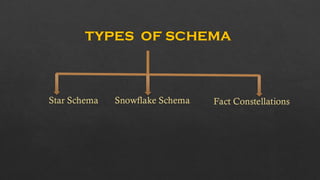
TYPES OF SCHEMA
Star Schema Snowflake Schema Fact Constellations
STAR SCHEMA
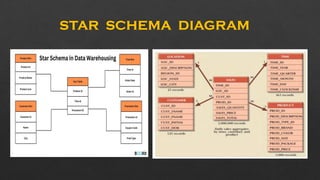
Each dimension in a star schema is represented with only one-dimension
table.
A star schema is the elementary form of a dimensional model, in which
data are organized into facts and dimensions.
There is a fact table at the center. It contains the keys to each of four
dimensions.
A dimension includes reference data about the fact, such as date, item, or
customer.
The fact table in a star schema contains the measures or metrics.
The dimensional table contain the set of attributes.
ADVANTAGES OF STAR SCHEMA
Easy for users to understand
Queries use very simple joins while retrieving the data and thereby
query performance is increased.
It is simple to retrieve data for reporting, at any point of time for any
period.
DISADVANTAGE OF STAR SCHEMA
Uses large disk space
It can become complex if there are too many dimensions, attributes, rows,
or columns in the fact table.
Data redundancy is more
STAR SCHEMA DIAGRAM
SNOWFLAKE SCHEMA
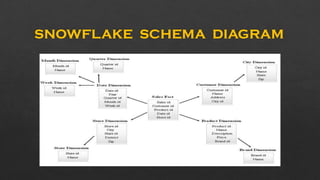
Represented by centralized fact tables which are connected to multiple
dimensions tables.
Some dimension tables in the snowflake schema are normalized.
A snowflake schema is equivalent to the star schema.
A schema is known as a snowflake if one or more dimension table do not
connect directly to the fact table but must join through other dimension tables.
ADVANTAGE OF SNOWFLAKE
SCHEMA
Reduces the problem of data integrity
Uses small disk space
Improvement in query performance
Easy to understand
It is easy to update (or) maintain the Snow Flaking tables.
DISADVANTAGE OF SNOWFLAKE
SCHEMA
Adds complexity to source query joins
Snowflake schemas can have slower data access and queries.
SNOWFLAKE SCHEMA DIAGRAM
FACT CONSTELLATION SCHEMA
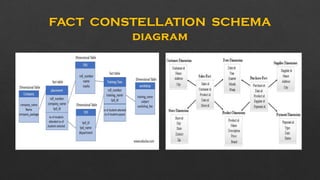
A fact constellation means two or more fact table sharing one or more
dimension.
It is a combination of other two schema.
A fact constellation has Multiple Fact Table, it is also known as Galaxy
Schema.
ADVANTAGE OF FACT CONSTELLATION
SCHEMA
Fact constellation schema can integrate data from multiple sources.
It is improved data retrival.
DISADVANTAGE OF fact constellation
SCHEMA
Difficult to maintain
More complex than star schema and snowflake schemas
FACT CONSTELLATION SCHEMA
diagram
THANK YOU

Schema in Data Mining and Data warehousing

  • 1.
    SCHEMA BY ANITA DIGGI COURSE:-MCA3rd College – Srinath University, Adityapur Jamshedpur
  • 2.
    WHAT IS SCHEMA? Schema is a logical description of the entire database. It includes the name and description of records of all record types including all associated data-Items and aggregates. Much like a database, a data warehouse also requires to maintain a schema. A database uses relational model, while a data warehouse uses Star, Snowflake, and Fact Constellation schema.
  • 3.
    TYPES OF SCHEMA StarSchema Snowflake Schema Fact Constellations
  • 4.
    STAR SCHEMA Each dimensionin a star schema is represented with only one-dimension table. A star schema is the elementary form of a dimensional model, in which data are organized into facts and dimensions. There is a fact table at the center. It contains the keys to each of four dimensions. A dimension includes reference data about the fact, such as date, item, or customer. The fact table in a star schema contains the measures or metrics. The dimensional table contain the set of attributes.
  • 5.
    ADVANTAGES OF STARSCHEMA Easy for users to understand Queries use very simple joins while retrieving the data and thereby query performance is increased. It is simple to retrieve data for reporting, at any point of time for any period.
  • 6.
    DISADVANTAGE OF STARSCHEMA Uses large disk space It can become complex if there are too many dimensions, attributes, rows, or columns in the fact table. Data redundancy is more
  • 7.
  • 8.
    SNOWFLAKE SCHEMA Represented bycentralized fact tables which are connected to multiple dimensions tables. Some dimension tables in the snowflake schema are normalized. A snowflake schema is equivalent to the star schema. A schema is known as a snowflake if one or more dimension table do not connect directly to the fact table but must join through other dimension tables.
  • 9.
    ADVANTAGE OF SNOWFLAKE SCHEMA Reducesthe problem of data integrity Uses small disk space Improvement in query performance Easy to understand It is easy to update (or) maintain the Snow Flaking tables.
  • 10.
    DISADVANTAGE OF SNOWFLAKE SCHEMA Addscomplexity to source query joins Snowflake schemas can have slower data access and queries.
  • 11.
  • 12.
    FACT CONSTELLATION SCHEMA Afact constellation means two or more fact table sharing one or more dimension. It is a combination of other two schema. A fact constellation has Multiple Fact Table, it is also known as Galaxy Schema.
  • 13.
    ADVANTAGE OF FACTCONSTELLATION SCHEMA Fact constellation schema can integrate data from multiple sources. It is improved data retrival.
  • 14.
    DISADVANTAGE OF factconstellation SCHEMA Difficult to maintain More complex than star schema and snowflake schemas
  • 15.
  • 16.