HOW TO BE AN 
ANGEL INVESTOR 
Advice for your first year as an angel investor. 
This presentation, and other free resources for angel investors, 
is available at www.adviceforangels.com
Goal for this presentation: Pay it forward 
(many people helped me avoid early mistakes).
This is not investment advice. 
Consult a lawyer, accountant, or financial advisor before thinking about anything in this presentation.
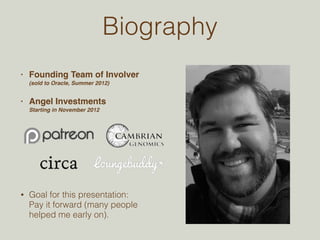
EXPERIENCE 
• Advisor 
Advised BranchOut, Hired, + others 
(2008-2012) 
• Founding Team of 
Involver 
(Acquired by Oracle, Summer 2012) 
• Angel Investor 
First investment in November 2012
SUMMARY 
• Barbell Strategy 
Don't commit more than you can afford to lose. 
• Large Portfolio 
Commit to doing many investments. 
• Power-law returns 
Make sure every deal has large potential upside. 
• Branding 
Know why a great entrepreneur would take your money over someone 
else. 
• Reputation 
Focus on improving your reputation at almost any cost.
Before making any investment, know 
what your goals are and what your plan 
to achieve them is.
BARBELL STRATEGY 
• Most of your money should be in very safe places, 
a small percentage should be subject to large risk. 
• You can not reasonably defend having >10% of your net 
worth dedicated to angel investing 
• Pick an amount you feel comfortable losing entirely and 
budget that as your angel investment fund 
• Assume these investments will take 10+ years to 
become liquid (you can not sell your shares at will, you 
have to wait for acquisition or IPO) 
Read more about the Barbell Strategy
LARGE PORTFOLIO 
• These are highly risky investments, any of which could 
easily go to zero 
• Diversify across many (20-50+) good companies in order 
to balance your risk 
• Each of those companies must meet a high quality bar - 
avoid any deal without very large potential upside. 
Here’s a strategy for maintaining a high quality bar: look for high quality co-investors, 
invest in companies where you know the space well, and have a high degree of 
confidence that the team is going to execute and succeed. 
• Don’t try to time the market, maintain a similar pace of 
investments over several years
A NOTE ON INVESTMENT 
SIZE • AngelList has investments with minimums as low as $1k; most 
serious seed startups have $10-25k minimums 
• Early on, make the same size investment in each company 
• This suggests that you need at least 20-40k of investment 
capital set aside for Syndicates; and 400k-1m for direct 
investment 
• If possible, save 1-2x for follow-on (click the highlight for a 
definition) — maintaining or growing your ownership in winners 
is the best way to maximize returns 
• Early on, follow on when a new, experienced investor leads a 
new round in the company at a higher valuation
A NOTE ON INVESTMENT 
SIZE 
• Power-law returns aren’t intuitive — all of your gains will be 
concentrated in a very small # of winners 
• Three out of YC’s 717 companies make up 78% of 
the portfolio's value 
• A $10k seed investment in Uber would be worth 
about $20 million dollars today 
! Your job is to invest in the one or two deals that 
will generate all of your returns.
FINDING THE BEST 
DEALS • Try lots of sources of deal flow: 
• Cold-call investors you know and ask for help, AngelList, 
Startup Events, Accelerators, Demo Days 
• Be curious about what companies are impacting 
people’s lives, study what’s working and what’s missing 
• Invest in areas you understand well or get help from people who 
understand the area well 
• Be aware that many of the best ideas look bad early-on: 
• Consensus ideas are priced for low returns 
• All good ideas initially look trivial or impossible
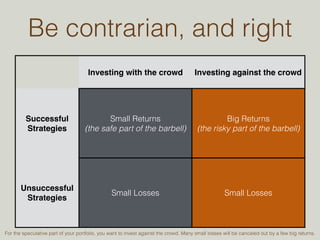
BE CONTRARIAN (AND 
BE RIGHT) 
INVESTING 
WITH THE 
CROWD 
INVESTING 
AGAINST THE 
CROWD 
SUCCESS 
FUL 
STRATEGIES 
Small Returns 
(the safe part of the barbell) 
Big Returns 
(the risky part of the barbell) 
UNSUCCE 
SSFUL 
STRATEGIES 
Small Losses Small Losses
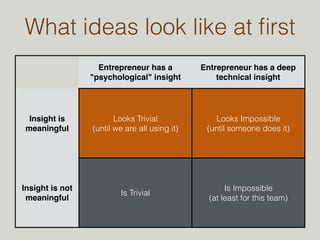
ALL NEW IDEAS LOOK 
BAD 
ENTRPRENEUR HAS A 
PSYCHOLOGICA 
L INSIGHT 
ENTRPRENEUR HAS A 
TECHNICAL 
INSIGHT 
THAT INSIGHT IS 
MEANIN 
GFUL 
Looks Trivial 
(until we all start using it) 
Looks Impossible 
(until someone does it) 
THAT INSIGHT IS 
NOT 
MEANIN 
GFUL 
Is Trivial Is Impossible 
(at least for this team)
Getting into deals: 
brand and reputation.
BRAND 
• Deals may be competitive — why would a founder take your 
money over a different investor? 
• Find ways to reliably add value (be an expert on a particular skill 
and advise/help the team with that) 
• Build your brand by sharing your insights freely (e.g. blog, tweet, 
speak at conferences, help VCs, mentor at accelerators) 
• The quality of the founders who cold call you for advice is a 
good test of the quality of your brand 
• Building a brand is easier in a niche (industry or location) — 
develop an investment thesis
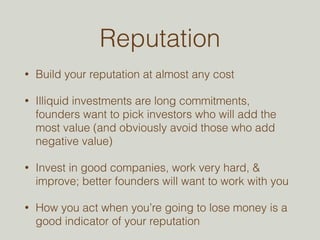
REPUTATION 
• Your reputation dictates your access to competitive investments 
• Illiquid investments are long commitments, founders want to 
pick investors who will add the most value 
• Invest in good companies and add value for your founders; they 
will recommend you to others 
• How you act when you’re going to lose money is a good 
indicator of your reputation
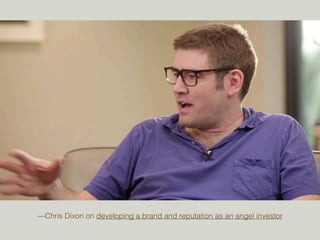
Chris Dixon on developing a brand and reputation as an angel.
RECAP 
• Have clear motives (have a goal, and a plan) 
• Understand the implications of power-law returns: 
• Find one deal that will make the majority of 
your gains 
• Build a portfolio of many high-potential 
investments 
• Add value; earn referrals from your portfolio executives
Advice from 
Experienced Angels
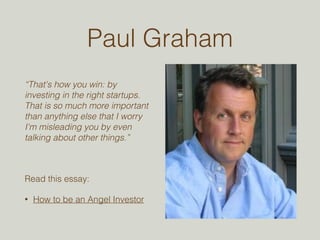
PAUL GRAHAM 
“That's how you win: by 
investing in the right 
startups. That is so much 
more important than 
anything else that I worry 
I'm misleading you by even 
talking about other things.” 
Read this essay: 
• How to be an Angel Investor
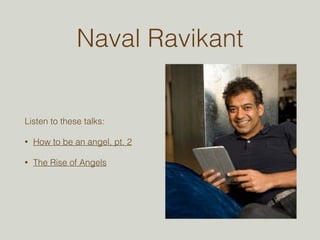
NAVAL RAVIKANT 
“There has to be some reason 
why people will take your 
money instead of somebody 
else’s. Otherwise at the end of 
the day, you are commoditized 
and you get bid out of the 
game.” 
Read this: 
• How to be an Angel Investor, 2 
• The rise of angels
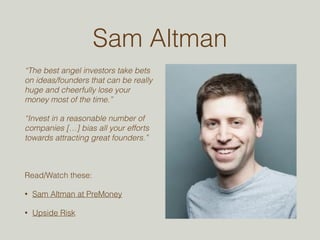
SAM ALTMAN 
“The real risk is missing out on that one outstanding 
investment, not failing to get our money back on all 
your other companies.” 
“The best angel investors take bets on ideas/founders 
that can be really huge and cheerfully lose your money 
most of the time.” 
“Invest in a reasonable number of companies […] bias 
all your efforts towards attracting great founders.” 
“Proprietary deal flow and networks are almost over, 
you – and your references – are going to have to be 
able to explain to a founder how you’re going to help 
them.” 
Read/Watch these: 
• Sam Altman at PreMoney 
• Upside Risk 
• Venture Funds Fret as YC Soars
PETER THIEL 
“There is only so much we can do to help the 
companies in which we invest. And because 
of this, the act of making the investment 
(rather than the ability to fix things later) 
remains by far the most important thing to 
do.” 
“[My biggest loss was not also investing in 
the B round of Facebook,] whenever a tech 
startup has a strong up round led by a top 
tier investor, it is generally still undervalued. 
The steeper the up round, the greater the 
undervaluation.” 
Read/Watch these: 
• Zero to One (book) 
• Peter Thiel AMA 
• Tim Ferriss Podcast (go to 9:40 min)
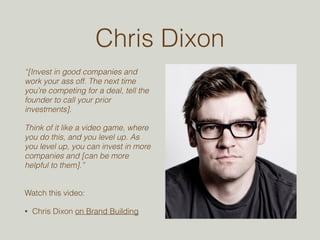
CHRIS DIXON 
“[Invest in good companies and 
work your ass off. The next time 
you’re competing for a deal, tell the 
founder to call your prior 
investments]. 
Think of it like a video game, where 
you do this, and you level up. As 
you level up, you can invest in 
more companies and [can be more 
helpful to them].” 
Watch this: 
• Chris Dixon on Brand Building
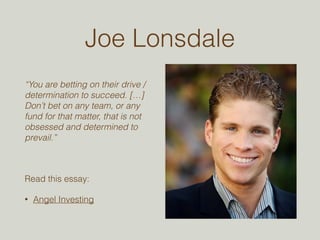
JOE LONSDALE 
“You are betting on their drive / 
determination to succeed. […] 
Don’t bet on any team, or any 
fund for that matter, that is not 
obsessed and determined to 
prevail.” 
Read this: 
• Angel Investing
BRAD FELD 
“Understand the difference 
between 0x and 100x: I’ve had two 
of my angel investments return 
over 100x each. Since I had a 
strategy of investing the same 
amount in each company, all I 
needed was one 100x to allow me 
to have 99 companies completely 
flame out and return 0 and I’d still 
break even.” 
Read this: 
• Suggestions for Angel 
Investors
MARC ANDREESSEN 
“4000 startups a year are founded … 15 of those 
will generate 95% of all the economic returns” 
“if you are doing it right, you are continuously 
investing in things that are non-consensus at the 
time of investment. And let me translate ‘non-consensus': 
in sort of practical terms, it translates 
to crazy.” 
“We are looking for a magic combination of 
courage and genius .… Courage [“not giving up 
in the face of adversity”] is the one people can 
learn.” 
Read this: 
• 12 things I learned from…
MAX LEVCHIN 
“For HVF, cutting only ‘big’ checks 
leads to more rigorous, more 
exciting investments. 
Removing the option of mitigating 
risk by reducing check size means 
the only way to discern between 
investments is to thoroughly 
understand [them].” 
Read this: 
• Big Checks
MORE COMING SOON… 
I will update this deck with 
new quotes frequently. I’ll 
also post video interviews 
and other resources on the 
AdviceForAngels website. 
If you want to be notified of 
updates, interviews or 
other resources: 
Signup for the 
Newsletter Here
ANGEL INVESTING 
LIBRARY 
• How to be an angel investor 
• Part 1 - Graham 
• Part 2 - Ravikant 
• Part 3 – Willis 
• AdviceForAngels.com 
• AngelList Investing Guidelines 
• Zero to One (Thiel) 
• Angel Investing 101 (Singh) 
• Angel Investing (Lonsdale) 
• Intro to Angel Investing (Teten) 
• Black Swan Seed Rounds (Altman) 
• Why angels lose money… 
• Building an Angel Portfolio 
• Ten Commandments of Angel 
• Angel Investing 
• Gust Videos (1, 2, 3, 4) 
• Mark Suster (1, 2, 3, 4, 5) 
• Angel Resource Institute 
• Possible Insight (data driven angel analysis) 
• AngelConf Videos (no longer available - does this exist anywhere?) 
• Angel in Groups 
• SecondMarket Guide to Angel Investing 
• Startup Investing Trends 
• Analyze Startups Like a VC 
• Video: The Art of Angel Investing 
• There is no angel bubble 
• This Week in Startups with Naval Ravikant, Gil Penchina 
• Unconventional Investing Rules (Kraus) 
• Video: Becoming an Angel Investor (Conway and Maples) 
• 25iq “Things I’ve Learned” series (Griffin) 
• Angel Investing (book)

How to be an Angel Investor, Part 3

  • 1.
    HOW TO BEAN ANGEL INVESTOR Advice for your first year as an angel investor. This presentation, and other free resources for angel investors, is available at www.adviceforangels.com
  • 2.
    Goal for thispresentation: Pay it forward (many people helped me avoid early mistakes).
  • 3.
    This is notinvestment advice. Consult a lawyer, accountant, or financial advisor before thinking about anything in this presentation.
  • 4.
    EXPERIENCE • Advisor Advised BranchOut, Hired, + others (2008-2012) • Founding Team of Involver (Acquired by Oracle, Summer 2012) • Angel Investor First investment in November 2012
  • 5.
    SUMMARY • BarbellStrategy Don't commit more than you can afford to lose. • Large Portfolio Commit to doing many investments. • Power-law returns Make sure every deal has large potential upside. • Branding Know why a great entrepreneur would take your money over someone else. • Reputation Focus on improving your reputation at almost any cost.
  • 6.
    Before making anyinvestment, know what your goals are and what your plan to achieve them is.
  • 7.
    BARBELL STRATEGY •Most of your money should be in very safe places, a small percentage should be subject to large risk. • You can not reasonably defend having >10% of your net worth dedicated to angel investing • Pick an amount you feel comfortable losing entirely and budget that as your angel investment fund • Assume these investments will take 10+ years to become liquid (you can not sell your shares at will, you have to wait for acquisition or IPO) Read more about the Barbell Strategy
  • 8.
    LARGE PORTFOLIO •These are highly risky investments, any of which could easily go to zero • Diversify across many (20-50+) good companies in order to balance your risk • Each of those companies must meet a high quality bar - avoid any deal without very large potential upside. Here’s a strategy for maintaining a high quality bar: look for high quality co-investors, invest in companies where you know the space well, and have a high degree of confidence that the team is going to execute and succeed. • Don’t try to time the market, maintain a similar pace of investments over several years
  • 9.
    A NOTE ONINVESTMENT SIZE • AngelList has investments with minimums as low as $1k; most serious seed startups have $10-25k minimums • Early on, make the same size investment in each company • This suggests that you need at least 20-40k of investment capital set aside for Syndicates; and 400k-1m for direct investment • If possible, save 1-2x for follow-on (click the highlight for a definition) — maintaining or growing your ownership in winners is the best way to maximize returns • Early on, follow on when a new, experienced investor leads a new round in the company at a higher valuation
  • 10.
    A NOTE ONINVESTMENT SIZE • Power-law returns aren’t intuitive — all of your gains will be concentrated in a very small # of winners • Three out of YC’s 717 companies make up 78% of the portfolio's value • A $10k seed investment in Uber would be worth about $20 million dollars today ! Your job is to invest in the one or two deals that will generate all of your returns.
  • 11.
    FINDING THE BEST DEALS • Try lots of sources of deal flow: • Cold-call investors you know and ask for help, AngelList, Startup Events, Accelerators, Demo Days • Be curious about what companies are impacting people’s lives, study what’s working and what’s missing • Invest in areas you understand well or get help from people who understand the area well • Be aware that many of the best ideas look bad early-on: • Consensus ideas are priced for low returns • All good ideas initially look trivial or impossible
  • 12.
    BE CONTRARIAN (AND BE RIGHT) INVESTING WITH THE CROWD INVESTING AGAINST THE CROWD SUCCESS FUL STRATEGIES Small Returns (the safe part of the barbell) Big Returns (the risky part of the barbell) UNSUCCE SSFUL STRATEGIES Small Losses Small Losses
  • 13.
    ALL NEW IDEASLOOK BAD ENTRPRENEUR HAS A PSYCHOLOGICA L INSIGHT ENTRPRENEUR HAS A TECHNICAL INSIGHT THAT INSIGHT IS MEANIN GFUL Looks Trivial (until we all start using it) Looks Impossible (until someone does it) THAT INSIGHT IS NOT MEANIN GFUL Is Trivial Is Impossible (at least for this team)
  • 14.
    Getting into deals: brand and reputation.
  • 15.
    BRAND • Dealsmay be competitive — why would a founder take your money over a different investor? • Find ways to reliably add value (be an expert on a particular skill and advise/help the team with that) • Build your brand by sharing your insights freely (e.g. blog, tweet, speak at conferences, help VCs, mentor at accelerators) • The quality of the founders who cold call you for advice is a good test of the quality of your brand • Building a brand is easier in a niche (industry or location) — develop an investment thesis
  • 16.
    REPUTATION • Yourreputation dictates your access to competitive investments • Illiquid investments are long commitments, founders want to pick investors who will add the most value • Invest in good companies and add value for your founders; they will recommend you to others • How you act when you’re going to lose money is a good indicator of your reputation
  • 17.
    Chris Dixon ondeveloping a brand and reputation as an angel.
  • 18.
    RECAP • Haveclear motives (have a goal, and a plan) • Understand the implications of power-law returns: • Find one deal that will make the majority of your gains • Build a portfolio of many high-potential investments • Add value; earn referrals from your portfolio executives
  • 19.
  • 20.
    PAUL GRAHAM “That'show you win: by investing in the right startups. That is so much more important than anything else that I worry I'm misleading you by even talking about other things.” Read this essay: • How to be an Angel Investor
  • 21.
    NAVAL RAVIKANT “Therehas to be some reason why people will take your money instead of somebody else’s. Otherwise at the end of the day, you are commoditized and you get bid out of the game.” Read this: • How to be an Angel Investor, 2 • The rise of angels
  • 22.
    SAM ALTMAN “Thereal risk is missing out on that one outstanding investment, not failing to get our money back on all your other companies.” “The best angel investors take bets on ideas/founders that can be really huge and cheerfully lose your money most of the time.” “Invest in a reasonable number of companies […] bias all your efforts towards attracting great founders.” “Proprietary deal flow and networks are almost over, you – and your references – are going to have to be able to explain to a founder how you’re going to help them.” Read/Watch these: • Sam Altman at PreMoney • Upside Risk • Venture Funds Fret as YC Soars
  • 23.
    PETER THIEL “Thereis only so much we can do to help the companies in which we invest. And because of this, the act of making the investment (rather than the ability to fix things later) remains by far the most important thing to do.” “[My biggest loss was not also investing in the B round of Facebook,] whenever a tech startup has a strong up round led by a top tier investor, it is generally still undervalued. The steeper the up round, the greater the undervaluation.” Read/Watch these: • Zero to One (book) • Peter Thiel AMA • Tim Ferriss Podcast (go to 9:40 min)
  • 24.
    CHRIS DIXON “[Investin good companies and work your ass off. The next time you’re competing for a deal, tell the founder to call your prior investments]. Think of it like a video game, where you do this, and you level up. As you level up, you can invest in more companies and [can be more helpful to them].” Watch this: • Chris Dixon on Brand Building
  • 25.
    JOE LONSDALE “Youare betting on their drive / determination to succeed. […] Don’t bet on any team, or any fund for that matter, that is not obsessed and determined to prevail.” Read this: • Angel Investing
  • 26.
    BRAD FELD “Understandthe difference between 0x and 100x: I’ve had two of my angel investments return over 100x each. Since I had a strategy of investing the same amount in each company, all I needed was one 100x to allow me to have 99 companies completely flame out and return 0 and I’d still break even.” Read this: • Suggestions for Angel Investors
  • 27.
    MARC ANDREESSEN “4000startups a year are founded … 15 of those will generate 95% of all the economic returns” “if you are doing it right, you are continuously investing in things that are non-consensus at the time of investment. And let me translate ‘non-consensus': in sort of practical terms, it translates to crazy.” “We are looking for a magic combination of courage and genius .… Courage [“not giving up in the face of adversity”] is the one people can learn.” Read this: • 12 things I learned from…
  • 28.
    MAX LEVCHIN “ForHVF, cutting only ‘big’ checks leads to more rigorous, more exciting investments. Removing the option of mitigating risk by reducing check size means the only way to discern between investments is to thoroughly understand [them].” Read this: • Big Checks
  • 29.
    MORE COMING SOON… I will update this deck with new quotes frequently. I’ll also post video interviews and other resources on the AdviceForAngels website. If you want to be notified of updates, interviews or other resources: Signup for the Newsletter Here
  • 30.
    ANGEL INVESTING LIBRARY • How to be an angel investor • Part 1 - Graham • Part 2 - Ravikant • Part 3 – Willis • AdviceForAngels.com • AngelList Investing Guidelines • Zero to One (Thiel) • Angel Investing 101 (Singh) • Angel Investing (Lonsdale) • Intro to Angel Investing (Teten) • Black Swan Seed Rounds (Altman) • Why angels lose money… • Building an Angel Portfolio • Ten Commandments of Angel • Angel Investing • Gust Videos (1, 2, 3, 4) • Mark Suster (1, 2, 3, 4, 5) • Angel Resource Institute • Possible Insight (data driven angel analysis) • AngelConf Videos (no longer available - does this exist anywhere?) • Angel in Groups • SecondMarket Guide to Angel Investing • Startup Investing Trends • Analyze Startups Like a VC • Video: The Art of Angel Investing • There is no angel bubble • This Week in Startups with Naval Ravikant, Gil Penchina • Unconventional Investing Rules (Kraus) • Video: Becoming an Angel Investor (Conway and Maples) • 25iq “Things I’ve Learned” series (Griffin) • Angel Investing (book)

Editor's Notes

  • #9 High Quality There’s a better link for the similar pace piece - I think Fred Wilson did a startup specific one at one point. Find later. - http://en.wikipedia.org/wiki/Dollar_cost_averaging - http://robgo.org/2012/03/10/diversification-the-alternative-to-market-timing/
  • #13 For the speculative part of your portfolio, you want to invest against the crowd. Many small losses will be canceled out by a few big returns. Credit for the ideas behind this graph belong to Marc Andreessen and/or Peter Thiel.