Self-Esteem
• Confidence orsatisfaction with oneself.
Do you think there is a connection between self-esteem and relationships? Does the
way you feel about yourself influence how you behave with others?
• We are going to look at a few examples for you to consider whether self-
esteem is being increased or decreased.
4.
Self-Esteem Example 1
Maryworked really hard on her English essay. When her graded essay was
returned, she was excited to see that she earned a 94%. Mary was very proud of
the grade, since she had worked so hard. Caroline started laughing and said, ‘So
who did you get to write that for you? You suck at writing!’ How do Caroline’s
words affect Mary’s self-esteem? What if Caroline had said, ‘Wow, that’s great. I
know you worked really hard on your essay.’
5.
Self-Esteem Example 2
Brianand Kyle are on the baseball team. Brian has not gotten a hit in the last
four games. Before the game, he tells Kyle that he doesn’t want to play tonight
because he doesn’t think he will get a hit. Kyle slaps him on the back and says
‘Hey man, we all have a few off games. Don’t get down on yourself.’ Did Kyle’s
words and actions help or hurt Brian’s self-esteem?
6.
Self-Esteem Example 3
Kaylynnhas been learning to cook. She tries a new recipe and is excited to
share it. Her mother’s friend tastes it and makes a face. He says, ‘Hey Kaylynn, I
think you need some pointers from your mom. This doesn’t taste nearly as
good as what she cooks!’ How did his reaction to her cooking make Kaylynn
feel?
7.
Self-Esteem Example Four
Marcusspent most of the day cutting the lawn and trimming the bushes. When
his neighbor comes home, he yells, ‘Wow, Marcus, good job! The lawn looks
great.’ Did the comments help or hurt Marcus’s self-esteem?
8.
Group Discussion onSelf-Esteem
• Examples of feelings or actions that can increase someone’s self-esteem.
• Examples of feelings or actions that can decrease someone’s self-esteem.
9.
Boundaries
• The wayyou act with your best friend is different from the way you act with
someone you’ve just met. In fact, okay boundaries in one situation may not
be appropriate in another.
• The way you act with your best friend at the mall is different from how you
act in class during a test.
10.
Balance of Power
•Passive Challenge
• Assertive Challenge
• Aggressive Challenge
11.
Passive Challenge
This iswhen the challenge is subtle and you usually don’t really resist. For
example: When you are offered ice cream and you say you are not hungry. Your
friend eats her ice cream. It looks so good that you decide to get some. But
sometimes even passive challenges can cross major boundaries, like when you
say no to drinking alcohol. Your friend gives you a passive challenge when he
doesn’t try to change your mind; instead, he just walks away, and you start to
feel left out.
12.
Assertive Challenge
An assertivechallenge is direct and clear. You know that you are being
challenged. Let’s take the previous example. You say no when you are offered
ice cream. This time your friend confronts you and says, ‘Oh, come on, it won’t
hurt. Try it. I promise you, one bite and you won’t be able to resist!’ What if
this time your friend wanted you to drink alcohol? When you say no, he
responds loudly, ‘Hey man, what’s wrong with you? Just man up and have a
drink!
13.
Aggressive Challenge
An aggressivechallenge is threatening, hostile, and may cause physical harm.
You may feel scared and in danger when you are challenged and worry about
your safety. This time when you say no to the ice cream, the challenge is much
more intense. Your friend gives you a look of disgust and throws the empty
bowl at you. If you refuse to drink alcohol, your friend gets in your face and
says, ‘Hey man, pick up that glass or I will pick it up for you and pour it down
your throat.
15.
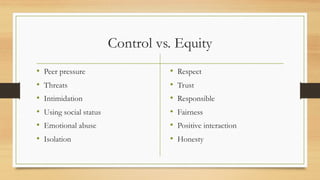
Control vs. Equity
•Peer pressure
• Threats
• Intimidation
• Using social status
• Emotional abuse
• Isolation
• Respect
• Trust
• Responsible
• Fairness
• Positive interaction
• Honesty
16.
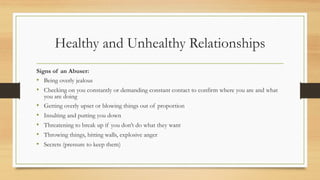
Healthy and UnhealthyRelationships
Signs of an Abuser:
• Being overly jealous
• Checking on you constantly or demanding constant contact to confirm where you are and what
you are doing
• Getting overly upset or blowing things out of proportion
• Insulting and putting you down
• Threatening to break up if you don’t do what they want
• Throwing things, hitting walls, explosive anger
• Secrets (pressure to keep them)
17.
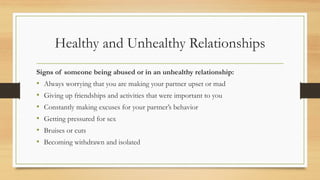
Healthy and UnhealthyRelationships
Signs of someone being abused or in an unhealthy relationship:
• Always worrying that you are making your partner upset or mad
• Giving up friendships and activities that were important to you
• Constantly making excuses for your partner’s behavior
• Getting pressured for sex
• Bruises or cuts
• Becoming withdrawn and isolated
18.
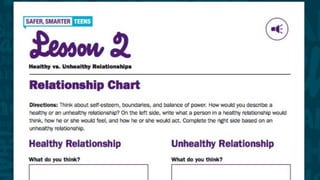
Think about self-esteem,boundaries, and balance of power. How would you
describe a healthy or an unhealthy relationship? How would a person in a
healthy relationship think, feel, or act? How would a person in an unhealthy
relationship think, feel, or act?
Relationship Brainstorm
19.
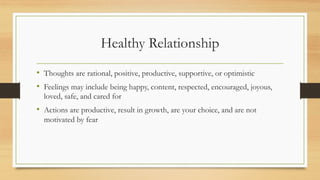
Healthy Relationship
• Thoughtsare rational, positive, productive, supportive, or optimistic
• Feelings may include being happy, content, respected, encouraged, joyous,
loved, safe, and cared for
• Actions are productive, result in growth, are your choice, and are not
motivated by fear
20.
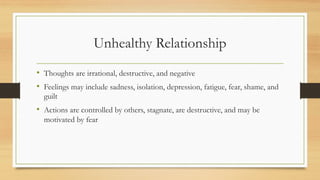
Unhealthy Relationship
• Thoughtsare irrational, destructive, and negative
• Feelings may include sadness, isolation, depression, fatigue, fear, shame, and
guilt
• Actions are controlled by others, stagnate, are destructive, and may be
motivated by fear
22.
Relationships Bill ofRights
Why do people stay in unhealthy relationships?
When the relationship started, it may have been positive and loving. However, over
time, things change. The abuser begins to take control. He or she often makes
promises that things will change and the abuse will end. The victim then has a sense of
hope that things will get back to that positive, safe, and healthy relationship. However,
things do not change. The abuse continues and may even increase. Now the victim’s
primary feeling is fear. Threats can create so much fear that the victim is too scared to
leave the relationship, especially if the abuser is an adult. Remember, you have the right
to have healthy and positive relationships.




![[LIFE SKILLS]Personal growth through healthy relationship](https://cdn.slidesharecdn.com/ss_thumbnails/group3-lifeskills-personalgrowththroughhealthyrelationship-260128131008-2147a629-thumbnail.jpg?width=640&height=640&fit=bounds)


