Scaling server-side WebRTC applications:
the Janus challenge
Lorenzo Miniero
@elminiero
CommCon 2018
June 27th 2018, Wotton House, Surrey (UK)
Sorry Dan, pineapples on pizza = BIG NO
A picture of me as a kid for no reason
Lorenzo Miniero
• Ph.D @ UniNA
• Chairman @ Meetecho
• Open source believer
Contacts and info
• lorenzo@meetecho.com
• https://twitter.com/elminiero
• https://www.slideshare.net/LorenzoMiniero
1. No, I don’t know what happened...
2. Yes, Police is still looking for who stole my cheeks
Ok, let’s stop clowning around...
Lorenzo Miniero
• Ph.D @ UniNA
• Chairman @ Meetecho
• Open source believer
Contacts and info
• lorenzo@meetecho.com
• https://twitter.com/elminiero
• https://www.slideshare.net/LorenzoMiniero
What is Janus?
Janus
General purpose, open source WebRTC server
• https://github.com/meetecho/janus-gateway
• Demos and documentation: https://janus.conf.meetecho.com
• Community: https://groups.google.com/forum/#!forum/meetecho-janus
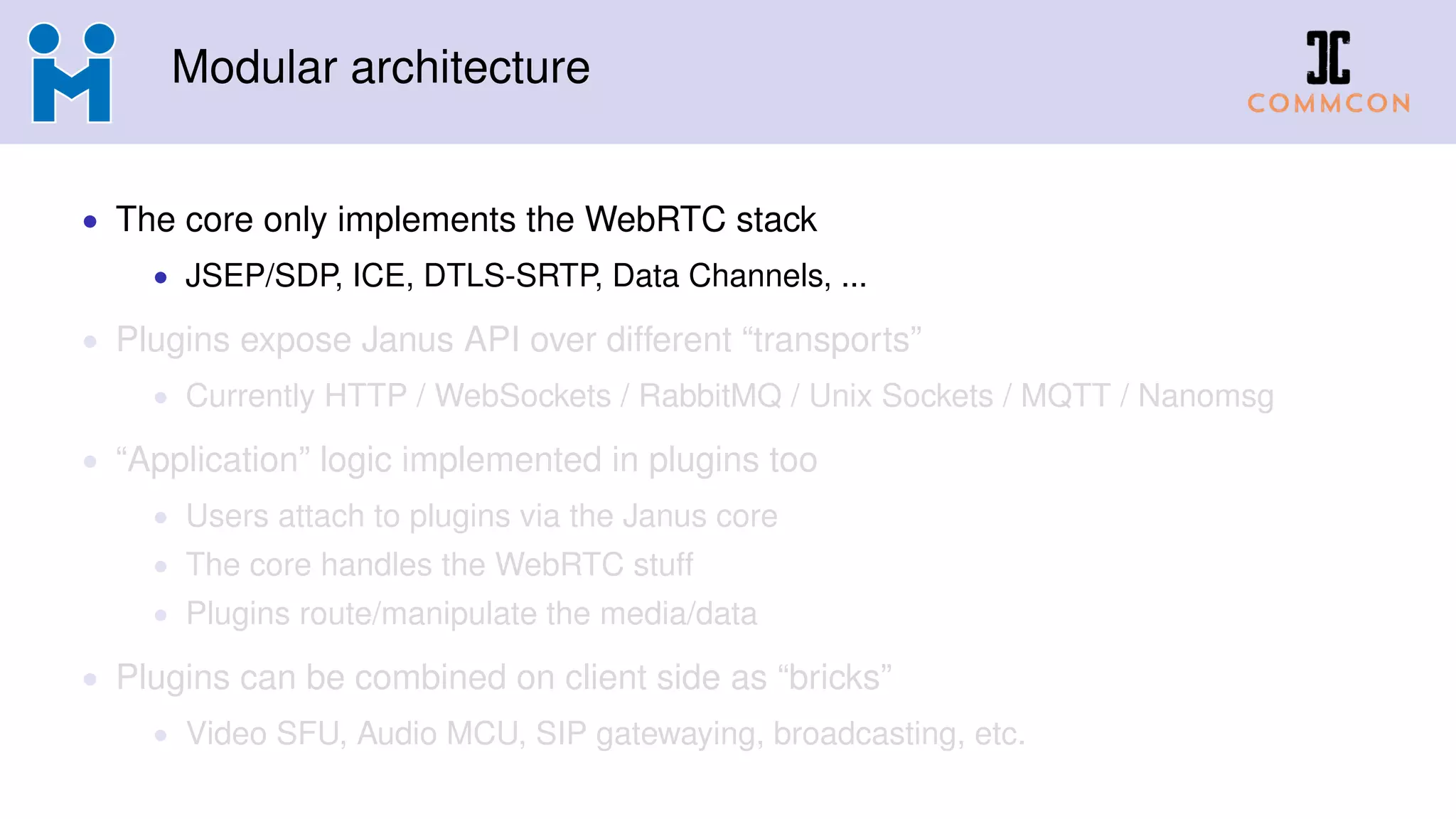
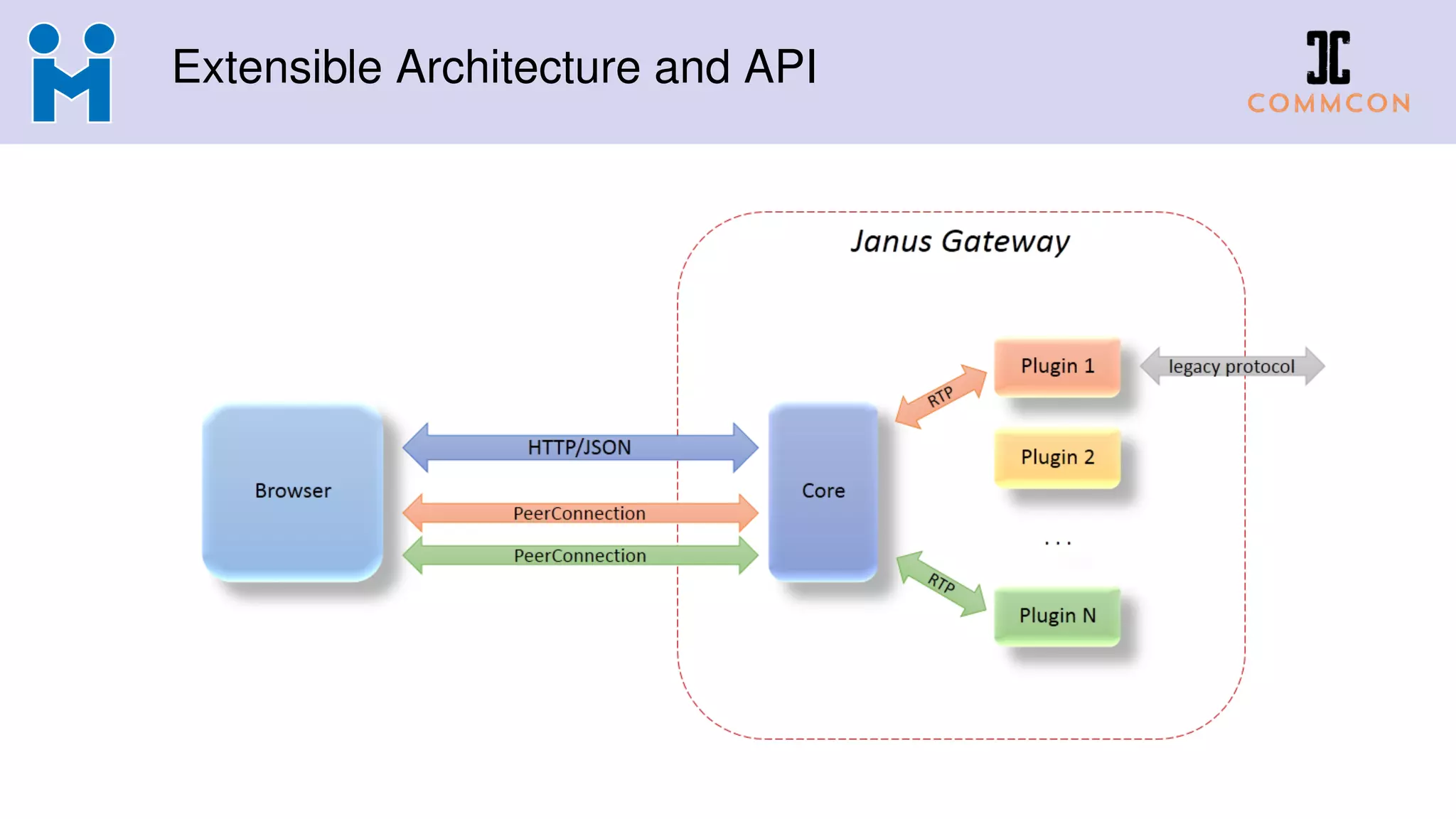
Modular architecture
• The core only implements the WebRTC stack
• JSEP/SDP, ICE, DTLS-SRTP, Data Channels, ...
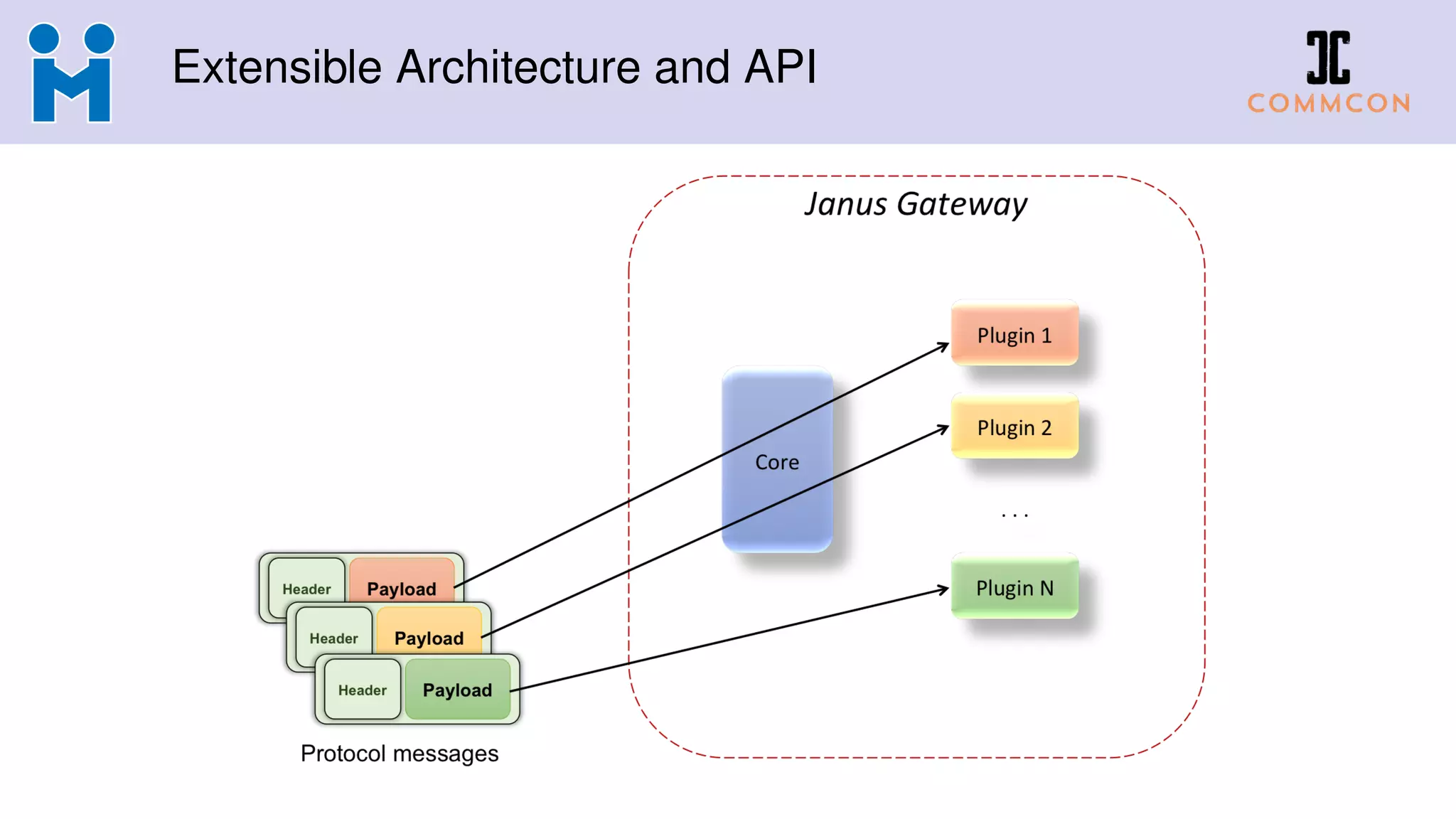
• Plugins expose Janus API over different “transports”
• Currently HTTP / WebSockets / RabbitMQ / Unix Sockets / MQTT / Nanomsg
• “Application” logic implemented in plugins too
• Users attach to plugins via the Janus core
• The core handles the WebRTC stuff
• Plugins route/manipulate the media/data
• Plugins can be combined on client side as “bricks”
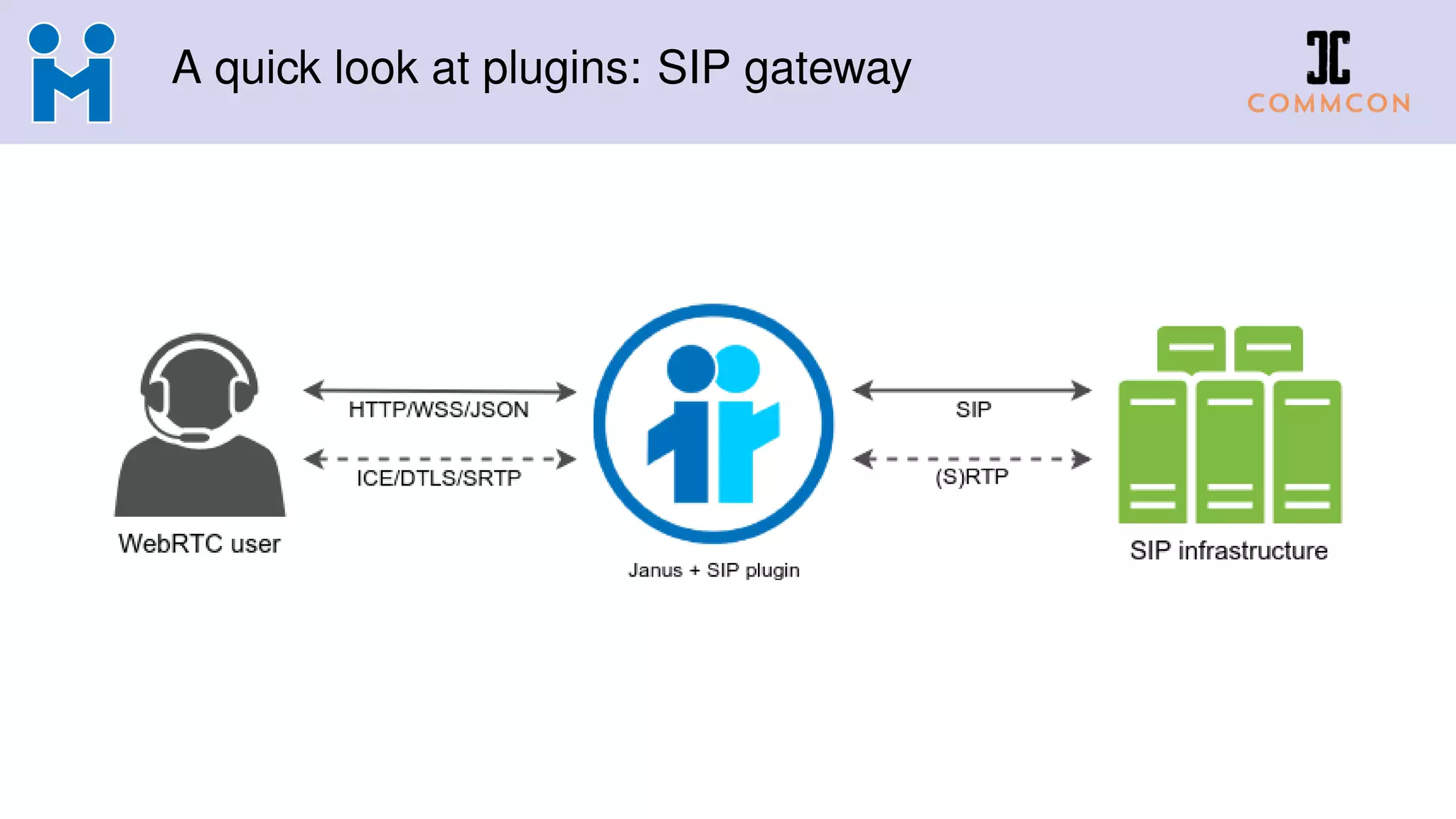
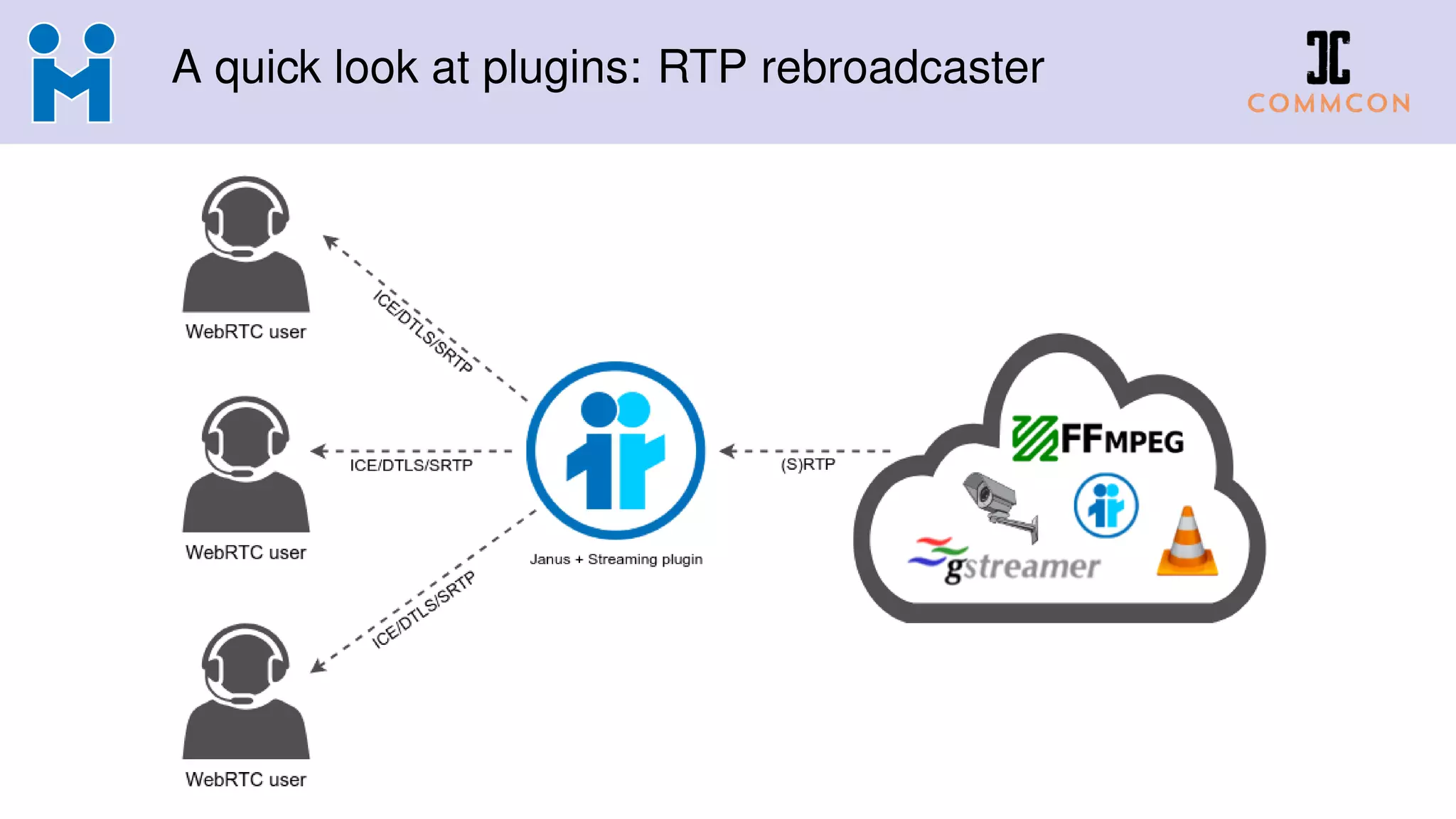
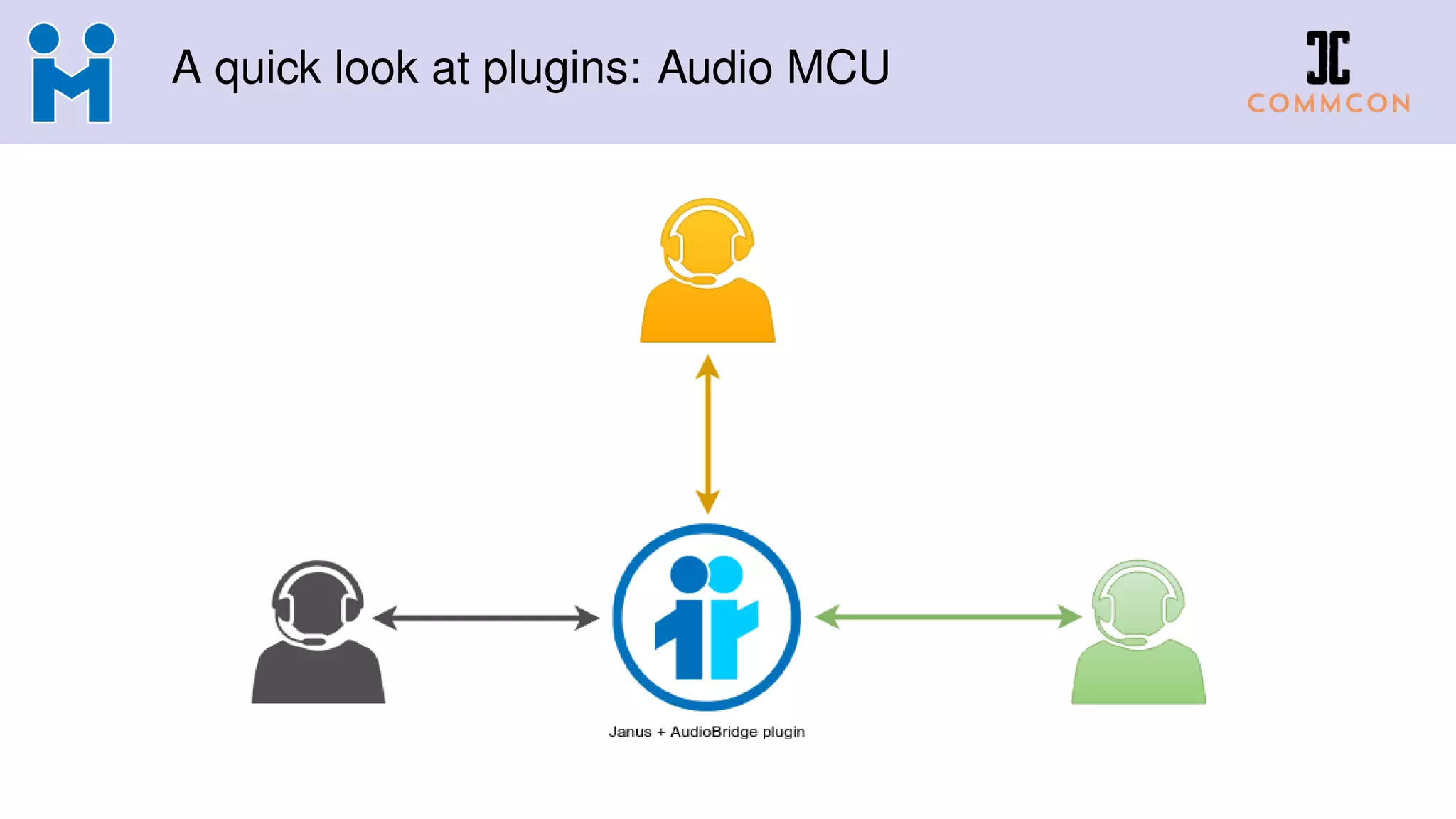
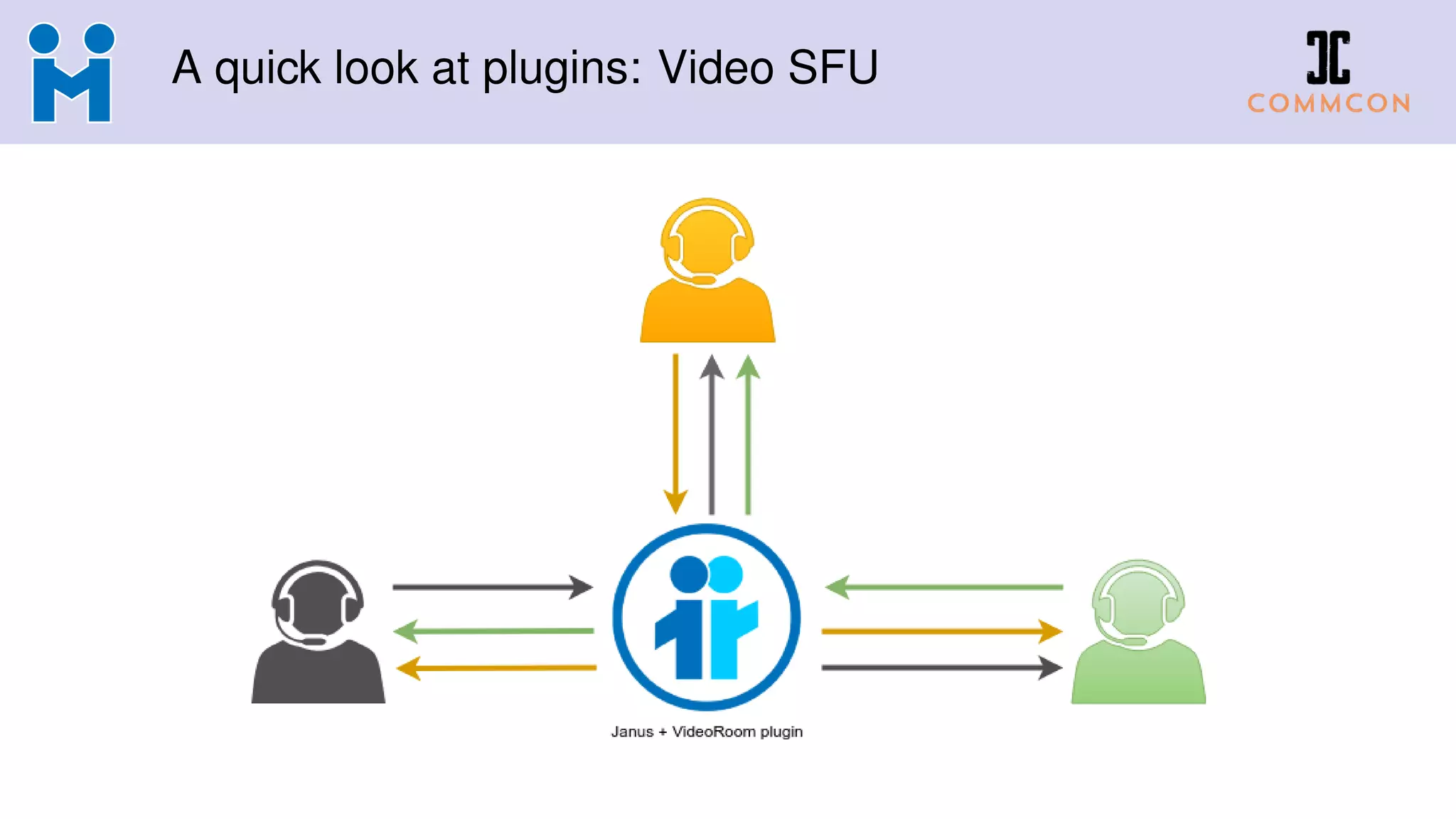
• Video SFU, Audio MCU, SIP gatewaying, broadcasting, etc.
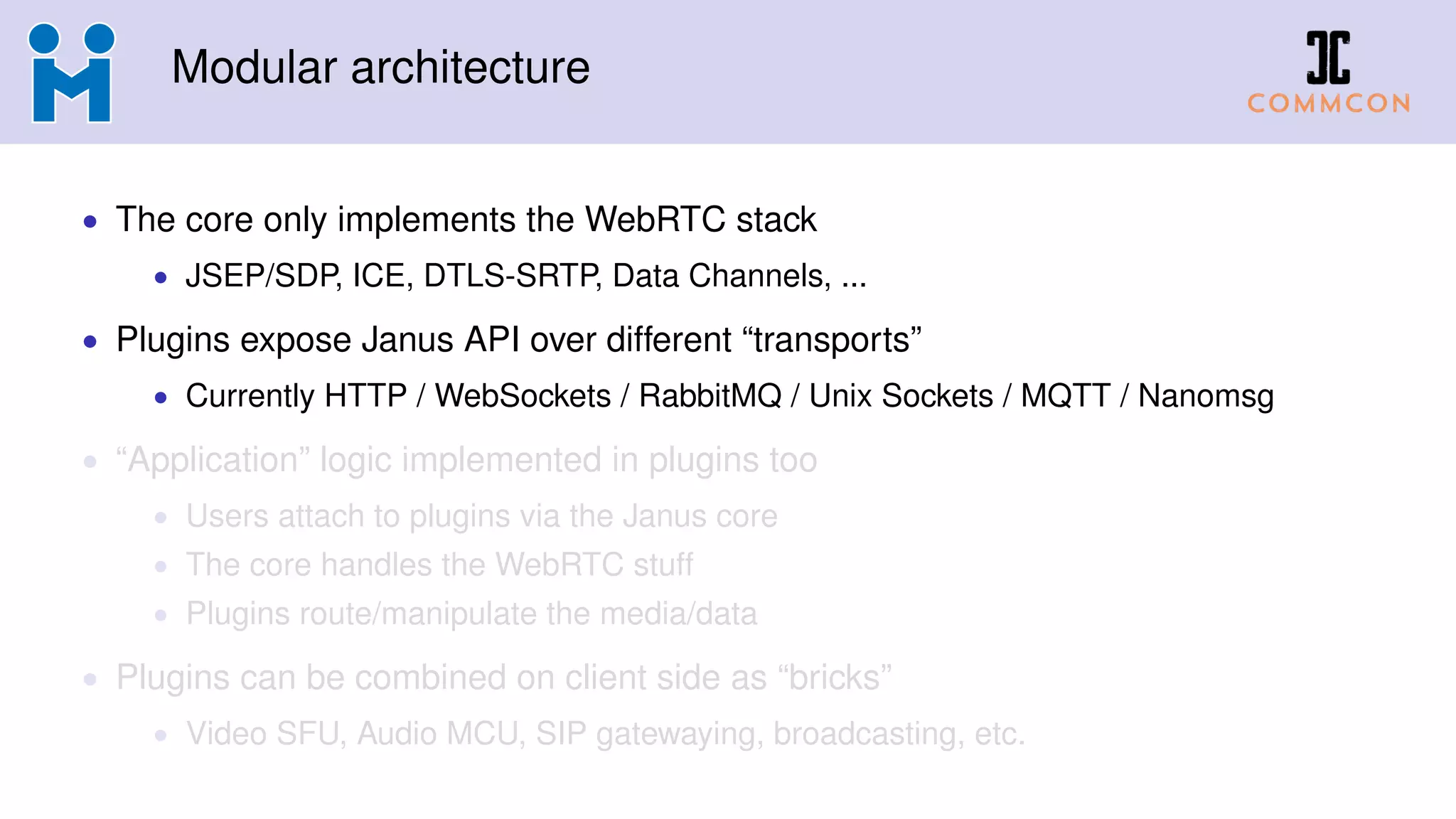
Modular architecture
• The core only implements the WebRTC stack
• JSEP/SDP, ICE, DTLS-SRTP, Data Channels, ...
• Plugins expose Janus API over different “transports”
• Currently HTTP / WebSockets / RabbitMQ / Unix Sockets / MQTT / Nanomsg
• “Application” logic implemented in plugins too
• Users attach to plugins via the Janus core
• The core handles the WebRTC stuff
• Plugins route/manipulate the media/data
• Plugins can be combined on client side as “bricks”
• Video SFU, Audio MCU, SIP gatewaying, broadcasting, etc.
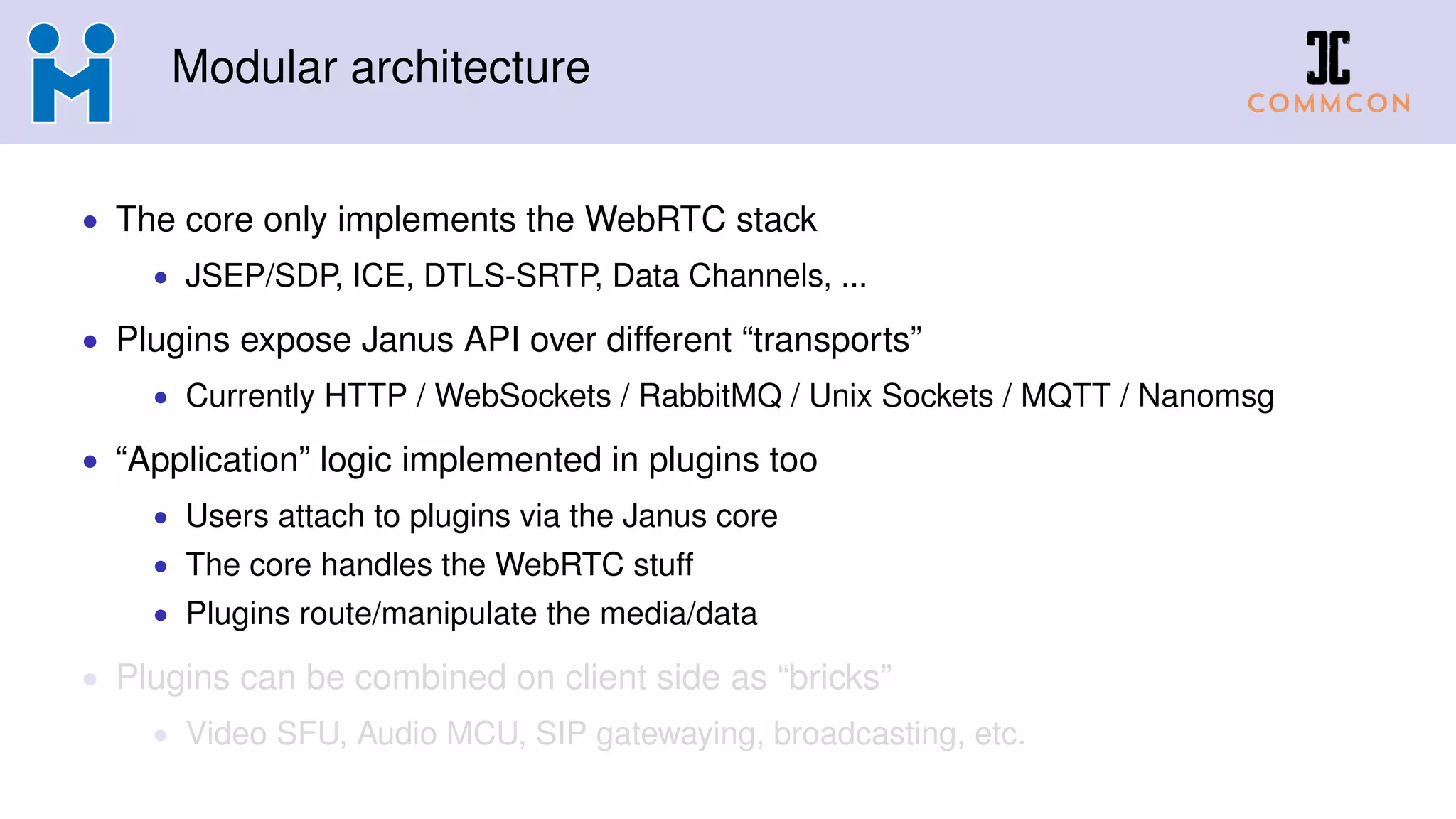
Modular architecture
• The core only implements the WebRTC stack
• JSEP/SDP, ICE, DTLS-SRTP, Data Channels, ...
• Plugins expose Janus API over different “transports”
• Currently HTTP / WebSockets / RabbitMQ / Unix Sockets / MQTT / Nanomsg
• “Application” logic implemented in plugins too
• Users attach to plugins via the Janus core
• The core handles the WebRTC stuff
• Plugins route/manipulate the media/data
• Plugins can be combined on client side as “bricks”
• Video SFU, Audio MCU, SIP gatewaying, broadcasting, etc.
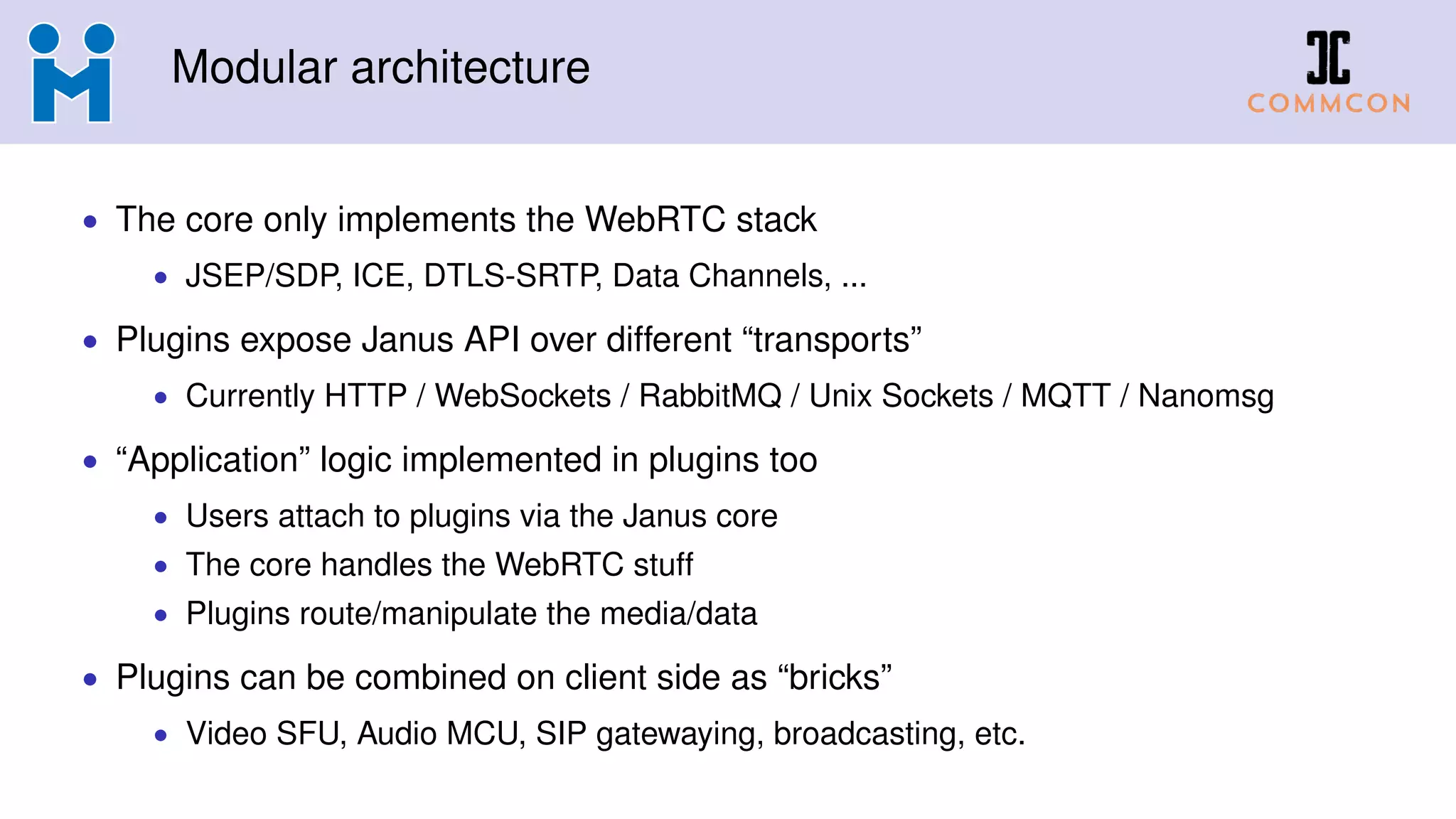
Modular architecture
• The core only implements the WebRTC stack
• JSEP/SDP, ICE, DTLS-SRTP, Data Channels, ...
• Plugins expose Janus API over different “transports”
• Currently HTTP / WebSockets / RabbitMQ / Unix Sockets / MQTT / Nanomsg
• “Application” logic implemented in plugins too
• Users attach to plugins via the Janus core
• The core handles the WebRTC stuff
• Plugins route/manipulate the media/data
• Plugins can be combined on client side as “bricks”
• Video SFU, Audio MCU, SIP gatewaying, broadcasting, etc.
Extensible Architecture and API
A quick look at plugins: SIP gateway
A quick look at plugins: RTP rebroadcaster
A quick look at plugins: Audio MCU
A quick look at plugins: Video SFU
The first step towards scaling: benchmarking
• Measuring Janus performance is not trivial...
• Different plugins have different behaviours
• Different technologies have different impact
• Need to focus on individual features
• SIP Gateway (SIP plugin)
• Multimedia streaming (Streaming plugin)
• Audio mixing (AudioBridge plugin)
• Video routing (VideoRoom plugin)
• ...
What about the results?1
• When just relaying, bandwidth is typically the real bottleneck
• Linear vs. exponential resource increase depends on plugin and topologies
1
https://janus.conf.meetecho.com/citeus
The first step towards scaling: benchmarking
• Measuring Janus performance is not trivial...
• Different plugins have different behaviours
• Different technologies have different impact
• Need to focus on individual features
• SIP Gateway (SIP plugin)
• Multimedia streaming (Streaming plugin)
• Audio mixing (AudioBridge plugin)
• Video routing (VideoRoom plugin)
• ...
What about the results?1
• When just relaying, bandwidth is typically the real bottleneck
• Linear vs. exponential resource increase depends on plugin and topologies
1
https://janus.conf.meetecho.com/citeus
The first step towards scaling: benchmarking
• Measuring Janus performance is not trivial...
• Different plugins have different behaviours
• Different technologies have different impact
• Need to focus on individual features
• SIP Gateway (SIP plugin)
• Multimedia streaming (Streaming plugin)
• Audio mixing (AudioBridge plugin)
• Video routing (VideoRoom plugin)
• ...
What about the results?1
• When just relaying, bandwidth is typically the real bottleneck
• Linear vs. exponential resource increase depends on plugin and topologies
1
https://janus.conf.meetecho.com/citeus
Beyond a single Janus instance: different strategies
• Once performance is evaluated, other aspects come into play
• Does a user stream need to stay within the plugin?
• Can it be sent to/received from somewhere else?
• Will this affect other connections?
• How much is the context important?
• What level of orchestration is needed?
• All those questions can lead to different answers/solutions, e.g.
1 Plain load balancing
2 Media resource brokering (MRB)
3 Sharing the “burden”
4 Cascaded delivery
5 ...
Beyond a single Janus instance: different strategies
• Once performance is evaluated, other aspects come into play
• Does a user stream need to stay within the plugin?
• Can it be sent to/received from somewhere else?
• Will this affect other connections?
• How much is the context important?
• What level of orchestration is needed?
• All those questions can lead to different answers/solutions, e.g.
1 Plain load balancing
2 Media resource brokering (MRB)
3 Sharing the “burden”
4 Cascaded delivery
5 ...
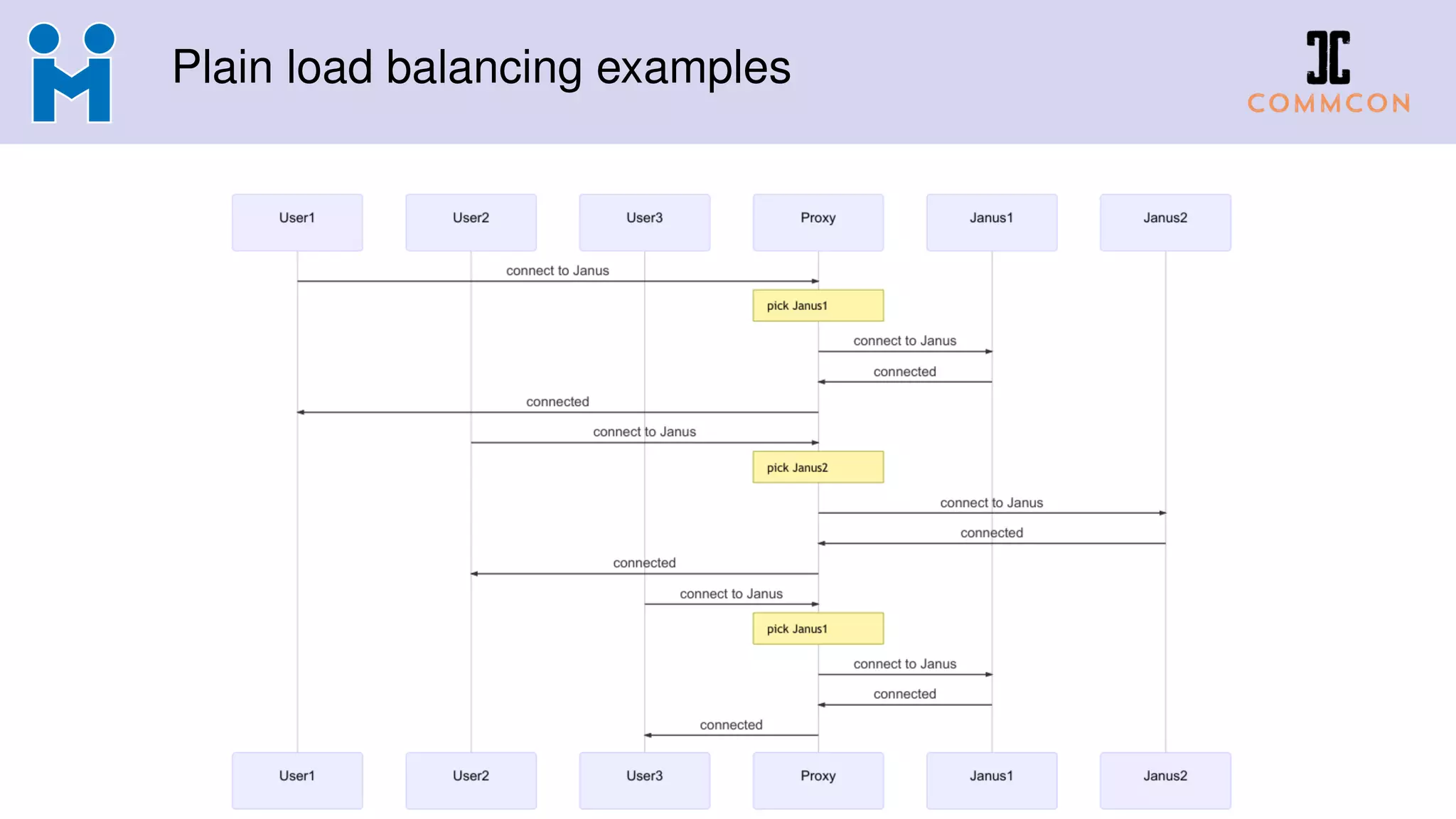
Plain load balancing
• The simplest strategy of them all
• You have N Janus instances available
• You allocate users on one according to some logic
• No orchestration needed, just knowledge of Janus addresses
• User has list vs. HAProxy vs. nginx vs. ...
• Logic can differ depending on the application
• Pick a random server?
• Use round robin?
• Pick the one closest to the user?
• Pick the least loaded?
• Something else and/or any combination of the above?
Plain load balancing
• The simplest strategy of them all
• You have N Janus instances available
• You allocate users on one according to some logic
• No orchestration needed, just knowledge of Janus addresses
• User has list vs. HAProxy vs. nginx vs. ...
• Logic can differ depending on the application
• Pick a random server?
• Use round robin?
• Pick the one closest to the user?
• Pick the least loaded?
• Something else and/or any combination of the above?
Plain load balancing
• The simplest strategy of them all
• You have N Janus instances available
• You allocate users on one according to some logic
• No orchestration needed, just knowledge of Janus addresses
• User has list vs. HAProxy vs. nginx vs. ...
• Logic can differ depending on the application
• Pick a random server?
• Use round robin?
• Pick the one closest to the user?
• Pick the least loaded?
• Something else and/or any combination of the above?
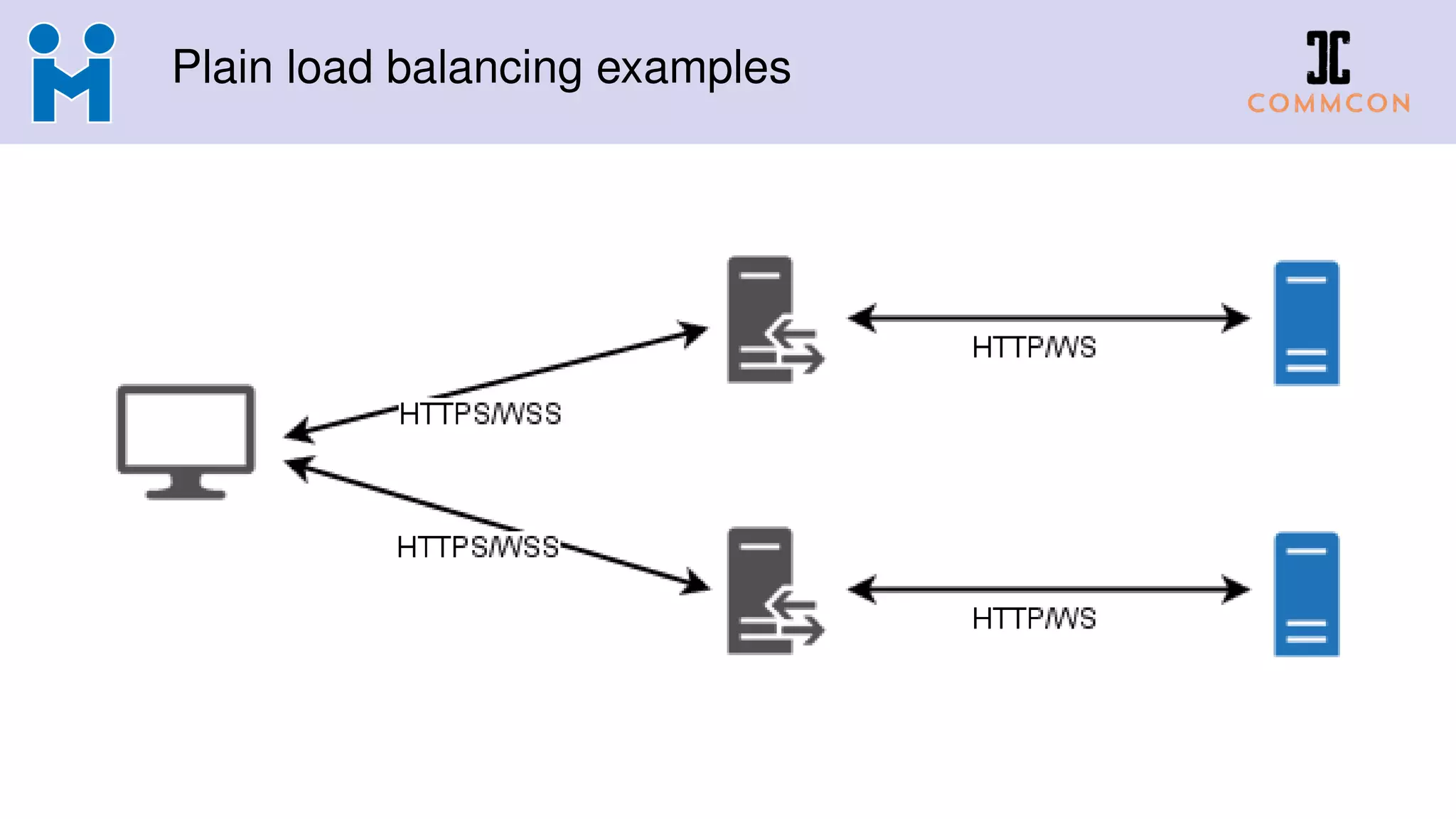
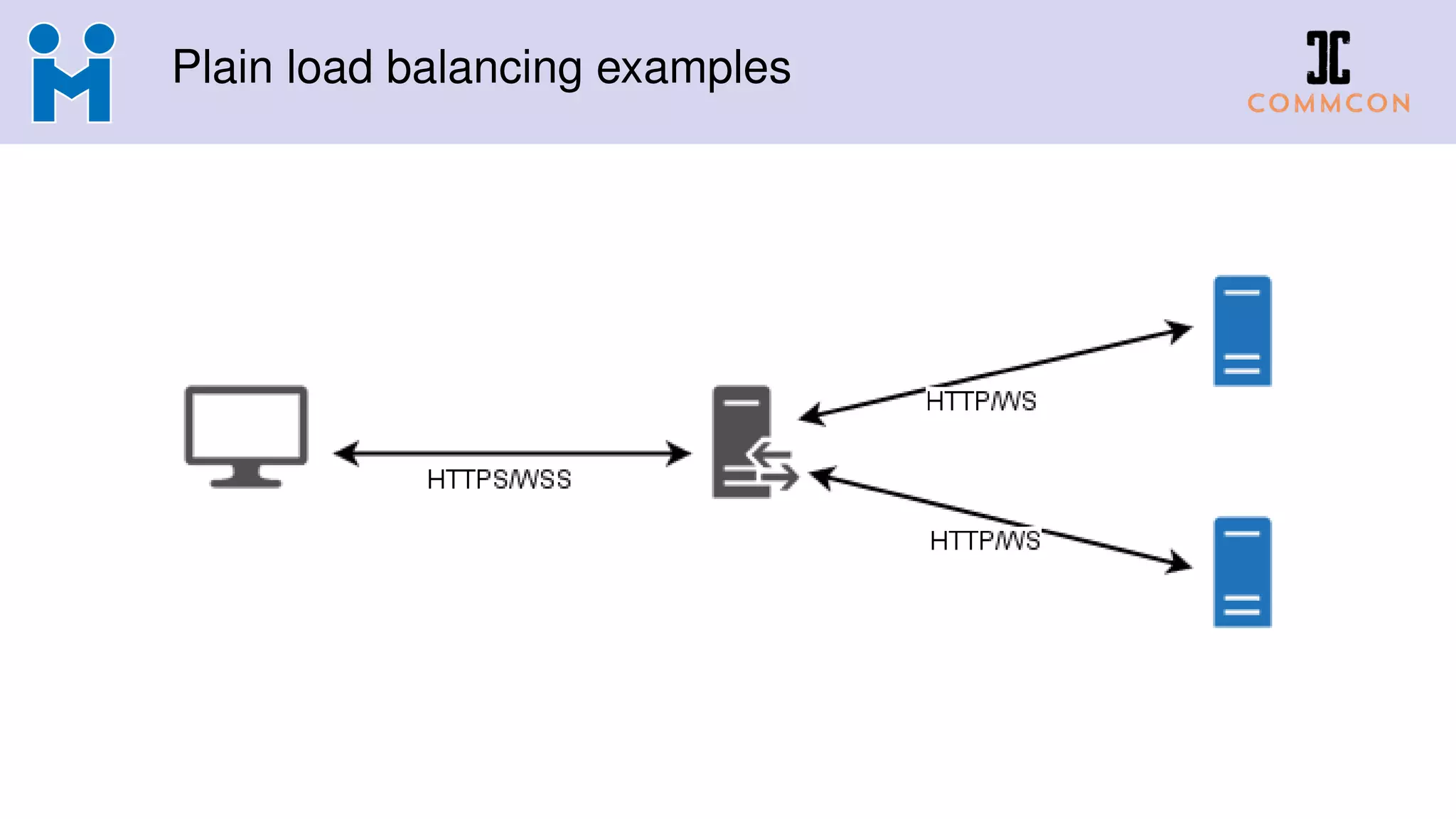
Plain load balancing examples
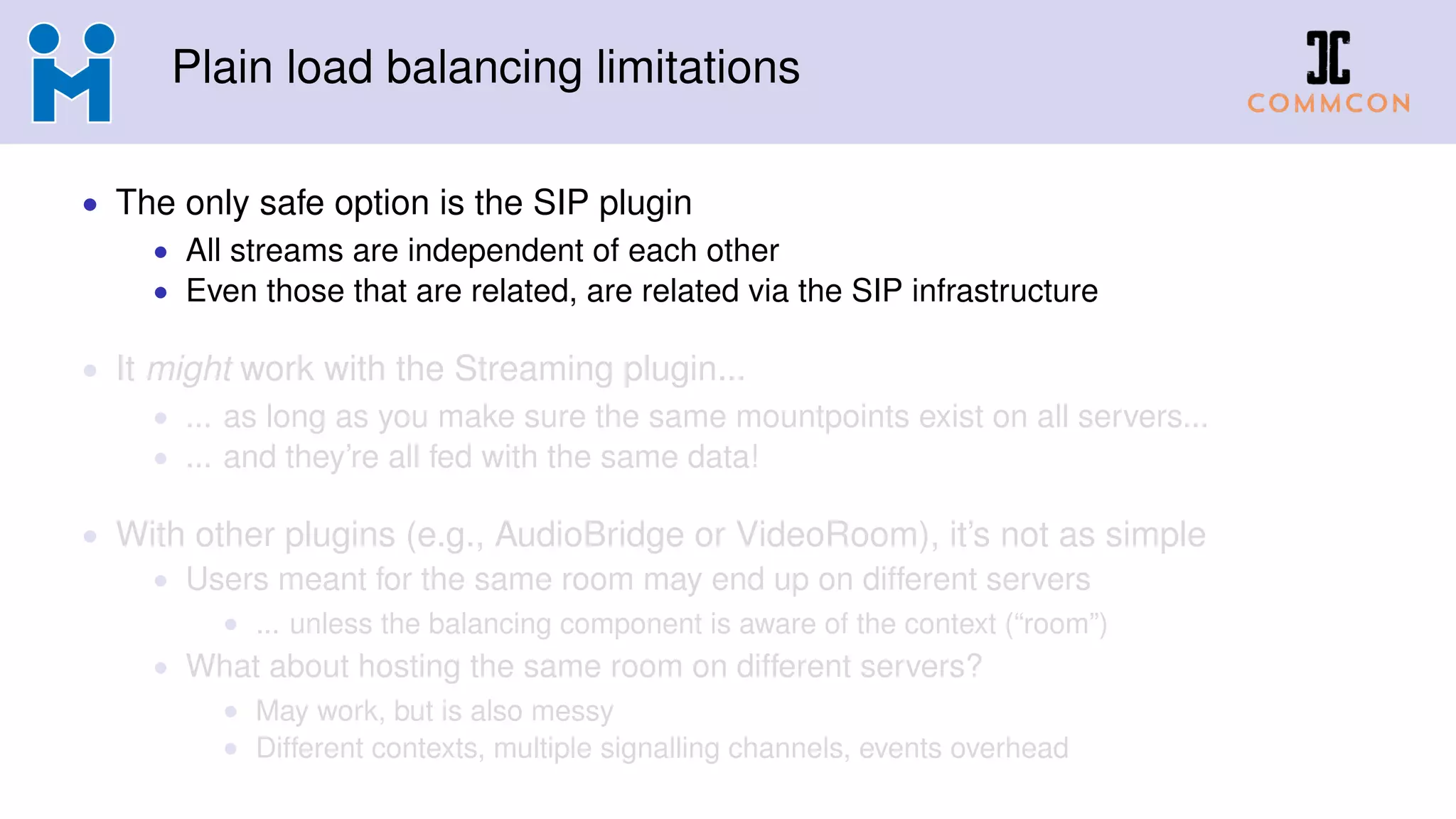
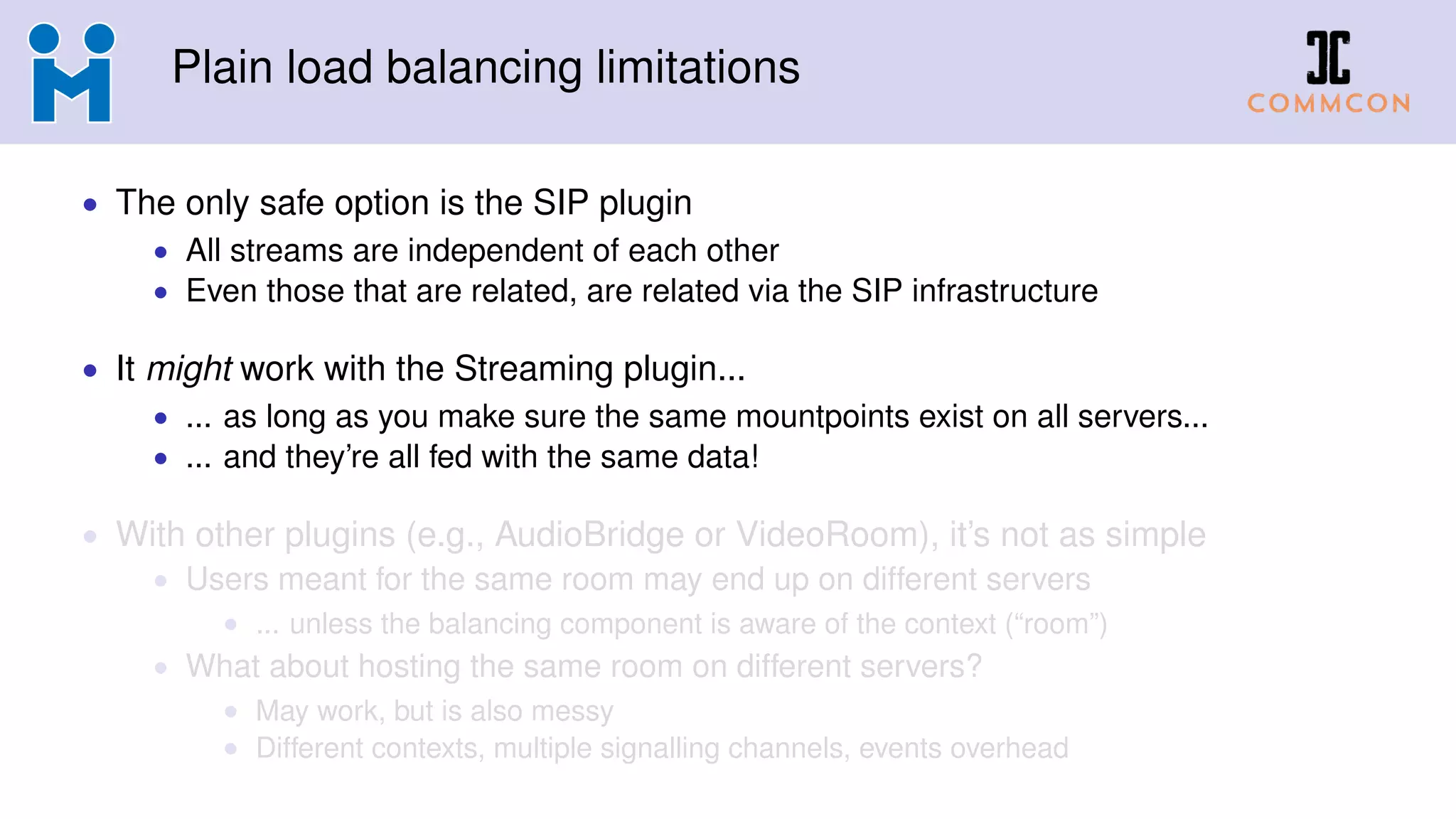
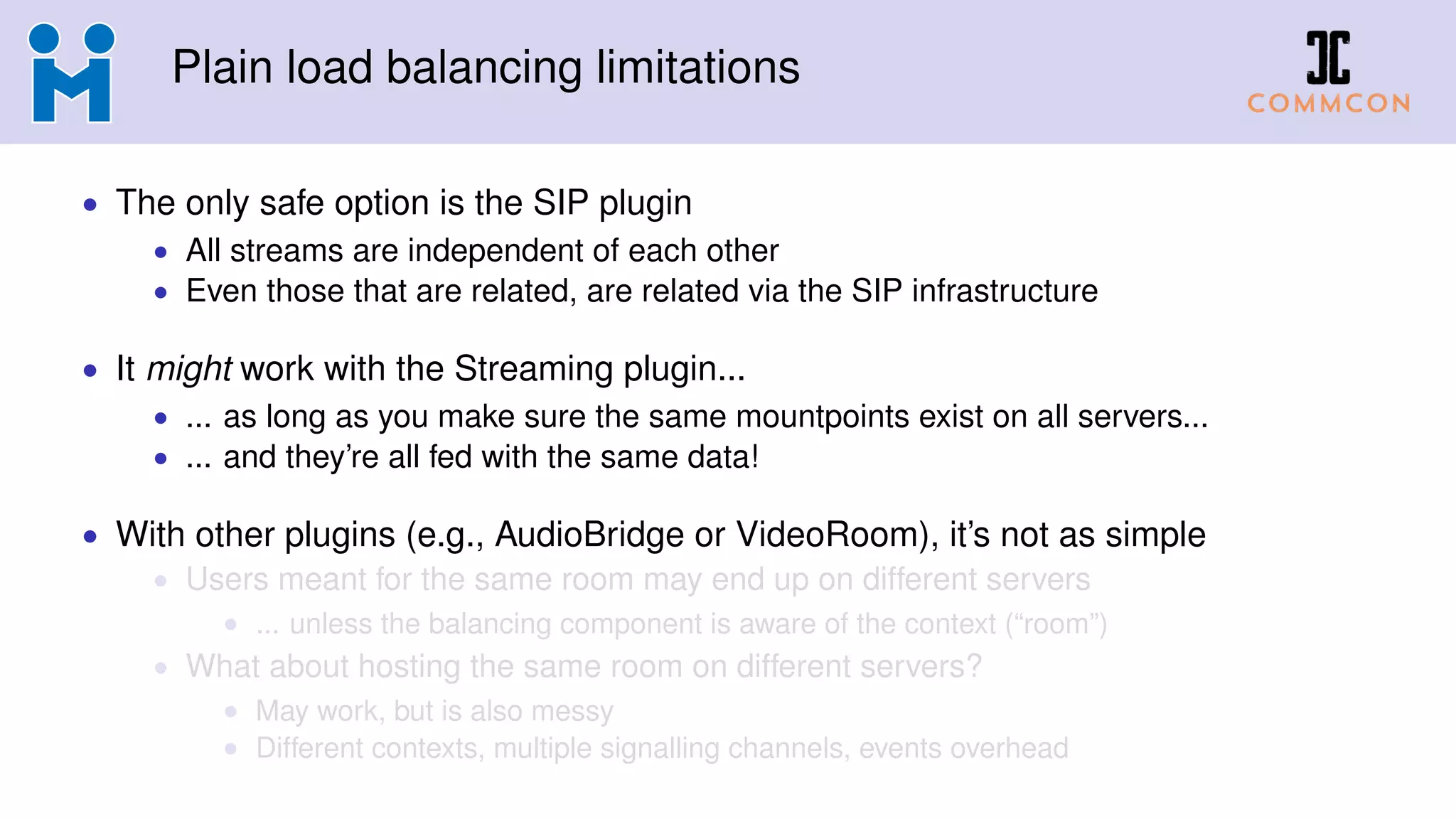
Plain load balancing limitations
• The only safe option is the SIP plugin
• All streams are independent of each other
• Even those that are related, are related via the SIP infrastructure
• It might work with the Streaming plugin...
• ... as long as you make sure the same mountpoints exist on all servers...
• ... and they’re all fed with the same data!
• With other plugins (e.g., AudioBridge or VideoRoom), it’s not as simple
• Users meant for the same room may end up on different servers
• ... unless the balancing component is aware of the context (“room”)
• What about hosting the same room on different servers?
• May work, but is also messy
• Different contexts, multiple signalling channels, events overhead
Plain load balancing limitations
• The only safe option is the SIP plugin
• All streams are independent of each other
• Even those that are related, are related via the SIP infrastructure
• It might work with the Streaming plugin...
• ... as long as you make sure the same mountpoints exist on all servers...
• ... and they’re all fed with the same data!
• With other plugins (e.g., AudioBridge or VideoRoom), it’s not as simple
• Users meant for the same room may end up on different servers
• ... unless the balancing component is aware of the context (“room”)
• What about hosting the same room on different servers?
• May work, but is also messy
• Different contexts, multiple signalling channels, events overhead
Plain load balancing limitations
• The only safe option is the SIP plugin
• All streams are independent of each other
• Even those that are related, are related via the SIP infrastructure
• It might work with the Streaming plugin...
• ... as long as you make sure the same mountpoints exist on all servers...
• ... and they’re all fed with the same data!
• With other plugins (e.g., AudioBridge or VideoRoom), it’s not as simple
• Users meant for the same room may end up on different servers
• ... unless the balancing component is aware of the context (“room”)
• What about hosting the same room on different servers?
• May work, but is also messy
• Different contexts, multiple signalling channels, events overhead
Plain load balancing limitations
• The only safe option is the SIP plugin
• All streams are independent of each other
• Even those that are related, are related via the SIP infrastructure
• It might work with the Streaming plugin...
• ... as long as you make sure the same mountpoints exist on all servers...
• ... and they’re all fed with the same data!
• With other plugins (e.g., AudioBridge or VideoRoom), it’s not as simple
• Users meant for the same room may end up on different servers
• ... unless the balancing component is aware of the context (“room”)
• What about hosting the same room on different servers?
• May work, but is also messy
• Different contexts, multiple signalling channels, events overhead
Plain load balancing limitations
• The only safe option is the SIP plugin
• All streams are independent of each other
• Even those that are related, are related via the SIP infrastructure
• It might work with the Streaming plugin...
• ... as long as you make sure the same mountpoints exist on all servers...
• ... and they’re all fed with the same data!
• With other plugins (e.g., AudioBridge or VideoRoom), it’s not as simple
• Users meant for the same room may end up on different servers
• ... unless the balancing component is aware of the context (“room”)
• What about hosting the same room on different servers?
• May work, but is also messy
• Different contexts, multiple signalling channels, events overhead
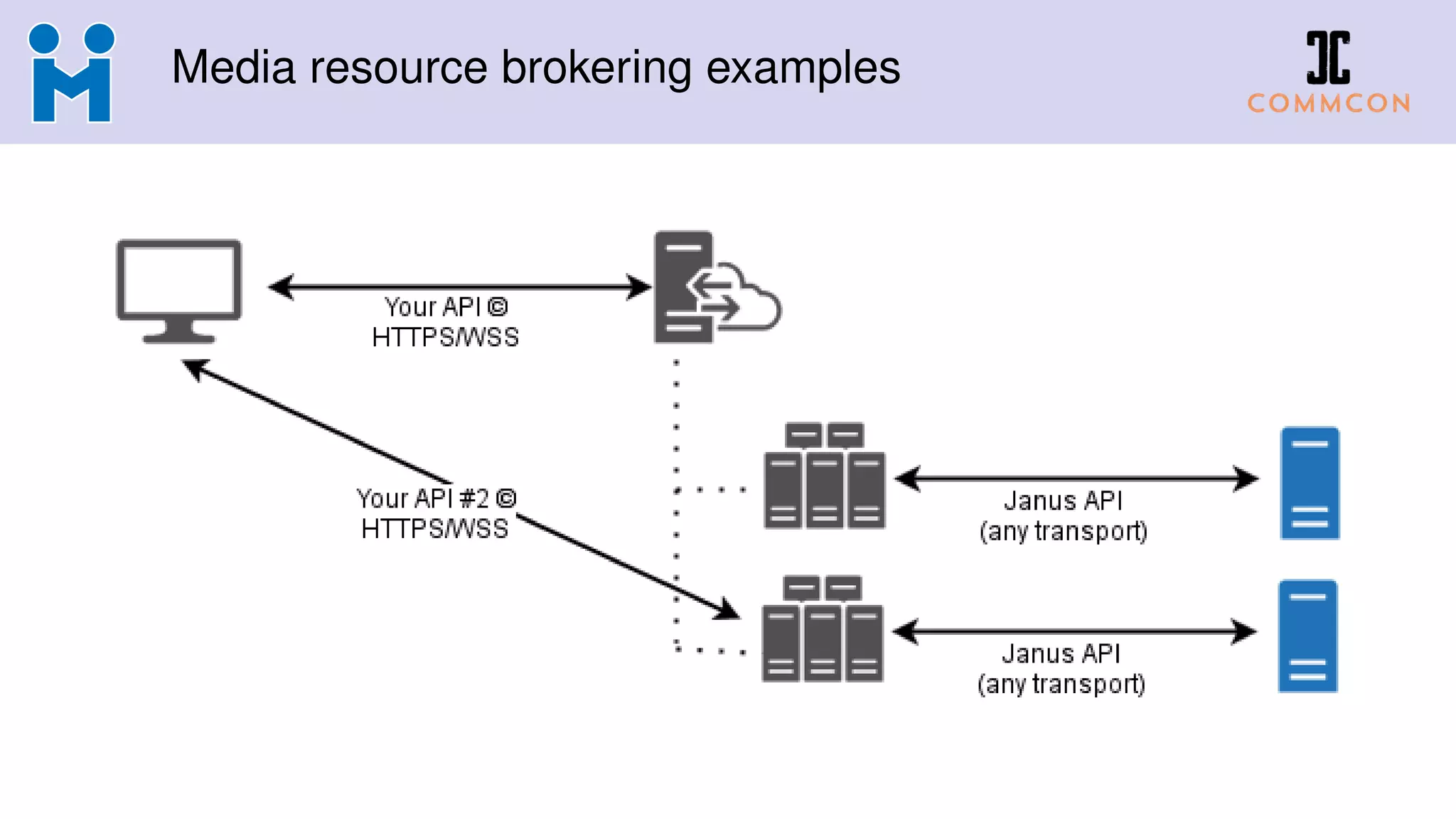
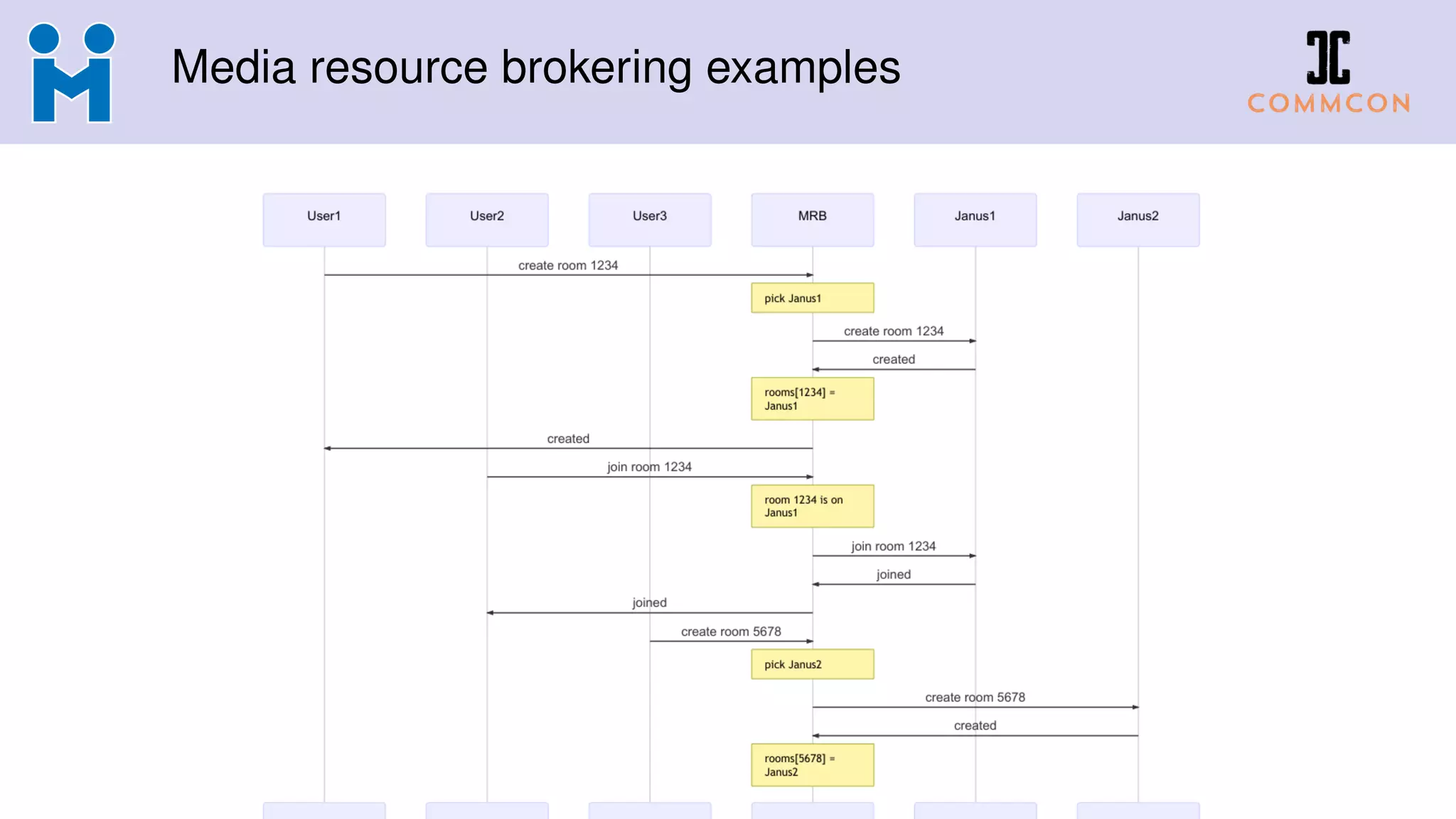
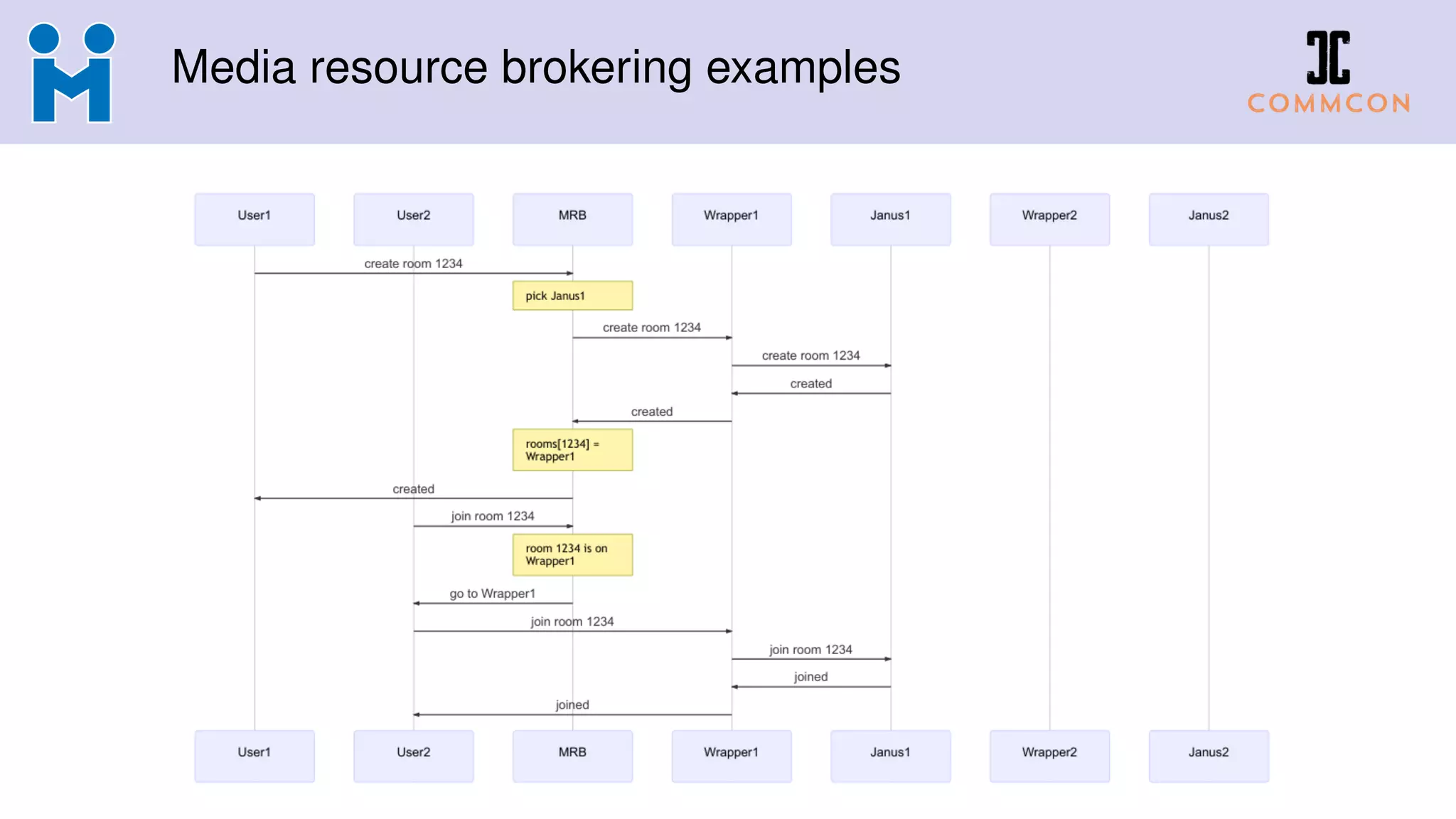
Media resource brokering
• A step above Plain load balancing
• You have N Janus instances available
• You allocate users based on logic AND context
• Orchestration needed, here
• You need to know which Janus instances are available...
• ... and which one is doing what
• Logic will differ depending on the context
• Before allocating users, you allocate the context itself (e.g., a conference room)
• Users are then sent wherever their context belongs to
• Unlike Plain load balancing, can be used for everything
• You just need to implement context awareness somehow, and track resources
Media resource brokering
• A step above Plain load balancing
• You have N Janus instances available
• You allocate users based on logic AND context
• Orchestration needed, here
• You need to know which Janus instances are available...
• ... and which one is doing what
• Logic will differ depending on the context
• Before allocating users, you allocate the context itself (e.g., a conference room)
• Users are then sent wherever their context belongs to
• Unlike Plain load balancing, can be used for everything
• You just need to implement context awareness somehow, and track resources
Media resource brokering
• A step above Plain load balancing
• You have N Janus instances available
• You allocate users based on logic AND context
• Orchestration needed, here
• You need to know which Janus instances are available...
• ... and which one is doing what
• Logic will differ depending on the context
• Before allocating users, you allocate the context itself (e.g., a conference room)
• Users are then sent wherever their context belongs to
• Unlike Plain load balancing, can be used for everything
• You just need to implement context awareness somehow, and track resources
Media resource brokering
• A step above Plain load balancing
• You have N Janus instances available
• You allocate users based on logic AND context
• Orchestration needed, here
• You need to know which Janus instances are available...
• ... and which one is doing what
• Logic will differ depending on the context
• Before allocating users, you allocate the context itself (e.g., a conference room)
• Users are then sent wherever their context belongs to
• Unlike Plain load balancing, can be used for everything
• You just need to implement context awareness somehow, and track resources
Media resource brokering use case
• Will work nicely with all plugins, if you manage the context
• Context may give more info to SIP balancing logic
• Conference rooms and Streaming mountpoints can be associated to instances
• Broadcasting with Streaming plugin...
• ... if MRB knows Janus X hosts mountpoint Y, it can send users there
• Conference rooms with AudioBridge and/or VideoRoom...
• New rooms can be “deployed” on a specific instance
• Attempts to join room Y can be sent to Janus instance responsible for it
• Won’t help much when the same resource needs to be scaled, though
• e.g., many small rooms vs. one very large room
• For that, some different approach is needed
Media resource brokering use case
• Will work nicely with all plugins, if you manage the context
• Context may give more info to SIP balancing logic
• Conference rooms and Streaming mountpoints can be associated to instances
• Broadcasting with Streaming plugin...
• ... if MRB knows Janus X hosts mountpoint Y, it can send users there
• Conference rooms with AudioBridge and/or VideoRoom...
• New rooms can be “deployed” on a specific instance
• Attempts to join room Y can be sent to Janus instance responsible for it
• Won’t help much when the same resource needs to be scaled, though
• e.g., many small rooms vs. one very large room
• For that, some different approach is needed
Media resource brokering use case
• Will work nicely with all plugins, if you manage the context
• Context may give more info to SIP balancing logic
• Conference rooms and Streaming mountpoints can be associated to instances
• Broadcasting with Streaming plugin...
• ... if MRB knows Janus X hosts mountpoint Y, it can send users there
• Conference rooms with AudioBridge and/or VideoRoom...
• New rooms can be “deployed” on a specific instance
• Attempts to join room Y can be sent to Janus instance responsible for it
• Won’t help much when the same resource needs to be scaled, though
• e.g., many small rooms vs. one very large room
• For that, some different approach is needed
Media resource brokering use case
• Will work nicely with all plugins, if you manage the context
• Context may give more info to SIP balancing logic
• Conference rooms and Streaming mountpoints can be associated to instances
• Broadcasting with Streaming plugin...
• ... if MRB knows Janus X hosts mountpoint Y, it can send users there
• Conference rooms with AudioBridge and/or VideoRoom...
• New rooms can be “deployed” on a specific instance
• Attempts to join room Y can be sent to Janus instance responsible for it
• Won’t help much when the same resource needs to be scaled, though
• e.g., many small rooms vs. one very large room
• For that, some different approach is needed
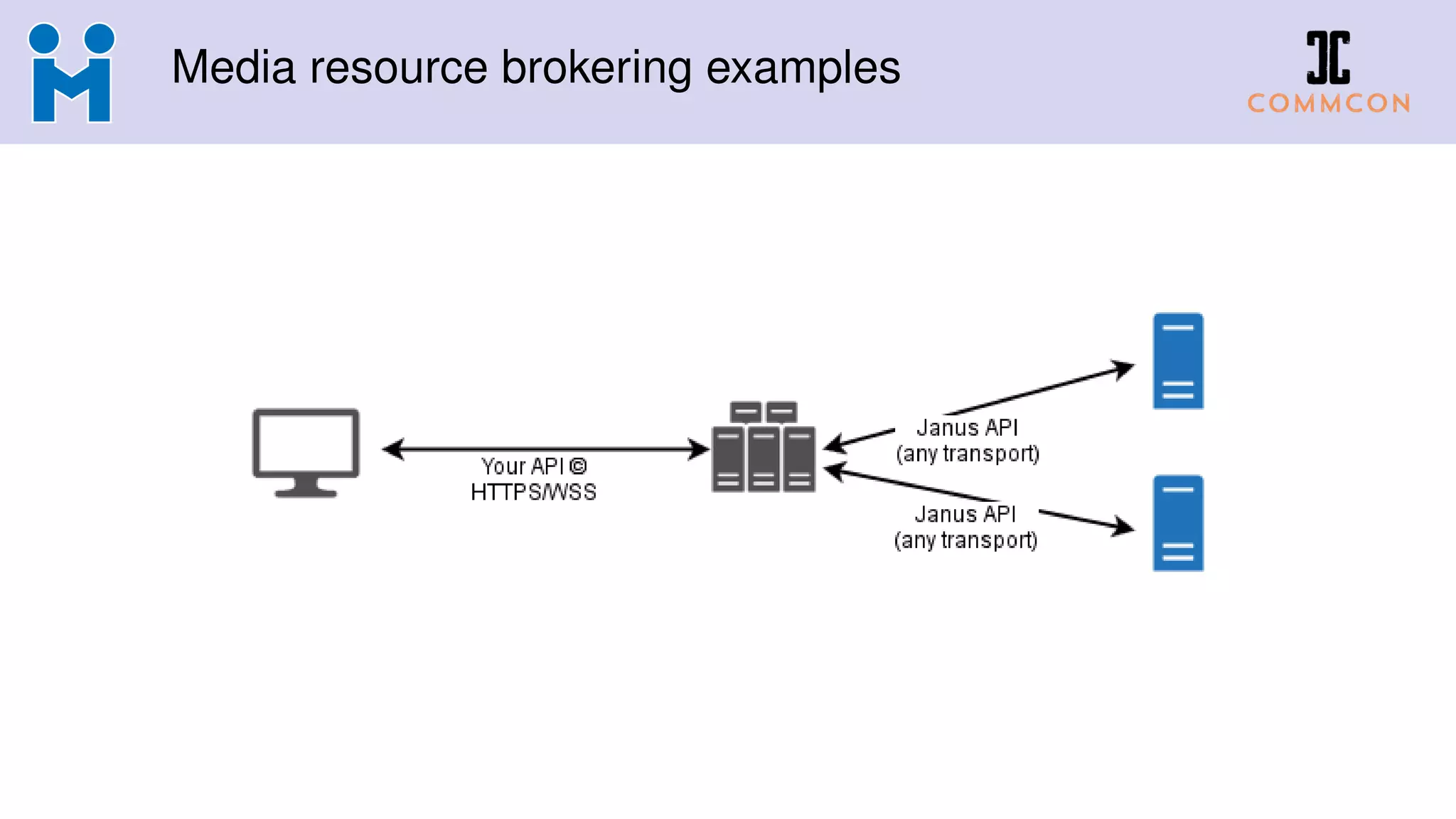
Media resource brokering examples
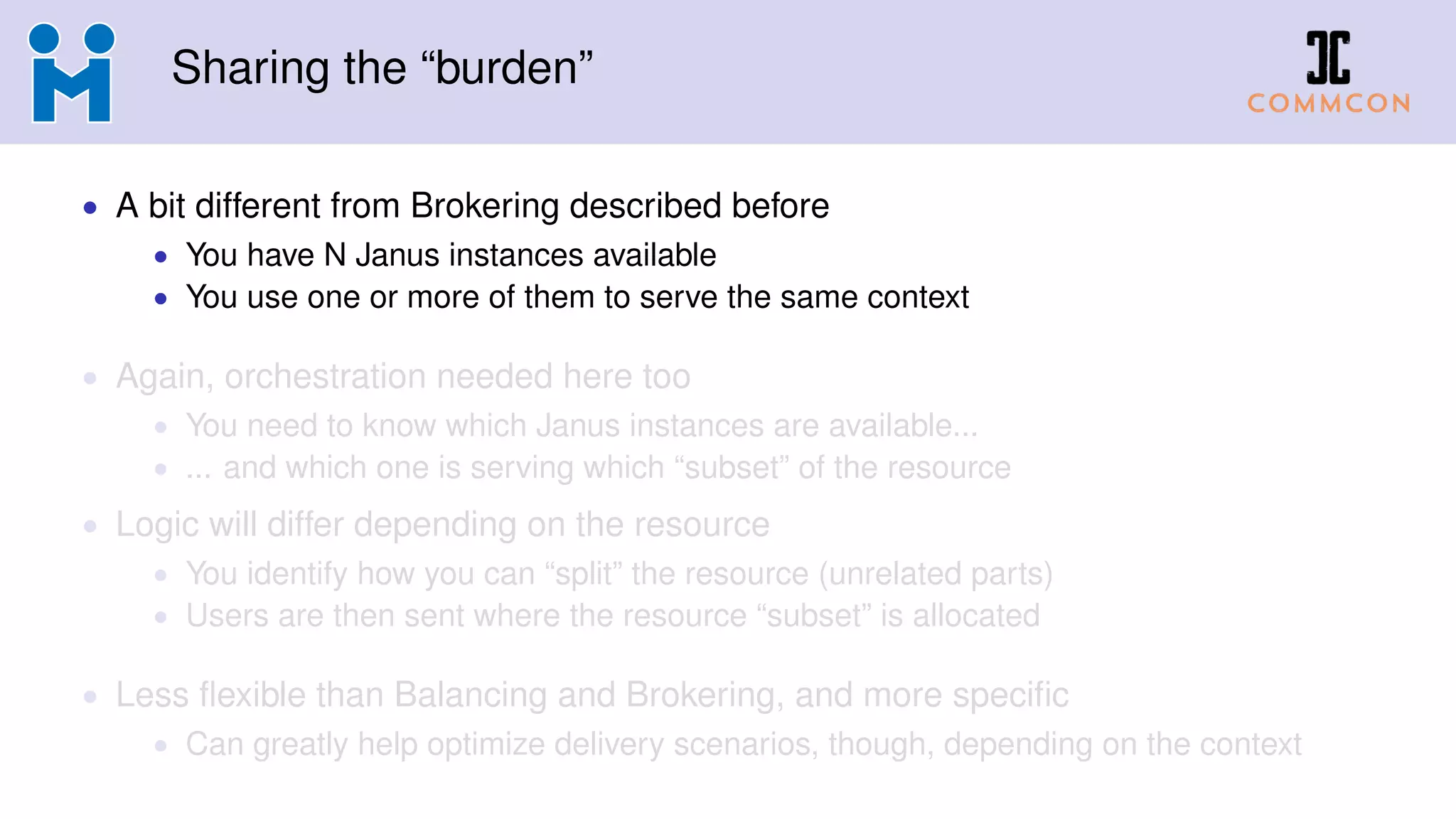
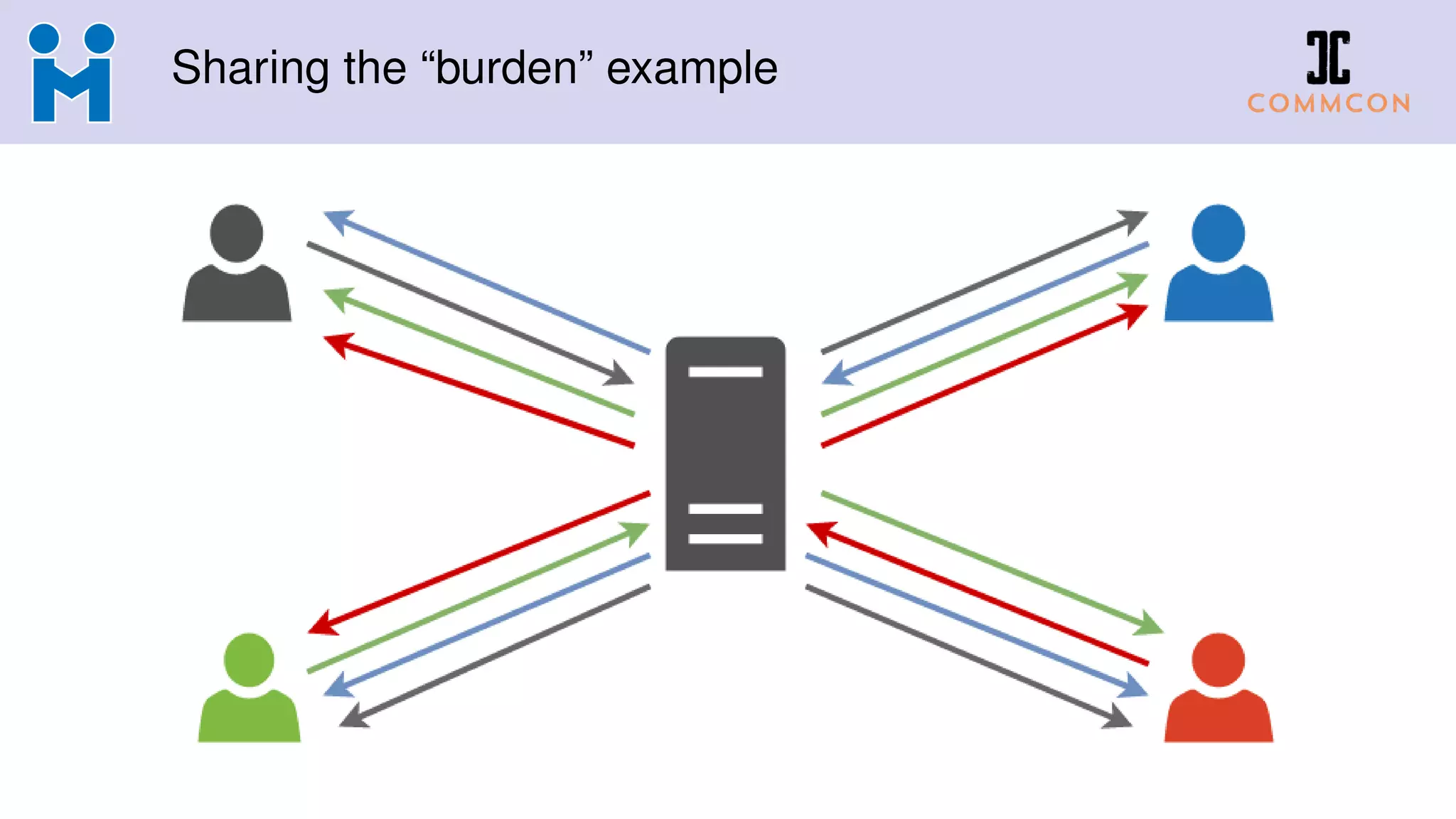
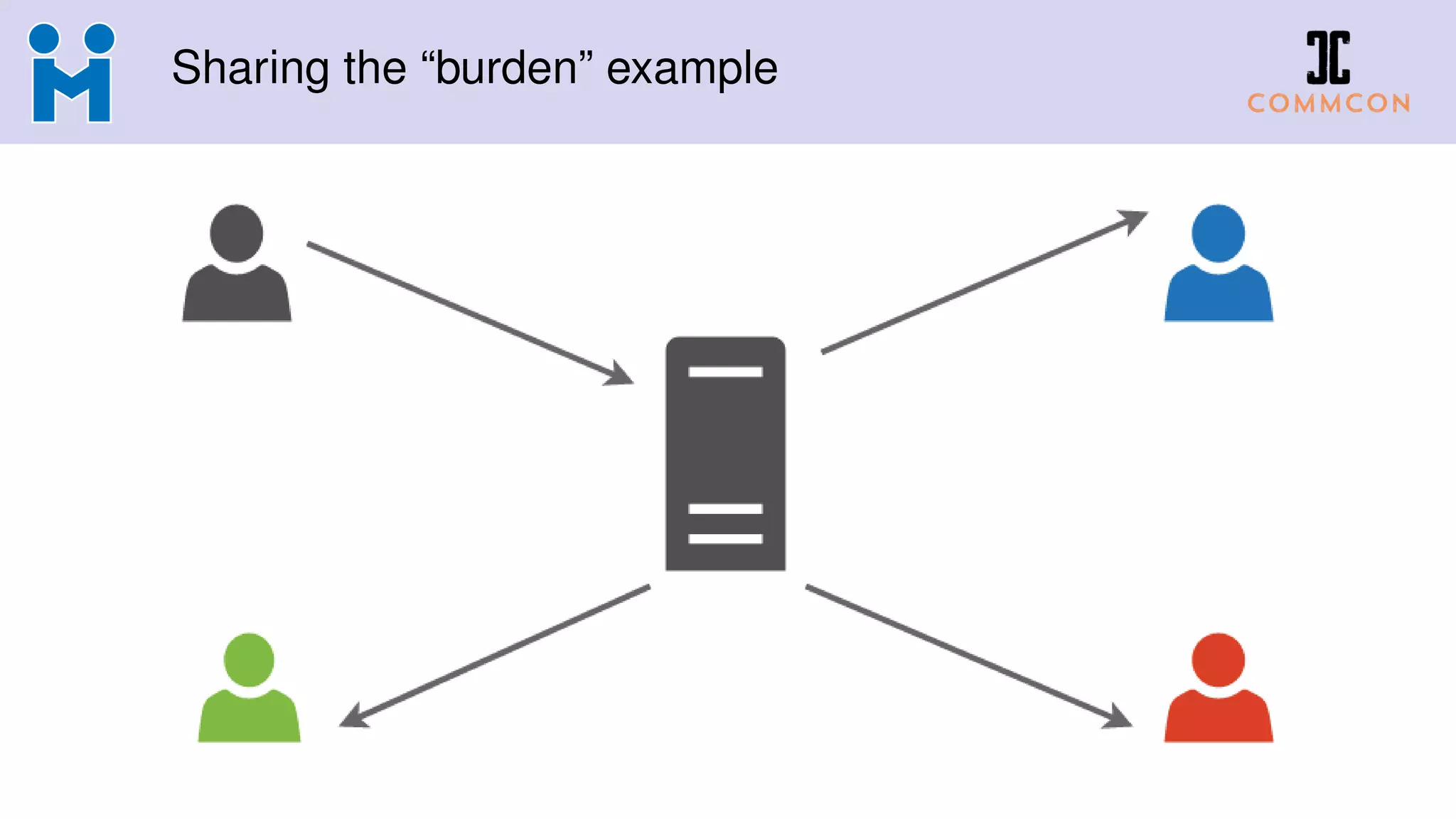
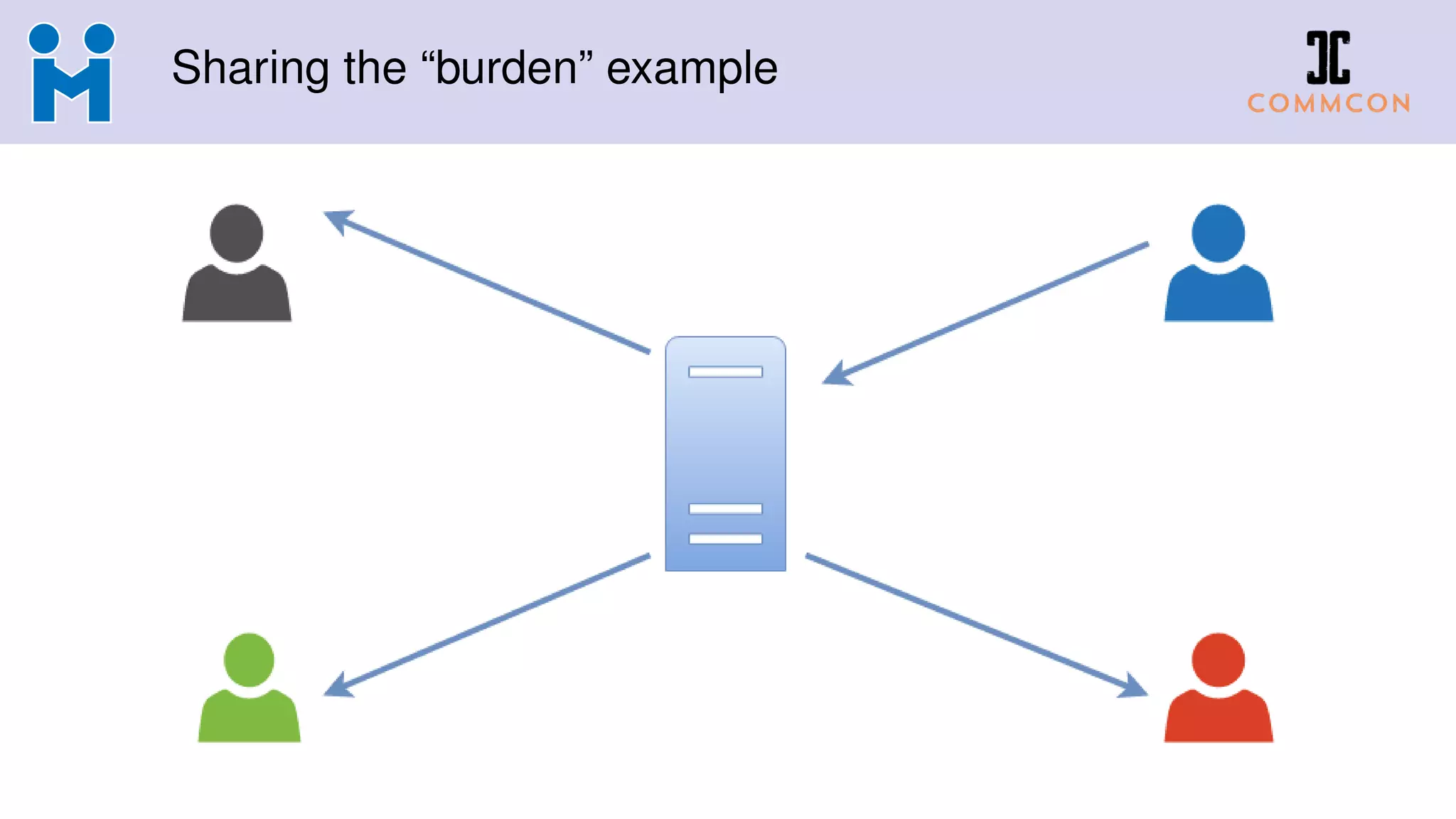
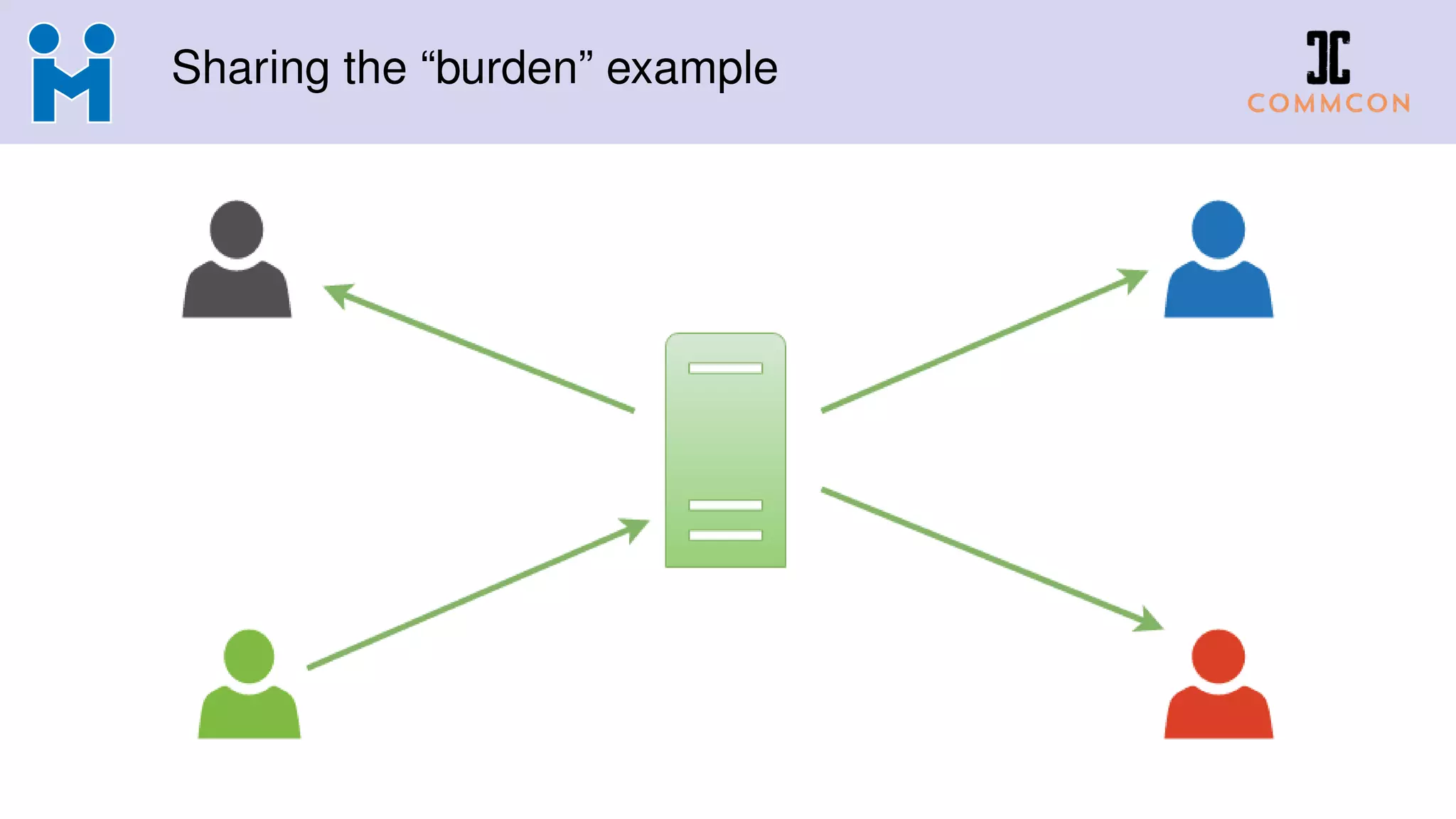
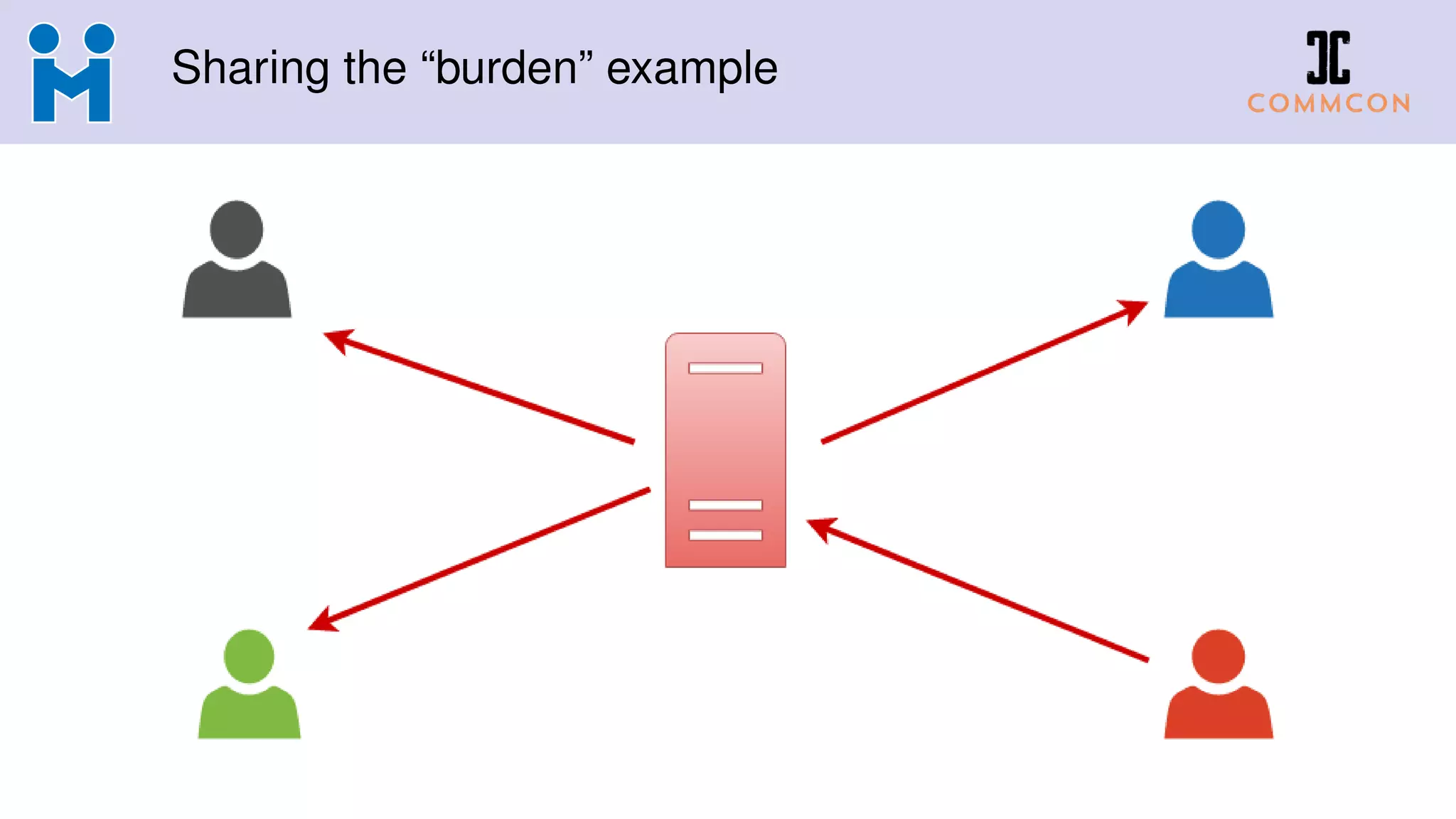
Sharing the “burden”
• A bit different from Brokering described before
• You have N Janus instances available
• You use one or more of them to serve the same context
• Again, orchestration needed here too
• You need to know which Janus instances are available...
• ... and which one is serving which “subset” of the resource
• Logic will differ depending on the resource
• You identify how you can “split” the resource (unrelated parts)
• Users are then sent where the resource “subset” is allocated
• Less flexible than Balancing and Brokering, and more specific
• Can greatly help optimize delivery scenarios, though, depending on the context
Sharing the “burden”
• A bit different from Brokering described before
• You have N Janus instances available
• You use one or more of them to serve the same context
• Again, orchestration needed here too
• You need to know which Janus instances are available...
• ... and which one is serving which “subset” of the resource
• Logic will differ depending on the resource
• You identify how you can “split” the resource (unrelated parts)
• Users are then sent where the resource “subset” is allocated
• Less flexible than Balancing and Brokering, and more specific
• Can greatly help optimize delivery scenarios, though, depending on the context
Sharing the “burden”
• A bit different from Brokering described before
• You have N Janus instances available
• You use one or more of them to serve the same context
• Again, orchestration needed here too
• You need to know which Janus instances are available...
• ... and which one is serving which “subset” of the resource
• Logic will differ depending on the resource
• You identify how you can “split” the resource (unrelated parts)
• Users are then sent where the resource “subset” is allocated
• Less flexible than Balancing and Brokering, and more specific
• Can greatly help optimize delivery scenarios, though, depending on the context
Sharing the “burden”
• A bit different from Brokering described before
• You have N Janus instances available
• You use one or more of them to serve the same context
• Again, orchestration needed here too
• You need to know which Janus instances are available...
• ... and which one is serving which “subset” of the resource
• Logic will differ depending on the resource
• You identify how you can “split” the resource (unrelated parts)
• Users are then sent where the resource “subset” is allocated
• Less flexible than Balancing and Brokering, and more specific
• Can greatly help optimize delivery scenarios, though, depending on the context
Sharing the “burden” use case
• A typical use case is larger conferences
• Many active participants, with many viewers
• The first step is identifying the resources, and how they’re related
• Publishers will send media: they don’t “depend” on each other
• Subscribers only receive media: they depend on a specific publisher
• Publishers can be the “subset”, here
• A large conference room becomes N 1-to-many smaller broadcasts
• Each publisher→subscribers distribution is allocated separately
• Controlling application makes sure that viewer picks streams from the right place
• Bob from Janus1, Alice from Janus2, Tom from Janus3, Jim from Janus2, ...
Sharing the “burden” use case
• A typical use case is larger conferences
• Many active participants, with many viewers
• The first step is identifying the resources, and how they’re related
• Publishers will send media: they don’t “depend” on each other
• Subscribers only receive media: they depend on a specific publisher
• Publishers can be the “subset”, here
• A large conference room becomes N 1-to-many smaller broadcasts
• Each publisher→subscribers distribution is allocated separately
• Controlling application makes sure that viewer picks streams from the right place
• Bob from Janus1, Alice from Janus2, Tom from Janus3, Jim from Janus2, ...
Sharing the “burden” use case
• A typical use case is larger conferences
• Many active participants, with many viewers
• The first step is identifying the resources, and how they’re related
• Publishers will send media: they don’t “depend” on each other
• Subscribers only receive media: they depend on a specific publisher
• Publishers can be the “subset”, here
• A large conference room becomes N 1-to-many smaller broadcasts
• Each publisher→subscribers distribution is allocated separately
• Controlling application makes sure that viewer picks streams from the right place
• Bob from Janus1, Alice from Janus2, Tom from Janus3, Jim from Janus2, ...
Sharing the “burden” use case
• A typical use case is larger conferences
• Many active participants, with many viewers
• The first step is identifying the resources, and how they’re related
• Publishers will send media: they don’t “depend” on each other
• Subscribers only receive media: they depend on a specific publisher
• Publishers can be the “subset”, here
• A large conference room becomes N 1-to-many smaller broadcasts
• Each publisher→subscribers distribution is allocated separately
• Controlling application makes sure that viewer picks streams from the right place
• Bob from Janus1, Alice from Janus2, Tom from Janus3, Jim from Janus2, ...
Sharing the “burden” example
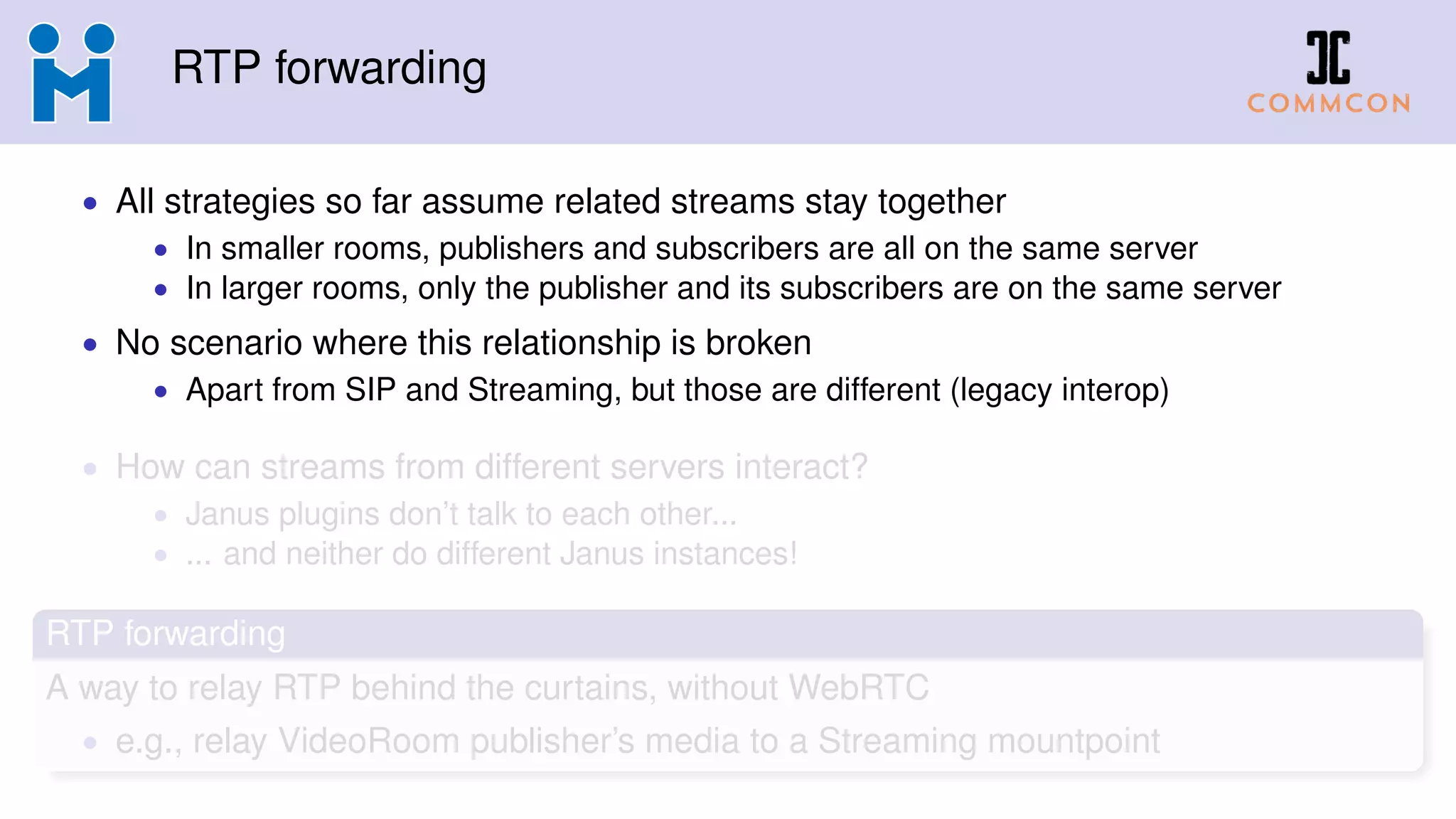
RTP forwarding
• All strategies so far assume related streams stay together
• In smaller rooms, publishers and subscribers are all on the same server
• In larger rooms, only the publisher and its subscribers are on the same server
• No scenario where this relationship is broken
• Apart from SIP and Streaming, but those are different (legacy interop)
• How can streams from different servers interact?
• Janus plugins don’t talk to each other...
• ... and neither do different Janus instances!
RTP forwarding
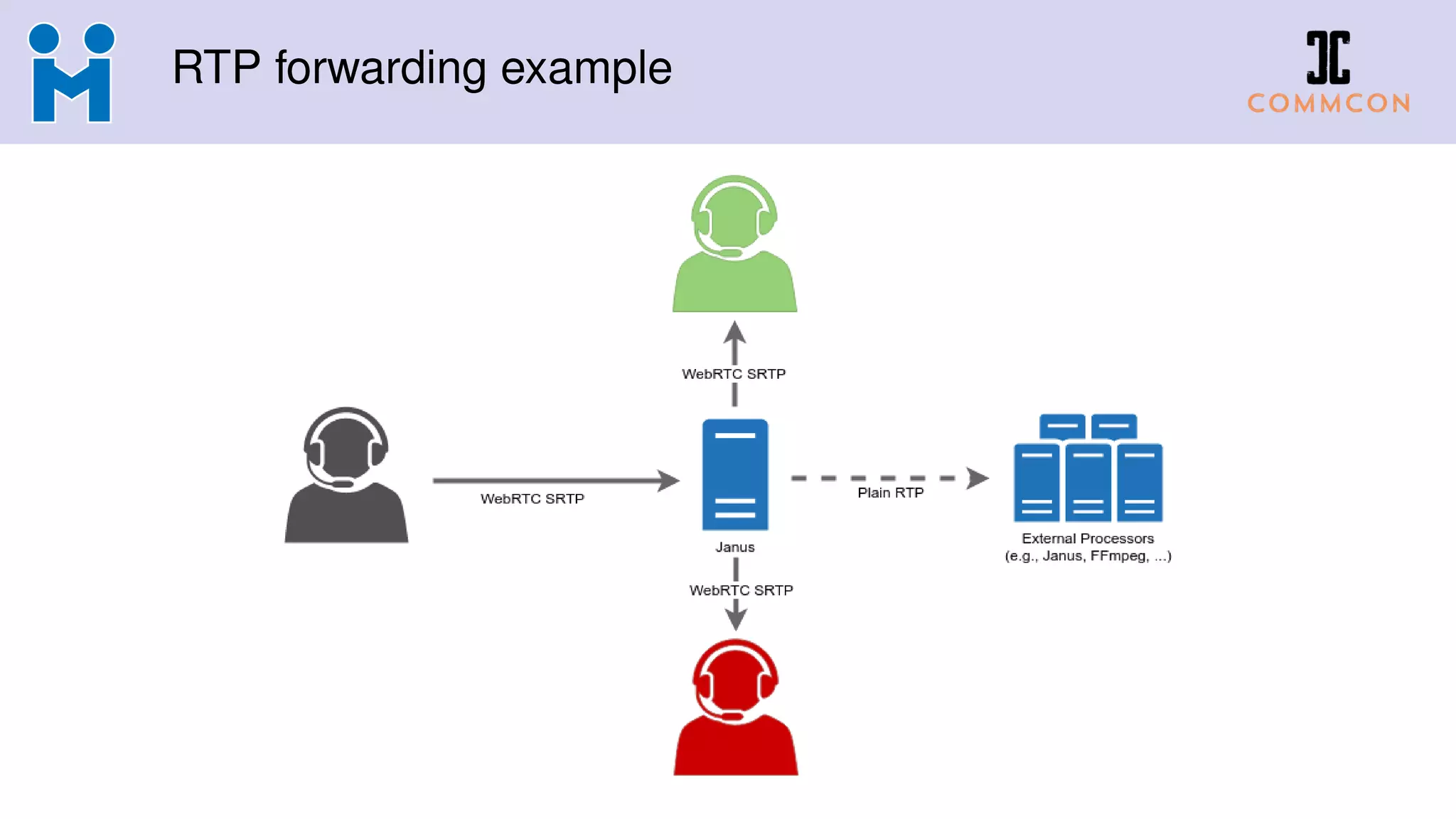
A way to relay RTP behind the curtains, without WebRTC
• e.g., relay VideoRoom publisher’s media to a Streaming mountpoint
RTP forwarding
• All strategies so far assume related streams stay together
• In smaller rooms, publishers and subscribers are all on the same server
• In larger rooms, only the publisher and its subscribers are on the same server
• No scenario where this relationship is broken
• Apart from SIP and Streaming, but those are different (legacy interop)
• How can streams from different servers interact?
• Janus plugins don’t talk to each other...
• ... and neither do different Janus instances!
RTP forwarding
A way to relay RTP behind the curtains, without WebRTC
• e.g., relay VideoRoom publisher’s media to a Streaming mountpoint
RTP forwarding
• All strategies so far assume related streams stay together
• In smaller rooms, publishers and subscribers are all on the same server
• In larger rooms, only the publisher and its subscribers are on the same server
• No scenario where this relationship is broken
• Apart from SIP and Streaming, but those are different (legacy interop)
• How can streams from different servers interact?
• Janus plugins don’t talk to each other...
• ... and neither do different Janus instances!
RTP forwarding
A way to relay RTP behind the curtains, without WebRTC
• e.g., relay VideoRoom publisher’s media to a Streaming mountpoint
RTP forwarding
• All strategies so far assume related streams stay together
• In smaller rooms, publishers and subscribers are all on the same server
• In larger rooms, only the publisher and its subscribers are on the same server
• No scenario where this relationship is broken
• Apart from SIP and Streaming, but those are different (legacy interop)
• How can streams from different servers interact?
• Janus plugins don’t talk to each other...
• ... and neither do different Janus instances!
RTP forwarding
A way to relay RTP behind the curtains, without WebRTC
• e.g., relay VideoRoom publisher’s media to a Streaming mountpoint
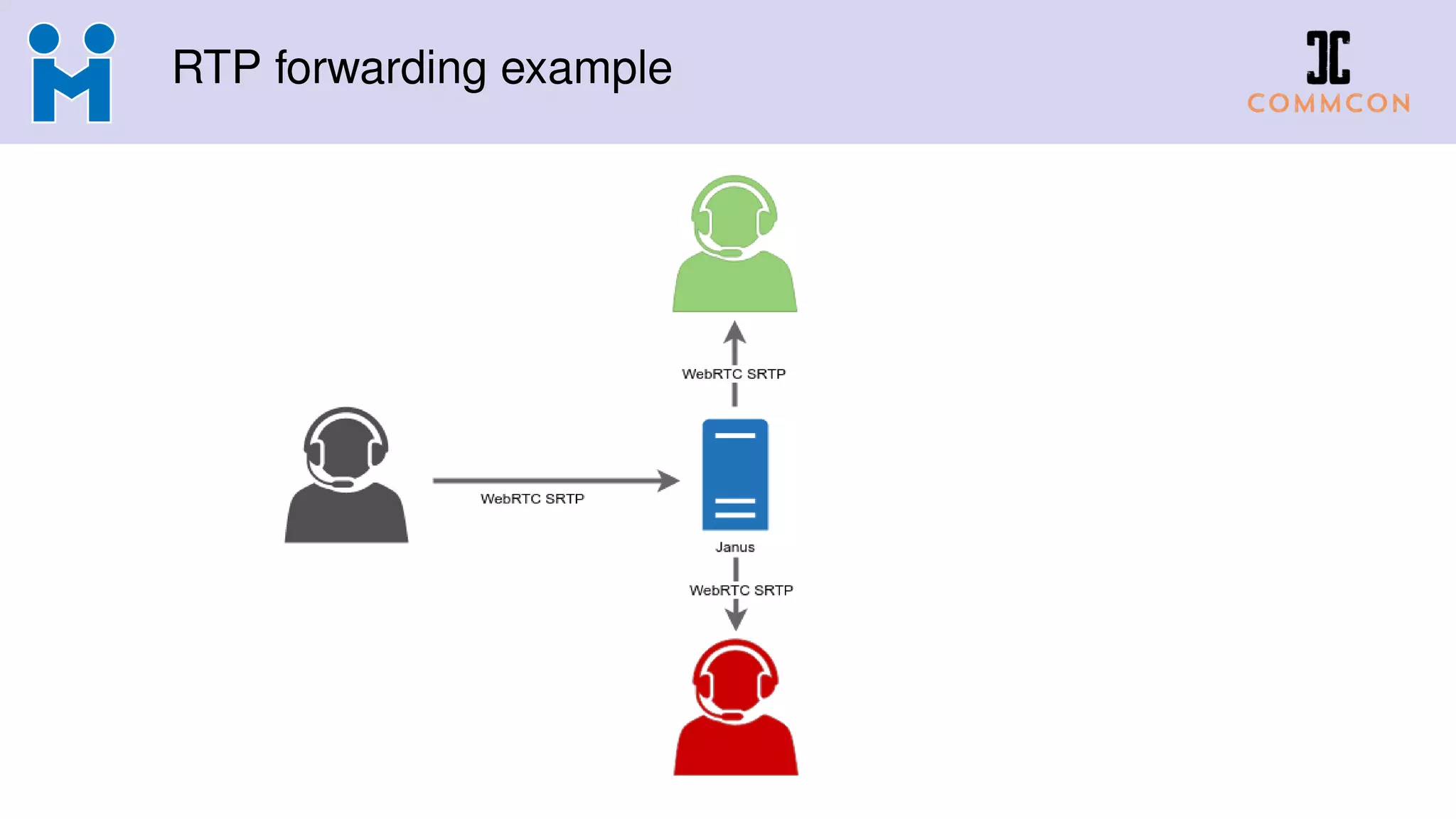
RTP forwarding example
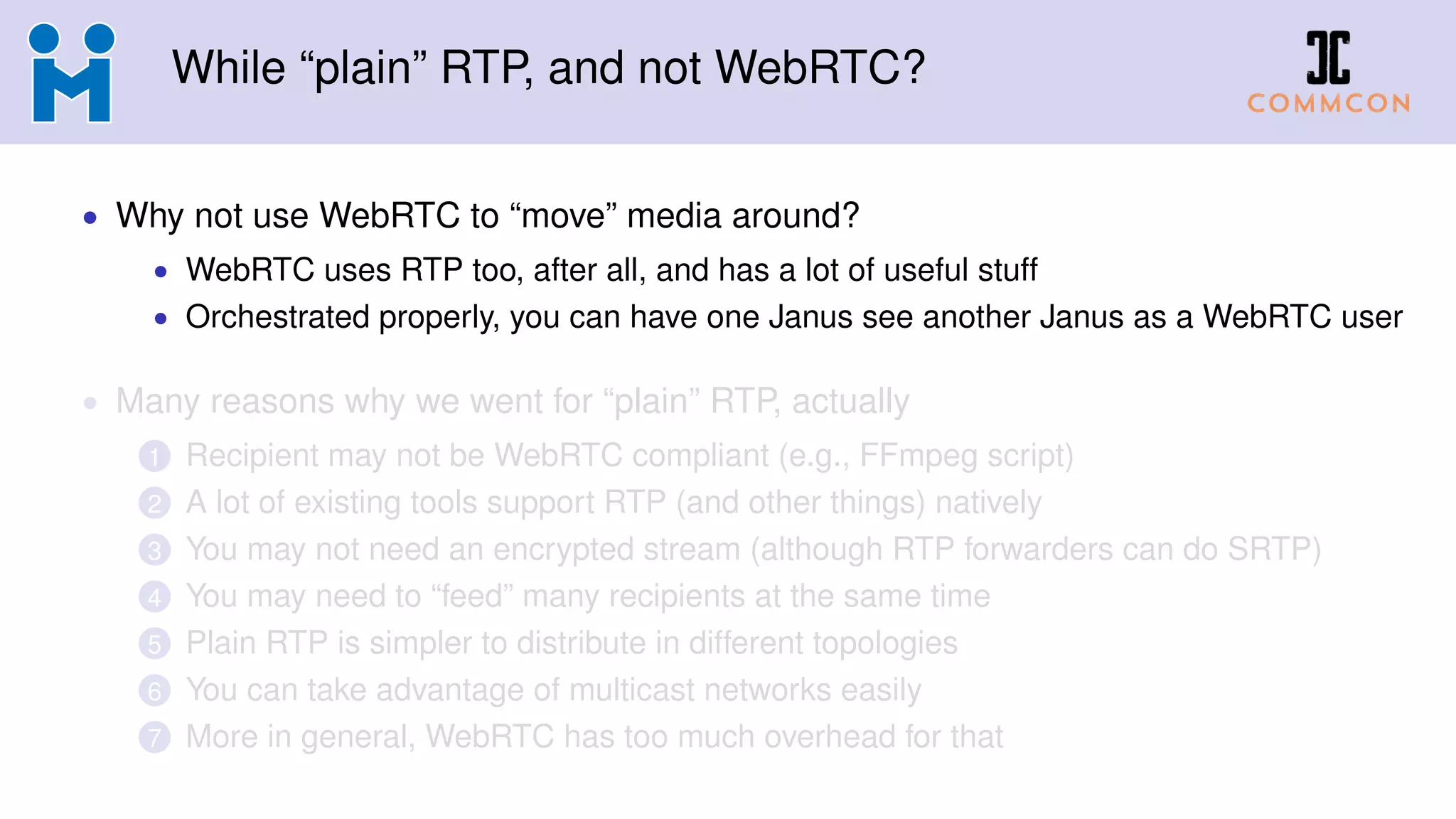
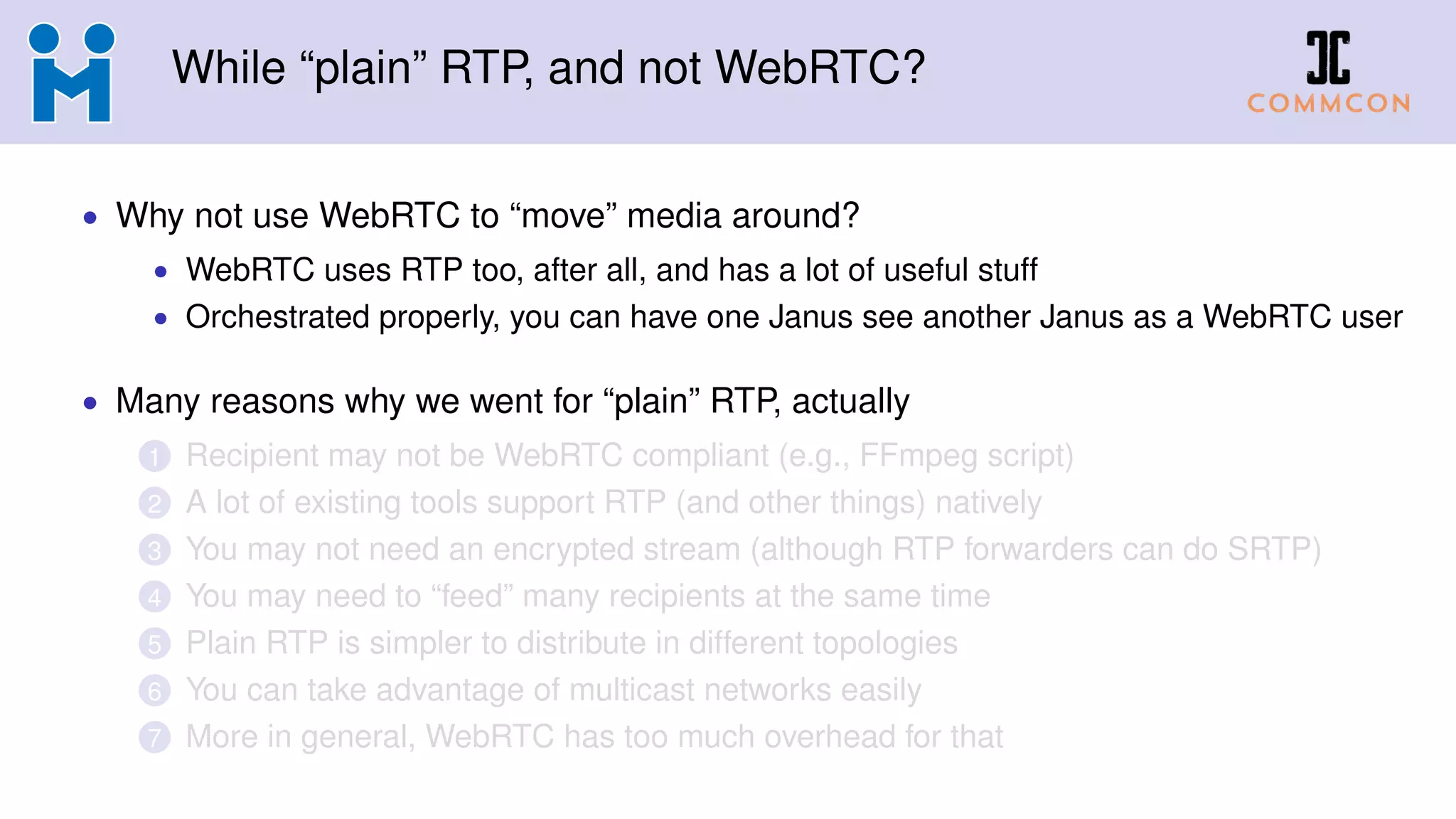
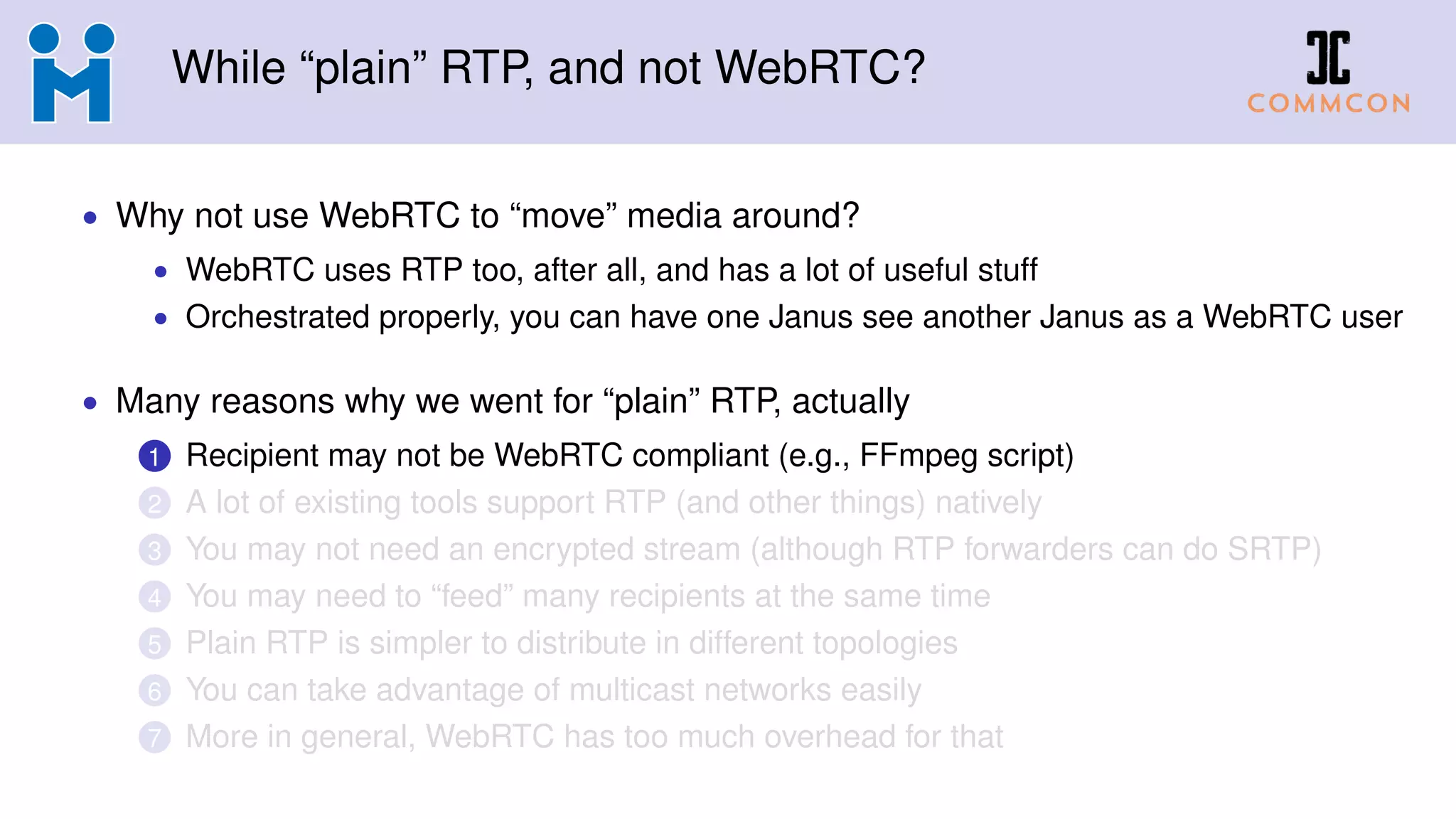
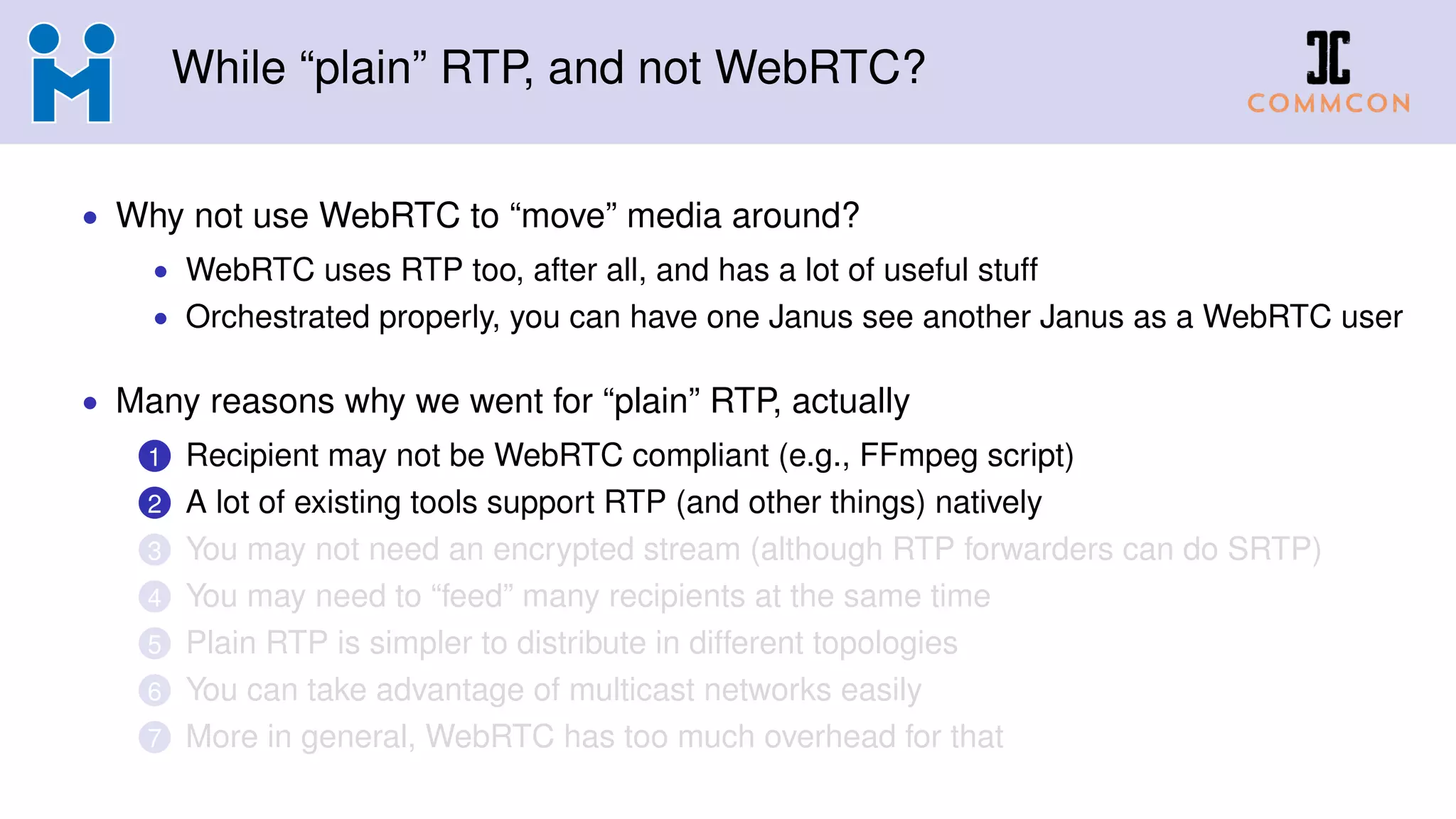
While “plain” RTP, and not WebRTC?
• Why not use WebRTC to “move” media around?
• WebRTC uses RTP too, after all, and has a lot of useful stuff
• Orchestrated properly, you can have one Janus see another Janus as a WebRTC user
• Many reasons why we went for “plain” RTP, actually
1 Recipient may not be WebRTC compliant (e.g., FFmpeg script)
2 A lot of existing tools support RTP (and other things) natively
3 You may not need an encrypted stream (although RTP forwarders can do SRTP)
4 You may need to “feed” many recipients at the same time
5 Plain RTP is simpler to distribute in different topologies
6 You can take advantage of multicast networks easily
7 More in general, WebRTC has too much overhead for that
While “plain” RTP, and not WebRTC?
• Why not use WebRTC to “move” media around?
• WebRTC uses RTP too, after all, and has a lot of useful stuff
• Orchestrated properly, you can have one Janus see another Janus as a WebRTC user
• Many reasons why we went for “plain” RTP, actually
1 Recipient may not be WebRTC compliant (e.g., FFmpeg script)
2 A lot of existing tools support RTP (and other things) natively
3 You may not need an encrypted stream (although RTP forwarders can do SRTP)
4 You may need to “feed” many recipients at the same time
5 Plain RTP is simpler to distribute in different topologies
6 You can take advantage of multicast networks easily
7 More in general, WebRTC has too much overhead for that
While “plain” RTP, and not WebRTC?
• Why not use WebRTC to “move” media around?
• WebRTC uses RTP too, after all, and has a lot of useful stuff
• Orchestrated properly, you can have one Janus see another Janus as a WebRTC user
• Many reasons why we went for “plain” RTP, actually
1 Recipient may not be WebRTC compliant (e.g., FFmpeg script)
2 A lot of existing tools support RTP (and other things) natively
3 You may not need an encrypted stream (although RTP forwarders can do SRTP)
4 You may need to “feed” many recipients at the same time
5 Plain RTP is simpler to distribute in different topologies
6 You can take advantage of multicast networks easily
7 More in general, WebRTC has too much overhead for that
While “plain” RTP, and not WebRTC?
• Why not use WebRTC to “move” media around?
• WebRTC uses RTP too, after all, and has a lot of useful stuff
• Orchestrated properly, you can have one Janus see another Janus as a WebRTC user
• Many reasons why we went for “plain” RTP, actually
1 Recipient may not be WebRTC compliant (e.g., FFmpeg script)
2 A lot of existing tools support RTP (and other things) natively
3 You may not need an encrypted stream (although RTP forwarders can do SRTP)
4 You may need to “feed” many recipients at the same time
5 Plain RTP is simpler to distribute in different topologies
6 You can take advantage of multicast networks easily
7 More in general, WebRTC has too much overhead for that
While “plain” RTP, and not WebRTC?
• Why not use WebRTC to “move” media around?
• WebRTC uses RTP too, after all, and has a lot of useful stuff
• Orchestrated properly, you can have one Janus see another Janus as a WebRTC user
• Many reasons why we went for “plain” RTP, actually
1 Recipient may not be WebRTC compliant (e.g., FFmpeg script)
2 A lot of existing tools support RTP (and other things) natively
3 You may not need an encrypted stream (although RTP forwarders can do SRTP)
4 You may need to “feed” many recipients at the same time
5 Plain RTP is simpler to distribute in different topologies
6 You can take advantage of multicast networks easily
7 More in general, WebRTC has too much overhead for that
While “plain” RTP, and not WebRTC?
• Why not use WebRTC to “move” media around?
• WebRTC uses RTP too, after all, and has a lot of useful stuff
• Orchestrated properly, you can have one Janus see another Janus as a WebRTC user
• Many reasons why we went for “plain” RTP, actually
1 Recipient may not be WebRTC compliant (e.g., FFmpeg script)
2 A lot of existing tools support RTP (and other things) natively
3 You may not need an encrypted stream (although RTP forwarders can do SRTP)
4 You may need to “feed” many recipients at the same time
5 Plain RTP is simpler to distribute in different topologies
6 You can take advantage of multicast networks easily
7 More in general, WebRTC has too much overhead for that
While “plain” RTP, and not WebRTC?
• Why not use WebRTC to “move” media around?
• WebRTC uses RTP too, after all, and has a lot of useful stuff
• Orchestrated properly, you can have one Janus see another Janus as a WebRTC user
• Many reasons why we went for “plain” RTP, actually
1 Recipient may not be WebRTC compliant (e.g., FFmpeg script)
2 A lot of existing tools support RTP (and other things) natively
3 You may not need an encrypted stream (although RTP forwarders can do SRTP)
4 You may need to “feed” many recipients at the same time
5 Plain RTP is simpler to distribute in different topologies
6 You can take advantage of multicast networks easily
7 More in general, WebRTC has too much overhead for that
While “plain” RTP, and not WebRTC?
• Why not use WebRTC to “move” media around?
• WebRTC uses RTP too, after all, and has a lot of useful stuff
• Orchestrated properly, you can have one Janus see another Janus as a WebRTC user
• Many reasons why we went for “plain” RTP, actually
1 Recipient may not be WebRTC compliant (e.g., FFmpeg script)
2 A lot of existing tools support RTP (and other things) natively
3 You may not need an encrypted stream (although RTP forwarders can do SRTP)
4 You may need to “feed” many recipients at the same time
5 Plain RTP is simpler to distribute in different topologies
6 You can take advantage of multicast networks easily
7 More in general, WebRTC has too much overhead for that
While “plain” RTP, and not WebRTC?
• Why not use WebRTC to “move” media around?
• WebRTC uses RTP too, after all, and has a lot of useful stuff
• Orchestrated properly, you can have one Janus see another Janus as a WebRTC user
• Many reasons why we went for “plain” RTP, actually
1 Recipient may not be WebRTC compliant (e.g., FFmpeg script)
2 A lot of existing tools support RTP (and other things) natively
3 You may not need an encrypted stream (although RTP forwarders can do SRTP)
4 You may need to “feed” many recipients at the same time
5 Plain RTP is simpler to distribute in different topologies
6 You can take advantage of multicast networks easily
7 More in general, WebRTC has too much overhead for that
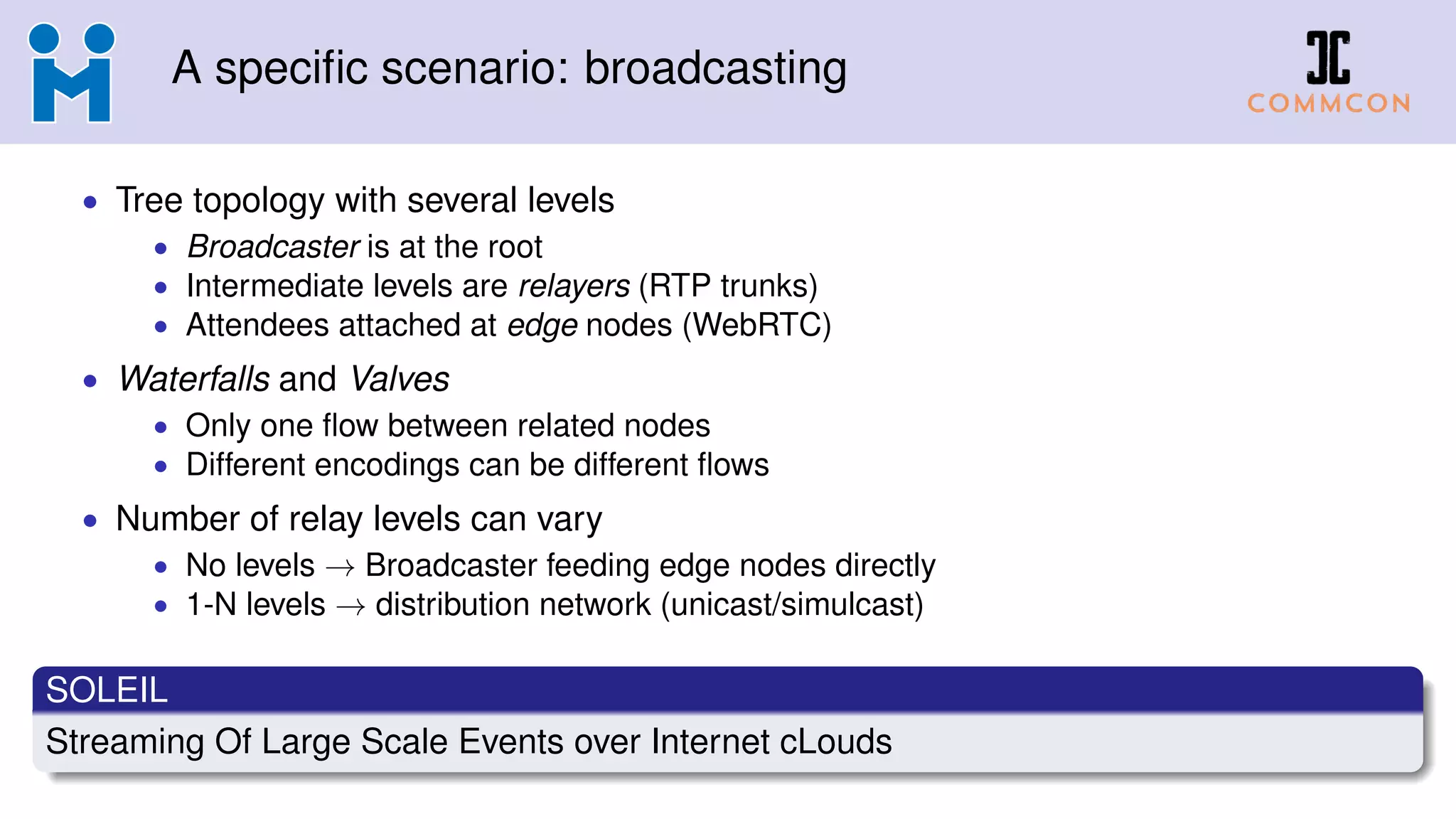
A specific scenario: broadcasting
• Tree topology with several levels
• Broadcaster is at the root
• Intermediate levels are relayers (RTP trunks)
• Attendees attached at edge nodes (WebRTC)
• Waterfalls and Valves
• Only one flow between related nodes
• Different encodings can be different flows
• Number of relay levels can vary
• No levels → Broadcaster feeding edge nodes directly
• 1-N levels → distribution network (unicast/simulcast)
SOLEIL
Streaming Of Large Scale Events over Internet cLouds
A specific scenario: broadcasting
• Tree topology with several levels
• Broadcaster is at the root
• Intermediate levels are relayers (RTP trunks)
• Attendees attached at edge nodes (WebRTC)
• Waterfalls and Valves
• Only one flow between related nodes
• Different encodings can be different flows
• Number of relay levels can vary
• No levels → Broadcaster feeding edge nodes directly
• 1-N levels → distribution network (unicast/simulcast)
SOLEIL
Streaming Of Large Scale Events over Internet cLouds
A specific scenario: broadcasting
• Tree topology with several levels
• Broadcaster is at the root
• Intermediate levels are relayers (RTP trunks)
• Attendees attached at edge nodes (WebRTC)
• Waterfalls and Valves
• Only one flow between related nodes
• Different encodings can be different flows
• Number of relay levels can vary
• No levels → Broadcaster feeding edge nodes directly
• 1-N levels → distribution network (unicast/simulcast)
SOLEIL
Streaming Of Large Scale Events over Internet cLouds
A specific scenario: broadcasting
• Tree topology with several levels
• Broadcaster is at the root
• Intermediate levels are relayers (RTP trunks)
• Attendees attached at edge nodes (WebRTC)
• Waterfalls and Valves
• Only one flow between related nodes
• Different encodings can be different flows
• Number of relay levels can vary
• No levels → Broadcaster feeding edge nodes directly
• 1-N levels → distribution network (unicast/simulcast)
SOLEIL
Streaming Of Large Scale Events over Internet cLouds
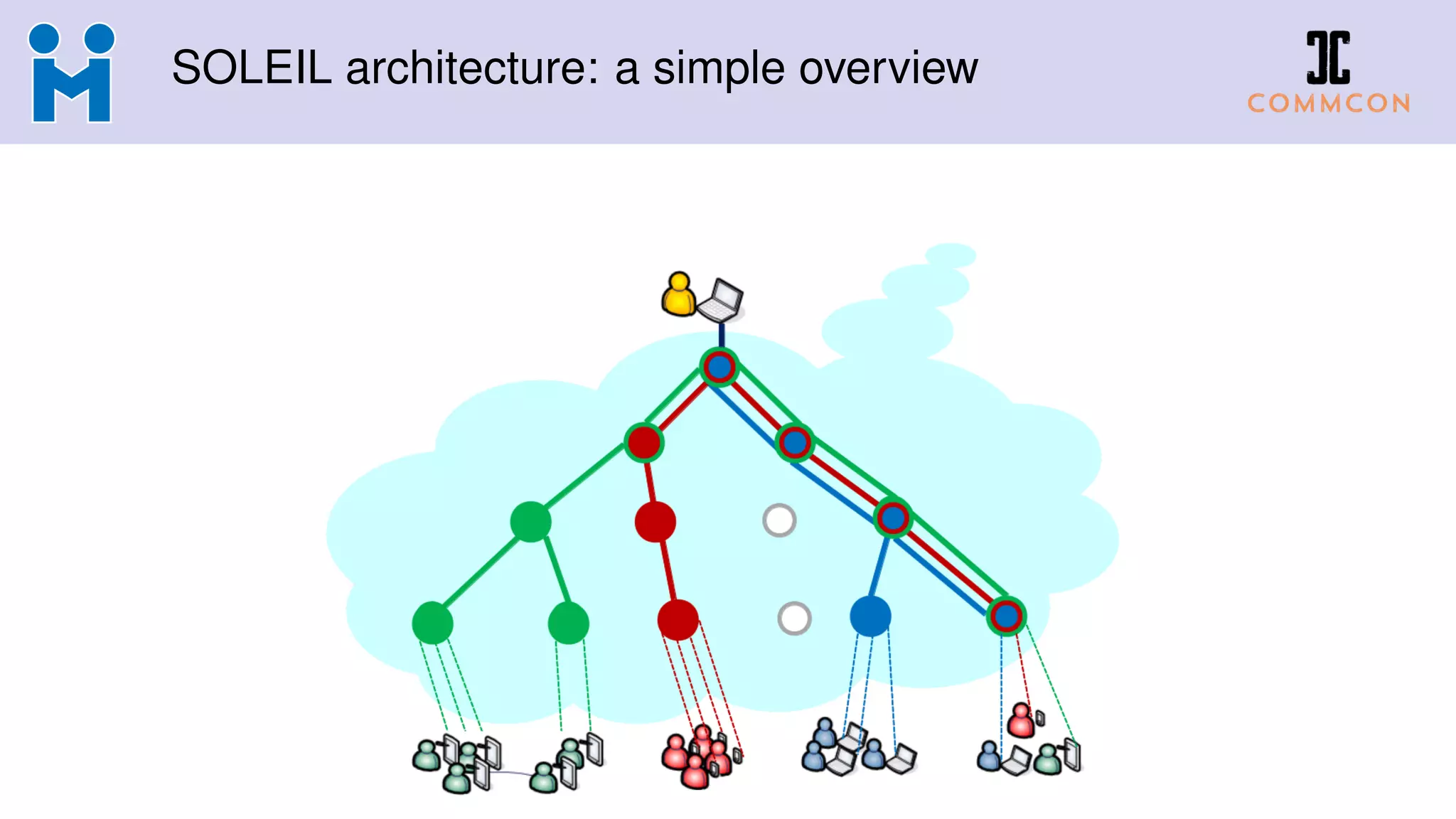
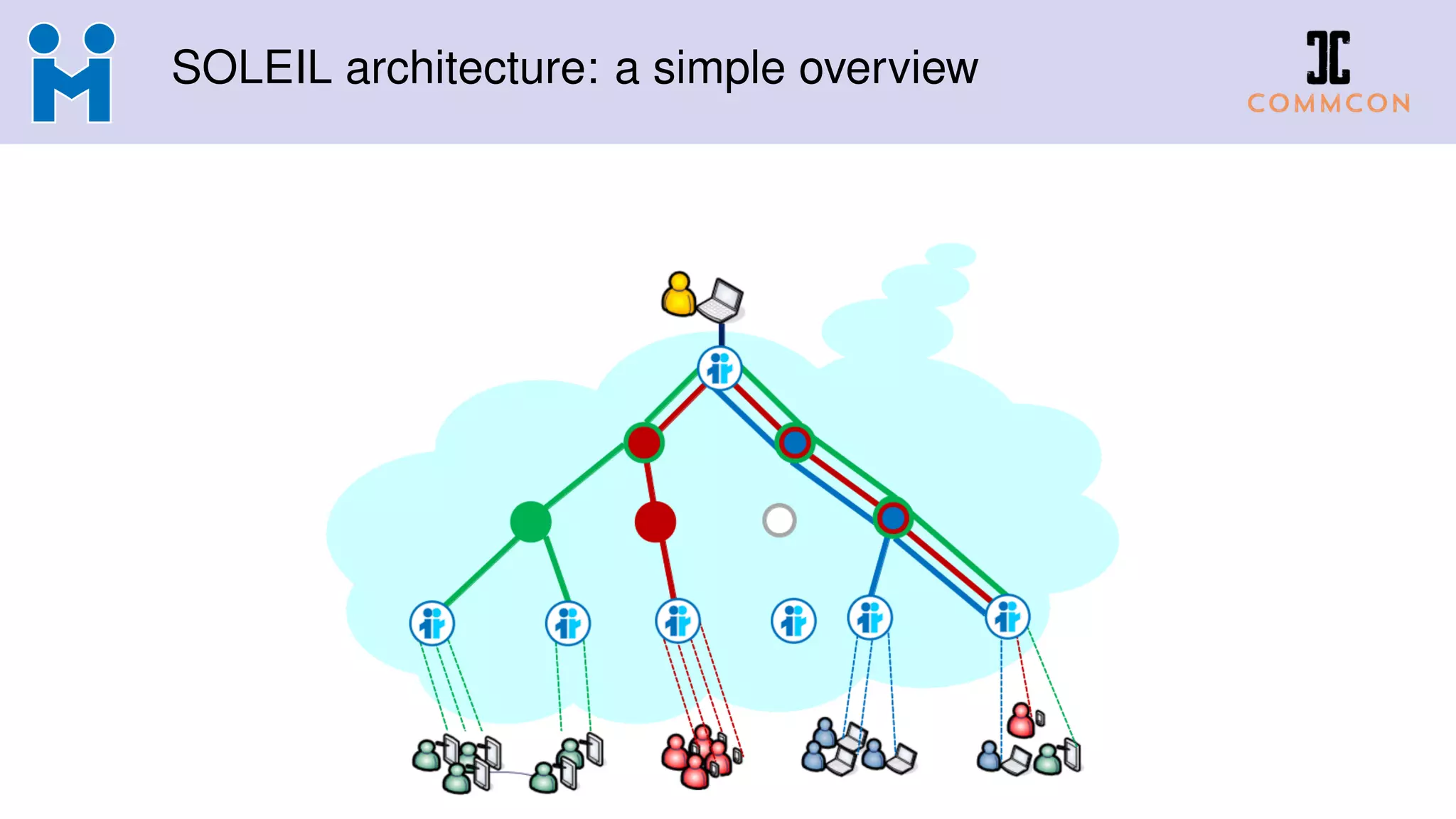
SOLEIL architecture: a simple overview
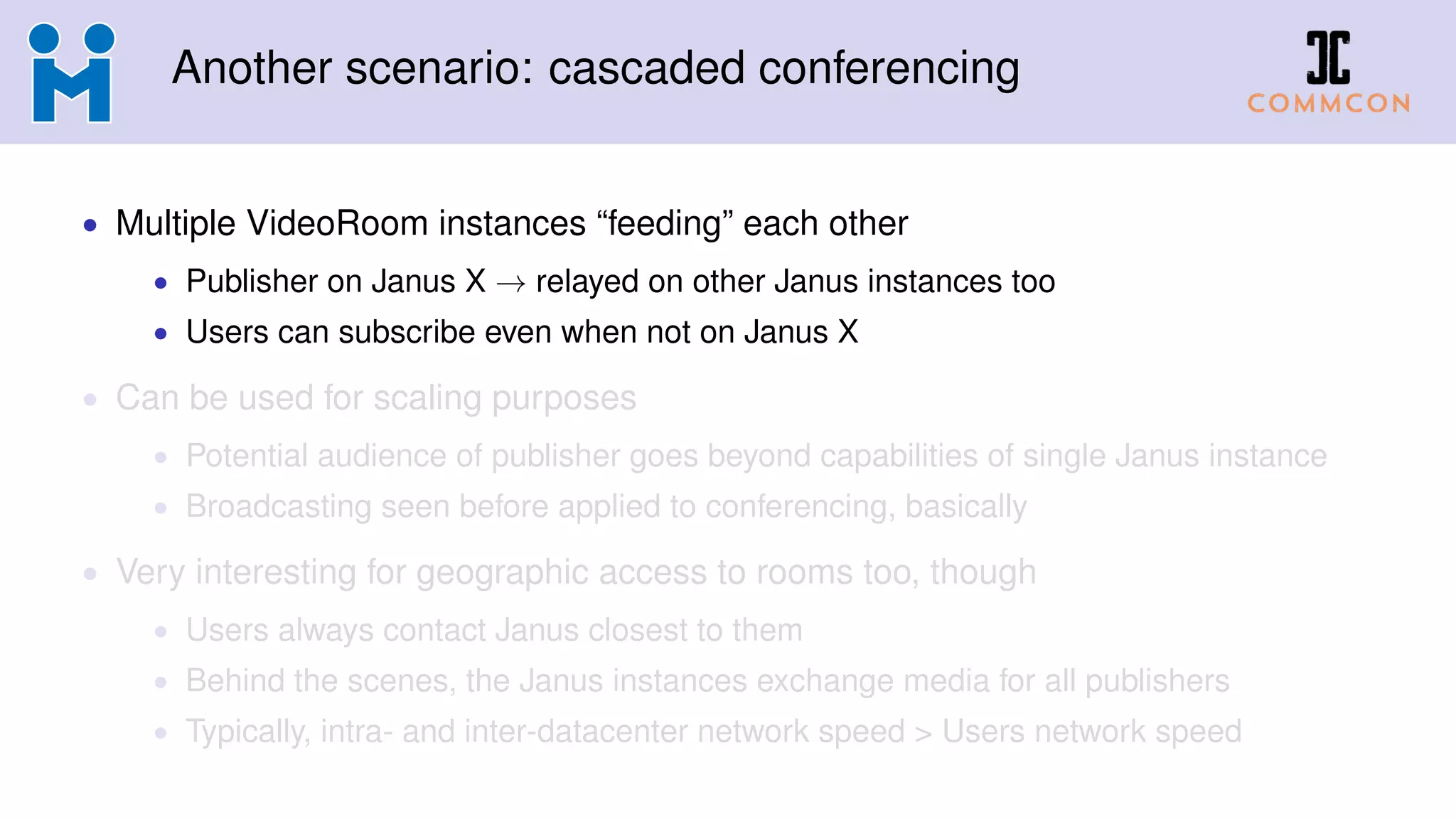
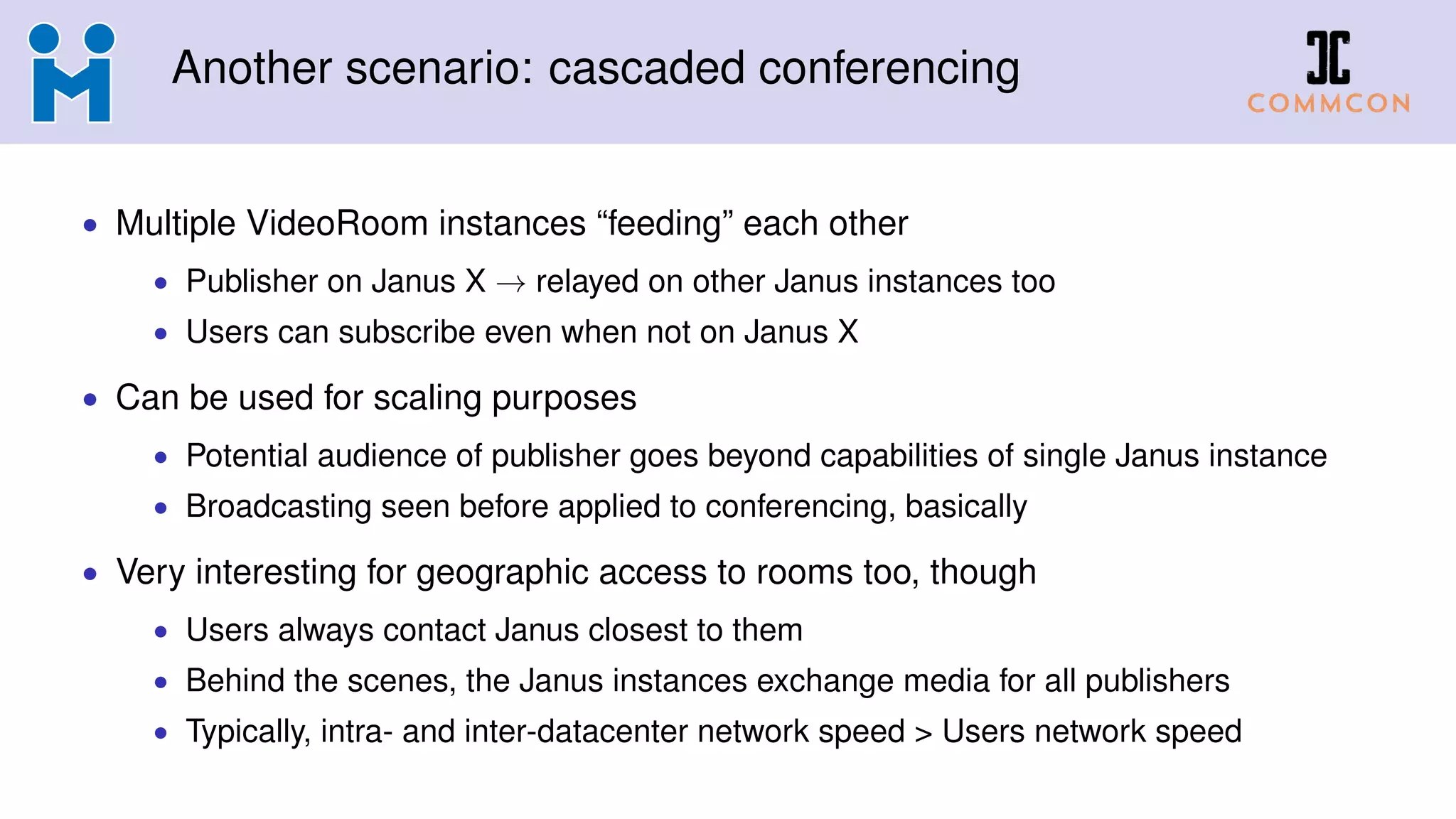
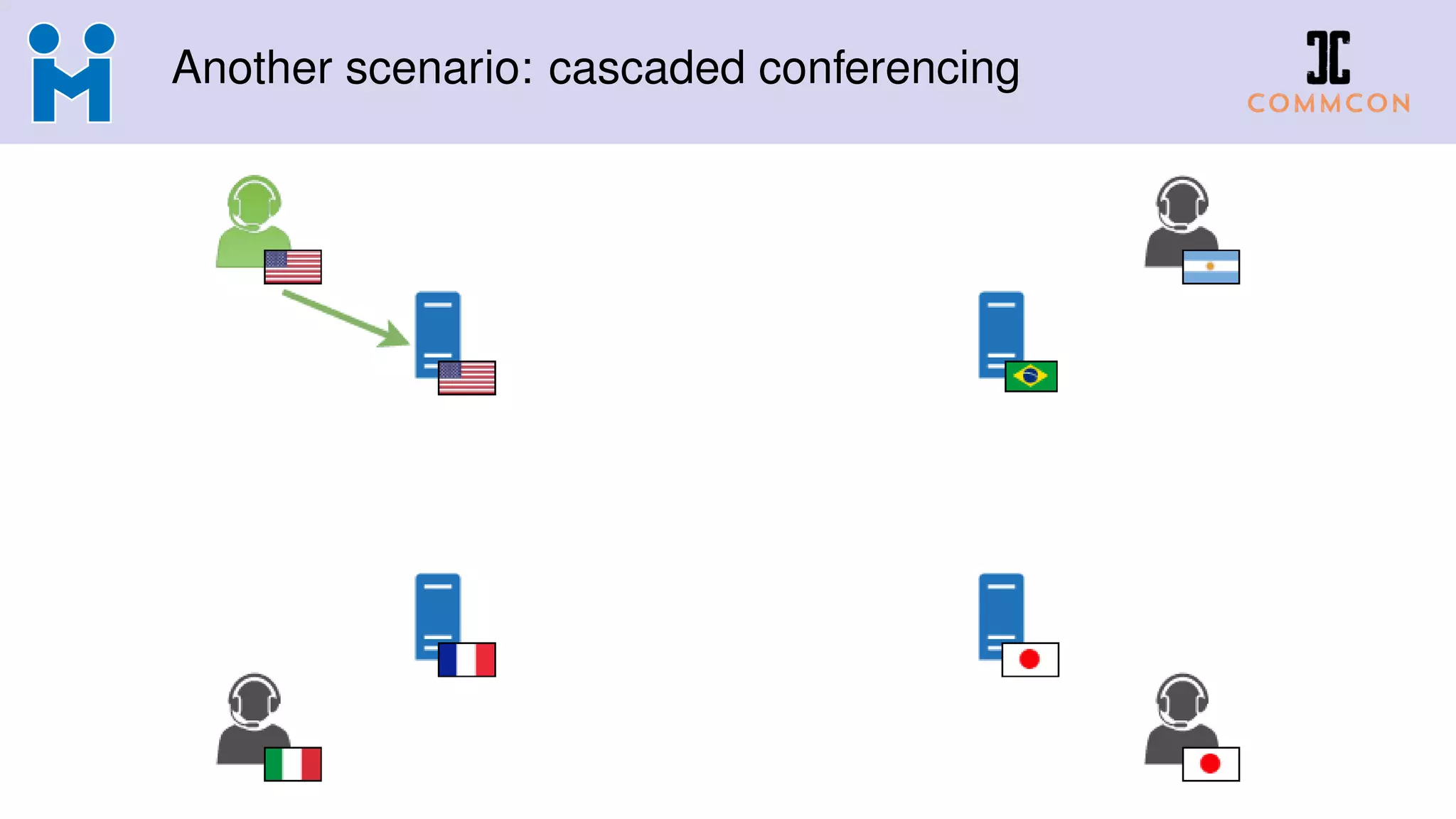
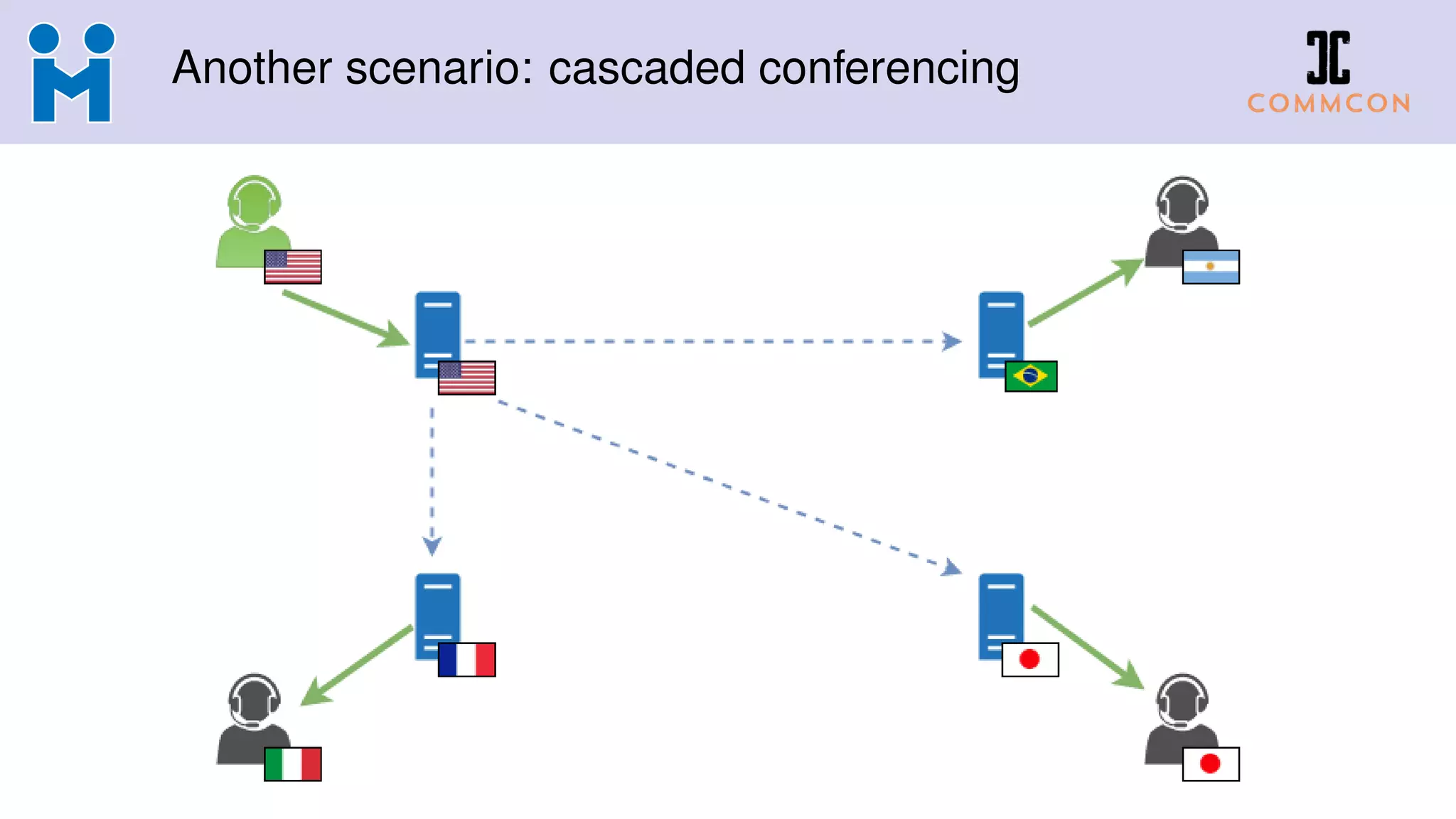
Another scenario: cascaded conferencing
• Multiple VideoRoom instances “feeding” each other
• Publisher on Janus X → relayed on other Janus instances too
• Users can subscribe even when not on Janus X
• Can be used for scaling purposes
• Potential audience of publisher goes beyond capabilities of single Janus instance
• Broadcasting seen before applied to conferencing, basically
• Very interesting for geographic access to rooms too, though
• Users always contact Janus closest to them
• Behind the scenes, the Janus instances exchange media for all publishers
• Typically, intra- and inter-datacenter network speed > Users network speed
Another scenario: cascaded conferencing
• Multiple VideoRoom instances “feeding” each other
• Publisher on Janus X → relayed on other Janus instances too
• Users can subscribe even when not on Janus X
• Can be used for scaling purposes
• Potential audience of publisher goes beyond capabilities of single Janus instance
• Broadcasting seen before applied to conferencing, basically
• Very interesting for geographic access to rooms too, though
• Users always contact Janus closest to them
• Behind the scenes, the Janus instances exchange media for all publishers
• Typically, intra- and inter-datacenter network speed > Users network speed
Another scenario: cascaded conferencing
• Multiple VideoRoom instances “feeding” each other
• Publisher on Janus X → relayed on other Janus instances too
• Users can subscribe even when not on Janus X
• Can be used for scaling purposes
• Potential audience of publisher goes beyond capabilities of single Janus instance
• Broadcasting seen before applied to conferencing, basically
• Very interesting for geographic access to rooms too, though
• Users always contact Janus closest to them
• Behind the scenes, the Janus instances exchange media for all publishers
• Typically, intra- and inter-datacenter network speed > Users network speed
Another scenario: cascaded conferencing
A few words on nuts and bolts
• We use Docker A LOT in our deployments
• Even though Janus can deal with NATs, we do prefer it to have a public IP
• Host networking makes it tricky to place more instances on the same machine
• Pipework: assign a dedicated IP address to a container
https://github.com/jpetazzo/pipework
• Docker native macvlan network driver also allows you to assign custom IPs to
containers. We’ll move to it sooner or later...
• Several people (including us) using Janus in clustered environments (Docker
Swarm, Kubernetes, ...)
• Auto-scaling by spawning new replicas as needed
• Live monitoring of machines’ resources (e.g., CPU, # connections, bandwidth) drives
the deployment process
A few words on nuts and bolts
• We use Docker A LOT in our deployments
• Even though Janus can deal with NATs, we do prefer it to have a public IP
• Host networking makes it tricky to place more instances on the same machine
• Pipework: assign a dedicated IP address to a container
https://github.com/jpetazzo/pipework
• Docker native macvlan network driver also allows you to assign custom IPs to
containers. We’ll move to it sooner or later...
• Several people (including us) using Janus in clustered environments (Docker
Swarm, Kubernetes, ...)
• Auto-scaling by spawning new replicas as needed
• Live monitoring of machines’ resources (e.g., CPU, # connections, bandwidth) drives
the deployment process
A few words on nuts and bolts
• We use Docker A LOT in our deployments
• Even though Janus can deal with NATs, we do prefer it to have a public IP
• Host networking makes it tricky to place more instances on the same machine
• Pipework: assign a dedicated IP address to a container
https://github.com/jpetazzo/pipework
• Docker native macvlan network driver also allows you to assign custom IPs to
containers. We’ll move to it sooner or later...
• Several people (including us) using Janus in clustered environments (Docker
Swarm, Kubernetes, ...)
• Auto-scaling by spawning new replicas as needed
• Live monitoring of machines’ resources (e.g., CPU, # connections, bandwidth) drives
the deployment process
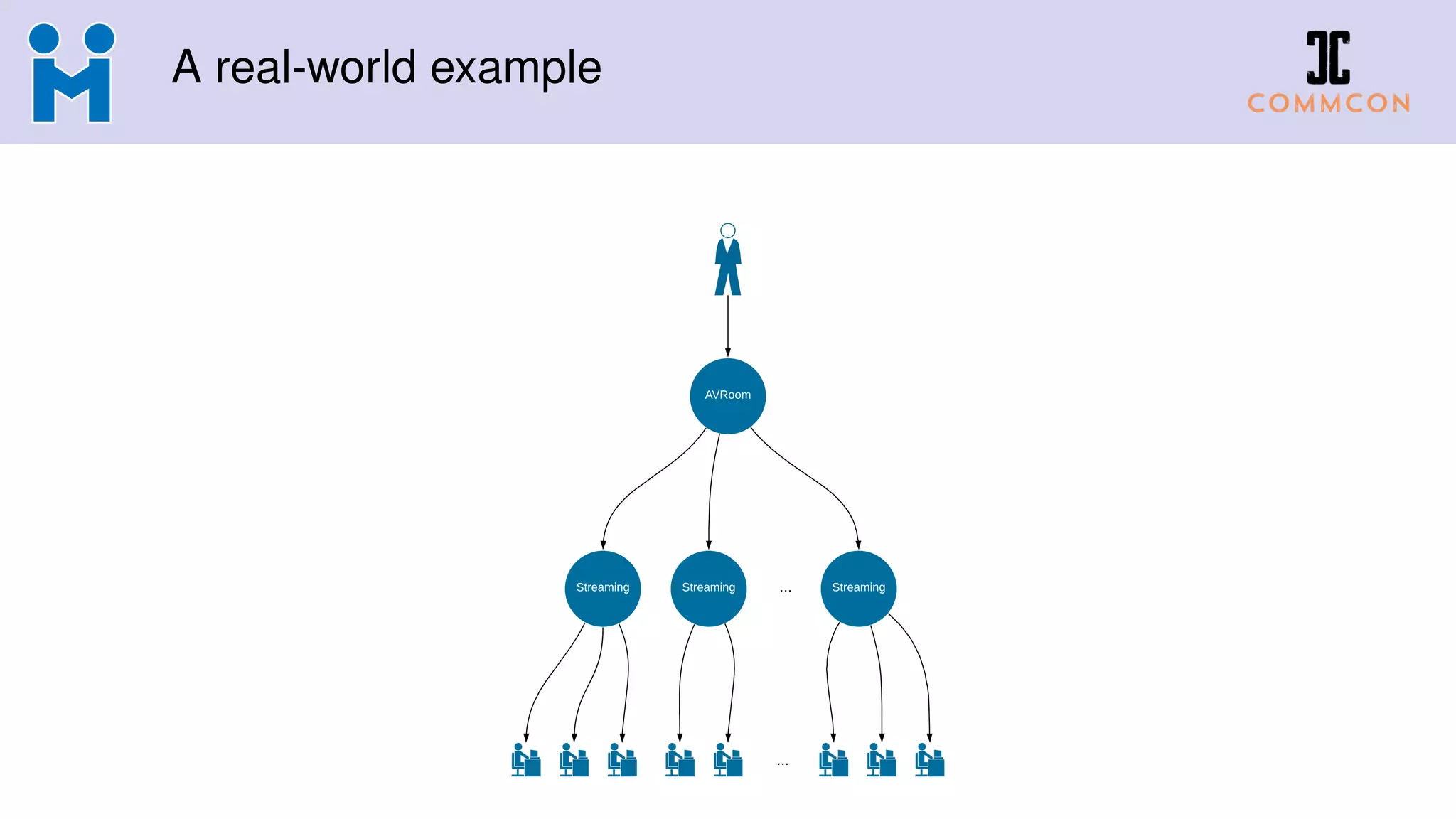
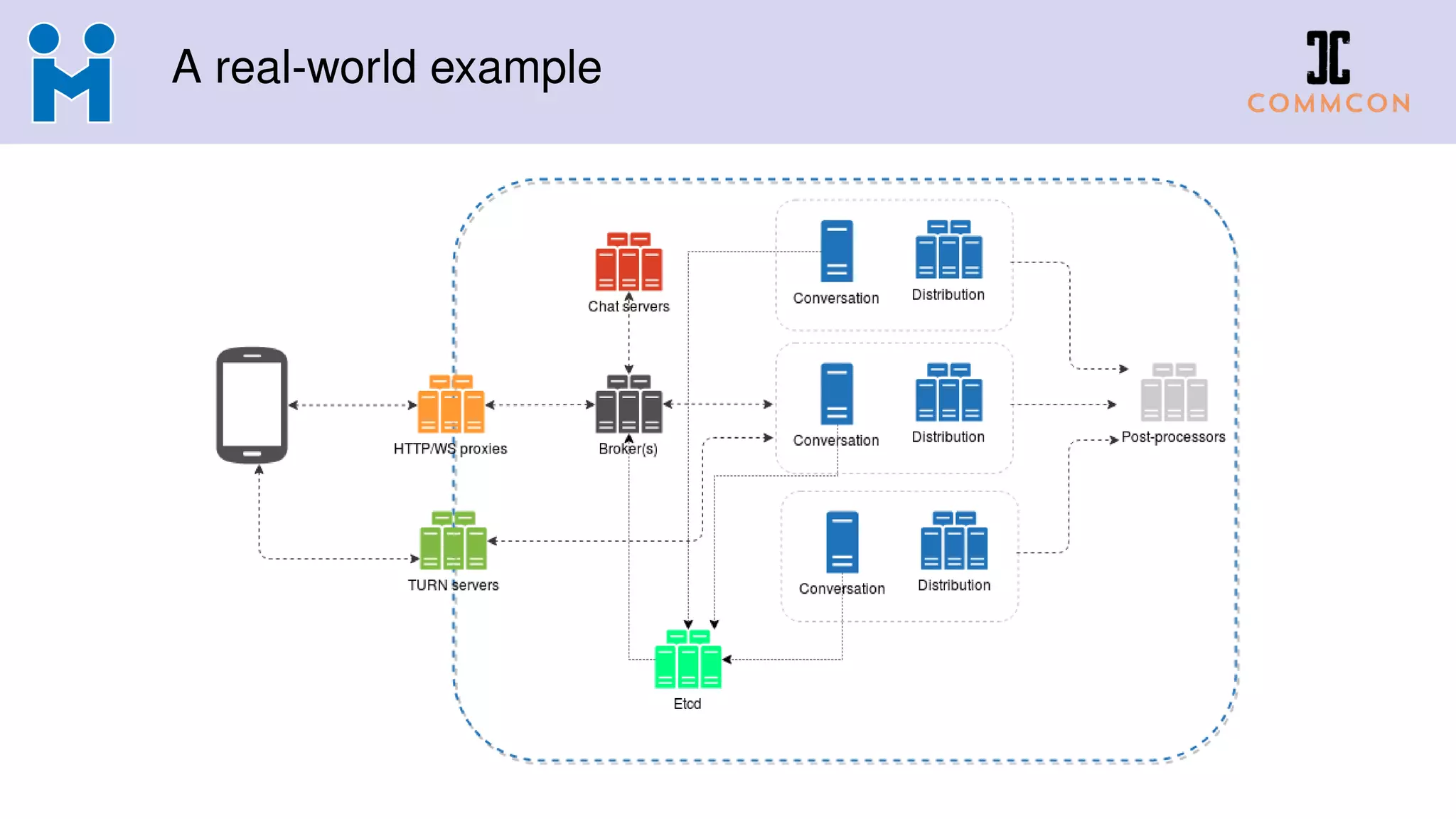
A real-world example
Thanks! Questions? Comments?
Contacts
• https://twitter.com/elminiero
• https://twitter.com/meetecho
• http://www.meetecho.com

Scaling server side web rtc applications the janus challenge by lorenzo miniero

  • 1.
    Scaling server-side WebRTCapplications: the Janus challenge Lorenzo Miniero @elminiero CommCon 2018 June 27th 2018, Wotton House, Surrey (UK)
  • 2.
    Sorry Dan, pineappleson pizza = BIG NO
  • 3.
    A picture ofme as a kid for no reason Lorenzo Miniero • Ph.D @ UniNA • Chairman @ Meetecho • Open source believer Contacts and info • lorenzo@meetecho.com • https://twitter.com/elminiero • https://www.slideshare.net/LorenzoMiniero
  • 4.
    1. No, Idon’t know what happened...
  • 5.
    2. Yes, Policeis still looking for who stole my cheeks
  • 6.
    Ok, let’s stopclowning around... Lorenzo Miniero • Ph.D @ UniNA • Chairman @ Meetecho • Open source believer Contacts and info • lorenzo@meetecho.com • https://twitter.com/elminiero • https://www.slideshare.net/LorenzoMiniero
  • 7.
    What is Janus? Janus Generalpurpose, open source WebRTC server • https://github.com/meetecho/janus-gateway • Demos and documentation: https://janus.conf.meetecho.com • Community: https://groups.google.com/forum/#!forum/meetecho-janus
  • 8.
    Modular architecture • Thecore only implements the WebRTC stack • JSEP/SDP, ICE, DTLS-SRTP, Data Channels, ... • Plugins expose Janus API over different “transports” • Currently HTTP / WebSockets / RabbitMQ / Unix Sockets / MQTT / Nanomsg • “Application” logic implemented in plugins too • Users attach to plugins via the Janus core • The core handles the WebRTC stuff • Plugins route/manipulate the media/data • Plugins can be combined on client side as “bricks” • Video SFU, Audio MCU, SIP gatewaying, broadcasting, etc.
  • 9.
    Modular architecture • Thecore only implements the WebRTC stack • JSEP/SDP, ICE, DTLS-SRTP, Data Channels, ... • Plugins expose Janus API over different “transports” • Currently HTTP / WebSockets / RabbitMQ / Unix Sockets / MQTT / Nanomsg • “Application” logic implemented in plugins too • Users attach to plugins via the Janus core • The core handles the WebRTC stuff • Plugins route/manipulate the media/data • Plugins can be combined on client side as “bricks” • Video SFU, Audio MCU, SIP gatewaying, broadcasting, etc.
  • 10.
    Modular architecture • Thecore only implements the WebRTC stack • JSEP/SDP, ICE, DTLS-SRTP, Data Channels, ... • Plugins expose Janus API over different “transports” • Currently HTTP / WebSockets / RabbitMQ / Unix Sockets / MQTT / Nanomsg • “Application” logic implemented in plugins too • Users attach to plugins via the Janus core • The core handles the WebRTC stuff • Plugins route/manipulate the media/data • Plugins can be combined on client side as “bricks” • Video SFU, Audio MCU, SIP gatewaying, broadcasting, etc.
  • 11.
    Modular architecture • Thecore only implements the WebRTC stack • JSEP/SDP, ICE, DTLS-SRTP, Data Channels, ... • Plugins expose Janus API over different “transports” • Currently HTTP / WebSockets / RabbitMQ / Unix Sockets / MQTT / Nanomsg • “Application” logic implemented in plugins too • Users attach to plugins via the Janus core • The core handles the WebRTC stuff • Plugins route/manipulate the media/data • Plugins can be combined on client side as “bricks” • Video SFU, Audio MCU, SIP gatewaying, broadcasting, etc.
  • 12.
  • 13.
  • 14.
    A quick lookat plugins: SIP gateway
  • 15.
    A quick lookat plugins: RTP rebroadcaster
  • 16.
    A quick lookat plugins: Audio MCU
  • 17.
    A quick lookat plugins: Video SFU
  • 18.
    The first steptowards scaling: benchmarking • Measuring Janus performance is not trivial... • Different plugins have different behaviours • Different technologies have different impact • Need to focus on individual features • SIP Gateway (SIP plugin) • Multimedia streaming (Streaming plugin) • Audio mixing (AudioBridge plugin) • Video routing (VideoRoom plugin) • ... What about the results?1 • When just relaying, bandwidth is typically the real bottleneck • Linear vs. exponential resource increase depends on plugin and topologies 1 https://janus.conf.meetecho.com/citeus
  • 19.
    The first steptowards scaling: benchmarking • Measuring Janus performance is not trivial... • Different plugins have different behaviours • Different technologies have different impact • Need to focus on individual features • SIP Gateway (SIP plugin) • Multimedia streaming (Streaming plugin) • Audio mixing (AudioBridge plugin) • Video routing (VideoRoom plugin) • ... What about the results?1 • When just relaying, bandwidth is typically the real bottleneck • Linear vs. exponential resource increase depends on plugin and topologies 1 https://janus.conf.meetecho.com/citeus
  • 20.
    The first steptowards scaling: benchmarking • Measuring Janus performance is not trivial... • Different plugins have different behaviours • Different technologies have different impact • Need to focus on individual features • SIP Gateway (SIP plugin) • Multimedia streaming (Streaming plugin) • Audio mixing (AudioBridge plugin) • Video routing (VideoRoom plugin) • ... What about the results?1 • When just relaying, bandwidth is typically the real bottleneck • Linear vs. exponential resource increase depends on plugin and topologies 1 https://janus.conf.meetecho.com/citeus
  • 21.
    Beyond a singleJanus instance: different strategies • Once performance is evaluated, other aspects come into play • Does a user stream need to stay within the plugin? • Can it be sent to/received from somewhere else? • Will this affect other connections? • How much is the context important? • What level of orchestration is needed? • All those questions can lead to different answers/solutions, e.g. 1 Plain load balancing 2 Media resource brokering (MRB) 3 Sharing the “burden” 4 Cascaded delivery 5 ...
  • 22.
    Beyond a singleJanus instance: different strategies • Once performance is evaluated, other aspects come into play • Does a user stream need to stay within the plugin? • Can it be sent to/received from somewhere else? • Will this affect other connections? • How much is the context important? • What level of orchestration is needed? • All those questions can lead to different answers/solutions, e.g. 1 Plain load balancing 2 Media resource brokering (MRB) 3 Sharing the “burden” 4 Cascaded delivery 5 ...
  • 23.
    Plain load balancing •The simplest strategy of them all • You have N Janus instances available • You allocate users on one according to some logic • No orchestration needed, just knowledge of Janus addresses • User has list vs. HAProxy vs. nginx vs. ... • Logic can differ depending on the application • Pick a random server? • Use round robin? • Pick the one closest to the user? • Pick the least loaded? • Something else and/or any combination of the above?
  • 24.
    Plain load balancing •The simplest strategy of them all • You have N Janus instances available • You allocate users on one according to some logic • No orchestration needed, just knowledge of Janus addresses • User has list vs. HAProxy vs. nginx vs. ... • Logic can differ depending on the application • Pick a random server? • Use round robin? • Pick the one closest to the user? • Pick the least loaded? • Something else and/or any combination of the above?
  • 25.
    Plain load balancing •The simplest strategy of them all • You have N Janus instances available • You allocate users on one according to some logic • No orchestration needed, just knowledge of Janus addresses • User has list vs. HAProxy vs. nginx vs. ... • Logic can differ depending on the application • Pick a random server? • Use round robin? • Pick the one closest to the user? • Pick the least loaded? • Something else and/or any combination of the above?
  • 26.
  • 27.
  • 28.
  • 29.
    Plain load balancinglimitations • The only safe option is the SIP plugin • All streams are independent of each other • Even those that are related, are related via the SIP infrastructure • It might work with the Streaming plugin... • ... as long as you make sure the same mountpoints exist on all servers... • ... and they’re all fed with the same data! • With other plugins (e.g., AudioBridge or VideoRoom), it’s not as simple • Users meant for the same room may end up on different servers • ... unless the balancing component is aware of the context (“room”) • What about hosting the same room on different servers? • May work, but is also messy • Different contexts, multiple signalling channels, events overhead
  • 30.
    Plain load balancinglimitations • The only safe option is the SIP plugin • All streams are independent of each other • Even those that are related, are related via the SIP infrastructure • It might work with the Streaming plugin... • ... as long as you make sure the same mountpoints exist on all servers... • ... and they’re all fed with the same data! • With other plugins (e.g., AudioBridge or VideoRoom), it’s not as simple • Users meant for the same room may end up on different servers • ... unless the balancing component is aware of the context (“room”) • What about hosting the same room on different servers? • May work, but is also messy • Different contexts, multiple signalling channels, events overhead
  • 31.
    Plain load balancinglimitations • The only safe option is the SIP plugin • All streams are independent of each other • Even those that are related, are related via the SIP infrastructure • It might work with the Streaming plugin... • ... as long as you make sure the same mountpoints exist on all servers... • ... and they’re all fed with the same data! • With other plugins (e.g., AudioBridge or VideoRoom), it’s not as simple • Users meant for the same room may end up on different servers • ... unless the balancing component is aware of the context (“room”) • What about hosting the same room on different servers? • May work, but is also messy • Different contexts, multiple signalling channels, events overhead
  • 32.
    Plain load balancinglimitations • The only safe option is the SIP plugin • All streams are independent of each other • Even those that are related, are related via the SIP infrastructure • It might work with the Streaming plugin... • ... as long as you make sure the same mountpoints exist on all servers... • ... and they’re all fed with the same data! • With other plugins (e.g., AudioBridge or VideoRoom), it’s not as simple • Users meant for the same room may end up on different servers • ... unless the balancing component is aware of the context (“room”) • What about hosting the same room on different servers? • May work, but is also messy • Different contexts, multiple signalling channels, events overhead
  • 33.
    Plain load balancinglimitations • The only safe option is the SIP plugin • All streams are independent of each other • Even those that are related, are related via the SIP infrastructure • It might work with the Streaming plugin... • ... as long as you make sure the same mountpoints exist on all servers... • ... and they’re all fed with the same data! • With other plugins (e.g., AudioBridge or VideoRoom), it’s not as simple • Users meant for the same room may end up on different servers • ... unless the balancing component is aware of the context (“room”) • What about hosting the same room on different servers? • May work, but is also messy • Different contexts, multiple signalling channels, events overhead
  • 34.
    Media resource brokering •A step above Plain load balancing • You have N Janus instances available • You allocate users based on logic AND context • Orchestration needed, here • You need to know which Janus instances are available... • ... and which one is doing what • Logic will differ depending on the context • Before allocating users, you allocate the context itself (e.g., a conference room) • Users are then sent wherever their context belongs to • Unlike Plain load balancing, can be used for everything • You just need to implement context awareness somehow, and track resources
  • 35.
    Media resource brokering •A step above Plain load balancing • You have N Janus instances available • You allocate users based on logic AND context • Orchestration needed, here • You need to know which Janus instances are available... • ... and which one is doing what • Logic will differ depending on the context • Before allocating users, you allocate the context itself (e.g., a conference room) • Users are then sent wherever their context belongs to • Unlike Plain load balancing, can be used for everything • You just need to implement context awareness somehow, and track resources
  • 36.
    Media resource brokering •A step above Plain load balancing • You have N Janus instances available • You allocate users based on logic AND context • Orchestration needed, here • You need to know which Janus instances are available... • ... and which one is doing what • Logic will differ depending on the context • Before allocating users, you allocate the context itself (e.g., a conference room) • Users are then sent wherever their context belongs to • Unlike Plain load balancing, can be used for everything • You just need to implement context awareness somehow, and track resources
  • 37.
    Media resource brokering •A step above Plain load balancing • You have N Janus instances available • You allocate users based on logic AND context • Orchestration needed, here • You need to know which Janus instances are available... • ... and which one is doing what • Logic will differ depending on the context • Before allocating users, you allocate the context itself (e.g., a conference room) • Users are then sent wherever their context belongs to • Unlike Plain load balancing, can be used for everything • You just need to implement context awareness somehow, and track resources
  • 38.
    Media resource brokeringuse case • Will work nicely with all plugins, if you manage the context • Context may give more info to SIP balancing logic • Conference rooms and Streaming mountpoints can be associated to instances • Broadcasting with Streaming plugin... • ... if MRB knows Janus X hosts mountpoint Y, it can send users there • Conference rooms with AudioBridge and/or VideoRoom... • New rooms can be “deployed” on a specific instance • Attempts to join room Y can be sent to Janus instance responsible for it • Won’t help much when the same resource needs to be scaled, though • e.g., many small rooms vs. one very large room • For that, some different approach is needed
  • 39.
    Media resource brokeringuse case • Will work nicely with all plugins, if you manage the context • Context may give more info to SIP balancing logic • Conference rooms and Streaming mountpoints can be associated to instances • Broadcasting with Streaming plugin... • ... if MRB knows Janus X hosts mountpoint Y, it can send users there • Conference rooms with AudioBridge and/or VideoRoom... • New rooms can be “deployed” on a specific instance • Attempts to join room Y can be sent to Janus instance responsible for it • Won’t help much when the same resource needs to be scaled, though • e.g., many small rooms vs. one very large room • For that, some different approach is needed
  • 40.
    Media resource brokeringuse case • Will work nicely with all plugins, if you manage the context • Context may give more info to SIP balancing logic • Conference rooms and Streaming mountpoints can be associated to instances • Broadcasting with Streaming plugin... • ... if MRB knows Janus X hosts mountpoint Y, it can send users there • Conference rooms with AudioBridge and/or VideoRoom... • New rooms can be “deployed” on a specific instance • Attempts to join room Y can be sent to Janus instance responsible for it • Won’t help much when the same resource needs to be scaled, though • e.g., many small rooms vs. one very large room • For that, some different approach is needed
  • 41.
    Media resource brokeringuse case • Will work nicely with all plugins, if you manage the context • Context may give more info to SIP balancing logic • Conference rooms and Streaming mountpoints can be associated to instances • Broadcasting with Streaming plugin... • ... if MRB knows Janus X hosts mountpoint Y, it can send users there • Conference rooms with AudioBridge and/or VideoRoom... • New rooms can be “deployed” on a specific instance • Attempts to join room Y can be sent to Janus instance responsible for it • Won’t help much when the same resource needs to be scaled, though • e.g., many small rooms vs. one very large room • For that, some different approach is needed
  • 42.
  • 43.
  • 44.
  • 45.
  • 46.
    Sharing the “burden” •A bit different from Brokering described before • You have N Janus instances available • You use one or more of them to serve the same context • Again, orchestration needed here too • You need to know which Janus instances are available... • ... and which one is serving which “subset” of the resource • Logic will differ depending on the resource • You identify how you can “split” the resource (unrelated parts) • Users are then sent where the resource “subset” is allocated • Less flexible than Balancing and Brokering, and more specific • Can greatly help optimize delivery scenarios, though, depending on the context
  • 47.
    Sharing the “burden” •A bit different from Brokering described before • You have N Janus instances available • You use one or more of them to serve the same context • Again, orchestration needed here too • You need to know which Janus instances are available... • ... and which one is serving which “subset” of the resource • Logic will differ depending on the resource • You identify how you can “split” the resource (unrelated parts) • Users are then sent where the resource “subset” is allocated • Less flexible than Balancing and Brokering, and more specific • Can greatly help optimize delivery scenarios, though, depending on the context
  • 48.
    Sharing the “burden” •A bit different from Brokering described before • You have N Janus instances available • You use one or more of them to serve the same context • Again, orchestration needed here too • You need to know which Janus instances are available... • ... and which one is serving which “subset” of the resource • Logic will differ depending on the resource • You identify how you can “split” the resource (unrelated parts) • Users are then sent where the resource “subset” is allocated • Less flexible than Balancing and Brokering, and more specific • Can greatly help optimize delivery scenarios, though, depending on the context
  • 49.
    Sharing the “burden” •A bit different from Brokering described before • You have N Janus instances available • You use one or more of them to serve the same context • Again, orchestration needed here too • You need to know which Janus instances are available... • ... and which one is serving which “subset” of the resource • Logic will differ depending on the resource • You identify how you can “split” the resource (unrelated parts) • Users are then sent where the resource “subset” is allocated • Less flexible than Balancing and Brokering, and more specific • Can greatly help optimize delivery scenarios, though, depending on the context
  • 50.
    Sharing the “burden”use case • A typical use case is larger conferences • Many active participants, with many viewers • The first step is identifying the resources, and how they’re related • Publishers will send media: they don’t “depend” on each other • Subscribers only receive media: they depend on a specific publisher • Publishers can be the “subset”, here • A large conference room becomes N 1-to-many smaller broadcasts • Each publisher→subscribers distribution is allocated separately • Controlling application makes sure that viewer picks streams from the right place • Bob from Janus1, Alice from Janus2, Tom from Janus3, Jim from Janus2, ...
  • 51.
    Sharing the “burden”use case • A typical use case is larger conferences • Many active participants, with many viewers • The first step is identifying the resources, and how they’re related • Publishers will send media: they don’t “depend” on each other • Subscribers only receive media: they depend on a specific publisher • Publishers can be the “subset”, here • A large conference room becomes N 1-to-many smaller broadcasts • Each publisher→subscribers distribution is allocated separately • Controlling application makes sure that viewer picks streams from the right place • Bob from Janus1, Alice from Janus2, Tom from Janus3, Jim from Janus2, ...
  • 52.
    Sharing the “burden”use case • A typical use case is larger conferences • Many active participants, with many viewers • The first step is identifying the resources, and how they’re related • Publishers will send media: they don’t “depend” on each other • Subscribers only receive media: they depend on a specific publisher • Publishers can be the “subset”, here • A large conference room becomes N 1-to-many smaller broadcasts • Each publisher→subscribers distribution is allocated separately • Controlling application makes sure that viewer picks streams from the right place • Bob from Janus1, Alice from Janus2, Tom from Janus3, Jim from Janus2, ...
  • 53.
    Sharing the “burden”use case • A typical use case is larger conferences • Many active participants, with many viewers • The first step is identifying the resources, and how they’re related • Publishers will send media: they don’t “depend” on each other • Subscribers only receive media: they depend on a specific publisher • Publishers can be the “subset”, here • A large conference room becomes N 1-to-many smaller broadcasts • Each publisher→subscribers distribution is allocated separately • Controlling application makes sure that viewer picks streams from the right place • Bob from Janus1, Alice from Janus2, Tom from Janus3, Jim from Janus2, ...
  • 54.
  • 55.
  • 56.
  • 57.
  • 58.
  • 59.
    RTP forwarding • Allstrategies so far assume related streams stay together • In smaller rooms, publishers and subscribers are all on the same server • In larger rooms, only the publisher and its subscribers are on the same server • No scenario where this relationship is broken • Apart from SIP and Streaming, but those are different (legacy interop) • How can streams from different servers interact? • Janus plugins don’t talk to each other... • ... and neither do different Janus instances! RTP forwarding A way to relay RTP behind the curtains, without WebRTC • e.g., relay VideoRoom publisher’s media to a Streaming mountpoint
  • 60.
    RTP forwarding • Allstrategies so far assume related streams stay together • In smaller rooms, publishers and subscribers are all on the same server • In larger rooms, only the publisher and its subscribers are on the same server • No scenario where this relationship is broken • Apart from SIP and Streaming, but those are different (legacy interop) • How can streams from different servers interact? • Janus plugins don’t talk to each other... • ... and neither do different Janus instances! RTP forwarding A way to relay RTP behind the curtains, without WebRTC • e.g., relay VideoRoom publisher’s media to a Streaming mountpoint
  • 61.
    RTP forwarding • Allstrategies so far assume related streams stay together • In smaller rooms, publishers and subscribers are all on the same server • In larger rooms, only the publisher and its subscribers are on the same server • No scenario where this relationship is broken • Apart from SIP and Streaming, but those are different (legacy interop) • How can streams from different servers interact? • Janus plugins don’t talk to each other... • ... and neither do different Janus instances! RTP forwarding A way to relay RTP behind the curtains, without WebRTC • e.g., relay VideoRoom publisher’s media to a Streaming mountpoint
  • 62.
    RTP forwarding • Allstrategies so far assume related streams stay together • In smaller rooms, publishers and subscribers are all on the same server • In larger rooms, only the publisher and its subscribers are on the same server • No scenario where this relationship is broken • Apart from SIP and Streaming, but those are different (legacy interop) • How can streams from different servers interact? • Janus plugins don’t talk to each other... • ... and neither do different Janus instances! RTP forwarding A way to relay RTP behind the curtains, without WebRTC • e.g., relay VideoRoom publisher’s media to a Streaming mountpoint
  • 63.
  • 64.
  • 65.
    While “plain” RTP,and not WebRTC? • Why not use WebRTC to “move” media around? • WebRTC uses RTP too, after all, and has a lot of useful stuff • Orchestrated properly, you can have one Janus see another Janus as a WebRTC user • Many reasons why we went for “plain” RTP, actually 1 Recipient may not be WebRTC compliant (e.g., FFmpeg script) 2 A lot of existing tools support RTP (and other things) natively 3 You may not need an encrypted stream (although RTP forwarders can do SRTP) 4 You may need to “feed” many recipients at the same time 5 Plain RTP is simpler to distribute in different topologies 6 You can take advantage of multicast networks easily 7 More in general, WebRTC has too much overhead for that
  • 66.
    While “plain” RTP,and not WebRTC? • Why not use WebRTC to “move” media around? • WebRTC uses RTP too, after all, and has a lot of useful stuff • Orchestrated properly, you can have one Janus see another Janus as a WebRTC user • Many reasons why we went for “plain” RTP, actually 1 Recipient may not be WebRTC compliant (e.g., FFmpeg script) 2 A lot of existing tools support RTP (and other things) natively 3 You may not need an encrypted stream (although RTP forwarders can do SRTP) 4 You may need to “feed” many recipients at the same time 5 Plain RTP is simpler to distribute in different topologies 6 You can take advantage of multicast networks easily 7 More in general, WebRTC has too much overhead for that
  • 67.
    While “plain” RTP,and not WebRTC? • Why not use WebRTC to “move” media around? • WebRTC uses RTP too, after all, and has a lot of useful stuff • Orchestrated properly, you can have one Janus see another Janus as a WebRTC user • Many reasons why we went for “plain” RTP, actually 1 Recipient may not be WebRTC compliant (e.g., FFmpeg script) 2 A lot of existing tools support RTP (and other things) natively 3 You may not need an encrypted stream (although RTP forwarders can do SRTP) 4 You may need to “feed” many recipients at the same time 5 Plain RTP is simpler to distribute in different topologies 6 You can take advantage of multicast networks easily 7 More in general, WebRTC has too much overhead for that
  • 68.
    While “plain” RTP,and not WebRTC? • Why not use WebRTC to “move” media around? • WebRTC uses RTP too, after all, and has a lot of useful stuff • Orchestrated properly, you can have one Janus see another Janus as a WebRTC user • Many reasons why we went for “plain” RTP, actually 1 Recipient may not be WebRTC compliant (e.g., FFmpeg script) 2 A lot of existing tools support RTP (and other things) natively 3 You may not need an encrypted stream (although RTP forwarders can do SRTP) 4 You may need to “feed” many recipients at the same time 5 Plain RTP is simpler to distribute in different topologies 6 You can take advantage of multicast networks easily 7 More in general, WebRTC has too much overhead for that
  • 69.
    While “plain” RTP,and not WebRTC? • Why not use WebRTC to “move” media around? • WebRTC uses RTP too, after all, and has a lot of useful stuff • Orchestrated properly, you can have one Janus see another Janus as a WebRTC user • Many reasons why we went for “plain” RTP, actually 1 Recipient may not be WebRTC compliant (e.g., FFmpeg script) 2 A lot of existing tools support RTP (and other things) natively 3 You may not need an encrypted stream (although RTP forwarders can do SRTP) 4 You may need to “feed” many recipients at the same time 5 Plain RTP is simpler to distribute in different topologies 6 You can take advantage of multicast networks easily 7 More in general, WebRTC has too much overhead for that
  • 70.
    While “plain” RTP,and not WebRTC? • Why not use WebRTC to “move” media around? • WebRTC uses RTP too, after all, and has a lot of useful stuff • Orchestrated properly, you can have one Janus see another Janus as a WebRTC user • Many reasons why we went for “plain” RTP, actually 1 Recipient may not be WebRTC compliant (e.g., FFmpeg script) 2 A lot of existing tools support RTP (and other things) natively 3 You may not need an encrypted stream (although RTP forwarders can do SRTP) 4 You may need to “feed” many recipients at the same time 5 Plain RTP is simpler to distribute in different topologies 6 You can take advantage of multicast networks easily 7 More in general, WebRTC has too much overhead for that
  • 71.
    While “plain” RTP,and not WebRTC? • Why not use WebRTC to “move” media around? • WebRTC uses RTP too, after all, and has a lot of useful stuff • Orchestrated properly, you can have one Janus see another Janus as a WebRTC user • Many reasons why we went for “plain” RTP, actually 1 Recipient may not be WebRTC compliant (e.g., FFmpeg script) 2 A lot of existing tools support RTP (and other things) natively 3 You may not need an encrypted stream (although RTP forwarders can do SRTP) 4 You may need to “feed” many recipients at the same time 5 Plain RTP is simpler to distribute in different topologies 6 You can take advantage of multicast networks easily 7 More in general, WebRTC has too much overhead for that
  • 72.
    While “plain” RTP,and not WebRTC? • Why not use WebRTC to “move” media around? • WebRTC uses RTP too, after all, and has a lot of useful stuff • Orchestrated properly, you can have one Janus see another Janus as a WebRTC user • Many reasons why we went for “plain” RTP, actually 1 Recipient may not be WebRTC compliant (e.g., FFmpeg script) 2 A lot of existing tools support RTP (and other things) natively 3 You may not need an encrypted stream (although RTP forwarders can do SRTP) 4 You may need to “feed” many recipients at the same time 5 Plain RTP is simpler to distribute in different topologies 6 You can take advantage of multicast networks easily 7 More in general, WebRTC has too much overhead for that
  • 73.
    While “plain” RTP,and not WebRTC? • Why not use WebRTC to “move” media around? • WebRTC uses RTP too, after all, and has a lot of useful stuff • Orchestrated properly, you can have one Janus see another Janus as a WebRTC user • Many reasons why we went for “plain” RTP, actually 1 Recipient may not be WebRTC compliant (e.g., FFmpeg script) 2 A lot of existing tools support RTP (and other things) natively 3 You may not need an encrypted stream (although RTP forwarders can do SRTP) 4 You may need to “feed” many recipients at the same time 5 Plain RTP is simpler to distribute in different topologies 6 You can take advantage of multicast networks easily 7 More in general, WebRTC has too much overhead for that
  • 74.
    A specific scenario:broadcasting • Tree topology with several levels • Broadcaster is at the root • Intermediate levels are relayers (RTP trunks) • Attendees attached at edge nodes (WebRTC) • Waterfalls and Valves • Only one flow between related nodes • Different encodings can be different flows • Number of relay levels can vary • No levels → Broadcaster feeding edge nodes directly • 1-N levels → distribution network (unicast/simulcast) SOLEIL Streaming Of Large Scale Events over Internet cLouds
  • 75.
    A specific scenario:broadcasting • Tree topology with several levels • Broadcaster is at the root • Intermediate levels are relayers (RTP trunks) • Attendees attached at edge nodes (WebRTC) • Waterfalls and Valves • Only one flow between related nodes • Different encodings can be different flows • Number of relay levels can vary • No levels → Broadcaster feeding edge nodes directly • 1-N levels → distribution network (unicast/simulcast) SOLEIL Streaming Of Large Scale Events over Internet cLouds
  • 76.
    A specific scenario:broadcasting • Tree topology with several levels • Broadcaster is at the root • Intermediate levels are relayers (RTP trunks) • Attendees attached at edge nodes (WebRTC) • Waterfalls and Valves • Only one flow between related nodes • Different encodings can be different flows • Number of relay levels can vary • No levels → Broadcaster feeding edge nodes directly • 1-N levels → distribution network (unicast/simulcast) SOLEIL Streaming Of Large Scale Events over Internet cLouds
  • 77.
    A specific scenario:broadcasting • Tree topology with several levels • Broadcaster is at the root • Intermediate levels are relayers (RTP trunks) • Attendees attached at edge nodes (WebRTC) • Waterfalls and Valves • Only one flow between related nodes • Different encodings can be different flows • Number of relay levels can vary • No levels → Broadcaster feeding edge nodes directly • 1-N levels → distribution network (unicast/simulcast) SOLEIL Streaming Of Large Scale Events over Internet cLouds
  • 78.
    SOLEIL architecture: asimple overview
  • 79.
    SOLEIL architecture: asimple overview
  • 80.
    Another scenario: cascadedconferencing • Multiple VideoRoom instances “feeding” each other • Publisher on Janus X → relayed on other Janus instances too • Users can subscribe even when not on Janus X • Can be used for scaling purposes • Potential audience of publisher goes beyond capabilities of single Janus instance • Broadcasting seen before applied to conferencing, basically • Very interesting for geographic access to rooms too, though • Users always contact Janus closest to them • Behind the scenes, the Janus instances exchange media for all publishers • Typically, intra- and inter-datacenter network speed > Users network speed
  • 81.
    Another scenario: cascadedconferencing • Multiple VideoRoom instances “feeding” each other • Publisher on Janus X → relayed on other Janus instances too • Users can subscribe even when not on Janus X • Can be used for scaling purposes • Potential audience of publisher goes beyond capabilities of single Janus instance • Broadcasting seen before applied to conferencing, basically • Very interesting for geographic access to rooms too, though • Users always contact Janus closest to them • Behind the scenes, the Janus instances exchange media for all publishers • Typically, intra- and inter-datacenter network speed > Users network speed
  • 82.
    Another scenario: cascadedconferencing • Multiple VideoRoom instances “feeding” each other • Publisher on Janus X → relayed on other Janus instances too • Users can subscribe even when not on Janus X • Can be used for scaling purposes • Potential audience of publisher goes beyond capabilities of single Janus instance • Broadcasting seen before applied to conferencing, basically • Very interesting for geographic access to rooms too, though • Users always contact Janus closest to them • Behind the scenes, the Janus instances exchange media for all publishers • Typically, intra- and inter-datacenter network speed > Users network speed
  • 83.
  • 84.
  • 85.
    A few wordson nuts and bolts • We use Docker A LOT in our deployments • Even though Janus can deal with NATs, we do prefer it to have a public IP • Host networking makes it tricky to place more instances on the same machine • Pipework: assign a dedicated IP address to a container https://github.com/jpetazzo/pipework • Docker native macvlan network driver also allows you to assign custom IPs to containers. We’ll move to it sooner or later... • Several people (including us) using Janus in clustered environments (Docker Swarm, Kubernetes, ...) • Auto-scaling by spawning new replicas as needed • Live monitoring of machines’ resources (e.g., CPU, # connections, bandwidth) drives the deployment process
  • 86.
    A few wordson nuts and bolts • We use Docker A LOT in our deployments • Even though Janus can deal with NATs, we do prefer it to have a public IP • Host networking makes it tricky to place more instances on the same machine • Pipework: assign a dedicated IP address to a container https://github.com/jpetazzo/pipework • Docker native macvlan network driver also allows you to assign custom IPs to containers. We’ll move to it sooner or later... • Several people (including us) using Janus in clustered environments (Docker Swarm, Kubernetes, ...) • Auto-scaling by spawning new replicas as needed • Live monitoring of machines’ resources (e.g., CPU, # connections, bandwidth) drives the deployment process
  • 87.
    A few wordson nuts and bolts • We use Docker A LOT in our deployments • Even though Janus can deal with NATs, we do prefer it to have a public IP • Host networking makes it tricky to place more instances on the same machine • Pipework: assign a dedicated IP address to a container https://github.com/jpetazzo/pipework • Docker native macvlan network driver also allows you to assign custom IPs to containers. We’ll move to it sooner or later... • Several people (including us) using Janus in clustered environments (Docker Swarm, Kubernetes, ...) • Auto-scaling by spawning new replicas as needed • Live monitoring of machines’ resources (e.g., CPU, # connections, bandwidth) drives the deployment process
  • 88.
  • 89.
  • 90.
    Thanks! Questions? Comments? Contacts •https://twitter.com/elminiero • https://twitter.com/meetecho • http://www.meetecho.com