1
Micro-frontends
Architecture
@lucamezzalira
Ciao :)
Luca Mezzalira
VP of Architecture at DAZN
Google Developer Expert
London Javascript Community Manager
2
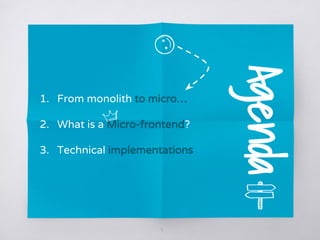
1. From monolith to micro…
2. What is a Micro-frontend?
3. Technical implementations
Agenda
3
DISCLAIMER
4
This presentation could mine many of your believes
on software development, please be
open minded and think at scale
1.
From monolith to micro…
EVERYTHING!
Moving towards the micro-world!
5
6
Scaling our applications
DB
Monolith
SPA
SPA
DB
Microservice
DB
Microservice
DB
Microservice
API
Gateway
???
7
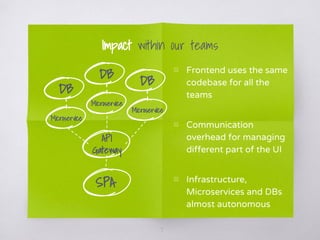
Impact within our teams
SPA
DB
Microservice
DB
Microservice
DB
Microservice
API
Gateway
▧ Frontend uses the same
codebase for all the
teams
▧ Communication
overhead for managing
different part of the UI
▧ Infrastructure,
Microservices and DBs
almost autonomous
8
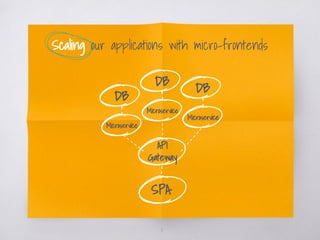
Scaling our applications with micro-frontends
SPA
DB
Microservice
DB
Microservice
DB
Microservice
API
Gateway
9
Scaling our applications with micro-frontends
Microfrontend
DB
Microservice
DB
Microservice
DB
Microservice
API
Gateway
Microfrontend Microfrontend
Routing
On the edge,
Server side
Or Client side
*
API
Gateway
10
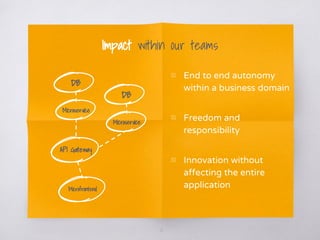
Impact within our teams
▧ End to end autonomy
within a business domain
▧ Freedom and
responsibility
▧ Innovation without
affecting the entire
application
DB
Microservice
Microfrontend
API Gateway
DB
Microservice
11
Impact within our organization
+ =
Cross-functional
team
Product
team
Business
Domain
2.
What is a Micro-frontend?
Let’s connect the dots...
12
“
Micro-frontends are the technical
representation of a business subdomain,
they allow independent implementations with same
or different technology choices, finally
they avoid sharing logic with other subdomains and they
are own by a single team
13
From Domain
Driven Design
(DDD)
Domain and Subdomains
(DDD)
14
15
Domain and Subdomains
The domain is the problem to be addressed with
a software effort.
A domain can be decomposed into subdomains
which typically reflect some organizational
structure.
A common example of a sub-domain is Product
Catalog
16
Subdomains
There are 3 different type of subdomains:
Core
subdomain
Supporting
subdomain
Generic
subdomain
https://bit.ly/2Au5Lio
Place your screenshot here
Share nothing… and I mean NOTHING
Avoid to share components or code across different
bounded contexts, abstraction could make our code more
complex to maintain in the long run, the communication
overhead could become a bottleneck for our
organizations
17
3.
Technical implementation
The journey of a thousand miles begins
with one step
18
Let’s review some potential approaches
Iframes
An iframes composition is
the choice made by
Spotify with an event bus
for coordinating the
events across different
iframes.
The desktop application
mixes Web technologies
with C++ codebase for the
low-level operations
Components
Opentable developers
experience team created
Open Components, an
open source project
composed by a registry of
components where
frontend and backend
logics are wrapped inside
small, self-contained units
usable inside any view of
their website
OpenComponent is
providing tools for quickly
create new components
like a CLI, more info:
opencomponents.github.io
Server-side
composition
Zalando was one of the
pioneers on microfrontends
with Mosaic9
(www.mosaic9.org) in
particular we need to
highlight Tailor.js, an open
source system for
assembling the components
on-demand on a backend
layer written in Go.
At the end of 2018 Zalando
moves to a server-side
include system called
“Interface framework”
19
20
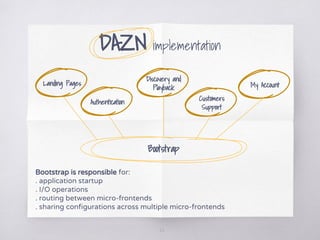
DAZN implementation
Landing Pages
Authentication
Discovery and
Playback
Customers
Support
My Account
Bootstrap
Bootstrap is responsible for:
. application startup
. I/O operations
. routing between micro-frontends
. sharing configurations across multiple micro-frontends
21
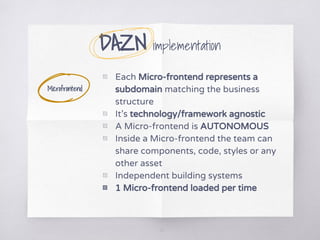
DAZN implementation
Microfrontend
▧ Each Micro-frontend represents a
subdomain matching the business
structure
▧ It’s technology/framework agnostic
▧ A Micro-frontend is AUTONOMOUS
▧ Inside a Micro-frontend the team can
share components, code, styles or any
other asset
▧ Independent building systems
▧ 1 Micro-frontend loaded per time
22
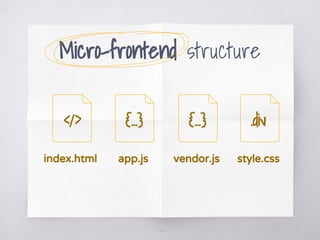
Micro-frontend structure
index.html
</>
app.js
{...}
vendor.js
{...}
style.css
.div
23
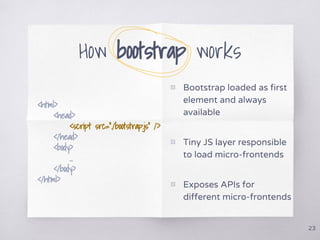
How bootstrap works
<html>
<head>
<script src=”./bootstrap.js” />
</head>
<body>
...
</body>
</html>
▧ Bootstrap loaded as first
element and always
available
▧ Tiny JS layer responsible
to load micro-frontends
▧ Exposes APIs for
different micro-frontends
24
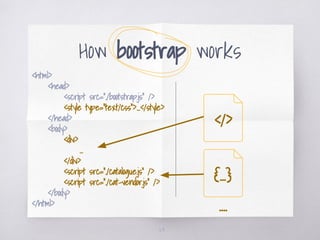
How bootstrap works
</>
{...}
….
<html>
<head>
<script src=”./bootstrap.js” />
<style type=”text/css”>...</style>
</head>
<body>
<div>
…
</div>
<script src=”./catalogue.js” />
<script src=”./cat-vendor.js” />
</body>
</html>
25
How bootstrap works
Window.DAZN = {
Lifecycle: {
OnLoad: function(){...}
OnunLoad: function(){...}
},
Localstorage: {...},
...
}
▧ DAZN object exposes
methods and properties
for all the micro-frontends
▧ Each micro-frontend has
lifecycle callbacks available
▧ This object abstracts the
platform exposing
common APIs
Components
26
{...}
▧ Components available on NPM
private repos
▧ Components need to work with
any framework
▧ They expose a contract for the
micro-frontend to interact with
▧ Components are own by specific
teams
▧ They can be shared within same
team
27
Deployment
2.0 1.0
cloudfront
▧ Based on some scenarios
I can redirect the user to a
version or another
▧ Don’t need to do a big
bang deployment
▧ Canary releases or Blue
Green deployment on
Frontend!
https://bit.ly/2Afy44t
5 teams
Onboarded on the same projects in 3 weeks
100%
Innovation, freedom and responsibility for
each team!!!
Over 100 developers
Working on the same project
28
“
The main challenges with scaling frontend
applications are scaling the teams,
reducing the communication overhead
and innovate!
29
Microfrontends frameworks
30
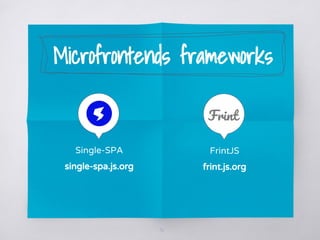
Single-SPA
single-spa.js.org
FrintJS
frint.js.org
Single SPA
31
appA.js
single-spa
appB.js
▧ Each SPA reacts to
lifecycle methods
(mount/unmount and
bootstrap)
▧ Framework agnostic,
helpers available for
major frameworks
▧ Single-spa-config with
method for registering
different SPAs
Frint.js
32
frint.js.org
Frint.js
33
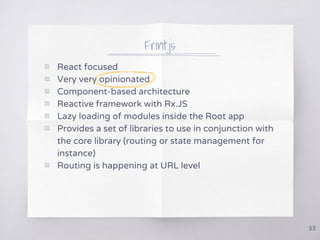
▧ React focused
▧ Very very opinionated
▧ Component-based architecture
▧ Reactive framework with Rx.JS
▧ Lazy loading of modules inside the Root app
▧ Provides a set of libraries to use in conjunction with
the core library (routing or state management for
instance)
▧ Routing is happening at URL level
DDD resources
34
Decompose by subdomain
https://bit.ly/2DUTQ1v
Subdomains and bounded
context in DDD
https://bit.ly/1BPZfIW
Learning, testing and sharing
35
. Micro-frontends FREE report
for O’Reilly (~80 pages)
. 28th February 3 hours online
workshop on Safari Books
Online: bit.ly/2BjfhFw
#OReillySACon
Rate today’s session
Session page on oreillysacon.com/ny O’Reilly Events App
Thank YOU
You can find me at:
@lucamezzalira
luca.mezzalira@dazn.com
37
#OReillySACon

Scaling frontend applications with micro-frontends Presentation.pdf

  • 1.
  • 2.
    Ciao :) Luca Mezzalira VPof Architecture at DAZN Google Developer Expert London Javascript Community Manager 2
  • 3.
    1. From monolithto micro… 2. What is a Micro-frontend? 3. Technical implementations Agenda 3
  • 4.
    DISCLAIMER 4 This presentation couldmine many of your believes on software development, please be open minded and think at scale
  • 5.
    1. From monolith tomicro… EVERYTHING! Moving towards the micro-world! 5
  • 6.
  • 7.
    7 Impact within ourteams SPA DB Microservice DB Microservice DB Microservice API Gateway ▧ Frontend uses the same codebase for all the teams ▧ Communication overhead for managing different part of the UI ▧ Infrastructure, Microservices and DBs almost autonomous
  • 8.
    8 Scaling our applicationswith micro-frontends SPA DB Microservice DB Microservice DB Microservice API Gateway
  • 9.
    9 Scaling our applicationswith micro-frontends Microfrontend DB Microservice DB Microservice DB Microservice API Gateway Microfrontend Microfrontend Routing On the edge, Server side Or Client side * API Gateway
  • 10.
    10 Impact within ourteams ▧ End to end autonomy within a business domain ▧ Freedom and responsibility ▧ Innovation without affecting the entire application DB Microservice Microfrontend API Gateway DB Microservice
  • 11.
    11 Impact within ourorganization + = Cross-functional team Product team Business Domain
  • 12.
    2. What is aMicro-frontend? Let’s connect the dots... 12
  • 13.
    “ Micro-frontends are thetechnical representation of a business subdomain, they allow independent implementations with same or different technology choices, finally they avoid sharing logic with other subdomains and they are own by a single team 13 From Domain Driven Design (DDD)
  • 14.
  • 15.
    15 Domain and Subdomains Thedomain is the problem to be addressed with a software effort. A domain can be decomposed into subdomains which typically reflect some organizational structure. A common example of a sub-domain is Product Catalog
  • 16.
    16 Subdomains There are 3different type of subdomains: Core subdomain Supporting subdomain Generic subdomain https://bit.ly/2Au5Lio
  • 17.
    Place your screenshothere Share nothing… and I mean NOTHING Avoid to share components or code across different bounded contexts, abstraction could make our code more complex to maintain in the long run, the communication overhead could become a bottleneck for our organizations 17
  • 18.
    3. Technical implementation The journeyof a thousand miles begins with one step 18
  • 19.
    Let’s review somepotential approaches Iframes An iframes composition is the choice made by Spotify with an event bus for coordinating the events across different iframes. The desktop application mixes Web technologies with C++ codebase for the low-level operations Components Opentable developers experience team created Open Components, an open source project composed by a registry of components where frontend and backend logics are wrapped inside small, self-contained units usable inside any view of their website OpenComponent is providing tools for quickly create new components like a CLI, more info: opencomponents.github.io Server-side composition Zalando was one of the pioneers on microfrontends with Mosaic9 (www.mosaic9.org) in particular we need to highlight Tailor.js, an open source system for assembling the components on-demand on a backend layer written in Go. At the end of 2018 Zalando moves to a server-side include system called “Interface framework” 19
  • 20.
    20 DAZN implementation Landing Pages Authentication Discoveryand Playback Customers Support My Account Bootstrap Bootstrap is responsible for: . application startup . I/O operations . routing between micro-frontends . sharing configurations across multiple micro-frontends
  • 21.
    21 DAZN implementation Microfrontend ▧ EachMicro-frontend represents a subdomain matching the business structure ▧ It’s technology/framework agnostic ▧ A Micro-frontend is AUTONOMOUS ▧ Inside a Micro-frontend the team can share components, code, styles or any other asset ▧ Independent building systems ▧ 1 Micro-frontend loaded per time
  • 22.
  • 23.
    23 How bootstrap works <html> <head> <scriptsrc=”./bootstrap.js” /> </head> <body> ... </body> </html> ▧ Bootstrap loaded as first element and always available ▧ Tiny JS layer responsible to load micro-frontends ▧ Exposes APIs for different micro-frontends
  • 24.
    24 How bootstrap works </> {...} …. <html> <head> <scriptsrc=”./bootstrap.js” /> <style type=”text/css”>...</style> </head> <body> <div> … </div> <script src=”./catalogue.js” /> <script src=”./cat-vendor.js” /> </body> </html>
  • 25.
    25 How bootstrap works Window.DAZN= { Lifecycle: { OnLoad: function(){...} OnunLoad: function(){...} }, Localstorage: {...}, ... } ▧ DAZN object exposes methods and properties for all the micro-frontends ▧ Each micro-frontend has lifecycle callbacks available ▧ This object abstracts the platform exposing common APIs
  • 26.
    Components 26 {...} ▧ Components availableon NPM private repos ▧ Components need to work with any framework ▧ They expose a contract for the micro-frontend to interact with ▧ Components are own by specific teams ▧ They can be shared within same team
  • 27.
    27 Deployment 2.0 1.0 cloudfront ▧ Basedon some scenarios I can redirect the user to a version or another ▧ Don’t need to do a big bang deployment ▧ Canary releases or Blue Green deployment on Frontend! https://bit.ly/2Afy44t
  • 28.
    5 teams Onboarded onthe same projects in 3 weeks 100% Innovation, freedom and responsibility for each team!!! Over 100 developers Working on the same project 28
  • 29.
    “ The main challengeswith scaling frontend applications are scaling the teams, reducing the communication overhead and innovate! 29
  • 30.
  • 31.
    Single SPA 31 appA.js single-spa appB.js ▧ EachSPA reacts to lifecycle methods (mount/unmount and bootstrap) ▧ Framework agnostic, helpers available for major frameworks ▧ Single-spa-config with method for registering different SPAs
  • 32.
  • 33.
    Frint.js 33 ▧ React focused ▧Very very opinionated ▧ Component-based architecture ▧ Reactive framework with Rx.JS ▧ Lazy loading of modules inside the Root app ▧ Provides a set of libraries to use in conjunction with the core library (routing or state management for instance) ▧ Routing is happening at URL level
  • 34.
    DDD resources 34 Decompose bysubdomain https://bit.ly/2DUTQ1v Subdomains and bounded context in DDD https://bit.ly/1BPZfIW
  • 35.
    Learning, testing andsharing 35 . Micro-frontends FREE report for O’Reilly (~80 pages) . 28th February 3 hours online workshop on Safari Books Online: bit.ly/2BjfhFw #OReillySACon
  • 36.
    Rate today’s session Sessionpage on oreillysacon.com/ny O’Reilly Events App
  • 37.
    Thank YOU You canfind me at: @lucamezzalira luca.mezzalira@dazn.com 37 #OReillySACon