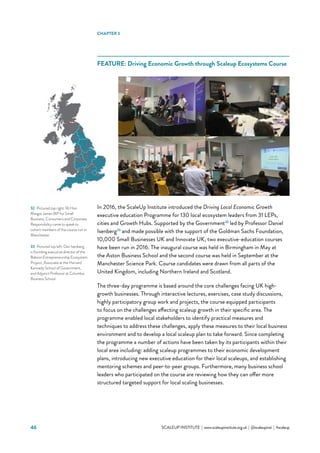
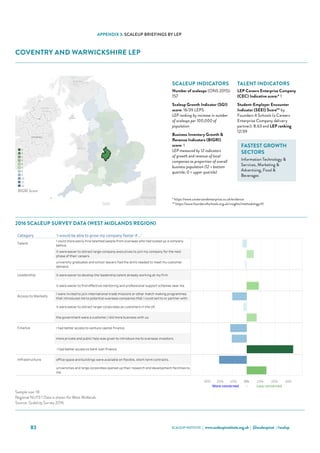
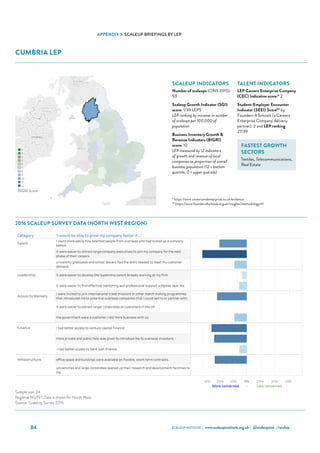
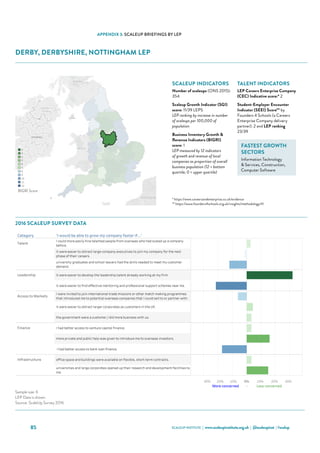
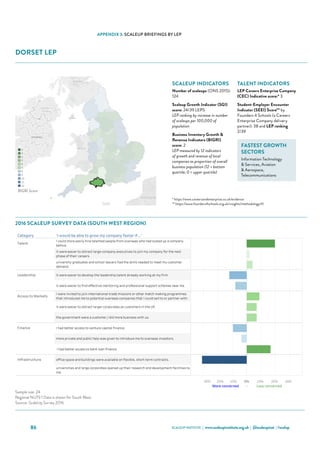
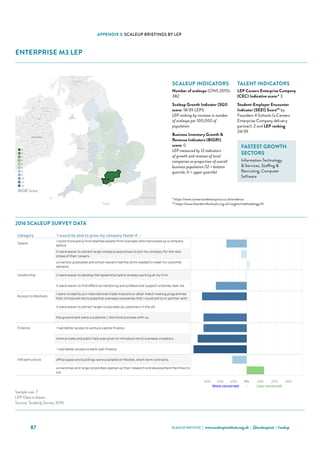
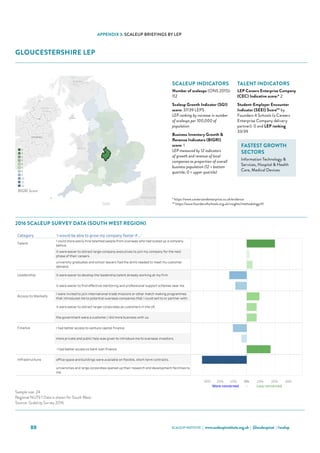
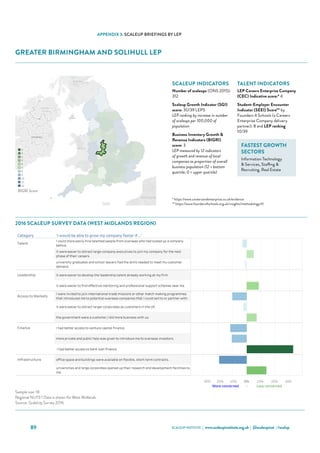
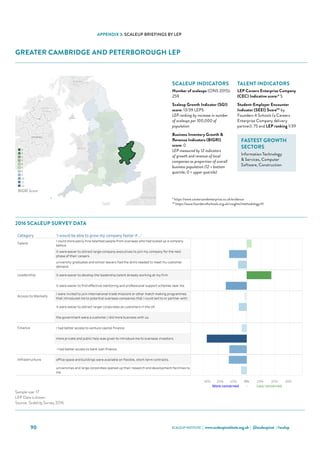
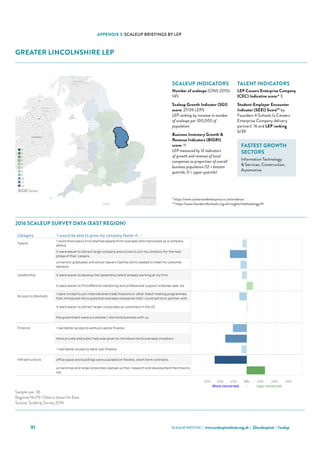
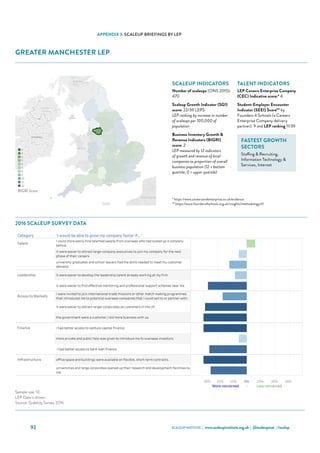
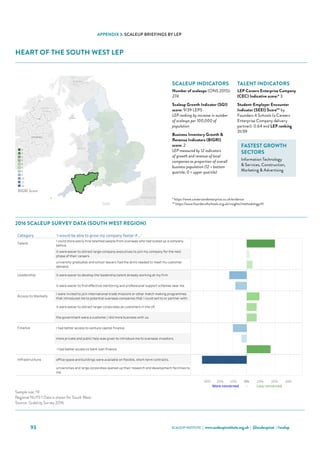
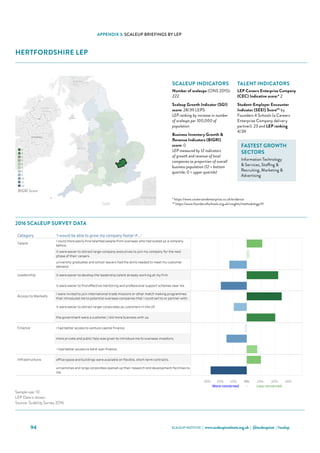
1 			 SCALEUP INSTITUTE | www.scaleupinstitute.org.uk | @scaleupinst | #scaleup
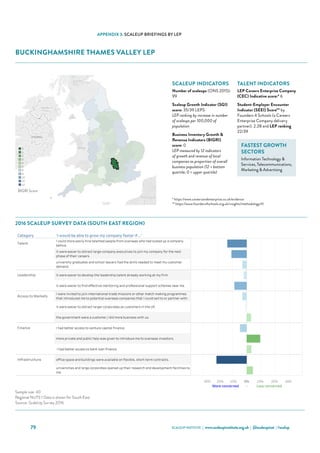
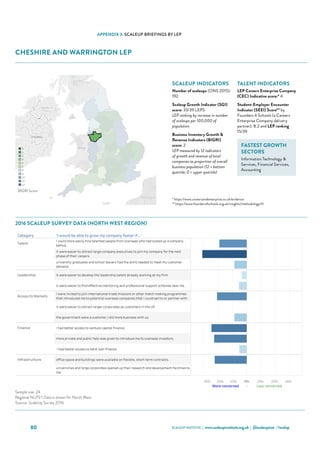
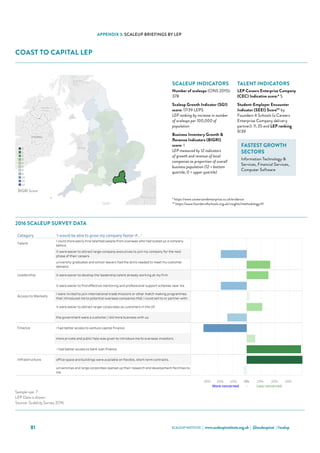
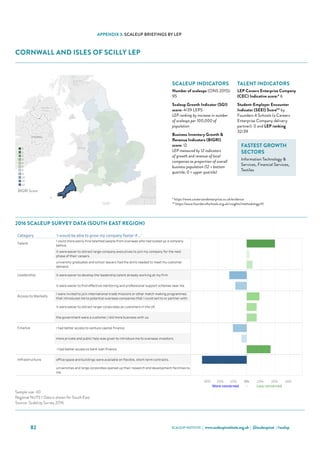
NOVEMBER 2016
THE SCALEUP REVIEW ON
ECONOMIC GROWTH 2016
THE SCALEUP INSTITUTE
2 			 SCALEUP INSTITUTE | www.scaleupinstitute.org.uk | @scaleupinst | #scaleup
Any enquiries relating to this Review or the
work of the ScaleUp Institute should be sent to:
info@scaleupinstitute.org.uk
This document can be accessed at:
www.scaleupinstitute.org.uk/scaleup-review-2016
Website: www.scaleupinstitute.org.uk
Twitter: @scaleupinst
3 			 SCALEUP INSTITUTE | www.scaleupinstitute.org.uk | @scaleupinst | #scaleup
Contents
Foreword4
Executive summary 8
Chapter 1: Scaleup identification 24
Chapter 2: On accessing talent and skills 30
Chapter 3: On developing leadership teams 40
Chapter 4: On accessing markets 48
Chapter 5: On accessing finance 56
Chapter 6: On accessing infrastructure 64
Chapter 7: Looking forward 68
Appendices71
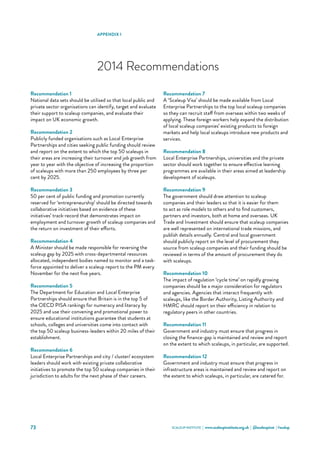
Appendix 1: 2014 Recommendations	 72
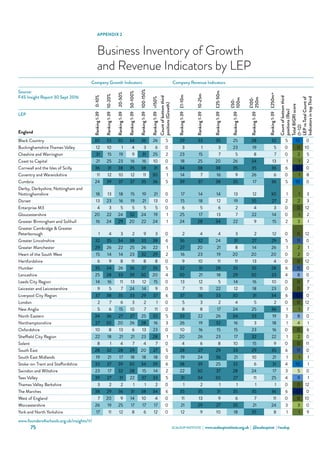
Appendix 2: Business Inventory of Growth 	
and Revenue Indicators by LEP		 74
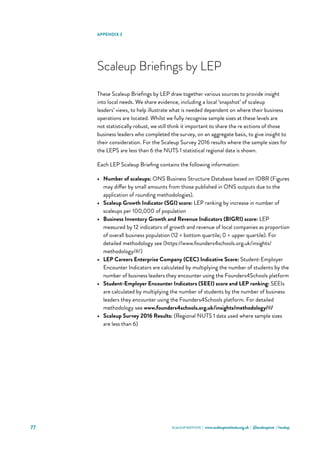
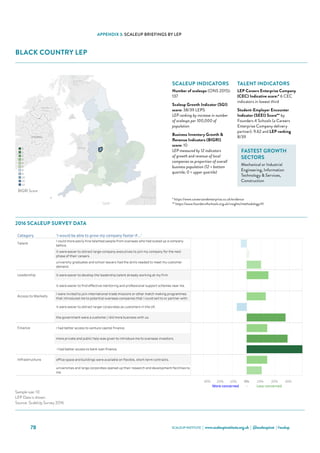
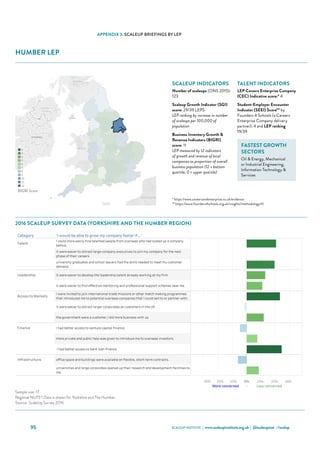
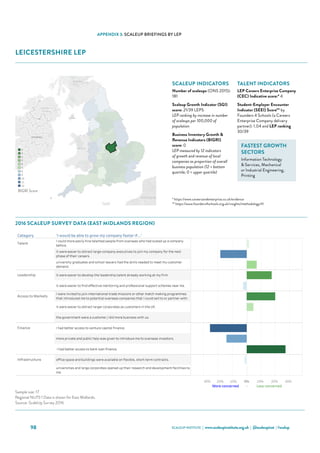
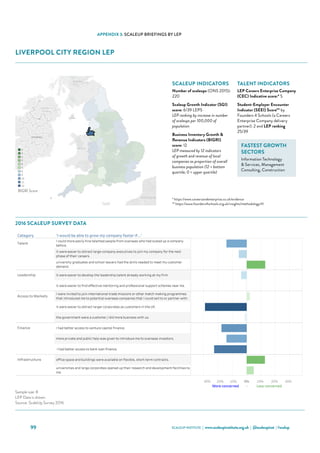
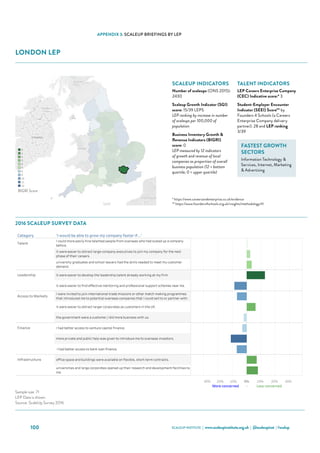
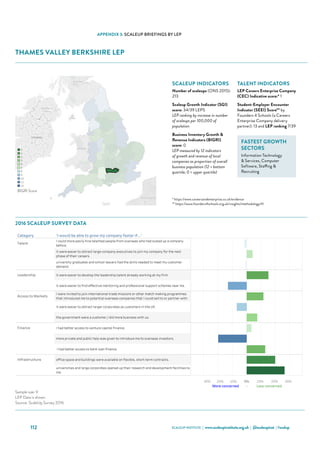
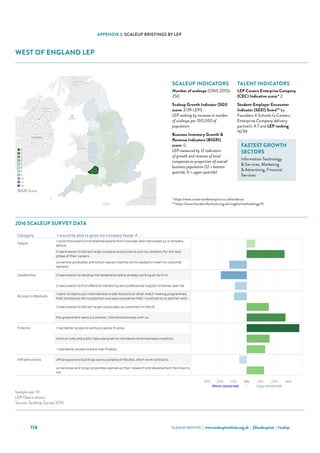
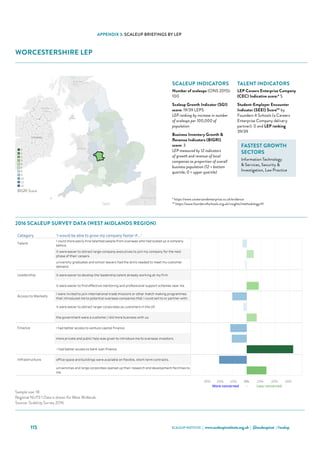
Appendix 3: Scaleup Briefings by LEP	 76
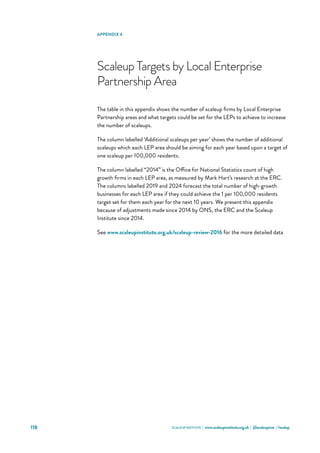
Appendix 4: Scaleup Targets by Local Enterprise	
Partnership Area	 117
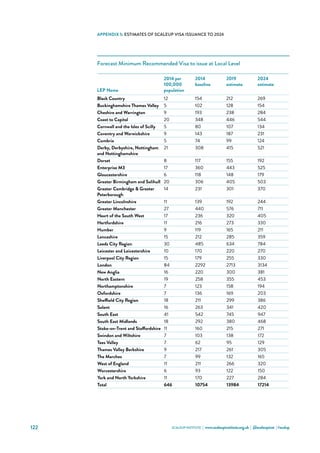
Appendix 5: Estimates of Scaleup Visa Issuance to 2024	 120
Appendix 6: The ScaleUp Institute	 123
SCALEUP INSTITUTE | www.scaleupinstitute.org.uk | @scaleupinst | #scaleup4
On behalf of the ScaleUp Institute, I am pleased to share with you the 2016
Scaleup Review that updates the ‘Scaleup Report on UK Economic Growth’ I was
commissioned to write in 2014. In this review, we build upon the 2014 report that
drew attention to the connection between economic prosperity and the proportion
of companies that were scaling up. We draw on new datasets, additional research
and recently published surveys of scaleup leaders to make new recommendations
on what needs to be done next.1
How do we prepare the ground within our communities to drive meaningful economic
growth on a global basis?  The answer to this question in 2014 resonates even more
strongly today: Using newly available datasets to change our focus from ‘small,
medium and large companies’, to ‘growing companies’, we build upon research that
demonstrates ‘local’ and ‘place’ are the most important drivers of national economic
growth we have available to us.
Data is the new infrastructure that enables us to act with confidence.
Much has occurred in the intervening period and we remain hugely encouraged by
the determination and enthusiasm to help our UK businesses scale and achieve their
fullest potential.
The 2014 Report highlighted that the UK economy was lagging behind the US and
other leading economies in the extent to which our companies scale. This is the
‘scaleup gap.’ The report showed that if we took advantage of the ability to focus
on scaleups, the UK would secure significant growth in jobs, taxes and wealth and a
competitive advantage for generations to come. The 2014 Report gave insights into
how a boost of just one per cent to our scaleup population should drive an additional
238,000 jobs and £225bn Gross Value Added (GVA).
The 2014 Scaleup Report therefore set out a clear plan of action to close the
scaleup gap. It spoke of the need for the whole ecosystem of stakeholders to
collaborate to improve their local environments so a higher proportion of companies
would progress from ‘small to large.’ Ecosystem stakeholders represent all avenues
of the community as the responsibility to become a ‘Scaleup Nation’ – to create a
society where a greater number of companies reach global scale – rests with all of
us who have an interest in supporting the prosperity of our citizens. We need to:
mobilise data in order to improve the talent pipeline, increase scaleup leadership
capacity and assist customer acquisition.
FOREWORD
1	 An enterprise with average annual
growth in employees or turnover
greater than 20 per cent per annum
over a three year period, and with
more than 10 employees at the
beginning of the period (OECD,
2014).
5 			 SCALEUP INSTITUTE | www.scaleupinstitute.org.uk | @scaleupinst | #scaleup
2	 It is clear from international
examples and case studies that ‘local’
is the correct ‘body’ to implement
ecosystem economic development
programmes. There are also reports
issued by Lord Sainsbury and Jim
O’Neill on clusters and cities.
The point made here is that the
‘ecosystem’ sometimes exists in a
‘cluster’ and sometimes in a ‘city’.
We are aware of the differences, but
use the terms interchangeably in
this review.
FOREWORD
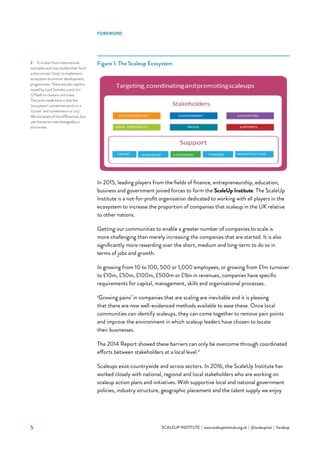
Figure 1: The Scaleup Ecosystem
In 2015, leading players from the fields of finance, entrepreneurship, education,
business and government joined forces to form the ScaleUp Institute. The ScaleUp
Institute is a not-for-profit organisation dedicated to working with all players in the
ecosystem to increase the proportion of companies that scaleup in the UK relative
to other nations.
Getting our communities to enable a greater number of companies to scale is
more challenging than merely increasing the companies that are started. It is also
significantly more rewarding over the short, medium and long-term to do so in
terms of jobs and growth.
In growing from 10 to 100, 500 or 1,000 employees, or growing from £1m turnover
to £10m, £50m, £100m, £500m or £1bn in revenues, companies have specific
requirements for capital, management, skills and organisational processes.
‘Growing pains’ in companies that are scaling are inevitable and it is pleasing
that there are now well-evidenced methods available to ease these. Once local
communities can identify scaleups, they can come together to remove pain points
and improve the environment in which scaleup leaders have chosen to locate
their businesses.
The 2014 Report showed these barriers can only be overcome through coordinated
efforts between stakeholders at a local level.2
Scaleups exist countrywide and across sectors. In 2016, the ScaleUp Institute has
worked closely with national, regional and local stakeholders who are working on
scaleup action plans and initiatives. With supportive local and national government
policies, industry structure, geographic placement and the talent supply we enjoy
6 			 SCALEUP INSTITUTE | www.scaleupinstitute.org.uk | @scaleupinst | #scaleup
FOREWORD
in the UK, we are positioned to create unrivalled national competitive advantage by
increasing the proportion of companies that are scaling up.
The 2016 ‘Scaleup Review on UK Economic Growth’ reports on where we are now
and what is different from 2014. We provide updates on the numbers of businesses
that are scaling up both nationally and by Local Enterprise Partnership. The 2016
Review also reports on what the scaleup leaders are saying and whether this has
changed since 2014. I am delighted to say that we are on track for the 2019
targets I outlined two years ago.
In 2014, I made 12 recommendations to stakeholders throughout the UK to
help drive economic growth and competitive advantage of Great Britain. In
light of the progress made since 2014, the ScaleUp Institute is now making
10 recommendations to supersede the original recommendations made. As before,
these recommendations should not be viewed as ‘a menu’ to pick and choose from,
but as a series of actions that members of our communities should take to address
scaleup gaps in their area of interest.
This review shows that between November 2014 and November 2015, there was
a steady growth of companies that were scaling up on a national basis and this is
a reason for optimism about the future of the UK’s prosperity.
In bringing this review together, I salute the hard work of my colleagues at the
ScaleUp Institute and also the insights of our Partners and Ambassadors who
volunteer their time and expertise. Our Directors, Advisors and Ambassadors are
listed in Appendix 6 to this document and on the ScaleUp Institute’s website.
This 2016 Scaleup Review would not have been possible without the input of these
colleagues and their encouragement to form the ScaleUp Institute in 2015. I am
particularly grateful to Irene Graham who joined us as our inaugural Chief Executive
in October 2015.  There are quite literally thousands of other people from
organisations up and down this country and further afield who have contributed to
the ideas in this report, from business, academia, politics and beyond. This is a long
list and it would be invidious to name some without naming all.
7 			 SCALEUP INSTITUTE | www.scaleupinstitute.org.uk | @scaleupinst | #scaleup
FOREWORD
The 2014 Scaleup Report was commissioned by the Information Economy Council,
a joint Industry and Government body, in March 2014.  Much has happened in the
intervening period including a vote to leave the European Union by the UK. We are
encouraged by the growth in the number of companies that are scaling up in the
UK and remain convinced that the focus on growth and the need for the ScaleUp
Institute’s work is as critical now as it has ever been. The following pages present
solid evidence charting significant progress made in the past two years. It is with
enthusiasm that I look forward to taking this agenda forward with colleagues to see
what we can further achieve together.
Working together, I am confident that we will be able to make Britain the most
attractive environment in the world a scaleup leader could possibly choose to
operate their growing international business from.
SCALEUP INSTITUTE | www.scaleupinstitute.org.uk | @scaleupinst | #scaleup8
EXECUTIVE
SUMMARY
SCALEUP INSTITUTE | www.scaleupinstitute.org.uk | @scaleupinst | #scaleup9
The 2014 ‘Scaleup Report on UK Economic Growth’ drew together 148 academic
publications, 300 interviews with practitioners and policy makers, a survey of
363 scaleup CEOs and a review of 75 initiatives from 20 countries. This enabled us to
identify the barriers preventing scaleup leaders from achieving their ambitions that
were able to be addressed.
This Review for 2016 is drawn from the work of the ScaleUp Institute, which
conducts annual surveys of scaleup stakeholders, undertakes and reviews research and
policy on scaleup indicators and themes and publishes case studies and weekly newsletters
on scaleup initiatives. We also deliver an executive education programme for scaleup
ecosystem leaders in partnership with other leading institutions from around the world.
Our annual review starts with a reminder of why scaleups are important within the
context of the prosperity of all UK citizens, follows with the critical issue of ‘scaleup
indicators’, reviews how priorities differ from local or thematic perspectives and ends with
new recommendations to close the scaleup gap in coming years.
This executive summary contains highlights from each chapter, the progress made
since 2014 and our new recommendations for 2017.
The key conclusions are:
•	 We are on track in increasing the number of scaleups with a rise to 11,575
nationally in 2015,3
but further concerted effort is needed if we are to reach our
target of £225 bn (net) GDP by 2034.
•	 The UK Government has excellent data sources, which if harnessed to even
greater effect, can ensure better tailored support to scaleups and those businesses
with high growth potential.
•	 Progress has been made locally, however, more still needs to be done to address
disparities.
•	 We have ambitious scaleup leaders who want to scale to even further heights.
These leaders continue to most need help on talent, leadership and access to
markets. Meanwhile, finance and infrastructure remain an important complement
to these needs, with specific actions required to address local disparities and to
unlock further institutional investment.
•	 Large corporates, business schools and universities, alongside local authorities
can help scaleups with talent, leadership development and sales opportunities at
home and abroad. This support is very much welcomed by scaleups and, although
progress has been made, more support is needed.
Executive summary
3	 ONS Business Structure
Database based on IDBR (Figures
may differ by small amounts from
those published in ONS outputs
due to the application of rounding
methodologies).
EXECUTIVE SUMMARY
10 			 SCALEUP INSTITUTE | www.scaleupinstitute.org.uk | @scaleupinst | #scaleup
A) WHY SCALEUPS MATTER
The connection between local economic growth and the number of companies
scaling up was established in the 2014 Scaleup Report. Further research in the past
two years underscores how critical it is to monitor scaleups accurately on a local
and national basis as part of our industrial strategy. This recent research established
that scaleups are also linked to productivity, job quality and innovation. “A doubling
of entrepreneurial quality predicts an increase of 6.8% in GDP 11 years in the
future,” the authors report. By contrast, startup quantity is less correlated and not
significantly linked once the city’s current GDP is controlled for.4
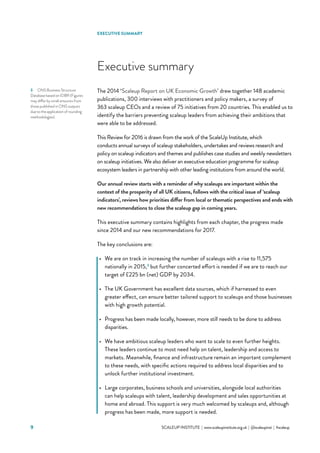
Figure 2: Why Scaleups Matter
Scaleups and Productivity: Research carried out in 2015 and 2016 adds to the strong
links between the two that we outlined in 2014: Octopus Investments showed high-
growth firms created three times as many jobs each week than did the FTSE-100.5
Furthermore, the CBI6
and Aston Business School showed high-productivity firms
to be twice as common in firms with scaleup status than those in ‘small, medium or
large’ business classifications.7
Scaleup Jobs are high-quality: There is significant evidence to show that companies
classified as scaleups help create high-quality jobs with more satisfied employees.
The Endeavor Programme surveyed employees from high-growth companies who
had joined the company from another employer: 80 per cent stated that they were
‘satisfied’ or ‘very satisfied’ with their current job compared to 46 per cent when
asked about their previous job.8
Scaleups are innovative and international: Internationally active scaleups were shown
to be three times more likely to introduce products or services new to their sector
over businesses which are entirely domestic in orientation. The 2015 Unlocking
SCALEUPS ARE
INNOVATIVE AND
INTERNATIONAL
with those exporting 3x more likely to
introduce products or services that are new
to their sector than businesses which are
entirely domestic9
SCALEUPS ARE
ACROSS ALL SECTORS
2016 scale up survey had scaleup CEO
respondees from: construction, manufacturing,
automotive, chemical engineering, advertising,
marketing, hospitality, retail, food and drink,
oil and gas, energy and utilities, creative,
games, property development, fintech, life
sciences, recruitment, education, healthcare,
consultancy. bioindustry, and IT/software
SCALEUPS ARE DIVERSE
927 female-led businesses with
£1M-£250M in revenues growing on average
at 28% p.a. 336 of them were found to
be growing at  50% per annum. Their
contribution was an additional
£2 bn to UK plc in 201511
SCALEUPS
CREATE JOBS
3 x as many per week as
FTSE 100 in 20145
SCALEUP JOBS
ARE HIGH QUALITY
80 percent + job satisfaction8
SCALEUPS ARE
PRODUCTIVE
high levels of productivity twice as
common in firms that are scaleups7
4	 Reported in Harvard Business
Review https://hbr.org/2016/03/
the-u-s-startup-economy-is-in-
both-better-and-worse-shape-than-
we-thought study located here:
http://jorgeg.scripts.mit.
edu/homepage/wp-content/
uploads/2016/03/Guzman-
Stern-State-of-American-
Entrepreneurship-FINAL.pdf
5	 Research Conducted on behalf
of Octopus by the Center for
Economics and Business Research:
accessed here on 9 November 2016
www.highgrowthsmallbusiness.
co.uk/Octopus-High-Growth-
Small-Business-Report-2015-
NATIONALS.pdf
6	 Confederation of British Industry
7	 “Lifting the Trophy: Scale-up
insights into the productivity prize”
Research carried out in 2016 by the
CBI in partnership with the ScaleUp
Institute, Lloyds Bank and Aston
Business School.
8	 Lunani, H. (2012) Endeavor:
Multiplying Impact through High
Quality Jobs. Retrieved from
http://share.endeavor.org/pdf/
GlobalEmployeeSurveys.pdf see
also www.scaleupinstitute.org.uk/
programme/endeavor-programme/
EXECUTIVE SUMMARY
11 			 SCALEUP INSTITUTE | www.scaleupinstitute.org.uk | @scaleupinst | #scaleup
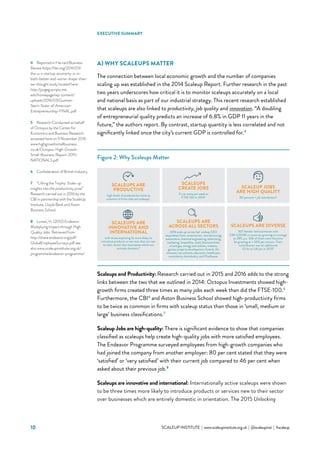
Productivity Report written by the Goldman Sachs Foundation and 10,000 Small
Businesses UK, showed that scaleups demonstrate high levels of innovation, strong
levels of export orientation and a high level of internationalisation.9
Scaleups and sectors: These scaleup business leaders truly represent the diversity of
our nation and sectors. In our 2016 survey alone, we had responses from scaleup
leaders from a range of sectors including construction, manufacturing, automotive,
chemical engineering, advertising, marketing, hospitality, retail, food and drink, oil
and gas, energy and utilities, creative, games, property development, fintech, life
sciences, recruitment, education, healthcare, consultancy and IT/software.
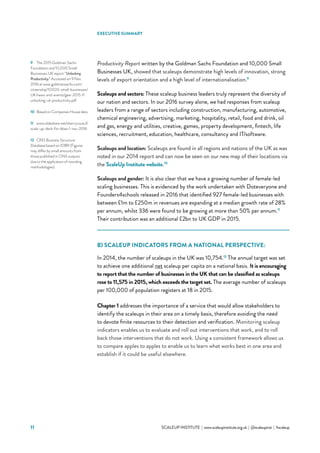
Scaleups and location: Scaleups are found in all regions and nations of the UK as was
noted in our 2014 report and can now be seen on our new map of their locations via
the ScaleUp Institute website.10
Scaleups and gender: It is also clear that we have a growing number of female-led
scaling businesses. This is evidenced by the work undertaken with Doteveryone and
Founders4schools released in 2016 that identified 927 female-led businesses with
between £1m to £250m in revenues are expanding at a median growth rate of 28%
per annum, whilst 336 were found to be growing at more than 50% per annum.11
Their contribution was an additional £2bn to UK GDP in 2015.
B) SCALEUP INDICATORS FROM A NATIONAL PERSPECTIVE:
In 2014, the number of scaleups in the UK was 10,754.12
The annual target was set
to achieve one additional net scaleup per capita on a national basis. It is encouraging
to report that the number of businesses in the UK that can be classified as scaleups
rose to 11,575 in 2015, which exceeds the target set. The average number of scaleups
per 100,000 of population registers at 18 in 2015.
Chapter 1 addresses the importance of a service that would allow stakeholders to
identify the scaleups in their area on a timely basis, therefore avoiding the need
to devote finite resources to their detection and verification. Monitoring scaleup
indicators enables us to evaluate and roll out interventions that work, and to roll
back those interventions that do not work. Using a consistent framework allows us
to compare apples to apples to enable us to learn what works best in one area and
establish if it could be useful elsewhere.
9	 The 2015 Goldman Sachs
Foundation and 10,000 Small
Businesses UK report “Unlocking
Productivity.” Accessed on 9 Nov
2016 at www.goldmansachs.com/
citizenship/10000-small-businesses/
UK/news-and-events/gew-2015-f/
unlocking-uk-productivity.pdf
10	 Based on Companies House data
11	 www.slideshare.net/sherrycoutu1/
scale-up-deck-for-bbaa-1-nov-2016
12	 ONS Business Structure
Database based on IDBR (Figures
may differ by small amounts from
those published in ONS outputs
due to the application of rounding
methodologies).
EXECUTIVE SUMMARY
12 			 SCALEUP INSTITUTE | www.scaleupinstitute.org.uk | @scaleupinst | #scaleup
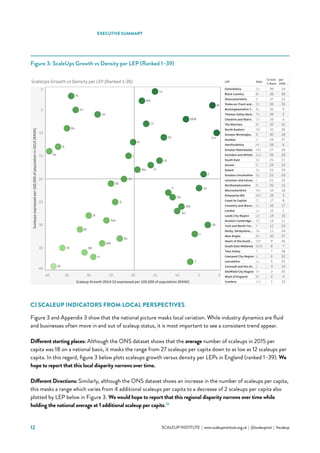
Figure 3: ScaleUps Growth vs Density per LEP (Ranked 1–39)
C) SCALEUP INDICATORS FROM LOCAL PERSPECTIVES
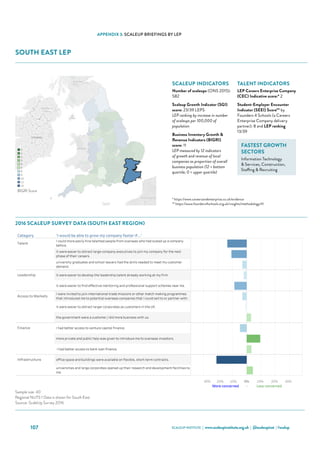
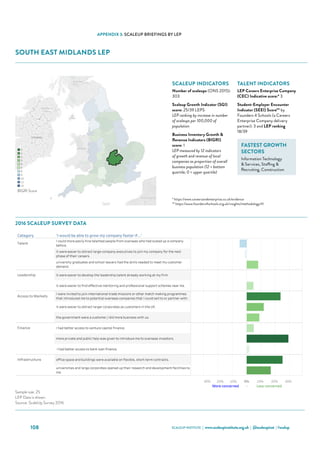
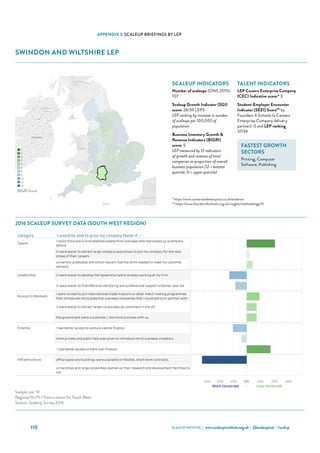
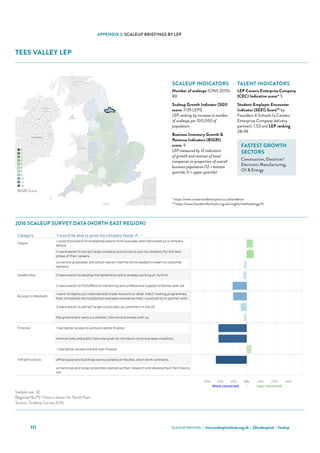
Figure 3 and Appendix 3 show that the national picture masks local variation. While industry dynamics are fluid
and businesses often move in and out of scaleup status, it is most important to see a consistent trend appear.
Different starting places: Although the ONS dataset shows that the average number of scaleups in 2015 per
capita was 18 on a national basis, it masks the range from 27 scaleups per capita down to as low as 12 scaleups per
capita. In this regard, figure 3 below plots scaleups growth versus density per LEPs in England (ranked 1–39). We
hope to report that this local disparity narrows over time.
Different Directions: Similarly, although the ONS dataset shows an increase in the number of scaleups per capita,
this masks a range which varies from 4 additional scaleups per capita to a decrease of 2 scaleups per capita also
plotted by LEP below in Figure 3. We would hope to report that this regional disparity narrows over time while
holding the national average at 1 additional scaleup per capita.13
0510152025303540
Scaleup Growth 2014-15 expressed per 100,000 of population (RANK)
0
5
10
15
20
25
30
35
40
Scaleupsexpressedper100,000ofpopulationin2015(RANK)
Y
Ox
NE
Cv
Cm
An
Wo
W
Th
T
Swi
SW
St
So
Sh
SEM
SE
N
M3
M
Lo
Li
Ld
La
L
Hr
H
GM
GL
GC
G
De
D
Ch
CC
C
Bu
Bl
B
ScaleUps Growth vs Density per LEP (Ranked 1-39) LEP Abbr
Growt
h Rank
per
100k ..
Oxfordshire Ox
Black Country Bl
Gloucestershire G
Stoke-on-Trent and .. St
Buckinghamshire T.. Bu
Thames Valley Berk.. Th
Cheshire and Warri.. Ch
The Marches M
North Eastern NE
Greater Birmingha.. B
Humber H
Hertfordshire Hr
Greater Manchester GM
Swindon and Wiltsh.. Swi
South East SE
Dorset D
Solent So
Greater Lincolnshire GL
Leicester and Leices.. L
Northamptonshire N
Worcestershire Wo
Enterprise M3 M3
Coast to Capital CC
Coventry and Warw.. Cv
London Lo
Leeds City Region Ld
Greater Cambridge .. GC
York and North Yor.. Y
Derby, Derbyshire, .. De
New Anglia An
Heart of the South .. SW
South East Midlands SEM
Tees Valley T
Liverpool City Region Li
Lancashire La
Cornwall and the Isl.. C
Sheffield City Region Sh
West of England W
Cumbria Cm
1439
3938
1337
3536
935
234
533
3132
3631
2830
3729
628
3427
2926
2125
2524
3323
2022
1521
1220
1819
318
817
1716
115
1614
1113
2312
2411
2710
269
78
387
326
225
194
303
42
101
EXECUTIVE SUMMARY
13 			 SCALEUP INSTITUTE | www.scaleupinstitute.org.uk | @scaleupinst | #scaleup
Quality of Business Inventory
In addition to observing each local community in terms of how many scaleups
by population they have and whether the trend in their area was encouraging or
discouraging, we also sought to understand the quality of the local environment
and its ability to support business growth and scaleup leaders throughout their
journey at each stage. The ideal pattern is a critical mass of business leaders across
each growth band and each revenue band so that there is a ‘pipeline to grow’ and a
‘pipeline of experience and role models’ to draw upon as a company progresses from
‘small’ to ‘large’ status. This picture allows stakeholders to operate effective, local
matchmaking programmes and provides guidance as to where we might bring in help
from elsewhere if there is not sufficient available locally.14
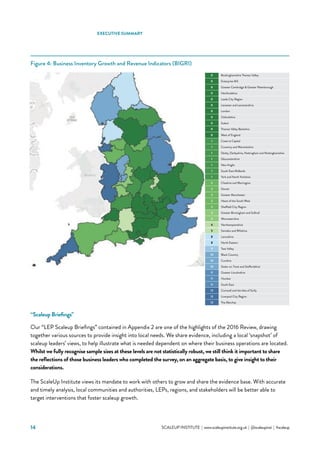
To review this, we turned to the Business Growth and Revenue Band indicators
(BIGRI Score) being used by Founders4Schools to understand the supply of
‘business leaders’ available per school per LEP. The BIGRI score, which is depicted
in Figure 4 below, looks at 6 indicators of ‘growth-rate’ and 6 indicators of business
size by ‘revenue band’ as a proportion of all businesses in any given LEP. If the LEP’s
indicator is in the lower third, then their score increases by a score of 1. Having a low
BIGRI score is more favourable than having a high BIGRI score.
13	 When we report per capita growth
rates and population, we do so on a per
100,000 population basis.
14	 We are grateful to
Founders4Schools whose BIGRI
dataset at LEP level from 2015
and 2016 is derived from the
insight reports they produce from
Companies House Dataset (via
Duedil). The BIGRI score looks at 12
indicators per LEP relative to others
by rate of growth and revenue band
as a proportion of all businesses.
See their methodology here www.
founders4schools.org.uk/insights/
methodology/#/
EXECUTIVE SUMMARY
14 			 SCALEUP INSTITUTE | www.scaleupinstitute.org.uk | @scaleupinst | #scaleup
Figure 4: Business Inventory Growth and Revenue Indicators (BIGRI)
“Scaleup Briefings”
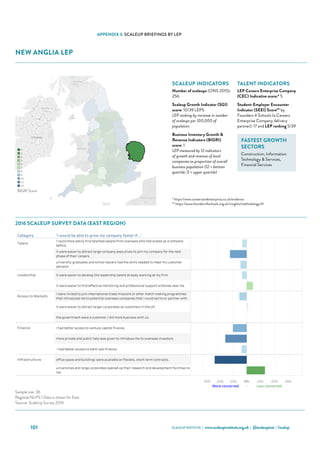
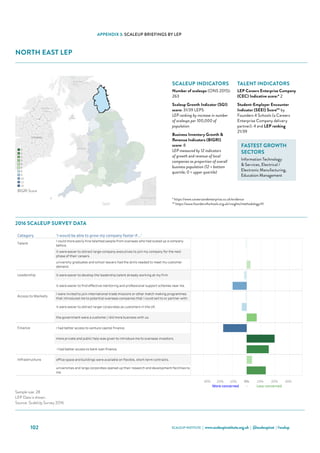
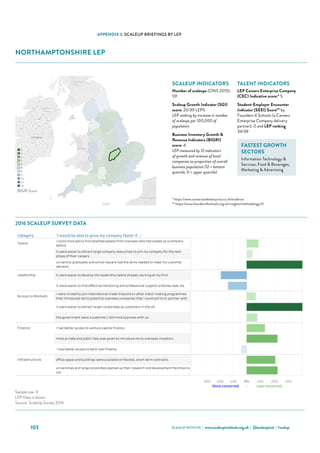
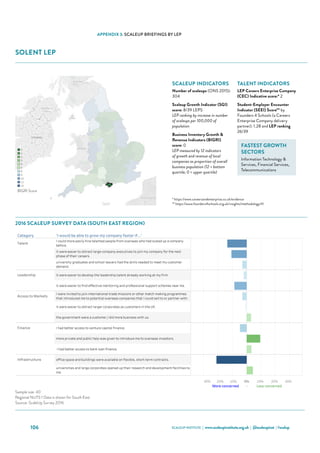
Our “LEP Scaleup Briefings” contained in Appendix 2 are one of the highlights of the 2016 Review, drawing
together various sources to provide insight into local needs. We share evidence, including a local ‘snapshot’ of
scaleup leaders’ views, to help illustrate what is needed dependent on where their business operations are located.
Whilst we fully recognise sample sizes at these levels are not statistically robust, we still think it important to share
the reflections of those business leaders who completed the survey, on an aggregate basis, to give insight to their
considerations.
The ScaleUp Institute views its mandate to work with others to grow and share the evidence base. With accurate
and timely analysis, local communities and authorities, LEPs, regions, and stakeholders will be better able to
target interventions that foster scaleup growth.
FOUNDERS4SCHOOLS BUSINESS INVENTORY
GROWTH AND REVENUE INDICATOR MAP
Number of indicators ranked in lowest third, by LEP (max 12)
0 Buckinghamshire Thames Valley
0 Enterprise M3
0 Greater Cambridge  Greater Peterborough
0 Hertfordshire
0 Leeds City Region
0 Leicester and Leicestershire
0 London
0 Oxfordshire
0 Solent
0 Thames Valley Berkshire
0 West of England
1 Coast to Capital
1 Coventry and Warwickshire
1 Derby, Derbyshire, Nottingham and Nottinghamshire
1 Gloucestershire
1 New Anglia
1 South East Midlands
1 York and North Yorkshire
2 Cheshire and Warrington
2 Dorset
2 Dorset
2 Greater Manchester
2 Heart of the South West
2 Sheffield City Region
3 Greater Birmingham and Solihull
3 Worcestershire
4 Northamptonshire
5 Swindon and Wiltshire
8 Lancashire
8 North Eastern
9 Tees Valley
10 Black Country
10 Cumbria
10 Stoke-on-Trent and Staffordshire
11 Greater Lincolnshire
11 Humber
11 South East
12 Cornwall and the Isles of Scilly
12 Liverpool City Region
12 The Marches
EXECUTIVE SUMMARY
0 Buckinghamshire Thames Valley
0 Enterprise M3
0 Greater Cambridge  Greater Peterborough
0 Hertfordshire
0 Leeds City Region
0 Leicester and Leicestershire
0 London
0 Oxfordshire
0 Solent
0 Thames Valley Berkshire
0 West of England
1 Coast to Capital
1 Coventry and Warwickshire
1 Derby, Derbyshire, Nottingham and Nottinghamshire
1 Gloucestershire
1 New Anglia
1 South East Midlands
1 York and North Yorkshire
2 Cheshire and Warrington
2 Dorset
2 Dorset
2 Greater M
2 Heart of th
2 Sheffield C
3 Greater Bi
3 Worcester
4 Northamp
5 Swindon an
8 Lancashire
8 North East
9 Tees Valley
10 Black Cou
10 Cumbria
10 Stoke-on-
11 Greater Lin
11 Humber
11 South East
12 Cornwall a
12 Liverpool C
12 The March0 Buckinghamshire Thames Valley
0 Enterprise M3
0 Greater Cambridge  Greater Peterborough
0 Hertfordshire
0 Leeds City Region
0 Leicester and Leicestershire
0 London
0 Oxfordshire
0 Solent
0 Thames Valley Berkshire
0 West of England
1 Coast to Capital
1 Coventry and Warwickshire
1 Derby, Derbyshire, Nottingham and Nottinghamshire
1 Gloucestershire
1 New Anglia
1 South East Midlands
1 York and North Yorkshire
2 Cheshire and Warrington
2 Dorset
2 Dorset
2 Greater Manchester
2 Heart of the South West
2 Sheffield City Region
3 Greater Birmingham and Solihull
3 Worcestershire
4 Northamptonshire
5 Swindon and Wiltshire
8 Lancashire
8 North Eastern
9 Tees Valley
10 Black Country
10 Cumbria
10 Stoke-on-Trent and Staffordshire
11 Greater Lincolnshire
11 Humber
11 South East
12 Cornwall and the Isles of Scilly
12 Liverpool City Region
12 The Marches
15 			 SCALEUP INSTITUTE | www.scaleupinstitute.org.uk | @scaleupinst | #scaleup
Whilst we as a nation are on track to close the scaleup gap, we need to continue
our efforts to ensure that this occurs in all parts of the country on a consistent and
sustainable basis to narrow the gap that exists between localities.
D) SCALEUP INDICATORS FROM THEMATIC PERSPECTIVES
The 2014 Report established that the barriers that significantly hindered scaleup
leaders in the UK could be grouped into five key themes. These themes were
grouped into the order of importance denoted by their potential economic impact
if addressed. We thought hard at the time about whether the themes should be
ordered as according to how soon after making a change you would be able to
detect’ impact or in their order of importance on economic growth. In 2014 we
decided to list them in order of importance rather than ‘timeframe for impact’ so as
not to encourage a bias towards short-term but less impactful actions.
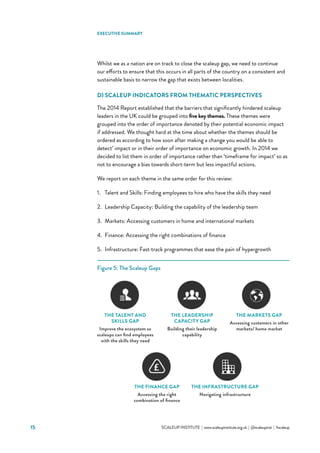
We report on each theme in the same order for this review:
1.	 Talent and Skills: Finding employees to hire who have the skills they need
2.	 Leadership Capacity: Building the capability of the leadership team
3.	 Markets: Accessing customers in home and international markets
4.	 Finance: Accessing the right combinations of finance
5.	 Infrastructure: Fast-track programmes that ease the pain of hypergrowth
Figure 5: The Scaleup Gaps
THE TALENT AND
SKILLS GAP
Improve the ecosystem so
scaleups can find employees
with the skills they need
THE LEADERSHIP
CAPACITY GAP
Building their leadership
capability
THE MARKETS GAP
Accessing customers in other
markets/ home market
THE FINANCE GAP
Accessing the right
combination of finance
THE INFRASTRUCTURE GAP
Navigating infrastructure
EXECUTIVE SUMMARY
16 			 SCALEUP INSTITUTE | www.scaleupinstitute.org.uk | @scaleupinst | #scaleup
The ScaleUp Institute operates five thematic committees that each meet
quarterly to review initiatives operating throughout the UK and elsewhere that are
intended to alleviate the growing pains faced by scaleup leaders. The outputs of
these Committees are ‘case studies’ which provide insights on impactful initiatives
alleviating the challenges faced by scaleups. These are published on our website
and several of which are listed in the subsequent pages of this report.
Figure 6: ScaleUp Survey Respondents and Sector Representation
In September 2016, the ScaleUp Institute and our partners surveyed more than
800 CEOs; 321 of whom could be categorised as scaleup leaders. The majority of
these were exporting and 83% said they expected their growth to continue, despite
the survey having been conducted post the Brexit vote. We present the views of
these 321 scaleups from across all sectors (see figure 6 above), drawing out their
challenges, needs and ideas for how we can reduce the barriers they encounter.
COMPLETED BY
321SCALE UPS
FROM A BROAD
RANGE OF
SECTORS
IT AND
SOFTWARE
CONSTRUCTION
CREATIVE
MANUFACTURING
RETAIL
PROPERTY
MARKETING
AND
ADVERTISING
EDUCATION
ENERGY
RECRUITMENT
OIL AND GAS
FINTECH
HEALTHCARE
HOSPITALITY
- FOOD AND
DRINK
CHEMICAL
ENGINEERING
AUTOMOTIVE
EXECUTIVE SUMMARY
17 			 SCALEUP INSTITUTE | www.scaleupinstitute.org.uk | @scaleupinst | #scaleup
In considering the changes that have occurred over the past two years, both in the
context of the national and international scenes, it is encouraging that our scaleup
leaders remain positive about their future growth potential. It is clear they want and
need continued support if UK citizens are to enjoy the prosperity associated with
the UK being the best ScaleUp Nation in the world.
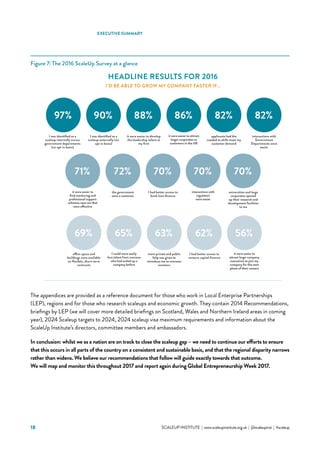
In figure 7 below we summarise the overall results of the scaleup survey and in the
ensuing chapters we delve deeper into the results by theme.15
Chapter 2 covers talent and skills: A critical factor that prevents scaleups from being
able to accept and fulfill customer orders is access to people available who have
the skills they need. We explore the issue and what stakeholders can do to ensure
scaleups have talent available to them when they need it.
Chapter 3 deals with leadership development: A shortage of experience in scaleup
leadership teams can hold them back from growing their revenues faster. Learning
and Development are common-place in large corporates, but not so much with
scaleups. We explore the issue and what stakeholders can do to ensure leaders have
high quality solutions available locally.
Chapter 4 covers barriers that inhibit the ability of scaleup leaders to access markets
and to sell their products or services at home and abroad. The 2016 ScaleUp Survey
shows that scaleup businesses view large corporate procurement as a key challenge;
we explore ways of making this more streamlined and effective.
Chapter 5 addresses finance as one of the key factors inhibiting scaleups from
achieving global scale. New technologies and regulatory shifts have opened new
opportunities for new players and our survey shows a need to help scaleup leaders
make their way through the myriad of finance options available more easily.
Chapter 6 covers the issue of how infrastructure impedes scaleup leaders rather than
enabling them and explores ways of addressing pain points common to scaleups.
Chapter 7 reaffirms why Britain can be the BEST place in the WORLD for a leader
to choose to SCALE their business if we act together now in unison.
15	 Statistics are presented for those
holding views.
EXECUTIVE SUMMARY
18 			 SCALEUP INSTITUTE | www.scaleupinstitute.org.uk | @scaleupinst | #scaleup
Figure 7: The 2016 ScaleUp Survey at a glance
The appendices are provided as a reference document for those who work in Local Enterprise Partnerships
(LEP), regions and for those who research scaleups and economic growth. They contain 2014 Recommendations,
briefings by LEP (we will cover more detailed briefings on Scotland, Wales and Northern Ireland areas in coming
year), 2024 Scaleup targets to 2024, 2024 scaleup visa maximum requirements and information about the
ScaleUp Institute’s directors, committee members and ambassadors.
In conclusion: whilst we as a nation are on track to close the scaleup gap – we need to continue our efforts to ensure
that this occurs in all parts of the country on a consistent and sustainable basis, and that the regional disparity narrows
rather than widens. We believe our recommendations that follow will guide exactly towards that outcome.
We will map and monitor this throughout 2017 and report again during Global Entrepreneurship Week 2017.
HEADLINE RESULTS FOR 2016
I’D BE ABLE TO GROW MY COMPANY FASTER IF…
97% 88%90%
I was identified as a
scaleup internally across
government departments
(on opt in basis)
it were easier to develop
the leadership talent at
my firm
I was identified as a
scaleup externally (on
opt in basis)
86% 82%82%
it were easier to attract
larger corporates as
customers in the UK
interactions with
Government
Departments were
easier
applicants had the
needed to skills meet my
customer demand
71% 70%72%
it were easier to
find mentoring and
professional support
schemes near me that
were effective
I had better access to
bank loan finance
the government
were a customer
70% 70%
interactions with
regulators
were easier
universities and large
corporates opened
up their research and
development facilities
to me
65% 62%63%
I could more easily
hire talent from overseas
who had scaled up a
company before
I had better access to
venture capital finance
more private and public
help was given to
introduce me to overseas
investors
69%
office space and
buildings were available
on flexible, short-term
contracts
56%
it were easier to
attract large-company
executives to join my
company for the next
phase of their careers
EXECUTIVE SUMMARY
19 			 SCALEUP INSTITUTE | www.scaleupinstitute.org.uk | @scaleupinst | #scaleup
EXECUTIVE SUMMARY
RECOMMENDATIONS
SCALEUP INSTITUTE | www.scaleupinstitute.org.uk | @scaleupinst | #scaleup21
2016 recommendations
In 2014, 12 recommendations were made to stakeholders throughout the UK to
drive the economic growth and competitive advantage of Great Britain. In light of
the progress made since 2014, the ScaleUp Institute is making 10 recommendations
to focus on in 2017 which will replace those previously made.
As previously mentioned, these recommendations should not be viewed as
‘a menu’ to pick and choose from, but as a comprehensive series of actions different
members of our communities should take within their areas of interest to address
the issues causing scaleup gaps. Some recommendations are directed towards
stakeholders at a national level and others are directed towards those operating at a
local or regional level. Taken together, we are confident that we will be able to make
Britain the most attractive ecosystem in the world for a scaleup leader to locate
their growing business.
RECOMMENDATIONS
Recommendation 1:
We recommend that scaleup status is officially recognised as a formal business
classification and that national datasets are utilised to allow the verification of
a company’s ‘scaleup status’ so that national, local, public and private sector
organisations can collectively drive economic growth more easily.
Recommendation 2:
We recommend that local stakeholders have funding they receive from central
Government tied to whether or not their strategy addresses closing the
scaleup gap and whether or not this strategy is working.
Recommendation 3:
We recommend that central Government make a Minister accountable for
closing the scaleup gap and local governments and local stakeholders should
make someone responsible for the same.
Recommendation 4:
We recommend that the Department for Education and Local Enterprise
Partnerships use their convening and promotional power to guarantee that
students at schools, colleges and universities come into contact with the top 50
scaleup business-leaders within 20 miles of their establishment. Additionally,
that an API to the National Pupils database, with suitable protections, is made
available so that the impact of these interventions can be measured.
22 			 SCALEUP INSTITUTE | www.scaleupinstitute.org.uk | @scaleupinst | #scaleup
RECOMMENDATIONS
Recommendation 5:
We recommend that a ‘Scaleup Visa’ be made available in communities where
there are 100 + scaleup companies to enable scaleup leaders to recruit staff
they need to increase their capacity to grow.
Recommendation 6:
We recommend that local stakeholders prioritise the signposting of high
quality mentorship programmes and develop effective matchmaking between
peers and non-executive directors who have scaled businesses before. Local
and national educational institutions should prioritise the introduction of
high-quality flexible courses designed to help scaleup leadership teams with
their development needs. Better connection should also continue to be made
between national programmes and local ecosystem leaders to encourage
scaling business leaders to apply to courses with known impact.
Recommendation 7:
We recommend that public bodies report on the level of procurement they
source from, and the collaboration they have with, scaleup companies and their
funding should be tied to increasing this amount.
Recommendation 8:
We recommend that large companies report on the level of procurement they
source from scaleup companies and the collaboration they have with scaleup
companies. Any procurement contracts with Government should require an
increase in the amount of business undertaken with scaleups.
Recommendation 9:
We recommend that agencies that interact frequently with scaleups, such
as the Border Authority, Listing Authority and HMRC, have fast-track
procedures for scaleups and report on these in relation to peers in other
countries.
Recommendation 10:
We recommend that Government and industry ensure that progress is made
closing the finance gap and ensure that growth finance is included as core
curriculum in all local scaleup leadership courses.
23 			 SCALEUP INSTITUTE | www.scaleupinstitute.org.uk | @scaleupinst | #scaleup
CHAPTER 1
Scaleup identification
SCALEUP INSTITUTE | www.scaleupinstitute.org.uk | @scaleupinst | #scaleup25
CHALLENGE: IDENTIFYING SCALE-UPS IN ORDER TO SUPPORT THEM
If you cannot measure it you cannot manage it and if you cannot detect it, you
cannot do either.
The identification and verification of ‘scaleup status’ remains the single most
important tool to be made available in order to boost UK productivity.
If a company’s scaleup status were easily identified on a national register (for free),
then the rest of the ecosystem could simply focus on initiatives directed towards
them and scaleup leaders could focus on selling more products to more customers
in more markets.
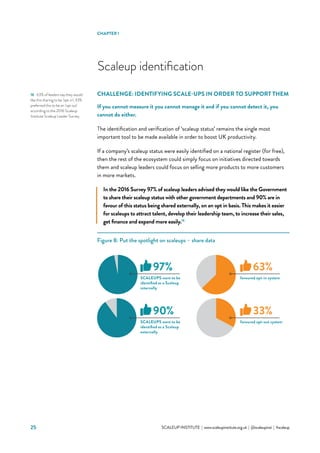
In the 2016 Survey 97% of scaleup leaders advised they would like the Government
to share their scaleup status with other government departments and 90% are in
favour of this status being shared externally, on an opt in basis. This makes it easier
for scaleups to attract talent, develop their leadership team, to increase their sales,
get finance and expand more easily.16
Figure 8: Put the spotlight on scaleups – share data
97%
SCALEUPS want to be
identified as a Scaleup
internally
63%
favoured opt-in system
90%
SCALEUPS want to be
identified as a Scaleup
externally
33%
favoured opt-out system
Scaleup identification
16	 63% of leaders say they would
like this sharing to be ‘opt-in’; 33%
preferred this to be an ‘opt out’
according to the 2016 Scaleup
Institute Scaleup Leader Survey.
CHAPTER 1
26 			 SCALEUP INSTITUTE | www.scaleupinstitute.org.uk | @scaleupinst | #scaleup
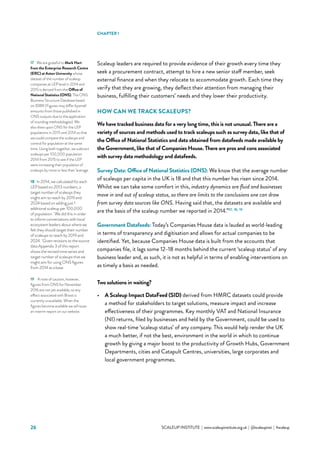
Scaleup leaders are required to provide evidence of their growth every time they
seek a procurement contract, attempt to hire a new senior staff member, seek
external finance and when they relocate to accommodate growth. Each time they
verify that they are growing, they deflect their attention from managing their
business, fulfilling their customers’ needs and they lower their productivity.
HOW CAN WE TRACK SCALEUPS?
We have tracked business data for a very long time, this is not unusual. There are a
variety of sources and methods used to track scaleups such as survey data, like that of
the Office of National Statistics and data obtained from datafeeds made available by
the Government, like that of Companies House. There are pros and cons associated
with survey data methodology and datafeeds.
Survey Data: Office of National Statistics (ONS): We know that the average number
of scaleups per capita in the UK is 18 and that this number has risen since 2014.
Whilst we can take some comfort in this, industry dynamics are fluid and businesses
move in and out of scaleup status, so there are limits to the conclusions one can draw
from survey data sources like ONS. Having said that, the datasets are available and
are the basis of the scaleup number we reported in 2014.”17, 18, 19
Government Datafeeds: Today’s Companies House data is lauded as world-leading
in terms of transparency and digitisation and allows for actual companies to be
identified. Yet, because Companies House data is built from the accounts that
companies file, it lags some 12–18 months behind the current ‘scaleup status’ of any
business leader and, as such, it is not as helpful in terms of enabling interventions on
as timely a basis as needed.
Two solutions in waiting?
•	 A Scaleup Impact DataFeed (SID) derived from HMRC datasets could provide
a method for stakeholders to target solutions, measure impact and increase
effectiveness of their programmes. Key monthly VAT and NationaI Insurance
(NI) returns, filed by businesses and held by the Government, could be used to
show real-time ‘scaleup status’ of any company. This would help render the UK
a much better, if not the best, environment in the world in which to continue
growth by giving a major boost to the productivity of Growth Hubs, Government
Departments, cities and Catapult Centres, universities, large corporates and
local government programmes.
17	 We are grateful to Mark Hart
from the Enterprise Research Centre
(ERC) at Aston University whose
dataset of the number of scaleup
companies at LEP level in 2014 and
2015 is derived from the Office of
National Statistics (ONS). The ONS
Business Structure Database based
on IDBR (Figures may differ bysmall
amounts from those published in
ONS outputs due to the application
of rounding methodologies). We
also drew upon ONS for the LEP
populations in 2015 and 2014 so that
we could compare the scaleups and
control for population at the same
time. Using both together, we subtract
scaleups per 100,000 population
2014 from 2015 to see if the LEP
were increasing their population of
scaleups by more or less than ‘average.
18	 In 2014, we calculated for each
LEP based on 2013 numbers, a
target number of scaleups they
might aim to reach by 2019 and
2024 based on adding just 1
additional scaleup per 100,000
of population.  We did this in order
to inform conversations with local
ecosystem leaders about where we
felt they should target their number
of scaleups to reach by 2019 and
2024.  Given revisions to the source
data Appendix 3 of this report
shows the revised time series and
target number of scaleups that we
might aim for using ONS figures
from 2014 as a base.
19	 A note of caution, however,
figures from ONS for November
2016 are not yet available, so any
effect associated with Brexit is
currently unavailable. When the
figures become available we will issue
an interim report on our website.
CHAPTER 1
27 			 SCALEUP INSTITUTE | www.scaleupinstitute.org.uk | @scaleupinst | #scaleup
•	 National Pupils Database (NPD): Likewise, creating an API with suitable
protections that allow vetted parties to query the National Pupils Database,
would be transformational for the educational sector because it would accelerate
high-impact employability programmes that improve the skills pipeline for
scaleups. While we endorse the NPC for its call for the National Pupils Database
to be made available as a datalab to empower those working in the education
sector to demonstrate their impact at a small fraction of the time and money,
we recommend that the economic impact would be considerably higher if the
Department for Education were to create an API. This could then be used
by larger charities, business schools, local authorities and vetted commercial
businesses with proven technical knowhow and skills programmes to improve
teacher productivity and student employability faster.
The benefits of creating a SID and access to the NPD via API
•	 It would increase the time-lag for targeted engagement with scaleup businesses
on finance, exports, skills, apprenticeships and procurement.
•	 It would help local stakeholders decide which programmes to commission and get
the best value for money.
•	 It would prevent waste, by giving stakeholders access to data that already exists
rather than being forced to collect their own.
•	 It would reduce spending on evaluation, freeing up resources. The cost of
setting-up and running the SID or NPDI would be a tiny fraction of the cost of
commissioning independent studies to deliver the same results.
•	 It would help the entire ecosystem – and government – develop an improved
understanding of ‘what works’ based on reliable data and statistical methods.
Scaleup programmes struggle to provide persuasive evidence on their impact
and effectiveness. The challenge being that impact evaluation requires
considerable time, resources and expertise that is generally lacking amongst
programme providers.
Data has power – enabling us to understand, learn and improve.
Each of these benefits is linked directly to improved scaleup outcomes.
CHAPTER 1
28 			 SCALEUP INSTITUTE | www.scaleupinstitute.org.uk | @scaleupinst | #scaleup
SCALEUP IDENTIFICATION – VIEWS FROM OUR SCALEUP LEADERS
“Please find us rather than us having to find you.” (North East)
“Be better at identifying winners and then prioritising resource accordingly.” (Wales)
“Please show more interest in dealing with emerging businesses.”
(Yorkshire and the Humber)
IN SUMMARY
Whilst progress is being made on a more targeted approach to scaling businesses,
as seen with Innovate UK re-balancing its five-year plan towards scaleups, it is clear
that even more effective and timely support can be developed if we use data already
collated at a national level. We therefore continue to recommend the following
actions be taken forward.
CHAPTER 1
2016 RECOMMENDATIONS
We recommend that scaleup status is officially recognised as a formal
business classification and that national datasets are utilised to allow the
verification of a company’s ‘scaleup status’ so that national, local, public and
private sector organisations can collectively drive economic growth more
easily (Recommendation 1).
We recommend that local stakeholders have funding they receive from
central Government tied to whether or not their strategy addresses
closing the scaleup gap and whether or not this strategy is working
(Recommendation 2).
We Recommend that central Government make a Minister accountable for
closing the scalep gap and local governments and local stakeholders should
make someone responsible for the same (Recommendation 3).
29 			 SCALEUP INSTITUTE | www.scaleupinstitute.org.uk | @scaleupinst | #scaleup
CHAPTER 2
Talent and skills
31 			 SCALEUP INSTITUTE | www.scaleupinstitute.org.uk | @scaleupinst | #scaleup
CHALLENGE: SCALEUPS REPORT PROBLEMS RECRUITING PEOPLE
WITH APPROPRIATE SKILLS
Recap 2014 Report Recommendations
Recommendation 5: The Department for Education and Local Enterprise Partnerships should
ensure that Britain is in the top 5 of the OECD PISA rankings for numeracy and literacy by
2025 and use their convening and promotional power to ensure educational institutions guarantee
that students at schools, colleges and universities come into contact with the top 50 scale-up
business-leaders within 20 miles of their establishment.
Recommendation 6: Local Enterprise Partnerships and city / cluster / ecosystem leaders should
work with existing private collaborative initiatives to promote the top 50 scale-up companies in
their jurisdiction to adults for the next phase of their careers.
Recommendation 7: A ‘Scaleup Visa’ should be made available from Local Enterprise
Partnerships to the top local scale-up companies so they can recruit staff from overseas within
two weeks of applying. These foreign workers help expand the distribution of local scale-up
companies’ existing products to foreign markets and help local scale-ups introduce new products
and services.
The 2014 Scaleup Report highlighted the skills crisis in the UK that is holding back
scaleup companies. Scaleup leaders reported being unable to take on new customer
orders because they were unable to hire the staff to fulfil them. Skills shortages
were cited as the most significant challenge among scaleup companies in the 2014
Report. In particular, scaleup companies were experiencing challenges in recruiting
people with the requisite technical and business skills, whether taking on young
people straight from education or more experienced people.
These skills are particularly important for rapidly scaling businesses, which enables
them to develop new products and services, navigate new markets and develop
their business structures. According to job-tracking company Adzuna, there were
990,000 open positions in the UK in July 2014: this number had increased to
1,132,844 by Sept 2016, which was a 3.8% fall compared to Sept 2015.20
“The numbers are frightening. When you start having a skills gap measured in the millions
by 2020 then you see that there’s a problem.” Professor Brian Cox21
On accessing talent and skills
20	 www2.staffingindustry.com/eng/
Editorial/Daily-News/UK-Number-
of-job-vacancies-fall-39909
21	 Evans, J. (2014), Brian Cox:
Millions heading for skills black hole’
Tech City News. Retrieved from
http://techcitynews.
com/2014/08/28/ brian-cox-skills-
gap-can-onlyget-better/?utm_
source=Website+and+Print+
Subscribersutm_ campaign=cdd
72e77cd-TWiT_ AUGUST_29utm_
medium=email
utm_term=0_23276d50d0-
cdd72e77cd-66761849#.
VAAs0u29LCQ
CHAPTER 2
32 			 SCALEUP INSTITUTE | www.scaleupinstitute.org.uk | @scaleupinst | #scaleup
NATIONAL PICTURE 2016
Talent remains one of the top three issues in the ScaleUp Survey 2016: 82%
of scaleup leaders say they would be able to grow their company more easily if
applicants had the skills needed to meet customer demand – this is slightly down
from 87% in 2014 and equal to 2015.22
The need to attract staff to join at entry-level positions and therefore to develop
talent at the school and graduate level (82%) was seen as more important than
being able to hire people from overseas who had scaled a company before (65%) or
to attract large company executives to join the company (56%). The greatest talent
‘pinch’ was felt among companies with more than 20 employees but less than 250.
More specifically, the skills gaps that scaleups identify for their particular businesses
are varied: business skills (34%), management skills (30%), technical skills (29%) and
social skills (28%). Notably, only 12% of scaleups surveyed nominated finance skills
as one of their top three gap areas.
More than 78% of scaleups reported apprenticeships to be beneficial in developing
skills and talent in the business. Notably, scaleup leaders indicated that more work
could be done in improving the availability and accessibility of these schemes as a
viable career path for students. There was also a desire expressed to ensure that
intended levies on these do not impact their ease of use in scaling businesses.
Scaleup leaders believe it is critically important for the UK to remain a country open
to others and able to easily recruit overseas talent. This is particularly salient given
the current political and economic climate following the vote to leave the EU.
The main concerns arising from scaleup business leaders centre around:
•	 making it easier to hire the right people with the requisite talent and skills by
having more flexible and cost-effective recruitment processes;  
•	 maintaining the ability to attract and retain talent from abroad – ensuring that
despite the Brexit vote it is easier to obtain overseas skilled labour;
•	 making sure that foreign students that are trained here have more ready access
to job opportunities.
These views were strongly held by scaleup leaders regardless of sector or location.
22	 The question asked was identical
in 2014, 2015 and 2016 scaleup
surveys, but it was asked of different
scaleup leaders. These were three
separate surveys rather than a
longitudinal study
CHAPTER 2
33 			 SCALEUP INSTITUTE | www.scaleupinstitute.org.uk | @scaleupinst | #scaleup
ATTRACTING TALENT – VIEWS FROM OUR SCALEUP LEADERS
“The main issue I have is getting the right talent. We have a shortage of the talent I
need as there is an excess of unskilled labour in the market and getting skilled labour
from overseas is highly complicated.” (South West)
“Talent is key, so with Brexit it is important to make sure that the right talent is
welcome in the UK and scaleup businesses should be able to keep the talent they have.”
(Greater London)
“Access to talent, including visa policies, to enable easy access to talented individuals
not currently based in the UK.” (Greater Manchester)
“The government must make it easier to retain foreign post-graduates in the UK.
Research positions do not necessarily command top salaries which results in individuals
achieving less points than are required for their visas to be approved for renewal. This
leads to leakage of highly trained individuals leaving the UK after the PhDs etc.”
(Scotland)
Apprenticeships are seen as useful to scaleups, but there is a sentiment that more
work could be done in improving availability and accessibility as a viable career path
for students
“Be more open to apprenticeship schemes and [thereby help] provide the correct
training to develop new, young ambitious talent.” (North East)
Making it easier to hire the right people with the requisite talent and skills
“The creation of a flexible talent pool where companies could quickly and cheaply
locate temporary (freelance) talent, with a trusted review system to ensure quality.”
(South West)
“Make it easier to connect and hire skilled workers that have been a part of scaleups,
in the UK, EU and abroad. Consider the creation of free databases to access active
candidates.” (Greater London)
“Tax breaks for hiring graduates because they don’t yet have the right skills – eg no
National Insurance if you hire people for the first three to five years they work for you
post university.” (Greater London)
CHAPTER 2
34 			 SCALEUP INSTITUTE | www.scaleupinstitute.org.uk | @scaleupinst | #scaleup
PROGRESS TO DATE  
It is evident that the recommendations of the 2014 Scaleup Report remain valid
today. We recognise the efforts that are being made by both the public and private
sector to make sure that that we are equipping our children, students and working
population for the jobs of today and tomorrow.
A critical development since 2014 has been the significant fund made available by
Government to enable the creation of the Careers and Enterprise Company (CEC)
in 2015 to focus on the employability of students. Since being established, CEC has
produced employability research on a LEP-by-LEP basis regarding the skills gaps on
several indicators. In addition, the appointment by CEC of Enterprise Coordinators
across England and 1,000 Enterprise Advisers in all LEPS is a significant step
towards ensuring better linkage and alignment between local entrepreneurs
and business leaders with teachers and students. Finally, the new fund recently
announced by CEC should allow detailed impact analysis by student-employer
encounter type, which will accelerate peer-to-peer support for the employability
of students across England.23
Similar focus is developing in other parts of the UK,
for example, in Wales the Agreement on Skills and Employability between the
Higher Education Funding Council for Wales (HEFCW), Universities Wales, CBI
Wales and NUS (National Union of Students) Wales is encouraging and one we
will be tracking with interest.24
The aim is to increase the employment of graduates
from Welsh universities through work placements and work experience, employer
approved courses and embedding employability skills across all higher education
curricula. Scotland are equally focused on their talent and skills needs and we look
forward to the publication of the second phase of the Enterprise and Skills Review25
which will address the detailed actions to meet these needs.
The connection made between growing SME businesses with students has been
shown to drive student attainment and engagement with critical STEM subjects, as
evidenced by the ‘Insight Reports’ on the 115,000 student-employer encounters
arranged by teachers using the gov-tech charity Founders4Schools (F4S) platform.26
It is also encouraging to note that in the October 2016 survey of executives from
20 LEPs by the ScaleUp Institute, most report having local schemes such as careers
fairs with schools, colleges and universities to support the development of skills and
talent for local scaleup leaders. The National Centre for Universities and Business
Schools report into Work Experience as a ‘Gateway to Talent’ in the UK from a
business viewpoint provides us with further useful insights to consider.27
Larger corporates are also seeking to support the skills agenda in developing school,
student and employability skills. A notable exemplar, is LifeSkills, created with
Barclays,28
which runs a substantial national programme featured on the website of
the ScaleUp Institute in 2016.
23	 www.careersandenterprise.
co.uk/evidence
24	 https://www.hefcw.ac.uk/
documents/policy_areas/business_
and_communities/Skills%20%20
Employability%20Agreement%20
FINAL%20ENGLISH.pdf
25	 www.gov.scot/Topics/Economy/
EntandSkillsreview
26	 The Chair of Founders4Schools
is also the Chair of the ScaleUp
Institute. The decision to reference
F4S and feature it as a case study was
made having had the Chair recuse
themselves from meetings that
decided whether or not their case
should be referenced.
27	 Accessed on 11 Nov 2016 www.
ncub.co.uk/reports/work-experience-
as-a-gateway-to-talent-in-the-uk-
assessing-business-views.html
28	 Barclays is a financial supporter of
the ScaleUp Institute and a member
of the Talent and Skills Committee.
However, the committee members
recused themselves from meetings
that decided whether or not their
cases should be endorsed and
the majority of the Directors are
independent.
CHAPTER 2
35 			 SCALEUP INSTITUTE | www.scaleupinstitute.org.uk | @scaleupinst | #scaleup
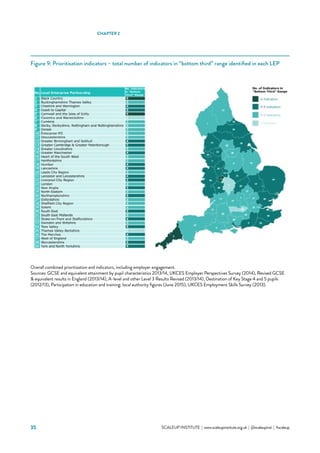
Figure 9: Prioritisation indicators – total number of indicators in “bottom third” range identified in each LEP
Overall combined prioritisation and indicators, including employer engagement.
Sources: GCSE and equivalent attainment by pupil characteristics 2013/14, UKCES Employer Perspectives Survey (2014), Revised GCSE
 equivalent results in England (2013/14), A-level and other Level 3 Results Revised (2013/14), Destination of Key Stage 4 and 5 pupils
(2012/13), Participation in education and training: local authority figures (June 2015), UKCES Employment Skills Survey (2013).
CHAPTER 2
36 			 SCALEUP INSTITUTE | www.scaleupinstitute.org.uk | @scaleupinst | #scaleup
Alongside this need for better skillsets in 2014, it was felt important that local
areas promoted the top 50 scaleup companies in their jurisdiction to adults for the
next phase of their careers (Recommendation 6 in 2014). This was a result of 61%
of scaleups expressing the desire for it to be easier to attract executives from large
corporates. In 2016, this percentage fell to 56%; we could infer from this that it is
becoming more culturally acceptable to leave a ‘safe’ job in a large company to join
a ‘more exciting’ growing company. This is a positive development so we are now
retracting Recommendation 6 from our recommendations this year.
Visas
At present, the ‘scaleup visa’ recommended in 2014 does not yet exist. It is apparent
however, that for many scaling businesses in 2016, access to overseas talent and
skills remains a priority, as a supplement to hiring locally available talent.
We view fast-track procedures to enable companies that have achieved ‘scaleup
status’ to be able to recruit from overseas to be a pressing matter.  
The majority of LEPs surveyed in 2016 would value a visa scaleup service in
their jurisdiction.
Appendix 5 of this Review examines this issue in more detail with estimates of what
Scaleup Visa issuance to 2024 should be per LEP and shows that the maximum
number of annual visas need not exceed the number of current scaleups in any
given year.
CASE STUDIES
The 2014 Scaleup Report published case studies about programmes that had
created well-evidenced, high-impact public-private collaborations targeted at home-
growing more talent so that scaleups could have a better supply of people with
the right skills to hire so they could fill customer orders; this served to explain the
emerging models of intervention.
In 2016, the following programmes are featured as exemplars by the ScaleUp
Institute because of their focus on raising aspirations and awareness regarding skills
needed for the roles that are most difficult for scaleup companies to fill.
CHAPTER 2
37 			 SCALEUP INSTITUTE | www.scaleupinstitute.org.uk | @scaleupinst | #scaleup
LifeSkills, created with Barclays
Founders4Schools
Google Campus
NACUE
General Assembly
These case studies can be found on the ScaleUp Institute website.
In 2016, the ScaleUp Institute have received nominations to review additional
initiatives designed to help make it easier for scaleup leaders to get the talent they
need: Our plans include reviewing the Advanced Manufacturing Catapult Centre,
the Engineering and Employment Federation (EEF), oppsinbuck.org and the work
of the Engine Shed in Bristol. In 2017, the ScaleUp Institute hopes to publish
additional research into sector-specific skills gaps. If you are aware of initiatives
that you believe to be well-evidenced and high impact, please bring them to
our attention.
IN SUMMARY
Whilst progress is being made on the skills agenda there remains much to be done.
The ScaleUp Institute will continue to work with its partners, educators, and the
public and private sectors to ensure the skills needed for our scaling businesses
remain a high priority on the national and local agenda. The recommendations for
2016 therefore build on those suggested in 2014.
CHAPTER 2
2016 RECOMMENDATIONS
We recommend that the Department for Education and Local Enterprise
Partnerships use their convening and promotional power to guarantee that
students at schools, colleges and universities come into contact with the
top 50 scaleup business-leaders within 20 miles of their establishment.
Additionally, that an API to the National Pupils database, with suitable
protections, is made available so that the impact of these interventions can be
measured (Recommendation 4).
We recommend that a ‘Scaleup Visa’ be made available in communities where
there are 100 + scaleup companies to enable scaleup leaders to recruit staff
they need to increase their capacity to grow (Recommendation 5).
38 			 SCALEUP INSTITUTE | www.scaleupinstitute.org.uk | @scaleupinst | #scaleup
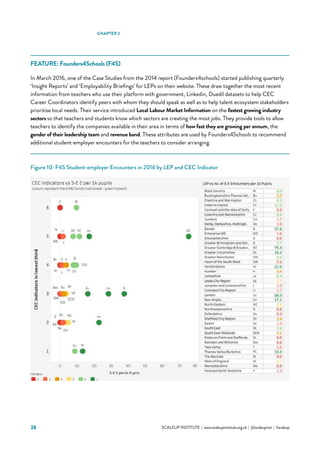
FEATURE: Founders4Schools (F4S)
In March 2016, one of the Case Studies from the 2014 report (Founders4schools) started publishing quarterly
‘Insight Reports’ and ‘Employability Briefings’ for LEPs on their website. These draw together the most recent
information from teachers who use their platform with government, Linkedin, Duedil datasets to help CEC
Career Coordinators identify peers with whom they should speak as well as to help talent ecosystem stakeholders
prioritise local needs. Their service introduced Local Labour Market Information on the fastest growing industry
sectors so that teachers and students know which sectors are creating the most jobs. They provide tools to allow
teachers to identify the companies available in their area in terms of how fast they are growing per annum, the
gender of their leadership team and revenue band. These attributes are used by Founders4Schools to recommend
additional student-employer encounters for the teachers to consider arranging.
Figure 10: F4S Student-employer Encounters in 2016 by LEP and CEC Indicator
CHAPTER 2
39 			 SCALEUP INSTITUTE | www.scaleupinstitute.org.uk | @scaleupinst | #scaleup
Figure 10 above shows F4S Student-employer encounters per 1,000 students
by LEP and by the CEC cold-spot indicator research.29
The left hand side of the
analysis shows LEPs by the CEC index and the bottom show local variation between
teachers in each LEP with regards to the business leaders they feature in their class,
ask to host workplace visits and feature in their career fairs.  Greater Cambridge and
Greater Peterborough LEP leads with 75 student-employer encounters per 1,000
student population, followed by Dorset LEP with 38 per 1,000 students and London
LEP with 28 student-employer encounters per 1,000 students.  Since the issuance
of the ‘F4S 2016 Quarter 3 (Q3) Employability Index’, it is interesting to see that
London has surpassed Dorset in student-employer encounters per 1,000 student
population.
CHAPTER 2
29	 https://www.careersandenterprise.
co.uk/evidence
CHAPTER 3
Leadership
SCALEUP INSTITUTE | www.scaleupinstitute.org.uk | @scaleupinst | #scaleup41
On developing leadership teams
CHALLENGE: DEVELOPING SCALEUP COMPANIES WITH THE ABILITY
TO MANAGE RAPID GROWTH
Recap of 2014 Recommendations
Recommendation 8: Local Enterprise Partnerships, universities and the private sector should
work together to ensure effective learning programmes are available in their areas aimed at
leadership development of scaleups.
In the 2014 ScaleUp Report, leadership development was cited by scaleup leaders
as the second most important factor preventing them from continuing to grow their
companies at the same pace or faster.
Leaders of scaleups worldwide need to learn to adjust quickly to changing
demands. Most acknowledged that it is hard to develop their managerial and
leadership talent. Indeed, it is easy to understand that it would be hard to grow
a company “faster than is ‘normal’” without the right training and support readily
available on a local basis.  
Expertise in new process implementation and the delivery of organisational change
can be recruited, some may also have experience with growing companies. However,
a scaleup leader must also be able to develop talent in-house. This requires taking
the time to learn from other companies and entrepreneurs who have scaled
businesses successfully, and being open to external ideas. For a rapidly growing
business this can be difficult to organise and deliver, especially when set against
other competing demands.
There is also a shortage of role models to provide vital mentoring and guidance.
The ScaleUp Report 2014 revealed that while there were many start-up mentoring
programmes, very few were focused on scaleups. The 2014 report found overall
there were insufficient numbers of high quality mentors, that the system for
identifying them was fragmented and that the matching process between mentors
and firms was erratic. The Report also found that although there were some national
leadership development programmes, these were not yet operating in all localities or
at sufficient scale.
Several recommended changes were identified that would improve the prospect for
the UK being the best place in the world to scale a company.
CHAPTER 3
42 			 SCALEUP INSTITUTE | www.scaleupinstitute.org.uk | @scaleupinst | #scaleup
For local ecosystems to track mentors who had been a director or employee at
a company during its scaleup period using Companies House data.
•	 For local educators and the private sector to provide targeted managerial and
leadership training for scaleups
•	 For existing mentoring schemes to be more focused on scaleups
NATIONAL PICTURE 2016
In 2016, leadership development is now the top barrier cited by scaleup leaders
when asked what was preventing them from growing their revenues faster. The 2016
ScaleUp Survey showed a growing desire among scaleup business leaders to have
scaleup executive education programmes, access to non–executive directors with
scaleup credentials and opportunities to engage with their peers available locally.
88% of scaleup leaders cited leadership development as the most important
barrier impeding their growth (This is 5% more than reported this in 2015).
Crucially, the more employees the scaleup business had, the more acute the
need for leadership development.
71% of scaleup CEOs said it would be easier for them to grow their company
faster if there were effective mentoring and professional support schemes
near to them.
4 in 10 of scaleup leaders cited mentoring as one of the key reasons they had
managed a scaleup level of growth in their businesses in the first place. However,
half of these mentioned that they were unsure as to where to find high-quality
mentors, and a third of them felt that the availability of high quality mentors was
a barrier to their continued growth. For the scaleup leaders who said mentoring
would help them grow faster, when asked which type of support would be the most
valuable, nearly half of the scaleup leaders said they would value better access to
peer-to peer mentoring and non-executive directors who had scaled a company
themselves. While a quarter said that they would value short executive education
courses the most.In contrast, only 5% of the CEOs said they would value support
from larger corporates within their supply chain.
CHAPTER 3
43 			 SCALEUP INSTITUTE | www.scaleupinstitute.org.uk | @scaleupinst | #scaleup
LEADERSHIP DEVELOPMENT  MENTORING
– VIEWS FROM SCALEUP LEADERS
“Please provide coaching and advisory support to help with the areas of my business
where I am unprepared.” (Oxfordshire)
“Please provide support from people that have genuine scaleup expertise.”
(Greater Manchester)
“I need access to experienced mentors/NEDs who know our industry and can help
us accelerate our growth by making large customer contacts, accessing finance and
developing a business plan.” (Greater Manchester)
“High quality and sector specific mentoring and leadership coaching.”
(Northamptonshire)
“Facilitate introductions to peers and provide funding to support business change and
transformation.” (North East)
“More accessible, structured programmes for scaleup companies at the smaller end of
the scale.” (North East)
NATIONAL VS. LOCAL PRIORITIES
As shown in the Local Scaleup Briefings in Appendix 2, disparities vary from city to
city and region to region. Less concern was expressed regarding leadership development
as an issue in Scotland, Greater London and in the Yorkshire and the Humber Region.
Sheffield City Region was cited favourably for their leadership support by 10 of their
local scaleup leaders. The East Midlands and West Midlands also agreed, with 10 Black
Country scaleup leaders reflecting a particularly positive view of their capacity for
leadership development to sustain their business growth. Conversely, there was a greater
need for leadership development to enable growth expressed in the South East, South
West, North East, and North West regions. We found 10 scaleup business leaders
in Manchester needed more effective mentoring schemes and professional support
schemes based locally to enable them to develop the leadership capacity at their firm.
PROGRESS SINCE 2014
One of the key recommendations of the 2014 Report was to encourage universities
and the private sector to work together to create a ‘scaleup culture’, and to provide
effective learning programmes in local areas aimed at leadership development in
scaleups. This would help to create a local scaleup ‘ecosystem’ and embed a sustainable
scaleup culture.
This has been a key part of the ScaleUp Institute’s work in 2016 through the
deployment of an executive education course on Driving Economic Growth Through
CHAPTER 3
44 			 SCALEUP INSTITUTE | www.scaleupinstitute.org.uk | @scaleupinst | #scaleup
Scale-Up Ecosystems designed by leading academic Professor Daniel Isenberg. This
was made possible by the support of Goldman Sachs Foundation and 10,000 Small
Businesses UK alongside Innovate UK. 30
The coverage of the programme and the
initial scaleup project outcomes are reported on in more detail in the feature over-
leaf. By enabling a greater fostering of growth and scaling businesses within the local
structure, this programme will support economic opportunity, internationalisation
and productivity.
Across 2016, the Institute has also worked closely with the Small Business Charter
and the Association of Business Schools (ABS).  The recent Chartered ABS report
on Business schools is of significant value to local and regional economies, which
recommended that business schools should improve the visibility of, and accessibility
to, the programmes supporting business growth and innovation.31
We expect to build on these two areas of work in 2017.
CASE STUDIES
The ScaleUp Institute is tracking and evaluating the growing number of intensive
executive education support programmes that help scaleup business leaders to share
experiences and learn from each other. In the past year, we are pleased to report
that the following two initiatives have expanded their reach and updated evidence to
strengthen evidence of the impact of these programmes.
Goldman Sachs 10,000 small businesses UK
ELITE Programme (London Stock Exchange)
We have received several nominations of additional programmes for scaleup leaders
that we hope to publish case studies on. These include, but are not limited to,
Cambridge School for ScaleUps , Strathclyde Business School Growth Advantage
programme, the Supper Club and Tech City’s Future Fifty  Upscale programmes.
We will be further assessing local case studies in 2017 and we invite further
submissions to be made.  
IN SUMMARY
In 2014, it was recommended that Local Enterprise Partnerships, universities and
the private sector needed to work together to ensure effective learning programmes
were available in their areas aimed at leadership development of scaleups. It was also
recommended that high quality mentoring programmes be more easily identifiable.
The results of the 2016 survey show that, at a local level, these actions are still
relevant. Signposting of local high quality mentorship and support programmes,
30	Dan Isenberg (@danisen) is
founding executive director of the
Babson Entrepreneurship Ecosystem
Project, Associate at the Harvard
Kennedy School of Government,
and Adjunct Professor at Columbia
Business School
31	 https://charteredabs.org/
wp-content/uploads/2016/09/
Chartered-ABS-Delivering-Value-
Report-2.pdf
CHAPTER 3
45 			 SCALEUP INSTITUTE | www.scaleupinstitute.org.uk | @scaleupinst | #scaleup
including options to recruit high-quality non-executive directors still requires
further action. The same applies to the availability of high quality local leadership
programmes which enable scaleup leaders to link with other successful scaleup peers
experiencing rapid growth. These peer-to-peer forums are highly valued by scaleups,
as well as the local support available from business schools and universities. We
welcome the continued work of the Association of Business Schools in this area with
the Small Business Charter, as well as the programme outputs from the Driving
Economic Development course, which we will further assess in 2017.
Leadership support in a rapidly changing and fast-paced environment is ever more
important to the CEOs of our scaleups and we must maintain our focus in these
areas at a local and national level if we are to provide an ecosystem that encourages
further growth.
CHAPTER 3
2016 RECOMMENDATION
We recommend that local stakeholders prioritise the signposting of high
quality mentorship programmes and develop effective matchmaking between
peers and non-executive directors who have scaled businesses before. Local
and national educational institutions should prioritise the introduction of
high-quality flexible courses designed to help scaleup leadership teams
with their development needs. Better connection should also continue to
be made between national programmes and local ecosystem leaders to
encourage scaling business leaders to apply to courses with known impact
(Recommendation 6).
46 			 SCALEUP INSTITUTE | www.scaleupinstitute.org.uk | @scaleupinst | #scaleup
FEATURE: Driving Economic Growth through Scaleup Ecosystems Course
In 2016, the ScaleUp Institute introduced the Driving Local Economic Growth
executive education Programme for 130 local ecosystem leaders from 31 LEPs,
cities and Growth Hubs. Supported by the Government32
led by Professor Daniel
Isenberg33
and made possible with the support of the Goldman Sachs Foundation,
10,000 Small Businesses UK and Innovate UK, two executive-education courses
have been run in 2016. The inaugural course was held in Birmingham in May at
the Aston Business School and the second course was held in September at the
Manchester Science Park. Course candidates were drawn from all parts of the
United Kingdom, including Northern Ireland and Scotland.
The three-day programme is based around the core challenges facing UK high-
growth businesses. Through interactive lectures, exercises, case study discussions,
highly participatory group work and projects, the course equipped participants
to focus on the challenges affecting scaleup growth in their specific area. The
programme enabled local stakeholders to identify practical measures and
techniques to address these challenges, apply these measures to their local business
environment and to develop a local scaleup plan to take forward. Since completing
the programme a number of actions have been taken by its participants within their
local area including: adding scaleup programmes to their economic development
plans, introducing new executive education for their local scaleups, and establishing
mentoring schemes and peer-to-peer groups. Furthermore, many business school
leaders who participated on the course are reviewing how they can offer more
structured targeted support for local scaling businesses.
CHAPTER 3
32	 Pictured top right: Rt Hon
Margot James MP for Small
Business, Consumers and Corporate
Responsibility came to speak to
cohort members of the course run in
Manchester.
33	 Pictured top left: Dan Isenberg
is founding executive director of the
Babson Entrepreneurship Ecosystem
Project, Associate at the Harvard
Kennedy School of Government,
and Adjunct Professor at Columbia
Business School
47 			 SCALEUP INSTITUTE | www.scaleupinstitute.org.uk | @scaleupinst | #scaleup
HIGHLIGHTS OF PROGRESS MADE BY LOCAL AREAS
SINCE THE COURSE
Swindon and Wiltshire: In October 2016, the Inspire Elite Swindon and Wiltshire
ScaleUp Programme was launched. With a dedicated manager, it aims to support
100 local scaleups through 2017 from across the local area. It includes dedicated
peer to peer networking opportunities for shared learning, visits to other successful
businesses, and access to experts in scaleup challenges. A true mix of sectors are
supported from high-value manufacturing, engineering, life sciences, energy and
waste management, digital and creative, electrical, print and media.
Greater Cambridge and Greater Peterborough: A dedicated ScaleUp and Growth
Manager has been appointed and a ‘School for Scaleups’ has been launched.
Worcestershire: In conjunction with University of Worcester, Worcestershire LEP
has undertaken an assessment of local scaleups. As a result, scaleups are now
embedded in the strategic priorities of the local LEP and Growth Hub and they
plan to launch a scaleup executive education programme in early 2017.
West of England: West of England LEP working with the University of Bristol
and the Engine Shed has undertaken scaleup roundtables with MPs to showcase
local growth companies. They have also organised a series of events for scaleup
companies focused on local scaleup needs and challenges.
Birmingham and Black Country: A ‘ScaleUp 1000’ Programme is due for formal
launch in January 2017. As part of this initiative, a ScaleUp Champion will be put
in place.
Scotland: Work is already underway to reshape Scottish Enterprise account
management to target and support scaleup companies. It is also anticipated that
the scope of the Enterprise and Skills Review will likely identify and commit to
further actions to support these companies.
Initial feedback has been promising and the Driving Economic Growth Programme is set
to continue in 2017, but it should be noted that this executive education programme is in
its initial stages. A full independent impact analysis will take place in 2017, which we will
report on in November 2017.
CHAPTER 4
Markets
SCALEUP INSTITUTE | www.scaleupinstitute.org.uk | @scaleupinst | #scaleup49
On accessing markets
CHALLENGE: SELLING TO LARGE COMPANIES AND GOVERNMENT,
ENTERING NEW MARKETS AND GAINING REGULATORY APPROVAL
FOR NEW PRODUCTS ALL LEAD TO INCREASING CUSTOMER
REVENUES
Recap on 2014 Recommendations
Recommendation 9: The government should draw attention to scale-up companies and their
leaders so that it is easier for them to act as role models to others and to find customers, partners
and investors, both at home and overseas. UK Trade and Investment should ensure that scale-
up companies are well represented on international trade missions, and publish details annually.
Central and local government should publicly report on the level of procurement they source from
scale-up companies and their funding should be reviewed in terms of the amount of procurement
they do with scale-ups.
Recommendation 10: The impact of regulation ‘cycle time’ on rapidly growing companies
should be a major consideration for regulators and agencies. Agencies that interact frequently
with scale-ups, like the Border Authority, Listing Authority and HMRC should report on their
efficiency in relation to regulatory peers in other countries.
The 2014 ScaleUp Report found that addressing local and international barriers was
third highest on the agenda for scaleups, significantly ahead of access to finance.
Scaleups rely on being able to roll out innovative products and services quickly. In
2014, we reported that scaleup leaders were leaving the UK because the ‘cycle-
time’ affecting their ability to roll out products was greater here than elsewhere.
Cycle-time lags, in some sectors, put UK scaleups at a disadvantage to their
international competitors. The 2014 Report therefore recommended that UK
stakeholders report on their cycle-time with regards to scaleup companies and
should benchmark their performance against their peers in other jurisdictions.
In the 2016 Scaleup Survey, access to markets ranked second on the agenda,
significantly ahead of access to finance and infrastructure concerns.
The actions of large companies and Government can support scaleups to flourish
in markets in any given geographic region. The 2014 Scaleup Report called
upon large companies to buy more from scaleups, trade missions to include
representation from more scaleup leaders and Government departments to use
their budgets to drive innovation through procurement with scaleup companies.
By way of comparison, within Europe, around 19 percent of GDP is spent on public
procurement; this could therefore constitute the single easiest lever we have to pull
in 2017 to support scaleups.
CHAPTER 4
50 			 SCALEUP INSTITUTE | www.scaleupinstitute.org.uk | @scaleupinst | #scaleup
NATIONAL PICTURE 2016
In 2016, 86% of scaleup leaders cited that they would be able to grow their company
faster if it were easier to attract large corporates as customers in the UK. This is a
9% (post-Brexit) jump from the 77% who stated this in 2015.
Amongst those who agreed that this was a considerable challenge, the main
difficulties were expressed at the initiation stage (identifying suitable prospect
companies and the right person to talk to there) and getting senior management
buy-in from the potential customer. Both concerns were raised by 21% of scaleup
survey respondents. Meanwhile, 1 in 10 of our respondents identified being able
to qualify for contracts (such as by compliance with procurement conditions)
as a challenge.
79% of scaleup CEOs agreed that they would be able to grow their business faster
if it were easier to attract larger corporates as customers overseas.
72% of scaleup leaders cited said they would be able to grow their company faster
if the Government were a customer. This is an advance on the 65% of Scaleups
who agreed with this statement in 2015.
82% of scaleup CEOs stated that they would be able to grow their companies faster
if interactions with Government Departments were easier. This is a 12 % jump from
the 74% of CEOs we surveyed in 2015. This issue appeared to be particularly
acute for CEOs running companies employing between 100 and 249 employees
as evidenced in Figure 12 below.
Figure 12: 2016 Survey Results for Government Department question by size
of company
83%84% 69% 96% 77%
11−19 20−49 50−99
Company size
100−249 250+
CHAPTER 4
51 			 SCALEUP INSTITUTE | www.scaleupinstitute.org.uk | @scaleupinst | #scaleup
70% of scaleup CEOs stated that they would benefit by being invited to join
international trade missions or if they were introduced to potential overseas
customers they could sell to or partner with. This rises to 84% of Scaleup CEOs
from companies with 11-19 employees.
In 2016, 70% of scaleup CEOs stated they would be able to grow their company
faster if interactions with regulators were easier. This is a 6-point jump on the 64%
of scaleup CEOs who reported this in 2015. Upon looking at the answers by size
of company, the case for fast-track systems for scaleup companies with more
than 100 employees seems far greater (83%) compared to the 65% of those with
less than 50 employees who expressed this as a concern.
Figure 13: 2016 Survey Results for Interactions with Regulators by size of company
VIEWS FROM SCALEUP LEADERS REGARDING ACCESS TO MARKET
“Without being flippant: buy from us. Both UK big business and UK government are
notoriously slow to engage with, slow to consider and slow to procure. That’s in
comparison to the US…even Japan. Time is a scaleup’s killer.” (Greater London)
“Show more interest in dealing with emerging businesses.” (Greater London)
“Be an early stage customer.” (Greater London)
“Public sector is so difficult for a small organisation to engage with because of the
procurement process. The same can apply for corporates. The amount of resource
required to respond to them is prohibitive and only favours larger organisations with
the bandwidth and resource to be able to respond and quickly. How could these
procurement processes be made easier and open to smaller businesses to succeed?”
(Oxfordshire)
“All Government Departments should use the same procurement as this would cost
much less when tendering and would stop duplication between each ministry, we work
for various and they are all independent of each other.” (Hertfordshire)
66…63…71…83…7363%66% 71% 83% 73%
11−19 20−49 50−99
Company size
100−249 250+
CHAPTER 4
52 			 SCALEUP INSTITUTE | www.scaleupinstitute.org.uk | @scaleupinst | #scaleup
34	 http://www.scaleupinstitute.org.
uk/research/scaling-together
“Publish RFPs / RFQs in the same location.”
“Public sector could have a contractors portal demonstrating contracts available. Also
the government could have open days where contractors are invited to present, a bit
like a trade show.” (Leeds)
“Contrary to government policy re public sector doing business with SMEs the
tendering processes legislate against SMEs primarily due to poor procurement practice
and risk averse nature.” (Greater London)
“Large corporates need to understand they are dealing with much smaller talented
businesses – their procurement processes are very expensive and onerous for us.”
(South West)
VARIATION BETWEEN LOCAL AND NATIONAL VIEWS:
As shown in the Scaleup Briefings in Appendix 2, priorities do differ for scaleup
leaders at a local level. In Greater London, the East Midlands (including
Northamptonshire), the South West and Yorkshire and Humber (including Sheffield
City Region), scaleup leaders feel relatively positive about access to international
markets and Government procurement in their areas. Conversely, greater concern was
expressed by scaleup leaders regarding access to international trade missions and
introductions to international customers among those who had chosen to locate
their businesses in the North East and North West, including Greater Manchester,
West Midlands, and Liverpool City Region.
PROGRESS TO DATE
Scaleup procurement and collaboration with large corporates and government.
Over the course of 2016, it is apparent that there is intent by large corporates
to engage with scaleups more effectively. However the pathway to procurement
contracts or collaborations is still not that easy, simple or clear for scaling businesses.
More concerted action is therefore required to facilitate and simplify these
processes to enable our scaling businesses to increase engagement with corporates
and gain access to procurement contracts.
That is why we welcomed the opportunity to collaborate with Nesta in 2016 on
their review of the barriers and challenges faced by early stage growth businesses
seeking to work with corporates. The resultant practical guidance given with case
exemplars in the ‘Scaling Together Report’34
published in March 2016 is a tool for
all parties. We were also pleased to see the work Nesta undertook in the Summer
of 2016, as part of the Startup Europe Partnership, to publish a league table of the
top 25 Corporations across Europe that were judged ‘Good Corporate Scaleup
Citizens’. This should inform non-executive directors on large company boards on
the questions they might consider asking of their executives and the benchmarks
CHAPTER 4
53 			 SCALEUP INSTITUTE | www.scaleupinstitute.org.uk | @scaleupinst | #scaleup
for measuring the effectiveness of the company in its engagement with scaleups.
As identified by Nesta, good scaleup practice includes, but is not limited to,
the following:
•	 the creation of procurer networks;
•	 ‘meet the market’ events to help small suppliers find buyers;
•	 internal executive education scaleup training programmes for
procurement officers;
•	 increased transparency on procurement needs;
•	 subdivision of big contracts into smaller parts;
•	 simplifying the qualification process;
•	 resisting demands for ISO certification for smaller suppliers;
•	 publishing procurement guidelines for scaleup suppliers about the
procurement process
It is evident that there are some practical ways in which improvements can be made
in this area, and to this end, scaleup matchmaking services are also welcomed by
such businesses.
It is vital that the Government at both central and the local levels continue the
work already underway to improve engagement with SMEs on supplier contracts
both on a direct and indirect basis. We also welcome the recently announced
review by the Government into the Small Business Research Initiative to look at
how it can increase its impact and give more innovators their first break. It would
also be useful, as previously recommended, for the Government to monitor their
procurement with scaleups at local and national level and to continue to encourage
larger companies they are buying from to support scaleups in their supply chain. The
use of data, as outlined in the first chapter, will help this become more effective. The
Scaleup Institute will continue to work with government on this area.
Exports
Among the scaleup CEOs we surveyed in 2016, the most relevant international
markets to their business were identified as the EU (29%), North America (27%),
Asia (19%) and the Middle East (13%).
CHAPTER 4
54 			 SCALEUP INSTITUTE | www.scaleupinstitute.org.uk | @scaleupinst | #scaleup
Figure 14: Most Relevant International Markets
In 2015-2016 critical work began to review how further support can be made
available to scaling businesses at home and abroad. Innovate UK has allocated a
significant portion of its funding to scaleups and aligned its strategic goals to scaling
businesses. UKTI has run the ‘Exporting is GREAT’ campaign which showcases
business opportunities across the world. This is an important initiative to continue
in order to encourage and facilitate access to overseas market opportunities for our
scaling businesses.
The development of, and easier access to, United Kingdom Export Finance (UKEF)
short-term and working capital products (including the Delegation Initiative for
banks, which will provide funding solutions to exporters under shorter and more
accessible timescales), are welcomed and necessary. It is also vital to continue the
work on the new enhanced tier one UKEF Supplier Export Working Capital scheme
and increase the eligibility of such schemes to current exporters and potential
exporters. Making it easier to understand and apply for these schemes is essential;
the Government should continue its drive to deliver a digital platform so exporters
can apply online for such UKEF schemes instead of the current paper-based
approach. The Autumn Statement announcement on the doubling of capacity and
increase in risk coverage of UKEF is also welcome.
As we seek to encourage our scaling businesses to embrace further export
opportunities, it may be worthwhile for government to consider an Export Voucher
Scheme to support businesses entering new markets for the first time or some form
of tax allowance. These are matters which we will further explore in an upcoming
report on the international perspective from scaling businesses due to be published
by the ScaleUp Institute.
European Union North America Asia Middle East India Subcontinent Latin America Africa
CHAPTER 4
55 			 SCALEUP INSTITUTE | www.scaleupinstitute.org.uk | @scaleupinst | #scaleup
CASE STUDIES
The UK has a small number of highly effective access-to-markets case studies,
which are featured on the ScaleUp Institute’s website.
VentureFest
SVC2UK
We have received nominations to evaluate London’s ‘GotoGrow’ programme,
which supports 800 Scaleup leaders in London in specific sectors to move into
international markets and the West Country LEP’s electronic match-making
service. Likewise, we have received nominations to review case studies in 2017
about the impact of initiatives like the Digital Catapult Centre, Level 39, Advanced
Manufacturing Centre and aerospace and automotive industry in the programmes
that connect large corporate buyers to scaleups in their supply chains.
IN SUMMARY
In light of Brexit and the market uncertainty associated with the referendum, the
challenges surrounding access to domestic and international markets is climbing up
the agenda in scaleup leaders’ minds. As we enter 2017, procurement, collaboration
and internationalisation must be a priority for both private and public sector
stakeholders up and down the country. To establish how that engagement can be
undertaken in simpler, easier, quicker and targeted ways is vital. The more we can
give effect to ‘fast-track procedures’, the more we drive UK economic growth.
This will continue to be a key area of work for the ScaleUp Institute in 2017,
particularly to ensure that as Brexit unfolds, we support the confidence of scaleup
leaders to expand internationally and seize the opportunities across the globe.
CHAPTER 4
2016 RECOMMENDATIONS
We recommend that public bodies report on the level of procurement they
source from, and the collaboration they have with, scaleup companies and their
funding should be tied to increasing this amount (Recommendation 7).
We recommend that large companies report on the level of procurement
they source from scaleup companies and the collaboration they have with
scaleup companies. Any procurement contracts with Government should
require an increase in the amount of business undertaken with scaleups
(Recommendation 8).
We recommend that agencies that interact frequently with scaleups, such
as the Border Authority, Listing Authority and HMRC, have fast-track
procedures for scaleups and report on these in relation to peers in other
countries (Recommendation 9).
CHAPTER 5
Finance
SCALEUP INSTITUTE | www.scaleupinstitute.org.uk | @scaleupinst | #scaleup57
On accessing finance
CHALLENGE: ATTRACTING APPROPRIATE GROWTH CAPITAL
Recap of 2014 Report Recommendation
Recommendation 11: Government and industry must ensure that progress in closing the
finance-gap is maintained and review and report on the extent to which scale-ups, in particular,
are supported.
In 2014, 151 of the 203 scaleup CEOs ranked access to talent as their 1st, 2nd or
3rd most important issue, against just 44 of the 203 who ranked access to finance
as a top-three issue. The historic shortage of capital available in the UK for scaleups
is well-documented and many initiatives have been put in place to address this. In
2014, the ScaleUp Report focused on the need for bigger pools of capital in the UK
and the need for more investors who are willing and able to provide ongoing rounds
of follow-on or scaleup financing.
We want entrepreneurs based in the UK to be able to identify and raise capital in
the UK and not feel the necessity to look towards the plentiful sources of attractive
finance domiciled in the US or Asia.
It is important to increase the provision of education on growth finance so that
scaleup leaders understand and are aware of all the options available to them so they
can structure their companies appropriately. It is particularly crucial for company
leaders to be able to understand the various financial instruments available so they
can align their interests with those of their shareholders from a very early stage.
This is one focus we hope to take forward in 2017, ideally building on the work of
the British Business Bank which provides information to business leaders regarding
finance options. The Review into Patient Capital recently announced by the
Government, led by Sir Damon Buffini, is also welcomed.
NATIONAL PICTURE 2016
In 2016, 70% of Scaleup leaders felt that they would be able to grow their company
faster if they had access to bank loan finance, 63% stated they would benefit from
help in meeting overseas investors and 62% felt they needed better access to
venture capital (VC) finance.
That said, our annual surveys of UK scaleup leaders from 2014 to 2016 showed
that issues with finance are now less of a priority in the UK compared to other
factors. Finance is important, however, addressing the skills shortages, developing
scale-up leadership and increasing access to customers via exports and government
CHAPTER 5
58 			 SCALEUP INSTITUTE | www.scaleupinstitute.org.uk | @scaleupinst | #scaleup
procurement, will do more to secure the UK’s long-term competitive advantage.
Finance challenges are a complement to the context of the broader issues that a
fast-growing company faces in its journey for achieving scale.
ON ACCESSING FINANCE – VIEWS FROM OUR SCALEUP LEADERS
Need for geographically balanced risk capital
“It would be better to be more balanced geographically … with this in mind a greater
steer can be placed on encouraging innovation funding into areas with stronger needs
for innovation and growth to help rebalance the UK economy. This may be possible to
address in the remit of funding agencies and application review processes, this action
could do a lot to rebalance innovation and growth across the UK.” (South Yorkshire)
Desire for continued support in taxation options
“Keep EIS funding incentive going.” (Greater London)
“Continuation of RD tax credits – RD tax credits help firms focus time and
efforts on innovation and IP generation….[it] is a helpful mechanism that encourages
innovation particularly in labour heavy (not capital equipment heavy) industries.
Removal of this would damage investment in innovation especially in the digital, high
skilled professional and service sectors….” (South Yorkshire)
Ease of flexible finance access and support in identifying options
“Make it easier to find out what government funding support is available.”
(Greater London)
“Help with Finance, access to FD skills.” (Warrington)
CHAPTER 5
59 			 SCALEUP INSTITUTE | www.scaleupinstitute.org.uk | @scaleupinst | #scaleup
NATIONAL VERSUS LOCAL PRIORITIES
As shown in the briefings in Appendix 2, on a local basis priorities differ. Scaleup
leaders in the North East and North West Regions are less likely to mention
finance as a barrier than their peers, albeit this can vary by LEP area. For example,
10 scaleup leaders in Manchester highlighted access to venture capital as a particular
concern to them. In Yorkshire and the Humber, the East Midlands, West Midlands
and the South West, access to finance was cited as more of a barrier to growth. For
example, views from 10 scaleup CEOs in the Black Country reflected the lack of
venture capital as a significant barrier in this area.
These regional disparities in access to private equity, both by deal numbers and
value, were also noted in recent British Business Bank analysis35
, with London and
the South East attracting a higher proportion of equity compared to their weight
in the UK economy. London received 47% of all equity deals by number and 57%
by value in 2015, despite only 21% of high-growth businesses being located in this
region.
Figure 14: Proportion of Equity Deals, High-Growth Businesses and Business
Population by Region
Region % of total no. of UK
Equity Investments
% of total no. of High-
Growth Enterprises
% of total no. of UK
Private Sector
London 47.1 20.9 18.1
South East 11.5 14.4 16.3
North West 6.3 11.1 9.9
East of England 6.1 8.6 9.8
West Midlands 4.0 8.5 7.4
South West 4.6 8.2 9.9
Yorkshire and the Humber 3.5 7.1 7.1
East Midlands 2.8 6.5 6.6
Scotland 6.1 6.4 6.3
Wales 2.3 3.5 3.9
North East 4.7 3.0 2.5
Northern Ireland 0.9 1.7 2.2
London received 47% of the total number of equity deals in the UK in 2015, but the region accounts
for 21% of high-growth businesses and 18% of the wider business population. This may suggest equity
deals are underrepresented in the other regions relative to the share of high-growth businesses and
business in the wider population.
Source: Beauhurst, ONS analysis of high-growth enterprises and BIS business population estimates.
CHAPTER 5
35	 http://british-business-bank.
co.uk/research/equity-tracker-2016
60 			 SCALEUP INSTITUTE | www.scaleupinstitute.org.uk | @scaleupinst | #scaleup
In its October 2016 report on access to finance published, the House of Commons
Select Committee for Business, Energy and Industrial Strategy (BEIS) noted that
“access to finance is not as fundamental a barrier to business growth as it was a
couple of years ago.” However, the Committee also acknowledged that there were
regional disparities and that “information and advice was often more of a barrier”
than gaining the finance itself.36
Demand has a role
Bearing in mind that 100% of net new jobs are generated by growing companies
that are less than five years old, there is a broader context of smaller and medium-
sized businesses one might wish to take into account which is reported in the latest
BDRC SME Finance Monitor (2016 Quarter 2). This report shows that Small and
Medium-sized companies (irrespective of whether they were growing, shrinking or
with stagnant growth) were recently far less likely to take up external finance.
According to the Monitor, choosing to use any form of external finance fell
from 44% in 2012 to 36% in Q2 2016. In particular, lower levels of finance were
reported. In 2012, 36% of SMEs used one or more forms of finance, while in Q2
2016 this had fallen to 30%. Attitudinally, 7 in 10 SMEs said that they would accept
slower growth through the use of their own resources rather than taking external
finance to grow more quickly, compared to 4 in 10 happy to use external finance to
help the business develop and grow.
Figure 15: There continues to be high levels of agreement with self-funding
and self-reliance
36	 http://www.parliament.uk/
business/committees/committees-
a-z/commons-select/business-
energy-industrial-strategy/
news-parliament-2015/access-to-
finance-report-published-16-17
CHAPTER 5
Aim to pay debt and remain debt free
Happy to use external finance to help business grow
Our current plans for the business are based
entirely on what we can afford to fund ourselves
NEW: We will accept a slower rate of growth rather
than borrowing to grow faster
NEW: We never think about whether we could/
should use more external finance
33%
31%
39%
44%
32%
27%
42%
35%
12%
15%
43%
81%
71%
47%
Agree Agree stronglyAttitudes to finance — H1 16 only
68%
61 			 SCALEUP INSTITUTE | www.scaleupinstitute.org.uk | @scaleupinst | #scaleup
If scaleups are not accessing finance available to them and there is a decrease in
business leaders’ confidence to accept external finance, it is evident there is an
urgent need to ensure that business leaders can access finance and understand their
available options.
PROGRESS TO DATE
It is clear that both the private and public sector have been, and are, listening to
the concerns of scaling businesses and are seeking to collaborate more to address
these needs. This is attributable to increased recognition of the impact of scaleup
businesses on productivity and job creation.
Due to policy action in recent years, it is now widely viewed that there is not an
issue in the UK per se with access to early stage angel or seed capital. This is in
large part due to the preferential SEIS and EIS and VCT schemes designed to make
it more attractive for people to invest and easier for SMEs and scaleups to grow,
which should be maintained. Much more of the issue now facing scaleup leaders is
the pool of available follow-on capital, its tenure and its scale. This was reviewed in
detail in 2016 in the work undertaken by Oxford University’s Saïd Business School
and Cambridge University’s Judge Business School with the support of one of the
ScaleUp Institute’s partners, Barclays Bank.37
We were encouraged in 2015 when the British Business Bank refreshed its strategy
and announced that a core pillar of its work would be collaboration with the private
sector on the development of scaleup finance. This led to the deployment of its
‘Help-to-Grow’ scheme, expansion of the ‘Angel Co-Investment Fund,’ a range
of investments through its early and late-stage venture capital funds, and the
establishment of regional investment funds, namely the ‘Northern Powerhouse’ and
‘Midlands Engine’ funds.
Alongside this Government-supported work, there has also been further evolution
in the private sector growth capital space. The Business Growth Fund (BGF) has
continued to expand and has now invested in more than 150 scaleups from their
regional offices across the UK and Santander continues to develop its ‘Breakthrough
Fund.’ There has been continued evolution of family office funds and further
expansion of investment funds such as Octopus Investments, Beringer and
Woodford Investment Management. There is now growing interest by institutional
funds in what more they can do for scaling businesses, subject to regulation, and
expansion of traditional bank lenders into new products such as the Venture Fund
established earlier in 2016 by Barclays Bank.
Nevertheless, it is clear that there remains a need for the UK to continue to expand
its overall pool of scaleup finance capacity. This is particularly the case in specific
regions and sectors and in reassessing the regulatory framework surrounding
37	 ‘Scale-up UK: Growing
Businesses, Growing our Economy A
report from the business schools at
the University of Cambridge and the
University of Oxford, convened by
Barclays’ www.scaleupinstitute.org.
uk/wp-content/uploads/2016/05/
Scale-up-UK_Growing-Businesses_
Growing-our-Economy.pdf
CHAPTER 5
62 			 SCALEUP INSTITUTE | www.scaleupinstitute.org.uk | @scaleupinst | #scaleup
institutional investment. There is also a necessity for businesses to better
understand the growth capital options available.
Confidence to invest also remains critical for Government and financiers to signal
support for scaling businesses. Investors need to be able to consider what else they
bring alongside capital to businesses whose leaders are becoming more focused
on the value of mentorship, such as their networks and the ‘patient’ nature of the
capital being offered.
As the Government’s Patient Capital Review evolves it will remain important to
consider:
•	 the necessary measures to support long-term growth capital in the UK,
alongside those needed to support the unlocking of long-term capital from
institutional investors;
•	 greater policy focus enabling the buy-side to contribute to renewed growth in
the pre-IPO and IPO market;
•	 the opportunities to review and adapt regulations and market practices to enlarge
the current spectrum of investors, with particular reference to the notion of
‘professional investors’;
•	 the way in which the public and private sectors support the creation of a wider
ecosystem of sophisticated advisors to support businesses to prepare to access
new forms of funding, lower the technical barriers and, eventually reduce the
cost of funding.
CASE STUDIES
A range of finance programmes exist to improve access to finance in the UK
for scaleups. The Scaleup Institute is reviewing a number of these with a view to
endorsing them in the coming months, such as those run by the British Business
Bank. Those that have already completed that process are listed below and found on
our website.
BGF
ELITE Programme (London Stock Exchange Group)
Santander Breakthrough Fund
CHAPTER 5
63 			 SCALEUP INSTITUTE | www.scaleupinstitute.org.uk | @scaleupinst | #scaleup
In view of the discernible cross-regional disparities reported, we will increase our
focus on more in depth regional analysis so that we can report with a greater sense
of statistical confidence in November 2017. Our programme of work for 2017
means we should be able to evaluate and publish additional case studies over the
next twelve months.
IN SUMMARY
From 2014 to 2016, we believe good progress has been made; however, we
recognise how the uncertainty generated by the post-Brexit referendum climate
could impact the overall UK investment environment. Whilst the overall UK capital
markets continue to provide evidence of a greater efficiency compared to the rest
of Europe, continued concerted action to focus on finance for scaleups will secure
a long-term competitive advantage to the UK. The recently announced Patient
Capital Review is welcomed and should be used as an opportunity to review closely
how the UK unlocks greater institutional investment into scaleups and to reassess
the cultural and fiscal regulatory barriers to this.
There remains regional disparity in growth capital distribution in the UK across
sectors such as those heavily dependent on RD or IP, such as Life Sciences
or the Creative Industries, that still require support to tap into non-traditional
finance options.
It is critical to map, evaluate and coordinate the finance initiatives available at a local
level to ensure that a full suite of finance options is available for scaleup business
leaders to consider and to provide clarity regarding what is on offer.
CHAPTER 5
2016 RECOMMENDATION
We recommend that Government and industry ensure that progress is made
closing the finance gap and ensure that growth finance is included as core
curriculum in all local scaleup leadership courses (Recommendation 10).
CHAPTER 6
Infrastructure
65 			 SCALEUP INSTITUTE | www.scaleupinstitute.org.uk | @scaleupinst | #scaleup
On accessing infrastructure
CHALLENGE: ACCESSING RESEARCH AND DEVELOPMENT
FACILITIES AND FINDING SUITABLE PREMISES
Recap of 2014 Report Recommendation
Recommendation 12: Government and industry must ensure that progress in infrastructure areas
is maintained and review and report on the extent to which scaleups, in particular, are catered for.
The 2014 Scaleup Report highlighted a number of issues surrounding access to
infrastructure that impeded scaleups, these included: planning laws, inflexible
landlords imposing onerously long leases, and difficulties accessing high-speed
broadband. Scaleups also highlighted concerns around accessing facilities and
equipment to carry out research and development (RD) for new products and
services; investing in this infrastructure was too costly and there were too few
opportunities to partner with universities or large corporates.
NATIONAL PICTURE 2016
In the 2014 Scaleup Report, 80% of scaleups said they would be able to grow their
company faster if local and sub-national government made available publicly-owned
offices and buildings on flexible, short-term contracts. In 2015, this figure dropped
to 77% and in 2016 fell even further to 69%. It would appear to be a diminishing
problem but one we will maintain a review of.
Likewise, in 2014, 78% of scaleup leaders said they would be able to grow more
easily if universities and large corporates opened up their research and development
facilities to their company. This figure was unchanged in 2015 but in 2016, it has
dropped to 70%. Again, despite there being a reduction in concern among scaleup
leaders on this issue this remains a key focus, alongside the ease of access to these
facilitates.
CHAPTER 6
66 			 SCALEUP INSTITUTE | www.scaleupinstitute.org.uk | @scaleupinst | #scaleup
ACCESS TO INFRASTRUCTURE: VIEWS FROM OUR SCALEUP
LEADERS
“After staff costs, accommodation is the next largest fixed overhead and a lot of our
investors’ cash goes into paying landlords and local authorities.”
“Lease commitments for a rapidly growing (or shrinking) company are
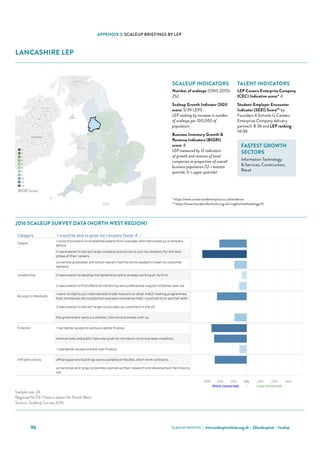
a huge burden.”
“To require, or at least encourage through tax or other means, short-term flexible
leases.” (Cambridge)
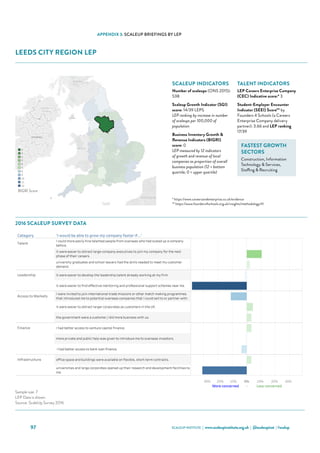
“… better options for office space on dedicated science parks.” (Scotland)
“Affordable office infrastructure.” (Greater London)
“Provide flexible accommodation and genuine risk capital. Ease transport bottlenecks
and substantially increase available housing as prices are unaffordable for most staff.”
(Cambridge)
NATIONAL VS LOCAL PRIORITIES
The 2016 ScaleUp Survey shows wide variation in scaleup leader confidence
regarding infrastructure depending on where they locate their business in the
country. The South East is generally less concerned about the availability of
buildings on flexible terms and the South East Midlands area is also relatively
positive on access to university and corporate research and development facilities.
Conversely, there are areas where scaleup leaders are more concerned about their
access to infrastructure: for example, in Sheffield, Leeds and Manchester those
surveyed are more concerned about the availability of RD facilities and in the
latter, about the availability of flexible space to move into.
CASE STUDIES
To help understand the emerging models of intervention, the 2014 Scaleup Report
published case studies about public-private collaborations providing infrastructure
solutions to scaleups so they could move out of the spaces they had out-grown and
access space owned by others that was not fully utilised. These case studies can be
found on the ScaleUp Institute website.
The ScaleUp Institute has published two case studies in 2016 mentioned below.
E-spark powered by Natwest
Google Campus London
CHAPTER 6
67 			 SCALEUP INSTITUTE | www.scaleupinstitute.org.uk | @scaleupinst | #scaleup
In 2017, the Scaleup Institute will be reviewing additional initiatives throughout the
UK designed to help make it easier for scaleup leaders to access the infrastructure
they need. We have received nominations to review Manchester Alderley Park, The
Knowledge Transfer Networks, Mass Challenge, Second Home, The Trampery and
WeWork, which we plan to review in our programme of work in 2017.
IN SUMMARY
Since 2014, some good progress has been made with certain infrastructure needs
of our scaleup leaders being answered. We need to ensure this continues and
encourage ecosystem stakeholders from across the country to take inspiration
from peers so that this hindrance can be removed from scaleup leaders’ lists of
growing pains. The continued focus and investment by the Government on local
infrastructure needs as announced in the 2016 Autumn Statement is also welcomed.
CHAPTER 6
CHAPTER 7
Looking forward
SCALEUP INSTITUTE | www.scaleupinstitute.org.uk | @scaleupinst | #scaleup69
Looking forward
MAKING BRITAIN THE BEST PLACE TO SCALE A BUSINESS
In 2014 it could only be hoped that the nation would get behind the scaleup agenda
to see these businesses as a sector in their own right and for the policymakers,
educators, business, finance and entrepreneurs to join together to help them
overcome whatever barriers they met so that scaleups could flourish.
In 2016 it is clear that the rallying cry has been heard and action is being taken
across all areas of the country and internationally. Much however, still needs to be
done if we are to close the gap and realise our ambition to be the greatest scaleup
nation in the world with the hundreds of thousands of jobs, billions in economic value
and prosperity that would bring.
The ScaleUp Institute will continue its programme of research and we will report
again on progress in November 2017. Our Committees will continue to evaluate
case studies, with a particular emphasis on local and regional programmes, and policy
actions across the scaleup themes. We will highlight these in our weekly newsletters
and on our website, tracking developments as they unfold.
The economic growth we so desire will only occur if local scaleup leaders get what
they need when they need it most. The identification of scaleups is key to this and
progressing work on a Scaleup Impact Datafeed is our number one priority. Whilst
the ScaleUp Institute and others can continue to use Companies House and ONS
information, opening up digital access to expanded robust data sets will increase
the capacity for local ecosystem stakeholders to collaborate and ensure that their
scaleup leaders flourish.
Scaleups are of even greater importance now as we ensure that the gap that existed
pre-Brexit is closed rather than further opened.
Together, let’s make Britain the BEST place in the WORLD for a leader to choose to
SCALE their business.
CHAPTER 7
Release
data
Increase
collaboration
Improve
skills
Assist
international
expansion
Develop
leadership
Champion
success stories
APPENDICES
APPENDIX 1
SCALEUP INSTITUTE | www.scaleupinstitute.org.uk | @scaleupinst | #scalup73
APPENDIX 1
2014 Recommendations
Recommendation 1
National data sets should be utilised so that local public and
private sector organisations can identify, target and evaluate
their support to scaleup companies, and evaluate their
impact on UK economic growth.
Recommendation 2
Publicly funded organisations such as Local Enterprise
Partnerships and cities seeking public funding should review
and report on the extent to which the top 50 scaleups in
their areas are increasing their turnover and job growth from
year to year with the objective of increasing the proportion
of scaleups with more than 250 employees by three per
cent by 2025.
Recommendation 3
50 per cent of public funding and promotion currently
reserved for ‘entrepreneurship’ should be directed towards
collaborative initiatives based on evidence of these
initiatives’ track-record that demonstrates impact on
employment and turnover growth of scaleup companies and
the return on investment of their efforts.
Recommendation 4
A Minister should be made responsible for reversing the
scaleup gap by 2025 with cross-departmental resources
allocated, independent bodies named to monitor and a task-
force appointed to deliver a scaleup report to the PM every
November for the next five years.
Recommendation 5
The Department for Education and Local Enterprise
Partnerships should ensure that Britain is in the top 5 of
the OECD PISA rankings for numeracy and literacy by
2025 and use their convening and promotional power to
ensure educational institutions guarantee that students at
schools, colleges and universities come into contact with
the top 50 scaleup business-leaders within 20 miles of their
establishment.
Recommendation 6
Local Enterprise Partnerships and city / cluster/ ecosystem
leaders should work with existing private collaborative
initiatives to promote the top 50 scaleup companies in their
jurisdiction to adults for the next phase of their careers.
Recommendation 7
A ‘Scaleup Visa’ should be made available from Local
Enterprise Partnerships to the top local scaleup companies
so they can recruit staff from overseas within two weeks of
applying. These foreign workers help expand the distribution
of local scaleup companies’ existing products to foreign
markets and help local scaleups introduce new products and
services.
Recommendation 8
Local Enterprise Partnerships, universities and the private
sector should work together to ensure effective learning
programmes are available in their areas aimed at leadership
development of scaleups.
Recommendation 9
The government should draw attention to scaleup
companies and their leaders so that it is easier for them
to act as role models to others and to find customers,
partners and investors, both at home and overseas. UK
Trade and Investment should ensure that scaleup companies
are well represented on international trade missions, and
publish details annually. Central and local government
should publicly report on the level of procurement they
source from scaleup companies and their funding should be
reviewed in terms of the amount of procurement they do
with scaleups.
Recommendation 10
The impact of regulation ‘cycle time’ on rapidly growing
companies should be a major consideration for regulators
and agencies. Agencies that interact frequently with
scaleups, like the Border Authority, Listing Authority and
HMRC should report on their efficiency in relation to
regulatory peers in other countries.
Recommendation 11
Government and industry must ensure that progress in
closing the finance-gap is maintained and review and report
on the extent to which scaleups, in particular, are supported.
Recommendation 12
Government and industry must ensure that progress in
infrastructure areas is maintained and review and report on
the extent to which scaleups, in particular, are catered for.
APPENDIX 2
SCALEUP INSTITUTE | www.scaleupinstitute.org.uk | @scaleupinst | #scalup75
APPENDIX 2
Business Inventory of Growth
and Revenue Indicators by LEP
  Company Growth Indicators Company Revenue Indicators
Source:
F4S Insight Report 30 Sept 2016 0-10%
10-20%
20-50%
50-100%
100-150%
150%
Countofbottomthird
positions(Growth)
£1-10m
10-25m
£25-50m
£50-
100m
£100-
250m
£250m+
Countofbottomthird
positions(Rev)
TotalBIGRIscore
(1–12)
LEPvsTotalCountof
IndicatorsintopThird
LEP
England
Ranking1-39
Ranking1-39
Ranking1-39
Ranking1-39
Ranking1-39
Ranking1-39
Ranking1-39
Ranking1-39
Ranking1-39
Ranking1-39
Ranking1-39
Ranking1-39
Black Country 30 33 30 34 36 26 5 29 33 35 25 28 32 5 10 0
Buckinghamshire Thames Valley 12 10 1 4 3 6 0 3 1 3 23 19 5 0 0 10
Cheshire and Warrington 31 15 19 9 31 25 2 23 15 7 5 8 7 0 2 5
Coast to Capital 21 25 23 16 16 10 0 18 25 20 26 34 13 1 1 2
Cornwall and the Isles of Scilly 36 31 38 35 38 31 6 34 38 38 35 35 36 6 12 0
Coventry and Warwickshire 11 12 10 12 11 30 1 14 7 16 9 26 6 0 1 8
Cumbria 24 39 37 37 35 36 5 39 37 38 35 17 36 5 10 0
Derby, Derbyshire, Nottingham and
Nottinghamshire 18 13 18 15 19 21 0 17 14 14 13 12 30 1 1 3
Dorset 13 23 16 19 21 13 0 15 18 12 19 35 27 2 2 3
Enterprise M3 4 3 5 5 5 5 0 6 5 6 2 4 3 0 0 12
Gloucestershire 20 22 24 32 24 19 1 25 17 13 7 22 14 0 1 2
Greater Birmingham and Solihull 16 24 29 20 22 24 1 24 28 34 22 9 15 2 3 1
Greater Cambridge  Greater
Peterborough 1 4 3 2 9 3 0 2 4 4 3 2 12 0 0 12
Greater Lincolnshire 32 35 34 38 33 38 6 36 32 24 31 27 29 5 11 0
Greater Manchester 29 26 22 25 26 22 1 27 20 21 8 14 26 1 2 1
Heart of the South West 15 14 14 23 32 29 2 16 23 19 20 20 20 0 2 0
Hertfordshire 6 9 8 11 8 8 0 9 10 11 11 13 4 0 0 12
Humber 35 34 26 36 27 35 5 32 31 28 35 35 28 6 11 0
Lancashire 25 28 33 39 30 20 4 30 21 18 29 30 33 4 8 0
Leeds City Region 14 16 11 13 12 15 0 13 12 5 14 16 10 0 0 7
Leicester and Leicestershire 9 5 7 24 14 9 0 7 11 22 12 18 23 0 0 7
Liverpool City Region 37 38 35 33 29 37 6 37 36 33 30 31 34 6 12 0
London 2 7 6 3 2 1 0 5 3 2 4 5 2 0 0 12
New Anglia 5 6 15 10 7 11 0 8 8 17 24 25 36 1 1 7
North Eastern 34 36 27 27 25 32 5 33 22 26 34 33 19 3 8 0
Northamptonshire 27 30 20 26 28 16 3 26 19 32 16 3 18 1 4 1
Oxfordshire 10 8 13 6 13 23 0 10 16 15 15 23 16 0 0 6
Sheffield City Region 22 18 21 21 23 28 1 20 26 23 17 32 22 1 2 0
Solent 8 1 4 7 4 7 0 4 6 8 10 15 9 0 0 11
South East 28 32 28 29 20 27 5 28 27 29 33 29 35 6 11 0
South East Midlands 19 21 17 18 18 18 0 19 24 36 21 10 21 1 1 1
Stoke-on-Trent and Staffordshire 33 37 39 30 34 39 6 38 39 25 32 6 31 4 10 1
Swindon and Wiltshire 23 17 32 28 15 14 2 22 30 37 28 24 17 3 5 0
Tees Valley 39 27 31 22 37 33 5 31 34 30 27 11 25 4 9 1
Thames Valley Berkshire 3 2 2 1 1 2 0 1 2 1 1 1 1 0 0 12
The Marches 38 29 36 31 38 34 6 35 35 31 35 35 36 6 12 0
West of England 7 20 9 14 10 4 0 11 13 9 6 7 11 0 0 10
Worcestershire 26 19 25 17 17 17 0 21 29 27 35 21 24 3 3 0
York and North Yorkshire 17 11 12 8 6 12 0 12 9 10 18 35 8 1 1 9
www.founders4schools.org.uk/insights/#/
APPENDIX 3
SCALEUP INSTITUTE | www.scaleupinstitute.org.uk | @scaleupinst | #scalup77
APPENDIX 3
Scaleup Briefings by LEP
These Scaleup Briefings by LEP draw together various sources to provide insight
into local needs. We share evidence, including a local ‘snapshot’ of scaleup
leaders’ views, to help illustrate what is needed dependent on where their business
operations are located. Whilst we fully recognise sample sizes at these levels are
not statistically robust, we still think it important to share the re ections of those
business leaders who completed the survey, on an aggregate basis, to give insight to
their consideration. For the Scaleup Survey 2016 results where the sample sizes for
the LEPS are less than 6 the NUTS 1 statistical regional data is shown.
Each LEP Scaleup Briefing contains the following information:
•	 Number of scaleups: ONS Business Structure Database based on IDBR (Figures
may differ by small amounts from those published in ONS outputs due to the
application of rounding methodologies).
•	 Scaleup Growth Indicator (SGI) score: LEP ranking by increase in number of
scaleups per 100,000 of population
•	 Business Inventory Growth and Revenue Indicators (BIGRI) score: LEP
measured by 12 indicators of growth and revenue of local companies as proportion
of overall business population (12 = bottom quartile; 0 = upper quartile). For
detailed methodology see (https://www.founders4schools.org.uk/insights/
methodology/#/)
•	 LEP Careers Enterprise Company (CEC) Indicative Score: Student-Employer
Encounter Indicators are calculated by multiplying the number of students by the
number of business leaders they encounter using the Founders4Schools platform
•	 Student-Employer Encounter Indicators (SEEI) score and LEP ranking: SEEIs
are calculated by multiplying the number of students by the number of business
leaders they encounter using the Founders4Schools platform. For detailed
methodology see www.founders4schools.org.uk/insights/methodology/#/
•	 Scaleup Survey 2016 Results: (Regional NUTS 1 data used where sample sizes
are less than 6)
SCALEUP INSTITUTE | www.scaleupinstitute.org.uk | @scaleupinst | #scalup78
BLACK COUNTRY LEP
Category 'I would be able to grow my company faster if...'
Talent
I could more easily hire talented people from overseas who had scaled up a company
before.
it were easier to attract large-company executives to join my company for the next
phase of their careers.
university graduates and school leavers had the skills needed to meet my customer
demand.
Leadership it were easier to develop the leadership talent already working at my firm.
it were easier to find effective mentoring and professional support schemes near me.
Access to Markets
I were invited to join international trade missions or other match making programmes
that introduced me to potential overseas companies that I could sell to or partner with.
it were easier to attract larger corporates as customers in the UK.
the government were a customer / did more business with us.
Finance I had better access to venture capital finance.
more private and public help was given to introduce me to overseas investors.
 I had better access to bank loan finance.
Infrastructure office space and buildings were available on flexible, short-term contracts.
universities and large corporates opened up their research and development facilities to
me.
Black Country Scale Up Report 2016
Choose an Area
Black Country
Qualifying ScaleUps in the area: 137 ONS, 2015
Sample Size: 10
Where the sample size is 6 or more the LEP data is shown
Where the sample size is less than 6 the data for the NUTS 1 Region (West Midlands) is shown
30% 20% 10% 0% 10% 20% 30%
More concerned - Less concerned
Sources: ScaleUp Survey 2016, ONS
Sample size: 10
LEP Data is shown.
Source: ScaleUp Survey 2016
SCALEUP INDICATORS
Number of scaleups (ONS 2015):
137
Scaleup Growth Indicator (SGI)
score: 38/39 LEPS
LEP ranking by increase in number
of scaleups per 100,000 of
population
Business Inventory Growth 
Revenue Indicators (BIGRI)
score: 10
LEP measured by 12 indicators
of growth and revenue of local
companies as proportion of overall
business population (12 = bottom
quartile; 0 = upper quartile)
TALENT INDICATORS
LEP Careers Enterprise Company
(CEC) Indicative score:* 6 CEC
indicators in lowest third
Student-Employer Encounter
Indicator (SEEI) Score** by
Founders 4 Schools (a Careers
Enterprise Company delivery
partner): 9.62 and LEP ranking
8/39
FASTEST GROWTH
SECTORS
Mechanical or Industrial
Engineering, Information
Technology  Services,
Construction
2016 Scale Up Indicators - Number of indicators ranked in lowest third, by LEP (max 12)
0
1
2
3
4
5
8
9
10
11
12
2016 SCALEUP SURVEY DATA
BIGRI Score
* https://www.careersandenterprise.co.uk/evidence
** https://www.founders4schools.org.uk/insights/methodology/#/
APPENDIX 3: SCALEUP BRIEFINGS BY LEP
SCALEUP INSTITUTE | www.scaleupinstitute.org.uk | @scaleupinst | #scalup79
APPENDIX 3: SCALEUP BRIEFINGS BY LEP
Category 'I would be able to grow my company faster if...'
Talent
I could more easily hire talented people from overseas who had scaled up a company
before.
it were easier to attract large-company executives to join my company for the next
phase of their careers.
university graduates and school leavers had the skills needed to meet my customer
demand.
Leadership it were easier to develop the leadership talent already working at my firm.
it were easier to find effective mentoring and professional support schemes near me.
Access to Markets
I were invited to join international trade missions or other match making programmes
that introduced me to potential overseas companies that I could sell to or partner with.
it were easier to attract larger corporates as customers in the UK.
the government were a customer / did more business with us.
Finance I had better access to venture capital finance.
more private and public help was given to introduce me to overseas investors.
 I had better access to bank loan finance.
Infrastructure office space and buildings were available on flexible, short-term contracts.
universities and large corporates opened up their research and development facilities to
me.
Buckinghamshire Thames Valley Scale Up Report 2016
Choose an Area
Buckinghamshire Thames ..
Qualifying ScaleUps in the area: 99 ONS, 2015
Sample Size: 2
Where the sample size is 6 or more the LEP data is shown
Where the sample size is less than 6 the data for the NUTS 1 Region (South East) is shown
30% 20% 10% 0% 10% 20% 30%
More concerned - Less concerned
Sources: ScaleUp Survey 2016, ONS
BUCKINGHAMSHIRE THAMES VALLEY LEP
Sample size: 40
Regional NUTS 1 Data is shown for South East.
Source: ScaleUp Survey 2016
2016 Scale Up Indicators - Number of indicators ranked in lowest third, by LEP (max 12)
0
1
2
3
4
5
8
9
10
11
12
BIGRI Score
2016 SCALEUP SURVEY DATA (SOUTH EAST REGION)
SCALEUP INDICATORS
Number of scaleups (ONS 2015):
99
Scaleup Growth Indicator (SGI)
score: 35/39 LEPS
LEP ranking by increase in number
of scaleups per 100,000 of
population
Business Inventory Growth 
Revenue Indicators (BIGRI)
score: 0
LEP measured by 12 indicators
of growth and revenue of local
companies as proportion of overall
business population (12 = bottom
quartile; 0 = upper quartile)
TALENT INDICATORS
LEP Careers Enterprise Company
(CEC) Indicative score:* 6
Student-Employer Encounter
Indicator (SEEI) Score** by
Founders 4 Schools (a Careers
Enterprise Company delivery
partner): 2.28 and LEP ranking
22/39
FASTEST GROWTH
SECTORS
Information Technology 
Services, Telecommunications,
Marketing  Advertising
* https://www.careersandenterprise.co.uk/evidence
** https://www.founders4schools.org.uk/insights/methodology/#/
SCALEUP INSTITUTE | www.scaleupinstitute.org.uk | @scaleupinst | #scalup80
APPENDIX 3: SCALEUP BRIEFINGS BY LEP
CHESHIRE AND WARRINGTON LEP
Category 'I would be able to grow my company faster if...'
Talent
I could more easily hire talented people from overseas who had scaled up a company
before.
it were easier to attract large-company executives to join my company for the next
phase of their careers.
university graduates and school leavers had the skills needed to meet my customer
demand.
Leadership it were easier to develop the leadership talent already working at my firm.
it were easier to find effective mentoring and professional support schemes near me.
Access to Markets
I were invited to join international trade missions or other match making programmes
that introduced me to potential overseas companies that I could sell to or partner with.
it were easier to attract larger corporates as customers in the UK.
the government were a customer / did more business with us.
Finance I had better access to venture capital finance.
more private and public help was given to introduce me to overseas investors.
 I had better access to bank loan finance.
Infrastructure office space and buildings were available on flexible, short-term contracts.
universities and large corporates opened up their research and development facilities to
me.
Cheshire and Warrington Scale Up Report 2016
Choose an Area
Cheshire and Warrington
Qualifying ScaleUps in the area: 192 ONS, 2015
Sample Size: 4
Where the sample size is 6 or more the LEP data is shown
Where the sample size is less than 6 the data for the NUTS 1 Region (North West) is shown
30% 20% 10% 0% 10% 20% 30%
More concerned - Less concerned
Sources: ScaleUp Survey 2016, ONS
Sample size: 24
Regional NUTS 1 Data is shown for North West.
Source: ScaleUp Survey 2016
2016 Scale Up Indicators - Number of indicators ranked in lowest third, by LEP (max 12)
0
1
2
3
4
5
8
9
10
11
12
BIGRI Score
2016 SCALEUP SURVEY DATA (NORTH WEST REGION)
SCALEUP INDICATORS
Number of scaleups (ONS 2015):
192
Scaleup Growth Indicator (SGI)
score: 33/39 LEPS
LEP ranking by increase in number
of scaleups per 100,000 of
population
Business Inventory Growth 
Revenue Indicators (BIGRI)
score: 2
LEP measured by 12 indicators
of growth and revenue of local
companies as proportion of overall
business population (12 = bottom
quartile; 0 = upper quartile)
TALENT INDICATORS
LEP Careers Enterprise Company
(CEC) Indicative score:* 4
Student-Employer Encounter
Indicator (SEEI) Score** by
Founders 4 Schools (a Careers
Enterprise Company delivery
partner): 8.2 and LEP ranking
15/39
FASTEST GROWTH
SECTORS
Information Technology 
Services, Financial Services,
Accounting
* https://www.careersandenterprise.co.uk/evidence
** https://www.founders4schools.org.uk/insights/methodology/#/
SCALEUP INSTITUTE | www.scaleupinstitute.org.uk | @scaleupinst | #scalup81
APPENDIX 3: SCALEUP BRIEFINGS BY LEP
COAST TO CAPITAL LEP
Category 'I would be able to grow my company faster if...'
Talent
I could more easily hire talented people from overseas who had scaled up a company
before.
it were easier to attract large-company executives to join my company for the next
phase of their careers.
university graduates and school leavers had the skills needed to meet my customer
demand.
Leadership it were easier to develop the leadership talent already working at my firm.
it were easier to find effective mentoring and professional support schemes near me.
Access to Markets
I were invited to join international trade missions or other match making programmes
that introduced me to potential overseas companies that I could sell to or partner with.
it were easier to attract larger corporates as customers in the UK.
the government were a customer / did more business with us.
Finance I had better access to venture capital finance.
more private and public help was given to introduce me to overseas investors.
 I had better access to bank loan finance.
Infrastructure office space and buildings were available on flexible, short-term contracts.
universities and large corporates opened up their research and development facilities to
me.
Coast to Capital Scale Up Report 2016
Choose an Area
Coast to Capital
Qualifying ScaleUps in the area: 378 ONS, 2015
Sample Size: 7
Where the sample size is 6 or more the LEP data is shown
Where the sample size is less than 6 the data for the NUTS 1 Region (South East) is shown
30% 20% 10% 0% 10% 20% 30%
More concerned - Less concerned
Sources: ScaleUp Survey 2016, ONS
Sample size: 7
LEP Data is shown.
Source: ScaleUp Survey 2016
2016 Scale Up Indicators - Number of indicators ranked in lowest third, by LEP (max 12)
0
1
2
3
4
5
8
9
10
11
12
BIGRI Score
2016 SCALEUP SURVEY DATA
SCALEUP INDICATORS
Number of scaleups (ONS 2015):
378
Scaleup Growth Indicator (SGI)
score: 17/39 LEPS
LEP ranking by increase in number
of scaleups per 100,000 of
population
Business Inventory Growth 
Revenue Indicators (BIGRI)
score: 1
LEP measured by 12 indicators
of growth and revenue of local
companies as proportion of overall
business population (12 = bottom
quartile; 0 = upper quartile)
TALENT INDICATORS
LEP Careers Enterprise Company
(CEC) Indicative score:* 5
Student-Employer Encounter
Indicator (SEEI) Score** by
Founders 4 Schools (a Careers
Enterprise Company delivery
partner): 11.35 and LEP ranking
9/39
FASTEST GROWTH
SECTORS
Information Technology 
Services, Financial Services,
Computer Software
* https://www.careersandenterprise.co.uk/evidence
** https://www.founders4schools.org.uk/insights/methodology/#/
SCALEUP INSTITUTE | www.scaleupinstitute.org.uk | @scaleupinst | #scalup82
APPENDIX 3: SCALEUP BRIEFINGS BY LEP
CORNWALL AND ISLES OF SCILLY LEP
Category 'I would be able to grow my company faster if...'
Talent
I could more easily hire talented people from overseas who had scaled up a company
before.
it were easier to attract large-company executives to join my company for the next
phase of their careers.
university graduates and school leavers had the skills needed to meet my customer
demand.
Leadership it were easier to develop the leadership talent already working at my firm.
it were easier to find effective mentoring and professional support schemes near me.
Access to Markets
I were invited to join international trade missions or other match making programmes
that introduced me to potential overseas companies that I could sell to or partner with.
it were easier to attract larger corporates as customers in the UK.
the government were a customer / did more business with us.
Finance I had better access to venture capital finance.
more private and public help was given to introduce me to overseas investors.
 I had better access to bank loan finance.
Infrastructure office space and buildings were available on flexible, short-term contracts.
universities and large corporates opened up their research and development facilities to
me.
Cornwall and the Isles of Scilly Scale Up Report 2016
Choose an Area
Cornwall and the Isles of S..
Qualifying ScaleUps in the area: 95 ONS, 2015
Sample Size: 0
Where the sample size is 6 or more the LEP data is shown
Where the sample size is less than 6 the data for the NUTS 1 Region (South West) is shown
30% 20% 10% 0% 10% 20% 30%
More concerned - Less concerned
Sources: ScaleUp Survey 2016, ONS
Sample size: 40
Regional NUTS 1 Data is shown for South East.
Source: ScaleUp Survey 2016
2016 Scale Up Indicators - Number of indicators ranked in lowest third, by LEP (max 12)
0
1
2
3
4
5
8
9
10
11
12
BIGRI Score
2016 SCALEUP SURVEY DATA (SOUTH EAST REGION)
SCALEUP INDICATORS
Number of scaleups (ONS 2015):
95
Scaleup Growth Indicator (SGI)
score: 4/39 LEPS
LEP ranking by increase in number
of scaleups per 100,000 of
population
Business Inventory Growth 
Revenue Indicators (BIGRI)
score: 12
LEP measured by 12 indicators
of growth and revenue of local
companies as proportion of overall
business population (12 = bottom
quartile; 0 = upper quartile)
TALENT INDICATORS
LEP Careers Enterprise Company
(CEC) Indicative score:* 6
Student-Employer Encounter
Indicator (SEEI) Score** by
Founders 4 Schools (a Careers
Enterprise Company delivery
partner): 0 and LEP ranking
32/39
FASTEST GROWTH
SECTORS
Information Technology 
Services, Financial Services,
Textiles
* https://www.careersandenterprise.co.uk/evidence
** https://www.founders4schools.org.uk/insights/methodology/#/
SCALEUP INSTITUTE | www.scaleupinstitute.org.uk | @scaleupinst | #scalup83
APPENDIX 3: SCALEUP BRIEFINGS BY LEP
COVENTRY AND WARWICKSHIRE LEP
Category 'I would be able to grow my company faster if...'
Talent
I could more easily hire talented people from overseas who had scaled up a company
before.
it were easier to attract large-company executives to join my company for the next
phase of their careers.
university graduates and school leavers had the skills needed to meet my customer
demand.
Leadership it were easier to develop the leadership talent already working at my firm.
it were easier to find effective mentoring and professional support schemes near me.
Access to Markets
I were invited to join international trade missions or other match making programmes
that introduced me to potential overseas companies that I could sell to or partner with.
it were easier to attract larger corporates as customers in the UK.
the government were a customer / did more business with us.
Finance I had better access to venture capital finance.
more private and public help was given to introduce me to overseas investors.
 I had better access to bank loan finance.
Infrastructure office space and buildings were available on flexible, short-term contracts.
universities and large corporates opened up their research and development facilities to
me.
Coventry and Warwickshire Scale Up Report 2016
Choose an Area
Coventry and Warwickshire
Qualifying ScaleUps in the area: 157 ONS, 2015
Sample Size: 0
Where the sample size is 6 or more the LEP data is shown
Where the sample size is less than 6 the data for the NUTS 1 Region (West Midlands) is shown
30% 20% 10% 0% 10% 20% 30%
More concerned - Less concerned
Sources: ScaleUp Survey 2016, ONS
Sample size: 18
Regional NUTS 1 Data is shown for West Midlands.
Source: ScaleUp Survey 2016
2016 Scale Up Indicators - Number of indicators ranked in lowest third, by LEP (max 12)
0
1
2
3
4
5
8
9
10
11
12
BIGRI Score
2016 SCALEUP SURVEY DATA (WEST MIDLANDS REGION)
SCALEUP INDICATORS
Number of scaleups (ONS 2015):
157
Scaleup Growth Indicator (SGI)
score: 16/39 LEPS
LEP ranking by increase in number
of scaleups per 100,000 of
population
Business Inventory Growth 
Revenue Indicators (BIGRI)
score: 1
LEP measured by 12 indicators
of growth and revenue of local
companies as proportion of overall
business population (12 = bottom
quartile; 0 = upper quartile)
TALENT INDICATORS
LEP Careers Enterprise Company
(CEC) Indicative score:* 1
Student-Employer Encounter
Indicator (SEEI) Score** by
Founders 4 Schools (a Careers
Enterprise Company delivery
partner): 8.63 and LEP ranking
12/39
FASTEST GROWTH
SECTORS
Information Technology 
Services, Marketing 
Advertising, Food 
Beverages
* https://www.careersandenterprise.co.uk/evidence
** https://www.founders4schools.org.uk/insights/methodology/#/
SCALEUP INSTITUTE | www.scaleupinstitute.org.uk | @scaleupinst | #scalup84
APPENDIX 3: SCALEUP BRIEFINGS BY LEP
CUMBRIA LEP
Category 'I would be able to grow my company faster if...'
Talent
I could more easily hire talented people from overseas who had scaled up a company
before.
it were easier to attract large-company executives to join my company for the next
phase of their careers.
university graduates and school leavers had the skills needed to meet my customer
demand.
Leadership it were easier to develop the leadership talent already working at my firm.
it were easier to find effective mentoring and professional support schemes near me.
Access to Markets
I were invited to join international trade missions or other match making programmes
that introduced me to potential overseas companies that I could sell to or partner with.
it were easier to attract larger corporates as customers in the UK.
the government were a customer / did more business with us.
Finance I had better access to venture capital finance.
more private and public help was given to introduce me to overseas investors.
 I had better access to bank loan finance.
Infrastructure office space and buildings were available on flexible, short-term contracts.
universities and large corporates opened up their research and development facilities to
me.
Cumbria Scale Up Report 2016
Choose an Area
Cumbria
Qualifying ScaleUps in the area: 93 ONS, 2015
Sample Size: 0
Where the sample size is 6 or more the LEP data is shown
Where the sample size is less than 6 the data for the NUTS 1 Region (North West) is shown
30% 20% 10% 0% 10% 20% 30%
More concerned - Less concerned
Sources: ScaleUp Survey 2016, ONS
Sample size: 24
Regional NUTS 1 Data is shown for North West.
Source: ScaleUp Survey 2016
2016 Scale Up Indicators - Number of indicators ranked in lowest third, by LEP (max 12)
0
1
2
3
4
5
8
9
10
11
12
BIGRI Score
2016 SCALEUP SURVEY DATA (NORTH WEST REGION)
SCALEUP INDICATORS
Number of scaleups (ONS 2015):
93
Scaleup Growth Indicator (SGI)
score: 1/39 LEPS
LEP ranking by increase in number
of scaleups per 100,000 of
population
Business Inventory Growth 
Revenue Indicators (BIGRI)
score: 10
LEP measured by 12 indicators
of growth and revenue of local
companies as proportion of overall
business population (12 = bottom
quartile; 0 = upper quartile)
TALENT INDICATORS
LEP Careers Enterprise Company
(CEC) Indicative score:* 2
Student-Employer Encounter
Indicator (SEEI) Score** by
Founders 4 Schools (a Careers
Enterprise Company delivery
partner): 2 and LEP ranking
27/39
FASTEST GROWTH
SECTORS
Textiles, Telecommunications,
Real Estate
* https://www.careersandenterprise.co.uk/evidence
** https://www.founders4schools.org.uk/insights/methodology/#/
SCALEUP INSTITUTE | www.scaleupinstitute.org.uk | @scaleupinst | #scalup85
APPENDIX 3: SCALEUP BRIEFINGS BY LEP
DERBY, DERBYSHIRE, NOTTINGHAM LEP
Category 'I would be able to grow my company faster if...'
Talent
I could more easily hire talented people from overseas who had scaled up a company
before.
it were easier to attract large-company executives to join my company for the next
phase of their careers.
university graduates and school leavers had the skills needed to meet my customer
demand.
Leadership it were easier to develop the leadership talent already working at my firm.
it were easier to find effective mentoring and professional support schemes near me.
Access to Markets
I were invited to join international trade missions or other match making programmes
that introduced me to potential overseas companies that I could sell to or partner with.
it were easier to attract larger corporates as customers in the UK.
the government were a customer / did more business with us.
Finance I had better access to venture capital finance.
more private and public help was given to introduce me to overseas investors.
 I had better access to bank loan finance.
Infrastructure office space and buildings were available on flexible, short-term contracts.
universities and large corporates opened up their research and development facilities to
me.
Derby, Derbyshire, Nottingham and Nottinghamshire, Scale Up Report 2016
Choose an Area
Derby, Derbyshire, Nottin..
Qualifying ScaleUps in the area: 354 ONS, 2015
Sample Size: 6
Where the sample size is 6 or more the LEP data is shown
Where the sample size is less than 6 the data for the NUTS 1 Region (East Midlands) is shown
30% 20% 10% 0% 10% 20% 30%
More concerned - Less concerned
Sources: ScaleUp Survey 2016, ONS
Sample size: 6
LEP Data is shown.
Source: ScaleUp Survey 2016
2016 Scale Up Indicators - Number of indicators ranked in lowest third, by LEP (max 12)
0
1
2
3
4
5
8
9
10
11
12
BIGRI Score
2016 SCALEUP SURVEY DATA
SCALEUP INDICATORS
Number of scaleups (ONS 2015):
354
Scaleup Growth Indicator (SGI)
score: 11/39 LEPS
LEP ranking by increase in number
of scaleups per 100,000 of
population
Business Inventory Growth 
Revenue Indicators (BIGRI)
score: 1
LEP measured by 12 indicators
of growth and revenue of local
companies as proportion of overall
business population (12 = bottom
quartile; 0 = upper quartile)
TALENT INDICATORS
LEP Careers Enterprise Company
(CEC) Indicative score:* 2
Student-Employer Encounter
Indicator (SEEI) Score** by
Founders 4 Schools (a Careers
Enterprise Company delivery
partner): 2 and LEP ranking
23/39
FASTEST GROWTH
SECTORS
Information Technology
 Services, Construction,
Computer Software
* https://www.careersandenterprise.co.uk/evidence
** https://www.founders4schools.org.uk/insights/methodology/#/
SCALEUP INSTITUTE | www.scaleupinstitute.org.uk | @scaleupinst | #scalup86
APPENDIX 3: SCALEUP BRIEFINGS BY LEP
DORSET LEP
Category 'I would be able to grow my company faster if...'
Talent
I could more easily hire talented people from overseas who had scaled up a company
before.
it were easier to attract large-company executives to join my company for the next
phase of their careers.
university graduates and school leavers had the skills needed to meet my customer
demand.
Leadership it were easier to develop the leadership talent already working at my firm.
it were easier to find effective mentoring and professional support schemes near me.
Access to Markets
I were invited to join international trade missions or other match making programmes
that introduced me to potential overseas companies that I could sell to or partner with.
it were easier to attract larger corporates as customers in the UK.
the government were a customer / did more business with us.
Finance I had better access to venture capital finance.
more private and public help was given to introduce me to overseas investors.
 I had better access to bank loan finance.
Infrastructure office space and buildings were available on flexible, short-term contracts.
universities and large corporates opened up their research and development facilities to
me.
Dorset Scale Up Report 2016
Choose an Area
Dorset
Qualifying ScaleUps in the area: 124 ONS, 2015
Sample Size: 1
Where the sample size is 6 or more the LEP data is shown
Where the sample size is less than 6 the data for the NUTS 1 Region (South West) is shown
30% 20% 10% 0% 10% 20% 30%
More concerned - Less concerned
Sources: ScaleUp Survey 2016, ONS
Sample size: 24
Regional NUTS 1 Data is shown for South West.
Source: ScaleUp Survey 2016
2016 Scale Up Indicators - Number of indicators ranked in lowest third, by LEP (max 12)
0
1
2
3
4
5
8
9
10
11
12
BIGRI Score
2016 SCALEUP SURVEY DATA (SOUTH WEST REGION)
SCALEUP INDICATORS
Number of scaleups (ONS 2015):
124
Scaleup Growth Indicator (SGI)
score: 24/39 LEPS
LEP ranking by increase in number
of scaleups per 100,000 of
population
Business Inventory Growth 
Revenue Indicators (BIGRI)
score: 2
LEP measured by 12 indicators
of growth and revenue of local
companies as proportion of overall
business population (12 = bottom
quartile; 0 = upper quartile)
TALENT INDICATORS
LEP Careers Enterprise Company
(CEC) Indicative score:* 3
Student-Employer Encounter
Indicator (SEEI) Score** by
Founders 4 Schools (a Careers
Enterprise Company delivery
partner): 38 and LEP ranking
2/39
FASTEST GROWTH
SECTORS
Information Technology
 Services, Aviation
 Aerospace,
Telecommunications
* https://www.careersandenterprise.co.uk/evidence
** https://www.founders4schools.org.uk/insights/methodology/#/
SCALEUP INSTITUTE | www.scaleupinstitute.org.uk | @scaleupinst | #scalup87
APPENDIX 3: SCALEUP BRIEFINGS BY LEP
ENTERPRISE M3 LEP
Category 'I would be able to grow my company faster if...'
Talent
I could more easily hire talented people from overseas who had scaled up a company
before.
it were easier to attract large-company executives to join my company for the next
phase of their careers.
university graduates and school leavers had the skills needed to meet my customer
demand.
Leadership it were easier to develop the leadership talent already working at my firm.
it were easier to find effective mentoring and professional support schemes near me.
Access to Markets
I were invited to join international trade missions or other match making programmes
that introduced me to potential overseas companies that I could sell to or partner with.
it were easier to attract larger corporates as customers in the UK.
the government were a customer / did more business with us.
Finance I had better access to venture capital finance.
more private and public help was given to introduce me to overseas investors.
 I had better access to bank loan finance.
Infrastructure office space and buildings were available on flexible, short-term contracts.
universities and large corporates opened up their research and development facilities to
me.
Enterprise M3 Scale Up Report 2016
Choose an Area
Enterprise M3
Qualifying ScaleUps in the area: 382 ONS, 2015
Sample Size: 7
Where the sample size is 6 or more the LEP data is shown
Where the sample size is less than 6 the data for the NUTS 1 Region (South East) is shown
30% 20% 10% 0% 10% 20% 30%
More concerned - Less concerned
Sources: ScaleUp Survey 2016, ONS
Sample size: 7
LEP Data is shown.
Source: ScaleUp Survey 2016
2016 Scale Up Indicators - Number of indicators ranked in lowest third, by LEP (max 12)
0
1
2
3
4
5
8
9
10
11
12
BIGRI Score
2016 SCALEUP SURVEY DATA
SCALEUP INDICATORS
Number of scaleups (ONS 2015):
382
Scaleup Growth Indicator (SGI)
score: 18/39 LEPS
LEP ranking by increase in number
of scaleups per 100,000 of
population
Business Inventory Growth 
Revenue Indicators (BIGRI)
score: 0
LEP measured by 12 indicators
of growth and revenue of local
companies as proportion of overall
business population (12 = bottom
quartile; 0 = upper quartile)
TALENT INDICATORS
LEP Careers Enterprise Company
(CEC) Indicative score:* 3
Student-Employer Encounter
Indicator (SEEI) Score** by
Founders 4 Schools (a Careers
Enterprise Company delivery
partner): 2 and LEP ranking
24/39
FASTEST GROWTH
SECTORS
Information Technology
 Services, Staffing 
Recruiting, Computer
Software
* https://www.careersandenterprise.co.uk/evidence
** https://www.founders4schools.org.uk/insights/methodology/#/
SCALEUP INSTITUTE | www.scaleupinstitute.org.uk | @scaleupinst | #scalup88
APPENDIX 3: SCALEUP BRIEFINGS BY LEP
GLOUCESTERSHIRE LEP
Category 'I would be able to grow my company faster if...'
Talent
I could more easily hire talented people from overseas who had scaled up a company
before.
it were easier to attract large-company executives to join my company for the next
phase of their careers.
university graduates and school leavers had the skills needed to meet my customer
demand.
Leadership it were easier to develop the leadership talent already working at my firm.
it were easier to find effective mentoring and professional support schemes near me.
Access to Markets
I were invited to join international trade missions or other match making programmes
that introduced me to potential overseas companies that I could sell to or partner with.
it were easier to attract larger corporates as customers in the UK.
the government were a customer / did more business with us.
Finance I had better access to venture capital finance.
more private and public help was given to introduce me to overseas investors.
 I had better access to bank loan finance.
Infrastructure office space and buildings were available on flexible, short-term contracts.
universities and large corporates opened up their research and development facilities to
me.
Gloucestershire Scale Up Report 2016
Choose an Area
Gloucestershire
Qualifying ScaleUps in the area: 112 ONS, 2015
Sample Size: 1
Where the sample size is 6 or more the LEP data is shown
Where the sample size is less than 6 the data for the NUTS 1 Region (South West) is shown
30% 20% 10% 0% 10% 20% 30%
More concerned - Less concerned
Sources: ScaleUp Survey 2016, ONS
Sample size: 24
Regional NUTS 1 Data is shown for South West.
Source: ScaleUp Survey 2016
2016 Scale Up Indicators - Number of indicators ranked in lowest third, by LEP (max 12)
0
1
2
3
4
5
8
9
10
11
12
BIGRI Score
2016 SCALEUP SURVEY DATA (SOUTH WEST REGION)
SCALEUP INDICATORS
Number of scaleups (ONS 2015):
112
Scaleup Growth Indicator (SGI)
score: 37/39 LEPS
LEP ranking by increase in number
of scaleups per 100,000 of
population
Business Inventory Growth 
Revenue Indicators (BIGRI)
score: 1
LEP measured by 12 indicators
of growth and revenue of local
companies as proportion of overall
business population (12 = bottom
quartile; 0 = upper quartile)
TALENT INDICATORS
LEP Careers Enterprise Company
(CEC) Indicative score:* 2
Student-Employer Encounter
Indicator (SEEI) Score** by
Founders 4 Schools (a Careers
Enterprise Company delivery
partner): 0 and LEP ranking
33/39
FASTEST GROWTH
SECTORS
Information Technology 
Services, Hospital  Health
Care, Medical Devices
* https://www.careersandenterprise.co.uk/evidence
** https://www.founders4schools.org.uk/insights/methodology/#/
SCALEUP INSTITUTE | www.scaleupinstitute.org.uk | @scaleupinst | #scalup89
APPENDIX 3: SCALEUP BRIEFINGS BY LEP
GREATER BIRMINGHAM AND SOLIHULL LEP
Category 'I would be able to grow my company faster if...'
Talent
I could more easily hire talented people from overseas who had scaled up a company
before.
it were easier to attract large-company executives to join my company for the next
phase of their careers.
university graduates and school leavers had the skills needed to meet my customer
demand.
Leadership it were easier to develop the leadership talent already working at my firm.
it were easier to find effective mentoring and professional support schemes near me.
Access to Markets
I were invited to join international trade missions or other match making programmes
that introduced me to potential overseas companies that I could sell to or partner with.
it were easier to attract larger corporates as customers in the UK.
the government were a customer / did more business with us.
Finance I had better access to venture capital finance.
more private and public help was given to introduce me to overseas investors.
 I had better access to bank loan finance.
Infrastructure office space and buildings were available on flexible, short-term contracts.
universities and large corporates opened up their research and development facilities to
me.
Greater Birmingham and Solihull Scale Up Report 2016
Choose an Area
Greater Birmingham and S..
Qualifying ScaleUps in the area: 312 ONS, 2015
Sample Size: 2
Where the sample size is 6 or more the LEP data is shown
Where the sample size is less than 6 the data for the NUTS 1 Region (West Midlands) is shown
30% 20% 10% 0% 10% 20% 30%
More concerned - Less concerned
Sources: ScaleUp Survey 2016, ONS
Sample size: 18
Regional NUTS 1 Data is shown for West Midlands.
Source: ScaleUp Survey 2016
2016 Scale Up Indicators - Number of indicators ranked in lowest third, by LEP (max 12)
0
1
2
3
4
5
8
9
10
11
12
BIGRI Score
2016 SCALEUP SURVEY DATA (WEST MIDLANDS REGION)
SCALEUP INDICATORS
Number of scaleups (ONS 2015):
312
Scaleup Growth Indicator (SGI)
score: 30/39 LEPS
LEP ranking by increase in number
of scaleups per 100,000 of
population
Business Inventory Growth 
Revenue Indicators (BIGRI)
score: 3
LEP measured by 12 indicators
of growth and revenue of local
companies as proportion of overall
business population (12 = bottom
quartile; 0 = upper quartile)
TALENT INDICATORS
LEP Careers Enterprise Company
(CEC) Indicative score:* 4
Student-Employer Encounter
Indicator (SEEI) Score** by
Founders 4 Schools (a Careers
Enterprise Company delivery
partner): 8 and LEP ranking
10/39
FASTEST GROWTH
SECTORS
Information Technology
 Services, Staffing 
Recruiting, Real Estate
* https://www.careersandenterprise.co.uk/evidence
** https://www.founders4schools.org.uk/insights/methodology/#/
SCALEUP INSTITUTE | www.scaleupinstitute.org.uk | @scaleupinst | #scalup90
APPENDIX 3: SCALEUP BRIEFINGS BY LEP
GREATER CAMBRIDGE AND PETERBOROUGH LEP
Category 'I would be able to grow my company faster if...'
Talent
I could more easily hire talented people from overseas who had scaled up a company
before.
it were easier to attract large-company executives to join my company for the next
phase of their careers.
university graduates and school leavers had the skills needed to meet my customer
demand.
Leadership it were easier to develop the leadership talent already working at my firm.
it were easier to find effective mentoring and professional support schemes near me.
Access to Markets
I were invited to join international trade missions or other match making programmes
that introduced me to potential overseas companies that I could sell to or partner with.
it were easier to attract larger corporates as customers in the UK.
the government were a customer / did more business with us.
Finance I had better access to venture capital finance.
more private and public help was given to introduce me to overseas investors.
 I had better access to bank loan finance.
Infrastructure office space and buildings were available on flexible, short-term contracts.
universities and large corporates opened up their research and development facilities to
me.
Greater Cambridge  Greater Peterborough Scale Up Report 2016
Choose an Area
Greater Cambridge  Grea..
Qualifying ScaleUps in the area: 259 ONS, 2015
Sample Size: 17
Where the sample size is 6 or more the LEP data is shown
Where the sample size is less than 6 the data for the NUTS 1 Region (East) is shown
30% 20% 10% 0% 10% 20% 30%
More concerned - Less concerned
Sources: ScaleUp Survey 2016, ONS
Sample size: 17
LEP Data is shown.
Source: ScaleUp Survey 2016
2016 Scale Up Indicators - Number of indicators ranked in lowest third, by LEP (max 12)
0
1
2
3
4
5
8
9
10
11
12
BIGRI Score
2016 SCALEUP SURVEY DATA
SCALEUP INDICATORS
Number of scaleups (ONS 2015):
259
Scaleup Growth Indicator (SGI)
score: 13/39 LEPS
LEP ranking by increase in number
of scaleups per 100,000 of
population
Business Inventory Growth 
Revenue Indicators (BIGRI)
score: 0
LEP measured by 12 indicators
of growth and revenue of local
companies as proportion of overall
business population (12 = bottom
quartile; 0 = upper quartile)
TALENT INDICATORS
LEP Careers Enterprise Company
(CEC) Indicative score:* 5
Student-Employer Encounter
Indicator (SEEI) Score** by
Founders 4 Schools (a Careers
Enterprise Company delivery
partner): 75 and LEP ranking 1/39
FASTEST GROWTH
SECTORS
Information Technology
 Services, Computer
Software, Construction
* https://www.careersandenterprise.co.uk/evidence
** https://www.founders4schools.org.uk/insights/methodology/#/
SCALEUP INSTITUTE | www.scaleupinstitute.org.uk | @scaleupinst | #scalup91
APPENDIX 3: SCALEUP BRIEFINGS BY LEP
GREATER LINCOLNSHIRE LEP
Category 'I would be able to grow my company faster if...'
Talent
I could more easily hire talented people from overseas who had scaled up a company
before.
it were easier to attract large-company executives to join my company for the next
phase of their careers.
university graduates and school leavers had the skills needed to meet my customer
demand.
Leadership it were easier to develop the leadership talent already working at my firm.
it were easier to find effective mentoring and professional support schemes near me.
Access to Markets
I were invited to join international trade missions or other match making programmes
that introduced me to potential overseas companies that I could sell to or partner with.
it were easier to attract larger corporates as customers in the UK.
the government were a customer / did more business with us.
Finance I had better access to venture capital finance.
more private and public help was given to introduce me to overseas investors.
 I had better access to bank loan finance.
Infrastructure office space and buildings were available on flexible, short-term contracts.
universities and large corporates opened up their research and development facilities to
me.
Greater Lincolnshire Scale Up Report 2016
Choose an Area
Greater Lincolnshire
Qualifying ScaleUps in the area: 145 ONS, 2015
Sample Size: 2
Where the sample size is 6 or more the LEP data is shown
Where the sample size is less than 6 the data for the NUTS 1 Region (East) is shown
30% 20% 10% 0% 10% 20% 30%
More concerned - Less concerned
Sources: ScaleUp Survey 2016, ONS
Sample size: 36
Regional NUTS 1 Data is shown for East.
Source: ScaleUp Survey 2016
2016 Scale Up Indicators - Number of indicators ranked in lowest third, by LEP (max 12)
0
1
2
3
4
5
8
9
10
11
12
BIGRI Score
2016 SCALEUP SURVEY DATA (EAST REGION)
SCALEUP INDICATORS
Number of scaleups (ONS 2015):
145
Scaleup Growth Indicator (SGI)
score: 27/39 LEPS
LEP ranking by increase in number
of scaleups per 100,000 of
population
Business Inventory Growth 
Revenue Indicators (BIGRI)
score: 11
LEP measured by 12 indicators
of growth and revenue of local
companies as proportion of overall
business population (12 = bottom
quartile; 0 = upper quartile)
TALENT INDICATORS
LEP Careers Enterprise Company
(CEC) Indicative score:* 3
Student-Employer Encounter
Indicator (SEEI) Score** by
Founders 4 Schools (a Careers
Enterprise Company delivery
partner): 16 and LEP ranking
6/39
FASTEST GROWTH
SECTORS
Information Technology
 Services, Construction,
Automotive
* https://www.careersandenterprise.co.uk/evidence
** https://www.founders4schools.org.uk/insights/methodology/#/
SCALEUP INSTITUTE | www.scaleupinstitute.org.uk | @scaleupinst | #scalup92
APPENDIX 3: SCALEUP BRIEFINGS BY LEP
GREATER MANCHESTER LEP
Category 'I would be able to grow my company faster if...'
Talent
I could more easily hire talented people from overseas who had scaled up a company
before.
it were easier to attract large-company executives to join my company for the next
phase of their careers.
university graduates and school leavers had the skills needed to meet my customer
demand.
Leadership it were easier to develop the leadership talent already working at my firm.
it were easier to find effective mentoring and professional support schemes near me.
Access to Markets
I were invited to join international trade missions or other match making programmes
that introduced me to potential overseas companies that I could sell to or partner with.
it were easier to attract larger corporates as customers in the UK.
the government were a customer / did more business with us.
Finance I had better access to venture capital finance.
more private and public help was given to introduce me to overseas investors.
 I had better access to bank loan finance.
Infrastructure office space and buildings were available on flexible, short-term contracts.
universities and large corporates opened up their research and development facilities to
me.
Greater Manchester Scale Up Report 2016
Choose an Area
Greater Manchester
Qualifying ScaleUps in the area: 470 ONS, 2015
Sample Size: 10
Where the sample size is 6 or more the LEP data is shown
Where the sample size is less than 6 the data for the NUTS 1 Region (North West) is shown
30% 20% 10% 0% 10% 20% 30%
More concerned - Less concerned
Sources: ScaleUp Survey 2016, ONS
Sample size: 10
LEP Data is shown.
Source: ScaleUp Survey 2016
2016 Scale Up Indicators - Number of indicators ranked in lowest third, by LEP (max 12)
0
1
2
3
4
5
8
9
10
11
12
BIGRI Score
2016 SCALEUP SURVEY DATA
SCALEUP INDICATORS
Number of scaleups (ONS 2015):
470
Scaleup Growth Indicator (SGI)
score: 22/39 LEPS
LEP ranking by increase in number
of scaleups per 100,000 of
population
Business Inventory Growth 
Revenue Indicators (BIGRI)
score: 2
LEP measured by 12 indicators
of growth and revenue of local
companies as proportion of overall
business population (12 = bottom
quartile; 0 = upper quartile)
TALENT INDICATORS
LEP Careers Enterprise Company
(CEC) Indicative score:* 4
Student-Employer Encounter
Indicator (SEEI) Score** by
Founders 4 Schools (a Careers
Enterprise Company delivery
partner): 9 and LEP ranking 11/39
FASTEST GROWTH
SECTORS
Staffing  Recruiting,
Information Technology 
Services, Internet
* https://www.careersandenterprise.co.uk/evidence
** https://www.founders4schools.org.uk/insights/methodology/#/
SCALEUP INSTITUTE | www.scaleupinstitute.org.uk | @scaleupinst | #scalup93
APPENDIX 3: SCALEUP BRIEFINGS BY LEP
HEART OF THE SOUTH WEST LEP
Category 'I would be able to grow my company faster if...'
Talent
I could more easily hire talented people from overseas who had scaled up a company
before.
it were easier to attract large-company executives to join my company for the next
phase of their careers.
university graduates and school leavers had the skills needed to meet my customer
demand.
Leadership it were easier to develop the leadership talent already working at my firm.
it were easier to find effective mentoring and professional support schemes near me.
Access to Markets
I were invited to join international trade missions or other match making programmes
that introduced me to potential overseas companies that I could sell to or partner with.
it were easier to attract larger corporates as customers in the UK.
the government were a customer / did more business with us.
Finance I had better access to venture capital finance.
more private and public help was given to introduce me to overseas investors.
 I had better access to bank loan finance.
Infrastructure office space and buildings were available on flexible, short-term contracts.
universities and large corporates opened up their research and development facilities to
me.
Heart of the South West Scale Up Report 2016
Choose an Area
Heart of the South West
Qualifying ScaleUps in the area: 274 ONS, 2015
Sample Size: 2
Where the sample size is 6 or more the LEP data is shown
Where the sample size is less than 6 the data for the NUTS 1 Region (South West) is shown
30% 20% 10% 0% 10% 20% 30%
More concerned - Less concerned
Sources: ScaleUp Survey 2016, ONS
Sample size: 19
Regional NUTS 1 Data is shown for South West.
Source: ScaleUp Survey 2016
2016 Scale Up Indicators - Number of indicators ranked in lowest third, by LEP (max 12)
0
1
2
3
4
5
8
9
10
11
12
BIGRI Score
2016 SCALEUP SURVEY DATA (SOUTH WEST REGION)
SCALEUP INDICATORS
Number of scaleups (ONS 2015):
274
Scaleup Growth Indicator (SGI)
score: 9/39 LEPS
LEP ranking by increase in number
of scaleups per 100,000 of
population
Business Inventory Growth 
Revenue Indicators (BIGRI)
score: 2
LEP measured by 12 indicators
of growth and revenue of local
companies as proportion of overall
business population (12 = bottom
quartile; 0 = upper quartile)
TALENT INDICATORS
LEP Careers Enterprise Company
(CEC) Indicative score:* 3
Student-Employer Encounter
Indicator (SEEI) Score** by
Founders 4 Schools (a Careers
Enterprise Company delivery
partner): 0.64 and LEP ranking
31/39
FASTEST GROWTH
SECTORS
Information Technology
 Services, Construction,
Marketing  Advertising
* https://www.careersandenterprise.co.uk/evidence
** https://www.founders4schools.org.uk/insights/methodology/#/
SCALEUP INSTITUTE | www.scaleupinstitute.org.uk | @scaleupinst | #scalup94
APPENDIX 3: SCALEUP BRIEFINGS BY LEP
HERTFORDSHIRE LEP
Category 'I would be able to grow my company faster if...'
Talent
I could more easily hire talented people from overseas who had scaled up a company
before.
it were easier to attract large-company executives to join my company for the next
phase of their careers.
university graduates and school leavers had the skills needed to meet my customer
demand.
Leadership it were easier to develop the leadership talent already working at my firm.
it were easier to find effective mentoring and professional support schemes near me.
Access to Markets
I were invited to join international trade missions or other match making programmes
that introduced me to potential overseas companies that I could sell to or partner with.
it were easier to attract larger corporates as customers in the UK.
the government were a customer / did more business with us.
Finance I had better access to venture capital finance.
more private and public help was given to introduce me to overseas investors.
 I had better access to bank loan finance.
Infrastructure office space and buildings were available on flexible, short-term contracts.
universities and large corporates opened up their research and development facilities to
me.
Hertfordshire Scale Up Report 2016
Choose an Area
Hertfordshire
Qualifying ScaleUps in the area: 222 ONS, 2015
Sample Size: 10
Where the sample size is 6 or more the LEP data is shown
Where the sample size is less than 6 the data for the NUTS 1 Region (East) is shown
30% 20% 10% 0% 10% 20% 30%
More concerned - Less concerned
Sources: ScaleUp Survey 2016, ONS
Sample size: 10
LEP Data is shown.
Source: ScaleUp Survey 2016
2016 Scale Up Indicators - Number of indicators ranked in lowest third, by LEP (max 12)
0
1
2
3
4
5
8
9
10
11
12
BIGRI Score
2016 SCALEUP SURVEY DATA
SCALEUP INDICATORS
Number of scaleups (ONS 2015):
222
Scaleup Growth Indicator (SGI)
score: 28/39 LEPS
LEP ranking by increase in number
of scaleups per 100,000 of
population
Business Inventory Growth 
Revenue Indicators (BIGRI)
score: 0
LEP measured by 12 indicators
of growth and revenue of local
companies as proportion of overall
business population (12 = bottom
quartile; 0 = upper quartile)
TALENT INDICATORS
LEP Careers Enterprise Company
(CEC) Indicative score:* 2
Student-Employer Encounter
Indicator (SEEI) Score** by
Founders 4 Schools (a Careers
Enterprise Company delivery
partner): 23 and LEP ranking
4/39
FASTEST GROWTH
SECTORS
Information Technology
 Services, Staffing 
Recruiting, Marketing 
Advertising
* https://www.careersandenterprise.co.uk/evidence
** https://www.founders4schools.org.uk/insights/methodology/#/
SCALEUP INSTITUTE | www.scaleupinstitute.org.uk | @scaleupinst | #scalup95
APPENDIX 3: SCALEUP BRIEFINGS BY LEP
HUMBER LEP
Category 'I would be able to grow my company faster if...'
Talent
I could more easily hire talented people from overseas who had scaled up a company
before.
it were easier to attract large-company executives to join my company for the next
phase of their careers.
university graduates and school leavers had the skills needed to meet my customer
demand.
Leadership it were easier to develop the leadership talent already working at my firm.
it were easier to find effective mentoring and professional support schemes near me.
Access to Markets
I were invited to join international trade missions or other match making programmes
that introduced me to potential overseas companies that I could sell to or partner with.
it were easier to attract larger corporates as customers in the UK.
the government were a customer / did more business with us.
Finance I had better access to venture capital finance.
more private and public help was given to introduce me to overseas investors.
 I had better access to bank loan finance.
Infrastructure office space and buildings were available on flexible, short-term contracts.
universities and large corporates opened up their research and development facilities to
me.
Humber Scale Up Report 2016
Choose an Area
Humber
Qualifying ScaleUps in the area: 123 ONS, 2015
Sample Size: 2
Where the sample size is 6 or more the LEP data is shown
Where the sample size is less than 6 the data for the NUTS 1 Region (Yorkshire and The Humber) is
shown
30% 20% 10% 0% 10% 20% 30%
More concerned - Less concerned
Sources: ScaleUp Survey 2016, ONS
Sample size: 17
Regional NUTS 1 Data is shown for Yorkshire and The Humber.
Source: ScaleUp Survey 2016
2016 Scale Up Indicators - Number of indicators ranked in lowest third, by LEP (max 12)
0
1
2
3
4
5
8
9
10
11
12
BIGRI Score
2016 SCALEUP SURVEY DATA (YORKSHIRE AND THE HUMBER REGION)
SCALEUP INDICATORS
Number of scaleups (ONS 2015):
123
Scaleup Growth Indicator (SGI)
score: 29/39 LEPS
LEP ranking by increase in number
of scaleups per 100,000 of
population
Business Inventory Growth 
Revenue Indicators (BIGRI)
score: 11
LEP measured by 12 indicators
of growth and revenue of local
companies as proportion of overall
business population (12 = bottom
quartile; 0 = upper quartile)
TALENT INDICATORS
LEP Careers Enterprise Company
(CEC) Indicative score:* 4
Student-Employer Encounter
Indicator (SEEI) Score** by
Founders 4 Schools (a Careers
Enterprise Company delivery
partner): 4 and LEP ranking
19/39
FASTEST GROWTH
SECTORS
Oil  Energy, Mechanical
or Industrial Engineering,
Information Technology 
Services
* https://www.careersandenterprise.co.uk/evidence
** https://www.founders4schools.org.uk/insights/methodology/#/
SCALEUP INSTITUTE | www.scaleupinstitute.org.uk | @scaleupinst | #scalup96
APPENDIX 3: SCALEUP BRIEFINGS BY LEP
LANCASHIRE LEP
Category 'I would be able to grow my company faster if...'
Talent
I could more easily hire talented people from overseas who had scaled up a company
before.
it were easier to attract large-company executives to join my company for the next
phase of their careers.
university graduates and school leavers had the skills needed to meet my customer
demand.
Leadership it were easier to develop the leadership talent already working at my firm.
it were easier to find effective mentoring and professional support schemes near me.
Access to Markets
I were invited to join international trade missions or other match making programmes
that introduced me to potential overseas companies that I could sell to or partner with.
it were easier to attract larger corporates as customers in the UK.
the government were a customer / did more business with us.
Finance I had better access to venture capital finance.
more private and public help was given to introduce me to overseas investors.
 I had better access to bank loan finance.
Infrastructure office space and buildings were available on flexible, short-term contracts.
universities and large corporates opened up their research and development facilities to
me.
Lancashire Scale Up Report 2016
Choose an Area
Lancashire
Qualifying ScaleUps in the area: 252 ONS, 2015
Sample Size: 1
Where the sample size is 6 or more the LEP data is shown
Where the sample size is less than 6 the data for the NUTS 1 Region (North West) is shown
30% 20% 10% 0% 10% 20% 30%
More concerned - Less concerned
Sources: ScaleUp Survey 2016, ONS
Sample size: 24
Regional NUTS 1 Data is shown for North West.
Source: ScaleUp Survey 2016
2016 Scale Up Indicators - Number of indicators ranked in lowest third, by LEP (max 12)
0
1
2
3
4
5
8
9
10
11
12
BIGRI Score
2016 SCALEUP SURVEY DATA (NORTH WEST REGION)
SCALEUP INDICATORS
Number of scaleups (ONS 2015):
252
Scaleup Growth Indicator (SGI)
score: 5/39 LEPS
LEP ranking by increase in number
of scaleups per 100,000 of
population
Business Inventory Growth 
Revenue Indicators (BIGRI)
score: 8
LEP measured by 12 indicators
of growth and revenue of local
companies as proportion of overall
business population (12 = bottom
quartile; 0 = upper quartile)
TALENT INDICATORS
LEP Careers Enterprise Company
(CEC) Indicative score:* 4
Student-Employer Encounter
Indicator (SEEI) Score** by
Founders 4 Schools (a Careers
Enterprise Company delivery
partner): 8.36 and LEP ranking
14/39
FASTEST GROWTH
SECTORS
Information Technology
 Services, Construction,
Retail
* https://www.careersandenterprise.co.uk/evidence
** https://www.founders4schools.org.uk/insights/methodology/#/
SCALEUP INSTITUTE | www.scaleupinstitute.org.uk | @scaleupinst | #scalup97
APPENDIX 3: SCALEUP BRIEFINGS BY LEP
LEEDS CITY REGION LEP
Category 'I would be able to grow my company faster if...'
Talent
I could more easily hire talented people from overseas who had scaled up a company
before.
it were easier to attract large-company executives to join my company for the next
phase of their careers.
university graduates and school leavers had the skills needed to meet my customer
demand.
Leadership it were easier to develop the leadership talent already working at my firm.
it were easier to find effective mentoring and professional support schemes near me.
Access to Markets
I were invited to join international trade missions or other match making programmes
that introduced me to potential overseas companies that I could sell to or partner with.
it were easier to attract larger corporates as customers in the UK.
the government were a customer / did more business with us.
Finance I had better access to venture capital finance.
more private and public help was given to introduce me to overseas investors.
 I had better access to bank loan finance.
Infrastructure office space and buildings were available on flexible, short-term contracts.
universities and large corporates opened up their research and development facilities to
me.
Leeds City Region Scale Up Report 2016
Choose an Area
Leeds City Region
Qualifying ScaleUps in the area: 538 ONS, 2015
Sample Size: 7
Where the sample size is 6 or more the LEP data is shown
Where the sample size is less than 6 the data for the NUTS 1 Region (Yorkshire and The Humber) is
shown
30% 20% 10% 0% 10% 20% 30%
More concerned - Less concerned
Sources: ScaleUp Survey 2016, ONS
Sample size: 7
LEP Data is shown.
Source: ScaleUp Survey 2016
2016 Scale Up Indicators - Number of indicators ranked in lowest third, by LEP (max 12)
0
1
2
3
4
5
8
9
10
11
12
BIGRI Score
2016 SCALEUP SURVEY DATA
SCALEUP INDICATORS
Number of scaleups (ONS 2015):
538
Scaleup Growth Indicator (SGI)
score: 14/39 LEPS
LEP ranking by increase in number
of scaleups per 100,000 of
population
Business Inventory Growth 
Revenue Indicators (BIGRI)
score: 0
LEP measured by 12 indicators
of growth and revenue of local
companies as proportion of overall
business population (12 = bottom
quartile; 0 = upper quartile)
TALENT INDICATORS
LEP Careers Enterprise Company
(CEC) Indicative score:* 3
Student-Employer Encounter
Indicator (SEEI) Score** by
Founders 4 Schools (a Careers
Enterprise Company delivery
partner): 3.66 and LEP ranking
17/39
FASTEST GROWTH
SECTORS
Construction, Information
Technology  Services,
Staffing  Recruiting
* https://www.careersandenterprise.co.uk/evidence
** https://www.founders4schools.org.uk/insights/methodology/#/
SCALEUP INSTITUTE | www.scaleupinstitute.org.uk | @scaleupinst | #scalup98
APPENDIX 3: SCALEUP BRIEFINGS BY LEP
LEICESTERSHIRE LEP
Category 'I would be able to grow my company faster if...'
Talent
I could more easily hire talented people from overseas who had scaled up a company
before.
it were easier to attract large-company executives to join my company for the next
phase of their careers.
university graduates and school leavers had the skills needed to meet my customer
demand.
Leadership it were easier to develop the leadership talent already working at my firm.
it were easier to find effective mentoring and professional support schemes near me.
Access to Markets
I were invited to join international trade missions or other match making programmes
that introduced me to potential overseas companies that I could sell to or partner with.
it were easier to attract larger corporates as customers in the UK.
the government were a customer / did more business with us.
Finance I had better access to venture capital finance.
more private and public help was given to introduce me to overseas investors.
 I had better access to bank loan finance.
Infrastructure office space and buildings were available on flexible, short-term contracts.
universities and large corporates opened up their research and development facilities to
me.
Leicester and Leicestershire Scale Up Report 2016
Choose an Area
Leicester and Leicestershi..
Qualifying ScaleUps in the area: 181 ONS, 2015
Sample Size: 1
Where the sample size is 6 or more the LEP data is shown
Where the sample size is less than 6 the data for the NUTS 1 Region (East Midlands) is shown
30% 20% 10% 0% 10% 20% 30%
More concerned - Less concerned
Sources: ScaleUp Survey 2016, ONS
Sample size: 17
Regional NUTS 1 Data is shown for East Midlands.
Source: ScaleUp Survey 2016
2016 Scale Up Indicators - Number of indicators ranked in lowest third, by LEP (max 12)
0
1
2
3
4
5
8
9
10
11
12
BIGRI Score
2016 SCALEUP SURVEY DATA (EAST MIDLANDS REGION)
SCALEUP INDICATORS
Number of scaleups (ONS 2015):
181
Scaleup Growth Indicator (SGI)
score: 21/39 LEPS
LEP ranking by increase in number
of scaleups per 100,000 of
population
Business Inventory Growth 
Revenue Indicators (BIGRI)
score: 0
LEP measured by 12 indicators
of growth and revenue of local
companies as proportion of overall
business population (12 = bottom
quartile; 0 = upper quartile)
TALENT INDICATORS
LEP Careers Enterprise Company
(CEC) Indicative score:* 4
Student-Employer Encounter
Indicator (SEEI) Score** by
Founders 4 Schools (a Careers
Enterprise Company delivery
partner): 1.04 and LEP ranking
30/39
FASTEST GROWTH
SECTORS
Information Technology
 Services, Mechanical
or Industrial Engineering,
Printing
* https://www.careersandenterprise.co.uk/evidence
** https://www.founders4schools.org.uk/insights/methodology/#/
SCALEUP INSTITUTE | www.scaleupinstitute.org.uk | @scaleupinst | #scalup99
APPENDIX 3: SCALEUP BRIEFINGS BY LEP
LIVERPOOL CITY REGION LEP
Category 'I would be able to grow my company faster if...'
Talent
I could more easily hire talented people from overseas who had scaled up a company
before.
it were easier to attract large-company executives to join my company for the next
phase of their careers.
university graduates and school leavers had the skills needed to meet my customer
demand.
Leadership it were easier to develop the leadership talent already working at my firm.
it were easier to find effective mentoring and professional support schemes near me.
Access to Markets
I were invited to join international trade missions or other match making programmes
that introduced me to potential overseas companies that I could sell to or partner with.
it were easier to attract larger corporates as customers in the UK.
the government were a customer / did more business with us.
Finance I had better access to venture capital finance.
more private and public help was given to introduce me to overseas investors.
 I had better access to bank loan finance.
Infrastructure office space and buildings were available on flexible, short-term contracts.
universities and large corporates opened up their research and development facilities to
me.
Liverpool City Region Scale Up Report 2016
Choose an Area
Liverpool City Region
Qualifying ScaleUps in the area: 220 ONS, 2015
Sample Size: 8
Where the sample size is 6 or more the LEP data is shown
Where the sample size is less than 6 the data for the NUTS 1 Region (North West) is shown
30% 20% 10% 0% 10% 20% 30%
More concerned - Less concerned
Sources: ScaleUp Survey 2016, ONS
Sample size: 8
LEP Data is shown.
Source: ScaleUp Survey 2016
2016 Scale Up Indicators - Number of indicators ranked in lowest third, by LEP (max 12)
0
1
2
3
4
5
8
9
10
11
12
BIGRI Score
2016 SCALEUP SURVEY DATA
SCALEUP INDICATORS
Number of scaleups (ONS 2015):
220
Scaleup Growth Indicator (SGI)
score: 6/39 LEPS
LEP ranking by increase in number
of scaleups per 100,000 of
population
Business Inventory Growth 
Revenue Indicators (BIGRI)
score: 12
LEP measured by 12 indicators
of growth and revenue of local
companies as proportion of overall
business population (12 = bottom
quartile; 0 = upper quartile)
TALENT INDICATORS
LEP Careers Enterprise Company
(CEC) Indicative score:* 5
Student-Employer Encounter
Indicator (SEEI) Score** by
Founders 4 Schools (a Careers
Enterprise Company delivery
partner): 2 and LEP ranking
25/39
FASTEST GROWTH
SECTORS
Information Technology
 Services, Management
Consulting, Construction
* https://www.careersandenterprise.co.uk/evidence
** https://www.founders4schools.org.uk/insights/methodology/#/
SCALEUP INSTITUTE | www.scaleupinstitute.org.uk | @scaleupinst | #scalup100
APPENDIX 3: SCALEUP BRIEFINGS BY LEP
LONDON LEP
Category 'I would be able to grow my company faster if...'
Talent
I could more easily hire talented people from overseas who had scaled up a company
before.
it were easier to attract large-company executives to join my company for the next
phase of their careers.
university graduates and school leavers had the skills needed to meet my customer
demand.
Leadership it were easier to develop the leadership talent already working at my firm.
it were easier to find effective mentoring and professional support schemes near me.
Access to Markets
I were invited to join international trade missions or other match making programmes
that introduced me to potential overseas companies that I could sell to or partner with.
it were easier to attract larger corporates as customers in the UK.
the government were a customer / did more business with us.
Finance I had better access to venture capital finance.
more private and public help was given to introduce me to overseas investors.
 I had better access to bank loan finance.
Infrastructure office space and buildings were available on flexible, short-term contracts.
universities and large corporates opened up their research and development facilities to
me.
London Scale Up Report 2016
Choose an Area
London
Qualifying ScaleUps in the area: 2,430 ONS, 2015
Sample Size: 71
Where the sample size is 6 or more the LEP data is shown
Where the sample size is less than 6 the data for the NUTS 1 Region (London) is shown
30% 20% 10% 0% 10% 20% 30%
More concerned - Less concerned
Sources: ScaleUp Survey 2016, ONS
Sample size: 71
LEP Data is shown.
Source: ScaleUp Survey 2016
2016 Scale Up Indicators - Number of indicators ranked in lowest third, by LEP (max 12)
0
1
2
3
4
5
8
9
10
11
12
BIGRI Score
2016 SCALEUP SURVEY DATA
SCALEUP INDICATORS
Number of scaleups (ONS 2015):
2430
Scaleup Growth Indicator (SGI)
score: 15/39 LEPS
LEP ranking by increase in number
of scaleups per 100,000 of
population
Business Inventory Growth 
Revenue Indicators (BIGRI)
score: 0
LEP measured by 12 indicators
of growth and revenue of local
companies as proportion of overall
business population (12 = bottom
quartile; 0 = upper quartile)
TALENT INDICATORS
LEP Careers Enterprise Company
(CEC) Indicative score:* 3
Student-Employer Encounter
Indicator (SEEI) Score** by
Founders 4 Schools (a Careers
Enterprise Company delivery
partner): 28 and LEP ranking
3/39
FASTEST GROWTH
SECTORS
Information Technology 
Services, Internet, Marketing
 Advertising
* https://www.careersandenterprise.co.uk/evidence
** https://www.founders4schools.org.uk/insights/methodology/#/
SCALEUP INSTITUTE | www.scaleupinstitute.org.uk | @scaleupinst | #scalup101
APPENDIX 3: SCALEUP BRIEFINGS BY LEP
NEW ANGLIA LEP
Category 'I would be able to grow my company faster if...'
Talent
I could more easily hire talented people from overseas who had scaled up a company
before.
it were easier to attract large-company executives to join my company for the next
phase of their careers.
university graduates and school leavers had the skills needed to meet my customer
demand.
Leadership it were easier to develop the leadership talent already working at my firm.
it were easier to find effective mentoring and professional support schemes near me.
Access to Markets
I were invited to join international trade missions or other match making programmes
that introduced me to potential overseas companies that I could sell to or partner with.
it were easier to attract larger corporates as customers in the UK.
the government were a customer / did more business with us.
Finance I had better access to venture capital finance.
more private and public help was given to introduce me to overseas investors.
 I had better access to bank loan finance.
Infrastructure office space and buildings were available on flexible, short-term contracts.
universities and large corporates opened up their research and development facilities to
me.
New Anglia Scale Up Report 2016
Choose an Area
New Anglia
Qualifying ScaleUps in the area: 256 ONS, 2015
Sample Size: 2
Where the sample size is 6 or more the LEP data is shown
Where the sample size is less than 6 the data for the NUTS 1 Region (East) is shown
30% 20% 10% 0% 10% 20% 30%
More concerned - Less concerned
Sources: ScaleUp Survey 2016, ONS
Sample size: 36
Regional NUTS 1 Data is shown for East.
Source: ScaleUp Survey 2016
2016 Scale Up Indicators - Number of indicators ranked in lowest third, by LEP (max 12)
0
1
2
3
4
5
8
9
10
11
12
BIGRI Score
2016 SCALEUP SURVEY DATA (EAST REGION)
SCALEUP INDICATORS
Number of scaleups (ONS 2015):
256
Scaleup Growth Indicator (SGI)
score: 10/39 LEPS
LEP ranking by increase in number
of scaleups per 100,000 of
population
Business Inventory Growth 
Revenue Indicators (BIGRI)
score: 1
LEP measured by 12 indicators
of growth and revenue of local
companies as proportion of overall
business population (12 = bottom
quartile; 0 = upper quartile)
TALENT INDICATORS
LEP Careers Enterprise Company
(CEC) Indicative score:* 5
Student-Employer Encounter
Indicator (SEEI) Score** by
Founders 4 Schools (a Careers
Enterprise Company delivery
partner): 17 and LEP ranking 5/39
FASTEST GROWTH
SECTORS
Construction, Information
Technology  Services,
Financial Services
* https://www.careersandenterprise.co.uk/evidence
** https://www.founders4schools.org.uk/insights/methodology/#/
SCALEUP INSTITUTE | www.scaleupinstitute.org.uk | @scaleupinst | #scalup102
APPENDIX 3: SCALEUP BRIEFINGS BY LEP
NORTH EAST LEP
Category 'I would be able to grow my company faster if...'
Talent
I could more easily hire talented people from overseas who had scaled up a company
before.
it were easier to attract large-company executives to join my company for the next
phase of their careers.
university graduates and school leavers had the skills needed to meet my customer
demand.
Leadership it were easier to develop the leadership talent already working at my firm.
it were easier to find effective mentoring and professional support schemes near me.
Access to Markets
I were invited to join international trade missions or other match making programmes
that introduced me to potential overseas companies that I could sell to or partner with.
it were easier to attract larger corporates as customers in the UK.
the government were a customer / did more business with us.
Finance I had better access to venture capital finance.
more private and public help was given to introduce me to overseas investors.
 I had better access to bank loan finance.
Infrastructure office space and buildings were available on flexible, short-term contracts.
universities and large corporates opened up their research and development facilities to
me.
North East LEP Scale Up Report 2016
Choose an Area
North East LEP
Qualifying ScaleUps in the area: 263 ONS, 2015
Sample Size: 28
Where the sample size is 6 or more the LEP data is shown
Where the sample size is less than 6 the data for the NUTS 1 Region (North East) is shown
30% 20% 10% 0% 10% 20% 30%
More concerned - Less concerned
Sources: ScaleUp Survey 2016, ONS
Sample size: 28
LEP Data is shown.
Source: ScaleUp Survey 2016
2016 Scale Up Indicators - Number of indicators ranked in lowest third, by LEP (max 12)
0
1
2
3
4
5
8
9
10
11
12
BIGRI Score
2016 SCALEUP SURVEY DATA
SCALEUP INDICATORS
Number of scaleups (ONS 2015):
263
Scaleup Growth Indicator (SGI)
score: 31/39 LEPS
LEP ranking by increase in number
of scaleups per 100,000 of
population
Business Inventory Growth 
Revenue Indicators (BIGRI)
score: 8
LEP measured by 12 indicators
of growth and revenue of local
companies as proportion of overall
business population (12 = bottom
quartile; 0 = upper quartile)
TALENT INDICATORS
LEP Careers Enterprise Company
(CEC) Indicative score:* 2
Student-Employer Encounter
Indicator (SEEI) Score** by
Founders 4 Schools (a Careers
Enterprise Company delivery
partner): 4 and LEP ranking
21/39
FASTEST GROWTH
SECTORS
Information Technology
 Services, Electrical /
Electronic Manufacturing,
Education Management
* https://www.careersandenterprise.co.uk/evidence
** https://www.founders4schools.org.uk/insights/methodology/#/
SCALEUP INSTITUTE | www.scaleupinstitute.org.uk | @scaleupinst | #scalup103
APPENDIX 3: SCALEUP BRIEFINGS BY LEP
NORTHAMPTONSHIRE LEP
Category 'I would be able to grow my company faster if...'
Talent
I could more easily hire talented people from overseas who had scaled up a company
before.
it were easier to attract large-company executives to join my company for the next
phase of their careers.
university graduates and school leavers had the skills needed to meet my customer
demand.
Leadership it were easier to develop the leadership talent already working at my firm.
it were easier to find effective mentoring and professional support schemes near me.
Access to Markets
I were invited to join international trade missions or other match making programmes
that introduced me to potential overseas companies that I could sell to or partner with.
it were easier to attract larger corporates as customers in the UK.
the government were a customer / did more business with us.
Finance I had better access to venture capital finance.
more private and public help was given to introduce me to overseas investors.
 I had better access to bank loan finance.
Infrastructure office space and buildings were available on flexible, short-term contracts.
universities and large corporates opened up their research and development facilities to
me.
Northamptonshire Scale Up Report 2016
Choose an Area
Northamptonshire
Qualifying ScaleUps in the area: 131 ONS, 2015
Sample Size: 9
Where the sample size is 6 or more the LEP data is shown
Where the sample size is less than 6 the data for the NUTS 1 Region (East Midlands) is shown
30% 20% 10% 0% 10% 20% 30%
More concerned - Less concerned
Sources: ScaleUp Survey 2016, ONS
Sample size: 9
LEP Data is shown.
Source: ScaleUp Survey 2016
2016 Scale Up Indicators - Number of indicators ranked in lowest third, by LEP (max 12)
0
1
2
3
4
5
8
9
10
11
12
BIGRI Score
2016 SCALEUP SURVEY DATA
SCALEUP INDICATORS
Number of scaleups (ONS 2015):
131
Scaleup Growth Indicator (SGI)
score: 20/39 LEPS
LEP ranking by increase in number
of scaleups per 100,000 of
population
Business Inventory Growth 
Revenue Indicators (BIGRI)
score: 4
LEP measured by 12 indicators
of growth and revenue of local
companies as proportion of overall
business population (12 = bottom
quartile; 0 = upper quartile)
TALENT INDICATORS
LEP Careers Enterprise Company
(CEC) Indicative score:* 5
Student-Employer Encounter
Indicator (SEEI) Score** by
Founders 4 Schools (a Careers
Enterprise Company delivery
partner): 0 and LEP ranking
34/39
FASTEST GROWTH
SECTORS
Information Technology 
Services, Food  Beverages,
Marketing  Advertising
* https://www.careersandenterprise.co.uk/evidence
** https://www.founders4schools.org.uk/insights/methodology/#/
SCALEUP INSTITUTE | www.scaleupinstitute.org.uk | @scaleupinst | #scalup104
APPENDIX 3: SCALEUP BRIEFINGS BY LEP
OXFORDSHIRE LEP
Category 'I would be able to grow my company faster if...'
Talent
I could more easily hire talented people from overseas who had scaled up a company
before.
it were easier to attract large-company executives to join my company for the next
phase of their careers.
university graduates and school leavers had the skills needed to meet my customer
demand.
Leadership it were easier to develop the leadership talent already working at my firm.
it were easier to find effective mentoring and professional support schemes near me.
Access to Markets
I were invited to join international trade missions or other match making programmes
that introduced me to potential overseas companies that I could sell to or partner with.
it were easier to attract larger corporates as customers in the UK.
the government were a customer / did more business with us.
Finance I had better access to venture capital finance.
more private and public help was given to introduce me to overseas investors.
 I had better access to bank loan finance.
Infrastructure office space and buildings were available on flexible, short-term contracts.
universities and large corporates opened up their research and development facilities to
me.
Oxfordshire LEP Scale Up Report 2016
Choose an Area
Oxfordshire LEP
Qualifying ScaleUps in the area: 122 ONS, 2015
Sample Size: 7
Where the sample size is 6 or more the LEP data is shown
Where the sample size is less than 6 the data for the NUTS 1 Region (South East) is shown
30% 20% 10% 0% 10% 20% 30%
More concerned - Less concerned
Sources: ScaleUp Survey 2016, ONS
Sample size: 7
LEP Data is shown.
Source: ScaleUp Survey 2016
2016 Scale Up Indicators - Number of indicators ranked in lowest third, by LEP (max 12)
0
1
2
3
4
5
8
9
10
11
12
BIGRI Score
2016 SCALEUP SURVEY DATA
SCALEUP INDICATORS
Number of scaleups (ONS 2015):
122
Scaleup Growth Indicator (SGI)
score: 39/39 LEPS
LEP ranking by increase in number
of scaleups per 100,000 of
population
Business Inventory Growth 
Revenue Indicators (BIGRI)
score: 0
LEP measured by 12 indicators
of growth and revenue of local
companies as proportion of overall
business population (12 = bottom
quartile; 0 = upper quartile)
TALENT INDICATORS
LEP Careers Enterprise Company
(CEC) Indicative score:* 2
Student-Employer Encounter
Indicator (SEEI) Score** by
Founders 4 Schools (a Careers
Enterprise Company delivery
partner): 0 and LEP ranking
35/39
FASTEST GROWTH
SECTORS
Information Technology
 Services, Marketing 
Advertising, Staffing 
Recruiting
* https://www.careersandenterprise.co.uk/evidence
** https://www.founders4schools.org.uk/insights/methodology/#/
SCALEUP INSTITUTE | www.scaleupinstitute.org.uk | @scaleupinst | #scalup105
APPENDIX 3: SCALEUP BRIEFINGS BY LEP
SHEFFIELD CITY REGION LEP
Category 'I would be able to grow my company faster if...'
Talent
I could more easily hire talented people from overseas who had scaled up a company
before.
it were easier to attract large-company executives to join my company for the next
phase of their careers.
university graduates and school leavers had the skills needed to meet my customer
demand.
Leadership it were easier to develop the leadership talent already working at my firm.
it were easier to find effective mentoring and professional support schemes near me.
Access to Markets
I were invited to join international trade missions or other match making programmes
that introduced me to potential overseas companies that I could sell to or partner with.
it were easier to attract larger corporates as customers in the UK.
the government were a customer / did more business with us.
Finance I had better access to venture capital finance.
more private and public help was given to introduce me to overseas investors.
 I had better access to bank loan finance.
Infrastructure office space and buildings were available on flexible, short-term contracts.
universities and large corporates opened up their research and development facilities to
me.
Sheffield City Region Scale Up Report 2016
Choose an Area
Sheffield City Region
Qualifying ScaleUps in the area: 265 ONS, 2015
Sample Size: 7
Where the sample size is 6 or more the LEP data is shown
Where the sample size is less than 6 the data for the NUTS 1 Region (Yorkshire and The Humber) is
shown
30% 20% 10% 0% 10% 20% 30%
More concerned - Less concerned
Sources: ScaleUp Survey 2016, ONS
Sample size: 7
LEP Data is shown.
Source: ScaleUp Survey 2016
2016 Scale Up Indicators - Number of indicators ranked in lowest third, by LEP (max 12)
0
1
2
3
4
5
8
9
10
11
12
BIGRI Score
2016 SCALEUP SURVEY DATA
SCALEUP INDICATORS
Number of scaleups (ONS 2015):
265
Scaleup Growth Indicator (SGI)
score: 3/39 LEPS
LEP ranking by increase in number
of scaleups per 100,000 of
population
Business Inventory Growth 
Revenue Indicators (BIGRI)
score: 2
LEP measured by 12 indicators
of growth and revenue of local
companies as proportion of overall
business population (12 = bottom
quartile; 0 = upper quartile)
TALENT INDICATORS
LEP Careers Enterprise Company
(CEC) Indicative score:* 3
Student-Employer Encounter
Indicator (SEEI) Score** by
Founders 4 Schools (a Careers
Enterprise Company delivery
partner): 3.4 and LEP ranking
20/39
FASTEST GROWTH
SECTORS
Information Technology
 Services, Mechanical
or Industrial Engineering,
Construction
* https://www.careersandenterprise.co.uk/evidence
** https://www.founders4schools.org.uk/insights/methodology/#/
SCALEUP INSTITUTE | www.scaleupinstitute.org.uk | @scaleupinst | #scalup106
APPENDIX 3: SCALEUP BRIEFINGS BY LEP
SOLENT LEP
Category 'I would be able to grow my company faster if...'
Talent
I could more easily hire talented people from overseas who had scaled up a company
before.
it were easier to attract large-company executives to join my company for the next
phase of their careers.
university graduates and school leavers had the skills needed to meet my customer
demand.
Leadership it were easier to develop the leadership talent already working at my firm.
it were easier to find effective mentoring and professional support schemes near me.
Access to Markets
I were invited to join international trade missions or other match making programmes
that introduced me to potential overseas companies that I could sell to or partner with.
it were easier to attract larger corporates as customers in the UK.
the government were a customer / did more business with us.
Finance I had better access to venture capital finance.
more private and public help was given to introduce me to overseas investors.
 I had better access to bank loan finance.
Infrastructure office space and buildings were available on flexible, short-term contracts.
universities and large corporates opened up their research and development facilities to
me.
Solent Scale Up Report 2016
Choose an Area
Solent
Qualifying ScaleUps in the area: 304 ONS, 2015
Sample Size: 2
Where the sample size is 6 or more the LEP data is shown
Where the sample size is less than 6 the data for the NUTS 1 Region (South East) is shown
30% 20% 10% 0% 10% 20% 30%
More concerned - Less concerned
Sources: ScaleUp Survey 2016, ONS
Sample size: 40
Regional NUTS 1 Data is shown for South East.
Source: ScaleUp Survey 2016
2016 Scale Up Indicators - Number of indicators ranked in lowest third, by LEP (max 12)
0
1
2
3
4
5
8
9
10
11
12
BIGRI Score
2016 SCALEUP SURVEY DATA (SOUTH EAST REGION)
SCALEUP INDICATORS
Number of scaleups (ONS 2015):
304
Scaleup Growth Indicator (SGI)
score: 8/39 LEPS
LEP ranking by increase in number
of scaleups per 100,000 of
population
Business Inventory Growth 
Revenue Indicators (BIGRI)
score: 0
LEP measured by 12 indicators
of growth and revenue of local
companies as proportion of overall
business population (12 = bottom
quartile; 0 = upper quartile)
TALENT INDICATORS
LEP Careers Enterprise Company
(CEC) Indicative score:* 2
Student-Employer Encounter
Indicator (SEEI) Score** by
Founders 4 Schools (a Careers
Enterprise Company delivery
partner): 1.28 and LEP ranking
26/39
FASTEST GROWTH
SECTORS
Information Technology 
Services, Financial Services,
Telecommunications
* https://www.careersandenterprise.co.uk/evidence
** https://www.founders4schools.org.uk/insights/methodology/#/
SCALEUP INSTITUTE | www.scaleupinstitute.org.uk | @scaleupinst | #scalup107
APPENDIX 3: SCALEUP BRIEFINGS BY LEP
SOUTH EAST LEP
Category 'I would be able to grow my company faster if...'
Talent
I could more easily hire talented people from overseas who had scaled up a company
before.
it were easier to attract large-company executives to join my company for the next
phase of their careers.
university graduates and school leavers had the skills needed to meet my customer
demand.
Leadership it were easier to develop the leadership talent already working at my firm.
it were easier to find effective mentoring and professional support schemes near me.
Access to Markets
I were invited to join international trade missions or other match making programmes
that introduced me to potential overseas companies that I could sell to or partner with.
it were easier to attract larger corporates as customers in the UK.
the government were a customer / did more business with us.
Finance I had better access to venture capital finance.
more private and public help was given to introduce me to overseas investors.
 I had better access to bank loan finance.
Infrastructure office space and buildings were available on flexible, short-term contracts.
universities and large corporates opened up their research and development facilities to
me.
South East Scale Up Report 2016
Choose an Area
South East
Qualifying ScaleUps in the area: 582 ONS, 2015
Sample Size: 3
Where the sample size is 6 or more the LEP data is shown
Where the sample size is less than 6 the data for the NUTS 1 Region (South East) is shown
30% 20% 10% 0% 10% 20% 30%
More concerned - Less concerned
Sources: ScaleUp Survey 2016, ONS
Sample size: 40
Regional NUTS 1 Data is shown for South East.
Source: ScaleUp Survey 2016
2016 Scale Up Indicators - Number of indicators ranked in lowest third, by LEP (max 12)
0
1
2
3
4
5
8
9
10
11
12
BIGRI Score
2016 SCALEUP SURVEY DATA (SOUTH EAST REGION)
SCALEUP INDICATORS
Number of scaleups (ONS 2015):
582
Scaleup Growth Indicator (SGI)
score: 23/39 LEPS
LEP ranking by increase in number
of scaleups per 100,000 of
population
Business Inventory Growth 
Revenue Indicators (BIGRI)
score: 11
LEP measured by 12 indicators
of growth and revenue of local
companies as proportion of overall
business population (12 = bottom
quartile; 0 = upper quartile)
TALENT INDICATORS
LEP Careers Enterprise Company
(CEC) Indicative score:* 2
Student-Employer Encounter
Indicator (SEEI) Score** by
Founders 4 Schools (a Careers
Enterprise Company delivery
partner): 8 and LEP ranking
13/39
FASTEST GROWTH
SECTORS
Information Technology
 Services, Construction,
Staffing  Recruiting
* https://www.careersandenterprise.co.uk/evidence
** https://www.founders4schools.org.uk/insights/methodology/#/
SCALEUP INSTITUTE | www.scaleupinstitute.org.uk | @scaleupinst | #scalup108
APPENDIX 3: SCALEUP BRIEFINGS BY LEP
SOUTH EAST MIDLANDS LEP
Category 'I would be able to grow my company faster if...'
Talent
I could more easily hire talented people from overseas who had scaled up a company
before.
it were easier to attract large-company executives to join my company for the next
phase of their careers.
university graduates and school leavers had the skills needed to meet my customer
demand.
Leadership it were easier to develop the leadership talent already working at my firm.
it were easier to find effective mentoring and professional support schemes near me.
Access to Markets
I were invited to join international trade missions or other match making programmes
that introduced me to potential overseas companies that I could sell to or partner with.
it were easier to attract larger corporates as customers in the UK.
the government were a customer / did more business with us.
Finance I had better access to venture capital finance.
more private and public help was given to introduce me to overseas investors.
 I had better access to bank loan finance.
Infrastructure office space and buildings were available on flexible, short-term contracts.
universities and large corporates opened up their research and development facilities to
me.
South East Midlands Scale Up Report 2016
Choose an Area
South East Midlands
Qualifying ScaleUps in the area: 303 ONS, 2015
Sample Size: 25
Where the sample size is 6 or more the LEP data is shown
Where the sample size is less than 6 the data for the NUTS 1 Region (East) is shown
30% 20% 10% 0% 10% 20% 30%
More concerned - Less concerned
Sources: ScaleUp Survey 2016, ONS
Sample size: 25
LEP Data is shown.
Source: ScaleUp Survey 2016
2016 Scale Up Indicators - Number of indicators ranked in lowest third, by LEP (max 12)
0
1
2
3
4
5
8
9
10
11
12
BIGRI Score
2016 SCALEUP SURVEY DATA
SCALEUP INDICATORS
Number of scaleups (ONS 2015):
303
Scaleup Growth Indicator (SGI)
score: 25/39 LEPS
LEP ranking by increase in number
of scaleups per 100,000 of
population
Business Inventory Growth 
Revenue Indicators (BIGRI)
score: 1
LEP measured by 12 indicators
of growth and revenue of local
companies as proportion of overall
business population (12 = bottom
quartile; 0 = upper quartile)
TALENT INDICATORS
LEP Careers Enterprise Company
(CEC) Indicative score:* 3
Student-Employer Encounter
Indicator (SEEI) Score** by
Founders 4 Schools (a Careers
Enterprise Company delivery
partner): 3 and LEP ranking
18/39
FASTEST GROWTH
SECTORS
Information Technology
 Services, Staffing 
Recruiting, Construction
* https://www.careersandenterprise.co.uk/evidence
** https://www.founders4schools.org.uk/insights/methodology/#/
SCALEUP INSTITUTE | www.scaleupinstitute.org.uk | @scaleupinst | #scalup109
APPENDIX 3: SCALEUP BRIEFINGS BY LEP
STOKE-ON-TRENT AND STAFFORDSHIRE LEP
Category 'I would be able to grow my company faster if...'
Talent
I could more easily hire talented people from overseas who had scaled up a company
before.
it were easier to attract large-company executives to join my company for the next
phase of their careers.
university graduates and school leavers had the skills needed to meet my customer
demand.
Leadership it were easier to develop the leadership talent already working at my firm.
it were easier to find effective mentoring and professional support schemes near me.
Access to Markets
I were invited to join international trade missions or other match making programmes
that introduced me to potential overseas companies that I could sell to or partner with.
it were easier to attract larger corporates as customers in the UK.
the government were a customer / did more business with us.
Finance I had better access to venture capital finance.
more private and public help was given to introduce me to overseas investors.
 I had better access to bank loan finance.
Infrastructure office space and buildings were available on flexible, short-term contracts.
universities and large corporates opened up their research and development facilities to
me.
Stoke-on-Trent and Staffordshire Scale Up Report 2016
Choose an Area
Stoke-on-Trent and Staffo..
Qualifying ScaleUps in the area: 151 ONS, 2015
Sample Size: 0
Where the sample size is 6 or more the LEP data is shown
Where the sample size is less than 6 the data for the NUTS 1 Region (West Midlands) is shown
30% 20% 10% 0% 10% 20% 30%
More concerned - Less concerned
Sources: ScaleUp Survey 2016, ONS
Sample size: 18
Regional NUTS 1 Data is shown for West Midlands.
Source: ScaleUp Survey 2016
2016 Scale Up Indicators - Number of indicators ranked in lowest third, by LEP (max 12)
0
1
2
3
4
5
8
9
10
11
12
BIGRI Score
2016 SCALEUP SURVEY DATA (WEST MIDLANDS REGION)
SCALEUP INDICATORS
Number of scaleups (ONS 2015):
151
Scaleup Growth Indicator (SGI)
score: 36/39 LEPS
LEP ranking by increase in number
of scaleups per 100,000 of
population
Business Inventory Growth 
Revenue Indicators (BIGRI)
score: 10
LEP measured by 12 indicators
of growth and revenue of local
companies as proportion of overall
business population (12 = bottom
quartile; 0 = upper quartile)
TALENT INDICATORS
LEP Careers Enterprise Company
(CEC) Indicative score:* 4
Student-Employer Encounter
Indicator (SEEI) Score** by
Founders 4 Schools (a Careers
Enterprise Company delivery
partner): 0 and LEP ranking
36/39
FASTEST GROWTH
SECTORS
Pharmaceuticals, Information
Technology  Services,
Transportation / Tracking /
Railroad
* https://www.careersandenterprise.co.uk/evidence
** https://www.founders4schools.org.uk/insights/methodology/#/
SCALEUP INSTITUTE | www.scaleupinstitute.org.uk | @scaleupinst | #scalup110
APPENDIX 3: SCALEUP BRIEFINGS BY LEP
SWINDON AND WILTSHIRE LEP
Category 'I would be able to grow my company faster if...'
Talent
I could more easily hire talented people from overseas who had scaled up a company
before.
it were easier to attract large-company executives to join my company for the next
phase of their careers.
university graduates and school leavers had the skills needed to meet my customer
demand.
Leadership it were easier to develop the leadership talent already working at my firm.
it were easier to find effective mentoring and professional support schemes near me.
Access to Markets
I were invited to join international trade missions or other match making programmes
that introduced me to potential overseas companies that I could sell to or partner with.
it were easier to attract larger corporates as customers in the UK.
the government were a customer / did more business with us.
Finance I had better access to venture capital finance.
more private and public help was given to introduce me to overseas investors.
 I had better access to bank loan finance.
Infrastructure office space and buildings were available on flexible, short-term contracts.
universities and large corporates opened up their research and development facilities to
me.
Swindon and Wiltshire Scale Up Report 2016
Choose an Area
Swindon and Wiltshire
Qualifying ScaleUps in the area: 107 ONS, 2015
Sample Size: 5
Where the sample size is 6 or more the LEP data is shown
Where the sample size is less than 6 the data for the NUTS 1 Region (South West) is shown
30% 20% 10% 0% 10% 20% 30%
More concerned - Less concerned
Sources: ScaleUp Survey 2016, ONS
Sample size: 19
Regional NUTS 1 Data is shown for South West.
Source: ScaleUp Survey 2016
2016 Scale Up Indicators - Number of indicators ranked in lowest third, by LEP (max 12)
0
1
2
3
4
5
8
9
10
11
12
BIGRI Score
2016 SCALEUP SURVEY DATA (SOUTH WEST REGION)
SCALEUP INDICATORS
Number of scaleups (ONS 2015):
107
Scaleup Growth Indicator (SGI)
score: 26/39 LEPS
LEP ranking by increase in number
of scaleups per 100,000 of
population
Business Inventory Growth 
Revenue Indicators (BIGRI)
score: 5
LEP measured by 12 indicators
of growth and revenue of local
companies as proportion of overall
business population (12 = bottom
quartile; 0 = upper quartile)
TALENT INDICATORS
LEP Careers Enterprise Company
(CEC) Indicative score:* 3
Student-Employer Encounter
Indicator (SEEI) Score** by
Founders 4 Schools (a Careers
Enterprise Company delivery
partner): 0 and LEP ranking
37/39
FASTEST GROWTH
SECTORS
Printing, Computer
Software, Publishing
* https://www.careersandenterprise.co.uk/evidence
** https://www.founders4schools.org.uk/insights/methodology/#/
SCALEUP INSTITUTE | www.scaleupinstitute.org.uk | @scaleupinst | #scalup111
APPENDIX 3: SCALEUP BRIEFINGS BY LEP
TEES VALLEY LEP
Category 'I would be able to grow my company faster if...'
Talent
I could more easily hire talented people from overseas who had scaled up a company
before.
it were easier to attract large-company executives to join my company for the next
phase of their careers.
university graduates and school leavers had the skills needed to meet my customer
demand.
Leadership it were easier to develop the leadership talent already working at my firm.
it were easier to find effective mentoring and professional support schemes near me.
Access to Markets
I were invited to join international trade missions or other match making programmes
that introduced me to potential overseas companies that I could sell to or partner with.
it were easier to attract larger corporates as customers in the UK.
the government were a customer / did more business with us.
Finance I had better access to venture capital finance.
more private and public help was given to introduce me to overseas investors.
 I had better access to bank loan finance.
Infrastructure office space and buildings were available on flexible, short-term contracts.
universities and large corporates opened up their research and development facilities to
me.
Tees Valley Scale Up Report 2016
Choose an Area
Tees Valley
Qualifying ScaleUps in the area: 80 ONS, 2015
Sample Size: 3
Where the sample size is 6 or more the LEP data is shown
Where the sample size is less than 6 the data for the NUTS 1 Region (North East) is shown
30% 20% 10% 0% 10% 20% 30%
More concerned - Less concerned
Sources: ScaleUp Survey 2016, ONS
Sample size: 32
Regional NUTS 1 Data is shown for North East.
Source: ScaleUp Survey 2016
2016 Scale Up Indicators - Number of indicators ranked in lowest third, by LEP (max 12)
0
1
2
3
4
5
8
9
10
11
12
BIGRI Score
2016 SCALEUP SURVEY DATA (NORTH EAST REGION)
SCALEUP INDICATORS
Number of scaleups (ONS 2015):
80
Scaleup Growth Indicator (SGI)
score: 7/39 LEPS
LEP ranking by increase in number
of scaleups per 100,000 of
population
Business Inventory Growth 
Revenue Indicators (BIGRI)
score: 9
LEP measured by 12 indicators
of growth and revenue of local
companies as proportion of overall
business population (12 = bottom
quartile; 0 = upper quartile)
TALENT INDICATORS
LEP Careers Enterprise Company
(CEC) Indicative score:* 5
Student-Employer Encounter
Indicator (SEEI) Score** by
Founders 4 Schools (a Careers
Enterprise Company delivery
partner): 1.53 and LEP ranking
28/39
FASTEST GROWTH
SECTORS
Construction, Electrical /
Electronic Manufacturing,
Oil  Energy
* https://www.careersandenterprise.co.uk/evidence
** https://www.founders4schools.org.uk/insights/methodology/#/
SCALEUP INSTITUTE | www.scaleupinstitute.org.uk | @scaleupinst | #scalup112
APPENDIX 3: SCALEUP BRIEFINGS BY LEP
THAMES VALLEY BERKSHIRE LEP
Category 'I would be able to grow my company faster if...'
Talent
I could more easily hire talented people from overseas who had scaled up a company
before.
it were easier to attract large-company executives to join my company for the next
phase of their careers.
university graduates and school leavers had the skills needed to meet my customer
demand.
Leadership it were easier to develop the leadership talent already working at my firm.
it were easier to find effective mentoring and professional support schemes near me.
Access to Markets
I were invited to join international trade missions or other match making programmes
that introduced me to potential overseas companies that I could sell to or partner with.
it were easier to attract larger corporates as customers in the UK.
the government were a customer / did more business with us.
Finance I had better access to venture capital finance.
more private and public help was given to introduce me to overseas investors.
 I had better access to bank loan finance.
Infrastructure office space and buildings were available on flexible, short-term contracts.
universities and large corporates opened up their research and development facilities to
me.
Thames Valley Berkshire Scale Up Report 2016
Choose an Area
Thames Valley Berkshire
Qualifying ScaleUps in the area: 213 ONS, 2015
Sample Size: 9
Where the sample size is 6 or more the LEP data is shown
Where the sample size is less than 6 the data for the NUTS 1 Region (South East) is shown
30% 20% 10% 0% 10% 20% 30%
More concerned - Less concerned
Sources: ScaleUp Survey 2016, ONS
Sample size: 9
LEP Data is shown.
Source: ScaleUp Survey 2016
2016 Scale Up Indicators - Number of indicators ranked in lowest third, by LEP (max 12)
0
1
2
3
4
5
8
9
10
11
12
BIGRI Score
2016 SCALEUP SURVEY DATA
SCALEUP INDICATORS
Number of scaleups (ONS 2015):
213
Scaleup Growth Indicator (SGI)
score: 34/39 LEPS
LEP ranking by increase in number
of scaleups per 100,000 of
population
Business Inventory Growth 
Revenue Indicators (BIGRI)
score: 0
LEP measured by 12 indicators
of growth and revenue of local
companies as proportion of overall
business population (12 = bottom
quartile; 0 = upper quartile)
TALENT INDICATORS
LEP Careers Enterprise Company
(CEC) Indicative score:* 1
Student-Employer Encounter
Indicator (SEEI) Score** by
Founders 4 Schools (a Careers
Enterprise Company delivery
partner): 13 and LEP ranking 7/39
FASTEST GROWTH
SECTORS
Information Technology
 Services, Computer
Software, Staffing 
Recruiting
* https://www.careersandenterprise.co.uk/evidence
** https://www.founders4schools.org.uk/insights/methodology/#/
SCALEUP INSTITUTE | www.scaleupinstitute.org.uk | @scaleupinst | #scalup113
APPENDIX 3: SCALEUP BRIEFINGS BY LEP
THE MARCHES LEP
Category 'I would be able to grow my company faster if...'
Talent
I could more easily hire talented people from overseas who had scaled up a company
before.
it were easier to attract large-company executives to join my company for the next
phase of their careers.
university graduates and school leavers had the skills needed to meet my customer
demand.
Leadership it were easier to develop the leadership talent already working at my firm.
it were easier to find effective mentoring and professional support schemes near me.
Access to Markets
I were invited to join international trade missions or other match making programmes
that introduced me to potential overseas companies that I could sell to or partner with.
it were easier to attract larger corporates as customers in the UK.
the government were a customer / did more business with us.
Finance I had better access to venture capital finance.
more private and public help was given to introduce me to overseas investors.
 I had better access to bank loan finance.
Infrastructure office space and buildings were available on flexible, short-term contracts.
universities and large corporates opened up their research and development facilities to
me.
The Marches Scale Up Report 2016
Choose an Area
The Marches
Qualifying ScaleUps in the area: 100 ONS, 2015
Sample Size: 1
Where the sample size is 6 or more the LEP data is shown
Where the sample size is less than 6 the data for the NUTS 1 Region (West Midlands) is shown
30% 20% 10% 0% 10% 20% 30%
More concerned - Less concerned
Sources: ScaleUp Survey 2016, ONS
Sample size: 18
Regional NUTS 1 Data is shown for West Midlands.
Source: ScaleUp Survey 2016
2016 Scale Up Indicators - Number of indicators ranked in lowest third, by LEP (max 12)
0
1
2
3
4
5
8
9
10
11
12
BIGRI Score
2016 SCALEUP SURVEY DATA (WEST MIDLANDS REGION)
SCALEUP INDICATORS
Number of scaleups (ONS 2015):
100
Scaleup Growth Indicator (SGI)
score: 32/39 LEPS
LEP ranking by increase in number
of scaleups per 100,000 of
population
Business Inventory Growth 
Revenue Indicators (BIGRI)
score: 12
LEP measured by 12 indicators
of growth and revenue of local
companies as proportion of overall
business population (12 = bottom
quartile; 0 = upper quartile)
TALENT INDICATORS
LEP Careers Enterprise Company
(CEC) Indicative score:* 4
Student-Employer Encounter
Indicator (SEEI) Score** by
Founders 4 Schools (a Careers
Enterprise Company delivery
partner): 0 and LEP ranking
38/39
FASTEST GROWTH
SECTORS
Information Technology
 Services, Mechanical
or Industrial Engineering,
Internet
* https://www.careersandenterprise.co.uk/evidence
** https://www.founders4schools.org.uk/insights/methodology/#/
SCALEUP INSTITUTE | www.scaleupinstitute.org.uk | @scaleupinst | #scalup114
APPENDIX 3: SCALEUP BRIEFINGS BY LEP
WEST OF ENGLAND LEP
Category 'I would be able to grow my company faster if...'
Talent
I could more easily hire talented people from overseas who had scaled up a company
before.
it were easier to attract large-company executives to join my company for the next
phase of their careers.
university graduates and school leavers had the skills needed to meet my customer
demand.
Leadership it were easier to develop the leadership talent already working at my firm.
it were easier to find effective mentoring and professional support schemes near me.
Access to Markets
I were invited to join international trade missions or other match making programmes
that introduced me to potential overseas companies that I could sell to or partner with.
it were easier to attract larger corporates as customers in the UK.
the government were a customer / did more business with us.
Finance I had better access to venture capital finance.
more private and public help was given to introduce me to overseas investors.
 I had better access to bank loan finance.
Infrastructure office space and buildings were available on flexible, short-term contracts.
universities and large corporates opened up their research and development facilities to
me.
West of England Scale Up Report 2016
Choose an Area
West of England
Qualifying ScaleUps in the area: 250 ONS, 2015
Sample Size: 10
Where the sample size is 6 or more the LEP data is shown
Where the sample size is less than 6 the data for the NUTS 1 Region (South West) is shown
30% 20% 10% 0% 10% 20% 30%
More concerned - Less concerned
Sources: ScaleUp Survey 2016, ONS
Sample size: 10
LEP Data is shown.
Source: ScaleUp Survey 2016
2016 Scale Up Indicators - Number of indicators ranked in lowest third, by LEP (max 12)
0
1
2
3
4
5
8
9
10
11
12
BIGRI Score
2016 SCALEUP SURVEY DATA
SCALEUP INDICATORS
Number of scaleups (ONS 2015):
250
Scaleup Growth Indicator (SGI)
score: 2/39 LEPS
LEP ranking by increase in number
of scaleups per 100,000 of
population
Business Inventory Growth 
Revenue Indicators (BIGRI)
score: 0
LEP measured by 12 indicators
of growth and revenue of local
companies as proportion of overall
business population (12 = bottom
quartile; 0 = upper quartile)
TALENT INDICATORS
LEP Careers Enterprise Company
(CEC) Indicative score:* 2
Student-Employer Encounter
Indicator (SEEI) Score** by
Founders 4 Schools (a Careers
Enterprise Company delivery
partner): 4.7 and LEP ranking
16/39
FASTEST GROWTH
SECTORS
Information Technology
 Services, Marketing
 Advertising, Financial
Services
* https://www.careersandenterprise.co.uk/evidence
** https://www.founders4schools.org.uk/insights/methodology/#/
SCALEUP INSTITUTE | www.scaleupinstitute.org.uk | @scaleupinst | #scalup115
APPENDIX 3: SCALEUP BRIEFINGS BY LEP
WORCESTERSHIRE LEP
Category 'I would be able to grow my company faster if...'
Talent
I could more easily hire talented people from overseas who had scaled up a company
before.
it were easier to attract large-company executives to join my company for the next
phase of their careers.
university graduates and school leavers had the skills needed to meet my customer
demand.
Leadership it were easier to develop the leadership talent already working at my firm.
it were easier to find effective mentoring and professional support schemes near me.
Access to Markets
I were invited to join international trade missions or other match making programmes
that introduced me to potential overseas companies that I could sell to or partner with.
it were easier to attract larger corporates as customers in the UK.
the government were a customer / did more business with us.
Finance I had better access to venture capital finance.
more private and public help was given to introduce me to overseas investors.
 I had better access to bank loan finance.
Infrastructure office space and buildings were available on flexible, short-term contracts.
universities and large corporates opened up their research and development facilities to
me.
Worcestershire Scale Up Report 2016
Choose an Area
Worcestershire
Qualifying ScaleUps in the area: 100 ONS, 2015
Sample Size: 5
Where the sample size is 6 or more the LEP data is shown
Where the sample size is less than 6 the data for the NUTS 1 Region (West Midlands) is shown
30% 20% 10% 0% 10% 20% 30%
More concerned - Less concerned
Sources: ScaleUp Survey 2016, ONS
Sample size: 18
Regional NUTS 1 Data is shown for West Midlands.
Source: ScaleUp Survey 2016
2016 Scale Up Indicators - Number of indicators ranked in lowest third, by LEP (max 12)
0
1
2
3
4
5
8
9
10
11
12
BIGRI Score
2016 SCALEUP SURVEY DATA (WEST MIDLANDS REGION)
SCALEUP INDICATORS
Number of scaleups (ONS 2015):
100
Scaleup Growth Indicator (SGI)
score: 19/39 LEPS
LEP ranking by increase in number
of scaleups per 100,000 of
population
Business Inventory Growth 
Revenue Indicators (BIGRI)
score: 3
LEP measured by 12 indicators
of growth and revenue of local
companies as proportion of overall
business population (12 = bottom
quartile; 0 = upper quartile)
TALENT INDICATORS
LEP Careers Enterprise Company
(CEC) Indicative score:* 5
Student-Employer Encounter
Indicator (SEEI) Score** by
Founders 4 Schools (a Careers
Enterprise Company delivery
partner): 0 and LEP ranking
39/39
FASTEST GROWTH
SECTORS
Information Technology
 Services, Security 
Investigation, Law Practice
* https://www.careersandenterprise.co.uk/evidence
** https://www.founders4schools.org.uk/insights/methodology/#/
SCALEUP INSTITUTE | www.scaleupinstitute.org.uk | @scaleupinst | #scalup116
APPENDIX 3: SCALEUP BRIEFINGS BY LEP
YORK AND NORTH YORKSHIRE LEP
Category 'I would be able to grow my company faster if...'
Talent
I could more easily hire talented people from overseas who had scaled up a company
before.
it were easier to attract large-company executives to join my company for the next
phase of their careers.
university graduates and school leavers had the skills needed to meet my customer
demand.
Leadership it were easier to develop the leadership talent already working at my firm.
it were easier to find effective mentoring and professional support schemes near me.
Access to Markets
I were invited to join international trade missions or other match making programmes
that introduced me to potential overseas companies that I could sell to or partner with.
it were easier to attract larger corporates as customers in the UK.
the government were a customer / did more business with us.
Finance I had better access to venture capital finance.
more private and public help was given to introduce me to overseas investors.
 I had better access to bank loan finance.
Infrastructure office space and buildings were available on flexible, short-term contracts.
universities and large corporates opened up their research and development facilities to
me.
York and North Yorkshire Scale Up Report 2016
Choose an Area
York and North Yorkshire
Qualifying ScaleUps in the area: 194 ONS, 2015
Sample Size: 6
Where the sample size is 6 or more the LEP data is shown
Where the sample size is less than 6 the data for the NUTS 1 Region (Yorkshire and The Humber) is
shown
30% 20% 10% 0% 10% 20% 30%
More concerned - Less concerned
Sources: ScaleUp Survey 2016, ONS
Sample size: 6
LEP Data is shown.
Source: ScaleUp Survey 2016
2016 Scale Up Indicators - Number of indicators ranked in lowest third, by LEP (max 12)
0
1
2
3
4
5
8
9
10
11
12
BIGRI Score
2016 SCALEUP SURVEY DATA
SCALEUP INDICATORS
Number of scaleups (ONS 2015):
194
Scaleup Growth Indicator (SGI)
score: 12/39 LEPS
LEP ranking by increase in number
of scaleups per 100,000 of
population
Business Inventory Growth 
Revenue Indicators (BIGRI)
score: 1
LEP measured by 12 indicators
of growth and revenue of local
companies as proportion of overall
business population (12 = bottom
quartile; 0 = upper quartile)
TALENT INDICATORS
LEP Careers Enterprise Company
(CEC) Indicative score:* 4
Student-Employer Encounter
Indicator (SEEI) Score** by
Founders 4 Schools (a Careers
Enterprise Company delivery
partner): 1.25 and LEP ranking
29/39
FASTEST GROWTH
SECTORS
Construction, Information
Technology  Services,
Mechanical or Industrial
Engineering
* https://www.careersandenterprise.co.uk/evidence
** https://www.founders4schools.org.uk/insights/methodology/#/
APPENDIX 4
SCALEUP INSTITUTE | www.scaleupinstitute.org.uk | @scaleupinst | #scalup118
APPENDIX 4
Scaleup Targets by Local Enterprise
Partnership Area
The table in this appendix shows the number of scaleup firms by Local Enterprise
Partnership areas and what targets could be set for the LEPs to achieve to increase
the number of scaleups.
The column labelled ‘Additional scaleups per year’ shows the number of additional
scaleups which each LEP area should be aiming for each year based upon a target of
one scaleup per 100,000 residents.
The column labelled “2014” is the Office for National Statistics count of high
growth firms in each LEP area, as measured by Mark Hart’s research at the ERC.
The columns labelled 2019 and 2024 forecast the total number of high-growth
businesses for each LEP area if they could achieve the 1 per 100,000 residents
target set for them each year for the next 10 years. We present this appendix
because of adjustments made since 2014 by ONS, the ERC and the Scaleup
Institute since 2014.
See www.scaleupinstitute.org.uk/scaleup-review-2016 for the more detailed data
SCALEUP INSTITUTE | www.scaleupinstitute.org.uk | @scaleupinst | #scalup119
APPENDIX 4: SCALEUP TARGETS BY LOCAL ENTERPRISE PARTNERSHIP AREA
Scaleup Targets by Local Enterprise Partnership Area
LEP Name
2014
population
(per 100,000)
2014
actual
2019
target
2024
target
Black Country 12 154 212 269
Buckinghamshire Thames Valley 5 102 128 154
Cheshire and Warrington 9 193 238 284
Coast to Capital 20 348 446 544
Cornwall and the Isles of Scilly 5 80 107 134
Coventry and Warwickshire 9 143 187 231
Cumbria 5 74 99 124
Derby, Derbyshire, Nottingham
and Nottinghamshire
21 308 415 521
Dorset 8 117 155 192
Enterprise M3 17 360 443 525
Gloucestershire 6 118 148 179
Greater Birmingham and Solihull 20 306 405 503
Greater Cambridge and Greater
Peterborough
14 231 301 370
Greater Lincolnshire 11 139 192 244
Greater Manchester 27 440 576 711
Heart of the South West 17 236 320 405
Hertfordshire 11 216 273 330
Humber 9 119 165 211
Lancashire 15 212 285 359
Leeds City Region 30 485 634 784
Leicester and Leicestershire 10 170 220 270
Liverpool City Region 15 179 255 330
London 84 2292 2713 3134
New Anglia 16 220 300 381
North Eastern 19 258 355 453
Northamptonshire 7 123 158 194
Oxfordshire 7 136 169 203
Sheffield City Region 18 211 299 386
Solent 16 263 341 420
South East 41 542 745 947
South East Midlands 18 292 380 468
Stoke-on-Trent and Staffordshire 11 160 215 271
Swindon and Wiltshire 7 103 138 172
Tees Valley 7 62 95 129
Thames Valley Berkshire 9 217 261 305
The Marches 7 99 132 165
West of England 11 211 266 320
Worcestershire 6 93 122 150
York and North Yorkshire 11 170 227 284
Total 646 10754 13984 17214
APPENDIX 5
SCALEUP INSTITUTE | www.scaleupinstitute.org.uk | @scaleupinst | #scalup121
APPENDIX 5
Estimates of Scaleup Visa Issuance
to 2024
The table overleaf provides estimates of the recommended number of locally issued
visas for scaleups per annum.
If a cap were placed on the number of scale-ups per LEP, this could be limited to
one per each scaleup. Therefore the maximum number of visas per annum that
could be granted would be around 11,000 currently. A limit could also be placed on
the number of visas in each LEP area, with one each for the top 50 scale-ups in each
LEP area, for example.
The down-side of limiting visas to 50 is that this could be said to be creating a
disadvantage for 80 per cent of scale-up firms.
See www.scaleupinstitute.org.uk/scaleup-review-2016 for the more detailed data
behind this.
SCALEUP INSTITUTE | www.scaleupinstitute.org.uk | @scaleupinst | #scalup122
Forecast Minimum Recommended Visa to issue at Local Level
LEP Name
2014 per
100,000
population
2014
baseline
2019
estimate
2024
estimate
Black Country 12 154 212 269
Buckinghamshire Thames Valley 5 102 128 154
Cheshire and Warrington 9 193 238 284
Coast to Capital 20 348 446 544
Cornwall and the Isles of Scilly 5 80 107 134
Coventry and Warwickshire 9 143 187 231
Cumbria 5 74 99 124
Derby, Derbyshire, Nottingham
and Nottinghamshire
21 308 415 521
Dorset 8 117 155 192
Enterprise M3 17 360 443 525
Gloucestershire 6 118 148 179
Greater Birmingham and Solihull 20 306 405 503
Greater Cambridge  Greater
Peterborough
14 231 301 370
Greater Lincolnshire 11 139 192 244
Greater Manchester 27 440 576 711
Heart of the South West 17 236 320 405
Hertfordshire 11 216 273 330
Humber 9 119 165 211
Lancashire 15 212 285 359
Leeds City Region 30 485 634 784
Leicester and Leicestershire 10 170 220 270
Liverpool City Region 15 179 255 330
London 84 2292 2713 3134
New Anglia 16 220 300 381
North Eastern 19 258 355 453
Northamptonshire 7 123 158 194
Oxfordshire 7 136 169 203
Sheffield City Region 18 211 299 386
Solent 16 263 341 420
South East 41 542 745 947
South East Midlands 18 292 380 468
Stoke-on-Trent and Staffordshire 11 160 215 271
Swindon and Wiltshire 7 103 138 172
Tees Valley 7 62 95 129
Thames Valley Berkshire 9 217 261 305
The Marches 7 99 132 165
West of England 11 211 266 320
Worcestershire 6 93 122 150
York and North Yorkshire 11 170 227 284
Total 646 10754 13984 17214
APPENDIX 5: ESTIMATES OF SCALEUP VISA ISSUANCE TO 2024
APPENDIX 6
SCALEUP INSTITUTE | www.scaleupinstitute.org.uk | @scaleupinst | #scalup124
The ScaleUp Institute
OUR VISION
Our ambition is that Britain becomes the most fertile ground for businesses, not
only to start up but to scale up and grow. If the UK is to capitalise on its long history
as a trading nation and the vibrant entrepreneurial spirit which has seen an explosion
in vitality over the past five years, it now needs to focus determinedly on how it
‘leans in’ to support its growing firms to scale.
The UK’s future economic prosperity and social wellbeing are critically dependent
upon our being a world-leading environment in which companies thrive after they
have been started, enabling opportunity for reach and scale and contributing
positive impact for generations to come.
Closing the ‘scaleup gap’ has the potential to deliver:
•	 up to 150,000 additional jobs by 2034, across every region of the UK
•	 as much as £225bn (net) towards UK GDP, from 2015 to 2034
•	 increased productivity in all sectors of the economy
WHAT WE DO
The ScaleUp Institute builds on the pioneering research and recommendations
published in the 2014 Scaleup Report. ScaleUp Institute collaborates with
policy makers, corporate partners and educational establishments to take these
recommendations forward, to track the targets set out in the report, and to make a
real and identifiable impact.
We aim to advance understanding of how to scale up a business, and how to build
the most effective environment in which scaleups can flourish. We spread best
practice, providing opportunities for scaleup companies across industry sectors and
regions to meet and share ideas. We undertake research, thought leadership and
targeted projects with partners.
We work with policy makers to identify opportunities that will support scaleup
businesses. We share our methodology and ideas to create resources that will help
aspiring scaleup businesses. We keep scaleups and their issues at the top of the UK
political and business agenda.
http://www.scaleupinstitute.org.uk/about/#ourvision
APPENDIX 6
SCALEUP INSTITUTE | www.scaleupinstitute.org.uk | @scaleupinst | #scalup125
BOARD OF DIRECTORS
The Directors of the Scaleup Institute are drawn from all constituent part of the
ecosystem. They meet quarterly in order to ensure that the ScaleUp Institute
delivers on our mandate to increase the number of scaleups in the UK relative to
other nations.
Name Committee
Sherry Coutu CBE The Board
Louis Glass Evidence
Irene Graham The Board
Thomas Hoegh Evidence
Reid Hoffman Nomination
Charlotte Keenan Leadership Development
The Rt Hon Lord Maude
of Horsham
The Board
Martha Lane Fox Evidence
Luca Peyrano Finance
Tamara Rajah Evidence
Jon Rhodes Access to Markets
Sancho Simmonds Finance, Audit and Risk
Jon Steinberg Talent and Skills
Professor Peter Tufano Evidence
APPENDIX 6: THE SCALEUP INSTITUTE
SCALEUP INSTITUTE | www.scaleupinstitute.org.uk | @scaleupinst | #scalup126
AMBASSADORS
The Scaleup Institute Ambassadors have been helping us since 2014 in a range of
ways in a variety of locations around the world are all scaleup experts in their own
right. We keep them informed of updates in scaleup policy and research as well as
involving them in our activities around the country. All of our Committee members
are also Ambassadors for the ScaleUp Institute.
Name Title Organisation
Tudor Aw Partner, Technology Sector Head KPMG Europe, LLP
Lord Karan Bilimoria CBE Chairman  Entrepreneur Cobra Beer Partnership Ltd;
UK India Business Council
Mike Blackburn OBE North West Regional Director BT
Chris Blundell Partner Brunswick
Jon Bradford Managing Director TechStars
Rowena Burns CEO Manchester Science Partnerships
Edward Bussey Founding Director Centre for Science and Policy
Claire Cockerton Chairman Pivotal Innovations
Louise Conolly-Smith Senior Key Account Manager – North America London and Partners
Janet Coyle Principal Adviser; Non-Executive Director London  Partners; Rocketseed
Julian David CEO TechUK
Jacqueline de Rojas EVP, Sage; President, techUK;
Non-Executive Director
Rightmove
Gi Fernando Serial Entrepreneur Entrepreneur
Nick Giles Co-Founder Seven Hills Group
Daniel Glazer Partner Wilson Sonsini Goodrich  Rosati
Chris Haley Head of New Technology  Startup Research Nesta
Michael Hayman Co-Founder Seven Hills Group
Davor Hebel Partner Fidelity Growth Partners
Brent Hoberman Executive Chairman Founders Factory
Paul Hofheinz President and Co-Founder The Lisbon Council asbl
Adam Jackson Head of Government Affairs, Marketing
and Business Development
Grant Thornton UK LLP
Claire Johnson CEO  Founder The Up Group
Elizabeth Kanter Director Government Relations
and Public Policy
Cabinet Office
Sandy Kennedy CEO Entrepreneurial Scotland
Shalini Khemka CEO E2Exchange
James Klein Partner, Corporate Team Penningtons Manches
Bethany Koby Co-Founder  CEO Technology Will Save Us
James Layfield CEO Central Working
Mike Lynch Founder Invoke Capital
Stephen Maher CEO MBA
Ruth McKernan CEO Innovate UK
Frank Meehan Cofounder and general partner Sparklabs Global Ventures
Caroline Norbury CEO Creative England
Kathryn Parsons Cofounder and co-CEO Decoded
Russ Shaw Founder Tech London Advocates
Jeremy Silver CEO Digital Catapult Centre
Jenny Tooth CEO UKBA
APPENDIX 6: THE SCALEUP INSTITUTE
See our website for more details:
www.scaleupinstitute.org.uk/
our-people
SCALEUP INSTITUTE | www.scaleupinstitute.org.uk | @scaleupinst | #scalup127
Our Committees
The ScaleUp Institute operates five thematic committees that each meet quarterly
to provide assessment and direction on the key needs and policy issues affecting
scaleup businesses. This includes research, analysis and thought leadership as well
as reviews of programmes that support scaleup businesses, in order to develop
appropriate case studies and learnings.
EVIDENCE COMMITTEE
Name Title Organisation
Tera Allas Visiting Fellow McKinsey Global Institute
Sherry Coutu CBE Chair ScaleUp Institute
Thomas Hoegh Investor, Entrepreneur and Co-Founder Arts Alliance
Anders Hoffman Deputy Director General Danish Business Authority
Reid Hoffman Co-Founder; Partner LinkedIn; Greylock
Professor Daniel
Isenberg
Professor of Entrepreneurship Practice Babson Executive and Enterprise
Education
Martha Lane Fox Businesswoman, philanthropist and public
servant
doteveryone
Rhett Morris Founder Knight Foundation
Professor Henry
Overman
Professor and Director London School of Economics
Tamara Rajah Founder  CEO Live Better With
Professor Peter
Tufano
Dean  Professor of Finance Saïd Business School, Oxford University
TALENT AND SKILLS COMMITTEE
Name Title Organisation
Dr David Docherty CEO National Centre for Universities and
Business
Ian Fordham Co-Founder The Education Foundation
Claudia Harris CEO Careers Enterprise Company
Lee Hopley Chief Economist EEF
Charlotte Keenan Executive Director Goldman Sachs
Kirstie Mackey Director of Citizenship,
Consumer Affairs  LifeSkills
Barclays
Jon Steinberg Public Policy and Government
Relations Manager
Google
APPENDIX 6: THE SCALEUP INSTITUTE
SCALEUP INSTITUTE | www.scaleupinstitute.org.uk | @scaleupinst | #scalup128
LEADERSHIP COMMITTEE
Name Title Organisation
Jonathan Brech Development Director Cambridge Network
Professor Mark
Hart
Professor of Small Business and
Entrepreneurship
Aston Business School
Charlotte Keenan Executive Director Goldman Sachs
Anne Kiem CEO Chartered ABS
Stephen Pegge Group External Relations Director Lloyds Banking Group
Dominic Schofield Senior Client Partner Korn Ferry
Professor Eleanor
Shaw
Professor of Entrepreneurship and Head
of the Hunter Centre for Entrepreneurship
University of Strathclyde
Jon Steinberg Public Policy and Government Relations
Manager
Google
Sarah Underwood Director and Associate Professor
of Enterprise
Centre for Enterprise and
Entrepreneurship Studies, University
of Leeds
ACCESS TO MARKETS COMMITTEE
Name Title Organisation
Stephen Drew Partner and Head of International Services Smith  Williamson
Jean-Marc Frangos Managing Director of External Innovation BT
Chris Haley Head of New Technology and Startup
Research
Nesta
Mark Ling Managing Director Santander UK
Rebecca McNeil Chief Operating Officer of Business Banking Barclays UK
Lara Morgan Founder Companyshortcuts.com
Jon Rhodes Director of External Affairs,
Communications  Marketing
Business Growth Fund
Elizabeth Vega Global CEO Informed Solutions
APPENDIX 6: THE SCALEUP INSTITUTE
SCALEUP INSTITUTE | www.scaleupinstitute.org.uk | @scaleupinst | #scalup129
FINANCE AND RISK CAPITAL COMMITTEE
Name Title Organisation
Steve Bates CEO BioIndustry Association
Simon Calver Chair UK Business Angels Association
Shiona Davies Director BDRC
Keith Morgan CEO British Business Bank
Luca Peyrano CEO Elite
Richard Phelps Managing Director of Senior Relationship
Management
Barclays Investment Bank
Guy Rigby Partner Smith  Williamson
Sam Smith CEO finnCap
Marcus Stuttard Head of AIM London Stock Exchange
Tim Ward Chief Executive Quoted Companies Alliance
George Whitehead Venture Partner Manager Octopus
For more information on our Committees and the programmes that have significant
impact on scaleups please refer to our webiste: www.scaleupinstitute.org.uk
APPENDIX 6: THE SCALEUP INSTITUTE

Scaleup_full_report_ReSET_021216_Final2-2

  • 1.
    1 SCALEUPINSTITUTE | www.scaleupinstitute.org.uk | @scaleupinst | #scaleup NOVEMBER 2016 THE SCALEUP REVIEW ON ECONOMIC GROWTH 2016 THE SCALEUP INSTITUTE
  • 2.
    2 SCALEUPINSTITUTE | www.scaleupinstitute.org.uk | @scaleupinst | #scaleup Any enquiries relating to this Review or the work of the ScaleUp Institute should be sent to: info@scaleupinstitute.org.uk This document can be accessed at: www.scaleupinstitute.org.uk/scaleup-review-2016 Website: www.scaleupinstitute.org.uk Twitter: @scaleupinst
  • 3.
    3 SCALEUPINSTITUTE | www.scaleupinstitute.org.uk | @scaleupinst | #scaleup Contents Foreword4 Executive summary 8 Chapter 1: Scaleup identification 24 Chapter 2: On accessing talent and skills 30 Chapter 3: On developing leadership teams 40 Chapter 4: On accessing markets 48 Chapter 5: On accessing finance 56 Chapter 6: On accessing infrastructure 64 Chapter 7: Looking forward 68 Appendices71 Appendix 1: 2014 Recommendations 72 Appendix 2: Business Inventory of Growth and Revenue Indicators by LEP 74 Appendix 3: Scaleup Briefings by LEP 76 Appendix 4: Scaleup Targets by Local Enterprise Partnership Area 117 Appendix 5: Estimates of Scaleup Visa Issuance to 2024 120 Appendix 6: The ScaleUp Institute 123
  • 4.
    SCALEUP INSTITUTE |www.scaleupinstitute.org.uk | @scaleupinst | #scaleup4 On behalf of the ScaleUp Institute, I am pleased to share with you the 2016 Scaleup Review that updates the ‘Scaleup Report on UK Economic Growth’ I was commissioned to write in 2014. In this review, we build upon the 2014 report that drew attention to the connection between economic prosperity and the proportion of companies that were scaling up. We draw on new datasets, additional research and recently published surveys of scaleup leaders to make new recommendations on what needs to be done next.1 How do we prepare the ground within our communities to drive meaningful economic growth on a global basis?  The answer to this question in 2014 resonates even more strongly today: Using newly available datasets to change our focus from ‘small, medium and large companies’, to ‘growing companies’, we build upon research that demonstrates ‘local’ and ‘place’ are the most important drivers of national economic growth we have available to us. Data is the new infrastructure that enables us to act with confidence. Much has occurred in the intervening period and we remain hugely encouraged by the determination and enthusiasm to help our UK businesses scale and achieve their fullest potential. The 2014 Report highlighted that the UK economy was lagging behind the US and other leading economies in the extent to which our companies scale. This is the ‘scaleup gap.’ The report showed that if we took advantage of the ability to focus on scaleups, the UK would secure significant growth in jobs, taxes and wealth and a competitive advantage for generations to come. The 2014 Report gave insights into how a boost of just one per cent to our scaleup population should drive an additional 238,000 jobs and £225bn Gross Value Added (GVA). The 2014 Scaleup Report therefore set out a clear plan of action to close the scaleup gap. It spoke of the need for the whole ecosystem of stakeholders to collaborate to improve their local environments so a higher proportion of companies would progress from ‘small to large.’ Ecosystem stakeholders represent all avenues of the community as the responsibility to become a ‘Scaleup Nation’ – to create a society where a greater number of companies reach global scale – rests with all of us who have an interest in supporting the prosperity of our citizens. We need to: mobilise data in order to improve the talent pipeline, increase scaleup leadership capacity and assist customer acquisition. FOREWORD 1 An enterprise with average annual growth in employees or turnover greater than 20 per cent per annum over a three year period, and with more than 10 employees at the beginning of the period (OECD, 2014).
  • 5.
    5 SCALEUPINSTITUTE | www.scaleupinstitute.org.uk | @scaleupinst | #scaleup 2 It is clear from international examples and case studies that ‘local’ is the correct ‘body’ to implement ecosystem economic development programmes. There are also reports issued by Lord Sainsbury and Jim O’Neill on clusters and cities. The point made here is that the ‘ecosystem’ sometimes exists in a ‘cluster’ and sometimes in a ‘city’. We are aware of the differences, but use the terms interchangeably in this review. FOREWORD Figure 1: The Scaleup Ecosystem In 2015, leading players from the fields of finance, entrepreneurship, education, business and government joined forces to form the ScaleUp Institute. The ScaleUp Institute is a not-for-profit organisation dedicated to working with all players in the ecosystem to increase the proportion of companies that scaleup in the UK relative to other nations. Getting our communities to enable a greater number of companies to scale is more challenging than merely increasing the companies that are started. It is also significantly more rewarding over the short, medium and long-term to do so in terms of jobs and growth. In growing from 10 to 100, 500 or 1,000 employees, or growing from £1m turnover to £10m, £50m, £100m, £500m or £1bn in revenues, companies have specific requirements for capital, management, skills and organisational processes. ‘Growing pains’ in companies that are scaling are inevitable and it is pleasing that there are now well-evidenced methods available to ease these. Once local communities can identify scaleups, they can come together to remove pain points and improve the environment in which scaleup leaders have chosen to locate their businesses. The 2014 Report showed these barriers can only be overcome through coordinated efforts between stakeholders at a local level.2 Scaleups exist countrywide and across sectors. In 2016, the ScaleUp Institute has worked closely with national, regional and local stakeholders who are working on scaleup action plans and initiatives. With supportive local and national government policies, industry structure, geographic placement and the talent supply we enjoy
  • 6.
    6 SCALEUPINSTITUTE | www.scaleupinstitute.org.uk | @scaleupinst | #scaleup FOREWORD in the UK, we are positioned to create unrivalled national competitive advantage by increasing the proportion of companies that are scaling up. The 2016 ‘Scaleup Review on UK Economic Growth’ reports on where we are now and what is different from 2014. We provide updates on the numbers of businesses that are scaling up both nationally and by Local Enterprise Partnership. The 2016 Review also reports on what the scaleup leaders are saying and whether this has changed since 2014. I am delighted to say that we are on track for the 2019 targets I outlined two years ago. In 2014, I made 12 recommendations to stakeholders throughout the UK to help drive economic growth and competitive advantage of Great Britain. In light of the progress made since 2014, the ScaleUp Institute is now making 10 recommendations to supersede the original recommendations made. As before, these recommendations should not be viewed as ‘a menu’ to pick and choose from, but as a series of actions that members of our communities should take to address scaleup gaps in their area of interest. This review shows that between November 2014 and November 2015, there was a steady growth of companies that were scaling up on a national basis and this is a reason for optimism about the future of the UK’s prosperity. In bringing this review together, I salute the hard work of my colleagues at the ScaleUp Institute and also the insights of our Partners and Ambassadors who volunteer their time and expertise. Our Directors, Advisors and Ambassadors are listed in Appendix 6 to this document and on the ScaleUp Institute’s website. This 2016 Scaleup Review would not have been possible without the input of these colleagues and their encouragement to form the ScaleUp Institute in 2015. I am particularly grateful to Irene Graham who joined us as our inaugural Chief Executive in October 2015.  There are quite literally thousands of other people from organisations up and down this country and further afield who have contributed to the ideas in this report, from business, academia, politics and beyond. This is a long list and it would be invidious to name some without naming all.
  • 7.
    7 SCALEUPINSTITUTE | www.scaleupinstitute.org.uk | @scaleupinst | #scaleup FOREWORD The 2014 Scaleup Report was commissioned by the Information Economy Council, a joint Industry and Government body, in March 2014.  Much has happened in the intervening period including a vote to leave the European Union by the UK. We are encouraged by the growth in the number of companies that are scaling up in the UK and remain convinced that the focus on growth and the need for the ScaleUp Institute’s work is as critical now as it has ever been. The following pages present solid evidence charting significant progress made in the past two years. It is with enthusiasm that I look forward to taking this agenda forward with colleagues to see what we can further achieve together. Working together, I am confident that we will be able to make Britain the most attractive environment in the world a scaleup leader could possibly choose to operate their growing international business from.
  • 8.
    SCALEUP INSTITUTE |www.scaleupinstitute.org.uk | @scaleupinst | #scaleup8 EXECUTIVE SUMMARY
  • 9.
    SCALEUP INSTITUTE |www.scaleupinstitute.org.uk | @scaleupinst | #scaleup9 The 2014 ‘Scaleup Report on UK Economic Growth’ drew together 148 academic publications, 300 interviews with practitioners and policy makers, a survey of 363 scaleup CEOs and a review of 75 initiatives from 20 countries. This enabled us to identify the barriers preventing scaleup leaders from achieving their ambitions that were able to be addressed. This Review for 2016 is drawn from the work of the ScaleUp Institute, which conducts annual surveys of scaleup stakeholders, undertakes and reviews research and policy on scaleup indicators and themes and publishes case studies and weekly newsletters on scaleup initiatives. We also deliver an executive education programme for scaleup ecosystem leaders in partnership with other leading institutions from around the world. Our annual review starts with a reminder of why scaleups are important within the context of the prosperity of all UK citizens, follows with the critical issue of ‘scaleup indicators’, reviews how priorities differ from local or thematic perspectives and ends with new recommendations to close the scaleup gap in coming years. This executive summary contains highlights from each chapter, the progress made since 2014 and our new recommendations for 2017. The key conclusions are: • We are on track in increasing the number of scaleups with a rise to 11,575 nationally in 2015,3 but further concerted effort is needed if we are to reach our target of £225 bn (net) GDP by 2034. • The UK Government has excellent data sources, which if harnessed to even greater effect, can ensure better tailored support to scaleups and those businesses with high growth potential. • Progress has been made locally, however, more still needs to be done to address disparities. • We have ambitious scaleup leaders who want to scale to even further heights. These leaders continue to most need help on talent, leadership and access to markets. Meanwhile, finance and infrastructure remain an important complement to these needs, with specific actions required to address local disparities and to unlock further institutional investment. • Large corporates, business schools and universities, alongside local authorities can help scaleups with talent, leadership development and sales opportunities at home and abroad. This support is very much welcomed by scaleups and, although progress has been made, more support is needed. Executive summary 3 ONS Business Structure Database based on IDBR (Figures may differ by small amounts from those published in ONS outputs due to the application of rounding methodologies). EXECUTIVE SUMMARY
  • 10.
    10 SCALEUPINSTITUTE | www.scaleupinstitute.org.uk | @scaleupinst | #scaleup A) WHY SCALEUPS MATTER The connection between local economic growth and the number of companies scaling up was established in the 2014 Scaleup Report. Further research in the past two years underscores how critical it is to monitor scaleups accurately on a local and national basis as part of our industrial strategy. This recent research established that scaleups are also linked to productivity, job quality and innovation. “A doubling of entrepreneurial quality predicts an increase of 6.8% in GDP 11 years in the future,” the authors report. By contrast, startup quantity is less correlated and not significantly linked once the city’s current GDP is controlled for.4 Figure 2: Why Scaleups Matter Scaleups and Productivity: Research carried out in 2015 and 2016 adds to the strong links between the two that we outlined in 2014: Octopus Investments showed high- growth firms created three times as many jobs each week than did the FTSE-100.5 Furthermore, the CBI6 and Aston Business School showed high-productivity firms to be twice as common in firms with scaleup status than those in ‘small, medium or large’ business classifications.7 Scaleup Jobs are high-quality: There is significant evidence to show that companies classified as scaleups help create high-quality jobs with more satisfied employees. The Endeavor Programme surveyed employees from high-growth companies who had joined the company from another employer: 80 per cent stated that they were ‘satisfied’ or ‘very satisfied’ with their current job compared to 46 per cent when asked about their previous job.8 Scaleups are innovative and international: Internationally active scaleups were shown to be three times more likely to introduce products or services new to their sector over businesses which are entirely domestic in orientation. The 2015 Unlocking SCALEUPS ARE INNOVATIVE AND INTERNATIONAL with those exporting 3x more likely to introduce products or services that are new to their sector than businesses which are entirely domestic9 SCALEUPS ARE ACROSS ALL SECTORS 2016 scale up survey had scaleup CEO respondees from: construction, manufacturing, automotive, chemical engineering, advertising, marketing, hospitality, retail, food and drink, oil and gas, energy and utilities, creative, games, property development, fintech, life sciences, recruitment, education, healthcare, consultancy. bioindustry, and IT/software SCALEUPS ARE DIVERSE 927 female-led businesses with £1M-£250M in revenues growing on average at 28% p.a. 336 of them were found to be growing at 50% per annum. Their contribution was an additional £2 bn to UK plc in 201511 SCALEUPS CREATE JOBS 3 x as many per week as FTSE 100 in 20145 SCALEUP JOBS ARE HIGH QUALITY 80 percent + job satisfaction8 SCALEUPS ARE PRODUCTIVE high levels of productivity twice as common in firms that are scaleups7 4 Reported in Harvard Business Review https://hbr.org/2016/03/ the-u-s-startup-economy-is-in- both-better-and-worse-shape-than- we-thought study located here: http://jorgeg.scripts.mit. edu/homepage/wp-content/ uploads/2016/03/Guzman- Stern-State-of-American- Entrepreneurship-FINAL.pdf 5 Research Conducted on behalf of Octopus by the Center for Economics and Business Research: accessed here on 9 November 2016 www.highgrowthsmallbusiness. co.uk/Octopus-High-Growth- Small-Business-Report-2015- NATIONALS.pdf 6 Confederation of British Industry 7 “Lifting the Trophy: Scale-up insights into the productivity prize” Research carried out in 2016 by the CBI in partnership with the ScaleUp Institute, Lloyds Bank and Aston Business School. 8 Lunani, H. (2012) Endeavor: Multiplying Impact through High Quality Jobs. Retrieved from http://share.endeavor.org/pdf/ GlobalEmployeeSurveys.pdf see also www.scaleupinstitute.org.uk/ programme/endeavor-programme/ EXECUTIVE SUMMARY
  • 11.
    11 SCALEUPINSTITUTE | www.scaleupinstitute.org.uk | @scaleupinst | #scaleup Productivity Report written by the Goldman Sachs Foundation and 10,000 Small Businesses UK, showed that scaleups demonstrate high levels of innovation, strong levels of export orientation and a high level of internationalisation.9 Scaleups and sectors: These scaleup business leaders truly represent the diversity of our nation and sectors. In our 2016 survey alone, we had responses from scaleup leaders from a range of sectors including construction, manufacturing, automotive, chemical engineering, advertising, marketing, hospitality, retail, food and drink, oil and gas, energy and utilities, creative, games, property development, fintech, life sciences, recruitment, education, healthcare, consultancy and IT/software. Scaleups and location: Scaleups are found in all regions and nations of the UK as was noted in our 2014 report and can now be seen on our new map of their locations via the ScaleUp Institute website.10 Scaleups and gender: It is also clear that we have a growing number of female-led scaling businesses. This is evidenced by the work undertaken with Doteveryone and Founders4schools released in 2016 that identified 927 female-led businesses with between £1m to £250m in revenues are expanding at a median growth rate of 28% per annum, whilst 336 were found to be growing at more than 50% per annum.11 Their contribution was an additional £2bn to UK GDP in 2015. B) SCALEUP INDICATORS FROM A NATIONAL PERSPECTIVE: In 2014, the number of scaleups in the UK was 10,754.12 The annual target was set to achieve one additional net scaleup per capita on a national basis. It is encouraging to report that the number of businesses in the UK that can be classified as scaleups rose to 11,575 in 2015, which exceeds the target set. The average number of scaleups per 100,000 of population registers at 18 in 2015. Chapter 1 addresses the importance of a service that would allow stakeholders to identify the scaleups in their area on a timely basis, therefore avoiding the need to devote finite resources to their detection and verification. Monitoring scaleup indicators enables us to evaluate and roll out interventions that work, and to roll back those interventions that do not work. Using a consistent framework allows us to compare apples to apples to enable us to learn what works best in one area and establish if it could be useful elsewhere. 9 The 2015 Goldman Sachs Foundation and 10,000 Small Businesses UK report “Unlocking Productivity.” Accessed on 9 Nov 2016 at www.goldmansachs.com/ citizenship/10000-small-businesses/ UK/news-and-events/gew-2015-f/ unlocking-uk-productivity.pdf 10 Based on Companies House data 11 www.slideshare.net/sherrycoutu1/ scale-up-deck-for-bbaa-1-nov-2016 12 ONS Business Structure Database based on IDBR (Figures may differ by small amounts from those published in ONS outputs due to the application of rounding methodologies). EXECUTIVE SUMMARY
  • 12.
    12 SCALEUPINSTITUTE | www.scaleupinstitute.org.uk | @scaleupinst | #scaleup Figure 3: ScaleUps Growth vs Density per LEP (Ranked 1–39) C) SCALEUP INDICATORS FROM LOCAL PERSPECTIVES Figure 3 and Appendix 3 show that the national picture masks local variation. While industry dynamics are fluid and businesses often move in and out of scaleup status, it is most important to see a consistent trend appear. Different starting places: Although the ONS dataset shows that the average number of scaleups in 2015 per capita was 18 on a national basis, it masks the range from 27 scaleups per capita down to as low as 12 scaleups per capita. In this regard, figure 3 below plots scaleups growth versus density per LEPs in England (ranked 1–39). We hope to report that this local disparity narrows over time. Different Directions: Similarly, although the ONS dataset shows an increase in the number of scaleups per capita, this masks a range which varies from 4 additional scaleups per capita to a decrease of 2 scaleups per capita also plotted by LEP below in Figure 3. We would hope to report that this regional disparity narrows over time while holding the national average at 1 additional scaleup per capita.13 0510152025303540 Scaleup Growth 2014-15 expressed per 100,000 of population (RANK) 0 5 10 15 20 25 30 35 40 Scaleupsexpressedper100,000ofpopulationin2015(RANK) Y Ox NE Cv Cm An Wo W Th T Swi SW St So Sh SEM SE N M3 M Lo Li Ld La L Hr H GM GL GC G De D Ch CC C Bu Bl B ScaleUps Growth vs Density per LEP (Ranked 1-39) LEP Abbr Growt h Rank per 100k .. Oxfordshire Ox Black Country Bl Gloucestershire G Stoke-on-Trent and .. St Buckinghamshire T.. Bu Thames Valley Berk.. Th Cheshire and Warri.. Ch The Marches M North Eastern NE Greater Birmingha.. B Humber H Hertfordshire Hr Greater Manchester GM Swindon and Wiltsh.. Swi South East SE Dorset D Solent So Greater Lincolnshire GL Leicester and Leices.. L Northamptonshire N Worcestershire Wo Enterprise M3 M3 Coast to Capital CC Coventry and Warw.. Cv London Lo Leeds City Region Ld Greater Cambridge .. GC York and North Yor.. Y Derby, Derbyshire, .. De New Anglia An Heart of the South .. SW South East Midlands SEM Tees Valley T Liverpool City Region Li Lancashire La Cornwall and the Isl.. C Sheffield City Region Sh West of England W Cumbria Cm 1439 3938 1337 3536 935 234 533 3132 3631 2830 3729 628 3427 2926 2125 2524 3323 2022 1521 1220 1819 318 817 1716 115 1614 1113 2312 2411 2710 269 78 387 326 225 194 303 42 101 EXECUTIVE SUMMARY
  • 13.
    13 SCALEUPINSTITUTE | www.scaleupinstitute.org.uk | @scaleupinst | #scaleup Quality of Business Inventory In addition to observing each local community in terms of how many scaleups by population they have and whether the trend in their area was encouraging or discouraging, we also sought to understand the quality of the local environment and its ability to support business growth and scaleup leaders throughout their journey at each stage. The ideal pattern is a critical mass of business leaders across each growth band and each revenue band so that there is a ‘pipeline to grow’ and a ‘pipeline of experience and role models’ to draw upon as a company progresses from ‘small’ to ‘large’ status. This picture allows stakeholders to operate effective, local matchmaking programmes and provides guidance as to where we might bring in help from elsewhere if there is not sufficient available locally.14 To review this, we turned to the Business Growth and Revenue Band indicators (BIGRI Score) being used by Founders4Schools to understand the supply of ‘business leaders’ available per school per LEP. The BIGRI score, which is depicted in Figure 4 below, looks at 6 indicators of ‘growth-rate’ and 6 indicators of business size by ‘revenue band’ as a proportion of all businesses in any given LEP. If the LEP’s indicator is in the lower third, then their score increases by a score of 1. Having a low BIGRI score is more favourable than having a high BIGRI score. 13 When we report per capita growth rates and population, we do so on a per 100,000 population basis. 14 We are grateful to Founders4Schools whose BIGRI dataset at LEP level from 2015 and 2016 is derived from the insight reports they produce from Companies House Dataset (via Duedil). The BIGRI score looks at 12 indicators per LEP relative to others by rate of growth and revenue band as a proportion of all businesses. See their methodology here www. founders4schools.org.uk/insights/ methodology/#/ EXECUTIVE SUMMARY
  • 14.
    14 SCALEUPINSTITUTE | www.scaleupinstitute.org.uk | @scaleupinst | #scaleup Figure 4: Business Inventory Growth and Revenue Indicators (BIGRI) “Scaleup Briefings” Our “LEP Scaleup Briefings” contained in Appendix 2 are one of the highlights of the 2016 Review, drawing together various sources to provide insight into local needs. We share evidence, including a local ‘snapshot’ of scaleup leaders’ views, to help illustrate what is needed dependent on where their business operations are located. Whilst we fully recognise sample sizes at these levels are not statistically robust, we still think it important to share the reflections of those business leaders who completed the survey, on an aggregate basis, to give insight to their considerations. The ScaleUp Institute views its mandate to work with others to grow and share the evidence base. With accurate and timely analysis, local communities and authorities, LEPs, regions, and stakeholders will be better able to target interventions that foster scaleup growth. FOUNDERS4SCHOOLS BUSINESS INVENTORY GROWTH AND REVENUE INDICATOR MAP Number of indicators ranked in lowest third, by LEP (max 12) 0 Buckinghamshire Thames Valley 0 Enterprise M3 0 Greater Cambridge Greater Peterborough 0 Hertfordshire 0 Leeds City Region 0 Leicester and Leicestershire 0 London 0 Oxfordshire 0 Solent 0 Thames Valley Berkshire 0 West of England 1 Coast to Capital 1 Coventry and Warwickshire 1 Derby, Derbyshire, Nottingham and Nottinghamshire 1 Gloucestershire 1 New Anglia 1 South East Midlands 1 York and North Yorkshire 2 Cheshire and Warrington 2 Dorset 2 Dorset 2 Greater Manchester 2 Heart of the South West 2 Sheffield City Region 3 Greater Birmingham and Solihull 3 Worcestershire 4 Northamptonshire 5 Swindon and Wiltshire 8 Lancashire 8 North Eastern 9 Tees Valley 10 Black Country 10 Cumbria 10 Stoke-on-Trent and Staffordshire 11 Greater Lincolnshire 11 Humber 11 South East 12 Cornwall and the Isles of Scilly 12 Liverpool City Region 12 The Marches EXECUTIVE SUMMARY 0 Buckinghamshire Thames Valley 0 Enterprise M3 0 Greater Cambridge Greater Peterborough 0 Hertfordshire 0 Leeds City Region 0 Leicester and Leicestershire 0 London 0 Oxfordshire 0 Solent 0 Thames Valley Berkshire 0 West of England 1 Coast to Capital 1 Coventry and Warwickshire 1 Derby, Derbyshire, Nottingham and Nottinghamshire 1 Gloucestershire 1 New Anglia 1 South East Midlands 1 York and North Yorkshire 2 Cheshire and Warrington 2 Dorset 2 Dorset 2 Greater M 2 Heart of th 2 Sheffield C 3 Greater Bi 3 Worcester 4 Northamp 5 Swindon an 8 Lancashire 8 North East 9 Tees Valley 10 Black Cou 10 Cumbria 10 Stoke-on- 11 Greater Lin 11 Humber 11 South East 12 Cornwall a 12 Liverpool C 12 The March0 Buckinghamshire Thames Valley 0 Enterprise M3 0 Greater Cambridge Greater Peterborough 0 Hertfordshire 0 Leeds City Region 0 Leicester and Leicestershire 0 London 0 Oxfordshire 0 Solent 0 Thames Valley Berkshire 0 West of England 1 Coast to Capital 1 Coventry and Warwickshire 1 Derby, Derbyshire, Nottingham and Nottinghamshire 1 Gloucestershire 1 New Anglia 1 South East Midlands 1 York and North Yorkshire 2 Cheshire and Warrington 2 Dorset 2 Dorset 2 Greater Manchester 2 Heart of the South West 2 Sheffield City Region 3 Greater Birmingham and Solihull 3 Worcestershire 4 Northamptonshire 5 Swindon and Wiltshire 8 Lancashire 8 North Eastern 9 Tees Valley 10 Black Country 10 Cumbria 10 Stoke-on-Trent and Staffordshire 11 Greater Lincolnshire 11 Humber 11 South East 12 Cornwall and the Isles of Scilly 12 Liverpool City Region 12 The Marches
  • 15.
    15 SCALEUPINSTITUTE | www.scaleupinstitute.org.uk | @scaleupinst | #scaleup Whilst we as a nation are on track to close the scaleup gap, we need to continue our efforts to ensure that this occurs in all parts of the country on a consistent and sustainable basis to narrow the gap that exists between localities. D) SCALEUP INDICATORS FROM THEMATIC PERSPECTIVES The 2014 Report established that the barriers that significantly hindered scaleup leaders in the UK could be grouped into five key themes. These themes were grouped into the order of importance denoted by their potential economic impact if addressed. We thought hard at the time about whether the themes should be ordered as according to how soon after making a change you would be able to detect’ impact or in their order of importance on economic growth. In 2014 we decided to list them in order of importance rather than ‘timeframe for impact’ so as not to encourage a bias towards short-term but less impactful actions. We report on each theme in the same order for this review: 1. Talent and Skills: Finding employees to hire who have the skills they need 2. Leadership Capacity: Building the capability of the leadership team 3. Markets: Accessing customers in home and international markets 4. Finance: Accessing the right combinations of finance 5. Infrastructure: Fast-track programmes that ease the pain of hypergrowth Figure 5: The Scaleup Gaps THE TALENT AND SKILLS GAP Improve the ecosystem so scaleups can find employees with the skills they need THE LEADERSHIP CAPACITY GAP Building their leadership capability THE MARKETS GAP Accessing customers in other markets/ home market THE FINANCE GAP Accessing the right combination of finance THE INFRASTRUCTURE GAP Navigating infrastructure EXECUTIVE SUMMARY
  • 16.
    16 SCALEUPINSTITUTE | www.scaleupinstitute.org.uk | @scaleupinst | #scaleup The ScaleUp Institute operates five thematic committees that each meet quarterly to review initiatives operating throughout the UK and elsewhere that are intended to alleviate the growing pains faced by scaleup leaders. The outputs of these Committees are ‘case studies’ which provide insights on impactful initiatives alleviating the challenges faced by scaleups. These are published on our website and several of which are listed in the subsequent pages of this report. Figure 6: ScaleUp Survey Respondents and Sector Representation In September 2016, the ScaleUp Institute and our partners surveyed more than 800 CEOs; 321 of whom could be categorised as scaleup leaders. The majority of these were exporting and 83% said they expected their growth to continue, despite the survey having been conducted post the Brexit vote. We present the views of these 321 scaleups from across all sectors (see figure 6 above), drawing out their challenges, needs and ideas for how we can reduce the barriers they encounter. COMPLETED BY 321SCALE UPS FROM A BROAD RANGE OF SECTORS IT AND SOFTWARE CONSTRUCTION CREATIVE MANUFACTURING RETAIL PROPERTY MARKETING AND ADVERTISING EDUCATION ENERGY RECRUITMENT OIL AND GAS FINTECH HEALTHCARE HOSPITALITY - FOOD AND DRINK CHEMICAL ENGINEERING AUTOMOTIVE EXECUTIVE SUMMARY
  • 17.
    17 SCALEUPINSTITUTE | www.scaleupinstitute.org.uk | @scaleupinst | #scaleup In considering the changes that have occurred over the past two years, both in the context of the national and international scenes, it is encouraging that our scaleup leaders remain positive about their future growth potential. It is clear they want and need continued support if UK citizens are to enjoy the prosperity associated with the UK being the best ScaleUp Nation in the world. In figure 7 below we summarise the overall results of the scaleup survey and in the ensuing chapters we delve deeper into the results by theme.15 Chapter 2 covers talent and skills: A critical factor that prevents scaleups from being able to accept and fulfill customer orders is access to people available who have the skills they need. We explore the issue and what stakeholders can do to ensure scaleups have talent available to them when they need it. Chapter 3 deals with leadership development: A shortage of experience in scaleup leadership teams can hold them back from growing their revenues faster. Learning and Development are common-place in large corporates, but not so much with scaleups. We explore the issue and what stakeholders can do to ensure leaders have high quality solutions available locally. Chapter 4 covers barriers that inhibit the ability of scaleup leaders to access markets and to sell their products or services at home and abroad. The 2016 ScaleUp Survey shows that scaleup businesses view large corporate procurement as a key challenge; we explore ways of making this more streamlined and effective. Chapter 5 addresses finance as one of the key factors inhibiting scaleups from achieving global scale. New technologies and regulatory shifts have opened new opportunities for new players and our survey shows a need to help scaleup leaders make their way through the myriad of finance options available more easily. Chapter 6 covers the issue of how infrastructure impedes scaleup leaders rather than enabling them and explores ways of addressing pain points common to scaleups. Chapter 7 reaffirms why Britain can be the BEST place in the WORLD for a leader to choose to SCALE their business if we act together now in unison. 15 Statistics are presented for those holding views. EXECUTIVE SUMMARY
  • 18.
    18 SCALEUPINSTITUTE | www.scaleupinstitute.org.uk | @scaleupinst | #scaleup Figure 7: The 2016 ScaleUp Survey at a glance The appendices are provided as a reference document for those who work in Local Enterprise Partnerships (LEP), regions and for those who research scaleups and economic growth. They contain 2014 Recommendations, briefings by LEP (we will cover more detailed briefings on Scotland, Wales and Northern Ireland areas in coming year), 2024 Scaleup targets to 2024, 2024 scaleup visa maximum requirements and information about the ScaleUp Institute’s directors, committee members and ambassadors. In conclusion: whilst we as a nation are on track to close the scaleup gap – we need to continue our efforts to ensure that this occurs in all parts of the country on a consistent and sustainable basis, and that the regional disparity narrows rather than widens. We believe our recommendations that follow will guide exactly towards that outcome. We will map and monitor this throughout 2017 and report again during Global Entrepreneurship Week 2017. HEADLINE RESULTS FOR 2016 I’D BE ABLE TO GROW MY COMPANY FASTER IF… 97% 88%90% I was identified as a scaleup internally across government departments (on opt in basis) it were easier to develop the leadership talent at my firm I was identified as a scaleup externally (on opt in basis) 86% 82%82% it were easier to attract larger corporates as customers in the UK interactions with Government Departments were easier applicants had the needed to skills meet my customer demand 71% 70%72% it were easier to find mentoring and professional support schemes near me that were effective I had better access to bank loan finance the government were a customer 70% 70% interactions with regulators were easier universities and large corporates opened up their research and development facilities to me 65% 62%63% I could more easily hire talent from overseas who had scaled up a company before I had better access to venture capital finance more private and public help was given to introduce me to overseas investors 69% office space and buildings were available on flexible, short-term contracts 56% it were easier to attract large-company executives to join my company for the next phase of their careers EXECUTIVE SUMMARY
  • 19.
    19 SCALEUPINSTITUTE | www.scaleupinstitute.org.uk | @scaleupinst | #scaleup EXECUTIVE SUMMARY
  • 20.
  • 21.
    SCALEUP INSTITUTE |www.scaleupinstitute.org.uk | @scaleupinst | #scaleup21 2016 recommendations In 2014, 12 recommendations were made to stakeholders throughout the UK to drive the economic growth and competitive advantage of Great Britain. In light of the progress made since 2014, the ScaleUp Institute is making 10 recommendations to focus on in 2017 which will replace those previously made. As previously mentioned, these recommendations should not be viewed as ‘a menu’ to pick and choose from, but as a comprehensive series of actions different members of our communities should take within their areas of interest to address the issues causing scaleup gaps. Some recommendations are directed towards stakeholders at a national level and others are directed towards those operating at a local or regional level. Taken together, we are confident that we will be able to make Britain the most attractive ecosystem in the world for a scaleup leader to locate their growing business. RECOMMENDATIONS Recommendation 1: We recommend that scaleup status is officially recognised as a formal business classification and that national datasets are utilised to allow the verification of a company’s ‘scaleup status’ so that national, local, public and private sector organisations can collectively drive economic growth more easily. Recommendation 2: We recommend that local stakeholders have funding they receive from central Government tied to whether or not their strategy addresses closing the scaleup gap and whether or not this strategy is working. Recommendation 3: We recommend that central Government make a Minister accountable for closing the scaleup gap and local governments and local stakeholders should make someone responsible for the same. Recommendation 4: We recommend that the Department for Education and Local Enterprise Partnerships use their convening and promotional power to guarantee that students at schools, colleges and universities come into contact with the top 50 scaleup business-leaders within 20 miles of their establishment. Additionally, that an API to the National Pupils database, with suitable protections, is made available so that the impact of these interventions can be measured.
  • 22.
    22 SCALEUPINSTITUTE | www.scaleupinstitute.org.uk | @scaleupinst | #scaleup RECOMMENDATIONS Recommendation 5: We recommend that a ‘Scaleup Visa’ be made available in communities where there are 100 + scaleup companies to enable scaleup leaders to recruit staff they need to increase their capacity to grow. Recommendation 6: We recommend that local stakeholders prioritise the signposting of high quality mentorship programmes and develop effective matchmaking between peers and non-executive directors who have scaled businesses before. Local and national educational institutions should prioritise the introduction of high-quality flexible courses designed to help scaleup leadership teams with their development needs. Better connection should also continue to be made between national programmes and local ecosystem leaders to encourage scaling business leaders to apply to courses with known impact. Recommendation 7: We recommend that public bodies report on the level of procurement they source from, and the collaboration they have with, scaleup companies and their funding should be tied to increasing this amount. Recommendation 8: We recommend that large companies report on the level of procurement they source from scaleup companies and the collaboration they have with scaleup companies. Any procurement contracts with Government should require an increase in the amount of business undertaken with scaleups. Recommendation 9: We recommend that agencies that interact frequently with scaleups, such as the Border Authority, Listing Authority and HMRC, have fast-track procedures for scaleups and report on these in relation to peers in other countries. Recommendation 10: We recommend that Government and industry ensure that progress is made closing the finance gap and ensure that growth finance is included as core curriculum in all local scaleup leadership courses.
  • 23.
    23 SCALEUPINSTITUTE | www.scaleupinstitute.org.uk | @scaleupinst | #scaleup
  • 24.
  • 25.
    SCALEUP INSTITUTE |www.scaleupinstitute.org.uk | @scaleupinst | #scaleup25 CHALLENGE: IDENTIFYING SCALE-UPS IN ORDER TO SUPPORT THEM If you cannot measure it you cannot manage it and if you cannot detect it, you cannot do either. The identification and verification of ‘scaleup status’ remains the single most important tool to be made available in order to boost UK productivity. If a company’s scaleup status were easily identified on a national register (for free), then the rest of the ecosystem could simply focus on initiatives directed towards them and scaleup leaders could focus on selling more products to more customers in more markets. In the 2016 Survey 97% of scaleup leaders advised they would like the Government to share their scaleup status with other government departments and 90% are in favour of this status being shared externally, on an opt in basis. This makes it easier for scaleups to attract talent, develop their leadership team, to increase their sales, get finance and expand more easily.16 Figure 8: Put the spotlight on scaleups – share data 97% SCALEUPS want to be identified as a Scaleup internally 63% favoured opt-in system 90% SCALEUPS want to be identified as a Scaleup externally 33% favoured opt-out system Scaleup identification 16 63% of leaders say they would like this sharing to be ‘opt-in’; 33% preferred this to be an ‘opt out’ according to the 2016 Scaleup Institute Scaleup Leader Survey. CHAPTER 1
  • 26.
    26 SCALEUPINSTITUTE | www.scaleupinstitute.org.uk | @scaleupinst | #scaleup Scaleup leaders are required to provide evidence of their growth every time they seek a procurement contract, attempt to hire a new senior staff member, seek external finance and when they relocate to accommodate growth. Each time they verify that they are growing, they deflect their attention from managing their business, fulfilling their customers’ needs and they lower their productivity. HOW CAN WE TRACK SCALEUPS? We have tracked business data for a very long time, this is not unusual. There are a variety of sources and methods used to track scaleups such as survey data, like that of the Office of National Statistics and data obtained from datafeeds made available by the Government, like that of Companies House. There are pros and cons associated with survey data methodology and datafeeds. Survey Data: Office of National Statistics (ONS): We know that the average number of scaleups per capita in the UK is 18 and that this number has risen since 2014. Whilst we can take some comfort in this, industry dynamics are fluid and businesses move in and out of scaleup status, so there are limits to the conclusions one can draw from survey data sources like ONS. Having said that, the datasets are available and are the basis of the scaleup number we reported in 2014.”17, 18, 19 Government Datafeeds: Today’s Companies House data is lauded as world-leading in terms of transparency and digitisation and allows for actual companies to be identified. Yet, because Companies House data is built from the accounts that companies file, it lags some 12–18 months behind the current ‘scaleup status’ of any business leader and, as such, it is not as helpful in terms of enabling interventions on as timely a basis as needed. Two solutions in waiting? • A Scaleup Impact DataFeed (SID) derived from HMRC datasets could provide a method for stakeholders to target solutions, measure impact and increase effectiveness of their programmes. Key monthly VAT and NationaI Insurance (NI) returns, filed by businesses and held by the Government, could be used to show real-time ‘scaleup status’ of any company. This would help render the UK a much better, if not the best, environment in the world in which to continue growth by giving a major boost to the productivity of Growth Hubs, Government Departments, cities and Catapult Centres, universities, large corporates and local government programmes. 17 We are grateful to Mark Hart from the Enterprise Research Centre (ERC) at Aston University whose dataset of the number of scaleup companies at LEP level in 2014 and 2015 is derived from the Office of National Statistics (ONS). The ONS Business Structure Database based on IDBR (Figures may differ bysmall amounts from those published in ONS outputs due to the application of rounding methodologies). We also drew upon ONS for the LEP populations in 2015 and 2014 so that we could compare the scaleups and control for population at the same time. Using both together, we subtract scaleups per 100,000 population 2014 from 2015 to see if the LEP were increasing their population of scaleups by more or less than ‘average. 18 In 2014, we calculated for each LEP based on 2013 numbers, a target number of scaleups they might aim to reach by 2019 and 2024 based on adding just 1 additional scaleup per 100,000 of population.  We did this in order to inform conversations with local ecosystem leaders about where we felt they should target their number of scaleups to reach by 2019 and 2024.  Given revisions to the source data Appendix 3 of this report shows the revised time series and target number of scaleups that we might aim for using ONS figures from 2014 as a base. 19 A note of caution, however, figures from ONS for November 2016 are not yet available, so any effect associated with Brexit is currently unavailable. When the figures become available we will issue an interim report on our website. CHAPTER 1
  • 27.
    27 SCALEUPINSTITUTE | www.scaleupinstitute.org.uk | @scaleupinst | #scaleup • National Pupils Database (NPD): Likewise, creating an API with suitable protections that allow vetted parties to query the National Pupils Database, would be transformational for the educational sector because it would accelerate high-impact employability programmes that improve the skills pipeline for scaleups. While we endorse the NPC for its call for the National Pupils Database to be made available as a datalab to empower those working in the education sector to demonstrate their impact at a small fraction of the time and money, we recommend that the economic impact would be considerably higher if the Department for Education were to create an API. This could then be used by larger charities, business schools, local authorities and vetted commercial businesses with proven technical knowhow and skills programmes to improve teacher productivity and student employability faster. The benefits of creating a SID and access to the NPD via API • It would increase the time-lag for targeted engagement with scaleup businesses on finance, exports, skills, apprenticeships and procurement. • It would help local stakeholders decide which programmes to commission and get the best value for money. • It would prevent waste, by giving stakeholders access to data that already exists rather than being forced to collect their own. • It would reduce spending on evaluation, freeing up resources. The cost of setting-up and running the SID or NPDI would be a tiny fraction of the cost of commissioning independent studies to deliver the same results. • It would help the entire ecosystem – and government – develop an improved understanding of ‘what works’ based on reliable data and statistical methods. Scaleup programmes struggle to provide persuasive evidence on their impact and effectiveness. The challenge being that impact evaluation requires considerable time, resources and expertise that is generally lacking amongst programme providers. Data has power – enabling us to understand, learn and improve. Each of these benefits is linked directly to improved scaleup outcomes. CHAPTER 1
  • 28.
    28 SCALEUPINSTITUTE | www.scaleupinstitute.org.uk | @scaleupinst | #scaleup SCALEUP IDENTIFICATION – VIEWS FROM OUR SCALEUP LEADERS “Please find us rather than us having to find you.” (North East) “Be better at identifying winners and then prioritising resource accordingly.” (Wales) “Please show more interest in dealing with emerging businesses.” (Yorkshire and the Humber) IN SUMMARY Whilst progress is being made on a more targeted approach to scaling businesses, as seen with Innovate UK re-balancing its five-year plan towards scaleups, it is clear that even more effective and timely support can be developed if we use data already collated at a national level. We therefore continue to recommend the following actions be taken forward. CHAPTER 1 2016 RECOMMENDATIONS We recommend that scaleup status is officially recognised as a formal business classification and that national datasets are utilised to allow the verification of a company’s ‘scaleup status’ so that national, local, public and private sector organisations can collectively drive economic growth more easily (Recommendation 1). We recommend that local stakeholders have funding they receive from central Government tied to whether or not their strategy addresses closing the scaleup gap and whether or not this strategy is working (Recommendation 2). We Recommend that central Government make a Minister accountable for closing the scalep gap and local governments and local stakeholders should make someone responsible for the same (Recommendation 3).
  • 29.
    29 SCALEUPINSTITUTE | www.scaleupinstitute.org.uk | @scaleupinst | #scaleup
  • 30.
  • 31.
    31 SCALEUPINSTITUTE | www.scaleupinstitute.org.uk | @scaleupinst | #scaleup CHALLENGE: SCALEUPS REPORT PROBLEMS RECRUITING PEOPLE WITH APPROPRIATE SKILLS Recap 2014 Report Recommendations Recommendation 5: The Department for Education and Local Enterprise Partnerships should ensure that Britain is in the top 5 of the OECD PISA rankings for numeracy and literacy by 2025 and use their convening and promotional power to ensure educational institutions guarantee that students at schools, colleges and universities come into contact with the top 50 scale-up business-leaders within 20 miles of their establishment. Recommendation 6: Local Enterprise Partnerships and city / cluster / ecosystem leaders should work with existing private collaborative initiatives to promote the top 50 scale-up companies in their jurisdiction to adults for the next phase of their careers. Recommendation 7: A ‘Scaleup Visa’ should be made available from Local Enterprise Partnerships to the top local scale-up companies so they can recruit staff from overseas within two weeks of applying. These foreign workers help expand the distribution of local scale-up companies’ existing products to foreign markets and help local scale-ups introduce new products and services. The 2014 Scaleup Report highlighted the skills crisis in the UK that is holding back scaleup companies. Scaleup leaders reported being unable to take on new customer orders because they were unable to hire the staff to fulfil them. Skills shortages were cited as the most significant challenge among scaleup companies in the 2014 Report. In particular, scaleup companies were experiencing challenges in recruiting people with the requisite technical and business skills, whether taking on young people straight from education or more experienced people. These skills are particularly important for rapidly scaling businesses, which enables them to develop new products and services, navigate new markets and develop their business structures. According to job-tracking company Adzuna, there were 990,000 open positions in the UK in July 2014: this number had increased to 1,132,844 by Sept 2016, which was a 3.8% fall compared to Sept 2015.20 “The numbers are frightening. When you start having a skills gap measured in the millions by 2020 then you see that there’s a problem.” Professor Brian Cox21 On accessing talent and skills 20 www2.staffingindustry.com/eng/ Editorial/Daily-News/UK-Number- of-job-vacancies-fall-39909 21 Evans, J. (2014), Brian Cox: Millions heading for skills black hole’ Tech City News. Retrieved from http://techcitynews. com/2014/08/28/ brian-cox-skills- gap-can-onlyget-better/?utm_ source=Website+and+Print+ Subscribersutm_ campaign=cdd 72e77cd-TWiT_ AUGUST_29utm_ medium=email utm_term=0_23276d50d0- cdd72e77cd-66761849#. VAAs0u29LCQ CHAPTER 2
  • 32.
    32 SCALEUPINSTITUTE | www.scaleupinstitute.org.uk | @scaleupinst | #scaleup NATIONAL PICTURE 2016 Talent remains one of the top three issues in the ScaleUp Survey 2016: 82% of scaleup leaders say they would be able to grow their company more easily if applicants had the skills needed to meet customer demand – this is slightly down from 87% in 2014 and equal to 2015.22 The need to attract staff to join at entry-level positions and therefore to develop talent at the school and graduate level (82%) was seen as more important than being able to hire people from overseas who had scaled a company before (65%) or to attract large company executives to join the company (56%). The greatest talent ‘pinch’ was felt among companies with more than 20 employees but less than 250. More specifically, the skills gaps that scaleups identify for their particular businesses are varied: business skills (34%), management skills (30%), technical skills (29%) and social skills (28%). Notably, only 12% of scaleups surveyed nominated finance skills as one of their top three gap areas. More than 78% of scaleups reported apprenticeships to be beneficial in developing skills and talent in the business. Notably, scaleup leaders indicated that more work could be done in improving the availability and accessibility of these schemes as a viable career path for students. There was also a desire expressed to ensure that intended levies on these do not impact their ease of use in scaling businesses. Scaleup leaders believe it is critically important for the UK to remain a country open to others and able to easily recruit overseas talent. This is particularly salient given the current political and economic climate following the vote to leave the EU. The main concerns arising from scaleup business leaders centre around: • making it easier to hire the right people with the requisite talent and skills by having more flexible and cost-effective recruitment processes;   • maintaining the ability to attract and retain talent from abroad – ensuring that despite the Brexit vote it is easier to obtain overseas skilled labour; • making sure that foreign students that are trained here have more ready access to job opportunities. These views were strongly held by scaleup leaders regardless of sector or location. 22 The question asked was identical in 2014, 2015 and 2016 scaleup surveys, but it was asked of different scaleup leaders. These were three separate surveys rather than a longitudinal study CHAPTER 2
  • 33.
    33 SCALEUPINSTITUTE | www.scaleupinstitute.org.uk | @scaleupinst | #scaleup ATTRACTING TALENT – VIEWS FROM OUR SCALEUP LEADERS “The main issue I have is getting the right talent. We have a shortage of the talent I need as there is an excess of unskilled labour in the market and getting skilled labour from overseas is highly complicated.” (South West) “Talent is key, so with Brexit it is important to make sure that the right talent is welcome in the UK and scaleup businesses should be able to keep the talent they have.” (Greater London) “Access to talent, including visa policies, to enable easy access to talented individuals not currently based in the UK.” (Greater Manchester) “The government must make it easier to retain foreign post-graduates in the UK. Research positions do not necessarily command top salaries which results in individuals achieving less points than are required for their visas to be approved for renewal. This leads to leakage of highly trained individuals leaving the UK after the PhDs etc.” (Scotland) Apprenticeships are seen as useful to scaleups, but there is a sentiment that more work could be done in improving availability and accessibility as a viable career path for students “Be more open to apprenticeship schemes and [thereby help] provide the correct training to develop new, young ambitious talent.” (North East) Making it easier to hire the right people with the requisite talent and skills “The creation of a flexible talent pool where companies could quickly and cheaply locate temporary (freelance) talent, with a trusted review system to ensure quality.” (South West) “Make it easier to connect and hire skilled workers that have been a part of scaleups, in the UK, EU and abroad. Consider the creation of free databases to access active candidates.” (Greater London) “Tax breaks for hiring graduates because they don’t yet have the right skills – eg no National Insurance if you hire people for the first three to five years they work for you post university.” (Greater London) CHAPTER 2
  • 34.
    34 SCALEUPINSTITUTE | www.scaleupinstitute.org.uk | @scaleupinst | #scaleup PROGRESS TO DATE   It is evident that the recommendations of the 2014 Scaleup Report remain valid today. We recognise the efforts that are being made by both the public and private sector to make sure that that we are equipping our children, students and working population for the jobs of today and tomorrow. A critical development since 2014 has been the significant fund made available by Government to enable the creation of the Careers and Enterprise Company (CEC) in 2015 to focus on the employability of students. Since being established, CEC has produced employability research on a LEP-by-LEP basis regarding the skills gaps on several indicators. In addition, the appointment by CEC of Enterprise Coordinators across England and 1,000 Enterprise Advisers in all LEPS is a significant step towards ensuring better linkage and alignment between local entrepreneurs and business leaders with teachers and students. Finally, the new fund recently announced by CEC should allow detailed impact analysis by student-employer encounter type, which will accelerate peer-to-peer support for the employability of students across England.23 Similar focus is developing in other parts of the UK, for example, in Wales the Agreement on Skills and Employability between the Higher Education Funding Council for Wales (HEFCW), Universities Wales, CBI Wales and NUS (National Union of Students) Wales is encouraging and one we will be tracking with interest.24 The aim is to increase the employment of graduates from Welsh universities through work placements and work experience, employer approved courses and embedding employability skills across all higher education curricula. Scotland are equally focused on their talent and skills needs and we look forward to the publication of the second phase of the Enterprise and Skills Review25 which will address the detailed actions to meet these needs. The connection made between growing SME businesses with students has been shown to drive student attainment and engagement with critical STEM subjects, as evidenced by the ‘Insight Reports’ on the 115,000 student-employer encounters arranged by teachers using the gov-tech charity Founders4Schools (F4S) platform.26 It is also encouraging to note that in the October 2016 survey of executives from 20 LEPs by the ScaleUp Institute, most report having local schemes such as careers fairs with schools, colleges and universities to support the development of skills and talent for local scaleup leaders. The National Centre for Universities and Business Schools report into Work Experience as a ‘Gateway to Talent’ in the UK from a business viewpoint provides us with further useful insights to consider.27 Larger corporates are also seeking to support the skills agenda in developing school, student and employability skills. A notable exemplar, is LifeSkills, created with Barclays,28 which runs a substantial national programme featured on the website of the ScaleUp Institute in 2016. 23 www.careersandenterprise. co.uk/evidence 24 https://www.hefcw.ac.uk/ documents/policy_areas/business_ and_communities/Skills%20%20 Employability%20Agreement%20 FINAL%20ENGLISH.pdf 25 www.gov.scot/Topics/Economy/ EntandSkillsreview 26 The Chair of Founders4Schools is also the Chair of the ScaleUp Institute. The decision to reference F4S and feature it as a case study was made having had the Chair recuse themselves from meetings that decided whether or not their case should be referenced. 27 Accessed on 11 Nov 2016 www. ncub.co.uk/reports/work-experience- as-a-gateway-to-talent-in-the-uk- assessing-business-views.html 28 Barclays is a financial supporter of the ScaleUp Institute and a member of the Talent and Skills Committee. However, the committee members recused themselves from meetings that decided whether or not their cases should be endorsed and the majority of the Directors are independent. CHAPTER 2
  • 35.
    35 SCALEUPINSTITUTE | www.scaleupinstitute.org.uk | @scaleupinst | #scaleup Figure 9: Prioritisation indicators – total number of indicators in “bottom third” range identified in each LEP Overall combined prioritisation and indicators, including employer engagement. Sources: GCSE and equivalent attainment by pupil characteristics 2013/14, UKCES Employer Perspectives Survey (2014), Revised GCSE equivalent results in England (2013/14), A-level and other Level 3 Results Revised (2013/14), Destination of Key Stage 4 and 5 pupils (2012/13), Participation in education and training: local authority figures (June 2015), UKCES Employment Skills Survey (2013). CHAPTER 2
  • 36.
    36 SCALEUPINSTITUTE | www.scaleupinstitute.org.uk | @scaleupinst | #scaleup Alongside this need for better skillsets in 2014, it was felt important that local areas promoted the top 50 scaleup companies in their jurisdiction to adults for the next phase of their careers (Recommendation 6 in 2014). This was a result of 61% of scaleups expressing the desire for it to be easier to attract executives from large corporates. In 2016, this percentage fell to 56%; we could infer from this that it is becoming more culturally acceptable to leave a ‘safe’ job in a large company to join a ‘more exciting’ growing company. This is a positive development so we are now retracting Recommendation 6 from our recommendations this year. Visas At present, the ‘scaleup visa’ recommended in 2014 does not yet exist. It is apparent however, that for many scaling businesses in 2016, access to overseas talent and skills remains a priority, as a supplement to hiring locally available talent. We view fast-track procedures to enable companies that have achieved ‘scaleup status’ to be able to recruit from overseas to be a pressing matter.   The majority of LEPs surveyed in 2016 would value a visa scaleup service in their jurisdiction. Appendix 5 of this Review examines this issue in more detail with estimates of what Scaleup Visa issuance to 2024 should be per LEP and shows that the maximum number of annual visas need not exceed the number of current scaleups in any given year. CASE STUDIES The 2014 Scaleup Report published case studies about programmes that had created well-evidenced, high-impact public-private collaborations targeted at home- growing more talent so that scaleups could have a better supply of people with the right skills to hire so they could fill customer orders; this served to explain the emerging models of intervention. In 2016, the following programmes are featured as exemplars by the ScaleUp Institute because of their focus on raising aspirations and awareness regarding skills needed for the roles that are most difficult for scaleup companies to fill. CHAPTER 2
  • 37.
    37 SCALEUPINSTITUTE | www.scaleupinstitute.org.uk | @scaleupinst | #scaleup LifeSkills, created with Barclays Founders4Schools Google Campus NACUE General Assembly These case studies can be found on the ScaleUp Institute website. In 2016, the ScaleUp Institute have received nominations to review additional initiatives designed to help make it easier for scaleup leaders to get the talent they need: Our plans include reviewing the Advanced Manufacturing Catapult Centre, the Engineering and Employment Federation (EEF), oppsinbuck.org and the work of the Engine Shed in Bristol. In 2017, the ScaleUp Institute hopes to publish additional research into sector-specific skills gaps. If you are aware of initiatives that you believe to be well-evidenced and high impact, please bring them to our attention. IN SUMMARY Whilst progress is being made on the skills agenda there remains much to be done. The ScaleUp Institute will continue to work with its partners, educators, and the public and private sectors to ensure the skills needed for our scaling businesses remain a high priority on the national and local agenda. The recommendations for 2016 therefore build on those suggested in 2014. CHAPTER 2 2016 RECOMMENDATIONS We recommend that the Department for Education and Local Enterprise Partnerships use their convening and promotional power to guarantee that students at schools, colleges and universities come into contact with the top 50 scaleup business-leaders within 20 miles of their establishment. Additionally, that an API to the National Pupils database, with suitable protections, is made available so that the impact of these interventions can be measured (Recommendation 4). We recommend that a ‘Scaleup Visa’ be made available in communities where there are 100 + scaleup companies to enable scaleup leaders to recruit staff they need to increase their capacity to grow (Recommendation 5).
  • 38.
    38 SCALEUPINSTITUTE | www.scaleupinstitute.org.uk | @scaleupinst | #scaleup FEATURE: Founders4Schools (F4S) In March 2016, one of the Case Studies from the 2014 report (Founders4schools) started publishing quarterly ‘Insight Reports’ and ‘Employability Briefings’ for LEPs on their website. These draw together the most recent information from teachers who use their platform with government, Linkedin, Duedil datasets to help CEC Career Coordinators identify peers with whom they should speak as well as to help talent ecosystem stakeholders prioritise local needs. Their service introduced Local Labour Market Information on the fastest growing industry sectors so that teachers and students know which sectors are creating the most jobs. They provide tools to allow teachers to identify the companies available in their area in terms of how fast they are growing per annum, the gender of their leadership team and revenue band. These attributes are used by Founders4Schools to recommend additional student-employer encounters for the teachers to consider arranging. Figure 10: F4S Student-employer Encounters in 2016 by LEP and CEC Indicator CHAPTER 2
  • 39.
    39 SCALEUPINSTITUTE | www.scaleupinstitute.org.uk | @scaleupinst | #scaleup Figure 10 above shows F4S Student-employer encounters per 1,000 students by LEP and by the CEC cold-spot indicator research.29 The left hand side of the analysis shows LEPs by the CEC index and the bottom show local variation between teachers in each LEP with regards to the business leaders they feature in their class, ask to host workplace visits and feature in their career fairs.  Greater Cambridge and Greater Peterborough LEP leads with 75 student-employer encounters per 1,000 student population, followed by Dorset LEP with 38 per 1,000 students and London LEP with 28 student-employer encounters per 1,000 students.  Since the issuance of the ‘F4S 2016 Quarter 3 (Q3) Employability Index’, it is interesting to see that London has surpassed Dorset in student-employer encounters per 1,000 student population. CHAPTER 2 29 https://www.careersandenterprise. co.uk/evidence
  • 40.
  • 41.
    SCALEUP INSTITUTE |www.scaleupinstitute.org.uk | @scaleupinst | #scaleup41 On developing leadership teams CHALLENGE: DEVELOPING SCALEUP COMPANIES WITH THE ABILITY TO MANAGE RAPID GROWTH Recap of 2014 Recommendations Recommendation 8: Local Enterprise Partnerships, universities and the private sector should work together to ensure effective learning programmes are available in their areas aimed at leadership development of scaleups. In the 2014 ScaleUp Report, leadership development was cited by scaleup leaders as the second most important factor preventing them from continuing to grow their companies at the same pace or faster. Leaders of scaleups worldwide need to learn to adjust quickly to changing demands. Most acknowledged that it is hard to develop their managerial and leadership talent. Indeed, it is easy to understand that it would be hard to grow a company “faster than is ‘normal’” without the right training and support readily available on a local basis.   Expertise in new process implementation and the delivery of organisational change can be recruited, some may also have experience with growing companies. However, a scaleup leader must also be able to develop talent in-house. This requires taking the time to learn from other companies and entrepreneurs who have scaled businesses successfully, and being open to external ideas. For a rapidly growing business this can be difficult to organise and deliver, especially when set against other competing demands. There is also a shortage of role models to provide vital mentoring and guidance. The ScaleUp Report 2014 revealed that while there were many start-up mentoring programmes, very few were focused on scaleups. The 2014 report found overall there were insufficient numbers of high quality mentors, that the system for identifying them was fragmented and that the matching process between mentors and firms was erratic. The Report also found that although there were some national leadership development programmes, these were not yet operating in all localities or at sufficient scale. Several recommended changes were identified that would improve the prospect for the UK being the best place in the world to scale a company. CHAPTER 3
  • 42.
    42 SCALEUPINSTITUTE | www.scaleupinstitute.org.uk | @scaleupinst | #scaleup For local ecosystems to track mentors who had been a director or employee at a company during its scaleup period using Companies House data. • For local educators and the private sector to provide targeted managerial and leadership training for scaleups • For existing mentoring schemes to be more focused on scaleups NATIONAL PICTURE 2016 In 2016, leadership development is now the top barrier cited by scaleup leaders when asked what was preventing them from growing their revenues faster. The 2016 ScaleUp Survey showed a growing desire among scaleup business leaders to have scaleup executive education programmes, access to non–executive directors with scaleup credentials and opportunities to engage with their peers available locally. 88% of scaleup leaders cited leadership development as the most important barrier impeding their growth (This is 5% more than reported this in 2015). Crucially, the more employees the scaleup business had, the more acute the need for leadership development. 71% of scaleup CEOs said it would be easier for them to grow their company faster if there were effective mentoring and professional support schemes near to them. 4 in 10 of scaleup leaders cited mentoring as one of the key reasons they had managed a scaleup level of growth in their businesses in the first place. However, half of these mentioned that they were unsure as to where to find high-quality mentors, and a third of them felt that the availability of high quality mentors was a barrier to their continued growth. For the scaleup leaders who said mentoring would help them grow faster, when asked which type of support would be the most valuable, nearly half of the scaleup leaders said they would value better access to peer-to peer mentoring and non-executive directors who had scaled a company themselves. While a quarter said that they would value short executive education courses the most.In contrast, only 5% of the CEOs said they would value support from larger corporates within their supply chain. CHAPTER 3
  • 43.
    43 SCALEUPINSTITUTE | www.scaleupinstitute.org.uk | @scaleupinst | #scaleup LEADERSHIP DEVELOPMENT MENTORING – VIEWS FROM SCALEUP LEADERS “Please provide coaching and advisory support to help with the areas of my business where I am unprepared.” (Oxfordshire) “Please provide support from people that have genuine scaleup expertise.” (Greater Manchester) “I need access to experienced mentors/NEDs who know our industry and can help us accelerate our growth by making large customer contacts, accessing finance and developing a business plan.” (Greater Manchester) “High quality and sector specific mentoring and leadership coaching.” (Northamptonshire) “Facilitate introductions to peers and provide funding to support business change and transformation.” (North East) “More accessible, structured programmes for scaleup companies at the smaller end of the scale.” (North East) NATIONAL VS. LOCAL PRIORITIES As shown in the Local Scaleup Briefings in Appendix 2, disparities vary from city to city and region to region. Less concern was expressed regarding leadership development as an issue in Scotland, Greater London and in the Yorkshire and the Humber Region. Sheffield City Region was cited favourably for their leadership support by 10 of their local scaleup leaders. The East Midlands and West Midlands also agreed, with 10 Black Country scaleup leaders reflecting a particularly positive view of their capacity for leadership development to sustain their business growth. Conversely, there was a greater need for leadership development to enable growth expressed in the South East, South West, North East, and North West regions. We found 10 scaleup business leaders in Manchester needed more effective mentoring schemes and professional support schemes based locally to enable them to develop the leadership capacity at their firm. PROGRESS SINCE 2014 One of the key recommendations of the 2014 Report was to encourage universities and the private sector to work together to create a ‘scaleup culture’, and to provide effective learning programmes in local areas aimed at leadership development in scaleups. This would help to create a local scaleup ‘ecosystem’ and embed a sustainable scaleup culture. This has been a key part of the ScaleUp Institute’s work in 2016 through the deployment of an executive education course on Driving Economic Growth Through CHAPTER 3
  • 44.
    44 SCALEUPINSTITUTE | www.scaleupinstitute.org.uk | @scaleupinst | #scaleup Scale-Up Ecosystems designed by leading academic Professor Daniel Isenberg. This was made possible by the support of Goldman Sachs Foundation and 10,000 Small Businesses UK alongside Innovate UK. 30 The coverage of the programme and the initial scaleup project outcomes are reported on in more detail in the feature over- leaf. By enabling a greater fostering of growth and scaling businesses within the local structure, this programme will support economic opportunity, internationalisation and productivity. Across 2016, the Institute has also worked closely with the Small Business Charter and the Association of Business Schools (ABS).  The recent Chartered ABS report on Business schools is of significant value to local and regional economies, which recommended that business schools should improve the visibility of, and accessibility to, the programmes supporting business growth and innovation.31 We expect to build on these two areas of work in 2017. CASE STUDIES The ScaleUp Institute is tracking and evaluating the growing number of intensive executive education support programmes that help scaleup business leaders to share experiences and learn from each other. In the past year, we are pleased to report that the following two initiatives have expanded their reach and updated evidence to strengthen evidence of the impact of these programmes. Goldman Sachs 10,000 small businesses UK ELITE Programme (London Stock Exchange) We have received several nominations of additional programmes for scaleup leaders that we hope to publish case studies on. These include, but are not limited to, Cambridge School for ScaleUps , Strathclyde Business School Growth Advantage programme, the Supper Club and Tech City’s Future Fifty Upscale programmes. We will be further assessing local case studies in 2017 and we invite further submissions to be made.   IN SUMMARY In 2014, it was recommended that Local Enterprise Partnerships, universities and the private sector needed to work together to ensure effective learning programmes were available in their areas aimed at leadership development of scaleups. It was also recommended that high quality mentoring programmes be more easily identifiable. The results of the 2016 survey show that, at a local level, these actions are still relevant. Signposting of local high quality mentorship and support programmes, 30 Dan Isenberg (@danisen) is founding executive director of the Babson Entrepreneurship Ecosystem Project, Associate at the Harvard Kennedy School of Government, and Adjunct Professor at Columbia Business School 31 https://charteredabs.org/ wp-content/uploads/2016/09/ Chartered-ABS-Delivering-Value- Report-2.pdf CHAPTER 3
  • 45.
    45 SCALEUPINSTITUTE | www.scaleupinstitute.org.uk | @scaleupinst | #scaleup including options to recruit high-quality non-executive directors still requires further action. The same applies to the availability of high quality local leadership programmes which enable scaleup leaders to link with other successful scaleup peers experiencing rapid growth. These peer-to-peer forums are highly valued by scaleups, as well as the local support available from business schools and universities. We welcome the continued work of the Association of Business Schools in this area with the Small Business Charter, as well as the programme outputs from the Driving Economic Development course, which we will further assess in 2017. Leadership support in a rapidly changing and fast-paced environment is ever more important to the CEOs of our scaleups and we must maintain our focus in these areas at a local and national level if we are to provide an ecosystem that encourages further growth. CHAPTER 3 2016 RECOMMENDATION We recommend that local stakeholders prioritise the signposting of high quality mentorship programmes and develop effective matchmaking between peers and non-executive directors who have scaled businesses before. Local and national educational institutions should prioritise the introduction of high-quality flexible courses designed to help scaleup leadership teams with their development needs. Better connection should also continue to be made between national programmes and local ecosystem leaders to encourage scaling business leaders to apply to courses with known impact (Recommendation 6).
  • 46.
    46 SCALEUPINSTITUTE | www.scaleupinstitute.org.uk | @scaleupinst | #scaleup FEATURE: Driving Economic Growth through Scaleup Ecosystems Course In 2016, the ScaleUp Institute introduced the Driving Local Economic Growth executive education Programme for 130 local ecosystem leaders from 31 LEPs, cities and Growth Hubs. Supported by the Government32 led by Professor Daniel Isenberg33 and made possible with the support of the Goldman Sachs Foundation, 10,000 Small Businesses UK and Innovate UK, two executive-education courses have been run in 2016. The inaugural course was held in Birmingham in May at the Aston Business School and the second course was held in September at the Manchester Science Park. Course candidates were drawn from all parts of the United Kingdom, including Northern Ireland and Scotland. The three-day programme is based around the core challenges facing UK high- growth businesses. Through interactive lectures, exercises, case study discussions, highly participatory group work and projects, the course equipped participants to focus on the challenges affecting scaleup growth in their specific area. The programme enabled local stakeholders to identify practical measures and techniques to address these challenges, apply these measures to their local business environment and to develop a local scaleup plan to take forward. Since completing the programme a number of actions have been taken by its participants within their local area including: adding scaleup programmes to their economic development plans, introducing new executive education for their local scaleups, and establishing mentoring schemes and peer-to-peer groups. Furthermore, many business school leaders who participated on the course are reviewing how they can offer more structured targeted support for local scaling businesses. CHAPTER 3 32 Pictured top right: Rt Hon Margot James MP for Small Business, Consumers and Corporate Responsibility came to speak to cohort members of the course run in Manchester. 33 Pictured top left: Dan Isenberg is founding executive director of the Babson Entrepreneurship Ecosystem Project, Associate at the Harvard Kennedy School of Government, and Adjunct Professor at Columbia Business School
  • 47.
    47 SCALEUPINSTITUTE | www.scaleupinstitute.org.uk | @scaleupinst | #scaleup HIGHLIGHTS OF PROGRESS MADE BY LOCAL AREAS SINCE THE COURSE Swindon and Wiltshire: In October 2016, the Inspire Elite Swindon and Wiltshire ScaleUp Programme was launched. With a dedicated manager, it aims to support 100 local scaleups through 2017 from across the local area. It includes dedicated peer to peer networking opportunities for shared learning, visits to other successful businesses, and access to experts in scaleup challenges. A true mix of sectors are supported from high-value manufacturing, engineering, life sciences, energy and waste management, digital and creative, electrical, print and media. Greater Cambridge and Greater Peterborough: A dedicated ScaleUp and Growth Manager has been appointed and a ‘School for Scaleups’ has been launched. Worcestershire: In conjunction with University of Worcester, Worcestershire LEP has undertaken an assessment of local scaleups. As a result, scaleups are now embedded in the strategic priorities of the local LEP and Growth Hub and they plan to launch a scaleup executive education programme in early 2017. West of England: West of England LEP working with the University of Bristol and the Engine Shed has undertaken scaleup roundtables with MPs to showcase local growth companies. They have also organised a series of events for scaleup companies focused on local scaleup needs and challenges. Birmingham and Black Country: A ‘ScaleUp 1000’ Programme is due for formal launch in January 2017. As part of this initiative, a ScaleUp Champion will be put in place. Scotland: Work is already underway to reshape Scottish Enterprise account management to target and support scaleup companies. It is also anticipated that the scope of the Enterprise and Skills Review will likely identify and commit to further actions to support these companies. Initial feedback has been promising and the Driving Economic Growth Programme is set to continue in 2017, but it should be noted that this executive education programme is in its initial stages. A full independent impact analysis will take place in 2017, which we will report on in November 2017.
  • 48.
  • 49.
    SCALEUP INSTITUTE |www.scaleupinstitute.org.uk | @scaleupinst | #scaleup49 On accessing markets CHALLENGE: SELLING TO LARGE COMPANIES AND GOVERNMENT, ENTERING NEW MARKETS AND GAINING REGULATORY APPROVAL FOR NEW PRODUCTS ALL LEAD TO INCREASING CUSTOMER REVENUES Recap on 2014 Recommendations Recommendation 9: The government should draw attention to scale-up companies and their leaders so that it is easier for them to act as role models to others and to find customers, partners and investors, both at home and overseas. UK Trade and Investment should ensure that scale- up companies are well represented on international trade missions, and publish details annually. Central and local government should publicly report on the level of procurement they source from scale-up companies and their funding should be reviewed in terms of the amount of procurement they do with scale-ups. Recommendation 10: The impact of regulation ‘cycle time’ on rapidly growing companies should be a major consideration for regulators and agencies. Agencies that interact frequently with scale-ups, like the Border Authority, Listing Authority and HMRC should report on their efficiency in relation to regulatory peers in other countries. The 2014 ScaleUp Report found that addressing local and international barriers was third highest on the agenda for scaleups, significantly ahead of access to finance. Scaleups rely on being able to roll out innovative products and services quickly. In 2014, we reported that scaleup leaders were leaving the UK because the ‘cycle- time’ affecting their ability to roll out products was greater here than elsewhere. Cycle-time lags, in some sectors, put UK scaleups at a disadvantage to their international competitors. The 2014 Report therefore recommended that UK stakeholders report on their cycle-time with regards to scaleup companies and should benchmark their performance against their peers in other jurisdictions. In the 2016 Scaleup Survey, access to markets ranked second on the agenda, significantly ahead of access to finance and infrastructure concerns. The actions of large companies and Government can support scaleups to flourish in markets in any given geographic region. The 2014 Scaleup Report called upon large companies to buy more from scaleups, trade missions to include representation from more scaleup leaders and Government departments to use their budgets to drive innovation through procurement with scaleup companies. By way of comparison, within Europe, around 19 percent of GDP is spent on public procurement; this could therefore constitute the single easiest lever we have to pull in 2017 to support scaleups. CHAPTER 4
  • 50.
    50 SCALEUPINSTITUTE | www.scaleupinstitute.org.uk | @scaleupinst | #scaleup NATIONAL PICTURE 2016 In 2016, 86% of scaleup leaders cited that they would be able to grow their company faster if it were easier to attract large corporates as customers in the UK. This is a 9% (post-Brexit) jump from the 77% who stated this in 2015. Amongst those who agreed that this was a considerable challenge, the main difficulties were expressed at the initiation stage (identifying suitable prospect companies and the right person to talk to there) and getting senior management buy-in from the potential customer. Both concerns were raised by 21% of scaleup survey respondents. Meanwhile, 1 in 10 of our respondents identified being able to qualify for contracts (such as by compliance with procurement conditions) as a challenge. 79% of scaleup CEOs agreed that they would be able to grow their business faster if it were easier to attract larger corporates as customers overseas. 72% of scaleup leaders cited said they would be able to grow their company faster if the Government were a customer. This is an advance on the 65% of Scaleups who agreed with this statement in 2015. 82% of scaleup CEOs stated that they would be able to grow their companies faster if interactions with Government Departments were easier. This is a 12 % jump from the 74% of CEOs we surveyed in 2015. This issue appeared to be particularly acute for CEOs running companies employing between 100 and 249 employees as evidenced in Figure 12 below. Figure 12: 2016 Survey Results for Government Department question by size of company 83%84% 69% 96% 77% 11−19 20−49 50−99 Company size 100−249 250+ CHAPTER 4
  • 51.
    51 SCALEUPINSTITUTE | www.scaleupinstitute.org.uk | @scaleupinst | #scaleup 70% of scaleup CEOs stated that they would benefit by being invited to join international trade missions or if they were introduced to potential overseas customers they could sell to or partner with. This rises to 84% of Scaleup CEOs from companies with 11-19 employees. In 2016, 70% of scaleup CEOs stated they would be able to grow their company faster if interactions with regulators were easier. This is a 6-point jump on the 64% of scaleup CEOs who reported this in 2015. Upon looking at the answers by size of company, the case for fast-track systems for scaleup companies with more than 100 employees seems far greater (83%) compared to the 65% of those with less than 50 employees who expressed this as a concern. Figure 13: 2016 Survey Results for Interactions with Regulators by size of company VIEWS FROM SCALEUP LEADERS REGARDING ACCESS TO MARKET “Without being flippant: buy from us. Both UK big business and UK government are notoriously slow to engage with, slow to consider and slow to procure. That’s in comparison to the US…even Japan. Time is a scaleup’s killer.” (Greater London) “Show more interest in dealing with emerging businesses.” (Greater London) “Be an early stage customer.” (Greater London) “Public sector is so difficult for a small organisation to engage with because of the procurement process. The same can apply for corporates. The amount of resource required to respond to them is prohibitive and only favours larger organisations with the bandwidth and resource to be able to respond and quickly. How could these procurement processes be made easier and open to smaller businesses to succeed?” (Oxfordshire) “All Government Departments should use the same procurement as this would cost much less when tendering and would stop duplication between each ministry, we work for various and they are all independent of each other.” (Hertfordshire) 66…63…71…83…7363%66% 71% 83% 73% 11−19 20−49 50−99 Company size 100−249 250+ CHAPTER 4
  • 52.
    52 SCALEUPINSTITUTE | www.scaleupinstitute.org.uk | @scaleupinst | #scaleup 34 http://www.scaleupinstitute.org. uk/research/scaling-together “Publish RFPs / RFQs in the same location.” “Public sector could have a contractors portal demonstrating contracts available. Also the government could have open days where contractors are invited to present, a bit like a trade show.” (Leeds) “Contrary to government policy re public sector doing business with SMEs the tendering processes legislate against SMEs primarily due to poor procurement practice and risk averse nature.” (Greater London) “Large corporates need to understand they are dealing with much smaller talented businesses – their procurement processes are very expensive and onerous for us.” (South West) VARIATION BETWEEN LOCAL AND NATIONAL VIEWS: As shown in the Scaleup Briefings in Appendix 2, priorities do differ for scaleup leaders at a local level. In Greater London, the East Midlands (including Northamptonshire), the South West and Yorkshire and Humber (including Sheffield City Region), scaleup leaders feel relatively positive about access to international markets and Government procurement in their areas. Conversely, greater concern was expressed by scaleup leaders regarding access to international trade missions and introductions to international customers among those who had chosen to locate their businesses in the North East and North West, including Greater Manchester, West Midlands, and Liverpool City Region. PROGRESS TO DATE Scaleup procurement and collaboration with large corporates and government. Over the course of 2016, it is apparent that there is intent by large corporates to engage with scaleups more effectively. However the pathway to procurement contracts or collaborations is still not that easy, simple or clear for scaling businesses. More concerted action is therefore required to facilitate and simplify these processes to enable our scaling businesses to increase engagement with corporates and gain access to procurement contracts. That is why we welcomed the opportunity to collaborate with Nesta in 2016 on their review of the barriers and challenges faced by early stage growth businesses seeking to work with corporates. The resultant practical guidance given with case exemplars in the ‘Scaling Together Report’34 published in March 2016 is a tool for all parties. We were also pleased to see the work Nesta undertook in the Summer of 2016, as part of the Startup Europe Partnership, to publish a league table of the top 25 Corporations across Europe that were judged ‘Good Corporate Scaleup Citizens’. This should inform non-executive directors on large company boards on the questions they might consider asking of their executives and the benchmarks CHAPTER 4
  • 53.
    53 SCALEUPINSTITUTE | www.scaleupinstitute.org.uk | @scaleupinst | #scaleup for measuring the effectiveness of the company in its engagement with scaleups. As identified by Nesta, good scaleup practice includes, but is not limited to, the following: • the creation of procurer networks; • ‘meet the market’ events to help small suppliers find buyers; • internal executive education scaleup training programmes for procurement officers; • increased transparency on procurement needs; • subdivision of big contracts into smaller parts; • simplifying the qualification process; • resisting demands for ISO certification for smaller suppliers; • publishing procurement guidelines for scaleup suppliers about the procurement process It is evident that there are some practical ways in which improvements can be made in this area, and to this end, scaleup matchmaking services are also welcomed by such businesses. It is vital that the Government at both central and the local levels continue the work already underway to improve engagement with SMEs on supplier contracts both on a direct and indirect basis. We also welcome the recently announced review by the Government into the Small Business Research Initiative to look at how it can increase its impact and give more innovators their first break. It would also be useful, as previously recommended, for the Government to monitor their procurement with scaleups at local and national level and to continue to encourage larger companies they are buying from to support scaleups in their supply chain. The use of data, as outlined in the first chapter, will help this become more effective. The Scaleup Institute will continue to work with government on this area. Exports Among the scaleup CEOs we surveyed in 2016, the most relevant international markets to their business were identified as the EU (29%), North America (27%), Asia (19%) and the Middle East (13%). CHAPTER 4
  • 54.
    54 SCALEUPINSTITUTE | www.scaleupinstitute.org.uk | @scaleupinst | #scaleup Figure 14: Most Relevant International Markets In 2015-2016 critical work began to review how further support can be made available to scaling businesses at home and abroad. Innovate UK has allocated a significant portion of its funding to scaleups and aligned its strategic goals to scaling businesses. UKTI has run the ‘Exporting is GREAT’ campaign which showcases business opportunities across the world. This is an important initiative to continue in order to encourage and facilitate access to overseas market opportunities for our scaling businesses. The development of, and easier access to, United Kingdom Export Finance (UKEF) short-term and working capital products (including the Delegation Initiative for banks, which will provide funding solutions to exporters under shorter and more accessible timescales), are welcomed and necessary. It is also vital to continue the work on the new enhanced tier one UKEF Supplier Export Working Capital scheme and increase the eligibility of such schemes to current exporters and potential exporters. Making it easier to understand and apply for these schemes is essential; the Government should continue its drive to deliver a digital platform so exporters can apply online for such UKEF schemes instead of the current paper-based approach. The Autumn Statement announcement on the doubling of capacity and increase in risk coverage of UKEF is also welcome. As we seek to encourage our scaling businesses to embrace further export opportunities, it may be worthwhile for government to consider an Export Voucher Scheme to support businesses entering new markets for the first time or some form of tax allowance. These are matters which we will further explore in an upcoming report on the international perspective from scaling businesses due to be published by the ScaleUp Institute. European Union North America Asia Middle East India Subcontinent Latin America Africa CHAPTER 4
  • 55.
    55 SCALEUPINSTITUTE | www.scaleupinstitute.org.uk | @scaleupinst | #scaleup CASE STUDIES The UK has a small number of highly effective access-to-markets case studies, which are featured on the ScaleUp Institute’s website. VentureFest SVC2UK We have received nominations to evaluate London’s ‘GotoGrow’ programme, which supports 800 Scaleup leaders in London in specific sectors to move into international markets and the West Country LEP’s electronic match-making service. Likewise, we have received nominations to review case studies in 2017 about the impact of initiatives like the Digital Catapult Centre, Level 39, Advanced Manufacturing Centre and aerospace and automotive industry in the programmes that connect large corporate buyers to scaleups in their supply chains. IN SUMMARY In light of Brexit and the market uncertainty associated with the referendum, the challenges surrounding access to domestic and international markets is climbing up the agenda in scaleup leaders’ minds. As we enter 2017, procurement, collaboration and internationalisation must be a priority for both private and public sector stakeholders up and down the country. To establish how that engagement can be undertaken in simpler, easier, quicker and targeted ways is vital. The more we can give effect to ‘fast-track procedures’, the more we drive UK economic growth. This will continue to be a key area of work for the ScaleUp Institute in 2017, particularly to ensure that as Brexit unfolds, we support the confidence of scaleup leaders to expand internationally and seize the opportunities across the globe. CHAPTER 4 2016 RECOMMENDATIONS We recommend that public bodies report on the level of procurement they source from, and the collaboration they have with, scaleup companies and their funding should be tied to increasing this amount (Recommendation 7). We recommend that large companies report on the level of procurement they source from scaleup companies and the collaboration they have with scaleup companies. Any procurement contracts with Government should require an increase in the amount of business undertaken with scaleups (Recommendation 8). We recommend that agencies that interact frequently with scaleups, such as the Border Authority, Listing Authority and HMRC, have fast-track procedures for scaleups and report on these in relation to peers in other countries (Recommendation 9).
  • 56.
  • 57.
    SCALEUP INSTITUTE |www.scaleupinstitute.org.uk | @scaleupinst | #scaleup57 On accessing finance CHALLENGE: ATTRACTING APPROPRIATE GROWTH CAPITAL Recap of 2014 Report Recommendation Recommendation 11: Government and industry must ensure that progress in closing the finance-gap is maintained and review and report on the extent to which scale-ups, in particular, are supported. In 2014, 151 of the 203 scaleup CEOs ranked access to talent as their 1st, 2nd or 3rd most important issue, against just 44 of the 203 who ranked access to finance as a top-three issue. The historic shortage of capital available in the UK for scaleups is well-documented and many initiatives have been put in place to address this. In 2014, the ScaleUp Report focused on the need for bigger pools of capital in the UK and the need for more investors who are willing and able to provide ongoing rounds of follow-on or scaleup financing. We want entrepreneurs based in the UK to be able to identify and raise capital in the UK and not feel the necessity to look towards the plentiful sources of attractive finance domiciled in the US or Asia. It is important to increase the provision of education on growth finance so that scaleup leaders understand and are aware of all the options available to them so they can structure their companies appropriately. It is particularly crucial for company leaders to be able to understand the various financial instruments available so they can align their interests with those of their shareholders from a very early stage. This is one focus we hope to take forward in 2017, ideally building on the work of the British Business Bank which provides information to business leaders regarding finance options. The Review into Patient Capital recently announced by the Government, led by Sir Damon Buffini, is also welcomed. NATIONAL PICTURE 2016 In 2016, 70% of Scaleup leaders felt that they would be able to grow their company faster if they had access to bank loan finance, 63% stated they would benefit from help in meeting overseas investors and 62% felt they needed better access to venture capital (VC) finance. That said, our annual surveys of UK scaleup leaders from 2014 to 2016 showed that issues with finance are now less of a priority in the UK compared to other factors. Finance is important, however, addressing the skills shortages, developing scale-up leadership and increasing access to customers via exports and government CHAPTER 5
  • 58.
    58 SCALEUPINSTITUTE | www.scaleupinstitute.org.uk | @scaleupinst | #scaleup procurement, will do more to secure the UK’s long-term competitive advantage. Finance challenges are a complement to the context of the broader issues that a fast-growing company faces in its journey for achieving scale. ON ACCESSING FINANCE – VIEWS FROM OUR SCALEUP LEADERS Need for geographically balanced risk capital “It would be better to be more balanced geographically … with this in mind a greater steer can be placed on encouraging innovation funding into areas with stronger needs for innovation and growth to help rebalance the UK economy. This may be possible to address in the remit of funding agencies and application review processes, this action could do a lot to rebalance innovation and growth across the UK.” (South Yorkshire) Desire for continued support in taxation options “Keep EIS funding incentive going.” (Greater London) “Continuation of RD tax credits – RD tax credits help firms focus time and efforts on innovation and IP generation….[it] is a helpful mechanism that encourages innovation particularly in labour heavy (not capital equipment heavy) industries. Removal of this would damage investment in innovation especially in the digital, high skilled professional and service sectors….” (South Yorkshire) Ease of flexible finance access and support in identifying options “Make it easier to find out what government funding support is available.” (Greater London) “Help with Finance, access to FD skills.” (Warrington) CHAPTER 5
  • 59.
    59 SCALEUPINSTITUTE | www.scaleupinstitute.org.uk | @scaleupinst | #scaleup NATIONAL VERSUS LOCAL PRIORITIES As shown in the briefings in Appendix 2, on a local basis priorities differ. Scaleup leaders in the North East and North West Regions are less likely to mention finance as a barrier than their peers, albeit this can vary by LEP area. For example, 10 scaleup leaders in Manchester highlighted access to venture capital as a particular concern to them. In Yorkshire and the Humber, the East Midlands, West Midlands and the South West, access to finance was cited as more of a barrier to growth. For example, views from 10 scaleup CEOs in the Black Country reflected the lack of venture capital as a significant barrier in this area. These regional disparities in access to private equity, both by deal numbers and value, were also noted in recent British Business Bank analysis35 , with London and the South East attracting a higher proportion of equity compared to their weight in the UK economy. London received 47% of all equity deals by number and 57% by value in 2015, despite only 21% of high-growth businesses being located in this region. Figure 14: Proportion of Equity Deals, High-Growth Businesses and Business Population by Region Region % of total no. of UK Equity Investments % of total no. of High- Growth Enterprises % of total no. of UK Private Sector London 47.1 20.9 18.1 South East 11.5 14.4 16.3 North West 6.3 11.1 9.9 East of England 6.1 8.6 9.8 West Midlands 4.0 8.5 7.4 South West 4.6 8.2 9.9 Yorkshire and the Humber 3.5 7.1 7.1 East Midlands 2.8 6.5 6.6 Scotland 6.1 6.4 6.3 Wales 2.3 3.5 3.9 North East 4.7 3.0 2.5 Northern Ireland 0.9 1.7 2.2 London received 47% of the total number of equity deals in the UK in 2015, but the region accounts for 21% of high-growth businesses and 18% of the wider business population. This may suggest equity deals are underrepresented in the other regions relative to the share of high-growth businesses and business in the wider population. Source: Beauhurst, ONS analysis of high-growth enterprises and BIS business population estimates. CHAPTER 5 35 http://british-business-bank. co.uk/research/equity-tracker-2016
  • 60.
    60 SCALEUPINSTITUTE | www.scaleupinstitute.org.uk | @scaleupinst | #scaleup In its October 2016 report on access to finance published, the House of Commons Select Committee for Business, Energy and Industrial Strategy (BEIS) noted that “access to finance is not as fundamental a barrier to business growth as it was a couple of years ago.” However, the Committee also acknowledged that there were regional disparities and that “information and advice was often more of a barrier” than gaining the finance itself.36 Demand has a role Bearing in mind that 100% of net new jobs are generated by growing companies that are less than five years old, there is a broader context of smaller and medium- sized businesses one might wish to take into account which is reported in the latest BDRC SME Finance Monitor (2016 Quarter 2). This report shows that Small and Medium-sized companies (irrespective of whether they were growing, shrinking or with stagnant growth) were recently far less likely to take up external finance. According to the Monitor, choosing to use any form of external finance fell from 44% in 2012 to 36% in Q2 2016. In particular, lower levels of finance were reported. In 2012, 36% of SMEs used one or more forms of finance, while in Q2 2016 this had fallen to 30%. Attitudinally, 7 in 10 SMEs said that they would accept slower growth through the use of their own resources rather than taking external finance to grow more quickly, compared to 4 in 10 happy to use external finance to help the business develop and grow. Figure 15: There continues to be high levels of agreement with self-funding and self-reliance 36 http://www.parliament.uk/ business/committees/committees- a-z/commons-select/business- energy-industrial-strategy/ news-parliament-2015/access-to- finance-report-published-16-17 CHAPTER 5 Aim to pay debt and remain debt free Happy to use external finance to help business grow Our current plans for the business are based entirely on what we can afford to fund ourselves NEW: We will accept a slower rate of growth rather than borrowing to grow faster NEW: We never think about whether we could/ should use more external finance 33% 31% 39% 44% 32% 27% 42% 35% 12% 15% 43% 81% 71% 47% Agree Agree stronglyAttitudes to finance — H1 16 only 68%
  • 61.
    61 SCALEUPINSTITUTE | www.scaleupinstitute.org.uk | @scaleupinst | #scaleup If scaleups are not accessing finance available to them and there is a decrease in business leaders’ confidence to accept external finance, it is evident there is an urgent need to ensure that business leaders can access finance and understand their available options. PROGRESS TO DATE It is clear that both the private and public sector have been, and are, listening to the concerns of scaling businesses and are seeking to collaborate more to address these needs. This is attributable to increased recognition of the impact of scaleup businesses on productivity and job creation. Due to policy action in recent years, it is now widely viewed that there is not an issue in the UK per se with access to early stage angel or seed capital. This is in large part due to the preferential SEIS and EIS and VCT schemes designed to make it more attractive for people to invest and easier for SMEs and scaleups to grow, which should be maintained. Much more of the issue now facing scaleup leaders is the pool of available follow-on capital, its tenure and its scale. This was reviewed in detail in 2016 in the work undertaken by Oxford University’s Saïd Business School and Cambridge University’s Judge Business School with the support of one of the ScaleUp Institute’s partners, Barclays Bank.37 We were encouraged in 2015 when the British Business Bank refreshed its strategy and announced that a core pillar of its work would be collaboration with the private sector on the development of scaleup finance. This led to the deployment of its ‘Help-to-Grow’ scheme, expansion of the ‘Angel Co-Investment Fund,’ a range of investments through its early and late-stage venture capital funds, and the establishment of regional investment funds, namely the ‘Northern Powerhouse’ and ‘Midlands Engine’ funds. Alongside this Government-supported work, there has also been further evolution in the private sector growth capital space. The Business Growth Fund (BGF) has continued to expand and has now invested in more than 150 scaleups from their regional offices across the UK and Santander continues to develop its ‘Breakthrough Fund.’ There has been continued evolution of family office funds and further expansion of investment funds such as Octopus Investments, Beringer and Woodford Investment Management. There is now growing interest by institutional funds in what more they can do for scaling businesses, subject to regulation, and expansion of traditional bank lenders into new products such as the Venture Fund established earlier in 2016 by Barclays Bank. Nevertheless, it is clear that there remains a need for the UK to continue to expand its overall pool of scaleup finance capacity. This is particularly the case in specific regions and sectors and in reassessing the regulatory framework surrounding 37 ‘Scale-up UK: Growing Businesses, Growing our Economy A report from the business schools at the University of Cambridge and the University of Oxford, convened by Barclays’ www.scaleupinstitute.org. uk/wp-content/uploads/2016/05/ Scale-up-UK_Growing-Businesses_ Growing-our-Economy.pdf CHAPTER 5
  • 62.
    62 SCALEUPINSTITUTE | www.scaleupinstitute.org.uk | @scaleupinst | #scaleup institutional investment. There is also a necessity for businesses to better understand the growth capital options available. Confidence to invest also remains critical for Government and financiers to signal support for scaling businesses. Investors need to be able to consider what else they bring alongside capital to businesses whose leaders are becoming more focused on the value of mentorship, such as their networks and the ‘patient’ nature of the capital being offered. As the Government’s Patient Capital Review evolves it will remain important to consider: • the necessary measures to support long-term growth capital in the UK, alongside those needed to support the unlocking of long-term capital from institutional investors; • greater policy focus enabling the buy-side to contribute to renewed growth in the pre-IPO and IPO market; • the opportunities to review and adapt regulations and market practices to enlarge the current spectrum of investors, with particular reference to the notion of ‘professional investors’; • the way in which the public and private sectors support the creation of a wider ecosystem of sophisticated advisors to support businesses to prepare to access new forms of funding, lower the technical barriers and, eventually reduce the cost of funding. CASE STUDIES A range of finance programmes exist to improve access to finance in the UK for scaleups. The Scaleup Institute is reviewing a number of these with a view to endorsing them in the coming months, such as those run by the British Business Bank. Those that have already completed that process are listed below and found on our website. BGF ELITE Programme (London Stock Exchange Group) Santander Breakthrough Fund CHAPTER 5
  • 63.
    63 SCALEUPINSTITUTE | www.scaleupinstitute.org.uk | @scaleupinst | #scaleup In view of the discernible cross-regional disparities reported, we will increase our focus on more in depth regional analysis so that we can report with a greater sense of statistical confidence in November 2017. Our programme of work for 2017 means we should be able to evaluate and publish additional case studies over the next twelve months. IN SUMMARY From 2014 to 2016, we believe good progress has been made; however, we recognise how the uncertainty generated by the post-Brexit referendum climate could impact the overall UK investment environment. Whilst the overall UK capital markets continue to provide evidence of a greater efficiency compared to the rest of Europe, continued concerted action to focus on finance for scaleups will secure a long-term competitive advantage to the UK. The recently announced Patient Capital Review is welcomed and should be used as an opportunity to review closely how the UK unlocks greater institutional investment into scaleups and to reassess the cultural and fiscal regulatory barriers to this. There remains regional disparity in growth capital distribution in the UK across sectors such as those heavily dependent on RD or IP, such as Life Sciences or the Creative Industries, that still require support to tap into non-traditional finance options. It is critical to map, evaluate and coordinate the finance initiatives available at a local level to ensure that a full suite of finance options is available for scaleup business leaders to consider and to provide clarity regarding what is on offer. CHAPTER 5 2016 RECOMMENDATION We recommend that Government and industry ensure that progress is made closing the finance gap and ensure that growth finance is included as core curriculum in all local scaleup leadership courses (Recommendation 10).
  • 64.
  • 65.
    65 SCALEUPINSTITUTE | www.scaleupinstitute.org.uk | @scaleupinst | #scaleup On accessing infrastructure CHALLENGE: ACCESSING RESEARCH AND DEVELOPMENT FACILITIES AND FINDING SUITABLE PREMISES Recap of 2014 Report Recommendation Recommendation 12: Government and industry must ensure that progress in infrastructure areas is maintained and review and report on the extent to which scaleups, in particular, are catered for. The 2014 Scaleup Report highlighted a number of issues surrounding access to infrastructure that impeded scaleups, these included: planning laws, inflexible landlords imposing onerously long leases, and difficulties accessing high-speed broadband. Scaleups also highlighted concerns around accessing facilities and equipment to carry out research and development (RD) for new products and services; investing in this infrastructure was too costly and there were too few opportunities to partner with universities or large corporates. NATIONAL PICTURE 2016 In the 2014 Scaleup Report, 80% of scaleups said they would be able to grow their company faster if local and sub-national government made available publicly-owned offices and buildings on flexible, short-term contracts. In 2015, this figure dropped to 77% and in 2016 fell even further to 69%. It would appear to be a diminishing problem but one we will maintain a review of. Likewise, in 2014, 78% of scaleup leaders said they would be able to grow more easily if universities and large corporates opened up their research and development facilities to their company. This figure was unchanged in 2015 but in 2016, it has dropped to 70%. Again, despite there being a reduction in concern among scaleup leaders on this issue this remains a key focus, alongside the ease of access to these facilitates. CHAPTER 6
  • 66.
    66 SCALEUPINSTITUTE | www.scaleupinstitute.org.uk | @scaleupinst | #scaleup ACCESS TO INFRASTRUCTURE: VIEWS FROM OUR SCALEUP LEADERS “After staff costs, accommodation is the next largest fixed overhead and a lot of our investors’ cash goes into paying landlords and local authorities.” “Lease commitments for a rapidly growing (or shrinking) company are a huge burden.” “To require, or at least encourage through tax or other means, short-term flexible leases.” (Cambridge) “… better options for office space on dedicated science parks.” (Scotland) “Affordable office infrastructure.” (Greater London) “Provide flexible accommodation and genuine risk capital. Ease transport bottlenecks and substantially increase available housing as prices are unaffordable for most staff.” (Cambridge) NATIONAL VS LOCAL PRIORITIES The 2016 ScaleUp Survey shows wide variation in scaleup leader confidence regarding infrastructure depending on where they locate their business in the country. The South East is generally less concerned about the availability of buildings on flexible terms and the South East Midlands area is also relatively positive on access to university and corporate research and development facilities. Conversely, there are areas where scaleup leaders are more concerned about their access to infrastructure: for example, in Sheffield, Leeds and Manchester those surveyed are more concerned about the availability of RD facilities and in the latter, about the availability of flexible space to move into. CASE STUDIES To help understand the emerging models of intervention, the 2014 Scaleup Report published case studies about public-private collaborations providing infrastructure solutions to scaleups so they could move out of the spaces they had out-grown and access space owned by others that was not fully utilised. These case studies can be found on the ScaleUp Institute website. The ScaleUp Institute has published two case studies in 2016 mentioned below. E-spark powered by Natwest Google Campus London CHAPTER 6
  • 67.
    67 SCALEUPINSTITUTE | www.scaleupinstitute.org.uk | @scaleupinst | #scaleup In 2017, the Scaleup Institute will be reviewing additional initiatives throughout the UK designed to help make it easier for scaleup leaders to access the infrastructure they need. We have received nominations to review Manchester Alderley Park, The Knowledge Transfer Networks, Mass Challenge, Second Home, The Trampery and WeWork, which we plan to review in our programme of work in 2017. IN SUMMARY Since 2014, some good progress has been made with certain infrastructure needs of our scaleup leaders being answered. We need to ensure this continues and encourage ecosystem stakeholders from across the country to take inspiration from peers so that this hindrance can be removed from scaleup leaders’ lists of growing pains. The continued focus and investment by the Government on local infrastructure needs as announced in the 2016 Autumn Statement is also welcomed. CHAPTER 6
  • 68.
  • 69.
    SCALEUP INSTITUTE |www.scaleupinstitute.org.uk | @scaleupinst | #scaleup69 Looking forward MAKING BRITAIN THE BEST PLACE TO SCALE A BUSINESS In 2014 it could only be hoped that the nation would get behind the scaleup agenda to see these businesses as a sector in their own right and for the policymakers, educators, business, finance and entrepreneurs to join together to help them overcome whatever barriers they met so that scaleups could flourish. In 2016 it is clear that the rallying cry has been heard and action is being taken across all areas of the country and internationally. Much however, still needs to be done if we are to close the gap and realise our ambition to be the greatest scaleup nation in the world with the hundreds of thousands of jobs, billions in economic value and prosperity that would bring. The ScaleUp Institute will continue its programme of research and we will report again on progress in November 2017. Our Committees will continue to evaluate case studies, with a particular emphasis on local and regional programmes, and policy actions across the scaleup themes. We will highlight these in our weekly newsletters and on our website, tracking developments as they unfold. The economic growth we so desire will only occur if local scaleup leaders get what they need when they need it most. The identification of scaleups is key to this and progressing work on a Scaleup Impact Datafeed is our number one priority. Whilst the ScaleUp Institute and others can continue to use Companies House and ONS information, opening up digital access to expanded robust data sets will increase the capacity for local ecosystem stakeholders to collaborate and ensure that their scaleup leaders flourish. Scaleups are of even greater importance now as we ensure that the gap that existed pre-Brexit is closed rather than further opened. Together, let’s make Britain the BEST place in the WORLD for a leader to choose to SCALE their business. CHAPTER 7
  • 70.
  • 71.
  • 72.
  • 73.
    SCALEUP INSTITUTE |www.scaleupinstitute.org.uk | @scaleupinst | #scalup73 APPENDIX 1 2014 Recommendations Recommendation 1 National data sets should be utilised so that local public and private sector organisations can identify, target and evaluate their support to scaleup companies, and evaluate their impact on UK economic growth. Recommendation 2 Publicly funded organisations such as Local Enterprise Partnerships and cities seeking public funding should review and report on the extent to which the top 50 scaleups in their areas are increasing their turnover and job growth from year to year with the objective of increasing the proportion of scaleups with more than 250 employees by three per cent by 2025. Recommendation 3 50 per cent of public funding and promotion currently reserved for ‘entrepreneurship’ should be directed towards collaborative initiatives based on evidence of these initiatives’ track-record that demonstrates impact on employment and turnover growth of scaleup companies and the return on investment of their efforts. Recommendation 4 A Minister should be made responsible for reversing the scaleup gap by 2025 with cross-departmental resources allocated, independent bodies named to monitor and a task- force appointed to deliver a scaleup report to the PM every November for the next five years. Recommendation 5 The Department for Education and Local Enterprise Partnerships should ensure that Britain is in the top 5 of the OECD PISA rankings for numeracy and literacy by 2025 and use their convening and promotional power to ensure educational institutions guarantee that students at schools, colleges and universities come into contact with the top 50 scaleup business-leaders within 20 miles of their establishment. Recommendation 6 Local Enterprise Partnerships and city / cluster/ ecosystem leaders should work with existing private collaborative initiatives to promote the top 50 scaleup companies in their jurisdiction to adults for the next phase of their careers. Recommendation 7 A ‘Scaleup Visa’ should be made available from Local Enterprise Partnerships to the top local scaleup companies so they can recruit staff from overseas within two weeks of applying. These foreign workers help expand the distribution of local scaleup companies’ existing products to foreign markets and help local scaleups introduce new products and services. Recommendation 8 Local Enterprise Partnerships, universities and the private sector should work together to ensure effective learning programmes are available in their areas aimed at leadership development of scaleups. Recommendation 9 The government should draw attention to scaleup companies and their leaders so that it is easier for them to act as role models to others and to find customers, partners and investors, both at home and overseas. UK Trade and Investment should ensure that scaleup companies are well represented on international trade missions, and publish details annually. Central and local government should publicly report on the level of procurement they source from scaleup companies and their funding should be reviewed in terms of the amount of procurement they do with scaleups. Recommendation 10 The impact of regulation ‘cycle time’ on rapidly growing companies should be a major consideration for regulators and agencies. Agencies that interact frequently with scaleups, like the Border Authority, Listing Authority and HMRC should report on their efficiency in relation to regulatory peers in other countries. Recommendation 11 Government and industry must ensure that progress in closing the finance-gap is maintained and review and report on the extent to which scaleups, in particular, are supported. Recommendation 12 Government and industry must ensure that progress in infrastructure areas is maintained and review and report on the extent to which scaleups, in particular, are catered for.
  • 74.
  • 75.
    SCALEUP INSTITUTE |www.scaleupinstitute.org.uk | @scaleupinst | #scalup75 APPENDIX 2 Business Inventory of Growth and Revenue Indicators by LEP   Company Growth Indicators Company Revenue Indicators Source: F4S Insight Report 30 Sept 2016 0-10% 10-20% 20-50% 50-100% 100-150% 150% Countofbottomthird positions(Growth) £1-10m 10-25m £25-50m £50- 100m £100- 250m £250m+ Countofbottomthird positions(Rev) TotalBIGRIscore (1–12) LEPvsTotalCountof IndicatorsintopThird LEP England Ranking1-39 Ranking1-39 Ranking1-39 Ranking1-39 Ranking1-39 Ranking1-39 Ranking1-39 Ranking1-39 Ranking1-39 Ranking1-39 Ranking1-39 Ranking1-39 Black Country 30 33 30 34 36 26 5 29 33 35 25 28 32 5 10 0 Buckinghamshire Thames Valley 12 10 1 4 3 6 0 3 1 3 23 19 5 0 0 10 Cheshire and Warrington 31 15 19 9 31 25 2 23 15 7 5 8 7 0 2 5 Coast to Capital 21 25 23 16 16 10 0 18 25 20 26 34 13 1 1 2 Cornwall and the Isles of Scilly 36 31 38 35 38 31 6 34 38 38 35 35 36 6 12 0 Coventry and Warwickshire 11 12 10 12 11 30 1 14 7 16 9 26 6 0 1 8 Cumbria 24 39 37 37 35 36 5 39 37 38 35 17 36 5 10 0 Derby, Derbyshire, Nottingham and Nottinghamshire 18 13 18 15 19 21 0 17 14 14 13 12 30 1 1 3 Dorset 13 23 16 19 21 13 0 15 18 12 19 35 27 2 2 3 Enterprise M3 4 3 5 5 5 5 0 6 5 6 2 4 3 0 0 12 Gloucestershire 20 22 24 32 24 19 1 25 17 13 7 22 14 0 1 2 Greater Birmingham and Solihull 16 24 29 20 22 24 1 24 28 34 22 9 15 2 3 1 Greater Cambridge Greater Peterborough 1 4 3 2 9 3 0 2 4 4 3 2 12 0 0 12 Greater Lincolnshire 32 35 34 38 33 38 6 36 32 24 31 27 29 5 11 0 Greater Manchester 29 26 22 25 26 22 1 27 20 21 8 14 26 1 2 1 Heart of the South West 15 14 14 23 32 29 2 16 23 19 20 20 20 0 2 0 Hertfordshire 6 9 8 11 8 8 0 9 10 11 11 13 4 0 0 12 Humber 35 34 26 36 27 35 5 32 31 28 35 35 28 6 11 0 Lancashire 25 28 33 39 30 20 4 30 21 18 29 30 33 4 8 0 Leeds City Region 14 16 11 13 12 15 0 13 12 5 14 16 10 0 0 7 Leicester and Leicestershire 9 5 7 24 14 9 0 7 11 22 12 18 23 0 0 7 Liverpool City Region 37 38 35 33 29 37 6 37 36 33 30 31 34 6 12 0 London 2 7 6 3 2 1 0 5 3 2 4 5 2 0 0 12 New Anglia 5 6 15 10 7 11 0 8 8 17 24 25 36 1 1 7 North Eastern 34 36 27 27 25 32 5 33 22 26 34 33 19 3 8 0 Northamptonshire 27 30 20 26 28 16 3 26 19 32 16 3 18 1 4 1 Oxfordshire 10 8 13 6 13 23 0 10 16 15 15 23 16 0 0 6 Sheffield City Region 22 18 21 21 23 28 1 20 26 23 17 32 22 1 2 0 Solent 8 1 4 7 4 7 0 4 6 8 10 15 9 0 0 11 South East 28 32 28 29 20 27 5 28 27 29 33 29 35 6 11 0 South East Midlands 19 21 17 18 18 18 0 19 24 36 21 10 21 1 1 1 Stoke-on-Trent and Staffordshire 33 37 39 30 34 39 6 38 39 25 32 6 31 4 10 1 Swindon and Wiltshire 23 17 32 28 15 14 2 22 30 37 28 24 17 3 5 0 Tees Valley 39 27 31 22 37 33 5 31 34 30 27 11 25 4 9 1 Thames Valley Berkshire 3 2 2 1 1 2 0 1 2 1 1 1 1 0 0 12 The Marches 38 29 36 31 38 34 6 35 35 31 35 35 36 6 12 0 West of England 7 20 9 14 10 4 0 11 13 9 6 7 11 0 0 10 Worcestershire 26 19 25 17 17 17 0 21 29 27 35 21 24 3 3 0 York and North Yorkshire 17 11 12 8 6 12 0 12 9 10 18 35 8 1 1 9 www.founders4schools.org.uk/insights/#/
  • 76.
  • 77.
    SCALEUP INSTITUTE |www.scaleupinstitute.org.uk | @scaleupinst | #scalup77 APPENDIX 3 Scaleup Briefings by LEP These Scaleup Briefings by LEP draw together various sources to provide insight into local needs. We share evidence, including a local ‘snapshot’ of scaleup leaders’ views, to help illustrate what is needed dependent on where their business operations are located. Whilst we fully recognise sample sizes at these levels are not statistically robust, we still think it important to share the re ections of those business leaders who completed the survey, on an aggregate basis, to give insight to their consideration. For the Scaleup Survey 2016 results where the sample sizes for the LEPS are less than 6 the NUTS 1 statistical regional data is shown. Each LEP Scaleup Briefing contains the following information: • Number of scaleups: ONS Business Structure Database based on IDBR (Figures may differ by small amounts from those published in ONS outputs due to the application of rounding methodologies). • Scaleup Growth Indicator (SGI) score: LEP ranking by increase in number of scaleups per 100,000 of population • Business Inventory Growth and Revenue Indicators (BIGRI) score: LEP measured by 12 indicators of growth and revenue of local companies as proportion of overall business population (12 = bottom quartile; 0 = upper quartile). For detailed methodology see (https://www.founders4schools.org.uk/insights/ methodology/#/) • LEP Careers Enterprise Company (CEC) Indicative Score: Student-Employer Encounter Indicators are calculated by multiplying the number of students by the number of business leaders they encounter using the Founders4Schools platform • Student-Employer Encounter Indicators (SEEI) score and LEP ranking: SEEIs are calculated by multiplying the number of students by the number of business leaders they encounter using the Founders4Schools platform. For detailed methodology see www.founders4schools.org.uk/insights/methodology/#/ • Scaleup Survey 2016 Results: (Regional NUTS 1 data used where sample sizes are less than 6)
  • 78.
    SCALEUP INSTITUTE |www.scaleupinstitute.org.uk | @scaleupinst | #scalup78 BLACK COUNTRY LEP Category 'I would be able to grow my company faster if...' Talent I could more easily hire talented people from overseas who had scaled up a company before. it were easier to attract large-company executives to join my company for the next phase of their careers. university graduates and school leavers had the skills needed to meet my customer demand. Leadership it were easier to develop the leadership talent already working at my firm. it were easier to find effective mentoring and professional support schemes near me. Access to Markets I were invited to join international trade missions or other match making programmes that introduced me to potential overseas companies that I could sell to or partner with. it were easier to attract larger corporates as customers in the UK. the government were a customer / did more business with us. Finance I had better access to venture capital finance. more private and public help was given to introduce me to overseas investors.  I had better access to bank loan finance. Infrastructure office space and buildings were available on flexible, short-term contracts. universities and large corporates opened up their research and development facilities to me. Black Country Scale Up Report 2016 Choose an Area Black Country Qualifying ScaleUps in the area: 137 ONS, 2015 Sample Size: 10 Where the sample size is 6 or more the LEP data is shown Where the sample size is less than 6 the data for the NUTS 1 Region (West Midlands) is shown 30% 20% 10% 0% 10% 20% 30% More concerned - Less concerned Sources: ScaleUp Survey 2016, ONS Sample size: 10 LEP Data is shown. Source: ScaleUp Survey 2016 SCALEUP INDICATORS Number of scaleups (ONS 2015): 137 Scaleup Growth Indicator (SGI) score: 38/39 LEPS LEP ranking by increase in number of scaleups per 100,000 of population Business Inventory Growth Revenue Indicators (BIGRI) score: 10 LEP measured by 12 indicators of growth and revenue of local companies as proportion of overall business population (12 = bottom quartile; 0 = upper quartile) TALENT INDICATORS LEP Careers Enterprise Company (CEC) Indicative score:* 6 CEC indicators in lowest third Student-Employer Encounter Indicator (SEEI) Score** by Founders 4 Schools (a Careers Enterprise Company delivery partner): 9.62 and LEP ranking 8/39 FASTEST GROWTH SECTORS Mechanical or Industrial Engineering, Information Technology Services, Construction 2016 Scale Up Indicators - Number of indicators ranked in lowest third, by LEP (max 12) 0 1 2 3 4 5 8 9 10 11 12 2016 SCALEUP SURVEY DATA BIGRI Score * https://www.careersandenterprise.co.uk/evidence ** https://www.founders4schools.org.uk/insights/methodology/#/ APPENDIX 3: SCALEUP BRIEFINGS BY LEP
  • 79.
    SCALEUP INSTITUTE |www.scaleupinstitute.org.uk | @scaleupinst | #scalup79 APPENDIX 3: SCALEUP BRIEFINGS BY LEP Category 'I would be able to grow my company faster if...' Talent I could more easily hire talented people from overseas who had scaled up a company before. it were easier to attract large-company executives to join my company for the next phase of their careers. university graduates and school leavers had the skills needed to meet my customer demand. Leadership it were easier to develop the leadership talent already working at my firm. it were easier to find effective mentoring and professional support schemes near me. Access to Markets I were invited to join international trade missions or other match making programmes that introduced me to potential overseas companies that I could sell to or partner with. it were easier to attract larger corporates as customers in the UK. the government were a customer / did more business with us. Finance I had better access to venture capital finance. more private and public help was given to introduce me to overseas investors.  I had better access to bank loan finance. Infrastructure office space and buildings were available on flexible, short-term contracts. universities and large corporates opened up their research and development facilities to me. Buckinghamshire Thames Valley Scale Up Report 2016 Choose an Area Buckinghamshire Thames .. Qualifying ScaleUps in the area: 99 ONS, 2015 Sample Size: 2 Where the sample size is 6 or more the LEP data is shown Where the sample size is less than 6 the data for the NUTS 1 Region (South East) is shown 30% 20% 10% 0% 10% 20% 30% More concerned - Less concerned Sources: ScaleUp Survey 2016, ONS BUCKINGHAMSHIRE THAMES VALLEY LEP Sample size: 40 Regional NUTS 1 Data is shown for South East. Source: ScaleUp Survey 2016 2016 Scale Up Indicators - Number of indicators ranked in lowest third, by LEP (max 12) 0 1 2 3 4 5 8 9 10 11 12 BIGRI Score 2016 SCALEUP SURVEY DATA (SOUTH EAST REGION) SCALEUP INDICATORS Number of scaleups (ONS 2015): 99 Scaleup Growth Indicator (SGI) score: 35/39 LEPS LEP ranking by increase in number of scaleups per 100,000 of population Business Inventory Growth Revenue Indicators (BIGRI) score: 0 LEP measured by 12 indicators of growth and revenue of local companies as proportion of overall business population (12 = bottom quartile; 0 = upper quartile) TALENT INDICATORS LEP Careers Enterprise Company (CEC) Indicative score:* 6 Student-Employer Encounter Indicator (SEEI) Score** by Founders 4 Schools (a Careers Enterprise Company delivery partner): 2.28 and LEP ranking 22/39 FASTEST GROWTH SECTORS Information Technology Services, Telecommunications, Marketing Advertising * https://www.careersandenterprise.co.uk/evidence ** https://www.founders4schools.org.uk/insights/methodology/#/
  • 80.
    SCALEUP INSTITUTE |www.scaleupinstitute.org.uk | @scaleupinst | #scalup80 APPENDIX 3: SCALEUP BRIEFINGS BY LEP CHESHIRE AND WARRINGTON LEP Category 'I would be able to grow my company faster if...' Talent I could more easily hire talented people from overseas who had scaled up a company before. it were easier to attract large-company executives to join my company for the next phase of their careers. university graduates and school leavers had the skills needed to meet my customer demand. Leadership it were easier to develop the leadership talent already working at my firm. it were easier to find effective mentoring and professional support schemes near me. Access to Markets I were invited to join international trade missions or other match making programmes that introduced me to potential overseas companies that I could sell to or partner with. it were easier to attract larger corporates as customers in the UK. the government were a customer / did more business with us. Finance I had better access to venture capital finance. more private and public help was given to introduce me to overseas investors.  I had better access to bank loan finance. Infrastructure office space and buildings were available on flexible, short-term contracts. universities and large corporates opened up their research and development facilities to me. Cheshire and Warrington Scale Up Report 2016 Choose an Area Cheshire and Warrington Qualifying ScaleUps in the area: 192 ONS, 2015 Sample Size: 4 Where the sample size is 6 or more the LEP data is shown Where the sample size is less than 6 the data for the NUTS 1 Region (North West) is shown 30% 20% 10% 0% 10% 20% 30% More concerned - Less concerned Sources: ScaleUp Survey 2016, ONS Sample size: 24 Regional NUTS 1 Data is shown for North West. Source: ScaleUp Survey 2016 2016 Scale Up Indicators - Number of indicators ranked in lowest third, by LEP (max 12) 0 1 2 3 4 5 8 9 10 11 12 BIGRI Score 2016 SCALEUP SURVEY DATA (NORTH WEST REGION) SCALEUP INDICATORS Number of scaleups (ONS 2015): 192 Scaleup Growth Indicator (SGI) score: 33/39 LEPS LEP ranking by increase in number of scaleups per 100,000 of population Business Inventory Growth Revenue Indicators (BIGRI) score: 2 LEP measured by 12 indicators of growth and revenue of local companies as proportion of overall business population (12 = bottom quartile; 0 = upper quartile) TALENT INDICATORS LEP Careers Enterprise Company (CEC) Indicative score:* 4 Student-Employer Encounter Indicator (SEEI) Score** by Founders 4 Schools (a Careers Enterprise Company delivery partner): 8.2 and LEP ranking 15/39 FASTEST GROWTH SECTORS Information Technology Services, Financial Services, Accounting * https://www.careersandenterprise.co.uk/evidence ** https://www.founders4schools.org.uk/insights/methodology/#/
  • 81.
    SCALEUP INSTITUTE |www.scaleupinstitute.org.uk | @scaleupinst | #scalup81 APPENDIX 3: SCALEUP BRIEFINGS BY LEP COAST TO CAPITAL LEP Category 'I would be able to grow my company faster if...' Talent I could more easily hire talented people from overseas who had scaled up a company before. it were easier to attract large-company executives to join my company for the next phase of their careers. university graduates and school leavers had the skills needed to meet my customer demand. Leadership it were easier to develop the leadership talent already working at my firm. it were easier to find effective mentoring and professional support schemes near me. Access to Markets I were invited to join international trade missions or other match making programmes that introduced me to potential overseas companies that I could sell to or partner with. it were easier to attract larger corporates as customers in the UK. the government were a customer / did more business with us. Finance I had better access to venture capital finance. more private and public help was given to introduce me to overseas investors.  I had better access to bank loan finance. Infrastructure office space and buildings were available on flexible, short-term contracts. universities and large corporates opened up their research and development facilities to me. Coast to Capital Scale Up Report 2016 Choose an Area Coast to Capital Qualifying ScaleUps in the area: 378 ONS, 2015 Sample Size: 7 Where the sample size is 6 or more the LEP data is shown Where the sample size is less than 6 the data for the NUTS 1 Region (South East) is shown 30% 20% 10% 0% 10% 20% 30% More concerned - Less concerned Sources: ScaleUp Survey 2016, ONS Sample size: 7 LEP Data is shown. Source: ScaleUp Survey 2016 2016 Scale Up Indicators - Number of indicators ranked in lowest third, by LEP (max 12) 0 1 2 3 4 5 8 9 10 11 12 BIGRI Score 2016 SCALEUP SURVEY DATA SCALEUP INDICATORS Number of scaleups (ONS 2015): 378 Scaleup Growth Indicator (SGI) score: 17/39 LEPS LEP ranking by increase in number of scaleups per 100,000 of population Business Inventory Growth Revenue Indicators (BIGRI) score: 1 LEP measured by 12 indicators of growth and revenue of local companies as proportion of overall business population (12 = bottom quartile; 0 = upper quartile) TALENT INDICATORS LEP Careers Enterprise Company (CEC) Indicative score:* 5 Student-Employer Encounter Indicator (SEEI) Score** by Founders 4 Schools (a Careers Enterprise Company delivery partner): 11.35 and LEP ranking 9/39 FASTEST GROWTH SECTORS Information Technology Services, Financial Services, Computer Software * https://www.careersandenterprise.co.uk/evidence ** https://www.founders4schools.org.uk/insights/methodology/#/
  • 82.
    SCALEUP INSTITUTE |www.scaleupinstitute.org.uk | @scaleupinst | #scalup82 APPENDIX 3: SCALEUP BRIEFINGS BY LEP CORNWALL AND ISLES OF SCILLY LEP Category 'I would be able to grow my company faster if...' Talent I could more easily hire talented people from overseas who had scaled up a company before. it were easier to attract large-company executives to join my company for the next phase of their careers. university graduates and school leavers had the skills needed to meet my customer demand. Leadership it were easier to develop the leadership talent already working at my firm. it were easier to find effective mentoring and professional support schemes near me. Access to Markets I were invited to join international trade missions or other match making programmes that introduced me to potential overseas companies that I could sell to or partner with. it were easier to attract larger corporates as customers in the UK. the government were a customer / did more business with us. Finance I had better access to venture capital finance. more private and public help was given to introduce me to overseas investors.  I had better access to bank loan finance. Infrastructure office space and buildings were available on flexible, short-term contracts. universities and large corporates opened up their research and development facilities to me. Cornwall and the Isles of Scilly Scale Up Report 2016 Choose an Area Cornwall and the Isles of S.. Qualifying ScaleUps in the area: 95 ONS, 2015 Sample Size: 0 Where the sample size is 6 or more the LEP data is shown Where the sample size is less than 6 the data for the NUTS 1 Region (South West) is shown 30% 20% 10% 0% 10% 20% 30% More concerned - Less concerned Sources: ScaleUp Survey 2016, ONS Sample size: 40 Regional NUTS 1 Data is shown for South East. Source: ScaleUp Survey 2016 2016 Scale Up Indicators - Number of indicators ranked in lowest third, by LEP (max 12) 0 1 2 3 4 5 8 9 10 11 12 BIGRI Score 2016 SCALEUP SURVEY DATA (SOUTH EAST REGION) SCALEUP INDICATORS Number of scaleups (ONS 2015): 95 Scaleup Growth Indicator (SGI) score: 4/39 LEPS LEP ranking by increase in number of scaleups per 100,000 of population Business Inventory Growth Revenue Indicators (BIGRI) score: 12 LEP measured by 12 indicators of growth and revenue of local companies as proportion of overall business population (12 = bottom quartile; 0 = upper quartile) TALENT INDICATORS LEP Careers Enterprise Company (CEC) Indicative score:* 6 Student-Employer Encounter Indicator (SEEI) Score** by Founders 4 Schools (a Careers Enterprise Company delivery partner): 0 and LEP ranking 32/39 FASTEST GROWTH SECTORS Information Technology Services, Financial Services, Textiles * https://www.careersandenterprise.co.uk/evidence ** https://www.founders4schools.org.uk/insights/methodology/#/
  • 83.
    SCALEUP INSTITUTE |www.scaleupinstitute.org.uk | @scaleupinst | #scalup83 APPENDIX 3: SCALEUP BRIEFINGS BY LEP COVENTRY AND WARWICKSHIRE LEP Category 'I would be able to grow my company faster if...' Talent I could more easily hire talented people from overseas who had scaled up a company before. it were easier to attract large-company executives to join my company for the next phase of their careers. university graduates and school leavers had the skills needed to meet my customer demand. Leadership it were easier to develop the leadership talent already working at my firm. it were easier to find effective mentoring and professional support schemes near me. Access to Markets I were invited to join international trade missions or other match making programmes that introduced me to potential overseas companies that I could sell to or partner with. it were easier to attract larger corporates as customers in the UK. the government were a customer / did more business with us. Finance I had better access to venture capital finance. more private and public help was given to introduce me to overseas investors.  I had better access to bank loan finance. Infrastructure office space and buildings were available on flexible, short-term contracts. universities and large corporates opened up their research and development facilities to me. Coventry and Warwickshire Scale Up Report 2016 Choose an Area Coventry and Warwickshire Qualifying ScaleUps in the area: 157 ONS, 2015 Sample Size: 0 Where the sample size is 6 or more the LEP data is shown Where the sample size is less than 6 the data for the NUTS 1 Region (West Midlands) is shown 30% 20% 10% 0% 10% 20% 30% More concerned - Less concerned Sources: ScaleUp Survey 2016, ONS Sample size: 18 Regional NUTS 1 Data is shown for West Midlands. Source: ScaleUp Survey 2016 2016 Scale Up Indicators - Number of indicators ranked in lowest third, by LEP (max 12) 0 1 2 3 4 5 8 9 10 11 12 BIGRI Score 2016 SCALEUP SURVEY DATA (WEST MIDLANDS REGION) SCALEUP INDICATORS Number of scaleups (ONS 2015): 157 Scaleup Growth Indicator (SGI) score: 16/39 LEPS LEP ranking by increase in number of scaleups per 100,000 of population Business Inventory Growth Revenue Indicators (BIGRI) score: 1 LEP measured by 12 indicators of growth and revenue of local companies as proportion of overall business population (12 = bottom quartile; 0 = upper quartile) TALENT INDICATORS LEP Careers Enterprise Company (CEC) Indicative score:* 1 Student-Employer Encounter Indicator (SEEI) Score** by Founders 4 Schools (a Careers Enterprise Company delivery partner): 8.63 and LEP ranking 12/39 FASTEST GROWTH SECTORS Information Technology  Services, Marketing Advertising, Food Beverages * https://www.careersandenterprise.co.uk/evidence ** https://www.founders4schools.org.uk/insights/methodology/#/
  • 84.
    SCALEUP INSTITUTE |www.scaleupinstitute.org.uk | @scaleupinst | #scalup84 APPENDIX 3: SCALEUP BRIEFINGS BY LEP CUMBRIA LEP Category 'I would be able to grow my company faster if...' Talent I could more easily hire talented people from overseas who had scaled up a company before. it were easier to attract large-company executives to join my company for the next phase of their careers. university graduates and school leavers had the skills needed to meet my customer demand. Leadership it were easier to develop the leadership talent already working at my firm. it were easier to find effective mentoring and professional support schemes near me. Access to Markets I were invited to join international trade missions or other match making programmes that introduced me to potential overseas companies that I could sell to or partner with. it were easier to attract larger corporates as customers in the UK. the government were a customer / did more business with us. Finance I had better access to venture capital finance. more private and public help was given to introduce me to overseas investors.  I had better access to bank loan finance. Infrastructure office space and buildings were available on flexible, short-term contracts. universities and large corporates opened up their research and development facilities to me. Cumbria Scale Up Report 2016 Choose an Area Cumbria Qualifying ScaleUps in the area: 93 ONS, 2015 Sample Size: 0 Where the sample size is 6 or more the LEP data is shown Where the sample size is less than 6 the data for the NUTS 1 Region (North West) is shown 30% 20% 10% 0% 10% 20% 30% More concerned - Less concerned Sources: ScaleUp Survey 2016, ONS Sample size: 24 Regional NUTS 1 Data is shown for North West. Source: ScaleUp Survey 2016 2016 Scale Up Indicators - Number of indicators ranked in lowest third, by LEP (max 12) 0 1 2 3 4 5 8 9 10 11 12 BIGRI Score 2016 SCALEUP SURVEY DATA (NORTH WEST REGION) SCALEUP INDICATORS Number of scaleups (ONS 2015): 93 Scaleup Growth Indicator (SGI) score: 1/39 LEPS LEP ranking by increase in number of scaleups per 100,000 of population Business Inventory Growth Revenue Indicators (BIGRI) score: 10 LEP measured by 12 indicators of growth and revenue of local companies as proportion of overall business population (12 = bottom quartile; 0 = upper quartile) TALENT INDICATORS LEP Careers Enterprise Company (CEC) Indicative score:* 2 Student-Employer Encounter Indicator (SEEI) Score** by Founders 4 Schools (a Careers Enterprise Company delivery partner): 2 and LEP ranking 27/39 FASTEST GROWTH SECTORS Textiles, Telecommunications, Real Estate * https://www.careersandenterprise.co.uk/evidence ** https://www.founders4schools.org.uk/insights/methodology/#/
  • 85.
    SCALEUP INSTITUTE |www.scaleupinstitute.org.uk | @scaleupinst | #scalup85 APPENDIX 3: SCALEUP BRIEFINGS BY LEP DERBY, DERBYSHIRE, NOTTINGHAM LEP Category 'I would be able to grow my company faster if...' Talent I could more easily hire talented people from overseas who had scaled up a company before. it were easier to attract large-company executives to join my company for the next phase of their careers. university graduates and school leavers had the skills needed to meet my customer demand. Leadership it were easier to develop the leadership talent already working at my firm. it were easier to find effective mentoring and professional support schemes near me. Access to Markets I were invited to join international trade missions or other match making programmes that introduced me to potential overseas companies that I could sell to or partner with. it were easier to attract larger corporates as customers in the UK. the government were a customer / did more business with us. Finance I had better access to venture capital finance. more private and public help was given to introduce me to overseas investors.  I had better access to bank loan finance. Infrastructure office space and buildings were available on flexible, short-term contracts. universities and large corporates opened up their research and development facilities to me. Derby, Derbyshire, Nottingham and Nottinghamshire, Scale Up Report 2016 Choose an Area Derby, Derbyshire, Nottin.. Qualifying ScaleUps in the area: 354 ONS, 2015 Sample Size: 6 Where the sample size is 6 or more the LEP data is shown Where the sample size is less than 6 the data for the NUTS 1 Region (East Midlands) is shown 30% 20% 10% 0% 10% 20% 30% More concerned - Less concerned Sources: ScaleUp Survey 2016, ONS Sample size: 6 LEP Data is shown. Source: ScaleUp Survey 2016 2016 Scale Up Indicators - Number of indicators ranked in lowest third, by LEP (max 12) 0 1 2 3 4 5 8 9 10 11 12 BIGRI Score 2016 SCALEUP SURVEY DATA SCALEUP INDICATORS Number of scaleups (ONS 2015): 354 Scaleup Growth Indicator (SGI) score: 11/39 LEPS LEP ranking by increase in number of scaleups per 100,000 of population Business Inventory Growth Revenue Indicators (BIGRI) score: 1 LEP measured by 12 indicators of growth and revenue of local companies as proportion of overall business population (12 = bottom quartile; 0 = upper quartile) TALENT INDICATORS LEP Careers Enterprise Company (CEC) Indicative score:* 2 Student-Employer Encounter Indicator (SEEI) Score** by Founders 4 Schools (a Careers Enterprise Company delivery partner): 2 and LEP ranking 23/39 FASTEST GROWTH SECTORS Information Technology Services, Construction, Computer Software * https://www.careersandenterprise.co.uk/evidence ** https://www.founders4schools.org.uk/insights/methodology/#/
  • 86.
    SCALEUP INSTITUTE |www.scaleupinstitute.org.uk | @scaleupinst | #scalup86 APPENDIX 3: SCALEUP BRIEFINGS BY LEP DORSET LEP Category 'I would be able to grow my company faster if...' Talent I could more easily hire talented people from overseas who had scaled up a company before. it were easier to attract large-company executives to join my company for the next phase of their careers. university graduates and school leavers had the skills needed to meet my customer demand. Leadership it were easier to develop the leadership talent already working at my firm. it were easier to find effective mentoring and professional support schemes near me. Access to Markets I were invited to join international trade missions or other match making programmes that introduced me to potential overseas companies that I could sell to or partner with. it were easier to attract larger corporates as customers in the UK. the government were a customer / did more business with us. Finance I had better access to venture capital finance. more private and public help was given to introduce me to overseas investors.  I had better access to bank loan finance. Infrastructure office space and buildings were available on flexible, short-term contracts. universities and large corporates opened up their research and development facilities to me. Dorset Scale Up Report 2016 Choose an Area Dorset Qualifying ScaleUps in the area: 124 ONS, 2015 Sample Size: 1 Where the sample size is 6 or more the LEP data is shown Where the sample size is less than 6 the data for the NUTS 1 Region (South West) is shown 30% 20% 10% 0% 10% 20% 30% More concerned - Less concerned Sources: ScaleUp Survey 2016, ONS Sample size: 24 Regional NUTS 1 Data is shown for South West. Source: ScaleUp Survey 2016 2016 Scale Up Indicators - Number of indicators ranked in lowest third, by LEP (max 12) 0 1 2 3 4 5 8 9 10 11 12 BIGRI Score 2016 SCALEUP SURVEY DATA (SOUTH WEST REGION) SCALEUP INDICATORS Number of scaleups (ONS 2015): 124 Scaleup Growth Indicator (SGI) score: 24/39 LEPS LEP ranking by increase in number of scaleups per 100,000 of population Business Inventory Growth Revenue Indicators (BIGRI) score: 2 LEP measured by 12 indicators of growth and revenue of local companies as proportion of overall business population (12 = bottom quartile; 0 = upper quartile) TALENT INDICATORS LEP Careers Enterprise Company (CEC) Indicative score:* 3 Student-Employer Encounter Indicator (SEEI) Score** by Founders 4 Schools (a Careers Enterprise Company delivery partner): 38 and LEP ranking 2/39 FASTEST GROWTH SECTORS Information Technology Services, Aviation Aerospace, Telecommunications * https://www.careersandenterprise.co.uk/evidence ** https://www.founders4schools.org.uk/insights/methodology/#/
  • 87.
    SCALEUP INSTITUTE |www.scaleupinstitute.org.uk | @scaleupinst | #scalup87 APPENDIX 3: SCALEUP BRIEFINGS BY LEP ENTERPRISE M3 LEP Category 'I would be able to grow my company faster if...' Talent I could more easily hire talented people from overseas who had scaled up a company before. it were easier to attract large-company executives to join my company for the next phase of their careers. university graduates and school leavers had the skills needed to meet my customer demand. Leadership it were easier to develop the leadership talent already working at my firm. it were easier to find effective mentoring and professional support schemes near me. Access to Markets I were invited to join international trade missions or other match making programmes that introduced me to potential overseas companies that I could sell to or partner with. it were easier to attract larger corporates as customers in the UK. the government were a customer / did more business with us. Finance I had better access to venture capital finance. more private and public help was given to introduce me to overseas investors.  I had better access to bank loan finance. Infrastructure office space and buildings were available on flexible, short-term contracts. universities and large corporates opened up their research and development facilities to me. Enterprise M3 Scale Up Report 2016 Choose an Area Enterprise M3 Qualifying ScaleUps in the area: 382 ONS, 2015 Sample Size: 7 Where the sample size is 6 or more the LEP data is shown Where the sample size is less than 6 the data for the NUTS 1 Region (South East) is shown 30% 20% 10% 0% 10% 20% 30% More concerned - Less concerned Sources: ScaleUp Survey 2016, ONS Sample size: 7 LEP Data is shown. Source: ScaleUp Survey 2016 2016 Scale Up Indicators - Number of indicators ranked in lowest third, by LEP (max 12) 0 1 2 3 4 5 8 9 10 11 12 BIGRI Score 2016 SCALEUP SURVEY DATA SCALEUP INDICATORS Number of scaleups (ONS 2015): 382 Scaleup Growth Indicator (SGI) score: 18/39 LEPS LEP ranking by increase in number of scaleups per 100,000 of population Business Inventory Growth Revenue Indicators (BIGRI) score: 0 LEP measured by 12 indicators of growth and revenue of local companies as proportion of overall business population (12 = bottom quartile; 0 = upper quartile) TALENT INDICATORS LEP Careers Enterprise Company (CEC) Indicative score:* 3 Student-Employer Encounter Indicator (SEEI) Score** by Founders 4 Schools (a Careers Enterprise Company delivery partner): 2 and LEP ranking 24/39 FASTEST GROWTH SECTORS Information Technology Services, Staffing Recruiting, Computer Software * https://www.careersandenterprise.co.uk/evidence ** https://www.founders4schools.org.uk/insights/methodology/#/
  • 88.
    SCALEUP INSTITUTE |www.scaleupinstitute.org.uk | @scaleupinst | #scalup88 APPENDIX 3: SCALEUP BRIEFINGS BY LEP GLOUCESTERSHIRE LEP Category 'I would be able to grow my company faster if...' Talent I could more easily hire talented people from overseas who had scaled up a company before. it were easier to attract large-company executives to join my company for the next phase of their careers. university graduates and school leavers had the skills needed to meet my customer demand. Leadership it were easier to develop the leadership talent already working at my firm. it were easier to find effective mentoring and professional support schemes near me. Access to Markets I were invited to join international trade missions or other match making programmes that introduced me to potential overseas companies that I could sell to or partner with. it were easier to attract larger corporates as customers in the UK. the government were a customer / did more business with us. Finance I had better access to venture capital finance. more private and public help was given to introduce me to overseas investors.  I had better access to bank loan finance. Infrastructure office space and buildings were available on flexible, short-term contracts. universities and large corporates opened up their research and development facilities to me. Gloucestershire Scale Up Report 2016 Choose an Area Gloucestershire Qualifying ScaleUps in the area: 112 ONS, 2015 Sample Size: 1 Where the sample size is 6 or more the LEP data is shown Where the sample size is less than 6 the data for the NUTS 1 Region (South West) is shown 30% 20% 10% 0% 10% 20% 30% More concerned - Less concerned Sources: ScaleUp Survey 2016, ONS Sample size: 24 Regional NUTS 1 Data is shown for South West. Source: ScaleUp Survey 2016 2016 Scale Up Indicators - Number of indicators ranked in lowest third, by LEP (max 12) 0 1 2 3 4 5 8 9 10 11 12 BIGRI Score 2016 SCALEUP SURVEY DATA (SOUTH WEST REGION) SCALEUP INDICATORS Number of scaleups (ONS 2015): 112 Scaleup Growth Indicator (SGI) score: 37/39 LEPS LEP ranking by increase in number of scaleups per 100,000 of population Business Inventory Growth Revenue Indicators (BIGRI) score: 1 LEP measured by 12 indicators of growth and revenue of local companies as proportion of overall business population (12 = bottom quartile; 0 = upper quartile) TALENT INDICATORS LEP Careers Enterprise Company (CEC) Indicative score:* 2 Student-Employer Encounter Indicator (SEEI) Score** by Founders 4 Schools (a Careers Enterprise Company delivery partner): 0 and LEP ranking 33/39 FASTEST GROWTH SECTORS Information Technology Services, Hospital Health Care, Medical Devices * https://www.careersandenterprise.co.uk/evidence ** https://www.founders4schools.org.uk/insights/methodology/#/
  • 89.
    SCALEUP INSTITUTE |www.scaleupinstitute.org.uk | @scaleupinst | #scalup89 APPENDIX 3: SCALEUP BRIEFINGS BY LEP GREATER BIRMINGHAM AND SOLIHULL LEP Category 'I would be able to grow my company faster if...' Talent I could more easily hire talented people from overseas who had scaled up a company before. it were easier to attract large-company executives to join my company for the next phase of their careers. university graduates and school leavers had the skills needed to meet my customer demand. Leadership it were easier to develop the leadership talent already working at my firm. it were easier to find effective mentoring and professional support schemes near me. Access to Markets I were invited to join international trade missions or other match making programmes that introduced me to potential overseas companies that I could sell to or partner with. it were easier to attract larger corporates as customers in the UK. the government were a customer / did more business with us. Finance I had better access to venture capital finance. more private and public help was given to introduce me to overseas investors.  I had better access to bank loan finance. Infrastructure office space and buildings were available on flexible, short-term contracts. universities and large corporates opened up their research and development facilities to me. Greater Birmingham and Solihull Scale Up Report 2016 Choose an Area Greater Birmingham and S.. Qualifying ScaleUps in the area: 312 ONS, 2015 Sample Size: 2 Where the sample size is 6 or more the LEP data is shown Where the sample size is less than 6 the data for the NUTS 1 Region (West Midlands) is shown 30% 20% 10% 0% 10% 20% 30% More concerned - Less concerned Sources: ScaleUp Survey 2016, ONS Sample size: 18 Regional NUTS 1 Data is shown for West Midlands. Source: ScaleUp Survey 2016 2016 Scale Up Indicators - Number of indicators ranked in lowest third, by LEP (max 12) 0 1 2 3 4 5 8 9 10 11 12 BIGRI Score 2016 SCALEUP SURVEY DATA (WEST MIDLANDS REGION) SCALEUP INDICATORS Number of scaleups (ONS 2015): 312 Scaleup Growth Indicator (SGI) score: 30/39 LEPS LEP ranking by increase in number of scaleups per 100,000 of population Business Inventory Growth Revenue Indicators (BIGRI) score: 3 LEP measured by 12 indicators of growth and revenue of local companies as proportion of overall business population (12 = bottom quartile; 0 = upper quartile) TALENT INDICATORS LEP Careers Enterprise Company (CEC) Indicative score:* 4 Student-Employer Encounter Indicator (SEEI) Score** by Founders 4 Schools (a Careers Enterprise Company delivery partner): 8 and LEP ranking 10/39 FASTEST GROWTH SECTORS Information Technology Services, Staffing Recruiting, Real Estate * https://www.careersandenterprise.co.uk/evidence ** https://www.founders4schools.org.uk/insights/methodology/#/
  • 90.
    SCALEUP INSTITUTE |www.scaleupinstitute.org.uk | @scaleupinst | #scalup90 APPENDIX 3: SCALEUP BRIEFINGS BY LEP GREATER CAMBRIDGE AND PETERBOROUGH LEP Category 'I would be able to grow my company faster if...' Talent I could more easily hire talented people from overseas who had scaled up a company before. it were easier to attract large-company executives to join my company for the next phase of their careers. university graduates and school leavers had the skills needed to meet my customer demand. Leadership it were easier to develop the leadership talent already working at my firm. it were easier to find effective mentoring and professional support schemes near me. Access to Markets I were invited to join international trade missions or other match making programmes that introduced me to potential overseas companies that I could sell to or partner with. it were easier to attract larger corporates as customers in the UK. the government were a customer / did more business with us. Finance I had better access to venture capital finance. more private and public help was given to introduce me to overseas investors.  I had better access to bank loan finance. Infrastructure office space and buildings were available on flexible, short-term contracts. universities and large corporates opened up their research and development facilities to me. Greater Cambridge Greater Peterborough Scale Up Report 2016 Choose an Area Greater Cambridge Grea.. Qualifying ScaleUps in the area: 259 ONS, 2015 Sample Size: 17 Where the sample size is 6 or more the LEP data is shown Where the sample size is less than 6 the data for the NUTS 1 Region (East) is shown 30% 20% 10% 0% 10% 20% 30% More concerned - Less concerned Sources: ScaleUp Survey 2016, ONS Sample size: 17 LEP Data is shown. Source: ScaleUp Survey 2016 2016 Scale Up Indicators - Number of indicators ranked in lowest third, by LEP (max 12) 0 1 2 3 4 5 8 9 10 11 12 BIGRI Score 2016 SCALEUP SURVEY DATA SCALEUP INDICATORS Number of scaleups (ONS 2015): 259 Scaleup Growth Indicator (SGI) score: 13/39 LEPS LEP ranking by increase in number of scaleups per 100,000 of population Business Inventory Growth Revenue Indicators (BIGRI) score: 0 LEP measured by 12 indicators of growth and revenue of local companies as proportion of overall business population (12 = bottom quartile; 0 = upper quartile) TALENT INDICATORS LEP Careers Enterprise Company (CEC) Indicative score:* 5 Student-Employer Encounter Indicator (SEEI) Score** by Founders 4 Schools (a Careers Enterprise Company delivery partner): 75 and LEP ranking 1/39 FASTEST GROWTH SECTORS Information Technology Services, Computer Software, Construction * https://www.careersandenterprise.co.uk/evidence ** https://www.founders4schools.org.uk/insights/methodology/#/
  • 91.
    SCALEUP INSTITUTE |www.scaleupinstitute.org.uk | @scaleupinst | #scalup91 APPENDIX 3: SCALEUP BRIEFINGS BY LEP GREATER LINCOLNSHIRE LEP Category 'I would be able to grow my company faster if...' Talent I could more easily hire talented people from overseas who had scaled up a company before. it were easier to attract large-company executives to join my company for the next phase of their careers. university graduates and school leavers had the skills needed to meet my customer demand. Leadership it were easier to develop the leadership talent already working at my firm. it were easier to find effective mentoring and professional support schemes near me. Access to Markets I were invited to join international trade missions or other match making programmes that introduced me to potential overseas companies that I could sell to or partner with. it were easier to attract larger corporates as customers in the UK. the government were a customer / did more business with us. Finance I had better access to venture capital finance. more private and public help was given to introduce me to overseas investors.  I had better access to bank loan finance. Infrastructure office space and buildings were available on flexible, short-term contracts. universities and large corporates opened up their research and development facilities to me. Greater Lincolnshire Scale Up Report 2016 Choose an Area Greater Lincolnshire Qualifying ScaleUps in the area: 145 ONS, 2015 Sample Size: 2 Where the sample size is 6 or more the LEP data is shown Where the sample size is less than 6 the data for the NUTS 1 Region (East) is shown 30% 20% 10% 0% 10% 20% 30% More concerned - Less concerned Sources: ScaleUp Survey 2016, ONS Sample size: 36 Regional NUTS 1 Data is shown for East. Source: ScaleUp Survey 2016 2016 Scale Up Indicators - Number of indicators ranked in lowest third, by LEP (max 12) 0 1 2 3 4 5 8 9 10 11 12 BIGRI Score 2016 SCALEUP SURVEY DATA (EAST REGION) SCALEUP INDICATORS Number of scaleups (ONS 2015): 145 Scaleup Growth Indicator (SGI) score: 27/39 LEPS LEP ranking by increase in number of scaleups per 100,000 of population Business Inventory Growth Revenue Indicators (BIGRI) score: 11 LEP measured by 12 indicators of growth and revenue of local companies as proportion of overall business population (12 = bottom quartile; 0 = upper quartile) TALENT INDICATORS LEP Careers Enterprise Company (CEC) Indicative score:* 3 Student-Employer Encounter Indicator (SEEI) Score** by Founders 4 Schools (a Careers Enterprise Company delivery partner): 16 and LEP ranking 6/39 FASTEST GROWTH SECTORS Information Technology Services, Construction, Automotive * https://www.careersandenterprise.co.uk/evidence ** https://www.founders4schools.org.uk/insights/methodology/#/
  • 92.
    SCALEUP INSTITUTE |www.scaleupinstitute.org.uk | @scaleupinst | #scalup92 APPENDIX 3: SCALEUP BRIEFINGS BY LEP GREATER MANCHESTER LEP Category 'I would be able to grow my company faster if...' Talent I could more easily hire talented people from overseas who had scaled up a company before. it were easier to attract large-company executives to join my company for the next phase of their careers. university graduates and school leavers had the skills needed to meet my customer demand. Leadership it were easier to develop the leadership talent already working at my firm. it were easier to find effective mentoring and professional support schemes near me. Access to Markets I were invited to join international trade missions or other match making programmes that introduced me to potential overseas companies that I could sell to or partner with. it were easier to attract larger corporates as customers in the UK. the government were a customer / did more business with us. Finance I had better access to venture capital finance. more private and public help was given to introduce me to overseas investors.  I had better access to bank loan finance. Infrastructure office space and buildings were available on flexible, short-term contracts. universities and large corporates opened up their research and development facilities to me. Greater Manchester Scale Up Report 2016 Choose an Area Greater Manchester Qualifying ScaleUps in the area: 470 ONS, 2015 Sample Size: 10 Where the sample size is 6 or more the LEP data is shown Where the sample size is less than 6 the data for the NUTS 1 Region (North West) is shown 30% 20% 10% 0% 10% 20% 30% More concerned - Less concerned Sources: ScaleUp Survey 2016, ONS Sample size: 10 LEP Data is shown. Source: ScaleUp Survey 2016 2016 Scale Up Indicators - Number of indicators ranked in lowest third, by LEP (max 12) 0 1 2 3 4 5 8 9 10 11 12 BIGRI Score 2016 SCALEUP SURVEY DATA SCALEUP INDICATORS Number of scaleups (ONS 2015): 470 Scaleup Growth Indicator (SGI) score: 22/39 LEPS LEP ranking by increase in number of scaleups per 100,000 of population Business Inventory Growth Revenue Indicators (BIGRI) score: 2 LEP measured by 12 indicators of growth and revenue of local companies as proportion of overall business population (12 = bottom quartile; 0 = upper quartile) TALENT INDICATORS LEP Careers Enterprise Company (CEC) Indicative score:* 4 Student-Employer Encounter Indicator (SEEI) Score** by Founders 4 Schools (a Careers Enterprise Company delivery partner): 9 and LEP ranking 11/39 FASTEST GROWTH SECTORS Staffing Recruiting, Information Technology Services, Internet * https://www.careersandenterprise.co.uk/evidence ** https://www.founders4schools.org.uk/insights/methodology/#/
  • 93.
    SCALEUP INSTITUTE |www.scaleupinstitute.org.uk | @scaleupinst | #scalup93 APPENDIX 3: SCALEUP BRIEFINGS BY LEP HEART OF THE SOUTH WEST LEP Category 'I would be able to grow my company faster if...' Talent I could more easily hire talented people from overseas who had scaled up a company before. it were easier to attract large-company executives to join my company for the next phase of their careers. university graduates and school leavers had the skills needed to meet my customer demand. Leadership it were easier to develop the leadership talent already working at my firm. it were easier to find effective mentoring and professional support schemes near me. Access to Markets I were invited to join international trade missions or other match making programmes that introduced me to potential overseas companies that I could sell to or partner with. it were easier to attract larger corporates as customers in the UK. the government were a customer / did more business with us. Finance I had better access to venture capital finance. more private and public help was given to introduce me to overseas investors.  I had better access to bank loan finance. Infrastructure office space and buildings were available on flexible, short-term contracts. universities and large corporates opened up their research and development facilities to me. Heart of the South West Scale Up Report 2016 Choose an Area Heart of the South West Qualifying ScaleUps in the area: 274 ONS, 2015 Sample Size: 2 Where the sample size is 6 or more the LEP data is shown Where the sample size is less than 6 the data for the NUTS 1 Region (South West) is shown 30% 20% 10% 0% 10% 20% 30% More concerned - Less concerned Sources: ScaleUp Survey 2016, ONS Sample size: 19 Regional NUTS 1 Data is shown for South West. Source: ScaleUp Survey 2016 2016 Scale Up Indicators - Number of indicators ranked in lowest third, by LEP (max 12) 0 1 2 3 4 5 8 9 10 11 12 BIGRI Score 2016 SCALEUP SURVEY DATA (SOUTH WEST REGION) SCALEUP INDICATORS Number of scaleups (ONS 2015): 274 Scaleup Growth Indicator (SGI) score: 9/39 LEPS LEP ranking by increase in number of scaleups per 100,000 of population Business Inventory Growth Revenue Indicators (BIGRI) score: 2 LEP measured by 12 indicators of growth and revenue of local companies as proportion of overall business population (12 = bottom quartile; 0 = upper quartile) TALENT INDICATORS LEP Careers Enterprise Company (CEC) Indicative score:* 3 Student-Employer Encounter Indicator (SEEI) Score** by Founders 4 Schools (a Careers Enterprise Company delivery partner): 0.64 and LEP ranking 31/39 FASTEST GROWTH SECTORS Information Technology Services, Construction, Marketing  Advertising * https://www.careersandenterprise.co.uk/evidence ** https://www.founders4schools.org.uk/insights/methodology/#/
  • 94.
    SCALEUP INSTITUTE |www.scaleupinstitute.org.uk | @scaleupinst | #scalup94 APPENDIX 3: SCALEUP BRIEFINGS BY LEP HERTFORDSHIRE LEP Category 'I would be able to grow my company faster if...' Talent I could more easily hire talented people from overseas who had scaled up a company before. it were easier to attract large-company executives to join my company for the next phase of their careers. university graduates and school leavers had the skills needed to meet my customer demand. Leadership it were easier to develop the leadership talent already working at my firm. it were easier to find effective mentoring and professional support schemes near me. Access to Markets I were invited to join international trade missions or other match making programmes that introduced me to potential overseas companies that I could sell to or partner with. it were easier to attract larger corporates as customers in the UK. the government were a customer / did more business with us. Finance I had better access to venture capital finance. more private and public help was given to introduce me to overseas investors.  I had better access to bank loan finance. Infrastructure office space and buildings were available on flexible, short-term contracts. universities and large corporates opened up their research and development facilities to me. Hertfordshire Scale Up Report 2016 Choose an Area Hertfordshire Qualifying ScaleUps in the area: 222 ONS, 2015 Sample Size: 10 Where the sample size is 6 or more the LEP data is shown Where the sample size is less than 6 the data for the NUTS 1 Region (East) is shown 30% 20% 10% 0% 10% 20% 30% More concerned - Less concerned Sources: ScaleUp Survey 2016, ONS Sample size: 10 LEP Data is shown. Source: ScaleUp Survey 2016 2016 Scale Up Indicators - Number of indicators ranked in lowest third, by LEP (max 12) 0 1 2 3 4 5 8 9 10 11 12 BIGRI Score 2016 SCALEUP SURVEY DATA SCALEUP INDICATORS Number of scaleups (ONS 2015): 222 Scaleup Growth Indicator (SGI) score: 28/39 LEPS LEP ranking by increase in number of scaleups per 100,000 of population Business Inventory Growth Revenue Indicators (BIGRI) score: 0 LEP measured by 12 indicators of growth and revenue of local companies as proportion of overall business population (12 = bottom quartile; 0 = upper quartile) TALENT INDICATORS LEP Careers Enterprise Company (CEC) Indicative score:* 2 Student-Employer Encounter Indicator (SEEI) Score** by Founders 4 Schools (a Careers Enterprise Company delivery partner): 23 and LEP ranking 4/39 FASTEST GROWTH SECTORS Information Technology Services, Staffing Recruiting, Marketing Advertising * https://www.careersandenterprise.co.uk/evidence ** https://www.founders4schools.org.uk/insights/methodology/#/
  • 95.
    SCALEUP INSTITUTE |www.scaleupinstitute.org.uk | @scaleupinst | #scalup95 APPENDIX 3: SCALEUP BRIEFINGS BY LEP HUMBER LEP Category 'I would be able to grow my company faster if...' Talent I could more easily hire talented people from overseas who had scaled up a company before. it were easier to attract large-company executives to join my company for the next phase of their careers. university graduates and school leavers had the skills needed to meet my customer demand. Leadership it were easier to develop the leadership talent already working at my firm. it were easier to find effective mentoring and professional support schemes near me. Access to Markets I were invited to join international trade missions or other match making programmes that introduced me to potential overseas companies that I could sell to or partner with. it were easier to attract larger corporates as customers in the UK. the government were a customer / did more business with us. Finance I had better access to venture capital finance. more private and public help was given to introduce me to overseas investors.  I had better access to bank loan finance. Infrastructure office space and buildings were available on flexible, short-term contracts. universities and large corporates opened up their research and development facilities to me. Humber Scale Up Report 2016 Choose an Area Humber Qualifying ScaleUps in the area: 123 ONS, 2015 Sample Size: 2 Where the sample size is 6 or more the LEP data is shown Where the sample size is less than 6 the data for the NUTS 1 Region (Yorkshire and The Humber) is shown 30% 20% 10% 0% 10% 20% 30% More concerned - Less concerned Sources: ScaleUp Survey 2016, ONS Sample size: 17 Regional NUTS 1 Data is shown for Yorkshire and The Humber. Source: ScaleUp Survey 2016 2016 Scale Up Indicators - Number of indicators ranked in lowest third, by LEP (max 12) 0 1 2 3 4 5 8 9 10 11 12 BIGRI Score 2016 SCALEUP SURVEY DATA (YORKSHIRE AND THE HUMBER REGION) SCALEUP INDICATORS Number of scaleups (ONS 2015): 123 Scaleup Growth Indicator (SGI) score: 29/39 LEPS LEP ranking by increase in number of scaleups per 100,000 of population Business Inventory Growth Revenue Indicators (BIGRI) score: 11 LEP measured by 12 indicators of growth and revenue of local companies as proportion of overall business population (12 = bottom quartile; 0 = upper quartile) TALENT INDICATORS LEP Careers Enterprise Company (CEC) Indicative score:* 4 Student-Employer Encounter Indicator (SEEI) Score** by Founders 4 Schools (a Careers Enterprise Company delivery partner): 4 and LEP ranking 19/39 FASTEST GROWTH SECTORS Oil Energy, Mechanical or Industrial Engineering, Information Technology Services * https://www.careersandenterprise.co.uk/evidence ** https://www.founders4schools.org.uk/insights/methodology/#/
  • 96.
    SCALEUP INSTITUTE |www.scaleupinstitute.org.uk | @scaleupinst | #scalup96 APPENDIX 3: SCALEUP BRIEFINGS BY LEP LANCASHIRE LEP Category 'I would be able to grow my company faster if...' Talent I could more easily hire talented people from overseas who had scaled up a company before. it were easier to attract large-company executives to join my company for the next phase of their careers. university graduates and school leavers had the skills needed to meet my customer demand. Leadership it were easier to develop the leadership talent already working at my firm. it were easier to find effective mentoring and professional support schemes near me. Access to Markets I were invited to join international trade missions or other match making programmes that introduced me to potential overseas companies that I could sell to or partner with. it were easier to attract larger corporates as customers in the UK. the government were a customer / did more business with us. Finance I had better access to venture capital finance. more private and public help was given to introduce me to overseas investors.  I had better access to bank loan finance. Infrastructure office space and buildings were available on flexible, short-term contracts. universities and large corporates opened up their research and development facilities to me. Lancashire Scale Up Report 2016 Choose an Area Lancashire Qualifying ScaleUps in the area: 252 ONS, 2015 Sample Size: 1 Where the sample size is 6 or more the LEP data is shown Where the sample size is less than 6 the data for the NUTS 1 Region (North West) is shown 30% 20% 10% 0% 10% 20% 30% More concerned - Less concerned Sources: ScaleUp Survey 2016, ONS Sample size: 24 Regional NUTS 1 Data is shown for North West. Source: ScaleUp Survey 2016 2016 Scale Up Indicators - Number of indicators ranked in lowest third, by LEP (max 12) 0 1 2 3 4 5 8 9 10 11 12 BIGRI Score 2016 SCALEUP SURVEY DATA (NORTH WEST REGION) SCALEUP INDICATORS Number of scaleups (ONS 2015): 252 Scaleup Growth Indicator (SGI) score: 5/39 LEPS LEP ranking by increase in number of scaleups per 100,000 of population Business Inventory Growth Revenue Indicators (BIGRI) score: 8 LEP measured by 12 indicators of growth and revenue of local companies as proportion of overall business population (12 = bottom quartile; 0 = upper quartile) TALENT INDICATORS LEP Careers Enterprise Company (CEC) Indicative score:* 4 Student-Employer Encounter Indicator (SEEI) Score** by Founders 4 Schools (a Careers Enterprise Company delivery partner): 8.36 and LEP ranking 14/39 FASTEST GROWTH SECTORS Information Technology Services, Construction, Retail * https://www.careersandenterprise.co.uk/evidence ** https://www.founders4schools.org.uk/insights/methodology/#/
  • 97.
    SCALEUP INSTITUTE |www.scaleupinstitute.org.uk | @scaleupinst | #scalup97 APPENDIX 3: SCALEUP BRIEFINGS BY LEP LEEDS CITY REGION LEP Category 'I would be able to grow my company faster if...' Talent I could more easily hire talented people from overseas who had scaled up a company before. it were easier to attract large-company executives to join my company for the next phase of their careers. university graduates and school leavers had the skills needed to meet my customer demand. Leadership it were easier to develop the leadership talent already working at my firm. it were easier to find effective mentoring and professional support schemes near me. Access to Markets I were invited to join international trade missions or other match making programmes that introduced me to potential overseas companies that I could sell to or partner with. it were easier to attract larger corporates as customers in the UK. the government were a customer / did more business with us. Finance I had better access to venture capital finance. more private and public help was given to introduce me to overseas investors.  I had better access to bank loan finance. Infrastructure office space and buildings were available on flexible, short-term contracts. universities and large corporates opened up their research and development facilities to me. Leeds City Region Scale Up Report 2016 Choose an Area Leeds City Region Qualifying ScaleUps in the area: 538 ONS, 2015 Sample Size: 7 Where the sample size is 6 or more the LEP data is shown Where the sample size is less than 6 the data for the NUTS 1 Region (Yorkshire and The Humber) is shown 30% 20% 10% 0% 10% 20% 30% More concerned - Less concerned Sources: ScaleUp Survey 2016, ONS Sample size: 7 LEP Data is shown. Source: ScaleUp Survey 2016 2016 Scale Up Indicators - Number of indicators ranked in lowest third, by LEP (max 12) 0 1 2 3 4 5 8 9 10 11 12 BIGRI Score 2016 SCALEUP SURVEY DATA SCALEUP INDICATORS Number of scaleups (ONS 2015): 538 Scaleup Growth Indicator (SGI) score: 14/39 LEPS LEP ranking by increase in number of scaleups per 100,000 of population Business Inventory Growth Revenue Indicators (BIGRI) score: 0 LEP measured by 12 indicators of growth and revenue of local companies as proportion of overall business population (12 = bottom quartile; 0 = upper quartile) TALENT INDICATORS LEP Careers Enterprise Company (CEC) Indicative score:* 3 Student-Employer Encounter Indicator (SEEI) Score** by Founders 4 Schools (a Careers Enterprise Company delivery partner): 3.66 and LEP ranking 17/39 FASTEST GROWTH SECTORS Construction, Information Technology Services, Staffing  Recruiting * https://www.careersandenterprise.co.uk/evidence ** https://www.founders4schools.org.uk/insights/methodology/#/
  • 98.
    SCALEUP INSTITUTE |www.scaleupinstitute.org.uk | @scaleupinst | #scalup98 APPENDIX 3: SCALEUP BRIEFINGS BY LEP LEICESTERSHIRE LEP Category 'I would be able to grow my company faster if...' Talent I could more easily hire talented people from overseas who had scaled up a company before. it were easier to attract large-company executives to join my company for the next phase of their careers. university graduates and school leavers had the skills needed to meet my customer demand. Leadership it were easier to develop the leadership talent already working at my firm. it were easier to find effective mentoring and professional support schemes near me. Access to Markets I were invited to join international trade missions or other match making programmes that introduced me to potential overseas companies that I could sell to or partner with. it were easier to attract larger corporates as customers in the UK. the government were a customer / did more business with us. Finance I had better access to venture capital finance. more private and public help was given to introduce me to overseas investors.  I had better access to bank loan finance. Infrastructure office space and buildings were available on flexible, short-term contracts. universities and large corporates opened up their research and development facilities to me. Leicester and Leicestershire Scale Up Report 2016 Choose an Area Leicester and Leicestershi.. Qualifying ScaleUps in the area: 181 ONS, 2015 Sample Size: 1 Where the sample size is 6 or more the LEP data is shown Where the sample size is less than 6 the data for the NUTS 1 Region (East Midlands) is shown 30% 20% 10% 0% 10% 20% 30% More concerned - Less concerned Sources: ScaleUp Survey 2016, ONS Sample size: 17 Regional NUTS 1 Data is shown for East Midlands. Source: ScaleUp Survey 2016 2016 Scale Up Indicators - Number of indicators ranked in lowest third, by LEP (max 12) 0 1 2 3 4 5 8 9 10 11 12 BIGRI Score 2016 SCALEUP SURVEY DATA (EAST MIDLANDS REGION) SCALEUP INDICATORS Number of scaleups (ONS 2015): 181 Scaleup Growth Indicator (SGI) score: 21/39 LEPS LEP ranking by increase in number of scaleups per 100,000 of population Business Inventory Growth Revenue Indicators (BIGRI) score: 0 LEP measured by 12 indicators of growth and revenue of local companies as proportion of overall business population (12 = bottom quartile; 0 = upper quartile) TALENT INDICATORS LEP Careers Enterprise Company (CEC) Indicative score:* 4 Student-Employer Encounter Indicator (SEEI) Score** by Founders 4 Schools (a Careers Enterprise Company delivery partner): 1.04 and LEP ranking 30/39 FASTEST GROWTH SECTORS Information Technology Services, Mechanical or Industrial Engineering, Printing * https://www.careersandenterprise.co.uk/evidence ** https://www.founders4schools.org.uk/insights/methodology/#/
  • 99.
    SCALEUP INSTITUTE |www.scaleupinstitute.org.uk | @scaleupinst | #scalup99 APPENDIX 3: SCALEUP BRIEFINGS BY LEP LIVERPOOL CITY REGION LEP Category 'I would be able to grow my company faster if...' Talent I could more easily hire talented people from overseas who had scaled up a company before. it were easier to attract large-company executives to join my company for the next phase of their careers. university graduates and school leavers had the skills needed to meet my customer demand. Leadership it were easier to develop the leadership talent already working at my firm. it were easier to find effective mentoring and professional support schemes near me. Access to Markets I were invited to join international trade missions or other match making programmes that introduced me to potential overseas companies that I could sell to or partner with. it were easier to attract larger corporates as customers in the UK. the government were a customer / did more business with us. Finance I had better access to venture capital finance. more private and public help was given to introduce me to overseas investors.  I had better access to bank loan finance. Infrastructure office space and buildings were available on flexible, short-term contracts. universities and large corporates opened up their research and development facilities to me. Liverpool City Region Scale Up Report 2016 Choose an Area Liverpool City Region Qualifying ScaleUps in the area: 220 ONS, 2015 Sample Size: 8 Where the sample size is 6 or more the LEP data is shown Where the sample size is less than 6 the data for the NUTS 1 Region (North West) is shown 30% 20% 10% 0% 10% 20% 30% More concerned - Less concerned Sources: ScaleUp Survey 2016, ONS Sample size: 8 LEP Data is shown. Source: ScaleUp Survey 2016 2016 Scale Up Indicators - Number of indicators ranked in lowest third, by LEP (max 12) 0 1 2 3 4 5 8 9 10 11 12 BIGRI Score 2016 SCALEUP SURVEY DATA SCALEUP INDICATORS Number of scaleups (ONS 2015): 220 Scaleup Growth Indicator (SGI) score: 6/39 LEPS LEP ranking by increase in number of scaleups per 100,000 of population Business Inventory Growth Revenue Indicators (BIGRI) score: 12 LEP measured by 12 indicators of growth and revenue of local companies as proportion of overall business population (12 = bottom quartile; 0 = upper quartile) TALENT INDICATORS LEP Careers Enterprise Company (CEC) Indicative score:* 5 Student-Employer Encounter Indicator (SEEI) Score** by Founders 4 Schools (a Careers Enterprise Company delivery partner): 2 and LEP ranking 25/39 FASTEST GROWTH SECTORS Information Technology Services, Management Consulting, Construction * https://www.careersandenterprise.co.uk/evidence ** https://www.founders4schools.org.uk/insights/methodology/#/
  • 100.
    SCALEUP INSTITUTE |www.scaleupinstitute.org.uk | @scaleupinst | #scalup100 APPENDIX 3: SCALEUP BRIEFINGS BY LEP LONDON LEP Category 'I would be able to grow my company faster if...' Talent I could more easily hire talented people from overseas who had scaled up a company before. it were easier to attract large-company executives to join my company for the next phase of their careers. university graduates and school leavers had the skills needed to meet my customer demand. Leadership it were easier to develop the leadership talent already working at my firm. it were easier to find effective mentoring and professional support schemes near me. Access to Markets I were invited to join international trade missions or other match making programmes that introduced me to potential overseas companies that I could sell to or partner with. it were easier to attract larger corporates as customers in the UK. the government were a customer / did more business with us. Finance I had better access to venture capital finance. more private and public help was given to introduce me to overseas investors.  I had better access to bank loan finance. Infrastructure office space and buildings were available on flexible, short-term contracts. universities and large corporates opened up their research and development facilities to me. London Scale Up Report 2016 Choose an Area London Qualifying ScaleUps in the area: 2,430 ONS, 2015 Sample Size: 71 Where the sample size is 6 or more the LEP data is shown Where the sample size is less than 6 the data for the NUTS 1 Region (London) is shown 30% 20% 10% 0% 10% 20% 30% More concerned - Less concerned Sources: ScaleUp Survey 2016, ONS Sample size: 71 LEP Data is shown. Source: ScaleUp Survey 2016 2016 Scale Up Indicators - Number of indicators ranked in lowest third, by LEP (max 12) 0 1 2 3 4 5 8 9 10 11 12 BIGRI Score 2016 SCALEUP SURVEY DATA SCALEUP INDICATORS Number of scaleups (ONS 2015): 2430 Scaleup Growth Indicator (SGI) score: 15/39 LEPS LEP ranking by increase in number of scaleups per 100,000 of population Business Inventory Growth Revenue Indicators (BIGRI) score: 0 LEP measured by 12 indicators of growth and revenue of local companies as proportion of overall business population (12 = bottom quartile; 0 = upper quartile) TALENT INDICATORS LEP Careers Enterprise Company (CEC) Indicative score:* 3 Student-Employer Encounter Indicator (SEEI) Score** by Founders 4 Schools (a Careers Enterprise Company delivery partner): 28 and LEP ranking 3/39 FASTEST GROWTH SECTORS Information Technology Services, Internet, Marketing Advertising * https://www.careersandenterprise.co.uk/evidence ** https://www.founders4schools.org.uk/insights/methodology/#/
  • 101.
    SCALEUP INSTITUTE |www.scaleupinstitute.org.uk | @scaleupinst | #scalup101 APPENDIX 3: SCALEUP BRIEFINGS BY LEP NEW ANGLIA LEP Category 'I would be able to grow my company faster if...' Talent I could more easily hire talented people from overseas who had scaled up a company before. it were easier to attract large-company executives to join my company for the next phase of their careers. university graduates and school leavers had the skills needed to meet my customer demand. Leadership it were easier to develop the leadership talent already working at my firm. it were easier to find effective mentoring and professional support schemes near me. Access to Markets I were invited to join international trade missions or other match making programmes that introduced me to potential overseas companies that I could sell to or partner with. it were easier to attract larger corporates as customers in the UK. the government were a customer / did more business with us. Finance I had better access to venture capital finance. more private and public help was given to introduce me to overseas investors.  I had better access to bank loan finance. Infrastructure office space and buildings were available on flexible, short-term contracts. universities and large corporates opened up their research and development facilities to me. New Anglia Scale Up Report 2016 Choose an Area New Anglia Qualifying ScaleUps in the area: 256 ONS, 2015 Sample Size: 2 Where the sample size is 6 or more the LEP data is shown Where the sample size is less than 6 the data for the NUTS 1 Region (East) is shown 30% 20% 10% 0% 10% 20% 30% More concerned - Less concerned Sources: ScaleUp Survey 2016, ONS Sample size: 36 Regional NUTS 1 Data is shown for East. Source: ScaleUp Survey 2016 2016 Scale Up Indicators - Number of indicators ranked in lowest third, by LEP (max 12) 0 1 2 3 4 5 8 9 10 11 12 BIGRI Score 2016 SCALEUP SURVEY DATA (EAST REGION) SCALEUP INDICATORS Number of scaleups (ONS 2015): 256 Scaleup Growth Indicator (SGI) score: 10/39 LEPS LEP ranking by increase in number of scaleups per 100,000 of population Business Inventory Growth Revenue Indicators (BIGRI) score: 1 LEP measured by 12 indicators of growth and revenue of local companies as proportion of overall business population (12 = bottom quartile; 0 = upper quartile) TALENT INDICATORS LEP Careers Enterprise Company (CEC) Indicative score:* 5 Student-Employer Encounter Indicator (SEEI) Score** by Founders 4 Schools (a Careers Enterprise Company delivery partner): 17 and LEP ranking 5/39 FASTEST GROWTH SECTORS Construction, Information Technology Services, Financial Services * https://www.careersandenterprise.co.uk/evidence ** https://www.founders4schools.org.uk/insights/methodology/#/
  • 102.
    SCALEUP INSTITUTE |www.scaleupinstitute.org.uk | @scaleupinst | #scalup102 APPENDIX 3: SCALEUP BRIEFINGS BY LEP NORTH EAST LEP Category 'I would be able to grow my company faster if...' Talent I could more easily hire talented people from overseas who had scaled up a company before. it were easier to attract large-company executives to join my company for the next phase of their careers. university graduates and school leavers had the skills needed to meet my customer demand. Leadership it were easier to develop the leadership talent already working at my firm. it were easier to find effective mentoring and professional support schemes near me. Access to Markets I were invited to join international trade missions or other match making programmes that introduced me to potential overseas companies that I could sell to or partner with. it were easier to attract larger corporates as customers in the UK. the government were a customer / did more business with us. Finance I had better access to venture capital finance. more private and public help was given to introduce me to overseas investors.  I had better access to bank loan finance. Infrastructure office space and buildings were available on flexible, short-term contracts. universities and large corporates opened up their research and development facilities to me. North East LEP Scale Up Report 2016 Choose an Area North East LEP Qualifying ScaleUps in the area: 263 ONS, 2015 Sample Size: 28 Where the sample size is 6 or more the LEP data is shown Where the sample size is less than 6 the data for the NUTS 1 Region (North East) is shown 30% 20% 10% 0% 10% 20% 30% More concerned - Less concerned Sources: ScaleUp Survey 2016, ONS Sample size: 28 LEP Data is shown. Source: ScaleUp Survey 2016 2016 Scale Up Indicators - Number of indicators ranked in lowest third, by LEP (max 12) 0 1 2 3 4 5 8 9 10 11 12 BIGRI Score 2016 SCALEUP SURVEY DATA SCALEUP INDICATORS Number of scaleups (ONS 2015): 263 Scaleup Growth Indicator (SGI) score: 31/39 LEPS LEP ranking by increase in number of scaleups per 100,000 of population Business Inventory Growth Revenue Indicators (BIGRI) score: 8 LEP measured by 12 indicators of growth and revenue of local companies as proportion of overall business population (12 = bottom quartile; 0 = upper quartile) TALENT INDICATORS LEP Careers Enterprise Company (CEC) Indicative score:* 2 Student-Employer Encounter Indicator (SEEI) Score** by Founders 4 Schools (a Careers Enterprise Company delivery partner): 4 and LEP ranking 21/39 FASTEST GROWTH SECTORS Information Technology Services, Electrical / Electronic Manufacturing, Education Management * https://www.careersandenterprise.co.uk/evidence ** https://www.founders4schools.org.uk/insights/methodology/#/
  • 103.
    SCALEUP INSTITUTE |www.scaleupinstitute.org.uk | @scaleupinst | #scalup103 APPENDIX 3: SCALEUP BRIEFINGS BY LEP NORTHAMPTONSHIRE LEP Category 'I would be able to grow my company faster if...' Talent I could more easily hire talented people from overseas who had scaled up a company before. it were easier to attract large-company executives to join my company for the next phase of their careers. university graduates and school leavers had the skills needed to meet my customer demand. Leadership it were easier to develop the leadership talent already working at my firm. it were easier to find effective mentoring and professional support schemes near me. Access to Markets I were invited to join international trade missions or other match making programmes that introduced me to potential overseas companies that I could sell to or partner with. it were easier to attract larger corporates as customers in the UK. the government were a customer / did more business with us. Finance I had better access to venture capital finance. more private and public help was given to introduce me to overseas investors.  I had better access to bank loan finance. Infrastructure office space and buildings were available on flexible, short-term contracts. universities and large corporates opened up their research and development facilities to me. Northamptonshire Scale Up Report 2016 Choose an Area Northamptonshire Qualifying ScaleUps in the area: 131 ONS, 2015 Sample Size: 9 Where the sample size is 6 or more the LEP data is shown Where the sample size is less than 6 the data for the NUTS 1 Region (East Midlands) is shown 30% 20% 10% 0% 10% 20% 30% More concerned - Less concerned Sources: ScaleUp Survey 2016, ONS Sample size: 9 LEP Data is shown. Source: ScaleUp Survey 2016 2016 Scale Up Indicators - Number of indicators ranked in lowest third, by LEP (max 12) 0 1 2 3 4 5 8 9 10 11 12 BIGRI Score 2016 SCALEUP SURVEY DATA SCALEUP INDICATORS Number of scaleups (ONS 2015): 131 Scaleup Growth Indicator (SGI) score: 20/39 LEPS LEP ranking by increase in number of scaleups per 100,000 of population Business Inventory Growth Revenue Indicators (BIGRI) score: 4 LEP measured by 12 indicators of growth and revenue of local companies as proportion of overall business population (12 = bottom quartile; 0 = upper quartile) TALENT INDICATORS LEP Careers Enterprise Company (CEC) Indicative score:* 5 Student-Employer Encounter Indicator (SEEI) Score** by Founders 4 Schools (a Careers Enterprise Company delivery partner): 0 and LEP ranking 34/39 FASTEST GROWTH SECTORS Information Technology Services, Food Beverages, Marketing Advertising * https://www.careersandenterprise.co.uk/evidence ** https://www.founders4schools.org.uk/insights/methodology/#/
  • 104.
    SCALEUP INSTITUTE |www.scaleupinstitute.org.uk | @scaleupinst | #scalup104 APPENDIX 3: SCALEUP BRIEFINGS BY LEP OXFORDSHIRE LEP Category 'I would be able to grow my company faster if...' Talent I could more easily hire talented people from overseas who had scaled up a company before. it were easier to attract large-company executives to join my company for the next phase of their careers. university graduates and school leavers had the skills needed to meet my customer demand. Leadership it were easier to develop the leadership talent already working at my firm. it were easier to find effective mentoring and professional support schemes near me. Access to Markets I were invited to join international trade missions or other match making programmes that introduced me to potential overseas companies that I could sell to or partner with. it were easier to attract larger corporates as customers in the UK. the government were a customer / did more business with us. Finance I had better access to venture capital finance. more private and public help was given to introduce me to overseas investors.  I had better access to bank loan finance. Infrastructure office space and buildings were available on flexible, short-term contracts. universities and large corporates opened up their research and development facilities to me. Oxfordshire LEP Scale Up Report 2016 Choose an Area Oxfordshire LEP Qualifying ScaleUps in the area: 122 ONS, 2015 Sample Size: 7 Where the sample size is 6 or more the LEP data is shown Where the sample size is less than 6 the data for the NUTS 1 Region (South East) is shown 30% 20% 10% 0% 10% 20% 30% More concerned - Less concerned Sources: ScaleUp Survey 2016, ONS Sample size: 7 LEP Data is shown. Source: ScaleUp Survey 2016 2016 Scale Up Indicators - Number of indicators ranked in lowest third, by LEP (max 12) 0 1 2 3 4 5 8 9 10 11 12 BIGRI Score 2016 SCALEUP SURVEY DATA SCALEUP INDICATORS Number of scaleups (ONS 2015): 122 Scaleup Growth Indicator (SGI) score: 39/39 LEPS LEP ranking by increase in number of scaleups per 100,000 of population Business Inventory Growth Revenue Indicators (BIGRI) score: 0 LEP measured by 12 indicators of growth and revenue of local companies as proportion of overall business population (12 = bottom quartile; 0 = upper quartile) TALENT INDICATORS LEP Careers Enterprise Company (CEC) Indicative score:* 2 Student-Employer Encounter Indicator (SEEI) Score** by Founders 4 Schools (a Careers Enterprise Company delivery partner): 0 and LEP ranking 35/39 FASTEST GROWTH SECTORS Information Technology Services, Marketing Advertising, Staffing Recruiting * https://www.careersandenterprise.co.uk/evidence ** https://www.founders4schools.org.uk/insights/methodology/#/
  • 105.
    SCALEUP INSTITUTE |www.scaleupinstitute.org.uk | @scaleupinst | #scalup105 APPENDIX 3: SCALEUP BRIEFINGS BY LEP SHEFFIELD CITY REGION LEP Category 'I would be able to grow my company faster if...' Talent I could more easily hire talented people from overseas who had scaled up a company before. it were easier to attract large-company executives to join my company for the next phase of their careers. university graduates and school leavers had the skills needed to meet my customer demand. Leadership it were easier to develop the leadership talent already working at my firm. it were easier to find effective mentoring and professional support schemes near me. Access to Markets I were invited to join international trade missions or other match making programmes that introduced me to potential overseas companies that I could sell to or partner with. it were easier to attract larger corporates as customers in the UK. the government were a customer / did more business with us. Finance I had better access to venture capital finance. more private and public help was given to introduce me to overseas investors.  I had better access to bank loan finance. Infrastructure office space and buildings were available on flexible, short-term contracts. universities and large corporates opened up their research and development facilities to me. Sheffield City Region Scale Up Report 2016 Choose an Area Sheffield City Region Qualifying ScaleUps in the area: 265 ONS, 2015 Sample Size: 7 Where the sample size is 6 or more the LEP data is shown Where the sample size is less than 6 the data for the NUTS 1 Region (Yorkshire and The Humber) is shown 30% 20% 10% 0% 10% 20% 30% More concerned - Less concerned Sources: ScaleUp Survey 2016, ONS Sample size: 7 LEP Data is shown. Source: ScaleUp Survey 2016 2016 Scale Up Indicators - Number of indicators ranked in lowest third, by LEP (max 12) 0 1 2 3 4 5 8 9 10 11 12 BIGRI Score 2016 SCALEUP SURVEY DATA SCALEUP INDICATORS Number of scaleups (ONS 2015): 265 Scaleup Growth Indicator (SGI) score: 3/39 LEPS LEP ranking by increase in number of scaleups per 100,000 of population Business Inventory Growth Revenue Indicators (BIGRI) score: 2 LEP measured by 12 indicators of growth and revenue of local companies as proportion of overall business population (12 = bottom quartile; 0 = upper quartile) TALENT INDICATORS LEP Careers Enterprise Company (CEC) Indicative score:* 3 Student-Employer Encounter Indicator (SEEI) Score** by Founders 4 Schools (a Careers Enterprise Company delivery partner): 3.4 and LEP ranking 20/39 FASTEST GROWTH SECTORS Information Technology Services, Mechanical or Industrial Engineering, Construction * https://www.careersandenterprise.co.uk/evidence ** https://www.founders4schools.org.uk/insights/methodology/#/
  • 106.
    SCALEUP INSTITUTE |www.scaleupinstitute.org.uk | @scaleupinst | #scalup106 APPENDIX 3: SCALEUP BRIEFINGS BY LEP SOLENT LEP Category 'I would be able to grow my company faster if...' Talent I could more easily hire talented people from overseas who had scaled up a company before. it were easier to attract large-company executives to join my company for the next phase of their careers. university graduates and school leavers had the skills needed to meet my customer demand. Leadership it were easier to develop the leadership talent already working at my firm. it were easier to find effective mentoring and professional support schemes near me. Access to Markets I were invited to join international trade missions or other match making programmes that introduced me to potential overseas companies that I could sell to or partner with. it were easier to attract larger corporates as customers in the UK. the government were a customer / did more business with us. Finance I had better access to venture capital finance. more private and public help was given to introduce me to overseas investors.  I had better access to bank loan finance. Infrastructure office space and buildings were available on flexible, short-term contracts. universities and large corporates opened up their research and development facilities to me. Solent Scale Up Report 2016 Choose an Area Solent Qualifying ScaleUps in the area: 304 ONS, 2015 Sample Size: 2 Where the sample size is 6 or more the LEP data is shown Where the sample size is less than 6 the data for the NUTS 1 Region (South East) is shown 30% 20% 10% 0% 10% 20% 30% More concerned - Less concerned Sources: ScaleUp Survey 2016, ONS Sample size: 40 Regional NUTS 1 Data is shown for South East. Source: ScaleUp Survey 2016 2016 Scale Up Indicators - Number of indicators ranked in lowest third, by LEP (max 12) 0 1 2 3 4 5 8 9 10 11 12 BIGRI Score 2016 SCALEUP SURVEY DATA (SOUTH EAST REGION) SCALEUP INDICATORS Number of scaleups (ONS 2015): 304 Scaleup Growth Indicator (SGI) score: 8/39 LEPS LEP ranking by increase in number of scaleups per 100,000 of population Business Inventory Growth Revenue Indicators (BIGRI) score: 0 LEP measured by 12 indicators of growth and revenue of local companies as proportion of overall business population (12 = bottom quartile; 0 = upper quartile) TALENT INDICATORS LEP Careers Enterprise Company (CEC) Indicative score:* 2 Student-Employer Encounter Indicator (SEEI) Score** by Founders 4 Schools (a Careers Enterprise Company delivery partner): 1.28 and LEP ranking 26/39 FASTEST GROWTH SECTORS Information Technology Services, Financial Services, Telecommunications * https://www.careersandenterprise.co.uk/evidence ** https://www.founders4schools.org.uk/insights/methodology/#/
  • 107.
    SCALEUP INSTITUTE |www.scaleupinstitute.org.uk | @scaleupinst | #scalup107 APPENDIX 3: SCALEUP BRIEFINGS BY LEP SOUTH EAST LEP Category 'I would be able to grow my company faster if...' Talent I could more easily hire talented people from overseas who had scaled up a company before. it were easier to attract large-company executives to join my company for the next phase of their careers. university graduates and school leavers had the skills needed to meet my customer demand. Leadership it were easier to develop the leadership talent already working at my firm. it were easier to find effective mentoring and professional support schemes near me. Access to Markets I were invited to join international trade missions or other match making programmes that introduced me to potential overseas companies that I could sell to or partner with. it were easier to attract larger corporates as customers in the UK. the government were a customer / did more business with us. Finance I had better access to venture capital finance. more private and public help was given to introduce me to overseas investors.  I had better access to bank loan finance. Infrastructure office space and buildings were available on flexible, short-term contracts. universities and large corporates opened up their research and development facilities to me. South East Scale Up Report 2016 Choose an Area South East Qualifying ScaleUps in the area: 582 ONS, 2015 Sample Size: 3 Where the sample size is 6 or more the LEP data is shown Where the sample size is less than 6 the data for the NUTS 1 Region (South East) is shown 30% 20% 10% 0% 10% 20% 30% More concerned - Less concerned Sources: ScaleUp Survey 2016, ONS Sample size: 40 Regional NUTS 1 Data is shown for South East. Source: ScaleUp Survey 2016 2016 Scale Up Indicators - Number of indicators ranked in lowest third, by LEP (max 12) 0 1 2 3 4 5 8 9 10 11 12 BIGRI Score 2016 SCALEUP SURVEY DATA (SOUTH EAST REGION) SCALEUP INDICATORS Number of scaleups (ONS 2015): 582 Scaleup Growth Indicator (SGI) score: 23/39 LEPS LEP ranking by increase in number of scaleups per 100,000 of population Business Inventory Growth Revenue Indicators (BIGRI) score: 11 LEP measured by 12 indicators of growth and revenue of local companies as proportion of overall business population (12 = bottom quartile; 0 = upper quartile) TALENT INDICATORS LEP Careers Enterprise Company (CEC) Indicative score:* 2 Student-Employer Encounter Indicator (SEEI) Score** by Founders 4 Schools (a Careers Enterprise Company delivery partner): 8 and LEP ranking 13/39 FASTEST GROWTH SECTORS Information Technology Services, Construction, Staffing  Recruiting * https://www.careersandenterprise.co.uk/evidence ** https://www.founders4schools.org.uk/insights/methodology/#/
  • 108.
    SCALEUP INSTITUTE |www.scaleupinstitute.org.uk | @scaleupinst | #scalup108 APPENDIX 3: SCALEUP BRIEFINGS BY LEP SOUTH EAST MIDLANDS LEP Category 'I would be able to grow my company faster if...' Talent I could more easily hire talented people from overseas who had scaled up a company before. it were easier to attract large-company executives to join my company for the next phase of their careers. university graduates and school leavers had the skills needed to meet my customer demand. Leadership it were easier to develop the leadership talent already working at my firm. it were easier to find effective mentoring and professional support schemes near me. Access to Markets I were invited to join international trade missions or other match making programmes that introduced me to potential overseas companies that I could sell to or partner with. it were easier to attract larger corporates as customers in the UK. the government were a customer / did more business with us. Finance I had better access to venture capital finance. more private and public help was given to introduce me to overseas investors.  I had better access to bank loan finance. Infrastructure office space and buildings were available on flexible, short-term contracts. universities and large corporates opened up their research and development facilities to me. South East Midlands Scale Up Report 2016 Choose an Area South East Midlands Qualifying ScaleUps in the area: 303 ONS, 2015 Sample Size: 25 Where the sample size is 6 or more the LEP data is shown Where the sample size is less than 6 the data for the NUTS 1 Region (East) is shown 30% 20% 10% 0% 10% 20% 30% More concerned - Less concerned Sources: ScaleUp Survey 2016, ONS Sample size: 25 LEP Data is shown. Source: ScaleUp Survey 2016 2016 Scale Up Indicators - Number of indicators ranked in lowest third, by LEP (max 12) 0 1 2 3 4 5 8 9 10 11 12 BIGRI Score 2016 SCALEUP SURVEY DATA SCALEUP INDICATORS Number of scaleups (ONS 2015): 303 Scaleup Growth Indicator (SGI) score: 25/39 LEPS LEP ranking by increase in number of scaleups per 100,000 of population Business Inventory Growth Revenue Indicators (BIGRI) score: 1 LEP measured by 12 indicators of growth and revenue of local companies as proportion of overall business population (12 = bottom quartile; 0 = upper quartile) TALENT INDICATORS LEP Careers Enterprise Company (CEC) Indicative score:* 3 Student-Employer Encounter Indicator (SEEI) Score** by Founders 4 Schools (a Careers Enterprise Company delivery partner): 3 and LEP ranking 18/39 FASTEST GROWTH SECTORS Information Technology Services, Staffing Recruiting, Construction * https://www.careersandenterprise.co.uk/evidence ** https://www.founders4schools.org.uk/insights/methodology/#/
  • 109.
    SCALEUP INSTITUTE |www.scaleupinstitute.org.uk | @scaleupinst | #scalup109 APPENDIX 3: SCALEUP BRIEFINGS BY LEP STOKE-ON-TRENT AND STAFFORDSHIRE LEP Category 'I would be able to grow my company faster if...' Talent I could more easily hire talented people from overseas who had scaled up a company before. it were easier to attract large-company executives to join my company for the next phase of their careers. university graduates and school leavers had the skills needed to meet my customer demand. Leadership it were easier to develop the leadership talent already working at my firm. it were easier to find effective mentoring and professional support schemes near me. Access to Markets I were invited to join international trade missions or other match making programmes that introduced me to potential overseas companies that I could sell to or partner with. it were easier to attract larger corporates as customers in the UK. the government were a customer / did more business with us. Finance I had better access to venture capital finance. more private and public help was given to introduce me to overseas investors.  I had better access to bank loan finance. Infrastructure office space and buildings were available on flexible, short-term contracts. universities and large corporates opened up their research and development facilities to me. Stoke-on-Trent and Staffordshire Scale Up Report 2016 Choose an Area Stoke-on-Trent and Staffo.. Qualifying ScaleUps in the area: 151 ONS, 2015 Sample Size: 0 Where the sample size is 6 or more the LEP data is shown Where the sample size is less than 6 the data for the NUTS 1 Region (West Midlands) is shown 30% 20% 10% 0% 10% 20% 30% More concerned - Less concerned Sources: ScaleUp Survey 2016, ONS Sample size: 18 Regional NUTS 1 Data is shown for West Midlands. Source: ScaleUp Survey 2016 2016 Scale Up Indicators - Number of indicators ranked in lowest third, by LEP (max 12) 0 1 2 3 4 5 8 9 10 11 12 BIGRI Score 2016 SCALEUP SURVEY DATA (WEST MIDLANDS REGION) SCALEUP INDICATORS Number of scaleups (ONS 2015): 151 Scaleup Growth Indicator (SGI) score: 36/39 LEPS LEP ranking by increase in number of scaleups per 100,000 of population Business Inventory Growth Revenue Indicators (BIGRI) score: 10 LEP measured by 12 indicators of growth and revenue of local companies as proportion of overall business population (12 = bottom quartile; 0 = upper quartile) TALENT INDICATORS LEP Careers Enterprise Company (CEC) Indicative score:* 4 Student-Employer Encounter Indicator (SEEI) Score** by Founders 4 Schools (a Careers Enterprise Company delivery partner): 0 and LEP ranking 36/39 FASTEST GROWTH SECTORS Pharmaceuticals, Information Technology Services, Transportation / Tracking / Railroad * https://www.careersandenterprise.co.uk/evidence ** https://www.founders4schools.org.uk/insights/methodology/#/
  • 110.
    SCALEUP INSTITUTE |www.scaleupinstitute.org.uk | @scaleupinst | #scalup110 APPENDIX 3: SCALEUP BRIEFINGS BY LEP SWINDON AND WILTSHIRE LEP Category 'I would be able to grow my company faster if...' Talent I could more easily hire talented people from overseas who had scaled up a company before. it were easier to attract large-company executives to join my company for the next phase of their careers. university graduates and school leavers had the skills needed to meet my customer demand. Leadership it were easier to develop the leadership talent already working at my firm. it were easier to find effective mentoring and professional support schemes near me. Access to Markets I were invited to join international trade missions or other match making programmes that introduced me to potential overseas companies that I could sell to or partner with. it were easier to attract larger corporates as customers in the UK. the government were a customer / did more business with us. Finance I had better access to venture capital finance. more private and public help was given to introduce me to overseas investors.  I had better access to bank loan finance. Infrastructure office space and buildings were available on flexible, short-term contracts. universities and large corporates opened up their research and development facilities to me. Swindon and Wiltshire Scale Up Report 2016 Choose an Area Swindon and Wiltshire Qualifying ScaleUps in the area: 107 ONS, 2015 Sample Size: 5 Where the sample size is 6 or more the LEP data is shown Where the sample size is less than 6 the data for the NUTS 1 Region (South West) is shown 30% 20% 10% 0% 10% 20% 30% More concerned - Less concerned Sources: ScaleUp Survey 2016, ONS Sample size: 19 Regional NUTS 1 Data is shown for South West. Source: ScaleUp Survey 2016 2016 Scale Up Indicators - Number of indicators ranked in lowest third, by LEP (max 12) 0 1 2 3 4 5 8 9 10 11 12 BIGRI Score 2016 SCALEUP SURVEY DATA (SOUTH WEST REGION) SCALEUP INDICATORS Number of scaleups (ONS 2015): 107 Scaleup Growth Indicator (SGI) score: 26/39 LEPS LEP ranking by increase in number of scaleups per 100,000 of population Business Inventory Growth Revenue Indicators (BIGRI) score: 5 LEP measured by 12 indicators of growth and revenue of local companies as proportion of overall business population (12 = bottom quartile; 0 = upper quartile) TALENT INDICATORS LEP Careers Enterprise Company (CEC) Indicative score:* 3 Student-Employer Encounter Indicator (SEEI) Score** by Founders 4 Schools (a Careers Enterprise Company delivery partner): 0 and LEP ranking 37/39 FASTEST GROWTH SECTORS Printing, Computer Software, Publishing * https://www.careersandenterprise.co.uk/evidence ** https://www.founders4schools.org.uk/insights/methodology/#/
  • 111.
    SCALEUP INSTITUTE |www.scaleupinstitute.org.uk | @scaleupinst | #scalup111 APPENDIX 3: SCALEUP BRIEFINGS BY LEP TEES VALLEY LEP Category 'I would be able to grow my company faster if...' Talent I could more easily hire talented people from overseas who had scaled up a company before. it were easier to attract large-company executives to join my company for the next phase of their careers. university graduates and school leavers had the skills needed to meet my customer demand. Leadership it were easier to develop the leadership talent already working at my firm. it were easier to find effective mentoring and professional support schemes near me. Access to Markets I were invited to join international trade missions or other match making programmes that introduced me to potential overseas companies that I could sell to or partner with. it were easier to attract larger corporates as customers in the UK. the government were a customer / did more business with us. Finance I had better access to venture capital finance. more private and public help was given to introduce me to overseas investors.  I had better access to bank loan finance. Infrastructure office space and buildings were available on flexible, short-term contracts. universities and large corporates opened up their research and development facilities to me. Tees Valley Scale Up Report 2016 Choose an Area Tees Valley Qualifying ScaleUps in the area: 80 ONS, 2015 Sample Size: 3 Where the sample size is 6 or more the LEP data is shown Where the sample size is less than 6 the data for the NUTS 1 Region (North East) is shown 30% 20% 10% 0% 10% 20% 30% More concerned - Less concerned Sources: ScaleUp Survey 2016, ONS Sample size: 32 Regional NUTS 1 Data is shown for North East. Source: ScaleUp Survey 2016 2016 Scale Up Indicators - Number of indicators ranked in lowest third, by LEP (max 12) 0 1 2 3 4 5 8 9 10 11 12 BIGRI Score 2016 SCALEUP SURVEY DATA (NORTH EAST REGION) SCALEUP INDICATORS Number of scaleups (ONS 2015): 80 Scaleup Growth Indicator (SGI) score: 7/39 LEPS LEP ranking by increase in number of scaleups per 100,000 of population Business Inventory Growth Revenue Indicators (BIGRI) score: 9 LEP measured by 12 indicators of growth and revenue of local companies as proportion of overall business population (12 = bottom quartile; 0 = upper quartile) TALENT INDICATORS LEP Careers Enterprise Company (CEC) Indicative score:* 5 Student-Employer Encounter Indicator (SEEI) Score** by Founders 4 Schools (a Careers Enterprise Company delivery partner): 1.53 and LEP ranking 28/39 FASTEST GROWTH SECTORS Construction, Electrical / Electronic Manufacturing, Oil  Energy * https://www.careersandenterprise.co.uk/evidence ** https://www.founders4schools.org.uk/insights/methodology/#/
  • 112.
    SCALEUP INSTITUTE |www.scaleupinstitute.org.uk | @scaleupinst | #scalup112 APPENDIX 3: SCALEUP BRIEFINGS BY LEP THAMES VALLEY BERKSHIRE LEP Category 'I would be able to grow my company faster if...' Talent I could more easily hire talented people from overseas who had scaled up a company before. it were easier to attract large-company executives to join my company for the next phase of their careers. university graduates and school leavers had the skills needed to meet my customer demand. Leadership it were easier to develop the leadership talent already working at my firm. it were easier to find effective mentoring and professional support schemes near me. Access to Markets I were invited to join international trade missions or other match making programmes that introduced me to potential overseas companies that I could sell to or partner with. it were easier to attract larger corporates as customers in the UK. the government were a customer / did more business with us. Finance I had better access to venture capital finance. more private and public help was given to introduce me to overseas investors.  I had better access to bank loan finance. Infrastructure office space and buildings were available on flexible, short-term contracts. universities and large corporates opened up their research and development facilities to me. Thames Valley Berkshire Scale Up Report 2016 Choose an Area Thames Valley Berkshire Qualifying ScaleUps in the area: 213 ONS, 2015 Sample Size: 9 Where the sample size is 6 or more the LEP data is shown Where the sample size is less than 6 the data for the NUTS 1 Region (South East) is shown 30% 20% 10% 0% 10% 20% 30% More concerned - Less concerned Sources: ScaleUp Survey 2016, ONS Sample size: 9 LEP Data is shown. Source: ScaleUp Survey 2016 2016 Scale Up Indicators - Number of indicators ranked in lowest third, by LEP (max 12) 0 1 2 3 4 5 8 9 10 11 12 BIGRI Score 2016 SCALEUP SURVEY DATA SCALEUP INDICATORS Number of scaleups (ONS 2015): 213 Scaleup Growth Indicator (SGI) score: 34/39 LEPS LEP ranking by increase in number of scaleups per 100,000 of population Business Inventory Growth Revenue Indicators (BIGRI) score: 0 LEP measured by 12 indicators of growth and revenue of local companies as proportion of overall business population (12 = bottom quartile; 0 = upper quartile) TALENT INDICATORS LEP Careers Enterprise Company (CEC) Indicative score:* 1 Student-Employer Encounter Indicator (SEEI) Score** by Founders 4 Schools (a Careers Enterprise Company delivery partner): 13 and LEP ranking 7/39 FASTEST GROWTH SECTORS Information Technology Services, Computer Software, Staffing Recruiting * https://www.careersandenterprise.co.uk/evidence ** https://www.founders4schools.org.uk/insights/methodology/#/
  • 113.
    SCALEUP INSTITUTE |www.scaleupinstitute.org.uk | @scaleupinst | #scalup113 APPENDIX 3: SCALEUP BRIEFINGS BY LEP THE MARCHES LEP Category 'I would be able to grow my company faster if...' Talent I could more easily hire talented people from overseas who had scaled up a company before. it were easier to attract large-company executives to join my company for the next phase of their careers. university graduates and school leavers had the skills needed to meet my customer demand. Leadership it were easier to develop the leadership talent already working at my firm. it were easier to find effective mentoring and professional support schemes near me. Access to Markets I were invited to join international trade missions or other match making programmes that introduced me to potential overseas companies that I could sell to or partner with. it were easier to attract larger corporates as customers in the UK. the government were a customer / did more business with us. Finance I had better access to venture capital finance. more private and public help was given to introduce me to overseas investors.  I had better access to bank loan finance. Infrastructure office space and buildings were available on flexible, short-term contracts. universities and large corporates opened up their research and development facilities to me. The Marches Scale Up Report 2016 Choose an Area The Marches Qualifying ScaleUps in the area: 100 ONS, 2015 Sample Size: 1 Where the sample size is 6 or more the LEP data is shown Where the sample size is less than 6 the data for the NUTS 1 Region (West Midlands) is shown 30% 20% 10% 0% 10% 20% 30% More concerned - Less concerned Sources: ScaleUp Survey 2016, ONS Sample size: 18 Regional NUTS 1 Data is shown for West Midlands. Source: ScaleUp Survey 2016 2016 Scale Up Indicators - Number of indicators ranked in lowest third, by LEP (max 12) 0 1 2 3 4 5 8 9 10 11 12 BIGRI Score 2016 SCALEUP SURVEY DATA (WEST MIDLANDS REGION) SCALEUP INDICATORS Number of scaleups (ONS 2015): 100 Scaleup Growth Indicator (SGI) score: 32/39 LEPS LEP ranking by increase in number of scaleups per 100,000 of population Business Inventory Growth Revenue Indicators (BIGRI) score: 12 LEP measured by 12 indicators of growth and revenue of local companies as proportion of overall business population (12 = bottom quartile; 0 = upper quartile) TALENT INDICATORS LEP Careers Enterprise Company (CEC) Indicative score:* 4 Student-Employer Encounter Indicator (SEEI) Score** by Founders 4 Schools (a Careers Enterprise Company delivery partner): 0 and LEP ranking 38/39 FASTEST GROWTH SECTORS Information Technology Services, Mechanical or Industrial Engineering, Internet * https://www.careersandenterprise.co.uk/evidence ** https://www.founders4schools.org.uk/insights/methodology/#/
  • 114.
    SCALEUP INSTITUTE |www.scaleupinstitute.org.uk | @scaleupinst | #scalup114 APPENDIX 3: SCALEUP BRIEFINGS BY LEP WEST OF ENGLAND LEP Category 'I would be able to grow my company faster if...' Talent I could more easily hire talented people from overseas who had scaled up a company before. it were easier to attract large-company executives to join my company for the next phase of their careers. university graduates and school leavers had the skills needed to meet my customer demand. Leadership it were easier to develop the leadership talent already working at my firm. it were easier to find effective mentoring and professional support schemes near me. Access to Markets I were invited to join international trade missions or other match making programmes that introduced me to potential overseas companies that I could sell to or partner with. it were easier to attract larger corporates as customers in the UK. the government were a customer / did more business with us. Finance I had better access to venture capital finance. more private and public help was given to introduce me to overseas investors.  I had better access to bank loan finance. Infrastructure office space and buildings were available on flexible, short-term contracts. universities and large corporates opened up their research and development facilities to me. West of England Scale Up Report 2016 Choose an Area West of England Qualifying ScaleUps in the area: 250 ONS, 2015 Sample Size: 10 Where the sample size is 6 or more the LEP data is shown Where the sample size is less than 6 the data for the NUTS 1 Region (South West) is shown 30% 20% 10% 0% 10% 20% 30% More concerned - Less concerned Sources: ScaleUp Survey 2016, ONS Sample size: 10 LEP Data is shown. Source: ScaleUp Survey 2016 2016 Scale Up Indicators - Number of indicators ranked in lowest third, by LEP (max 12) 0 1 2 3 4 5 8 9 10 11 12 BIGRI Score 2016 SCALEUP SURVEY DATA SCALEUP INDICATORS Number of scaleups (ONS 2015): 250 Scaleup Growth Indicator (SGI) score: 2/39 LEPS LEP ranking by increase in number of scaleups per 100,000 of population Business Inventory Growth Revenue Indicators (BIGRI) score: 0 LEP measured by 12 indicators of growth and revenue of local companies as proportion of overall business population (12 = bottom quartile; 0 = upper quartile) TALENT INDICATORS LEP Careers Enterprise Company (CEC) Indicative score:* 2 Student-Employer Encounter Indicator (SEEI) Score** by Founders 4 Schools (a Careers Enterprise Company delivery partner): 4.7 and LEP ranking 16/39 FASTEST GROWTH SECTORS Information Technology Services, Marketing Advertising, Financial Services * https://www.careersandenterprise.co.uk/evidence ** https://www.founders4schools.org.uk/insights/methodology/#/
  • 115.
    SCALEUP INSTITUTE |www.scaleupinstitute.org.uk | @scaleupinst | #scalup115 APPENDIX 3: SCALEUP BRIEFINGS BY LEP WORCESTERSHIRE LEP Category 'I would be able to grow my company faster if...' Talent I could more easily hire talented people from overseas who had scaled up a company before. it were easier to attract large-company executives to join my company for the next phase of their careers. university graduates and school leavers had the skills needed to meet my customer demand. Leadership it were easier to develop the leadership talent already working at my firm. it were easier to find effective mentoring and professional support schemes near me. Access to Markets I were invited to join international trade missions or other match making programmes that introduced me to potential overseas companies that I could sell to or partner with. it were easier to attract larger corporates as customers in the UK. the government were a customer / did more business with us. Finance I had better access to venture capital finance. more private and public help was given to introduce me to overseas investors.  I had better access to bank loan finance. Infrastructure office space and buildings were available on flexible, short-term contracts. universities and large corporates opened up their research and development facilities to me. Worcestershire Scale Up Report 2016 Choose an Area Worcestershire Qualifying ScaleUps in the area: 100 ONS, 2015 Sample Size: 5 Where the sample size is 6 or more the LEP data is shown Where the sample size is less than 6 the data for the NUTS 1 Region (West Midlands) is shown 30% 20% 10% 0% 10% 20% 30% More concerned - Less concerned Sources: ScaleUp Survey 2016, ONS Sample size: 18 Regional NUTS 1 Data is shown for West Midlands. Source: ScaleUp Survey 2016 2016 Scale Up Indicators - Number of indicators ranked in lowest third, by LEP (max 12) 0 1 2 3 4 5 8 9 10 11 12 BIGRI Score 2016 SCALEUP SURVEY DATA (WEST MIDLANDS REGION) SCALEUP INDICATORS Number of scaleups (ONS 2015): 100 Scaleup Growth Indicator (SGI) score: 19/39 LEPS LEP ranking by increase in number of scaleups per 100,000 of population Business Inventory Growth Revenue Indicators (BIGRI) score: 3 LEP measured by 12 indicators of growth and revenue of local companies as proportion of overall business population (12 = bottom quartile; 0 = upper quartile) TALENT INDICATORS LEP Careers Enterprise Company (CEC) Indicative score:* 5 Student-Employer Encounter Indicator (SEEI) Score** by Founders 4 Schools (a Careers Enterprise Company delivery partner): 0 and LEP ranking 39/39 FASTEST GROWTH SECTORS Information Technology Services, Security Investigation, Law Practice * https://www.careersandenterprise.co.uk/evidence ** https://www.founders4schools.org.uk/insights/methodology/#/
  • 116.
    SCALEUP INSTITUTE |www.scaleupinstitute.org.uk | @scaleupinst | #scalup116 APPENDIX 3: SCALEUP BRIEFINGS BY LEP YORK AND NORTH YORKSHIRE LEP Category 'I would be able to grow my company faster if...' Talent I could more easily hire talented people from overseas who had scaled up a company before. it were easier to attract large-company executives to join my company for the next phase of their careers. university graduates and school leavers had the skills needed to meet my customer demand. Leadership it were easier to develop the leadership talent already working at my firm. it were easier to find effective mentoring and professional support schemes near me. Access to Markets I were invited to join international trade missions or other match making programmes that introduced me to potential overseas companies that I could sell to or partner with. it were easier to attract larger corporates as customers in the UK. the government were a customer / did more business with us. Finance I had better access to venture capital finance. more private and public help was given to introduce me to overseas investors.  I had better access to bank loan finance. Infrastructure office space and buildings were available on flexible, short-term contracts. universities and large corporates opened up their research and development facilities to me. York and North Yorkshire Scale Up Report 2016 Choose an Area York and North Yorkshire Qualifying ScaleUps in the area: 194 ONS, 2015 Sample Size: 6 Where the sample size is 6 or more the LEP data is shown Where the sample size is less than 6 the data for the NUTS 1 Region (Yorkshire and The Humber) is shown 30% 20% 10% 0% 10% 20% 30% More concerned - Less concerned Sources: ScaleUp Survey 2016, ONS Sample size: 6 LEP Data is shown. Source: ScaleUp Survey 2016 2016 Scale Up Indicators - Number of indicators ranked in lowest third, by LEP (max 12) 0 1 2 3 4 5 8 9 10 11 12 BIGRI Score 2016 SCALEUP SURVEY DATA SCALEUP INDICATORS Number of scaleups (ONS 2015): 194 Scaleup Growth Indicator (SGI) score: 12/39 LEPS LEP ranking by increase in number of scaleups per 100,000 of population Business Inventory Growth Revenue Indicators (BIGRI) score: 1 LEP measured by 12 indicators of growth and revenue of local companies as proportion of overall business population (12 = bottom quartile; 0 = upper quartile) TALENT INDICATORS LEP Careers Enterprise Company (CEC) Indicative score:* 4 Student-Employer Encounter Indicator (SEEI) Score** by Founders 4 Schools (a Careers Enterprise Company delivery partner): 1.25 and LEP ranking 29/39 FASTEST GROWTH SECTORS Construction, Information Technology Services, Mechanical or Industrial Engineering * https://www.careersandenterprise.co.uk/evidence ** https://www.founders4schools.org.uk/insights/methodology/#/
  • 117.
  • 118.
    SCALEUP INSTITUTE |www.scaleupinstitute.org.uk | @scaleupinst | #scalup118 APPENDIX 4 Scaleup Targets by Local Enterprise Partnership Area The table in this appendix shows the number of scaleup firms by Local Enterprise Partnership areas and what targets could be set for the LEPs to achieve to increase the number of scaleups. The column labelled ‘Additional scaleups per year’ shows the number of additional scaleups which each LEP area should be aiming for each year based upon a target of one scaleup per 100,000 residents. The column labelled “2014” is the Office for National Statistics count of high growth firms in each LEP area, as measured by Mark Hart’s research at the ERC. The columns labelled 2019 and 2024 forecast the total number of high-growth businesses for each LEP area if they could achieve the 1 per 100,000 residents target set for them each year for the next 10 years. We present this appendix because of adjustments made since 2014 by ONS, the ERC and the Scaleup Institute since 2014. See www.scaleupinstitute.org.uk/scaleup-review-2016 for the more detailed data
  • 119.
    SCALEUP INSTITUTE |www.scaleupinstitute.org.uk | @scaleupinst | #scalup119 APPENDIX 4: SCALEUP TARGETS BY LOCAL ENTERPRISE PARTNERSHIP AREA Scaleup Targets by Local Enterprise Partnership Area LEP Name 2014 population (per 100,000) 2014 actual 2019 target 2024 target Black Country 12 154 212 269 Buckinghamshire Thames Valley 5 102 128 154 Cheshire and Warrington 9 193 238 284 Coast to Capital 20 348 446 544 Cornwall and the Isles of Scilly 5 80 107 134 Coventry and Warwickshire 9 143 187 231 Cumbria 5 74 99 124 Derby, Derbyshire, Nottingham and Nottinghamshire 21 308 415 521 Dorset 8 117 155 192 Enterprise M3 17 360 443 525 Gloucestershire 6 118 148 179 Greater Birmingham and Solihull 20 306 405 503 Greater Cambridge and Greater Peterborough 14 231 301 370 Greater Lincolnshire 11 139 192 244 Greater Manchester 27 440 576 711 Heart of the South West 17 236 320 405 Hertfordshire 11 216 273 330 Humber 9 119 165 211 Lancashire 15 212 285 359 Leeds City Region 30 485 634 784 Leicester and Leicestershire 10 170 220 270 Liverpool City Region 15 179 255 330 London 84 2292 2713 3134 New Anglia 16 220 300 381 North Eastern 19 258 355 453 Northamptonshire 7 123 158 194 Oxfordshire 7 136 169 203 Sheffield City Region 18 211 299 386 Solent 16 263 341 420 South East 41 542 745 947 South East Midlands 18 292 380 468 Stoke-on-Trent and Staffordshire 11 160 215 271 Swindon and Wiltshire 7 103 138 172 Tees Valley 7 62 95 129 Thames Valley Berkshire 9 217 261 305 The Marches 7 99 132 165 West of England 11 211 266 320 Worcestershire 6 93 122 150 York and North Yorkshire 11 170 227 284 Total 646 10754 13984 17214
  • 120.
  • 121.
    SCALEUP INSTITUTE |www.scaleupinstitute.org.uk | @scaleupinst | #scalup121 APPENDIX 5 Estimates of Scaleup Visa Issuance to 2024 The table overleaf provides estimates of the recommended number of locally issued visas for scaleups per annum. If a cap were placed on the number of scale-ups per LEP, this could be limited to one per each scaleup. Therefore the maximum number of visas per annum that could be granted would be around 11,000 currently. A limit could also be placed on the number of visas in each LEP area, with one each for the top 50 scale-ups in each LEP area, for example. The down-side of limiting visas to 50 is that this could be said to be creating a disadvantage for 80 per cent of scale-up firms. See www.scaleupinstitute.org.uk/scaleup-review-2016 for the more detailed data behind this.
  • 122.
    SCALEUP INSTITUTE |www.scaleupinstitute.org.uk | @scaleupinst | #scalup122 Forecast Minimum Recommended Visa to issue at Local Level LEP Name 2014 per 100,000 population 2014 baseline 2019 estimate 2024 estimate Black Country 12 154 212 269 Buckinghamshire Thames Valley 5 102 128 154 Cheshire and Warrington 9 193 238 284 Coast to Capital 20 348 446 544 Cornwall and the Isles of Scilly 5 80 107 134 Coventry and Warwickshire 9 143 187 231 Cumbria 5 74 99 124 Derby, Derbyshire, Nottingham and Nottinghamshire 21 308 415 521 Dorset 8 117 155 192 Enterprise M3 17 360 443 525 Gloucestershire 6 118 148 179 Greater Birmingham and Solihull 20 306 405 503 Greater Cambridge Greater Peterborough 14 231 301 370 Greater Lincolnshire 11 139 192 244 Greater Manchester 27 440 576 711 Heart of the South West 17 236 320 405 Hertfordshire 11 216 273 330 Humber 9 119 165 211 Lancashire 15 212 285 359 Leeds City Region 30 485 634 784 Leicester and Leicestershire 10 170 220 270 Liverpool City Region 15 179 255 330 London 84 2292 2713 3134 New Anglia 16 220 300 381 North Eastern 19 258 355 453 Northamptonshire 7 123 158 194 Oxfordshire 7 136 169 203 Sheffield City Region 18 211 299 386 Solent 16 263 341 420 South East 41 542 745 947 South East Midlands 18 292 380 468 Stoke-on-Trent and Staffordshire 11 160 215 271 Swindon and Wiltshire 7 103 138 172 Tees Valley 7 62 95 129 Thames Valley Berkshire 9 217 261 305 The Marches 7 99 132 165 West of England 11 211 266 320 Worcestershire 6 93 122 150 York and North Yorkshire 11 170 227 284 Total 646 10754 13984 17214 APPENDIX 5: ESTIMATES OF SCALEUP VISA ISSUANCE TO 2024
  • 123.
  • 124.
    SCALEUP INSTITUTE |www.scaleupinstitute.org.uk | @scaleupinst | #scalup124 The ScaleUp Institute OUR VISION Our ambition is that Britain becomes the most fertile ground for businesses, not only to start up but to scale up and grow. If the UK is to capitalise on its long history as a trading nation and the vibrant entrepreneurial spirit which has seen an explosion in vitality over the past five years, it now needs to focus determinedly on how it ‘leans in’ to support its growing firms to scale. The UK’s future economic prosperity and social wellbeing are critically dependent upon our being a world-leading environment in which companies thrive after they have been started, enabling opportunity for reach and scale and contributing positive impact for generations to come. Closing the ‘scaleup gap’ has the potential to deliver: • up to 150,000 additional jobs by 2034, across every region of the UK • as much as £225bn (net) towards UK GDP, from 2015 to 2034 • increased productivity in all sectors of the economy WHAT WE DO The ScaleUp Institute builds on the pioneering research and recommendations published in the 2014 Scaleup Report. ScaleUp Institute collaborates with policy makers, corporate partners and educational establishments to take these recommendations forward, to track the targets set out in the report, and to make a real and identifiable impact. We aim to advance understanding of how to scale up a business, and how to build the most effective environment in which scaleups can flourish. We spread best practice, providing opportunities for scaleup companies across industry sectors and regions to meet and share ideas. We undertake research, thought leadership and targeted projects with partners. We work with policy makers to identify opportunities that will support scaleup businesses. We share our methodology and ideas to create resources that will help aspiring scaleup businesses. We keep scaleups and their issues at the top of the UK political and business agenda. http://www.scaleupinstitute.org.uk/about/#ourvision APPENDIX 6
  • 125.
    SCALEUP INSTITUTE |www.scaleupinstitute.org.uk | @scaleupinst | #scalup125 BOARD OF DIRECTORS The Directors of the Scaleup Institute are drawn from all constituent part of the ecosystem. They meet quarterly in order to ensure that the ScaleUp Institute delivers on our mandate to increase the number of scaleups in the UK relative to other nations. Name Committee Sherry Coutu CBE The Board Louis Glass Evidence Irene Graham The Board Thomas Hoegh Evidence Reid Hoffman Nomination Charlotte Keenan Leadership Development The Rt Hon Lord Maude of Horsham The Board Martha Lane Fox Evidence Luca Peyrano Finance Tamara Rajah Evidence Jon Rhodes Access to Markets Sancho Simmonds Finance, Audit and Risk Jon Steinberg Talent and Skills Professor Peter Tufano Evidence APPENDIX 6: THE SCALEUP INSTITUTE
  • 126.
    SCALEUP INSTITUTE |www.scaleupinstitute.org.uk | @scaleupinst | #scalup126 AMBASSADORS The Scaleup Institute Ambassadors have been helping us since 2014 in a range of ways in a variety of locations around the world are all scaleup experts in their own right. We keep them informed of updates in scaleup policy and research as well as involving them in our activities around the country. All of our Committee members are also Ambassadors for the ScaleUp Institute. Name Title Organisation Tudor Aw Partner, Technology Sector Head KPMG Europe, LLP Lord Karan Bilimoria CBE Chairman Entrepreneur Cobra Beer Partnership Ltd; UK India Business Council Mike Blackburn OBE North West Regional Director BT Chris Blundell Partner Brunswick Jon Bradford Managing Director TechStars Rowena Burns CEO Manchester Science Partnerships Edward Bussey Founding Director Centre for Science and Policy Claire Cockerton Chairman Pivotal Innovations Louise Conolly-Smith Senior Key Account Manager – North America London and Partners Janet Coyle Principal Adviser; Non-Executive Director London Partners; Rocketseed Julian David CEO TechUK Jacqueline de Rojas EVP, Sage; President, techUK; Non-Executive Director Rightmove Gi Fernando Serial Entrepreneur Entrepreneur Nick Giles Co-Founder Seven Hills Group Daniel Glazer Partner Wilson Sonsini Goodrich Rosati Chris Haley Head of New Technology Startup Research Nesta Michael Hayman Co-Founder Seven Hills Group Davor Hebel Partner Fidelity Growth Partners Brent Hoberman Executive Chairman Founders Factory Paul Hofheinz President and Co-Founder The Lisbon Council asbl Adam Jackson Head of Government Affairs, Marketing and Business Development Grant Thornton UK LLP Claire Johnson CEO Founder The Up Group Elizabeth Kanter Director Government Relations and Public Policy Cabinet Office Sandy Kennedy CEO Entrepreneurial Scotland Shalini Khemka CEO E2Exchange James Klein Partner, Corporate Team Penningtons Manches Bethany Koby Co-Founder CEO Technology Will Save Us James Layfield CEO Central Working Mike Lynch Founder Invoke Capital Stephen Maher CEO MBA Ruth McKernan CEO Innovate UK Frank Meehan Cofounder and general partner Sparklabs Global Ventures Caroline Norbury CEO Creative England Kathryn Parsons Cofounder and co-CEO Decoded Russ Shaw Founder Tech London Advocates Jeremy Silver CEO Digital Catapult Centre Jenny Tooth CEO UKBA APPENDIX 6: THE SCALEUP INSTITUTE See our website for more details: www.scaleupinstitute.org.uk/ our-people
  • 127.
    SCALEUP INSTITUTE |www.scaleupinstitute.org.uk | @scaleupinst | #scalup127 Our Committees The ScaleUp Institute operates five thematic committees that each meet quarterly to provide assessment and direction on the key needs and policy issues affecting scaleup businesses. This includes research, analysis and thought leadership as well as reviews of programmes that support scaleup businesses, in order to develop appropriate case studies and learnings. EVIDENCE COMMITTEE Name Title Organisation Tera Allas Visiting Fellow McKinsey Global Institute Sherry Coutu CBE Chair ScaleUp Institute Thomas Hoegh Investor, Entrepreneur and Co-Founder Arts Alliance Anders Hoffman Deputy Director General Danish Business Authority Reid Hoffman Co-Founder; Partner LinkedIn; Greylock Professor Daniel Isenberg Professor of Entrepreneurship Practice Babson Executive and Enterprise Education Martha Lane Fox Businesswoman, philanthropist and public servant doteveryone Rhett Morris Founder Knight Foundation Professor Henry Overman Professor and Director London School of Economics Tamara Rajah Founder CEO Live Better With Professor Peter Tufano Dean Professor of Finance Saïd Business School, Oxford University TALENT AND SKILLS COMMITTEE Name Title Organisation Dr David Docherty CEO National Centre for Universities and Business Ian Fordham Co-Founder The Education Foundation Claudia Harris CEO Careers Enterprise Company Lee Hopley Chief Economist EEF Charlotte Keenan Executive Director Goldman Sachs Kirstie Mackey Director of Citizenship, Consumer Affairs LifeSkills Barclays Jon Steinberg Public Policy and Government Relations Manager Google APPENDIX 6: THE SCALEUP INSTITUTE
  • 128.
    SCALEUP INSTITUTE |www.scaleupinstitute.org.uk | @scaleupinst | #scalup128 LEADERSHIP COMMITTEE Name Title Organisation Jonathan Brech Development Director Cambridge Network Professor Mark Hart Professor of Small Business and Entrepreneurship Aston Business School Charlotte Keenan Executive Director Goldman Sachs Anne Kiem CEO Chartered ABS Stephen Pegge Group External Relations Director Lloyds Banking Group Dominic Schofield Senior Client Partner Korn Ferry Professor Eleanor Shaw Professor of Entrepreneurship and Head of the Hunter Centre for Entrepreneurship University of Strathclyde Jon Steinberg Public Policy and Government Relations Manager Google Sarah Underwood Director and Associate Professor of Enterprise Centre for Enterprise and Entrepreneurship Studies, University of Leeds ACCESS TO MARKETS COMMITTEE Name Title Organisation Stephen Drew Partner and Head of International Services Smith Williamson Jean-Marc Frangos Managing Director of External Innovation BT Chris Haley Head of New Technology and Startup Research Nesta Mark Ling Managing Director Santander UK Rebecca McNeil Chief Operating Officer of Business Banking Barclays UK Lara Morgan Founder Companyshortcuts.com Jon Rhodes Director of External Affairs, Communications Marketing Business Growth Fund Elizabeth Vega Global CEO Informed Solutions APPENDIX 6: THE SCALEUP INSTITUTE
  • 129.
    SCALEUP INSTITUTE |www.scaleupinstitute.org.uk | @scaleupinst | #scalup129 FINANCE AND RISK CAPITAL COMMITTEE Name Title Organisation Steve Bates CEO BioIndustry Association Simon Calver Chair UK Business Angels Association Shiona Davies Director BDRC Keith Morgan CEO British Business Bank Luca Peyrano CEO Elite Richard Phelps Managing Director of Senior Relationship Management Barclays Investment Bank Guy Rigby Partner Smith Williamson Sam Smith CEO finnCap Marcus Stuttard Head of AIM London Stock Exchange Tim Ward Chief Executive Quoted Companies Alliance George Whitehead Venture Partner Manager Octopus For more information on our Committees and the programmes that have significant impact on scaleups please refer to our webiste: www.scaleupinstitute.org.uk APPENDIX 6: THE SCALEUP INSTITUTE