Scala: building bridges
between programming
domains
Germán Ferrari
Scala Meetup Montevideo
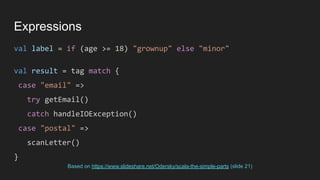
Expressions
val label = if (age >= 18) "grownup" else "minor"
val result = tag match {
case "email" =>
try getEmail()
catch handleIOException()
case "postal" =>
scanLetter()
}
Based on https://www.slideshare.net/Odersky/scala-the-simple-parts (slide 21)
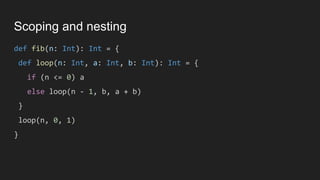
Scoping and nesting
def fib(n: Int): Int = {
def loop(n: Int, a: Int, b: Int): Int = {
if (n <= 0) a
else loop(n - 1, b, a + b)
}
loop(n, 0, 1)
}
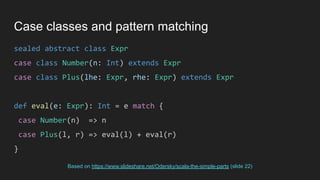
Case classes and pattern matching
sealed abstract class Expr
case class Number(n: Int) extends Expr
case class Plus(lhe: Expr, rhe: Expr) extends Expr
def eval(e: Expr): Int = e match {
case Number(n) => n
case Plus(l, r) => eval(l) + eval(r)
}
Based on https://www.slideshare.net/Odersky/scala-the-simple-parts (slide 22)
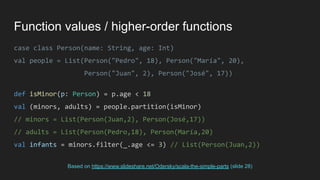
Function values / higher-order functions
case class Person(name: String, age: Int)
val people = List(Person("Pedro", 18), Person("María", 20),
Person("Juan", 2), Person("José", 17))
def isMinor(p: Person) = p.age < 18
val (minors, adults) = people.partition(isMinor)
// minors = List(Person(Juan,2), Person(José,17))
// adults = List(Person(Pedro,18), Person(María,20)
val infants = minors.filter(_.age <= 3) // List(Person(Juan,2))
Based on https://www.slideshare.net/Odersky/scala-the-simple-parts (slide 28)
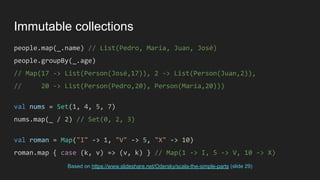
Immutable collections
people.map(_.name) // List(Pedro, María, Juan, José)
people.groupBy(_.age)
// Map(17 -> List(Person(José,17)), 2 -> List(Person(Juan,2)),
// 20 -> List(Person(Pedro,20), Person(María,20)))
val nums = Set(1, 4, 5, 7)
nums.map(_ / 2) // Set(0, 2, 3)
val roman = Map("I" -> 1, "V" -> 5, "X" -> 10)
roman.map { case (k, v) => (v, k) } // Map(1 -> I, 5 -> V, 10 -> X)
Based on https://www.slideshare.net/Odersky/scala-the-simple-parts (slide 29)
Parameterized types
class List[+A]
class Set[A]
class Function1[-A, +B]
type T1 = List[Number]
type T2 = Set[String]
type T3 = Function1[String, Int]
Based on https://www.slideshare.net/Odersky/scala-the-simple-parts (slide 47)
Implicit parameters
def min[A](x: A, y: A)(implicit ord: Order[A]): A =
if (ord.lteqv(x, y)) x else y
min(2, 3) // 2
min("abc", "xyz") // "abc"
min(List(3, 8, 5), List(2, 7, 9)) // List(2, 7, 9)
Based on https://www.slideshare.net/Odersky/scala-the-simple-parts (slide 49)
Higher-kinded types
trait Functor[F[_]]
trait Applicative[F[_]]
trait Monad[F[_]]
type T1 = Functor[Option]
type T2 = Applicative[ValidatedA]
type T3 = Monad[List]
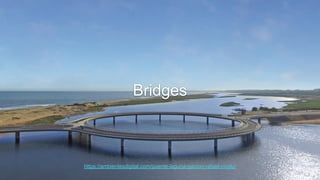
Bridges
https://ambientesdigital.com/puente-laguna-garzon-rafael-vinoly/
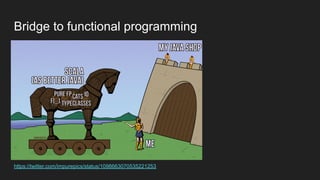
Bridge to functional programming
https://twitter.com/impurepics/status/1098663070535221253
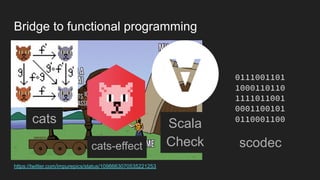
Bridge to functional programming
https://twitter.com/impurepics/status/1098663070535221253
cats
cats-effect
Scala
Check scodec
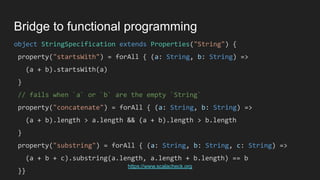
object StringSpecification extends Properties("String") {
property("startsWith") = forAll { (a: String, b: String) =>
(a + b).startsWith(a)
}
// fails when `a` or `b` are the empty `String`
property("concatenate") = forAll { (a: String, b: String) =>
(a + b).length > a.length && (a + b).length > b.length
}
property("substring") = forAll { (a: String, b: String, c: String) =>
(a + b + c).substring(a.length, a.length + b.length) == b
}}
Bridge to functional programming
https://www.scalacheck.org
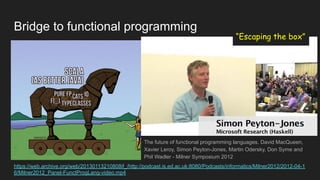
Bridge to functional programming
https://web.archive.org/web/20130113210808if_/http://podcast.is.ed.ac.uk:8080/Podcasts/informatics/Milner2012/2012-04-1
6/Milner2012_Panel-FunctProgLang-video.mp4
The future of functional programming languages. David MacQueen,
Xavier Leroy, Simon Peyton-Jones, Martin Odersky, Don Syme and
Phil Wadler - Milner Symposium 2012
“Escaping the box”
Bridge to concurrent and distributed programming
Monix
FS2
Reactive
Streams
Stream.resource(blockingExecutionContext).flatMap { blockingEC =>
io.file
.readAll[IO](Paths.get("fahrenheit.txt"), blockingEC, 4096)
.through(text.utf8Decode).through(text.lines)
.filter(s => !s.trim.isEmpty && !s.startsWith("//"))
.map(line => fahrenheitToCelsius(line.toDouble).toString)
.intersperse("n")
.through(text.utf8Encode)
.through(io.file.writeAll(Paths.get("celsius.txt"), blockingEC))
}.compile.drain.unsafeRunSync()
Bridge to concurrent and distributed programming
https://github.com/functional-streams-for-scala/fs2/blob/series/1.0/docs/ReadmeExample.md
Bridge to web and front-end programming
scalajs-react
slinky
scalajs-angular
Bridge to web and front-end programming
scalajs-react
slinky
scalajs-angular
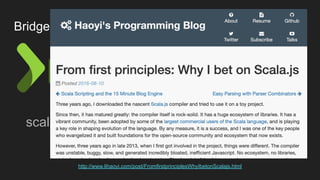
http://www.lihaoyi.com/post/FromfirstprinciplesWhyIbetonScalajs.html
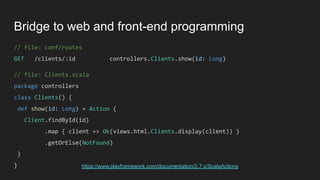
Bridge to web and front-end programming
// file: conf/routes
GET /clients/:id controllers.Clients.show(id: Long)
// file: Clients.scala
package controllers
class Clients() {
def show(id: Long) = Action {
Client.findById(id)
.map { client => Ok(views.html.Clients.display(client)) }
.getOrElse(NotFound)
}
} https://www.playframework.com/documentation/2.7.x/ScalaActions
Bridge to big data and data science
almond
Breeze
Spire
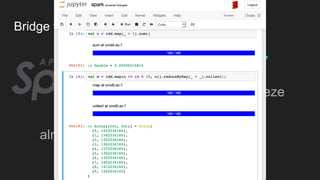
Bridge to big data and data science
almond
Breeze
Spire
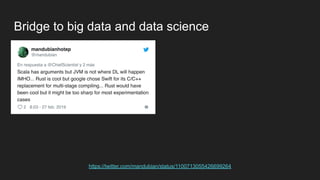
Bridge to big data and data science
https://twitter.com/mandubian/status/1100713055426699264
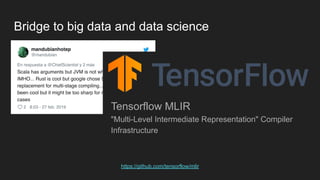
Bridge to big data and data science
https://github.com/tensorflow/mlir
Tensorflow MLIR
"Multi-Level Intermediate Representation" Compiler
Infrastructure
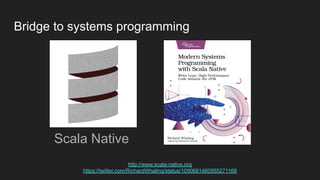
Bridge to systems programming
http://www.scala-native.org
https://twitter.com/RichardWhaling/status/1090681460955271168
Scala Native
Bridge to systems programming
type Vec = CStruct3[Double, Double, Double]
val vec = stackalloc[Vec] // allocate c struct on stack
!vec._1 = 10.0 // initialize fields
!vec._2 = 20.0
!vec._3 = 30.0
length(vec) // pass by reference
http://www.scala-native.org
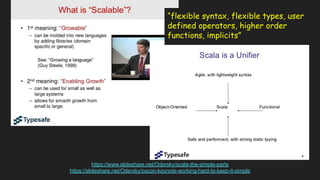
https://www.slideshare.net/Odersky/scala-the-simple-parts
https://slideshare.net/Odersky/oscon-keynote-working-hard-to-keep-it-simple
“flexible syntax, flexible types, user
defined operators, higher order
functions, implicits”
FIN

Scala: building bridges between programming domains

  • 1.
    Scala: building bridges betweenprogramming domains Germán Ferrari Scala Meetup Montevideo
  • 3.
    Expressions val label =if (age >= 18) "grownup" else "minor" val result = tag match { case "email" => try getEmail() catch handleIOException() case "postal" => scanLetter() } Based on https://www.slideshare.net/Odersky/scala-the-simple-parts (slide 21)
  • 4.
    Scoping and nesting deffib(n: Int): Int = { def loop(n: Int, a: Int, b: Int): Int = { if (n <= 0) a else loop(n - 1, b, a + b) } loop(n, 0, 1) }
  • 5.
    Case classes andpattern matching sealed abstract class Expr case class Number(n: Int) extends Expr case class Plus(lhe: Expr, rhe: Expr) extends Expr def eval(e: Expr): Int = e match { case Number(n) => n case Plus(l, r) => eval(l) + eval(r) } Based on https://www.slideshare.net/Odersky/scala-the-simple-parts (slide 22)
  • 6.
    Function values /higher-order functions case class Person(name: String, age: Int) val people = List(Person("Pedro", 18), Person("María", 20), Person("Juan", 2), Person("José", 17)) def isMinor(p: Person) = p.age < 18 val (minors, adults) = people.partition(isMinor) // minors = List(Person(Juan,2), Person(José,17)) // adults = List(Person(Pedro,18), Person(María,20) val infants = minors.filter(_.age <= 3) // List(Person(Juan,2)) Based on https://www.slideshare.net/Odersky/scala-the-simple-parts (slide 28)
  • 7.
    Immutable collections people.map(_.name) //List(Pedro, María, Juan, José) people.groupBy(_.age) // Map(17 -> List(Person(José,17)), 2 -> List(Person(Juan,2)), // 20 -> List(Person(Pedro,20), Person(María,20))) val nums = Set(1, 4, 5, 7) nums.map(_ / 2) // Set(0, 2, 3) val roman = Map("I" -> 1, "V" -> 5, "X" -> 10) roman.map { case (k, v) => (v, k) } // Map(1 -> I, 5 -> V, 10 -> X) Based on https://www.slideshare.net/Odersky/scala-the-simple-parts (slide 29)
  • 8.
    Parameterized types class List[+A] classSet[A] class Function1[-A, +B] type T1 = List[Number] type T2 = Set[String] type T3 = Function1[String, Int] Based on https://www.slideshare.net/Odersky/scala-the-simple-parts (slide 47)
  • 9.
    Implicit parameters def min[A](x:A, y: A)(implicit ord: Order[A]): A = if (ord.lteqv(x, y)) x else y min(2, 3) // 2 min("abc", "xyz") // "abc" min(List(3, 8, 5), List(2, 7, 9)) // List(2, 7, 9) Based on https://www.slideshare.net/Odersky/scala-the-simple-parts (slide 49)
  • 10.
    Higher-kinded types trait Functor[F[_]] traitApplicative[F[_]] trait Monad[F[_]] type T1 = Functor[Option] type T2 = Applicative[ValidatedA] type T3 = Monad[List]
  • 11.
  • 12.
    Bridge to functionalprogramming https://twitter.com/impurepics/status/1098663070535221253
  • 13.
    Bridge to functionalprogramming https://twitter.com/impurepics/status/1098663070535221253 cats cats-effect Scala Check scodec
  • 14.
    object StringSpecification extendsProperties("String") { property("startsWith") = forAll { (a: String, b: String) => (a + b).startsWith(a) } // fails when `a` or `b` are the empty `String` property("concatenate") = forAll { (a: String, b: String) => (a + b).length > a.length && (a + b).length > b.length } property("substring") = forAll { (a: String, b: String, c: String) => (a + b + c).substring(a.length, a.length + b.length) == b }} Bridge to functional programming https://www.scalacheck.org
  • 15.
    Bridge to functionalprogramming https://web.archive.org/web/20130113210808if_/http://podcast.is.ed.ac.uk:8080/Podcasts/informatics/Milner2012/2012-04-1 6/Milner2012_Panel-FunctProgLang-video.mp4 The future of functional programming languages. David MacQueen, Xavier Leroy, Simon Peyton-Jones, Martin Odersky, Don Syme and Phil Wadler - Milner Symposium 2012 “Escaping the box”
  • 16.
    Bridge to concurrentand distributed programming Monix FS2 Reactive Streams
  • 17.
    Stream.resource(blockingExecutionContext).flatMap { blockingEC=> io.file .readAll[IO](Paths.get("fahrenheit.txt"), blockingEC, 4096) .through(text.utf8Decode).through(text.lines) .filter(s => !s.trim.isEmpty && !s.startsWith("//")) .map(line => fahrenheitToCelsius(line.toDouble).toString) .intersperse("n") .through(text.utf8Encode) .through(io.file.writeAll(Paths.get("celsius.txt"), blockingEC)) }.compile.drain.unsafeRunSync() Bridge to concurrent and distributed programming https://github.com/functional-streams-for-scala/fs2/blob/series/1.0/docs/ReadmeExample.md
  • 18.
    Bridge to weband front-end programming scalajs-react slinky scalajs-angular
  • 19.
    Bridge to weband front-end programming scalajs-react slinky scalajs-angular http://www.lihaoyi.com/post/FromfirstprinciplesWhyIbetonScalajs.html
  • 20.
    Bridge to weband front-end programming // file: conf/routes GET /clients/:id controllers.Clients.show(id: Long) // file: Clients.scala package controllers class Clients() { def show(id: Long) = Action { Client.findById(id) .map { client => Ok(views.html.Clients.display(client)) } .getOrElse(NotFound) } } https://www.playframework.com/documentation/2.7.x/ScalaActions
  • 21.
    Bridge to bigdata and data science almond Breeze Spire
  • 22.
    Bridge to bigdata and data science almond Breeze Spire
  • 23.
    Bridge to bigdata and data science https://twitter.com/mandubian/status/1100713055426699264
  • 24.
    Bridge to bigdata and data science https://github.com/tensorflow/mlir Tensorflow MLIR "Multi-Level Intermediate Representation" Compiler Infrastructure
  • 25.
    Bridge to systemsprogramming http://www.scala-native.org https://twitter.com/RichardWhaling/status/1090681460955271168 Scala Native
  • 26.
    Bridge to systemsprogramming type Vec = CStruct3[Double, Double, Double] val vec = stackalloc[Vec] // allocate c struct on stack !vec._1 = 10.0 // initialize fields !vec._2 = 20.0 !vec._3 = 30.0 length(vec) // pass by reference http://www.scala-native.org
  • 27.
  • 28.