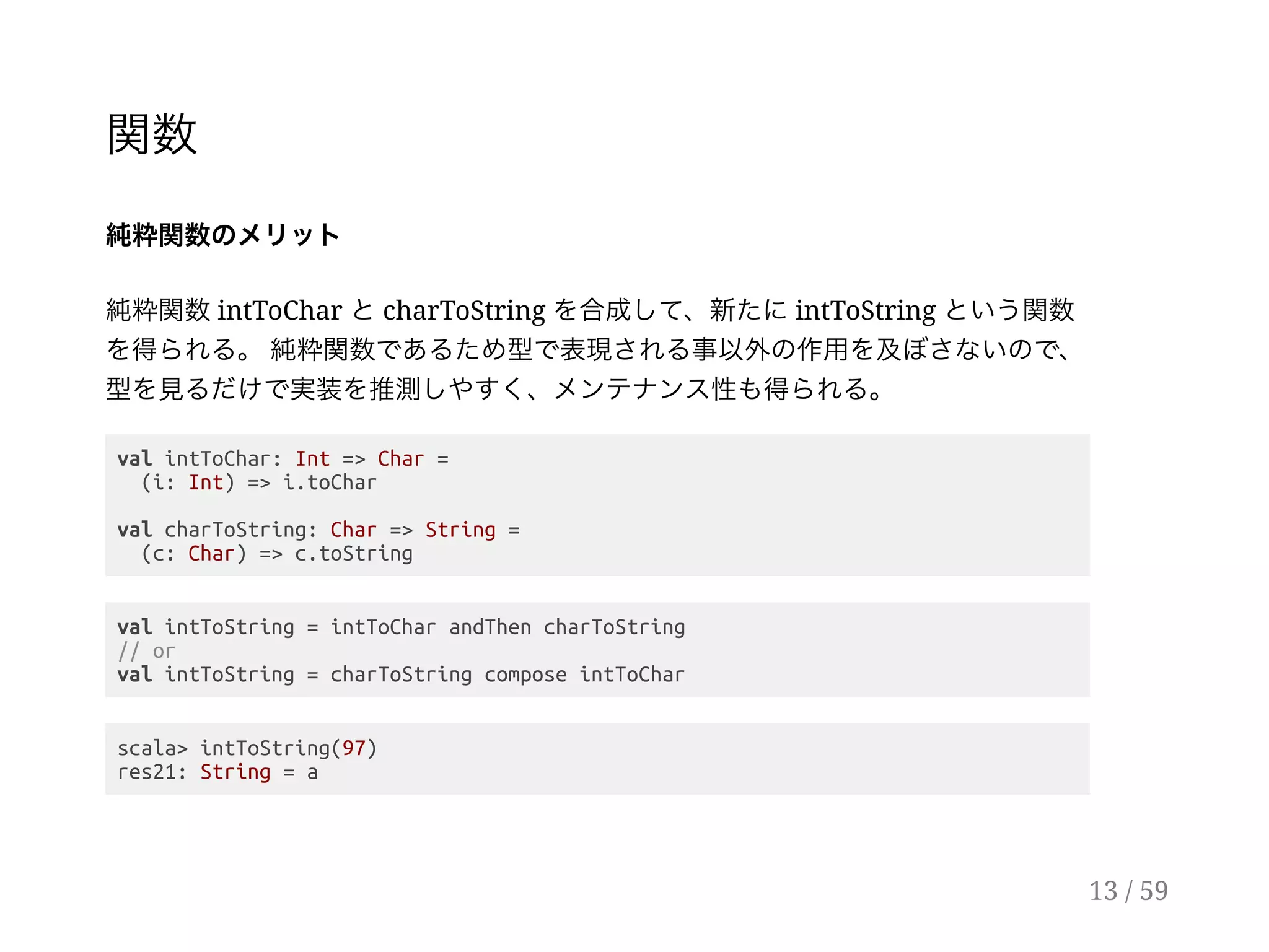
関数
Scala の関数
Scala の関数はファーストクラス。
変数に代入したり、他の関数の引数に渡したり出来る。
valinc = (i: Int) => i + 1
val cl: String => Int => String =
(msg: String) => (rep: Int) => msg * rep
Scala では、変数/定数定義で型パラメータをとるような値は定義出来ない。メソッ
ド定義で代用するので、便宜上def を用いた定義も関数と呼ぶこととする。
def show[A]: A => String = (a: A) => a.toString
9 / 59
10.
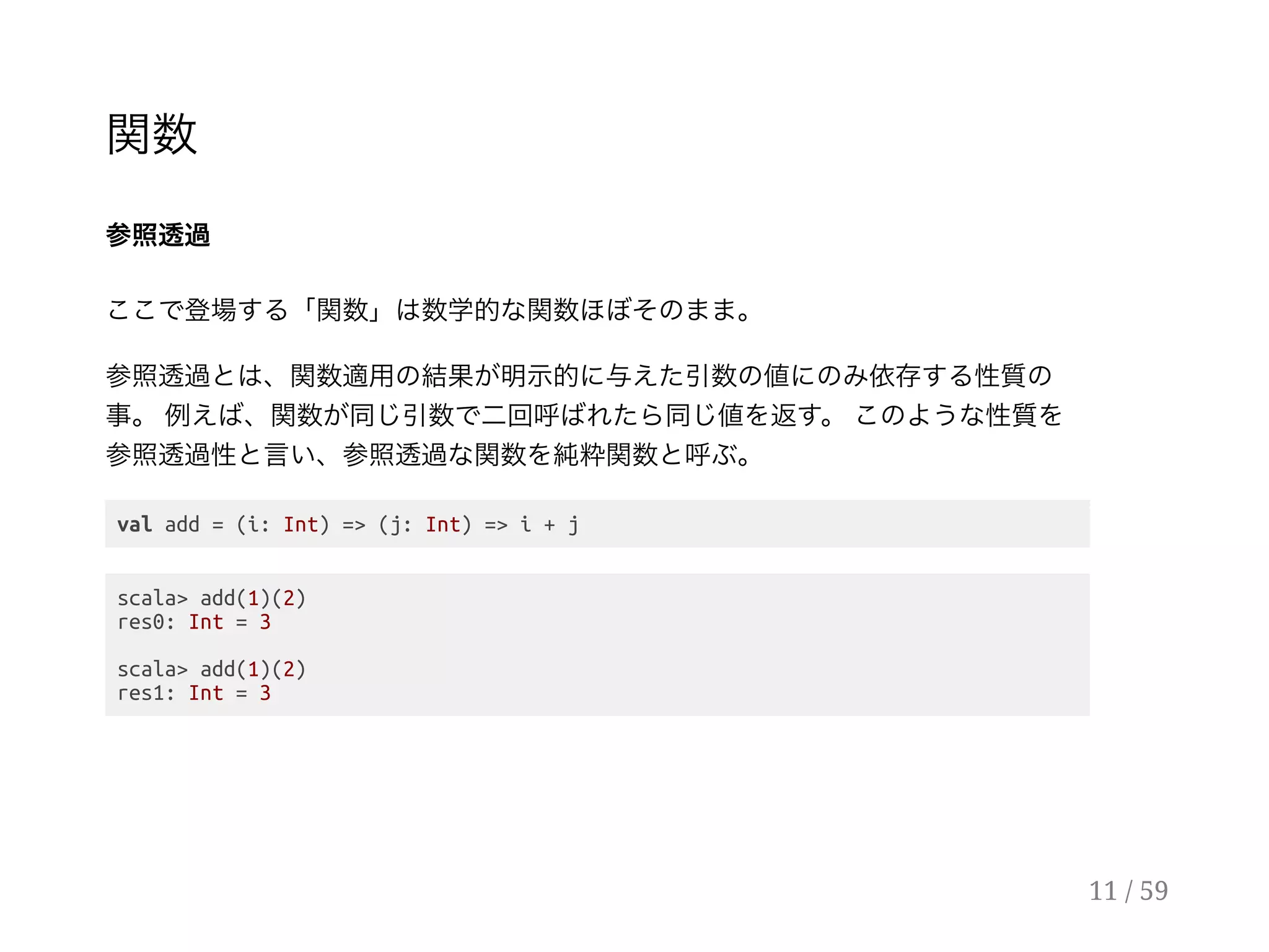
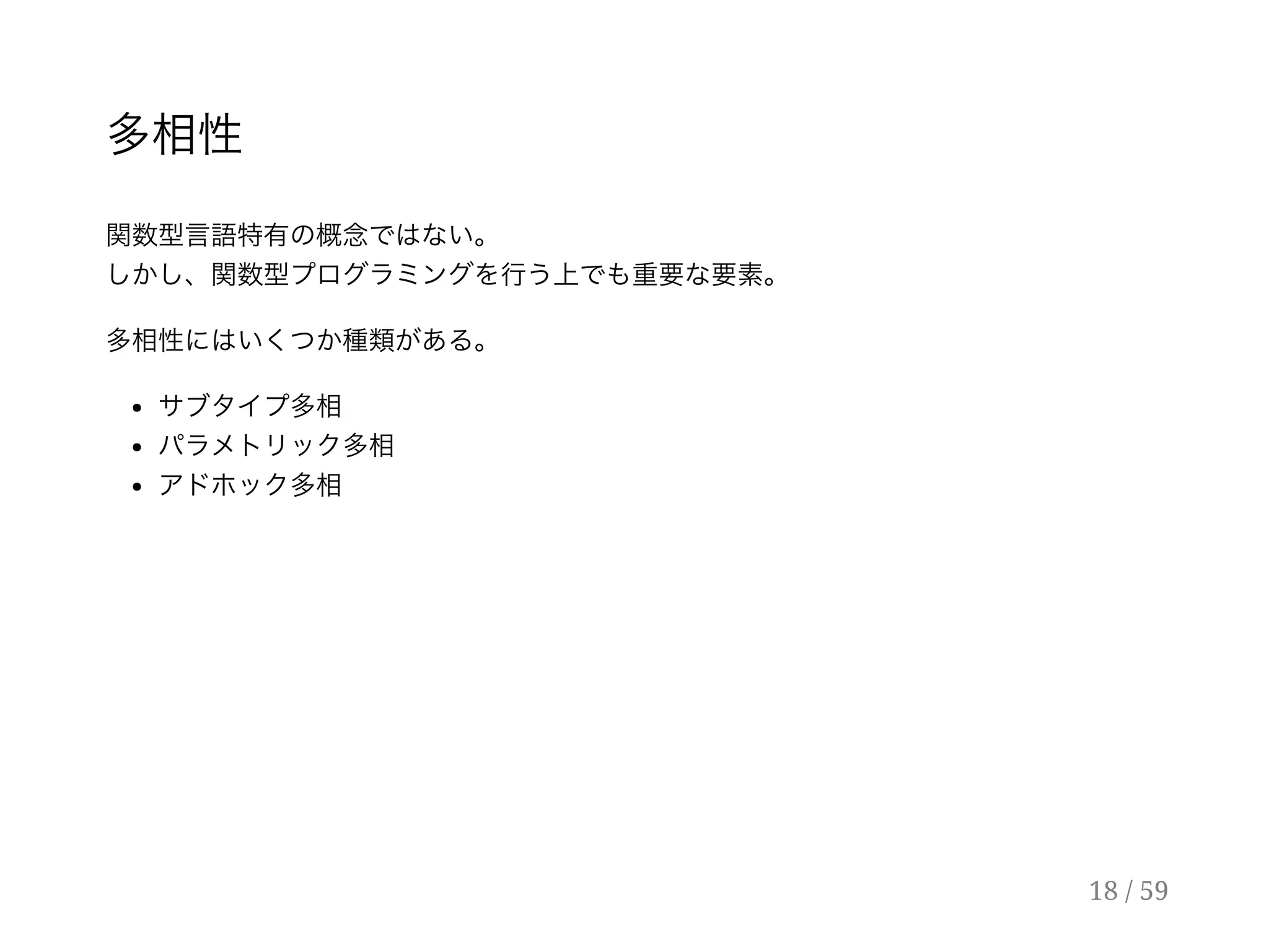
関数
Scala の関数
関数を引数にとったり、返り値として返したりする関数を高階関数と呼ぶ。
val calc:(Int => Int => Int) => Int => Int => Int =
(f: Int => Int => Int) => (i: Int) => (j: Int) => f(i)(j)
val add: Int => Int => Int =
(i: Int) => (j: Int) => i + j
val multi: Int => Int => Int =
(i: Int) => (j: Int) => i * j
scala> calc(add)(1)(2)
res15: Int = 3
scala> calc(multi)(1)(2)
res16: Int = 2
10 / 59
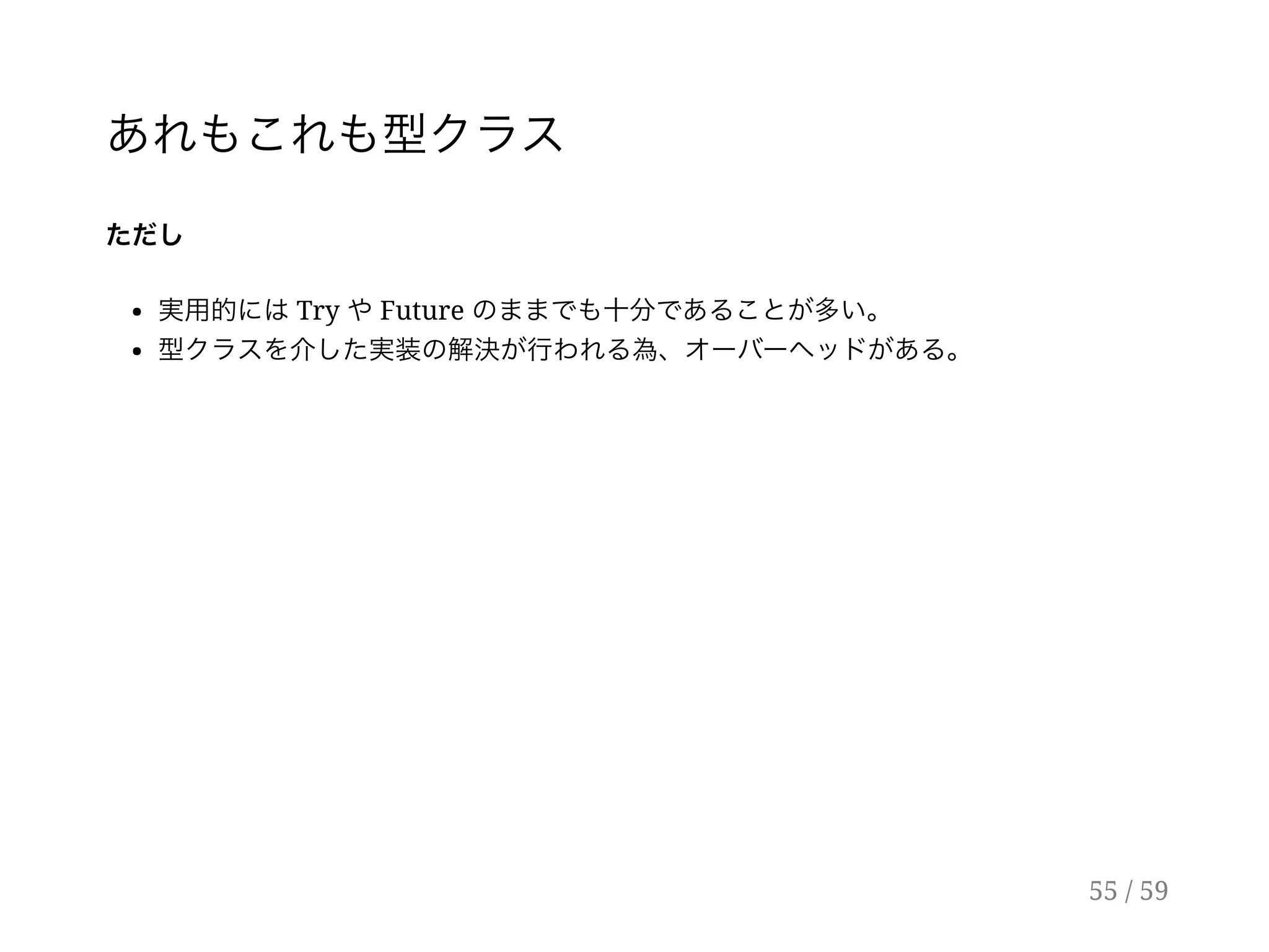
あれもこれも型クラス
for 式再説
Scala のfor式は糖衣構文。
val fooOpt: Option[Int] = ...
val barOpt: Option[Int] = ...
for {
foo <- fooOpt
bar <- barOpt
} yield foo + bar
以下のように展開される。
fooOpt.flatMap(foo =>
barOpt.map(bar =>
foo + bar
)
)
45 / 59
46.
あれもこれも型クラス
for 式再説
for 式の展開には他にもルールがある。compilerの型付け前に展開されるので、
必ず全ての展開対象メソッドを実装している必要はない。
abstract class C[A] {
def map[B](f: A => B): C[B]
def flatMap[B](f: A => C[B]): C[B]
def withFilter([: A => Boolean): C[A]
def foreach(b: A => Unit): Unit
}
46 / 59
47.
あれもこれも型クラス
「for 式が使える」型クラス
便宜上map, flatMapのみを考える。
trait CanWriteForSyntax[F[_]] {
def map[A, B](fa: F[A])(f: A => B): F[B]
def flatMap[A, B](fa: F[A])(f: A => F[B]): F[B]
}
例えば、Option のインスタンスは以下の通り。
implicit val optionCanWriteForSyntax: CanWriteForSyntax[Option] =
new CanWriteForSyntax[Option] {
def map[A, B](fa: Option[A])(f: A => B): Option[B] =
fa.map(f)
def flatMap[A, B](fa: Option[A])(f: A => Option[B]): Option[B] =
fa.flatMap(f)
}
47 / 59






![関数
Scala の関数
Scala の関数はファーストクラス。
変数に代入したり、他の関数の引数に渡したり出来る。
val inc = (i: Int) => i + 1
val cl: String => Int => String =
(msg: String) => (rep: Int) => msg * rep
Scala では、変数/定数定義で型パラメータをとるような値は定義出来ない。メソッ
ド定義で代用するので、便宜上def を用いた定義も関数と呼ぶこととする。
def show[A]: A => String = (a: A) => a.toString
9 / 59](https://image.slidesharecdn.com/scala-170909024631/75/Scala-9-2048.jpg)



![関数
イミュータブルなデータ構造
破壊的代入や状態の操作など、副作用のある操作を行えない。この純粋関数の考え
方をデータ型に対しても適用するとイミュータブルなデータ構造となる。操作の実
行後は新しい操作後のデータが返され、操作前のデータはそのまま残る。
scala> val l = List(1, 2, 3)
l: List[Int] = List(1, 2, 3)
scala> l.map(_ * 10)
res0: List[Int] = List(10, 20, 30)
scala> l
res1: List[Int] = List(1, 2, 3)
16 / 59](https://image.slidesharecdn.com/scala-170909024631/75/Scala-16-2048.jpg)

![多相性
パラメトリック多相
複数の型が型パラメータを使って統一的に表現できる多相。
sealed abstract class List[+A] extends ... { ... }
val strList = List("foo", "bar", "baz")
val intList = List(1, 2, 3)
sealed abstract class Option[+A] extends ... { ... }
final case class Some[+A](value: A) extends Option[A] { ... }
case object None extends Option[Nothing] { ... }
val strOpt = Option("foo")
val intOpt = Option(100)
19 / 59](https://image.slidesharecdn.com/scala-170909024631/75/Scala-19-2048.jpg)
![多相性
パラメトリック多相
Scala では高カインド型も扱うことが出来る。
型コンストラクタをとる型コンストラクタ。
trait Cache[F[_]] {
def get[A](key: String): F[A]
}
class TryCache[Try] {
def get[A](key: String): Try[A] = ???
}
class OptionCache[Option] {
def get[A](key: String): Option[A] = ???
}
20 / 59](https://image.slidesharecdn.com/scala-170909024631/75/Scala-20-2048.jpg)



: Int = ???
下記のように展開される。
def foo[A](a: A)(implicit x: Ordering[A]): Int = ???
implicitly 暗黙の引数を召喚する為の便利メソッド。scala.Predefより。
@inline def implicitly[T](implicit e: T) = e
25 / 59](https://image.slidesharecdn.com/scala-170909024631/75/Scala-25-2048.jpg)
![型クラス
Ordering(Scala の標準ライブラリより)
// List#sorted の場合、Repr は List[A]
def sorted[B >: A](implicit ord: Ordering[B]): Repr = {
...
}
// List#max の場合、A は List の要素の型
def max[B >: A](implicit cmp: Ordering[B]): A = {
...
}
trait Ordering[T] extends Comparator[T] with PartialOrdering[T] with Serializable {
...
def compare(x: T, y: T): Int
...
}
26 / 59](https://image.slidesharecdn.com/scala-170909024631/75/Scala-26-2048.jpg)
![型クラス
Ordering(Scala の標準ライブラリより)
自分で定義したデータ
sealed abstract class Num(val i: Int)
case object Zero extends Num(0)
case object One extends Num(1)
case object Two extends Num(2)
implicit val numOrdering: Ordering[Num] = new Ordering[Num] {
def compare(x: Num, y: Num): Int =
if (x.i == y.i) 0
else if (x.i < y.i) -1
else 1
}
scala> List[Num](One, Two, Zero).max
res4: Num = Two
scala> List[Num](One, Two, Zero).sorted
res6: List[Num] = List(Zero, One, Two)
27 / 59](https://image.slidesharecdn.com/scala-170909024631/75/Scala-27-2048.jpg)
![型クラス
TypeBinder(scalikejdbc 公式ドキュメントより)
import scalikejdbc._
import java.sql.ResultSet
case class MemberId(id: Long)
implicit val memberIdTypeBinder: TypeBinder[MemberId] = new TypeBinder[MemberId] {
def apply(rs: ResultSet, label: String): MemberId = MemberId(rs.getLong(label))
def apply(rs: ResultSet, index: Int): MemberId = MemberId(rs.getLong(index))
}
val ids: Seq[MemberId] = sql"select id from member".map(_.get[MemberId]("id")).list.apply()
case class WrappedResultSet(underlying: ResultSet, cursor: ResultSetCursor, index:
//...
def get[A: TypeBinder](columnLabel: String): A = {
ensureCursor()
wrapIfError(implicitly[TypeBinder[A]].apply(underlying, columnLabel))
}
}
28 / 59](https://image.slidesharecdn.com/scala-170909024631/75/Scala-28-2048.jpg)
![型クラス
「文字列に変換する」型クラス
trait Show[A] {
def show(a: A): String
}
object Show {
implicit val stringShow: Show[String] = new Show[String] {
def show(a: String): String = a
}
implicit val intShow: Show[Int] = new Show[Int] {
def show(a: Int): String = a.toString
}
}
29 / 59](https://image.slidesharecdn.com/scala-170909024631/75/Scala-29-2048.jpg)
(implicit sa: Show[A]): String =
sa.show(a)
scala> show(100)
res2: String = 100
scala> show("foo")
res3: String = foo
scala> show('a')
<console>:14: error: could not find implicit value for parameter sa: Show[Char]
show('a')
^
30 / 59](https://image.slidesharecdn.com/scala-170909024631/75/Scala-30-2048.jpg)
![型クラス
「文字列に変換する」型クラス
scala> case class Cat(name: String)
defined class Cat
scala> implicit val catShow: Show[Cat] = new Show[Cat] {
| def show(a: Cat): String = s"${a.name} say, meow!"
| }
catShow: Show[Cat] = $anon$1@71179b6f
scala> show(Cat("moko"))
res5: String = moko say, meow!
31 / 59](https://image.slidesharecdn.com/scala-170909024631/75/Scala-31-2048.jpg)
![型クラス
「なんか結合できる」型クラス
trait Additive[A] {
def combine(x: A, y: A): A
}
object Additive {
implicit val stringAdditive: Additive[String] = new Additive[String] {
def combine(x: String, y: String): String =
x + y
}
}
32 / 59](https://image.slidesharecdn.com/scala-170909024631/75/Scala-32-2048.jpg)
(implicit aa: Additive[A]): A =
aa.combine(a, b)
scala> combine("foo", "bar")
res10: String = foobar
case class Natural(i: Int)
implicit val naturalAdditive: Additive[Natural] = new Additive[Natural] {
def combine(x: Natural, y: Natural): Natural =
Natural(x.i + y.i)
}
scala> combine(Natural(1), Natural(2))
res0: Natural = Natural(3)
33 / 59](https://image.slidesharecdn.com/scala-170909024631/75/Scala-33-2048.jpg)
 {
def show(implicit sa: Show[A]): String =
sa.show(a)
}
scala> 100.show
res7: String = 100
scala> Cat("moko").show
res8: String = moko say, meow!
34 / 59](https://image.slidesharecdn.com/scala-170909024631/75/Scala-34-2048.jpg)
 {
def combine(b: A)(implicit aa: Additive[A]): A =
aa.combine(a, b)
}
scala> Natural(1) combine Natural(2)
res1: Natural = Natural(3)
35 / 59](https://image.slidesharecdn.com/scala-170909024631/75/Scala-35-2048.jpg)
![型クラス
なぜ、型クラスが重要なのか
以下のようなMyList について考えてみる。
sealed abstract class MyList[+A]
case class MyCons[A](val head: A, val tail: MyList[A]) extends MyList[A]
case object MyNil extends MyList[Nothing]
scala> val l: MyList[Int] = MyCons(1, MyCons(2, MyCons(3, MyNil)))
l: MyList[Int] = MyCons(1,MyCons(2,MyCons(3,MyNil)))
36 / 59](https://image.slidesharecdn.com/scala-170909024631/75/Scala-36-2048.jpg)
![型クラス
なぜ、型クラスが重要なのか
主に、オブジェクト指向ではMyList などのデータ構造に対してメソッドを追加す
るようなアプローチをとることが多い。
sealed abstract class MyList[+A] {
// メソッドの追加
def map(f: A => B): MyList[B] = ???
}
37 / 59](https://image.slidesharecdn.com/scala-170909024631/75/Scala-37-2048.jpg)
![型クラス
なぜ、型クラスが重要なのか
関数型プログラミングでは異なるアプローチをとる。既存のデータ型を型クラスを
用いて操作を追加する。
implicit val mappable: Mappable[MyList] = new Mappable[MyList] {
def map[A, B](fa: MyList[A])(f: A => B): MyList[B] = ???
}
38 / 59](https://image.slidesharecdn.com/scala-170909024631/75/Scala-38-2048.jpg)



![あれもこれも型クラス
「map が使える」型クラス
Option#map
scala> Option("Hello").map(s => s + "!!!")
res0: Option[String] = Some(Hello!!!)
List#map
scala> List(1, 2, 3).map(i => i * 10)
res2: List[Int] = List(10, 20, 30)
42 / 59](https://image.slidesharecdn.com/scala-170909024631/75/Scala-42-2048.jpg)
![あれもこれも型クラス
「map が使える」型クラス
trait Mappable[F[_]] {
def map[A, B](fa: F[A])(f: A => B): F[B]
}
object Mappable {
implicit val optionMappable: Mappable[Option] = new Mappable[Option] {
def map[A, B](a: Option[A])(f: A => B): Option[B] =
a.map(f)
}
implicit val listMappable: Mappable[List] = new Mappable[List] {
def map[A, B](a: List[A])(f: A => B): List[B] =
a.map(f)
}
}
43 / 59](https://image.slidesharecdn.com/scala-170909024631/75/Scala-43-2048.jpg)
![あれもこれも型クラス
「map が使える」型クラス
使い方
scala> implicitly[Mappable[Option]].map(Option(100))(i => i + 1)
res3: Option[Int] = Some(101)
scala> implicitly[Mappable[List]].map(List(1, 2, 3))(i => i + 1)
res4: List[Int] = List(2, 3, 4)
44 / 59](https://image.slidesharecdn.com/scala-170909024631/75/Scala-44-2048.jpg)
![あれもこれも型クラス
for 式再説
Scala のfor 式は糖衣構文。
val fooOpt: Option[Int] = ...
val barOpt: Option[Int] = ...
for {
foo <- fooOpt
bar <- barOpt
} yield foo + bar
以下のように展開される。
fooOpt.flatMap(foo =>
barOpt.map(bar =>
foo + bar
)
)
45 / 59](https://image.slidesharecdn.com/scala-170909024631/75/Scala-45-2048.jpg)
![あれもこれも型クラス
for 式再説
for 式の展開には他にもルールがある。compiler の型付け前に展開されるので、
必ず全ての展開対象メソッドを実装している必要はない。
abstract class C[A] {
def map[B](f: A => B): C[B]
def flatMap[B](f: A => C[B]): C[B]
def withFilter([: A => Boolean): C[A]
def foreach(b: A => Unit): Unit
}
46 / 59](https://image.slidesharecdn.com/scala-170909024631/75/Scala-46-2048.jpg)
![あれもこれも型クラス
「for 式が使える」型クラス
便宜上map, flatMap のみを考える。
trait CanWriteForSyntax[F[_]] {
def map[A, B](fa: F[A])(f: A => B): F[B]
def flatMap[A, B](fa: F[A])(f: A => F[B]): F[B]
}
例えば、Option のインスタンスは以下の通り。
implicit val optionCanWriteForSyntax: CanWriteForSyntax[Option] =
new CanWriteForSyntax[Option] {
def map[A, B](fa: Option[A])(f: A => B): Option[B] =
fa.map(f)
def flatMap[A, B](fa: Option[A])(f: A => Option[B]): Option[B] =
fa.flatMap(f)
}
47 / 59](https://image.slidesharecdn.com/scala-170909024631/75/Scala-47-2048.jpg)
![あれもこれも型クラス
「for 式が使える」型クラス
標準機能で求められるmap, flatMap とはシグネチャが異なるので、実際に使う場
合にはimplicit conversion と組み合わせる必要がある。
implicit class CanWriteForSyntaxOp[F[_], A](fa: F[A])(implicit x: CanWriteForSyntax
def map[B](f: A => B): F[B] =
x.map(fa)(f)
def flatMap[B](f: A => F[B]): F[B] =
x.flatMap(fa)(f)
}
48 / 59](https://image.slidesharecdn.com/scala-170909024631/75/Scala-48-2048.jpg)
![あれもこれも型クラス
「for 式が使える」型クラス
def foo[F[_]: CanWriteForSyntax, A, B](fa: F[A]): F[String] =
for {
a <- fa
} yield a.toString
scala> foo(Option(100))
res6: Option[String] = Some(100)
49 / 59](https://image.slidesharecdn.com/scala-170909024631/75/Scala-49-2048.jpg)

implicit val responseCanWriteForSyntax: CanWriteForSyntax[Response] =
new CanWriteForSyntax[Response] {
def map[A, B](fa: Response[A])(f: A => B): Response[B] =
fa.copy(value = f(fa.value))
def flatMap[A, B](fa: Response[A])(f: A => Response[B]): Response[B] =
fa match {
case Response(v) => f(v)
}
}
scala> foo(Response(100))
res13: Response[String] = Response(100)
50 / 59](https://image.slidesharecdn.com/scala-170909024631/75/Scala-50-2048.jpg)
: Try[A]
def set[A](key: String, value: A): Try[Unit]
def update[A](key: String, f: A => A): Try[Unit]
}
abstract class AsyncCache {
def get[A](key: String): Future[A]
def set[A](key: String, value: A): Future[Unit]
def update[A](key: String, f: A => A): Future[Unit]
}
51 / 59](https://image.slidesharecdn.com/scala-170909024631/75/Scala-51-2048.jpg)
: Try[A]
def set[A](key: String, value: A): Try[Unit]
def update[A](key: String, f: A => A): Try[Unit] =
for {
v <- get[A](key)
_ <- set(key, f(v))
} yield ()
}
class AsyncCache {
def get[A](key: String): Future[A]
def set[A](key: String, value: A): Future[Unit]
def update[A](key: String, f: A => A): Future[Unit] =
for {
v <- get[A](key)
_ <- set(key, f(v))
} yield ()
}
52 / 59](https://image.slidesharecdn.com/scala-170909024631/75/Scala-52-2048.jpg)
![あれもこれも型クラス
返り値の型をF[_] という型パラメータをとる型パラメータに包むことで共通化でき
る。ただし、update ではF[_] がmap, flatMap が定義されていることを知らない
(保証出来ない)。
abstract class Cache[F[_]] {
def get[A](key: String): F[A]
def set[A](key: String, value: A): F[Unit]
// compile 出来なくなる
def update[A](key: String, f: A => A): F[Unit] =
for {
v <- get[A](key)
_ <- set(key, f(v))
} yield ()
}
class SyncCache extends Cache[Try] { ... }
class AsyncCache extends Cache[Future] { ... }
53 / 59](https://image.slidesharecdn.com/scala-170909024631/75/Scala-53-2048.jpg)
![あれもこれも型クラス
F[_] にCanWriteForSyntax 型クラスのインスタンスであるという制約をかけれ
ば、map, flatMap の実装を持つことが保証されるのでcompile 出来る。※実際
にはCanWriteForSyntaxOp の定義も必要。
abstract class Cache[F[_]: CanWriteForSyntax] { ... }
implicit val tryCanWriteForSyntax: CanWriteForSyntax[Try] =
new CanWriteForSyntax[Try] {
def map[A, B](fa: Try[A])(f: A => B): Try[B] =
fa.map(f)
def flatMap[A, B](fa: Try[A])(f: A => Try[B]): Try[B] =
fa.flatMap(f)
}
implicit def futureCanWriteForSyntax(implicit ec: ExecutionContext): CanWriteForSyntax
new CanWriteForSyntax[Future] {
def map[A, B](fa: Future[A])(f: A => B): Future[B] =
fa.map(f)
def flatMap[A, B](fa: Future[A](f: A => Future[B]): Future[B] =
fa.flatMap(f)
}
54 / 59](https://image.slidesharecdn.com/scala-170909024631/75/Scala-54-2048.jpg)




![Scalaで萌える関数型プログラミング[1.1.RC1]](https://cdn.slidesharecdn.com/ss_thumbnails/tkscalascala-110819233541-phpapp01-thumbnail.jpg?width=640&height=640&fit=bounds)

![Scalaで萌える関数型プログラミング[完全版]](https://cdn.slidesharecdn.com/ss_thumbnails/olbjpscala-110717003227-phpapp01-thumbnail.jpg?width=640&height=640&fit=bounds)


