Presentation Outline
• Introduction
•Scaffold Components
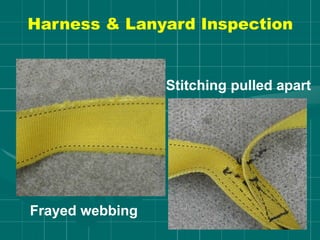
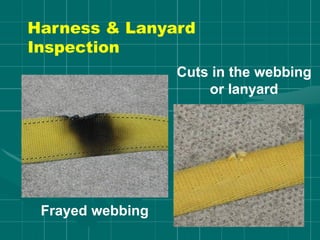
• Harness/Lanyard Inspection & Use
• Scaffold Inspection and Tagging
• Scaffold User’s Checklist
• Scaffold General Requirements
3.
Objectives
• Learn thedifferent types of scaffold
& its components
• Learn how to inspect & use a full body
harness & lanyard
• Learn how to inspect and tag a safe
or unsafe scaffold
• Learn how to use the Scaffold User’s
Safety Checklist
• Learn the scaffold general safety
requirements
Think…
• What isa scaffold?
• When is scaffold needed?
• Where do we need scaffold?
• How scaffold is built?
6.
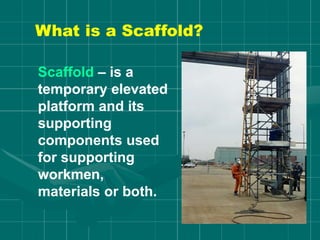
What is aScaffold?
Scaffold – is a
temporary elevated
platform and its
supporting
components used
for supporting
workmen,
materials or both.
7.
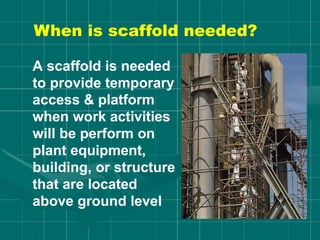
When is scaffoldneeded?
A scaffold is needed
to provide temporary
access & platform
when work activities
will be perform on
plant equipment,
building, or structure
that are located
above ground level
8.
How scaffold isbuilt?
Scaffold is built by
connecting several
components such as
posts, runners,
bearers etc. using
either by ‘couplers’
or system
‘connectors’
Types of ScaffoldConstruction
• System type – is a type of scaffold
whose scaffold components are
connected by fixed connectors
• Tube & Coupler type – is a type of
scaffold whose scaffold
components are connected by
couplers
12.
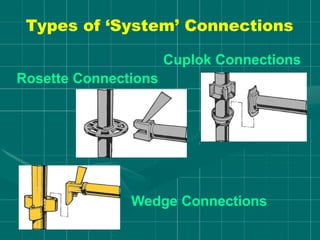
Types of ‘System’Connections
Cuplok Connections
Rosette Connections
Wedge Connections
Think…
• What isa Post?
• What is a Runner?
• What is a Bearer?
• What is a Board Bearer
• What is a Plank?
• What is a Base Plate?
• What is a Sole Board?
16.
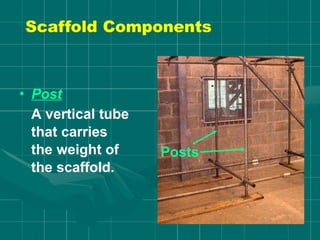
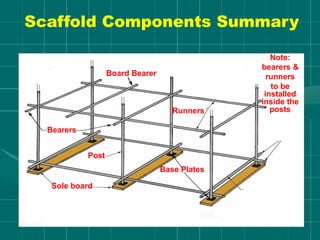
• Post
A verticaltube
that carries
the weight of
the scaffold.
Posts
Scaffold Components
17.
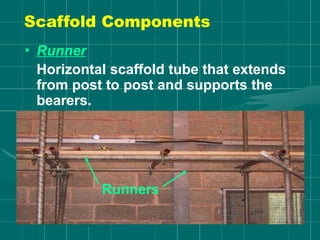
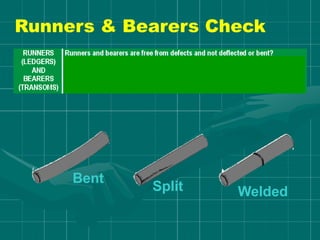
• Runner
Horizontal scaffoldtube that extends
from post to post and supports the
bearers.
Runners
Scaffold Components
18.
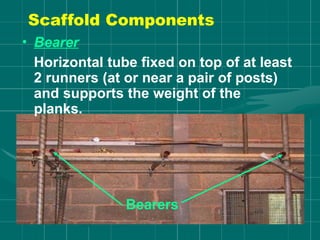
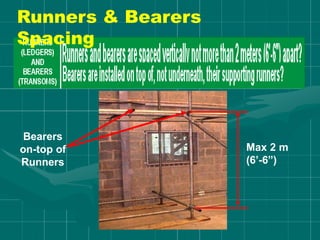
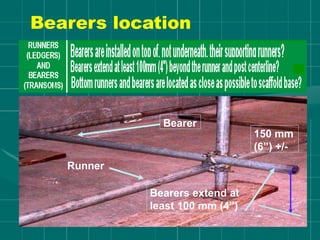
• Bearer
Horizontal tubefixed on top of at least
2 runners (at or near a pair of posts)
and supports the weight of the
planks.
Bearers
Scaffold Components
19.
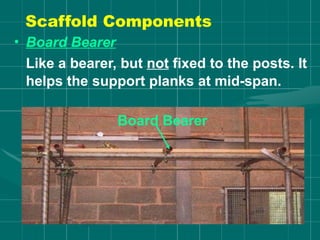
• Board Bearer
Likea bearer, but not fixed to the posts. It
helps the support planks at mid-span.
Board Bearer
Scaffold Components
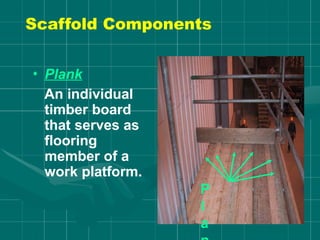
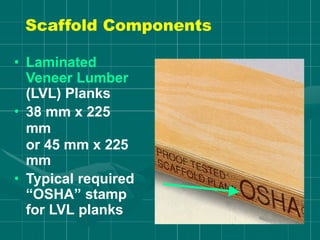
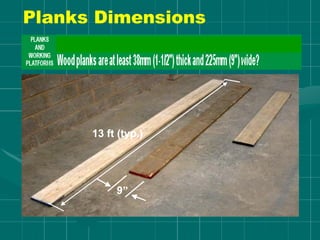
• Laminated
Veneer Lumber
(LVL)Planks
• 38 mm x 225
mm
or 45 mm x 225
mm
• Typical required
“OSHA” stamp
for LVL planks
Scaffold Components
22.
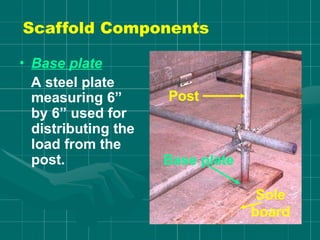
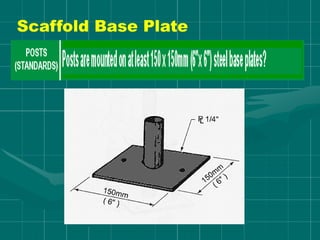
• Base plate
Asteel plate
measuring 6”
by 6” used for
distributing the
load from the
post.
Sole
board
Base plate
Post
Scaffold Components
23.
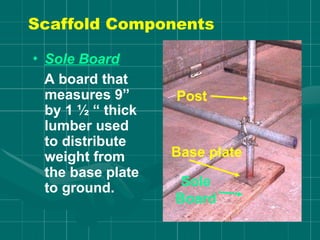
• Sole Board
Aboard that
measures 9”
by 1 ½ “ thick
lumber used
to distribute
weight from
the base plate
to ground.
Base plate
Sole
Board
Post
Scaffold Components
24.
Think…
• What isa guardrail system?
• Why installed a guardrail system?
• What is the purpose of a toe-board?
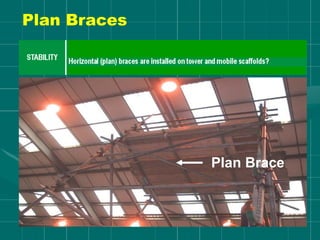
• How are bracings installed?
• Why there is a need for bracing?
25.
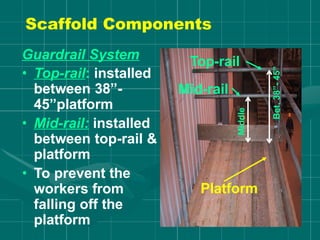
Guardrail System
• Top-rail:installed
between 38”-
45”platform
• Mid-rail: installed
between top-rail &
platform
• To prevent the
workers from
falling off the
platform
Top-rail
Mid-rail
Scaffold Components
Platform
Bet.
38”-
45”
Middle
26.
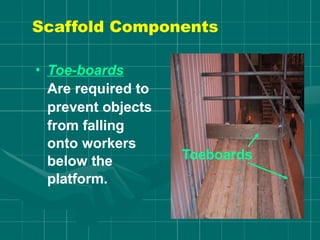
• Toe-boards
Are requiredto
prevent objects
from falling
onto workers
below the
platform.
Toeboards
Scaffold Components
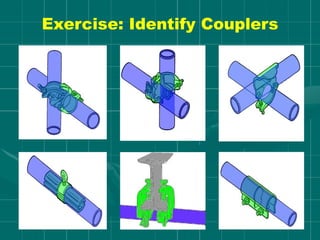
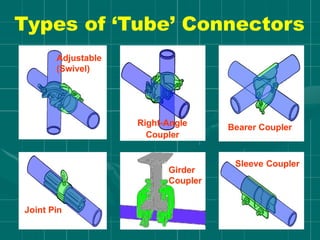
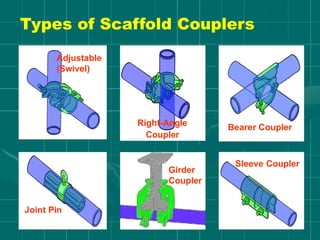
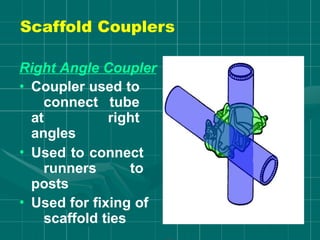
Right Angle Coupler
•Coupler used to
connect tube
at right
angles
• Used to connect
runners to
posts
• Used for fixing of
scaffold ties
Scaffold Couplers
31.
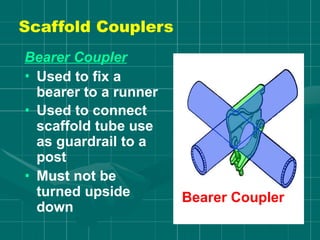
Bearer Coupler
• Usedto fix a
bearer to a runner
• Used to connect
scaffold tube use
as guardrail to a
post
• Must not be
turned upside
down
Bearer Coupler
Scaffold Couplers
32.
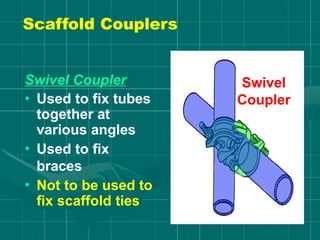
Swivel Coupler
• Usedto fix tubes
together at
various angles
• Used to fix
braces
• Not to be used to
fix scaffold ties
Swivel
Coupler
Scaffold Couplers
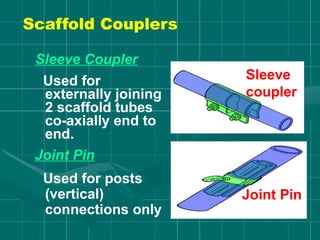
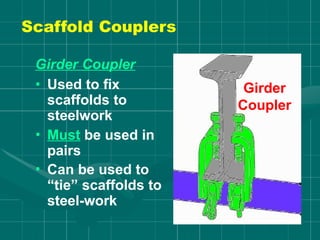
Girder Coupler
• Usedto fix
scaffolds to
steelwork
• Must be used in
pairs
• Can be used to
“tie” scaffolds to
steel-work
Girder
Coupler
Scaffold Couplers
35.
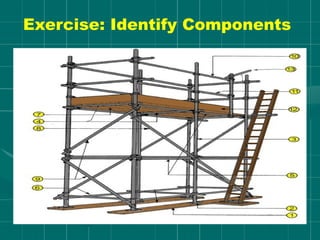
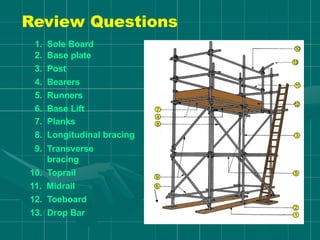
Review Questions
1. SoleBoard
2. Base plate
3. Post
4. Bearers
5. Runners
6. Base Lift
7. Planks
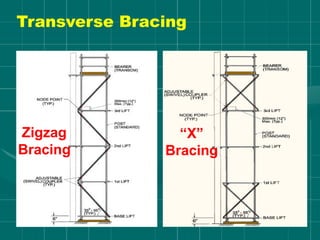
8. Longitudinal bracing
9. Transverse
bracing
10. Toprail
11. Midrail
12. Toeboard
13. Drop Bar
Think…
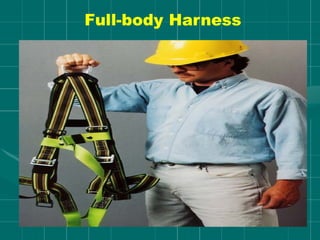
• What isa Personal Fall-Arrest System?
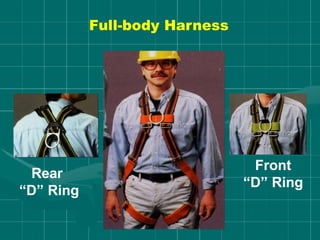
• What is a Full-body Harness?
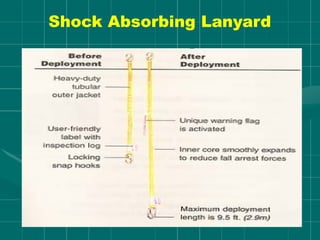
• What is a “Shock-Absorbing” Lanyard?
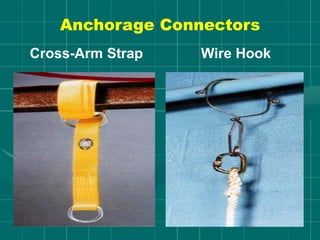
• How and Where to anchor a Lanyard?
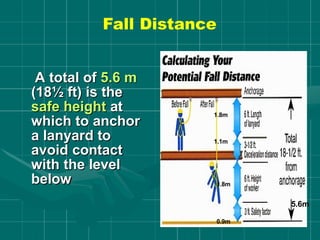
• What is the safe height at which to
anchor a lanyard to avoid hitting the
ground?
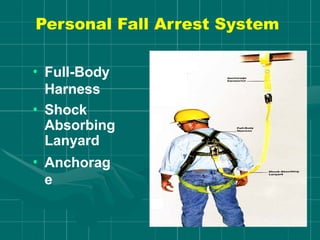
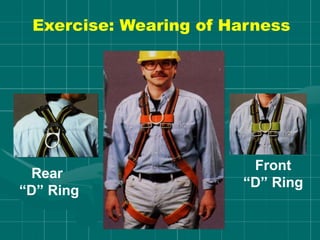
Personal Fall ArrestSystem
• Full-Body
Harness
• Shock
Absorbing
Lanyard
• Anchorag
e
41.
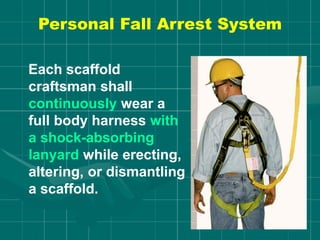
Personal Fall ArrestSystem
Each scaffold
craftsman shall
continuously wear a
full body harness with
a shock-absorbing
lanyard while erecting,
altering, or dismantling
a scaffold.
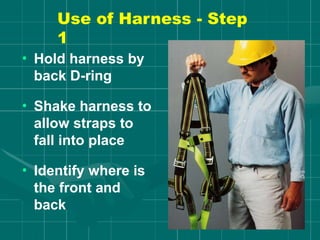
Use of Harness- Step
1
• Hold harness by
back D-ring
• Shake harness to
allow straps to
fall into place
• Identify where is
the front and
back
49.
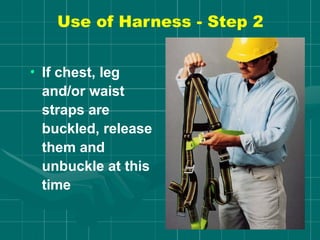
Use of Harness- Step 2
• If chest, leg
and/or waist
straps are
buckled, release
them and
unbuckle at this
time
50.
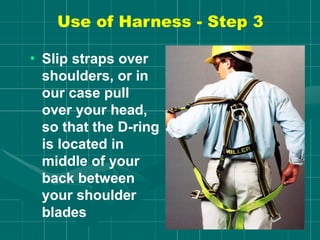
Use of Harness- Step 3
• Slip straps over
shoulders, or in
our case pull
over your head,
so that the D-ring
is located in
middle of your
back between
your shoulder
blades
51.
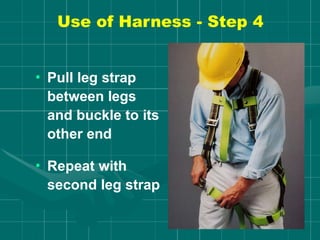
Use of Harness- Step 4
• Pull leg strap
between legs
and buckle to its
other end
• Repeat with
second leg strap
52.
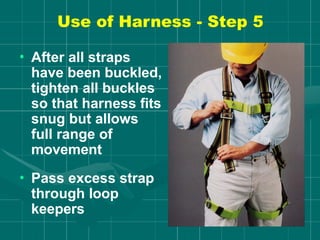
Use of Harness- Step 5
• After all straps
have been buckled,
tighten all buckles
so that harness fits
snug but allows
full range of
movement
• Pass excess strap
through loop
keepers
Pre-Use Inspection
• Beforewe learn how to do a scaffold
pre-use inspection
– Let’s see what Scaffold Supervisors
and Inspectors must do, and
– How they communicate scaffold
safety requirements to us through
scaffold tags
– So we may know if things are being
done properly and safely
57.
Think…
• Who areScaffold Supervisors?
• What are the responsibilities of being
a Scaffold Supervisor?
• What are the different levels of
Scaffold Supervisors?
• Who are Scaffold Inspectors?
• What are the responsibilities of being
a Scaffold Inspector?
58.
Who are ScaffoldSupervisors?
• Immediate supervisors of scaffold
craftsmen
• Responsible for safety of erected
scaffold
• Must passed the Scaffold
Supervisor certification test given
by Saudi Aramco Training Dept.
• Could be Saudi Aramco or
contractor employee
59.
Supervisor Certification Levels
•Certified Scaffold Supervisor I
– All scaffolds
• Certified Scaffold Supervisor II-T
– Only Tube and Coupler
– Less than 12.2 meters (40 feet)
• Certified Scaffold Supervisor II-S
– Only System Scaffolds
(Cuplok, Kwikstage, etc.)
– Less than 12.2 meters (40 feet)
60.
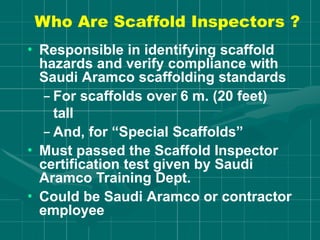
Who Are ScaffoldInspectors ?
• Responsible in identifying scaffold
hazards and verify compliance with
Saudi Aramco scaffolding standards
– For scaffolds over 6 m. (20 feet)
tall
– And, for “Special Scaffolds”
• Must passed the Scaffold Inspector
certification test given by Saudi
Aramco Training Dept.
• Could be Saudi Aramco or contractor
employee
61.
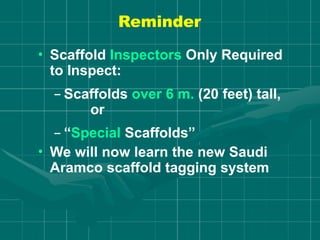
Reminder
• Scaffold InspectorsOnly Required
to Inspect:
– Scaffolds over 6 m. (20 feet) tall,
or
– “Special Scaffolds”
• We will now learn the new Saudi
Aramco scaffold tagging system
62.
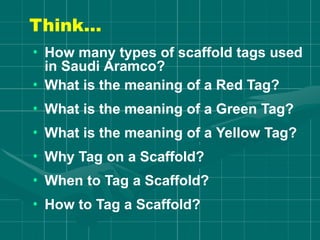
Think…
• How manytypes of scaffold tags used
in Saudi Aramco?
• What is the meaning of a Red Tag?
• What is the meaning of a Green Tag?
• What is the meaning of a Yellow Tag?
• Why Tag on a Scaffold?
• When to Tag a Scaffold?
• How to Tag a Scaffold?
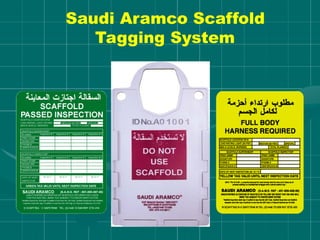
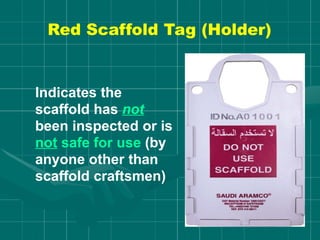
Indicates the
scaffold hasnot
been inspected or is
not safe for use (by
anyone other than
scaffold craftsmen)
Red Scaffold Tag (Holder)
65.
Red Scaffold Tag(Holder)
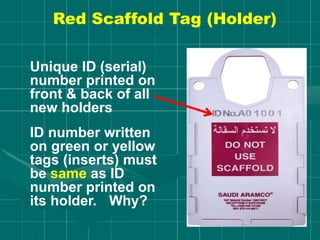
Unique ID (serial)
number printed on
front & back of all
new holders
ID number written
on green or yellow
tags (inserts) must
be same as ID
number printed on
its holder. Why?
66.
Red Scaffold Tag(Holder)
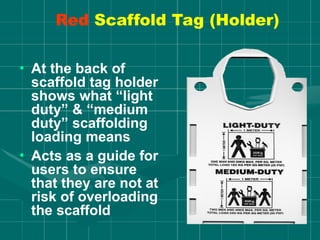
• At the back of
scaffold tag holder
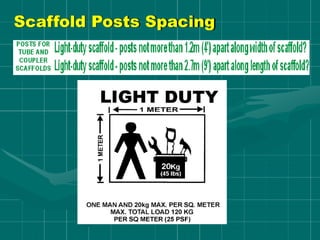
shows what “light
duty” & “medium
duty” scaffolding
loading means
• Acts as a guide for
users to ensure
that they are not at
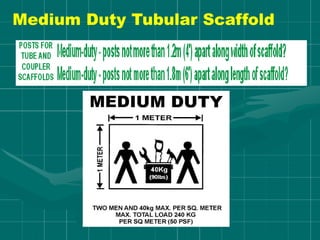
risk of overloading
the scaffold
67.
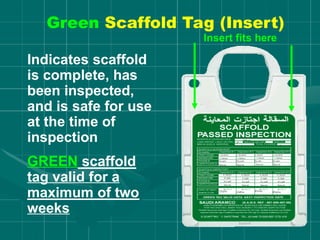
maximum of two
weeks
GreenScaffold Tag (Insert)
K. SALEH K. SALEH K. SALEH K. SALEH
K. Saleh K. Saleh K. Saleh K. Saleh
673-2308 673-2308 673-2308 673-2308
I022-02 I022-02 I022-02 I022-02
7/14/02 7/28/02 8/11/02 8/25/02
6
TANK 105
✓ 2
A. SULAIMAN A. SULAIMAN A. GHAMDI A. SULAIMAN
A. Sulaiman A. Sulaiman A. Ghamdi A. Sulaiman
673-2400 673-2400 673-2100 673-2400
S022-02 S022-02 A012-02 S022-02
Insert fits here
Indicates scaffold
is complete, has
been inspected,
and is safe for use
at the time of
inspection
GREEN scaffold
tag valid for a
68.
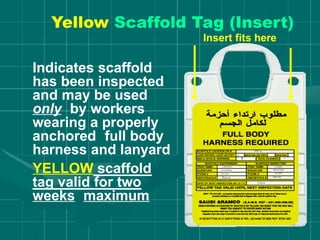
Indicates scaffold
has beeninspected
and may be used
only by workers
wearing a properly
anchored full body
harness and lanyard
YELLOW scaffold
tag valid for two
weeks maximum
2
7/14/02
K. SALEH
Khaled Saleh
673-2308
I022-02
6
TANK 105
✓
A. SULAIMAN
Ahmed Sulaiman
673-2400
S022-02
Yellow Scaffold Tag (Insert)
Insert fits here
69.
Why Tag aScaffold ?
• To be able to identify a scaffold on-
site (ID#)
• To show on-site that a scaffold is
either safe or not safe to use
• To give an on-site warning that the
use of full body harness is required
• To be able to confirm on-site that a
scaffold has been inspected
70.
When to Taga Scaffold
• After a work permit has been
issued
• As soon as construction of scaffold
starts using a Red Scaffold Tag
• All the time that a scaffold remains
on site
71.
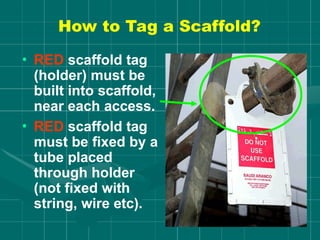
How to Taga Scaffold?
• RED scaffold tag
(holder) must be
built into scaffold,
near each access.
• RED scaffold tag
must be fixed by a
tube placed
through holder
(not fixed with
string, wire etc).
72.
Think…
• When musta Scaffold Supervisor &
Inspector inspect a Scaffold
• When must a Scaffold Supervisor
sign a scaffold tag?
• How a scaffold green tag is filled-in, if
scaffold is less than 6 m (20 feet)?
• How a scaffold green tag is filled-in, if
scaffold is more than 6 m (20 feet)?
73.
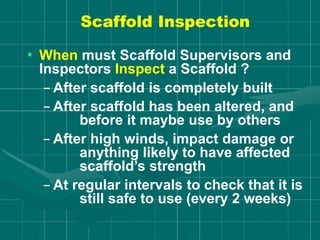
Scaffold Inspection
• Whenmust Scaffold Supervisors and
Inspectors Inspect a Scaffold ?
– After scaffold is completely built
– After scaffold has been altered, and
before it maybe use by others
– After high winds, impact damage or
anything likely to have affected
scaffold’s strength
– At regular intervals to check that it is
still safe to use (every 2 weeks)
74.
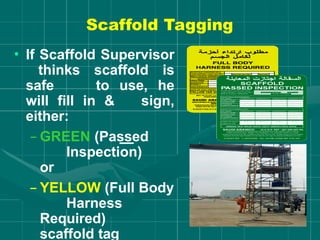
Scaffold Tagging
• IfScaffold Supervisor
thinks scaffold is
safe to use, he
will fill in & sign,
either:
– GREEN (Passed
Inspection)
or
– YELLOW (Full Body
Harness
Required)
scaffold tag
75.
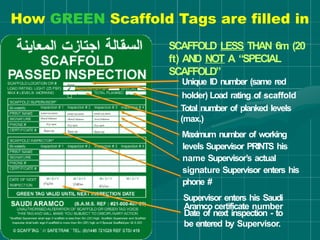
AHMEDSULAIMAN
Ahmed Sulaiman
673-2400
S022-02
Date ofnext inspection - to
be entered by Supervisor.
7/14/02
3
A01001
AHMEDSULAIMAN
Ahmed Sulaiman
673-2400
S022-02
7/28/02
AHMEDSULAIMAN
Ahmed Sulaiman
673-2400
S022-02
8/11/02
2
Unique ID number (same red
holder) Load rating of scaffold
Total number of planked levels
(max.)
Maximum number of working
levels Supervisor PRINTS his
name Supervisor’s actual
signature Supervisor enters his
phone #
Supervisor enters his Saudi
Aramco certificate number
✓
□
How GREEN Scaffold Tags are filled in
SCAFFOLD LESS THAN 6m (20
ft) AND NOT A “SPECIAL
SCAFFOLD”
76.
Date of nextinspection - to be entered
by Scaffold Inspector
7/14/02
673-2400
A012-02
AHMED GHAMDI
Ahmed Ghamdi
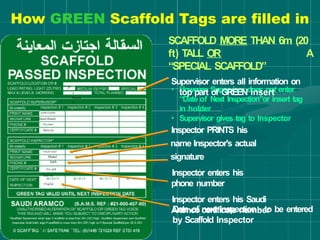
• However, Supervisor does not enter
“Date of Next Inspection”or insert tag
in holder
• Supervisor gives tag to Inspector
✓□
2
6
Inspector PRINTS his
name Inspector's actual
signature
Inspector enters his
phone number
Inspector enters his Saudi
Aramco certificate number
KHALED SALEH
Khaled
Saleh
673-2308
I022-02
SCAFFOLD MORE THAN 6m (20
ft) T
ALL OR A
“SPECIAL SCAFFOLD”
Supervisor enters all information on
top part of GREEN insert
A01001
How GREEN Scaffold Tags are filled in
77.
Work Permit Issuer’sRole?
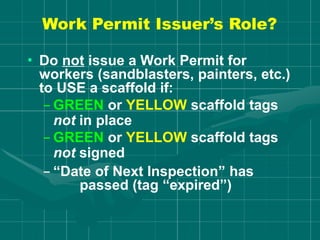
• Do not issue a Work Permit for
workers (sandblasters, painters, etc.)
to USE a scaffold if:
– GREEN or YELLOW scaffold tags
not in place
– GREEN or YELLOW scaffold tags
not signed
– “Date of Next Inspection” has
passed (tag “expired”)
78.
Work Permit Receiver’sRole?
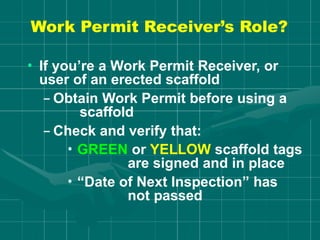
• If you’re a Work Permit Receiver, or
user of an erected scaffold
– Obtain Work Permit before using a
scaffold
– Check and verify that:
• GREEN or YELLOW scaffold tags
are signed and in place
• “Date of Next Inspection” has
not passed
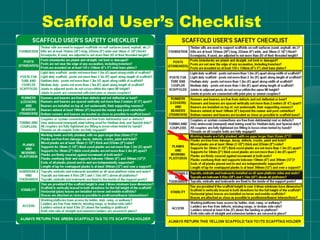
Why have ScaffoldUser’s Safety
Checklist?
– For your safety in making sure the
scaffold is safe to use.
– Just because the scaffold has a
green tag does not mean it is safe
• Scaffold could have
changed since last
inspection
– A convenient “Pre-Use Inspection”
tool that you can use in the
field
Scaffold User’s Checklist
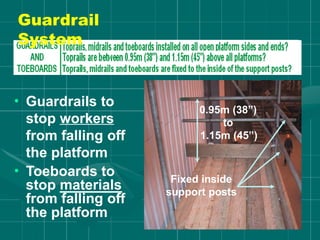
• Guardrails to
stopworkers
from falling off
the platform
• Toeboards to
stop materials
from falling off
the platform
0.95m (38”)
to
1.15m (45”)
Guardrail
System
Fixed inside
support posts
Scaffold Stability
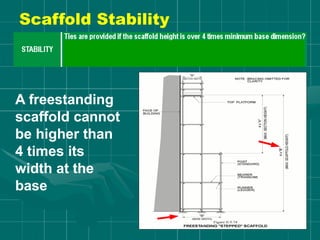
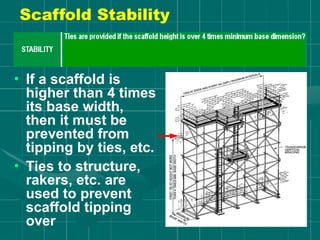
• Ifa scaffold is
higher than 4 times
its base width,
then it must be
prevented from
tipping by ties, etc.
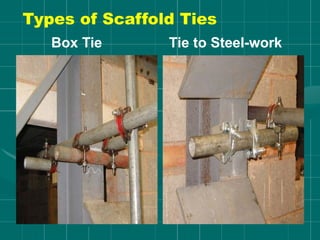
• Ties to structure,
rakers, etc. are
used to prevent
scaffold tipping
over
Think…
• When isscaffold plan required?
• Who are only authorized to erect
scaffolds more than 40 feet or
“special” scaffolds?
• Who signs the scaffold tags, if the
scaffold is more than 20 feet tall?
• What are basic scaffold work flow
components?
119.
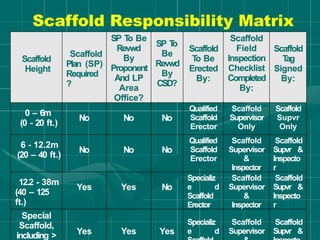
Scaffold
Height
Scaffold
Plan (SP)
Required
?
SP T
oBe
Revwd
By
Proponent
And LP
Area
Office?
SP T
o
Be
Revwd
By
CSD?
Scaffold
T
o Be
Erected
By:
Scaffold
Field
Inspection
Checklist
Completed
By:
Scaffold
T
ag
Signed
By:
0 – 6m
(0 - 20 ft.)
No No No
Qualified
Scaffold
Erector
Scaffold
Supervisor
Only
Scaffold
Supvr
Only
6 - 12.2m
(20 – 40 ft.)
No No No
Qualified
Scaffold
Erector
Scaffold
Supervisor
&
Inspector
Scaffold
Supvr &
Inspecto
r
12.2 - 38m
(40 – 125
ft.)
Yes Yes No
Specializ
e d
Scaffold
Erector
Scaffold
Supervisor
&
Inspector
Scaffold
Supvr &
Inspecto
r
Special
Scaffold,
including > Yes Yes Yes
Specializ
e d
Scaffold
Supervisor
Scaffold
Supvr &
Scaffold Responsibility Matrix
120.
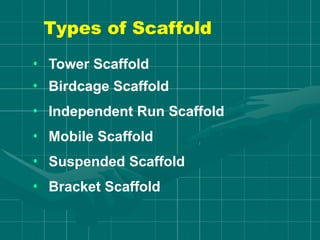
Types of Scaffold
•Tower Scaffold
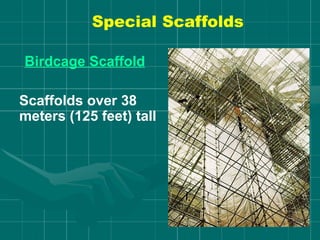
• Birdcage Scaffold
• Independent Run Scaffold
• Mobile Scaffold
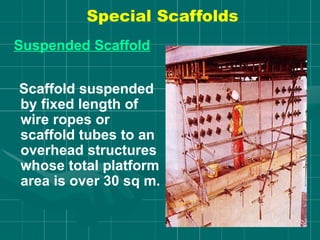
• Suspended Scaffold
• Bracket Scaffold
121.
Reminder
• Scaffold InspectorsOnly Required to
Inspect:
– Scaffolds over 6 meters (20 feet)
tall,
or
– “Special Scaffolds”
122.
What is a“Special Scaffold” ?
• Higher than 38 meters (125 feet)
• Cantilevered (extended outward)
by more than 3 meters (10 ft)
• Over 30m² (320 ft²) platform area &
supported by or hung from an
existing structure
• Supporting loads greater than 240
kg/m² (50 psf), such as piping or
equipment
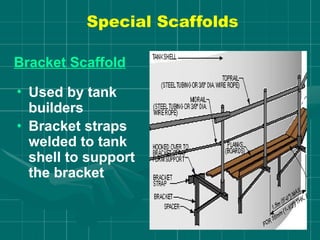
Bracket Scaffold
• Usedby tank
builders
• Bracket straps
welded to tank
shell to support
the bracket
Special Scaffolds
126.
Scaffold Work Flow
ScaffoldInspection
• Scaffold Supervisors and Inspectors
must inspect a Scaffold?
– After scaffold is completely built
– After scaffold has been altered
– After high winds or anything likely
to have affected scaffold’s
strength
– At regular intervals to check that it
is still safe to use (every 2
weeks)
127.
Scaffold Work Flow
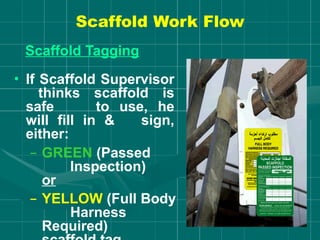
ScaffoldTagging
• If Scaffold Supervisor
thinks scaffold is
safe to use, he
will fill in & sign,
either:
– GREEN (Passed
Inspection)
or
– YELLOW (Full Body
Harness
Required)
128.
Scaffold Potential Hazards
Donot interfere with scaffolds
• Do not take out ties !
• Do not take out braces !
• Do not remove planks or guardrails !
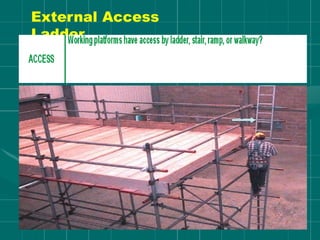
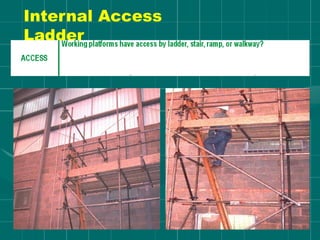
• Do not remove ladder access !
• Do not exceed scaffold loading !
If you need a scaffold to be altered,
ask your supervisor to arrange for a
scaffold craftsman to carry out the
work. do not do it yourself!
129.
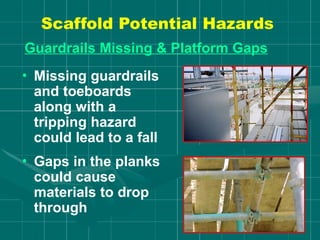
Scaffold Potential Hazards
GuardrailsMissing & Platform Gaps
• Missing guardrails
and toeboards
along with a
tripping hazard
could lead to a fall
• Gaps in the planks
could cause
materials to drop
through
130.
Scaffold Potential Hazards
ElectricalHazards
• Keep away from
power lines
• Make sure any
conductive materials
(e.g., scaffold tubing)
cannot get closer
than 3 m (10 ft) from
a live power line
131.
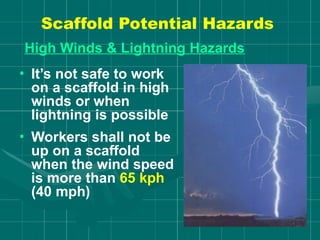
Scaffold Potential Hazards
HighWinds & Lightning Hazards
• It’s not safe to work
on a scaffold in high
winds or when
lightning is possible
• Workers shall not be
up on a scaffold
when the wind speed
is more than 65 kph
(40 mph)
132.
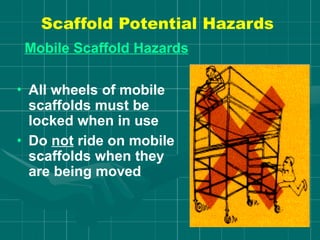
Scaffold Potential Hazards
MobileScaffold Hazards
• All wheels of mobile
scaffolds must be
locked when in use
• Do not ride on mobile
scaffolds when they
are being moved