Credit Card Industry in IndiaSBI Cards
• Credit card issuance has grown by 20% CAGR over the last 5 years with average annual spends per credit
card of Rs 1,44,000, registering a growth of 12 % CAGR over the last 5 years.
• Credit card transactions at the point of sales to personal consumption spend ratio jumped from 2.4% in
FY14 to 5.3 % in FY19. According to CRISIL, credit card spending is expected to grow at a CAGR of 20% till
FY24.
• In India, there are 74 players in the credit cards industry. HDFC Bank, Axis Bank, ICICI Bank and SBI Cards
account for 72% of the number of cards in the market. In terms of credit card spends these four players
account for 66% of the total spends. HDFC Bank is at the top of the list in both the categories.
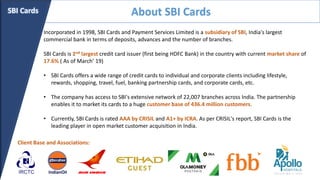
About SBI Cards
Incorporated in 1998, SBI Cards and Payment Services Limited is a subsidiary of SBI, India's largest
commercial bank in terms of deposits, advances and the number of branches.
SBI Cards is 2nd largest credit card issuer (first being HDFC Bank) in the country with current market share of
17.6% ( As of March’ 19)
• SBI Cards offers a wide range of credit cards to individual and corporate clients including lifestyle,
rewards, shopping, travel, fuel, banking partnership cards, and corporate cards, etc.
• The company has access to SBI's extensive network of 22,007 branches across India. The partnership
enables it to market its cards to a huge customer base of 436.4 million customers.
• Currently, SBI Cards is rated AAA by CRISIL and A1+ by ICRA. As per CRISIL's report, SBI Cards is the
leading player in open market customer acquisition in India.
SBI Cards
Client Base and Associations:
Briefing about the IPO
SBI Cards is diluting 14% equity
To raise approx. 10,286.20 Cr. (@Rs. 750* lower price band) ~ 10,354.77 Cr. (@Rs. 755* upper price band)
SBI will divest 4% of its stake, while Carlyle will sell 10% of its stake.
How is 14% equity split?
44.6% - Institutional buyers (QIBs and Anchor)
31.2% - Retail Investors (RIIs)
9.5% - SBI Shareholders (Anyone who is holding min. 1 share of SBI Bank from 18th Feb’20 till IPO allotment date)
1.4% - Employees of SBI ( retail discount of Rs. 15 per share is applicable for Employees)
Issue Objectives
1. The Offer for Sale- The object of the Offer for Sale is to allow the Selling Shareholders to sell an
aggregate of up to 130,526,798 equity Shares held by them. The company will not receive any
proceeds from the Offer for Sale.
2. Fresh Issue- The net proceeds of the Fresh Issue of 6,622,517 equity shares , i.e. Gross proceeds of
the Fresh Issue less the Offer Expenses apportioned to the Company ("Net Proceeds") are proposed
to be utilized for augmenting the capital base to meet company's future capital requirements.
SBI Cards
Revenues Model
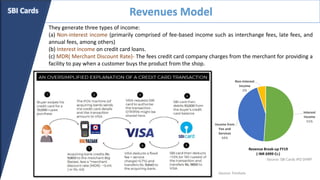
They generate three types of income:
(a) Non-interest income (primarily comprised of fee-based income such as interchange fees, late fees, and
annual fees, among others)
(b) Interest income on credit card loans.
(c) MDR( Merchant Discount Rate)- The fees credit card company charges from the merchant for providing a
facility to pay when a customer buys the product from the shop.
SBI Cards
Interest
Income
51%
Income from
Fee and
Services
44%
Non-Interest
Income
5%
Revenue Break-up FY19
( INR 6999 Cr.)
-Source: Finshots
-Source: SBI Cards IPO DHRP
Financial Performance
Fundamental Analysis
Operating margin 15.39%
(projected CAGR -- 37%+ next 4 yrs)
ROE 28.4% ROA 4.2% ROCE 10.84%
Company is not paying dividend as it is focusing on growth.
Lower ROA as cost of borrowing is higher being a NBFC
EPS 9.61/-
P/E ratio – 48 ( Compared to HDFC’s 27)
SBI Cards
Opportunities & Risk
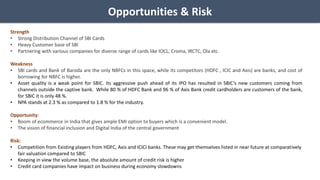
Strength
• Strong Distribution Channel of SBI Cards
• Heavy Customer base of SBI
• Partnering with various companies for diverse range of cards like IOCL, Croma, IRCTC, Ola etc.
Weakness
• SBI cards and Bank of Baroda are the only NBFCs in this space, while its competitors (HDFC , ICIC and Axis) are banks, and cost of
borrowing for NBFC is higher.
• Asset quality is a weak point for SBIC. Its aggressive push ahead of its IPO has resulted in SBIC’s new customers coming from
channels outside the captive bank. While 80 % of HDFC Bank and 96 % of Axis Bank credit cardholders are customers of the bank,
for SBIC it is only 48 %.
• NPA stands at 2.3 % as compared to 1.8 % for the industry.
Opportunity:
• Boom of ecommerce in India that gives ample EMI option to buyers which is a convenient model.
• The vision of financial inclusion and Digital India of the central government
Risk:
• Competition from Existing players from HDFC, Axis and ICICI banks. These may get themselves listed in near future at comparatively
fair valuation compared to SBIC
• Keeping in view the volume base, the absolute amount of credit risk is higher
• Credit card companies have impact on business during economy slowdowns
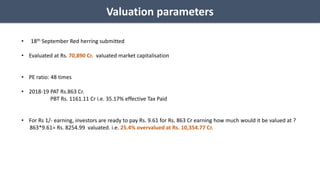
Valuation parameters
• 18th September Red herring submitted
• Evaluated at Rs. 70,890 Cr. valuated market capitalisation
• PE ratio: 48 times
• 2018-19 PAT Rs.863 Cr.
PBT Rs. 1161.11 Cr i.e. 35.17% effective Tax Paid
• For Rs 1/- earning, investors are ready to pay Rs. 9.61 for Rs. 863 Cr earning how much would it be valued at ?
863*9.61= Rs. 8254.99 valuated. i.e. 25.4% overvalued at Rs. 10,354.77 Cr.
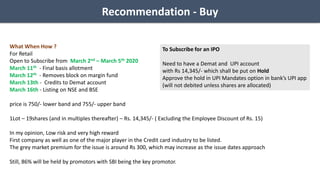
Recommendation - Buy
What When How ?
For Retail
Open to Subscribe from March 2nd – March 5th 2020
March 11th - Final basis allotment
March 12th - Removes block on margin fund
March 13th - Credits to Demat account
March 16th - Listing on NSE and BSE
price is 750/- lower band and 755/- upper band
1Lot – 19shares (and in multiples thereafter) – Rs. 14,345/- ( Excluding the Employee Discount of Rs. 15)
In my opinion, Low risk and very high reward
First company as well as one of the major player in the Credit card industry to be listed.
The grey market premium for the issue is around Rs 300, which may increase as the issue dates approach
Still, 86% will be held by promotors with SBI being the key promotor.
To Subscribe for an IPO
Need to have a Demat and UPI account
with Rs 14,345/- which shall be put on Hold
Approve the hold in UPI Mandates option in bank’s UPI app
(will not debited unless shares are allocated)
SBI cards IPO

SBI cards IPO

  • 2.
    Credit Card Industryin IndiaSBI Cards • Credit card issuance has grown by 20% CAGR over the last 5 years with average annual spends per credit card of Rs 1,44,000, registering a growth of 12 % CAGR over the last 5 years. • Credit card transactions at the point of sales to personal consumption spend ratio jumped from 2.4% in FY14 to 5.3 % in FY19. According to CRISIL, credit card spending is expected to grow at a CAGR of 20% till FY24. • In India, there are 74 players in the credit cards industry. HDFC Bank, Axis Bank, ICICI Bank and SBI Cards account for 72% of the number of cards in the market. In terms of credit card spends these four players account for 66% of the total spends. HDFC Bank is at the top of the list in both the categories.
  • 3.
    About SBI Cards Incorporatedin 1998, SBI Cards and Payment Services Limited is a subsidiary of SBI, India's largest commercial bank in terms of deposits, advances and the number of branches. SBI Cards is 2nd largest credit card issuer (first being HDFC Bank) in the country with current market share of 17.6% ( As of March’ 19) • SBI Cards offers a wide range of credit cards to individual and corporate clients including lifestyle, rewards, shopping, travel, fuel, banking partnership cards, and corporate cards, etc. • The company has access to SBI's extensive network of 22,007 branches across India. The partnership enables it to market its cards to a huge customer base of 436.4 million customers. • Currently, SBI Cards is rated AAA by CRISIL and A1+ by ICRA. As per CRISIL's report, SBI Cards is the leading player in open market customer acquisition in India. SBI Cards Client Base and Associations:
  • 4.
    Briefing about theIPO SBI Cards is diluting 14% equity To raise approx. 10,286.20 Cr. (@Rs. 750* lower price band) ~ 10,354.77 Cr. (@Rs. 755* upper price band) SBI will divest 4% of its stake, while Carlyle will sell 10% of its stake. How is 14% equity split? 44.6% - Institutional buyers (QIBs and Anchor) 31.2% - Retail Investors (RIIs) 9.5% - SBI Shareholders (Anyone who is holding min. 1 share of SBI Bank from 18th Feb’20 till IPO allotment date) 1.4% - Employees of SBI ( retail discount of Rs. 15 per share is applicable for Employees) Issue Objectives 1. The Offer for Sale- The object of the Offer for Sale is to allow the Selling Shareholders to sell an aggregate of up to 130,526,798 equity Shares held by them. The company will not receive any proceeds from the Offer for Sale. 2. Fresh Issue- The net proceeds of the Fresh Issue of 6,622,517 equity shares , i.e. Gross proceeds of the Fresh Issue less the Offer Expenses apportioned to the Company ("Net Proceeds") are proposed to be utilized for augmenting the capital base to meet company's future capital requirements. SBI Cards
  • 5.
    Revenues Model They generatethree types of income: (a) Non-interest income (primarily comprised of fee-based income such as interchange fees, late fees, and annual fees, among others) (b) Interest income on credit card loans. (c) MDR( Merchant Discount Rate)- The fees credit card company charges from the merchant for providing a facility to pay when a customer buys the product from the shop. SBI Cards Interest Income 51% Income from Fee and Services 44% Non-Interest Income 5% Revenue Break-up FY19 ( INR 6999 Cr.) -Source: Finshots -Source: SBI Cards IPO DHRP
  • 6.
  • 7.
    Fundamental Analysis Operating margin15.39% (projected CAGR -- 37%+ next 4 yrs) ROE 28.4% ROA 4.2% ROCE 10.84% Company is not paying dividend as it is focusing on growth. Lower ROA as cost of borrowing is higher being a NBFC EPS 9.61/- P/E ratio – 48 ( Compared to HDFC’s 27) SBI Cards
  • 8.
    Opportunities & Risk Strength •Strong Distribution Channel of SBI Cards • Heavy Customer base of SBI • Partnering with various companies for diverse range of cards like IOCL, Croma, IRCTC, Ola etc. Weakness • SBI cards and Bank of Baroda are the only NBFCs in this space, while its competitors (HDFC , ICIC and Axis) are banks, and cost of borrowing for NBFC is higher. • Asset quality is a weak point for SBIC. Its aggressive push ahead of its IPO has resulted in SBIC’s new customers coming from channels outside the captive bank. While 80 % of HDFC Bank and 96 % of Axis Bank credit cardholders are customers of the bank, for SBIC it is only 48 %. • NPA stands at 2.3 % as compared to 1.8 % for the industry. Opportunity: • Boom of ecommerce in India that gives ample EMI option to buyers which is a convenient model. • The vision of financial inclusion and Digital India of the central government Risk: • Competition from Existing players from HDFC, Axis and ICICI banks. These may get themselves listed in near future at comparatively fair valuation compared to SBIC • Keeping in view the volume base, the absolute amount of credit risk is higher • Credit card companies have impact on business during economy slowdowns
  • 9.
    Valuation parameters • 18thSeptember Red herring submitted • Evaluated at Rs. 70,890 Cr. valuated market capitalisation • PE ratio: 48 times • 2018-19 PAT Rs.863 Cr. PBT Rs. 1161.11 Cr i.e. 35.17% effective Tax Paid • For Rs 1/- earning, investors are ready to pay Rs. 9.61 for Rs. 863 Cr earning how much would it be valued at ? 863*9.61= Rs. 8254.99 valuated. i.e. 25.4% overvalued at Rs. 10,354.77 Cr.
  • 10.
    Recommendation - Buy WhatWhen How ? For Retail Open to Subscribe from March 2nd – March 5th 2020 March 11th - Final basis allotment March 12th - Removes block on margin fund March 13th - Credits to Demat account March 16th - Listing on NSE and BSE price is 750/- lower band and 755/- upper band 1Lot – 19shares (and in multiples thereafter) – Rs. 14,345/- ( Excluding the Employee Discount of Rs. 15) In my opinion, Low risk and very high reward First company as well as one of the major player in the Credit card industry to be listed. The grey market premium for the issue is around Rs 300, which may increase as the issue dates approach Still, 86% will be held by promotors with SBI being the key promotor. To Subscribe for an IPO Need to have a Demat and UPI account with Rs 14,345/- which shall be put on Hold Approve the hold in UPI Mandates option in bank’s UPI app (will not debited unless shares are allocated)