1
SATELLITE COMMUNICATION
BY,
M.ASHVITHA
2
What is satellite?
• A satellite is simply anybody that moves around another (usually much
larger) one in a mathematically predictable path called an orbit
• A communication satellite is a microwave repeater station in space that is
used for telecommunication , radio and television signals
• The first man made satellite with radio transmitter was in 1957
• There are about 750 satellite in the space, most of them are used for
communication
Working
• Two Stations on Earth want to communicate through radio broadcast but
are too far away to use conventional means
• The two stations can use a satellite as a relay station for their
communication
• One Earth Station transmits the signals to the satellite. Up link frequency is
the frequency at which Ground Station is communicating with Satellite
• The satellite Transponder converts the signal and sends it down to the
second earth station. This frequency is called a Downlink frequency
ADVANTAGES
The advantages of satellite communication over terrestrial communication
are…
• The coverage area of a satellite is greater than that of a terrestrial
system
• Transmission cost of a satellite is independent of the distance from the
center of the coverage area
• Higher Bandwidths are available for use
3
DISADVANTAGES
The disadvantages of satellite communication are…
• Cost involved in launching satellites into orbit is too high
• Satellite bandwidth is gradually becoming used up
• There is a larger propagation delay in satellite communication than in
terrestrial communication
APPLICATIONS
General applications
• Weather forecasting
• Radio and TV broadcast broadcasting
• Military
• Satellites for navigation and localization (e.g. GPS)
In context of mobile communication
• Global telephone backbones (get rid of large cables)
• Connections for communication in remote places or developing areas (for
researchers in Antarctica)
• Global mobile communication (satellites with lower orbits are needed like
LEO’s)
4
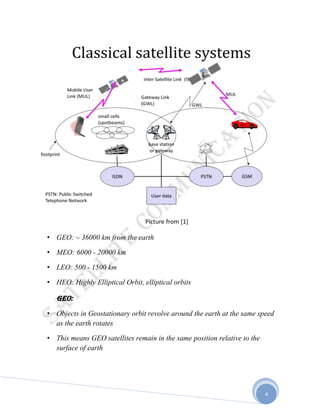
• GEO: ~ 36000 km from the earth
• MEO: 6000 - 20000 km
• LEO: 500 - 1500 km
• HEO: Highly Elliptical Orbit, elliptical orbits
GEO:
• Objects in Geostationary orbit revolve around the earth at the same speed
as the earth rotates
• This means GEO satellites remain in the same position relative to the
surface of earth
5
• Because of the long distance from earth it gives a large coverage area,
almost a fourth of the earth’s surface
• But, this distance also cause it to have both a comparatively weak signal and
a time delay in the signal, which is bad for point to point communication.
• High transmit power needed and launching of satellites to orbit are complex
and expensive.
• Not useful for global coverage for small mobile phones and data
transmission, typically used for radio and TV transmission
MEO:
• MEO satellites have a larger coverage area than LEO satellites
• A MEO satellite’s longer duration of visibility and wider footprint means
fewer satellites are needed in a MEO network than a LEO network
• A MEO satellite’s distance gives it a longer time delay and weaker signal
than a LEO satellite, though not as bad as a GEO satellite
LEO:
• LEO satellites are much closer to the earth than GEO satellites, ranging
from 500 to 1,500 km above the surface
• LEO satellites don’t stay in fixed position relative to the surface, and are
only visible for 15 to 20 minutes each pass
• A network of LEO satellites is necessary for LEO satellites to be useful
• Handover necessary from one satellite to another
• Need for routing
6
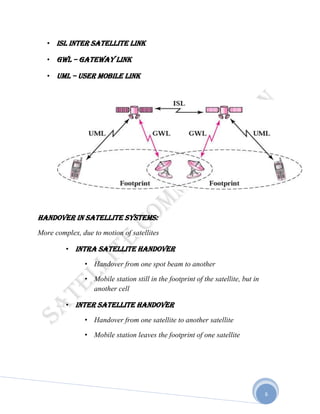
• ISL Inter Satellite Link
• GWL – Gateway Link
• UML – User Mobile Link
Handover in satellite systems:
More complex, due to motion of satellites
• Intra satellite handover
• Handover from one spot beam to another
• Mobile station still in the footprint of the satellite, but in
another cell
• Inter satellite handover
• Handover from one satellite to another satellite
• Mobile station leaves the footprint of one satellite
7
• Gateway handover
• Handover from one gateway to another
• Mobile station still in the footprint of a satellite, but satellite
moves away from the current gateway
• Inter system handover
• Handover from the satellite network to a terrestrial cellular
network
• Mobile station can use a terrestrial network again which might
be cheaper, have a lower latency.
Conclusions
• Satellite systems are not aimed to replace terrestrial system but at
complementing them
• GEO’s are ideal for TV and Radio broadcasting and they do not need
handover because of its larger footprint
• Lifetime of GEO’s are rather high, about 15 years
• LEO’s need a network of satellites and are appropriate for voice
communications
• In LEO’s handover is frequent and routing is must
• MEO’s are in between LEO’s and GEO’s in every aspect

Satellite communication

  • 1.
  • 2.
    2 What is satellite? •A satellite is simply anybody that moves around another (usually much larger) one in a mathematically predictable path called an orbit • A communication satellite is a microwave repeater station in space that is used for telecommunication , radio and television signals • The first man made satellite with radio transmitter was in 1957 • There are about 750 satellite in the space, most of them are used for communication Working • Two Stations on Earth want to communicate through radio broadcast but are too far away to use conventional means • The two stations can use a satellite as a relay station for their communication • One Earth Station transmits the signals to the satellite. Up link frequency is the frequency at which Ground Station is communicating with Satellite • The satellite Transponder converts the signal and sends it down to the second earth station. This frequency is called a Downlink frequency ADVANTAGES The advantages of satellite communication over terrestrial communication are… • The coverage area of a satellite is greater than that of a terrestrial system • Transmission cost of a satellite is independent of the distance from the center of the coverage area • Higher Bandwidths are available for use
  • 3.
    3 DISADVANTAGES The disadvantages ofsatellite communication are… • Cost involved in launching satellites into orbit is too high • Satellite bandwidth is gradually becoming used up • There is a larger propagation delay in satellite communication than in terrestrial communication APPLICATIONS General applications • Weather forecasting • Radio and TV broadcast broadcasting • Military • Satellites for navigation and localization (e.g. GPS) In context of mobile communication • Global telephone backbones (get rid of large cables) • Connections for communication in remote places or developing areas (for researchers in Antarctica) • Global mobile communication (satellites with lower orbits are needed like LEO’s)
  • 4.
    4 • GEO: ~36000 km from the earth • MEO: 6000 - 20000 km • LEO: 500 - 1500 km • HEO: Highly Elliptical Orbit, elliptical orbits GEO: • Objects in Geostationary orbit revolve around the earth at the same speed as the earth rotates • This means GEO satellites remain in the same position relative to the surface of earth
  • 5.
    5 • Because ofthe long distance from earth it gives a large coverage area, almost a fourth of the earth’s surface • But, this distance also cause it to have both a comparatively weak signal and a time delay in the signal, which is bad for point to point communication. • High transmit power needed and launching of satellites to orbit are complex and expensive. • Not useful for global coverage for small mobile phones and data transmission, typically used for radio and TV transmission MEO: • MEO satellites have a larger coverage area than LEO satellites • A MEO satellite’s longer duration of visibility and wider footprint means fewer satellites are needed in a MEO network than a LEO network • A MEO satellite’s distance gives it a longer time delay and weaker signal than a LEO satellite, though not as bad as a GEO satellite LEO: • LEO satellites are much closer to the earth than GEO satellites, ranging from 500 to 1,500 km above the surface • LEO satellites don’t stay in fixed position relative to the surface, and are only visible for 15 to 20 minutes each pass • A network of LEO satellites is necessary for LEO satellites to be useful • Handover necessary from one satellite to another • Need for routing
  • 6.
    6 • ISL InterSatellite Link • GWL – Gateway Link • UML – User Mobile Link Handover in satellite systems: More complex, due to motion of satellites • Intra satellite handover • Handover from one spot beam to another • Mobile station still in the footprint of the satellite, but in another cell • Inter satellite handover • Handover from one satellite to another satellite • Mobile station leaves the footprint of one satellite
  • 7.
    7 • Gateway handover •Handover from one gateway to another • Mobile station still in the footprint of a satellite, but satellite moves away from the current gateway • Inter system handover • Handover from the satellite network to a terrestrial cellular network • Mobile station can use a terrestrial network again which might be cheaper, have a lower latency. Conclusions • Satellite systems are not aimed to replace terrestrial system but at complementing them • GEO’s are ideal for TV and Radio broadcasting and they do not need handover because of its larger footprint • Lifetime of GEO’s are rather high, about 15 years • LEO’s need a network of satellites and are appropriate for voice communications • In LEO’s handover is frequent and routing is must • MEO’s are in between LEO’s and GEO’s in every aspect