peace
SARCOCYSTIS
• Sarcocystosis is a disease caused by a parasite called Sarcocystis. There are numerous species of
Sarcocystis. This disease usually affects animals but also can also cause disease in humans. Two
types of the disease can occur, one type causes diarrhea, mild fever, and vomiting (intestinal type,
for example infection caused by S. hominis and S. suihominis), and the other type causes muscle
pain, transitory edema, and fever (muscular type).
• intermediate-definitive host life cycle based on a prey-predator relationship
• Human can appear in both life cycles either as the definitive or intermediate host
GEOGRAPHICAL DISTRIBUTION
• Sarcocystosis has a worldwide distribution, but it is more common in
areas where livestock is raised, and in tropical or subtropical countries.
This is particularly true for muscular sarcocystosis, which is most often
reported from countries in Southeast Asia.
CYCLE IN DEFINITE HOST
• After oocysts or free sporocysts from the definitive host are ingested by a susceptible
intermediate host, they pass to the small intestine. The plates forming the sporocyst walls
separate, releasing the four sporozoites held inside.
• Motile sporozoites migrate through the gut epithelium, eventually entering endothelial cells
in small arteries throughout the body.
• Here they undergo the first of three asexual generations (called schizogony or merogony),
producing numerous merozoites. Subsequent generations of merozoites develop downstream
in the blood vessels throughout the body and then develop the final asexual generation in
muscles.
• Merozoites from the third generation enter muscle cells, round up to form metrocytes (mother
cells), and initiate sarcocyst.
• Sarcocysts begin as unicellular bodies containing a single metrocyte. Through repeated
asexual multiplication, numerous metrocytes accumulate and the sarcocyst increases in size
and mature giving rise to infectious, crescent-shaped bodies called bradyzoites still within the
sarcocyst.
• Sarcocysts are found in virtually all striated muscles of the body including the tongue,
esophagus, and diaphragm, as well as cardiac muscle and, to a lesser extent, smooth muscle.
Sarcocysts have also been found in small numbers in neural tissue such as spinal cord and
LIFE CYCLE IN INTERMEDIATE HOSTS
• After sarcocysts are eaten by a susceptible definitive host
the wall is mechanically ruptured or digested, bradyzoites
become motile, leave the sarcocyst, and enter cells of the
intestinal lamina propria.
• Each intracellular bradyzoite develops into a male
(microgametocytes from which sperm-like microgametes
develop) or female stage (macrogametes resembling
uninucleate ova).
• After these gametes fuse, the cytoplasm within the
macrogamete undergoes sequential development
(sporogony) into a mature oocyst containing two
sporocysts.
• Oocysts pass into the intestinal lumen and then pass from
the body in the feces.
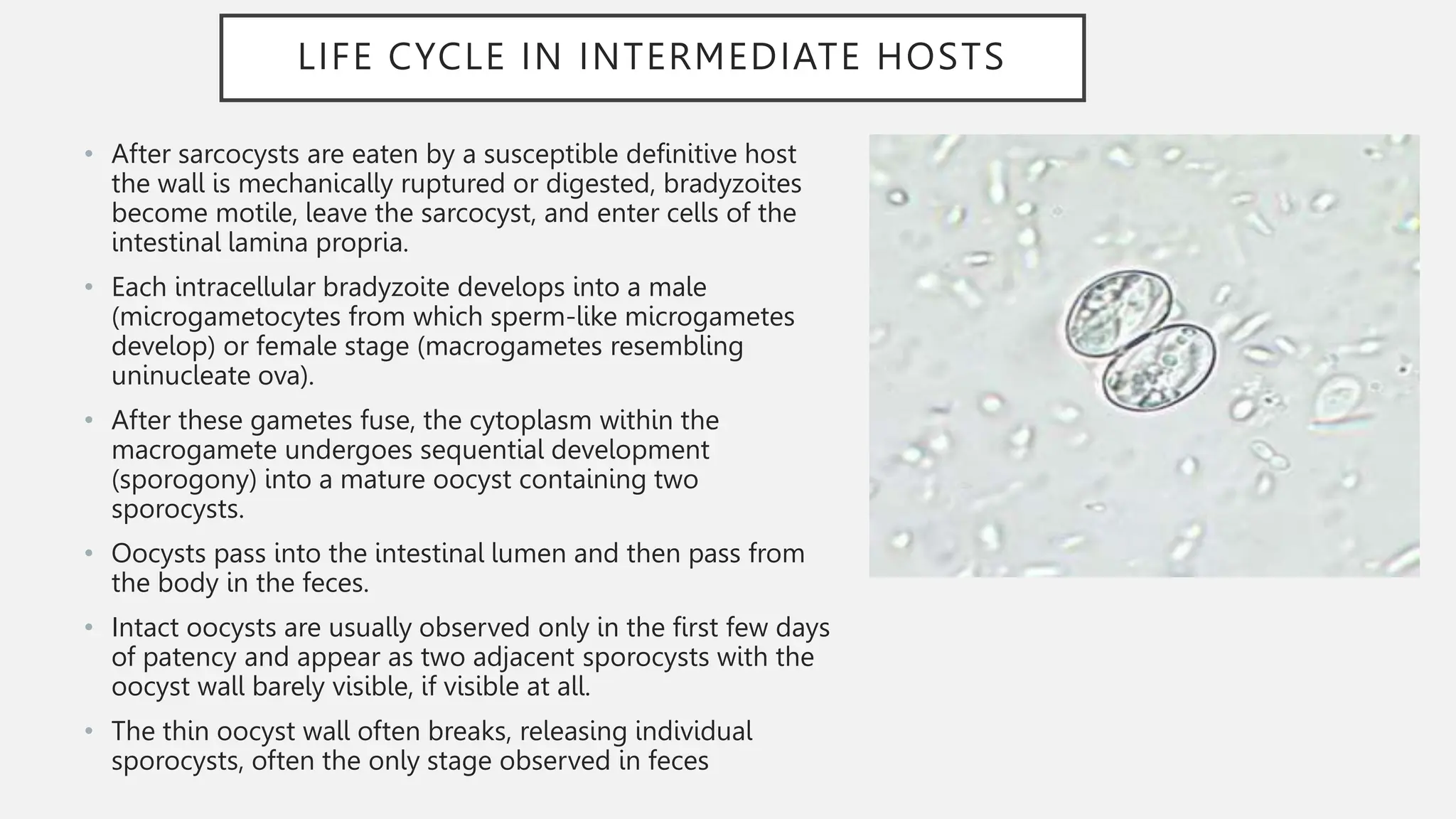
• Intact oocysts are usually observed only in the first few days
of patency and appear as two adjacent sporocysts with the
oocyst wall barely visible, if visible at all.
• The thin oocyst wall often breaks, releasing individual
sporocysts, often the only stage observed in feces
CLINICAL MANIFESTATIONS
• Intestinal Sarcocystosis: This occurs when humans serve as the definitive hosts, often due to the ingestion
of undercooked meat containing Sarcocystis cysts. Infections are often asymptomatic and clear
spontaneously. Occasionally, symptoms such as mild fever, diarrhea, chills, vomiting, and respiratory
problems may occur.
• Muscular Sarcocystosis: This results from infection with sarcocysts of non-human species, where humans act
as accidental, dead-end intermediate hosts. Symptoms for this form of the disease include muscle pain,
transitory edema (swelling), and fever.
LABORATORY DIAGNOSIS
• For intestinal sarcocystosis caused by S. hominis and S. suihominis,
diagnosis is made by the observation of oocysts or sporocysts in stool.
They are easily overlooked as they are often shed in small numbers. Also,
the two species cannot be separated by oocyst or sporocyst
morphology. When humans serve as dead-end hosts for non-human
Sarcocystis spp., diagnosis is made by the finding of sarcocysts in tissue
specimens.
• Definitive laboratory confirmation is challenging as is relies on the
microscopic identification of sarcocysts in muscle biopsies; molecular
and serologic testing for clinical cases is also not widely available.
TREATMENT
• Medication: Trimethoprim-sulfamethoxazole might act against schizonts in the early phase of muscular
sarcocystosis, but data are scant. The method is not fully reliable.
• .Symptom Management: Glucocorticoids and nonsteroidal anti-inflammatory medications can improve
the symptoms associated with myositis.
• Supportive Care: In wildlife, supportive care, such as fluids and antibiotics, may help alleviate some of the
symptoms
PREVENTION AND CONTROL
• 1. Interrupting the Life Cycle: The main objective in controlling sarcocystosis is to interrupt the life cycle,
which will minimize the spread of sporocysts the definitive hosts.
• 2. Proper Food Handling: Intestinal sarcocystosis can be prevented by thoroughly cooking or freezing
meat, which kills the infective bradyzoites. Uncooked meat or offal should never be left to feed carnivores.
• 3. Safe Water and Food Practices: Travelers can reduce the risk for muscular sarcocystosis by following
standard food and water precautions. This includes using bottled water with unbroken seals, boiling water
for at least one minute, using filtered water, and practicing good sanitation methods.
• 4. Hygienic Living Conditions: Maintaining clean and hygienic living conditions for captive animals is
crucial. Dead livestock should be buried or incinerated to avoid access of carnivores.
• 5. Avoiding Contact with Infected Wildlife: Preventing contact with infected wildlife is an effective way to
prevent sarcocystosis.

SARCOCYSTIS parasite, and sarcocystosis.

  • 1.
  • 2.
    • Sarcocystosis isa disease caused by a parasite called Sarcocystis. There are numerous species of Sarcocystis. This disease usually affects animals but also can also cause disease in humans. Two types of the disease can occur, one type causes diarrhea, mild fever, and vomiting (intestinal type, for example infection caused by S. hominis and S. suihominis), and the other type causes muscle pain, transitory edema, and fever (muscular type). • intermediate-definitive host life cycle based on a prey-predator relationship • Human can appear in both life cycles either as the definitive or intermediate host
  • 3.
    GEOGRAPHICAL DISTRIBUTION • Sarcocystosishas a worldwide distribution, but it is more common in areas where livestock is raised, and in tropical or subtropical countries. This is particularly true for muscular sarcocystosis, which is most often reported from countries in Southeast Asia.
  • 4.
    CYCLE IN DEFINITEHOST • After oocysts or free sporocysts from the definitive host are ingested by a susceptible intermediate host, they pass to the small intestine. The plates forming the sporocyst walls separate, releasing the four sporozoites held inside. • Motile sporozoites migrate through the gut epithelium, eventually entering endothelial cells in small arteries throughout the body. • Here they undergo the first of three asexual generations (called schizogony or merogony), producing numerous merozoites. Subsequent generations of merozoites develop downstream in the blood vessels throughout the body and then develop the final asexual generation in muscles. • Merozoites from the third generation enter muscle cells, round up to form metrocytes (mother cells), and initiate sarcocyst. • Sarcocysts begin as unicellular bodies containing a single metrocyte. Through repeated asexual multiplication, numerous metrocytes accumulate and the sarcocyst increases in size and mature giving rise to infectious, crescent-shaped bodies called bradyzoites still within the sarcocyst. • Sarcocysts are found in virtually all striated muscles of the body including the tongue, esophagus, and diaphragm, as well as cardiac muscle and, to a lesser extent, smooth muscle. Sarcocysts have also been found in small numbers in neural tissue such as spinal cord and
  • 5.
    LIFE CYCLE ININTERMEDIATE HOSTS • After sarcocysts are eaten by a susceptible definitive host the wall is mechanically ruptured or digested, bradyzoites become motile, leave the sarcocyst, and enter cells of the intestinal lamina propria. • Each intracellular bradyzoite develops into a male (microgametocytes from which sperm-like microgametes develop) or female stage (macrogametes resembling uninucleate ova). • After these gametes fuse, the cytoplasm within the macrogamete undergoes sequential development (sporogony) into a mature oocyst containing two sporocysts. • Oocysts pass into the intestinal lumen and then pass from the body in the feces. • Intact oocysts are usually observed only in the first few days of patency and appear as two adjacent sporocysts with the oocyst wall barely visible, if visible at all. • The thin oocyst wall often breaks, releasing individual sporocysts, often the only stage observed in feces
  • 7.
    CLINICAL MANIFESTATIONS • IntestinalSarcocystosis: This occurs when humans serve as the definitive hosts, often due to the ingestion of undercooked meat containing Sarcocystis cysts. Infections are often asymptomatic and clear spontaneously. Occasionally, symptoms such as mild fever, diarrhea, chills, vomiting, and respiratory problems may occur. • Muscular Sarcocystosis: This results from infection with sarcocysts of non-human species, where humans act as accidental, dead-end intermediate hosts. Symptoms for this form of the disease include muscle pain, transitory edema (swelling), and fever.
  • 8.
    LABORATORY DIAGNOSIS • Forintestinal sarcocystosis caused by S. hominis and S. suihominis, diagnosis is made by the observation of oocysts or sporocysts in stool. They are easily overlooked as they are often shed in small numbers. Also, the two species cannot be separated by oocyst or sporocyst morphology. When humans serve as dead-end hosts for non-human Sarcocystis spp., diagnosis is made by the finding of sarcocysts in tissue specimens. • Definitive laboratory confirmation is challenging as is relies on the microscopic identification of sarcocysts in muscle biopsies; molecular and serologic testing for clinical cases is also not widely available.
  • 9.
    TREATMENT • Medication: Trimethoprim-sulfamethoxazolemight act against schizonts in the early phase of muscular sarcocystosis, but data are scant. The method is not fully reliable. • .Symptom Management: Glucocorticoids and nonsteroidal anti-inflammatory medications can improve the symptoms associated with myositis. • Supportive Care: In wildlife, supportive care, such as fluids and antibiotics, may help alleviate some of the symptoms
  • 10.
    PREVENTION AND CONTROL •1. Interrupting the Life Cycle: The main objective in controlling sarcocystosis is to interrupt the life cycle, which will minimize the spread of sporocysts the definitive hosts. • 2. Proper Food Handling: Intestinal sarcocystosis can be prevented by thoroughly cooking or freezing meat, which kills the infective bradyzoites. Uncooked meat or offal should never be left to feed carnivores. • 3. Safe Water and Food Practices: Travelers can reduce the risk for muscular sarcocystosis by following standard food and water precautions. This includes using bottled water with unbroken seals, boiling water for at least one minute, using filtered water, and practicing good sanitation methods. • 4. Hygienic Living Conditions: Maintaining clean and hygienic living conditions for captive animals is crucial. Dead livestock should be buried or incinerated to avoid access of carnivores. • 5. Avoiding Contact with Infected Wildlife: Preventing contact with infected wildlife is an effective way to prevent sarcocystosis.