Population and Sampling
Chapter 9:
COURSE INSTRUCTOR: Dr. AFTAB
Population and Element; Sample and
Subject
Population:
The entire group under study as defined by research
objectives
Element:
An element is the single member of the population
Sample:
A sample is a subset of the population that should
represent the entire group.
Subject:
A subject is the single member of the sample (Just as element
is a single member of the population)
Sampling is the process of selectingobservations
(a sample) to provide all information about of
the population.
Sample
It is aunit that is selected from
population
Represents the whole population
Sampling Frame
Listing of population from which asample ischosen
Population
Sample
Sampling
Frame
Sampling
Process
What you
want to
talk about
What you
actually
observe
in the
data
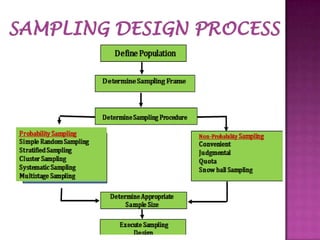
All subsets of the frame are given an equa
l
probability.
Random number generators
Population is divided into two or more groups
called strata
Subsamples are randomly selected from e
a
c
h
strata
Thepopulation is divided into subgroups (clusters) like
families.
Asimple random sample is taken from eachcluster
Order all units in the samplingframe
Then every number on the list isselected
N=Sampling Interval
Theprobability of each casebeing selected from t
h
e
total population is not known.
Units of the sample are chosen on the basisof
personal judgment or convenience.
There are NOstatistical techniques for measuring
random sampling error in anon-probability sample.
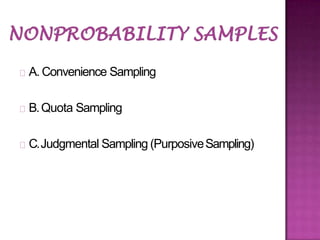
A. Convenience Sampling
B.Quota Sampling
C.Judgmental Sampling (PurposiveSampling)
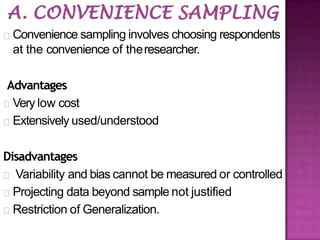
Convenience sampling involves choosing respondents
at the convenience of theresearcher.
Advantages
Very low cost
Extensively used/understood
Disadvantages
Variability and bias cannot be measured or controlled
Projecting data beyond sample not justified
Restriction of Generalization.
Thepopulation is first segmented into mutually
exclusive sub-groups, just asin stratified sampling.
Advantages
Usedwhen research budget is limited
Very extensively used/understood
No need for list of populationelements
Disadvantages
Variability and bias cannot be measured/controlled
Time Consuming
Projecting data beyond sample not justified
Researcheremploys his or her own "expert”
judgment about.
Advantages
There is aassuranceof Quality response
Meet the specificobjective.
Disadvantages
Biasselection of sample mayoccur
Time consuming process.
Sample size determination is the act of
choosing the number of observations or replicates to
include in a statistical sample. The sample size is an
important feature of any empirical study in which the
goal is to make inferences about a population from a
sample. In practice, the sample size used in a study is
usually determined based on the cost, time, or
convenience of collecting the data, and the need for it
to offer sufficient statistical power.
Determination of sample size

sampling.pptx

  • 1.
    Population and Sampling Chapter9: COURSE INSTRUCTOR: Dr. AFTAB
  • 2.
    Population and Element;Sample and Subject Population: The entire group under study as defined by research objectives Element: An element is the single member of the population Sample: A sample is a subset of the population that should represent the entire group. Subject: A subject is the single member of the sample (Just as element is a single member of the population)
  • 3.
    Sampling is theprocess of selectingobservations (a sample) to provide all information about of the population. Sample It is aunit that is selected from population Represents the whole population Sampling Frame Listing of population from which asample ischosen
  • 4.
  • 9.
    All subsets ofthe frame are given an equa l probability. Random number generators
  • 10.
    Population is dividedinto two or more groups called strata Subsamples are randomly selected from e a c h strata
  • 11.
    Thepopulation is dividedinto subgroups (clusters) like families. Asimple random sample is taken from eachcluster
  • 12.
    Order all unitsin the samplingframe Then every number on the list isselected N=Sampling Interval
  • 14.
    Theprobability of eachcasebeing selected from t h e total population is not known. Units of the sample are chosen on the basisof personal judgment or convenience. There are NOstatistical techniques for measuring random sampling error in anon-probability sample.
  • 15.
    A. Convenience Sampling B.QuotaSampling C.Judgmental Sampling (PurposiveSampling)
  • 16.
    Convenience sampling involveschoosing respondents at the convenience of theresearcher. Advantages Very low cost Extensively used/understood Disadvantages Variability and bias cannot be measured or controlled Projecting data beyond sample not justified Restriction of Generalization.
  • 17.
    Thepopulation is firstsegmented into mutually exclusive sub-groups, just asin stratified sampling. Advantages Usedwhen research budget is limited Very extensively used/understood No need for list of populationelements Disadvantages Variability and bias cannot be measured/controlled Time Consuming Projecting data beyond sample not justified
  • 18.
    Researcheremploys his orher own "expert” judgment about. Advantages There is aassuranceof Quality response Meet the specificobjective. Disadvantages Biasselection of sample mayoccur Time consuming process.
  • 19.
    Sample size determinationis the act of choosing the number of observations or replicates to include in a statistical sample. The sample size is an important feature of any empirical study in which the goal is to make inferences about a population from a sample. In practice, the sample size used in a study is usually determined based on the cost, time, or convenience of collecting the data, and the need for it to offer sufficient statistical power. Determination of sample size

Editor's Notes

  • #3 Population refers to the entire group of people, events or things of interest that the researcher wishes to investigate. For instance, if a banker is interested in investigating the saving habits of blue collar workers in the pharmaceutical industry in Pakistan, then all blue collar workers in that industry throughout the country will form the population. Element: In the above example, if there are 5000 blue collar workers happens to be the population of interest to a researcher, then each blue collar worker therein is an element. Population Frame: the population frame is listing of all elements in the population from which the sample is drawn. For example, the payroll of an organization would serve as the population frame if its members are to be studied. Likewise, a university registry containing a listing of all students, faculty, administrators, and support staff in the university during a particular academic year or semester could serve as the population frame for a study of the university population. A roster of class students could be the population frame for the study of students in a class. The telephone directory is also frequently used as a population frame for some types of studies.