Sampling Techniques
Defining the Target Population
 It is critical to the success of the
research project to clearly define
the target population.
 Rely on logic and judgment.
 The population should be defined in
connection with the objectives of
the study.
Technical Terminology
 An element is an object on which a
measurement is taken.
 A population is a collection of elements
about which we wish to make an
inference.
 Sampling units are nonoverlapping
collections of elements from the
population that cover the entire
population.
Technical Terms
 A sampling frame is a list of sampling
units.
 A sample is a collection of sampling units
drawn from a sampling frame.
 Parameter: numerical characteristic of a
population
 Statistic: numerical characteristic of a
sample
Errors of nonobservation
 The deviation between an estimate
from an ideal sample and the true
population value is the sampling
error.
 Almost always, the sampling frame
does not match up perfectly with the
target population, leading to errors of
coverage.
Errors of nonobservation
 Nonresponse is probably the most serious
of these errors.
 Arises in three ways:
 Inability of the person responding to
come up with the answer
 Refusal to answer
 Inability to contact the sampled
elements
Errors of observation
 These errors can be classified as
due to the interviewer, respondent,
instrument, or method of data
collection.
Interviewers
 Interviewers have a direct and dramatic
effect on the way a person responds to a
question.
 Most people tend to side with the view
apparently favored by the interviewer,
especially if they are neutral.
 Friendly interviewers are more successful.
 In general, interviewers of the same gender,
racial, and ethnic groups as those being
interviewed are slightly more successful.
Respondents
 Respondents differ greatly in motivation
to answer correctly and in ability to do so.
 Obtaining an honest response to sensitive
questions is difficult.
 Basic errors
 Recall bias: simply does not remember
 Prestige bias: exaggerates to ‘look’ better
 Intentional deception: lying
 Incorrect measurement: does not understand
the units or definition
Census Sample
 A census study occurs if the entire
population is very small or it is
reasonable to include the entire
population (for other reasons).
 It is called a census sample because
data is gathered on every member
of the population.
Why sample?
 The population of interest is usually
too large to attempt to survey all of
its members.
 A carefully chosen sample can be
used to represent the population.
 The sample reflects the characteristics
of the population from which it is
drawn.
Probability versus Nonprobability
 Probability Samples: each member of
the population has a known non-zero
probability of being selected
 Methods include random sampling, systematic
sampling, and stratified sampling.
 Nonprobability Samples: members are
selected from the population in some
nonrandom manner
 Methods include convenience sampling,
judgment sampling, quota sampling, and
snowball sampling
Random Sampling
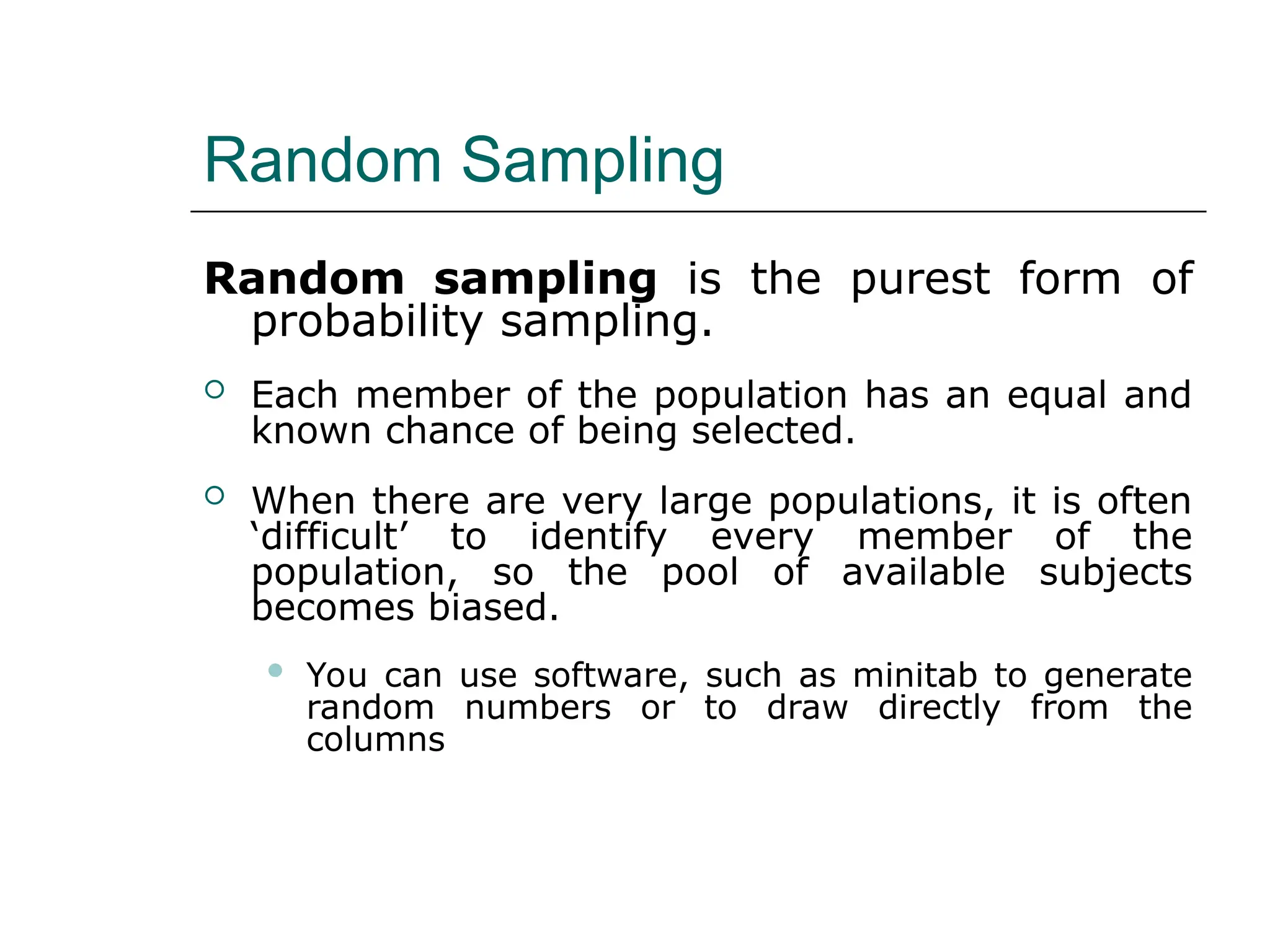
Random sampling is the purest form of
probability sampling.
 Each member of the population has an equal and
known chance of being selected.
 When there are very large populations, it is often
‘difficult’ to identify every member of the
population, so the pool of available subjects
becomes biased.
 You can use software, such as minitab to generate
random numbers or to draw directly from the
columns
Systematic Sampling
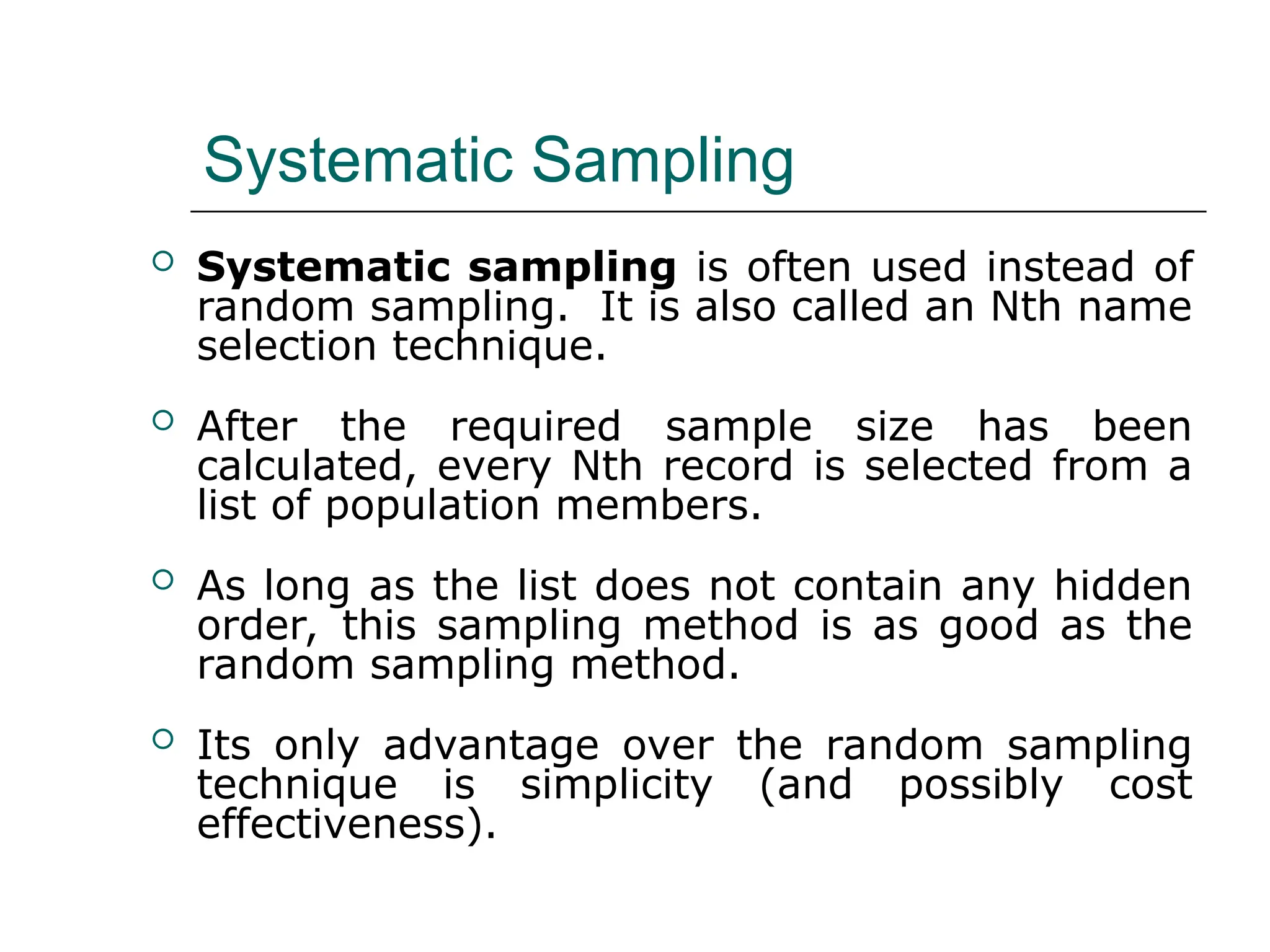
 Systematic sampling is often used instead of
random sampling. It is also called an Nth name
selection technique.
 After the required sample size has been
calculated, every Nth record is selected from a
list of population members.
 As long as the list does not contain any hidden
order, this sampling method is as good as the
random sampling method.
 Its only advantage over the random sampling
technique is simplicity (and possibly cost
effectiveness).
Stratified Sampling
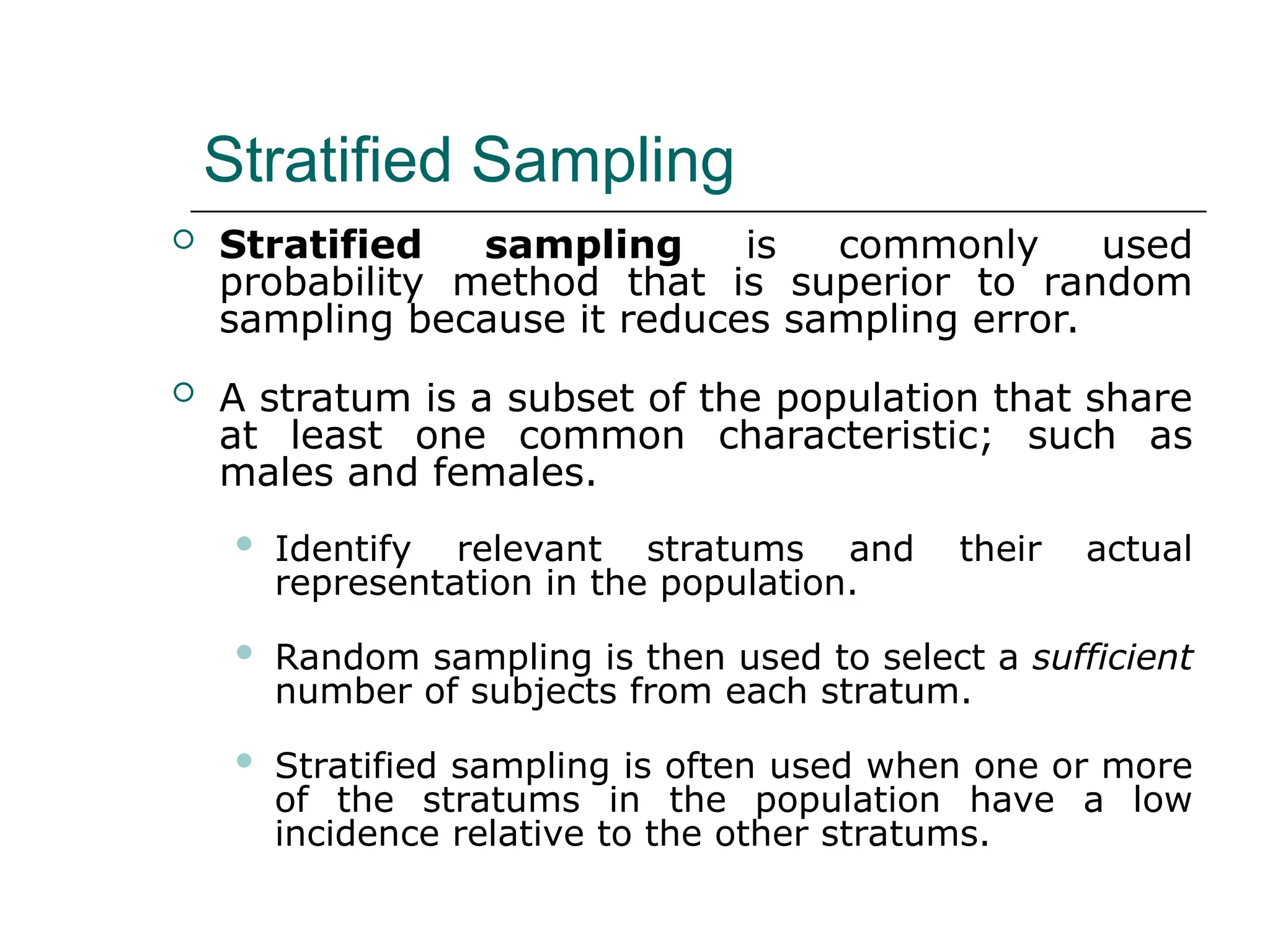
 Stratified sampling is commonly used
probability method that is superior to random
sampling because it reduces sampling error.
 A stratum is a subset of the population that share
at least one common characteristic; such as
males and females.
 Identify relevant stratums and their actual
representation in the population.
 Random sampling is then used to select a sufficient
number of subjects from each stratum.
 Stratified sampling is often used when one or more
of the stratums in the population have a low
incidence relative to the other stratums.
Cluster Sampling
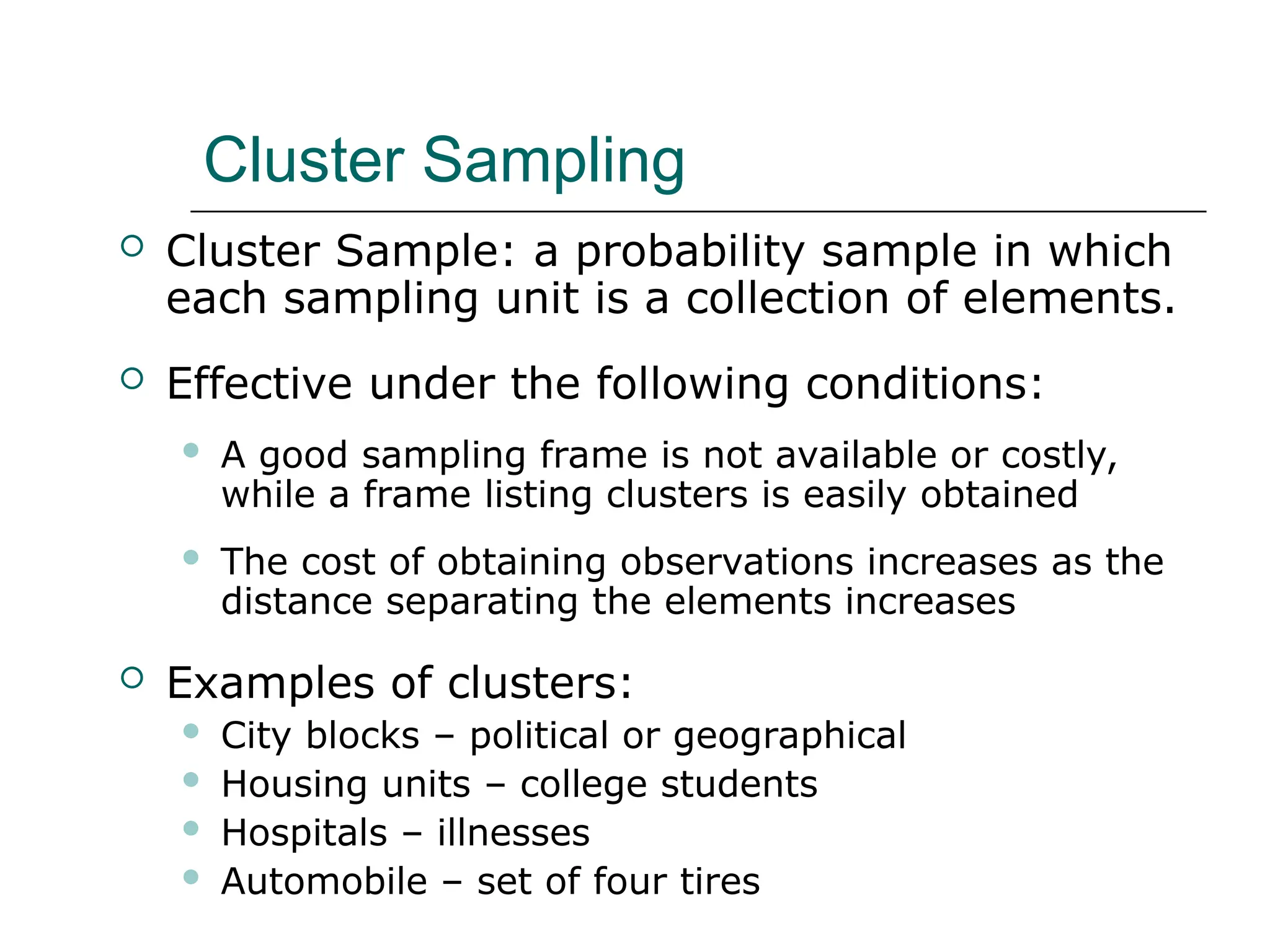
 Cluster Sample: a probability sample in which
each sampling unit is a collection of elements.
 Effective under the following conditions:
 A good sampling frame is not available or costly,
while a frame listing clusters is easily obtained
 The cost of obtaining observations increases as the
distance separating the elements increases
 Examples of clusters:
 City blocks – political or geographical
 Housing units – college students
 Hospitals – illnesses
 Automobile – set of four tires
Convenience Sampling
 Convenience sampling is used in
exploratory research where the
researcher is interested in getting an
inexpensive approximation.
 The sample is selected because they are
convenient.
 It is a nonprobability method.
 Often used during preliminary research efforts
to get an estimate without incurring the cost or
time required to select a random sample
Judgment Sampling
 Judgment sampling is a common
nonprobability method.
 The sample is selected based upon
judgment.
 an extension of convenience sampling
 When using this method, the researcher
must be confident that the chosen
sample is truly representative of the
entire population.
Quota Sampling
 Quota sampling is the nonprobability
equivalent of stratified sampling.
 First identify the stratums and their
proportions as they are represented in
the population
 Then convenience or judgment sampling
is used to select the required number of
subjects from each stratum.
Snowball Sampling
 Snowball sampling is a special nonprobability
method used when the desired sample
characteristic is rare.
 It may be extremely difficult or cost prohibitive
to locate respondents in these situations.
 This technique relies on referrals from initial
subjects to generate additional subjects.
 It lowers search costs; however, it introduces
bias because the technique itself reduces the
likelihood that the sample will represent a good
cross section from the population.
Sample Size?
 The more heterogeneous a population is,
the larger the sample needs to be.
 Depends on topic – frequently it occurs?
 For probability sampling, the larger the
sample size, the better.
 With nonprobability samples, not
generalizable regardless – still consider
stability of results
Response Rates
 About 20 – 30% usually return a
questionnaire
 Follow up techniques could bring it up to
about 50%
 Still, response rates under 60 – 70%
challenge the integrity of the random
sample
 How the survey is distributed can affect
the quality of sampling

Sampling Techniques Fatima M. Limbaga .ppt

  • 1.
  • 2.
    Defining the TargetPopulation  It is critical to the success of the research project to clearly define the target population.  Rely on logic and judgment.  The population should be defined in connection with the objectives of the study.
  • 3.
    Technical Terminology  Anelement is an object on which a measurement is taken.  A population is a collection of elements about which we wish to make an inference.  Sampling units are nonoverlapping collections of elements from the population that cover the entire population.
  • 4.
    Technical Terms  Asampling frame is a list of sampling units.  A sample is a collection of sampling units drawn from a sampling frame.  Parameter: numerical characteristic of a population  Statistic: numerical characteristic of a sample
  • 5.
    Errors of nonobservation The deviation between an estimate from an ideal sample and the true population value is the sampling error.  Almost always, the sampling frame does not match up perfectly with the target population, leading to errors of coverage.
  • 6.
    Errors of nonobservation Nonresponse is probably the most serious of these errors.  Arises in three ways:  Inability of the person responding to come up with the answer  Refusal to answer  Inability to contact the sampled elements
  • 7.
    Errors of observation These errors can be classified as due to the interviewer, respondent, instrument, or method of data collection.
  • 8.
    Interviewers  Interviewers havea direct and dramatic effect on the way a person responds to a question.  Most people tend to side with the view apparently favored by the interviewer, especially if they are neutral.  Friendly interviewers are more successful.  In general, interviewers of the same gender, racial, and ethnic groups as those being interviewed are slightly more successful.
  • 9.
    Respondents  Respondents differgreatly in motivation to answer correctly and in ability to do so.  Obtaining an honest response to sensitive questions is difficult.  Basic errors  Recall bias: simply does not remember  Prestige bias: exaggerates to ‘look’ better  Intentional deception: lying  Incorrect measurement: does not understand the units or definition
  • 10.
    Census Sample  Acensus study occurs if the entire population is very small or it is reasonable to include the entire population (for other reasons).  It is called a census sample because data is gathered on every member of the population.
  • 11.
    Why sample?  Thepopulation of interest is usually too large to attempt to survey all of its members.  A carefully chosen sample can be used to represent the population.  The sample reflects the characteristics of the population from which it is drawn.
  • 12.
    Probability versus Nonprobability Probability Samples: each member of the population has a known non-zero probability of being selected  Methods include random sampling, systematic sampling, and stratified sampling.  Nonprobability Samples: members are selected from the population in some nonrandom manner  Methods include convenience sampling, judgment sampling, quota sampling, and snowball sampling
  • 13.
    Random Sampling Random samplingis the purest form of probability sampling.  Each member of the population has an equal and known chance of being selected.  When there are very large populations, it is often ‘difficult’ to identify every member of the population, so the pool of available subjects becomes biased.  You can use software, such as minitab to generate random numbers or to draw directly from the columns
  • 14.
    Systematic Sampling  Systematicsampling is often used instead of random sampling. It is also called an Nth name selection technique.  After the required sample size has been calculated, every Nth record is selected from a list of population members.  As long as the list does not contain any hidden order, this sampling method is as good as the random sampling method.  Its only advantage over the random sampling technique is simplicity (and possibly cost effectiveness).
  • 15.
    Stratified Sampling  Stratifiedsampling is commonly used probability method that is superior to random sampling because it reduces sampling error.  A stratum is a subset of the population that share at least one common characteristic; such as males and females.  Identify relevant stratums and their actual representation in the population.  Random sampling is then used to select a sufficient number of subjects from each stratum.  Stratified sampling is often used when one or more of the stratums in the population have a low incidence relative to the other stratums.
  • 16.
    Cluster Sampling  ClusterSample: a probability sample in which each sampling unit is a collection of elements.  Effective under the following conditions:  A good sampling frame is not available or costly, while a frame listing clusters is easily obtained  The cost of obtaining observations increases as the distance separating the elements increases  Examples of clusters:  City blocks – political or geographical  Housing units – college students  Hospitals – illnesses  Automobile – set of four tires
  • 17.
    Convenience Sampling  Conveniencesampling is used in exploratory research where the researcher is interested in getting an inexpensive approximation.  The sample is selected because they are convenient.  It is a nonprobability method.  Often used during preliminary research efforts to get an estimate without incurring the cost or time required to select a random sample
  • 18.
    Judgment Sampling  Judgmentsampling is a common nonprobability method.  The sample is selected based upon judgment.  an extension of convenience sampling  When using this method, the researcher must be confident that the chosen sample is truly representative of the entire population.
  • 19.
    Quota Sampling  Quotasampling is the nonprobability equivalent of stratified sampling.  First identify the stratums and their proportions as they are represented in the population  Then convenience or judgment sampling is used to select the required number of subjects from each stratum.
  • 20.
    Snowball Sampling  Snowballsampling is a special nonprobability method used when the desired sample characteristic is rare.  It may be extremely difficult or cost prohibitive to locate respondents in these situations.  This technique relies on referrals from initial subjects to generate additional subjects.  It lowers search costs; however, it introduces bias because the technique itself reduces the likelihood that the sample will represent a good cross section from the population.
  • 21.
    Sample Size?  Themore heterogeneous a population is, the larger the sample needs to be.  Depends on topic – frequently it occurs?  For probability sampling, the larger the sample size, the better.  With nonprobability samples, not generalizable regardless – still consider stability of results
  • 22.
    Response Rates  About20 – 30% usually return a questionnaire  Follow up techniques could bring it up to about 50%  Still, response rates under 60 – 70% challenge the integrity of the random sample  How the survey is distributed can affect the quality of sampling