M A R C H - A P R I L 2 0 1 4V O L U M E 4 , I S S U E 2 7
Miami-Florida European Union Center of Excellence - FIU
Newsletter
This year, the Miami-Florida European Un-
ion Center of Excellence had the great
honor and privilege to have the annual
Directors’ meeting take place in Miami.
Hosted by our fellow European Union
Center of Excellence at the University of
North Carolina at Chapel Hill, the Directors’
meeting took place on March 20-22 in
downtown Coral Gables. Over these three
days, directors and associate directors
from the ten EU Centers of Excellence
around the nation gathered together to dis-
cuss past successes, share advice, and to
plan future collaborative events.
The series of events began on the evening
of Thursday, March 20th with a reception
and dinner at the home of the Consul Gen-
eral of France, the Honorable Philippe
Létrilliart. Members of the various Europe-
an Union Centers of Excellence ate dinner
and networked with local professionals,
academics, business leaders, and mem-
bers of Miami’s diplomatic community. This
informal setting allowed members to com-
municate and get to know each other in a
way that would contribute greatly to the
sense of camaraderie and common
mission of building greater ties between
the United States and Europe.
The next day, Friday March 21st,
EU directors met in Miami’s historic Coral
Gables’ Miracle Mile at the innovative
workspaces of Right Space 2 Meet for a
full day of work and collaboration. The
day began with remarks by François
Rivasseau, the Deputy Head of the EU
Delegation to the United States, who re-
marked on how important these centers
are in promoting EU-US ties through teach-
ing, research and community outreach. Mr.
Rivasseau’s speech inspired the remainder
of the morning’s discussion on the EU’s
changes and efforts to promote transatlan-
tic research initiatives. The changes asso-
ciated with the Horizon 2020 program were
a point of major discussion, a subject that
would come up again on Saturday (see
article on page 5-6). Following a delightful
and recharging lunch at a local restaurant,
members of the EU centers reconvened in
the afternoon to discuss their methods and
strategies for engaging in outreach.
From newsletters such as this one, to
I N S I D E T H I S
I S S U E
 Annual EU Centers of
Excellence Networking
Meeting..……...…........1-4
 Workshop on Horizon
2020 ……...….……...…..5-6
 Workshop on Gender
and Generations …….7-9
 Gender Equality for
Generation y in 2030:
an EU Perspective…....10
 Immigration and the
Radical Right in
Europe……...….........11-12
 Crisis in Ukraine…..13-14
 The EU and Russia
Competition and Conflict
in Eastern Europe and
the Caucasus.…............15
 The Euro Challenge
Competition 2014....16-17
 World War II Veterans
honored by French
Consulate……………….18
 Storm the Beach ….19-20
 Announcements and
Contact Info……..…......21
miamieuc.fiu.edu
Annual EU Centers Network Meeting in Miami
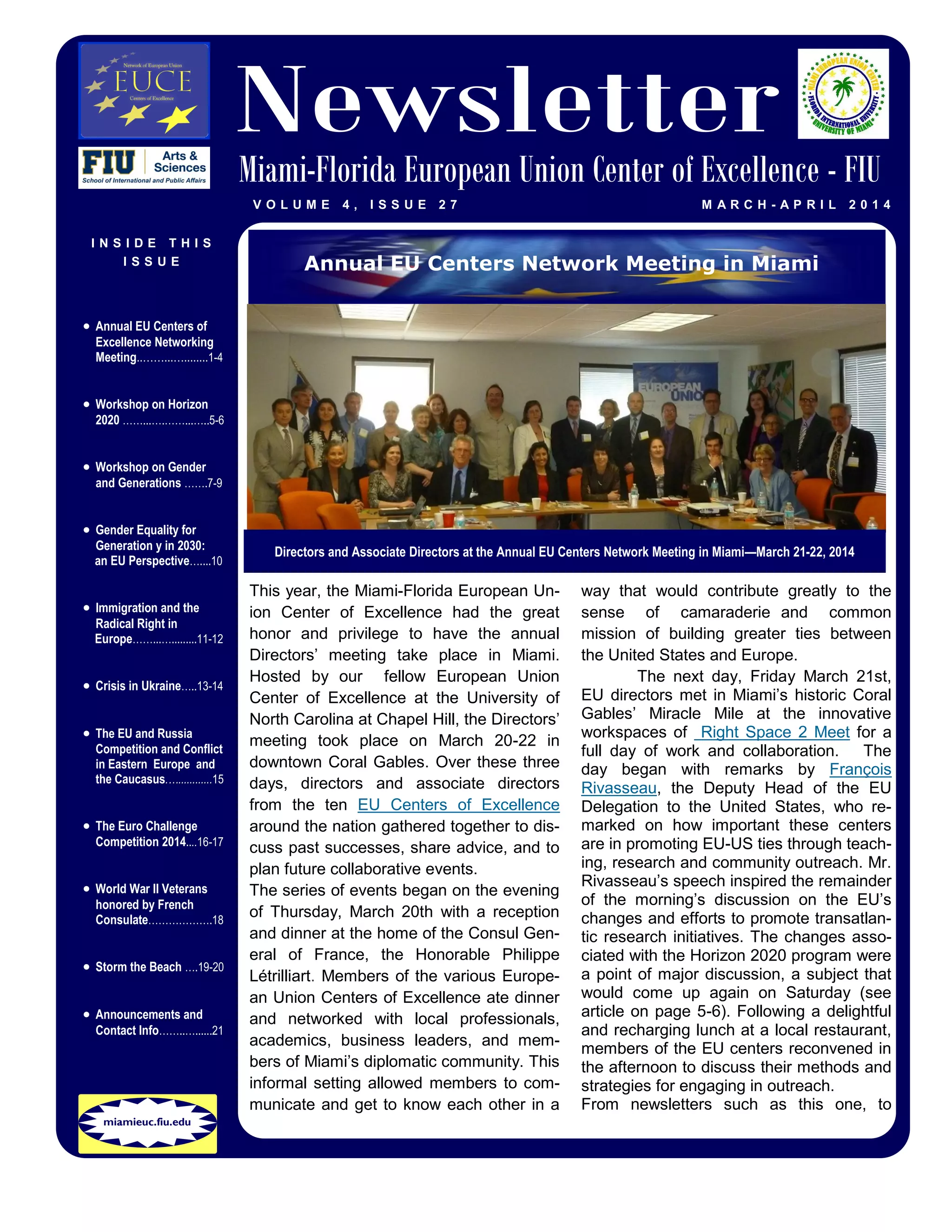
Directors and Associate Directors at the Annual EU Centers Network Meeting in Miami—March 21-22, 2014
YouTube channels and twitter handles, as well as
more conventional methods, EU Centers shared and
learned of new ways to spread the message to their
local researchers and professionals about the oppor-
tunities available through collaboration. The day’s
fruitful meeting concluded following remarks from
Jean Luc-Robert, First Counselor of the European
Parliament Liaison Office with the US Congress, and
an update from the European Delegation.
The morning of Saturday March 22nd saw
the close of the network meeting for 2014. Associate
directors met to discuss the best way to make sure
that EU centers around the nation continue to work
together. With the success of past endeavors such
as the videoconference series hosted by the EU
Center at the University of Pittsburgh, participants
were well aware that working together has been and
will continue to offer the best and most efficient use
of time. The day, and the weekend’s meetings con-
cluded with new information on Horizon 2020 (the
subject of the article on page 5-6). While members
of MEUCE will miss having our fellow EU Center
directors and associate directors in our backyard,
the level of collaboration among these institutions
means that the conversation is not at an end.
The Miami-Florida European Union Center of Excel-
lence would like to thank sincerely Hon. Philippe
Létrilliart, Consul General of France in Miami, Mark
Trowbridge, President and CEO of the Coral Gables
Chamber of Commerce, and Caroline Rendeiro,
President and CEO of Right Space 2 Meet, Inc. for
sponsoring this event, and making it a success.
M A R C H - A P R I L 2 0 1 4 P A G E 2
Annual EU Center Networking Meeting
in Miami this March
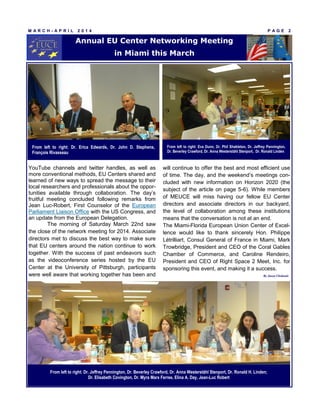
From left to right: Dr. Erica Edwards, Dr. John D. Stephens,
François Rivasseau
From left to right: Eva Dunn, Dr. Phil Shekleton, Dr. Jeffrey Pennington,
Dr. Beverley Crawford, Dr. Anna Westerståhl Stenport, Dr. Ronald Linden
By Jason Chohonis
From left to right: Dr. Jeffrey Pennington, Dr. Beverley Crawford, Dr. Anna Westerståhl Stenport, Dr. Ronald H. Linden;
Dr. Elisabeth Covington, Dr. Myra Marx Ferree, Elina A. Day, Jean-Luc Robert
P A G E 3
Annual EU Center Networking Meeting
Dinner Reception at the residence of the Consul General of France
M A R C H - A P R I L 2 0 1 4
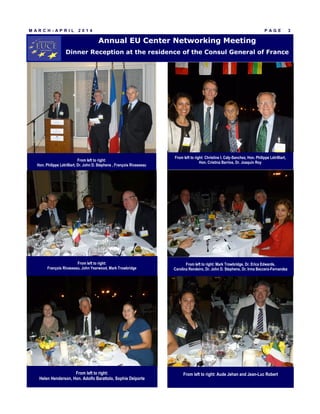
From left to right: Christine I. Caly-Sanchez, Hon. Philippe Létrilliart,
Hon. Cristina Barrios, Dr. Joaquin Roy
From left to right:
Helen Henderson, Hon. Adolfo Barattolo, Sophie Delporte
From left to right:
Hon. Philippe Létrilliart, Dr. John D. Stephens , François Rivasseau
From left to right:
François Rivasseau, John Yearwood, Mark Trowbridge
From left to right: Mark Trowbridge, Dr. Erica Edwards,
Carolina Rendeiro, Dr. John D. Stephens, Dr. Irma Beccera-Fernandez
From left to right: Aude Jehan and Jean-Luc Robert
P A G E 4
Annual EU Center Networking Meeting
Cocktail-Reception in Coral Gables
sponsored by the Coral Gables Chamber of Commerce
M A R C H - A P R I L 2 0 1 4
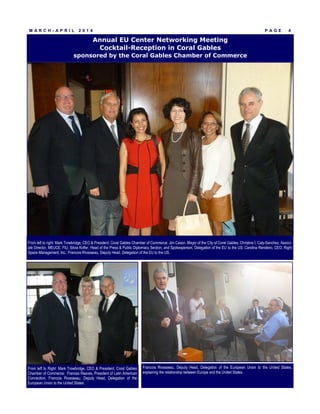
Francois Rivasseau, Deputy Head, Delegation of the European Union to the United States,
explaining the relationship between Europe and the United States.
From left to right: Mark Trowbridge, CEO & President, Coral Gables Chamber of Commerce; Jim Cason, Mayor of the City of Coral Gables; Christine I. Caly-Sanchez, Associ-
ate Director, MEUCE, FIU; Silvia Kofler, Head of the Press & Public Diplomacy Section, and Spokesperson, Delegation of the EU to the US; Carolina Rendeiro, CEO, Right
Space Management, Inc.; Francois Rivasseau, Deputy Head, Delegation of the EU to the US.
From left to Right: Mark Trowbridge, CEO & President, Coral Gables
Chamber of Commerce; Frances Reaves, President of Latin American
Connection; Francois Rivasseau, Deputy Head, Delegation of the
European Union to the United States.
M A R C H - A P R I L 2 0 1 4 P A G E 5
The Miami-Florida European
Union Center of Excellence
(MEUCE) has dedicated a sig-
nificant amount of energy to en-
suring that local researchers
and professionals are aware of
the BILAT and Horizon 2020
Programs. These programs,
that provide grant and research
money to U.S researchers and
businesses that work with Euro-
pean partner organizations,
were the subject of a recent
workshop in Coral Gables’
Miracle Mile on Saturday March
22, 2014. With many EU Center
directors in Miami for the annual
EU Center meetings, this
workshop entitled“EU Research
and Innovation Funding through
Horizon 2020” provided the
perfect opportunity to dissemi-
nate valuable information that
could then be relayed around
the nation by the respective EU
Centers. This workshop was
jointly sponsored by BILAT USA
2.0, MEUCE, and FIU and was
co-sponsored by Euraxess
Links, DLR, and the Right
Space 2 Meet. This meeting
was housed in the workspaces
of the Right Space 2 Meet
company, which offers confer-
ence rooms and virtual offices
for researchers and entrepre-
neurs. An incredibly unique lo-
cation that even contained a
former bank vault that is still
functional, this workspace was
the ideal place to meet to dis-
cuss opportunities available for
innovative researchers in the
United States.
MEUCE had the oppor-
tunity to speak with the work-
shop presenter, Viktoria Bodna-
rova, a regional representative
of Euraxess Links North Ameri-
ca. Euraxess Links, Ms. Bodna-
rova informed us, main goal
was to “inform scientists of all
nationalities based in North
America about the job vacan-
cies and funding opportunities
available in 40 European coun-
tries.” Euraxess, as part of the
Horizon 2020 funding program,
operates as an “information
center to spread the word of
different funding opportunities”
that are available through Hori-
zon 2020. Unlike the EU dele-
gation, Euraxess focuses less
on collaborative projects and
more on “individuals, individual
mobility, individual fellow-
ships.” Instead of trying to form
consortium, which involves dif-
ferent rules and procedures,
Bodnarova makes individuals
aware through “a website,
social media, a newsletter that
is sent to our community every
month where we look through
opportunities available in each
of these 40 countries.”
Bodnarova and her peers at
Euraxess Links are busy as
getting the word out on “6-8000
job vacancies that are available
every day” means they must
inform “the research organiza-
tions who publish the vacancies
on their website.” As part of this
effort to disseminate information
about opportunities available for
individual researchers, Bodna-
rova spoke to the assembled
directors of the EU Centers who
had gathered in Miami. These
participants were made aware
of the many opportunities avail-
able for researchers and how
these opportunities could be
found. Bodnarova informed
Workshop on Horizon 2020
Viktoria Bodnarova
Regional Representatrve of
Euraxess Links North America
Workshop on Horizon 2020 at Right Space 2 Meet—March 22, 2014
From left to right: Carolina Rendeiro, Christine I. Caly-Sanchez,
Dr. Rebecca Friedman, Viktoria Bodnarova
M A R C H - A P R I L 2 0 1 4 P A G E 6
MEUCE that these EU Directors
and Associate Directors “could
spread the word in their univer-
sities to their researchers. I
think of them as multipliers of
the message, I introduce the
schemes and let them know
what is possible.”
Ultimately, due to the
efforts of MEUCE, Euraxess
Links, BILAT, and our fellow
European Union Centers,
Bodnarova and Horizon 2020’s
message will reach many more
eager researchers throughout
North America. As the members
of the EU Centers departed
Miami, they did so much more
aware of ways to assist their
colleagues back home.
For more information please contact
Christine I. Caly-Sanchez,
Associate Director of the MEUCE,
by email at calyc@fiu.edu
or please visit
http://miamieuc.fiu.edu/events/general/2014/
meuce-bilat-usa-20-meeting-fiu/
Workshop on Horizon 2020 (con’t)
By Jason Chohonis
Dr. Antonello Pileggi, Christine I. Caly-
Sanchez, Viktoria Bodnarova
BILAT USA 2.0—Workshop on Horizon 2020—March 22, 2014
Participants of the Workshop Horizon 2020 - March 22, 2014
Directors and Associate Directors of the following EUCE Centers of Excellence: University of Colorado, University of North Carolina Chapel Hill, University of Seattle, John Hopkins
University, University of Pittsburgh, University of Wisconsin-Madison, University of Texas-Austin, Florida International University, University of California-Berkeley, University of Illinois
P A G E 7
M A R C H - A P R I L 2 0 1 4
On March 28th and 29th the Miami-
Florida European Union Center of Ex-
cellence (MEUCE) and its sister organi-
zation, the University of Wisconsin-
Madison European Union Center of
Excellence collaborated to bring Miami
residents, FIU students, and leading
scholars from around the country to
participate in an incredibly engaging
academic workshop. Friday March 28th
featured a full day of panel discussions
and lectures on a beautiful Miami day.
Dr. Rebecca Friedman, the MEUCE co-
director, and Dr. Myra Marx Ferree, the
Wisconsin European Union Center di-
rector welcomed participants to the
workshop and indicated that the a sub-
ject as diverse as “Gender and Genera-
tions” would necessitate a creative for-
mat in which collaborative discussion
featuring scholars from multiple disci-
plines would be the style of the days
conference. This somewhat informal
approach allowed individuals of many
different research interests to question
each other’s’ arguments in a productive
and engaging way.
The first panel of the day dis-
cussed the idea of gender and genera-
tion in a historical context. Dr. Geoff
Eley, a professor of history at the Uni-
versity of Michigan discussed the idea
of generation and the way this concept
entangles with the idea of gender. Dr.
Eley discussed some of the conceptual
problems that arise with discussing any
specific ‘generation’, a term that can
often appear arbitrary. Dr. Eley was
able to demonstrate that the concept of
generation is in many ways an expres-
sion of both analysis of social topogra-
phy as well as an indication of agency,
or self-identification. Dr. Eley discussed
how these conceptual ideas related to
the relationship between labor, capital,
and government since the 1960s. Fol-
lowing Dr. Eley, Dr. Camille Robcis, an
assistant professor of history at Cornell
University discussed “Family Policy
and the Origins of the Welfare State in
France.” Dr. Robcis discussion began
with an explanation of the issue of gay
rights in France, an issue that lead to
“massive street protests.” Dr. Robcis
explored the way that gay marriage and
reproductive rights were rhetorically
expressed by protestors on either side of
the political divide, and how the form
protests took often utilized imagery and
rhetoric related to ideas of traditional
French Republicanism. Dr. Robcis ar-
gued that in French culture, the idea of
‘the social’ cannot exist without the idea
of ‘the family’, a result of specific his-
torical conditions such as the 1939
French family code, or the earlier 1804
French civil code. The discussion pivot-
ed with the panel’s next presenter, Dr.
Becky E. Conekin, a professor with the
History and MacMillan Center, Yale,
who discussed issues of morality
amongst female laborers in Europe in
the twentieth century and the relation to
consumer culture. Dr. Conekin ex-
plained that her research and interviews
with models has revealed the way that
gender and generation, class and morali-
ty evolved throughout the twentieth
century in public discourse. Dr. Con-
ekin, a former AIDS activist, argued
that the discourse surrounding AIDS
has shifted in that today prostitutes are
no longer labeled as predators in the
HIV debate, but as potential victims,
and that issues of HIV and prostitute
rights figure into the contemporary
transnational labor debates and labor
movements of today.
On Saturday March 29th, the enthusias-
tic participants, refreshed from a relax-
ing South Florida evening reconvened at
FIU for another round of panel discus-
sions. As participants ate breakfast, Dr.
Mary Daly, a professor of sociology and
social policy from the University of
Oxford spoke about the concept of in-
terventions around parenting as a way
of looking at the intersection of gender
and generations. Dr. Daly’s lecture fo-
cused on the specific policies put in
Workshop on Gender and Generations in Europe
Panel I: History Reverberations—March 28, 2014
Dr. Myra Marx Ferree, Dr. Rebecca Friedman, Dr. Geoff Eley, Dr. Becky Conekin, Dr. Camille Robcis
Dr. Myra Marx Ferree, Director,
European Union Center of Excellence,
University of Wisconsin-Madison
P A G E 8M A R C H - A P R I L 2 0 1 4
Workshop on Gender and Generations
in Europe (cont’)
place in England under the New-Labour
party that targeted parents for support
and problem solving, and compared
these interventions to those in place in
France and Germany. Dr. Daly ex-
plained that cross national differences in
parenting intervention could be ex-
plained by a number of factors includ-
ing “the perspective on and organization
for child welfare” and “the approach
taken to family and the prevailing social
philosophies around family.” According
to Dr. Daly all of these countries recent
parenting policy approaches demon-
strate the common features of focusing
on parents and parenting behavior while
also underplaying the agency of chil-
dren, and signifies a move for policies
inside of family dynamics. While many,
such as this writer, were unfamiliar with
the sociological methodology used by
Dr. Daly, her lecture, expertly ex-
pressed, made all participants familiar
with the role generation plays in these
interventions, as well as the conse-
quences of gender’s absence from these
interventions.
Saturday’s second speaker was
Dr. Diane-Gabrielle Tremblay, the Can-
ada Research Chair on the Socio-
organizational challenges of the
Knowledge Economy and a Professor at
the School of Administration at
TELUQ| Université de Québec. Dr.
Tremblay spoke about “the work-family
relation and public policy: towards gen-
der equality” and compared the way that
France, Belgium, and Québec ap-
proached work life issues. Some coun-
tries, such as some of those in Southern
Europe engage in a non-intervention
model, in which there is no policy inter-
vention in the work-life model. Others,
such as France, engage in the alternation
model in which some policies are in
place that see women as alternating be-
tween work and family obligations. The
third model, Dr. Tremblay argued, is
where Québec fits in, and should be
termed a model of “work-life reconcilia-
tion or work-family articulation.” Qué-
bec, more than France or Southern Eu-
ropean countries, utilizes policies like
paternity leave that more closely follow
the “work-family reconciliation model.”
The day’s final speaker is a
familiar face to MEUCE, having partici-
pated in a number of previous events
with FIU’s EU Center, the University of
Miami’s Dr. Louise K. Davidson-
Schmich. Dr. Davidson-Schmich, a pro-
fessor at UM’s Department of Political
Science, presented her lecture entitled
“The Needs of Families and Political
Responses in Germany”, which ex-
plored the “one thing that all European
countries have in common, that all of
them have laws and policies that define
legally who is related to whom. All of
these countries confer legal privileges,
rights, and responsibilities to individu-
als related to each other that they do not
confer on individuals who don’t share
relations. We have seen that all of these
policies are highly gendered and highly
heteronormative.” Dr. Davidson-
Schmich explored relationships of care,
that don’t stem from sexual relation-
ships, and as such fall outside the con-
ventional heteronormative family poli-
Panel II: Contemporary Changes - March 28, 2014
Dr. Philip N.Cohen, Dr. Pearl Dykstra , Dr. Gerda Neyer, Dr. Kimberly Morgan, Dr. Chiara Saraceno,
Panel III: Political Responses - March 29, 2014
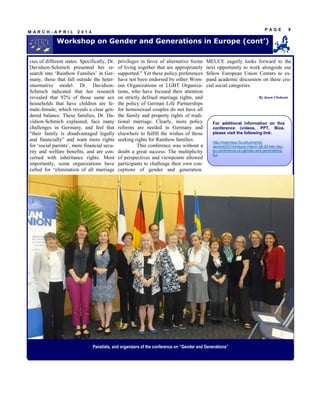
From left to right: Dr. Myra Marx Ferree, Dr. Mary Daly, Dr. Diane-Gabrielle Tremblay, Dr. Louise Davidson-Schmich
cies of different states. Specifically, Dr.
Davidson-Schmich presented her re-
search into ‘Rainbow Families’ in Ger-
many, those that fall outside the heter-
onormative model. Dr. Davidson-
Schmich indicated that her research
revealed that 92% of those same sex
households that have children are fe-
male-female, which reveals a clear gen-
dered balance. These families, Dr. Da-
vidson-Schmich explained, face many
challenges in Germany, and feel that
“their family is disadvantaged legally
and financially” and want more rights
for ‘social parents’, more financial secu-
rity and welfare benefits, and are con-
cerned with inheritance rights. Most
importantly, some organizations have
called for “elimination of all marriage
privileges in favor of alternative forms
of living together that are appropriately
supported.” Yet these policy preferences
have not been endorsed by either Wom-
ens Organizations or LGBT Organiza-
tions, who have focused their attention
on strictly defined marriage rights, and
the policy of German Life Partnerships
for homosexual couples do not have all
the family and property rights of tradi-
tional marriage. Clearly, more policy
reforms are needed in Germany and
elsewhere to fulfill the wishes of those
seeking rights for Rainbow families.
This conference was without a
doubt a great success. The multiplicity
of perspectives and viewpoints allowed
participants to challenge their own con-
ceptions of gender and generation.
MEUCE eagerly looks forward to the
next opportunity to work alongside our
fellow European Union Centers to ex-
pand academic discussion on these cru-
cial social categories.
Panelists, and organizers of the conference on “Gender and Generations”
P A G E 9
M A R C H - A P R I L 2 0 1 4
Workshop on Gender and Generations in Europe (cont’)
For additional information on this
conference (videos, PPT, Bios,
please visit the following link:
http://miamieuc.fiu.edu/events/
general/2014/meuce-march-28-29-two-day-
eu-conference-on-gender-and-generations-
fiu/
By Jason Chohonis
P A G E 1 0M A R C H - A P R I L 2 0 1 4
As mentioned on the article on pages 7-9, the Miami-
Florida European Union Center of Excellence
(MEUCE) and the University of Wisconsin-Madison
European Union Center of Excellence jointly hosted a
conference on “Gender and Generations” on March
28th and 29th of 2014. On Friday, March 28th, invited
participants gathered in FIU’s Frost Museum for a
luncheon and a keynote address by Agnès Hubert,
an Adviser for the Bureau of European Policy Advis-
ers (BEPA) European Commission. This lecture was
titled “Gender equality for generation y in 2030: an
EU perspective.” Ms. Hubert, who has an extensive
resume with multiple EU policy making roles, includ-
ing a stint as the Head of the Unit Equal Opportuni-
ties for Women, informed participants about how
some of the specific academic issues raised, such as
the gendering of the social contract and the welfare
state, apply in the contemporary context for members
of Generation Y (roughly those born between 1980
and 2000). Ms. Hubert explained that gender equality
“is a value of the EU, that is to be promoted as a
founding principle of the EU that conditions sanctions
and the accession of new member states.” Even to-
day absolute gender equality does not prevail across
the EU, despite the gains that have been made for
women over the twentieth century. As Ms. Hubert
explained, measures of the Gender Equality Index
indicate that women still lag behind men in greater or
lesser degrees across all of Europe. Hubert indicated
that generational changes and expectations continue
to influence the way that gender is constructed and
realized.
Ms. Hubert discussed the future trajectory for
trends in gender equality. Ultimately, she explained
that equality is “progressing, but not very quickly”.
Many challenges exist in the post-crisis EU. Ms. Hu-
bert, aware of these challenges, discussed what re-
search strategies may help Europe’s policy makers,
and indicated that “the current materialistic culture is
not sustainable”. Other measures, besides Gross
Domestic Product (GDP), will be necessary to deter-
mine how successful policy reforms are. Ms. Hubert
explained that for a variety of reasons not directly
measurable by GDP, European investment in Gender
Equality should make Europe more competitive, dem-
ocratic, welcoming of change, and able to socially
innovate to protect the positive aspects of the welfare
state. Despite the fact that the achievement of gender
equality in the European Union and the United
States, not to mention elsewhere, is a long way
away, the continued attention of professionals such
as Ms. Hubert indicates that future generations, as
well as generation Y, will continue to push towards a
more just planet.
Gender Equality for Generation y in 2030:
an EU Perspective
For additional information on this event
and to watch the video, please visit the
following link:
h t t p s : / / w w w . y o u t u b e . c o m / w a t c h ?
v=vqIOkgLcrF0&list=HL1398262964&feature=mh_lolz
By Jason Chohonis
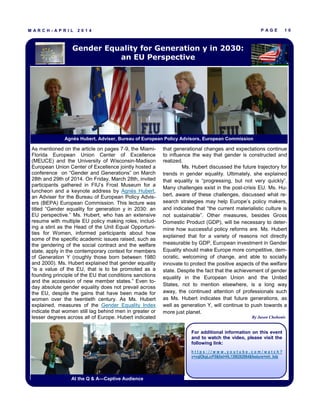
At the Q & A—Captive Audience
Agnès Hubert, Adviser, Bureau of European Policy Advisors, European Commission
P A G E 1 1
M A R C H — A P R I L 2 0 1 4
Dr. Erica Edwards speaks to FIU students about
“Immigration and the Radical Right in Europe”
There has been significant interest on both sides
of the Atlantic about the relationship between the
growth of radical right populist parties and the in-
crease in immigration in the EU. The Miami-
Florida European Union Center of Excellence
(MEUCE) was proud to have the opportunity to
host a lecture by Dr. Erica Edwards, a scholar of
EU politics and the Executive Director of the Euro-
pean Union Center of Excellence at the University
of North Carolina at Chapel Hill to share her re-
search on this subject. Her talk was entitled
“Immigration and the Radical Right in Europe.”
This lecture took place on the morning of March
20th, 2014 at FIU’s Modeste Maidique Campus
before a crowd of students and faculty members
alike.
Dr. Edwards’ lecture was lively and enthu-
siastic, and featured frequent give and take be-
tween students, faculty, and Dr. Edwards herself.
Dr. Edwards presented students with a plethora of
statistical information about the immigrants them-
selves and indicated that push and pull factors
must be considered when analyzing why immi-
grants move where they do. Following this statisti-
cal overview, Dr. Edwards informed students that
there were three distinct waves of immigration to
Europe. These three waves included post World
War II immigration (1945-1970) for the purposes
of labor, family reunification migration (1970s-
2000), and the most recent wave of asylum seek-
ers, refugees, and illegal immigration (1989 to the
present).
Dr. Edwards, following her presentation of
this historical context, explored the ideologies of
European right wing parties that have reacted to
these waves of immigration. Students were capti-
vated by Dr. Edwards exploration of the nativist
ideologies present in European political video and
print advertisements that presented xenophobic
images of immigrants. In addition to having nativist
ideologies, many of these political parties have
authoritarian impulses, and favor ‘law and order
policies’ that often “favor punishing out group
figures in the name of some authority,” Edwards
explained. In addition to authoritarianism and na-
tivism, these groups also make use of populist
rhetoric in order to divide a society into create an
“other” or outsider group in society. Dr. Edwards
posited that these groups combination of nativism
and populist ideological impulses means these
parties are hostile to compromise and see minority
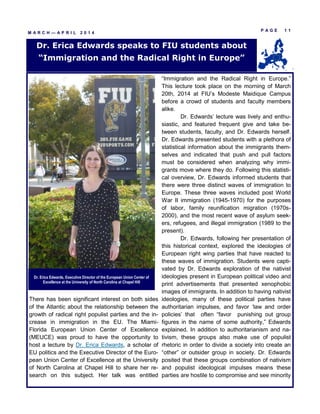
Dr. Erica Edwards, Executive Director of the European Union Center of
Excellence at the University of North Carolina at Chapel Hill
P A G E 1 2
M A R C H — A P R I L 2 0 1 4
Dr. Erica Edwards speaks to FIU students about
“Immigration and the Radical Right in Europe” (cont’)
rights as special interests, and therefore undemo-
cratic.
One member of the radical right that has
received a lot of attention is Netherlands politician
and “Party for Freedom” founder and leader Geert
Wilders. This party achieved its greatest popularity
in 2010, and has recently seen its popularity on
the decline, a trend Dr. Edwards indicated is con-
sistent throughout Europe. Rather than a rise in
radical right wing parties, Dr. Edwards argued that
these parties lack any concrete plan to enact the
changes they argue for in society, and as such
decline in popularity following a brief surge. The
concern however, Dr. Edwards argued, is that
“these groups shift the rhetoric and framing of
these issues”, and that mainstream parties often
co-opt the nativist and populist rhetoric of these
radical parties.
Following a question from the audience,
Dr. Edwards explained the relationship between
Euroscepticism and anti-immigration. Dr. Edwards
argued that what makes these groups popular is
their anti-immigration stance more so than their
Euroscepticism. Additionally, the Euroscepticism
of these parties is more tied to opposition to elite
power and globalization than to their separate na-
tivist policies.
As this issue is not likely to disappear
anytime soon, make sure to visit the MEUCE
website and Facebook page for more updates
on future events concerning this issue!
By Jason Chohonis
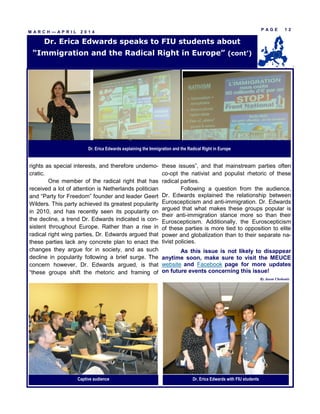
Captive audience Dr. Erica Edwards with FIU students
Dr. Erica Edwards explaining the Immigration and the Radical Right in Europe
M A R C H - A P R I L 2 0 1 4 P A G E 1 3
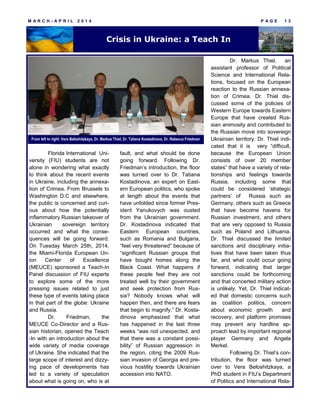
Crisis in Ukraine: a Teach In
Florida International Uni-
versity (FIU) students are not
alone in wondering what exactly
to think about the recent events
in Ukraine, including the annexa-
tion of Crimea. From Brussels to
Washington D.C and elsewhere,
the public is concerned and curi-
ous about how the potentially
inflammatory Russian takeover of
Ukrainian sovereign territory
occurred and what the conse-
quences will be going forward.
On Tuesday March 25th, 2014,
the Miami-Florida European Un-
ion Center of Excellence
(MEUCE) sponsored a Teach-In
Panel discussion of FIU experts
to explore some of the more
pressing issues related to just
these type of events taking place
in that part of the globe: Ukraine
and Russia.
Dr. Friedman, the
MEUCE Co-Director and a Rus-
sian historian, opened the Teach
-In with an introduction about the
wide variety of media coverage
of Ukraine. She indicated that the
large scope of interest and dizzy-
ing pace of developments has
led to a variety of speculation
about what is going on, who is at
fault, and what should be done
going forward. Following Dr.
Friedman’s introduction, the floor
was turned over to Dr. Tatiana
Kostadinova, an expert on East-
ern European politics, who spoke
at length about the events that
have unfolded since former Pres-
ident Yanukovych was ousted
from the Ukrainian government.
Dr. Kostadinova indicated that
Eastern European countries,
such as Romania and Bulgaria,
“feel very threatened” because of
“significant Russian groups that
have bought homes along the
Black Coast. What happens if
these people feel they are not
treated well by their government
and seek protection from Rus-
sia? Nobody knows what will
happen then, and there are fears
that begin to magnify.” Dr. Kosta-
dinova emphasized that what
has happened in the last three
weeks “was not unexpected, and
that there was a constant possi-
bility” of Russian aggression in
the region, citing the 2009 Rus-
sian invasion of Georgia and pre-
vious hostility towards Ukrainian
accession into NATO.
Dr. Markus Thiel, an
assistant professor of Political
Science and International Rela-
tions, focused on the European
reaction to the Russian annexa-
tion of Crimea. Dr. Thiel dis-
cussed some of the policies of
Western Europe towards Eastern
Europe that have created Rus-
sian animosity and contributed to
the Russian move into sovereign
Ukrainian territory. Dr. Thiel indi-
cated that it is very “difficult,
because the European Union
consists of over 20 member
states” that have a variety of rela-
tionships and feelings towards
Russia, including some that
could be considered ‘strategic
partners’ of Russia such as
Germany, others such as Greece
that have become havens for
Russian investment, and others
that are very opposed to Russia
such as Poland and Lithuania.
Dr. Thiel discussed the limited
sanctions and disciplinary initia-
tives that have been taken thus
far, and what could occur going
forward, indicating that larger
sanctions could be forthcoming
and that concerted military action
is unlikely. Yet, Dr. Thiel indicat-
ed that domestic concerns such
as coalition politics, concern
about economic growth and
recovery, and platform promises
may prevent any hardline ap-
proach lead by important regional
player Germany and Angela
Merkel.
Following Dr. Thiel’s con-
tribution, the floor was turned
over to Vera Beloshitzkaya, a
PhD student in FIU’s Department
of Politics and International Rela-
From left to right: Vera Beloshitzkaya, Dr. Markus Thiel, Dr. Tatiana Kostadinova, Dr. Rebecca Friedman
M A R C H - A P R I L 2 0 1 4 P A G E 1 4
tions. Ms. Beloshitzkaya offered a historical overview
of Ukraine going back to the 17th century in order to
explain how ethnicity and borders were formed as a
result of specific historical periods. Ms. Beloshitzkaya
indicated that the historical portioning of Ukraine
throughout the last few centuries has created the
amalgamation of ethnic groups and identities seen in
Ukraine today.
Dr. Peter Craumer, a Geographer with exper-
tise in the region, gave students a geographic per-
spective on the crisis. Dr. Craumer criticized some of
the recent journalistic portrayals of the crisis and the
demographics of Ukraine, indicating that the maps of
Ukraine that have been shown by the media have
been overly focused on ethnic differences that make
Eastern and Western Ukraine appear starkly differ-
ent. Instead, Dr. Craumer presented maps that em-
phasized the ethnic differences between ‘Russians’
and ‘Ukrainians’ in Ukraine is more subtle than as-
sumed by observers in the United States. Dr.
Craumer indicated that the blurring of ethnic and lan-
guage identity boundaries has contributed to the cur-
rent debate over the physical boundaries of sover-
eign nation states.
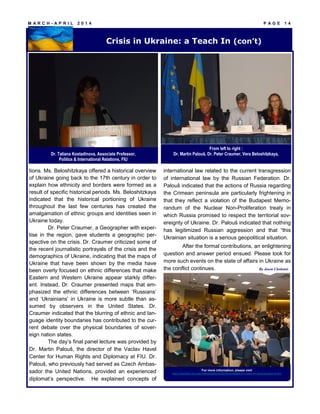
The day’s final panel lecture was provided by
Dr. Martin Palouš, the director of the Vaclav Havel
Center for Human Rights and Diplomacy at FIU. Dr.
Palouš, who previously had served as Czech Ambas-
sador the United Nations, provided an experienced
diplomat’s perspective. He explained concepts of
international law related to the current transgression
of international law by the Russian Federation. Dr.
Palouš indicated that the actions of Russia regarding
the Crimean peninsula are particularly frightening in
that they reflect a violation of the Budapest Memo-
randum of the Nuclear Non-Proliferation treaty in
which Russia promised to respect the territorial sov-
ereignty of Ukraine. Dr. Palouš indicated that nothing
has legitimized Russian aggression and that “this
Ukrainian situation is a serious geopolitical situation.
After the formal contributions, an enlightening
question and answer period ensued. Please look for
more such events on the state of affairs in Ukraine as
the conflict continues.
For more information, please visit
http://miamieuc.fiu.edu/events/general/2014/roundtable-on-crisis-in-ukraine-teach-in-fiu/
By Jason Chohonis
Crisis in Ukraine: a Teach In (con’t)
Dr. Tatiana Kostadinova, Associate Professor,
Politics & International Relations, FIU
From left to right :
Dr. Martin Palouš, Dr. Peter Craumer, Vera Beloshitzkaya,
P A G E 1 5
M A R C H - A P R I L 2 0 1 4
The EU and Russia Competition and Conflict
in Eastern Europe and the Caucasus
When the government of the Sovi-
et Union collapsed in the early
1990s, the international communi-
ty celebrated the end of the Cold
War. This seemed a moment that
promised future peace in the re-
gion. Unfortunately, the actions
taken by Russia under Vladimir
Putin towards neighboring nations
have been less than peaceful over
the past decade, particularly over
the last year in the Crimean penin-
sula. The increased level of con-
flict and hostile negotiations in the
Caucasus has lead to a commen-
surate level of student interest in
what exactly is going on in this
region. The Miami-Florida Europe-
an Union Center of Excellence
(MEUCE), cognizant of this fervent
interest recently hosted a lecture
by an esteemed scholar, Dr. Han-
nes Adomeit, who is currently a
Fellow with the German Academic
Exchange Service (DAAD). Dr.
Adomeit, who earned his doctorate
in Russian Studies from Colombia
University, spoke to FIU students
on April 8th 2014 in a lecture enti-
tled “The EU and Russia: Conflict
and Competition in Eastern Eu-
rope and the Caucasus.”
Dr. Adomeit, who has pub-
lished extensively on the relation-
ship between the United States,
Europe, and Russia, spoke before
students gathered at FIU’s School
of International and Public Affairs
(SIPA) about the economic, diplo-
matic, and historical roots of this
current conflict. Dr. Adomeit spoke
about how the agreements made
between the European Union and
Russia to “respect the rule of law”
in the region of Eastern Europe
and the Caucasus have not been
realized. Outlining ten propositions
that he believed applied to the re-
gion, Dr. Adomeit informed stu-
dents and guests that Russian for-
eign policy “has regarded the post-
Soviet space as exclusively a Rus-
sian sphere of influence.” The
Russian government, according to
Dr. Adomeit has acted as if “they
have special rights and privileges”
in the region that are being en-
croached upon by the European
Union. This has lead to a very
problematic state of affairs as
Eastern European governments
have acted as sovereign nations
and engaged economically and
politically with the European Un-
ion. Putin, who still imagines the
old Soviet space as part of the
Russian sphere of influence, pro-
claims the legitimacy of efforts to
invade sovereign territory under
the cloak of the protection of Rus-
sian-speaking peoples.
Blame for this international
crisis was not laid entirely at Rus-
sia’s feet. The European govern-
ment could have done a better job
of trying to integrate post-Soviet
Russia. As a former member of
the Crisis Prevention Network on
Russia-EU relations, Dr. Adomeit
was well versed in speaking about
the negotiations and supposed
transgressions that lead to this
blatant disrespect of national sov-
ereignty by the Russian Federa-
tion. Students and faculty mem-
bers were enthralled by Dr. Ado-
meit’s analysis of the multifaceted
concerns of the political players in
the region. The conversation had
broad reach-- from domestic con-
cerns of the Eastern European
nations, to questions about the
role of the European Union, to
Russia’s desire to create a com-
peting Eurasian consortium of na-
tions. Audience members left this
lecture aware that the blame for
this event, while primarily due to
Russian nationalistic aggression,
can be laid at the feet of many dif-
ferent political actors. Ultimately,
the depth of Dr. Adomeit’s lecture
cannot be sufficiently summarized
within this article.
For more information, watch the
video, follow our facebook page
and website for more exciting
events.
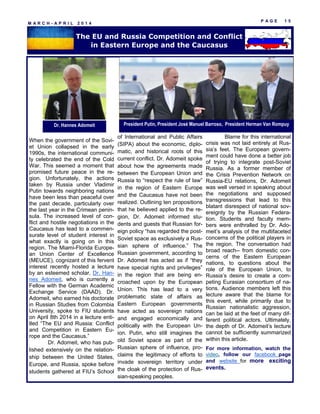
Dr. Hannes Adomeit President Putin, President José Manuel Barroso, President Herman Van Rompuy
M A R C H - A P R I L 2 0 1 4 P A G E 1 6
On March 13th 2014, the Miami-
Florida European Union Center of
Excellence was proud to host some
of South Florida’s finest young
scholars as high schoolers from
around the region gathered to com-
pete in the first round of the annual
Euro Challenge Competition. Spon-
sored by the European Delegation
to the United States in partnership
with Moody’s foundation and the
Federal Reserve Bank of the Unit-
ed States, this competition is sup-
ported by European Union Centers
throughout the U.S and challenges
students to learn more about the
European Union and its currency,
the Euro. This competition, in its
9th year, tasks students in teams of
three to five to come up with
presentations about the challenges
facing a single European member
state. Students are asked to create
15 minute presentations detailing
the economic condition of the
country, an economic related chal-
lenge facing the country, and ulti-
mately, to craft a policy that would
address the economic exigencies
of that nation. This competition al-
lows students to engage with mat-
ters of international economics in a
way that they wouldn't normally,
and provides an incredibly engag-
ing way to learn about Europe’s
political structure.
For example, students
from Coral Reef were tasked with
addressing the economic turmoil of
Greece and the challenges faced
by unemployment. One student,
who was clearly well versed on the
topic, indicated that “it has an un-
employment rate of around 28%”
and “that the austerity cuts have
been devastating.” These 10th
grade students indicated that the
Eurochallenge positions are tough
to come by as students would meet
every day to practice during their
lunch hour to get ready for the try-
outs to represent their school.
Clearly these students understand
the importance of the European
market, as one student remarked
“the Euro is the single most im-
portant currency next to the U.S
dollar.”
On March 13th, 11 teams
of these students gathered to com-
pete. Inside the MARC building
things were vibrant, as teams hud-
dled and discussed last minute
strategy. It was difficult to envy the
panels of judges who were forced
to decide between the teams of
Florida’s best and brightest. As the
winners of this competition are sent
to New York City to compete in the
national competition, a much covet-
ed prize, the decision was made
even more difficult. Ultimately, the
judges decided on two schools who
stood out as particularly exception-
al- Trinity Preparatory School and
Nova High School. These students,
above all others, were able to craft
meaningful policies to address the
economic concerns of their as-
signed European Union member
states. MEUCE is proud to congrat-
ulate these students, as well as
their competitors, on another suc-
cessful rendition of the local Euro
Challenge competition. We wish
them the best of luck in New York!
► For more information on this year’s Euro
Challenge Competition in Florida please
visit: http://miamieuc.fiu.edu/events/general/2014/
meuce-competition-local-florida-euro-challenge-
competition-2014-fiu/
► For more information on the Euro Challenge
Competition, please visit: http://
miamieuc.fiu.edu/outreach/euro-challenge/
The Euro Challenge Competition 2014
Florida Students test their European Economic Acumen
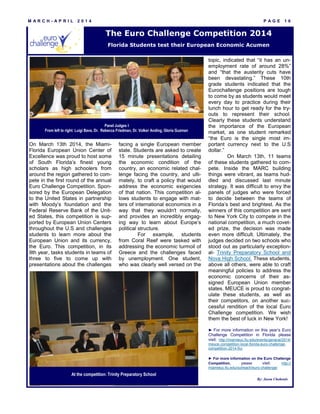
At the competition: Trinity Preparatory School
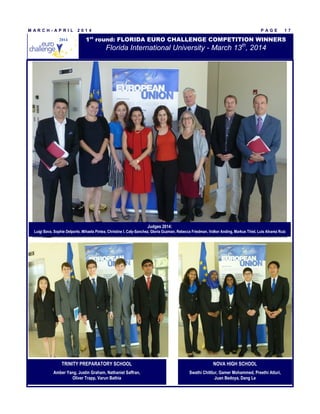
Panel Judges I
From left to right: Luigi Bava, Dr. Rebecca Friedman, Dr. Volker Anding, Gloria Guzman
By: Jason Chohonis
P A G E 1 7M A R C H - A P R I L 2 0 1 4
1st
round: FLORIDA EURO CHALLENGE COMPETITION WINNERS
Florida International University - March 13th
, 2014
2014
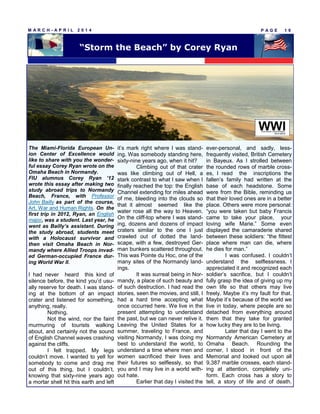
NOVA HIGH SCHOOL
Swathi Chittlur, Gamer Mohammed, Preethi Atluri,
Juan Bedoya, Dang Le
TRINITY PREPARATORY SCHOOL
Amber Yang, Justin Graham, Nathaniel Saffran,
Oliver Trapp, Varun Bathia
Judges 2014:
Luigi Bava, Sophie Delporte, Mihaela Pintea, Christine I. Caly-Sanchez, Gloria Guzman, Rebecca Friedman, Volker Anding, Markus Thiel, Luis Alvarez Ruiz
M A R C H - A P R I L 2 0 1 4 P A G E 1 8
While the Miami-Florida European Union Cen-
ter of Excellence (MEUCE) does many things to pro-
mote ties and friendship between the United States
and the European Union, our efforts pale in compari-
son to those of the brave men and women who fought
during World War II to prevent the spread of fascism.
The valiant efforts of those Americans and Europeans
that fought against Nazi Germany or Imperialist Japan
have created strong bonds that cross the Atlantic to
this day. On April 4th, the Consulate General of
France and the Honors College of Florida International
University (FIU) were pleased to have the opportunity
to honor eight of the surviving veterans of the second
World War. This incredibly moving event was held at
the Frost Museum at FIU and saw the Consul General
of France, Hon. Philippe Létrilliart award the insignias
of “Chevalier dans l’Ordre National de la Légion d’Hon-
neur” (Knight in the National Order of the Legion of
Honor) to U.S. veterans who fought alongside France
during World War II.
This honor, the highest distinction France has to offer
to any civilian French or foreigner, was created in 1802
by Napoleon Bonaparte, and has been bestowed upon
such famous figures as Victor Hugo, Alexander Du-
mas, and Douglas MacArthur. Before receiving this
honor, Veteran soldiers met with students of FIU’s
honor’s college for a private question and answer ses-
sion in which FIU students were able to engage with
these veterans personally.
More than two dozen students who took part in Profes-
sor John Bailly’s study abroad to France were part of
the ceremony. The students have all visited the histor-
ic sites of World War II’s battles in France. “[This is]
the greatest generation speaking to FIU’s generation,”
said Bailly, known for bringing the realities of World
War II to his students. “Every student in here will re-
member this event for the rest of their lives.”
The Formal Ceremony began promptly at 3
pm, as participants and Veterans were regaled by the
singing of the National Anthem of the United States by
FIU honor college’s a cappella group. In addition to the
U.S anthem, the group, lead by honors college student
Kamila Manzueta sang the national anthem of France.
Following this melodic introduction, the Honorable
Philippe Létrilliart presented these Veterans, who
fought in one of America and Europe’s bloodiest wars,
with the insignias that they and others had sacrificed
so much for in order to earn. Following the ceremony,
a reception was held, and students and Veterans chat-
ted amiably. The Miami-Florida European Union Cen-
ter of Excellence was proud to have been part of this
incredible event and more dedicated than ever to pre-
serving the bonds that these soldiers fought for.
For more information, the article Ray Boyle wrote, and to view all the pictures
of the event, click on the following link:
http://news.fiu.edu/2014/04/honors-college-hosts-french-legion-of-honor-ceremony/76585
World War II Veterans honored by
French Consulate
World War II Veterans Award Ceremony at FIU on April 4th, 2014Hon. Philippe Létrilliart, Consul General of France in Miami, awarding
Mr. Ifshin the insignias of "Chevalier dans l'Ordre National de la Legion
d' Honneur" (Knight in the National Order of the Legion of Honor)
Veteran soldiers met with FIU’s Honor’s College — Photography by Ray Boyle
P A G E 1 9M A R C H - A P R I L 2 0 1 4
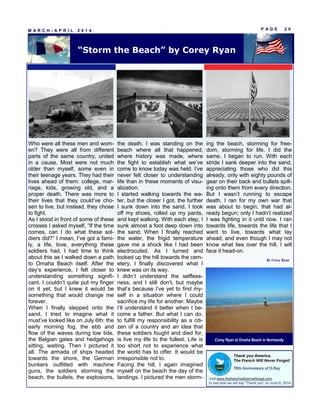
The Miami-Florida European Un-
ion Center of Excellence would
like to share with you the wonder-
ful essay Corey Ryan wrote on the
Omaha Beach in Normandy.
FIU alumnus Corey Ryan ’12
wrote this essay after making two
study abroad trips to Normandy
Beach, France, with Professor
John Bailly as part of the course,
Art, War and Human Rights. On the
first trip in 2012, Ryan, an English
major, was a student. Last year, he
went as Bailly’s assistant. During
the study abroad, students meet
with a Holocaust survivor and
then visit Omaha Beach in Nor-
mandy where Allied Troops invad-
ed German-occupied France dur-
ing World War II.
I had never heard this kind of
silence before, the kind you’d usu-
ally reserve for death. I was stand-
ing at the bottom of an impact
crater and listened for something,
anything, really.
Nothing.
Not the wind, nor the faint
murmuring of tourists walking
about, and certainly not the sound
of English Channel waves crashing
against the cliffs.
I felt trapped. My legs
couldn’t move. I wanted to yell for
somebody to come and drag me
out of this thing, but I couldn’t,
knowing that sixty-nine years ago
a mortar shell hit this earth and left
it’s mark right where I was stand-
ing. Was somebody standing here,
sixty-nine years ago, when it hit?
Climbing out of that crater
was like climbing out of Hell, a
stark contrast to what I saw when I
finally reached the top: the English
Channel extending for miles ahead
of me, bleeding into the clouds so
that it almost seemed like the
water rose all the way to Heaven.
On the cliff-top where I was stand-
ing, dozens and dozens of impact
craters similar to the one I just
crawled out of dotted the land-
scape, with a few, destroyed Ger-
man bunkers scattered throughout.
This was Pointe du Hoc, one of the
many sites of the Normandy land-
ings.
It was surreal being in Nor-
mandy, a place of such beauty and
of such destruction. I had read the
stories, seen the movies, and still, I
had a hard time accepting what
once occurred here. We live in the
present attempting to understand
the past, but we can never relive it.
Leaving the United States for a
summer, traveling to France, and
visiting Normandy, I was doing my
best to understand the world, to
understand a time where men and
women sacrificed their lives and
their futures so selflessly, so that
you and I may live in a world with-
out hate.
Earlier that day I visited the
ever-personal, and sadly, less-
frequently visited, British Cemetery
in Bayeux. As I strolled between
the rounded rows of marble cross-
es, I read the inscriptions the
fallen’s family had written at the
base of each headstone. Some
were from the Bible, reminding us
that their loved ones are in a better
place. Others were more personal:
“you were taken but baby Francis
came to take your place, your
loving wife Marie.” Some even
displayed the camaraderie shared
between these soldiers: “the fittest
place where man can die, where
he dies for man.”
I was confused. I couldn’t
understand the selflessness. I
appreciated it and recognized each
soldier’s sacrifice, but I couldn’t
fully grasp the idea of giving up my
own life so that others may live
freely. Maybe it’s my fault for that.
Maybe it’s because of the world we
live in today, where people are so
detached from everything around
them that they take for granted
how lucky they are to be living.
Later that day I went to the
Normandy American Cemetery at
Omaha Beach. Rounding the
corner, I stood in front of the
Memorial and looked out upon all
9,387 marble crosses, each stand-
ing at attention, completely uni-
form. Each cross has a story to
tell, a story of life and of death.
“Storm the Beach” by Corey Ryan
Who were all these men and wom-
en? They were all from different
parts of the same country, united
in a cause. Most were not much
older than myself, some even in
their teenage years. They had their
lives ahead of them: college, mar-
riage, kids, growing old, and a
proper death. There was more to
their lives that they could’ve cho-
sen to live, but instead, they chose
to fight.
As I stood in front of some of these
crosses I asked myself, “If the time
comes, can I do what these sol-
diers did?” I mean, I’ve got a fami-
ly, a life, love, everything these
soldiers had. I had time to think
about this as I walked down a path
to Omaha Beach itself. After the
day’s experience, I felt closer to
understanding something signifi-
cant. I couldn’t quite put my finger
on it yet, but I knew it would be
something that would change me
forever.
When I finally stepped onto the
sand, I tried to imagine what it
must’ve looked like on July 6th: the
early morning fog, the ebb and
flow of the waves during low tide,
the Belgian gates and hedgehogs
sitting, waiting. Then I pictured it
all. The armada of ships headed
towards the shore, the German
bunkers outfitted with machine
guns, the soldiers storming the
beach, the bullets, the explosions,
the death. I was standing on the
beach where all that happened,
where history was made, where
the fight to establish what we’ve
come to know today was held. I’ve
never felt closer to understanding
life than in these moments of visu-
alization.
I started walking towards the wa-
ter, but the closer I got, the further
I sunk down into the sand. I took
off my shoes, rolled up my pants,
and kept walking. With each step, I
sunk almost a foot deep down into
the sand. When I finally reached
the water, the frigid temperature
gave me a shock like I had been
electrocuted. As I turned and
looked up the hill towards the cem-
etery, I finally discovered what I
knew was on its way.
I didn’t understand the selfless-
ness, and I still don’t, but maybe
that’s because I’ve yet to find my-
self in a situation where I could
sacrifice my life for another. Maybe
I’ll understand it better when I be-
come a father. But what I can do,
to fulfill my responsibility as a citi-
zen of a country and an idea that
these soldiers fought and died for,
is live my life to the fullest. Life is
too short not to experience what
the world has to offer. It would be
irresponsible not to.
Facing the hill, I again imagined
myself on the beach the day of the
landings. I pictured the men storm-
ing the beach, storming for free-
dom, storming for life. I did the
same. I began to run. With each
stride I sank deeper into the sand,
appreciating those who did this
already, only with eighty pounds of
gear on their back and bullets spill-
ing onto them from every direction.
But I wasn’t running to escape
death. I ran for my own war that
was about to begin, that had al-
ready begun; only I hadn’t realized
I was fighting in it until now. I ran
towards life, towards the life that I
want to live, towards what lay
ahead, and even though I may not
know what lies over the hill, I will
face it head-on.
P A G E 2 0M A R C H - A P R I L 2 0 1 4
“Storm the Beach” by Corey Ryan
By Corey Ryan
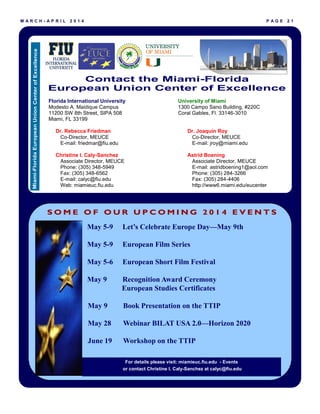
Corey Ryan at Omaha Beach in Normandy
M A R C H - A P R I L 2 0 1 4 P A G E 2 1
Eu ro
Florida International University
Modesto A. Maidique Campus
11200 SW 8th Street, SIPA 508
Miami, FL 33199
Dr. Rebecca Friedman
Co-Director, MEUCE
E-mail: friedmar@fiu.edu
Christine I. Caly-Sanchez
Associate Director, MEUCE
Phone: (305) 348-5949
Fax: (305) 348-6562
E-mail: calyc@fiu.edu
Web: miamieuc.fiu.edu
University of Miami
1300 Campo Sano Building, #220C
Coral Gables, Fl. 33146-3010
Dr. Joaquín Roy
Co-Director, MEUCE
E-mail: jroy@miami.edu
Astrid Boening
Associate Director, MEUCE
E-mail: astridboening1@aol.com
Phone: (305) 284-3266
Fax: (305) 284-4406
http://www6.miami.edu/eucenter
Miami-FloridaEuropeanUnionCenterofExcellence
Contact the Miami-Florida
European Union Center of Excellence
For details please visit: miamieuc.fiu.edu - Events
or contact Christine I. Caly-Sanchez at calyc@fiu.edu
May 5-9 Let’s Celebrate Europe Day—May 9th
May 5-9 European Film Series
May 5-6 European Short Film Festival
May 9 Recognition Award Ceremony
European Studies Certificates
May 9 Book Presentation on the TTIP
May 28 Webinar BILAT USA 2.0—Horizon 2020
June 19 Workshop on the TTIP
S O M E O F O U R U P C O M I N G 2 0 1 4 E V E N T S

Sample MEUCE Newsletter

  • 1.
    M A RC H - A P R I L 2 0 1 4V O L U M E 4 , I S S U E 2 7 Miami-Florida European Union Center of Excellence - FIU Newsletter This year, the Miami-Florida European Un- ion Center of Excellence had the great honor and privilege to have the annual Directors’ meeting take place in Miami. Hosted by our fellow European Union Center of Excellence at the University of North Carolina at Chapel Hill, the Directors’ meeting took place on March 20-22 in downtown Coral Gables. Over these three days, directors and associate directors from the ten EU Centers of Excellence around the nation gathered together to dis- cuss past successes, share advice, and to plan future collaborative events. The series of events began on the evening of Thursday, March 20th with a reception and dinner at the home of the Consul Gen- eral of France, the Honorable Philippe Létrilliart. Members of the various Europe- an Union Centers of Excellence ate dinner and networked with local professionals, academics, business leaders, and mem- bers of Miami’s diplomatic community. This informal setting allowed members to com- municate and get to know each other in a way that would contribute greatly to the sense of camaraderie and common mission of building greater ties between the United States and Europe. The next day, Friday March 21st, EU directors met in Miami’s historic Coral Gables’ Miracle Mile at the innovative workspaces of Right Space 2 Meet for a full day of work and collaboration. The day began with remarks by François Rivasseau, the Deputy Head of the EU Delegation to the United States, who re- marked on how important these centers are in promoting EU-US ties through teach- ing, research and community outreach. Mr. Rivasseau’s speech inspired the remainder of the morning’s discussion on the EU’s changes and efforts to promote transatlan- tic research initiatives. The changes asso- ciated with the Horizon 2020 program were a point of major discussion, a subject that would come up again on Saturday (see article on page 5-6). Following a delightful and recharging lunch at a local restaurant, members of the EU centers reconvened in the afternoon to discuss their methods and strategies for engaging in outreach. From newsletters such as this one, to I N S I D E T H I S I S S U E  Annual EU Centers of Excellence Networking Meeting..……...…........1-4  Workshop on Horizon 2020 ……...….……...…..5-6  Workshop on Gender and Generations …….7-9  Gender Equality for Generation y in 2030: an EU Perspective…....10  Immigration and the Radical Right in Europe……...….........11-12  Crisis in Ukraine…..13-14  The EU and Russia Competition and Conflict in Eastern Europe and the Caucasus.…............15  The Euro Challenge Competition 2014....16-17  World War II Veterans honored by French Consulate……………….18  Storm the Beach ….19-20  Announcements and Contact Info……..…......21 miamieuc.fiu.edu Annual EU Centers Network Meeting in Miami Directors and Associate Directors at the Annual EU Centers Network Meeting in Miami—March 21-22, 2014
  • 2.
    YouTube channels andtwitter handles, as well as more conventional methods, EU Centers shared and learned of new ways to spread the message to their local researchers and professionals about the oppor- tunities available through collaboration. The day’s fruitful meeting concluded following remarks from Jean Luc-Robert, First Counselor of the European Parliament Liaison Office with the US Congress, and an update from the European Delegation. The morning of Saturday March 22nd saw the close of the network meeting for 2014. Associate directors met to discuss the best way to make sure that EU centers around the nation continue to work together. With the success of past endeavors such as the videoconference series hosted by the EU Center at the University of Pittsburgh, participants were well aware that working together has been and will continue to offer the best and most efficient use of time. The day, and the weekend’s meetings con- cluded with new information on Horizon 2020 (the subject of the article on page 5-6). While members of MEUCE will miss having our fellow EU Center directors and associate directors in our backyard, the level of collaboration among these institutions means that the conversation is not at an end. The Miami-Florida European Union Center of Excel- lence would like to thank sincerely Hon. Philippe Létrilliart, Consul General of France in Miami, Mark Trowbridge, President and CEO of the Coral Gables Chamber of Commerce, and Caroline Rendeiro, President and CEO of Right Space 2 Meet, Inc. for sponsoring this event, and making it a success. M A R C H - A P R I L 2 0 1 4 P A G E 2 Annual EU Center Networking Meeting in Miami this March From left to right: Dr. Erica Edwards, Dr. John D. Stephens, François Rivasseau From left to right: Eva Dunn, Dr. Phil Shekleton, Dr. Jeffrey Pennington, Dr. Beverley Crawford, Dr. Anna Westerståhl Stenport, Dr. Ronald Linden By Jason Chohonis From left to right: Dr. Jeffrey Pennington, Dr. Beverley Crawford, Dr. Anna Westerståhl Stenport, Dr. Ronald H. Linden; Dr. Elisabeth Covington, Dr. Myra Marx Ferree, Elina A. Day, Jean-Luc Robert
  • 3.
    P A GE 3 Annual EU Center Networking Meeting Dinner Reception at the residence of the Consul General of France M A R C H - A P R I L 2 0 1 4 From left to right: Christine I. Caly-Sanchez, Hon. Philippe Létrilliart, Hon. Cristina Barrios, Dr. Joaquin Roy From left to right: Helen Henderson, Hon. Adolfo Barattolo, Sophie Delporte From left to right: Hon. Philippe Létrilliart, Dr. John D. Stephens , François Rivasseau From left to right: François Rivasseau, John Yearwood, Mark Trowbridge From left to right: Mark Trowbridge, Dr. Erica Edwards, Carolina Rendeiro, Dr. John D. Stephens, Dr. Irma Beccera-Fernandez From left to right: Aude Jehan and Jean-Luc Robert
  • 4.
    P A GE 4 Annual EU Center Networking Meeting Cocktail-Reception in Coral Gables sponsored by the Coral Gables Chamber of Commerce M A R C H - A P R I L 2 0 1 4 Francois Rivasseau, Deputy Head, Delegation of the European Union to the United States, explaining the relationship between Europe and the United States. From left to right: Mark Trowbridge, CEO & President, Coral Gables Chamber of Commerce; Jim Cason, Mayor of the City of Coral Gables; Christine I. Caly-Sanchez, Associ- ate Director, MEUCE, FIU; Silvia Kofler, Head of the Press & Public Diplomacy Section, and Spokesperson, Delegation of the EU to the US; Carolina Rendeiro, CEO, Right Space Management, Inc.; Francois Rivasseau, Deputy Head, Delegation of the EU to the US. From left to Right: Mark Trowbridge, CEO & President, Coral Gables Chamber of Commerce; Frances Reaves, President of Latin American Connection; Francois Rivasseau, Deputy Head, Delegation of the European Union to the United States.
  • 5.
    M A RC H - A P R I L 2 0 1 4 P A G E 5 The Miami-Florida European Union Center of Excellence (MEUCE) has dedicated a sig- nificant amount of energy to en- suring that local researchers and professionals are aware of the BILAT and Horizon 2020 Programs. These programs, that provide grant and research money to U.S researchers and businesses that work with Euro- pean partner organizations, were the subject of a recent workshop in Coral Gables’ Miracle Mile on Saturday March 22, 2014. With many EU Center directors in Miami for the annual EU Center meetings, this workshop entitled“EU Research and Innovation Funding through Horizon 2020” provided the perfect opportunity to dissemi- nate valuable information that could then be relayed around the nation by the respective EU Centers. This workshop was jointly sponsored by BILAT USA 2.0, MEUCE, and FIU and was co-sponsored by Euraxess Links, DLR, and the Right Space 2 Meet. This meeting was housed in the workspaces of the Right Space 2 Meet company, which offers confer- ence rooms and virtual offices for researchers and entrepre- neurs. An incredibly unique lo- cation that even contained a former bank vault that is still functional, this workspace was the ideal place to meet to dis- cuss opportunities available for innovative researchers in the United States. MEUCE had the oppor- tunity to speak with the work- shop presenter, Viktoria Bodna- rova, a regional representative of Euraxess Links North Ameri- ca. Euraxess Links, Ms. Bodna- rova informed us, main goal was to “inform scientists of all nationalities based in North America about the job vacan- cies and funding opportunities available in 40 European coun- tries.” Euraxess, as part of the Horizon 2020 funding program, operates as an “information center to spread the word of different funding opportunities” that are available through Hori- zon 2020. Unlike the EU dele- gation, Euraxess focuses less on collaborative projects and more on “individuals, individual mobility, individual fellow- ships.” Instead of trying to form consortium, which involves dif- ferent rules and procedures, Bodnarova makes individuals aware through “a website, social media, a newsletter that is sent to our community every month where we look through opportunities available in each of these 40 countries.” Bodnarova and her peers at Euraxess Links are busy as getting the word out on “6-8000 job vacancies that are available every day” means they must inform “the research organiza- tions who publish the vacancies on their website.” As part of this effort to disseminate information about opportunities available for individual researchers, Bodna- rova spoke to the assembled directors of the EU Centers who had gathered in Miami. These participants were made aware of the many opportunities avail- able for researchers and how these opportunities could be found. Bodnarova informed Workshop on Horizon 2020 Viktoria Bodnarova Regional Representatrve of Euraxess Links North America Workshop on Horizon 2020 at Right Space 2 Meet—March 22, 2014 From left to right: Carolina Rendeiro, Christine I. Caly-Sanchez, Dr. Rebecca Friedman, Viktoria Bodnarova
  • 6.
    M A RC H - A P R I L 2 0 1 4 P A G E 6 MEUCE that these EU Directors and Associate Directors “could spread the word in their univer- sities to their researchers. I think of them as multipliers of the message, I introduce the schemes and let them know what is possible.” Ultimately, due to the efforts of MEUCE, Euraxess Links, BILAT, and our fellow European Union Centers, Bodnarova and Horizon 2020’s message will reach many more eager researchers throughout North America. As the members of the EU Centers departed Miami, they did so much more aware of ways to assist their colleagues back home. For more information please contact Christine I. Caly-Sanchez, Associate Director of the MEUCE, by email at calyc@fiu.edu or please visit http://miamieuc.fiu.edu/events/general/2014/ meuce-bilat-usa-20-meeting-fiu/ Workshop on Horizon 2020 (con’t) By Jason Chohonis Dr. Antonello Pileggi, Christine I. Caly- Sanchez, Viktoria Bodnarova BILAT USA 2.0—Workshop on Horizon 2020—March 22, 2014 Participants of the Workshop Horizon 2020 - March 22, 2014 Directors and Associate Directors of the following EUCE Centers of Excellence: University of Colorado, University of North Carolina Chapel Hill, University of Seattle, John Hopkins University, University of Pittsburgh, University of Wisconsin-Madison, University of Texas-Austin, Florida International University, University of California-Berkeley, University of Illinois
  • 7.
    P A GE 7 M A R C H - A P R I L 2 0 1 4 On March 28th and 29th the Miami- Florida European Union Center of Ex- cellence (MEUCE) and its sister organi- zation, the University of Wisconsin- Madison European Union Center of Excellence collaborated to bring Miami residents, FIU students, and leading scholars from around the country to participate in an incredibly engaging academic workshop. Friday March 28th featured a full day of panel discussions and lectures on a beautiful Miami day. Dr. Rebecca Friedman, the MEUCE co- director, and Dr. Myra Marx Ferree, the Wisconsin European Union Center di- rector welcomed participants to the workshop and indicated that the a sub- ject as diverse as “Gender and Genera- tions” would necessitate a creative for- mat in which collaborative discussion featuring scholars from multiple disci- plines would be the style of the days conference. This somewhat informal approach allowed individuals of many different research interests to question each other’s’ arguments in a productive and engaging way. The first panel of the day dis- cussed the idea of gender and genera- tion in a historical context. Dr. Geoff Eley, a professor of history at the Uni- versity of Michigan discussed the idea of generation and the way this concept entangles with the idea of gender. Dr. Eley discussed some of the conceptual problems that arise with discussing any specific ‘generation’, a term that can often appear arbitrary. Dr. Eley was able to demonstrate that the concept of generation is in many ways an expres- sion of both analysis of social topogra- phy as well as an indication of agency, or self-identification. Dr. Eley discussed how these conceptual ideas related to the relationship between labor, capital, and government since the 1960s. Fol- lowing Dr. Eley, Dr. Camille Robcis, an assistant professor of history at Cornell University discussed “Family Policy and the Origins of the Welfare State in France.” Dr. Robcis discussion began with an explanation of the issue of gay rights in France, an issue that lead to “massive street protests.” Dr. Robcis explored the way that gay marriage and reproductive rights were rhetorically expressed by protestors on either side of the political divide, and how the form protests took often utilized imagery and rhetoric related to ideas of traditional French Republicanism. Dr. Robcis ar- gued that in French culture, the idea of ‘the social’ cannot exist without the idea of ‘the family’, a result of specific his- torical conditions such as the 1939 French family code, or the earlier 1804 French civil code. The discussion pivot- ed with the panel’s next presenter, Dr. Becky E. Conekin, a professor with the History and MacMillan Center, Yale, who discussed issues of morality amongst female laborers in Europe in the twentieth century and the relation to consumer culture. Dr. Conekin ex- plained that her research and interviews with models has revealed the way that gender and generation, class and morali- ty evolved throughout the twentieth century in public discourse. Dr. Con- ekin, a former AIDS activist, argued that the discourse surrounding AIDS has shifted in that today prostitutes are no longer labeled as predators in the HIV debate, but as potential victims, and that issues of HIV and prostitute rights figure into the contemporary transnational labor debates and labor movements of today. On Saturday March 29th, the enthusias- tic participants, refreshed from a relax- ing South Florida evening reconvened at FIU for another round of panel discus- sions. As participants ate breakfast, Dr. Mary Daly, a professor of sociology and social policy from the University of Oxford spoke about the concept of in- terventions around parenting as a way of looking at the intersection of gender and generations. Dr. Daly’s lecture fo- cused on the specific policies put in Workshop on Gender and Generations in Europe Panel I: History Reverberations—March 28, 2014 Dr. Myra Marx Ferree, Dr. Rebecca Friedman, Dr. Geoff Eley, Dr. Becky Conekin, Dr. Camille Robcis Dr. Myra Marx Ferree, Director, European Union Center of Excellence, University of Wisconsin-Madison
  • 8.
    P A GE 8M A R C H - A P R I L 2 0 1 4 Workshop on Gender and Generations in Europe (cont’) place in England under the New-Labour party that targeted parents for support and problem solving, and compared these interventions to those in place in France and Germany. Dr. Daly ex- plained that cross national differences in parenting intervention could be ex- plained by a number of factors includ- ing “the perspective on and organization for child welfare” and “the approach taken to family and the prevailing social philosophies around family.” According to Dr. Daly all of these countries recent parenting policy approaches demon- strate the common features of focusing on parents and parenting behavior while also underplaying the agency of chil- dren, and signifies a move for policies inside of family dynamics. While many, such as this writer, were unfamiliar with the sociological methodology used by Dr. Daly, her lecture, expertly ex- pressed, made all participants familiar with the role generation plays in these interventions, as well as the conse- quences of gender’s absence from these interventions. Saturday’s second speaker was Dr. Diane-Gabrielle Tremblay, the Can- ada Research Chair on the Socio- organizational challenges of the Knowledge Economy and a Professor at the School of Administration at TELUQ| Université de Québec. Dr. Tremblay spoke about “the work-family relation and public policy: towards gen- der equality” and compared the way that France, Belgium, and Québec ap- proached work life issues. Some coun- tries, such as some of those in Southern Europe engage in a non-intervention model, in which there is no policy inter- vention in the work-life model. Others, such as France, engage in the alternation model in which some policies are in place that see women as alternating be- tween work and family obligations. The third model, Dr. Tremblay argued, is where Québec fits in, and should be termed a model of “work-life reconcilia- tion or work-family articulation.” Qué- bec, more than France or Southern Eu- ropean countries, utilizes policies like paternity leave that more closely follow the “work-family reconciliation model.” The day’s final speaker is a familiar face to MEUCE, having partici- pated in a number of previous events with FIU’s EU Center, the University of Miami’s Dr. Louise K. Davidson- Schmich. Dr. Davidson-Schmich, a pro- fessor at UM’s Department of Political Science, presented her lecture entitled “The Needs of Families and Political Responses in Germany”, which ex- plored the “one thing that all European countries have in common, that all of them have laws and policies that define legally who is related to whom. All of these countries confer legal privileges, rights, and responsibilities to individu- als related to each other that they do not confer on individuals who don’t share relations. We have seen that all of these policies are highly gendered and highly heteronormative.” Dr. Davidson- Schmich explored relationships of care, that don’t stem from sexual relation- ships, and as such fall outside the con- ventional heteronormative family poli- Panel II: Contemporary Changes - March 28, 2014 Dr. Philip N.Cohen, Dr. Pearl Dykstra , Dr. Gerda Neyer, Dr. Kimberly Morgan, Dr. Chiara Saraceno, Panel III: Political Responses - March 29, 2014 From left to right: Dr. Myra Marx Ferree, Dr. Mary Daly, Dr. Diane-Gabrielle Tremblay, Dr. Louise Davidson-Schmich
  • 9.
    cies of differentstates. Specifically, Dr. Davidson-Schmich presented her re- search into ‘Rainbow Families’ in Ger- many, those that fall outside the heter- onormative model. Dr. Davidson- Schmich indicated that her research revealed that 92% of those same sex households that have children are fe- male-female, which reveals a clear gen- dered balance. These families, Dr. Da- vidson-Schmich explained, face many challenges in Germany, and feel that “their family is disadvantaged legally and financially” and want more rights for ‘social parents’, more financial secu- rity and welfare benefits, and are con- cerned with inheritance rights. Most importantly, some organizations have called for “elimination of all marriage privileges in favor of alternative forms of living together that are appropriately supported.” Yet these policy preferences have not been endorsed by either Wom- ens Organizations or LGBT Organiza- tions, who have focused their attention on strictly defined marriage rights, and the policy of German Life Partnerships for homosexual couples do not have all the family and property rights of tradi- tional marriage. Clearly, more policy reforms are needed in Germany and elsewhere to fulfill the wishes of those seeking rights for Rainbow families. This conference was without a doubt a great success. The multiplicity of perspectives and viewpoints allowed participants to challenge their own con- ceptions of gender and generation. MEUCE eagerly looks forward to the next opportunity to work alongside our fellow European Union Centers to ex- pand academic discussion on these cru- cial social categories. Panelists, and organizers of the conference on “Gender and Generations” P A G E 9 M A R C H - A P R I L 2 0 1 4 Workshop on Gender and Generations in Europe (cont’) For additional information on this conference (videos, PPT, Bios, please visit the following link: http://miamieuc.fiu.edu/events/ general/2014/meuce-march-28-29-two-day- eu-conference-on-gender-and-generations- fiu/ By Jason Chohonis
  • 10.
    P A GE 1 0M A R C H - A P R I L 2 0 1 4 As mentioned on the article on pages 7-9, the Miami- Florida European Union Center of Excellence (MEUCE) and the University of Wisconsin-Madison European Union Center of Excellence jointly hosted a conference on “Gender and Generations” on March 28th and 29th of 2014. On Friday, March 28th, invited participants gathered in FIU’s Frost Museum for a luncheon and a keynote address by Agnès Hubert, an Adviser for the Bureau of European Policy Advis- ers (BEPA) European Commission. This lecture was titled “Gender equality for generation y in 2030: an EU perspective.” Ms. Hubert, who has an extensive resume with multiple EU policy making roles, includ- ing a stint as the Head of the Unit Equal Opportuni- ties for Women, informed participants about how some of the specific academic issues raised, such as the gendering of the social contract and the welfare state, apply in the contemporary context for members of Generation Y (roughly those born between 1980 and 2000). Ms. Hubert explained that gender equality “is a value of the EU, that is to be promoted as a founding principle of the EU that conditions sanctions and the accession of new member states.” Even to- day absolute gender equality does not prevail across the EU, despite the gains that have been made for women over the twentieth century. As Ms. Hubert explained, measures of the Gender Equality Index indicate that women still lag behind men in greater or lesser degrees across all of Europe. Hubert indicated that generational changes and expectations continue to influence the way that gender is constructed and realized. Ms. Hubert discussed the future trajectory for trends in gender equality. Ultimately, she explained that equality is “progressing, but not very quickly”. Many challenges exist in the post-crisis EU. Ms. Hu- bert, aware of these challenges, discussed what re- search strategies may help Europe’s policy makers, and indicated that “the current materialistic culture is not sustainable”. Other measures, besides Gross Domestic Product (GDP), will be necessary to deter- mine how successful policy reforms are. Ms. Hubert explained that for a variety of reasons not directly measurable by GDP, European investment in Gender Equality should make Europe more competitive, dem- ocratic, welcoming of change, and able to socially innovate to protect the positive aspects of the welfare state. Despite the fact that the achievement of gender equality in the European Union and the United States, not to mention elsewhere, is a long way away, the continued attention of professionals such as Ms. Hubert indicates that future generations, as well as generation Y, will continue to push towards a more just planet. Gender Equality for Generation y in 2030: an EU Perspective For additional information on this event and to watch the video, please visit the following link: h t t p s : / / w w w . y o u t u b e . c o m / w a t c h ? v=vqIOkgLcrF0&list=HL1398262964&feature=mh_lolz By Jason Chohonis At the Q & A—Captive Audience Agnès Hubert, Adviser, Bureau of European Policy Advisors, European Commission
  • 11.
    P A GE 1 1 M A R C H — A P R I L 2 0 1 4 Dr. Erica Edwards speaks to FIU students about “Immigration and the Radical Right in Europe” There has been significant interest on both sides of the Atlantic about the relationship between the growth of radical right populist parties and the in- crease in immigration in the EU. The Miami- Florida European Union Center of Excellence (MEUCE) was proud to have the opportunity to host a lecture by Dr. Erica Edwards, a scholar of EU politics and the Executive Director of the Euro- pean Union Center of Excellence at the University of North Carolina at Chapel Hill to share her re- search on this subject. Her talk was entitled “Immigration and the Radical Right in Europe.” This lecture took place on the morning of March 20th, 2014 at FIU’s Modeste Maidique Campus before a crowd of students and faculty members alike. Dr. Edwards’ lecture was lively and enthu- siastic, and featured frequent give and take be- tween students, faculty, and Dr. Edwards herself. Dr. Edwards presented students with a plethora of statistical information about the immigrants them- selves and indicated that push and pull factors must be considered when analyzing why immi- grants move where they do. Following this statisti- cal overview, Dr. Edwards informed students that there were three distinct waves of immigration to Europe. These three waves included post World War II immigration (1945-1970) for the purposes of labor, family reunification migration (1970s- 2000), and the most recent wave of asylum seek- ers, refugees, and illegal immigration (1989 to the present). Dr. Edwards, following her presentation of this historical context, explored the ideologies of European right wing parties that have reacted to these waves of immigration. Students were capti- vated by Dr. Edwards exploration of the nativist ideologies present in European political video and print advertisements that presented xenophobic images of immigrants. In addition to having nativist ideologies, many of these political parties have authoritarian impulses, and favor ‘law and order policies’ that often “favor punishing out group figures in the name of some authority,” Edwards explained. In addition to authoritarianism and na- tivism, these groups also make use of populist rhetoric in order to divide a society into create an “other” or outsider group in society. Dr. Edwards posited that these groups combination of nativism and populist ideological impulses means these parties are hostile to compromise and see minority Dr. Erica Edwards, Executive Director of the European Union Center of Excellence at the University of North Carolina at Chapel Hill
  • 12.
    P A GE 1 2 M A R C H — A P R I L 2 0 1 4 Dr. Erica Edwards speaks to FIU students about “Immigration and the Radical Right in Europe” (cont’) rights as special interests, and therefore undemo- cratic. One member of the radical right that has received a lot of attention is Netherlands politician and “Party for Freedom” founder and leader Geert Wilders. This party achieved its greatest popularity in 2010, and has recently seen its popularity on the decline, a trend Dr. Edwards indicated is con- sistent throughout Europe. Rather than a rise in radical right wing parties, Dr. Edwards argued that these parties lack any concrete plan to enact the changes they argue for in society, and as such decline in popularity following a brief surge. The concern however, Dr. Edwards argued, is that “these groups shift the rhetoric and framing of these issues”, and that mainstream parties often co-opt the nativist and populist rhetoric of these radical parties. Following a question from the audience, Dr. Edwards explained the relationship between Euroscepticism and anti-immigration. Dr. Edwards argued that what makes these groups popular is their anti-immigration stance more so than their Euroscepticism. Additionally, the Euroscepticism of these parties is more tied to opposition to elite power and globalization than to their separate na- tivist policies. As this issue is not likely to disappear anytime soon, make sure to visit the MEUCE website and Facebook page for more updates on future events concerning this issue! By Jason Chohonis Captive audience Dr. Erica Edwards with FIU students Dr. Erica Edwards explaining the Immigration and the Radical Right in Europe
  • 13.
    M A RC H - A P R I L 2 0 1 4 P A G E 1 3 Crisis in Ukraine: a Teach In Florida International Uni- versity (FIU) students are not alone in wondering what exactly to think about the recent events in Ukraine, including the annexa- tion of Crimea. From Brussels to Washington D.C and elsewhere, the public is concerned and curi- ous about how the potentially inflammatory Russian takeover of Ukrainian sovereign territory occurred and what the conse- quences will be going forward. On Tuesday March 25th, 2014, the Miami-Florida European Un- ion Center of Excellence (MEUCE) sponsored a Teach-In Panel discussion of FIU experts to explore some of the more pressing issues related to just these type of events taking place in that part of the globe: Ukraine and Russia. Dr. Friedman, the MEUCE Co-Director and a Rus- sian historian, opened the Teach -In with an introduction about the wide variety of media coverage of Ukraine. She indicated that the large scope of interest and dizzy- ing pace of developments has led to a variety of speculation about what is going on, who is at fault, and what should be done going forward. Following Dr. Friedman’s introduction, the floor was turned over to Dr. Tatiana Kostadinova, an expert on East- ern European politics, who spoke at length about the events that have unfolded since former Pres- ident Yanukovych was ousted from the Ukrainian government. Dr. Kostadinova indicated that Eastern European countries, such as Romania and Bulgaria, “feel very threatened” because of “significant Russian groups that have bought homes along the Black Coast. What happens if these people feel they are not treated well by their government and seek protection from Rus- sia? Nobody knows what will happen then, and there are fears that begin to magnify.” Dr. Kosta- dinova emphasized that what has happened in the last three weeks “was not unexpected, and that there was a constant possi- bility” of Russian aggression in the region, citing the 2009 Rus- sian invasion of Georgia and pre- vious hostility towards Ukrainian accession into NATO. Dr. Markus Thiel, an assistant professor of Political Science and International Rela- tions, focused on the European reaction to the Russian annexa- tion of Crimea. Dr. Thiel dis- cussed some of the policies of Western Europe towards Eastern Europe that have created Rus- sian animosity and contributed to the Russian move into sovereign Ukrainian territory. Dr. Thiel indi- cated that it is very “difficult, because the European Union consists of over 20 member states” that have a variety of rela- tionships and feelings towards Russia, including some that could be considered ‘strategic partners’ of Russia such as Germany, others such as Greece that have become havens for Russian investment, and others that are very opposed to Russia such as Poland and Lithuania. Dr. Thiel discussed the limited sanctions and disciplinary initia- tives that have been taken thus far, and what could occur going forward, indicating that larger sanctions could be forthcoming and that concerted military action is unlikely. Yet, Dr. Thiel indicat- ed that domestic concerns such as coalition politics, concern about economic growth and recovery, and platform promises may prevent any hardline ap- proach lead by important regional player Germany and Angela Merkel. Following Dr. Thiel’s con- tribution, the floor was turned over to Vera Beloshitzkaya, a PhD student in FIU’s Department of Politics and International Rela- From left to right: Vera Beloshitzkaya, Dr. Markus Thiel, Dr. Tatiana Kostadinova, Dr. Rebecca Friedman
  • 14.
    M A RC H - A P R I L 2 0 1 4 P A G E 1 4 tions. Ms. Beloshitzkaya offered a historical overview of Ukraine going back to the 17th century in order to explain how ethnicity and borders were formed as a result of specific historical periods. Ms. Beloshitzkaya indicated that the historical portioning of Ukraine throughout the last few centuries has created the amalgamation of ethnic groups and identities seen in Ukraine today. Dr. Peter Craumer, a Geographer with exper- tise in the region, gave students a geographic per- spective on the crisis. Dr. Craumer criticized some of the recent journalistic portrayals of the crisis and the demographics of Ukraine, indicating that the maps of Ukraine that have been shown by the media have been overly focused on ethnic differences that make Eastern and Western Ukraine appear starkly differ- ent. Instead, Dr. Craumer presented maps that em- phasized the ethnic differences between ‘Russians’ and ‘Ukrainians’ in Ukraine is more subtle than as- sumed by observers in the United States. Dr. Craumer indicated that the blurring of ethnic and lan- guage identity boundaries has contributed to the cur- rent debate over the physical boundaries of sover- eign nation states. The day’s final panel lecture was provided by Dr. Martin Palouš, the director of the Vaclav Havel Center for Human Rights and Diplomacy at FIU. Dr. Palouš, who previously had served as Czech Ambas- sador the United Nations, provided an experienced diplomat’s perspective. He explained concepts of international law related to the current transgression of international law by the Russian Federation. Dr. Palouš indicated that the actions of Russia regarding the Crimean peninsula are particularly frightening in that they reflect a violation of the Budapest Memo- randum of the Nuclear Non-Proliferation treaty in which Russia promised to respect the territorial sov- ereignty of Ukraine. Dr. Palouš indicated that nothing has legitimized Russian aggression and that “this Ukrainian situation is a serious geopolitical situation. After the formal contributions, an enlightening question and answer period ensued. Please look for more such events on the state of affairs in Ukraine as the conflict continues. For more information, please visit http://miamieuc.fiu.edu/events/general/2014/roundtable-on-crisis-in-ukraine-teach-in-fiu/ By Jason Chohonis Crisis in Ukraine: a Teach In (con’t) Dr. Tatiana Kostadinova, Associate Professor, Politics & International Relations, FIU From left to right : Dr. Martin Palouš, Dr. Peter Craumer, Vera Beloshitzkaya,
  • 15.
    P A GE 1 5 M A R C H - A P R I L 2 0 1 4 The EU and Russia Competition and Conflict in Eastern Europe and the Caucasus When the government of the Sovi- et Union collapsed in the early 1990s, the international communi- ty celebrated the end of the Cold War. This seemed a moment that promised future peace in the re- gion. Unfortunately, the actions taken by Russia under Vladimir Putin towards neighboring nations have been less than peaceful over the past decade, particularly over the last year in the Crimean penin- sula. The increased level of con- flict and hostile negotiations in the Caucasus has lead to a commen- surate level of student interest in what exactly is going on in this region. The Miami-Florida Europe- an Union Center of Excellence (MEUCE), cognizant of this fervent interest recently hosted a lecture by an esteemed scholar, Dr. Han- nes Adomeit, who is currently a Fellow with the German Academic Exchange Service (DAAD). Dr. Adomeit, who earned his doctorate in Russian Studies from Colombia University, spoke to FIU students on April 8th 2014 in a lecture enti- tled “The EU and Russia: Conflict and Competition in Eastern Eu- rope and the Caucasus.” Dr. Adomeit, who has pub- lished extensively on the relation- ship between the United States, Europe, and Russia, spoke before students gathered at FIU’s School of International and Public Affairs (SIPA) about the economic, diplo- matic, and historical roots of this current conflict. Dr. Adomeit spoke about how the agreements made between the European Union and Russia to “respect the rule of law” in the region of Eastern Europe and the Caucasus have not been realized. Outlining ten propositions that he believed applied to the re- gion, Dr. Adomeit informed stu- dents and guests that Russian for- eign policy “has regarded the post- Soviet space as exclusively a Rus- sian sphere of influence.” The Russian government, according to Dr. Adomeit has acted as if “they have special rights and privileges” in the region that are being en- croached upon by the European Union. This has lead to a very problematic state of affairs as Eastern European governments have acted as sovereign nations and engaged economically and politically with the European Un- ion. Putin, who still imagines the old Soviet space as part of the Russian sphere of influence, pro- claims the legitimacy of efforts to invade sovereign territory under the cloak of the protection of Rus- sian-speaking peoples. Blame for this international crisis was not laid entirely at Rus- sia’s feet. The European govern- ment could have done a better job of trying to integrate post-Soviet Russia. As a former member of the Crisis Prevention Network on Russia-EU relations, Dr. Adomeit was well versed in speaking about the negotiations and supposed transgressions that lead to this blatant disrespect of national sov- ereignty by the Russian Federa- tion. Students and faculty mem- bers were enthralled by Dr. Ado- meit’s analysis of the multifaceted concerns of the political players in the region. The conversation had broad reach-- from domestic con- cerns of the Eastern European nations, to questions about the role of the European Union, to Russia’s desire to create a com- peting Eurasian consortium of na- tions. Audience members left this lecture aware that the blame for this event, while primarily due to Russian nationalistic aggression, can be laid at the feet of many dif- ferent political actors. Ultimately, the depth of Dr. Adomeit’s lecture cannot be sufficiently summarized within this article. For more information, watch the video, follow our facebook page and website for more exciting events. Dr. Hannes Adomeit President Putin, President José Manuel Barroso, President Herman Van Rompuy
  • 16.
    M A RC H - A P R I L 2 0 1 4 P A G E 1 6 On March 13th 2014, the Miami- Florida European Union Center of Excellence was proud to host some of South Florida’s finest young scholars as high schoolers from around the region gathered to com- pete in the first round of the annual Euro Challenge Competition. Spon- sored by the European Delegation to the United States in partnership with Moody’s foundation and the Federal Reserve Bank of the Unit- ed States, this competition is sup- ported by European Union Centers throughout the U.S and challenges students to learn more about the European Union and its currency, the Euro. This competition, in its 9th year, tasks students in teams of three to five to come up with presentations about the challenges facing a single European member state. Students are asked to create 15 minute presentations detailing the economic condition of the country, an economic related chal- lenge facing the country, and ulti- mately, to craft a policy that would address the economic exigencies of that nation. This competition al- lows students to engage with mat- ters of international economics in a way that they wouldn't normally, and provides an incredibly engag- ing way to learn about Europe’s political structure. For example, students from Coral Reef were tasked with addressing the economic turmoil of Greece and the challenges faced by unemployment. One student, who was clearly well versed on the topic, indicated that “it has an un- employment rate of around 28%” and “that the austerity cuts have been devastating.” These 10th grade students indicated that the Eurochallenge positions are tough to come by as students would meet every day to practice during their lunch hour to get ready for the try- outs to represent their school. Clearly these students understand the importance of the European market, as one student remarked “the Euro is the single most im- portant currency next to the U.S dollar.” On March 13th, 11 teams of these students gathered to com- pete. Inside the MARC building things were vibrant, as teams hud- dled and discussed last minute strategy. It was difficult to envy the panels of judges who were forced to decide between the teams of Florida’s best and brightest. As the winners of this competition are sent to New York City to compete in the national competition, a much covet- ed prize, the decision was made even more difficult. Ultimately, the judges decided on two schools who stood out as particularly exception- al- Trinity Preparatory School and Nova High School. These students, above all others, were able to craft meaningful policies to address the economic concerns of their as- signed European Union member states. MEUCE is proud to congrat- ulate these students, as well as their competitors, on another suc- cessful rendition of the local Euro Challenge competition. We wish them the best of luck in New York! ► For more information on this year’s Euro Challenge Competition in Florida please visit: http://miamieuc.fiu.edu/events/general/2014/ meuce-competition-local-florida-euro-challenge- competition-2014-fiu/ ► For more information on the Euro Challenge Competition, please visit: http:// miamieuc.fiu.edu/outreach/euro-challenge/ The Euro Challenge Competition 2014 Florida Students test their European Economic Acumen At the competition: Trinity Preparatory School Panel Judges I From left to right: Luigi Bava, Dr. Rebecca Friedman, Dr. Volker Anding, Gloria Guzman By: Jason Chohonis
  • 17.
    P A GE 1 7M A R C H - A P R I L 2 0 1 4 1st round: FLORIDA EURO CHALLENGE COMPETITION WINNERS Florida International University - March 13th , 2014 2014 NOVA HIGH SCHOOL Swathi Chittlur, Gamer Mohammed, Preethi Atluri, Juan Bedoya, Dang Le TRINITY PREPARATORY SCHOOL Amber Yang, Justin Graham, Nathaniel Saffran, Oliver Trapp, Varun Bathia Judges 2014: Luigi Bava, Sophie Delporte, Mihaela Pintea, Christine I. Caly-Sanchez, Gloria Guzman, Rebecca Friedman, Volker Anding, Markus Thiel, Luis Alvarez Ruiz
  • 18.
    M A RC H - A P R I L 2 0 1 4 P A G E 1 8 While the Miami-Florida European Union Cen- ter of Excellence (MEUCE) does many things to pro- mote ties and friendship between the United States and the European Union, our efforts pale in compari- son to those of the brave men and women who fought during World War II to prevent the spread of fascism. The valiant efforts of those Americans and Europeans that fought against Nazi Germany or Imperialist Japan have created strong bonds that cross the Atlantic to this day. On April 4th, the Consulate General of France and the Honors College of Florida International University (FIU) were pleased to have the opportunity to honor eight of the surviving veterans of the second World War. This incredibly moving event was held at the Frost Museum at FIU and saw the Consul General of France, Hon. Philippe Létrilliart award the insignias of “Chevalier dans l’Ordre National de la Légion d’Hon- neur” (Knight in the National Order of the Legion of Honor) to U.S. veterans who fought alongside France during World War II. This honor, the highest distinction France has to offer to any civilian French or foreigner, was created in 1802 by Napoleon Bonaparte, and has been bestowed upon such famous figures as Victor Hugo, Alexander Du- mas, and Douglas MacArthur. Before receiving this honor, Veteran soldiers met with students of FIU’s honor’s college for a private question and answer ses- sion in which FIU students were able to engage with these veterans personally. More than two dozen students who took part in Profes- sor John Bailly’s study abroad to France were part of the ceremony. The students have all visited the histor- ic sites of World War II’s battles in France. “[This is] the greatest generation speaking to FIU’s generation,” said Bailly, known for bringing the realities of World War II to his students. “Every student in here will re- member this event for the rest of their lives.” The Formal Ceremony began promptly at 3 pm, as participants and Veterans were regaled by the singing of the National Anthem of the United States by FIU honor college’s a cappella group. In addition to the U.S anthem, the group, lead by honors college student Kamila Manzueta sang the national anthem of France. Following this melodic introduction, the Honorable Philippe Létrilliart presented these Veterans, who fought in one of America and Europe’s bloodiest wars, with the insignias that they and others had sacrificed so much for in order to earn. Following the ceremony, a reception was held, and students and Veterans chat- ted amiably. The Miami-Florida European Union Cen- ter of Excellence was proud to have been part of this incredible event and more dedicated than ever to pre- serving the bonds that these soldiers fought for. For more information, the article Ray Boyle wrote, and to view all the pictures of the event, click on the following link: http://news.fiu.edu/2014/04/honors-college-hosts-french-legion-of-honor-ceremony/76585 World War II Veterans honored by French Consulate World War II Veterans Award Ceremony at FIU on April 4th, 2014Hon. Philippe Létrilliart, Consul General of France in Miami, awarding Mr. Ifshin the insignias of "Chevalier dans l'Ordre National de la Legion d' Honneur" (Knight in the National Order of the Legion of Honor) Veteran soldiers met with FIU’s Honor’s College — Photography by Ray Boyle
  • 19.
    P A GE 1 9M A R C H - A P R I L 2 0 1 4 The Miami-Florida European Un- ion Center of Excellence would like to share with you the wonder- ful essay Corey Ryan wrote on the Omaha Beach in Normandy. FIU alumnus Corey Ryan ’12 wrote this essay after making two study abroad trips to Normandy Beach, France, with Professor John Bailly as part of the course, Art, War and Human Rights. On the first trip in 2012, Ryan, an English major, was a student. Last year, he went as Bailly’s assistant. During the study abroad, students meet with a Holocaust survivor and then visit Omaha Beach in Nor- mandy where Allied Troops invad- ed German-occupied France dur- ing World War II. I had never heard this kind of silence before, the kind you’d usu- ally reserve for death. I was stand- ing at the bottom of an impact crater and listened for something, anything, really. Nothing. Not the wind, nor the faint murmuring of tourists walking about, and certainly not the sound of English Channel waves crashing against the cliffs. I felt trapped. My legs couldn’t move. I wanted to yell for somebody to come and drag me out of this thing, but I couldn’t, knowing that sixty-nine years ago a mortar shell hit this earth and left it’s mark right where I was stand- ing. Was somebody standing here, sixty-nine years ago, when it hit? Climbing out of that crater was like climbing out of Hell, a stark contrast to what I saw when I finally reached the top: the English Channel extending for miles ahead of me, bleeding into the clouds so that it almost seemed like the water rose all the way to Heaven. On the cliff-top where I was stand- ing, dozens and dozens of impact craters similar to the one I just crawled out of dotted the land- scape, with a few, destroyed Ger- man bunkers scattered throughout. This was Pointe du Hoc, one of the many sites of the Normandy land- ings. It was surreal being in Nor- mandy, a place of such beauty and of such destruction. I had read the stories, seen the movies, and still, I had a hard time accepting what once occurred here. We live in the present attempting to understand the past, but we can never relive it. Leaving the United States for a summer, traveling to France, and visiting Normandy, I was doing my best to understand the world, to understand a time where men and women sacrificed their lives and their futures so selflessly, so that you and I may live in a world with- out hate. Earlier that day I visited the ever-personal, and sadly, less- frequently visited, British Cemetery in Bayeux. As I strolled between the rounded rows of marble cross- es, I read the inscriptions the fallen’s family had written at the base of each headstone. Some were from the Bible, reminding us that their loved ones are in a better place. Others were more personal: “you were taken but baby Francis came to take your place, your loving wife Marie.” Some even displayed the camaraderie shared between these soldiers: “the fittest place where man can die, where he dies for man.” I was confused. I couldn’t understand the selflessness. I appreciated it and recognized each soldier’s sacrifice, but I couldn’t fully grasp the idea of giving up my own life so that others may live freely. Maybe it’s my fault for that. Maybe it’s because of the world we live in today, where people are so detached from everything around them that they take for granted how lucky they are to be living. Later that day I went to the Normandy American Cemetery at Omaha Beach. Rounding the corner, I stood in front of the Memorial and looked out upon all 9,387 marble crosses, each stand- ing at attention, completely uni- form. Each cross has a story to tell, a story of life and of death. “Storm the Beach” by Corey Ryan
  • 20.
    Who were allthese men and wom- en? They were all from different parts of the same country, united in a cause. Most were not much older than myself, some even in their teenage years. They had their lives ahead of them: college, mar- riage, kids, growing old, and a proper death. There was more to their lives that they could’ve cho- sen to live, but instead, they chose to fight. As I stood in front of some of these crosses I asked myself, “If the time comes, can I do what these sol- diers did?” I mean, I’ve got a fami- ly, a life, love, everything these soldiers had. I had time to think about this as I walked down a path to Omaha Beach itself. After the day’s experience, I felt closer to understanding something signifi- cant. I couldn’t quite put my finger on it yet, but I knew it would be something that would change me forever. When I finally stepped onto the sand, I tried to imagine what it must’ve looked like on July 6th: the early morning fog, the ebb and flow of the waves during low tide, the Belgian gates and hedgehogs sitting, waiting. Then I pictured it all. The armada of ships headed towards the shore, the German bunkers outfitted with machine guns, the soldiers storming the beach, the bullets, the explosions, the death. I was standing on the beach where all that happened, where history was made, where the fight to establish what we’ve come to know today was held. I’ve never felt closer to understanding life than in these moments of visu- alization. I started walking towards the wa- ter, but the closer I got, the further I sunk down into the sand. I took off my shoes, rolled up my pants, and kept walking. With each step, I sunk almost a foot deep down into the sand. When I finally reached the water, the frigid temperature gave me a shock like I had been electrocuted. As I turned and looked up the hill towards the cem- etery, I finally discovered what I knew was on its way. I didn’t understand the selfless- ness, and I still don’t, but maybe that’s because I’ve yet to find my- self in a situation where I could sacrifice my life for another. Maybe I’ll understand it better when I be- come a father. But what I can do, to fulfill my responsibility as a citi- zen of a country and an idea that these soldiers fought and died for, is live my life to the fullest. Life is too short not to experience what the world has to offer. It would be irresponsible not to. Facing the hill, I again imagined myself on the beach the day of the landings. I pictured the men storm- ing the beach, storming for free- dom, storming for life. I did the same. I began to run. With each stride I sank deeper into the sand, appreciating those who did this already, only with eighty pounds of gear on their back and bullets spill- ing onto them from every direction. But I wasn’t running to escape death. I ran for my own war that was about to begin, that had al- ready begun; only I hadn’t realized I was fighting in it until now. I ran towards life, towards the life that I want to live, towards what lay ahead, and even though I may not know what lies over the hill, I will face it head-on. P A G E 2 0M A R C H - A P R I L 2 0 1 4 “Storm the Beach” by Corey Ryan By Corey Ryan Corey Ryan at Omaha Beach in Normandy
  • 21.
    M A RC H - A P R I L 2 0 1 4 P A G E 2 1 Eu ro Florida International University Modesto A. Maidique Campus 11200 SW 8th Street, SIPA 508 Miami, FL 33199 Dr. Rebecca Friedman Co-Director, MEUCE E-mail: friedmar@fiu.edu Christine I. Caly-Sanchez Associate Director, MEUCE Phone: (305) 348-5949 Fax: (305) 348-6562 E-mail: calyc@fiu.edu Web: miamieuc.fiu.edu University of Miami 1300 Campo Sano Building, #220C Coral Gables, Fl. 33146-3010 Dr. Joaquín Roy Co-Director, MEUCE E-mail: jroy@miami.edu Astrid Boening Associate Director, MEUCE E-mail: astridboening1@aol.com Phone: (305) 284-3266 Fax: (305) 284-4406 http://www6.miami.edu/eucenter Miami-FloridaEuropeanUnionCenterofExcellence Contact the Miami-Florida European Union Center of Excellence For details please visit: miamieuc.fiu.edu - Events or contact Christine I. Caly-Sanchez at calyc@fiu.edu May 5-9 Let’s Celebrate Europe Day—May 9th May 5-9 European Film Series May 5-6 European Short Film Festival May 9 Recognition Award Ceremony European Studies Certificates May 9 Book Presentation on the TTIP May 28 Webinar BILAT USA 2.0—Horizon 2020 June 19 Workshop on the TTIP S O M E O F O U R U P C O M I N G 2 0 1 4 E V E N T S