1
This presentation is a draft business plan prepared for. The ideas and approach presented are
my personal views and data numbers are from industry publications and internet.
Business plan
Table of contents
1. Theme Statement.
2. Ambition, Goals & Objectives.
3. Market Analysis and Trends.
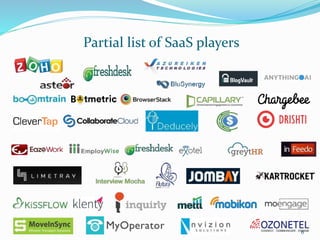
4. Partial list of SaaS players in India.
5. Approach to realize business goal.
6. Challenges.
7. Key Asks.
2
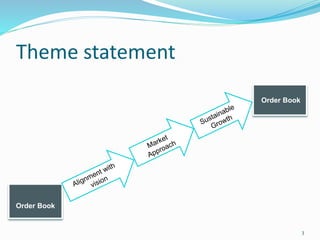
Theme statement
3
Order Book
Order Book
4
Ambition
 To build a robust and sustainable business development model.
 To make _________a known face in the market for next gen _________ solutions.
Strategic Objectives
Go-To-Market:
 Vertical Focus: TMT (Technology, Media & Telco), Retail/CPG, Healthcare, BFSI, Manufacturing.
 Horizontal Focus: Productivity/Collaboration, HR, Marketing, CRM, Expense & Time reporting.
 Integrated approach to win against global and local competitors.
 Reusable Next-Gen cloud applications.
 Communication & Collaboration.
 Integrations.
 Leverage industry relationships for identifying prospects and building pipeline.
 Alliance partnerships to expand business landscape.
Develop self sustainable business: Use technology to create awareness, popularize OneTeam and
win business online reducing personal engagements.
Financial
 Marketing, POC etc.,
Learning/Scaling resources and Internal processes
 Sales & Technical team enablement. Streamlining and continuous fine tuning of processes.
Goal
 Achieve
Market analysis & Trends
5
“The worldwide Software as a Service (SaaS) market is valued at USD __ billion in and
is forecasted to reach USD 72 billion by 2020 at a CAGR of 18.2%.
The Indian Software as a Service (SaaS) market is worth USD 407 million in FY 2016E.
It is poised to grow 3X times by 2020.
Investors are showing a keen interest in a number of start-ups. Indian SaaS based
products have received ~USD 450 million.”
Partial list of SaaS players
6
Approach to realize the business goal
7
Stage 1: Preliminary background work.
 SWOT analysis to plan the positioning and market penetration strategy.
 Gain feedback and endorsements from existing customers.
Stage 2: Business Development
 Account strategy, email campaigns, Social media and Affiliate marketing.
• Direct customer engagement by field sales team.
• Use industry database for email campaign and tele-calling for generating leads.
• Use social media, website enquiries, blogs, user reviews/white papers, syndicate
articles etc.,
• Affiliate marketing (Pay per click/Pay per action)
Approach to realise the business goal continued…
8
Stage 3: Sales Approach: Feet on street, Inside sales and Channel Partners.
• Enterprise Sales (Potentially with a pilot)
• Try & Buy (Subscription with trail)
• Freemium (Limited features with add on premium features)
• Revenue Share / Outcome based.
 Deep engagement: Executive level meetings, workshops, PoC etc.,
 Identify the big bets for growth and focus on progressing the deals for closure.
 Measurement framework: Pipeline growth, order booking and retention.
 Team effort: Involve cross functional teams for integrated approach and
positive business outcomes.
Challenges
9
 Crowded with SaaS providers.
 Brand recognition.
 Customer references.
 Operational.
 Financial.
Key asks
10
 Sales enablement: Products & Services, Key differentiators & USPs etc.,
 Backend support: Marketing, POC etc.,
 Technical team.
 Commercial & Delivery support.
11

Sample Business Plan.pptx

  • 1.
    1 This presentation isa draft business plan prepared for. The ideas and approach presented are my personal views and data numbers are from industry publications and internet.
  • 2.
    Business plan Table ofcontents 1. Theme Statement. 2. Ambition, Goals & Objectives. 3. Market Analysis and Trends. 4. Partial list of SaaS players in India. 5. Approach to realize business goal. 6. Challenges. 7. Key Asks. 2
  • 3.
  • 4.
    4 Ambition  To builda robust and sustainable business development model.  To make _________a known face in the market for next gen _________ solutions. Strategic Objectives Go-To-Market:  Vertical Focus: TMT (Technology, Media & Telco), Retail/CPG, Healthcare, BFSI, Manufacturing.  Horizontal Focus: Productivity/Collaboration, HR, Marketing, CRM, Expense & Time reporting.  Integrated approach to win against global and local competitors.  Reusable Next-Gen cloud applications.  Communication & Collaboration.  Integrations.  Leverage industry relationships for identifying prospects and building pipeline.  Alliance partnerships to expand business landscape. Develop self sustainable business: Use technology to create awareness, popularize OneTeam and win business online reducing personal engagements. Financial  Marketing, POC etc., Learning/Scaling resources and Internal processes  Sales & Technical team enablement. Streamlining and continuous fine tuning of processes. Goal  Achieve
  • 5.
    Market analysis &Trends 5 “The worldwide Software as a Service (SaaS) market is valued at USD __ billion in and is forecasted to reach USD 72 billion by 2020 at a CAGR of 18.2%. The Indian Software as a Service (SaaS) market is worth USD 407 million in FY 2016E. It is poised to grow 3X times by 2020. Investors are showing a keen interest in a number of start-ups. Indian SaaS based products have received ~USD 450 million.”
  • 6.
    Partial list ofSaaS players 6
  • 7.
    Approach to realizethe business goal 7 Stage 1: Preliminary background work.  SWOT analysis to plan the positioning and market penetration strategy.  Gain feedback and endorsements from existing customers. Stage 2: Business Development  Account strategy, email campaigns, Social media and Affiliate marketing. • Direct customer engagement by field sales team. • Use industry database for email campaign and tele-calling for generating leads. • Use social media, website enquiries, blogs, user reviews/white papers, syndicate articles etc., • Affiliate marketing (Pay per click/Pay per action)
  • 8.
    Approach to realisethe business goal continued… 8 Stage 3: Sales Approach: Feet on street, Inside sales and Channel Partners. • Enterprise Sales (Potentially with a pilot) • Try & Buy (Subscription with trail) • Freemium (Limited features with add on premium features) • Revenue Share / Outcome based.  Deep engagement: Executive level meetings, workshops, PoC etc.,  Identify the big bets for growth and focus on progressing the deals for closure.  Measurement framework: Pipeline growth, order booking and retention.  Team effort: Involve cross functional teams for integrated approach and positive business outcomes.
  • 9.
    Challenges 9  Crowded withSaaS providers.  Brand recognition.  Customer references.  Operational.  Financial.
  • 10.
    Key asks 10  Salesenablement: Products & Services, Key differentiators & USPs etc.,  Backend support: Marketing, POC etc.,  Technical team.  Commercial & Delivery support.
  • 11.