Salesforce
Cloud Platform
● Designed to simplify the
development and deployment of
cloud-based applications.
● Force.com is a PaaS - not a CRM
● It provides the infrastructure
needed for any business
application.
Force.com
Force.com platform have many clouds for
different business purposes.
Sales Cloud
(Salesforce)
Service Cloud
Data Cloud
(Data.com)
Marketing Cloud
(Exact Target / Marketo)
Collaboration Cloud
(Chatter)
Analytics Cloud
(Wave)
Heroku
(PaaS)
Force.com
Clouds
Force.com
“
● Is a cloud-based application designed to help your
salespeople sell faster and automating tasks
salespeople do every day.
● Lets developers rapidly create and deploy cloud
applications.
● Delivers out-of-the-box tools and services to
automate your business processes, integrate with
external applications.
Sales Cloud - CRM
“
Sales Cloud
● Standard Objects
● Visual Layouts (UI)
● Admin console for
configuration
● User identity
● Integration
● Approval process
● Data Storage
● Workflows and
validation rules
● Reporting
● Security, roles and
profiles
standard functionality
● Accounts
● Contacts
● Leads
● Opportunities
● Products
● Campaigns
● Contracts
● Files Attachments
● Cases
● Events
● Tasks
Sales Cloud
Salesforce standard objects
“
● Service Cloud is a customer support solution
designed for businesses.
● Agents/Call Center can monitor and respond to all
customer channels from one screen.
● CTI integration.
● Cases management.
Service Cloud
Chatter
Collaboration Cloud
● A social network that enables companies to connect
customers, partners and employees.
● Agents/Call Center can monitor and respond to all
customer channels from one screen.
● Share knowledge
● Create user Groups
● Polls
● Propose new Ideas
● Feeds & Topics
● Files sharing
“
● Data.com: is an online business directory of
companies and business professionals that is built,
maintained and accessed by a worldwide community
of over a million subscribers.
● Marketo: create, automate and measure engaging
campaigns across all your marketing channels.
● Wave: a data exploration tool. Muti-channel.
Data, Marketing
& Analytics Clouds
Focus on building, not the infrastructure
● Heroku lets you deploy, run and manage applications
written in open languages and frameworks such as
Ruby, Node.js, Java, Python, Clojure, Scala, Go and
PHP.
● Heroku handles compilation, dependencies, assets and
executables so you can focus on creating apps.
Heroku
● Github and Docker integration
Salesforce
Architecture
Apex Programming language
Multitenant
& API
APEX
programing language
Apex class versions
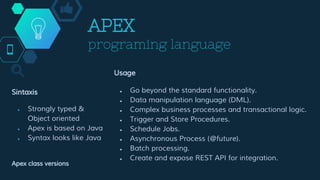
Usage
● Go beyond the standard functionality.
● Data manipulation language (DML).
● Complex business processes and transactional logic.
● Trigger and Store Procedures.
● Schedule Jobs.
● Asynchronous Process (@future).
● Batch processing.
● Create and expose REST API for integration.
Sintaxis
● Strongly typed &
Object oriented
● Apex is based on Java
● Syntax looks like Java
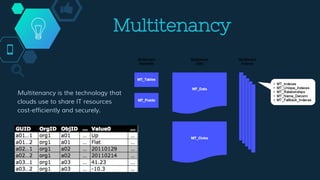
Multitenancy
Multitenancy is the technology that
clouds use to share IT resources
cost-efficiently and securely.
Releases, Change control
& Unit testing
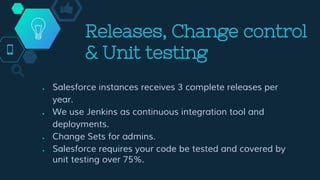
● Salesforce instances receives 3 complete releases per
year.
● We use Jenkins as continuous integration tool and
deployments.
● Change Sets for admins.
● Salesforce requires your code be tested and covered by
unit testing over 75%.
“
. DeveloperForce: 2.1 million registered developers and
there are currently 130 developer user groups in the
ecosystem.
. Force.com "Most Valued Professionals" (MVPs).
. Webinars and social communities
(twitter #askforce)
. Pilot programs
Salesforce community
Dreamforce
Lightning,
Lightning Experience
& Thunder IoT
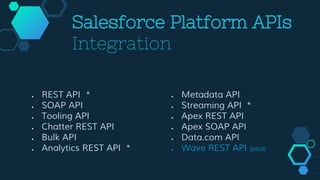
● REST API *
● SOAP API
● Tooling API
● Chatter REST API
● Bulk API
● Analytics REST API *
Salesforce Platform APIs
Integration
● Metadata API
● Streaming API *
● Apex REST API
● Apex SOAP API
● Data.com API
● Wave REST API (pilot)
@breathingcode
about.me/lucasbuyo
+LucasBuyo
Lucas Buyo
Cloud Architect
Developer
Thanks!

Salesforce talk

  • 1.
  • 2.
    ● Designed tosimplify the development and deployment of cloud-based applications. ● Force.com is a PaaS - not a CRM ● It provides the infrastructure needed for any business application. Force.com
  • 3.
    Force.com platform havemany clouds for different business purposes. Sales Cloud (Salesforce) Service Cloud Data Cloud (Data.com) Marketing Cloud (Exact Target / Marketo) Collaboration Cloud (Chatter) Analytics Cloud (Wave) Heroku (PaaS) Force.com Clouds Force.com
  • 4.
    “ ● Is acloud-based application designed to help your salespeople sell faster and automating tasks salespeople do every day. ● Lets developers rapidly create and deploy cloud applications. ● Delivers out-of-the-box tools and services to automate your business processes, integrate with external applications. Sales Cloud - CRM
  • 5.
    “ Sales Cloud ● StandardObjects ● Visual Layouts (UI) ● Admin console for configuration ● User identity ● Integration ● Approval process ● Data Storage ● Workflows and validation rules ● Reporting ● Security, roles and profiles standard functionality
  • 6.
    ● Accounts ● Contacts ●Leads ● Opportunities ● Products ● Campaigns ● Contracts ● Files Attachments ● Cases ● Events ● Tasks Sales Cloud Salesforce standard objects
  • 7.
    “ ● Service Cloudis a customer support solution designed for businesses. ● Agents/Call Center can monitor and respond to all customer channels from one screen. ● CTI integration. ● Cases management. Service Cloud
  • 8.
    Chatter Collaboration Cloud ● Asocial network that enables companies to connect customers, partners and employees. ● Agents/Call Center can monitor and respond to all customer channels from one screen. ● Share knowledge ● Create user Groups ● Polls ● Propose new Ideas ● Feeds & Topics ● Files sharing
  • 9.
    “ ● Data.com: isan online business directory of companies and business professionals that is built, maintained and accessed by a worldwide community of over a million subscribers. ● Marketo: create, automate and measure engaging campaigns across all your marketing channels. ● Wave: a data exploration tool. Muti-channel. Data, Marketing & Analytics Clouds
  • 10.
    Focus on building,not the infrastructure ● Heroku lets you deploy, run and manage applications written in open languages and frameworks such as Ruby, Node.js, Java, Python, Clojure, Scala, Go and PHP. ● Heroku handles compilation, dependencies, assets and executables so you can focus on creating apps. Heroku ● Github and Docker integration
  • 11.
  • 12.
    APEX programing language Apex classversions Usage ● Go beyond the standard functionality. ● Data manipulation language (DML). ● Complex business processes and transactional logic. ● Trigger and Store Procedures. ● Schedule Jobs. ● Asynchronous Process (@future). ● Batch processing. ● Create and expose REST API for integration. Sintaxis ● Strongly typed & Object oriented ● Apex is based on Java ● Syntax looks like Java
  • 13.
    Multitenancy Multitenancy is thetechnology that clouds use to share IT resources cost-efficiently and securely.
  • 14.
    Releases, Change control &Unit testing ● Salesforce instances receives 3 complete releases per year. ● We use Jenkins as continuous integration tool and deployments. ● Change Sets for admins. ● Salesforce requires your code be tested and covered by unit testing over 75%.
  • 15.
    “ . DeveloperForce: 2.1million registered developers and there are currently 130 developer user groups in the ecosystem. . Force.com "Most Valued Professionals" (MVPs). . Webinars and social communities (twitter #askforce) . Pilot programs Salesforce community
  • 16.
  • 17.
  • 18.
    ● REST API* ● SOAP API ● Tooling API ● Chatter REST API ● Bulk API ● Analytics REST API * Salesforce Platform APIs Integration ● Metadata API ● Streaming API * ● Apex REST API ● Apex SOAP API ● Data.com API ● Wave REST API (pilot)
  • 19.