MARKETING MANAGEMENT
Dr.Jitendra Gowrabhathini
BBA-MBA
SALES PROMOTION
List of Sub-topics
Basics of Marketing Management
Methods of Promotion
What is Promotion?
Sales Promotion
Sales Promotion Techniques
Case Study Introduction, Need, Objectives and How to analyze Case?
Case Studies Discussion
Promotion Meaning and Definition
 Promotion is basically a marketing communication process.
Promotion is the responsibility of producers. It includes
advertising, personal selling, sales promotion and public
relations.
 Promotion – It refers to a process of informing, persuading and
influencing a consumer to make choice of the product to be
bought. Promotion is done through means of personal selling,
advertising, publicity and sales promotion.
Example
 Frank lives in a small town; he owns a shoe company. These shoes are designed for
sports and the gym. Despite manufacturing quality goods, Frank struggles with
sales.
 Frank attempts to improve promotion. After elaborate research and brainstorming,
Frank decides to contact local gyms. Gym owners start displaying Frank’s products
on the main counter.
 In addition, the firm opts for influencer marketing. They contact the town’s
popular fitness trainer. The influencer agrees to the proposition. After signing the
deal, the influencer starts wearing Frank’s gear in training and videos.
 Word spread among the gym members and the influencer’s followers. There was a
steep rise in demand for Frank’s shoes.
Methods of Promotion
Methods of
Promotion
Sales Promotion
 A sales promotion is a marketing strategy in which a
business uses a temporary campaign or offer to
increase interest or demand in its product or service.
 There are many reasons why a business may choose to
use a sales promotion (or ‘promo’), but the primary
reason is to boost sales.
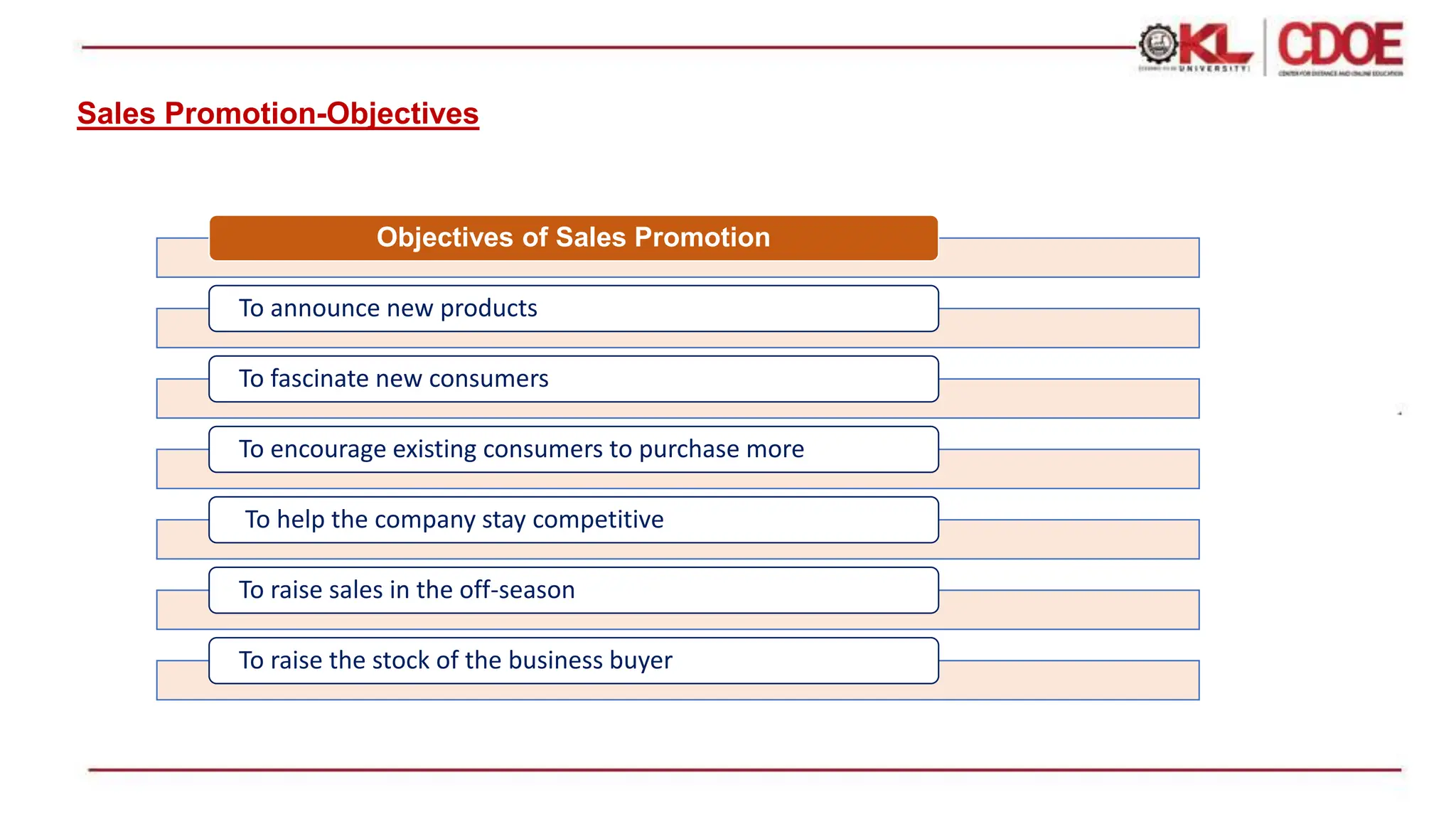
Sales Promotion-Objectives
Objectives of Sales Promotion
To announce new products
To fascinate new consumers
To encourage existing consumers to purchase more
To help the company stay competitive
To raise sales in the off-season
To raise the stock of the business buyer
Sales Promotion-Methods
Methods of sales
promotion
Coupons
premiums
Incentives
Product
samples
sponsorship
Product
placement
Loyalty
programs
Point- of-
Purchase
displays
Case Study Introduction
 The method was first developed in the 1871 by Christopher
Langdell at the Harvard law School.
 A Case study is a written record of the events that occurred at a
particular company or within a particular industry over a number
of years. The details included in a case may include, but are not
limited to:
 Information about a company, industry or project
 Objectives, strategies and challenges established and
encountered
 Responses, results and recommendations.
Need for Case Method
 Giving broader exposure to different situations, companies and
industries
 Placing the students in different roles of case.
 Provide an opportunity to apply principles , concepts, techniques
of management to problem situation
 Inculcating the students to prepare managerial action plans and
to deal with related issues.
Objectives of Case Analysis
 To increase the understanding of the students of what managers
should and should not do in guiding a business success.
 To build student skills in conducting strategic analysis in a variety
of situations, companies and industries.
 To provide the students valuable practice in diagnosing strategic
issues, evaluating strategic alternatives with the help of SWOT
analysis and formulating practicable plans of actions based on
the ground realities.
 To provide the students an in-depth exposure to a variety of
companies and industries, thereby gaining something close to
actual experience.
How to Analyze a Case?
 Read the Case material quickly to get familiarity
 Read the Exhibits, Appendices etc., carefully.
 Study the case
 Define the objectives sought in dealing with the issues in the case.
 Identify the problems in the case and uncover their probable causes.
 Develop alternative course of action
 Screen the alternatives using the objectives as the criteria.
 Select the alternatives that are most suitable in keeping with stated objectives.
 Prepare a plan of action
 Communicate the results to parties concerned.
Case Study-1
 Vijay Electronics is a well-established company in the consumer electronics industry, known for its
high-quality products such as smartphones, laptops, and smart home devices. Despite having a
strong market presence, the company has identified the need to boost sales for its latest flagship
smartphone model, "TechMaster X." In response, the marketing team has planned a comprehensive
sales promotion campaign to increase product visibility, attract new customers, and enhance overall
sales.
 The sales promotion campaign for TechMaster X includes a mix of promotional tools, such as
discounts, limited-time offers, in-store demonstrations, and online contests. The campaign aims to
create a sense of urgency and excitement among potential customers, encouraging them to make a
purchase decision during the promotional period.
Questions
 What specific objectives should Vijay Electronics set for the sales promotion campaign to consider it
successful?
 Who are the primary target audiences for the TechMaster X sales promotion campaign, and how does
Vijay Electronics plan to reach them effectively?
 What combination of promotional tools would be most effective for creating awareness and driving sales
for TechMaster X?
 How should Vijay Electronics structure the discounts for TechMaster X to ensure they are appealing to
customers while maintaining profitability?
 How can the company maximize the impact of in-store demonstrations to showcase the features and
benefits of TechMaster X?
Questions
 What type of online contests can Vijay Electronics organize to engage the target audience and generate buzz for
TechMaster X?
 What key performance indicators (KPIs) should Vijay Electronics use to measure the success of the sales
promotion campaign?
 How should the marketing team allocate the budget across different promotional tools to ensure a balanced and
effective campaign?
 How should Vijay Electronics analyze and respond to the competitive landscape during the sales promotion
period?
 What strategies should Vijay Electronics implement post-promotion to maintain the momentum and sustain
increased sales for TechMaster X?
Case Study-2
 JK University is a prestigious institution offering a wide range of academic programs. In response to the growing
demand for flexible education, the university has introduced a robust distance education program, providing
students with the opportunity to pursue their studies remotely. The challenge lies in promoting this distance
education program effectively to attract and enroll a significant number of students.
 The primary goal is to increase enrollment in the distance education program by implementing a targeted sales
promotion strategy
 Discounts and Scholarships:
• Offer limited-time discounts on tuition fees for early registrations.
• Introduce merit-based scholarships for outstanding students in the distance education program.
 Referral Program:
• Implement a referral program where existing students can refer new students and receive incentives or
discounts on their next semester's fees.
Sales Promotion Strategy
 Webinars and Workshops:
• Conduct webinars and workshops to showcase the benefits of distance education.
• Highlight success stories of previous distance education graduates.
 Social Media Campaigns:
• Leverage social media platforms for targeted advertising.
• Create engaging content about the advantages of distance education and share student testimonials.
 Collaborations and Partnerships:
• Form partnerships with corporations to provide employee education benefits.
• Collaborate with other educational institutions for joint promotions and exchange programs.
 Free Trial Courses:
• Offer free trial courses to give potential students a taste of the distance education experience.
• Provide certificates for completing trial courses to encourage enrollment.
 Responsive Customer Service:
• Enhance customer service to address inquiries promptly.
• Set up a dedicated helpline and live chat support for prospective distance education students.
Questions
 How can the university track the effectiveness of the discount and scholarship strategy in increasing distance
education enrollment?
 How can the referral program be structured to ensure maximum participation from existing students?
 How can the university leverage social media campaigns to reach the target audience effectively?
 What measures can be taken to address concerns and doubts raised by potential distance education students
during webinars and workshops?
 How can the university ensure a seamless and positive experience for students participating in free trial courses?
 What steps can be taken to maintain a high level of customer service for prospective distance education
students?
Sales Promotion
 Identify the method of sales-promotion in the following cases and explain each one in detail
• a) A mobile company offers a discount of Rs. 1000 to clear off excess inventory.
• b) A customer gets Rs. 5 off on return of an empty wrapper while making a new purchase of the same product.
• c) A Company offers a pack of 1/2kg of sugar with the purchase of a 5 kg bag of wheat flour.
• d) A Company offers 40% of extra shaving cream in a pack of 500 gms.
• e) Scratch a card and get a gold coin with the purchase of a cold drink.
• f) Purchase goods worth Rs. 50,000 and get a holiday package worth Rs. 10,000 free.
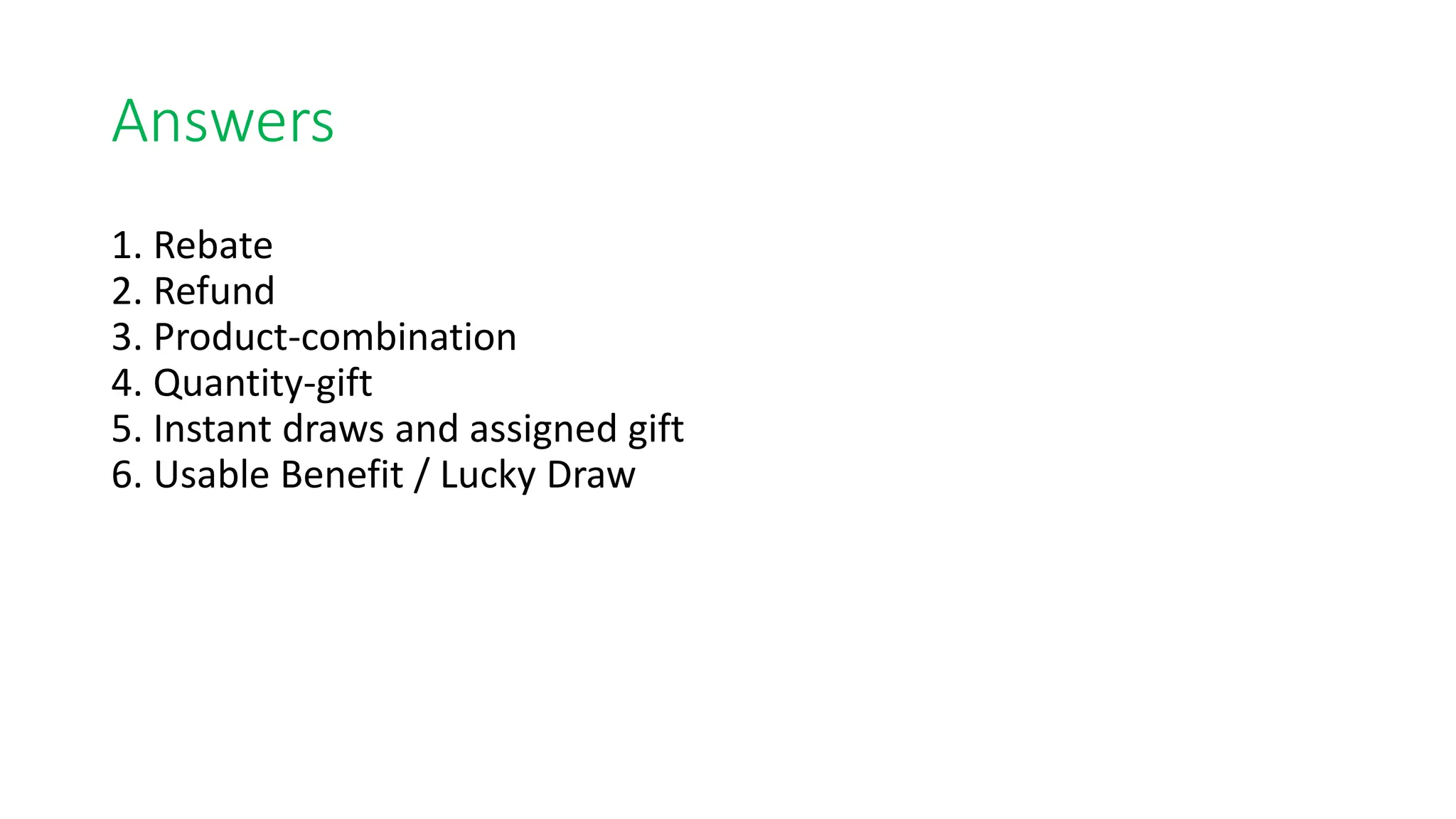
Answers
1. Rebate
2. Refund
3. Product-combination
4. Quantity-gift
5. Instant draws and assigned gift
6. Usable Benefit / Lucky Draw
THANK YOU

Sales Promotion and Case Studies on Sales Promotion.pptx

  • 1.
  • 2.
    List of Sub-topics Basicsof Marketing Management Methods of Promotion What is Promotion? Sales Promotion Sales Promotion Techniques Case Study Introduction, Need, Objectives and How to analyze Case? Case Studies Discussion
  • 4.
    Promotion Meaning andDefinition  Promotion is basically a marketing communication process. Promotion is the responsibility of producers. It includes advertising, personal selling, sales promotion and public relations.  Promotion – It refers to a process of informing, persuading and influencing a consumer to make choice of the product to be bought. Promotion is done through means of personal selling, advertising, publicity and sales promotion.
  • 5.
    Example  Frank livesin a small town; he owns a shoe company. These shoes are designed for sports and the gym. Despite manufacturing quality goods, Frank struggles with sales.  Frank attempts to improve promotion. After elaborate research and brainstorming, Frank decides to contact local gyms. Gym owners start displaying Frank’s products on the main counter.  In addition, the firm opts for influencer marketing. They contact the town’s popular fitness trainer. The influencer agrees to the proposition. After signing the deal, the influencer starts wearing Frank’s gear in training and videos.  Word spread among the gym members and the influencer’s followers. There was a steep rise in demand for Frank’s shoes.
  • 6.
  • 7.
    Sales Promotion  Asales promotion is a marketing strategy in which a business uses a temporary campaign or offer to increase interest or demand in its product or service.  There are many reasons why a business may choose to use a sales promotion (or ‘promo’), but the primary reason is to boost sales.
  • 8.
    Sales Promotion-Objectives Objectives ofSales Promotion To announce new products To fascinate new consumers To encourage existing consumers to purchase more To help the company stay competitive To raise sales in the off-season To raise the stock of the business buyer
  • 9.
    Sales Promotion-Methods Methods ofsales promotion Coupons premiums Incentives Product samples sponsorship Product placement Loyalty programs Point- of- Purchase displays
  • 10.
    Case Study Introduction The method was first developed in the 1871 by Christopher Langdell at the Harvard law School.  A Case study is a written record of the events that occurred at a particular company or within a particular industry over a number of years. The details included in a case may include, but are not limited to:  Information about a company, industry or project  Objectives, strategies and challenges established and encountered  Responses, results and recommendations.
  • 11.
    Need for CaseMethod  Giving broader exposure to different situations, companies and industries  Placing the students in different roles of case.  Provide an opportunity to apply principles , concepts, techniques of management to problem situation  Inculcating the students to prepare managerial action plans and to deal with related issues.
  • 12.
    Objectives of CaseAnalysis  To increase the understanding of the students of what managers should and should not do in guiding a business success.  To build student skills in conducting strategic analysis in a variety of situations, companies and industries.  To provide the students valuable practice in diagnosing strategic issues, evaluating strategic alternatives with the help of SWOT analysis and formulating practicable plans of actions based on the ground realities.  To provide the students an in-depth exposure to a variety of companies and industries, thereby gaining something close to actual experience.
  • 13.
    How to Analyzea Case?  Read the Case material quickly to get familiarity  Read the Exhibits, Appendices etc., carefully.  Study the case  Define the objectives sought in dealing with the issues in the case.  Identify the problems in the case and uncover their probable causes.  Develop alternative course of action  Screen the alternatives using the objectives as the criteria.  Select the alternatives that are most suitable in keeping with stated objectives.  Prepare a plan of action  Communicate the results to parties concerned.
  • 14.
    Case Study-1  VijayElectronics is a well-established company in the consumer electronics industry, known for its high-quality products such as smartphones, laptops, and smart home devices. Despite having a strong market presence, the company has identified the need to boost sales for its latest flagship smartphone model, "TechMaster X." In response, the marketing team has planned a comprehensive sales promotion campaign to increase product visibility, attract new customers, and enhance overall sales.  The sales promotion campaign for TechMaster X includes a mix of promotional tools, such as discounts, limited-time offers, in-store demonstrations, and online contests. The campaign aims to create a sense of urgency and excitement among potential customers, encouraging them to make a purchase decision during the promotional period.
  • 15.
    Questions  What specificobjectives should Vijay Electronics set for the sales promotion campaign to consider it successful?  Who are the primary target audiences for the TechMaster X sales promotion campaign, and how does Vijay Electronics plan to reach them effectively?  What combination of promotional tools would be most effective for creating awareness and driving sales for TechMaster X?  How should Vijay Electronics structure the discounts for TechMaster X to ensure they are appealing to customers while maintaining profitability?  How can the company maximize the impact of in-store demonstrations to showcase the features and benefits of TechMaster X?
  • 16.
    Questions  What typeof online contests can Vijay Electronics organize to engage the target audience and generate buzz for TechMaster X?  What key performance indicators (KPIs) should Vijay Electronics use to measure the success of the sales promotion campaign?  How should the marketing team allocate the budget across different promotional tools to ensure a balanced and effective campaign?  How should Vijay Electronics analyze and respond to the competitive landscape during the sales promotion period?  What strategies should Vijay Electronics implement post-promotion to maintain the momentum and sustain increased sales for TechMaster X?
  • 17.
    Case Study-2  JKUniversity is a prestigious institution offering a wide range of academic programs. In response to the growing demand for flexible education, the university has introduced a robust distance education program, providing students with the opportunity to pursue their studies remotely. The challenge lies in promoting this distance education program effectively to attract and enroll a significant number of students.  The primary goal is to increase enrollment in the distance education program by implementing a targeted sales promotion strategy  Discounts and Scholarships: • Offer limited-time discounts on tuition fees for early registrations. • Introduce merit-based scholarships for outstanding students in the distance education program.  Referral Program: • Implement a referral program where existing students can refer new students and receive incentives or discounts on their next semester's fees.
  • 18.
    Sales Promotion Strategy Webinars and Workshops: • Conduct webinars and workshops to showcase the benefits of distance education. • Highlight success stories of previous distance education graduates.  Social Media Campaigns: • Leverage social media platforms for targeted advertising. • Create engaging content about the advantages of distance education and share student testimonials.  Collaborations and Partnerships: • Form partnerships with corporations to provide employee education benefits. • Collaborate with other educational institutions for joint promotions and exchange programs.  Free Trial Courses: • Offer free trial courses to give potential students a taste of the distance education experience. • Provide certificates for completing trial courses to encourage enrollment.  Responsive Customer Service: • Enhance customer service to address inquiries promptly. • Set up a dedicated helpline and live chat support for prospective distance education students.
  • 19.
    Questions  How canthe university track the effectiveness of the discount and scholarship strategy in increasing distance education enrollment?  How can the referral program be structured to ensure maximum participation from existing students?  How can the university leverage social media campaigns to reach the target audience effectively?  What measures can be taken to address concerns and doubts raised by potential distance education students during webinars and workshops?  How can the university ensure a seamless and positive experience for students participating in free trial courses?  What steps can be taken to maintain a high level of customer service for prospective distance education students?
  • 20.
    Sales Promotion  Identifythe method of sales-promotion in the following cases and explain each one in detail • a) A mobile company offers a discount of Rs. 1000 to clear off excess inventory. • b) A customer gets Rs. 5 off on return of an empty wrapper while making a new purchase of the same product. • c) A Company offers a pack of 1/2kg of sugar with the purchase of a 5 kg bag of wheat flour. • d) A Company offers 40% of extra shaving cream in a pack of 500 gms. • e) Scratch a card and get a gold coin with the purchase of a cold drink. • f) Purchase goods worth Rs. 50,000 and get a holiday package worth Rs. 10,000 free.
  • 21.
    Answers 1. Rebate 2. Refund 3.Product-combination 4. Quantity-gift 5. Instant draws and assigned gift 6. Usable Benefit / Lucky Draw
  • 22.