.
SALES
MANAGEMENT
TOPIC
•SALES DEPARTMENT
EXTERNAL RELATIONS
DISTRIBUTIVE NETWORK
RELATIONS
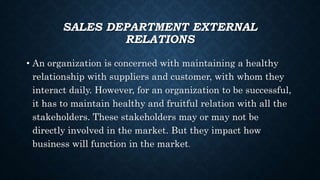
SALES DEPARTMENT EXTERNAL
RELATIONS
• An organization is concerned with maintaining a healthy
relationship with suppliers and customer, with whom they
interact daily. However, for an organization to be successful,
it has to maintain healthy and fruitful relation with all the
stakeholders. These stakeholders may or may not be
directly involved in the market. But they impact how
business will function in the market.
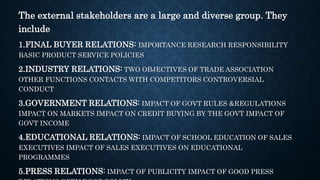
The external stakeholders are a large and diverse group. They
include
1.FINAL BUYER RELATIONS: IMPORTANCE RESEARCH RESPONSIBILITY
BASIC PRODUCT SERVICE POLICIES
2.INDUSTRY RELATIONS: TWO OBJECTIVES OF TRADE ASSOCIATION
OTHER FUNCTIONS CONTACTS WITH COMPETITORS CONTROVERSIAL
CONDUCT
3.GOVERNMENT RELATIONS: IMPACT OF GOVT RULES &REGULATIONS
IMPACT ON MARKETS IMPACT ON CREDIT BUYING BY THE GOVT IMPACT OF
GOVT INCOME
4.EDUCATIONAL RELATIONS: IMPACT OF SCHOOL EDUCATION OF SALES
EXECUTIVES IMPACT OF SALES EXECUTIVES ON EDUCATIONAL
PROGRAMMES
5.PRESS RELATIONS: IMPACT OF PUBLICITY IMPACT OF GOOD PRESS
SALES DEPARTMENT DISTRIBUTIVE
RELAIONS
• Too often, distribution is the neglected side of marketing. Automobile
companies, savvy in many aspects of strategy, have lost huge shares of
the parts and service markets to NAPA, Midas, and Goodyear because
they resist making changes in their dealer franchise networks. A great
many other American companies—Tupperware springs to mind—are
reaching their markets in similarly outmoded ways. It is hardly seemly
for Tupperware to continue with its “parties” when more than half of
American women are working outside their homes.
• We suggest eight steps to design a distribution system that really performs.
The word process is key here because whatever the result of taking these
steps, management will gain by clarifying what its customers want and how to
serve them. Managers are always saying that they want their company to be
“market driven.” In following these steps, they can give substance to what is
too often merely corporate rhetoric.
Step 1: Find Out What Your Customers Want
Step 2: Decide on Appropriate Outlets
Step 3: Find Out About the Costs
Step 4: Bound the “Ideal”
Step 5: Compare Your Options
Step 6: Review Your Pet Assumptions
Step 7: Confront the Gap
Step 8: Prepare to Implement
THANKYOU

SALES MANAGEMENT.pptx

  • 1.
  • 2.
  • 3.
    SALES DEPARTMENT EXTERNAL RELATIONS •An organization is concerned with maintaining a healthy relationship with suppliers and customer, with whom they interact daily. However, for an organization to be successful, it has to maintain healthy and fruitful relation with all the stakeholders. These stakeholders may or may not be directly involved in the market. But they impact how business will function in the market.
  • 4.
    The external stakeholdersare a large and diverse group. They include 1.FINAL BUYER RELATIONS: IMPORTANCE RESEARCH RESPONSIBILITY BASIC PRODUCT SERVICE POLICIES 2.INDUSTRY RELATIONS: TWO OBJECTIVES OF TRADE ASSOCIATION OTHER FUNCTIONS CONTACTS WITH COMPETITORS CONTROVERSIAL CONDUCT 3.GOVERNMENT RELATIONS: IMPACT OF GOVT RULES &REGULATIONS IMPACT ON MARKETS IMPACT ON CREDIT BUYING BY THE GOVT IMPACT OF GOVT INCOME 4.EDUCATIONAL RELATIONS: IMPACT OF SCHOOL EDUCATION OF SALES EXECUTIVES IMPACT OF SALES EXECUTIVES ON EDUCATIONAL PROGRAMMES 5.PRESS RELATIONS: IMPACT OF PUBLICITY IMPACT OF GOOD PRESS
  • 5.
    SALES DEPARTMENT DISTRIBUTIVE RELAIONS •Too often, distribution is the neglected side of marketing. Automobile companies, savvy in many aspects of strategy, have lost huge shares of the parts and service markets to NAPA, Midas, and Goodyear because they resist making changes in their dealer franchise networks. A great many other American companies—Tupperware springs to mind—are reaching their markets in similarly outmoded ways. It is hardly seemly for Tupperware to continue with its “parties” when more than half of American women are working outside their homes.
  • 6.
    • We suggesteight steps to design a distribution system that really performs. The word process is key here because whatever the result of taking these steps, management will gain by clarifying what its customers want and how to serve them. Managers are always saying that they want their company to be “market driven.” In following these steps, they can give substance to what is too often merely corporate rhetoric. Step 1: Find Out What Your Customers Want Step 2: Decide on Appropriate Outlets Step 3: Find Out About the Costs Step 4: Bound the “Ideal” Step 5: Compare Your Options Step 6: Review Your Pet Assumptions Step 7: Confront the Gap Step 8: Prepare to Implement
  • 7.