The mission of A Safe Place is to break the cycle of domestic abuse by providing crisis intervention, support services, education and advocacy to survivors, their families and the community while maintaining . . .“AN OPEN DOOR TO SAFETY” FOR SURVIVORS OF DOMESTIC VIOLENCE”
What is abuse? 	A Safe Place defines domestic abuse as the coercive or violent pattern of 	behavior used by one person in a relationship to gain power and control over 	the other.
 	Domestic abuse is illegal and some examples include:
 	if someone injures you;
 	threatens you/fear for your safety;
 	forces/pressures you into sexual acts;
 	destroys/ threatens to destroy your property; or
 	enters your home against your wishes (if not residing together).
 	They further expand on this definition by explaining that these examples can 	also be categorized in terms of:Verbal Abuse:  name-calling, putting you down in every aspect of your 	existence, and blaming you for the abuse.
Emotional Abuse:  includes threats, isolation, manipulation, insults, 	destruction of property, public humiliation, and accusations of affairs, 	threats of suicide, self injury, or homicide if you leave.
Financial Abuse:  includes all aspects in connection with any and all income 	related matters.
Physical Abuse:  includes any forceful behavior such as hitting, chocking, 	slapping, using weapons, driving recklessly, holding you down, and 	preventing you from leaving.
 	As you can see, domestic abuse goes far beyond inflicting “physical” injury 	alone.  A more comprehensive list of acts detailing these additional factors are 	contained in their brochure.
“IF YOU OR SOMEONE YOU KNOW SUSPECTS BEING A VICTIM OF DOMESTIC VIOLENCE, A SAFE PLACEWOULD BE A VALUABLE RESOURCE FOR ASSISTANCE!!!!”THE BROCHURE IS VERY DETAILED. YOU CAN DIRECTLY OBTAIN A COPY OF SAME TO FULLY APPRECIATE THE COMPLEX NATURE OF ABUSE BY VISITING THEIR WEBSITE.
First established in 1976 to serve as a domestic violence shelter for victims with the additional goal of prevention and elimination of same.  They are a non-profit organization that provides free shelter and support services for those who need them.It’s inception dates back to in or around the time of the “second wave feminist movement” and the introduction of the first abuse hotline established in 1971.  The first actual “shelter” was opened in St. Paul, Minnesota in 1975--so A Safe Place is among one of the beginning pioneers in terms of its development.They primarily support communities in the Rockingham County area with locations in Portsmouth (2), Rochester and Salem.  All services are free and confidential.
 	A Safe Place (originally named Seacoast Taskforce on Family Violence) was 	made up of both men and women with the primary focus to educate the 	community about domestic violence--teaming up with police agencies, schools, 	hospitals and medical providers.
 	The first shelter was a rented a four bedroom house on Islington Street in 	Portsmouth, N.H. which housed 181 women and 253 children in its’ first 18 	months of operation.  Thereafter they purchased a permanent residence, the 	location of which remains confidential.
 	They work with the AmeriCorps Victim Assistance Program (a 	multi-agency collaboration which is located in Concord, N.H. 	providing services to victims of domestic-sexual violence and stalking.Not onlydo theyserve the individual victims of domestic violence, but also 	their children, extended family and friends, and the community.
 	Because of their “open door policy”, they prohibit discrimination on the basis of 	gender, age, health status  (including HIV-positive) physical, mental/emotional 	ability, sexual orientation, gender identity/expression, socioeconomic status, 	race, national origin, immigration status, religious and political affiliation.
 	They pride themselves as being more than a shelter.  They are a FIRST STEP 	for victims of domestic abuse who want to regain control over 	their lives. 	A Safe Place maintains a 24 hour, toll-free hotline (1-800-854-3552).
 	Their “home base” is located in Portsmouth, New Hampshire.  Due to their 	obvious need for confidentiality, they do not provide a direct address, 	however, their mailing address for donations and other administrative 	correspondence is 6 Greenleaf Woods, Ste. 101, Portsmouth, NH 03801.  They 	also maintain offices (with local, separate hot-line numbers) located in:	(1) 	Portsmouth, N.H. (separate from above contact):  603-436-7924; 	(2) 	Rochester, N.H.:  603-330-0214; and 	(3) 	Salem, N.H.:  603-890-6392.  	A website is also available at: http://asafeplacenh.org/, HOWEVER . . . In keeping with A Safe Place’s commitment in providing confidential services, they offer further, critical advice on behalf of victims involved in these compromising domestic violence/abuse situations by stating--via their website –the following:“Please remember that your visit to this site or any other site on the internet is saved to your computer. If you think your computer is being monitored and may affect your safety, please consider using other computer resources such as the public library, your work computer or another public computer.”
Services providedA Safe Place provides extensive services with regard to issues of domestic 	violence ranging from support groups to assist victims, their family and the 	community  as well as a wide range of informative educational programs.
They provide crucial assistance by  working with the victims individually to 	create a safety plan  in connection with their abusive situation.  The safety 	plan is designed to encompass a variety of situations--whether the individual 	is directly involved in an abusive relationship, leaving the relationship, after the relationship is terminated, or with regard to the overall emotional well being of the victim.
An example outlining the guidelines of the safety plan is provided in Figure 	1 on the following slide.FIGURE 1.
 	They provide a “confidential”  emergency shelter  for 	victims—a critical component required in order to keep 	women and children safe from imminent danger. The 	shelter is available to anyone in need and provides not 	only housing but includes weekly house meetings and support groups.
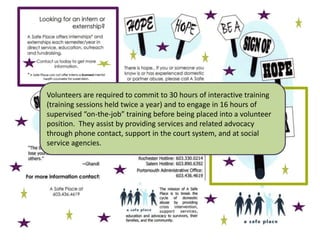
 	They provide Court and Social Service advocacy to 	assist individuals in: 	(1) 	obtaining protective orders (temporary and 		permanent)	(2)	accompany victims to court proceedings, and 	(3)	to refer these individuals to pro bono services 		when needed. 	They also provide comprehensive information and education through 	interactive presentations and workshops as provided for in their brochure . . .

SAFE Presentation

  • 2.
    The mission ofA Safe Place is to break the cycle of domestic abuse by providing crisis intervention, support services, education and advocacy to survivors, their families and the community while maintaining . . .“AN OPEN DOOR TO SAFETY” FOR SURVIVORS OF DOMESTIC VIOLENCE”
  • 3.
    What is abuse? A Safe Place defines domestic abuse as the coercive or violent pattern of behavior used by one person in a relationship to gain power and control over the other.
  • 4.
    Domestic abuseis illegal and some examples include:
  • 5.
    if someoneinjures you;
  • 6.
    threatens you/fearfor your safety;
  • 7.
    forces/pressures youinto sexual acts;
  • 8.
    destroys/ threatensto destroy your property; or
  • 9.
    enters yourhome against your wishes (if not residing together).
  • 10.
    They furtherexpand on this definition by explaining that these examples can also be categorized in terms of:Verbal Abuse: name-calling, putting you down in every aspect of your existence, and blaming you for the abuse.
  • 11.
    Emotional Abuse: includes threats, isolation, manipulation, insults, destruction of property, public humiliation, and accusations of affairs, threats of suicide, self injury, or homicide if you leave.
  • 12.
    Financial Abuse: includes all aspects in connection with any and all income related matters.
  • 13.
    Physical Abuse: includes any forceful behavior such as hitting, chocking, slapping, using weapons, driving recklessly, holding you down, and preventing you from leaving.
  • 14.
    As youcan see, domestic abuse goes far beyond inflicting “physical” injury alone. A more comprehensive list of acts detailing these additional factors are contained in their brochure.
  • 15.
    “IF YOU ORSOMEONE YOU KNOW SUSPECTS BEING A VICTIM OF DOMESTIC VIOLENCE, A SAFE PLACEWOULD BE A VALUABLE RESOURCE FOR ASSISTANCE!!!!”THE BROCHURE IS VERY DETAILED. YOU CAN DIRECTLY OBTAIN A COPY OF SAME TO FULLY APPRECIATE THE COMPLEX NATURE OF ABUSE BY VISITING THEIR WEBSITE.
  • 16.
    First established in1976 to serve as a domestic violence shelter for victims with the additional goal of prevention and elimination of same. They are a non-profit organization that provides free shelter and support services for those who need them.It’s inception dates back to in or around the time of the “second wave feminist movement” and the introduction of the first abuse hotline established in 1971. The first actual “shelter” was opened in St. Paul, Minnesota in 1975--so A Safe Place is among one of the beginning pioneers in terms of its development.They primarily support communities in the Rockingham County area with locations in Portsmouth (2), Rochester and Salem. All services are free and confidential.
  • 17.
    A SafePlace (originally named Seacoast Taskforce on Family Violence) was made up of both men and women with the primary focus to educate the community about domestic violence--teaming up with police agencies, schools, hospitals and medical providers.
  • 18.
    The firstshelter was a rented a four bedroom house on Islington Street in Portsmouth, N.H. which housed 181 women and 253 children in its’ first 18 months of operation. Thereafter they purchased a permanent residence, the location of which remains confidential.
  • 19.
    They workwith the AmeriCorps Victim Assistance Program (a multi-agency collaboration which is located in Concord, N.H. providing services to victims of domestic-sexual violence and stalking.Not onlydo theyserve the individual victims of domestic violence, but also their children, extended family and friends, and the community.
  • 20.
    Because oftheir “open door policy”, they prohibit discrimination on the basis of gender, age, health status (including HIV-positive) physical, mental/emotional ability, sexual orientation, gender identity/expression, socioeconomic status, race, national origin, immigration status, religious and political affiliation.
  • 21.
    They pridethemselves as being more than a shelter. They are a FIRST STEP for victims of domestic abuse who want to regain control over their lives. A Safe Place maintains a 24 hour, toll-free hotline (1-800-854-3552).
  • 22.
    Their “homebase” is located in Portsmouth, New Hampshire. Due to their obvious need for confidentiality, they do not provide a direct address, however, their mailing address for donations and other administrative correspondence is 6 Greenleaf Woods, Ste. 101, Portsmouth, NH 03801. They also maintain offices (with local, separate hot-line numbers) located in: (1) Portsmouth, N.H. (separate from above contact): 603-436-7924; (2) Rochester, N.H.: 603-330-0214; and (3) Salem, N.H.: 603-890-6392. A website is also available at: http://asafeplacenh.org/, HOWEVER . . . In keeping with A Safe Place’s commitment in providing confidential services, they offer further, critical advice on behalf of victims involved in these compromising domestic violence/abuse situations by stating--via their website –the following:“Please remember that your visit to this site or any other site on the internet is saved to your computer. If you think your computer is being monitored and may affect your safety, please consider using other computer resources such as the public library, your work computer or another public computer.”
  • 23.
    Services providedA SafePlace provides extensive services with regard to issues of domestic violence ranging from support groups to assist victims, their family and the community as well as a wide range of informative educational programs.
  • 24.
    They provide crucialassistance by working with the victims individually to create a safety plan in connection with their abusive situation. The safety plan is designed to encompass a variety of situations--whether the individual is directly involved in an abusive relationship, leaving the relationship, after the relationship is terminated, or with regard to the overall emotional well being of the victim.
  • 25.
    An example outliningthe guidelines of the safety plan is provided in Figure 1 on the following slide.FIGURE 1.
  • 26.
    They providea “confidential” emergency shelter for victims—a critical component required in order to keep women and children safe from imminent danger. The shelter is available to anyone in need and provides not only housing but includes weekly house meetings and support groups.
  • 27.
    They provideCourt and Social Service advocacy to assist individuals in: (1) obtaining protective orders (temporary and permanent) (2) accompany victims to court proceedings, and (3) to refer these individuals to pro bono services when needed. They also provide comprehensive information and education through interactive presentations and workshops as provided for in their brochure . . .