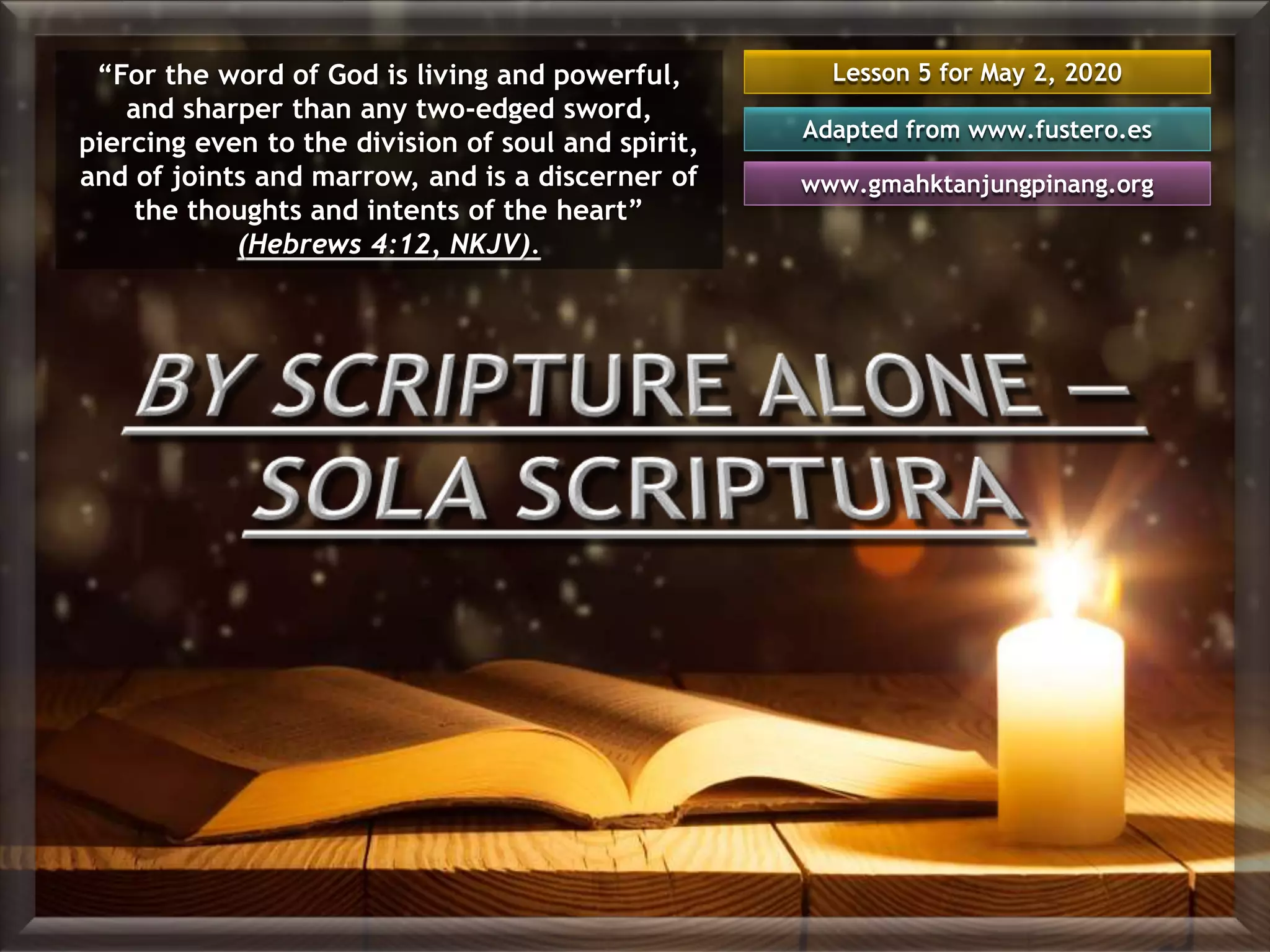
Lesson 5 for May 2, 2020
Adapted from www.fustero.es
www.gmahktanjungpinang.org
“For the word of God is living and powerful,
and sharper than any two-edged sword,
piercing even to the division of soul and spirit,
and of joints and marrow, and is a discerner of
the thoughts and intents of the heart”
(Hebrews 4:12, NKJV).
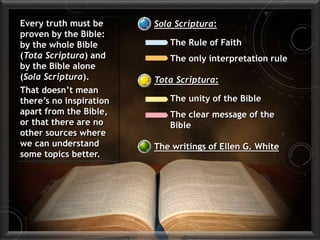
Sola Scriptura:
The Rule of Faith
The only interpretation rule
Tota Scriptura:
The unity of the Bible
The clear message of the
Bible
The writings of Ellen G. White
Every truth must be
proven by the Bible:
by the whole Bible
(Tota Scriptura) and
by the Bible alone
(Sola Scriptura).
That doesn’t mean
there’s no inspiration
apart from the Bible,
or that there are no
other sources where
we can understand
some topics better.
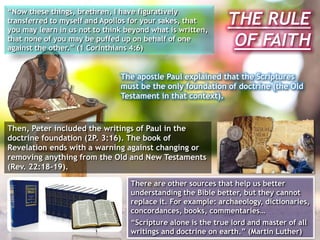
THE RULE
OF FAITH
“Now these things, brethren, I have figuratively
transferred to myself and Apollos for your sakes, that
you may learn in us not to think beyond what is written,
that none of you may be puffed up on behalf of one
against the other.” (1 Corinthians 4:6)
The apostle Paul explained that the Scriptures
must be the only foundation of doctrine (the Old
Testament in that context).
There are other sources that help us better
understanding the Bible better, but they cannot
replace it. For example: archaeology, dictionaries,
concordances, books, commentaries…
“Scripture alone is the true lord and master of all
writings and doctrine on earth.” (Martin Luther)
Then, Peter included the writings of Paul in the
doctrine foundation (2P. 3:16). The book of
Revelation ends with a warning against changing or
removing anything from the Old and New Testaments
(Rev. 22:18-19).
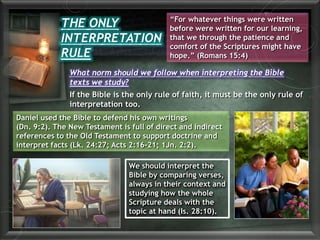
THE ONLY
INTERPRETATION
RULE
“For whatever things were written
before were written for our learning,
that we through the patience and
comfort of the Scriptures might have
hope.” (Romans 15:4)
What norm should we follow when interpreting the Bible
texts we study?
If the Bible is the only rule of faith, it must be the only rule of
interpretation too.
Daniel used the Bible to defend his own writings
(Dn. 9:2). The New Testament is full of direct and indirect
references to the Old Testament to support doctrine and
interpret facts (Lk. 24:27; Acts 2:16-21; 1Jn. 2:2).
We should interpret the
Bible by comparing verses,
always in their context and
studying how the whole
Scripture deals with the
topic at hand (Is. 28:10).
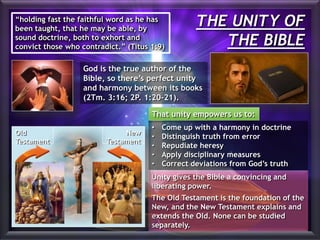
THE UNITY OF
THE BIBLE
“holding fast the faithful word as he has
been taught, that he may be able, by
sound doctrine, both to exhort and
convict those who contradict.” (Titus 1:9)
God is the true author of the
Bible, so there’s perfect unity
and harmony between its books
(2Tm. 3:16; 2P. 1:20-21).
• Come up with a harmony in doctrine
• Distinguish truth from error
• Repudiate heresy
• Apply disciplinary measures
• Correct deviations from God’s truth
Unity gives the Bible a convincing and
liberating power.
The Old Testament is the foundation of the
New, and the New Testament explains and
extends the Old. None can be studied
separately.
Old
Testament
New
Testament
That unity empowers us to:
THE CLEAR MESSAGE OF THE BIBLE
“So when you see the ‘abomination of desolation,’ spoken of by
Daniel the prophet, standing where it ought not (let the reader
understand), then let those who are in Judea flee to the
mountains.” (Mark 13:14)
Although there are some passages that are hard to
understand (2P. 3:16), the Bible is clear enough for
anyone to understand it.
The topics of salvation and eternal life are amazingly
easy to understand in the Bible. Both the ignorant
and the wise can understand them.
If we read the Bible with the
desire to learn more about God,
the Holy Spirit will help us to
understand it better and to
obtain wisdom.
There is no point in restricting
the Bible to only a handful of
chosen people or the clergy.
Everyone can understand it.
THE WRITINGS OF ELLEN G. WHITE
“And it shall come to pass afterward that I will pour out My Spirit on
all flesh; your sons and your daughters shall prophesy, your old men
shall dream dreams, your young men shall see visions.” (Joel 2:28)
There are prophets in the Bible who
didn’t write anything or whose
writings weren’t preserved (Nm.
21:14; Jos. 10:13; 1K. 11:41; 1Chr.
29:29; 2Chr. 35:25).
That doesn’t mean that they were less
inspired. In fact, John the Baptist was
considered the great of all prophets
but didn’t write anything down (Lk.
7:28).
God has promised that there would be
inspired prophets in the End Time, our
time.
Ellen G. White was one of those
prophets.
How should Ellen G. White’s writings be interpreted? Do they
have any authority?
As Ellen explained, her writings must be interpreted according
to the Bible, not vice versa.
She never stated or pretended that her writings should
replace the Bible.
The purpose of the visions given to sister
White is for the people of God to put the
Bible truths into practice in the End Time.
We must never use her writings as the
foundation for any doctrine. The Bible is still
the only rule of faith and practice for the
Seventh-day Adventist Church.
THE WRITINGS OF ELLEN G. WHITE
“And it shall come to pass afterward that I will pour out My
Spirit on all flesh; your sons and your daughters shall
prophesy, your old men shall dream dreams, your young men
shall see visions.” (Joel 2:28)
“When you make the Bible your food, your
meat, and your drink, when you make its
principles the elements of your character,
you will know better how to receive counsel
from God. I exalt the precious word before
you today. Do not repeat what I have said,
saying, ‘Sister White said this,’ and ‘Sister
White said that.’ Find out what the Lord
God of Israel says, and then do what He
commands.”
E.G.W. (Selected Messages, vol. 3, p. 33)
“God has given in His word
sufficient evidence of its divine
character. The great truths
which concern our redemption
are clearly presented. By the
aid of the Holy Spirit, which is
promised to all who seek it in
sincerity, every man may
understand these truths for
himself. God has granted to
men a strong foundation upon
which to rest their faith.”
E.G.W. (The Great Controversy, cp. 32, p. 526)

Sabbath school lesson 5, 2nd quarter 2020

  • 1.
    Lesson 5 forMay 2, 2020 Adapted from www.fustero.es www.gmahktanjungpinang.org “For the word of God is living and powerful, and sharper than any two-edged sword, piercing even to the division of soul and spirit, and of joints and marrow, and is a discerner of the thoughts and intents of the heart” (Hebrews 4:12, NKJV).
  • 2.
    Sola Scriptura: The Ruleof Faith The only interpretation rule Tota Scriptura: The unity of the Bible The clear message of the Bible The writings of Ellen G. White Every truth must be proven by the Bible: by the whole Bible (Tota Scriptura) and by the Bible alone (Sola Scriptura). That doesn’t mean there’s no inspiration apart from the Bible, or that there are no other sources where we can understand some topics better.
  • 3.
    THE RULE OF FAITH “Nowthese things, brethren, I have figuratively transferred to myself and Apollos for your sakes, that you may learn in us not to think beyond what is written, that none of you may be puffed up on behalf of one against the other.” (1 Corinthians 4:6) The apostle Paul explained that the Scriptures must be the only foundation of doctrine (the Old Testament in that context). There are other sources that help us better understanding the Bible better, but they cannot replace it. For example: archaeology, dictionaries, concordances, books, commentaries… “Scripture alone is the true lord and master of all writings and doctrine on earth.” (Martin Luther) Then, Peter included the writings of Paul in the doctrine foundation (2P. 3:16). The book of Revelation ends with a warning against changing or removing anything from the Old and New Testaments (Rev. 22:18-19).
  • 4.
    THE ONLY INTERPRETATION RULE “For whateverthings were written before were written for our learning, that we through the patience and comfort of the Scriptures might have hope.” (Romans 15:4) What norm should we follow when interpreting the Bible texts we study? If the Bible is the only rule of faith, it must be the only rule of interpretation too. Daniel used the Bible to defend his own writings (Dn. 9:2). The New Testament is full of direct and indirect references to the Old Testament to support doctrine and interpret facts (Lk. 24:27; Acts 2:16-21; 1Jn. 2:2). We should interpret the Bible by comparing verses, always in their context and studying how the whole Scripture deals with the topic at hand (Is. 28:10).
  • 5.
    THE UNITY OF THEBIBLE “holding fast the faithful word as he has been taught, that he may be able, by sound doctrine, both to exhort and convict those who contradict.” (Titus 1:9) God is the true author of the Bible, so there’s perfect unity and harmony between its books (2Tm. 3:16; 2P. 1:20-21). • Come up with a harmony in doctrine • Distinguish truth from error • Repudiate heresy • Apply disciplinary measures • Correct deviations from God’s truth Unity gives the Bible a convincing and liberating power. The Old Testament is the foundation of the New, and the New Testament explains and extends the Old. None can be studied separately. Old Testament New Testament That unity empowers us to:
  • 6.
    THE CLEAR MESSAGEOF THE BIBLE “So when you see the ‘abomination of desolation,’ spoken of by Daniel the prophet, standing where it ought not (let the reader understand), then let those who are in Judea flee to the mountains.” (Mark 13:14) Although there are some passages that are hard to understand (2P. 3:16), the Bible is clear enough for anyone to understand it. The topics of salvation and eternal life are amazingly easy to understand in the Bible. Both the ignorant and the wise can understand them. If we read the Bible with the desire to learn more about God, the Holy Spirit will help us to understand it better and to obtain wisdom. There is no point in restricting the Bible to only a handful of chosen people or the clergy. Everyone can understand it.
  • 7.
    THE WRITINGS OFELLEN G. WHITE “And it shall come to pass afterward that I will pour out My Spirit on all flesh; your sons and your daughters shall prophesy, your old men shall dream dreams, your young men shall see visions.” (Joel 2:28) There are prophets in the Bible who didn’t write anything or whose writings weren’t preserved (Nm. 21:14; Jos. 10:13; 1K. 11:41; 1Chr. 29:29; 2Chr. 35:25). That doesn’t mean that they were less inspired. In fact, John the Baptist was considered the great of all prophets but didn’t write anything down (Lk. 7:28). God has promised that there would be inspired prophets in the End Time, our time. Ellen G. White was one of those prophets.
  • 8.
    How should EllenG. White’s writings be interpreted? Do they have any authority? As Ellen explained, her writings must be interpreted according to the Bible, not vice versa. She never stated or pretended that her writings should replace the Bible. The purpose of the visions given to sister White is for the people of God to put the Bible truths into practice in the End Time. We must never use her writings as the foundation for any doctrine. The Bible is still the only rule of faith and practice for the Seventh-day Adventist Church. THE WRITINGS OF ELLEN G. WHITE “And it shall come to pass afterward that I will pour out My Spirit on all flesh; your sons and your daughters shall prophesy, your old men shall dream dreams, your young men shall see visions.” (Joel 2:28)
  • 9.
    “When you makethe Bible your food, your meat, and your drink, when you make its principles the elements of your character, you will know better how to receive counsel from God. I exalt the precious word before you today. Do not repeat what I have said, saying, ‘Sister White said this,’ and ‘Sister White said that.’ Find out what the Lord God of Israel says, and then do what He commands.” E.G.W. (Selected Messages, vol. 3, p. 33)
  • 10.
    “God has givenin His word sufficient evidence of its divine character. The great truths which concern our redemption are clearly presented. By the aid of the Holy Spirit, which is promised to all who seek it in sincerity, every man may understand these truths for himself. God has granted to men a strong foundation upon which to rest their faith.” E.G.W. (The Great Controversy, cp. 32, p. 526)