Safeguarding Adults in
Havering
Community and Voluntary Sector
Focus Group
Safeguarding Adults
At Risk From Harm
Four Key Messages
SafeguardingAdultsBoard@havering.gov.uk
 Safeguarding is everyone’s responsibility
 Who are ‘adults at risk’?
 What is abuse?
 Where to go if you have a concern?
 How can C&VS get involved?
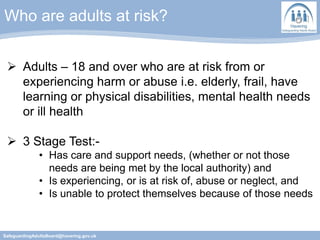
Who are adults at risk?
SafeguardingAdultsBoard@havering.gov.uk
 Adults – 18 and over who are at risk from or
experiencing harm or abuse i.e. elderly, frail, have
learning or physical disabilities, mental health needs
or ill health
 3 Stage Test:-
• Has care and support needs, (whether or not those
needs are being met by the local authority) and
• Is experiencing, or is at risk of, abuse or neglect, and
• Is unable to protect themselves because of those needs
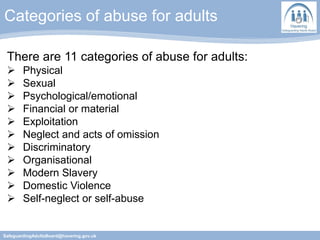
Categories of abuse for adults
SafeguardingAdultsBoard@havering.gov.uk
There are 11 categories of abuse for adults:
 Physical
 Sexual
 Psychological/emotional
 Financial or material
 Exploitation
 Neglect and acts of omission
 Discriminatory
 Organisational
 Modern Slavery
 Domestic Violence
 Self-neglect or self-abuse
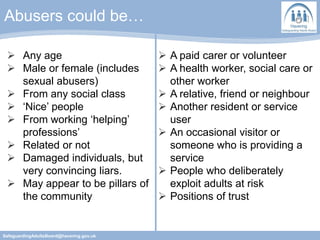
Abusers could be…
SafeguardingAdultsBoard@havering.gov.uk
 Any age
 Male or female (includes
sexual abusers)
 From any social class
 ‘Nice’ people
 From working ‘helping’
professions’
 Related or not
 Damaged individuals, but
very convincing liars.
 May appear to be pillars of
the community
 A paid carer or volunteer
 A health worker, social care or
other worker
 A relative, friend or neighbour
 Another resident or service
user
 An occasional visitor or
someone who is providing a
service
 People who deliberately
exploit adults at risk
 Positions of trust
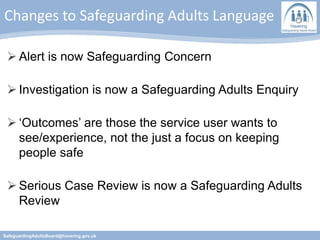
Changes to Safeguarding Adults Language
SafeguardingAdultsBoard@havering.gov.uk
 Alert is now Safeguarding Concern
 Investigation is now a Safeguarding Adults Enquiry
 ‘Outcomes’ are those the service user wants to
see/experience, not the just a focus on keeping
people safe
 Serious Case Review is now a Safeguarding Adults
Review
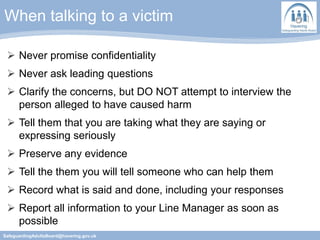
When talking to a victim
SafeguardingAdultsBoard@havering.gov.uk
 Never promise confidentiality
 Never ask leading questions
 Clarify the concerns, but DO NOT attempt to interview the
person alleged to have caused harm
 Tell them that you are taking what they are saying or
expressing seriously
 Preserve any evidence
 Tell the them you will tell someone who can help them
 Record what is said and done, including your responses
 Report all information to your Line Manager as soon as
possible
Where to go if you have a concern
Adult Social Services:
Safeguarding Adults Team
Tel: 01708 433550
Fax: 01708 432497 (Safe Haven)
Email: Safeguarding_Adults_Team@havering.gov.uk.
If there is an immediate risk of serious harm, then call the Police
Dial 999
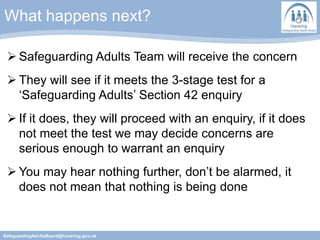
What happens next?
SafeguardingAdultsBoard@havering.gov.uk
 Safeguarding Adults Team will receive the concern
 They will see if it meets the 3-stage test for a
‘Safeguarding Adults’ Section 42 enquiry
 If it does, they will proceed with an enquiry, if it does
not meet the test we may decide concerns are
serious enough to warrant an enquiry
 You may hear nothing further, don’t be alarmed, it
does not mean that nothing is being done
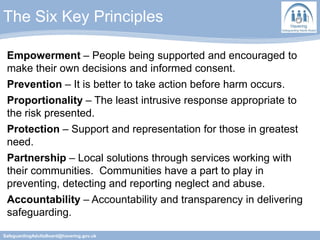
The Six Key Principles
SafeguardingAdultsBoard@havering.gov.uk
Empowerment – People being supported and encouraged to
make their own decisions and informed consent.
Prevention – It is better to take action before harm occurs.
Proportionality – The least intrusive response appropriate to
the risk presented.
Protection – Support and representation for those in greatest
need.
Partnership – Local solutions through services working with
their communities. Communities have a part to play in
preventing, detecting and reporting neglect and abuse.
Accountability – Accountability and transparency in delivering
safeguarding.
How can the C&VS get involved?
SafeguardingAdultsBoard@havering.gov.uk
The SAB must publish a strategic plan for each financial year
that sets how it will meet its main objective and what the
members will do to achieve this. The plan must be developed
with local community involvement, and the SAB must consult
the local Healthwatch organisation. The plan should be evidence
based and make use of all available evidence and intelligence
from partners to form and develop its plan.
After the end of each financial year, the SAB must publish an
annual report that must clearly state what both the SAB and its
members have done to carry out and deliver the objectives and
other content of its strategic plan.
Both have to be accessible to local people!
Discussion
SafeguardingAdultsBoard@havering.gov.uk
 How can we find out what about safeguarding adults
matters to local people?
 How can we make sure that local people understand
what Safeguarding Adults Board is doing?
 How do we work together the raise awareness of
Safeguarding Adults in the community?

Saa cvs focus group presentation v2

  • 1.
    Safeguarding Adults in Havering Communityand Voluntary Sector Focus Group
  • 2.
  • 3.
    Four Key Messages SafeguardingAdultsBoard@havering.gov.uk Safeguarding is everyone’s responsibility  Who are ‘adults at risk’?  What is abuse?  Where to go if you have a concern?  How can C&VS get involved?
  • 4.
    Who are adultsat risk? SafeguardingAdultsBoard@havering.gov.uk  Adults – 18 and over who are at risk from or experiencing harm or abuse i.e. elderly, frail, have learning or physical disabilities, mental health needs or ill health  3 Stage Test:- • Has care and support needs, (whether or not those needs are being met by the local authority) and • Is experiencing, or is at risk of, abuse or neglect, and • Is unable to protect themselves because of those needs
  • 5.
    Categories of abusefor adults SafeguardingAdultsBoard@havering.gov.uk There are 11 categories of abuse for adults:  Physical  Sexual  Psychological/emotional  Financial or material  Exploitation  Neglect and acts of omission  Discriminatory  Organisational  Modern Slavery  Domestic Violence  Self-neglect or self-abuse
  • 6.
    Abusers could be… SafeguardingAdultsBoard@havering.gov.uk Any age  Male or female (includes sexual abusers)  From any social class  ‘Nice’ people  From working ‘helping’ professions’  Related or not  Damaged individuals, but very convincing liars.  May appear to be pillars of the community  A paid carer or volunteer  A health worker, social care or other worker  A relative, friend or neighbour  Another resident or service user  An occasional visitor or someone who is providing a service  People who deliberately exploit adults at risk  Positions of trust
  • 7.
    Changes to SafeguardingAdults Language SafeguardingAdultsBoard@havering.gov.uk  Alert is now Safeguarding Concern  Investigation is now a Safeguarding Adults Enquiry  ‘Outcomes’ are those the service user wants to see/experience, not the just a focus on keeping people safe  Serious Case Review is now a Safeguarding Adults Review
  • 8.
    When talking toa victim SafeguardingAdultsBoard@havering.gov.uk  Never promise confidentiality  Never ask leading questions  Clarify the concerns, but DO NOT attempt to interview the person alleged to have caused harm  Tell them that you are taking what they are saying or expressing seriously  Preserve any evidence  Tell the them you will tell someone who can help them  Record what is said and done, including your responses  Report all information to your Line Manager as soon as possible
  • 9.
    Where to goif you have a concern Adult Social Services: Safeguarding Adults Team Tel: 01708 433550 Fax: 01708 432497 (Safe Haven) Email: Safeguarding_Adults_Team@havering.gov.uk. If there is an immediate risk of serious harm, then call the Police Dial 999
  • 10.
    What happens next? SafeguardingAdultsBoard@havering.gov.uk Safeguarding Adults Team will receive the concern  They will see if it meets the 3-stage test for a ‘Safeguarding Adults’ Section 42 enquiry  If it does, they will proceed with an enquiry, if it does not meet the test we may decide concerns are serious enough to warrant an enquiry  You may hear nothing further, don’t be alarmed, it does not mean that nothing is being done
  • 11.
    The Six KeyPrinciples SafeguardingAdultsBoard@havering.gov.uk Empowerment – People being supported and encouraged to make their own decisions and informed consent. Prevention – It is better to take action before harm occurs. Proportionality – The least intrusive response appropriate to the risk presented. Protection – Support and representation for those in greatest need. Partnership – Local solutions through services working with their communities. Communities have a part to play in preventing, detecting and reporting neglect and abuse. Accountability – Accountability and transparency in delivering safeguarding.
  • 12.
    How can theC&VS get involved? SafeguardingAdultsBoard@havering.gov.uk The SAB must publish a strategic plan for each financial year that sets how it will meet its main objective and what the members will do to achieve this. The plan must be developed with local community involvement, and the SAB must consult the local Healthwatch organisation. The plan should be evidence based and make use of all available evidence and intelligence from partners to form and develop its plan. After the end of each financial year, the SAB must publish an annual report that must clearly state what both the SAB and its members have done to carry out and deliver the objectives and other content of its strategic plan. Both have to be accessible to local people!
  • 13.
    Discussion SafeguardingAdultsBoard@havering.gov.uk  How canwe find out what about safeguarding adults matters to local people?  How can we make sure that local people understand what Safeguarding Adults Board is doing?  How do we work together the raise awareness of Safeguarding Adults in the community?