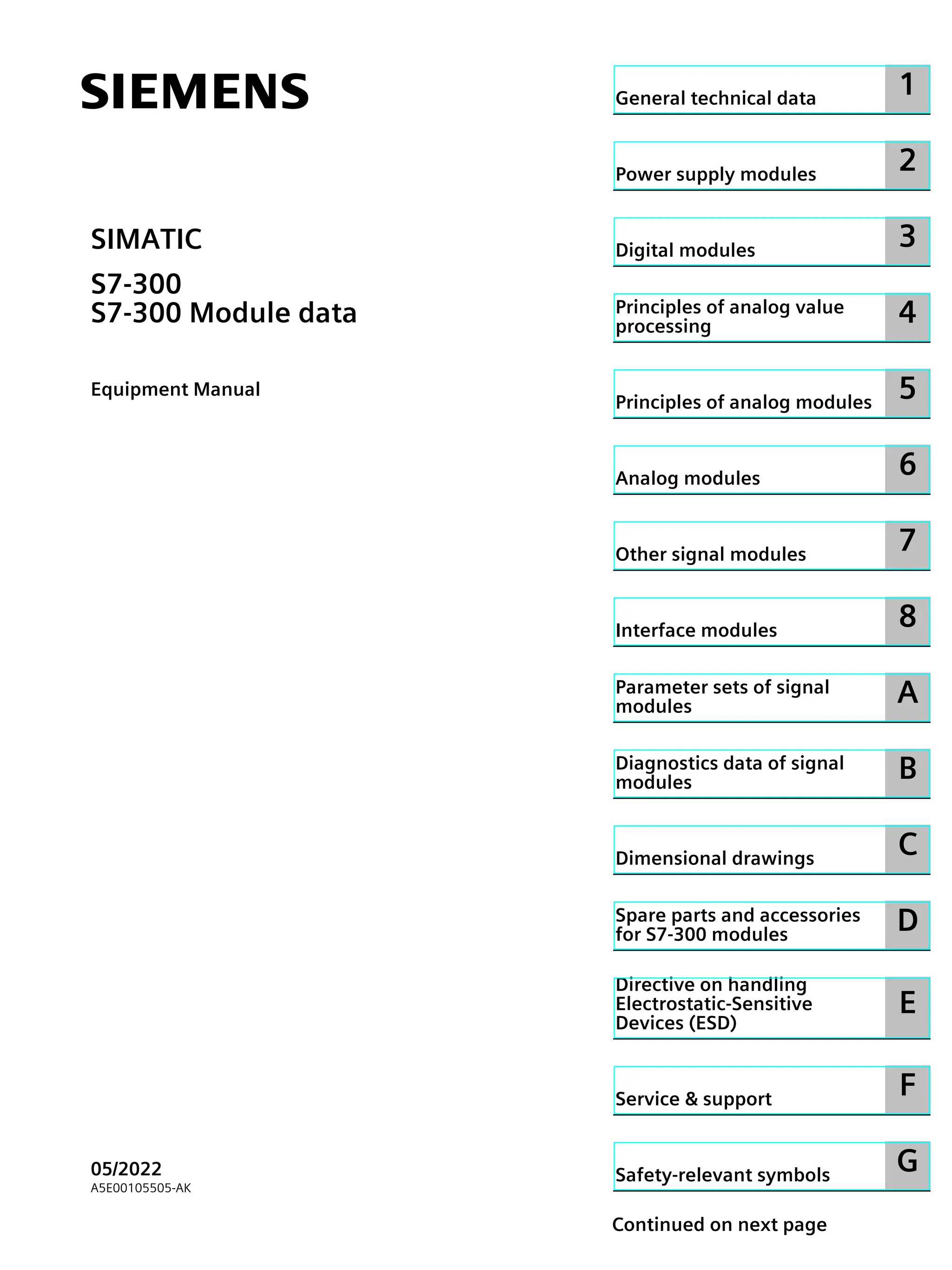
General technical data
1
Power supply modules
2
Digital modules
3
Principles of analog value
processing
4
Principles of analog modules
5
Analog modules
6
Other signal modules
7
Interface modules
8
Parameter sets of signal
modules
A
Diagnostics data of signal
modules
B
Dimensional drawings
C
Spare parts and accessories
for S7-300 modules
D
Directive on handling
Electrostatic-Sensitive
Devices (ESD)
E
Service & support
F
Safety-relevant symbols
G
Continued on next page
SIMATIC
S7-300
S7-300 Module data
Equipment Manual
05/2022
A5E00105505-AK
Continued
List of abbreviations
H
S7-300
S7-300 Module data
Equipment Manual
Siemens AG
Digital Industries
Postfach 48 48
90026 NÜRNBERG
GERMANY
A5E00105505-AK
Ⓟ 05/2022 Subject to change
Copyright © Siemens AG 2001 - 2022.
All rights reserved
Legal information
Warning notice system
This manual contains notices you have to observe in order to ensure your personal safety, as well as to prevent
damage to property. The notices referring to your personal safety are highlighted in the manual by a safety alert
symbol, notices referring only to property damage have no safety alert symbol. These notices shown below are
graded according to the degree of danger.
DANGER
indicates that death or severe personal injury will result if proper precautions are not taken.
WARNING
indicates that death or severe personal injury may result if proper precautions are not taken.
CAUTION
indicates that minor personal injury can result if proper precautions are not taken.
NOTICE
indicates that property damage can result if proper precautions are not taken.
If more than one degree of danger is present, the warning notice representing the highest degree of danger will
be used. A notice warning of injury to persons with a safety alert symbol may also include a warning relating to
property damage.
Qualified Personnel
The product/system described in this documentation may be operated only by personnel qualified for the specific
task in accordance with the relevant documentation, in particular its warning notices and safety instructions. Qual­
ified personnel are those who, based on their training and experience, are capable of identifying risks and avoiding
potential hazards when working with these products/systems.
Proper use of Siemens products
Note the following:
WARNING
Siemens products may only be used for the applications described in the catalog and in the relevant technical doc­
umentation. If products and components from other manufacturers are used, these must be recommended or
approved by Siemens. Proper transport, storage, installation, assembly, commissioning, operation and mainten­
ance are required to ensure that the products operate safely and without any problems. The permissible ambient
conditions must be complied with. The information in the relevant documentation must be observed.
Trademarks
All names identified by ® are registered trademarks of Siemens AG. The remaining trademarks in this publication
may be trademarks whose use by third parties for their own purposes could violate the rights of the owner.
Disclaimer of Liability
We have reviewed the contents of this publication to ensure consistency with the hardware and software
described. Since variance cannot be precluded entirely, we cannot guarantee full consistency. However, the
information in this publication is reviewed regularly and any necessary corrections are included in subsequent edi­
tions.
S7-300 Module data
Equipment Manual, 05/2022, A5E00105505-AK
4
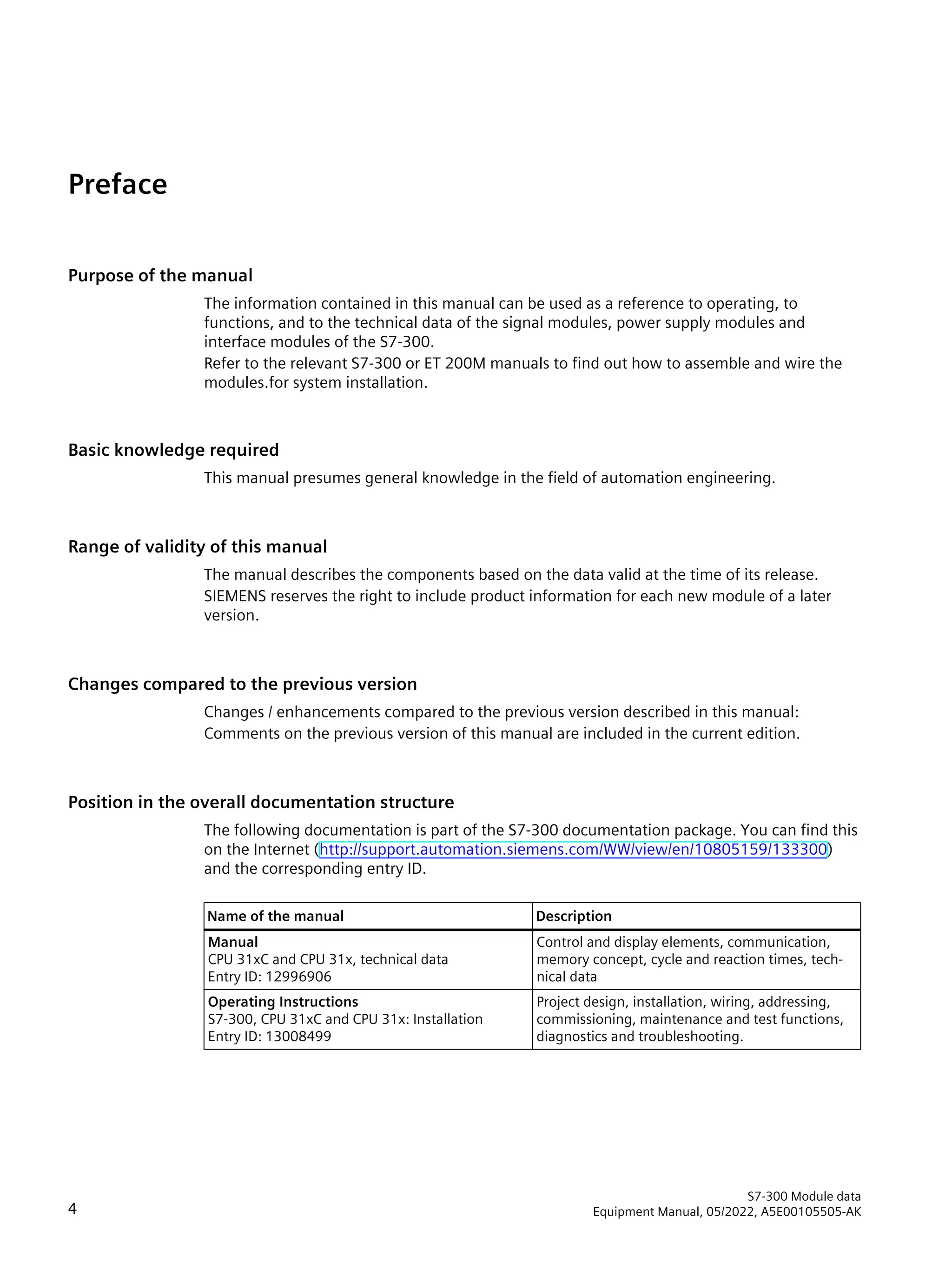
Preface
Purpose of the manual
The information contained in this manual can be used as a reference to operating, to
functions, and to the technical data of the signal modules, power supply modules and
interface modules of the S7-300.
Refer to the relevant S7-300 or ET 200M manuals to find out how to assemble and wire the
modules.for system installation.
Basic knowledge required
This manual presumes general knowledge in the field of automation engineering.
Range of validity of this manual
The manual describes the components based on the data valid at the time of its release.
SIEMENS reserves the right to include product information for each new module of a later
version.
Changes compared to the previous version
Changes / enhancements compared to the previous version described in this manual:
Comments on the previous version of this manual are included in the current edition.
Position in the overall documentation structure
The following documentation is part of the S7-300 documentation package. You can find this
on the Internet (http://support.automation.siemens.com/WW/view/en/10805159/133300)
and the corresponding entry ID.
Name of the manual Description
Manual
CPU 31xC and CPU 31x, technical data
Entry ID: 12996906
Control and display elements, communication,
memory concept, cycle and reaction times, tech­
nical data
Operating Instructions
S7-300, CPU 31xC and CPU 31x: Installation
Entry ID: 13008499
Project design, installation, wiring, addressing,
commissioning, maintenance and test functions,
diagnostics and troubleshooting.
Name of the manual Description
System Manual
PROFINET system description
Entry ID: 19292127
Basic description of PROFINET:
Network components, data exchange and commu­
nication, PROFINET IO, Component-based Automa­
tion, application example of PROFINET IO and
Component-based Automation.
Programming manual
Migration from PROFIBUS DP to PROFINET IO
Entry ID: 19289930
Guideline for migration from PROFIBUS DP to
PROFINET IO.
Manual
• CPU 31xC: Technological functions
Entry ID: 12429336
• CD containing examples
Description of the technological functions: posi­
tioning, counting, point-to-point coupling, loop
control.
The CD contains examples of the technological
functions.
YOU ARE CURRENTLY READING the Manual
S7-300 Automation System: Module Data
Entry ID: 8859629
Description of the functions and technical data of
signal/ power supply/ interface modules.
Instructions List
• CPU 31xC, CPU 31x,
IM151-7 CPU, IM154-8 CPU, BM 147-1 CPU,
BM147-2 CPU
Entry ID: 13206730
• CPU 312, CPU 314, CPU 315-2 DP
CPU 315-2 PN/DP, CPU 317-2 PN/DP, CPU 319-3
PN/DP as of V3.0
Entry ID: 31977679
List of the CPU's instruction set and corresponding
execution times. List of executable blocks (OBs,
SFCs, SFBs) and their execution times.
Getting Started
Available anthology of Getting Started manuals:
• S7-300 Getting Started
Entry ID: 15390497
• PROFINET Getting Started Collection
Entry ID: 19290251
Using concrete examples, the Getting Started doc­
umentation provides step-by-step instructions
focused on commissioning a fully functional
application.
Other manuals on S7-300 and ET 200M
Name of the manual Description
Reference Manual
• CPU Data: CPU 312 IFM - 318-2 DP
• Entry ID: 8860591
Control and display elements, communication,
memory concept, cycle and reaction times, tech­
nical data
Software Installation Manual
S7-300 Automation System: Installation: CPU 312
IFM – 318-2 DP
Entry ID: 15390415
Project design, installation, wiring, addressing,
commissioning, maintenance and test functions,
diagnostics and troubleshooting.
Configuration manual
ET 200M signal modules for process automation
Entry ID: 7215812
Description of integration in process automation,
parameter configuration using SIMATIC PDM,
digital input modules, digital output modules.
S7-300 Module data
Equipment Manual, 05/2022, A5E00105505-AK 5
Preface
S7-300 Module data
Equipment Manual, 05/2022, A5E00105505-AK
6
Name of the manual Description
Manual
Distributed I/O Device ET 200M
HART analog modules
Entry ID: 22063748
Description of configuration and commissioning of
HART analog modules.
Manual
Distributed I/O Device ET 200M
Entry ID: 1142798
Description of configuration, assembly and wiring.
Manual
SM 335 - High-speed analog mixed module for
SIMATIC S7-300
Entry ID: 1398483
Description of how to use the SM 335 module in a
SIMATIC S7-300.
Overview of operations, descriptions of functions,
and technical data relating to the SM 335.
Sign posts
The manual contains various features supporting quick access to specific information:
• At the beginning of the manual, you will find a complete table of contents.
• Key terms are explained in the glossary.
• You can use the index to find the key parts of the manual.
Approvals
See section Standards and approvals (Page 15).
CE approval
See section Standards and approvals (Page 15).
RCM (C-Tick) Declaration of conformity for Australia/New Zealand
See section Standards and approvals (Page 15).
Standards
See section Standards and approvals (Page 15).
Recycling and disposal
Since the S7-300 components only contain low levels of harmful substances, they are
suitable for recycling. For ecologically compatible recycling and disposal of your old device,
contact a certificated disposal service for electronic scrap.
Preface
Security information
Siemens provides products and solutions with industrial security functions that support the
secure operation of plants, systems, machines and networks.
In order to protect plants, systems, machines and networks against cyber threats, it is
necessary to implement – and continuously maintain – a holistic, state-of-the-art industrial
security concept. Siemens’ products and solutions only form one element of such a concept.
Customer is responsible to prevent unauthorized access to its plants, systems, machines and
networks. Systems, machines and components should only be connected to the enterprise
network or the internet if and to the extent necessary and with appropriate security measures
(e.g. use of firewalls and network segmentation) in place.
Additionally, Siemens’ guidance on appropriate security measures should be taken into
account. For more information about industrial security, please visit
(http://www.siemens.com/industrialsecurity).
Siemens’ products and solutions undergo continuous development to make them more
secure. Siemens strongly recommends to apply product updates as soon as available and to
always use the latest product versions. Use of product versions that are no longer supported,
and failure to apply latest updates may increase customer’s exposure to cyber threats.
To stay informed about product updates, subscribe to the Siemens Industrial Security RSS
Feed under (http://www.siemens.com/industrialsecurity).
S7-300 Module data
Equipment Manual, 05/2022, A5E00105505-AK 7
Preface
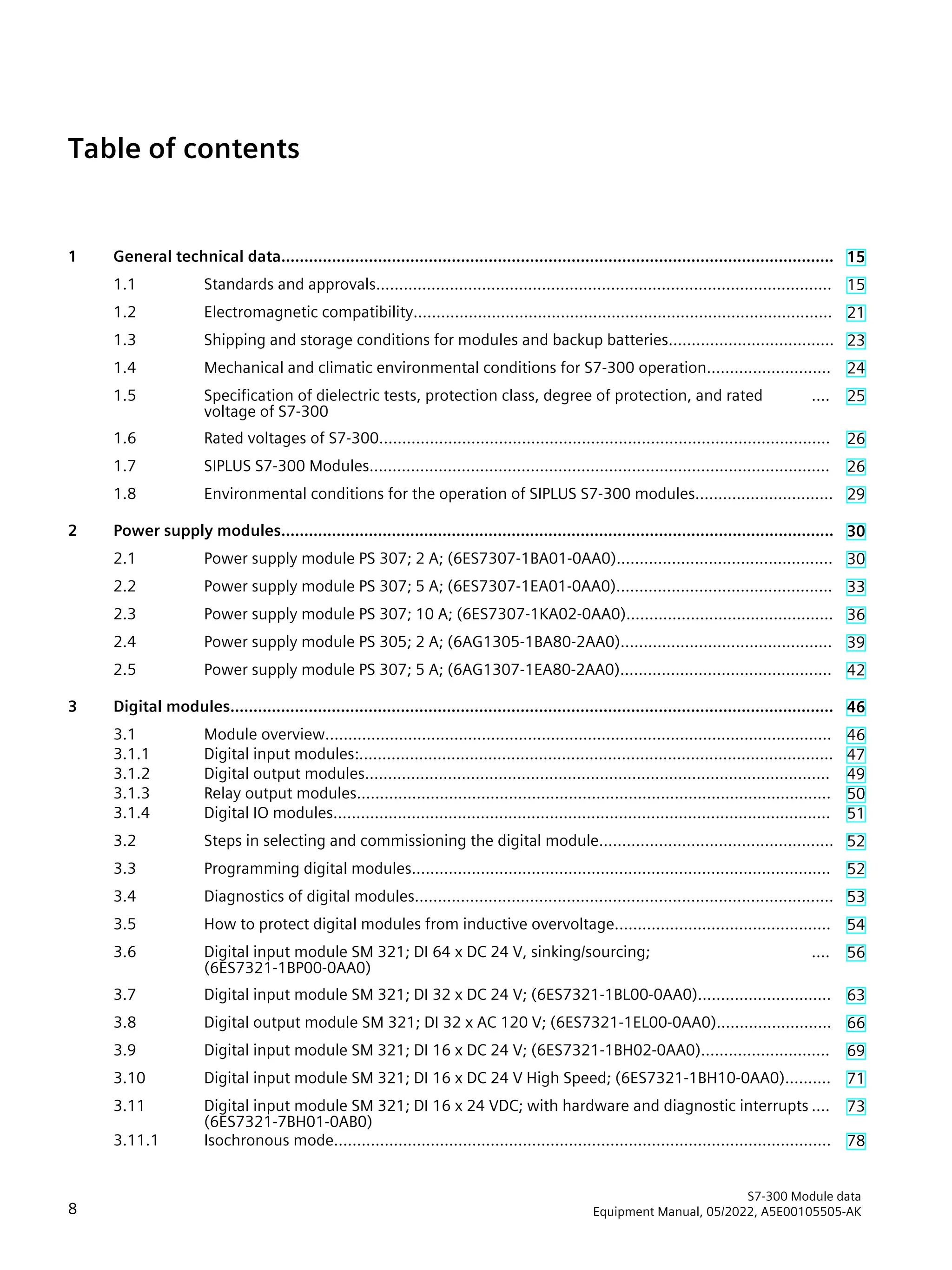
8
1 General technical data........................................................................................................................ 15
1.1 Standards and approvals................................................................................................... 15
1.2 Electromagnetic compatibility........................................................................................... 21
1.3 Shipping and storage conditions for modules and backup batteries.................................... 23
1.4 Mechanical and climatic environmental conditions for S7-300 operation........................... 24
1.5 Specification of dielectric tests, protection class, degree of protection, and rated
voltage of S7-300
.... 25
1.6 Rated voltages of S7-300.................................................................................................. 26
1.7 SIPLUS S7-300 Modules.................................................................................................... 26
1.8 Environmental conditions for the operation of SIPLUS S7-300 modules.............................. 29
2 Power supply modules........................................................................................................................ 30
2.1 Power supply module PS 307; 2 A; (6ES7307-1BA01-0AA0)............................................... 30
2.2 Power supply module PS 307; 5 A; (6ES7307-1EA01-0AA0)............................................... 33
2.3 Power supply module PS 307; 10 A; (6ES7307-1KA02-0AA0)............................................. 36
2.4 Power supply module PS 305; 2 A; (6AG1305-1BA80-2AA0).............................................. 39
2.5 Power supply module PS 307; 5 A; (6AG1307-1EA80-2AA0).............................................. 42
3 Digital modules................................................................................................................................... 46
3.1 Module overview.............................................................................................................. 46
3.1.1 Digital input modules:....................................................................................................... 47
3.1.2 Digital output modules..................................................................................................... 49
3.1.3 Relay output modules....................................................................................................... 50
3.1.4 Digital IO modules............................................................................................................ 51
3.2 Steps in selecting and commissioning the digital module................................................... 52
3.3 Programming digital modules........................................................................................... 52
3.4 Diagnostics of digital modules........................................................................................... 53
3.5 How to protect digital modules from inductive overvoltage............................................... 54
3.6 Digital input module SM 321; DI 64 x DC 24 V, sinking/sourcing;
(6ES7321-1BP00-0AA0)
.... 56
3.7 Digital input module SM 321; DI 32 x DC 24 V; (6ES7321-1BL00-0AA0)............................. 63
3.8 Digital output module SM 321; DI 32 x AC 120 V; (6ES7321-1EL00-0AA0)......................... 66
3.9 Digital input module SM 321; DI 16 x DC 24 V; (6ES7321-1BH02-0AA0)............................ 69
3.10 Digital input module SM 321; DI 16 x DC 24 V High Speed; (6ES7321-1BH10-0AA0).......... 71
3.11 Digital input module SM 321; DI 16 x 24 VDC; with hardware and diagnostic interrupts
(6ES7321-7BH01-0AB0)
.... 73
3.11.1 Isochronous mode............................................................................................................ 78
S7-300 Module data
Equipment Manual, 05/2022, A5E00105505-AK
Table of contents
3.11.2 SM 321; DI 16 x DC 24 V - Parameters............................................................................... 79
3.11.3 SM 321; DI 16 x DC 24 V - Diagnostics............................................................................... 80
3.11.4 SM 321; DI 16 x DC 24 V - Behavior................................................................................... 81
3.11.5 SM 321; DI 16 x DC 24 V - Interrupts................................................................................. 82
3.12 Digital input module SM 321; DI 16 x DC 24/125 V; with hardware and diagnostic
interrupts (6ES7321-7EH00-0AB0)
.... 84
3.12.1 Parameters of SM 321; DI 16 x DC 24/125 V...................................................................... 88
3.12.2 Diagnostics of SM 321; DI 16 x DC 24/125 V...................................................................... 89
3.12.3 Interrupts of SM 321; DI 16 x DC 24/125 V........................................................................ 91
3.13 Digital input module SM 321; DI 16 x DC 24 V; source input; (6ES7321-1BH50-0AA0)........ 92
3.14 Digital input module SM 321; DI 16 x UC 24/48 V; (6ES7321-1CH00-0AA0)....................... 94
3.15 Digital input module SM 321; DI 16 x DC 48-125 V; (6ES7321-1CH20-0AA0)..................... 96
3.16 Digital input module SM 321; DI 16 x AC 120/230 V; (6ES7321-1FH00-0AA0).................... 99
3.17 Digital input module SM 321; DI 8 x AC 120/230 V; (6ES7321-1FF01-0AA0)...................... 101
3.18 Digital input module SM 321; DI 8 x AC 120/230 V ISOL; (6ES7321-1FF10-0AA0)............... 103
3.19 Digital output module SM 322; DO 64 x DC 24 V/0.3 A sourcing;
(6ES7322-1BP00-0AA0)
.... 106
3.20 Digital output module SM 322; DO 64 x DC 24 V/0.3 A Sinking (6ES7322-1BP50-0AA0)..... 112
3.21 Digital output module SM 322; DO 32 x DC 24 V/ 0.5 A; (6ES7322-1BL00-0AA0)............... 119
3.22 Digital output module SM 322; DO 32 x AC 120/230 V/1 A; (6ES7322-1FL00-0AA0)........... 122
3.23 Digital output module SM 322; DO 16 x DC 24 V/ 0.5 A; (6ES7322-1BH01-0AA0)............... 125
3.24 Digital output module SM 322; DO 16 x DC 24 V/0.5 A: (6ES7322-8BH10-0AB0)................ 129
3.24.1 Parameters of digital output modules................................................................................ 133
3.24.2 Diagnosis of digital output modules.................................................................................. 134
3.24.3 Firmware update via HW Config........................................................................................ 135
3.24.4 I&M identification data...................................................................................................... 136
3.25 Digital output module SM 322; DO 16 x DC 24 V/0.5 A High Speed;
(6ES7322-1BH10-0AA0)
.... 137
3.26 Digital output module SM 322; DO 16 x UC 24/48 V; (6ES7322-5GH00-0AB0)................... 140
3.26.1 Parameters of digital output module SM 322 DO 16 x UC24/48 V....................................... 143
3.27 Digital output module SM 322; DO 16 x AC 120/230 V/1 A; (6ES7322-1FH00-0AA0).......... 145
3.28 Digital output module SM 322; DO 8 x DC 24 V/2 A; (6ES7322-1BF01-0AA0)..................... 148
3.29 Digital output module SM 322; DO 8 x DC 24 V/ 0.5 A; with diagnostics interrupt;
(6ES7322-8BF00-0AB0)
.... 151
3.29.1 SM 322; DO 8 x DC 24 V/0.5 A - Parameters....................................................................... 155
3.29.2 SM 322; DO 8 x DC 24 V/0.5 A - Diagnostics...................................................................... 156
3.29.3 SM 322; DO 8 x DC 24 V/0.5 A - Behavior........................................................................... 157
3.29.4 SM 322; DO 8 x DC 24 V/0.5 A - Interrupts......................................................................... 157
3.30 Digital output module SM 322; DO 8 x DC 48-125 V/1.5 A; (6ES7322-1CF00-0AA0)........... 158
3.31 Digital output module SM 322;DO 8 x AC 120/230 V/2 A; (6ES7322-1FF01-0AA0)............. 161
3.32 Digital output module SM 322; DO 8 x AC 120/230 V/2 A ISOL (6ES7322-5FF00-0AB0)...... 164
3.32.1 Parameters of SM 322; DO 8 x AC 120/230 V/2 A ISOL ...................................................... 167
3.32.2 SM 322; DO 8 x AC 120/230 V/2 A ISOL - Diagnostics......................................................... 168
3.32.3 SM 322; DO 8 x AC 120/230 V/2 A ISOL - Interrupts........................................................... 168
S7-300 Module data
Equipment Manual, 05/2022, A5E00105505-AK 9
Table of contents
3.33 Relay output module SM 322; DO 16 x Rel. AC 120/230 V; (6ES7322-1HH01-0AA0)........... 169
3.34 Relay output module SM 322; DO 8 x Rel. AC 230 V; (6ES7322-1HF01-0AA0).................... 172
3.35 Relay output module SM 322; DO 8 x Rel. 230VAC/5A; (6ES7322-5HF00-0AB0)................. 176
3.35.1 Parameters of SM 322; DO 8 x Rel. AC 230V/5A................................................................. 181
3.35.2 SM 322; DO 8 x Rel. AC 230V/5A - Diagnostics................................................................... 181
3.35.3 SM 322; DO 8 x Rel. AC 230V/5A - Interrupts..................................................................... 182
3.36 Relay output module SM 322; DO 8 x Rel. AC 230 V/5 A; (6ES7322-1HF10-0AA0).............. 182
3.37 Digital IO module SM 323; DI 16/DO 16 x DC 24 V/0.5 A; (6ES7323-1BL00-0AA0).............. 187
3.38 Digital IO module SM 323; DI 8/DO 8 x DC 24 V/0.5 A; (6ES7323-1BH01-0AA0).................. 190
3.39 Programmable digital IO module SM 327; DI 8/DO 8 x DC 24 V/0.5 A
(6ES7327-1BH00-0AB0)
.... 193
3.39.1 Parameters of SM 327; DI 8/DO 8 x 24 VDC/0.5 A .............................................................. 197
3.39.1.1 Structure of data record 1 of SM 327; DI 8/DO 8 x DC 24 V/0.5 A ....................................... 198
4 Principles of analog value processing................................................................................................ 200
4.1 Overview.......................................................................................................................... 200
4.2 Wiring and connecting transducers to analog inputs.......................................................... 200
4.2.1 Wiring and connecting electrically isolated transducers..................................................... 201
4.2.2 Wiring non-isolated transducers........................................................................................ 203
4.3 Wiring and connecting voltage transducers....................................................................... 204
4.4 Wiring and connecting current transducers....................................................................... 205
4.5 Wiring and connecting resistance thermometers and resistors........................................... 206
4.6 Wiring and connecting thermocouples.............................................................................. 208
4.6.1 Wiring and connecting thermocouples with internal compensation................................... 211
4.6.2 Wiring and connecting thermocouples with external compensation................................... 212
4.7 Wiring and connecting loads/actuators to analog outputs.................................................. 214
4.7.1 Wiring and connecting loads/actuators to voltage outputs................................................. 215
4.7.2 Wiring and connecting loads/actuators to current outputs................................................. 216
5 Principles of analog modules.............................................................................................................. 218
5.1 Representation of the values for analog input channels..................................................... 219
5.2 Representation of analog values for analog output channels.............................................. 233
5.3 Setting the measuring method and ranges of analog input channels................................. 236
5.4 Response of the analog modules....................................................................................... 238
5.4.1 Influence of the power supply and operating state............................................................ 238
5.4.2 Influence of the range of analog values............................................................................. 239
5.4.3 Influence of operational limits and basic error limits.......................................................... 240
5.5 Conversion and cycle times of analog modules ................................................................. 241
5.6 Settling and response times of analog output channels..................................................... 243
5.7 Programming analog modules.......................................................................................... 244
5.7.1 Parameters of analog input modules................................................................................. 245
10
Table of contents
S7-300 Module data
Equipment Manual, 05/2022, A5E00105505-AK
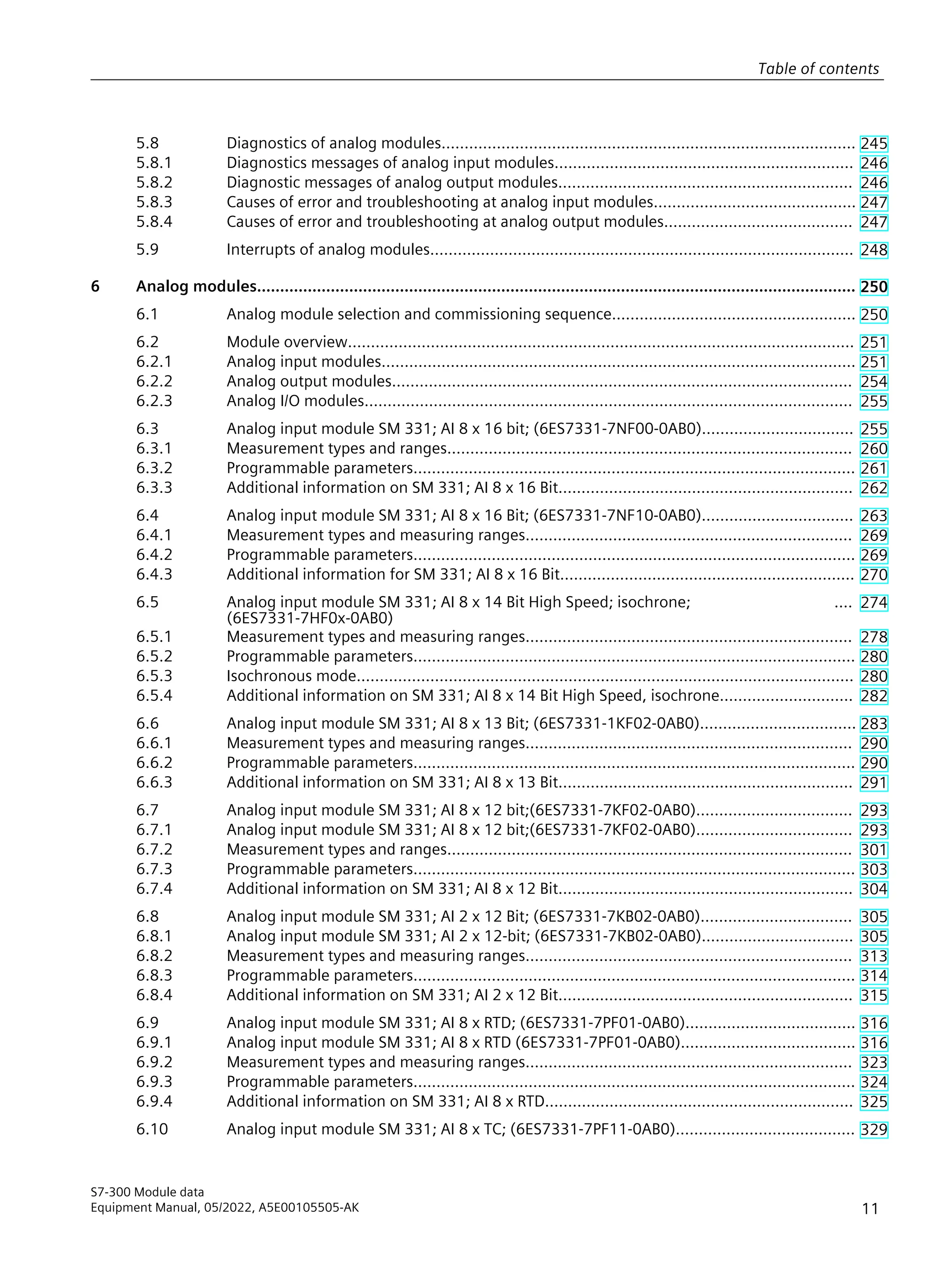
5.8 Diagnostics of analog modules.......................................................................................... 245
5.8.1 Diagnostics messages of analog input modules................................................................. 246
5.8.2 Diagnostic messages of analog output modules................................................................ 246
5.8.3 Causes of error and troubleshooting at analog input modules............................................ 247
5.8.4 Causes of error and troubleshooting at analog output modules......................................... 247
5.9 Interrupts of analog modules............................................................................................ 248
6 Analog modules.................................................................................................................................. 250
6.1 Analog module selection and commissioning sequence..................................................... 250
6.2 Module overview.............................................................................................................. 251
6.2.1 Analog input modules....................................................................................................... 251
6.2.2 Analog output modules.................................................................................................... 254
6.2.3 Analog I/O modules.......................................................................................................... 255
6.3 Analog input module SM 331; AI 8 x 16 bit; (6ES7331-7NF00-0AB0)................................. 255
6.3.1 Measurement types and ranges........................................................................................ 260
6.3.2 Programmable parameters................................................................................................ 261
6.3.3 Additional information on SM 331; AI 8 x 16 Bit................................................................ 262
6.4 Analog input module SM 331; AI 8 x 16 Bit; (6ES7331-7NF10-0AB0)................................. 263
6.4.1 Measurement types and measuring ranges....................................................................... 269
6.4.2 Programmable parameters................................................................................................ 269
6.4.3 Additional information for SM 331; AI 8 x 16 Bit................................................................ 270
6.5 Analog input module SM 331; AI 8 x 14 Bit High Speed; isochrone;
(6ES7331-7HF0x-0AB0)
.... 274
6.5.1 Measurement types and measuring ranges....................................................................... 278
6.5.2 Programmable parameters................................................................................................ 280
6.5.3 Isochronous mode............................................................................................................ 280
6.5.4 Additional information on SM 331; AI 8 x 14 Bit High Speed, isochrone............................. 282
6.6 Analog input module SM 331; AI 8 x 13 Bit; (6ES7331-1KF02-0AB0).................................. 283
6.6.1 Measurement types and measuring ranges....................................................................... 290
6.6.2 Programmable parameters................................................................................................ 290
6.6.3 Additional information on SM 331; AI 8 x 13 Bit................................................................ 291
6.7 Analog input module SM 331; AI 8 x 12 bit;(6ES7331-7KF02-0AB0).................................. 293
6.7.1 Analog input module SM 331; AI 8 x 12 bit;(6ES7331-7KF02-0AB0).................................. 293
6.7.2 Measurement types and ranges........................................................................................ 301
6.7.3 Programmable parameters................................................................................................ 303
6.7.4 Additional information on SM 331; AI 8 x 12 Bit................................................................ 304
6.8 Analog input module SM 331; AI 2 x 12 Bit; (6ES7331-7KB02-0AB0)................................. 305
6.8.1 Analog input module SM 331; AI 2 x 12-bit; (6ES7331-7KB02-0AB0)................................. 305
6.8.2 Measurement types and measuring ranges....................................................................... 313
6.8.3 Programmable parameters................................................................................................ 314
6.8.4 Additional information on SM 331; AI 2 x 12 Bit................................................................ 315
6.9 Analog input module SM 331; AI 8 x RTD; (6ES7331-7PF01-0AB0)..................................... 316
6.9.1 Analog input module SM 331; AI 8 x RTD (6ES7331-7PF01-0AB0)...................................... 316
6.9.2 Measurement types and measuring ranges....................................................................... 323
6.9.3 Programmable parameters................................................................................................ 324
6.9.4 Additional information on SM 331; AI 8 x RTD................................................................... 325
6.10 Analog input module SM 331; AI 8 x TC; (6ES7331-7PF11-0AB0)....................................... 329
S7-300 Module data
Equipment Manual, 05/2022, A5E00105505-AK 11
Table of contents
6.10.1 Measurement types and measuring ranges....................................................................... 337
6.10.2 Adjustable parameters...................................................................................................... 337
6.10.3 Additional information on SM 331; AI 8 x TC..................................................................... 339
6.11 Analog input module SM 331, AI 6 x TC isolated (6ES7331-7PE10-0AB0)........................... 342
6.11.1 Measurement types and measuring ranges....................................................................... 352
6.11.2 Programmable parameters................................................................................................ 353
6.11.3 Additional information relating to SM 331; AI 6 x TC.......................................................... 354
6.11.4 Firmware update via HW Config for analog input module SM 331; AI 6 x TC....................... 359
6.11.5 I&M data for identifying the analog input module SM 331; AI 6 x TC.................................. 360
6.11.6 Calibration of analog input module SM 331; AI 6 x TC........................................................ 361
6.12 Analog output module SM 332; AO 8 x 12 bit; (6ES7332-5HF00-0AB0)............................. 367
6.12.1 SM 332; AO 8 x 12 Bit - Output ranges.............................................................................. 371
6.12.2 Programmable parameters................................................................................................ 372
6.12.3 Additional information on SM 332; AO 8 x 12 Bit............................................................... 373
6.13 Analog output module SM 332; AO 4 x 16 bit; isochrone; (6ES7332-7ND02-0AB0)............ 373
6.13.1 SM 332; AO 4 x 16 Bit - Output ranges.............................................................................. 379
6.13.2 Programmable parameters................................................................................................ 379
6.13.3 Isochronous mode............................................................................................................ 380
6.13.4 Additional information on SM 332; AO 4 x 16 Bit............................................................... 381
6.14 Analog output module SM 332; AO 4 x 12 Bit; (6ES7332-5HD01-0AB0)............................. 382
6.14.1 Output ranges of SM 332; AO 4 x 12 Bit............................................................................ 387
6.14.2 Programmable parameters................................................................................................ 387
6.14.3 Additional information on SM 332; AO 4 x 12 Bit............................................................... 388
6.15 Analog output module SM 332; AO 2 x 12 Bit; (6ES7332-5HB01-0AB0)............................. 388
6.15.1 Output ranges of SM 332; AO 2 x 12 Bit............................................................................ 393
6.15.2 Programmable parameters................................................................................................ 393
6.15.3 Additional information on SM 332; AO 2 x 12 Bit............................................................... 394
6.16 Analog IO module SM 334; AI 4/AO 2 x 8/8 Bit; (6ES7334-0CE01-0AA0)............................. 395
6.16.1 SM 334; AI 4/AO 2 x 8/8 Bit - Function principle ................................................................ 400
6.16.2 Measurement and output type of SM 334; AI 4/AO 2 x 8/8 bit............................................ 400
6.16.3 Measurement and output ranges of SM 334; AI 4/ AO 2 x 8/8 bit....................................... 401
6.16.4 Additional information on SM 334; AI 4/AO2 x 8/8 Bit........................................................ 401
6.17 Analog IO module SM 334; AI 4/AO 2 x 12 bit; (6ES7334-0KE00-0AB0).............................. 401
6.17.1 Programmable parameters................................................................................................ 406
6.17.2 Measurement types and ranges........................................................................................ 407
6.17.3 Additional information on SM 334; AI 4/ AO 2 x 12 bit....................................................... 408
7 Other signal modules......................................................................................................................... 409
7.1 Module overview.............................................................................................................. 409
7.2 Simulator module SM 374; IN/OUT 16; (6ES7374-2XH01-0AA0)........................................ 409
7.3 Dummy module DM 370; (6ES7370-0AA01-0AA0)............................................................ 412
7.4 Position decoder module SM 338; POS-INPUT; (6ES7338-4BC01-0AB0) ............................. 414
7.4.1 Isochronous mode............................................................................................................ 415
7.4.2 Wiring and block diagrams................................................................................................ 416
7.4.3 Functions of SM 338; POS-INPUT; encoder value acquisition.............................................. 417
12
Table of contents
S7-300 Module data
Equipment Manual, 05/2022, A5E00105505-AK
7.4.3.1 Encoder value acquisition................................................................................................. 417
7.4.3.2 Gray code/binary code converter....................................................................................... 417
7.4.3.3 Transferred encoder value and scaling............................................................................... 417
7.4.3.4 Freeze function................................................................................................................. 418
7.4.4 Parametrization SM 338 POS-INPUT................................................................................... 419
7.4.5 Addressing SM 338 POS-INPUT.......................................................................................... 420
7.4.6 Diagnostics of SM 338; POS-INPUT.................................................................................... 422
7.4.7 SM 338; POS INPUT - Interrupts......................................................................................... 424
7.4.8 Technical data of SM 338; POS-INPUT................................................................................ 424
8 Interface modules............................................................................................................................... 427
8.1 Module overview.............................................................................................................. 427
8.2 Interface module IM 360; (6ES7360-3AA01-0AA0)............................................................ 427
8.3 Interface module IM 361; (6ES7361-3CA01-0AA0)............................................................ 429
8.4 Interface module IM 365; (6ES7365-0BA01-0AA0)............................................................ 431
A Parameter sets of signal modules...................................................................................................... 433
A.1 Principles of programming signal modules in the user program......................................... 433
A.2 Parameters of digital IO modules....................................................................................... 434
A.3 Parameters of the digital input module SM 321; DI 16 x DC 24/125 V................................. 436
A.4 Parameters of digital output modules................................................................................ 438
A.5 Settings from the digital output module SM 322; DO 16 x DC 24 V/0.5 A
(6ES7322-8BH10-0AB0)
.... 440
A.6 Parameters of analog input modules................................................................................. 443
A.7 Parameters of analog input module SM 331; AI 8 x RTD..................................................... 446
A.8 Parameters of SM 331; AI 8 TC.......................................................................................... 454
A.9 Parameters of analog input module SM 331; AI 8 x 13 Bit.................................................. 461
A.10 Setting of the analog input module SM 331; AI 8 x 16 Bit (6ES7331-7NF10-0AB0)............. 464
A.11 Parameters of analog input module SM 331; AI 6 x TC isolated.......................................... 470
A.12 Parameters of analog output modules............................................................................... 477
A.13 Parameters of analog output module SM 332; AO 8 x 12 Bit.............................................. 479
A.14 Parameters of analog IO modules...................................................................................... 481
B Diagnostics data of signal modules.................................................................................................... 484
B.1 Evaluating diagnostic data of signal modules in the user program...................................... 484
B.2 Structure and content of diagnostics data, byte 0 and up................................................... 484
B.3 Channel-specific diagnostics data...................................................................................... 488
B.4 Diagnosis data from the SM 322; DO 16 x DC24 V/0.5 A (6ES7322-8BH10-0AB0)............... 489
B.5 Diagnostics data of SM 331; AI 6 x TC isolated................................................................... 492
B.6 Diagnostics data of SM 338; POS-INPUT............................................................................. 495
S7-300 Module data
Equipment Manual, 05/2022, A5E00105505-AK 13
Table of contents
C Dimensional drawings........................................................................................................................ 498
C.1 Dimensional drawings of the mounting rails...................................................................... 498
C.1.1 Bus modules..................................................................................................................... 504
C.2 Dimensional drawings of the power supply modules......................................................... 504
C.3 Dimensional drawings of the interface modules ............................................................... 507
C.4 Dimensional drawings of the signal modules..................................................................... 509
C.5 Dimensional drawings of accessories................................................................................. 511
D Spare parts and accessories for S7-300 modules............................................................................... 513
E Directive on handling Electrostatic-Sensitive Devices (ESD).............................................................. 515
E.1 Definition of ESD.............................................................................................................. 515
E.2 Electrostatic charging of the body..................................................................................... 515
E.3 Basic protective measures against electrostatic discharge.................................................. 516
F Service & support................................................................................................................................ 517
F.1 Service & support.............................................................................................................. 517
G Safety-relevant symbols..................................................................................................................... 518
G.1 Safety-related symbols for devices without Ex protection................................................... 518
G.2 Safety-related symbols for devices with Ex protection........................................................ 519
H List of abbreviations........................................................................................................................... 520
H.1 List of abbreviations.......................................................................................................... 520
Glossary.............................................................................................................................................. 522
Index................................................................................................................................................... 531
14
Table of contents
S7-300 Module data
Equipment Manual, 05/2022, A5E00105505-AK
General technical data 1
1.1 Standards and approvals
Introduction
Contents of general technical data:
• standards and test values satisfied by modules of the S7-300 automation system
• test criteria of S7-300 modules.
NOTE
Information on the nameplate
You will find the current labels and approvals on the nameplate of the respective mod­
ules.
Safety guidelines
WARNING
Personal injury and damage to property may occur
In hazardous areas, injury to persons and material damage may occur if you disconnect plug-
in connections during operation of an S7‑300 automation system.
Always switch off the power to the S7‑300 automation system when disconnecting plug-in
connections in potentially explosive atmospheres.
WARNING
Explosion hazard
If you replace components, compliance with Class I, DIV 2 may become invalid.
WARNING
Deployment requirements
This device is only suitable for use in Class I, Div. 2, Group A, B, C, D, or in non-hazardous
areas.
Test symbols and their significance
The test symbols and their meanings are described in the following section.
15
S7-300 Module data
Equipment Manual, 05/2022, A5E00105505-AK
CE Label
The S7-300 automation system satisfies the requirements and protection goals of the
following EC directives, and conforms with the harmonized European standards (EN) for
programmable logic controllers announced in the Official Journals of the European
Community:
• 2014/35/EU "Electrical equipment designed for use within certain voltage limits" (Low-
Voltage Directive)
• 2014/30/EU "Electromagnetic Compatibility" (EMC Directive)
• 2014/34/EU "Equipment and protective systems intended for use in potentially explosive
atmospheres" (Explosion Protection Directive)
• 2011/65/EU "Restriction of the use of certain hazardous substances in electrical and
electronic equipment" (RoHS Directive)
The EU Declarations of Conformity are available to the relevant authorities at the following
address:
Siemens AG
Digital Industries
Factory Automation
DI FA TI COS TT
P.O. Box 1963
D-92209 Amberg
The EU declarations of conformity are also available for download from the Siemens Industry
Online Support website, under the keyword "Declaration of Conformity".
UK Conformity Assessed marking
The S7-300 automation system complies with the designated British Standards (BS) for
programmable logic controllers published in the official consolidated list of the British
government. The S7-300 automation system fulfills the requirements and protection goals of
the following regulations and related supplements:
• Electrical Equipment (Safety) Regulations 2016 (Low-Voltage)
• Electromagnetic Compatibility Regulations 2016 (EMC)
• Equipment and Protective Systems Intended for Use in Potentially Explosive Atmospheres
Regulations 2016 (Explosion Protection)
• The Restriction of the Use of Certain Hazardous Substances in Electrical and Electronic
Equipment Regulations 2012 (RoHS)
• Supply of Machinery (Safety) Regulations 2008 for S7‑300 safety components (fail-safe
modules)
UK declarations of conformity for the respective authorities are available from:
Siemens AG
Digital Industries
Factory Automation
DI FA TI COS TT
P.O. Box 1963
D-92209 Amberg
The UK Declaration of Conformity is also available for download from the Siemens Industry
Online Support website under the keyword "Declaration of Conformity".
16
S7-300 Module data
Equipment Manual, 05/2022, A5E00105505-AK
General technical data
1.1 Standards and approvals
UL approval
Underwriters Laboratories Inc., complyling with
• UL 508 (Industrial Control Equipment)
CSA approval
Canadian Standards Association to
• C22.2 No. 142 (Process Control Equipment)
or
cULus approval
Underwriters Laboratories Inc. complying with
• UL 508 (Industrial Control Equipment)
• CAN/CSA C22.2 No. 142 (Process Control Equipment)
or
cULus HAZ. LOC. approval
+$=/2
Underwriters Laboratories Inc., complying with
• UL 508 (Industrial Control Equipment)
• ANSI/ISA 12.12.01
• CAN/CSA C22.2 No. 142 (Process Control Equipment)
• CAN/CSA C22.2 No. 213 (Hazardous Location)
APPROVED for use in
Class I, Division 2, Group A, B, C, D Tx;
Class I, Zone 2, Group IIC Tx
17
General technical data
1.1 Standards and approvals
S7-300 Module data
Equipment Manual, 05/2022, A5E00105505-AK
FM approval
Factory Mutual Research (FM) according to
• Approval Standard Class Number 3611, 3600, 3810
• ANSI/UL 121201
• ANSI/UL 61010-1
APPROVED for use in
Class I, Division 2, Group A, B, C, D Tx;
Class I, Zone 2, Group IIC Tx
ATEX approval
According to EN 60079-15 (Electrical apparatus for potentially explosive atmospheres - Part
15: Type of protection n) and EN IEC 60079-0 (Electrical apparatus for potentially explosive
gas atmospheres - Part 0: General Requirements) and EN 60079-0 (Electrical apparatus for
potentially explosive gas atmospheres - Part 0: General requirements).
II 3 G Ex nA IIC Tx Gc
DEKRA 13ATEX0015 X
OR
According to EN IEC 60079-7 (Electrical apparatus for potentially explosive atmospheres - Part
7: Increased safety e) and EN IEC 60079-0 (Electrical apparatus for potentially explosive gas
atmospheres - Part 0: General Requirements), EN IEC 60079-15 (Electrical apparatus for
potentially explosive atmospheres - Part 15: Type of protection n) and EN IEC 60079-0
(Electrical apparatus for potentially explosive gas atmospheres - Part 0: General
requirements).
II 3 G Ex ec nC IIC Tx Gc
DEKRA 21ATEX0048 X
Special conditions in explosive atmospheres:
• The equipment shall only be used in an area of not more than pollution degree 2, as
defined in EN 60664-1.
• The equipment shall be installed in a suitable enclosure providing a degree of protection
not less than IP54 in accordance with EN IEC 60079-0. The ambient conditions must be
taken into consideration for use.
• Provisions shall be made to prevent the rated voltage from being exceeded by transient
disturbances of more than 119 V.
18
S7-300 Module data
Equipment Manual, 05/2022, A5E00105505-AK
General technical data
1.1 Standards and approvals
UKEX approval
According to EN IEC 60079-7 (Explosive atmospheres – Part 7: Equipment protection by
increased safety e), EN IEC 60079-15 (Electrical apparatus for potentially explosive
atmospheres - Part 15: Type of protection n) and EN IEC 60079-0 (Explosive atmospheres –
Part 0: Equipment - General requirements).
II 3 G Ex ec nC IIC Tx Gc
DEKRA 21UKEX0011 X
Special conditions in explosive atmospheres:
• The equipment shall only be used in an area of not more than pollution degree 2, as
defined in EN 60664-1.
• The equipment shall be installed in a suitable enclosure providing a degree of protection
not less than IP54 in accordance with EN IEC 60079-0. The ambient conditions must be
taken into consideration for use.
• Provisions shall be made to prevent the rated voltage from being exceeded by transient
disturbances of more than 119 V.
IECEx approval
According to IEC 60079-15 (Explosive atmospheres - Part 15: Equipment protection by type of
protection n) and IEC 60079-0 (Explosive atmospheres - Part 0: Equipment - General
requirements).
II 3 G Ex ec IIC Tx Gc
DEKRA 21DEK 14.0042 X
OR
According to IEC 60079-7 (Electrical apparatus for potentially explosive atmospheres - Part 7:
Increased safety “e”), IEC 60079-15 (Electrical apparatus for potentially explosive
atmospheres - Part 15: Type of protection n) and IEC 60079-0 (Electrical apparatus for
potentially explosive gas atmospheres - Part 0: General requirements).
II 3 G Ex ec nC IIC Tx Gc
IECEx 21DEK 21.0030 X
Special conditions in hazardous areas:
• The equipment shall only be used in an area of not more than pollution degree 2, as
defined in IEC 60664-1.
• The device must be installed in a suitable housing that ensures at least IP54 degree of
protection according to IEC 60079-0. The ambient conditions must be taken into
consideration for use.
• Provisions shall be made to prevent the rated voltage from being exceeded by transient
disturbances of more than 119 V.
19
General technical data
1.1 Standards and approvals
S7-300 Module data
Equipment Manual, 05/2022, A5E00105505-AK
CCCEx approval
In accordance with GB/T 3836.3 (Explosive atmospheres - Part 3: Equipment protection by
type of protection e), GB/T 3836.8 (Explosive atmospheres - Part 8: Equipment protection by
type of protection n) and GB/T 3836.1 (Explosive atmospheres - Part 1: Equipment - General
requirements).
Ex ec nC IIC Tx Gc
Special conditions in hazardous areas:
• The equipment shall only be used in an area of not more than pollution degree 2, as
defined in GB/T 16935.1.
• The equipment shall be installed in a suitable enclosure providing a degree of protection
not less than IP54 in accordance with GB/T 3836.1. The ambient conditions must be taken
into consideration for use.
• Provisions shall be made to prevent the rated voltage from being exceeded by transient
disturbances of more than 119 V.
RCM (C-Tick) Declaration of conformity for Australia/New Zealand
The ET 200M distributed I/O device satisfies the requirements of the IEC 61000-6-4 standard.
EN 61131
The S7-300 automation system fulfills the requirements and criteria of the EN 61131-2
standard (Programmable Controllers, Part 2: Equipment requirements and tests).
Marine approval
Classification societies:
• ABS (American Bureau of Shipping)
• BV (Bureau Veritas)
• DNV-GL (Det Norske Veritas-Germanischer Lloyd)
• LRS (Lloyds Register of Shipping)
• Class NK (Nippon Kaiji Kyokai)
• CCS (China Classification Society)
• RINA (Registro Italiano Navale)
Use in industrial environments
SIMATIC products are designed for industrial applications.
Table 1-1 Use in industrial environments
Field of applica­
tion
Noise emission requirements Noise immunity requirements
Industry EN IEC 61000-6-4:2019 EN IEC 61000-6-2:2019
20
S7-300 Module data
Equipment Manual, 05/2022, A5E00105505-AK
General technical data
1.1 Standards and approvals
Use in residential areas / mixed areas
NOTE
The S7-300 automation system is intended for use in industrial areas; use in residential areas
/ mixed areas may have an impact on radio/TV reception.
If you use the S7-300 in residential areas / mixed areas, you must ensure observance of
emission of radio interference according to EN IEC 61000-6-3.
Suitable measures for achieving the required Class B radio interference level include, for
example:
• S7-300 installation in grounded switch cabinets / cubicles
• Use of noise filters in the supply lines
1.2 Electromagnetic compatibility
Definition See EMV
Electromagnetic compatibility (EMC) is the ability of an electrical installation to function
satisfactorily in its electromagnetic environment without interfering with that environment.
The S7-300 modules also satisfy requirements of EMC legislation for the European domestic
market. Compliance of the S7-300 system with specifications and directives on electric design
is prerequisite.
Pulseshaped disturbance
The table below shows the EMC compatibility of S7 modules in areas subject to pulse-shaped
disturbance.
Pulse-shaped disturbance Test voltage corresponds with
degree of severity
Electrostatic discharge
to IEC 61000-4-2
Air discharge: ±8 kV
Contact discharge ± 4 kV
3
2
Burst pulses (high-speed transient
disturbance)
to IEC 61000-4-4.
2 kV (power supply lines)
2 kV (signal lines  3 m)
1 kV (signal lines  3 m)
3
3
High-energy single pulse (surge) to IEC 61000-4-5
External protective circuit required
(refer to S7-300 Automation System, Hardware and Installation, Chapter
Lightning and overvoltage protection)
• asymmetric coupling 2 kV (power supply lines)
DC with protective elements
2 kV (signal/ data line only  3 m), with
protective elements as required
• symmetric coupling 1 kV (power supply lines) DC with pro­
tective elements
1 kV (signal/ data line only  3 m), with
protective elements as required
3
21
General technical data
1.2 Electromagnetic compatibility
S7-300 Module data
Equipment Manual, 05/2022, A5E00105505-AK
Sinusoidal disturbance
The table below shows the EMC compatibility of S7-300 modules in areas subject to
sinusoidal disturbance.
• HF radiation
HF radiation according to IEC 61000-4-3
Electromagnetic HF field, amplitude-modulated
Corresponds with degree of
severity
80 MHz to 1,000 MHz; 1.4 GHz to 2 GHz 2.0 GHz to 2.7 GHz
10 V/m 1 V/m
80% AM (1 kHz)
3, 1
• HF coupling
HF coupling according to IEC 61000-4-6 Corresponds with degree of
severity
0.15 MHz to 80 MHz
10 Vrms unmodulated
80% AM (1 kHz)
150 Ω source impedance
3
Emission of radio interference
Emission of interference from electromagnetic fields in accordance with EN 61000-6-4: Limit
Value Class A (measured at a distance of 10 m).
Frequency Noise emission
30 MHz to 230 MHz  40 dB (µV/m)Q
230 MHz to 1000 MHz  47 dB (µV/m)Q
1 GHz - 3 GHz  76 dB (µV/m) peak  56 dB (µV/m) average
3 GHz - 6 GHz  80 dB (µV/m) peak  60 dB (µV/m) average
Noise emission via AC mains to EN 55016: Limit value class A, Group 1.
Frequency Noise emission
From 0.15 to 0.5 MHz  79 dB (µV/m)Q
 66 dB (µV/m)M
0.5 MHz to 5 MHz  73 dB (µV/m)Q
 60 dB (µV/m)M
5 MHz to 30 MHz  73 dB (µV/m)Q
 60 dB (µV/m)M
22
S7-300 Module data
Equipment Manual, 05/2022, A5E00105505-AK
General technical data
1.2 Electromagnetic compatibility
1.3 Shipping and storage conditions for modules and backup
batteries
Introduction
S7-300 modules exceed the specifications regarding transport and storage conditions
pursuant to IEC 61131-2. The following information applies to modules that are transported
and stored in their original packaging.
The climatic conditions for temperature and humidity meet:
• IEC 60721-3-3
• IEC 60721-3-2
The mechanical conditions for individual parameters meet IEC 60721-3-2.
Shipping and storage conditions for modules
Type of condition Permissible range
Free fall (in shipping package) ≤ 1 m
Temperature - 40 °C to + 70 °C
Barometric pressure from 1140 to 660 hPa (corresponds to an elevation
of -1000 to 3500 m)
Relative humidity 10% to 95%, no condensation
Sinusoidal oscillation to
IEC 60068-2-6
5 Hz to 9 Hz: 3.5 mm
9 Hz to 150 Hz: 9.8 m/s2
Shock according to IEC 60068-2-27 250 m/s2, 6 ms, 1000 shocks
Shipment of backup batteries
Backup batteries should always be shipped in their original package. Note the regulations
governing the transport of hazardous goods. The backup battery has a lithium content of
approx. 0.25 g.
Storing backup batteries
Always store backup batteries in a cool and dry place. The maximum storage period is 5 years
WARNING
Handling backup batteries
Improper handling of backup batteries can result in injury and damage to property. Improp­
erly handled backup batteries may explode or cause severe burns.
Observe the following rules when handling the backup batteries used in the S7-300 automa­
tion system:
• Never charge the batteries
• Never heat the batteries
• Never throw the batteries in an open fire
• Never damage the batteries mechanically (drill, squeeze, etc.)
23
General technical data
1.3 Shipping and storage conditions for modules and backup batteries
S7-300 Module data
Equipment Manual, 05/2022, A5E00105505-AK
NOTE
Backup batteries
Do not dispose of batteries through household waste! Batteries are recyclable!
1.4 Mechanical and climatic environmental conditions for S7-300
operation
Operating conditions
S7-300 systems are designed for stationary use in weather-proof locations. The operating
conditions are based on the requirements of DIN IEC 60721-3-3:
Use with additional measures
The S7-300 may not be used under the conditions outlined below without taking additional
measures:
• at locations with a high degree of ionizing radiation
• in aggressive environments caused, for example, by
– the development of dust
– corrosive vapors or gases
– strong electric or magnetic fields
• in installations requiring special monitoring, for example
– elevators
– electrical plants in potentially hazardous areas
Mechanical environmental conditions
The table below shows the mechanical environmental conditions in the form of sinusoidal
oscillations.
Frequency band Continuous Infrequently
10 Hz ≤ f ≤ 58 Hz 0.0375 mm amplitude 0.75 mm amplitude
58 Hz ≤ f ≤ 150 Hz 0.5 g constant acceleration 1 g constant acceleration
Reducing vibrations
If your S7-300 modules are exposed to severe shock or vibration, take appropriate measures
to reduce acceleration or the amplitude.
We recommend the installation of the S7-300 on damping materials (for example, rubber-
bonded-to-metal mounting.)
24
S7-300 Module data
Equipment Manual, 05/2022, A5E00105505-AK
General technical data
1.4 Mechanical and climatic environmental conditions for S7-300 operation
Test of mechanical environmental conditions
The table below provides important information with respect to the type and scope of the
test of ambient mechanical conditions.
Condition tested Test Standard Comment
Vibration Vibration test to IEC
60068-2-6 (sinusoidal)
Type of oscillation: Frequency sweeps with a rate of change of 1
octave/minute.
5 Hz ≤ f ≤ 9 Hz, constant amplitude 3.5 mm
9 Hz ≤ f ≤ 150Hz, constant acceleration 1 g
Duration of oscillation: 10 frequency sweeps per axis at each of three ver­
tically aligned axes
Shock Shock, tested to
IEC 60068-2-27
Type of shock: half-sine
Severity of shock: 15 g peak value, 11 ms duration
Direction of shock: 3 shocks in each direction (+/-) at each of three vertic­
ally aligned axes
Climatic environmental conditions
The S7-300 may be operated on following environmental conditions:
Environmental conditions Permitted range Comments
Temperature:
horizontal mounting position:
vertical mounting position:
0°C to 60°C
0°C to 40°C
-
Relative humidity 10 % to 95 % No condensation, corresponds to relative
humidity (RH) Class 2 to IEC 61131, Part 2
Barometric pressure from 1140 to 795 hPa Corresponds with an altitude of -1000 m to
2000 m
SO2:  0.5 ppm;
RH  60 %, no condensation
H2S:  0.1 ppm;
RH  60 %, no condensation
Test: 10 ppm; 4 days
Test: 1 ppm; 4 days
Concentration of pollutants
ISA-71.04 severity level G1; G2; G3 -
1.5 Specification of dielectric tests, protection class, degree of
protection, and rated voltage of S7-300
Isolation
The isolation is designed in accordance with the requirements of EN 61131-2.
Pollution degree/overvoltage category according to IEC 61131-2: 2007
Proof of dielectric strength must be provided in the type test at a test voltage according to
IEC 61131-2:
• Pollution degree 2
• Overvoltage category: II
25
General technical data
1.5 Specification of dielectric tests, protection class, degree of protection, and rated voltage of S7-300
S7-300 Module data
Equipment Manual, 05/2022, A5E00105505-AK
Protection class in accordance with IEC 61131-2: 2007
The automation system S7-300 meets Protection Class I and contains parts of Protection
Classes II and III.
Degree of protection IP20
Degree of protection IP 20 in accordance with IEC 60529 for all modules of the S7-300
automation system, i.e.:
• Protection against contact with standard test finger
• Protection against foreign objects with diameters greater than 12.5 mm
• No protection against water
1.6 Rated voltages of S7-300
Rated operating voltages
The S7-300 modules operate at different rated voltages. The table shows the rated voltages
and corresponding tolerances.
Rated voltages Tolerance
24 VDC 20.4 VDC to 28.8 VDC
120 VAC 93 VAC to 132 VAC
230 VAC 187 VAC to 264 VAC
1.7 SIPLUS S7-300 Modules
Definition
SIPLUS S7-300 modules can be used under extended environmental conditions. Meaning of
extended environmental conditions:
• Extended temperature range of - 25 °C to + 60 °C/70°C
• Moisture condensation/condensation permissible
• increased mechanical stress permissible
Comparison with standard modules
The functional scope and technical data of SIPLUS S7-300 modules and of standard modules
are identical, with the exception of the environmental conditions.
SIPLUS S7-300 modules have a separate order number (see the table below.)
The mechanical/climatic environmental conditions and the method of testing these have
changed. The SIPLUS S7-300 modules are specified:
• For deployment in harsh environmental conditions,
• For use in hostile environments.
• For extreme temperature ranges.
For more on this, read section Environmental conditions for the operation of SIPLUS S7-300
modules (Page 28).
26
S7-300 Module data
Equipment Manual, 05/2022, A5E00105505-AK
General technical data
1.7 SIPLUS S7-300 Modules
Project design in STEP 7
SIPLUS S7-300 modules are not included in the hardware catalog. Please design your plant
based on the relevant standard modules shown in the table below.
SIPLUS S7-300 Modules
This following table contains all SIPLUS S7-300 modules available at the time of publication.
In addition, we included the order numbers of the corresponding standard modules to
support project design. You can refer to specifications and technical data in the special
standard module section.
You´ll find more information on SIPLUS and contact partners in the Internet
(http://www.siemens.com/siplus-extreme).
Table 1-2 Comparison of SIPLUS S7-300 modules and S7-300 Standard module
SIPLUS S7-300 modules for the
use under extended environ­
mental conditions
Standard modules
Module type
as of order no.
Power supply
PS 305; 2A
PS 307; 5A
PS 307; 10A
6AG1305-1BA80-2AA0
6AG1307-1EA80-2AA0
6AG1307-1KA02-7AA0
6ES7305-1BA80-0AA0
6ES7307-1EA80-0AA0
6ES7307-1KA02-0AA0
Interface module
IM 153-1
IM 365
6AG1153-1AA03-2XB0
6AG1365-0BA01-2AA0
6ES7153-1AA03-0XB0
6ES7365-0BA01-0AA0
Separator module 6AG1195-7KF00-2XA0 6ES7195-7KF00-0XA0
Central module
CPU 312C (EN50155)
CPU 312C
CPU 313C (EN50155)
CPU 313C
CPU 313C-2DP (EN50155)
CPU 313C-2DP
CPU 314 (EN50155)
CPU 314
CPU 314C
CPU 314C-2DP (EN50155)
CPU 314C-2DP
CPU314C-2PN/DP
CPU 315-2DP (EN50155)
CPU 315-2DP
CPU 315-2PN/DP (EN50155)
CPU 315-2PN/DP
CPU 315F-2PN/DP
CPU 315F-2PN/DP (EN50155)
CPU 315F-2DP
CPU 315F-2DP (EN50155)
CPU 317-2PN/DP (EN50155)
CPU 317-2PN/DP
CPU 317F-2PN/DP
CPU 317F-2PN/DP (EN50155)
CPU 317F-2DP
6AG1312-5BF04-2AY0
6AG1312-5BF04-7AB0
6AG1313-5BG04-2AY0
6AG1313-5BG04-7AB0
6AG1313-6CG04-2AY0
6AG1313-6CG04-7AB0
6AG1314-1AG14-2AY0
6AG1314-1AG14-7AB0
6AG1314-6BH04-7AB0
6AG1314-6CH04-2AY0
6AG1314-6CH04-7AB0
6AG1314-6EH04-7AB0
6AG1315-2AH14-2AY0
6AG1315-2AH14-7AB0
6AG1315-2EH14-2AY0
6AG1315-2EH14-7AB0
6AG1315-2FJ14-2AB0
6AG1315-2FJ14-2AY0
6AG1315-6FF04-2AB0
6AG1315-6FF04-2AY0
6AG1317-2EK14-2AY0
6AG1317-2EK14-7AB0
6AG1317-2FK14-2AB0
6AG1317-2FK14-2AY0
6AG1317-6FF04-2AB0
6ES7312-5BF04-0AB0
6ES7312-5BF04-0AB0
6ES7313-5BG04-0AB0
6ES7313-5BG04-0AB0
6ES7313-6CG04-0AB0
6ES7313-6CG04-0AB0
6ES7314-1AG14-0AB0
6ES7314-1AG14-0AB0
6ES7314-6BH04-0AB0
6ES7314-6CH04-0AB0
6ES7314-6CH04-0AB0
6ES7314-6EH04-0AB0
6ES7315-2AH14-0AB0
6ES7315-2AH14-0AB0
6ES7315-2EH14-0AB0
6ES7315-2EH14-0AB0
6ES7315-2FJ14-0AB0
6ES7315-2FJ14-0AB0
6ES7315-6FF04-0AB0
6ES7315-6FF04-0AB0
6ES7317-2EK14-0AB0
6ES7317-2EK14-0AB0
6ES7317-2FK14-0AB0
6ES7317-2FK14-0AB0
6ES7317-6FF04-0AB0
27
General technical data
1.7 SIPLUS S7-300 Modules
S7-300 Module data
Equipment Manual, 05/2022, A5E00105505-AK
SIPLUS S7-300 modules for the
use under extended environ­
mental conditions
Standard modules
Module type
as of order no.
Digital input module
SM 321; DI 16 x DC 24V
SM 321; DI 32 x DC 24V
SM 321; DI 16 x DC 24V
SM 321; DI 8 x AC 120/230V
SM 321; DI 16 x DC 48 V-125V
SM 321; DI 8 x AC 120/220 V
SM 321; DI 4 NAMUR
SM 321; DI 16 x DC 24V
6AG1321-1BH02-2AA0
6AG1321-1BL00-2AA0
6AG1321-7BH01-2AB0
6AG1321-1FF10-7AA0
6AG1321-1CH20-2AA0
6AG1321-1FF01-2AA0
6AG1321-7RD00-4AB0
6AG1321-7TH00-4AB0
6ES7321-1BH02-0AA0
6ES7321-1BL00-0AA0
6ES7321-7BH01-0AB0
6ES7321-1FF10-0AA0
6ES7321-1CH20-0AA0
6ES7321-1FF01-0AA0
6ES7321-7RD00-0AB0
6ES7321-7TH00-0AB0
Digital output module
SM 322; DO 16 x DC 24V/0.5A
SM 322; DO 8 x Rel. 230 V AC / 5A
SM 322, DO 8 x DC 48-125 V/1.5 A
SM 322; DO 8 x AC 120/230V/2A
SM 322; DO 8 x DC 24V/0.5A
SM 322; DO 8 x DC 24V
SM 322; DO 32 x DC 24 V/0.5 A
SM 322; DO 16 x AC 120/230V/1 A
SM 322; DO 16 RELAY
SM 322; DO 8 x AC 120/230 V, 2 A
SM 322; DO 8 RELAY
SM 322; DO 16 x DC 24V
6AG1322-1BH01-2AA0
6AG1322-1HF10-2AA0
6AG1322-1CF00-7AA0
6AG1322-1FF01-7AA0
6AG1322-8BF00-2AB0
6AG1322-1BF01-2XB0
6AG1322-1BL00-2AA0
6AG1322-1FH00-7AA0
6AG1322-1HH01-2AA0
6AG1322-5FF00-4AB0
6AG1322-5HF00-4AB0
6AG1322-8BH10-7AB0
6ES7322-1BH01-0AA0
6ES7322-1HF10-0AA0
6ES7322-1CF00-0AA0
6ES7322-1FF01-0AA0
6ES7322-8BF00-0AB0
6ES7322-1BF01-0AA0
6ES7322-1BL00-0AA0
6ES7322-1FH00-0AA0
6ES7322-1HH01-0AA0
6ES7322-5FF00-0AB0
6ES7322-5HF00-0AB0
6ES7322-8BH10-0AB0
Digital I/O module
SM 323; DI8/DO8 x DC 24V/0.5A 6AG1323-1BH01-2AA0 6ES7323-1BH01-0AA0
Analog input module
SM 331; AI 2 x 12Bit
SM 331; AI 8 x 13 Bit
SM 331; AI 8 x 12 Bit
SM 331; AI 8 x 16 Bit
SM 331; AI 8 x 13 Bit
SM 331; AI 8 x 13-bit
SM 331; AI 4 x 0/4-20 mA
SM 331; AI 8 Thermo / AI 4 PT 100
SM 331; AI 2 HART
SM 331; AI 8 x 0/4 to mA HART
6AG1331-7KB02-2AB0
6AG1331-1KF02-4AB0
6AG1331-1KF02-7AB0
6AG1331-7KF02-2AB0
6AG1331-7NF00-2AB0
6AG1331-7NF10-2AB0
6AG1331-7PF11-4AB0
6AG1331-7PF01-4AB0
6AG1331-7RD00-2AB0
6AG1331-7SF00-4AB0
6AG1331-7TB00-7AB0
6AG1331-7TF01-7AB0
6ES7331-7KB02-0AB0
6ES7331-1KF02-0AB0
6ES7331-1KF02-0AB0
6ES7331-7KF02-0AB0
6ES7331-7NF00-0AB0
6ES7331-7NF10-0AB0
6ES7331-7PF11-0AB0
6ES7331-7PF11-0AB0
6ES7331-7RD00-0AB0
6ES7331-7SF00-0AB0
6ES7331-7TB00-0AB0
6ES7331-7TF01-0AB0
Analog output module
SM 332; AO 2 x 12 bit
SM 332; AO 4 x 12 bit
SM 332; AO 8 x 12 bit
SM 332; AO 8 x 0/4 - 20 mA HART
SM 332; AO 4 x 16 bit
6AG1332-5HB01-2AB0
6AG1332-5HD01-7AB0
6AG1332-5HF00-2AB0
6AG1332-8TF01-2AB0
6AG1332-7ND02-4AB0
6ES7332-5HB01-0AB0
6ES7332-5HD01-0AB0
6ES7332-5HF00-0AB0
6ES7332-8TF01-0AB0
6ES7332-7ND02-0AB0
Analog IO module
SM 334; AI 4/AO 2 x 12 Bit 6AG1334-0KE00-7AB0 6ES7334-0KE00-0AB0
28
S7-300 Module data
Equipment Manual, 05/2022, A5E00105505-AK
General technical data
1.7 SIPLUS S7-300 Modules
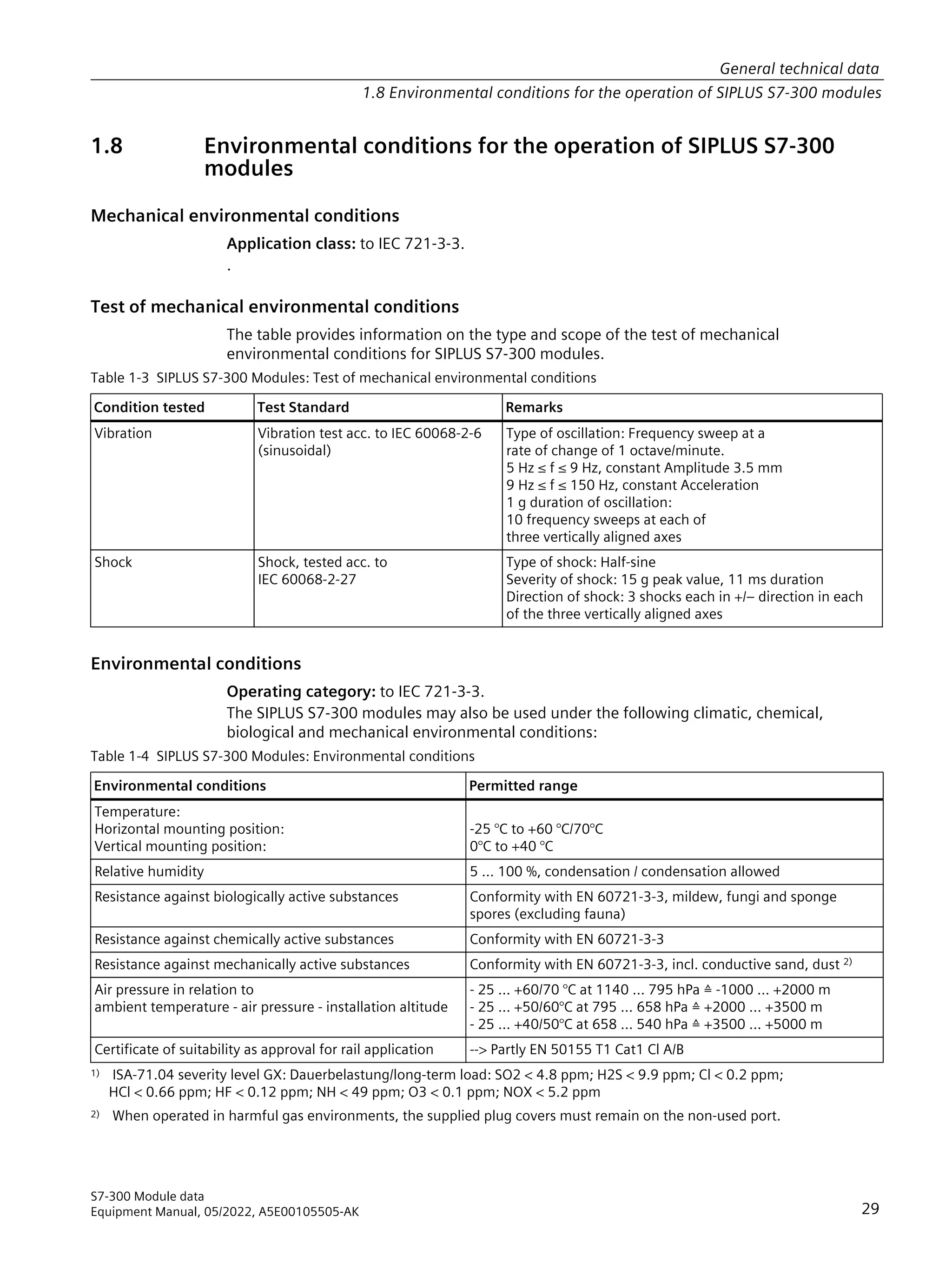
1.8 Environmental conditions for the operation of SIPLUS S7-300
modules
Mechanical environmental conditions
Application class: to IEC 721-3-3.
.
Test of mechanical environmental conditions
The table provides information on the type and scope of the test of mechanical
environmental conditions for SIPLUS S7-300 modules.
Table 1-3 SIPLUS S7-300 Modules: Test of mechanical environmental conditions
Condition tested Test Standard Remarks
Vibration Vibration test acc. to IEC 60068-2-6
(sinusoidal)
Type of oscillation: Frequency sweep at a
rate of change of 1 octave/minute.
5 Hz ≤ f ≤ 9 Hz, constant Amplitude 3.5 mm
9 Hz ≤ f ≤ 150 Hz, constant Acceleration
1 g duration of oscillation:
10 frequency sweeps at each of
three vertically aligned axes
Shock Shock, tested acc. to
IEC 60068-2-27
Type of shock: Half-sine
Severity of shock: 15 g peak value, 11 ms duration
Direction of shock: 3 shocks each in +/– direction in each
of the three vertically aligned axes
Environmental conditions
Operating category: to IEC 721-3-3.
The SIPLUS S7-300 modules may also be used under the following climatic, chemical,
biological and mechanical environmental conditions:
Table 1-4 SIPLUS S7-300 Modules: Environmental conditions
Environmental conditions Permitted range
Temperature:
Horizontal mounting position:
Vertical mounting position:
-25 °C to +60 °C/70°C
0°C to +40 °C
Relative humidity 5 ... 100 %, condensation / condensation allowed
Resistance against biologically active substances Conformity with EN 60721‑3‑3, mildew, fungi and sponge
spores (excluding fauna)
Resistance against chemically active substances Conformity with EN 60721‑3‑3
Resistance against mechanically active substances Conformity with EN 60721‑3‑3, incl. conductive sand, dust 2)
Air pressure in relation to
ambient temperature - air pressure - installation altitude
- 25 ... +60/70 °C at 1140 ... 795 hPa ≙ -1000 ... +2000 m
- 25 ... +50/60°C at 795 ... 658 hPa ≙ +2000 ... +3500 m
- 25 ... +40/50°C at 658 ... 540 hPa ≙ +3500 ... +5000 m
Certificate of suitability as approval for rail application -- Partly EN 50155 T1 Cat1 Cl A/B
1) ISA-71.04 severity level GX: Dauerbelastung/long-term load: SO2  4.8 ppm; H2S  9.9 ppm; Cl  0.2 ppm;
HCl  0.66 ppm; HF  0.12 ppm; NH  49 ppm; O3  0.1 ppm; NOX  5.2 ppm
2) When operated in harmful gas environments, the supplied plug covers must remain on the non-used port.
29
General technical data
1.8 Environmental conditions for the operation of SIPLUS S7-300 modules
S7-300 Module data
Equipment Manual, 05/2022, A5E00105505-AK
S7-300 Module data
Equipment Manual, 05/2022, A5E00105505-AK
30
Power supply modules 2
Introduction
Various 24-VDC power supply modules are available for your S7-300 PLC and the
sensors/actuators.
Power supply modules See also PS 305, PS 307
This chapter contains the technical data of the S7-300 power supply modules.
In addition to technical data, this chapter describes:
• The characteristics
• Wiring diagram
• Block Diagram
• Line protection
• Reaction to atypical operating conditions
2.1 Power supply module PS 307; 2 A; (6ES7307-1BA01-0AA0)
Order number
6ES7307-1BA01-0AA0
Properties
Properties of the PS 307; 2 A power supply module:
• Output current 2 A
• Output voltage 24 V DC; short circuit-proof, open circuit-proof
• Connection to singlephase AC mains
(rated input voltage 120/230 V AC, 50/60 Hz)
• safe electrical isolation in accordance with 61010-2-201 (SELV)
• May be used as load power supply
Wiring diagram of PS 307; 2 A
5
3
2
1
4
/
/
'9
;
68;;

 
36
$
/
0
0
1
① 24 V DC output voltage present display
② 24 V DC On/Off switch
③ Mains and protective conductor terminals
④ Terminals for 24 V DC output voltage
⑤ Strain-relief
Schematic circuit diagram of PS 307; 2 A
1
/ /
8
0
'9
Figure 2-1 Schematic circuit diagram of power supply module PS 307; 2 A
31
Power supply modules
2.1 Power supply module PS 307; 2 A; (6ES7307-1BA01-0AA0)
S7-300 Module data
Equipment Manual, 05/2022, A5E00105505-AK
Line protection
The mains supply of the PS 307; 2A power supply module should be protected with a
miniature circuit-breaker (for example Siemens 5SN1 series) of the following rating:
• Rated current at 230 V AC: 3 A
• Tripping characteristics (type): C.
Reaction to atypical operating conditions
Table 2-1 Reaction of the PS 307; 2A power supply module to atypical operating conditions
If ... ... then ... 24 V DC LED
the output circuit is overloaded:
• I  2.6 A (dynamic)
• 2 A  I ≤ 2.6 A (static)
Voltage dip, automatic voltage recovery
Voltage drop, reduction of service life
Flashing
short-circuit at the output Output voltage 0 V; automatic voltage recovery after
short-circuit is eliminated
off
overvoltage on primary side risk of destruction -
undervoltage on primary side Automatic shutdown; automatic voltage recovery off
Technical specifications of the PS 307; 2 A (6ES7307-1BA01-0AA0)
Technical specifications
Dimensions and weight
Dimensions W x H x D (mm) 40 x 125 x 120
Weight ca. 400 g
Input parameters
Input voltage
• Rated value
Mains frequency
• Rated value
• Permitted range
120/230 V AC (automatic switching)
50 Hz or 60 Hz
47 Hz to 63 Hz
Rated input current
• at 230 V
• at 120 V
0.5 A
0.9 A
Inrush current (at 25 °C) 22 A
I2t (at inrush current) 1 A2s
Output parameters
Output voltage
• Rated value
• Permitted range
• Rampup time
24 V DC
24 V ± 3 %, open-circuit test
max. 2.5 s
Output current
• Rated value 2 A,
parallel wiring supported
Short-circuit protection electronic, non-latching
1.1 to 1.3 x IN
32
S7-300 Module data
Equipment Manual, 05/2022, A5E00105505-AK
Power supply modules
2.1 Power supply module PS 307; 2 A; (6ES7307-1BA01-0AA0)
Technical specifications
Residual ripple max. 150 mVpp
Characteristics
Safety class to IEC 536 (DIN VDE 0106, Part 1) I, with protective conductor
Isolation rating
• Rated isolation voltage
(24 V to L1)
• Test voltage
250 V AC
4200 V DC
Safety isolation SELV circuit
Buffering of power supply failure (at 93 V or 187 V)
• Repeat rate
min. 20 ms
min 1 s
Efficiency 84 %
Power consumption 57 W
Power loss Typ. 9 W
Diagnostics
Output voltage present display yes, green LED
2.2 Power supply module PS 307; 5 A; (6ES7307-1EA01-0AA0)
Order number
6ES7307-1EA01-0AA0
Properties
Properties of the PS 307; 5 A power supply module:
• Output current 5 A
• Output voltage 24 V DC; short circuit-proof, open circuit-proof
• Connection to singlephase AC mains
(rated input voltage 120/230 V AC, 50/60 Hz)
• safe electrical isolation in accordance with EN 60 950 (SELV)
• May be used as load power supply
33
Power supply modules
2.2 Power supply module PS 307; 5 A; (6ES7307-1EA01-0AA0)
S7-300 Module data
Equipment Manual, 05/2022, A5E00105505-AK
Wiring diagram of PS 307; 5 A
5
'9
68;;
; 
 
36
$
3
2
1
4
/
/
/
0
0
0
/ 1
① Display for Output voltage DC 24 V present
② 24 V DC On/Off switch
③ Mains and protective conductor terminals
④ Terminals for 24 V DC output voltage
⑤ Strain-relief
Block diagram PS 307; 5 A
1
/ /
8
0
'9
Figure 2-2 Block diagram of the PS 307; 5 A power supply module
Line protection
The mains supplies of the PS 307; 5 A power supply module should be protected with a
miniature circuit-breaker (for example Siemens 5SN1 series) of the following rating:
• Rated current at 230 V AC: 6 A
• Tripping characteristics (type): C.
34
S7-300 Module data
Equipment Manual, 05/2022, A5E00105505-AK
Power supply modules
2.2 Power supply module PS 307; 5 A; (6ES7307-1EA01-0AA0)
Reaction to atypical operating conditions
Table 2-2 Reaction to atypical operating conditions of the PS 307; 5 A power supply module
If ... ... then ... Display­
DC 24 V
the output circuit is overloaded:
• I  6.5 A (dynamic)
• 5 A  I ≤ 6.5 A (static)
Voltage dip, automatic voltage recovery
Voltage drop, reduction of service life
flashes
short-circuit at the output Output voltage 0 V; automatic voltage recovery after short-
circuit is eliminated
off
overvoltage on primary side risk of destruction -
undervoltage on primary side Automatic shutdown; automatic voltage recovery off
Technical specifications of PS 307; 5 A (6ES7307-1EA01-0AA0)
Technical specifications
Dimensions and weight
Dimensions W x H x D (mm) 60 x 125 x 120
Weight ca. 600 g
Input parameters
Input voltage
• Rated value 120/230 V AC (automatic switching)
Mains frequency
• Rated value
• Permitted range
50 Hz or 60 Hz
47 Hz to 63 Hz
Rated input current
• at 120 V
• at 230 V
2.3 A
1.2 A
Inrush current (at 25 °C) 20 A
I2t (at inrush current) 1.2 A2s
Output parameters
Output voltage
• Rated value
• Permitted range
24 V DC
24 V ± 3 %, open circuit-proof
• Rampup time max. 2.5 s
Output current
• Rated value 5 A, parallel wiring is available
Short-circuit protection electronic, non-latching
1.1 to 1.3 x IN
Residual ripple max. 150 mVpp
Characteristics
Safety class to IEC 536 (DIN VDE 0106, Part 1) I, with protective conductor
Isolation rating
• Rated isolation voltage (24 V to L1) 250 V AC
35
Power supply modules
2.2 Power supply module PS 307; 5 A; (6ES7307-1EA01-0AA0)
S7-300 Module data
Equipment Manual, 05/2022, A5E00105505-AK
Technical specifications
• Test voltage 4200 V DC
Safety isolation SELV circuit
Buffering of power supply failure (at 93 V or 187 V)
• Repeat rate
Min. 20 ms
min 1 s
Efficiency 87 %
Power consumption 138 W
Power loss typ. 18 W
Diagnostics
Output voltage present display yes, green LED
2.3 Power supply module PS 307; 10 A; (6ES7307-1KA02-0AA0)
Order number
6ES7307-1KA02-0AA0
Properties
Properties of the PS 307; 10 A power supply module:
• Output current 10 A
• Output voltage 24 V DC; short circuit-proof, open circuit-proof
• Connection to singlephase AC mains
(rated input voltage 120/230 V AC, 50/60 Hz)
• safe electrical isolation in accordance with EN 60 950 (SELV)
• May be used as load power supply
36
S7-300 Module data
Equipment Manual, 05/2022, A5E00105505-AK
Power supply modules
2.3 Power supply module PS 307; 10 A; (6ES7307-1KA02-0AA0)
Block diagram of PS 307; 10 A
3
2
1
4
5
/
/
/
/
'9
68;;
; 
 
36
$
0
0
0
0
/ 1
① Display for Output voltage DC 24 V present
② Terminals for 24 V DC output voltage
③ Strain-relief
④ Mains and protective conductor terminals
⑤ 24 V DC On/Off switch
Block diagram PS 307; 10 A
1
/ /
8
0
'9
Figure 2-3 Block diagram of the PS 307; 10 A power supply module
37
Power supply modules
2.3 Power supply module PS 307; 10 A; (6ES7307-1KA02-0AA0)
S7-300 Module data
Equipment Manual, 05/2022, A5E00105505-AK
Line protection
The mains supplies of the PS 307;10 A power supply module should be protected with a
miniature circuit-breaker (for example Siemens 5SN1 series) of the following rating:
• Rated current at 230 V AC: 10 A
• Tripping characteristics (type): C.
Reaction to atypical operating conditions
Table 2-3 Reaction to atypical operating conditions of the PS 307; 10 A power supply module
If ... Module reaction DisplayDC 24 V
.output circuit is overloaded:
• I  13 A (dynamic)
• 10 A  I ≤ 13 A (static)
Voltage dip, automatic voltage recovery
Voltage drop (reduction of service life) flashes
short-circuit at the output Output voltage 0 V; automatic voltage recovery after
short-circuit is eliminated
off
overvoltage on primary side risk of destruction -
undervoltage on primary side Automatic shutdown; automatic voltage recovery off
Technical specifications of PS 307; 10 A (6ES7307-1KA02-0AA0)
Technical specifications
Dimensions and weight
Dimensions W x H x D (mm) 80 x 125 x 120
Weight 800 g
Input parameters
Input voltage
• Rated value 120/230 V AC (automatic switching)
Mains frequency
• Rated value
• Permitted range
50 Hz or 60 Hz
47 Hz to 63 Hz
Rated input current
• at 230 V
• at 120 V
1.9 A
4.2 A
Inrush current (at 25 °C) 55 A
I2t (at inrush current) 3.3 A2s
Output parameters
Output voltage
• Rated value
• Permitted range
• Rampup time
24 V DC
24 V ± 3 %, open-circuit test
max. 2.5 s
Output current
• Rated value 10 A, parallel wiring is available
Short-circuit protection electronic, non-latching
1.1 to 1.3 x IN
Residual ripple max. 150 mVpp
38
S7-300 Module data
Equipment Manual, 05/2022, A5E00105505-AK
Power supply modules
2.3 Power supply module PS 307; 10 A; (6ES7307-1KA02-0AA0)
Technical specifications
Characteristics
Safety class to IEC 536 (DIN VDE 0106, Part 1) I, with protective conductor
Isolation rating
• Rated isolation voltage (24 V to L1)
• Test voltage
250 V AC
4200 V DC
Safety isolation SELV circuit
Buffering of power supply failure (at 93 V or 187 V)
• Repeat rate
Min. 20 ms
min 1 s
Efficiency 90 %
Power consumption 267 W
Power loss typ. 27 W
Diagnostics
Output voltage present display yes, green LED
2.4 Power supply module PS 305; 2 A; (6AG1305-1BA80-2AA0)
Order number SIPLUS S7-300 module
6AG1305-1BA80-2AA0
Properties
Properties of the PS 305 power supply module (2 A):
• Output current 2 A
• Output voltage 24 V DC; short circuit-proof, open circuit-proof
• Connection to DC power supply
(rated input voltage 24/48/72/96/110 V DC)
• safe electrical isolation in accordance with EN 60 950 (SELV)
• May be used as load power supply
39
Power supply modules
2.4 Power supply module PS 305; 2 A; (6AG1305-1BA80-2AA0)
S7-300 Module data
Equipment Manual, 05/2022, A5E00105505-AK
Wiring diagram of PS 305; 2 A


/
0
/
0
/
0
/
0
'9
① 24 V DC output voltage present display
② Terminals for 24 V DC output voltage
③ Strain relief
④ Mains and protective conductor terminals
⑤ 24 V DC On/Off switch
Schematic circuit diagram of PS 305; 2 A
0
/ /
8
0
'9
Figure 2-4 Schematic circuit diagram of power supply module PS 305; 2 A
40
S7-300 Module data
Equipment Manual, 05/2022, A5E00105505-AK
Power supply modules
2.4 Power supply module PS 305; 2 A; (6AG1305-1BA80-2AA0)
Line protection
The mains supply of the PS 305 power supply module (2 A) should be protected with a
miniature circuit-breaker (for example Siemens 5SN1 series) of the following rating:
• Rated current at 110 V DC: 10 A
• Tripping characteristics (type): C.
Reaction to atypical operating conditions
Table 2-4 Reaction of the PS 305;(2 A) power supply module to atypical operating conditions
If ... ... then ... 24 V DC LED
... the output circuit is overloaded:
• I  3.9 A (dynamic)
• 3 A  I ≤ 3.9 A (static)
Voltage dip, automatic voltage recovery
Voltage drop, reduction of service life
Flashing
... short-circuit at the output Output voltage 0 V; automatic voltage recovery
after short-circuit is eliminated
off
overvoltage on primary side risk of destruction -
undervoltage on primary side Automatic shutdown; automatic voltage recovery off
Technical specifications of the PS 305; 2 A (6AG1305-1BA80-2AA0)
Technical specifications
Dimensions and weight
Dimensions W x H x D (mm) 80 x 125 x 120
Weight ca. 740 g
Input parameters
Input voltage
• Rated value
• Voltage range
24/48/72/96/110 V DC
16.8 to 138 V DC
Rated input current
• at 24 V
• at 48 V
• at 72 V
• at 96 V
• at 110 V
2.7 A
1.3 A
0.9 A
0.65 A
0.6 A
Inrush current (at 25 °C) 20 A
I2t (at inrush current) 5 A2s
Output parameters
Output voltage
• Rated value
• Permitted range
24 V DC
24 V ± 3 %, open circuit-proof
• Rampup time max. 3 s
Output current
• Rated value
2 A; 1)
parallel connection supported
Short-circuit protection electronic, non-latching, 1.65 to 1.95 x IN
Residual ripple max. 150 mVpp
41
Power supply modules
2.4 Power supply module PS 305; 2 A; (6AG1305-1BA80-2AA0)
S7-300 Module data
Equipment Manual, 05/2022, A5E00105505-AK
Technical specifications
Characteristics
Safety class to IEC 536 (DIN VDE 0106, Part 1) I, with protective conductor
Isolation rating
• Rated isolation voltage (24 V to input) 150 V AC
• Test voltage 2800 V DC
Safety isolation SELV circuit
Buffering of power supply failure (at 24/48/72/96/110 V)  10 ms
• Repeat rate min. 1 s
Efficiency 75%
Power consumption 64 W
Power loss 16 W
Diagnostics
Output voltage present display yes, green LED
1) At a limited input voltage range  24 V (24 to 138 V DC), PS 305 can be loaded to 3 A.
2.5 Power supply module PS 307; 5 A; (6AG1307-1EA80-2AA0)
Order number SIPLUS S7 module
6AG1307-1EA80-2AA0
Properties
Properties of the PS 307; 5 A power supply module:
• Output current 5 A
• Output voltage 24 V DC; short circuit-proof, open circuit-proof
• Connection to singlephase AC mains
(rated input voltage 120/230 V AC, 50/60 Hz)
• safe electrical isolation in accordance with EN 60 950 (SELV)
• May be used as load power supply
42
S7-300 Module data
Equipment Manual, 05/2022, A5E00105505-AK
Power supply modules
2.5 Power supply module PS 307; 5 A; (6AG1307-1EA80-2AA0)
Wiring diagram of PS 307; 5 A


/
1
/
0
/
0
/
0
'9
9
① 24 V DC output voltage present display
② Terminals for 24 V DC output voltage
③ Strain relief
④ Mains and protective conductor terminals
⑤ 24 V DC On/Off switch
⑥ Mains selector switch
Schematic circuit diagram of PS 307; 5 A
1
/ /
8
0
'9
Figure 2-5 Schematic circuit diagram of power supply module PS 307; 5 A
43
Power supply modules
2.5 Power supply module PS 307; 5 A; (6AG1307-1EA80-2AA0)
S7-300 Module data
Equipment Manual, 05/2022, A5E00105505-AK
Line protection
To protect the mains supply line of the PS 307; 5 A power supply module, you should install a
miniature circuit-breaker (for example Siemens 5SN1 series) of the following rating:
• Rated current at 230 V AC: 10 A
• Tripping characteristics (type): C.
Reaction to atypical operating conditions
Table 2-5 Reaction of the PS 307; 5A power supply module to atypical operating conditions
If ... ... then ... 24 V DC LED
the output circuit is overloaded:
• I  6.5 A (dynamic)
• 5 A  I ≤ 6.5 A (static)
Voltage dip, automatic voltage recovery
Voltage drop, reduction of service life
Flashing
short-circuit at the output Output voltage 0 V; automatic voltage recovery after short-
circuit is eliminated
off
overvoltage on primary side risk of destruction -
undervoltage on primary side Automatic shutdown; automatic voltage recovery off
Technical specifications of the PS 307; 5 A (6AG1307-1EA80-2AA0)
Technical specifications
Dimensions and weight
Dimensions W x H x D (mm) 80 x 125 x 120
Weight ca. 570 g
Input parameters
Input voltage
• Rated value 120/230 V DC
Mains frequency
• Rated value
• Permitted range
50 Hz or 60 Hz
47 Hz to 63 Hz
Rated input current
• at 120 V
• at 230 V
2.1 A
1.2 A
Inrush current (at 25 °C) 45 A
I2t (at inrush current) 1.8 A2s
Output parameters
Output voltage
• Rated value
• Permitted range
• Rampup time
24 V DC
24 ± V 3 %
max. 3 s
Output current
• Rated value 5 A; parallel wiring not supported
Short-circuit protection electronic, non-latching
1.1 to 1.3 x IN
Residual ripple max. 150 mVpp
44
S7-300 Module data
Equipment Manual, 05/2022, A5E00105505-AK
Power supply modules
2.5 Power supply module PS 307; 5 A; (6AG1307-1EA80-2AA0)
Technical specifications
Characteristics
Safety class to IEC 536 (DIN VDE 0106, Part 1) I, with protective conductor
Isolation rating
• Rated isolation voltage (24 V to L1)
• Test voltage
250 V AC
2800 V DC
Safety isolation SELV circuit
Buffering of power supply failure (at 93 V or 187 V)
• Repeat rate
min. 20 ms
min. 1 s
Efficiency 84 %
Power consumption 143 W
Power loss 23 W
Diagnostics
Output voltage present display yes, green LED
45
Power supply modules
2.5 Power supply module PS 307; 5 A; (6AG1307-1EA80-2AA0)
S7-300 Module data
Equipment Manual, 05/2022, A5E00105505-AK
S7-300 Module data
Equipment Manual, 05/2022, A5E00105505-AK
46
Digital modules 3
Chapter layout
Topical structure of this chapter:
1. Chapter overview of which modules are available and described here
2. Overview of essential module properties
3. Steps in selecting and commissioning the digital module
4. General information, i.e. global data applicable to all digital modules (parameter
assignment and diagnostics, for example)
5. Module-specific information (properties, connection and block diagrams, technical data
and special features of the module):
a) for digital input modules
b) for digital output modules
c) for relay output modules
d) for digital IO modules
Installation and wiring
For information on installation and wiring, refer to the S7-300, CPU 31xC, and CPU 31x
Operating Instructions: Installation. The operating instructions are available on the Internet
(http://support.automation.siemens.com/WW/view/en/13008499).
Further information
The structure of parameter sets (data records 0, 1 and 128) is described in the system data
section of the appendix. You must be familiar with this structure if you want to modify
module parameters in the STEP 7 user program.
The structure of diagnostic data (data records 0 and 1) is described in the system data section
of the appendix. You must be familiar with this structure if you want to analyze diagnostics
data of the modules in the STEP 7 user program.
See also
Principles of programming signal modules in the user program (Page 433)
Evaluating diagnostic data of signal modules in the user program (Page 484)
3.1 Module overview
Introduction
The tables below summarize the essential properties of the digital modules. This overview
supports you in selecting a module to suit your requirements.
3.1.1 Digital input modules:
Overview of properties
The table below shows essential properties of the digital input modules
Table 3-1 Digital input modules:
Module
SM 321;
DI 64 x 24V; Sink­
ing/Sourcing
SM 321;
DI 32 x DC24V
SM 321;
DI 32 x AC120V
SM 321;
DI 16 x DC24V
Properties
(-1BP00-) (-1BL00-) (-1EL00-) (-1BH02-)
Number of inputs 64 DO; isolated in
groups of 16
32 DI; isolated in
groups of 16
32 DI; isolated in
groups of 8
16 DI; isolated in
groups of 16
Rated input voltage 24 VDC 24 VDC 120 VAC 24 VDC
Suitable for... - 2-wire, 3-wire and 4-wire proximity switches (BEROs)
Supports isochronous
mode
No No No No
Programmable
diagnostics
No No No No
Diagnostic interrupt No No No No
Edge-triggered hard­
ware interrupt
No No No No
Adjustable input delays No No No No
Special features - - - -
Table 3-2 Digital input modules (continued)
Module
SM 321;
DI 16 x DC24V
High Speed
SM 321;
DI 16 x DC24V
with process and
diagnostic inter­
rupts
SM 321; DI 16 x
DC 24V/125V
with process and
diagnostic inter­
rupts
SM 321;
DI 16 x DC24V;
source input
SM 321;
DI 16 x UC24/48V
Properties
(-1BH10-) (-7BH01-) (-7EH00-) (-1BH50-) (-1CH00-)
Number of inputs 16 DI; electrically
isolated in
groups of 16
16 DI; electrically
isolated in groups
of 16
16 DI; isolated in
groups of 16
16 DI,
source input, electric­
ally isolated in groups
of 16
16 DI; isolated in
groups of 1
Rated input voltage 24 VDC 24 VDC 24 VDC - 125 VDC 24 VDC 24 VDC to 48 VDC
24 VAC to 48 VAC
Suitable for... Switches;
2-wire, 3-wire and 4-wire proximity switches (BEROs)
Supports isochron­
ous mode
Yes Yes No No No
Programmable
diagnostics
No Yes Yes No No
Diagnostic interrupt No Yes Yes No No
47
Digital modules
3.1 Module overview
S7-300 Module data
Equipment Manual, 05/2022, A5E00105505-AK
Module
SM 321;
DI 16 x DC24V
High Speed
SM 321;
DI 16 x DC24V
with process and
diagnostic inter­
rupts
SM 321; DI 16 x
DC 24V/125V
with process and
diagnostic inter­
rupts
SM 321;
DI 16 x DC24V;
source input
SM 321;
DI 16 x UC24/48V
Properties
(-1BH10-) (-7BH01-) (-7EH00-) (-1BH50-) (-1CH00-)
Edge-triggered
hardware interrupt
No Yes Yes No No
Adjustable input
delays
No Yes Yes No No
Special features Fast module;
especially for iso­
chronous mode
2 short-circuit-
proof sensor sup­
plies for 8 channels
each;
External redundant
sensor supply is
supported
--- --- ---
Table 3-3 Digital input modules (continued)
Module
SM 321;
DI 16 x DC48-125V
SM 321;
DI 16 x AC120/230
V
SM 321;
DI 16 x NAMUR
SM 321; DI 8 x
AC 120/230V
SM 321; DI 8 x AC
120/230 V ISOL
Properties
(-1CH20-) (-1FH00-) (-7TH00-) * (-1FF01-) (-1FF10-)
Number of inputs 16 DI; isolated in
groups of 4
16 DI; isolated in
groups of 4
16 DI; isolated in
groups of 2
8 DI; isolated in
groups of 2
8 DI; isolated in
groups of 2
Rated input voltage 120/230 VAC 120/230 VAC 24 VDC 120/230 VAC 120/230 VAC
Suitable for... Switches;
2-wire, 3-wire and
4-wire proximity
switches (BEROs)
Switches; 2-wire /
3-wire AC proximity
switches
NAMUR encoder Switches; 2-wire / 3-wire AC proximity
switches
Supports isochron­
ous mode
No No No No No
Programmable
diagnostics
No No No No No
Diagnostic interrupt No No Yes No No
Edge-triggered
hardware interrupt
No No No No No
Adjustable input
delays
No No No No No
Special features --- --- Module with single
channel dia­
gnostics and
extensive control
functions
--- ---
* This module is described in the ET 200M Signal Modules for Process Automation manual.
You can find the manual on the Internet
(http://support.automation.siemens.com/WW/view/en/7215812).
48
S7-300 Module data
Equipment Manual, 05/2022, A5E00105505-AK
Digital modules
3.1 Module overview
3.1.2 Digital output modules
Overview of properties
The table below shows the essential properties of the digital output modules
Table 3-4 Digital output modules
Module
Properties
SM 322; DO 64 x
DC24V/0,3A
Sourcing
(-1BP00-)
SM 322; DO 64 x
DC 24V/0,3A Sink­
ing
(-1BP50-)
SM 322; DO 32 x
DC24V/0,5A
(-1BL00-)
SM 322; DO 32 x
AC120/230V/1A
(-1FL00-)
SM 322; DO 16 x
DC24V/0,5A
(-1BH01-)
Number of outputs 64 DO; isolated in
groups of 16
64 DO; isolated in
groups of 16
32 DO; isolated in
groups of 8
32 DO; isolated in
groups of 8
16 DO; isolated in
groups of 8
Output current 0.3 A 0.3 A 0.5 A 1.0 A 0.5 A
Rated load voltage 24 V DC 24 V DC 24 V DC 24 V DC 24 V DC
Suitable for... solenoid valves, DC contactors and signal lamps
Supports isochronous
mode
no no No No No
Programmable
diagnostics
No No No No no
Diagnostic interrupt No No No No No
Substitute value out­
put
No No No No No
Special features -
Table 3-5 Digital output modules (continued)
Module
Properties
SM 322; DO 16 x
DC24V/0,5A High
Speed
(-1BH10-)
SM 322; DO 16 x
UC24/48 V
(-5GH00-)
SM 322; DO 16 x
AC120/230V/1A
(-1FH00-)
SM 322; DO 16 x
DC24V/0,5A
(-8BH00-)*
(-8BH01-) *
(-8BH10-)
SM 322; DO 8 x
DC24V/2A
(-1BF01-)
Number of outputs 16 DO; isolated in
groups of 8
16 DO; isolated in
groups of 1
16 DO; isolated in
groups of 8
16 DO; isolated in
groups of 4
8 DO; isolated in
groups of 4
Output current 0.5 A 0.5 A 1 A 0.5 A 2 A
Rated load voltage 24 V DC 24 to 48 V DC
24 to 48 V AC
120/230 V AC 24 V DC 24 V DC
Suitable for... solenoid valves, DC contactors and signal lamps
Supports isochronous
mode
Yes no no no no
Programmable
diagnostics
No Yes no yes no
Diagnostic interrupt no Yes No Yes No
Substitute value output Yes No
Special features Fast module; espe­
cially for isochron­
ous mode
- - Redundant load
control is suppor­
ted; extensive
control functions
-
49
Digital modules
3.1 Module overview
S7-300 Module data
Equipment Manual, 05/2022, A5E00105505-AK
Table 3-6 Digital output modules (continued)
Module
Properties
SM 322; DO 8 x
DC24V/0,5A with dia­
gnostics interrupt
(-8BF00-)
SM 322; DO 8 x
DC48-125V/1,5A
(-1CF00-)
SM 322; DO 8 x
AC120/230 V/2A
(-1FF01-)
SM 322;DO 8 x
AC120/230 V/ 2A ISOL
(-5FF00-)
Number of outputs 8 DO; isolated in
groups of 8
8 DO; electrically isol­
ated in groups of 4,
with reverse polarity
protection
8 DO; isolated in
groups of 4
8 DO; isolated in
groups of 1
Output current 0.5 A 1.5 A 2 A 2 A
Rated load voltage 24 V DC 48 to 125 V DC 120/230 V AC 120/230 V AC
Suitable for... solenoid valves, DC contactors and signal lamps AC solenoid valves, contactors, motor starters,
FHP motors and signal lamps.
Supports isochronous
mode
No No No No
Programmable
diagnostics
Yes No no yes
Diagnostic interrupt Yes No no yes
Substitute value output Yes No no yes
Special features Redundant load control
is supported
- Fuse blown display.
Replaceable fuse for
each group
-
* This module is described in the ET 200M Signal Modules for Process Automation manual.
You can find the manual on the Internet
(http://support.automation.siemens.com/WW/view/en/7215812).
3.1.3 Relay output modules
Overview of properties
The table below shows the essential properties relay output modules
Table 3-7 Relay output modules
Module
Properties
SM 322; DO 16 x Rel.
AC 120 V
(-1HH01-)
SM 322; DO 8 x Rel.
AC 230 V
(-1HF01-)
SM 322; DO 8 x Rel.
AC 230 V/ 5 A
(-5HF00-)
SM 322; DO 8 x Rel.
AC 230 V/ 5 A
(-1HF10-)
Number of outputs 16 outputs, electrically
isolated in groups of 8
8 outputs, electrically
isolated in groups of 2
8 outputs, electrically
isolated in groups of 1
8 outputs, electrically
isolated in groups of 1
Rated load voltage 24 VDC to 120 VDC,
48 VAC to 230 VAC
24 VDC to 120 VDC,
48 VAC to 230 VAC
24 VDC to 120 VDC,
24 VAC to 230 VAC
24 VDC to 120 VDC,
48 VAC to 230 VAC
Suitable for... AC/DC solenoid valves, contactors, motor starters, FHP motors and signal lamps
Supports isochronous mode no no no no
Programmable
diagnostics function
no no yes no
50
S7-300 Module data
Equipment Manual, 05/2022, A5E00105505-AK
Digital modules
3.1 Module overview
Module
Properties
SM 322; DO 16 x Rel.
AC 120 V
(-1HH01-)
SM 322; DO 8 x Rel.
AC 230 V
(-1HF01-)
SM 322; DO 8 x Rel.
AC 230 V/ 5 A
(-5HF00-)
SM 322; DO 8 x Rel.
AC 230 V/ 5 A
(-1HF10-)
Diagnostics interrupt no no yes no
Substitution value output no no yes no
Special features -
3.1.4 Digital IO modules
Overview of properties
The table below shows the essential properties of digital IO modules
Table 3-8 Digital IO modules
Module
Properties
SM 323; DI 16/DO 16 x
DC 24 V/ 0,5 A
(-1BL00-)
SM 323; DI 8/DO 8 x
DC 24 V/0,5 A
(-1BH01-)
SM 327; DI 8/DX 8 x
DC 24 V/0,5 A,
Programmable
(-1BH00-)
Number of inputs 16 inputs, electrically isol­
ated in groups of 16
8 inputs, electrically isolated
in groups of 8
8 digital inputs, plus 8 separ­
ately programmable
inputs/outputs, electrically
isolated in groups of 16
Number of outputs 16 outputs, electrically isol­
ated in groups of 8
8 outputs, electrically isol­
ated in groups of 8
Rated input voltage 24 VDC 24 VDC 24 VDC
Output current 0.5 A 0.5 A 0.5 A
Rated load voltage 24 VDC 24 VDC 24 VDC
Inputs suitable for... Switches and 2-/3-/4-wire proximity switches (BEROs).
Outputs suitable for... solenoid valves, DC contactors and signal lamps
Supports isochronous mode no no no
Programmable diagnostics no no no
Diagnostic interrupt no no no
Edge-triggered hardware inter­
rupt
no no no
Programmable input delay no no no
Substitution value output no no no
Special features - 8 individually configurable
input or outputs;
Reading back of inputs is
possible, for example, for
diagnoses
51
Digital modules
3.1 Module overview
S7-300 Module data
Equipment Manual, 05/2022, A5E00105505-AK
3.2 Steps in selecting and commissioning the digital module
Introduction
The table below contains the steps required to successfully complete commission of digital
modules.
You do not strictly have to adhere to this suggested sequence, that is, you can complete
other tasks such as installing or commissioning other modules, or program the module at an
earlier or later time.
Step sequence
Table 3-9 Steps in selecting and commissioning the digital module
Step Procedure See...
1. Selecting the module Chapter Modules overview (Page 46)and the specific module
chapter
2. Installing the module in the SIMATIC S7 sys­
tem
Installation chapter in the relevant AS Installation Manual:
• S7-300 Automation System, Hardware and Installation, or
S7-400 / M7-400 Automation System, Hardware and Installa­
tion
or
• Distributed I/O Device ET 200M
3. Assigning module parameters Chapter Diagnostics of digital modules (Page 53)
4. Commission the configuration Commissioning chapter in the relevant installation manual:of the
AS used:
• S7-300 Automation System, Hardware and Installation, or
S7-400 / M7-400 Automation System, Hardware and Installa­
tion
or
• ET 200M distributed I/O device
5. Analysis the configuration if commissioning
was not successful.
Chapter Diagnostics of digital modules (Page 53)
See also
Programming digital modules (Page 52)
Parameters of digital output modules (Page 437)
Module overview (Page 46)
3.3 Programming digital modules
Introduction
Digital modules may have different properties. You can program the properties of certain
modules.
All information in this chapter applies only to programmable digital modules:
• Digital input module SM 321; DI 16 x DC 24 V with process and diagnostic interrupts,
isochronous; (6ES7321-7BH01-0AB0)
• Digital input module SM 321; DI 16 x DC 24 V/125 V with process and diagnostic
interrupts (6ES7321-7EH00-0AB0)
52
S7-300 Module data
Equipment Manual, 05/2022, A5E00105505-AK
Digital modules
3.3 Programming digital modules
• Digital output module SM 322; DO 16 x DC 24 V/0,5 A (6ES7322-8BH10-0AB0)
• Digital output module SM 322; DO 8 x DC 24 V/0,5 A with diagnostic interrupt
(6ES7322‑8BF00-0AB0)
• Digital output module SM 322; DO 8 x AC120/230 V /2A ISOL (6ES7322-5FF00-0AB0)
• Digital output module SM 322; DO 8 x Rel. AC230V /5A (6ES7322-5HF00-0AB0)
• Digital input/output module SM 327; DI 8/DO 8 x DC 24 V/0,5 A (6ES7327-1BH00-0AB0)
Programming tools
Only program the digital modules in STEP 7 while the CPU is in STOP.
After you defined all parameters, download these from your PG to the CPU. During its STOP →
RUN transition, the CPU transfers the parameters to the relevant digital modules.
Static and dynamic parameters
Parameters are organized by static and dynamic properties.
Set the static parameters while the CPU is in STOP, as described earlier.
You may also edit dynamic parameters in the active user program of an S7 PLC using SFCs.
However, the parameters set in STEP 7 will be applied again after a RUN → STOP, STOP →
RUN transition of the CPU. The appendix Parameter sets of the signal modules (Page 433)
describes the assignment of module parameters in the user program.
Parameters programmable using CPU operating state
static PG (STEP 7 HW CONFIG) STOP
dynamic PG (STEP 7 HW CONFIG) STOP
SFC55 in the user program RUN
Parameters of digital modules
Information on programmable parameters is available in the module-specific chapter.
See also
Parameters of digital IO modules (Page 434)
3.4 Diagnostics of digital modules
Introduction
The information provided in this chapter applies only to S7-300 digital modules with
diagnostics functions.
• Digital input module SM 321; DI 16 x DC 24 V with process and diagnostic interrupts,
isochronous; (6ES7321-7BH01-0AB0)
• Digital input module SM 321; DI 16 x DC 24 V/125 V with process and diagnostic
interrupts (6ES7321-7EH00-0AB0)
• Digital output module SM 322; DO 16 × UC 24/48 V (6ES7322-5GH00-0AB0)
• Digital output module SM 322; DO 16 x DC 24 V/0,5 A (6ES7322-8BH10-0AB0)
53
Digital modules
3.4 Diagnostics of digital modules
S7-300 Module data
Equipment Manual, 05/2022, A5E00105505-AK
• Digital output module SM 322; DO 8 x DC 24 V/0,5 A with diagnostic interrupt
(6ES7322-8BF00-0AB0)
• Digital output module SM 322; DO 8 x AC120/230 V /2A ISOL (6ES7322-5FF00-0AB0)
• Digital output module SM 322; DO 8 x Rel. AC230V /5A (6ES7322-5HF00-0AB0)
Programmable and non-programmable diagnostics messages
We distinguish between programmable and non-programmable diagnostics messages.
You only obtain programmable diagnostics messages if you have enabled diagnostics at the
relevant parameters. Program the Diagnostics parameter block in STEP 7.
Digital modules always return non-programmable diagnostics messages, irrespective of
diagnostics being enabled.
Reactions to diagnostics message in STEP 7
Actions initiated by diagnostics messages:
• The diagnostics message will be entered in the diagnostics data of the digital module, and
is then passed to the CPU.
• The SF LED on the digital module is lit.
• When Enable Diagnostics Interrupt is set in STEP 7, the system triggers a diagnostics
interrupt and calls OB82.
Reading diagnostics messages
You can read detailed diagnostics messages using SFCs in the user program (refer to the
appendix Diagnostics data of signal modules (Page 484)).
In STEP 7, you can view the cause of error by reading the module diagnostics data (refer to
the STEP 7 Online Help.)
Diagnostics message using the SF LED See group error LED
Digital modules with diagnostics function indicate errors at their SF LED (group error LED.)
The SF LED lights up when the digital module generates a diagnostics message. It goes dark
after all error states are cleared.
The SF LED also lights up to indicate external errors (short-circuit at the sensor supply),
regardless of the CPU operating state (at POWER ON.)
Diagnostics messages and interrupt processing of digital modules
For information on diagnostics messages, their possible causes, troubleshooting measures,
and possible interrupts refer to the specific module chapter.
3.5 How to protect digital modules from inductive overvoltage
Inductive overvoltage
Overvoltage occurs when an inductance is deactivated. Examples of this are relay coils and
contactors.
Integrated overvoltage protection
The digital output modules of S7-300 have integrated overvoltage protection equipment.
54
S7-300 Module data
Equipment Manual, 05/2022, A5E00105505-AK
Digital modules
3.5 How to protect digital modules from inductive overvoltage
Extra overvoltage protection
Inductances should only be configured with extra overvoltage protection equipment in the
following instances:
• If SIMATIC output current circuits can be deactivated by extra fitted contacts (e.g. relay
contacts).
• If the inductive reactances are not activated by SIMATIC modules.
Note: Ask the suppliers of inductive reactances what size of overvoltage protection
equipment should be used.
Example
The following diagram shows an output current circuit which make extra overvoltage
protection equipment necessary.


38
36 60 60
60 60 60 60
① Contact in output current circuit
② Inductive reactance needs a protective circuit
Figure 3-1 Relay contact for emergency stop in output current circuit
Configuration of coils operated with direct current
Coils operated with direct current are shown in the following diagram and configured with
diodes or Z diodes.


① with diode
② with Z diode
Figure 3-2 Configuration of coils operated with direct current
Properties of the diode/Z diode circuit:
• Cut-off currents can be avoided. Z diode withstands a higher cut-off voltage.
• High cut-off delay (6 to 9 times higher compared to non-protective cid´rcuits).
55
Digital modules
3.5 How to protect digital modules from inductive overvoltage
S7-300 Module data
Equipment Manual, 05/2022, A5E00105505-AK
Faster cut-off of the Zener diode compared to the diode circuit.
Connection of AC-operated coils
The operation of AC coils with varistors or RC elements is shown in the diagram.
a
a
a
a
 
① with varistor
② with RC element
Figure 3-3 Connection of AC-operated coils
Properties of a circuit with varistor:
• The amplitude of the cut-off current is limited but not attenuated.
• The steepness of the overvoltage remains the same.
• Low cut-off delay.
Properties of acircuit with RC elements:
• Reduction of the amplitude and steepness of the cut-off current.
• Low cut-off delay.
3.6 Digital input module SM 321; DI 64 x DC 24 V, sinking/sourcing;
(6ES7321-1BP00-0AA0)
Order number
6ES7321-1BP00-0AA0
Properties
Properties of SM 321; DI 64 x DC 24 V, Sinking/Sourcing:
• 64 inputs, isolated in 4 groups of 16
• Rated input voltage 24 V DC
56
S7-300 Module data
Equipment Manual, 05/2022, A5E00105505-AK
Digital modules
3.6 Digital input module SM 321; DI 64 x DC 24 V, sinking/sourcing; (6ES7321-1BP00-0AA0)
Wiring and block diagram of SM 321; DI 64 x DC 24 V, Sinking/Sourcing


0
0
0
0
20
20
20
20
20
20
20
20
;
;
① Channel number
② Status display - green
③ Backplane bus interface
④ Terminal for sinking operating mode
⑤ Terminal for sourcing operating mode
57
Digital modules
3.6 Digital input module SM 321; DI 64 x DC 24 V, sinking/sourcing; (6ES7321-1BP00-0AA0)
S7-300 Module data
Equipment Manual, 05/2022, A5E00105505-AK
Terminal assignment of SM 321; DI 64 x DC 24 V, Sinking/Sourcing
The figure below shows how channels are assigned to addresses (input byte x up to input
byte x+7).
[
[
[
[
[
[
[
[
[[
[[
;
;
40-pin terminal block
SM321; DI 64 X DC 24 V Sinking/Sourcing features two terminal blocks for connecting
actuators and sensors to the module front connector. A connecting cable is used to establish
the module connections.
The table below shows how channel terminals are assigned to the terminal block for module
SM321; DI 64 X DC 24 V Sinking/Sourcing.
Terminal Function Terminal Function
1 I x.0 2 I x+2.0
3 I x.1 4 I x+2.1
5 I x.2 6 I x+2.2
7 I x.3 8 I x+2.3
9 I x.4 10 I x+2.4
58
S7-300 Module data
Equipment Manual, 05/2022, A5E00105505-AK
Digital modules
3.6 Digital input module SM 321; DI 64 x DC 24 V, sinking/sourcing; (6ES7321-1BP00-0AA0)
Terminal Function Terminal Function
11 I x.5 12 I x+2.5
13 I x.6 14 I x+2.6
15 I x.7 16 I x+2.7
17 COM 0 18 COM 1
19 I x+1.0 20 I x+3.0
21 I x+1.1 22 I x+3.1
23 I x+1.2 24 I x+3.2
25 I x+1.3 26 I x+3.3
27 I x+1.4 28 I x+3.4
29 I x+1.5 30 I x+3.5
31 I x+1.6 32 I x+3.6
33 I x+1.7 34 I x+3.7
35 COM 0 36 COM 1
37 Not connected 38 Not connected
39 Not connected 40 Not connected
NOTE
The COM x terminals must be connected on the terminal block.
Technical specifications of SM 321; DI 64 x DC 24 V, Sinking/Sourcing
Technical specifications
Dimensions and weight
Dimensions (W x H x D) (mm) 40 x 125 x 112 (including protective barrier,
required for connections which are not in use)
Weight ca. 230 g
Module-specific data
Supports isochronous mode No
Number of inputs 64
Cable length
• Unshielded
• Shielded
max. 600 m
max. 1000 m
Voltages, currents, electrical potentials
Number of simultaneously controlled inputs
• Horizontal installation
to 40 °C
to 60 °C
• Vertical installation
to 40 °C
64
32 (50% derating per group)
59
Digital modules
3.6 Digital input module SM 321; DI 64 x DC 24 V, sinking/sourcing; (6ES7321-1BP00-0AA0)
S7-300 Module data
Equipment Manual, 05/2022, A5E00105505-AK
Technical specifications
Electrical isolation
• between channels and the backplane bus
• Between channels
in groups of
Yes
Yes
16
Isolation test voltage 500 VDC
Current consumption
• from the backplane bus Max. 100 mA
Power loss of the module Typ. 7 W
Status, interrupts, diagnostics
Status display Green LED (per channel)
Interrupts none
Diagnostic functions none
Encoder selection data
Input voltage
• Rated value
• 1 signal
• 0 signal
24 V DC
-13 V to -30 V, 13 V to 30 V
- 5 V to + 5 V
Input current
• 1 signal Typ. 4.2 mA
Input delay
• 0 to 1 transition
• 1 to 0 transition
1.2 ms to 4.8 ms
1.2 ms to 4.8 ms
Input characteristics to IEC 61131, type 1
Connection of 2-wire BEROs not supported
Input type Sinking/sourcing input
Wiring of the signal transmitters Two 40-pin terminal blocks
STEP 7 integration
64-channel I/O modules are integrated with the HSP 2019 V 1.0. The HSP forms part of STEP 7
V 5.4 SP2 and can be installed from STEP 7 V 5.4 and higher.
GSD/GSDML files
The 64-channel I/O modules are supported by the ET 200M versions listed below. Download
the corresponding GSD/GSDML files from the following link: on the Internet
(http://www.siemens.com/automation/service).
• To search for PROFIBUS GSD files, type in the entry ID 113498.
• To search for PROFINET GSDML files, type in the entry ID: 25057900.
PROFIBUS
• IM 153-1, as of 6ES7153-1AA03-0XB0, E12 with GSD file SI01801D.*, version V 1.5
• IM 153-2, as of 6ES7153-2BA02-0XB0, E01 with GSD file SI04801E.*, version V 1.0
60
S7-300 Module data
Equipment Manual, 05/2022, A5E00105505-AK
Digital modules
3.6 Digital input module SM 321; DI 64 x DC 24 V, sinking/sourcing; (6ES7321-1BP00-0AA0)
PROFINET
• IM 153-4 PN, as of 6ES7153-4AA00-0XB0 with GSDML file version V 2.1
Using the module in S7-300 and ET 200M
If the station is configured with STEP 7, you can use the SM 321 digital input module with all
CPUs in the following tables. Startup cannot be performed if no configuration is loaded.
C-CPUs (compact CPUs) Order number
6ES7312-5BD0x-0AB0
6ES7312-5BE03-0AB0
CPU 312C
6ES7312-5BF04-0AB0
6ES7313-5BE0x-0AB0
6ES7313-5BF03-0AB0
CPU 313C
6ES7313-5BG04-0AB0
6ES7313-6CE0x-0AB0
6ES7313-6CF03-0AB0
CPU 313C-2 DP
6ES7313-6CG04-0AB0
6ES7313-6BE0x-0AB0
6ES7313-6BF03-0AB0
CPU313C-2 PtP
6ES7313-6BG04-0AB0
6ES7314-6CF0x-0AB0
6ES7314-6CG03-0AB0
CPU 314C-2 DP
6ES7314-6CH04-0AB0
6ES7314-6BF0x--0AB0
6ES7314-6BG03--0AB0
CPU 314C-2 PtP
6ES7314-6BH04-0AB0
CPU314C-2 PN/DP 6ES7314-6EH04-0AB0
M-CPUs Order number
6ES7312-1AD1x-0AB0
6ES7312-1AE13-0AB0
CPU 312
6ES7312-1AE14-0AB0
6ES7314-1AF1x-0AB0
6ES7314-1AG13-0AB0
CPU 314
6ES7314-1AG14-0AB0
6ES7315-2AF0x-0AB0
6ES7315-2AG10-0AB0
CPU 315-2 DP
6ES7315-2AH14-0AB0
CPU 316-2 DP 6ES7316-2AG00-0AB0
6ES7317-2AJ10-0AB0
CPU 317-2 DP
6ES7317-2AK14-0AB0
61
Digital modules
3.6 Digital input module SM 321; DI 64 x DC 24 V, sinking/sourcing; (6ES7321-1BP00-0AA0)
S7-300 Module data
Equipment Manual, 05/2022, A5E00105505-AK
M-CPUs Order number
6ES7315-2EG10-0AB0
6ES7315-2EH13-0AB0
CPU 315-2 PN/DP
6ES7315-2EH14-0AB0
6ES7317-2EJ10-0AB0
6ES7317-2EK13-0AB0
CPU 317-2 PN/DP
6ES7317-2EK14-0AB0
6ES7318-3EL00-0AB0
CPU 319-3 PN/DP
6ES7318-3EL01-0AB0
F-CPUs Order number
CPU 315F-2 DP 6ES7315-6FF0x-0AB0
CPU 317F-2 DP 6ES7317-6FF0x-0AB0
6ES7315-2FH1x-0AB0
CPU 315F-2 PN/DP
6ES7315-2FJ14-0AB0
6ES7317-2FJ10-0AB0
6ES7317-2FK13-0AB0
CPU 317F-2 PN/DP
6ES7317-2FK14-0AB0
6ES7318-3FL00-0AB0
CPU 319F-3 PN/DP
6ES7318-3FL01-0AB0
T-CPUs Order number
CPU 315T-2 DP 6ES7315-6TG10-0AB0
CPU315T-3 PN/DP 6ES7315-7TJ10-0AB0
CPU 317T-2 DP 6ES7317-6TJ10-0AB0
CPU317TF-2 DP 6ES7317-6TF14-0AB0
CPU317T-3 PN/DP 6ES7317-7TK10-0AB0
CPU317TF-3 PN/DP 6ES7317-7UL10-0AB0
62
S7-300 Module data
Equipment Manual, 05/2022, A5E00105505-AK
Digital modules
3.6 Digital input module SM 321; DI 64 x DC 24 V, sinking/sourcing; (6ES7321-1BP00-0AA0)
C7-CPUs Order number
C7-613 6ES7613-1CA01-0AE3
C7-635 Touch 6ES7635-2EB01-0AE3
C7-635 Key 6ES7635-2EC01-0AE3
C7-636 Touch 6ES7636-2EB00-0AE3
C7-636 Key 6ES7636-2EC00-0AE3
WARNING
Use of the module
This module must be configured in a STEP 7 project in which the correct address assignment
and allocation of the input/output point is ensured. Using the module without having first
carried out this configuration work can lead to machines or processes operating in an unex­
pected manner.
If machines or processes do run in an unexpected manner, this can result in death, serious
injury, and/or material damage.
3.7 Digital input module SM 321; DI 32 x DC 24 V;
(6ES7321-1BL00-0AA0)
Order number: Standard module
6ES7321-1BL00-0AA0
Order number: SIPLUS S7-300 module
6AG1321-1BL00-2AA0
Properties
Properties of SM 321; DI 32 x DC 24 V:
• 32 inputs, isolated in groups of 16
• Rated input voltage 24 V DC
• Suitable for switches and 2-/3-/4-wire proximity switches (BEROs)
63
Digital modules
3.7 Digital input module SM 321; DI 32 x DC 24 V; (6ES7321-1BL00-0AA0)
S7-300 Module data
Equipment Manual, 05/2022, A5E00105505-AK
Wiring and block diagram of SM 321; DI 32 x DC 24 V


9


0
0
9


 0
0
① Channel number
② Status display - green
③ Backplane bus interface
Terminal assignment of SM 321; DI 32 x DC 24 V
The figure below shows how channels are assigned to addresses (input byte x up to input
byte x+3).
[
[
[
[
64
S7-300 Module data
Equipment Manual, 05/2022, A5E00105505-AK
Digital modules
3.7 Digital input module SM 321; DI 32 x DC 24 V; (6ES7321-1BL00-0AA0)
Technical specifications of SM 321; DI 32 x DC 24 V
Technical specifications
Dimensions and weight
Dimensions W x H x D (mm) 40 x 125 x 120
Weight ca. 260 g
Module-specific data
Supports isochronous mode No
Number of inputs 32
Cable length
• Unshielded
• Shielded
Max. 600 m
Max. 1000 m
Front connector 40-pin
Voltages, currents, potentials
Number of simultaneously controlled inputs
• Horizontal mounting position
to 40 °C
to 60 °C
• Vertical arrangement
to 40 °C
32
16
32
Electrical isolation
• between channels and the backplane bus
• Between channels
– in groups of
yes
Yes
16
Isolation test voltage 500 V DC
Current consumption
• From the backplane bus Max. 15 mA
Power loss of the module Typ. 6.5 W
Status, interrupts, diagnostics
Status display Green LED per channel
Interrupts None
Diagnostic functions None
Encoder selection data
Input voltage
• Rated value
• 1 signal
• 0 signal
24 V DC
13 to 30 V
- 30 to + 5 V
Input current
• 1 signal Typ. 7 mA
Input delay
• 0 to 1 transition
• 1 to 0 transition
1.2 ms to 4.8 ms
1.2 ms to 4.8 ms
65
Digital modules
3.7 Digital input module SM 321; DI 32 x DC 24 V; (6ES7321-1BL00-0AA0)
S7-300 Module data
Equipment Manual, 05/2022, A5E00105505-AK
Technical specifications
Input characteristics to IEC 61131, type 1
Connection of 2-wire BEROs
• Permissible quiescent current
Supported
Max. 1.5 mA
Connection of the signal transmitters Using a 40-pin front connector
3.8 Digital output module SM 321; DI 32 x AC 120 V;
(6ES7321-1EL00-0AA0)
Order number
6ES7321-1EL00-0AA0
Properties
Properties of SM 321; DI 32 x AC 120 V:
• 32 inputs, electrically isolated in groups of 8
• Rated input voltage 120 VAC
• Suitable for switches and 2-/3-wire AC proximity switches
66
S7-300 Module data
Equipment Manual, 05/2022, A5E00105505-AK
Digital modules
3.8 Digital output module SM 321; DI 32 x AC 120 V; (6ES7321-1EL00-0AA0)
Wiring and block diagrams SM 321; DI 32 x AC 120 V


1


1


1


1
① Channel number
② Status display - green
③ Backplane bus interface
Terminal assignment
The figure below shows the channel addressing (input byte x up to input byte x +3).
[
[
[
[
67
Digital modules
3.8 Digital output module SM 321; DI 32 x AC 120 V; (6ES7321-1EL00-0AA0)
S7-300 Module data
Equipment Manual, 05/2022, A5E00105505-AK
Technical specifications of SM 321; DI 32 x AC 120 V
Technical specifications
Dimensions and weight
Dimensions W x H x D (mm) 40 x 125 x 117
Weight ca. 300 g
Module-specific data
Supports isochronous mode no
Number of inputs 32
Cable length
• unshielded
• shielded
max. 600 m
max. 1000 m
Voltages, currents, electrical potentials
Number of simultaneously controlled inputs
• horizontal mounting position
to 40 °C
to 60 °C
32
24
• vertical mounting position
to 40 °C 32
Electrical isolation
• between channels and the backplane bus yes
• between channels
in groups of
yes
8
Maximum potential difference
• between Minternal and inputs 120 VAC
• between inputs of different groups 250 VAC
Isolation test voltage 2500 VDC
Current consumption
• from the backplane bus max. 16 mA
Power loss of the module typ. 4 W
Status, interrupts, diagnostics
Status display green LED per channel
Interrupts none
Diagnostic functions none
Transducer selection data
Input voltage
• Rated value
• 1 signal
• 0 signal
• Frequency band
120 VAC
74 V to 132 V
0 V to 20 V
47 Hz to 63 Hz
Input current
• 1 signal typ. 21 mA
68
S7-300 Module data
Equipment Manual, 05/2022, A5E00105505-AK
Digital modules
3.8 Digital output module SM 321; DI 32 x AC 120 V; (6ES7321-1EL00-0AA0)
Technical specifications
Input delay
• 0 to 1 transition
• 1 to 0 transition
max. 15 ms
max. 25 ms
Input characteristics to IEC 61131, type 2
Connection of 2-wire BEROs
• Permissible quiescent current
supported
max. 4 mA
Wiring the signal transducers using a 40pin front connector
3.9 Digital input module SM 321; DI 16 x DC 24 V;
(6ES7321-1BH02-0AA0)
Order number: Standard module
6ES7321-1BH02-0AA0
Order number: SIPLUS S7-300 module
6AG1321-1BH02-2AA0
Properties
Properties of SM 321; DI 16 x DC 24 V:
• 16 inputs, electrically isolated in groups of 16
• Rated input voltage 24 V DC
• suitable for switches and 2- /3-/4-wire proximity switches (BEROs)
69
Digital modules
3.9 Digital input module SM 321; DI 16 x DC 24 V; (6ES7321-1BH02-0AA0)
S7-300 Module data
Equipment Manual, 05/2022, A5E00105505-AK
Wiring and block diagram of SM 321; DI 16 x DC 24 V


0


9
0
① Channel number
② Status display - green
③ Backplane bus interface
Technical specifications of SM 321; DI 16 x DC 24 V
Technical specifications
Dimensions and weight
Dimensions W x H x D (mm) 40 x 125 x 117
Weight ca. 200 g
Module-specific data
Supports isochronous mode no
Number of inputs 16
Cable length
• unshielded
• shielded
max. 600 m
max. 1000 m
Voltages, currents, electrical potentials
70
S7-300 Module data
Equipment Manual, 05/2022, A5E00105505-AK
Digital modules
3.9 Digital input module SM 321; DI 16 x DC 24 V; (6ES7321-1BH02-0AA0)
Technical specifications
Number of simultaneously controlled inputs
• horizontal mounting position
to 60 °C
• vertical mounting position
to 40 °C
16
16
Electrical isolation
• between channels and the backplane bus
• between channels
• in groups of
yes
yes
16
Isolation test voltage 500 V DC
Current consumption
• from the backplane bus max. 10 mA
Power loss of the module typ. 3.5 W
Status, interrupts, diagnostics
Status display green LED per channel
Interrupts none
Diagnostic functions none
Encoder selection data
Input voltage
• Rated value
• 1 signal
• 0 signal
24 V DC
13 V to 30 V
- 30 V to + 5 V
Input current
• 1 signal typ. 7 mA
Input delay
• 0 to 1 transition
• 1 to 0 transition
1.2 ms to 4.8 ms
1.2 ms to 4.8 ms
Input characteristics to IEC 61131, type 1
Connection of 2-wire BEROs
• Permissible quiescent current
supported
max. 1.5 mA
Wiring of the signal transmitters using a 20-pin front connector
3.10 Digital input module SM 321; DI 16 x DC 24 V High Speed;
(6ES7321-1BH10-0AA0)
Order number
6ES7321-1BH10-0AA0
71
Digital modules
3.10 Digital input module SM 321; DI 16 x DC 24 V High Speed; (6ES7321-1BH10-0AA0)
S7-300 Module data
Equipment Manual, 05/2022, A5E00105505-AK
Properties
Properties of SM 321; DI 16 x DC 24 V High Speed:
• 16 inputs, electrically isolated in groups of 16
• Rated input voltage 24 V DC
• suitable for switches and 2- /3-/4-wire proximity switches (BEROs)
• Supports isochronous mode
Wiring and block diagram of SM 321; DI 16 x DC 24 V High Speed


0


9
0
① Channel number
② Status display - green
③ Backplane bus interface
Technical specifications of SM 321; DI 16 x DC 24 V High Speed
Technical specifications
Dimensions and weight
Dimensions W x H x D (mm) 40 x 125 x 117
Weight ca. 200 g
Module-specific data
Supports isochronous mode yes
Number of inputs 16
72
S7-300 Module data
Equipment Manual, 05/2022, A5E00105505-AK
Digital modules
3.10 Digital input module SM 321; DI 16 x DC 24 V High Speed; (6ES7321-1BH10-0AA0)
Technical specifications
Cable length
• unshielded
• shielded
max. 600 m
max. 1000 m
Voltages, currents, electrical potentials
Number of simultaneously controlled inputs
• horizontal mounting position
to 60 °C
• vertical mounting position
to 40 °C
16
16
Electrical isolation
• between channels and the backplane bus yes
Maximum potential difference
• between channels
– in groups of
yes
16
Isolation test voltage 500 V DC
Current consumption
• from the backplane bus max. 110 mA
Power loss of the module typ. 3.8 W
Status, interrupts, diagnostics
Status display green LED per channel
Interrupts none
Diagnostic functions none
Encoder selection data
Input voltage
• Rated value
• 1 signal
• 0 signal
24 V DC
13 V to 30 V
- 30 V to + 5 V
Input current
• 1 signal typ. 7 mA
Input delay
• 0 to 1 transition
• 1 to 0 transition
25 μs to 75 μs
25 μs to 75 μs
Input characteristics to IEC 61131, type 1
Connection of 2-wire BEROs
• Permissible quiescent current
supported
max. 1.5 mA
Wiring of the signal transmitters using a 20-pin front connector
3.11 Digital input module SM 321; DI 16 x 24 VDC; with hardware and
diagnostic interrupts (6ES7321-7BH01-0AB0)
Order number: Standard module
6ES7321-7BH01-0AB0
73
Digital modules
3.11 Digital input module SM 321; DI 16 x 24 VDC; with hardware and diagnostic interrupts
(6ES7321-7BH01-0AB0)
S7-300 Module data
Equipment Manual, 05/2022, A5E00105505-AK
Order number: SIPLUS S7-300 module
6AG1321-7BH01-2AB0
Properties
Properties of SM 321; DI 16 x DC 24 V with hardware and diagnostic interrupts:
• 16 inputs, electrically isolated in groups of 16
• Rated input voltage 24 V DC
• Input characteristics to IEC 61131, Type 2
• suitable for switches and 2- /3-/4-wire proximity switches (BEROs)
• 2 short circuitproof sensor supplies for each group of 8 channels
• external redundant sensor supply is supported
• Sensor supply (Vs) status display
• Group error display (SF)
• Supports isochronous mode
• Supports parameter reassignment in RUN
• Programmable diagnostics
• Programmable diagnostic interrupt
• Programmable hardware interrupts
• Programmable input delays
74
S7-300 Module data
Equipment Manual, 05/2022, A5E00105505-AK
Digital modules
3.11 Digital input module SM 321; DI 16 x 24 VDC; with hardware and diagnostic interrupts
(6ES7321-7BH01-0AB0)
Wiring and block diagram of SM 321; DI 16 x DC 24 V


6)
9V
9V


 9V
9V
/
/
/


9
0
0
① Channel number
② Status displays - green
Error displays - red
Sensor supply VS -green
③ Backplane bus interface
④ Wire-break detection
Wiring diagram of the redundant sensor supply
The figure below shows how an additional redundant voltage source can be used to power
sensors using Vs.
/
/
9V
0
/
6KRUWFLUFXLWSURRI
GULYHU
'LJLWDOLQSXW
PRGXOH
7RWKHVHQVRUV
Figure 3-4 Wiring diagram of the redundant supply of sensors of SM 321; DI 16 x DC 24 V
75
Digital modules
3.11 Digital input module SM 321; DI 16 x 24 VDC; with hardware and diagnostic interrupts
(6ES7321-7BH01-0AB0)
S7-300 Module data
Equipment Manual, 05/2022, A5E00105505-AK
Wiring diagram of the shunt circuit of the sensors
For wire-break detection, it is necessary to connect a shunt resistor to the transducer
contacts.
([[
/9V
NവNവ
Figure 3-5 Wiring diagram of the shunt circuit of transducers of SM 321; DI 16 x DC 24 V
Technical specifications of SM 321; DI 16 x DC 24 V
Technical specifications
Dimensions and weight
Dimensions W x H x D (mm) 40 x 125 x 117
Weight ca. 200 g
Module-specific data
Supports isochronous mode yes
Supports parameter reassignment in RUN yes
• Response of non-programmed inputs return the process value which was valid before con­
figuration
Number of inputs 16
Cable length
• unshielded
• shielded
max. 600 m
max. 1000 m
Voltages, currents, electrical potentials
Rated supply voltage L+ for the electronic system and sensors 24 V DC
• Reverse polarity protection yes
Number of simultaneously controlled inputs
• horizontal mounting position
to 60 °C 16
• vertical mounting position
to 40 °C 16
Electrical isolation
• between channels and the backplane bus
• between channels
– In groups of
yes
16
Isolation test voltage 500 V DC
Current consumption
• from the backplane bus max. 130 mA
• from load voltage L + (without sensor supply VS) max. 90 mA
76
S7-300 Module data
Equipment Manual, 05/2022, A5E00105505-AK
Digital modules
3.11 Digital input module SM 321; DI 16 x 24 VDC; with hardware and diagnostic interrupts
(6ES7321-7BH01-0AB0)
Technical specifications
Power loss of the module typ. 4 W
Status, interrupts, diagnostics
Status display
• Inputs green LED per channel
• Sensor supplies (Vs) green LED per output
Interrupts
• Hardware interrupt
• Diagnostic interrupt
programmable
programmable
Diagnostic functions programmable
• Group error display red LED (SF)
• Reading diagnostic information supported
Monitoring for
• wirebreak yes, sensing I  1 mA
Sensor supply outputs
Number of outputs 2
Output voltage
• on load min. L+ (- 2.5 V)
Output current
• Rated value
• Permitted range
120 mA
0 mA to 150 mA
Additional (redundant) supply supported
Short-circuit protection yes, electronic
Encoder selection data
Input voltage
• Rated value
• 1 signal
• 0 signal
24 V DC
13 V to 30 V
-30 V to + 5 V
Input current
• 1 signal typ. 7 mA
Input characteristics to IEC 61131, type 2
Connection of 2-wire BEROs
• Permissible quiescent current
supported
max. 2 mA
Wiring of the signal transmitters using a 20-pin front connector
Shunt circuit of the sensor for wire-break detection 10 kohms to 18 kohms
Time/frequency
Internal preparation time for diagnostics (in non-isochronous mode)
• Enabling of process and diagnostic interrupts
max. 40 ms
Input delay
• programmable
• Rated value
yes
typ. 0.1/0.5/3/15/20 ms
77
Digital modules
3.11 Digital input module SM 321; DI 16 x 24 VDC; with hardware and diagnostic interrupts
(6ES7321-7BH01-0AB0)
S7-300 Module data
Equipment Manual, 05/2022, A5E00105505-AK
Configuration in RUN
Special considerations must be given if you use the Configuration in RUN function.
SF LED is lit:
Status before re-configuration diagnostics on, SF LEDs lit among others (on CPU, IM or
module), although diagnostics are no longer pending and the module is operating correctly.
Solution:
• Only change the configuration when no diagnostics are pending for the module or
• Pulling and plugging the module.
3.11.1 Isochronous mode
Properties
Reproducible reaction times (i.e. of the same length) are achieved in a SIMATIC system by
means of a constant DP bus cycle, and synchronization of the single cyclic processes outlined
below:
• Independent user program cycle. The length of the cycle time may vary due to non-cyclic
program branching.
• Independent and variable DP cycle on the PROFIBUS subnet
• Cyclic operation of the backplane bus of the DP slave.
• Cyclic signal conditioning and conversion at the electronic modules of the DP slave.
The constant DP cycle runs in synchronism and at the same length. The CPU run levels (OB61
to OB64) and isochronous IO are synchronized with this cycle. I/O data are therefore
transferred at defined and constant intervals (isochronous mode.)
Requirements
• The DP master and slave must support isochronous mode. STEP 7 V5.2 or higher.
Operating mode: Isochronous mode
Conditions of isochronous mode:
Filtering and processing time TWE between reading actual values and writing these to the trans­
fer buffer(the value defined for TWE applies, irrespective of the enable status of diagnostics)
255 μs to 345 µs
includes an input delay time of 100 µs
TDPmin 2.5 ms
Diagnostic interrupt max. 4 x TDP
NOTE
In isochronous mode, the input delay is automatically set to 100 μs, regardless of the input
delay setting in STEP 7
Further information
You can find additional information on isochronous mode in the online help for STEP 7 and in
the operating instructions Distributed I/O System ET 200M.
(http://support.automation.siemens.com/WW/view/en/1142798)
78
S7-300 Module data
Equipment Manual, 05/2022, A5E00105505-AK
Digital modules
3.11 Digital input module SM 321; DI 16 x 24 VDC; with hardware and diagnostic interrupts
(6ES7321-7BH01-0AB0)
3.11.2 SM 321; DI 16 x DC 24 V - Parameters
Programming
The general procedure of programming digital modules is described in the chapter
Programming digital modules (Page 52).
Parameters of SM 321; DI 16 x DC 24 V
The table below shows an overview of configurable parameters and their default settings for
SM 321; DI 16 x DC 24 V.
The default settings apply if you have not set any parameters in STEP 7.
Table 3-10 Parameters of SM 321; DI 16 x DC 24 V
Parameters Range of values Default Parameter
type
Scope
Enable
• Diagnostic interrupt
• Hardware interrupt
Yes/No
Yes/No
No
No
dynamic Module
Input delay/voltage type 0.1 ms (DC)
0.5 ms (DC)
3 ms (DC)
15 ms (DC)
20 ms (DC/AC)
(DC) static Module
Diagnosis encoder supply missing
• Wire break Yes/No
Yes/No
No
No
static Channel group
Hardware interrupt trigger
• Positive edge
• Negative edge
Yes/No
Yes/No
No
No
dynamic Channel group
Allocating the sensor supplies to channel groups
The module's two sensor supplies power the two channel groups: Inputs 0 to 7 and inputs 8
to 15. You also configure the diagnostics for the encoder supply in these channel groups.
Assigning interrupt parameters to channel groups
The table below shows which channels you can group for interrupt processing.
The channel group number is required to program SFC parameters in the user program.
Table 3-11 Assigning interrupt parameters to the inputs of SM 321; DI 16 x DC 24 V
Parameters... Programmable in the following
channel groups
Channel group number
• Hardware interrupt (triggered at the positive, negat­
ive, or both edges)
• Diagnostic interrupt for wire break
0 and 1
2 and 3
4 and 5
6 and 7
8 and 9
10 and 11
12 and 13
14 and 15
0
1
2
3
4
5
6
7
• Diagnostic interrupt for missing encoder supply 0 to 7
8 to 15
-
79
Digital modules
3.11 Digital input module SM 321; DI 16 x 24 VDC; with hardware and diagnostic interrupts
(6ES7321-7BH01-0AB0)
S7-300 Module data
Equipment Manual, 05/2022, A5E00105505-AK
Tolerances of the programmable input delays
Table 3-12 Tolerances of the input delays at SM 321; DI 16 x DC 24 V
Programmed input delay Tolerance
0.1 ms 60 μs to 140 μs
0.5 ms 400 μs to 900 μs
3 ms (default) 2.6 ms to 3.3 ms
15 ms 12 ms to 15 ms
20 ms 17 ms to 23 ms
3.11.3 SM 321; DI 16 x DC 24 V - Diagnostics
Diagnostic messages of SM 321; DI 16 x DC 24 V
The table below shows an overview of the diagnostic messages of SM 321; DI 16 x DC 24 V.
Table 3-13 Diagnostic messages of SM 321; DI 16 x DC 24 V
Diagnostic message LED Scope of diagnostics programmable
Sensor supply missing SF Channel group
Wire break SF Channel group
Module not programmed SF Channel group
yes
External auxiliary voltage missing SF Module
Internal auxiliary voltage missing SF Module
Fuse blown SF Module
Incorrect module parameters SF Module
Watchdog time-out SF Module
EPROM fault SF Module
RAM fault SF Module
Hardware interrupt lost SF Module
no
NOTE
A prerequisite for detecting faults indicated by programmable diagnostic messages is an
appropriate configuration of the digital module in STEP 7.
NOTE
Wire break diagnostics
Wire break diagnostics is always used for one channel group with two channels. It is only pos­
sible to determine that one of the two channels has suffered a wire break; it is not possible to
identify which one. When operated with PCS7, only one channel of the group can be used at
any time for an exact diagnosis.
80
S7-300 Module data
Equipment Manual, 05/2022, A5E00105505-AK
Digital modules
3.11 Digital input module SM 321; DI 16 x 24 VDC; with hardware and diagnostic interrupts
(6ES7321-7BH01-0AB0)
Causes of error and troubleshooting
Table 3-14 Diagnostics Messages of the SM 321; DI 16 x DC 24 V, causes of error and troubleshooting
Diagnostic message Possible cause of error To correct or avoid error
Overload at sensor supply Eliminate overload
Sensor supply missing
Short-circuit to M at sensor supply Eliminate the short-circuit
External auxiliary voltage
missing
Power supply L+ to module missing Feed supply L+
Internal auxiliary voltage
missing
Fuse blown in module Replace the module
Fuse blown Fuse blown in module Replace the module
Incorrect module paramet­
ers
Implausible parameter or combination thereof Program the module
Infrequent high electromagnetic interference Eliminate the interference
Watchdog timeout
Module defective Replace the module
Infrequent high electromagnetic interference Eliminate interference and cycle the power
supply of CPU off/on.
EPROM fault
Module defective Replace the module
Infrequent high electromagnetic interference Eliminate interference and cycle the power
supply of CPU off/on.
RAM fault
Module defective Replace the module
Hardware interrupt lost The module can not output an interrupt,
because the previous interrupt was not
acknowledged; possibly a configuration error
Change interrupt processing in the CPU, and
reprogram the module as required
The error persists until the module is assigned
new parameters
Module not programmed Startup error Program the module
3.11.4 SM 321; DI 16 x DC 24 V - Behavior
Influence of the operating state and supply voltage on input values
The SM 321; DI 16 x DC 24 input values are determined by the CPU's operating state and the
module's power supply.
Table 3-15 Dependency of input values on the CPU's operating state, and on the L+ power supply of SM 321; DI 16 x DC 24 V
CPU operating state Power supply L+ at digital module input value
of the digital module
L+ present Process value
RUN
L+ missing 0 signal
L+ present Process value
POWER ON
STOP
L+ missing 0 signal
L+ present -
POWER OFF -
L+ missing -
81
Digital modules
3.11 Digital input module SM 321; DI 16 x 24 VDC; with hardware and diagnostic interrupts
(6ES7321-7BH01-0AB0)
S7-300 Module data
Equipment Manual, 05/2022, A5E00105505-AK
Reaction to power failure
Failure of the SM 321; DI 16 x DC 24 power supply is always indicated by the module's SF
LED. This information is also available on the module.
The input value is initially held for the duration of 20 ms to 40 ms before the zero signal is
transferred to the CPU. Supply voltage dips 20 ms do not influence the process value (see
the table above.)
Triggering of diagnostic interrupts is determined by the parameter settings (see chapter
Interrupts of SM 321; DO 16 x DC 24 V (Page 82)).
Power supply failure with redundant external sensor supply
NOTE
When an external redundant power source is connected in parallel to the sensor supply (Vs)
and the L+ power supply fails, the module does not report failure of the sensor supply, but
rather the failure of the internal and/or external auxiliary voltage, and/or a blown fuse.
Short-circuit at the sensor supply Vs
The relevant Vs LED goes dark if a short-circuit is detected at the sensor supply Vs, irrespective
of parameter settings.
3.11.5 SM 321; DI 16 x DC 24 V - Interrupts
Introduction
This chapter describes the interrupt reaction of SM 321; DI 16 x DC 24 V. Always distinguish
between the following interrupts:
• Diagnostic interrupt
• Hardware interrupt
For detailed information on the OBs and SFCs mentioned below, refer to the STEP 7 Online
Help.
Enabling interrupts
There is no default interrupt setting, i.e. interrupts are disabled if parameters are not set
accordingly. You can enable interrupts in STEP 7 (see the chapter Parameters of SM 321; DI
16 x DC 24 V (Page 78)).
Diagnostic interrupt
When diagnostic interrupts are enabled, incoming error events (initial occurrence) and
outgoing error events (error is cleared) are reported by means of an interrupt.
The CPU interrupts user program execution in order to process diagnostic interrupt OB82.
You can call SFC51 or 59 in OB82 in the user program to view detailed diagnostics data
output by the module.
Diagnostics data remain consistent until the program exits OB82. The module acknowledges
the diagnostic interrupt when the program exits OB82.
82
S7-300 Module data
Equipment Manual, 05/2022, A5E00105505-AK
Digital modules
3.11 Digital input module SM 321; DI 16 x 24 VDC; with hardware and diagnostic interrupts
(6ES7321-7BH01-0AB0)
Hardware interrupt
SM 321; DI 16 x DC 24 V can trigger a hardware interrupt for each channel group at the
positive, negative, or both edges of a signal transition.
Program each channel group separately. The parameters can be changed at any time (in RUN
mode in the user program.)
Active hardware interrupts trigger hardware interrupt processing in the CPU (OB40) and
interrupt execution of the user program or of object classes with lower priority in the CPU.
You can define the response of the AS to signal edge transitions in the user program of
hardware interrupt OB40. The module acknowledges the hardware interrupt when the
program exits the hardware interrupt OB.
The module can save one interrupt per channel to the stack. If no higher priority classes are
pending processing, the CPU processes the buffered interrupts (of all modules) in the order of
their occurrence.
Hardware interrupt lost
A Hardware interrupt lost diagnostic interrupt is generated if a successive interrupt is
triggered at the channel previously saved to the stack and which has not yet been processed
by the CPU.
The CPU does not register any further interrupts at this channel unless it has completed
processing of the queued interrupts of the same channel.
Interrupt-triggering channels
The relevant hardware interrupt-triggering channel is logged in the OB40_POINT_ADDR
variable of the start information of OB40. The figure shows the bit assignments of DWORD 8
in the local data.
Byte Variable Data type Description
6/7 OB40_MDL_ADDR WORD B#16#0 Address of the interrupt-triggering module
starting at
8
OB40_POINT_ADDR DWORD see the figure
below
Indication of the interrupt-triggering inputs
83
Digital modules
3.11 Digital input module SM 321; DI 16 x 24 VDC; with hardware and diagnostic interrupts
(6ES7321-7BH01-0AB0)
S7-300 Module data
Equipment Manual, 05/2022, A5E00105505-AK
/% /% /% /%
/'
5HVHUYHG
(GJHFKDQJHKDQQHO
(GJHFKDQJHKDQQHO
(GJHFKDQJHKDQQHO
(GJHFKDQJHKDQQHO
(GJHFKDQJHKDQQHO
(GJHFKDQJHKDQQHO
(GJHFKDQJHKDQQHO
(GJHFKDQJHKDQQHO
%LWQR
Figure 3-6 Start Information of OB40: which event has triggered the hardware interrupt
3.12 Digital input module SM 321; DI 16 x DC 24/125 V; with hardware
and diagnostic interrupts (6ES7321-7EH00-0AB0)
Order number:
6ES7321-7EH00-0AB0
84
S7-300 Module data
Equipment Manual, 05/2022, A5E00105505-AK
Digital modules
3.12 Digital input module SM 321; DI 16 x DC 24/125 V; with hardware and diagnostic interrupts
(6ES7321-7EH00-0AB0)
Properties
Properties of SM 321; DI 16 x DC 24 V/125 V; with hardware and diagnostic interrupts:
• 16 inputs, electrically isolated in groups of 16
• Rated input voltage 24 to 125 V DC
• Input characteristics to IEC 61131, Type 1
• suitable for switches and 2- /3-/4-wire proximity switches (BEROs)
• Group error display (SF)
• Supports parameter reassignment in RUN
• Channel-based configurable diagnostics
• Programmable diagnostic interrupt
• Channel-based configurable hardware interrupts
• Programmable input delays
WARNING
• Electrical hazard arises with electric circuits operated with voltages
– 30 Veff and 42.4 Vpeak
– 60 VDC.
• It is not permitted to mix electrically safe and dangerous contact input voltages on the 16
inputs of the same module.
85
Digital modules
3.12 Digital input module SM 321; DI 16 x DC 24/125 V; with hardware and diagnostic interrupts
(6ES7321-7EH00-0AB0)
S7-300 Module data
Equipment Manual, 05/2022, A5E00105505-AK
Wiring and block diagram of SM 321; DI 16 x DC 24 V/125 V


6)


+
0 0 /
+
+
+
+
+
+
+
+
+
+
+
+
+
+
+
,
1
3
8
7


,
1
3
8
7


① Channel number
② Status displays - green
Error displays - red
③ Backplane bus interface
Wiring diagram of the shunt circuit of the sensors
For wire-break detection, it is necessary to connect a shunt resistor to the transducer
contacts.
([[
/
5V
Figure 3-7 Wiring diagram of the shunt circuit of transducers of SM 321; DI 16 x DC 24 V/125 V
The resistance used depends on the module's rated input voltage
Table 3-16 Dependence on rated input voltage and resistance
Rated input voltage L+ Resistance Rs
24 V DC 43 kΩ
48 V DC 100 kΩ
125 V DC 300 kΩ
86
S7-300 Module data
Equipment Manual, 05/2022, A5E00105505-AK
Digital modules
3.12 Digital input module SM 321; DI 16 x DC 24/125 V; with hardware and diagnostic interrupts
(6ES7321-7EH00-0AB0)
SM 321; DI 16 x DC 24 V/125V - Technical specifications
Technical specifications
Dimensions and weight
Dimensions W x H x D (mm) 40 x 125 x 117
Weight approx. 200 g
Module-specific data
Supports isochronous mode No
Supports parameter reassignment in RUN Yes
• Response of non-programmed inputs return the process value which was valid before con­
figuration
Accuracy of the time stamp  5 ms*
Number of inputs 16
Cable length
• unshielded
• shielded
max. 600 m
max. 1000 m
Voltages, currents, electrical potentials
Number of simultaneously controlled inputs
• Horizontal mounting position to 60 °C
– L+ = 146 VDC
– L+ = 125 VDC
– L+ = 100 VDC
8
12
16
• Vertical mounting position to 40 °C
– L+ = 146 VDC
– L+ = 125 VDC
– L+ = 100 VDC
8
12
16
Electrical isolation
• between channels and the backplane bus
• between channels
Yes
No
Maximum potential difference
• between different circuits 300 V DC / 250 V AC
Isolation test voltage 3500 VDC
Current consumption
• from the backplane bus max. 90 mA
Power loss of the module
• L+ = 24 V
• L+ = 100 V
typ. 2 W
typ. 6.5 W
Status, interrupts, diagnostics
Status displays green LED per channel
Interrupts
• Hardware interrupt
• Diagnostic interrupt
• Wire break
programmable
programmable
programmable
Diagnostic functions programmable
• Group error display red LED (SF)
87
Digital modules
3.12 Digital input module SM 321; DI 16 x DC 24/125 V; with hardware and diagnostic interrupts
(6ES7321-7EH00-0AB0)
S7-300 Module data
Equipment Manual, 05/2022, A5E00105505-AK
Technical specifications
• Reading diagnostics information supported
Monitoring for
• Wire break yes, sensing I  1 mA
Encoder selection data
Input voltage
• Rated value
• 1 signal
• 0 signal
From 15 to 146 V
from -146 V to + 5 V
Input current
• 1 signal Typ. 3.5 mA
Input characteristics to IEC 61131, Type 1
Connection of 2-wire BEROs
• Permissible quiescent current
supported
max. 1 mA
Wiring of the signal transmitters with 40-pin front connector
Time/frequency
Input delay
• programmable
• Rated value
Yes
typ. 0.1/0.5/3/15/20 ms**
Fixed current limitation of the sensor for wire-break detection See previous table for dependence on rated input
voltage and resistance
Overvoltage protection Dehnconnect RK DCO RK ME110; Art. No. 919 923
* To obtain a time stamp accuracy of  1 ms, the input delay must be configured to 0.1 ms.
** To obtain a high immunity to interference, use a shielded cable and set input delay to 0.1 ms.
Configuration in RUN
Special considerations must be given if you use the Configuration in RUN function.
SF LED is lit:
Status before re-configuration diagnostics on, SF LEDs lit among others (on CPU, IM or
module), although diagnostics are no longer pending and the module is operating correctly.
Solution:
• Only change the configuration when no diagnostics are pending for the module or
• Pulling and plugging the module.
3.12.1 Parameters of SM 321; DI 16 x DC 24/125 V
Programming
The general procedure of programming digital modules is described in the chapter
Programming digital modules.
Parameters of SM 321; DI 16 x DC 24 V/125 V
The table below shows an overview of configurable parameters and their default settings for
SM 321; DI 16 x DC 24 V/125V.
88
S7-300 Module data
Equipment Manual, 05/2022, A5E00105505-AK
Digital modules
3.12 Digital input module SM 321; DI 16 x DC 24/125 V; with hardware and diagnostic interrupts
(6ES7321-7EH00-0AB0)
The default settings apply if you have not set any parameters in STEP 7.
Table 3-17 Parameters of SM 321; DI 16 x DC 24 V/125 V
Parameters Range of values Default Parameter
type
Efficiency range
Enable
• Diagnostic interrupt
• Hardware interrupt
Yes/No
Yes/No
No
No
dynamic Module
Input delay/voltage type 0.1 ms (DC)
0.5 ms (DC)
3 ms (DC)
15 ms (DC)
20 ms (DC/AC)
3 ms (DC) static Module
Diagnostics
• Wire break Yes/No No static Channel
Hardware interrupt trigger
• Positive edge
• Negative edge
Yes/No
Yes/No
No
No
dynamic Channel
Tolerances of the programmable input delays
Table 3-18 Tolerances of the input delays of SM 321; DI 16 x DC 24 V/125 V
Programmed input delay Tolerance
0.1 ms 80 μs to 200 μs
0.5 ms 580 μs to 700 μs
3 ms (default) 3.1 ms to 3.7 ms
15 ms 15.1 ms to 18.1 ms
20 ms 20.1 ms to 24.1 ms
NOTE
The timers for the input delay are only valid for reading in the status. In the case of wire-
break, Wire-break diagnostics is only triggered approx. 40 ms after the reading in of the
value.
3.12.2 Diagnostics of SM 321; DI 16 x DC 24/125 V
Diagnostic messages of SM 321; DI 16 x DC 24 V/125 V
The table below shows an overview of the diagnostic messages of SM 321; DI 16 x
DC 24 V/125 V.
Table 3-19 Diagnostic messages of SM 321; DI 16 x DC 24 V/125 V
Diagnostic message LED Scope of diagnostics programmable
Wire break SF Channel
No channel parameters SF Channel
Yes
89
Digital modules
3.12 Digital input module SM 321; DI 16 x DC 24/125 V; with hardware and diagnostic interrupts
(6ES7321-7EH00-0AB0)
S7-300 Module data
Equipment Manual, 05/2022, A5E00105505-AK
Diagnostic message LED Scope of diagnostics programmable
No/incorrect parameters in module SF Module
Time monitoring activated (watchdog) SF Module
EPROM fault SF Module
RAM fault SF Module
Hardware interrupt lost SF Module
No
NOTE
To detect the errors indicated by programmable diagnostic messages, you must have pro­
grammed the digital module accordingly in STEP 7.
Special features of diagnostics
The SM 321; DI 16 x DC 24 V/125 V supplies 9-byte diagnostic data (diagnostic data set 0 with
a length of 4 bytes and the diagnostic data set 1 with a length of 9 bytes).
The wire-break diagnostics is only reported in the channel error vector of the data set 1 (bytes
7 and 8). Each channel that reports an error in the channel errror vector has a wire-break. You
can find additional information, in chapter Structure and content of diagnostics data, byte 0
and up (Page 484).
Causes of error and troubleshooting
Table 3-20 Diagnostics messages of SM 321; DI 16 x DC 24 V/125V, causes of error and troubleshooting
Diagnostic message Possible cause of error To correct or avoid error
Incorrect module paramet­
ers
Implausible parameter or combination thereof Program the module
Infrequent high electromagnetic interference Eliminate the interference
Time monitoring activated
(watchdog)
Module defective Replace the module
Infrequent high electromagnetic interference Eliminate interference and cycle the power
supply of CPU off/on.
EPROM fault
Module defective Replace the module
Infrequent high electromagnetic interference Eliminate interference and cycle the power
supply of CPU off/on.
RAM fault
Module defective Replace the module
Hardware interrupt lost The module can not output an interrupt,
because the previous interrupt was not
acknowledged; possibly a configuration error
Change interrupt processing in the CPU, and
reprogram the module as required
The error persists until the module is assigned
new parameters
Module not programmed Startup error Program the module
90
S7-300 Module data
Equipment Manual, 05/2022, A5E00105505-AK
Digital modules
3.12 Digital input module SM 321; DI 16 x DC 24/125 V; with hardware and diagnostic interrupts
(6ES7321-7EH00-0AB0)
3.12.3 Interrupts of SM 321; DI 16 x DC 24/125 V
Introduction
This chapter describes the interrupt reaction of SM 321; DI 16 x DC 24 V/125V. Always
distinguish between the following interrupts:
• Diagnostic interrupt
• Hardware interrupt
For detailed information on the OBs and SFCs mentioned below, refer to the STEP 7 Online
Help.
Enabling interrupts
There is no default interrupt setting, i.e. interrupts are disabled if parameters are not set
accordingly. You can enable interrupts in STEP 7 (see the chapter Parameters of SM 321; DI
16 x DC 24 V ).
Diagnostic interrupt
When diagnostic interrupts are enabled, incoming error events (initial occurrence) and
outgoing error events (error is cleared) are reported by means of an interrupt.
The CPU interrupts user program execution in order to process diagnostic interrupt OB82.
You can call SFC51 or 59 in OB82 in the user program to view detailed diagnostics data
output by the module.
Diagnostics data remain consistent until the program exits OB82. The module acknowledges
the diagnostic interrupt when the program exits OB82.
Hardware interrupt
SM 321; DI 16 x DC 24 V/125V can trigger a hardware interrupt for each channel group at the
positive, negative, or both edges of a signal transition.
You perform parameter assignment for each channel separately. The parameters can be
changed at any time (in RUN mode in the user program.)
Active hardware interrupts trigger hardware interrupt processing in the CPU (OB40) and
interrupt execution of the user program or of object classes with lower priority in the CPU.
You can define the response of the AS to signal edge transitions in the user program of
hardware interrupt OB40. The module acknowledges the hardware interrupt when the
program exits the hardware interrupt OB.
The module can save one interrupt per channel to the stack. If no higher priority classes are
pending processing, the CPU processes the buffered interrupts (of all modules) in the order of
their occurrence.
Hardware interrupt lost
A Hardware interrupt lost diagnostic interrupt is generated if a successive interrupt is
triggered at the channel previously saved to the stack and which has not yet been processed
by the CPU.
The CPU does not register any further interrupts at this channel unless it has completed
processing of the queued interrupts of the same channel.
91
Digital modules
3.12 Digital input module SM 321; DI 16 x DC 24/125 V; with hardware and diagnostic interrupts
(6ES7321-7EH00-0AB0)
S7-300 Module data
Equipment Manual, 05/2022, A5E00105505-AK
Interrupt-triggering channels
The relevant hardware interrupt-triggering channel is logged in the OB40_POINT_ADDR
variable of the start information of OB40. The figure shows the bit assignments of DWORD 8
in the local data.
Byte Variable Data type Description
6/7 OB40_MDL_ADDR WORD B#16#0 Address of the interrupt-triggering module
starting at
8
OB40_POINT_ADDR DWORD see the figure
below
Indication of the interrupt-triggering inputs
       
   
/% /% /% /%
/'
5HVHUYHG
(GJHFKDQJHKDQQHO
(GJHFKDQJHKDQQHO
(GJHFKDQJHKDQQHO
(GJHFKDQJHKDQQHO
(GJHFKDQJHKDQQHO
(GJHFKDQJHKDQQHO
(GJHFKDQJHKDQQHO
(GJHFKDQJHKDQQHO
%LWQR
Figure 3-8 Start Information of OB40: which event has triggered the hardware interrupt
3.13 Digital input module SM 321; DI 16 x DC 24 V; source input;
(6ES7321-1BH50-0AA0)
Order number
6ES7321-1BH50-0AA0
Properties
Properties of SM 321; DI 16 x DC 24 V; source input:
• 16 inputs, source input, electrically isolated in groups of 16
• Rated input voltage 24 V DC
• Suitable for switches and 2- /3-/4-wire proximity switches (BEROs)
92
S7-300 Module data
Equipment Manual, 05/2022, A5E00105505-AK
Digital modules
3.13 Digital input module SM 321; DI 16 x DC 24 V; source input; (6ES7321-1BH50-0AA0)
Wiring and block diagram of SM 321; DI 16 x DC 24 V


/
① Channel number
② Status display - green
③ Backplane bus interface
SM 321; DI 16 x DC 24 V - Technical specifications
Technical specifications
Dimensions and weight
Dimensions W x H x D (mm) 40 x 125 x 117
Weight ca. 200 g
Module-specific data
Supports isochronous mode no
Number of inputs 16
Cable length
• unshielded
• shielded
max. 600 m
max. 1000 m
Voltages, currents, electrical potentials
Number of simultaneously controlled inputs
• horizontal mounting position
to 60 °C
16
93
Digital modules
3.13 Digital input module SM 321; DI 16 x DC 24 V; source input; (6ES7321-1BH50-0AA0)
S7-300 Module data
Equipment Manual, 05/2022, A5E00105505-AK
Technical specifications
• vertical mounting position
to 40 °C
16
Electrical isolation
• between channels and the backplane bus yes
• between channels
in groups of
yes
16
Isolation test voltage 500 V DC
Current consumption
• from the backplane bus max. 10 mA
Power loss of the module typ. 3.5 W
Status, interrupts, diagnostics
Status display green LED per channel
Interrupts none
Diagnostic functions none
Encoder selection data
Input voltage (reference potential L+)
• Rated value
• 1 signal
• 0 signal
24 V DC
-13 V to -30 V
+30 V to -5 V
Input current
• 1 signal typ. 7 mA
Input delay
• 0 to 1 transition
• 1 to 0 transition
1.2 ms to 4.8 ms
1.2 ms to 4.8 ms
Input characteristics to IEC 61131, type 1
Connection of 2-wire BEROs
• Permissible quiescent current
supported
max. 1.5 mA
Wiring of the signal transmitters using a 20-pin front connector
3.14 Digital input module SM 321; DI 16 x UC 24/48 V;
(6ES7321-1CH00-0AA0)
Order number
6ES7321-1CH00-0AA0
Properties
Properties of SM 321; DI 16 x UC24/48 V:
• 16 inputs, electrically isolated
• Electrical isolation between channels of 120 V AC
• Rated input voltage 24 VDC/VAC to 48 VDC/VAC
• Inputs are autarkic and can be wired to suit any configuration
94
S7-300 Module data
Equipment Manual, 05/2022, A5E00105505-AK
Digital modules
3.14 Digital input module SM 321; DI 16 x UC 24/48 V; (6ES7321-1CH00-0AA0)
Wiring and block diagram of SM 321; DI 16 x UC 24/48 V


① Channel number
② Status display - green
③ Backplane bus interface
SM 321; DI 16 x UC 24/48 V - Technical specifications
Technical specifications
Dimensions and weight
Dimensions W x H x D 40 x 125 x 117
Weight ca. 260 g
Module-specific data
Supports isochronous mode no
Number of inputs 16
Cable length
• unshielded
• shielded
max. 600 m
max. 1000 m
Voltages, currents, electrical potentials
Number of simultaneously controlled inputs
• horizontal mounting position up to 60 °C 16
• other mounting positions up to 40 °C 16
95
Digital modules
3.14 Digital input module SM 321; DI 16 x UC 24/48 V; (6ES7321-1CH00-0AA0)
S7-300 Module data
Equipment Manual, 05/2022, A5E00105505-AK
Technical specifications
Electrical isolation
• Between channels and the backplane bus Yes
• between channels
In groups of
Yes
1
Maximum potential difference
• Between channels and the backplane bus 170 VDC, 120 VAC
• between inputs of different groups 170 VDC, 120 VAC
Isolation test voltage
• Between channels and the backplane bus 1500 VAC
• between inputs of different groups 1500 VAC
Current consumption
• from the backplane bus 100 mA max.
Power loss of the module
• Operation with 24 V
• Operation with 48 V
typ. 1.5 W
typ. 2.8 W
Status, interrupts, diagnostics
Status display
Interrupts
Diagnostic functions
green LED per channel
none
none
Sensor selection data
Input voltage
• Rated value 24 VDC/VAC or 48 VDC/VAC
• 1 signal
• 0 signal
• Frequency band
14 V to 60 V
-5 V to 5 V
0 Hz to 63 Hz
Input current
• 1 signal
• 0 signal
typ. 2.7 mA
-1 mA to +1 mA
Input delay
• 0 to 1 transition
• 1 to 0 transition
max. 16 ms
max. 16 ms
Input characteristics to IEC 61131, type 1
Connection of 2-wire BEROs supported
• Permissible quiescent current max. 1 mA
Wiring of the signal sensors using a 40-pin front connector
3.15 Digital input module SM 321; DI 16 x DC 48-125 V;
(6ES7321-1CH20-0AA0)
Order number: Standard module
6ES7321-1CH20-0AA0
96
S7-300 Module data
Equipment Manual, 05/2022, A5E00105505-AK
Digital modules
3.15 Digital input module SM 321; DI 16 x DC 48-125 V; (6ES7321-1CH20-0AA0)
Order number: SIPLUS S7-300 module
6AG1321-1CH20-2AA0
Properties
Properties of SM 321; DI 16 x DC 48-125 V:
• 16 inputs, electrically isolated in groups of 8
• Rated input voltage 48 VDC to 125 VDC
• suitable for switches and 2- /3-/4-wire proximity switches (BEROs)
Wiring and block diagram of SM 321; DI 16 x DC 48-125 V


0
0


 0
0


9
9
① Channel number
② Status display - green
③ Backplane bus interface
SM 321; DI 16 x DC 48-125 V - Technical specifications
Technical specifications
Dimensions and weight
Dimensions W x H x D (mm) 40 x 125 x 120
Weight ca. 200 g
Module-specific data
97
Digital modules
3.15 Digital input module SM 321; DI 16 x DC 48-125 V; (6ES7321-1CH20-0AA0)
S7-300 Module data
Equipment Manual, 05/2022, A5E00105505-AK
Technical specifications
Supports isochronous mode no
Number of inputs 16
Cable length
• unshielded
• shielded
max. 600 m
max. 1000 m
Voltages, currents, electrical potentials
Number of simultaneously controlled inputs per group at UI to 60 V to 146 V
• horizontal mounting position
to 50 °C
to 60 °C
8
8
8
6
• vertical mounting position
to 40 °C
8 8
Electrical isolation
• between channels and the backplane bus yes
• between channels
in groups of
yes
8
Maximum potential difference
• between different circuits 146 VDC / 132 VAC
Isolation test voltage 1500 VDC
Current consumption
• from the backplane bus max. 40 mA
Power loss of the module typ. 4.3 W
Status, interrupts, diagnostics
Status display green LED per channel
Interrupts none
Diagnostic functions none
Sensor selection data
Input voltage
• Rated value 48 VDC to 125 VDC
• 1 signal 30 V to 146 V
• 0 signal -146 V to 15 V
Input current
• 1 signal typ. 3.5 mA
Input delay
• 0 to 1 transition
• 1 to 0 transition
0.1 ms to 3.5 ms
0.7 ms to 3.0 ms
Input characteristics to IEC 61131, type 1
Connection of 2-wire BEROs
• Permissible quiescent current
supported
max. 1 mA
Wiring the signal transducers using a 20-pin front connector
98
S7-300 Module data
Equipment Manual, 05/2022, A5E00105505-AK
Digital modules
3.15 Digital input module SM 321; DI 16 x DC 48-125 V; (6ES7321-1CH20-0AA0)
3.16 Digital input module SM 321; DI 16 x AC 120/230 V;
(6ES7321-1FH00-0AA0)
Order number
6ES7321-1FH00-0AA0
Properties
Properties of SM 321, DI 16 x AC 120/230 V:
• 16 inputs, electrically isolated in groups of 4
• Rated input voltage 120/230 VAC
• Suitable for switches and 2-/3-wire proximity switches (AC)
Wiring and block diagrams of SM 321; DI 16 x AC 120/230 V


0
0
0
0


 1
1
1
1


① Channel number
② Status display - green
③ Backplane bus interface
SM 321; DI 16 x AC 120/230 V- Technical specifications
Technical specifications
Dimensions and weight
Dimensions W x H x D 40 x 125 x 117
99
Digital modules
3.16 Digital input module SM 321; DI 16 x AC 120/230 V; (6ES7321-1FH00-0AA0)
S7-300 Module data
Equipment Manual, 05/2022, A5E00105505-AK
Technical specifications
Weight ca. 240 g
Module-specific data
Supports isochronous mode no
Number of inputs 16
Cable length
• unshielded
• shielded
max. 600 m
max. 1000 m
Voltages, currents, electrical potentials
Rated load voltage L1
All load voltages must be connected to a common phase
120/230 V
Number of simultaneously controlled inputs
• Horizontal mounting position to 60 °C 16
• Vertical mounting position to 40 °C 16
Electrical isolation
• Between channels and the backplane bus Yes
• between channels
in groups of
Yes
4
Maximum potential difference
• between Minternal and inputs 230 VAC
• between inputs of different groups 500 VAC
Isolation test voltage 4000 VDC
Current consumption
• from the backplane bus max. 29 mA
Power loss of the module typ. 4.9 W
Status, interrupts, diagnostics
Status display green LED per channel
Interrupts none
Diagnostic functions none
Sensor selection data
Input voltage
• Rated value
• 1 signal
• 0 signal
• Frequency band
120/230 VAC
79 V to 264 V
0 V to 40 V
47 Hz to 63 Hz
Input current
• 1 signal
120 V, 60 Hz
230 V, 50 Hz
typ. 6.5 mA
typ. 16.0 mA
Input delay
• 0 to 1 transition
• 0 to 1 transition
max. 25 ms
max. 25 ms
100
S7-300 Module data
Equipment Manual, 05/2022, A5E00105505-AK
Digital modules
3.16 Digital input module SM 321; DI 16 x AC 120/230 V; (6ES7321-1FH00-0AA0)
Technical specifications
Input characteristics to IEC 61131, type 1
Connection of 2-wire BEROs
• Permissible quiescent current
supported
max. 2 mA
Wiring the signal transducers using a 20-pin front connector
3.17 Digital input module SM 321; DI 8 x AC 120/230 V;
(6ES7321-1FF01-0AA0)
Order number: Standard module
6ES7321-1FF01-0AA0
Order number: SIPLUS S7-300 module
6AG1321-1FF01-2AA0
Properties
Properties of SM 321, DI 8 x AC 120/230 V:
• 8 inputs, electrically isolated in groups of 2
• Rated input voltage 120/230 VAC
• suitable for switches and 2-/3-wire AC proximity switches
101
Digital modules
3.17 Digital input module SM 321; DI 8 x AC 120/230 V; (6ES7321-1FF01-0AA0)
S7-300 Module data
Equipment Manual, 05/2022, A5E00105505-AK
Wiring and block diagram of SM 321; DI 8 x AC 120/230 V


1
0


1
0


1
0


1
0


① Channel number
② Status display - green
③ Backplane bus interface
SM 321; DI 8 x AC 120/230 V - Technical specifications
Technical specifications
Dimensions and weight
Dimensions W x H x D (mm) 40 x 125 x 117
Weight ca. 240 g
Module-specific data
Supports isochronous mode no
Number of inputs 8
Cable length
• unshielded
• shielded
max. 600 m
max. 1000 m
Voltages, currents, electrical potentials
Number of simultaneously controlled inputs
• horizontal mounting position
to 60 °C
8
102
S7-300 Module data
Equipment Manual, 05/2022, A5E00105505-AK
Digital modules
3.17 Digital input module SM 321; DI 8 x AC 120/230 V; (6ES7321-1FF01-0AA0)
Technical specifications
• vertical mounting position
to 40 °C
8
Electrical isolation
• between channels and the backplane bus yes
• between channels
in groups of
yes
2
Maximum potential difference
• between Minternal and inputs 230 VAC
• between inputs of different groups 500 VAC
Isolation test voltage 4000 VDC
Current consumption
• from the backplane bus max. 29 mA
Power loss of the module typ. 4.9 W
Status, interrupts, diagnostics
Status display green LED per channel
Interrupts none
Diagnostic functions none
Sensor selection data
Input voltage
• Rated value
• 1 signal
• 0 signal
• Frequency band
120/230 VAC
79 V to 264 V
0 V to 40 V
47 Hz to 63 Hz
Input current
• 1 signal
120 V, 60 Hz
230 V, 50 Hz
typ. 6.5 mA
typ. 11 mA
Input delay
• 0 to 1 transition
• 1 to 0 transition
max. 25 ms
max. 25 ms
Input characteristics to IEC 61131, type 1
Connection of 2-wire BEROs
• Permissible quiescent current
supported
max. 2 mA
Wiring of the signal transducers using a 20-pin front connector
3.18 Digital input module SM 321; DI 8 x AC 120/230 V ISOL;
(6ES7321-1FF10-0AA0)
Order number
6ES7321-1FF10-0AA0
103
Digital modules
3.18 Digital input module SM 321; DI 8 x AC 120/230 V ISOL; (6ES7321-1FF10-0AA0)
S7-300 Module data
Equipment Manual, 05/2022, A5E00105505-AK
Properties
Properties of the digital input module SM 321; DI 8 x AC 120/230 V ISOL:
• 8 inputs, electrically isolated in groups of 1
• Rated input voltage 120/230 VAC
• Suitable for switches and 2-/3-/4-wire AC proximity switches
Wiring and block diagrams of SM 321; DI 8 x AC 120/230 V ISOL


0
0


① Channel number
② Status display - green
③ Backplane bus interface
SM 321; DI 8 x AC 120/230 V ISOL - Technical specifications
Technical specifications
Dimensions and weight
Dimensions W × H × D 40 × 125 × 117
Weight ca. 240 g
Module-specific data
Supports isochronous mode no
Number of inputs 8
104
S7-300 Module data
Equipment Manual, 05/2022, A5E00105505-AK
Digital modules
3.18 Digital input module SM 321; DI 8 x AC 120/230 V ISOL; (6ES7321-1FF10-0AA0)
Technical specifications
Cable length
• unshielded
• shielded
max. 600 m
max. 1000 m
Voltages, currents, electrical potentials
Rated load voltage L1
All load voltages must be connected to a common phase
120/230 VAC
Number of simultaneously controlled inputs
• Horizontal mounting position to 60 °C 8
• Vertical mounting position to 40 °C 8
Electrical isolation
• Between channels and the backplane bus Yes
• between channels
in groups of
Yes
1
Maximum potential difference
• between Minternal and inputs 230 VAC
• between inputs of different groups 500 VAC
Isolation test voltage
• between Minternal and inputs 1500 VAC
• between inputs of different groups 2000 VAC
Current consumption
• from the backplane bus max. 100 mA
Power loss of the module typ. 4.9 W
Status, interrupts, diagnostics
Status display green LED per channel
Interrupts none
Diagnostic functions none
Sensor selection data
Input voltage
• Rated value
• 1 signal
• 0 signal
• Frequency band
120/230 VAC
79 V to 264 V
0 V to 40 V
47 Hz to 63 Hz
Input current
• 1 signal
120 V, 60 Hz
230 V, 50 Hz
typ. 7.5 mA
typ. 17.3 mA
Input delay
• 0 to 1 transition
• 0 to 1 transition
max. 25 ms
max. 25 ms
Input characteristics to IEC 61131, type 1
105
Digital modules
3.18 Digital input module SM 321; DI 8 x AC 120/230 V ISOL; (6ES7321-1FF10-0AA0)
S7-300 Module data
Equipment Manual, 05/2022, A5E00105505-AK
Technical specifications
Connection of 2-wire BEROs supported
• Permissible quiescent current max. 2 mA
Wiring of the signal sensors using a 40-pin front connector
3.19 Digital output module SM 322; DO 64 x DC 24 V/0.3 A sourcing;
(6ES7322-1BP00-0AA0)
Order number
6ES7322-1BP00-0AA0
Properties
Properties of SM 322; DO 64 x DC 24 V/0,3 A Sourcing:
• 64 outputs, isolated in 4 groups of 16
• Rated load voltage 24 V DC
Wiring and block diagram of SM 322; DO 64 x DC 24 V/0,3 A Sourcing


0 0
0
20
20
20
20
20
20
20
20
0
0 0
0
0
0
0
0
865B
865B
865B
865B
865B
865B
865B
865B
0
;
;
① Channel number
② Status display - green
③ Backplane bus interface
106
S7-300 Module data
Equipment Manual, 05/2022, A5E00105505-AK
Digital modules
3.19 Digital output module SM 322; DO 64 x DC 24 V/0.3 A sourcing; (6ES7322-1BP00-0AA0)
Terminal assignment of SM 322; DO 64 x DC 24 V/0,3 A Sourcing
The figure below shows how channels are assigned to addresses (output byte x up to output
byte x+7).
[
[
[
[
[
[
[
[
[[
[[
;
;
40-pin terminal block
SM 322; DO 64 x DC 24 V/0,3 A Sourcing features two terminal blocks for connecting
actuators and sensors to the module front connector. A connecting cable is used to establish
the module connections.
The table below shows how channel terminals are assigned to the connector for module
SM 322; DO 64 x DC 24 V/0,3 A Sourcing.
Terminal Function Terminal Function
1 O x.0 2 O x+2.0
3 O x.1 4 O x+2.1
5 O x.2 6 O x+2.2
7 O x.3 8 O x+2.3
9 O x.4 10 O x+2.4
107
Digital modules
3.19 Digital output module SM 322; DO 64 x DC 24 V/0.3 A sourcing; (6ES7322-1BP00-0AA0)
S7-300 Module data
Equipment Manual, 05/2022, A5E00105505-AK
Terminal Function Terminal Function
11 O x.5 12 O x+2.5
13 O x.6 14 O x+2.6
15 O x.7 16 O x+2.7
17 1M 18 2M
19 1L+ 20 2L+
21 O x+1.0 22 O x+3.0
23 O x+1.1 24 O x+3.1
25 O x+1.2 26 O x+3.2
27 O x+1.3 28 O x+3.3
29 O x+1.4 30 O x+3.4
31 O x+1.5 32 O x+3.5
33 O x+1.6 34 O x+3.6
35 O x+1.7 36 O x+3.7
37 1M 38 2M
39 1L+ 40 2L+
NOTE
Connections x M and x L+ must be connected to a channel group.
Technical specifications of SM 322, DO 64 x DC 24 V, 0,3 A Sourcing
Technical specifications
Dimensions and weight
Dimensions (W x H x D) (mm) 40 x 125 x 112 (including protective barrier,
required for connections which are not in use)
Weight ca. 260 g
Module-specific data
Supports isochronous mode No
Number of outputs 64
Cable length
• Unshielded
• Shielded
max. 600 m
max. 1000 m
Voltages, currents, electrical potentials
Rated load voltage L+ 24 V DC
Total current of outputs (per group)
For horizontal installation
• Up to 25 °C
• to 40 °C
• to 60 °C
max. 2.0 A
max. 1.6 A
max. 1.2 A
108
S7-300 Module data
Equipment Manual, 05/2022, A5E00105505-AK
Digital modules
3.19 Digital output module SM 322; DO 64 x DC 24 V/0.3 A sourcing; (6ES7322-1BP00-0AA0)
Technical specifications
For vertical installation
• to 40 °C
• Up to 25 °C
max. 1.6 A
max. 2.0 A
Electrical isolation
• Between channels and the backplane bus
• Between channels
– In groups of
Yes
Yes
16
Isolation test voltage 500 VDC
Current consumption
• From the backplane bus
• From the user 24 V (L+) (separately for each group; no load)
Max. 100 mA
Max. 75 mA
Power loss of the module Typ. 6.0 W
Status, interrupts, diagnostics
Status display Green LED per channel
Interrupts None
Diagnostic functions None
Actuator selection data
Output type
Output voltage
• 1 signal
M switching
24 V DC
L+ (-0.5 V)
Output current
• 1 signal
– Rated value
– Permitted range
• 0 signal (residual current)
Typ. 0.3 A
2.4 mA to 0.36 A
100 µA
Output delay (resistive load)
• 0 to 1 transition
• 1 to 0 transition
550 µs
550 µs
Load resistance range 80 Ω to 10 kΩ
Lamp load Max. 5 W
Wiring two outputs in parallel
• For redundant load control
• For performance increase
supported (with external diode)
not supported
Control of a digital input supported
Switching frequency
• with resistive load
• With inductive load to IEC 947-5-1, DC 131
• With lamp load
Max. 100 Hz
Max. 0.5 Hz
Max. 10 Hz
Internal limiting of the inductive shutdown voltage to: 53 V typ.
Short-circuit-proof output
• Response threshold:
Yes, electronic
0.7 A to 1.9 A typ.
Wiring of the actuators Two 40-pin terminal blocks
1 For loads above 200 mA, a terminal diode is required for the inductive load.
109
Digital modules
3.19 Digital output module SM 322; DO 64 x DC 24 V/0.3 A sourcing; (6ES7322-1BP00-0AA0)
S7-300 Module data
Equipment Manual, 05/2022, A5E00105505-AK
STEP 7 integration
64-channel I/O modules are integrated with the HSP 2019 V 1.0. The HSP forms part of STEP 7
V 5.4 SP2 and can be installed from STEP 7 V 5.4 and higher.
GSD/GSDML files
The 64-channel I/O modules are supported by the ET 200M versions listed below. Download
the corresponding GSD/GSDML files from the following link: on the Internet
(http://www.siemens.com/automation/service).
• To search for PROFIBUS GSD files, type in the entry ID 113498.
• To search for PROFINET GSDML files, type in the entry ID: 25057900.
PROFIBUS
• IM 153-1, as of 6ES7153-1AA03-0XB0, E12 with GSD file SI01801D.*, version V 1.5
• IM 153-2, as of 6ES7153-2BA02-0XB0, E01 with GSD file SI04801E.*, version V 1.0
PROFINET
• IM 153-4 PN, as of 6ES7153-4AA00-0XB0 with GSDML file version V 2.1
• IM153-4 PN IO HF, as of 6ES7153-4BA00-0XB0 with GSDML file version V2.1
Using the module in S7-300 and ET 200M
If the station is configured with STEP 7, you can use the digital output module SM 322 with
all CPUs in the following table. Startup cannot be performed if no configuration is loaded.
C-CPUs (compact CPUs) Order number
6ES7312-5BD0x-0AB0
6ES7312-5BE03-0AB0
CPU 312C
6ES7312-5BF04-0AB0
6ES7313-5BE0x-0AB0
6ES7313-5BF03-0AB0
CPU 313C
6ES7313-5BG04-0AB0
6ES7313-6CE0x-0AB0
6ES7313-6CF03-0AB0
CPU 313C-2 DP
6ES7313-6CG04-0AB0
6ES7313-6BE0x-0AB0
6ES7313-6BF03-0AB0
CPU313C-2 PtP
6ES7313-6BG04-0AB0
6ES7314-6CF0x-0AB0
6ES7314-6CG03-0AB0
CPU 314C-2 DP
6ES7314-6CH04-0AB0
110
S7-300 Module data
Equipment Manual, 05/2022, A5E00105505-AK
Digital modules
3.19 Digital output module SM 322; DO 64 x DC 24 V/0.3 A sourcing; (6ES7322-1BP00-0AA0)
C-CPUs (compact CPUs) Order number
6ES7314-6BF0x--0AB0
6ES7314-6BG03--0AB0
CPU 314C-2 PtP
6ES7314-6BH04-0AB0
CPU314C-2 PN/DP 6ES7314-6EH04-0AB0
M-CPUs Order number
6ES7312-1AD1x-0AB0
6ES7312-1AE13-0AB0
CPU 312
6ES7312-1AE14-0AB0
6ES7314-1AF1x-0AB0
6ES7314-1AG13-0AB0
CPU 314
6ES7314-1AG14-0AB0
6ES7315-2AF0x-0AB0
6ES7315-2AG10-0AB0
CPU 315-2 DP
6ES7315-2AH14-0AB0
CPU 316-2 DP 6ES7316-2AG00-0AB0
6ES7317-2AJ10-0AB0
CPU 317-2 DP
6ES7317-2AK14-0AB0
6ES7315-2EG10-0AB0
6ES7315-2EH13-0AB0
CPU 315-2 PN/DP
6ES7315-2EH14-0AB0
6ES7317-2EJ10-0AB0
6ES7317-2EK13-0AB0
CPU 317-2 PN/DP
6ES7317-2EK14-0AB0
6ES7318-3EL00-0AB0
CPU 319-3 PN/DP
6ES7318-3EL01-0AB0
F-CPUs Order number
CPU 315F-2 DP 6ES7315-6FF0x-0AB0
CPU 317F-2 DP 6ES7317-6FF0x-0AB0
6ES7315-2FH1x-0AB0
CPU 315F-2 PN/DP
6ES7315-2FJ14-0AB0
6ES7317-2FJ10-0AB0
6ES7317-2FK13-0AB0
CPU 317F-2 PN/DP
6ES7317-2FK14-0AB0
6ES7318-3FL00-0AB0
CPU 319F-3 PN/DP
6ES7318-3FL01-0AB0
111
Digital modules
3.19 Digital output module SM 322; DO 64 x DC 24 V/0.3 A sourcing; (6ES7322-1BP00-0AA0)
S7-300 Module data
Equipment Manual, 05/2022, A5E00105505-AK
T-CPUs Order number
CPU 315T-2 DP 6ES7315-6TG10-0AB0
CPU315T-3 PN/DP 6ES7315-7TJ10-0AB0
CPU 317T-2 DP 6ES7317-6TJ10-0AB0
CPU317TF-2 DP 6ES7317-6TF14-0AB0
CPU317T-3 PN/DP 6ES7317-7TK10-0AB0
CPU317TF-3 PN/DP 6ES7317-7UL10-0AB0
C7-CPUs Order number
C7-613 6ES7613-1CA01-0AE3
C7-635 Touch 6ES7635-2EB01-0AE3
C7-635 Key 6ES7635-2EC01-0AE3
C7-636 Touch 6ES7636-2EB00-0AE3
C7-636 Key 6ES7636-2EC00-0AE3
WARNING
Use of the module
This module must be configured in a STEP 7 project in which the correct address assignment
and allocation of the input/output point is ensured. Using the module without having first
carried out this configuration work can lead to machines or processes operating in an unex­
pected manner.
If machines or processes do run in an unexpected manner, this can result in death, serious
injury, and/or material damage.
3.20 Digital output module SM 322; DO 64 x DC 24 V/0.3 A Sinking
(6ES7322-1BP50-0AA0)
Order number
6ES7322-1BP50-0AA0
Properties
Characteristics of the SM 322; DO 64 x DC 24 V, 0,3 A Sinking digital output module:
• 64 outputs, isolated in 4 groups of 16
• Rated load voltage 24 V DC
112
S7-300 Module data
Equipment Manual, 05/2022, A5E00105505-AK
Digital modules
3.20 Digital output module SM 322; DO 64 x DC 24 V/0.3 A Sinking (6ES7322-1BP50-0AA0)
Wiring and block diagram of SM 322; DO 64 x DC 24 V, 0,3 A Sinking


0 0
0
20
20
20
20
20
20
20
20
0
0 0
0
0
0
0
0
865B
865B
865B
865B
865B
865B
865B
865B
0
;
;
① Channel number
② Status display - green
③ Backplane bus interface
Terminal assignment of SM 322; DO 64 x DC 24 V, 0,3 A Sinking
The figure below shows how channels are assigned to addresses (output byte x to output
byte x+7).
[
[
[
[
[
[
[
[
[[
[[
;
;
113
Digital modules
3.20 Digital output module SM 322; DO 64 x DC 24 V/0.3 A Sinking (6ES7322-1BP50-0AA0)
S7-300 Module data
Equipment Manual, 05/2022, A5E00105505-AK
40-pin terminal block
SM 322; DO 64 x DC 24 V/0,3 A Sinking features two terminal blocks for connecting actuators
and sensors to the module front connector. A connecting cable is used to establish the
module connections.
The table below shows how channel terminals are assigned to the terminal block for module
SM 322; DO 64 x DC 24 V/0,3 A Sinking..
Terminal Function Terminal Function
1 O x.0 2 O x+2.0
3 O x.1 4 O x+2.1
5 O x.2 6 O x+2.2
7 O x.3 8 O x+2.3
9 O x.4 10 O x+2.4
11 O x.5 12 O x+2.5
13 O x.6 14 O x+2.6
15 O x.7 16 O x+2.7
17 1M 18 2M
19 1L+ 20 2L+
21 O x+1.0 22 O x+3.0
23 O x+1.1 24 O x+3.1
25 O x+1.2 26 O x+3.2
27 O x+1.3 28 O x+3.3
29 O x+1.4 30 O x+3.4
31 O x+1.5 32 O x+3.5
33 O x+1.6 34 O x+3.6
114
S7-300 Module data
Equipment Manual, 05/2022, A5E00105505-AK
Digital modules
3.20 Digital output module SM 322; DO 64 x DC 24 V/0.3 A Sinking (6ES7322-1BP50-0AA0)
Terminal Function Terminal Function
35 O x+1.7 36 O x+3.7
37 1M 38 2M
39 1L+ 40 2L+
NOTE
Terminals x M and x L+ must be connected on the terminal block.
Technical specifications of SM 322, DO 64 x DC 24 V, 0,3 A (Sinking)
Technical specifications
Dimensions and weight
Dimensions (W x H x D) (mm) 40 x 125 x 112 (including protective barrier,
required for connections which are not in use)
Weight ca. 260 g
Module-specific data
Supports isochronous mode No
Number of outputs 64
Cable length
• Unshielded
• Shielded
Max. 600 m
Max. 1000 m
Voltages, currents, electrical potentials
Rated load voltage L+ 24 V DC
Total current of outputs (per group)
For horizontal installation
• Up to 25 °C
• to 40 °C
• to 60 °C
max. 2.0 A
max. 1.6 A
max. 1.2 A
For vertical installation
• to 40 °C
• Up to 25 °C
max. 1.6 A
max. 2.0 A
Electrical isolation
• Between channels and the backplane bus
• Between channels
In groups of
Yes
Yes
16
Isolation test voltage 500 VDC
Current consumption
• From the backplane bus
• From load voltage L+ (no load)
max. 100 mA
max. 75 mA
Power loss of the module Typ. 6.0 W
Status, interrupts, diagnostics
Status display Green LED per channel
Interrupts None
Diagnostic functions None
115
Digital modules
3.20 Digital output module SM 322; DO 64 x DC 24 V/0.3 A Sinking (6ES7322-1BP50-0AA0)
S7-300 Module data
Equipment Manual, 05/2022, A5E00105505-AK
Technical specifications
Actuator selection data
Output type
Output voltage
• 1 signal
Sinking
24 V DC
M+ (0.5 V) at full load
Output current
1 signal
• Rated value
• Permitted range
0 signal (residual current)
Typ. 0.3 A
2.4 mA to 0.36 A
100 µA
Output delay (resistive load)
• 0 to 1 transition
• 1 to 0 transition
450 µs
450 µs
Load resistance range 80 Ω to 10 kΩ
Lamp load Max. 5 W
Wiring two outputs in parallel
• for redundant load control
• for performance increase
supported (with external diode)
not supported
Control of a digital input supported
Switching frequency
• With resistive load
• With inductive load to IEC 947-5-1, DC 131
• With lamp load
Max. 100 Hz
Max. 0.5 Hz
Max. 10 Hz
Internal limiting of the inductive shutdown voltage to: Typ. 45 V
Short-circuit protection of the output
• Response threshold
Yes, electronic
1.7 A to 3.5 A typ.
Wiring of the actuators Two 40-pin terminal blocks
1 For loads above 200 mA, a terminal diode is required for the inductive load.
Recommended fuse
Groups of outputs must be protected by a 4 A/125 V fast-blow fuse (recommended: Littelfuse
235 004P 125 V 4 A). If the fuse is installed in a danger zone in accordance with the National
Electric Code (NEC), you must always use a suitable tool to remove it. Before removing or
replacing the fuse, you must determine whether or not you are dealing with a danger zone.
STEP 7 integration
64-channel I/O modules are integrated with the HSP 2019 V 1.0. The HSP forms part of STEP 7
V 5.4 SP2 and can be installed from STEP 7 V 5.4 and higher.
GSD/GSDML files
The 64-channel I/O modules are supported by the ET 200M versions listed below. Download
the corresponding GSD/GSDML files from the following link: on the Internet
(http://www.siemens.com/automation/service).
• To search for PROFIBUS GSD files, type in the entry ID 113498.
• To search for PROFINET GSDML files, type in the entry ID: 25057900.
116
S7-300 Module data
Equipment Manual, 05/2022, A5E00105505-AK
Digital modules
3.20 Digital output module SM 322; DO 64 x DC 24 V/0.3 A Sinking (6ES7322-1BP50-0AA0)
PROFIBUS
• IM 153-1, as of 6ES7153-1AA03-0XB0, E12 with GSD file SI01801D.*, version V 1.5
• IM 153-2, as of 6ES7153-2BA02-0XB0, E01 with GSD file SI04801E.*, version V 1.0
PROFINET
• IM 153-4 PN, as of 6ES7153-4AA00-0XB0 with GSDML file version V 2.1
• IM153-4 PN IO HF, as of 6ES7153-4BA00-0XB0 with GSDML file version V2.1
Using the module in S7-300 and ET 200M
If the station is configured with STEP 7, you can use the digital output module SM 322 with
all CPUs in the following table. Startup cannot be performed if no configuration is loaded.
C-CPUs (compact CPUs) Order number
6ES7312-5BD0x-0AB0
6ES7312-5BE03-0AB0
CPU 312C
6ES7312-5BF04-0AB0
6ES7313-5BE0x-0AB0
6ES7313-5BF03-0AB0
CPU 313C
6ES7313-5BG04-0AB0
6ES7313-6CE0x-0AB0
6ES7313-6CF03-0AB0
CPU 313C-2 DP
6ES7313-6CG04-0AB0
6ES7313-6BE0x-0AB0
6ES7313-6BF03-0AB0
CPU313C-2 PtP
6ES7313-6BG04-0AB0
6ES7314-6CF0x-0AB0
6ES7314-6CG03-0AB0
CPU 314C-2 DP
6ES7314-6CH04-0AB0
6ES7314-6BF0x--0AB0
6ES7314-6BG03--0AB0
CPU 314C-2 PtP
6ES7314-6BH04-0AB0
CPU314C-2 PN/DP 6ES7314-6EH04-0AB0
M-CPUs Order number
6ES7312-1AD1x-0AB0
6ES7312-1AE13-0AB0
CPU 312
6ES7312-1AE14-0AB0
6ES7314-1AF1x-0AB0
6ES7314-1AG13-0AB0
CPU 314
6ES7314-1AG14-0AB0
117
Digital modules
3.20 Digital output module SM 322; DO 64 x DC 24 V/0.3 A Sinking (6ES7322-1BP50-0AA0)
S7-300 Module data
Equipment Manual, 05/2022, A5E00105505-AK
M-CPUs Order number
6ES7315-2AF0x-0AB0
6ES7315-2AG10-0AB0
CPU 315-2 DP
6ES7315-2AH14-0AB0
CPU 316-2 DP 6ES7316-2AG00-0AB0
6ES7317-2AJ10-0AB0
CPU 317-2 DP
6ES7317-2AK14-0AB0
6ES7315-2EG10-0AB0
6ES7315-2EH13-0AB0
CPU315-2 PN/DP
6ES7315-2EH14-0AB0
6ES7317-2EJ10-0AB0
6ES7317-2EK13-0AB0
CPU317-2 PN/DP
6ES7317-2EK14-0AB0
6ES7318-3EL00-0AB0
CPU 319-3 PN/DP
6ES7318-3EL01-0AB0
F-CPUs Order number
CPU 315F-2 DP 6ES7315-6FF0x-0AB0
CPU 317F-2 DP 6ES7317-6FF0x-0AB0
6ES7315-2FH1x-0AB0
CPU315F-2 PN/DP
6ES7315-2FJ14-0AB0
6ES7317-2FJ10-0AB0
6ES7317-2FK13-0AB0
CPU 317F-2 PN/DP
6ES7317-2FK14-0AB0
6ES7318-3FL00-0AB0
CPU 319F-3 PN/DP
6ES7318-3FL01-0AB0
T-CPUs Order number
CPU 315T-2 DP 6ES7315-6TG10-0AB0
CPU315T-3 PN/DP 6ES7315-7TJ10-0AB0
CPU317T-2 DP 6ES7317-6TJ10-0AB0
CPU317TF-2 DP 6ES7317-6TF14-0AB0
CPU317T-3 PN/DP 6ES7317-7TK10-0AB0
CPU317TF-3 PN/DP 6ES7317-7UL10-0AB0
C7-CPUs Order number
C7-613 6ES7613-1CA01-0AE3
C7-635 Touch 6ES7635-2EB01-0AE3
118
S7-300 Module data
Equipment Manual, 05/2022, A5E00105505-AK
Digital modules
3.20 Digital output module SM 322; DO 64 x DC 24 V/0.3 A Sinking (6ES7322-1BP50-0AA0)
C7-CPUs Order number
C7-635 Key 6ES7635-2EC01-0AE3
C7-636 Touch 6ES7636-2EB00-0AE3
C7-636 Key 6ES7636-2EC00-0AE3
WARNING
Use of the module
This module must be configured in a STEP 7 project in which the correct address assignment
and allocation of the input/output point is ensured. Using the module without having first
carried out this configuration work can lead to machines or processes operating in an unex­
pected manner.
If machines or processes do run in an unexpected manner, this can result in death, serious
injury, and/or material damage.
3.21 Digital output module SM 322; DO 32 x DC 24 V/ 0.5 A;
(6ES7322-1BL00-0AA0)
Order number
6ES7322-1BL00-0AA0
Properties
Properties of SM 322; DO 32 x DC 24 V/0.5 A:
• 32 outputs, electrically isolated in groups of 8
• Output current 0.5 A
• Rated load voltage 24 V DC
• Suitable for solenoid valves, DC contactors and signal lamps
Use of the module with high-speed counters
Please note when using the module in combination with high-speed counters:
NOTE
When using a mechanical contact to switch on the 24-V power supply to SM 322; DO
32 x DC 24 V/0.5 A, its outputs will carry 1 signal for the duration of ca. 50 µs due to the cir­
cuit structure.
119
Digital modules
3.21 Digital output module SM 322; DO 32 x DC 24 V/ 0.5 A; (6ES7322-1BL00-0AA0)
S7-300 Module data
Equipment Manual, 05/2022, A5E00105505-AK
Wiring and block diagram of SM 322; DO 32 x DC 24 V/ 0.5 A


9
0


/
0


 0
/ 9
0


9 

/
0
0


 0
/ 9
0
① Channel number
② Status display - green
③ Backplane bus interface
Terminal assignment
The figure below shows the channel addressing (output byte x to output byte x+3).
[
[
[
[
120
S7-300 Module data
Equipment Manual, 05/2022, A5E00105505-AK
Digital modules
3.21 Digital output module SM 322; DO 32 x DC 24 V/ 0.5 A; (6ES7322-1BL00-0AA0)
SM 322; DO 32 x DC 24 V/ 0.5 A - Technical specifications
Technical specifications
Dimensions and weight
Dimensions W x H x D (mm) 40 x 125 x 117
Weight ca. 260 g
Module-specific data
Supports isochronous mode no
Number of outputs 32
Cable length
• unshielded
• shielded
max. 600 m
max. 1000 m
Voltages, currents, electrical potentials
Rated load voltage L+ 24 V DC
Total current of outputs (per group)
• horizontal mounting position
to 40 °C
to 60 °C
max. 4 A
max. 3 A
• vertical mounting position
to 40 °C
max. 2 A
Electrical isolation
• between channels and the backplane bus yes
• between channels
in groups of
yes
8
Isolation test voltage 500 V DC
Current consumption
• from the backplane bus
• from load voltage L+ (no-load)
max. 110 mA
max. 160 mA
Power loss of the module typ. 6.6 W
Status, interrupts, diagnostics
Status display green LED per channel
Interrupts none
Diagnostic functions none
Actuator selection data
Output voltage
• 1 signal min. L + (- 0.8 V)
Output current
• 1 signal
Rated value
Permitted range
0.5 A
5 mA to 0.6 A
• 0 signal (residual current) max. 0.5 mA
Output delay (resistive load)
• 0 to 1 transition max. 100 μs
• 1 to 0 transition max. 500 μs
121
Digital modules
3.21 Digital output module SM 322; DO 32 x DC 24 V/ 0.5 A; (6ES7322-1BL00-0AA0)
S7-300 Module data
Equipment Manual, 05/2022, A5E00105505-AK
Technical specifications
Load resistance range 48 Ω to 4 kΩ
Lamp load max. 5 W
Wiring two outputs in parallel
• For redundant load control supported (only outputs of the same group)
• For performance increase Not supported
Control of a digital input Supported
Switching frequency
• with resistive load max. 100 Hz
• with inductive load to IEC 947-5-1, DC 13 max. 0.5 Hz
• with lamp load max. 10 Hz
Internal limiting of the inductive shutdown voltage to typ. L + (-53 V)
Short-circuit protection of the output yes, electronic
• Threshold typ. 1 A
Wiring of the actuators using a 40-pin front connector
3.22 Digital output module SM 322; DO 32 x AC 120/230 V/1 A;
(6ES7322-1FL00-0AA0)
Order number
6ES7322-1FL00-0AA0
Properties
Properties of SM 322; DO 32 x AC 120/230 V/1 A:
• 32 outputs, fused and electrically isolated in groups of 8
• Output current 1.0 A
• Rated load voltage 120/230 VAC
• Blown fuse indicator for each group
• Suitable for AC solenoids, contactors, starters, FHP motors and signal lamps
• Group error display (SF)
122
S7-300 Module data
Equipment Manual, 05/2022, A5E00105505-AK
Digital modules
3.22 Digital output module SM 322; DO 32 x AC 120/230 V/1 A; (6ES7322-1FL00-0AA0)
Wiring and block diagram of SM 322; DO 32 x AC 120/230 V/1 A


6)
/


1


6)
/


1


/


1


/


1


6)


6)
6)


6)
; 
 
① Channel numbers
② Status display - green
Error LED - red
③ Backplane bus interface
123
Digital modules
3.22 Digital output module SM 322; DO 32 x AC 120/230 V/1 A; (6ES7322-1FL00-0AA0)
S7-300 Module data
Equipment Manual, 05/2022, A5E00105505-AK
Terminal assignment
The figure below shows the channel addressing (output byte x to output byte x+3).
[
[
[
[
SM 322; DO 32 x AC 120/230 V/1 A - Technical specifications
Technical specifications
Dimensions and weight
Dimensions W x H x D (mm) 80 x 125 x 117
Weight ca. 500 g
Module-specific data
Supports isochronous mode no
Number of outputs 32
Cable length
• unshielded
• shielded
max. 600 m
max. 1000 m
Voltages, currents, electrical potentials
Rated load voltage L1 120/230 VAC
• Maximum frequency range 47 Hz to 63 Hz
Total current of outputs (per group)
• horizontal mounting position
to 60 °C
to 40 °C
max. 3 A
max. 4 A
• vertical mounting position
• to 40 °C max. 4 A
Electrical isolation
• between channels and the backplane bus yes
• between channels
in groups of
yes
8
Maximum potential difference
• between Minternal and outputs 250 VAC
• between outputs of different groups 250 VAC
Isolation test voltage 4000 VDC
124
S7-300 Module data
Equipment Manual, 05/2022, A5E00105505-AK
Digital modules
3.22 Digital output module SM 322; DO 32 x AC 120/230 V/1 A; (6ES7322-1FL00-0AA0)
Technical specifications
Current consumption
• from the backplane bus
• from load voltage L1 (no-load)
max. 190 mA
max. 10 mA
Power loss of the module typ. 25 W
Status, interrupts, diagnostics
Status display green LED per channel
Interrupts no
Diagnostic functions
• Group error display
yes
red LED (SF)
Actuator selection data
Output voltage
• 1 signal min. L1 (-0.8 V)
Output current
• 1 signal
Rated value
Permitted range
Maximum inrush current (per group)
1 A
10 mA to 1 A
10 A (for two AC cycles)
• 0 signal (residual current) max. 2 mA
Output delay (resistive load)
• 0 to 1 transition 1 AC cycle
• 1 to 0 transition 1 AC cycle
Blocking voltage
zero transition max. 60 V
Size of the motor starter max. size 4 to NEMA
Lamp load max. 50 W
Wiring two outputs in parallel
• for redundant load control supported (only outputs of the same group)
• for performance increase not supported
Control of a digital input supported
Switching frequency
• with resistive load
• with inductive load to IEC 947-5-1, AC 15
• with lamp load
max. 10 Hz
max. 0.5 Hz
1 Hz
Short-circuit protection of the output no
Wiring of the actuators using a 20-pin* front connector
*Requires two front connectors of the appropriate version
3.23 Digital output module SM 322; DO 16 x DC 24 V/ 0.5 A;
(6ES7322-1BH01-0AA0)
Order number: Standard module
6ES7322-1BH01-0AA0
125
Digital modules
3.23 Digital output module SM 322; DO 16 x DC 24 V/ 0.5 A; (6ES7322-1BH01-0AA0)
S7-300 Module data
Equipment Manual, 05/2022, A5E00105505-AK
Order number: SIPLUS S7-300 module
6AG1322-1BH01-2AA0
Properties
Properties of SM 322; DO 16 x DC 24 V/0.5 A:
• 16 outputs, electrically isolated in groups of 8
• Output current 0.5 A
• Rated load voltage 24 V DC
• Suitable for solenoid valves, DC contactors and signal lamps
Use of the module with high-speed counters
Please note when using the module in combination with high-speed counters:
NOTE
When using a mechanical contact to switch on the 24-V power supply to SM 322; DO
16 x DC 24 V/0.5 A, its outputs will carry 1 signal for the duration of ca. 50 µs, due to the
circuit structure.
126
S7-300 Module data
Equipment Manual, 05/2022, A5E00105505-AK
Digital modules
3.23 Digital output module SM 322; DO 16 x DC 24 V/ 0.5 A; (6ES7322-1BH01-0AA0)
Wiring and block diagram of SM 322; DO 16 x DC 24 V/ 0.5 A


9


/
0
0


9


/
0
0
① Channel number
② Status display - green
③ Backplane bus interface
SM 322; DO 16 x DC 24 V/0.5 A - Technical specifications
Table 3-21
Technical specifications
Dimensions and weight
Dimensions W x H x D (mm) 40 x 125 x 117
Weight ca. 190 g
Module-specific data
Supports isochronous mode no
Number of outputs 16
Cable length
• unshielded
• shielded
max. 600 m
max. 1000 m
Voltages, currents, electrical potentials
Rated load voltage L+ 24 V DC
Total current of outputs
(per group)
127
Digital modules
3.23 Digital output module SM 322; DO 16 x DC 24 V/ 0.5 A; (6ES7322-1BH01-0AA0)
S7-300 Module data
Equipment Manual, 05/2022, A5E00105505-AK
Technical specifications
• horizontal mounting position
to 40 °C
to 60 °C
max. 4 A
max. 3 A
• vertical mounting position
to 40 °C max. 2 A
Electrical isolation
• between channels and the backplane bus yes
• between channels
in groups of
yes
8
Isolation test voltage 500 V DC
Current consumption
• from the backplane bus
• from load voltage L+ (no-load)
max. 80 mA
max. 80 mA
Power loss of the module typ. 4.9 W
Status, interrupts, diagnostics
Status display green LED per channel
Interrupts none
Diagnostic functions none
Actuator selection data
Output voltage
• 1 signal
min. L + (- 0.8 V)
Output current
• 1 signal
Rated value
Permitted range
0.5 A
5 mA to 0.6 A
• 0 signal (residual current) Max. 0.5 mA
Output delay (resistive load)
• 0 to 1 transition max. 100 μs
• 1 to 0 transition max. 500 μs
Load resistance range 48 Ω to 4 kΩ
Lamp load max. 5 W
Wiring two outputs in parallel
• For redundant load control Supported (only outputs of the same group)
• For performance increase Not supported
Control of a digital input Supported
Switching frequency
• with resistive load max. 100 Hz
• with inductive load to IEC 947-5-1, DC 13 max. 0.5 Hz
• with lamp load max. 10 Hz
Internal limiting of the inductive shutdown voltage to typ. L + (-53 V)
128
S7-300 Module data
Equipment Manual, 05/2022, A5E00105505-AK
Digital modules
3.23 Digital output module SM 322; DO 16 x DC 24 V/ 0.5 A; (6ES7322-1BH01-0AA0)
Technical specifications
Short-circuit protection of the output yes, electronic
• Threshold typ. 1 A
Wiring of the actuators using a 20-pin front connector
3.24 Digital output module SM 322; DO 16 x DC 24 V/0.5 A:
(6ES7322-8BH10-0AB0)
Order number
6ES7322-8BH10-0AB0
Order number: SIPLUS S7-300 module
6AG1322-8BH10-7AB0
Properties
The digital output module SM 322; DO 16 x DC24 V/0.5 A is distinguished by the following
properties:
• 16 outputs, electrically isolated in groups of 4 channels
• A nominal load voltage of 24 V DC
• Configurable diagnostics
• Programmable diagnostic interrupt
• Redundant
• Wire break at 0 and 1 signal
• Identification Data
• Firmware update possible
Use of the module with high-speed counters
Please note when using the module in combination with high-speed counters.
NOTE
When using a mechanical contact to switch on the 24-V power supply to SM 322; DO
16 x DC 24 V/0.5 A, its outputs will carry 1 signal for the duration of ca. 50 µs, due to the
circuit structure.
Using the module
For the use of the SM 322; DO 16 x DC24V/0.5A, the following hardware and software
requirements must be fulfilled:
• For the central use in S7-300, the module can be used with all available CPUs.
• For the decentral use in ET 200M, the module can be used with the following IM
153-modules and compatible successor modules:
– IM 153-2; as of 6ES7153-2BA02-0XB0, (PROFIBUS).
– IM 153-2; as of 6ES7153-2BA82-0XB0; (PROFIBUS, OUTDOOR).
– IM 153-4; as of 6ES7153-4BA0x-0XB0; (PROFINET).
129
Digital modules
3.24 Digital output module SM 322; DO 16 x DC 24 V/0.5 A: (6ES7322-8BH10-0AB0)
S7-300 Module data
Equipment Manual, 05/2022, A5E00105505-AK
• Requirement: STEP 7 V5.5 (HSP0217) or higher.
• A GSD file or a GSDML file must be used if the module is part of a distributed and
controlled by a master produced by a third-party manufacturer. The corresponding file for
the selected IM 153 is available for download from the Internet
(http://www.siemens.com/automation/servicesupport).
• Module diagnosis and identification data (IM) are available through STEP 7 and with
SIMATIC PDM as of V6.0 + SP5 (HSP0217) or SIMATIC PDM V7.0 or higher and EDD for ET
200M DP_IOSystem_Siemens_ET200M_Module.Device as of V1.1.12.
Compatible use of the module 6ES7322-8BH0x-0AB0
You can repalce the digital output module 6ES7322-8BH0x-0AB0 without changing your
settings through a digital output module 6ES7322-8B10-0AB0.
In this case, the module does not offer discrepancy failure monitoring.
If a STEP 7 version before STEP 7 V5.1 SP3 is used, the replacement value behavior will only
be entered through the parameter dialog from HW config and transferred to the module
during system startup.
In this case, all other settings must be transferred through SIMATIC PDM or in the user
program through datasets to the module.
These settings are not saved retentively on the digital output module 6ES7322-8BH10-0AB0
and are reset after restarting the module.
NOTE
A setting through SIMATIC PDM is only possible with the use of a 6ES7322-8BH10-0AB0 as a
replacement for a 6ES7322-8BH0x-0AB0 as long as the device label (6ES7322-8BH0x-0AB0)
in SIMATIC PDM was not updated with the actual device label through Device - Load in
PC/PG.
Redundant use of the module
A redundant use of the module is only permissible if the 6ES7322-8BH10-0AB0 is used and
configured for both modules. No short-circuit monitoring occurs according to L+ in redundant
use.
130
S7-300 Module data
Equipment Manual, 05/2022, A5E00105505-AK
Digital modules
3.24 Digital output module SM 322; DO 16 x DC 24 V/0.5 A: (6ES7322-8BH10-0AB0)
Wiring and block diagram


)

)
)
)

)
)

) )


6)
) )


) )
) )


)
)


/
0
/
/
9
9
9
9
/
0
0
0


① Status displays - green
Error - red
② Channel numbers
Numbers 0 to 7 on the right side correspond to channel numbers 8 to 15
③ Channel status
④ Channel fault
⑤ Backplane bus interface
Redundant Output Signals
Two clamps are on each channel. Both connections are similar and can be used for a
redundant control of an actuator. Redundant control can take place from 2 different modules
without an external circuit. Both signal modules must be connected to the common reference
potential M.
Technical specifications
Table 3-22 Technical specifications SM 322; DO 16 x DC 24V/0.5A
Technical specifications
Dimensions and Weight
Dimensions W x H x D (mm) 40 x 125 x 120
Weight approx. 300 g
Module-specific data
131
Digital modules
3.24 Digital output module SM 322; DO 16 x DC 24 V/0.5 A: (6ES7322-8BH10-0AB0)
S7-300 Module data
Equipment Manual, 05/2022, A5E00105505-AK
Technical specifications
Supports isochronous mode No
Number of outputs 16
Cable length
• Unshielded Max. 600 m
• Shielded Max. 1000 m
Voltages, Currents, Potentials
Nominal load voltage L+ 24 V DC
• Reverse polarity protection Yes
Total current of outputs (per group)
• Horizontal mounting position to 60 °C Max. 2 A
• Vertical mounting position to 40 °C Max. 2 A
Electrical isolation
• Between channels and the backplane bus Yes
• between channels
in groups of
yes
4
Insolation tested with DC 500 V
Power consumption
• From the backplane bus Max. 100 mA
• From load voltage L+ (without load) Max. 100 mA
Power dissipation of the module Typically 6 W
Status, Interrupts, Diagnostics
Status LEDs Green LED per channel
Interrupts
• Diagnostic interrupt Programmable
Diagnostic functions Programmable
• Group error display Red LED (SF)
• Channel error display red LED, per channel
• Diagnostic information readable supported
Actuator selection data
Output voltage
• 1 signal Min. L + (- 0.7 V)
• 0 signal 0.7 mA * RL (RL = load resistance value)
max. 31 V for RL = infinite
Output current
• At signal 1
Nominal value
Permitted range
0.5 A
5 mA up to 600 mA
• 0 signal (residual current) Max. 0.7mA
Output delay (with resistive load)
• At 1 to 0 Max. 2.7 ms (including module cycle time)
132
S7-300 Module data
Equipment Manual, 05/2022, A5E00105505-AK
Digital modules
3.24 Digital output module SM 322; DO 16 x DC 24 V/0.5 A: (6ES7322-8BH10-0AB0)
Technical specifications
• At 1 to 0 Max. 2.7 ms (including module cycle time)
Load resistor range 48 Ω bis 4kΩ
Lamp load Max. 5 W
Connecting 2 outputs in parallel
• For redundant triggering of a load supported
• To increase performance Not possible
Control of a digital input supported
Operating frequency
• with resistive load Max. 100 Hz
• With inductive load, to IEC 947-5-1, DC 13 Max. 2 Hz
• With lamp load Max. 10 Hz
Limit (internal) of the inductive circuit interrup­
tion voltage to
Typical L+ (-68 V)
Short-circuit of an output Yes, electronic
• Response threshold Typical 1.4 A
Load resistances of the actuators
The load resistances of the actuators must be in the range from 48 Ω to 4 Ω. For larger
values, a suitable resistance must be switched directly on the connection clamps of the
actuator (observe the maximum power loss with signal 1).
The permissible rated voltage of the actuator must be greater than 28.2 V.
The lower response threshold of the actuator must be known in the operating temperature
range or be determined experimentally. The output voltage of the module with signal 0 can
be influenced through parallel switching of a resistance directly on the actuator connection
clamps. With the selection of the resistance, the maximum power loss with signal 1 must be
observed.
• Load resistances between 10 kΩ and 1 MΩ can be reported as short-circuits after L+.
• Unwired outputs or loads greater than 1 MΩ are reporeted as wire-break.
3.24.1 Parameters of digital output modules
Programming
For general information on programming digital modules, refer to the chapter Programming
digital modules (Page 52).
The table below describes the programmable parameters of SM 322; DO 16 x DC 24 V/0.5 A,
including defaults.
NOTE
A setting of the module through SIMATIC PDM is not possible.
133
Digital modules
3.24 Digital output module SM 322; DO 16 x DC 24 V/0.5 A: (6ES7322-8BH10-0AB0)
S7-300 Module data
Equipment Manual, 05/2022, A5E00105505-AK
Table 3-23 Setting for the digital output module SM 322; 6ES7322-8BH10-0AB0
Parameters Value range Default setting Applicability
Diagnostics
• Group diagnostics Yes/no no Channel
• Load voltage L+ missing Yes/no No Channel group
• Discrepancy error Yes/no No Channel group
Diagnostics interrupt yes/no no Module
Response at CPU-STOP Substitute a value/
Keep last value
Substitute a
value
Module
Substitute value 0/1 0 Channel
See also
Settings from the digital output module SM 322; DO 16 x DC 24 V/0.5 A
(6ES7322-8BH10-0AB0) (Page 439)
3.24.2 Diagnosis of digital output modules
Introduction
General information in regards to the evaluation of the diagnosis messages can be found in
the chapter Diagnosis of digital modules (Page 53) and the design and content of the
individual bytes in the chapter Diagnosis data from the SM 322; DO 16 x DC24 V/0.5 A
(6ES7322-8BH10-0AB0) (Page 489).
Channel errors are signaled with the channel error display (red LED per channel) and reported
in the data record 1. As soon as at least one channel error display is lit, the group error display
(SF) is also lit.
Module errors are signaled via the diagnostic data record 0/1 and only displayed via the the
group error display (SF).
Group diagnostics
Through the Group diagnositcs setting, the message from the channel-specific fields, with
the exception of external load voltage L+, for Setting error and the recognition of a
discrepancy error can be turned off.
Load voltage L+ missing
The approval of the channel diagnositcs external load point L+ occurs in channel groups
through the diagnostics setting Missing load voltage L+. This means that if the load voltage
fails, the error will be reported to all four channels of a channel group. Additionally, the
module-specific message occurs in the byte 0 of the diagnostics dataset 0 / 1, external
auxiliary voltage missing. Even if the diagnostics of Missing load voltage L+ is turned off for
all channels/channel groups, the recognition within the module remains active. This means
that if there is a failure of at least one load voltage, the module error will always be reported
in the byte 0 of the diagnostics data set 0 / 1 External auxiliary voltage missing.
Fuse blown
If a fuse is blown, it will always be reported to all four channels of a channel group. In
addition to the channel message, there is always the module-specific message in the byte 3
of the diagnostics dataset 0 / 1 Fuse defect. Even if the Group diagnostics setting is
134
S7-300 Module data
Equipment Manual, 05/2022, A5E00105505-AK
Digital modules
3.24 Digital output module SM 322; DO 16 x DC 24 V/0.5 A: (6ES7322-8BH10-0AB0)
disabled by all channels, a defective fuse will always be reported as module error in the byte
3 of the diagnostics dataset 0 / 1 Fuse defect.
Discrepancy error monitoring
For project engineering with the MLFB 6ES7322-8BH10-0AB0, the SM 322 DO 16 x DC24 V /
0.5A offers a discrepancy error monitoring.
The approval of the channel discrepancy error monitoring occurs in channel groups through
the Discrepancy error diagnostics settings. With an approved discrepancy error monitoring,
the module constantly checks the set and actual status of the corresponding digital outputs.
With a recognized discrepancy, for example, due to a component defect on the digital
module, the corresponding channel group will be turned off and the Fuse defect error will
be reported to all affected channels in the channel group. After removal/insertion or restart of
the module, the digital outputs will be reactivated and the discrepancy test runs again.
A discrepancy error is exclusively reported through the Fuse defect error. An additional
indication through the byte 3 Fuse defect does not occur. Thus, a differentiation between
the actual fuse blown and a discrepancy error is possible.
Description of the Diagnostic Evaluation
You can find a detailed description of how to evaluate diagnostic information in the STEP 7
online help.
3.24.3 Firmware update via HW Config
Introduction
The SM 322; DO 16 x DC 24V/0.5 A can be updated to the newest firmware version
depending on the available compatible functional updates.
The most recent firmware versions are available from your Siemens representative or from
the Internet (http://www.siemens.com/automation/servicesupport).
Preconditions / Requirements
• STEP 7 V5.5 +(HSP0217) or higher
• With a central use of the module in a S7-300, the firmware update must occur in the CPU-
operating mode STOP. If the CPU is in the operating mode RUN, it may lead to unexpected
behavior and the module is only available after a network off/network on.
• If the module is used in a distributed IO device ET 200M with active backplane bus
modules (removal and insertion allowed), the a firmware update is also possible in the
RUN CPU state.
• With a distributed use without active backplane bus modules, the firmware update is also
possible in the RUN CPU state. Please observe that during the firmware update, the
distributed IO device will be turned off shortly.
Firmware update
This is how you update the firmware of a central or distributed module:
1. Select the module SM 322; DO 16 x DC 24V/0.5 A in HW-config.
2. Select PLC  Update Firmware.
135
Digital modules
3.24 Digital output module SM 322; DO 16 x DC 24 V/0.5 A: (6ES7322-8BH10-0AB0)
S7-300 Module data
Equipment Manual, 05/2022, A5E00105505-AK
3. Use the Browse button to select the path to the firmware files (*.upd).
4. Click the Run button.
– The module performs the firmware update.
5. You can find additional information in the STEP 7 Online Help.
NOTE
– During the firmware update, the OB 83 (alarm due to removing and inserting mod­
ules), the OB 85 (program execution error) and the OB 86 (error due to module rack
failure) are opened. If the diagnostics alarm of the module is approved, the OB 82 (dia­
gnostics alarm) will also be opened during the firmware update. Make sure that the OB
is set correspondingly.
– If the red LED (SF) on the module blinks, an error occurred during the firmware update
and the update must be repeated. In this case, the bootloader version Ex.x.x is dis­
played in the online diagnostics.
– A firmware update through HW-config is not permitted if the module is in redundant
mode.
Identification of the firmware version
After the firmware update, you must label the firmware version on the module.
3.24.4 IM identification data
Properties
I data: Information about the module, which is normally found on the module casing. I-data is
write-protected. They include:
• Hardware release status
• Firmware release status
• Serial number
M data: System-dependent information (e.g. plant designation).
M data is created during configuration.
All identification data (IM) is stored retentively in a module and supports you with the
following tasks:
• Error search and repair in the system
• Testing the system configuration
• Finding changes to the system hardware.
The SM 322; DO 16 x DC 24V/0.5 A supports:
• IM 0 (identification)
• IM 1 (system identification / location identification)
• IM 2 (installation date)
• IM 3 ( additional information)
Reading and writing the identification data with STEP 7
System-dependent information (M-data) is configured in the properties dialog of the module.
136
S7-300 Module data
Equipment Manual, 05/2022, A5E00105505-AK
Digital modules
3.24 Digital output module SM 322; DO 16 x DC 24 V/0.5 A: (6ES7322-8BH10-0AB0)
You obtain information on the module (I data) from the module status dialog. The system-
dependent information on the module is displayed here too.
NOTE
Identification data can only be written for modules if the CPU is in the STOP operating mode.
Reading and writing the identification data with PDM
Through the Identification flap, the identification data is evaluated and transferred to the
module. Location identification is not available in PDM.
NOTE
Identification data can only be written for modules if the CPU is in the STOP operating mode.
It is recommended to change at most one entry per download, if applicable, the transferring
of the identification data must be activated multiple times.
3.25 Digital output module SM 322; DO 16 x DC 24 V/0.5 A High
Speed; (6ES7322-1BH10-0AA0)
Order number
6ES7322-1BH10-0AA0
Properties
Properties of SM 322; DO 16 x DC 24 V/0.5 A High Speed:
• 16 outputs, electrically isolated in groups of 8
• Output current 0.5 A
• Rated load voltage 24 V DC
• Suitable for solenoid valves, DC contactors and signal lamps
• Supports isochronous mode
Use of the module with high-speed counters
Please note when using the module in combination with high-speed counters:
NOTE
When using a mechanical contact to switch on the 24-V power supply to SM 322; DO
16 x DC 24 V/0.5 A High Speed, its outputs will carry 1 signal for the duration of ca. 50 µs,
due to the circuit structure.
137
Digital modules
3.25 Digital output module SM 322; DO 16 x DC 24 V/0.5 A High Speed; (6ES7322-1BH10-0AA0)
S7-300 Module data
Equipment Manual, 05/2022, A5E00105505-AK
Wiring and block diagram of SM 322; DO 16 x DC 24 V/0.5 A High Speed


9


/
0
0


9


/
0
0
① Channel number
② Status display - green
③ Backplane bus interface
Technical specifications of SM 322; DO 16 x DC 24 V/0.5 A High Speed
Technical specifications
Dimensions and weight
Dimensions W x H x D (mm) 40 x 125 x 117
Weight ca. 200 g
Module-specific data
Supports isochronous mode yes
Number of outputs 16
Cable length
• unshielded
• shielded
max. 600 m
max. 1000 m
Voltages, currents, electrical potentials
Rated load voltage L+ 24 V DC
Total current of outputs
(per group)
138
S7-300 Module data
Equipment Manual, 05/2022, A5E00105505-AK
Digital modules
3.25 Digital output module SM 322; DO 16 x DC 24 V/0.5 A High Speed; (6ES7322-1BH10-0AA0)
Technical specifications
• horizontal mounting position
to 40 °C
to 60 °C
max. 4 A
max. 3 A
• vertical mounting position
to 40 °C
max. 2 A
Electrical isolation
• between channels and the backplane bus yes
• between channels
in groups of
yes
8
Isolation test voltage 500 V DC
Current consumption
• from the backplane bus
• from load voltage L+ (no-load)
max. 70 mA
max. 110 mA
Power loss of the module typ. 5 W
Status, interrupts, diagnostics
Status display green LED per channel
Interrupts none
Diagnostic functions none
Actuator selection data
Output voltage
• 1 signal
min. L + (- 0.8 V)
Output current
• 1 signal
Rated value
Permitted range
0.5 A
5 mA to 0.6 A
• 0 signal (residual current) Max. 0.5 mA
Output delay (resistive load)
• 0 to 1 transition max. 100 μs
• 1 to 0 transition max. 200 μs
Internal module cycle time between the backplane bus and the out­
put driver input
• 0 to 1 transition 0.1 µs to 20 µs
• 1 to 0 transition 0.1 µs to 20 µs
Load resistance range 48 Ω to 4 kΩ
Lamp load max. 5 W
Wiring two outputs in parallel
• For redundant load control Supported (only outputs of the same group)
• For performance increase Not supported
Control of a digital input Supported
Switching frequency
• with resistive load max. 1000 Hz
139
Digital modules
3.25 Digital output module SM 322; DO 16 x DC 24 V/0.5 A High Speed; (6ES7322-1BH10-0AA0)
S7-300 Module data
Equipment Manual, 05/2022, A5E00105505-AK
Technical specifications
• with inductive load to IEC 947-5-1, DC 13 max. 0.5 Hz
• with lamp load max. 10 Hz
Internal limiting of the inductive shutdown voltage to typ. L + (-53 V)
Short-circuit protection of the output yes, electronic
• Threshold typ. 1 A
Wiring of the actuators using a 20-pin front connector
3.26 Digital output module SM 322; DO 16 x UC 24/48 V;
(6ES7322-5GH00-0AB0)
Order number
6ES7322-5GH00-0AB0
Properties
Performance features of the SM 322; DO 16 x UC24/48 V digital output module:
• 16 electrically isolated semiconductor relay outputs
• Electrical isolation between channels of 120 V
• Switching characteristics: RDS ON is typically 0.25 Ohm, and RDS OFF is typically greater
than 100 GOhm
• Designed for load voltages up to 48 V AC or DC, no minimum load voltage
• Designed for output loads up to 0.5 A, no minimum load current
• Outputs are fully independent and support any wiring configuration
• Set substitution values or Hold last values can be programmed at the outputs for CPU
STOP.
• The module supports diagnostics of programming errors and of external power failure
• Suitable for AC solenoids, actuators, motor starters, FHP motors and signal lamps
• Supports parameter reassignment in RUN
140
S7-300 Module data
Equipment Manual, 05/2022, A5E00105505-AK
Digital modules
3.26 Digital output module SM 322; DO 16 x UC 24/48 V; (6ES7322-5GH00-0AB0)
Wiring and block diagram of SM 322; DO 16 x UC 24/48 V


9
/
9
0
6)
① Channel number
② Status LEDs - green
③ Backplane bus interface
Technical specifications of SM 322; DO 16 x UC 24/48 V
Dimensions and weight
Dimensions W x H x D (mm) 40 x 125 x 117
Weight ca. 260 g
Module-specific data
Supports parameter reassignment in RUN Yes
• Reaction of non-programmed outputs Return the output value which was valid before the
parameterization
Supports isochronous mode no
Number of outputs 16
Cable length
• unshielded
• shielded
max. 600 m
max. 1000 m
Voltages, currents, electrical potentials
Rated electronics supply voltage L + 24 V DC
141
Digital modules
3.26 Digital output module SM 322; DO 16 x UC 24/48 V; (6ES7322-5GH00-0AB0)
S7-300 Module data
Equipment Manual, 05/2022, A5E00105505-AK
Dimensions and weight
• Reverse polarity protection
• Power failure buffering
yes
min. 5 ms
Total current of outputs (per group)
• horizontal mounting position
up to 60 °C
max. 0.5 A
• other mounting positions
to 40 °C
max. 0.5 A
Cumulated current of outputs (per module)
• horizontal mounting position
to 60 °C
max. 8 A
• other mounting positions
to 40 °C
max. 8 A
Electrical isolation
• between channels and the backplane bus yes
• between channels and electronics power supply yes
• between channels
in groups of
yes
1
Maximum potential difference
• between channels and the backplane bus 170 V DC, 120 V AC
• between channels and electronics power supply 170 V DC, 120 V AC
• between outputs of different groups 170 V DC, 120 V AC
Isolation test voltage
• between channels and the backplane bus 1500 V AC
• between channels and electronics power supply 1500 V AC
• between outputs of different groups 1500 V AC
Current consumption
• from the backplane bus
• from supply voltage L+
max. 100 mA
max. 200 mA
Power loss of the module typ. 2.8 W
Status, interrupts, diagnostics
Status display green LED per channel
Diagnostic functions
• Group error display red LED (SF)
Interrupts
• Diagnostic interrupt
• Reading diagnostics information
programmable
supported
Actuator selection data
Output voltage
• 1 signal min. L+ (-0.25 V)
Output current
142
S7-300 Module data
Equipment Manual, 05/2022, A5E00105505-AK
Digital modules
3.26 Digital output module SM 322; DO 16 x UC 24/48 V; (6ES7322-5GH00-0AB0)
Dimensions and weight
• Rated inrush current (per group) with 1 signal
• 0 signal (residual current)
0.5 A max. 1.5 A (max. 50 ms)
max. 10 μA
Output delay (resistive load)
• 0 to 1 transition
• 1 to 0 transition
max. 6 ms
max. 3 ms
External fuse for relay outputs Fuse, I2 t :1 A2 s, fast-blow fuse*
Lamp load max. 2.5 W
Internal parallel wiring of 2 outputs Varistor, 85 V
• for redundant load control
• for performance increase
supported
not supported
Control of a digital input supported
Switching frequency
• with resistive load max. 10 Hz
• with inductive load to IEC 947-5-1; DC 12 AC/12 max. 0.5 Hz
• with lamp load max. 0.5 Hz
Wiring of the actuators using a 40pin front connector
* Outputs must be protected by a 250 V fast-blow fuse (recommended fuses: Wickman
194-1100 1.1 A and Littlefuse 0217-800 V 800 mA.)
When mounted in a hazardous area to National Electric Code (NEC), always remove the fuse
when the module is outside of the potentially explosive atmosphere, and use a suitable tool.
Configuration in RUN
Special considerations must be given if you use the Configuration in RUN function.
SF LED is lit:
Status before re-configuration diagnostics on, SF LEDs lit among others (on CPU, IM or
module), although diagnostics are no longer pending and the module is operating correctly.
Solution:
• Only change the configuration when no diagnostics are pending for the module or
• Pulling and plugging the module.
3.26.1 Parameters of digital output module SM 322 DO 16 x UC24/48 V
Programming
The tables below show data record numbers for static and dynamic parameters.
Table 3-24 Data record 0 (static parameters):
Parameters Comment
Enable diagnostics Enabling an interrupt as a reaction to module failure caused by faulty
parameter, hardware error, or voltage error.
143
Digital modules
3.26 Digital output module SM 322; DO 16 x UC 24/48 V; (6ES7322-5GH00-0AB0)
S7-300 Module data
Equipment Manual, 05/2022, A5E00105505-AK
Table 3-25 Data record 1 (dynamic parameters):
Parameters Comment
Reaction to CPU STOP
Hold last value
Substitute value output
Substitute value
Substitute value Each bit represents an output
This module supports fail state/substitution value outputs when the CPU changes from RUN
to STOP.
Status displays
Each output of this module is equipped with a green LED to indicate the relay state. In
addition, a red LED (SF) indicates the diagnostics status of the module.
Diagnostics, troubleshooting
Diagnostics data are assigned according to the technical data listed below.
The four system diagnostics data bytes can be read in the additional interrupt information as
data record 0, or in the first 4 bytes of data record 1.
Structure of the data record and system diagnostics for SM 322 DO 16x UC 24/48V
Structure of data record 1:
Table 3-26 Structure of the data record for SM 322 DO 16 x UC 24/48 V
Data record 1 byte
address
Available information Contents
0..3 System-specific diagnostics data 4 bytes
System diagnostics for SM 322;DO 16 x UC24/48 V:
Table 3-27 System diagnostics for SM 322 DO 16 x UC 24/48 V
System diagnostics byte 1: Technical data
D0: Module fault yes
D1: Internal fault yes
D2: External fault yes
D3: Channel fault no
D4: External auxiliary voltage missing yes
D5: Front connector missing no
D6: Module not programmed yes
D7: Incorrect parameters yes
System diagnostics byte 2:
D0..D3: Module class 1111
D4: Channel information available no
D5: User information available no
D6: Diagnostics interrupt from substitute no
144
S7-300 Module data
Equipment Manual, 05/2022, A5E00105505-AK
Digital modules
3.26 Digital output module SM 322; DO 16 x UC 24/48 V; (6ES7322-5GH00-0AB0)
System diagnostics byte 1: Technical data
D7: Reserve
System diagnostics byte 3:
D0: Wrong/missing memory module no
D1: Communication error no
D2: RUN/STOP operating state no
D3: Watchdog timeout yes
D4: Internal power failure no
D5: Battery 1 low no
D6: Backup system failure no
D7: Reserve
System diagnostics byte 4:
D0: Rack failure no
D1: Processor failure yes
D2: EPROM fault yes
D3: RAM fault yes
D4: DAC error no
D5: Fuse blown no
D6: Process interrupt lost no
D7: Reserve
3.27 Digital output module SM 322; DO 16 x AC 120/230 V/1 A;
(6ES7322-1FH00-0AA0)
Order number
6ES7322-1FH00-0AA0
Properties
Properties of digital output module SM 322; DO 16 x AC120/230 V/1 A:
• 16 outputs, fused and electrically isolated in groups of 8
• Output current 1 A
• Rated load voltage 120/230 VAC
• Suitable for AC solenoids, actuators, motor starters, FHP motors and signal lamps
145
Digital modules
3.27 Digital output module SM 322; DO 16 x AC 120/230 V/1 A; (6ES7322-1FH00-0AA0)
S7-300 Module data
Equipment Manual, 05/2022, A5E00105505-AK
Wiring and block diagram of SM 322 DO 16 x AC120/230 V/1 A


/
1
0
0


/
1
0
0
6)
9
6)
9
6)
① Channel number
② Status LEDs - green
Error LED - red
③ Backplane bus interface
SM 322; DO 16 x AC 120/230 V/1 A - Technical specifications
Technical specifications
Dimensions and weight
Dimensions W x H x D 40 x 125 x 117
Weight ca. 275 g
Module-specific data
Supports isochronous mode No
Number of outputs 16
Cable length
• unshielded
• shielded
max. 600 m
max. 1000 m
Voltages, currents, electrical potentials
Load voltage L1
All load voltages must be connected to the same phase
120/230 VAC
Total current of outputs (per group)
146
S7-300 Module data
Equipment Manual, 05/2022, A5E00105505-AK
Digital modules
3.27 Digital output module SM 322; DO 16 x AC 120/230 V/1 A; (6ES7322-1FH00-0AA0)
Technical specifications
• horizontal mounting position
to 40 °C
to 60 °C
max. 4 A
max. 2 A
• vertical mounting position
to 40 °C
max. 2 A
Electrical isolation
• between channels and the backplane bus yes
• between channels
in groups of
yes
8
Maximum potential difference
• between Minternal and outputs 230 VAC
• between outputs of different groups 500 VAC
Isolation test voltage 4000 VDC
Current consumption
• from the backplane bus
• from load voltage L+ (no-load)
max. 200 mA
max. 2 mA
Power loss of the module typ. 8.6 W
Status, interrupts, diagnostics
Status display green LED per channel
Interrupts
• Diagnostic interrupt no
Diagnostic functions
• Group error display
red LED (SF)
(fuse or no L1/N)
Actuator selection data
Output voltage
• 1 signal
– At maximum current
– At minimum current
min. L 1 (- 1.5 V)
min. L 1 (- 8.5 V)
Output current
• 1 signal
Rated value
Permitted range at 0 °C to 40 °C
Permitted range at 0°C to 60°C
Maximum inrush current (per group)
1 A
10 mA to 1 A
10 mA to 0.5 A
20 A (two half-waves)
• with 0 signal (residual current) max. 2 mA
Blocking voltage max. 60 V
Zero transition
Size of the motor starter max. size 4 to NEMA
Lamp load max. 50 W
Wiring two outputs in parallel
• for redundant load control supported (only outputs of the same group)
• for performance increase no
Control of a digital input supported
147
Digital modules
3.27 Digital output module SM 322; DO 16 x AC 120/230 V/1 A; (6ES7322-1FH00-0AA0)
S7-300 Module data
Equipment Manual, 05/2022, A5E00105505-AK
Technical specifications
Switching frequency
• with resistive load
• with inductive load to IEC 947-5-1, AC 15
max. 10 Hz
max. 0.5 Hz
• with lamp load max. 1 Hz
Short-circuit protection of the output Fuse 8 A,
250 V; per group
• Fuse-tripping current min. 40 A
• Response time max. 300 ms
Replacement fuses 8 A fuse, fast-blowing
• Wickman
• Schurter
• Littlefuse
19 194-8 A
SP001.1014
217.008
Fuse holder
• Wickman 19 653
Wiring of the actuators using a 20-pin front connector
3.28 Digital output module SM 322; DO 8 x DC 24 V/2 A;
(6ES7322-1BF01-0AA0)
Order number
6ES7322-1BF01-0AA0
Properties
Properties of SM 322; DO 8 x DC 24 V/2 A:
• 8 outputs, electrically isolated in groups of 4
• Output current 2 A
• Rated load voltage 24 V DC
• Suitable for solenoid valves, DC contactors and signal lamps
Use of the module with high-speed counters
Please note when using the module in combination with high-speed counters:
NOTE
When using a mechanical contact to switch on the 24-V power supply to SM 322; DO
8 x DC 24 V/2 A, the module outputs will carry a 1 signal for the duration of ca. 50 µs due to
the circuit structure.
148
S7-300 Module data
Equipment Manual, 05/2022, A5E00105505-AK
Digital modules
3.28 Digital output module SM 322; DO 8 x DC 24 V/2 A; (6ES7322-1BF01-0AA0)
Wiring and block diagram of SM 322; DO 8 x DC 24 V/2 A


9


/
0
0


9


/
0
0
① Channel number
② Status display - green
③ Backplane bus interface
SM 322; DO 8 x DC 24 V/2 A - Technical specifications
Technical specifications
Dimensions and weight
Dimensions W x H x D (mm) 40 x 125 x 117
Weight ca. 190 g
Module-specific data
Supports isochronous mode no
Number of outputs 8
Cable length
• unshielded
• shielded
max. 600 m
max. 1000 m
Voltages, currents, electrical potentials
Rated load voltage L+ 24 V DC
Total current of outputs (per group)
149
Digital modules
3.28 Digital output module SM 322; DO 8 x DC 24 V/2 A; (6ES7322-1BF01-0AA0)
S7-300 Module data
Equipment Manual, 05/2022, A5E00105505-AK
Technical specifications
• horizontal mounting position
to 60 °C
max. 4 A
• vertical mounting position
to 40 °C
max. 4 A
Electrical isolation
• between channels and the backplane bus yes
• between channels
in groups of
yes
4
Isolation test voltage 500 V DC
Current consumption
• from the backplane bus
• from load voltage L+ (no-load)
max. 40 mA
max. 60 mA
Power loss of the module typ. 6.8 W
Status, interrupts, diagnostics
Status display green LED per channel
Interrupts none
Diagnostic functions none
Actuator selection data
Output voltage
• 1 signal
min. L+ (- 0.8 V)
Output current
• 1 signal
Rated value
Permitted range
2 A
5 mA to 2.4 A
• with 0 signal (residual current) max. 0.5 mA
Output delay (with resistance load)
• 0 to 1 transition max. 100 μs
• 1 to 0 transition max. 500 μs
Load resistance range 12 Ω to 4 kΩ
Lamp load max. 10 W
Wiring two outputs in parallel
• for redundant load control supported (only outputs of the same group)
• for performance increase not supported
Control of a digital input supported
Switching frequency
• with resistive load max. 100 Hz
• with inductive load to IEC 947-5-1, DC 13 max. 0.5 Hz
• with lamp load max. 10 Hz
Internal limiting of the inductive shutdown voltage to typ. L + (-48 V)
150
S7-300 Module data
Equipment Manual, 05/2022, A5E00105505-AK
Digital modules
3.28 Digital output module SM 322; DO 8 x DC 24 V/2 A; (6ES7322-1BF01-0AA0)
Technical specifications
Short-circuit protection of the output yes, electronic
• Threshold typ. 3 A
Wiring of the actuators using a 20-pin front connector
3.29 Digital output module SM 322; DO 8 x DC 24 V/ 0.5 A; with
diagnostics interrupt; (6ES7322-8BF00-0AB0)
Order number: Standard module
6ES7322-8BF00-0AB0
Order number: SIPLUS S7-300 module
6AG1322-8BF00-2AB0
Properties
Properties of SM 322; DO 8 x DC 24 V/0.5 A:
• 8 outputs, electrically isolated in groups of 8
• Output current 0.5 A
• Rated load voltage 24 V DC
• Suitable for solenoid valves, DC contactors and signal lamps
• 2 terminals per output
– Output without series diode
– Output with series diode (for redundant load control)
• Group error display (SF)
• Channel-specific status and error LEDs
• Programmable diagnostics
• Programmable diagnostic interrupt
• Programmable substitute value output
• Supports parameter reassignment in RUN
151
Digital modules
3.29 Digital output module SM 322; DO 8 x DC 24 V/ 0.5 A; with diagnostics interrupt; (6ES7322-8BF00-0AB0)
S7-300 Module data
Equipment Manual, 05/2022, A5E00105505-AK
Wiring and block diagram of SM 322; DO 8 x DC 24 V/ 0.5 A


 /


9


)

)

)

)

)

)

)

)

6)
; 
 
[6)
0
0
/
[)
① Group error display -red-
② Channel number (0 ... 7)
③ Channel fault display -red- (F0 ... F7)
④ Status display -green-
⑤ Backplane bus interface
Figure 3-9 Wiring and block diagram of SM 322; DO 8 x 24 V DC / 0.5
Redundant load control
The output with series diode can be used for redundant load control. Redundant control
without external circuitry is possible using two different signal modules. Both modules must
be connected to the common reference potential M.
NOTE
It is not possible to detect external short-circuits to L+ at output with series diode.
152
S7-300 Module data
Equipment Manual, 05/2022, A5E00105505-AK
Digital modules
3.29 Digital output module SM 322; DO 8 x DC 24 V/ 0.5 A; with diagnostics interrupt; (6ES7322-8BF00-0AB0)
SM 322; DO 8 x DC 24 V/0.5 A - Technical specifications
Technical specifications
Dimensions and weight
Dimensions W x H x D (mm) 40 x 125 x 117
Weight ca. 210 g
Module-specific data
Supports parameter reassignment in RUN Yes
• Reaction of non-programmed outputs Return the output value which was valid before the
parameterization
Supports isochronous mode no
Number of outputs 8
Cable length
• unshielded
• shielded
max. 600 m
max. 1000 m
Voltages, currents, electrical potentials
Rated load voltage L+ 24 V DC
Total current (per group) of outputs without series diode
• horizontal mounting position
to 40 °C
to 60 °C
max. 4 A
max. 3 A
• vertical mounting position
to 40 °C
max. 4 A
Total current of outputs (per group) with series diode
• horizontal mounting position
to 40 °C
to 60 °C
max. 3 A
max. 2 A
• vertical mounting position
to 40 °C
max. 3 A
Electrical isolation
• between channels and the backplane bus yes
• between channels
in groups of
yes
8
Isolation test voltage 500 V DC
Current consumption
• from the backplane bus
• from load voltage L+ (no-load)
max. 70 mA
max. 90 mA
Power loss of the module typ. 5 W
Status, interrupts, diagnostics
Status display green LED per channel
Interrupts
• Diagnostic interrupt
programmable
153
Digital modules
3.29 Digital output module SM 322; DO 8 x DC 24 V/ 0.5 A; with diagnostics interrupt; (6ES7322-8BF00-0AB0)
S7-300 Module data
Equipment Manual, 05/2022, A5E00105505-AK
Technical specifications
Diagnostic functions
• Group error display
• Channel error display (F)
• Reading diagnostics data
programmable
red LED (SF)
red LED (F) per channel
supported
Actuator selection data
Output voltage
• 1 signal
without series diode
with series diode
min. L + (- 0.8 V)
min. L+ (-1.6 V)
Output current
• 1 signal
Rated value
Permitted range
0.5 A
10 mA to 0.6 A1)
• 0 signal (residual current) max. 0.5 mA
Output delay (resistive load)
• 0 to 1 transition
• 1 to 0 transition
max. 180 μs
max. 245 μs
Load resistance range 48 Ω to 3 kΩ
Lamp load max. 5 W
Wiring two outputs in parallel
• for redundant load control Only outputs with series diode and common refer­
ence potential
• for performance increase not supported
Control of a digital input supported
1 binary input to IEC 61131, Type 2;
Type 1, with disabled wire-break monitoring
Switching frequency
• with resistive load
• with inductive load to IEC 947-5-1, DC 13
• with lamp load
max. 100 Hz
max. 2 Hz
max. 10 Hz
Internal limiting of the inductive shutdown voltage to typ. L + (-45 V)
Short-circuit protection of the output yes, electronic
• Threshold typ. 0.75 A to 1.5 A
Wiring of the actuators using a 20-pin front connector
1) 5 mA to 0.6 A, with disabled wire-break monitoring
Configuration in RUN
Special considerations must be given if you use the Configuration in RUN function.
SF LED is lit:
Status before re-configuration diagnostics on, SF LEDs lit among others (on CPU, IM or
module), although diagnostics are no longer pending and the module is operating correctly.
Solution:
• Only change the configuration when no diagnostics are pending for the module or
• Pulling and plugging the module.
154
S7-300 Module data
Equipment Manual, 05/2022, A5E00105505-AK
Digital modules
3.29 Digital output module SM 322; DO 8 x DC 24 V/ 0.5 A; with diagnostics interrupt; (6ES7322-8BF00-0AB0)
3.29.1 SM 322; DO 8 x DC 24 V/0.5 A - Parameters
Programming
The general procedure of programming digital modules is described in the chapter
Programming digital modules (Page 52).
SM 322; DO 8 x DC 24 V/0.5 A - Parameters
The table below lists the programmable parameters of SM 322; DO 8 x DC 24 V/0.5 A,
including defaults.
The defaults apply if you have not set any parameters in STEP 7.
Table 3-28 Parameters of SM 322; DO 8 x DC 24 V/0.5 A
Parameters Range of values Default Parameter
type
Scope
Enable
• Diagnostics interrupt yes/no no
Reaction to CPU STOP Set substitute value (SSV)
Hold last value (HLV)
SSV
dynamic Module
Diagnostics
• Wirebreak
• No load voltage L
• Short-circuit to M
• Short-circuit to L
yes/no
yes/no
yes/no
yes/no
no
no
no
no
static Channel
Set substitute value 1 yes/no no dynamic Channel
155
Digital modules
3.29 Digital output module SM 322; DO 8 x DC 24 V/ 0.5 A; with diagnostics interrupt; (6ES7322-8BF00-0AB0)
S7-300 Module data
Equipment Manual, 05/2022, A5E00105505-AK
3.29.2 SM 322; DO 8 x DC 24 V/0.5 A - Diagnostics
Diagnostics messages of SM 322; DO 8 x DC 24 V/0.5 A
The table provides an overview of the diagnostic messages of SM 322; DO 8 x DC 24 V/0.5 A
Table 3-29 Diagnostics messages of SM 322; DO 8 x DC 24 V/0.5 A
Diagnostics message LED Scope of diagnostics programmable
Wire-break* SF Channel yes
Load voltage missing SF Channel yes
Short-circuit to M SF Channel yes
Short-circuit to L+ SF Channel yes
External auxiliary voltage missing SF Module no
Internal auxiliary voltage missing SF Module no
Fuse blown SF Module no
Watchdog time-out SF Module no
EPROM fault SF Module no
RAM fault SF Module no
* The module detects a wire-break at a current  1 mA.
If configured accordingly, the
SF LED and corresponding channel error LED light up when a wire-break is detected.
NOTE
Prerequisite for the detection of errors indicated by programmable diagnostic messages is an
appropriate configuration of the digital module in STEP 7.
Causes of error and troubleshooting
Table 3-30 Diagnostic messages of SM 322; DO 8 x DC 24 V/0.5 A, causes of error and troubleshooting
Diagnostics message Error detection
condition ...
Possible cause of error To correct or avoid error
Wire-break between the module
and actuator
Connect the cable
Wirebreak Only when output
= 1
Channel not connected (open) Disable the wire-break diagnostics
parameter for the channel in STEP 7
Load voltage missing Only when output
= 1
Defective output Replace the module
Overload at output Eliminate overload
Short-circuit to M Only when output
= 1
Short-circuit of output to M Eliminate the short-circuit
Short-circuit to L+ generally Short-circuit at output to L+ of the
module power supply
Eliminate the short-circuit
External auxiliary voltage
missing
generally Power supply L+ to module missing Feed supply L+
Power supply L+ to module missing Feed supply L+
Internal auxiliary voltage
missing
generally
Fuse blown in module Replace the module
156
S7-300 Module data
Equipment Manual, 05/2022, A5E00105505-AK
Digital modules
3.29 Digital output module SM 322; DO 8 x DC 24 V/ 0.5 A; with diagnostics interrupt; (6ES7322-8BF00-0AB0)
Diagnostics message Error detection
condition ...
Possible cause of error To correct or avoid error
Fuse blown generally Fuse blown in module Replace the module
Infrequent high electromagnetic
interference
Eliminate the interference
Watchdog timeout generally
Defective module Replace the module
Infrequent high electromagnetic
interference
Eliminate interference and cycle the
power supply of CPU off/on.
EPROM fault generally
Defective module Replace the module
Infrequent high electromagnetic
interference
Eliminate interference and cycle the
power supply of CPU off/on.
RAM fault generally
Defective module Replace the module
3.29.3 SM 322; DO 8 x DC 24 V/0.5 A - Behavior
Influence of the operating state and supply voltage on output values
The output values of SM 322; DO 8 x DC 24V/0.5 A are determined by the CPU's operating
state and the module's power supply.
Table 3-31 Influence of the CPU operating state and of the supply voltage L+ of SM 322; DO 8 24 VDC/0.5 A on output val­
ues.
CPU
operating state
Power supply L+ at digital module Output value
of the digital module
L+ present CPU value
RUN
L+ missing 0 signal
L+ present Substitute value/last value (default = 0
signal)
POWER ON
STOP
L+ missing 0 signal
L+ present 0 signal
POWER OFF -
L+ missing 0 signal
Reaction to power failure
Failure of the power supply to SM 322; DO 8 x DC 24V/0.5 A is always indicated at the
module's SF LED. This information is also available on the module (entry in diagnostics data.)
Triggering of diagnostics interrupts is determined by the parameter settings (see the next
chapter Interrupts of SM 322; DO 8 x DC 24/0.5 A (Page 157)).
See also
SM 322; DO 8 x DC 24 V/0.5 A - Parameters (Page 154)
3.29.4 SM 322; DO 8 x DC 24 V/0.5 A - Interrupts
Introduction
The SM 322; DO 8 x DC 24 V/0.5 A can trigger diagnostic interrupts.
157
Digital modules
3.29 Digital output module SM 322; DO 8 x DC 24 V/ 0.5 A; with diagnostics interrupt; (6ES7322-8BF00-0AB0)
S7-300 Module data
Equipment Manual, 05/2022, A5E00105505-AK
For detailed information on the OBs and SFCs mentioned below, refer to the STEP 7 Online
Help.
Enabling interrupts
There is no default interrupt setting, i.e. interrupts are disabled if parameters are not set
accordingly. Program the interrupt enable parameter in STEP 7.
Diagnostics interrupt
Incoming error events (initial occurrence) and outgoing error events (error is cleared) are
reported by means of diagnostics interrupt, if this interrupt is enabled.
The CPU interrupts user program execution in order to process diagnostics interrupt OB82.
You can call SFC51 or 59 in OB82 in the user program to view detailed diagnostics data
output by the module.
Diagnostics data remain consistent until the program exits OB82. The module acknowledges
the diagnostics interrupt when the program exits OB82.
See also
SM 322; DO 8 x DC 24 V/0.5 A - Parameters (Page 154)
3.30 Digital output module SM 322; DO 8 x DC 48-125 V/1.5 A;
(6ES7322-1CF00-0AA0)
Order number: Standard module
6ES7322-1CF00-0AA0
Order number: SIPLUS S7-300 module
6AG1322-1CF00-2AA0
Properties
Properties of SM 322; DO 8 x DC 48-125 V/1.5 A:
• 8 outputs, with reverse polarity protection, and electrically isolated in groups of 4
• Output current 1.5 A
• Rated load voltage 48 VDC to 125 VDC
• Suitable for solenoid valves, DC contactors and signal lamps
• Group error display (SF)
Use of the module with high-speed counters
Please note when using the module in combination with high-speed counters:
NOTE
When using a mechanical contact to switch on the power supply, the outputs of SM 322; DO
8 x DC 48-125 V/1.5 A will carry a 1 signal for the duration of ca. 50 µs due to the circuit
structure.
158
S7-300 Module data
Equipment Manual, 05/2022, A5E00105505-AK
Digital modules
3.30 Digital output module SM 322; DO 8 x DC 48-125 V/1.5 A; (6ES7322-1CF00-0AA0)
Wiring and block diagrams of SM 322; DO 8 x DC 48-125 V/1.5 A


9

9


/
0
9
6)
6)


/
0
9
① Channel number
② Status display - green
Error LED - red
③ Backplane bus interface
Technical specifications of M 322; DO 8 x DC 48-125 V/1.5 A
Technical specifications
Dimensions and weight
Dimensions W x H x D (mm) 40 x 125 x 117
Weight ca. 250 g
Module-specific data
Supports isochronous mode no
Number of outputs 8
Cable length
• unshielded
• shielded
max. 600 m
max. 1000 m
Voltages, currents, electrical potentials
Rated load voltage L+ 48 VDC to 125 VDC
• Reverse polarity protection yes, by fusing1)
Total current of outputs (per group)
159
Digital modules
3.30 Digital output module SM 322; DO 8 x DC 48-125 V/1.5 A; (6ES7322-1CF00-0AA0)
S7-300 Module data
Equipment Manual, 05/2022, A5E00105505-AK
Technical specifications
• horizontal mounting position
to 40 °C
to 50 °C
to 60 °C
max. 6 A
max. 4 A
max. 3 A
• vertical mounting position
to 40 °C
max. 4 A
Electrical isolation
• between channels and the backplane bus
yes
• between channels
in groups of
yes
4
Maximum potential difference
• between different circuits 146 VDC / 132 VAC
Isolation test voltage 1500 VAC
Current consumption
• from the backplane bus
• from load voltage L+ (no-load)
max. 100 mA
max. 2 mA
Power loss of the module typ. 7.2 W
Status, interrupts, diagnostics
Status display green LED per channel
Interrupts none
Diagnostic functions
• Group error display red LED (SF) 2)
Actuator selection data
Output voltage
• 1 signal min. L+ (-1.2 V)
Output current
• 1 signal
Rated value
Permitted range
1.5 A
10 mA to 1.5 A
• Permitted surge current max. 3 A for a duration of 10 ms
• with 0 signal (residual current) max. 0.5 mA
Output delay (resistive load)
• 0 to 1 transition
• 1 to 0 transition
max. 2 ms
max. 15 ms
Lamp load max. 15 W at 48 V
max. 40 W at 125 V
Wiring two outputs in parallel
• for redundant load control supported (only outputs of the same group)
• for performance increase not supported
Control of a digital input supported
Switching frequency
• with resistive load
• with inductive load
• with lamp load
max. 25 Hz
max. 0.5 Hz
max. 10 Hz
160
S7-300 Module data
Equipment Manual, 05/2022, A5E00105505-AK
Digital modules
3.30 Digital output module SM 322; DO 8 x DC 48-125 V/1.5 A; (6ES7322-1CF00-0AA0)
Technical specifications
Internal limiting of the inductive shutdown voltage to typ. M (-1V)
Short-circuit protection of the output
• Threshold
yes, electronic3)
typ. 4.4 A
Replacement fuses Fuse 6.3 A/250 V, fast-blow, 5 x 20 mm
• Schurter
• Littlefuse
SP0001.1012
194-1630-0
Fuse holder
• Littlefuse 653 0000 040
Wiring of the actuators using a 20-pin front connector
1) Fuses on this module are only supplementary. External surge current protection (suitable
for tap circuits conforming to local regulations for electrical engineering) is required in the
supply lines of the load circuit.
2) Possible errors:
- no load voltage
- defective fuse
- output overload
3) If an overload condition is detected, the output is disabled for the duration of ca. 2.4 s.
3.31 Digital output module SM 322;DO 8 x AC 120/230 V/2 A;
(6ES7322-1FF01-0AA0)
Order number: Standard module
6ES7322-1FF01-0AA0
Order number: SIPLUS S7-300 module
6AG1322-1FF01-2AA0
Properties
Properties of SM 322; DO 8 x AC 120/230 V/2 A:
• 8 outputs, fused and electrically isolated in groups of 4
• Output current 2 A
• Rated load voltage 120/230 VAC
• Suitable for AC solenoid valves, contactors, motor starters, FHP motors and signal lamps.
• Group error display (SF)
161
Digital modules
3.31 Digital output module SM 322;DO 8 x AC 120/230 V/2 A; (6ES7322-1FF01-0AA0)
S7-300 Module data
Equipment Manual, 05/2022, A5E00105505-AK
Wiring and block diagram of SM 322; DO 8 x AC 120/230 V/2 A


 /
1
9
6)
6)


 /
1
9
0
0
8
8
0
0
① Channel number
② Status display - green
Error LED - red
③ Backplane bus interface
④ Optotriac
SM 322; DO 8 x AC 120/230 V/2 A - Technical specifications
Technical specifications
Dimensions and weight
Dimensions W x H x D (mm) 40 x 125 x 117
Weight ca. 275 g
Module-specific data
Supports isochronous mode no
Number of outputs 8
Cable length
• unshielded
• shielded
max. 600 m
max. 1000 m
Voltages, currents, electrical potentials
Rated load voltage L1
• Maximum frequency range
120/230 VAC
47 Hz to 63 Hz
162
S7-300 Module data
Equipment Manual, 05/2022, A5E00105505-AK
Digital modules
3.31 Digital output module SM 322;DO 8 x AC 120/230 V/2 A; (6ES7322-1FF01-0AA0)
Technical specifications
Total current of outputs
(per group)
• horizontal mounting position
to 40 °C
to 60 °C
max. 4 A
max. 2 A
• vertical mounting position
to 40 °C max. 2 A
Electrical isolation
• between channels and the backplane bus
• between channels
in groups of
yes
yes
4
Maximum potential difference
• between Minternal and outputs 230 VAC
• between outputs of different groups 500 VAC
Isolation test voltage 1500 VAC
Current consumption
• from the backplane bus
• from load voltage L1 (no-load)
max. 100 mA
max. 2 mA
Power loss of the module typ. 8.6 W
Status, interrupts, diagnostics
Status display green LED per channel
Interrupts none
Diagnostic functions
• Group error display
yes
red LED (SF) 2)
Actuator selection data
Output voltage
• 1 signal
– At maximum current
– At minimum current
min. L1 (-1.5 V)
min. L1 (-8.5 V)
Output current
• 1 signal
Rated value
permissible range at 0 °C to 40 °C
permissible range at 40 °C to 60 °C
Maximum inrush current (per group)
AC 2 A1)
10 mA to 2 A
10 mA to 1 A
max. 20 A (max. 1 AC cycle)
• 0 signal (residual current) max. 2 mA
Output delay (resistive load)
• 0 to 1 transition max. 1 AC cycle
• 1 to 0 transition max. 1 AC cycle
Minimum load current 10 mA
Zero transition max. 60 V
Size of the motor starter max. size 5 to NEMA
Lamp load max. 50 W
Wiring two outputs in parallel
163
Digital modules
3.31 Digital output module SM 322;DO 8 x AC 120/230 V/2 A; (6ES7322-1FF01-0AA0)
S7-300 Module data
Equipment Manual, 05/2022, A5E00105505-AK
Technical specifications
• for redundant load control supported (only outputs of the same group)
• for performance increase not supported
Control of a digital input supported
Switching frequency
• with resistive load
• with inductive load to IEC 947-5-1, AC 15
• with lamp load
max. 10 Hz
max. 0.5 Hz
max. 1 Hz
Short-circuit protection of the output Fuse, 8 A/250 V; per group
• Fuse-tripping current min. 40 A
• Response time max. 300 ms
Replacement fuses
• Wickman
• Schurter
• Littlefuse
8 A fuse/fast-blow
194-1800-0
SP001.1013
217.008
Fuse holder
• Wickman 653 07
Wiring of the actuators using a 20-pin front connector
1) The load current must not be half-wave
2) Possible errors:
- no load voltage
- defective fuse
3.32 Digital output module SM 322; DO 8 x AC 120/230 V/2 A ISOL
(6ES7322-5FF00-0AB0)
Order number
6ES7322-5FF00-0AB0
Properties
Properties of digital output module SM 322; DO 8 x AC 120/230 V/2 A ISOL:
• 8 outputs, electrically isolated
• Group error display
• Channelspecific status LEDs
• Configurable diagnostics
• Programmable diagnostic interrupt
• Programmable substitute value output
• Output current 2 A
• Rated load voltage 120/230 V AC
• Suitable for AC solenoid valves, contactors, motor starters, FHP motors and signal lamps
• Supports parameter reassignment in RUN
164
S7-300 Module data
Equipment Manual, 05/2022, A5E00105505-AK
Digital modules
3.32 Digital output module SM 322; DO 8 x AC 120/230 V/2 A ISOL (6ES7322-5FF00-0AB0)
Wiring and block diagram of SM 322; DO 8 x AC 120/230 V/2 A ISOL


0


/
6)
/
/
/


0


/
/
/
/
① Group error display - red
② Backplane bus interface
③ Channel number
④ Status display - green
SM 322; DO 8 x AC 120/230 V/2 A ISOL - Technical specifications
Technical specifications
Dimensions and weight
Dimensions W x H x D 40 x 125 x 117
Weight approx. 275 g
Module-specific data
Supports parameter reassignment in RUN Yes
• Reaction of non-programmed outputs Return the output value which was valid before the
parameterization
Supports isochronous mode No
Number of outputs 8
Cable length
• unshielded
• shielded
max. 600 m
max. 1000 m
Voltages, currents, electrical potentials
165
Digital modules
3.32 Digital output module SM 322; DO 8 x AC 120/230 V/2 A ISOL (6ES7322-5FF00-0AB0)
S7-300 Module data
Equipment Manual, 05/2022, A5E00105505-AK
Technical specifications
Rated load voltage L1 120/230 V AC
Total current of outputs (module)
• Horizontal mounting position
to 40 °C
to 60 °C
max. 8 A
max. 4 A
• vertical mounting position
to 40 °C
max. 4 A
Electrical isolation
• between channels and the backplane bus yes
• between channels
in groups of
yes
1
Maximum potential difference
• between Minternal and outputs 230 V AC
• between outputs 500 V AC
Isolation test voltage
• between Minternal and outputs 1500 V AC
• between outputs of different groups 2000 V AC
Current consumption
• from the backplane bus
• from load voltage L1 (no-load)
max. 100 mA
max. 2 mA
Power loss of the module typ. 8.6 W
Status, interrupts, diagnostics
Status display green LED per channel
Interrupts
• Diagnostic interrupt programmable
Diagnostic functions
• Group error display red LED (SF)
Actuator selection data
Output voltage
• 1 signal
– At maximum current
– At minimum current
min. L1 (-1.5 V)
min L1 (-8.5 V)
Output current
• 1 signal
Rated value
permissible range at 0 °C to 40 °C
permissible range at 40 °C to 60 °C
Maximum inrush current (per group)
2 A
10 mA to 2 A
10 mA to 1 A
20 A (with two half-waves)
• 0 signal (residual current) max. 2 mA
Zero transition max. 60 V
Size of the motor starter max. size 5 to NEMA
Lamp load max. 50 W
Wiring two outputs in parallel
166
S7-300 Module data
Equipment Manual, 05/2022, A5E00105505-AK
Digital modules
3.32 Digital output module SM 322; DO 8 x AC 120/230 V/2 A ISOL (6ES7322-5FF00-0AB0)
Technical specifications
• for redundant load control supported
• for performance increase not supported
Control of a digital input supported
Switching frequency
• with resistive load max. 10 Hz
• with inductive load to IEC 947-5-1, AC 15 max. 0.5 Hz
• with lamp load max. 1 Hz
Short circuit-proof output yes, 3.15 A / 250 V fuse, fast-blow
Wiring of the actuators Using a 40-pin front connector
NOTE
The outputs must be protected by a high-speed, fast-blow 3.15 A 250 V AC fuse. Hazardous
areas to National Electric Code must be determined safe before you remove/replace the fuse.
Removal and replacement may only be possible using a suitable tool.
Configuration in RUN
Special considerations must be given if you use the Configuration in RUN function.
SF LED is lit:
Status before re-configuration diagnostics on, SF LEDs lit among others (on CPU, IM or
module), although diagnostics are no longer pending and the module is operating correctly.
Solution:
• Only change the configuration when no diagnostics are pending for the module or
• Pulling and plugging the module.
3.32.1 Parameters of SM 322; DO 8 x AC 120/230 V/2 A ISOL
Parameters of SM 322; DO 8 x AC 120/230 V/2 A ISOL
The table below lists the configurable parameters of SM 322; DO 8 x AC120/230 V/2 A ISOL,
including defaults.
The defaults apply if you have not set any parameters in STEP 7.
Table 3-32 Parameters of SM 322; DO 8 x AC 120/230 V/2 A ISOL
Parameters Range of values Defaults Parameter type Scope
Enable
• Diagnostic interrupts yes/no no dynamic Module
Reaction to CPU STOP Set substitute value (SSV)
Hold last value (HLV)
SSV dynamic Channel
Set substitute value 1 yes/no no dynamic Channel
167
Digital modules
3.32 Digital output module SM 322; DO 8 x AC 120/230 V/2 A ISOL (6ES7322-5FF00-0AB0)
S7-300 Module data
Equipment Manual, 05/2022, A5E00105505-AK
Programming
For detailed information on parameters of the digital output module, refer to the appendix
Settings for the digital output modules (Page 437).
See also
Programming digital modules (Page 52)
3.32.2 SM 322; DO 8 x AC 120/230 V/2 A ISOL - Diagnostics
Diagnostic messages of SM 322; DO 8 x AC 120/230 V/2 A ISOL
The table below provides an overview of the diagnostic messages of SM 322; DO 8 x 120/230
VAC/2 A ISOL.
Table 3-33 Diagnostic messages of SM 322; DO 8 x AC 120/230 V/2 A ISOL
Diagnostics message LED Scope of diagnostics programmable
Watchdog timeout SF Module no
EPROM fault SF Module no
RAM fault SF Module no
Causes of error and troubleshooting
The following table shows the diagnostic messages of SM 322; DO 8 x AC 120/230V/2 A ISOL,
causes of error and troubleshooting.
Table 3-34 Diagnostic messages of SM 322; DO 8 x AC 120/230V/2 A ISOL, error causes and troubleshooting
Diagnostics message Error detection Possible cause of error To correct or avoid errors
Transient high electromagnetic
interference
Eliminate interference and cycle the
CPU power supply off and on
Watchdog timeout Always
Defective module Replace the module
Transient high electromagnetic
interference
Eliminate interference and cycle the
CPU power supply off and on
EPROM fault Always
Defective module Replace the module
Transient high electromagnetic
interference
Eliminate interference and cycle the
CPU power supply off and on
RAM fault Always
Defective module Replace the module
3.32.3 SM 322; DO 8 x AC 120/230 V/2 A ISOL - Interrupts
Introduction
The SM 322; DO 8 x AC 120/230 V/2 A ISOL can trigger diagnostic interrupts.
For detailed information on the OBs and SFCs mentioned below, refer to the STEP 7 Online
Help.
Enabling interrupts
There is no default interrupt setting, i.e. interrupts are disabled if not set accordingly.
Program the interrupt enable parameter in STEP 7.
168
S7-300 Module data
Equipment Manual, 05/2022, A5E00105505-AK
Digital modules
3.32 Digital output module SM 322; DO 8 x AC 120/230 V/2 A ISOL (6ES7322-5FF00-0AB0)
Diagnostic interrupt
When diagnostic interrupts are enabled, incoming error events (initial occurrence) and
outgoing error events (error is cleared) are reported by means of interrupt.
The CPU interrupts user program execution in order to process diagnostics interrupt OB82.
You can call SFC51 or 59 in OB82 in the user program to obtain detailed diagnostics data
from the module.
Diagnostics data remain consistent until the program exits OB82. The module acknowledges
the diagnostic interrupt when the program exits OB82.
Load restrictions in horizontal mounting position
In horizontal mounting position, the module loads must be restricted so that two adjacent
inputs or outputs do not exceed their rated load.
Load restrictions in vertical mounting position
In vertical mounting position, the module loads must be restricted so that four adjacent
inputs or outputs do not exceed their rated load.
3.33 Relay output module SM 322; DO 16 x Rel. AC 120/230 V;
(6ES7322-1HH01-0AA0)
Order number
6ES7322-1HH01-0AA0
Properties
The SM 322; DO 16 x Rel. 120/230 V AC is characterized by the following properties:
• 16 outputs, electrically isolated in groups of 8
• Load voltage 24 to 120 V DC; 24 to 230 V AC
• Suitable for AC/DC solenoid valves, contactors, motor starters, FHP motors and signal
lamps.
Reaction to a shutdown of the power supply
NOTE
The internal 200-ms buffer capacitance discharges sufficient power after power off to allow
the user program to set a defined relay state.
169
Digital modules
3.33 Relay output module SM 322; DO 16 x Rel. AC 120/230 V; (6ES7322-1HH01-0AA0)
S7-300 Module data
Equipment Manual, 05/2022, A5E00105505-AK
Wiring and block diagram of SM 322; DO 16 x Rel. 120/230 V AC


 0
/
0
0
1
1
9
① Channel number
② Status display - green
③ Backplane bus interface
Technical specifications of the SM 322; DO 16 x Rel. 120/230 V AC
Technical specifications
Dimensions and weight
Dimensions W x H x D (mm) 40 x 125 x 117
Weight ca. 250 g
Module-specific data
Supports isochronous mode no
Number of outputs 16
Cable length
• unshielded
• shielded
max. 600 m
max. 1000 m
Voltages, currents, electrical potentials
Rated power supply L+ to the relays 24 V DC
Total current of outputs (per group) max. 8 A
Electrical isolation
170
S7-300 Module data
Equipment Manual, 05/2022, A5E00105505-AK
Digital modules
3.33 Relay output module SM 322; DO 16 x Rel. AC 120/230 V; (6ES7322-1HH01-0AA0)
Technical specifications
• between channels and the backplane bus yes
• between channels
in groups of
yes
8
Maximum potential difference
• Between Minternal and the power supply to relays and outputs 230 V AC
• Between outputs of different groups 500 V AC
Isolation test voltage
• between Minternal and the power supply to relays 500 V DC
• between Minternal and the power supply to relays and outputs 1500 V AC
• between outputs of different groups 2000 V AC
Current consumption
• from the backplane bus
• from power supply L+
max. 100 mA
max. 250 mA
Power loss of the module typ. 4.5 W
Status, interrupts, diagnostics
Status display green LED per channel
Interrupts none
Diagnostic functions none
Actuator selection data
Thermal current, continuous max. 2 A
Minimum load voltage / current 10 V / 10 mA
Short-circuit current to IEC 947-5-1 200 A, with B10/B16 circuit breaker
Switching capacity and service life of contacts
• with resistive load
Voltage Current No. of switching cycles (typical)
24 V DC
60 V DC
120 V DC
24 V AC
48 V AC
60 V AC
120 V AC
230 V AC
2.0 A
1.0 A
0.5 A
0.5 A
0.2 A
1.5 A
1.5 A
1.5 A
2.0 A
1.0 A
0.5 A
2.0 A
1.0 A
0.5 A
0.1 million
0.2 million
1.0 million
0.2 million
0.6 million
1.5 million
1.5 million
1.5 million
1.0 million
1.5 million
2.0 million
1.0 million
1.5 million
2.0 million
• with inductive load to IEC 947-5-1 DC13/AC15
Voltage Current No. of switching cycles (typical)
171
Digital modules
3.33 Relay output module SM 322; DO 16 x Rel. AC 120/230 V; (6ES7322-1HH01-0AA0)
S7-300 Module data
Equipment Manual, 05/2022, A5E00105505-AK
Technical specifications
24 V DC
DC 60 V
DC 120 V
24 V AC
48 V AC
AC 60 V
AC 120 V
230 V AC
2.0 A
1.0 A
0.5 A
0.5 A
0.2 A
1.5 A
1.5 A
1.5 A
2.0 A
1.0 A
0.5 A
2.0 A
1.0 A
0.5 A
0.05 million
0.1 million
0.5 million
0.1 million
0.3 million
1 million
1 million
1 million
0.7 million
1.0 million
1.5 million
0.7 million
1.0 million
1.5 million
An external protective circuit will increase the service life of contacts.
Size of the motor starter max. size 5 to NEMA
Lamp load 50 W / 230 V AC
5 W / 24 V DC
Contact protection (internal) none
Wiring two outputs in parallel
• for redundant load control supported (only outputs of the same group)
• for performance increase not supported
Control of a digital input supported
Switching frequency
• Mechanical max. 10 Hz
• with resistive load max. 1 Hz
• with inductive load to IEC 947-5-1, DC13/AC15 max. 0.5 Hz
• with lamp load max. 1 Hz
Wiring of the actuators using a 20-pin front connector
3.34 Relay output module SM 322; DO 8 x Rel. AC 230 V;
(6ES7322-1HF01-0AA0)
Order number
6ES7322-1HF01-0AA0
Properties
The SM 322; DO 8 x Rel. 230 V AC is characterized by the following properties:
• 8 outputs, electrically isolated in groups of 2
• Rated load voltage 24 to 120 V DC, 48 V to 230 V AC
• Suitable for AC/DC solenoid valves, contactors, motor starters, FHP motors and signal
lamps.
172
S7-300 Module data
Equipment Manual, 05/2022, A5E00105505-AK
Digital modules
3.34 Relay output module SM 322; DO 8 x Rel. AC 230 V; (6ES7322-1HF01-0AA0)
Reaction to a shutdown of the power supply
NOTE
The following only applies to SM 322; DO 8 x Rel. 230 V AC with product version 1: The
internal backup capacitor provides power for the duration of ca. 200 ms. This backup time is
sufficient to briefly control the relay in the user program.
Wiring and block diagram of SM 322; DO 8 x Rel. 230 V AC


8


8


0
0
9
0
① Channel number
② Status display - green
③ Backplane bus interface
Technical specifications of the SM 322; DO 8 x Rel. 230 V AC
Technical specifications
Dimensions and weight
Dimensions W x H x D (mm) 40 x 125 x 117
Weight ca. 190 g
Module-specific data
Supports isochronous mode no
Number of outputs 8
173
Digital modules
3.34 Relay output module SM 322; DO 8 x Rel. AC 230 V; (6ES7322-1HF01-0AA0)
S7-300 Module data
Equipment Manual, 05/2022, A5E00105505-AK
Technical specifications
Cable length
• unshielded
• shielded
max. 600 m
max. 1000 m
Voltages, currents, electrical potentials
Rated power supply L+ to the relays 24 V DC
Total current of outputs (per group) max. 4 A
Electrical isolation
• between channels and the backplane bus yes
• between channels
in groups of
yes
2
Maximum potential difference
• Between Minternal and the power supply to relays and outputs 230 V AC
• Between outputs of different groups 500 V AC
Isolation test voltage
• between Minternal and the power supply to relays 500 V DC
• between Minternal and the power supply to relays and outputs 2000 V AC
• between outputs of different groups 2000 V AC
Current consumption
• from the backplane bus
• from power supply L+
max. 40 mA
max. 160 mA
Power loss of the module typ. 3.2 W
Status, interrupts, diagnostics
Status display green LED per channel
Interrupts none
Diagnostic functions none
Actuator selection data
Thermal current, continuous max. 3 A
Minimum load voltage / current 10 V / 5 mA
Short circuit-proof to IEC 947-5-1 2) With circuit-breaker, characteristics B, for:
cos Φ 1.0: 600 A
cos Φ 0.5...0.7: 900 A
With 8 A Diazed fuse: 1000 A
Switching capacity and useful life of contacts
• with resistive load
Voltage Current No. of switching cycles (typ­
ical)
24 V DC
60 V DC
120 V DC
48 V AC
60 V AC
120 V AC
2.0 A
1.0 A
0.5 A
0.5 A
0.2 A
2.0 A
2.0 A
2.0 A
0.7 million
1.6 million
4 million
1.6 million
1.6 million
1.6 million
1.2 million
0.5 million 2)
174
S7-300 Module data
Equipment Manual, 05/2022, A5E00105505-AK
Digital modules
3.34 Relay output module SM 322; DO 8 x Rel. AC 230 V; (6ES7322-1HF01-0AA0)
Technical specifications
230 V AC
1.0 A
0.5 A
2.0 A
1.0 A
0.5 A
0.7 million 2)
1.5 million 2)
0.5 million 2)
0.7 million 2)
1.5 million
• with inductive load to IEC 947-5-1 DC13/AC15
Voltage Current No. of switching cycles (typ­
ical)
24 V DC
60 V DC
120 V DC
48 V AC
60 V AC
120 V AC
230 V AC
2.0 A
1.0 A
0.5 A
0.5 A
0.2 A
1.5 A
1.5 A
2.0 A
1.0 A
0.7 A
0.5 A
2.0 A
1.0 A
0.5 A
0.3 million
0.5 million
1.0 million
0.5 million
0.3 million 2)
1 million
1 million
0.2 million
0.7 million
1 million
2.0 million
0.3 million 2)
0.7 million 2)
2 million 2)
Contact protection (internal) Varistor SIOV-CU4032 K275 G
An external protective circuit extends the useful life of contacts.
Actuator selection data [continued]
Lamp load 1) max. 50 W
Power No. of switching cycles (typ­
ical)
Lamp load (230 V AC) 2) 700 W
1500 W
25000
10000
Energy-saving lamps/fluorescent lamps with electronic ballast2) 10 x 58 W 25000
Fluorescent lamps, conventionally compensated 2) 1 x 58 W 25000
Fluorescent lamps, non-compensated 2) 10 x 58 W 25000
Wiring two outputs in parallel
• for redundant load control supported (only outputs of the same group)
• for performance increase not supported
Control of a digital input supported
Switching frequency
• Mechanical max. 10 Hz
• with resistive load max. 2 Hz
• with inductive load to IEC 947-5-1, DC13/AC15 max. 0.5 Hz
• with lamp load max. 2 Hz
Wiring of the actuators using a 20-pin front connector
1) Product version 1
2) Product version 2 or higher
175
Digital modules
3.34 Relay output module SM 322; DO 8 x Rel. AC 230 V; (6ES7322-1HF01-0AA0)
S7-300 Module data
Equipment Manual, 05/2022, A5E00105505-AK
3.35 Relay output module SM 322; DO 8 x Rel. 230VAC/5A;
(6ES7322-5HF00-0AB0)
Order number
6ES7322-5HF00-0AB0
Properties
The relay output module SM 322; DO 8 x Rel. 230 V AC / 5A is characterized by the following
properties:
• 8 outputs, electrically isolated
• Load voltage 24 to 120 V DC, 24 to 230 V AC
• Suitable for AC solenoid valves, contactors, motor starters, FHP motors and signal lamps
• You can protect the contacts with an RC quenching element by setting a jumper (SJ.)
• Group error display
• Channel-specific status displays
• Programmable diagnostic interrupt
• Programmable substitute value output
• Supports parameter reassignment in RUN
Overvoltage protection of contacts
You can protect the contacts against overvoltage by bridging (SJ) the module terminals 3 and
4, 7 and 8, 12 and 13 etc. (see the diagram below).
176
S7-300 Module data
Equipment Manual, 05/2022, A5E00105505-AK
Digital modules
3.35 Relay output module SM 322; DO 8 x Rel. 230VAC/5A; (6ES7322-5HF00-0AB0)
Wiring and block diagram of SM 322; DO 8 x Rel. 230 V AC / 5A


6)


/
/


6-
0


/


6-
0


/


6-
0


/


6-
0


0
9


/
/


6-
0


/


6-
0


/


6-
0


/


6-
0


0
9
6)

① Error LED - red
② Channel number
③ Status display - green
④ Backplane bus interface
Operation on safety extra-low voltage (SELV)
Make allowances for the special feature outlined below when operating the
6ES7322-5HF00-0AB0 relay output module on SELV:
177
Digital modules
3.35 Relay output module SM 322; DO 8 x Rel. 230VAC/5A; (6ES7322-5HF00-0AB0)
S7-300 Module data
Equipment Manual, 05/2022, A5E00105505-AK
The horizontally adjacent terminal of a terminal operated on SELV may not be operated at a
rated voltage higher than 120 VUC. When operated at voltages higher than 120 VUC, the
creepage distances and air gaps in the 40-pin front connector do not meet SIMATIC
requirements of safe electrical separation.

① If one of two horizontally adjacent terminals is operated on SELV, the other terminal may not be
operated at more than 120 VUC.
Technical specifications of the SM 322; DO 8 x Rel. 230 V AC / 5A
Technical specifications
Dimensions and weight
Dimensions W x H x D (mm) 40 x 125 x 117
Weight ca. 320 g
Module-specific data
Supports parameter reassignment in RUN Yes
• Reaction of non-programmed outputs Return the output value which was valid before the
parameterization
Supports isochronous mode no
Number of outputs 8
Cable length
• unshielded
• shielded
max. 600 m
max. 1000 m
Voltages, currents, electrical potentials
Rated electronics supply voltage L+ 24 V DC
• Reverse polarity protection yes
Total current of outputs (per group)
• horizontal mounting position up to 60° max. 5 A
• vertical mounting position up to 40° max. 5 A
Electrical isolation
• between channels and the backplane bus yes
• between channels and the power supply to relays yes
• between channels
in groups of
yes
1
Maximum potential difference
• Between Minternal and the power supply to relays and outputs 250 V AC
• Between outputs of different groups 500 V AC
178
S7-300 Module data
Equipment Manual, 05/2022, A5E00105505-AK
Digital modules
3.35 Relay output module SM 322; DO 8 x Rel. 230VAC/5A; (6ES7322-5HF00-0AB0)
Technical specifications
Isolation test voltage
• between Minternal and the power supply to relays 500 V DC
• between Minternal and the power supply to relays and outputs 1500 V AC
• between outputs of different groups 2000 V AC
Current consumption
• from the backplane bus
• from power supply L+
max. 100 mA
max. 160 mA
Power loss of the module typ. 3.5 W
Status, interrupts, diagnostics
Status display green LED per channel
Interrupts
• Diagnostic interrupt programmable
Diagnostic functions programmable
• Group error display red LED (SF)
• Reading diagnostics information supported
Actuator selection data
Thermal current, continuous max. 5 A
Minimum load voltage / current 10 V /10 mA1)
Residual current 11.5 mA 2)
Short circuit-proof to IEC 947-5-1 With circuit-breaker, characteristics B, for:
cos Φ 1.0: 600 A
cos Φ 0.5...0.7: 900 A
With 8 A Diazed fuse: 1000 A
Switching capacity and useful life of contacts
• with resistive load
Voltage Current No. of switching cycles (typ­
ical)
24 V DC
24 V DC
24 V DC
24 V DC
24 V DC
120 V DC
120 V DC
230 V AC
230 V AC
230 V AC
230 V AC
230 V AC
5.0 A
2.5 A
1.0 A
0.2 A
0.1 A
0.2 A
0.1 A
5.0 A
2.5 A
1.0 A
0.2 A
0.1 A
0.2 million
0.4 million
0.9 million
1.7 million
2 million
1.7 million
2 million
0.2 million
0.4 million
0.9 million
1.7 million
2 million
• with inductive load
Voltage Current No. of switching cycles (typ­
ical)
179
Digital modules
3.35 Relay output module SM 322; DO 8 x Rel. 230VAC/5A; (6ES7322-5HF00-0AB0)
S7-300 Module data
Equipment Manual, 05/2022, A5E00105505-AK
Technical specifications
24 V DC
24 V DC
24 V DC
24 V DC
24 V DC
120 V DC
230 V AC
230 V AC
230 V AC
230 V AC
230 V AC
5.0 A
2.5 A
1.0 A
0.2 A
0.1 A
0.1 A
5.0 A
2.5 A
1.0 A
0.2 A
0.1 A
0.1 million
0.25 million
0.5 million
1 million
1.2 million
1.2 million
0.1 million
0.25 million
0.5 million
1 million
1.2 million
An RC quenching element (jumper SJ inserted) or an external protection circuit extend the service life of contacts.
Size of the motor starter max. size 5 to NEMA
Power No. of switching cycles (typ­
ical)
Lamp load (230 V AC) 1000 W
1500 W
25000
10000
Energy-saving lamps/fluorescent lamps with electronic ballast3) 10 x 58 W 25000
Fluorescent lamps, conventionally compensated 1 x 58 W 25000
Fluorescent lamps, non-compensated 10 x 58 W 25000
Contact protection RC quenching element; 330 Ω, 0.1 µF
Wiring two outputs in parallel
• for redundant load control supported (only outputs with the same load voltage)
• for performance increase not supported
Control of a digital input supported
Switching frequency
• Mechanical max. 10 Hz
• with resistive load max. 2 Hz
• with inductive load to IEC 947-5-1, DC13/AC15 max. 0.5 Hz
• with lamp load max. 2 Hz
Wiring of the actuators using a 40-pin front connector
1) Without inserted jumper (SJ).
2) With AC load voltage and inserted jumper (SJ). No residual current if the jumper (SJ) is not installed.
3) The sum of all inrush currents on a ballast connected to an output must not
exceed 5 A.
NOTE
The residual current of an RC quenching element connected to IEC Type 1 inputs may cause
unwanted signal states. Remove the SJ jumper to rectify this fault.
Configuration in RUN
Special considerations must be given if you use the Configuration in RUN function.
SF LED is lit:
180
S7-300 Module data
Equipment Manual, 05/2022, A5E00105505-AK
Digital modules
3.35 Relay output module SM 322; DO 8 x Rel. 230VAC/5A; (6ES7322-5HF00-0AB0)
Status before re-configuration diagnostics on, SF LEDs lit among others (on CPU, IM or
module), although diagnostics are no longer pending and the module is operating correctly.
Solution:
• Only change the configuration when no diagnostics are pending for the module or
• Pulling and plugging the module.
3.35.1 Parameters of SM 322; DO 8 x Rel. AC 230V/5A
Parameters of SM 322; DO 8 x Rel. AC 230V/5A
The table below provides an overview of configurable parameters and defaults for SM 322;
DO 8 x Rel. AC 230V/5A.
The defaults apply if you have not set any parameters in STEP 7.
Table 3-35 Parameters of SM 322; DO 8 x Rel. AC 230V/5A
Parameters Range of values Defaults Parameter type Scope
Enable
• Diagnostic interrupts yes/no no Dynamic Module
Reaction to CPU STOP Set substitution value (SSV)
Hold last value (HLV)
SSV Dynamic Channel
Set substitution value 1 yes/no no Dynamic Channel
See also
Programming digital modules (Page 52)
3.35.2 SM 322; DO 8 x Rel. AC 230V/5A - Diagnostics
Diagnostics messages of SM 322; DO 8 x Rel. AC 230V/5A
The table below provides an overview of the diagnostic messages of SM 322; DO 8 x Rel. AC
230V/5A.
Table 3-36 Diagnostics messages of SM 322; DO 8 x Rel. AC 230V/5A
Diagnostics message LED Scope of diagnostics programmable
Watchdog time-out SF Module no
EPROM error SF Module no
RAM error SF Module no
Causes of error and troubleshooting
Table 3-37 Diagnostic messages of SM 322; DO 8 x Rel. AC230V/5A, cause of error and troubleshooting
Diagnostics message Error detection Possible cause of error To correct or avoid errors
infrequent high level of electro­
magnetic interference
Eliminate interference and cycle the
CPU power supply off and on
Watchdog time-out generally
Defective module Replace the module
181
Digital modules
3.35 Relay output module SM 322; DO 8 x Rel. 230VAC/5A; (6ES7322-5HF00-0AB0)
S7-300 Module data
Equipment Manual, 05/2022, A5E00105505-AK
Diagnostics message Error detection Possible cause of error To correct or avoid errors
infrequent high level of electro­
magnetic interference
Eliminate interference and cycle the
CPU power supply off and on
EPROM error generally
Defective module Replace the module
transient high electromagnetic
interference
Eliminate interference and cycle the
CPU power supply off and on
RAM error generally
Defective module Replace the module
3.35.3 SM 322; DO 8 x Rel. AC 230V/5A - Interrupts
Introduction
The SM 322; DO 8 x Rel. AC 230V/5A can trigger diagnostic interrupts.
For detailed information on the OBs and SFCs mentioned below, refer to the STEP 7 Online
Help.
Enabling interrupts
There is no default interrupt setting, i.e. interrupts are disabled if not set accordingly.
Program the interrupt enable parameter in STEP 7.
Diagnostic interrupt
Incoming error events (initial occurrence) and outgoing error events (error is cleared) are
reported by means of diagnostics interrupt, if this interrupt is enabled.
The CPU interrupts user program execution in order to process diagnostics interrupt OB82.
You can call SFC51 or 59 in OB82 in the user program to obtain detailed diagnostics data
from the module.
Diagnostics data remain consistent until the program exits OB82. The module acknowledges
the diagnostics interrupt when the program exits OB82.
3.36 Relay output module SM 322; DO 8 x Rel. AC 230 V/5 A;
(6ES7322-1HF10-0AA0)
Order number: Standard module
6ES7322-1HF10-0AA0
Order number: SIPLUS S7-300 module
6AG1322-1HF10-2AA0
Properties
The SM 322; DO 8 x Rel. 230 V AC / 5 A is characterized by the following properties:
• 8 outputs, electrically isolated in groups of 1
• Rated load voltage 24 to 120 V DC, 48 V to 230 V AC
• Suitable for AC/DC solenoid valves, contactors, motor starters, FHP motors and signal
lamps.
182
S7-300 Module data
Equipment Manual, 05/2022, A5E00105505-AK
Digital modules
3.36 Relay output module SM 322; DO 8 x Rel. AC 230 V/5 A; (6ES7322-1HF10-0AA0)
Measures to take for switching currents  3 A
NOTE
Always use connecting cables with a cross-section of 1.5 mm2 when operating with switching
currents  3 A in order to reduce any temperature rise in the connector area of the module to
a minimum.
Wiring and block diagram of SM 322; DO 8 x Rel. 230 V AC / 5 A


/
/


0
/
0
/
0
/
0
/
0
/
0
/
0
/
0


0
0
9


/


① Channel number
② Status displays - green
③ Backplane bus interface
④ Options of looping the power supply to contacts
IAccumulated current ≦ 8 A at TU ≦ 30 °C
IAccumulated current ≦ 5 A at TU ≦ 60 °C
Operation on safety extra-low voltage (SELV)
Make allowances for the special feature outlined below when operating relay output module
322-1HF10 on SELV:
183
Digital modules
3.36 Relay output module SM 322; DO 8 x Rel. AC 230 V/5 A; (6ES7322-1HF10-0AA0)
S7-300 Module data
Equipment Manual, 05/2022, A5E00105505-AK
To operate a terminal on SELV, the horizontally adjacent terminal may not be operated at a
rated voltage higher than 120 VUC. The creepage distances and air gaps of the 40-pin front
connector do not meet SIMATIC requirements in terms of safe electrical separation if
operated with voltages above 120 VUC.

① If one of two horizontally adjacent terminals is operated on SELV, the other terminal may not be
operated at more than 120 VUC.
Technical specifications of the SM 322; DO 8 x Rel. 230 V AC / 5 A
Technical specifications
Dimensions and weight
Dimensions W x H x D (mm) 40 x 125 x 120
Weight ca. 320 g
Module-specific data
Supports isochronous mode no
Number of outputs 8
Cable length
• unshielded
• shielded
max. 600 m
max. 1000 m
Voltages, currents, electrical potentials
Rated power supply L+ to the relays 24 V DC
Total current of outputs (per group)
• horizontal mounting position
to 30 °C
to 60 °C
• vertical mounting position
to 40 °C
max. 8 A
max. 5 A
max. 5 A
Electrical isolation
• between channels and the backplane bus yes
• between channels
in groups of
yes
1
Maximum potential difference
• Between Minternal and the power supply to relays and outputs 250 V AC
• Between outputs of different groups 500 V AC
Isolation test voltage
• between Minternal and the power supply to relays 500 V DC
• between Minternal and the power supply to relays and outputs 1500 V AC
184
S7-300 Module data
Equipment Manual, 05/2022, A5E00105505-AK
Digital modules
3.36 Relay output module SM 322; DO 8 x Rel. AC 230 V/5 A; (6ES7322-1HF10-0AA0)
Technical specifications
• between outputs of different groups 2000 V AC
Current consumption
• from the backplane bus
• from power supply L+
max. 40 mA
max. 125 mA
Power loss of the module typ. 3.2 W
Status, interrupts, diagnostics
Status display
Interrupt
Diagnostic functions
green LED per channel
none
none
Actuator selection data
Thermal current, continuous max. 8 A
Minimum load voltage / current 10 V / 5 mA
Short-circuit current to IEC 947-5-1 With circuit-breaker, characteristics B, for:
cos Φ 1.0: 600 A
cos Φ 0.5...0.7: 900 A
With 8 A Diazed fuse: 1000 A
Switching capacity and useful life of contacts
• with resistive load
Voltage Current No. of switching cycles (typic­
al)
24 V DC 8.0 A
4.0 A
2.0 A
0.5 A
0.1 million
0.3 million
0.7 million
4.0 million
60 V DC 0.5 A 4 million
120 V DC 0.2 A 1.6 million
48 V AC 8.0 A
2.0 A
0.1 million
1.6 million
60 V AC 8.0 A
2.0 A
0.1 million
1.2 million
120 V AC 8.0 A
4.0 A
2.0 A
1.0 A
0.5 A
0.1 million
0.3 million
0.5 million
0.7 million
1.5 million
230 V AC 8.0 A
4.0 A
2.0 A
1.0 A
0.5 A
0.1 million
0.3 million
0.5 million
0.7 million
1.5 million
Switching capacity and useful life of contacts
• with inductive load to IEC 947-5-1 DC13/AC15
Voltage Current No. of switching cycles (typic­
al)
185
Digital modules
3.36 Relay output module SM 322; DO 8 x Rel. AC 230 V/5 A; (6ES7322-1HF10-0AA0)
S7-300 Module data
Equipment Manual, 05/2022, A5E00105505-AK
Technical specifications
24 V DC 2.0 A
1.0 A
0.5 A
0.3 million
0.5 million
1 million
60 V DC 0.5 A
0.3 A
0.5 million
1 million
120 V DC 0.2 A 0.5 million
48 V AC 3.0 A
1.5 A
0.5 million
1 million
60 V AC 3.0 A
1.5A
0.3 million
1 million
120 V AC 3.0 A
2.0 A
1.0 A
0.5 A
0.2 million
0.3 million
0.7 million
2 million
230 V AC 3.0 A
2.0 A
1.0 A
0.5 A
0.1 million
0.3 million
0.7 million
2.0 million
• Aux. contactors Size 0 (3TH28) 30 million
An external protective circuit extends the useful life of contacts.
Power No. of switching cycles (typic­
al)
Lamp load (230 V AC) 1000 W
1500 W
25000
10000
Energy-saving lamps/fluorescent lamps with electronic ballast 10 x 58 W 25000
Fluorescent lamps, conventionally compensated 1 x 58 W 25000
Fluorescent lamps, non-compensated 10 x 58 W 25000
Contact protection (internal) none
Wiring two outputs in parallel
• For redundant load control supported
• for performance increase not supported
Control of a digital input supported
Switching frequency
• Mechanical max. 10 Hz
• with resistive load max. 2 Hz
• with inductive load to IEC 947-5-1, DC13/AC15 max. 0.5 Hz
• with lamp load max. 2 Hz
Wiring of the actuators using a 40-pin front connector
186
S7-300 Module data
Equipment Manual, 05/2022, A5E00105505-AK
Digital modules
3.36 Relay output module SM 322; DO 8 x Rel. AC 230 V/5 A; (6ES7322-1HF10-0AA0)
3.37 Digital IO module SM 323; DI 16/DO 16 x DC 24 V/0.5 A;
(6ES7323-1BL00-0AA0)
Order number
6ES7323-1BL00-0AA0
Properties
Properties of SM 323; DI 16/DO 16 x DC 24 V/0.5 A:
• 16 inputs, electrically isolated in groups of 16
• 16 outputs, electrically isolated in groups of 8
• Rated input voltage 24 V DC
• Rated load voltage 24 V DC
• Inputs suitable for switches and 2-/3-/4-wire proximity switches (BEROs)
• Outputs capable of driving solenoid valves, DC contactors and indicator lights
Use of the module with high-speed counters
Please note when using the module in combination with high-speed counters:
NOTE
When using a mechanical contact to switch on the 24-V power supply to SM 323; DI 16/DO
16 x DC 24 V/0.5 A, its outputs will carry 1 signal for the duration of ca. 50 µs, due to the
circuit structure.
187
Digital modules
3.37 Digital IO module SM 323; DI 16/DO 16 x DC 24 V/0.5 A; (6ES7323-1BL00-0AA0)
S7-300 Module data
Equipment Manual, 05/2022, A5E00105505-AK
Wiring and block diagram of SM 323; DI 16/DO 16 x DC 24 V/0.5 A


9


0
0
0
9
/
0
0
0
9
/
① Channel number
② Status displays - green
③ Backplane bus interface
Terminal assignment
The diagram below shows the IO addressing of channels.
,QSXWEWH[
,QSXWEWH[
2XWSXWEWH[
2XWSXWEWH[
SM 323; DI 16/DO 16 x DC 24 V/0.5 A - Technical specifications
Technical specifications
Dimensions and weight
Dimensions W x H x D (mm) 40 x 125 x 117
188
S7-300 Module data
Equipment Manual, 05/2022, A5E00105505-AK
Digital modules
3.37 Digital IO module SM 323; DI 16/DO 16 x DC 24 V/0.5 A; (6ES7323-1BL00-0AA0)
Technical specifications
Weight ca. 260 g
Module-specific data
Isochronous no
Number of inputs 16
Number of outputs 16
Cable length
• unshielded
• shielded
max. 600 m
max. 1000 m
Voltages, currents, electrical potentials
Rated load voltage L+ 24 V DC
Number of simultaneously controlled inputs
• horizontal mounting position
to 40 °C
to 60 °C
16
8
• vertical mounting position
to 40 °C
16
Total current of outputs (per group)
• horizontal mounting position
to 40 °C
to 60 °C
max. 4 A
max. 3 A
• vertical mounting position
to 40 °C
max. 2 A
Electrical isolation
• between channels and the backplane bus yes
• between channels
Inputs in groups of
Outputs in groups of
yes
16
8
Isolation test voltage 500 V DC
Current consumption
• from the backplane bus
• from load voltage L+ (no-load)
max. 80 mA
max. 80 mA
Power loss of the module typ. 6.5 W
Status, interrupts, diagnostics
Status display green LED per channel
Interrupts none
Diagnostic functions none
Encoder selection data
Input voltage
• Rated value
• 1 signal
• 0 signal
24 V DC
13 V to 30 V
- 30 V to + 5 V
Input current
• 1 signal typ. 7 mA
189
Digital modules
3.37 Digital IO module SM 323; DI 16/DO 16 x DC 24 V/0.5 A; (6ES7323-1BL00-0AA0)
S7-300 Module data
Equipment Manual, 05/2022, A5E00105505-AK
Technical specifications
Input delay
• 0 to 1 transition
• 1 to 0 transition
1.2 ms to 4.8 ms
1.2 ms to 4.8 ms
Input characteristics to IEC 61131, type 1
Connection of 2-wire BEROs
• Permissible quiescent current
supported
max. 1.5 mA
Wiring of the signal transmitters using a 40-pin front connector
Actuator selection data
Output voltage
• 1 signal min. L + (- 0.8 V)
Output current
• 1 signal
Rated value
Permitted range
0.5 A
5 mA to 0.6 A
• 0 signal (residual current) max. 0.5 mA
Output delay (resistive load)
• 0 to 1 transition
• 1 to 0 transition
Max. 100 μs
Max. 500 μs
Load resistance range 48 Ω to 4 kΩ
Lamp load Max. 5 W
Wiring two outputs in parallel
• for redundant load control supported (only outputs of the same group)
• for performance increase not supported
Control of a digital input supported
Switching frequency
• with resistive load
• with inductive load to IEC 947-5-1, DC 13
• with lamp load
max. 100 Hz
max. 0.5 Hz
max. 10 Hz
Internal limiting of the inductive shutdown voltage to typ. L + (- 53 V)
Short circuit-proof output yes, electronic
• Threshold typ. 1 A
Wiring of the actuators using a 40-pin front connector
3.38 Digital IO module SM 323; DI 8/DO 8 x DC 24 V/0.5 A;
(6ES7323-1BH01-0AA0)
Order number: Standard module
6ES7323-1BH01-0AA0
Order number: SIPLUS S7-300 module
6AG1323-1BH01-2AA0
190
S7-300 Module data
Equipment Manual, 05/2022, A5E00105505-AK
Digital modules
3.38 Digital IO module SM 323; DI 8/DO 8 x DC 24 V/0.5 A; (6ES7323-1BH01-0AA0)
Properties
Properties of SM 323; DI 8/DO 8 x DC 24 V/0.5 A:
• 8 inputs, electrically isolated in groups of 8
• 8 outputs, electrically isolated in groups of 8
• Rated input voltage 24 V DC
• Rated load voltage 24 V DC
• Inputs suitable for switches and 2-/3-/4-wire proximity switches (BEROs)
• Outputs capable of driving solenoid valves, DC contactors and indicator lights
Use of the module with high-speed counters
Please note when using the module in combination with high-speed counters:
NOTE
When using a mechanical contact to switch on the 24-V power supply to SM 323; DI 8/DO
8 x DC 24 V/0.5 A, its outputs will carry 1 signal for the duration of ca. 50 µs, due to the cir­
cuit structure.
Wiring and block diagram of SM 323; DI 8/DO 8 x DC 24 V/0.5 A


9
 0
0


9


/
0
0
① Channel number
② Status displays - green
③ Backplane bus interface
191
Digital modules
3.38 Digital IO module SM 323; DI 8/DO 8 x DC 24 V/0.5 A; (6ES7323-1BH01-0AA0)
S7-300 Module data
Equipment Manual, 05/2022, A5E00105505-AK
SM 323; DI 8/DO 8 x DC 24 V/0.5 A - Technical specifications
Technical specifications
Dimensions and weight
Dimensions W x H x D (mm) 40 x 125 x 117
Weight ca. 200 g
Module-specific data
Supports isochronous mode no
Number of inputs 8
Number of outputs 8
Cable length
• unshielded
• shielded
max. 600 m
max. 1000 m
Voltages, currents, electrical potentials
Rated load voltage L+ 24 V DC
Number of simultaneously controlled inputs
• horizontal mounting position
to 60 °C
• vertical mounting position
to 40 °C
8
8
Total current of outputs (per group)
• horizontal mounting position
to 60 °C
• vertical mounting position
to 40 °C
max. 4 A
max. 4 A
Electrical isolation
• between channels and the backplane bus yes
• between channels
Inputs in groups of
Outputs in groups of
yes
8
8
Isolation test voltage 500 V DC
Current consumption
• from the backplane bus
• from load voltage L+ (no-load)
max. 40 mA
max. 40 mA
Power loss of the module typ. 3.5 W
Status, interrupts, diagnostics
Status display green LED per channel
Interrupts none
Diagnostic functions none
Encoder selection data
Input voltage
• Rated value
• 1 signal
• 0 signal
24 V DC
13 V to 30 V
- 30 V to + 5 V
192
S7-300 Module data
Equipment Manual, 05/2022, A5E00105505-AK
Digital modules
3.38 Digital IO module SM 323; DI 8/DO 8 x DC 24 V/0.5 A; (6ES7323-1BH01-0AA0)
Technical specifications
Input current
• 1 signal typ. 7 mA
Input delay
• 0 to 1 transition
• 1 to 0 transition
1.2 ms to 4.8 ms
1.2 ms to 4.8 ms
Input characteristics to IEC 61131, type 1
Connection of 2-wire BEROs
• Permissible quiescent current
supported
max. 1.5 mA
Wiring of the signal transmitters using a 20-pin front connector
Actuator selection data
Output voltage
• 1 signal min. L + (- 0.8 V)
Output current
• 1 signal
Rated value
Permitted range
0.5 A
5 mA to 0.6 A
• 0 signal (residual current) Max. 0.5 mA
Output delay (resistive load)
• 0 to 1 transition
• 1 to 0 transition
Max. 100 μs
Max. 500 μs
Load resistance range 48 Ω to 4 kΩ
Lamp load Max. 5 W
Wiring two outputs in parallel
• for redundant load control supported (only outputs of the same group)
• for performance increase not supported
Control of a digital input supported
Switching frequency
• with resistive load
• with inductive load to IEC 947-5-1, DC 13
• with lamp load
max. 100 Hz
max. 0.5 Hz
max. 10 Hz
Internal limiting of the inductive shutdown voltage to typ. L + (- 53 V)
Short circuit-proof output yes, electronic
• Threshold typ. 1 A
Wiring of the actuators using a 20-pin front connector
3.39 Programmable digital IO module SM 327; DI 8/DO 8 x DC 24 V/0.5
A (6ES7327-1BH00-0AB0)
Order number
6ES7327-1BH00-0AB0
193
Digital modules
3.39 Programmable digital IO module SM 327; DI 8/DO 8 x DC 24 V/0.5 A (6ES7327-1BH00-0AB0)
S7-300 Module data
Equipment Manual, 05/2022, A5E00105505-AK
Properties
Properties of SM 327; DI 8/DO 8 x DC 24 V/0.5 A:
• 8 digital inputs and 8 individually configurable inputs or outputs, isolated in groups of 16
• Rated input voltage 24 V DC
• Inputs suitable for switches and 2-/3-/4-wire proximity switches (BEROs)
• Output current 0.5 A
• Rated load voltage 24 V DC
• Outputs capable of driving solenoid valves, DC contactors and indicator lights
• Dynamic change of parameters in RUN (CiR-compatible), separately at each channel.
• Readback of outputs.
Use of the module with high-speed counters
Please note when using the module in combination with high-speed counters:
NOTE
When using a mechanical contact to switch on the 24-V power supply to SM 327; DI 8/DO
8 x DC 24 V/0.5 A, its outputs will carry 1 signal for the duration of ca. 50 µs, due to the cir­
cuit structure.
194
S7-300 Module data
Equipment Manual, 05/2022, A5E00105505-AK
Digital modules
3.39 Programmable digital IO module SM 327; DI 8/DO 8 x DC 24 V/0.5 A (6ES7327-1BH00-0AB0)
Wiring and block diagram of SM 327; DI 8/DO 8 x DC 24 V/0.5 A, programmable


0


/
0
/
0
0
① Channel number
② Status display - green
③ Backplane bus interface
Technical specifications of SM 327; DI 8/DO 8 x DC 24 V/0.5 A, programmable
Technical specifications
Dimensions and weight
Dimensions W x H x D (mm) 40 x 125 x 120
Weight ca. 200 g
Module-specific data
Supports isochronous mode no
Number of inputs 8 digital
Number of inputs/outputs 8, can be programmed separately
Cable length
• unshielded
• shielded
max. 600 m
max. 1000 m
Voltages, currents, electrical potentials
Rated load voltage L+ 24 V DC
Number of simultaneously controlled inputs
195
Digital modules
3.39 Programmable digital IO module SM 327; DI 8/DO 8 x DC 24 V/0.5 A (6ES7327-1BH00-0AB0)
S7-300 Module data
Equipment Manual, 05/2022, A5E00105505-AK
Technical specifications
• horizontal mounting position
to 60 °C
• vertical mounting position
to 40 °C
16
16
Total current of outputs (per group)
• horizontal mounting position
to 40 °C
to 60 °C
• vertical mounting position
to 40 °C
max. 4 A
max. 3 A
max. 2 A
Electrical isolation
• between channels and the backplane bus yes
• between channels no
Isolation test voltage 500 V DC
Current consumption
• from the backplane bus
• from load voltage L+ (no-load)
max. 60 mA
max. 20 mA
Power loss of the module typ. 3 W
Status, interrupts, diagnostics
Status display green LED per channel
Interrupts none
Diagnostic functions none
Encoder selection data
Input voltage
• Rated value
• 1 signal
• 0 signal
24 V DC
15 V to 30 V
- 30 V to + 5 V
Input current
• 1 signal typ. 6 mA
Input delay
• 0 to 1 transition
• 1 to 0 transition
1.2 ms to 4.8 ms
1.2 ms to 4.8 ms
Input characteristics to IEC 61131, type 1
Connection of 2-wire BEROs
• Permissible quiescent current
supported
max. 1.5 mA
Wiring of the signal transmitters using a 20pin front connector
Actuator selection data
Output voltage
• 1 signal min. L+ (-1.5 V)
Output current
• 1 signal
Rated value
Permitted range
0.5 A
5 mA to 0.6 A
• 0 signal (residual current) Max. 0.5 mA
196
S7-300 Module data
Equipment Manual, 05/2022, A5E00105505-AK
Digital modules
3.39 Programmable digital IO module SM 327; DI 8/DO 8 x DC 24 V/0.5 A (6ES7327-1BH00-0AB0)
Technical specifications
Output delay (resistive load)
• 0 to 1 transition
• 1 to 0 transition
max. 350 μs
max. 500 μs
Load resistance range 48 Ω to 4 kΩ
Lamp load max. 5 W
Wiring two outputs in parallel
• for redundant load control supported
• for performance increase not supported
Control of a digital input supported
Switching frequency
• with resistive load
• with inductive load to IEC 947-5-1, DC 13
• with lamp load
max. 100 Hz
max. 0.5 Hz
max. 10 Hz
Internal limiting of the inductive shutdown voltage to typ. L + (-54 V)
Short circuit-proof output yes, electronic
• Threshold typ. 1 A
Wiring of the actuators using a 20pin front connector
3.39.1 Parameters of SM 327; DI 8/DO 8 x 24 VDC/0.5 A
Programming
The general procedure of programming digital modules is described in the chapter
Programming digital modules (Page 52).
Parameters of SM 327; DI 8/DO 8 x DC 24 V/0.5 A, programmable
The table below lists the programmable parameters of SM 327; DI 8/DO 8 x DC 24 V/0.5 A,
including defaults.
The defaults apply if you have not set any parameters in STEP 7.
The comparison illustrates the parameters you can edit:
• inSTEP 7
• using SFC55 WR_PARM
• using SFB53 WRREC (for GSD, for example).
Parameters set in STEP 7 may also be transferred to the module using SFCs 56 and 57, and
SFB 53 (refer to the STEP 7) Online Help).
Table 3-38 Parameters of SM 327; DI 8/DO 8 x DC 24 V/0.5 A
Programmable using ...
Parameters Range of val­
ues
Default Parameter
type
Scope Data record
number SFC55,
SFB53
PG
Digital output yes/no no dynamic Channel 1 yes yes
197
Digital modules
3.39 Programmable digital IO module SM 327; DI 8/DO 8 x DC 24 V/0.5 A (6ES7327-1BH00-0AB0)
S7-300 Module data
Equipment Manual, 05/2022, A5E00105505-AK
3.39.1.1 Structure of data record 1 of SM 327; DI 8/DO 8 x DC 24 V/0.5 A
Structure of data record 1
The figure below shows the structure of data record 1 of the dynamic parameters of SM 327;
DI 8/DO 8 x DC 24 V/0.5 A.


1RWUHOHYDQW
1RWUHOHYDQW
1RWUHOHYDQW
1RWUHOHYDQW
1RWUHOHYDQW
1RWUHOHYDQW
8VHFKDQQHODVRXWSXW
8VHFKDQQHODVLQSXW
8VHFKDQQHODVRXWSXW
8VHFKDQQHODVLQSXW
%WH
%WH
%WH
%WH
%WH
%WH
Figure 3-10 Structure of data record 1 of SM 327; DI 8/DO 8 x DC 24 V/0.5 A
Readback of outputs
The readback function is a simple form of diagnostics. You can use this to determine whether
the information output to the process (1 or 0) actually arrives there.
198
S7-300 Module data
Equipment Manual, 05/2022, A5E00105505-AK
Digital modules
3.39 Programmable digital IO module SM 327; DI 8/DO 8 x DC 24 V/0.5 A (6ES7327-1BH00-0AB0)
The digital outputs can be read back to the user data area: When Q11.3 is configured as an
output, for example, it can be read back at I11.3. See the figure below


:KHUH
,QSXWV
2XWSXWV
5HDGEDFN
KDQQHOQ
KDQQHOQ
KDQQHOQ
KDQQHOQ
KDQQHOQ
KDQQHOQ
KDQQHOQ
KDQQHOQ
%WHQ %WHQ
%WHQ
Figure 3-11 Readback of the outputs of SM 327; DI 8/DO 8 x DC 24 V/0.5 A
199
Digital modules
3.39 Programmable digital IO module SM 327; DI 8/DO 8 x DC 24 V/0.5 A (6ES7327-1BH00-0AB0)
S7-300 Module data
Equipment Manual, 05/2022, A5E00105505-AK
S7-300 Module data
Equipment Manual, 05/2022, A5E00105505-AK
200
Principles of analog value processing 4
4.1 Overview
Introduction
This chapter describes the basic procedure in wiring and connecting signal sensors to analog
inputs and analog outputs and corresponding items to observe.
The diagrams below do not show the connecting lines required to connect the electrical
potentials of the analog input module and sensors.
Always adhere to the general information on sensor wiring and connecting.
Special wiring and connecting options are described in the corresponding module data.
Installation and wiring
For information on installation and wiring, refer to the S7‑300, CPU 31xC, and CPU 31x
Operating Instructions: Installation The operating instructions are available on the Internet
(http://support.automation.siemens.com/WW/view/en/13008499).
4.2 Wiring and connecting transducers to analog inputs
Transducers which can be wired and connected to analog inputs
You can wire and connect the following transducers to the analog input modules, depending
on the type of measurement:
• Voltage transducers
• Current transducers
– As 2-wire transducer
– As 4-wire transducer
• Resistors
• Thermocouples
Cables for analog signals
Always use shielded twisted-pair cables to wire analog signals. This reduces interference.
Connect both ends of the analog cable shield to ground.
Any potential difference between the cable ends may cause an equipotential current on the
shield and disturbance on analog signals. Avoid this effect by means of low-impedance
equipotential bonding. Ground only one end of the shielding.
Electrically isolated analog input modules
Electrically isolated analog input modules are not electrically interconnected at the reference
point of the measuring circuit (MANA and/or M) and the M terminal of the CPU/IM153.
Always use electrically isolated analog input modules if there is any risk of potential
difference VISO developing between the reference point of measuring circuit (MANA and/or M-
) and the M terminal of the CPU/IM153 .
You can prevent the potential difference V ISO from exceeding limits by means of
equipotential interconnection of terminals MANA and M of the CPU/IM153.
Non-isolated analog input modules
Non-isolated analog input modules require a low-impedance connection between the
reference point of measuring circuit MANA and the M terminal of the CPU or interface module
IM 153. Interconnect terminals MANA with M of the CPU or interface module IM 153. Any
potential difference between MANA and M of the CPU or interface module IM 153 may corrupt
the analog signal.
Limited potential difference CMV
The permissible potential difference UCM (CMV/Common Mode) may not be exceeded. A CMV
fault may develop between
• the measurement inputs (M+ / M-) and the reference potential of measuring circuit MANA
• between the measuring inputs.
The following diagrams show the measures to be taken when wiring transducers.
4.2.1 Wiring and connecting electrically isolated transducers
Electrically isolated transducers
Electrically isolated transducers are not connected to local ground potential. They can be
operated in electrically isolated mode.
Potential differences may develop between electrically isolated sensors. These potential
differences may be caused by interference, or may develop as a result of the local distribution
of transducers.
In environments with a high level of EMC interference, it is advisable to interconnect M- with
MANA in order to prevent the permissible CMV value from being exceeded.
NOTE
For modules where VCM ≤ 2.5 V, interconnect M- and MANA (see the diagrams below).
201
Principles of analog value processing
4.2 Wiring and connecting transducers to analog inputs
S7-300 Module data
Equipment Manual, 05/2022, A5E00105505-AK
Wiring and connecting electrically isolated transducesr to an electrically isolated AI
The CPU / IM 153 can be operated in grounded mode or ungrounded mode.
0
0
0
0ದ
/
0
0$1$
8,62
/
0
38,0
0
/RJLF

$'
,VRODWHG
VHQVRUV
5HFRPPHQGHG
FRQQHFWLRQ
0DLQJURXQGOLQH
%DFNSODQH
EXV
Figure 4-1 Wiring and connecting electrically isolated transducers to electrically isolated AI
Wiring and connecting electrically isolated transducers to a non-isolated AI
The CPU / IM 153 can be operated in grounded mode or ungrounded mode.
0
0ದ
0
0ದ
/
0
0$1$
/
0
38,0
0
/RJLF
$'
,VRODWHG
VHQVRUV
5HFRPPHQGHG
FRQQHFWLRQ
0DLQJURXQGOLQH
%DFNSODQH
EXV
Figure 4-2 Wiring and connecting electrically isolated transducers to a non-isolated AI
NOTE
Do not interconnect M- with MANA when wiring and connecting 2-wire transducers and resist­
ance transducers. An equalization current develops at the interconnection of M- with MANA
and corrupts the measured value. This also applies to unused inputs which are programmed
accordingly.
202
S7-300 Module data
Equipment Manual, 05/2022, A5E00105505-AK
Principles of analog value processing
4.2 Wiring and connecting transducers to analog inputs
4.2.2 Wiring non-isolated transducers
Non-isolated transducer
Non-isolated transducers are interconnected with local ground potential. Always interconnect
MANA with local ground when using non-isolated transducers.
Local conditions or interference may cause potential differences CMV (static or dynamic)
between locally distributed measuring points. If the maximum CMV value is exceeded,
interconnect the measuring points by means of equipotential conductors.
Wiring non-isolated transducer to electrically isolated AI
When connecting non-isolated transducers to electrically isolated modules, the CPU / IM 153
can be operated in grounded or ungrounded mode.
0
0ದ
0
0ದ
/
0
0$1$
8,62
80
/
0
38,0
/RJLF

0
$'
0DLQJURXQGOLQH
%DFNSODQH
EXV
1RQ
LVRODWHG
VHQVRUV
(TXLSRWHQWLDO
ERQGLQJOLQH
Figure 4-3 Wiring non-isolated transducer to electrically isolated AI
203
Principles of analog value processing
4.2 Wiring and connecting transducers to analog inputs
S7-300 Module data
Equipment Manual, 05/2022, A5E00105505-AK
Wiring non-isolated transducer to a non-isolated AI
Always operate the CPU / IM 153 in grounded mode if you connect non-isolated transducers
to non-isolated modules.
0
0ದ
0
0ದ
/
0
0$1$
80
/
0
38,0
/RJLF
$'
0
0DLQJURXQGOLQH
%DFNSODQH
EXV
1RQ
LVRODWHG
VHQVRUV
(TXLSRWHQWLDO
ERQGLQJOLQH
Figure 4-4 Wiring non-isolated transducers to a non-isolated AI
NOTE
You may not connect non-isolated 2-wire transducers/resistive transducers to non-isolated
analog inputs!
4.3 Wiring and connecting voltage transducers
Introduction
This chapter describes how to wire and connect voltage transducers and and the
corresponding items to be observed.
Wiring and connecting voltage transducers


0
/
0
0
0
0
0$1$
$'
/RJLF
9
9
%DFNSODQH
EXV
Figure 4-5 Wiring and connecting voltage transducers to electrically isolated AI
204
S7-300 Module data
Equipment Manual, 05/2022, A5E00105505-AK
Principles of analog value processing
4.3 Wiring and connecting voltage transducers
4.4 Wiring and connecting current transducers
Introduction
This chapter describes the wiring and connecting of current transducers and rules to be
observed.
Supported current transducers
• As 2-wire transducer
• As 4-wire transducer
Wiring and connecting 2-wire transducers with power supply from the module
The 2-wire transducer is wired to the short circuit-proof supply voltage at the terminals of the
analog input module.
The 2-wire transducer converts the process variable into a current. 2-wire transducers must
be electrically isolated.
0

0ದ
ದ

ದ
0
0ದ
/
0
0$1$
3
3
/RJLF
$'
ZLUH
WUDQVGXFHU
%DFNSODQH
EXV
6HQVRU
HJ
SUHVVXUH
JDXJH ZLUH
WUDQVGXFHU
Figure 4-6 Wiring and connecting 2-wire transducers to electrically isolated AI
Wiring and connecting 2-wire transducers with power supply from L+
Configure the 2-wire as a 4-wire transducer in STEP 7 if it is connected to supply voltage L+.

0
ದ
0ದ
/
0
0$1$
3
/RJLF
$'
ZLUH
WUDQVGXFHU
%DFNSODQHEXV
6HQVRU
HJSUHVVXUH
JDXJH
Figure 4-7 Wiring and connecting a 2-wire transducer with supply from L + to an electrically isolated AI
205
Principles of analog value processing
4.4 Wiring and connecting current transducers
S7-300 Module data
Equipment Manual, 05/2022, A5E00105505-AK
Wiring and connecting 4-wire transducers
4-wire transducers are connected to a separately power supply.
0

0ದ
ದ

ದ
0
0ದ
/
0
/ 0
/ 0
0$1$
3
3
/RJLF
$'
ZLUH
WUDQVGXFHU
ZLUH
WUDQVGXFHU
%DFNSODQH
EXV
6HQVRU
HJ
SUHVVXUH
JDXJH
Figure 4-8 Wiring and connecting 4-wire transducers to electrically isolated AI
4.5 Wiring and connecting resistance thermometers and resistors
Introduction
This chapter describes the wiring and connecting of resistance thermometers and resistors
and rules to be observed.
Supported resistance transducers
• With 4-wire connection
• With 3-wire connection
• With 2-wire connection
Wiring and connecting resistance thermometers and resistors
The module provides a constant current at terminals IC+ and IC- for current measurements.
The constant current is fed to the resistance for measuring its voltage potential. The constant
current cables must be wired directly to the resistance thermometer/resistor.
Measurements programmed for 4-or 3-wire connections compensate for line resistance and
return considerably higher precision compared to 2-wire connections.
Measurements with programmed 2-wire connections also record line impedance in addition
to their internal resistance.
4-wire connection of a resistance thermometer
The voltage generated at the resistance thermometer is measured across the M+ and M-
terminals. Observe the correct polarity when wiring and connecting the devices (IC+ and M+,
and IC - and M- at the resistance thermometer).
206
S7-300 Module data
Equipment Manual, 05/2022, A5E00105505-AK
Principles of analog value processing
4.5 Wiring and connecting resistance thermometers and resistors
Always wire and connect the IC+, M+, IC- and M- lines directly to the resistance
thermometer.
0
0ದ
/
0
,
0$1$
,ದ
,
/RJLF
$'
%DFNSODQH
EXV
Figure 4-9 4-wire connection of resistance thermometers to an electrically isolated analog input
3-wire connection of a resistance thermometer (not for 6ES7331-7PF01-0AB0)
When connecting 3-wire devices to modules equipped with four terminals, you should
generally bridge M- and IC-. Always wire and connect the connected C+ and M+ lines directly
to the resistance thermometer.
The image shows the basic wiring. Please observe the notes in the description about the
respective module.
0
0ದ
/
0
,
0$1$
,ದ
,
/RJLF
$'
%DFNSODQH
EXV
Figure 4-10 3-wire connection of resistance thermometers to an electrically isolated analog input
207
Principles of analog value processing
4.5 Wiring and connecting resistance thermometers and resistors
S7-300 Module data
Equipment Manual, 05/2022, A5E00105505-AK
2-wire connection of a resistance thermometerError! Bookmark not defined.
For 2-wire connections, insert a bridge between the M+ and IC+ and between the M- and IC-
terminals of the module. The line impedance is included in the measurement.
0
0ದ
/
0
0$1$
,ದ
,
/RJLF
$'
%DFNSODQH
EXV
Figure 4-11 2-wire connection of resistance thermometers to an electrically isolated analog input
4.6 Wiring and connecting thermocouples
Introduction
This chapter describes the wiring and connecting of thermocouples and corresponding rules
to be observed.
Supported thermocouples (depending on module)
• B; C; E; J; K; L; N; R; S; T; U;
• TXK / XKL GOST
208
S7-300 Module data
Equipment Manual, 05/2022, A5E00105505-AK
Principles of analog value processing
4.6 Wiring and connecting thermocouples
Thermocouple selection
The figure below shows several thermocouples and their temperature ranges.
r 


1
7
 
8
6
5
.
/
-
 
(
%

Figure 4-12 Thermocouples and their ranges
Thermocouple structure
Thermocouples consist of a pair of thermal probes and all necessary installation and
connecting parts. The thermocouple pair consists of two wires made of different metals, or of
metal alloys soldered or welded together at their ends.
The different thermocouple types, for example, K, J or N, are derived from different material
compositions. The measuring principle of all thermocouples is the same, irrespective of their
type.
209
Principles of analog value processing
4.6 Wiring and connecting thermocouples
S7-300 Module data
Equipment Manual, 05/2022, A5E00105505-AK
°C
① Measurement point
② Thermocouple with positive and negative thermal elements
③ Terminal
④ Compensating line
⑤ Reference junction
⑥ Supply line
⑦ Thermal voltage acquisition point
Figure 4-13 Fig. 4-22 Structure of thermocouples
Operating principle of thermocouples
Any temperature difference between the measuring point and the free ends of the
thermocouple (point of connection) generates a thermoelectric voltage. The thermoelectric
voltage is a function of the temperature difference between the measuring point and the free
ends, and is also determined by the material composition of the thermal elements.
As thermocouples always sense temperature differences, it is essential to maintain the free
ends at the known temperature of a reference junction in order to be able to determine the
temperature at the measuring point.
The thermocouples can be extended from their point of connection to the reference junction
by means of compensating lines. These compensating lines are made of the same materials
as the thermocouple wires. The supply lines from the reference junction to the module are
made of copper.
NOTE
Make sure of the correct polarity in order to avoid serious measuring errors.
Compensation for the reference junction temperature
You can compensate for the influence of temperature fluctuation at the reference junction by
means of a compensating circuit.
You have several options of measuring the reference junction temperature in order to obtain
an absolute temperature value as a function of the temperature difference between the
reference junction and the measuring point.
210
S7-300 Module data
Equipment Manual, 05/2022, A5E00105505-AK
Principles of analog value processing
4.6 Wiring and connecting thermocouples
You can use either an internal or an external compensating circuit, depending on the
required location of the reference junction.
Options of compensating for the reference junction temperature
Table 4-1 Options of compensating for the reference junction temperature
Option Explanations
No compensation To record only the temperature difference between the measuring
point and reference junction.
Internal compensation
(for wiring and connecting, see Connecting
thermocouples with internal compensation box to
electrically isolated analog inputs)
The internal compensation is based on a comparison using the intern­
al temperature (thermocouple internal comparison) of the module.
External compensation with compensation box in
the feed lines of each thermocouple (the wiring and
connecting is shown in the diagram Wiring and
connecting of thermocouples with compensation
box to electrically isolated analog inputs and Wiring
and connecting of thermocouples with reference
junction (order no. M72166-xxx00) to electrically
isolated analog inputs)
You have already measured and compensated for the reference junc­
tion temperature (thermocouple external comparison) using an inter­
connected compensating box in the feed lines of each thermocouple.
Further signal processing is not required at the module.
Only for SM 331; AI 8 x TC:
External compensation with resistance thermometer
for recording the reference junction temperature
You can measure the reference temperature using a (platinum or
nickel) resistance thermometer, and compute it in the module for any
thermocouple.
See also
Wiring and connecting thermocouples with internal compensation (Page 211)
Wiring and connecting thermocouples with external compensation (Page 212)
Wiring and connecting transducers to analog inputs (Page 200)
4.6.1 Wiring and connecting thermocouples with internal compensation
Function principle of internal compensation
Internal compensation allows you to form the reference point at the terminals of the analog
input module. In this case, route the compensating lines directly to the analog module. The
internal temperature sensor measures the module's temperature and returns a compensation
voltage.
Note that internal compensation is not as accurate as external compensation.
211
Principles of analog value processing
4.6 Wiring and connecting thermocouples
S7-300 Module data
Equipment Manual, 05/2022, A5E00105505-AK
Wiring and connecting thermocouples with internal compensation
Wire the thermocouples either directly to the inputs of the module, or indirectly via
compensating lines. Each channel group can use any type of thermocouple supported by the
analog module, independently of other channel groups.
0
0ದ
0
0ದ
/
0
+
+
/RJLF
$' %DFNSODQH
EXV
RPSHQVDWLQJOLQH
VDPHPDWHULDO
DVWKHUPRFRXSOH
7KHUPRFRXSOH
Figure 4-14 Wiring and connecting thermocouples with internal compensation to electrically isolated
analog inputs
4.6.2 Wiring and connecting thermocouples with external compensation
Function principle of external compensation with compensating box
With external compensation, the temperature at the reference junction of the thermocouples
is evaluated using a compensating box.
The compensating box contains a bridge circuit which is calibrated to a defined reference
junction temperature /calibrating temperature.) The reference junction is formed by the
connecting ends of the thermocouple's equalizing conductor.
The resistance of the temperature-sensitive bridge changes as a function of the difference
between the actual reference temperature and calibrating temperature. This difference
induces a positive or negative compensating voltage, which is added to the thermoelectrical
voltage.
Wiring and connecting the compensating box
Terminate the compensating box at the COMP terminals of the module; the compensating
box must be installed at the reference junction of the thermocouples. The compensating box
be supplied with an electrically isolated voltage. The power supply module must provide
adequate noise filtering, for example, by means of grounded cable shielding.
The terminals for the connection of the thermocouple on the compensating box are not
required and must therefore be jumpered (for example, see figure Connection of
thermocouples to reference junction)
212
S7-300 Module data
Equipment Manual, 05/2022, A5E00105505-AK
Principles of analog value processing
4.6 Wiring and connecting thermocouples
Restrictions:
• The channel group parameters always apply to the all its channels (for example, input
voltage, integrating time etc.)
• External compensation with connection of the compensating box to the COMP
connections of the module can only be made for one thermocouple type. That is, all
channels that work with external compensation must use the same type.
Wiring and connecting thermocouples via compensating box
If all thermocouples connected to the module's inputs share a common reference junction,
compensate the circuit as follows:
0
0ದ
203
203ದ0$1$
0
0ದ
/
0
/ 0
/RJLF
$'
5HIHUHQFHMXQFWLRQ
RPS
ER[
%DFNSODQH
EXV
6XSSO
OLQH
X
RPSHQVDWLQJ
OLQH VDPH
PDWHULDODV
WKHUPRFRXSOH
7KHUPR
FRXSOHV
Figure 4-15 Wiring and connecting thermocouples to electrically isolated analog inputs via
compensation box
NOTE
To compensate the analog input modules, always use compensation boxes with a reference
junction temperature of 0 °C.
Recommended compensating box
Use a compensating box with a reference junction. You must order compensating box from
external companies. Contact your Siemens representative or Industry Online Support on the
Internet (https://support.industry.siemens.com/cs/ww/en/).
213
Principles of analog value processing
4.6 Wiring and connecting thermocouples
S7-300 Module data
Equipment Manual, 05/2022, A5E00105505-AK
Connection of the reference junction
If all thermocouples connected to the module's inputs share a common reference junction,
compensate the circuit as follows:
0
0ದ
 ದ
 ದ
0
0ದ
/
0


 203
203ದ0$1$
/RJLF
$'8
%DFNSODQH
EXV
2XWSXW XOLQHV
RPSHQVDWLQJOLQH
VDPHPDWHULDO
DVWKHUPRFRXSOHV
7HUPLQDOVIRU
FRPSHQVDWLRQ
OLQHPXVWEH
MXPSHUHG
$X[LOLDU
SRZHU
7KHUPR
FRXSOH
6XSSOOLQH
RXWRIX
Figure 4-16 Connection of thermocouples to reference junction
Additional information
You can find additional information on the compensating box and connection to an analog
module on the Internet. (https://support.industry.siemens.com/cs/ww/en/view/18272332)
4.7 Wiring and connecting loads/actuators to analog outputs
Wiring and connecting loads/actuators to analog outputs
The analog output modules can be used as current or voltage source for loads and actuators.
Cables for analog signals
Always use shielded twisted-pair cables to wire analog signals. Form two twisted pairs of the
QV and S+, and M and S- signals in order to reduce interference. Connect both ends of the
analog cable shield to ground.
Any potential difference between the cable ends may cause an equipotential current on the
shield and disturbance on analog signals. Avoid this situation by grounding only one end of
the shielding.
Electrically isolated analog output modules
Electrically isolated analog output modules do not have a galvanic interconnection between
the reference point of measuring circuit MANA and the CPU's M terminal.
214
S7-300 Module data
Equipment Manual, 05/2022, A5E00105505-AK
Principles of analog value processing
4.7 Wiring and connecting loads/actuators to analog outputs
Always use electrically isolated analog input modules if there is any risk of potential
difference Viso developing between the reference point of measuring circuit MANA and the M
terminal of the CPU. Use an equipotential bonding conductor to interconnect the MANA
terminal and the M terminal of the CPU, in order to prevent Viso from exceeding the permitted
value.
Non-isolated analog output modules
When using on-isolated analog output modules, always interconnect the reference point
MANA of the of measuring circuit with terminal M of the CPU. Wire the MANA terminal to the M
terminal of the CPU. Any potential difference between MANA and the M terminal of the CPU
could otherwise corrupt the analog signal.
4.7.1 Wiring and connecting loads/actuators to voltage outputs
Wiring and connecting loads to a voltage output
The voltage outptus support the wiring and connecting of 2-wire and 4-wire loads. Certain
analog output modules, however, do not support both types of wiring and connecting.
Wiring 4-wire loads to the voltage output of an electrically isolated module
The 4-wire load circuit returns high precision. Wiring and connecting the S- and S+ sense
lines directly to the load. This allows direct measurement and correction of the load voltage.
Interference or voltage dips may lead to potential differences between the sense line S- and
the reference loop of analog circuit MANA. This potential difference may not exceed set limits.
Any potential difference above limits has a negative impact on analog signal precision.
6
6ದ
/
0
0$1$
8,62
49
5/
/
0
38
/RJLF
0LQWHUQDO
'$
%DFNSODQH
EXV
0DLQJURXQGOLQH
Figure 4-17 4-wire connection of loads to the voltage output of an electrically isolated analog output
module
215
Principles of analog value processing
4.7 Wiring and connecting loads/actuators to analog outputs
S7-300 Module data
Equipment Manual, 05/2022, A5E00105505-AK
Wiring 2-wire loads to the voltage output of non-isolated module
Wire the loads to the QV terminals and to the reference point of measuring circuit MANA.
Interconnect terminal S+ to QV with terminal S to MANA in the front connector.
A 2-wire circuit does not provide for compensation of line impedance.
/
0
0$1$
49
6
6
5/
/
0
38,0 /RJLF
0
'$
%DFNSODQH
EXV
0DLQJURXQGOLQH
Figure 4-18 2-wire connection of loads to the voltage output of a non-isolated analog module
See also
Wiring and connecting loads/actuators to analog outputs (Page 214)
4.7.2 Wiring and connecting loads/actuators to current outputs
Wiring and connecting loads to a current output
Wire and connect the loads to QI and to the reference point of analog circuit MANA of a current
output.
216
S7-300 Module data
Equipment Manual, 05/2022, A5E00105505-AK
Principles of analog value processing
4.7 Wiring and connecting loads/actuators to analog outputs
Wiring and connecting loads to a current output of an electrically isolated module
/
0
0$1$
8,62
4,
5/
/
0
38,0
0
/RJLF
'$
%DFNSODQH
EXV
0DLQJURXQGOLQH
Figure 4-19 Wiring and connecting loads to a current output of an electrically isolated analog output
module
Wiring and connecting loads to a current output of a non-isolated analog output module
/
0
0$1$
4,
5/
/
0
38,0
0
/RJLF
'$
%DFNSODQH
EXV
0DLQJURXQGOLQH
Figure 4-20 Wiring and connecting loads to a current output of a non-isolated analog output module
See also
Wiring and connecting loads/actuators to analog outputs (Page 214)
217
Principles of analog value processing
4.7 Wiring and connecting loads/actuators to analog outputs
S7-300 Module data
Equipment Manual, 05/2022, A5E00105505-AK
S7-300 Module data
Equipment Manual, 05/2022, A5E00105505-AK
218
Principles of analog modules 5
Introduction
This chapter describes the analog values for all measuring or output ranges supported by the
analog modules.
Analog value conversion
The CPU always processes the analog values in binary format.
Analog input modules convert the analog process signal to a digital format.
Analog output modules convert digital output values to analog signals.
Representation of analog values at a resolution of 16 bits
The digitized analog value applies to input and output values of the same rated range. Analog
values are output as fixed point numbers with two's complement. The resultant assignment:
Bit 15 14 13 12 11 10 9 8 7 6 5 4 3 2 1 0
Bit values 215 214 213 212 211 210 29 28 27 26 25 24 23 22 21 20
Sign
The sign of the analog value is always set at bit 15:
• 0 → +
• 1 → -
Resolution  16 bits
On analog modules with a resolution of  16 bits, the analog value is stored left-aligned. The
unused least significant bit positions are padded with zeros (0.)
Example
The example below demonstrates the zero padding of unused bit positions for low resolution
values.
Table 5-1 Example: Bit pattern of a 16-bit and 13-bit analog value
Resolution Analog value
Bit 15 14 13 12 11 10 9 8 7 6 5 4 3 2 1 0
16-bit analog value 0 1 0 0 0 1 1 0 0 1 1 1 0 0 1 1
13-bit analog value 0 1 0 0 0 1 1 0 0 1 1 1 0 0 0 0
5.1 Representation of the values for analog input channels
Measured value resolution
The resolution of the analog values may differ, based on the analog module and module
parameters. At resolutions  15 bits, all bits identified by x are set to 0.
NOTE
This resolution does not apply to temperature values. Converted temperature values are the
result of a conversion in the analog module.
Table 5-2 Supported analog value resolutions
Resolution
in bits (+ sign)
Units Analog value
dec hex high byte low byte
8 128 80H Sign 0 0 0 0 0 0 0 1 x x x x x x x
9 64 40H Sign 0 0 0 0 0 0 0 0 1 x x x x x x
10 32 20H Sign 0 0 0 0 0 0 0 0 0 1 x x x x x
11 16 10H Sign 0 0 0 0 0 0 0 0 0 0 1 x x x x
12 8 8H Sign 0 0 0 0 0 0 0 0 0 0 0 1 x x x
13 4 4H Sign 0 0 0 0 0 0 0 0 0 0 0 0 1 x x
14 2 2H Sign 0 0 0 0 0 0 0 0 0 0 0 0 0 1 x
15 1 1H Sign 0 0 0 0 0 0 0 0 0 0 0 0 0 0 1
Binary representation of input ranges
Table 5-3 Bipolar input ranges
Units Measured
value in %
Data word Range
215 214 213 212 211 210 29 28 27 26 25 24 23 22 21 20
32767 118.515 0 1 1 1 1 1 1 1 1 1 1 1 1 1 1 1 Overflow
32511 117.589 0 1 1 1 1 1 1 0 1 1 1 1 1 1 1 1
27649 100.004 0 1 1 0 1 1 0 0 0 0 0 0 0 0 0 1
Overshoot
range
27648 100.000 0 1 1 0 1 1 0 0 0 0 0 0 0 0 0 0
1 0.003617 0 0 0 0 0 0 0 0 0 0 0 0 0 0 0 1
0 0.000 0 0 0 0 0 0 0 0 0 0 0 0 0 0 0 0
-1 -0.003617 1 1 1 1 1 1 1 1 1 1 1 1 1 1 1 1
-27648 -100.000 1 0 0 1 0 1 0 0 0 0 0 0 0 0 0 0
Rated range
-27649 ≤-100.004 1 0 0 1 0 0 1 1 1 1 1 1 1 1 1 1
-32512 -117.593 1 0 0 0 0 0 0 1 0 0 0 0 0 0 0 0
Undershoot
range
-32768 ≤-117.596 1 0 0 0 0 0 0 0 0 0 0 0 0 0 0 0 Underflow
219
Principles of analog modules
5.1 Representation of the values for analog input channels
S7-300 Module data
Equipment Manual, 05/2022, A5E00105505-AK
Table 5-4 Unipolar input ranges
Units Measured
value in %
Data word Range
215 214 213 212 211 210 29 28 27 26 25 24 23 22 21 20
32767 ≥118.515 0 1 1 1 1 1 1 1 1 1 1 1 1 1 1 1 Overflow
32511 117.589 0 1 1 1 1 1 1 0 1 1 1 1 1 1 1 1
27649 ≥100.004 0 1 1 0 1 1 0 0 0 0 0 0 0 0 0 1
27648 100.000 0 1 1 0 1 1 0 0 0 0 0 0 0 0 0 0
Overshoot
range
range
1 0.003617 0 0 0 0 0 0 0 0 0 0 0 0 0 0 0 1
0 0.000 0 0 0 0 0 0 0 0 0 0 0 0 0 0 0 0
Rated range
-1 -0.003617 1 1 1 1 1 1 1 1 1 1 1 1 1 1 1 1
-4864 -17.593 1 1 1 0 1 1 0 1 0 0 0 0 0 0 0 0
Undershoot
range
range
-32768 ≤-17.596 1 0 0 0 0 0 0 0 0 0 0 0 0 0 0 0 Underflow
Representation of analog values in voltage measuring ranges
Table 5-5 Representation of analog values in the ±1 V to ±10 V voltage measuring range
System Voltage measuring range
dec hex ±10 V ±5 V ±2.5 V ±1 V
32767 7FFF 11.851 V 5.926 V 2.963 V 1.185 V
32512 7F00
Overflow
32511 7EFF 11.759 V 5.879 V 2.940 V 1.176 V
27649 6C01
Overshoot range
27648 6C00 10 V 5 V 2.5 V 1 V
20736 5100 7.5 V 3.75 V 1.875 V 0.75 V
1 1 361.7 µV 180.8 µV 90.4 µV 36.17 µV
0 0 0 V 0 V 0 V 0 V
-1 FFFF
-20736 AF00 -7.5 V -3.75 V -1.875 V -0.75 V
-27648 9400 -10 V -5 V -2.5 V -1 V
Rated range
-27649 93FF
-32512 8100 -11.759 V -5.879 V -2.940 V -1.176 V
Undershoot range
-32513 80FF
-32768 8000 -11.851 V -5.926 V -2.963 V -1.185 V
Underflow
Table 5-6 Representation of analog values in the ±80 mV to ±500 mV voltage measuring ranges
System Voltage measuring range
dec hex ±500 mV ±250 mV ±80 mV
32767 7FFF 592.6 mV 296.3 mV 94.8 mV
32512 7F00
Overflow
220
S7-300 Module data
Equipment Manual, 05/2022, A5E00105505-AK
Principles of analog modules
5.1 Representation of the values for analog input channels
System Voltage measuring range
32511 7EFF 587.9 mV 294.0 mV 94.1 mV
27649 6C01
Overshoot range
27648 6C00 500 mV 250 mV 80 mV
20736 5100 375 mV 187.5 mV 60 mV
1 1 18.08 µV 9.04 µV 2.89 µV
0 0 0 mV 0 mV 0 mV
-1 FFFF
-20736 AF00 -375 mV -187.5 mV -60 mV
-27648 9400 -500 mV -250 mV -80 mV
Rated range
-27649 93FF
-32512 8100 -587.9 mV -294.0 mV -94.1 mV
Undershoot range
-32513 80FF
-32768 8000 -592.6 mV -296.3 mV -94.8 mV
Underflow
Table 5-7 Representation of analog values in the 1 V to 5 V and 0 V to 10 V voltage measuring ranges
System Voltage measuring range
dec hex 1 V to 5 V 0 V to 10 V
32767 7FFF 5.741 V 11.852 V
32512 7F00
Overflow
32511 7EFF 5.704 V 11.759 V
27649 6C01
Overshoot range
27648 6C00 5 V 10 V
20736 5100 4 V 7.5 V
1 1 1 V + 144.7 µV 0 V + 361.7 µV
0 0 1 V 0 V
Rated range
-1 FFFF
-4864 ED00 0.296 V
Undershoot range
-4865 ECFF
-32768 8000
Negative values are not suppor­
ted
Underflow
Representation of analog values in the current measuring ranges
Table 5-8 Representation of analog values in the ±3.2 mA to ±20 mA current measuring ranges
System Current measuring range
dec hex ±20 mA ±10 mA ±3.2 mA
32767 7FFF 23.70 mA 11.85 mA 3.79 mA Overflow
32512 7F00
32511 7EFF 23.52 mA 11.76 mA 3.76 mA
27649 6C01
Overshoot range
221
Principles of analog modules
5.1 Representation of the values for analog input channels
S7-300 Module data
Equipment Manual, 05/2022, A5E00105505-AK
System Current measuring range
27648 6C00 20 mA 10 mA 3.2 mA
20736 5100 15 mA 7.5 mA 2.4 mA
1 1 723.4 nA 361.7 nA 115.7 nA
0 0 0 mA 0 mA 0 mA
-1 FFFF
-20736 AF00 -15 mA -7.5 mA -2.4 mA
-27648 9400 -20 mA -10 mA -3.2 mA
Rated range
-27649 93FF
-32512 8100 -23.52 mA -11.76 mA -3.76 mA
Undershoot range
-32513 80FF
-32768 8000 -23.70 mA -11.85 mA -3.79 mA
Underflow
Table 5-9 Representation of analog values in the 0 mA to 20 mA and 4 mA to 20 mA current measuring ranges
System Current measuring range
dec hex 0 mA to 20 mA 4 mA to 20 mA
32767 7FFF 23.70 mA 22.96 mA
32512 7F00
Overflow
32511 7EFF 23.52 mA 22.81 mA
27649 6C01
Overshoot range
27648 6C00 20 mA 20 mA
20736 5100 15 mA 16 mA
1 1 723.4 nA 4 mA + 578.7 nA
0 0 0 mA 4 mA
Rated range
-1 FFFF
-4864 ED00 -3.52 mA 1.185 mA
Undershoot range
-4865 ECFF
-32768 8000
Underflow
Representation of the analog values of resistive transducers
Table 5-10 Representation of the analog values of 6 kΩ; 10 kΩ and from 150 Ω to 600 Ω resistive transducers
System Resistive transducer range
dec hex 6kΩ 10 kΩ 150 Ω 300 Ω 600 Ω
32767 7FFF 7.111 kΩ 11.852 kΩ 177.77 Ω 355.54 Ω 711.09 Ω
32512 7F00 176.39 Ω 352.78 Ω 705.55 Ω
Overflow
32511 7EFF 7.055 kΩ 11.759 kΩ 176.38 Ω 352.77 Ω 705.53 Ω
27649 6C01
Overshoot range
222
S7-300 Module data
Equipment Manual, 05/2022, A5E00105505-AK
Principles of analog modules
5.1 Representation of the values for analog input channels
System Resistive transducer range
27648 6C00 6.0 kΩ 10 kΩ 150 Ω 300 Ω 600 Ω
20736 5100 4.5 kΩ 7.5 kΩ 112.5 Ω 225 Ω 450 Ω
1 1 217.0 mΩ 361.7 mΩ 5.43 mΩ 10.85 mΩ 21.70 mΩ
0 0 0 Ω 0 Ω 0 Ω 0 Ω 0 Ω
Rated range
(negative values are physically impossible) Undershoot range
Representation of analog values for resistance thermometers Pt x00 and Pt x00 GOST (0.003850)
standard
Table 5-11 Representation of analog values for resistance thermometers PT 100, 200, 500,1000 and PT 10, 50,100, 500
GOST (0.003850) standard
Units Units Units
Pt x00
Standard /
GOST in °C
(1 digit =
0.1°C)
dec hex
Pt x00
Standard/
GOST in °F
(1 digit =
0.1 °F)
dec hex
Pt x00
Standard/
GOST in K (1
digit = 0.1
K)
dec hex
Range
 1000.0 32767 7FFFH  1832.0 32767 7FFFH  1273.2 32767 7FFFH Overflow
1000.0
:
850.1
10000
:
8501
2710H
:
2135H
1832.0
:
1562.1
18320
:
15621
4790H
:
3D05H
1273.2
:
1123.3
12732
:
11233
31BCH
:
2BE1H
Overshoot
range
850.0
:
-200.0
8500
:
-2000
2134H
:
F830H
1562.0
:
-328.0
15620
:
-3280
3D04H
:
F330H
1123.2
:
73.2
11232
:
732
2BE0H
:
2DCH
Rated range
-200.1
:
-243.0
-2001
:
-2430
F82FH
:
F682H
-328.1
:
-405.4
-3281
:
-4054
F32FH
:
F02AH
73.1
:
30.2
731
:
302
2DBH
:
12EH
Undershoot
range
 - 243.0 -32768 8000H  - 405.4 -32768 8000H  30.2 32768 8000H Underflow
Representation of the analog values of Pt x00 GOST (0.003910) standard resistance thermomet­
ers
Table 5-12 Representation of the analog values of Pt 10, 50, 100, 500 GOST (0.003910) standard resistance thermometers
Units Units
Pt x00 GOST
Standard in °C
(1 digit = 0.1°C)
dec hex
Pt x00 GOST
Standard in °F
(1 digit = 0.1
°F)
dec hex
Range
 1295.0 32767 7FFFH  2363.0 32767 7FFFH Overflow
1295.0
:
1100.1
12950
:
11001
3296H
:
2AF9H
2363.0
:
2012.1
23630
:
20121
5CE4H
:
4E99H
Overshoot range
1100.0
:
-260.0
11000
:
-2600
2AF8H
:
F5D8H
2012.0
:
-436.0
20120
:
-4360
4E98H
:
EEF8H
Rated range
-260.1
:
-273.2
-2601
:
-2732
F5D7H
:
F554H
-436.1
:
-459.7
-4361
:
-4597
EEF7H
:
EE0BH
Undershoot range
 - 273.2 -32768 8000H  - 459.7 -32768 8000H Underflow
223
Principles of analog modules
5.1 Representation of the values for analog input channels
S7-300 Module data
Equipment Manual, 05/2022, A5E00105505-AK
Representation of analog values for Pt x00 and Pt x0 GOST (0.003850 and 0.003910) climatic res­
istance thermometers
Table 5-13 Representation of analog values for Pt 100, 200, 500,1000 and Pt 10, 50, 100, 500 GOST (0.003850 and
0.003910) climatic resistance thermometers
Units Units
Pt x00 climat­
ic/GOST in °C
(1 digit = 0.01
°C)
dec hex
Pt x00 cli­
matic/GOST
in °F (1 digit
= 0.01 °F)
dec hex
Range
 155.00 32767 7FFFH  311.00 32767 7FFFH Overflow
155.00
:
130.01
15500
:
13001
3C8CH
:
32C9H
311.00
:
266.01
31100
:
26601
797CH
:
67E9H
Overshoot range
130.00
:
-120.00
13000
:
-12000
32C8H
:
D120H
266.00
:
-184.00
26600
:
-18400
67E8H
:
B820H
Rated range
-120.01
:
-145.00
-12001
:
-14500
D11FH
:
C75CH
-184.01
:
-229.00
-18401
:
-22900
B81FH
:
A68CH
Undershoot range
 - 145.00 -32768 8000H  - 229.00 -32768 8000H Underflow
Representation of the analog values of Ni x00 Standard resistance thermometers
Table 5-14 Representation of the analog values of Ni100, 120, 200, 500, 1000 and
LG-Ni 1000 resistance thermometers
Units Units Units
Ni x00
Standard in
°C (1 digit =
0.1°C)
dec hex
Ni x00
Standard in
°F (1 digit =
0.1 °F)
dec hex
Ni x00
standard in
K (1 digit =
0.1 K)
dec hex
Range
 295.0 32767 7FFFH  563.0 32767 7FFFH  568.2 32767 7FFFH Overflow
295.0
:
250.1
2950
:
2501
B86H
:
9C5H
563.0
:
482.1
5630
:
4821
15FEH
:
12D5H
568.2
:
523.3
5682
:
5233
1632H
:
1471H
Overshoot
range
250.0
:
-60.0
2500
:
-600
9C4H
:
FDA8H
482.0
:
-76.0
4820
:
-760
12D4H
:
FD08H
523.2
:
213.2
5232
:
2132
1470H
:
854H
Rated range
-60.1
:
-105.0
-601
:
-1050
FDA7H
:
FBE6H
-76.1
:
-157.0
-761
:
-1570
FD07H
:
F9DEH
213.1
:
168.2
2131
:
1682
853H
:
692H
Undershoot
range
 -105.0 -32768 8000H  -157.0 -32768 8000H  168.2 32768 8000H Underflow
Representation of the analog values of Ni x00 climate resistance thermometers
The following table shows the analog values for the resistance thermometer Nix00 Climatic
for all analog input modules.
Exceptions:
• Analog input module AI 8x12-bit; 6ES7331-7KF02-0AB0
• Analog input module AI 2x12-bit; 6ES7331-7KB02-0AB0
224
S7-300 Module data
Equipment Manual, 05/2022, A5E00105505-AK
Principles of analog modules
5.1 Representation of the values for analog input channels
There is no overrange for these analog input modules. Overflow begins at 240 °C and is
encoded with 7FFFH.
Table 5-15 Representation of the analog values of Ni 100, 120, 200, 500, 1000 and
LG-Ni 1000 resistance thermometers
Units Units
Ni x00 cli­
matic in °C
(1 digit =
0.01 °C)
dec hex
Ni x00 cli­
matic in °F
(1 digit =
0.01 °F)
dec hex
Range
 295.00 32767 7FFFH  327.66 32767 7FFFH Overflow
295.00
:
250.01
29500
:
25001
733CH
:
61A9H
327.66
:
280.01
32766
:
28001
7FFEH
:
6D61H
Overshoot range
250.00
:
-60.00
25000
:
-6000
61A8H
:
E890H
280.00
:
-76.00
28000
:
-7600
6D60H
:
E250H
Rated range
-60.01
:
-105.00
-6001
:
-10500
E88FH
:
D6FCH
-76.01
:
-157.00
-7601
:
-15700
E24FH
:
C2ACH
Undershoot range
 - 105.00 -32768 8000H  - 157.00 -32768 8000H Underflow
Representation of the analog values of Ni 100 GOST Standard resistance thermometers
Table 5-16 Representation of the analog values of Ni 100 GOST Standard resistance thermometers
Units Units
Ni 100
GOST
Standard in
°C (1 digit =
0.1°C)
dec hex
Ni 100 GOST
Standard in
°F (1 digit =
0.1 °F)
dec hex
Range
 212.4 32767 7FFFH  414.3 32767 7FFFH Overflow
212.4
:
180.1
2124
:
1801
084CH
:
0709H
414.3
:
356.1
4143
:
3561
102FH
:
0DE9H
Overshoot range
180.0
:
-60.0
1800
:
-600
0708H
:
FDA8H
356.0
:
-76.0
3560
:
-760
0DE8H
:
FD08H
Rated range
-60.1
:
-105.0
-601
:
-1050
FDA7H
:
FBE6H
-76.1
:
-157.0
-761
:
-1570
FD07H
:
F9DEH
Undershoot range
 - 105.0 -32768 8000H  - 157.0 -32768 8000H Underflow
225
Principles of analog modules
5.1 Representation of the values for analog input channels
S7-300 Module data
Equipment Manual, 05/2022, A5E00105505-AK
Representation of the analog values of Ni 100 GOST Klima resistance thermometers
Table 5-17 Representation of the analog values of Ni 100 GOST Klima resistance thermometers
Units Units
Ni 100
GOST Klima
in °C (1 digit
= 0.1°C)
dec hex
Ni 100 GOST
Klima in °F
(1 digit =
0.1 °F)
dec hex
Range
 212.40 32767 7FFFH  327.66 32767 7FFFH Overflow
212.40
:
180.01
21240
:
18001
52F8H
:
4651H
327.66
:
280.01
32766
:
28001
7FFEH
:
6D61H
Overshoot range
180.00
:
-60.00
18000
:
-6000
4650H
:
E890H
280.00
:
-76.00
28000
:
-7600
6D60H
:
E250H
Rated range
-60.01
:
-105.00
-6001
:
-10500
E88FH
:
D6FCH
-76.01
:
-157.00
-7601
:
-15700
E24FH
:
C2ACH
Undershoot range
 - 105.00 -32768 8000H  - 157.00 -32768 8000H Underflow
Representation of the analog values for Cu 10 standard resistance thermometers
Table 5-18 Representation of the analog values for Cu 10 standard resistance thermometers
Units Units Units
Cu 10 stand­
ard in °C (1
digit = 0.01
°C)
dec hex
Cu 10 stand­
ard in °F (1
digit = 0.01
°F)
dec hex
Cu 10 stand­
ard in K (1
digit = 0.01
K)
dec hex
Range
 312.0 32767 7FFFH  593.6 32767 7FFFH  585.2 32767 7FFFH Overflow
312.0
:
260.1
3120
:
2601
C30H
:
A29H
593.6
:
500.1
5936
:
5001
1730H
:
12D5H
585.2
:
533.3
5852
:
5333
16DCH
:
14D5H
Overshoot
range
260.0
:
-200.0
2600
:
-2000
A28H
:
F830H
500.0
:
-328.0
5000
:
-3280
1389H
:
F330H
533.2
:
73.2
5332
:
732
14D4H
:
2DCH
Rated range
-200.1
:
-240.0
-2001
:
-2400
F82FH
:
F6A0H
-328.1
:
-400.0
-3281
:
-4000
F32FH
:
F060H
73.1
:
33.2
731
:
332
2DBH
:
14CH
Undershoot
range
 - 240.0 -32768 8000H  - 400.0 -32768 8000H  33.2 32768 8000H Underflow
Representation of analog values for Cu 10 climatic and Cu 10, 50, 100 GOST climatic resistance
thermometers
Table 5-19 Representation of analog values for Cu 10 climatic and Cu 10, 50, 100 GOST climatic resistance thermometers
Units Units
Cu x0 cli­
matic/in °C
(1 digit =
0.01 °C)
dec hex
Cu x0 cli­
matic in °F
(1 digit =
0.01 °F)
dec hex
Range
 180.00 32767 7FFFH  327.66 32767 7FFFH Overflow
180.00
:
150.01
18000
:
15001
4650H
:
3A99H
327.66
:
280.01
32766
:
28001
7FFEH
:
6D61AH
Overshoot range
226
S7-300 Module data
Equipment Manual, 05/2022, A5E00105505-AK
Principles of analog modules
5.1 Representation of the values for analog input channels
Units Units
Cu x0 cli­
matic/in °C
(1 digit =
0.01 °C)
dec hex
Cu x0 cli­
matic in °F
(1 digit =
0.01 °F)
dec hex
Range
150.00
:
-50.00
15000
:
-5000
3A98H
:
EC78H
280.00
:
- 58.00
28000
:
-5800
6D60H
:
E958H
Rated range
-50.01
:
-60.00
-5001
:
-6000
EC77H
:
E890H
-58.01
:
-76.00
-5801
:
-7600
E957H
:
E250H
Undershoot range
 - 60.00 -32768 8000H  - 76.00 -32768 8000H Underflow
Representation of analog values for Cu 10, 50, 100, 500 GOST standard (0.00426) resistance ther­
mometers
Table 5-20 Representation of analog values for Cu 10, 50, 100, 500 GOST standard (0.00426) resistance thermometers
Units Units
Cu x0
Standard in
°C (1 digit =
0.1°C)
dec hex
Cu x0 stand­
ard in °F (1
digit = 0.01
°F)
dec hex
Range
 240.0 32767 7FFFH  464.0 32767 7FFFH Overflow
240.0
:
200.1
2400
:
2001
0960H
:
07D1H
464.0
:
392.1
4640
:
3921
1220H
:
0F51H
Overshoot range
200.0
:
-50.0
2000
:
-500
07D0H
:
FE0CH
392.0
:
-58.0
3920
:
-580
0F50H
:
FDBCH
Rated range
-50.1
:
-60.0
-501
:
-600
FE0BH
:
FDA8H
-58.1
:
-76.0
-581
:
-760
FDBBH
:
FD08H
Undershoot range
 - 60.00 -32768 8000H  - 76.0 -32768 8000H Underflow
Representation of the analog values for Cu 10, 50, 100, 500 GOST standard (0.00428) resistance
thermometers
Table 5-21 Representation of the analog values for Cu 10, 50, 100, 500 GOST standard (0.00428) resistance thermometers
Units Units
Cu x0 stand­
ard in °C (1
digit = 0.01
°C)
dec hex
Cu x0 stand­
ard in °F (1
digit = 0.01
°F)
dec hex
Range
 240.0 32767 7FFFH  464.0 32767 7FFFH Overflow
240.0
:
200.1
2400
:
2001
0960H
:
07D1H
464.0
:
392.1
4640
:
3921
1220H
:
0F51H
Overshoot range
227
Principles of analog modules
5.1 Representation of the values for analog input channels
S7-300 Module data
Equipment Manual, 05/2022, A5E00105505-AK
Units Units
Cu x0 stand­
ard in °C (1
digit = 0.01
°C)
dec hex
Cu x0 stand­
ard in °F (1
digit = 0.01
°F)
dec hex
Range
200.0
:
-200.0
2000
:
-2000
07D0H
:
F830H
392.0
:
-328.0
3920
:
-3280
0F50H
:
F330H
Rated range
-200.1
:
-240.0
-2001
:
-2400
F82FH
:
F6A0H
-328.1
:
-405.4
-3281
:
-4054
F32FH
:
F02AH
Undershoot range
 - 240.0 -32768 8000H  - 405.4 -32768 8000H Underflow
Representation of analog values for KTY83/110 silicon temperature sensors
Table 5-22 Representation of analog values for KTY83/110 silicon temperature sensors
Units Units Units
KTY83/110 in
°C
(1 digit = 0.1
°C)
dec hex
KTY83/110
in °F
(1 digit =
0.1 °F)
dec hex
KTY83/110
in °K
(1 digit =
0.1 °K)
dec hex
Range
 206.3 32767 7FFFH  403.3 32767 7FFFH  479.5 32767 7FFFH Overflow
206.3
:
175.1
2063
:
1751
080FH
:
06D7H
403.3
:
347.1
4033
:
3471
0FC1H
:
0D8FH
479.5
:
448.3
4795
:
4483
12BBH
:
1183H
Overshoot
range
175
:
-55
1750
:
-550
06D6H
:
FDDAH
347
:
-67
3470
:
-670
0D8EH
:
FD62H
448.2
:
218.2
4482
:
2182
1182H
:
0886H
Rated range
-55.1
:
-64.7
-551
:
-647
FDD9H
:
FD79H
-67.1
:
-84.5
-671
:
-845
FD61H
:
FCB3H
218.1
:
208.5
2181
:
2085
0885H
:
08205H
Undershoot
range
 -64.7 -32768 8000H  -84.5 -32768 8000H  208.5 -32768 8000H Underflow
Representation of analog values for KTY84/130 silicon temperature sensors
Table 5-23 Representation of analog values for KTY84/130 silicon temperature sensors
Units Units Units
KTY84/130 in
°C
(1 digit = 0.1
°C)
dec hex
KTY84/130
in °F
(1 digit =
0.1 °F)
dec hex
KTY84/130
in °K
(1 digit =
0.1 °K)
dec hex
Range
 352.8 32767 7FFFH  667.0 32767 7FFFH  626.0 32767 7FFFH Overflow
352.8
:
300.1
3528
:
3001
0DC8H
:
0BB9H
667.0
:
572.1
6670
:
5721
1A0EH
:
1659H
626.0
:
573.3
6260
:
5733
1874H
:
1665H
Overshoot
range
300
:
-40
3000
:
-400
0BB8H
:
FE70H
572
:
-40
5720
:
-400
1658H
:
FE70H
573.2
:
233.2
5732
:
2332
1664H
:
091CH
Rated range
-40.1
:
-47.0
-401
:
-470
FE6FH
:
FE2AH
-40.1
:
-52.6
-401
:
-526
FE6FH
:
FDF2H
233.1
:
226.2
2331
:
2262
091BH
:
08D6H
Undershoot
range
 -47.0 -32768 8000H  -52.6 -32768 8000H  226.2 -32768 8000H Underflow
228
S7-300 Module data
Equipment Manual, 05/2022, A5E00105505-AK
Principles of analog modules
5.1 Representation of the values for analog input channels
Representation of the analog values of thermocouples type B
Table 5-24 Representation of the analog values of thermocouples type B
Units Units Units
Type B in °C
dec hex
Type B in °F
dec hex
Type B in K
dec hex
Range
 2070.0 32767 7FFFH  3276.6 32767 7FFFH  2343.2 32767 7FFFH Overflow
2070.0
:
1820.1
20700
:
18201
50DCH
:
4719H
3276.6
:
2786.6
32766
:
27866
7FFEH
:
6CDAH
2343.2
:
2093.3
23432
:
20933
5B88H
:
51C5H
Overshoot
range
1820.0
:
0.0
18200
:
0
4718H
:
0000H
2786.5
:
32.0
27865
:
320
6CD9H
:
0140H
2093.2
:
273.2
20932
:
2732
51C4H
:
0AACH
Rated range
:
-120.0
:
-1200
:
FB50H
:
-184.0
:
-1840
:
F8D0H
:
153.2
:
1532
:
05FCH
Undershoot
range
 -120.0 -32768 8000H  -184.0 -32768 8000H  153.2 32768 8000H Underflow
Representation of the analog values of thermocouples type C
Table 5-25 Representation of the analog values of thermocouples type C
Units Units
Type C in °C
dec hex
Type C in °F
dec hex
Range
 2500.0 32767 7FFFH  3276.6 32767 7FFFH Overflow
2500.0
:
2315.1
25000
:
23151
61A8H
:
5A6FH
3276.6
:
2786.6
32766
:
27866
7FFEH
:
6CDAH
Overshoot range
2315.0
:
0.0
23150
:
0
5A6EH
:
0000H
2786.5
:
32.0
27865
:
320
6CD9H
:
0140H
Rated range
-0.1
:
-120.0
-1
:
-1200
FFFFH
:
FB50H
31.9
:
-184.0
319
:
-1840
013FH
:
F8D0H
Undershoot range
 -120.0 -32768 8000H  -184.0 -32768 8000H Underflow
Representation of the analog values of thermocouples type E
Table 5-26 Representation of the analog values of thermocouples type E
Units Units Units
Type E in °C
dec hex
Type E in °F
dec hex
Type E in K
dec hex
Range
 1200.0 32767 7FFFH  2192.0 32767 7FFFH  1473.2 32767 7FFFH Overflow
1200.0
:
1000.1
12000
:
10001
2EE0H
:
2711H
2192.0
:
1832.2
21920
:
18322
55A0H
:
4792H
1473.2
:
1273.3
14732
:
12733
398CH
:
31BDH
Overshoot
range
1000.0
:
-270.0
10000
:
-2700
2710H
:
F574H
1832.0
:
-454.0
18320
:
-4540
4790H
:
EE44H
1273.2
:
0
12732
:
0
31BCH
:
0000H
Rated range
229
Principles of analog modules
5.1 Representation of the values for analog input channels
S7-300 Module data
Equipment Manual, 05/2022, A5E00105505-AK
Units Units Units
Type E in °C
dec hex
Type E in °F
dec hex
Type E in K
dec hex
Range
 -270.0  -2700  F574H  -454.0  -4540 EE44H 0 0 0000H Underflow
Faulty wiring (polarity reversal, or open inputs, for example), or sensor error in the negative range (wrong
type of thermocouple, for example) will cause the analog input module to signal underflow, starting at...
... from F0C4H underflow and out­
puts 8000H.
... from FB70H underflow and out­
puts 8000H.
... from E5D4H underflow and out­
puts 8000H.
Representation of the analog values of thermocouples type J
Table 5-27 Representation of the analog values of thermocouples type J
Units Units Units
Type J in °C
dec hex
Type J in °F
dec hex
Type J in K
dec hex
Range
 1450.0 32767 7FFFH  2642.0 32767 7FFFH  1723.2 32767 7FFFH Overflow
1450.0
:
1200.1
14500
:
12001
38A4H
:
2EE1H
2642.0
:
2192.2
26420
:
21922
6734H
:
55A2H
1723.2
:
1473.3
17232
:
14733
4350H
:
398DH
Overshoot
range
1200.0
:
-210.0
12000
:
-2100
2EE0H
:
F7CCH
2192.0
:
-346.0
21920
:
-3460
55A0H
:
F27CH
1473.2
:
63.2
14732
:
632
398CH
:
0278H
Rated range
 -210.0  -2100 F7CCH  -346.0  -3460 F27CH  63.2  632  0278H Underflow
Faulty wiring (polarity reversal, or open inputs, for example), or sensor error in the negative range (wrong
type of thermocouple, for example) will cause the analog input module to signal underflow, starting at ...
... from F31CH underflow and out­
puts 8000H.
... from EA0CH underflow and out­
puts 8000H.
... from FDC8H underflow and out­
puts 8000H.
Representation of the analog values of thermocouples type K
Table 5-28 Representation of the analog values of thermocouples type K
Units Units Units
Type K in °C
dec hex
Type K in °F
dec hex
Type K in K
dec hex
Range
 1622.0 32767 7FFFH  2951.6 32767 7FFFH  1895.2 32767 7FFFH Overflow
1622.0
:
1372.1
16220
:
13721
3F5CH
:
3599H
2951.6
:
2501.8
29516
:
25018
734CH
:
61BAH
1895.2
:
1645.3
18952
:
16453
4A08H
:
4045H
Overshoot
range
1372.0
:
-270.0
13720
:
-2700
3598H
:
F574H
2501.6
:
-454.0
25061
:
-4540
61B8H
:
EE44H
1645.2
:
0
16452
:
0
4044H
:
0000H
Rated range
 -270.0  -2700  F574H  -454.0  -4540 EE44H  0  0  0000H Underflow
Faulty wiring (polarity reversal, or open inputs, for example), or sensor error in the negative range (wrong
type of thermocouple, for example) will cause the analog input module to signal underflow, starting at ...
... from F0C4H underflow and out­
puts 8000H.
... from E5D4H underflow and out­
puts 8000H.
... from FB70H underflow and out­
puts 8000H.
230
S7-300 Module data
Equipment Manual, 05/2022, A5E00105505-AK
Principles of analog modules
5.1 Representation of the values for analog input channels
Representation of the analog values of thermocouples type L
Table 5-29 Representation of the analog values of thermocouples type L
Units Units Units
Type L in °C
dec hex
Type L in °F
dec hex
Type L in K
dec hex
Range
 1150.0 32767 7FFFH  2102.0 32767 7FFFH  1423.2 32767 7FFFH Overflow
1150.0
:
900.1
11500
:
9001
2CECH
:
2329H
2102.0
:
1652.2
21020
:
16522
521CH
:
408AH
1423.2
:
1173.3
14232
:
11733
3798H
:
2DD5H
Overshoot
range
900.0
:
-200.0
9000
:
-2000
2328H
:
F830H
1652.0
:
-328.0
16520
:
-3280
4088H
:
F330H
1173.2
:
73.2
11732
:
732
2DD4H
:
02DCH
Rated range
 -200.0  -2000  F830H  -328.0  -3280  F330H  73.2  732 02DCH Underflow
Faulty wiring (polarity reversal, or open inputs, for example), or sensor error in the negative range (wrong
type of thermocouple, for example) will cause the analog input module to signal underflow, starting at ...
... from F380H underflow and out­
puts 8000H.
... from EAC0H underflow and out­
puts 8000H.
... from FE2CH underflow and out­
puts 8000H.
Representation of the analog values of thermocouples type N
Table 5-30 Representation of the analog values of thermocouples type N
Units Units Units
Type N in °C
dec hex
Type N in °F
dec hex
Type N in K
dec hex
Range
 1550.0 32767 7FFFH  2822.0 32767 7FFFH  1823.2 32767 7FFFH Overflow
1550.0
:
1300.1
15500
:
13001
3C8CH
:
32C9H
2822.0
:
2372.2
28220
:
23722
6E3CH
:
5CAAH
1823.2
:
1573.3
18232
:
15733
4738H
:
3D75H
Overshoot
range
1300.0
:
-270.0
13000
:
-2700
32C8H
:
F574H
2372.0
:
-454.0
23720
:
-4540
5CA8H
:
EE44H
1573.2
:
0
15732
:
0
3D74H
:
0000H
Rated range
 -270.0  -2700  F574H  -454.0  -4540 EE44H  0  0  0000H Underflow
Faulty wiring (polarity reversal, or open inputs, for example), or sensor error in the negative range (wrong
type of thermocouple, for example) will cause the analog input module to signal underflow, starting at ...
... from F0C4H underflow and out­
puts 8000H.
... from E5D4H underflow and out­
puts 8000H.
... from FB70H underflow and out­
puts 8000H.
Representation of the analog values of thermocouples type R, S
Table 5-31 Representation of the analog values of thermocouples type R, S
Units Units Units
Type R, S in
°C dec hex
Type R, S in
°F dec hex
Types R, S in
K dec hex
Range
 2019.0 32767 7FFFH  3276.6 32767 7FFFH  2292.2 32767 7FFFH Overflow
2019.0
:
1769.1
20190
:
17691
4EDEH
:
451BH
3276.6
:
3216.4
32766
:
32164
7FFEH
:
7DA4H
2292.2
:
2042.3
22922
:
20423
598AH
:
4FC7H
Overshoot
range
231
Principles of analog modules
5.1 Representation of the values for analog input channels
S7-300 Module data
Equipment Manual, 05/2022, A5E00105505-AK
Units Units Units
Type R, S in
°C dec hex
Type R, S in
°F dec hex
Types R, S in
K dec hex
Range
1769.0
:
-50.0
17690
:
-500
451AH
:
FE0CH
3216.2
:
-58.0
32162
:
-580
7DA2H
:
FDBCH
2042.2
:
223.2
20422
:
2232
4FC6H
:
08B8H
Rated range
-50.1
:
-170.0
-501
:
-1700
FE0BH
:
F95CH
-58.2
:
-274.0
-582
:
-2740
FDBAH
:
F54CH
223.1
:
103.2
2231
:
1032
08B7H
:
0408H
Undershoot
range
 -170.0 -32768 8000H  -274.0 -32768 8000H  103.2  1032 8000H Underflow
Representation of the analog values of thermocouples type T
Table 5-32 Representation of the analog values of thermocouples type T
Units Units Units
Type T in °C
dec hex
Type T in °F
dec hex
Type T in K
dec hex
Range
 540.0 32767 7FFFH  1004.0 32767 7FFFH  813.2 32767 7FFFH Overflow
540.0
:
400.1
5400
:
4001
1518H
:
0FA1H
1004.0
:
752.2
10040
:
7522
2738H
:
1D62H
813.2
:
673.3
8132
:
6733
1FC4H
:
1AADH
Overshoot
range
400.0
:
-270.0
4000
:
-2700
0FA0H
:
F574H
752.0
:
-454.0
7520
:
-4540
1D60H
:
EE44H
673.2
:
3.2
6732
:
32
1AACH
:
0020H
Rated range
 -270.0  -2700  F574H  -454.0  -4540 EE44H  3.2  32  0020H Underflow
Faulty wiring (polarity reversal, or open inputs, for example), or sensor error in the negative range (wrong
type of thermocouple, for example) will cause the analog input module to signal underflow, starting at ...
... from F0C4H underflow and out­
puts 8000H.
... from E5D4H underflow and out­
puts 8000H.
... from FB70H underflow and out­
puts 8000H.
Representation of the analog values of thermocouples type U
Table 5-33 Representation of the analog values of thermocouples type U
Units Units Units
Type U in °C
dec hex
Type U in °F
dec hex
Type U in K
dec hex
Range
 850.0 32767 7FFFH  1562.0 32767 7FFFH  1123.2 32767 7FFFH Overflow
850.0
:
600.1
8500
:
6001
2134H
:
1771H
1562.0
:
1112.2
15620
:
11122
2738.0H
:
2B72H
1123.2
:
873.2
11232
:
8732
2BE0H
:
221CH
Overshoot
range
600.0
:
-200.0
6000
:
-2000
1770H
:
F830H
1112.0
:
-328.0
11120
:
-3280
2B70H
:
F330H
873.2
:
73.2
8732
:
732
221CH
:
02DCH
Rated range
 -200.0  -2000  F830H  -328.0  -3280  F330H  73.2  732 02DCH Underflow
Faulty wiring (polarity reversal, or open inputs, for example), or sensor error in the negative range (wrong
type of thermocouple, for example) will cause the analog input module to signal underflow, starting at ...
... from F380H underflow and out­
puts 8000H.
... from EAC0H underflow and out­
puts 8000H.
... from FE2CH underflow and out­
puts 8000H.
232
S7-300 Module data
Equipment Manual, 05/2022, A5E00105505-AK
Principles of analog modules
5.1 Representation of the values for analog input channels
Representation of analog values for type TXK/XKL GOST thermocouple
Table 5-34 Representation of analog values for type TXK/XKL GOST thermocouple
Units Units
Type
TXK/XKL
in °C
dec hex
Type
TXK/XKL
in °F
dec hex
Range
 1050.0 32767 7FFFH  1922.0 32767 7FFFH Overflow
1050.0
:
800.1
8500
:
8001
2904H
:
1F41H
1922.0
:
1472.1
19220
:
14721
4B14H
:
3981H
Overshoot range
800.0
:
0.0
:
-200.0
8000
:
0
:
-2000
1F40H
:
0000H
:
F830H
1472.0
:
32.0
:
-328.0
14720
:
320
:
-3280
3980H
:
0140H
:
F330H
Rated range
 -200.0 -32768  F8000H  -328.0 -32768 8000H Underflow
5.2 Representation of analog values for analog output channels
Binary representation of output ranges
Table 5-35 Bipolar output ranges
215 214 213 212 211 210 29 28 27 26 25 24 23 22 21 20
≥32512 0 % 0 1 1 1 1 1 1 1 x x x x x x x x Overflow
32511 117,589 0 1 1 1 1 1 1 0 1 1 1 1 1 1 1 1
27649 ≥100,004 0 1 1 0 1 1 0 0 0 0 0 0 0 0 0 1
Overshoot
range
27648 100,000 0 1 1 0 1 1 0 0 0 0 0 0 0 0 0 0
1 0,003617 0 0 0 0 0 0 0 0 0 0 0 0 0 0 0 1
0 0,000 0 0 0 0 0 0 0 0 0 0 0 0 0 0 0 0
-1 -0,003617 1 1 1 1 1 1 1 1 1 1 1 1 1 1 1 1
-27648 -100,000 1 0 0 1 0 1 0 0 0 0 0 0 0 0 0 0
Rated range
-27649 ≤100,004 1 0 0 1 0 0 1 1 1 1 1 1 1 1 1 1
-32512 -117,593 1 0 0 0 0 0 0 1 0 0 0 0 0 0 0 0
Undershoot
range
≤-32513 0 % 1 0 0 0 0 0 0 0 x x x x x x x x Underflow
Table 5-36 Unipolar output ranges
Units Output value in
%
Data word Range
215 214 213 212 211 210 29 28 27 26 25 24 23 22 21 20
≥32512 0 % 0 1 1 1 1 1 1 1 x x x x x x x x Overflow
32511 117,589 0 1 1 1 1 1 1 0 1 1 1 1 1 1 1 1
27649 ≥100,004 0 1 1 0 1 1 0 0 0 0 0 0 0 0 0 1
Overshoot
range
27648 100,000 0 1 1 0 1 1 0 0 0 0 0 0 0 0 0 0
1 0,003617 0 0 0 0 0 0 0 0 0 0 0 0 0 0 0 1
0 0,000 0 0 0 0 0 0 0 0 0 0 0 0 0 0 0 0
Rated range
233
Principles of analog modules
5.2 Representation of analog values for analog output channels
S7-300 Module data
Equipment Manual, 05/2022, A5E00105505-AK
-1 0,000 1 1 1 1 1 1 1 1 1 1 1 1 1 1 1 1
-32512 1 0 0 0 0 0 0 1 0 0 0 0 0 0 0 0
limited to the
low limit of
the rated
range, 0 V or
0 mA
≤-32513 0 % 1 0 0 0 0 0 0 0 x x x x x x x x Underflow
Representation of analog values in the voltage output ranges
Table 5-37 Representation of analog values in the ±10 V output range
System Voltage output range
dec hex ±10 V
118,5149 % 32767 7FFF 0.00 V
32512 7F00
Overflow, off power
117,589 % 32511 7EFF 11.76 V
27649 6C01
Overshoot range
100 % 27648 6C00 10 V
75 % 20736 5100 7.5 V
0,003617 % 1 1 361.7 µV
0 % 0 0 0 V
-1 FFFF -361.7 µV
Rated range
-75 % -20736 AF00 -7.5 V
-100 % -27648 9400 -10 V
-27649 93FF
-117,593 % -32512 8100 -11.76 V
Undershoot range
-32513 80FF
-118,519 % -32768 8000 0.00 V
Underflow, at zero voltage and current
Table 5-38 Representation of analog values in the 0 V to 10 V and 1 V to 5 V output ranges
System Voltage output range
dec hex 0 V to 10 V 1 V to 5 V
118,5149 % 32767 7FFF 0.00 V 0.00 V
32512 7F00
Overflow, off power
117,589 % 32511 7EFF 11.76 V 5.70 V
27649 6C01
Overshoot range
100 % 27648 6C00 10 V 5 V
75 % 20736 5100 7.5 V 3.75 V
0,003617 % 1 1 361.7 µV 1 V +144.7 µV
0 % 0 0 0 V 1 V
Rated range
-1 FFFF
-25 % -6912 E500 0 V
Undershoot range
234
S7-300 Module data
Equipment Manual, 05/2022, A5E00105505-AK
Principles of analog modules
5.2 Representation of analog values for analog output channels
System Voltage output range
-6913 E4FF
-117,593 % -32512 8100
Not supported. Output value limited to
0 V.
-32513 80FF
-118,519 % -32768 8000 0.00 V 0.00 V
Underflow, at zero voltage and current
Representation of analog values in the current output ranges
Table 5-39 Representation of analog values in the ±20 mA output range
System Current output range
dec hex ±20 mA
118,5149 % 32767 7FFF 0.00 mA
32512 7F00
Overflow, off power
117,589 % 32511 7EFF 23.52 mA
27649 6C01
Overshoot range
100 % 27648 6C00 20 mA
75 % 20736 5100 15 mA
0,003617 % 1 1 723.4 nA
0 % 0 0 0 mA
-1 FFFF -723.4 nA
Rated range
-75 % -20736 AF00 -15 mA
-100 % -27648 9400 -20 mA
-27649 93FF
-117,593 % -32512 8100 -23.52 mA
Undershoot range
-32513 80FF
-118,519 % -32768 8000 0.00 mA
Underflow, at zero voltage and current
Table 5-40 Representation of analog values in the 0 mA to 20 mA and 4 mA to 20 mA output ranges
System Current output range
dec hex 0 mA to 20 mA 4 mA to 20 mA
118,5149 % 32767 7FFF 0.00 mA 0.00 mA
32512 7F00
Overflow, off power
117,589 % 32511 7EFF 23.52 mA 22.81 mA
27649 6C01
Overshoot range
100 % 27648 6C00 20 mA 20 mA
75 % 20736 5100 15 mA 16 mA
0,003617 % 1 1 723.4 nA 4 mA + 578.7 nA
0 % 0 0 0 mA 4 mA
Rated range
-1 FFFF
-25 % -6912 E500 0 mA
Undershoot range
235
Principles of analog modules
5.2 Representation of analog values for analog output channels
S7-300 Module data
Equipment Manual, 05/2022, A5E00105505-AK
System Current output range
-6913 E4FF
-117,593 % -32512 8100
Not supported. Output value
limited to 0 mA.
-32513 80FF
-118,519 % -32768 8000 0.00 mA 0.00 mA
Underflow, at zero voltage
and current
5.3 Setting the measuring method and ranges of analog input
channels
Two procedures
There are two methods of setting the measuring method and ranges of analog input
channels at analog modules:
• using a measuring range module and STEP 7
• hardwiring of the analog input channel and STEP 7
The method to use for the various analog modules is module-specific and is described in
detail in the special module chapters.
This section describes how to set up the type and range of measurement using measuring
range modules.
Setting the measurement type and ranges using measuring range modules
The analog modules are supplied with corresponding measuring range modules as required.
You may have to change the position of the measuring range module to suit the
measurement type and range.
NOTE
Note that the measuring range modules are installed on the side of the analog input module.
Always check whether the measuring range modules needs to be set up for a different meas­
urement type and range before you install the analog input module.
Optional settings of the measuring range modules
Optional settings of the measuring range modules: A, B, C and D.
For detailed information on settings to be made for a specific measurement type and range,
refer to the special module chapter.
The settings for the different measurement types and ranges are also printed onto the analog
module.
236
S7-300 Module data
Equipment Manual, 05/2022, A5E00105505-AK
Principles of analog modules
5.3 Setting the measuring method and ranges of analog input channels
Changing the positioning of measuring range modules
To insert the measuring range module into a different slot:
1. Remove the measuring range module from the slot of the analog input module by lifting it
out with a screwdriver.


Figure 5-1 Removing the measuring range module from a slot of the analog input module
2. Insert the measuring range module into the required slot (1) of the analog input module.
The indicator of the selected measuring range must be in line with the marker on the
module (2).


Figure 5-2 Inserting the measuring range module into the analog input module
Proceed likewise with any other measuring range modules.
237
Principles of analog modules
5.3 Setting the measuring method and ranges of analog input channels
S7-300 Module data
Equipment Manual, 05/2022, A5E00105505-AK
You can now install the module.
CAUTION
Incorrect settings of the measuring range modules may lead to the destruction of the mod­
ule.
Always make sure that the measuring range module is in the correct position before you
connect a sensor to the module.
5.4 Response of the analog modules
This chapter
This chapter describes:
• the dependency of analog input and output values on CPU operating states and on the
supply voltage of the analog module
• the reaction of analog modules, based on the actual analog value within the relevant
range of values
• the influence of the operational limits of analog modules on analog IO values, as
illustrated by an example
5.4.1 Influence of the power supply and operating state
Introduction
This chapter describes:
• the dependency of analog IO values on CPU operating states, and on the supply voltage of
the analog module
• the reaction of analog modules, based on the actual analog value within the relevant
range of values
• the influence of the operational limits of analog modules on analog IO values, as
illustrated by an example
Influence of the supply voltage and operating state on the modules
The IO values of analog modules are determined by the CPU operating state and the module's
supply voltage.
Table 5-41 Dependencies of the analog IO values on the CPU's operating State and on the L+ supply voltage
CPU operating state Supply voltage L+
at the analog
module
Input value of the analog input
module
Output value of the analog output
module
Measured value CPU values
POWER ON RUN L+ present
7FFFH, until the first conversion after
POWER ON is completed, or when the
module has been programmed.
Until the first conversion...
• after POWER ON, the module out­
puts a 0 mA or 0 V signal.
• after programming is successfully
completed, it outputs the previous
value.
238
S7-300 Module data
Equipment Manual, 05/2022, A5E00105505-AK
Principles of analog modules
5.4 Response of the analog modules
CPU operating state Supply voltage L+
at the analog
module
Input value of the analog input
module
Output value of the analog output
module
POWER ON RUN L+ missing Overflow value 0 mA / 0 V
Measured value
L+ present
7FFFH, until the first conversion after
POWER ON is completed, or when the
module has been programmed.
Substitution value / last value
(default: 0 mA / 0 V)
POWER ON STOP
L+ missing Overflow value 0 mA / 0 V
L+ present - 0 mA / 0 V
POWER
OFF
-
L+ missing - 0 mA / 0 V
Reaction to power failure
Power failure at analog modules is always indicated by their relevant SF LED. This information
is also available on the module (in diagnostics buffer data.)
Diagnostics interrupt triggering is based on parameter settings.
See also
Programming analog modules (Page 244)
5.4.2 Influence of the range of analog values
influence of errors on analog modules with diagnostics functions
Errors may lead to an entry in the diagnostics buffer and trigger a diagnostics interrupt at
analog modules with diagnostics function and corresponding parameter settings.
Influence of the range of values on the analog input module
The reaction of analog modules is determined by the actual input values within the range of
values.
Table 5-42 Reaction of analog input modules as a function of the actual analog value within the range of values
Measured value with­
in
Input value SF LED Diagnostics Interrupt
Rated range Measured value - - -
Overshoot/undershoot
range
Measured value - - -
Overflow 7FFFH lit1 Entry is made1 Diagnostics interrupt1)
Underflow 8000H lit1 Entry is made1 Diagnostics interrupt1)
beyond programmed
limit
Measured value - - Process interrupt1)
1), only supported by modules with diagnostics function, and depending on parameter settings
239
Principles of analog modules
5.4 Response of the analog modules
S7-300 Module data
Equipment Manual, 05/2022, A5E00105505-AK
Influence of the range of values on the analog output module
The reaction of analog modules is determined by the actual output values within the value
range.
Table 5-43 Reaction of analog output modules as a function of the actual analog value within the range of values
Output value within Output value SF LED Diagnostics Interrupt
Rated range CPU value - - -
Overshoot/undershoot
range
CPU value - - -
Overflow 0 signal - - -
Underflow 0 signal - - -
5.4.3 Influence of operational limits and basic error limits
Operational limit
The operational limit represents the total measuring/output error of an analog module within
the permissible temperature range, based on the module's rating.
Basic error limit
The basic error limit represents the total measuring/output error at 25 °C, based on the
module's rating.
NOTE
The percentile values of operational and basic error limits in the module's technical data
always refer to the highest possible input and output value within the nominal range of the
module.
Example of the determination of the output error of a module
An analog output module SM 332; AO 4 x 12 Bit is being used for voltage output. An output
range of 0 to 10 V is set. The module is operating at an ambient temperature of 30 °C, i.e.
the operational limit applies. The technical data of the module state:
• Operational limit for voltage output: ±0,5 %
Hence, an output error of ±0.05 V (±0.5 % of 10 V) across the nominal range of the module
must be expected.
At an actual voltage of 1 V, for example, the module will then output a value in the range
from 0.95 V to 1.05 V. The relative error is ±5 % in this case.
For the example, the figure below shows how the relative error decreases as the output value
approaches the end of the 10-V range.
9
9
9
ದ9 9
s9
ฬs
s9
ฬs
s9
ฬs
2XWSXWYDOXH
Figure 5-3 Example of the relative error of an analog output module
240
S7-300 Module data
Equipment Manual, 05/2022, A5E00105505-AK
Principles of analog modules
5.4 Response of the analog modules
5.5 Conversion and cycle times of analog modules
Conversion time of analog input channels
The conversion time is the total of the basic conversion time plus additional processing times
of the module for:
• Resistance measurement
• Wirebreak monitoring
The basic conversion time depends directly on the conversion method of the analog input
channel (integrating method, actual value conversion.)
The integration time of integrating conversions has a direct influence on conversion times.
The integration time depends on the interference frequency suppression you set in STEP 7.
For information on basic conversion times and additional processing times of the various
analog modules, refer to the technical data of the relevant module.
Cycle time of analog input channels
Analog-to-digital conversion, and the transfer of digitized measured values to memory and/or
to the backplane bus, are carried out sequentially, i.e. the analog input channels are
converted in successive order. The cycle time, i.e. the time expiring until an analog input
value is converted again, represents the accumulated conversion time of all activated analog
input channels of the analog input module.
The figure below provides an overview of the cycle time elements for an n-channel analog
module.
RQYHUVLRQWLPH
FKDQQHO
RQYHUVLRQWLPH
FKDQQHO 6FDQWLPH
RQYHUVLRQWLPH
FKDQQHOQ
Figure 5-4 Cycle time of an analog input or output module
Conversion and cycle times for analog input channels in channel groups
Make allowances for the accumulated channel conversion time when the analog input
channels are joined to form channel groups.
Example
Two analog input channels of the SM 331; AI 2 x 12 Bit analog input module form a channel
group. You must therefore grade the cycle time in steps of 2.
Setting smoothing of analog values
Certain analog input modules allow you to set smoothing of analog values in STEP 7.
241
Principles of analog modules
5.5 Conversion and cycle times of analog modules
S7-300 Module data
Equipment Manual, 05/2022, A5E00105505-AK
Using smoothing
Smoothed analog values provide a reliable analog signal for further processing.
It is useful to smooth the analog values with slow variations of measured values, for example,
when measuring temperature.
Smoothing principle
The measured values are smoothed by digital filtering. Smoothing is accomplished by the
module calculating mean values, derived from a defined number of converted (digitized)
analog values.
The user configures up to four grades of smoothing (none, low, average, high). The grade
determines the number of analog signals used for averaging.
A higher smoothing provides a more reliable analog value, and prolongs the time it takes to
apply a smoothed analog signal following a step response (see the example below.)
Examples
The figures below show the number of cycles a module requires to apply a close to 100%
smoothed analog value after a step response, based on the smoothing function settings. The
figure applies to all signal changes at the analog input.


6LJQDOFKDQJH
DVDSHUFHQWDJH
0RGXOHFFOHV
6WHSUHVSRQVHWRDQDQDORJLQSXWVLJQDO
① Low smoothing grade
② Medium smoothing grade
③ High smoothing grade
Figure 5-5 Example of impact of smoothing on the jump response with the AI 8 x 14 bit
242
S7-300 Module data
Equipment Manual, 05/2022, A5E00105505-AK
Principles of analog modules
5.5 Conversion and cycle times of analog modules
1
2 3


6WHSUHVSRQVHWRDQDQDORJLQSXWVLJQDO
6LJQDOFKDQJHDVD
SHUFHQWDJH
0RGXOHFFOHV
① Low smoothing grade
② Medium smoothing grade
③ High smoothing grade
Figure 5-6 Example of impact of smoothing on the step response with the AI 6 x TC
Further information on smoothing
For information showing whether a specific module supports smoothing functions, and
special features to observe, refer to the chapter dealing with the analog input module.
Conversion time of the analog output channels
The conversion time of the analog output channels includes the transfer of digitized output
values from internal memory, and their digital-to-analog conversion.
Cycle time of analog output channels
Analog output channels are converted sequentially, i.e. successively.
The cycle time, i.e. the time expiring until an analog output value is converted again, is
equivalent to the accumulated conversion times of all activated analog output channels.
Refer to the figure Cycle time of an analog IO channel.
Tip
You should disable all unused analog channels in STEP 7 in order to reduce cycle times.
5.6 Settling and response times of analog output channels
Settling time
The settling time (t2 to t3), i.e. the time expiring until a converted value has gained a specified
level at an analog output, is load-dependent. We therefore distinguish between resistive,
capacitive and inductive load.
For information on settling times as a function of load at the various analog output modules,
refer to the technical data of the relevant module.
243
Principles of analog modules
5.6 Settling and response times of analog output channels
S7-300 Module data
Equipment Manual, 05/2022, A5E00105505-AK
Response time
The worst case response time (t1 to t3), i.e. the time expiring between the input of digital
output values to internal memory, and the signal settling time at the analog output, may be
equivalent to the total of cycle time plus settling time.
The worst case scenario is given, when the analog channel has been converted immediately
before a new output value is transferred, and is not converted again until all other channels
have been converted (cycle time.)
Overview of the settling time and response time of analog output modules
W$
W=
W(
W W W
tA Response time
tC tC = Cycle time, equivalent to n x conversion time (n = active channels)
tS Settling time
t1 new digital output value is set
t2 Output value is applied and converted
t3 specified output value is reached
5.7 Programming analog modules
Introduction
The properties of analog modules may differ. The module properties can be programmed.
Programming tools
You program analog modules in STEP 7. Always program the module while the CPU is in STOP
mode.
After you defined all parameters, download these from your PG to the CPU. The CPU transfers
the parameters to the relevant analog modules at the STOP → RUN transition.
Also, position the measuring range modules of the module as required.
Static and dynamic parameters
Parameters are organized by static and dynamic properties.
Set the static parameters while the CPU is in STOP, as described earlier.
244
S7-300 Module data
Equipment Manual, 05/2022, A5E00105505-AK
Principles of analog modules
5.7 Programming analog modules
You can also modify dynamic parameters in the active user program using SFCs. However,
the parameters set in STEP 7 will be applied again after a RUN → STOP, STOP → RUN
transition of the CPU.
Parameters configurable using CPU
operating state
static PG (STEP 7 HW CONFIG) STOP
PG (STEP 7 HW CONFIG) STOP
dynamic
SFC 55 in the user program RUN
See also
Programmable parameters (Page 290)
5.7.1 Parameters of analog input modules
Parameters of analog input modules
For information on parameters supported by specific analog modules, refer to the chapter
dealing with the relevant module.
The defaults apply if you have not set any parameters in STEP 7.
5.8 Diagnostics of analog modules
Programmable and non-programmable diagnostic messages
We distinguish between programmable and non-programmable diagnostic messages.
You only obtain programmable diagnostic messages if you have enabled diagnostics at the
relevant parameters. Program these functions in the Diagnostics parameter block in STEP 7.
The the analog module always provides non-programmable diagnostic messages, irrespective
of the enable state of diagnostic functions.
Reactions to a diagnostic message in STEP 7
Actions initiated by diagnostic messages:
• The diagnostic message is written to the diagnostics buffer of the analog module, and is
then passed to the CPU.
• The error LED on the analog module is lit.
• When Enable Diagnostics Interrupt is set in STEP 7, the system triggers a diagnostic
interrupt and calls OB82.
Reading diagnostic messages
You can read detailed diagnostic messages in the user program using SFCs.
Viewing the cause of error
You can view the cause of the error in the module diagnostics data in STEP 7 (refer to the
STEP 7 Online Help.)
245
Principles of analog modules
5.8 Diagnostics of analog modules
S7-300 Module data
Equipment Manual, 05/2022, A5E00105505-AK
Diagnostic message included in the measured value of analog input modules
All analog input modules return the measured value 7FFFH as a reaction to errors, irrespective
of parameter settings. This measured value indicates either overflow, error, or a disabled
channel.
Diagnostic message using the SF LED
Diagnostics-capable analog modules indicate errors by means of their SF LED (group error
LED). The SF LED lights up when the analog module has generated a diagnostic message. It
goes dark after all error states are cleared.
See also
Programming analog modules (Page 244)
5.8.1 Diagnostics messages of analog input modules
Overview of the diagnostics messages of analog input modules
The table below provides an overview of the diagnostics messages of analog input modules.
Table 5-44 Diagnostics messages of analog input modules
Diagnostics message LED Scope of diagnostics programmable
External load voltage missing SF Module no
Configuration / programming error SF Channel yes
Common-mode error SF Channel yes
Wirebreak SF Channel yes
Underflow SF Channel yes
Overflow SF Channel yes
5.8.2 Diagnostic messages of analog output modules
Overview of the diagnostic messages of analog output modules
The table below provides an overview of the diagnostic messages of analog output modules.
Table 5-45 Diagnostic messages of analog output modules
Diagnostic message LED Scope of diagnostics programmable
External load voltage missing SF Module no
Configuration / programming error SF Channel yes
Short-circuit to M* SF Channel yes
Wire-break* SF Channel yes
* Not with the SM 332, AO 4 x 16 bit, isochrone
NOTE
The detection of errors which are indicated in programmable diagnostic messages requires
appropriate configuration of the analog module in STEP 7.
246
S7-300 Module data
Equipment Manual, 05/2022, A5E00105505-AK
Principles of analog modules
5.8 Diagnostics of analog modules
5.8.3 Causes of error and troubleshooting at analog input modules
Overview of the causes of error and troubleshooting at analog input modules
Table 5-46 Diagnostics messages of analog input modules, causes of error and troubleshooting
Diagnostics message Possible cause of error To correct or avoid errors
External load voltage miss­
ing
Load voltage L+ of module missing Connect supply L+
Check the measuring range module
Configuration / program­
ming error
Faulty parameters transferred to module
Program the module
Common-mode error Potential difference CMV between inputs M-
and the reference potential of measuring
circuit (MANA out of limits)
Connect M- with MANA
Resistance of transducer circuit too high Use a different type of sensor, or modify the wir­
ing, for example, using a larger conductor cross-
section.
Open circuit between module and sensor Connect the cable
Disable the channel group (measuring method
parameter)
Wirebreak
Channel not connected (open)
Wire the channel
Input value below undershoot range; pos­
sible cause of error:
wrong measuring range setting program a different measuring range
Underflow
polarity reversal of the sensor wiring in the
measuring ranges 4 to 20 mA and 1 to 5 V
Check the connections
Overflow Input value exceeds overshoot range program a different measuring range
5.8.4 Causes of error and troubleshooting at analog output modules
Overview of the causes of error and troubleshooting routines at analog output modules
Table 5-47 Diagnostics messages of analog output modules, causes of error and troubleshooting
Diagnostics message Possible cause of error To correct or avoid errors
External load voltage miss­
ing
Load voltage L+ of module missing Connect supply L+
Configuration / program­
ming error
Faulty parameters transferred to module Assign new module parameters
Overload at output Eliminate overload
Short-circuit to M
Short-circuit at output QV to MANA Eliminate the short-circuit
Actuator impedance too high Use a different type of actuator, or modify the wiring
using cables with a larger conductor cross-section
Wire-break between the module and
actuator
Connect the cable
Wirebreak
Channel not used (open) Disable the channel group (output type parameter)
247
Principles of analog modules
5.8 Diagnostics of analog modules
S7-300 Module data
Equipment Manual, 05/2022, A5E00105505-AK
5.9 Interrupts of analog modules
Introduction
This section describes the interrupt response of analog modules. Always distinguish between
the following interrupts:
• Diagnostic interrupt
• Hardware interrupt
Note that certain analog modules do not support interrupts, or are only partially capable of
handling the interrupts described below. For information on modules which support
interrupt functionality, refer to their technical data.
Description of the STEP 7 blocks
For detailed information on the OBs and SFCs mentioned below, refer to the STEP 7 Online
Help.
Enabling interrupts
There are no default interrupt settings, that is, interrupts are disabled if not set accordingly.
Program the interrupt enable parameter in STEP 7.
Diagnostic interrupt
Incoming error events (initial occurrence) and outgoing error events (error is cleared) are
reported by means of diagnostic interrupt, if this interrupt is enabled.
The CPU interrupts user program execution in order to process diagnostic interrupt OB82.
You can call SFC51 or 59 in OB82 in the user program to view details of diagnostics data
output by the module.
Diagnostics data remain consistent until the program exits OB82. The program acknowledges
the diagnostic interrupt at the module when it exits OB82.
Hardware interrupt with high or low limit exceeded trigger
Define a working range by setting a high and low limit. If the process signal (for example, the
temperature) overshoots this working range, the module triggers a hardware interrupt,
provided the interrupt is enabled.
The CPU interrupts user program execution in order to execute hardware interrupt OB40.
In the user program of OB 40, you can define the reaction of the automation system to the
violation of limits.
The program acknowledges the diagnostic interrupt at the module when it exits OB40.
NOTE
Note: the system does not generate a hardware interrupt if your limit setting exceeds the
overshoot or undershoot range.
248
S7-300 Module data
Equipment Manual, 05/2022, A5E00105505-AK
Principles of analog modules
5.9 Interrupts of analog modules
Structure of the start information variable OB40_POINT_ADDR of OB 40
The channel at which a specific limit is exceeded is logged to the OB40_POINT_ADDR variable
in the start information of OB40. The diagram below shows the bit assignment of DWORD 8
in local data.
           
 
    /'
/% /%
/%
    

/%

 %LWQR
9DOXHH[FHHGVORZOLPLWLQFKDQQHO
9DOXHH[FHHGVKLJKOLPLWLQFKDQQHO
3URFHVVLQWHUUXSWDWHQGRIFFOH
Figure 5-7 Start information of OB40: which limits event has triggered a hardware interrupt
Hardware interrupt triggered by End of cycle reached
You can synchronize a process with the cycle of the analog input module by programming a
hardware interrupt trigger at the end of the cycle.
One cycle comprises the conversion of the measured values of all active channels of the
analog input module. The module processes the channels in successive order. After all
measured values were successfully converted, the module outputs an interrupt to the CPU in
order to report new measured values at its channels.
You can always use this interrupt to download the actual converted analog values.
249
Principles of analog modules
5.9 Interrupts of analog modules
S7-300 Module data
Equipment Manual, 05/2022, A5E00105505-AK
S7-300 Module data
Equipment Manual, 05/2022, A5E00105505-AK
250
Analog modules 6
Introduction
This chapter describes:
1. Analog module selection and commissioning sequence
2. Overview of essential module properties
3. Modules which are available (properties, connection and block diagrams, technical data
and additional information on the module):
a) for analog input modules
b) for analog output modules
c) for analog IO modules
STEP 7 blocks for analog functions
You can use FC105 SCALE (scale values) and FC106 UNSCALE (unscale values) blocks to
read and output analog values in STEP 7. Those FCs are available in the STEP 7 standard
library, in the TI-S7-Converting Blocks subfolder.
Description of STEP 7 blocks for analog functions
For information on FCs 105 and 106, refer to the STEP 7 Online Help.
Further information
You should be familiar with the structure of the parameter sets (data records 0, 1 and 128) in
system data before you edit module parameters in the STEP 7 user program.
You should be familiar with the structure of diagnostics data (data records 0, 1) in system
data before you edit any diagnostics data of the module in the STEP 7 user program.
See also
Principles of programming signal modules in the user program (Page 433)
Evaluating diagnostic data of signal modules in the user program (Page 484)
6.1 Analog module selection and commissioning sequence
Introduction
The table below contains the steps required to successfully complete commissioning of
analog modules.
You do not strictly have to adhere to this suggested sequence, that is, you can complete
other tasks such as installing or commissioning other modules, or program the module at an
earlier or later time.
Analog module selection and commissioning sequence
1. Selecting the module
2. For certain analog input modules: Set the measuring type and range using the measuring
range module
3. Installing the module in the SIMATIC S7 system
4. Assigning module parameters
5. Connect the measuring transducers or loads to the module
6. Commission the configuration
7. Analyze the configuration if commissioning failed
More information on installation and commissioning
See the Installation and Commissioning chapter in the Installation Manual for your
automation system:
• S7-300 Automation System, Installation or
• S7-400 Automation System, Installation or
• Distributed I/O Device ET 200M
The documentation is available on the Internet
(http://support.automation.siemens.com/WW/view/en).
6.2 Module overview
Introduction
The tables below summarize the essential properties of the analog modules. This overview
supports you in selecting a module to suit your requirements.
6.2.1 Analog input modules
Overview of properties
The table below shows essential properties of the analog input modules
Table 6-1 Analog input modules
Properties Module
AI 8 x 16 BitSM
331;
AI 8 x 16 BitSM
331;
AI 8 x 14 Bit
High SpeedSM
331;
AI 8 x 13 BitSM
331;
AI 8 x 12 BitSM
331;
(-7NF00-) (-7NF10-) (-7HF0x-) (-1KF02-) (-7KF02-)
Number of inputs 8 inputs in 4 chan­
nel groups
8 inputs in 4 chan­
nel groups
8 inputs in 4 chan­
nel groups
8 inputs in 8 chan­
nel groups
8 inputs in 4 chan­
nel groups
Resolution programmable for
each channel
group:
• 15 bits+sign
programmable for
each channel
group:
• 15 bits+sign
programmable for
each channel
group:
• 13 bits+sign
programmable for
each channel
group:
• 12 bits+sign
programmable for
each channel
group:
• 9 bits+sign
• 12 bits+sign
• 14 bits+sign
251
Analog modules
6.2 Module overview
S7-300 Module data
Equipment Manual, 05/2022, A5E00105505-AK
Properties Module
Measurement type programmable for
each channel
group:
• Voltage
• Current
programmable for
each channel
group:
• Voltage
• Current
programmable for
each channel
group:
• Voltage
• Current
programmable per
channel:
• Voltage
• Current
• Resistance
• Temperature
programmable for
each channel
group:
• Voltage
• Current
• Resistance
• Temperature
Measuring range
selection
any, per channel
group
any, per channel
group
any, per channel
group
any, per channel any, per channel
group
Supports isochron­
ous mode
no no yes no yes
Programmable dia­
gnostics
yes yes yes no no
Diagnostic inter­
rupt
programmable programmable programmable no programmable
Limit value monit­
oring
programmable for
2 channels
programmable for
8 channels
programmable for
2 channels
no programmable for
2 channels
Hardware interrupt
when limit
exceeded
programmable programmable programmable no Programmable
Hardware interrupt
at end of cycle
no yes no No no
Potential ratios electrically isolated
from:
• The backplane
bus interface
electrically isolated
from:
• The backplane
bus interface
electrically isolated
from:
• The backplane
bus interface
• The load
voltage (not for
2-DMU)
electrically isolated
from:
• The backplane
bus interface
electrically isolated
from:
• the CPU
• The load
voltage (not for
2-DMU)
maximum potential
difference between
inputs (ICM)
50 V DC 60 V DC 11 V DC 2.0 V DC ≤ DC 2.3 V
Special features - - - Motor protection
with PTC and
silicone temperat­
ure sensors
-
Z sign
2-DMU = 2-wire transducer
Table 6-2 Analog input modules (continued)
Properties Module
AI 2 x 12 BitSM
331;
AI 6 x TCSM 331; AI 8 x TCSM 331; AI 8 x RTDSM 331;
SM 331; AI 8 x
0/4...20 mA HART
(-7KB02-) (-7PE10-) (-7PF11-) (-7PF01-) (-7TF00-)*
Number of inputs 2 inputs in 1 chan­
nel group
6 inputs in 1 chan­
nel group
8 inputs in 4 chan­
nel groups
8 inputs in 4 chan­
nel groups
8 inputs in 1 chan­
nel group
252
S7-300 Module data
Equipment Manual, 05/2022, A5E00105505-AK
Analog modules
6.2 Module overview
Properties Module
Resolution programmable for
each channel
group:
• 9 bits+sign
• 12 bits+sign
• 14 bits+sign
Programmable for
each channel
group:
• 15 bits+sign
Programmable for
each channel
group:
• 15 bits+sign
Programmable for
each channel
group:
• 15 bits+sign
programmable for
each channel
group:
15 bits+sign
Measurement type programmable for
each channel
group:
• Voltage
• Current
• Resistance
• Temperature
Programmable for
each channel
group:
• Voltage
• Temperature
programmable for
each channel
group:
• Temperature
programmable for
each channel
group:
• Resistance
• Temperature
Programmable for
each channel
group:
• Current
Measuring range
selection
any, per channel
group
any, per channel
group
any, per channel
group
any, per channel
group
any, per channel
group
Supports isochron­
ous mode
Yes No Yes Yes Yes
Programmable dia­
gnostics
No Yes No No no
Diagnostic inter­
rupt
programmable Programmable Programmable Programmable Programmable
Limit value monit­
oring
programmable for
1 channel
Programmable for
6 channels
programmable for
8 channels
programmable for
8 channels
programmable for
8 channels
Hardware interrupt
when limit
exceeded
Programmable Programmable Programmable Programmable programmable
Hardware interrupt
at end of cycle
no No Programmable Programmable No
Potential ratios electrically isolated
from:
• the CPU
• The load
voltage (not for
2-DMU)
electrically isolated
from:
• the CPU
electrically isolated
from:
• of the CPU
electrically isolated
from:
• the CPU
electrically isolated
from:
• the CPU
• The load
voltage (not for
2-DMU)
maximum potential
difference between
inputs (ICM)
≤ DC 2.3 V 250 V AC - - -
Special features - Calibration - - -
Z sign
2-DMU = 2-wire transducer
* This module is described in the Distributed I/O Device ET 200M HART Analog Modules
manual. You can find the manual on the Internet
(http://support.automation.siemens.com/WW/view/en/22063748).
253
Analog modules
6.2 Module overview
S7-300 Module data
Equipment Manual, 05/2022, A5E00105505-AK
6.2.2 Analog output modules
Overview of properties
The table below shows the analog output modules based on their essential properties
Table 6-3 Analog output modules: Overview of properties
Modules
SM 332; AO 8 x
12 Bit
SM 332; AO 4 x 16
Bit
SM 332; AO 4 x 12
Bit
SM 332;
AO 2 x 12 Bit
SM 332;
AO 8 x 0/4...20mA
HART
Properties
(-5HF00-) (-7ND02-) (-5HD01-) (-5HB01-) (-8TF00-) *
Number of outputs 8 output chan­
nels
4 outputs in 4
channel groups
4 output channels 2 output chan­
nels
8 output channels
Resolution 12 bits 16 bits 12 bits 12 bits 15 bits (0 mA to
20mA)
15 bits +sign (4 mA
to 20mA)
Output type per channel:
• Voltage
• Current
per channel:
• Voltage
• Current
per channel:
• Voltage
• Current
per channel:
• Voltage
• Current
per channel:
• Voltage
• Current
Supports isochronous
mode
no yes no no no
Programmable dia­
gnostics
yes yes yes yes yes
Diagnostic interrupt programmable programmable programmable programmable programmable
Substitute value out­
put
no programmable programmable programmable programmable
Potential ratios electrical isola­
tion between:
• the backplane
bus connec­
tion
• load voltage
electrical isolation
between:
• backplane bus
interface and
channel
• channels
• output and L+,
M
• CPU and L+, M
electrically isolated
from:
• the backplane
bus interface
• load voltage
electrically isol­
ated from:
• the back­
plane bus
interface
• load voltage
electrically isolated
from:
• the backplane
bus interface
• load voltage
Special features - - - - -
+sign = plus sign
* This module is described in the Distributed I/O Device ET 200M HART Analog Modules
manual. You can find the manual on the Internet
(http://support.automation.siemens.com/WW/view/en/22063748).
254
S7-300 Module data
Equipment Manual, 05/2022, A5E00105505-AK
Analog modules
6.2 Module overview
6.2.3 Analog I/O modules
Overview of properties
The table below shows the analog IO modules based on their essential properties
Table 6-4 Analog IO modules: Overview of properties
Modules
Properties
SM 334; AI 4/AO 2 x 8/8 Bit
(-0CE01-)
SM 334; AI 4/AO 2 x 12 Bit
(-0KE00-)
Number of inputs 4 inputs in 1 channel group 4 inputs in 2 channel groups
Number of outputs 2 outputs in 1 channel group 2 outputs in 1 channel group
Resolution 8 bits 12 bits + sign
Measurement type programmable for each channel group:
• Voltage
• Current
programmable for each channel group:
• Voltage
• Resistance
• Temperature
Output type per channel:
• Voltage
• Current
per channel:
• Voltage
Supports isochronous mode no no
Programmable diagnostics no no
Diagnostic interrupt no no
Limit value monitoring no no
Hardware interrupt when limit is
exceeded
no no
Hardware interrupt at end of cycle no no
Substitute value output no no
Potential ratios • connected to potential of the back­
plane bus interface
• electrically isolated to load voltage
electrically isolated to:
• backplane bus interface
• load voltage
Special features Not programmable, measurement and
output type defined by hardwiring
-
6.3 Analog input module SM 331; AI 8 x 16 bit;
(6ES7331-7NF00-0AB0)
Order number
6ES7331-7NF00-0AB0
Properties
• 8 inputs in 4 channel groups
• Programmable measurement type at each channel group
– Voltage
– Current
255
Analog modules
6.3 Analog input module SM 331; AI 8 x 16 bit; (6ES7331-7NF00-0AB0)
S7-300 Module data
Equipment Manual, 05/2022, A5E00105505-AK
• Programmable resolution for each channel group (15 bits + sign)
• Any measuring range per channel group
• Programmable diagnostics and diagnostic interrupt
• Programmable limit value monitoring for 2 channels
• Programmable hardware interrupt when limit is exceeded
• High-speed update of measured values
• Electrically isolated to the CPU
• Supports parameter reassignment in RUN
Resolution
The resolution of measured values is independent of the selected integration time.
Diagnostics
For information on diagnostic messages at the group diagnostics parameter, refer to the
table Diagnostic messages of analog input modules.
Hardware interrupts
Hardware interrupts for channel groups 0 and 1 can be programmed in STEP 7. However, set
a hardware interrupt only for the first channel of a channel group, that is, either at channel 0,
or at channel 2
High-speed update of measured values
A high-speed update of measured values at two channels of a channel group is three times
compared to the activation of several channel groups.
Example: When channels 0 and 1 are active with 2.5 ms filtering, both channels return new
measured values to the PLC at intervals of 10 ms. (with other settings, the refresh rate is
equivalent to the filter setting.)
High-speed update of measured values is only possible if both channels of channel group 0
and 1 are active, that is, the measuring type parameter is set. However, only one of the two
channel groups 0 or 1 may be active (not concurrently active.)
Terminal assignment
The diagrams below show various wiring options
Wiring: Voltage and current measurement
Wire the voltage inputs of the channel voltage in parallel using the corresponding shunt
resistor when measuring current. Bridge the channel input terminals with the adjacent
connector terminals.
Example: You configure channel 0 for current measurement by bridging terminals 22 and 2,
and terminals 23 to 3.
256
S7-300 Module data
Equipment Manual, 05/2022, A5E00105505-AK
Analog modules
6.3 Analog input module SM 331; AI 8 x 16 bit; (6ES7331-7NF00-0AB0)
At the channel configured for current measurements, connect the shunt resistor to the
adjacent channel terminals in order to achieve the specified precision.


വ
+


വ


വ


വ


വ


വ


വ


വ


9
9
9
9
9
9
9
6)

ದ
+

ದ
+

ದ
+

ದ
+

ದ
+

ದ
+

ದ
+
9

ದ
① Voltage measurement
② Backplane bus interface
③ Electrical isolation
④ Analog-to-Digital Converter (ADC)
⑤ Equipotential bonding
Figure 6-1 Wiring and block diagram
257
Analog modules
6.3 Analog input module SM 331; AI 8 x 16 bit; (6ES7331-7NF00-0AB0)
S7-300 Module data
Equipment Manual, 05/2022, A5E00105505-AK
Wiring: 2-wire and 4-wire transducers


വ
+


വ


വ


വ


വ


വ


വ


വ


6)
+
+
+
+
+
+
+
/
0
/
0
① Backplane bus interface
② Electrical isolation
③ Analog-to-Digital Converter (ADC)
④ Channel 0 for 4-wire transducer
⑤ Channel 7 for 2-wire transducer (with external supply)
⑥ Equipotential bonding
Figure 6-2 Wiring and block diagram
Technical specifications
Dimensions and weight
Dimensions W x H x D (mm) 40 x 125 x 117
Weight ca. 272 g
Module-specific data
Supports parameter reassignment in RUN Yes
258
S7-300 Module data
Equipment Manual, 05/2022, A5E00105505-AK
Analog modules
6.3 Analog input module SM 331; AI 8 x 16 bit; (6ES7331-7NF00-0AB0)
Technical specifications
Response of non-configured inputs Return the process value which was valid before configur­
ation
Supports isochronous mode no
Number of inputs 8
Cable length
• shielded max. 200 m
Voltages, currents, electrical potentials
Electrical isolation
• between channels and the backplane bus yes
Maximum potential difference
• between inputs (CMV) 35 V AC / 50 V DC,
Isolation test voltage 500 V DC
Current consumption
• from the backplane bus max. 130 mA
Power loss of the module typ. 0.6 W
Generation of analog values
Measuring principle Integrating
Integration/conversion time/resolution (per channel)
• programmable yes
• Integration time in ms 10 16.7 20 100
• Basic conversion time for each group with more than one act­
ive channel
35 55 65 305
• Channel conversion time for each group, only with active
channel group 0 or 1
10 16.7 20 100
Channel integration time (1/f1) in ms 10 16.7 20 100
• Resolution (including overshoot range) 15 bits + sign
• Interference frequency suppression at interference frequency
f1 in Hz
100 60 50 10
Basic execution time of the module in ms (all channels enabled) 140 220 260 1220
Interference frequency suppression and error limits
Interference frequency suppression at f = n (f1 1%), (f1 = interference frequency); n= 1, 2, ...
• Common mode interference (CMV  50 V)
• Series mode interference (peak value of interference  rated
input range)
 100 dB
 90 dB
Crosstalk between inputs  100 dB
Operational limit (across entire temperature range, relative to
measurement range end value in the selected input range)
CMV = 0 / CMV = ±50 V
• Voltage input
• Current input
±0.1% / ± 0.7%
±0.3% / ± 0.9%
Basic error limit (operational limit at 25 °C, relative to measurement range end value in the selected input range)
• Voltage input
• Current input
±0.05%
±0.05%
259
Analog modules
6.3 Analog input module SM 331; AI 8 x 16 bit; (6ES7331-7NF00-0AB0)
S7-300 Module data
Equipment Manual, 05/2022, A5E00105505-AK
Technical specifications
Temperature error (relative to input range) ± 0.005%/K
Linearity error (relative to input range) ±0.03%
Repeat accuracy (in transient state at 25 °C, relative to input
range)
±0.025%
Status, interrupts, diagnostics
Interrupts
• Limit interrupt
• Diagnostic interrupt
programmable
Channels 0 and 2
programmable
Diagnostic functions
• Group error display
• Reading diagnostic information
programmable
red LED (SF)
supported
Encoder selection data
Input ranges (rated values) / input impedance
• Voltage ± 5 V
1 V to 5 V
± 10 V
/ 2 MΩ
/ 2 MΩ
/ 2 MΩ
• Current 0 mA to 20 mA
± 20 mA
4 mA to 20 mA
/ 250 Ω
/ 250 Ω
/ 250 Ω
Maximum voltage at voltage input (destruction limit) max. 50 V, continuous
Maximum current at current input (destruction limit) max. 32 mA
Wiring of the signal transmitters using a 40pin front connector
• for voltage measurement
• for current measurement
– as 2-wire transducer
– as 4-wire transducer
supported
possible, with separate transducer supply
supported
Parameter reassignment in RUN
If you reassign parameters in RUN, the following special characteristic applies.
SF LED is lit:
If a diagnostics was pending prior to reconfiguration, the SF LEDs (on CPU, IM or module)
may be lit even though diagnostics are no longer pending and the module is operating
correctly.
Solution:
• Only assign new parameters if no diagnostics is pending, or
• unplug module and plug it in again.
6.3.1 Measurement types and ranges
Introduction
The measurement type and range is configured at the measuring range parameter in STEP
7.
The default setting of the module is voltage measurement with ± 10V range. You can use
these default settings without having to program the SM 331; AI 8 x 16 Bit in STEP 7.
260
S7-300 Module data
Equipment Manual, 05/2022, A5E00105505-AK
Analog modules
6.3 Analog input module SM 331; AI 8 x 16 bit; (6ES7331-7NF00-0AB0)
Measurement types and ranges
Table 6-5 Measurement types and ranges
Selected type of measurement Measuring range
Voltage V: ± 5 V
1 V to 5 V
± 10 V
Current 0 mA to 20 mA
± 20 mA
4 mA to 20 mA
6.3.2 Programmable parameters
Introduction
For information on programming analog modules, refer to the chapter Programming analog
modules (Page 244).
Parameters
Table 6-6 Overview of the parameters of SM 331; AI 8 x 16 Bit
Parameters Range of values Default Parameter
type
Scope
Enable
• Diagnostic interrupt
• Hardware interrupt when
limit exceeded
yes/no
yes/no
no
no
dynamic Module
Hardware interrupt trigger
• High limit
• Low limit
May be restricted by the measuring range.
from 32511 to - 32512
from - 32512 to 32511
- dynamic Channel
Diagnostics
• Group diagnostics
• with line continuity check
yes/no
yes/no
no
no
static Channel
group
Measurement
• Measurement type disabled
Voltage V:
4DMU current (4-wire transducer)
V
• Measuring range See the table Measurement types and ranges ± 10 V
• Noise suppression 100 Hz; 60 Hz; 50 Hz; 10 Hz 50 Hz
dynamic Channel
group
Channel groups
The channels of SM 331; AI 8 x 16 Bit are arranged in four groups of two channels. You can
assign parameters only to one channel group.
261
Analog modules
6.3 Analog input module SM 331; AI 8 x 16 bit; (6ES7331-7NF00-0AB0)
S7-300 Module data
Equipment Manual, 05/2022, A5E00105505-AK
The table below shows the relevant configuration of channel groups. The channel group
number is required to program SFC parameters in the user program.
Table 6-7 Assignment of SM 331; AI 8 x 16 Bit channels to channel groups
Channels ... ... form one channel group each
Channel 0
Channel 1
Channel group 0
Channel 2
Channel 3
Channel group 1
Channel 4
Channel 5
Channel group 2
Channel 6
Channel 7
Channel group 3
See also
Diagnostics messages of analog input modules (Page 246)
6.3.3 Additional information on SM 331; AI 8 x 16 Bit
Unused channels
Set the disabled value at the measuring type parameter for unused channels. This setting
reduces module cycle times.
As certain programmed inputs may remain unused due to the channel group configuration,
make allowances for the special features of those inputs outlined below in order to be able to
use the diagnostic functions at these used channels:
• Measuring range 1 V to 5 V: wire the used input and unused input of the same channel
group in parallel.
• Current measurement, 4 mA to 20 mA: wire the used input and unused input of the
same channel group in series. Connect a shunt resistor to each programmed and unused
channel.
• Other measuring ranges:Short-circuit the plus and minus inputs of the channel.
Line continuity check
The line continuity check is available for the 1 V to 5 V and 4 mA to 20 mA ranges.
Rule for both measuring ranges:
When the line continuity check is enabled, the module logs the wire-break to diagnostics
data when the current drops below 3.6 mA (0.9 V.)
The module also triggers a diagnostic interrupt if this function is enabled in the program.
A wire break can only be signaled by means of the lit SF LED and the diagnostic bytes must be
evaluated in the user program if diagnostic interrupts are disabled.
When line continuity check is disabled and diagnostic interrupts are enabled, the module
triggers a diagnostic interrupt when underflow is detected.
Special features in programming high and low limits
The programmable limits (hardware interrupt triggers) of SM 331; AI 8 x 16 Bit differ from the
range of value shown in the Overview of parameters of SM 331; AI 8 x 16 Bit. table.
262
S7-300 Module data
Equipment Manual, 05/2022, A5E00105505-AK
Analog modules
6.3 Analog input module SM 331; AI 8 x 16 bit; (6ES7331-7NF00-0AB0)
Reason: The calculation methods deployed in the module software to evaluate the process
variables do not allow the reporting of values up to 32511 in certain situations. The process
value triggering a hardware interrupt at underflow or overflow limits is based on the
calibration factors of the relevant channel, and may vary between the low limits shown in the
table below and the value 32511 (7EFFH).
You may not define any limits which exceed the minimum limits specified in the table below.
Table 6-8 Minimum high and low limits of SM 331; AI 8 x 16 Bit
Measuring range Minimum high limit Minimum low limit
± 10 V 11.368 V
31430
7AC6H
-11.369 V
-31433
8537H
± 5 V 5.684 V
31430
7AC6H
-5.684 V
-31430
853AH
1 V to 5 V 5.684 V
32376
7E78H
0.296 V
-4864
ED00H
0 mA to 20 mA 22.737 mA
31432
7AC8H
-3.519 mA
-4864
ED00H
4 mA to 20 mA 22.737 mA
32378
7E7AH
1.185 mA
-4864
ED00H
± 20 mA 22.737 mA
31432
7AC8H
-22.737 mA
-31432
8538H
Measuring errors as a result of CMV
SM 331; AI 8 x 16 Bit is capable of taking measurements, irrespective of the presence of any
CMV in the AC or DC range.
With AC CMV values of a multiple of filter frequency settings, noise is suppressed as a result
of ADC integration time and common mode suppression at the input amplifiers. With AC CMV
 35 VRMS, the noise suppression of  100 dB results in negligible measurement errors.
The influence of DC CMV can only be reduced to minimum using the noise suppression
function of the input amplifier unit. A certain degradation of measuring accuracy in
proportion to CMV must be expected. The worst case error is generated at 50 VDC between
one channel and the remaining seven channels. The calculated worst case error is 0.7% at 0
°C to 60 °C, while the measured error usually lies at ≤ 0.1% at 25 °C.
6.4 Analog input module SM 331; AI 8 x 16 Bit;
(6ES7331-7NF10-0AB0)
Order number
6ES7331-7NF10-0AB0
263
Analog modules
6.4 Analog input module SM 331; AI 8 x 16 Bit; (6ES7331-7NF10-0AB0)
S7-300 Module data
Equipment Manual, 05/2022, A5E00105505-AK
Properties
• 8 inputs in 4 channel groups
• Programmable measurement type at each channel group
– Voltage
– Current
• Programmable resolution for each channel group (15 bits + sign)
• Any measuring range selection per channel group
• Programmable diagnostics and diagnostic interrupt
• Programmable limit value monitoring for 8 channels
• Programmable hardware interrupt when limit is exceeded
• Programmable hardware interrupt at end of cycle
• High-speed update of measured values at up to 4 channels
• Electrical isolation to the CPU
• Supports parameter reassignment in RUN
Diagnostics
For information on diagnostic messages at the group diagnostics parameter, refer to the
table Diagnostic messages of analog input modules.
Terminal assignment
The diagrams below show various wiring options
264
S7-300 Module data
Equipment Manual, 05/2022, A5E00105505-AK
Analog modules
6.4 Analog input module SM 331; AI 8 x 16 Bit; (6ES7331-7NF10-0AB0)
Wiring: Voltage and current measurement
Connection possible at both sides to channels 0 to 7


0
0ದ
0
0ದ
0
0ದ
0
0ದ
0ದ
0
0ದ
0
0ದ
0
0ದ
0
/ 0


9
9
9
9
0
/
6)
വ
വ
വ
വ
വ
വ
വ
വ
+
+
+
+
+
+
+
+
$'8
$'8
$'8
$'8
'
'
① Connection for voltage measurement
② Equipotential bonding
Figure 6-3 Wiring and block diagram
265
Analog modules
6.4 Analog input module SM 331; AI 8 x 16 Bit; (6ES7331-7NF10-0AB0)
S7-300 Module data
Equipment Manual, 05/2022, A5E00105505-AK
Wiring: 2-wire and 4-wire transducer
Connection possible at both sides to channels 0 to 7


0
0ದ
0
0ದ
0
0ದ
0
0ದ
0ದ
0
0ದ
0
0ದ
0
0ದ
0
/ 0


0
/
6)
വ
വ
വ
വ
വ
വ
വ
വ
+
+
+
+
+
+
+
+
/
0
0
/


'
'
$'
$'
$'
$'
① 2-wire transducer
② 4-wire transducer
③ Equipotential bonding
Figure 6-4 Wiring and block diagram
Technical specifications
Dimensions and weight
Dimensions W x H x D (mm) 40 x 125 x 117
Weight ca. 272 g
Module-specific data
Supports parameter reassignment in RUN Yes
Response of non-programmed inputs Return the process value which was valid before con­
figuration
Supports isochronous mode no
Number of inputs 8
Cable length
• shielded max. 200 m
Voltages, currents, electrical potentials
Rated electronics supply voltage L + 24 V DC
266
S7-300 Module data
Equipment Manual, 05/2022, A5E00105505-AK
Analog modules
6.4 Analog input module SM 331; AI 8 x 16 Bit; (6ES7331-7NF10-0AB0)
Technical specifications
• Reverse polarity protection yes
Electrical isolation
• between channels and the backplane bus
• between channels and electronics power supply
• between channels
in groups of
yes
yes
yes
2
Isolation test voltage 500 V AC
Current consumption
• from the backplane bus
• from supply voltage L+
max. 100 mA
max. 200 mA
Power loss of the module typ. 3.0 W
Generation of analog values
Measuring principle Integrating
Integration/conversion time/resolution (per channel)
• programmable
• Basic conversion time in ms (8-channel mode)
• Basic conversion time in ms (4-channel mode)
• Resolution, including sign
• Interference frequency suppression at frequency f1 in Hz
yes
95/83/72/23
101) 4)
16 bits
All2)/50/60/400
Measured value smoothing None / low/ average/ high
Basic execution time of the module, in ms (8-channel-mode) 190/166/144//46
Basic execution time of the module, in ms (4-channel-mode) 101)
Interference frequency suppression, error limits
Interference frequency suppression at F = n x (f1 1%)(f1 = interference frequency, n = 1, 2, ...)
• Common mode interference (VCM  AC 60 V)
• Series mode interference (peak value of disturbance  rated input
range)
 100 dB
 90 dB 3)
Crosstalk between inputs  100 dB
Operational limit (across entire temperature range, relative to the measurement range end value in the selected input
range)
• Input voltage
• Input current
±0.1%
±0.1%
Basic error limit (operational limit at 25 °C, relative to the measurement range end value in the selected input range)
• Voltage input
• Current input
±0.05%
±0.05%
Temperature error (relative to input range) ± 0.005%/K
Linearity error (relative to input range) ±0.01%
Repeat accuracy (in settled state at 25 °C, relative to measurement
range end value in the input range)
±0.01%
Status, interrupts, diagnostics
Interrupts
267
Analog modules
6.4 Analog input module SM 331; AI 8 x 16 Bit; (6ES7331-7NF10-0AB0)
S7-300 Module data
Equipment Manual, 05/2022, A5E00105505-AK
Technical specifications
• Hardware interrupt when limit value is exceeded
• Hardware interrupt at end of cycle
• Diagnostic interrupt
Programmable channels 0 to 7
programmable
programmable
Diagnostic functions programmable
• Group error display
• Reading diagnostic information
red LED (SF)
supported
Encoder selection data
Input range (rated values) / input impedance
• Voltage ± 5 V / 2 MΩ
1 V to 5 V / 2 MΩ
± 10 V / 2 MΩ
• Current 0 mA to 20 mA / 250 Ω
4 mA to 20 mA / 250 Ω
± 20 mA / 250 Ω
Maximum voltage at voltage input (destruction limit) 35 V continuous; 75 V for max. duration of 1 s (duty
factor 1:20)
Maximum current at current input (destruction limit) 40 mA
Wiring of the signal transmitters using a 40pin front connector
• for voltage measurement
• for current measurement
as 2-wire transducer
as 4-wire transducer
supported
possible, with separate transducer supply
supported
1) Interference frequency for 4-channel mode is All
2) Interference frequencies 50/60/400 Hz are designated as All
3) The series mode rejection in 8-channel mode is reduced as follows:
50 Hz  70 db
60 Hz  70 db
400 Hz  80 dB
50/60/400 Hz  90 dB
4) In 4-channel mode, the converted value settles to 100% within 80 ms. The value determined in this process is returned at
intervals of max. 10 ms.
Reassigning parameters in RUN
If you reassign parameters in RUN, the following special characteristic applies.
SF LED is lit:
If a diagnostics was pending prior to reconfiguration, the SF LEDs (on CPU, IM or module)
may be lit even though diagnostics is no longer pending and the module is operating
correctly.
Solution:
• Only assign new parameters if no diagnostics is pending, or
• unplug module and plug it in again.
268
S7-300 Module data
Equipment Manual, 05/2022, A5E00105505-AK
Analog modules
6.4 Analog input module SM 331; AI 8 x 16 Bit; (6ES7331-7NF10-0AB0)
6.4.1 Measurement types and measuring ranges
Introduction
The measurement type and range is configured at the measuring type parameter in STEP 7.
Table 6-9 Measurement types and ranges
Selected type of measurement Output range
Voltage V: ± 5 V, from 1 V to 5 V, ± 10 V
Current (4-wire transducer)
4DMU
0 mA to 20 mA
4 mA to 20 mA
± 20 mA
Channel groups
The channels of SM 331; AI 8 x 16 bits are arranged in four groups of two channels. You
always assign parameters to a group. The interrupt limits form the exception.
The table below shows the relevant configuration of channel groups. The channel group
number is required to program SFC parameters in the user program.
Table 6-10 Assignment of SM 331; AI 8 x 16 Bit channels to channel groups
Channels ... ...form one channel group each
Channel 0
Channel 1
Channel group 0
Channel 2
Channel 3
Channel group 1
Channel 4
Channel 5
Channel group 2
Channel 6
Channel 7
Channel group 3
6.4.2 Programmable parameters
Introduction
For information on programming analog modules, refer to the chapter Programming analog
modules (Page 244).
Parameter
Table 6-11 Overview of parameters of SM 331; AI 8 x 16 Bit
Parameters Range of values Defaults Parameter type Scope
Enable
• Process interrupt when limit value
is exceeded
• Process interrupt at end of cycle
• Diagnostics interrupt
yes/no
yes/no
yes/no
no
no
no
dynamic
dynamic
dynamic
Module
269
Analog modules
6.4 Analog input module SM 331; AI 8 x 16 Bit; (6ES7331-7NF10-0AB0)
S7-300 Module data
Equipment Manual, 05/2022, A5E00105505-AK
Parameters Range of values Defaults Parameter type Scope
Process interrupt trigger
• High limit
• Low limit
32511 to -32512
-32512 to 32511
-
-
dynamic
dynamic
Channel
Channel
Diagnostics
• Group diagnostics
• Line continuity check
yes/no
yes/no
no
no
static Channel
Channel
Measurement
• Module operating mode
• Noise suppression
• 8 channels
• 4 channels
50 Hz
60 Hz
400 Hz
50/60/400 Hz
yes
no
50/60/400 Hz
dynamic Module
Channel group
• Smoothing • none
• weak
• medium
• strong
none dynamic Channel group
• Measurement type • Measuring range: dynamic Channel group
disabled
Voltage • ± 5 V
• 1 V to 5 V
• ± 10 V
± 10 V
Current (4-wire transducer) • 0 mA to 20 mA
• 4 mA to 20 mA
• ± 20 mA
4 mA to 20 mA
See also
Diagnostics messages of analog input modules (Page 246)
Programming analog modules (Page 244)
6.4.3 Additional information for SM 331; AI 8 x 16 Bit
Modes of operation
Operating modes of SM 331; AI 8 x 16 Bit:
• 8-channel mode
• 4-channel mode
270
S7-300 Module data
Equipment Manual, 05/2022, A5E00105505-AK
Analog modules
6.4 Analog input module SM 331; AI 8 x 16 Bit; (6ES7331-7NF10-0AB0)
8-channel operating mode
In this mode, the module changes between the two channels of each group. Since the
module contains four analog/digital converters (ADC), all four ADCs convert simultaneously
for channels 0, 2, 4 and 6. After converting the channels with the even numbers, all ADCs
simultaneously convert for the channels with the odd numbers 1, 3, 5 and 7 (see the figure
below).
+ + + +
+ + + +
FOHWLPH
6WDUWDQDORJFRQYHUVLRQ
VLPXOWDQHRXV
6WDUWDQDORJFRQYHUVLRQ
VLPXOWDQHRXV
Figure 6-5 8-channel mode cycle time
Cycle time of module in 8-channel mode
The channel conversion time is based on the programmed noise suppression. The channel
conversion time is 76 ms, including communication time, at a set interference frequency of
50 Hz. The channel conversion time is 65 ms when you set an interference frequency of 60
Hz. You can reduce channel conversion times to 16 ms by setting an interference frequency
of 400 Hz. When you set 50, 60 and 400 Hz , the channel conversion time amounts to 88 ms.
The module then has to switch to a different channel of the group by means of the OptoMOS
relay. Opto-MOS relays require 7 ms for switching and settling. The following table shows this
relationship.
Table 6-12 Cycle times in 8-channel mode
Interference frequency (Hz) Channel cycle time (ms) Module cycle time
(all channels)
50 83 166
60 72 144
400 23 46
50/60/400 95 190
271
Analog modules
6.4 Analog input module SM 331; AI 8 x 16 Bit; (6ES7331-7NF10-0AB0)
S7-300 Module data
Equipment Manual, 05/2022, A5E00105505-AK
4-channel operating mode
In this mode, the module does not change between the channels of the groups. The four
ADCs of the module simultaneously convert the channels 0, 2, 4 and 6.
+ + + +
FOHWLPH
6WDUWDQDORJFRQYHUVLRQ
VLPXOWDQHRXV
Figure 6-6 4-channel mode cycle time
Module cycle time
The converted value settles to 100% within 80 ms and is updated every 10 ms when
4-channel mode is set. The channel and module cycle times are always identical, because the
module does not change between the channels of a group: 10 ms.
Channel conversion time = channel cycle time = module cycle time = 10 ms
Unused channels
Set the disabled value at the measuring method parameter for unused channels. This
setting reduces module cycle times.
As certain programmed inputs may remain unused due to the channel group configuration in
8-channel mode, make allowances for the special features of these inputs outlined below to
activate the diagnostics functions at the channels being used:
• Measuring range 1 V to 5 V: wire the used input and unused input of the same channel
group in parallel.
• Current measurement, 4 to 20 mA: Connect unused input in series to the input of the
same channel group. A shunt resistor must be connected for each programmed and
unused channel.
• Other measuring ranges: Short-circuit the plus and minus inputs of the channel.
Line continuity check
The wire break test is available for the voltage measuring range 1 to 5 V and the current
measuring range 4 to 20 mA.
When there is a configured measuring range of 1 to 5 V or 4 to 20 mA and the wire break test
is activated, the analog input module reports a wire break in the diagnostics when underflow
(-32768) is reached.
• The module also triggers a diagnostic interrupt if this function is enabled in the program.
• A wire break can only be signaled by means of the lit SF LED and the diagnostic bytes must
be evaluated in the user program if diagnostic interrupts are disabled.
Under the following circumstances, wire-break detection can take up to 2 s:
• If a wire break occurs during voltage measurement.
• If a wire break occurs on the front-connector jumpers from shunt (250 Ω) to the inputs
during current measurement.
272
S7-300 Module data
Equipment Manual, 05/2022, A5E00105505-AK
Analog modules
6.4 Analog input module SM 331; AI 8 x 16 Bit; (6ES7331-7NF10-0AB0)
The measured value can go through the entire valid value range during the wire break
detection.
When there are configured measuring ranges ± 10 V, ± 5 V, 1 to 5 V or 4 to 20 mA, the wire
break test is not activated and a diagnostic interrupt is enabled, the module triggers a
diagnostic interrupt when the underflow is reached. The module detect the underflow when
the input signal is below 0.296 V or 1.185 mA.
Overflow, underflow and hardware interrupt limits
The limits in diagnostics response to overflow and underflow in certain measuring ranges
differ compared to the listed ranges starting at the chapterAnalog value representation for
analog input channels of the manual. In certain situations the numerical methods of the
module software used to evaluate the process variables do not return values up to 32511.
Do not set any hardware interrupt limits higher than the lowest possible overflow or
underflow response limits. End of cycle interrupt starting at the chapter Analog value
representation for analog input channels.
End of cycle interrupt
You can synchronize a process with the conversion cycle of the module by enabling the end
of cycle interrupt. The interrupt is set when enabled channels have been converted.
The table below shows the contents of the 4 bytes of additional OB40 information during
process or end of cycle interrupts.
Content of the 4 bytes of additional information 27 26 25 24 23 22 21 20 Byte
2 bits per channel to identify the range
High limit exceeded at channel 7 6 5 4 3 2 1 0 0
Low limit exceeded at channel 7 6 5 4 3 2 1 0 1
End of cycle event X 2
Special analog
flags
Free bit 3
Operation of the module on the ET 200M Distributed IO devices
Operation of SM 331; AI 8 x 16 Bit on ET 200M requires one of the following IM 153 x:
• IM 153-1; as of 6ES7153-1AA03-0XB0, E 01
• IM 153-2; as of 6ES7153-2AA02-0XB0; E 05
• IM 153-2; as of 6ES7153-2AB01-0XB0; E 04
Programming restrictions when operating SM 331; AI 8 x 16 Bit on PROFIBUS masters which only
support DPV0
Certain parameters are not supported when operating an electrically isolated SM 331; AI 8 16
Bit analog input module on an ET200M PROFIBUS slave system in combination with a
PROFIBUS master which is not an S7 master. Non-S7 masters do not support hardware
interrupts. All parameters associated with these functions are disabled for this reason. This
includes hardware interrupt enable, hardware restrictions and end the enabling of cycle
interrupts. All other parameters are allowed.
273
Analog modules
6.4 Analog input module SM 331; AI 8 x 16 Bit; (6ES7331-7NF10-0AB0)
S7-300 Module data
Equipment Manual, 05/2022, A5E00105505-AK
6.5 Analog input module SM 331; AI 8 x 14 Bit High Speed;
isochrone; (6ES7331-7HF0x-0AB0)
Order number
6ES7331-7HF00-0AB0 or 6ES7331-7HF01-0AB0
Properties
• 8 inputs in 4 channel groups
• Measurement type programmable for each channel group:
– Voltage
– Current
• Programmable resolution for each group (13 bits + sign)
• Any measuring range per channel group
• Programmable diagnostics and diagnostic interrupt
• Programmable limit value monitoring for 2 channels
• Programmable hardware interrupt when limit is exceeded
• High-speed update of measured values
• Supports isochronous mode
• Electrical isolation from the CPU
• Electrically isolated from load voltage (not for 2-wire transducers)
Diagnostics
For information on diagnostics messages at the group diagnostics parameter, refer to
chapter Diagnostic messages of analog input modules (Page 246).
Hardware interrupts
Hardware interrupts for channel groups 0 and 1 can be programmed in STEP 7. However, set
a hardware interrupt only for the first channel of a channel group, that is, either at channel 0,
or at channel 2
Terminal assignment
The diagrams below show the various wiring options.
274
S7-300 Module data
Equipment Manual, 05/2022, A5E00105505-AK
Analog modules
6.5 Analog input module SM 331; AI 8 x 14 Bit High Speed; isochrone; (6ES7331-7HF0x-0AB0)
Wiring: Voltage measurement
6)
9
9
9
9
9
9
/


9


 0
+
+
+
+
+
+
+
+


'
9
9
0ದ
0ದ
0
0
0ದ
0$1$
0ದ
0
0
0ದ
0ದ
0
0
0ದ
0$1$
0ದ
0
0
$'
%DFNSODQHEXV
LQWHUIDFH
(OHFWULFDO
LVRODWLRQ
,QWHUQDO
VXSSO
)XQFWLRQDO
JURXQG
0HDVXULQJ
UDQJHPRGXOHV
(TXLSRWHQWLDO
ERQGLQJ
0XOWLSOH[HU
Figure 6-7 Block diagram and wiring diagram
Measuring range module settings
Measuring range Measuring range module setting
± 1V A
± 5V B
± 10V B (Default)
1 V to 5V B
275
Analog modules
6.5 Analog input module SM 331; AI 8 x 14 Bit High Speed; isochrone; (6ES7331-7HF0x-0AB0)
S7-300 Module data
Equipment Manual, 05/2022, A5E00105505-AK
Wiring: 2-wire and 4-wire transducers for current measurement
/
0
/
0
/
0
/
0
6)
/


9


 0
+
+
+
+
+
+
+
+


'
0ದ
0ದ
0
0
0ದ
0$1$
0ದ
0
0
0ದ
0ದ
0
0
0ದ
0$1$
0ದ
0
0 


'08
'08


$'
%DFNSODQHEXV
LQWHUIDFH
(OHFWULFDO
LVRODWLRQ
,QWHUQDO
VXSSO
)XQFWLRQDO
JURXQG
0HDVXULQJ
UDQJHPRGXOHV
(TXLSRWHQWLDO
ERQGLQJ
0XOWLSOH[HU
Figure 6-8 Block diagram and wiring diagram
Measuring range module settings
Measuring range Measuring range module setting
2-wire transducer 4 mA to 20mA D
4-wire transducer ± 20mA
0 mA to 20mA
4 mA to 20mA
C
Technical specifications
Dimensions and weight
Dimensions W x H x D (mm) 40 x 125 x 117
Weight ca. 230 g
Module-specific data
Supports isochronous mode yes
Number of inputs 8
Cable length
• shielded max. 200 m
Voltages, currents, electrical potentials
276
S7-300 Module data
Equipment Manual, 05/2022, A5E00105505-AK
Analog modules
6.5 Analog input module SM 331; AI 8 x 14 Bit High Speed; isochrone; (6ES7331-7HF0x-0AB0)
Technical specifications
Rated electronics supply voltage L +
• Reverse polarity protection
24 V DC
yes
Transducer power supply
• Supply current
• short circuit-proof
max. 30 mA (per channel)
yes
Electrical isolation
• between channels and the backplane bus
• between channels
• between channels and electronics power supply
yes
no
yes
Maximum potential difference
• between inputs and MANA (CMV)
– at signal = 0 V
– not for 2-wire transducers
• between inputs (CMV)
11 V DC / 8 V AC
11 V DC / 8 V AC
Isolation test voltage
• Channels to backplane bus and load voltage L + 500 V DC
Current consumption
• from the backplane bus
• from load voltage L + (without 2-wire transducer)
max. 100 mA
max. 50 mA
Power loss of the module typ. 1.5 W
Generation of analog values
Measuring principle Actual value conversion
Integration/conversion time/resolution (per channel)
• programmable yes
• Basic conversion time per channel 52 µs
• Resolution (including overshoot range) 14 bits
• Interference frequency suppression at interference fre­
quency f1 in Hz
none 400 60 50
• Basic execution time of the module (independent of the
number of enabled channels)
0.42 ms 2.5 ms 16.7 ms 20 ms
Interference frequency suppression, error limits
Interference frequency suppression at f = n (f1 ± 1 %), (f1 = interference frequency) n=1.2...
• Common mode interference (CMV  11 Vpp)
• Series-mode interference (peak value  rated input range)
 80 dB
 40 dB
Crosstalk between inputs  65 dB
Operational limit (across entire temperature range, relative to measurement range end value in the selected input range)
• Voltage input ± 1 V
± 5 V
± 10 V
1 V to 5 V
± 0.3 %
± 0.4 %
± 0.3 %
± 0.4 %
• Current input ± 20 mA
0 mA to 20 mA
4 mA to 20 mA
± 0.3 %
± 0.3 %
± 0.3 %
Basic error limit (operational limit at 25 °C, relative to the measurement range end value in the selected input range)
277
Analog modules
6.5 Analog input module SM 331; AI 8 x 14 Bit High Speed; isochrone; (6ES7331-7HF0x-0AB0)
S7-300 Module data
Equipment Manual, 05/2022, A5E00105505-AK
Technical specifications
• Voltage input ± 1 V
± 5 V
± 10 V
1 V to 5 V
± 0.2 %
± 0.25 %
± 0.2 %
± 0.25 %
• Current input ± 20 mA
0 mA to 20 mA
4 mA to 20 mA
± 0.2 %
± 0.2 %
± 0.2 %
Temperature error (relative to input range) ± 0.004 %/K
Linearity error (relative to input range) ± 0.03 %
Repeat accuracy (in settled state at 25 °C, relative to input
range)
± 0.1 %
Status, interrupts, diagnostics
Interrupts
• Hardware interrupt
• Diagnostic interrupt
programmable
programmable
Diagnostic functions
• Group error display
• Reading diagnostics information
red LED (SF)
supported
Encoder selection data
Input ranges (rated values) / input impedance
• Voltage ± 1 V
± 5 V
± 10 V
1 V to 5 V
10 MΩ
100 kΩ
100 kΩ
100 kΩ
• Current ± 20 mA
0 mA to 20 mA
4 mA to 20 mA
50 Ω
50 Ω
50 Ω
Maximum voltage at voltage input (destruction limit) max. 20 V continuous; 75 V for the duration of max. 1 s
(duty factor 1:20)
Maximum current at current input (destruction limit) 40 mA
Wiring of the signal transmitters
• for voltage measurement
• for current measurement
as 2-wire transducer
as 4-wire transducer
• Load of the 2-wire transducer at L+ = DC 24 V
using a 20-pin front connector
supported
supported
supported
max. 820 Ω
Characteristics linearization none
6.5.1 Measurement types and measuring ranges
Introduction
The analog input module has measuring range modules. The measurement type and range is
configured at the measuring range parameter in STEP 7.
The default setting of the module STEP 7 is voltage measurement with ± 10V range. You
can use those default settings without having to program the SM 331;
AI 8 x 14 Bit High Speed in STEP 7.
278
S7-300 Module data
Equipment Manual, 05/2022, A5E00105505-AK
Analog modules
6.5 Analog input module SM 331; AI 8 x 14 Bit High Speed; isochrone; (6ES7331-7HF0x-0AB0)
Measuring range modules
You may have to change the position of the measuring range module to suit the
measurement type and range. See table Setting measuring methods and ranges of analog
input channels. The settings are also printed on the module. Mark the position of the
measuring range module on the front door (see figure).
5DQJH
$ %
 '
Measurement types and measuring ranges
Table 6-13 Measurement types and ranges
Selected type of measurement Measuring range
(type of sensor)
Measuring range module set­
tings
± 1 V A
V: Voltage
± 5 V
1 V to 5 V
± 10 V
B
4DMU: Current (4-wire transducer) 0 mA to 20 mA
4 mA to 20 mA
± 20 mA
C
2DMU: Current (2-wire transducer) 4 mA to 20 mA D
Channel groups
The channels of SM 331; AI 8 x 14 Bit High Speed are arranged in four groups of two
channels. You can assign parameters only to one channel group.
SM 331; AI 8 x 14 bits High Speed is equipped with one measuring range module per channel
group.
The table below shows the relevant configuration of channel groups. The channel group
number is required to program SFC parameters in the user program.
Table 6-14 Assignment of SM 331; AI 8 x 14 bits High Speed channels to channel groups
Channels ... ... form one channel group each
Channel 0
Channel 1
Channel group 0
Channel 2
Channel 3
Channel group 1
Channel 4
Channel 5
Channel group 2
Channel 6
Channel 7
Channel group 3
279
Analog modules
6.5 Analog input module SM 331; AI 8 x 14 Bit High Speed; isochrone; (6ES7331-7HF0x-0AB0)
S7-300 Module data
Equipment Manual, 05/2022, A5E00105505-AK
6.5.2 Programmable parameters
Introduction
For information on programming analog modules, refer to the chapter Programming analog
modules (Page 244).
Parameter
Table 6-15 Overview of parameters for SM 331; AI 8 x 14 Bit High Speed
Parameters Range of values Default Parameter
type
Scope
Enable
• Diagnostics interrupt
• Process interrupt when limit
exceeded
yes/no
yes/no
no
no
dynamic Module
Fast Mode (can only be set if the
331-7HF01 is included for iso­
chronous operation in the DP
slave properties)
yes/no no static Module
Process interrupt trigger
• High limit
• Low limit
May be restricted by the measuring range.
from 32511 to - 32512
from - 32512 to 32511
- dynamic Channel
Diagnostics
• Group diagnostics yes/no no static Channel
group
Measurement
• Measurement type disabled
Voltage V
4DMU current (4-wire transducer)
2DMU current (2-wire transducer)
V
• Measuring range See the table Measurement types and
ranges
± 10 V
• Noise suppression none; 400 Hz; 60 Hz; 50 Hz 50 Hz
dynamic Channel or
channel group
6.5.3 Isochronous mode
Properties
Reproducible reaction times (i.e. of the same length) are achieved in a SIMATIC system by
means of a constant DP bus cycle, and synchronization of the single cyclic processes outlined
below:
• Independent user program cycle. The length of the cycle time may vary due to non-cyclic
program branching.
• Independent and variable DP cycle on the PROFIBUS subnet
• Cyclic operation of the backplane bus of the DP slave.
• Cyclic signal preparation and conversion at the electronic modules of the DP slave.
The constant DP cycle runs in synchronism and at the same length. The CPU run levels (OB61
to OB64) and isochronous IO are synchronized with this cycle. I/O data are therefore
transferred at defined and constant intervals (isochronous mode.)
280
S7-300 Module data
Equipment Manual, 05/2022, A5E00105505-AK
Analog modules
6.5 Analog input module SM 331; AI 8 x 14 Bit High Speed; isochrone; (6ES7331-7HF0x-0AB0)
Requirements
• The DP master and slave must support isochronous mode. You require STEP 7 V5.2 or
higher.
Mode of operation: Isochronous mode
Table 6-16 Conditions of isochronous mode:
Standard Mode
Filtering and processing time TWE between reading actual values and writing these to the trans­
fer buffer(the value defined for TWE applies, irrespective of the enable status of diagnostics)
max. 625 μs
including an input delay time of 10 µs
TDPmin 3.5 ms
Diagnostics interrupt max. 4 x TDP
Fast Mode (only possible with 6ES7331-7HF01-0AB0)
Filter and processing time TWE between reading actual value and writing the results to the
transfer buffer (diagnosis not selectable)
max. 625 μs
including an input delay time of 10 µs
TDPmin 1 ms
NOTE
You can accelerate the cycle of your DP system by setting Fast Mode. However, this is at the
expense of diagnostics: Diagnostics functions will be disabled in this operating mode.
The minimum Ti value of 875 µs which you can set in HW Config is derived from the defined
TWE value plus calculation and transfer times required by the IM 153.
The specified TDPmin value is determined by the size of the DP slave/IM 153 configuration: Of
the diverse installed modules, the slowest always determines the time TDPmin.
NOTE
When operated in isochronous mode, the modules automatically sets Integration time:
none/interference frequency, irrespective of parameter settings in STEP 7. none / interfer­
ence frequency. Process interrupt functionality is not available in isochronous mode.
Calculation of filter and processing times
The same time conditions always apply, regardless of the number of configured channels.
The time relative to the clock signal for reading a specific channel is calculated according to
the formula:
281
Analog modules
6.5 Analog input module SM 331; AI 8 x 14 Bit High Speed; isochrone; (6ES7331-7HF0x-0AB0)
S7-300 Module data
Equipment Manual, 05/2022, A5E00105505-AK
TWE_CH = (channel number +1) x 52 µs + tv; tv = 119 to 209 µs
wV wV wV wV wV wV wV wV
+ + + + + + + +
wV
7:(
$'FRQYHUVLRQ ,QWHUQDOSURFHVVLQJ WY
Figure 6-9 Calculation of filter and processing times
Definition of isochronous mode
The module starts with the analog-to-digital conversion of channel 7, and saves the result
internally. Next, it converts channels 6...0 sequentially at intervals of 52 ms and in the same
way. After an additional internal processing time, it outputs the result of all converted
channels to the backplane bus interface where it can be fetched by the CPU.
Further information
You can find additional information on isochronous mode in the online help for STEP 7, and
in the operating instructions Distributed I/O System ET 200M
(http://support.automation.siemens.com/WW/view/en/1142798).
6.5.4 Additional information on SM 331; AI 8 x 14 Bit High Speed, isochrone
Unused channels
You should wire unused channels as shown in the following table. This optimizes interference
immunity of the analog input module.
Measuring range M+/ M- M_ana
Voltage short-circuit connect with M-
Current / 4-wire transducer leave open connect with M-
Current / 2-wire transducer leave open connect with M
As certain programmed inputs may remain unused due to the channel group configuration,
make allowances for the special features of these inputs outlined below in order to be able to
use the diagnostics functions at these used channels:
• Measuring range 1 V to 5 V: wire the used input and unused input of the same channel
group in parallel.
• Current measurement, 2-wire transducer: There are two options of wiring the channel
circuit.
a) Open unused inputs; channel group diagnostics disabled. If you were to enable
diagnostics, the analog module would trigger a single diagnostic interrupt, and light up its
SF LED.
282
S7-300 Module data
Equipment Manual, 05/2022, A5E00105505-AK
Analog modules
6.5 Analog input module SM 331; AI 8 x 14 Bit High Speed; isochrone; (6ES7331-7HF0x-0AB0)
b) Loading the unused input using a 1.5 kΩ to 3.3 kΩ resistor. This allows you to enable
diagnostics for this channel group.
• Current measurement 4 mA to 20 mA, 4-wire transducer: wire the used input and
unused input of the same channel group in series.
Line continuity check for the 4 mA to 20 mA measuring range
If you configured a measuring range of 4 mA to 20 mA, and enabled the line continuity
check, the analog input module logs a wire-break event to diagnostics data when the current
drops below 1.185 mA.
The module also triggers a diagnostics interrupt if this function is enabled in the program.
A wire break can only be signaled by means of the lit SF LED and the diagnostic bytes must be
evaluated in the user program if diagnostics interrupts are disabled.
If you configured a measuring range of 4 mA to 20 mA, disabled the line continuity check,
and enabled diagnostic interrupts, the module triggers a diagnostic interrupt when the
underflow value is reached.
6.6 Analog input module SM 331; AI 8 x 13 Bit;
(6ES7331-1KF02-0AB0)
Order number
6ES7331-1KF02-0AB0
Properties
• 8 inputs in 8 channel groups
• Programmable resolution for each group (12 bits + sign)
• Measurement type programmable for each channel group:
– Voltage
– Current
– Resistance
– Temperature
• Any measuring range per channel
• Motor protection / temperature monitoring with PTC in accordance with IEC 60034-11-2
type A
• Temperatures recorded via KTY83/110, KTY84/130 silicon temperature sensors
Terminal assignment
The diagrams below show various wiring options. These examples apply to all channels
(channel 0 to 7).
NOTE
When connecting voltage and current transducers, make sure that the maximum permitted
common-mode voltage CMV of 2 V is not exceeded between the inputs. Prevent measuring
errors by interconnecting the corresponding M- terminals.
283
Analog modules
6.6 Analog input module SM 331; AI 8 x 13 Bit; (6ES7331-1KF02-0AB0)
S7-300 Module data
Equipment Manual, 05/2022, A5E00105505-AK
Wiring: Voltage measurement


8

,

6ದ

0

0ದ

8

,

6ದ

0

0ದ

8

,

6ದ

0

0ದ

8

,

6ದ

0

0ದ
+
+
+
+
 8
 ,
 6ದ
 0
 0ದ
 8
 ,
 6ದ
 0
 0ದ
 8
 ,
 6ದ
 0
 0ದ
 8
 ,
 6ದ
 0
 0ದ
0
+
+
+
+
9
9
0
8
/
0
5HI
① Voltage measurement: (± 5V, ± 10V, 1 ... 5V, 0...10V)
② Voltage measurement (± 50 mV, ± 500 mV, ± 1 V) (note the input resistance defined in the technical data)
③ Equipotential bonding
④ Internal supply
⑤ + 5 V from backplane bus
⑥ Logic and backplane bus interface
⑦ Electrical isolation
⑧ Multiplexer
⑨ Analog to Digital Converter (ADC)
⑩ Current source
Figure 6-10 Block diagram and terminal diagram
284
S7-300 Module data
Equipment Manual, 05/2022, A5E00105505-AK
Analog modules
6.6 Analog input module SM 331; AI 8 x 13 Bit; (6ES7331-1KF02-0AB0)
Wiring: 2-wire and 4-wire transducers for current measurement


/
0
/
0

'08

8

,

6ದ

0

0ದ

8

,

6ದ

0

0ದ

8

,

6ದ

0

0ದ

8

,

6ದ

0

0ದ
+
+
+
+
 8
 ,
 6ದ
 0
 0ದ
 8
 ,
 6ದ
 0
 0ದ
 8
 ,
 6ದ
 0
 0ದ
 8
 ,
 6ದ
 0
 0ದ
+
+
+
+


'08


① 4-wire transducer (0/4 mA to 20 mA or ± 20 mA)
② 2-wire transducer (4 mA to 20 mA)
③ Equipotential bonding
④ Internal supply
⑤ + 5 V from backplane bus
⑥ Logic and backplane bus interface
⑦ Electrical isolation
⑧ Multiplexer
⑨ Analog to Digital Converter (ADC)
⑩ Current source
Figure 6-11 Block diagram and wiring diagram
285
Analog modules
6.6 Analog input module SM 331; AI 8 x 13 Bit; (6ES7331-1KF02-0AB0)
S7-300 Module data
Equipment Manual, 05/2022, A5E00105505-AK
Wiring: Resistance measurement with 2-, 3- and 4-wire connection
The following connection possibilities also apply to silicon temperature sensors and PTCs.


8

,

6ದ

0

0ದ

8

,

6ದ

0

0ದ

8

,

6ದ

0

0ದ

8

,

6ದ

0

0ದ
+
+
+
+
 8
 ,
 6ದ
 0
 0ದ
 8
 ,
 6ದ
 0
 0ದ
 8
 ,
 6ದ
 0
 0ದ
 8
 ,
 6ದ
 0
 0ದ
+
+
+
+
① 2-wire connection. Insert a bridge between M and S (no line resistance compensation).
② 3-wire connection
③ 4-wire connection. The fourth line may not be wired (remains unused)
④ 4-wire connection. The fourth line is routed to the terminal strip in the cabinet but is not wired.
⑤ Internal supply
⑥ + 5 V from backplane bus
⑦ Logic and backplane bus interface
⑧ Electrical isolation
⑨ Multiplexer
⑩ Analog to Digital Converter (ADC)
⑪ Current source
Figure 6-12 Block diagram and terminal diagram
NOTE
It is not necessary to interconnect the M- terminals when measuring using resistors, resist­
ance thermometers, PTCs, or silicon temperature sensors. However, interconnection of the
M- terminals may enhance interference immunity.
286
S7-300 Module data
Equipment Manual, 05/2022, A5E00105505-AK
Analog modules
6.6 Analog input module SM 331; AI 8 x 13 Bit; (6ES7331-1KF02-0AB0)
Technical specifications
Dimensions and weight
Dimensions W x H x D (mm) 40 x 125 x 117
Weight ca. 250 g
Module-specific data
Supports isochronous mode no
Number of inputs
• with resistive transducers
8
8
Cable length
• shielded max. 200 m
max. 50 m at 50 mV
Voltages, currents, electrical potentials
Constant current for resistive transducers
• Resistance thermometer and resistance measurements 0 Ω
to 600 Ω
• Resistance measurement 0 to 6 kΩ, PTC,
silicon temperature sensors
0.83 mA (pulsed)
0.25 mA (pulsed)
Electrical isolation
• between channels and the backplane bus
• between channels
yes
no
Maximum potential difference
• between inputs (CMV) 2.0 V DC
Isolation test voltage 500 V DC
Current consumption
• from the backplane bus max. 90 mA
Power loss of the module typ. 0.4 W
Generation of analog values
Measuring principle Integrating
Integration/conversion time/resolution (per channel)
• programmable yes
• Interference frequency suppression at interference frequency
f1 in Hz
50 60
• Integration time in ms 60 50
• Basic conversion time, including the integration time in ms 66 55
Additional conversion time for resistance measurements in ms 66 55
• Resolution in bits (including overshoot range) 13 bits 13 bits
Interference frequency suppression, error limits
Interference frequency suppression at f = n (f1 ± 1 %), (f1 = interference frequency) n=1.2
• Common mode interference (VCM  2 V)
• Seriesmode interference (peak value  rated input range)
 86 dB
 40 dB
Crosstalk between inputs  50 dB
287
Analog modules
6.6 Analog input module SM 331; AI 8 x 13 Bit; (6ES7331-1KF02-0AB0)
S7-300 Module data
Equipment Manual, 05/2022, A5E00105505-AK
Technical specifications
Operational limit (across entire temperature range, relative to the measurement range end value in the selected input
range)
± 0.6 %
• Voltage input ± 5 V
± 10 V
1 V to 5 V
0 V to 10 V
± 50 mV
± 500 mV
±1 V
± 0.5 %
• Current input ± 20 mA
0 mA to 20 mA
4 mA to 20 mA
± 0.5 %
• Resistor/PTC 0 kΩ to 6 kΩ
0 Ω to 600 Ω
PTC
± 0.5 %
± 0.5 %
± 0.5 %
Pt 100
Ni 100
Standard
± 1.2 K
Pt 100
Ni 100
Klima
± 1 K
Ni 1000,
LG-Ni 1000
Standard
± 1 K
Ni 1000
LG-Ni 1000
Klima
± 1 K
• Resistance thermometer/silicon temperature sensors
KTY83/110
KTY84/130
± 3.5 K
± 4.5 K
Basic error limit (operational limit at 25 °C, relative to the measurement range end value in the selected input range)
± 0.4 %
• Voltage input ± 5 V
± 10 V
1 V to 5 V
0 V to 10 V
± 50 mV
± 500 mV
± 1 V
± 0.3 %
• Current input ± 20 mA
0 to 20 mA
4 mA to 20 mA
± 0.3 %
• Resistor/PTC 0 kΩ to 6 kΩ
0 Ω to 600 Ω
PTC
± 0.3 %
± 0.3 %
± 0.3 %
Pt 100
Ni 100
Standard
± 1 K
• Resistance thermometer/silicon temperature sensors
Pt 100
Ni 100
Klima
± 0.8 K
288
S7-300 Module data
Equipment Manual, 05/2022, A5E00105505-AK
Analog modules
6.6 Analog input module SM 331; AI 8 x 13 Bit; (6ES7331-1KF02-0AB0)
Technical specifications
Ni 1000
LG-Ni 1000
Standard
± 0.8 K
Ni 1000
LG-Ni
1000 Klima
± 0.8 K
• Resistance thermometer/silicon temperature sensors
KTY83/110
KTY84/130
± 2 K
± 2.7 K
Temperature error (relative to input range) ± 0.006 %/K / 0.006 K/K
Linearity error (relative to input range) ± 0.1 % / 0.1 K
Repeat accuracy (in transient state at 25 °C, relative to input
range)
± 0.1 % / ± 0.1 K
Status, interrupts, diagnostics
Interrupts none
Diagnostic functions none
Encoder selection data
Input ranges (rated values) / input impedance
• Voltage ± 50 mV
± 500 mV
± 1 V
± 5 V
± 10 V
1 V to 5 V
0 V to 10 V
100 kΩ
• Current ± 20 mA
0 mA to 20 mA
4 mA to 20 mA
100 Ω
• Resistor/PTC 0 kΩ to 6 kΩ
0 Ω to 600 Ω
PTC
100 MΩ
• Resistance thermometer/silicon temperature sensors Pt 100
Ni 100
Ni 1000
LG-Ni
1000
Standard / Klima
KTY83/110
KTY84/130
100 MΩ
Maximum voltage at voltage input U+ (destruction limit) max. 30 V, continuous
Maximum voltage at voltage inputs M+, M-, S- (destruction limit) max. 12 V continuous; 30 V for a duration of max. 1 s
Maximum current at current input I+ (destruction limit) 40 mA
Wiring of the signal transmitters using a 40pin front connector
• for voltage measurement
• for current measurement
– as 2-wire transducer
– as 4-wire transducer
supported
supported, with external supply
supported
289
Analog modules
6.6 Analog input module SM 331; AI 8 x 13 Bit; (6ES7331-1KF02-0AB0)
S7-300 Module data
Equipment Manual, 05/2022, A5E00105505-AK
Technical specifications
• for resistance measurement
with 2-wire connection
with 3-wire connection
with 4-wire connection
supported
supported
supported
Characteristics linearization programmable
• for resistance thermometers Pt 100 Standard / Klima
Ni 100 Standard / Klima
Ni 1000 Standard / Klima
LG-Ni 1000 Standard / Klima
• Technical unit of temperature measurement Degrees Centigrade, degrees Fahrenheit, Kelvin
6.6.1 Measurement types and measuring ranges
Introduction
The measurement type and range is configured at the measuring type parameter in STEP 7.
Selected type of measurement Measuring range
Voltage
V:
± 50 mV
± 500 mV
± 1 V
± 5 V
1 V to 5 V
0 V to 10 V
± 10 V
Current I 0 mA to 20 mA
4 mA to 20 mA
± 20 mA
resistance (4-wire connection)
R-4L
6 kΩ
600 Ω
PTC
Thermal resistance
RTD-4L (linear, 4-wire connection)
(temperature measurement)
Silicon temperature sensors
Pt 100 Klima / Standard
Ni 100 Klima / Standard
Ni 1000 Klima / Standard
LG-Ni 1000 Klima / Standard
KTY83/110
KTY84/130
6.6.2 Programmable parameters
Introduction
You will find a description of the general procedure for assigning parameters to analog
modules in section Programming analog modules (Page 244).
290
S7-300 Module data
Equipment Manual, 05/2022, A5E00105505-AK
Analog modules
6.6 Analog input module SM 331; AI 8 x 13 Bit; (6ES7331-1KF02-0AB0)
Parameter
Table 6-17 Overview of the parameters of SM 331; AI 8 x 13 Bit
Parameters Range of values Default Parameter
type
Scope
Measurement
• Measurement type disabled
Voltage V
Current I
Resistance R, PTC
Thermal resistance RTD,
silicon temperature sensors
V
Voltage
± 50 mV; ± 500 mV; ±1 V;
1 V to 5 V
± 5 V; 0 V to 10 V; ± 10 V
± 10 V
Current
0 mA to 20 mA; 4 mA to 20 mA; ± 20 mA
± 20 mA
Resistance
0 Ω to 600 Ω; 0 kΩ to 6 kΩ; PTC
600 Ω
• Measuring range
Thermoelectric resistance (linear)
Pt 100 Klima / Standard
Ni 100 Klima / Standard
Ni 1000 Klima / Standard
LG-Ni 1000 Klima / Standard
KTY83/110
KTY84/130
Pt 100 Stand­
ard
• Temperature coefficient Pt 100
0.003850 Ω/Ω/ °C (IST-90)
Ni 100 / Ni 1000
0.006180 Ω/Ω/ °C
LG-Ni 1000
0.005000 Ω/Ω/ °C
0,003850
Channel
• Interference frequency
suppression
50 Hz; 60 Hz 50 Hz
• Temperature unit Degrees Centigrade, degrees Fahrenheit,
Kelvin*
degrees Cen­
tigrade
dynamic
Module
* only Pt 100 Standard, Ni 100 Standard, Ni 1000 Standard, LG-Ni 1000 Standard
6.6.3 Additional information on SM 331; AI 8 x 13 Bit
Using the module
The spare parts of the SM 331-1KF02 are compatible with the SM 331-1KF01 and are
configured with HSP 2067. HSP 2067 can be installed for STEP7 V5.4, SP5 and higher and is
included for STEP7 V5.4, SP6 and higher.
Unused channels
Set the disabled value at the measurement type parameter for unused channels. This
setting reduces module cycle times.
Interconnect the M- terminals of unused channels.
291
Analog modules
6.6 Analog input module SM 331; AI 8 x 13 Bit; (6ES7331-1KF02-0AB0)
S7-300 Module data
Equipment Manual, 05/2022, A5E00105505-AK
Using PTC resistors
PTCs are suitable for monitoring the temperature of or providing thermal protection for
complex drives and transformer windings. The module has no analog values when PTC
resistances are used. Status information on fixed temperature ranges are displyed instead of
analog values.
• When setting the parameters, select measurement type R Resistance and measuring
range PTC.
• Connect the PTC (see Terminal diagram for resistance measurement).
• Use PTC resistors that comply with IEC 60034-11-2 (previously, PTC thermistors that
complied with DIN/VDE 0660, Part 302).
• Sensor data for the PTC resistor:
Property Technical specifica­
tions
Comment
Response to rising temperature
 550 Ω Normal range:
Bit 0 = 0, bit 2 = 0 (in the PII)
550 Ω to 1650 Ω Advance warning range:
Bit 0 = 0, bit 2 = 1 (in the PII)
 1650 Ω Actuating range:
Bit 0 = 1, bit 2 = 0 (in the PII)
Response to falling temperature
 750 Ω Actuating range:
Bit 0 = 1, bit 2 = 0 (in the PII)
750 Ω to 540 Ω Advance warning range:
Bit 0 = 0, bit 2 = 1 (in the PII)
Switching points
 540 Ω Normal range:
Bit 0 = 0, bit 2 = 0 (in the PII)
(RRT-5) °C
(RRT+5) °C
(RRT+15) °C
Measurement
voltage
Voltage at PTC
Max. 550 Ω
Min. 1,330 Ω
Min. 4,000 Ω
Max. 7.5 V
RRT = Rated response temperature
• Assignment in the process image input (PII)


0HDVXUHGUHVLVWDQFH5HVSRQVHWKUHVKROG
EHWZHHQSUHZDUQLQJWKUHVKROG
DQGUHVSRQVHYDOXH 0HDVXUHGUHVLVWDQFH!5HVSRQVHWKUHVKROG
(%[
(%[
[ ,QSXWDGGUHVVRIWKHPRGXOH෪FKDQQHOQXPEHU
292
S7-300 Module data
Equipment Manual, 05/2022, A5E00105505-AK
Analog modules
6.6 Analog input module SM 331; AI 8 x 13 Bit; (6ES7331-1KF02-0AB0)
• Notes on programming
NOTE
Only bits 0 and 2 in the process image input are relevant for evaluation. You can use bits 0
and 2 to monitor the temperature of a motor, for example.
Bits 0 and 2 in the process image input cannot be saved. When assigning parameters,
make sure that the motor, for example, starts up in a controlled manner (by means of an
acknowledgment).
Bits 0 and 2 can never be set at the same time; they are set one after the other.
Using silicon temperature sensors
Silicon temperature sensors are commonly used to detect temperatures in motors.
• When assigning the parameters, select measurement type thermoresistor and measuring
range KTY83/110 or KTY84/130.
• Connect the temperature sensor (see Terminal diagram for resistance measurement).
Use temperature sensors which comply with the Product Specifications published by
Philips Semiconductors.
• KTY83 series (KTY83/110)
• KTY84 series (KTY84/130)
Also take note of the accuracy of the temperature sensors.
The temperature is specified in 0.1 degrees C, 0.1 degrees K, and/or 0.1 degrees F, see
section Representation of the values for analog input channels (Page 218).
6.7 Analog input module SM 331; AI 8 x 12
bit;(6ES7331-7KF02-0AB0)
6.7.1 Analog input module SM 331; AI 8 x 12 bit;(6ES7331-7KF02-0AB0)
Order number
6ES7331-7KF02-0AB0
Properties
• 8 inputs in 4 channel groups
• Programmable measurement type at each channel group
– Voltage
– Current
– Resistance
– Temperature
• Programmable resolution at each channel group (9/12/14 bits + sign)
• Any measuring range selection per channel group
• Programmable diagnostics and diagnostic interrupt
293
Analog modules
6.7 Analog input module SM 331; AI 8 x 12 bit;(6ES7331-7KF02-0AB0)
S7-300 Module data
Equipment Manual, 05/2022, A5E00105505-AK
• Programmable limit value monitoring for 2 channels
• Programmable hardware interrupt when limit is exceeded
• Electrically isolated to CPU and load voltage (not for 2-wire transducers)
Resolution
The resolution of measured values is directly dependent of the selected integration time. In
other words, the longer the integration time for an analog input channel, the higher the
resolution of a measured value.
Diagnostics
For information on diagnostics messages at the group diagnostics parameter, refer to
chapter Diagnostic messages of analog input modules.
Hardware interrupts
Hardware interrupts for channel groups 0 and 1 can be programmed in STEP 7. However, set
a hardware interrupt only for the first channel of a channel group, that is, either at channel 0,
or at channel 2
Terminal assignment
The diagrams below show various wiring options The input impedance depends on the
setting of the measuring range module, see table Measurement types and ranges.
Wiring: Voltage measurement
9
9
9
9
9
9


9


7

6)
+
+
+
+
+
+
+
+
RPS


'
9
9
/
0
0ದ
0ದ
0
0
0ದ
0$1$
0
0
0ದ
0ದ
0
0
0ದ
0ದ
0
0
0
)XQFWLRQDO
JURXQG
%DFNSODQHEXV
LQWHUIDFH
(OHFWULFDO
LVRODWLRQ
,QWHUQDO
VXSSO
XUUHQW
VRXUFH
,QW
FRPS
1RQH
0XOWLSOH
[HU
0HDVXULQJ
UDQJHPRGXOHV
$'
([WFRPSHQVDWLRQ
(TXLSRWHQWLDO
ERQGLQJ
Figure 6-13 Block diagram and wiring diagram
294
S7-300 Module data
Equipment Manual, 05/2022, A5E00105505-AK
Analog modules
6.7 Analog input module SM 331; AI 8 x 12 bit;(6ES7331-7KF02-0AB0)
Measuring range module settings
Measuring range Measuring range module setting
± 80 mV
± 250 mV
± 500 mV
± 1,000 mV
A
± 2.5 V
± 5 V
1 V to 5 V
± 10 V
B
Wiring: 2-wire and 4-wire transducers for current measurement


9


7

6)
+
+
+
+
+
+
+
+


'
/
/
0
0ದ
0ದ
0
0
0ದ
0$1$
0ದ
0
0
0ದ
0ದ
0
0
0ದ
203
0ದ
0
0
0
0
0
0
/
/
/
)XQFWLRQDO
JURXQG
%DFNSODQHEXV
LQWHUIDFH
(OHFWULFDO
LVRODWLRQ
,QWHUQDO
VXSSO
XUUHQW
VRXUFH
,QW
FRPS
1RQH
0XOWLSOH
[HU
0HDVXULQJ
UDQJHPRGXOHV
$'
([WFRPSHQVDWLRQ
(TXLSRWHQWLDO
ERQGLQJ
ZLUHWUDQVGXFHU
ZLUHWUDQVGXFHU
Figure 6-14 Block diagram and wiring diagram
NOTE
The interconnection between MANA and M- (terminals 11, 13, 15, 17, 19) is not required
when using grounded 4-wire transducers with non-isolated supply.
295
Analog modules
6.7 Analog input module SM 331; AI 8 x 12 bit;(6ES7331-7KF02-0AB0)
S7-300 Module data
Equipment Manual, 05/2022, A5E00105505-AK
Measuring range module settings
Measuring range Measuring range module setting
2-wire transducer 4 mA to 20 mA D
4-wire transducer ± 3.2 mA
± 10 mA
0 mA to 20 mA
4 mA to 20 mA
± 20 mA
C
CAUTION
Measuring range module in Current position
Any voltage measurement will destroy the measuring range module if current measuring
mode is set.
Wiring: 2-, 3- and 4-wire connection of resistance transducers or thermoresistors


9


7

6)
+
+
+
+
+
+
+
+


'
/
0
,ದ
0ದ
0
,
,ದ
RPS0$1$
0ದ
0
,
,ದ
0
0
,
,ದ
RPS
0ದ
0
,
)XQFWLRQDO
JURXQG
%DFNSODQHEXV
LQWHUIDFH
(OHFWULFDO
LVRODWLRQ
,QWHUQDO
VXSSO
XUUHQW
VRXUFH
,QW
FRPS
1RQH
0XOWLSOH
[HU
0HDVXULQJ
UDQJHPRGXOHV
$'
([WFRPSHQVDWLRQ
(TXLSRWHQWLDO
ERQGLQJ
① 4-wire connection
② 3-wire connection, no compensation for line resistors
③ 2-wire connection, no compensation for line resistors
Figure 6-15 Block diagram and wiring diagram
296
S7-300 Module data
Equipment Manual, 05/2022, A5E00105505-AK
Analog modules
6.7 Analog input module SM 331; AI 8 x 12 bit;(6ES7331-7KF02-0AB0)
Measuring range module settings
Measuring range Measuring range module
setting
150 Ω
300 Ω
600 Ω
A
Thermoresistor
(linear, 4-wire connection) (temperature
measurement)
RTD-4L
Pt 100 Klima
Ni 100 Klima
Pt 100 Standard
Ni 100 Standard
A
NOTE
• Resistance measurement is only available at one channel per group. The 2nd channel
of the group is used accordingly for current measuring mode (IC). The 1st channel of the
group returns the measured value. The 2nd channel of the group is assigned the default
overflow value 7FFFH.
• There is no compensation of the line resistance with a 2 and 3-wire connection.
Wiring: Thermocouples with external compensation
Insert a bridge between Comp+ and MANA when using the internal compensation.


9


7

6)
+
+
+
+
+
+
+
+
RPS
203


'
/
0
0ದ
0ದ
0
0
0ದ
0$1$
0
0
0ದ
0ದ
0
0
0ದ
0ದ
0
0
0
)XQFWLRQDO
JURXQG
%DFNSODQHEXV
LQWHUIDFH
(OHFWULFDO
LVRODWLRQ
,QWHUQDO
VXSSO
XUUHQW
VRXUFH
,QW
FRPS
1RQH
0XOWLSOH
[HU
0HDVXULQJ
UDQJHPRGXOHV
$'
([WFRPSHQVDWLRQ
(TXLSRWHQWLDO
ERQGLQJ
Figure 6-16 Block diagram and wiring diagram
297
Analog modules
6.7 Analog input module SM 331; AI 8 x 12 bit;(6ES7331-7KF02-0AB0)
S7-300 Module data
Equipment Manual, 05/2022, A5E00105505-AK
Measuring range module settings
Measuring range Measuring range module setting
Thermocouple TC-I
(internal comparison) (thermal
voltage measurement)
Linearization is ignored
Thermocouple TC-E
(external comparison) (thermo­
voltage measurement)
Linearization is ignored
Type N [NiCrSi-NiSi]
Type E [NiCr-CuNi]
Type J [Fe-CuNi]
Type K [NiCr-Ni]
Type L [Fe-CuNi]
A
Thermocouple
(linear, internal comparison)
(temperature measurement) TC-
IL
Thermocouple
(linear, external comparison)
(temperature measurement) TC-
EL
Type N [NiCrSi-NiSi]
Type E [NiCr-CuNi]
Type J [Fe-CuNi]
Type K [NiCr-Ni]
Type L [Fe-CuNi]
A
NOTE
• An interconnection of M- and MANA is prohibited when using grounded thermocouples. In
this case, you must ensure that low-resistance equipotential bonding is in place so that
the permitted common-mode voltage is not exceeded.
• Interconnect M- and MANA when using non-grounded thermocouples
Technical specifications
Dimensions and weight
Dimensions W x H x D (mm) 40 x 125 x 117
Weight approx. 250 g
Module-specific data
Supports isochronous mode No
Number of inputs
• with resistive transducers
8
4
Cable length
• shielded
max. 200 m
max. 50 m at 80 mV and with thermocouples
Voltages, currents, electrical potentials
Rated electronics supply voltage L +
• Reverse polarity protection
24 V DC
Yes
Transducer power supply
• Supply current
• short circuit-proof
max. 60 mA (per channel)
Yes
Constant current for resistive transducers typ. 1.67 mA (pulsed)
298
S7-300 Module data
Equipment Manual, 05/2022, A5E00105505-AK
Analog modules
6.7 Analog input module SM 331; AI 8 x 12 bit;(6ES7331-7KF02-0AB0)
Technical specifications
Electrical isolation
• between channels and the backplane bus
• between channels and electronics power supply
– Not for 2-wire transducers
Yes
Yes
Maximum potential difference
• between inputs and MANA (VCM)
– at signal = 0 V
• between inputs (VCM)
typ. 2.5 V DC ( 2.3 V DC)
Isolation test voltage 500 V DC
Current consumption
• from the backplane bus
• from load voltage L+
max. 50 mA
max. 30 mA (without 2-wire transducer)
Power loss of the module typ. 1 W
Generation of analog values
Measuring principle Integrating
Integration/conversion time/resolution (per channel)
• programmable Yes
• Integration time in ms 2.5 162/3 20 100
• Basic conversion time, including the integration time in ms 3 17 22 102
Additional conversion time for resistance measurement, in ms
or
1 1 1 1
additional conversion time for wire-break monitoring in ms
or
10 10 10 10
additional conversion time for resistance measurements and
wire-break monitoring in ms
16 16 16 16
• Resolution in bits (including overrange) 9 bits 12 bits 12 bits 14 bits
• Interference frequency suppression at interference fre­
quency f1 in Hz
400 60 50 10
• Basic execution time of the module in ms (all channels
enabled)
24 136 176 816
Measured value smoothing none
Interference frequency suppression, error limits
Interference frequency suppression at F = n (f1 ± 1 %), (f1 = interference frequency)
• Common mode interference (VCM  2.5 V)
• Seriesmode interference (peak interference value  rated
input range)
 70 dB
 40 dB
Crosstalk between inputs  50 dB
Operational limit (across entire temperature range, relative to the measurement range end value in the selected input
range)
• Voltage input 80 mV
250 mV to 1,000 mV
2.5 V to 10 V
± 1 %
± 0.6 %
± 0.8 %
• Current input 3.2 mA to 20 mA ± 0.7 %
• Resistance 150 Ω; 300Ω; 600 Ω ± 0. 7 %
299
Analog modules
6.7 Analog input module SM 331; AI 8 x 12 bit;(6ES7331-7KF02-0AB0)
S7-300 Module data
Equipment Manual, 05/2022, A5E00105505-AK
Technical specifications
• Thermocouple Types E, N, J, K, L ± 1. 1 %
• Resistance thermometer Pt 100/Ni 100 ± 0. 7 %
Pt 100 Klima ± 0. 8 %
Basic error limit (operational limit at 25 °C, relative to the measurement range end value in the selected input range)
• Voltage input 80 mV
250 mV to 1,000 mV
2.5 V to 10 V
± 0.7 %
± 0.4 %
± 0.6 %
• Current input 3.2 mA to 20 mA ± 0.5 %
• Resistance 150 Ω; 300 Ω; 600 Ω ± 0.5 %
• Thermocouple Types E, N, J, K, L ± 0.7 %
• Resistance thermometer Pt 100/Ni 100 ± 0.5 %
Pt 100 Klima ± 0.6 %
Temperature error (relative to input range) ± 0.005%/K
Linearity error (relative to input range) ± 0.05 %
Repeat accuracy (in settled state at 25 °C, relative to input
range)
± 0.05 %
Temperature error of internal compensation ± 1 %
Status, interrupts, diagnostics
Interrupts
• Limit interrupt
• Diagnostic interrupt
programmable
Channels 0 and 2
programmable
Diagnostic functions
• Group error display
• Reading diagnostics information
programmable
red LED (SF)
supported
Encoder selection data
Input ranges (rated values) / input impedance
• Voltage ± 80 mV
± 250 mV
± 500 mV
± 1,000 mV
± 2.5 V
± 5 V
1 V to 5 V
± 10 V
10 MΩ
10 MΩ
10 MΩ
10 MΩ
100 kΩ
100 kΩ
100 kΩ
100 kΩ
• Current ± 3.2 mA
± 10 mA
± 20 mA
0 mA to 20 mA
4 mA to 20 mA
25 Ω
25 Ω
25 Ω
25 Ω
25 Ω
• Resistance 150 Ω
300 Ω
600 Ω
10 MΩ
10 MΩ
10 MΩ
• Thermocouples Types E, N, J, K, L 10 MΩ
• Resistance thermometer Pt 100, Ni 100 10 MΩ
300
S7-300 Module data
Equipment Manual, 05/2022, A5E00105505-AK
Analog modules
6.7 Analog input module SM 331; AI 8 x 12 bit;(6ES7331-7KF02-0AB0)
Technical specifications
Maximum voltage at voltage input (destruction limit) max. 20 V, continuous
75 V for the duration of max. 1 s (duty factor 1:20)
Maximum current at current input (destruction limit) 40 mA
Wiring of the signal transmitters using a 20-pin front connector
• for voltage measurement supported
• for current measurement
as 2-wire transducer
as 4-wire transducer
supported
supported
• For thermoresistor/resistance measurement
with 2-wire connection Supported, cable resistances are not compensated
with 3-wire connection Supported, cable resistances are not compensated
with 4-wire connection Supported, cable resistances are compensated
• Load of the 2-wire transducer max. 820 Ω
Characteristics linearization
• for thermocouples
programmable
Types E, N, J, K, L
• for resistance thermometers Pt 100 (Standard and Klima range)
Ni 100 (Standard and Klima range)
Temperature compensation
• Internal temperature compensation
programmable
supported
• External temperature compensation with compensating
box
supported
• Compensation for 0 °C reference junction temperature supported
• Technical unit of temperature measurement degrees Centigrade
See also
Diagnostics messages of analog input modules (Page 246)
6.7.2 Measurement types and ranges
Introduction
Module SM 331; AI 8 x 12 Bit has measuring range modules
The measurement type and range is configured at the measuring range parameter in STEP
7.
The default setting of the module is voltage measurement with ± 10V range. You can use
these default settings without having to program the SM 331; AI 8 x 12 Bit in STEP 7.
Measuring range modules
You may have to change the position of the measuring range modules to suit the
measurement type and range (see the chapter Setting the measuring types and ranges of
analog input channels). The necessary settings are also available on the module's imprint.
Mark the position of the measuring range module on the front door (see figure).
5DQJH
$ %
 '
301
Analog modules
6.7 Analog input module SM 331; AI 8 x 12 bit;(6ES7331-7KF02-0AB0)
S7-300 Module data
Equipment Manual, 05/2022, A5E00105505-AK
Measurement types and ranges
Table 6-18 Measurement types and ranges
Selected type of measurement Measuring range
(type of sensor)
Measuring range module
settings
± 80 mV
± 250 mV
± 500 mV
± 1000 mV
A
Voltage
V
± 2.5 V
± 5 V
1 V to 5 V
± 10 V
B
Thermocouple
TC-I
(internal comparison) (thermal voltage
measurement)
Linearization is ignored
Thermocouple
TC-E
(external comparison) (thermovoltage
measurement)
Linearization is ignored
Type N [NiCrSi-NiSi]
Type E [NiCr-CuNi]
Type J [Fe-CuNi]
Type K [NiCr-Ni]
Type L [Fe-CuNi]
A
Thermocouple
(linear, internal comparison)
(temperature measurement) TC-IL
Thermocouple
(linear, external comparison)
(temperature measurement) TC-EL
Type N [NiCrSi-NiSi]
Type E [NiCr-CuNi]
Type J [Fe-CuNi]
Type K [NiCr-Ni]
Type L [Fe-CuNi]
A
Current (2-wire transducer)
2DMU
4 mA to 20 mA D
Current (4-wire transducer)
4DMU
± 3.2 mA
± 10 mA
0 mA to 20 mA
4 mA to 20 mA
± 20 mA
C
Resistance (4-wire connection)
R-4L
150 Ω
300 Ω
600 Ω
A
Thermoresistor
(linear, 4-wire connection) (temperature
measurement)
RTD-4L
Pt 100 Klima
Ni 100 Klima
Pt 100 Standard
Ni 100 Standard
A
Channel groups
The channels of SM 331; AI 8 x 12 Bit are arranged in four groups of two channels. You can
assign parameters only to one channel group.
SM 331; AI 8 x 12 Bit is equipped with one measuring range module per channel group.
302
S7-300 Module data
Equipment Manual, 05/2022, A5E00105505-AK
Analog modules
6.7 Analog input module SM 331; AI 8 x 12 bit;(6ES7331-7KF02-0AB0)
The table below shows the relevant configuration of channel groups. The channel group
number is required to program SFC parameters in the user program.
Table 6-19 Assignment of SM 331; AI 8x12 bit channels to channel groups
Channels ... ...form one channel group each
Channel 0
Channel 1
Channel group 0
Channel 2
Channel 3
Channel group 1
Channel 4
Channel 5
Channel group 2
Channel 6
Channel 7
Channel group 3
See also
Programming analog modules (Page 244)
Diagnostics messages of analog input modules (Page 246)
6.7.3 Programmable parameters
Introduction
For information on programming analog modules, refer to the chapter Programming analog
modules (Page 244).
Parameters
Table 6-20 Overview of the parameters for SM 331; AI 8 x 12 Bit
Parameters Range of values Default Parameter
type
Scope
Enable
• Diagnostics interrupt
• Process interrupt when lim­
it exceeded
yes/no
yes/no
no
no
dynamic Module
Process interrupt trigger
• High limit
• Low limit
May be restricted by the measuring range
from 32511 to - 32512
from - 32512 to 32511
- dynamic Channel
Diagnostics
• Group diagnostics
• with line continuity check
yes/no
yes/no
no
no
static Channel
group
Measurement
• Measurement type disabled
Voltage V
4DMU current (4-wire transducer)
2DMU current (2-wire transducer)
R-4L resistance (4-wire connection)
RTD-4L thermoresistor
(linear, 4-wire connection)
V
303
Analog modules
6.7 Analog input module SM 331; AI 8 x 12 bit;(6ES7331-7KF02-0AB0)
S7-300 Module data
Equipment Manual, 05/2022, A5E00105505-AK
Parameters Range of values Default Parameter
type
Scope
TC-I thermocouple
(internal comparison)
TC-E thermocouple
(external comparison)
TC-IL thermocouple
(internal comparison)
TC-EL thermocouple
(linear, external comparison)
• Measuring range See the table Measurement types and ranges ± 10 V
• Noise suppression 400 Hz; 60 Hz; 50 Hz; 10 Hz 50 Hz
dynamic Channel or
channel group
6.7.4 Additional information on SM 331; AI 8 x 12 Bit
Unused channels
As certain programmed inputs may remain unused due to the channel group configuration,
make allowances for the special features of these inputs outlined below in order to be able to
use the diagnostics functions at these used channels:
• Voltage measurement (except 1 V to 5V) and for thermocouples: Short-circuit unused
channels and connect these with MANA. This optimizes interference immunity of the
analog input module. Set the disabled value at the measurement type parameter for
unused channels. This setting reduces module cycle times. Also short-circuit the COMP
input if this is not used.
• Measuring range 1 V to 5 V: wire the used and unused inputs of the same channel group
in parallel.
• Current measurement, 2-wire transducer: There are two options of wiring the channel
circuit.
a) Open unused input; channel group diagnostics disabled. If you were to enable
diagnostics, the analog module would trigger a single diagnostic interrupt, and light up its
SF LED.
b) Loading the unused input using a 1.5 kΩ to 3.3 kΩ resistor. This allows you to enable
diagnostics for this channel group.
• Current measurement 4 mA to 20 mA, 4-wire transducer: wire the unused inputs of the
same channel group in series.
All channels deactivated
If you disable all input channels of the module and enable diagnostics at the parameters of
SM 331; AI 8 x 12 Bit, the module does not report external auxiliary voltage missing.
Line continuity check for the 4 mA to 20 mA measuring range
If you configured a measuring range of 4 mA to 20 mA, and enabled the line continuity
check, the analog input module logs a wire-break event to diagnostics data when the current
drops below 3.6 mA.
The module also triggers a diagnostics interrupt if this function is enabled in the program.
A wire break can only be signaled by means of the lit SF LED and the diagnostic bytes must be
evaluated in the user program if diagnostics interrupts are disabled.
304
S7-300 Module data
Equipment Manual, 05/2022, A5E00105505-AK
Analog modules
6.7 Analog input module SM 331; AI 8 x 12 bit;(6ES7331-7KF02-0AB0)
If you configured a measuring range of 4 mA to 20 mA, disabled the line continuity check,
and enabled diagnostic interrupts, the module triggers a diagnostic interrupt when the
underflow value is reached.
Line continuity check
The line continuity check is designed only for temperature measurements (thermocouples
and thermoresistors.)
See also
Representation of the values for analog input channels (Page 218)
6.8 Analog input module SM 331; AI 2 x 12 Bit;
(6ES7331-7KB02-0AB0)
6.8.1 Analog input module SM 331; AI 2 x 12-bit; (6ES7331-7KB02-0AB0)
Order number: Standard module
6ES7331-7KB02-0AB0
Order number: SIPLUS S7-300 module
6AG1331-7KB02-2AB0
Properties
• Two inputs in one channel group
• Programmable measurement type for each channel group
– Voltage
– Current
– Resistance
– Temperature
• Programmable resolution at each channel group (9/12/14 bits + sign)
• Any measuring range selection per channel group
• Programmable diagnostics and diagnostic interrupt
• Programmable limit value monitoring for one channel
• Programmable hardware interrupt when limit is exceeded
• Electrically isolated from the CPU and load voltage (not for 2DMU)
Resolution
The measured value resolution is directly proportional to the selected integration time, that
is, the measured value resolution increases in proportion to length of the integration time at
the analog input channel.
Diagnostics
For information on diagnostics messages at the group diagnostics parameter, refer to
chapter Diagnostic messages of analog input modules.
305
Analog modules
6.8 Analog input module SM 331; AI 2 x 12 Bit; (6ES7331-7KB02-0AB0)
S7-300 Module data
Equipment Manual, 05/2022, A5E00105505-AK
Hardware interrupts
Hardware interrupts for channel groups can be programmed in STEP 7. However, set a
hardware interrupt only for the first channel of a channel group, that is channel 0.
Terminal assignment
The diagrams below show various wiring options The input impedance depends on
programmed measuring range.
Wiring: Voltage measurement

9


'
/


 0
7

6)
0ದ
0ದ
0
0
RPS
+
+
RPSದ0$1$
9
9
%DFNSODQHEXV
LQWHUIDFH
(OHFWULFDO
LVRODWLRQ
,QWHUQDO
VXSSO
,QWHUQDO
FRPSHQVDWLRQ
([WHUQDOFRPSHQVDWLRQ
1RQH
$'
XUUHQW
VRXUFH
0XOWLS
OH[HU
0HDVXULQJ
UDQJHPRGXOHV
(TXLSRWHQWLDO
ERQGLQJ
)XQFWLRQDO
JURXQG
Figure 6-17 Wiring and block diagram
Measuring range module settings
Measuring range Measuring range module setting
± 80 mV
± 250 mV
± 500 mV
± 1,000 mV
A
± 2.5 V
± 5 V
1 V to 5 V
± 10 V
B
306
S7-300 Module data
Equipment Manual, 05/2022, A5E00105505-AK
Analog modules
6.8 Analog input module SM 331; AI 2 x 12 Bit; (6ES7331-7KB02-0AB0)
Wiring: Thermocouple with external compensation
Insert a bridge between Comp+ and MANA when using the internal compensation.

9


'
/


 0
7

6)
0ದ
0ದ
0
0
RPS
+
+
RPSದ0$1$
RPS
%DFNSODQHEXV
LQWHUIDFH
(OHFWULFDO
LVRODWLRQ
,QWHUQDO
VXSSO
,QWHUQDO
FRPSHQVDWLRQ
([WHUQDOFRPSHQVDWLRQ
1RQH
$'
XUUHQW
VRXUFH
0XOWLS
OH[HU
0HDVXULQJ
UDQJHPRGXOHV
(TXLSRWHQWLDO
ERQGLQJ
)XQFWLRQDO
JURXQG
Figure 6-18 Wiring and block diagram
Measuring range module settings
Measuring range Measuring range module setting
TC-I: Thermocouple
(internal comparison) (thermal voltage meas­
urement)
TC-E: Thermocouples
(external comparison)
(thermovoltage measurement)
Type N [NiCrSi-NiSi]
Type E [NiCr-CuNi]
Type J [Fe-CuNi]
Type K [NiCr-Ni]
Type L [Fe-CuNi]
A
TC-IL: Thermocouples (linear, internal compar­
ison)
(temperature measurement)
Type N [NiCrSi-NiSi]
Type E [NiCr-CuNi]
Type J [Fe-CuNi]
Type K [NiCr-Ni]
Type L [Fe-CuNi]
A
TC-EL: Thermocouples
(linear, external comparison)
(temperature measurement)
Type N [NiCrSi-NiSi]
Type E [NiCr-CuNi]
Type J [Fe-CuNi]
Type K [NiCr-Ni]
Type L [Fe-CuNi]
A
307
Analog modules
6.8 Analog input module SM 331; AI 2 x 12 Bit; (6ES7331-7KB02-0AB0)
S7-300 Module data
Equipment Manual, 05/2022, A5E00105505-AK
Wiring: 2-, 3- and 4-wire connection of resistance transducers or thermoresistors

9


'
/


 0
7

6)
0ದ
0
RPS
,ದ
,
+
RPSದ0$1$
  
+
(TXLSRWHQWLDO
ERQGLQJ
)XQFWLRQDO
JURXQG
%DFNSODQHEXV
LQWHUIDFH
(OHFWULFDO
LVRODWLRQ
,QWHUQDO
VXSSO
,QWHUQDO
FRPSHQVDWLRQ
([WHUQDOFRPSHQVDWLRQ
1RQH
$'
XUUHQW
VRXUFH
0XOWLS
OH[HU
0HDVXULQJ
UDQJHPRGXOHV
① 4-wire connection
② 3-wire connection, no compensation for line resistors
③ 2-wire connection, no compensation for line resistors
Figure 6-19 Wiring and block diagram
Measuring range module settings
Measuring range Measuring range module setting
150 Ω
300 Ω
600 Ω
A
RTD-4L: Thermal resistance
(linear, 4-wire connection) (temperature
measurement)
Pt 100 Klima
Ni 100 Klima
Pt 100 Standard
Ni 100 Standard
A
NOTE
Resistance measurement is only available at one channel per group. The 2nd channel of
the group is used accordingly for current measuring mode (IC).
The 1st returns the measured value. The 2nd channel of the group is assigned the default
overflow value 7FFFH.
308
S7-300 Module data
Equipment Manual, 05/2022, A5E00105505-AK
Analog modules
6.8 Analog input module SM 331; AI 2 x 12 Bit; (6ES7331-7KB02-0AB0)
Wiring: 2-wire and 4-wire transducers for current measurement


9


'
/
0
/
0
/


 0
7

6)
0ದ
0ದ
0
0
RPS
+
+
RPSದ0$1$
'08 '08
%DFNSODQHEXV
LQWHUIDFH
(OHFWULFDO
LVRODWLRQ
,QWHUQDO
VXSSO
,QWHUQDO
FRPSHQVDWLRQ
([WHUQDOFRPSHQVDWLRQ
1RQH
$'
XUUHQW
VRXUFH
0XOWLS
OH[HU
0HDVXULQJ
UDQJHPRGXOHV
(TXLSRWHQ
WLDO
ERQGLQJ
)XQFWLRQDO
JURXQG
Figure 6-20 Wiring and block diagram
Measuring range module settings
Measuring range Measuring range module setting
2-wire transducer 4 mA to 20 mA D
4-wire transducer ± 3.2 mA
± 10 mA
0 mA to 20 mA
4 mA to 20 mA
± 20 mA
C
CAUTION
Measuring range module in Current position
If current measuring mode is set, any voltage measurement will destroy the measuring
range module.
Technical specifications
Dimensions and weight
Dimensions W x H x D (mm) 40 x 125 x 117
Weight approx. 250 g
309
Analog modules
6.8 Analog input module SM 331; AI 2 x 12 Bit; (6ES7331-7KB02-0AB0)
S7-300 Module data
Equipment Manual, 05/2022, A5E00105505-AK
Technical specifications
Module-specific data
Supports isochronous mode No
Number of inputs
• with resistive transducers
2
1
Cable length
• shielded
max. 200 m
max. 50 m at 80 mV and with thermocouples
Voltages, currents, electrical potentials
Rated electronics supply voltage L +
• Reverse polarity protection
24 V DC
Yes
Transducer power supply
• Supply current
• short circuit-proof
max. 60 mA (per channel)
Yes
Constant current for resistive transducers typ. 1.67 mA (pulsed)
Electrical isolation
• between channels and the backplane bus
• between channels and electronics power supply
– Not for 2-wire transducers
Yes
Yes
Maximum potential difference
• between inputs and MANA (VCM)
– at signal = 0 V
• between inputs (VCM)
typ. 2.5 V DC ( 2.3 V DC)
Isolation test voltage 500 V DC
Current consumption
• from the backplane bus
• from load voltage L+
max. 50 mA
max. 30 mA (without 2-wire transducer)
Power loss of the module typ. 1 W
Generation of analog values
Measuring principle Integrating
Integration/conversion time/resolution (per channel)
• programmable Yes
• Integration time in ms 2.5 162/3 20 100
• Basic conversion time, including the integration time in ms 3 17 22 102
Additional conversion time for resistance measurement, in ms
or
1 1 1 1
additional conversion time for wire-break monitoring in ms
or
10 10 10 10
additional conversion time for resistance measurements and
wire-break monitoring in ms
16 16 16 16
• Resolution in bits (including overshoot range) 9 bits 12 bits 12 bits 14 bits
• Interference frequency suppression at interference fre­
quency f1 in Hz
400 60 50 10
• Basic execution time of the module in ms (all channels
enabled)
6 34 44 204
310
S7-300 Module data
Equipment Manual, 05/2022, A5E00105505-AK
Analog modules
6.8 Analog input module SM 331; AI 2 x 12 Bit; (6ES7331-7KB02-0AB0)
Technical specifications
Measured value smoothing none
Interference frequency suppression, error limits
Interference frequency suppression at f = n (f1 ± 1%), (f1 = interference frequency) n=1.2...
• Common mode interference (VCM  2.5 V)
• Seriesmode interference (peak interference value  rated
input range)
 70 dB
 40 dB
Crosstalk between inputs  50 dB
Operational limit (across entire temperature range, relative to the measurement range end value of the selected input
range)
• Voltage input 80 mV
250 mV to 1,000 mV
2.5 V to 10 V
± 1 %
± 0.6 %
± 0.8 %
• Current input 3.2 mA to 20 mA ± 0.7 %
• Resistance 150 Ω; 300 Ω; 600 Ω ± 0. 7 %
• Thermocouple Types E, N, J, K, L ± 1. 1 %
• Resistance thermometer Pt 100/Ni 100 ± 0. 7 %
Pt 100 Klima ± 0. 8 %
Basic error limit (operational limit at 25 °C, relative to the measurement range end value in the selected input range)
• Voltage input 80 mV
250 mV to 1,000 mV
2.5 V to 10 V
± 0.6 %
± 0.4 %
± 0.6 %
• Current input 3.2 mA to 20 mA ± 0.5 %
• Resistance 150 Ω; 300 Ω; 600 Ω ± 0.5 %
• Thermocouple Types E, N, J, K, L ± 0.7 %
• Resistance thermometer Pt 100/Ni 100 ± 0.5 %
Pt 100 Klima ± 0.6 %
Temperature error (relative to input range) ± 0.005%/K
Linearity error (relative to input range) ± 0.05 %
Repeat accuracy (in settled state at 25°C, relative to input
range)
± 0.05 %
Temperature error of internal compensation ± 1 %
Status, interrupts, diagnostics
Interrupts
• Limit interrupt
• Diagnostic interrupt
programmable
Channels 0
programmable
Diagnostic functions
• Group error display
• Reading diagnostics information
programmable
red LED (SF)
supported
Encoder selection data
Input ranges (rated values) / input impedance
311
Analog modules
6.8 Analog input module SM 331; AI 2 x 12 Bit; (6ES7331-7KB02-0AB0)
S7-300 Module data
Equipment Manual, 05/2022, A5E00105505-AK
Technical specifications
• Voltage ± 80 mV
± 250 mV
± 500 mV
± 1,000 mV
± 2.5 V
± 5 V
1 V to 5 V
± 10 V
10 MΩ
10 MΩ
10 MΩ
10 MΩ
100 kΩ
100 kΩ
100 kΩ
100 kΩ
• Current ± 3.2 mA
± 10 mA
± 20 mA
0 mA to 20 mA
4 mA to 20 mA
25 Ω
25 Ω
25 Ω
25 Ω
25 Ω
• Resistance 150 Ω
300 Ω
600 Ω
10 MΩ
10 ΜΩ
10 ΜΩ
• Thermocouples Types E, N, J, K, L 10 ΜΩ
• Resistance thermometer Pt 100, Ni 100 10 ΜΩ
Maximum voltage at voltage input (destruction limit) max. 20 V continuous; 75 V for the duration of max. 1 s
(duty factor 1:20)
Maximum current at current input (destruction limit) 40 mA
Wiring of the signal transmitters using a 20-pin front connector
• for voltage measurement supported
• for current measurement
as 2-ire transducer
as 4-wire transducer
supported
supported
• For thermoresistor/resistance measurement
With 2-wire connection
With 3-wire connection
With 4-wire connection
Supported, cable resistances are not compensated
Supported, cable resistances are compensated
• Load of the 2-wire transducer max. 820 Ω
Characteristics linearization
• for thermocouples
• for resistance thermometers
programmable
Types E, N, J, K, L
Pt 100 (Standard and Klima range)
Ni 100 (Standard and Klima range)
Temperature compensation
• Internal temperature compensation
• External temperature compensation with compensating
box
• Compensation for 0 °C reference junction temperature
• Technical unit of temperature measurement
programmable
supported
supported
supported
degrees Centigrade
See also
Causes of error and troubleshooting at analog input modules (Page 246)
312
S7-300 Module data
Equipment Manual, 05/2022, A5E00105505-AK
Analog modules
6.8 Analog input module SM 331; AI 2 x 12 Bit; (6ES7331-7KB02-0AB0)
6.8.2 Measurement types and measuring ranges
Introduction
SM 331; AI 2 x 12 Bit is equipped with a measuring range module. The measurement type
and range is configured at the measuring range parameter in STEP 7. You can use the
default voltage measurement type and ± 10 V range without having to program the
SM 331; AI 2 x 12 Bit in STEP 7.
Measuring range module
Change the position of the measuring range module to set the measurement type and range
(see the chapter Setting the measurement types and ranges of analog input channels ). The
necessary settings are also available on the module's imprint. Mark the position of the
measuring range module on the front door (see figure).
5DQJH
$ %
 '
Table 6-21 Measurement types and ranges
Selected type of measurement Measuring range
(type of sensor)
Measuring range mod­
ule settings
± 80 mV
± 250 mV
± 500 mV
± 1000 mV
A
V: Voltage
± 2.5 V
± 5 V
1 V to 5 V
± 10 V
B
TC-I: Thermocouple
(internal comparison) (thermal voltage meas­
urement)
TC-E: Thermocouples
(external comparison)
(thermal voltage measurement)
Type N [NiCrSi-NiSi]
Type E [NiCr-CuNi]
Type J [Fe-CuNi]
Type K [NiCr-Ni]
Type L [Fe-CuNi]
A
2DMU: Current (2-wire transducer) 4 mA to 20 mA D
4DMU: Current (4-wire transducer) ± 3.2 mA
± 10 mA
0 mA to 20 mA
4 mA to 20 mA
± 20 mA
C
R-4L: Resistance
(4-wire connection)
150 Ω
300 Ω
600 Ω
A
313
Analog modules
6.8 Analog input module SM 331; AI 2 x 12 Bit; (6ES7331-7KB02-0AB0)
S7-300 Module data
Equipment Manual, 05/2022, A5E00105505-AK
Selected type of measurement Measuring range
(type of sensor)
Measuring range mod­
ule settings
TC-IL: Thermocouples (linear, internal comparis­
on)
(temperature measurement)
Type N [NiCrSi-NiSi]
Type E [NiCr-CuNi]
Type J [Fe-CuNi]
Type K [NiCr-Ni]
Type L [Fe-CuNi]
A
TC-EL: Thermocouples
(linear, external comparison)
(temperature measurement)
Type N [NiCrSi-NiSi]
Type E [NiCr-CuNi]
Type J [Fe-CuNi]
Type K [NiCr-Ni]
Type L [Fe-CuNi]
A
RTD-4L: Thermal resistance
(linear, 4-wire connection) (temperature meas­
urement)
Pt 100 Klima
Ni 100 Klima
Pt 100 Standard
Ni 100 Standard
A
Channel groups
The two channels of SM 331; AI 2 x 12 Bit form a channel group. You can assign parameters
only to one channel group.
SM 331; AI 2 x 12 Bit is equipped with a measuring range module for channel group 0.
Line continuity check
The line continuity check is designed only for temperature measurements (thermocouples
and thermoresistors.)
Special features of the line continuity check for the 4 mA to 20 mA measuring range
If you configured a measuring range of 4 mA to 20 mA, and enabled the line continuity
check, the analog input module logs a wire-break event to diagnostics data when the current
drops below 3.6 mA.
The module also triggers a diagnostics interrupt if this function is enabled in the program.
A wire break can only be signaled by means of the lit SF LED and the diagnostic bytes must be
evaluated in the user program if diagnostics interrupts are disabled.
If you configured a measuring range of 4 mA to 20 mA, disabled the line continuity check,
and enabled diagnostic interrupts, the module triggers a diagnostic interrupt when the
underflow value is reached.
6.8.3 Programmable parameters
Introduction
For general information on programming analog modules, refer to the chapter Programming
analog modules (Page 244).
314
S7-300 Module data
Equipment Manual, 05/2022, A5E00105505-AK
Analog modules
6.8 Analog input module SM 331; AI 2 x 12 Bit; (6ES7331-7KB02-0AB0)
Parameters
Table 6-22 Overview of the parameters of SM 331; AI 2 x 12 Bit
Parameters Range of values Default Parameter
type
Scope
Enable
• Diagnostics interrupt
• Process interrupt when limit
exceeded
yes/no
yes/no
no
no
dynamic Module
Process interrupt trigger
• High limit
• Low limit
32511 to -32512
from - 32512 to 32511
- dynamic Channel
Diagnostics
• Group diagnostics
• with line continuity check
yes/no
yes/no
no
no
static Channel
group
Measurement
• Measurement type disabled
Voltage V
4DMU current (4-wire transducer)
2DMU current (2-wire transducer)
R-4L resistance (4-wire connection)
RTD-4L thermoresistor
(linear, 4-wire connection)
TC-I thermocouple
(internal comparison)
TC-E thermocouple
(external comparison)
TC-IL thermocouple
(internal comparison)
TC-EL thermocouple
(linear, external comparison)
V
• Measuring range Refer to the chapter Measuring methods
and ranges (Page 312) for the adjustable
measuring ranges of the input channels
± 10 V
• Noise suppression 400 Hz; 60 Hz; 50 Hz; 10 Hz 50 Hz
dynamic Channel or
channel group
See also
Diagnostics messages of analog input modules (Page 246)
6.8.4 Additional information on SM 331; AI 2 x 12 Bit
Unused channels
Short-circuit unused channels and connect these with MANA. This optimizes interference
immunity of the analog input module. Set the disabled value at the measurement type
parameter for unused channels. This setting reduces module cycle times.
Also short-circuit the COMP input if this is not used.
315
Analog modules
6.8 Analog input module SM 331; AI 2 x 12 Bit; (6ES7331-7KB02-0AB0)
S7-300 Module data
Equipment Manual, 05/2022, A5E00105505-AK
As certain programmed inputs may remain unused due to the channel group configuration,
make allowances for the special features of these inputs outlined below in order to be able to
use the diagnostics functions at these used channels:
• Measuring range 1 V to 5 V: wire the used input and unused input of the same channel
group in parallel.
• Current measurement, 2-wire transducer: There are two options of setting up the
channel circuit:
a) Open unused input; channel group diagnostics disabled. The analog module would
trigger a single diagnostics interrupt and set its SF LED if diagnostics is enabled.
b) Terminating the unused input using a 1.5 kΩ to 3.3 kΩ resistor. This allows you to
enable diagnostics for this channel group.
• Current measurement 4 mA to 20 mA, 4-wire transducer: wire the used input and
unused input of the same channel group in series.
Line continuity check
The line continuity check is designed only for temperature measurements (thermocouples
and thermoresistors.)
Special features of the line continuity check for the 4 mA to 20 mA measuring range
If you configured a measuring range of 4 mA to 20 mA, and enabled the line continuity
check, the analog input module logs a wire-break event to diagnostics data when the current
drops below 3.6 mA.
The module also triggers a diagnostics interrupt if this function is enabled in the program.
A wire break can only be signaled by means of the lit SF LED and the diagnostic bytes must be
evaluated in the user program if diagnostics interrupts are disabled.
If you configured a measuring range of 4 mA to 20 mA, disabled the line continuity check
and enabled diagnostic interrupts, the module triggers a diagnostic interrupt when the
underflow value is reached.
6.9 Analog input module SM 331; AI 8 x RTD; (6ES7331-7PF01-0AB0)
6.9.1 Analog input module SM 331; AI 8 x RTD (6ES7331-7PF01-0AB0)
Order number
6ES7331-7PF01-0AB0
Properties
• 8 inputs in 4 channel groups
• Measurement type programmable for each channel group
– Resistor
– Temperature
• Programmable resolution for each channel group (15 bits + sign)
• Measuring range selection for each channel group
• Configurable diagnostics and diagnostic interrupt
• Limit monitoring adjustable for 8 channels
• Hardware interrupt can be set for violation of the limit
316
S7-300 Module data
Equipment Manual, 05/2022, A5E00105505-AK
Analog modules
6.9 Analog input module SM 331; AI 8 x RTD; (6ES7331-7PF01-0AB0)
• Fast measurement update for 4 channels
• Hardware interrupt can be set for end of scan cycle
• Potential-free from the CPU
• Supports the Configuration in RUN function
Resolution
The resolution of measured values is independent of the selected integration time.
Diagnostics
You can find the diagnostic messages grouped under the Group diagnostics parameter in
the section Diagnostic messages of the analog input modules.
Hardware interrupts
You can set hardware interrupts in STEP 7 for channel groups 0 and 1. However, set a
hardware interrupt only for the first channel of a channel group, that is, either at channel 0,
or at channel 2.
Pin assignment
The figures below show the various connection options. These connection examples apply to
all channels (channels 0 to 7).
CAUTION
Wiring
Incorrect wiring of the 3-wire connection can result in unpredictable operation of the mod­
ule and dangerous conditions in the plant.
317
Analog modules
6.9 Analog input module SM 331; AI 8 x RTD; (6ES7331-7PF01-0AB0)
S7-300 Module data
Equipment Manual, 05/2022, A5E00105505-AK
Wiring: 2, 3 and 4-wire connection for resistance and thermal resistance measurement
Connection possible at both sides to channels 0 to 7


0
0ದ
,F
,F
0
0ದ
,F
,F
0
0ದ
,F
,F
0
0ದ
,F
,F

/ 0ದ


0
/
0
+
0ದ
,F
,Fದ
0
+
0ದ
,F
,Fದ
0
+
0ದ
,F
,Fದ
0
+
0ದ
,F
,Fದ


+
+
+
+
'
'
① 4-wire connection
② 3-wire connection
③ 2-wire connection
④ Digital-analog converter
⑤ Backplane bus interface
⑥ Analog-to-digital converter (ADC)
Figure 6-21 Wiring and block diagram
318
S7-300 Module data
Equipment Manual, 05/2022, A5E00105505-AK
Analog modules
6.9 Analog input module SM 331; AI 8 x RTD; (6ES7331-7PF01-0AB0)
+
+


˽
Figure 6-22 Unused channel
NOTE
- Always use channel n (in this case channel 0) for measurement
- Short-circuit unused channels (in this case channel 1) or connect them in order to avoid dia­
gnostic results with a resistance of the rated range (eg.100 ohms at Pt 100)
CAUTION
Wiring
Incorrect wiring of the 3-wire connection can result in unpredictable operation of the mod­
ule and dangerous conditions in the plant.
Wiring: 3-wire connection
With a 3-wire connection to the SM 331; AI 8 x RTD, you need to set a jumper between M+
and IC+.
Always ensure that the connected IC and M cables are directly to the resistance thermometer.
Wiring: 2-wire connection
With a 2-wire connection to the SM 331; AI 8 x RTD, you need to set a jumper between M+
and IC+ as well as M- and IC- .
There is no compensation of the line resistance with a 2-wire connection. The line resistances
are also measured!
319
Analog modules
6.9 Analog input module SM 331; AI 8 x RTD; (6ES7331-7PF01-0AB0)
S7-300 Module data
Equipment Manual, 05/2022, A5E00105505-AK
Technical specifications
Dimensions and weight
Dimensions W x H x D (mm) 40 x 125 x 117
Weight approx. 272 g
Module-specific data
Configuration in RUN possible Yes
Behavior of the non-configured inputs Provides the last valid process value before the para­
meter assignment
Supports isochronous operation No
Number of inputs 8
Cable length
• Shielded max. 200 m
Voltages, currents, potentials
Supply voltage of the electronics L+
• Reverse polarity protection
24 V DC
Yes
Constant measurement current for resistance-type transmitter max. 5 mA (pulsed)
Electrical isolation
• Between channels and backplane bus
• between channels and electronics power supply
• Between the channels
In groups of
Yes
Yes
Yes
2
Insulation tested with 500 V DC
Current consumption
• From backplane bus
• from supply voltage L+
max. 100 mA
max. 240 mA
Power loss of the module typ. 4.6 W
Analog value formation
Measuring principle Integrating
Mode 8-channel mode (hardware filter)
Integration/conversion time/resolution (per channel)
• Configurable
• Basic conversion time in ms
• Additional conversion time for resistance measurement in ms
• Additional conversion time for wire break monitoring in ms
• Resolution (including overrange)
• Interference voltage suppression at interference frequency f1 in
Hz
Yes
80
100*
0
16-bit (including sign)
400 / 60 / 50
Smoothing of the measured values None/Weak/Medium/Strong
Conversion time (per channel) 100 ms
Basic execution time of the module (all channels enabled) 200 ms
Mode 8-channel mode (software filter)
320
S7-300 Module data
Equipment Manual, 05/2022, A5E00105505-AK
Analog modules
6.9 Analog input module SM 331; AI 8 x RTD; (6ES7331-7PF01-0AB0)
Technical specifications
Integration/conversion time/resolution (per channel)
• Configurable
• Basic conversion time in ms
• Additional conversion time for resistance measurement in ms
• Additional conversion time for wire break monitoring in ms
• Resolution (including overrange)
• Interference voltage suppression at interference frequency f1 in
Hz
Yes
8 / 25 / 30
25/ 43/ 48*
0
16-bit (including sign)
400 / 60 / 50
Smoothing of the measured values None/Weak/Medium/Strong
Conversion time (per channel) 25/ 43/ 48 ms
Basic execution time of the module (all channels enabled) 50/ 86/ 96 ms
Mode 4-channel mode (hardware filter)
Integration/conversion time/resolution (per channel)
• Configurable
• Basic conversion time in ms
• Additional conversion time for resistance measurement in ms
• Additional conversion time for wire break monitoring in ms
• Resolution (including overrange)
• Interference voltage suppression at interference frequency f1 in
Hz
Yes
3.3****
100*
100**
16-bit (including sign)
400 / 60 / 50
Smoothing of the measured values None/Weak/Medium/Strong
Basic execution time of the module (all channels enabled) 10 ms
Interference suppression, error limits
Interference voltage suppression for f = n x (f1 ± 1 %), (f1 = interference frequency), n = 1, 2, etc.
• Common mode interference (UCM  60 V AC)
• Series-mode interference (peak value of the interference  rated
value of the input range)
 100 dB
 90 dB
Crosstalk between inputs  100 dB
Operational limit (within the entire temperature range, relative to the measuring range end value of the selected input
range)
• Resistance thermometer
– Pt 50, Pt 100, Pt 200, Pt 500, Pt 1000, Ni 100, Ni 120, Ni 200,
Ni 500, Ni 1000, LG-Ni 1000, Cu 50, Cu 100,
– Pt 10, Cu 10
• Resistor
± 1.0 °C
± 2.0 °C
± 0.1 %
Basic error limit (operational limit at 25 °C, in relation to measuring range full-scale value of the input range)
• Resistance thermometer
– Pt 50, Pt 100, Pt 200, Pt 500, Pt 1000, Ni 100, Ni 120, Ni 200,
Ni 500, Ni 1000, LG-Ni 1000, Cu 50, Cu 100,
– Pt 10, Cu 10
• Resistor
± 0.5 °C
± 1.0 °C
±0.05 %
Temperature error (in relation to input range)
• Resistance thermometer
• Resistor
± 0.015 °C/K
± 0.005 %/K
Linearity error (referenced to input range)
• Resistance thermometer
• Resistor
± 0.2 °C
± 0.02 %
321
Analog modules
6.9 Analog input module SM 331; AI 8 x RTD; (6ES7331-7PF01-0AB0)
S7-300 Module data
Equipment Manual, 05/2022, A5E00105505-AK
Technical specifications
Repeat accuracy (in steady state at 25 °C, referenced to input range)
• Resistance thermometer
• Resistor
± 0.2 °C
± 0.01 %
Status, interrupts, diagnostics
Interrupts
• Hardware interrupt
• Diagnostics interrupt
Configurable (channels 0-7)
Configurable
Diagnostics function
• Group error display
• Diagnostic information can be read
Configurable
Red LED (group error)
possible
Encoder selection data
Input range (rated values) input resistance
• Resistance thermometer
• Resistor
Pt 10, Pt 50, Pt 100, Pt 200, Pt 500, Pt 1000, Ni 100,
Ni 120, Ni 200, Ni 500, Ni 1000, LG-Ni 1000, Cu 10,
Cu 50, Cu 100 (standard and climatic)
150, 300, 600 Ω
Permissible input voltage at voltage input (destruction limit) 35 V DC continuous 75 V DC for max. 1 s (duty cycle
1 : 20)
Wiring of the signal transmitters
• for resistance measurement
with 2-wire connection
with 3-wire connection
with 4-wire connection
with 40-pin front connector
possible
possible***
possible
Characteristic linearization
• Resistance thermometer
• Technical unit for temperature measurement
Pt 10, Pt 50, Pt 100, Pt 200, Pt 500, Pt 1000, Ni 100,
Ni 120, Ni 200, Ni 500, Ni 1000, LG-Ni 1000, Cu 10,
Cu 50, Cu 100 (standard and climatic)
Degrees Celsius / degrees Fahrenheit
* The resistance test for compensation of the line resistances with a 3-wire connection is performed every 5 minutes.
** Wire break monitoring in 4-channel mode (hardware filter) is performed every 3 seconds.
*** The maximum line resistance with 3-wire encoder measurements for the RTD elements PT 10 and Cu 10 is 10 Ω. For all
other RTD elements, the maximum power resistance for 3-wire encoder measurements is 20 Ω.
**** In 4-channel mode, the converted value settles to 100% within 80 ms. The value determined in this process is
switched typically every 3.3 ms (max. 10 ms).
Configuration in RUN
Special considerations must be given if you use the Configuration in RUN function.
SF LED is lit:
Status before re-configuration diagnostics on, SF LEDs lit among others (on CPU, IM or
module), although diagnostics are no longer pending and the module is operating correctly.
Solution:
• Only change the configuration when no diagnostics are pending for the module or
• Pulling and plugging the module.
322
S7-300 Module data
Equipment Manual, 05/2022, A5E00105505-AK
Analog modules
6.9 Analog input module SM 331; AI 8 x RTD; (6ES7331-7PF01-0AB0)
6.9.2 Measurement types and measuring ranges
Introduction
The measurement type and range is configured at the measurement type parameter in STEP
7.
Table 6-23 Measurement types and ranges
Selected type of measurement Measuring range
Resistance:
(3-/4-wire connection)
150 Ω
300 Ω
600 Ω
RTD resistance and linearization:
(3-/4-wire connection)
Pt 100 Klima
Pt 200 Klima
Pt 500 Klima
Pt 1000 Klima
Ni 100 Klima
Ni 120 Klima
Ni 200 Klima
Ni 500 Klima
Ni 1000 Klima*
LG-Ni 1000 Klima
Cu 10 Klima
Pt 100 Standard
Pt 200 Standard
Pt 500 Standard
Pt 1000 Standard
Ni 100 Standard
Ni 120 Standard
Ni 200 Standard
Ni 500 Standard
Ni 1000 Standard*
LG-Ni 1000 Standard
Cu 10 Standard
Pt 10 GOST Klima
Pt 10 GOST Standard
Pt 50 GOST Klima
Pt 50 GOST Standard
Pt 100 GOST Klima
Pt 100 GOST Standard
Pt 500 GOST Klima
Pt 500 GOST Standard
Cu 10 GOST Klima
Cu 10 GOST Standard
Cu 50 GOST Klima
Cu 50 GOST Standard
Cu 100 GOST Klima
Cu 100 GOST Standard
Ni 100 GOST Klima
Ni 100 GOST Standard
* ≙ LG-Ni 1000 with temperature coefficient 0.00618 or 0.00672
Channel groups
The channels of SM 331; AI 8 x RTD are arranged in four groups of two channels. You can
assign parameters only to one channel group.
323
Analog modules
6.9 Analog input module SM 331; AI 8 x RTD; (6ES7331-7PF01-0AB0)
S7-300 Module data
Equipment Manual, 05/2022, A5E00105505-AK
The table below shows the relevant configuration of channel groups. The channel group
number is required to program SFC parameters in the user program.
Table 6-24 Assignment of SM 331; AI 8 x RTD channels to channel groups
Channels ... ... form one channel group each
Channel 0
Channel 1
Channel group 0
Channel 2
Channel 3
Channel group 1
Channel 4
Channel 5
Channel group 2
Channel 6
Channel 7
Channel group 3
6.9.3 Programmable parameters
Introduction
For general information on programming analog modules, refer to the chapter Programming
analog modules (Page 244).
The table below provides an overview of programmable parameters and of their defaults:
Parameters
Table 6-25 Overview of SM 331; AI 8 x RTD parameters
Parameters Range of values Default Parameter
type
Scope
Enable
• Diagnostics interrupt
• Process interrupt when limit
exceeded
• Process interrupt at end of cycle
yes/no
yes/no
yes/no
no
no
no
dynamic Module
Process interrupt trigger
• High limit
• Low limit
32511 to -32512
from - 32512 to 32511
32767
-32768
dynamic Channel
Diagnostics
• Group diagnostics
• with line continuity check
yes/no
yes/no
no
no
static Channel
group
Measurement
• Measurement type disabled
R-4L resistance
(4-wire connection)
R-3L resistance
(3-wire connection)
RTD-4L thermoresistor
(linear, 4-wire connection)
RTD-3L thermoresistor
(linear, 3-wire connection)
RTD-4L
dynamic Channel
group
324
S7-300 Module data
Equipment Manual, 05/2022, A5E00105505-AK
Analog modules
6.9 Analog input module SM 331; AI 8 x RTD; (6ES7331-7PF01-0AB0)
Parameters Range of values Default Parameter
type
Scope
• Measuring range See chapter Measurement types and
measuring ranges (Page 322)
Pt 100 Klima
0.003850
(IPTS-68)
dynamic Channel
group
• Temperature unit Degrees Centigrade; degrees Fahren­
heit
degrees Centi­
grade
dynamic Module
• Mode of operation 8-channel mode (hardware filter)
8-channel mode (software filter)
4-channel mode (hardware filter)
8-channel
mode, hard­
ware filter
dynamic Module
• Temperature coefficient for
temperature measurement with
thermoresistor (RTD)
Platinum (Pt)
0.003850 Ω/Ω/ °C (IPTS-68)
0.003916 Ω/Ω/ °C
0.003902 Ω/Ω/ °C
0.003920 Ω/Ω/ °C
0.003850 Ω/Ω/ °C (ITS-90)
0.003910 Ω/Ω/ °C
Nickel (Ni)
0.006170 Ω/Ω/ °C
0.006180 Ω/Ω/ °C
0.006720 Ω/Ω/ °C
0.005000 Ω/Ω/ °C (LG Ni 1000)
Copper (Cu)
0.004260 Ω/Ω/ °C
0.004270 Ω/Ω/ °C
0.004280 Ω/Ω/ °C
0,003850
dynamic Channel
group
• Noise suppression* 50/60/400 Hz; 400 Hz; 60 Hz; 50 Hz 50/60/400 Hz dynamic Channel
group
• Smoothing none
weak
medium
strong
none dynamic Channel
group
* 50/60/400 Hz only programmable for 8-channel mode (hardware filter) and 4-channel mode (hardware filter);
50 Hz, 60 Hz or 400 Hz only programmable for 8-channel mode (software filter)
See also
Diagnostics messages of analog input modules (Page 246)
6.9.4 Additional information on SM 331; AI 8 x RTD
Modes of operation
Operating modes of SM 331; AI 8 x RTD:
• 8-channel mode (hardware filter)
• 8-channel mode (software filter)
• 4-channel mode (hardware filter)
The operating mode influences the module cycle time.
325
Analog modules
6.9 Analog input module SM 331; AI 8 x RTD; (6ES7331-7PF01-0AB0)
S7-300 Module data
Equipment Manual, 05/2022, A5E00105505-AK
8-channel mode (hardware filter)
In this mode, the module changes between the two channels of each group. The four ADCs of
the module simultaneously convert channels 0, 2, 4 and 6. The ADCs first convert the
channels with even numbers, and then the channels with the odd numbers 1, 3, 5 and 7 (see
the figure below.)
+ + + +
+ + + +
FOHWLPH
6WDUWDQDORJFRQYHUVLRQ
VLPXOWDQHRXV
6WDUWDQDORJFRQYHUVLRQ
VLPXOWDQHRXV
Figure 6-23 8-channel mode cycle time (hardware filter)
Cycle time of module in 8-channel mode
The channel conversion time, including module communication time, is 84 ms. The module
must change to the second channel of the group using OptoMOS relays when conversion is
completed. Opto-MOS relays require 12 ms for switching and settling. Each channel requires
a time of 97 ms, i.e. the total cycle time equals 194 ms.
Cycle time = (tK + tU) x 2
Cycle time = (84 ms + 16 ms) x 2
Cycle time = 200 ms
tC: Conversion time for one channel
tC: Channel changeover time within the channel group
326
S7-300 Module data
Equipment Manual, 05/2022, A5E00105505-AK
Analog modules
6.9 Analog input module SM 331; AI 8 x RTD; (6ES7331-7PF01-0AB0)
8-channel mode (software filter)
Analog-to-digital conversion in this mode is identical to the conversion in 8-channel mode
(hardware filter). The four ADCs of the module simultaneously convert channels 0, 2, 4 and 6.
The ADCs first convert the channels with even numbers, and then the channels with the odd
numbers 1, 3, 5 and 7 (see the figure below.)
+ + + +
+ + + +
FOHWLPH
6WDUWDQDORJFRQYHUVLRQ
VLPXOWDQHRXV
6WDUWDQDORJFRQYHUVLRQ
VLPXOWDQHRXV
Figure 6-24 8-channel mode cycle time (software filter)
Cycle time of module in 8-channel mode (software filter)
The channel conversion time is based on the programmed interference frequency. The
channel conversion time is 32 ms, including communication time, when you set an
interference frequency of 50 Hz. The channel conversion time is 27 ms when you set an
interference frequency of 60 Hz. You can reduce channel conversion times to 9 ms by setting
an interference frequency of 400 Hz. As in hardware filter, 8channel mode, the module has
to toggle to the second channel of the group within a changeover time of 16 ms using the
Opto-MOS relays. The table below shows this correlation.
Table 6-26 Cycle times in 8-channel mode (software filter)
Interference frequency Channel cycle time* Module cycle time (all channels)
50 Hz 48 ms 96 ms
60 Hz 43 ms 86 ms
400 Hz 25 ms 50 ms
* Channel cycle time = channel conversion time + 12 ms channel changeover time within the group
327
Analog modules
6.9 Analog input module SM 331; AI 8 x RTD; (6ES7331-7PF01-0AB0)
S7-300 Module data
Equipment Manual, 05/2022, A5E00105505-AK
4-channel mode (hardware filter)
In this mode, the module does not change between the channels of the groups. The four
ADCs of the module simultaneously convert the channels 0, 2, 4 and 6.
+ + + +
FOHWLPH
6WDUWDQDORJFRQYHUVLRQ
VLPXOWDQHRXV
Figure 6-25 4-channel mode cycle time (hardware filter)
Cycle time of the module in 4-channel mode (hardware filter)
The converted value settles to 100% within 80 ms and is updated at intervals of 10 ms when
4-channel mode is set. The channel and module cycle times are always identical, as the
module does not change between the channels of a group: 10 ms.
Channel conversion time = channel cycle time = module cycle time = 10 ms
Cycle time extension due to wire-break monitoring
The wire-break monitoring software function of the module is available in all operating
modes.
The cycle time of the module is doubled in 8-channel mode (hardware or software filter),
irrespective of the number of channels at which wire-break monitoring is enabled.
In 4-channel mode (hardware filter), the module interrupts processing of input data for the
duration of 100 ms and performs a line continuity check. That is, each line continuity check
extends the module cycle time by 100 ms.
Unused channels
In order to avoid incorrect measurements, an unused channel from an active group of
channels must be configured. Connect a resistor of the nominal range to the unused channel
in order to suppress diagnostics errors.
Set the disabled value at the measurement type parameter for unused channels. This
setting reduces module cycle times.
Short-circuit to M or L
The module does not suffer any damage if you short-circuit an input channel to M or L.. The
channel continues to output valid data and does not report a diagnostics event.
End of cycle interrupt
You can synchronize a process with the conversion cycle of the module by enabling the end
of cycle interrupt. The interrupt is set when all active channels have been converted.
328
S7-300 Module data
Equipment Manual, 05/2022, A5E00105505-AK
Analog modules
6.9 Analog input module SM 331; AI 8 x RTD; (6ES7331-7PF01-0AB0)
The table below shows the contents of the 4 bytes of additional OB40 information during
process or end of cycle interrupts.
Content of the 4 bytes with additional inform­
ation
27 26 25 24 23 22 21 20 Byte
2 bits per channel to identify the range
High limit exceeded at channel 7 6 5 4 3 2 1 0 0
Low limit exceeded at channel 7 6 5 4 3 2 1 0 1
End of cycle event X 2
Special
analog
flags
Free bit 3
Programming restrictions when operating SM 331; AI 8 x RTD with PROFIBUS masters which only
support DPV0.
Certain parameters are not allowed when operating the SM 331; AI 8 x RTD analog input
module on an ET 200M PROFIBUS slave system and the PROFIBUS master is not an S7 master..
Non-S7 masters do not support process interrupts. All parameters associated with these
functions are disabled for this reason. This includes process interrupt enable, hardware
restrictions and end the enabling of cycle interrupts. All other parameters are allowed.
Operating the module on the ET 200M Distributed IO device
Operation of SM 331; AI 8 x RTD on ET 200M requires one of the following IM 153 x:
• IM 153-1; as of 6ES7153-1AA03-0XB0, V 01
• IM 153-2; as of 6ES7153-2AA02-0XB0, V 05
• IM 153-2; as of 6ES7153-2BA00-0XA0; V 01
• IM 153-2; as of 6ES7153-2AA01-0XB0, V 04
6.10 Analog input module SM 331; AI 8 x TC; (6ES7331-7PF11-0AB0)
Order number
6ES7331-7PF11-0AB0
Properties
• 8 inputs in 4 channel groups
• Programmable measurement type at each channel group
– Temperature
• Programmable resolution at each channel group (15 bits + sign)
• Any measuring range selection per channel group
• Programmable diagnostics and diagnostic interrupt
• Programmable limit value monitoring for 8 channels
• Programmable hardware interrupt when limit is exceeded
• High-speed update of measured values at up to 4 channels
• Programmable hardware interrupt at end of cycle
• Electrically isolated from the CPU
• Supports parameter reassignment in RUN
329
Analog modules
6.10 Analog input module SM 331; AI 8 x TC; (6ES7331-7PF11-0AB0)
S7-300 Module data
Equipment Manual, 05/2022, A5E00105505-AK
Resolution
The resolution of measured values is independent of the selected integration time.
Diagnostics
For information on diagnostics messages at the group diagnostics parameter, refer to
chapter Diagnostic messages of analog input modules (Page 246).
Hardware interrupts
Hardware interrupts for channel groups 0 and 1 can be programmed in STEP 7. However, set
a hardware interrupt only for the first channel of a channel group, that is, either at channel 0,
or at channel 2
Terminal assignment
The diagrams below show various wiring options. These examples apply to all channels
(channel 0 to 7).
Wiring: Thermocouple via reference junction
All 8 inputs are available as measurement channels if thermocouples are wired via reference
junctions which are regulated to 0 °C or 50 °C.
8
+


/ದ
'
'


0
/
+
+
+
+


+
0
0
0
0
0
0
0
0
+
+
+
330
S7-300 Module data
Equipment Manual, 05/2022, A5E00105505-AK
Analog modules
6.10 Analog input module SM 331; AI 8 x TC; (6ES7331-7PF11-0AB0)
① Thermocouple via reference junction
② Reference junction regulated to 0 °C or 50 °C
for example, compensation box (per channel) or thermostat
③ Analog-to-Digital Converter (ADC)
④ Backplane bus interface
⑤ External cold spot comparison
Figure 6-26 Wiring and block diagram
Wiring: Thermocouple with external compensation
With this type of compensation, the temperature of the terminals at the reference junction is
established using a resistance thermometer Pt100 with a temperature range of -25 °C to 85
°C (see terminals 35 to 38).


/ದ
'
'
0


0
/
+
+
+
+


+
+
+
+
37
0
0
0
0
0
0
0
0
0
0
,
,
① Thermocouple with external temperature compensation
② Backplane bus interface
③ Analog-to-Digital Converter (ADC)
④ External cold spot comparison
Figure 6-27 Wiring and block diagram
331
Analog modules
6.10 Analog input module SM 331; AI 8 x TC; (6ES7331-7PF11-0AB0)
S7-300 Module data
Equipment Manual, 05/2022, A5E00105505-AK
Wiring: Thermocouple with internal compensation
With this kind of compensation, the module registers the temperature at the reference
junction in the connector.


/ದ 0


0
/
+
+
+
+


+
+
+
+
'
'
0
0
0
0
0
0
0
0
① Thermocouple with equalizing conductor up to front connector
② Backplane bus interface
③ Analog-to-Digital Converter (ADC)
④ External cold spot comparison
Figure 6-28 Wiring and block diagram
Technical specifications
Dimensions and weight
Dimensions W x H x D (mm) 40 x 125 x117
Weight approx. 272 g
Module-specific data
Supports parameter reassignment in RUN Yes
Response of non-programmed inputs Return the process value which was valid before configur­
ation
Supports isochronous mode No
Cable length
• shielded max. 100 m
Voltages, currents, electrical potentials
332
S7-300 Module data
Equipment Manual, 05/2022, A5E00105505-AK
Analog modules
6.10 Analog input module SM 331; AI 8 x TC; (6ES7331-7PF11-0AB0)
Technical specifications
Rated electronics supply voltage L +
• Reverse polarity protection
24 V DC
Yes
Constant measuring current for resistance-type transmitters typ. 0.7 mA
Electrical isolation
• between channels and the backplane bus
• between channels and electronics power supply
• between channels
in groups of
Yes
Yes
Yes
2
Isolation test voltage 500 V DC
Current consumption
• from the backplane bus
• from supply voltage L+
max. 100 mA
max. 240 mA
Power loss of the module typ. 3.0 W
Generation of analog values
Measuring principle Integrating
Operating mode 8-channel mode (hardware filter)
Integration/conversion time/resolution (per channel)
• programmable
• Basic conversion time in ms
• additional conversion time for wire-break monitoring in ms
• Resolution (including overshoot range)
• Interference frequency suppression at
interference frequency f1 in Hz
Yes
95
4
16 bits (including sign)
400/60/50
Measured value smoothing none/weak/medium/strong
Basic execution time of the module (all channels enabled) 196 ms ******
Operating mode 8-channel mode (software filter)
Integration/conversion time/resolution (per channel)
• programmable
• Basic conversion time in ms
• additional conversion time for wire-break monitoring in ms
• Resolution (including overshoot range)
• Interference frequency suppression at
interference frequency f1 in Hz
Yes
23/72/83
4
16 bits (including sign)
400/60/50
Measured value smoothing none/weak/medium/strong
Basic execution time of the module (all channels enabled) 46/144/166 ms ******
Measuring principle Integrating
Operating mode 4-channel mode (hardware filter)
Integration/conversion time/resolution (per channel)
• programmable
• Basic conversion time in ms
Yes
3.3 ms *****
• additional conversion time for wire-break monitoring in ms 93 *
• Resolution (including overshoot range)
• Interference frequency suppression at interference fre­
quency f1 in Hz
16 bits (including sign)
400/60/50
333
Analog modules
6.10 Analog input module SM 331; AI 8 x TC; (6ES7331-7PF11-0AB0)
S7-300 Module data
Equipment Manual, 05/2022, A5E00105505-AK
Technical specifications
Measured value smoothing none/weak/medium/strong
Basic execution time of the module (all channels enabled) 10 ms ******
Interference frequency suppression, error limits
Interference frequency suppression at f = n (f1 1%), (f1 = interference frequency) n = 1.2, etc.
• Common mode interference (VCM  60 V AC)
• Series-mode interference (peak interference value  rated
input range)
 100 dB
 90 dB **
Crosstalk between inputs  100 dB
Operational limit (across temperature range, relative to the measurement range end value of the input range) (0 to 60 °C)
Note: This limit does not cover the temperature-error comparison points.
• Thermocouple
-200 °C to +400 °C ± 0.7 °C
Type T
-230 °C to -200 °C ± 1.5 °C
-150 °C to +600 °C ± 0.9 °C
Type U
-200 °C to -150 °C ± 1.2 °C
-200 °C to +1000 °C ± 1.2 °C
Type E
-230 °C to -200 °C ± 1.5 °C
-150 °C to +1200 °C ± 1.4 °C
Type J
-210 °C to -150 °C ± 1.7 °C
-150 °C to +900 °C ± 1.5 °C
Type L
-200 °C to -150 °C ± 1.8 °C
-150 °C to +1372 °C ± 2.1 °C
Type K
-220 °C to -150 °C ± 2.9 °C
-150 °C to +1300 °C ± 2.2 °C
Type N
-220 °C to -150 °C ± 3.0 °C
+100 °C to +1769 °C ± 1.5 °C
Type R
-50 °C to +100 °C ± 1.8 °C
+100 °C to +1769 °C ± 1.7 °C
Type S
-50 °C to +100 °C ± 2.0 °C
+800 °C to +1820 °C ± 2.3 °C
Type B ****
+200 °C +800 °C ± 2.5 °C
+100 °C to +2315 °C ± 2.3 °C
Type C
0 °C +100 °C ± 2.5 °C
-150 °C to +800 °C ± 1.0 °C
Txk/xk(L)
-200 ° C -150 ° C ± 1.5 °C
Basic error limit (operational limit at 25 °C, relative to the measurement range end value in the selected input range)
• Thermocouple
-200 °C to +400 °C ± 0.5 °C
Type T
-230 °C to -200 °C ± 1.0 °C
334
S7-300 Module data
Equipment Manual, 05/2022, A5E00105505-AK
Analog modules
6.10 Analog input module SM 331; AI 8 x TC; (6ES7331-7PF11-0AB0)
Technical specifications
-150 °C to +600 °C ± 0.5 °C
Type U
-200 °C to -150 °C ± 1.0 °C
-200 °C to +1000 °C ± 0.5 °C
Type E
-230 °C to -200 °C ± 1.0 °C
-150 °C to +1200 °C ± 0.5 °C
Type J
-210 °C to -150 °C ± 1.0 °C
-150 °C to +900 °C ± 0.5 °C
Type L
-200 °C to -150 °C ± 1.0 °C
-150 °C to +1372 °C ± 0.5 °C
Type K
-220 °C to -150 °C ± 1.0 °C
-150 °C to +1300 °C ± 0.5 °C
Type N
-200 °C to -150 °C ± 1.0 °C
+100 °C to +1769 °C ± 0.5 °C
Type R
-50 °C to +100 °C ± 0.5 °C
+100 °C to +1769 °C ± 0.5 °C
Type S
-50 °C to +100 °C ± 1.0 °C
+800 °C to +1820 °C ± 1.0 °C
Type B ****
+200 °C to +800 °C ± 2.0 °C
+100 °C to +2315 °C ± 0.5 °C
Type C
0 °C +100 °C ± 1.0 °C
-150 °C to +800 °C ± 0.5 °C
Txk/xk(L)
-200 ° C -150 ° C ± 1.0 °C
Temperature error (relative to input range) ± 0.005%/K
Linearity error (relative to input range) ±0.02%
Repeat accuracy (in settled state at 25 °C, relative to input
range)***
±0.01%
Status, interrupts, diagnostics
Interrupts
• Hardware interrupt
• Diagnostic interrupt
programmable
(channels 0 to 7)
programmable
Diagnostic functions
• Group error display
• Reading diagnostics information
programmable
red LED (SF)
supported
Encoder selection data
Input ranges (rated values) / input impedance
• Thermocouples Types B, C, N, E, R, S, J, L, T, K, U, TxK/xK (L)/  10 mega­
ohms
Maximum voltage at voltage input (destruction limit) 20 V DC continuous; 75 V DC for the duration of max. 1 s
(duty factor 1:20)
Characteristics linearization programmable
335
Analog modules
6.10 Analog input module SM 331; AI 8 x TC; (6ES7331-7PF11-0AB0)
S7-300 Module data
Equipment Manual, 05/2022, A5E00105505-AK
Technical specifications
Temperature compensation
• Internal temperature compensation
• External temperature compensation with Pt 100 (0.003850)
• Compensation for 0 °C reference junction temperature
• Compensation for 50 °C reference junction temperature
• Technical unit of temperature measurement
programmable
supported
supported
supported
supported
Degrees Centigrade / degrees Fahrenheit
Wiring of the signal transmitters using a 40-pin front connector
** Wire-break monitoring in 4-channel mode (hardware filter) at intervals of three seconds.
** In 8-channel software mode (software filter), series-mode rejection is reduced as follows:
• 50 Hz  70 dB
• 60 Hz  70 dB
• 400 Hz  80 dB
*** The operational limit comprises only the basic error of the analog input at Ta = 25 °C and the total temperature error.
The total error must include the compensation error of the cold reference junction. Internal compensation of the reference
junction = max. 1.5 °C
External compensation of the reference junction = accuracy of the used external RTD ± 0.1 °C.
External compensation of the reference junction at which the reference junction is maintained at 0 °C or 50 °C = accuracy of
the temperature control of the reference junction.
**** Due to its small slope of approx. 0 °C to 40 °C, a lack of compensation for the reference junction temperature only has
a slight effect with thermocouple type B. With missing compensation and set measuring type Compensation to 0 °C, the
deviation with thermocouple type B at measuring temperatures between:
• 700 °C and 1820 °C is  0.5 °C
• 500 °C and 700 °C is  0.7 °C.
If the reference junction temperature is approximately that of the module temperature, internal compensation should be
set. As a result, the error for the temperature range from 500 °C to 1820 °C is reduced to  0.5 °C.
***** In 4-channel mode, the converted value settles to 100 % within 80 ms. The value determined in this process is set at
intervals of 3.3 ms (max. 10 ms).
****** If internal or external reference junction compensation is configured, the measured values of all channels are not
updated for about 1 s in each minute. ###
Parameter reassignment in RUN
If you reassign parameters in RUN, the following special characteristic applies.
SF LED is lit:
If a diagnostics was pending prior to reconfiguration, the SF LEDs (on CPU, IM or module)
may be lit even though diagnostics is no longer pending and the module is operating
correctly.
Solution:
• Only assign new parameters if no diagnostics is pending, or
• unplug module and plug it in again.
336
S7-300 Module data
Equipment Manual, 05/2022, A5E00105505-AK
Analog modules
6.10 Analog input module SM 331; AI 8 x TC; (6ES7331-7PF11-0AB0)
6.10.1 Measurement types and measuring ranges
Introduction
The measurement type and range are configured at the measuring range parameter in STEP
7.
Table 6-27 Measurement types and ranges
Selected type of measurement Measuring range
TC-L00C:
(thermocouple, linear, 0 °C reference temperature)
TC-L50C:
(thermocouple, linear, 50 °C reference temperature)
TC-IL:
(thermocouple, linear, internal comparator)
TC-EL:
(thermocouple, linear, external comparison)
Type B
Type C
Type E
Type J
Type K
Type L
Type N
Type R
Type S
Type T
Type U
Type Txk / xk (L)
Channel groups
The channels of SM 331; AI 8 x TC are arranged in four groups of two channels. You can
assign parameters only to one channel group.
The table below shows the relevant configuration of channel groups. The channel group
number is required to program SFC parameters in the user program.
Table 6-28 Assignment of SM 331; AI 8 x TC channels to channel groups
Channels ... ... form one channel group each
Channel 0
Channel 1
Channel group 0
Channel 2
Channel 3
Channel group 1
Channel 4
Channel 5
Channel group 2
Channel 6
Channel 7
Channel group 3
6.10.2 Adjustable parameters
Introduction
For general information on programming analog modules, refer to the chapter Programming
analog modules (Page 244).
337
Analog modules
6.10 Analog input module SM 331; AI 8 x TC; (6ES7331-7PF11-0AB0)
S7-300 Module data
Equipment Manual, 05/2022, A5E00105505-AK
Parameters
Table 6-29 Parameters of SM 331; AI 8 x TC
Parameters Range of values Default Parameter
type
Scope
Enable
• Diagnostics interrupt
• Process interrupt when limit
exceeded
• Process interrupt at end of cycle
yes/no
yes/no
yes/no
no
no
no
dynamic Module
Process interrupt trigger
• High limit
• Low limit
32511 to -32512
from - 32512 to 32511
32767
-32768
dynamic Channel
Diagnostics
• Group diagnostics
• with line continuity check
yes/no
yes/no
no
no
static Channel
group
Measurement
• Measurement type disabled
TC-IL thermocouple
(linear, internal comparison)
TC-EL thermocouple
(linear, external comparison)
TC-L00C thermocouple
(linear, ref. temp. 0 °C)
TC-L50C thermocouple
(linear, ref. temp. 50 °C)
TC-IL
• Measuring range See table Measurement types and
measuring ranges (Page 336)
Type K
• Reaction to open thermocouple Overflow; underflow Overflow
dynamic Channel
group
• Temperature unit Degrees Centigrade; degrees Fahren­
heit
degrees Centi­
grade
dynamic Module
• Mode of operation 8-channel mode (hardware filter)
8-channel mode (software filter)
4-channel mode (hardware filter)
8 channels,
hardware filter
dynamic Module
• Noise suppression* 50/60/400 Hz; 400 Hz; 60 Hz; 50 Hz; 50/60/400 Hz dynamic Channel
group
• Smoothing none
weak
medium
strong
none dynamic Channel
group
* 50/60/400 Hz only programmable for 8-channel mode (hardware filter) and 4-channel mode (hardware filter);
50 Hz, 60 Hz or 400 Hz only programmable for 8-channel mode (software filter)
See also
Diagnostics messages of analog input modules (Page 246)
338
S7-300 Module data
Equipment Manual, 05/2022, A5E00105505-AK
Analog modules
6.10 Analog input module SM 331; AI 8 x TC; (6ES7331-7PF11-0AB0)
6.10.3 Additional information on SM 331; AI 8 x TC
Modes of operation
Operating modes of SM 331; AI 8 x TC:
• 8-channel mode (hardware filter)
• 8-channel mode (software filter)
• 4-channel mode (hardware filter)
The operating mode influences the module cycle time.
8-channel mode (hardware filter)
In this mode, the module changes between the two channels of each group. The four ADCs of
the module simultaneously convert channels 0, 2, 4 and 6. The ADCs first convert the
channels with even numbers, and then the channels with the odd numbers 1, 3, 5 and 7 (see
the figure below.)
+ + + +
+ + + +
FOHWLPH
6WDUWDQDORJFRQYHUVLRQ
VLPXOWDQHRXV
6WDUWDQDORJFRQYHUVLRQ
VLPXOWDQHRXV
Figure 6-29 8-channel mode cycle time (hardware filter)
Cycle time of the module in 8-channel mode (hardware filter)
The channel conversion time, including module communication time, is 91 ms. The module
must change to the second channel of the group using OptoMOS relays when conversion is
completed. Opto-MOS relays require 7 ms for switching and settling. Each channel requires a
time of 98 ms, i.e. the total cycle time equals 196 ms.
Cycle time = (tK + tU) x 2
Cycle time = (91 ms + 7 ms) x 2
Cycle time = 196 ms
tC: Conversion time for one channel
tC: Time for changing over to the other channel in a channel group
339
Analog modules
6.10 Analog input module SM 331; AI 8 x TC; (6ES7331-7PF11-0AB0)
S7-300 Module data
Equipment Manual, 05/2022, A5E00105505-AK
8-channel mode (software filter)
Analog-to-digital conversion in this mode is similar to conversion in 8-channel mode
(hardware filter). The four ADCs of the module simultaneously convert channels 0, 2, 4 and 6.
The ADCs first convert the channels with even numbers, and then the channels with the odd
numbers 1, 3, 5 and 7 (see the figure below.)
+ + + +
+ + + +
FOHWLPH
6WDUWDQDORJFRQYHUVLRQ
VLPXOWDQHRXV
6WDUWDQDORJFRQYHUVLRQ
VLPXOWDQHRXV
Figure 6-30 8-channel mode cycle time (software filter)
Cycle time of module in 8-channel mode (software filter)
However, the channel conversion time is oriented on the programmed noise suppression. The
channel conversion time is 76 ms, including communication time, when you set an
interference frequency of 50 Hz. The channel conversion time is 65 ms when you set an
interference frequency of 60 Hz. You can reduce channel conversion times to 16 ms by
setting an interference frequency of 400 Hz. As in hardware filter, 8channel mode, the
module has to change to the second channel of the group within a changeover time of 7 ms
using the Opto-MOS relays. The table below shows this correlation.
Table 6-30 Cycle times in 8-channel mode (software filter)
Programmed noise suppression Channel cycle time* Module cycle time (all channels)
50 Hz 83 ms 166 ms
60 Hz 72 ms 144 ms
400 Hz 23 ms 46 ms
* Channel cycle time = channel conversion time +7 ms channel changeover time within the group
340
S7-300 Module data
Equipment Manual, 05/2022, A5E00105505-AK
Analog modules
6.10 Analog input module SM 331; AI 8 x TC; (6ES7331-7PF11-0AB0)
4-channel mode (hardware filter)
In this mode, the module does not change between the channels of the groups. The four
ADCs of the module simultaneously convert the channels 0, 2, 4 and 6.
+ + + +
FOHWLPH
6WDUWDQDORJFRQYHUVLRQ
VLPXOWDQHRXV
Figure 6-31 4-channel mode cycle time (hardware filter)
Cycle time of the module in 4-channel mode (hardware filter)
The converted value settles to 100 % within 80 ms and is updated every 10 ms when
4-channel mode is set. The channel and module cycle times are always identical, as the
module does not change between the channels of a group: 10 ms.
Channel conversion time = channel cycle time = module cycle time = 10 ms
Cycle time extension due to wire-break monitoring
The wire-break monitoring software function of the module is available in all operating
modes.
The 8-channel mode (hardware or software filter modes) extends module cycle times by 4
ms, irrespective of the number of channels at which wire-break monitoring is enabled.
In 4-channel mode (hardware filter), the module interrupts processing of input data for the
duration of 170 ms and performs a line continuity check. That is, each line continuity check
extends the module cycle time by 93 ms.
Unused channels
Set the disabled value at the measurement type parameter for unused channels. This
setting reduces module cycle times.
You must short-circuit all unused channels of an active group, that is, you short-circuit the
positive and negative inputs of these channels.
Effect of this measure:
• Measurement errors at the channels used of a group are avoided
• Diagnostic messages from the unused channel in a group are suppressed
Short-circuit to M or L
The module does not suffer any damage if you short-circuit an input channel to M or L.. The
channel continues to output valid data and does not report a diagnostics event.
Special features of channel groups with respect to hardware interrupts upon limit violation
You can set the high and low limits triggering hardware interrupts separately for each
channel in STEP 7.
341
Analog modules
6.10 Analog input module SM 331; AI 8 x TC; (6ES7331-7PF11-0AB0)
S7-300 Module data
Equipment Manual, 05/2022, A5E00105505-AK
End of cycle interrupt
You can synchronize a process with the conversion cycle of the module by enabling the end
of cycle interrupt. The interrupt is set when all active channels have been converted.
Table 6-31 The table below shows the contents of the 4 bytes of additional OB40 information during process or end of cycle
interrupts.
Content of the 4 bytes with additional informa­
tion
27 26 25 24 23 22 21 20 Byte
2 bits per channel to identify the range
High limit exceeded at channel 7 6 5 4 3 2 1 0 0
Low limit exceeded at channel 7 6 5 4 3 2 1 0 1
End of cycle event X 2
Special
analog
flags
Free byte 3
Programming restrictions when operating SM 331; AI 8 x TC with PROFIBUS masters which only
support DPV0.
When operating the SM 331; AI 8 xTC analog input module on an ET 200M PROFIBUS slave
system and the PROFIBUS master is not an S7 master, certain parameters are not permitted.
Non-S7 masters do not support hardware interrupts. All parameters associated with these
functions are disabled for this reason. This includes hardware interrupt enable, hardware
restrictions and end of cycle interrupt enable. All other parameters are allowed.
Operating the module on the ET 200M Distributed IO device
Operation of SM 331; AI 8 x TC on ET 200M requires one of the following IM 153 x:
• IM 153-1; as of 6ES7153-1AA03-0XB0, E 01
• IM 153-2; as of 6ES7153-2AA02-0XB0, E 05
• IM 153-2; as of 6ES7153-2AB01-0XB0, E 04
6.11 Analog input module SM 331, AI 6 x TC isolated
(6ES7331-7PE10-0AB0)
Order number
6ES7331-7PE10-0AB0
Properties
The SM 331; AI 6 x TC isolated analog input module has the following properties:
• 6 inputs in one group
• Electrical isolation 250 VAC between channels
• Support for user calibration via SIMATIC PDM
• Compensation via internal or external cold spot comparison, or via remote access by
means of a separate thermoresistor module.
• Measurement type can be set for each channel
– Voltage
– Temperature
• Resolution of 15 bits + sign
342
S7-300 Module data
Equipment Manual, 05/2022, A5E00105505-AK
Analog modules
6.11 Analog input module SM 331, AI 6 x TC isolated (6ES7331-7PE10-0AB0)
• Any measuring range for each channel
• Programmable diagnostics and diagnostic interrupt
• Limit value monitoring can be set for 6 channels
• Programmable hardware interrupt when limit is exceeded
• Electrically isolated from the CPU
Resolution
The maximum resolution of the measured value (15 bits + sign or 0.1 K) is independent of
the programmed integration time.
Diagnostics
For information on diagnostics messages at the group diagnostics parameter, refer to
chapter Diagnostic messages of analog input modules (Page 246).
Hardware interrupts
Hardware interrupts can be set in STEP 7 for all channels.
Terminal assignment
The figures below show various connection possibilities. These examples apply to all channels
(channels 0 to 5).
343
Analog modules
6.11 Analog input module SM 331, AI 6 x TC isolated (6ES7331-7PE10-0AB0)
S7-300 Module data
Equipment Manual, 05/2022, A5E00105505-AK
Wiring: Thermocouple with internal compensation
With this kind of compensation, the module detects the temperature at the reference
junction of the connector.

0


/
+
+
+
+


+
0
0
+
0
0
'
'
ི
ི
ི
ི
ི
ི
ཱ
཰
ི
ཱི
① Thermocouple with compensating line (extension) to front connector
② Backplane bus interface
③ Analog digital converter (ADC)
④ External cold spot comparison (ADC and current source)
Figure 6-32 Internal compensation
344
S7-300 Module data
Equipment Manual, 05/2022, A5E00105505-AK
Analog modules
6.11 Analog input module SM 331, AI 6 x TC isolated (6ES7331-7PE10-0AB0)
Wiring: Thermocouple with external compensation
With this type of compensation, the temperature of the terminals at the reference junction is
established using a Pt 100 Klima resistance thermometer with a temperature range of -145 °C
to +155 °C (see terminals 35, 36, 39, and 40).

0


/
+
+
+
+


+
0
0
+
0
0
37
0
0
,
,
'
'
ི
ི
ི
ི
ི
ི
ི
ཱ ཱི
཰
① Thermocouple with terminal for external temperature compensation via copper wire at front connector
② Backplane bus interface
③ Analog digital converter (ADC)
④ External cold spot comparison (ADC and current source)
Figure 6-33 External compensation
If no Pt 100 resistance thermometer is available, the reference junction can be read using a
thermoresistor module. The measured temperature values are then transferred to module AI
6 x TC via data record 2 (for details on the structure of data record 2, see the figure Structure
of data record 2 for TC).
345
Analog modules
6.11 Analog input module SM 331, AI 6 x TC isolated (6ES7331-7PE10-0AB0)
S7-300 Module data
Equipment Manual, 05/2022, A5E00105505-AK
Wiring: Thermocouple via reference junction
With this kind of compensation, the temperature of the terminals at the reference junction is
regulated at 0 °C or 50 °C.

0


/
+
+
+
+


'
'
+
0
0
0
0
+
ི
ི
ི
ི
ི
ི
ི
ཱ ཱི
཰
ུ
① Thermocouple via reference-junction terminal with copper wire at front connector
② Backplane bus interface
③ Analog digital converter (ADC)
④ External cold spot comparison (ADC and current source)
⑤ Reference junction regulated at 0 °C or 50 °C, for example, via compensation box (for each channel) or a thermostat
Figure 6-34 Reference junction
346
S7-300 Module data
Equipment Manual, 05/2022, A5E00105505-AK
Analog modules
6.11 Analog input module SM 331, AI 6 x TC isolated (6ES7331-7PE10-0AB0)
Wiring: Voltage input
ཱི
ཱི

0


/
+
+
+
+


+
0
0
+
0
0
'
'
ི
ི
ི
ི
ི
ི
ཱ
཰
9

ದ
9

ದ
① Applied input voltage
② Backplane bus interface
③ Analog digital converter (ADC)
④ External cold spot comparison (ADC and current source)
Figure 6-35 Voltage input
Technical specifications
Dimensions and weight
Dimensions (W x H x D) (mm) 40 x 125 x 120
Weight approx. 272 g
Module-specific data
Supports isochronous mode No
Cable length
• shielded Max. 200 m
Max. 80 m in voltage ranges ≤ 80 mV and where thermo­
couples are used.
Voltages, currents, electrical potentials
Rated electronics supply voltage L +
• Reverse polarity protection
24 VDC
Yes
347
Analog modules
6.11 Analog input module SM 331, AI 6 x TC isolated (6ES7331-7PE10-0AB0)
S7-300 Module data
Equipment Manual, 05/2022, A5E00105505-AK
Technical specifications
Constant measuring current for resistance-type transmitters Typ. 0.9 mA
Electrical isolation
• between channels and the backplane bus
• between channels and electronics power supply
• between channels
In groups of
Yes
Yes
Yes
1
Maximum potential difference
• between channels (UCM)
• Between the channels and Minternal (Viso)
250 VAC
250 VAC
Isolation test voltage 2,500 VDC
Current consumption
• from the backplane bus
• from supply voltage L+
max. 100 mA
max. 150 mA
Power loss of the module Typ. 2.2 W
Generation of analog values
Measuring principle Integrating
• Integration/conversion time/resolution (per channel)
programmable
Yes
• Integration time in ms(1) 10/16.67/20/100
• Basic conversion time in ms(2) 30/50/60/300
• Additional conversion time for wire-break monitoring 65 ms
• Resolution (including overshoot range) 15 bits + sign
• Interference frequency suppression at interference fre­
quency f1 in Hz
400/60/50/10
Measured value smoothing none/weak/medium/strong
Interference frequency suppression, error limits
Interference frequency suppression at f = n x (f1 ± 1%), (f1 = interference frequency) n = 1.2, etc.
• Common mode interference (CMV  250 VAC)
• Series-mode interference (peak interference value  rated
input range)
 130 dB(3)
 90 dB
Crosstalk between inputs  130 dB(3)
Operational limit (across entire temperature range, relative to measurement range end value in the selected input range,
0-60 °C).
Note: This limit does not cover the temperature-error comparison points.
Voltage input
• ± 25 mV
• ± 50 mV
• ± 80 mV
• ± 250 mV
• ± 500 mV
• ± 1 V
± 0.12%
± 0.08%
± 0.06%
± 0.05%
± 0.05%
± 0.05%
Thermocouple(4) (5)
-200 °C to +400 °C ± 0.6 °C
Type T
-230 °C to -200 °C ± 1.6 °C
348
S7-300 Module data
Equipment Manual, 05/2022, A5E00105505-AK
Analog modules
6.11 Analog input module SM 331, AI 6 x TC isolated (6ES7331-7PE10-0AB0)
Technical specifications
-150 °C to +600 °C ± 0.9 °C
Type U
-200 °C to -150 °C ± 1.2 °C
-200 °C to +1000 °C ± 0.5 °C
Type E
-230 °C to -200 °C ± 1.3 °C
-150 °C to +1200 °C ± 0.5 °C
Type J
-210 °C to -150 °C ± 1.2 °C
-150 °C to +900 °C ± 0.9 °C
Type L
-200 °C to -150 °C ± 1.7 °C
-150 °C to +1372 °C ± 0.8 °C
Type K
-220 °C to -150 °C ± 1.6 °C
-150 °C to +1300 °C ± 1.1 °C
Type N
-220 °C to -150 °C ± 1.9 °C
+100 °C to +1769 °C ± 1.2 °C
Type R
-50 °C to +100 °C ± 2.2 °C
+100 °C to +1769 °C ± 1.2 °C
Type S
-50 °C to +100 °C ± 1.9 °C
+700 °C to +1820 °C ± 1.7 °C
+500 °C to +700 °C ± 1.9 °C
Type B(5)
+200 °C to +500 °C ± 4.4 °C
+100 °C to +2315 °C ± 2.3 °C
Type C
0 °C +100 °C ± 2.5 °C
-150 °C +800 °C ± 1.0 °C
Type TxK/XK(L)
-200 °C -150 °C ± 1.5 °C
Basic error limit (operational limit at 25 °C, relative to the measurement range end value in the selected input range)
Voltage input
• ± 25 mV
• ± 50 mV
• ± 80 mV
• ± 250 mV
• ± 500 mV
• ± 1 V
± 0.04%
± 0.03%
± 0.03%
± 0.02%
± 0.02%
± 0.02%
Thermocouple(5)
-150 °C to +400 °C ± 0.4 °C
Type T
-230 °C to -150 °C ± 1.0 °C
-150 °C to +600 °C ± 0.4 °C
Type U
-200 °C to -150 °C ± 1.0 °C
-100 °C to +1000 °C ± 0.2 °C
Type E
-230 °C to -100 °C ± 1.0 °C
-150 °C to +1200 °C ± 0.2 °C
Type J
-210 °C to -150 °C ± 0.5 °C
349
Analog modules
6.11 Analog input module SM 331, AI 6 x TC isolated (6ES7331-7PE10-0AB0)
S7-300 Module data
Equipment Manual, 05/2022, A5E00105505-AK
Technical specifications
-50 °C to +900 °C ± 0.4 °C
Type L
-200 °C to -50 °C ± 1.0 °C
-100 °C to +1372 °C ± 0.3 °C
Type K
-220 °C to -100 °C ± 1.0 °C
-150 °C to +1300 °C ± 0.5 °C
Type N
-220 °C to -150 °C ± 1.2 °C
+200 °C to +1769 °C ± 0.8 °C
Type R
-50 °C to +200 °C ± 1.5 °C
+100 °C to +1769 °C ± 0.8 °C
Type S
-50 °C to +100 °C ± 1.5 °C
+700 °C to +1820 °C ± 1.0 °C
+500 °C to +700 °C ± 1.3 °C
Type B(5)
+200 °C to +500 °C ± 3.0 °C
+100 °C to +2315 °C ± 0.5 °C
Type C
0 °C to +100 °C ± 1.0 °C
-150 °C to +800 °C ± 0.5 °C
Type TxK/XK(L)
-200 °C to -150 °C ± 1.0 °C
The accuracy of the temperature measurement with internal
compensation (terminal temperature) is derived from: (4) (6)
• Error for the analog input of the type of thermo­
couple used
• Measuring accuracy for the temperature of the
internal reference junction ± 1.5 K
The accuracy of the temperature measurement with external
compensation by means of thermoresistors connected locally or
via remote access by means of an external thermoresistor module
is derived from: (4)
• Error for the analog input of the type of thermo­
couple used
• Measuring accuracy for the type of thermoresistor
used for compensation purposes
• Error for the compensation input (local connection)
± 0.5 K
• Error for the thermoresistor module (remote connec­
tion)
The accuracy of the temperature measurement with
compensation of the external reference junction, which is
maintained at 0 °C/50 °C, is derived from: (4)
• Error for the analog input of the type of thermo­
couple used
• Measuring accuracy for the temperature of the refer­
ence junction
Temperature error (relative to input range)
Voltage input
• ± 25 mV
• ± 50 mV
• ± 80 mV
• ± 250 mV
• ± 500 mV
• ± 1 V
± 0.0023%/K
± 0.0015%/K
± 0.0010%/K
± 0.0010 %/K
± 0.0010 %/K
± 0.0010%/K
350
S7-300 Module data
Equipment Manual, 05/2022, A5E00105505-AK
Analog modules
6.11 Analog input module SM 331, AI 6 x TC isolated (6ES7331-7PE10-0AB0)
Technical specifications
Thermocouple (at integration time of 100 ms)
Type T
Type U
Type E
Type J
Type L
Type K
Type N
Type R
Type S
Type B
Type C
Type TxK/XK(L)
± 0.0060 K/K
± 0.0175 K/K
± 0.0086 K/K
± 0.0086 K/K
± 0.0175 K/K
± 0.0143 K/K
± 0.0175 K/K
± 0.0115 K/K
± 0.0115 K/K
± 0.0200 K/K
± 0.0515 K/K
± 0.0143 K/K
Linearity error (relative to input range) ± 0.05%
Repeat accuracy (in settled state at
25 °C, relative to input range)
± 0.05%
Status, interrupts, diagnostics
Interrupts
• Hardware interrupt
• Diagnostic interrupt
Programmable (channels 0 to 5)
programmable
Diagnostic functions
• Group error display
• Reading diagnostics information
programmable
red LED (SF)
Supported
Sensor selection data
Input ranges (rated values) / input impedance
• Thermocouple
• Voltage
Type B, C, N, E, R, S, J, L, T,
K, U, TxK/XK (L)
± 25 mV
± 50 mV
± 80 mV
± 250 mV
± 500 mV
± 1 V
10 MΩ
10 MΩ
10 MΩ
10 MΩ
10 MΩ
10 MΩ
Maximum input voltage for voltage input (destruction limit) 35 VDC continuous; 75 VDC for the duration of max. 1 s
(duty factor 1:20)
Characteristics linearization programmable
Temperature compensation
• Internal temperature compensation
• External temperature compensation with Pt 100
• Compensation for 0 °C reference junction temperature
• Compensation for 50 °C reference junction temperature
• Technical unit of temperature measurement
programmable
Supported
Supported
Supported
Supported
Degrees Centigrade/Degrees Fahrenheit/Kelvin
Wiring of the signal sensors using a 40-pin front connector
1. The integration time of the module at 400 Hz suppression is displayed in HW Config as 2.5 ms. To achieve the required
resolution of 15 bits (plus sign), an integration time of 10 ms is needed.
2. If wire-break monitoring is active, the module cycle is performed within the basic conversion time
+ 65 ms. and the reaction time to a change in the step input is no longer than twice the module-cycle time. If wire-break
monitoring is inactive, in the best-case scenario the module-cycle time is exactly the same as the integration time.
However, this time interval cannot be guaranteed due to the time needed to process the input channels. If wire-break
monitoring is inactive, the reaction time to a change in the step input is no longer than four times the integration time.
351
Analog modules
6.11 Analog input module SM 331, AI 6 x TC isolated (6ES7331-7PE10-0AB0)
S7-300 Module data
Equipment Manual, 05/2022, A5E00105505-AK
Technical specifications
3. Common mode interference suppression and crosstalk between inputs are executed at  130 dB, if 10 Hz, 50 Hz, or 60
Hz has been selected as the interference frequency. If 400 Hz has been selected as the interference frequency, common
mode interference suppression and crosstalk between inputs are implemented at  110 dB
4. The operational limit comprises only the basic error of the analog input at Ta = 25 °C and the total temperature error.
The total error must include the compensation error of the cold reference junction. Internal compensation of the refer­
ence junction = max. 1.5 °C External compensation of the reference junction = accuracy of the external thermoresistor
used ± 0.1 °C. External compensation of the reference junction, which maintains the reference junction at 0 °C or 50 °C
= accuracy of temperature control for the reference junction.
5. An integration time of 100 ms is recommended for thermocouple measurements. Integration times set lower than this
will result in a higher repeat-accuracy error for the temperature measurements.
6. With thermocouple type B, a missing compensation of the reference junction temperature has no significant effect
owing to its slight increase from approx. 0 °C to 40 °C. With missing compensation and set measuring type Compensa­
tion to 0 °C, the deviation with thermocouple type B at measuring temperatures between:
– 700 °C and 1820 °C is  0.5 °C
– 500 °C and 700 °C is  0.7 °C.
If the reference junction temperature is approximately that of the module temperature, internal compensation should
be set. As a result, the error for the temperature range from 500 °C to 1820 °C is reduced to  0.5 °C.
6.11.1 Measurement types and measuring ranges
Measurement types and measuring ranges
The measurement type and measuring range is configured at the measuring range
parameter in STEP 7.
Selected measurement type Measuring range
Voltage ± 25 mV
± 50 mV
± 80 mV
± 250 mV
± 500 mV
± 1 V
TC-L00C:
(thermocouple, linear, 0 °C reference temperature)
TC-L50C:
(thermocouple, linear, 50 °C reference temperature)
TC-IL:
(thermocouple, linear, internal comparison)
TC-EL:
(thermocouple, linear, external comparison)
Type B
Type C
Type E
Type J
Type K
Type L
Type N
Type R
Type S
Type T
Type U
Type TxK/XK(L)
352
S7-300 Module data
Equipment Manual, 05/2022, A5E00105505-AK
Analog modules
6.11 Analog input module SM 331, AI 6 x TC isolated (6ES7331-7PE10-0AB0)
6.11.2 Programmable parameters
Adjustable parameters
For general information on programming analog modules, refer to the section titled
Programming analog modules (Page 244).
Parameters Range of values Default Type of para­
meter
Scope
Diagnostics
• Group diagnostics
• With wirebreak monitoring
Yes/no
Yes/no
No
No
Static Channel
Enable
• Diagnostic interrupt
• Hardware interrupt when limit
exceeded
• Auto-calibration
Yes/no
Yes/no
Yes/no
No
No
Yes
Dynamic Module
• Temperature unit Degrees Celsius; degrees Fahrenheit;
Kelvin
degrees Celsius Dynamic Module
• Interference frequency suppres­
sion
400 Hz; 60 Hz; 50 Hz; 10 Hz 50 Hz Dynamic Module
Measurement
• Measurement type disabled
TC-IL thermocouple
(linear, internal comparison)
TC-EL thermocouple
(linear, external comparison)
TC-L00C thermocouple
(linear, 0 °C reference temperature)
TC-L50C thermocouple
(linear, 50 °C reference temperature)
TC-IL:
• Measuring range See chapter Measurement types and
measuring ranges (Page 352)
Type K
Dynamic Channel
• Response to open thermocouple Overflow; underflow Overflow Dynamic Channel
• Smoothing None
Low
Average
High
None Dynamic Channel
• External reference junction Local thermoresistor Local ther­
moresistor
Dynamic Channel
• Temperature coefficient 0.003850 (IPTS-68)
0.003850 (ITS-90)
0.003916
0.003902
0.003920
0.003910 (GOST)
0.003850
(IPTS-68)
Dynamic Module
Hardware-interrupt trigger
• High limit
• Low limit
32511 to -32512
From - 32512 to 32511
32767
-32768
Dynamic Channel
353
Analog modules
6.11 Analog input module SM 331, AI 6 x TC isolated (6ES7331-7PE10-0AB0)
S7-300 Module data
Equipment Manual, 05/2022, A5E00105505-AK
6.11.3 Additional information relating to SM 331; AI 6 x TC
Using the module
The following hardware and software requirements must be met to use the SM 331; AI 6 x TC
isolated S7-300 analog input module:
• If the module is to be used centrally in S7-300, all CPUs must have firmware version 2.6 or
higher (with the exception of 6ES7318-2AJ00-0AB0).
• If the module is to be used on a distributed basis in ET 200M, the following IM 153
modules are suitable:
6ES7153-1AA03-0XB0, product version 12 or higher
6ES7153-2BA02-0XB0
6ES7153-2BA82-0XB0
6ES7153-4BA00-0XB0
6ES7153-4AA01-0XB0
• A GSD file must be used if the module is part of a distributed installation and controlled by
a master produced by a third-party manufacturer with DPV1 support (operation with DPV0
is not supported). The GSD file for the selected IM 153 is available for download from the
Internet (http://www.siemens.com/automation/servicesupport).
• STEP 7 V5.4 SP4 (HSP0158) or higher
• For user calibration:
SIMATIC PDM V6.0 + SP3 + HF2 (HSP0158) or PDM V6.0 + SP4 or higher
and EDD for ET 200M DP_IOSystem_Siemens_ET200M_Module.Device V1.1.10 or
higher.
Unused channels
Set the disabled value at the measurement type parameter for unused channels. Unused
channels should also be short-circuited at the connection plug.
Effect of this measure:
• You prevent measurement errors at the unused channels.
• You suppress diagnostic messages from the unused channels.
Short-circuit to M or L
The module does not suffer any damage if you short-circuit an input channel to M or L. The
channel continues to output valid data and does not report a diagnostics event.
Special features of channel groups with respect to hardware interrupts when limit is exceeded
You can set the high and low limits triggering hardware interrupts separately for each
channel in STEP 7.
Hardware interrupt
The table below shows the contents of the 4 bytes of additional OB40 information during a
hardware interrupt.
Content of the 4 bytes with additional information 27 26 25 24 23 22 21 20 Byte
2 bits per channel to identify the range
Special
analog
High limit exceeded at channel 5 4 3 2 1 0 0
354
S7-300 Module data
Equipment Manual, 05/2022, A5E00105505-AK
Analog modules
6.11 Analog input module SM 331, AI 6 x TC isolated (6ES7331-7PE10-0AB0)
Content of the 4 bytes with additional information 27 26 25 24 23 22 21 20 Byte
Low limit undershot at channel 5 4 3 2 1 0 1
Free byte 2
flags
Free byte 3
Startup characteristics and compensation time monitoring (watchdog) for external cold spot
compensation via remote thermoresistor
When the module starts up, all inputs report an overflow (32767). Once a compensation
value has been received via data record 2, the module starts to read the TC inputs and to
output correct data. If the module does not receive any data from data record 2 within 5
minutes of startup, a reference channel fault is reported in the standard channel diagnostics
data. If enabled, a diagnostic interrupt is sent.
The module features time monitoring (watchdog) set to 5 minutes, which is reset when a
new compensation value is received via data record 2. If the module does not receive any
data from data record 2 within the 5 minute interval set for the time-monitoring function in
normal operation, a reference channel fault is reported in the standard channel diagnostics
data. If enabled, a diagnostic interrupt is sent.
Internal calibration while the process is running
The module can compensate most of the internal temperature-drift errors. Internal calibration
while the process is running is always executed after startup, when parameters are
reassigned, and when the power is switched on/off. Once the relevant parameters have been
activated, internal calibration while the process is running is also performed if the ambient
temperature at the module changes by 5 degrees Celsius. Enabling calibration while the
process is running interrupts the module I/O cycle until calibration is complete. The duration
of the interruption depends on the programmed interference frequency; see the table below
for information about this relationship.
Duration of interruption caused by calibration while the process is running
Interference frequency Duration of interruption
10 Hz 600 ms
50 Hz 120 ms
60 Hz 100 ms
400 Hz (100 Hz) 60 ms
Calibration while the process is running should be activated to ensure measuring accuracy
over a long period of time. Some applications do not permit an interruption of the I/O cycle.
In such cases, you can disable the parameter for calibration while the process is running,
although this will result in less accurate measurements over time. The parameter for
calibration is activated as standard while the process is running.
Compensation of the reference junction
If the measuring point is exposed to a different temperature than the free ends of the
thermocouple (connection point), a voltage known as the thermoelectric voltage arises
between the free ends.
The level of the thermoelectric voltage depends on the difference between the temperature
at the measuring point and that at the free ends, as well as on the type of materials combined
355
Analog modules
6.11 Analog input module SM 331, AI 6 x TC isolated (6ES7331-7PE10-0AB0)
S7-300 Module data
Equipment Manual, 05/2022, A5E00105505-AK
in the thermocouple. Because a thermocouple always detects any temperature difference,
the free ends at the reference junction must be maintained at a certain temperature to
determine the temperature at the measuring point.
External compensation of the reference junction via remote thermoresistor
The reference-junction temperature can also be measured via an external module and
transferred to the AI 6 x TC isolated module by means of SFC 58 in data record 2 (DR2).
The permitted reference temperature corresponds to the Pt100 climatic temperature range
for platinum thermoresistors.
-145.0 °C ≤ tref
-229.0 °F  t ≤+155.0 °Cref
+128.2 K  t+311.0 °Fref +327.6 K
The Kelvin measurement is only limited to 327.6 if the reference temperature is output in
technical units. If the reference temperature is reported in standard units, the Kelvin
measurement limit is 428.2 K.
If a reference value above the permitted temperature limit is received in DR2, it will cause a
reference channel fault, which is displayed in the standard channel diagnostic data. If
enabled, a diagnostic interrupt is sent.
NOTE
If an analog input module such as AI 8 x thermoresistor is used to measure the reference-
junction temperature, the thermoresistor module parameters for the output structure and
the measuring accuracy must be represented by bytes 0 and 1 in data record 2. This is shown
in the figure Structure of data record 2 for SM 331; AI 6 x TC. If the external thermoresistor
module does not provide correct information about data structure and scaling, it will lead to
inaccurate measurements being output by the isolated SM 331; AI 6 x TC module.
356
S7-300 Module data
Equipment Manual, 05/2022, A5E00105505-AK
Analog modules
6.11 Analog input module SM 331, AI 6 x TC isolated (6ES7331-7PE10-0AB0)
Structure of data record 2 for SM 331; AI 6 x TC
%WH 5HVROXWLRQ
7HPSHUDWXUHXQLW
HOVLXV
)DKUHQKHLW
.HOYLQ
+LJK%WH 7HPSHUDWXUHH[WHUQDOFRPSDULVRQSRLQW
KDQQHO
7HPSHUDWXUHH[WHUQDOFRPSDULVRQSRLQW
KDQQHO
7HPSHUDWXUHH[WHUQDOFRPSDULVRQSRLQW
KDQQHO
7HPSHUDWXUHH[WHUQDOFRPSDULVRQSRLQW
KDQQHO
7HPSHUDWXUHH[WHUQDOFRPSDULVRQSRLQW
KDQQHO
7HPSHUDWXUHH[WHUQDOFRPSDULVRQSRLQW
KDQQHO
/RZ%WH
+LJK%WH
/RZ%WH
+LJK%WH
/RZ%WH
+LJK%WH
/RZ%WH
+LJK%WH
/RZ%WH
+LJK%WH
/RZ%WH
6WDQGDUG WHQWKVRIDGHJUHH
OLPDWLF KXQGUHGWKVRIDGHJUHH
%WH
%WH
%WH
%WH
%WH
%WH
%WH
%WH
%WH
%WH
%WH
%WH
%WH


Figure 6-36 Structure of data record 2 for SM 331; AI 6 x TC
357
Analog modules
6.11 Analog input module SM 331, AI 6 x TC isolated (6ES7331-7PE10-0AB0)
S7-300 Module data
Equipment Manual, 05/2022, A5E00105505-AK
Compensation of the thermocouple via an external Pt100 element with external thermoresistor
module
Because of the flexible structure of data record 2, you can use a separate external Pt100
element for each channel. In addition, the channels can also be grouped together by means
of the user application in such a way that they all use the same external Pt100. This simply
requires the same temperature value to be specified in DR2 for all the channels which use the
same reference temperature.
NOTE
Reference-junction compensation also results in an error in the temperature measured by the
isolated AI 6 x TC module. For this reason, great care must be taken when detecting the refer­
ence junction. To keep this error to an absolute minimum, the reference-junction temperat­
ure must remain as constant as possible.
Example: Transfer of a temperature value as a cold-spot temperature for channels 0 to 5, from a
thermoresistor module to AI 6 x TC:
Input address of AI 6 x TC: 238 (module address)
Input address of the thermoresistor: 128 (channel address)
Occupied memory:
M 20.0: Request bit for SFC WR_REC
M 20.1: Busy bit for SFC WR_REC
MW 22: Return value for SFC WR_REC
MW 0 to MW 12: Memory for data transfer (see table below).
UN M 20.0 // Check the request: new cold spot temperature
UN M 20.1 // Check whether WR_REC is busy
SPB END // Skip, if no transfer is required
ist
U M 20.1 //Check whether WR_REC is busy
SPB WRT
//Create the memory for data transfer
L B#16#01 // Transfer the temperature in hundredthsl
// of a degree (Pt100 climatic))
T MB 0
L B#16#02 // Transer the temperature in Kelvin
T MB 1
L PEW 128 // Read out the input address of the used channel
of
// the thermoresistor module
T MW 2 // for channel 0 of AI 6 x TC
T MW 4 // for channel 1 of AI 6 x TC
T MW 6 // for channel 2 of AI 6 x TC
T MW 8 // for channel 3 of AI 6 x TC
T MW 10 // for channel 4 of AI 6 x TC
T MW 12 // for channel 5 ofAI 6 x TC
// Transfer the cold-spot temperature to AI 6 x TC
WRT: CALL WR_REC
REQ :=M20.0 // Request bit for data transfer
IOID :=B#16#54
LADDR :=W#16#EE // Input address of AI 6 x TC
RECNUM :=B#16#2 // Data record number must be set to 2
RECORD :=P#M 0.0 Byte 14 // Indicator for the memory for data
// transfer, 14 bytes long
RET_VAL :=MW22 // Return value for SFC WR_REC
BUSY :=M20.1 // Busy bit of SFC WR_REC
U M 20.1 // check whether WR_REC is busy
SPB END
CLR
= M 20.0 // Reset request for cold-spot
358
S7-300 Module data
Equipment Manual, 05/2022, A5E00105505-AK
Analog modules
6.11 Analog input module SM 331, AI 6 x TC isolated (6ES7331-7PE10-0AB0)
// temperature
END: NOP 0
This is just an example. The logic and memory allocation must be adapted to the structure of
the particular PLC program used.
The return value of SFC WR_REC (MW 22) can be evaluated in accordance with the structure
of the PLC program used. Additional information is available in the manual titled System Soft­
ware for S7-300/400 System and Standard Functions
(http://support.automation.siemens.com/WW/view/en/1214574).
6.11.4 Firmware update via HW Config for analog input module SM 331; AI 6 x TC
Introduction
Depending on the available comaptible function updates, the module AL 6 x TC can be
updated to the newest firmware version.
The most recent firmware versions are available from your Siemens representative or from
the Internet (http://www.siemens.com/automation/servicesupport).
Requirements
• STEP 7 V 5.4 SP4 (HSP0158) or higher
• For central use of the module Al 6 x TC in a S7-300, the firmware update must occur in the
CPU-operating mode STOP. If the CPU is in the RUN operating mode, it may result in
unexpected behavior and the module will first be available again after a network
off/network on.
• If the module Al 6 x TC is set in a distributed IO device ET 200M, a firmware update is also
possible in the CPU-operating mode RUN.
Firmware update
This is how you update the firmware of a central or distributed module with the IM 153:
1. Select the module Al 6 x TC in HW Config.
2. Select the SPS  Update Firmware menu command.
3. Use the Browse button to select the path to the firmware files (*.upd).
4. Click the Execute button.
– The module performs the firmware update.
359
Analog modules
6.11 Analog input module SM 331, AI 6 x TC isolated (6ES7331-7PE10-0AB0)
S7-300 Module data
Equipment Manual, 05/2022, A5E00105505-AK
For additional information, refer to the STEP 7 online help.
NOTE
• During the firmware update, the OB 83 (alarm due to removing and inserting modules),
the OB 85 (program execution error) and the OB 86 (error due to module rack failure) are
opened. If the diagnostics alarm of the module is approved, the OB 82 will also be opened
during the firmware update. Make sure that the OB is set correspondingly.
• If the red LED (SF) on the module blinks, an error occurred during the firmware update
and the update must be repeated. In this case, the bootloader version Ex.x.x is displayed
in the online diagnostics.
• A firmware update through HW-config is not permitted if the Al 6 x TC module is in
redundant mode.
Identification of the firmware
After the firmware update, you must label the firmware version on the module.
6.11.5 IM data for identifying the analog input module SM 331; AI 6 x TC
Properties
I data: Information about the module, which is normally found on the module casing. I-data is
write-protected. They include:
• Hardware release status
• Firmware release status
• Serial number
M data: System-dependent information (e.g. plant designation).
M data is created during configuration.
All identification data (IM-data) is retentively saved in a module and supports you with the
following tasks:
• Error search and repair in the system
• Testing the system configuration
• Finding changes to the system hardware
Reading and writing the identification data with STEP 7
System-dependent information is configured in the properties dialog field of the module.
You obtain information on the module (I data) from the module status dialog. The system-
dependent information on the module is displayed here too.
NOTE
IM data can only be written if the CPU is in the STOP operating mode.
The Al 6 x TC supports only IM0 and IM1 data.
360
S7-300 Module data
Equipment Manual, 05/2022, A5E00105505-AK
Analog modules
6.11 Analog input module SM 331, AI 6 x TC isolated (6ES7331-7PE10-0AB0)
6.11.6 Calibration of analog input module SM 331; AI 6 x TC
Introduction
The SM 331 is calibrated at the factory and complies with the specified accuracy values. As a
rule, there is no need to recalibrate the module.
With certain systems, it may be advisable or even a requirement laid down in standards (as
required by particular institutions in the food and beverage or pharmaceutical industries) to
recalibrate the module once it has been integrated into the system, for example, at
specific time intervals.
Particularly in systems where sensors detect and/or process relatively low voltages and/or
currents, it may be advisable to perform recalibration when the module is in the system
including all connected cables. This approach compensates any influence by cables and/or
temperature.
If you carry out a calibration procedure, new calibration values are detected and saved
retentively on the module. This means that the calibration values determined for the module
at the factory prior to delivery are not lost when users perform their own calibration work.
You can revert to these original calibration values at any time.
NOTE
The calibration values from each channel are saved retentively on the module for a specific
measuring range, which means they only apply to the measuring range in which the user cal­
ibration work was performed.
If the parameters of a channel which has active user-calibration values are reassigned to
change the measuring range, the calibration values saved at the factory for this channel and
this measuring range are used from this point on.
However, the user-calibration values still remain in the memory; they are not overwritten
until the user calibrates the channel again. But if the original measuring range is reset for this
channel without the user performing the calibration procedure again, the user-calibration
values which have already been established become effective once more.
Requirements
The calibration function can only be used in a distributed installation and in conjunction with
the SIMATIC PDM (Process Device Manager).
The following requirements must be met to use the module calibration functions: SIMATIC
PDM V6.0 + SP3 or higher + HF2 in conjunction with HSP158, or SIMATIC PDM V6.0 + SP4 or
higher, and the EDD for the ET 200M, DP_IOSystem_Siemens_ET200M_Module.Device,
Version V1.1.10 or higher
User calibration is not permitted if the AI 6 x TC module is running in redundant mode.
Launching the calibration function
The following diagrams show the sequence of a user calibration in SIMATIC PDM V6.0 + SP5.
More recent versions of SIMATIC PDM can deviate from the content of these diagrams.
361
Analog modules
6.11 Analog input module SM 331, AI 6 x TC isolated (6ES7331-7PE10-0AB0)
S7-300 Module data
Equipment Manual, 05/2022, A5E00105505-AK
The module calibration function is launched in the SIMATIC PDM via Device ⇒ Calibration
for the selected module.
Figure 6-37 Calibration function
Once the calibration function has been launched, the calibration start screen appears. Each
time a new channel is selected, the module reads the following general data and calibration
values:
General data:
• Measuring range: Currently programmed measuring range for the selected channel
• Date: Date and time when the displayed calibration values were determined
• Calibration: Indicates whether the currently active calibration values are factory-set or user
values
362
S7-300 Module data
Equipment Manual, 05/2022, A5E00105505-AK
Analog modules
6.11 Analog input module SM 331, AI 6 x TC isolated (6ES7331-7PE10-0AB0)
Calibration values:
• Offset: Currently active offset for the analog digital converter
• Gain: Currently active gain for the analog digital converter
• CJ Offset: Currently active temperature offset for the internal reference-temperature
sensor (only relevant for TC-IL thermocouples)
• TC Gain: Currently active gain for recording the temperature (only relevant for TC-IL, TC-
EL, TC-L00C, and TC-L50C thermocouples)
7
1
2
3
4
5
6
① Slot address of the module
② Current system ID (HID)
③ Selection of the channel to be calibrated
④ Cancels the calibration function
⑤ Resets the calibration values of the selected channel to the factory settings
⑥ Starts user calibration for the selected channel
⑦ Current calibration values
Figure 6-38 User-calibration values
363
Analog modules
6.11 Analog input module SM 331, AI 6 x TC isolated (6ES7331-7PE10-0AB0)
S7-300 Module data
Equipment Manual, 05/2022, A5E00105505-AK
Options
Now you can:
• Start user calibration for the selected channel
- User calibration button
• Reset the calibration values set at the factory for the selected channel
- Reset to factory setting button
• Cancel the calibration function
- Cancel button
NOTE
If you reset the currently active channel to its factory settings, the original calibration val­
ues saved on the module when it was delivered become valid again. Any user-calibration
values which may exist for this channel are then lost. You cannot restore these user-calib­
ration values.
User calibration
User calibration is started for the selected channel by pressing the User calibration button.
A 24 V load voltage must be applied at the module for calibration.
The user calibration function re-establishes the calibration values required by the selected
channel in accordance with the measuring range which has been programmed for that
channel.
Calibration can be executed in the CPU's RUN or STOP operating modes. Please note that in
the CPU's RUN operating mode, the module does not return any correct analog values to the
process for the duration of the calibration.
NOTE
While user calibration is ongoing, none of the module channels can handle new process val­
ues.
• All analog input values of the module are set to 0x7FFF (invalid analog value) until calib­
ration is complete.
• All channels indicate this status by means of a corresponding channel-diagnostic function
using the second type of diagnosis (see Section 1.7, Diagnostics of the analog input mod­
ule SM 331; AI 6 x TC isolated).
The previously selected channel is calibrated using the calibration display which is output.
Calibration consists of several different steps, during which the individual calibration values
are determined.
• If a fault occurs during calibration or if new parameters are assigned to the module, the
calibration of the relevant channel is canceled and the most recently active calibration
values for the channel become effective once more. All of the calibration values recorded
up to this point are lost. The module can now handle the current process values once
again.
• Calibration can be canceled at any time once it has been started. Following cancelation,
the previously active calibration values take effect again and the calibration values
recorded up to this point are lost. The module can now handle the current process values
once again.
364
S7-300 Module data
Equipment Manual, 05/2022, A5E00105505-AK
Analog modules
6.11 Analog input module SM 331, AI 6 x TC isolated (6ES7331-7PE10-0AB0)
You must provide a voltage and/or temperature during user calibration. You do this by using
the appropriate external wiring and an external voltage/temperature transmitter. As shown in
the figure User-calibration status, the Instructions field indicates the numbers of the pins
where the calibration stimulus can be applied. The first pin number corresponds to the
positive terminal, the second to the negative terminal. The accuracy of the calibration
depends on the accuracy of the voltage/temperature supplied. To ensure that the module
maintains the specified measuring accuracy following user calibration, the
voltage/temperature provided must demonstrate an accuracy at least twice that defined for
the module. Inaccurate voltages or temperatures will result in an incorrect calibration.
4
5
6
7
1 2 3
① Here you will find instructions on how to carry out the currently active calibration step
② Here you will find information relating to the currently active calibration step
③ Here you will find information relating to the current status of the calibration procedure
④ Cancels the calibration function completely
⑤ Cancels the currently active calibration and returns to the calibration start screen
⑥ Skips the currently active calibration step
⑦ Confirms the currently active calibration step and proceeds to the next step
Figure 6-39 User-calibration status
Status
Several different calibration steps are required to calibrate a channel, depending on the
measurement type which has been set. The Status field indicates whether the last
calibration step was completed with or without a fault. If a fault occurs while a calibration
step is being executed, the fault is indicated here and the calibration for that channel is
canceled. All calibration values recorded up to that point are deleted. The calibration values
which were active before the user-calibration function was launched take effect once more.
Comment
365
Analog modules
6.11 Analog input module SM 331, AI 6 x TC isolated (6ES7331-7PE10-0AB0)
S7-300 Module data
Equipment Manual, 05/2022, A5E00105505-AK
The following entries are displayed in the Comment field:
• The number of calibration steps completed thus far
• The number of calibration steps which still need to be carried out for the channel to be
fully calibrated
• The calibration value currently being determined by the module
Instructions
The Instructions field indicates which actions the user has to personally carry out for the
currently active calibration step. Perform the actions indicated here and confirm by pressing
the Continue button. The module now executes the actions required for the currently active
calibration step. If this step is processed without a fault, the function proceeds to the next
calibration step.
If you want to avoid recording existing calibration values again during user calibration,
confirm the currently active calibration step by pressing the Skip this step button (rather
than Continue). In this case, the factory-set calibration value is used for the calibration step
which has been skipped (see Comment field).
In the last calibration step, the values determined during the course of calibration are
displayed.
2
3
4
1
① New calibration values
② Cancels the calibration function completely
③ Cancels the currently active calibration and returns to the calibration start screen
④ Confirms the determined calibration values, saves the values, and returns to the calibration start screen
Figure 6-40 User-calibration values
You can now adopt these calibration values as the new values for this channel by pressing the
Continue button. The calibration values are saved retentively and the channel calibration is
complete.
366
S7-300 Module data
Equipment Manual, 05/2022, A5E00105505-AK
Analog modules
6.11 Analog input module SM 331, AI 6 x TC isolated (6ES7331-7PE10-0AB0)
If you do not want to use the displayed calibration values, you can either return to the start
screen and start a new calibration procedure by pressing the Restart button, or exit
calibration altogether by pressing the Cancel button.
6.12 Analog output module SM 332; AO 8 x 12 bit;
(6ES7332-5HF00-0AB0)
Order number
6ES7332-5HF00-0AB0
Order number: SIPLUS S7-300 module
6AG1332-5HF00-2AB0
Properties
• 8 outputs in one group
• The output can be selected by individual channel
– Voltage output
– Current output
• Resolution 12 bits
• Programmable diagnostics and diagnostic interrupt
• Programmable diagnostic interrupt
• Electrically isolated from the backplane bus interface and load voltage
• Supports parameter reassignment in RUN
Diagnostics
For information on diagnostics messages at the group diagnostics parameter, refer to
chapter Diagnostic messages of analog output modules (Page 246).
Terminal assignment
The diagrams below show various wiring options. These examples apply to all channels
(channel 0 to 7).
NOTE
When you switch the rated load voltage (L+) off and on, the outputs can return incorrect
voltage/current values for the duration of about 500 ms.
367
Analog modules
6.12 Analog output module SM 332; AO 8 x 12 bit; (6ES7332-5HF00-0AB0)
S7-300 Module data
Equipment Manual, 05/2022, A5E00105505-AK
Wiring: 2 and 4-wire connection for voltage output
The following image depicts:
• 2-wire connection, no compensation for line impedance and
• 4-wire connection with compensation for line impedance


/ 0
9
0
0
+
+
+
+


 6)


+
+
+
+
6
49
6ದ
0$1$
6
49
6ದ
0$1$
6
49
6ದ
0$1$
6
49
6ದ
0$1$
9


'
/
① DAC
② Internal supply
③ Equipotential bonding
④ Functional ground
⑤ Backplane bus interface
⑥ Electrical isolation
Figure 6-41 Wiring and block diagram
368
S7-300 Module data
Equipment Manual, 05/2022, A5E00105505-AK
Analog modules
6.12 Analog output module SM 332; AO 8 x 12 bit; (6ES7332-5HF00-0AB0)
Wiring: Current output


9
0
9
'
/ 0
0
+
+
+
+


 6)


+
+
+
+
4,
0$1$
4,
0$1$
4,
0$1$
4,
0$1$
① DAC
② Internal supply
③ Equipotential bonding
④ Functional ground
⑤ Backplane bus interface
⑥ Electrical isolation
Figure 6-42 Wiring and block diagram
Technical specifications
Dimensions and weight
Dimensions W x H x D (mm) 40 x 125 x 117
Weight ca. 272 g
Module-specific data
Supports parameter reassignment in RUN Yes
Reaction of non-programmed outputs Return the output value which was valid before the
parameterization
Supports isochronous mode no
Number of inputs 8
Cable length
• shielded max. 200 m
Voltages, currents, electrical potentials
369
Analog modules
6.12 Analog output module SM 332; AO 8 x 12 bit; (6ES7332-5HF00-0AB0)
S7-300 Module data
Equipment Manual, 05/2022, A5E00105505-AK
Technical specifications
Rated load voltage L+
• Reverse polarity protection
24 V DC
yes
• Electrical isolation
• between channels and the backplane bus
• between channels and electronics power supply
• between channels
• between channels and load voltage L+
yes
yes
no
yes
Maximum potential difference
• between S- and MANA (CMV) 3 V DC
Isolation test voltage 500 V DC
Current consumption
• from the backplane bus
• From supply voltage L+
max. 100 mA
max. 340 mA
Power loss of the module typ. 6.0 W
Generation of analog values
Resolution, including sign
• ± 10 V; ± 20 mA; 4 mA to 20 mA; 1 V to 5 V
• 0 V to 10 V; 0 mA to 20 mA;
• Conversion time (per channel)
11 bits + sign
12 Bit max.
0.8 ms
Transient recovery time
• with resistive load
• with capacitive load
• with inductive load
0.2 ms
3.3 ms
0.5 ms (1 mH)
3.3 ms (10 mH)
Interference frequency suppression, error limits
• Crosstalk between outputs  40 dB
Operational limit (across entire temperature range, relative to measurement range end value in the selected output range)
• Voltage output
• Current output
±0.5 %
± 0.6 %
Basic error limit (operational limit at 25 °C, relative to the measurement range end value in the selected output range)
• Output voltage
• Output current
• Temperature error (relative to output range)
• Linearity error (relative to output range)
• Repeat accuracy (in transient state at 25 °C, relative to output
range)
• Output ripple; bandwidth 0 kHz to 50 kHz (relative to output
range)
± 0.4 %
± 0.5 %
± 0.002 %/K
+ 0.05 %
±0.05 %
±0.05 %
Status, interrupts, diagnostics
Interrupts
• Diagnostic interrupt programmable
Diagnostic functions
• Group error display
• Reading diagnostics information
programmable
red LED (SF)
supported
Actuator selection data
Output ranges (rated values)
370
S7-300 Module data
Equipment Manual, 05/2022, A5E00105505-AK
Analog modules
6.12 Analog output module SM 332; AO 8 x 12 bit; (6ES7332-5HF00-0AB0)
Technical specifications
• Voltage ± 10 V
0 V to 10 V
1 V to 5 V
• Current ± 20 mA
0 mA to 20 mA
4 mA to 20 mA
Load impedance (in the rated output range)
• For voltage outputs
– Capacitive load
Min. 1 kΩ
Max. 1 µF
• For current outputs
– at CMV  1 V
– with inductive load
max. 500 Ω
max. 600 Ω
max. 10 mH
Voltage output
• Short-circuit protection
• Short-circuit current
yes
max. 25 mA
Current output
• noload voltage max. 18 V
• Destruction limit against external voltages/currents
• Voltage at outputs to MANA
• Current
max. 18 V continuous; 75 V for a duration of max. 1 s
(duty factor 1:20)
max. 50 mA d.c.
Wiring of the actuators
• for voltage output
4–wire connection
• for current output
2–wire connection
using a 40-pin front connector
supported
supported
Configuration in RUN
Special considerations must be given if you use the Configuration in RUN function.
SF LED is lit:
Status before re-configuration diagnostics on, SF LEDs lit among others (on CPU, IM or
module), although diagnostics are no longer pending and the module is operating correctly.
Solution:
• Only change the configuration when no diagnostics are pending for the module or
• Pulling and plugging the module.
6.12.1 SM 332; AO 8 x 12 Bit - Output ranges
Introduction
You can configure the outputs for operation as voltage or current outputs, or disable them.
You program the outputs at the output type parameter in STEP 7.
371
Analog modules
6.12 Analog output module SM 332; AO 8 x 12 bit; (6ES7332-5HF00-0AB0)
S7-300 Module data
Equipment Manual, 05/2022, A5E00105505-AK
Output type Voltage and output range ± 10 V are set by default at the module. You can
always use this combination of output type and range without having to program the SM
332; AO 8 x 12 Bit in STEP 7.
Table 6-32 Output ranges
Selected type of output Output range
Voltage 1 V to 5 V
0 V to 10 V
± 10 V
Current 0 mA to 20 mA
4 mA to 20 mA
± 20 mA
See also
Representation of analog values for analog output channels (Page 233)
6.12.2 Programmable parameters
Introduction
For general information on programming analog modules, refer to the chapter Programming
analog modules (Page 244).
The table below provides an overview of configurable parameters, including defaults:
Table 6-33 Overview of the parameters of SM 332; AO 8 x 12 Bit
Parameter Range of values Default Parameter
type
Scope
Enable
• Diagnostic interrupt yes/no no dynamic Module
Diagnostics
• Group diagnostics Yes/no No static Channel
Output
• Output type
• Output range
disabled
Voltage
Current
See chapter output ranges (Page 371)
V
± 10 V
dynamic Channel
Reaction to CPU STOP ASS
HLV
Outputs zero cur­
rent/voltage
Hold last value
ASS dynamic Channel
Assigning parameters to channels
The parameters can be set separately at each output channel of SM 332; AO 8 x 12 Bit. You
can assign separate parameters to each output channel.
372
S7-300 Module data
Equipment Manual, 05/2022, A5E00105505-AK
Analog modules
6.12 Analog output module SM 332; AO 8 x 12 bit; (6ES7332-5HF00-0AB0)
Assign the parameters you set at the SFCs in the user program to the channel groups. Each
output channel of SM 332; AO 8 x 12 Bit is thus assigned to a channel group, i.e. output
channel 0  channel group 0, for example.
NOTE
The output may carry invalid interim values if you modify output ranges while SM 332; AO
8 x 12 bit is in RUN.
See also
Diagnostic messages of analog output modules (Page 246)
6.12.3 Additional information on SM 332; AO 8 x 12 Bit
Unused channels
To take unused output channels of SM 332; AO 8 x 12 Bit off power, set the disabled
argument at the output type parameter. Disabled channels do not have to be wired.
Line continuity check
SM 332; AO 8 x 12 Bit only performs a line continuity check at the current outputs.
In output ranges 0 mA to 20 mA and ± 20 mA, a reliable wire-break check is not possible for
output values of ± 200 µA.
Short-circuit test
SM 332; AO 8 x 12 Bit only performs a short-circuit test at the voltage outputs.
6.13 Analog output module SM 332; AO 4 x 16 bit; isochrone;
(6ES7332-7ND02-0AB0)
Order number
6ES7332-7ND02-0AB0
Order number: SIPLUS S7-300 module
6AG1332-7ND02-4AB0
Properties
• 4 outputs in 4 channel groups
• The output channels can be programmed as
– Voltage output
– Current output
• Resolution 16 bits
• Supports isochronous mode
• Supports parameter reassignment in RUN
373
Analog modules
6.13 Analog output module SM 332; AO 4 x 16 bit; isochrone; (6ES7332-7ND02-0AB0)
S7-300 Module data
Equipment Manual, 05/2022, A5E00105505-AK
• Programmable diagnostics and diagnostic interrupt
• Electrical isolation between:
– backplane bus interface and analog output channel
– analog output channels
– analog output and L+, M
– Backplane bus circuit and L+, M
• Supports parameter reassignment in RUN
Diagnostics
For information on diagnostic messages at the group diagnostics parameter, refer to
chapter Diagnostic messages of analog output modules (Page 246).
Terminal assignment
The diagrams below show various wiring options.
NOTE
When you switch the rated load voltage (L+) off and on, the output may carry invalid interim
values for the duration of ca. 10 ms.
374
S7-300 Module data
Equipment Manual, 05/2022, A5E00105505-AK
Analog modules
6.13 Analog output module SM 332; AO 4 x 16 bit; isochrone; (6ES7332-7ND02-0AB0)
Wiring: 4-wire connection


+
+
+
+
6
49
6ದ
0$1$
6
49
6ದ
0$1$
6
49
6ದ
0$1$
6
49
6ದ
0$1$


9
/
0
9
'


① Backplane bus interface
② Electrical isolation
③ Equipotential bonding
④ Functional ground
Figure 6-43 Wiring and block diagram
375
Analog modules
6.13 Analog output module SM 332; AO 4 x 16 bit; isochrone; (6ES7332-7ND02-0AB0)
S7-300 Module data
Equipment Manual, 05/2022, A5E00105505-AK
Wiring: Current output


+
+
+
+
4,
0$1$
4,
0$1$
4,
0$1$
4,
0$1$


9
/
0
9
'


① Backplane bus interface
② Electrical isolation
③ Equipotential bonding
④ Functional earthing
Figure 6-44 Wiring and block diagram
Technical specifications
Dimensions and weight
Dimensions W x H x D (mm) 40 x 125 x 117
Weight ca. 220 g
Module-specific data
Supports parameter reassignment in RUN
• Reaction of non-programmed outputs
yes
return the output value which was valid before the
parameterization
376
S7-300 Module data
Equipment Manual, 05/2022, A5E00105505-AK
Analog modules
6.13 Analog output module SM 332; AO 4 x 16 bit; isochrone; (6ES7332-7ND02-0AB0)
Technical specifications
Supports isochronous mode yes
Number of outputs 4
Cable length
• shielded
max. 200 m
Voltages, currents and potentials
Rated load voltage L+
• Reverse polarity protection
24 V DC
yes
Electrical isolation
• between channels and the backplane bus
• between channels and electronics power supply
• between channels
yes
yes
yes
Maximum potential difference
• between outputs (ECM)
• between MANA and Minternal (VISO)
200 V DC / 120 V AC
200 V DC / 120 V AC
Isolation test voltage 1500 V DC
Current consumption
• from the backplane bus
• from load voltage L+ (no-load)
max. 120 mA
max. 290 mA
Power loss of the module typ. 3 W
Generation of analog values
Resolution (including sign)
• ± 10 V
• 0 V to 10 V
• 1 V to 5 V
• ± 20 mA
• 0 mA to 20 mA
• 4 mA to 20 mA
16 bits
15 bits
14 bits
16 bits
15 bits
15 bits
Conversion time (per channel)
• in standard mode
• in isochronous mode
200 μs
640 µs
Basic execution time of the module (independent of the number of
enabled channels)
• in standard mode
• in isochronous mode
800 μs
750 µs
Transient recovery time
• with resistive load
• with capacitive load
• with inductive load
0.2 ms
3.3 ms
0.5 ms (1 mH) / 3.3 ms (10 mH)
Interference suppression, error limits
Crosstalk between outputs  100 dB
Operational limit (across entire temperature range, relative to measurement range end value in the selected output range)
• Voltage output
• Current output
±0.12%
±0.18%
Basic error limit (operational limit at 25 °C, relative to the measurement range end value in the selected output range)
377
Analog modules
6.13 Analog output module SM 332; AO 4 x 16 bit; isochrone; (6ES7332-7ND02-0AB0)
S7-300 Module data
Equipment Manual, 05/2022, A5E00105505-AK
Technical specifications
• Voltage output
± 10 V
0 V to 10 V
1 V to 5 V
±0.02%
±0.02%
±0.04%
• Current output
± 20 mA
0 mA to 20 mA
4 mA to 20 mA
±0.02%
±0.02%
±0.04%
Temperature error (relative to output range)
• Voltage output
• Current output
± 0.0025%/K
± 0.004%/K
Linearity error (relative to output range) ±0.004%
Repeat accuracy (in transient state at 25°, relative to output range) ±0.002 %
Output ripple; range 0 Hz to 50 kHz (relative to output range) ±0.05 %
Status, interrupts, diagnostics
Interrupts
• Diagnostic interrupt programmable
Diagnostic functions
• Group error display
• Reading diagnostic information
programmable
red LED (SF)
supported
Set substitute values yes, programmable
Actuator selection data
Output ranges (rated values)
• Voltage ± 10 V
0 V to 10 V
1 V to 5 V
• Current ± 20 mA
0 mA to 20 mA
4 mA to 20 mA
Load impedance (in the rated range of the output)
• For voltage outputs
– Capacitive load
Min. 1 kΩ
Max. 1 µF
• For current outputs
– inductive load
max. 500 Ω
max. 1 mH
Voltage output
• Short-circuit protection
• Short-circuit current
yes
max. 40 mA
Current output
• noload voltage max. 18 V
Destruction limit against external voltages/currents
• Voltage at outputs to MANA
• Current
max. 15 V, continuous
75 V for the duration of max. 1 s
(duty factor 1:20) 20)
max. 50 mA d.c.
378
S7-300 Module data
Equipment Manual, 05/2022, A5E00105505-AK
Analog modules
6.13 Analog output module SM 332; AO 4 x 16 bit; isochrone; (6ES7332-7ND02-0AB0)
Technical specifications
Wiring of the actuators
• for voltage output
– 4-wire connection (measuring lead)
• for current output
– 2-wire connection
using a 20-pin front connector
supported
supported
Configuration in RUN
Special considerations must be given if you use the Configuration in RUN function.
SF LED is lit:
Status before re-configuration diagnostics on, SF LEDs lit among others (on CPU, IM or
module), although diagnostics are no longer pending and the module is operating correctly.
Solution:
• Only change the configuration when no diagnostics are pending for the module or
• Pulling and plugging the module.
6.13.1 SM 332; AO 4 x 16 Bit - Output ranges
Introduction
You can configure the outputs for operation as voltage or current outputs, or disable these.
You program the outputs at the output type parameter in STEP 7.
The output type Voltage and output range ± 10 V are set by default at the module. You
can always use this combination of output type and range without having to program the SM
332; AO 4 x 16 Bit in STEP 7.
Output ranges
You program the output ranges for voltage and current outputs in STEP 7.
Table 6-34 Output ranges SM 332; AO 4 x 16 Bit
Selected type of output Output range
Voltage 1 V to 5 V
0 V to 10 V
± 10 V
Current 0 mA to 20 mA
4 mA to 20 mA
± 20 mA
6.13.2 Programmable parameters
Introduction
For general information on programming analog modules, refer to the chapter Programming
analog modules (Page 244).
379
Analog modules
6.13 Analog output module SM 332; AO 4 x 16 bit; isochrone; (6ES7332-7ND02-0AB0)
S7-300 Module data
Equipment Manual, 05/2022, A5E00105505-AK
The table below provides overview of programmable parameters and of their defaults.
Table 6-35 Overview of the parameters of SM 332; AO 4 x 16 Bit
Parameters Range of values Default Parameter
type
Scope
Enable
• Diagnostic interrupt yes/no no dynamic Module
Diagnostics
• Group diagnostics yes/no no static Channel
Output
• Output type
• Output range
disabled
Voltage
Current
See chapter Output ranges for SM 332; AO
4 x 16 Bit (Page 379)
V
± 10 V
dynamic Channel
Reaction to CPU STOP ASS
HLV
Outputs zero cur­
rent/voltage
Hold last value
ASS dynamic Channel
Assigning parameters to channels
The parameters can be set separately at each output channel of SM 332; AO 4 x 16 Bit. You
can assign separate parameters to each output channel.
Assign the parameters you set at the SFCs in the user program to the channel groups. Each
output channel of SM 332; AO 4 x 16 Bit is thus assigned to a channel group, i.e. output
channel 0  channel group 0, for example.
NOTE
The output may carry invalid interim values if you modify output ranges while SM 332; AO
4 x 16 bit is in RUN.
See also
Diagnostic messages of analog output modules (Page 246)
6.13.3 Isochronous mode
Properties
Reproducible reaction times (i.e. of the same length) are achieved in a SIMATIC system by
means of a constant DP bus cycle, and synchronization of the single cyclic processes outlined
below:
• Independent user program cycle. The length of the cycle time may vary due to non-cyclic
program branching.
• Independent and variable DP cycle on the PROFIBUS subnet
• Cyclic operation of the backplane bus of the DP slave.
• Cyclic signal preparation and conversion at the electronic modules of the DP slave.
The constant DP cycle runs in synchronism and at the same length. The CPU run levels (OB61
to OB64) and isochronous IO are synchronized with this cycle. I/O data are therefore
transferred at defined and constant intervals (isochronous mode.) Maximum flutter: ±50 μs.
380
S7-300 Module data
Equipment Manual, 05/2022, A5E00105505-AK
Analog modules
6.13 Analog output module SM 332; AO 4 x 16 bit; isochrone; (6ES7332-7ND02-0AB0)
Requirements
• The DP master and slave must support isochronous mode. You require STEP 7 V5.2 or
higher.
Mode of operation: Isochronous mode
Conditions of isochronous mode:
Processing and activation time TWA between reading the output value to the
transfer buffer and loading it into the D/A converter for output
750 µs
TDPmin 1100 µs
Diagnostic interrupt max. 4 x TDP
Calculation of filter and processing times
The same time conditions always apply, regardless of the number of configured channels.
+
+
+
+
wV
wV
7:$
72
'$FRQYHUVLRQDQGLQWHUQDOSURFHVVLQJ
8SGDWHRIWKH
RXWSXW
Figure 6-45 Calculation of the processing time and refresh time of the output
Definition of isochronous mode
During the time TO - TWA, the module reads the output data and saves the data internally. The
internal processing time for each channel is used to write the results into the individual D/A
converters.
Further information
You can find additional information on isochronous mode in the online help for STEP 7, and
in the operating instructions Distributed I/O System ET 200M.
(http://support.automation.siemens.com/WW/view/en/1142798)
6.13.4 Additional information on SM 332; AO 4 x 16 Bit
Unused channels
To take unused output channels of SM 332; AO 4 x 16 Bit off power, set the disabled
argument at the output type parameter, and leave the terminal open.
381
Analog modules
6.13 Analog output module SM 332; AO 4 x 16 bit; isochrone; (6ES7332-7ND02-0AB0)
S7-300 Module data
Equipment Manual, 05/2022, A5E00105505-AK
Substitute values
You can configure the SM 332; AO 4 x 16 Bit for CPU STOP mode as follows: Outputs off
power, hold last value or set substitute values. The set substitute values must lie within the
output range.
6.14 Analog output module SM 332; AO 4 x 12 Bit;
(6ES7332-5HD01-0AB0)
Order number
6ES7332-5HD01-0AB0
Order number: SIPLUS S7-300 module
6AG1332-5HD01-7AB0
Properties
• 4 outputs in one group
• The output can be selected by individual channel
– Voltage output
– Current output
• Resolution 12 bits
• Programmable diagnostics and diagnostic interrupt
• Electrically isolated to backplane bus interface and load voltage
• Supports parameter reassignment in RUN
Diagnostics
For information on diagnostic messages at the group diagnostics parameter, refer to
chapter Diagnostic messages of analog output modules (Page 246).
Terminal assignment
The diagrams below show various wiring options.
NOTE
When you switch the rated load voltage (L+) off and on, the outputs can return incorrect
voltage/current values for the duration of about 500 ms.
382
S7-300 Module data
Equipment Manual, 05/2022, A5E00105505-AK
Analog modules
6.14 Analog output module SM 332; AO 4 x 12 Bit; (6ES7332-5HD01-0AB0)
Wiring: 2 and 4-wire connection for voltage output
The following Fig. represents the 2-wire connection with no compensation for line resistors
and the 4-wire connection with compensation for line resistors.


+
+
+
+
6)
6
49
6ದ
0$1$
6
49
6ದ
0$1$
6
49
6ದ
0$1$
6
49
6ದ
0$1$


/
0


9
'


① 2-wire connection, no compensation for line resistors
② 4-wire connection, with compensation for line resistors
③ Equipotential bonding
④ Functional earthing
⑤ Internal supply
⑥ Electrical isolation
⑦ Backplane bus interface
⑧ Analog-to-Digital Converter (ADC)
Figure 6-46 Wiring and block diagram
383
Analog modules
6.14 Analog output module SM 332; AO 4 x 12 Bit; (6ES7332-5HD01-0AB0)
S7-300 Module data
Equipment Manual, 05/2022, A5E00105505-AK
Wiring: Current output


6)


/
0
5


5
5
5
5
5
+
4,
0$1$
4,
0$1$
4,
0$1$
4,
0$1$
+
+
+
9
'


5
5
/RDG
/RDG
/RDG
/RDG
① Equipotential bonding
② Functional earthing
③ Internal supply
④ Electrical isolation
⑤ Backplane bus interface
⑥ Analog-to-Digital Converter (ADC)
Figure 6-47 Wiring and block diagram
Technical specifications
Dimensions and weight
Dimensions W x H x D (mm) 40 x 125 x 117
Weight ca. 220 g
Module-specific data
Supports parameter reassignment in RUN yes
Reaction of non-programmed outputs Return the output value which was valid before the
parameterization
Supports isochronous mode no
Number of outputs 4
384
S7-300 Module data
Equipment Manual, 05/2022, A5E00105505-AK
Analog modules
6.14 Analog output module SM 332; AO 4 x 12 Bit; (6ES7332-5HD01-0AB0)
Technical specifications
Cable length
• shielded max. 200 m
Voltages, currents, electrical potentials
Rated load voltage L+
• Reverse polarity protection
24 V DC
Yes
Electrical isolation
• between channels and the backplane bus
• between channels and electronics power supply
• between channels
• between channels and load voltage L+
Yes
Yes
no
Yes
Maximum potential difference
• between S- and MANA (CMV) 3 V DC
Isolation test voltage 500 V DC
Current consumption
• from the backplane bus
• from load voltage L+ (no-load)
max. 60 mA
max. 240 mA
Power loss of the module typ. 3 W
Generation of analog values
Resolution (including overshoot range)
• ± 10 V; ± 20 mA;
• 4 mA to 20 mA; 1 V to 5 V
• 0 V to 10 V; 0 mA to 20 mA
11 bits + sign
12 bits
Conversion time (per channel) max. 0.8 ms
Transient recovery time
• with resistive load
• with capacitive load
• with inductive load
0.2 ms
3.3 ms
0.5 ms (1 mH)
3.3 ms (10 mH)
Interference frequency suppression, error limits
Crosstalk between outputs  40 dB
Operational limit (across entire temperature range, relative to measurement range end value in the selected output range)
• Voltage output
• Current output
± 0.5 %
± 0.6 %
Basic error limit (operational limit at 25 °C, relative to the measurement range end value in the selected output range)
• Voltage output
• Current output
± 0.4 %
± 0.5 %
Temperature error (relative to output range) ± 0.002 %/K
Linearity error (relative to output range) ± 0.05 %
Repeat accuracy (in settled state at 25 °C, relative to output range) ± 0.05 %
Output ripple; range 0 Hz to 50 kHz (relative to output range) ± 0.05 %
Status, interrupts, diagnostics
Interrupts
• Diagnostic interrupt Programmable
385
Analog modules
6.14 Analog output module SM 332; AO 4 x 12 Bit; (6ES7332-5HD01-0AB0)
S7-300 Module data
Equipment Manual, 05/2022, A5E00105505-AK
Technical specifications
Diagnostic functions
• Group fault display
• Reading diagnostic information
programmable
Red LED (SF)
Supported
Setting substitute values Yes, programmable
Actuator selection data
Output ranges (rated values)
• Voltage ± 10 V
0 V to 10 V
1 V to 5 V
• Current ± 20 mA
0 mA to 20 mA
4 mA to 20 mA
Load impedance (in the rated range of the output)
• For voltage outputs
– Capacitive load
Min. 1 kΩ
Max. 1 µF
• For current outputs
– at CMV  1 V
– inductive load
max. 500 Ω
max. 600 Ω
max. 10 mH
Voltage output
• Short-circuit protection
• Short-circuit current
Yes
max. 25 mA
Current output
• noload voltage max. 18 V
Destruction limit against external voltages/currents
• Voltage at outputs to MANA
• Current
max. 18 V continuous;
75 V for the duration of max. 1 s (duty factor 1:20)
max. 50 mA d.c.
Wiring of the actuators
• for voltage output
– 4-wire connection (measuring lead)
• for current output
– 2-wire connection
using a 20-pin front connector
supported
supported
Parameter reassignment in RUN
If you reassign parameters in RUN, the following special characteristic applies.
SF LED is lit:
If a diagnostics was pending prior to reconfiguration, the SF LEDs (on CPU, IM or module)
may be lit even though diagnostics is no longer pending and the module is operating
correctly.
Solution:
• Only assign new parameters if no diagnostics is pending, or
• unplug module and plug it in again.
386
S7-300 Module data
Equipment Manual, 05/2022, A5E00105505-AK
Analog modules
6.14 Analog output module SM 332; AO 4 x 12 Bit; (6ES7332-5HD01-0AB0)
6.14.1 Output ranges of SM 332; AO 4 x 12 Bit
Introduction
You can configure the outputs for operation as voltage or current outputs, or disable them.
You program the outputs at the output type parameter in STEP 7.
The output type Voltage and output range ± 10 V are set by default at the module. You
can always use this combination of output type and range without having to program the SM
332; AO 4 x 12 Bit in STEP 7.
Output ranges
Program the voltage and current output ranges in STEP 7.
Table 6-36 Output ranges of SM 332; AO 4 x 12 Bit
Selected type of output Output range
Voltage 1 V to 5 V
0 V to 10 V
± 10 V
Current 0 mA to 20 mA
4 mA to 20 mA
± 20 mA
6.14.2 Programmable parameters
Introduction
For general information on programming analog modules, refer to the chapter Programming
analog modules (Page 244).
The table below provides overview of programmable parameters and of their defaults.
Table 6-37 Overview of the parameters of SM 332; AO 4 x 12 Bit
Parameters Range of values Default Parameter
type
Scope
Enable
• Diagnostic interrupt yes/no no dynamic Module
Diagnostics
• Group diagnostics yes/no no static Channel
Output
• Output type
• Output range
disabled
Voltage
Current
See table of Output ranges for SM 332; AO
4 x 12 Bit
V
± 10 V
dynamic Channel
Reaction to CPU STOP ASS
HLV
SSV
Outputs zero current/voltage
Hold last value
Set substitute value
ASS dynamic Channel
Assigning parameters to channels
The parameters can be set separately at each output channel of SM 332; AO 4 x 12 Bit. You
can assign separate parameters to each output channel.
387
Analog modules
6.14 Analog output module SM 332; AO 4 x 12 Bit; (6ES7332-5HD01-0AB0)
S7-300 Module data
Equipment Manual, 05/2022, A5E00105505-AK
Assign the parameters you set at the SFCs in the user program to the channel groups. Each
output channel of SM 332; AO 4 x 12 Bit is thus assigned to a channel group, i.e. output
channel 0  channel group 0, for example.
NOTE
The output may carry incorrect interim values if you modify output ranges while SM 332; AO
4 x 12 Bit is in RUN.
See also
Diagnostic messages of analog output modules (Page 246)
6.14.3 Additional information on SM 332; AO 4 x 12 Bit
Unused channels
To take unused output channels of SM 332; AO 4 x 12 Bit off power, set the disabled
argument at the output type parameter. Disabled channels do not have to be wired.
Line continuity check
SM 332; AO 4 x 12 Bit only performs a line continuity check at the current outputs.
In output ranges 0 mA to 20mA and ±20 mA, a reliable wire-break check is not possible for
output values of-20s to ±200 µA.
Short-circuit test
SM 332; AO 4 x 12 Bit only performs a short-circuit test at the voltage outputs.
Substitute values
You can configure the SM 332; AO 4 x 12 Bit for CPU STOP mode as follows: Outputs off
power, hold last value or set substitute values. The set substitute values must lie within the
output range.
6.15 Analog output module SM 332; AO 2 x 12 Bit;
(6ES7332-5HB01-0AB0)
Order number: Standard module
6ES7332-5HB01-0AB0
Order number: SIPLUS S7-300 module
6AG1332-5HB01-2AB0
Properties
• 2 outputs in one group
• The outputs can be set separately as
– voltage output
– current output
388
S7-300 Module data
Equipment Manual, 05/2022, A5E00105505-AK
Analog modules
6.15 Analog output module SM 332; AO 2 x 12 Bit; (6ES7332-5HB01-0AB0)
• Resolution 12 bits
• Programmable diagnostics and diagnostic interrupt
• Electrically isolated to backplane bus interface and load voltage
• Supports parameter reassignment in RUN
Diagnostics
For information on diagnostic messages at the group diagnostics parameter, refer to
chapter Diagnostic messages of analog output modules (Page 246).
Terminal assignment
The diagrams below show various wiring options.
NOTE
When you switch the rated load voltage (L+) off and on, the outputs can return incorrect
voltage/current values for the duration of about 500 ms.
Wiring: 2 and 4-wire connection for voltage output


+
+
6)
6
49
6ದ
0$1$
6
49
6ದ
0$1$


/
0
9
'


389
Analog modules
6.15 Analog output module SM 332; AO 2 x 12 Bit; (6ES7332-5HB01-0AB0)
S7-300 Module data
Equipment Manual, 05/2022, A5E00105505-AK
① 2-wire connection: no compensation for line impedance
② 4-wire connection: with compensation for line impedance
③ Equipotential bonding
④ Functional earthing
⑤ Internal supply
⑥ Electrical isolation
⑦ Backplane bus interface
⑧ Analog-to-Digital Converter (ADC)
Figure 6-48 Wiring and block diagram
Wiring for current output


+
+
6)
4,
0$1$
4,
0$1$


/
0
9
'


① Equipotential bonding
② Functional earthing
③ Internal supply
④ Electrical isolation
⑤ Backplane bus interface
⑥ Digital analog converter (DAC)
Figure 6-49 Wiring and block diagram
390
S7-300 Module data
Equipment Manual, 05/2022, A5E00105505-AK
Analog modules
6.15 Analog output module SM 332; AO 2 x 12 Bit; (6ES7332-5HB01-0AB0)
Technical specifications
Dimensions and weight
Dimensions W x H x D (mm) 40 x 125 x 117
Weight Approximately 220 g
Module-specific data
Supports parameter reassignment in RUN Yes
Reaction of non-programmed outputs Return the output value which was valid before the
parameterization
Supports isochronous mode no
Number of outputs 2
Cable length
• shielded max. 200 m
Voltages, currents, electrical potentials
Rated load voltage L+
• Reverse polarity protection
24 V DC
Yes
Electrical isolation
• between channels and the backplane bus
• between channels and electronics power supply
• between channels
• between channels and load voltage L+
Yes
Yes
no
Yes
Maximum potential difference
• between S- and MANA (CMV) 3 V DC
Isolation test voltage 500 V DC
Current consumption
• from the backplane bus
• from load voltage L+ (no-load)
max. 60 mA
max. 135 mA
Power loss of the module typ. 3 W
Generation of analog values
Resolution (including overshoot range)
• ± 10 V; ± 20 mA;
• 4 mA to 20 mA; 1 V to 5 V
• 0 V to 10 V; 0 mA to 20 mA
11 bits + sign
12 bits
Conversion time (per channel) max. 0.8 ms
Transient recovery time
• with resistive load
• with capacitive load
• with inductive load
0.2 ms
3.3 ms
0.5 ms (1 mH)
3.3 ms (10 mH)
Interference frequency suppression, error limits
Crosstalk between outputs  40 dB
Operational limit (across entire temperature range, relative to measurement range end value in the selected output range)
• Voltage output
• Current output
± 0.5 %
± 0.6 %
Basic error limit (operational limit at 25 °C, relative to the measurement range end value in the selected output range)
391
Analog modules
6.15 Analog output module SM 332; AO 2 x 12 Bit; (6ES7332-5HB01-0AB0)
S7-300 Module data
Equipment Manual, 05/2022, A5E00105505-AK
Technical specifications
• Voltage output
• Current output
± 0.4 %
± 0.5 %
Temperature error (relative to output range) ± 0.002 %/K
Linearity error (relative to output range) ± 0.05 %
Repeat accuracy (in settled state at 25 °C, relative to output range) ± 0.05 %
Output ripple; range 0 Hz to 50 kHz (relative to output range) ± 0.05 %
Status, interrupts, diagnostics
Interrupts
• Diagnostic interrupt programmable
Diagnostic functions
• Group error display
• Reading diagnostic information
programmable
red LED (SF)
supported
Setting substitute values Yes, programmable
Actuator selection data
Output ranges (rated values)
• Voltage ± 10 V
0 V to 10 V
1 V to 5 V
• Current ± 20 mA
0 mA to 20 mA
4 mA to 20 mA
Load impedance (in the rated range of the output)
• For voltage outputs
– capacitive load
min. 1 kΩ
max. 1 µF
• For current outputs
– at CMV  1 V
– inductive load
max. 500 Ω
max. 600 Ω
max. 10 mH
Voltage output
• Short-circuit protection
• Short-circuit current
Yes
max. 25 mA
Current output
• noload voltage max. 18 V
Destruction limit against external voltages/currents
• Voltage at outputs to MANA
• Current
max. 18 V continuous;
75 V for the duration of max. 1 s (duty factor 1:20)
max. 50 mA DC
• Wiring of the actuators
• for voltage output
– 2-wire connection
– 4-wire connection (measuring line)
• for current output
– 2-wire connection
using a 20-pin front connector
supported
supported
supported
Reassigning parameters in RUN
If you reassign parameters in RUN, the following special characteristic applies.
392
S7-300 Module data
Equipment Manual, 05/2022, A5E00105505-AK
Analog modules
6.15 Analog output module SM 332; AO 2 x 12 Bit; (6ES7332-5HB01-0AB0)
SF LED is lit:
If a diagnostics was pending prior to reconfiguration, the SF LEDs (on CPU, IM or module)
may be lit even though diagnostics is no longer pending and the module is operating
correctly.
Solution:
• Only assign new parameters if no diagnostics is pending, or
• unplug module and plug it in again.
6.15.1 Output ranges of SM 332; AO 2 x 12 Bit
Introduction
You can configure the outputs for operation as voltage or current outputs, or disable them.
You program the outputs at the output type parameter in STEP 7.
Output type Voltage and output range ± 10 V are set by default at the module. You can
always use this combination of output type and range without having to program the SM
332; AO 2 x 12 Bit in STEP 7.
Output ranges
Program the voltage and current output ranges in STEP 7.
Table 6-38 Output ranges of SM 332; AO 2 x 12 Bit
Selected type of output Output range
Voltage 1 V to 5 V
0 V to 10 V
± 10 V
Current 0 mA to 20 mA
4 mA to 20 mA
± 20 mA
6.15.2 Programmable parameters
Introduction
For general information on programming analog modules, refer to the chapter Programming
analog modules (Page 244).
393
Analog modules
6.15 Analog output module SM 332; AO 2 x 12 Bit; (6ES7332-5HB01-0AB0)
S7-300 Module data
Equipment Manual, 05/2022, A5E00105505-AK
The table below provides an overview of configurable parameters, including defaults:
Table 6-39 Overview of the parameters of SM 332; AO 2 x 12 Bit
Parameter Range of values Default Parameter
type
Scope
Enable
• Diagnostic interrupt Yes/no No Dynamic Module
Diagnostics
• Group diagnostics Yes/no No Static Channel
Edition
• Output type
• Output range
disabled
Voltage
Current
See chapter Output ranges for SM 332; AO
2 x 12 Bit (Page 393)
V
± 10 V
dynamic Channel
Reaction to CPU STOP ASS
HLV
SSV
Outputs zero cur­
rent/voltage
Hold last value
Set substitute value
ASS dynamic Channel
Assigning parameters to channels
The parameters can be set separately at each output channel of SM 332; AO 2 x 12 Bit. You
can assign separate parameters to each output channel.
Assign the parameters you set at the SFCs in the user program to the channel groups. Each
output channel of SM 332; AO 2 x 12 Bit is thus assigned to a channel group, i.e. output
channel 0  channel group 0, for example.
NOTE
The output may carry invalid interim values if you modify output ranges while SM 332; AO
2 x 12 bit is in RUN.
See also
Diagnostic messages of analog output modules (Page 246)
6.15.3 Additional information on SM 332; AO 2 x 12 Bit
Unused channels
To take unused output channels of SM 332; AO 2 x 12 Bit off power, set the disabled
argument at the output type parameter. Disabled channels do not have to be wired.
Line continuity check
SM 332; AO 2 x 12 Bit only performs a line continuity check at the current outputs.
In output ranges 0 mA to 20mA and ±20 mA, a reliable wire-break check is not possible for
output values of-20s to ±200 µA.
Short-circuit test
SM 332; AO 2 x 12 Bit only performs a short-circuit test at the voltage outputs.
394
S7-300 Module data
Equipment Manual, 05/2022, A5E00105505-AK
Analog modules
6.15 Analog output module SM 332; AO 2 x 12 Bit; (6ES7332-5HB01-0AB0)
Substitute values
You can configure the SM 332; AO 2 x 12 Bit for CPU STOP mode as follows: Outputs off
power, hold last value or set substitute values. The set substitute values must lie within the
output range.
6.16 Analog IO module SM 334; AI 4/AO 2 x 8/8 Bit;
(6ES7334-0CE01-0AA0)
Order number
6ES7334-0CE01-0AA0
Properties
• 4 inputs in one group and 2 outputs in one group
• Resolution 8 bits
• Programmable measurement type at each channel group
– Voltage
– Current
• Not programmable, measurement and output type defined by hardwiring
• Connected to potential of the backplane bus interface
• Electrically isolated to load voltage
Terminal assignment
The diagrams below show various wiring options.
NOTE
Note when wiring the SM 334:
• analog ground MANA(terminal 15 or 18) is interconnected with chassis ground M of
the CPU or interface module IM. Use a cable with a conductor cross-section of at least
1 mm2.
The module will shut down if the ground connection between MANA and M is missing.
Inputs are read with 7FFFH, and outputs return a value of 0. The module may be destroyed
if operated without ground over a longer period of time.
• the supply voltage for the CPU and/or the interface module (IM) may not be
connected with reversed polarity. Reverse polarity will inevitably lead to the destruction
of the module, because MANA develops an impermissible high potential (+24 V.)
395
Analog modules
6.16 Analog IO module SM 334; AI 4/AO 2 x 8/8 Bit; (6ES7334-0CE01-0AA0)
S7-300 Module data
Equipment Manual, 05/2022, A5E00105505-AK
Wiring: Voltage measurement and current output


'
9
+
09
0ದ
09
0,
+
0$1$
0$1$
0,
0ದ
0,
0ದ
09
+
+
49
0ದ
09
0,
+
4,
0$1$
0$1$
4,
49
+
/


9
9
9
9
0
① Internal supply
② Analog-to-Digital Converter (ADC)
③ Inputs: Voltage measurement
④ Outputs: Voltage output
⑤ Digital-to-Analog Converter (DAC)
⑥ Backplane bus interface
⑦ Equipotential bonding
⑧ Functional earthing
Figure 6-50 Wiring and block diagrams
396
S7-300 Module data
Equipment Manual, 05/2022, A5E00105505-AK
Analog modules
6.16 Analog IO module SM 334; AI 4/AO 2 x 8/8 Bit; (6ES7334-0CE01-0AA0)
Wiring: 4-wire transducers for current measurement and voltage output


+
09
0ದ
09
0,
+
0$1$
0$1$
0,
0ದ
0,
0ದ
09
+
+
49
0ದ
09
0,
+
4,
0$1$
0$1$
4,
49
+
/


/
/
/


/
0
0
0
0
0

'08

'08

'08

'08
'
9
① Internal supply
② Analog-to-Digital Converter (ADC)
③ Inputs: Current measurement with 4-wire transducer
④ Outputs: Voltage output
⑤ Digital-to-Analog Converter (DAC)
⑥ Backplane bus interface
⑦ Equipotential bonding
⑧ Functional earthing
Figure 6-51 Wiring and block diagrams
Technical specifications
Dimensions and weight
Dimensions W x H x D (mm) 40 x 125 x 117
Weight ca. 285 g
Module-specific data
Supports isochronous mode no
Number of inputs 4
Number of outputs 2
Cable length
• shielded max. 200 m
397
Analog modules
6.16 Analog IO module SM 334; AI 4/AO 2 x 8/8 Bit; (6ES7334-0CE01-0AA0)
S7-300 Module data
Equipment Manual, 05/2022, A5E00105505-AK
Technical specifications
Voltages, currents, electrical potentials
Rated supply voltage of the rated electronics and load voltage L+ 24 VDC
Electrical isolation
• between channels and the backplane bus
• between channels and electronics power supply
no
yes
between channels no
Maximum potential difference
• between inputs and MANA (CMV)
• between inputs (CMV)
1 VDC
1 VDC
Isolation test voltage 500 VDC
Current consumption
• from the backplane bus
• from supply and load voltage L+ (no load)
max. 55 mA
max. 110 mA
Power loss of the module typ. 3 W
Generation of analog input values
Measuring principle
• Resolution (including overshoot range)
Actual value conversion
8 bits
Integration/conversion time (per channel)
• programmable
• Integration time in µs
no
500
Basic execution time of inputs max. 5 ms
Time constant of the input filter 0.8 ms
Generation of analog output values
• Resolution (including overshoot range) 8 bits
Conversion time (per channel)
• programmable
• Conversion time in µs
no
500
Basic execution time of outputs max. 5 ms
Transient recovery time
• with resistive load
• with capacitive load
• with inductive load
0.3 ms
3.0 ms
0.3 ms
Interference frequency suppression, error limits for inputs
Interference frequency suppression at F = n (f1 ± 1 %) (f1 = interference frequency)
• Common mode interference (Vpp  1 V)  60 dB
Crosstalk between outputs  50 dB
Operational limit (across entire temperature range, relative to measurement range end value in the selected input range)
• Voltage input
• Current input
± 0,9 %
± 0,8 %
Basic error limit (operational limit at 25 °C, relative to measurement range end value of the selected input range)
• Voltage input
• Current input
± 0,7 %
± 0,6 %
Temperature error (relative to input range) ± 0.005 %/K
398
S7-300 Module data
Equipment Manual, 05/2022, A5E00105505-AK
Analog modules
6.16 Analog IO module SM 334; AI 4/AO 2 x 8/8 Bit; (6ES7334-0CE01-0AA0)
Technical specifications
Linearity error (relative to input range) ± 0,05 %
Repeat accuracy (in transient state at 25 °C, relative to input range) ± 0,05 %
Output ripple; range 0 Hz to 50 kHz (relative to output range) ± 0,05 %
Interference frequency suppression, error limits of outputs
Crosstalk between outputs  40 dB
Operational limit (across entire temperature range, relative to measurement range end value in the selected output range)
• Voltage output
• Current output
± 0,6 %
± 1,0 %
Basic error limit (operational limit at 25 °C, relative to the measurement range end value in the selected output range)
• Voltage output
• Current output
± 0,5 %
± 0,5 %
Temperature error (relative to output range) ± 0.02 %/K
Linearity error (relative to output range) ± 0,05 %
Repeat accuracy (in transient state at 25 °C, relative to output range) ± 0,05 %
Output ripple (bandwidth relative to output range) ± 0,05 %
Status, interrupts, diagnostics
Interrupts none
Diagnostic functions none
Sensor selection data
Input ranges (rated values) / input impedance
• Voltage
• Current
0 V to 10 V/100 k Ω
0 mA to 20 mA/50 Ω
Maximum voltage at voltage input (destruction limit) max. 20 V continuous; 75 V for max. duration of 1 s
(duty factor 1:20)
Maximum current at current input (destruction limit) 40 mA
Wiring of the signal sensors
• for voltage measurement
• for current measurement
as 2-wire transducer
as 4-wire transducer
using a 20-pin front connector
supported
supported with external
supply
Actuator selection data
Output ranges (rated values)
• Voltage
• Current
0 V to 10 V
0 mA to 20 mA
Load impedance (in the rated output range)
• For voltage outputs
– capacitive load
• For current outputs
– inductive load
min. 5 kΩ
max. 1 µF
max. 300 Ω
max. 1 mH
Voltage output
• Short-circuit protection
• Short-circuit current
yes
max. 11 mA
399
Analog modules
6.16 Analog IO module SM 334; AI 4/AO 2 x 8/8 Bit; (6ES7334-0CE01-0AA0)
S7-300 Module data
Equipment Manual, 05/2022, A5E00105505-AK
Technical specifications
Current output
• noload voltage max. 15 V
Destruction limit against external voltages/currents
• Voltage at outputs to MANA
• Current
max. 15 V, continuous
max. 50 mA d.c.
Wiring of the actuators
• for voltage output
2-wire connection
4-wire connection (measuring line)
using a 20-pin front connector
supported
not supported
6.16.1 SM 334; AI 4/AO 2 x 8/8 Bit - Function principle
Introduction
SM 334; AI 4/AO 2 x 8/8 bit is a non-isolated analog IO module. SM 334; AI 4/AO 2 x 8/8 Bit is
not programmable.
Addressing
The I/O of the module are addressed beginning at the module start address.
The address of a channel is derived from the module start address and an address offset.
Input addresses
Valid input addresses:
Channel Address
0 Module start address
1 Module start address + 2 bytes address offset
2 Module start address + 4 bytes address offset
3 Module start address + 6 bytes address offset
Output addresses
Valid output addresses:
Channel Address
0 Module start address
1 Module start address + 2 bytes address offset
6.16.2 Measurement and output type of SM 334; AI 4/AO 2 x 8/8 bit
Introduction
SM 334; AI 4/AO 2 x 8/8 Bit is not programmable.
400
S7-300 Module data
Equipment Manual, 05/2022, A5E00105505-AK
Analog modules
6.16 Analog IO module SM 334; AI 4/AO 2 x 8/8 Bit; (6ES7334-0CE01-0AA0)
Defining the measurement and output type
Set the measurement type (voltage, current) by hardwiring the input channel.
Set the output type (voltage, current) by hardwiring the output channel.
See also
Representation of the values for analog input channels (Page 218)
Representation of analog values for analog output channels (Page 233)
6.16.3 Measurement and output ranges of SM 334; AI 4/ AO 2 x 8/8 bit
Measuring ranges
SM 334; AI 4/AO 2 x 8/8 Bit provides the 0 V to 10 V and 0 mA to 20 mA measuring ranges.
By contrast to the other analog modules, the SM 334 has a lower resolution and no negative
measuring ranges. Make allowances for this feature when reading the measured value tables
Analog value representation in the ± 1 V to ± 10 V measuring ranges and Analog value
representation in the 0 mA to 20 mA and 4 mA to 20 mA measuring ranges.
Output ranges
SM 334; AI 4/AO 2 x 8/8 Bit provides the 0 V to 10 V and 0 mA to 20 mA output ranges.
Compared to the other analog modules, the SM 334 has a lower resolution, and its analog
outputs do not have any overshoot ranges. Make allowances for this feature when reading
the tables Analog value representation in the 0 V to 10 V and 1 V to 5 V output ranges and
Analog value representation in the 0 mA to 20 mA and 4 mA to 20 mA output ranges.
6.16.4 Additional information on SM 334; AI 4/AO2 x 8/8 Bit
Unused channels
Always short-circuit unused input channels, and connect these to MANA. This optimizes
interference immunity of the analog input module.
Leave unused output channels open.
6.17 Analog IO module SM 334; AI 4/AO 2 x 12 bit;
(6ES7334-0KE00-0AB0)
Order number: Standard module
6ES7334-0KE00-0AB0
Order number: SIPLUS S7-300 module
6AG1334-0KE00-2AB0
Properties
• 4 inputs in 2 groups and 2 outputs in one group
• Resolution of 12 bits + sign
401
Analog modules
6.17 Analog IO module SM 334; AI 4/AO 2 x 12 bit; (6ES7334-0KE00-0AB0)
S7-300 Module data
Equipment Manual, 05/2022, A5E00105505-AK
• Programmable measurement type at each channel group:
– Voltage (not adjustable for channel 0 and channel 1)
– Resistance
– Temperature
• Electrically isolated to the backplane bus interface
• Electrically isolated to load voltage
Terminal assignment
The diagrams below show various wiring options.
NOTE
When you switch the rated load voltage supply on/off, the output may assume invalid interim
values below the rated load voltage.
Wiring: Resistance measurement, voltage measurement and voltage output


9
0
0$1$
/
0
0
,
0ದ
,ದ
0ದ
,
0
+
+
+
+
+
0
49
49
0ದ
0ದ
0$1$
0$1$
0$1$
0$1$
0$1$
+
9
9


%DFNSODQHEXV
LQWHUIDFH
XUUHQWVRXUFH
0XOWLSOH[HU
,QWHUQDO
VXSSO
'$

9ROWDJH
PHDVXUHPHQW
5HVLVWDQFH
PHDVXUHPHQW
9ROWDJH
RXWSXW
)XQFWLRQDO
JURXQG
(TXLSRWHQWLDOERQGLQJ
Figure 6-52 Wiring and block diagram
402
S7-300 Module data
Equipment Manual, 05/2022, A5E00105505-AK
Analog modules
6.17 Analog IO module SM 334; AI 4/AO 2 x 12 bit; (6ES7334-0KE00-0AB0)
Wiring: Resistance measurement and voltage output
9
0
+
+
+
+
+
49
49
0$1$
0$1$
0$1$
0$1$
0$1$
0$1$
+
/


0
0
,
0ದ
0
0
,ದ
0ದ
0ದ
0ದ
,
,ದ
%DFNSODQHEXV
LQWHUIDFH
XUUHQWVRXUFH
0XOWLSOH[HU
,QWHUQDO
VXSSO
'$
5HVLVWDQFH
PHDVXUH
PHQW
9ROWDJH
RXWSXW
)XQFWLRQDOJURXQG
(TXLSRWHQWLDOERQGLQJ
Figure 6-53 Wiring and block diagram
Technical specifications
Dimensions and weight
Dimensions W x H x D (mm) 40 x 125 x 117
Weight approx. 200 g
Module-specific data
Supports isochronous mode No
Number of inputs
• with resistive transducers
4
4
Number of outputs 2
Shielded cable length max. 100 m
Voltages, currents, electrical potentials
Supply voltage of the rated electronics and load voltage L+
• Reverse polarity protection
24 V DC
Yes
403
Analog modules
6.17 Analog IO module SM 334; AI 4/AO 2 x 12 bit; (6ES7334-0KE00-0AB0)
S7-300 Module data
Equipment Manual, 05/2022, A5E00105505-AK
Technical specifications
Constant measuring current for resistive transducers (pulsed)
• For PT 100
• at 10 kΩ
typ. 490 µA; from product version 06: 1.5 mA
typ. 105 µA
Electrical isolation
• between channels and the backplane bus
• between channels and electronics power supply
Yes
Yes
between channels No
Maximum potential difference
• between inputs and MANA (VCM)
• between inputs (VCM)
1 V
1 V
Isolation test voltage 500 V DC
Current consumption
• from the backplane bus
• from supply and load voltage L+ (no load)
max. 60 mA
max. 80 mA
Power loss of the module typ. 2 W
Generation of analog input values
Measuring principle Integrating
Integration/conversion time (per channel)
• programmable Yes
• Integration time in ms 162/3 20
• Basic conversion time, including the integration time in ms 72 85
• Additional conversion time for resistance measurements in ms 72 85
• Resolution in bits (including overshoot range) 12 bits 12 bits
• Interference frequency suppression at interference frequency f1 in
Hz
60 50
Measured value smoothing programmable, in 2 stages
Time constant of the input filter 0.9 ms
Basic execution time of the module (all channels enabled) 350 ms
Generation of analog output values
Resolution (including overshoot range) 12 bits
Conversion time (per channel) 500 µs
Transient recovery time
• with resistive load
• with capacitive load
0.8 ms
0.8 ms
Interference frequency suppression, error limits for inputs
Interference frequency suppression at F = n (f1 ± 1 %) (f1 = interference frequency)
• Common mode interference (Vpp  1 V)
• Seriesmode interference (peak interference value  rated input
range)
 38 dB
 36 dB
Crosstalk between inputs  88 dB
Operational limit (across entire temperature range, relative to the measurement range end value in the selected input
range)
404
S7-300 Module data
Equipment Manual, 05/2022, A5E00105505-AK
Analog modules
6.17 Analog IO module SM 334; AI 4/AO 2 x 12 bit; (6ES7334-0KE00-0AB0)
Technical specifications
• Voltage input 0 V to 10 V ± 0.7 %
• Resistance input 10 kΩ ± 3.5 %
• Temperature input Pt 100 ± 1 %
Basic error limit (operational limit at 25 °C, relative to the measurement range end value in the selected input range)
• Voltage input 0 V to 10 V ±0.5 %
• Resistance input 10 kΩ ± 2.8 %
• Temperature input Pt 100 ± 0.8 %
Temperature error (relative to input range) ± 0.01 %/K
Linearity error (relative to input range) ±0.05 %
Repeat accuracy (in settled state at 25 °C, relative to input range) ± 0.05 %
Interference frequency suppression, error limits of outputs
Crosstalk between outputs  88 dB
Operational limit (across entire temperature range, relative to measurement range end value in the selected output range)
• Voltage output ± 1.0 %
Basic error limit (operational limit at 25 °C, relative to the measurement range end value in the selected output range)
• Voltage output ± 0.85 %
Temperature error (relative to output range) ± 0.01 %/K
Linearity error (relative to output range) ± 0.01 %
Repeat accuracy (in transient state at 25 °C, relative to output range) ± 0.01 %
Output ripple; range 0 Hz to 50 kHz (relative to output range) ± 0.1 %
Status, interrupts, diagnostics
Interrupts none
Diagnostic function none
Encoder selection data
Input ranges (rated values) / input impedance
• Voltage 0 V to 10 V 100 kΩ
• Resistance 10 kΩ 10 MΩ
• Temperature Pt 100 10 MΩ
Maximum voltage at voltage input (destruction limit) max. 20 V continuous; 75 V for max. duration of 1 s
(duty factor 1:20)
Wiring of the signal transmitters
• for voltage measurement
• for resistance measurement
with 2-wire connection
with 3-wire connection
with 4-wire connection
supported
supported
supported
supported
Characteristics linearization
• for resistance thermometers
programmable
Pt 100 (Climatic range)
Technical unit of data formats degrees Centigrade
Actuator selection data
405
Analog modules
6.17 Analog IO module SM 334; AI 4/AO 2 x 12 bit; (6ES7334-0KE00-0AB0)
S7-300 Module data
Equipment Manual, 05/2022, A5E00105505-AK
Technical specifications
Output range (rated value)
• Voltage 0 V to 10 V
Load impedance (in the rated output range)
• For voltage outputs
– capacitive load
min. 2.5 kΩ *
max. 1.0 µF
Voltage output
• Short-circuit protection
• Short-circuit current
Yes
max. 30 mA
Destruction limit against external voltages/currents
• Voltage at outputs to MANA max. 15 V, continuous
Wiring of the actuators
• for voltage output
2-wire connection
4-wire connection (measuring line)
using a 20-pin front connector
supported
not supported
* the error limits specified for the outputs are only valid when there is a high-ohm connection. In the entire load resistance
range, an additional error of 0.9 % can result.
6.17.1 Programmable parameters
Introduction
For general information on programming analog modules, refer to the chapter Programming
analog modules (Page 244).
The table below provides an overview of configurable parameters, including defaults:
Table 6-40 Summary of parameters SM 334; AI 4/AO 2 x 12 Bit
Parameters Range of values Default Parameter type Scope
disabled RTD-4L
Input
Measurement
• Measurement type
V
R-4L
RTD-4L
Voltage
Resistance
(4-wire connection)
Thermal resistance
(linear, 4-wire con­
nection)
dynamic Channel
• Measuring range 0 V to 10 V
10000 Ω
Pt 100 Klima
Pt 100 Klima
Output
• Output type
• Output range
disabled
Voltage
0 V to 10 V
V
0 V to 10 V
dynamic Channel
406
S7-300 Module data
Equipment Manual, 05/2022, A5E00105505-AK
Analog modules
6.17 Analog IO module SM 334; AI 4/AO 2 x 12 bit; (6ES7334-0KE00-0AB0)
6.17.2 Measurement types and ranges
Introduction
You can configure the outputs for operation as voltage or current outputs, or disable these.
You can wire the outputs as voltage outputs, or disable these.
Program the outputs at the measurement type AND output type parameters in STEP 7.
Input defaults
The thermoelectric resistance (linear, 4-wire connection) measurement type and Pt 100
Klima measuring range are set by default at the module. You can use these default settings
without having to program the SM 334; AI 4/AO 2 x12 Bit in STEP 7.
Options of wiring the input channels
You can wire the input channels of SM 334; AI 4/AO 2 x 12 Bit in the following combinations:
Channel Wiring versions
Channels 0 and 1 • 2 x temperature or
• 2 x resistance
Channels 2 and 3 • 2 x voltage,
• 2 x resistance,
• 2 x temperature,
• 1 x temperature and 1 x voltage, or
• 1 x resistance and 1 x voltage
NOTE
Wiring both a temperature sensor and a resistor to channels 0 and 1 or 2 and 3 is not
allowed.
Reason: Common current source for both channels.
Measuring ranges
Program the measuring ranges in STEP 7.
Table 6-41 Measurement types and ranges
Selected type of measurement Measuring range
V: Voltage 0 V to 10 V
R-4L: resistance (4-wire connection) 10 kΩ
RTD-4L: Thermoresistor
(linear, 4-wire connection)
(temperature measurement)
Pt 100 Klima
407
Analog modules
6.17 Analog IO module SM 334; AI 4/AO 2 x 12 bit; (6ES7334-0KE00-0AB0)
S7-300 Module data
Equipment Manual, 05/2022, A5E00105505-AK
Output ranges of SM 334; AI 4/ AO 2 x 12 bit
The voltage output type and 0 V to 10 V output range are set by default at the module.
You can always use this combination of the output type and range without having to
program the SM 334; AO 4 x 2 Bit in STEP 7.
Table 6-42 Output ranges
Selected type of output Output range
Voltage 0 V to 10 V
See also
Representation of analog values for analog output channels (Page 233)
6.17.3 Additional information on SM 334; AI 4/ AO 2 x 12 bit
Unused channels
Set the disabled value at the measurement type parameter for unused input channels. This
setting reduces module cycle times.
Always short-circuit unused input channels, and connect these to MANA. This optimizes
interference immunity of the analog input module.
To take the unused output channels of SM 334; AI 4/AO 2 x 12 Bit off power, always set
disabled argument at the output type parameter, and leave the connection open.
408
S7-300 Module data
Equipment Manual, 05/2022, A5E00105505-AK
Analog modules
6.17 Analog IO module SM 334; AI 4/AO 2 x 12 bit; (6ES7334-0KE00-0AB0)
Other signal modules 7
Signal modules
This chapter describes the technical data and properties of the S7-300 signal modules.
7.1 Module overview
Introduction
The table below summarizes the essential features of the signal modules described in this
chapter. This overview supports you in selecting a module to suit your requirements.
Table 7-1 Special signal modules: Overview of properties
Properties Simulator module SM 374;
IN/OUT 16
Dummy module DM 370 Position decoder module
SM 338; POS-INPUT
Number of inputs/out­
puts
• max. 16 inputs or outputs 1 slot reserved for non-pro­
grammable module
• 3 inputs for absolute
encoders (SSI)
• 2 digital inputs for freezing
encoder values
Suitable for... Simulation of:
• 16 inputs or
• 16 outputs or
• 8 inputs and 8 outputs
Dummy for:
• Interface modules
• non-programmable signal
modules
• modules which occupy 2
slots
Position detection using up to
three absolute encoders (SSI)
Encoder types: Absolute
encoder (SSI), message frame
length 13 bits, 21 bits or 25 bits
Data formats: Gray code or bin­
ary code
Isochronous mode sup­
ported
no no yes
Programmable dia­
gnostics
no no no
Diagnostics interrupt no no programmable
Special features Function adjustable with screw­
driver
the mechanical structure and
addressing of the overall config­
uration remains unchanged
when DM 370 is replaced with a
different module.
SM 338 does not support abso­
lute encoders with a monoflop
time  64 µs
7.2 Simulator module SM 374; IN/OUT 16; (6ES7374-2XH01-0AA0)
Order number
6ES7374-2XH01-0AA0
409
S7-300 Module data
Equipment Manual, 05/2022, A5E00105505-AK
Properties
Properties of simulator module SM 374; IN/OUT 16:
• Simulation of:
– 16 inputs or
– 16 outputs or
– 8 inputs and 8 outputs (each with the same start addresses!)
• Status displays for the simulation of inputs and outputs
• Function adjustable with screwdriver
NOTE
Do not operate the function selection switch in RUN!
Configuration in STEP 7
The simulator module SM 374; IN/OUT 16 is not included in the STEP 7 module catalog. STEP
7 therefore does not recognize the SM 374 order number. Simulate the simulator module
function required for your configuration as follows:
• To use the SM 374 with 16 inputs, define the order number of a digital input module with
16 inputs in STEP 7,
for example: 6ES7321-1BH02-0AA0
• To use the SM 374 with 16 outputs, define the order number of a digital output module
with 16 outputs in STEP 7,
for example: 6ES7322-1BH01-0AA0
• To use the SM 374 with 8 inputs and 8 outputs, define the order number of a digital
input/output module with 8 inputs and 8 outputs in STEP 7,
for example: 6ES7323-1BH00-0AA0
410
S7-300 Module data
Equipment Manual, 05/2022, A5E00105505-AK
Other signal modules
7.2 Simulator module SM 374; IN/OUT 16; (6ES7374-2XH01-0AA0)
Module view (without front panel door)


[
2XWSXW
[
,QSXW
[2XWSXW
[,QSXW


① Input status selector switch
② Function selector switch
③ Channel number
④ Status displays - green
Technical data of SM 374; IN/OUT 16
Technical data
Dimensions and weight
Dimensions W x H x D (mm) 40 x 125 x 110
Weight approx. 190 g
Module-specific data
Optional simulation of 16 inputs
16 outputs
8 inputs and 8 outputs
Voltages, currents, electrical potentials
Current consumption from the backplane bus max. 80 mA
Power loss of the module typ. 0.35 W
Status, interrupts, diagnostics
411
Other signal modules
7.2 Simulator module SM 374; IN/OUT 16; (6ES7374-2XH01-0AA0)
S7-300 Module data
Equipment Manual, 05/2022, A5E00105505-AK
Technical data
Status display yes, green LED for each channel
Interrupts no
Diagnostics functions no
7.3 Dummy module DM 370; (6ES7370-0AA01-0AA0)
Order number
6ES7 370-0AA01-0AA0
Properties
The dummy module DM 370 reserves a slot for a non-configured module. It can be used as
dummy module for:
• Interface modules (without reservation of address space)
• Non-configured signal modules (with reservation of address space)
• Modules which occupy 2 slots (with reservation of address space)
When replacing the dummy module with another S7-300 module, the mechanical assembly
and address assignment/addressing of the entire configuration remain unchanged.
Configuration in STEP 7
Configure the DM 370 dummy module in STEP 7 only if you module for a programmed signal
module. If the module reserves the slot for an interface module, you can discard module
configuration in STEP 7.
Modules which occupy 2 slots
Install two dummy modules for modules which occupy 2 slots. You only reserve the address
space using the dummy module in slot x, rather than the dummy module in slot x + 1. For
details of the procedure, see the table below.
The rack can receive up to 8 modules (SM/FM/CP.) When using two dummy modules to
reserve a slot for a module of 80 mm width, you may still install 7 further modules
(SM/FM/CP) because the dummy module only uses the address space for one module.
412
S7-300 Module data
Equipment Manual, 05/2022, A5E00105505-AK
Other signal modules
7.3 Dummy module DM 370; (6ES7370-0AA01-0AA0)
Module view
 

1$
$
① Front view
② Rear view
③ Address selector switch
Switch settings for addressing
The table below shows how to set the switch on the rear panel of the module, according to
the module type.
Table 7-2 Meaning of the switch settings of dummy module DM 370
Switch setting Meaning Use
1$
$
The dummy module reserves one slot.
The module will not be configured, and
does not use any address space.
• Without active backplane bus: For configurations
where a single slot is physically reserved, with
electrical connection to the S7-300 bus.
• With active backplane bus: no
1$
$
The dummy module reserves one slot.
The module must be configured and occu­
pies 1 byte in the input address space (sys­
tem default: not in the process image.)
For configurations where an addressed slot is
reserved.
413
Other signal modules
7.3 Dummy module DM 370; (6ES7370-0AA01-0AA0)
S7-300 Module data
Equipment Manual, 05/2022, A5E00105505-AK
Technical data of DM 370
Technical data
Dimensions and weight
Dimensions W x H x D (mm) 40 x 125 x 120
Weight approx. 180 g
Voltages, currents, electrical potentials
Current consumption from the backplane bus approx. 5 mA
Power loss typ. 0.03 W
7.4 Position decoder module SM 338; POS-INPUT;
(6ES7338-4BC01-0AB0)
Order number
6ES7 338-4BC01-0AB0
Properties
Properties of position decoder module SM 338; POS-INPUT:
• 3 inputs for the connection of up to three absolute value encoders (SSI), and 2 digital
inputs to freeze encoder values
• Allows direct reaction to encoder values in motion systems
• Processing of encoder values recorded by SM 338 in the user program
• Supports isochronous mode
• Selectable encoder value acquisition mode:
– cyclic
– isochronous
• Rated input voltage 24 VDC
• Nonisolated to the CPU
• Fast Mode selectable; with faster transducer action and compressed feedback interface.
The Fast Mode is available from firmware version V2.0.0 in SM 338; POS-INPUT and can be
selected from STEP 7 V5.3+SP2.
Supported encoder types
Encoder types supported by SM 338; POS-INPUT:
• Absolute value encoder (SSI), frame length 13 bit
• Absolute value encoder (SSI), frame length 21 bit
• Absolute value encoder (SSI), frame length 25 bit
Supported data formats
SM 338; POS-INPUT supports gray code and binary code.
414
S7-300 Module data
Equipment Manual, 05/2022, A5E00105505-AK
Other signal modules
7.4 Position decoder module SM 338; POS-INPUT; (6ES7338-4BC01-0AB0)
Firmware update
To extend functions and for troubleshooting, it is possible with the help of STEP 7 HW-Config
to load firmware updates in the operating system memory of the SM 338; POS-INPUT.
NOTE
When you boot the firmware update, the old firmware is deleted. If the firmware update is
interrupted or terminated for some reason, thereafter the SM 338; POS-INPUT ceases to func­
tion properly. Reboot the firmware update and wait until this has completed successfully.
NOTE
The firmware update is only possible in remote operation if the header assembly (slave cir­
cuit) employed supports the system services required for this.
7.4.1 Isochronous mode
NOTE
For basic information on isochronous mode, refer to the SIMATIC; isochronous mode function
manual.
Hardware requirements
To operate SM 338 in isochronous mode, you need:
• a CPU which supports isochronous mode
• a DP master which supports the constant bus cycle
• a slave interface (IM 153-x) which supports isochronous mode
Properties
SM 338 operates in non-isochronous or isochronous mode, depending on system parameters.
In isochronous mode, data are exchanged between the DP master and SM 338 in
synchronism to the PROFIBUS DP cycle.
In isochronous mode, all 16 bytes of the feedback interface are consistent.
If synchronism is lost due to disturbance or failure/delay of Global Control (GC), the SM 338
resumes isochronous mode at the next cycle without error reaction.
If synchronism is lost, the feedback interface is not updated.
415
Other signal modules
7.4 Position decoder module SM 338; POS-INPUT; (6ES7338-4BC01-0AB0)
S7-300 Module data
Equipment Manual, 05/2022, A5E00105505-AK
7.4.2 Wiring and block diagrams
Wiring and block diagrams
6EDFNSODQHEXV
/RJLF
3RZHU
PRQLWRULQJ
6KRUWFLUFXLW
SURWHFWLRQ
2'GDWD
2'GDWD
2FORFN
2FORFN
FORFN
FORFN
'GDWD
'GDWD
FORFN
FORFN
9' HQFRGHU
9' HQFRGHU
0 HQFRGHU
0 HQFRGHU
',b GLJLWDOLQSXW
',b GLJLWDOLQSXW
'GDWD
'GDWD
 

6)
',
',


66,
66,
66,
/
0
9
56
① Error LED - red
② Connection to CPU ground
③ Twisted-pair cables
Wiring rules
Important rules to observe wiring the module:
• Ground of the encoder supply is connected to CPU ground potential. Thus, establish a low
impedance connection between pin 2 of SM 338 (M) and CPU ground.
• Always use shielded twisted-pair cable to wire encoder signals (pins 3 to 14.) Connect
both ends of the shielding.
Use the shield connection element to terminate the shielding on SM 338 (order number
6ES7390-5AA00-0AA0).
• Connect an external power supply if the maximum output current (900 mA) of the
encoder supply is exceeded.
416
S7-300 Module data
Equipment Manual, 05/2022, A5E00105505-AK
Other signal modules
7.4 Position decoder module SM 338; POS-INPUT; (6ES7338-4BC01-0AB0)
7.4.3 Functions of SM 338; POS-INPUT; encoder value acquisition
7.4.3.1 Encoder value acquisition
The absolute value encoder transfers its values in frames to the SM 338. The SM 338 initiates
the frame transfer.
• In non-isochronous mode, the encoder values are acquired cyclically.
• In isochronous mode, the encoder values are acquired in synchronism with the PROFIBUS
DP cycle at each Ti.
Cyclic encoder value acquisition
The SM 338 always initiates a frame transfer at the end of the programmed monoflop time.
Asynchronously to these cyclic frames, the SM 338 processes the acquired encoder values
cyclically, based on its refresh rate (refer to the chapter Technical data of SM 338; POS-INPUT
(Page 424)).
Thus, cyclic acquisition returns encoder values of different ages. The difference between the
min./max. age represents the jitter (refer to the chapter Technical data of SM 338; POS-
INPUT (Page 424).)
Isochronous encoder value acquisition
Isochronous encoder values acquisition is automatically set when the DP master system
operates with active constant bus cycle, and the DP slave is in synchronism with the DP cycle.
SM 338 initiates a frame transfer in each
PROFIBUS DP cycle, at the time Ti.
The SM 338 processes the transferred encoder values in synchronism with the PROFIBUS DP
cycle.
7.4.3.2 Gray code/binary code converter
When Gray code is set, the Gray code value returned by the absolute value encoder is
converted into binary code. When binary code is set, the values returned by the encoder
remain unchanged.
NOTE
When you set Gray code, the SM 338 always converts the entire encoder value (13, 21, 25
bits). As a result, any leading special bits will influence the encoder value, and the appended
bits may be corrupted.
7.4.3.3 Transferred encoder value and scaling
The transferred encoder value contains the encoder position of the absolute value encoder. In
addition to the encoder position, the encoder transfers additional bits located before and
after the encoder position, depending on the encoder used.
The SM 338 determines the encoder position based on the following settings:
• Scaling, places (0..12), or
• scaling, steps / revolution
417
Other signal modules
7.4 Position decoder module SM 338; POS-INPUT; (6ES7338-4BC01-0AB0)
S7-300 Module data
Equipment Manual, 05/2022, A5E00105505-AK
Scaling, places
Scaling determines the position of the encoder value at the feedback interface.
• Places = 1, 2....12 indicates that appended irrelevant bits in the encoder value are shifted
out, and the encoder value is right-aligned in the address area (see the example below.)
• Places = 0 determines that appended bits are retained and available for evaluation.
This may be useful when the absolute value encoder used transfers information in the
appended bits (see manufacturer specifications) which you want to evaluate. Refer also to
chapter Gray code/binary code converter (Page 417).
Steps per revolution parameter
Up to 13 bits are available for the steps per revolution parameter. The resultant number of
steps per revolution is displayed automatically according to the Places setting.
Example of encoder value scaling
You are using a single-turn encoder with
29 steps = 512 steps per revolution (resolution/360°.)
Your configuration in STEP 7:
• Absolute encoder: 13 bits
• Scaling: 4 places
• Steps per revolution: 512
5HOHYDQWELWV
7UDQVIHUUHGELWV
'DWDGRXEOHZRUG
5HOHYDQWELWV
'DWDGRXEOHZRUG
3ULRUWRQRUPDOL]LQJFFOLFDOOPHDVXUHGHQFRGHUYDOXH
$IWHUQRUPDOL]LQJ(QFRGHUYDOXH
5HVXOWELWVWR GLJLWVPDUNHGZLWK[ ZHUHRPLWWHG


                           ;

; ; ;


7.4.3.4 Freeze function
The freeze function freezes the actual encoder values of SM 338. The freeze function is
coupled to the digital inputs DI 0 and DI 1 of SM 338.
The freeze function is triggered by a signal transition (positive edge) a DI 0 or DI 1. Bit 31 = 1
(output address) identifies a frozen encoder value. You can freeze one, two or three encoder
values using one digital input.
Enable the freeze function by setting the corresponding parameters in STEP 7 .
To allows their event-triggered evaluation, the encoder values are retained until the freeze
function is terminated.
418
S7-300 Module data
Equipment Manual, 05/2022, A5E00105505-AK
Other signal modules
7.4 Position decoder module SM 338; POS-INPUT; (6ES7338-4BC01-0AB0)
Terminating the freeze function
The freeze function must be terminated separately at each encoder input. You acknowledge
the function in the user program by using STEP 7 operation T PAB to set bit 0, 1 or 2 to xyz
according to the channel (Program example: refer to chapter AUTOHOTSPOT).
The acknowledgement resets bit 31 of the corresponding encoder value, and initiates a
refresh of the encoder values. You can freeze the encoder values again after you cleared the
ACK bit at the output address of the module.
In isochronous mode, the acknowledgement is processed at the time To. From this point on,
you can freeze the encoder values again by setting the digital inputs.
NOTE
The Freeze function is acknowledged automatically when you assign new parameters with
different arguments to the relevant
channel (refer to chapter AUTOHOTSPOT).
If the parameter are identical the Freeze function remains unaffected.
7.4.4 Parametrization SM 338 POS-INPUT
You parameterize the SM 338; POS-INPUT in STEP 7. Always parameterize the module while
the CPU is in STOP mode.
After you completed the parameter assignment, download the parameters from the PG to the
CPU. At its next STOP → RUN transition, the CPU transfers the parameters to the SM 338.
New parameters can not be assigned by the user program.
Parameters of SM 338; POS-INPUT
The table below provides an overview of configurable parameters and defaults for the SM
338.
The defaults apply if you have not set any parameters in STEP 7 (default setting bold).
Table 7-3 Parameters of SM 338; POS-INPUT
Parameters Range of values Note
Enable
• Fast-Mode yes / no
Enable parameter.
Applies to all 3 channels.
Enable
• Diagnostic interrupt yes / no
Enable parameter.
Applies to all 3 channels.
Absolute value encoder (SSI) 1) none; 13 bits; 21 bits; 25 bits none: The encoder input is switched off.
Code type 1) Gray; Binary Code returned by the encoder.
Baud rate 1.3) 125 kHz; 250 kHz; 500 kHz; 1 MHz Data transfer rate of the SSI position detection.
Observe the relationship between cable lengths
and the transmission rate (refer to chapter Tech­
nical data of SM 338; POS-INPUT (Page 424))
419
Other signal modules
7.4 Position decoder module SM 338; POS-INPUT; (6ES7338-4BC01-0AB0)
S7-300 Module data
Equipment Manual, 05/2022, A5E00105505-AK
Parameters Range of values Note
Monoflop time 1),2),3) 16 µs; 32 µs; 48 µs; 64 µs The monoflop time represents the minimum inter­
val between two SSI frames.
The configured monoflop time must be greater
than the monoflop time of the absolute value
encoder.
Scaling
• Places
• Steps per revolution 4
0 to 12
2 to 8192
Scaling right-aligns the encoder value in the
address space; irrelevant places are discarded.
Enabling the Freeze function off; 0; 1 Definition of the digital input that initiates freez­
ing of the encoder value at the positive edge.
1 Refer to the technical specifications of the absolute value encoder
2 The monoflop time represents the interval between two SSI frames. The configured
monoflop time must be greater than the monoflop time of the absolute value encoder (see
the technical data of the manufacturer). The time 2 x (1 / transmission rate) is added to the
value set in HW Config. A transmission rate of 125 kHz and configured monoflop time of
16 µs sets an effective monoflop time of 32 µs.
3 Restriction of the monoflop time of the absolute value encoder:
(1 / transmission rate)  monoflop time of the absolute value encoder  64 µs + 2 x (1 /
transmission rate)
4 to powers of two
NOTE
Please note that in asynchronous mode, the transmission rate and monoflop time affect the
accuracy and update quality of the encoder values. In isochronous mode, the transmission
rate and monoflop time have an influence on the accuracy of the freeze function.
7.4.5 Addressing SM 338 POS-INPUT
Data areas for encoder values
The SM 338 inputs and outputs are addressed beginning at the module start address. The
input and output address is determined in your configuration of SM 338 in STEP 7.
Input addresses
Table 7-4 SM 338; POS-INPUT: Input addresses
Encoder input Input address (derived from configuration) + address offset
0 Module start address
1 Module start address + 4 byte address offset
2 Module start address +8 byte address offset
420
S7-300 Module data
Equipment Manual, 05/2022, A5E00105505-AK
Other signal modules
7.4 Position decoder module SM 338; POS-INPUT; (6ES7338-4BC01-0AB0)
Structure of double data word in Standard Mode
Double data word structure of the encoder inputs:
 (QFRGHUYDOXHLVQRWIUR]HQ7KHYDOXHLVFRQWLQXRXVOXSGDWHG
 (QFRGHUYDOXHLVIUR]HQ7KHYDOXHUHPDLQVFRQVWDQWXQWLODFNQRZOHGJHPHQW
)UHH]H
ELWHQFRGHUYDOXHLQJUDRUELQDUFRGH
 

Structure of double data word in Fast Mode
Double data word structure of the encoder inputs:
ELWHQFRGHUYDOXHLQJUDRUELQDUFRGH
6WDWXVGLJLWDOLQSXW
 *URXSHUURU HQFRGHUHUURUHUURUH[WDX[LOLDUYROWDJH
 3DUDPHWHUL]DWLRQHUURU
 RSHUDWLRQDO FKHFNEDFNYDOXHVDUHYDOLG


In the double data word from channel 0, the status of digital input I0 is reported to bit 27
(digital input status) and the double data word from channel 1 is reported to digital input I1.
In the double data word from channel 2, the bit is always = 0.
Output address in Standard Mode
no output data are supported in Fast Mode.
%LW (QFRGHULQSXW
%LW (QFRGHULQSXW
%LW (QFRGHULQSXW
$FNQRZOHGJHPHQWRIIUHH]HIXQFWLRQ
0RGXOHVWDUWDGGUHVV
 
Reading data areas
You can read the data areas in your user program using the STEP 7 operation L PED xyz.
421
Other signal modules
7.4 Position decoder module SM 338; POS-INPUT; (6ES7338-4BC01-0AB0)
S7-300 Module data
Equipment Manual, 05/2022, A5E00105505-AK
Example of access to encoder values and use of the freeze function
You want to read and evaluate the values at the encoder inputs. The module start address is
256.
STL Explanation
L PED 256 // Read encoder value in the address area for encoder
input 0
T MD 100 // Save encoder value to memory double word
A M 100.7 // Freeze state for subsequent acknowledgement
= M 99.0 // Determine and save
L PED 230 // Read encoder value in the address area for encoder
input 1
T MD 104 // Save encoder value to memory double word
A M 104.7 // Freeze state for subsequent acknowledgement
= M 99.1 // Determine and save
L PED 264 // Read encoder value in the address area for encoder
input 2
T MD 108 // Save encoder value to memory double word
A M 108.7 // Freeze state for subsequent acknowledgement
= M 99.2 // determine and save
L MB 99 // Load freeze state and
T POB 256 // acknowledge (SM 338: output address 256)
You can then process the encoder values from the bit memory address areas MD 100, MD
104 and MD 108. The encoder value is set in bits 0 to 30 of the memory double word.
7.4.6 Diagnostics of SM 338; POS-INPUT
Introduction
The SM 338 provides diagnostics messages, i.e. it always provides all diagnostics messages
without user intervention.
Reactions to a diagnostic message in STEP 7
Actions initiated by diagnostic messages:
• The diagnostic message is entered in the diagnosis of the module and forwarded to the
CPU.
• The SF LED on the module is lit.
• If you have set Enable Diagnostic Interrupt in STEP 7, the system triggers a diagnostic
interrupt and calls OB 82.
422
S7-300 Module data
Equipment Manual, 05/2022, A5E00105505-AK
Other signal modules
7.4 Position decoder module SM 338; POS-INPUT; (6ES7338-4BC01-0AB0)
Reading diagnostic messages
You can read detailed diagnostic messages using SFCs in the user program (refer to section
Diagnostics data of SM 338; POS-INPUT (Page 495)).
You can view the cause of the error in the module diagnostics data in STEP 7 (refer to the
STEP 7 Online Help.)
Diagnostic message using the SF LED
The SM 338 indicates errors at its SF LED (group error LED.) The
SF LED lights up when the SM 338 generates a diagnostic message. It goes dark after all error
states are cleared.
The SF LED also lights up to indicate external errors (short-circuit at the encoder supply),
regardless of the CPU operating state (at POWER ON.)
The SF LED lights up temporarily at startup, during the self test of SM 338.
Diagnostic messages of SM338; POS-INPUT
The table below provides an overview of the diagnostic messages of SM 338; POS-INPUT.
Table 7-5 Diagnostic messages of SM 338; POS INPUT
Diagnostic message LED Scope of diagnostics
Module error SF Module
Internal error SF Module
External error SF Module
Channel error SF Module
External auxiliary voltage missing SF Module
Module not programmed SF Module
Incorrect parameters SF Module
Channel information available SF Module
Watchdog time-out SF Module
Channel error SF Channel (encoder input)
Configuration / programming error SF Channel (encoder input)
External channel error (encoder error) SF Channel (encoder input)
Causes of error and troubleshooting
Table 7-6 Diagnostic messages of SM 338, causes of error and troubleshooting
Diagnostic message Possible cause of error To correct or avoid error
Module error Any, the module has detected an error.
Internal error Module has detected an error within the auto­
mation system.
External error Module has detected an error outside of the
automation system.
Channel error Indicates that only specific channels are
faulty.
External auxiliary voltage
missing
Supply voltage L+ of the module is missing Feed supply L+
423
Other signal modules
7.4 Position decoder module SM 338; POS-INPUT; (6ES7338-4BC01-0AB0)
S7-300 Module data
Equipment Manual, 05/2022, A5E00105505-AK
Diagnostic message Possible cause of error To correct or avoid error
Module not programmed Module requires information whether it
should operate with default system paramet­
ers or user parameters.
Message present after power on, until the CPU
has completed the transfer of parameters; con­
figure the module as required.
Incorrect parameters One parameter, or the combination of para­
meters, is not plausible
Program the module
Channel information avail­
able
Channel error; module can provide additional
channel information.
Watchdog time-out Infrequent high electromagnetic interference Eliminate interference
Channel error Any, the module has detected an error at the
encoder input.
Configuration / program­
ming error
Illegal parameter transferred to module Program the module
External channel error
(encoder error)
Wire-break at encoder cable, encoder cable
not connected, or encoder defective.
Check connected encoder
7.4.7 SM 338; POS INPUT - Interrupts
Introduction
This chapter describes the interrupt reaction of SM 338; POS-INPUT. The SM 338 can trigger
diagnostic interrupts.
For detailed information on the OBs and SFCs mentioned below, refer to the STEP 7 Online
Help.
Enabling interrupts
There is no default interrupt setting, i.e. interrupts are disabled if not set accordingly. You
configure the interrupt enable parameter in STEP 7 (refer to chapter Parametrization SM 338
POS-INPUT (Page 419)).
Diagnostic interrupt
If you have enabled diagnostic interrupts, the incoming error events (initial occurrence of the
error) and outgoing error events (message after troubleshooting) are reported by means of
interrupts.
The CPU interrupts user program execution, and executes diagnostic interrupt OB82.
You can call SFC 51 or 59 in OB82 in the user program to view detailed diagnostic data
output by the module.
Diagnostics data remain consistent until the program exits OB 82. The module acknowledges
the diagnostic interrupt when the program exits OB82.
7.4.8 Technical data of SM 338; POS-INPUT
Technical data of SM 338; POS-INPUT
Technical data
Dimensions and weight
Dimensions W x H x D (mm) 40 x 125 x 120
424
S7-300 Module data
Equipment Manual, 05/2022, A5E00105505-AK
Other signal modules
7.4 Position decoder module SM 338; POS-INPUT; (6ES7338-4BC01-0AB0)
Technical data
Weight Approx. 235 g
Voltages, currents, electrical potentials
Rated load voltage L+
• Range
• Reverse polarity protection
24 VDC
20.4 ... 28.8 V
No
Electrical isolation No, only to shield
Maximum potential difference
• Between the input (M terminal) and CPU grounding bus­
bar
1 VDC
Encoder supply
• Output voltage
• Output current
L+ -0.8 V
Max. 900 mA, short circuit-proof
Current consumption
• from the backplane bus
• from load voltage L+ (no load)
Max. 160 mA
max. 10 mA
Power loss of the module Typ. 3 W
Encoder inputs POS-INPUT 0 to 2
Position detection Absolute
Difference signals for SSI data and SSI clock To RS422 standard
Data transfer rate and cable (twisted-pair and shielded)
length of absolute value encoders
• 125 kHz max. 320 m
• 250 kHz max. 160 m
• 500 kHz max. 60 m
• 1 MHz max. 20 m
SSI frame transfer rate
• 125 kHz
• 250 kHz
• 500 kHz
• 1 MHz
13 bits
112 µs
56 µs
28 µs
14 µs
21 bits
176 µs
88 µs
44 µs
22 µs
25 bits
208 µs
104 µs
52 µs
26 µs
Monoflop time2 16 µs, 32 µs, 48 µs, 64 µs
Digital inputs DI 0, DI 1
Electrical isolation No, only to shield
Input voltage 0 signal -3 V ... 5 V
1 signal 11 V ... 30.2 V
Input current 0 signal ≤ 2 mA (standby current)
1 signal 9 mA (typ.)
Input delay 0  1: max. 300 μs
1  0: Max. 300 μs
Maximum repetition rate 1 kHz
Connection of a two-wire BEROS, type 2 Supported
Shielded cable length 600 m
Unshielded cable length 32 m
Status, interrupts, diagnostics
Interrupts
• Diagnostics interrupt programmable
425
Other signal modules
7.4 Position decoder module SM 338; POS-INPUT; (6ES7338-4BC01-0AB0)
S7-300 Module data
Equipment Manual, 05/2022, A5E00105505-AK
Technical data
Status display for digital inputs
Group error
LED (green)
LED (red)
Inaccuracy of the encoder value
Free-running transducer capture (Standard Mode)
• maximum age 1
• minimum age 1
• Jitter
(2 × frame transfer rate) + monoflop time + 580 µs
Frame transfer rate + 130 µs
Frame transfer rate + monoflop time + 450 µs
Refresh rate Frame evaluation at intervals of 450 µs
Free-running transducer capture (Fast Mode)
• maximum age 1
• minimum age 1
• Jitter
(2 × frame transfer rate) + monoflop time + 400 µs
Frame transfer rate + 100 µs
Frame transfer rate + monoflop time + 360 µs
Refresh rate Frame evaluation at intervals of 360 µs
Isochronous encoder value acquisition
• Age Encoder value at time Ti of the current PROFIBUS DP cycle
Inaccuracy of the frozen encoder value (Freeze)
Cyclic encoder value acquisition (Standard Mode)
• maximum age 1
• minimum age 1
• Jitter
(2 × frame transfer rate) + monoflop time + 580 µs
Frame transfer rate + 130 µs
Frame transfer rate + monoflop time + 450 µs
Isochronous encoder value acquisition
• Jitter Max. (frame transfer rate n + programmed Monoflop time n)
=0, 1, 2, (channel)
Isochronous times for the module
In Standard Mode TCI
TCO
ToiMin
TDPMin
850 µs
620 µs
90 µs
1620 µs
In Fast Mode TCI
TCO
ToiMin
TDPMin
700 µs
0 µs
0 µs
900 µs
1 Age of the encoder values determined by the transfer process and the processing
2 Restriction of the monoflop time of the absolute value encoder:
(1 / transmission rate)  monoflop of the absolute value encoder  64 µs + 2 x (1 /
transmission rate)
426
S7-300 Module data
Equipment Manual, 05/2022, A5E00105505-AK
Other signal modules
7.4 Position decoder module SM 338; POS-INPUT; (6ES7338-4BC01-0AB0)
Interface modules 8
Interface modules
This chapter described the technical data and properties of the S7-300 interface modules.
8.1 Module overview
Introduction
The table below summarizes the essential features of the interface modules described in this
chapter. This overview supports you in selecting a module to suit your requirements.
Table 8-1 Interface modules: Overview of properties
Properties Interface module IM 360 Interface module IM 361 Interface module IM 365
Suitable for installation
in S7-300 racks
• 0 • 1 to 3 • 0 and 1
Data transfer • from IM 360 to IM 361 via
connecting cable 386
• from IM 360 to IM 361, or
from IM 361 to IM 361, via
connecting cable 386
• from IM 365 to IM 365 via
connecting cable 386
Distance between... • max. 10 m • max. 10 m • 1 m, permanently connec­
ted
Special features --- --- • Preassembled module pair
• Rack 1 supports only signal
modules
• IM 365 does not route the
communication bus to rack
1
8.2 Interface module IM 360; (6ES7360-3AA01-0AA0)
Order number
6ES7360-3AA01-0AA0
Properties
Special features of interface module IM 360:
• Interface for rack 0 of the S7-300
• Data transfer from IM 360 to IM 361 via connecting cable 368
• Maximum distance between IM 360 and IM 361 is 10 m
427
S7-300 Module data
Equipment Manual, 05/2022, A5E00105505-AK
Status and error LEDs
Interface module IM 360 is equipped with the following status and error LEDs.
Display element Meaning Explanations
SF Group error The LED lights up if
• the connecting cable is missing.
• IM 361 is switched off.
Front view
The figure below shows the front view of interface module IM 360
6)
; 287
Technical data
The overview below shows the technical data of interface module IM 360.
Technical data
Dimensions and weight
Dimensions W x H x D (mm) 40 x 125 x 120
Weight approx. 250 g
Module-specific data
Cable length
• Maximum length to next IM 10 m
Current consumption
• from the backplane bus 350 mA
Power loss typ. 2 W
Status and error LEDs yes
428
S7-300 Module data
Equipment Manual, 05/2022, A5E00105505-AK
Interface modules
8.2 Interface module IM 360; (6ES7360-3AA01-0AA0)
8.3 Interface module IM 361; (6ES7361-3CA01-0AA0)
Order number
6ES7361-3CA01-0AA0
Properties
Special features of interface module IM 361:
• 24 VDC power supply
• Interface for racks 1 to 3 of the S7-300
• Current output via the S7-300 backplane bus: max. 0.8 A
• Data transfer from IM 360 to IM 361, or from IM 361 to IM 361 via connecting cable 368
• Maximum distance between IM 360 and IM 361 is 10 m
• Maximum distance between IM 361 and IM 361 is 10 m
Status and error LEDs
Interface module IM 361 is equipped with the following status and error LEDs.
Display element Meaning Explanations
SF Group error The LED lights up if
• the connecting cable is missing
• the IM 361 connected in series is
switched off
• the CPU is in POWER OFF state
5 VDC 5 VDC supply for the S7-300 backplane
bus
-
429
Interface modules
8.3 Interface module IM 361; (6ES7361-3CA01-0AA0)
S7-300 Module data
Equipment Manual, 05/2022, A5E00105505-AK
Front view
The figure below shows the front view of interface module IM 361
s

6)
'9
0
/
0
; 287
; ,1
① Front view
Technical data
The overview below shows the technical data of interface module IM 361.
Technical data
Dimensions and weight
Dimensions W x H x D (mm) 80 x 125 x 120
Weight 505 g
Module-specific data
Cable length
Maximum length to next IM 10 m
Current consumption
from 24 VDC
Power loss
0.5 A
typ. 5 W
Current sinking at backplane bus 0.8 A
Status and error LEDs yes
See also
Spare parts and accessories for S7-300 modules (Page 513)
430
S7-300 Module data
Equipment Manual, 05/2022, A5E00105505-AK
Interface modules
8.3 Interface module IM 361; (6ES7361-3CA01-0AA0)
8.4 Interface module IM 365; (6ES7365-0BA01-0AA0)
Order number: Standard module
6ES7365-0BA01-0AA0
Order number: SIPLUS S7-300 module
6AG1365-0BA01-2AA0
Properties
Special features of interface module IM 365:
• Preassembled pair of modules for rack 0 and rack 1
• Total power supply of 1.2 A, of which up to 0.8 A may be used per rack.
• Connecting cable with a length of 1 m already permanently connected
• IM 365 does not route the communication bus to rack 1, i.e. you cannot install FMs with
communication bus function in rack 1.
Front view
The figure below shows the front view of interface module IM 365


,0
5((,9(
,0
6(1'
① In rack 1
② In rack 0
431
Interface modules
8.4 Interface module IM 365; (6ES7365-0BA01-0AA0)
S7-300 Module data
Equipment Manual, 05/2022, A5E00105505-AK
Technical specifications
The overview below shows the technical data of interface module IM 365.
Technical data
Dimensions and weight
Dimensions W x H x D (mm) per module 40 x 125 x 120
Total weight 580 g
Module-specific data
Cable length
Maximum length to next IM 1 m
Current consumption
from the backplane bus
Power loss
100 mA
typ. 0.5 W
Current sinking
per module
max. 1.2 A
0.8 A
Status and error LEDs no
432
S7-300 Module data
Equipment Manual, 05/2022, A5E00105505-AK
Interface modules
8.4 Interface module IM 365; (6ES7365-0BA01-0AA0)
Parameter sets of signal modules A
A.1 Principles of programming signal modules in the user program
Parameter assignment in the user program
You have programmed the modules in STEP 7.
In the user program, you can use a SFC:
• to assign new parameters to the module, and
• transfer the parameters from the CPU to the addressed signal module
Parameters are stored in data records
The signal module parameters are written to data records 0 and 1; for certain analog input
modules, these are also written to data record 128.
Editable parameters
You can edit the parameters of data record 1, and then transfer these to the signal module
using SFC55. The CPU parameters are not changed by this action!
You cannot modify any parameters of data record 0 in the user program.
SFCs for programming
SFCs available for programming signal modules in the user program:
Table A-1 SFCs for programming signal modules
SFC no. Identifier Application
55 WR_PARM Transfer the programmable parameters (data record 1 and 28) to the addressed sig­
nal module.
56 WR_DPARM Transfer the parameters (data record 0, 1 or 128) from the CPU to the addressed sig­
nal module.
57 PARM_MOD Transfer all parameters (data record 0, 1 and 128) from the CPU to the addressed
signal module.
Description of the parameters
The next chapters describe all modifiable parameters of the various module classes. For
information on signal module parameters, refer to:
• the STEP 7 Online Help
• to this Reference Manual
The chapters dealing with the various signal modules also show you the corresponding
configurable parameters.
433
S7-300 Module data
Equipment Manual, 05/2022, A5E00105505-AK
Further references
For detailed information on programming signal modules in the user program and on
corresponding SFCs, refer to the STEP 7 manuals.
A.2 Parameters of digital IO modules
Parameter
The table below lists the parameters you can set for digital input modules.
NOTE
For details on parameters of programmable digital IO modules, see the chapter dealing with
the relevant module.
The comparison illustrates the parameters you can edit:
• in STEP 7
• using SFC55 WR_PARM
• using SFB53 WRREC (for GSD, for example).
Parameters set in STEP 7 may also be transferred to the module using SFCs 56 and 57, and
SFB53 (refer to the STEP 7) Online Help).
Table A-2 Parameters of digital IO modules
Parameters Data record num­ Programmable, using ...
SFB53... SFC55,
... PG
Input delay no yes
Diagnostics of missing encoder supply no yes
Wire-break diagnostics
0
no yes
Hardware interrupt enable yes yes
Diagnostics interrupt enable yes yes
Hardware interrupt at positive edge yes yes
Hardware interrupt at negative edge
1
yes yes
NOTE
To enable diagnostics interrupts in the user program at data record 1, you first need to enable
diagnostics at data record 0 in STEP 7.
Structure of data record 1
The figure below shows the structure of data record 1 for the parameters of digital input
modules.
434
S7-300 Module data
Equipment Manual, 05/2022, A5E00105505-AK
Parameter sets of signal modules
A.2 Parameters of digital IO modules
You enable a parameter by setting a logical 1 at the corresponding bit.


+DUGZDUHLQWHUUXSW
+DUGZDUHLQWHUUXSW
2QULVLQJHGJHDWFKDQQHOJURXS
2QIDOOLQJHGJHDWFKDQQHOJURXS
2QULVLQJHGJHDWFKDQQHOJURXS
2QIDOOLQJHGJHDWFKDQQHOJURXS
2QULVLQJHGJHDWFKDQQHOJURXS
2QIDOOLQJHGJHDWFKDQQHOJURXS
2QULVLQJHGJHDWFKDQQHOJURXS
2QIDOOLQJHGJHDWFKDQQHOJURXS
2QULVLQJHGJHDWFKDQQHOJURXS
2QIDOOLQJHGJHDWFKDQQHOJURXS
2QULVLQJHGJHDWFKDQQHOJURXS
2QIDOOLQJHGJHDWFKDQQHOJURXS
2QULVLQJHGJHDWFKDQQHOJURXS
2QIDOOLQJHGJHDWFKDQQHOJURXS
2QULVLQJHGJHDWFKDQQHOJURXS
2QIDOOLQJHGJHDWFKDQQHOJURXS
1RWUHOHYDQW
1RWUHOHYDQW
1RWUHOHYDQW
'LDJQRVWLFLQWHUUXSWHQDEOH
+DUGZDUHLQWHUUXSWHQDEOH
%WH
%WH
%WH
%WH
%WH
%WH
Figure A-1 Data record 1 for parameters of digital input modules
See also
Diagnostics of digital modules (Page 53)
435
Parameter sets of signal modules
A.2 Parameters of digital IO modules
S7-300 Module data
Equipment Manual, 05/2022, A5E00105505-AK
A.3 Parameters of the digital input module SM 321; DI 16 x DC 24/125
V
Parameters
The table below lists the parameters you can set for digital input modules.
NOTE
For details on parameters of programmable digital IO modules, see the chapter dealing with
the relevant module.
The comparison illustrates the parameters you can edit:
• in STEP 7
• using SFC55 WR_PARM
• using SFB53 WRREC (for GSD, for example).
Parameters set in STEP 7 may also be transferred to the module using SFCs 56 and 57, and
SFB53 (refer to the STEP 7) Online Help).
Table A-3 Parameters of the digital input module SM 321; DI 16 x DC 24/125 V
Parameters Data record num­ Programmable, using ...
SFB53... SFC55,
... PG
Input delay No Yes
Wire-break diagnostics
0
No Yes
Hardware interrupt enable Yes Yes
Diagnostic interrupt enable Yes Yes
Hardware interrupt at positive edge Yes Yes
Hardware interrupt at negative edge
1
Yes Yes
NOTE
To enable diagnostic interrupts in the user program at data record 1, you first need to enable
diagnostics at data record 0 in STEP 7.
Structure of data record 1
The figure below shows the structure of data record 1 for the parameters of digital input
modules.
436
S7-300 Module data
Equipment Manual, 05/2022, A5E00105505-AK
Parameter sets of signal modules
A.3 Parameters of the digital input module SM 321; DI 16 x DC 24/125 V
You enable a parameter by setting a logical 1 at the corresponding bit.


'LDJQRVWLFPHVVDJHV
+DUGZDUHLQWHUUXSWHQDEOH
2QULVLQJHGJHDWFKDQQHO
+DUGZDUHLQWHUUXSW
2QIDOOOLQJHGJHDWFKDQQHO
2QULVLQJHGJHDWFKDQQHO
+DUGZDUHLQWHUUXSW
2QIDOOOLQJHGJHDWFKDQQHO
2QULVLQJHGJHDWFKDQQHO
2QIDOOOLQJHGJHDWFKDQQHO
2QULVLQJHGJHDWFKDQQHO
2QIDOOOLQJHGJHDWFKDQQHO
%WH
2QULVLQJHGJHDWFKDQQHO
2QIDOOOLQJHGJHDWFKDQQHO
2QULVLQJHGJHDWFKDQQHO
+DUGZDUHLQWHUUXSW
2QIDOOOLQJHGJHDWFKDQQHO
2QULVLQJHGJHDWFKDQQHO
+DUGZDUHLQWHUUXSW
2QIDOOOLQJHGJHDWFKDQQHO
2QULVLQJHGJHDWFKDQQHO
2QIDOOOLQJHGJHDWFKDQQHO
2QULVLQJHGJHDWFKDQQHO
2QIDOOOLQJHGJHDWFKDQQHO
%WH
2QULVLQJHGJHDWFKDQQHO
2QIDOOOLQJHGJHDWFKDQQHO
2QULVLQJHGJHDWFKDQQHO
2QIDOOOLQJHGJHDWFKDQQHO
%WH
2QULVLQJHGJHDWFKDQQHO
2QIDOOOLQJHGJHDWFKDQQHO
%WH
%WH
1RWUHOHYDQW
%WH
%WH


Figure A-2 Data record 1 for parameters of digital input modules
437
Parameter sets of signal modules
A.3 Parameters of the digital input module SM 321; DI 16 x DC 24/125 V
S7-300 Module data
Equipment Manual, 05/2022, A5E00105505-AK
A.4 Parameters of digital output modules
Parameter
The table below contains all parameters you can set for digital output modules.
NOTE
For details on the parameters of programmable digital IO modules, see the chapter dealing
with the relevant module.
The comparison illustrates the parameters you can edit:
• in STEP 7
• using SFC55 WR_PARM
• using SFB53 WRREC (for GSD, for example).
Parameters set in STEP 7 may also be transferred to the module using SFCs 56 and 57, and
SFB 53 (refer to the STEP 7) Online Help).
Table A-4 Parameters of digital output modules
Parameter Data record num­ Programmable, using ...
SFB53... SFC55,
... PG
Diagnostics of missing load voltage L+ no yes
Wire-break diagnostics No Yes
Diagnostics of short-circuit to M No Yes
Diagnosis of short-circuit to L+
0
No Yes
Diagnostics interrupt enable Yes Yes
Reaction to CPU STOP Yes Yes
Set substitute value 1
1
Yes Yes
NOTE
To enable diagnostic interrupts in the user program at data record 1, you first need to enable
diagnostics at data record 0 in STEP 7.
Structure of data record 1
The figure below shows the structure of data record 1 for the parameters of digital output
modules.
438
S7-300 Module data
Equipment Manual, 05/2022, A5E00105505-AK
Parameter sets of signal modules
A.4 Parameters of digital output modules
You enable a parameter by setting a logic 1 at the corresponding bit of byte 0.


5HDFWLRQWR386723
%WH
%WH
%WH
%WH
6XEVWLWXWHYDOXH
6XEVWLWXWHYDOXH
(QDEOHVXEVWLWXWHYDOXHRQFKDQQHO
.HHSODVWYDOLGYDOXH
(QDEOHVXEVWLWXWHYDOXH
'LDJQRVWLFLQWHUUXSWHQDEOH
(QDEOHVXEVWLWXWHYDOXHRQFKDQQHO
1RWUHOHYDQW
Figure A-3 Data record 1 for parameters of digital output modules
NOTE
The hold last valid value and set substitute value parameters should only be enabled at
byte 0 as an alternative.
439
Parameter sets of signal modules
A.4 Parameters of digital output modules
S7-300 Module data
Equipment Manual, 05/2022, A5E00105505-AK
A.5 Settings from the digital output module SM 322; DO 16 x DC 24
V/0.5 A (6ES7322-8BH10-0AB0)
Parameter
The table below contains all parameters you can set for digital output modules.
The comparison illustrates the parameters you can edit:
• inSTEP 7
• using SFC55 WR_PARM
• using SFB53 WRREC (for GSD, for example).
Parameters set in STEP 7 can also be transferred to the module using SFC 56 and SFC 57
(refer to the STEP 7 Online Help).
Table A-5 Digital output module SM 322; 6ES7322-8HB10-0AB0
Parameter Data record num­ Programmable, using ...
SFB53... SFC55,
... PG
Diagnostics: Group diagnostics
Diagnostics: Load voltage L+ missing
Diagnostics: Discrepancy error
Diagnostics interrupt enable
Behavior at CPU/master STOP
Substitute a value
1 Yes Yes
Structure of data record 1
The figure below shows the structure of data record 1 for the parameters of digital output
modules.
440
S7-300 Module data
Equipment Manual, 05/2022, A5E00105505-AK
Parameter sets of signal modules
A.5 Settings from the digital output module SM 322; DO 16 x DC 24 V/0.5 A (6ES7322-8BH10-0AB0)
You enable a parameter by setting a logic 1 at the corresponding bit of byte 0.
%WH
6XEVWLWXWHYDOXHEHKDYLRUIRU38VWRS
 +ROGODVWYDOLGYDOXH
6XEVWLWXWHYDOXHFKDQQHO
%WH
 6XEVWLWXWHDYDOXH 69
6XEVWLWXWHYDOXHFKDQQHO
%WH
0XVWEH
%WH


441
Parameter sets of signal modules
A.5 Settings from the digital output module SM 322; DO 16 x DC 24 V/0.5 A (6ES7322-8BH10-0AB0)
S7-300 Module data
Equipment Manual, 05/2022, A5E00105505-AK
%WH
'LDJQRVLVGLVFUHSDQFHUURUFKDQQHOJURXS FKDQQHO 
 RII RQ
'LDJQRVLVGLVFUHSDQFHUURUFKDQQHOJURXS FKDQQHO 
 RII RQ
'LDJQRVLVGLVFUHSDQFHUURUFKDQQHOJURXS FKDQQHO 
 RII RQ
'LDJQRVLVGLVFUHSDQFHUURUFKDQQHOJURXS FKDQQHO 
 RII RQ
*URXSGLDJQRVWLFVFKDQQHO
%WH
*URXSGLDJQRVWLFVFKDQQHO
%WH
(QDEOHGLDJQRVWLFLQWHUUXSW
%WH
%WH
'LDJQRVWLFVRIPLVVLQJORDGYROWDJHFKDQQHOJURXS FKDQQHO 
 RII RQ
'LDJQRVWLFVRIPLVVLQJORDGYROWDJHFKDQQHOJURXS FKDQQHO 
 RII RQ
'LDJQRVWLFVRIPLVVLQJORDGYROWDJHFKDQQHOJURXS FKDQQHO 
 RII RQ
'LDJQRVWLFVRIPLVVLQJORDGYROWDJHFKDQQHOJURXS FKDQQHO 
 RII RQ
Figure A-4 Structure of data record 1
NOTE
The hold last valid value and set substitute value parameters should only be enabled at
byte 0 as an alternative.
442
S7-300 Module data
Equipment Manual, 05/2022, A5E00105505-AK
Parameter sets of signal modules
A.5 Settings from the digital output module SM 322; DO 16 x DC 24 V/0.5 A (6ES7322-8BH10-0AB0)
See also
Parameters of digital output modules (Page 133)
A.6 Parameters of analog input modules
Parameter
The table below lists all parameters you can set for analog input modules.
The comparison illustrates the parameters you can edit:
• in STEP 7
• using SFC55 WR_PARM
Parameters set in STEP 7 can also be transferred to the module using SFC56 and SFC57 (refer
to the STEP 7 manuals).
Table A-6 Parameters of analog input modules
Parameters Data record num­ Programmable, using ...
... SFC55 ... PG
Diagnostics: Group diagnostics No Yes
Diagnostics: with wirebreak monitoring no yes
Temperature unit no yes
Temperature coefficient no yes
Smoothing
0
no yes
Diagnostic interrupt enable yes yes
Hardware interrupt when limit exceeded yes yes
End of cycle interrupt enable yes yes
Interference frequency suppression yes yes
Measurement type yes yes
Measuring range yes yes
High limit yes yes
Low limit
1
yes yes
NOTE
To enable diagnostic interrupts in the user program at data record 1, you first need to enable
diagnostics at data record 0 in STEP 7.
Structure of data record 1
The figure below shows the structure of data record 1 of the parameters for an analog input
module with 8 channels in 4 groups (e.g. AI 8 x 12 bits). The structure of a module whose
channels are not grouped together is documented in the relevant module description.
443
Parameter sets of signal modules
A.6 Parameters of analog input modules
S7-300 Module data
Equipment Manual, 05/2022, A5E00105505-AK
You enable a parameter by setting a logic 1 at the corresponding bit of byte 0.


%WH
%WH
%WH
%WH
%WH
%WH
%WH
%WH
%WH
%WH
%WH
%WH
%WH
%WH
,QWHUIHUHQFHIUHTXHQFVXSSUHVVLRQ
/LPLWLQWHUUXSWHQDEOH
0HDVXUHPHQWFKDQQHOJURXS
6HHWKHWDEOHRIFRGHV
UHODWLQJWRLQWHUIHUHQFH
IUHTXHQFVXSSUHVVLRQ
RIDQDORJLQSXWPRGXOHV
6HHWKHWDEOHRIFRGHV
UHODWLQJWRPHDVXULQJUDQJHVRI
DQDORJLQSXWPRGXOHV
KDQQHOJURXS
KDQQHOJURXS
KDQQHOJURXS
KDQQHOJURXS
0HDVXULQJUDQJH
+LJKEWH
/RZEWH
+LJKEWH
/RZEWH
+LJKEWH
/RZEWH
+LJKEWH
/RZEWH
0HDVXUHPHQWWSH
'LDJQRVWLFLQWHUUXSWHQDEOH
(QGRIFFOHLQWHUUXSWHQDEOH
1RWH-XVWRQHOLPLWYDOXHLVVHWIRUWKHILUVWFKDQQHORIHDFK
FKDQQHOJURXS
+LJKOLPLWRIFKDQQHO
JURXSFKDQQHO
/RZOLPLWRIFKDQQHO
JURXSFKDQQHO
+LJKOLPLWRIFKDQQHO
JURXSFKDQQHO
/RZOLPLWRIFKDQQHO
JURXSFKDQQHO
Figure A-5 Data record 1 for the parameters of analog input modules
NOTE
The representation of limits matches the analog value representation (see chapter 4.)
Observe range limits when setting the limit values.
444
S7-300 Module data
Equipment Manual, 05/2022, A5E00105505-AK
Parameter sets of signal modules
A.6 Parameters of analog input modules
Interference frequency suppression
The table below contains the coding at byte 1 of data record 1 for the various frequencies
(see the previous figure.) Make allowances for the resultant integration time at each channel!
Table A-7 Interference frequency suppression codes of analog input modules
Interference frequency suppression Integration time Code
400 Hz 2.5 ms 2#00
60 Hz 16.7 ms 2#01
50 Hz 20 ms 2#10
10 Hz 100 ms 2#11
Measurement types and measuring ranges
The table below shows all measurement types and measuring ranges of the analog input
module, including their codes. Enter these codes at bytes 2 to 5 in data record 1 (refer to the
previous figure.)
NOTE
You may have to reposition a measuring range module of the analog input module to suit the
measuring range.
Table A-8 Measuring range codes of analog input modules
Measurement type Code Measuring range Code
disabled 2#0000 disabled 2#0000
Voltage 2#0001 ± 80 mV
± 250 mV
± 500 mV
± 1 V
± 2.5 V
± 5 V
1 V to 5 V
0 V to 10 V
± 10 V
± 25 mV
± 50 mV
2#0001
2#0010
2#0011
2#0100
2#0101
2#0110
2#0111
2#1000
2#1001
2#1010
2#1011
4-wire transducer 2#0010 ±3.2 mA
±10 mA
0 to 20 mA
4 to 20 mA
±20 mA
±5 mA
2#0000
2#0001
2#0010
2#0011
2#0100
2#0101
2-wire transducer 2#0011 4 to 20 mA 2#0011
Resistance (4-wire connec­
tion)
2#0100 150 Ω
300 Ω
600 Ω
10 k Ω
2#0010
2#0100
2#0110
2#1001
Resistance 4-wire connec­
tion; 100 Ω compensation
2#0110 52 Ω to 148 Ω
250 Ω
400 Ω
700 Ω
2#0001
2#0011
2#0101
2#0111
445
Parameter sets of signal modules
A.6 Parameters of analog input modules
S7-300 Module data
Equipment Manual, 05/2022, A5E00105505-AK
Measurement type Code Measuring range Code
Thermal resistance + linear­
ization 4-wire connection
2#1000 Pt 100 Klima
Ni 100 Klima
Pt 100 Standard range
Pt 200 Standard range
Pt 500 Standard range
Pt 1000 Standard range
Ni 1000 standard range
Pt 200 Klima
Pt 500 Klima
Pt 1000 Klima
Ni 1000 Klima
Ni 100 standard range
2#0000
2#0001
2#0010
2#0011
2#0100
2#0101
2#0110
2#0111
2#1000
2#1001
2#1001
2#1011
Thermocouples with
internal comparator
2#1010
Thermocouples with
external comparison
2#1011
Thermocouples + lineariza­
tion internal comparison
2#1101
Thermocouples + lineariza­
tion external comparison
2#1110
Type B [PtRh - PtRh]
Type N [NiCrSi-NiSi]
Type E [NiCr-CuNi]
Type R [PtRh -Pt]
Type S [PtRh -Pt]
Type J [Fe - CuNi IEC]
Type L [Fe-CuNi]
Type T [Cu - CuNi]
Type K [NiCr-Ni]
Type U [Cu -Cu Ni]
2#0000
2#0001
2#0010
2#0011
2#0100
2#0101
2#0110
2#0111
2#1000
2#1001
See also
Analog modules (Page 250)
A.7 Parameters of analog input module SM 331; AI 8 x RTD
Parameters
The table below shows all parameters you can set at analog input module SM 331; AI 8 x RTD.
The comparison illustrates the parameters you can edit:
• in STEP 7
• using SFC55 WR_PARM
Parameters set in STEP 7 can also be transferred to the module using SFC56 and SFC57 (refer
to the STEP 7 manuals).
Table A-9 Parameters of SM 331; AI 8 x RTD
Parameters Data record num­ Programmable, using ...
... SFC55 ... PG
Diagnostics: Group diagnostics no yes
Diagnostics: with wirebreak monitoring
0
no yes
Diagnostic interrupt enable yes yes
Hardware interrupt when limit exceeded yes yes
End of cycle interrupt enable yes yes
Temperature unit
1
yes yes
446
S7-300 Module data
Equipment Manual, 05/2022, A5E00105505-AK
Parameter sets of signal modules
A.7 Parameters of analog input module SM 331; AI 8 x RTD
Parameters ber Programmable, using ...
Measurement type yes yes
Measuring range yes yes
Operating mode yes yes
Temperature coefficient yes yes
Interference frequency suppression yes yes
Smoothing yes yes
High limit yes yes
Low limit
128
yes yes
NOTE
To enable diagnostic interrupts in the user program at data record 1, you first need to enable
diagnostics at data record 0 in STEP 7.
Structure of data record 1
The diagram below shows the structure of data record 1 of SM 331; AI 8 x RTD. You enable a
parameter by setting a logical 1 at the corresponding bit.
   
7HPSHUDWXUHXQLW GHJUHHVHOVLXV
 GHJUHHV)DKUHQKHLW
(QGRIFFOHLQWHUUXSWHQDEOH
'LDJQRVWLFLQWHUUXSWHQDEOH
/LPLWLQWHUUXSWHQDEOH
%WHVWRDUHQRWRFFXSLHG
%WH
Figure A-6 Data record 1 for the parameters of SM 331; AI 8 RTD
447
Parameter sets of signal modules
A.7 Parameters of analog input module SM 331; AI 8 x RTD
S7-300 Module data
Equipment Manual, 05/2022, A5E00105505-AK
Structure of data record 128
The diagram below shows the structure of data record 128 of SM 331; AI 8 x RTD.
       
2SHUDWLQJPRGH VHHWKHWDEOHRIFRGHV
UHODWLQJWRRSHUDWLQJPRGHVRI60$,ၮ
WKHUPRUHVLVWRU
,QWHUIHUHQFHIUHTXHQFVXSSUHVVLRQ
KDQQHOJURXS
KDQQHOJURXS
KDQQHOJURXS
KDQQHOJURXS
6HHWKHWDEOHRIFRGHV
UHODWLQJWRLQWHUIHUHQFH
IUHTXHQFVXSSUHVVLRQRI
60$,[WKHUPRUHVLVWRU
VHHWKHWDEOHRIFRGHVUHODWLQJWRPHDVXULQJUDQJHVRI
60$,[WKHUPRUHVLVWRU
0HDVXUHPHQWWSHFKDQQHOJURXS
VHHWKHWDEOHRIFRGHVUHODWLQJWRPHDVXULQJUDQJHVRI
60$,[WKHUPRUHVLVWRU
0HDVXUHPHQWWSHFKDQQHOJURXS
VHHWKHWDEOHRIFRGHVUHODWLQJWRPHDVXULQJUDQJHVRI
60$,[WKHUPRUHVLVWRU
0HDVXULQJUDQJHFKDQQHOJURXS
VHHWKHWDEOHRIFRGHVUHODWLQJWRPHDVXULQJUDQJHVRI
60$,[WKHUPRUHVLVWRU
0HDVXULQJUDQJHFKDQQHOJURXS
VHHWKHWDEOHRIFRGHVUHODWLQJWRWHPSHUDWXUHFRHIILFLHQWV
RI60$,b[WKHUPRUHVLVWRU
7HPSHUDWXUHFRHIILFLHQWFKDQQHOJURXS
VHHWKHWDEOHRIFRGHVUHODWLQJWRWKHVPRRWKLQJRI60$,[WKHUPRUHVLVWRU
6PRRWKLQJFKDQQHOJURXS
%WH
%WH
%WH
%WH
%WH
%WH
%WH
Figure A-7 Data record 128 of SM 331; AI 8 x RTD
448
S7-300 Module data
Equipment Manual, 05/2022, A5E00105505-AK
Parameter sets of signal modules
A.7 Parameters of analog input module SM 331; AI 8 x RTD
VHHWKHWDEOHRIFRGHVUHODWLQJWRPHDVXULQJUDQJHVRI
60$,[WKHUPRUHVLVWRU
0HDVXUHPHQWWSHFKDQQHOJURXS
VHHWKHWDEOHRIFRGHVUHODWLQJWRPHDVXULQJUDQJHVRI
60$,[WKHUPRUHVLVWRU
0HDVXUHPHQWWSHFKDQQHOJURXS
VHHWKHWDEOHRIFRGHVUHODWLQJWRPHDVXULQJUDQJHVRI
60$,[WKHUPRUHVLVWRU
0HDVXULQJUDQJHFKDQQHOJURXS
VHHWKHWDEOHRIFRGHVUHODWLQJWRPHDVXULQJUDQJHVRI
60$,[WKHUPRUHVLVWRU
0HDVXULQJUDQJHFKDQQHOJURXS
VHHWKHWDEOHRIFRGHVUHODWLQJWRWHPSHUDWXUH
FRHIILFLHQWVRI60$,b[WKHUPRUHVLVWRU
7HPSHUDWXUHFRHIILFLHQWFKDQQHOJURXS
VHHWKHWDEOHRIFRGHVUHODWLQJWRWKHVPRRWKLQJRI60$,[WKHUPRUHVLVWRU
6PRRWKLQJFKDQQHOJURXS
VHHWKHWDEOHRIFRGHVUHODWLQJWRWHPSHUDWXUHFRHIILFLHQWVRI
60$,[WKHUPRUHVLVWRU
7HPSHUDWXUHFRHIILFLHQWFKDQQHOJURXS
VHHWKHWDEOHRIFRGHVUHODWLQJWRWKHVPRRWKLQJRI60$,[WKHUPRUHVLVWRU
6PRRWKLQJFKDQQHOJURXS
%WH
%WH
%WH
%WH
%WH
%WH
VHHWKHWDEOHRIFRGHVUHODWLQJWRWHPSHUDWXUH
FRHIILFLHQWVRI60$,b[WKHUPRUHVLVWRU
7HPSHUDWXUHFRHIILFLHQWFKDQQHOJURXS
VHHWKHWDEOHRIFRGHVUHODWLQJWRWKHVPRRWKLQJRI60$,[WKHUPRUHVLVWRU
6PRRWKLQJFKDQQHOJURXS
%WH
Figure A-8 Data record 128 of SM 331; AI 8 x RTD (continued)
449
Parameter sets of signal modules
A.7 Parameters of analog input module SM 331; AI 8 x RTD
S7-300 Module data
Equipment Manual, 05/2022, A5E00105505-AK
%WH
%WH
%WH
%WH
+LJK%WH
/RZ%WH
+LJK%WH
/RZ%WH
+LOLPLWYDOXH
KDQQHOJURXS
KDQQHO
/ROLPLWYDOXH
KDQQHOJURXS
KDQQHO
%WH
%WH
%WH
%WH
%WH
%WH
%WH
%WH
+LJK%WH
/RZ%WH
+LJK%WH
/RZ%WH
+LJK%WH
/RZ%WH
+LJK%WH
/RZ%WH
+LOLPLWYDOXH
KDQQHOJURXS
KDQQHO
/ROLPLWYDOXH
KDQQHOJURXS
KDQQHO
+LOLPLWYDOXH
KDQQHOJURXS
KDQQHO
/ROLPLWYDOXH
KDQQHOJURXS
KDQQHO
%WH
%WH
%WH
%WH
+LJK%WH
/RZ%WH
+LJK%WH
/RZ%WH
+LOLPLWYDOXH
KDQQHOJURXS
KDQQHO
/ROLPLWYDOXH
KDQQHOJURXS
KDQQHO
%WH
%WH
%WH
%WH
%WH
%WH
%WH
%WH
+LJK%WH
/RZ%WH
+LJK%WH
/RZ%WH
+LJK%WH
/RZ%WH
+LJK%WH
/RZ%WH
+LOLPLWYDOXH
KDQQHOJURXS
KDQQHO
/ROLPLWYDOXH
KDQQHOJURXS
KDQQHO
+LOLPLWYDOXH
KDQQHOJURXS
KDQQHO
/ROLPLWYDOXH
KDQQHOJURXS
KDQQHO
Figure A-9 Data record 128 of SM 331; AI 8 x RTD (continued)
450
S7-300 Module data
Equipment Manual, 05/2022, A5E00105505-AK
Parameter sets of signal modules
A.7 Parameters of analog input module SM 331; AI 8 x RTD
%WH
%WH
%WH
%WH
%WH
%WH
%WH
%WH
+LJKEWH
/RZEWH
+LJKEWH
/RZEWH
+LJKEWH
/RZEWH
+LJKEWH
/RZEWH
+LJKOLPLW
FKDQQHOJURXS
FKDQQHO
/RZOLPLW
FKDQQHOJURXS
FKDQQHO
+LJKOLPLW
FKDQQHOJURXS
FKDQQHO
/RZOLPLW
FKDQQHOJURXS
FKDQQHO
Figure A-10 Data record 128 of SM 331; AI 8 x RTD (continued)
NOTE
The representation of limits matches the analog value representation. Observe range limits
when setting the limit values.
Modes of operation of SM 331; AI 8 x RTD
The table below contains the coding at byte 0 of data record 128 for the various modes of
operation (see the previous figure.)
Table A-10 Operating mode coding of SM 331; AI 8 x RTD
Operating mode Code
8 channels, hardware filter 2#00000000
8 channels, software filter 2#00000001
4 channels, hardware filter 2#00000010
Interference frequency suppression at SM 331; AI 8 x RTD
The table below contains the frequency codes to be entered at byte 1 of data record 128 (see
the previous figure.) The 50 Hz, 60 Hz and 400 Hz only apply to 8channel software filter
mode. The 50 Hz, 60 Hz and 400 Hz settings only apply to 4- and 8-channel hardware filter
mode.
Table A-11 Interference suppression coding of SM 331; AI 8 x RTD
Interference frequency suppression Code
400 Hz 2#00
60 Hz 2#01
50 Hz 2#10
50/60/400 Hz 2#11
451
Parameter sets of signal modules
A.7 Parameters of analog input module SM 331; AI 8 x RTD
S7-300 Module data
Equipment Manual, 05/2022, A5E00105505-AK
Measurement types and measuring ranges of SM 331; AI 8 x RTD
The table below shows all measurement types and measuring ranges of the module,
including their codes. Enter these codes at the corresponding bytes of data record 128 (see
the figure Data record 1 for the parameters of analog input modules).
Table A-12 Measuring range codes of SM 331; AI 8 x RTD
Measurement type Code Measuring range Code
disabled 2#0000 disabled 2#0000
Resistance (4-wire connection) 2#0100 150 Ω
300 Ω
600 Ω
2#0010
2#0100
2#0110
Resistance (3-wire connection) 2#0101 150 Ω
300 Ω
600 Ω
2#0010
2#0100
2#0110
Thermal resistance + linearization 4-wire
connection
2#1000 Pt 100 Climatic
Ni 100 Climatic
Pt 100 Standard
Ni 100 Standard
Pt 500 Standard
Pt 1000 Standard
Ni 1000 Standard
Pt 200 Climatic
Pt 500 Climatic
Pt 1000 Climatic
Ni 1000 Climatic
Pt 200 Standard
Ni 120 Standard
Ni 120 Climatic
Cu 10 Climatic
Cu 10 Standard
Ni 200 Standard
Ni 200 Climatic
Ni 500 Standard
Ni 500 Climatic
Pt 10 GOST Climatic
Pt 10 GOST Standard
Pt 50 GOST Climatic
Pt 50 GOST Climatic
Pt 100 GOST Climatic
Pt 100 GOST Standard
Pt 500 GOST Climatic
Pt 500 GOST Standard
Cu 10 GOST Climatic
Cu 10 GOST Standard
Cu 50 GOST Climatic
Cu 50 GOST Standard
Cu 100 GOST Climatic
Cu 100 GOST Standard
Ni 100 GOST Climatic
Ni 100 GOST Standard
2#00000000
2#00000001
2#00000010
2#00000011
2#00000100
2#00000101
2#00000110
2#00000111
2#00001000
2#00001001
2#00001010
2#00001011
2#00001100
2#00001101
2#00001110
2#00001111
2#00010000
2#00010001
2#00010010
2#00010011
2#00010100
2#00010101
2#00010110
2#00010111
2#00011000
2#00011001
2#00011010
2#00011011
2#00011100
2#00011101
2#00011110
2#00011111
2#00100000
2#00100001
2#00100010
2#00100011
452
S7-300 Module data
Equipment Manual, 05/2022, A5E00105505-AK
Parameter sets of signal modules
A.7 Parameters of analog input module SM 331; AI 8 x RTD
Measurement type Code Measuring range Code
Thermal resistance + linearization 3-wire
connection
2#1001 Pt 100 climatic
Ni 100 climatic
Pt 100 standard
Ni 100 standard
Pt 500 standard
Pt 1000 standard
Ni 1000 standard
Pt 200 climatic
Pt 500 climatic
Pt 1000 climatic
Ni 1000 climatic
Pt 200 standard
Ni 120 standard
Ni 120 climatic
Cu 10 climatic
Cu 10 standard
Ni 200 standard
Ni 200 climatic
Ni 500 standard
Ni 500 climatic
Pt 10 GOST climatic
Pt 10 GOST standard
Pt 50 GOST climatic
Pt 50 GOST standard
Pt 100 GOST climatic
Pt 100 GOST standard
Pt 500 GOST climatic
Pt 500 GOST standard
Cu 10 GOST climatic
Cu 10 GOST standard
Cu 50 GOST climatic
Cu 50 GOST standard
Cu 100 GOST climatic
Cu 100 GOST standard
Ni 100 GOST climatic
Ni 100 GOST standard
2#00000000
2#00000001
2#00000010
2#00000011
2#00000100
2#00000101
2#00000110
2#00000111
2#00001000
2#00001001
2#00001010
2#00001011
2#00001100
2#00001101
2#00001110
2#00001111
2#00010000
2#00010001
2#00010010
2#00010011
2#00010100
2#00010101
2#00010110
2#00010111
2#00011000
2#00011001
2#00011010
2#00011011
2#00011100
2#00011101
2#00011110
2#00011111
2#00100000
2#00100001
2#00100010
2#00100011
Temperature coefficient of SM 331; AI 8 x RTD
The table below contains the temperature coefficient codes to be entered at the
corresponding byte of data record 128 (refer to the previous figure.)
Table A-13 Temperature coefficient codes of SM 331; AI 8 x RTD
Temperature coefficient Code
Pt 0.003850 Ω/Ω/°C (IPTS-68) 2#0000
Pt 0,003916 Ω/Ω/°C 2#0001
Pt 0.003902 Ω/Ω/°C 2#0010
Pt 0.003920 Ω/Ω/°C 2#0011
Pt 0.003850 Ω/Ω/°C (ITS-90) 2#0100
Pt 0.003910 Ω/Ω/°C 2#0101
Pt 0.006170 Ω/Ω/°C 2#0111
Ni 0.006180 Ω/Ω/°C 2#1000
453
Parameter sets of signal modules
A.7 Parameters of analog input module SM 331; AI 8 x RTD
S7-300 Module data
Equipment Manual, 05/2022, A5E00105505-AK
Temperature coefficient Code
Ni 0.006720 Ω/Ω/°C 2#1001
0.005000 Ω/Ω/ °C (LG Ni 1000) 2#1010
Cu 0.004260 Ω/Ω/°C 2#1011
Cu 0.004270 Ω/Ω/°C 2#1100
Cu 0.004280 Ω/Ω/°C 2#1101
Smoothing function at SM 331; AI 8 x RTD
The table below lists all smoothing codes to be entered at the corresponding byte of data
record 128 (refer to the previous figure.)
Table A-14 Smoothing codes at SM 331; AI 8 x RTD
Smoothing Code
None 2#00
Low 2#01
Average 2#10
High 2#11
See also
Analog modules (Page 250)
Parameters of analog input modules (Page 443)
A.8 Parameters of SM 331; AI 8 TC
Parameter
The table below shows all parameters you can set at analog input module SM 331; AI 8 x TC.
The comparison illustrates the parameters you can edit:
• in STEP 7
• using SFC55 WR_PARM
Parameters set in STEP 7 can also be transferred to the module using SFC56 and SFC57 (refer
to the STEP 7 manuals).
Table A-15 Parameters of SM 331; AI 8 TC
Parameters Data record num­ Programmable, using ...
... SFC 55 ... PG
Diagnostics: Group diagnostics no yes
Diagnostics: with wirebreak monitoring
0
no yes
Diagnostic interrupt enable yes yes
Hardware interrupt when limit exceeded yes yes
End of cycle interrupt enable yes yes
Temperature unit
1
yes yes
454
S7-300 Module data
Equipment Manual, 05/2022, A5E00105505-AK
Parameter sets of signal modules
A.8 Parameters of SM 331; AI 8 TC
Parameters ber Programmable, using ...
Measurement type yes yes
Measuring range yes yes
Operating mode yes yes
Response to open thermocouple yes yes
Interference frequency suppression yes yes
Smoothing yes yes
High limit yes yes
Low limit
128
yes yes
NOTE
To enable diagnostic interrupts in the user program at data record 1, you first need to enable
diagnostics at data record 0 in STEP 7.
Structure of data record 1
The figure below shows the structure of data record 1 of SM 331; AI 8 x TC. You enable a
parameter by setting a logical 1 at the corresponding bit.
   
7HPSHUDWXUHXQLW GHJUHHVHOVLXV
 GHJUHHV)DKUHQKHLW
(QGRIFFOHLQWHUUXSWHQDEOH
'LDJQRVWLFLQWHUUXSWHQDEOH
/LPLWLQWHUUXSWHQDEOH
%WHVWRDUHQRWRFFXSLHG
%WH
Figure A-11 Data record 1 for the parameters of SM 331; AI 8 x TC
455
Parameter sets of signal modules
A.8 Parameters of SM 331; AI 8 TC
S7-300 Module data
Equipment Manual, 05/2022, A5E00105505-AK
Structure of data record 128
The figure below shows the structure of data record 128 of SM 331; AI 8 x TC.
       
2SHUDWLQJPRGH VHHWKHWDEOHRIFRGHV
UHODWLQJWRRSHUDWLQJPRGHVRI60$,ၮ7
,QWHUIHUHQFHIUHTXHQFVXSSUHVVLRQ
KDQQHOJURXS
KDQQHOJURXS
KDQQHOJURXS
KDQQHOJURXS
6HHWKHWDEOHRIFRGHV
UHODWLQJWRLQWHUIHUHQFH
IUHTXHQFVXSSUHVVLRQ
RI60$,ၮ7
VHHWKHWDEOHIRUFRGHVUHODWLQJWRPHDVXULQJUDQJHVRI
60$,ၮ7
0HDVXUHPHQWWSHFKDQQHOJURXS
VHHWKHWDEOHRIFRGHVUHODWLQJWRPHDVXULQJUDQJHVRI
60$,ၮ7
0HDVXUHPHQWWSHFKDQQHOJURXS
VHHWKHWDEOHRIFRGHVUHODWLQJWRPHDVXULQJUDQJHVRI
60$,ၮ7
0HDVXULQJUDQJHFKDQQHOJURXS
VHHWKHWDEOHRIFRGHVUHODWLQJWRPHDVXULQJUDQJHVRI
60$,ၮ7
0HDVXULQJUDQJHFKDQQHOJURXS
VHHWDEOHRIFRGHVUHODWLQJWRWKHUHDFWLRQWRRSHQWKHUPRFRXSOHRI
60$,ၮ7
5HDFWLRQWRRSHQWKHUPRFRXSOHFKDQQHOJURXS
6PRRWKLQJFKDQQHOJURXS VHHWKHWDEOHRIFRGHVUHODWLQJWR
VPRRWKLQJRI60$,ၮ7
%WH
%WH
%WH
%WH
%WH
%WH
%WH
Figure A-12 Fig. A-10 Data record 128 of SM 331; AI 8 x TC (continued)
456
S7-300 Module data
Equipment Manual, 05/2022, A5E00105505-AK
Parameter sets of signal modules
A.8 Parameters of SM 331; AI 8 TC
VHHWKHWDEOHRIFRGHVUHODWLQJWRPHDVXULQJUDQJHVRI
60$,ၮ7
0HDVXUHPHQWWSHFKDQQHOJURXS
VHHWKHWDEOHRIFRGHVUHODWLQJWRPHDVXULQJUDQJHVRI
60$,ၮ7
0HDVXUHPHQWWSHFKDQQHOJURXS
VHHWKHWDEOHIRUFRGHVUHODWLQJWRPHDVXULQJUDQJHVRI
60$,ၮ7
0HDVXULQJUDQJHFKDQQHOJURXS
VHHWKHWDEOHRIFRGHVUHODWLQJWRPHDVXULQJUDQJHVRI
60$,ၮ7
0HDVXULQJUDQJHFKDQQHOJURXS
VHHWKHWDEOHRIFRGHVUHODWLQJWRWKHUHDFWLRQWRRSHQWKHUPRFRXSOHRI
60$,ၮ7
5HDFWLRQWRRSHQWKHUPRFRXSOHFKDQQHOJURXS
6PRRWKLQJFKDQQHOJURXS VHHWKHWDEOHRIFRGHVUHODWLQJWR
VPRRWKLQJRI60$,ၮ7
VHHWKHWDEOHRIFRGHVUHODWLQJWRWKHUHDFWLRQWRRSHQWKHUPRFRXSOHRI
60$,ၮ7
5HDFWLRQWRRSHQWKHUPRFRXSOHFKDQQHOJURXS
6PRRWKLQJFKDQQHOJURXS VHHWKHWDEOHRIFRGHVUHODWLQJWR
VPRRWKLQJRI60$,ၮ7
%WH
%WH
%WH
%WH
%WH
%WH
VHHWKHWDEOHRIFRGHVUHODWLQJWRWKHUHDFWLRQWRRSHQWKHUPRFRXSOHRI
60$,[7
5HDFWLRQWRRSHQWKHUPRFRXSOHFKDQQHOJURXS
6PRRWKLQJFKDQQHOJURXS VHHWKHWDEOHRIFRGHVUHODWLQJWR
VPRRWKLQJRI60$,ၮ7
%WH
Figure A-13 Data record 128 of SM 331; AI 8 TC (continued)
457
Parameter sets of signal modules
A.8 Parameters of SM 331; AI 8 TC
S7-300 Module data
Equipment Manual, 05/2022, A5E00105505-AK
%WH
%WH
%WH
%WH
+LJKEWH
/RZEWH
+LJKEWH
/RZEWH
+LJKOLPLW
FKDQQHOJURXS
FKDQQHO
/RZOLPLW
FKDQQHOJURXS
FKDQQHO
%WH
%WH
%WH
%WH
%WH
%WH
%WH
%WH
+LJKEWH
/RZEWH
+LJKEWH
/RZEWH
+LJKEWH
/RZEWH
+LJKEWH
/RZEWH
+LJKOLPLW
FKDQQHOJURXS
FKDQQHO
/RZOLPLW
FKDQQHOJURXS
FKDQQHO
+LJKOLPLW
FKDQQHOJURXS
FKDQQHO
/RZOLPLW
FKDQQHOJURXS
FKDQQHO
%WH
%WH
%WH
%WH
+LJKEWH
/RZEWH
+LJKEWH
/RZEWH
+LJKOLPLW
FKDQQHOJURXS
FKDQQHO
/RZOLPLW
FKDQQHOJURXS
FKDQQHO
%WH
%WH
%WH
%WH
%WH
%WH
%WH
%WH
+LJKEWH
/RZEWH
+LJKEWH
/RZEWH
+LJKEWH
/RZEWH
+LJKEWH
/RZEWH
+LJKOLPLW
FKDQQHOJURXS
FKDQQHO
/RZOLPLW
FKDQQHOJURXS
FKDQQHO
+LJKOLPLW
FKDQQHOJURXS
FKDQQHO
/RZOLPLW
FKDQQHOJURXS
FKDQQHO
Figure A-14 Data record 128 of SM 331; AI 8 TC (continued)
458
S7-300 Module data
Equipment Manual, 05/2022, A5E00105505-AK
Parameter sets of signal modules
A.8 Parameters of SM 331; AI 8 TC
%WH
%WH
%WH
%WH
%WH
%WH
%WH
%WH
+LJKEWH
/RZEWH
+LJKEWH
/RZEWH
+LJKEWH
/RZEWH
+LJKEWH
/RZEWH
+LJKOLPLW
FKDQQHOJURXS
FKDQQHO
/RZOLPLW
FKDQQHOJURXS
FKDQQHO
+LJKOLPLW
FKDQQHOJURXS
FKDQQHO
/RZOLPLW
FKDQQHOJURXS
FKDQQHO
Figure A-15 Data record 128 of SM 331; AI 8 x TC (continued)
NOTE
The representation of limits matches the analog value representation. Observe range limits
when setting the limit values.
Modes of operation of SM 331; AI 8 x TC
The table below contains the coding at byte 0 of data record 128 for the various modes of
operation (see the previous figure.)
Table A-16 Operating mode codes of SM 331; AI 8 x TC
Operating mode Code
8 channels, hardware filter 2#00000000
8 channels, software filter 2#00000001
4 channels, hardware filter 2#00000010
Interference frequency suppression at SM 331; AI 8 x TC
The table below contains the frequency codes to be entered at byte 1 of data record 128 (see
the previous figure.) The 400 Hz, 60 Hz and 50 Hz settings only apply to 8channel software
filter mode. The 50 Hz, 60 Hz and 400 Hz settings only apply to 4- and 8-channel hardware
filter mode.
Table A-17 Interference frequency suppression codes of SM 331; AI 8 x TC
Interference frequency suppression Code
400 Hz 2#00
60 Hz 2#01
50 Hz 2#10
50/60/400 Hz 2#11
459
Parameter sets of signal modules
A.8 Parameters of SM 331; AI 8 TC
S7-300 Module data
Equipment Manual, 05/2022, A5E00105505-AK
Measurement types and measuring ranges of SM 331; AI 8 x TC
The table below shows all measurement types and measuring ranges of the module,
including their codes. Enter these codes at the corresponding bytes of data record 128 (see
the figure Data record 1 for the parameters of analog input modules).
Table A-18 Measuring range codes of SM 331; AI 8 x TC
Measurement type Code Measuring range Code
disabled 2#0000 disabled 2#0000
TC-L00C: (thermocouple, linear, 0 °C reference temperature) 2#1010 B
N
E
R
S
J
L
T
K
U
C
TXK/XK(L)
2#0000
2#0001
2#0010
2#0011
2#0100
2#0101
2#0110
2#0111
2#1000
2#1001
2#1010
2#1011
TC-L50C: (thermocouple, linear, 50 °C reference temperat­
ure)
2#1011 B
N
E
R
S
J
L
T
K
U
C
TXK/XK(L)
2#0000
2#0001
2#0010
2#0011
2#0100
2#0101
2#0110
2#0111
2#1000
2#1001
2#1010
2#1011
TC-IL: (thermocouple, linear, internal comparison) 2#1101 B
N
E
R
S
J
L
T
K
U
C
TXK/XK(L)
2#0000
2#0001
2#0010
2#0011
2#0100
2#0101
2#0110
2#0111
2#1000
2#1001
2#1010
2#1011
TC-EL: (thermocouple, linear, external comparison) 2#1110 B
N
E
R
S
J
L
T
K
U
C
TXK/XK(L)
2#0000
2#0001
2#0010
2#0011
2#0100
2#0101
2#0110
2#0111
2#1000
2#1001
2#1010
2#1011
460
S7-300 Module data
Equipment Manual, 05/2022, A5E00105505-AK
Parameter sets of signal modules
A.8 Parameters of SM 331; AI 8 TC
Reaction to open thermocouple of the SM 331; AI 8 x TC
The table below lists the codes for the reaction to an open thermocouple to enter at the
corresponding byte of data record 128 (refer the previous figure.)
Table A-19 Codes of the reaction to open thermocouple of SM 331; AI 8 x TC
Response to open thermocouple Code
Overflow 2#0
Underflow 2#1
Smoothing of SM 331; AI 8 x TC
The table below lists all smoothing codes to be entered at the corresponding byte of data
record 128 (refer to the previous figure.)
Table A-20 Smoothing codes at SM 331; AI 8 x TC
Smoothing Code
None 2#00
Low 2#01
Average 2#10
High 2#11
See also
Analog modules (Page 250)
Parameters of analog input modules (Page 443)
A.9 Parameters of analog input module SM 331; AI 8 x 13 Bit
Structure of data record 1
The figure below shows the structure of data record 1 for the parameters of the analog input
module.
461
Parameter sets of signal modules
A.9 Parameters of analog input module SM 331; AI 8 x 13 Bit
S7-300 Module data
Equipment Manual, 05/2022, A5E00105505-AK
You enable a parameter by setting a logical 1 at the corresponding bit in the bytes.


%WH
%WH
%WH
%WH
%WH
%WH
%WH
%WH
%WH
%WH
%WH
%WH
%WH
%WH
7HPSHUDWXUHPHDVXUHPHQW
,QWHUIHUHQFHIUHTXHQFVXSSUHVVLRQ
0HDVXULQJPHWKRGDQGPHDVXULQJUDQJHFKDQQHO
7HPSHUDWXUHFRHIILFLHQWFKDQQHOVDQG
0HDVXULQJPHWKRGDQGPHDVXULQJUDQJHFKDQQHO
KDQQHO
KDQQHO
0HDVXUHPHQWWSH
0HDVXULQJUDQJH
Figure A-16 Data record 1 for the parameters of analog input modules
Temperature measurement
The table below lists the temperature measurement codes to be enterd at byte 0 of data
record 1 (see the previous figure.)
Table A-21 Temperature measurement codes of the analog input module
Temperature unit for linearization Code
degrees Celsius 2#0000 0000
Degrees Fahrenheit 2#0000 1000
Kelvin 2#0001 0000
462
S7-300 Module data
Equipment Manual, 05/2022, A5E00105505-AK
Parameter sets of signal modules
A.9 Parameters of analog input module SM 331; AI 8 x 13 Bit
Interference frequency suppression
The table below contains the frequency codes to be entered at byte 1 of data record 1 (see
the previous figure.) Make allowances for the resultant integration time at each module!
Table A-22 Interference frequency suppression codes of the analog input module
Interference frequency suppression Integration time Code
60 Hz 50 ms 2#01
50 Hz 60 ms 2#10
Measurement types and measuring ranges
The table below contains all the measurement types and measuring ranges of the analog
input module, including their codes. Enter these codes at bytes 2 to 13 in data record 1 (refer
to the previous figure.)
NOTE
The front connector of the analog input module must be wired in accordance with the meas­
uring range!
Table A-23 Measuring ranges codes of the analog input module
Measurement type Code Measuring range Code
disabled 2#0000 disabled 2#0000
Voltage 2#0001 ± 50 mV
± 500 mV
± 1 V
± 5 V
1 V to 5 V
0 V to 10 V
± 10 V
2#1011
2#0011
2#0100
2# 0110
2#0111
2#1000
2#1001
Current 2#0010 0 mA to 20 mA
4 mA to 20 mA
± 20 mA
2#0010
2#0011
2#0100
Resistance 2#0101 600 Ω
6 kΩ
PTC
2#0110
2#1000
2#1111
Thermoelectric resistance
(linear)
2#1001 Pt 100 Klima
Pt 100 Standard
Ni 100 Klima
Ni 100 Standard
Ni 1000 / LG-Ni 1000 Klima
Ni 1000 / LG-Ni 1000 Standard
KTY83/110
KTY84/130
2#0000
2#0010
2#0001
2#0011
2#1010
2#0110
2#1100
2#1101
463
Parameter sets of signal modules
A.9 Parameters of analog input module SM 331; AI 8 x 13 Bit
S7-300 Module data
Equipment Manual, 05/2022, A5E00105505-AK
Temperature coefficient
The table below lists the temperature coefficient codes to be entered at bytes 10 to 13 of
data record 1 (refer to previous figure.)
Table A-24 Temperature measurement codes of the analog input module
Temperature coefficient Measuring range Code
Pt 0.003850 Ω/Ω/°C (ITS-90) Pt 100 2#0100
Ni 0.006180 Ω/Ω/°C Ni 100 / Ni 1000 2#1000
Ni 0.005000 Ω/Ω/°C LG-Ni 1000 2#1010
A.10 Setting of the analog input module SM 331; AI 8 x 16 Bit
(6ES7331-7NF10-0AB0)
Parameter
The table below contains all settings you can set for isolated digital output modules SM 331;
AI 8 ×16 Bit (6ES7331-7NF10-0AB0). This comparison shows which specific method you can
use to configure the various parameters:
• SFC55 WR_PARM
• STEP 7 programming device
Parameters set in STEP 7 can also be transferred to the module using SFC56 or SFC57.
Table A-25 Parameters for the electrically isolated analog input module SM 331; AI 8 x 16 Bit
Parameters Data record no. Configurable using...
... SFC55 ...Programming
device
Diagnostics: Group diagnostics no yes
Diagnostics: with wirebreak monitor­
ing
0
no yes
Hardware interrupt when limit
exceeded
yes yes
Diagnostics interrupt enable yes yes
End-of-cycle alarm enable
1
yes yes
Module operating mode yes yes
Noise suppression yes yes
Measuring method yes yes
Measuring range yes yes
Smoothing yes yes
High limit yes yes
Low limit
128
yes yes
NOTE
To enable diagnostic interrupts in the user program at data record 1, you first need to enable
diagnostics at data record 0 in STEP 7.
464
S7-300 Module data
Equipment Manual, 05/2022, A5E00105505-AK
Parameter sets of signal modules
A.10 Setting of the analog input module SM 331; AI 8 x 16 Bit (6ES7331-7NF10-0AB0)
Structure of data record 1
The figure below shows the structure of data record 1 for the parameters of the electrically
isolated analog input module SM 331; AI 8 x 16 bit.
You enable a parameter by setting a logical 1 at the corresponding bit in byte 0.
       
(QGRIFFOHLQWHUUXSWHQDEOH
'LDJQRVWLFLQWHUUXSWHQDEOH
/LPLWLQWHUUXSWHQDEOH
%WHVWRDUHQRWRFFXSLHG
%WH
%LWQXPEHU
Figure A-17 Data record 1 for parameters of SM 331; AI 8 x 16 Bit
465
Parameter sets of signal modules
A.10 Setting of the analog input module SM 331; AI 8 x 16 Bit (6ES7331-7NF10-0AB0)
S7-300 Module data
Equipment Manual, 05/2022, A5E00105505-AK
Structure of data record 128
The figure below shows the structure of data record 128 for the parameters of the electrically
isolated analog input module SM 331; AI 8 x 16 bit.
       
2SHUDWLQJPRGH VHHWKHWDEOHRIFRGHVUHODWLQJ
WRWKHRSHUDWLQJPRGHVRI60$,ၮ%LW
,QWHUIHUHQFHIUHTXHQFVXSSUHVVLRQ
KDQQHOJURXS
%LWQXPEHU
KDQQHOJURXS
KDQQHOJURXS
KDQQHOJURXS
VHHWKHWDEOHRIFRGHVUHODWLQJ
WRLQWHUIHUHQFHIUHTXHQF
VXSSUHVVLRQRI
60$,ၮELWV
VHHWKHWDEOHRIFRGHVUHODWLQJWRPHDVXULQJUDQJHVRI
60$,ၮELWV
0HDVXUHPHQWWSHFKDQQHOJURXS
VHHWKHWDEOHRIFRGHVUHODWLQJWRVPRRWKLQJVHWWLQJVRI
60$,ၮELWV
VHHWKHWDEOHRIFRGHVUHODWLQJWRPHDVXULQJUDQJHVRI
60$,ၮELWV
0HDVXUHPHQWWSHFKDQQHOJURXS
VHHWKHWDEOHRIFRGHVUHODWLQJWRPHDVXULQJUDQJHVRI
60$,ၮELWV
0HDVXULQJUDQJHFKDQQHOJURXS
VHHWKHWDEOHRIFRGHVUHODWLQJWRPHDVXULQJUDQJHVRI
60$,ၮELWV
0HDVXULQJUDQJHFKDQQHOJURXS
6PRRWKLQJFKDQQHOJURXS
%WH
%WH
%WH
%WH
%WH
%WH
%WH
466
S7-300 Module data
Equipment Manual, 05/2022, A5E00105505-AK
Parameter sets of signal modules
A.10 Setting of the analog input module SM 331; AI 8 x 16 Bit (6ES7331-7NF10-0AB0)
Figure A-18 Data record 128 for parameters of SM 331; AI 8 x 16 Bit
VHHWKHWDEOHRIFRGHVUHODWLQJWRPHDVXULQJUDQJHVRI
60$,ၮELWV
0HDVXUHPHQWWSHFKDQQHOJURXS
VHHWKHWDEOHRIFRGHVUHODWLQJWRPHDVXULQJUDQJHVRI
60$,ၮELWV
0HDVXUHPHQWWSHFKDQQHOJURXS
VHHWKHWDEOHRIFRGHVUHODWLQJWRPHDVXULQJUDQJHVRI
60$,ၮELWV
0HDVXULQJUDQJHFKDQQHOJURXS
VHHWKHWDEOHRIFRGHVUHODWLQJWRVPRRWKLQJVHWWLQJVRI
60$,ၮELWV
VHHWKHWDEOHRIFRGHVUHODWLQJWRPHDVXULQJ
UDQJHVRI60$,[ELWV
0HDVXULQJUDQJHFKDQQHOJURXS
6PRRWKLQJFKDQQHOJURXS
VHHWKHWDEOHRIFRGHVUHODWLQJWRVPRRWKLQJVHWWLQJVRI60
$,[ELWV
6PRRWKLQJFKDQQHOJURXS
%WH
%WH
%WH
%WH
%WH
%WH
VHHWKHWDEOHRIFRGHVUHODWLQJWRVPRRWKLQJVHWWLQJVRI
60$,ၮELWV
6PRRWKLQJFKDQQHOJURXS
%WH
Figure A-19 Data record 128 for parameters of SM 331; AI 8 x 16 Bit (continued)
467
Parameter sets of signal modules
A.10 Setting of the analog input module SM 331; AI 8 x 16 Bit (6ES7331-7NF10-0AB0)
S7-300 Module data
Equipment Manual, 05/2022, A5E00105505-AK
%WH
%WH
%WH
%WH
+LJKEWH
/RZEWH
+LJKEWH
/RZEWH
+LJKOLPLW
FKDQQHOJURXS
FKDQQHO
/RZOLPLW
FKDQQHOJURXS
FKDQQHO
%WH
%WH
%WH
%WH
%WH
%WH
%WH
%WH
+LJKEWH
/RZEWH
+LJKEWH
/RZEWH
+LJKEWH
/RZEWH
+LJKEWH
/RZEWH
+LJKOLPLW
FKDQQHOJURXS
FKDQQHO
/RZOLPLW
FKDQQHOJURXS
FKDQQHO
+LJKOLPLW
FKDQQHOJURXS
FKDQQHO
/RZOLPLW
FKDQQHOJURXS
FKDQQHO
%WH
%WH
%WH
%WH
+LJKEWH
/RZEWH
+LJKEWH
/RZEWH
+LJKOLPLW
FKDQQHOJURXS
FKDQQHO
/RZOLPLW
FKDQQHOJURXS
FKDQQHO
%WH
%WH
%WH
%WH
%WH
%WH
%WH
%WH
+LJKEWH
/RZEWH
+LJKEWH
/RZEWH
+LJKEWH
/RZEWH
+LJKEWH
/RZEWH
+LJKOLPLW
FKDQQHOJURXS
FKDQQHO
/RZOLPLW
FKDQQHOJURXS
FKDQQHO
+LJKOLPLW
FKDQQHOJURXS
FKDQQHO
/RZOLPLW
FKDQQHOJURXS
FKDQQHO
Figure A-20 Data record 128 for parameters of SM 331; AI 8 x 16 Bit (continued)
468
S7-300 Module data
Equipment Manual, 05/2022, A5E00105505-AK
Parameter sets of signal modules
A.10 Setting of the analog input module SM 331; AI 8 x 16 Bit (6ES7331-7NF10-0AB0)
%WH
%WH
%WH
%WH
%WH
%WH
%WH
%WH
+LJKEWH
/RZEWH
+LJKEWH
/RZEWH
+LJKEWH
/RZEWH
+LJKEWH
/RZEWH
+LJKOLPLW
FKDQQHOJURXS
FKDQQHO
/RZOLPLW
FKDQQHOJURXS
FKDQQHO
+LJKOLPLW
FKDQQHOJURXS
FKDQQHO
/RZOLPLW
FKDQQHOJURXS
FKDQQHO
Figure A-21 Data record 128 for parameters of SM 331; AI 8 x 16 Bit (continued)
NOTE
The representation of limits matches the analog value representation. Observe range limits
when setting the limit values.
Module operating modes
The table below lists the operating mode codes to be entered at byte 0 of data record 128
(see the previous figure.)
Table A-26 Operating mode codes of SM 331; AI 8 x 16 Bit
Module operating mode Code
8 channels 2#00000000
4 channels 2#00000001
Noise suppression
The table below lists the frequency codes to be entered at byte 1 of data record 128 (see the
previous figure.) 4-channel mode only works if 50 Hz, 60 Hz and 400 Hz noise suppression is
set.
Table A-27 Noise suppression codes of SM 331; AI 8 x 16 Bit
Noise suppression Code
400 Hz 2#00
60 Hz 2#01
50 Hz 2#10
50 Hz, 60 Hz and 400 Hz 2#11
469
Parameter sets of signal modules
A.10 Setting of the analog input module SM 331; AI 8 x 16 Bit (6ES7331-7NF10-0AB0)
S7-300 Module data
Equipment Manual, 05/2022, A5E00105505-AK
Measuring methods and ranges
The table below lists the measuring ranges of the electrically isolated analog input module
SM 331; AI 8 x 16 bit. The table below shows the measuring method and range codes. Enter
these codes according to the required measuring range at the relevant byte of data record
128 (see previous figure.)
Table A-28 Measuring range codes of SM 331; AI 8 x 16 Bit
Measuring method Code Measuring range Code
Disabled 2#0000 Disabled 2#0000
Voltage 2#0001 ±5 V
1 V to 5 V
±10 V
2#0110
2#0111
2#1001
Current (4-wire transducer) 2#0010 0 mA to 20 mA
4 mA to 20 mA
± 20 mA
2#0010
2#0011
2#0100
Settings of input smoothing
The table below lists the smoothing settings of the electrically isolated analog input module
SM 331; AI 8 x 16 Bit. Enter these codes according to the required smoothing at the relevant
byte of data record 128 (see previous figure.)
Table A-29 Smoothing codes of SM 331; AI 8 x 16 Bit
Smoothing settings Code
None 2#00
Low 2#01
Average 2#10
High 2#11
See also
Analog modules (Page 250)
A.11 Parameters of analog input module SM 331; AI 6 x TC isolated
Parameter
The table below shows all parameters you can set at analog input module SM 331; AI 6 x TC.
The comparison illustrates the parameters you can edit:
• In STEP 7
• Using SFC55 WR_PARM
Parameters set in STEP 7 can also be transferred to the module using SFC56 and SFC57 (refer
to the STEP 7 manuals).
Parameters Data record
number
Programmable, using ...
... SFC55 ... PG
Diagnostics: Channel 0 No Yes
470
S7-300 Module data
Equipment Manual, 05/2022, A5E00105505-AK
Parameter sets of signal modules
A.11 Parameters of analog input module SM 331; AI 6 x TC isolated
Parameters Data record
number
Programmable, using ...
Diagnostics: For wire break 0 No Yes
Hardware interrupt when limit
exceeded
1 Yes Yes
Diagnostic interrupt enable 1 Yes Yes
Temperature unit 1 Yes Yes
Activation of auto-calibration 1 Yes Yes
Interference frequency suppres­
sion
1 Yes Yes
Measurement type 1 Yes Yes
Measuring range 1 Yes Yes
Measured value smoothing 1 Yes Yes
Response to open thermocouple 1 Yes Yes
External reference junction 1 Yes Yes
Temperature coefficient 1 Yes Yes
High limit 128 Yes Yes
Low limit 128 Yes Yes
NOTE
To enable diagnostic interrupts in the user program at data record 1, you first need to enable
diagnostics at data record 0 in STEP 7.
471
Parameter sets of signal modules
A.11 Parameters of analog input module SM 331; AI 6 x TC isolated
S7-300 Module data
Equipment Manual, 05/2022, A5E00105505-AK
Structure of data record 1
The figure below shows the structure of data record 1 for the parameters of analog input
module SM 331; AI 6 x TC. You enable a parameter by setting a logical 1 at the
corresponding bit.
%WH
%WH
$FWLYDWLRQRIDXWRFDOLEUDWLRQ
7HPSHUDWXUHXQLW
'LDJQRVWLFLQWHUUXSWHQDEOH
/LPLWYDOXHLQWHUUXSWHQDEOH
,QWHUIHUHQFHIUHTXHQFVXSSUHVVLRQ
0HDVXULQJUDQJHFKDQQHO
0HDVXUHPHQWWSHFKDQQHO
0HDVXULQJUDQJHFKDQQHO
%WH
%WH
%WH
%WH
%WH
%WH
       
Figure A-22 Structure of data record 1 for AI 6 x TC
472
S7-300 Module data
Equipment Manual, 05/2022, A5E00105505-AK
Parameter sets of signal modules
A.11 Parameters of analog input module SM 331; AI 6 x TC isolated
Structure of data record 128
The figure below shows the structure of data record 128 for the parameters of analog input
module SM 331; AI 6 x TC.
%WH
6PRRWKLQJFKDQQHO
5HDFWLRQWRRSHQWKHUPRFRXSOHFKDQQHO
([WHUQDOUHIHUHQFHMXQFWLRQFKDQQHO
7HPSHUDWXUHFRHIILFLHQWFKDQQHO
6PRRWKLQJFKDQQHO
6PRRWKLQJFKDQQHO
5HDFWLRQWRRSHQWKHUPRFRXSOHFKDQQHO
([WHUQDOUHIHUHQFHMXQFWLRQFKDQQHO
7HPSHUDWXUHFRHIILFLHQWFKDQQHO
6PRRWKLQJFKDQQHO
5HDFWLRQWRRSHQWKHUPRFRXSOHFKDQQHO
([WHUQDOUHIHUHQFHMXQFWLRQFKDQQHO
7HPSHUDWXUHFRHIILFLHQWFKDQQHO
6PRRWKLQJFKDQQHO
5HDFWLRQWRRSHQWKHUPRFRXSOHFKDQQHO
([WHUQDOUHIHUHQFHMXQFWLRQFKDQQHO
7HPSHUDWXUHFRHIILFLHQWFKDQQHO
6PRRWKLQJFKDQQHO
5HDFWLRQWRRSHQWKHUPRFRXSOHFKDQQHO
([WHUQDOUHIHUHQFHMXQFWLRQFKDQQHO
7HPSHUDWXUHFRHIILFLHQWFKDQQHO
5HDFWLRQWRRSHQWKHUPRFRXSOHFKDQQHO
([WHUQDOUHIHUHQFHMXQFWLRQFKDQQHO
7HPSHUDWXUHFRHIILFLHQWFKDQQHO
%WH
%WH
%WH
%WH
%WH
       
Figure A-23 Structure of data record 1 for AI 6 x TC (cont.)
473
Parameter sets of signal modules
A.11 Parameters of analog input module SM 331; AI 6 x TC isolated
S7-300 Module data
Equipment Manual, 05/2022, A5E00105505-AK
%WH +LJK%WH 8SSHUOLPLWYDOXH
/RZHUOLPLWYDOXH
KDQQHO
KDQQHO
8SSHUOLPLWYDOXH
/RZHUOLPLWYDOXH
KDQQHO
KDQQHO
8SSHUOLPLWYDOXH
/RZHUOLPLWYDOXH
KDQQHO
KDQQHO
8SSHUOLPLWYDOXH
/RZHUOLPLWYDOXH
KDQQHO
KDQQHO
8SSHUOLPLWYDOXH
/RZHUOLPLWYDOXH
KDQQHO
KDQQHO
8SSHUOLPLWYDOXH
/RZHUOLPLWYDOXH
KDQQHO
KDQQHO
+LJK%WH
/RZ%WH
/RZ%WH
+LJK%WH
+LJK%WH
/RZ%WH
/RZ%WH
+LJK%WH
+LJK%WH
/RZ%WH
/RZ%WH
+LJK%WH
+LJK%WH
/RZ%WH
/RZ%WH
+LJK%WH
+LJK%WH
/RZ%WH
/RZ%WH
+LJK%WH
+LJK%WH
/RZ%WH
/RZ%WH
%WH
%WH
%WH
%WH
%WH
%WH
%WH
%WH
%WH
%WH
%WH
%WH
%WH
%WH
%WH
%WH
%WH
%WH
%WH
%WH
%WH
%WH
%WH
       
Figure A-24 Data record 128 for AI 6 x TC
NOTE
The representation of limits matches the analog value representation. When defining limit
values, take the measuring range limits into account.
Temperature measurement
The table below contains the coding you must enter at byte 0 of data record 1 for the various
temperature measurements.
Temperature unit for linearization Code
Celsius 2#00
Fahrenheit 2#01
Kelvin 2#10
474
S7-300 Module data
Equipment Manual, 05/2022, A5E00105505-AK
Parameter sets of signal modules
A.11 Parameters of analog input module SM 331; AI 6 x TC isolated
Interference frequency suppression
The table below contains the coding you must enter at byte 1 of data record 1 for the various
frequencies.
Interference frequency suppression Code
400 Hz 2#00
60 Hz 2#01
50 Hz 2#10
10 Hz 2#11
Measurement types and measuring ranges
The table below contains all measuring ranges for the module, together with the associated
codes. Enter these codes at the corresponding bytes of data record 1.
Measurement type Code Measuring range Code
disabled 2#0000 disabled 2#0000
Voltage 2#0001 ± 80 mV
± 250 mV
± 500 mV
± 1 V
± 25 mV
± 50 mV
2#0001
2#0010
2#0011
2#0100
2#1010
2#1011
TC-L00C
Thermocouple, linear, 0 °C ref­
erence temperature
2#1010 B
N
E
R
S
J
L
T
K
U
C
TxK/XK(L)
2#0000
2#0001
2#0010
2#0011
2#0100
2#0101
2#0110
2#0111
2#1000
2#1001
2#1010
2#1011
TC-L50C
Thermocouple, linear, 50 °C
reference temperature
2#1011 B
N
E
R
S
J
L
T
K
U
C
TxK/XK(L)
2#0000
2#0001
2#0010
2#0011
2#0100
2#0101
2#0110
2#0111
2#1000
2#1001
2#1010
2#1011
475
Parameter sets of signal modules
A.11 Parameters of analog input module SM 331; AI 6 x TC isolated
S7-300 Module data
Equipment Manual, 05/2022, A5E00105505-AK
Measurement type Code Measuring range Code
TC-IL
Thermocouple, linear, internal
comparison
2#1101 B
N
E
R
S
J
L
T
K
U
C
TxK/XK(L)
2#0000
2#0001
2#0010
2#0011
2#0100
2#0101
2#0110
2#0111
2#1000
2#1001
2#1010
2#1011
TC-EL:
Thermocouple, linear, external
comparison
2#1110 B
N
E
R
S
J
L
T
K
U
C
TxK/XK(L)
2#0000
2#0001
2#0010
2#0011
2#0100
2#0101
2#0110
2#0111
2#1000
2#1001
2#1010
2#1011
Smoothing
The table below lists all smoothing codes to be entered at the corresponding byte of data
record 1.
Smoothing Code
None 2#00
Low 2#01
Average 2#10
High 2#11
Response to open thermocouple
The table below lists the codes for the reaction to an open thermocouple to be entered at the
corresponding byte of data record 1.
Response to open thermocouple Code
Overflow 2#0
Underflow 2#1
476
S7-300 Module data
Equipment Manual, 05/2022, A5E00105505-AK
Parameter sets of signal modules
A.11 Parameters of analog input module SM 331; AI 6 x TC isolated
External reference junction
The table below lists the codes for the external reference junction, to be entered at the
corresponding byte of data record 1.
Selection of an external reference junction Code
Local thermoresistor 2#0
Remote thermoresistor 2#1
Temperature coefficient
The table below lists the codes for the temperature coefficient, to be entered at the
corresponding byte of data record 1.
Temperature coefficient Code
Pt 0.003850 Ω/Ω/°C (IPTS-68) 2#0000
Pt 0.003916 Ω/Ω/°C 2#0001
Pt 0.003902 Ω/Ω/°C 2#0010
Pt 0.003920 Ω/Ω/°C 2#0011
Pt 0.003850 Ω/Ω/°C (ITS-90) 2#0100
Pt 0.003910 Ω/Ω/°C (GOST) 2#0101
NOTE
When selecting a temperature coefficient by writing data record 1 via an SFC or a GSD file,
the same temperature coefficient must be specified for every channel which uses the extern­
al reference junction. If you select different temperature coefficients, this will lead to a para­
meter fault.
A.12 Parameters of analog output modules
Parameters
The table below lists all parameters you can set for analog output modules. The comparison
shows:
• which parameters you can edit in STEP 7, and
• which parameters you can change using SFC55 WR_PARM.
Parameters set in STEP 7 can also be transferred to the module using SFC56 and SFC57.
Table A-30 Parameters of analog output modules
Parameters Data record num­ Programmable, using ...
... SFC55 ... PG
Diagnostics: Group diagnostics 0 No Yes
477
Parameter sets of signal modules
A.12 Parameters of analog output modules
S7-300 Module data
Equipment Manual, 05/2022, A5E00105505-AK
Parameters ber Programmable, using ...
Diagnostic interrupt enable Yes Yes
Reaction to CPU STOP Yes Yes
Output type Yes Yes
Output range Yes Yes
Substitute value
1
Yes Yes
NOTE
To enable diagnostic interrupts in the user program at data record 1, you first need to enable
diagnostics at data record 0 in STEP 7.
Structure of data record 1
The figure below shows the structure of data record 1 for the parameters of analog output
modules.
You enable diagnostic interrupts by setting a logic 1 at the corresponding bit of byte 0.


%WH
%WH
%WH
%WH
%WH
%WH
%WH
%WH
%WH
%WH
%WH
%WH
%WH
%WH
5HDFWLRQWR386723
2XWSXWFKDQQHOJURXS
2XWSXWFKDQQHOJURXS
2XWSXWFKDQQHOJURXS
2XWSXWFKDQQHOJURXS
 RXWSXWVDW]HURFXUUHQW
YROWDJHRU
VXEVWLWXWHYDOXH
 +ROGODVWYDOXH
6HHRGLQJWDEOHIRU
WKHRXWSXWUDQJHVRIWKH
DQDORJRXWSXWPRGXOHV
KDQQHOJURXS
KDQQHOJURXS
KDQQHOJURXS
KDQQHOJURXS
2XWSXWUDQJH
KLJKEWH
ORZEWH
KLJKEWH
ORZEWH
KLJKEWH
ORZEWH
KLJKEWH
ORZEWH
2XWSXWWSH
'LDJQRVWLFLQWHUUXSWHQDEOH
6XEVWLWXWHYDOXHFKDQQHOJURXS
478
S7-300 Module data
Equipment Manual, 05/2022, A5E00105505-AK
Parameter sets of signal modules
A.12 Parameters of analog output modules
Figure A-25 Data record 1 for the parameters of analog output modules
Output types and output ranges
The table below lists all output types/ranges of the analog output modules, including their
codes. Enter these codes at bytes 2 to 5 in data record 1 (refer to the previous figure.)
Table A-31 Output range codes of analog output modules
Output type Code Output range Code
disabled 2#0000 disabled 2#0000
Voltage 2#0001 1 V to 5 V
0 V to 10 V
± 10 V
2#0111
2#1000
2#1001
Current 2#0010 0 mA to 20 mA
4 mA to 20 mA
± 20 mA
2#0010
2#0011
2#0100
See also
Analog modules (Page 250)
A.13 Parameters of analog output module SM 332; AO 8 x 12 Bit
Parameter
The table below shows all parameters you can set at analog output module SM 332; AO 8 x
12 Bit. The comparison shows:
• which parameters you can edit in STEP 7, and
• which parameters you can change using SFC 55 WR_PARM.
Parameters set in STEP 7 can also be transferred to the module using SFC 56 and SFC 57.
Table A-32 Parameters of SM 332; AO 8 x 12 Bit
Parameters Data record num­ Programmable, using ...
... SFC 55 ... PG
Diagnostics: Group diagnostics 0 no yes
Diagnostics interrupt enable yes yes
Reaction to CPU STOP yes yes
Output type yes yes
Output range
1
yes yes
NOTE
To enable diagnostics interrupts in the user program at data record 1, you first need to enable
diagnostics at data record 0 in STEP 7.
479
Parameter sets of signal modules
A.13 Parameters of analog output module SM 332; AO 8 x 12 Bit
S7-300 Module data
Equipment Manual, 05/2022, A5E00105505-AK
Structure of data record 1
The figure below shows the structure of data record 1 for the parameters of SM 332; AO 8 x
12 Bit.
You enable diagnostics interrupts by setting a logic 1 at the corresponding bit of byte 0.


%WH
%WH
%WH
%WH
%WH
%WH
5HDFWLRQWR386723
2XWSXWFKDQQHO
2XWSXWFKDQQHO
2XWSXWFKDQQHO
2XWSXWFKDQQHO
%WH 2XWSXWFKDQQHO
%WH 2XWSXWFKDQQHO
%WH 2XWSXWFKDQQHO
%WH 2XWSXWFKDQQHO
 2XWSXWVDW]HURFXUUHQW
YROWDJH
 .HHSODVWYDOXH
KDQQHO
KDQQHO
KDQQHO
KDQQHO
KDQQHO
KDQQHO
KDQQHO
KDQQHO
6HHWKHWDEOHRIFRGHVUHODWLQJWR
RXWSXWUDQJHVRIWKH
DQDORJRXWSXWPRGXOH
60$2ၮ%LW
2XWSXWUDQJH
2XWSXWWSH
'LDJQRVWLFLQWHUUXSWHQDEOH
%WHVWRDUHQRWRFFXSLHG
Figure A-26 Data record 1 for the parameters of analog output modules
480
S7-300 Module data
Equipment Manual, 05/2022, A5E00105505-AK
Parameter sets of signal modules
A.13 Parameters of analog output module SM 332; AO 8 x 12 Bit
Output type and output range
The table lists the output types/ranges of SM 332; AO 8 x 12 Bit, including their codes. Enter
these codes at bytes 2 to 9 in data record 1 (refer to the previous figure.)
Table A-33 Output range codes of analog output module SM 332; AO 8 x 12 Bit
Output type Code Output range Code
Disabled 2#0000 Disabled 2#0000
Voltage 2#0001 1 V to 5 V
0 V to 10 V
± 10 V
2#0111
2#1000
2#1001
Current 2#0010 0 mA to 20 mA
4 mA to 20 mA
± 20 mA
2#0010
2#0011
2#0100
A.14 Parameters of analog IO modules
Parameter
The table below lists all parameters you can set for analog IO modules.
The comparison illustrates the parameters you can edit:
• in STEP 7
• using SFC 55 WR_PARM
Parameters set in STEP 7 can also be transferred to the module using SFC 56 and SFC 57
(refer to the STEP 7 manuals).
Table A-34 Parameters of analog IO modules
Parameters Data record number Programmable, using ...
... SFC 55 ... PG
Measuring method yes yes
Measuring range yes yes
Integration time yes yes
Output type yes yes
Output range
1
yes yes
Structure of data record 1
The figure below shows the structure of data record 1 for the parameters of analog IO
modules.
481
Parameter sets of signal modules
A.14 Parameters of analog IO modules
S7-300 Module data
Equipment Manual, 05/2022, A5E00105505-AK
You enable a parameter by setting a logic 1 at the corresponding bit of byte 0.


%WH
%WH
%WH
%WH
%WH
%WH
,QWHJUDWLRQWLPH
0HDVXUHPHQWFKDQQHO
0HDVXUHPHQWFKDQQHO
0HDVXUHPHQWFKDQQHO
0HDVXUHPHQWFKDQQHO
KDQQHO
KDQQHO
KDQQHO
KDQQHO
0HDVXULQJUDQJH
0HDVXUHPHQWWSH
%WH
%WH
%WH
%WH
2XWSXWFKDQQHO
2XWSXWFKDQQHO
2XWSXWUDQJH
2XWSXWWSH
6HWWKHVDPHSDUDPHWHUVIRU
DOOFKDQQHOV
1RWUHOHYDQW
1RWUHOHYDQW
Figure A-27 Data record 1 for the parameters of analog IO modules
482
S7-300 Module data
Equipment Manual, 05/2022, A5E00105505-AK
Parameter sets of signal modules
A.14 Parameters of analog IO modules
Measuring methods and ranges
The table below lists all measuring methods/ranges of analog IO modules, including their
codes. Enter these codes at bytes 2 to 5 in data record 1 (refer to the previous figure.)
Table A-35 Measuring range codes of analog IO modules
Measuring method Code Measuring range Code
disabled 2#0000 disabled 2#0000
Voltage 2#0001 0 V to 10 V 2#1000
Resistance (4-wire connection) 2#0100 10 kΩ 2#1001
Thermal resistance + linearization 4-wire connection 2#1000 Pt 100 Klima 2#0000
Output types and output ranges
The table below lists all output types/ranges of analog IO modules, including their codes.
Enter these codes at bytes 6 and 7 of data record 1 (refer to the previous figure.)
Table A-36 Output range codes of analog IO modules
Output type Code Output range Code
disabled 2#0000 disabled 2#0000
Voltage 2#0001 0 V to 10 V 2#1000
483
Parameter sets of signal modules
A.14 Parameters of analog IO modules
S7-300 Module data
Equipment Manual, 05/2022, A5E00105505-AK
S7-300 Module data
Equipment Manual, 05/2022, A5E00105505-AK
484
Diagnostics data of signal modules B
B.1 Evaluating diagnostic data of signal modules in the user program
Introduction
This appendix describes the diagnostic data structure in system data. You should be
sufficiently familiar with this structure if you want to evaluate the diagnostics data of the
signal module in the STEP 7 user program.
Diagnostics data are saved to data records
The diagnostics data for a module is stored in data records 0 and 1.
• Data record 0 contains 4 bytes of diagnostics data describing the current state of the
module.
• Data record 1 contains the 4 bytes of diagnostics data also stored in data record 0, plus
additional module-specific diagnostics data, which describes the status of a channel or a
channel group.
Further references
For detailed information on the evaluation of the diagnostics data of signal modules in the
user program and on corresponding SFCs, refer to the STEP 7 manuals.
B.2 Structure and content of diagnostics data, byte 0 and up
Introduction
The section below describes the structure and content of the various bytes in diagnostics
data. General rule: A fault is indicated by a logic 1 at the relevant bit.
Bytes 0 and 1 (data records 0 and 1)


0RGXOHHUURU
,QWHUQDOHUURU
([WHUQDOIDXOW
KDQQHOHUURU
([WHUQDODX[LOLDUYROWDJHPLVVLQJ
)URQWFRQQHFWRUPLVVLQJ
0RGXOHQRWSURJUDPPHG
,QFRUUHFWSDUDPHWHULQWKHPRGXOH
0RGXOHFODVV ,'
$QDORJPRGXOH
38
)XQFWLRQPRGXOH
3
'LJLWDOPRGXOH
KDQQHOLQIRUPDWLRQDYDLODEOH
8VHULQIRUPDWLRQDYDLODEOH
%WH
%WH
Figure B-1 Bytes 0 and 1 of diagnostics data
485
Diagnostics data of signal modules
B.2 Structure and content of diagnostics data, byte 0 and up
S7-300 Module data
Equipment Manual, 05/2022, A5E00105505-AK
Bytes 2 and 3 (data records 0 and 1)


0HPRUPRGXOHRUPHDVXULQJUDQJHPRGXOH
IRUDQDORJPRGXOHV LQFRUUHFWRUPLVVLQJ
RPPXQLFDWLRQHUURU
2SHUDWLQJVWDWH 581
 6723
FOHWLPHPRQLWRULQJWULJJHUHG
0RGXOHLQWHUQDOVXSSOYROWDJHIDLOXUH
%DWWHUHPSW
)DLOXUHRIHQWLUHEXIIHUIXQFWLRQ
%WH
5DFNIDLOXUH
3URFHVVRUIDLOXUH
(3520IDXOW
5$0IDXOW
$''$IDXOW
)XVHEORZQ
+DUGZDUHLQWHUUXSWORVW
%WH
Figure B-2 Bytes 2 and 3 of diagnostics data
486
S7-300 Module data
Equipment Manual, 05/2022, A5E00105505-AK
Diagnostics data of signal modules
B.2 Structure and content of diagnostics data, byte 0 and up
Bytes 4 to 6 info block (data record 1)
Bytes 4 to 6 form the info block, which contains information relating to the channel type, the
length of the diagnostic information, and the number of channels.


KDQQHO
WSH
%'LJLWDOLQSXW
%$QDORJLQSXW
%'LJLWDORXWSXW
%$QDORJRXWSXW
$GGLWLRQDOFKDQQHOWSH
H[LVWV
1R
HV
1XPEHURIGLDJQRVWLFLWHPVRILQIRUPDWLRQ
WKDWWKHPRGXOHRXWSXWVSHUFKDQQHO
%WH
%WH
1XPEHURILGHQWLFDOFKDQQHOV
SHUPRGXOH
%WH
KDQQHOWSH
:KHQDQDGGLWLRQDOFKDQQHOWSHH[LVWV ELWRIWKHFKDQQHOWSH  WKH
QH[WFKDQQHOWSHIROORZVLQGDWDUHFRUGVWDUWLQJZLWKWKHGDWDWSHGLUHFWODIWHU
WKHFKDQQHOVSHFLILFGLDJQRVWLFVGDWDRIWKHSUHYLRXVFKDQQHOWSH
7KHQXPEHURIEWHVWKDWDUHXVHGSHUFKDQQHOIRUWKHFKDQQHOVSHFLILF
GLDJQRVWLFVGDWDFRUUHVSRQGVWRWKHQXPEHURIELWVVSHFLILHGKHUH
Figure B-3 Bytes 4 to 6 of diagnostics data
Byte 7 channel fault vector and up (data record 1)


KDQQHOIDXOWFKDQQHORUFKDQQHOJURXS
%WH
Figure B-4 Byte 7 of diagnostics data
The channel fault vector is at least 1 byte long. For modules with more than 8 channels, the
channel fault vector occupies several bytes.
The channel-specific diagnostics data comes after the channel fault vector; refer to section
Channel-specific diagnostics data (Page 487).
If another channel type is available (see Figure Bytes 4 to 6 of diagnostics data), the channel
type with the same structure as that described above (channel type, length of diagnostics
data, number of channels of the same type, channel fault vector, channel-specific diagnostics
data of the channel type) follows after the channel-specific diagnostics data.
487
Diagnostics data of signal modules
B.2 Structure and content of diagnostics data, byte 0 and up
S7-300 Module data
Equipment Manual, 05/2022, A5E00105505-AK
B.3 Channel-specific diagnostics data
Introduction
The channel-specific diagnostic data follow the channel error vector. The number of bytes
used per channel for channel-specific diagnostics depends on the number of bits entered in
byte 5 Length of the diagnostic information.
The following figures show the assignment of the diagnostic byte for a channel or a channel
group of the special module. The following generally applies: When an error occurs, the
corresponding bit is set to 1.
A description of possible causes of the fault and corresponding corrective measures can be
found in the section Diagnostics of the modules.
Digital input channel of the SM 321; DI 16 x 24 V DC; with process and diagnostic interrupt


RQILJXUDWLRQSDUDPHWHUDVVLJQPHQWIDXOW
*URXQGIDXOW
6KRUWFLUFXLWWR/
6KRUWFLUFXLWWR0
:LUHEUHDN
6HQVRUVXSSOPLVVLQJ
Figure B-5 Diagnostic byte for a digital input channel der SM 321; DI 16 x DC 24 V
Digital output channel of the SM 322; DO DC 8 x 24 V/0.5 A; with diagnostic interrupt


RQILJXUDWLRQSDUDPHWHUDVVLJQPHQWIDXOW
*URXQGIDXOW
6KRUWFLUFXLWWR/
6KRUWFLUFXLWWR0
:LUHEUHDN
([WHUQDOORDGYROWDJHPLVVLQJ
2YHUWHPSHUDWXUH
Figure B-6 Diagnostic byte for a digital output channel of the SM 322; DO DC 8 x 24 V/0.5 A
488
S7-300 Module data
Equipment Manual, 05/2022, A5E00105505-AK
Diagnostics data of signal modules
B.3 Channel-specific diagnostics data
Analog input channel of the SM 331 module with diagnostic capability
       
RQILJXUDWLRQSDUDPHWHUDVVLJQPHQWIDXOW
RPPRQPRGHHUURU
6KRUWFLUFXLWWR/
6KRUWFLUFXLWWR0
:LUHEUHDN
5HIHUHQFHFKDQQHOIDXOW
8QGHUIORZ
2YHUIORZ
Figure B-7 Diagnostic byte for an analog input channel of an SM 331 with diagnostic capability
Analog output channel of the SM 332 module with diagnostic capability


RQILJXUDWLRQSDUDPHWHUDVVLJQPHQWIDXOW
RPPRQPRGHHUURU
6KRUWFLUFXLWWR/
6KRUWFLUFXLWWR0
:LUHEUHDN
([WHUQDOORDGYROWDJHPLVVLQJ
Figure B-8 Diagnostic byte for an analog output channel of an SM 332 with diagnostic capability
B.4 Diagnosis data from the SM 322; DO 16 x DC24 V/0.5 A
(6ES7322-8BH10-0AB0)
Introduction
The section below describes the structure and content of the various bytes in diagnostics
data. In the bytoes 0...3, module errors are reported - errors that affect the entire module.
Starting at byte 4, channel-specific errors are reported.
General rule: A fault is indicated by a logic 1 at the relevant bit.
489
Diagnostics data of signal modules
B.4 Diagnosis data from the SM 322; DO 16 x DC24 V/0.5 A (6ES7322-8BH10-0AB0)
S7-300 Module data
Equipment Manual, 05/2022, A5E00105505-AK
Byte 0 to byte 3 (diagnostic data records 0 and 1)
Through entries in the diagnostic bytes byte 0 (bit 4...7) byte 2 and byte 3, module errors are
reported, which cannot be turned off through the setting of the module.


0RGXOHSUREOHP
,QWHUQDOHUURU
([WHUQDOHUURU
KDQQHOHUURU
1RVHWWLQJ
%WH
([WHUQDODX[LOLDUYROWDJHPLVVLQJ
5$0IDXOW
(3520HUURU
%ORZQIXVH
%WH
,QFRUUHFWSDUDPHWHULQWKHPRGXOH
0RGXOHFODVV)0
KDQQHOLQIRUPDWLRQDYDLODEOH
%WH
6HWWLQJGLUHFWODIWHUYROWDJHUHFRYHU

FOHWLPHPRQLWRULQJRIWKHPRGXOH
%WH
:DWFKGRJWLPHRXW
490
S7-300 Module data
Equipment Manual, 05/2022, A5E00105505-AK
Diagnostics data of signal modules
B.4 Diagnosis data from the SM 322; DO 16 x DC24 V/0.5 A (6ES7322-8BH10-0AB0)
Byte 4 to byte 6 infoblock (diagnostic data record 1)


KDQQHOWSH%'LJLWDORXWSXW
%WH
1XPEHURIGLDJQRVWLFVELWVSHUFKDQQHO%
%WH
%WH 1XPEHURILGHQWLFDOFKDQQHOV%
Byte 7 and 8 channel error vector (Diagnostic data record 1)


)DXOWRQFKDQQHO
)DXOWRQFKDQQHO
%WH
)DXOWRQFKDQQHO
)DXOWRQFKDQQHO
%WH
KDQQHOIDXOWYHFWRU
KDQQHOIDXOWYHFWRU
491
Diagnostics data of signal modules
B.4 Diagnosis data from the SM 322; DO 16 x DC24 V/0.5 A (6ES7322-8BH10-0AB0)
S7-300 Module data
Equipment Manual, 05/2022, A5E00105505-AK
Byte 9 to byte 24 cable diagnostics (diagnostic data record 1)
Through byte 9 to byte 24 channel-specific errors are reported.


%WH
3DUDPHWHUDVVLJQPHQWHUURU
*URXQGIDXOW
6KRUWFLUFXLWWR/ 
6KRUWFLUFXLWWR0
:LUHEUHDN
([WHUQDOORDGYROWDJH/PLVVLQJ
%WH
2YHUWHPSHUDWXUH
%WH
'HIHFWLYHIXVH
$VVLJQPHQWDFFWRFKDQQHOVHHEWH
KDQQHOVSHFLILFIDXOWIRUFKDQQHO
$VVLJQPHQWDFFWRFKDQQHOVHHEWH
KDQQHOVSHFLILFIDXOWIRUFKDQQHO
1RWZLWKUHGXQGDQWXVH
B.5 Diagnostics data of SM 331; AI 6 x TC isolated
Introduction
The section below describes the structure and content of the various bytes in diagnostics
data. General rule: A fault is indicated by a logic 1 at the relevant bit.
492
S7-300 Module data
Equipment Manual, 05/2022, A5E00105505-AK
Diagnostics data of signal modules
B.5 Diagnostics data of SM 331; AI 6 x TC isolated
Byte 0 to byte 3 (diagnostic data records 0 and 1)
%WH 0RGXOHIDXOW
,QWHUQDOIDXOW
([WHUQDOIDXOW
KDQQHOIDXOW
1RSDUDPHWHU
VHWWLQJLPPHGLDWHODIWHUWKHYROWDJHKDVEHHQUHVWRUHG
([WHUQDODX[LOLDUYROWDJHPLVVLQJ
,QFRUUHFWPRGXOHSDUDPHWHUV
0RGXOHFODVV)0
KDQQHOLQIRUPDWLRQDYDLODEOH

(3520IDXOW
5$0IDXOW
$''$IDXOW
+DUGZDUHLQWHUUXSWORVW

FOHWLPHPRQLWRULQJRIWKHPRGXOH ZDWFKGRJ 
WULJJHUHG
%WH
%WH
%WH


Figure B-9 Diagnostic data records 0 and 1
493
Diagnostics data of signal modules
B.5 Diagnostics data of SM 331; AI 6 x TC isolated
S7-300 Module data
Equipment Manual, 05/2022, A5E00105505-AK
Byte 4 to byte 13 (diagnostic data record 1)
%WH
KDQQHOWSH%$QDORJLQSXW
$QRWKHUFKDQQHOWSHDYDLODEOH
1XPEHURIGLDJQRVWLFELWVRXWSXWEWKHPRGXOH
IRUHDFKFKDQQHO
1XPEHURILGHQWLFDOFKDQQHOVSHU
PRGXOH
KDQQHOVSHFLILFIDXOWSUHVHQWLI
IROORZLQJ,' 
KDQQHOVSHFLILFIDXOWIRUFKDQQHO
,'IRUFKDQQHOVWR
KDQQHOVSHFLILFIDXOWIRUFKDQQHO
$VVLJQPHQWDVSHUFKDQQHOVHHEWH
3URJUDPPLQJIDXOW
1RWUHOHYDQW
1RWUHOHYDQW
1RWUHOHYDQW
:LUHEUHDN
5HIHUHQFHFKDQQHOIDXOW
2YHUIORZ
8QGHUIORZ
%WH
%WH
%WH
%WH
%WH
%WH
%WH
%WH
%
%


Figure B-10 Diagnostic data record 1
494
S7-300 Module data
Equipment Manual, 05/2022, A5E00105505-AK
Diagnostics data of signal modules
B.5 Diagnostics data of SM 331; AI 6 x TC isolated
Byte 14 to byte 23 (diagnostic data record 1)
%WH
KDQQHOWSH%([WHQGHGGLDJQRVWLFV
1XPEHURIGLDJQRVWLFELWVRXWSXWEWKH
PRGXOHIRUHDFKFKDQQHO
1XPEHURILGHQWLFDOFKDQQHOV
SHUPRGXOH
KDQQHOVSHFLILFIDXOWSUHVHQWLI
IROORZLQJ,' 
,'IRUFKDQQHOVWR
KDQQHOVSHFLILFIDXOWIRUFKDQQHO
KDQQHOFDOLEUDWLRQ
KDQQHOWHPSRUDULOXQDYDLODEOH
$VVLJQPHQWDVSHUFKDQQHOVHHEWH
KDQQHOVSHFLILFIDXOWIRUFKDQQHO
1RRWKHUFKDQQHOWSHDYDLODEOH
%WH
%WH
%WH
%WH
%WH
%WH
%
%


Figure B-11 Diagnostic data record 1 (continued)
B.6 Diagnostics data of SM 338; POS-INPUT
Introduction
The next section describes the structure and contents of the various bytes in diagnostic data
of the position detection module SM 338; POS-INPUT. General rule: A fault is indicated by a
logic 1 at the relevant bit.
You will find a description of possible causes of problems and appropriate remedies in the
section titled Position detection module SM 338; POS-INPUT.
495
Diagnostics data of signal modules
B.6 Diagnostics data of SM 338; POS-INPUT
S7-300 Module data
Equipment Manual, 05/2022, A5E00105505-AK
Bytes 0 and 1


0RGXOHHUURU
,QWHUQDOHUURU
([WHUQDOHUURU
KDQQHOHUURU
0RGXOHQRWSURJUDPPHG
,QFRUUHFWSDUDPHWHULQWKHPRGXOH
0RGXOHFODVV+
KDQQHOLQIRUPDWLRQDYDLODEOH
%WH
%WH
Figure B-12 Bytes 0 and 1 in diagnostics data of SM 338; POS-INPUT
Bytes 2 to 7


KDQQHOWSH+60326,1387
%WH
FOHWLPHPRQLWRULQJWULJJHUHG
1RWUHOHYDQW
%WH
%WH
1XPEHURIGLDJQRVWLFELWVRXWSXWEWKHPRGXOH
IRUHDFKFKDQQHOELWVORQJ
%WH
1XPEHURIFKDQQHOVRIWKHVDPHWSH
IRUDPRGXOHFKDQQHOV
%WH
KDQQHOIDXOWFKDQQHO
KDQQHOIDXOWFKDQQHO
KDQQHOIDXOWFKDQQHO
%WH
Figure B-13 Bytes 2 and 7 in diagnostics data of SM 338; POS-INPUT
496
S7-300 Module data
Equipment Manual, 05/2022, A5E00105505-AK
Diagnostics data of signal modules
B.6 Diagnostics data of SM 338; POS-INPUT
Bytes 8 to 10
Data record 1 contains the channel-specific diagnostic data, starting at bytes 8 to 10. The
figure below shows the assignment of the diagnostic byte for a channel of SM 338; POS-
INPUT.


RQILJXUDWLRQSDUDPHWHUDVVLJQPHQWIDXOW
LQWHUQDOFKDQQHOIDXOW 
6HQVRUIDXOW H[WHUQDOFKDQQHOIDXOW
Figure B-14 Diagnostics byte for a channel of SM 338; POS-INPUT
497
Diagnostics data of signal modules
B.6 Diagnostics data of SM 338; POS-INPUT
S7-300 Module data
Equipment Manual, 05/2022, A5E00105505-AK
S7-300 Module data
Equipment Manual, 05/2022, A5E00105505-AK
498
Dimensional drawings C
Introduction
This appendix contains the dimensional drawings of the most important components of an
S7-300. The specified dimensions are required to determine the dimensions of an S7-300
configuration. Make allowances for the dimensions of an S7-300 configuration when you
install the system in cabinets, control rooms, etc. This appendix does not include the
dimensional drawings of S7-300 or M7-300 CPUs, or of IM 153-1. These are included in the
relevant manuals.
Contents
This appendix contains the dimensional drawings of the S7-300 components listed below.
• Mounting rails
• Power supply modules
• Interface modules
• Signal modules
• Accessories
C.1 Dimensional drawings of the mounting rails
Standard mounting rail 483 mm
The figure below shows the dimensional drawing of the 483 mm standard rail.
15
24
19
7
35
11
8,7
482,6
163,9

155
Figure C-1 Dimensional drawing of the 483 mm standard rail
Standard mounting rail 530 mm
The figure below shows the dimensional drawing of the 530 mm standard rail.


[ 
Figure C-2 Dimensional drawing of the 530 mm standard rail
Standard mounting rail 830 mm
The figure below shows the dimensional drawing of the 830 mm standard rail.


[ 
Figure C-3 Dimensional drawing of the 830 mm standard rail
499
Dimensional drawings
C.1 Dimensional drawings of the mounting rails
S7-300 Module data
Equipment Manual, 05/2022, A5E00105505-AK
Standard mounting rail 2000 mm
The figure below shows the dimensional drawing of the 2000 mm standard rail.


Figure C-4 Dimensional drawing of the 2000 mm standard rail
Mounting rail 160 mm
The figure below shows the dimensional drawing of the 160 mm mounting rail.


0
Figure C-5 Dimensional drawing of the mounting rail with standard width of 160 mm.
500
S7-300 Module data
Equipment Manual, 05/2022, A5E00105505-AK
Dimensional drawings
C.1 Dimensional drawings of the mounting rails
Mounting rail 482.6 mm
The figure below shows the dimensional drawing of the 482.6 mm mounting rail.


0
Figure C-6 Dimensional drawing of the mounting rail with standard width of 482.6 mm.
Mounting rail 530 mm
The figure below shows the dimensional drawing of the 530 mm mounting rail.


0

Figure C-7 Dimensional drawing of the mounting rail with standard width of 530 mm.
501
Dimensional drawings
C.1 Dimensional drawings of the mounting rails
S7-300 Module data
Equipment Manual, 05/2022, A5E00105505-AK
Mounting rail 830 mm
The figure below shows the dimensional drawing of the 830 mm mounting rail.


0


Figure C-8 Dimensional drawing of the mounting rail with standard width of 830 mm.
Mounting rail 2000 mm
The figure below shows the dimensional drawing of the 2000 mm mounting rail.


Figure C-9 Dimensional drawing of the 2000 mm mounting rail
502
S7-300 Module data
Equipment Manual, 05/2022, A5E00105505-AK
Dimensional drawings
C.1 Dimensional drawings of the mounting rails
Mounting rail for the Insertion and Removal function
The figure below shows the dimensional drawing of the mounting rail for the Insertion and
Removal function with active bus module, S7-300 module and explosion-proof partition. The
mounting rail has a length of 482.6 mm or 530 mm.


① Explosion-proof partition
② S7-300 module
③ active bus module
④ Mounting rail for the Insertion and Removal function
503
Dimensional drawings
C.1 Dimensional drawings of the mounting rails
S7-300 Module data
Equipment Manual, 05/2022, A5E00105505-AK
C.1.1 Bus modules
The figure below shows the dimension drawing of the active bus module for the Insertion
and Removal function.


① Bus modules
BM PS/IM (...7HA)
BM IM/IM (...7HD)
BM 2 x 40 (...7HB)
BM 1 x 80 (...7HC)
C.2 Dimensional drawings of the power supply modules
PS 307 2 A
The drawing below shows the dimensions of power supply module PS 307; 2 A.


Figure C-10 Power supply module PS 307; 2 A
504
S7-300 Module data
Equipment Manual, 05/2022, A5E00105505-AK
Dimensional drawings
C.2 Dimensional drawings of the power supply modules
PS 307 5 A (6ES7307-1EA01-0AA0)
The drawing below shows the dimensions of power supply module PS 307; 5 A.


Figure C-11 Power supply module PS 307; 5 A
PS 307; 10 A with 313/314/315/ 315-2 DP CPU
The figures below show the dimensional drawings of a configuration consisting of a power
supply module PS 307; 10 A and a 313/314/315/315-2 DP CPU. Observe the dimensions
derived from the use of a power connector when wiring the PS 307; 10 A to the CPU.


Figure C-12 Dimensional drawing of power supply module PS 307; 10 A with CPU 313/314/315/315-2
DP, front view
505
Dimensional drawings
C.2 Dimensional drawings of the power supply modules
S7-300 Module data
Equipment Manual, 05/2022, A5E00105505-AK
PS 307; 10 A with 313/314/315/ 315-2 DP CPU
The side view drawing below shows the dimensions of power supply module PS 307; 10 A
with 313/314/315/315-2 DP CPU.


Figure C-13 Dimensional drawing power supply module PS 307; 10 A with CPU 313/314/315/315-2 DP,
side view
PS 305 2 A, PS 307 5 A (6ES7307-1EA80-0AA0) and PS 307 10 A
The following image shows the drawing of the power supply modules PS 305; 2 A, PS 307 5 A
and PS 307; 10 A.


Figure C-14 Power supply module PS 307; 10 A
506
S7-300 Module data
Equipment Manual, 05/2022, A5E00105505-AK
Dimensional drawings
C.2 Dimensional drawings of the power supply modules
C.3 Dimensional drawings of the interface modules
IM 360
The figure below shows the dimensional drawing of interface module IM 360.

 
Figure C-15 Interface module IM 360
IM 361
The figure below shows the dimensional drawing of interface module IM 361.

 
Figure C-16 Interface module IM 361
507
Dimensional drawings
C.3 Dimensional drawings of the interface modules
S7-300 Module data
Equipment Manual, 05/2022, A5E00105505-AK
IM 365
The figure below shows the dimensional drawing of interface module IM 365.


Figure C-17 Interface module IM 365
508
S7-300 Module data
Equipment Manual, 05/2022, A5E00105505-AK
Dimensional drawings
C.3 Dimensional drawings of the interface modules
C.4 Dimensional drawings of the signal modules
Signal module
The figure below shows the dimensional drawing of the signal module.
The signal module design may differ. The specified dimensions are always the same.


* With front door, elevated design
Figure C-18 Signal module
509
Dimensional drawings
C.4 Dimensional drawings of the signal modules
S7-300 Module data
Equipment Manual, 05/2022, A5E00105505-AK
64-channel signal module
The figure below shows the dimension drawing for 64-channel I/O modules.


Figure C-19 64-channel signal module
510
S7-300 Module data
Equipment Manual, 05/2022, A5E00105505-AK
Dimensional drawings
C.4 Dimensional drawings of the signal modules
C.5 Dimensional drawings of accessories
Shield connection element
The figure below shows the dimensional drawing of the shield connecting element used two
signal modules.


Figure C-20 2 signal modules with shield connecting element
511
Dimensional drawings
C.5 Dimensional drawings of accessories
S7-300 Module data
Equipment Manual, 05/2022, A5E00105505-AK
40-pin terminal block
The figure below shows the dimension drawing of the 40-pin terminal block for 64-channel
signal modules.


Figure C-21 40-pin terminal block
512
S7-300 Module data
Equipment Manual, 05/2022, A5E00105505-AK
Dimensional drawings
C.5 Dimensional drawings of accessories
Spare parts and accessories for S7-300 modules D
Spare parts
The table below lists the S7-300 parts you can order separately or later.
Table D-1 Accessories and spare parts
S7-300 parts Order number
Bus connector 6ES7390-0AA00-0AA0
Connection comb between power supply and CPU (older generation,
before 2003)
6ES7390-7BA00-0AA0
Labeling strips for
• Modules with 20-pin front connector:
– (petrol)
– (light beige)
– (yellow)
– (red)
6ES7392-2AX00-0AA0
6ES7392-2BX00-0AA0
6ES7392-2CX00-0AA0
6ES7392-2DX00-0AA0
Labeling strips for
• Modules with 40-pin front connector:
– (petrol)
– (light beige)
– (yellow)
– (red)
6ES7392-2AX10-0AA0
6ES7392-2BX10-0AA0
6ES7392-2CX10-0AA0
6ES7392-2DX10-0AA0
• Instructions for printing labeling strips using print templates On the Internet
(http://www.siemens.
com/automation/servicesupport)
Entry ID: 11978022
Slot number plate 6ES7912-0AA00-0AA0
Front connector 20-pin
• Screw terminal technology (1 unit)
• Screw technology (100 units)
• Spring clamp technology (1 unit)
• Spring clamp technology (100 units)
6ES7392-1AJ00-0AA0
6ES7392-1AJ00-1AB0
6ES7392-1BJ00-0AA0
6ES7392-1BJ00-1AB0
Front connector 40-pin
• Screw technology (1 unit)
• Screw technology (100 units)
• Spring clamp technology (1 unit)
• Spring clamp technology (100 units)
6ES7392-1AM00-0AA0
6ES7392-1AM00-1AB0
6ES7392-1BM01-0AA0
6ES7392-1BM01-1AB0
Front connector for 2 ribbon cable connections
• screw terminal technology
• Spring clamp technology
6ES7921-3AB00-0AA0
6ES7921-3AA00-0AA0
Front connector for 4 ribbon cable connections
• Spring clamp technology 6ES7921-3AA20-0AA0
513
S7-300 Module data
Equipment Manual, 05/2022, A5E00105505-AK
S7-300 parts Order number
Round-sheath ribbon cable (16-pole)
• Unshielded 30 m
• Unshielded 60 m
• Shielded 30 m
• Shielded 60 m
6ES7923-0CD00-0AA0
6ES7923-0CG00-0AA0
6ES7923-0CD00-0BA0
6ES7923-0CG00-0BA0
Connectors, 16-pin, set of 8 (insulation displacement terminals) 6ES7921-3BE10-0AA0
Shield connection element 6ES7390-5AA00-0AA0
Shield terminal element for
• 2 cables, each with a shield diameter of 2 to 6 mm
• 1 cable with a shield diameter of 3 to 8 mm
• 1 cable with a shield diameter of 4 to 13 mm
6ES7390-5AB00-0AA0
6ES7390-5BA00-0AA0
6ES7390-5CA00-0AA0
Measuring range module for analog modules 6ES7974-0AA00-0AA0
Fuse set for digital output modules
- 6ES7322-1FF01-0AA0
- 6ES7322-1FH00-0AA0
- 6AG1322-1FF01-2AA0
(contains 10 fuses and 2 fuse holders)
6ES7973-1HD00-0AA0
Fuse set for digital output module
• 6ES7322-1CF00-0AA0 (contains 10 fuses)
6ES7973-1GC00-0AA0
Connecting cable for IM 360 and IM 361, or IM 361 and IM 361
• 1 m
• 2.5 m
• 5 m
• 10 m
6ES7368-3BB01-0AA0
6ES7368-3BC51-0AA0
6ES7368-3BF01-0AA0
6ES7368-3CB01-0AA0
Connecting cable between the 64-channel modules:
SM 321, 6ES7321-1BP00-0AA0 sinking/sourcing,
SM 322, 6ES7322-1BP00-0AA0 sourcing,
SM 322, 6ES7322-1BP50-0AA0 sinking
and 40-pin terminal block (screw terminal, spring clamp technology)
• 1.0 m
• 2.5 m
• 5.0 m
6ES7392-4BB00-0AA0 (2 units)
6ES7392-4BC50-0AA0 (2 units)
6ES7392-4BF00-0AA0 (2 units)
Terminal block 40-pin for 64-channel modules
• Screw terminal technology
• Spring clamp technology
6ES7392-1AN00-0AA0 (2 units)
6ES7392-1BN00-0AA0 (2 units)
Front door, elevated design for 32-channel modules (5 units) incl.
labeling strips and connection diagram
6ES7328-0AA00-7AA0
Information about front connector selection
Your can find more information on front connector selection for the various SIMATIC S7-300
modules on the Internet (http://support.automation.siemens.com/WW/view/en/23060726).
514
S7-300 Module data
Equipment Manual, 05/2022, A5E00105505-AK
Spare parts and accessories for S7-300 modules
Directive on handling Electrostatic-Sensitive Devices
(ESD) E
Introduction
In this appendix, we explain
• the meaning of electrostatic-sensitive devices
• the precautions you must take when handling and working with electrostatic sensitive
modules.
E.1 Definition of ESD
Definition
All electronic modules are equipped with large-scale integrated ICs or components. Due to
their design, these electronic elements are highly sensitive to overvoltage, and thus to any
electrostatic discharge.
These Electrostatic Sensitive Ddevices/Modules are commonly abbreviated ESD. The common
international designation ESD stands for Electrostatic Sensitive Device.
ESD modules are identified by the following symbol:
CAUTION
ESD devices can be destroyed by voltages well below the threshold of human perception.
These static voltages develop when you touch a component or electrical connection of a
device without having drained the static charges present on your body. The electrostatic dis­
charge current may lead to latent failure of a module, that is, this damage may not be signi­
ficant immediately, but in operation may cause malfunction.
E.2 Electrostatic charging of the body
Electrostatic charging
Any person with a non-conductive connection to the electrical potential of its surroundings
may be exposed to electrostatic charge.
515
S7-300 Module data
Equipment Manual, 05/2022, A5E00105505-AK
The figure below shows the maximum electrostatic voltage which may build up on a person
coming into contact with the materials indicated. These values correspond to IEC 801-2
specifications.


N9


5HODWLYHDWPRVSKHULF
KXPLGLWLQ
9ROWDJHLQN9
① Synthetic material
② Wool
③ antistatic materials, such as wood or concrete
E.3 Basic protective measures against electrostatic discharge
Ensure sufficient grounding
When working with electrostatic sensitive devices, make sure that personnel and
workstations are properly grounded. This prevents static charging.
Avoid direct contact
You should only touch ESD components if unavoidable (for example, during maintenance
work). Handly the assemblies so that you do not touch any block pins or conductors. In this
way, the energy of the discharges cannot reach and damage sensitive components.
If you need to take measurements on an assembly, discharge your body before performing
any work. Touch grounded metallic objects for this purpose. Use only grounded measuring
devices.
516
S7-300 Module data
Equipment Manual, 05/2022, A5E00105505-AK
Directive on handling Electrostatic-Sensitive Devices (ESD)
E.3 Basic protective measures against electrostatic discharge
Service  support F
F.1 Service  support
Technical support
You can contact Technical Support for all Industry Automation products by means of the
Internet Web form for the Support Request on the Internet
(http://www.siemens.com/automation/support-request)
Additional information on our technical support is available on the Internet
(http://www.siemens.com/automation/service).
Service  support on the Internet
In addition to our documentation, we offer a comprehensive knowledge base on the Internet.
On the Internet (http://www.siemens.com/automation/servicesupport).
There you will find:
• Our Newsletter, which constantly provides you with the latest information about your
products.
• The documents you require, via our service  support search facility.
• A forum, where users and experts from all over the world exchange their experiences.
• Your local contact for Automation  Drives from our contact database.
• Information about on-site service, repairs, spare parts, and much more.
Additional support
If you have any questions relating to the products described in this manual and cannot find
the answers in this documentation, please contact your Siemens partner at the appropriate
office or sales and service location.
The contact details for your partner are available on the Internet
(http://www.automation.siemens.com/partner/).
A guide to the technical documentation provided for the various SIMATIC products and
systems is available on the Internet (http://www.siemens.com/simatic-tech-doku-portal).
The online catalog and order system is available on the Internet
(http://www.siemens.com/automation/mall).
Training center
Siemens offers various courses to get you started with the S7-300 and the SIMATIC S7
automation system. Please contact your regional training center or the central training center
in Nuremberg (ZIP code: 90327).
Additional information is available on the Internet (http://www.siemens.com/sitrain).
517
S7-300 Module data
Equipment Manual, 05/2022, A5E00105505-AK
S7-300 Module data
Equipment Manual, 05/2022, A5E00105505-AK
518
Safety-relevant symbols G
G.1 Safety-related symbols for devices without Ex protection
The following table contains an explanation of the symbols located in your SIMATIC device,
its packaging or the accompanying documentation.
Symbol Meaning
General warning sign Caution/Notice
You must read the product documentation. The product documentation contains
information about the potential risks and enable you to recognize risks and imple­
ment countermeasures.
Read the information provided by the product documentation.
ISO 7010 M002
Ensure the device is only installed by electrically skilled person.
IEC 60417 No. 6182
Note that connected mains lines must be designed according to the expected min­
imum and maximum ambient temperature.
Note that the device must be constructed and connected in accordance with EMC
regulations.
Note that a 230 V device can be exposed to electrical voltages which can be dan­
gerous.
ANSI Z535.2
Note that a device of Protection Class III may only be supplied with a protective low
voltage according to the standard SELV/PELV.
IEC 60417‑1‑5180 Class III equipment
Be aware that the device is only approved for the industrial field and only for indoor
use.
Note that an enclosure is required for installing the device. Enclosures are con­
sidered:
• Standing control cabinet
• Serial control cabinet
• Terminal boxes
• Wall enclosure
G.2 Safety-related symbols for devices with Ex protection
The following table contains an explanation of the symbols located in your SIMATIC device,
its packaging or the accompanying documentation.
Symbol Meaning
The assigned safety symbols apply to devices with Ex approval.
You must read the product documentation. The product documentation contains
information about the potential risks and enable you to recognize risks and imple­
ment countermeasures.
Read the information provided by the product documentation.
ISO 7010 M002
Ensure the device is only installed by electrically skilled person.
IEC 60417 No. 6182
Observe the mechanical rating of the device.
Note that connected mains lines must be designed according to the expected min­
imum and maximum ambient temperature.
Note that the device must be constructed and connected in accordance with EMC
regulations.
When the device is under voltage, note that it may not be installed or removed, or
plugged or pulled.
Note that a 230 V device can be exposed to electrical voltages which can be dan­
gerous.
ANSI Z535.2
Note that a device of Protection Class III may only be supplied with a protective low
voltage according to the standard SELV/PELV.
IEC 60417‑1‑5180 Class III equipment
Be aware that the device is only approved for the industrial field and only for indoor
use.
For Zone 2 potentially explosive atmospheres, be aware that the device may only
be used when it is installed in an enclosure with a degree of protection ≥ IP54.
For Zone 22 potentially explosive atmospheres, be aware that the device may only
be used when it is installed in an enclosure with a degree of protection ≥ IP6x.
519
Safety-relevant symbols
G.2 Safety-related symbols for devices with Ex protection
S7-300 Module data
Equipment Manual, 05/2022, A5E00105505-AK
S7-300 Module data
Equipment Manual, 05/2022, A5E00105505-AK
520
List of abbreviations H
H.1 List of abbreviations
Abbreviations Explanations
AC Alternating current
ADC Analog-to-Digital Converter
AI Analog input
AO Analog output
AS Automation system
COMP+ / - Compensation line (positive / negative)
CP Communications processor
CPU Central Processing Unit of the PLC
DAC Digital-to-Analog Converter
DB Data block
DC Direct current
DI Digital input
DO Digital output
ESD Electrostatic sensitive devices
EMC Electromagnetic Compatibility
EPROM Erasable Programmable Read-Only Memory
SSV Set substitution value
FB Function block
FC Function
FEPROM Flash Erasable Programmable Read-Only Memory
ES Encoder supply
I+ Measuring line for current input
IC+ / - Constantcurrent line (positive negative)
KV+ / - Cold spot comparison (positive / negative)
L+ Power supply 24 VDC
HLV Hold last valid value
FOC Fiber-optic conductor
M Ground
M+ / - Measuring line (positive / negative)
MANA Reference potential of the analog measuring circuit
MPI Multipoint interface
Abbreviations Explanations
OB Organization block
OP Operator panel
OS Operator system
P5V Power supply for module logic
PIO Process Image of Outputs
PII Process Image of Inputs
PG Programming device
PS Power supply
QI: Analog output current
QV: Analog output voltage
RAM Random Access Memory
RL: Load impedance
S + / - Sensor line (positive / negative)
SF Group error LED
SFB System function block
SFC System function
SM Signal module
PLC Programmable logic controller
SSI Synchronous serial interface
TD HMI (Text Display)
U+ Measuring line for voltage input
CMV Common Mode Voltage
Viso Potential difference between MANA and local ground
sign Sign
521
List of abbreviations
H.1 List of abbreviations
S7-300 Module data
Equipment Manual, 05/2022, A5E00105505-AK
2-/3-/4-wire connection
Methods of connecting resistance thermometers / resistances to the front connector of the
module, or loads to the voltage output of an analog input module.
2-wire transducer (passive sensor) / 4-wire transducer (active sensor)
Type of transducer ( 2-wire transducers: power supply via terminals of the analog input
module; 4-wire transducers: power supply via separate terminals of the transducer.)
Absolute encoder
Determines the distance traveled by reading a numerical value: When using absolute
encoders with serial interface (SSI), the path information is transferred synchronously and
serially according to the SSI protocol (synchronous serial interface).
Address
Represents the identifier of a specific address or address range. Examples: input I 12.1; flag
word MW 25; data block DB 3.
Article number
→ Order number
Backplane bus
Serial data bus for module intercommunication, and power distribution to the modules. Bus
connectors interconnect the modules.
Basic conversion time
Time required for the actual coding of a channel (integration time, plus all times required by
the internal control, i.e. the channel is fully processed when this time has expired.
Basic error limit
Represents the operational limit at 25 °C, relative the module's rated range.
Basic execution time
Cycle time of an analog IO module when all of its channels are enabled. Equivalent to
number of channels x basic conversion time.
Bus
A transfer medium that interconnects several nodes. Data may be transferred in serial or
parallel mode, using electrical or fiber-optic conductors.
S7-300 Module data
Equipment Manual, 05/2022, A5E00105505-AK
522
Glossary
Bus segment
Self-contained part of a bus system. Bus segments are coupled by means of → Repeater.
Calibration
Refers to the process of determining the relationship between the measured or expected
value of the output variable and the associated true or correct value of the measured variable
provided as the input variable, for a specific measuring device and under particular
circumstances.
Common mode voltage (CMV)
The voltage common to all terminals of a group, measured between this group and any
reference point (usually ground potential.)
Communications processor
Programmable communications module, used for networking, PtP coupling, for example.
Compensating box
Can be used for temperature measurements using thermocouples connected to analog input
modules. Represents a compensation circuit used to compensate temperature fluctuation at
the → Reference junction.
Configuring
Refers to the selection and assembly of automation system components, or to software
installation and adaptation to a specific process (by programming the modules, for example.)
CP
→ Communications processor
CPU
Central Processing Unit of the → Automation System. A CPU stores and executes the user
program. It contains the operating system, memory, processing unit and communications
interfaces.
Cycle time
Denotes the time a → CPU requires for a single execution of the → user program.
Default setting
A useful setting which is used whenever the user does not enter a different value.
Destruction limit
Permissible limit of the input voltage / output current. The accuracy of measurements may
deteriorate if this limit is violated. If the destruction limit is considerably exceeded, this may
destroy the internal measuring circuit.
S7-300 Module data
Equipment Manual, 05/2022, A5E00105505-AK 523
Glossary
Diagnostic interrupt
Module diagnostics function report errors to the → CPU by means of diagnostic interrupts.
The CPU operating system calls OB 82 when a diagnostic interrupt is generated.
Diagnostics
Generic term for → System diagnostics, hardware error diagnostics, and user-specific
diagnostics.
Diagnostics buffer
The diagnostics buffer represents a backup memory in the CPU, used to store diagnostics
events in their order of occurrence.
In STEP 7 (PLC → Module status), the user can read data from the diagnostics buffer to
determine the precise cause of error.
Diagnostics data
All diagnostics events are logged at the CPU and entered in → Diagnostics buffer. If an error
OB exists, the buffer is started.
Direct access
Denotes access of the CPU to a module via the → backplane bus, while bypassing the →
Process image.
electrically disconnected
The reference potential of the control and load voltage circuits at electrically isolated IO
modules are isolated galvanically, for example, using optocouplers, relay contacts or
transformers. IO circuits can be connected to a common reference potential.
electrically interconnected
The reference potential of the control and load voltage circuits of non-isolated IO modules are
electrically interconnected.
Equipotential bonding
Electrical connection (equipotential conductor) of electrical equipment and external
conductive objects to the same or near to same potential, in order to prevent the
development of disturbance and dangerous potentials between those objects.
FREEZE
STEP 7 parameter for the SM 338; POS-INPUT position detection module. FREEZE is a control
command (function), used to freeze actual encoder values of SM 338.
Ground
The conductive earth whose electrical potential can be set equal to zero at any point.
Ground potential may be different from zero in the area of grounding electrodes. The term
reference ground is frequently used to describe this situation.
524
S7-300 Module data
Equipment Manual, 05/2022, A5E00105505-AK
Glossary
grounding
Grounding means, to connect an electrically conductive component via an equipotential
grounding system to a grounding electrode (one or several conductive components with low
impedance contact to earth.)
Hardware interrupt
Function initiated by interrupt-triggering modules, based on specific events in the process
(high or low limit violated, module has completed cyclic conversion of channels.)
The hardware interrupt is reported to the CPU, The CPU executes the assigned →
Organization block according to interrupt priority.
Hold last value (HLV)
The module retains the last value output before the CPU went into STOP.
Input delay
STEP 7 parameter for digital input modules. The input delay function is used to suppress
coupled disturbance. This includes pulse-shaped disturbance within the range from 0 ms to
the set input delay
The input delay tolerance is defined in the technical data of the module. The length of
suppressed pulse-shaped disturbance is determined by the length of the input delay.
The permissible input delay is determined by the line length between the encoder and the
module. Unshielded encoder supply lines of a grater length (more than 100 m) require a long
delay setting.
Integration time
STEP 7 parameter for analog input modules. The integration time is equivalent to the inverse
value of the → noise suppression frequency in ms.
Interface, multi-point
→ MPI
Interference frequency suppression
STEP 7 parameter for analog input modules. The frequency of AC mains may corrupt
measured values, in particular in the low voltage ranges, and when thermocouples are being
used. At this parameter, the user defines the mains frequency prevailing on his system.
Interrupt
SIMATIC S7 knows 28 different priority classes which control user program execution. These
priority classes include interrupts, such as hardware interrupts. When an interrupt occurs, the
operating system automatically calls an assigned organization block, in which the user can
program the desired response (e.g. in an FB).
Interrupt, diagnostics
→ Diagnostic interrupt
S7-300 Module data
Equipment Manual, 05/2022, A5E00105505-AK 525
Glossary
Interrupt, end of cycle
→ hardware interrupt
Interrupt, hardware
→ hardware interrupt
Linearity error
Denotes the maximum deviation of the measured/output value from the ideal linear
relationship between the measured/output signal and the digital value. Defined as a
percentage, relative to the rated range of the analog module.
Logic block
A SIMATIC S7 logic block contains elements of the STEP 7 user program. In contrast, a data
block only contains data. Available logic blocks: Organization Blocks (OBs), Function Blocks
(FBs), Functions (FCs), System Function Blocks (SFBs), System Functions (SFCs).
Measuring range module
Modules installed on analog input modules for the adaptation to different measuring ranges.
Monoflop time
STEP 7 parameter for the SM 338; POS-INPUT position detection module. The monoflop time
is equivalent to interval between two SSI message frames ( → Absolute encoder.)
MPI
Multi-Point Interface. SIMATIC S7 interface for programming devices. Allows central access to
remote programmable modules (CPUs, CPs), Text Displays und Operator Panels. MPI nodes
can intercommunicate.
OB
→ Organization Block
Operating mode
Definition of this term:
1. selection of a CPU operating state using the mode selector switch or a PG
2. the type of program execution at the CPU
3. an analog input module parameter in STEP 7
Operating state
Operating states known to SIMATIC S7 automation systems: STOP, → STARTUP, RUN and
STOP.
526
S7-300 Module data
Equipment Manual, 05/2022, A5E00105505-AK
Glossary
Operational limit
Represents the measuring/output error of an analog module across the entire permissible
temperature range, based on the module's rating.
Organization block
OBs form the interface between the CPU operating system and the user program. The
sequential order of user program execution is defined in the organization blocks.
Parameters
1. Tag of a → Code block
2. Tag used to set one or several properties of a module. Each module is supplied with
default parameters which users may edit in STEP 7.
PG
→ Programming device
Process image
The CPU saves the signal states of analog IO modules to a process image.
We distinguish between the process image of inputs (PII) and outputs (PIO). The input
modules read the process image of inputs (PII) before the operating system executes the user
program. The operating system transfers the process image of outputs (PIO) to the output
modules at the end of program execution.
Product version
Differentiates products of the same order number. The product version is incremented in the
case of upwards compatible enhancements of functionality, production-specific changes (use
of new components/parts), and fixes.
Programming device
A programming device (PG) is a special compact PC (Personal Computer) suitable for use in
industry. A PG is fully equipped for programming SIMATIC automation systems.
Reference junction
When operating thermocouples on analog input modules: point of known temperature
(for example, → compensating box.)
Reference potential
Potential from which the voltages of participating circuits are derived and measured.
Repeat accuracy
Denotes the maximum deviation between measured/output values, if the same input or
output signal is repeatedly set. Repeat accuracy refers to the rated range of the module, and
applies to its settled temperature state.
S7-300 Module data
Equipment Manual, 05/2022, A5E00105505-AK 527
Glossary
Repeater
Equipment used to amplify bus signals, and couple → bus segments across greater distances
Resolution
Number of bits representing the value of analog modules in binary format. The resolution is
module-specific. It is also determined by the → integration time of analog input modules. The
precision of the measured value resolution increases with the length of the integration time.
The maximum resolution is 16 bits + sign.
Response to open thermocouple
STEP 7 parameter for analog input modules operating with thermocouples. This parameter
defines whether the module outputs an Overflow (7FFFH) or Underflow (8000H) value
when it detects an open thermocouple.
Restart
At its restart (initiated by setting the mode selector switch from STOP to RUN, or after POWER
ON), the CPU first executes restart OB 100, and then continues with cyclic program execution
(OB1.)
During its restart, the CPU reads the → Process image of inputs (PIO), and then executes the
STEP 7 user program, starting at the first statement in OB1.
Retentivity
Data areas in data blocks (DBs), timers, counters and flags are considered retentive if their
content is not lost as a result of restart or power off.
Scaling
STEP 7 parameter for the SM 338; POS-INPUT position detection module. Scaling right-aligns
the → Absolute encoder value in the address space; irrelevant places are discarded.
Segment
→ Bus segment
SFC
→ System Function
Signal module
Signal modules (SMs) form the interface between the process and the automation system.
These are available as digital and analog input/output and IO modules.
Smoothing
STEP 7 parameter for analog input modules. The measured values are smoothed by digital
filtering. Users can select module-specific filter properties, i.e. none, low, medium or high.
The time constant of the digital filter increases in proportion to the degree of smoothing.
528
S7-300 Module data
Equipment Manual, 05/2022, A5E00105505-AK
Glossary
STARTUP
STARTUP mode initiates the transition from STOP to RUN mode. STARTUP can be triggered by
setting the → mode selector, by power on, or by an operator action on the programming
device. S7-300 performs a → restart.
Substitution value
Values output by faulty signal output modules to the process, or used to substitute a process
value of a faulty signal input module in the user program.
Users can program the substitute values in STEP 7 (hold last value, substitution value 0 or 1.)
Those values must be set at the outputs when the CPU goes into STOP.
System diagnostics
Denotes the detection, evaluation and reporting of error events within the automation
system. Examples of such errors are: program errors, or module failure. System errors may be
indicated by LED displays, or in STEP 7.
System Function
A System Function (SFC) is an integral function of the CPU operating system, and can be
called in the STEP 7 user program as required.
Temperature coefficient
STEP 7 parameter for analog input modules, for temperature measurements taken with
resistance thermometers (RTD.) The selected temperature coefficient is specific to the
resistance thermometer being used (to DIN standard.)
Temperature error
Denotes the drift of measured/output values, caused by fluctuation of the ambient
temperature at an analog module. It is defined in % per Kelvin, relative to the rated range of
the analog module.
Temperature error of internal compensation
Only applies to the measurement of thermocouples. Defines the error to add to the actual
temperature error, when internal comparison mode is selected. The error is defined either
as a percentile value relative to the physical rated range of the analog module, or as an
absolute value in °C.
Total current
Total current of all output channels of a digital output module.
ungrounded
no galvanic connection to ground potential
S7-300 Module data
Equipment Manual, 05/2022, A5E00105505-AK 529
Glossary
User program
Contains statements, tags and data for processing signals which can control a plant or
process. It is assigned to a programmable module (CPU, FM, for example) and can be
organized in smaller units (blocks).
Wirebreak
Parameter in STEP 7. A wirebreak check is used to monitor line continuity between the
encoder and input, or between the actuator and output. The module detects a wirebreak
based on a current flow at the appropriately programmed input/output.
530
S7-300 Module data
Equipment Manual, 05/2022, A5E00105505-AK
Glossary
531
S7-300 Module data
Equipment Manual, 05/2022, A5E00105505-AK
2
2-wire connection
Resistance thermometer, 208
Voltage output, 216
2-wire transducer, 205
3
3-wire connection, 207
4
40-pin terminal block
SM 321, DI 64 x DC 24 V, sinking/sourcing, 58
SM 321, DO 64 x DC 24 V, 0.3 A sourcing, 107
SM 322, DO 64 x DC 24 V, 0.3 A Sinking, 114
Dimensional drawing, 512
4-wire connection
Resistance thermometer, 206
Voltage output, 215
4-wire transducer, 206
A
Absolute value encoder (SSI)
SM 338, POS-INPUT, 419
Accessories, 513
Actuators see also Connect loads/actuators, 214
Addressing
SM 334; AI 4/AO 2 x 8/8 Bit, 400
SM 338, POS-INPUT, 420
Ambient conditions
Operating condition, 24
Mechanical , 24
Climatic, 25
SIPLUS S7-300, 29
Analog functions, STEP 7 blocks, 250
Analog input/output module
SM 334, AI 4/AO 2 x 12 Bit, 401
Analog input module
isolated, non-isolated, 200
Wiring and connecting thermocouples, 208
Parameters, 245
Diagnostics messages, 246
Causes of error and troubleshooting, 247
Load voltage missing, 247
Configuration error, 247
Programming error, 247
Common-mode error, 247
Wirebreak, 247
Underflow, 247
Overflow, 247
Parameters, 443
Dataset 1, structure, 443
Analog input modules
SM 331, AI 8 x 16 Bit, 255
SM 331, AI 8 x 16 Bit, 263
SM 331, AI 8 x 14 Bit High Speed, 274
SM 331, AI 8 x 13 Bit, 283
SM 331, AI 8 x 12 Bit, 293
SM 331, AI 2 x 12 Bit, 305
SM 331, AI 8 x RTD, 316
SM 331, AI 8 x TC, 329
SM 331, AI 6 x TC isolated, 342
Analog IO module
SM 334, AI 4/AO 2 x 8/8 Bit, 395
Parameters, 481
Dataset 1, structure , 481
Analog module
Analog value processing, 200
Reaction, 238
Power failure, 239
Determination of the measuring error/output
error, 240
programming, 244
Diagnostics, 245
Group error LED, 246
Interrupts, 248
Start up, step, 250
Dimensional drawing, 509
Analog output channel
Conversion time, 243
Index
S7-300 Module data
Equipment Manual, 05/2022, A5E00105505-AK
532
Analog output module
isolated, non-isolated, 214
Diagnostic messages, 246
Causes of error and troubleshooting, 247
Load voltage missing, 247
Programming error, 247
Configuration error, 247
Short-circuit to M, 247
Wirebreak, 247
Parameters, 477
Dataset 1, structure, 478
Analog output modules
SM 332, AO 8 x 12 Bit, 367
SM 332, AO 4 x 16 Bit, 373
SM 332, AO 4 x 12 Bit, 382
SM 332, AO 2 x 12 Bit, 388
Analog-to-digital conversion, 241
Analog value
Conversion, 218
Sign, 218
STEP 7 blocks, 250
Analog value processing
Introduction, 200
Transducers, 200
Voltage transducers, 204
Current transducers, 205
Resistance thermometer, 206
Resistors, 206
Thermocouples, 208
Connecting loads/actuators, 214
Approval, 15
UL, 17
CSA, 17
FM, 18
Marine, 20
Use in industrial environments, 20
Use in residential areas / mixed areas, 21
Auxiliary voltage missing
SM 338, POS-INPUT, 423
B
Basic error limit, 240
Basic knowledge required, 4
C
Causes of error and remedies
SM 321, DI 16 x DC 24 V, 81
SM 321, DI 16 x DC 24 V/125 V, 90
SM 322, DO 8 x DC 24 V/0.5 A, 156
SM 322, DO 8 x AC 120/230 V/2 A ISOL, 168
SM 322, DO 8 x Rel. AC 230 V/5 A (5HF00), 181
Causes of error and troubleshooting
Analog input module, 247
Analog output module, 247
SM 338, POS-INPUT, 423
Changes
in the manual, 4
Changes in the manual, 4
Channel fault
SM 338, POS-INPUT, 423
SM 338, POS-INPUT, 424
Channel information available
SM 338, POS-INPUT, 424
Channel-specific diagnostics, 488
Code type
SM 338, POS-INPUT, 419
Common-mode error
Analog input module, 247
Compensate reference junction temperature, 210
Configuration error
Analog input module, 247
Analog output module, 247
SM 338, POS-INPUT, 424
Connect current transducer, 205
2-wire transducer, 205
4-wire transducer, 206
Connecting loads/actuators
Introduction, 214
Voltage output, 215
4-wire connection, 215
2-wire connection, 216
Current output, 216
Connecting measuring transducers
Principles, 200
Isolated measuring encoders, 201
Non-isolated sensors, 203
Index
S7-300 Module data
Equipment Manual, 05/2022, A5E00105505-AK 533
Connecting resistance thermometers, 206
4-wire connection, 206
3-wire connection, 207
2-wire connection, 208
Connect voltage transducer, 204
Conversion
of analog values, 218
Conversion time
Analog input channels, 241
Analog output channel, 243
CSA approval, 17
Cycle time
Analog input channels, 241
Analog output channels, 243
D
Data records
for parameters, 433
for diagnostic data, 484
Dataset 1, structure
SM 327, DI 8/DO 8 x DC 24 V/0.5 A, 198
Digital input module, 434
Digital input module, 436
Digital output module, 438
SM 322, DO 16 x DC 24 V/0.5 A (8BH10), 440
Analog input module, 443
SM 331, AI 8 x RTD, 447
SM 331, AI 8 x TC, 455
SM 331, AI 8 x 13 Bit, 461
SM 331, AI 8 x 16 Bit, 465
SM 331, AI 6 x TC isolated, 472
Analog output module, 478
SM 332, AO 8 x 12 Bit, 480
Analog IO module, 481
Dataset 128, structure
SM 331, AI 8 x RTD, 448
SM 331, AI 8 x TC, 456
SM 331, AI 8 x 16 Bit, 466
SM 331, AI 6 x TC isolated, 473
Degree of protection IP 20, 26
Diagnostic interrupt
SM 321, DI 16 x DC 24 V, 82
SM 321, DI 16 x DC 24 V/125 V, 91
SM 322, DO 8 x DC 24 V/0.5 A, 158
SM 322, DO 8 x Rel. AC 230 V/5 A (5HF00), 182
of analog modules, 248
SM 338, POS-INPUT, 424
Diagnostic interrupt enable
SM 338, POS-INPUT, 419
Diagnostic messages, 54
SM 321, DI 16 x DC 24 V, 80
SM 321, DI 16 x DC 24 V/125 V, 89
of analog output modules, 246
reading, 423
Diagnostics
Digital modules, 53
of analog modules, 245
SM 338, POS-INPUT, 422
SM 338, POS-INPUT, 423
Diagnostics data
Data record, 484
channel-specific, 488
SM 331, AI 6 x TC isolated, 492
SM 338, POS-INPUT, 495
Channel-specific, for SM 338; POS-INPUT, 497
Diagnostics data entry, 239
Diagnostics interrupt
SM 322, DO 8 x AC 120/230 V/2 A ISOL, 169
Diagnostics messages
SM 322, DO 16 x DC 4 V/0.5 A (8BH10), 134
SM 322, DO 8 x DC 24 V/0.5 A, 156
SM 322, DO 8 x AC 120/230 V/2 A ISOL, 168
SM 322, DO 8 x Rel. AC 230 V/5 A (5HF00), 181
of the analog input modules, 246
Digital I/O module
SM 323, DI 16/DO 16 x DC 24 V/0.5 A, 187
SM 323, DI 8/DO 8 x DC 24 V/0.5 A, 190
SM 327, DI 8/DO 8 x DC 24 V/0.5 A, program­
mable, 193
Index
S7-300 Module data
Equipment Manual, 05/2022, A5E00105505-AK
534
Digital input module
SM 321, DI 64 x DC 24 V, sinking/sourcing, 56
SM 321, DI 32 x DC 24 V, 63
SM 321, DI 32 x AC 120 V, 66
SM 321, DI 16 x DC 24 V, 69
SM 321, DI 16 x DC 24 V High Speed, 71
SM 321, DI 16 x DC 24 V, with process and dia­
gnostic interrupt, 73
SM 321, DI 16 x DC 24 V/125V, with process and
diagnostic interrupt, 84
SM 321, DI 16 x DC 24 V, source input, 92
SM 321, DI 16 x UC 24/48 V, 94
SM 321, DI 16 x DC 48-125 V, 96
SM 321, DI 16 x AC 120/230 V, 99
SM 321, DI 8 x AC 120/230 V, 101
SM 321, DI 32 x AC 120/230 V ISOL, 103
Parameters, 434
Dataset 1, structure, 434
Parameters, 436
Dataset 1, structure, 436
digital module
Start up, step, 52
Digital module, 46
programming, 52
Diagnostics, 53
Group error LED, 54
Dimensional drawing, 509
Digital output module
SM 322, DO 64 x DC 24 V/0.3 A sourcing, 106
SM 322, DO 64 x DC 24 V, 0.3 A, sinking, 112
SM 322, DO 32 x DC 24 V/0.5 A, 119
SM 322, DO 32 x AC 120/230 V/1 A, 122
SM 322, DO 16 x DC 24 V/0.5 A (1BH01), 125
SM 322, DO 16 x DC 24 V/0.5 A High Speed, 137
SM 322, DO 16 x UC 24/48 V, 140
SM 322, DO 16 x AC 120/230 V/1 A, 145
SM 322, DO 8 x DC 24 V/2 A, 148
SM 322, DO 8 x DC 24 V/0.5 A with diagnostic
interrupt, 151
SM 322, DO 8 x DC 48-125 V/1.5 A, 158
SM 322, DO 8 x AC 120/230 V/2 A, 161
SM 322, DO 8 x AC 120/230 V/2 A ISOL, 164
Parameter, 438
Dataset 1, structure, 438
Dimensional drawing, 498
Mounting rail, 498
Bus module for hot swapping, 504
Interface module, 507
Digital module, 509
Analog module, 509
Signal module, 509
Shield connection element, 511
40-pin terminal block, 512
DM 370
Properties, 412
Technical data, 414
DM 370 dummy module, 412
Documentation landscape
Classification, 4
E
Electromagnetic compatibility (EMC), 21
Electrostatic discharge, 21
EMC (Electromagnetic compatibility)
disturbance variables, 21
EMV (Electromagnetic compatibility), 21
Encoder error
SM 338, POS-INPUT, 424
Error
of an analog module, 240
F
FM approval, 18
Freeze function
SM 338, POS-INPUT, 420
G
Group error LED
Digital module, 54
Analog module, 246
SM 338, POS-INPUT, 423
Guide
for the manual, 6
Index
S7-300 Module data
Equipment Manual, 05/2022, A5E00105505-AK 535
H
Hardware interrupt
SM 321, DI 16 x DC 24 V, 83
SM 321, DI 16 x DC 24 V/125 V, 91
when limit is exceeded, 248
End of cycle, 249
I
IEC 61131, 20
IECEx approval, 19
IM 360
Properties, 427
Technical data, 428
Dimensional drawing, 507
IM 361
Properties, 429
Technical data, 430
Dimensional drawing, 507
IM 365
Properties, 431
Technical data, 432
Dimensional drawing, 508
Inbetriebnahme
digital module, 52
Analog modules, 250
Interface module, 427
IM 360, 427
IM 361, 429
IM 365, 431
Dimensional drawing, 507
Internal error
SM 338, POS-INPUT, 423
Internet
Service  support, 517
Interrupts
SM 321, DI 16 x DC 24 V, 82
SM 321, DI 16 x DC 24 V/125 V, 91
SM 322, DO 8 x DC 24 V/ 0.5 A; diagnostics inter­
rupt, 157
SM 322, DO 8 x AC 120/230 V/2 A ISOL, 168
SM 322, DO 8 x Rel. AC 230 V/5 A (5HF00), 182
of analog modules, 248
enabling, 248
SM 338, POS-INPUT, 424
enabling, 424
Isochronous mode, 78
SM 321, DI 16 x DC 24 V, 78
SM 331; AI 8 x 14 Bit High Speed, 281
SM 332, AO 4 x 16 Bit, 381
SM 338, 415
Isolation test, 25
L
Load voltage missing
Analog input module, 247
Analog output module, 247
M
Manual
purpose, 4
Marine approval, 20
Measurement types and measuring ranges
SM 331, AI 8 x 16 Bit, 261
SM 331, AI 8 x 16 Bit, 269
SM 331; AI 8 x 14 Bit High Speed, 279
SM 331, AI 8 x 13 Bit , 290
SM 331, AI 8 x 12 Bit , 302
SM 331, AI 2 x 12 Bit, 313
SM 331, AI 8 x RTD, 323
SM 331, AI 8 x TC, 337
SM 331, AI 6 x TC isolated, 352
SM 334, AI 4/AO 2 x 8/8 Bit, 401
SM 334, AI 4/AO 2 x 12 Bit, 407
Measuring method
Analog input channels, 236
Measuring range module, 236
Changing the position, 237
Measuring ranges
Analog input channels, 236
Module error
SM 338, POS-INPUT, 423
Index
S7-300 Module data
Equipment Manual, 05/2022, A5E00105505-AK
536
Module overview, 46
Digital input modules:, 47
Digital output modules, 49
Relay output modules, 50
Digital I/O modules, 51
Analog input modules, 251
Analog output modules, 254
Analog I/O modules, 255
Other signal modules, 409
Interface modules, 427
Module parameters
SM 321, DI 16 x DC 24 V, 79
Monoflop time
SM 338, POS-INPUT, 420
N
no parameters
SM 338, POS-INPUT, 424
O
OB40, 83
Start information, 249
OB82, 82, 91, 158, 169, 182, 248
Operating state
of the CPU, 238
Operational limit, 240
Order number
6ES7307-1BA01-0AA0, 30
6ES7307-1EA01-0AA0, 33
6ES7307-1KA02-0AA0, 36
6AG1305-1BA80-2AA0, 39
6AG1307-1EA80-2AA0, 42
6ES7321-1BP00-0AA0, 56
6ES7321-1BL00-0AA0, 63
6AG1321-1BL00-2AA0, 63
6ES7321-1EL00-0AA0, 66
6ES7321-1BH02-0AA0, 69
6AG1321-1BH02-2AA0, 69
6ES7321-1BH10-0AA0, 71
6ES7321-7BH01-0AB0, 73
6AG1321-7BH01-2AB0, 74
6ES7321-7EH00-0AB0, 84
6ES7321-1BH50-0AA0, 92
6ES7321-1CH00-0AA0, 94
6ES7321-1CH20-0AA0, 96
6AG1321-1CH20-2AA0, 97
6ES7321-1FH00-0AA0, 99
6ES7321-1FF01-0AA0, 101
6AG1321-1FF01-2AA0, 101
6ES7321-1FF10-0AA0, 103
6ES7322-1BP00-0AA0, 106
6ES7322-1BP50-0AA0, 112
6ES7322-1BL00-0AA0, 119
6ES7322-1FL00-0AA0, 122
6AG1322-1BH01-2AA0, 126
6ES7322-8BH10-0AB0, 129
6AG1322-8BH10-7AB0, 129
6ES7322-1BH10-0AA0, 137
6ES7322-5GH00-0AB0, 140
6ES7322-1FH00-0AA0, 145
6ES7322-1BF01-0AA0, 148
6ES7322-8BF00-0AB0, 151
6AG1322-8BF00-2AB0, 151
6ES7322-1CF00-0AA0, 158
6AG1322-1CF00-2AA0, 158
6ES7322-1FF01-0AA0, 161
6AG1322-1FF01-2AA0, 161
6ES7322-5FF00-0AB0, 164
6ES7322-1HH01-0AA0, 169
6ES7322-1HF01-0AA0, 172
6ES7322-5HF00-0AB0, 176
6ES7322-1HF10-0AA0, 182
6AG1322-1HF10-2AA0, 182
6ES7323-1BL00-0AA0, 187
6ES7323-1BH01-0AA0, 190
Index
S7-300 Module data
Equipment Manual, 05/2022, A5E00105505-AK 537
6AG1323-1BH01-2AA0, 190
6ES7327-1BH00-0AB0, 193
6ES7331-7NF00-0AB0, 255
6ES7331-7NF10-0AB0, 263
6ES7331-7HF00-0AB0, 274
6ES7331-7HF01-0AB0, 274
6ES7331-1KF02-0AB0, 283
6ES7331-7KF02-0AB0, 293
6ES7331-7KB02-0AB0, 305
6AG1331-7KB02-2AB0, 305
6ES7331-7PF01-0AB0, 316
6ES7331-7PF11-0AB0, 329
6ES7331-7PE10-0AB0, 342
6ES7332-5HF00-0AB0, 367
6AG1332-5HF00-2AB0, 367
6ES7332-7ND02-0AB0, 373
6AG1332-7ND02-4AB0, 373
6ES7332-5HD01-0AB0, 382
6AG1332-5HD01-7AB0, 382
6ES7332-5HB01-0AB0, 388
6AG1332-5HB01-2AB0, 388
6ES7334-0CE01-0AA0, 395
6ES7334-0KE00-0AB0, 401
6AG1334-0KE00-2AB0, 401
6ES7374-2XH01-0AA0, 409
6ES7370-0AA01-0AA0, 412
6ES7 338-4BC01-0AB0, 414
6ES7360-3AA01-0AA0, 427
6ES7361-3CA01-0AA0, 429
6ES7365-0BA01-0AA0, 431
6AG1365-0BA01-2AA0, 431
Output range
SM 332, AO 8 x 12 Bit, 371
SM 332, AO 4 x 16 bit, 379
SM 332, AO 4 x 12 Bit, 387
SM 332, AO 2 x 12 Bit, 393
SM 334, AI 4/AO 2 x 8/8 Bit, 401
SM 334, AI 4/AO 2 x 12 Bit, 408
Overflow
Analog input module, 247
Overvoltage protection, 54
P
Parameter
SFCs, 433
Digital output module, 438
Parameters, 53
changing in the user program, 244
dynamic, 244
static, 244
Analog input module, 245
SM 338, POS-INPUT, 419
Data record, 433
Digital input module, 434
Digital input module, 436
Analog input module, 443
Analog output module, 477
Analog IO module, 481
Parameters, incorrect
SM 338, POS-INPUT, 424
Parameters of modules
SM 321, DI 16 x DC 24 V/125 V, 88
SM 321, DO 16 x DC 24 V/0.5 A (8BH10), 133
SM 322, DO 16 x UC 24/48 V , 143
SM 322, DO 8 x DC 24 V/0.5 A with diagnostic
interrupt , 155
SM 322, DO 8 x AC 120/230 V/2 A ISOL, 167
SM 322, DO 8 x Rel. AC 230 V/5 A (5HF00), 181
SM 327, DI 8/DO 8 x DC 24 V/0.5 A, program­
mable, 197
SM 331, AI 8 x 16 Bit, 261
SM 331, AI 8 x 16 Bit, 269
SM 331, AI 8 x 16 Bit, 280
SM 331; AI 8 x 13 Bit, 291
SM 331, AI 8 x 12 Bit, 303
SM 331, AI 2 x 12 Bit , 315
SM 331, AI 8 x RTD, 324
SM 331, AI 8 x TC, 338
SM 331, AI 6 x TC isolated, 353
SM 332, AO 8 x 12 Bit, 372
SM 332, AO 4 x 16 Bit, 379
SM 332, AO 4 x 12 Bit, 387
SM 332, AO 8 x 12 Bit, 393
SM 334, AI 4/AO 2 x 12 Bit, 406
SM 322, DO 16 x DC 24 V/0.5 A (8BH10), 440
SM 331, AI 8 x RTD, 446
SM 331, AI 8 x TC, 454
SM 331, AI 8 x 16 Bit, 464
SM 331, AI 6 x TC isolated, 470
SM 332, AO 8 x 12 Bit, 479
PARM_MOD, SFC 57, 433
POS input module
SM 338, 414
Index
S7-300 Module data
Equipment Manual, 05/2022, A5E00105505-AK
538
Position
Documentation structure, 4
Position decoder module
SM 338, POS-INPUT, 414
Power failure
SM 321, DI 16 x DC 24 V, 81
SM 322, DO 8 x DC 24 V/0.5 A with diagnostic
interrupt, 157
of the analog module, 239
Power supply module, 30
PS 307 2 A, 30
PS 307 5 A, 33
PS 307 10 A, 36
PS 305 2 A, 39
Programming
Digital modules, 52
of analog modules, 244
in user program, 433
Programming error
Analog input module, 247
Analog output module, 247
SM 338, POS-INPUT, 424
Protection class, 25
PS 305 2 A
Properties, 39
Wiring diagram, 40
Schematic circuit diagram, 40
Technical specifications, 41
Dimensional drawing, 506
PS 307 10 A
Wiring diagram, 37
Schematic circuit diagram, 37
Technical specifications, 38
Dimensional drawing, 506
PS 307 2 A
Properties, 30
Schematic circuit diagram, 31
Technical specifications, 32
Dimensional drawing, 504
PS 307 5A
Drawing (-1EA01-), 505
PS 307 5 A
Wiring diagram, 34
Schematic circuit diagram, 34
Technical specifications, 35
Properties, 42
Wiring diagram, 43
Schematic circuit diagram, 43
Drawing (-1EA80-), 506
R
Rail dimensioned drawing, 498
Rated voltage, 26
Relay output module
SM 322, DO 16 x Rel. 120/230 V AC, 169
SM 322, DO 8 x Rel. 230 V AC, 172
SM 322, DO 8 x Rel. 230 V AC / 5 A (5HF00), 176
SM 322, DO 8 x Rel. 230 V AC / 5 A (1HF10), 182
Index
S7-300 Module data
Equipment Manual, 05/2022, A5E00105505-AK 539
Representation of analog values, 218
Binary representation of input ranges, 219
For voltage measuring ranges, 220
For voltage measuring ranges, 221
For current measuring ranges, 221
For current measuring ranges, 222
of resistive transducers, 222
for resistance thermometers, 223
for resistance thermometers, 224
for resistance thermometers, 225
for resistance thermometers, 226
for resistance thermometers, 227
for resistance thermometers, 229
for resistance thermometers, 230
for resistance thermometers, 231
for resistance thermometers, 232
binary representation of output ranges, 233
for voltage output ranges, 234
in the current output ranges, 235
Resolution, 218
S
Scaling
SM 338, POS-INPUT, 418
SM 338, POS-INPUT, 420
Service  support, 517
SFC51, 82, 91, 158, 169, 182, 248
SFC55 WR_PARM, 433
SFC56 WR_DPARM, 433
SFC 57 PARM_MOD, 433
SFC59, 82, 91, 158, 169, 182, 248
SF LED, 54
SM 338, POS-INPUT, 423
Shield connection element, drawing, 511
Shipping conditions, 23
Short-circuit to M
Analog output module, 247
Sign
Analog value, 218
Signal module
Overview, 409
Dimensional drawing, 509
Simulator module SM 374, IN/OUT 16, 409
SIPLUS S7-300 module, 26
SM 321, DI 16 x AC 120/230 V
Properties, 99
Wiring diagram, 99
Technical specifications, 99
SM 321, DI 16 x DC 24 V
Properties, 69
Wiring diagram, 70
Technical specifications, 70
redundant sensor supply, 75
Shunt circuit of the sensors, 76
Isochronous mode, 78
Parameters, 79
Diagnostic messages, 80
Causes of error and troubleshooting, 81
Power supply, 81
Interrupts, 82
Diagnostic interrupt, 82
Hardware interrupt, 83
SM 321, DI 16 x DC 24 V, source input
Properties, 92
Wiring diagram, 93
Technical specifications, 93
SM 321, DI 16 x DC 24 V, with process and dia­
gnostic interrupt
Properties, 74
Wiring diagram, 75
Technical specifications, 76
Technical specifications, 87
SM 321, DI 16 x DC 24 V/125 V
Shunt circuit of the sensors, 86
Parameters, 88
Diagnostic messages, 89
Causes of error and troubleshooting, 90
Interrupts, 91
Diagnostic interrupt, 91
Hardware interrupt, 91
Index
S7-300 Module data
Equipment Manual, 05/2022, A5E00105505-AK
540
SM 321, DI 16 x DC 24 V/125 V, with process and
diagnostic interrupt
Properties, 85
Wiring diagram, 86
SM 321, DI 16 x DC 24 V High Speed
Properties, 72
Wiring diagram, 72
Technical specifications, 72
SM 321, DI 16 x DC 48-125 V
Properties, 97
Wiring diagram, 97
Technical specifications, 97
SM 321, DI 16 x UC 24/48 V
Properties, 94
Wiring diagram, 95
Technical specifications, 95
SM 321, DI 32 x AC 120/230 V ISOL
Properties, 104
Wiring diagram, 104
Technical specifications, 104
SM 321, DI 32 x AC 120 V
Properties, 66
Wiring diagram, 67
Technical specifications, 68
SM 321, DI 32 x DC 24 V
Properties, 63
SM 321, DI 32 x DC 24 V
Wiring diagram, 64
Technical specifications, 65
SM 321, DI 64 x DC 24 V, sinking/sourcing
Properties, 56
Wiring diagram, 57
40-pin terminal block, 58
Technical specifications, 59
SM 321, DI 8 x AC 120/230 V
Properties, 101
Wiring diagram, 102
Technical specifications, 102
SM 321, DO 64 x DC 24 V, 0.3 A sourcing
Properties, 106
Wiring diagram, 106
40-pin terminal block, 107
Technical specifications, 108
SM 322, DO 16 x AC 120/230 V/1 A
Properties, 145
Wiring diagram, 146
Technical specifications, 146
SM 322, DO 16 x DC 24 V/0.5 A (1BH01)
Properties, 126
Wiring diagram, 127
Technical specifications, 127
SM 322, DO 16 x DC 24 V/0.5 A (8BH10)
Properties, 129
Wiring diagram, 131
Technical specifications, 131
Diagnostics, 134
Discrepancy error monitoring, 135
Firmware update, 135
IM data (identification data), 136
Parameter, 440
Dataset 1, structure, 440
Diagnostic data records, 489
SM 322, DO 16 x DC 24 V/0.5 A High Speed
Properties, 137
Wiring diagram, 138
Technical specifications, 138
SM 322, DO 16 x Rel. 120/230 V AC
Properties, 169
Wiring diagram, 170
Technical specifications, 170
SM 322, DO 16 x UC 24/48 V
Properties, 140
Wiring diagram, 141
Technical specifications, 141
Parameters, 143
SM 322, DO 32 x AC 120/230 V/1 A
Properties, 122
Wiring diagram, 123
Technical specifications, 124
SM 322, DO 32 x DC 24 V/0.5 A
Properties, 119
Wiring diagram, 120
Technical specifications, 121
SM 322, DO 64 x DC 24 V, 0.3 A, sinking
Properties, 112
Wiring diagram, 113
40-pin terminal block, 114
Technical specifications, 115
Supplementary information, 116
SM 322, DO 8 x AC 120/230 V/2 A
Properties, 161
Wiring diagram, 162
Technical specifications, 162
Index
S7-300 Module data
Equipment Manual, 05/2022, A5E00105505-AK 541
SM 322, DO 8 x AC 120/230 V/2 A ISOL
Properties, 164
Wiring diagram, 165
Technical specifications, 165
Parameters, 167
Diagnostic messages, 168
Causes of error and troubleshooting, 168
Interrupts, 168
Diagnostics interrupt, 169
Load restrictions, 169
SM 322, DO 8 x DC 24 V/0.5 A with diagnostic
interrupt
Properties, 151
Wiring diagram, 152
Technical specifications, 153
Parameters, 155
Diagnostics messages, 156
Causes of error and troubleshooting, 156
Power supply, 157
Interrupts, 157
Diagnostic interrupt, 158
SM 322, DO 8 x DC 24 V/2 A
Properties, 148
Wiring diagram, 149
Technical specifications, 149
SM 322, DO 8 x DC 48-125 V/1.5 A
Properties, 158
Wiring diagram, 159
Technical specifications, 159
SM 322, DO 8 x Rel. 230 V AC
Properties, 172
Wiring diagram, 173
Technical specifications, 173
SM 322, DO 8 x Rel. 230 V AC / 5 A (1HF10)
Properties, 182
Wiring diagram, 183
Technical specifications, 184
SM 322, DO 8 x Rel. 230 V AC / 5 A (5HF00)
Properties, 176
Wiring diagram, 177
Technical specifications, 178
SM 322, DO 8 x Rel. AC 230 V/5 A (5HF00)
Parameters, 181
Diagnostics messages, 181
Causes of error and troubleshooting, 181
Interrupts, 182
Diagnostic interrupt, 182
SM 323, DI 16/DO 16 x DC 24 V/0.5 A
Properties, 187
Wiring diagram, 188
Technical specifications, 188
SM 323, DI 8/DO 8 x DC 24 V/0.5 A
Properties, 191
Wiring diagram, 191
Technical specifications, 192
SM 327, DI 8/DO 8 x DC 24 V/0.5 A, programmable
Properties, 194
Wiring diagram, 195
Technical specifications, 195
Parameters, 197
Dataset 1, structure, 198
SM 331, AI 2 x 12 Bit
Measurement types and measuring ranges, 313
Parameters, 315
Supplementary information, 315
SM 331, AI 2 x 12-bit
Properties, 305
Wiring diagram, 306
Technical specifications, 309
SM 331, AI 6 x TC isolated
Properties, 342
Terminal assignment, 343
Technical specifications, 347
Measurement types and measuring ranges, 352
Parameter, 353
Supplementary information, 354
Firmware update, 359
IM data (identification data), 360
Calibration, 361
Parameter, 470
Dataset 1, structure, 472
Dataset 128, structure, 473
Diagnostics data, 492
SM 331, AI 8 x 12 bit
Parameters, 303
SM 331, AI 8 x 12 Bit
Measurement types and measuring ranges, 302
Supplementary information, 304
SM 331, AI 8 x 12-bit
Properties, 293
Wiring diagram, 294
Technical specifications, 298
Index
S7-300 Module data
Equipment Manual, 05/2022, A5E00105505-AK
542
SM 331, AI 8 x 13 Bit
Properties, 283
Wiring diagram, 283
Measurement types and measuring ranges, 290
Supplementary information, 291
SM 331, AI 8 x 13 Bit
Dataset 1, structure , 461
SM 331, AI 8 x 14 Bit High Speed
Technical specifications, 276
SM 331, AI 8 x 16 Bit
Properties, 255
High-speed update of measured values, 256
Wiring diagram, 256
Technical specifications, 258
Measurement types and ranges, 261
Parameter, 261
Supplementary information, 262
Properties, 264
Wiring diagram, 265
Technical specifications, 266
Measurement types and measuring ranges, 269
Parameter, 269
Supplementary information, 270
Parameter, 280
Parameters, 464
Dataset 1, structure , 465
Dataset 128, structure, 466
SM 331, AI 8 x RTD
Properties, 316
Wiring diagram, 317
Technical specifications, 320
Measurement types and measuring ranges, 323
Parameters, 324
Supplementary information, 325
Parameters, 446
Dataset 1, structure , 447
Dataset 128, structure, 448
SM 331, AI 8 x TC
Properties, 329
Wiring diagram, 330
Technical specifications, 332
Measurement types and measuring ranges, 337
Parameter, 338
Supplementary information, 339
Parameters, 454
Dataset 1, structure , 455
Dataset 128, structure, 456
SM 331; AI 8 x 13 Bit
Technical specifications, 287
Parameters, 291
SM 331; AI 8 x 14 Bit High Speed
Properties, 274
Wiring diagram, 274
Measurement types and measuring ranges, 279
Isochronous mode, 281
Supplementary information, 282
SM 332, AO 2 x 12 Bit
Properties, 388
Wiring diagram, 389
Technical specifications, 391
Output range, 393
Supplementary information, 394
SM 332, AO 4 x 12 Bit
Properties, 382
Wiring diagram, 382
Technical specifications, 384
Output range, 387
Parameters, 387
Supplementary information, 388
SM 332, AO 4 x 16 bit
Output range, 379
SM 332, AO 4 x 16 Bit
Technical specifications, 376
Parameters, 379
Isochronous mode, 381
SM 332, AO 4 x 16 Bit, isochrone
Properties, 373
Wiring diagram, 374
Supplementary information, 381
SM 332, AO 8 x 12
Properties, 367
Wiring diagram, 367
Supplementary information, 373
SM 332, AO 8 x 12 Bit
Technical specifications, 369
Output range, 371
Parameter, 372
Parameters, 393
Parameters, 479
Dataset 1, structure, 480
SM 334, AI 4/AO 2 x 12 Bit
Parameters, 406
Measurement types and measuring ranges, 407
Output range, 408
SM 334, AI 4/AO 2 x 12-bit
Properties, 401
Wiring diagram, 402
Technical specifications, 403
Index
S7-300 Module data
Equipment Manual, 05/2022, A5E00105505-AK 543
SM 334, AI 4/AO 2 x 8/8 Bit
Wiring diagram, 395
Technical specifications, 397
Addresses, 400
Measurement types and measuring ranges, 401
Output types and output ranges, 401
Unused channels, 401
SM 334; AI 4/AO 2 x 12 Bit
Unused channels, 408
SM 338
POS input module, 414
Isochronous mode, 415
Cyclic encoder value acquisition, 417
Isochronous encoder value acquisition, 417
SM 338, POS-INPUT
Wiring diagram, 416
Scaling, 418
Diagnostic interrupt enable, 419
Absolute value encoder (SSI), 419
Code type, 419
Transmission rate, 419
Monoflop time, 420
Scaling, 420
Freeze function, 420
Addressing, 420
Diagnostics, 422
SF LED, 423
Group error LED, 423
Causes of error and troubleshooting, 423
Module error, 423
Internal error, 423
External error, 423
Channel error, 423
Auxiliary voltage missing, 423
no parameters, 424
Incorrect parameters, 424
Channel information available, 424
Watchdog time-out, 424
Channel fault, 424
Configuration error, 424
Programming error, 424
Encoder error, 424
Interrupts, 424
Diagnostic interrupt, 424
Technical data, 424
Diagnostics data, 495
Diagnostics data, 497
SM 374, IN/OUT 16
Properties, 410
Technical data, 411
Smoothing of analog input values, 241
Spare parts, 513
Standards, 15
STEP 7 blocks for analog functions, 250
Storage conditions, 23
T
Technical specifications
Standards and approvals, 15
EMV (Electromagnetic compatibility), 21
Shipping and storage conditions, 23
Test voltage, 25
Thermocouple
General, 208
Structure, 209
Operating principle, 210
Reference junction, 210
Internal compensation, 211
external compensation, 212
Reference junction, 213
Training center, 517
Transmission rate
SM 338, POS-INPUT, 419
U
UL approval, 17
Underflow
Analog input module, 247
W
Watchdog time-out
SM 338, POS-INPUT, 424
Wirebreak
Analog input module, 247
Analog output module, 247
WR_DPARM, SFC 56, 433
WR_PARM, SFC 55, 433
Index

s7300_module_data_manual_en-US_en-US.pdf

  • 1.
    General technical data 1 Powersupply modules 2 Digital modules 3 Principles of analog value processing 4 Principles of analog modules 5 Analog modules 6 Other signal modules 7 Interface modules 8 Parameter sets of signal modules A Diagnostics data of signal modules B Dimensional drawings C Spare parts and accessories for S7-300 modules D Directive on handling Electrostatic-Sensitive Devices (ESD) E Service & support F Safety-relevant symbols G Continued on next page SIMATIC S7-300 S7-300 Module data Equipment Manual 05/2022 A5E00105505-AK
  • 2.
  • 3.
    Siemens AG Digital Industries Postfach48 48 90026 NÜRNBERG GERMANY A5E00105505-AK Ⓟ 05/2022 Subject to change Copyright © Siemens AG 2001 - 2022. All rights reserved Legal information Warning notice system This manual contains notices you have to observe in order to ensure your personal safety, as well as to prevent damage to property. The notices referring to your personal safety are highlighted in the manual by a safety alert symbol, notices referring only to property damage have no safety alert symbol. These notices shown below are graded according to the degree of danger. DANGER indicates that death or severe personal injury will result if proper precautions are not taken. WARNING indicates that death or severe personal injury may result if proper precautions are not taken. CAUTION indicates that minor personal injury can result if proper precautions are not taken. NOTICE indicates that property damage can result if proper precautions are not taken. If more than one degree of danger is present, the warning notice representing the highest degree of danger will be used. A notice warning of injury to persons with a safety alert symbol may also include a warning relating to property damage. Qualified Personnel The product/system described in this documentation may be operated only by personnel qualified for the specific task in accordance with the relevant documentation, in particular its warning notices and safety instructions. Qual­ ified personnel are those who, based on their training and experience, are capable of identifying risks and avoiding potential hazards when working with these products/systems. Proper use of Siemens products Note the following: WARNING Siemens products may only be used for the applications described in the catalog and in the relevant technical doc­ umentation. If products and components from other manufacturers are used, these must be recommended or approved by Siemens. Proper transport, storage, installation, assembly, commissioning, operation and mainten­ ance are required to ensure that the products operate safely and without any problems. The permissible ambient conditions must be complied with. The information in the relevant documentation must be observed. Trademarks All names identified by ® are registered trademarks of Siemens AG. The remaining trademarks in this publication may be trademarks whose use by third parties for their own purposes could violate the rights of the owner. Disclaimer of Liability We have reviewed the contents of this publication to ensure consistency with the hardware and software described. Since variance cannot be precluded entirely, we cannot guarantee full consistency. However, the information in this publication is reviewed regularly and any necessary corrections are included in subsequent edi­ tions.
  • 4.
    S7-300 Module data EquipmentManual, 05/2022, A5E00105505-AK 4 Preface Purpose of the manual The information contained in this manual can be used as a reference to operating, to functions, and to the technical data of the signal modules, power supply modules and interface modules of the S7-300. Refer to the relevant S7-300 or ET 200M manuals to find out how to assemble and wire the modules.for system installation. Basic knowledge required This manual presumes general knowledge in the field of automation engineering. Range of validity of this manual The manual describes the components based on the data valid at the time of its release. SIEMENS reserves the right to include product information for each new module of a later version. Changes compared to the previous version Changes / enhancements compared to the previous version described in this manual: Comments on the previous version of this manual are included in the current edition. Position in the overall documentation structure The following documentation is part of the S7-300 documentation package. You can find this on the Internet (http://support.automation.siemens.com/WW/view/en/10805159/133300) and the corresponding entry ID. Name of the manual Description Manual CPU 31xC and CPU 31x, technical data Entry ID: 12996906 Control and display elements, communication, memory concept, cycle and reaction times, tech­ nical data Operating Instructions S7-300, CPU 31xC and CPU 31x: Installation Entry ID: 13008499 Project design, installation, wiring, addressing, commissioning, maintenance and test functions, diagnostics and troubleshooting.
  • 5.
    Name of themanual Description System Manual PROFINET system description Entry ID: 19292127 Basic description of PROFINET: Network components, data exchange and commu­ nication, PROFINET IO, Component-based Automa­ tion, application example of PROFINET IO and Component-based Automation. Programming manual Migration from PROFIBUS DP to PROFINET IO Entry ID: 19289930 Guideline for migration from PROFIBUS DP to PROFINET IO. Manual • CPU 31xC: Technological functions Entry ID: 12429336 • CD containing examples Description of the technological functions: posi­ tioning, counting, point-to-point coupling, loop control. The CD contains examples of the technological functions. YOU ARE CURRENTLY READING the Manual S7-300 Automation System: Module Data Entry ID: 8859629 Description of the functions and technical data of signal/ power supply/ interface modules. Instructions List • CPU 31xC, CPU 31x, IM151-7 CPU, IM154-8 CPU, BM 147-1 CPU, BM147-2 CPU Entry ID: 13206730 • CPU 312, CPU 314, CPU 315-2 DP CPU 315-2 PN/DP, CPU 317-2 PN/DP, CPU 319-3 PN/DP as of V3.0 Entry ID: 31977679 List of the CPU's instruction set and corresponding execution times. List of executable blocks (OBs, SFCs, SFBs) and their execution times. Getting Started Available anthology of Getting Started manuals: • S7-300 Getting Started Entry ID: 15390497 • PROFINET Getting Started Collection Entry ID: 19290251 Using concrete examples, the Getting Started doc­ umentation provides step-by-step instructions focused on commissioning a fully functional application. Other manuals on S7-300 and ET 200M Name of the manual Description Reference Manual • CPU Data: CPU 312 IFM - 318-2 DP • Entry ID: 8860591 Control and display elements, communication, memory concept, cycle and reaction times, tech­ nical data Software Installation Manual S7-300 Automation System: Installation: CPU 312 IFM – 318-2 DP Entry ID: 15390415 Project design, installation, wiring, addressing, commissioning, maintenance and test functions, diagnostics and troubleshooting. Configuration manual ET 200M signal modules for process automation Entry ID: 7215812 Description of integration in process automation, parameter configuration using SIMATIC PDM, digital input modules, digital output modules. S7-300 Module data Equipment Manual, 05/2022, A5E00105505-AK 5 Preface
  • 6.
    S7-300 Module data EquipmentManual, 05/2022, A5E00105505-AK 6 Name of the manual Description Manual Distributed I/O Device ET 200M HART analog modules Entry ID: 22063748 Description of configuration and commissioning of HART analog modules. Manual Distributed I/O Device ET 200M Entry ID: 1142798 Description of configuration, assembly and wiring. Manual SM 335 - High-speed analog mixed module for SIMATIC S7-300 Entry ID: 1398483 Description of how to use the SM 335 module in a SIMATIC S7-300. Overview of operations, descriptions of functions, and technical data relating to the SM 335. Sign posts The manual contains various features supporting quick access to specific information: • At the beginning of the manual, you will find a complete table of contents. • Key terms are explained in the glossary. • You can use the index to find the key parts of the manual. Approvals See section Standards and approvals (Page 15). CE approval See section Standards and approvals (Page 15). RCM (C-Tick) Declaration of conformity for Australia/New Zealand See section Standards and approvals (Page 15). Standards See section Standards and approvals (Page 15). Recycling and disposal Since the S7-300 components only contain low levels of harmful substances, they are suitable for recycling. For ecologically compatible recycling and disposal of your old device, contact a certificated disposal service for electronic scrap. Preface
  • 7.
    Security information Siemens providesproducts and solutions with industrial security functions that support the secure operation of plants, systems, machines and networks. In order to protect plants, systems, machines and networks against cyber threats, it is necessary to implement – and continuously maintain – a holistic, state-of-the-art industrial security concept. Siemens’ products and solutions only form one element of such a concept. Customer is responsible to prevent unauthorized access to its plants, systems, machines and networks. Systems, machines and components should only be connected to the enterprise network or the internet if and to the extent necessary and with appropriate security measures (e.g. use of firewalls and network segmentation) in place. Additionally, Siemens’ guidance on appropriate security measures should be taken into account. For more information about industrial security, please visit (http://www.siemens.com/industrialsecurity). Siemens’ products and solutions undergo continuous development to make them more secure. Siemens strongly recommends to apply product updates as soon as available and to always use the latest product versions. Use of product versions that are no longer supported, and failure to apply latest updates may increase customer’s exposure to cyber threats. To stay informed about product updates, subscribe to the Siemens Industrial Security RSS Feed under (http://www.siemens.com/industrialsecurity). S7-300 Module data Equipment Manual, 05/2022, A5E00105505-AK 7 Preface
  • 8.
    8 1 General technicaldata........................................................................................................................ 15 1.1 Standards and approvals................................................................................................... 15 1.2 Electromagnetic compatibility........................................................................................... 21 1.3 Shipping and storage conditions for modules and backup batteries.................................... 23 1.4 Mechanical and climatic environmental conditions for S7-300 operation........................... 24 1.5 Specification of dielectric tests, protection class, degree of protection, and rated voltage of S7-300 .... 25 1.6 Rated voltages of S7-300.................................................................................................. 26 1.7 SIPLUS S7-300 Modules.................................................................................................... 26 1.8 Environmental conditions for the operation of SIPLUS S7-300 modules.............................. 29 2 Power supply modules........................................................................................................................ 30 2.1 Power supply module PS 307; 2 A; (6ES7307-1BA01-0AA0)............................................... 30 2.2 Power supply module PS 307; 5 A; (6ES7307-1EA01-0AA0)............................................... 33 2.3 Power supply module PS 307; 10 A; (6ES7307-1KA02-0AA0)............................................. 36 2.4 Power supply module PS 305; 2 A; (6AG1305-1BA80-2AA0).............................................. 39 2.5 Power supply module PS 307; 5 A; (6AG1307-1EA80-2AA0).............................................. 42 3 Digital modules................................................................................................................................... 46 3.1 Module overview.............................................................................................................. 46 3.1.1 Digital input modules:....................................................................................................... 47 3.1.2 Digital output modules..................................................................................................... 49 3.1.3 Relay output modules....................................................................................................... 50 3.1.4 Digital IO modules............................................................................................................ 51 3.2 Steps in selecting and commissioning the digital module................................................... 52 3.3 Programming digital modules........................................................................................... 52 3.4 Diagnostics of digital modules........................................................................................... 53 3.5 How to protect digital modules from inductive overvoltage............................................... 54 3.6 Digital input module SM 321; DI 64 x DC 24 V, sinking/sourcing; (6ES7321-1BP00-0AA0) .... 56 3.7 Digital input module SM 321; DI 32 x DC 24 V; (6ES7321-1BL00-0AA0)............................. 63 3.8 Digital output module SM 321; DI 32 x AC 120 V; (6ES7321-1EL00-0AA0)......................... 66 3.9 Digital input module SM 321; DI 16 x DC 24 V; (6ES7321-1BH02-0AA0)............................ 69 3.10 Digital input module SM 321; DI 16 x DC 24 V High Speed; (6ES7321-1BH10-0AA0).......... 71 3.11 Digital input module SM 321; DI 16 x 24 VDC; with hardware and diagnostic interrupts (6ES7321-7BH01-0AB0) .... 73 3.11.1 Isochronous mode............................................................................................................ 78 S7-300 Module data Equipment Manual, 05/2022, A5E00105505-AK Table of contents
  • 9.
    3.11.2 SM 321;DI 16 x DC 24 V - Parameters............................................................................... 79 3.11.3 SM 321; DI 16 x DC 24 V - Diagnostics............................................................................... 80 3.11.4 SM 321; DI 16 x DC 24 V - Behavior................................................................................... 81 3.11.5 SM 321; DI 16 x DC 24 V - Interrupts................................................................................. 82 3.12 Digital input module SM 321; DI 16 x DC 24/125 V; with hardware and diagnostic interrupts (6ES7321-7EH00-0AB0) .... 84 3.12.1 Parameters of SM 321; DI 16 x DC 24/125 V...................................................................... 88 3.12.2 Diagnostics of SM 321; DI 16 x DC 24/125 V...................................................................... 89 3.12.3 Interrupts of SM 321; DI 16 x DC 24/125 V........................................................................ 91 3.13 Digital input module SM 321; DI 16 x DC 24 V; source input; (6ES7321-1BH50-0AA0)........ 92 3.14 Digital input module SM 321; DI 16 x UC 24/48 V; (6ES7321-1CH00-0AA0)....................... 94 3.15 Digital input module SM 321; DI 16 x DC 48-125 V; (6ES7321-1CH20-0AA0)..................... 96 3.16 Digital input module SM 321; DI 16 x AC 120/230 V; (6ES7321-1FH00-0AA0).................... 99 3.17 Digital input module SM 321; DI 8 x AC 120/230 V; (6ES7321-1FF01-0AA0)...................... 101 3.18 Digital input module SM 321; DI 8 x AC 120/230 V ISOL; (6ES7321-1FF10-0AA0)............... 103 3.19 Digital output module SM 322; DO 64 x DC 24 V/0.3 A sourcing; (6ES7322-1BP00-0AA0) .... 106 3.20 Digital output module SM 322; DO 64 x DC 24 V/0.3 A Sinking (6ES7322-1BP50-0AA0)..... 112 3.21 Digital output module SM 322; DO 32 x DC 24 V/ 0.5 A; (6ES7322-1BL00-0AA0)............... 119 3.22 Digital output module SM 322; DO 32 x AC 120/230 V/1 A; (6ES7322-1FL00-0AA0)........... 122 3.23 Digital output module SM 322; DO 16 x DC 24 V/ 0.5 A; (6ES7322-1BH01-0AA0)............... 125 3.24 Digital output module SM 322; DO 16 x DC 24 V/0.5 A: (6ES7322-8BH10-0AB0)................ 129 3.24.1 Parameters of digital output modules................................................................................ 133 3.24.2 Diagnosis of digital output modules.................................................................................. 134 3.24.3 Firmware update via HW Config........................................................................................ 135 3.24.4 I&M identification data...................................................................................................... 136 3.25 Digital output module SM 322; DO 16 x DC 24 V/0.5 A High Speed; (6ES7322-1BH10-0AA0) .... 137 3.26 Digital output module SM 322; DO 16 x UC 24/48 V; (6ES7322-5GH00-0AB0)................... 140 3.26.1 Parameters of digital output module SM 322 DO 16 x UC24/48 V....................................... 143 3.27 Digital output module SM 322; DO 16 x AC 120/230 V/1 A; (6ES7322-1FH00-0AA0).......... 145 3.28 Digital output module SM 322; DO 8 x DC 24 V/2 A; (6ES7322-1BF01-0AA0)..................... 148 3.29 Digital output module SM 322; DO 8 x DC 24 V/ 0.5 A; with diagnostics interrupt; (6ES7322-8BF00-0AB0) .... 151 3.29.1 SM 322; DO 8 x DC 24 V/0.5 A - Parameters....................................................................... 155 3.29.2 SM 322; DO 8 x DC 24 V/0.5 A - Diagnostics...................................................................... 156 3.29.3 SM 322; DO 8 x DC 24 V/0.5 A - Behavior........................................................................... 157 3.29.4 SM 322; DO 8 x DC 24 V/0.5 A - Interrupts......................................................................... 157 3.30 Digital output module SM 322; DO 8 x DC 48-125 V/1.5 A; (6ES7322-1CF00-0AA0)........... 158 3.31 Digital output module SM 322;DO 8 x AC 120/230 V/2 A; (6ES7322-1FF01-0AA0)............. 161 3.32 Digital output module SM 322; DO 8 x AC 120/230 V/2 A ISOL (6ES7322-5FF00-0AB0)...... 164 3.32.1 Parameters of SM 322; DO 8 x AC 120/230 V/2 A ISOL ...................................................... 167 3.32.2 SM 322; DO 8 x AC 120/230 V/2 A ISOL - Diagnostics......................................................... 168 3.32.3 SM 322; DO 8 x AC 120/230 V/2 A ISOL - Interrupts........................................................... 168 S7-300 Module data Equipment Manual, 05/2022, A5E00105505-AK 9 Table of contents
  • 10.
    3.33 Relay outputmodule SM 322; DO 16 x Rel. AC 120/230 V; (6ES7322-1HH01-0AA0)........... 169 3.34 Relay output module SM 322; DO 8 x Rel. AC 230 V; (6ES7322-1HF01-0AA0).................... 172 3.35 Relay output module SM 322; DO 8 x Rel. 230VAC/5A; (6ES7322-5HF00-0AB0)................. 176 3.35.1 Parameters of SM 322; DO 8 x Rel. AC 230V/5A................................................................. 181 3.35.2 SM 322; DO 8 x Rel. AC 230V/5A - Diagnostics................................................................... 181 3.35.3 SM 322; DO 8 x Rel. AC 230V/5A - Interrupts..................................................................... 182 3.36 Relay output module SM 322; DO 8 x Rel. AC 230 V/5 A; (6ES7322-1HF10-0AA0).............. 182 3.37 Digital IO module SM 323; DI 16/DO 16 x DC 24 V/0.5 A; (6ES7323-1BL00-0AA0).............. 187 3.38 Digital IO module SM 323; DI 8/DO 8 x DC 24 V/0.5 A; (6ES7323-1BH01-0AA0).................. 190 3.39 Programmable digital IO module SM 327; DI 8/DO 8 x DC 24 V/0.5 A (6ES7327-1BH00-0AB0) .... 193 3.39.1 Parameters of SM 327; DI 8/DO 8 x 24 VDC/0.5 A .............................................................. 197 3.39.1.1 Structure of data record 1 of SM 327; DI 8/DO 8 x DC 24 V/0.5 A ....................................... 198 4 Principles of analog value processing................................................................................................ 200 4.1 Overview.......................................................................................................................... 200 4.2 Wiring and connecting transducers to analog inputs.......................................................... 200 4.2.1 Wiring and connecting electrically isolated transducers..................................................... 201 4.2.2 Wiring non-isolated transducers........................................................................................ 203 4.3 Wiring and connecting voltage transducers....................................................................... 204 4.4 Wiring and connecting current transducers....................................................................... 205 4.5 Wiring and connecting resistance thermometers and resistors........................................... 206 4.6 Wiring and connecting thermocouples.............................................................................. 208 4.6.1 Wiring and connecting thermocouples with internal compensation................................... 211 4.6.2 Wiring and connecting thermocouples with external compensation................................... 212 4.7 Wiring and connecting loads/actuators to analog outputs.................................................. 214 4.7.1 Wiring and connecting loads/actuators to voltage outputs................................................. 215 4.7.2 Wiring and connecting loads/actuators to current outputs................................................. 216 5 Principles of analog modules.............................................................................................................. 218 5.1 Representation of the values for analog input channels..................................................... 219 5.2 Representation of analog values for analog output channels.............................................. 233 5.3 Setting the measuring method and ranges of analog input channels................................. 236 5.4 Response of the analog modules....................................................................................... 238 5.4.1 Influence of the power supply and operating state............................................................ 238 5.4.2 Influence of the range of analog values............................................................................. 239 5.4.3 Influence of operational limits and basic error limits.......................................................... 240 5.5 Conversion and cycle times of analog modules ................................................................. 241 5.6 Settling and response times of analog output channels..................................................... 243 5.7 Programming analog modules.......................................................................................... 244 5.7.1 Parameters of analog input modules................................................................................. 245 10 Table of contents S7-300 Module data Equipment Manual, 05/2022, A5E00105505-AK
  • 11.
    5.8 Diagnostics ofanalog modules.......................................................................................... 245 5.8.1 Diagnostics messages of analog input modules................................................................. 246 5.8.2 Diagnostic messages of analog output modules................................................................ 246 5.8.3 Causes of error and troubleshooting at analog input modules............................................ 247 5.8.4 Causes of error and troubleshooting at analog output modules......................................... 247 5.9 Interrupts of analog modules............................................................................................ 248 6 Analog modules.................................................................................................................................. 250 6.1 Analog module selection and commissioning sequence..................................................... 250 6.2 Module overview.............................................................................................................. 251 6.2.1 Analog input modules....................................................................................................... 251 6.2.2 Analog output modules.................................................................................................... 254 6.2.3 Analog I/O modules.......................................................................................................... 255 6.3 Analog input module SM 331; AI 8 x 16 bit; (6ES7331-7NF00-0AB0)................................. 255 6.3.1 Measurement types and ranges........................................................................................ 260 6.3.2 Programmable parameters................................................................................................ 261 6.3.3 Additional information on SM 331; AI 8 x 16 Bit................................................................ 262 6.4 Analog input module SM 331; AI 8 x 16 Bit; (6ES7331-7NF10-0AB0)................................. 263 6.4.1 Measurement types and measuring ranges....................................................................... 269 6.4.2 Programmable parameters................................................................................................ 269 6.4.3 Additional information for SM 331; AI 8 x 16 Bit................................................................ 270 6.5 Analog input module SM 331; AI 8 x 14 Bit High Speed; isochrone; (6ES7331-7HF0x-0AB0) .... 274 6.5.1 Measurement types and measuring ranges....................................................................... 278 6.5.2 Programmable parameters................................................................................................ 280 6.5.3 Isochronous mode............................................................................................................ 280 6.5.4 Additional information on SM 331; AI 8 x 14 Bit High Speed, isochrone............................. 282 6.6 Analog input module SM 331; AI 8 x 13 Bit; (6ES7331-1KF02-0AB0).................................. 283 6.6.1 Measurement types and measuring ranges....................................................................... 290 6.6.2 Programmable parameters................................................................................................ 290 6.6.3 Additional information on SM 331; AI 8 x 13 Bit................................................................ 291 6.7 Analog input module SM 331; AI 8 x 12 bit;(6ES7331-7KF02-0AB0).................................. 293 6.7.1 Analog input module SM 331; AI 8 x 12 bit;(6ES7331-7KF02-0AB0).................................. 293 6.7.2 Measurement types and ranges........................................................................................ 301 6.7.3 Programmable parameters................................................................................................ 303 6.7.4 Additional information on SM 331; AI 8 x 12 Bit................................................................ 304 6.8 Analog input module SM 331; AI 2 x 12 Bit; (6ES7331-7KB02-0AB0)................................. 305 6.8.1 Analog input module SM 331; AI 2 x 12-bit; (6ES7331-7KB02-0AB0)................................. 305 6.8.2 Measurement types and measuring ranges....................................................................... 313 6.8.3 Programmable parameters................................................................................................ 314 6.8.4 Additional information on SM 331; AI 2 x 12 Bit................................................................ 315 6.9 Analog input module SM 331; AI 8 x RTD; (6ES7331-7PF01-0AB0)..................................... 316 6.9.1 Analog input module SM 331; AI 8 x RTD (6ES7331-7PF01-0AB0)...................................... 316 6.9.2 Measurement types and measuring ranges....................................................................... 323 6.9.3 Programmable parameters................................................................................................ 324 6.9.4 Additional information on SM 331; AI 8 x RTD................................................................... 325 6.10 Analog input module SM 331; AI 8 x TC; (6ES7331-7PF11-0AB0)....................................... 329 S7-300 Module data Equipment Manual, 05/2022, A5E00105505-AK 11 Table of contents
  • 12.
    6.10.1 Measurement typesand measuring ranges....................................................................... 337 6.10.2 Adjustable parameters...................................................................................................... 337 6.10.3 Additional information on SM 331; AI 8 x TC..................................................................... 339 6.11 Analog input module SM 331, AI 6 x TC isolated (6ES7331-7PE10-0AB0)........................... 342 6.11.1 Measurement types and measuring ranges....................................................................... 352 6.11.2 Programmable parameters................................................................................................ 353 6.11.3 Additional information relating to SM 331; AI 6 x TC.......................................................... 354 6.11.4 Firmware update via HW Config for analog input module SM 331; AI 6 x TC....................... 359 6.11.5 I&M data for identifying the analog input module SM 331; AI 6 x TC.................................. 360 6.11.6 Calibration of analog input module SM 331; AI 6 x TC........................................................ 361 6.12 Analog output module SM 332; AO 8 x 12 bit; (6ES7332-5HF00-0AB0)............................. 367 6.12.1 SM 332; AO 8 x 12 Bit - Output ranges.............................................................................. 371 6.12.2 Programmable parameters................................................................................................ 372 6.12.3 Additional information on SM 332; AO 8 x 12 Bit............................................................... 373 6.13 Analog output module SM 332; AO 4 x 16 bit; isochrone; (6ES7332-7ND02-0AB0)............ 373 6.13.1 SM 332; AO 4 x 16 Bit - Output ranges.............................................................................. 379 6.13.2 Programmable parameters................................................................................................ 379 6.13.3 Isochronous mode............................................................................................................ 380 6.13.4 Additional information on SM 332; AO 4 x 16 Bit............................................................... 381 6.14 Analog output module SM 332; AO 4 x 12 Bit; (6ES7332-5HD01-0AB0)............................. 382 6.14.1 Output ranges of SM 332; AO 4 x 12 Bit............................................................................ 387 6.14.2 Programmable parameters................................................................................................ 387 6.14.3 Additional information on SM 332; AO 4 x 12 Bit............................................................... 388 6.15 Analog output module SM 332; AO 2 x 12 Bit; (6ES7332-5HB01-0AB0)............................. 388 6.15.1 Output ranges of SM 332; AO 2 x 12 Bit............................................................................ 393 6.15.2 Programmable parameters................................................................................................ 393 6.15.3 Additional information on SM 332; AO 2 x 12 Bit............................................................... 394 6.16 Analog IO module SM 334; AI 4/AO 2 x 8/8 Bit; (6ES7334-0CE01-0AA0)............................. 395 6.16.1 SM 334; AI 4/AO 2 x 8/8 Bit - Function principle ................................................................ 400 6.16.2 Measurement and output type of SM 334; AI 4/AO 2 x 8/8 bit............................................ 400 6.16.3 Measurement and output ranges of SM 334; AI 4/ AO 2 x 8/8 bit....................................... 401 6.16.4 Additional information on SM 334; AI 4/AO2 x 8/8 Bit........................................................ 401 6.17 Analog IO module SM 334; AI 4/AO 2 x 12 bit; (6ES7334-0KE00-0AB0).............................. 401 6.17.1 Programmable parameters................................................................................................ 406 6.17.2 Measurement types and ranges........................................................................................ 407 6.17.3 Additional information on SM 334; AI 4/ AO 2 x 12 bit....................................................... 408 7 Other signal modules......................................................................................................................... 409 7.1 Module overview.............................................................................................................. 409 7.2 Simulator module SM 374; IN/OUT 16; (6ES7374-2XH01-0AA0)........................................ 409 7.3 Dummy module DM 370; (6ES7370-0AA01-0AA0)............................................................ 412 7.4 Position decoder module SM 338; POS-INPUT; (6ES7338-4BC01-0AB0) ............................. 414 7.4.1 Isochronous mode............................................................................................................ 415 7.4.2 Wiring and block diagrams................................................................................................ 416 7.4.3 Functions of SM 338; POS-INPUT; encoder value acquisition.............................................. 417 12 Table of contents S7-300 Module data Equipment Manual, 05/2022, A5E00105505-AK
  • 13.
    7.4.3.1 Encoder valueacquisition................................................................................................. 417 7.4.3.2 Gray code/binary code converter....................................................................................... 417 7.4.3.3 Transferred encoder value and scaling............................................................................... 417 7.4.3.4 Freeze function................................................................................................................. 418 7.4.4 Parametrization SM 338 POS-INPUT................................................................................... 419 7.4.5 Addressing SM 338 POS-INPUT.......................................................................................... 420 7.4.6 Diagnostics of SM 338; POS-INPUT.................................................................................... 422 7.4.7 SM 338; POS INPUT - Interrupts......................................................................................... 424 7.4.8 Technical data of SM 338; POS-INPUT................................................................................ 424 8 Interface modules............................................................................................................................... 427 8.1 Module overview.............................................................................................................. 427 8.2 Interface module IM 360; (6ES7360-3AA01-0AA0)............................................................ 427 8.3 Interface module IM 361; (6ES7361-3CA01-0AA0)............................................................ 429 8.4 Interface module IM 365; (6ES7365-0BA01-0AA0)............................................................ 431 A Parameter sets of signal modules...................................................................................................... 433 A.1 Principles of programming signal modules in the user program......................................... 433 A.2 Parameters of digital IO modules....................................................................................... 434 A.3 Parameters of the digital input module SM 321; DI 16 x DC 24/125 V................................. 436 A.4 Parameters of digital output modules................................................................................ 438 A.5 Settings from the digital output module SM 322; DO 16 x DC 24 V/0.5 A (6ES7322-8BH10-0AB0) .... 440 A.6 Parameters of analog input modules................................................................................. 443 A.7 Parameters of analog input module SM 331; AI 8 x RTD..................................................... 446 A.8 Parameters of SM 331; AI 8 TC.......................................................................................... 454 A.9 Parameters of analog input module SM 331; AI 8 x 13 Bit.................................................. 461 A.10 Setting of the analog input module SM 331; AI 8 x 16 Bit (6ES7331-7NF10-0AB0)............. 464 A.11 Parameters of analog input module SM 331; AI 6 x TC isolated.......................................... 470 A.12 Parameters of analog output modules............................................................................... 477 A.13 Parameters of analog output module SM 332; AO 8 x 12 Bit.............................................. 479 A.14 Parameters of analog IO modules...................................................................................... 481 B Diagnostics data of signal modules.................................................................................................... 484 B.1 Evaluating diagnostic data of signal modules in the user program...................................... 484 B.2 Structure and content of diagnostics data, byte 0 and up................................................... 484 B.3 Channel-specific diagnostics data...................................................................................... 488 B.4 Diagnosis data from the SM 322; DO 16 x DC24 V/0.5 A (6ES7322-8BH10-0AB0)............... 489 B.5 Diagnostics data of SM 331; AI 6 x TC isolated................................................................... 492 B.6 Diagnostics data of SM 338; POS-INPUT............................................................................. 495 S7-300 Module data Equipment Manual, 05/2022, A5E00105505-AK 13 Table of contents
  • 14.
    C Dimensional drawings........................................................................................................................498 C.1 Dimensional drawings of the mounting rails...................................................................... 498 C.1.1 Bus modules..................................................................................................................... 504 C.2 Dimensional drawings of the power supply modules......................................................... 504 C.3 Dimensional drawings of the interface modules ............................................................... 507 C.4 Dimensional drawings of the signal modules..................................................................... 509 C.5 Dimensional drawings of accessories................................................................................. 511 D Spare parts and accessories for S7-300 modules............................................................................... 513 E Directive on handling Electrostatic-Sensitive Devices (ESD).............................................................. 515 E.1 Definition of ESD.............................................................................................................. 515 E.2 Electrostatic charging of the body..................................................................................... 515 E.3 Basic protective measures against electrostatic discharge.................................................. 516 F Service & support................................................................................................................................ 517 F.1 Service & support.............................................................................................................. 517 G Safety-relevant symbols..................................................................................................................... 518 G.1 Safety-related symbols for devices without Ex protection................................................... 518 G.2 Safety-related symbols for devices with Ex protection........................................................ 519 H List of abbreviations........................................................................................................................... 520 H.1 List of abbreviations.......................................................................................................... 520 Glossary.............................................................................................................................................. 522 Index................................................................................................................................................... 531 14 Table of contents S7-300 Module data Equipment Manual, 05/2022, A5E00105505-AK
  • 15.
    General technical data1 1.1 Standards and approvals Introduction Contents of general technical data: • standards and test values satisfied by modules of the S7-300 automation system • test criteria of S7-300 modules. NOTE Information on the nameplate You will find the current labels and approvals on the nameplate of the respective mod­ ules. Safety guidelines WARNING Personal injury and damage to property may occur In hazardous areas, injury to persons and material damage may occur if you disconnect plug- in connections during operation of an S7‑300 automation system. Always switch off the power to the S7‑300 automation system when disconnecting plug-in connections in potentially explosive atmospheres. WARNING Explosion hazard If you replace components, compliance with Class I, DIV 2 may become invalid. WARNING Deployment requirements This device is only suitable for use in Class I, Div. 2, Group A, B, C, D, or in non-hazardous areas. Test symbols and their significance The test symbols and their meanings are described in the following section. 15 S7-300 Module data Equipment Manual, 05/2022, A5E00105505-AK
  • 16.
    CE Label The S7-300automation system satisfies the requirements and protection goals of the following EC directives, and conforms with the harmonized European standards (EN) for programmable logic controllers announced in the Official Journals of the European Community: • 2014/35/EU "Electrical equipment designed for use within certain voltage limits" (Low- Voltage Directive) • 2014/30/EU "Electromagnetic Compatibility" (EMC Directive) • 2014/34/EU "Equipment and protective systems intended for use in potentially explosive atmospheres" (Explosion Protection Directive) • 2011/65/EU "Restriction of the use of certain hazardous substances in electrical and electronic equipment" (RoHS Directive) The EU Declarations of Conformity are available to the relevant authorities at the following address: Siemens AG Digital Industries Factory Automation DI FA TI COS TT P.O. Box 1963 D-92209 Amberg The EU declarations of conformity are also available for download from the Siemens Industry Online Support website, under the keyword "Declaration of Conformity". UK Conformity Assessed marking The S7-300 automation system complies with the designated British Standards (BS) for programmable logic controllers published in the official consolidated list of the British government. The S7-300 automation system fulfills the requirements and protection goals of the following regulations and related supplements: • Electrical Equipment (Safety) Regulations 2016 (Low-Voltage) • Electromagnetic Compatibility Regulations 2016 (EMC) • Equipment and Protective Systems Intended for Use in Potentially Explosive Atmospheres Regulations 2016 (Explosion Protection) • The Restriction of the Use of Certain Hazardous Substances in Electrical and Electronic Equipment Regulations 2012 (RoHS) • Supply of Machinery (Safety) Regulations 2008 for S7‑300 safety components (fail-safe modules) UK declarations of conformity for the respective authorities are available from: Siemens AG Digital Industries Factory Automation DI FA TI COS TT P.O. Box 1963 D-92209 Amberg The UK Declaration of Conformity is also available for download from the Siemens Industry Online Support website under the keyword "Declaration of Conformity". 16 S7-300 Module data Equipment Manual, 05/2022, A5E00105505-AK General technical data 1.1 Standards and approvals
  • 17.
    UL approval Underwriters LaboratoriesInc., complyling with • UL 508 (Industrial Control Equipment) CSA approval Canadian Standards Association to • C22.2 No. 142 (Process Control Equipment) or cULus approval Underwriters Laboratories Inc. complying with • UL 508 (Industrial Control Equipment) • CAN/CSA C22.2 No. 142 (Process Control Equipment) or cULus HAZ. LOC. approval +$=/2 Underwriters Laboratories Inc., complying with • UL 508 (Industrial Control Equipment) • ANSI/ISA 12.12.01 • CAN/CSA C22.2 No. 142 (Process Control Equipment) • CAN/CSA C22.2 No. 213 (Hazardous Location) APPROVED for use in Class I, Division 2, Group A, B, C, D Tx; Class I, Zone 2, Group IIC Tx 17 General technical data 1.1 Standards and approvals S7-300 Module data Equipment Manual, 05/2022, A5E00105505-AK
  • 18.
    FM approval Factory MutualResearch (FM) according to • Approval Standard Class Number 3611, 3600, 3810 • ANSI/UL 121201 • ANSI/UL 61010-1 APPROVED for use in Class I, Division 2, Group A, B, C, D Tx; Class I, Zone 2, Group IIC Tx ATEX approval According to EN 60079-15 (Electrical apparatus for potentially explosive atmospheres - Part 15: Type of protection n) and EN IEC 60079-0 (Electrical apparatus for potentially explosive gas atmospheres - Part 0: General Requirements) and EN 60079-0 (Electrical apparatus for potentially explosive gas atmospheres - Part 0: General requirements). II 3 G Ex nA IIC Tx Gc DEKRA 13ATEX0015 X OR According to EN IEC 60079-7 (Electrical apparatus for potentially explosive atmospheres - Part 7: Increased safety e) and EN IEC 60079-0 (Electrical apparatus for potentially explosive gas atmospheres - Part 0: General Requirements), EN IEC 60079-15 (Electrical apparatus for potentially explosive atmospheres - Part 15: Type of protection n) and EN IEC 60079-0 (Electrical apparatus for potentially explosive gas atmospheres - Part 0: General requirements). II 3 G Ex ec nC IIC Tx Gc DEKRA 21ATEX0048 X Special conditions in explosive atmospheres: • The equipment shall only be used in an area of not more than pollution degree 2, as defined in EN 60664-1. • The equipment shall be installed in a suitable enclosure providing a degree of protection not less than IP54 in accordance with EN IEC 60079-0. The ambient conditions must be taken into consideration for use. • Provisions shall be made to prevent the rated voltage from being exceeded by transient disturbances of more than 119 V. 18 S7-300 Module data Equipment Manual, 05/2022, A5E00105505-AK General technical data 1.1 Standards and approvals
  • 19.
    UKEX approval According toEN IEC 60079-7 (Explosive atmospheres – Part 7: Equipment protection by increased safety e), EN IEC 60079-15 (Electrical apparatus for potentially explosive atmospheres - Part 15: Type of protection n) and EN IEC 60079-0 (Explosive atmospheres – Part 0: Equipment - General requirements). II 3 G Ex ec nC IIC Tx Gc DEKRA 21UKEX0011 X Special conditions in explosive atmospheres: • The equipment shall only be used in an area of not more than pollution degree 2, as defined in EN 60664-1. • The equipment shall be installed in a suitable enclosure providing a degree of protection not less than IP54 in accordance with EN IEC 60079-0. The ambient conditions must be taken into consideration for use. • Provisions shall be made to prevent the rated voltage from being exceeded by transient disturbances of more than 119 V. IECEx approval According to IEC 60079-15 (Explosive atmospheres - Part 15: Equipment protection by type of protection n) and IEC 60079-0 (Explosive atmospheres - Part 0: Equipment - General requirements). II 3 G Ex ec IIC Tx Gc DEKRA 21DEK 14.0042 X OR According to IEC 60079-7 (Electrical apparatus for potentially explosive atmospheres - Part 7: Increased safety “e”), IEC 60079-15 (Electrical apparatus for potentially explosive atmospheres - Part 15: Type of protection n) and IEC 60079-0 (Electrical apparatus for potentially explosive gas atmospheres - Part 0: General requirements). II 3 G Ex ec nC IIC Tx Gc IECEx 21DEK 21.0030 X Special conditions in hazardous areas: • The equipment shall only be used in an area of not more than pollution degree 2, as defined in IEC 60664-1. • The device must be installed in a suitable housing that ensures at least IP54 degree of protection according to IEC 60079-0. The ambient conditions must be taken into consideration for use. • Provisions shall be made to prevent the rated voltage from being exceeded by transient disturbances of more than 119 V. 19 General technical data 1.1 Standards and approvals S7-300 Module data Equipment Manual, 05/2022, A5E00105505-AK
  • 20.
    CCCEx approval In accordancewith GB/T 3836.3 (Explosive atmospheres - Part 3: Equipment protection by type of protection e), GB/T 3836.8 (Explosive atmospheres - Part 8: Equipment protection by type of protection n) and GB/T 3836.1 (Explosive atmospheres - Part 1: Equipment - General requirements). Ex ec nC IIC Tx Gc Special conditions in hazardous areas: • The equipment shall only be used in an area of not more than pollution degree 2, as defined in GB/T 16935.1. • The equipment shall be installed in a suitable enclosure providing a degree of protection not less than IP54 in accordance with GB/T 3836.1. The ambient conditions must be taken into consideration for use. • Provisions shall be made to prevent the rated voltage from being exceeded by transient disturbances of more than 119 V. RCM (C-Tick) Declaration of conformity for Australia/New Zealand The ET 200M distributed I/O device satisfies the requirements of the IEC 61000-6-4 standard. EN 61131 The S7-300 automation system fulfills the requirements and criteria of the EN 61131-2 standard (Programmable Controllers, Part 2: Equipment requirements and tests). Marine approval Classification societies: • ABS (American Bureau of Shipping) • BV (Bureau Veritas) • DNV-GL (Det Norske Veritas-Germanischer Lloyd) • LRS (Lloyds Register of Shipping) • Class NK (Nippon Kaiji Kyokai) • CCS (China Classification Society) • RINA (Registro Italiano Navale) Use in industrial environments SIMATIC products are designed for industrial applications. Table 1-1 Use in industrial environments Field of applica­ tion Noise emission requirements Noise immunity requirements Industry EN IEC 61000-6-4:2019 EN IEC 61000-6-2:2019 20 S7-300 Module data Equipment Manual, 05/2022, A5E00105505-AK General technical data 1.1 Standards and approvals
  • 21.
    Use in residentialareas / mixed areas NOTE The S7-300 automation system is intended for use in industrial areas; use in residential areas / mixed areas may have an impact on radio/TV reception. If you use the S7-300 in residential areas / mixed areas, you must ensure observance of emission of radio interference according to EN IEC 61000-6-3. Suitable measures for achieving the required Class B radio interference level include, for example: • S7-300 installation in grounded switch cabinets / cubicles • Use of noise filters in the supply lines 1.2 Electromagnetic compatibility Definition See EMV Electromagnetic compatibility (EMC) is the ability of an electrical installation to function satisfactorily in its electromagnetic environment without interfering with that environment. The S7-300 modules also satisfy requirements of EMC legislation for the European domestic market. Compliance of the S7-300 system with specifications and directives on electric design is prerequisite. Pulseshaped disturbance The table below shows the EMC compatibility of S7 modules in areas subject to pulse-shaped disturbance. Pulse-shaped disturbance Test voltage corresponds with degree of severity Electrostatic discharge to IEC 61000-4-2 Air discharge: ±8 kV Contact discharge ± 4 kV 3 2 Burst pulses (high-speed transient disturbance) to IEC 61000-4-4. 2 kV (power supply lines) 2 kV (signal lines 3 m) 1 kV (signal lines 3 m) 3 3 High-energy single pulse (surge) to IEC 61000-4-5 External protective circuit required (refer to S7-300 Automation System, Hardware and Installation, Chapter Lightning and overvoltage protection) • asymmetric coupling 2 kV (power supply lines) DC with protective elements 2 kV (signal/ data line only 3 m), with protective elements as required • symmetric coupling 1 kV (power supply lines) DC with pro­ tective elements 1 kV (signal/ data line only 3 m), with protective elements as required 3 21 General technical data 1.2 Electromagnetic compatibility S7-300 Module data Equipment Manual, 05/2022, A5E00105505-AK
  • 22.
    Sinusoidal disturbance The tablebelow shows the EMC compatibility of S7-300 modules in areas subject to sinusoidal disturbance. • HF radiation HF radiation according to IEC 61000-4-3 Electromagnetic HF field, amplitude-modulated Corresponds with degree of severity 80 MHz to 1,000 MHz; 1.4 GHz to 2 GHz 2.0 GHz to 2.7 GHz 10 V/m 1 V/m 80% AM (1 kHz) 3, 1 • HF coupling HF coupling according to IEC 61000-4-6 Corresponds with degree of severity 0.15 MHz to 80 MHz 10 Vrms unmodulated 80% AM (1 kHz) 150 Ω source impedance 3 Emission of radio interference Emission of interference from electromagnetic fields in accordance with EN 61000-6-4: Limit Value Class A (measured at a distance of 10 m). Frequency Noise emission 30 MHz to 230 MHz 40 dB (µV/m)Q 230 MHz to 1000 MHz 47 dB (µV/m)Q 1 GHz - 3 GHz 76 dB (µV/m) peak 56 dB (µV/m) average 3 GHz - 6 GHz 80 dB (µV/m) peak 60 dB (µV/m) average Noise emission via AC mains to EN 55016: Limit value class A, Group 1. Frequency Noise emission From 0.15 to 0.5 MHz 79 dB (µV/m)Q 66 dB (µV/m)M 0.5 MHz to 5 MHz 73 dB (µV/m)Q 60 dB (µV/m)M 5 MHz to 30 MHz 73 dB (µV/m)Q 60 dB (µV/m)M 22 S7-300 Module data Equipment Manual, 05/2022, A5E00105505-AK General technical data 1.2 Electromagnetic compatibility
  • 23.
    1.3 Shipping andstorage conditions for modules and backup batteries Introduction S7-300 modules exceed the specifications regarding transport and storage conditions pursuant to IEC 61131-2. The following information applies to modules that are transported and stored in their original packaging. The climatic conditions for temperature and humidity meet: • IEC 60721-3-3 • IEC 60721-3-2 The mechanical conditions for individual parameters meet IEC 60721-3-2. Shipping and storage conditions for modules Type of condition Permissible range Free fall (in shipping package) ≤ 1 m Temperature - 40 °C to + 70 °C Barometric pressure from 1140 to 660 hPa (corresponds to an elevation of -1000 to 3500 m) Relative humidity 10% to 95%, no condensation Sinusoidal oscillation to IEC 60068-2-6 5 Hz to 9 Hz: 3.5 mm 9 Hz to 150 Hz: 9.8 m/s2 Shock according to IEC 60068-2-27 250 m/s2, 6 ms, 1000 shocks Shipment of backup batteries Backup batteries should always be shipped in their original package. Note the regulations governing the transport of hazardous goods. The backup battery has a lithium content of approx. 0.25 g. Storing backup batteries Always store backup batteries in a cool and dry place. The maximum storage period is 5 years WARNING Handling backup batteries Improper handling of backup batteries can result in injury and damage to property. Improp­ erly handled backup batteries may explode or cause severe burns. Observe the following rules when handling the backup batteries used in the S7-300 automa­ tion system: • Never charge the batteries • Never heat the batteries • Never throw the batteries in an open fire • Never damage the batteries mechanically (drill, squeeze, etc.) 23 General technical data 1.3 Shipping and storage conditions for modules and backup batteries S7-300 Module data Equipment Manual, 05/2022, A5E00105505-AK
  • 24.
    NOTE Backup batteries Do notdispose of batteries through household waste! Batteries are recyclable! 1.4 Mechanical and climatic environmental conditions for S7-300 operation Operating conditions S7-300 systems are designed for stationary use in weather-proof locations. The operating conditions are based on the requirements of DIN IEC 60721-3-3: Use with additional measures The S7-300 may not be used under the conditions outlined below without taking additional measures: • at locations with a high degree of ionizing radiation • in aggressive environments caused, for example, by – the development of dust – corrosive vapors or gases – strong electric or magnetic fields • in installations requiring special monitoring, for example – elevators – electrical plants in potentially hazardous areas Mechanical environmental conditions The table below shows the mechanical environmental conditions in the form of sinusoidal oscillations. Frequency band Continuous Infrequently 10 Hz ≤ f ≤ 58 Hz 0.0375 mm amplitude 0.75 mm amplitude 58 Hz ≤ f ≤ 150 Hz 0.5 g constant acceleration 1 g constant acceleration Reducing vibrations If your S7-300 modules are exposed to severe shock or vibration, take appropriate measures to reduce acceleration or the amplitude. We recommend the installation of the S7-300 on damping materials (for example, rubber- bonded-to-metal mounting.) 24 S7-300 Module data Equipment Manual, 05/2022, A5E00105505-AK General technical data 1.4 Mechanical and climatic environmental conditions for S7-300 operation
  • 25.
    Test of mechanicalenvironmental conditions The table below provides important information with respect to the type and scope of the test of ambient mechanical conditions. Condition tested Test Standard Comment Vibration Vibration test to IEC 60068-2-6 (sinusoidal) Type of oscillation: Frequency sweeps with a rate of change of 1 octave/minute. 5 Hz ≤ f ≤ 9 Hz, constant amplitude 3.5 mm 9 Hz ≤ f ≤ 150Hz, constant acceleration 1 g Duration of oscillation: 10 frequency sweeps per axis at each of three ver­ tically aligned axes Shock Shock, tested to IEC 60068-2-27 Type of shock: half-sine Severity of shock: 15 g peak value, 11 ms duration Direction of shock: 3 shocks in each direction (+/-) at each of three vertic­ ally aligned axes Climatic environmental conditions The S7-300 may be operated on following environmental conditions: Environmental conditions Permitted range Comments Temperature: horizontal mounting position: vertical mounting position: 0°C to 60°C 0°C to 40°C - Relative humidity 10 % to 95 % No condensation, corresponds to relative humidity (RH) Class 2 to IEC 61131, Part 2 Barometric pressure from 1140 to 795 hPa Corresponds with an altitude of -1000 m to 2000 m SO2: 0.5 ppm; RH 60 %, no condensation H2S: 0.1 ppm; RH 60 %, no condensation Test: 10 ppm; 4 days Test: 1 ppm; 4 days Concentration of pollutants ISA-71.04 severity level G1; G2; G3 - 1.5 Specification of dielectric tests, protection class, degree of protection, and rated voltage of S7-300 Isolation The isolation is designed in accordance with the requirements of EN 61131-2. Pollution degree/overvoltage category according to IEC 61131-2: 2007 Proof of dielectric strength must be provided in the type test at a test voltage according to IEC 61131-2: • Pollution degree 2 • Overvoltage category: II 25 General technical data 1.5 Specification of dielectric tests, protection class, degree of protection, and rated voltage of S7-300 S7-300 Module data Equipment Manual, 05/2022, A5E00105505-AK
  • 26.
    Protection class inaccordance with IEC 61131-2: 2007 The automation system S7-300 meets Protection Class I and contains parts of Protection Classes II and III. Degree of protection IP20 Degree of protection IP 20 in accordance with IEC 60529 for all modules of the S7-300 automation system, i.e.: • Protection against contact with standard test finger • Protection against foreign objects with diameters greater than 12.5 mm • No protection against water 1.6 Rated voltages of S7-300 Rated operating voltages The S7-300 modules operate at different rated voltages. The table shows the rated voltages and corresponding tolerances. Rated voltages Tolerance 24 VDC 20.4 VDC to 28.8 VDC 120 VAC 93 VAC to 132 VAC 230 VAC 187 VAC to 264 VAC 1.7 SIPLUS S7-300 Modules Definition SIPLUS S7-300 modules can be used under extended environmental conditions. Meaning of extended environmental conditions: • Extended temperature range of - 25 °C to + 60 °C/70°C • Moisture condensation/condensation permissible • increased mechanical stress permissible Comparison with standard modules The functional scope and technical data of SIPLUS S7-300 modules and of standard modules are identical, with the exception of the environmental conditions. SIPLUS S7-300 modules have a separate order number (see the table below.) The mechanical/climatic environmental conditions and the method of testing these have changed. The SIPLUS S7-300 modules are specified: • For deployment in harsh environmental conditions, • For use in hostile environments. • For extreme temperature ranges. For more on this, read section Environmental conditions for the operation of SIPLUS S7-300 modules (Page 28). 26 S7-300 Module data Equipment Manual, 05/2022, A5E00105505-AK General technical data 1.7 SIPLUS S7-300 Modules
  • 27.
    Project design inSTEP 7 SIPLUS S7-300 modules are not included in the hardware catalog. Please design your plant based on the relevant standard modules shown in the table below. SIPLUS S7-300 Modules This following table contains all SIPLUS S7-300 modules available at the time of publication. In addition, we included the order numbers of the corresponding standard modules to support project design. You can refer to specifications and technical data in the special standard module section. You´ll find more information on SIPLUS and contact partners in the Internet (http://www.siemens.com/siplus-extreme). Table 1-2 Comparison of SIPLUS S7-300 modules and S7-300 Standard module SIPLUS S7-300 modules for the use under extended environ­ mental conditions Standard modules Module type as of order no. Power supply PS 305; 2A PS 307; 5A PS 307; 10A 6AG1305-1BA80-2AA0 6AG1307-1EA80-2AA0 6AG1307-1KA02-7AA0 6ES7305-1BA80-0AA0 6ES7307-1EA80-0AA0 6ES7307-1KA02-0AA0 Interface module IM 153-1 IM 365 6AG1153-1AA03-2XB0 6AG1365-0BA01-2AA0 6ES7153-1AA03-0XB0 6ES7365-0BA01-0AA0 Separator module 6AG1195-7KF00-2XA0 6ES7195-7KF00-0XA0 Central module CPU 312C (EN50155) CPU 312C CPU 313C (EN50155) CPU 313C CPU 313C-2DP (EN50155) CPU 313C-2DP CPU 314 (EN50155) CPU 314 CPU 314C CPU 314C-2DP (EN50155) CPU 314C-2DP CPU314C-2PN/DP CPU 315-2DP (EN50155) CPU 315-2DP CPU 315-2PN/DP (EN50155) CPU 315-2PN/DP CPU 315F-2PN/DP CPU 315F-2PN/DP (EN50155) CPU 315F-2DP CPU 315F-2DP (EN50155) CPU 317-2PN/DP (EN50155) CPU 317-2PN/DP CPU 317F-2PN/DP CPU 317F-2PN/DP (EN50155) CPU 317F-2DP 6AG1312-5BF04-2AY0 6AG1312-5BF04-7AB0 6AG1313-5BG04-2AY0 6AG1313-5BG04-7AB0 6AG1313-6CG04-2AY0 6AG1313-6CG04-7AB0 6AG1314-1AG14-2AY0 6AG1314-1AG14-7AB0 6AG1314-6BH04-7AB0 6AG1314-6CH04-2AY0 6AG1314-6CH04-7AB0 6AG1314-6EH04-7AB0 6AG1315-2AH14-2AY0 6AG1315-2AH14-7AB0 6AG1315-2EH14-2AY0 6AG1315-2EH14-7AB0 6AG1315-2FJ14-2AB0 6AG1315-2FJ14-2AY0 6AG1315-6FF04-2AB0 6AG1315-6FF04-2AY0 6AG1317-2EK14-2AY0 6AG1317-2EK14-7AB0 6AG1317-2FK14-2AB0 6AG1317-2FK14-2AY0 6AG1317-6FF04-2AB0 6ES7312-5BF04-0AB0 6ES7312-5BF04-0AB0 6ES7313-5BG04-0AB0 6ES7313-5BG04-0AB0 6ES7313-6CG04-0AB0 6ES7313-6CG04-0AB0 6ES7314-1AG14-0AB0 6ES7314-1AG14-0AB0 6ES7314-6BH04-0AB0 6ES7314-6CH04-0AB0 6ES7314-6CH04-0AB0 6ES7314-6EH04-0AB0 6ES7315-2AH14-0AB0 6ES7315-2AH14-0AB0 6ES7315-2EH14-0AB0 6ES7315-2EH14-0AB0 6ES7315-2FJ14-0AB0 6ES7315-2FJ14-0AB0 6ES7315-6FF04-0AB0 6ES7315-6FF04-0AB0 6ES7317-2EK14-0AB0 6ES7317-2EK14-0AB0 6ES7317-2FK14-0AB0 6ES7317-2FK14-0AB0 6ES7317-6FF04-0AB0 27 General technical data 1.7 SIPLUS S7-300 Modules S7-300 Module data Equipment Manual, 05/2022, A5E00105505-AK
  • 28.
    SIPLUS S7-300 modulesfor the use under extended environ­ mental conditions Standard modules Module type as of order no. Digital input module SM 321; DI 16 x DC 24V SM 321; DI 32 x DC 24V SM 321; DI 16 x DC 24V SM 321; DI 8 x AC 120/230V SM 321; DI 16 x DC 48 V-125V SM 321; DI 8 x AC 120/220 V SM 321; DI 4 NAMUR SM 321; DI 16 x DC 24V 6AG1321-1BH02-2AA0 6AG1321-1BL00-2AA0 6AG1321-7BH01-2AB0 6AG1321-1FF10-7AA0 6AG1321-1CH20-2AA0 6AG1321-1FF01-2AA0 6AG1321-7RD00-4AB0 6AG1321-7TH00-4AB0 6ES7321-1BH02-0AA0 6ES7321-1BL00-0AA0 6ES7321-7BH01-0AB0 6ES7321-1FF10-0AA0 6ES7321-1CH20-0AA0 6ES7321-1FF01-0AA0 6ES7321-7RD00-0AB0 6ES7321-7TH00-0AB0 Digital output module SM 322; DO 16 x DC 24V/0.5A SM 322; DO 8 x Rel. 230 V AC / 5A SM 322, DO 8 x DC 48-125 V/1.5 A SM 322; DO 8 x AC 120/230V/2A SM 322; DO 8 x DC 24V/0.5A SM 322; DO 8 x DC 24V SM 322; DO 32 x DC 24 V/0.5 A SM 322; DO 16 x AC 120/230V/1 A SM 322; DO 16 RELAY SM 322; DO 8 x AC 120/230 V, 2 A SM 322; DO 8 RELAY SM 322; DO 16 x DC 24V 6AG1322-1BH01-2AA0 6AG1322-1HF10-2AA0 6AG1322-1CF00-7AA0 6AG1322-1FF01-7AA0 6AG1322-8BF00-2AB0 6AG1322-1BF01-2XB0 6AG1322-1BL00-2AA0 6AG1322-1FH00-7AA0 6AG1322-1HH01-2AA0 6AG1322-5FF00-4AB0 6AG1322-5HF00-4AB0 6AG1322-8BH10-7AB0 6ES7322-1BH01-0AA0 6ES7322-1HF10-0AA0 6ES7322-1CF00-0AA0 6ES7322-1FF01-0AA0 6ES7322-8BF00-0AB0 6ES7322-1BF01-0AA0 6ES7322-1BL00-0AA0 6ES7322-1FH00-0AA0 6ES7322-1HH01-0AA0 6ES7322-5FF00-0AB0 6ES7322-5HF00-0AB0 6ES7322-8BH10-0AB0 Digital I/O module SM 323; DI8/DO8 x DC 24V/0.5A 6AG1323-1BH01-2AA0 6ES7323-1BH01-0AA0 Analog input module SM 331; AI 2 x 12Bit SM 331; AI 8 x 13 Bit SM 331; AI 8 x 13 Bit SM 331; AI 8 x 12 Bit SM 331; AI 8 x 16 Bit SM 331; AI 8 x 16 Bit SM 331; AI 8 x 13 Bit SM 331; AI 8 x 13-bit SM 331; AI 4 x 0/4-20 mA SM 331; AI 8 Thermo / AI 4 PT 100 SM 331; AI 2 HART SM 331; AI 8 x 0/4 to mA HART 6AG1331-7KB02-2AB0 6AG1331-1KF02-4AB0 6AG1331-1KF02-7AB0 6AG1331-7KF02-2AB0 6AG1331-7NF00-2AB0 6AG1331-7NF10-2AB0 6AG1331-7PF11-4AB0 6AG1331-7PF01-4AB0 6AG1331-7RD00-2AB0 6AG1331-7SF00-4AB0 6AG1331-7TB00-7AB0 6AG1331-7TF01-7AB0 6ES7331-7KB02-0AB0 6ES7331-1KF02-0AB0 6ES7331-1KF02-0AB0 6ES7331-7KF02-0AB0 6ES7331-7NF00-0AB0 6ES7331-7NF10-0AB0 6ES7331-7PF11-0AB0 6ES7331-7PF11-0AB0 6ES7331-7RD00-0AB0 6ES7331-7SF00-0AB0 6ES7331-7TB00-0AB0 6ES7331-7TF01-0AB0 Analog output module SM 332; AO 2 x 12 bit SM 332; AO 4 x 12 bit SM 332; AO 8 x 12 bit SM 332; AO 8 x 0/4 - 20 mA HART SM 332; AO 4 x 16 bit 6AG1332-5HB01-2AB0 6AG1332-5HD01-7AB0 6AG1332-5HF00-2AB0 6AG1332-8TF01-2AB0 6AG1332-7ND02-4AB0 6ES7332-5HB01-0AB0 6ES7332-5HD01-0AB0 6ES7332-5HF00-0AB0 6ES7332-8TF01-0AB0 6ES7332-7ND02-0AB0 Analog IO module SM 334; AI 4/AO 2 x 12 Bit 6AG1334-0KE00-7AB0 6ES7334-0KE00-0AB0 28 S7-300 Module data Equipment Manual, 05/2022, A5E00105505-AK General technical data 1.7 SIPLUS S7-300 Modules
  • 29.
    1.8 Environmental conditionsfor the operation of SIPLUS S7-300 modules Mechanical environmental conditions Application class: to IEC 721-3-3. . Test of mechanical environmental conditions The table provides information on the type and scope of the test of mechanical environmental conditions for SIPLUS S7-300 modules. Table 1-3 SIPLUS S7-300 Modules: Test of mechanical environmental conditions Condition tested Test Standard Remarks Vibration Vibration test acc. to IEC 60068-2-6 (sinusoidal) Type of oscillation: Frequency sweep at a rate of change of 1 octave/minute. 5 Hz ≤ f ≤ 9 Hz, constant Amplitude 3.5 mm 9 Hz ≤ f ≤ 150 Hz, constant Acceleration 1 g duration of oscillation: 10 frequency sweeps at each of three vertically aligned axes Shock Shock, tested acc. to IEC 60068-2-27 Type of shock: Half-sine Severity of shock: 15 g peak value, 11 ms duration Direction of shock: 3 shocks each in +/– direction in each of the three vertically aligned axes Environmental conditions Operating category: to IEC 721-3-3. The SIPLUS S7-300 modules may also be used under the following climatic, chemical, biological and mechanical environmental conditions: Table 1-4 SIPLUS S7-300 Modules: Environmental conditions Environmental conditions Permitted range Temperature: Horizontal mounting position: Vertical mounting position: -25 °C to +60 °C/70°C 0°C to +40 °C Relative humidity 5 ... 100 %, condensation / condensation allowed Resistance against biologically active substances Conformity with EN 60721‑3‑3, mildew, fungi and sponge spores (excluding fauna) Resistance against chemically active substances Conformity with EN 60721‑3‑3 Resistance against mechanically active substances Conformity with EN 60721‑3‑3, incl. conductive sand, dust 2) Air pressure in relation to ambient temperature - air pressure - installation altitude - 25 ... +60/70 °C at 1140 ... 795 hPa ≙ -1000 ... +2000 m - 25 ... +50/60°C at 795 ... 658 hPa ≙ +2000 ... +3500 m - 25 ... +40/50°C at 658 ... 540 hPa ≙ +3500 ... +5000 m Certificate of suitability as approval for rail application -- Partly EN 50155 T1 Cat1 Cl A/B 1) ISA-71.04 severity level GX: Dauerbelastung/long-term load: SO2 4.8 ppm; H2S 9.9 ppm; Cl 0.2 ppm; HCl 0.66 ppm; HF 0.12 ppm; NH 49 ppm; O3 0.1 ppm; NOX 5.2 ppm 2) When operated in harmful gas environments, the supplied plug covers must remain on the non-used port. 29 General technical data 1.8 Environmental conditions for the operation of SIPLUS S7-300 modules S7-300 Module data Equipment Manual, 05/2022, A5E00105505-AK
  • 30.
    S7-300 Module data EquipmentManual, 05/2022, A5E00105505-AK 30 Power supply modules 2 Introduction Various 24-VDC power supply modules are available for your S7-300 PLC and the sensors/actuators. Power supply modules See also PS 305, PS 307 This chapter contains the technical data of the S7-300 power supply modules. In addition to technical data, this chapter describes: • The characteristics • Wiring diagram • Block Diagram • Line protection • Reaction to atypical operating conditions 2.1 Power supply module PS 307; 2 A; (6ES7307-1BA01-0AA0) Order number 6ES7307-1BA01-0AA0 Properties Properties of the PS 307; 2 A power supply module: • Output current 2 A • Output voltage 24 V DC; short circuit-proof, open circuit-proof • Connection to singlephase AC mains (rated input voltage 120/230 V AC, 50/60 Hz) • safe electrical isolation in accordance with 61010-2-201 (SELV) • May be used as load power supply
  • 31.
    Wiring diagram ofPS 307; 2 A 5 3 2 1 4 / / '9 ; 68;; 36 $ / 0 0 1 ① 24 V DC output voltage present display ② 24 V DC On/Off switch ③ Mains and protective conductor terminals ④ Terminals for 24 V DC output voltage ⑤ Strain-relief Schematic circuit diagram of PS 307; 2 A 1 / / 8 0 '9 Figure 2-1 Schematic circuit diagram of power supply module PS 307; 2 A 31 Power supply modules 2.1 Power supply module PS 307; 2 A; (6ES7307-1BA01-0AA0) S7-300 Module data Equipment Manual, 05/2022, A5E00105505-AK
  • 32.
    Line protection The mainssupply of the PS 307; 2A power supply module should be protected with a miniature circuit-breaker (for example Siemens 5SN1 series) of the following rating: • Rated current at 230 V AC: 3 A • Tripping characteristics (type): C. Reaction to atypical operating conditions Table 2-1 Reaction of the PS 307; 2A power supply module to atypical operating conditions If ... ... then ... 24 V DC LED the output circuit is overloaded: • I 2.6 A (dynamic) • 2 A I ≤ 2.6 A (static) Voltage dip, automatic voltage recovery Voltage drop, reduction of service life Flashing short-circuit at the output Output voltage 0 V; automatic voltage recovery after short-circuit is eliminated off overvoltage on primary side risk of destruction - undervoltage on primary side Automatic shutdown; automatic voltage recovery off Technical specifications of the PS 307; 2 A (6ES7307-1BA01-0AA0) Technical specifications Dimensions and weight Dimensions W x H x D (mm) 40 x 125 x 120 Weight ca. 400 g Input parameters Input voltage • Rated value Mains frequency • Rated value • Permitted range 120/230 V AC (automatic switching) 50 Hz or 60 Hz 47 Hz to 63 Hz Rated input current • at 230 V • at 120 V 0.5 A 0.9 A Inrush current (at 25 °C) 22 A I2t (at inrush current) 1 A2s Output parameters Output voltage • Rated value • Permitted range • Rampup time 24 V DC 24 V ± 3 %, open-circuit test max. 2.5 s Output current • Rated value 2 A, parallel wiring supported Short-circuit protection electronic, non-latching 1.1 to 1.3 x IN 32 S7-300 Module data Equipment Manual, 05/2022, A5E00105505-AK Power supply modules 2.1 Power supply module PS 307; 2 A; (6ES7307-1BA01-0AA0)
  • 33.
    Technical specifications Residual ripplemax. 150 mVpp Characteristics Safety class to IEC 536 (DIN VDE 0106, Part 1) I, with protective conductor Isolation rating • Rated isolation voltage (24 V to L1) • Test voltage 250 V AC 4200 V DC Safety isolation SELV circuit Buffering of power supply failure (at 93 V or 187 V) • Repeat rate min. 20 ms min 1 s Efficiency 84 % Power consumption 57 W Power loss Typ. 9 W Diagnostics Output voltage present display yes, green LED 2.2 Power supply module PS 307; 5 A; (6ES7307-1EA01-0AA0) Order number 6ES7307-1EA01-0AA0 Properties Properties of the PS 307; 5 A power supply module: • Output current 5 A • Output voltage 24 V DC; short circuit-proof, open circuit-proof • Connection to singlephase AC mains (rated input voltage 120/230 V AC, 50/60 Hz) • safe electrical isolation in accordance with EN 60 950 (SELV) • May be used as load power supply 33 Power supply modules 2.2 Power supply module PS 307; 5 A; (6ES7307-1EA01-0AA0) S7-300 Module data Equipment Manual, 05/2022, A5E00105505-AK
  • 34.
    Wiring diagram ofPS 307; 5 A 5 '9 68;; ; 36 $ 3 2 1 4 / / / 0 0 0 / 1 ① Display for Output voltage DC 24 V present ② 24 V DC On/Off switch ③ Mains and protective conductor terminals ④ Terminals for 24 V DC output voltage ⑤ Strain-relief Block diagram PS 307; 5 A 1 / / 8 0 '9 Figure 2-2 Block diagram of the PS 307; 5 A power supply module Line protection The mains supplies of the PS 307; 5 A power supply module should be protected with a miniature circuit-breaker (for example Siemens 5SN1 series) of the following rating: • Rated current at 230 V AC: 6 A • Tripping characteristics (type): C. 34 S7-300 Module data Equipment Manual, 05/2022, A5E00105505-AK Power supply modules 2.2 Power supply module PS 307; 5 A; (6ES7307-1EA01-0AA0)
  • 35.
    Reaction to atypicaloperating conditions Table 2-2 Reaction to atypical operating conditions of the PS 307; 5 A power supply module If ... ... then ... Display­ DC 24 V the output circuit is overloaded: • I 6.5 A (dynamic) • 5 A I ≤ 6.5 A (static) Voltage dip, automatic voltage recovery Voltage drop, reduction of service life flashes short-circuit at the output Output voltage 0 V; automatic voltage recovery after short- circuit is eliminated off overvoltage on primary side risk of destruction - undervoltage on primary side Automatic shutdown; automatic voltage recovery off Technical specifications of PS 307; 5 A (6ES7307-1EA01-0AA0) Technical specifications Dimensions and weight Dimensions W x H x D (mm) 60 x 125 x 120 Weight ca. 600 g Input parameters Input voltage • Rated value 120/230 V AC (automatic switching) Mains frequency • Rated value • Permitted range 50 Hz or 60 Hz 47 Hz to 63 Hz Rated input current • at 120 V • at 230 V 2.3 A 1.2 A Inrush current (at 25 °C) 20 A I2t (at inrush current) 1.2 A2s Output parameters Output voltage • Rated value • Permitted range 24 V DC 24 V ± 3 %, open circuit-proof • Rampup time max. 2.5 s Output current • Rated value 5 A, parallel wiring is available Short-circuit protection electronic, non-latching 1.1 to 1.3 x IN Residual ripple max. 150 mVpp Characteristics Safety class to IEC 536 (DIN VDE 0106, Part 1) I, with protective conductor Isolation rating • Rated isolation voltage (24 V to L1) 250 V AC 35 Power supply modules 2.2 Power supply module PS 307; 5 A; (6ES7307-1EA01-0AA0) S7-300 Module data Equipment Manual, 05/2022, A5E00105505-AK
  • 36.
    Technical specifications • Testvoltage 4200 V DC Safety isolation SELV circuit Buffering of power supply failure (at 93 V or 187 V) • Repeat rate Min. 20 ms min 1 s Efficiency 87 % Power consumption 138 W Power loss typ. 18 W Diagnostics Output voltage present display yes, green LED 2.3 Power supply module PS 307; 10 A; (6ES7307-1KA02-0AA0) Order number 6ES7307-1KA02-0AA0 Properties Properties of the PS 307; 10 A power supply module: • Output current 10 A • Output voltage 24 V DC; short circuit-proof, open circuit-proof • Connection to singlephase AC mains (rated input voltage 120/230 V AC, 50/60 Hz) • safe electrical isolation in accordance with EN 60 950 (SELV) • May be used as load power supply 36 S7-300 Module data Equipment Manual, 05/2022, A5E00105505-AK Power supply modules 2.3 Power supply module PS 307; 10 A; (6ES7307-1KA02-0AA0)
  • 37.
    Block diagram ofPS 307; 10 A 3 2 1 4 5 / / / / '9 68;; ; 36 $ 0 0 0 0 / 1 ① Display for Output voltage DC 24 V present ② Terminals for 24 V DC output voltage ③ Strain-relief ④ Mains and protective conductor terminals ⑤ 24 V DC On/Off switch Block diagram PS 307; 10 A 1 / / 8 0 '9 Figure 2-3 Block diagram of the PS 307; 10 A power supply module 37 Power supply modules 2.3 Power supply module PS 307; 10 A; (6ES7307-1KA02-0AA0) S7-300 Module data Equipment Manual, 05/2022, A5E00105505-AK
  • 38.
    Line protection The mainssupplies of the PS 307;10 A power supply module should be protected with a miniature circuit-breaker (for example Siemens 5SN1 series) of the following rating: • Rated current at 230 V AC: 10 A • Tripping characteristics (type): C. Reaction to atypical operating conditions Table 2-3 Reaction to atypical operating conditions of the PS 307; 10 A power supply module If ... Module reaction DisplayDC 24 V .output circuit is overloaded: • I 13 A (dynamic) • 10 A I ≤ 13 A (static) Voltage dip, automatic voltage recovery Voltage drop (reduction of service life) flashes short-circuit at the output Output voltage 0 V; automatic voltage recovery after short-circuit is eliminated off overvoltage on primary side risk of destruction - undervoltage on primary side Automatic shutdown; automatic voltage recovery off Technical specifications of PS 307; 10 A (6ES7307-1KA02-0AA0) Technical specifications Dimensions and weight Dimensions W x H x D (mm) 80 x 125 x 120 Weight 800 g Input parameters Input voltage • Rated value 120/230 V AC (automatic switching) Mains frequency • Rated value • Permitted range 50 Hz or 60 Hz 47 Hz to 63 Hz Rated input current • at 230 V • at 120 V 1.9 A 4.2 A Inrush current (at 25 °C) 55 A I2t (at inrush current) 3.3 A2s Output parameters Output voltage • Rated value • Permitted range • Rampup time 24 V DC 24 V ± 3 %, open-circuit test max. 2.5 s Output current • Rated value 10 A, parallel wiring is available Short-circuit protection electronic, non-latching 1.1 to 1.3 x IN Residual ripple max. 150 mVpp 38 S7-300 Module data Equipment Manual, 05/2022, A5E00105505-AK Power supply modules 2.3 Power supply module PS 307; 10 A; (6ES7307-1KA02-0AA0)
  • 39.
    Technical specifications Characteristics Safety classto IEC 536 (DIN VDE 0106, Part 1) I, with protective conductor Isolation rating • Rated isolation voltage (24 V to L1) • Test voltage 250 V AC 4200 V DC Safety isolation SELV circuit Buffering of power supply failure (at 93 V or 187 V) • Repeat rate Min. 20 ms min 1 s Efficiency 90 % Power consumption 267 W Power loss typ. 27 W Diagnostics Output voltage present display yes, green LED 2.4 Power supply module PS 305; 2 A; (6AG1305-1BA80-2AA0) Order number SIPLUS S7-300 module 6AG1305-1BA80-2AA0 Properties Properties of the PS 305 power supply module (2 A): • Output current 2 A • Output voltage 24 V DC; short circuit-proof, open circuit-proof • Connection to DC power supply (rated input voltage 24/48/72/96/110 V DC) • safe electrical isolation in accordance with EN 60 950 (SELV) • May be used as load power supply 39 Power supply modules 2.4 Power supply module PS 305; 2 A; (6AG1305-1BA80-2AA0) S7-300 Module data Equipment Manual, 05/2022, A5E00105505-AK
  • 40.
    Wiring diagram ofPS 305; 2 A / 0 / 0 / 0 / 0 '9 ① 24 V DC output voltage present display ② Terminals for 24 V DC output voltage ③ Strain relief ④ Mains and protective conductor terminals ⑤ 24 V DC On/Off switch Schematic circuit diagram of PS 305; 2 A 0 / / 8 0 '9 Figure 2-4 Schematic circuit diagram of power supply module PS 305; 2 A 40 S7-300 Module data Equipment Manual, 05/2022, A5E00105505-AK Power supply modules 2.4 Power supply module PS 305; 2 A; (6AG1305-1BA80-2AA0)
  • 41.
    Line protection The mainssupply of the PS 305 power supply module (2 A) should be protected with a miniature circuit-breaker (for example Siemens 5SN1 series) of the following rating: • Rated current at 110 V DC: 10 A • Tripping characteristics (type): C. Reaction to atypical operating conditions Table 2-4 Reaction of the PS 305;(2 A) power supply module to atypical operating conditions If ... ... then ... 24 V DC LED ... the output circuit is overloaded: • I 3.9 A (dynamic) • 3 A I ≤ 3.9 A (static) Voltage dip, automatic voltage recovery Voltage drop, reduction of service life Flashing ... short-circuit at the output Output voltage 0 V; automatic voltage recovery after short-circuit is eliminated off overvoltage on primary side risk of destruction - undervoltage on primary side Automatic shutdown; automatic voltage recovery off Technical specifications of the PS 305; 2 A (6AG1305-1BA80-2AA0) Technical specifications Dimensions and weight Dimensions W x H x D (mm) 80 x 125 x 120 Weight ca. 740 g Input parameters Input voltage • Rated value • Voltage range 24/48/72/96/110 V DC 16.8 to 138 V DC Rated input current • at 24 V • at 48 V • at 72 V • at 96 V • at 110 V 2.7 A 1.3 A 0.9 A 0.65 A 0.6 A Inrush current (at 25 °C) 20 A I2t (at inrush current) 5 A2s Output parameters Output voltage • Rated value • Permitted range 24 V DC 24 V ± 3 %, open circuit-proof • Rampup time max. 3 s Output current • Rated value 2 A; 1) parallel connection supported Short-circuit protection electronic, non-latching, 1.65 to 1.95 x IN Residual ripple max. 150 mVpp 41 Power supply modules 2.4 Power supply module PS 305; 2 A; (6AG1305-1BA80-2AA0) S7-300 Module data Equipment Manual, 05/2022, A5E00105505-AK
  • 42.
    Technical specifications Characteristics Safety classto IEC 536 (DIN VDE 0106, Part 1) I, with protective conductor Isolation rating • Rated isolation voltage (24 V to input) 150 V AC • Test voltage 2800 V DC Safety isolation SELV circuit Buffering of power supply failure (at 24/48/72/96/110 V) 10 ms • Repeat rate min. 1 s Efficiency 75% Power consumption 64 W Power loss 16 W Diagnostics Output voltage present display yes, green LED 1) At a limited input voltage range 24 V (24 to 138 V DC), PS 305 can be loaded to 3 A. 2.5 Power supply module PS 307; 5 A; (6AG1307-1EA80-2AA0) Order number SIPLUS S7 module 6AG1307-1EA80-2AA0 Properties Properties of the PS 307; 5 A power supply module: • Output current 5 A • Output voltage 24 V DC; short circuit-proof, open circuit-proof • Connection to singlephase AC mains (rated input voltage 120/230 V AC, 50/60 Hz) • safe electrical isolation in accordance with EN 60 950 (SELV) • May be used as load power supply 42 S7-300 Module data Equipment Manual, 05/2022, A5E00105505-AK Power supply modules 2.5 Power supply module PS 307; 5 A; (6AG1307-1EA80-2AA0)
  • 43.
    Wiring diagram ofPS 307; 5 A / 1 / 0 / 0 / 0 '9 9 ① 24 V DC output voltage present display ② Terminals for 24 V DC output voltage ③ Strain relief ④ Mains and protective conductor terminals ⑤ 24 V DC On/Off switch ⑥ Mains selector switch Schematic circuit diagram of PS 307; 5 A 1 / / 8 0 '9 Figure 2-5 Schematic circuit diagram of power supply module PS 307; 5 A 43 Power supply modules 2.5 Power supply module PS 307; 5 A; (6AG1307-1EA80-2AA0) S7-300 Module data Equipment Manual, 05/2022, A5E00105505-AK
  • 44.
    Line protection To protectthe mains supply line of the PS 307; 5 A power supply module, you should install a miniature circuit-breaker (for example Siemens 5SN1 series) of the following rating: • Rated current at 230 V AC: 10 A • Tripping characteristics (type): C. Reaction to atypical operating conditions Table 2-5 Reaction of the PS 307; 5A power supply module to atypical operating conditions If ... ... then ... 24 V DC LED the output circuit is overloaded: • I 6.5 A (dynamic) • 5 A I ≤ 6.5 A (static) Voltage dip, automatic voltage recovery Voltage drop, reduction of service life Flashing short-circuit at the output Output voltage 0 V; automatic voltage recovery after short- circuit is eliminated off overvoltage on primary side risk of destruction - undervoltage on primary side Automatic shutdown; automatic voltage recovery off Technical specifications of the PS 307; 5 A (6AG1307-1EA80-2AA0) Technical specifications Dimensions and weight Dimensions W x H x D (mm) 80 x 125 x 120 Weight ca. 570 g Input parameters Input voltage • Rated value 120/230 V DC Mains frequency • Rated value • Permitted range 50 Hz or 60 Hz 47 Hz to 63 Hz Rated input current • at 120 V • at 230 V 2.1 A 1.2 A Inrush current (at 25 °C) 45 A I2t (at inrush current) 1.8 A2s Output parameters Output voltage • Rated value • Permitted range • Rampup time 24 V DC 24 ± V 3 % max. 3 s Output current • Rated value 5 A; parallel wiring not supported Short-circuit protection electronic, non-latching 1.1 to 1.3 x IN Residual ripple max. 150 mVpp 44 S7-300 Module data Equipment Manual, 05/2022, A5E00105505-AK Power supply modules 2.5 Power supply module PS 307; 5 A; (6AG1307-1EA80-2AA0)
  • 45.
    Technical specifications Characteristics Safety classto IEC 536 (DIN VDE 0106, Part 1) I, with protective conductor Isolation rating • Rated isolation voltage (24 V to L1) • Test voltage 250 V AC 2800 V DC Safety isolation SELV circuit Buffering of power supply failure (at 93 V or 187 V) • Repeat rate min. 20 ms min. 1 s Efficiency 84 % Power consumption 143 W Power loss 23 W Diagnostics Output voltage present display yes, green LED 45 Power supply modules 2.5 Power supply module PS 307; 5 A; (6AG1307-1EA80-2AA0) S7-300 Module data Equipment Manual, 05/2022, A5E00105505-AK
  • 46.
    S7-300 Module data EquipmentManual, 05/2022, A5E00105505-AK 46 Digital modules 3 Chapter layout Topical structure of this chapter: 1. Chapter overview of which modules are available and described here 2. Overview of essential module properties 3. Steps in selecting and commissioning the digital module 4. General information, i.e. global data applicable to all digital modules (parameter assignment and diagnostics, for example) 5. Module-specific information (properties, connection and block diagrams, technical data and special features of the module): a) for digital input modules b) for digital output modules c) for relay output modules d) for digital IO modules Installation and wiring For information on installation and wiring, refer to the S7-300, CPU 31xC, and CPU 31x Operating Instructions: Installation. The operating instructions are available on the Internet (http://support.automation.siemens.com/WW/view/en/13008499). Further information The structure of parameter sets (data records 0, 1 and 128) is described in the system data section of the appendix. You must be familiar with this structure if you want to modify module parameters in the STEP 7 user program. The structure of diagnostic data (data records 0 and 1) is described in the system data section of the appendix. You must be familiar with this structure if you want to analyze diagnostics data of the modules in the STEP 7 user program. See also Principles of programming signal modules in the user program (Page 433) Evaluating diagnostic data of signal modules in the user program (Page 484) 3.1 Module overview Introduction The tables below summarize the essential properties of the digital modules. This overview supports you in selecting a module to suit your requirements.
  • 47.
    3.1.1 Digital inputmodules: Overview of properties The table below shows essential properties of the digital input modules Table 3-1 Digital input modules: Module SM 321; DI 64 x 24V; Sink­ ing/Sourcing SM 321; DI 32 x DC24V SM 321; DI 32 x AC120V SM 321; DI 16 x DC24V Properties (-1BP00-) (-1BL00-) (-1EL00-) (-1BH02-) Number of inputs 64 DO; isolated in groups of 16 32 DI; isolated in groups of 16 32 DI; isolated in groups of 8 16 DI; isolated in groups of 16 Rated input voltage 24 VDC 24 VDC 120 VAC 24 VDC Suitable for... - 2-wire, 3-wire and 4-wire proximity switches (BEROs) Supports isochronous mode No No No No Programmable diagnostics No No No No Diagnostic interrupt No No No No Edge-triggered hard­ ware interrupt No No No No Adjustable input delays No No No No Special features - - - - Table 3-2 Digital input modules (continued) Module SM 321; DI 16 x DC24V High Speed SM 321; DI 16 x DC24V with process and diagnostic inter­ rupts SM 321; DI 16 x DC 24V/125V with process and diagnostic inter­ rupts SM 321; DI 16 x DC24V; source input SM 321; DI 16 x UC24/48V Properties (-1BH10-) (-7BH01-) (-7EH00-) (-1BH50-) (-1CH00-) Number of inputs 16 DI; electrically isolated in groups of 16 16 DI; electrically isolated in groups of 16 16 DI; isolated in groups of 16 16 DI, source input, electric­ ally isolated in groups of 16 16 DI; isolated in groups of 1 Rated input voltage 24 VDC 24 VDC 24 VDC - 125 VDC 24 VDC 24 VDC to 48 VDC 24 VAC to 48 VAC Suitable for... Switches; 2-wire, 3-wire and 4-wire proximity switches (BEROs) Supports isochron­ ous mode Yes Yes No No No Programmable diagnostics No Yes Yes No No Diagnostic interrupt No Yes Yes No No 47 Digital modules 3.1 Module overview S7-300 Module data Equipment Manual, 05/2022, A5E00105505-AK
  • 48.
    Module SM 321; DI 16x DC24V High Speed SM 321; DI 16 x DC24V with process and diagnostic inter­ rupts SM 321; DI 16 x DC 24V/125V with process and diagnostic inter­ rupts SM 321; DI 16 x DC24V; source input SM 321; DI 16 x UC24/48V Properties (-1BH10-) (-7BH01-) (-7EH00-) (-1BH50-) (-1CH00-) Edge-triggered hardware interrupt No Yes Yes No No Adjustable input delays No Yes Yes No No Special features Fast module; especially for iso­ chronous mode 2 short-circuit- proof sensor sup­ plies for 8 channels each; External redundant sensor supply is supported --- --- --- Table 3-3 Digital input modules (continued) Module SM 321; DI 16 x DC48-125V SM 321; DI 16 x AC120/230 V SM 321; DI 16 x NAMUR SM 321; DI 8 x AC 120/230V SM 321; DI 8 x AC 120/230 V ISOL Properties (-1CH20-) (-1FH00-) (-7TH00-) * (-1FF01-) (-1FF10-) Number of inputs 16 DI; isolated in groups of 4 16 DI; isolated in groups of 4 16 DI; isolated in groups of 2 8 DI; isolated in groups of 2 8 DI; isolated in groups of 2 Rated input voltage 120/230 VAC 120/230 VAC 24 VDC 120/230 VAC 120/230 VAC Suitable for... Switches; 2-wire, 3-wire and 4-wire proximity switches (BEROs) Switches; 2-wire / 3-wire AC proximity switches NAMUR encoder Switches; 2-wire / 3-wire AC proximity switches Supports isochron­ ous mode No No No No No Programmable diagnostics No No No No No Diagnostic interrupt No No Yes No No Edge-triggered hardware interrupt No No No No No Adjustable input delays No No No No No Special features --- --- Module with single channel dia­ gnostics and extensive control functions --- --- * This module is described in the ET 200M Signal Modules for Process Automation manual. You can find the manual on the Internet (http://support.automation.siemens.com/WW/view/en/7215812). 48 S7-300 Module data Equipment Manual, 05/2022, A5E00105505-AK Digital modules 3.1 Module overview
  • 49.
    3.1.2 Digital outputmodules Overview of properties The table below shows the essential properties of the digital output modules Table 3-4 Digital output modules Module Properties SM 322; DO 64 x DC24V/0,3A Sourcing (-1BP00-) SM 322; DO 64 x DC 24V/0,3A Sink­ ing (-1BP50-) SM 322; DO 32 x DC24V/0,5A (-1BL00-) SM 322; DO 32 x AC120/230V/1A (-1FL00-) SM 322; DO 16 x DC24V/0,5A (-1BH01-) Number of outputs 64 DO; isolated in groups of 16 64 DO; isolated in groups of 16 32 DO; isolated in groups of 8 32 DO; isolated in groups of 8 16 DO; isolated in groups of 8 Output current 0.3 A 0.3 A 0.5 A 1.0 A 0.5 A Rated load voltage 24 V DC 24 V DC 24 V DC 24 V DC 24 V DC Suitable for... solenoid valves, DC contactors and signal lamps Supports isochronous mode no no No No No Programmable diagnostics No No No No no Diagnostic interrupt No No No No No Substitute value out­ put No No No No No Special features - Table 3-5 Digital output modules (continued) Module Properties SM 322; DO 16 x DC24V/0,5A High Speed (-1BH10-) SM 322; DO 16 x UC24/48 V (-5GH00-) SM 322; DO 16 x AC120/230V/1A (-1FH00-) SM 322; DO 16 x DC24V/0,5A (-8BH00-)* (-8BH01-) * (-8BH10-) SM 322; DO 8 x DC24V/2A (-1BF01-) Number of outputs 16 DO; isolated in groups of 8 16 DO; isolated in groups of 1 16 DO; isolated in groups of 8 16 DO; isolated in groups of 4 8 DO; isolated in groups of 4 Output current 0.5 A 0.5 A 1 A 0.5 A 2 A Rated load voltage 24 V DC 24 to 48 V DC 24 to 48 V AC 120/230 V AC 24 V DC 24 V DC Suitable for... solenoid valves, DC contactors and signal lamps Supports isochronous mode Yes no no no no Programmable diagnostics No Yes no yes no Diagnostic interrupt no Yes No Yes No Substitute value output Yes No Special features Fast module; espe­ cially for isochron­ ous mode - - Redundant load control is suppor­ ted; extensive control functions - 49 Digital modules 3.1 Module overview S7-300 Module data Equipment Manual, 05/2022, A5E00105505-AK
  • 50.
    Table 3-6 Digitaloutput modules (continued) Module Properties SM 322; DO 8 x DC24V/0,5A with dia­ gnostics interrupt (-8BF00-) SM 322; DO 8 x DC48-125V/1,5A (-1CF00-) SM 322; DO 8 x AC120/230 V/2A (-1FF01-) SM 322;DO 8 x AC120/230 V/ 2A ISOL (-5FF00-) Number of outputs 8 DO; isolated in groups of 8 8 DO; electrically isol­ ated in groups of 4, with reverse polarity protection 8 DO; isolated in groups of 4 8 DO; isolated in groups of 1 Output current 0.5 A 1.5 A 2 A 2 A Rated load voltage 24 V DC 48 to 125 V DC 120/230 V AC 120/230 V AC Suitable for... solenoid valves, DC contactors and signal lamps AC solenoid valves, contactors, motor starters, FHP motors and signal lamps. Supports isochronous mode No No No No Programmable diagnostics Yes No no yes Diagnostic interrupt Yes No no yes Substitute value output Yes No no yes Special features Redundant load control is supported - Fuse blown display. Replaceable fuse for each group - * This module is described in the ET 200M Signal Modules for Process Automation manual. You can find the manual on the Internet (http://support.automation.siemens.com/WW/view/en/7215812). 3.1.3 Relay output modules Overview of properties The table below shows the essential properties relay output modules Table 3-7 Relay output modules Module Properties SM 322; DO 16 x Rel. AC 120 V (-1HH01-) SM 322; DO 8 x Rel. AC 230 V (-1HF01-) SM 322; DO 8 x Rel. AC 230 V/ 5 A (-5HF00-) SM 322; DO 8 x Rel. AC 230 V/ 5 A (-1HF10-) Number of outputs 16 outputs, electrically isolated in groups of 8 8 outputs, electrically isolated in groups of 2 8 outputs, electrically isolated in groups of 1 8 outputs, electrically isolated in groups of 1 Rated load voltage 24 VDC to 120 VDC, 48 VAC to 230 VAC 24 VDC to 120 VDC, 48 VAC to 230 VAC 24 VDC to 120 VDC, 24 VAC to 230 VAC 24 VDC to 120 VDC, 48 VAC to 230 VAC Suitable for... AC/DC solenoid valves, contactors, motor starters, FHP motors and signal lamps Supports isochronous mode no no no no Programmable diagnostics function no no yes no 50 S7-300 Module data Equipment Manual, 05/2022, A5E00105505-AK Digital modules 3.1 Module overview
  • 51.
    Module Properties SM 322; DO16 x Rel. AC 120 V (-1HH01-) SM 322; DO 8 x Rel. AC 230 V (-1HF01-) SM 322; DO 8 x Rel. AC 230 V/ 5 A (-5HF00-) SM 322; DO 8 x Rel. AC 230 V/ 5 A (-1HF10-) Diagnostics interrupt no no yes no Substitution value output no no yes no Special features - 3.1.4 Digital IO modules Overview of properties The table below shows the essential properties of digital IO modules Table 3-8 Digital IO modules Module Properties SM 323; DI 16/DO 16 x DC 24 V/ 0,5 A (-1BL00-) SM 323; DI 8/DO 8 x DC 24 V/0,5 A (-1BH01-) SM 327; DI 8/DX 8 x DC 24 V/0,5 A, Programmable (-1BH00-) Number of inputs 16 inputs, electrically isol­ ated in groups of 16 8 inputs, electrically isolated in groups of 8 8 digital inputs, plus 8 separ­ ately programmable inputs/outputs, electrically isolated in groups of 16 Number of outputs 16 outputs, electrically isol­ ated in groups of 8 8 outputs, electrically isol­ ated in groups of 8 Rated input voltage 24 VDC 24 VDC 24 VDC Output current 0.5 A 0.5 A 0.5 A Rated load voltage 24 VDC 24 VDC 24 VDC Inputs suitable for... Switches and 2-/3-/4-wire proximity switches (BEROs). Outputs suitable for... solenoid valves, DC contactors and signal lamps Supports isochronous mode no no no Programmable diagnostics no no no Diagnostic interrupt no no no Edge-triggered hardware inter­ rupt no no no Programmable input delay no no no Substitution value output no no no Special features - 8 individually configurable input or outputs; Reading back of inputs is possible, for example, for diagnoses 51 Digital modules 3.1 Module overview S7-300 Module data Equipment Manual, 05/2022, A5E00105505-AK
  • 52.
    3.2 Steps inselecting and commissioning the digital module Introduction The table below contains the steps required to successfully complete commission of digital modules. You do not strictly have to adhere to this suggested sequence, that is, you can complete other tasks such as installing or commissioning other modules, or program the module at an earlier or later time. Step sequence Table 3-9 Steps in selecting and commissioning the digital module Step Procedure See... 1. Selecting the module Chapter Modules overview (Page 46)and the specific module chapter 2. Installing the module in the SIMATIC S7 sys­ tem Installation chapter in the relevant AS Installation Manual: • S7-300 Automation System, Hardware and Installation, or S7-400 / M7-400 Automation System, Hardware and Installa­ tion or • Distributed I/O Device ET 200M 3. Assigning module parameters Chapter Diagnostics of digital modules (Page 53) 4. Commission the configuration Commissioning chapter in the relevant installation manual:of the AS used: • S7-300 Automation System, Hardware and Installation, or S7-400 / M7-400 Automation System, Hardware and Installa­ tion or • ET 200M distributed I/O device 5. Analysis the configuration if commissioning was not successful. Chapter Diagnostics of digital modules (Page 53) See also Programming digital modules (Page 52) Parameters of digital output modules (Page 437) Module overview (Page 46) 3.3 Programming digital modules Introduction Digital modules may have different properties. You can program the properties of certain modules. All information in this chapter applies only to programmable digital modules: • Digital input module SM 321; DI 16 x DC 24 V with process and diagnostic interrupts, isochronous; (6ES7321-7BH01-0AB0) • Digital input module SM 321; DI 16 x DC 24 V/125 V with process and diagnostic interrupts (6ES7321-7EH00-0AB0) 52 S7-300 Module data Equipment Manual, 05/2022, A5E00105505-AK Digital modules 3.3 Programming digital modules
  • 53.
    • Digital outputmodule SM 322; DO 16 x DC 24 V/0,5 A (6ES7322-8BH10-0AB0) • Digital output module SM 322; DO 8 x DC 24 V/0,5 A with diagnostic interrupt (6ES7322‑8BF00-0AB0) • Digital output module SM 322; DO 8 x AC120/230 V /2A ISOL (6ES7322-5FF00-0AB0) • Digital output module SM 322; DO 8 x Rel. AC230V /5A (6ES7322-5HF00-0AB0) • Digital input/output module SM 327; DI 8/DO 8 x DC 24 V/0,5 A (6ES7327-1BH00-0AB0) Programming tools Only program the digital modules in STEP 7 while the CPU is in STOP. After you defined all parameters, download these from your PG to the CPU. During its STOP → RUN transition, the CPU transfers the parameters to the relevant digital modules. Static and dynamic parameters Parameters are organized by static and dynamic properties. Set the static parameters while the CPU is in STOP, as described earlier. You may also edit dynamic parameters in the active user program of an S7 PLC using SFCs. However, the parameters set in STEP 7 will be applied again after a RUN → STOP, STOP → RUN transition of the CPU. The appendix Parameter sets of the signal modules (Page 433) describes the assignment of module parameters in the user program. Parameters programmable using CPU operating state static PG (STEP 7 HW CONFIG) STOP dynamic PG (STEP 7 HW CONFIG) STOP SFC55 in the user program RUN Parameters of digital modules Information on programmable parameters is available in the module-specific chapter. See also Parameters of digital IO modules (Page 434) 3.4 Diagnostics of digital modules Introduction The information provided in this chapter applies only to S7-300 digital modules with diagnostics functions. • Digital input module SM 321; DI 16 x DC 24 V with process and diagnostic interrupts, isochronous; (6ES7321-7BH01-0AB0) • Digital input module SM 321; DI 16 x DC 24 V/125 V with process and diagnostic interrupts (6ES7321-7EH00-0AB0) • Digital output module SM 322; DO 16 × UC 24/48 V (6ES7322-5GH00-0AB0) • Digital output module SM 322; DO 16 x DC 24 V/0,5 A (6ES7322-8BH10-0AB0) 53 Digital modules 3.4 Diagnostics of digital modules S7-300 Module data Equipment Manual, 05/2022, A5E00105505-AK
  • 54.
    • Digital outputmodule SM 322; DO 8 x DC 24 V/0,5 A with diagnostic interrupt (6ES7322-8BF00-0AB0) • Digital output module SM 322; DO 8 x AC120/230 V /2A ISOL (6ES7322-5FF00-0AB0) • Digital output module SM 322; DO 8 x Rel. AC230V /5A (6ES7322-5HF00-0AB0) Programmable and non-programmable diagnostics messages We distinguish between programmable and non-programmable diagnostics messages. You only obtain programmable diagnostics messages if you have enabled diagnostics at the relevant parameters. Program the Diagnostics parameter block in STEP 7. Digital modules always return non-programmable diagnostics messages, irrespective of diagnostics being enabled. Reactions to diagnostics message in STEP 7 Actions initiated by diagnostics messages: • The diagnostics message will be entered in the diagnostics data of the digital module, and is then passed to the CPU. • The SF LED on the digital module is lit. • When Enable Diagnostics Interrupt is set in STEP 7, the system triggers a diagnostics interrupt and calls OB82. Reading diagnostics messages You can read detailed diagnostics messages using SFCs in the user program (refer to the appendix Diagnostics data of signal modules (Page 484)). In STEP 7, you can view the cause of error by reading the module diagnostics data (refer to the STEP 7 Online Help.) Diagnostics message using the SF LED See group error LED Digital modules with diagnostics function indicate errors at their SF LED (group error LED.) The SF LED lights up when the digital module generates a diagnostics message. It goes dark after all error states are cleared. The SF LED also lights up to indicate external errors (short-circuit at the sensor supply), regardless of the CPU operating state (at POWER ON.) Diagnostics messages and interrupt processing of digital modules For information on diagnostics messages, their possible causes, troubleshooting measures, and possible interrupts refer to the specific module chapter. 3.5 How to protect digital modules from inductive overvoltage Inductive overvoltage Overvoltage occurs when an inductance is deactivated. Examples of this are relay coils and contactors. Integrated overvoltage protection The digital output modules of S7-300 have integrated overvoltage protection equipment. 54 S7-300 Module data Equipment Manual, 05/2022, A5E00105505-AK Digital modules 3.5 How to protect digital modules from inductive overvoltage
  • 55.
    Extra overvoltage protection Inductancesshould only be configured with extra overvoltage protection equipment in the following instances: • If SIMATIC output current circuits can be deactivated by extra fitted contacts (e.g. relay contacts). • If the inductive reactances are not activated by SIMATIC modules. Note: Ask the suppliers of inductive reactances what size of overvoltage protection equipment should be used. Example The following diagram shows an output current circuit which make extra overvoltage protection equipment necessary. 38 36 60 60 60 60 60 60 ① Contact in output current circuit ② Inductive reactance needs a protective circuit Figure 3-1 Relay contact for emergency stop in output current circuit Configuration of coils operated with direct current Coils operated with direct current are shown in the following diagram and configured with diodes or Z diodes. ① with diode ② with Z diode Figure 3-2 Configuration of coils operated with direct current Properties of the diode/Z diode circuit: • Cut-off currents can be avoided. Z diode withstands a higher cut-off voltage. • High cut-off delay (6 to 9 times higher compared to non-protective cid´rcuits). 55 Digital modules 3.5 How to protect digital modules from inductive overvoltage S7-300 Module data Equipment Manual, 05/2022, A5E00105505-AK
  • 56.
    Faster cut-off ofthe Zener diode compared to the diode circuit. Connection of AC-operated coils The operation of AC coils with varistors or RC elements is shown in the diagram. a a a a ① with varistor ② with RC element Figure 3-3 Connection of AC-operated coils Properties of a circuit with varistor: • The amplitude of the cut-off current is limited but not attenuated. • The steepness of the overvoltage remains the same. • Low cut-off delay. Properties of acircuit with RC elements: • Reduction of the amplitude and steepness of the cut-off current. • Low cut-off delay. 3.6 Digital input module SM 321; DI 64 x DC 24 V, sinking/sourcing; (6ES7321-1BP00-0AA0) Order number 6ES7321-1BP00-0AA0 Properties Properties of SM 321; DI 64 x DC 24 V, Sinking/Sourcing: • 64 inputs, isolated in 4 groups of 16 • Rated input voltage 24 V DC 56 S7-300 Module data Equipment Manual, 05/2022, A5E00105505-AK Digital modules 3.6 Digital input module SM 321; DI 64 x DC 24 V, sinking/sourcing; (6ES7321-1BP00-0AA0)
  • 57.
    Wiring and blockdiagram of SM 321; DI 64 x DC 24 V, Sinking/Sourcing 0 0 0 0 20 20 20 20 20 20 20 20 ; ; ① Channel number ② Status display - green ③ Backplane bus interface ④ Terminal for sinking operating mode ⑤ Terminal for sourcing operating mode 57 Digital modules 3.6 Digital input module SM 321; DI 64 x DC 24 V, sinking/sourcing; (6ES7321-1BP00-0AA0) S7-300 Module data Equipment Manual, 05/2022, A5E00105505-AK
  • 58.
    Terminal assignment ofSM 321; DI 64 x DC 24 V, Sinking/Sourcing The figure below shows how channels are assigned to addresses (input byte x up to input byte x+7). [ [ [ [ [ [ [ [ [[ [[ ; ; 40-pin terminal block SM321; DI 64 X DC 24 V Sinking/Sourcing features two terminal blocks for connecting actuators and sensors to the module front connector. A connecting cable is used to establish the module connections. The table below shows how channel terminals are assigned to the terminal block for module SM321; DI 64 X DC 24 V Sinking/Sourcing. Terminal Function Terminal Function 1 I x.0 2 I x+2.0 3 I x.1 4 I x+2.1 5 I x.2 6 I x+2.2 7 I x.3 8 I x+2.3 9 I x.4 10 I x+2.4 58 S7-300 Module data Equipment Manual, 05/2022, A5E00105505-AK Digital modules 3.6 Digital input module SM 321; DI 64 x DC 24 V, sinking/sourcing; (6ES7321-1BP00-0AA0)
  • 59.
    Terminal Function TerminalFunction 11 I x.5 12 I x+2.5 13 I x.6 14 I x+2.6 15 I x.7 16 I x+2.7 17 COM 0 18 COM 1 19 I x+1.0 20 I x+3.0 21 I x+1.1 22 I x+3.1 23 I x+1.2 24 I x+3.2 25 I x+1.3 26 I x+3.3 27 I x+1.4 28 I x+3.4 29 I x+1.5 30 I x+3.5 31 I x+1.6 32 I x+3.6 33 I x+1.7 34 I x+3.7 35 COM 0 36 COM 1 37 Not connected 38 Not connected 39 Not connected 40 Not connected NOTE The COM x terminals must be connected on the terminal block. Technical specifications of SM 321; DI 64 x DC 24 V, Sinking/Sourcing Technical specifications Dimensions and weight Dimensions (W x H x D) (mm) 40 x 125 x 112 (including protective barrier, required for connections which are not in use) Weight ca. 230 g Module-specific data Supports isochronous mode No Number of inputs 64 Cable length • Unshielded • Shielded max. 600 m max. 1000 m Voltages, currents, electrical potentials Number of simultaneously controlled inputs • Horizontal installation to 40 °C to 60 °C • Vertical installation to 40 °C 64 32 (50% derating per group) 32 (50% derating per group) 59 Digital modules 3.6 Digital input module SM 321; DI 64 x DC 24 V, sinking/sourcing; (6ES7321-1BP00-0AA0) S7-300 Module data Equipment Manual, 05/2022, A5E00105505-AK
  • 60.
    Technical specifications Electrical isolation •between channels and the backplane bus • Between channels in groups of Yes Yes 16 Isolation test voltage 500 VDC Current consumption • from the backplane bus Max. 100 mA Power loss of the module Typ. 7 W Status, interrupts, diagnostics Status display Green LED (per channel) Interrupts none Diagnostic functions none Encoder selection data Input voltage • Rated value • 1 signal • 0 signal 24 V DC -13 V to -30 V, 13 V to 30 V - 5 V to + 5 V Input current • 1 signal Typ. 4.2 mA Input delay • 0 to 1 transition • 1 to 0 transition 1.2 ms to 4.8 ms 1.2 ms to 4.8 ms Input characteristics to IEC 61131, type 1 Connection of 2-wire BEROs not supported Input type Sinking/sourcing input Wiring of the signal transmitters Two 40-pin terminal blocks STEP 7 integration 64-channel I/O modules are integrated with the HSP 2019 V 1.0. The HSP forms part of STEP 7 V 5.4 SP2 and can be installed from STEP 7 V 5.4 and higher. GSD/GSDML files The 64-channel I/O modules are supported by the ET 200M versions listed below. Download the corresponding GSD/GSDML files from the following link: on the Internet (http://www.siemens.com/automation/service). • To search for PROFIBUS GSD files, type in the entry ID 113498. • To search for PROFINET GSDML files, type in the entry ID: 25057900. PROFIBUS • IM 153-1, as of 6ES7153-1AA03-0XB0, E12 with GSD file SI01801D.*, version V 1.5 • IM 153-2, as of 6ES7153-2BA02-0XB0, E01 with GSD file SI04801E.*, version V 1.0 60 S7-300 Module data Equipment Manual, 05/2022, A5E00105505-AK Digital modules 3.6 Digital input module SM 321; DI 64 x DC 24 V, sinking/sourcing; (6ES7321-1BP00-0AA0)
  • 61.
    PROFINET • IM 153-4PN, as of 6ES7153-4AA00-0XB0 with GSDML file version V 2.1 Using the module in S7-300 and ET 200M If the station is configured with STEP 7, you can use the SM 321 digital input module with all CPUs in the following tables. Startup cannot be performed if no configuration is loaded. C-CPUs (compact CPUs) Order number 6ES7312-5BD0x-0AB0 6ES7312-5BE03-0AB0 CPU 312C 6ES7312-5BF04-0AB0 6ES7313-5BE0x-0AB0 6ES7313-5BF03-0AB0 CPU 313C 6ES7313-5BG04-0AB0 6ES7313-6CE0x-0AB0 6ES7313-6CF03-0AB0 CPU 313C-2 DP 6ES7313-6CG04-0AB0 6ES7313-6BE0x-0AB0 6ES7313-6BF03-0AB0 CPU313C-2 PtP 6ES7313-6BG04-0AB0 6ES7314-6CF0x-0AB0 6ES7314-6CG03-0AB0 CPU 314C-2 DP 6ES7314-6CH04-0AB0 6ES7314-6BF0x--0AB0 6ES7314-6BG03--0AB0 CPU 314C-2 PtP 6ES7314-6BH04-0AB0 CPU314C-2 PN/DP 6ES7314-6EH04-0AB0 M-CPUs Order number 6ES7312-1AD1x-0AB0 6ES7312-1AE13-0AB0 CPU 312 6ES7312-1AE14-0AB0 6ES7314-1AF1x-0AB0 6ES7314-1AG13-0AB0 CPU 314 6ES7314-1AG14-0AB0 6ES7315-2AF0x-0AB0 6ES7315-2AG10-0AB0 CPU 315-2 DP 6ES7315-2AH14-0AB0 CPU 316-2 DP 6ES7316-2AG00-0AB0 6ES7317-2AJ10-0AB0 CPU 317-2 DP 6ES7317-2AK14-0AB0 61 Digital modules 3.6 Digital input module SM 321; DI 64 x DC 24 V, sinking/sourcing; (6ES7321-1BP00-0AA0) S7-300 Module data Equipment Manual, 05/2022, A5E00105505-AK
  • 62.
    M-CPUs Order number 6ES7315-2EG10-0AB0 6ES7315-2EH13-0AB0 CPU315-2 PN/DP 6ES7315-2EH14-0AB0 6ES7317-2EJ10-0AB0 6ES7317-2EK13-0AB0 CPU 317-2 PN/DP 6ES7317-2EK14-0AB0 6ES7318-3EL00-0AB0 CPU 319-3 PN/DP 6ES7318-3EL01-0AB0 F-CPUs Order number CPU 315F-2 DP 6ES7315-6FF0x-0AB0 CPU 317F-2 DP 6ES7317-6FF0x-0AB0 6ES7315-2FH1x-0AB0 CPU 315F-2 PN/DP 6ES7315-2FJ14-0AB0 6ES7317-2FJ10-0AB0 6ES7317-2FK13-0AB0 CPU 317F-2 PN/DP 6ES7317-2FK14-0AB0 6ES7318-3FL00-0AB0 CPU 319F-3 PN/DP 6ES7318-3FL01-0AB0 T-CPUs Order number CPU 315T-2 DP 6ES7315-6TG10-0AB0 CPU315T-3 PN/DP 6ES7315-7TJ10-0AB0 CPU 317T-2 DP 6ES7317-6TJ10-0AB0 CPU317TF-2 DP 6ES7317-6TF14-0AB0 CPU317T-3 PN/DP 6ES7317-7TK10-0AB0 CPU317TF-3 PN/DP 6ES7317-7UL10-0AB0 62 S7-300 Module data Equipment Manual, 05/2022, A5E00105505-AK Digital modules 3.6 Digital input module SM 321; DI 64 x DC 24 V, sinking/sourcing; (6ES7321-1BP00-0AA0)
  • 63.
    C7-CPUs Order number C7-6136ES7613-1CA01-0AE3 C7-635 Touch 6ES7635-2EB01-0AE3 C7-635 Key 6ES7635-2EC01-0AE3 C7-636 Touch 6ES7636-2EB00-0AE3 C7-636 Key 6ES7636-2EC00-0AE3 WARNING Use of the module This module must be configured in a STEP 7 project in which the correct address assignment and allocation of the input/output point is ensured. Using the module without having first carried out this configuration work can lead to machines or processes operating in an unex­ pected manner. If machines or processes do run in an unexpected manner, this can result in death, serious injury, and/or material damage. 3.7 Digital input module SM 321; DI 32 x DC 24 V; (6ES7321-1BL00-0AA0) Order number: Standard module 6ES7321-1BL00-0AA0 Order number: SIPLUS S7-300 module 6AG1321-1BL00-2AA0 Properties Properties of SM 321; DI 32 x DC 24 V: • 32 inputs, isolated in groups of 16 • Rated input voltage 24 V DC • Suitable for switches and 2-/3-/4-wire proximity switches (BEROs) 63 Digital modules 3.7 Digital input module SM 321; DI 32 x DC 24 V; (6ES7321-1BL00-0AA0) S7-300 Module data Equipment Manual, 05/2022, A5E00105505-AK
  • 64.
    Wiring and blockdiagram of SM 321; DI 32 x DC 24 V 9 0 0 9 0 0 ① Channel number ② Status display - green ③ Backplane bus interface Terminal assignment of SM 321; DI 32 x DC 24 V The figure below shows how channels are assigned to addresses (input byte x up to input byte x+3). [ [ [ [ 64 S7-300 Module data Equipment Manual, 05/2022, A5E00105505-AK Digital modules 3.7 Digital input module SM 321; DI 32 x DC 24 V; (6ES7321-1BL00-0AA0)
  • 65.
    Technical specifications ofSM 321; DI 32 x DC 24 V Technical specifications Dimensions and weight Dimensions W x H x D (mm) 40 x 125 x 120 Weight ca. 260 g Module-specific data Supports isochronous mode No Number of inputs 32 Cable length • Unshielded • Shielded Max. 600 m Max. 1000 m Front connector 40-pin Voltages, currents, potentials Number of simultaneously controlled inputs • Horizontal mounting position to 40 °C to 60 °C • Vertical arrangement to 40 °C 32 16 32 Electrical isolation • between channels and the backplane bus • Between channels – in groups of yes Yes 16 Isolation test voltage 500 V DC Current consumption • From the backplane bus Max. 15 mA Power loss of the module Typ. 6.5 W Status, interrupts, diagnostics Status display Green LED per channel Interrupts None Diagnostic functions None Encoder selection data Input voltage • Rated value • 1 signal • 0 signal 24 V DC 13 to 30 V - 30 to + 5 V Input current • 1 signal Typ. 7 mA Input delay • 0 to 1 transition • 1 to 0 transition 1.2 ms to 4.8 ms 1.2 ms to 4.8 ms 65 Digital modules 3.7 Digital input module SM 321; DI 32 x DC 24 V; (6ES7321-1BL00-0AA0) S7-300 Module data Equipment Manual, 05/2022, A5E00105505-AK
  • 66.
    Technical specifications Input characteristicsto IEC 61131, type 1 Connection of 2-wire BEROs • Permissible quiescent current Supported Max. 1.5 mA Connection of the signal transmitters Using a 40-pin front connector 3.8 Digital output module SM 321; DI 32 x AC 120 V; (6ES7321-1EL00-0AA0) Order number 6ES7321-1EL00-0AA0 Properties Properties of SM 321; DI 32 x AC 120 V: • 32 inputs, electrically isolated in groups of 8 • Rated input voltage 120 VAC • Suitable for switches and 2-/3-wire AC proximity switches 66 S7-300 Module data Equipment Manual, 05/2022, A5E00105505-AK Digital modules 3.8 Digital output module SM 321; DI 32 x AC 120 V; (6ES7321-1EL00-0AA0)
  • 67.
    Wiring and blockdiagrams SM 321; DI 32 x AC 120 V 1 1 1 1 ① Channel number ② Status display - green ③ Backplane bus interface Terminal assignment The figure below shows the channel addressing (input byte x up to input byte x +3). [ [ [ [ 67 Digital modules 3.8 Digital output module SM 321; DI 32 x AC 120 V; (6ES7321-1EL00-0AA0) S7-300 Module data Equipment Manual, 05/2022, A5E00105505-AK
  • 68.
    Technical specifications ofSM 321; DI 32 x AC 120 V Technical specifications Dimensions and weight Dimensions W x H x D (mm) 40 x 125 x 117 Weight ca. 300 g Module-specific data Supports isochronous mode no Number of inputs 32 Cable length • unshielded • shielded max. 600 m max. 1000 m Voltages, currents, electrical potentials Number of simultaneously controlled inputs • horizontal mounting position to 40 °C to 60 °C 32 24 • vertical mounting position to 40 °C 32 Electrical isolation • between channels and the backplane bus yes • between channels in groups of yes 8 Maximum potential difference • between Minternal and inputs 120 VAC • between inputs of different groups 250 VAC Isolation test voltage 2500 VDC Current consumption • from the backplane bus max. 16 mA Power loss of the module typ. 4 W Status, interrupts, diagnostics Status display green LED per channel Interrupts none Diagnostic functions none Transducer selection data Input voltage • Rated value • 1 signal • 0 signal • Frequency band 120 VAC 74 V to 132 V 0 V to 20 V 47 Hz to 63 Hz Input current • 1 signal typ. 21 mA 68 S7-300 Module data Equipment Manual, 05/2022, A5E00105505-AK Digital modules 3.8 Digital output module SM 321; DI 32 x AC 120 V; (6ES7321-1EL00-0AA0)
  • 69.
    Technical specifications Input delay •0 to 1 transition • 1 to 0 transition max. 15 ms max. 25 ms Input characteristics to IEC 61131, type 2 Connection of 2-wire BEROs • Permissible quiescent current supported max. 4 mA Wiring the signal transducers using a 40pin front connector 3.9 Digital input module SM 321; DI 16 x DC 24 V; (6ES7321-1BH02-0AA0) Order number: Standard module 6ES7321-1BH02-0AA0 Order number: SIPLUS S7-300 module 6AG1321-1BH02-2AA0 Properties Properties of SM 321; DI 16 x DC 24 V: • 16 inputs, electrically isolated in groups of 16 • Rated input voltage 24 V DC • suitable for switches and 2- /3-/4-wire proximity switches (BEROs) 69 Digital modules 3.9 Digital input module SM 321; DI 16 x DC 24 V; (6ES7321-1BH02-0AA0) S7-300 Module data Equipment Manual, 05/2022, A5E00105505-AK
  • 70.
    Wiring and blockdiagram of SM 321; DI 16 x DC 24 V 0 9 0 ① Channel number ② Status display - green ③ Backplane bus interface Technical specifications of SM 321; DI 16 x DC 24 V Technical specifications Dimensions and weight Dimensions W x H x D (mm) 40 x 125 x 117 Weight ca. 200 g Module-specific data Supports isochronous mode no Number of inputs 16 Cable length • unshielded • shielded max. 600 m max. 1000 m Voltages, currents, electrical potentials 70 S7-300 Module data Equipment Manual, 05/2022, A5E00105505-AK Digital modules 3.9 Digital input module SM 321; DI 16 x DC 24 V; (6ES7321-1BH02-0AA0)
  • 71.
    Technical specifications Number ofsimultaneously controlled inputs • horizontal mounting position to 60 °C • vertical mounting position to 40 °C 16 16 Electrical isolation • between channels and the backplane bus • between channels • in groups of yes yes 16 Isolation test voltage 500 V DC Current consumption • from the backplane bus max. 10 mA Power loss of the module typ. 3.5 W Status, interrupts, diagnostics Status display green LED per channel Interrupts none Diagnostic functions none Encoder selection data Input voltage • Rated value • 1 signal • 0 signal 24 V DC 13 V to 30 V - 30 V to + 5 V Input current • 1 signal typ. 7 mA Input delay • 0 to 1 transition • 1 to 0 transition 1.2 ms to 4.8 ms 1.2 ms to 4.8 ms Input characteristics to IEC 61131, type 1 Connection of 2-wire BEROs • Permissible quiescent current supported max. 1.5 mA Wiring of the signal transmitters using a 20-pin front connector 3.10 Digital input module SM 321; DI 16 x DC 24 V High Speed; (6ES7321-1BH10-0AA0) Order number 6ES7321-1BH10-0AA0 71 Digital modules 3.10 Digital input module SM 321; DI 16 x DC 24 V High Speed; (6ES7321-1BH10-0AA0) S7-300 Module data Equipment Manual, 05/2022, A5E00105505-AK
  • 72.
    Properties Properties of SM321; DI 16 x DC 24 V High Speed: • 16 inputs, electrically isolated in groups of 16 • Rated input voltage 24 V DC • suitable for switches and 2- /3-/4-wire proximity switches (BEROs) • Supports isochronous mode Wiring and block diagram of SM 321; DI 16 x DC 24 V High Speed 0 9 0 ① Channel number ② Status display - green ③ Backplane bus interface Technical specifications of SM 321; DI 16 x DC 24 V High Speed Technical specifications Dimensions and weight Dimensions W x H x D (mm) 40 x 125 x 117 Weight ca. 200 g Module-specific data Supports isochronous mode yes Number of inputs 16 72 S7-300 Module data Equipment Manual, 05/2022, A5E00105505-AK Digital modules 3.10 Digital input module SM 321; DI 16 x DC 24 V High Speed; (6ES7321-1BH10-0AA0)
  • 73.
    Technical specifications Cable length •unshielded • shielded max. 600 m max. 1000 m Voltages, currents, electrical potentials Number of simultaneously controlled inputs • horizontal mounting position to 60 °C • vertical mounting position to 40 °C 16 16 Electrical isolation • between channels and the backplane bus yes Maximum potential difference • between channels – in groups of yes 16 Isolation test voltage 500 V DC Current consumption • from the backplane bus max. 110 mA Power loss of the module typ. 3.8 W Status, interrupts, diagnostics Status display green LED per channel Interrupts none Diagnostic functions none Encoder selection data Input voltage • Rated value • 1 signal • 0 signal 24 V DC 13 V to 30 V - 30 V to + 5 V Input current • 1 signal typ. 7 mA Input delay • 0 to 1 transition • 1 to 0 transition 25 μs to 75 μs 25 μs to 75 μs Input characteristics to IEC 61131, type 1 Connection of 2-wire BEROs • Permissible quiescent current supported max. 1.5 mA Wiring of the signal transmitters using a 20-pin front connector 3.11 Digital input module SM 321; DI 16 x 24 VDC; with hardware and diagnostic interrupts (6ES7321-7BH01-0AB0) Order number: Standard module 6ES7321-7BH01-0AB0 73 Digital modules 3.11 Digital input module SM 321; DI 16 x 24 VDC; with hardware and diagnostic interrupts (6ES7321-7BH01-0AB0) S7-300 Module data Equipment Manual, 05/2022, A5E00105505-AK
  • 74.
    Order number: SIPLUSS7-300 module 6AG1321-7BH01-2AB0 Properties Properties of SM 321; DI 16 x DC 24 V with hardware and diagnostic interrupts: • 16 inputs, electrically isolated in groups of 16 • Rated input voltage 24 V DC • Input characteristics to IEC 61131, Type 2 • suitable for switches and 2- /3-/4-wire proximity switches (BEROs) • 2 short circuitproof sensor supplies for each group of 8 channels • external redundant sensor supply is supported • Sensor supply (Vs) status display • Group error display (SF) • Supports isochronous mode • Supports parameter reassignment in RUN • Programmable diagnostics • Programmable diagnostic interrupt • Programmable hardware interrupts • Programmable input delays 74 S7-300 Module data Equipment Manual, 05/2022, A5E00105505-AK Digital modules 3.11 Digital input module SM 321; DI 16 x 24 VDC; with hardware and diagnostic interrupts (6ES7321-7BH01-0AB0)
  • 75.
    Wiring and blockdiagram of SM 321; DI 16 x DC 24 V 6) 9V 9V 9V 9V / / / 9 0 0 ① Channel number ② Status displays - green Error displays - red Sensor supply VS -green ③ Backplane bus interface ④ Wire-break detection Wiring diagram of the redundant sensor supply The figure below shows how an additional redundant voltage source can be used to power sensors using Vs. / / 9V 0 / 6KRUWFLUFXLWSURRI GULYHU 'LJLWDOLQSXW PRGXOH 7RWKHVHQVRUV Figure 3-4 Wiring diagram of the redundant supply of sensors of SM 321; DI 16 x DC 24 V 75 Digital modules 3.11 Digital input module SM 321; DI 16 x 24 VDC; with hardware and diagnostic interrupts (6ES7321-7BH01-0AB0) S7-300 Module data Equipment Manual, 05/2022, A5E00105505-AK
  • 76.
    Wiring diagram ofthe shunt circuit of the sensors For wire-break detection, it is necessary to connect a shunt resistor to the transducer contacts. ([[ /9V NവNവ Figure 3-5 Wiring diagram of the shunt circuit of transducers of SM 321; DI 16 x DC 24 V Technical specifications of SM 321; DI 16 x DC 24 V Technical specifications Dimensions and weight Dimensions W x H x D (mm) 40 x 125 x 117 Weight ca. 200 g Module-specific data Supports isochronous mode yes Supports parameter reassignment in RUN yes • Response of non-programmed inputs return the process value which was valid before con­ figuration Number of inputs 16 Cable length • unshielded • shielded max. 600 m max. 1000 m Voltages, currents, electrical potentials Rated supply voltage L+ for the electronic system and sensors 24 V DC • Reverse polarity protection yes Number of simultaneously controlled inputs • horizontal mounting position to 60 °C 16 • vertical mounting position to 40 °C 16 Electrical isolation • between channels and the backplane bus • between channels – In groups of yes 16 Isolation test voltage 500 V DC Current consumption • from the backplane bus max. 130 mA • from load voltage L + (without sensor supply VS) max. 90 mA 76 S7-300 Module data Equipment Manual, 05/2022, A5E00105505-AK Digital modules 3.11 Digital input module SM 321; DI 16 x 24 VDC; with hardware and diagnostic interrupts (6ES7321-7BH01-0AB0)
  • 77.
    Technical specifications Power lossof the module typ. 4 W Status, interrupts, diagnostics Status display • Inputs green LED per channel • Sensor supplies (Vs) green LED per output Interrupts • Hardware interrupt • Diagnostic interrupt programmable programmable Diagnostic functions programmable • Group error display red LED (SF) • Reading diagnostic information supported Monitoring for • wirebreak yes, sensing I 1 mA Sensor supply outputs Number of outputs 2 Output voltage • on load min. L+ (- 2.5 V) Output current • Rated value • Permitted range 120 mA 0 mA to 150 mA Additional (redundant) supply supported Short-circuit protection yes, electronic Encoder selection data Input voltage • Rated value • 1 signal • 0 signal 24 V DC 13 V to 30 V -30 V to + 5 V Input current • 1 signal typ. 7 mA Input characteristics to IEC 61131, type 2 Connection of 2-wire BEROs • Permissible quiescent current supported max. 2 mA Wiring of the signal transmitters using a 20-pin front connector Shunt circuit of the sensor for wire-break detection 10 kohms to 18 kohms Time/frequency Internal preparation time for diagnostics (in non-isochronous mode) • Enabling of process and diagnostic interrupts max. 40 ms Input delay • programmable • Rated value yes typ. 0.1/0.5/3/15/20 ms 77 Digital modules 3.11 Digital input module SM 321; DI 16 x 24 VDC; with hardware and diagnostic interrupts (6ES7321-7BH01-0AB0) S7-300 Module data Equipment Manual, 05/2022, A5E00105505-AK
  • 78.
    Configuration in RUN Specialconsiderations must be given if you use the Configuration in RUN function. SF LED is lit: Status before re-configuration diagnostics on, SF LEDs lit among others (on CPU, IM or module), although diagnostics are no longer pending and the module is operating correctly. Solution: • Only change the configuration when no diagnostics are pending for the module or • Pulling and plugging the module. 3.11.1 Isochronous mode Properties Reproducible reaction times (i.e. of the same length) are achieved in a SIMATIC system by means of a constant DP bus cycle, and synchronization of the single cyclic processes outlined below: • Independent user program cycle. The length of the cycle time may vary due to non-cyclic program branching. • Independent and variable DP cycle on the PROFIBUS subnet • Cyclic operation of the backplane bus of the DP slave. • Cyclic signal conditioning and conversion at the electronic modules of the DP slave. The constant DP cycle runs in synchronism and at the same length. The CPU run levels (OB61 to OB64) and isochronous IO are synchronized with this cycle. I/O data are therefore transferred at defined and constant intervals (isochronous mode.) Requirements • The DP master and slave must support isochronous mode. STEP 7 V5.2 or higher. Operating mode: Isochronous mode Conditions of isochronous mode: Filtering and processing time TWE between reading actual values and writing these to the trans­ fer buffer(the value defined for TWE applies, irrespective of the enable status of diagnostics) 255 μs to 345 µs includes an input delay time of 100 µs TDPmin 2.5 ms Diagnostic interrupt max. 4 x TDP NOTE In isochronous mode, the input delay is automatically set to 100 μs, regardless of the input delay setting in STEP 7 Further information You can find additional information on isochronous mode in the online help for STEP 7 and in the operating instructions Distributed I/O System ET 200M. (http://support.automation.siemens.com/WW/view/en/1142798) 78 S7-300 Module data Equipment Manual, 05/2022, A5E00105505-AK Digital modules 3.11 Digital input module SM 321; DI 16 x 24 VDC; with hardware and diagnostic interrupts (6ES7321-7BH01-0AB0)
  • 79.
    3.11.2 SM 321;DI 16 x DC 24 V - Parameters Programming The general procedure of programming digital modules is described in the chapter Programming digital modules (Page 52). Parameters of SM 321; DI 16 x DC 24 V The table below shows an overview of configurable parameters and their default settings for SM 321; DI 16 x DC 24 V. The default settings apply if you have not set any parameters in STEP 7. Table 3-10 Parameters of SM 321; DI 16 x DC 24 V Parameters Range of values Default Parameter type Scope Enable • Diagnostic interrupt • Hardware interrupt Yes/No Yes/No No No dynamic Module Input delay/voltage type 0.1 ms (DC) 0.5 ms (DC) 3 ms (DC) 15 ms (DC) 20 ms (DC/AC) (DC) static Module Diagnosis encoder supply missing • Wire break Yes/No Yes/No No No static Channel group Hardware interrupt trigger • Positive edge • Negative edge Yes/No Yes/No No No dynamic Channel group Allocating the sensor supplies to channel groups The module's two sensor supplies power the two channel groups: Inputs 0 to 7 and inputs 8 to 15. You also configure the diagnostics for the encoder supply in these channel groups. Assigning interrupt parameters to channel groups The table below shows which channels you can group for interrupt processing. The channel group number is required to program SFC parameters in the user program. Table 3-11 Assigning interrupt parameters to the inputs of SM 321; DI 16 x DC 24 V Parameters... Programmable in the following channel groups Channel group number • Hardware interrupt (triggered at the positive, negat­ ive, or both edges) • Diagnostic interrupt for wire break 0 and 1 2 and 3 4 and 5 6 and 7 8 and 9 10 and 11 12 and 13 14 and 15 0 1 2 3 4 5 6 7 • Diagnostic interrupt for missing encoder supply 0 to 7 8 to 15 - 79 Digital modules 3.11 Digital input module SM 321; DI 16 x 24 VDC; with hardware and diagnostic interrupts (6ES7321-7BH01-0AB0) S7-300 Module data Equipment Manual, 05/2022, A5E00105505-AK
  • 80.
    Tolerances of theprogrammable input delays Table 3-12 Tolerances of the input delays at SM 321; DI 16 x DC 24 V Programmed input delay Tolerance 0.1 ms 60 μs to 140 μs 0.5 ms 400 μs to 900 μs 3 ms (default) 2.6 ms to 3.3 ms 15 ms 12 ms to 15 ms 20 ms 17 ms to 23 ms 3.11.3 SM 321; DI 16 x DC 24 V - Diagnostics Diagnostic messages of SM 321; DI 16 x DC 24 V The table below shows an overview of the diagnostic messages of SM 321; DI 16 x DC 24 V. Table 3-13 Diagnostic messages of SM 321; DI 16 x DC 24 V Diagnostic message LED Scope of diagnostics programmable Sensor supply missing SF Channel group Wire break SF Channel group Module not programmed SF Channel group yes External auxiliary voltage missing SF Module Internal auxiliary voltage missing SF Module Fuse blown SF Module Incorrect module parameters SF Module Watchdog time-out SF Module EPROM fault SF Module RAM fault SF Module Hardware interrupt lost SF Module no NOTE A prerequisite for detecting faults indicated by programmable diagnostic messages is an appropriate configuration of the digital module in STEP 7. NOTE Wire break diagnostics Wire break diagnostics is always used for one channel group with two channels. It is only pos­ sible to determine that one of the two channels has suffered a wire break; it is not possible to identify which one. When operated with PCS7, only one channel of the group can be used at any time for an exact diagnosis. 80 S7-300 Module data Equipment Manual, 05/2022, A5E00105505-AK Digital modules 3.11 Digital input module SM 321; DI 16 x 24 VDC; with hardware and diagnostic interrupts (6ES7321-7BH01-0AB0)
  • 81.
    Causes of errorand troubleshooting Table 3-14 Diagnostics Messages of the SM 321; DI 16 x DC 24 V, causes of error and troubleshooting Diagnostic message Possible cause of error To correct or avoid error Overload at sensor supply Eliminate overload Sensor supply missing Short-circuit to M at sensor supply Eliminate the short-circuit External auxiliary voltage missing Power supply L+ to module missing Feed supply L+ Power supply L+ to module missing Feed supply L+ Internal auxiliary voltage missing Fuse blown in module Replace the module Fuse blown Fuse blown in module Replace the module Incorrect module paramet­ ers Implausible parameter or combination thereof Program the module Infrequent high electromagnetic interference Eliminate the interference Watchdog timeout Module defective Replace the module Infrequent high electromagnetic interference Eliminate interference and cycle the power supply of CPU off/on. EPROM fault Module defective Replace the module Infrequent high electromagnetic interference Eliminate interference and cycle the power supply of CPU off/on. RAM fault Module defective Replace the module Hardware interrupt lost The module can not output an interrupt, because the previous interrupt was not acknowledged; possibly a configuration error Change interrupt processing in the CPU, and reprogram the module as required The error persists until the module is assigned new parameters Module not programmed Startup error Program the module 3.11.4 SM 321; DI 16 x DC 24 V - Behavior Influence of the operating state and supply voltage on input values The SM 321; DI 16 x DC 24 input values are determined by the CPU's operating state and the module's power supply. Table 3-15 Dependency of input values on the CPU's operating state, and on the L+ power supply of SM 321; DI 16 x DC 24 V CPU operating state Power supply L+ at digital module input value of the digital module L+ present Process value RUN L+ missing 0 signal L+ present Process value POWER ON STOP L+ missing 0 signal L+ present - POWER OFF - L+ missing - 81 Digital modules 3.11 Digital input module SM 321; DI 16 x 24 VDC; with hardware and diagnostic interrupts (6ES7321-7BH01-0AB0) S7-300 Module data Equipment Manual, 05/2022, A5E00105505-AK
  • 82.
    Reaction to powerfailure Failure of the SM 321; DI 16 x DC 24 power supply is always indicated by the module's SF LED. This information is also available on the module. The input value is initially held for the duration of 20 ms to 40 ms before the zero signal is transferred to the CPU. Supply voltage dips 20 ms do not influence the process value (see the table above.) Triggering of diagnostic interrupts is determined by the parameter settings (see chapter Interrupts of SM 321; DO 16 x DC 24 V (Page 82)). Power supply failure with redundant external sensor supply NOTE When an external redundant power source is connected in parallel to the sensor supply (Vs) and the L+ power supply fails, the module does not report failure of the sensor supply, but rather the failure of the internal and/or external auxiliary voltage, and/or a blown fuse. Short-circuit at the sensor supply Vs The relevant Vs LED goes dark if a short-circuit is detected at the sensor supply Vs, irrespective of parameter settings. 3.11.5 SM 321; DI 16 x DC 24 V - Interrupts Introduction This chapter describes the interrupt reaction of SM 321; DI 16 x DC 24 V. Always distinguish between the following interrupts: • Diagnostic interrupt • Hardware interrupt For detailed information on the OBs and SFCs mentioned below, refer to the STEP 7 Online Help. Enabling interrupts There is no default interrupt setting, i.e. interrupts are disabled if parameters are not set accordingly. You can enable interrupts in STEP 7 (see the chapter Parameters of SM 321; DI 16 x DC 24 V (Page 78)). Diagnostic interrupt When diagnostic interrupts are enabled, incoming error events (initial occurrence) and outgoing error events (error is cleared) are reported by means of an interrupt. The CPU interrupts user program execution in order to process diagnostic interrupt OB82. You can call SFC51 or 59 in OB82 in the user program to view detailed diagnostics data output by the module. Diagnostics data remain consistent until the program exits OB82. The module acknowledges the diagnostic interrupt when the program exits OB82. 82 S7-300 Module data Equipment Manual, 05/2022, A5E00105505-AK Digital modules 3.11 Digital input module SM 321; DI 16 x 24 VDC; with hardware and diagnostic interrupts (6ES7321-7BH01-0AB0)
  • 83.
    Hardware interrupt SM 321;DI 16 x DC 24 V can trigger a hardware interrupt for each channel group at the positive, negative, or both edges of a signal transition. Program each channel group separately. The parameters can be changed at any time (in RUN mode in the user program.) Active hardware interrupts trigger hardware interrupt processing in the CPU (OB40) and interrupt execution of the user program or of object classes with lower priority in the CPU. You can define the response of the AS to signal edge transitions in the user program of hardware interrupt OB40. The module acknowledges the hardware interrupt when the program exits the hardware interrupt OB. The module can save one interrupt per channel to the stack. If no higher priority classes are pending processing, the CPU processes the buffered interrupts (of all modules) in the order of their occurrence. Hardware interrupt lost A Hardware interrupt lost diagnostic interrupt is generated if a successive interrupt is triggered at the channel previously saved to the stack and which has not yet been processed by the CPU. The CPU does not register any further interrupts at this channel unless it has completed processing of the queued interrupts of the same channel. Interrupt-triggering channels The relevant hardware interrupt-triggering channel is logged in the OB40_POINT_ADDR variable of the start information of OB40. The figure shows the bit assignments of DWORD 8 in the local data. Byte Variable Data type Description 6/7 OB40_MDL_ADDR WORD B#16#0 Address of the interrupt-triggering module starting at 8 OB40_POINT_ADDR DWORD see the figure below Indication of the interrupt-triggering inputs 83 Digital modules 3.11 Digital input module SM 321; DI 16 x 24 VDC; with hardware and diagnostic interrupts (6ES7321-7BH01-0AB0) S7-300 Module data Equipment Manual, 05/2022, A5E00105505-AK
  • 84.
    /% /% /%/% /' 5HVHUYHG (GJHFKDQJHKDQQHO (GJHFKDQJHKDQQHO (GJHFKDQJHKDQQHO (GJHFKDQJHKDQQHO (GJHFKDQJHKDQQHO (GJHFKDQJHKDQQHO (GJHFKDQJHKDQQHO (GJHFKDQJHKDQQHO %LWQR Figure 3-6 Start Information of OB40: which event has triggered the hardware interrupt 3.12 Digital input module SM 321; DI 16 x DC 24/125 V; with hardware and diagnostic interrupts (6ES7321-7EH00-0AB0) Order number: 6ES7321-7EH00-0AB0 84 S7-300 Module data Equipment Manual, 05/2022, A5E00105505-AK Digital modules 3.12 Digital input module SM 321; DI 16 x DC 24/125 V; with hardware and diagnostic interrupts (6ES7321-7EH00-0AB0)
  • 85.
    Properties Properties of SM321; DI 16 x DC 24 V/125 V; with hardware and diagnostic interrupts: • 16 inputs, electrically isolated in groups of 16 • Rated input voltage 24 to 125 V DC • Input characteristics to IEC 61131, Type 1 • suitable for switches and 2- /3-/4-wire proximity switches (BEROs) • Group error display (SF) • Supports parameter reassignment in RUN • Channel-based configurable diagnostics • Programmable diagnostic interrupt • Channel-based configurable hardware interrupts • Programmable input delays WARNING • Electrical hazard arises with electric circuits operated with voltages – 30 Veff and 42.4 Vpeak – 60 VDC. • It is not permitted to mix electrically safe and dangerous contact input voltages on the 16 inputs of the same module. 85 Digital modules 3.12 Digital input module SM 321; DI 16 x DC 24/125 V; with hardware and diagnostic interrupts (6ES7321-7EH00-0AB0) S7-300 Module data Equipment Manual, 05/2022, A5E00105505-AK
  • 86.
    Wiring and blockdiagram of SM 321; DI 16 x DC 24 V/125 V 6) + 0 0 / + + + + + + + + + + + + + + + , 1 3 8 7 , 1 3 8 7 ① Channel number ② Status displays - green Error displays - red ③ Backplane bus interface Wiring diagram of the shunt circuit of the sensors For wire-break detection, it is necessary to connect a shunt resistor to the transducer contacts. ([[ / 5V Figure 3-7 Wiring diagram of the shunt circuit of transducers of SM 321; DI 16 x DC 24 V/125 V The resistance used depends on the module's rated input voltage Table 3-16 Dependence on rated input voltage and resistance Rated input voltage L+ Resistance Rs 24 V DC 43 kΩ 48 V DC 100 kΩ 125 V DC 300 kΩ 86 S7-300 Module data Equipment Manual, 05/2022, A5E00105505-AK Digital modules 3.12 Digital input module SM 321; DI 16 x DC 24/125 V; with hardware and diagnostic interrupts (6ES7321-7EH00-0AB0)
  • 87.
    SM 321; DI16 x DC 24 V/125V - Technical specifications Technical specifications Dimensions and weight Dimensions W x H x D (mm) 40 x 125 x 117 Weight approx. 200 g Module-specific data Supports isochronous mode No Supports parameter reassignment in RUN Yes • Response of non-programmed inputs return the process value which was valid before con­ figuration Accuracy of the time stamp 5 ms* Number of inputs 16 Cable length • unshielded • shielded max. 600 m max. 1000 m Voltages, currents, electrical potentials Number of simultaneously controlled inputs • Horizontal mounting position to 60 °C – L+ = 146 VDC – L+ = 125 VDC – L+ = 100 VDC 8 12 16 • Vertical mounting position to 40 °C – L+ = 146 VDC – L+ = 125 VDC – L+ = 100 VDC 8 12 16 Electrical isolation • between channels and the backplane bus • between channels Yes No Maximum potential difference • between different circuits 300 V DC / 250 V AC Isolation test voltage 3500 VDC Current consumption • from the backplane bus max. 90 mA Power loss of the module • L+ = 24 V • L+ = 100 V typ. 2 W typ. 6.5 W Status, interrupts, diagnostics Status displays green LED per channel Interrupts • Hardware interrupt • Diagnostic interrupt • Wire break programmable programmable programmable Diagnostic functions programmable • Group error display red LED (SF) 87 Digital modules 3.12 Digital input module SM 321; DI 16 x DC 24/125 V; with hardware and diagnostic interrupts (6ES7321-7EH00-0AB0) S7-300 Module data Equipment Manual, 05/2022, A5E00105505-AK
  • 88.
    Technical specifications • Readingdiagnostics information supported Monitoring for • Wire break yes, sensing I 1 mA Encoder selection data Input voltage • Rated value • 1 signal • 0 signal From 15 to 146 V from -146 V to + 5 V Input current • 1 signal Typ. 3.5 mA Input characteristics to IEC 61131, Type 1 Connection of 2-wire BEROs • Permissible quiescent current supported max. 1 mA Wiring of the signal transmitters with 40-pin front connector Time/frequency Input delay • programmable • Rated value Yes typ. 0.1/0.5/3/15/20 ms** Fixed current limitation of the sensor for wire-break detection See previous table for dependence on rated input voltage and resistance Overvoltage protection Dehnconnect RK DCO RK ME110; Art. No. 919 923 * To obtain a time stamp accuracy of 1 ms, the input delay must be configured to 0.1 ms. ** To obtain a high immunity to interference, use a shielded cable and set input delay to 0.1 ms. Configuration in RUN Special considerations must be given if you use the Configuration in RUN function. SF LED is lit: Status before re-configuration diagnostics on, SF LEDs lit among others (on CPU, IM or module), although diagnostics are no longer pending and the module is operating correctly. Solution: • Only change the configuration when no diagnostics are pending for the module or • Pulling and plugging the module. 3.12.1 Parameters of SM 321; DI 16 x DC 24/125 V Programming The general procedure of programming digital modules is described in the chapter Programming digital modules. Parameters of SM 321; DI 16 x DC 24 V/125 V The table below shows an overview of configurable parameters and their default settings for SM 321; DI 16 x DC 24 V/125V. 88 S7-300 Module data Equipment Manual, 05/2022, A5E00105505-AK Digital modules 3.12 Digital input module SM 321; DI 16 x DC 24/125 V; with hardware and diagnostic interrupts (6ES7321-7EH00-0AB0)
  • 89.
    The default settingsapply if you have not set any parameters in STEP 7. Table 3-17 Parameters of SM 321; DI 16 x DC 24 V/125 V Parameters Range of values Default Parameter type Efficiency range Enable • Diagnostic interrupt • Hardware interrupt Yes/No Yes/No No No dynamic Module Input delay/voltage type 0.1 ms (DC) 0.5 ms (DC) 3 ms (DC) 15 ms (DC) 20 ms (DC/AC) 3 ms (DC) static Module Diagnostics • Wire break Yes/No No static Channel Hardware interrupt trigger • Positive edge • Negative edge Yes/No Yes/No No No dynamic Channel Tolerances of the programmable input delays Table 3-18 Tolerances of the input delays of SM 321; DI 16 x DC 24 V/125 V Programmed input delay Tolerance 0.1 ms 80 μs to 200 μs 0.5 ms 580 μs to 700 μs 3 ms (default) 3.1 ms to 3.7 ms 15 ms 15.1 ms to 18.1 ms 20 ms 20.1 ms to 24.1 ms NOTE The timers for the input delay are only valid for reading in the status. In the case of wire- break, Wire-break diagnostics is only triggered approx. 40 ms after the reading in of the value. 3.12.2 Diagnostics of SM 321; DI 16 x DC 24/125 V Diagnostic messages of SM 321; DI 16 x DC 24 V/125 V The table below shows an overview of the diagnostic messages of SM 321; DI 16 x DC 24 V/125 V. Table 3-19 Diagnostic messages of SM 321; DI 16 x DC 24 V/125 V Diagnostic message LED Scope of diagnostics programmable Wire break SF Channel No channel parameters SF Channel Yes 89 Digital modules 3.12 Digital input module SM 321; DI 16 x DC 24/125 V; with hardware and diagnostic interrupts (6ES7321-7EH00-0AB0) S7-300 Module data Equipment Manual, 05/2022, A5E00105505-AK
  • 90.
    Diagnostic message LEDScope of diagnostics programmable No/incorrect parameters in module SF Module Time monitoring activated (watchdog) SF Module EPROM fault SF Module RAM fault SF Module Hardware interrupt lost SF Module No NOTE To detect the errors indicated by programmable diagnostic messages, you must have pro­ grammed the digital module accordingly in STEP 7. Special features of diagnostics The SM 321; DI 16 x DC 24 V/125 V supplies 9-byte diagnostic data (diagnostic data set 0 with a length of 4 bytes and the diagnostic data set 1 with a length of 9 bytes). The wire-break diagnostics is only reported in the channel error vector of the data set 1 (bytes 7 and 8). Each channel that reports an error in the channel errror vector has a wire-break. You can find additional information, in chapter Structure and content of diagnostics data, byte 0 and up (Page 484). Causes of error and troubleshooting Table 3-20 Diagnostics messages of SM 321; DI 16 x DC 24 V/125V, causes of error and troubleshooting Diagnostic message Possible cause of error To correct or avoid error Incorrect module paramet­ ers Implausible parameter or combination thereof Program the module Infrequent high electromagnetic interference Eliminate the interference Time monitoring activated (watchdog) Module defective Replace the module Infrequent high electromagnetic interference Eliminate interference and cycle the power supply of CPU off/on. EPROM fault Module defective Replace the module Infrequent high electromagnetic interference Eliminate interference and cycle the power supply of CPU off/on. RAM fault Module defective Replace the module Hardware interrupt lost The module can not output an interrupt, because the previous interrupt was not acknowledged; possibly a configuration error Change interrupt processing in the CPU, and reprogram the module as required The error persists until the module is assigned new parameters Module not programmed Startup error Program the module 90 S7-300 Module data Equipment Manual, 05/2022, A5E00105505-AK Digital modules 3.12 Digital input module SM 321; DI 16 x DC 24/125 V; with hardware and diagnostic interrupts (6ES7321-7EH00-0AB0)
  • 91.
    3.12.3 Interrupts ofSM 321; DI 16 x DC 24/125 V Introduction This chapter describes the interrupt reaction of SM 321; DI 16 x DC 24 V/125V. Always distinguish between the following interrupts: • Diagnostic interrupt • Hardware interrupt For detailed information on the OBs and SFCs mentioned below, refer to the STEP 7 Online Help. Enabling interrupts There is no default interrupt setting, i.e. interrupts are disabled if parameters are not set accordingly. You can enable interrupts in STEP 7 (see the chapter Parameters of SM 321; DI 16 x DC 24 V ). Diagnostic interrupt When diagnostic interrupts are enabled, incoming error events (initial occurrence) and outgoing error events (error is cleared) are reported by means of an interrupt. The CPU interrupts user program execution in order to process diagnostic interrupt OB82. You can call SFC51 or 59 in OB82 in the user program to view detailed diagnostics data output by the module. Diagnostics data remain consistent until the program exits OB82. The module acknowledges the diagnostic interrupt when the program exits OB82. Hardware interrupt SM 321; DI 16 x DC 24 V/125V can trigger a hardware interrupt for each channel group at the positive, negative, or both edges of a signal transition. You perform parameter assignment for each channel separately. The parameters can be changed at any time (in RUN mode in the user program.) Active hardware interrupts trigger hardware interrupt processing in the CPU (OB40) and interrupt execution of the user program or of object classes with lower priority in the CPU. You can define the response of the AS to signal edge transitions in the user program of hardware interrupt OB40. The module acknowledges the hardware interrupt when the program exits the hardware interrupt OB. The module can save one interrupt per channel to the stack. If no higher priority classes are pending processing, the CPU processes the buffered interrupts (of all modules) in the order of their occurrence. Hardware interrupt lost A Hardware interrupt lost diagnostic interrupt is generated if a successive interrupt is triggered at the channel previously saved to the stack and which has not yet been processed by the CPU. The CPU does not register any further interrupts at this channel unless it has completed processing of the queued interrupts of the same channel. 91 Digital modules 3.12 Digital input module SM 321; DI 16 x DC 24/125 V; with hardware and diagnostic interrupts (6ES7321-7EH00-0AB0) S7-300 Module data Equipment Manual, 05/2022, A5E00105505-AK
  • 92.
    Interrupt-triggering channels The relevanthardware interrupt-triggering channel is logged in the OB40_POINT_ADDR variable of the start information of OB40. The figure shows the bit assignments of DWORD 8 in the local data. Byte Variable Data type Description 6/7 OB40_MDL_ADDR WORD B#16#0 Address of the interrupt-triggering module starting at 8 OB40_POINT_ADDR DWORD see the figure below Indication of the interrupt-triggering inputs /% /% /% /% /' 5HVHUYHG (GJHFKDQJHKDQQHO (GJHFKDQJHKDQQHO (GJHFKDQJHKDQQHO (GJHFKDQJHKDQQHO (GJHFKDQJHKDQQHO (GJHFKDQJHKDQQHO (GJHFKDQJHKDQQHO (GJHFKDQJHKDQQHO %LWQR Figure 3-8 Start Information of OB40: which event has triggered the hardware interrupt 3.13 Digital input module SM 321; DI 16 x DC 24 V; source input; (6ES7321-1BH50-0AA0) Order number 6ES7321-1BH50-0AA0 Properties Properties of SM 321; DI 16 x DC 24 V; source input: • 16 inputs, source input, electrically isolated in groups of 16 • Rated input voltage 24 V DC • Suitable for switches and 2- /3-/4-wire proximity switches (BEROs) 92 S7-300 Module data Equipment Manual, 05/2022, A5E00105505-AK Digital modules 3.13 Digital input module SM 321; DI 16 x DC 24 V; source input; (6ES7321-1BH50-0AA0)
  • 93.
    Wiring and blockdiagram of SM 321; DI 16 x DC 24 V / ① Channel number ② Status display - green ③ Backplane bus interface SM 321; DI 16 x DC 24 V - Technical specifications Technical specifications Dimensions and weight Dimensions W x H x D (mm) 40 x 125 x 117 Weight ca. 200 g Module-specific data Supports isochronous mode no Number of inputs 16 Cable length • unshielded • shielded max. 600 m max. 1000 m Voltages, currents, electrical potentials Number of simultaneously controlled inputs • horizontal mounting position to 60 °C 16 93 Digital modules 3.13 Digital input module SM 321; DI 16 x DC 24 V; source input; (6ES7321-1BH50-0AA0) S7-300 Module data Equipment Manual, 05/2022, A5E00105505-AK
  • 94.
    Technical specifications • verticalmounting position to 40 °C 16 Electrical isolation • between channels and the backplane bus yes • between channels in groups of yes 16 Isolation test voltage 500 V DC Current consumption • from the backplane bus max. 10 mA Power loss of the module typ. 3.5 W Status, interrupts, diagnostics Status display green LED per channel Interrupts none Diagnostic functions none Encoder selection data Input voltage (reference potential L+) • Rated value • 1 signal • 0 signal 24 V DC -13 V to -30 V +30 V to -5 V Input current • 1 signal typ. 7 mA Input delay • 0 to 1 transition • 1 to 0 transition 1.2 ms to 4.8 ms 1.2 ms to 4.8 ms Input characteristics to IEC 61131, type 1 Connection of 2-wire BEROs • Permissible quiescent current supported max. 1.5 mA Wiring of the signal transmitters using a 20-pin front connector 3.14 Digital input module SM 321; DI 16 x UC 24/48 V; (6ES7321-1CH00-0AA0) Order number 6ES7321-1CH00-0AA0 Properties Properties of SM 321; DI 16 x UC24/48 V: • 16 inputs, electrically isolated • Electrical isolation between channels of 120 V AC • Rated input voltage 24 VDC/VAC to 48 VDC/VAC • Inputs are autarkic and can be wired to suit any configuration 94 S7-300 Module data Equipment Manual, 05/2022, A5E00105505-AK Digital modules 3.14 Digital input module SM 321; DI 16 x UC 24/48 V; (6ES7321-1CH00-0AA0)
  • 95.
    Wiring and blockdiagram of SM 321; DI 16 x UC 24/48 V ① Channel number ② Status display - green ③ Backplane bus interface SM 321; DI 16 x UC 24/48 V - Technical specifications Technical specifications Dimensions and weight Dimensions W x H x D 40 x 125 x 117 Weight ca. 260 g Module-specific data Supports isochronous mode no Number of inputs 16 Cable length • unshielded • shielded max. 600 m max. 1000 m Voltages, currents, electrical potentials Number of simultaneously controlled inputs • horizontal mounting position up to 60 °C 16 • other mounting positions up to 40 °C 16 95 Digital modules 3.14 Digital input module SM 321; DI 16 x UC 24/48 V; (6ES7321-1CH00-0AA0) S7-300 Module data Equipment Manual, 05/2022, A5E00105505-AK
  • 96.
    Technical specifications Electrical isolation •Between channels and the backplane bus Yes • between channels In groups of Yes 1 Maximum potential difference • Between channels and the backplane bus 170 VDC, 120 VAC • between inputs of different groups 170 VDC, 120 VAC Isolation test voltage • Between channels and the backplane bus 1500 VAC • between inputs of different groups 1500 VAC Current consumption • from the backplane bus 100 mA max. Power loss of the module • Operation with 24 V • Operation with 48 V typ. 1.5 W typ. 2.8 W Status, interrupts, diagnostics Status display Interrupts Diagnostic functions green LED per channel none none Sensor selection data Input voltage • Rated value 24 VDC/VAC or 48 VDC/VAC • 1 signal • 0 signal • Frequency band 14 V to 60 V -5 V to 5 V 0 Hz to 63 Hz Input current • 1 signal • 0 signal typ. 2.7 mA -1 mA to +1 mA Input delay • 0 to 1 transition • 1 to 0 transition max. 16 ms max. 16 ms Input characteristics to IEC 61131, type 1 Connection of 2-wire BEROs supported • Permissible quiescent current max. 1 mA Wiring of the signal sensors using a 40-pin front connector 3.15 Digital input module SM 321; DI 16 x DC 48-125 V; (6ES7321-1CH20-0AA0) Order number: Standard module 6ES7321-1CH20-0AA0 96 S7-300 Module data Equipment Manual, 05/2022, A5E00105505-AK Digital modules 3.15 Digital input module SM 321; DI 16 x DC 48-125 V; (6ES7321-1CH20-0AA0)
  • 97.
    Order number: SIPLUSS7-300 module 6AG1321-1CH20-2AA0 Properties Properties of SM 321; DI 16 x DC 48-125 V: • 16 inputs, electrically isolated in groups of 8 • Rated input voltage 48 VDC to 125 VDC • suitable for switches and 2- /3-/4-wire proximity switches (BEROs) Wiring and block diagram of SM 321; DI 16 x DC 48-125 V 0 0 0 0 9 9 ① Channel number ② Status display - green ③ Backplane bus interface SM 321; DI 16 x DC 48-125 V - Technical specifications Technical specifications Dimensions and weight Dimensions W x H x D (mm) 40 x 125 x 120 Weight ca. 200 g Module-specific data 97 Digital modules 3.15 Digital input module SM 321; DI 16 x DC 48-125 V; (6ES7321-1CH20-0AA0) S7-300 Module data Equipment Manual, 05/2022, A5E00105505-AK
  • 98.
    Technical specifications Supports isochronousmode no Number of inputs 16 Cable length • unshielded • shielded max. 600 m max. 1000 m Voltages, currents, electrical potentials Number of simultaneously controlled inputs per group at UI to 60 V to 146 V • horizontal mounting position to 50 °C to 60 °C 8 8 8 6 • vertical mounting position to 40 °C 8 8 Electrical isolation • between channels and the backplane bus yes • between channels in groups of yes 8 Maximum potential difference • between different circuits 146 VDC / 132 VAC Isolation test voltage 1500 VDC Current consumption • from the backplane bus max. 40 mA Power loss of the module typ. 4.3 W Status, interrupts, diagnostics Status display green LED per channel Interrupts none Diagnostic functions none Sensor selection data Input voltage • Rated value 48 VDC to 125 VDC • 1 signal 30 V to 146 V • 0 signal -146 V to 15 V Input current • 1 signal typ. 3.5 mA Input delay • 0 to 1 transition • 1 to 0 transition 0.1 ms to 3.5 ms 0.7 ms to 3.0 ms Input characteristics to IEC 61131, type 1 Connection of 2-wire BEROs • Permissible quiescent current supported max. 1 mA Wiring the signal transducers using a 20-pin front connector 98 S7-300 Module data Equipment Manual, 05/2022, A5E00105505-AK Digital modules 3.15 Digital input module SM 321; DI 16 x DC 48-125 V; (6ES7321-1CH20-0AA0)
  • 99.
    3.16 Digital inputmodule SM 321; DI 16 x AC 120/230 V; (6ES7321-1FH00-0AA0) Order number 6ES7321-1FH00-0AA0 Properties Properties of SM 321, DI 16 x AC 120/230 V: • 16 inputs, electrically isolated in groups of 4 • Rated input voltage 120/230 VAC • Suitable for switches and 2-/3-wire proximity switches (AC) Wiring and block diagrams of SM 321; DI 16 x AC 120/230 V 0 0 0 0 1 1 1 1 ① Channel number ② Status display - green ③ Backplane bus interface SM 321; DI 16 x AC 120/230 V- Technical specifications Technical specifications Dimensions and weight Dimensions W x H x D 40 x 125 x 117 99 Digital modules 3.16 Digital input module SM 321; DI 16 x AC 120/230 V; (6ES7321-1FH00-0AA0) S7-300 Module data Equipment Manual, 05/2022, A5E00105505-AK
  • 100.
    Technical specifications Weight ca.240 g Module-specific data Supports isochronous mode no Number of inputs 16 Cable length • unshielded • shielded max. 600 m max. 1000 m Voltages, currents, electrical potentials Rated load voltage L1 All load voltages must be connected to a common phase 120/230 V Number of simultaneously controlled inputs • Horizontal mounting position to 60 °C 16 • Vertical mounting position to 40 °C 16 Electrical isolation • Between channels and the backplane bus Yes • between channels in groups of Yes 4 Maximum potential difference • between Minternal and inputs 230 VAC • between inputs of different groups 500 VAC Isolation test voltage 4000 VDC Current consumption • from the backplane bus max. 29 mA Power loss of the module typ. 4.9 W Status, interrupts, diagnostics Status display green LED per channel Interrupts none Diagnostic functions none Sensor selection data Input voltage • Rated value • 1 signal • 0 signal • Frequency band 120/230 VAC 79 V to 264 V 0 V to 40 V 47 Hz to 63 Hz Input current • 1 signal 120 V, 60 Hz 230 V, 50 Hz typ. 6.5 mA typ. 16.0 mA Input delay • 0 to 1 transition • 0 to 1 transition max. 25 ms max. 25 ms 100 S7-300 Module data Equipment Manual, 05/2022, A5E00105505-AK Digital modules 3.16 Digital input module SM 321; DI 16 x AC 120/230 V; (6ES7321-1FH00-0AA0)
  • 101.
    Technical specifications Input characteristicsto IEC 61131, type 1 Connection of 2-wire BEROs • Permissible quiescent current supported max. 2 mA Wiring the signal transducers using a 20-pin front connector 3.17 Digital input module SM 321; DI 8 x AC 120/230 V; (6ES7321-1FF01-0AA0) Order number: Standard module 6ES7321-1FF01-0AA0 Order number: SIPLUS S7-300 module 6AG1321-1FF01-2AA0 Properties Properties of SM 321, DI 8 x AC 120/230 V: • 8 inputs, electrically isolated in groups of 2 • Rated input voltage 120/230 VAC • suitable for switches and 2-/3-wire AC proximity switches 101 Digital modules 3.17 Digital input module SM 321; DI 8 x AC 120/230 V; (6ES7321-1FF01-0AA0) S7-300 Module data Equipment Manual, 05/2022, A5E00105505-AK
  • 102.
    Wiring and blockdiagram of SM 321; DI 8 x AC 120/230 V 1 0 1 0 1 0 1 0 ① Channel number ② Status display - green ③ Backplane bus interface SM 321; DI 8 x AC 120/230 V - Technical specifications Technical specifications Dimensions and weight Dimensions W x H x D (mm) 40 x 125 x 117 Weight ca. 240 g Module-specific data Supports isochronous mode no Number of inputs 8 Cable length • unshielded • shielded max. 600 m max. 1000 m Voltages, currents, electrical potentials Number of simultaneously controlled inputs • horizontal mounting position to 60 °C 8 102 S7-300 Module data Equipment Manual, 05/2022, A5E00105505-AK Digital modules 3.17 Digital input module SM 321; DI 8 x AC 120/230 V; (6ES7321-1FF01-0AA0)
  • 103.
    Technical specifications • verticalmounting position to 40 °C 8 Electrical isolation • between channels and the backplane bus yes • between channels in groups of yes 2 Maximum potential difference • between Minternal and inputs 230 VAC • between inputs of different groups 500 VAC Isolation test voltage 4000 VDC Current consumption • from the backplane bus max. 29 mA Power loss of the module typ. 4.9 W Status, interrupts, diagnostics Status display green LED per channel Interrupts none Diagnostic functions none Sensor selection data Input voltage • Rated value • 1 signal • 0 signal • Frequency band 120/230 VAC 79 V to 264 V 0 V to 40 V 47 Hz to 63 Hz Input current • 1 signal 120 V, 60 Hz 230 V, 50 Hz typ. 6.5 mA typ. 11 mA Input delay • 0 to 1 transition • 1 to 0 transition max. 25 ms max. 25 ms Input characteristics to IEC 61131, type 1 Connection of 2-wire BEROs • Permissible quiescent current supported max. 2 mA Wiring of the signal transducers using a 20-pin front connector 3.18 Digital input module SM 321; DI 8 x AC 120/230 V ISOL; (6ES7321-1FF10-0AA0) Order number 6ES7321-1FF10-0AA0 103 Digital modules 3.18 Digital input module SM 321; DI 8 x AC 120/230 V ISOL; (6ES7321-1FF10-0AA0) S7-300 Module data Equipment Manual, 05/2022, A5E00105505-AK
  • 104.
    Properties Properties of thedigital input module SM 321; DI 8 x AC 120/230 V ISOL: • 8 inputs, electrically isolated in groups of 1 • Rated input voltage 120/230 VAC • Suitable for switches and 2-/3-/4-wire AC proximity switches Wiring and block diagrams of SM 321; DI 8 x AC 120/230 V ISOL 0 0 ① Channel number ② Status display - green ③ Backplane bus interface SM 321; DI 8 x AC 120/230 V ISOL - Technical specifications Technical specifications Dimensions and weight Dimensions W × H × D 40 × 125 × 117 Weight ca. 240 g Module-specific data Supports isochronous mode no Number of inputs 8 104 S7-300 Module data Equipment Manual, 05/2022, A5E00105505-AK Digital modules 3.18 Digital input module SM 321; DI 8 x AC 120/230 V ISOL; (6ES7321-1FF10-0AA0)
  • 105.
    Technical specifications Cable length •unshielded • shielded max. 600 m max. 1000 m Voltages, currents, electrical potentials Rated load voltage L1 All load voltages must be connected to a common phase 120/230 VAC Number of simultaneously controlled inputs • Horizontal mounting position to 60 °C 8 • Vertical mounting position to 40 °C 8 Electrical isolation • Between channels and the backplane bus Yes • between channels in groups of Yes 1 Maximum potential difference • between Minternal and inputs 230 VAC • between inputs of different groups 500 VAC Isolation test voltage • between Minternal and inputs 1500 VAC • between inputs of different groups 2000 VAC Current consumption • from the backplane bus max. 100 mA Power loss of the module typ. 4.9 W Status, interrupts, diagnostics Status display green LED per channel Interrupts none Diagnostic functions none Sensor selection data Input voltage • Rated value • 1 signal • 0 signal • Frequency band 120/230 VAC 79 V to 264 V 0 V to 40 V 47 Hz to 63 Hz Input current • 1 signal 120 V, 60 Hz 230 V, 50 Hz typ. 7.5 mA typ. 17.3 mA Input delay • 0 to 1 transition • 0 to 1 transition max. 25 ms max. 25 ms Input characteristics to IEC 61131, type 1 105 Digital modules 3.18 Digital input module SM 321; DI 8 x AC 120/230 V ISOL; (6ES7321-1FF10-0AA0) S7-300 Module data Equipment Manual, 05/2022, A5E00105505-AK
  • 106.
    Technical specifications Connection of2-wire BEROs supported • Permissible quiescent current max. 2 mA Wiring of the signal sensors using a 40-pin front connector 3.19 Digital output module SM 322; DO 64 x DC 24 V/0.3 A sourcing; (6ES7322-1BP00-0AA0) Order number 6ES7322-1BP00-0AA0 Properties Properties of SM 322; DO 64 x DC 24 V/0,3 A Sourcing: • 64 outputs, isolated in 4 groups of 16 • Rated load voltage 24 V DC Wiring and block diagram of SM 322; DO 64 x DC 24 V/0,3 A Sourcing 0 0 0 20 20 20 20 20 20 20 20 0 0 0 0 0 0 0 0 865B 865B 865B 865B 865B 865B 865B 865B 0 ; ; ① Channel number ② Status display - green ③ Backplane bus interface 106 S7-300 Module data Equipment Manual, 05/2022, A5E00105505-AK Digital modules 3.19 Digital output module SM 322; DO 64 x DC 24 V/0.3 A sourcing; (6ES7322-1BP00-0AA0)
  • 107.
    Terminal assignment ofSM 322; DO 64 x DC 24 V/0,3 A Sourcing The figure below shows how channels are assigned to addresses (output byte x up to output byte x+7). [ [ [ [ [ [ [ [ [[ [[ ; ; 40-pin terminal block SM 322; DO 64 x DC 24 V/0,3 A Sourcing features two terminal blocks for connecting actuators and sensors to the module front connector. A connecting cable is used to establish the module connections. The table below shows how channel terminals are assigned to the connector for module SM 322; DO 64 x DC 24 V/0,3 A Sourcing. Terminal Function Terminal Function 1 O x.0 2 O x+2.0 3 O x.1 4 O x+2.1 5 O x.2 6 O x+2.2 7 O x.3 8 O x+2.3 9 O x.4 10 O x+2.4 107 Digital modules 3.19 Digital output module SM 322; DO 64 x DC 24 V/0.3 A sourcing; (6ES7322-1BP00-0AA0) S7-300 Module data Equipment Manual, 05/2022, A5E00105505-AK
  • 108.
    Terminal Function TerminalFunction 11 O x.5 12 O x+2.5 13 O x.6 14 O x+2.6 15 O x.7 16 O x+2.7 17 1M 18 2M 19 1L+ 20 2L+ 21 O x+1.0 22 O x+3.0 23 O x+1.1 24 O x+3.1 25 O x+1.2 26 O x+3.2 27 O x+1.3 28 O x+3.3 29 O x+1.4 30 O x+3.4 31 O x+1.5 32 O x+3.5 33 O x+1.6 34 O x+3.6 35 O x+1.7 36 O x+3.7 37 1M 38 2M 39 1L+ 40 2L+ NOTE Connections x M and x L+ must be connected to a channel group. Technical specifications of SM 322, DO 64 x DC 24 V, 0,3 A Sourcing Technical specifications Dimensions and weight Dimensions (W x H x D) (mm) 40 x 125 x 112 (including protective barrier, required for connections which are not in use) Weight ca. 260 g Module-specific data Supports isochronous mode No Number of outputs 64 Cable length • Unshielded • Shielded max. 600 m max. 1000 m Voltages, currents, electrical potentials Rated load voltage L+ 24 V DC Total current of outputs (per group) For horizontal installation • Up to 25 °C • to 40 °C • to 60 °C max. 2.0 A max. 1.6 A max. 1.2 A 108 S7-300 Module data Equipment Manual, 05/2022, A5E00105505-AK Digital modules 3.19 Digital output module SM 322; DO 64 x DC 24 V/0.3 A sourcing; (6ES7322-1BP00-0AA0)
  • 109.
    Technical specifications For verticalinstallation • to 40 °C • Up to 25 °C max. 1.6 A max. 2.0 A Electrical isolation • Between channels and the backplane bus • Between channels – In groups of Yes Yes 16 Isolation test voltage 500 VDC Current consumption • From the backplane bus • From the user 24 V (L+) (separately for each group; no load) Max. 100 mA Max. 75 mA Power loss of the module Typ. 6.0 W Status, interrupts, diagnostics Status display Green LED per channel Interrupts None Diagnostic functions None Actuator selection data Output type Output voltage • 1 signal M switching 24 V DC L+ (-0.5 V) Output current • 1 signal – Rated value – Permitted range • 0 signal (residual current) Typ. 0.3 A 2.4 mA to 0.36 A 100 µA Output delay (resistive load) • 0 to 1 transition • 1 to 0 transition 550 µs 550 µs Load resistance range 80 Ω to 10 kΩ Lamp load Max. 5 W Wiring two outputs in parallel • For redundant load control • For performance increase supported (with external diode) not supported Control of a digital input supported Switching frequency • with resistive load • With inductive load to IEC 947-5-1, DC 131 • With lamp load Max. 100 Hz Max. 0.5 Hz Max. 10 Hz Internal limiting of the inductive shutdown voltage to: 53 V typ. Short-circuit-proof output • Response threshold: Yes, electronic 0.7 A to 1.9 A typ. Wiring of the actuators Two 40-pin terminal blocks 1 For loads above 200 mA, a terminal diode is required for the inductive load. 109 Digital modules 3.19 Digital output module SM 322; DO 64 x DC 24 V/0.3 A sourcing; (6ES7322-1BP00-0AA0) S7-300 Module data Equipment Manual, 05/2022, A5E00105505-AK
  • 110.
    STEP 7 integration 64-channelI/O modules are integrated with the HSP 2019 V 1.0. The HSP forms part of STEP 7 V 5.4 SP2 and can be installed from STEP 7 V 5.4 and higher. GSD/GSDML files The 64-channel I/O modules are supported by the ET 200M versions listed below. Download the corresponding GSD/GSDML files from the following link: on the Internet (http://www.siemens.com/automation/service). • To search for PROFIBUS GSD files, type in the entry ID 113498. • To search for PROFINET GSDML files, type in the entry ID: 25057900. PROFIBUS • IM 153-1, as of 6ES7153-1AA03-0XB0, E12 with GSD file SI01801D.*, version V 1.5 • IM 153-2, as of 6ES7153-2BA02-0XB0, E01 with GSD file SI04801E.*, version V 1.0 PROFINET • IM 153-4 PN, as of 6ES7153-4AA00-0XB0 with GSDML file version V 2.1 • IM153-4 PN IO HF, as of 6ES7153-4BA00-0XB0 with GSDML file version V2.1 Using the module in S7-300 and ET 200M If the station is configured with STEP 7, you can use the digital output module SM 322 with all CPUs in the following table. Startup cannot be performed if no configuration is loaded. C-CPUs (compact CPUs) Order number 6ES7312-5BD0x-0AB0 6ES7312-5BE03-0AB0 CPU 312C 6ES7312-5BF04-0AB0 6ES7313-5BE0x-0AB0 6ES7313-5BF03-0AB0 CPU 313C 6ES7313-5BG04-0AB0 6ES7313-6CE0x-0AB0 6ES7313-6CF03-0AB0 CPU 313C-2 DP 6ES7313-6CG04-0AB0 6ES7313-6BE0x-0AB0 6ES7313-6BF03-0AB0 CPU313C-2 PtP 6ES7313-6BG04-0AB0 6ES7314-6CF0x-0AB0 6ES7314-6CG03-0AB0 CPU 314C-2 DP 6ES7314-6CH04-0AB0 110 S7-300 Module data Equipment Manual, 05/2022, A5E00105505-AK Digital modules 3.19 Digital output module SM 322; DO 64 x DC 24 V/0.3 A sourcing; (6ES7322-1BP00-0AA0)
  • 111.
    C-CPUs (compact CPUs)Order number 6ES7314-6BF0x--0AB0 6ES7314-6BG03--0AB0 CPU 314C-2 PtP 6ES7314-6BH04-0AB0 CPU314C-2 PN/DP 6ES7314-6EH04-0AB0 M-CPUs Order number 6ES7312-1AD1x-0AB0 6ES7312-1AE13-0AB0 CPU 312 6ES7312-1AE14-0AB0 6ES7314-1AF1x-0AB0 6ES7314-1AG13-0AB0 CPU 314 6ES7314-1AG14-0AB0 6ES7315-2AF0x-0AB0 6ES7315-2AG10-0AB0 CPU 315-2 DP 6ES7315-2AH14-0AB0 CPU 316-2 DP 6ES7316-2AG00-0AB0 6ES7317-2AJ10-0AB0 CPU 317-2 DP 6ES7317-2AK14-0AB0 6ES7315-2EG10-0AB0 6ES7315-2EH13-0AB0 CPU 315-2 PN/DP 6ES7315-2EH14-0AB0 6ES7317-2EJ10-0AB0 6ES7317-2EK13-0AB0 CPU 317-2 PN/DP 6ES7317-2EK14-0AB0 6ES7318-3EL00-0AB0 CPU 319-3 PN/DP 6ES7318-3EL01-0AB0 F-CPUs Order number CPU 315F-2 DP 6ES7315-6FF0x-0AB0 CPU 317F-2 DP 6ES7317-6FF0x-0AB0 6ES7315-2FH1x-0AB0 CPU 315F-2 PN/DP 6ES7315-2FJ14-0AB0 6ES7317-2FJ10-0AB0 6ES7317-2FK13-0AB0 CPU 317F-2 PN/DP 6ES7317-2FK14-0AB0 6ES7318-3FL00-0AB0 CPU 319F-3 PN/DP 6ES7318-3FL01-0AB0 111 Digital modules 3.19 Digital output module SM 322; DO 64 x DC 24 V/0.3 A sourcing; (6ES7322-1BP00-0AA0) S7-300 Module data Equipment Manual, 05/2022, A5E00105505-AK
  • 112.
    T-CPUs Order number CPU315T-2 DP 6ES7315-6TG10-0AB0 CPU315T-3 PN/DP 6ES7315-7TJ10-0AB0 CPU 317T-2 DP 6ES7317-6TJ10-0AB0 CPU317TF-2 DP 6ES7317-6TF14-0AB0 CPU317T-3 PN/DP 6ES7317-7TK10-0AB0 CPU317TF-3 PN/DP 6ES7317-7UL10-0AB0 C7-CPUs Order number C7-613 6ES7613-1CA01-0AE3 C7-635 Touch 6ES7635-2EB01-0AE3 C7-635 Key 6ES7635-2EC01-0AE3 C7-636 Touch 6ES7636-2EB00-0AE3 C7-636 Key 6ES7636-2EC00-0AE3 WARNING Use of the module This module must be configured in a STEP 7 project in which the correct address assignment and allocation of the input/output point is ensured. Using the module without having first carried out this configuration work can lead to machines or processes operating in an unex­ pected manner. If machines or processes do run in an unexpected manner, this can result in death, serious injury, and/or material damage. 3.20 Digital output module SM 322; DO 64 x DC 24 V/0.3 A Sinking (6ES7322-1BP50-0AA0) Order number 6ES7322-1BP50-0AA0 Properties Characteristics of the SM 322; DO 64 x DC 24 V, 0,3 A Sinking digital output module: • 64 outputs, isolated in 4 groups of 16 • Rated load voltage 24 V DC 112 S7-300 Module data Equipment Manual, 05/2022, A5E00105505-AK Digital modules 3.20 Digital output module SM 322; DO 64 x DC 24 V/0.3 A Sinking (6ES7322-1BP50-0AA0)
  • 113.
    Wiring and blockdiagram of SM 322; DO 64 x DC 24 V, 0,3 A Sinking 0 0 0 20 20 20 20 20 20 20 20 0 0 0 0 0 0 0 0 865B 865B 865B 865B 865B 865B 865B 865B 0 ; ; ① Channel number ② Status display - green ③ Backplane bus interface Terminal assignment of SM 322; DO 64 x DC 24 V, 0,3 A Sinking The figure below shows how channels are assigned to addresses (output byte x to output byte x+7). [ [ [ [ [ [ [ [ [[ [[ ; ; 113 Digital modules 3.20 Digital output module SM 322; DO 64 x DC 24 V/0.3 A Sinking (6ES7322-1BP50-0AA0) S7-300 Module data Equipment Manual, 05/2022, A5E00105505-AK
  • 114.
    40-pin terminal block SM322; DO 64 x DC 24 V/0,3 A Sinking features two terminal blocks for connecting actuators and sensors to the module front connector. A connecting cable is used to establish the module connections. The table below shows how channel terminals are assigned to the terminal block for module SM 322; DO 64 x DC 24 V/0,3 A Sinking.. Terminal Function Terminal Function 1 O x.0 2 O x+2.0 3 O x.1 4 O x+2.1 5 O x.2 6 O x+2.2 7 O x.3 8 O x+2.3 9 O x.4 10 O x+2.4 11 O x.5 12 O x+2.5 13 O x.6 14 O x+2.6 15 O x.7 16 O x+2.7 17 1M 18 2M 19 1L+ 20 2L+ 21 O x+1.0 22 O x+3.0 23 O x+1.1 24 O x+3.1 25 O x+1.2 26 O x+3.2 27 O x+1.3 28 O x+3.3 29 O x+1.4 30 O x+3.4 31 O x+1.5 32 O x+3.5 33 O x+1.6 34 O x+3.6 114 S7-300 Module data Equipment Manual, 05/2022, A5E00105505-AK Digital modules 3.20 Digital output module SM 322; DO 64 x DC 24 V/0.3 A Sinking (6ES7322-1BP50-0AA0)
  • 115.
    Terminal Function TerminalFunction 35 O x+1.7 36 O x+3.7 37 1M 38 2M 39 1L+ 40 2L+ NOTE Terminals x M and x L+ must be connected on the terminal block. Technical specifications of SM 322, DO 64 x DC 24 V, 0,3 A (Sinking) Technical specifications Dimensions and weight Dimensions (W x H x D) (mm) 40 x 125 x 112 (including protective barrier, required for connections which are not in use) Weight ca. 260 g Module-specific data Supports isochronous mode No Number of outputs 64 Cable length • Unshielded • Shielded Max. 600 m Max. 1000 m Voltages, currents, electrical potentials Rated load voltage L+ 24 V DC Total current of outputs (per group) For horizontal installation • Up to 25 °C • to 40 °C • to 60 °C max. 2.0 A max. 1.6 A max. 1.2 A For vertical installation • to 40 °C • Up to 25 °C max. 1.6 A max. 2.0 A Electrical isolation • Between channels and the backplane bus • Between channels In groups of Yes Yes 16 Isolation test voltage 500 VDC Current consumption • From the backplane bus • From load voltage L+ (no load) max. 100 mA max. 75 mA Power loss of the module Typ. 6.0 W Status, interrupts, diagnostics Status display Green LED per channel Interrupts None Diagnostic functions None 115 Digital modules 3.20 Digital output module SM 322; DO 64 x DC 24 V/0.3 A Sinking (6ES7322-1BP50-0AA0) S7-300 Module data Equipment Manual, 05/2022, A5E00105505-AK
  • 116.
    Technical specifications Actuator selectiondata Output type Output voltage • 1 signal Sinking 24 V DC M+ (0.5 V) at full load Output current 1 signal • Rated value • Permitted range 0 signal (residual current) Typ. 0.3 A 2.4 mA to 0.36 A 100 µA Output delay (resistive load) • 0 to 1 transition • 1 to 0 transition 450 µs 450 µs Load resistance range 80 Ω to 10 kΩ Lamp load Max. 5 W Wiring two outputs in parallel • for redundant load control • for performance increase supported (with external diode) not supported Control of a digital input supported Switching frequency • With resistive load • With inductive load to IEC 947-5-1, DC 131 • With lamp load Max. 100 Hz Max. 0.5 Hz Max. 10 Hz Internal limiting of the inductive shutdown voltage to: Typ. 45 V Short-circuit protection of the output • Response threshold Yes, electronic 1.7 A to 3.5 A typ. Wiring of the actuators Two 40-pin terminal blocks 1 For loads above 200 mA, a terminal diode is required for the inductive load. Recommended fuse Groups of outputs must be protected by a 4 A/125 V fast-blow fuse (recommended: Littelfuse 235 004P 125 V 4 A). If the fuse is installed in a danger zone in accordance with the National Electric Code (NEC), you must always use a suitable tool to remove it. Before removing or replacing the fuse, you must determine whether or not you are dealing with a danger zone. STEP 7 integration 64-channel I/O modules are integrated with the HSP 2019 V 1.0. The HSP forms part of STEP 7 V 5.4 SP2 and can be installed from STEP 7 V 5.4 and higher. GSD/GSDML files The 64-channel I/O modules are supported by the ET 200M versions listed below. Download the corresponding GSD/GSDML files from the following link: on the Internet (http://www.siemens.com/automation/service). • To search for PROFIBUS GSD files, type in the entry ID 113498. • To search for PROFINET GSDML files, type in the entry ID: 25057900. 116 S7-300 Module data Equipment Manual, 05/2022, A5E00105505-AK Digital modules 3.20 Digital output module SM 322; DO 64 x DC 24 V/0.3 A Sinking (6ES7322-1BP50-0AA0)
  • 117.
    PROFIBUS • IM 153-1,as of 6ES7153-1AA03-0XB0, E12 with GSD file SI01801D.*, version V 1.5 • IM 153-2, as of 6ES7153-2BA02-0XB0, E01 with GSD file SI04801E.*, version V 1.0 PROFINET • IM 153-4 PN, as of 6ES7153-4AA00-0XB0 with GSDML file version V 2.1 • IM153-4 PN IO HF, as of 6ES7153-4BA00-0XB0 with GSDML file version V2.1 Using the module in S7-300 and ET 200M If the station is configured with STEP 7, you can use the digital output module SM 322 with all CPUs in the following table. Startup cannot be performed if no configuration is loaded. C-CPUs (compact CPUs) Order number 6ES7312-5BD0x-0AB0 6ES7312-5BE03-0AB0 CPU 312C 6ES7312-5BF04-0AB0 6ES7313-5BE0x-0AB0 6ES7313-5BF03-0AB0 CPU 313C 6ES7313-5BG04-0AB0 6ES7313-6CE0x-0AB0 6ES7313-6CF03-0AB0 CPU 313C-2 DP 6ES7313-6CG04-0AB0 6ES7313-6BE0x-0AB0 6ES7313-6BF03-0AB0 CPU313C-2 PtP 6ES7313-6BG04-0AB0 6ES7314-6CF0x-0AB0 6ES7314-6CG03-0AB0 CPU 314C-2 DP 6ES7314-6CH04-0AB0 6ES7314-6BF0x--0AB0 6ES7314-6BG03--0AB0 CPU 314C-2 PtP 6ES7314-6BH04-0AB0 CPU314C-2 PN/DP 6ES7314-6EH04-0AB0 M-CPUs Order number 6ES7312-1AD1x-0AB0 6ES7312-1AE13-0AB0 CPU 312 6ES7312-1AE14-0AB0 6ES7314-1AF1x-0AB0 6ES7314-1AG13-0AB0 CPU 314 6ES7314-1AG14-0AB0 117 Digital modules 3.20 Digital output module SM 322; DO 64 x DC 24 V/0.3 A Sinking (6ES7322-1BP50-0AA0) S7-300 Module data Equipment Manual, 05/2022, A5E00105505-AK
  • 118.
    M-CPUs Order number 6ES7315-2AF0x-0AB0 6ES7315-2AG10-0AB0 CPU315-2 DP 6ES7315-2AH14-0AB0 CPU 316-2 DP 6ES7316-2AG00-0AB0 6ES7317-2AJ10-0AB0 CPU 317-2 DP 6ES7317-2AK14-0AB0 6ES7315-2EG10-0AB0 6ES7315-2EH13-0AB0 CPU315-2 PN/DP 6ES7315-2EH14-0AB0 6ES7317-2EJ10-0AB0 6ES7317-2EK13-0AB0 CPU317-2 PN/DP 6ES7317-2EK14-0AB0 6ES7318-3EL00-0AB0 CPU 319-3 PN/DP 6ES7318-3EL01-0AB0 F-CPUs Order number CPU 315F-2 DP 6ES7315-6FF0x-0AB0 CPU 317F-2 DP 6ES7317-6FF0x-0AB0 6ES7315-2FH1x-0AB0 CPU315F-2 PN/DP 6ES7315-2FJ14-0AB0 6ES7317-2FJ10-0AB0 6ES7317-2FK13-0AB0 CPU 317F-2 PN/DP 6ES7317-2FK14-0AB0 6ES7318-3FL00-0AB0 CPU 319F-3 PN/DP 6ES7318-3FL01-0AB0 T-CPUs Order number CPU 315T-2 DP 6ES7315-6TG10-0AB0 CPU315T-3 PN/DP 6ES7315-7TJ10-0AB0 CPU317T-2 DP 6ES7317-6TJ10-0AB0 CPU317TF-2 DP 6ES7317-6TF14-0AB0 CPU317T-3 PN/DP 6ES7317-7TK10-0AB0 CPU317TF-3 PN/DP 6ES7317-7UL10-0AB0 C7-CPUs Order number C7-613 6ES7613-1CA01-0AE3 C7-635 Touch 6ES7635-2EB01-0AE3 118 S7-300 Module data Equipment Manual, 05/2022, A5E00105505-AK Digital modules 3.20 Digital output module SM 322; DO 64 x DC 24 V/0.3 A Sinking (6ES7322-1BP50-0AA0)
  • 119.
    C7-CPUs Order number C7-635Key 6ES7635-2EC01-0AE3 C7-636 Touch 6ES7636-2EB00-0AE3 C7-636 Key 6ES7636-2EC00-0AE3 WARNING Use of the module This module must be configured in a STEP 7 project in which the correct address assignment and allocation of the input/output point is ensured. Using the module without having first carried out this configuration work can lead to machines or processes operating in an unex­ pected manner. If machines or processes do run in an unexpected manner, this can result in death, serious injury, and/or material damage. 3.21 Digital output module SM 322; DO 32 x DC 24 V/ 0.5 A; (6ES7322-1BL00-0AA0) Order number 6ES7322-1BL00-0AA0 Properties Properties of SM 322; DO 32 x DC 24 V/0.5 A: • 32 outputs, electrically isolated in groups of 8 • Output current 0.5 A • Rated load voltage 24 V DC • Suitable for solenoid valves, DC contactors and signal lamps Use of the module with high-speed counters Please note when using the module in combination with high-speed counters: NOTE When using a mechanical contact to switch on the 24-V power supply to SM 322; DO 32 x DC 24 V/0.5 A, its outputs will carry 1 signal for the duration of ca. 50 µs due to the cir­ cuit structure. 119 Digital modules 3.21 Digital output module SM 322; DO 32 x DC 24 V/ 0.5 A; (6ES7322-1BL00-0AA0) S7-300 Module data Equipment Manual, 05/2022, A5E00105505-AK
  • 120.
    Wiring and blockdiagram of SM 322; DO 32 x DC 24 V/ 0.5 A 9 0 / 0 0 / 9 0 9 / 0 0 0 / 9 0 ① Channel number ② Status display - green ③ Backplane bus interface Terminal assignment The figure below shows the channel addressing (output byte x to output byte x+3). [ [ [ [ 120 S7-300 Module data Equipment Manual, 05/2022, A5E00105505-AK Digital modules 3.21 Digital output module SM 322; DO 32 x DC 24 V/ 0.5 A; (6ES7322-1BL00-0AA0)
  • 121.
    SM 322; DO32 x DC 24 V/ 0.5 A - Technical specifications Technical specifications Dimensions and weight Dimensions W x H x D (mm) 40 x 125 x 117 Weight ca. 260 g Module-specific data Supports isochronous mode no Number of outputs 32 Cable length • unshielded • shielded max. 600 m max. 1000 m Voltages, currents, electrical potentials Rated load voltage L+ 24 V DC Total current of outputs (per group) • horizontal mounting position to 40 °C to 60 °C max. 4 A max. 3 A • vertical mounting position to 40 °C max. 2 A Electrical isolation • between channels and the backplane bus yes • between channels in groups of yes 8 Isolation test voltage 500 V DC Current consumption • from the backplane bus • from load voltage L+ (no-load) max. 110 mA max. 160 mA Power loss of the module typ. 6.6 W Status, interrupts, diagnostics Status display green LED per channel Interrupts none Diagnostic functions none Actuator selection data Output voltage • 1 signal min. L + (- 0.8 V) Output current • 1 signal Rated value Permitted range 0.5 A 5 mA to 0.6 A • 0 signal (residual current) max. 0.5 mA Output delay (resistive load) • 0 to 1 transition max. 100 μs • 1 to 0 transition max. 500 μs 121 Digital modules 3.21 Digital output module SM 322; DO 32 x DC 24 V/ 0.5 A; (6ES7322-1BL00-0AA0) S7-300 Module data Equipment Manual, 05/2022, A5E00105505-AK
  • 122.
    Technical specifications Load resistancerange 48 Ω to 4 kΩ Lamp load max. 5 W Wiring two outputs in parallel • For redundant load control supported (only outputs of the same group) • For performance increase Not supported Control of a digital input Supported Switching frequency • with resistive load max. 100 Hz • with inductive load to IEC 947-5-1, DC 13 max. 0.5 Hz • with lamp load max. 10 Hz Internal limiting of the inductive shutdown voltage to typ. L + (-53 V) Short-circuit protection of the output yes, electronic • Threshold typ. 1 A Wiring of the actuators using a 40-pin front connector 3.22 Digital output module SM 322; DO 32 x AC 120/230 V/1 A; (6ES7322-1FL00-0AA0) Order number 6ES7322-1FL00-0AA0 Properties Properties of SM 322; DO 32 x AC 120/230 V/1 A: • 32 outputs, fused and electrically isolated in groups of 8 • Output current 1.0 A • Rated load voltage 120/230 VAC • Blown fuse indicator for each group • Suitable for AC solenoids, contactors, starters, FHP motors and signal lamps • Group error display (SF) 122 S7-300 Module data Equipment Manual, 05/2022, A5E00105505-AK Digital modules 3.22 Digital output module SM 322; DO 32 x AC 120/230 V/1 A; (6ES7322-1FL00-0AA0)
  • 123.
    Wiring and blockdiagram of SM 322; DO 32 x AC 120/230 V/1 A 6) / 1 6) / 1 / 1 / 1 6) 6) 6) 6) ; ① Channel numbers ② Status display - green Error LED - red ③ Backplane bus interface 123 Digital modules 3.22 Digital output module SM 322; DO 32 x AC 120/230 V/1 A; (6ES7322-1FL00-0AA0) S7-300 Module data Equipment Manual, 05/2022, A5E00105505-AK
  • 124.
    Terminal assignment The figurebelow shows the channel addressing (output byte x to output byte x+3). [ [ [ [ SM 322; DO 32 x AC 120/230 V/1 A - Technical specifications Technical specifications Dimensions and weight Dimensions W x H x D (mm) 80 x 125 x 117 Weight ca. 500 g Module-specific data Supports isochronous mode no Number of outputs 32 Cable length • unshielded • shielded max. 600 m max. 1000 m Voltages, currents, electrical potentials Rated load voltage L1 120/230 VAC • Maximum frequency range 47 Hz to 63 Hz Total current of outputs (per group) • horizontal mounting position to 60 °C to 40 °C max. 3 A max. 4 A • vertical mounting position • to 40 °C max. 4 A Electrical isolation • between channels and the backplane bus yes • between channels in groups of yes 8 Maximum potential difference • between Minternal and outputs 250 VAC • between outputs of different groups 250 VAC Isolation test voltage 4000 VDC 124 S7-300 Module data Equipment Manual, 05/2022, A5E00105505-AK Digital modules 3.22 Digital output module SM 322; DO 32 x AC 120/230 V/1 A; (6ES7322-1FL00-0AA0)
  • 125.
    Technical specifications Current consumption •from the backplane bus • from load voltage L1 (no-load) max. 190 mA max. 10 mA Power loss of the module typ. 25 W Status, interrupts, diagnostics Status display green LED per channel Interrupts no Diagnostic functions • Group error display yes red LED (SF) Actuator selection data Output voltage • 1 signal min. L1 (-0.8 V) Output current • 1 signal Rated value Permitted range Maximum inrush current (per group) 1 A 10 mA to 1 A 10 A (for two AC cycles) • 0 signal (residual current) max. 2 mA Output delay (resistive load) • 0 to 1 transition 1 AC cycle • 1 to 0 transition 1 AC cycle Blocking voltage zero transition max. 60 V Size of the motor starter max. size 4 to NEMA Lamp load max. 50 W Wiring two outputs in parallel • for redundant load control supported (only outputs of the same group) • for performance increase not supported Control of a digital input supported Switching frequency • with resistive load • with inductive load to IEC 947-5-1, AC 15 • with lamp load max. 10 Hz max. 0.5 Hz 1 Hz Short-circuit protection of the output no Wiring of the actuators using a 20-pin* front connector *Requires two front connectors of the appropriate version 3.23 Digital output module SM 322; DO 16 x DC 24 V/ 0.5 A; (6ES7322-1BH01-0AA0) Order number: Standard module 6ES7322-1BH01-0AA0 125 Digital modules 3.23 Digital output module SM 322; DO 16 x DC 24 V/ 0.5 A; (6ES7322-1BH01-0AA0) S7-300 Module data Equipment Manual, 05/2022, A5E00105505-AK
  • 126.
    Order number: SIPLUSS7-300 module 6AG1322-1BH01-2AA0 Properties Properties of SM 322; DO 16 x DC 24 V/0.5 A: • 16 outputs, electrically isolated in groups of 8 • Output current 0.5 A • Rated load voltage 24 V DC • Suitable for solenoid valves, DC contactors and signal lamps Use of the module with high-speed counters Please note when using the module in combination with high-speed counters: NOTE When using a mechanical contact to switch on the 24-V power supply to SM 322; DO 16 x DC 24 V/0.5 A, its outputs will carry 1 signal for the duration of ca. 50 µs, due to the circuit structure. 126 S7-300 Module data Equipment Manual, 05/2022, A5E00105505-AK Digital modules 3.23 Digital output module SM 322; DO 16 x DC 24 V/ 0.5 A; (6ES7322-1BH01-0AA0)
  • 127.
    Wiring and blockdiagram of SM 322; DO 16 x DC 24 V/ 0.5 A 9 / 0 0 9 / 0 0 ① Channel number ② Status display - green ③ Backplane bus interface SM 322; DO 16 x DC 24 V/0.5 A - Technical specifications Table 3-21 Technical specifications Dimensions and weight Dimensions W x H x D (mm) 40 x 125 x 117 Weight ca. 190 g Module-specific data Supports isochronous mode no Number of outputs 16 Cable length • unshielded • shielded max. 600 m max. 1000 m Voltages, currents, electrical potentials Rated load voltage L+ 24 V DC Total current of outputs (per group) 127 Digital modules 3.23 Digital output module SM 322; DO 16 x DC 24 V/ 0.5 A; (6ES7322-1BH01-0AA0) S7-300 Module data Equipment Manual, 05/2022, A5E00105505-AK
  • 128.
    Technical specifications • horizontalmounting position to 40 °C to 60 °C max. 4 A max. 3 A • vertical mounting position to 40 °C max. 2 A Electrical isolation • between channels and the backplane bus yes • between channels in groups of yes 8 Isolation test voltage 500 V DC Current consumption • from the backplane bus • from load voltage L+ (no-load) max. 80 mA max. 80 mA Power loss of the module typ. 4.9 W Status, interrupts, diagnostics Status display green LED per channel Interrupts none Diagnostic functions none Actuator selection data Output voltage • 1 signal min. L + (- 0.8 V) Output current • 1 signal Rated value Permitted range 0.5 A 5 mA to 0.6 A • 0 signal (residual current) Max. 0.5 mA Output delay (resistive load) • 0 to 1 transition max. 100 μs • 1 to 0 transition max. 500 μs Load resistance range 48 Ω to 4 kΩ Lamp load max. 5 W Wiring two outputs in parallel • For redundant load control Supported (only outputs of the same group) • For performance increase Not supported Control of a digital input Supported Switching frequency • with resistive load max. 100 Hz • with inductive load to IEC 947-5-1, DC 13 max. 0.5 Hz • with lamp load max. 10 Hz Internal limiting of the inductive shutdown voltage to typ. L + (-53 V) 128 S7-300 Module data Equipment Manual, 05/2022, A5E00105505-AK Digital modules 3.23 Digital output module SM 322; DO 16 x DC 24 V/ 0.5 A; (6ES7322-1BH01-0AA0)
  • 129.
    Technical specifications Short-circuit protectionof the output yes, electronic • Threshold typ. 1 A Wiring of the actuators using a 20-pin front connector 3.24 Digital output module SM 322; DO 16 x DC 24 V/0.5 A: (6ES7322-8BH10-0AB0) Order number 6ES7322-8BH10-0AB0 Order number: SIPLUS S7-300 module 6AG1322-8BH10-7AB0 Properties The digital output module SM 322; DO 16 x DC24 V/0.5 A is distinguished by the following properties: • 16 outputs, electrically isolated in groups of 4 channels • A nominal load voltage of 24 V DC • Configurable diagnostics • Programmable diagnostic interrupt • Redundant • Wire break at 0 and 1 signal • Identification Data • Firmware update possible Use of the module with high-speed counters Please note when using the module in combination with high-speed counters. NOTE When using a mechanical contact to switch on the 24-V power supply to SM 322; DO 16 x DC 24 V/0.5 A, its outputs will carry 1 signal for the duration of ca. 50 µs, due to the circuit structure. Using the module For the use of the SM 322; DO 16 x DC24V/0.5A, the following hardware and software requirements must be fulfilled: • For the central use in S7-300, the module can be used with all available CPUs. • For the decentral use in ET 200M, the module can be used with the following IM 153-modules and compatible successor modules: – IM 153-2; as of 6ES7153-2BA02-0XB0, (PROFIBUS). – IM 153-2; as of 6ES7153-2BA82-0XB0; (PROFIBUS, OUTDOOR). – IM 153-4; as of 6ES7153-4BA0x-0XB0; (PROFINET). 129 Digital modules 3.24 Digital output module SM 322; DO 16 x DC 24 V/0.5 A: (6ES7322-8BH10-0AB0) S7-300 Module data Equipment Manual, 05/2022, A5E00105505-AK
  • 130.
    • Requirement: STEP7 V5.5 (HSP0217) or higher. • A GSD file or a GSDML file must be used if the module is part of a distributed and controlled by a master produced by a third-party manufacturer. The corresponding file for the selected IM 153 is available for download from the Internet (http://www.siemens.com/automation/servicesupport). • Module diagnosis and identification data (IM) are available through STEP 7 and with SIMATIC PDM as of V6.0 + SP5 (HSP0217) or SIMATIC PDM V7.0 or higher and EDD for ET 200M DP_IOSystem_Siemens_ET200M_Module.Device as of V1.1.12. Compatible use of the module 6ES7322-8BH0x-0AB0 You can repalce the digital output module 6ES7322-8BH0x-0AB0 without changing your settings through a digital output module 6ES7322-8B10-0AB0. In this case, the module does not offer discrepancy failure monitoring. If a STEP 7 version before STEP 7 V5.1 SP3 is used, the replacement value behavior will only be entered through the parameter dialog from HW config and transferred to the module during system startup. In this case, all other settings must be transferred through SIMATIC PDM or in the user program through datasets to the module. These settings are not saved retentively on the digital output module 6ES7322-8BH10-0AB0 and are reset after restarting the module. NOTE A setting through SIMATIC PDM is only possible with the use of a 6ES7322-8BH10-0AB0 as a replacement for a 6ES7322-8BH0x-0AB0 as long as the device label (6ES7322-8BH0x-0AB0) in SIMATIC PDM was not updated with the actual device label through Device - Load in PC/PG. Redundant use of the module A redundant use of the module is only permissible if the 6ES7322-8BH10-0AB0 is used and configured for both modules. No short-circuit monitoring occurs according to L+ in redundant use. 130 S7-300 Module data Equipment Manual, 05/2022, A5E00105505-AK Digital modules 3.24 Digital output module SM 322; DO 16 x DC 24 V/0.5 A: (6ES7322-8BH10-0AB0)
  • 131.
    Wiring and blockdiagram ) ) ) ) ) ) ) ) 6) ) ) ) ) ) ) ) ) / 0 / / 9 9 9 9 / 0 0 0 ① Status displays - green Error - red ② Channel numbers Numbers 0 to 7 on the right side correspond to channel numbers 8 to 15 ③ Channel status ④ Channel fault ⑤ Backplane bus interface Redundant Output Signals Two clamps are on each channel. Both connections are similar and can be used for a redundant control of an actuator. Redundant control can take place from 2 different modules without an external circuit. Both signal modules must be connected to the common reference potential M. Technical specifications Table 3-22 Technical specifications SM 322; DO 16 x DC 24V/0.5A Technical specifications Dimensions and Weight Dimensions W x H x D (mm) 40 x 125 x 120 Weight approx. 300 g Module-specific data 131 Digital modules 3.24 Digital output module SM 322; DO 16 x DC 24 V/0.5 A: (6ES7322-8BH10-0AB0) S7-300 Module data Equipment Manual, 05/2022, A5E00105505-AK
  • 132.
    Technical specifications Supports isochronousmode No Number of outputs 16 Cable length • Unshielded Max. 600 m • Shielded Max. 1000 m Voltages, Currents, Potentials Nominal load voltage L+ 24 V DC • Reverse polarity protection Yes Total current of outputs (per group) • Horizontal mounting position to 60 °C Max. 2 A • Vertical mounting position to 40 °C Max. 2 A Electrical isolation • Between channels and the backplane bus Yes • between channels in groups of yes 4 Insolation tested with DC 500 V Power consumption • From the backplane bus Max. 100 mA • From load voltage L+ (without load) Max. 100 mA Power dissipation of the module Typically 6 W Status, Interrupts, Diagnostics Status LEDs Green LED per channel Interrupts • Diagnostic interrupt Programmable Diagnostic functions Programmable • Group error display Red LED (SF) • Channel error display red LED, per channel • Diagnostic information readable supported Actuator selection data Output voltage • 1 signal Min. L + (- 0.7 V) • 0 signal 0.7 mA * RL (RL = load resistance value) max. 31 V for RL = infinite Output current • At signal 1 Nominal value Permitted range 0.5 A 5 mA up to 600 mA • 0 signal (residual current) Max. 0.7mA Output delay (with resistive load) • At 1 to 0 Max. 2.7 ms (including module cycle time) 132 S7-300 Module data Equipment Manual, 05/2022, A5E00105505-AK Digital modules 3.24 Digital output module SM 322; DO 16 x DC 24 V/0.5 A: (6ES7322-8BH10-0AB0)
  • 133.
    Technical specifications • At1 to 0 Max. 2.7 ms (including module cycle time) Load resistor range 48 Ω bis 4kΩ Lamp load Max. 5 W Connecting 2 outputs in parallel • For redundant triggering of a load supported • To increase performance Not possible Control of a digital input supported Operating frequency • with resistive load Max. 100 Hz • With inductive load, to IEC 947-5-1, DC 13 Max. 2 Hz • With lamp load Max. 10 Hz Limit (internal) of the inductive circuit interrup­ tion voltage to Typical L+ (-68 V) Short-circuit of an output Yes, electronic • Response threshold Typical 1.4 A Load resistances of the actuators The load resistances of the actuators must be in the range from 48 Ω to 4 Ω. For larger values, a suitable resistance must be switched directly on the connection clamps of the actuator (observe the maximum power loss with signal 1). The permissible rated voltage of the actuator must be greater than 28.2 V. The lower response threshold of the actuator must be known in the operating temperature range or be determined experimentally. The output voltage of the module with signal 0 can be influenced through parallel switching of a resistance directly on the actuator connection clamps. With the selection of the resistance, the maximum power loss with signal 1 must be observed. • Load resistances between 10 kΩ and 1 MΩ can be reported as short-circuits after L+. • Unwired outputs or loads greater than 1 MΩ are reporeted as wire-break. 3.24.1 Parameters of digital output modules Programming For general information on programming digital modules, refer to the chapter Programming digital modules (Page 52). The table below describes the programmable parameters of SM 322; DO 16 x DC 24 V/0.5 A, including defaults. NOTE A setting of the module through SIMATIC PDM is not possible. 133 Digital modules 3.24 Digital output module SM 322; DO 16 x DC 24 V/0.5 A: (6ES7322-8BH10-0AB0) S7-300 Module data Equipment Manual, 05/2022, A5E00105505-AK
  • 134.
    Table 3-23 Settingfor the digital output module SM 322; 6ES7322-8BH10-0AB0 Parameters Value range Default setting Applicability Diagnostics • Group diagnostics Yes/no no Channel • Load voltage L+ missing Yes/no No Channel group • Discrepancy error Yes/no No Channel group Diagnostics interrupt yes/no no Module Response at CPU-STOP Substitute a value/ Keep last value Substitute a value Module Substitute value 0/1 0 Channel See also Settings from the digital output module SM 322; DO 16 x DC 24 V/0.5 A (6ES7322-8BH10-0AB0) (Page 439) 3.24.2 Diagnosis of digital output modules Introduction General information in regards to the evaluation of the diagnosis messages can be found in the chapter Diagnosis of digital modules (Page 53) and the design and content of the individual bytes in the chapter Diagnosis data from the SM 322; DO 16 x DC24 V/0.5 A (6ES7322-8BH10-0AB0) (Page 489). Channel errors are signaled with the channel error display (red LED per channel) and reported in the data record 1. As soon as at least one channel error display is lit, the group error display (SF) is also lit. Module errors are signaled via the diagnostic data record 0/1 and only displayed via the the group error display (SF). Group diagnostics Through the Group diagnositcs setting, the message from the channel-specific fields, with the exception of external load voltage L+, for Setting error and the recognition of a discrepancy error can be turned off. Load voltage L+ missing The approval of the channel diagnositcs external load point L+ occurs in channel groups through the diagnostics setting Missing load voltage L+. This means that if the load voltage fails, the error will be reported to all four channels of a channel group. Additionally, the module-specific message occurs in the byte 0 of the diagnostics dataset 0 / 1, external auxiliary voltage missing. Even if the diagnostics of Missing load voltage L+ is turned off for all channels/channel groups, the recognition within the module remains active. This means that if there is a failure of at least one load voltage, the module error will always be reported in the byte 0 of the diagnostics data set 0 / 1 External auxiliary voltage missing. Fuse blown If a fuse is blown, it will always be reported to all four channels of a channel group. In addition to the channel message, there is always the module-specific message in the byte 3 of the diagnostics dataset 0 / 1 Fuse defect. Even if the Group diagnostics setting is 134 S7-300 Module data Equipment Manual, 05/2022, A5E00105505-AK Digital modules 3.24 Digital output module SM 322; DO 16 x DC 24 V/0.5 A: (6ES7322-8BH10-0AB0)
  • 135.
    disabled by allchannels, a defective fuse will always be reported as module error in the byte 3 of the diagnostics dataset 0 / 1 Fuse defect. Discrepancy error monitoring For project engineering with the MLFB 6ES7322-8BH10-0AB0, the SM 322 DO 16 x DC24 V / 0.5A offers a discrepancy error monitoring. The approval of the channel discrepancy error monitoring occurs in channel groups through the Discrepancy error diagnostics settings. With an approved discrepancy error monitoring, the module constantly checks the set and actual status of the corresponding digital outputs. With a recognized discrepancy, for example, due to a component defect on the digital module, the corresponding channel group will be turned off and the Fuse defect error will be reported to all affected channels in the channel group. After removal/insertion or restart of the module, the digital outputs will be reactivated and the discrepancy test runs again. A discrepancy error is exclusively reported through the Fuse defect error. An additional indication through the byte 3 Fuse defect does not occur. Thus, a differentiation between the actual fuse blown and a discrepancy error is possible. Description of the Diagnostic Evaluation You can find a detailed description of how to evaluate diagnostic information in the STEP 7 online help. 3.24.3 Firmware update via HW Config Introduction The SM 322; DO 16 x DC 24V/0.5 A can be updated to the newest firmware version depending on the available compatible functional updates. The most recent firmware versions are available from your Siemens representative or from the Internet (http://www.siemens.com/automation/servicesupport). Preconditions / Requirements • STEP 7 V5.5 +(HSP0217) or higher • With a central use of the module in a S7-300, the firmware update must occur in the CPU- operating mode STOP. If the CPU is in the operating mode RUN, it may lead to unexpected behavior and the module is only available after a network off/network on. • If the module is used in a distributed IO device ET 200M with active backplane bus modules (removal and insertion allowed), the a firmware update is also possible in the RUN CPU state. • With a distributed use without active backplane bus modules, the firmware update is also possible in the RUN CPU state. Please observe that during the firmware update, the distributed IO device will be turned off shortly. Firmware update This is how you update the firmware of a central or distributed module: 1. Select the module SM 322; DO 16 x DC 24V/0.5 A in HW-config. 2. Select PLC Update Firmware. 135 Digital modules 3.24 Digital output module SM 322; DO 16 x DC 24 V/0.5 A: (6ES7322-8BH10-0AB0) S7-300 Module data Equipment Manual, 05/2022, A5E00105505-AK
  • 136.
    3. Use theBrowse button to select the path to the firmware files (*.upd). 4. Click the Run button. – The module performs the firmware update. 5. You can find additional information in the STEP 7 Online Help. NOTE – During the firmware update, the OB 83 (alarm due to removing and inserting mod­ ules), the OB 85 (program execution error) and the OB 86 (error due to module rack failure) are opened. If the diagnostics alarm of the module is approved, the OB 82 (dia­ gnostics alarm) will also be opened during the firmware update. Make sure that the OB is set correspondingly. – If the red LED (SF) on the module blinks, an error occurred during the firmware update and the update must be repeated. In this case, the bootloader version Ex.x.x is dis­ played in the online diagnostics. – A firmware update through HW-config is not permitted if the module is in redundant mode. Identification of the firmware version After the firmware update, you must label the firmware version on the module. 3.24.4 IM identification data Properties I data: Information about the module, which is normally found on the module casing. I-data is write-protected. They include: • Hardware release status • Firmware release status • Serial number M data: System-dependent information (e.g. plant designation). M data is created during configuration. All identification data (IM) is stored retentively in a module and supports you with the following tasks: • Error search and repair in the system • Testing the system configuration • Finding changes to the system hardware. The SM 322; DO 16 x DC 24V/0.5 A supports: • IM 0 (identification) • IM 1 (system identification / location identification) • IM 2 (installation date) • IM 3 ( additional information) Reading and writing the identification data with STEP 7 System-dependent information (M-data) is configured in the properties dialog of the module. 136 S7-300 Module data Equipment Manual, 05/2022, A5E00105505-AK Digital modules 3.24 Digital output module SM 322; DO 16 x DC 24 V/0.5 A: (6ES7322-8BH10-0AB0)
  • 137.
    You obtain informationon the module (I data) from the module status dialog. The system- dependent information on the module is displayed here too. NOTE Identification data can only be written for modules if the CPU is in the STOP operating mode. Reading and writing the identification data with PDM Through the Identification flap, the identification data is evaluated and transferred to the module. Location identification is not available in PDM. NOTE Identification data can only be written for modules if the CPU is in the STOP operating mode. It is recommended to change at most one entry per download, if applicable, the transferring of the identification data must be activated multiple times. 3.25 Digital output module SM 322; DO 16 x DC 24 V/0.5 A High Speed; (6ES7322-1BH10-0AA0) Order number 6ES7322-1BH10-0AA0 Properties Properties of SM 322; DO 16 x DC 24 V/0.5 A High Speed: • 16 outputs, electrically isolated in groups of 8 • Output current 0.5 A • Rated load voltage 24 V DC • Suitable for solenoid valves, DC contactors and signal lamps • Supports isochronous mode Use of the module with high-speed counters Please note when using the module in combination with high-speed counters: NOTE When using a mechanical contact to switch on the 24-V power supply to SM 322; DO 16 x DC 24 V/0.5 A High Speed, its outputs will carry 1 signal for the duration of ca. 50 µs, due to the circuit structure. 137 Digital modules 3.25 Digital output module SM 322; DO 16 x DC 24 V/0.5 A High Speed; (6ES7322-1BH10-0AA0) S7-300 Module data Equipment Manual, 05/2022, A5E00105505-AK
  • 138.
    Wiring and blockdiagram of SM 322; DO 16 x DC 24 V/0.5 A High Speed 9 / 0 0 9 / 0 0 ① Channel number ② Status display - green ③ Backplane bus interface Technical specifications of SM 322; DO 16 x DC 24 V/0.5 A High Speed Technical specifications Dimensions and weight Dimensions W x H x D (mm) 40 x 125 x 117 Weight ca. 200 g Module-specific data Supports isochronous mode yes Number of outputs 16 Cable length • unshielded • shielded max. 600 m max. 1000 m Voltages, currents, electrical potentials Rated load voltage L+ 24 V DC Total current of outputs (per group) 138 S7-300 Module data Equipment Manual, 05/2022, A5E00105505-AK Digital modules 3.25 Digital output module SM 322; DO 16 x DC 24 V/0.5 A High Speed; (6ES7322-1BH10-0AA0)
  • 139.
    Technical specifications • horizontalmounting position to 40 °C to 60 °C max. 4 A max. 3 A • vertical mounting position to 40 °C max. 2 A Electrical isolation • between channels and the backplane bus yes • between channels in groups of yes 8 Isolation test voltage 500 V DC Current consumption • from the backplane bus • from load voltage L+ (no-load) max. 70 mA max. 110 mA Power loss of the module typ. 5 W Status, interrupts, diagnostics Status display green LED per channel Interrupts none Diagnostic functions none Actuator selection data Output voltage • 1 signal min. L + (- 0.8 V) Output current • 1 signal Rated value Permitted range 0.5 A 5 mA to 0.6 A • 0 signal (residual current) Max. 0.5 mA Output delay (resistive load) • 0 to 1 transition max. 100 μs • 1 to 0 transition max. 200 μs Internal module cycle time between the backplane bus and the out­ put driver input • 0 to 1 transition 0.1 µs to 20 µs • 1 to 0 transition 0.1 µs to 20 µs Load resistance range 48 Ω to 4 kΩ Lamp load max. 5 W Wiring two outputs in parallel • For redundant load control Supported (only outputs of the same group) • For performance increase Not supported Control of a digital input Supported Switching frequency • with resistive load max. 1000 Hz 139 Digital modules 3.25 Digital output module SM 322; DO 16 x DC 24 V/0.5 A High Speed; (6ES7322-1BH10-0AA0) S7-300 Module data Equipment Manual, 05/2022, A5E00105505-AK
  • 140.
    Technical specifications • withinductive load to IEC 947-5-1, DC 13 max. 0.5 Hz • with lamp load max. 10 Hz Internal limiting of the inductive shutdown voltage to typ. L + (-53 V) Short-circuit protection of the output yes, electronic • Threshold typ. 1 A Wiring of the actuators using a 20-pin front connector 3.26 Digital output module SM 322; DO 16 x UC 24/48 V; (6ES7322-5GH00-0AB0) Order number 6ES7322-5GH00-0AB0 Properties Performance features of the SM 322; DO 16 x UC24/48 V digital output module: • 16 electrically isolated semiconductor relay outputs • Electrical isolation between channels of 120 V • Switching characteristics: RDS ON is typically 0.25 Ohm, and RDS OFF is typically greater than 100 GOhm • Designed for load voltages up to 48 V AC or DC, no minimum load voltage • Designed for output loads up to 0.5 A, no minimum load current • Outputs are fully independent and support any wiring configuration • Set substitution values or Hold last values can be programmed at the outputs for CPU STOP. • The module supports diagnostics of programming errors and of external power failure • Suitable for AC solenoids, actuators, motor starters, FHP motors and signal lamps • Supports parameter reassignment in RUN 140 S7-300 Module data Equipment Manual, 05/2022, A5E00105505-AK Digital modules 3.26 Digital output module SM 322; DO 16 x UC 24/48 V; (6ES7322-5GH00-0AB0)
  • 141.
    Wiring and blockdiagram of SM 322; DO 16 x UC 24/48 V 9 / 9 0 6) ① Channel number ② Status LEDs - green ③ Backplane bus interface Technical specifications of SM 322; DO 16 x UC 24/48 V Dimensions and weight Dimensions W x H x D (mm) 40 x 125 x 117 Weight ca. 260 g Module-specific data Supports parameter reassignment in RUN Yes • Reaction of non-programmed outputs Return the output value which was valid before the parameterization Supports isochronous mode no Number of outputs 16 Cable length • unshielded • shielded max. 600 m max. 1000 m Voltages, currents, electrical potentials Rated electronics supply voltage L + 24 V DC 141 Digital modules 3.26 Digital output module SM 322; DO 16 x UC 24/48 V; (6ES7322-5GH00-0AB0) S7-300 Module data Equipment Manual, 05/2022, A5E00105505-AK
  • 142.
    Dimensions and weight •Reverse polarity protection • Power failure buffering yes min. 5 ms Total current of outputs (per group) • horizontal mounting position up to 60 °C max. 0.5 A • other mounting positions to 40 °C max. 0.5 A Cumulated current of outputs (per module) • horizontal mounting position to 60 °C max. 8 A • other mounting positions to 40 °C max. 8 A Electrical isolation • between channels and the backplane bus yes • between channels and electronics power supply yes • between channels in groups of yes 1 Maximum potential difference • between channels and the backplane bus 170 V DC, 120 V AC • between channels and electronics power supply 170 V DC, 120 V AC • between outputs of different groups 170 V DC, 120 V AC Isolation test voltage • between channels and the backplane bus 1500 V AC • between channels and electronics power supply 1500 V AC • between outputs of different groups 1500 V AC Current consumption • from the backplane bus • from supply voltage L+ max. 100 mA max. 200 mA Power loss of the module typ. 2.8 W Status, interrupts, diagnostics Status display green LED per channel Diagnostic functions • Group error display red LED (SF) Interrupts • Diagnostic interrupt • Reading diagnostics information programmable supported Actuator selection data Output voltage • 1 signal min. L+ (-0.25 V) Output current 142 S7-300 Module data Equipment Manual, 05/2022, A5E00105505-AK Digital modules 3.26 Digital output module SM 322; DO 16 x UC 24/48 V; (6ES7322-5GH00-0AB0)
  • 143.
    Dimensions and weight •Rated inrush current (per group) with 1 signal • 0 signal (residual current) 0.5 A max. 1.5 A (max. 50 ms) max. 10 μA Output delay (resistive load) • 0 to 1 transition • 1 to 0 transition max. 6 ms max. 3 ms External fuse for relay outputs Fuse, I2 t :1 A2 s, fast-blow fuse* Lamp load max. 2.5 W Internal parallel wiring of 2 outputs Varistor, 85 V • for redundant load control • for performance increase supported not supported Control of a digital input supported Switching frequency • with resistive load max. 10 Hz • with inductive load to IEC 947-5-1; DC 12 AC/12 max. 0.5 Hz • with lamp load max. 0.5 Hz Wiring of the actuators using a 40pin front connector * Outputs must be protected by a 250 V fast-blow fuse (recommended fuses: Wickman 194-1100 1.1 A and Littlefuse 0217-800 V 800 mA.) When mounted in a hazardous area to National Electric Code (NEC), always remove the fuse when the module is outside of the potentially explosive atmosphere, and use a suitable tool. Configuration in RUN Special considerations must be given if you use the Configuration in RUN function. SF LED is lit: Status before re-configuration diagnostics on, SF LEDs lit among others (on CPU, IM or module), although diagnostics are no longer pending and the module is operating correctly. Solution: • Only change the configuration when no diagnostics are pending for the module or • Pulling and plugging the module. 3.26.1 Parameters of digital output module SM 322 DO 16 x UC24/48 V Programming The tables below show data record numbers for static and dynamic parameters. Table 3-24 Data record 0 (static parameters): Parameters Comment Enable diagnostics Enabling an interrupt as a reaction to module failure caused by faulty parameter, hardware error, or voltage error. 143 Digital modules 3.26 Digital output module SM 322; DO 16 x UC 24/48 V; (6ES7322-5GH00-0AB0) S7-300 Module data Equipment Manual, 05/2022, A5E00105505-AK
  • 144.
    Table 3-25 Datarecord 1 (dynamic parameters): Parameters Comment Reaction to CPU STOP Hold last value Substitute value output Substitute value Substitute value Each bit represents an output This module supports fail state/substitution value outputs when the CPU changes from RUN to STOP. Status displays Each output of this module is equipped with a green LED to indicate the relay state. In addition, a red LED (SF) indicates the diagnostics status of the module. Diagnostics, troubleshooting Diagnostics data are assigned according to the technical data listed below. The four system diagnostics data bytes can be read in the additional interrupt information as data record 0, or in the first 4 bytes of data record 1. Structure of the data record and system diagnostics for SM 322 DO 16x UC 24/48V Structure of data record 1: Table 3-26 Structure of the data record for SM 322 DO 16 x UC 24/48 V Data record 1 byte address Available information Contents 0..3 System-specific diagnostics data 4 bytes System diagnostics for SM 322;DO 16 x UC24/48 V: Table 3-27 System diagnostics for SM 322 DO 16 x UC 24/48 V System diagnostics byte 1: Technical data D0: Module fault yes D1: Internal fault yes D2: External fault yes D3: Channel fault no D4: External auxiliary voltage missing yes D5: Front connector missing no D6: Module not programmed yes D7: Incorrect parameters yes System diagnostics byte 2: D0..D3: Module class 1111 D4: Channel information available no D5: User information available no D6: Diagnostics interrupt from substitute no 144 S7-300 Module data Equipment Manual, 05/2022, A5E00105505-AK Digital modules 3.26 Digital output module SM 322; DO 16 x UC 24/48 V; (6ES7322-5GH00-0AB0)
  • 145.
    System diagnostics byte1: Technical data D7: Reserve System diagnostics byte 3: D0: Wrong/missing memory module no D1: Communication error no D2: RUN/STOP operating state no D3: Watchdog timeout yes D4: Internal power failure no D5: Battery 1 low no D6: Backup system failure no D7: Reserve System diagnostics byte 4: D0: Rack failure no D1: Processor failure yes D2: EPROM fault yes D3: RAM fault yes D4: DAC error no D5: Fuse blown no D6: Process interrupt lost no D7: Reserve 3.27 Digital output module SM 322; DO 16 x AC 120/230 V/1 A; (6ES7322-1FH00-0AA0) Order number 6ES7322-1FH00-0AA0 Properties Properties of digital output module SM 322; DO 16 x AC120/230 V/1 A: • 16 outputs, fused and electrically isolated in groups of 8 • Output current 1 A • Rated load voltage 120/230 VAC • Suitable for AC solenoids, actuators, motor starters, FHP motors and signal lamps 145 Digital modules 3.27 Digital output module SM 322; DO 16 x AC 120/230 V/1 A; (6ES7322-1FH00-0AA0) S7-300 Module data Equipment Manual, 05/2022, A5E00105505-AK
  • 146.
    Wiring and blockdiagram of SM 322 DO 16 x AC120/230 V/1 A / 1 0 0 / 1 0 0 6) 9 6) 9 6) ① Channel number ② Status LEDs - green Error LED - red ③ Backplane bus interface SM 322; DO 16 x AC 120/230 V/1 A - Technical specifications Technical specifications Dimensions and weight Dimensions W x H x D 40 x 125 x 117 Weight ca. 275 g Module-specific data Supports isochronous mode No Number of outputs 16 Cable length • unshielded • shielded max. 600 m max. 1000 m Voltages, currents, electrical potentials Load voltage L1 All load voltages must be connected to the same phase 120/230 VAC Total current of outputs (per group) 146 S7-300 Module data Equipment Manual, 05/2022, A5E00105505-AK Digital modules 3.27 Digital output module SM 322; DO 16 x AC 120/230 V/1 A; (6ES7322-1FH00-0AA0)
  • 147.
    Technical specifications • horizontalmounting position to 40 °C to 60 °C max. 4 A max. 2 A • vertical mounting position to 40 °C max. 2 A Electrical isolation • between channels and the backplane bus yes • between channels in groups of yes 8 Maximum potential difference • between Minternal and outputs 230 VAC • between outputs of different groups 500 VAC Isolation test voltage 4000 VDC Current consumption • from the backplane bus • from load voltage L+ (no-load) max. 200 mA max. 2 mA Power loss of the module typ. 8.6 W Status, interrupts, diagnostics Status display green LED per channel Interrupts • Diagnostic interrupt no Diagnostic functions • Group error display red LED (SF) (fuse or no L1/N) Actuator selection data Output voltage • 1 signal – At maximum current – At minimum current min. L 1 (- 1.5 V) min. L 1 (- 8.5 V) Output current • 1 signal Rated value Permitted range at 0 °C to 40 °C Permitted range at 0°C to 60°C Maximum inrush current (per group) 1 A 10 mA to 1 A 10 mA to 0.5 A 20 A (two half-waves) • with 0 signal (residual current) max. 2 mA Blocking voltage max. 60 V Zero transition Size of the motor starter max. size 4 to NEMA Lamp load max. 50 W Wiring two outputs in parallel • for redundant load control supported (only outputs of the same group) • for performance increase no Control of a digital input supported 147 Digital modules 3.27 Digital output module SM 322; DO 16 x AC 120/230 V/1 A; (6ES7322-1FH00-0AA0) S7-300 Module data Equipment Manual, 05/2022, A5E00105505-AK
  • 148.
    Technical specifications Switching frequency •with resistive load • with inductive load to IEC 947-5-1, AC 15 max. 10 Hz max. 0.5 Hz • with lamp load max. 1 Hz Short-circuit protection of the output Fuse 8 A, 250 V; per group • Fuse-tripping current min. 40 A • Response time max. 300 ms Replacement fuses 8 A fuse, fast-blowing • Wickman • Schurter • Littlefuse 19 194-8 A SP001.1014 217.008 Fuse holder • Wickman 19 653 Wiring of the actuators using a 20-pin front connector 3.28 Digital output module SM 322; DO 8 x DC 24 V/2 A; (6ES7322-1BF01-0AA0) Order number 6ES7322-1BF01-0AA0 Properties Properties of SM 322; DO 8 x DC 24 V/2 A: • 8 outputs, electrically isolated in groups of 4 • Output current 2 A • Rated load voltage 24 V DC • Suitable for solenoid valves, DC contactors and signal lamps Use of the module with high-speed counters Please note when using the module in combination with high-speed counters: NOTE When using a mechanical contact to switch on the 24-V power supply to SM 322; DO 8 x DC 24 V/2 A, the module outputs will carry a 1 signal for the duration of ca. 50 µs due to the circuit structure. 148 S7-300 Module data Equipment Manual, 05/2022, A5E00105505-AK Digital modules 3.28 Digital output module SM 322; DO 8 x DC 24 V/2 A; (6ES7322-1BF01-0AA0)
  • 149.
    Wiring and blockdiagram of SM 322; DO 8 x DC 24 V/2 A 9 / 0 0 9 / 0 0 ① Channel number ② Status display - green ③ Backplane bus interface SM 322; DO 8 x DC 24 V/2 A - Technical specifications Technical specifications Dimensions and weight Dimensions W x H x D (mm) 40 x 125 x 117 Weight ca. 190 g Module-specific data Supports isochronous mode no Number of outputs 8 Cable length • unshielded • shielded max. 600 m max. 1000 m Voltages, currents, electrical potentials Rated load voltage L+ 24 V DC Total current of outputs (per group) 149 Digital modules 3.28 Digital output module SM 322; DO 8 x DC 24 V/2 A; (6ES7322-1BF01-0AA0) S7-300 Module data Equipment Manual, 05/2022, A5E00105505-AK
  • 150.
    Technical specifications • horizontalmounting position to 60 °C max. 4 A • vertical mounting position to 40 °C max. 4 A Electrical isolation • between channels and the backplane bus yes • between channels in groups of yes 4 Isolation test voltage 500 V DC Current consumption • from the backplane bus • from load voltage L+ (no-load) max. 40 mA max. 60 mA Power loss of the module typ. 6.8 W Status, interrupts, diagnostics Status display green LED per channel Interrupts none Diagnostic functions none Actuator selection data Output voltage • 1 signal min. L+ (- 0.8 V) Output current • 1 signal Rated value Permitted range 2 A 5 mA to 2.4 A • with 0 signal (residual current) max. 0.5 mA Output delay (with resistance load) • 0 to 1 transition max. 100 μs • 1 to 0 transition max. 500 μs Load resistance range 12 Ω to 4 kΩ Lamp load max. 10 W Wiring two outputs in parallel • for redundant load control supported (only outputs of the same group) • for performance increase not supported Control of a digital input supported Switching frequency • with resistive load max. 100 Hz • with inductive load to IEC 947-5-1, DC 13 max. 0.5 Hz • with lamp load max. 10 Hz Internal limiting of the inductive shutdown voltage to typ. L + (-48 V) 150 S7-300 Module data Equipment Manual, 05/2022, A5E00105505-AK Digital modules 3.28 Digital output module SM 322; DO 8 x DC 24 V/2 A; (6ES7322-1BF01-0AA0)
  • 151.
    Technical specifications Short-circuit protectionof the output yes, electronic • Threshold typ. 3 A Wiring of the actuators using a 20-pin front connector 3.29 Digital output module SM 322; DO 8 x DC 24 V/ 0.5 A; with diagnostics interrupt; (6ES7322-8BF00-0AB0) Order number: Standard module 6ES7322-8BF00-0AB0 Order number: SIPLUS S7-300 module 6AG1322-8BF00-2AB0 Properties Properties of SM 322; DO 8 x DC 24 V/0.5 A: • 8 outputs, electrically isolated in groups of 8 • Output current 0.5 A • Rated load voltage 24 V DC • Suitable for solenoid valves, DC contactors and signal lamps • 2 terminals per output – Output without series diode – Output with series diode (for redundant load control) • Group error display (SF) • Channel-specific status and error LEDs • Programmable diagnostics • Programmable diagnostic interrupt • Programmable substitute value output • Supports parameter reassignment in RUN 151 Digital modules 3.29 Digital output module SM 322; DO 8 x DC 24 V/ 0.5 A; with diagnostics interrupt; (6ES7322-8BF00-0AB0) S7-300 Module data Equipment Manual, 05/2022, A5E00105505-AK
  • 152.
    Wiring and blockdiagram of SM 322; DO 8 x DC 24 V/ 0.5 A / 9 ) ) ) ) ) ) ) ) 6) ; [6) 0 0 / [) ① Group error display -red- ② Channel number (0 ... 7) ③ Channel fault display -red- (F0 ... F7) ④ Status display -green- ⑤ Backplane bus interface Figure 3-9 Wiring and block diagram of SM 322; DO 8 x 24 V DC / 0.5 Redundant load control The output with series diode can be used for redundant load control. Redundant control without external circuitry is possible using two different signal modules. Both modules must be connected to the common reference potential M. NOTE It is not possible to detect external short-circuits to L+ at output with series diode. 152 S7-300 Module data Equipment Manual, 05/2022, A5E00105505-AK Digital modules 3.29 Digital output module SM 322; DO 8 x DC 24 V/ 0.5 A; with diagnostics interrupt; (6ES7322-8BF00-0AB0)
  • 153.
    SM 322; DO8 x DC 24 V/0.5 A - Technical specifications Technical specifications Dimensions and weight Dimensions W x H x D (mm) 40 x 125 x 117 Weight ca. 210 g Module-specific data Supports parameter reassignment in RUN Yes • Reaction of non-programmed outputs Return the output value which was valid before the parameterization Supports isochronous mode no Number of outputs 8 Cable length • unshielded • shielded max. 600 m max. 1000 m Voltages, currents, electrical potentials Rated load voltage L+ 24 V DC Total current (per group) of outputs without series diode • horizontal mounting position to 40 °C to 60 °C max. 4 A max. 3 A • vertical mounting position to 40 °C max. 4 A Total current of outputs (per group) with series diode • horizontal mounting position to 40 °C to 60 °C max. 3 A max. 2 A • vertical mounting position to 40 °C max. 3 A Electrical isolation • between channels and the backplane bus yes • between channels in groups of yes 8 Isolation test voltage 500 V DC Current consumption • from the backplane bus • from load voltage L+ (no-load) max. 70 mA max. 90 mA Power loss of the module typ. 5 W Status, interrupts, diagnostics Status display green LED per channel Interrupts • Diagnostic interrupt programmable 153 Digital modules 3.29 Digital output module SM 322; DO 8 x DC 24 V/ 0.5 A; with diagnostics interrupt; (6ES7322-8BF00-0AB0) S7-300 Module data Equipment Manual, 05/2022, A5E00105505-AK
  • 154.
    Technical specifications Diagnostic functions •Group error display • Channel error display (F) • Reading diagnostics data programmable red LED (SF) red LED (F) per channel supported Actuator selection data Output voltage • 1 signal without series diode with series diode min. L + (- 0.8 V) min. L+ (-1.6 V) Output current • 1 signal Rated value Permitted range 0.5 A 10 mA to 0.6 A1) • 0 signal (residual current) max. 0.5 mA Output delay (resistive load) • 0 to 1 transition • 1 to 0 transition max. 180 μs max. 245 μs Load resistance range 48 Ω to 3 kΩ Lamp load max. 5 W Wiring two outputs in parallel • for redundant load control Only outputs with series diode and common refer­ ence potential • for performance increase not supported Control of a digital input supported 1 binary input to IEC 61131, Type 2; Type 1, with disabled wire-break monitoring Switching frequency • with resistive load • with inductive load to IEC 947-5-1, DC 13 • with lamp load max. 100 Hz max. 2 Hz max. 10 Hz Internal limiting of the inductive shutdown voltage to typ. L + (-45 V) Short-circuit protection of the output yes, electronic • Threshold typ. 0.75 A to 1.5 A Wiring of the actuators using a 20-pin front connector 1) 5 mA to 0.6 A, with disabled wire-break monitoring Configuration in RUN Special considerations must be given if you use the Configuration in RUN function. SF LED is lit: Status before re-configuration diagnostics on, SF LEDs lit among others (on CPU, IM or module), although diagnostics are no longer pending and the module is operating correctly. Solution: • Only change the configuration when no diagnostics are pending for the module or • Pulling and plugging the module. 154 S7-300 Module data Equipment Manual, 05/2022, A5E00105505-AK Digital modules 3.29 Digital output module SM 322; DO 8 x DC 24 V/ 0.5 A; with diagnostics interrupt; (6ES7322-8BF00-0AB0)
  • 155.
    3.29.1 SM 322;DO 8 x DC 24 V/0.5 A - Parameters Programming The general procedure of programming digital modules is described in the chapter Programming digital modules (Page 52). SM 322; DO 8 x DC 24 V/0.5 A - Parameters The table below lists the programmable parameters of SM 322; DO 8 x DC 24 V/0.5 A, including defaults. The defaults apply if you have not set any parameters in STEP 7. Table 3-28 Parameters of SM 322; DO 8 x DC 24 V/0.5 A Parameters Range of values Default Parameter type Scope Enable • Diagnostics interrupt yes/no no Reaction to CPU STOP Set substitute value (SSV) Hold last value (HLV) SSV dynamic Module Diagnostics • Wirebreak • No load voltage L • Short-circuit to M • Short-circuit to L yes/no yes/no yes/no yes/no no no no no static Channel Set substitute value 1 yes/no no dynamic Channel 155 Digital modules 3.29 Digital output module SM 322; DO 8 x DC 24 V/ 0.5 A; with diagnostics interrupt; (6ES7322-8BF00-0AB0) S7-300 Module data Equipment Manual, 05/2022, A5E00105505-AK
  • 156.
    3.29.2 SM 322;DO 8 x DC 24 V/0.5 A - Diagnostics Diagnostics messages of SM 322; DO 8 x DC 24 V/0.5 A The table provides an overview of the diagnostic messages of SM 322; DO 8 x DC 24 V/0.5 A Table 3-29 Diagnostics messages of SM 322; DO 8 x DC 24 V/0.5 A Diagnostics message LED Scope of diagnostics programmable Wire-break* SF Channel yes Load voltage missing SF Channel yes Short-circuit to M SF Channel yes Short-circuit to L+ SF Channel yes External auxiliary voltage missing SF Module no Internal auxiliary voltage missing SF Module no Fuse blown SF Module no Watchdog time-out SF Module no EPROM fault SF Module no RAM fault SF Module no * The module detects a wire-break at a current 1 mA. If configured accordingly, the SF LED and corresponding channel error LED light up when a wire-break is detected. NOTE Prerequisite for the detection of errors indicated by programmable diagnostic messages is an appropriate configuration of the digital module in STEP 7. Causes of error and troubleshooting Table 3-30 Diagnostic messages of SM 322; DO 8 x DC 24 V/0.5 A, causes of error and troubleshooting Diagnostics message Error detection condition ... Possible cause of error To correct or avoid error Wire-break between the module and actuator Connect the cable Wirebreak Only when output = 1 Channel not connected (open) Disable the wire-break diagnostics parameter for the channel in STEP 7 Load voltage missing Only when output = 1 Defective output Replace the module Overload at output Eliminate overload Short-circuit to M Only when output = 1 Short-circuit of output to M Eliminate the short-circuit Short-circuit to L+ generally Short-circuit at output to L+ of the module power supply Eliminate the short-circuit External auxiliary voltage missing generally Power supply L+ to module missing Feed supply L+ Power supply L+ to module missing Feed supply L+ Internal auxiliary voltage missing generally Fuse blown in module Replace the module 156 S7-300 Module data Equipment Manual, 05/2022, A5E00105505-AK Digital modules 3.29 Digital output module SM 322; DO 8 x DC 24 V/ 0.5 A; with diagnostics interrupt; (6ES7322-8BF00-0AB0)
  • 157.
    Diagnostics message Errordetection condition ... Possible cause of error To correct or avoid error Fuse blown generally Fuse blown in module Replace the module Infrequent high electromagnetic interference Eliminate the interference Watchdog timeout generally Defective module Replace the module Infrequent high electromagnetic interference Eliminate interference and cycle the power supply of CPU off/on. EPROM fault generally Defective module Replace the module Infrequent high electromagnetic interference Eliminate interference and cycle the power supply of CPU off/on. RAM fault generally Defective module Replace the module 3.29.3 SM 322; DO 8 x DC 24 V/0.5 A - Behavior Influence of the operating state and supply voltage on output values The output values of SM 322; DO 8 x DC 24V/0.5 A are determined by the CPU's operating state and the module's power supply. Table 3-31 Influence of the CPU operating state and of the supply voltage L+ of SM 322; DO 8 24 VDC/0.5 A on output val­ ues. CPU operating state Power supply L+ at digital module Output value of the digital module L+ present CPU value RUN L+ missing 0 signal L+ present Substitute value/last value (default = 0 signal) POWER ON STOP L+ missing 0 signal L+ present 0 signal POWER OFF - L+ missing 0 signal Reaction to power failure Failure of the power supply to SM 322; DO 8 x DC 24V/0.5 A is always indicated at the module's SF LED. This information is also available on the module (entry in diagnostics data.) Triggering of diagnostics interrupts is determined by the parameter settings (see the next chapter Interrupts of SM 322; DO 8 x DC 24/0.5 A (Page 157)). See also SM 322; DO 8 x DC 24 V/0.5 A - Parameters (Page 154) 3.29.4 SM 322; DO 8 x DC 24 V/0.5 A - Interrupts Introduction The SM 322; DO 8 x DC 24 V/0.5 A can trigger diagnostic interrupts. 157 Digital modules 3.29 Digital output module SM 322; DO 8 x DC 24 V/ 0.5 A; with diagnostics interrupt; (6ES7322-8BF00-0AB0) S7-300 Module data Equipment Manual, 05/2022, A5E00105505-AK
  • 158.
    For detailed informationon the OBs and SFCs mentioned below, refer to the STEP 7 Online Help. Enabling interrupts There is no default interrupt setting, i.e. interrupts are disabled if parameters are not set accordingly. Program the interrupt enable parameter in STEP 7. Diagnostics interrupt Incoming error events (initial occurrence) and outgoing error events (error is cleared) are reported by means of diagnostics interrupt, if this interrupt is enabled. The CPU interrupts user program execution in order to process diagnostics interrupt OB82. You can call SFC51 or 59 in OB82 in the user program to view detailed diagnostics data output by the module. Diagnostics data remain consistent until the program exits OB82. The module acknowledges the diagnostics interrupt when the program exits OB82. See also SM 322; DO 8 x DC 24 V/0.5 A - Parameters (Page 154) 3.30 Digital output module SM 322; DO 8 x DC 48-125 V/1.5 A; (6ES7322-1CF00-0AA0) Order number: Standard module 6ES7322-1CF00-0AA0 Order number: SIPLUS S7-300 module 6AG1322-1CF00-2AA0 Properties Properties of SM 322; DO 8 x DC 48-125 V/1.5 A: • 8 outputs, with reverse polarity protection, and electrically isolated in groups of 4 • Output current 1.5 A • Rated load voltage 48 VDC to 125 VDC • Suitable for solenoid valves, DC contactors and signal lamps • Group error display (SF) Use of the module with high-speed counters Please note when using the module in combination with high-speed counters: NOTE When using a mechanical contact to switch on the power supply, the outputs of SM 322; DO 8 x DC 48-125 V/1.5 A will carry a 1 signal for the duration of ca. 50 µs due to the circuit structure. 158 S7-300 Module data Equipment Manual, 05/2022, A5E00105505-AK Digital modules 3.30 Digital output module SM 322; DO 8 x DC 48-125 V/1.5 A; (6ES7322-1CF00-0AA0)
  • 159.
    Wiring and blockdiagrams of SM 322; DO 8 x DC 48-125 V/1.5 A 9 9 / 0 9 6) 6) / 0 9 ① Channel number ② Status display - green Error LED - red ③ Backplane bus interface Technical specifications of M 322; DO 8 x DC 48-125 V/1.5 A Technical specifications Dimensions and weight Dimensions W x H x D (mm) 40 x 125 x 117 Weight ca. 250 g Module-specific data Supports isochronous mode no Number of outputs 8 Cable length • unshielded • shielded max. 600 m max. 1000 m Voltages, currents, electrical potentials Rated load voltage L+ 48 VDC to 125 VDC • Reverse polarity protection yes, by fusing1) Total current of outputs (per group) 159 Digital modules 3.30 Digital output module SM 322; DO 8 x DC 48-125 V/1.5 A; (6ES7322-1CF00-0AA0) S7-300 Module data Equipment Manual, 05/2022, A5E00105505-AK
  • 160.
    Technical specifications • horizontalmounting position to 40 °C to 50 °C to 60 °C max. 6 A max. 4 A max. 3 A • vertical mounting position to 40 °C max. 4 A Electrical isolation • between channels and the backplane bus yes • between channels in groups of yes 4 Maximum potential difference • between different circuits 146 VDC / 132 VAC Isolation test voltage 1500 VAC Current consumption • from the backplane bus • from load voltage L+ (no-load) max. 100 mA max. 2 mA Power loss of the module typ. 7.2 W Status, interrupts, diagnostics Status display green LED per channel Interrupts none Diagnostic functions • Group error display red LED (SF) 2) Actuator selection data Output voltage • 1 signal min. L+ (-1.2 V) Output current • 1 signal Rated value Permitted range 1.5 A 10 mA to 1.5 A • Permitted surge current max. 3 A for a duration of 10 ms • with 0 signal (residual current) max. 0.5 mA Output delay (resistive load) • 0 to 1 transition • 1 to 0 transition max. 2 ms max. 15 ms Lamp load max. 15 W at 48 V max. 40 W at 125 V Wiring two outputs in parallel • for redundant load control supported (only outputs of the same group) • for performance increase not supported Control of a digital input supported Switching frequency • with resistive load • with inductive load • with lamp load max. 25 Hz max. 0.5 Hz max. 10 Hz 160 S7-300 Module data Equipment Manual, 05/2022, A5E00105505-AK Digital modules 3.30 Digital output module SM 322; DO 8 x DC 48-125 V/1.5 A; (6ES7322-1CF00-0AA0)
  • 161.
    Technical specifications Internal limitingof the inductive shutdown voltage to typ. M (-1V) Short-circuit protection of the output • Threshold yes, electronic3) typ. 4.4 A Replacement fuses Fuse 6.3 A/250 V, fast-blow, 5 x 20 mm • Schurter • Littlefuse SP0001.1012 194-1630-0 Fuse holder • Littlefuse 653 0000 040 Wiring of the actuators using a 20-pin front connector 1) Fuses on this module are only supplementary. External surge current protection (suitable for tap circuits conforming to local regulations for electrical engineering) is required in the supply lines of the load circuit. 2) Possible errors: - no load voltage - defective fuse - output overload 3) If an overload condition is detected, the output is disabled for the duration of ca. 2.4 s. 3.31 Digital output module SM 322;DO 8 x AC 120/230 V/2 A; (6ES7322-1FF01-0AA0) Order number: Standard module 6ES7322-1FF01-0AA0 Order number: SIPLUS S7-300 module 6AG1322-1FF01-2AA0 Properties Properties of SM 322; DO 8 x AC 120/230 V/2 A: • 8 outputs, fused and electrically isolated in groups of 4 • Output current 2 A • Rated load voltage 120/230 VAC • Suitable for AC solenoid valves, contactors, motor starters, FHP motors and signal lamps. • Group error display (SF) 161 Digital modules 3.31 Digital output module SM 322;DO 8 x AC 120/230 V/2 A; (6ES7322-1FF01-0AA0) S7-300 Module data Equipment Manual, 05/2022, A5E00105505-AK
  • 162.
    Wiring and blockdiagram of SM 322; DO 8 x AC 120/230 V/2 A / 1 9 6) 6) / 1 9 0 0 8 8 0 0 ① Channel number ② Status display - green Error LED - red ③ Backplane bus interface ④ Optotriac SM 322; DO 8 x AC 120/230 V/2 A - Technical specifications Technical specifications Dimensions and weight Dimensions W x H x D (mm) 40 x 125 x 117 Weight ca. 275 g Module-specific data Supports isochronous mode no Number of outputs 8 Cable length • unshielded • shielded max. 600 m max. 1000 m Voltages, currents, electrical potentials Rated load voltage L1 • Maximum frequency range 120/230 VAC 47 Hz to 63 Hz 162 S7-300 Module data Equipment Manual, 05/2022, A5E00105505-AK Digital modules 3.31 Digital output module SM 322;DO 8 x AC 120/230 V/2 A; (6ES7322-1FF01-0AA0)
  • 163.
    Technical specifications Total currentof outputs (per group) • horizontal mounting position to 40 °C to 60 °C max. 4 A max. 2 A • vertical mounting position to 40 °C max. 2 A Electrical isolation • between channels and the backplane bus • between channels in groups of yes yes 4 Maximum potential difference • between Minternal and outputs 230 VAC • between outputs of different groups 500 VAC Isolation test voltage 1500 VAC Current consumption • from the backplane bus • from load voltage L1 (no-load) max. 100 mA max. 2 mA Power loss of the module typ. 8.6 W Status, interrupts, diagnostics Status display green LED per channel Interrupts none Diagnostic functions • Group error display yes red LED (SF) 2) Actuator selection data Output voltage • 1 signal – At maximum current – At minimum current min. L1 (-1.5 V) min. L1 (-8.5 V) Output current • 1 signal Rated value permissible range at 0 °C to 40 °C permissible range at 40 °C to 60 °C Maximum inrush current (per group) AC 2 A1) 10 mA to 2 A 10 mA to 1 A max. 20 A (max. 1 AC cycle) • 0 signal (residual current) max. 2 mA Output delay (resistive load) • 0 to 1 transition max. 1 AC cycle • 1 to 0 transition max. 1 AC cycle Minimum load current 10 mA Zero transition max. 60 V Size of the motor starter max. size 5 to NEMA Lamp load max. 50 W Wiring two outputs in parallel 163 Digital modules 3.31 Digital output module SM 322;DO 8 x AC 120/230 V/2 A; (6ES7322-1FF01-0AA0) S7-300 Module data Equipment Manual, 05/2022, A5E00105505-AK
  • 164.
    Technical specifications • forredundant load control supported (only outputs of the same group) • for performance increase not supported Control of a digital input supported Switching frequency • with resistive load • with inductive load to IEC 947-5-1, AC 15 • with lamp load max. 10 Hz max. 0.5 Hz max. 1 Hz Short-circuit protection of the output Fuse, 8 A/250 V; per group • Fuse-tripping current min. 40 A • Response time max. 300 ms Replacement fuses • Wickman • Schurter • Littlefuse 8 A fuse/fast-blow 194-1800-0 SP001.1013 217.008 Fuse holder • Wickman 653 07 Wiring of the actuators using a 20-pin front connector 1) The load current must not be half-wave 2) Possible errors: - no load voltage - defective fuse 3.32 Digital output module SM 322; DO 8 x AC 120/230 V/2 A ISOL (6ES7322-5FF00-0AB0) Order number 6ES7322-5FF00-0AB0 Properties Properties of digital output module SM 322; DO 8 x AC 120/230 V/2 A ISOL: • 8 outputs, electrically isolated • Group error display • Channelspecific status LEDs • Configurable diagnostics • Programmable diagnostic interrupt • Programmable substitute value output • Output current 2 A • Rated load voltage 120/230 V AC • Suitable for AC solenoid valves, contactors, motor starters, FHP motors and signal lamps • Supports parameter reassignment in RUN 164 S7-300 Module data Equipment Manual, 05/2022, A5E00105505-AK Digital modules 3.32 Digital output module SM 322; DO 8 x AC 120/230 V/2 A ISOL (6ES7322-5FF00-0AB0)
  • 165.
    Wiring and blockdiagram of SM 322; DO 8 x AC 120/230 V/2 A ISOL 0 / 6) / / / 0 / / / / ① Group error display - red ② Backplane bus interface ③ Channel number ④ Status display - green SM 322; DO 8 x AC 120/230 V/2 A ISOL - Technical specifications Technical specifications Dimensions and weight Dimensions W x H x D 40 x 125 x 117 Weight approx. 275 g Module-specific data Supports parameter reassignment in RUN Yes • Reaction of non-programmed outputs Return the output value which was valid before the parameterization Supports isochronous mode No Number of outputs 8 Cable length • unshielded • shielded max. 600 m max. 1000 m Voltages, currents, electrical potentials 165 Digital modules 3.32 Digital output module SM 322; DO 8 x AC 120/230 V/2 A ISOL (6ES7322-5FF00-0AB0) S7-300 Module data Equipment Manual, 05/2022, A5E00105505-AK
  • 166.
    Technical specifications Rated loadvoltage L1 120/230 V AC Total current of outputs (module) • Horizontal mounting position to 40 °C to 60 °C max. 8 A max. 4 A • vertical mounting position to 40 °C max. 4 A Electrical isolation • between channels and the backplane bus yes • between channels in groups of yes 1 Maximum potential difference • between Minternal and outputs 230 V AC • between outputs 500 V AC Isolation test voltage • between Minternal and outputs 1500 V AC • between outputs of different groups 2000 V AC Current consumption • from the backplane bus • from load voltage L1 (no-load) max. 100 mA max. 2 mA Power loss of the module typ. 8.6 W Status, interrupts, diagnostics Status display green LED per channel Interrupts • Diagnostic interrupt programmable Diagnostic functions • Group error display red LED (SF) Actuator selection data Output voltage • 1 signal – At maximum current – At minimum current min. L1 (-1.5 V) min L1 (-8.5 V) Output current • 1 signal Rated value permissible range at 0 °C to 40 °C permissible range at 40 °C to 60 °C Maximum inrush current (per group) 2 A 10 mA to 2 A 10 mA to 1 A 20 A (with two half-waves) • 0 signal (residual current) max. 2 mA Zero transition max. 60 V Size of the motor starter max. size 5 to NEMA Lamp load max. 50 W Wiring two outputs in parallel 166 S7-300 Module data Equipment Manual, 05/2022, A5E00105505-AK Digital modules 3.32 Digital output module SM 322; DO 8 x AC 120/230 V/2 A ISOL (6ES7322-5FF00-0AB0)
  • 167.
    Technical specifications • forredundant load control supported • for performance increase not supported Control of a digital input supported Switching frequency • with resistive load max. 10 Hz • with inductive load to IEC 947-5-1, AC 15 max. 0.5 Hz • with lamp load max. 1 Hz Short circuit-proof output yes, 3.15 A / 250 V fuse, fast-blow Wiring of the actuators Using a 40-pin front connector NOTE The outputs must be protected by a high-speed, fast-blow 3.15 A 250 V AC fuse. Hazardous areas to National Electric Code must be determined safe before you remove/replace the fuse. Removal and replacement may only be possible using a suitable tool. Configuration in RUN Special considerations must be given if you use the Configuration in RUN function. SF LED is lit: Status before re-configuration diagnostics on, SF LEDs lit among others (on CPU, IM or module), although diagnostics are no longer pending and the module is operating correctly. Solution: • Only change the configuration when no diagnostics are pending for the module or • Pulling and plugging the module. 3.32.1 Parameters of SM 322; DO 8 x AC 120/230 V/2 A ISOL Parameters of SM 322; DO 8 x AC 120/230 V/2 A ISOL The table below lists the configurable parameters of SM 322; DO 8 x AC120/230 V/2 A ISOL, including defaults. The defaults apply if you have not set any parameters in STEP 7. Table 3-32 Parameters of SM 322; DO 8 x AC 120/230 V/2 A ISOL Parameters Range of values Defaults Parameter type Scope Enable • Diagnostic interrupts yes/no no dynamic Module Reaction to CPU STOP Set substitute value (SSV) Hold last value (HLV) SSV dynamic Channel Set substitute value 1 yes/no no dynamic Channel 167 Digital modules 3.32 Digital output module SM 322; DO 8 x AC 120/230 V/2 A ISOL (6ES7322-5FF00-0AB0) S7-300 Module data Equipment Manual, 05/2022, A5E00105505-AK
  • 168.
    Programming For detailed informationon parameters of the digital output module, refer to the appendix Settings for the digital output modules (Page 437). See also Programming digital modules (Page 52) 3.32.2 SM 322; DO 8 x AC 120/230 V/2 A ISOL - Diagnostics Diagnostic messages of SM 322; DO 8 x AC 120/230 V/2 A ISOL The table below provides an overview of the diagnostic messages of SM 322; DO 8 x 120/230 VAC/2 A ISOL. Table 3-33 Diagnostic messages of SM 322; DO 8 x AC 120/230 V/2 A ISOL Diagnostics message LED Scope of diagnostics programmable Watchdog timeout SF Module no EPROM fault SF Module no RAM fault SF Module no Causes of error and troubleshooting The following table shows the diagnostic messages of SM 322; DO 8 x AC 120/230V/2 A ISOL, causes of error and troubleshooting. Table 3-34 Diagnostic messages of SM 322; DO 8 x AC 120/230V/2 A ISOL, error causes and troubleshooting Diagnostics message Error detection Possible cause of error To correct or avoid errors Transient high electromagnetic interference Eliminate interference and cycle the CPU power supply off and on Watchdog timeout Always Defective module Replace the module Transient high electromagnetic interference Eliminate interference and cycle the CPU power supply off and on EPROM fault Always Defective module Replace the module Transient high electromagnetic interference Eliminate interference and cycle the CPU power supply off and on RAM fault Always Defective module Replace the module 3.32.3 SM 322; DO 8 x AC 120/230 V/2 A ISOL - Interrupts Introduction The SM 322; DO 8 x AC 120/230 V/2 A ISOL can trigger diagnostic interrupts. For detailed information on the OBs and SFCs mentioned below, refer to the STEP 7 Online Help. Enabling interrupts There is no default interrupt setting, i.e. interrupts are disabled if not set accordingly. Program the interrupt enable parameter in STEP 7. 168 S7-300 Module data Equipment Manual, 05/2022, A5E00105505-AK Digital modules 3.32 Digital output module SM 322; DO 8 x AC 120/230 V/2 A ISOL (6ES7322-5FF00-0AB0)
  • 169.
    Diagnostic interrupt When diagnosticinterrupts are enabled, incoming error events (initial occurrence) and outgoing error events (error is cleared) are reported by means of interrupt. The CPU interrupts user program execution in order to process diagnostics interrupt OB82. You can call SFC51 or 59 in OB82 in the user program to obtain detailed diagnostics data from the module. Diagnostics data remain consistent until the program exits OB82. The module acknowledges the diagnostic interrupt when the program exits OB82. Load restrictions in horizontal mounting position In horizontal mounting position, the module loads must be restricted so that two adjacent inputs or outputs do not exceed their rated load. Load restrictions in vertical mounting position In vertical mounting position, the module loads must be restricted so that four adjacent inputs or outputs do not exceed their rated load. 3.33 Relay output module SM 322; DO 16 x Rel. AC 120/230 V; (6ES7322-1HH01-0AA0) Order number 6ES7322-1HH01-0AA0 Properties The SM 322; DO 16 x Rel. 120/230 V AC is characterized by the following properties: • 16 outputs, electrically isolated in groups of 8 • Load voltage 24 to 120 V DC; 24 to 230 V AC • Suitable for AC/DC solenoid valves, contactors, motor starters, FHP motors and signal lamps. Reaction to a shutdown of the power supply NOTE The internal 200-ms buffer capacitance discharges sufficient power after power off to allow the user program to set a defined relay state. 169 Digital modules 3.33 Relay output module SM 322; DO 16 x Rel. AC 120/230 V; (6ES7322-1HH01-0AA0) S7-300 Module data Equipment Manual, 05/2022, A5E00105505-AK
  • 170.
    Wiring and blockdiagram of SM 322; DO 16 x Rel. 120/230 V AC 0 / 0 0 1 1 9 ① Channel number ② Status display - green ③ Backplane bus interface Technical specifications of the SM 322; DO 16 x Rel. 120/230 V AC Technical specifications Dimensions and weight Dimensions W x H x D (mm) 40 x 125 x 117 Weight ca. 250 g Module-specific data Supports isochronous mode no Number of outputs 16 Cable length • unshielded • shielded max. 600 m max. 1000 m Voltages, currents, electrical potentials Rated power supply L+ to the relays 24 V DC Total current of outputs (per group) max. 8 A Electrical isolation 170 S7-300 Module data Equipment Manual, 05/2022, A5E00105505-AK Digital modules 3.33 Relay output module SM 322; DO 16 x Rel. AC 120/230 V; (6ES7322-1HH01-0AA0)
  • 171.
    Technical specifications • betweenchannels and the backplane bus yes • between channels in groups of yes 8 Maximum potential difference • Between Minternal and the power supply to relays and outputs 230 V AC • Between outputs of different groups 500 V AC Isolation test voltage • between Minternal and the power supply to relays 500 V DC • between Minternal and the power supply to relays and outputs 1500 V AC • between outputs of different groups 2000 V AC Current consumption • from the backplane bus • from power supply L+ max. 100 mA max. 250 mA Power loss of the module typ. 4.5 W Status, interrupts, diagnostics Status display green LED per channel Interrupts none Diagnostic functions none Actuator selection data Thermal current, continuous max. 2 A Minimum load voltage / current 10 V / 10 mA Short-circuit current to IEC 947-5-1 200 A, with B10/B16 circuit breaker Switching capacity and service life of contacts • with resistive load Voltage Current No. of switching cycles (typical) 24 V DC 60 V DC 120 V DC 24 V AC 48 V AC 60 V AC 120 V AC 230 V AC 2.0 A 1.0 A 0.5 A 0.5 A 0.2 A 1.5 A 1.5 A 1.5 A 2.0 A 1.0 A 0.5 A 2.0 A 1.0 A 0.5 A 0.1 million 0.2 million 1.0 million 0.2 million 0.6 million 1.5 million 1.5 million 1.5 million 1.0 million 1.5 million 2.0 million 1.0 million 1.5 million 2.0 million • with inductive load to IEC 947-5-1 DC13/AC15 Voltage Current No. of switching cycles (typical) 171 Digital modules 3.33 Relay output module SM 322; DO 16 x Rel. AC 120/230 V; (6ES7322-1HH01-0AA0) S7-300 Module data Equipment Manual, 05/2022, A5E00105505-AK
  • 172.
    Technical specifications 24 VDC DC 60 V DC 120 V 24 V AC 48 V AC AC 60 V AC 120 V 230 V AC 2.0 A 1.0 A 0.5 A 0.5 A 0.2 A 1.5 A 1.5 A 1.5 A 2.0 A 1.0 A 0.5 A 2.0 A 1.0 A 0.5 A 0.05 million 0.1 million 0.5 million 0.1 million 0.3 million 1 million 1 million 1 million 0.7 million 1.0 million 1.5 million 0.7 million 1.0 million 1.5 million An external protective circuit will increase the service life of contacts. Size of the motor starter max. size 5 to NEMA Lamp load 50 W / 230 V AC 5 W / 24 V DC Contact protection (internal) none Wiring two outputs in parallel • for redundant load control supported (only outputs of the same group) • for performance increase not supported Control of a digital input supported Switching frequency • Mechanical max. 10 Hz • with resistive load max. 1 Hz • with inductive load to IEC 947-5-1, DC13/AC15 max. 0.5 Hz • with lamp load max. 1 Hz Wiring of the actuators using a 20-pin front connector 3.34 Relay output module SM 322; DO 8 x Rel. AC 230 V; (6ES7322-1HF01-0AA0) Order number 6ES7322-1HF01-0AA0 Properties The SM 322; DO 8 x Rel. 230 V AC is characterized by the following properties: • 8 outputs, electrically isolated in groups of 2 • Rated load voltage 24 to 120 V DC, 48 V to 230 V AC • Suitable for AC/DC solenoid valves, contactors, motor starters, FHP motors and signal lamps. 172 S7-300 Module data Equipment Manual, 05/2022, A5E00105505-AK Digital modules 3.34 Relay output module SM 322; DO 8 x Rel. AC 230 V; (6ES7322-1HF01-0AA0)
  • 173.
    Reaction to ashutdown of the power supply NOTE The following only applies to SM 322; DO 8 x Rel. 230 V AC with product version 1: The internal backup capacitor provides power for the duration of ca. 200 ms. This backup time is sufficient to briefly control the relay in the user program. Wiring and block diagram of SM 322; DO 8 x Rel. 230 V AC 8 8 0 0 9 0 ① Channel number ② Status display - green ③ Backplane bus interface Technical specifications of the SM 322; DO 8 x Rel. 230 V AC Technical specifications Dimensions and weight Dimensions W x H x D (mm) 40 x 125 x 117 Weight ca. 190 g Module-specific data Supports isochronous mode no Number of outputs 8 173 Digital modules 3.34 Relay output module SM 322; DO 8 x Rel. AC 230 V; (6ES7322-1HF01-0AA0) S7-300 Module data Equipment Manual, 05/2022, A5E00105505-AK
  • 174.
    Technical specifications Cable length •unshielded • shielded max. 600 m max. 1000 m Voltages, currents, electrical potentials Rated power supply L+ to the relays 24 V DC Total current of outputs (per group) max. 4 A Electrical isolation • between channels and the backplane bus yes • between channels in groups of yes 2 Maximum potential difference • Between Minternal and the power supply to relays and outputs 230 V AC • Between outputs of different groups 500 V AC Isolation test voltage • between Minternal and the power supply to relays 500 V DC • between Minternal and the power supply to relays and outputs 2000 V AC • between outputs of different groups 2000 V AC Current consumption • from the backplane bus • from power supply L+ max. 40 mA max. 160 mA Power loss of the module typ. 3.2 W Status, interrupts, diagnostics Status display green LED per channel Interrupts none Diagnostic functions none Actuator selection data Thermal current, continuous max. 3 A Minimum load voltage / current 10 V / 5 mA Short circuit-proof to IEC 947-5-1 2) With circuit-breaker, characteristics B, for: cos Φ 1.0: 600 A cos Φ 0.5...0.7: 900 A With 8 A Diazed fuse: 1000 A Switching capacity and useful life of contacts • with resistive load Voltage Current No. of switching cycles (typ­ ical) 24 V DC 60 V DC 120 V DC 48 V AC 60 V AC 120 V AC 2.0 A 1.0 A 0.5 A 0.5 A 0.2 A 2.0 A 2.0 A 2.0 A 0.7 million 1.6 million 4 million 1.6 million 1.6 million 1.6 million 1.2 million 0.5 million 2) 174 S7-300 Module data Equipment Manual, 05/2022, A5E00105505-AK Digital modules 3.34 Relay output module SM 322; DO 8 x Rel. AC 230 V; (6ES7322-1HF01-0AA0)
  • 175.
    Technical specifications 230 VAC 1.0 A 0.5 A 2.0 A 1.0 A 0.5 A 0.7 million 2) 1.5 million 2) 0.5 million 2) 0.7 million 2) 1.5 million • with inductive load to IEC 947-5-1 DC13/AC15 Voltage Current No. of switching cycles (typ­ ical) 24 V DC 60 V DC 120 V DC 48 V AC 60 V AC 120 V AC 230 V AC 2.0 A 1.0 A 0.5 A 0.5 A 0.2 A 1.5 A 1.5 A 2.0 A 1.0 A 0.7 A 0.5 A 2.0 A 1.0 A 0.5 A 0.3 million 0.5 million 1.0 million 0.5 million 0.3 million 2) 1 million 1 million 0.2 million 0.7 million 1 million 2.0 million 0.3 million 2) 0.7 million 2) 2 million 2) Contact protection (internal) Varistor SIOV-CU4032 K275 G An external protective circuit extends the useful life of contacts. Actuator selection data [continued] Lamp load 1) max. 50 W Power No. of switching cycles (typ­ ical) Lamp load (230 V AC) 2) 700 W 1500 W 25000 10000 Energy-saving lamps/fluorescent lamps with electronic ballast2) 10 x 58 W 25000 Fluorescent lamps, conventionally compensated 2) 1 x 58 W 25000 Fluorescent lamps, non-compensated 2) 10 x 58 W 25000 Wiring two outputs in parallel • for redundant load control supported (only outputs of the same group) • for performance increase not supported Control of a digital input supported Switching frequency • Mechanical max. 10 Hz • with resistive load max. 2 Hz • with inductive load to IEC 947-5-1, DC13/AC15 max. 0.5 Hz • with lamp load max. 2 Hz Wiring of the actuators using a 20-pin front connector 1) Product version 1 2) Product version 2 or higher 175 Digital modules 3.34 Relay output module SM 322; DO 8 x Rel. AC 230 V; (6ES7322-1HF01-0AA0) S7-300 Module data Equipment Manual, 05/2022, A5E00105505-AK
  • 176.
    3.35 Relay outputmodule SM 322; DO 8 x Rel. 230VAC/5A; (6ES7322-5HF00-0AB0) Order number 6ES7322-5HF00-0AB0 Properties The relay output module SM 322; DO 8 x Rel. 230 V AC / 5A is characterized by the following properties: • 8 outputs, electrically isolated • Load voltage 24 to 120 V DC, 24 to 230 V AC • Suitable for AC solenoid valves, contactors, motor starters, FHP motors and signal lamps • You can protect the contacts with an RC quenching element by setting a jumper (SJ.) • Group error display • Channel-specific status displays • Programmable diagnostic interrupt • Programmable substitute value output • Supports parameter reassignment in RUN Overvoltage protection of contacts You can protect the contacts against overvoltage by bridging (SJ) the module terminals 3 and 4, 7 and 8, 12 and 13 etc. (see the diagram below). 176 S7-300 Module data Equipment Manual, 05/2022, A5E00105505-AK Digital modules 3.35 Relay output module SM 322; DO 8 x Rel. 230VAC/5A; (6ES7322-5HF00-0AB0)
  • 177.
    Wiring and blockdiagram of SM 322; DO 8 x Rel. 230 V AC / 5A 6) / / 6- 0 / 6- 0 / 6- 0 / 6- 0 0 9 / / 6- 0 / 6- 0 / 6- 0 / 6- 0 0 9 6) ① Error LED - red ② Channel number ③ Status display - green ④ Backplane bus interface Operation on safety extra-low voltage (SELV) Make allowances for the special feature outlined below when operating the 6ES7322-5HF00-0AB0 relay output module on SELV: 177 Digital modules 3.35 Relay output module SM 322; DO 8 x Rel. 230VAC/5A; (6ES7322-5HF00-0AB0) S7-300 Module data Equipment Manual, 05/2022, A5E00105505-AK
  • 178.
    The horizontally adjacentterminal of a terminal operated on SELV may not be operated at a rated voltage higher than 120 VUC. When operated at voltages higher than 120 VUC, the creepage distances and air gaps in the 40-pin front connector do not meet SIMATIC requirements of safe electrical separation. ① If one of two horizontally adjacent terminals is operated on SELV, the other terminal may not be operated at more than 120 VUC. Technical specifications of the SM 322; DO 8 x Rel. 230 V AC / 5A Technical specifications Dimensions and weight Dimensions W x H x D (mm) 40 x 125 x 117 Weight ca. 320 g Module-specific data Supports parameter reassignment in RUN Yes • Reaction of non-programmed outputs Return the output value which was valid before the parameterization Supports isochronous mode no Number of outputs 8 Cable length • unshielded • shielded max. 600 m max. 1000 m Voltages, currents, electrical potentials Rated electronics supply voltage L+ 24 V DC • Reverse polarity protection yes Total current of outputs (per group) • horizontal mounting position up to 60° max. 5 A • vertical mounting position up to 40° max. 5 A Electrical isolation • between channels and the backplane bus yes • between channels and the power supply to relays yes • between channels in groups of yes 1 Maximum potential difference • Between Minternal and the power supply to relays and outputs 250 V AC • Between outputs of different groups 500 V AC 178 S7-300 Module data Equipment Manual, 05/2022, A5E00105505-AK Digital modules 3.35 Relay output module SM 322; DO 8 x Rel. 230VAC/5A; (6ES7322-5HF00-0AB0)
  • 179.
    Technical specifications Isolation testvoltage • between Minternal and the power supply to relays 500 V DC • between Minternal and the power supply to relays and outputs 1500 V AC • between outputs of different groups 2000 V AC Current consumption • from the backplane bus • from power supply L+ max. 100 mA max. 160 mA Power loss of the module typ. 3.5 W Status, interrupts, diagnostics Status display green LED per channel Interrupts • Diagnostic interrupt programmable Diagnostic functions programmable • Group error display red LED (SF) • Reading diagnostics information supported Actuator selection data Thermal current, continuous max. 5 A Minimum load voltage / current 10 V /10 mA1) Residual current 11.5 mA 2) Short circuit-proof to IEC 947-5-1 With circuit-breaker, characteristics B, for: cos Φ 1.0: 600 A cos Φ 0.5...0.7: 900 A With 8 A Diazed fuse: 1000 A Switching capacity and useful life of contacts • with resistive load Voltage Current No. of switching cycles (typ­ ical) 24 V DC 24 V DC 24 V DC 24 V DC 24 V DC 120 V DC 120 V DC 230 V AC 230 V AC 230 V AC 230 V AC 230 V AC 5.0 A 2.5 A 1.0 A 0.2 A 0.1 A 0.2 A 0.1 A 5.0 A 2.5 A 1.0 A 0.2 A 0.1 A 0.2 million 0.4 million 0.9 million 1.7 million 2 million 1.7 million 2 million 0.2 million 0.4 million 0.9 million 1.7 million 2 million • with inductive load Voltage Current No. of switching cycles (typ­ ical) 179 Digital modules 3.35 Relay output module SM 322; DO 8 x Rel. 230VAC/5A; (6ES7322-5HF00-0AB0) S7-300 Module data Equipment Manual, 05/2022, A5E00105505-AK
  • 180.
    Technical specifications 24 VDC 24 V DC 24 V DC 24 V DC 24 V DC 120 V DC 230 V AC 230 V AC 230 V AC 230 V AC 230 V AC 5.0 A 2.5 A 1.0 A 0.2 A 0.1 A 0.1 A 5.0 A 2.5 A 1.0 A 0.2 A 0.1 A 0.1 million 0.25 million 0.5 million 1 million 1.2 million 1.2 million 0.1 million 0.25 million 0.5 million 1 million 1.2 million An RC quenching element (jumper SJ inserted) or an external protection circuit extend the service life of contacts. Size of the motor starter max. size 5 to NEMA Power No. of switching cycles (typ­ ical) Lamp load (230 V AC) 1000 W 1500 W 25000 10000 Energy-saving lamps/fluorescent lamps with electronic ballast3) 10 x 58 W 25000 Fluorescent lamps, conventionally compensated 1 x 58 W 25000 Fluorescent lamps, non-compensated 10 x 58 W 25000 Contact protection RC quenching element; 330 Ω, 0.1 µF Wiring two outputs in parallel • for redundant load control supported (only outputs with the same load voltage) • for performance increase not supported Control of a digital input supported Switching frequency • Mechanical max. 10 Hz • with resistive load max. 2 Hz • with inductive load to IEC 947-5-1, DC13/AC15 max. 0.5 Hz • with lamp load max. 2 Hz Wiring of the actuators using a 40-pin front connector 1) Without inserted jumper (SJ). 2) With AC load voltage and inserted jumper (SJ). No residual current if the jumper (SJ) is not installed. 3) The sum of all inrush currents on a ballast connected to an output must not exceed 5 A. NOTE The residual current of an RC quenching element connected to IEC Type 1 inputs may cause unwanted signal states. Remove the SJ jumper to rectify this fault. Configuration in RUN Special considerations must be given if you use the Configuration in RUN function. SF LED is lit: 180 S7-300 Module data Equipment Manual, 05/2022, A5E00105505-AK Digital modules 3.35 Relay output module SM 322; DO 8 x Rel. 230VAC/5A; (6ES7322-5HF00-0AB0)
  • 181.
    Status before re-configurationdiagnostics on, SF LEDs lit among others (on CPU, IM or module), although diagnostics are no longer pending and the module is operating correctly. Solution: • Only change the configuration when no diagnostics are pending for the module or • Pulling and plugging the module. 3.35.1 Parameters of SM 322; DO 8 x Rel. AC 230V/5A Parameters of SM 322; DO 8 x Rel. AC 230V/5A The table below provides an overview of configurable parameters and defaults for SM 322; DO 8 x Rel. AC 230V/5A. The defaults apply if you have not set any parameters in STEP 7. Table 3-35 Parameters of SM 322; DO 8 x Rel. AC 230V/5A Parameters Range of values Defaults Parameter type Scope Enable • Diagnostic interrupts yes/no no Dynamic Module Reaction to CPU STOP Set substitution value (SSV) Hold last value (HLV) SSV Dynamic Channel Set substitution value 1 yes/no no Dynamic Channel See also Programming digital modules (Page 52) 3.35.2 SM 322; DO 8 x Rel. AC 230V/5A - Diagnostics Diagnostics messages of SM 322; DO 8 x Rel. AC 230V/5A The table below provides an overview of the diagnostic messages of SM 322; DO 8 x Rel. AC 230V/5A. Table 3-36 Diagnostics messages of SM 322; DO 8 x Rel. AC 230V/5A Diagnostics message LED Scope of diagnostics programmable Watchdog time-out SF Module no EPROM error SF Module no RAM error SF Module no Causes of error and troubleshooting Table 3-37 Diagnostic messages of SM 322; DO 8 x Rel. AC230V/5A, cause of error and troubleshooting Diagnostics message Error detection Possible cause of error To correct or avoid errors infrequent high level of electro­ magnetic interference Eliminate interference and cycle the CPU power supply off and on Watchdog time-out generally Defective module Replace the module 181 Digital modules 3.35 Relay output module SM 322; DO 8 x Rel. 230VAC/5A; (6ES7322-5HF00-0AB0) S7-300 Module data Equipment Manual, 05/2022, A5E00105505-AK
  • 182.
    Diagnostics message Errordetection Possible cause of error To correct or avoid errors infrequent high level of electro­ magnetic interference Eliminate interference and cycle the CPU power supply off and on EPROM error generally Defective module Replace the module transient high electromagnetic interference Eliminate interference and cycle the CPU power supply off and on RAM error generally Defective module Replace the module 3.35.3 SM 322; DO 8 x Rel. AC 230V/5A - Interrupts Introduction The SM 322; DO 8 x Rel. AC 230V/5A can trigger diagnostic interrupts. For detailed information on the OBs and SFCs mentioned below, refer to the STEP 7 Online Help. Enabling interrupts There is no default interrupt setting, i.e. interrupts are disabled if not set accordingly. Program the interrupt enable parameter in STEP 7. Diagnostic interrupt Incoming error events (initial occurrence) and outgoing error events (error is cleared) are reported by means of diagnostics interrupt, if this interrupt is enabled. The CPU interrupts user program execution in order to process diagnostics interrupt OB82. You can call SFC51 or 59 in OB82 in the user program to obtain detailed diagnostics data from the module. Diagnostics data remain consistent until the program exits OB82. The module acknowledges the diagnostics interrupt when the program exits OB82. 3.36 Relay output module SM 322; DO 8 x Rel. AC 230 V/5 A; (6ES7322-1HF10-0AA0) Order number: Standard module 6ES7322-1HF10-0AA0 Order number: SIPLUS S7-300 module 6AG1322-1HF10-2AA0 Properties The SM 322; DO 8 x Rel. 230 V AC / 5 A is characterized by the following properties: • 8 outputs, electrically isolated in groups of 1 • Rated load voltage 24 to 120 V DC, 48 V to 230 V AC • Suitable for AC/DC solenoid valves, contactors, motor starters, FHP motors and signal lamps. 182 S7-300 Module data Equipment Manual, 05/2022, A5E00105505-AK Digital modules 3.36 Relay output module SM 322; DO 8 x Rel. AC 230 V/5 A; (6ES7322-1HF10-0AA0)
  • 183.
    Measures to takefor switching currents 3 A NOTE Always use connecting cables with a cross-section of 1.5 mm2 when operating with switching currents 3 A in order to reduce any temperature rise in the connector area of the module to a minimum. Wiring and block diagram of SM 322; DO 8 x Rel. 230 V AC / 5 A / / 0 / 0 / 0 / 0 / 0 / 0 / 0 / 0 0 0 9 / ① Channel number ② Status displays - green ③ Backplane bus interface ④ Options of looping the power supply to contacts IAccumulated current ≦ 8 A at TU ≦ 30 °C IAccumulated current ≦ 5 A at TU ≦ 60 °C Operation on safety extra-low voltage (SELV) Make allowances for the special feature outlined below when operating relay output module 322-1HF10 on SELV: 183 Digital modules 3.36 Relay output module SM 322; DO 8 x Rel. AC 230 V/5 A; (6ES7322-1HF10-0AA0) S7-300 Module data Equipment Manual, 05/2022, A5E00105505-AK
  • 184.
    To operate aterminal on SELV, the horizontally adjacent terminal may not be operated at a rated voltage higher than 120 VUC. The creepage distances and air gaps of the 40-pin front connector do not meet SIMATIC requirements in terms of safe electrical separation if operated with voltages above 120 VUC. ① If one of two horizontally adjacent terminals is operated on SELV, the other terminal may not be operated at more than 120 VUC. Technical specifications of the SM 322; DO 8 x Rel. 230 V AC / 5 A Technical specifications Dimensions and weight Dimensions W x H x D (mm) 40 x 125 x 120 Weight ca. 320 g Module-specific data Supports isochronous mode no Number of outputs 8 Cable length • unshielded • shielded max. 600 m max. 1000 m Voltages, currents, electrical potentials Rated power supply L+ to the relays 24 V DC Total current of outputs (per group) • horizontal mounting position to 30 °C to 60 °C • vertical mounting position to 40 °C max. 8 A max. 5 A max. 5 A Electrical isolation • between channels and the backplane bus yes • between channels in groups of yes 1 Maximum potential difference • Between Minternal and the power supply to relays and outputs 250 V AC • Between outputs of different groups 500 V AC Isolation test voltage • between Minternal and the power supply to relays 500 V DC • between Minternal and the power supply to relays and outputs 1500 V AC 184 S7-300 Module data Equipment Manual, 05/2022, A5E00105505-AK Digital modules 3.36 Relay output module SM 322; DO 8 x Rel. AC 230 V/5 A; (6ES7322-1HF10-0AA0)
  • 185.
    Technical specifications • betweenoutputs of different groups 2000 V AC Current consumption • from the backplane bus • from power supply L+ max. 40 mA max. 125 mA Power loss of the module typ. 3.2 W Status, interrupts, diagnostics Status display Interrupt Diagnostic functions green LED per channel none none Actuator selection data Thermal current, continuous max. 8 A Minimum load voltage / current 10 V / 5 mA Short-circuit current to IEC 947-5-1 With circuit-breaker, characteristics B, for: cos Φ 1.0: 600 A cos Φ 0.5...0.7: 900 A With 8 A Diazed fuse: 1000 A Switching capacity and useful life of contacts • with resistive load Voltage Current No. of switching cycles (typic­ al) 24 V DC 8.0 A 4.0 A 2.0 A 0.5 A 0.1 million 0.3 million 0.7 million 4.0 million 60 V DC 0.5 A 4 million 120 V DC 0.2 A 1.6 million 48 V AC 8.0 A 2.0 A 0.1 million 1.6 million 60 V AC 8.0 A 2.0 A 0.1 million 1.2 million 120 V AC 8.0 A 4.0 A 2.0 A 1.0 A 0.5 A 0.1 million 0.3 million 0.5 million 0.7 million 1.5 million 230 V AC 8.0 A 4.0 A 2.0 A 1.0 A 0.5 A 0.1 million 0.3 million 0.5 million 0.7 million 1.5 million Switching capacity and useful life of contacts • with inductive load to IEC 947-5-1 DC13/AC15 Voltage Current No. of switching cycles (typic­ al) 185 Digital modules 3.36 Relay output module SM 322; DO 8 x Rel. AC 230 V/5 A; (6ES7322-1HF10-0AA0) S7-300 Module data Equipment Manual, 05/2022, A5E00105505-AK
  • 186.
    Technical specifications 24 VDC 2.0 A 1.0 A 0.5 A 0.3 million 0.5 million 1 million 60 V DC 0.5 A 0.3 A 0.5 million 1 million 120 V DC 0.2 A 0.5 million 48 V AC 3.0 A 1.5 A 0.5 million 1 million 60 V AC 3.0 A 1.5A 0.3 million 1 million 120 V AC 3.0 A 2.0 A 1.0 A 0.5 A 0.2 million 0.3 million 0.7 million 2 million 230 V AC 3.0 A 2.0 A 1.0 A 0.5 A 0.1 million 0.3 million 0.7 million 2.0 million • Aux. contactors Size 0 (3TH28) 30 million An external protective circuit extends the useful life of contacts. Power No. of switching cycles (typic­ al) Lamp load (230 V AC) 1000 W 1500 W 25000 10000 Energy-saving lamps/fluorescent lamps with electronic ballast 10 x 58 W 25000 Fluorescent lamps, conventionally compensated 1 x 58 W 25000 Fluorescent lamps, non-compensated 10 x 58 W 25000 Contact protection (internal) none Wiring two outputs in parallel • For redundant load control supported • for performance increase not supported Control of a digital input supported Switching frequency • Mechanical max. 10 Hz • with resistive load max. 2 Hz • with inductive load to IEC 947-5-1, DC13/AC15 max. 0.5 Hz • with lamp load max. 2 Hz Wiring of the actuators using a 40-pin front connector 186 S7-300 Module data Equipment Manual, 05/2022, A5E00105505-AK Digital modules 3.36 Relay output module SM 322; DO 8 x Rel. AC 230 V/5 A; (6ES7322-1HF10-0AA0)
  • 187.
    3.37 Digital IOmodule SM 323; DI 16/DO 16 x DC 24 V/0.5 A; (6ES7323-1BL00-0AA0) Order number 6ES7323-1BL00-0AA0 Properties Properties of SM 323; DI 16/DO 16 x DC 24 V/0.5 A: • 16 inputs, electrically isolated in groups of 16 • 16 outputs, electrically isolated in groups of 8 • Rated input voltage 24 V DC • Rated load voltage 24 V DC • Inputs suitable for switches and 2-/3-/4-wire proximity switches (BEROs) • Outputs capable of driving solenoid valves, DC contactors and indicator lights Use of the module with high-speed counters Please note when using the module in combination with high-speed counters: NOTE When using a mechanical contact to switch on the 24-V power supply to SM 323; DI 16/DO 16 x DC 24 V/0.5 A, its outputs will carry 1 signal for the duration of ca. 50 µs, due to the circuit structure. 187 Digital modules 3.37 Digital IO module SM 323; DI 16/DO 16 x DC 24 V/0.5 A; (6ES7323-1BL00-0AA0) S7-300 Module data Equipment Manual, 05/2022, A5E00105505-AK
  • 188.
    Wiring and blockdiagram of SM 323; DI 16/DO 16 x DC 24 V/0.5 A 9 0 0 0 9 / 0 0 0 9 / ① Channel number ② Status displays - green ③ Backplane bus interface Terminal assignment The diagram below shows the IO addressing of channels. ,QSXWEWH[ ,QSXWEWH[ 2XWSXWEWH[ 2XWSXWEWH[ SM 323; DI 16/DO 16 x DC 24 V/0.5 A - Technical specifications Technical specifications Dimensions and weight Dimensions W x H x D (mm) 40 x 125 x 117 188 S7-300 Module data Equipment Manual, 05/2022, A5E00105505-AK Digital modules 3.37 Digital IO module SM 323; DI 16/DO 16 x DC 24 V/0.5 A; (6ES7323-1BL00-0AA0)
  • 189.
    Technical specifications Weight ca.260 g Module-specific data Isochronous no Number of inputs 16 Number of outputs 16 Cable length • unshielded • shielded max. 600 m max. 1000 m Voltages, currents, electrical potentials Rated load voltage L+ 24 V DC Number of simultaneously controlled inputs • horizontal mounting position to 40 °C to 60 °C 16 8 • vertical mounting position to 40 °C 16 Total current of outputs (per group) • horizontal mounting position to 40 °C to 60 °C max. 4 A max. 3 A • vertical mounting position to 40 °C max. 2 A Electrical isolation • between channels and the backplane bus yes • between channels Inputs in groups of Outputs in groups of yes 16 8 Isolation test voltage 500 V DC Current consumption • from the backplane bus • from load voltage L+ (no-load) max. 80 mA max. 80 mA Power loss of the module typ. 6.5 W Status, interrupts, diagnostics Status display green LED per channel Interrupts none Diagnostic functions none Encoder selection data Input voltage • Rated value • 1 signal • 0 signal 24 V DC 13 V to 30 V - 30 V to + 5 V Input current • 1 signal typ. 7 mA 189 Digital modules 3.37 Digital IO module SM 323; DI 16/DO 16 x DC 24 V/0.5 A; (6ES7323-1BL00-0AA0) S7-300 Module data Equipment Manual, 05/2022, A5E00105505-AK
  • 190.
    Technical specifications Input delay •0 to 1 transition • 1 to 0 transition 1.2 ms to 4.8 ms 1.2 ms to 4.8 ms Input characteristics to IEC 61131, type 1 Connection of 2-wire BEROs • Permissible quiescent current supported max. 1.5 mA Wiring of the signal transmitters using a 40-pin front connector Actuator selection data Output voltage • 1 signal min. L + (- 0.8 V) Output current • 1 signal Rated value Permitted range 0.5 A 5 mA to 0.6 A • 0 signal (residual current) max. 0.5 mA Output delay (resistive load) • 0 to 1 transition • 1 to 0 transition Max. 100 μs Max. 500 μs Load resistance range 48 Ω to 4 kΩ Lamp load Max. 5 W Wiring two outputs in parallel • for redundant load control supported (only outputs of the same group) • for performance increase not supported Control of a digital input supported Switching frequency • with resistive load • with inductive load to IEC 947-5-1, DC 13 • with lamp load max. 100 Hz max. 0.5 Hz max. 10 Hz Internal limiting of the inductive shutdown voltage to typ. L + (- 53 V) Short circuit-proof output yes, electronic • Threshold typ. 1 A Wiring of the actuators using a 40-pin front connector 3.38 Digital IO module SM 323; DI 8/DO 8 x DC 24 V/0.5 A; (6ES7323-1BH01-0AA0) Order number: Standard module 6ES7323-1BH01-0AA0 Order number: SIPLUS S7-300 module 6AG1323-1BH01-2AA0 190 S7-300 Module data Equipment Manual, 05/2022, A5E00105505-AK Digital modules 3.38 Digital IO module SM 323; DI 8/DO 8 x DC 24 V/0.5 A; (6ES7323-1BH01-0AA0)
  • 191.
    Properties Properties of SM323; DI 8/DO 8 x DC 24 V/0.5 A: • 8 inputs, electrically isolated in groups of 8 • 8 outputs, electrically isolated in groups of 8 • Rated input voltage 24 V DC • Rated load voltage 24 V DC • Inputs suitable for switches and 2-/3-/4-wire proximity switches (BEROs) • Outputs capable of driving solenoid valves, DC contactors and indicator lights Use of the module with high-speed counters Please note when using the module in combination with high-speed counters: NOTE When using a mechanical contact to switch on the 24-V power supply to SM 323; DI 8/DO 8 x DC 24 V/0.5 A, its outputs will carry 1 signal for the duration of ca. 50 µs, due to the cir­ cuit structure. Wiring and block diagram of SM 323; DI 8/DO 8 x DC 24 V/0.5 A 9 0 0 9 / 0 0 ① Channel number ② Status displays - green ③ Backplane bus interface 191 Digital modules 3.38 Digital IO module SM 323; DI 8/DO 8 x DC 24 V/0.5 A; (6ES7323-1BH01-0AA0) S7-300 Module data Equipment Manual, 05/2022, A5E00105505-AK
  • 192.
    SM 323; DI8/DO 8 x DC 24 V/0.5 A - Technical specifications Technical specifications Dimensions and weight Dimensions W x H x D (mm) 40 x 125 x 117 Weight ca. 200 g Module-specific data Supports isochronous mode no Number of inputs 8 Number of outputs 8 Cable length • unshielded • shielded max. 600 m max. 1000 m Voltages, currents, electrical potentials Rated load voltage L+ 24 V DC Number of simultaneously controlled inputs • horizontal mounting position to 60 °C • vertical mounting position to 40 °C 8 8 Total current of outputs (per group) • horizontal mounting position to 60 °C • vertical mounting position to 40 °C max. 4 A max. 4 A Electrical isolation • between channels and the backplane bus yes • between channels Inputs in groups of Outputs in groups of yes 8 8 Isolation test voltage 500 V DC Current consumption • from the backplane bus • from load voltage L+ (no-load) max. 40 mA max. 40 mA Power loss of the module typ. 3.5 W Status, interrupts, diagnostics Status display green LED per channel Interrupts none Diagnostic functions none Encoder selection data Input voltage • Rated value • 1 signal • 0 signal 24 V DC 13 V to 30 V - 30 V to + 5 V 192 S7-300 Module data Equipment Manual, 05/2022, A5E00105505-AK Digital modules 3.38 Digital IO module SM 323; DI 8/DO 8 x DC 24 V/0.5 A; (6ES7323-1BH01-0AA0)
  • 193.
    Technical specifications Input current •1 signal typ. 7 mA Input delay • 0 to 1 transition • 1 to 0 transition 1.2 ms to 4.8 ms 1.2 ms to 4.8 ms Input characteristics to IEC 61131, type 1 Connection of 2-wire BEROs • Permissible quiescent current supported max. 1.5 mA Wiring of the signal transmitters using a 20-pin front connector Actuator selection data Output voltage • 1 signal min. L + (- 0.8 V) Output current • 1 signal Rated value Permitted range 0.5 A 5 mA to 0.6 A • 0 signal (residual current) Max. 0.5 mA Output delay (resistive load) • 0 to 1 transition • 1 to 0 transition Max. 100 μs Max. 500 μs Load resistance range 48 Ω to 4 kΩ Lamp load Max. 5 W Wiring two outputs in parallel • for redundant load control supported (only outputs of the same group) • for performance increase not supported Control of a digital input supported Switching frequency • with resistive load • with inductive load to IEC 947-5-1, DC 13 • with lamp load max. 100 Hz max. 0.5 Hz max. 10 Hz Internal limiting of the inductive shutdown voltage to typ. L + (- 53 V) Short circuit-proof output yes, electronic • Threshold typ. 1 A Wiring of the actuators using a 20-pin front connector 3.39 Programmable digital IO module SM 327; DI 8/DO 8 x DC 24 V/0.5 A (6ES7327-1BH00-0AB0) Order number 6ES7327-1BH00-0AB0 193 Digital modules 3.39 Programmable digital IO module SM 327; DI 8/DO 8 x DC 24 V/0.5 A (6ES7327-1BH00-0AB0) S7-300 Module data Equipment Manual, 05/2022, A5E00105505-AK
  • 194.
    Properties Properties of SM327; DI 8/DO 8 x DC 24 V/0.5 A: • 8 digital inputs and 8 individually configurable inputs or outputs, isolated in groups of 16 • Rated input voltage 24 V DC • Inputs suitable for switches and 2-/3-/4-wire proximity switches (BEROs) • Output current 0.5 A • Rated load voltage 24 V DC • Outputs capable of driving solenoid valves, DC contactors and indicator lights • Dynamic change of parameters in RUN (CiR-compatible), separately at each channel. • Readback of outputs. Use of the module with high-speed counters Please note when using the module in combination with high-speed counters: NOTE When using a mechanical contact to switch on the 24-V power supply to SM 327; DI 8/DO 8 x DC 24 V/0.5 A, its outputs will carry 1 signal for the duration of ca. 50 µs, due to the cir­ cuit structure. 194 S7-300 Module data Equipment Manual, 05/2022, A5E00105505-AK Digital modules 3.39 Programmable digital IO module SM 327; DI 8/DO 8 x DC 24 V/0.5 A (6ES7327-1BH00-0AB0)
  • 195.
    Wiring and blockdiagram of SM 327; DI 8/DO 8 x DC 24 V/0.5 A, programmable 0 / 0 / 0 0 ① Channel number ② Status display - green ③ Backplane bus interface Technical specifications of SM 327; DI 8/DO 8 x DC 24 V/0.5 A, programmable Technical specifications Dimensions and weight Dimensions W x H x D (mm) 40 x 125 x 120 Weight ca. 200 g Module-specific data Supports isochronous mode no Number of inputs 8 digital Number of inputs/outputs 8, can be programmed separately Cable length • unshielded • shielded max. 600 m max. 1000 m Voltages, currents, electrical potentials Rated load voltage L+ 24 V DC Number of simultaneously controlled inputs 195 Digital modules 3.39 Programmable digital IO module SM 327; DI 8/DO 8 x DC 24 V/0.5 A (6ES7327-1BH00-0AB0) S7-300 Module data Equipment Manual, 05/2022, A5E00105505-AK
  • 196.
    Technical specifications • horizontalmounting position to 60 °C • vertical mounting position to 40 °C 16 16 Total current of outputs (per group) • horizontal mounting position to 40 °C to 60 °C • vertical mounting position to 40 °C max. 4 A max. 3 A max. 2 A Electrical isolation • between channels and the backplane bus yes • between channels no Isolation test voltage 500 V DC Current consumption • from the backplane bus • from load voltage L+ (no-load) max. 60 mA max. 20 mA Power loss of the module typ. 3 W Status, interrupts, diagnostics Status display green LED per channel Interrupts none Diagnostic functions none Encoder selection data Input voltage • Rated value • 1 signal • 0 signal 24 V DC 15 V to 30 V - 30 V to + 5 V Input current • 1 signal typ. 6 mA Input delay • 0 to 1 transition • 1 to 0 transition 1.2 ms to 4.8 ms 1.2 ms to 4.8 ms Input characteristics to IEC 61131, type 1 Connection of 2-wire BEROs • Permissible quiescent current supported max. 1.5 mA Wiring of the signal transmitters using a 20pin front connector Actuator selection data Output voltage • 1 signal min. L+ (-1.5 V) Output current • 1 signal Rated value Permitted range 0.5 A 5 mA to 0.6 A • 0 signal (residual current) Max. 0.5 mA 196 S7-300 Module data Equipment Manual, 05/2022, A5E00105505-AK Digital modules 3.39 Programmable digital IO module SM 327; DI 8/DO 8 x DC 24 V/0.5 A (6ES7327-1BH00-0AB0)
  • 197.
    Technical specifications Output delay(resistive load) • 0 to 1 transition • 1 to 0 transition max. 350 μs max. 500 μs Load resistance range 48 Ω to 4 kΩ Lamp load max. 5 W Wiring two outputs in parallel • for redundant load control supported • for performance increase not supported Control of a digital input supported Switching frequency • with resistive load • with inductive load to IEC 947-5-1, DC 13 • with lamp load max. 100 Hz max. 0.5 Hz max. 10 Hz Internal limiting of the inductive shutdown voltage to typ. L + (-54 V) Short circuit-proof output yes, electronic • Threshold typ. 1 A Wiring of the actuators using a 20pin front connector 3.39.1 Parameters of SM 327; DI 8/DO 8 x 24 VDC/0.5 A Programming The general procedure of programming digital modules is described in the chapter Programming digital modules (Page 52). Parameters of SM 327; DI 8/DO 8 x DC 24 V/0.5 A, programmable The table below lists the programmable parameters of SM 327; DI 8/DO 8 x DC 24 V/0.5 A, including defaults. The defaults apply if you have not set any parameters in STEP 7. The comparison illustrates the parameters you can edit: • inSTEP 7 • using SFC55 WR_PARM • using SFB53 WRREC (for GSD, for example). Parameters set in STEP 7 may also be transferred to the module using SFCs 56 and 57, and SFB 53 (refer to the STEP 7) Online Help). Table 3-38 Parameters of SM 327; DI 8/DO 8 x DC 24 V/0.5 A Programmable using ... Parameters Range of val­ ues Default Parameter type Scope Data record number SFC55, SFB53 PG Digital output yes/no no dynamic Channel 1 yes yes 197 Digital modules 3.39 Programmable digital IO module SM 327; DI 8/DO 8 x DC 24 V/0.5 A (6ES7327-1BH00-0AB0) S7-300 Module data Equipment Manual, 05/2022, A5E00105505-AK
  • 198.
    3.39.1.1 Structure ofdata record 1 of SM 327; DI 8/DO 8 x DC 24 V/0.5 A Structure of data record 1 The figure below shows the structure of data record 1 of the dynamic parameters of SM 327; DI 8/DO 8 x DC 24 V/0.5 A. 1RWUHOHYDQW 1RWUHOHYDQW 1RWUHOHYDQW 1RWUHOHYDQW 1RWUHOHYDQW 1RWUHOHYDQW 8VHFKDQQHODVRXWSXW 8VHFKDQQHODVLQSXW 8VHFKDQQHODVRXWSXW 8VHFKDQQHODVLQSXW %WH %WH %WH %WH %WH %WH Figure 3-10 Structure of data record 1 of SM 327; DI 8/DO 8 x DC 24 V/0.5 A Readback of outputs The readback function is a simple form of diagnostics. You can use this to determine whether the information output to the process (1 or 0) actually arrives there. 198 S7-300 Module data Equipment Manual, 05/2022, A5E00105505-AK Digital modules 3.39 Programmable digital IO module SM 327; DI 8/DO 8 x DC 24 V/0.5 A (6ES7327-1BH00-0AB0)
  • 199.
    The digital outputscan be read back to the user data area: When Q11.3 is configured as an output, for example, it can be read back at I11.3. See the figure below :KHUH ,QSXWV 2XWSXWV 5HDGEDFN KDQQHOQ KDQQHOQ KDQQHOQ KDQQHOQ KDQQHOQ KDQQHOQ KDQQHOQ KDQQHOQ %WHQ %WHQ %WHQ Figure 3-11 Readback of the outputs of SM 327; DI 8/DO 8 x DC 24 V/0.5 A 199 Digital modules 3.39 Programmable digital IO module SM 327; DI 8/DO 8 x DC 24 V/0.5 A (6ES7327-1BH00-0AB0) S7-300 Module data Equipment Manual, 05/2022, A5E00105505-AK
  • 200.
    S7-300 Module data EquipmentManual, 05/2022, A5E00105505-AK 200 Principles of analog value processing 4 4.1 Overview Introduction This chapter describes the basic procedure in wiring and connecting signal sensors to analog inputs and analog outputs and corresponding items to observe. The diagrams below do not show the connecting lines required to connect the electrical potentials of the analog input module and sensors. Always adhere to the general information on sensor wiring and connecting. Special wiring and connecting options are described in the corresponding module data. Installation and wiring For information on installation and wiring, refer to the S7‑300, CPU 31xC, and CPU 31x Operating Instructions: Installation The operating instructions are available on the Internet (http://support.automation.siemens.com/WW/view/en/13008499). 4.2 Wiring and connecting transducers to analog inputs Transducers which can be wired and connected to analog inputs You can wire and connect the following transducers to the analog input modules, depending on the type of measurement: • Voltage transducers • Current transducers – As 2-wire transducer – As 4-wire transducer • Resistors • Thermocouples Cables for analog signals Always use shielded twisted-pair cables to wire analog signals. This reduces interference. Connect both ends of the analog cable shield to ground. Any potential difference between the cable ends may cause an equipotential current on the shield and disturbance on analog signals. Avoid this effect by means of low-impedance equipotential bonding. Ground only one end of the shielding. Electrically isolated analog input modules Electrically isolated analog input modules are not electrically interconnected at the reference point of the measuring circuit (MANA and/or M) and the M terminal of the CPU/IM153.
  • 201.
    Always use electricallyisolated analog input modules if there is any risk of potential difference VISO developing between the reference point of measuring circuit (MANA and/or M- ) and the M terminal of the CPU/IM153 . You can prevent the potential difference V ISO from exceeding limits by means of equipotential interconnection of terminals MANA and M of the CPU/IM153. Non-isolated analog input modules Non-isolated analog input modules require a low-impedance connection between the reference point of measuring circuit MANA and the M terminal of the CPU or interface module IM 153. Interconnect terminals MANA with M of the CPU or interface module IM 153. Any potential difference between MANA and M of the CPU or interface module IM 153 may corrupt the analog signal. Limited potential difference CMV The permissible potential difference UCM (CMV/Common Mode) may not be exceeded. A CMV fault may develop between • the measurement inputs (M+ / M-) and the reference potential of measuring circuit MANA • between the measuring inputs. The following diagrams show the measures to be taken when wiring transducers. 4.2.1 Wiring and connecting electrically isolated transducers Electrically isolated transducers Electrically isolated transducers are not connected to local ground potential. They can be operated in electrically isolated mode. Potential differences may develop between electrically isolated sensors. These potential differences may be caused by interference, or may develop as a result of the local distribution of transducers. In environments with a high level of EMC interference, it is advisable to interconnect M- with MANA in order to prevent the permissible CMV value from being exceeded. NOTE For modules where VCM ≤ 2.5 V, interconnect M- and MANA (see the diagrams below). 201 Principles of analog value processing 4.2 Wiring and connecting transducers to analog inputs S7-300 Module data Equipment Manual, 05/2022, A5E00105505-AK
  • 202.
    Wiring and connectingelectrically isolated transducesr to an electrically isolated AI The CPU / IM 153 can be operated in grounded mode or ungrounded mode. 0 0 0 0ದ / 0 0$1$ 8,62 / 0 38,0 0 /RJLF $' ,VRODWHG VHQVRUV 5HFRPPHQGHG FRQQHFWLRQ 0DLQJURXQGOLQH %DFNSODQH EXV Figure 4-1 Wiring and connecting electrically isolated transducers to electrically isolated AI Wiring and connecting electrically isolated transducers to a non-isolated AI The CPU / IM 153 can be operated in grounded mode or ungrounded mode. 0 0ದ 0 0ದ / 0 0$1$ / 0 38,0 0 /RJLF $' ,VRODWHG VHQVRUV 5HFRPPHQGHG FRQQHFWLRQ 0DLQJURXQGOLQH %DFNSODQH EXV Figure 4-2 Wiring and connecting electrically isolated transducers to a non-isolated AI NOTE Do not interconnect M- with MANA when wiring and connecting 2-wire transducers and resist­ ance transducers. An equalization current develops at the interconnection of M- with MANA and corrupts the measured value. This also applies to unused inputs which are programmed accordingly. 202 S7-300 Module data Equipment Manual, 05/2022, A5E00105505-AK Principles of analog value processing 4.2 Wiring and connecting transducers to analog inputs
  • 203.
    4.2.2 Wiring non-isolatedtransducers Non-isolated transducer Non-isolated transducers are interconnected with local ground potential. Always interconnect MANA with local ground when using non-isolated transducers. Local conditions or interference may cause potential differences CMV (static or dynamic) between locally distributed measuring points. If the maximum CMV value is exceeded, interconnect the measuring points by means of equipotential conductors. Wiring non-isolated transducer to electrically isolated AI When connecting non-isolated transducers to electrically isolated modules, the CPU / IM 153 can be operated in grounded or ungrounded mode. 0 0ದ 0 0ದ / 0 0$1$ 8,62 80 / 0 38,0 /RJLF 0 $' 0DLQJURXQGOLQH %DFNSODQH EXV 1RQ LVRODWHG VHQVRUV (TXLSRWHQWLDO ERQGLQJOLQH Figure 4-3 Wiring non-isolated transducer to electrically isolated AI 203 Principles of analog value processing 4.2 Wiring and connecting transducers to analog inputs S7-300 Module data Equipment Manual, 05/2022, A5E00105505-AK
  • 204.
    Wiring non-isolated transducerto a non-isolated AI Always operate the CPU / IM 153 in grounded mode if you connect non-isolated transducers to non-isolated modules. 0 0ದ 0 0ದ / 0 0$1$ 80 / 0 38,0 /RJLF $' 0 0DLQJURXQGOLQH %DFNSODQH EXV 1RQ LVRODWHG VHQVRUV (TXLSRWHQWLDO ERQGLQJOLQH Figure 4-4 Wiring non-isolated transducers to a non-isolated AI NOTE You may not connect non-isolated 2-wire transducers/resistive transducers to non-isolated analog inputs! 4.3 Wiring and connecting voltage transducers Introduction This chapter describes how to wire and connect voltage transducers and and the corresponding items to be observed. Wiring and connecting voltage transducers 0 / 0 0 0 0 0$1$ $' /RJLF 9 9 %DFNSODQH EXV Figure 4-5 Wiring and connecting voltage transducers to electrically isolated AI 204 S7-300 Module data Equipment Manual, 05/2022, A5E00105505-AK Principles of analog value processing 4.3 Wiring and connecting voltage transducers
  • 205.
    4.4 Wiring andconnecting current transducers Introduction This chapter describes the wiring and connecting of current transducers and rules to be observed. Supported current transducers • As 2-wire transducer • As 4-wire transducer Wiring and connecting 2-wire transducers with power supply from the module The 2-wire transducer is wired to the short circuit-proof supply voltage at the terminals of the analog input module. The 2-wire transducer converts the process variable into a current. 2-wire transducers must be electrically isolated. 0 0ದ ದ ದ 0 0ದ / 0 0$1$ 3 3 /RJLF $' ZLUH WUDQVGXFHU %DFNSODQH EXV 6HQVRU HJ SUHVVXUH JDXJH ZLUH WUDQVGXFHU Figure 4-6 Wiring and connecting 2-wire transducers to electrically isolated AI Wiring and connecting 2-wire transducers with power supply from L+ Configure the 2-wire as a 4-wire transducer in STEP 7 if it is connected to supply voltage L+. 0 ದ 0ದ / 0 0$1$ 3 /RJLF $' ZLUH WUDQVGXFHU %DFNSODQHEXV 6HQVRU HJSUHVVXUH JDXJH Figure 4-7 Wiring and connecting a 2-wire transducer with supply from L + to an electrically isolated AI 205 Principles of analog value processing 4.4 Wiring and connecting current transducers S7-300 Module data Equipment Manual, 05/2022, A5E00105505-AK
  • 206.
    Wiring and connecting4-wire transducers 4-wire transducers are connected to a separately power supply. 0 0ದ ದ ದ 0 0ದ / 0 / 0 / 0 0$1$ 3 3 /RJLF $' ZLUH WUDQVGXFHU ZLUH WUDQVGXFHU %DFNSODQH EXV 6HQVRU HJ SUHVVXUH JDXJH Figure 4-8 Wiring and connecting 4-wire transducers to electrically isolated AI 4.5 Wiring and connecting resistance thermometers and resistors Introduction This chapter describes the wiring and connecting of resistance thermometers and resistors and rules to be observed. Supported resistance transducers • With 4-wire connection • With 3-wire connection • With 2-wire connection Wiring and connecting resistance thermometers and resistors The module provides a constant current at terminals IC+ and IC- for current measurements. The constant current is fed to the resistance for measuring its voltage potential. The constant current cables must be wired directly to the resistance thermometer/resistor. Measurements programmed for 4-or 3-wire connections compensate for line resistance and return considerably higher precision compared to 2-wire connections. Measurements with programmed 2-wire connections also record line impedance in addition to their internal resistance. 4-wire connection of a resistance thermometer The voltage generated at the resistance thermometer is measured across the M+ and M- terminals. Observe the correct polarity when wiring and connecting the devices (IC+ and M+, and IC - and M- at the resistance thermometer). 206 S7-300 Module data Equipment Manual, 05/2022, A5E00105505-AK Principles of analog value processing 4.5 Wiring and connecting resistance thermometers and resistors
  • 207.
    Always wire andconnect the IC+, M+, IC- and M- lines directly to the resistance thermometer. 0 0ದ / 0 , 0$1$ ,ದ , /RJLF $' %DFNSODQH EXV Figure 4-9 4-wire connection of resistance thermometers to an electrically isolated analog input 3-wire connection of a resistance thermometer (not for 6ES7331-7PF01-0AB0) When connecting 3-wire devices to modules equipped with four terminals, you should generally bridge M- and IC-. Always wire and connect the connected C+ and M+ lines directly to the resistance thermometer. The image shows the basic wiring. Please observe the notes in the description about the respective module. 0 0ದ / 0 , 0$1$ ,ದ , /RJLF $' %DFNSODQH EXV Figure 4-10 3-wire connection of resistance thermometers to an electrically isolated analog input 207 Principles of analog value processing 4.5 Wiring and connecting resistance thermometers and resistors S7-300 Module data Equipment Manual, 05/2022, A5E00105505-AK
  • 208.
    2-wire connection ofa resistance thermometerError! Bookmark not defined. For 2-wire connections, insert a bridge between the M+ and IC+ and between the M- and IC- terminals of the module. The line impedance is included in the measurement. 0 0ದ / 0 0$1$ ,ದ , /RJLF $' %DFNSODQH EXV Figure 4-11 2-wire connection of resistance thermometers to an electrically isolated analog input 4.6 Wiring and connecting thermocouples Introduction This chapter describes the wiring and connecting of thermocouples and corresponding rules to be observed. Supported thermocouples (depending on module) • B; C; E; J; K; L; N; R; S; T; U; • TXK / XKL GOST 208 S7-300 Module data Equipment Manual, 05/2022, A5E00105505-AK Principles of analog value processing 4.6 Wiring and connecting thermocouples
  • 209.
    Thermocouple selection The figurebelow shows several thermocouples and their temperature ranges. r 1 7 8 6 5 . / - ( % Figure 4-12 Thermocouples and their ranges Thermocouple structure Thermocouples consist of a pair of thermal probes and all necessary installation and connecting parts. The thermocouple pair consists of two wires made of different metals, or of metal alloys soldered or welded together at their ends. The different thermocouple types, for example, K, J or N, are derived from different material compositions. The measuring principle of all thermocouples is the same, irrespective of their type. 209 Principles of analog value processing 4.6 Wiring and connecting thermocouples S7-300 Module data Equipment Manual, 05/2022, A5E00105505-AK
  • 210.
    °C ① Measurement point ②Thermocouple with positive and negative thermal elements ③ Terminal ④ Compensating line ⑤ Reference junction ⑥ Supply line ⑦ Thermal voltage acquisition point Figure 4-13 Fig. 4-22 Structure of thermocouples Operating principle of thermocouples Any temperature difference between the measuring point and the free ends of the thermocouple (point of connection) generates a thermoelectric voltage. The thermoelectric voltage is a function of the temperature difference between the measuring point and the free ends, and is also determined by the material composition of the thermal elements. As thermocouples always sense temperature differences, it is essential to maintain the free ends at the known temperature of a reference junction in order to be able to determine the temperature at the measuring point. The thermocouples can be extended from their point of connection to the reference junction by means of compensating lines. These compensating lines are made of the same materials as the thermocouple wires. The supply lines from the reference junction to the module are made of copper. NOTE Make sure of the correct polarity in order to avoid serious measuring errors. Compensation for the reference junction temperature You can compensate for the influence of temperature fluctuation at the reference junction by means of a compensating circuit. You have several options of measuring the reference junction temperature in order to obtain an absolute temperature value as a function of the temperature difference between the reference junction and the measuring point. 210 S7-300 Module data Equipment Manual, 05/2022, A5E00105505-AK Principles of analog value processing 4.6 Wiring and connecting thermocouples
  • 211.
    You can useeither an internal or an external compensating circuit, depending on the required location of the reference junction. Options of compensating for the reference junction temperature Table 4-1 Options of compensating for the reference junction temperature Option Explanations No compensation To record only the temperature difference between the measuring point and reference junction. Internal compensation (for wiring and connecting, see Connecting thermocouples with internal compensation box to electrically isolated analog inputs) The internal compensation is based on a comparison using the intern­ al temperature (thermocouple internal comparison) of the module. External compensation with compensation box in the feed lines of each thermocouple (the wiring and connecting is shown in the diagram Wiring and connecting of thermocouples with compensation box to electrically isolated analog inputs and Wiring and connecting of thermocouples with reference junction (order no. M72166-xxx00) to electrically isolated analog inputs) You have already measured and compensated for the reference junc­ tion temperature (thermocouple external comparison) using an inter­ connected compensating box in the feed lines of each thermocouple. Further signal processing is not required at the module. Only for SM 331; AI 8 x TC: External compensation with resistance thermometer for recording the reference junction temperature You can measure the reference temperature using a (platinum or nickel) resistance thermometer, and compute it in the module for any thermocouple. See also Wiring and connecting thermocouples with internal compensation (Page 211) Wiring and connecting thermocouples with external compensation (Page 212) Wiring and connecting transducers to analog inputs (Page 200) 4.6.1 Wiring and connecting thermocouples with internal compensation Function principle of internal compensation Internal compensation allows you to form the reference point at the terminals of the analog input module. In this case, route the compensating lines directly to the analog module. The internal temperature sensor measures the module's temperature and returns a compensation voltage. Note that internal compensation is not as accurate as external compensation. 211 Principles of analog value processing 4.6 Wiring and connecting thermocouples S7-300 Module data Equipment Manual, 05/2022, A5E00105505-AK
  • 212.
    Wiring and connectingthermocouples with internal compensation Wire the thermocouples either directly to the inputs of the module, or indirectly via compensating lines. Each channel group can use any type of thermocouple supported by the analog module, independently of other channel groups. 0 0ದ 0 0ದ / 0 + + /RJLF $' %DFNSODQH EXV RPSHQVDWLQJOLQH VDPHPDWHULDO DVWKHUPRFRXSOH 7KHUPRFRXSOH Figure 4-14 Wiring and connecting thermocouples with internal compensation to electrically isolated analog inputs 4.6.2 Wiring and connecting thermocouples with external compensation Function principle of external compensation with compensating box With external compensation, the temperature at the reference junction of the thermocouples is evaluated using a compensating box. The compensating box contains a bridge circuit which is calibrated to a defined reference junction temperature /calibrating temperature.) The reference junction is formed by the connecting ends of the thermocouple's equalizing conductor. The resistance of the temperature-sensitive bridge changes as a function of the difference between the actual reference temperature and calibrating temperature. This difference induces a positive or negative compensating voltage, which is added to the thermoelectrical voltage. Wiring and connecting the compensating box Terminate the compensating box at the COMP terminals of the module; the compensating box must be installed at the reference junction of the thermocouples. The compensating box be supplied with an electrically isolated voltage. The power supply module must provide adequate noise filtering, for example, by means of grounded cable shielding. The terminals for the connection of the thermocouple on the compensating box are not required and must therefore be jumpered (for example, see figure Connection of thermocouples to reference junction) 212 S7-300 Module data Equipment Manual, 05/2022, A5E00105505-AK Principles of analog value processing 4.6 Wiring and connecting thermocouples
  • 213.
    Restrictions: • The channelgroup parameters always apply to the all its channels (for example, input voltage, integrating time etc.) • External compensation with connection of the compensating box to the COMP connections of the module can only be made for one thermocouple type. That is, all channels that work with external compensation must use the same type. Wiring and connecting thermocouples via compensating box If all thermocouples connected to the module's inputs share a common reference junction, compensate the circuit as follows: 0 0ದ 203 203ದ0$1$ 0 0ದ / 0 / 0 /RJLF $' 5HIHUHQFHMXQFWLRQ RPS ER[ %DFNSODQH EXV 6XSSO OLQH X RPSHQVDWLQJ OLQH VDPH PDWHULDODV WKHUPRFRXSOH 7KHUPR FRXSOHV Figure 4-15 Wiring and connecting thermocouples to electrically isolated analog inputs via compensation box NOTE To compensate the analog input modules, always use compensation boxes with a reference junction temperature of 0 °C. Recommended compensating box Use a compensating box with a reference junction. You must order compensating box from external companies. Contact your Siemens representative or Industry Online Support on the Internet (https://support.industry.siemens.com/cs/ww/en/). 213 Principles of analog value processing 4.6 Wiring and connecting thermocouples S7-300 Module data Equipment Manual, 05/2022, A5E00105505-AK
  • 214.
    Connection of thereference junction If all thermocouples connected to the module's inputs share a common reference junction, compensate the circuit as follows: 0 0ದ ದ ದ 0 0ದ / 0 203 203ದ0$1$ /RJLF $'8 %DFNSODQH EXV 2XWSXW XOLQHV RPSHQVDWLQJOLQH VDPHPDWHULDO DVWKHUPRFRXSOHV 7HUPLQDOVIRU FRPSHQVDWLRQ OLQHPXVWEH MXPSHUHG $X[LOLDU SRZHU 7KHUPR FRXSOH 6XSSOOLQH RXWRIX Figure 4-16 Connection of thermocouples to reference junction Additional information You can find additional information on the compensating box and connection to an analog module on the Internet. (https://support.industry.siemens.com/cs/ww/en/view/18272332) 4.7 Wiring and connecting loads/actuators to analog outputs Wiring and connecting loads/actuators to analog outputs The analog output modules can be used as current or voltage source for loads and actuators. Cables for analog signals Always use shielded twisted-pair cables to wire analog signals. Form two twisted pairs of the QV and S+, and M and S- signals in order to reduce interference. Connect both ends of the analog cable shield to ground. Any potential difference between the cable ends may cause an equipotential current on the shield and disturbance on analog signals. Avoid this situation by grounding only one end of the shielding. Electrically isolated analog output modules Electrically isolated analog output modules do not have a galvanic interconnection between the reference point of measuring circuit MANA and the CPU's M terminal. 214 S7-300 Module data Equipment Manual, 05/2022, A5E00105505-AK Principles of analog value processing 4.7 Wiring and connecting loads/actuators to analog outputs
  • 215.
    Always use electricallyisolated analog input modules if there is any risk of potential difference Viso developing between the reference point of measuring circuit MANA and the M terminal of the CPU. Use an equipotential bonding conductor to interconnect the MANA terminal and the M terminal of the CPU, in order to prevent Viso from exceeding the permitted value. Non-isolated analog output modules When using on-isolated analog output modules, always interconnect the reference point MANA of the of measuring circuit with terminal M of the CPU. Wire the MANA terminal to the M terminal of the CPU. Any potential difference between MANA and the M terminal of the CPU could otherwise corrupt the analog signal. 4.7.1 Wiring and connecting loads/actuators to voltage outputs Wiring and connecting loads to a voltage output The voltage outptus support the wiring and connecting of 2-wire and 4-wire loads. Certain analog output modules, however, do not support both types of wiring and connecting. Wiring 4-wire loads to the voltage output of an electrically isolated module The 4-wire load circuit returns high precision. Wiring and connecting the S- and S+ sense lines directly to the load. This allows direct measurement and correction of the load voltage. Interference or voltage dips may lead to potential differences between the sense line S- and the reference loop of analog circuit MANA. This potential difference may not exceed set limits. Any potential difference above limits has a negative impact on analog signal precision. 6 6ದ / 0 0$1$ 8,62 49 5/ / 0 38 /RJLF 0LQWHUQDO '$ %DFNSODQH EXV 0DLQJURXQGOLQH Figure 4-17 4-wire connection of loads to the voltage output of an electrically isolated analog output module 215 Principles of analog value processing 4.7 Wiring and connecting loads/actuators to analog outputs S7-300 Module data Equipment Manual, 05/2022, A5E00105505-AK
  • 216.
    Wiring 2-wire loadsto the voltage output of non-isolated module Wire the loads to the QV terminals and to the reference point of measuring circuit MANA. Interconnect terminal S+ to QV with terminal S to MANA in the front connector. A 2-wire circuit does not provide for compensation of line impedance. / 0 0$1$ 49 6 6 5/ / 0 38,0 /RJLF 0 '$ %DFNSODQH EXV 0DLQJURXQGOLQH Figure 4-18 2-wire connection of loads to the voltage output of a non-isolated analog module See also Wiring and connecting loads/actuators to analog outputs (Page 214) 4.7.2 Wiring and connecting loads/actuators to current outputs Wiring and connecting loads to a current output Wire and connect the loads to QI and to the reference point of analog circuit MANA of a current output. 216 S7-300 Module data Equipment Manual, 05/2022, A5E00105505-AK Principles of analog value processing 4.7 Wiring and connecting loads/actuators to analog outputs
  • 217.
    Wiring and connectingloads to a current output of an electrically isolated module / 0 0$1$ 8,62 4, 5/ / 0 38,0 0 /RJLF '$ %DFNSODQH EXV 0DLQJURXQGOLQH Figure 4-19 Wiring and connecting loads to a current output of an electrically isolated analog output module Wiring and connecting loads to a current output of a non-isolated analog output module / 0 0$1$ 4, 5/ / 0 38,0 0 /RJLF '$ %DFNSODQH EXV 0DLQJURXQGOLQH Figure 4-20 Wiring and connecting loads to a current output of a non-isolated analog output module See also Wiring and connecting loads/actuators to analog outputs (Page 214) 217 Principles of analog value processing 4.7 Wiring and connecting loads/actuators to analog outputs S7-300 Module data Equipment Manual, 05/2022, A5E00105505-AK
  • 218.
    S7-300 Module data EquipmentManual, 05/2022, A5E00105505-AK 218 Principles of analog modules 5 Introduction This chapter describes the analog values for all measuring or output ranges supported by the analog modules. Analog value conversion The CPU always processes the analog values in binary format. Analog input modules convert the analog process signal to a digital format. Analog output modules convert digital output values to analog signals. Representation of analog values at a resolution of 16 bits The digitized analog value applies to input and output values of the same rated range. Analog values are output as fixed point numbers with two's complement. The resultant assignment: Bit 15 14 13 12 11 10 9 8 7 6 5 4 3 2 1 0 Bit values 215 214 213 212 211 210 29 28 27 26 25 24 23 22 21 20 Sign The sign of the analog value is always set at bit 15: • 0 → + • 1 → - Resolution 16 bits On analog modules with a resolution of 16 bits, the analog value is stored left-aligned. The unused least significant bit positions are padded with zeros (0.) Example The example below demonstrates the zero padding of unused bit positions for low resolution values. Table 5-1 Example: Bit pattern of a 16-bit and 13-bit analog value Resolution Analog value Bit 15 14 13 12 11 10 9 8 7 6 5 4 3 2 1 0 16-bit analog value 0 1 0 0 0 1 1 0 0 1 1 1 0 0 1 1 13-bit analog value 0 1 0 0 0 1 1 0 0 1 1 1 0 0 0 0
  • 219.
    5.1 Representation ofthe values for analog input channels Measured value resolution The resolution of the analog values may differ, based on the analog module and module parameters. At resolutions 15 bits, all bits identified by x are set to 0. NOTE This resolution does not apply to temperature values. Converted temperature values are the result of a conversion in the analog module. Table 5-2 Supported analog value resolutions Resolution in bits (+ sign) Units Analog value dec hex high byte low byte 8 128 80H Sign 0 0 0 0 0 0 0 1 x x x x x x x 9 64 40H Sign 0 0 0 0 0 0 0 0 1 x x x x x x 10 32 20H Sign 0 0 0 0 0 0 0 0 0 1 x x x x x 11 16 10H Sign 0 0 0 0 0 0 0 0 0 0 1 x x x x 12 8 8H Sign 0 0 0 0 0 0 0 0 0 0 0 1 x x x 13 4 4H Sign 0 0 0 0 0 0 0 0 0 0 0 0 1 x x 14 2 2H Sign 0 0 0 0 0 0 0 0 0 0 0 0 0 1 x 15 1 1H Sign 0 0 0 0 0 0 0 0 0 0 0 0 0 0 1 Binary representation of input ranges Table 5-3 Bipolar input ranges Units Measured value in % Data word Range 215 214 213 212 211 210 29 28 27 26 25 24 23 22 21 20 32767 118.515 0 1 1 1 1 1 1 1 1 1 1 1 1 1 1 1 Overflow 32511 117.589 0 1 1 1 1 1 1 0 1 1 1 1 1 1 1 1 27649 100.004 0 1 1 0 1 1 0 0 0 0 0 0 0 0 0 1 Overshoot range 27648 100.000 0 1 1 0 1 1 0 0 0 0 0 0 0 0 0 0 1 0.003617 0 0 0 0 0 0 0 0 0 0 0 0 0 0 0 1 0 0.000 0 0 0 0 0 0 0 0 0 0 0 0 0 0 0 0 -1 -0.003617 1 1 1 1 1 1 1 1 1 1 1 1 1 1 1 1 -27648 -100.000 1 0 0 1 0 1 0 0 0 0 0 0 0 0 0 0 Rated range -27649 ≤-100.004 1 0 0 1 0 0 1 1 1 1 1 1 1 1 1 1 -32512 -117.593 1 0 0 0 0 0 0 1 0 0 0 0 0 0 0 0 Undershoot range -32768 ≤-117.596 1 0 0 0 0 0 0 0 0 0 0 0 0 0 0 0 Underflow 219 Principles of analog modules 5.1 Representation of the values for analog input channels S7-300 Module data Equipment Manual, 05/2022, A5E00105505-AK
  • 220.
    Table 5-4 Unipolarinput ranges Units Measured value in % Data word Range 215 214 213 212 211 210 29 28 27 26 25 24 23 22 21 20 32767 ≥118.515 0 1 1 1 1 1 1 1 1 1 1 1 1 1 1 1 Overflow 32511 117.589 0 1 1 1 1 1 1 0 1 1 1 1 1 1 1 1 27649 ≥100.004 0 1 1 0 1 1 0 0 0 0 0 0 0 0 0 1 27648 100.000 0 1 1 0 1 1 0 0 0 0 0 0 0 0 0 0 Overshoot range range 1 0.003617 0 0 0 0 0 0 0 0 0 0 0 0 0 0 0 1 0 0.000 0 0 0 0 0 0 0 0 0 0 0 0 0 0 0 0 Rated range -1 -0.003617 1 1 1 1 1 1 1 1 1 1 1 1 1 1 1 1 -4864 -17.593 1 1 1 0 1 1 0 1 0 0 0 0 0 0 0 0 Undershoot range range -32768 ≤-17.596 1 0 0 0 0 0 0 0 0 0 0 0 0 0 0 0 Underflow Representation of analog values in voltage measuring ranges Table 5-5 Representation of analog values in the ±1 V to ±10 V voltage measuring range System Voltage measuring range dec hex ±10 V ±5 V ±2.5 V ±1 V 32767 7FFF 11.851 V 5.926 V 2.963 V 1.185 V 32512 7F00 Overflow 32511 7EFF 11.759 V 5.879 V 2.940 V 1.176 V 27649 6C01 Overshoot range 27648 6C00 10 V 5 V 2.5 V 1 V 20736 5100 7.5 V 3.75 V 1.875 V 0.75 V 1 1 361.7 µV 180.8 µV 90.4 µV 36.17 µV 0 0 0 V 0 V 0 V 0 V -1 FFFF -20736 AF00 -7.5 V -3.75 V -1.875 V -0.75 V -27648 9400 -10 V -5 V -2.5 V -1 V Rated range -27649 93FF -32512 8100 -11.759 V -5.879 V -2.940 V -1.176 V Undershoot range -32513 80FF -32768 8000 -11.851 V -5.926 V -2.963 V -1.185 V Underflow Table 5-6 Representation of analog values in the ±80 mV to ±500 mV voltage measuring ranges System Voltage measuring range dec hex ±500 mV ±250 mV ±80 mV 32767 7FFF 592.6 mV 296.3 mV 94.8 mV 32512 7F00 Overflow 220 S7-300 Module data Equipment Manual, 05/2022, A5E00105505-AK Principles of analog modules 5.1 Representation of the values for analog input channels
  • 221.
    System Voltage measuringrange 32511 7EFF 587.9 mV 294.0 mV 94.1 mV 27649 6C01 Overshoot range 27648 6C00 500 mV 250 mV 80 mV 20736 5100 375 mV 187.5 mV 60 mV 1 1 18.08 µV 9.04 µV 2.89 µV 0 0 0 mV 0 mV 0 mV -1 FFFF -20736 AF00 -375 mV -187.5 mV -60 mV -27648 9400 -500 mV -250 mV -80 mV Rated range -27649 93FF -32512 8100 -587.9 mV -294.0 mV -94.1 mV Undershoot range -32513 80FF -32768 8000 -592.6 mV -296.3 mV -94.8 mV Underflow Table 5-7 Representation of analog values in the 1 V to 5 V and 0 V to 10 V voltage measuring ranges System Voltage measuring range dec hex 1 V to 5 V 0 V to 10 V 32767 7FFF 5.741 V 11.852 V 32512 7F00 Overflow 32511 7EFF 5.704 V 11.759 V 27649 6C01 Overshoot range 27648 6C00 5 V 10 V 20736 5100 4 V 7.5 V 1 1 1 V + 144.7 µV 0 V + 361.7 µV 0 0 1 V 0 V Rated range -1 FFFF -4864 ED00 0.296 V Undershoot range -4865 ECFF -32768 8000 Negative values are not suppor­ ted Underflow Representation of analog values in the current measuring ranges Table 5-8 Representation of analog values in the ±3.2 mA to ±20 mA current measuring ranges System Current measuring range dec hex ±20 mA ±10 mA ±3.2 mA 32767 7FFF 23.70 mA 11.85 mA 3.79 mA Overflow 32512 7F00 32511 7EFF 23.52 mA 11.76 mA 3.76 mA 27649 6C01 Overshoot range 221 Principles of analog modules 5.1 Representation of the values for analog input channels S7-300 Module data Equipment Manual, 05/2022, A5E00105505-AK
  • 222.
    System Current measuringrange 27648 6C00 20 mA 10 mA 3.2 mA 20736 5100 15 mA 7.5 mA 2.4 mA 1 1 723.4 nA 361.7 nA 115.7 nA 0 0 0 mA 0 mA 0 mA -1 FFFF -20736 AF00 -15 mA -7.5 mA -2.4 mA -27648 9400 -20 mA -10 mA -3.2 mA Rated range -27649 93FF -32512 8100 -23.52 mA -11.76 mA -3.76 mA Undershoot range -32513 80FF -32768 8000 -23.70 mA -11.85 mA -3.79 mA Underflow Table 5-9 Representation of analog values in the 0 mA to 20 mA and 4 mA to 20 mA current measuring ranges System Current measuring range dec hex 0 mA to 20 mA 4 mA to 20 mA 32767 7FFF 23.70 mA 22.96 mA 32512 7F00 Overflow 32511 7EFF 23.52 mA 22.81 mA 27649 6C01 Overshoot range 27648 6C00 20 mA 20 mA 20736 5100 15 mA 16 mA 1 1 723.4 nA 4 mA + 578.7 nA 0 0 0 mA 4 mA Rated range -1 FFFF -4864 ED00 -3.52 mA 1.185 mA Undershoot range -4865 ECFF -32768 8000 Underflow Representation of the analog values of resistive transducers Table 5-10 Representation of the analog values of 6 kΩ; 10 kΩ and from 150 Ω to 600 Ω resistive transducers System Resistive transducer range dec hex 6kΩ 10 kΩ 150 Ω 300 Ω 600 Ω 32767 7FFF 7.111 kΩ 11.852 kΩ 177.77 Ω 355.54 Ω 711.09 Ω 32512 7F00 176.39 Ω 352.78 Ω 705.55 Ω Overflow 32511 7EFF 7.055 kΩ 11.759 kΩ 176.38 Ω 352.77 Ω 705.53 Ω 27649 6C01 Overshoot range 222 S7-300 Module data Equipment Manual, 05/2022, A5E00105505-AK Principles of analog modules 5.1 Representation of the values for analog input channels
  • 223.
    System Resistive transducerrange 27648 6C00 6.0 kΩ 10 kΩ 150 Ω 300 Ω 600 Ω 20736 5100 4.5 kΩ 7.5 kΩ 112.5 Ω 225 Ω 450 Ω 1 1 217.0 mΩ 361.7 mΩ 5.43 mΩ 10.85 mΩ 21.70 mΩ 0 0 0 Ω 0 Ω 0 Ω 0 Ω 0 Ω Rated range (negative values are physically impossible) Undershoot range Representation of analog values for resistance thermometers Pt x00 and Pt x00 GOST (0.003850) standard Table 5-11 Representation of analog values for resistance thermometers PT 100, 200, 500,1000 and PT 10, 50,100, 500 GOST (0.003850) standard Units Units Units Pt x00 Standard / GOST in °C (1 digit = 0.1°C) dec hex Pt x00 Standard/ GOST in °F (1 digit = 0.1 °F) dec hex Pt x00 Standard/ GOST in K (1 digit = 0.1 K) dec hex Range 1000.0 32767 7FFFH 1832.0 32767 7FFFH 1273.2 32767 7FFFH Overflow 1000.0 : 850.1 10000 : 8501 2710H : 2135H 1832.0 : 1562.1 18320 : 15621 4790H : 3D05H 1273.2 : 1123.3 12732 : 11233 31BCH : 2BE1H Overshoot range 850.0 : -200.0 8500 : -2000 2134H : F830H 1562.0 : -328.0 15620 : -3280 3D04H : F330H 1123.2 : 73.2 11232 : 732 2BE0H : 2DCH Rated range -200.1 : -243.0 -2001 : -2430 F82FH : F682H -328.1 : -405.4 -3281 : -4054 F32FH : F02AH 73.1 : 30.2 731 : 302 2DBH : 12EH Undershoot range - 243.0 -32768 8000H - 405.4 -32768 8000H 30.2 32768 8000H Underflow Representation of the analog values of Pt x00 GOST (0.003910) standard resistance thermomet­ ers Table 5-12 Representation of the analog values of Pt 10, 50, 100, 500 GOST (0.003910) standard resistance thermometers Units Units Pt x00 GOST Standard in °C (1 digit = 0.1°C) dec hex Pt x00 GOST Standard in °F (1 digit = 0.1 °F) dec hex Range 1295.0 32767 7FFFH 2363.0 32767 7FFFH Overflow 1295.0 : 1100.1 12950 : 11001 3296H : 2AF9H 2363.0 : 2012.1 23630 : 20121 5CE4H : 4E99H Overshoot range 1100.0 : -260.0 11000 : -2600 2AF8H : F5D8H 2012.0 : -436.0 20120 : -4360 4E98H : EEF8H Rated range -260.1 : -273.2 -2601 : -2732 F5D7H : F554H -436.1 : -459.7 -4361 : -4597 EEF7H : EE0BH Undershoot range - 273.2 -32768 8000H - 459.7 -32768 8000H Underflow 223 Principles of analog modules 5.1 Representation of the values for analog input channels S7-300 Module data Equipment Manual, 05/2022, A5E00105505-AK
  • 224.
    Representation of analogvalues for Pt x00 and Pt x0 GOST (0.003850 and 0.003910) climatic res­ istance thermometers Table 5-13 Representation of analog values for Pt 100, 200, 500,1000 and Pt 10, 50, 100, 500 GOST (0.003850 and 0.003910) climatic resistance thermometers Units Units Pt x00 climat­ ic/GOST in °C (1 digit = 0.01 °C) dec hex Pt x00 cli­ matic/GOST in °F (1 digit = 0.01 °F) dec hex Range 155.00 32767 7FFFH 311.00 32767 7FFFH Overflow 155.00 : 130.01 15500 : 13001 3C8CH : 32C9H 311.00 : 266.01 31100 : 26601 797CH : 67E9H Overshoot range 130.00 : -120.00 13000 : -12000 32C8H : D120H 266.00 : -184.00 26600 : -18400 67E8H : B820H Rated range -120.01 : -145.00 -12001 : -14500 D11FH : C75CH -184.01 : -229.00 -18401 : -22900 B81FH : A68CH Undershoot range - 145.00 -32768 8000H - 229.00 -32768 8000H Underflow Representation of the analog values of Ni x00 Standard resistance thermometers Table 5-14 Representation of the analog values of Ni100, 120, 200, 500, 1000 and LG-Ni 1000 resistance thermometers Units Units Units Ni x00 Standard in °C (1 digit = 0.1°C) dec hex Ni x00 Standard in °F (1 digit = 0.1 °F) dec hex Ni x00 standard in K (1 digit = 0.1 K) dec hex Range 295.0 32767 7FFFH 563.0 32767 7FFFH 568.2 32767 7FFFH Overflow 295.0 : 250.1 2950 : 2501 B86H : 9C5H 563.0 : 482.1 5630 : 4821 15FEH : 12D5H 568.2 : 523.3 5682 : 5233 1632H : 1471H Overshoot range 250.0 : -60.0 2500 : -600 9C4H : FDA8H 482.0 : -76.0 4820 : -760 12D4H : FD08H 523.2 : 213.2 5232 : 2132 1470H : 854H Rated range -60.1 : -105.0 -601 : -1050 FDA7H : FBE6H -76.1 : -157.0 -761 : -1570 FD07H : F9DEH 213.1 : 168.2 2131 : 1682 853H : 692H Undershoot range -105.0 -32768 8000H -157.0 -32768 8000H 168.2 32768 8000H Underflow Representation of the analog values of Ni x00 climate resistance thermometers The following table shows the analog values for the resistance thermometer Nix00 Climatic for all analog input modules. Exceptions: • Analog input module AI 8x12-bit; 6ES7331-7KF02-0AB0 • Analog input module AI 2x12-bit; 6ES7331-7KB02-0AB0 224 S7-300 Module data Equipment Manual, 05/2022, A5E00105505-AK Principles of analog modules 5.1 Representation of the values for analog input channels
  • 225.
    There is nooverrange for these analog input modules. Overflow begins at 240 °C and is encoded with 7FFFH. Table 5-15 Representation of the analog values of Ni 100, 120, 200, 500, 1000 and LG-Ni 1000 resistance thermometers Units Units Ni x00 cli­ matic in °C (1 digit = 0.01 °C) dec hex Ni x00 cli­ matic in °F (1 digit = 0.01 °F) dec hex Range 295.00 32767 7FFFH 327.66 32767 7FFFH Overflow 295.00 : 250.01 29500 : 25001 733CH : 61A9H 327.66 : 280.01 32766 : 28001 7FFEH : 6D61H Overshoot range 250.00 : -60.00 25000 : -6000 61A8H : E890H 280.00 : -76.00 28000 : -7600 6D60H : E250H Rated range -60.01 : -105.00 -6001 : -10500 E88FH : D6FCH -76.01 : -157.00 -7601 : -15700 E24FH : C2ACH Undershoot range - 105.00 -32768 8000H - 157.00 -32768 8000H Underflow Representation of the analog values of Ni 100 GOST Standard resistance thermometers Table 5-16 Representation of the analog values of Ni 100 GOST Standard resistance thermometers Units Units Ni 100 GOST Standard in °C (1 digit = 0.1°C) dec hex Ni 100 GOST Standard in °F (1 digit = 0.1 °F) dec hex Range 212.4 32767 7FFFH 414.3 32767 7FFFH Overflow 212.4 : 180.1 2124 : 1801 084CH : 0709H 414.3 : 356.1 4143 : 3561 102FH : 0DE9H Overshoot range 180.0 : -60.0 1800 : -600 0708H : FDA8H 356.0 : -76.0 3560 : -760 0DE8H : FD08H Rated range -60.1 : -105.0 -601 : -1050 FDA7H : FBE6H -76.1 : -157.0 -761 : -1570 FD07H : F9DEH Undershoot range - 105.0 -32768 8000H - 157.0 -32768 8000H Underflow 225 Principles of analog modules 5.1 Representation of the values for analog input channels S7-300 Module data Equipment Manual, 05/2022, A5E00105505-AK
  • 226.
    Representation of theanalog values of Ni 100 GOST Klima resistance thermometers Table 5-17 Representation of the analog values of Ni 100 GOST Klima resistance thermometers Units Units Ni 100 GOST Klima in °C (1 digit = 0.1°C) dec hex Ni 100 GOST Klima in °F (1 digit = 0.1 °F) dec hex Range 212.40 32767 7FFFH 327.66 32767 7FFFH Overflow 212.40 : 180.01 21240 : 18001 52F8H : 4651H 327.66 : 280.01 32766 : 28001 7FFEH : 6D61H Overshoot range 180.00 : -60.00 18000 : -6000 4650H : E890H 280.00 : -76.00 28000 : -7600 6D60H : E250H Rated range -60.01 : -105.00 -6001 : -10500 E88FH : D6FCH -76.01 : -157.00 -7601 : -15700 E24FH : C2ACH Undershoot range - 105.00 -32768 8000H - 157.00 -32768 8000H Underflow Representation of the analog values for Cu 10 standard resistance thermometers Table 5-18 Representation of the analog values for Cu 10 standard resistance thermometers Units Units Units Cu 10 stand­ ard in °C (1 digit = 0.01 °C) dec hex Cu 10 stand­ ard in °F (1 digit = 0.01 °F) dec hex Cu 10 stand­ ard in K (1 digit = 0.01 K) dec hex Range 312.0 32767 7FFFH 593.6 32767 7FFFH 585.2 32767 7FFFH Overflow 312.0 : 260.1 3120 : 2601 C30H : A29H 593.6 : 500.1 5936 : 5001 1730H : 12D5H 585.2 : 533.3 5852 : 5333 16DCH : 14D5H Overshoot range 260.0 : -200.0 2600 : -2000 A28H : F830H 500.0 : -328.0 5000 : -3280 1389H : F330H 533.2 : 73.2 5332 : 732 14D4H : 2DCH Rated range -200.1 : -240.0 -2001 : -2400 F82FH : F6A0H -328.1 : -400.0 -3281 : -4000 F32FH : F060H 73.1 : 33.2 731 : 332 2DBH : 14CH Undershoot range - 240.0 -32768 8000H - 400.0 -32768 8000H 33.2 32768 8000H Underflow Representation of analog values for Cu 10 climatic and Cu 10, 50, 100 GOST climatic resistance thermometers Table 5-19 Representation of analog values for Cu 10 climatic and Cu 10, 50, 100 GOST climatic resistance thermometers Units Units Cu x0 cli­ matic/in °C (1 digit = 0.01 °C) dec hex Cu x0 cli­ matic in °F (1 digit = 0.01 °F) dec hex Range 180.00 32767 7FFFH 327.66 32767 7FFFH Overflow 180.00 : 150.01 18000 : 15001 4650H : 3A99H 327.66 : 280.01 32766 : 28001 7FFEH : 6D61AH Overshoot range 226 S7-300 Module data Equipment Manual, 05/2022, A5E00105505-AK Principles of analog modules 5.1 Representation of the values for analog input channels
  • 227.
    Units Units Cu x0cli­ matic/in °C (1 digit = 0.01 °C) dec hex Cu x0 cli­ matic in °F (1 digit = 0.01 °F) dec hex Range 150.00 : -50.00 15000 : -5000 3A98H : EC78H 280.00 : - 58.00 28000 : -5800 6D60H : E958H Rated range -50.01 : -60.00 -5001 : -6000 EC77H : E890H -58.01 : -76.00 -5801 : -7600 E957H : E250H Undershoot range - 60.00 -32768 8000H - 76.00 -32768 8000H Underflow Representation of analog values for Cu 10, 50, 100, 500 GOST standard (0.00426) resistance ther­ mometers Table 5-20 Representation of analog values for Cu 10, 50, 100, 500 GOST standard (0.00426) resistance thermometers Units Units Cu x0 Standard in °C (1 digit = 0.1°C) dec hex Cu x0 stand­ ard in °F (1 digit = 0.01 °F) dec hex Range 240.0 32767 7FFFH 464.0 32767 7FFFH Overflow 240.0 : 200.1 2400 : 2001 0960H : 07D1H 464.0 : 392.1 4640 : 3921 1220H : 0F51H Overshoot range 200.0 : -50.0 2000 : -500 07D0H : FE0CH 392.0 : -58.0 3920 : -580 0F50H : FDBCH Rated range -50.1 : -60.0 -501 : -600 FE0BH : FDA8H -58.1 : -76.0 -581 : -760 FDBBH : FD08H Undershoot range - 60.00 -32768 8000H - 76.0 -32768 8000H Underflow Representation of the analog values for Cu 10, 50, 100, 500 GOST standard (0.00428) resistance thermometers Table 5-21 Representation of the analog values for Cu 10, 50, 100, 500 GOST standard (0.00428) resistance thermometers Units Units Cu x0 stand­ ard in °C (1 digit = 0.01 °C) dec hex Cu x0 stand­ ard in °F (1 digit = 0.01 °F) dec hex Range 240.0 32767 7FFFH 464.0 32767 7FFFH Overflow 240.0 : 200.1 2400 : 2001 0960H : 07D1H 464.0 : 392.1 4640 : 3921 1220H : 0F51H Overshoot range 227 Principles of analog modules 5.1 Representation of the values for analog input channels S7-300 Module data Equipment Manual, 05/2022, A5E00105505-AK
  • 228.
    Units Units Cu x0stand­ ard in °C (1 digit = 0.01 °C) dec hex Cu x0 stand­ ard in °F (1 digit = 0.01 °F) dec hex Range 200.0 : -200.0 2000 : -2000 07D0H : F830H 392.0 : -328.0 3920 : -3280 0F50H : F330H Rated range -200.1 : -240.0 -2001 : -2400 F82FH : F6A0H -328.1 : -405.4 -3281 : -4054 F32FH : F02AH Undershoot range - 240.0 -32768 8000H - 405.4 -32768 8000H Underflow Representation of analog values for KTY83/110 silicon temperature sensors Table 5-22 Representation of analog values for KTY83/110 silicon temperature sensors Units Units Units KTY83/110 in °C (1 digit = 0.1 °C) dec hex KTY83/110 in °F (1 digit = 0.1 °F) dec hex KTY83/110 in °K (1 digit = 0.1 °K) dec hex Range 206.3 32767 7FFFH 403.3 32767 7FFFH 479.5 32767 7FFFH Overflow 206.3 : 175.1 2063 : 1751 080FH : 06D7H 403.3 : 347.1 4033 : 3471 0FC1H : 0D8FH 479.5 : 448.3 4795 : 4483 12BBH : 1183H Overshoot range 175 : -55 1750 : -550 06D6H : FDDAH 347 : -67 3470 : -670 0D8EH : FD62H 448.2 : 218.2 4482 : 2182 1182H : 0886H Rated range -55.1 : -64.7 -551 : -647 FDD9H : FD79H -67.1 : -84.5 -671 : -845 FD61H : FCB3H 218.1 : 208.5 2181 : 2085 0885H : 08205H Undershoot range -64.7 -32768 8000H -84.5 -32768 8000H 208.5 -32768 8000H Underflow Representation of analog values for KTY84/130 silicon temperature sensors Table 5-23 Representation of analog values for KTY84/130 silicon temperature sensors Units Units Units KTY84/130 in °C (1 digit = 0.1 °C) dec hex KTY84/130 in °F (1 digit = 0.1 °F) dec hex KTY84/130 in °K (1 digit = 0.1 °K) dec hex Range 352.8 32767 7FFFH 667.0 32767 7FFFH 626.0 32767 7FFFH Overflow 352.8 : 300.1 3528 : 3001 0DC8H : 0BB9H 667.0 : 572.1 6670 : 5721 1A0EH : 1659H 626.0 : 573.3 6260 : 5733 1874H : 1665H Overshoot range 300 : -40 3000 : -400 0BB8H : FE70H 572 : -40 5720 : -400 1658H : FE70H 573.2 : 233.2 5732 : 2332 1664H : 091CH Rated range -40.1 : -47.0 -401 : -470 FE6FH : FE2AH -40.1 : -52.6 -401 : -526 FE6FH : FDF2H 233.1 : 226.2 2331 : 2262 091BH : 08D6H Undershoot range -47.0 -32768 8000H -52.6 -32768 8000H 226.2 -32768 8000H Underflow 228 S7-300 Module data Equipment Manual, 05/2022, A5E00105505-AK Principles of analog modules 5.1 Representation of the values for analog input channels
  • 229.
    Representation of theanalog values of thermocouples type B Table 5-24 Representation of the analog values of thermocouples type B Units Units Units Type B in °C dec hex Type B in °F dec hex Type B in K dec hex Range 2070.0 32767 7FFFH 3276.6 32767 7FFFH 2343.2 32767 7FFFH Overflow 2070.0 : 1820.1 20700 : 18201 50DCH : 4719H 3276.6 : 2786.6 32766 : 27866 7FFEH : 6CDAH 2343.2 : 2093.3 23432 : 20933 5B88H : 51C5H Overshoot range 1820.0 : 0.0 18200 : 0 4718H : 0000H 2786.5 : 32.0 27865 : 320 6CD9H : 0140H 2093.2 : 273.2 20932 : 2732 51C4H : 0AACH Rated range : -120.0 : -1200 : FB50H : -184.0 : -1840 : F8D0H : 153.2 : 1532 : 05FCH Undershoot range -120.0 -32768 8000H -184.0 -32768 8000H 153.2 32768 8000H Underflow Representation of the analog values of thermocouples type C Table 5-25 Representation of the analog values of thermocouples type C Units Units Type C in °C dec hex Type C in °F dec hex Range 2500.0 32767 7FFFH 3276.6 32767 7FFFH Overflow 2500.0 : 2315.1 25000 : 23151 61A8H : 5A6FH 3276.6 : 2786.6 32766 : 27866 7FFEH : 6CDAH Overshoot range 2315.0 : 0.0 23150 : 0 5A6EH : 0000H 2786.5 : 32.0 27865 : 320 6CD9H : 0140H Rated range -0.1 : -120.0 -1 : -1200 FFFFH : FB50H 31.9 : -184.0 319 : -1840 013FH : F8D0H Undershoot range -120.0 -32768 8000H -184.0 -32768 8000H Underflow Representation of the analog values of thermocouples type E Table 5-26 Representation of the analog values of thermocouples type E Units Units Units Type E in °C dec hex Type E in °F dec hex Type E in K dec hex Range 1200.0 32767 7FFFH 2192.0 32767 7FFFH 1473.2 32767 7FFFH Overflow 1200.0 : 1000.1 12000 : 10001 2EE0H : 2711H 2192.0 : 1832.2 21920 : 18322 55A0H : 4792H 1473.2 : 1273.3 14732 : 12733 398CH : 31BDH Overshoot range 1000.0 : -270.0 10000 : -2700 2710H : F574H 1832.0 : -454.0 18320 : -4540 4790H : EE44H 1273.2 : 0 12732 : 0 31BCH : 0000H Rated range 229 Principles of analog modules 5.1 Representation of the values for analog input channels S7-300 Module data Equipment Manual, 05/2022, A5E00105505-AK
  • 230.
    Units Units Units TypeE in °C dec hex Type E in °F dec hex Type E in K dec hex Range -270.0 -2700 F574H -454.0 -4540 EE44H 0 0 0000H Underflow Faulty wiring (polarity reversal, or open inputs, for example), or sensor error in the negative range (wrong type of thermocouple, for example) will cause the analog input module to signal underflow, starting at... ... from F0C4H underflow and out­ puts 8000H. ... from FB70H underflow and out­ puts 8000H. ... from E5D4H underflow and out­ puts 8000H. Representation of the analog values of thermocouples type J Table 5-27 Representation of the analog values of thermocouples type J Units Units Units Type J in °C dec hex Type J in °F dec hex Type J in K dec hex Range 1450.0 32767 7FFFH 2642.0 32767 7FFFH 1723.2 32767 7FFFH Overflow 1450.0 : 1200.1 14500 : 12001 38A4H : 2EE1H 2642.0 : 2192.2 26420 : 21922 6734H : 55A2H 1723.2 : 1473.3 17232 : 14733 4350H : 398DH Overshoot range 1200.0 : -210.0 12000 : -2100 2EE0H : F7CCH 2192.0 : -346.0 21920 : -3460 55A0H : F27CH 1473.2 : 63.2 14732 : 632 398CH : 0278H Rated range -210.0 -2100 F7CCH -346.0 -3460 F27CH 63.2 632 0278H Underflow Faulty wiring (polarity reversal, or open inputs, for example), or sensor error in the negative range (wrong type of thermocouple, for example) will cause the analog input module to signal underflow, starting at ... ... from F31CH underflow and out­ puts 8000H. ... from EA0CH underflow and out­ puts 8000H. ... from FDC8H underflow and out­ puts 8000H. Representation of the analog values of thermocouples type K Table 5-28 Representation of the analog values of thermocouples type K Units Units Units Type K in °C dec hex Type K in °F dec hex Type K in K dec hex Range 1622.0 32767 7FFFH 2951.6 32767 7FFFH 1895.2 32767 7FFFH Overflow 1622.0 : 1372.1 16220 : 13721 3F5CH : 3599H 2951.6 : 2501.8 29516 : 25018 734CH : 61BAH 1895.2 : 1645.3 18952 : 16453 4A08H : 4045H Overshoot range 1372.0 : -270.0 13720 : -2700 3598H : F574H 2501.6 : -454.0 25061 : -4540 61B8H : EE44H 1645.2 : 0 16452 : 0 4044H : 0000H Rated range -270.0 -2700 F574H -454.0 -4540 EE44H 0 0 0000H Underflow Faulty wiring (polarity reversal, or open inputs, for example), or sensor error in the negative range (wrong type of thermocouple, for example) will cause the analog input module to signal underflow, starting at ... ... from F0C4H underflow and out­ puts 8000H. ... from E5D4H underflow and out­ puts 8000H. ... from FB70H underflow and out­ puts 8000H. 230 S7-300 Module data Equipment Manual, 05/2022, A5E00105505-AK Principles of analog modules 5.1 Representation of the values for analog input channels
  • 231.
    Representation of theanalog values of thermocouples type L Table 5-29 Representation of the analog values of thermocouples type L Units Units Units Type L in °C dec hex Type L in °F dec hex Type L in K dec hex Range 1150.0 32767 7FFFH 2102.0 32767 7FFFH 1423.2 32767 7FFFH Overflow 1150.0 : 900.1 11500 : 9001 2CECH : 2329H 2102.0 : 1652.2 21020 : 16522 521CH : 408AH 1423.2 : 1173.3 14232 : 11733 3798H : 2DD5H Overshoot range 900.0 : -200.0 9000 : -2000 2328H : F830H 1652.0 : -328.0 16520 : -3280 4088H : F330H 1173.2 : 73.2 11732 : 732 2DD4H : 02DCH Rated range -200.0 -2000 F830H -328.0 -3280 F330H 73.2 732 02DCH Underflow Faulty wiring (polarity reversal, or open inputs, for example), or sensor error in the negative range (wrong type of thermocouple, for example) will cause the analog input module to signal underflow, starting at ... ... from F380H underflow and out­ puts 8000H. ... from EAC0H underflow and out­ puts 8000H. ... from FE2CH underflow and out­ puts 8000H. Representation of the analog values of thermocouples type N Table 5-30 Representation of the analog values of thermocouples type N Units Units Units Type N in °C dec hex Type N in °F dec hex Type N in K dec hex Range 1550.0 32767 7FFFH 2822.0 32767 7FFFH 1823.2 32767 7FFFH Overflow 1550.0 : 1300.1 15500 : 13001 3C8CH : 32C9H 2822.0 : 2372.2 28220 : 23722 6E3CH : 5CAAH 1823.2 : 1573.3 18232 : 15733 4738H : 3D75H Overshoot range 1300.0 : -270.0 13000 : -2700 32C8H : F574H 2372.0 : -454.0 23720 : -4540 5CA8H : EE44H 1573.2 : 0 15732 : 0 3D74H : 0000H Rated range -270.0 -2700 F574H -454.0 -4540 EE44H 0 0 0000H Underflow Faulty wiring (polarity reversal, or open inputs, for example), or sensor error in the negative range (wrong type of thermocouple, for example) will cause the analog input module to signal underflow, starting at ... ... from F0C4H underflow and out­ puts 8000H. ... from E5D4H underflow and out­ puts 8000H. ... from FB70H underflow and out­ puts 8000H. Representation of the analog values of thermocouples type R, S Table 5-31 Representation of the analog values of thermocouples type R, S Units Units Units Type R, S in °C dec hex Type R, S in °F dec hex Types R, S in K dec hex Range 2019.0 32767 7FFFH 3276.6 32767 7FFFH 2292.2 32767 7FFFH Overflow 2019.0 : 1769.1 20190 : 17691 4EDEH : 451BH 3276.6 : 3216.4 32766 : 32164 7FFEH : 7DA4H 2292.2 : 2042.3 22922 : 20423 598AH : 4FC7H Overshoot range 231 Principles of analog modules 5.1 Representation of the values for analog input channels S7-300 Module data Equipment Manual, 05/2022, A5E00105505-AK
  • 232.
    Units Units Units TypeR, S in °C dec hex Type R, S in °F dec hex Types R, S in K dec hex Range 1769.0 : -50.0 17690 : -500 451AH : FE0CH 3216.2 : -58.0 32162 : -580 7DA2H : FDBCH 2042.2 : 223.2 20422 : 2232 4FC6H : 08B8H Rated range -50.1 : -170.0 -501 : -1700 FE0BH : F95CH -58.2 : -274.0 -582 : -2740 FDBAH : F54CH 223.1 : 103.2 2231 : 1032 08B7H : 0408H Undershoot range -170.0 -32768 8000H -274.0 -32768 8000H 103.2 1032 8000H Underflow Representation of the analog values of thermocouples type T Table 5-32 Representation of the analog values of thermocouples type T Units Units Units Type T in °C dec hex Type T in °F dec hex Type T in K dec hex Range 540.0 32767 7FFFH 1004.0 32767 7FFFH 813.2 32767 7FFFH Overflow 540.0 : 400.1 5400 : 4001 1518H : 0FA1H 1004.0 : 752.2 10040 : 7522 2738H : 1D62H 813.2 : 673.3 8132 : 6733 1FC4H : 1AADH Overshoot range 400.0 : -270.0 4000 : -2700 0FA0H : F574H 752.0 : -454.0 7520 : -4540 1D60H : EE44H 673.2 : 3.2 6732 : 32 1AACH : 0020H Rated range -270.0 -2700 F574H -454.0 -4540 EE44H 3.2 32 0020H Underflow Faulty wiring (polarity reversal, or open inputs, for example), or sensor error in the negative range (wrong type of thermocouple, for example) will cause the analog input module to signal underflow, starting at ... ... from F0C4H underflow and out­ puts 8000H. ... from E5D4H underflow and out­ puts 8000H. ... from FB70H underflow and out­ puts 8000H. Representation of the analog values of thermocouples type U Table 5-33 Representation of the analog values of thermocouples type U Units Units Units Type U in °C dec hex Type U in °F dec hex Type U in K dec hex Range 850.0 32767 7FFFH 1562.0 32767 7FFFH 1123.2 32767 7FFFH Overflow 850.0 : 600.1 8500 : 6001 2134H : 1771H 1562.0 : 1112.2 15620 : 11122 2738.0H : 2B72H 1123.2 : 873.2 11232 : 8732 2BE0H : 221CH Overshoot range 600.0 : -200.0 6000 : -2000 1770H : F830H 1112.0 : -328.0 11120 : -3280 2B70H : F330H 873.2 : 73.2 8732 : 732 221CH : 02DCH Rated range -200.0 -2000 F830H -328.0 -3280 F330H 73.2 732 02DCH Underflow Faulty wiring (polarity reversal, or open inputs, for example), or sensor error in the negative range (wrong type of thermocouple, for example) will cause the analog input module to signal underflow, starting at ... ... from F380H underflow and out­ puts 8000H. ... from EAC0H underflow and out­ puts 8000H. ... from FE2CH underflow and out­ puts 8000H. 232 S7-300 Module data Equipment Manual, 05/2022, A5E00105505-AK Principles of analog modules 5.1 Representation of the values for analog input channels
  • 233.
    Representation of analogvalues for type TXK/XKL GOST thermocouple Table 5-34 Representation of analog values for type TXK/XKL GOST thermocouple Units Units Type TXK/XKL in °C dec hex Type TXK/XKL in °F dec hex Range 1050.0 32767 7FFFH 1922.0 32767 7FFFH Overflow 1050.0 : 800.1 8500 : 8001 2904H : 1F41H 1922.0 : 1472.1 19220 : 14721 4B14H : 3981H Overshoot range 800.0 : 0.0 : -200.0 8000 : 0 : -2000 1F40H : 0000H : F830H 1472.0 : 32.0 : -328.0 14720 : 320 : -3280 3980H : 0140H : F330H Rated range -200.0 -32768 F8000H -328.0 -32768 8000H Underflow 5.2 Representation of analog values for analog output channels Binary representation of output ranges Table 5-35 Bipolar output ranges 215 214 213 212 211 210 29 28 27 26 25 24 23 22 21 20 ≥32512 0 % 0 1 1 1 1 1 1 1 x x x x x x x x Overflow 32511 117,589 0 1 1 1 1 1 1 0 1 1 1 1 1 1 1 1 27649 ≥100,004 0 1 1 0 1 1 0 0 0 0 0 0 0 0 0 1 Overshoot range 27648 100,000 0 1 1 0 1 1 0 0 0 0 0 0 0 0 0 0 1 0,003617 0 0 0 0 0 0 0 0 0 0 0 0 0 0 0 1 0 0,000 0 0 0 0 0 0 0 0 0 0 0 0 0 0 0 0 -1 -0,003617 1 1 1 1 1 1 1 1 1 1 1 1 1 1 1 1 -27648 -100,000 1 0 0 1 0 1 0 0 0 0 0 0 0 0 0 0 Rated range -27649 ≤100,004 1 0 0 1 0 0 1 1 1 1 1 1 1 1 1 1 -32512 -117,593 1 0 0 0 0 0 0 1 0 0 0 0 0 0 0 0 Undershoot range ≤-32513 0 % 1 0 0 0 0 0 0 0 x x x x x x x x Underflow Table 5-36 Unipolar output ranges Units Output value in % Data word Range 215 214 213 212 211 210 29 28 27 26 25 24 23 22 21 20 ≥32512 0 % 0 1 1 1 1 1 1 1 x x x x x x x x Overflow 32511 117,589 0 1 1 1 1 1 1 0 1 1 1 1 1 1 1 1 27649 ≥100,004 0 1 1 0 1 1 0 0 0 0 0 0 0 0 0 1 Overshoot range 27648 100,000 0 1 1 0 1 1 0 0 0 0 0 0 0 0 0 0 1 0,003617 0 0 0 0 0 0 0 0 0 0 0 0 0 0 0 1 0 0,000 0 0 0 0 0 0 0 0 0 0 0 0 0 0 0 0 Rated range 233 Principles of analog modules 5.2 Representation of analog values for analog output channels S7-300 Module data Equipment Manual, 05/2022, A5E00105505-AK
  • 234.
    -1 0,000 11 1 1 1 1 1 1 1 1 1 1 1 1 1 1 -32512 1 0 0 0 0 0 0 1 0 0 0 0 0 0 0 0 limited to the low limit of the rated range, 0 V or 0 mA ≤-32513 0 % 1 0 0 0 0 0 0 0 x x x x x x x x Underflow Representation of analog values in the voltage output ranges Table 5-37 Representation of analog values in the ±10 V output range System Voltage output range dec hex ±10 V 118,5149 % 32767 7FFF 0.00 V 32512 7F00 Overflow, off power 117,589 % 32511 7EFF 11.76 V 27649 6C01 Overshoot range 100 % 27648 6C00 10 V 75 % 20736 5100 7.5 V 0,003617 % 1 1 361.7 µV 0 % 0 0 0 V -1 FFFF -361.7 µV Rated range -75 % -20736 AF00 -7.5 V -100 % -27648 9400 -10 V -27649 93FF -117,593 % -32512 8100 -11.76 V Undershoot range -32513 80FF -118,519 % -32768 8000 0.00 V Underflow, at zero voltage and current Table 5-38 Representation of analog values in the 0 V to 10 V and 1 V to 5 V output ranges System Voltage output range dec hex 0 V to 10 V 1 V to 5 V 118,5149 % 32767 7FFF 0.00 V 0.00 V 32512 7F00 Overflow, off power 117,589 % 32511 7EFF 11.76 V 5.70 V 27649 6C01 Overshoot range 100 % 27648 6C00 10 V 5 V 75 % 20736 5100 7.5 V 3.75 V 0,003617 % 1 1 361.7 µV 1 V +144.7 µV 0 % 0 0 0 V 1 V Rated range -1 FFFF -25 % -6912 E500 0 V Undershoot range 234 S7-300 Module data Equipment Manual, 05/2022, A5E00105505-AK Principles of analog modules 5.2 Representation of analog values for analog output channels
  • 235.
    System Voltage outputrange -6913 E4FF -117,593 % -32512 8100 Not supported. Output value limited to 0 V. -32513 80FF -118,519 % -32768 8000 0.00 V 0.00 V Underflow, at zero voltage and current Representation of analog values in the current output ranges Table 5-39 Representation of analog values in the ±20 mA output range System Current output range dec hex ±20 mA 118,5149 % 32767 7FFF 0.00 mA 32512 7F00 Overflow, off power 117,589 % 32511 7EFF 23.52 mA 27649 6C01 Overshoot range 100 % 27648 6C00 20 mA 75 % 20736 5100 15 mA 0,003617 % 1 1 723.4 nA 0 % 0 0 0 mA -1 FFFF -723.4 nA Rated range -75 % -20736 AF00 -15 mA -100 % -27648 9400 -20 mA -27649 93FF -117,593 % -32512 8100 -23.52 mA Undershoot range -32513 80FF -118,519 % -32768 8000 0.00 mA Underflow, at zero voltage and current Table 5-40 Representation of analog values in the 0 mA to 20 mA and 4 mA to 20 mA output ranges System Current output range dec hex 0 mA to 20 mA 4 mA to 20 mA 118,5149 % 32767 7FFF 0.00 mA 0.00 mA 32512 7F00 Overflow, off power 117,589 % 32511 7EFF 23.52 mA 22.81 mA 27649 6C01 Overshoot range 100 % 27648 6C00 20 mA 20 mA 75 % 20736 5100 15 mA 16 mA 0,003617 % 1 1 723.4 nA 4 mA + 578.7 nA 0 % 0 0 0 mA 4 mA Rated range -1 FFFF -25 % -6912 E500 0 mA Undershoot range 235 Principles of analog modules 5.2 Representation of analog values for analog output channels S7-300 Module data Equipment Manual, 05/2022, A5E00105505-AK
  • 236.
    System Current outputrange -6913 E4FF -117,593 % -32512 8100 Not supported. Output value limited to 0 mA. -32513 80FF -118,519 % -32768 8000 0.00 mA 0.00 mA Underflow, at zero voltage and current 5.3 Setting the measuring method and ranges of analog input channels Two procedures There are two methods of setting the measuring method and ranges of analog input channels at analog modules: • using a measuring range module and STEP 7 • hardwiring of the analog input channel and STEP 7 The method to use for the various analog modules is module-specific and is described in detail in the special module chapters. This section describes how to set up the type and range of measurement using measuring range modules. Setting the measurement type and ranges using measuring range modules The analog modules are supplied with corresponding measuring range modules as required. You may have to change the position of the measuring range module to suit the measurement type and range. NOTE Note that the measuring range modules are installed on the side of the analog input module. Always check whether the measuring range modules needs to be set up for a different meas­ urement type and range before you install the analog input module. Optional settings of the measuring range modules Optional settings of the measuring range modules: A, B, C and D. For detailed information on settings to be made for a specific measurement type and range, refer to the special module chapter. The settings for the different measurement types and ranges are also printed onto the analog module. 236 S7-300 Module data Equipment Manual, 05/2022, A5E00105505-AK Principles of analog modules 5.3 Setting the measuring method and ranges of analog input channels
  • 237.
    Changing the positioningof measuring range modules To insert the measuring range module into a different slot: 1. Remove the measuring range module from the slot of the analog input module by lifting it out with a screwdriver. Figure 5-1 Removing the measuring range module from a slot of the analog input module 2. Insert the measuring range module into the required slot (1) of the analog input module. The indicator of the selected measuring range must be in line with the marker on the module (2). Figure 5-2 Inserting the measuring range module into the analog input module Proceed likewise with any other measuring range modules. 237 Principles of analog modules 5.3 Setting the measuring method and ranges of analog input channels S7-300 Module data Equipment Manual, 05/2022, A5E00105505-AK
  • 238.
    You can nowinstall the module. CAUTION Incorrect settings of the measuring range modules may lead to the destruction of the mod­ ule. Always make sure that the measuring range module is in the correct position before you connect a sensor to the module. 5.4 Response of the analog modules This chapter This chapter describes: • the dependency of analog input and output values on CPU operating states and on the supply voltage of the analog module • the reaction of analog modules, based on the actual analog value within the relevant range of values • the influence of the operational limits of analog modules on analog IO values, as illustrated by an example 5.4.1 Influence of the power supply and operating state Introduction This chapter describes: • the dependency of analog IO values on CPU operating states, and on the supply voltage of the analog module • the reaction of analog modules, based on the actual analog value within the relevant range of values • the influence of the operational limits of analog modules on analog IO values, as illustrated by an example Influence of the supply voltage and operating state on the modules The IO values of analog modules are determined by the CPU operating state and the module's supply voltage. Table 5-41 Dependencies of the analog IO values on the CPU's operating State and on the L+ supply voltage CPU operating state Supply voltage L+ at the analog module Input value of the analog input module Output value of the analog output module Measured value CPU values POWER ON RUN L+ present 7FFFH, until the first conversion after POWER ON is completed, or when the module has been programmed. Until the first conversion... • after POWER ON, the module out­ puts a 0 mA or 0 V signal. • after programming is successfully completed, it outputs the previous value. 238 S7-300 Module data Equipment Manual, 05/2022, A5E00105505-AK Principles of analog modules 5.4 Response of the analog modules
  • 239.
    CPU operating stateSupply voltage L+ at the analog module Input value of the analog input module Output value of the analog output module POWER ON RUN L+ missing Overflow value 0 mA / 0 V Measured value L+ present 7FFFH, until the first conversion after POWER ON is completed, or when the module has been programmed. Substitution value / last value (default: 0 mA / 0 V) POWER ON STOP L+ missing Overflow value 0 mA / 0 V L+ present - 0 mA / 0 V POWER OFF - L+ missing - 0 mA / 0 V Reaction to power failure Power failure at analog modules is always indicated by their relevant SF LED. This information is also available on the module (in diagnostics buffer data.) Diagnostics interrupt triggering is based on parameter settings. See also Programming analog modules (Page 244) 5.4.2 Influence of the range of analog values influence of errors on analog modules with diagnostics functions Errors may lead to an entry in the diagnostics buffer and trigger a diagnostics interrupt at analog modules with diagnostics function and corresponding parameter settings. Influence of the range of values on the analog input module The reaction of analog modules is determined by the actual input values within the range of values. Table 5-42 Reaction of analog input modules as a function of the actual analog value within the range of values Measured value with­ in Input value SF LED Diagnostics Interrupt Rated range Measured value - - - Overshoot/undershoot range Measured value - - - Overflow 7FFFH lit1 Entry is made1 Diagnostics interrupt1) Underflow 8000H lit1 Entry is made1 Diagnostics interrupt1) beyond programmed limit Measured value - - Process interrupt1) 1), only supported by modules with diagnostics function, and depending on parameter settings 239 Principles of analog modules 5.4 Response of the analog modules S7-300 Module data Equipment Manual, 05/2022, A5E00105505-AK
  • 240.
    Influence of therange of values on the analog output module The reaction of analog modules is determined by the actual output values within the value range. Table 5-43 Reaction of analog output modules as a function of the actual analog value within the range of values Output value within Output value SF LED Diagnostics Interrupt Rated range CPU value - - - Overshoot/undershoot range CPU value - - - Overflow 0 signal - - - Underflow 0 signal - - - 5.4.3 Influence of operational limits and basic error limits Operational limit The operational limit represents the total measuring/output error of an analog module within the permissible temperature range, based on the module's rating. Basic error limit The basic error limit represents the total measuring/output error at 25 °C, based on the module's rating. NOTE The percentile values of operational and basic error limits in the module's technical data always refer to the highest possible input and output value within the nominal range of the module. Example of the determination of the output error of a module An analog output module SM 332; AO 4 x 12 Bit is being used for voltage output. An output range of 0 to 10 V is set. The module is operating at an ambient temperature of 30 °C, i.e. the operational limit applies. The technical data of the module state: • Operational limit for voltage output: ±0,5 % Hence, an output error of ±0.05 V (±0.5 % of 10 V) across the nominal range of the module must be expected. At an actual voltage of 1 V, for example, the module will then output a value in the range from 0.95 V to 1.05 V. The relative error is ±5 % in this case. For the example, the figure below shows how the relative error decreases as the output value approaches the end of the 10-V range. 9 9 9 ದ9 9 s9 ฬs s9 ฬs s9 ฬs 2XWSXWYDOXH Figure 5-3 Example of the relative error of an analog output module 240 S7-300 Module data Equipment Manual, 05/2022, A5E00105505-AK Principles of analog modules 5.4 Response of the analog modules
  • 241.
    5.5 Conversion andcycle times of analog modules Conversion time of analog input channels The conversion time is the total of the basic conversion time plus additional processing times of the module for: • Resistance measurement • Wirebreak monitoring The basic conversion time depends directly on the conversion method of the analog input channel (integrating method, actual value conversion.) The integration time of integrating conversions has a direct influence on conversion times. The integration time depends on the interference frequency suppression you set in STEP 7. For information on basic conversion times and additional processing times of the various analog modules, refer to the technical data of the relevant module. Cycle time of analog input channels Analog-to-digital conversion, and the transfer of digitized measured values to memory and/or to the backplane bus, are carried out sequentially, i.e. the analog input channels are converted in successive order. The cycle time, i.e. the time expiring until an analog input value is converted again, represents the accumulated conversion time of all activated analog input channels of the analog input module. The figure below provides an overview of the cycle time elements for an n-channel analog module. RQYHUVLRQWLPH FKDQQHO RQYHUVLRQWLPH FKDQQHO 6FDQWLPH RQYHUVLRQWLPH FKDQQHOQ Figure 5-4 Cycle time of an analog input or output module Conversion and cycle times for analog input channels in channel groups Make allowances for the accumulated channel conversion time when the analog input channels are joined to form channel groups. Example Two analog input channels of the SM 331; AI 2 x 12 Bit analog input module form a channel group. You must therefore grade the cycle time in steps of 2. Setting smoothing of analog values Certain analog input modules allow you to set smoothing of analog values in STEP 7. 241 Principles of analog modules 5.5 Conversion and cycle times of analog modules S7-300 Module data Equipment Manual, 05/2022, A5E00105505-AK
  • 242.
    Using smoothing Smoothed analogvalues provide a reliable analog signal for further processing. It is useful to smooth the analog values with slow variations of measured values, for example, when measuring temperature. Smoothing principle The measured values are smoothed by digital filtering. Smoothing is accomplished by the module calculating mean values, derived from a defined number of converted (digitized) analog values. The user configures up to four grades of smoothing (none, low, average, high). The grade determines the number of analog signals used for averaging. A higher smoothing provides a more reliable analog value, and prolongs the time it takes to apply a smoothed analog signal following a step response (see the example below.) Examples The figures below show the number of cycles a module requires to apply a close to 100% smoothed analog value after a step response, based on the smoothing function settings. The figure applies to all signal changes at the analog input. 6LJQDOFKDQJH DVDSHUFHQWDJH 0RGXOHFFOHV 6WHSUHVSRQVHWRDQDQDORJLQSXWVLJQDO ① Low smoothing grade ② Medium smoothing grade ③ High smoothing grade Figure 5-5 Example of impact of smoothing on the jump response with the AI 8 x 14 bit 242 S7-300 Module data Equipment Manual, 05/2022, A5E00105505-AK Principles of analog modules 5.5 Conversion and cycle times of analog modules
  • 243.
    1 2 3 6WHSUHVSRQVHWRDQDQDORJLQSXWVLJQDO 6LJQDOFKDQJHDVD SHUFHQWDJH 0RGXOHFFOHV ① Low smoothing grade ② Medium smoothing grade ③ High smoothing grade Figure 5-6 Example of impact of smoothing on the step response with the AI 6 x TC Further information on smoothing For information showing whether a specific module supports smoothing functions, and special features to observe, refer to the chapter dealing with the analog input module. Conversion time of the analog output channels The conversion time of the analog output channels includes the transfer of digitized output values from internal memory, and their digital-to-analog conversion. Cycle time of analog output channels Analog output channels are converted sequentially, i.e. successively. The cycle time, i.e. the time expiring until an analog output value is converted again, is equivalent to the accumulated conversion times of all activated analog output channels. Refer to the figure Cycle time of an analog IO channel. Tip You should disable all unused analog channels in STEP 7 in order to reduce cycle times. 5.6 Settling and response times of analog output channels Settling time The settling time (t2 to t3), i.e. the time expiring until a converted value has gained a specified level at an analog output, is load-dependent. We therefore distinguish between resistive, capacitive and inductive load. For information on settling times as a function of load at the various analog output modules, refer to the technical data of the relevant module. 243 Principles of analog modules 5.6 Settling and response times of analog output channels S7-300 Module data Equipment Manual, 05/2022, A5E00105505-AK
  • 244.
    Response time The worstcase response time (t1 to t3), i.e. the time expiring between the input of digital output values to internal memory, and the signal settling time at the analog output, may be equivalent to the total of cycle time plus settling time. The worst case scenario is given, when the analog channel has been converted immediately before a new output value is transferred, and is not converted again until all other channels have been converted (cycle time.) Overview of the settling time and response time of analog output modules W$ W= W( W W W tA Response time tC tC = Cycle time, equivalent to n x conversion time (n = active channels) tS Settling time t1 new digital output value is set t2 Output value is applied and converted t3 specified output value is reached 5.7 Programming analog modules Introduction The properties of analog modules may differ. The module properties can be programmed. Programming tools You program analog modules in STEP 7. Always program the module while the CPU is in STOP mode. After you defined all parameters, download these from your PG to the CPU. The CPU transfers the parameters to the relevant analog modules at the STOP → RUN transition. Also, position the measuring range modules of the module as required. Static and dynamic parameters Parameters are organized by static and dynamic properties. Set the static parameters while the CPU is in STOP, as described earlier. 244 S7-300 Module data Equipment Manual, 05/2022, A5E00105505-AK Principles of analog modules 5.7 Programming analog modules
  • 245.
    You can alsomodify dynamic parameters in the active user program using SFCs. However, the parameters set in STEP 7 will be applied again after a RUN → STOP, STOP → RUN transition of the CPU. Parameters configurable using CPU operating state static PG (STEP 7 HW CONFIG) STOP PG (STEP 7 HW CONFIG) STOP dynamic SFC 55 in the user program RUN See also Programmable parameters (Page 290) 5.7.1 Parameters of analog input modules Parameters of analog input modules For information on parameters supported by specific analog modules, refer to the chapter dealing with the relevant module. The defaults apply if you have not set any parameters in STEP 7. 5.8 Diagnostics of analog modules Programmable and non-programmable diagnostic messages We distinguish between programmable and non-programmable diagnostic messages. You only obtain programmable diagnostic messages if you have enabled diagnostics at the relevant parameters. Program these functions in the Diagnostics parameter block in STEP 7. The the analog module always provides non-programmable diagnostic messages, irrespective of the enable state of diagnostic functions. Reactions to a diagnostic message in STEP 7 Actions initiated by diagnostic messages: • The diagnostic message is written to the diagnostics buffer of the analog module, and is then passed to the CPU. • The error LED on the analog module is lit. • When Enable Diagnostics Interrupt is set in STEP 7, the system triggers a diagnostic interrupt and calls OB82. Reading diagnostic messages You can read detailed diagnostic messages in the user program using SFCs. Viewing the cause of error You can view the cause of the error in the module diagnostics data in STEP 7 (refer to the STEP 7 Online Help.) 245 Principles of analog modules 5.8 Diagnostics of analog modules S7-300 Module data Equipment Manual, 05/2022, A5E00105505-AK
  • 246.
    Diagnostic message includedin the measured value of analog input modules All analog input modules return the measured value 7FFFH as a reaction to errors, irrespective of parameter settings. This measured value indicates either overflow, error, or a disabled channel. Diagnostic message using the SF LED Diagnostics-capable analog modules indicate errors by means of their SF LED (group error LED). The SF LED lights up when the analog module has generated a diagnostic message. It goes dark after all error states are cleared. See also Programming analog modules (Page 244) 5.8.1 Diagnostics messages of analog input modules Overview of the diagnostics messages of analog input modules The table below provides an overview of the diagnostics messages of analog input modules. Table 5-44 Diagnostics messages of analog input modules Diagnostics message LED Scope of diagnostics programmable External load voltage missing SF Module no Configuration / programming error SF Channel yes Common-mode error SF Channel yes Wirebreak SF Channel yes Underflow SF Channel yes Overflow SF Channel yes 5.8.2 Diagnostic messages of analog output modules Overview of the diagnostic messages of analog output modules The table below provides an overview of the diagnostic messages of analog output modules. Table 5-45 Diagnostic messages of analog output modules Diagnostic message LED Scope of diagnostics programmable External load voltage missing SF Module no Configuration / programming error SF Channel yes Short-circuit to M* SF Channel yes Wire-break* SF Channel yes * Not with the SM 332, AO 4 x 16 bit, isochrone NOTE The detection of errors which are indicated in programmable diagnostic messages requires appropriate configuration of the analog module in STEP 7. 246 S7-300 Module data Equipment Manual, 05/2022, A5E00105505-AK Principles of analog modules 5.8 Diagnostics of analog modules
  • 247.
    5.8.3 Causes oferror and troubleshooting at analog input modules Overview of the causes of error and troubleshooting at analog input modules Table 5-46 Diagnostics messages of analog input modules, causes of error and troubleshooting Diagnostics message Possible cause of error To correct or avoid errors External load voltage miss­ ing Load voltage L+ of module missing Connect supply L+ Check the measuring range module Configuration / program­ ming error Faulty parameters transferred to module Program the module Common-mode error Potential difference CMV between inputs M- and the reference potential of measuring circuit (MANA out of limits) Connect M- with MANA Resistance of transducer circuit too high Use a different type of sensor, or modify the wir­ ing, for example, using a larger conductor cross- section. Open circuit between module and sensor Connect the cable Disable the channel group (measuring method parameter) Wirebreak Channel not connected (open) Wire the channel Input value below undershoot range; pos­ sible cause of error: wrong measuring range setting program a different measuring range Underflow polarity reversal of the sensor wiring in the measuring ranges 4 to 20 mA and 1 to 5 V Check the connections Overflow Input value exceeds overshoot range program a different measuring range 5.8.4 Causes of error and troubleshooting at analog output modules Overview of the causes of error and troubleshooting routines at analog output modules Table 5-47 Diagnostics messages of analog output modules, causes of error and troubleshooting Diagnostics message Possible cause of error To correct or avoid errors External load voltage miss­ ing Load voltage L+ of module missing Connect supply L+ Configuration / program­ ming error Faulty parameters transferred to module Assign new module parameters Overload at output Eliminate overload Short-circuit to M Short-circuit at output QV to MANA Eliminate the short-circuit Actuator impedance too high Use a different type of actuator, or modify the wiring using cables with a larger conductor cross-section Wire-break between the module and actuator Connect the cable Wirebreak Channel not used (open) Disable the channel group (output type parameter) 247 Principles of analog modules 5.8 Diagnostics of analog modules S7-300 Module data Equipment Manual, 05/2022, A5E00105505-AK
  • 248.
    5.9 Interrupts ofanalog modules Introduction This section describes the interrupt response of analog modules. Always distinguish between the following interrupts: • Diagnostic interrupt • Hardware interrupt Note that certain analog modules do not support interrupts, or are only partially capable of handling the interrupts described below. For information on modules which support interrupt functionality, refer to their technical data. Description of the STEP 7 blocks For detailed information on the OBs and SFCs mentioned below, refer to the STEP 7 Online Help. Enabling interrupts There are no default interrupt settings, that is, interrupts are disabled if not set accordingly. Program the interrupt enable parameter in STEP 7. Diagnostic interrupt Incoming error events (initial occurrence) and outgoing error events (error is cleared) are reported by means of diagnostic interrupt, if this interrupt is enabled. The CPU interrupts user program execution in order to process diagnostic interrupt OB82. You can call SFC51 or 59 in OB82 in the user program to view details of diagnostics data output by the module. Diagnostics data remain consistent until the program exits OB82. The program acknowledges the diagnostic interrupt at the module when it exits OB82. Hardware interrupt with high or low limit exceeded trigger Define a working range by setting a high and low limit. If the process signal (for example, the temperature) overshoots this working range, the module triggers a hardware interrupt, provided the interrupt is enabled. The CPU interrupts user program execution in order to execute hardware interrupt OB40. In the user program of OB 40, you can define the reaction of the automation system to the violation of limits. The program acknowledges the diagnostic interrupt at the module when it exits OB40. NOTE Note: the system does not generate a hardware interrupt if your limit setting exceeds the overshoot or undershoot range. 248 S7-300 Module data Equipment Manual, 05/2022, A5E00105505-AK Principles of analog modules 5.9 Interrupts of analog modules
  • 249.
    Structure of thestart information variable OB40_POINT_ADDR of OB 40 The channel at which a specific limit is exceeded is logged to the OB40_POINT_ADDR variable in the start information of OB40. The diagram below shows the bit assignment of DWORD 8 in local data. /' /% /% /% /% %LWQR 9DOXHH[FHHGVORZOLPLWLQFKDQQHO 9DOXHH[FHHGVORZOLPLWLQFKDQQHO 9DOXHH[FHHGVKLJKOLPLWLQFKDQQHO 9DOXHH[FHHGVKLJKOLPLWLQFKDQQHO 3URFHVVLQWHUUXSWDWHQGRIFFOH Figure 5-7 Start information of OB40: which limits event has triggered a hardware interrupt Hardware interrupt triggered by End of cycle reached You can synchronize a process with the cycle of the analog input module by programming a hardware interrupt trigger at the end of the cycle. One cycle comprises the conversion of the measured values of all active channels of the analog input module. The module processes the channels in successive order. After all measured values were successfully converted, the module outputs an interrupt to the CPU in order to report new measured values at its channels. You can always use this interrupt to download the actual converted analog values. 249 Principles of analog modules 5.9 Interrupts of analog modules S7-300 Module data Equipment Manual, 05/2022, A5E00105505-AK
  • 250.
    S7-300 Module data EquipmentManual, 05/2022, A5E00105505-AK 250 Analog modules 6 Introduction This chapter describes: 1. Analog module selection and commissioning sequence 2. Overview of essential module properties 3. Modules which are available (properties, connection and block diagrams, technical data and additional information on the module): a) for analog input modules b) for analog output modules c) for analog IO modules STEP 7 blocks for analog functions You can use FC105 SCALE (scale values) and FC106 UNSCALE (unscale values) blocks to read and output analog values in STEP 7. Those FCs are available in the STEP 7 standard library, in the TI-S7-Converting Blocks subfolder. Description of STEP 7 blocks for analog functions For information on FCs 105 and 106, refer to the STEP 7 Online Help. Further information You should be familiar with the structure of the parameter sets (data records 0, 1 and 128) in system data before you edit module parameters in the STEP 7 user program. You should be familiar with the structure of diagnostics data (data records 0, 1) in system data before you edit any diagnostics data of the module in the STEP 7 user program. See also Principles of programming signal modules in the user program (Page 433) Evaluating diagnostic data of signal modules in the user program (Page 484) 6.1 Analog module selection and commissioning sequence Introduction The table below contains the steps required to successfully complete commissioning of analog modules. You do not strictly have to adhere to this suggested sequence, that is, you can complete other tasks such as installing or commissioning other modules, or program the module at an earlier or later time.
  • 251.
    Analog module selectionand commissioning sequence 1. Selecting the module 2. For certain analog input modules: Set the measuring type and range using the measuring range module 3. Installing the module in the SIMATIC S7 system 4. Assigning module parameters 5. Connect the measuring transducers or loads to the module 6. Commission the configuration 7. Analyze the configuration if commissioning failed More information on installation and commissioning See the Installation and Commissioning chapter in the Installation Manual for your automation system: • S7-300 Automation System, Installation or • S7-400 Automation System, Installation or • Distributed I/O Device ET 200M The documentation is available on the Internet (http://support.automation.siemens.com/WW/view/en). 6.2 Module overview Introduction The tables below summarize the essential properties of the analog modules. This overview supports you in selecting a module to suit your requirements. 6.2.1 Analog input modules Overview of properties The table below shows essential properties of the analog input modules Table 6-1 Analog input modules Properties Module AI 8 x 16 BitSM 331; AI 8 x 16 BitSM 331; AI 8 x 14 Bit High SpeedSM 331; AI 8 x 13 BitSM 331; AI 8 x 12 BitSM 331; (-7NF00-) (-7NF10-) (-7HF0x-) (-1KF02-) (-7KF02-) Number of inputs 8 inputs in 4 chan­ nel groups 8 inputs in 4 chan­ nel groups 8 inputs in 4 chan­ nel groups 8 inputs in 8 chan­ nel groups 8 inputs in 4 chan­ nel groups Resolution programmable for each channel group: • 15 bits+sign programmable for each channel group: • 15 bits+sign programmable for each channel group: • 13 bits+sign programmable for each channel group: • 12 bits+sign programmable for each channel group: • 9 bits+sign • 12 bits+sign • 14 bits+sign 251 Analog modules 6.2 Module overview S7-300 Module data Equipment Manual, 05/2022, A5E00105505-AK
  • 252.
    Properties Module Measurement typeprogrammable for each channel group: • Voltage • Current programmable for each channel group: • Voltage • Current programmable for each channel group: • Voltage • Current programmable per channel: • Voltage • Current • Resistance • Temperature programmable for each channel group: • Voltage • Current • Resistance • Temperature Measuring range selection any, per channel group any, per channel group any, per channel group any, per channel any, per channel group Supports isochron­ ous mode no no yes no yes Programmable dia­ gnostics yes yes yes no no Diagnostic inter­ rupt programmable programmable programmable no programmable Limit value monit­ oring programmable for 2 channels programmable for 8 channels programmable for 2 channels no programmable for 2 channels Hardware interrupt when limit exceeded programmable programmable programmable no Programmable Hardware interrupt at end of cycle no yes no No no Potential ratios electrically isolated from: • The backplane bus interface electrically isolated from: • The backplane bus interface electrically isolated from: • The backplane bus interface • The load voltage (not for 2-DMU) electrically isolated from: • The backplane bus interface electrically isolated from: • the CPU • The load voltage (not for 2-DMU) maximum potential difference between inputs (ICM) 50 V DC 60 V DC 11 V DC 2.0 V DC ≤ DC 2.3 V Special features - - - Motor protection with PTC and silicone temperat­ ure sensors - Z sign 2-DMU = 2-wire transducer Table 6-2 Analog input modules (continued) Properties Module AI 2 x 12 BitSM 331; AI 6 x TCSM 331; AI 8 x TCSM 331; AI 8 x RTDSM 331; SM 331; AI 8 x 0/4...20 mA HART (-7KB02-) (-7PE10-) (-7PF11-) (-7PF01-) (-7TF00-)* Number of inputs 2 inputs in 1 chan­ nel group 6 inputs in 1 chan­ nel group 8 inputs in 4 chan­ nel groups 8 inputs in 4 chan­ nel groups 8 inputs in 1 chan­ nel group 252 S7-300 Module data Equipment Manual, 05/2022, A5E00105505-AK Analog modules 6.2 Module overview
  • 253.
    Properties Module Resolution programmablefor each channel group: • 9 bits+sign • 12 bits+sign • 14 bits+sign Programmable for each channel group: • 15 bits+sign Programmable for each channel group: • 15 bits+sign Programmable for each channel group: • 15 bits+sign programmable for each channel group: 15 bits+sign Measurement type programmable for each channel group: • Voltage • Current • Resistance • Temperature Programmable for each channel group: • Voltage • Temperature programmable for each channel group: • Temperature programmable for each channel group: • Resistance • Temperature Programmable for each channel group: • Current Measuring range selection any, per channel group any, per channel group any, per channel group any, per channel group any, per channel group Supports isochron­ ous mode Yes No Yes Yes Yes Programmable dia­ gnostics No Yes No No no Diagnostic inter­ rupt programmable Programmable Programmable Programmable Programmable Limit value monit­ oring programmable for 1 channel Programmable for 6 channels programmable for 8 channels programmable for 8 channels programmable for 8 channels Hardware interrupt when limit exceeded Programmable Programmable Programmable Programmable programmable Hardware interrupt at end of cycle no No Programmable Programmable No Potential ratios electrically isolated from: • the CPU • The load voltage (not for 2-DMU) electrically isolated from: • the CPU electrically isolated from: • of the CPU electrically isolated from: • the CPU electrically isolated from: • the CPU • The load voltage (not for 2-DMU) maximum potential difference between inputs (ICM) ≤ DC 2.3 V 250 V AC - - - Special features - Calibration - - - Z sign 2-DMU = 2-wire transducer * This module is described in the Distributed I/O Device ET 200M HART Analog Modules manual. You can find the manual on the Internet (http://support.automation.siemens.com/WW/view/en/22063748). 253 Analog modules 6.2 Module overview S7-300 Module data Equipment Manual, 05/2022, A5E00105505-AK
  • 254.
    6.2.2 Analog outputmodules Overview of properties The table below shows the analog output modules based on their essential properties Table 6-3 Analog output modules: Overview of properties Modules SM 332; AO 8 x 12 Bit SM 332; AO 4 x 16 Bit SM 332; AO 4 x 12 Bit SM 332; AO 2 x 12 Bit SM 332; AO 8 x 0/4...20mA HART Properties (-5HF00-) (-7ND02-) (-5HD01-) (-5HB01-) (-8TF00-) * Number of outputs 8 output chan­ nels 4 outputs in 4 channel groups 4 output channels 2 output chan­ nels 8 output channels Resolution 12 bits 16 bits 12 bits 12 bits 15 bits (0 mA to 20mA) 15 bits +sign (4 mA to 20mA) Output type per channel: • Voltage • Current per channel: • Voltage • Current per channel: • Voltage • Current per channel: • Voltage • Current per channel: • Voltage • Current Supports isochronous mode no yes no no no Programmable dia­ gnostics yes yes yes yes yes Diagnostic interrupt programmable programmable programmable programmable programmable Substitute value out­ put no programmable programmable programmable programmable Potential ratios electrical isola­ tion between: • the backplane bus connec­ tion • load voltage electrical isolation between: • backplane bus interface and channel • channels • output and L+, M • CPU and L+, M electrically isolated from: • the backplane bus interface • load voltage electrically isol­ ated from: • the back­ plane bus interface • load voltage electrically isolated from: • the backplane bus interface • load voltage Special features - - - - - +sign = plus sign * This module is described in the Distributed I/O Device ET 200M HART Analog Modules manual. You can find the manual on the Internet (http://support.automation.siemens.com/WW/view/en/22063748). 254 S7-300 Module data Equipment Manual, 05/2022, A5E00105505-AK Analog modules 6.2 Module overview
  • 255.
    6.2.3 Analog I/Omodules Overview of properties The table below shows the analog IO modules based on their essential properties Table 6-4 Analog IO modules: Overview of properties Modules Properties SM 334; AI 4/AO 2 x 8/8 Bit (-0CE01-) SM 334; AI 4/AO 2 x 12 Bit (-0KE00-) Number of inputs 4 inputs in 1 channel group 4 inputs in 2 channel groups Number of outputs 2 outputs in 1 channel group 2 outputs in 1 channel group Resolution 8 bits 12 bits + sign Measurement type programmable for each channel group: • Voltage • Current programmable for each channel group: • Voltage • Resistance • Temperature Output type per channel: • Voltage • Current per channel: • Voltage Supports isochronous mode no no Programmable diagnostics no no Diagnostic interrupt no no Limit value monitoring no no Hardware interrupt when limit is exceeded no no Hardware interrupt at end of cycle no no Substitute value output no no Potential ratios • connected to potential of the back­ plane bus interface • electrically isolated to load voltage electrically isolated to: • backplane bus interface • load voltage Special features Not programmable, measurement and output type defined by hardwiring - 6.3 Analog input module SM 331; AI 8 x 16 bit; (6ES7331-7NF00-0AB0) Order number 6ES7331-7NF00-0AB0 Properties • 8 inputs in 4 channel groups • Programmable measurement type at each channel group – Voltage – Current 255 Analog modules 6.3 Analog input module SM 331; AI 8 x 16 bit; (6ES7331-7NF00-0AB0) S7-300 Module data Equipment Manual, 05/2022, A5E00105505-AK
  • 256.
    • Programmable resolutionfor each channel group (15 bits + sign) • Any measuring range per channel group • Programmable diagnostics and diagnostic interrupt • Programmable limit value monitoring for 2 channels • Programmable hardware interrupt when limit is exceeded • High-speed update of measured values • Electrically isolated to the CPU • Supports parameter reassignment in RUN Resolution The resolution of measured values is independent of the selected integration time. Diagnostics For information on diagnostic messages at the group diagnostics parameter, refer to the table Diagnostic messages of analog input modules. Hardware interrupts Hardware interrupts for channel groups 0 and 1 can be programmed in STEP 7. However, set a hardware interrupt only for the first channel of a channel group, that is, either at channel 0, or at channel 2 High-speed update of measured values A high-speed update of measured values at two channels of a channel group is three times compared to the activation of several channel groups. Example: When channels 0 and 1 are active with 2.5 ms filtering, both channels return new measured values to the PLC at intervals of 10 ms. (with other settings, the refresh rate is equivalent to the filter setting.) High-speed update of measured values is only possible if both channels of channel group 0 and 1 are active, that is, the measuring type parameter is set. However, only one of the two channel groups 0 or 1 may be active (not concurrently active.) Terminal assignment The diagrams below show various wiring options Wiring: Voltage and current measurement Wire the voltage inputs of the channel voltage in parallel using the corresponding shunt resistor when measuring current. Bridge the channel input terminals with the adjacent connector terminals. Example: You configure channel 0 for current measurement by bridging terminals 22 and 2, and terminals 23 to 3. 256 S7-300 Module data Equipment Manual, 05/2022, A5E00105505-AK Analog modules 6.3 Analog input module SM 331; AI 8 x 16 bit; (6ES7331-7NF00-0AB0)
  • 257.
    At the channelconfigured for current measurements, connect the shunt resistor to the adjacent channel terminals in order to achieve the specified precision. വ + വ വ വ വ വ വ വ 9 9 9 9 9 9 9 6) ದ + ದ + ದ + ದ + ದ + ದ + ದ + 9 ದ ① Voltage measurement ② Backplane bus interface ③ Electrical isolation ④ Analog-to-Digital Converter (ADC) ⑤ Equipotential bonding Figure 6-1 Wiring and block diagram 257 Analog modules 6.3 Analog input module SM 331; AI 8 x 16 bit; (6ES7331-7NF00-0AB0) S7-300 Module data Equipment Manual, 05/2022, A5E00105505-AK
  • 258.
    Wiring: 2-wire and4-wire transducers വ + വ വ വ വ വ വ വ 6) + + + + + + + / 0 / 0 ① Backplane bus interface ② Electrical isolation ③ Analog-to-Digital Converter (ADC) ④ Channel 0 for 4-wire transducer ⑤ Channel 7 for 2-wire transducer (with external supply) ⑥ Equipotential bonding Figure 6-2 Wiring and block diagram Technical specifications Technical specifications Dimensions and weight Dimensions W x H x D (mm) 40 x 125 x 117 Weight ca. 272 g Module-specific data Supports parameter reassignment in RUN Yes 258 S7-300 Module data Equipment Manual, 05/2022, A5E00105505-AK Analog modules 6.3 Analog input module SM 331; AI 8 x 16 bit; (6ES7331-7NF00-0AB0)
  • 259.
    Technical specifications Response ofnon-configured inputs Return the process value which was valid before configur­ ation Supports isochronous mode no Number of inputs 8 Cable length • shielded max. 200 m Voltages, currents, electrical potentials Electrical isolation • between channels and the backplane bus yes Maximum potential difference • between inputs (CMV) 35 V AC / 50 V DC, Isolation test voltage 500 V DC Current consumption • from the backplane bus max. 130 mA Power loss of the module typ. 0.6 W Generation of analog values Measuring principle Integrating Integration/conversion time/resolution (per channel) • programmable yes • Integration time in ms 10 16.7 20 100 • Basic conversion time for each group with more than one act­ ive channel 35 55 65 305 • Channel conversion time for each group, only with active channel group 0 or 1 10 16.7 20 100 Channel integration time (1/f1) in ms 10 16.7 20 100 • Resolution (including overshoot range) 15 bits + sign • Interference frequency suppression at interference frequency f1 in Hz 100 60 50 10 Basic execution time of the module in ms (all channels enabled) 140 220 260 1220 Interference frequency suppression and error limits Interference frequency suppression at f = n (f1 1%), (f1 = interference frequency); n= 1, 2, ... • Common mode interference (CMV 50 V) • Series mode interference (peak value of interference rated input range) 100 dB 90 dB Crosstalk between inputs 100 dB Operational limit (across entire temperature range, relative to measurement range end value in the selected input range) CMV = 0 / CMV = ±50 V • Voltage input • Current input ±0.1% / ± 0.7% ±0.3% / ± 0.9% Basic error limit (operational limit at 25 °C, relative to measurement range end value in the selected input range) • Voltage input • Current input ±0.05% ±0.05% 259 Analog modules 6.3 Analog input module SM 331; AI 8 x 16 bit; (6ES7331-7NF00-0AB0) S7-300 Module data Equipment Manual, 05/2022, A5E00105505-AK
  • 260.
    Technical specifications Temperature error(relative to input range) ± 0.005%/K Linearity error (relative to input range) ±0.03% Repeat accuracy (in transient state at 25 °C, relative to input range) ±0.025% Status, interrupts, diagnostics Interrupts • Limit interrupt • Diagnostic interrupt programmable Channels 0 and 2 programmable Diagnostic functions • Group error display • Reading diagnostic information programmable red LED (SF) supported Encoder selection data Input ranges (rated values) / input impedance • Voltage ± 5 V 1 V to 5 V ± 10 V / 2 MΩ / 2 MΩ / 2 MΩ • Current 0 mA to 20 mA ± 20 mA 4 mA to 20 mA / 250 Ω / 250 Ω / 250 Ω Maximum voltage at voltage input (destruction limit) max. 50 V, continuous Maximum current at current input (destruction limit) max. 32 mA Wiring of the signal transmitters using a 40pin front connector • for voltage measurement • for current measurement – as 2-wire transducer – as 4-wire transducer supported possible, with separate transducer supply supported Parameter reassignment in RUN If you reassign parameters in RUN, the following special characteristic applies. SF LED is lit: If a diagnostics was pending prior to reconfiguration, the SF LEDs (on CPU, IM or module) may be lit even though diagnostics are no longer pending and the module is operating correctly. Solution: • Only assign new parameters if no diagnostics is pending, or • unplug module and plug it in again. 6.3.1 Measurement types and ranges Introduction The measurement type and range is configured at the measuring range parameter in STEP 7. The default setting of the module is voltage measurement with ± 10V range. You can use these default settings without having to program the SM 331; AI 8 x 16 Bit in STEP 7. 260 S7-300 Module data Equipment Manual, 05/2022, A5E00105505-AK Analog modules 6.3 Analog input module SM 331; AI 8 x 16 bit; (6ES7331-7NF00-0AB0)
  • 261.
    Measurement types andranges Table 6-5 Measurement types and ranges Selected type of measurement Measuring range Voltage V: ± 5 V 1 V to 5 V ± 10 V Current 0 mA to 20 mA ± 20 mA 4 mA to 20 mA 6.3.2 Programmable parameters Introduction For information on programming analog modules, refer to the chapter Programming analog modules (Page 244). Parameters Table 6-6 Overview of the parameters of SM 331; AI 8 x 16 Bit Parameters Range of values Default Parameter type Scope Enable • Diagnostic interrupt • Hardware interrupt when limit exceeded yes/no yes/no no no dynamic Module Hardware interrupt trigger • High limit • Low limit May be restricted by the measuring range. from 32511 to - 32512 from - 32512 to 32511 - dynamic Channel Diagnostics • Group diagnostics • with line continuity check yes/no yes/no no no static Channel group Measurement • Measurement type disabled Voltage V: 4DMU current (4-wire transducer) V • Measuring range See the table Measurement types and ranges ± 10 V • Noise suppression 100 Hz; 60 Hz; 50 Hz; 10 Hz 50 Hz dynamic Channel group Channel groups The channels of SM 331; AI 8 x 16 Bit are arranged in four groups of two channels. You can assign parameters only to one channel group. 261 Analog modules 6.3 Analog input module SM 331; AI 8 x 16 bit; (6ES7331-7NF00-0AB0) S7-300 Module data Equipment Manual, 05/2022, A5E00105505-AK
  • 262.
    The table belowshows the relevant configuration of channel groups. The channel group number is required to program SFC parameters in the user program. Table 6-7 Assignment of SM 331; AI 8 x 16 Bit channels to channel groups Channels ... ... form one channel group each Channel 0 Channel 1 Channel group 0 Channel 2 Channel 3 Channel group 1 Channel 4 Channel 5 Channel group 2 Channel 6 Channel 7 Channel group 3 See also Diagnostics messages of analog input modules (Page 246) 6.3.3 Additional information on SM 331; AI 8 x 16 Bit Unused channels Set the disabled value at the measuring type parameter for unused channels. This setting reduces module cycle times. As certain programmed inputs may remain unused due to the channel group configuration, make allowances for the special features of those inputs outlined below in order to be able to use the diagnostic functions at these used channels: • Measuring range 1 V to 5 V: wire the used input and unused input of the same channel group in parallel. • Current measurement, 4 mA to 20 mA: wire the used input and unused input of the same channel group in series. Connect a shunt resistor to each programmed and unused channel. • Other measuring ranges:Short-circuit the plus and minus inputs of the channel. Line continuity check The line continuity check is available for the 1 V to 5 V and 4 mA to 20 mA ranges. Rule for both measuring ranges: When the line continuity check is enabled, the module logs the wire-break to diagnostics data when the current drops below 3.6 mA (0.9 V.) The module also triggers a diagnostic interrupt if this function is enabled in the program. A wire break can only be signaled by means of the lit SF LED and the diagnostic bytes must be evaluated in the user program if diagnostic interrupts are disabled. When line continuity check is disabled and diagnostic interrupts are enabled, the module triggers a diagnostic interrupt when underflow is detected. Special features in programming high and low limits The programmable limits (hardware interrupt triggers) of SM 331; AI 8 x 16 Bit differ from the range of value shown in the Overview of parameters of SM 331; AI 8 x 16 Bit. table. 262 S7-300 Module data Equipment Manual, 05/2022, A5E00105505-AK Analog modules 6.3 Analog input module SM 331; AI 8 x 16 bit; (6ES7331-7NF00-0AB0)
  • 263.
    Reason: The calculationmethods deployed in the module software to evaluate the process variables do not allow the reporting of values up to 32511 in certain situations. The process value triggering a hardware interrupt at underflow or overflow limits is based on the calibration factors of the relevant channel, and may vary between the low limits shown in the table below and the value 32511 (7EFFH). You may not define any limits which exceed the minimum limits specified in the table below. Table 6-8 Minimum high and low limits of SM 331; AI 8 x 16 Bit Measuring range Minimum high limit Minimum low limit ± 10 V 11.368 V 31430 7AC6H -11.369 V -31433 8537H ± 5 V 5.684 V 31430 7AC6H -5.684 V -31430 853AH 1 V to 5 V 5.684 V 32376 7E78H 0.296 V -4864 ED00H 0 mA to 20 mA 22.737 mA 31432 7AC8H -3.519 mA -4864 ED00H 4 mA to 20 mA 22.737 mA 32378 7E7AH 1.185 mA -4864 ED00H ± 20 mA 22.737 mA 31432 7AC8H -22.737 mA -31432 8538H Measuring errors as a result of CMV SM 331; AI 8 x 16 Bit is capable of taking measurements, irrespective of the presence of any CMV in the AC or DC range. With AC CMV values of a multiple of filter frequency settings, noise is suppressed as a result of ADC integration time and common mode suppression at the input amplifiers. With AC CMV 35 VRMS, the noise suppression of 100 dB results in negligible measurement errors. The influence of DC CMV can only be reduced to minimum using the noise suppression function of the input amplifier unit. A certain degradation of measuring accuracy in proportion to CMV must be expected. The worst case error is generated at 50 VDC between one channel and the remaining seven channels. The calculated worst case error is 0.7% at 0 °C to 60 °C, while the measured error usually lies at ≤ 0.1% at 25 °C. 6.4 Analog input module SM 331; AI 8 x 16 Bit; (6ES7331-7NF10-0AB0) Order number 6ES7331-7NF10-0AB0 263 Analog modules 6.4 Analog input module SM 331; AI 8 x 16 Bit; (6ES7331-7NF10-0AB0) S7-300 Module data Equipment Manual, 05/2022, A5E00105505-AK
  • 264.
    Properties • 8 inputsin 4 channel groups • Programmable measurement type at each channel group – Voltage – Current • Programmable resolution for each channel group (15 bits + sign) • Any measuring range selection per channel group • Programmable diagnostics and diagnostic interrupt • Programmable limit value monitoring for 8 channels • Programmable hardware interrupt when limit is exceeded • Programmable hardware interrupt at end of cycle • High-speed update of measured values at up to 4 channels • Electrical isolation to the CPU • Supports parameter reassignment in RUN Diagnostics For information on diagnostic messages at the group diagnostics parameter, refer to the table Diagnostic messages of analog input modules. Terminal assignment The diagrams below show various wiring options 264 S7-300 Module data Equipment Manual, 05/2022, A5E00105505-AK Analog modules 6.4 Analog input module SM 331; AI 8 x 16 Bit; (6ES7331-7NF10-0AB0)
  • 265.
    Wiring: Voltage andcurrent measurement Connection possible at both sides to channels 0 to 7 0 0ದ 0 0ದ 0 0ದ 0 0ದ 0ದ 0 0ದ 0 0ದ 0 0ದ 0 / 0 9 9 9 9 0 / 6) വ വ വ വ വ വ വ വ + + + + + + + + $'8 $'8 $'8 $'8 ' ' ① Connection for voltage measurement ② Equipotential bonding Figure 6-3 Wiring and block diagram 265 Analog modules 6.4 Analog input module SM 331; AI 8 x 16 Bit; (6ES7331-7NF10-0AB0) S7-300 Module data Equipment Manual, 05/2022, A5E00105505-AK
  • 266.
    Wiring: 2-wire and4-wire transducer Connection possible at both sides to channels 0 to 7 0 0ದ 0 0ದ 0 0ದ 0 0ದ 0ದ 0 0ದ 0 0ದ 0 0ದ 0 / 0 0 / 6) വ വ വ വ വ വ വ വ + + + + + + + + / 0 0 / ' ' $' $' $' $' ① 2-wire transducer ② 4-wire transducer ③ Equipotential bonding Figure 6-4 Wiring and block diagram Technical specifications Technical specifications Dimensions and weight Dimensions W x H x D (mm) 40 x 125 x 117 Weight ca. 272 g Module-specific data Supports parameter reassignment in RUN Yes Response of non-programmed inputs Return the process value which was valid before con­ figuration Supports isochronous mode no Number of inputs 8 Cable length • shielded max. 200 m Voltages, currents, electrical potentials Rated electronics supply voltage L + 24 V DC 266 S7-300 Module data Equipment Manual, 05/2022, A5E00105505-AK Analog modules 6.4 Analog input module SM 331; AI 8 x 16 Bit; (6ES7331-7NF10-0AB0)
  • 267.
    Technical specifications • Reversepolarity protection yes Electrical isolation • between channels and the backplane bus • between channels and electronics power supply • between channels in groups of yes yes yes 2 Isolation test voltage 500 V AC Current consumption • from the backplane bus • from supply voltage L+ max. 100 mA max. 200 mA Power loss of the module typ. 3.0 W Generation of analog values Measuring principle Integrating Integration/conversion time/resolution (per channel) • programmable • Basic conversion time in ms (8-channel mode) • Basic conversion time in ms (4-channel mode) • Resolution, including sign • Interference frequency suppression at frequency f1 in Hz yes 95/83/72/23 101) 4) 16 bits All2)/50/60/400 Measured value smoothing None / low/ average/ high Basic execution time of the module, in ms (8-channel-mode) 190/166/144//46 Basic execution time of the module, in ms (4-channel-mode) 101) Interference frequency suppression, error limits Interference frequency suppression at F = n x (f1 1%)(f1 = interference frequency, n = 1, 2, ...) • Common mode interference (VCM AC 60 V) • Series mode interference (peak value of disturbance rated input range) 100 dB 90 dB 3) Crosstalk between inputs 100 dB Operational limit (across entire temperature range, relative to the measurement range end value in the selected input range) • Input voltage • Input current ±0.1% ±0.1% Basic error limit (operational limit at 25 °C, relative to the measurement range end value in the selected input range) • Voltage input • Current input ±0.05% ±0.05% Temperature error (relative to input range) ± 0.005%/K Linearity error (relative to input range) ±0.01% Repeat accuracy (in settled state at 25 °C, relative to measurement range end value in the input range) ±0.01% Status, interrupts, diagnostics Interrupts 267 Analog modules 6.4 Analog input module SM 331; AI 8 x 16 Bit; (6ES7331-7NF10-0AB0) S7-300 Module data Equipment Manual, 05/2022, A5E00105505-AK
  • 268.
    Technical specifications • Hardwareinterrupt when limit value is exceeded • Hardware interrupt at end of cycle • Diagnostic interrupt Programmable channels 0 to 7 programmable programmable Diagnostic functions programmable • Group error display • Reading diagnostic information red LED (SF) supported Encoder selection data Input range (rated values) / input impedance • Voltage ± 5 V / 2 MΩ 1 V to 5 V / 2 MΩ ± 10 V / 2 MΩ • Current 0 mA to 20 mA / 250 Ω 4 mA to 20 mA / 250 Ω ± 20 mA / 250 Ω Maximum voltage at voltage input (destruction limit) 35 V continuous; 75 V for max. duration of 1 s (duty factor 1:20) Maximum current at current input (destruction limit) 40 mA Wiring of the signal transmitters using a 40pin front connector • for voltage measurement • for current measurement as 2-wire transducer as 4-wire transducer supported possible, with separate transducer supply supported 1) Interference frequency for 4-channel mode is All 2) Interference frequencies 50/60/400 Hz are designated as All 3) The series mode rejection in 8-channel mode is reduced as follows: 50 Hz 70 db 60 Hz 70 db 400 Hz 80 dB 50/60/400 Hz 90 dB 4) In 4-channel mode, the converted value settles to 100% within 80 ms. The value determined in this process is returned at intervals of max. 10 ms. Reassigning parameters in RUN If you reassign parameters in RUN, the following special characteristic applies. SF LED is lit: If a diagnostics was pending prior to reconfiguration, the SF LEDs (on CPU, IM or module) may be lit even though diagnostics is no longer pending and the module is operating correctly. Solution: • Only assign new parameters if no diagnostics is pending, or • unplug module and plug it in again. 268 S7-300 Module data Equipment Manual, 05/2022, A5E00105505-AK Analog modules 6.4 Analog input module SM 331; AI 8 x 16 Bit; (6ES7331-7NF10-0AB0)
  • 269.
    6.4.1 Measurement typesand measuring ranges Introduction The measurement type and range is configured at the measuring type parameter in STEP 7. Table 6-9 Measurement types and ranges Selected type of measurement Output range Voltage V: ± 5 V, from 1 V to 5 V, ± 10 V Current (4-wire transducer) 4DMU 0 mA to 20 mA 4 mA to 20 mA ± 20 mA Channel groups The channels of SM 331; AI 8 x 16 bits are arranged in four groups of two channels. You always assign parameters to a group. The interrupt limits form the exception. The table below shows the relevant configuration of channel groups. The channel group number is required to program SFC parameters in the user program. Table 6-10 Assignment of SM 331; AI 8 x 16 Bit channels to channel groups Channels ... ...form one channel group each Channel 0 Channel 1 Channel group 0 Channel 2 Channel 3 Channel group 1 Channel 4 Channel 5 Channel group 2 Channel 6 Channel 7 Channel group 3 6.4.2 Programmable parameters Introduction For information on programming analog modules, refer to the chapter Programming analog modules (Page 244). Parameter Table 6-11 Overview of parameters of SM 331; AI 8 x 16 Bit Parameters Range of values Defaults Parameter type Scope Enable • Process interrupt when limit value is exceeded • Process interrupt at end of cycle • Diagnostics interrupt yes/no yes/no yes/no no no no dynamic dynamic dynamic Module 269 Analog modules 6.4 Analog input module SM 331; AI 8 x 16 Bit; (6ES7331-7NF10-0AB0) S7-300 Module data Equipment Manual, 05/2022, A5E00105505-AK
  • 270.
    Parameters Range ofvalues Defaults Parameter type Scope Process interrupt trigger • High limit • Low limit 32511 to -32512 -32512 to 32511 - - dynamic dynamic Channel Channel Diagnostics • Group diagnostics • Line continuity check yes/no yes/no no no static Channel Channel Measurement • Module operating mode • Noise suppression • 8 channels • 4 channels 50 Hz 60 Hz 400 Hz 50/60/400 Hz yes no 50/60/400 Hz dynamic Module Channel group • Smoothing • none • weak • medium • strong none dynamic Channel group • Measurement type • Measuring range: dynamic Channel group disabled Voltage • ± 5 V • 1 V to 5 V • ± 10 V ± 10 V Current (4-wire transducer) • 0 mA to 20 mA • 4 mA to 20 mA • ± 20 mA 4 mA to 20 mA See also Diagnostics messages of analog input modules (Page 246) Programming analog modules (Page 244) 6.4.3 Additional information for SM 331; AI 8 x 16 Bit Modes of operation Operating modes of SM 331; AI 8 x 16 Bit: • 8-channel mode • 4-channel mode 270 S7-300 Module data Equipment Manual, 05/2022, A5E00105505-AK Analog modules 6.4 Analog input module SM 331; AI 8 x 16 Bit; (6ES7331-7NF10-0AB0)
  • 271.
    8-channel operating mode Inthis mode, the module changes between the two channels of each group. Since the module contains four analog/digital converters (ADC), all four ADCs convert simultaneously for channels 0, 2, 4 and 6. After converting the channels with the even numbers, all ADCs simultaneously convert for the channels with the odd numbers 1, 3, 5 and 7 (see the figure below). + + + + + + + + FOHWLPH 6WDUWDQDORJFRQYHUVLRQ VLPXOWDQHRXV 6WDUWDQDORJFRQYHUVLRQ VLPXOWDQHRXV Figure 6-5 8-channel mode cycle time Cycle time of module in 8-channel mode The channel conversion time is based on the programmed noise suppression. The channel conversion time is 76 ms, including communication time, at a set interference frequency of 50 Hz. The channel conversion time is 65 ms when you set an interference frequency of 60 Hz. You can reduce channel conversion times to 16 ms by setting an interference frequency of 400 Hz. When you set 50, 60 and 400 Hz , the channel conversion time amounts to 88 ms. The module then has to switch to a different channel of the group by means of the OptoMOS relay. Opto-MOS relays require 7 ms for switching and settling. The following table shows this relationship. Table 6-12 Cycle times in 8-channel mode Interference frequency (Hz) Channel cycle time (ms) Module cycle time (all channels) 50 83 166 60 72 144 400 23 46 50/60/400 95 190 271 Analog modules 6.4 Analog input module SM 331; AI 8 x 16 Bit; (6ES7331-7NF10-0AB0) S7-300 Module data Equipment Manual, 05/2022, A5E00105505-AK
  • 272.
    4-channel operating mode Inthis mode, the module does not change between the channels of the groups. The four ADCs of the module simultaneously convert the channels 0, 2, 4 and 6. + + + + FOHWLPH 6WDUWDQDORJFRQYHUVLRQ VLPXOWDQHRXV Figure 6-6 4-channel mode cycle time Module cycle time The converted value settles to 100% within 80 ms and is updated every 10 ms when 4-channel mode is set. The channel and module cycle times are always identical, because the module does not change between the channels of a group: 10 ms. Channel conversion time = channel cycle time = module cycle time = 10 ms Unused channels Set the disabled value at the measuring method parameter for unused channels. This setting reduces module cycle times. As certain programmed inputs may remain unused due to the channel group configuration in 8-channel mode, make allowances for the special features of these inputs outlined below to activate the diagnostics functions at the channels being used: • Measuring range 1 V to 5 V: wire the used input and unused input of the same channel group in parallel. • Current measurement, 4 to 20 mA: Connect unused input in series to the input of the same channel group. A shunt resistor must be connected for each programmed and unused channel. • Other measuring ranges: Short-circuit the plus and minus inputs of the channel. Line continuity check The wire break test is available for the voltage measuring range 1 to 5 V and the current measuring range 4 to 20 mA. When there is a configured measuring range of 1 to 5 V or 4 to 20 mA and the wire break test is activated, the analog input module reports a wire break in the diagnostics when underflow (-32768) is reached. • The module also triggers a diagnostic interrupt if this function is enabled in the program. • A wire break can only be signaled by means of the lit SF LED and the diagnostic bytes must be evaluated in the user program if diagnostic interrupts are disabled. Under the following circumstances, wire-break detection can take up to 2 s: • If a wire break occurs during voltage measurement. • If a wire break occurs on the front-connector jumpers from shunt (250 Ω) to the inputs during current measurement. 272 S7-300 Module data Equipment Manual, 05/2022, A5E00105505-AK Analog modules 6.4 Analog input module SM 331; AI 8 x 16 Bit; (6ES7331-7NF10-0AB0)
  • 273.
    The measured valuecan go through the entire valid value range during the wire break detection. When there are configured measuring ranges ± 10 V, ± 5 V, 1 to 5 V or 4 to 20 mA, the wire break test is not activated and a diagnostic interrupt is enabled, the module triggers a diagnostic interrupt when the underflow is reached. The module detect the underflow when the input signal is below 0.296 V or 1.185 mA. Overflow, underflow and hardware interrupt limits The limits in diagnostics response to overflow and underflow in certain measuring ranges differ compared to the listed ranges starting at the chapterAnalog value representation for analog input channels of the manual. In certain situations the numerical methods of the module software used to evaluate the process variables do not return values up to 32511. Do not set any hardware interrupt limits higher than the lowest possible overflow or underflow response limits. End of cycle interrupt starting at the chapter Analog value representation for analog input channels. End of cycle interrupt You can synchronize a process with the conversion cycle of the module by enabling the end of cycle interrupt. The interrupt is set when enabled channels have been converted. The table below shows the contents of the 4 bytes of additional OB40 information during process or end of cycle interrupts. Content of the 4 bytes of additional information 27 26 25 24 23 22 21 20 Byte 2 bits per channel to identify the range High limit exceeded at channel 7 6 5 4 3 2 1 0 0 Low limit exceeded at channel 7 6 5 4 3 2 1 0 1 End of cycle event X 2 Special analog flags Free bit 3 Operation of the module on the ET 200M Distributed IO devices Operation of SM 331; AI 8 x 16 Bit on ET 200M requires one of the following IM 153 x: • IM 153-1; as of 6ES7153-1AA03-0XB0, E 01 • IM 153-2; as of 6ES7153-2AA02-0XB0; E 05 • IM 153-2; as of 6ES7153-2AB01-0XB0; E 04 Programming restrictions when operating SM 331; AI 8 x 16 Bit on PROFIBUS masters which only support DPV0 Certain parameters are not supported when operating an electrically isolated SM 331; AI 8 16 Bit analog input module on an ET200M PROFIBUS slave system in combination with a PROFIBUS master which is not an S7 master. Non-S7 masters do not support hardware interrupts. All parameters associated with these functions are disabled for this reason. This includes hardware interrupt enable, hardware restrictions and end the enabling of cycle interrupts. All other parameters are allowed. 273 Analog modules 6.4 Analog input module SM 331; AI 8 x 16 Bit; (6ES7331-7NF10-0AB0) S7-300 Module data Equipment Manual, 05/2022, A5E00105505-AK
  • 274.
    6.5 Analog inputmodule SM 331; AI 8 x 14 Bit High Speed; isochrone; (6ES7331-7HF0x-0AB0) Order number 6ES7331-7HF00-0AB0 or 6ES7331-7HF01-0AB0 Properties • 8 inputs in 4 channel groups • Measurement type programmable for each channel group: – Voltage – Current • Programmable resolution for each group (13 bits + sign) • Any measuring range per channel group • Programmable diagnostics and diagnostic interrupt • Programmable limit value monitoring for 2 channels • Programmable hardware interrupt when limit is exceeded • High-speed update of measured values • Supports isochronous mode • Electrical isolation from the CPU • Electrically isolated from load voltage (not for 2-wire transducers) Diagnostics For information on diagnostics messages at the group diagnostics parameter, refer to chapter Diagnostic messages of analog input modules (Page 246). Hardware interrupts Hardware interrupts for channel groups 0 and 1 can be programmed in STEP 7. However, set a hardware interrupt only for the first channel of a channel group, that is, either at channel 0, or at channel 2 Terminal assignment The diagrams below show the various wiring options. 274 S7-300 Module data Equipment Manual, 05/2022, A5E00105505-AK Analog modules 6.5 Analog input module SM 331; AI 8 x 14 Bit High Speed; isochrone; (6ES7331-7HF0x-0AB0)
  • 275.
    Wiring: Voltage measurement 6) 9 9 9 9 9 9 / 9 0 + + + + + + + + ' 9 9 0ದ 0ದ 0 0 0ದ 0$1$ 0ದ 0 0 0ದ 0ದ 0 0 0ದ 0$1$ 0ದ 0 0 $' %DFNSODQHEXV LQWHUIDFH (OHFWULFDO LVRODWLRQ ,QWHUQDO VXSSO )XQFWLRQDO JURXQG 0HDVXULQJ UDQJHPRGXOHV (TXLSRWHQWLDO ERQGLQJ 0XOWLSOH[HU Figure 6-7 Block diagram and wiring diagram Measuring range module settings Measuring range Measuring range module setting ± 1V A ± 5V B ± 10V B (Default) 1 V to 5V B 275 Analog modules 6.5 Analog input module SM 331; AI 8 x 14 Bit High Speed; isochrone; (6ES7331-7HF0x-0AB0) S7-300 Module data Equipment Manual, 05/2022, A5E00105505-AK
  • 276.
    Wiring: 2-wire and4-wire transducers for current measurement / 0 / 0 / 0 / 0 6) / 9 0 + + + + + + + + ' 0ದ 0ದ 0 0 0ದ 0$1$ 0ದ 0 0 0ದ 0ದ 0 0 0ದ 0$1$ 0ದ 0 0 '08 '08 $' %DFNSODQHEXV LQWHUIDFH (OHFWULFDO LVRODWLRQ ,QWHUQDO VXSSO )XQFWLRQDO JURXQG 0HDVXULQJ UDQJHPRGXOHV (TXLSRWHQWLDO ERQGLQJ 0XOWLSOH[HU Figure 6-8 Block diagram and wiring diagram Measuring range module settings Measuring range Measuring range module setting 2-wire transducer 4 mA to 20mA D 4-wire transducer ± 20mA 0 mA to 20mA 4 mA to 20mA C Technical specifications Technical specifications Dimensions and weight Dimensions W x H x D (mm) 40 x 125 x 117 Weight ca. 230 g Module-specific data Supports isochronous mode yes Number of inputs 8 Cable length • shielded max. 200 m Voltages, currents, electrical potentials 276 S7-300 Module data Equipment Manual, 05/2022, A5E00105505-AK Analog modules 6.5 Analog input module SM 331; AI 8 x 14 Bit High Speed; isochrone; (6ES7331-7HF0x-0AB0)
  • 277.
    Technical specifications Rated electronicssupply voltage L + • Reverse polarity protection 24 V DC yes Transducer power supply • Supply current • short circuit-proof max. 30 mA (per channel) yes Electrical isolation • between channels and the backplane bus • between channels • between channels and electronics power supply yes no yes Maximum potential difference • between inputs and MANA (CMV) – at signal = 0 V – not for 2-wire transducers • between inputs (CMV) 11 V DC / 8 V AC 11 V DC / 8 V AC Isolation test voltage • Channels to backplane bus and load voltage L + 500 V DC Current consumption • from the backplane bus • from load voltage L + (without 2-wire transducer) max. 100 mA max. 50 mA Power loss of the module typ. 1.5 W Generation of analog values Measuring principle Actual value conversion Integration/conversion time/resolution (per channel) • programmable yes • Basic conversion time per channel 52 µs • Resolution (including overshoot range) 14 bits • Interference frequency suppression at interference fre­ quency f1 in Hz none 400 60 50 • Basic execution time of the module (independent of the number of enabled channels) 0.42 ms 2.5 ms 16.7 ms 20 ms Interference frequency suppression, error limits Interference frequency suppression at f = n (f1 ± 1 %), (f1 = interference frequency) n=1.2... • Common mode interference (CMV 11 Vpp) • Series-mode interference (peak value rated input range) 80 dB 40 dB Crosstalk between inputs 65 dB Operational limit (across entire temperature range, relative to measurement range end value in the selected input range) • Voltage input ± 1 V ± 5 V ± 10 V 1 V to 5 V ± 0.3 % ± 0.4 % ± 0.3 % ± 0.4 % • Current input ± 20 mA 0 mA to 20 mA 4 mA to 20 mA ± 0.3 % ± 0.3 % ± 0.3 % Basic error limit (operational limit at 25 °C, relative to the measurement range end value in the selected input range) 277 Analog modules 6.5 Analog input module SM 331; AI 8 x 14 Bit High Speed; isochrone; (6ES7331-7HF0x-0AB0) S7-300 Module data Equipment Manual, 05/2022, A5E00105505-AK
  • 278.
    Technical specifications • Voltageinput ± 1 V ± 5 V ± 10 V 1 V to 5 V ± 0.2 % ± 0.25 % ± 0.2 % ± 0.25 % • Current input ± 20 mA 0 mA to 20 mA 4 mA to 20 mA ± 0.2 % ± 0.2 % ± 0.2 % Temperature error (relative to input range) ± 0.004 %/K Linearity error (relative to input range) ± 0.03 % Repeat accuracy (in settled state at 25 °C, relative to input range) ± 0.1 % Status, interrupts, diagnostics Interrupts • Hardware interrupt • Diagnostic interrupt programmable programmable Diagnostic functions • Group error display • Reading diagnostics information red LED (SF) supported Encoder selection data Input ranges (rated values) / input impedance • Voltage ± 1 V ± 5 V ± 10 V 1 V to 5 V 10 MΩ 100 kΩ 100 kΩ 100 kΩ • Current ± 20 mA 0 mA to 20 mA 4 mA to 20 mA 50 Ω 50 Ω 50 Ω Maximum voltage at voltage input (destruction limit) max. 20 V continuous; 75 V for the duration of max. 1 s (duty factor 1:20) Maximum current at current input (destruction limit) 40 mA Wiring of the signal transmitters • for voltage measurement • for current measurement as 2-wire transducer as 4-wire transducer • Load of the 2-wire transducer at L+ = DC 24 V using a 20-pin front connector supported supported supported max. 820 Ω Characteristics linearization none 6.5.1 Measurement types and measuring ranges Introduction The analog input module has measuring range modules. The measurement type and range is configured at the measuring range parameter in STEP 7. The default setting of the module STEP 7 is voltage measurement with ± 10V range. You can use those default settings without having to program the SM 331; AI 8 x 14 Bit High Speed in STEP 7. 278 S7-300 Module data Equipment Manual, 05/2022, A5E00105505-AK Analog modules 6.5 Analog input module SM 331; AI 8 x 14 Bit High Speed; isochrone; (6ES7331-7HF0x-0AB0)
  • 279.
    Measuring range modules Youmay have to change the position of the measuring range module to suit the measurement type and range. See table Setting measuring methods and ranges of analog input channels. The settings are also printed on the module. Mark the position of the measuring range module on the front door (see figure). 5DQJH $ % ' Measurement types and measuring ranges Table 6-13 Measurement types and ranges Selected type of measurement Measuring range (type of sensor) Measuring range module set­ tings ± 1 V A V: Voltage ± 5 V 1 V to 5 V ± 10 V B 4DMU: Current (4-wire transducer) 0 mA to 20 mA 4 mA to 20 mA ± 20 mA C 2DMU: Current (2-wire transducer) 4 mA to 20 mA D Channel groups The channels of SM 331; AI 8 x 14 Bit High Speed are arranged in four groups of two channels. You can assign parameters only to one channel group. SM 331; AI 8 x 14 bits High Speed is equipped with one measuring range module per channel group. The table below shows the relevant configuration of channel groups. The channel group number is required to program SFC parameters in the user program. Table 6-14 Assignment of SM 331; AI 8 x 14 bits High Speed channels to channel groups Channels ... ... form one channel group each Channel 0 Channel 1 Channel group 0 Channel 2 Channel 3 Channel group 1 Channel 4 Channel 5 Channel group 2 Channel 6 Channel 7 Channel group 3 279 Analog modules 6.5 Analog input module SM 331; AI 8 x 14 Bit High Speed; isochrone; (6ES7331-7HF0x-0AB0) S7-300 Module data Equipment Manual, 05/2022, A5E00105505-AK
  • 280.
    6.5.2 Programmable parameters Introduction Forinformation on programming analog modules, refer to the chapter Programming analog modules (Page 244). Parameter Table 6-15 Overview of parameters for SM 331; AI 8 x 14 Bit High Speed Parameters Range of values Default Parameter type Scope Enable • Diagnostics interrupt • Process interrupt when limit exceeded yes/no yes/no no no dynamic Module Fast Mode (can only be set if the 331-7HF01 is included for iso­ chronous operation in the DP slave properties) yes/no no static Module Process interrupt trigger • High limit • Low limit May be restricted by the measuring range. from 32511 to - 32512 from - 32512 to 32511 - dynamic Channel Diagnostics • Group diagnostics yes/no no static Channel group Measurement • Measurement type disabled Voltage V 4DMU current (4-wire transducer) 2DMU current (2-wire transducer) V • Measuring range See the table Measurement types and ranges ± 10 V • Noise suppression none; 400 Hz; 60 Hz; 50 Hz 50 Hz dynamic Channel or channel group 6.5.3 Isochronous mode Properties Reproducible reaction times (i.e. of the same length) are achieved in a SIMATIC system by means of a constant DP bus cycle, and synchronization of the single cyclic processes outlined below: • Independent user program cycle. The length of the cycle time may vary due to non-cyclic program branching. • Independent and variable DP cycle on the PROFIBUS subnet • Cyclic operation of the backplane bus of the DP slave. • Cyclic signal preparation and conversion at the electronic modules of the DP slave. The constant DP cycle runs in synchronism and at the same length. The CPU run levels (OB61 to OB64) and isochronous IO are synchronized with this cycle. I/O data are therefore transferred at defined and constant intervals (isochronous mode.) 280 S7-300 Module data Equipment Manual, 05/2022, A5E00105505-AK Analog modules 6.5 Analog input module SM 331; AI 8 x 14 Bit High Speed; isochrone; (6ES7331-7HF0x-0AB0)
  • 281.
    Requirements • The DPmaster and slave must support isochronous mode. You require STEP 7 V5.2 or higher. Mode of operation: Isochronous mode Table 6-16 Conditions of isochronous mode: Standard Mode Filtering and processing time TWE between reading actual values and writing these to the trans­ fer buffer(the value defined for TWE applies, irrespective of the enable status of diagnostics) max. 625 μs including an input delay time of 10 µs TDPmin 3.5 ms Diagnostics interrupt max. 4 x TDP Fast Mode (only possible with 6ES7331-7HF01-0AB0) Filter and processing time TWE between reading actual value and writing the results to the transfer buffer (diagnosis not selectable) max. 625 μs including an input delay time of 10 µs TDPmin 1 ms NOTE You can accelerate the cycle of your DP system by setting Fast Mode. However, this is at the expense of diagnostics: Diagnostics functions will be disabled in this operating mode. The minimum Ti value of 875 µs which you can set in HW Config is derived from the defined TWE value plus calculation and transfer times required by the IM 153. The specified TDPmin value is determined by the size of the DP slave/IM 153 configuration: Of the diverse installed modules, the slowest always determines the time TDPmin. NOTE When operated in isochronous mode, the modules automatically sets Integration time: none/interference frequency, irrespective of parameter settings in STEP 7. none / interfer­ ence frequency. Process interrupt functionality is not available in isochronous mode. Calculation of filter and processing times The same time conditions always apply, regardless of the number of configured channels. The time relative to the clock signal for reading a specific channel is calculated according to the formula: 281 Analog modules 6.5 Analog input module SM 331; AI 8 x 14 Bit High Speed; isochrone; (6ES7331-7HF0x-0AB0) S7-300 Module data Equipment Manual, 05/2022, A5E00105505-AK
  • 282.
    TWE_CH = (channelnumber +1) x 52 µs + tv; tv = 119 to 209 µs wV wV wV wV wV wV wV wV + + + + + + + + wV 7:( $'FRQYHUVLRQ ,QWHUQDOSURFHVVLQJ WY Figure 6-9 Calculation of filter and processing times Definition of isochronous mode The module starts with the analog-to-digital conversion of channel 7, and saves the result internally. Next, it converts channels 6...0 sequentially at intervals of 52 ms and in the same way. After an additional internal processing time, it outputs the result of all converted channels to the backplane bus interface where it can be fetched by the CPU. Further information You can find additional information on isochronous mode in the online help for STEP 7, and in the operating instructions Distributed I/O System ET 200M (http://support.automation.siemens.com/WW/view/en/1142798). 6.5.4 Additional information on SM 331; AI 8 x 14 Bit High Speed, isochrone Unused channels You should wire unused channels as shown in the following table. This optimizes interference immunity of the analog input module. Measuring range M+/ M- M_ana Voltage short-circuit connect with M- Current / 4-wire transducer leave open connect with M- Current / 2-wire transducer leave open connect with M As certain programmed inputs may remain unused due to the channel group configuration, make allowances for the special features of these inputs outlined below in order to be able to use the diagnostics functions at these used channels: • Measuring range 1 V to 5 V: wire the used input and unused input of the same channel group in parallel. • Current measurement, 2-wire transducer: There are two options of wiring the channel circuit. a) Open unused inputs; channel group diagnostics disabled. If you were to enable diagnostics, the analog module would trigger a single diagnostic interrupt, and light up its SF LED. 282 S7-300 Module data Equipment Manual, 05/2022, A5E00105505-AK Analog modules 6.5 Analog input module SM 331; AI 8 x 14 Bit High Speed; isochrone; (6ES7331-7HF0x-0AB0)
  • 283.
    b) Loading theunused input using a 1.5 kΩ to 3.3 kΩ resistor. This allows you to enable diagnostics for this channel group. • Current measurement 4 mA to 20 mA, 4-wire transducer: wire the used input and unused input of the same channel group in series. Line continuity check for the 4 mA to 20 mA measuring range If you configured a measuring range of 4 mA to 20 mA, and enabled the line continuity check, the analog input module logs a wire-break event to diagnostics data when the current drops below 1.185 mA. The module also triggers a diagnostics interrupt if this function is enabled in the program. A wire break can only be signaled by means of the lit SF LED and the diagnostic bytes must be evaluated in the user program if diagnostics interrupts are disabled. If you configured a measuring range of 4 mA to 20 mA, disabled the line continuity check, and enabled diagnostic interrupts, the module triggers a diagnostic interrupt when the underflow value is reached. 6.6 Analog input module SM 331; AI 8 x 13 Bit; (6ES7331-1KF02-0AB0) Order number 6ES7331-1KF02-0AB0 Properties • 8 inputs in 8 channel groups • Programmable resolution for each group (12 bits + sign) • Measurement type programmable for each channel group: – Voltage – Current – Resistance – Temperature • Any measuring range per channel • Motor protection / temperature monitoring with PTC in accordance with IEC 60034-11-2 type A • Temperatures recorded via KTY83/110, KTY84/130 silicon temperature sensors Terminal assignment The diagrams below show various wiring options. These examples apply to all channels (channel 0 to 7). NOTE When connecting voltage and current transducers, make sure that the maximum permitted common-mode voltage CMV of 2 V is not exceeded between the inputs. Prevent measuring errors by interconnecting the corresponding M- terminals. 283 Analog modules 6.6 Analog input module SM 331; AI 8 x 13 Bit; (6ES7331-1KF02-0AB0) S7-300 Module data Equipment Manual, 05/2022, A5E00105505-AK
  • 284.
    Wiring: Voltage measurement 8 , 6ದ 0 0ದ 8 , 6ದ 0 0ದ 8 , 6ದ 0 0ದ 8 , 6ದ 0 0ದ + + + + 8 , 6ದ 0 0ದ 8 , 6ದ 0 0ದ 8 , 6ದ 0 0ದ 8 , 6ದ 0 0ದ 0 + + + + 9 9 0 8 / 0 5HI ① Voltage measurement: (± 5V, ± 10V, 1 ... 5V, 0...10V) ② Voltage measurement (± 50 mV, ± 500 mV, ± 1 V) (note the input resistance defined in the technical data) ③ Equipotential bonding ④ Internal supply ⑤ + 5 V from backplane bus ⑥ Logic and backplane bus interface ⑦ Electrical isolation ⑧ Multiplexer ⑨ Analog to Digital Converter (ADC) ⑩ Current source Figure 6-10 Block diagram and terminal diagram 284 S7-300 Module data Equipment Manual, 05/2022, A5E00105505-AK Analog modules 6.6 Analog input module SM 331; AI 8 x 13 Bit; (6ES7331-1KF02-0AB0)
  • 285.
    Wiring: 2-wire and4-wire transducers for current measurement / 0 / 0 '08 8 , 6ದ 0 0ದ 8 , 6ದ 0 0ದ 8 , 6ದ 0 0ದ 8 , 6ದ 0 0ದ + + + + 8 , 6ದ 0 0ದ 8 , 6ದ 0 0ದ 8 , 6ದ 0 0ದ 8 , 6ದ 0 0ದ + + + + '08 ① 4-wire transducer (0/4 mA to 20 mA or ± 20 mA) ② 2-wire transducer (4 mA to 20 mA) ③ Equipotential bonding ④ Internal supply ⑤ + 5 V from backplane bus ⑥ Logic and backplane bus interface ⑦ Electrical isolation ⑧ Multiplexer ⑨ Analog to Digital Converter (ADC) ⑩ Current source Figure 6-11 Block diagram and wiring diagram 285 Analog modules 6.6 Analog input module SM 331; AI 8 x 13 Bit; (6ES7331-1KF02-0AB0) S7-300 Module data Equipment Manual, 05/2022, A5E00105505-AK
  • 286.
    Wiring: Resistance measurementwith 2-, 3- and 4-wire connection The following connection possibilities also apply to silicon temperature sensors and PTCs. 8 , 6ದ 0 0ದ 8 , 6ದ 0 0ದ 8 , 6ದ 0 0ದ 8 , 6ದ 0 0ದ + + + + 8 , 6ದ 0 0ದ 8 , 6ದ 0 0ದ 8 , 6ದ 0 0ದ 8 , 6ದ 0 0ದ + + + + ① 2-wire connection. Insert a bridge between M and S (no line resistance compensation). ② 3-wire connection ③ 4-wire connection. The fourth line may not be wired (remains unused) ④ 4-wire connection. The fourth line is routed to the terminal strip in the cabinet but is not wired. ⑤ Internal supply ⑥ + 5 V from backplane bus ⑦ Logic and backplane bus interface ⑧ Electrical isolation ⑨ Multiplexer ⑩ Analog to Digital Converter (ADC) ⑪ Current source Figure 6-12 Block diagram and terminal diagram NOTE It is not necessary to interconnect the M- terminals when measuring using resistors, resist­ ance thermometers, PTCs, or silicon temperature sensors. However, interconnection of the M- terminals may enhance interference immunity. 286 S7-300 Module data Equipment Manual, 05/2022, A5E00105505-AK Analog modules 6.6 Analog input module SM 331; AI 8 x 13 Bit; (6ES7331-1KF02-0AB0)
  • 287.
    Technical specifications Technical specifications Dimensionsand weight Dimensions W x H x D (mm) 40 x 125 x 117 Weight ca. 250 g Module-specific data Supports isochronous mode no Number of inputs • with resistive transducers 8 8 Cable length • shielded max. 200 m max. 50 m at 50 mV Voltages, currents, electrical potentials Constant current for resistive transducers • Resistance thermometer and resistance measurements 0 Ω to 600 Ω • Resistance measurement 0 to 6 kΩ, PTC, silicon temperature sensors 0.83 mA (pulsed) 0.25 mA (pulsed) Electrical isolation • between channels and the backplane bus • between channels yes no Maximum potential difference • between inputs (CMV) 2.0 V DC Isolation test voltage 500 V DC Current consumption • from the backplane bus max. 90 mA Power loss of the module typ. 0.4 W Generation of analog values Measuring principle Integrating Integration/conversion time/resolution (per channel) • programmable yes • Interference frequency suppression at interference frequency f1 in Hz 50 60 • Integration time in ms 60 50 • Basic conversion time, including the integration time in ms 66 55 Additional conversion time for resistance measurements in ms 66 55 • Resolution in bits (including overshoot range) 13 bits 13 bits Interference frequency suppression, error limits Interference frequency suppression at f = n (f1 ± 1 %), (f1 = interference frequency) n=1.2 • Common mode interference (VCM 2 V) • Seriesmode interference (peak value rated input range) 86 dB 40 dB Crosstalk between inputs 50 dB 287 Analog modules 6.6 Analog input module SM 331; AI 8 x 13 Bit; (6ES7331-1KF02-0AB0) S7-300 Module data Equipment Manual, 05/2022, A5E00105505-AK
  • 288.
    Technical specifications Operational limit(across entire temperature range, relative to the measurement range end value in the selected input range) ± 0.6 % • Voltage input ± 5 V ± 10 V 1 V to 5 V 0 V to 10 V ± 50 mV ± 500 mV ±1 V ± 0.5 % • Current input ± 20 mA 0 mA to 20 mA 4 mA to 20 mA ± 0.5 % • Resistor/PTC 0 kΩ to 6 kΩ 0 Ω to 600 Ω PTC ± 0.5 % ± 0.5 % ± 0.5 % Pt 100 Ni 100 Standard ± 1.2 K Pt 100 Ni 100 Klima ± 1 K Ni 1000, LG-Ni 1000 Standard ± 1 K Ni 1000 LG-Ni 1000 Klima ± 1 K • Resistance thermometer/silicon temperature sensors KTY83/110 KTY84/130 ± 3.5 K ± 4.5 K Basic error limit (operational limit at 25 °C, relative to the measurement range end value in the selected input range) ± 0.4 % • Voltage input ± 5 V ± 10 V 1 V to 5 V 0 V to 10 V ± 50 mV ± 500 mV ± 1 V ± 0.3 % • Current input ± 20 mA 0 to 20 mA 4 mA to 20 mA ± 0.3 % • Resistor/PTC 0 kΩ to 6 kΩ 0 Ω to 600 Ω PTC ± 0.3 % ± 0.3 % ± 0.3 % Pt 100 Ni 100 Standard ± 1 K • Resistance thermometer/silicon temperature sensors Pt 100 Ni 100 Klima ± 0.8 K 288 S7-300 Module data Equipment Manual, 05/2022, A5E00105505-AK Analog modules 6.6 Analog input module SM 331; AI 8 x 13 Bit; (6ES7331-1KF02-0AB0)
  • 289.
    Technical specifications Ni 1000 LG-Ni1000 Standard ± 0.8 K Ni 1000 LG-Ni 1000 Klima ± 0.8 K • Resistance thermometer/silicon temperature sensors KTY83/110 KTY84/130 ± 2 K ± 2.7 K Temperature error (relative to input range) ± 0.006 %/K / 0.006 K/K Linearity error (relative to input range) ± 0.1 % / 0.1 K Repeat accuracy (in transient state at 25 °C, relative to input range) ± 0.1 % / ± 0.1 K Status, interrupts, diagnostics Interrupts none Diagnostic functions none Encoder selection data Input ranges (rated values) / input impedance • Voltage ± 50 mV ± 500 mV ± 1 V ± 5 V ± 10 V 1 V to 5 V 0 V to 10 V 100 kΩ • Current ± 20 mA 0 mA to 20 mA 4 mA to 20 mA 100 Ω • Resistor/PTC 0 kΩ to 6 kΩ 0 Ω to 600 Ω PTC 100 MΩ • Resistance thermometer/silicon temperature sensors Pt 100 Ni 100 Ni 1000 LG-Ni 1000 Standard / Klima KTY83/110 KTY84/130 100 MΩ Maximum voltage at voltage input U+ (destruction limit) max. 30 V, continuous Maximum voltage at voltage inputs M+, M-, S- (destruction limit) max. 12 V continuous; 30 V for a duration of max. 1 s Maximum current at current input I+ (destruction limit) 40 mA Wiring of the signal transmitters using a 40pin front connector • for voltage measurement • for current measurement – as 2-wire transducer – as 4-wire transducer supported supported, with external supply supported 289 Analog modules 6.6 Analog input module SM 331; AI 8 x 13 Bit; (6ES7331-1KF02-0AB0) S7-300 Module data Equipment Manual, 05/2022, A5E00105505-AK
  • 290.
    Technical specifications • forresistance measurement with 2-wire connection with 3-wire connection with 4-wire connection supported supported supported Characteristics linearization programmable • for resistance thermometers Pt 100 Standard / Klima Ni 100 Standard / Klima Ni 1000 Standard / Klima LG-Ni 1000 Standard / Klima • Technical unit of temperature measurement Degrees Centigrade, degrees Fahrenheit, Kelvin 6.6.1 Measurement types and measuring ranges Introduction The measurement type and range is configured at the measuring type parameter in STEP 7. Selected type of measurement Measuring range Voltage V: ± 50 mV ± 500 mV ± 1 V ± 5 V 1 V to 5 V 0 V to 10 V ± 10 V Current I 0 mA to 20 mA 4 mA to 20 mA ± 20 mA resistance (4-wire connection) R-4L 6 kΩ 600 Ω PTC Thermal resistance RTD-4L (linear, 4-wire connection) (temperature measurement) Silicon temperature sensors Pt 100 Klima / Standard Ni 100 Klima / Standard Ni 1000 Klima / Standard LG-Ni 1000 Klima / Standard KTY83/110 KTY84/130 6.6.2 Programmable parameters Introduction You will find a description of the general procedure for assigning parameters to analog modules in section Programming analog modules (Page 244). 290 S7-300 Module data Equipment Manual, 05/2022, A5E00105505-AK Analog modules 6.6 Analog input module SM 331; AI 8 x 13 Bit; (6ES7331-1KF02-0AB0)
  • 291.
    Parameter Table 6-17 Overviewof the parameters of SM 331; AI 8 x 13 Bit Parameters Range of values Default Parameter type Scope Measurement • Measurement type disabled Voltage V Current I Resistance R, PTC Thermal resistance RTD, silicon temperature sensors V Voltage ± 50 mV; ± 500 mV; ±1 V; 1 V to 5 V ± 5 V; 0 V to 10 V; ± 10 V ± 10 V Current 0 mA to 20 mA; 4 mA to 20 mA; ± 20 mA ± 20 mA Resistance 0 Ω to 600 Ω; 0 kΩ to 6 kΩ; PTC 600 Ω • Measuring range Thermoelectric resistance (linear) Pt 100 Klima / Standard Ni 100 Klima / Standard Ni 1000 Klima / Standard LG-Ni 1000 Klima / Standard KTY83/110 KTY84/130 Pt 100 Stand­ ard • Temperature coefficient Pt 100 0.003850 Ω/Ω/ °C (IST-90) Ni 100 / Ni 1000 0.006180 Ω/Ω/ °C LG-Ni 1000 0.005000 Ω/Ω/ °C 0,003850 Channel • Interference frequency suppression 50 Hz; 60 Hz 50 Hz • Temperature unit Degrees Centigrade, degrees Fahrenheit, Kelvin* degrees Cen­ tigrade dynamic Module * only Pt 100 Standard, Ni 100 Standard, Ni 1000 Standard, LG-Ni 1000 Standard 6.6.3 Additional information on SM 331; AI 8 x 13 Bit Using the module The spare parts of the SM 331-1KF02 are compatible with the SM 331-1KF01 and are configured with HSP 2067. HSP 2067 can be installed for STEP7 V5.4, SP5 and higher and is included for STEP7 V5.4, SP6 and higher. Unused channels Set the disabled value at the measurement type parameter for unused channels. This setting reduces module cycle times. Interconnect the M- terminals of unused channels. 291 Analog modules 6.6 Analog input module SM 331; AI 8 x 13 Bit; (6ES7331-1KF02-0AB0) S7-300 Module data Equipment Manual, 05/2022, A5E00105505-AK
  • 292.
    Using PTC resistors PTCsare suitable for monitoring the temperature of or providing thermal protection for complex drives and transformer windings. The module has no analog values when PTC resistances are used. Status information on fixed temperature ranges are displyed instead of analog values. • When setting the parameters, select measurement type R Resistance and measuring range PTC. • Connect the PTC (see Terminal diagram for resistance measurement). • Use PTC resistors that comply with IEC 60034-11-2 (previously, PTC thermistors that complied with DIN/VDE 0660, Part 302). • Sensor data for the PTC resistor: Property Technical specifica­ tions Comment Response to rising temperature 550 Ω Normal range: Bit 0 = 0, bit 2 = 0 (in the PII) 550 Ω to 1650 Ω Advance warning range: Bit 0 = 0, bit 2 = 1 (in the PII) 1650 Ω Actuating range: Bit 0 = 1, bit 2 = 0 (in the PII) Response to falling temperature 750 Ω Actuating range: Bit 0 = 1, bit 2 = 0 (in the PII) 750 Ω to 540 Ω Advance warning range: Bit 0 = 0, bit 2 = 1 (in the PII) Switching points 540 Ω Normal range: Bit 0 = 0, bit 2 = 0 (in the PII) (RRT-5) °C (RRT+5) °C (RRT+15) °C Measurement voltage Voltage at PTC Max. 550 Ω Min. 1,330 Ω Min. 4,000 Ω Max. 7.5 V RRT = Rated response temperature • Assignment in the process image input (PII) 0HDVXUHGUHVLVWDQFH5HVSRQVHWKUHVKROG EHWZHHQSUHZDUQLQJWKUHVKROG DQGUHVSRQVHYDOXH 0HDVXUHGUHVLVWDQFH!5HVSRQVHWKUHVKROG (%[ (%[ [ ,QSXWDGGUHVVRIWKHPRGXOH෪FKDQQHOQXPEHU 292 S7-300 Module data Equipment Manual, 05/2022, A5E00105505-AK Analog modules 6.6 Analog input module SM 331; AI 8 x 13 Bit; (6ES7331-1KF02-0AB0)
  • 293.
    • Notes onprogramming NOTE Only bits 0 and 2 in the process image input are relevant for evaluation. You can use bits 0 and 2 to monitor the temperature of a motor, for example. Bits 0 and 2 in the process image input cannot be saved. When assigning parameters, make sure that the motor, for example, starts up in a controlled manner (by means of an acknowledgment). Bits 0 and 2 can never be set at the same time; they are set one after the other. Using silicon temperature sensors Silicon temperature sensors are commonly used to detect temperatures in motors. • When assigning the parameters, select measurement type thermoresistor and measuring range KTY83/110 or KTY84/130. • Connect the temperature sensor (see Terminal diagram for resistance measurement). Use temperature sensors which comply with the Product Specifications published by Philips Semiconductors. • KTY83 series (KTY83/110) • KTY84 series (KTY84/130) Also take note of the accuracy of the temperature sensors. The temperature is specified in 0.1 degrees C, 0.1 degrees K, and/or 0.1 degrees F, see section Representation of the values for analog input channels (Page 218). 6.7 Analog input module SM 331; AI 8 x 12 bit;(6ES7331-7KF02-0AB0) 6.7.1 Analog input module SM 331; AI 8 x 12 bit;(6ES7331-7KF02-0AB0) Order number 6ES7331-7KF02-0AB0 Properties • 8 inputs in 4 channel groups • Programmable measurement type at each channel group – Voltage – Current – Resistance – Temperature • Programmable resolution at each channel group (9/12/14 bits + sign) • Any measuring range selection per channel group • Programmable diagnostics and diagnostic interrupt 293 Analog modules 6.7 Analog input module SM 331; AI 8 x 12 bit;(6ES7331-7KF02-0AB0) S7-300 Module data Equipment Manual, 05/2022, A5E00105505-AK
  • 294.
    • Programmable limitvalue monitoring for 2 channels • Programmable hardware interrupt when limit is exceeded • Electrically isolated to CPU and load voltage (not for 2-wire transducers) Resolution The resolution of measured values is directly dependent of the selected integration time. In other words, the longer the integration time for an analog input channel, the higher the resolution of a measured value. Diagnostics For information on diagnostics messages at the group diagnostics parameter, refer to chapter Diagnostic messages of analog input modules. Hardware interrupts Hardware interrupts for channel groups 0 and 1 can be programmed in STEP 7. However, set a hardware interrupt only for the first channel of a channel group, that is, either at channel 0, or at channel 2 Terminal assignment The diagrams below show various wiring options The input impedance depends on the setting of the measuring range module, see table Measurement types and ranges. Wiring: Voltage measurement 9 9 9 9 9 9 9 7 6) + + + + + + + + RPS ' 9 9 / 0 0ದ 0ದ 0 0 0ದ 0$1$ 0 0 0ದ 0ದ 0 0 0ದ 0ದ 0 0 0 )XQFWLRQDO JURXQG %DFNSODQHEXV LQWHUIDFH (OHFWULFDO LVRODWLRQ ,QWHUQDO VXSSO XUUHQW VRXUFH ,QW FRPS 1RQH 0XOWLSOH [HU 0HDVXULQJ UDQJHPRGXOHV $' ([WFRPSHQVDWLRQ (TXLSRWHQWLDO ERQGLQJ Figure 6-13 Block diagram and wiring diagram 294 S7-300 Module data Equipment Manual, 05/2022, A5E00105505-AK Analog modules 6.7 Analog input module SM 331; AI 8 x 12 bit;(6ES7331-7KF02-0AB0)
  • 295.
    Measuring range modulesettings Measuring range Measuring range module setting ± 80 mV ± 250 mV ± 500 mV ± 1,000 mV A ± 2.5 V ± 5 V 1 V to 5 V ± 10 V B Wiring: 2-wire and 4-wire transducers for current measurement 9 7 6) + + + + + + + + ' / / 0 0ದ 0ದ 0 0 0ದ 0$1$ 0ದ 0 0 0ದ 0ದ 0 0 0ದ 203 0ದ 0 0 0 0 0 0 / / / )XQFWLRQDO JURXQG %DFNSODQHEXV LQWHUIDFH (OHFWULFDO LVRODWLRQ ,QWHUQDO VXSSO XUUHQW VRXUFH ,QW FRPS 1RQH 0XOWLSOH [HU 0HDVXULQJ UDQJHPRGXOHV $' ([WFRPSHQVDWLRQ (TXLSRWHQWLDO ERQGLQJ ZLUHWUDQVGXFHU ZLUHWUDQVGXFHU Figure 6-14 Block diagram and wiring diagram NOTE The interconnection between MANA and M- (terminals 11, 13, 15, 17, 19) is not required when using grounded 4-wire transducers with non-isolated supply. 295 Analog modules 6.7 Analog input module SM 331; AI 8 x 12 bit;(6ES7331-7KF02-0AB0) S7-300 Module data Equipment Manual, 05/2022, A5E00105505-AK
  • 296.
    Measuring range modulesettings Measuring range Measuring range module setting 2-wire transducer 4 mA to 20 mA D 4-wire transducer ± 3.2 mA ± 10 mA 0 mA to 20 mA 4 mA to 20 mA ± 20 mA C CAUTION Measuring range module in Current position Any voltage measurement will destroy the measuring range module if current measuring mode is set. Wiring: 2-, 3- and 4-wire connection of resistance transducers or thermoresistors 9 7 6) + + + + + + + + ' / 0 ,ದ 0ದ 0 , ,ದ RPS0$1$ 0ದ 0 , ,ದ 0 0 , ,ದ RPS 0ದ 0 , )XQFWLRQDO JURXQG %DFNSODQHEXV LQWHUIDFH (OHFWULFDO LVRODWLRQ ,QWHUQDO VXSSO XUUHQW VRXUFH ,QW FRPS 1RQH 0XOWLSOH [HU 0HDVXULQJ UDQJHPRGXOHV $' ([WFRPSHQVDWLRQ (TXLSRWHQWLDO ERQGLQJ ① 4-wire connection ② 3-wire connection, no compensation for line resistors ③ 2-wire connection, no compensation for line resistors Figure 6-15 Block diagram and wiring diagram 296 S7-300 Module data Equipment Manual, 05/2022, A5E00105505-AK Analog modules 6.7 Analog input module SM 331; AI 8 x 12 bit;(6ES7331-7KF02-0AB0)
  • 297.
    Measuring range modulesettings Measuring range Measuring range module setting 150 Ω 300 Ω 600 Ω A Thermoresistor (linear, 4-wire connection) (temperature measurement) RTD-4L Pt 100 Klima Ni 100 Klima Pt 100 Standard Ni 100 Standard A NOTE • Resistance measurement is only available at one channel per group. The 2nd channel of the group is used accordingly for current measuring mode (IC). The 1st channel of the group returns the measured value. The 2nd channel of the group is assigned the default overflow value 7FFFH. • There is no compensation of the line resistance with a 2 and 3-wire connection. Wiring: Thermocouples with external compensation Insert a bridge between Comp+ and MANA when using the internal compensation. 9 7 6) + + + + + + + + RPS 203 ' / 0 0ದ 0ದ 0 0 0ದ 0$1$ 0 0 0ದ 0ದ 0 0 0ದ 0ದ 0 0 0 )XQFWLRQDO JURXQG %DFNSODQHEXV LQWHUIDFH (OHFWULFDO LVRODWLRQ ,QWHUQDO VXSSO XUUHQW VRXUFH ,QW FRPS 1RQH 0XOWLSOH [HU 0HDVXULQJ UDQJHPRGXOHV $' ([WFRPSHQVDWLRQ (TXLSRWHQWLDO ERQGLQJ Figure 6-16 Block diagram and wiring diagram 297 Analog modules 6.7 Analog input module SM 331; AI 8 x 12 bit;(6ES7331-7KF02-0AB0) S7-300 Module data Equipment Manual, 05/2022, A5E00105505-AK
  • 298.
    Measuring range modulesettings Measuring range Measuring range module setting Thermocouple TC-I (internal comparison) (thermal voltage measurement) Linearization is ignored Thermocouple TC-E (external comparison) (thermo­ voltage measurement) Linearization is ignored Type N [NiCrSi-NiSi] Type E [NiCr-CuNi] Type J [Fe-CuNi] Type K [NiCr-Ni] Type L [Fe-CuNi] A Thermocouple (linear, internal comparison) (temperature measurement) TC- IL Thermocouple (linear, external comparison) (temperature measurement) TC- EL Type N [NiCrSi-NiSi] Type E [NiCr-CuNi] Type J [Fe-CuNi] Type K [NiCr-Ni] Type L [Fe-CuNi] A NOTE • An interconnection of M- and MANA is prohibited when using grounded thermocouples. In this case, you must ensure that low-resistance equipotential bonding is in place so that the permitted common-mode voltage is not exceeded. • Interconnect M- and MANA when using non-grounded thermocouples Technical specifications Technical specifications Dimensions and weight Dimensions W x H x D (mm) 40 x 125 x 117 Weight approx. 250 g Module-specific data Supports isochronous mode No Number of inputs • with resistive transducers 8 4 Cable length • shielded max. 200 m max. 50 m at 80 mV and with thermocouples Voltages, currents, electrical potentials Rated electronics supply voltage L + • Reverse polarity protection 24 V DC Yes Transducer power supply • Supply current • short circuit-proof max. 60 mA (per channel) Yes Constant current for resistive transducers typ. 1.67 mA (pulsed) 298 S7-300 Module data Equipment Manual, 05/2022, A5E00105505-AK Analog modules 6.7 Analog input module SM 331; AI 8 x 12 bit;(6ES7331-7KF02-0AB0)
  • 299.
    Technical specifications Electrical isolation •between channels and the backplane bus • between channels and electronics power supply – Not for 2-wire transducers Yes Yes Maximum potential difference • between inputs and MANA (VCM) – at signal = 0 V • between inputs (VCM) typ. 2.5 V DC ( 2.3 V DC) typ. 2.5 V DC ( 2.3 V DC) Isolation test voltage 500 V DC Current consumption • from the backplane bus • from load voltage L+ max. 50 mA max. 30 mA (without 2-wire transducer) Power loss of the module typ. 1 W Generation of analog values Measuring principle Integrating Integration/conversion time/resolution (per channel) • programmable Yes • Integration time in ms 2.5 162/3 20 100 • Basic conversion time, including the integration time in ms 3 17 22 102 Additional conversion time for resistance measurement, in ms or 1 1 1 1 additional conversion time for wire-break monitoring in ms or 10 10 10 10 additional conversion time for resistance measurements and wire-break monitoring in ms 16 16 16 16 • Resolution in bits (including overrange) 9 bits 12 bits 12 bits 14 bits • Interference frequency suppression at interference fre­ quency f1 in Hz 400 60 50 10 • Basic execution time of the module in ms (all channels enabled) 24 136 176 816 Measured value smoothing none Interference frequency suppression, error limits Interference frequency suppression at F = n (f1 ± 1 %), (f1 = interference frequency) • Common mode interference (VCM 2.5 V) • Seriesmode interference (peak interference value rated input range) 70 dB 40 dB Crosstalk between inputs 50 dB Operational limit (across entire temperature range, relative to the measurement range end value in the selected input range) • Voltage input 80 mV 250 mV to 1,000 mV 2.5 V to 10 V ± 1 % ± 0.6 % ± 0.8 % • Current input 3.2 mA to 20 mA ± 0.7 % • Resistance 150 Ω; 300Ω; 600 Ω ± 0. 7 % 299 Analog modules 6.7 Analog input module SM 331; AI 8 x 12 bit;(6ES7331-7KF02-0AB0) S7-300 Module data Equipment Manual, 05/2022, A5E00105505-AK
  • 300.
    Technical specifications • ThermocoupleTypes E, N, J, K, L ± 1. 1 % • Resistance thermometer Pt 100/Ni 100 ± 0. 7 % Pt 100 Klima ± 0. 8 % Basic error limit (operational limit at 25 °C, relative to the measurement range end value in the selected input range) • Voltage input 80 mV 250 mV to 1,000 mV 2.5 V to 10 V ± 0.7 % ± 0.4 % ± 0.6 % • Current input 3.2 mA to 20 mA ± 0.5 % • Resistance 150 Ω; 300 Ω; 600 Ω ± 0.5 % • Thermocouple Types E, N, J, K, L ± 0.7 % • Resistance thermometer Pt 100/Ni 100 ± 0.5 % Pt 100 Klima ± 0.6 % Temperature error (relative to input range) ± 0.005%/K Linearity error (relative to input range) ± 0.05 % Repeat accuracy (in settled state at 25 °C, relative to input range) ± 0.05 % Temperature error of internal compensation ± 1 % Status, interrupts, diagnostics Interrupts • Limit interrupt • Diagnostic interrupt programmable Channels 0 and 2 programmable Diagnostic functions • Group error display • Reading diagnostics information programmable red LED (SF) supported Encoder selection data Input ranges (rated values) / input impedance • Voltage ± 80 mV ± 250 mV ± 500 mV ± 1,000 mV ± 2.5 V ± 5 V 1 V to 5 V ± 10 V 10 MΩ 10 MΩ 10 MΩ 10 MΩ 100 kΩ 100 kΩ 100 kΩ 100 kΩ • Current ± 3.2 mA ± 10 mA ± 20 mA 0 mA to 20 mA 4 mA to 20 mA 25 Ω 25 Ω 25 Ω 25 Ω 25 Ω • Resistance 150 Ω 300 Ω 600 Ω 10 MΩ 10 MΩ 10 MΩ • Thermocouples Types E, N, J, K, L 10 MΩ • Resistance thermometer Pt 100, Ni 100 10 MΩ 300 S7-300 Module data Equipment Manual, 05/2022, A5E00105505-AK Analog modules 6.7 Analog input module SM 331; AI 8 x 12 bit;(6ES7331-7KF02-0AB0)
  • 301.
    Technical specifications Maximum voltageat voltage input (destruction limit) max. 20 V, continuous 75 V for the duration of max. 1 s (duty factor 1:20) Maximum current at current input (destruction limit) 40 mA Wiring of the signal transmitters using a 20-pin front connector • for voltage measurement supported • for current measurement as 2-wire transducer as 4-wire transducer supported supported • For thermoresistor/resistance measurement with 2-wire connection Supported, cable resistances are not compensated with 3-wire connection Supported, cable resistances are not compensated with 4-wire connection Supported, cable resistances are compensated • Load of the 2-wire transducer max. 820 Ω Characteristics linearization • for thermocouples programmable Types E, N, J, K, L • for resistance thermometers Pt 100 (Standard and Klima range) Ni 100 (Standard and Klima range) Temperature compensation • Internal temperature compensation programmable supported • External temperature compensation with compensating box supported • Compensation for 0 °C reference junction temperature supported • Technical unit of temperature measurement degrees Centigrade See also Diagnostics messages of analog input modules (Page 246) 6.7.2 Measurement types and ranges Introduction Module SM 331; AI 8 x 12 Bit has measuring range modules The measurement type and range is configured at the measuring range parameter in STEP 7. The default setting of the module is voltage measurement with ± 10V range. You can use these default settings without having to program the SM 331; AI 8 x 12 Bit in STEP 7. Measuring range modules You may have to change the position of the measuring range modules to suit the measurement type and range (see the chapter Setting the measuring types and ranges of analog input channels). The necessary settings are also available on the module's imprint. Mark the position of the measuring range module on the front door (see figure). 5DQJH $ % ' 301 Analog modules 6.7 Analog input module SM 331; AI 8 x 12 bit;(6ES7331-7KF02-0AB0) S7-300 Module data Equipment Manual, 05/2022, A5E00105505-AK
  • 302.
    Measurement types andranges Table 6-18 Measurement types and ranges Selected type of measurement Measuring range (type of sensor) Measuring range module settings ± 80 mV ± 250 mV ± 500 mV ± 1000 mV A Voltage V ± 2.5 V ± 5 V 1 V to 5 V ± 10 V B Thermocouple TC-I (internal comparison) (thermal voltage measurement) Linearization is ignored Thermocouple TC-E (external comparison) (thermovoltage measurement) Linearization is ignored Type N [NiCrSi-NiSi] Type E [NiCr-CuNi] Type J [Fe-CuNi] Type K [NiCr-Ni] Type L [Fe-CuNi] A Thermocouple (linear, internal comparison) (temperature measurement) TC-IL Thermocouple (linear, external comparison) (temperature measurement) TC-EL Type N [NiCrSi-NiSi] Type E [NiCr-CuNi] Type J [Fe-CuNi] Type K [NiCr-Ni] Type L [Fe-CuNi] A Current (2-wire transducer) 2DMU 4 mA to 20 mA D Current (4-wire transducer) 4DMU ± 3.2 mA ± 10 mA 0 mA to 20 mA 4 mA to 20 mA ± 20 mA C Resistance (4-wire connection) R-4L 150 Ω 300 Ω 600 Ω A Thermoresistor (linear, 4-wire connection) (temperature measurement) RTD-4L Pt 100 Klima Ni 100 Klima Pt 100 Standard Ni 100 Standard A Channel groups The channels of SM 331; AI 8 x 12 Bit are arranged in four groups of two channels. You can assign parameters only to one channel group. SM 331; AI 8 x 12 Bit is equipped with one measuring range module per channel group. 302 S7-300 Module data Equipment Manual, 05/2022, A5E00105505-AK Analog modules 6.7 Analog input module SM 331; AI 8 x 12 bit;(6ES7331-7KF02-0AB0)
  • 303.
    The table belowshows the relevant configuration of channel groups. The channel group number is required to program SFC parameters in the user program. Table 6-19 Assignment of SM 331; AI 8x12 bit channels to channel groups Channels ... ...form one channel group each Channel 0 Channel 1 Channel group 0 Channel 2 Channel 3 Channel group 1 Channel 4 Channel 5 Channel group 2 Channel 6 Channel 7 Channel group 3 See also Programming analog modules (Page 244) Diagnostics messages of analog input modules (Page 246) 6.7.3 Programmable parameters Introduction For information on programming analog modules, refer to the chapter Programming analog modules (Page 244). Parameters Table 6-20 Overview of the parameters for SM 331; AI 8 x 12 Bit Parameters Range of values Default Parameter type Scope Enable • Diagnostics interrupt • Process interrupt when lim­ it exceeded yes/no yes/no no no dynamic Module Process interrupt trigger • High limit • Low limit May be restricted by the measuring range from 32511 to - 32512 from - 32512 to 32511 - dynamic Channel Diagnostics • Group diagnostics • with line continuity check yes/no yes/no no no static Channel group Measurement • Measurement type disabled Voltage V 4DMU current (4-wire transducer) 2DMU current (2-wire transducer) R-4L resistance (4-wire connection) RTD-4L thermoresistor (linear, 4-wire connection) V 303 Analog modules 6.7 Analog input module SM 331; AI 8 x 12 bit;(6ES7331-7KF02-0AB0) S7-300 Module data Equipment Manual, 05/2022, A5E00105505-AK
  • 304.
    Parameters Range ofvalues Default Parameter type Scope TC-I thermocouple (internal comparison) TC-E thermocouple (external comparison) TC-IL thermocouple (internal comparison) TC-EL thermocouple (linear, external comparison) • Measuring range See the table Measurement types and ranges ± 10 V • Noise suppression 400 Hz; 60 Hz; 50 Hz; 10 Hz 50 Hz dynamic Channel or channel group 6.7.4 Additional information on SM 331; AI 8 x 12 Bit Unused channels As certain programmed inputs may remain unused due to the channel group configuration, make allowances for the special features of these inputs outlined below in order to be able to use the diagnostics functions at these used channels: • Voltage measurement (except 1 V to 5V) and for thermocouples: Short-circuit unused channels and connect these with MANA. This optimizes interference immunity of the analog input module. Set the disabled value at the measurement type parameter for unused channels. This setting reduces module cycle times. Also short-circuit the COMP input if this is not used. • Measuring range 1 V to 5 V: wire the used and unused inputs of the same channel group in parallel. • Current measurement, 2-wire transducer: There are two options of wiring the channel circuit. a) Open unused input; channel group diagnostics disabled. If you were to enable diagnostics, the analog module would trigger a single diagnostic interrupt, and light up its SF LED. b) Loading the unused input using a 1.5 kΩ to 3.3 kΩ resistor. This allows you to enable diagnostics for this channel group. • Current measurement 4 mA to 20 mA, 4-wire transducer: wire the unused inputs of the same channel group in series. All channels deactivated If you disable all input channels of the module and enable diagnostics at the parameters of SM 331; AI 8 x 12 Bit, the module does not report external auxiliary voltage missing. Line continuity check for the 4 mA to 20 mA measuring range If you configured a measuring range of 4 mA to 20 mA, and enabled the line continuity check, the analog input module logs a wire-break event to diagnostics data when the current drops below 3.6 mA. The module also triggers a diagnostics interrupt if this function is enabled in the program. A wire break can only be signaled by means of the lit SF LED and the diagnostic bytes must be evaluated in the user program if diagnostics interrupts are disabled. 304 S7-300 Module data Equipment Manual, 05/2022, A5E00105505-AK Analog modules 6.7 Analog input module SM 331; AI 8 x 12 bit;(6ES7331-7KF02-0AB0)
  • 305.
    If you configureda measuring range of 4 mA to 20 mA, disabled the line continuity check, and enabled diagnostic interrupts, the module triggers a diagnostic interrupt when the underflow value is reached. Line continuity check The line continuity check is designed only for temperature measurements (thermocouples and thermoresistors.) See also Representation of the values for analog input channels (Page 218) 6.8 Analog input module SM 331; AI 2 x 12 Bit; (6ES7331-7KB02-0AB0) 6.8.1 Analog input module SM 331; AI 2 x 12-bit; (6ES7331-7KB02-0AB0) Order number: Standard module 6ES7331-7KB02-0AB0 Order number: SIPLUS S7-300 module 6AG1331-7KB02-2AB0 Properties • Two inputs in one channel group • Programmable measurement type for each channel group – Voltage – Current – Resistance – Temperature • Programmable resolution at each channel group (9/12/14 bits + sign) • Any measuring range selection per channel group • Programmable diagnostics and diagnostic interrupt • Programmable limit value monitoring for one channel • Programmable hardware interrupt when limit is exceeded • Electrically isolated from the CPU and load voltage (not for 2DMU) Resolution The measured value resolution is directly proportional to the selected integration time, that is, the measured value resolution increases in proportion to length of the integration time at the analog input channel. Diagnostics For information on diagnostics messages at the group diagnostics parameter, refer to chapter Diagnostic messages of analog input modules. 305 Analog modules 6.8 Analog input module SM 331; AI 2 x 12 Bit; (6ES7331-7KB02-0AB0) S7-300 Module data Equipment Manual, 05/2022, A5E00105505-AK
  • 306.
    Hardware interrupts Hardware interruptsfor channel groups can be programmed in STEP 7. However, set a hardware interrupt only for the first channel of a channel group, that is channel 0. Terminal assignment The diagrams below show various wiring options The input impedance depends on programmed measuring range. Wiring: Voltage measurement 9 ' / 0 7 6) 0ದ 0ದ 0 0 RPS + + RPSದ0$1$ 9 9 %DFNSODQHEXV LQWHUIDFH (OHFWULFDO LVRODWLRQ ,QWHUQDO VXSSO ,QWHUQDO FRPSHQVDWLRQ ([WHUQDOFRPSHQVDWLRQ 1RQH $' XUUHQW VRXUFH 0XOWLS OH[HU 0HDVXULQJ UDQJHPRGXOHV (TXLSRWHQWLDO ERQGLQJ )XQFWLRQDO JURXQG Figure 6-17 Wiring and block diagram Measuring range module settings Measuring range Measuring range module setting ± 80 mV ± 250 mV ± 500 mV ± 1,000 mV A ± 2.5 V ± 5 V 1 V to 5 V ± 10 V B 306 S7-300 Module data Equipment Manual, 05/2022, A5E00105505-AK Analog modules 6.8 Analog input module SM 331; AI 2 x 12 Bit; (6ES7331-7KB02-0AB0)
  • 307.
    Wiring: Thermocouple withexternal compensation Insert a bridge between Comp+ and MANA when using the internal compensation. 9 ' / 0 7 6) 0ದ 0ದ 0 0 RPS + + RPSದ0$1$ RPS %DFNSODQHEXV LQWHUIDFH (OHFWULFDO LVRODWLRQ ,QWHUQDO VXSSO ,QWHUQDO FRPSHQVDWLRQ ([WHUQDOFRPSHQVDWLRQ 1RQH $' XUUHQW VRXUFH 0XOWLS OH[HU 0HDVXULQJ UDQJHPRGXOHV (TXLSRWHQWLDO ERQGLQJ )XQFWLRQDO JURXQG Figure 6-18 Wiring and block diagram Measuring range module settings Measuring range Measuring range module setting TC-I: Thermocouple (internal comparison) (thermal voltage meas­ urement) TC-E: Thermocouples (external comparison) (thermovoltage measurement) Type N [NiCrSi-NiSi] Type E [NiCr-CuNi] Type J [Fe-CuNi] Type K [NiCr-Ni] Type L [Fe-CuNi] A TC-IL: Thermocouples (linear, internal compar­ ison) (temperature measurement) Type N [NiCrSi-NiSi] Type E [NiCr-CuNi] Type J [Fe-CuNi] Type K [NiCr-Ni] Type L [Fe-CuNi] A TC-EL: Thermocouples (linear, external comparison) (temperature measurement) Type N [NiCrSi-NiSi] Type E [NiCr-CuNi] Type J [Fe-CuNi] Type K [NiCr-Ni] Type L [Fe-CuNi] A 307 Analog modules 6.8 Analog input module SM 331; AI 2 x 12 Bit; (6ES7331-7KB02-0AB0) S7-300 Module data Equipment Manual, 05/2022, A5E00105505-AK
  • 308.
    Wiring: 2-, 3-and 4-wire connection of resistance transducers or thermoresistors 9 ' / 0 7 6) 0ದ 0 RPS ,ದ , + RPSದ0$1$ + (TXLSRWHQWLDO ERQGLQJ )XQFWLRQDO JURXQG %DFNSODQHEXV LQWHUIDFH (OHFWULFDO LVRODWLRQ ,QWHUQDO VXSSO ,QWHUQDO FRPSHQVDWLRQ ([WHUQDOFRPSHQVDWLRQ 1RQH $' XUUHQW VRXUFH 0XOWLS OH[HU 0HDVXULQJ UDQJHPRGXOHV ① 4-wire connection ② 3-wire connection, no compensation for line resistors ③ 2-wire connection, no compensation for line resistors Figure 6-19 Wiring and block diagram Measuring range module settings Measuring range Measuring range module setting 150 Ω 300 Ω 600 Ω A RTD-4L: Thermal resistance (linear, 4-wire connection) (temperature measurement) Pt 100 Klima Ni 100 Klima Pt 100 Standard Ni 100 Standard A NOTE Resistance measurement is only available at one channel per group. The 2nd channel of the group is used accordingly for current measuring mode (IC). The 1st returns the measured value. The 2nd channel of the group is assigned the default overflow value 7FFFH. 308 S7-300 Module data Equipment Manual, 05/2022, A5E00105505-AK Analog modules 6.8 Analog input module SM 331; AI 2 x 12 Bit; (6ES7331-7KB02-0AB0)
  • 309.
    Wiring: 2-wire and4-wire transducers for current measurement 9 ' / 0 / 0 / 0 7 6) 0ದ 0ದ 0 0 RPS + + RPSದ0$1$ '08 '08 %DFNSODQHEXV LQWHUIDFH (OHFWULFDO LVRODWLRQ ,QWHUQDO VXSSO ,QWHUQDO FRPSHQVDWLRQ ([WHUQDOFRPSHQVDWLRQ 1RQH $' XUUHQW VRXUFH 0XOWLS OH[HU 0HDVXULQJ UDQJHPRGXOHV (TXLSRWHQ WLDO ERQGLQJ )XQFWLRQDO JURXQG Figure 6-20 Wiring and block diagram Measuring range module settings Measuring range Measuring range module setting 2-wire transducer 4 mA to 20 mA D 4-wire transducer ± 3.2 mA ± 10 mA 0 mA to 20 mA 4 mA to 20 mA ± 20 mA C CAUTION Measuring range module in Current position If current measuring mode is set, any voltage measurement will destroy the measuring range module. Technical specifications Technical specifications Dimensions and weight Dimensions W x H x D (mm) 40 x 125 x 117 Weight approx. 250 g 309 Analog modules 6.8 Analog input module SM 331; AI 2 x 12 Bit; (6ES7331-7KB02-0AB0) S7-300 Module data Equipment Manual, 05/2022, A5E00105505-AK
  • 310.
    Technical specifications Module-specific data Supportsisochronous mode No Number of inputs • with resistive transducers 2 1 Cable length • shielded max. 200 m max. 50 m at 80 mV and with thermocouples Voltages, currents, electrical potentials Rated electronics supply voltage L + • Reverse polarity protection 24 V DC Yes Transducer power supply • Supply current • short circuit-proof max. 60 mA (per channel) Yes Constant current for resistive transducers typ. 1.67 mA (pulsed) Electrical isolation • between channels and the backplane bus • between channels and electronics power supply – Not for 2-wire transducers Yes Yes Maximum potential difference • between inputs and MANA (VCM) – at signal = 0 V • between inputs (VCM) typ. 2.5 V DC ( 2.3 V DC) typ. 2.5 V DC ( 2.3 V DC) Isolation test voltage 500 V DC Current consumption • from the backplane bus • from load voltage L+ max. 50 mA max. 30 mA (without 2-wire transducer) Power loss of the module typ. 1 W Generation of analog values Measuring principle Integrating Integration/conversion time/resolution (per channel) • programmable Yes • Integration time in ms 2.5 162/3 20 100 • Basic conversion time, including the integration time in ms 3 17 22 102 Additional conversion time for resistance measurement, in ms or 1 1 1 1 additional conversion time for wire-break monitoring in ms or 10 10 10 10 additional conversion time for resistance measurements and wire-break monitoring in ms 16 16 16 16 • Resolution in bits (including overshoot range) 9 bits 12 bits 12 bits 14 bits • Interference frequency suppression at interference fre­ quency f1 in Hz 400 60 50 10 • Basic execution time of the module in ms (all channels enabled) 6 34 44 204 310 S7-300 Module data Equipment Manual, 05/2022, A5E00105505-AK Analog modules 6.8 Analog input module SM 331; AI 2 x 12 Bit; (6ES7331-7KB02-0AB0)
  • 311.
    Technical specifications Measured valuesmoothing none Interference frequency suppression, error limits Interference frequency suppression at f = n (f1 ± 1%), (f1 = interference frequency) n=1.2... • Common mode interference (VCM 2.5 V) • Seriesmode interference (peak interference value rated input range) 70 dB 40 dB Crosstalk between inputs 50 dB Operational limit (across entire temperature range, relative to the measurement range end value of the selected input range) • Voltage input 80 mV 250 mV to 1,000 mV 2.5 V to 10 V ± 1 % ± 0.6 % ± 0.8 % • Current input 3.2 mA to 20 mA ± 0.7 % • Resistance 150 Ω; 300 Ω; 600 Ω ± 0. 7 % • Thermocouple Types E, N, J, K, L ± 1. 1 % • Resistance thermometer Pt 100/Ni 100 ± 0. 7 % Pt 100 Klima ± 0. 8 % Basic error limit (operational limit at 25 °C, relative to the measurement range end value in the selected input range) • Voltage input 80 mV 250 mV to 1,000 mV 2.5 V to 10 V ± 0.6 % ± 0.4 % ± 0.6 % • Current input 3.2 mA to 20 mA ± 0.5 % • Resistance 150 Ω; 300 Ω; 600 Ω ± 0.5 % • Thermocouple Types E, N, J, K, L ± 0.7 % • Resistance thermometer Pt 100/Ni 100 ± 0.5 % Pt 100 Klima ± 0.6 % Temperature error (relative to input range) ± 0.005%/K Linearity error (relative to input range) ± 0.05 % Repeat accuracy (in settled state at 25°C, relative to input range) ± 0.05 % Temperature error of internal compensation ± 1 % Status, interrupts, diagnostics Interrupts • Limit interrupt • Diagnostic interrupt programmable Channels 0 programmable Diagnostic functions • Group error display • Reading diagnostics information programmable red LED (SF) supported Encoder selection data Input ranges (rated values) / input impedance 311 Analog modules 6.8 Analog input module SM 331; AI 2 x 12 Bit; (6ES7331-7KB02-0AB0) S7-300 Module data Equipment Manual, 05/2022, A5E00105505-AK
  • 312.
    Technical specifications • Voltage± 80 mV ± 250 mV ± 500 mV ± 1,000 mV ± 2.5 V ± 5 V 1 V to 5 V ± 10 V 10 MΩ 10 MΩ 10 MΩ 10 MΩ 100 kΩ 100 kΩ 100 kΩ 100 kΩ • Current ± 3.2 mA ± 10 mA ± 20 mA 0 mA to 20 mA 4 mA to 20 mA 25 Ω 25 Ω 25 Ω 25 Ω 25 Ω • Resistance 150 Ω 300 Ω 600 Ω 10 MΩ 10 ΜΩ 10 ΜΩ • Thermocouples Types E, N, J, K, L 10 ΜΩ • Resistance thermometer Pt 100, Ni 100 10 ΜΩ Maximum voltage at voltage input (destruction limit) max. 20 V continuous; 75 V for the duration of max. 1 s (duty factor 1:20) Maximum current at current input (destruction limit) 40 mA Wiring of the signal transmitters using a 20-pin front connector • for voltage measurement supported • for current measurement as 2-ire transducer as 4-wire transducer supported supported • For thermoresistor/resistance measurement With 2-wire connection With 3-wire connection With 4-wire connection Supported, cable resistances are not compensated Supported, cable resistances are not compensated Supported, cable resistances are compensated • Load of the 2-wire transducer max. 820 Ω Characteristics linearization • for thermocouples • for resistance thermometers programmable Types E, N, J, K, L Pt 100 (Standard and Klima range) Ni 100 (Standard and Klima range) Temperature compensation • Internal temperature compensation • External temperature compensation with compensating box • Compensation for 0 °C reference junction temperature • Technical unit of temperature measurement programmable supported supported supported degrees Centigrade See also Causes of error and troubleshooting at analog input modules (Page 246) 312 S7-300 Module data Equipment Manual, 05/2022, A5E00105505-AK Analog modules 6.8 Analog input module SM 331; AI 2 x 12 Bit; (6ES7331-7KB02-0AB0)
  • 313.
    6.8.2 Measurement typesand measuring ranges Introduction SM 331; AI 2 x 12 Bit is equipped with a measuring range module. The measurement type and range is configured at the measuring range parameter in STEP 7. You can use the default voltage measurement type and ± 10 V range without having to program the SM 331; AI 2 x 12 Bit in STEP 7. Measuring range module Change the position of the measuring range module to set the measurement type and range (see the chapter Setting the measurement types and ranges of analog input channels ). The necessary settings are also available on the module's imprint. Mark the position of the measuring range module on the front door (see figure). 5DQJH $ % ' Table 6-21 Measurement types and ranges Selected type of measurement Measuring range (type of sensor) Measuring range mod­ ule settings ± 80 mV ± 250 mV ± 500 mV ± 1000 mV A V: Voltage ± 2.5 V ± 5 V 1 V to 5 V ± 10 V B TC-I: Thermocouple (internal comparison) (thermal voltage meas­ urement) TC-E: Thermocouples (external comparison) (thermal voltage measurement) Type N [NiCrSi-NiSi] Type E [NiCr-CuNi] Type J [Fe-CuNi] Type K [NiCr-Ni] Type L [Fe-CuNi] A 2DMU: Current (2-wire transducer) 4 mA to 20 mA D 4DMU: Current (4-wire transducer) ± 3.2 mA ± 10 mA 0 mA to 20 mA 4 mA to 20 mA ± 20 mA C R-4L: Resistance (4-wire connection) 150 Ω 300 Ω 600 Ω A 313 Analog modules 6.8 Analog input module SM 331; AI 2 x 12 Bit; (6ES7331-7KB02-0AB0) S7-300 Module data Equipment Manual, 05/2022, A5E00105505-AK
  • 314.
    Selected type ofmeasurement Measuring range (type of sensor) Measuring range mod­ ule settings TC-IL: Thermocouples (linear, internal comparis­ on) (temperature measurement) Type N [NiCrSi-NiSi] Type E [NiCr-CuNi] Type J [Fe-CuNi] Type K [NiCr-Ni] Type L [Fe-CuNi] A TC-EL: Thermocouples (linear, external comparison) (temperature measurement) Type N [NiCrSi-NiSi] Type E [NiCr-CuNi] Type J [Fe-CuNi] Type K [NiCr-Ni] Type L [Fe-CuNi] A RTD-4L: Thermal resistance (linear, 4-wire connection) (temperature meas­ urement) Pt 100 Klima Ni 100 Klima Pt 100 Standard Ni 100 Standard A Channel groups The two channels of SM 331; AI 2 x 12 Bit form a channel group. You can assign parameters only to one channel group. SM 331; AI 2 x 12 Bit is equipped with a measuring range module for channel group 0. Line continuity check The line continuity check is designed only for temperature measurements (thermocouples and thermoresistors.) Special features of the line continuity check for the 4 mA to 20 mA measuring range If you configured a measuring range of 4 mA to 20 mA, and enabled the line continuity check, the analog input module logs a wire-break event to diagnostics data when the current drops below 3.6 mA. The module also triggers a diagnostics interrupt if this function is enabled in the program. A wire break can only be signaled by means of the lit SF LED and the diagnostic bytes must be evaluated in the user program if diagnostics interrupts are disabled. If you configured a measuring range of 4 mA to 20 mA, disabled the line continuity check, and enabled diagnostic interrupts, the module triggers a diagnostic interrupt when the underflow value is reached. 6.8.3 Programmable parameters Introduction For general information on programming analog modules, refer to the chapter Programming analog modules (Page 244). 314 S7-300 Module data Equipment Manual, 05/2022, A5E00105505-AK Analog modules 6.8 Analog input module SM 331; AI 2 x 12 Bit; (6ES7331-7KB02-0AB0)
  • 315.
    Parameters Table 6-22 Overviewof the parameters of SM 331; AI 2 x 12 Bit Parameters Range of values Default Parameter type Scope Enable • Diagnostics interrupt • Process interrupt when limit exceeded yes/no yes/no no no dynamic Module Process interrupt trigger • High limit • Low limit 32511 to -32512 from - 32512 to 32511 - dynamic Channel Diagnostics • Group diagnostics • with line continuity check yes/no yes/no no no static Channel group Measurement • Measurement type disabled Voltage V 4DMU current (4-wire transducer) 2DMU current (2-wire transducer) R-4L resistance (4-wire connection) RTD-4L thermoresistor (linear, 4-wire connection) TC-I thermocouple (internal comparison) TC-E thermocouple (external comparison) TC-IL thermocouple (internal comparison) TC-EL thermocouple (linear, external comparison) V • Measuring range Refer to the chapter Measuring methods and ranges (Page 312) for the adjustable measuring ranges of the input channels ± 10 V • Noise suppression 400 Hz; 60 Hz; 50 Hz; 10 Hz 50 Hz dynamic Channel or channel group See also Diagnostics messages of analog input modules (Page 246) 6.8.4 Additional information on SM 331; AI 2 x 12 Bit Unused channels Short-circuit unused channels and connect these with MANA. This optimizes interference immunity of the analog input module. Set the disabled value at the measurement type parameter for unused channels. This setting reduces module cycle times. Also short-circuit the COMP input if this is not used. 315 Analog modules 6.8 Analog input module SM 331; AI 2 x 12 Bit; (6ES7331-7KB02-0AB0) S7-300 Module data Equipment Manual, 05/2022, A5E00105505-AK
  • 316.
    As certain programmedinputs may remain unused due to the channel group configuration, make allowances for the special features of these inputs outlined below in order to be able to use the diagnostics functions at these used channels: • Measuring range 1 V to 5 V: wire the used input and unused input of the same channel group in parallel. • Current measurement, 2-wire transducer: There are two options of setting up the channel circuit: a) Open unused input; channel group diagnostics disabled. The analog module would trigger a single diagnostics interrupt and set its SF LED if diagnostics is enabled. b) Terminating the unused input using a 1.5 kΩ to 3.3 kΩ resistor. This allows you to enable diagnostics for this channel group. • Current measurement 4 mA to 20 mA, 4-wire transducer: wire the used input and unused input of the same channel group in series. Line continuity check The line continuity check is designed only for temperature measurements (thermocouples and thermoresistors.) Special features of the line continuity check for the 4 mA to 20 mA measuring range If you configured a measuring range of 4 mA to 20 mA, and enabled the line continuity check, the analog input module logs a wire-break event to diagnostics data when the current drops below 3.6 mA. The module also triggers a diagnostics interrupt if this function is enabled in the program. A wire break can only be signaled by means of the lit SF LED and the diagnostic bytes must be evaluated in the user program if diagnostics interrupts are disabled. If you configured a measuring range of 4 mA to 20 mA, disabled the line continuity check and enabled diagnostic interrupts, the module triggers a diagnostic interrupt when the underflow value is reached. 6.9 Analog input module SM 331; AI 8 x RTD; (6ES7331-7PF01-0AB0) 6.9.1 Analog input module SM 331; AI 8 x RTD (6ES7331-7PF01-0AB0) Order number 6ES7331-7PF01-0AB0 Properties • 8 inputs in 4 channel groups • Measurement type programmable for each channel group – Resistor – Temperature • Programmable resolution for each channel group (15 bits + sign) • Measuring range selection for each channel group • Configurable diagnostics and diagnostic interrupt • Limit monitoring adjustable for 8 channels • Hardware interrupt can be set for violation of the limit 316 S7-300 Module data Equipment Manual, 05/2022, A5E00105505-AK Analog modules 6.9 Analog input module SM 331; AI 8 x RTD; (6ES7331-7PF01-0AB0)
  • 317.
    • Fast measurementupdate for 4 channels • Hardware interrupt can be set for end of scan cycle • Potential-free from the CPU • Supports the Configuration in RUN function Resolution The resolution of measured values is independent of the selected integration time. Diagnostics You can find the diagnostic messages grouped under the Group diagnostics parameter in the section Diagnostic messages of the analog input modules. Hardware interrupts You can set hardware interrupts in STEP 7 for channel groups 0 and 1. However, set a hardware interrupt only for the first channel of a channel group, that is, either at channel 0, or at channel 2. Pin assignment The figures below show the various connection options. These connection examples apply to all channels (channels 0 to 7). CAUTION Wiring Incorrect wiring of the 3-wire connection can result in unpredictable operation of the mod­ ule and dangerous conditions in the plant. 317 Analog modules 6.9 Analog input module SM 331; AI 8 x RTD; (6ES7331-7PF01-0AB0) S7-300 Module data Equipment Manual, 05/2022, A5E00105505-AK
  • 318.
    Wiring: 2, 3and 4-wire connection for resistance and thermal resistance measurement Connection possible at both sides to channels 0 to 7 0 0ದ ,F ,F 0 0ದ ,F ,F 0 0ದ ,F ,F 0 0ದ ,F ,F / 0ದ 0 / 0 + 0ದ ,F ,Fದ 0 + 0ದ ,F ,Fದ 0 + 0ದ ,F ,Fದ 0 + 0ದ ,F ,Fದ + + + + ' ' ① 4-wire connection ② 3-wire connection ③ 2-wire connection ④ Digital-analog converter ⑤ Backplane bus interface ⑥ Analog-to-digital converter (ADC) Figure 6-21 Wiring and block diagram 318 S7-300 Module data Equipment Manual, 05/2022, A5E00105505-AK Analog modules 6.9 Analog input module SM 331; AI 8 x RTD; (6ES7331-7PF01-0AB0)
  • 319.
    + + ˽ Figure 6-22 Unusedchannel NOTE - Always use channel n (in this case channel 0) for measurement - Short-circuit unused channels (in this case channel 1) or connect them in order to avoid dia­ gnostic results with a resistance of the rated range (eg.100 ohms at Pt 100) CAUTION Wiring Incorrect wiring of the 3-wire connection can result in unpredictable operation of the mod­ ule and dangerous conditions in the plant. Wiring: 3-wire connection With a 3-wire connection to the SM 331; AI 8 x RTD, you need to set a jumper between M+ and IC+. Always ensure that the connected IC and M cables are directly to the resistance thermometer. Wiring: 2-wire connection With a 2-wire connection to the SM 331; AI 8 x RTD, you need to set a jumper between M+ and IC+ as well as M- and IC- . There is no compensation of the line resistance with a 2-wire connection. The line resistances are also measured! 319 Analog modules 6.9 Analog input module SM 331; AI 8 x RTD; (6ES7331-7PF01-0AB0) S7-300 Module data Equipment Manual, 05/2022, A5E00105505-AK
  • 320.
    Technical specifications Technical specifications Dimensionsand weight Dimensions W x H x D (mm) 40 x 125 x 117 Weight approx. 272 g Module-specific data Configuration in RUN possible Yes Behavior of the non-configured inputs Provides the last valid process value before the para­ meter assignment Supports isochronous operation No Number of inputs 8 Cable length • Shielded max. 200 m Voltages, currents, potentials Supply voltage of the electronics L+ • Reverse polarity protection 24 V DC Yes Constant measurement current for resistance-type transmitter max. 5 mA (pulsed) Electrical isolation • Between channels and backplane bus • between channels and electronics power supply • Between the channels In groups of Yes Yes Yes 2 Insulation tested with 500 V DC Current consumption • From backplane bus • from supply voltage L+ max. 100 mA max. 240 mA Power loss of the module typ. 4.6 W Analog value formation Measuring principle Integrating Mode 8-channel mode (hardware filter) Integration/conversion time/resolution (per channel) • Configurable • Basic conversion time in ms • Additional conversion time for resistance measurement in ms • Additional conversion time for wire break monitoring in ms • Resolution (including overrange) • Interference voltage suppression at interference frequency f1 in Hz Yes 80 100* 0 16-bit (including sign) 400 / 60 / 50 Smoothing of the measured values None/Weak/Medium/Strong Conversion time (per channel) 100 ms Basic execution time of the module (all channels enabled) 200 ms Mode 8-channel mode (software filter) 320 S7-300 Module data Equipment Manual, 05/2022, A5E00105505-AK Analog modules 6.9 Analog input module SM 331; AI 8 x RTD; (6ES7331-7PF01-0AB0)
  • 321.
    Technical specifications Integration/conversion time/resolution(per channel) • Configurable • Basic conversion time in ms • Additional conversion time for resistance measurement in ms • Additional conversion time for wire break monitoring in ms • Resolution (including overrange) • Interference voltage suppression at interference frequency f1 in Hz Yes 8 / 25 / 30 25/ 43/ 48* 0 16-bit (including sign) 400 / 60 / 50 Smoothing of the measured values None/Weak/Medium/Strong Conversion time (per channel) 25/ 43/ 48 ms Basic execution time of the module (all channels enabled) 50/ 86/ 96 ms Mode 4-channel mode (hardware filter) Integration/conversion time/resolution (per channel) • Configurable • Basic conversion time in ms • Additional conversion time for resistance measurement in ms • Additional conversion time for wire break monitoring in ms • Resolution (including overrange) • Interference voltage suppression at interference frequency f1 in Hz Yes 3.3**** 100* 100** 16-bit (including sign) 400 / 60 / 50 Smoothing of the measured values None/Weak/Medium/Strong Basic execution time of the module (all channels enabled) 10 ms Interference suppression, error limits Interference voltage suppression for f = n x (f1 ± 1 %), (f1 = interference frequency), n = 1, 2, etc. • Common mode interference (UCM 60 V AC) • Series-mode interference (peak value of the interference rated value of the input range) 100 dB 90 dB Crosstalk between inputs 100 dB Operational limit (within the entire temperature range, relative to the measuring range end value of the selected input range) • Resistance thermometer – Pt 50, Pt 100, Pt 200, Pt 500, Pt 1000, Ni 100, Ni 120, Ni 200, Ni 500, Ni 1000, LG-Ni 1000, Cu 50, Cu 100, – Pt 10, Cu 10 • Resistor ± 1.0 °C ± 2.0 °C ± 0.1 % Basic error limit (operational limit at 25 °C, in relation to measuring range full-scale value of the input range) • Resistance thermometer – Pt 50, Pt 100, Pt 200, Pt 500, Pt 1000, Ni 100, Ni 120, Ni 200, Ni 500, Ni 1000, LG-Ni 1000, Cu 50, Cu 100, – Pt 10, Cu 10 • Resistor ± 0.5 °C ± 1.0 °C ±0.05 % Temperature error (in relation to input range) • Resistance thermometer • Resistor ± 0.015 °C/K ± 0.005 %/K Linearity error (referenced to input range) • Resistance thermometer • Resistor ± 0.2 °C ± 0.02 % 321 Analog modules 6.9 Analog input module SM 331; AI 8 x RTD; (6ES7331-7PF01-0AB0) S7-300 Module data Equipment Manual, 05/2022, A5E00105505-AK
  • 322.
    Technical specifications Repeat accuracy(in steady state at 25 °C, referenced to input range) • Resistance thermometer • Resistor ± 0.2 °C ± 0.01 % Status, interrupts, diagnostics Interrupts • Hardware interrupt • Diagnostics interrupt Configurable (channels 0-7) Configurable Diagnostics function • Group error display • Diagnostic information can be read Configurable Red LED (group error) possible Encoder selection data Input range (rated values) input resistance • Resistance thermometer • Resistor Pt 10, Pt 50, Pt 100, Pt 200, Pt 500, Pt 1000, Ni 100, Ni 120, Ni 200, Ni 500, Ni 1000, LG-Ni 1000, Cu 10, Cu 50, Cu 100 (standard and climatic) 150, 300, 600 Ω Permissible input voltage at voltage input (destruction limit) 35 V DC continuous 75 V DC for max. 1 s (duty cycle 1 : 20) Wiring of the signal transmitters • for resistance measurement with 2-wire connection with 3-wire connection with 4-wire connection with 40-pin front connector possible possible*** possible Characteristic linearization • Resistance thermometer • Technical unit for temperature measurement Pt 10, Pt 50, Pt 100, Pt 200, Pt 500, Pt 1000, Ni 100, Ni 120, Ni 200, Ni 500, Ni 1000, LG-Ni 1000, Cu 10, Cu 50, Cu 100 (standard and climatic) Degrees Celsius / degrees Fahrenheit * The resistance test for compensation of the line resistances with a 3-wire connection is performed every 5 minutes. ** Wire break monitoring in 4-channel mode (hardware filter) is performed every 3 seconds. *** The maximum line resistance with 3-wire encoder measurements for the RTD elements PT 10 and Cu 10 is 10 Ω. For all other RTD elements, the maximum power resistance for 3-wire encoder measurements is 20 Ω. **** In 4-channel mode, the converted value settles to 100% within 80 ms. The value determined in this process is switched typically every 3.3 ms (max. 10 ms). Configuration in RUN Special considerations must be given if you use the Configuration in RUN function. SF LED is lit: Status before re-configuration diagnostics on, SF LEDs lit among others (on CPU, IM or module), although diagnostics are no longer pending and the module is operating correctly. Solution: • Only change the configuration when no diagnostics are pending for the module or • Pulling and plugging the module. 322 S7-300 Module data Equipment Manual, 05/2022, A5E00105505-AK Analog modules 6.9 Analog input module SM 331; AI 8 x RTD; (6ES7331-7PF01-0AB0)
  • 323.
    6.9.2 Measurement typesand measuring ranges Introduction The measurement type and range is configured at the measurement type parameter in STEP 7. Table 6-23 Measurement types and ranges Selected type of measurement Measuring range Resistance: (3-/4-wire connection) 150 Ω 300 Ω 600 Ω RTD resistance and linearization: (3-/4-wire connection) Pt 100 Klima Pt 200 Klima Pt 500 Klima Pt 1000 Klima Ni 100 Klima Ni 120 Klima Ni 200 Klima Ni 500 Klima Ni 1000 Klima* LG-Ni 1000 Klima Cu 10 Klima Pt 100 Standard Pt 200 Standard Pt 500 Standard Pt 1000 Standard Ni 100 Standard Ni 120 Standard Ni 200 Standard Ni 500 Standard Ni 1000 Standard* LG-Ni 1000 Standard Cu 10 Standard Pt 10 GOST Klima Pt 10 GOST Standard Pt 50 GOST Klima Pt 50 GOST Standard Pt 100 GOST Klima Pt 100 GOST Standard Pt 500 GOST Klima Pt 500 GOST Standard Cu 10 GOST Klima Cu 10 GOST Standard Cu 50 GOST Klima Cu 50 GOST Standard Cu 100 GOST Klima Cu 100 GOST Standard Ni 100 GOST Klima Ni 100 GOST Standard * ≙ LG-Ni 1000 with temperature coefficient 0.00618 or 0.00672 Channel groups The channels of SM 331; AI 8 x RTD are arranged in four groups of two channels. You can assign parameters only to one channel group. 323 Analog modules 6.9 Analog input module SM 331; AI 8 x RTD; (6ES7331-7PF01-0AB0) S7-300 Module data Equipment Manual, 05/2022, A5E00105505-AK
  • 324.
    The table belowshows the relevant configuration of channel groups. The channel group number is required to program SFC parameters in the user program. Table 6-24 Assignment of SM 331; AI 8 x RTD channels to channel groups Channels ... ... form one channel group each Channel 0 Channel 1 Channel group 0 Channel 2 Channel 3 Channel group 1 Channel 4 Channel 5 Channel group 2 Channel 6 Channel 7 Channel group 3 6.9.3 Programmable parameters Introduction For general information on programming analog modules, refer to the chapter Programming analog modules (Page 244). The table below provides an overview of programmable parameters and of their defaults: Parameters Table 6-25 Overview of SM 331; AI 8 x RTD parameters Parameters Range of values Default Parameter type Scope Enable • Diagnostics interrupt • Process interrupt when limit exceeded • Process interrupt at end of cycle yes/no yes/no yes/no no no no dynamic Module Process interrupt trigger • High limit • Low limit 32511 to -32512 from - 32512 to 32511 32767 -32768 dynamic Channel Diagnostics • Group diagnostics • with line continuity check yes/no yes/no no no static Channel group Measurement • Measurement type disabled R-4L resistance (4-wire connection) R-3L resistance (3-wire connection) RTD-4L thermoresistor (linear, 4-wire connection) RTD-3L thermoresistor (linear, 3-wire connection) RTD-4L dynamic Channel group 324 S7-300 Module data Equipment Manual, 05/2022, A5E00105505-AK Analog modules 6.9 Analog input module SM 331; AI 8 x RTD; (6ES7331-7PF01-0AB0)
  • 325.
    Parameters Range ofvalues Default Parameter type Scope • Measuring range See chapter Measurement types and measuring ranges (Page 322) Pt 100 Klima 0.003850 (IPTS-68) dynamic Channel group • Temperature unit Degrees Centigrade; degrees Fahren­ heit degrees Centi­ grade dynamic Module • Mode of operation 8-channel mode (hardware filter) 8-channel mode (software filter) 4-channel mode (hardware filter) 8-channel mode, hard­ ware filter dynamic Module • Temperature coefficient for temperature measurement with thermoresistor (RTD) Platinum (Pt) 0.003850 Ω/Ω/ °C (IPTS-68) 0.003916 Ω/Ω/ °C 0.003902 Ω/Ω/ °C 0.003920 Ω/Ω/ °C 0.003850 Ω/Ω/ °C (ITS-90) 0.003910 Ω/Ω/ °C Nickel (Ni) 0.006170 Ω/Ω/ °C 0.006180 Ω/Ω/ °C 0.006720 Ω/Ω/ °C 0.005000 Ω/Ω/ °C (LG Ni 1000) Copper (Cu) 0.004260 Ω/Ω/ °C 0.004270 Ω/Ω/ °C 0.004280 Ω/Ω/ °C 0,003850 dynamic Channel group • Noise suppression* 50/60/400 Hz; 400 Hz; 60 Hz; 50 Hz 50/60/400 Hz dynamic Channel group • Smoothing none weak medium strong none dynamic Channel group * 50/60/400 Hz only programmable for 8-channel mode (hardware filter) and 4-channel mode (hardware filter); 50 Hz, 60 Hz or 400 Hz only programmable for 8-channel mode (software filter) See also Diagnostics messages of analog input modules (Page 246) 6.9.4 Additional information on SM 331; AI 8 x RTD Modes of operation Operating modes of SM 331; AI 8 x RTD: • 8-channel mode (hardware filter) • 8-channel mode (software filter) • 4-channel mode (hardware filter) The operating mode influences the module cycle time. 325 Analog modules 6.9 Analog input module SM 331; AI 8 x RTD; (6ES7331-7PF01-0AB0) S7-300 Module data Equipment Manual, 05/2022, A5E00105505-AK
  • 326.
    8-channel mode (hardwarefilter) In this mode, the module changes between the two channels of each group. The four ADCs of the module simultaneously convert channels 0, 2, 4 and 6. The ADCs first convert the channels with even numbers, and then the channels with the odd numbers 1, 3, 5 and 7 (see the figure below.) + + + + + + + + FOHWLPH 6WDUWDQDORJFRQYHUVLRQ VLPXOWDQHRXV 6WDUWDQDORJFRQYHUVLRQ VLPXOWDQHRXV Figure 6-23 8-channel mode cycle time (hardware filter) Cycle time of module in 8-channel mode The channel conversion time, including module communication time, is 84 ms. The module must change to the second channel of the group using OptoMOS relays when conversion is completed. Opto-MOS relays require 12 ms for switching and settling. Each channel requires a time of 97 ms, i.e. the total cycle time equals 194 ms. Cycle time = (tK + tU) x 2 Cycle time = (84 ms + 16 ms) x 2 Cycle time = 200 ms tC: Conversion time for one channel tC: Channel changeover time within the channel group 326 S7-300 Module data Equipment Manual, 05/2022, A5E00105505-AK Analog modules 6.9 Analog input module SM 331; AI 8 x RTD; (6ES7331-7PF01-0AB0)
  • 327.
    8-channel mode (softwarefilter) Analog-to-digital conversion in this mode is identical to the conversion in 8-channel mode (hardware filter). The four ADCs of the module simultaneously convert channels 0, 2, 4 and 6. The ADCs first convert the channels with even numbers, and then the channels with the odd numbers 1, 3, 5 and 7 (see the figure below.) + + + + + + + + FOHWLPH 6WDUWDQDORJFRQYHUVLRQ VLPXOWDQHRXV 6WDUWDQDORJFRQYHUVLRQ VLPXOWDQHRXV Figure 6-24 8-channel mode cycle time (software filter) Cycle time of module in 8-channel mode (software filter) The channel conversion time is based on the programmed interference frequency. The channel conversion time is 32 ms, including communication time, when you set an interference frequency of 50 Hz. The channel conversion time is 27 ms when you set an interference frequency of 60 Hz. You can reduce channel conversion times to 9 ms by setting an interference frequency of 400 Hz. As in hardware filter, 8channel mode, the module has to toggle to the second channel of the group within a changeover time of 16 ms using the Opto-MOS relays. The table below shows this correlation. Table 6-26 Cycle times in 8-channel mode (software filter) Interference frequency Channel cycle time* Module cycle time (all channels) 50 Hz 48 ms 96 ms 60 Hz 43 ms 86 ms 400 Hz 25 ms 50 ms * Channel cycle time = channel conversion time + 12 ms channel changeover time within the group 327 Analog modules 6.9 Analog input module SM 331; AI 8 x RTD; (6ES7331-7PF01-0AB0) S7-300 Module data Equipment Manual, 05/2022, A5E00105505-AK
  • 328.
    4-channel mode (hardwarefilter) In this mode, the module does not change between the channels of the groups. The four ADCs of the module simultaneously convert the channels 0, 2, 4 and 6. + + + + FOHWLPH 6WDUWDQDORJFRQYHUVLRQ VLPXOWDQHRXV Figure 6-25 4-channel mode cycle time (hardware filter) Cycle time of the module in 4-channel mode (hardware filter) The converted value settles to 100% within 80 ms and is updated at intervals of 10 ms when 4-channel mode is set. The channel and module cycle times are always identical, as the module does not change between the channels of a group: 10 ms. Channel conversion time = channel cycle time = module cycle time = 10 ms Cycle time extension due to wire-break monitoring The wire-break monitoring software function of the module is available in all operating modes. The cycle time of the module is doubled in 8-channel mode (hardware or software filter), irrespective of the number of channels at which wire-break monitoring is enabled. In 4-channel mode (hardware filter), the module interrupts processing of input data for the duration of 100 ms and performs a line continuity check. That is, each line continuity check extends the module cycle time by 100 ms. Unused channels In order to avoid incorrect measurements, an unused channel from an active group of channels must be configured. Connect a resistor of the nominal range to the unused channel in order to suppress diagnostics errors. Set the disabled value at the measurement type parameter for unused channels. This setting reduces module cycle times. Short-circuit to M or L The module does not suffer any damage if you short-circuit an input channel to M or L.. The channel continues to output valid data and does not report a diagnostics event. End of cycle interrupt You can synchronize a process with the conversion cycle of the module by enabling the end of cycle interrupt. The interrupt is set when all active channels have been converted. 328 S7-300 Module data Equipment Manual, 05/2022, A5E00105505-AK Analog modules 6.9 Analog input module SM 331; AI 8 x RTD; (6ES7331-7PF01-0AB0)
  • 329.
    The table belowshows the contents of the 4 bytes of additional OB40 information during process or end of cycle interrupts. Content of the 4 bytes with additional inform­ ation 27 26 25 24 23 22 21 20 Byte 2 bits per channel to identify the range High limit exceeded at channel 7 6 5 4 3 2 1 0 0 Low limit exceeded at channel 7 6 5 4 3 2 1 0 1 End of cycle event X 2 Special analog flags Free bit 3 Programming restrictions when operating SM 331; AI 8 x RTD with PROFIBUS masters which only support DPV0. Certain parameters are not allowed when operating the SM 331; AI 8 x RTD analog input module on an ET 200M PROFIBUS slave system and the PROFIBUS master is not an S7 master.. Non-S7 masters do not support process interrupts. All parameters associated with these functions are disabled for this reason. This includes process interrupt enable, hardware restrictions and end the enabling of cycle interrupts. All other parameters are allowed. Operating the module on the ET 200M Distributed IO device Operation of SM 331; AI 8 x RTD on ET 200M requires one of the following IM 153 x: • IM 153-1; as of 6ES7153-1AA03-0XB0, V 01 • IM 153-2; as of 6ES7153-2AA02-0XB0, V 05 • IM 153-2; as of 6ES7153-2BA00-0XA0; V 01 • IM 153-2; as of 6ES7153-2AA01-0XB0, V 04 6.10 Analog input module SM 331; AI 8 x TC; (6ES7331-7PF11-0AB0) Order number 6ES7331-7PF11-0AB0 Properties • 8 inputs in 4 channel groups • Programmable measurement type at each channel group – Temperature • Programmable resolution at each channel group (15 bits + sign) • Any measuring range selection per channel group • Programmable diagnostics and diagnostic interrupt • Programmable limit value monitoring for 8 channels • Programmable hardware interrupt when limit is exceeded • High-speed update of measured values at up to 4 channels • Programmable hardware interrupt at end of cycle • Electrically isolated from the CPU • Supports parameter reassignment in RUN 329 Analog modules 6.10 Analog input module SM 331; AI 8 x TC; (6ES7331-7PF11-0AB0) S7-300 Module data Equipment Manual, 05/2022, A5E00105505-AK
  • 330.
    Resolution The resolution ofmeasured values is independent of the selected integration time. Diagnostics For information on diagnostics messages at the group diagnostics parameter, refer to chapter Diagnostic messages of analog input modules (Page 246). Hardware interrupts Hardware interrupts for channel groups 0 and 1 can be programmed in STEP 7. However, set a hardware interrupt only for the first channel of a channel group, that is, either at channel 0, or at channel 2 Terminal assignment The diagrams below show various wiring options. These examples apply to all channels (channel 0 to 7). Wiring: Thermocouple via reference junction All 8 inputs are available as measurement channels if thermocouples are wired via reference junctions which are regulated to 0 °C or 50 °C. 8 + /ದ ' ' 0 / + + + + + 0 0 0 0 0 0 0 0 + + + 330 S7-300 Module data Equipment Manual, 05/2022, A5E00105505-AK Analog modules 6.10 Analog input module SM 331; AI 8 x TC; (6ES7331-7PF11-0AB0)
  • 331.
    ① Thermocouple viareference junction ② Reference junction regulated to 0 °C or 50 °C for example, compensation box (per channel) or thermostat ③ Analog-to-Digital Converter (ADC) ④ Backplane bus interface ⑤ External cold spot comparison Figure 6-26 Wiring and block diagram Wiring: Thermocouple with external compensation With this type of compensation, the temperature of the terminals at the reference junction is established using a resistance thermometer Pt100 with a temperature range of -25 °C to 85 °C (see terminals 35 to 38). /ದ ' ' 0 0 / + + + + + + + + 37 0 0 0 0 0 0 0 0 0 0 , , ① Thermocouple with external temperature compensation ② Backplane bus interface ③ Analog-to-Digital Converter (ADC) ④ External cold spot comparison Figure 6-27 Wiring and block diagram 331 Analog modules 6.10 Analog input module SM 331; AI 8 x TC; (6ES7331-7PF11-0AB0) S7-300 Module data Equipment Manual, 05/2022, A5E00105505-AK
  • 332.
    Wiring: Thermocouple withinternal compensation With this kind of compensation, the module registers the temperature at the reference junction in the connector. /ದ 0 0 / + + + + + + + + ' ' 0 0 0 0 0 0 0 0 ① Thermocouple with equalizing conductor up to front connector ② Backplane bus interface ③ Analog-to-Digital Converter (ADC) ④ External cold spot comparison Figure 6-28 Wiring and block diagram Technical specifications Technical specifications Dimensions and weight Dimensions W x H x D (mm) 40 x 125 x117 Weight approx. 272 g Module-specific data Supports parameter reassignment in RUN Yes Response of non-programmed inputs Return the process value which was valid before configur­ ation Supports isochronous mode No Cable length • shielded max. 100 m Voltages, currents, electrical potentials 332 S7-300 Module data Equipment Manual, 05/2022, A5E00105505-AK Analog modules 6.10 Analog input module SM 331; AI 8 x TC; (6ES7331-7PF11-0AB0)
  • 333.
    Technical specifications Rated electronicssupply voltage L + • Reverse polarity protection 24 V DC Yes Constant measuring current for resistance-type transmitters typ. 0.7 mA Electrical isolation • between channels and the backplane bus • between channels and electronics power supply • between channels in groups of Yes Yes Yes 2 Isolation test voltage 500 V DC Current consumption • from the backplane bus • from supply voltage L+ max. 100 mA max. 240 mA Power loss of the module typ. 3.0 W Generation of analog values Measuring principle Integrating Operating mode 8-channel mode (hardware filter) Integration/conversion time/resolution (per channel) • programmable • Basic conversion time in ms • additional conversion time for wire-break monitoring in ms • Resolution (including overshoot range) • Interference frequency suppression at interference frequency f1 in Hz Yes 95 4 16 bits (including sign) 400/60/50 Measured value smoothing none/weak/medium/strong Basic execution time of the module (all channels enabled) 196 ms ****** Operating mode 8-channel mode (software filter) Integration/conversion time/resolution (per channel) • programmable • Basic conversion time in ms • additional conversion time for wire-break monitoring in ms • Resolution (including overshoot range) • Interference frequency suppression at interference frequency f1 in Hz Yes 23/72/83 4 16 bits (including sign) 400/60/50 Measured value smoothing none/weak/medium/strong Basic execution time of the module (all channels enabled) 46/144/166 ms ****** Measuring principle Integrating Operating mode 4-channel mode (hardware filter) Integration/conversion time/resolution (per channel) • programmable • Basic conversion time in ms Yes 3.3 ms ***** • additional conversion time for wire-break monitoring in ms 93 * • Resolution (including overshoot range) • Interference frequency suppression at interference fre­ quency f1 in Hz 16 bits (including sign) 400/60/50 333 Analog modules 6.10 Analog input module SM 331; AI 8 x TC; (6ES7331-7PF11-0AB0) S7-300 Module data Equipment Manual, 05/2022, A5E00105505-AK
  • 334.
    Technical specifications Measured valuesmoothing none/weak/medium/strong Basic execution time of the module (all channels enabled) 10 ms ****** Interference frequency suppression, error limits Interference frequency suppression at f = n (f1 1%), (f1 = interference frequency) n = 1.2, etc. • Common mode interference (VCM 60 V AC) • Series-mode interference (peak interference value rated input range) 100 dB 90 dB ** Crosstalk between inputs 100 dB Operational limit (across temperature range, relative to the measurement range end value of the input range) (0 to 60 °C) Note: This limit does not cover the temperature-error comparison points. • Thermocouple -200 °C to +400 °C ± 0.7 °C Type T -230 °C to -200 °C ± 1.5 °C -150 °C to +600 °C ± 0.9 °C Type U -200 °C to -150 °C ± 1.2 °C -200 °C to +1000 °C ± 1.2 °C Type E -230 °C to -200 °C ± 1.5 °C -150 °C to +1200 °C ± 1.4 °C Type J -210 °C to -150 °C ± 1.7 °C -150 °C to +900 °C ± 1.5 °C Type L -200 °C to -150 °C ± 1.8 °C -150 °C to +1372 °C ± 2.1 °C Type K -220 °C to -150 °C ± 2.9 °C -150 °C to +1300 °C ± 2.2 °C Type N -220 °C to -150 °C ± 3.0 °C +100 °C to +1769 °C ± 1.5 °C Type R -50 °C to +100 °C ± 1.8 °C +100 °C to +1769 °C ± 1.7 °C Type S -50 °C to +100 °C ± 2.0 °C +800 °C to +1820 °C ± 2.3 °C Type B **** +200 °C +800 °C ± 2.5 °C +100 °C to +2315 °C ± 2.3 °C Type C 0 °C +100 °C ± 2.5 °C -150 °C to +800 °C ± 1.0 °C Txk/xk(L) -200 ° C -150 ° C ± 1.5 °C Basic error limit (operational limit at 25 °C, relative to the measurement range end value in the selected input range) • Thermocouple -200 °C to +400 °C ± 0.5 °C Type T -230 °C to -200 °C ± 1.0 °C 334 S7-300 Module data Equipment Manual, 05/2022, A5E00105505-AK Analog modules 6.10 Analog input module SM 331; AI 8 x TC; (6ES7331-7PF11-0AB0)
  • 335.
    Technical specifications -150 °Cto +600 °C ± 0.5 °C Type U -200 °C to -150 °C ± 1.0 °C -200 °C to +1000 °C ± 0.5 °C Type E -230 °C to -200 °C ± 1.0 °C -150 °C to +1200 °C ± 0.5 °C Type J -210 °C to -150 °C ± 1.0 °C -150 °C to +900 °C ± 0.5 °C Type L -200 °C to -150 °C ± 1.0 °C -150 °C to +1372 °C ± 0.5 °C Type K -220 °C to -150 °C ± 1.0 °C -150 °C to +1300 °C ± 0.5 °C Type N -200 °C to -150 °C ± 1.0 °C +100 °C to +1769 °C ± 0.5 °C Type R -50 °C to +100 °C ± 0.5 °C +100 °C to +1769 °C ± 0.5 °C Type S -50 °C to +100 °C ± 1.0 °C +800 °C to +1820 °C ± 1.0 °C Type B **** +200 °C to +800 °C ± 2.0 °C +100 °C to +2315 °C ± 0.5 °C Type C 0 °C +100 °C ± 1.0 °C -150 °C to +800 °C ± 0.5 °C Txk/xk(L) -200 ° C -150 ° C ± 1.0 °C Temperature error (relative to input range) ± 0.005%/K Linearity error (relative to input range) ±0.02% Repeat accuracy (in settled state at 25 °C, relative to input range)*** ±0.01% Status, interrupts, diagnostics Interrupts • Hardware interrupt • Diagnostic interrupt programmable (channels 0 to 7) programmable Diagnostic functions • Group error display • Reading diagnostics information programmable red LED (SF) supported Encoder selection data Input ranges (rated values) / input impedance • Thermocouples Types B, C, N, E, R, S, J, L, T, K, U, TxK/xK (L)/ 10 mega­ ohms Maximum voltage at voltage input (destruction limit) 20 V DC continuous; 75 V DC for the duration of max. 1 s (duty factor 1:20) Characteristics linearization programmable 335 Analog modules 6.10 Analog input module SM 331; AI 8 x TC; (6ES7331-7PF11-0AB0) S7-300 Module data Equipment Manual, 05/2022, A5E00105505-AK
  • 336.
    Technical specifications Temperature compensation •Internal temperature compensation • External temperature compensation with Pt 100 (0.003850) • Compensation for 0 °C reference junction temperature • Compensation for 50 °C reference junction temperature • Technical unit of temperature measurement programmable supported supported supported supported Degrees Centigrade / degrees Fahrenheit Wiring of the signal transmitters using a 40-pin front connector ** Wire-break monitoring in 4-channel mode (hardware filter) at intervals of three seconds. ** In 8-channel software mode (software filter), series-mode rejection is reduced as follows: • 50 Hz 70 dB • 60 Hz 70 dB • 400 Hz 80 dB *** The operational limit comprises only the basic error of the analog input at Ta = 25 °C and the total temperature error. The total error must include the compensation error of the cold reference junction. Internal compensation of the reference junction = max. 1.5 °C External compensation of the reference junction = accuracy of the used external RTD ± 0.1 °C. External compensation of the reference junction at which the reference junction is maintained at 0 °C or 50 °C = accuracy of the temperature control of the reference junction. **** Due to its small slope of approx. 0 °C to 40 °C, a lack of compensation for the reference junction temperature only has a slight effect with thermocouple type B. With missing compensation and set measuring type Compensation to 0 °C, the deviation with thermocouple type B at measuring temperatures between: • 700 °C and 1820 °C is 0.5 °C • 500 °C and 700 °C is 0.7 °C. If the reference junction temperature is approximately that of the module temperature, internal compensation should be set. As a result, the error for the temperature range from 500 °C to 1820 °C is reduced to 0.5 °C. ***** In 4-channel mode, the converted value settles to 100 % within 80 ms. The value determined in this process is set at intervals of 3.3 ms (max. 10 ms). ****** If internal or external reference junction compensation is configured, the measured values of all channels are not updated for about 1 s in each minute. ### Parameter reassignment in RUN If you reassign parameters in RUN, the following special characteristic applies. SF LED is lit: If a diagnostics was pending prior to reconfiguration, the SF LEDs (on CPU, IM or module) may be lit even though diagnostics is no longer pending and the module is operating correctly. Solution: • Only assign new parameters if no diagnostics is pending, or • unplug module and plug it in again. 336 S7-300 Module data Equipment Manual, 05/2022, A5E00105505-AK Analog modules 6.10 Analog input module SM 331; AI 8 x TC; (6ES7331-7PF11-0AB0)
  • 337.
    6.10.1 Measurement typesand measuring ranges Introduction The measurement type and range are configured at the measuring range parameter in STEP 7. Table 6-27 Measurement types and ranges Selected type of measurement Measuring range TC-L00C: (thermocouple, linear, 0 °C reference temperature) TC-L50C: (thermocouple, linear, 50 °C reference temperature) TC-IL: (thermocouple, linear, internal comparator) TC-EL: (thermocouple, linear, external comparison) Type B Type C Type E Type J Type K Type L Type N Type R Type S Type T Type U Type Txk / xk (L) Channel groups The channels of SM 331; AI 8 x TC are arranged in four groups of two channels. You can assign parameters only to one channel group. The table below shows the relevant configuration of channel groups. The channel group number is required to program SFC parameters in the user program. Table 6-28 Assignment of SM 331; AI 8 x TC channels to channel groups Channels ... ... form one channel group each Channel 0 Channel 1 Channel group 0 Channel 2 Channel 3 Channel group 1 Channel 4 Channel 5 Channel group 2 Channel 6 Channel 7 Channel group 3 6.10.2 Adjustable parameters Introduction For general information on programming analog modules, refer to the chapter Programming analog modules (Page 244). 337 Analog modules 6.10 Analog input module SM 331; AI 8 x TC; (6ES7331-7PF11-0AB0) S7-300 Module data Equipment Manual, 05/2022, A5E00105505-AK
  • 338.
    Parameters Table 6-29 Parametersof SM 331; AI 8 x TC Parameters Range of values Default Parameter type Scope Enable • Diagnostics interrupt • Process interrupt when limit exceeded • Process interrupt at end of cycle yes/no yes/no yes/no no no no dynamic Module Process interrupt trigger • High limit • Low limit 32511 to -32512 from - 32512 to 32511 32767 -32768 dynamic Channel Diagnostics • Group diagnostics • with line continuity check yes/no yes/no no no static Channel group Measurement • Measurement type disabled TC-IL thermocouple (linear, internal comparison) TC-EL thermocouple (linear, external comparison) TC-L00C thermocouple (linear, ref. temp. 0 °C) TC-L50C thermocouple (linear, ref. temp. 50 °C) TC-IL • Measuring range See table Measurement types and measuring ranges (Page 336) Type K • Reaction to open thermocouple Overflow; underflow Overflow dynamic Channel group • Temperature unit Degrees Centigrade; degrees Fahren­ heit degrees Centi­ grade dynamic Module • Mode of operation 8-channel mode (hardware filter) 8-channel mode (software filter) 4-channel mode (hardware filter) 8 channels, hardware filter dynamic Module • Noise suppression* 50/60/400 Hz; 400 Hz; 60 Hz; 50 Hz; 50/60/400 Hz dynamic Channel group • Smoothing none weak medium strong none dynamic Channel group * 50/60/400 Hz only programmable for 8-channel mode (hardware filter) and 4-channel mode (hardware filter); 50 Hz, 60 Hz or 400 Hz only programmable for 8-channel mode (software filter) See also Diagnostics messages of analog input modules (Page 246) 338 S7-300 Module data Equipment Manual, 05/2022, A5E00105505-AK Analog modules 6.10 Analog input module SM 331; AI 8 x TC; (6ES7331-7PF11-0AB0)
  • 339.
    6.10.3 Additional informationon SM 331; AI 8 x TC Modes of operation Operating modes of SM 331; AI 8 x TC: • 8-channel mode (hardware filter) • 8-channel mode (software filter) • 4-channel mode (hardware filter) The operating mode influences the module cycle time. 8-channel mode (hardware filter) In this mode, the module changes between the two channels of each group. The four ADCs of the module simultaneously convert channels 0, 2, 4 and 6. The ADCs first convert the channels with even numbers, and then the channels with the odd numbers 1, 3, 5 and 7 (see the figure below.) + + + + + + + + FOHWLPH 6WDUWDQDORJFRQYHUVLRQ VLPXOWDQHRXV 6WDUWDQDORJFRQYHUVLRQ VLPXOWDQHRXV Figure 6-29 8-channel mode cycle time (hardware filter) Cycle time of the module in 8-channel mode (hardware filter) The channel conversion time, including module communication time, is 91 ms. The module must change to the second channel of the group using OptoMOS relays when conversion is completed. Opto-MOS relays require 7 ms for switching and settling. Each channel requires a time of 98 ms, i.e. the total cycle time equals 196 ms. Cycle time = (tK + tU) x 2 Cycle time = (91 ms + 7 ms) x 2 Cycle time = 196 ms tC: Conversion time for one channel tC: Time for changing over to the other channel in a channel group 339 Analog modules 6.10 Analog input module SM 331; AI 8 x TC; (6ES7331-7PF11-0AB0) S7-300 Module data Equipment Manual, 05/2022, A5E00105505-AK
  • 340.
    8-channel mode (softwarefilter) Analog-to-digital conversion in this mode is similar to conversion in 8-channel mode (hardware filter). The four ADCs of the module simultaneously convert channels 0, 2, 4 and 6. The ADCs first convert the channels with even numbers, and then the channels with the odd numbers 1, 3, 5 and 7 (see the figure below.) + + + + + + + + FOHWLPH 6WDUWDQDORJFRQYHUVLRQ VLPXOWDQHRXV 6WDUWDQDORJFRQYHUVLRQ VLPXOWDQHRXV Figure 6-30 8-channel mode cycle time (software filter) Cycle time of module in 8-channel mode (software filter) However, the channel conversion time is oriented on the programmed noise suppression. The channel conversion time is 76 ms, including communication time, when you set an interference frequency of 50 Hz. The channel conversion time is 65 ms when you set an interference frequency of 60 Hz. You can reduce channel conversion times to 16 ms by setting an interference frequency of 400 Hz. As in hardware filter, 8channel mode, the module has to change to the second channel of the group within a changeover time of 7 ms using the Opto-MOS relays. The table below shows this correlation. Table 6-30 Cycle times in 8-channel mode (software filter) Programmed noise suppression Channel cycle time* Module cycle time (all channels) 50 Hz 83 ms 166 ms 60 Hz 72 ms 144 ms 400 Hz 23 ms 46 ms * Channel cycle time = channel conversion time +7 ms channel changeover time within the group 340 S7-300 Module data Equipment Manual, 05/2022, A5E00105505-AK Analog modules 6.10 Analog input module SM 331; AI 8 x TC; (6ES7331-7PF11-0AB0)
  • 341.
    4-channel mode (hardwarefilter) In this mode, the module does not change between the channels of the groups. The four ADCs of the module simultaneously convert the channels 0, 2, 4 and 6. + + + + FOHWLPH 6WDUWDQDORJFRQYHUVLRQ VLPXOWDQHRXV Figure 6-31 4-channel mode cycle time (hardware filter) Cycle time of the module in 4-channel mode (hardware filter) The converted value settles to 100 % within 80 ms and is updated every 10 ms when 4-channel mode is set. The channel and module cycle times are always identical, as the module does not change between the channels of a group: 10 ms. Channel conversion time = channel cycle time = module cycle time = 10 ms Cycle time extension due to wire-break monitoring The wire-break monitoring software function of the module is available in all operating modes. The 8-channel mode (hardware or software filter modes) extends module cycle times by 4 ms, irrespective of the number of channels at which wire-break monitoring is enabled. In 4-channel mode (hardware filter), the module interrupts processing of input data for the duration of 170 ms and performs a line continuity check. That is, each line continuity check extends the module cycle time by 93 ms. Unused channels Set the disabled value at the measurement type parameter for unused channels. This setting reduces module cycle times. You must short-circuit all unused channels of an active group, that is, you short-circuit the positive and negative inputs of these channels. Effect of this measure: • Measurement errors at the channels used of a group are avoided • Diagnostic messages from the unused channel in a group are suppressed Short-circuit to M or L The module does not suffer any damage if you short-circuit an input channel to M or L.. The channel continues to output valid data and does not report a diagnostics event. Special features of channel groups with respect to hardware interrupts upon limit violation You can set the high and low limits triggering hardware interrupts separately for each channel in STEP 7. 341 Analog modules 6.10 Analog input module SM 331; AI 8 x TC; (6ES7331-7PF11-0AB0) S7-300 Module data Equipment Manual, 05/2022, A5E00105505-AK
  • 342.
    End of cycleinterrupt You can synchronize a process with the conversion cycle of the module by enabling the end of cycle interrupt. The interrupt is set when all active channels have been converted. Table 6-31 The table below shows the contents of the 4 bytes of additional OB40 information during process or end of cycle interrupts. Content of the 4 bytes with additional informa­ tion 27 26 25 24 23 22 21 20 Byte 2 bits per channel to identify the range High limit exceeded at channel 7 6 5 4 3 2 1 0 0 Low limit exceeded at channel 7 6 5 4 3 2 1 0 1 End of cycle event X 2 Special analog flags Free byte 3 Programming restrictions when operating SM 331; AI 8 x TC with PROFIBUS masters which only support DPV0. When operating the SM 331; AI 8 xTC analog input module on an ET 200M PROFIBUS slave system and the PROFIBUS master is not an S7 master, certain parameters are not permitted. Non-S7 masters do not support hardware interrupts. All parameters associated with these functions are disabled for this reason. This includes hardware interrupt enable, hardware restrictions and end of cycle interrupt enable. All other parameters are allowed. Operating the module on the ET 200M Distributed IO device Operation of SM 331; AI 8 x TC on ET 200M requires one of the following IM 153 x: • IM 153-1; as of 6ES7153-1AA03-0XB0, E 01 • IM 153-2; as of 6ES7153-2AA02-0XB0, E 05 • IM 153-2; as of 6ES7153-2AB01-0XB0, E 04 6.11 Analog input module SM 331, AI 6 x TC isolated (6ES7331-7PE10-0AB0) Order number 6ES7331-7PE10-0AB0 Properties The SM 331; AI 6 x TC isolated analog input module has the following properties: • 6 inputs in one group • Electrical isolation 250 VAC between channels • Support for user calibration via SIMATIC PDM • Compensation via internal or external cold spot comparison, or via remote access by means of a separate thermoresistor module. • Measurement type can be set for each channel – Voltage – Temperature • Resolution of 15 bits + sign 342 S7-300 Module data Equipment Manual, 05/2022, A5E00105505-AK Analog modules 6.11 Analog input module SM 331, AI 6 x TC isolated (6ES7331-7PE10-0AB0)
  • 343.
    • Any measuringrange for each channel • Programmable diagnostics and diagnostic interrupt • Limit value monitoring can be set for 6 channels • Programmable hardware interrupt when limit is exceeded • Electrically isolated from the CPU Resolution The maximum resolution of the measured value (15 bits + sign or 0.1 K) is independent of the programmed integration time. Diagnostics For information on diagnostics messages at the group diagnostics parameter, refer to chapter Diagnostic messages of analog input modules (Page 246). Hardware interrupts Hardware interrupts can be set in STEP 7 for all channels. Terminal assignment The figures below show various connection possibilities. These examples apply to all channels (channels 0 to 5). 343 Analog modules 6.11 Analog input module SM 331, AI 6 x TC isolated (6ES7331-7PE10-0AB0) S7-300 Module data Equipment Manual, 05/2022, A5E00105505-AK
  • 344.
    Wiring: Thermocouple withinternal compensation With this kind of compensation, the module detects the temperature at the reference junction of the connector. 0 / + + + + + 0 0 + 0 0 ' ' ི ི ི ི ི ི ཱ ཰ ི ཱི ① Thermocouple with compensating line (extension) to front connector ② Backplane bus interface ③ Analog digital converter (ADC) ④ External cold spot comparison (ADC and current source) Figure 6-32 Internal compensation 344 S7-300 Module data Equipment Manual, 05/2022, A5E00105505-AK Analog modules 6.11 Analog input module SM 331, AI 6 x TC isolated (6ES7331-7PE10-0AB0)
  • 345.
    Wiring: Thermocouple withexternal compensation With this type of compensation, the temperature of the terminals at the reference junction is established using a Pt 100 Klima resistance thermometer with a temperature range of -145 °C to +155 °C (see terminals 35, 36, 39, and 40). 0 / + + + + + 0 0 + 0 0 37 0 0 , , ' ' ི ི ི ི ི ི ི ཱ ཱི ཰ ① Thermocouple with terminal for external temperature compensation via copper wire at front connector ② Backplane bus interface ③ Analog digital converter (ADC) ④ External cold spot comparison (ADC and current source) Figure 6-33 External compensation If no Pt 100 resistance thermometer is available, the reference junction can be read using a thermoresistor module. The measured temperature values are then transferred to module AI 6 x TC via data record 2 (for details on the structure of data record 2, see the figure Structure of data record 2 for TC). 345 Analog modules 6.11 Analog input module SM 331, AI 6 x TC isolated (6ES7331-7PE10-0AB0) S7-300 Module data Equipment Manual, 05/2022, A5E00105505-AK
  • 346.
    Wiring: Thermocouple viareference junction With this kind of compensation, the temperature of the terminals at the reference junction is regulated at 0 °C or 50 °C. 0 / + + + + ' ' + 0 0 0 0 + ི ི ི ི ི ི ི ཱ ཱི ཰ ུ ① Thermocouple via reference-junction terminal with copper wire at front connector ② Backplane bus interface ③ Analog digital converter (ADC) ④ External cold spot comparison (ADC and current source) ⑤ Reference junction regulated at 0 °C or 50 °C, for example, via compensation box (for each channel) or a thermostat Figure 6-34 Reference junction 346 S7-300 Module data Equipment Manual, 05/2022, A5E00105505-AK Analog modules 6.11 Analog input module SM 331, AI 6 x TC isolated (6ES7331-7PE10-0AB0)
  • 347.
    Wiring: Voltage input ཱི ཱི 0 / + + + + + 0 0 + 0 0 ' ' ི ི ི ི ི ི ཱ ཰ 9 ದ 9 ದ ①Applied input voltage ② Backplane bus interface ③ Analog digital converter (ADC) ④ External cold spot comparison (ADC and current source) Figure 6-35 Voltage input Technical specifications Technical specifications Dimensions and weight Dimensions (W x H x D) (mm) 40 x 125 x 120 Weight approx. 272 g Module-specific data Supports isochronous mode No Cable length • shielded Max. 200 m Max. 80 m in voltage ranges ≤ 80 mV and where thermo­ couples are used. Voltages, currents, electrical potentials Rated electronics supply voltage L + • Reverse polarity protection 24 VDC Yes 347 Analog modules 6.11 Analog input module SM 331, AI 6 x TC isolated (6ES7331-7PE10-0AB0) S7-300 Module data Equipment Manual, 05/2022, A5E00105505-AK
  • 348.
    Technical specifications Constant measuringcurrent for resistance-type transmitters Typ. 0.9 mA Electrical isolation • between channels and the backplane bus • between channels and electronics power supply • between channels In groups of Yes Yes Yes 1 Maximum potential difference • between channels (UCM) • Between the channels and Minternal (Viso) 250 VAC 250 VAC Isolation test voltage 2,500 VDC Current consumption • from the backplane bus • from supply voltage L+ max. 100 mA max. 150 mA Power loss of the module Typ. 2.2 W Generation of analog values Measuring principle Integrating • Integration/conversion time/resolution (per channel) programmable Yes • Integration time in ms(1) 10/16.67/20/100 • Basic conversion time in ms(2) 30/50/60/300 • Additional conversion time for wire-break monitoring 65 ms • Resolution (including overshoot range) 15 bits + sign • Interference frequency suppression at interference fre­ quency f1 in Hz 400/60/50/10 Measured value smoothing none/weak/medium/strong Interference frequency suppression, error limits Interference frequency suppression at f = n x (f1 ± 1%), (f1 = interference frequency) n = 1.2, etc. • Common mode interference (CMV 250 VAC) • Series-mode interference (peak interference value rated input range) 130 dB(3) 90 dB Crosstalk between inputs 130 dB(3) Operational limit (across entire temperature range, relative to measurement range end value in the selected input range, 0-60 °C). Note: This limit does not cover the temperature-error comparison points. Voltage input • ± 25 mV • ± 50 mV • ± 80 mV • ± 250 mV • ± 500 mV • ± 1 V ± 0.12% ± 0.08% ± 0.06% ± 0.05% ± 0.05% ± 0.05% Thermocouple(4) (5) -200 °C to +400 °C ± 0.6 °C Type T -230 °C to -200 °C ± 1.6 °C 348 S7-300 Module data Equipment Manual, 05/2022, A5E00105505-AK Analog modules 6.11 Analog input module SM 331, AI 6 x TC isolated (6ES7331-7PE10-0AB0)
  • 349.
    Technical specifications -150 °Cto +600 °C ± 0.9 °C Type U -200 °C to -150 °C ± 1.2 °C -200 °C to +1000 °C ± 0.5 °C Type E -230 °C to -200 °C ± 1.3 °C -150 °C to +1200 °C ± 0.5 °C Type J -210 °C to -150 °C ± 1.2 °C -150 °C to +900 °C ± 0.9 °C Type L -200 °C to -150 °C ± 1.7 °C -150 °C to +1372 °C ± 0.8 °C Type K -220 °C to -150 °C ± 1.6 °C -150 °C to +1300 °C ± 1.1 °C Type N -220 °C to -150 °C ± 1.9 °C +100 °C to +1769 °C ± 1.2 °C Type R -50 °C to +100 °C ± 2.2 °C +100 °C to +1769 °C ± 1.2 °C Type S -50 °C to +100 °C ± 1.9 °C +700 °C to +1820 °C ± 1.7 °C +500 °C to +700 °C ± 1.9 °C Type B(5) +200 °C to +500 °C ± 4.4 °C +100 °C to +2315 °C ± 2.3 °C Type C 0 °C +100 °C ± 2.5 °C -150 °C +800 °C ± 1.0 °C Type TxK/XK(L) -200 °C -150 °C ± 1.5 °C Basic error limit (operational limit at 25 °C, relative to the measurement range end value in the selected input range) Voltage input • ± 25 mV • ± 50 mV • ± 80 mV • ± 250 mV • ± 500 mV • ± 1 V ± 0.04% ± 0.03% ± 0.03% ± 0.02% ± 0.02% ± 0.02% Thermocouple(5) -150 °C to +400 °C ± 0.4 °C Type T -230 °C to -150 °C ± 1.0 °C -150 °C to +600 °C ± 0.4 °C Type U -200 °C to -150 °C ± 1.0 °C -100 °C to +1000 °C ± 0.2 °C Type E -230 °C to -100 °C ± 1.0 °C -150 °C to +1200 °C ± 0.2 °C Type J -210 °C to -150 °C ± 0.5 °C 349 Analog modules 6.11 Analog input module SM 331, AI 6 x TC isolated (6ES7331-7PE10-0AB0) S7-300 Module data Equipment Manual, 05/2022, A5E00105505-AK
  • 350.
    Technical specifications -50 °Cto +900 °C ± 0.4 °C Type L -200 °C to -50 °C ± 1.0 °C -100 °C to +1372 °C ± 0.3 °C Type K -220 °C to -100 °C ± 1.0 °C -150 °C to +1300 °C ± 0.5 °C Type N -220 °C to -150 °C ± 1.2 °C +200 °C to +1769 °C ± 0.8 °C Type R -50 °C to +200 °C ± 1.5 °C +100 °C to +1769 °C ± 0.8 °C Type S -50 °C to +100 °C ± 1.5 °C +700 °C to +1820 °C ± 1.0 °C +500 °C to +700 °C ± 1.3 °C Type B(5) +200 °C to +500 °C ± 3.0 °C +100 °C to +2315 °C ± 0.5 °C Type C 0 °C to +100 °C ± 1.0 °C -150 °C to +800 °C ± 0.5 °C Type TxK/XK(L) -200 °C to -150 °C ± 1.0 °C The accuracy of the temperature measurement with internal compensation (terminal temperature) is derived from: (4) (6) • Error for the analog input of the type of thermo­ couple used • Measuring accuracy for the temperature of the internal reference junction ± 1.5 K The accuracy of the temperature measurement with external compensation by means of thermoresistors connected locally or via remote access by means of an external thermoresistor module is derived from: (4) • Error for the analog input of the type of thermo­ couple used • Measuring accuracy for the type of thermoresistor used for compensation purposes • Error for the compensation input (local connection) ± 0.5 K • Error for the thermoresistor module (remote connec­ tion) The accuracy of the temperature measurement with compensation of the external reference junction, which is maintained at 0 °C/50 °C, is derived from: (4) • Error for the analog input of the type of thermo­ couple used • Measuring accuracy for the temperature of the refer­ ence junction Temperature error (relative to input range) Voltage input • ± 25 mV • ± 50 mV • ± 80 mV • ± 250 mV • ± 500 mV • ± 1 V ± 0.0023%/K ± 0.0015%/K ± 0.0010%/K ± 0.0010 %/K ± 0.0010 %/K ± 0.0010%/K 350 S7-300 Module data Equipment Manual, 05/2022, A5E00105505-AK Analog modules 6.11 Analog input module SM 331, AI 6 x TC isolated (6ES7331-7PE10-0AB0)
  • 351.
    Technical specifications Thermocouple (atintegration time of 100 ms) Type T Type U Type E Type J Type L Type K Type N Type R Type S Type B Type C Type TxK/XK(L) ± 0.0060 K/K ± 0.0175 K/K ± 0.0086 K/K ± 0.0086 K/K ± 0.0175 K/K ± 0.0143 K/K ± 0.0175 K/K ± 0.0115 K/K ± 0.0115 K/K ± 0.0200 K/K ± 0.0515 K/K ± 0.0143 K/K Linearity error (relative to input range) ± 0.05% Repeat accuracy (in settled state at 25 °C, relative to input range) ± 0.05% Status, interrupts, diagnostics Interrupts • Hardware interrupt • Diagnostic interrupt Programmable (channels 0 to 5) programmable Diagnostic functions • Group error display • Reading diagnostics information programmable red LED (SF) Supported Sensor selection data Input ranges (rated values) / input impedance • Thermocouple • Voltage Type B, C, N, E, R, S, J, L, T, K, U, TxK/XK (L) ± 25 mV ± 50 mV ± 80 mV ± 250 mV ± 500 mV ± 1 V 10 MΩ 10 MΩ 10 MΩ 10 MΩ 10 MΩ 10 MΩ Maximum input voltage for voltage input (destruction limit) 35 VDC continuous; 75 VDC for the duration of max. 1 s (duty factor 1:20) Characteristics linearization programmable Temperature compensation • Internal temperature compensation • External temperature compensation with Pt 100 • Compensation for 0 °C reference junction temperature • Compensation for 50 °C reference junction temperature • Technical unit of temperature measurement programmable Supported Supported Supported Supported Degrees Centigrade/Degrees Fahrenheit/Kelvin Wiring of the signal sensors using a 40-pin front connector 1. The integration time of the module at 400 Hz suppression is displayed in HW Config as 2.5 ms. To achieve the required resolution of 15 bits (plus sign), an integration time of 10 ms is needed. 2. If wire-break monitoring is active, the module cycle is performed within the basic conversion time + 65 ms. and the reaction time to a change in the step input is no longer than twice the module-cycle time. If wire-break monitoring is inactive, in the best-case scenario the module-cycle time is exactly the same as the integration time. However, this time interval cannot be guaranteed due to the time needed to process the input channels. If wire-break monitoring is inactive, the reaction time to a change in the step input is no longer than four times the integration time. 351 Analog modules 6.11 Analog input module SM 331, AI 6 x TC isolated (6ES7331-7PE10-0AB0) S7-300 Module data Equipment Manual, 05/2022, A5E00105505-AK
  • 352.
    Technical specifications 3. Commonmode interference suppression and crosstalk between inputs are executed at 130 dB, if 10 Hz, 50 Hz, or 60 Hz has been selected as the interference frequency. If 400 Hz has been selected as the interference frequency, common mode interference suppression and crosstalk between inputs are implemented at 110 dB 4. The operational limit comprises only the basic error of the analog input at Ta = 25 °C and the total temperature error. The total error must include the compensation error of the cold reference junction. Internal compensation of the refer­ ence junction = max. 1.5 °C External compensation of the reference junction = accuracy of the external thermoresistor used ± 0.1 °C. External compensation of the reference junction, which maintains the reference junction at 0 °C or 50 °C = accuracy of temperature control for the reference junction. 5. An integration time of 100 ms is recommended for thermocouple measurements. Integration times set lower than this will result in a higher repeat-accuracy error for the temperature measurements. 6. With thermocouple type B, a missing compensation of the reference junction temperature has no significant effect owing to its slight increase from approx. 0 °C to 40 °C. With missing compensation and set measuring type Compensa­ tion to 0 °C, the deviation with thermocouple type B at measuring temperatures between: – 700 °C and 1820 °C is 0.5 °C – 500 °C and 700 °C is 0.7 °C. If the reference junction temperature is approximately that of the module temperature, internal compensation should be set. As a result, the error for the temperature range from 500 °C to 1820 °C is reduced to 0.5 °C. 6.11.1 Measurement types and measuring ranges Measurement types and measuring ranges The measurement type and measuring range is configured at the measuring range parameter in STEP 7. Selected measurement type Measuring range Voltage ± 25 mV ± 50 mV ± 80 mV ± 250 mV ± 500 mV ± 1 V TC-L00C: (thermocouple, linear, 0 °C reference temperature) TC-L50C: (thermocouple, linear, 50 °C reference temperature) TC-IL: (thermocouple, linear, internal comparison) TC-EL: (thermocouple, linear, external comparison) Type B Type C Type E Type J Type K Type L Type N Type R Type S Type T Type U Type TxK/XK(L) 352 S7-300 Module data Equipment Manual, 05/2022, A5E00105505-AK Analog modules 6.11 Analog input module SM 331, AI 6 x TC isolated (6ES7331-7PE10-0AB0)
  • 353.
    6.11.2 Programmable parameters Adjustableparameters For general information on programming analog modules, refer to the section titled Programming analog modules (Page 244). Parameters Range of values Default Type of para­ meter Scope Diagnostics • Group diagnostics • With wirebreak monitoring Yes/no Yes/no No No Static Channel Enable • Diagnostic interrupt • Hardware interrupt when limit exceeded • Auto-calibration Yes/no Yes/no Yes/no No No Yes Dynamic Module • Temperature unit Degrees Celsius; degrees Fahrenheit; Kelvin degrees Celsius Dynamic Module • Interference frequency suppres­ sion 400 Hz; 60 Hz; 50 Hz; 10 Hz 50 Hz Dynamic Module Measurement • Measurement type disabled TC-IL thermocouple (linear, internal comparison) TC-EL thermocouple (linear, external comparison) TC-L00C thermocouple (linear, 0 °C reference temperature) TC-L50C thermocouple (linear, 50 °C reference temperature) TC-IL: • Measuring range See chapter Measurement types and measuring ranges (Page 352) Type K Dynamic Channel • Response to open thermocouple Overflow; underflow Overflow Dynamic Channel • Smoothing None Low Average High None Dynamic Channel • External reference junction Local thermoresistor Local ther­ moresistor Dynamic Channel • Temperature coefficient 0.003850 (IPTS-68) 0.003850 (ITS-90) 0.003916 0.003902 0.003920 0.003910 (GOST) 0.003850 (IPTS-68) Dynamic Module Hardware-interrupt trigger • High limit • Low limit 32511 to -32512 From - 32512 to 32511 32767 -32768 Dynamic Channel 353 Analog modules 6.11 Analog input module SM 331, AI 6 x TC isolated (6ES7331-7PE10-0AB0) S7-300 Module data Equipment Manual, 05/2022, A5E00105505-AK
  • 354.
    6.11.3 Additional informationrelating to SM 331; AI 6 x TC Using the module The following hardware and software requirements must be met to use the SM 331; AI 6 x TC isolated S7-300 analog input module: • If the module is to be used centrally in S7-300, all CPUs must have firmware version 2.6 or higher (with the exception of 6ES7318-2AJ00-0AB0). • If the module is to be used on a distributed basis in ET 200M, the following IM 153 modules are suitable: 6ES7153-1AA03-0XB0, product version 12 or higher 6ES7153-2BA02-0XB0 6ES7153-2BA82-0XB0 6ES7153-4BA00-0XB0 6ES7153-4AA01-0XB0 • A GSD file must be used if the module is part of a distributed installation and controlled by a master produced by a third-party manufacturer with DPV1 support (operation with DPV0 is not supported). The GSD file for the selected IM 153 is available for download from the Internet (http://www.siemens.com/automation/servicesupport). • STEP 7 V5.4 SP4 (HSP0158) or higher • For user calibration: SIMATIC PDM V6.0 + SP3 + HF2 (HSP0158) or PDM V6.0 + SP4 or higher and EDD for ET 200M DP_IOSystem_Siemens_ET200M_Module.Device V1.1.10 or higher. Unused channels Set the disabled value at the measurement type parameter for unused channels. Unused channels should also be short-circuited at the connection plug. Effect of this measure: • You prevent measurement errors at the unused channels. • You suppress diagnostic messages from the unused channels. Short-circuit to M or L The module does not suffer any damage if you short-circuit an input channel to M or L. The channel continues to output valid data and does not report a diagnostics event. Special features of channel groups with respect to hardware interrupts when limit is exceeded You can set the high and low limits triggering hardware interrupts separately for each channel in STEP 7. Hardware interrupt The table below shows the contents of the 4 bytes of additional OB40 information during a hardware interrupt. Content of the 4 bytes with additional information 27 26 25 24 23 22 21 20 Byte 2 bits per channel to identify the range Special analog High limit exceeded at channel 5 4 3 2 1 0 0 354 S7-300 Module data Equipment Manual, 05/2022, A5E00105505-AK Analog modules 6.11 Analog input module SM 331, AI 6 x TC isolated (6ES7331-7PE10-0AB0)
  • 355.
    Content of the4 bytes with additional information 27 26 25 24 23 22 21 20 Byte Low limit undershot at channel 5 4 3 2 1 0 1 Free byte 2 flags Free byte 3 Startup characteristics and compensation time monitoring (watchdog) for external cold spot compensation via remote thermoresistor When the module starts up, all inputs report an overflow (32767). Once a compensation value has been received via data record 2, the module starts to read the TC inputs and to output correct data. If the module does not receive any data from data record 2 within 5 minutes of startup, a reference channel fault is reported in the standard channel diagnostics data. If enabled, a diagnostic interrupt is sent. The module features time monitoring (watchdog) set to 5 minutes, which is reset when a new compensation value is received via data record 2. If the module does not receive any data from data record 2 within the 5 minute interval set for the time-monitoring function in normal operation, a reference channel fault is reported in the standard channel diagnostics data. If enabled, a diagnostic interrupt is sent. Internal calibration while the process is running The module can compensate most of the internal temperature-drift errors. Internal calibration while the process is running is always executed after startup, when parameters are reassigned, and when the power is switched on/off. Once the relevant parameters have been activated, internal calibration while the process is running is also performed if the ambient temperature at the module changes by 5 degrees Celsius. Enabling calibration while the process is running interrupts the module I/O cycle until calibration is complete. The duration of the interruption depends on the programmed interference frequency; see the table below for information about this relationship. Duration of interruption caused by calibration while the process is running Interference frequency Duration of interruption 10 Hz 600 ms 50 Hz 120 ms 60 Hz 100 ms 400 Hz (100 Hz) 60 ms Calibration while the process is running should be activated to ensure measuring accuracy over a long period of time. Some applications do not permit an interruption of the I/O cycle. In such cases, you can disable the parameter for calibration while the process is running, although this will result in less accurate measurements over time. The parameter for calibration is activated as standard while the process is running. Compensation of the reference junction If the measuring point is exposed to a different temperature than the free ends of the thermocouple (connection point), a voltage known as the thermoelectric voltage arises between the free ends. The level of the thermoelectric voltage depends on the difference between the temperature at the measuring point and that at the free ends, as well as on the type of materials combined 355 Analog modules 6.11 Analog input module SM 331, AI 6 x TC isolated (6ES7331-7PE10-0AB0) S7-300 Module data Equipment Manual, 05/2022, A5E00105505-AK
  • 356.
    in the thermocouple.Because a thermocouple always detects any temperature difference, the free ends at the reference junction must be maintained at a certain temperature to determine the temperature at the measuring point. External compensation of the reference junction via remote thermoresistor The reference-junction temperature can also be measured via an external module and transferred to the AI 6 x TC isolated module by means of SFC 58 in data record 2 (DR2). The permitted reference temperature corresponds to the Pt100 climatic temperature range for platinum thermoresistors. -145.0 °C ≤ tref -229.0 °F t ≤+155.0 °Cref +128.2 K t+311.0 °Fref +327.6 K The Kelvin measurement is only limited to 327.6 if the reference temperature is output in technical units. If the reference temperature is reported in standard units, the Kelvin measurement limit is 428.2 K. If a reference value above the permitted temperature limit is received in DR2, it will cause a reference channel fault, which is displayed in the standard channel diagnostic data. If enabled, a diagnostic interrupt is sent. NOTE If an analog input module such as AI 8 x thermoresistor is used to measure the reference- junction temperature, the thermoresistor module parameters for the output structure and the measuring accuracy must be represented by bytes 0 and 1 in data record 2. This is shown in the figure Structure of data record 2 for SM 331; AI 6 x TC. If the external thermoresistor module does not provide correct information about data structure and scaling, it will lead to inaccurate measurements being output by the isolated SM 331; AI 6 x TC module. 356 S7-300 Module data Equipment Manual, 05/2022, A5E00105505-AK Analog modules 6.11 Analog input module SM 331, AI 6 x TC isolated (6ES7331-7PE10-0AB0)
  • 357.
    Structure of datarecord 2 for SM 331; AI 6 x TC %WH 5HVROXWLRQ 7HPSHUDWXUHXQLW HOVLXV )DKUHQKHLW .HOYLQ +LJK%WH 7HPSHUDWXUHH[WHUQDOFRPSDULVRQSRLQW KDQQHO 7HPSHUDWXUHH[WHUQDOFRPSDULVRQSRLQW KDQQHO 7HPSHUDWXUHH[WHUQDOFRPSDULVRQSRLQW KDQQHO 7HPSHUDWXUHH[WHUQDOFRPSDULVRQSRLQW KDQQHO 7HPSHUDWXUHH[WHUQDOFRPSDULVRQSRLQW KDQQHO 7HPSHUDWXUHH[WHUQDOFRPSDULVRQSRLQW KDQQHO /RZ%WH +LJK%WH /RZ%WH +LJK%WH /RZ%WH +LJK%WH /RZ%WH +LJK%WH /RZ%WH +LJK%WH /RZ%WH 6WDQGDUG WHQWKVRIDGHJUHH OLPDWLF KXQGUHGWKVRIDGHJUHH %WH %WH %WH %WH %WH %WH %WH %WH %WH %WH %WH %WH %WH Figure 6-36 Structure of data record 2 for SM 331; AI 6 x TC 357 Analog modules 6.11 Analog input module SM 331, AI 6 x TC isolated (6ES7331-7PE10-0AB0) S7-300 Module data Equipment Manual, 05/2022, A5E00105505-AK
  • 358.
    Compensation of thethermocouple via an external Pt100 element with external thermoresistor module Because of the flexible structure of data record 2, you can use a separate external Pt100 element for each channel. In addition, the channels can also be grouped together by means of the user application in such a way that they all use the same external Pt100. This simply requires the same temperature value to be specified in DR2 for all the channels which use the same reference temperature. NOTE Reference-junction compensation also results in an error in the temperature measured by the isolated AI 6 x TC module. For this reason, great care must be taken when detecting the refer­ ence junction. To keep this error to an absolute minimum, the reference-junction temperat­ ure must remain as constant as possible. Example: Transfer of a temperature value as a cold-spot temperature for channels 0 to 5, from a thermoresistor module to AI 6 x TC: Input address of AI 6 x TC: 238 (module address) Input address of the thermoresistor: 128 (channel address) Occupied memory: M 20.0: Request bit for SFC WR_REC M 20.1: Busy bit for SFC WR_REC MW 22: Return value for SFC WR_REC MW 0 to MW 12: Memory for data transfer (see table below). UN M 20.0 // Check the request: new cold spot temperature UN M 20.1 // Check whether WR_REC is busy SPB END // Skip, if no transfer is required ist U M 20.1 //Check whether WR_REC is busy SPB WRT //Create the memory for data transfer L B#16#01 // Transfer the temperature in hundredthsl // of a degree (Pt100 climatic)) T MB 0 L B#16#02 // Transer the temperature in Kelvin T MB 1 L PEW 128 // Read out the input address of the used channel of // the thermoresistor module T MW 2 // for channel 0 of AI 6 x TC T MW 4 // for channel 1 of AI 6 x TC T MW 6 // for channel 2 of AI 6 x TC T MW 8 // for channel 3 of AI 6 x TC T MW 10 // for channel 4 of AI 6 x TC T MW 12 // for channel 5 ofAI 6 x TC // Transfer the cold-spot temperature to AI 6 x TC WRT: CALL WR_REC REQ :=M20.0 // Request bit for data transfer IOID :=B#16#54 LADDR :=W#16#EE // Input address of AI 6 x TC RECNUM :=B#16#2 // Data record number must be set to 2 RECORD :=P#M 0.0 Byte 14 // Indicator for the memory for data // transfer, 14 bytes long RET_VAL :=MW22 // Return value for SFC WR_REC BUSY :=M20.1 // Busy bit of SFC WR_REC U M 20.1 // check whether WR_REC is busy SPB END CLR = M 20.0 // Reset request for cold-spot 358 S7-300 Module data Equipment Manual, 05/2022, A5E00105505-AK Analog modules 6.11 Analog input module SM 331, AI 6 x TC isolated (6ES7331-7PE10-0AB0)
  • 359.
    // temperature END: NOP0 This is just an example. The logic and memory allocation must be adapted to the structure of the particular PLC program used. The return value of SFC WR_REC (MW 22) can be evaluated in accordance with the structure of the PLC program used. Additional information is available in the manual titled System Soft­ ware for S7-300/400 System and Standard Functions (http://support.automation.siemens.com/WW/view/en/1214574). 6.11.4 Firmware update via HW Config for analog input module SM 331; AI 6 x TC Introduction Depending on the available comaptible function updates, the module AL 6 x TC can be updated to the newest firmware version. The most recent firmware versions are available from your Siemens representative or from the Internet (http://www.siemens.com/automation/servicesupport). Requirements • STEP 7 V 5.4 SP4 (HSP0158) or higher • For central use of the module Al 6 x TC in a S7-300, the firmware update must occur in the CPU-operating mode STOP. If the CPU is in the RUN operating mode, it may result in unexpected behavior and the module will first be available again after a network off/network on. • If the module Al 6 x TC is set in a distributed IO device ET 200M, a firmware update is also possible in the CPU-operating mode RUN. Firmware update This is how you update the firmware of a central or distributed module with the IM 153: 1. Select the module Al 6 x TC in HW Config. 2. Select the SPS Update Firmware menu command. 3. Use the Browse button to select the path to the firmware files (*.upd). 4. Click the Execute button. – The module performs the firmware update. 359 Analog modules 6.11 Analog input module SM 331, AI 6 x TC isolated (6ES7331-7PE10-0AB0) S7-300 Module data Equipment Manual, 05/2022, A5E00105505-AK
  • 360.
    For additional information,refer to the STEP 7 online help. NOTE • During the firmware update, the OB 83 (alarm due to removing and inserting modules), the OB 85 (program execution error) and the OB 86 (error due to module rack failure) are opened. If the diagnostics alarm of the module is approved, the OB 82 will also be opened during the firmware update. Make sure that the OB is set correspondingly. • If the red LED (SF) on the module blinks, an error occurred during the firmware update and the update must be repeated. In this case, the bootloader version Ex.x.x is displayed in the online diagnostics. • A firmware update through HW-config is not permitted if the Al 6 x TC module is in redundant mode. Identification of the firmware After the firmware update, you must label the firmware version on the module. 6.11.5 IM data for identifying the analog input module SM 331; AI 6 x TC Properties I data: Information about the module, which is normally found on the module casing. I-data is write-protected. They include: • Hardware release status • Firmware release status • Serial number M data: System-dependent information (e.g. plant designation). M data is created during configuration. All identification data (IM-data) is retentively saved in a module and supports you with the following tasks: • Error search and repair in the system • Testing the system configuration • Finding changes to the system hardware Reading and writing the identification data with STEP 7 System-dependent information is configured in the properties dialog field of the module. You obtain information on the module (I data) from the module status dialog. The system- dependent information on the module is displayed here too. NOTE IM data can only be written if the CPU is in the STOP operating mode. The Al 6 x TC supports only IM0 and IM1 data. 360 S7-300 Module data Equipment Manual, 05/2022, A5E00105505-AK Analog modules 6.11 Analog input module SM 331, AI 6 x TC isolated (6ES7331-7PE10-0AB0)
  • 361.
    6.11.6 Calibration ofanalog input module SM 331; AI 6 x TC Introduction The SM 331 is calibrated at the factory and complies with the specified accuracy values. As a rule, there is no need to recalibrate the module. With certain systems, it may be advisable or even a requirement laid down in standards (as required by particular institutions in the food and beverage or pharmaceutical industries) to recalibrate the module once it has been integrated into the system, for example, at specific time intervals. Particularly in systems where sensors detect and/or process relatively low voltages and/or currents, it may be advisable to perform recalibration when the module is in the system including all connected cables. This approach compensates any influence by cables and/or temperature. If you carry out a calibration procedure, new calibration values are detected and saved retentively on the module. This means that the calibration values determined for the module at the factory prior to delivery are not lost when users perform their own calibration work. You can revert to these original calibration values at any time. NOTE The calibration values from each channel are saved retentively on the module for a specific measuring range, which means they only apply to the measuring range in which the user cal­ ibration work was performed. If the parameters of a channel which has active user-calibration values are reassigned to change the measuring range, the calibration values saved at the factory for this channel and this measuring range are used from this point on. However, the user-calibration values still remain in the memory; they are not overwritten until the user calibrates the channel again. But if the original measuring range is reset for this channel without the user performing the calibration procedure again, the user-calibration values which have already been established become effective once more. Requirements The calibration function can only be used in a distributed installation and in conjunction with the SIMATIC PDM (Process Device Manager). The following requirements must be met to use the module calibration functions: SIMATIC PDM V6.0 + SP3 or higher + HF2 in conjunction with HSP158, or SIMATIC PDM V6.0 + SP4 or higher, and the EDD for the ET 200M, DP_IOSystem_Siemens_ET200M_Module.Device, Version V1.1.10 or higher User calibration is not permitted if the AI 6 x TC module is running in redundant mode. Launching the calibration function The following diagrams show the sequence of a user calibration in SIMATIC PDM V6.0 + SP5. More recent versions of SIMATIC PDM can deviate from the content of these diagrams. 361 Analog modules 6.11 Analog input module SM 331, AI 6 x TC isolated (6ES7331-7PE10-0AB0) S7-300 Module data Equipment Manual, 05/2022, A5E00105505-AK
  • 362.
    The module calibrationfunction is launched in the SIMATIC PDM via Device ⇒ Calibration for the selected module. Figure 6-37 Calibration function Once the calibration function has been launched, the calibration start screen appears. Each time a new channel is selected, the module reads the following general data and calibration values: General data: • Measuring range: Currently programmed measuring range for the selected channel • Date: Date and time when the displayed calibration values were determined • Calibration: Indicates whether the currently active calibration values are factory-set or user values 362 S7-300 Module data Equipment Manual, 05/2022, A5E00105505-AK Analog modules 6.11 Analog input module SM 331, AI 6 x TC isolated (6ES7331-7PE10-0AB0)
  • 363.
    Calibration values: • Offset:Currently active offset for the analog digital converter • Gain: Currently active gain for the analog digital converter • CJ Offset: Currently active temperature offset for the internal reference-temperature sensor (only relevant for TC-IL thermocouples) • TC Gain: Currently active gain for recording the temperature (only relevant for TC-IL, TC- EL, TC-L00C, and TC-L50C thermocouples) 7 1 2 3 4 5 6 ① Slot address of the module ② Current system ID (HID) ③ Selection of the channel to be calibrated ④ Cancels the calibration function ⑤ Resets the calibration values of the selected channel to the factory settings ⑥ Starts user calibration for the selected channel ⑦ Current calibration values Figure 6-38 User-calibration values 363 Analog modules 6.11 Analog input module SM 331, AI 6 x TC isolated (6ES7331-7PE10-0AB0) S7-300 Module data Equipment Manual, 05/2022, A5E00105505-AK
  • 364.
    Options Now you can: •Start user calibration for the selected channel - User calibration button • Reset the calibration values set at the factory for the selected channel - Reset to factory setting button • Cancel the calibration function - Cancel button NOTE If you reset the currently active channel to its factory settings, the original calibration val­ ues saved on the module when it was delivered become valid again. Any user-calibration values which may exist for this channel are then lost. You cannot restore these user-calib­ ration values. User calibration User calibration is started for the selected channel by pressing the User calibration button. A 24 V load voltage must be applied at the module for calibration. The user calibration function re-establishes the calibration values required by the selected channel in accordance with the measuring range which has been programmed for that channel. Calibration can be executed in the CPU's RUN or STOP operating modes. Please note that in the CPU's RUN operating mode, the module does not return any correct analog values to the process for the duration of the calibration. NOTE While user calibration is ongoing, none of the module channels can handle new process val­ ues. • All analog input values of the module are set to 0x7FFF (invalid analog value) until calib­ ration is complete. • All channels indicate this status by means of a corresponding channel-diagnostic function using the second type of diagnosis (see Section 1.7, Diagnostics of the analog input mod­ ule SM 331; AI 6 x TC isolated). The previously selected channel is calibrated using the calibration display which is output. Calibration consists of several different steps, during which the individual calibration values are determined. • If a fault occurs during calibration or if new parameters are assigned to the module, the calibration of the relevant channel is canceled and the most recently active calibration values for the channel become effective once more. All of the calibration values recorded up to this point are lost. The module can now handle the current process values once again. • Calibration can be canceled at any time once it has been started. Following cancelation, the previously active calibration values take effect again and the calibration values recorded up to this point are lost. The module can now handle the current process values once again. 364 S7-300 Module data Equipment Manual, 05/2022, A5E00105505-AK Analog modules 6.11 Analog input module SM 331, AI 6 x TC isolated (6ES7331-7PE10-0AB0)
  • 365.
    You must providea voltage and/or temperature during user calibration. You do this by using the appropriate external wiring and an external voltage/temperature transmitter. As shown in the figure User-calibration status, the Instructions field indicates the numbers of the pins where the calibration stimulus can be applied. The first pin number corresponds to the positive terminal, the second to the negative terminal. The accuracy of the calibration depends on the accuracy of the voltage/temperature supplied. To ensure that the module maintains the specified measuring accuracy following user calibration, the voltage/temperature provided must demonstrate an accuracy at least twice that defined for the module. Inaccurate voltages or temperatures will result in an incorrect calibration. 4 5 6 7 1 2 3 ① Here you will find instructions on how to carry out the currently active calibration step ② Here you will find information relating to the currently active calibration step ③ Here you will find information relating to the current status of the calibration procedure ④ Cancels the calibration function completely ⑤ Cancels the currently active calibration and returns to the calibration start screen ⑥ Skips the currently active calibration step ⑦ Confirms the currently active calibration step and proceeds to the next step Figure 6-39 User-calibration status Status Several different calibration steps are required to calibrate a channel, depending on the measurement type which has been set. The Status field indicates whether the last calibration step was completed with or without a fault. If a fault occurs while a calibration step is being executed, the fault is indicated here and the calibration for that channel is canceled. All calibration values recorded up to that point are deleted. The calibration values which were active before the user-calibration function was launched take effect once more. Comment 365 Analog modules 6.11 Analog input module SM 331, AI 6 x TC isolated (6ES7331-7PE10-0AB0) S7-300 Module data Equipment Manual, 05/2022, A5E00105505-AK
  • 366.
    The following entriesare displayed in the Comment field: • The number of calibration steps completed thus far • The number of calibration steps which still need to be carried out for the channel to be fully calibrated • The calibration value currently being determined by the module Instructions The Instructions field indicates which actions the user has to personally carry out for the currently active calibration step. Perform the actions indicated here and confirm by pressing the Continue button. The module now executes the actions required for the currently active calibration step. If this step is processed without a fault, the function proceeds to the next calibration step. If you want to avoid recording existing calibration values again during user calibration, confirm the currently active calibration step by pressing the Skip this step button (rather than Continue). In this case, the factory-set calibration value is used for the calibration step which has been skipped (see Comment field). In the last calibration step, the values determined during the course of calibration are displayed. 2 3 4 1 ① New calibration values ② Cancels the calibration function completely ③ Cancels the currently active calibration and returns to the calibration start screen ④ Confirms the determined calibration values, saves the values, and returns to the calibration start screen Figure 6-40 User-calibration values You can now adopt these calibration values as the new values for this channel by pressing the Continue button. The calibration values are saved retentively and the channel calibration is complete. 366 S7-300 Module data Equipment Manual, 05/2022, A5E00105505-AK Analog modules 6.11 Analog input module SM 331, AI 6 x TC isolated (6ES7331-7PE10-0AB0)
  • 367.
    If you donot want to use the displayed calibration values, you can either return to the start screen and start a new calibration procedure by pressing the Restart button, or exit calibration altogether by pressing the Cancel button. 6.12 Analog output module SM 332; AO 8 x 12 bit; (6ES7332-5HF00-0AB0) Order number 6ES7332-5HF00-0AB0 Order number: SIPLUS S7-300 module 6AG1332-5HF00-2AB0 Properties • 8 outputs in one group • The output can be selected by individual channel – Voltage output – Current output • Resolution 12 bits • Programmable diagnostics and diagnostic interrupt • Programmable diagnostic interrupt • Electrically isolated from the backplane bus interface and load voltage • Supports parameter reassignment in RUN Diagnostics For information on diagnostics messages at the group diagnostics parameter, refer to chapter Diagnostic messages of analog output modules (Page 246). Terminal assignment The diagrams below show various wiring options. These examples apply to all channels (channel 0 to 7). NOTE When you switch the rated load voltage (L+) off and on, the outputs can return incorrect voltage/current values for the duration of about 500 ms. 367 Analog modules 6.12 Analog output module SM 332; AO 8 x 12 bit; (6ES7332-5HF00-0AB0) S7-300 Module data Equipment Manual, 05/2022, A5E00105505-AK
  • 368.
    Wiring: 2 and4-wire connection for voltage output The following image depicts: • 2-wire connection, no compensation for line impedance and • 4-wire connection with compensation for line impedance / 0 9 0 0 + + + + 6) + + + + 6 49 6ದ 0$1$ 6 49 6ದ 0$1$ 6 49 6ದ 0$1$ 6 49 6ದ 0$1$ 9 ' / ① DAC ② Internal supply ③ Equipotential bonding ④ Functional ground ⑤ Backplane bus interface ⑥ Electrical isolation Figure 6-41 Wiring and block diagram 368 S7-300 Module data Equipment Manual, 05/2022, A5E00105505-AK Analog modules 6.12 Analog output module SM 332; AO 8 x 12 bit; (6ES7332-5HF00-0AB0)
  • 369.
    Wiring: Current output 9 0 9 ' / 0 0 + + + + 6) + + + + 4, 0$1$ 4, 0$1$ 4, 0$1$ 4, 0$1$ ① DAC ② Internal supply ③ Equipotential bonding ④ Functional ground ⑤ Backplane bus interface ⑥ Electrical isolation Figure 6-42 Wiring and block diagram Technical specifications Technical specifications Dimensions and weight Dimensions W x H x D (mm) 40 x 125 x 117 Weight ca. 272 g Module-specific data Supports parameter reassignment in RUN Yes Reaction of non-programmed outputs Return the output value which was valid before the parameterization Supports isochronous mode no Number of inputs 8 Cable length • shielded max. 200 m Voltages, currents, electrical potentials 369 Analog modules 6.12 Analog output module SM 332; AO 8 x 12 bit; (6ES7332-5HF00-0AB0) S7-300 Module data Equipment Manual, 05/2022, A5E00105505-AK
  • 370.
    Technical specifications Rated loadvoltage L+ • Reverse polarity protection 24 V DC yes • Electrical isolation • between channels and the backplane bus • between channels and electronics power supply • between channels • between channels and load voltage L+ yes yes no yes Maximum potential difference • between S- and MANA (CMV) 3 V DC Isolation test voltage 500 V DC Current consumption • from the backplane bus • From supply voltage L+ max. 100 mA max. 340 mA Power loss of the module typ. 6.0 W Generation of analog values Resolution, including sign • ± 10 V; ± 20 mA; 4 mA to 20 mA; 1 V to 5 V • 0 V to 10 V; 0 mA to 20 mA; • Conversion time (per channel) 11 bits + sign 12 Bit max. 0.8 ms Transient recovery time • with resistive load • with capacitive load • with inductive load 0.2 ms 3.3 ms 0.5 ms (1 mH) 3.3 ms (10 mH) Interference frequency suppression, error limits • Crosstalk between outputs 40 dB Operational limit (across entire temperature range, relative to measurement range end value in the selected output range) • Voltage output • Current output ±0.5 % ± 0.6 % Basic error limit (operational limit at 25 °C, relative to the measurement range end value in the selected output range) • Output voltage • Output current • Temperature error (relative to output range) • Linearity error (relative to output range) • Repeat accuracy (in transient state at 25 °C, relative to output range) • Output ripple; bandwidth 0 kHz to 50 kHz (relative to output range) ± 0.4 % ± 0.5 % ± 0.002 %/K + 0.05 % ±0.05 % ±0.05 % Status, interrupts, diagnostics Interrupts • Diagnostic interrupt programmable Diagnostic functions • Group error display • Reading diagnostics information programmable red LED (SF) supported Actuator selection data Output ranges (rated values) 370 S7-300 Module data Equipment Manual, 05/2022, A5E00105505-AK Analog modules 6.12 Analog output module SM 332; AO 8 x 12 bit; (6ES7332-5HF00-0AB0)
  • 371.
    Technical specifications • Voltage± 10 V 0 V to 10 V 1 V to 5 V • Current ± 20 mA 0 mA to 20 mA 4 mA to 20 mA Load impedance (in the rated output range) • For voltage outputs – Capacitive load Min. 1 kΩ Max. 1 µF • For current outputs – at CMV 1 V – with inductive load max. 500 Ω max. 600 Ω max. 10 mH Voltage output • Short-circuit protection • Short-circuit current yes max. 25 mA Current output • noload voltage max. 18 V • Destruction limit against external voltages/currents • Voltage at outputs to MANA • Current max. 18 V continuous; 75 V for a duration of max. 1 s (duty factor 1:20) max. 50 mA d.c. Wiring of the actuators • for voltage output 4–wire connection • for current output 2–wire connection using a 40-pin front connector supported supported Configuration in RUN Special considerations must be given if you use the Configuration in RUN function. SF LED is lit: Status before re-configuration diagnostics on, SF LEDs lit among others (on CPU, IM or module), although diagnostics are no longer pending and the module is operating correctly. Solution: • Only change the configuration when no diagnostics are pending for the module or • Pulling and plugging the module. 6.12.1 SM 332; AO 8 x 12 Bit - Output ranges Introduction You can configure the outputs for operation as voltage or current outputs, or disable them. You program the outputs at the output type parameter in STEP 7. 371 Analog modules 6.12 Analog output module SM 332; AO 8 x 12 bit; (6ES7332-5HF00-0AB0) S7-300 Module data Equipment Manual, 05/2022, A5E00105505-AK
  • 372.
    Output type Voltageand output range ± 10 V are set by default at the module. You can always use this combination of output type and range without having to program the SM 332; AO 8 x 12 Bit in STEP 7. Table 6-32 Output ranges Selected type of output Output range Voltage 1 V to 5 V 0 V to 10 V ± 10 V Current 0 mA to 20 mA 4 mA to 20 mA ± 20 mA See also Representation of analog values for analog output channels (Page 233) 6.12.2 Programmable parameters Introduction For general information on programming analog modules, refer to the chapter Programming analog modules (Page 244). The table below provides an overview of configurable parameters, including defaults: Table 6-33 Overview of the parameters of SM 332; AO 8 x 12 Bit Parameter Range of values Default Parameter type Scope Enable • Diagnostic interrupt yes/no no dynamic Module Diagnostics • Group diagnostics Yes/no No static Channel Output • Output type • Output range disabled Voltage Current See chapter output ranges (Page 371) V ± 10 V dynamic Channel Reaction to CPU STOP ASS HLV Outputs zero cur­ rent/voltage Hold last value ASS dynamic Channel Assigning parameters to channels The parameters can be set separately at each output channel of SM 332; AO 8 x 12 Bit. You can assign separate parameters to each output channel. 372 S7-300 Module data Equipment Manual, 05/2022, A5E00105505-AK Analog modules 6.12 Analog output module SM 332; AO 8 x 12 bit; (6ES7332-5HF00-0AB0)
  • 373.
    Assign the parametersyou set at the SFCs in the user program to the channel groups. Each output channel of SM 332; AO 8 x 12 Bit is thus assigned to a channel group, i.e. output channel 0 channel group 0, for example. NOTE The output may carry invalid interim values if you modify output ranges while SM 332; AO 8 x 12 bit is in RUN. See also Diagnostic messages of analog output modules (Page 246) 6.12.3 Additional information on SM 332; AO 8 x 12 Bit Unused channels To take unused output channels of SM 332; AO 8 x 12 Bit off power, set the disabled argument at the output type parameter. Disabled channels do not have to be wired. Line continuity check SM 332; AO 8 x 12 Bit only performs a line continuity check at the current outputs. In output ranges 0 mA to 20 mA and ± 20 mA, a reliable wire-break check is not possible for output values of ± 200 µA. Short-circuit test SM 332; AO 8 x 12 Bit only performs a short-circuit test at the voltage outputs. 6.13 Analog output module SM 332; AO 4 x 16 bit; isochrone; (6ES7332-7ND02-0AB0) Order number 6ES7332-7ND02-0AB0 Order number: SIPLUS S7-300 module 6AG1332-7ND02-4AB0 Properties • 4 outputs in 4 channel groups • The output channels can be programmed as – Voltage output – Current output • Resolution 16 bits • Supports isochronous mode • Supports parameter reassignment in RUN 373 Analog modules 6.13 Analog output module SM 332; AO 4 x 16 bit; isochrone; (6ES7332-7ND02-0AB0) S7-300 Module data Equipment Manual, 05/2022, A5E00105505-AK
  • 374.
    • Programmable diagnosticsand diagnostic interrupt • Electrical isolation between: – backplane bus interface and analog output channel – analog output channels – analog output and L+, M – Backplane bus circuit and L+, M • Supports parameter reassignment in RUN Diagnostics For information on diagnostic messages at the group diagnostics parameter, refer to chapter Diagnostic messages of analog output modules (Page 246). Terminal assignment The diagrams below show various wiring options. NOTE When you switch the rated load voltage (L+) off and on, the output may carry invalid interim values for the duration of ca. 10 ms. 374 S7-300 Module data Equipment Manual, 05/2022, A5E00105505-AK Analog modules 6.13 Analog output module SM 332; AO 4 x 16 bit; isochrone; (6ES7332-7ND02-0AB0)
  • 375.
    Wiring: 4-wire connection + + + + 6 49 6ದ 0$1$ 6 49 6ದ 0$1$ 6 49 6ದ 0$1$ 6 49 6ದ 0$1$ 9 / 0 9 ' ①Backplane bus interface ② Electrical isolation ③ Equipotential bonding ④ Functional ground Figure 6-43 Wiring and block diagram 375 Analog modules 6.13 Analog output module SM 332; AO 4 x 16 bit; isochrone; (6ES7332-7ND02-0AB0) S7-300 Module data Equipment Manual, 05/2022, A5E00105505-AK
  • 376.
    Wiring: Current output + + + + 4, 0$1$ 4, 0$1$ 4, 0$1$ 4, 0$1$ 9 / 0 9 ' ①Backplane bus interface ② Electrical isolation ③ Equipotential bonding ④ Functional earthing Figure 6-44 Wiring and block diagram Technical specifications Technical specifications Dimensions and weight Dimensions W x H x D (mm) 40 x 125 x 117 Weight ca. 220 g Module-specific data Supports parameter reassignment in RUN • Reaction of non-programmed outputs yes return the output value which was valid before the parameterization 376 S7-300 Module data Equipment Manual, 05/2022, A5E00105505-AK Analog modules 6.13 Analog output module SM 332; AO 4 x 16 bit; isochrone; (6ES7332-7ND02-0AB0)
  • 377.
    Technical specifications Supports isochronousmode yes Number of outputs 4 Cable length • shielded max. 200 m Voltages, currents and potentials Rated load voltage L+ • Reverse polarity protection 24 V DC yes Electrical isolation • between channels and the backplane bus • between channels and electronics power supply • between channels yes yes yes Maximum potential difference • between outputs (ECM) • between MANA and Minternal (VISO) 200 V DC / 120 V AC 200 V DC / 120 V AC Isolation test voltage 1500 V DC Current consumption • from the backplane bus • from load voltage L+ (no-load) max. 120 mA max. 290 mA Power loss of the module typ. 3 W Generation of analog values Resolution (including sign) • ± 10 V • 0 V to 10 V • 1 V to 5 V • ± 20 mA • 0 mA to 20 mA • 4 mA to 20 mA 16 bits 15 bits 14 bits 16 bits 15 bits 15 bits Conversion time (per channel) • in standard mode • in isochronous mode 200 μs 640 µs Basic execution time of the module (independent of the number of enabled channels) • in standard mode • in isochronous mode 800 μs 750 µs Transient recovery time • with resistive load • with capacitive load • with inductive load 0.2 ms 3.3 ms 0.5 ms (1 mH) / 3.3 ms (10 mH) Interference suppression, error limits Crosstalk between outputs 100 dB Operational limit (across entire temperature range, relative to measurement range end value in the selected output range) • Voltage output • Current output ±0.12% ±0.18% Basic error limit (operational limit at 25 °C, relative to the measurement range end value in the selected output range) 377 Analog modules 6.13 Analog output module SM 332; AO 4 x 16 bit; isochrone; (6ES7332-7ND02-0AB0) S7-300 Module data Equipment Manual, 05/2022, A5E00105505-AK
  • 378.
    Technical specifications • Voltageoutput ± 10 V 0 V to 10 V 1 V to 5 V ±0.02% ±0.02% ±0.04% • Current output ± 20 mA 0 mA to 20 mA 4 mA to 20 mA ±0.02% ±0.02% ±0.04% Temperature error (relative to output range) • Voltage output • Current output ± 0.0025%/K ± 0.004%/K Linearity error (relative to output range) ±0.004% Repeat accuracy (in transient state at 25°, relative to output range) ±0.002 % Output ripple; range 0 Hz to 50 kHz (relative to output range) ±0.05 % Status, interrupts, diagnostics Interrupts • Diagnostic interrupt programmable Diagnostic functions • Group error display • Reading diagnostic information programmable red LED (SF) supported Set substitute values yes, programmable Actuator selection data Output ranges (rated values) • Voltage ± 10 V 0 V to 10 V 1 V to 5 V • Current ± 20 mA 0 mA to 20 mA 4 mA to 20 mA Load impedance (in the rated range of the output) • For voltage outputs – Capacitive load Min. 1 kΩ Max. 1 µF • For current outputs – inductive load max. 500 Ω max. 1 mH Voltage output • Short-circuit protection • Short-circuit current yes max. 40 mA Current output • noload voltage max. 18 V Destruction limit against external voltages/currents • Voltage at outputs to MANA • Current max. 15 V, continuous 75 V for the duration of max. 1 s (duty factor 1:20) 20) max. 50 mA d.c. 378 S7-300 Module data Equipment Manual, 05/2022, A5E00105505-AK Analog modules 6.13 Analog output module SM 332; AO 4 x 16 bit; isochrone; (6ES7332-7ND02-0AB0)
  • 379.
    Technical specifications Wiring ofthe actuators • for voltage output – 4-wire connection (measuring lead) • for current output – 2-wire connection using a 20-pin front connector supported supported Configuration in RUN Special considerations must be given if you use the Configuration in RUN function. SF LED is lit: Status before re-configuration diagnostics on, SF LEDs lit among others (on CPU, IM or module), although diagnostics are no longer pending and the module is operating correctly. Solution: • Only change the configuration when no diagnostics are pending for the module or • Pulling and plugging the module. 6.13.1 SM 332; AO 4 x 16 Bit - Output ranges Introduction You can configure the outputs for operation as voltage or current outputs, or disable these. You program the outputs at the output type parameter in STEP 7. The output type Voltage and output range ± 10 V are set by default at the module. You can always use this combination of output type and range without having to program the SM 332; AO 4 x 16 Bit in STEP 7. Output ranges You program the output ranges for voltage and current outputs in STEP 7. Table 6-34 Output ranges SM 332; AO 4 x 16 Bit Selected type of output Output range Voltage 1 V to 5 V 0 V to 10 V ± 10 V Current 0 mA to 20 mA 4 mA to 20 mA ± 20 mA 6.13.2 Programmable parameters Introduction For general information on programming analog modules, refer to the chapter Programming analog modules (Page 244). 379 Analog modules 6.13 Analog output module SM 332; AO 4 x 16 bit; isochrone; (6ES7332-7ND02-0AB0) S7-300 Module data Equipment Manual, 05/2022, A5E00105505-AK
  • 380.
    The table belowprovides overview of programmable parameters and of their defaults. Table 6-35 Overview of the parameters of SM 332; AO 4 x 16 Bit Parameters Range of values Default Parameter type Scope Enable • Diagnostic interrupt yes/no no dynamic Module Diagnostics • Group diagnostics yes/no no static Channel Output • Output type • Output range disabled Voltage Current See chapter Output ranges for SM 332; AO 4 x 16 Bit (Page 379) V ± 10 V dynamic Channel Reaction to CPU STOP ASS HLV Outputs zero cur­ rent/voltage Hold last value ASS dynamic Channel Assigning parameters to channels The parameters can be set separately at each output channel of SM 332; AO 4 x 16 Bit. You can assign separate parameters to each output channel. Assign the parameters you set at the SFCs in the user program to the channel groups. Each output channel of SM 332; AO 4 x 16 Bit is thus assigned to a channel group, i.e. output channel 0 channel group 0, for example. NOTE The output may carry invalid interim values if you modify output ranges while SM 332; AO 4 x 16 bit is in RUN. See also Diagnostic messages of analog output modules (Page 246) 6.13.3 Isochronous mode Properties Reproducible reaction times (i.e. of the same length) are achieved in a SIMATIC system by means of a constant DP bus cycle, and synchronization of the single cyclic processes outlined below: • Independent user program cycle. The length of the cycle time may vary due to non-cyclic program branching. • Independent and variable DP cycle on the PROFIBUS subnet • Cyclic operation of the backplane bus of the DP slave. • Cyclic signal preparation and conversion at the electronic modules of the DP slave. The constant DP cycle runs in synchronism and at the same length. The CPU run levels (OB61 to OB64) and isochronous IO are synchronized with this cycle. I/O data are therefore transferred at defined and constant intervals (isochronous mode.) Maximum flutter: ±50 μs. 380 S7-300 Module data Equipment Manual, 05/2022, A5E00105505-AK Analog modules 6.13 Analog output module SM 332; AO 4 x 16 bit; isochrone; (6ES7332-7ND02-0AB0)
  • 381.
    Requirements • The DPmaster and slave must support isochronous mode. You require STEP 7 V5.2 or higher. Mode of operation: Isochronous mode Conditions of isochronous mode: Processing and activation time TWA between reading the output value to the transfer buffer and loading it into the D/A converter for output 750 µs TDPmin 1100 µs Diagnostic interrupt max. 4 x TDP Calculation of filter and processing times The same time conditions always apply, regardless of the number of configured channels. + + + + wV wV 7:$ 72 '$FRQYHUVLRQDQGLQWHUQDOSURFHVVLQJ 8SGDWHRIWKH RXWSXW Figure 6-45 Calculation of the processing time and refresh time of the output Definition of isochronous mode During the time TO - TWA, the module reads the output data and saves the data internally. The internal processing time for each channel is used to write the results into the individual D/A converters. Further information You can find additional information on isochronous mode in the online help for STEP 7, and in the operating instructions Distributed I/O System ET 200M. (http://support.automation.siemens.com/WW/view/en/1142798) 6.13.4 Additional information on SM 332; AO 4 x 16 Bit Unused channels To take unused output channels of SM 332; AO 4 x 16 Bit off power, set the disabled argument at the output type parameter, and leave the terminal open. 381 Analog modules 6.13 Analog output module SM 332; AO 4 x 16 bit; isochrone; (6ES7332-7ND02-0AB0) S7-300 Module data Equipment Manual, 05/2022, A5E00105505-AK
  • 382.
    Substitute values You canconfigure the SM 332; AO 4 x 16 Bit for CPU STOP mode as follows: Outputs off power, hold last value or set substitute values. The set substitute values must lie within the output range. 6.14 Analog output module SM 332; AO 4 x 12 Bit; (6ES7332-5HD01-0AB0) Order number 6ES7332-5HD01-0AB0 Order number: SIPLUS S7-300 module 6AG1332-5HD01-7AB0 Properties • 4 outputs in one group • The output can be selected by individual channel – Voltage output – Current output • Resolution 12 bits • Programmable diagnostics and diagnostic interrupt • Electrically isolated to backplane bus interface and load voltage • Supports parameter reassignment in RUN Diagnostics For information on diagnostic messages at the group diagnostics parameter, refer to chapter Diagnostic messages of analog output modules (Page 246). Terminal assignment The diagrams below show various wiring options. NOTE When you switch the rated load voltage (L+) off and on, the outputs can return incorrect voltage/current values for the duration of about 500 ms. 382 S7-300 Module data Equipment Manual, 05/2022, A5E00105505-AK Analog modules 6.14 Analog output module SM 332; AO 4 x 12 Bit; (6ES7332-5HD01-0AB0)
  • 383.
    Wiring: 2 and4-wire connection for voltage output The following Fig. represents the 2-wire connection with no compensation for line resistors and the 4-wire connection with compensation for line resistors. + + + + 6) 6 49 6ದ 0$1$ 6 49 6ದ 0$1$ 6 49 6ದ 0$1$ 6 49 6ದ 0$1$ / 0 9 ' ① 2-wire connection, no compensation for line resistors ② 4-wire connection, with compensation for line resistors ③ Equipotential bonding ④ Functional earthing ⑤ Internal supply ⑥ Electrical isolation ⑦ Backplane bus interface ⑧ Analog-to-Digital Converter (ADC) Figure 6-46 Wiring and block diagram 383 Analog modules 6.14 Analog output module SM 332; AO 4 x 12 Bit; (6ES7332-5HD01-0AB0) S7-300 Module data Equipment Manual, 05/2022, A5E00105505-AK
  • 384.
    Wiring: Current output 6) / 0 5 5 5 5 5 5 + 4, 0$1$ 4, 0$1$ 4, 0$1$ 4, 0$1$ + + + 9 ' 5 5 /RDG /RDG /RDG /RDG ①Equipotential bonding ② Functional earthing ③ Internal supply ④ Electrical isolation ⑤ Backplane bus interface ⑥ Analog-to-Digital Converter (ADC) Figure 6-47 Wiring and block diagram Technical specifications Technical specifications Dimensions and weight Dimensions W x H x D (mm) 40 x 125 x 117 Weight ca. 220 g Module-specific data Supports parameter reassignment in RUN yes Reaction of non-programmed outputs Return the output value which was valid before the parameterization Supports isochronous mode no Number of outputs 4 384 S7-300 Module data Equipment Manual, 05/2022, A5E00105505-AK Analog modules 6.14 Analog output module SM 332; AO 4 x 12 Bit; (6ES7332-5HD01-0AB0)
  • 385.
    Technical specifications Cable length •shielded max. 200 m Voltages, currents, electrical potentials Rated load voltage L+ • Reverse polarity protection 24 V DC Yes Electrical isolation • between channels and the backplane bus • between channels and electronics power supply • between channels • between channels and load voltage L+ Yes Yes no Yes Maximum potential difference • between S- and MANA (CMV) 3 V DC Isolation test voltage 500 V DC Current consumption • from the backplane bus • from load voltage L+ (no-load) max. 60 mA max. 240 mA Power loss of the module typ. 3 W Generation of analog values Resolution (including overshoot range) • ± 10 V; ± 20 mA; • 4 mA to 20 mA; 1 V to 5 V • 0 V to 10 V; 0 mA to 20 mA 11 bits + sign 12 bits Conversion time (per channel) max. 0.8 ms Transient recovery time • with resistive load • with capacitive load • with inductive load 0.2 ms 3.3 ms 0.5 ms (1 mH) 3.3 ms (10 mH) Interference frequency suppression, error limits Crosstalk between outputs 40 dB Operational limit (across entire temperature range, relative to measurement range end value in the selected output range) • Voltage output • Current output ± 0.5 % ± 0.6 % Basic error limit (operational limit at 25 °C, relative to the measurement range end value in the selected output range) • Voltage output • Current output ± 0.4 % ± 0.5 % Temperature error (relative to output range) ± 0.002 %/K Linearity error (relative to output range) ± 0.05 % Repeat accuracy (in settled state at 25 °C, relative to output range) ± 0.05 % Output ripple; range 0 Hz to 50 kHz (relative to output range) ± 0.05 % Status, interrupts, diagnostics Interrupts • Diagnostic interrupt Programmable 385 Analog modules 6.14 Analog output module SM 332; AO 4 x 12 Bit; (6ES7332-5HD01-0AB0) S7-300 Module data Equipment Manual, 05/2022, A5E00105505-AK
  • 386.
    Technical specifications Diagnostic functions •Group fault display • Reading diagnostic information programmable Red LED (SF) Supported Setting substitute values Yes, programmable Actuator selection data Output ranges (rated values) • Voltage ± 10 V 0 V to 10 V 1 V to 5 V • Current ± 20 mA 0 mA to 20 mA 4 mA to 20 mA Load impedance (in the rated range of the output) • For voltage outputs – Capacitive load Min. 1 kΩ Max. 1 µF • For current outputs – at CMV 1 V – inductive load max. 500 Ω max. 600 Ω max. 10 mH Voltage output • Short-circuit protection • Short-circuit current Yes max. 25 mA Current output • noload voltage max. 18 V Destruction limit against external voltages/currents • Voltage at outputs to MANA • Current max. 18 V continuous; 75 V for the duration of max. 1 s (duty factor 1:20) max. 50 mA d.c. Wiring of the actuators • for voltage output – 4-wire connection (measuring lead) • for current output – 2-wire connection using a 20-pin front connector supported supported Parameter reassignment in RUN If you reassign parameters in RUN, the following special characteristic applies. SF LED is lit: If a diagnostics was pending prior to reconfiguration, the SF LEDs (on CPU, IM or module) may be lit even though diagnostics is no longer pending and the module is operating correctly. Solution: • Only assign new parameters if no diagnostics is pending, or • unplug module and plug it in again. 386 S7-300 Module data Equipment Manual, 05/2022, A5E00105505-AK Analog modules 6.14 Analog output module SM 332; AO 4 x 12 Bit; (6ES7332-5HD01-0AB0)
  • 387.
    6.14.1 Output rangesof SM 332; AO 4 x 12 Bit Introduction You can configure the outputs for operation as voltage or current outputs, or disable them. You program the outputs at the output type parameter in STEP 7. The output type Voltage and output range ± 10 V are set by default at the module. You can always use this combination of output type and range without having to program the SM 332; AO 4 x 12 Bit in STEP 7. Output ranges Program the voltage and current output ranges in STEP 7. Table 6-36 Output ranges of SM 332; AO 4 x 12 Bit Selected type of output Output range Voltage 1 V to 5 V 0 V to 10 V ± 10 V Current 0 mA to 20 mA 4 mA to 20 mA ± 20 mA 6.14.2 Programmable parameters Introduction For general information on programming analog modules, refer to the chapter Programming analog modules (Page 244). The table below provides overview of programmable parameters and of their defaults. Table 6-37 Overview of the parameters of SM 332; AO 4 x 12 Bit Parameters Range of values Default Parameter type Scope Enable • Diagnostic interrupt yes/no no dynamic Module Diagnostics • Group diagnostics yes/no no static Channel Output • Output type • Output range disabled Voltage Current See table of Output ranges for SM 332; AO 4 x 12 Bit V ± 10 V dynamic Channel Reaction to CPU STOP ASS HLV SSV Outputs zero current/voltage Hold last value Set substitute value ASS dynamic Channel Assigning parameters to channels The parameters can be set separately at each output channel of SM 332; AO 4 x 12 Bit. You can assign separate parameters to each output channel. 387 Analog modules 6.14 Analog output module SM 332; AO 4 x 12 Bit; (6ES7332-5HD01-0AB0) S7-300 Module data Equipment Manual, 05/2022, A5E00105505-AK
  • 388.
    Assign the parametersyou set at the SFCs in the user program to the channel groups. Each output channel of SM 332; AO 4 x 12 Bit is thus assigned to a channel group, i.e. output channel 0 channel group 0, for example. NOTE The output may carry incorrect interim values if you modify output ranges while SM 332; AO 4 x 12 Bit is in RUN. See also Diagnostic messages of analog output modules (Page 246) 6.14.3 Additional information on SM 332; AO 4 x 12 Bit Unused channels To take unused output channels of SM 332; AO 4 x 12 Bit off power, set the disabled argument at the output type parameter. Disabled channels do not have to be wired. Line continuity check SM 332; AO 4 x 12 Bit only performs a line continuity check at the current outputs. In output ranges 0 mA to 20mA and ±20 mA, a reliable wire-break check is not possible for output values of-20s to ±200 µA. Short-circuit test SM 332; AO 4 x 12 Bit only performs a short-circuit test at the voltage outputs. Substitute values You can configure the SM 332; AO 4 x 12 Bit for CPU STOP mode as follows: Outputs off power, hold last value or set substitute values. The set substitute values must lie within the output range. 6.15 Analog output module SM 332; AO 2 x 12 Bit; (6ES7332-5HB01-0AB0) Order number: Standard module 6ES7332-5HB01-0AB0 Order number: SIPLUS S7-300 module 6AG1332-5HB01-2AB0 Properties • 2 outputs in one group • The outputs can be set separately as – voltage output – current output 388 S7-300 Module data Equipment Manual, 05/2022, A5E00105505-AK Analog modules 6.15 Analog output module SM 332; AO 2 x 12 Bit; (6ES7332-5HB01-0AB0)
  • 389.
    • Resolution 12bits • Programmable diagnostics and diagnostic interrupt • Electrically isolated to backplane bus interface and load voltage • Supports parameter reassignment in RUN Diagnostics For information on diagnostic messages at the group diagnostics parameter, refer to chapter Diagnostic messages of analog output modules (Page 246). Terminal assignment The diagrams below show various wiring options. NOTE When you switch the rated load voltage (L+) off and on, the outputs can return incorrect voltage/current values for the duration of about 500 ms. Wiring: 2 and 4-wire connection for voltage output + + 6) 6 49 6ದ 0$1$ 6 49 6ದ 0$1$ / 0 9 ' 389 Analog modules 6.15 Analog output module SM 332; AO 2 x 12 Bit; (6ES7332-5HB01-0AB0) S7-300 Module data Equipment Manual, 05/2022, A5E00105505-AK
  • 390.
    ① 2-wire connection:no compensation for line impedance ② 4-wire connection: with compensation for line impedance ③ Equipotential bonding ④ Functional earthing ⑤ Internal supply ⑥ Electrical isolation ⑦ Backplane bus interface ⑧ Analog-to-Digital Converter (ADC) Figure 6-48 Wiring and block diagram Wiring for current output + + 6) 4, 0$1$ 4, 0$1$ / 0 9 ' ① Equipotential bonding ② Functional earthing ③ Internal supply ④ Electrical isolation ⑤ Backplane bus interface ⑥ Digital analog converter (DAC) Figure 6-49 Wiring and block diagram 390 S7-300 Module data Equipment Manual, 05/2022, A5E00105505-AK Analog modules 6.15 Analog output module SM 332; AO 2 x 12 Bit; (6ES7332-5HB01-0AB0)
  • 391.
    Technical specifications Technical specifications Dimensionsand weight Dimensions W x H x D (mm) 40 x 125 x 117 Weight Approximately 220 g Module-specific data Supports parameter reassignment in RUN Yes Reaction of non-programmed outputs Return the output value which was valid before the parameterization Supports isochronous mode no Number of outputs 2 Cable length • shielded max. 200 m Voltages, currents, electrical potentials Rated load voltage L+ • Reverse polarity protection 24 V DC Yes Electrical isolation • between channels and the backplane bus • between channels and electronics power supply • between channels • between channels and load voltage L+ Yes Yes no Yes Maximum potential difference • between S- and MANA (CMV) 3 V DC Isolation test voltage 500 V DC Current consumption • from the backplane bus • from load voltage L+ (no-load) max. 60 mA max. 135 mA Power loss of the module typ. 3 W Generation of analog values Resolution (including overshoot range) • ± 10 V; ± 20 mA; • 4 mA to 20 mA; 1 V to 5 V • 0 V to 10 V; 0 mA to 20 mA 11 bits + sign 12 bits Conversion time (per channel) max. 0.8 ms Transient recovery time • with resistive load • with capacitive load • with inductive load 0.2 ms 3.3 ms 0.5 ms (1 mH) 3.3 ms (10 mH) Interference frequency suppression, error limits Crosstalk between outputs 40 dB Operational limit (across entire temperature range, relative to measurement range end value in the selected output range) • Voltage output • Current output ± 0.5 % ± 0.6 % Basic error limit (operational limit at 25 °C, relative to the measurement range end value in the selected output range) 391 Analog modules 6.15 Analog output module SM 332; AO 2 x 12 Bit; (6ES7332-5HB01-0AB0) S7-300 Module data Equipment Manual, 05/2022, A5E00105505-AK
  • 392.
    Technical specifications • Voltageoutput • Current output ± 0.4 % ± 0.5 % Temperature error (relative to output range) ± 0.002 %/K Linearity error (relative to output range) ± 0.05 % Repeat accuracy (in settled state at 25 °C, relative to output range) ± 0.05 % Output ripple; range 0 Hz to 50 kHz (relative to output range) ± 0.05 % Status, interrupts, diagnostics Interrupts • Diagnostic interrupt programmable Diagnostic functions • Group error display • Reading diagnostic information programmable red LED (SF) supported Setting substitute values Yes, programmable Actuator selection data Output ranges (rated values) • Voltage ± 10 V 0 V to 10 V 1 V to 5 V • Current ± 20 mA 0 mA to 20 mA 4 mA to 20 mA Load impedance (in the rated range of the output) • For voltage outputs – capacitive load min. 1 kΩ max. 1 µF • For current outputs – at CMV 1 V – inductive load max. 500 Ω max. 600 Ω max. 10 mH Voltage output • Short-circuit protection • Short-circuit current Yes max. 25 mA Current output • noload voltage max. 18 V Destruction limit against external voltages/currents • Voltage at outputs to MANA • Current max. 18 V continuous; 75 V for the duration of max. 1 s (duty factor 1:20) max. 50 mA DC • Wiring of the actuators • for voltage output – 2-wire connection – 4-wire connection (measuring line) • for current output – 2-wire connection using a 20-pin front connector supported supported supported Reassigning parameters in RUN If you reassign parameters in RUN, the following special characteristic applies. 392 S7-300 Module data Equipment Manual, 05/2022, A5E00105505-AK Analog modules 6.15 Analog output module SM 332; AO 2 x 12 Bit; (6ES7332-5HB01-0AB0)
  • 393.
    SF LED islit: If a diagnostics was pending prior to reconfiguration, the SF LEDs (on CPU, IM or module) may be lit even though diagnostics is no longer pending and the module is operating correctly. Solution: • Only assign new parameters if no diagnostics is pending, or • unplug module and plug it in again. 6.15.1 Output ranges of SM 332; AO 2 x 12 Bit Introduction You can configure the outputs for operation as voltage or current outputs, or disable them. You program the outputs at the output type parameter in STEP 7. Output type Voltage and output range ± 10 V are set by default at the module. You can always use this combination of output type and range without having to program the SM 332; AO 2 x 12 Bit in STEP 7. Output ranges Program the voltage and current output ranges in STEP 7. Table 6-38 Output ranges of SM 332; AO 2 x 12 Bit Selected type of output Output range Voltage 1 V to 5 V 0 V to 10 V ± 10 V Current 0 mA to 20 mA 4 mA to 20 mA ± 20 mA 6.15.2 Programmable parameters Introduction For general information on programming analog modules, refer to the chapter Programming analog modules (Page 244). 393 Analog modules 6.15 Analog output module SM 332; AO 2 x 12 Bit; (6ES7332-5HB01-0AB0) S7-300 Module data Equipment Manual, 05/2022, A5E00105505-AK
  • 394.
    The table belowprovides an overview of configurable parameters, including defaults: Table 6-39 Overview of the parameters of SM 332; AO 2 x 12 Bit Parameter Range of values Default Parameter type Scope Enable • Diagnostic interrupt Yes/no No Dynamic Module Diagnostics • Group diagnostics Yes/no No Static Channel Edition • Output type • Output range disabled Voltage Current See chapter Output ranges for SM 332; AO 2 x 12 Bit (Page 393) V ± 10 V dynamic Channel Reaction to CPU STOP ASS HLV SSV Outputs zero cur­ rent/voltage Hold last value Set substitute value ASS dynamic Channel Assigning parameters to channels The parameters can be set separately at each output channel of SM 332; AO 2 x 12 Bit. You can assign separate parameters to each output channel. Assign the parameters you set at the SFCs in the user program to the channel groups. Each output channel of SM 332; AO 2 x 12 Bit is thus assigned to a channel group, i.e. output channel 0 channel group 0, for example. NOTE The output may carry invalid interim values if you modify output ranges while SM 332; AO 2 x 12 bit is in RUN. See also Diagnostic messages of analog output modules (Page 246) 6.15.3 Additional information on SM 332; AO 2 x 12 Bit Unused channels To take unused output channels of SM 332; AO 2 x 12 Bit off power, set the disabled argument at the output type parameter. Disabled channels do not have to be wired. Line continuity check SM 332; AO 2 x 12 Bit only performs a line continuity check at the current outputs. In output ranges 0 mA to 20mA and ±20 mA, a reliable wire-break check is not possible for output values of-20s to ±200 µA. Short-circuit test SM 332; AO 2 x 12 Bit only performs a short-circuit test at the voltage outputs. 394 S7-300 Module data Equipment Manual, 05/2022, A5E00105505-AK Analog modules 6.15 Analog output module SM 332; AO 2 x 12 Bit; (6ES7332-5HB01-0AB0)
  • 395.
    Substitute values You canconfigure the SM 332; AO 2 x 12 Bit for CPU STOP mode as follows: Outputs off power, hold last value or set substitute values. The set substitute values must lie within the output range. 6.16 Analog IO module SM 334; AI 4/AO 2 x 8/8 Bit; (6ES7334-0CE01-0AA0) Order number 6ES7334-0CE01-0AA0 Properties • 4 inputs in one group and 2 outputs in one group • Resolution 8 bits • Programmable measurement type at each channel group – Voltage – Current • Not programmable, measurement and output type defined by hardwiring • Connected to potential of the backplane bus interface • Electrically isolated to load voltage Terminal assignment The diagrams below show various wiring options. NOTE Note when wiring the SM 334: • analog ground MANA(terminal 15 or 18) is interconnected with chassis ground M of the CPU or interface module IM. Use a cable with a conductor cross-section of at least 1 mm2. The module will shut down if the ground connection between MANA and M is missing. Inputs are read with 7FFFH, and outputs return a value of 0. The module may be destroyed if operated without ground over a longer period of time. • the supply voltage for the CPU and/or the interface module (IM) may not be connected with reversed polarity. Reverse polarity will inevitably lead to the destruction of the module, because MANA develops an impermissible high potential (+24 V.) 395 Analog modules 6.16 Analog IO module SM 334; AI 4/AO 2 x 8/8 Bit; (6ES7334-0CE01-0AA0) S7-300 Module data Equipment Manual, 05/2022, A5E00105505-AK
  • 396.
    Wiring: Voltage measurementand current output ' 9 + 09 0ದ 09 0, + 0$1$ 0$1$ 0, 0ದ 0, 0ದ 09 + + 49 0ದ 09 0, + 4, 0$1$ 0$1$ 4, 49 + / 9 9 9 9 0 ① Internal supply ② Analog-to-Digital Converter (ADC) ③ Inputs: Voltage measurement ④ Outputs: Voltage output ⑤ Digital-to-Analog Converter (DAC) ⑥ Backplane bus interface ⑦ Equipotential bonding ⑧ Functional earthing Figure 6-50 Wiring and block diagrams 396 S7-300 Module data Equipment Manual, 05/2022, A5E00105505-AK Analog modules 6.16 Analog IO module SM 334; AI 4/AO 2 x 8/8 Bit; (6ES7334-0CE01-0AA0)
  • 397.
    Wiring: 4-wire transducersfor current measurement and voltage output + 09 0ದ 09 0, + 0$1$ 0$1$ 0, 0ದ 0, 0ದ 09 + + 49 0ದ 09 0, + 4, 0$1$ 0$1$ 4, 49 + / / / / / 0 0 0 0 0 '08 '08 '08 '08 ' 9 ① Internal supply ② Analog-to-Digital Converter (ADC) ③ Inputs: Current measurement with 4-wire transducer ④ Outputs: Voltage output ⑤ Digital-to-Analog Converter (DAC) ⑥ Backplane bus interface ⑦ Equipotential bonding ⑧ Functional earthing Figure 6-51 Wiring and block diagrams Technical specifications Technical specifications Dimensions and weight Dimensions W x H x D (mm) 40 x 125 x 117 Weight ca. 285 g Module-specific data Supports isochronous mode no Number of inputs 4 Number of outputs 2 Cable length • shielded max. 200 m 397 Analog modules 6.16 Analog IO module SM 334; AI 4/AO 2 x 8/8 Bit; (6ES7334-0CE01-0AA0) S7-300 Module data Equipment Manual, 05/2022, A5E00105505-AK
  • 398.
    Technical specifications Voltages, currents,electrical potentials Rated supply voltage of the rated electronics and load voltage L+ 24 VDC Electrical isolation • between channels and the backplane bus • between channels and electronics power supply no yes between channels no Maximum potential difference • between inputs and MANA (CMV) • between inputs (CMV) 1 VDC 1 VDC Isolation test voltage 500 VDC Current consumption • from the backplane bus • from supply and load voltage L+ (no load) max. 55 mA max. 110 mA Power loss of the module typ. 3 W Generation of analog input values Measuring principle • Resolution (including overshoot range) Actual value conversion 8 bits Integration/conversion time (per channel) • programmable • Integration time in µs no 500 Basic execution time of inputs max. 5 ms Time constant of the input filter 0.8 ms Generation of analog output values • Resolution (including overshoot range) 8 bits Conversion time (per channel) • programmable • Conversion time in µs no 500 Basic execution time of outputs max. 5 ms Transient recovery time • with resistive load • with capacitive load • with inductive load 0.3 ms 3.0 ms 0.3 ms Interference frequency suppression, error limits for inputs Interference frequency suppression at F = n (f1 ± 1 %) (f1 = interference frequency) • Common mode interference (Vpp 1 V) 60 dB Crosstalk between outputs 50 dB Operational limit (across entire temperature range, relative to measurement range end value in the selected input range) • Voltage input • Current input ± 0,9 % ± 0,8 % Basic error limit (operational limit at 25 °C, relative to measurement range end value of the selected input range) • Voltage input • Current input ± 0,7 % ± 0,6 % Temperature error (relative to input range) ± 0.005 %/K 398 S7-300 Module data Equipment Manual, 05/2022, A5E00105505-AK Analog modules 6.16 Analog IO module SM 334; AI 4/AO 2 x 8/8 Bit; (6ES7334-0CE01-0AA0)
  • 399.
    Technical specifications Linearity error(relative to input range) ± 0,05 % Repeat accuracy (in transient state at 25 °C, relative to input range) ± 0,05 % Output ripple; range 0 Hz to 50 kHz (relative to output range) ± 0,05 % Interference frequency suppression, error limits of outputs Crosstalk between outputs 40 dB Operational limit (across entire temperature range, relative to measurement range end value in the selected output range) • Voltage output • Current output ± 0,6 % ± 1,0 % Basic error limit (operational limit at 25 °C, relative to the measurement range end value in the selected output range) • Voltage output • Current output ± 0,5 % ± 0,5 % Temperature error (relative to output range) ± 0.02 %/K Linearity error (relative to output range) ± 0,05 % Repeat accuracy (in transient state at 25 °C, relative to output range) ± 0,05 % Output ripple (bandwidth relative to output range) ± 0,05 % Status, interrupts, diagnostics Interrupts none Diagnostic functions none Sensor selection data Input ranges (rated values) / input impedance • Voltage • Current 0 V to 10 V/100 k Ω 0 mA to 20 mA/50 Ω Maximum voltage at voltage input (destruction limit) max. 20 V continuous; 75 V for max. duration of 1 s (duty factor 1:20) Maximum current at current input (destruction limit) 40 mA Wiring of the signal sensors • for voltage measurement • for current measurement as 2-wire transducer as 4-wire transducer using a 20-pin front connector supported supported with external supply Actuator selection data Output ranges (rated values) • Voltage • Current 0 V to 10 V 0 mA to 20 mA Load impedance (in the rated output range) • For voltage outputs – capacitive load • For current outputs – inductive load min. 5 kΩ max. 1 µF max. 300 Ω max. 1 mH Voltage output • Short-circuit protection • Short-circuit current yes max. 11 mA 399 Analog modules 6.16 Analog IO module SM 334; AI 4/AO 2 x 8/8 Bit; (6ES7334-0CE01-0AA0) S7-300 Module data Equipment Manual, 05/2022, A5E00105505-AK
  • 400.
    Technical specifications Current output •noload voltage max. 15 V Destruction limit against external voltages/currents • Voltage at outputs to MANA • Current max. 15 V, continuous max. 50 mA d.c. Wiring of the actuators • for voltage output 2-wire connection 4-wire connection (measuring line) using a 20-pin front connector supported not supported 6.16.1 SM 334; AI 4/AO 2 x 8/8 Bit - Function principle Introduction SM 334; AI 4/AO 2 x 8/8 bit is a non-isolated analog IO module. SM 334; AI 4/AO 2 x 8/8 Bit is not programmable. Addressing The I/O of the module are addressed beginning at the module start address. The address of a channel is derived from the module start address and an address offset. Input addresses Valid input addresses: Channel Address 0 Module start address 1 Module start address + 2 bytes address offset 2 Module start address + 4 bytes address offset 3 Module start address + 6 bytes address offset Output addresses Valid output addresses: Channel Address 0 Module start address 1 Module start address + 2 bytes address offset 6.16.2 Measurement and output type of SM 334; AI 4/AO 2 x 8/8 bit Introduction SM 334; AI 4/AO 2 x 8/8 Bit is not programmable. 400 S7-300 Module data Equipment Manual, 05/2022, A5E00105505-AK Analog modules 6.16 Analog IO module SM 334; AI 4/AO 2 x 8/8 Bit; (6ES7334-0CE01-0AA0)
  • 401.
    Defining the measurementand output type Set the measurement type (voltage, current) by hardwiring the input channel. Set the output type (voltage, current) by hardwiring the output channel. See also Representation of the values for analog input channels (Page 218) Representation of analog values for analog output channels (Page 233) 6.16.3 Measurement and output ranges of SM 334; AI 4/ AO 2 x 8/8 bit Measuring ranges SM 334; AI 4/AO 2 x 8/8 Bit provides the 0 V to 10 V and 0 mA to 20 mA measuring ranges. By contrast to the other analog modules, the SM 334 has a lower resolution and no negative measuring ranges. Make allowances for this feature when reading the measured value tables Analog value representation in the ± 1 V to ± 10 V measuring ranges and Analog value representation in the 0 mA to 20 mA and 4 mA to 20 mA measuring ranges. Output ranges SM 334; AI 4/AO 2 x 8/8 Bit provides the 0 V to 10 V and 0 mA to 20 mA output ranges. Compared to the other analog modules, the SM 334 has a lower resolution, and its analog outputs do not have any overshoot ranges. Make allowances for this feature when reading the tables Analog value representation in the 0 V to 10 V and 1 V to 5 V output ranges and Analog value representation in the 0 mA to 20 mA and 4 mA to 20 mA output ranges. 6.16.4 Additional information on SM 334; AI 4/AO2 x 8/8 Bit Unused channels Always short-circuit unused input channels, and connect these to MANA. This optimizes interference immunity of the analog input module. Leave unused output channels open. 6.17 Analog IO module SM 334; AI 4/AO 2 x 12 bit; (6ES7334-0KE00-0AB0) Order number: Standard module 6ES7334-0KE00-0AB0 Order number: SIPLUS S7-300 module 6AG1334-0KE00-2AB0 Properties • 4 inputs in 2 groups and 2 outputs in one group • Resolution of 12 bits + sign 401 Analog modules 6.17 Analog IO module SM 334; AI 4/AO 2 x 12 bit; (6ES7334-0KE00-0AB0) S7-300 Module data Equipment Manual, 05/2022, A5E00105505-AK
  • 402.
    • Programmable measurementtype at each channel group: – Voltage (not adjustable for channel 0 and channel 1) – Resistance – Temperature • Electrically isolated to the backplane bus interface • Electrically isolated to load voltage Terminal assignment The diagrams below show various wiring options. NOTE When you switch the rated load voltage supply on/off, the output may assume invalid interim values below the rated load voltage. Wiring: Resistance measurement, voltage measurement and voltage output 9 0 0$1$ / 0 0 , 0ದ ,ದ 0ದ , 0 + + + + + 0 49 49 0ದ 0ದ 0$1$ 0$1$ 0$1$ 0$1$ 0$1$ + 9 9 %DFNSODQHEXV LQWHUIDFH XUUHQWVRXUFH 0XOWLSOH[HU ,QWHUQDO VXSSO '$ 9ROWDJH PHDVXUHPHQW 5HVLVWDQFH PHDVXUHPHQW 9ROWDJH RXWSXW )XQFWLRQDO JURXQG (TXLSRWHQWLDOERQGLQJ Figure 6-52 Wiring and block diagram 402 S7-300 Module data Equipment Manual, 05/2022, A5E00105505-AK Analog modules 6.17 Analog IO module SM 334; AI 4/AO 2 x 12 bit; (6ES7334-0KE00-0AB0)
  • 403.
    Wiring: Resistance measurementand voltage output 9 0 + + + + + 49 49 0$1$ 0$1$ 0$1$ 0$1$ 0$1$ 0$1$ + / 0 0 , 0ದ 0 0 ,ದ 0ದ 0ದ 0ದ , ,ದ %DFNSODQHEXV LQWHUIDFH XUUHQWVRXUFH 0XOWLSOH[HU ,QWHUQDO VXSSO '$ 5HVLVWDQFH PHDVXUH PHQW 9ROWDJH RXWSXW )XQFWLRQDOJURXQG (TXLSRWHQWLDOERQGLQJ Figure 6-53 Wiring and block diagram Technical specifications Technical specifications Dimensions and weight Dimensions W x H x D (mm) 40 x 125 x 117 Weight approx. 200 g Module-specific data Supports isochronous mode No Number of inputs • with resistive transducers 4 4 Number of outputs 2 Shielded cable length max. 100 m Voltages, currents, electrical potentials Supply voltage of the rated electronics and load voltage L+ • Reverse polarity protection 24 V DC Yes 403 Analog modules 6.17 Analog IO module SM 334; AI 4/AO 2 x 12 bit; (6ES7334-0KE00-0AB0) S7-300 Module data Equipment Manual, 05/2022, A5E00105505-AK
  • 404.
    Technical specifications Constant measuringcurrent for resistive transducers (pulsed) • For PT 100 • at 10 kΩ typ. 490 µA; from product version 06: 1.5 mA typ. 105 µA Electrical isolation • between channels and the backplane bus • between channels and electronics power supply Yes Yes between channels No Maximum potential difference • between inputs and MANA (VCM) • between inputs (VCM) 1 V 1 V Isolation test voltage 500 V DC Current consumption • from the backplane bus • from supply and load voltage L+ (no load) max. 60 mA max. 80 mA Power loss of the module typ. 2 W Generation of analog input values Measuring principle Integrating Integration/conversion time (per channel) • programmable Yes • Integration time in ms 162/3 20 • Basic conversion time, including the integration time in ms 72 85 • Additional conversion time for resistance measurements in ms 72 85 • Resolution in bits (including overshoot range) 12 bits 12 bits • Interference frequency suppression at interference frequency f1 in Hz 60 50 Measured value smoothing programmable, in 2 stages Time constant of the input filter 0.9 ms Basic execution time of the module (all channels enabled) 350 ms Generation of analog output values Resolution (including overshoot range) 12 bits Conversion time (per channel) 500 µs Transient recovery time • with resistive load • with capacitive load 0.8 ms 0.8 ms Interference frequency suppression, error limits for inputs Interference frequency suppression at F = n (f1 ± 1 %) (f1 = interference frequency) • Common mode interference (Vpp 1 V) • Seriesmode interference (peak interference value rated input range) 38 dB 36 dB Crosstalk between inputs 88 dB Operational limit (across entire temperature range, relative to the measurement range end value in the selected input range) 404 S7-300 Module data Equipment Manual, 05/2022, A5E00105505-AK Analog modules 6.17 Analog IO module SM 334; AI 4/AO 2 x 12 bit; (6ES7334-0KE00-0AB0)
  • 405.
    Technical specifications • Voltageinput 0 V to 10 V ± 0.7 % • Resistance input 10 kΩ ± 3.5 % • Temperature input Pt 100 ± 1 % Basic error limit (operational limit at 25 °C, relative to the measurement range end value in the selected input range) • Voltage input 0 V to 10 V ±0.5 % • Resistance input 10 kΩ ± 2.8 % • Temperature input Pt 100 ± 0.8 % Temperature error (relative to input range) ± 0.01 %/K Linearity error (relative to input range) ±0.05 % Repeat accuracy (in settled state at 25 °C, relative to input range) ± 0.05 % Interference frequency suppression, error limits of outputs Crosstalk between outputs 88 dB Operational limit (across entire temperature range, relative to measurement range end value in the selected output range) • Voltage output ± 1.0 % Basic error limit (operational limit at 25 °C, relative to the measurement range end value in the selected output range) • Voltage output ± 0.85 % Temperature error (relative to output range) ± 0.01 %/K Linearity error (relative to output range) ± 0.01 % Repeat accuracy (in transient state at 25 °C, relative to output range) ± 0.01 % Output ripple; range 0 Hz to 50 kHz (relative to output range) ± 0.1 % Status, interrupts, diagnostics Interrupts none Diagnostic function none Encoder selection data Input ranges (rated values) / input impedance • Voltage 0 V to 10 V 100 kΩ • Resistance 10 kΩ 10 MΩ • Temperature Pt 100 10 MΩ Maximum voltage at voltage input (destruction limit) max. 20 V continuous; 75 V for max. duration of 1 s (duty factor 1:20) Wiring of the signal transmitters • for voltage measurement • for resistance measurement with 2-wire connection with 3-wire connection with 4-wire connection supported supported supported supported Characteristics linearization • for resistance thermometers programmable Pt 100 (Climatic range) Technical unit of data formats degrees Centigrade Actuator selection data 405 Analog modules 6.17 Analog IO module SM 334; AI 4/AO 2 x 12 bit; (6ES7334-0KE00-0AB0) S7-300 Module data Equipment Manual, 05/2022, A5E00105505-AK
  • 406.
    Technical specifications Output range(rated value) • Voltage 0 V to 10 V Load impedance (in the rated output range) • For voltage outputs – capacitive load min. 2.5 kΩ * max. 1.0 µF Voltage output • Short-circuit protection • Short-circuit current Yes max. 30 mA Destruction limit against external voltages/currents • Voltage at outputs to MANA max. 15 V, continuous Wiring of the actuators • for voltage output 2-wire connection 4-wire connection (measuring line) using a 20-pin front connector supported not supported * the error limits specified for the outputs are only valid when there is a high-ohm connection. In the entire load resistance range, an additional error of 0.9 % can result. 6.17.1 Programmable parameters Introduction For general information on programming analog modules, refer to the chapter Programming analog modules (Page 244). The table below provides an overview of configurable parameters, including defaults: Table 6-40 Summary of parameters SM 334; AI 4/AO 2 x 12 Bit Parameters Range of values Default Parameter type Scope disabled RTD-4L Input Measurement • Measurement type V R-4L RTD-4L Voltage Resistance (4-wire connection) Thermal resistance (linear, 4-wire con­ nection) dynamic Channel • Measuring range 0 V to 10 V 10000 Ω Pt 100 Klima Pt 100 Klima Output • Output type • Output range disabled Voltage 0 V to 10 V V 0 V to 10 V dynamic Channel 406 S7-300 Module data Equipment Manual, 05/2022, A5E00105505-AK Analog modules 6.17 Analog IO module SM 334; AI 4/AO 2 x 12 bit; (6ES7334-0KE00-0AB0)
  • 407.
    6.17.2 Measurement typesand ranges Introduction You can configure the outputs for operation as voltage or current outputs, or disable these. You can wire the outputs as voltage outputs, or disable these. Program the outputs at the measurement type AND output type parameters in STEP 7. Input defaults The thermoelectric resistance (linear, 4-wire connection) measurement type and Pt 100 Klima measuring range are set by default at the module. You can use these default settings without having to program the SM 334; AI 4/AO 2 x12 Bit in STEP 7. Options of wiring the input channels You can wire the input channels of SM 334; AI 4/AO 2 x 12 Bit in the following combinations: Channel Wiring versions Channels 0 and 1 • 2 x temperature or • 2 x resistance Channels 2 and 3 • 2 x voltage, • 2 x resistance, • 2 x temperature, • 1 x temperature and 1 x voltage, or • 1 x resistance and 1 x voltage NOTE Wiring both a temperature sensor and a resistor to channels 0 and 1 or 2 and 3 is not allowed. Reason: Common current source for both channels. Measuring ranges Program the measuring ranges in STEP 7. Table 6-41 Measurement types and ranges Selected type of measurement Measuring range V: Voltage 0 V to 10 V R-4L: resistance (4-wire connection) 10 kΩ RTD-4L: Thermoresistor (linear, 4-wire connection) (temperature measurement) Pt 100 Klima 407 Analog modules 6.17 Analog IO module SM 334; AI 4/AO 2 x 12 bit; (6ES7334-0KE00-0AB0) S7-300 Module data Equipment Manual, 05/2022, A5E00105505-AK
  • 408.
    Output ranges ofSM 334; AI 4/ AO 2 x 12 bit The voltage output type and 0 V to 10 V output range are set by default at the module. You can always use this combination of the output type and range without having to program the SM 334; AO 4 x 2 Bit in STEP 7. Table 6-42 Output ranges Selected type of output Output range Voltage 0 V to 10 V See also Representation of analog values for analog output channels (Page 233) 6.17.3 Additional information on SM 334; AI 4/ AO 2 x 12 bit Unused channels Set the disabled value at the measurement type parameter for unused input channels. This setting reduces module cycle times. Always short-circuit unused input channels, and connect these to MANA. This optimizes interference immunity of the analog input module. To take the unused output channels of SM 334; AI 4/AO 2 x 12 Bit off power, always set disabled argument at the output type parameter, and leave the connection open. 408 S7-300 Module data Equipment Manual, 05/2022, A5E00105505-AK Analog modules 6.17 Analog IO module SM 334; AI 4/AO 2 x 12 bit; (6ES7334-0KE00-0AB0)
  • 409.
    Other signal modules7 Signal modules This chapter describes the technical data and properties of the S7-300 signal modules. 7.1 Module overview Introduction The table below summarizes the essential features of the signal modules described in this chapter. This overview supports you in selecting a module to suit your requirements. Table 7-1 Special signal modules: Overview of properties Properties Simulator module SM 374; IN/OUT 16 Dummy module DM 370 Position decoder module SM 338; POS-INPUT Number of inputs/out­ puts • max. 16 inputs or outputs 1 slot reserved for non-pro­ grammable module • 3 inputs for absolute encoders (SSI) • 2 digital inputs for freezing encoder values Suitable for... Simulation of: • 16 inputs or • 16 outputs or • 8 inputs and 8 outputs Dummy for: • Interface modules • non-programmable signal modules • modules which occupy 2 slots Position detection using up to three absolute encoders (SSI) Encoder types: Absolute encoder (SSI), message frame length 13 bits, 21 bits or 25 bits Data formats: Gray code or bin­ ary code Isochronous mode sup­ ported no no yes Programmable dia­ gnostics no no no Diagnostics interrupt no no programmable Special features Function adjustable with screw­ driver the mechanical structure and addressing of the overall config­ uration remains unchanged when DM 370 is replaced with a different module. SM 338 does not support abso­ lute encoders with a monoflop time 64 µs 7.2 Simulator module SM 374; IN/OUT 16; (6ES7374-2XH01-0AA0) Order number 6ES7374-2XH01-0AA0 409 S7-300 Module data Equipment Manual, 05/2022, A5E00105505-AK
  • 410.
    Properties Properties of simulatormodule SM 374; IN/OUT 16: • Simulation of: – 16 inputs or – 16 outputs or – 8 inputs and 8 outputs (each with the same start addresses!) • Status displays for the simulation of inputs and outputs • Function adjustable with screwdriver NOTE Do not operate the function selection switch in RUN! Configuration in STEP 7 The simulator module SM 374; IN/OUT 16 is not included in the STEP 7 module catalog. STEP 7 therefore does not recognize the SM 374 order number. Simulate the simulator module function required for your configuration as follows: • To use the SM 374 with 16 inputs, define the order number of a digital input module with 16 inputs in STEP 7, for example: 6ES7321-1BH02-0AA0 • To use the SM 374 with 16 outputs, define the order number of a digital output module with 16 outputs in STEP 7, for example: 6ES7322-1BH01-0AA0 • To use the SM 374 with 8 inputs and 8 outputs, define the order number of a digital input/output module with 8 inputs and 8 outputs in STEP 7, for example: 6ES7323-1BH00-0AA0 410 S7-300 Module data Equipment Manual, 05/2022, A5E00105505-AK Other signal modules 7.2 Simulator module SM 374; IN/OUT 16; (6ES7374-2XH01-0AA0)
  • 411.
    Module view (withoutfront panel door) [ 2XWSXW [ ,QSXW [2XWSXW [,QSXW ① Input status selector switch ② Function selector switch ③ Channel number ④ Status displays - green Technical data of SM 374; IN/OUT 16 Technical data Dimensions and weight Dimensions W x H x D (mm) 40 x 125 x 110 Weight approx. 190 g Module-specific data Optional simulation of 16 inputs 16 outputs 8 inputs and 8 outputs Voltages, currents, electrical potentials Current consumption from the backplane bus max. 80 mA Power loss of the module typ. 0.35 W Status, interrupts, diagnostics 411 Other signal modules 7.2 Simulator module SM 374; IN/OUT 16; (6ES7374-2XH01-0AA0) S7-300 Module data Equipment Manual, 05/2022, A5E00105505-AK
  • 412.
    Technical data Status displayyes, green LED for each channel Interrupts no Diagnostics functions no 7.3 Dummy module DM 370; (6ES7370-0AA01-0AA0) Order number 6ES7 370-0AA01-0AA0 Properties The dummy module DM 370 reserves a slot for a non-configured module. It can be used as dummy module for: • Interface modules (without reservation of address space) • Non-configured signal modules (with reservation of address space) • Modules which occupy 2 slots (with reservation of address space) When replacing the dummy module with another S7-300 module, the mechanical assembly and address assignment/addressing of the entire configuration remain unchanged. Configuration in STEP 7 Configure the DM 370 dummy module in STEP 7 only if you module for a programmed signal module. If the module reserves the slot for an interface module, you can discard module configuration in STEP 7. Modules which occupy 2 slots Install two dummy modules for modules which occupy 2 slots. You only reserve the address space using the dummy module in slot x, rather than the dummy module in slot x + 1. For details of the procedure, see the table below. The rack can receive up to 8 modules (SM/FM/CP.) When using two dummy modules to reserve a slot for a module of 80 mm width, you may still install 7 further modules (SM/FM/CP) because the dummy module only uses the address space for one module. 412 S7-300 Module data Equipment Manual, 05/2022, A5E00105505-AK Other signal modules 7.3 Dummy module DM 370; (6ES7370-0AA01-0AA0)
  • 413.
    Module view 1$ $ ①Front view ② Rear view ③ Address selector switch Switch settings for addressing The table below shows how to set the switch on the rear panel of the module, according to the module type. Table 7-2 Meaning of the switch settings of dummy module DM 370 Switch setting Meaning Use 1$ $ The dummy module reserves one slot. The module will not be configured, and does not use any address space. • Without active backplane bus: For configurations where a single slot is physically reserved, with electrical connection to the S7-300 bus. • With active backplane bus: no 1$ $ The dummy module reserves one slot. The module must be configured and occu­ pies 1 byte in the input address space (sys­ tem default: not in the process image.) For configurations where an addressed slot is reserved. 413 Other signal modules 7.3 Dummy module DM 370; (6ES7370-0AA01-0AA0) S7-300 Module data Equipment Manual, 05/2022, A5E00105505-AK
  • 414.
    Technical data ofDM 370 Technical data Dimensions and weight Dimensions W x H x D (mm) 40 x 125 x 120 Weight approx. 180 g Voltages, currents, electrical potentials Current consumption from the backplane bus approx. 5 mA Power loss typ. 0.03 W 7.4 Position decoder module SM 338; POS-INPUT; (6ES7338-4BC01-0AB0) Order number 6ES7 338-4BC01-0AB0 Properties Properties of position decoder module SM 338; POS-INPUT: • 3 inputs for the connection of up to three absolute value encoders (SSI), and 2 digital inputs to freeze encoder values • Allows direct reaction to encoder values in motion systems • Processing of encoder values recorded by SM 338 in the user program • Supports isochronous mode • Selectable encoder value acquisition mode: – cyclic – isochronous • Rated input voltage 24 VDC • Nonisolated to the CPU • Fast Mode selectable; with faster transducer action and compressed feedback interface. The Fast Mode is available from firmware version V2.0.0 in SM 338; POS-INPUT and can be selected from STEP 7 V5.3+SP2. Supported encoder types Encoder types supported by SM 338; POS-INPUT: • Absolute value encoder (SSI), frame length 13 bit • Absolute value encoder (SSI), frame length 21 bit • Absolute value encoder (SSI), frame length 25 bit Supported data formats SM 338; POS-INPUT supports gray code and binary code. 414 S7-300 Module data Equipment Manual, 05/2022, A5E00105505-AK Other signal modules 7.4 Position decoder module SM 338; POS-INPUT; (6ES7338-4BC01-0AB0)
  • 415.
    Firmware update To extendfunctions and for troubleshooting, it is possible with the help of STEP 7 HW-Config to load firmware updates in the operating system memory of the SM 338; POS-INPUT. NOTE When you boot the firmware update, the old firmware is deleted. If the firmware update is interrupted or terminated for some reason, thereafter the SM 338; POS-INPUT ceases to func­ tion properly. Reboot the firmware update and wait until this has completed successfully. NOTE The firmware update is only possible in remote operation if the header assembly (slave cir­ cuit) employed supports the system services required for this. 7.4.1 Isochronous mode NOTE For basic information on isochronous mode, refer to the SIMATIC; isochronous mode function manual. Hardware requirements To operate SM 338 in isochronous mode, you need: • a CPU which supports isochronous mode • a DP master which supports the constant bus cycle • a slave interface (IM 153-x) which supports isochronous mode Properties SM 338 operates in non-isochronous or isochronous mode, depending on system parameters. In isochronous mode, data are exchanged between the DP master and SM 338 in synchronism to the PROFIBUS DP cycle. In isochronous mode, all 16 bytes of the feedback interface are consistent. If synchronism is lost due to disturbance or failure/delay of Global Control (GC), the SM 338 resumes isochronous mode at the next cycle without error reaction. If synchronism is lost, the feedback interface is not updated. 415 Other signal modules 7.4 Position decoder module SM 338; POS-INPUT; (6ES7338-4BC01-0AB0) S7-300 Module data Equipment Manual, 05/2022, A5E00105505-AK
  • 416.
    7.4.2 Wiring andblock diagrams Wiring and block diagrams 6EDFNSODQHEXV /RJLF 3RZHU PRQLWRULQJ 6KRUWFLUFXLW SURWHFWLRQ 2'GDWD 2'GDWD 2FORFN 2FORFN FORFN FORFN 'GDWD 'GDWD FORFN FORFN 9' HQFRGHU 9' HQFRGHU 0 HQFRGHU 0 HQFRGHU ',b GLJLWDOLQSXW ',b GLJLWDOLQSXW 'GDWD 'GDWD 6) ', ', 66, 66, 66, / 0 9 56 ① Error LED - red ② Connection to CPU ground ③ Twisted-pair cables Wiring rules Important rules to observe wiring the module: • Ground of the encoder supply is connected to CPU ground potential. Thus, establish a low impedance connection between pin 2 of SM 338 (M) and CPU ground. • Always use shielded twisted-pair cable to wire encoder signals (pins 3 to 14.) Connect both ends of the shielding. Use the shield connection element to terminate the shielding on SM 338 (order number 6ES7390-5AA00-0AA0). • Connect an external power supply if the maximum output current (900 mA) of the encoder supply is exceeded. 416 S7-300 Module data Equipment Manual, 05/2022, A5E00105505-AK Other signal modules 7.4 Position decoder module SM 338; POS-INPUT; (6ES7338-4BC01-0AB0)
  • 417.
    7.4.3 Functions ofSM 338; POS-INPUT; encoder value acquisition 7.4.3.1 Encoder value acquisition The absolute value encoder transfers its values in frames to the SM 338. The SM 338 initiates the frame transfer. • In non-isochronous mode, the encoder values are acquired cyclically. • In isochronous mode, the encoder values are acquired in synchronism with the PROFIBUS DP cycle at each Ti. Cyclic encoder value acquisition The SM 338 always initiates a frame transfer at the end of the programmed monoflop time. Asynchronously to these cyclic frames, the SM 338 processes the acquired encoder values cyclically, based on its refresh rate (refer to the chapter Technical data of SM 338; POS-INPUT (Page 424)). Thus, cyclic acquisition returns encoder values of different ages. The difference between the min./max. age represents the jitter (refer to the chapter Technical data of SM 338; POS- INPUT (Page 424).) Isochronous encoder value acquisition Isochronous encoder values acquisition is automatically set when the DP master system operates with active constant bus cycle, and the DP slave is in synchronism with the DP cycle. SM 338 initiates a frame transfer in each PROFIBUS DP cycle, at the time Ti. The SM 338 processes the transferred encoder values in synchronism with the PROFIBUS DP cycle. 7.4.3.2 Gray code/binary code converter When Gray code is set, the Gray code value returned by the absolute value encoder is converted into binary code. When binary code is set, the values returned by the encoder remain unchanged. NOTE When you set Gray code, the SM 338 always converts the entire encoder value (13, 21, 25 bits). As a result, any leading special bits will influence the encoder value, and the appended bits may be corrupted. 7.4.3.3 Transferred encoder value and scaling The transferred encoder value contains the encoder position of the absolute value encoder. In addition to the encoder position, the encoder transfers additional bits located before and after the encoder position, depending on the encoder used. The SM 338 determines the encoder position based on the following settings: • Scaling, places (0..12), or • scaling, steps / revolution 417 Other signal modules 7.4 Position decoder module SM 338; POS-INPUT; (6ES7338-4BC01-0AB0) S7-300 Module data Equipment Manual, 05/2022, A5E00105505-AK
  • 418.
    Scaling, places Scaling determinesthe position of the encoder value at the feedback interface. • Places = 1, 2....12 indicates that appended irrelevant bits in the encoder value are shifted out, and the encoder value is right-aligned in the address area (see the example below.) • Places = 0 determines that appended bits are retained and available for evaluation. This may be useful when the absolute value encoder used transfers information in the appended bits (see manufacturer specifications) which you want to evaluate. Refer also to chapter Gray code/binary code converter (Page 417). Steps per revolution parameter Up to 13 bits are available for the steps per revolution parameter. The resultant number of steps per revolution is displayed automatically according to the Places setting. Example of encoder value scaling You are using a single-turn encoder with 29 steps = 512 steps per revolution (resolution/360°.) Your configuration in STEP 7: • Absolute encoder: 13 bits • Scaling: 4 places • Steps per revolution: 512 5HOHYDQWELWV 7UDQVIHUUHGELWV 'DWDGRXEOHZRUG 5HOHYDQWELWV 'DWDGRXEOHZRUG 3ULRUWRQRUPDOL]LQJFFOLFDOOPHDVXUHGHQFRGHUYDOXH $IWHUQRUPDOL]LQJ(QFRGHUYDOXH 5HVXOWELWVWR GLJLWVPDUNHGZLWK[ ZHUHRPLWWHG ; ; ; ; 7.4.3.4 Freeze function The freeze function freezes the actual encoder values of SM 338. The freeze function is coupled to the digital inputs DI 0 and DI 1 of SM 338. The freeze function is triggered by a signal transition (positive edge) a DI 0 or DI 1. Bit 31 = 1 (output address) identifies a frozen encoder value. You can freeze one, two or three encoder values using one digital input. Enable the freeze function by setting the corresponding parameters in STEP 7 . To allows their event-triggered evaluation, the encoder values are retained until the freeze function is terminated. 418 S7-300 Module data Equipment Manual, 05/2022, A5E00105505-AK Other signal modules 7.4 Position decoder module SM 338; POS-INPUT; (6ES7338-4BC01-0AB0)
  • 419.
    Terminating the freezefunction The freeze function must be terminated separately at each encoder input. You acknowledge the function in the user program by using STEP 7 operation T PAB to set bit 0, 1 or 2 to xyz according to the channel (Program example: refer to chapter AUTOHOTSPOT). The acknowledgement resets bit 31 of the corresponding encoder value, and initiates a refresh of the encoder values. You can freeze the encoder values again after you cleared the ACK bit at the output address of the module. In isochronous mode, the acknowledgement is processed at the time To. From this point on, you can freeze the encoder values again by setting the digital inputs. NOTE The Freeze function is acknowledged automatically when you assign new parameters with different arguments to the relevant channel (refer to chapter AUTOHOTSPOT). If the parameter are identical the Freeze function remains unaffected. 7.4.4 Parametrization SM 338 POS-INPUT You parameterize the SM 338; POS-INPUT in STEP 7. Always parameterize the module while the CPU is in STOP mode. After you completed the parameter assignment, download the parameters from the PG to the CPU. At its next STOP → RUN transition, the CPU transfers the parameters to the SM 338. New parameters can not be assigned by the user program. Parameters of SM 338; POS-INPUT The table below provides an overview of configurable parameters and defaults for the SM 338. The defaults apply if you have not set any parameters in STEP 7 (default setting bold). Table 7-3 Parameters of SM 338; POS-INPUT Parameters Range of values Note Enable • Fast-Mode yes / no Enable parameter. Applies to all 3 channels. Enable • Diagnostic interrupt yes / no Enable parameter. Applies to all 3 channels. Absolute value encoder (SSI) 1) none; 13 bits; 21 bits; 25 bits none: The encoder input is switched off. Code type 1) Gray; Binary Code returned by the encoder. Baud rate 1.3) 125 kHz; 250 kHz; 500 kHz; 1 MHz Data transfer rate of the SSI position detection. Observe the relationship between cable lengths and the transmission rate (refer to chapter Tech­ nical data of SM 338; POS-INPUT (Page 424)) 419 Other signal modules 7.4 Position decoder module SM 338; POS-INPUT; (6ES7338-4BC01-0AB0) S7-300 Module data Equipment Manual, 05/2022, A5E00105505-AK
  • 420.
    Parameters Range ofvalues Note Monoflop time 1),2),3) 16 µs; 32 µs; 48 µs; 64 µs The monoflop time represents the minimum inter­ val between two SSI frames. The configured monoflop time must be greater than the monoflop time of the absolute value encoder. Scaling • Places • Steps per revolution 4 0 to 12 2 to 8192 Scaling right-aligns the encoder value in the address space; irrelevant places are discarded. Enabling the Freeze function off; 0; 1 Definition of the digital input that initiates freez­ ing of the encoder value at the positive edge. 1 Refer to the technical specifications of the absolute value encoder 2 The monoflop time represents the interval between two SSI frames. The configured monoflop time must be greater than the monoflop time of the absolute value encoder (see the technical data of the manufacturer). The time 2 x (1 / transmission rate) is added to the value set in HW Config. A transmission rate of 125 kHz and configured monoflop time of 16 µs sets an effective monoflop time of 32 µs. 3 Restriction of the monoflop time of the absolute value encoder: (1 / transmission rate) monoflop time of the absolute value encoder 64 µs + 2 x (1 / transmission rate) 4 to powers of two NOTE Please note that in asynchronous mode, the transmission rate and monoflop time affect the accuracy and update quality of the encoder values. In isochronous mode, the transmission rate and monoflop time have an influence on the accuracy of the freeze function. 7.4.5 Addressing SM 338 POS-INPUT Data areas for encoder values The SM 338 inputs and outputs are addressed beginning at the module start address. The input and output address is determined in your configuration of SM 338 in STEP 7. Input addresses Table 7-4 SM 338; POS-INPUT: Input addresses Encoder input Input address (derived from configuration) + address offset 0 Module start address 1 Module start address + 4 byte address offset 2 Module start address +8 byte address offset 420 S7-300 Module data Equipment Manual, 05/2022, A5E00105505-AK Other signal modules 7.4 Position decoder module SM 338; POS-INPUT; (6ES7338-4BC01-0AB0)
  • 421.
    Structure of doubledata word in Standard Mode Double data word structure of the encoder inputs: (QFRGHUYDOXHLVQRWIUR]HQ7KHYDOXHLVFRQWLQXRXVOXSGDWHG (QFRGHUYDOXHLVIUR]HQ7KHYDOXHUHPDLQVFRQVWDQWXQWLODFNQRZOHGJHPHQW )UHH]H ELWHQFRGHUYDOXHLQJUDRUELQDUFRGH Structure of double data word in Fast Mode Double data word structure of the encoder inputs: ELWHQFRGHUYDOXHLQJUDRUELQDUFRGH 6WDWXVGLJLWDOLQSXW *URXSHUURU HQFRGHUHUURUHUURUH[WDX[LOLDUYROWDJH 3DUDPHWHUL]DWLRQHUURU RSHUDWLRQDO FKHFNEDFNYDOXHVDUHYDOLG In the double data word from channel 0, the status of digital input I0 is reported to bit 27 (digital input status) and the double data word from channel 1 is reported to digital input I1. In the double data word from channel 2, the bit is always = 0. Output address in Standard Mode no output data are supported in Fast Mode. %LW (QFRGHULQSXW %LW (QFRGHULQSXW %LW (QFRGHULQSXW $FNQRZOHGJHPHQWRIIUHH]HIXQFWLRQ 0RGXOHVWDUWDGGUHVV Reading data areas You can read the data areas in your user program using the STEP 7 operation L PED xyz. 421 Other signal modules 7.4 Position decoder module SM 338; POS-INPUT; (6ES7338-4BC01-0AB0) S7-300 Module data Equipment Manual, 05/2022, A5E00105505-AK
  • 422.
    Example of accessto encoder values and use of the freeze function You want to read and evaluate the values at the encoder inputs. The module start address is 256. STL Explanation L PED 256 // Read encoder value in the address area for encoder input 0 T MD 100 // Save encoder value to memory double word A M 100.7 // Freeze state for subsequent acknowledgement = M 99.0 // Determine and save L PED 230 // Read encoder value in the address area for encoder input 1 T MD 104 // Save encoder value to memory double word A M 104.7 // Freeze state for subsequent acknowledgement = M 99.1 // Determine and save L PED 264 // Read encoder value in the address area for encoder input 2 T MD 108 // Save encoder value to memory double word A M 108.7 // Freeze state for subsequent acknowledgement = M 99.2 // determine and save L MB 99 // Load freeze state and T POB 256 // acknowledge (SM 338: output address 256) You can then process the encoder values from the bit memory address areas MD 100, MD 104 and MD 108. The encoder value is set in bits 0 to 30 of the memory double word. 7.4.6 Diagnostics of SM 338; POS-INPUT Introduction The SM 338 provides diagnostics messages, i.e. it always provides all diagnostics messages without user intervention. Reactions to a diagnostic message in STEP 7 Actions initiated by diagnostic messages: • The diagnostic message is entered in the diagnosis of the module and forwarded to the CPU. • The SF LED on the module is lit. • If you have set Enable Diagnostic Interrupt in STEP 7, the system triggers a diagnostic interrupt and calls OB 82. 422 S7-300 Module data Equipment Manual, 05/2022, A5E00105505-AK Other signal modules 7.4 Position decoder module SM 338; POS-INPUT; (6ES7338-4BC01-0AB0)
  • 423.
    Reading diagnostic messages Youcan read detailed diagnostic messages using SFCs in the user program (refer to section Diagnostics data of SM 338; POS-INPUT (Page 495)). You can view the cause of the error in the module diagnostics data in STEP 7 (refer to the STEP 7 Online Help.) Diagnostic message using the SF LED The SM 338 indicates errors at its SF LED (group error LED.) The SF LED lights up when the SM 338 generates a diagnostic message. It goes dark after all error states are cleared. The SF LED also lights up to indicate external errors (short-circuit at the encoder supply), regardless of the CPU operating state (at POWER ON.) The SF LED lights up temporarily at startup, during the self test of SM 338. Diagnostic messages of SM338; POS-INPUT The table below provides an overview of the diagnostic messages of SM 338; POS-INPUT. Table 7-5 Diagnostic messages of SM 338; POS INPUT Diagnostic message LED Scope of diagnostics Module error SF Module Internal error SF Module External error SF Module Channel error SF Module External auxiliary voltage missing SF Module Module not programmed SF Module Incorrect parameters SF Module Channel information available SF Module Watchdog time-out SF Module Channel error SF Channel (encoder input) Configuration / programming error SF Channel (encoder input) External channel error (encoder error) SF Channel (encoder input) Causes of error and troubleshooting Table 7-6 Diagnostic messages of SM 338, causes of error and troubleshooting Diagnostic message Possible cause of error To correct or avoid error Module error Any, the module has detected an error. Internal error Module has detected an error within the auto­ mation system. External error Module has detected an error outside of the automation system. Channel error Indicates that only specific channels are faulty. External auxiliary voltage missing Supply voltage L+ of the module is missing Feed supply L+ 423 Other signal modules 7.4 Position decoder module SM 338; POS-INPUT; (6ES7338-4BC01-0AB0) S7-300 Module data Equipment Manual, 05/2022, A5E00105505-AK
  • 424.
    Diagnostic message Possiblecause of error To correct or avoid error Module not programmed Module requires information whether it should operate with default system paramet­ ers or user parameters. Message present after power on, until the CPU has completed the transfer of parameters; con­ figure the module as required. Incorrect parameters One parameter, or the combination of para­ meters, is not plausible Program the module Channel information avail­ able Channel error; module can provide additional channel information. Watchdog time-out Infrequent high electromagnetic interference Eliminate interference Channel error Any, the module has detected an error at the encoder input. Configuration / program­ ming error Illegal parameter transferred to module Program the module External channel error (encoder error) Wire-break at encoder cable, encoder cable not connected, or encoder defective. Check connected encoder 7.4.7 SM 338; POS INPUT - Interrupts Introduction This chapter describes the interrupt reaction of SM 338; POS-INPUT. The SM 338 can trigger diagnostic interrupts. For detailed information on the OBs and SFCs mentioned below, refer to the STEP 7 Online Help. Enabling interrupts There is no default interrupt setting, i.e. interrupts are disabled if not set accordingly. You configure the interrupt enable parameter in STEP 7 (refer to chapter Parametrization SM 338 POS-INPUT (Page 419)). Diagnostic interrupt If you have enabled diagnostic interrupts, the incoming error events (initial occurrence of the error) and outgoing error events (message after troubleshooting) are reported by means of interrupts. The CPU interrupts user program execution, and executes diagnostic interrupt OB82. You can call SFC 51 or 59 in OB82 in the user program to view detailed diagnostic data output by the module. Diagnostics data remain consistent until the program exits OB 82. The module acknowledges the diagnostic interrupt when the program exits OB82. 7.4.8 Technical data of SM 338; POS-INPUT Technical data of SM 338; POS-INPUT Technical data Dimensions and weight Dimensions W x H x D (mm) 40 x 125 x 120 424 S7-300 Module data Equipment Manual, 05/2022, A5E00105505-AK Other signal modules 7.4 Position decoder module SM 338; POS-INPUT; (6ES7338-4BC01-0AB0)
  • 425.
    Technical data Weight Approx.235 g Voltages, currents, electrical potentials Rated load voltage L+ • Range • Reverse polarity protection 24 VDC 20.4 ... 28.8 V No Electrical isolation No, only to shield Maximum potential difference • Between the input (M terminal) and CPU grounding bus­ bar 1 VDC Encoder supply • Output voltage • Output current L+ -0.8 V Max. 900 mA, short circuit-proof Current consumption • from the backplane bus • from load voltage L+ (no load) Max. 160 mA max. 10 mA Power loss of the module Typ. 3 W Encoder inputs POS-INPUT 0 to 2 Position detection Absolute Difference signals for SSI data and SSI clock To RS422 standard Data transfer rate and cable (twisted-pair and shielded) length of absolute value encoders • 125 kHz max. 320 m • 250 kHz max. 160 m • 500 kHz max. 60 m • 1 MHz max. 20 m SSI frame transfer rate • 125 kHz • 250 kHz • 500 kHz • 1 MHz 13 bits 112 µs 56 µs 28 µs 14 µs 21 bits 176 µs 88 µs 44 µs 22 µs 25 bits 208 µs 104 µs 52 µs 26 µs Monoflop time2 16 µs, 32 µs, 48 µs, 64 µs Digital inputs DI 0, DI 1 Electrical isolation No, only to shield Input voltage 0 signal -3 V ... 5 V 1 signal 11 V ... 30.2 V Input current 0 signal ≤ 2 mA (standby current) 1 signal 9 mA (typ.) Input delay 0 1: max. 300 μs 1 0: Max. 300 μs Maximum repetition rate 1 kHz Connection of a two-wire BEROS, type 2 Supported Shielded cable length 600 m Unshielded cable length 32 m Status, interrupts, diagnostics Interrupts • Diagnostics interrupt programmable 425 Other signal modules 7.4 Position decoder module SM 338; POS-INPUT; (6ES7338-4BC01-0AB0) S7-300 Module data Equipment Manual, 05/2022, A5E00105505-AK
  • 426.
    Technical data Status displayfor digital inputs Group error LED (green) LED (red) Inaccuracy of the encoder value Free-running transducer capture (Standard Mode) • maximum age 1 • minimum age 1 • Jitter (2 × frame transfer rate) + monoflop time + 580 µs Frame transfer rate + 130 µs Frame transfer rate + monoflop time + 450 µs Refresh rate Frame evaluation at intervals of 450 µs Free-running transducer capture (Fast Mode) • maximum age 1 • minimum age 1 • Jitter (2 × frame transfer rate) + monoflop time + 400 µs Frame transfer rate + 100 µs Frame transfer rate + monoflop time + 360 µs Refresh rate Frame evaluation at intervals of 360 µs Isochronous encoder value acquisition • Age Encoder value at time Ti of the current PROFIBUS DP cycle Inaccuracy of the frozen encoder value (Freeze) Cyclic encoder value acquisition (Standard Mode) • maximum age 1 • minimum age 1 • Jitter (2 × frame transfer rate) + monoflop time + 580 µs Frame transfer rate + 130 µs Frame transfer rate + monoflop time + 450 µs Isochronous encoder value acquisition • Jitter Max. (frame transfer rate n + programmed Monoflop time n) =0, 1, 2, (channel) Isochronous times for the module In Standard Mode TCI TCO ToiMin TDPMin 850 µs 620 µs 90 µs 1620 µs In Fast Mode TCI TCO ToiMin TDPMin 700 µs 0 µs 0 µs 900 µs 1 Age of the encoder values determined by the transfer process and the processing 2 Restriction of the monoflop time of the absolute value encoder: (1 / transmission rate) monoflop of the absolute value encoder 64 µs + 2 x (1 / transmission rate) 426 S7-300 Module data Equipment Manual, 05/2022, A5E00105505-AK Other signal modules 7.4 Position decoder module SM 338; POS-INPUT; (6ES7338-4BC01-0AB0)
  • 427.
    Interface modules 8 Interfacemodules This chapter described the technical data and properties of the S7-300 interface modules. 8.1 Module overview Introduction The table below summarizes the essential features of the interface modules described in this chapter. This overview supports you in selecting a module to suit your requirements. Table 8-1 Interface modules: Overview of properties Properties Interface module IM 360 Interface module IM 361 Interface module IM 365 Suitable for installation in S7-300 racks • 0 • 1 to 3 • 0 and 1 Data transfer • from IM 360 to IM 361 via connecting cable 386 • from IM 360 to IM 361, or from IM 361 to IM 361, via connecting cable 386 • from IM 365 to IM 365 via connecting cable 386 Distance between... • max. 10 m • max. 10 m • 1 m, permanently connec­ ted Special features --- --- • Preassembled module pair • Rack 1 supports only signal modules • IM 365 does not route the communication bus to rack 1 8.2 Interface module IM 360; (6ES7360-3AA01-0AA0) Order number 6ES7360-3AA01-0AA0 Properties Special features of interface module IM 360: • Interface for rack 0 of the S7-300 • Data transfer from IM 360 to IM 361 via connecting cable 368 • Maximum distance between IM 360 and IM 361 is 10 m 427 S7-300 Module data Equipment Manual, 05/2022, A5E00105505-AK
  • 428.
    Status and errorLEDs Interface module IM 360 is equipped with the following status and error LEDs. Display element Meaning Explanations SF Group error The LED lights up if • the connecting cable is missing. • IM 361 is switched off. Front view The figure below shows the front view of interface module IM 360 6) ; 287 Technical data The overview below shows the technical data of interface module IM 360. Technical data Dimensions and weight Dimensions W x H x D (mm) 40 x 125 x 120 Weight approx. 250 g Module-specific data Cable length • Maximum length to next IM 10 m Current consumption • from the backplane bus 350 mA Power loss typ. 2 W Status and error LEDs yes 428 S7-300 Module data Equipment Manual, 05/2022, A5E00105505-AK Interface modules 8.2 Interface module IM 360; (6ES7360-3AA01-0AA0)
  • 429.
    8.3 Interface moduleIM 361; (6ES7361-3CA01-0AA0) Order number 6ES7361-3CA01-0AA0 Properties Special features of interface module IM 361: • 24 VDC power supply • Interface for racks 1 to 3 of the S7-300 • Current output via the S7-300 backplane bus: max. 0.8 A • Data transfer from IM 360 to IM 361, or from IM 361 to IM 361 via connecting cable 368 • Maximum distance between IM 360 and IM 361 is 10 m • Maximum distance between IM 361 and IM 361 is 10 m Status and error LEDs Interface module IM 361 is equipped with the following status and error LEDs. Display element Meaning Explanations SF Group error The LED lights up if • the connecting cable is missing • the IM 361 connected in series is switched off • the CPU is in POWER OFF state 5 VDC 5 VDC supply for the S7-300 backplane bus - 429 Interface modules 8.3 Interface module IM 361; (6ES7361-3CA01-0AA0) S7-300 Module data Equipment Manual, 05/2022, A5E00105505-AK
  • 430.
    Front view The figurebelow shows the front view of interface module IM 361 s 6) '9 0 / 0 ; 287 ; ,1 ① Front view Technical data The overview below shows the technical data of interface module IM 361. Technical data Dimensions and weight Dimensions W x H x D (mm) 80 x 125 x 120 Weight 505 g Module-specific data Cable length Maximum length to next IM 10 m Current consumption from 24 VDC Power loss 0.5 A typ. 5 W Current sinking at backplane bus 0.8 A Status and error LEDs yes See also Spare parts and accessories for S7-300 modules (Page 513) 430 S7-300 Module data Equipment Manual, 05/2022, A5E00105505-AK Interface modules 8.3 Interface module IM 361; (6ES7361-3CA01-0AA0)
  • 431.
    8.4 Interface moduleIM 365; (6ES7365-0BA01-0AA0) Order number: Standard module 6ES7365-0BA01-0AA0 Order number: SIPLUS S7-300 module 6AG1365-0BA01-2AA0 Properties Special features of interface module IM 365: • Preassembled pair of modules for rack 0 and rack 1 • Total power supply of 1.2 A, of which up to 0.8 A may be used per rack. • Connecting cable with a length of 1 m already permanently connected • IM 365 does not route the communication bus to rack 1, i.e. you cannot install FMs with communication bus function in rack 1. Front view The figure below shows the front view of interface module IM 365 ,0 5((,9( ,0 6(1' ① In rack 1 ② In rack 0 431 Interface modules 8.4 Interface module IM 365; (6ES7365-0BA01-0AA0) S7-300 Module data Equipment Manual, 05/2022, A5E00105505-AK
  • 432.
    Technical specifications The overviewbelow shows the technical data of interface module IM 365. Technical data Dimensions and weight Dimensions W x H x D (mm) per module 40 x 125 x 120 Total weight 580 g Module-specific data Cable length Maximum length to next IM 1 m Current consumption from the backplane bus Power loss 100 mA typ. 0.5 W Current sinking per module max. 1.2 A 0.8 A Status and error LEDs no 432 S7-300 Module data Equipment Manual, 05/2022, A5E00105505-AK Interface modules 8.4 Interface module IM 365; (6ES7365-0BA01-0AA0)
  • 433.
    Parameter sets ofsignal modules A A.1 Principles of programming signal modules in the user program Parameter assignment in the user program You have programmed the modules in STEP 7. In the user program, you can use a SFC: • to assign new parameters to the module, and • transfer the parameters from the CPU to the addressed signal module Parameters are stored in data records The signal module parameters are written to data records 0 and 1; for certain analog input modules, these are also written to data record 128. Editable parameters You can edit the parameters of data record 1, and then transfer these to the signal module using SFC55. The CPU parameters are not changed by this action! You cannot modify any parameters of data record 0 in the user program. SFCs for programming SFCs available for programming signal modules in the user program: Table A-1 SFCs for programming signal modules SFC no. Identifier Application 55 WR_PARM Transfer the programmable parameters (data record 1 and 28) to the addressed sig­ nal module. 56 WR_DPARM Transfer the parameters (data record 0, 1 or 128) from the CPU to the addressed sig­ nal module. 57 PARM_MOD Transfer all parameters (data record 0, 1 and 128) from the CPU to the addressed signal module. Description of the parameters The next chapters describe all modifiable parameters of the various module classes. For information on signal module parameters, refer to: • the STEP 7 Online Help • to this Reference Manual The chapters dealing with the various signal modules also show you the corresponding configurable parameters. 433 S7-300 Module data Equipment Manual, 05/2022, A5E00105505-AK
  • 434.
    Further references For detailedinformation on programming signal modules in the user program and on corresponding SFCs, refer to the STEP 7 manuals. A.2 Parameters of digital IO modules Parameter The table below lists the parameters you can set for digital input modules. NOTE For details on parameters of programmable digital IO modules, see the chapter dealing with the relevant module. The comparison illustrates the parameters you can edit: • in STEP 7 • using SFC55 WR_PARM • using SFB53 WRREC (for GSD, for example). Parameters set in STEP 7 may also be transferred to the module using SFCs 56 and 57, and SFB53 (refer to the STEP 7) Online Help). Table A-2 Parameters of digital IO modules Parameters Data record num­ Programmable, using ... SFB53... SFC55, ... PG Input delay no yes Diagnostics of missing encoder supply no yes Wire-break diagnostics 0 no yes Hardware interrupt enable yes yes Diagnostics interrupt enable yes yes Hardware interrupt at positive edge yes yes Hardware interrupt at negative edge 1 yes yes NOTE To enable diagnostics interrupts in the user program at data record 1, you first need to enable diagnostics at data record 0 in STEP 7. Structure of data record 1 The figure below shows the structure of data record 1 for the parameters of digital input modules. 434 S7-300 Module data Equipment Manual, 05/2022, A5E00105505-AK Parameter sets of signal modules A.2 Parameters of digital IO modules
  • 435.
    You enable aparameter by setting a logical 1 at the corresponding bit. +DUGZDUHLQWHUUXSW +DUGZDUHLQWHUUXSW 2QULVLQJHGJHDWFKDQQHOJURXS 2QIDOOLQJHGJHDWFKDQQHOJURXS 2QULVLQJHGJHDWFKDQQHOJURXS 2QIDOOLQJHGJHDWFKDQQHOJURXS 2QULVLQJHGJHDWFKDQQHOJURXS 2QIDOOLQJHGJHDWFKDQQHOJURXS 2QULVLQJHGJHDWFKDQQHOJURXS 2QIDOOLQJHGJHDWFKDQQHOJURXS 2QULVLQJHGJHDWFKDQQHOJURXS 2QIDOOLQJHGJHDWFKDQQHOJURXS 2QULVLQJHGJHDWFKDQQHOJURXS 2QIDOOLQJHGJHDWFKDQQHOJURXS 2QULVLQJHGJHDWFKDQQHOJURXS 2QIDOOLQJHGJHDWFKDQQHOJURXS 2QULVLQJHGJHDWFKDQQHOJURXS 2QIDOOLQJHGJHDWFKDQQHOJURXS 1RWUHOHYDQW 1RWUHOHYDQW 1RWUHOHYDQW 'LDJQRVWLFLQWHUUXSWHQDEOH +DUGZDUHLQWHUUXSWHQDEOH %WH %WH %WH %WH %WH %WH Figure A-1 Data record 1 for parameters of digital input modules See also Diagnostics of digital modules (Page 53) 435 Parameter sets of signal modules A.2 Parameters of digital IO modules S7-300 Module data Equipment Manual, 05/2022, A5E00105505-AK
  • 436.
    A.3 Parameters ofthe digital input module SM 321; DI 16 x DC 24/125 V Parameters The table below lists the parameters you can set for digital input modules. NOTE For details on parameters of programmable digital IO modules, see the chapter dealing with the relevant module. The comparison illustrates the parameters you can edit: • in STEP 7 • using SFC55 WR_PARM • using SFB53 WRREC (for GSD, for example). Parameters set in STEP 7 may also be transferred to the module using SFCs 56 and 57, and SFB53 (refer to the STEP 7) Online Help). Table A-3 Parameters of the digital input module SM 321; DI 16 x DC 24/125 V Parameters Data record num­ Programmable, using ... SFB53... SFC55, ... PG Input delay No Yes Wire-break diagnostics 0 No Yes Hardware interrupt enable Yes Yes Diagnostic interrupt enable Yes Yes Hardware interrupt at positive edge Yes Yes Hardware interrupt at negative edge 1 Yes Yes NOTE To enable diagnostic interrupts in the user program at data record 1, you first need to enable diagnostics at data record 0 in STEP 7. Structure of data record 1 The figure below shows the structure of data record 1 for the parameters of digital input modules. 436 S7-300 Module data Equipment Manual, 05/2022, A5E00105505-AK Parameter sets of signal modules A.3 Parameters of the digital input module SM 321; DI 16 x DC 24/125 V
  • 437.
    You enable aparameter by setting a logical 1 at the corresponding bit. 'LDJQRVWLFPHVVDJHV +DUGZDUHLQWHUUXSWHQDEOH 2QULVLQJHGJHDWFKDQQHO +DUGZDUHLQWHUUXSW 2QIDOOOLQJHGJHDWFKDQQHO 2QULVLQJHGJHDWFKDQQHO +DUGZDUHLQWHUUXSW 2QIDOOOLQJHGJHDWFKDQQHO 2QULVLQJHGJHDWFKDQQHO 2QULVLQJHGJHDWFKDQQHO 2QIDOOOLQJHGJHDWFKDQQHO 2QIDOOOLQJHGJHDWFKDQQHO 2QULVLQJHGJHDWFKDQQHO 2QIDOOOLQJHGJHDWFKDQQHO %WH 2QULVLQJHGJHDWFKDQQHO 2QULVLQJHGJHDWFKDQQHO 2QIDOOOLQJHGJHDWFKDQQHO 2QIDOOOLQJHGJHDWFKDQQHO 2QULVLQJHGJHDWFKDQQHO +DUGZDUHLQWHUUXSW 2QIDOOOLQJHGJHDWFKDQQHO 2QULVLQJHGJHDWFKDQQHO +DUGZDUHLQWHUUXSW 2QIDOOOLQJHGJHDWFKDQQHO 2QULVLQJHGJHDWFKDQQHO 2QULVLQJHGJHDWFKDQQHO 2QIDOOOLQJHGJHDWFKDQQHO 2QIDOOOLQJHGJHDWFKDQQHO 2QULVLQJHGJHDWFKDQQHO 2QIDOOOLQJHGJHDWFKDQQHO %WH 2QULVLQJHGJHDWFKDQQHO 2QULVLQJHGJHDWFKDQQHO 2QIDOOOLQJHGJHDWFKDQQHO 2QIDOOOLQJHGJHDWFKDQQHO 2QULVLQJHGJHDWFKDQQHO 2QIDOOOLQJHGJHDWFKDQQHO %WH 2QULVLQJHGJHDWFKDQQHO 2QIDOOOLQJHGJHDWFKDQQHO %WH %WH 1RWUHOHYDQW %WH %WH Figure A-2 Data record 1 for parameters of digital input modules 437 Parameter sets of signal modules A.3 Parameters of the digital input module SM 321; DI 16 x DC 24/125 V S7-300 Module data Equipment Manual, 05/2022, A5E00105505-AK
  • 438.
    A.4 Parameters ofdigital output modules Parameter The table below contains all parameters you can set for digital output modules. NOTE For details on the parameters of programmable digital IO modules, see the chapter dealing with the relevant module. The comparison illustrates the parameters you can edit: • in STEP 7 • using SFC55 WR_PARM • using SFB53 WRREC (for GSD, for example). Parameters set in STEP 7 may also be transferred to the module using SFCs 56 and 57, and SFB 53 (refer to the STEP 7) Online Help). Table A-4 Parameters of digital output modules Parameter Data record num­ Programmable, using ... SFB53... SFC55, ... PG Diagnostics of missing load voltage L+ no yes Wire-break diagnostics No Yes Diagnostics of short-circuit to M No Yes Diagnosis of short-circuit to L+ 0 No Yes Diagnostics interrupt enable Yes Yes Reaction to CPU STOP Yes Yes Set substitute value 1 1 Yes Yes NOTE To enable diagnostic interrupts in the user program at data record 1, you first need to enable diagnostics at data record 0 in STEP 7. Structure of data record 1 The figure below shows the structure of data record 1 for the parameters of digital output modules. 438 S7-300 Module data Equipment Manual, 05/2022, A5E00105505-AK Parameter sets of signal modules A.4 Parameters of digital output modules
  • 439.
    You enable aparameter by setting a logic 1 at the corresponding bit of byte 0. 5HDFWLRQWR386723 %WH %WH %WH %WH 6XEVWLWXWHYDOXH 6XEVWLWXWHYDOXH (QDEOHVXEVWLWXWHYDOXHRQFKDQQHO .HHSODVWYDOLGYDOXH (QDEOHVXEVWLWXWHYDOXH 'LDJQRVWLFLQWHUUXSWHQDEOH (QDEOHVXEVWLWXWHYDOXHRQFKDQQHO (QDEOHVXEVWLWXWHYDOXHRQFKDQQHO (QDEOHVXEVWLWXWHYDOXHRQFKDQQHO (QDEOHVXEVWLWXWHYDOXHRQFKDQQHO (QDEOHVXEVWLWXWHYDOXHRQFKDQQHO (QDEOHVXEVWLWXWHYDOXHRQFKDQQHO (QDEOHVXEVWLWXWHYDOXHRQFKDQQHO (QDEOHVXEVWLWXWHYDOXHRQFKDQQHO (QDEOHVXEVWLWXWHYDOXHRQFKDQQHO (QDEOHVXEVWLWXWHYDOXHRQFKDQQHO (QDEOHVXEVWLWXWHYDOXHRQFKDQQHO (QDEOHVXEVWLWXWHYDOXHRQFKDQQHO (QDEOHVXEVWLWXWHYDOXHRQFKDQQHO (QDEOHVXEVWLWXWHYDOXHRQFKDQQHO (QDEOHVXEVWLWXWHYDOXHRQFKDQQHO 1RWUHOHYDQW Figure A-3 Data record 1 for parameters of digital output modules NOTE The hold last valid value and set substitute value parameters should only be enabled at byte 0 as an alternative. 439 Parameter sets of signal modules A.4 Parameters of digital output modules S7-300 Module data Equipment Manual, 05/2022, A5E00105505-AK
  • 440.
    A.5 Settings fromthe digital output module SM 322; DO 16 x DC 24 V/0.5 A (6ES7322-8BH10-0AB0) Parameter The table below contains all parameters you can set for digital output modules. The comparison illustrates the parameters you can edit: • inSTEP 7 • using SFC55 WR_PARM • using SFB53 WRREC (for GSD, for example). Parameters set in STEP 7 can also be transferred to the module using SFC 56 and SFC 57 (refer to the STEP 7 Online Help). Table A-5 Digital output module SM 322; 6ES7322-8HB10-0AB0 Parameter Data record num­ Programmable, using ... SFB53... SFC55, ... PG Diagnostics: Group diagnostics Diagnostics: Load voltage L+ missing Diagnostics: Discrepancy error Diagnostics interrupt enable Behavior at CPU/master STOP Substitute a value 1 Yes Yes Structure of data record 1 The figure below shows the structure of data record 1 for the parameters of digital output modules. 440 S7-300 Module data Equipment Manual, 05/2022, A5E00105505-AK Parameter sets of signal modules A.5 Settings from the digital output module SM 322; DO 16 x DC 24 V/0.5 A (6ES7322-8BH10-0AB0)
  • 441.
    You enable aparameter by setting a logic 1 at the corresponding bit of byte 0. %WH 6XEVWLWXWHYDOXHEHKDYLRUIRU38VWRS +ROGODVWYDOLGYDOXH 6XEVWLWXWHYDOXHFKDQQHO 6XEVWLWXWHYDOXHFKDQQHO %WH 6XEVWLWXWHDYDOXH 69 6XEVWLWXWHYDOXHFKDQQHO 6XEVWLWXWHYDOXHFKDQQHO %WH 0XVWEH %WH 441 Parameter sets of signal modules A.5 Settings from the digital output module SM 322; DO 16 x DC 24 V/0.5 A (6ES7322-8BH10-0AB0) S7-300 Module data Equipment Manual, 05/2022, A5E00105505-AK
  • 442.
    %WH 'LDJQRVLVGLVFUHSDQFHUURUFKDQQHOJURXS FKDQQHO RII RQ 'LDJQRVLVGLVFUHSDQFHUURUFKDQQHOJURXS FKDQQHO RII RQ 'LDJQRVLVGLVFUHSDQFHUURUFKDQQHOJURXS FKDQQHO RII RQ 'LDJQRVLVGLVFUHSDQFHUURUFKDQQHOJURXS FKDQQHO RII RQ *URXSGLDJQRVWLFVFKDQQHO *URXSGLDJQRVWLFVFKDQQHO %WH *URXSGLDJQRVWLFVFKDQQHO *URXSGLDJQRVWLFVFKDQQHO %WH (QDEOHGLDJQRVWLFLQWHUUXSW %WH %WH 'LDJQRVWLFVRIPLVVLQJORDGYROWDJHFKDQQHOJURXS FKDQQHO RII RQ 'LDJQRVWLFVRIPLVVLQJORDGYROWDJHFKDQQHOJURXS FKDQQHO RII RQ 'LDJQRVWLFVRIPLVVLQJORDGYROWDJHFKDQQHOJURXS FKDQQHO RII RQ 'LDJQRVWLFVRIPLVVLQJORDGYROWDJHFKDQQHOJURXS FKDQQHO RII RQ Figure A-4 Structure of data record 1 NOTE The hold last valid value and set substitute value parameters should only be enabled at byte 0 as an alternative. 442 S7-300 Module data Equipment Manual, 05/2022, A5E00105505-AK Parameter sets of signal modules A.5 Settings from the digital output module SM 322; DO 16 x DC 24 V/0.5 A (6ES7322-8BH10-0AB0)
  • 443.
    See also Parameters ofdigital output modules (Page 133) A.6 Parameters of analog input modules Parameter The table below lists all parameters you can set for analog input modules. The comparison illustrates the parameters you can edit: • in STEP 7 • using SFC55 WR_PARM Parameters set in STEP 7 can also be transferred to the module using SFC56 and SFC57 (refer to the STEP 7 manuals). Table A-6 Parameters of analog input modules Parameters Data record num­ Programmable, using ... ... SFC55 ... PG Diagnostics: Group diagnostics No Yes Diagnostics: with wirebreak monitoring no yes Temperature unit no yes Temperature coefficient no yes Smoothing 0 no yes Diagnostic interrupt enable yes yes Hardware interrupt when limit exceeded yes yes End of cycle interrupt enable yes yes Interference frequency suppression yes yes Measurement type yes yes Measuring range yes yes High limit yes yes Low limit 1 yes yes NOTE To enable diagnostic interrupts in the user program at data record 1, you first need to enable diagnostics at data record 0 in STEP 7. Structure of data record 1 The figure below shows the structure of data record 1 of the parameters for an analog input module with 8 channels in 4 groups (e.g. AI 8 x 12 bits). The structure of a module whose channels are not grouped together is documented in the relevant module description. 443 Parameter sets of signal modules A.6 Parameters of analog input modules S7-300 Module data Equipment Manual, 05/2022, A5E00105505-AK
  • 444.
    You enable aparameter by setting a logic 1 at the corresponding bit of byte 0. %WH %WH %WH %WH %WH %WH %WH %WH %WH %WH %WH %WH %WH %WH ,QWHUIHUHQFHIUHTXHQFVXSSUHVVLRQ /LPLWLQWHUUXSWHQDEOH 0HDVXUHPHQWFKDQQHOJURXS 0HDVXUHPHQWFKDQQHOJURXS 0HDVXUHPHQWFKDQQHOJURXS 0HDVXUHPHQWFKDQQHOJURXS 6HHWKHWDEOHRIFRGHV UHODWLQJWRLQWHUIHUHQFH IUHTXHQFVXSSUHVVLRQ RIDQDORJLQSXWPRGXOHV 6HHWKHWDEOHRIFRGHV UHODWLQJWRPHDVXULQJUDQJHVRI DQDORJLQSXWPRGXOHV KDQQHOJURXS KDQQHOJURXS KDQQHOJURXS KDQQHOJURXS 0HDVXULQJUDQJH +LJKEWH /RZEWH +LJKEWH /RZEWH +LJKEWH /RZEWH +LJKEWH /RZEWH 0HDVXUHPHQWWSH 'LDJQRVWLFLQWHUUXSWHQDEOH (QGRIFFOHLQWHUUXSWHQDEOH 1RWH-XVWRQHOLPLWYDOXHLVVHWIRUWKHILUVWFKDQQHORIHDFK FKDQQHOJURXS +LJKOLPLWRIFKDQQHO JURXSFKDQQHO /RZOLPLWRIFKDQQHO JURXSFKDQQHO +LJKOLPLWRIFKDQQHO JURXSFKDQQHO /RZOLPLWRIFKDQQHO JURXSFKDQQHO Figure A-5 Data record 1 for the parameters of analog input modules NOTE The representation of limits matches the analog value representation (see chapter 4.) Observe range limits when setting the limit values. 444 S7-300 Module data Equipment Manual, 05/2022, A5E00105505-AK Parameter sets of signal modules A.6 Parameters of analog input modules
  • 445.
    Interference frequency suppression Thetable below contains the coding at byte 1 of data record 1 for the various frequencies (see the previous figure.) Make allowances for the resultant integration time at each channel! Table A-7 Interference frequency suppression codes of analog input modules Interference frequency suppression Integration time Code 400 Hz 2.5 ms 2#00 60 Hz 16.7 ms 2#01 50 Hz 20 ms 2#10 10 Hz 100 ms 2#11 Measurement types and measuring ranges The table below shows all measurement types and measuring ranges of the analog input module, including their codes. Enter these codes at bytes 2 to 5 in data record 1 (refer to the previous figure.) NOTE You may have to reposition a measuring range module of the analog input module to suit the measuring range. Table A-8 Measuring range codes of analog input modules Measurement type Code Measuring range Code disabled 2#0000 disabled 2#0000 Voltage 2#0001 ± 80 mV ± 250 mV ± 500 mV ± 1 V ± 2.5 V ± 5 V 1 V to 5 V 0 V to 10 V ± 10 V ± 25 mV ± 50 mV 2#0001 2#0010 2#0011 2#0100 2#0101 2#0110 2#0111 2#1000 2#1001 2#1010 2#1011 4-wire transducer 2#0010 ±3.2 mA ±10 mA 0 to 20 mA 4 to 20 mA ±20 mA ±5 mA 2#0000 2#0001 2#0010 2#0011 2#0100 2#0101 2-wire transducer 2#0011 4 to 20 mA 2#0011 Resistance (4-wire connec­ tion) 2#0100 150 Ω 300 Ω 600 Ω 10 k Ω 2#0010 2#0100 2#0110 2#1001 Resistance 4-wire connec­ tion; 100 Ω compensation 2#0110 52 Ω to 148 Ω 250 Ω 400 Ω 700 Ω 2#0001 2#0011 2#0101 2#0111 445 Parameter sets of signal modules A.6 Parameters of analog input modules S7-300 Module data Equipment Manual, 05/2022, A5E00105505-AK
  • 446.
    Measurement type CodeMeasuring range Code Thermal resistance + linear­ ization 4-wire connection 2#1000 Pt 100 Klima Ni 100 Klima Pt 100 Standard range Pt 200 Standard range Pt 500 Standard range Pt 1000 Standard range Ni 1000 standard range Pt 200 Klima Pt 500 Klima Pt 1000 Klima Ni 1000 Klima Ni 100 standard range 2#0000 2#0001 2#0010 2#0011 2#0100 2#0101 2#0110 2#0111 2#1000 2#1001 2#1001 2#1011 Thermocouples with internal comparator 2#1010 Thermocouples with external comparison 2#1011 Thermocouples + lineariza­ tion internal comparison 2#1101 Thermocouples + lineariza­ tion external comparison 2#1110 Type B [PtRh - PtRh] Type N [NiCrSi-NiSi] Type E [NiCr-CuNi] Type R [PtRh -Pt] Type S [PtRh -Pt] Type J [Fe - CuNi IEC] Type L [Fe-CuNi] Type T [Cu - CuNi] Type K [NiCr-Ni] Type U [Cu -Cu Ni] 2#0000 2#0001 2#0010 2#0011 2#0100 2#0101 2#0110 2#0111 2#1000 2#1001 See also Analog modules (Page 250) A.7 Parameters of analog input module SM 331; AI 8 x RTD Parameters The table below shows all parameters you can set at analog input module SM 331; AI 8 x RTD. The comparison illustrates the parameters you can edit: • in STEP 7 • using SFC55 WR_PARM Parameters set in STEP 7 can also be transferred to the module using SFC56 and SFC57 (refer to the STEP 7 manuals). Table A-9 Parameters of SM 331; AI 8 x RTD Parameters Data record num­ Programmable, using ... ... SFC55 ... PG Diagnostics: Group diagnostics no yes Diagnostics: with wirebreak monitoring 0 no yes Diagnostic interrupt enable yes yes Hardware interrupt when limit exceeded yes yes End of cycle interrupt enable yes yes Temperature unit 1 yes yes 446 S7-300 Module data Equipment Manual, 05/2022, A5E00105505-AK Parameter sets of signal modules A.7 Parameters of analog input module SM 331; AI 8 x RTD
  • 447.
    Parameters ber Programmable,using ... Measurement type yes yes Measuring range yes yes Operating mode yes yes Temperature coefficient yes yes Interference frequency suppression yes yes Smoothing yes yes High limit yes yes Low limit 128 yes yes NOTE To enable diagnostic interrupts in the user program at data record 1, you first need to enable diagnostics at data record 0 in STEP 7. Structure of data record 1 The diagram below shows the structure of data record 1 of SM 331; AI 8 x RTD. You enable a parameter by setting a logical 1 at the corresponding bit. 7HPSHUDWXUHXQLW GHJUHHVHOVLXV GHJUHHV)DKUHQKHLW (QGRIFFOHLQWHUUXSWHQDEOH 'LDJQRVWLFLQWHUUXSWHQDEOH /LPLWLQWHUUXSWHQDEOH %WHVWRDUHQRWRFFXSLHG %WH Figure A-6 Data record 1 for the parameters of SM 331; AI 8 RTD 447 Parameter sets of signal modules A.7 Parameters of analog input module SM 331; AI 8 x RTD S7-300 Module data Equipment Manual, 05/2022, A5E00105505-AK
  • 448.
    Structure of datarecord 128 The diagram below shows the structure of data record 128 of SM 331; AI 8 x RTD. 2SHUDWLQJPRGH VHHWKHWDEOHRIFRGHV UHODWLQJWRRSHUDWLQJPRGHVRI60$,ၮ WKHUPRUHVLVWRU ,QWHUIHUHQFHIUHTXHQFVXSSUHVVLRQ KDQQHOJURXS KDQQHOJURXS KDQQHOJURXS KDQQHOJURXS 6HHWKHWDEOHRIFRGHV UHODWLQJWRLQWHUIHUHQFH IUHTXHQFVXSSUHVVLRQRI 60$,[WKHUPRUHVLVWRU VHHWKHWDEOHRIFRGHVUHODWLQJWRPHDVXULQJUDQJHVRI 60$,[WKHUPRUHVLVWRU 0HDVXUHPHQWWSHFKDQQHOJURXS VHHWKHWDEOHRIFRGHVUHODWLQJWRPHDVXULQJUDQJHVRI 60$,[WKHUPRUHVLVWRU 0HDVXUHPHQWWSHFKDQQHOJURXS VHHWKHWDEOHRIFRGHVUHODWLQJWRPHDVXULQJUDQJHVRI 60$,[WKHUPRUHVLVWRU 0HDVXULQJUDQJHFKDQQHOJURXS VHHWKHWDEOHRIFRGHVUHODWLQJWRPHDVXULQJUDQJHVRI 60$,[WKHUPRUHVLVWRU 0HDVXULQJUDQJHFKDQQHOJURXS VHHWKHWDEOHRIFRGHVUHODWLQJWRWHPSHUDWXUHFRHIILFLHQWV RI60$,b[WKHUPRUHVLVWRU 7HPSHUDWXUHFRHIILFLHQWFKDQQHOJURXS VHHWKHWDEOHRIFRGHVUHODWLQJWRWKHVPRRWKLQJRI60$,[WKHUPRUHVLVWRU 6PRRWKLQJFKDQQHOJURXS %WH %WH %WH %WH %WH %WH %WH Figure A-7 Data record 128 of SM 331; AI 8 x RTD 448 S7-300 Module data Equipment Manual, 05/2022, A5E00105505-AK Parameter sets of signal modules A.7 Parameters of analog input module SM 331; AI 8 x RTD
  • 449.
    VHHWKHWDEOHRIFRGHVUHODWLQJWRPHDVXULQJUDQJHVRI 60$,[WKHUPRUHVLVWRU 0HDVXUHPHQWWSHFKDQQHOJURXS VHHWKHWDEOHRIFRGHVUHODWLQJWRPHDVXULQJUDQJHVRI 60$,[WKHUPRUHVLVWRU 0HDVXUHPHQWWSHFKDQQHOJURXS VHHWKHWDEOHRIFRGHVUHODWLQJWRPHDVXULQJUDQJHVRI 60$,[WKHUPRUHVLVWRU 0HDVXULQJUDQJHFKDQQHOJURXS VHHWKHWDEOHRIFRGHVUHODWLQJWRPHDVXULQJUDQJHVRI 60$,[WKHUPRUHVLVWRU 0HDVXULQJUDQJHFKDQQHOJURXS VHHWKHWDEOHRIFRGHVUHODWLQJWRWHPSHUDWXUH FRHIILFLHQWVRI60$,b[WKHUPRUHVLVWRU 7HPSHUDWXUHFRHIILFLHQWFKDQQHOJURXS VHHWKHWDEOHRIFRGHVUHODWLQJWRWKHVPRRWKLQJRI60$,[WKHUPRUHVLVWRU 6PRRWKLQJFKDQQHOJURXS VHHWKHWDEOHRIFRGHVUHODWLQJWRWHPSHUDWXUHFRHIILFLHQWVRI 60$,[WKHUPRUHVLVWRU 7HPSHUDWXUHFRHIILFLHQWFKDQQHOJURXS VHHWKHWDEOHRIFRGHVUHODWLQJWRWKHVPRRWKLQJRI60$,[WKHUPRUHVLVWRU 6PRRWKLQJFKDQQHOJURXS %WH %WH %WH %WH %WH %WH VHHWKHWDEOHRIFRGHVUHODWLQJWRWHPSHUDWXUH FRHIILFLHQWVRI60$,b[WKHUPRUHVLVWRU 7HPSHUDWXUHFRHIILFLHQWFKDQQHOJURXS VHHWKHWDEOHRIFRGHVUHODWLQJWRWKHVPRRWKLQJRI60$,[WKHUPRUHVLVWRU 6PRRWKLQJFKDQQHOJURXS %WH Figure A-8 Datarecord 128 of SM 331; AI 8 x RTD (continued) 449 Parameter sets of signal modules A.7 Parameters of analog input module SM 331; AI 8 x RTD S7-300 Module data Equipment Manual, 05/2022, A5E00105505-AK
  • 450.
    %WH %WH %WH %WH +LJK%WH /RZ%WH +LJK%WH /RZ%WH +LOLPLWYDOXH KDQQHOJURXS KDQQHO /ROLPLWYDOXH KDQQHOJURXS KDQQHO %WH %WH %WH %WH %WH %WH %WH %WH +LJK%WH /RZ%WH +LJK%WH /RZ%WH +LJK%WH /RZ%WH +LJK%WH /RZ%WH +LOLPLWYDOXH KDQQHOJURXS KDQQHO /ROLPLWYDOXH KDQQHOJURXS KDQQHO +LOLPLWYDOXH KDQQHOJURXS KDQQHO /ROLPLWYDOXH KDQQHOJURXS KDQQHO %WH %WH %WH %WH +LJK%WH /RZ%WH +LJK%WH /RZ%WH +LOLPLWYDOXH KDQQHOJURXS KDQQHO /ROLPLWYDOXH KDQQHOJURXS KDQQHO %WH %WH %WH %WH %WH %WH %WH %WH +LJK%WH /RZ%WH +LJK%WH /RZ%WH +LJK%WH /RZ%WH +LJK%WH /RZ%WH +LOLPLWYDOXH KDQQHOJURXS KDQQHO /ROLPLWYDOXH KDQQHOJURXS KDQQHO +LOLPLWYDOXH KDQQHOJURXS KDQQHO /ROLPLWYDOXH KDQQHOJURXS KDQQHO Figure A-9 Datarecord 128 of SM 331; AI 8 x RTD (continued) 450 S7-300 Module data Equipment Manual, 05/2022, A5E00105505-AK Parameter sets of signal modules A.7 Parameters of analog input module SM 331; AI 8 x RTD
  • 451.
    %WH %WH %WH %WH %WH %WH %WH %WH +LJKEWH /RZEWH +LJKEWH /RZEWH +LJKEWH /RZEWH +LJKEWH /RZEWH +LJKOLPLW FKDQQHOJURXS FKDQQHO /RZOLPLW FKDQQHOJURXS FKDQQHO +LJKOLPLW FKDQQHOJURXS FKDQQHO /RZOLPLW FKDQQHOJURXS FKDQQHO Figure A-10 Datarecord 128 of SM 331; AI 8 x RTD (continued) NOTE The representation of limits matches the analog value representation. Observe range limits when setting the limit values. Modes of operation of SM 331; AI 8 x RTD The table below contains the coding at byte 0 of data record 128 for the various modes of operation (see the previous figure.) Table A-10 Operating mode coding of SM 331; AI 8 x RTD Operating mode Code 8 channels, hardware filter 2#00000000 8 channels, software filter 2#00000001 4 channels, hardware filter 2#00000010 Interference frequency suppression at SM 331; AI 8 x RTD The table below contains the frequency codes to be entered at byte 1 of data record 128 (see the previous figure.) The 50 Hz, 60 Hz and 400 Hz only apply to 8channel software filter mode. The 50 Hz, 60 Hz and 400 Hz settings only apply to 4- and 8-channel hardware filter mode. Table A-11 Interference suppression coding of SM 331; AI 8 x RTD Interference frequency suppression Code 400 Hz 2#00 60 Hz 2#01 50 Hz 2#10 50/60/400 Hz 2#11 451 Parameter sets of signal modules A.7 Parameters of analog input module SM 331; AI 8 x RTD S7-300 Module data Equipment Manual, 05/2022, A5E00105505-AK
  • 452.
    Measurement types andmeasuring ranges of SM 331; AI 8 x RTD The table below shows all measurement types and measuring ranges of the module, including their codes. Enter these codes at the corresponding bytes of data record 128 (see the figure Data record 1 for the parameters of analog input modules). Table A-12 Measuring range codes of SM 331; AI 8 x RTD Measurement type Code Measuring range Code disabled 2#0000 disabled 2#0000 Resistance (4-wire connection) 2#0100 150 Ω 300 Ω 600 Ω 2#0010 2#0100 2#0110 Resistance (3-wire connection) 2#0101 150 Ω 300 Ω 600 Ω 2#0010 2#0100 2#0110 Thermal resistance + linearization 4-wire connection 2#1000 Pt 100 Climatic Ni 100 Climatic Pt 100 Standard Ni 100 Standard Pt 500 Standard Pt 1000 Standard Ni 1000 Standard Pt 200 Climatic Pt 500 Climatic Pt 1000 Climatic Ni 1000 Climatic Pt 200 Standard Ni 120 Standard Ni 120 Climatic Cu 10 Climatic Cu 10 Standard Ni 200 Standard Ni 200 Climatic Ni 500 Standard Ni 500 Climatic Pt 10 GOST Climatic Pt 10 GOST Standard Pt 50 GOST Climatic Pt 50 GOST Climatic Pt 100 GOST Climatic Pt 100 GOST Standard Pt 500 GOST Climatic Pt 500 GOST Standard Cu 10 GOST Climatic Cu 10 GOST Standard Cu 50 GOST Climatic Cu 50 GOST Standard Cu 100 GOST Climatic Cu 100 GOST Standard Ni 100 GOST Climatic Ni 100 GOST Standard 2#00000000 2#00000001 2#00000010 2#00000011 2#00000100 2#00000101 2#00000110 2#00000111 2#00001000 2#00001001 2#00001010 2#00001011 2#00001100 2#00001101 2#00001110 2#00001111 2#00010000 2#00010001 2#00010010 2#00010011 2#00010100 2#00010101 2#00010110 2#00010111 2#00011000 2#00011001 2#00011010 2#00011011 2#00011100 2#00011101 2#00011110 2#00011111 2#00100000 2#00100001 2#00100010 2#00100011 452 S7-300 Module data Equipment Manual, 05/2022, A5E00105505-AK Parameter sets of signal modules A.7 Parameters of analog input module SM 331; AI 8 x RTD
  • 453.
    Measurement type CodeMeasuring range Code Thermal resistance + linearization 3-wire connection 2#1001 Pt 100 climatic Ni 100 climatic Pt 100 standard Ni 100 standard Pt 500 standard Pt 1000 standard Ni 1000 standard Pt 200 climatic Pt 500 climatic Pt 1000 climatic Ni 1000 climatic Pt 200 standard Ni 120 standard Ni 120 climatic Cu 10 climatic Cu 10 standard Ni 200 standard Ni 200 climatic Ni 500 standard Ni 500 climatic Pt 10 GOST climatic Pt 10 GOST standard Pt 50 GOST climatic Pt 50 GOST standard Pt 100 GOST climatic Pt 100 GOST standard Pt 500 GOST climatic Pt 500 GOST standard Cu 10 GOST climatic Cu 10 GOST standard Cu 50 GOST climatic Cu 50 GOST standard Cu 100 GOST climatic Cu 100 GOST standard Ni 100 GOST climatic Ni 100 GOST standard 2#00000000 2#00000001 2#00000010 2#00000011 2#00000100 2#00000101 2#00000110 2#00000111 2#00001000 2#00001001 2#00001010 2#00001011 2#00001100 2#00001101 2#00001110 2#00001111 2#00010000 2#00010001 2#00010010 2#00010011 2#00010100 2#00010101 2#00010110 2#00010111 2#00011000 2#00011001 2#00011010 2#00011011 2#00011100 2#00011101 2#00011110 2#00011111 2#00100000 2#00100001 2#00100010 2#00100011 Temperature coefficient of SM 331; AI 8 x RTD The table below contains the temperature coefficient codes to be entered at the corresponding byte of data record 128 (refer to the previous figure.) Table A-13 Temperature coefficient codes of SM 331; AI 8 x RTD Temperature coefficient Code Pt 0.003850 Ω/Ω/°C (IPTS-68) 2#0000 Pt 0,003916 Ω/Ω/°C 2#0001 Pt 0.003902 Ω/Ω/°C 2#0010 Pt 0.003920 Ω/Ω/°C 2#0011 Pt 0.003850 Ω/Ω/°C (ITS-90) 2#0100 Pt 0.003910 Ω/Ω/°C 2#0101 Pt 0.006170 Ω/Ω/°C 2#0111 Ni 0.006180 Ω/Ω/°C 2#1000 453 Parameter sets of signal modules A.7 Parameters of analog input module SM 331; AI 8 x RTD S7-300 Module data Equipment Manual, 05/2022, A5E00105505-AK
  • 454.
    Temperature coefficient Code Ni0.006720 Ω/Ω/°C 2#1001 0.005000 Ω/Ω/ °C (LG Ni 1000) 2#1010 Cu 0.004260 Ω/Ω/°C 2#1011 Cu 0.004270 Ω/Ω/°C 2#1100 Cu 0.004280 Ω/Ω/°C 2#1101 Smoothing function at SM 331; AI 8 x RTD The table below lists all smoothing codes to be entered at the corresponding byte of data record 128 (refer to the previous figure.) Table A-14 Smoothing codes at SM 331; AI 8 x RTD Smoothing Code None 2#00 Low 2#01 Average 2#10 High 2#11 See also Analog modules (Page 250) Parameters of analog input modules (Page 443) A.8 Parameters of SM 331; AI 8 TC Parameter The table below shows all parameters you can set at analog input module SM 331; AI 8 x TC. The comparison illustrates the parameters you can edit: • in STEP 7 • using SFC55 WR_PARM Parameters set in STEP 7 can also be transferred to the module using SFC56 and SFC57 (refer to the STEP 7 manuals). Table A-15 Parameters of SM 331; AI 8 TC Parameters Data record num­ Programmable, using ... ... SFC 55 ... PG Diagnostics: Group diagnostics no yes Diagnostics: with wirebreak monitoring 0 no yes Diagnostic interrupt enable yes yes Hardware interrupt when limit exceeded yes yes End of cycle interrupt enable yes yes Temperature unit 1 yes yes 454 S7-300 Module data Equipment Manual, 05/2022, A5E00105505-AK Parameter sets of signal modules A.8 Parameters of SM 331; AI 8 TC
  • 455.
    Parameters ber Programmable,using ... Measurement type yes yes Measuring range yes yes Operating mode yes yes Response to open thermocouple yes yes Interference frequency suppression yes yes Smoothing yes yes High limit yes yes Low limit 128 yes yes NOTE To enable diagnostic interrupts in the user program at data record 1, you first need to enable diagnostics at data record 0 in STEP 7. Structure of data record 1 The figure below shows the structure of data record 1 of SM 331; AI 8 x TC. You enable a parameter by setting a logical 1 at the corresponding bit. 7HPSHUDWXUHXQLW GHJUHHVHOVLXV GHJUHHV)DKUHQKHLW (QGRIFFOHLQWHUUXSWHQDEOH 'LDJQRVWLFLQWHUUXSWHQDEOH /LPLWLQWHUUXSWHQDEOH %WHVWRDUHQRWRFFXSLHG %WH Figure A-11 Data record 1 for the parameters of SM 331; AI 8 x TC 455 Parameter sets of signal modules A.8 Parameters of SM 331; AI 8 TC S7-300 Module data Equipment Manual, 05/2022, A5E00105505-AK
  • 456.
    Structure of datarecord 128 The figure below shows the structure of data record 128 of SM 331; AI 8 x TC. 2SHUDWLQJPRGH VHHWKHWDEOHRIFRGHV UHODWLQJWRRSHUDWLQJPRGHVRI60$,ၮ7 ,QWHUIHUHQFHIUHTXHQFVXSSUHVVLRQ KDQQHOJURXS KDQQHOJURXS KDQQHOJURXS KDQQHOJURXS 6HHWKHWDEOHRIFRGHV UHODWLQJWRLQWHUIHUHQFH IUHTXHQFVXSSUHVVLRQ RI60$,ၮ7 VHHWKHWDEOHIRUFRGHVUHODWLQJWRPHDVXULQJUDQJHVRI 60$,ၮ7 0HDVXUHPHQWWSHFKDQQHOJURXS VHHWKHWDEOHRIFRGHVUHODWLQJWRPHDVXULQJUDQJHVRI 60$,ၮ7 0HDVXUHPHQWWSHFKDQQHOJURXS VHHWKHWDEOHRIFRGHVUHODWLQJWRPHDVXULQJUDQJHVRI 60$,ၮ7 0HDVXULQJUDQJHFKDQQHOJURXS VHHWKHWDEOHRIFRGHVUHODWLQJWRPHDVXULQJUDQJHVRI 60$,ၮ7 0HDVXULQJUDQJHFKDQQHOJURXS VHHWDEOHRIFRGHVUHODWLQJWRWKHUHDFWLRQWRRSHQWKHUPRFRXSOHRI 60$,ၮ7 5HDFWLRQWRRSHQWKHUPRFRXSOHFKDQQHOJURXS 6PRRWKLQJFKDQQHOJURXS VHHWKHWDEOHRIFRGHVUHODWLQJWR VPRRWKLQJRI60$,ၮ7 %WH %WH %WH %WH %WH %WH %WH Figure A-12 Fig. A-10 Data record 128 of SM 331; AI 8 x TC (continued) 456 S7-300 Module data Equipment Manual, 05/2022, A5E00105505-AK Parameter sets of signal modules A.8 Parameters of SM 331; AI 8 TC
  • 457.
    VHHWKHWDEOHRIFRGHVUHODWLQJWRPHDVXULQJUDQJHVRI 60$,ၮ7 0HDVXUHPHQWWSHFKDQQHOJURXS VHHWKHWDEOHRIFRGHVUHODWLQJWRPHDVXULQJUDQJHVRI 60$,ၮ7 0HDVXUHPHQWWSHFKDQQHOJURXS VHHWKHWDEOHIRUFRGHVUHODWLQJWRPHDVXULQJUDQJHVRI 60$,ၮ7 0HDVXULQJUDQJHFKDQQHOJURXS VHHWKHWDEOHRIFRGHVUHODWLQJWRPHDVXULQJUDQJHVRI 60$,ၮ7 0HDVXULQJUDQJHFKDQQHOJURXS VHHWKHWDEOHRIFRGHVUHODWLQJWRWKHUHDFWLRQWRRSHQWKHUPRFRXSOHRI 60$,ၮ7 5HDFWLRQWRRSHQWKHUPRFRXSOHFKDQQHOJURXS 6PRRWKLQJFKDQQHOJURXS VHHWKHWDEOHRIFRGHVUHODWLQJWR VPRRWKLQJRI60$,ၮ7 VHHWKHWDEOHRIFRGHVUHODWLQJWRWKHUHDFWLRQWRRSHQWKHUPRFRXSOHRI 60$,ၮ7 5HDFWLRQWRRSHQWKHUPRFRXSOHFKDQQHOJURXS 6PRRWKLQJFKDQQHOJURXS VHHWKHWDEOHRIFRGHVUHODWLQJWR VPRRWKLQJRI60$,ၮ7 %WH %WH %WH %WH %WH %WH VHHWKHWDEOHRIFRGHVUHODWLQJWRWKHUHDFWLRQWRRSHQWKHUPRFRXSOHRI 60$,[7 5HDFWLRQWRRSHQWKHUPRFRXSOHFKDQQHOJURXS 6PRRWKLQJFKDQQHOJURXSVHHWKHWDEOHRIFRGHVUHODWLQJWR VPRRWKLQJRI60$,ၮ7 %WH Figure A-13 Data record 128 of SM 331; AI 8 TC (continued) 457 Parameter sets of signal modules A.8 Parameters of SM 331; AI 8 TC S7-300 Module data Equipment Manual, 05/2022, A5E00105505-AK
  • 458.
    %WH %WH %WH %WH +LJKEWH /RZEWH +LJKEWH /RZEWH +LJKOLPLW FKDQQHOJURXS FKDQQHO /RZOLPLW FKDQQHOJURXS FKDQQHO %WH %WH %WH %WH %WH %WH %WH %WH +LJKEWH /RZEWH +LJKEWH /RZEWH +LJKEWH /RZEWH +LJKEWH /RZEWH +LJKOLPLW FKDQQHOJURXS FKDQQHO /RZOLPLW FKDQQHOJURXS FKDQQHO +LJKOLPLW FKDQQHOJURXS FKDQQHO /RZOLPLW FKDQQHOJURXS FKDQQHO %WH %WH %WH %WH +LJKEWH /RZEWH +LJKEWH /RZEWH +LJKOLPLW FKDQQHOJURXS FKDQQHO /RZOLPLW FKDQQHOJURXS FKDQQHO %WH %WH %WH %WH %WH %WH %WH %WH +LJKEWH /RZEWH +LJKEWH /RZEWH +LJKEWH /RZEWH +LJKEWH /RZEWH +LJKOLPLW FKDQQHOJURXS FKDQQHO /RZOLPLW FKDQQHOJURXS FKDQQHO +LJKOLPLW FKDQQHOJURXS FKDQQHO /RZOLPLW FKDQQHOJURXS FKDQQHO Figure A-14 Datarecord 128 of SM 331; AI 8 TC (continued) 458 S7-300 Module data Equipment Manual, 05/2022, A5E00105505-AK Parameter sets of signal modules A.8 Parameters of SM 331; AI 8 TC
  • 459.
    %WH %WH %WH %WH %WH %WH %WH %WH +LJKEWH /RZEWH +LJKEWH /RZEWH +LJKEWH /RZEWH +LJKEWH /RZEWH +LJKOLPLW FKDQQHOJURXS FKDQQHO /RZOLPLW FKDQQHOJURXS FKDQQHO +LJKOLPLW FKDQQHOJURXS FKDQQHO /RZOLPLW FKDQQHOJURXS FKDQQHO Figure A-15 Datarecord 128 of SM 331; AI 8 x TC (continued) NOTE The representation of limits matches the analog value representation. Observe range limits when setting the limit values. Modes of operation of SM 331; AI 8 x TC The table below contains the coding at byte 0 of data record 128 for the various modes of operation (see the previous figure.) Table A-16 Operating mode codes of SM 331; AI 8 x TC Operating mode Code 8 channels, hardware filter 2#00000000 8 channels, software filter 2#00000001 4 channels, hardware filter 2#00000010 Interference frequency suppression at SM 331; AI 8 x TC The table below contains the frequency codes to be entered at byte 1 of data record 128 (see the previous figure.) The 400 Hz, 60 Hz and 50 Hz settings only apply to 8channel software filter mode. The 50 Hz, 60 Hz and 400 Hz settings only apply to 4- and 8-channel hardware filter mode. Table A-17 Interference frequency suppression codes of SM 331; AI 8 x TC Interference frequency suppression Code 400 Hz 2#00 60 Hz 2#01 50 Hz 2#10 50/60/400 Hz 2#11 459 Parameter sets of signal modules A.8 Parameters of SM 331; AI 8 TC S7-300 Module data Equipment Manual, 05/2022, A5E00105505-AK
  • 460.
    Measurement types andmeasuring ranges of SM 331; AI 8 x TC The table below shows all measurement types and measuring ranges of the module, including their codes. Enter these codes at the corresponding bytes of data record 128 (see the figure Data record 1 for the parameters of analog input modules). Table A-18 Measuring range codes of SM 331; AI 8 x TC Measurement type Code Measuring range Code disabled 2#0000 disabled 2#0000 TC-L00C: (thermocouple, linear, 0 °C reference temperature) 2#1010 B N E R S J L T K U C TXK/XK(L) 2#0000 2#0001 2#0010 2#0011 2#0100 2#0101 2#0110 2#0111 2#1000 2#1001 2#1010 2#1011 TC-L50C: (thermocouple, linear, 50 °C reference temperat­ ure) 2#1011 B N E R S J L T K U C TXK/XK(L) 2#0000 2#0001 2#0010 2#0011 2#0100 2#0101 2#0110 2#0111 2#1000 2#1001 2#1010 2#1011 TC-IL: (thermocouple, linear, internal comparison) 2#1101 B N E R S J L T K U C TXK/XK(L) 2#0000 2#0001 2#0010 2#0011 2#0100 2#0101 2#0110 2#0111 2#1000 2#1001 2#1010 2#1011 TC-EL: (thermocouple, linear, external comparison) 2#1110 B N E R S J L T K U C TXK/XK(L) 2#0000 2#0001 2#0010 2#0011 2#0100 2#0101 2#0110 2#0111 2#1000 2#1001 2#1010 2#1011 460 S7-300 Module data Equipment Manual, 05/2022, A5E00105505-AK Parameter sets of signal modules A.8 Parameters of SM 331; AI 8 TC
  • 461.
    Reaction to openthermocouple of the SM 331; AI 8 x TC The table below lists the codes for the reaction to an open thermocouple to enter at the corresponding byte of data record 128 (refer the previous figure.) Table A-19 Codes of the reaction to open thermocouple of SM 331; AI 8 x TC Response to open thermocouple Code Overflow 2#0 Underflow 2#1 Smoothing of SM 331; AI 8 x TC The table below lists all smoothing codes to be entered at the corresponding byte of data record 128 (refer to the previous figure.) Table A-20 Smoothing codes at SM 331; AI 8 x TC Smoothing Code None 2#00 Low 2#01 Average 2#10 High 2#11 See also Analog modules (Page 250) Parameters of analog input modules (Page 443) A.9 Parameters of analog input module SM 331; AI 8 x 13 Bit Structure of data record 1 The figure below shows the structure of data record 1 for the parameters of the analog input module. 461 Parameter sets of signal modules A.9 Parameters of analog input module SM 331; AI 8 x 13 Bit S7-300 Module data Equipment Manual, 05/2022, A5E00105505-AK
  • 462.
    You enable aparameter by setting a logical 1 at the corresponding bit in the bytes. %WH %WH %WH %WH %WH %WH %WH %WH %WH %WH %WH %WH %WH %WH 7HPSHUDWXUHPHDVXUHPHQW ,QWHUIHUHQFHIUHTXHQFVXSSUHVVLRQ 0HDVXULQJPHWKRGDQGPHDVXULQJUDQJHFKDQQHO 7HPSHUDWXUHFRHIILFLHQWFKDQQHOVDQG 7HPSHUDWXUHFRHIILFLHQWFKDQQHOVDQG 7HPSHUDWXUHFRHIILFLHQWFKDQQHOVDQG 7HPSHUDWXUHFRHIILFLHQWFKDQQHOVDQG 0HDVXULQJPHWKRGDQGPHDVXULQJUDQJHFKDQQHO 0HDVXULQJPHWKRGDQGPHDVXULQJUDQJHFKDQQHO 0HDVXULQJPHWKRGDQGPHDVXULQJUDQJHFKDQQHO 0HDVXULQJPHWKRGDQGPHDVXULQJUDQJHFKDQQHO 0HDVXULQJPHWKRGDQGPHDVXULQJUDQJHFKDQQHO 0HDVXULQJPHWKRGDQGPHDVXULQJUDQJHFKDQQHO 0HDVXULQJPHWKRGDQGPHDVXULQJUDQJHFKDQQHO KDQQHO KDQQHO 0HDVXUHPHQWWSH 0HDVXULQJUDQJH Figure A-16 Data record 1 for the parameters of analog input modules Temperature measurement The table below lists the temperature measurement codes to be enterd at byte 0 of data record 1 (see the previous figure.) Table A-21 Temperature measurement codes of the analog input module Temperature unit for linearization Code degrees Celsius 2#0000 0000 Degrees Fahrenheit 2#0000 1000 Kelvin 2#0001 0000 462 S7-300 Module data Equipment Manual, 05/2022, A5E00105505-AK Parameter sets of signal modules A.9 Parameters of analog input module SM 331; AI 8 x 13 Bit
  • 463.
    Interference frequency suppression Thetable below contains the frequency codes to be entered at byte 1 of data record 1 (see the previous figure.) Make allowances for the resultant integration time at each module! Table A-22 Interference frequency suppression codes of the analog input module Interference frequency suppression Integration time Code 60 Hz 50 ms 2#01 50 Hz 60 ms 2#10 Measurement types and measuring ranges The table below contains all the measurement types and measuring ranges of the analog input module, including their codes. Enter these codes at bytes 2 to 13 in data record 1 (refer to the previous figure.) NOTE The front connector of the analog input module must be wired in accordance with the meas­ uring range! Table A-23 Measuring ranges codes of the analog input module Measurement type Code Measuring range Code disabled 2#0000 disabled 2#0000 Voltage 2#0001 ± 50 mV ± 500 mV ± 1 V ± 5 V 1 V to 5 V 0 V to 10 V ± 10 V 2#1011 2#0011 2#0100 2# 0110 2#0111 2#1000 2#1001 Current 2#0010 0 mA to 20 mA 4 mA to 20 mA ± 20 mA 2#0010 2#0011 2#0100 Resistance 2#0101 600 Ω 6 kΩ PTC 2#0110 2#1000 2#1111 Thermoelectric resistance (linear) 2#1001 Pt 100 Klima Pt 100 Standard Ni 100 Klima Ni 100 Standard Ni 1000 / LG-Ni 1000 Klima Ni 1000 / LG-Ni 1000 Standard KTY83/110 KTY84/130 2#0000 2#0010 2#0001 2#0011 2#1010 2#0110 2#1100 2#1101 463 Parameter sets of signal modules A.9 Parameters of analog input module SM 331; AI 8 x 13 Bit S7-300 Module data Equipment Manual, 05/2022, A5E00105505-AK
  • 464.
    Temperature coefficient The tablebelow lists the temperature coefficient codes to be entered at bytes 10 to 13 of data record 1 (refer to previous figure.) Table A-24 Temperature measurement codes of the analog input module Temperature coefficient Measuring range Code Pt 0.003850 Ω/Ω/°C (ITS-90) Pt 100 2#0100 Ni 0.006180 Ω/Ω/°C Ni 100 / Ni 1000 2#1000 Ni 0.005000 Ω/Ω/°C LG-Ni 1000 2#1010 A.10 Setting of the analog input module SM 331; AI 8 x 16 Bit (6ES7331-7NF10-0AB0) Parameter The table below contains all settings you can set for isolated digital output modules SM 331; AI 8 ×16 Bit (6ES7331-7NF10-0AB0). This comparison shows which specific method you can use to configure the various parameters: • SFC55 WR_PARM • STEP 7 programming device Parameters set in STEP 7 can also be transferred to the module using SFC56 or SFC57. Table A-25 Parameters for the electrically isolated analog input module SM 331; AI 8 x 16 Bit Parameters Data record no. Configurable using... ... SFC55 ...Programming device Diagnostics: Group diagnostics no yes Diagnostics: with wirebreak monitor­ ing 0 no yes Hardware interrupt when limit exceeded yes yes Diagnostics interrupt enable yes yes End-of-cycle alarm enable 1 yes yes Module operating mode yes yes Noise suppression yes yes Measuring method yes yes Measuring range yes yes Smoothing yes yes High limit yes yes Low limit 128 yes yes NOTE To enable diagnostic interrupts in the user program at data record 1, you first need to enable diagnostics at data record 0 in STEP 7. 464 S7-300 Module data Equipment Manual, 05/2022, A5E00105505-AK Parameter sets of signal modules A.10 Setting of the analog input module SM 331; AI 8 x 16 Bit (6ES7331-7NF10-0AB0)
  • 465.
    Structure of datarecord 1 The figure below shows the structure of data record 1 for the parameters of the electrically isolated analog input module SM 331; AI 8 x 16 bit. You enable a parameter by setting a logical 1 at the corresponding bit in byte 0. (QGRIFFOHLQWHUUXSWHQDEOH 'LDJQRVWLFLQWHUUXSWHQDEOH /LPLWLQWHUUXSWHQDEOH %WHVWRDUHQRWRFFXSLHG %WH %LWQXPEHU Figure A-17 Data record 1 for parameters of SM 331; AI 8 x 16 Bit 465 Parameter sets of signal modules A.10 Setting of the analog input module SM 331; AI 8 x 16 Bit (6ES7331-7NF10-0AB0) S7-300 Module data Equipment Manual, 05/2022, A5E00105505-AK
  • 466.
    Structure of datarecord 128 The figure below shows the structure of data record 128 for the parameters of the electrically isolated analog input module SM 331; AI 8 x 16 bit. 2SHUDWLQJPRGH VHHWKHWDEOHRIFRGHVUHODWLQJ WRWKHRSHUDWLQJPRGHVRI60$,ၮ%LW ,QWHUIHUHQFHIUHTXHQFVXSSUHVVLRQ KDQQHOJURXS %LWQXPEHU KDQQHOJURXS KDQQHOJURXS KDQQHOJURXS VHHWKHWDEOHRIFRGHVUHODWLQJ WRLQWHUIHUHQFHIUHTXHQF VXSSUHVVLRQRI 60$,ၮELWV VHHWKHWDEOHRIFRGHVUHODWLQJWRPHDVXULQJUDQJHVRI 60$,ၮELWV 0HDVXUHPHQWWSHFKDQQHOJURXS VHHWKHWDEOHRIFRGHVUHODWLQJWRVPRRWKLQJVHWWLQJVRI 60$,ၮELWV VHHWKHWDEOHRIFRGHVUHODWLQJWRPHDVXULQJUDQJHVRI 60$,ၮELWV 0HDVXUHPHQWWSHFKDQQHOJURXS VHHWKHWDEOHRIFRGHVUHODWLQJWRPHDVXULQJUDQJHVRI 60$,ၮELWV 0HDVXULQJUDQJHFKDQQHOJURXS VHHWKHWDEOHRIFRGHVUHODWLQJWRPHDVXULQJUDQJHVRI 60$,ၮELWV 0HDVXULQJUDQJHFKDQQHOJURXS 6PRRWKLQJFKDQQHOJURXS %WH %WH %WH %WH %WH %WH %WH 466 S7-300 Module data Equipment Manual, 05/2022, A5E00105505-AK Parameter sets of signal modules A.10 Setting of the analog input module SM 331; AI 8 x 16 Bit (6ES7331-7NF10-0AB0)
  • 467.
    Figure A-18 Datarecord 128 for parameters of SM 331; AI 8 x 16 Bit VHHWKHWDEOHRIFRGHVUHODWLQJWRPHDVXULQJUDQJHVRI 60$,ၮELWV 0HDVXUHPHQWWSHFKDQQHOJURXS VHHWKHWDEOHRIFRGHVUHODWLQJWRPHDVXULQJUDQJHVRI 60$,ၮELWV 0HDVXUHPHQWWSHFKDQQHOJURXS VHHWKHWDEOHRIFRGHVUHODWLQJWRPHDVXULQJUDQJHVRI 60$,ၮELWV 0HDVXULQJUDQJHFKDQQHOJURXS VHHWKHWDEOHRIFRGHVUHODWLQJWRVPRRWKLQJVHWWLQJVRI 60$,ၮELWV VHHWKHWDEOHRIFRGHVUHODWLQJWRPHDVXULQJ UDQJHVRI60$,[ELWV 0HDVXULQJUDQJHFKDQQHOJURXS 6PRRWKLQJFKDQQHOJURXS VHHWKHWDEOHRIFRGHVUHODWLQJWRVPRRWKLQJVHWWLQJVRI60 $,[ELWV 6PRRWKLQJFKDQQHOJURXS %WH %WH %WH %WH %WH %WH VHHWKHWDEOHRIFRGHVUHODWLQJWRVPRRWKLQJVHWWLQJVRI 60$,ၮELWV 6PRRWKLQJFKDQQHOJURXS %WH Figure A-19 Data record 128 for parameters of SM 331; AI 8 x 16 Bit (continued) 467 Parameter sets of signal modules A.10 Setting of the analog input module SM 331; AI 8 x 16 Bit (6ES7331-7NF10-0AB0) S7-300 Module data Equipment Manual, 05/2022, A5E00105505-AK
  • 468.
    %WH %WH %WH %WH +LJKEWH /RZEWH +LJKEWH /RZEWH +LJKOLPLW FKDQQHOJURXS FKDQQHO /RZOLPLW FKDQQHOJURXS FKDQQHO %WH %WH %WH %WH %WH %WH %WH %WH +LJKEWH /RZEWH +LJKEWH /RZEWH +LJKEWH /RZEWH +LJKEWH /RZEWH +LJKOLPLW FKDQQHOJURXS FKDQQHO /RZOLPLW FKDQQHOJURXS FKDQQHO +LJKOLPLW FKDQQHOJURXS FKDQQHO /RZOLPLW FKDQQHOJURXS FKDQQHO %WH %WH %WH %WH +LJKEWH /RZEWH +LJKEWH /RZEWH +LJKOLPLW FKDQQHOJURXS FKDQQHO /RZOLPLW FKDQQHOJURXS FKDQQHO %WH %WH %WH %WH %WH %WH %WH %WH +LJKEWH /RZEWH +LJKEWH /RZEWH +LJKEWH /RZEWH +LJKEWH /RZEWH +LJKOLPLW FKDQQHOJURXS FKDQQHO /RZOLPLW FKDQQHOJURXS FKDQQHO +LJKOLPLW FKDQQHOJURXS FKDQQHO /RZOLPLW FKDQQHOJURXS FKDQQHO Figure A-20 Datarecord 128 for parameters of SM 331; AI 8 x 16 Bit (continued) 468 S7-300 Module data Equipment Manual, 05/2022, A5E00105505-AK Parameter sets of signal modules A.10 Setting of the analog input module SM 331; AI 8 x 16 Bit (6ES7331-7NF10-0AB0)
  • 469.
    %WH %WH %WH %WH %WH %WH %WH %WH +LJKEWH /RZEWH +LJKEWH /RZEWH +LJKEWH /RZEWH +LJKEWH /RZEWH +LJKOLPLW FKDQQHOJURXS FKDQQHO /RZOLPLW FKDQQHOJURXS FKDQQHO +LJKOLPLW FKDQQHOJURXS FKDQQHO /RZOLPLW FKDQQHOJURXS FKDQQHO Figure A-21 Datarecord 128 for parameters of SM 331; AI 8 x 16 Bit (continued) NOTE The representation of limits matches the analog value representation. Observe range limits when setting the limit values. Module operating modes The table below lists the operating mode codes to be entered at byte 0 of data record 128 (see the previous figure.) Table A-26 Operating mode codes of SM 331; AI 8 x 16 Bit Module operating mode Code 8 channels 2#00000000 4 channels 2#00000001 Noise suppression The table below lists the frequency codes to be entered at byte 1 of data record 128 (see the previous figure.) 4-channel mode only works if 50 Hz, 60 Hz and 400 Hz noise suppression is set. Table A-27 Noise suppression codes of SM 331; AI 8 x 16 Bit Noise suppression Code 400 Hz 2#00 60 Hz 2#01 50 Hz 2#10 50 Hz, 60 Hz and 400 Hz 2#11 469 Parameter sets of signal modules A.10 Setting of the analog input module SM 331; AI 8 x 16 Bit (6ES7331-7NF10-0AB0) S7-300 Module data Equipment Manual, 05/2022, A5E00105505-AK
  • 470.
    Measuring methods andranges The table below lists the measuring ranges of the electrically isolated analog input module SM 331; AI 8 x 16 bit. The table below shows the measuring method and range codes. Enter these codes according to the required measuring range at the relevant byte of data record 128 (see previous figure.) Table A-28 Measuring range codes of SM 331; AI 8 x 16 Bit Measuring method Code Measuring range Code Disabled 2#0000 Disabled 2#0000 Voltage 2#0001 ±5 V 1 V to 5 V ±10 V 2#0110 2#0111 2#1001 Current (4-wire transducer) 2#0010 0 mA to 20 mA 4 mA to 20 mA ± 20 mA 2#0010 2#0011 2#0100 Settings of input smoothing The table below lists the smoothing settings of the electrically isolated analog input module SM 331; AI 8 x 16 Bit. Enter these codes according to the required smoothing at the relevant byte of data record 128 (see previous figure.) Table A-29 Smoothing codes of SM 331; AI 8 x 16 Bit Smoothing settings Code None 2#00 Low 2#01 Average 2#10 High 2#11 See also Analog modules (Page 250) A.11 Parameters of analog input module SM 331; AI 6 x TC isolated Parameter The table below shows all parameters you can set at analog input module SM 331; AI 6 x TC. The comparison illustrates the parameters you can edit: • In STEP 7 • Using SFC55 WR_PARM Parameters set in STEP 7 can also be transferred to the module using SFC56 and SFC57 (refer to the STEP 7 manuals). Parameters Data record number Programmable, using ... ... SFC55 ... PG Diagnostics: Channel 0 No Yes 470 S7-300 Module data Equipment Manual, 05/2022, A5E00105505-AK Parameter sets of signal modules A.11 Parameters of analog input module SM 331; AI 6 x TC isolated
  • 471.
    Parameters Data record number Programmable,using ... Diagnostics: For wire break 0 No Yes Hardware interrupt when limit exceeded 1 Yes Yes Diagnostic interrupt enable 1 Yes Yes Temperature unit 1 Yes Yes Activation of auto-calibration 1 Yes Yes Interference frequency suppres­ sion 1 Yes Yes Measurement type 1 Yes Yes Measuring range 1 Yes Yes Measured value smoothing 1 Yes Yes Response to open thermocouple 1 Yes Yes External reference junction 1 Yes Yes Temperature coefficient 1 Yes Yes High limit 128 Yes Yes Low limit 128 Yes Yes NOTE To enable diagnostic interrupts in the user program at data record 1, you first need to enable diagnostics at data record 0 in STEP 7. 471 Parameter sets of signal modules A.11 Parameters of analog input module SM 331; AI 6 x TC isolated S7-300 Module data Equipment Manual, 05/2022, A5E00105505-AK
  • 472.
    Structure of datarecord 1 The figure below shows the structure of data record 1 for the parameters of analog input module SM 331; AI 6 x TC. You enable a parameter by setting a logical 1 at the corresponding bit. %WH %WH $FWLYDWLRQRIDXWRFDOLEUDWLRQ 7HPSHUDWXUHXQLW 'LDJQRVWLFLQWHUUXSWHQDEOH /LPLWYDOXHLQWHUUXSWHQDEOH ,QWHUIHUHQFHIUHTXHQFVXSSUHVVLRQ 0HDVXULQJUDQJHFKDQQHO 0HDVXUHPHQWWSHFKDQQHO 0HDVXUHPHQWWSHFKDQQHO 0HDVXUHPHQWWSHFKDQQHO 0HDVXUHPHQWWSHFKDQQHO 0HDVXUHPHQWWSHFKDQQHO 0HDVXUHPHQWWSHFKDQQHO 0HDVXULQJUDQJHFKDQQHO 0HDVXULQJUDQJHFKDQQHO 0HDVXULQJUDQJHFKDQQHO 0HDVXULQJUDQJHFKDQQHO 0HDVXULQJUDQJHFKDQQHO %WH %WH %WH %WH %WH %WH Figure A-22 Structure of data record 1 for AI 6 x TC 472 S7-300 Module data Equipment Manual, 05/2022, A5E00105505-AK Parameter sets of signal modules A.11 Parameters of analog input module SM 331; AI 6 x TC isolated
  • 473.
    Structure of datarecord 128 The figure below shows the structure of data record 128 for the parameters of analog input module SM 331; AI 6 x TC. %WH 6PRRWKLQJFKDQQHO 5HDFWLRQWRRSHQWKHUPRFRXSOHFKDQQHO ([WHUQDOUHIHUHQFHMXQFWLRQFKDQQHO 7HPSHUDWXUHFRHIILFLHQWFKDQQHO 6PRRWKLQJFKDQQHO 6PRRWKLQJFKDQQHO 5HDFWLRQWRRSHQWKHUPRFRXSOHFKDQQHO ([WHUQDOUHIHUHQFHMXQFWLRQFKDQQHO 7HPSHUDWXUHFRHIILFLHQWFKDQQHO 6PRRWKLQJFKDQQHO 5HDFWLRQWRRSHQWKHUPRFRXSOHFKDQQHO ([WHUQDOUHIHUHQFHMXQFWLRQFKDQQHO 7HPSHUDWXUHFRHIILFLHQWFKDQQHO 6PRRWKLQJFKDQQHO 5HDFWLRQWRRSHQWKHUPRFRXSOHFKDQQHO ([WHUQDOUHIHUHQFHMXQFWLRQFKDQQHO 7HPSHUDWXUHFRHIILFLHQWFKDQQHO 6PRRWKLQJFKDQQHO 5HDFWLRQWRRSHQWKHUPRFRXSOHFKDQQHO ([WHUQDOUHIHUHQFHMXQFWLRQFKDQQHO 7HPSHUDWXUHFRHIILFLHQWFKDQQHO 5HDFWLRQWRRSHQWKHUPRFRXSOHFKDQQHO ([WHUQDOUHIHUHQFHMXQFWLRQFKDQQHO 7HPSHUDWXUHFRHIILFLHQWFKDQQHO %WH %WH %WH %WH %WH Figure A-23 Structure of data record 1 for AI 6 x TC (cont.) 473 Parameter sets of signal modules A.11 Parameters of analog input module SM 331; AI 6 x TC isolated S7-300 Module data Equipment Manual, 05/2022, A5E00105505-AK
  • 474.
    %WH +LJK%WH 8SSHUOLPLWYDOXH /RZHUOLPLWYDOXH KDQQHO KDQQHO 8SSHUOLPLWYDOXH /RZHUOLPLWYDOXH KDQQHO KDQQHO 8SSHUOLPLWYDOXH /RZHUOLPLWYDOXH KDQQHO KDQQHO 8SSHUOLPLWYDOXH /RZHUOLPLWYDOXH KDQQHO KDQQHO 8SSHUOLPLWYDOXH /RZHUOLPLWYDOXH KDQQHO KDQQHO 8SSHUOLPLWYDOXH /RZHUOLPLWYDOXH KDQQHO KDQQHO +LJK%WH /RZ%WH /RZ%WH +LJK%WH +LJK%WH /RZ%WH /RZ%WH +LJK%WH +LJK%WH /RZ%WH /RZ%WH +LJK%WH +LJK%WH /RZ%WH /RZ%WH +LJK%WH +LJK%WH /RZ%WH /RZ%WH +LJK%WH +LJK%WH /RZ%WH /RZ%WH %WH %WH %WH %WH %WH %WH %WH %WH %WH %WH %WH %WH %WH %WH %WH %WH %WH %WH %WH %WH %WH %WH %WH Figure A-24 Data record 128 for AI 6 x TC NOTE The representation of limits matches the analog value representation. When defining limit values, take the measuring range limits into account. Temperature measurement The table below contains the coding you must enter at byte 0 of data record 1 for the various temperature measurements. Temperature unit for linearization Code Celsius 2#00 Fahrenheit 2#01 Kelvin 2#10 474 S7-300 Module data Equipment Manual, 05/2022, A5E00105505-AK Parameter sets of signal modules A.11 Parameters of analog input module SM 331; AI 6 x TC isolated
  • 475.
    Interference frequency suppression Thetable below contains the coding you must enter at byte 1 of data record 1 for the various frequencies. Interference frequency suppression Code 400 Hz 2#00 60 Hz 2#01 50 Hz 2#10 10 Hz 2#11 Measurement types and measuring ranges The table below contains all measuring ranges for the module, together with the associated codes. Enter these codes at the corresponding bytes of data record 1. Measurement type Code Measuring range Code disabled 2#0000 disabled 2#0000 Voltage 2#0001 ± 80 mV ± 250 mV ± 500 mV ± 1 V ± 25 mV ± 50 mV 2#0001 2#0010 2#0011 2#0100 2#1010 2#1011 TC-L00C Thermocouple, linear, 0 °C ref­ erence temperature 2#1010 B N E R S J L T K U C TxK/XK(L) 2#0000 2#0001 2#0010 2#0011 2#0100 2#0101 2#0110 2#0111 2#1000 2#1001 2#1010 2#1011 TC-L50C Thermocouple, linear, 50 °C reference temperature 2#1011 B N E R S J L T K U C TxK/XK(L) 2#0000 2#0001 2#0010 2#0011 2#0100 2#0101 2#0110 2#0111 2#1000 2#1001 2#1010 2#1011 475 Parameter sets of signal modules A.11 Parameters of analog input module SM 331; AI 6 x TC isolated S7-300 Module data Equipment Manual, 05/2022, A5E00105505-AK
  • 476.
    Measurement type CodeMeasuring range Code TC-IL Thermocouple, linear, internal comparison 2#1101 B N E R S J L T K U C TxK/XK(L) 2#0000 2#0001 2#0010 2#0011 2#0100 2#0101 2#0110 2#0111 2#1000 2#1001 2#1010 2#1011 TC-EL: Thermocouple, linear, external comparison 2#1110 B N E R S J L T K U C TxK/XK(L) 2#0000 2#0001 2#0010 2#0011 2#0100 2#0101 2#0110 2#0111 2#1000 2#1001 2#1010 2#1011 Smoothing The table below lists all smoothing codes to be entered at the corresponding byte of data record 1. Smoothing Code None 2#00 Low 2#01 Average 2#10 High 2#11 Response to open thermocouple The table below lists the codes for the reaction to an open thermocouple to be entered at the corresponding byte of data record 1. Response to open thermocouple Code Overflow 2#0 Underflow 2#1 476 S7-300 Module data Equipment Manual, 05/2022, A5E00105505-AK Parameter sets of signal modules A.11 Parameters of analog input module SM 331; AI 6 x TC isolated
  • 477.
    External reference junction Thetable below lists the codes for the external reference junction, to be entered at the corresponding byte of data record 1. Selection of an external reference junction Code Local thermoresistor 2#0 Remote thermoresistor 2#1 Temperature coefficient The table below lists the codes for the temperature coefficient, to be entered at the corresponding byte of data record 1. Temperature coefficient Code Pt 0.003850 Ω/Ω/°C (IPTS-68) 2#0000 Pt 0.003916 Ω/Ω/°C 2#0001 Pt 0.003902 Ω/Ω/°C 2#0010 Pt 0.003920 Ω/Ω/°C 2#0011 Pt 0.003850 Ω/Ω/°C (ITS-90) 2#0100 Pt 0.003910 Ω/Ω/°C (GOST) 2#0101 NOTE When selecting a temperature coefficient by writing data record 1 via an SFC or a GSD file, the same temperature coefficient must be specified for every channel which uses the extern­ al reference junction. If you select different temperature coefficients, this will lead to a para­ meter fault. A.12 Parameters of analog output modules Parameters The table below lists all parameters you can set for analog output modules. The comparison shows: • which parameters you can edit in STEP 7, and • which parameters you can change using SFC55 WR_PARM. Parameters set in STEP 7 can also be transferred to the module using SFC56 and SFC57. Table A-30 Parameters of analog output modules Parameters Data record num­ Programmable, using ... ... SFC55 ... PG Diagnostics: Group diagnostics 0 No Yes 477 Parameter sets of signal modules A.12 Parameters of analog output modules S7-300 Module data Equipment Manual, 05/2022, A5E00105505-AK
  • 478.
    Parameters ber Programmable,using ... Diagnostic interrupt enable Yes Yes Reaction to CPU STOP Yes Yes Output type Yes Yes Output range Yes Yes Substitute value 1 Yes Yes NOTE To enable diagnostic interrupts in the user program at data record 1, you first need to enable diagnostics at data record 0 in STEP 7. Structure of data record 1 The figure below shows the structure of data record 1 for the parameters of analog output modules. You enable diagnostic interrupts by setting a logic 1 at the corresponding bit of byte 0. %WH %WH %WH %WH %WH %WH %WH %WH %WH %WH %WH %WH %WH %WH 5HDFWLRQWR386723 2XWSXWFKDQQHOJURXS 2XWSXWFKDQQHOJURXS 2XWSXWFKDQQHOJURXS 2XWSXWFKDQQHOJURXS RXWSXWVDW]HURFXUUHQW YROWDJHRU VXEVWLWXWHYDOXH +ROGODVWYDOXH 6HHRGLQJWDEOHIRU WKHRXWSXWUDQJHVRIWKH DQDORJRXWSXWPRGXOHV KDQQHOJURXS KDQQHOJURXS KDQQHOJURXS KDQQHOJURXS 2XWSXWUDQJH KLJKEWH ORZEWH KLJKEWH ORZEWH KLJKEWH ORZEWH KLJKEWH ORZEWH 2XWSXWWSH 'LDJQRVWLFLQWHUUXSWHQDEOH 6XEVWLWXWHYDOXHFKDQQHOJURXS 6XEVWLWXWHYDOXHFKDQQHOJURXS 6XEVWLWXWHYDOXHFKDQQHOJURXS 6XEVWLWXWHYDOXHFKDQQHOJURXS 478 S7-300 Module data Equipment Manual, 05/2022, A5E00105505-AK Parameter sets of signal modules A.12 Parameters of analog output modules
  • 479.
    Figure A-25 Datarecord 1 for the parameters of analog output modules Output types and output ranges The table below lists all output types/ranges of the analog output modules, including their codes. Enter these codes at bytes 2 to 5 in data record 1 (refer to the previous figure.) Table A-31 Output range codes of analog output modules Output type Code Output range Code disabled 2#0000 disabled 2#0000 Voltage 2#0001 1 V to 5 V 0 V to 10 V ± 10 V 2#0111 2#1000 2#1001 Current 2#0010 0 mA to 20 mA 4 mA to 20 mA ± 20 mA 2#0010 2#0011 2#0100 See also Analog modules (Page 250) A.13 Parameters of analog output module SM 332; AO 8 x 12 Bit Parameter The table below shows all parameters you can set at analog output module SM 332; AO 8 x 12 Bit. The comparison shows: • which parameters you can edit in STEP 7, and • which parameters you can change using SFC 55 WR_PARM. Parameters set in STEP 7 can also be transferred to the module using SFC 56 and SFC 57. Table A-32 Parameters of SM 332; AO 8 x 12 Bit Parameters Data record num­ Programmable, using ... ... SFC 55 ... PG Diagnostics: Group diagnostics 0 no yes Diagnostics interrupt enable yes yes Reaction to CPU STOP yes yes Output type yes yes Output range 1 yes yes NOTE To enable diagnostics interrupts in the user program at data record 1, you first need to enable diagnostics at data record 0 in STEP 7. 479 Parameter sets of signal modules A.13 Parameters of analog output module SM 332; AO 8 x 12 Bit S7-300 Module data Equipment Manual, 05/2022, A5E00105505-AK
  • 480.
    Structure of datarecord 1 The figure below shows the structure of data record 1 for the parameters of SM 332; AO 8 x 12 Bit. You enable diagnostics interrupts by setting a logic 1 at the corresponding bit of byte 0. %WH %WH %WH %WH %WH %WH 5HDFWLRQWR386723 2XWSXWFKDQQHO 2XWSXWFKDQQHO 2XWSXWFKDQQHO 2XWSXWFKDQQHO %WH 2XWSXWFKDQQHO %WH 2XWSXWFKDQQHO %WH 2XWSXWFKDQQHO %WH 2XWSXWFKDQQHO 2XWSXWVDW]HURFXUUHQW YROWDJH .HHSODVWYDOXH KDQQHO KDQQHO KDQQHO KDQQHO KDQQHO KDQQHO KDQQHO KDQQHO 6HHWKHWDEOHRIFRGHVUHODWLQJWR RXWSXWUDQJHVRIWKH DQDORJRXWSXWPRGXOH 60$2ၮ%LW 2XWSXWUDQJH 2XWSXWWSH 'LDJQRVWLFLQWHUUXSWHQDEOH %WHVWRDUHQRWRFFXSLHG Figure A-26 Data record 1 for the parameters of analog output modules 480 S7-300 Module data Equipment Manual, 05/2022, A5E00105505-AK Parameter sets of signal modules A.13 Parameters of analog output module SM 332; AO 8 x 12 Bit
  • 481.
    Output type andoutput range The table lists the output types/ranges of SM 332; AO 8 x 12 Bit, including their codes. Enter these codes at bytes 2 to 9 in data record 1 (refer to the previous figure.) Table A-33 Output range codes of analog output module SM 332; AO 8 x 12 Bit Output type Code Output range Code Disabled 2#0000 Disabled 2#0000 Voltage 2#0001 1 V to 5 V 0 V to 10 V ± 10 V 2#0111 2#1000 2#1001 Current 2#0010 0 mA to 20 mA 4 mA to 20 mA ± 20 mA 2#0010 2#0011 2#0100 A.14 Parameters of analog IO modules Parameter The table below lists all parameters you can set for analog IO modules. The comparison illustrates the parameters you can edit: • in STEP 7 • using SFC 55 WR_PARM Parameters set in STEP 7 can also be transferred to the module using SFC 56 and SFC 57 (refer to the STEP 7 manuals). Table A-34 Parameters of analog IO modules Parameters Data record number Programmable, using ... ... SFC 55 ... PG Measuring method yes yes Measuring range yes yes Integration time yes yes Output type yes yes Output range 1 yes yes Structure of data record 1 The figure below shows the structure of data record 1 for the parameters of analog IO modules. 481 Parameter sets of signal modules A.14 Parameters of analog IO modules S7-300 Module data Equipment Manual, 05/2022, A5E00105505-AK
  • 482.
    You enable aparameter by setting a logic 1 at the corresponding bit of byte 0. %WH %WH %WH %WH %WH %WH ,QWHJUDWLRQWLPH 0HDVXUHPHQWFKDQQHO 0HDVXUHPHQWFKDQQHO 0HDVXUHPHQWFKDQQHO 0HDVXUHPHQWFKDQQHO KDQQHO KDQQHO KDQQHO KDQQHO 0HDVXULQJUDQJH 0HDVXUHPHQWWSH %WH %WH %WH %WH 2XWSXWFKDQQHO 2XWSXWFKDQQHO 2XWSXWUDQJH 2XWSXWWSH 6HWWKHVDPHSDUDPHWHUVIRU DOOFKDQQHOV 1RWUHOHYDQW 1RWUHOHYDQW Figure A-27 Data record 1 for the parameters of analog IO modules 482 S7-300 Module data Equipment Manual, 05/2022, A5E00105505-AK Parameter sets of signal modules A.14 Parameters of analog IO modules
  • 483.
    Measuring methods andranges The table below lists all measuring methods/ranges of analog IO modules, including their codes. Enter these codes at bytes 2 to 5 in data record 1 (refer to the previous figure.) Table A-35 Measuring range codes of analog IO modules Measuring method Code Measuring range Code disabled 2#0000 disabled 2#0000 Voltage 2#0001 0 V to 10 V 2#1000 Resistance (4-wire connection) 2#0100 10 kΩ 2#1001 Thermal resistance + linearization 4-wire connection 2#1000 Pt 100 Klima 2#0000 Output types and output ranges The table below lists all output types/ranges of analog IO modules, including their codes. Enter these codes at bytes 6 and 7 of data record 1 (refer to the previous figure.) Table A-36 Output range codes of analog IO modules Output type Code Output range Code disabled 2#0000 disabled 2#0000 Voltage 2#0001 0 V to 10 V 2#1000 483 Parameter sets of signal modules A.14 Parameters of analog IO modules S7-300 Module data Equipment Manual, 05/2022, A5E00105505-AK
  • 484.
    S7-300 Module data EquipmentManual, 05/2022, A5E00105505-AK 484 Diagnostics data of signal modules B B.1 Evaluating diagnostic data of signal modules in the user program Introduction This appendix describes the diagnostic data structure in system data. You should be sufficiently familiar with this structure if you want to evaluate the diagnostics data of the signal module in the STEP 7 user program. Diagnostics data are saved to data records The diagnostics data for a module is stored in data records 0 and 1. • Data record 0 contains 4 bytes of diagnostics data describing the current state of the module. • Data record 1 contains the 4 bytes of diagnostics data also stored in data record 0, plus additional module-specific diagnostics data, which describes the status of a channel or a channel group. Further references For detailed information on the evaluation of the diagnostics data of signal modules in the user program and on corresponding SFCs, refer to the STEP 7 manuals. B.2 Structure and content of diagnostics data, byte 0 and up Introduction The section below describes the structure and content of the various bytes in diagnostics data. General rule: A fault is indicated by a logic 1 at the relevant bit.
  • 485.
    Bytes 0 and1 (data records 0 and 1) 0RGXOHHUURU ,QWHUQDOHUURU ([WHUQDOIDXOW KDQQHOHUURU ([WHUQDODX[LOLDUYROWDJHPLVVLQJ )URQWFRQQHFWRUPLVVLQJ 0RGXOHQRWSURJUDPPHG ,QFRUUHFWSDUDPHWHULQWKHPRGXOH 0RGXOHFODVV ,' $QDORJPRGXOH 38 )XQFWLRQPRGXOH 3 'LJLWDOPRGXOH KDQQHOLQIRUPDWLRQDYDLODEOH 8VHULQIRUPDWLRQDYDLODEOH %WH %WH Figure B-1 Bytes 0 and 1 of diagnostics data 485 Diagnostics data of signal modules B.2 Structure and content of diagnostics data, byte 0 and up S7-300 Module data Equipment Manual, 05/2022, A5E00105505-AK
  • 486.
    Bytes 2 and3 (data records 0 and 1) 0HPRUPRGXOHRUPHDVXULQJUDQJHPRGXOH IRUDQDORJPRGXOHV LQFRUUHFWRUPLVVLQJ RPPXQLFDWLRQHUURU 2SHUDWLQJVWDWH 581 6723 FOHWLPHPRQLWRULQJWULJJHUHG 0RGXOHLQWHUQDOVXSSOYROWDJHIDLOXUH %DWWHUHPSW )DLOXUHRIHQWLUHEXIIHUIXQFWLRQ %WH 5DFNIDLOXUH 3URFHVVRUIDLOXUH (3520IDXOW 5$0IDXOW $''$IDXOW )XVHEORZQ +DUGZDUHLQWHUUXSWORVW %WH Figure B-2 Bytes 2 and 3 of diagnostics data 486 S7-300 Module data Equipment Manual, 05/2022, A5E00105505-AK Diagnostics data of signal modules B.2 Structure and content of diagnostics data, byte 0 and up
  • 487.
    Bytes 4 to6 info block (data record 1) Bytes 4 to 6 form the info block, which contains information relating to the channel type, the length of the diagnostic information, and the number of channels. KDQQHO WSH %'LJLWDOLQSXW %$QDORJLQSXW %'LJLWDORXWSXW %$QDORJRXWSXW $GGLWLRQDOFKDQQHOWSH H[LVWV 1R HV 1XPEHURIGLDJQRVWLFLWHPVRILQIRUPDWLRQ WKDWWKHPRGXOHRXWSXWVSHUFKDQQHO %WH %WH 1XPEHURILGHQWLFDOFKDQQHOV SHUPRGXOH %WH KDQQHOWSH :KHQDQDGGLWLRQDOFKDQQHOWSHH[LVWV ELWRIWKHFKDQQHOWSH WKH QH[WFKDQQHOWSHIROORZVLQGDWDUHFRUGVWDUWLQJZLWKWKHGDWDWSHGLUHFWODIWHU WKHFKDQQHOVSHFLILFGLDJQRVWLFVGDWDRIWKHSUHYLRXVFKDQQHOWSH 7KHQXPEHURIEWHVWKDWDUHXVHGSHUFKDQQHOIRUWKHFKDQQHOVSHFLILF GLDJQRVWLFVGDWDFRUUHVSRQGVWRWKHQXPEHURIELWVVSHFLILHGKHUH Figure B-3 Bytes 4 to 6 of diagnostics data Byte 7 channel fault vector and up (data record 1) KDQQHOIDXOWFKDQQHORUFKDQQHOJURXS KDQQHOIDXOWFKDQQHORUFKDQQHOJURXS KDQQHOIDXOWFKDQQHORUFKDQQHOJURXS KDQQHOIDXOWFKDQQHORUFKDQQHOJURXS %WH Figure B-4 Byte 7 of diagnostics data The channel fault vector is at least 1 byte long. For modules with more than 8 channels, the channel fault vector occupies several bytes. The channel-specific diagnostics data comes after the channel fault vector; refer to section Channel-specific diagnostics data (Page 487). If another channel type is available (see Figure Bytes 4 to 6 of diagnostics data), the channel type with the same structure as that described above (channel type, length of diagnostics data, number of channels of the same type, channel fault vector, channel-specific diagnostics data of the channel type) follows after the channel-specific diagnostics data. 487 Diagnostics data of signal modules B.2 Structure and content of diagnostics data, byte 0 and up S7-300 Module data Equipment Manual, 05/2022, A5E00105505-AK
  • 488.
    B.3 Channel-specific diagnosticsdata Introduction The channel-specific diagnostic data follow the channel error vector. The number of bytes used per channel for channel-specific diagnostics depends on the number of bits entered in byte 5 Length of the diagnostic information. The following figures show the assignment of the diagnostic byte for a channel or a channel group of the special module. The following generally applies: When an error occurs, the corresponding bit is set to 1. A description of possible causes of the fault and corresponding corrective measures can be found in the section Diagnostics of the modules. Digital input channel of the SM 321; DI 16 x 24 V DC; with process and diagnostic interrupt RQILJXUDWLRQSDUDPHWHUDVVLJQPHQWIDXOW *URXQGIDXOW 6KRUWFLUFXLWWR/ 6KRUWFLUFXLWWR0 :LUHEUHDN 6HQVRUVXSSOPLVVLQJ Figure B-5 Diagnostic byte for a digital input channel der SM 321; DI 16 x DC 24 V Digital output channel of the SM 322; DO DC 8 x 24 V/0.5 A; with diagnostic interrupt RQILJXUDWLRQSDUDPHWHUDVVLJQPHQWIDXOW *URXQGIDXOW 6KRUWFLUFXLWWR/ 6KRUWFLUFXLWWR0 :LUHEUHDN ([WHUQDOORDGYROWDJHPLVVLQJ 2YHUWHPSHUDWXUH Figure B-6 Diagnostic byte for a digital output channel of the SM 322; DO DC 8 x 24 V/0.5 A 488 S7-300 Module data Equipment Manual, 05/2022, A5E00105505-AK Diagnostics data of signal modules B.3 Channel-specific diagnostics data
  • 489.
    Analog input channelof the SM 331 module with diagnostic capability RQILJXUDWLRQSDUDPHWHUDVVLJQPHQWIDXOW RPPRQPRGHHUURU 6KRUWFLUFXLWWR/ 6KRUWFLUFXLWWR0 :LUHEUHDN 5HIHUHQFHFKDQQHOIDXOW 8QGHUIORZ 2YHUIORZ Figure B-7 Diagnostic byte for an analog input channel of an SM 331 with diagnostic capability Analog output channel of the SM 332 module with diagnostic capability RQILJXUDWLRQSDUDPHWHUDVVLJQPHQWIDXOW RPPRQPRGHHUURU 6KRUWFLUFXLWWR/ 6KRUWFLUFXLWWR0 :LUHEUHDN ([WHUQDOORDGYROWDJHPLVVLQJ Figure B-8 Diagnostic byte for an analog output channel of an SM 332 with diagnostic capability B.4 Diagnosis data from the SM 322; DO 16 x DC24 V/0.5 A (6ES7322-8BH10-0AB0) Introduction The section below describes the structure and content of the various bytes in diagnostics data. In the bytoes 0...3, module errors are reported - errors that affect the entire module. Starting at byte 4, channel-specific errors are reported. General rule: A fault is indicated by a logic 1 at the relevant bit. 489 Diagnostics data of signal modules B.4 Diagnosis data from the SM 322; DO 16 x DC24 V/0.5 A (6ES7322-8BH10-0AB0) S7-300 Module data Equipment Manual, 05/2022, A5E00105505-AK
  • 490.
    Byte 0 tobyte 3 (diagnostic data records 0 and 1) Through entries in the diagnostic bytes byte 0 (bit 4...7) byte 2 and byte 3, module errors are reported, which cannot be turned off through the setting of the module. 0RGXOHSUREOHP ,QWHUQDOHUURU ([WHUQDOHUURU KDQQHOHUURU 1RVHWWLQJ %WH ([WHUQDODX[LOLDUYROWDJHPLVVLQJ 5$0IDXOW (3520HUURU %ORZQIXVH %WH ,QFRUUHFWSDUDPHWHULQWKHPRGXOH 0RGXOHFODVV)0 KDQQHOLQIRUPDWLRQDYDLODEOH %WH 6HWWLQJGLUHFWODIWHUYROWDJHUHFRYHU FOHWLPHPRQLWRULQJRIWKHPRGXOH %WH :DWFKGRJWLPHRXW 490 S7-300 Module data Equipment Manual, 05/2022, A5E00105505-AK Diagnostics data of signal modules B.4 Diagnosis data from the SM 322; DO 16 x DC24 V/0.5 A (6ES7322-8BH10-0AB0)
  • 491.
    Byte 4 tobyte 6 infoblock (diagnostic data record 1) KDQQHOWSH%'LJLWDORXWSXW %WH 1XPEHURIGLDJQRVWLFVELWVSHUFKDQQHO% %WH %WH 1XPEHURILGHQWLFDOFKDQQHOV% Byte 7 and 8 channel error vector (Diagnostic data record 1) )DXOWRQFKDQQHO )DXOWRQFKDQQHO %WH )DXOWRQFKDQQHO )DXOWRQFKDQQHO %WH KDQQHOIDXOWYHFWRU KDQQHOIDXOWYHFWRU 491 Diagnostics data of signal modules B.4 Diagnosis data from the SM 322; DO 16 x DC24 V/0.5 A (6ES7322-8BH10-0AB0) S7-300 Module data Equipment Manual, 05/2022, A5E00105505-AK
  • 492.
    Byte 9 tobyte 24 cable diagnostics (diagnostic data record 1) Through byte 9 to byte 24 channel-specific errors are reported. %WH 3DUDPHWHUDVVLJQPHQWHUURU *URXQGIDXOW 6KRUWFLUFXLWWR/ 6KRUWFLUFXLWWR0 :LUHEUHDN ([WHUQDOORDGYROWDJH/PLVVLQJ %WH 2YHUWHPSHUDWXUH %WH 'HIHFWLYHIXVH $VVLJQPHQWDFFWRFKDQQHOVHHEWH KDQQHOVSHFLILFIDXOWIRUFKDQQHO $VVLJQPHQWDFFWRFKDQQHOVHHEWH KDQQHOVSHFLILFIDXOWIRUFKDQQHO KDQQHOVSHFLILFIDXOWIRUFKDQQHO 1RWZLWKUHGXQGDQWXVH B.5 Diagnostics data of SM 331; AI 6 x TC isolated Introduction The section below describes the structure and content of the various bytes in diagnostics data. General rule: A fault is indicated by a logic 1 at the relevant bit. 492 S7-300 Module data Equipment Manual, 05/2022, A5E00105505-AK Diagnostics data of signal modules B.5 Diagnostics data of SM 331; AI 6 x TC isolated
  • 493.
    Byte 0 tobyte 3 (diagnostic data records 0 and 1) %WH 0RGXOHIDXOW ,QWHUQDOIDXOW ([WHUQDOIDXOW KDQQHOIDXOW 1RSDUDPHWHU VHWWLQJLPPHGLDWHODIWHUWKHYROWDJHKDVEHHQUHVWRUHG ([WHUQDODX[LOLDUYROWDJHPLVVLQJ ,QFRUUHFWPRGXOHSDUDPHWHUV 0RGXOHFODVV)0 KDQQHOLQIRUPDWLRQDYDLODEOH (3520IDXOW 5$0IDXOW $''$IDXOW +DUGZDUHLQWHUUXSWORVW FOHWLPHPRQLWRULQJRIWKHPRGXOH ZDWFKGRJ WULJJHUHG %WH %WH %WH Figure B-9 Diagnostic data records 0 and 1 493 Diagnostics data of signal modules B.5 Diagnostics data of SM 331; AI 6 x TC isolated S7-300 Module data Equipment Manual, 05/2022, A5E00105505-AK
  • 494.
    Byte 4 tobyte 13 (diagnostic data record 1) %WH KDQQHOWSH%$QDORJLQSXW $QRWKHUFKDQQHOWSHDYDLODEOH 1XPEHURIGLDJQRVWLFELWVRXWSXWEWKHPRGXOH IRUHDFKFKDQQHO 1XPEHURILGHQWLFDOFKDQQHOVSHU PRGXOH KDQQHOVSHFLILFIDXOWSUHVHQWLI IROORZLQJ,' KDQQHOVSHFLILFIDXOWIRUFKDQQHO ,'IRUFKDQQHOVWR KDQQHOVSHFLILFIDXOWIRUFKDQQHO KDQQHOVSHFLILFIDXOWIRUFKDQQHO $VVLJQPHQWDVSHUFKDQQHOVHHEWH $VVLJQPHQWDVSHUFKDQQHOVHHEWH 3URJUDPPLQJIDXOW 1RWUHOHYDQW 1RWUHOHYDQW 1RWUHOHYDQW :LUHEUHDN 5HIHUHQFHFKDQQHOIDXOW 2YHUIORZ 8QGHUIORZ %WH %WH %WH %WH %WH %WH %WH %WH % % Figure B-10 Diagnostic data record 1 494 S7-300 Module data Equipment Manual, 05/2022, A5E00105505-AK Diagnostics data of signal modules B.5 Diagnostics data of SM 331; AI 6 x TC isolated
  • 495.
    Byte 14 tobyte 23 (diagnostic data record 1) %WH KDQQHOWSH%([WHQGHGGLDJQRVWLFV 1XPEHURIGLDJQRVWLFELWVRXWSXWEWKH PRGXOHIRUHDFKFKDQQHO 1XPEHURILGHQWLFDOFKDQQHOV SHUPRGXOH KDQQHOVSHFLILFIDXOWSUHVHQWLI IROORZLQJ,' ,'IRUFKDQQHOVWR KDQQHOVSHFLILFIDXOWIRUFKDQQHO KDQQHOFDOLEUDWLRQ KDQQHOWHPSRUDULOXQDYDLODEOH $VVLJQPHQWDVSHUFKDQQHOVHHEWH $VVLJQPHQWDVSHUFKDQQHOVHHEWH KDQQHOVSHFLILFIDXOWIRUFKDQQHO KDQQHOVSHFLILFIDXOWIRUFKDQQHO 1RRWKHUFKDQQHOWSHDYDLODEOH %WH %WH %WH %WH %WH %WH % % Figure B-11 Diagnostic data record 1 (continued) B.6 Diagnostics data of SM 338; POS-INPUT Introduction The next section describes the structure and contents of the various bytes in diagnostic data of the position detection module SM 338; POS-INPUT. General rule: A fault is indicated by a logic 1 at the relevant bit. You will find a description of possible causes of problems and appropriate remedies in the section titled Position detection module SM 338; POS-INPUT. 495 Diagnostics data of signal modules B.6 Diagnostics data of SM 338; POS-INPUT S7-300 Module data Equipment Manual, 05/2022, A5E00105505-AK
  • 496.
    Bytes 0 and1 0RGXOHHUURU ,QWHUQDOHUURU ([WHUQDOHUURU KDQQHOHUURU 0RGXOHQRWSURJUDPPHG ,QFRUUHFWSDUDPHWHULQWKHPRGXOH 0RGXOHFODVV+ KDQQHOLQIRUPDWLRQDYDLODEOH %WH %WH Figure B-12 Bytes 0 and 1 in diagnostics data of SM 338; POS-INPUT Bytes 2 to 7 KDQQHOWSH+60326,1387 %WH FOHWLPHPRQLWRULQJWULJJHUHG 1RWUHOHYDQW %WH %WH 1XPEHURIGLDJQRVWLFELWVRXWSXWEWKHPRGXOH IRUHDFKFKDQQHOELWVORQJ %WH 1XPEHURIFKDQQHOVRIWKHVDPHWSH IRUDPRGXOHFKDQQHOV %WH KDQQHOIDXOWFKDQQHO KDQQHOIDXOWFKDQQHO KDQQHOIDXOWFKDQQHO %WH Figure B-13 Bytes 2 and 7 in diagnostics data of SM 338; POS-INPUT 496 S7-300 Module data Equipment Manual, 05/2022, A5E00105505-AK Diagnostics data of signal modules B.6 Diagnostics data of SM 338; POS-INPUT
  • 497.
    Bytes 8 to10 Data record 1 contains the channel-specific diagnostic data, starting at bytes 8 to 10. The figure below shows the assignment of the diagnostic byte for a channel of SM 338; POS- INPUT. RQILJXUDWLRQSDUDPHWHUDVVLJQPHQWIDXOW LQWHUQDOFKDQQHOIDXOW 6HQVRUIDXOW H[WHUQDOFKDQQHOIDXOW Figure B-14 Diagnostics byte for a channel of SM 338; POS-INPUT 497 Diagnostics data of signal modules B.6 Diagnostics data of SM 338; POS-INPUT S7-300 Module data Equipment Manual, 05/2022, A5E00105505-AK
  • 498.
    S7-300 Module data EquipmentManual, 05/2022, A5E00105505-AK 498 Dimensional drawings C Introduction This appendix contains the dimensional drawings of the most important components of an S7-300. The specified dimensions are required to determine the dimensions of an S7-300 configuration. Make allowances for the dimensions of an S7-300 configuration when you install the system in cabinets, control rooms, etc. This appendix does not include the dimensional drawings of S7-300 or M7-300 CPUs, or of IM 153-1. These are included in the relevant manuals. Contents This appendix contains the dimensional drawings of the S7-300 components listed below. • Mounting rails • Power supply modules • Interface modules • Signal modules • Accessories C.1 Dimensional drawings of the mounting rails Standard mounting rail 483 mm The figure below shows the dimensional drawing of the 483 mm standard rail. 15 24 19 7 35 11 8,7 482,6 163,9 155 Figure C-1 Dimensional drawing of the 483 mm standard rail
  • 499.
    Standard mounting rail530 mm The figure below shows the dimensional drawing of the 530 mm standard rail. [ Figure C-2 Dimensional drawing of the 530 mm standard rail Standard mounting rail 830 mm The figure below shows the dimensional drawing of the 830 mm standard rail. [ Figure C-3 Dimensional drawing of the 830 mm standard rail 499 Dimensional drawings C.1 Dimensional drawings of the mounting rails S7-300 Module data Equipment Manual, 05/2022, A5E00105505-AK
  • 500.
    Standard mounting rail2000 mm The figure below shows the dimensional drawing of the 2000 mm standard rail. Figure C-4 Dimensional drawing of the 2000 mm standard rail Mounting rail 160 mm The figure below shows the dimensional drawing of the 160 mm mounting rail. 0 Figure C-5 Dimensional drawing of the mounting rail with standard width of 160 mm. 500 S7-300 Module data Equipment Manual, 05/2022, A5E00105505-AK Dimensional drawings C.1 Dimensional drawings of the mounting rails
  • 501.
    Mounting rail 482.6mm The figure below shows the dimensional drawing of the 482.6 mm mounting rail. 0 Figure C-6 Dimensional drawing of the mounting rail with standard width of 482.6 mm. Mounting rail 530 mm The figure below shows the dimensional drawing of the 530 mm mounting rail. 0 Figure C-7 Dimensional drawing of the mounting rail with standard width of 530 mm. 501 Dimensional drawings C.1 Dimensional drawings of the mounting rails S7-300 Module data Equipment Manual, 05/2022, A5E00105505-AK
  • 502.
    Mounting rail 830mm The figure below shows the dimensional drawing of the 830 mm mounting rail. 0 Figure C-8 Dimensional drawing of the mounting rail with standard width of 830 mm. Mounting rail 2000 mm The figure below shows the dimensional drawing of the 2000 mm mounting rail. Figure C-9 Dimensional drawing of the 2000 mm mounting rail 502 S7-300 Module data Equipment Manual, 05/2022, A5E00105505-AK Dimensional drawings C.1 Dimensional drawings of the mounting rails
  • 503.
    Mounting rail forthe Insertion and Removal function The figure below shows the dimensional drawing of the mounting rail for the Insertion and Removal function with active bus module, S7-300 module and explosion-proof partition. The mounting rail has a length of 482.6 mm or 530 mm. ① Explosion-proof partition ② S7-300 module ③ active bus module ④ Mounting rail for the Insertion and Removal function 503 Dimensional drawings C.1 Dimensional drawings of the mounting rails S7-300 Module data Equipment Manual, 05/2022, A5E00105505-AK
  • 504.
    C.1.1 Bus modules Thefigure below shows the dimension drawing of the active bus module for the Insertion and Removal function. ① Bus modules BM PS/IM (...7HA) BM IM/IM (...7HD) BM 2 x 40 (...7HB) BM 1 x 80 (...7HC) C.2 Dimensional drawings of the power supply modules PS 307 2 A The drawing below shows the dimensions of power supply module PS 307; 2 A. Figure C-10 Power supply module PS 307; 2 A 504 S7-300 Module data Equipment Manual, 05/2022, A5E00105505-AK Dimensional drawings C.2 Dimensional drawings of the power supply modules
  • 505.
    PS 307 5A (6ES7307-1EA01-0AA0) The drawing below shows the dimensions of power supply module PS 307; 5 A. Figure C-11 Power supply module PS 307; 5 A PS 307; 10 A with 313/314/315/ 315-2 DP CPU The figures below show the dimensional drawings of a configuration consisting of a power supply module PS 307; 10 A and a 313/314/315/315-2 DP CPU. Observe the dimensions derived from the use of a power connector when wiring the PS 307; 10 A to the CPU. Figure C-12 Dimensional drawing of power supply module PS 307; 10 A with CPU 313/314/315/315-2 DP, front view 505 Dimensional drawings C.2 Dimensional drawings of the power supply modules S7-300 Module data Equipment Manual, 05/2022, A5E00105505-AK
  • 506.
    PS 307; 10A with 313/314/315/ 315-2 DP CPU The side view drawing below shows the dimensions of power supply module PS 307; 10 A with 313/314/315/315-2 DP CPU. Figure C-13 Dimensional drawing power supply module PS 307; 10 A with CPU 313/314/315/315-2 DP, side view PS 305 2 A, PS 307 5 A (6ES7307-1EA80-0AA0) and PS 307 10 A The following image shows the drawing of the power supply modules PS 305; 2 A, PS 307 5 A and PS 307; 10 A. Figure C-14 Power supply module PS 307; 10 A 506 S7-300 Module data Equipment Manual, 05/2022, A5E00105505-AK Dimensional drawings C.2 Dimensional drawings of the power supply modules
  • 507.
    C.3 Dimensional drawingsof the interface modules IM 360 The figure below shows the dimensional drawing of interface module IM 360. Figure C-15 Interface module IM 360 IM 361 The figure below shows the dimensional drawing of interface module IM 361. Figure C-16 Interface module IM 361 507 Dimensional drawings C.3 Dimensional drawings of the interface modules S7-300 Module data Equipment Manual, 05/2022, A5E00105505-AK
  • 508.
    IM 365 The figurebelow shows the dimensional drawing of interface module IM 365. Figure C-17 Interface module IM 365 508 S7-300 Module data Equipment Manual, 05/2022, A5E00105505-AK Dimensional drawings C.3 Dimensional drawings of the interface modules
  • 509.
    C.4 Dimensional drawingsof the signal modules Signal module The figure below shows the dimensional drawing of the signal module. The signal module design may differ. The specified dimensions are always the same. * With front door, elevated design Figure C-18 Signal module 509 Dimensional drawings C.4 Dimensional drawings of the signal modules S7-300 Module data Equipment Manual, 05/2022, A5E00105505-AK
  • 510.
    64-channel signal module Thefigure below shows the dimension drawing for 64-channel I/O modules. Figure C-19 64-channel signal module 510 S7-300 Module data Equipment Manual, 05/2022, A5E00105505-AK Dimensional drawings C.4 Dimensional drawings of the signal modules
  • 511.
    C.5 Dimensional drawingsof accessories Shield connection element The figure below shows the dimensional drawing of the shield connecting element used two signal modules. Figure C-20 2 signal modules with shield connecting element 511 Dimensional drawings C.5 Dimensional drawings of accessories S7-300 Module data Equipment Manual, 05/2022, A5E00105505-AK
  • 512.
    40-pin terminal block Thefigure below shows the dimension drawing of the 40-pin terminal block for 64-channel signal modules. Figure C-21 40-pin terminal block 512 S7-300 Module data Equipment Manual, 05/2022, A5E00105505-AK Dimensional drawings C.5 Dimensional drawings of accessories
  • 513.
    Spare parts andaccessories for S7-300 modules D Spare parts The table below lists the S7-300 parts you can order separately or later. Table D-1 Accessories and spare parts S7-300 parts Order number Bus connector 6ES7390-0AA00-0AA0 Connection comb between power supply and CPU (older generation, before 2003) 6ES7390-7BA00-0AA0 Labeling strips for • Modules with 20-pin front connector: – (petrol) – (light beige) – (yellow) – (red) 6ES7392-2AX00-0AA0 6ES7392-2BX00-0AA0 6ES7392-2CX00-0AA0 6ES7392-2DX00-0AA0 Labeling strips for • Modules with 40-pin front connector: – (petrol) – (light beige) – (yellow) – (red) 6ES7392-2AX10-0AA0 6ES7392-2BX10-0AA0 6ES7392-2CX10-0AA0 6ES7392-2DX10-0AA0 • Instructions for printing labeling strips using print templates On the Internet (http://www.siemens. com/automation/servicesupport) Entry ID: 11978022 Slot number plate 6ES7912-0AA00-0AA0 Front connector 20-pin • Screw terminal technology (1 unit) • Screw technology (100 units) • Spring clamp technology (1 unit) • Spring clamp technology (100 units) 6ES7392-1AJ00-0AA0 6ES7392-1AJ00-1AB0 6ES7392-1BJ00-0AA0 6ES7392-1BJ00-1AB0 Front connector 40-pin • Screw technology (1 unit) • Screw technology (100 units) • Spring clamp technology (1 unit) • Spring clamp technology (100 units) 6ES7392-1AM00-0AA0 6ES7392-1AM00-1AB0 6ES7392-1BM01-0AA0 6ES7392-1BM01-1AB0 Front connector for 2 ribbon cable connections • screw terminal technology • Spring clamp technology 6ES7921-3AB00-0AA0 6ES7921-3AA00-0AA0 Front connector for 4 ribbon cable connections • Spring clamp technology 6ES7921-3AA20-0AA0 513 S7-300 Module data Equipment Manual, 05/2022, A5E00105505-AK
  • 514.
    S7-300 parts Ordernumber Round-sheath ribbon cable (16-pole) • Unshielded 30 m • Unshielded 60 m • Shielded 30 m • Shielded 60 m 6ES7923-0CD00-0AA0 6ES7923-0CG00-0AA0 6ES7923-0CD00-0BA0 6ES7923-0CG00-0BA0 Connectors, 16-pin, set of 8 (insulation displacement terminals) 6ES7921-3BE10-0AA0 Shield connection element 6ES7390-5AA00-0AA0 Shield terminal element for • 2 cables, each with a shield diameter of 2 to 6 mm • 1 cable with a shield diameter of 3 to 8 mm • 1 cable with a shield diameter of 4 to 13 mm 6ES7390-5AB00-0AA0 6ES7390-5BA00-0AA0 6ES7390-5CA00-0AA0 Measuring range module for analog modules 6ES7974-0AA00-0AA0 Fuse set for digital output modules - 6ES7322-1FF01-0AA0 - 6ES7322-1FH00-0AA0 - 6AG1322-1FF01-2AA0 (contains 10 fuses and 2 fuse holders) 6ES7973-1HD00-0AA0 Fuse set for digital output module • 6ES7322-1CF00-0AA0 (contains 10 fuses) 6ES7973-1GC00-0AA0 Connecting cable for IM 360 and IM 361, or IM 361 and IM 361 • 1 m • 2.5 m • 5 m • 10 m 6ES7368-3BB01-0AA0 6ES7368-3BC51-0AA0 6ES7368-3BF01-0AA0 6ES7368-3CB01-0AA0 Connecting cable between the 64-channel modules: SM 321, 6ES7321-1BP00-0AA0 sinking/sourcing, SM 322, 6ES7322-1BP00-0AA0 sourcing, SM 322, 6ES7322-1BP50-0AA0 sinking and 40-pin terminal block (screw terminal, spring clamp technology) • 1.0 m • 2.5 m • 5.0 m 6ES7392-4BB00-0AA0 (2 units) 6ES7392-4BC50-0AA0 (2 units) 6ES7392-4BF00-0AA0 (2 units) Terminal block 40-pin for 64-channel modules • Screw terminal technology • Spring clamp technology 6ES7392-1AN00-0AA0 (2 units) 6ES7392-1BN00-0AA0 (2 units) Front door, elevated design for 32-channel modules (5 units) incl. labeling strips and connection diagram 6ES7328-0AA00-7AA0 Information about front connector selection Your can find more information on front connector selection for the various SIMATIC S7-300 modules on the Internet (http://support.automation.siemens.com/WW/view/en/23060726). 514 S7-300 Module data Equipment Manual, 05/2022, A5E00105505-AK Spare parts and accessories for S7-300 modules
  • 515.
    Directive on handlingElectrostatic-Sensitive Devices (ESD) E Introduction In this appendix, we explain • the meaning of electrostatic-sensitive devices • the precautions you must take when handling and working with electrostatic sensitive modules. E.1 Definition of ESD Definition All electronic modules are equipped with large-scale integrated ICs or components. Due to their design, these electronic elements are highly sensitive to overvoltage, and thus to any electrostatic discharge. These Electrostatic Sensitive Ddevices/Modules are commonly abbreviated ESD. The common international designation ESD stands for Electrostatic Sensitive Device. ESD modules are identified by the following symbol: CAUTION ESD devices can be destroyed by voltages well below the threshold of human perception. These static voltages develop when you touch a component or electrical connection of a device without having drained the static charges present on your body. The electrostatic dis­ charge current may lead to latent failure of a module, that is, this damage may not be signi­ ficant immediately, but in operation may cause malfunction. E.2 Electrostatic charging of the body Electrostatic charging Any person with a non-conductive connection to the electrical potential of its surroundings may be exposed to electrostatic charge. 515 S7-300 Module data Equipment Manual, 05/2022, A5E00105505-AK
  • 516.
    The figure belowshows the maximum electrostatic voltage which may build up on a person coming into contact with the materials indicated. These values correspond to IEC 801-2 specifications. N9 5HODWLYHDWPRVSKHULF KXPLGLWLQ 9ROWDJHLQN9 ① Synthetic material ② Wool ③ antistatic materials, such as wood or concrete E.3 Basic protective measures against electrostatic discharge Ensure sufficient grounding When working with electrostatic sensitive devices, make sure that personnel and workstations are properly grounded. This prevents static charging. Avoid direct contact You should only touch ESD components if unavoidable (for example, during maintenance work). Handly the assemblies so that you do not touch any block pins or conductors. In this way, the energy of the discharges cannot reach and damage sensitive components. If you need to take measurements on an assembly, discharge your body before performing any work. Touch grounded metallic objects for this purpose. Use only grounded measuring devices. 516 S7-300 Module data Equipment Manual, 05/2022, A5E00105505-AK Directive on handling Electrostatic-Sensitive Devices (ESD) E.3 Basic protective measures against electrostatic discharge
  • 517.
    Service supportF F.1 Service support Technical support You can contact Technical Support for all Industry Automation products by means of the Internet Web form for the Support Request on the Internet (http://www.siemens.com/automation/support-request) Additional information on our technical support is available on the Internet (http://www.siemens.com/automation/service). Service support on the Internet In addition to our documentation, we offer a comprehensive knowledge base on the Internet. On the Internet (http://www.siemens.com/automation/servicesupport). There you will find: • Our Newsletter, which constantly provides you with the latest information about your products. • The documents you require, via our service support search facility. • A forum, where users and experts from all over the world exchange their experiences. • Your local contact for Automation Drives from our contact database. • Information about on-site service, repairs, spare parts, and much more. Additional support If you have any questions relating to the products described in this manual and cannot find the answers in this documentation, please contact your Siemens partner at the appropriate office or sales and service location. The contact details for your partner are available on the Internet (http://www.automation.siemens.com/partner/). A guide to the technical documentation provided for the various SIMATIC products and systems is available on the Internet (http://www.siemens.com/simatic-tech-doku-portal). The online catalog and order system is available on the Internet (http://www.siemens.com/automation/mall). Training center Siemens offers various courses to get you started with the S7-300 and the SIMATIC S7 automation system. Please contact your regional training center or the central training center in Nuremberg (ZIP code: 90327). Additional information is available on the Internet (http://www.siemens.com/sitrain). 517 S7-300 Module data Equipment Manual, 05/2022, A5E00105505-AK
  • 518.
    S7-300 Module data EquipmentManual, 05/2022, A5E00105505-AK 518 Safety-relevant symbols G G.1 Safety-related symbols for devices without Ex protection The following table contains an explanation of the symbols located in your SIMATIC device, its packaging or the accompanying documentation. Symbol Meaning General warning sign Caution/Notice You must read the product documentation. The product documentation contains information about the potential risks and enable you to recognize risks and imple­ ment countermeasures. Read the information provided by the product documentation. ISO 7010 M002 Ensure the device is only installed by electrically skilled person. IEC 60417 No. 6182 Note that connected mains lines must be designed according to the expected min­ imum and maximum ambient temperature. Note that the device must be constructed and connected in accordance with EMC regulations. Note that a 230 V device can be exposed to electrical voltages which can be dan­ gerous. ANSI Z535.2 Note that a device of Protection Class III may only be supplied with a protective low voltage according to the standard SELV/PELV. IEC 60417‑1‑5180 Class III equipment Be aware that the device is only approved for the industrial field and only for indoor use. Note that an enclosure is required for installing the device. Enclosures are con­ sidered: • Standing control cabinet • Serial control cabinet • Terminal boxes • Wall enclosure
  • 519.
    G.2 Safety-related symbolsfor devices with Ex protection The following table contains an explanation of the symbols located in your SIMATIC device, its packaging or the accompanying documentation. Symbol Meaning The assigned safety symbols apply to devices with Ex approval. You must read the product documentation. The product documentation contains information about the potential risks and enable you to recognize risks and imple­ ment countermeasures. Read the information provided by the product documentation. ISO 7010 M002 Ensure the device is only installed by electrically skilled person. IEC 60417 No. 6182 Observe the mechanical rating of the device. Note that connected mains lines must be designed according to the expected min­ imum and maximum ambient temperature. Note that the device must be constructed and connected in accordance with EMC regulations. When the device is under voltage, note that it may not be installed or removed, or plugged or pulled. Note that a 230 V device can be exposed to electrical voltages which can be dan­ gerous. ANSI Z535.2 Note that a device of Protection Class III may only be supplied with a protective low voltage according to the standard SELV/PELV. IEC 60417‑1‑5180 Class III equipment Be aware that the device is only approved for the industrial field and only for indoor use. For Zone 2 potentially explosive atmospheres, be aware that the device may only be used when it is installed in an enclosure with a degree of protection ≥ IP54. For Zone 22 potentially explosive atmospheres, be aware that the device may only be used when it is installed in an enclosure with a degree of protection ≥ IP6x. 519 Safety-relevant symbols G.2 Safety-related symbols for devices with Ex protection S7-300 Module data Equipment Manual, 05/2022, A5E00105505-AK
  • 520.
    S7-300 Module data EquipmentManual, 05/2022, A5E00105505-AK 520 List of abbreviations H H.1 List of abbreviations Abbreviations Explanations AC Alternating current ADC Analog-to-Digital Converter AI Analog input AO Analog output AS Automation system COMP+ / - Compensation line (positive / negative) CP Communications processor CPU Central Processing Unit of the PLC DAC Digital-to-Analog Converter DB Data block DC Direct current DI Digital input DO Digital output ESD Electrostatic sensitive devices EMC Electromagnetic Compatibility EPROM Erasable Programmable Read-Only Memory SSV Set substitution value FB Function block FC Function FEPROM Flash Erasable Programmable Read-Only Memory ES Encoder supply I+ Measuring line for current input IC+ / - Constantcurrent line (positive negative) KV+ / - Cold spot comparison (positive / negative) L+ Power supply 24 VDC HLV Hold last valid value FOC Fiber-optic conductor M Ground M+ / - Measuring line (positive / negative) MANA Reference potential of the analog measuring circuit MPI Multipoint interface
  • 521.
    Abbreviations Explanations OB Organizationblock OP Operator panel OS Operator system P5V Power supply for module logic PIO Process Image of Outputs PII Process Image of Inputs PG Programming device PS Power supply QI: Analog output current QV: Analog output voltage RAM Random Access Memory RL: Load impedance S + / - Sensor line (positive / negative) SF Group error LED SFB System function block SFC System function SM Signal module PLC Programmable logic controller SSI Synchronous serial interface TD HMI (Text Display) U+ Measuring line for voltage input CMV Common Mode Voltage Viso Potential difference between MANA and local ground sign Sign 521 List of abbreviations H.1 List of abbreviations S7-300 Module data Equipment Manual, 05/2022, A5E00105505-AK
  • 522.
    2-/3-/4-wire connection Methods ofconnecting resistance thermometers / resistances to the front connector of the module, or loads to the voltage output of an analog input module. 2-wire transducer (passive sensor) / 4-wire transducer (active sensor) Type of transducer ( 2-wire transducers: power supply via terminals of the analog input module; 4-wire transducers: power supply via separate terminals of the transducer.) Absolute encoder Determines the distance traveled by reading a numerical value: When using absolute encoders with serial interface (SSI), the path information is transferred synchronously and serially according to the SSI protocol (synchronous serial interface). Address Represents the identifier of a specific address or address range. Examples: input I 12.1; flag word MW 25; data block DB 3. Article number → Order number Backplane bus Serial data bus for module intercommunication, and power distribution to the modules. Bus connectors interconnect the modules. Basic conversion time Time required for the actual coding of a channel (integration time, plus all times required by the internal control, i.e. the channel is fully processed when this time has expired. Basic error limit Represents the operational limit at 25 °C, relative the module's rated range. Basic execution time Cycle time of an analog IO module when all of its channels are enabled. Equivalent to number of channels x basic conversion time. Bus A transfer medium that interconnects several nodes. Data may be transferred in serial or parallel mode, using electrical or fiber-optic conductors. S7-300 Module data Equipment Manual, 05/2022, A5E00105505-AK 522 Glossary
  • 523.
    Bus segment Self-contained partof a bus system. Bus segments are coupled by means of → Repeater. Calibration Refers to the process of determining the relationship between the measured or expected value of the output variable and the associated true or correct value of the measured variable provided as the input variable, for a specific measuring device and under particular circumstances. Common mode voltage (CMV) The voltage common to all terminals of a group, measured between this group and any reference point (usually ground potential.) Communications processor Programmable communications module, used for networking, PtP coupling, for example. Compensating box Can be used for temperature measurements using thermocouples connected to analog input modules. Represents a compensation circuit used to compensate temperature fluctuation at the → Reference junction. Configuring Refers to the selection and assembly of automation system components, or to software installation and adaptation to a specific process (by programming the modules, for example.) CP → Communications processor CPU Central Processing Unit of the → Automation System. A CPU stores and executes the user program. It contains the operating system, memory, processing unit and communications interfaces. Cycle time Denotes the time a → CPU requires for a single execution of the → user program. Default setting A useful setting which is used whenever the user does not enter a different value. Destruction limit Permissible limit of the input voltage / output current. The accuracy of measurements may deteriorate if this limit is violated. If the destruction limit is considerably exceeded, this may destroy the internal measuring circuit. S7-300 Module data Equipment Manual, 05/2022, A5E00105505-AK 523 Glossary
  • 524.
    Diagnostic interrupt Module diagnosticsfunction report errors to the → CPU by means of diagnostic interrupts. The CPU operating system calls OB 82 when a diagnostic interrupt is generated. Diagnostics Generic term for → System diagnostics, hardware error diagnostics, and user-specific diagnostics. Diagnostics buffer The diagnostics buffer represents a backup memory in the CPU, used to store diagnostics events in their order of occurrence. In STEP 7 (PLC → Module status), the user can read data from the diagnostics buffer to determine the precise cause of error. Diagnostics data All diagnostics events are logged at the CPU and entered in → Diagnostics buffer. If an error OB exists, the buffer is started. Direct access Denotes access of the CPU to a module via the → backplane bus, while bypassing the → Process image. electrically disconnected The reference potential of the control and load voltage circuits at electrically isolated IO modules are isolated galvanically, for example, using optocouplers, relay contacts or transformers. IO circuits can be connected to a common reference potential. electrically interconnected The reference potential of the control and load voltage circuits of non-isolated IO modules are electrically interconnected. Equipotential bonding Electrical connection (equipotential conductor) of electrical equipment and external conductive objects to the same or near to same potential, in order to prevent the development of disturbance and dangerous potentials between those objects. FREEZE STEP 7 parameter for the SM 338; POS-INPUT position detection module. FREEZE is a control command (function), used to freeze actual encoder values of SM 338. Ground The conductive earth whose electrical potential can be set equal to zero at any point. Ground potential may be different from zero in the area of grounding electrodes. The term reference ground is frequently used to describe this situation. 524 S7-300 Module data Equipment Manual, 05/2022, A5E00105505-AK Glossary
  • 525.
    grounding Grounding means, toconnect an electrically conductive component via an equipotential grounding system to a grounding electrode (one or several conductive components with low impedance contact to earth.) Hardware interrupt Function initiated by interrupt-triggering modules, based on specific events in the process (high or low limit violated, module has completed cyclic conversion of channels.) The hardware interrupt is reported to the CPU, The CPU executes the assigned → Organization block according to interrupt priority. Hold last value (HLV) The module retains the last value output before the CPU went into STOP. Input delay STEP 7 parameter for digital input modules. The input delay function is used to suppress coupled disturbance. This includes pulse-shaped disturbance within the range from 0 ms to the set input delay The input delay tolerance is defined in the technical data of the module. The length of suppressed pulse-shaped disturbance is determined by the length of the input delay. The permissible input delay is determined by the line length between the encoder and the module. Unshielded encoder supply lines of a grater length (more than 100 m) require a long delay setting. Integration time STEP 7 parameter for analog input modules. The integration time is equivalent to the inverse value of the → noise suppression frequency in ms. Interface, multi-point → MPI Interference frequency suppression STEP 7 parameter for analog input modules. The frequency of AC mains may corrupt measured values, in particular in the low voltage ranges, and when thermocouples are being used. At this parameter, the user defines the mains frequency prevailing on his system. Interrupt SIMATIC S7 knows 28 different priority classes which control user program execution. These priority classes include interrupts, such as hardware interrupts. When an interrupt occurs, the operating system automatically calls an assigned organization block, in which the user can program the desired response (e.g. in an FB). Interrupt, diagnostics → Diagnostic interrupt S7-300 Module data Equipment Manual, 05/2022, A5E00105505-AK 525 Glossary
  • 526.
    Interrupt, end ofcycle → hardware interrupt Interrupt, hardware → hardware interrupt Linearity error Denotes the maximum deviation of the measured/output value from the ideal linear relationship between the measured/output signal and the digital value. Defined as a percentage, relative to the rated range of the analog module. Logic block A SIMATIC S7 logic block contains elements of the STEP 7 user program. In contrast, a data block only contains data. Available logic blocks: Organization Blocks (OBs), Function Blocks (FBs), Functions (FCs), System Function Blocks (SFBs), System Functions (SFCs). Measuring range module Modules installed on analog input modules for the adaptation to different measuring ranges. Monoflop time STEP 7 parameter for the SM 338; POS-INPUT position detection module. The monoflop time is equivalent to interval between two SSI message frames ( → Absolute encoder.) MPI Multi-Point Interface. SIMATIC S7 interface for programming devices. Allows central access to remote programmable modules (CPUs, CPs), Text Displays und Operator Panels. MPI nodes can intercommunicate. OB → Organization Block Operating mode Definition of this term: 1. selection of a CPU operating state using the mode selector switch or a PG 2. the type of program execution at the CPU 3. an analog input module parameter in STEP 7 Operating state Operating states known to SIMATIC S7 automation systems: STOP, → STARTUP, RUN and STOP. 526 S7-300 Module data Equipment Manual, 05/2022, A5E00105505-AK Glossary
  • 527.
    Operational limit Represents themeasuring/output error of an analog module across the entire permissible temperature range, based on the module's rating. Organization block OBs form the interface between the CPU operating system and the user program. The sequential order of user program execution is defined in the organization blocks. Parameters 1. Tag of a → Code block 2. Tag used to set one or several properties of a module. Each module is supplied with default parameters which users may edit in STEP 7. PG → Programming device Process image The CPU saves the signal states of analog IO modules to a process image. We distinguish between the process image of inputs (PII) and outputs (PIO). The input modules read the process image of inputs (PII) before the operating system executes the user program. The operating system transfers the process image of outputs (PIO) to the output modules at the end of program execution. Product version Differentiates products of the same order number. The product version is incremented in the case of upwards compatible enhancements of functionality, production-specific changes (use of new components/parts), and fixes. Programming device A programming device (PG) is a special compact PC (Personal Computer) suitable for use in industry. A PG is fully equipped for programming SIMATIC automation systems. Reference junction When operating thermocouples on analog input modules: point of known temperature (for example, → compensating box.) Reference potential Potential from which the voltages of participating circuits are derived and measured. Repeat accuracy Denotes the maximum deviation between measured/output values, if the same input or output signal is repeatedly set. Repeat accuracy refers to the rated range of the module, and applies to its settled temperature state. S7-300 Module data Equipment Manual, 05/2022, A5E00105505-AK 527 Glossary
  • 528.
    Repeater Equipment used toamplify bus signals, and couple → bus segments across greater distances Resolution Number of bits representing the value of analog modules in binary format. The resolution is module-specific. It is also determined by the → integration time of analog input modules. The precision of the measured value resolution increases with the length of the integration time. The maximum resolution is 16 bits + sign. Response to open thermocouple STEP 7 parameter for analog input modules operating with thermocouples. This parameter defines whether the module outputs an Overflow (7FFFH) or Underflow (8000H) value when it detects an open thermocouple. Restart At its restart (initiated by setting the mode selector switch from STOP to RUN, or after POWER ON), the CPU first executes restart OB 100, and then continues with cyclic program execution (OB1.) During its restart, the CPU reads the → Process image of inputs (PIO), and then executes the STEP 7 user program, starting at the first statement in OB1. Retentivity Data areas in data blocks (DBs), timers, counters and flags are considered retentive if their content is not lost as a result of restart or power off. Scaling STEP 7 parameter for the SM 338; POS-INPUT position detection module. Scaling right-aligns the → Absolute encoder value in the address space; irrelevant places are discarded. Segment → Bus segment SFC → System Function Signal module Signal modules (SMs) form the interface between the process and the automation system. These are available as digital and analog input/output and IO modules. Smoothing STEP 7 parameter for analog input modules. The measured values are smoothed by digital filtering. Users can select module-specific filter properties, i.e. none, low, medium or high. The time constant of the digital filter increases in proportion to the degree of smoothing. 528 S7-300 Module data Equipment Manual, 05/2022, A5E00105505-AK Glossary
  • 529.
    STARTUP STARTUP mode initiatesthe transition from STOP to RUN mode. STARTUP can be triggered by setting the → mode selector, by power on, or by an operator action on the programming device. S7-300 performs a → restart. Substitution value Values output by faulty signal output modules to the process, or used to substitute a process value of a faulty signal input module in the user program. Users can program the substitute values in STEP 7 (hold last value, substitution value 0 or 1.) Those values must be set at the outputs when the CPU goes into STOP. System diagnostics Denotes the detection, evaluation and reporting of error events within the automation system. Examples of such errors are: program errors, or module failure. System errors may be indicated by LED displays, or in STEP 7. System Function A System Function (SFC) is an integral function of the CPU operating system, and can be called in the STEP 7 user program as required. Temperature coefficient STEP 7 parameter for analog input modules, for temperature measurements taken with resistance thermometers (RTD.) The selected temperature coefficient is specific to the resistance thermometer being used (to DIN standard.) Temperature error Denotes the drift of measured/output values, caused by fluctuation of the ambient temperature at an analog module. It is defined in % per Kelvin, relative to the rated range of the analog module. Temperature error of internal compensation Only applies to the measurement of thermocouples. Defines the error to add to the actual temperature error, when internal comparison mode is selected. The error is defined either as a percentile value relative to the physical rated range of the analog module, or as an absolute value in °C. Total current Total current of all output channels of a digital output module. ungrounded no galvanic connection to ground potential S7-300 Module data Equipment Manual, 05/2022, A5E00105505-AK 529 Glossary
  • 530.
    User program Contains statements,tags and data for processing signals which can control a plant or process. It is assigned to a programmable module (CPU, FM, for example) and can be organized in smaller units (blocks). Wirebreak Parameter in STEP 7. A wirebreak check is used to monitor line continuity between the encoder and input, or between the actuator and output. The module detects a wirebreak based on a current flow at the appropriately programmed input/output. 530 S7-300 Module data Equipment Manual, 05/2022, A5E00105505-AK Glossary
  • 531.
    531 S7-300 Module data EquipmentManual, 05/2022, A5E00105505-AK 2 2-wire connection Resistance thermometer, 208 Voltage output, 216 2-wire transducer, 205 3 3-wire connection, 207 4 40-pin terminal block SM 321, DI 64 x DC 24 V, sinking/sourcing, 58 SM 321, DO 64 x DC 24 V, 0.3 A sourcing, 107 SM 322, DO 64 x DC 24 V, 0.3 A Sinking, 114 Dimensional drawing, 512 4-wire connection Resistance thermometer, 206 Voltage output, 215 4-wire transducer, 206 A Absolute value encoder (SSI) SM 338, POS-INPUT, 419 Accessories, 513 Actuators see also Connect loads/actuators, 214 Addressing SM 334; AI 4/AO 2 x 8/8 Bit, 400 SM 338, POS-INPUT, 420 Ambient conditions Operating condition, 24 Mechanical , 24 Climatic, 25 SIPLUS S7-300, 29 Analog functions, STEP 7 blocks, 250 Analog input/output module SM 334, AI 4/AO 2 x 12 Bit, 401 Analog input module isolated, non-isolated, 200 Wiring and connecting thermocouples, 208 Parameters, 245 Diagnostics messages, 246 Causes of error and troubleshooting, 247 Load voltage missing, 247 Configuration error, 247 Programming error, 247 Common-mode error, 247 Wirebreak, 247 Underflow, 247 Overflow, 247 Parameters, 443 Dataset 1, structure, 443 Analog input modules SM 331, AI 8 x 16 Bit, 255 SM 331, AI 8 x 16 Bit, 263 SM 331, AI 8 x 14 Bit High Speed, 274 SM 331, AI 8 x 13 Bit, 283 SM 331, AI 8 x 12 Bit, 293 SM 331, AI 2 x 12 Bit, 305 SM 331, AI 8 x RTD, 316 SM 331, AI 8 x TC, 329 SM 331, AI 6 x TC isolated, 342 Analog IO module SM 334, AI 4/AO 2 x 8/8 Bit, 395 Parameters, 481 Dataset 1, structure , 481 Analog module Analog value processing, 200 Reaction, 238 Power failure, 239 Determination of the measuring error/output error, 240 programming, 244 Diagnostics, 245 Group error LED, 246 Interrupts, 248 Start up, step, 250 Dimensional drawing, 509 Analog output channel Conversion time, 243 Index
  • 532.
    S7-300 Module data EquipmentManual, 05/2022, A5E00105505-AK 532 Analog output module isolated, non-isolated, 214 Diagnostic messages, 246 Causes of error and troubleshooting, 247 Load voltage missing, 247 Programming error, 247 Configuration error, 247 Short-circuit to M, 247 Wirebreak, 247 Parameters, 477 Dataset 1, structure, 478 Analog output modules SM 332, AO 8 x 12 Bit, 367 SM 332, AO 4 x 16 Bit, 373 SM 332, AO 4 x 12 Bit, 382 SM 332, AO 2 x 12 Bit, 388 Analog-to-digital conversion, 241 Analog value Conversion, 218 Sign, 218 STEP 7 blocks, 250 Analog value processing Introduction, 200 Transducers, 200 Voltage transducers, 204 Current transducers, 205 Resistance thermometer, 206 Resistors, 206 Thermocouples, 208 Connecting loads/actuators, 214 Approval, 15 UL, 17 CSA, 17 FM, 18 Marine, 20 Use in industrial environments, 20 Use in residential areas / mixed areas, 21 Auxiliary voltage missing SM 338, POS-INPUT, 423 B Basic error limit, 240 Basic knowledge required, 4 C Causes of error and remedies SM 321, DI 16 x DC 24 V, 81 SM 321, DI 16 x DC 24 V/125 V, 90 SM 322, DO 8 x DC 24 V/0.5 A, 156 SM 322, DO 8 x AC 120/230 V/2 A ISOL, 168 SM 322, DO 8 x Rel. AC 230 V/5 A (5HF00), 181 Causes of error and troubleshooting Analog input module, 247 Analog output module, 247 SM 338, POS-INPUT, 423 Changes in the manual, 4 Changes in the manual, 4 Channel fault SM 338, POS-INPUT, 423 SM 338, POS-INPUT, 424 Channel information available SM 338, POS-INPUT, 424 Channel-specific diagnostics, 488 Code type SM 338, POS-INPUT, 419 Common-mode error Analog input module, 247 Compensate reference junction temperature, 210 Configuration error Analog input module, 247 Analog output module, 247 SM 338, POS-INPUT, 424 Connect current transducer, 205 2-wire transducer, 205 4-wire transducer, 206 Connecting loads/actuators Introduction, 214 Voltage output, 215 4-wire connection, 215 2-wire connection, 216 Current output, 216 Connecting measuring transducers Principles, 200 Isolated measuring encoders, 201 Non-isolated sensors, 203 Index
  • 533.
    S7-300 Module data EquipmentManual, 05/2022, A5E00105505-AK 533 Connecting resistance thermometers, 206 4-wire connection, 206 3-wire connection, 207 2-wire connection, 208 Connect voltage transducer, 204 Conversion of analog values, 218 Conversion time Analog input channels, 241 Analog output channel, 243 CSA approval, 17 Cycle time Analog input channels, 241 Analog output channels, 243 D Data records for parameters, 433 for diagnostic data, 484 Dataset 1, structure SM 327, DI 8/DO 8 x DC 24 V/0.5 A, 198 Digital input module, 434 Digital input module, 436 Digital output module, 438 SM 322, DO 16 x DC 24 V/0.5 A (8BH10), 440 Analog input module, 443 SM 331, AI 8 x RTD, 447 SM 331, AI 8 x TC, 455 SM 331, AI 8 x 13 Bit, 461 SM 331, AI 8 x 16 Bit, 465 SM 331, AI 6 x TC isolated, 472 Analog output module, 478 SM 332, AO 8 x 12 Bit, 480 Analog IO module, 481 Dataset 128, structure SM 331, AI 8 x RTD, 448 SM 331, AI 8 x TC, 456 SM 331, AI 8 x 16 Bit, 466 SM 331, AI 6 x TC isolated, 473 Degree of protection IP 20, 26 Diagnostic interrupt SM 321, DI 16 x DC 24 V, 82 SM 321, DI 16 x DC 24 V/125 V, 91 SM 322, DO 8 x DC 24 V/0.5 A, 158 SM 322, DO 8 x Rel. AC 230 V/5 A (5HF00), 182 of analog modules, 248 SM 338, POS-INPUT, 424 Diagnostic interrupt enable SM 338, POS-INPUT, 419 SM 338, POS-INPUT, 419 Diagnostic messages, 54 SM 321, DI 16 x DC 24 V, 80 SM 321, DI 16 x DC 24 V/125 V, 89 of analog output modules, 246 reading, 423 Diagnostics Digital modules, 53 of analog modules, 245 SM 338, POS-INPUT, 422 SM 338, POS-INPUT, 423 Diagnostics data Data record, 484 channel-specific, 488 SM 331, AI 6 x TC isolated, 492 SM 338, POS-INPUT, 495 Channel-specific, for SM 338; POS-INPUT, 497 Diagnostics data entry, 239 Diagnostics interrupt SM 322, DO 8 x AC 120/230 V/2 A ISOL, 169 Diagnostics messages SM 322, DO 16 x DC 4 V/0.5 A (8BH10), 134 SM 322, DO 8 x DC 24 V/0.5 A, 156 SM 322, DO 8 x AC 120/230 V/2 A ISOL, 168 SM 322, DO 8 x Rel. AC 230 V/5 A (5HF00), 181 of the analog input modules, 246 Digital I/O module SM 323, DI 16/DO 16 x DC 24 V/0.5 A, 187 SM 323, DI 8/DO 8 x DC 24 V/0.5 A, 190 SM 327, DI 8/DO 8 x DC 24 V/0.5 A, program­ mable, 193 Index
  • 534.
    S7-300 Module data EquipmentManual, 05/2022, A5E00105505-AK 534 Digital input module SM 321, DI 64 x DC 24 V, sinking/sourcing, 56 SM 321, DI 32 x DC 24 V, 63 SM 321, DI 32 x AC 120 V, 66 SM 321, DI 16 x DC 24 V, 69 SM 321, DI 16 x DC 24 V High Speed, 71 SM 321, DI 16 x DC 24 V, with process and dia­ gnostic interrupt, 73 SM 321, DI 16 x DC 24 V/125V, with process and diagnostic interrupt, 84 SM 321, DI 16 x DC 24 V, source input, 92 SM 321, DI 16 x UC 24/48 V, 94 SM 321, DI 16 x DC 48-125 V, 96 SM 321, DI 16 x AC 120/230 V, 99 SM 321, DI 8 x AC 120/230 V, 101 SM 321, DI 32 x AC 120/230 V ISOL, 103 Parameters, 434 Dataset 1, structure, 434 Parameters, 436 Dataset 1, structure, 436 digital module Start up, step, 52 Digital module, 46 programming, 52 Diagnostics, 53 Group error LED, 54 Dimensional drawing, 509 Digital output module SM 322, DO 64 x DC 24 V/0.3 A sourcing, 106 SM 322, DO 64 x DC 24 V, 0.3 A, sinking, 112 SM 322, DO 32 x DC 24 V/0.5 A, 119 SM 322, DO 32 x AC 120/230 V/1 A, 122 SM 322, DO 16 x DC 24 V/0.5 A (1BH01), 125 SM 322, DO 16 x DC 24 V/0.5 A High Speed, 137 SM 322, DO 16 x UC 24/48 V, 140 SM 322, DO 16 x AC 120/230 V/1 A, 145 SM 322, DO 8 x DC 24 V/2 A, 148 SM 322, DO 8 x DC 24 V/0.5 A with diagnostic interrupt, 151 SM 322, DO 8 x DC 48-125 V/1.5 A, 158 SM 322, DO 8 x AC 120/230 V/2 A, 161 SM 322, DO 8 x AC 120/230 V/2 A ISOL, 164 Parameter, 438 Dataset 1, structure, 438 Dimensional drawing, 498 Mounting rail, 498 Bus module for hot swapping, 504 Interface module, 507 Digital module, 509 Analog module, 509 Signal module, 509 Shield connection element, 511 40-pin terminal block, 512 DM 370 Properties, 412 Technical data, 414 DM 370 dummy module, 412 Documentation landscape Classification, 4 E Electromagnetic compatibility (EMC), 21 Electrostatic discharge, 21 EMC (Electromagnetic compatibility) disturbance variables, 21 EMV (Electromagnetic compatibility), 21 Encoder error SM 338, POS-INPUT, 424 Error of an analog module, 240 F FM approval, 18 Freeze function SM 338, POS-INPUT, 420 G Group error LED Digital module, 54 Analog module, 246 SM 338, POS-INPUT, 423 Guide for the manual, 6 Index
  • 535.
    S7-300 Module data EquipmentManual, 05/2022, A5E00105505-AK 535 H Hardware interrupt SM 321, DI 16 x DC 24 V, 83 SM 321, DI 16 x DC 24 V/125 V, 91 when limit is exceeded, 248 End of cycle, 249 I IEC 61131, 20 IECEx approval, 19 IM 360 Properties, 427 Technical data, 428 Dimensional drawing, 507 IM 361 Properties, 429 Technical data, 430 Dimensional drawing, 507 IM 365 Properties, 431 Technical data, 432 Dimensional drawing, 508 Inbetriebnahme digital module, 52 Analog modules, 250 Interface module, 427 IM 360, 427 IM 361, 429 IM 365, 431 Dimensional drawing, 507 Internal error SM 338, POS-INPUT, 423 Internet Service support, 517 Interrupts SM 321, DI 16 x DC 24 V, 82 SM 321, DI 16 x DC 24 V/125 V, 91 SM 322, DO 8 x DC 24 V/ 0.5 A; diagnostics inter­ rupt, 157 SM 322, DO 8 x AC 120/230 V/2 A ISOL, 168 SM 322, DO 8 x Rel. AC 230 V/5 A (5HF00), 182 of analog modules, 248 enabling, 248 SM 338, POS-INPUT, 424 enabling, 424 Isochronous mode, 78 SM 321, DI 16 x DC 24 V, 78 SM 331; AI 8 x 14 Bit High Speed, 281 SM 332, AO 4 x 16 Bit, 381 SM 338, 415 Isolation test, 25 L Load voltage missing Analog input module, 247 Analog output module, 247 M Manual purpose, 4 Marine approval, 20 Measurement types and measuring ranges SM 331, AI 8 x 16 Bit, 261 SM 331, AI 8 x 16 Bit, 269 SM 331; AI 8 x 14 Bit High Speed, 279 SM 331, AI 8 x 13 Bit , 290 SM 331, AI 8 x 12 Bit , 302 SM 331, AI 2 x 12 Bit, 313 SM 331, AI 8 x RTD, 323 SM 331, AI 8 x TC, 337 SM 331, AI 6 x TC isolated, 352 SM 334, AI 4/AO 2 x 8/8 Bit, 401 SM 334, AI 4/AO 2 x 12 Bit, 407 Measuring method Analog input channels, 236 Measuring range module, 236 Changing the position, 237 Measuring ranges Analog input channels, 236 Module error SM 338, POS-INPUT, 423 Index
  • 536.
    S7-300 Module data EquipmentManual, 05/2022, A5E00105505-AK 536 Module overview, 46 Digital input modules:, 47 Digital output modules, 49 Relay output modules, 50 Digital I/O modules, 51 Analog input modules, 251 Analog output modules, 254 Analog I/O modules, 255 Other signal modules, 409 Interface modules, 427 Module parameters SM 321, DI 16 x DC 24 V, 79 Monoflop time SM 338, POS-INPUT, 420 N no parameters SM 338, POS-INPUT, 424 O OB40, 83 Start information, 249 OB82, 82, 91, 158, 169, 182, 248 Operating state of the CPU, 238 Operational limit, 240 Order number 6ES7307-1BA01-0AA0, 30 6ES7307-1EA01-0AA0, 33 6ES7307-1KA02-0AA0, 36 6AG1305-1BA80-2AA0, 39 6AG1307-1EA80-2AA0, 42 6ES7321-1BP00-0AA0, 56 6ES7321-1BL00-0AA0, 63 6AG1321-1BL00-2AA0, 63 6ES7321-1EL00-0AA0, 66 6ES7321-1BH02-0AA0, 69 6AG1321-1BH02-2AA0, 69 6ES7321-1BH10-0AA0, 71 6ES7321-7BH01-0AB0, 73 6AG1321-7BH01-2AB0, 74 6ES7321-7EH00-0AB0, 84 6ES7321-1BH50-0AA0, 92 6ES7321-1CH00-0AA0, 94 6ES7321-1CH20-0AA0, 96 6AG1321-1CH20-2AA0, 97 6ES7321-1FH00-0AA0, 99 6ES7321-1FF01-0AA0, 101 6AG1321-1FF01-2AA0, 101 6ES7321-1FF10-0AA0, 103 6ES7322-1BP00-0AA0, 106 6ES7322-1BP50-0AA0, 112 6ES7322-1BL00-0AA0, 119 6ES7322-1FL00-0AA0, 122 6AG1322-1BH01-2AA0, 126 6ES7322-8BH10-0AB0, 129 6AG1322-8BH10-7AB0, 129 6ES7322-1BH10-0AA0, 137 6ES7322-5GH00-0AB0, 140 6ES7322-1FH00-0AA0, 145 6ES7322-1BF01-0AA0, 148 6ES7322-8BF00-0AB0, 151 6AG1322-8BF00-2AB0, 151 6ES7322-1CF00-0AA0, 158 6AG1322-1CF00-2AA0, 158 6ES7322-1FF01-0AA0, 161 6AG1322-1FF01-2AA0, 161 6ES7322-5FF00-0AB0, 164 6ES7322-1HH01-0AA0, 169 6ES7322-1HF01-0AA0, 172 6ES7322-5HF00-0AB0, 176 6ES7322-1HF10-0AA0, 182 6AG1322-1HF10-2AA0, 182 6ES7323-1BL00-0AA0, 187 6ES7323-1BH01-0AA0, 190 Index
  • 537.
    S7-300 Module data EquipmentManual, 05/2022, A5E00105505-AK 537 6AG1323-1BH01-2AA0, 190 6ES7327-1BH00-0AB0, 193 6ES7331-7NF00-0AB0, 255 6ES7331-7NF10-0AB0, 263 6ES7331-7HF00-0AB0, 274 6ES7331-7HF01-0AB0, 274 6ES7331-1KF02-0AB0, 283 6ES7331-7KF02-0AB0, 293 6ES7331-7KB02-0AB0, 305 6AG1331-7KB02-2AB0, 305 6ES7331-7PF01-0AB0, 316 6ES7331-7PF11-0AB0, 329 6ES7331-7PE10-0AB0, 342 6ES7332-5HF00-0AB0, 367 6AG1332-5HF00-2AB0, 367 6ES7332-7ND02-0AB0, 373 6AG1332-7ND02-4AB0, 373 6ES7332-5HD01-0AB0, 382 6AG1332-5HD01-7AB0, 382 6ES7332-5HB01-0AB0, 388 6AG1332-5HB01-2AB0, 388 6ES7334-0CE01-0AA0, 395 6ES7334-0KE00-0AB0, 401 6AG1334-0KE00-2AB0, 401 6ES7374-2XH01-0AA0, 409 6ES7370-0AA01-0AA0, 412 6ES7 338-4BC01-0AB0, 414 6ES7360-3AA01-0AA0, 427 6ES7361-3CA01-0AA0, 429 6ES7365-0BA01-0AA0, 431 6AG1365-0BA01-2AA0, 431 Output range SM 332, AO 8 x 12 Bit, 371 SM 332, AO 4 x 16 bit, 379 SM 332, AO 4 x 12 Bit, 387 SM 332, AO 2 x 12 Bit, 393 SM 334, AI 4/AO 2 x 8/8 Bit, 401 SM 334, AI 4/AO 2 x 12 Bit, 408 Overflow Analog input module, 247 Overvoltage protection, 54 P Parameter SFCs, 433 Digital output module, 438 Parameters, 53 changing in the user program, 244 dynamic, 244 static, 244 Analog input module, 245 SM 338, POS-INPUT, 419 Data record, 433 Digital input module, 434 Digital input module, 436 Analog input module, 443 Analog output module, 477 Analog IO module, 481 Parameters, incorrect SM 338, POS-INPUT, 424 Parameters of modules SM 321, DI 16 x DC 24 V/125 V, 88 SM 321, DO 16 x DC 24 V/0.5 A (8BH10), 133 SM 322, DO 16 x UC 24/48 V , 143 SM 322, DO 8 x DC 24 V/0.5 A with diagnostic interrupt , 155 SM 322, DO 8 x AC 120/230 V/2 A ISOL, 167 SM 322, DO 8 x Rel. AC 230 V/5 A (5HF00), 181 SM 327, DI 8/DO 8 x DC 24 V/0.5 A, program­ mable, 197 SM 331, AI 8 x 16 Bit, 261 SM 331, AI 8 x 16 Bit, 269 SM 331, AI 8 x 16 Bit, 280 SM 331; AI 8 x 13 Bit, 291 SM 331, AI 8 x 12 Bit, 303 SM 331, AI 2 x 12 Bit , 315 SM 331, AI 8 x RTD, 324 SM 331, AI 8 x TC, 338 SM 331, AI 6 x TC isolated, 353 SM 332, AO 8 x 12 Bit, 372 SM 332, AO 4 x 16 Bit, 379 SM 332, AO 4 x 12 Bit, 387 SM 332, AO 8 x 12 Bit, 393 SM 334, AI 4/AO 2 x 12 Bit, 406 SM 322, DO 16 x DC 24 V/0.5 A (8BH10), 440 SM 331, AI 8 x RTD, 446 SM 331, AI 8 x TC, 454 SM 331, AI 8 x 16 Bit, 464 SM 331, AI 6 x TC isolated, 470 SM 332, AO 8 x 12 Bit, 479 PARM_MOD, SFC 57, 433 POS input module SM 338, 414 Index
  • 538.
    S7-300 Module data EquipmentManual, 05/2022, A5E00105505-AK 538 Position Documentation structure, 4 Position decoder module SM 338, POS-INPUT, 414 Power failure SM 321, DI 16 x DC 24 V, 81 SM 322, DO 8 x DC 24 V/0.5 A with diagnostic interrupt, 157 of the analog module, 239 Power supply module, 30 PS 307 2 A, 30 PS 307 5 A, 33 PS 307 10 A, 36 PS 305 2 A, 39 Programming Digital modules, 52 of analog modules, 244 in user program, 433 Programming error Analog input module, 247 Analog output module, 247 SM 338, POS-INPUT, 424 Protection class, 25 PS 305 2 A Properties, 39 Wiring diagram, 40 Schematic circuit diagram, 40 Technical specifications, 41 Dimensional drawing, 506 PS 307 10 A Wiring diagram, 37 Schematic circuit diagram, 37 Technical specifications, 38 Dimensional drawing, 506 PS 307 2 A Properties, 30 Schematic circuit diagram, 31 Technical specifications, 32 Dimensional drawing, 504 PS 307 5A Drawing (-1EA01-), 505 PS 307 5 A Wiring diagram, 34 Schematic circuit diagram, 34 Technical specifications, 35 Properties, 42 Wiring diagram, 43 Schematic circuit diagram, 43 Drawing (-1EA80-), 506 R Rail dimensioned drawing, 498 Rated voltage, 26 Relay output module SM 322, DO 16 x Rel. 120/230 V AC, 169 SM 322, DO 8 x Rel. 230 V AC, 172 SM 322, DO 8 x Rel. 230 V AC / 5 A (5HF00), 176 SM 322, DO 8 x Rel. 230 V AC / 5 A (1HF10), 182 Index
  • 539.
    S7-300 Module data EquipmentManual, 05/2022, A5E00105505-AK 539 Representation of analog values, 218 Binary representation of input ranges, 219 For voltage measuring ranges, 220 For voltage measuring ranges, 220 For voltage measuring ranges, 221 For current measuring ranges, 221 For current measuring ranges, 222 of resistive transducers, 222 for resistance thermometers, 223 for resistance thermometers, 223 for resistance thermometers, 224 for resistance thermometers, 224 for resistance thermometers, 225 for resistance thermometers, 225 for resistance thermometers, 226 for resistance thermometers, 226 for resistance thermometers, 226 for resistance thermometers, 227 for resistance thermometers, 227 for resistance thermometers, 229 for resistance thermometers, 229 for resistance thermometers, 229 for resistance thermometers, 230 for resistance thermometers, 230 for resistance thermometers, 231 for resistance thermometers, 231 for resistance thermometers, 231 for resistance thermometers, 232 binary representation of output ranges, 233 for voltage output ranges, 234 in the current output ranges, 235 Resolution, 218 S Scaling SM 338, POS-INPUT, 418 SM 338, POS-INPUT, 420 Service support, 517 SFC51, 82, 91, 158, 169, 182, 248 SFC55 WR_PARM, 433 SFC56 WR_DPARM, 433 SFC 57 PARM_MOD, 433 SFC59, 82, 91, 158, 169, 182, 248 SF LED, 54 SM 338, POS-INPUT, 423 Shield connection element, drawing, 511 Shipping conditions, 23 Short-circuit to M Analog output module, 247 Sign Analog value, 218 Signal module Overview, 409 Dimensional drawing, 509 Simulator module SM 374, IN/OUT 16, 409 SIPLUS S7-300 module, 26 SM 321, DI 16 x AC 120/230 V Properties, 99 Wiring diagram, 99 Technical specifications, 99 SM 321, DI 16 x DC 24 V Properties, 69 Wiring diagram, 70 Technical specifications, 70 redundant sensor supply, 75 Shunt circuit of the sensors, 76 Isochronous mode, 78 Parameters, 79 Diagnostic messages, 80 Causes of error and troubleshooting, 81 Power supply, 81 Interrupts, 82 Diagnostic interrupt, 82 Hardware interrupt, 83 SM 321, DI 16 x DC 24 V, source input Properties, 92 Wiring diagram, 93 Technical specifications, 93 SM 321, DI 16 x DC 24 V, with process and dia­ gnostic interrupt Properties, 74 Wiring diagram, 75 Technical specifications, 76 Technical specifications, 87 SM 321, DI 16 x DC 24 V/125 V Shunt circuit of the sensors, 86 Parameters, 88 Diagnostic messages, 89 Causes of error and troubleshooting, 90 Interrupts, 91 Diagnostic interrupt, 91 Hardware interrupt, 91 Index
  • 540.
    S7-300 Module data EquipmentManual, 05/2022, A5E00105505-AK 540 SM 321, DI 16 x DC 24 V/125 V, with process and diagnostic interrupt Properties, 85 Wiring diagram, 86 SM 321, DI 16 x DC 24 V High Speed Properties, 72 Wiring diagram, 72 Technical specifications, 72 SM 321, DI 16 x DC 48-125 V Properties, 97 Wiring diagram, 97 Technical specifications, 97 SM 321, DI 16 x UC 24/48 V Properties, 94 Wiring diagram, 95 Technical specifications, 95 SM 321, DI 32 x AC 120/230 V ISOL Properties, 104 Wiring diagram, 104 Technical specifications, 104 SM 321, DI 32 x AC 120 V Properties, 66 Wiring diagram, 67 Technical specifications, 68 SM 321, DI 32 x DC 24 V Properties, 63 SM 321, DI 32 x DC 24 V Wiring diagram, 64 Technical specifications, 65 SM 321, DI 64 x DC 24 V, sinking/sourcing Properties, 56 Wiring diagram, 57 40-pin terminal block, 58 Technical specifications, 59 SM 321, DI 8 x AC 120/230 V Properties, 101 Wiring diagram, 102 Technical specifications, 102 SM 321, DO 64 x DC 24 V, 0.3 A sourcing Properties, 106 Wiring diagram, 106 40-pin terminal block, 107 Technical specifications, 108 SM 322, DO 16 x AC 120/230 V/1 A Properties, 145 Wiring diagram, 146 Technical specifications, 146 SM 322, DO 16 x DC 24 V/0.5 A (1BH01) Properties, 126 Wiring diagram, 127 Technical specifications, 127 SM 322, DO 16 x DC 24 V/0.5 A (8BH10) Properties, 129 Wiring diagram, 131 Technical specifications, 131 Diagnostics, 134 Discrepancy error monitoring, 135 Firmware update, 135 IM data (identification data), 136 Parameter, 440 Dataset 1, structure, 440 Diagnostic data records, 489 SM 322, DO 16 x DC 24 V/0.5 A High Speed Properties, 137 Wiring diagram, 138 Technical specifications, 138 SM 322, DO 16 x Rel. 120/230 V AC Properties, 169 Wiring diagram, 170 Technical specifications, 170 SM 322, DO 16 x UC 24/48 V Properties, 140 Wiring diagram, 141 Technical specifications, 141 Parameters, 143 SM 322, DO 32 x AC 120/230 V/1 A Properties, 122 Wiring diagram, 123 Technical specifications, 124 SM 322, DO 32 x DC 24 V/0.5 A Properties, 119 Wiring diagram, 120 Technical specifications, 121 SM 322, DO 64 x DC 24 V, 0.3 A, sinking Properties, 112 Wiring diagram, 113 40-pin terminal block, 114 Technical specifications, 115 Supplementary information, 116 SM 322, DO 8 x AC 120/230 V/2 A Properties, 161 Wiring diagram, 162 Technical specifications, 162 Index
  • 541.
    S7-300 Module data EquipmentManual, 05/2022, A5E00105505-AK 541 SM 322, DO 8 x AC 120/230 V/2 A ISOL Properties, 164 Wiring diagram, 165 Technical specifications, 165 Parameters, 167 Diagnostic messages, 168 Causes of error and troubleshooting, 168 Interrupts, 168 Diagnostics interrupt, 169 Load restrictions, 169 SM 322, DO 8 x DC 24 V/0.5 A with diagnostic interrupt Properties, 151 Wiring diagram, 152 Technical specifications, 153 Parameters, 155 Diagnostics messages, 156 Causes of error and troubleshooting, 156 Power supply, 157 Interrupts, 157 Diagnostic interrupt, 158 SM 322, DO 8 x DC 24 V/2 A Properties, 148 Wiring diagram, 149 Technical specifications, 149 SM 322, DO 8 x DC 48-125 V/1.5 A Properties, 158 Wiring diagram, 159 Technical specifications, 159 SM 322, DO 8 x Rel. 230 V AC Properties, 172 Wiring diagram, 173 Technical specifications, 173 SM 322, DO 8 x Rel. 230 V AC / 5 A (1HF10) Properties, 182 Wiring diagram, 183 Technical specifications, 184 SM 322, DO 8 x Rel. 230 V AC / 5 A (5HF00) Properties, 176 Wiring diagram, 177 Technical specifications, 178 SM 322, DO 8 x Rel. AC 230 V/5 A (5HF00) Parameters, 181 Diagnostics messages, 181 Causes of error and troubleshooting, 181 Interrupts, 182 Diagnostic interrupt, 182 SM 323, DI 16/DO 16 x DC 24 V/0.5 A Properties, 187 Wiring diagram, 188 Technical specifications, 188 SM 323, DI 8/DO 8 x DC 24 V/0.5 A Properties, 191 Wiring diagram, 191 Technical specifications, 192 SM 327, DI 8/DO 8 x DC 24 V/0.5 A, programmable Properties, 194 Wiring diagram, 195 Technical specifications, 195 Parameters, 197 Dataset 1, structure, 198 SM 331, AI 2 x 12 Bit Measurement types and measuring ranges, 313 Parameters, 315 Supplementary information, 315 SM 331, AI 2 x 12-bit Properties, 305 Wiring diagram, 306 Technical specifications, 309 SM 331, AI 6 x TC isolated Properties, 342 Terminal assignment, 343 Technical specifications, 347 Measurement types and measuring ranges, 352 Parameter, 353 Supplementary information, 354 Firmware update, 359 IM data (identification data), 360 Calibration, 361 Parameter, 470 Dataset 1, structure, 472 Dataset 128, structure, 473 Diagnostics data, 492 SM 331, AI 8 x 12 bit Parameters, 303 SM 331, AI 8 x 12 Bit Measurement types and measuring ranges, 302 Supplementary information, 304 SM 331, AI 8 x 12-bit Properties, 293 Wiring diagram, 294 Technical specifications, 298 Index
  • 542.
    S7-300 Module data EquipmentManual, 05/2022, A5E00105505-AK 542 SM 331, AI 8 x 13 Bit Properties, 283 Wiring diagram, 283 Measurement types and measuring ranges, 290 Supplementary information, 291 SM 331, AI 8 x 13 Bit Dataset 1, structure , 461 SM 331, AI 8 x 14 Bit High Speed Technical specifications, 276 SM 331, AI 8 x 16 Bit Properties, 255 High-speed update of measured values, 256 Wiring diagram, 256 Technical specifications, 258 Measurement types and ranges, 261 Parameter, 261 Supplementary information, 262 Properties, 264 Wiring diagram, 265 Technical specifications, 266 Measurement types and measuring ranges, 269 Parameter, 269 Supplementary information, 270 Parameter, 280 Parameters, 464 Dataset 1, structure , 465 Dataset 128, structure, 466 SM 331, AI 8 x RTD Properties, 316 Wiring diagram, 317 Technical specifications, 320 Measurement types and measuring ranges, 323 Parameters, 324 Supplementary information, 325 Parameters, 446 Dataset 1, structure , 447 Dataset 128, structure, 448 SM 331, AI 8 x TC Properties, 329 Wiring diagram, 330 Technical specifications, 332 Measurement types and measuring ranges, 337 Parameter, 338 Supplementary information, 339 Parameters, 454 Dataset 1, structure , 455 Dataset 128, structure, 456 SM 331; AI 8 x 13 Bit Technical specifications, 287 Parameters, 291 SM 331; AI 8 x 14 Bit High Speed Properties, 274 Wiring diagram, 274 Measurement types and measuring ranges, 279 Isochronous mode, 281 Supplementary information, 282 SM 332, AO 2 x 12 Bit Properties, 388 Wiring diagram, 389 Technical specifications, 391 Output range, 393 Supplementary information, 394 SM 332, AO 4 x 12 Bit Properties, 382 Wiring diagram, 382 Technical specifications, 384 Output range, 387 Parameters, 387 Supplementary information, 388 SM 332, AO 4 x 16 bit Output range, 379 SM 332, AO 4 x 16 Bit Technical specifications, 376 Parameters, 379 Isochronous mode, 381 SM 332, AO 4 x 16 Bit, isochrone Properties, 373 Wiring diagram, 374 Supplementary information, 381 SM 332, AO 8 x 12 Properties, 367 Wiring diagram, 367 Supplementary information, 373 SM 332, AO 8 x 12 Bit Technical specifications, 369 Output range, 371 Parameter, 372 Parameters, 393 Parameters, 479 Dataset 1, structure, 480 SM 334, AI 4/AO 2 x 12 Bit Parameters, 406 Measurement types and measuring ranges, 407 Output range, 408 SM 334, AI 4/AO 2 x 12-bit Properties, 401 Wiring diagram, 402 Technical specifications, 403 Index
  • 543.
    S7-300 Module data EquipmentManual, 05/2022, A5E00105505-AK 543 SM 334, AI 4/AO 2 x 8/8 Bit Wiring diagram, 395 Technical specifications, 397 Addresses, 400 Measurement types and measuring ranges, 401 Output types and output ranges, 401 Unused channels, 401 SM 334; AI 4/AO 2 x 12 Bit Unused channels, 408 SM 338 POS input module, 414 Isochronous mode, 415 Cyclic encoder value acquisition, 417 Isochronous encoder value acquisition, 417 SM 338, POS-INPUT Wiring diagram, 416 Scaling, 418 Diagnostic interrupt enable, 419 Diagnostic interrupt enable, 419 Absolute value encoder (SSI), 419 Code type, 419 Transmission rate, 419 Monoflop time, 420 Scaling, 420 Freeze function, 420 Addressing, 420 Diagnostics, 422 SF LED, 423 Group error LED, 423 Causes of error and troubleshooting, 423 Module error, 423 Internal error, 423 External error, 423 Channel error, 423 Auxiliary voltage missing, 423 no parameters, 424 Incorrect parameters, 424 Channel information available, 424 Watchdog time-out, 424 Channel fault, 424 Configuration error, 424 Programming error, 424 Encoder error, 424 Interrupts, 424 Diagnostic interrupt, 424 Technical data, 424 Diagnostics data, 495 Diagnostics data, 497 SM 374, IN/OUT 16 Properties, 410 Technical data, 411 Smoothing of analog input values, 241 Spare parts, 513 Standards, 15 STEP 7 blocks for analog functions, 250 Storage conditions, 23 T Technical specifications Standards and approvals, 15 EMV (Electromagnetic compatibility), 21 Shipping and storage conditions, 23 Test voltage, 25 Thermocouple General, 208 Structure, 209 Operating principle, 210 Reference junction, 210 Internal compensation, 211 external compensation, 212 Reference junction, 213 Training center, 517 Transmission rate SM 338, POS-INPUT, 419 U UL approval, 17 Underflow Analog input module, 247 W Watchdog time-out SM 338, POS-INPUT, 424 Wirebreak Analog input module, 247 Analog output module, 247 WR_DPARM, SFC 56, 433 WR_PARM, SFC 55, 433 Index