session 2 |wave 6
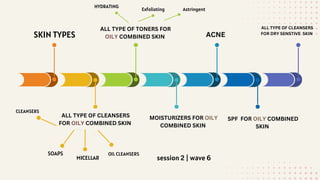
SKIN TYPES
ALL TYPE OF CLEANSERS
FOR OILY COMBINED SKIN
SOAPS
MICELLAR
OIL CLEANSERS
CLEANSERS
ALL TYPE OF TONERS FOR
OILY COMBINED SKIN
Astringent
HYDRATING
Exfoliating
MOISTURIZERS FOR OILY
COMBINED SKIN
ACNE
SPF FOR OILY COMBINED
SKIN
ALL TYPE OF CLEANSERS
FOR DRY SENSTIVE SKIN
3.
WHAT WE WILLLEARN TODAY ?
1
2
Oily skin Cleansing :
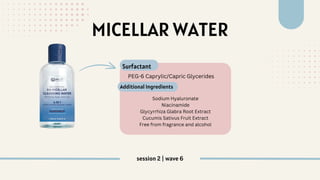
Double Cleansing Concept
Cleansing Rules
Product Exampels :
Micellar Water ( local - Global )
Oil Cleansers
Wipes
Soap
Myths & Misconeptions
session
2
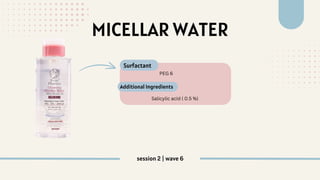
|
wave
6
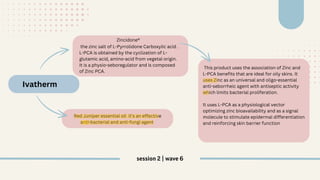
4.
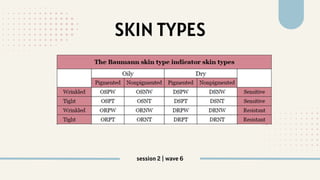
SKIN TYPES
1
2
Oily skinproduces an excess of sebum that causes the skin to appear shiny and feel
greasy. If you have oily skin, you may be more likely to have enlarged pores, develop
acne blemishes and be more prone to acne breakouts.
Dry skin Usually has a lower-than-usual production of sebum, which is the oily
substance your skin produces to help waterproof the skin. There may also be a lack
of natural moisturizing factors such as triglycerides, wax esters and squalene, and
an impaired skin barrier. Skin will feel tight and can look dull.”
Session
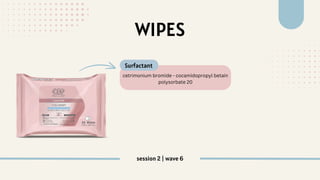
2
|
wave
6
5.
SKIN TYPES
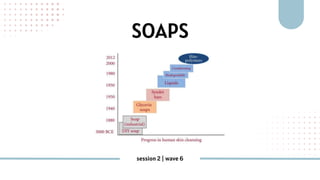
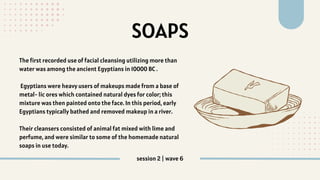
3
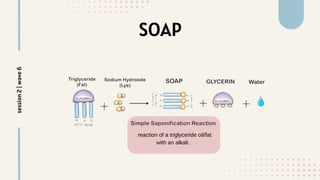
4
Combined skinincludes areas that are dry as well as oily—with the T-Zone
commonly being oily, and the cheeks being either dry or normal.
Normal skin is the perfect skin as it is balanced—feeling neither dry nor oily. It is not
prone to breakouts, flakiness, feeling slick or tight. Pores are generally small, the
skin's texture is smooth, and it is less likely to be prone to sensitivity or blemishes.
Session
2
|
wave
6
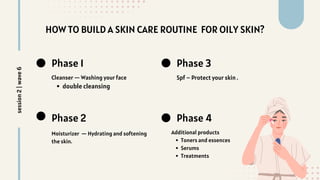
HOW TO BUILDA SKIN CARE ROUTINE FOR OILY SKIN?
Additional products
Toners and essences
Serums
Treatments
Phase 1
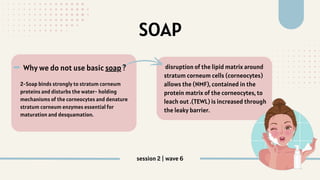
Cleanser — Washing your face
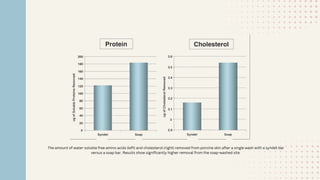
double cleansing
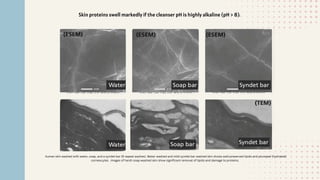
Phase 2
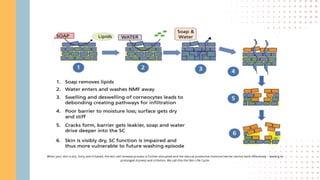
Moisturizer — Hydrating and softening
the skin.
Phase 3
Spf – Protect your skin .
Phase 4
session
2
|
wave
6
10.
SEBUM
session 2 |wave 6
Sebum is now known to play important roles in the
three-dimensional organization of skin surface lipids
(SSL), the glycerol production necessary for skin
hydration, and as an occlusive moisturizing agent.
Sebum protects the skin against oxidative stress
because it contains vitamin E, a powerful antioxidant.
11.
SEBUM
session 2 |wave 6
Moreover, sebum also exhibits innate antimicrobial
activity because it contains IgG, which is thought to
help prevent infection.
SG count can reach as high as 400 to 900 glands per
cm2 on the face and less than 100 glands per cm2
elsewhere in the body.
12.
CHARACTERISTICS OF OILYSKIN?
individuals with oily skin often exhibit larger
sebaceous glands,blemishes and clogged pores
further contribute to alterations in the skin's
texture.
Sebum
Oily skin is characterized by the overproduction
of sebum, an oily substance produced by the
sebaceous glands responsible for lubricating the
skin. This excess sebum can create a shiny or
greasy appearance
Pores
You may also notice enlarged pores on your nose,
chin and forehead, and a tendency towards
breakouts, particularly in the form of blackheads or
whiteheads
Acne
its usually acne prone You may also notice a tendency
towards breakouts, particularly in the form of
blackheads or whiteheads
Texture
session
2
|
wave
6
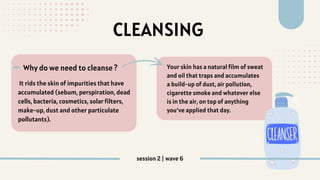
CLEANSING
session 2 |wave 6
It rids the skin of impurities that have
accumulated (sebum, perspiration, dead
cells, bacteria, cosmetics, solar filters,
make-up, dust and other particulate
pollutants).
Why do we need to cleanse ? Your skin has a natural film of sweat
and oil that traps and accumulates
a build-up of dust, air pollution,
cigarette smoke and whatever else
is in the air, on top of anything
you’ve applied that day.
-
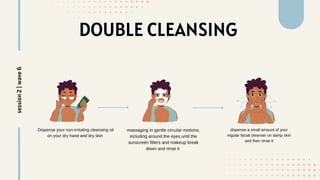
DOUBLE CLEANSING
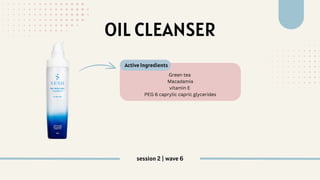
Dispense yournon-irritating cleansing oil
on your dry hand and dry skin
massaging in gentle circular motions,
including around the eyes until the
sunscreen filters and makeup break
down and rinse it
dispense a small amount of your
regular facial cleanser on damp skin
and then rinse it
session
2
|
wave
6
17.
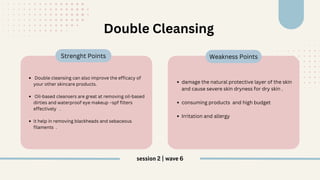
Double cleansing canalso improve the efficacy of
your other skincare products.
Oil-based cleansers are great at removing oil-based
dirties and waterproof eye makeup –spf filters
effectively .
it help in removing blackheads and sebaceous
filaments .
damage the natural protective layer of the skin
and cause severe skin dryness for dry skin .
consuming products and high budget
Irritation and allergy
Strenght Points Weakness Points
Double Cleansing
session 2 | wave 6
18.
Should we usedouble cleansing to remove
waterproof make up ?
Do we need a cleansing gel after a oily cleanser ?
How many times should I cleanse my face ?
Do we need to cleanse at morning ?
Can I use oils instead of oil cleansers ?
Ask ?
Double Cleansing
session 2 | wave 6
19.
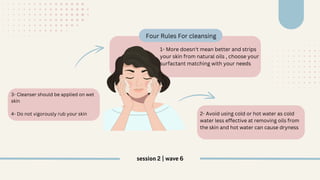
2- Avoid usingcold or hot water as cold
water less effective at removing oils from
the skin and hot water can cause dryness
Four Rules For cleansing
1- More doesn't mean better and strips
your skin from natural oils , choose your
surfactant matching with your needs
3- Cleanser should be applied on wet
skin
4- Do not vigorously rub your skin
session 2 | wave 6
20.
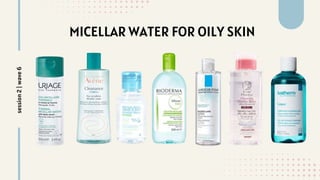
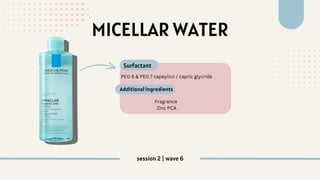
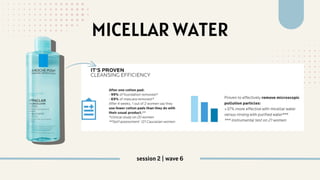
MICELLAR WATER
Why weuse micellar waters ?
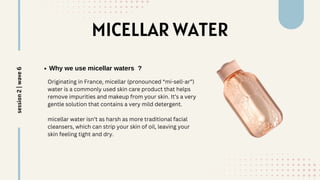
Originating in France, micellar (pronounced “mi-sell-ar”)
water is a commonly used skin care product that helps
remove impurities and makeup from your skin. It’s a very
gentle solution that contains a very mild detergent.
micellar water isn’t as harsh as more traditional facial
cleansers, which can strip your skin of oil, leaving your
skin feeling tight and dry.
session
2
|
wave
6
21.
MICELLAR WATER
How micellarwater works ?
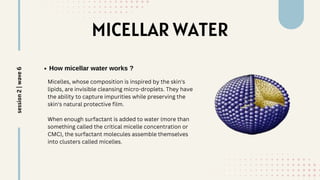
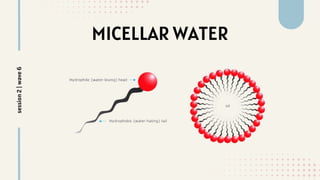
Micelles, whose composition is inspired by the skin's
lipids, are invisible cleansing micro-droplets. They have
the ability to capture impurities while preserving the
skin's natural protective film.
When enough surfactant is added to water (more than
something called the critical micelle concentration or
CMC), the surfactant molecules assemble themselves
into clusters called micelles.
session
2
|
wave
6
MICELLAR WATER
How micellarwaters works ?
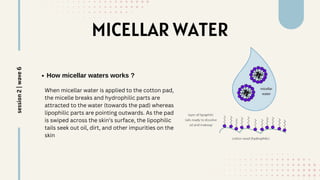
When micellar water is applied to the cotton pad,
the micelle breaks and hydrophilic parts are
attracted to the water (towards the pad) whereas
lipophilic parts are pointing outwards. As the pad
is swiped across the skin’s surface, the lipophilic
tails seek out oil, dirt, and other impurities on the
skin
session
2
|
wave
6
24.
MICELLAR WATER
Micellar WaterHistory
Micellar water has been described as a resurgence of cleansing
practices from France in the early 1900s. As some sources
report, in the days before traditional plumbing, the local water
was harsh to the skin.
other sources report that water shortages or inaccessibility to
tap water led to micelle water’s development but the authors
were unable to find primary literature sources to support
these accounts.
session
2
|
wave
6
25.
MICELLAR WATER
Do wereally nees to Rinse it ?
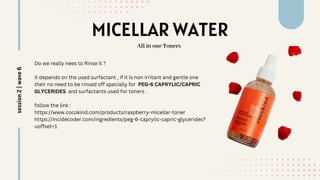
it depends on the used surfactant , if it is non irritant and gentle one
their no need to be rinsed off specially for PEG-6 CAPRYLIC/CAPRIC
GLYCERIDES and surfactants used for toners .
follow the link :
https://www.cocokind.com/products/raspberry-micellar-toner
https://incidecoder.com/ingredients/peg-6-caprylic-capric-glycerides?
uoffset=1
All in one Toners
session
2
|
wave
6
MICELLAR WATER
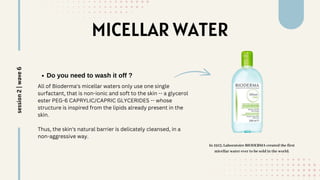
Do youneed to wash it off ?
All of Bioderma's micellar waters only use one single
surfactant, that is non-ionic and soft to the skin -- a glycerol
ester PEG-6 CAPRYLIC/CAPRIC GLYCERIDES -- whose
structure is inspired from the lipids already present in the
skin.
Thus, the skin's natural barrier is delicately cleansed, in a
non-aggressive way.
In 1913, Laboratoire BIODERMA created the first
micellar water ever to be sold in the world.
session
2
|
wave
6
28.
MICELLAR WATER
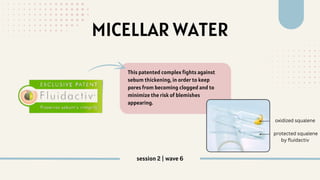
This patentedcomplex fights against
sebum thickening, in order to keep
pores from becoming clogged and to
minimize the risk of blemishes
appearing.
oxidized squalene
protected squalene
by fluidactiv
session 2 | wave 6
29.
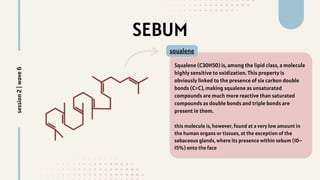
Squalene (C30H50) is,among the lipid class, a molecule
highly sensitive to oxidization. This property is
obviously linked to the presence of six carbon double
bonds (C=C), making squalene as unsaturated
compounds are much more reactive than saturated
compounds as double bonds and triple bonds are
present in them.
this molecule is, however, found at a very low amount in
the human organs or tissues, at the exception of the
sebaceous glands, where its presence within sebum (10–
15%) onto the face
SEBUM
squalene
session
2
|
wave
6
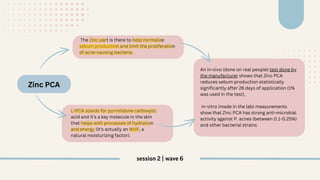
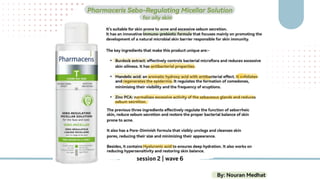
Zinc PCA
The Zincpart is there to help normalize
sebum production and limit the proliferation
of acne-causing bacteria.
L-PCA stands for pyrrolidone carboxylic
acid and it's a key molecule in the skin
that helps with processes of hydration
and energy (it's actually an NMF, a
natural moisturizing factor).
An in-vivo (done on real people) test done by
the manufacturer shows that Zinc PCA
reduces sebum production statistically
significantly after 28 days of application (1%
was used in the test),
in-vitro (made in the lab) measurements
show that Zinc PCA has strong anti-microbial
activity against P. acnes (between 0.1-0.25%)
and other bacterial strains
session 2 | wave 6
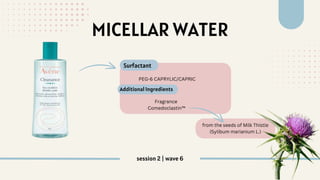
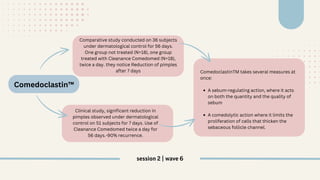
Comedoclastin™
Comparative study conductedon 36 subjects
under dermatological control for 56 days.
One group not treated (N=18), one group
treated with Cleanance Comedomed (N=18),
twice a day. they notice Reduction of pimples
after 7 days
Clinical study, significant reduction in
pimples observed under dermatological
control on 51 subjects for 7 days. Use of
Cleanance Comedomed twice a day for
56 days.-90% recurrence.
ComedoclastinTM takes several measures at
once:
A sebum-regulating action, where it acts
on both the quantity and the quality of
sebum
A comedolytic action where it limits the
proliferation of cells that thicken the
sebaceous follicle channel.
session 2 | wave 6
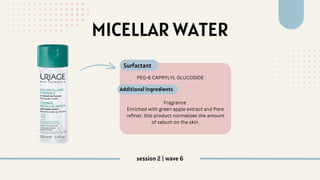
35.
MICELLAR WATER
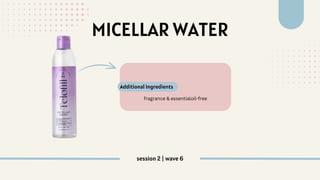
Fragrance
Enriched withgreen apple extract and Pore
refiner, this product normalizes the amount
of sebum on the skin.
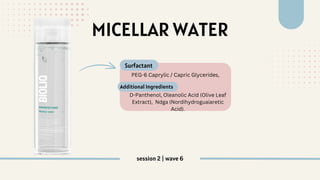
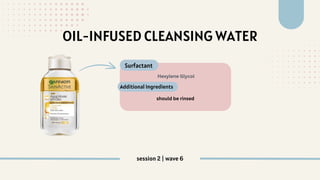
PEG-6
CAPRYLYL GLUCOSIDE
Surfactant
Additional Ingredients
session 2 | wave 6
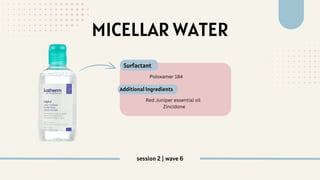
MICELLAR WATER
Red Juniperessential oil
Zincidone
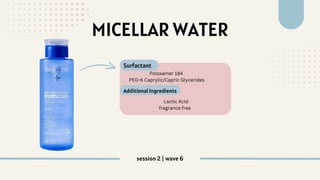
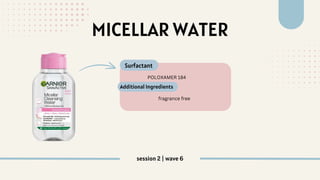
Poloxamer 184
Surfactant
Additional Ingredients
session 2 | wave 6
38.
Ivatherm
Zincidone®
the zinc saltof L-Pyrrolidone Carboxylic acid .
L-PCA is obtained by the cyclization of L-
glutamic acid, amino-acid from vegetal origin.
It is a physio-seboregulator and is composed
of Zinc PCA.
This product uses the association of Zinc and
L-PCA benefits that are ideal for oily skins. It
uses Zinc as an universal and oligo-essential
anti-seborrheic agent with antiseptic activity
which limits bacterial proliferation.
It uses L-PCA as a physiological vector
optimizing zinc bioavailability and as a signal
molecule to stimulate epidermal differentiation
and reinforcing skin barrier function
Red Juniper essential oil it’s an effective
anti-bacterial and anti-fungi agent
session 2 | wave 6
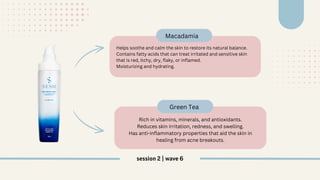
Helps soothe andcalm the skin to restore its natural balance.
Contains fatty acids that can treat irritated and sensitive skin
that is red, itchy, dry, flaky, or inflamed.
Moisturizing and hydrating.
Rich in vitamins, minerals, and antioxidants.
Reduces skin irritation, redness, and swelling.
Has anti-inflammatory properties that aid the skin in
healing from acne breakouts.
Macadamia
Green Tea
session 2 | wave 6
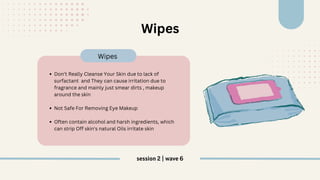
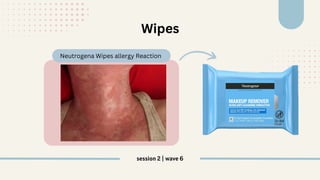
50.
Don't Really CleanseYour Skin due to lack of
surfactant and They can cause irritation due to
fragrance and mainly just smear dirts , makeup
around the skin
Not Safe For Removing Eye Makeup
Often contain alcohol and harsh ingredients, which
can strip Off skin's natural Oils irritate skin
Wipes
Wipes
session 2 | wave 6
SOAPS
The first recordeduse of facial cleansing utilizing more than
water was among the ancient Egyptians in 10000 BC .
Egyptians were heavy users of makeups made from a base of
metal- lic ores which contained natural dyes for color; this
mixture was then painted onto the face. In this period, early
Egyptians typically bathed and removed makeup in a river.
Their cleansers consisted of animal fat mixed with lime and
perfume, and were similar to some of the homemade natural
soaps in use today.
session 2 | wave 6
57.
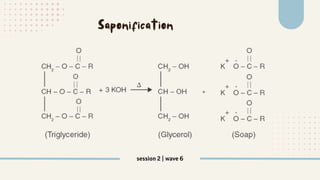
SOAP
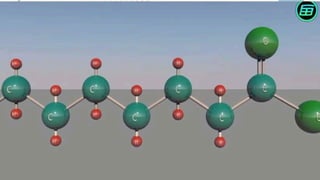
reaction of atriglyceride oil/fat
with an alkali.
session
2
|
wave
6
SOAPS
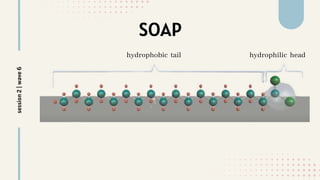
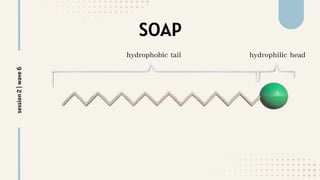
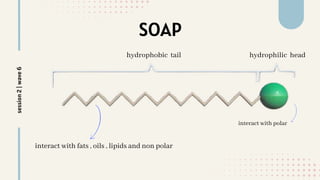
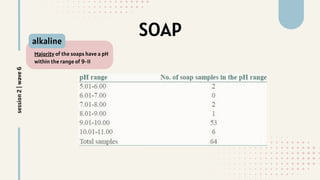
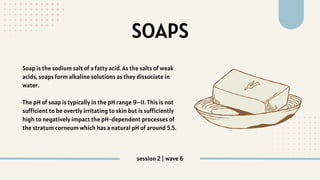
Soap is thesodium salt of a fatty acid. As the salts of weak
acids, soaps form alkaline solutions as they dissociate in
water.
The pH of soap is typically in the pH range 9–11. This is not
sufficient to be overtly irritating to skin but is sufficiently
high to negatively impact the pH‐dependent processes of
the stratum corneum which has a natural pH of around 5.5.
session 2 | wave 6
64.
SOAPS
SUPERFATTED SOAPS
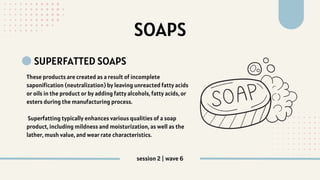
These productsare created as a result of incomplete
saponification (neutralization) by leaving unreacted fatty acids
or oils in the product or by adding fatty alcohols, fatty acids, or
esters during the manufacturing process.
Superfatting typically enhances various qualities of a soap
product, including mildness and moisturization, as well as the
lather, mush value, and wear rate characteristics.
session 2 | wave 6
65.
SOAPS
TRANSPARENT SOAPS
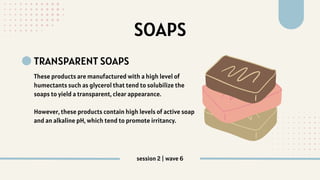
These productsare manufactured with a high level of
humectants such as glycerol that tend to solubilize the
soaps to yield a transparent, clear appearance.
However, these products contain high levels of active soap
and an alkaline pH, which tend to promote irritancy.
session 2 | wave 6
66.
SOAPS
TRANSPARENT SOAPS
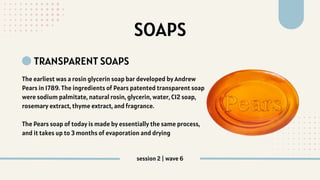
The earliestwas a rosin glycerin soap bar developed by Andrew
Pears in 1789. The ingredients of Pears patented transparent soap
were sodium palmitate, natural rosin, glycerin, water, C12 soap,
rosemary extract, thyme extract, and fragrance.
The Pears soap of today is made by essentially the same process,
and it takes up to 3 months of evaporation and drying
session 2 | wave 6
67.
SOAPS
TRANSPARENT SOAPS
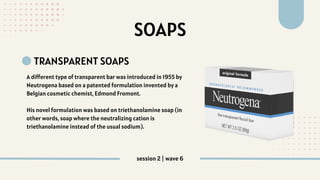
A differenttype of transparent bar was introduced in 1955 by
Neutrogena based on a patented formulation invented by a
Belgian cosmetic chemist, Edmond Fromont.
His novel formulation was based on triethanolamine soap (in
other words, soap where the neutralizing cation is
triethanolamine instead of the usual sodium).
session 2 | wave 6
68.
SOAPS
TRANSPARENT SOAPS
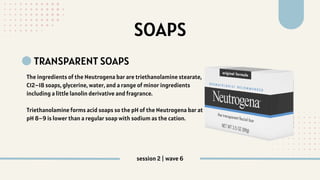
The ingredientsof the Neutrogena bar are triethanolamine stearate,
C12–18 soaps, glycerine, water, and a range of minor ingredients
including a little lanolin derivative and fragrance.
Triethanolamine forms acid soaps so the pH of the Neutrogena bar at
pH 8–9 is lower than a regular soap with sodium as the cation.
session 2 | wave 6
69.
SOAPS
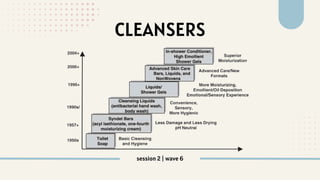
Syndet Soap
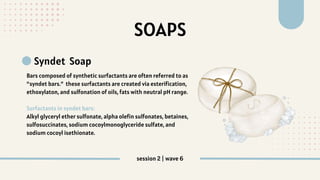
Bars composedof synthetic surfactants are often referred to as
“syndet bars.” these surfactants are created via esterification,
ethoxylaton, and sulfonation of oils, fats with neutral pH range.
Surfactants in syndet bars:
Alkyl glyceryl ether sulfonate, alpha olefin sulfonates, betaines,
sulfosuccinates, sodium cocoylmonoglyceride sulfate, and
sodium cocoyl isethionate.
session 2 | wave 6
70.
SOAPS
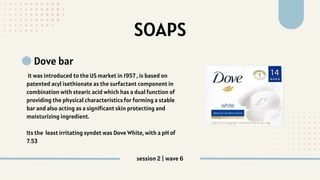
Dove bar
it wasintroduced to the US market in 1957 , is based on
patented acyl isethionate as the surfactant component in
combination with stearic acid which has a dual function of
providing the physical characteristics for forming a stable
bar and also acting as a significant skin protecting and
moisturizing ingredient.
Its the least irritating syndet was Dove White, with a pH of
7.53
session 2 | wave 6
71.
SOAPS
Dove bar
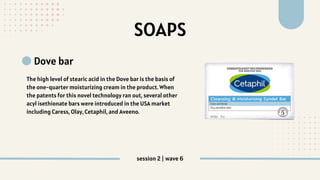
The highlevel of stearic acid in the Dove bar is the basis of
the one‐quarter moisturizing cream in the product. When
the patents for this novel technology ran out, several other
acyl isethionate bars were introduced in the USA market
including Caress, Olay, Cetaphil, and Aveeno.
session 2 | wave 6
72.
SOAPS
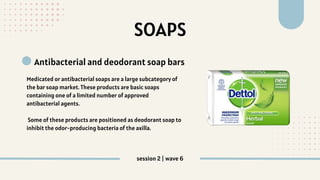
Antibacterial and deodorantsoap bars
Medicated or antibacterial soaps are a large subcategory of
the bar soap market. These products are basic soaps
containing one of a limited number of approved
antibacterial agents.
Some of these products are positioned as deodorant soap to
inhibit the odor‐producing bacteria of the axilla.
session 2 | wave 6
73.
SOAP
1- The bipolarstructure of the soap molecule
is similar to the bipolar structure of the three
major lipid types that make up the lipid bi‐
layers of the stratum corneum (fatty acids,
cholesterol, and ceramides).
Why we do not use basic soap ? Soap disrupts the bi‐layer structure
of these lipids in the stratum
corneum and thereby reduces the
effectiveness of the stratum
corneum water barrier.
-
session 2 | wave 6
74.
SOAP
2-Soap binds stronglyto stratum corneum
proteins and disturbs the water‐ holding
mechanisms of the corneocytes and denature
stratum corneum enzymes essential for
maturation and desquamation.
Why we do not use basic soap ? disruption of the lipid matrix around
stratum corneum cells (corneocytes)
allows the (NMF), contained in the
protein matrix of the corneocytes, to
leach out .(TEWL) is increased through
the leaky barrier.
-
session 2 | wave 6
75.
The amount ofwater-soluble free amino acids (left) and cholesterol (right) removed from porcine skin after a single wash with a syndet bar
versus a soap bar. Results show significantly higher removal from the soap-washed site
76.
Skin proteins swellmarkedly if the cleanser pH is highly alkaline (pH > 8).
human skin washed with water, soap, and a syndet bar (9 repeat washes). Water washed and mild syndet bar washed skin shows well‐preserved lipids and plumped (hydrated)
corneocytes. images of harsh soap‐washed skin show significant removal of lipids and damage to proteins.
77.
When your skinis dry, itchy and irritated, the skin cell renewal process is further disrupted and the natural protective moisture barrier cannot work effectively – leading to
prolonged dryness and irritation. We call this the Skin Life Cycle.
78.
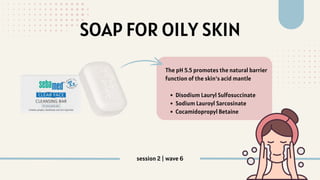
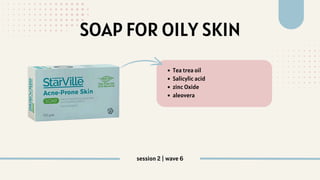
SOAP FOR OILYSKIN
The pH 5.5 promotes the natural barrier
function of the skin's acid mantle
Disodium Lauryl Sulfosuccinate
Sodium Lauroyl Sarcosinate
Cocamidopropyl Betaine
session 2 | wave 6
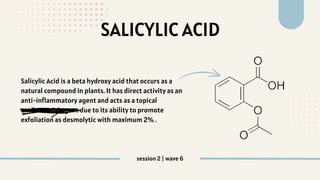
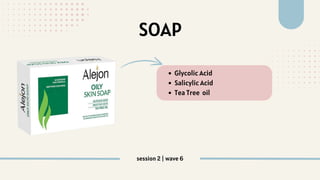
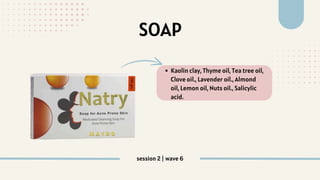
SALICYLIC ACID
Salicylic Acidis a beta hydroxy acid that occurs as a
natural compound in plants. It has direct activity as an
anti-inflammatory agent and acts as a topical
antibacterial agent due to its ability to promote
exfoliation as desmolytic with maximum 2% .
session 2 | wave 6
81.
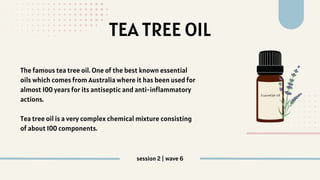
TEA TREE OIL
Thefamous tea tree oil. One of the best known essential
oils which comes from Australia where it has been used for
almost 100 years for its antiseptic and anti-inflammatory
actions.
Tea tree oil is a very complex chemical mixture consisting
of about 100 components.
session 2 | wave 6
82.
TEA TREE OIL
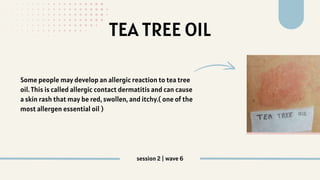
Somepeople may develop an allergic reaction to tea tree
oil. This is called allergic contact dermatitis and can cause
a skin rash that may be red, swollen, and itchy.( one of the
most allergen essential oil )
session 2 | wave 6
83.
TEA TREE OIL
Regardingskincare and tea tree oil, its most well-known effect
is probably being a well established anti-acne ingredient.
Multiple studies confirm that TTO is effective against the acne-
causing bacteria called P. acnes and the effectiveness of 5%
TTO gel is comparable to the gold standard anti-acne
treatment, 5% Benzoyl Peroxide lotion
session 2 | wave 6
SULFUR
Sulfur, used foracne since centuries , is useful as a drying and
antibacterial agent. It is available in washes, leave-on lotions,
creams, foam formulations, and also as prescription and non-
prescription masks. Sulfur acts as a keratolytic agent and also
it has antibacterial activity . it is anti fungi, scabies mites and
other parasites.
session 2 |wave 6
In 2005, Youn et al. observed regional and seasonal variations in sebum secretion that led to changes of
skin type from dry to oily, resulting in what they termed a “combination skin type .This was the first study to
show sebum changes throughout different seasons.
Forty-six patients were included in the study and their sebum secretion was measured over an entire year.
They reported that summer was the only season in which a significant increase in sebum secretion was seen.
In addition, a reduction in the dry skin type and an increase in the oily type based on their categorization
system was recorded in the summer
SEASONAL SKIN TYPE
MYTH OR REALITY?
90.
session 2 |wave 6
Natural Soap free from chemicals!!
Saponification is the process in which triglycerides are combined with a
strong base to form fatty acid metal salts during the soap-making
process.
The distribution of unsaturated and saturated fatty acid determines the
hardness, aroma, cleansing, lather, and moisturizing abilities of soaps.