Scott Roberts BS, LPN, DTR
Prof. Anne Davis, PhD, RD
 06/26/2012
GI Nutritional Therapy Evidence-Based Review


                                          NUTR590: Gastrointestinal Nutrition
                                                                                1
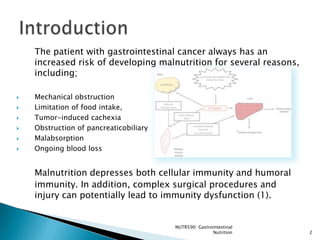
The patient with gastrointestinal cancer always has an
    increased risk of developing malnutrition for several reasons,
    including;

   Mechanical obstruction
   Limitation of food intake,
   Tumor-induced cachexia
   Obstruction of pancreaticobiliary
   Malabsorption
   Ongoing blood loss


    Malnutrition depresses both cellular immunity and humoral
    immunity. In addition, complex surgical procedures and
    injury can potentially lead to immunity dysfunction (1).


                                        NUTR590: Gastrointestinal
                                                       Nutrition     2
Multiple factors have an effect on the outcome of treatment,
    such as;

   Antibacterial drugs
   Immunoenhancers such as naltrexone or Imunovir
   Aseptic techniques
   Surgical skills


    Immunonutrition may be useful in decreasing infection rates in
    patients undergoing gastrointestinal surgery, especially those
    with malnutrition-related immune depression.

    The addition of immune-modulating nutrients such as n-3 fatty
    acids, arginine, and nucleotides to enteral formulas has been
    examined in numerous clinical trials.


                                           NUTR590: Gastrointestinal
                                                          Nutrition    3
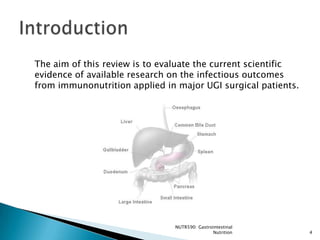
The aim of this review is to evaluate the current scientific
evidence of available research on the infectious outcomes
from immunonutrition applied in major UGI surgical patients.


                               NUTR590: Gastrointestinal
                                              Nutrition        4
PubMed and Medline were the search engines used in
   June of 2012

The key search terms:

   Enteral nutrition
   Parenteral nutrition
   Major upper gastrointestinal surgery
   Cancer
   Immunonurtrition,
   Arginine
   N-3 fatty acids
   Nucleotides

                             NUTR590: Gastrointestinal
                                            Nutrition    5
Inclusion Criteria:

Major UGI cancer surgeries
    Resections of esophagus stomach, and pancreas
    liver transplantation.
Both parenteral and nutrition routs where evaluated.
Postoperative infections to be evaluated were:
    Infection at surgical site
    Systemic infections
    Pneumonia.
The search was restricted to human studies
Study designs included were limited to:
    clinical trials
    meta-analysis
    systematic analysis
    Cochrane reviews
    Randomized clinical trials (RCTs)
Only publications in English, were included
Only core clinical journals were evaluated.

                                       NUTR590: Gastrointestinal
                                                      Nutrition    6
Exclusion Criteria

   Other types GI surgeries were not considered and
    studies involving them were excluded.
   Articles using formulas without all three
    substrates of arginine, n-3 fatty acids, and
    nucleotied were excluded from the review
   Case reports as well as reviews were also
    excluded from comparison as where non-English
    publications.

                            NUTR590: Gastrointestinal
                                           Nutrition    7
   Articles collected
    ◦ 11
    ◦ All were randomized control trial (RCT)
   Articles included
    ◦ 7
    ◦ RCT
   Articles excluded
    ◦ 4
    ◦ RCT
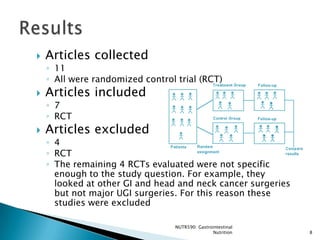
    ◦ The remaining 4 RCTs evaluated were not specific
      enough to the study question. For example, they
      looked at other GI and head and neck cancer surgeries
      but not major UGI surgeries. For this reason these
      studies were excluded

                                  NUTR590: Gastrointestinal
                                                 Nutrition    8
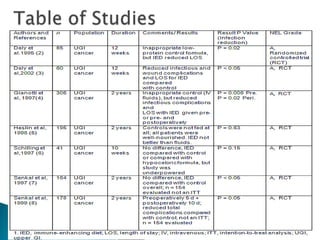
   The outcomes of the included trials of immunonutrition in UGI
    cancer (Table 1) were substantially flawed in their study designs.

   Few patients, especially in the earliest studies, received goal
    feedings.

   Researchers had published 2 main protocols: either preoperative
    + postoperative nutrition with a control group or a
    postoperative-feeding only strategy without a control group.

   Table 1 displays a benefit of immunonutrition for infectious
    complications in UGI cancer patients undergoing surgery.


                                         NUTR590: Gastrointestinal
                                                        Nutrition        9
NUTR590: Gastrointestinal
               Nutrition    10
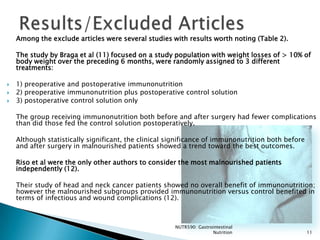
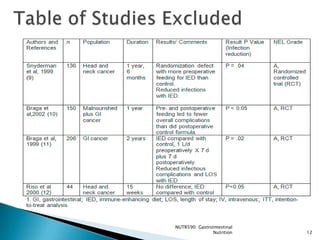
Among the exclude articles were several studies with results worth noting (Table 2).

    The study by Braga et al (11) focused on a study population with weight losses of > 10% of
    body weight over the preceding 6 months, were randomly assigned to 3 different
    treatments:

   1) preoperative and postoperative immunonutrition
   2) preoperative immunonutrition plus postoperative control solution
   3) postoperative control solution only

    The group receiving immunonutrition both before and after surgery had fewer complications
    than did those fed the control solution postoperatively.

    Although statistically significant, the clinical significance of immunonutrition both before
    and after surgery in malnourished patients showed a trend toward the best outcomes.

    Riso et al were the only other authors to consider the most malnourished patients
    independently (12).

    Their study of head and neck cancer patients showed no overall benefit of immunonutrition;
    however the malnourished subgroups provided immunonutrition versus control benefited in
    terms of infectious and wound complications (12).


                                                      NUTR590: Gastrointestinal
                                                                     Nutrition                     11
NUTR590: Gastrointestinal
               Nutrition    12
   A significant benefit of immunonutrition for postoperative
    infections and length of stay was found in the majority of studies
    evaluated.

   The most common flaw was a failure to deliver an adequate
    nutrition volume.

   When feeding volumes are low, immunonutrition is usually not
    better than an isonitrogenous control.

   In more recent studies, practitioners have been increasingly
    aggressive with enteral feeding, and this has been reflected in
    improved outcomes from immunonutrition.

   Early delivery of immunonutrition (preoperatively in surgical
    patients with cancer) might be particularly beneficial.


                                     NUTR590: Gastrointestinal
                                                    Nutrition            13
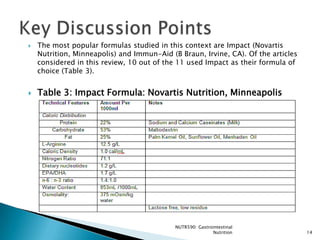
   The most popular formulas studied in this context are Impact (Novartis
    Nutrition, Minneapolis) and Immun-Aid (B Braun, Irvine, CA). Of the articles
    considered in this review, 10 out of the 11 used Impact as their formula of
    choice (Table 3).


   Table 3: Impact Formula: Novartis Nutrition, Minneapolis


                                            NUTR590: Gastrointestinal
                                                           Nutrition               14
After compiling the data of the various study designs, there
  were several strategies mentioned to maximize the
  success of immunonutrition formulas; they are as follows:

   1) Arginine should be > 12 g/L

   2) Duration should be > 3 d, preferably 5–10 d

   3) Nasogastric feeding should be used aggressively, with
    nursing protocols to advance feeding every 4–6 h, and
    gastric residuals of >200 mL should be accepted

   4) Feeding goals should approach 25 kcal/kg, and ≥ 800
    mL/d should be given for optimum outcome.


                                 NUTR590: Gastrointestinal
                                                Nutrition      15
Limitations

   Articles selected were all earlier studies
    which is due to the lack of current
    research focused specifically on the
    immunonutrition effect on major UGI
    surgeries.

   Review was conduction over the course of
    only 6 weeks which is a limited amount of
    time to compile research data.

                         NUTR590: Gastrointestinal
                                        Nutrition    16
Strengths

   The primary strength of this review was
    that 7 articles were directly related to and
    evaluated the implications of
    immunonutrition in major UGI cancer
    surgeries.

   All studies were RCTs


                         NUTR590: Gastrointestinal
                                        Nutrition    17
   I found this evidence to be fair.

   The research evaluated shows the potential benefit of
    immunonutrition in preventing the occurrence of
    postoperative infections in major UGI surgeries involving
    cancer.

   After reviewing the research, it is my belief that the benefits
    of the use of immuonutrition in this specific population
    exceed the harms, although quality evidence is still elusive.

   In clearly identified circumstances the use of immuonutrition
    may be made based on lesser evidence when high-quality
    evidence is still absent.

   Practitioners should consider immuonutrition in major UGI
    surgeries involving cancer but remain alert to new
    information and be sensitive to individual patient needs.
                                    NUTR590: Gastrointestinal
                                                   Nutrition      18
   Future research should evaluate whether these
    patients benefit from preoperative
    supplementation with an immune-enhancing
    formula or whether they require postoperative
    continuation (perioperative approach) to
    combat their risk of complications after surgery
    and if these formulae can be used safely in
    those patients who develop sepsis.


                             NUTR590: Gastrointestinal
                                            Nutrition    19
   1. Harry C. Sax, MD. Immunonutrition and Upper Gastrointestinal Surgery: What Really Matters. Nutrition in
    Clinical Practice 2005; 20: 540–543.
   2. Daly JM, Lieberman MD, Goldfine J, et al. Enteral nutrition with supplemental arginine, RNA, and omega-3
    fatty acids in patients after operation: immunologic, metabolic, and clinical outcome. Surgery 1992;112:56–67.
   3. Daly JM, Weintraub FN, Shou J, Rosato EF, Lucia M. Enteral nutrition during multimodality therapy in upper
    gastrointestinal cancer patients. Ann Surg 1995;221:327–38.
   4. Gianotti L, Braga M, Nespoli L, Radaelli G, Beneduce A, Di Carlo V. A randomized controlled trial of
    preoperative oral supplementation with a specialized diet in patients with gastrointestinal cancer.
    Gastroenterology 2002;122:1763–70.
   5. Heslin MJ, Latkany L, Leung D, et al. A prospective, randomized trial of early enteral feeding after resection of
    upper gastrointestinal malignancy. Ann Surg 1997;226:567–77.
   6. Schilling J, Vranjes N, Fierz W, et al. Clinical outcome and immunology of postoperative arginine, omega-3
    fatty acids, and nucleotideenriched enteral feeding: a randomized prospective comparison with standard enteral
    and low calorie/low fat i.v. solutions. Nutrition 1996;
   12:423–9.
   7. Senkal M, Mumme A, Eickhoff U, et al. Early postoperative enteral immunonutrition: clinical outcome and
    cost-comparison analysis in surgical patients. Crit Care Med 1997;25:1489–96.
   8. Senkal M, Zumtobel V, Bauer KH, et al. Outcome and cost-effectiveness of perioperative enteral
    immunonutrition in patients undergoing elective upper gastrointestinal tract surgery: a prospective randomized
    study. Arch Surg 1999;134:1309–16.
   9. Snyderman CH, Kachman K, Molseed L, et al. Reduced postoperative
   infections with an immune-enhancing nutritional supplement. Laryngoscope 1999;109:915–21.
   10. Braga M, Gianotti L, Nespoli L, Radaelli G, Di Carlo V. Nutritional approach in malnourished surgical patients:
    a prospective randomized study. Arch Surg 2002;137:174–80.


                                                                  NUTR590: Gastrointestinal
                                                                                 Nutrition                                 20
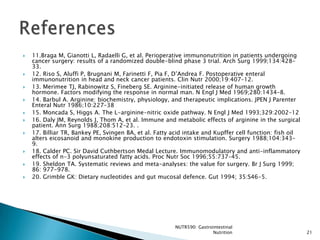
   11.Braga M, Gianotti L, Radaelli G, et al. Perioperative immunonutrition in patients undergoing
    cancer surgery: results of a randomized double-blind phase 3 trial. Arch Surg 1999;134:428–
    33.
   12. Riso S, Aluffi P, Brugnani M, Farinetti F, Pia F, D’Andrea F. Postoperative enteral
    immunonutrition in head and neck cancer patients. Clin Nutr 2000;19:407–12.
   13. Merimee TJ, Rabinowitz S, Fineberg SE. Arginine-initiated release of human growth
    hormone. Factors modifying the response in normal man. N Engl J Med 1969;280:1434–8.
   14. Barbul A. Arginine: biochemistry, physiology, and therapeutic implications. JPEN J Parenter
    Enteral Nutr 1986;10:227–38
   15. Moncada S, Higgs A. The L-arginine-nitric oxide pathway. N Engl J Med 1993;329:2002–12
   16. Daly JM, Reynolds J, Thom A, et al. Immune and metabolic effects of arginine in the surgical
    patient. Ann Surg 1988;208:512–23. .
   17. Billiar TR, Bankey PE, Svingen BA, et al. Fatty acid intake and Kupffer cell function: fish oil
    alters eicosanoid and monokine production to endotoxin stimulation. Surgery 1988;104:343–
    9.
   18. Calder PC. Sir David Cuthbertson Medal Lecture. Immunomodulatory and anti-inflammatory
    effects of n-3 polyunsaturated fatty acids. Proc Nutr Soc 1996;55:737–45.
   19. Sheldon TA. Systematic reviews and meta-analyses: the value for surgery. Br J Surg 1999;
    86: 977-978.
   20. Grimble GK: Dietary nucleotides and gut mucosal defence. Gut 1994; 35:S46-5.


                                                        NUTR590: Gastrointestinal
                                                                       Nutrition                          21
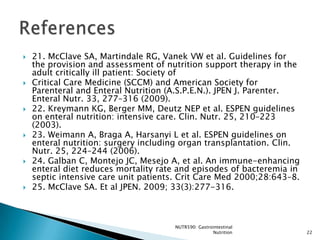
   21. McClave SA, Martindale RG, Vanek VW et al. Guidelines for
    the provision and assessment of nutrition support therapy in the
    adult critically ill patient: Society of
   Critical Care Medicine (SCCM) and American Society for
    Parenteral and Enteral Nutrition (A.S.P.E.N.). JPEN J. Parenter.
    Enteral Nutr. 33, 277–316 (2009).
   22. Kreymann KG, Berger MM, Deutz NEP et al. ESPEN guidelines
    on enteral nutrition: intensive care. Clin. Nutr. 25, 210–223
    (2003).
   23. Weimann A, Braga A, Harsanyi L et al. ESPEN guidelines on
    enteral nutrition: surgery including organ transplantation. Clin.
    Nutr. 25, 224–244 (2006).
   24. Galban C, Montejo JC, Mesejo A, et al. An immune-enhancing
    enteral diet reduces mortality rate and episodes of bacteremia in
    septic intensive care unit patients. Crit Care Med 2000;28:643–8.
   25. McClave SA. Et al JPEN. 2009; 33(3):277-316.


                                      NUTR590: Gastrointestinal
                                                     Nutrition          22

S roberts ebr

  • 1.
    Scott Roberts BS,LPN, DTR Prof. Anne Davis, PhD, RD 06/26/2012 GI Nutritional Therapy Evidence-Based Review NUTR590: Gastrointestinal Nutrition 1
  • 2.
    The patient withgastrointestinal cancer always has an increased risk of developing malnutrition for several reasons, including;  Mechanical obstruction  Limitation of food intake,  Tumor-induced cachexia  Obstruction of pancreaticobiliary  Malabsorption  Ongoing blood loss Malnutrition depresses both cellular immunity and humoral immunity. In addition, complex surgical procedures and injury can potentially lead to immunity dysfunction (1). NUTR590: Gastrointestinal Nutrition 2
  • 3.
    Multiple factors havean effect on the outcome of treatment, such as;  Antibacterial drugs  Immunoenhancers such as naltrexone or Imunovir  Aseptic techniques  Surgical skills Immunonutrition may be useful in decreasing infection rates in patients undergoing gastrointestinal surgery, especially those with malnutrition-related immune depression. The addition of immune-modulating nutrients such as n-3 fatty acids, arginine, and nucleotides to enteral formulas has been examined in numerous clinical trials. NUTR590: Gastrointestinal Nutrition 3
  • 4.
    The aim ofthis review is to evaluate the current scientific evidence of available research on the infectious outcomes from immunonutrition applied in major UGI surgical patients. NUTR590: Gastrointestinal Nutrition 4
  • 5.
    PubMed and Medlinewere the search engines used in June of 2012 The key search terms:  Enteral nutrition  Parenteral nutrition  Major upper gastrointestinal surgery  Cancer  Immunonurtrition,  Arginine  N-3 fatty acids  Nucleotides NUTR590: Gastrointestinal Nutrition 5
  • 6.
    Inclusion Criteria: Major UGIcancer surgeries  Resections of esophagus stomach, and pancreas  liver transplantation. Both parenteral and nutrition routs where evaluated. Postoperative infections to be evaluated were:  Infection at surgical site  Systemic infections  Pneumonia. The search was restricted to human studies Study designs included were limited to:  clinical trials  meta-analysis  systematic analysis  Cochrane reviews  Randomized clinical trials (RCTs) Only publications in English, were included Only core clinical journals were evaluated. NUTR590: Gastrointestinal Nutrition 6
  • 7.
    Exclusion Criteria  Other types GI surgeries were not considered and studies involving them were excluded.  Articles using formulas without all three substrates of arginine, n-3 fatty acids, and nucleotied were excluded from the review  Case reports as well as reviews were also excluded from comparison as where non-English publications. NUTR590: Gastrointestinal Nutrition 7
  • 8.
    Articles collected ◦ 11 ◦ All were randomized control trial (RCT)  Articles included ◦ 7 ◦ RCT  Articles excluded ◦ 4 ◦ RCT ◦ The remaining 4 RCTs evaluated were not specific enough to the study question. For example, they looked at other GI and head and neck cancer surgeries but not major UGI surgeries. For this reason these studies were excluded NUTR590: Gastrointestinal Nutrition 8
  • 9.
    The outcomes of the included trials of immunonutrition in UGI cancer (Table 1) were substantially flawed in their study designs.  Few patients, especially in the earliest studies, received goal feedings.  Researchers had published 2 main protocols: either preoperative + postoperative nutrition with a control group or a postoperative-feeding only strategy without a control group.  Table 1 displays a benefit of immunonutrition for infectious complications in UGI cancer patients undergoing surgery. NUTR590: Gastrointestinal Nutrition 9
  • 10.
  • 11.
    Among the excludearticles were several studies with results worth noting (Table 2). The study by Braga et al (11) focused on a study population with weight losses of > 10% of body weight over the preceding 6 months, were randomly assigned to 3 different treatments:  1) preoperative and postoperative immunonutrition  2) preoperative immunonutrition plus postoperative control solution  3) postoperative control solution only The group receiving immunonutrition both before and after surgery had fewer complications than did those fed the control solution postoperatively. Although statistically significant, the clinical significance of immunonutrition both before and after surgery in malnourished patients showed a trend toward the best outcomes. Riso et al were the only other authors to consider the most malnourished patients independently (12). Their study of head and neck cancer patients showed no overall benefit of immunonutrition; however the malnourished subgroups provided immunonutrition versus control benefited in terms of infectious and wound complications (12). NUTR590: Gastrointestinal Nutrition 11
  • 12.
  • 13.
    A significant benefit of immunonutrition for postoperative infections and length of stay was found in the majority of studies evaluated.  The most common flaw was a failure to deliver an adequate nutrition volume.  When feeding volumes are low, immunonutrition is usually not better than an isonitrogenous control.  In more recent studies, practitioners have been increasingly aggressive with enteral feeding, and this has been reflected in improved outcomes from immunonutrition.  Early delivery of immunonutrition (preoperatively in surgical patients with cancer) might be particularly beneficial. NUTR590: Gastrointestinal Nutrition 13
  • 14.
    The most popular formulas studied in this context are Impact (Novartis Nutrition, Minneapolis) and Immun-Aid (B Braun, Irvine, CA). Of the articles considered in this review, 10 out of the 11 used Impact as their formula of choice (Table 3).  Table 3: Impact Formula: Novartis Nutrition, Minneapolis NUTR590: Gastrointestinal Nutrition 14
  • 15.
    After compiling thedata of the various study designs, there were several strategies mentioned to maximize the success of immunonutrition formulas; they are as follows:  1) Arginine should be > 12 g/L  2) Duration should be > 3 d, preferably 5–10 d  3) Nasogastric feeding should be used aggressively, with nursing protocols to advance feeding every 4–6 h, and gastric residuals of >200 mL should be accepted  4) Feeding goals should approach 25 kcal/kg, and ≥ 800 mL/d should be given for optimum outcome. NUTR590: Gastrointestinal Nutrition 15
  • 16.
    Limitations  Articles selected were all earlier studies which is due to the lack of current research focused specifically on the immunonutrition effect on major UGI surgeries.  Review was conduction over the course of only 6 weeks which is a limited amount of time to compile research data. NUTR590: Gastrointestinal Nutrition 16
  • 17.
    Strengths  The primary strength of this review was that 7 articles were directly related to and evaluated the implications of immunonutrition in major UGI cancer surgeries.  All studies were RCTs NUTR590: Gastrointestinal Nutrition 17
  • 18.
    I found this evidence to be fair.  The research evaluated shows the potential benefit of immunonutrition in preventing the occurrence of postoperative infections in major UGI surgeries involving cancer.  After reviewing the research, it is my belief that the benefits of the use of immuonutrition in this specific population exceed the harms, although quality evidence is still elusive.  In clearly identified circumstances the use of immuonutrition may be made based on lesser evidence when high-quality evidence is still absent.  Practitioners should consider immuonutrition in major UGI surgeries involving cancer but remain alert to new information and be sensitive to individual patient needs. NUTR590: Gastrointestinal Nutrition 18
  • 19.
    Future research should evaluate whether these patients benefit from preoperative supplementation with an immune-enhancing formula or whether they require postoperative continuation (perioperative approach) to combat their risk of complications after surgery and if these formulae can be used safely in those patients who develop sepsis. NUTR590: Gastrointestinal Nutrition 19
  • 20.
    1. Harry C. Sax, MD. Immunonutrition and Upper Gastrointestinal Surgery: What Really Matters. Nutrition in Clinical Practice 2005; 20: 540–543.  2. Daly JM, Lieberman MD, Goldfine J, et al. Enteral nutrition with supplemental arginine, RNA, and omega-3 fatty acids in patients after operation: immunologic, metabolic, and clinical outcome. Surgery 1992;112:56–67.  3. Daly JM, Weintraub FN, Shou J, Rosato EF, Lucia M. Enteral nutrition during multimodality therapy in upper gastrointestinal cancer patients. Ann Surg 1995;221:327–38.  4. Gianotti L, Braga M, Nespoli L, Radaelli G, Beneduce A, Di Carlo V. A randomized controlled trial of preoperative oral supplementation with a specialized diet in patients with gastrointestinal cancer. Gastroenterology 2002;122:1763–70.  5. Heslin MJ, Latkany L, Leung D, et al. A prospective, randomized trial of early enteral feeding after resection of upper gastrointestinal malignancy. Ann Surg 1997;226:567–77.  6. Schilling J, Vranjes N, Fierz W, et al. Clinical outcome and immunology of postoperative arginine, omega-3 fatty acids, and nucleotideenriched enteral feeding: a randomized prospective comparison with standard enteral and low calorie/low fat i.v. solutions. Nutrition 1996;  12:423–9.  7. Senkal M, Mumme A, Eickhoff U, et al. Early postoperative enteral immunonutrition: clinical outcome and cost-comparison analysis in surgical patients. Crit Care Med 1997;25:1489–96.  8. Senkal M, Zumtobel V, Bauer KH, et al. Outcome and cost-effectiveness of perioperative enteral immunonutrition in patients undergoing elective upper gastrointestinal tract surgery: a prospective randomized study. Arch Surg 1999;134:1309–16.  9. Snyderman CH, Kachman K, Molseed L, et al. Reduced postoperative  infections with an immune-enhancing nutritional supplement. Laryngoscope 1999;109:915–21.  10. Braga M, Gianotti L, Nespoli L, Radaelli G, Di Carlo V. Nutritional approach in malnourished surgical patients: a prospective randomized study. Arch Surg 2002;137:174–80. NUTR590: Gastrointestinal Nutrition 20
  • 21.
    11.Braga M, Gianotti L, Radaelli G, et al. Perioperative immunonutrition in patients undergoing cancer surgery: results of a randomized double-blind phase 3 trial. Arch Surg 1999;134:428– 33.  12. Riso S, Aluffi P, Brugnani M, Farinetti F, Pia F, D’Andrea F. Postoperative enteral immunonutrition in head and neck cancer patients. Clin Nutr 2000;19:407–12.  13. Merimee TJ, Rabinowitz S, Fineberg SE. Arginine-initiated release of human growth hormone. Factors modifying the response in normal man. N Engl J Med 1969;280:1434–8.  14. Barbul A. Arginine: biochemistry, physiology, and therapeutic implications. JPEN J Parenter Enteral Nutr 1986;10:227–38  15. Moncada S, Higgs A. The L-arginine-nitric oxide pathway. N Engl J Med 1993;329:2002–12  16. Daly JM, Reynolds J, Thom A, et al. Immune and metabolic effects of arginine in the surgical patient. Ann Surg 1988;208:512–23. .  17. Billiar TR, Bankey PE, Svingen BA, et al. Fatty acid intake and Kupffer cell function: fish oil alters eicosanoid and monokine production to endotoxin stimulation. Surgery 1988;104:343– 9.  18. Calder PC. Sir David Cuthbertson Medal Lecture. Immunomodulatory and anti-inflammatory effects of n-3 polyunsaturated fatty acids. Proc Nutr Soc 1996;55:737–45.  19. Sheldon TA. Systematic reviews and meta-analyses: the value for surgery. Br J Surg 1999; 86: 977-978.  20. Grimble GK: Dietary nucleotides and gut mucosal defence. Gut 1994; 35:S46-5. NUTR590: Gastrointestinal Nutrition 21
  • 22.
    21. McClave SA, Martindale RG, Vanek VW et al. Guidelines for the provision and assessment of nutrition support therapy in the adult critically ill patient: Society of  Critical Care Medicine (SCCM) and American Society for Parenteral and Enteral Nutrition (A.S.P.E.N.). JPEN J. Parenter. Enteral Nutr. 33, 277–316 (2009).  22. Kreymann KG, Berger MM, Deutz NEP et al. ESPEN guidelines on enteral nutrition: intensive care. Clin. Nutr. 25, 210–223 (2003).  23. Weimann A, Braga A, Harsanyi L et al. ESPEN guidelines on enteral nutrition: surgery including organ transplantation. Clin. Nutr. 25, 224–244 (2006).  24. Galban C, Montejo JC, Mesejo A, et al. An immune-enhancing enteral diet reduces mortality rate and episodes of bacteremia in septic intensive care unit patients. Crit Care Med 2000;28:643–8.  25. McClave SA. Et al JPEN. 2009; 33(3):277-316. NUTR590: Gastrointestinal Nutrition 22