Download to read offline
![Ruby/Rails in Enterprise Development Ye Zheng [email_address]](https://image.slidesharecdn.com/rubyinenterprisedevelopment-090525032612-phpapp01/85/Ruby-In-Enterprise-Development-1-320.jpg)
![Ruby/Rails in Enterprise Development Ye Zheng [email_address]](https://image.slidesharecdn.com/rubyinenterprisedevelopment-090525032612-phpapp01/75/Ruby-In-Enterprise-Development-1-2048.jpg)
![Automation namespace :svn do task :add do sh %(svn st | grep "^?" | awk -F " " '{printf "\\"%s\\"\\n", $2}' | xargs -r svn add) end task :commit do sh %(svn stat --ignore-externals) require 'readline' comment = Readline.readline("[Comment]: ") sh %(svn ci -m "#{comment}") end task :up do sh %(svn up}) end end task :commit => %w(svn:up default svn:add svn:commit)](https://image.slidesharecdn.com/rubyinenterprisedevelopment-090525032612-phpapp01/85/Ruby-In-Enterprise-Development-15-320.jpg)

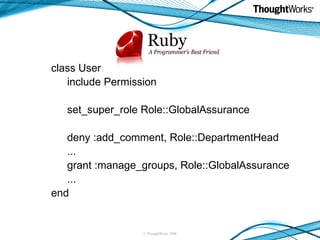
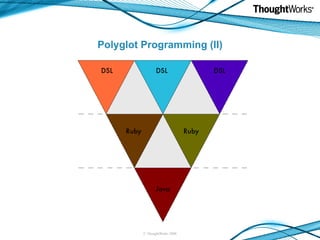
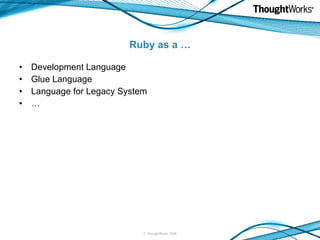
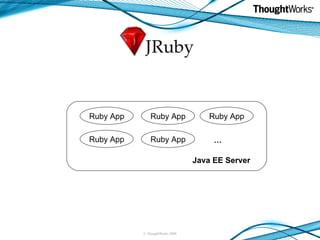
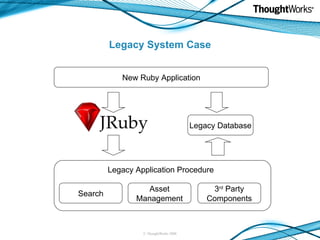
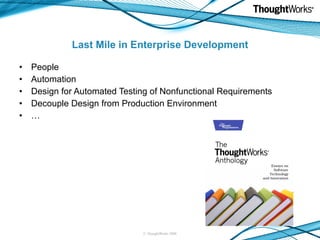
The document discusses using Ruby and Rails for enterprise development. It covers using Ruby as both a primary development language and as a glue language to connect legacy systems. It also discusses designing applications for automated testing and decoupling design from production environments. Lastly, it provides an example of automating source control tasks like adding, committing, and updating files using a Ruby namespace and Rake tasks.


![Getting Started with Apache Spark: Big Data Made Simple [Free Meetup]](https://cdn.slidesharecdn.com/ss_thumbnails/apachesparkgettingstarted-260203175547-8361bcc3-thumbnail.jpg?width=640&height=640&fit=bounds)


