Sumeru
On Rails
Make your own Rails frame work
By: Pankaj Bhageria
Tech Lead
Sumeru Software Solutions
Website: sumeruonrails.com
Blog: railsguru.org
3 Questions ?
Have you ever thought of creating
your own Web Framework?
3 Questions ?
Have you contributed to the Rails
community?
3 Questions ?
Have you ever peeped through the source
code of Rails Framework?
Why Am I here?
It is my vision to have India contribute
significantly to the Rails world.
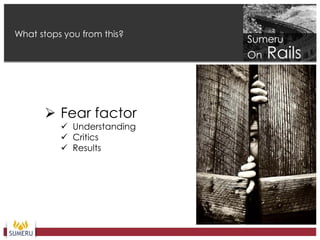
What stops you from this?
 Fear factor
 Understanding
 Critics
 Results
Objectives
To inspire you, so that, you start
 Contributing to Rails
 Start writing your own gems
 Doing your own experiments
 Start thinking big
 Talk at the next Rubyconf
Minimum Qualification
Basic knowledge of Ruby and Rails.
Over Qualification
 If you are a guru in Ruby and Rails
 If you are already contributing to Rails and open source.
 If you have built some frameworks.
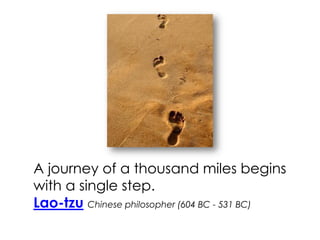
A journey of a thousand miles begins
with a single step.
Lao-tzu Chinese philosopher (604 BC - 531 BC)
The Single Step
 We will build a basic web server and demonstrate
 Routing
 Controllers and Action
 Views
Understanding RACK
WEB SERVER WEB APPLICATION
Hey I got a
Request
/login
Response
[200,header,”Login Form”]
Request
/login
Response
“Login Form”
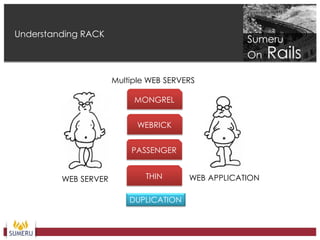
Understanding RACK
WEB SERVER WEB APPLICATION
Multiple WEB SERVERS
MONGREL
WEBRICK
PASSENGER
THIN
DUPLICATION
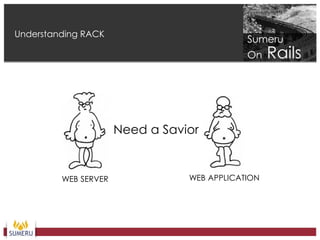
Understanding RACK
WEB SERVER WEB APPLICATION
Need a Savior
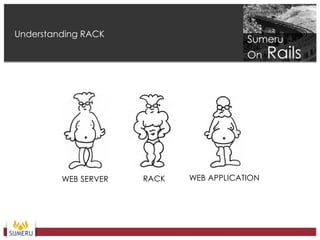
Understanding RACK
WEB SERVER WEB APPLICATIONRACK
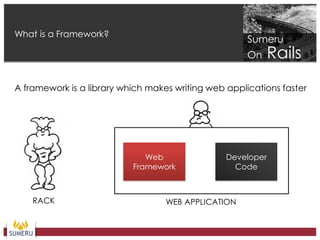
What is a Framework?
A framework is a library which makes writing web applications faster
RACK WEB APPLICATION
Web
Framework
Developer
Code
Integrating with Rack
 To communicate with Rack, the web application should be
a ruby object which respond to a call method
 The Call method should
 Accept a key value pair
 Return an array [status, header, body]
Integrating with Rack
# myserver.rb
class MyServer
def call(env)
[200,{"content-type"=>"text/html"},“Login Here"]
end
end
Integrating with Rack
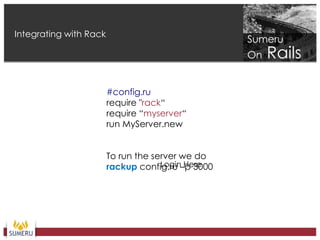
#config.ru
require "rack“
require “myserver“
run MyServer.new
To run the server we do
rackup config.ru –p 3000Login Here
Integrating with Rack
 We have now a functional
Web Application which can
communicate to Rack.
Lets see what Rack Sends To Webserver
# myserver.rb
class MyServer
def call(env)
[200,{"content-type"=>"text/html"},env.inspect]
end
End
A look at the request
http://localhost:3001/login?username=pankaj
{"HTTP_HOST"=>"localhost:3001",
"HTTP_ACCEPT"=>"text/html,application/xhtml+xml,application/xml;q=0.9,*/*;q=0.8",
"SERVER_NAME"=>"localhost", "REQUEST_PATH"=>"/login", "rack.url_scheme"=>"http",
"HTTP_KEEP_ALIVE"=>"300", "HTTP_USER_AGENT"=>"Mozilla/5.0 (Windows; U; Windows NT 6.1; en-GB;
rv:1.9.1.7) Gecko/20091221 Firefox/3.5.7", "REMOTE_HOST"=>"SAMLP05110000", "rack.errors"=>#>,
"HTTP_ACCEPT_LANGUAGE"=>"en-gb,en;q=0.5", "SERVER_PROTOCOL"=>"HTTP/1.1",
"rack.version"=>[1, 1], "rack.run_once"=>false, "SERVER_SOFTWARE"=>"WEBrick/1.3.1
(Ruby/1.8.7/2011-02-18)", "REMOTE_ADDR"=>"127.0.0.1", "PATH_INFO"=>"/login",
"SCRIPT_NAME"=>"", "HTTP_VERSION"=>"HTTP/1.1", "rack.multithread"=>true,
"rack.multiprocess"=>false, "REQUEST_URI"=>"http://localhost:3001/login?username=pankaj",
"HTTP_ACCEPT_CHARSET"=>"ISO-8859-1,utf-8;q=0.7,*;q=0.7", "SERVER_PORT"=>"3001",
"REQUEST_METHOD"=>"GET", "rack.input"=>#>, "HTTP_ACCEPT_ENCODING"=>"gzip,deflate",
"HTTP_CONNECTION"=>"keep-alive", "QUERY_STRING"=>"username=pankaj",
"GATEWAY_INTERFACE"=>"CGI/1.1"}
Lets Add some routing
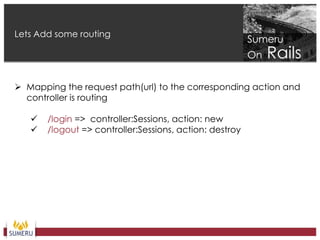
 Mapping the request path(url) to the corresponding action and
controller is routing
 /login => controller:Sessions, action: new
 /logout => controller:Sessions, action: destroy
Define Routes
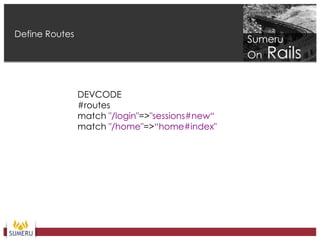
DEVCODE
#routes
match "/login"=>"sessions#new“
match "/home"=>“home#index"
Define Routes
class MyServer
@@routes_collection = []
..
def self.match(route)
@@routes_collection << MyRoute.new(route)
end
end
Framework: route
class MyRoute
attr_accessor :path, :controller, :action
def initialize(options)
path = options.keys[0]
x = options.values[0].split(“#”)
controller = x[0]
action = x[1]
end
def match(match_path)
path == match_path
end
end
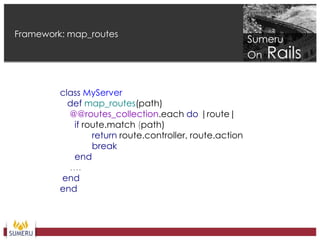
Framework: map_routes
class MyServer
def map_routes(path)
@@routes_collection.each do |route|
if route.match (path)
return route.controller, route.action
break
end
….
end
end
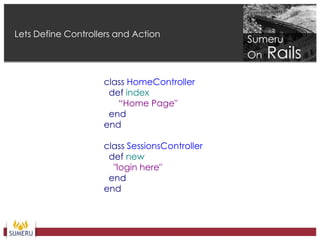
Lets Define Controllers and Action
class HomeController
def index
“Home Page"
end
end
class SessionsController
def new
"login here"
end
end
Revision
# myserver.rb
class MyServer
def call(env)
[200,{"content-type"=>"text/html"},“Login Here"]
end
end
# “Login Here “
# SessionsController
# “sessions”, “new”
# /login
Putting it together
class MyServer
def call(env)
path = env["PATH_INFO"]
controller,action = map_routes(path)
if controller
controller_name = controller_name (controller)
body = eval( "#{controller_name}.new.#{action}" )
else
body = ["Page not found"]
end
status = 200
header = {"content-type"=>"text/html"}
[status,header,body]
end
end
Login Here
Lets Render Some views:
require 'erubis'
class MyActionController
def render(options)
@status = 200
if options[:text]
@body = options[:text]
elsif options[:file]
@body = render_erb_file(views + options[:file] + .erb)
end
end
def render_erb_file(file)
input = File.read(file)
eruby = Erubis::Eruby.new(input)
@body = eruby.result(binding())
end
end
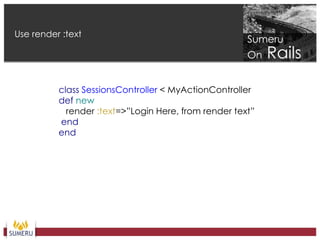
Use render :text
class SessionsController < MyActionController
def new
render :text=>”Login Here, from render text”
end
end
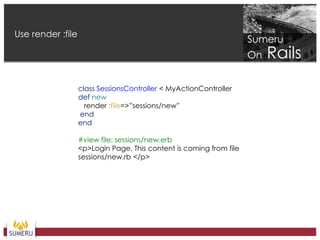
Use render :file
class SessionsController < MyActionController
def new
render :file=>”sessions/new”
end
end
#view file: sessions/new.erb
<p>Login Page. This content is coming from file
sessions/new.rb </p>
End of our first step
 We have built a basic web server and covered the
following features
 Routing
 Controllers and Action
 Views
Where do you go from here
 Start, do not wait
 Start looking at rails code
 Start developing your gems
 Start writing your blogs
 Form groups and meetup monthly and share your
knowledge.
 Look at others code.
 Contact me at pankaj.bhageria@sumerusolutions.com
Take Away
You must believe
Any Queries?
Thank you
Need Ruby/Rails training? Contact us at rails@sumerusolutions.com

Ruby conf 2011, Create your own rails framework

  • 1.
    Sumeru On Rails Make yourown Rails frame work By: Pankaj Bhageria Tech Lead Sumeru Software Solutions Website: sumeruonrails.com Blog: railsguru.org
  • 2.
    3 Questions ? Haveyou ever thought of creating your own Web Framework?
  • 3.
    3 Questions ? Haveyou contributed to the Rails community?
  • 4.
    3 Questions ? Haveyou ever peeped through the source code of Rails Framework?
  • 5.
    Why Am Ihere? It is my vision to have India contribute significantly to the Rails world.
  • 6.
    What stops youfrom this?  Fear factor  Understanding  Critics  Results
  • 7.
    Objectives To inspire you,so that, you start  Contributing to Rails  Start writing your own gems  Doing your own experiments  Start thinking big  Talk at the next Rubyconf
  • 8.
  • 9.
    Over Qualification  Ifyou are a guru in Ruby and Rails  If you are already contributing to Rails and open source.  If you have built some frameworks.
  • 10.
    A journey ofa thousand miles begins with a single step. Lao-tzu Chinese philosopher (604 BC - 531 BC)
  • 11.
    The Single Step We will build a basic web server and demonstrate  Routing  Controllers and Action  Views
  • 12.
    Understanding RACK WEB SERVERWEB APPLICATION Hey I got a Request /login Response [200,header,”Login Form”] Request /login Response “Login Form”
  • 13.
    Understanding RACK WEB SERVERWEB APPLICATION Multiple WEB SERVERS MONGREL WEBRICK PASSENGER THIN DUPLICATION
  • 14.
    Understanding RACK WEB SERVERWEB APPLICATION Need a Savior
  • 15.
    Understanding RACK WEB SERVERWEB APPLICATIONRACK
  • 16.
    What is aFramework? A framework is a library which makes writing web applications faster RACK WEB APPLICATION Web Framework Developer Code
  • 17.
    Integrating with Rack To communicate with Rack, the web application should be a ruby object which respond to a call method  The Call method should  Accept a key value pair  Return an array [status, header, body]
  • 18.
    Integrating with Rack #myserver.rb class MyServer def call(env) [200,{"content-type"=>"text/html"},“Login Here"] end end
  • 19.
    Integrating with Rack #config.ru require"rack“ require “myserver“ run MyServer.new To run the server we do rackup config.ru –p 3000Login Here
  • 20.
    Integrating with Rack We have now a functional Web Application which can communicate to Rack.
  • 21.
    Lets see whatRack Sends To Webserver # myserver.rb class MyServer def call(env) [200,{"content-type"=>"text/html"},env.inspect] end End
  • 22.
    A look atthe request http://localhost:3001/login?username=pankaj {"HTTP_HOST"=>"localhost:3001", "HTTP_ACCEPT"=>"text/html,application/xhtml+xml,application/xml;q=0.9,*/*;q=0.8", "SERVER_NAME"=>"localhost", "REQUEST_PATH"=>"/login", "rack.url_scheme"=>"http", "HTTP_KEEP_ALIVE"=>"300", "HTTP_USER_AGENT"=>"Mozilla/5.0 (Windows; U; Windows NT 6.1; en-GB; rv:1.9.1.7) Gecko/20091221 Firefox/3.5.7", "REMOTE_HOST"=>"SAMLP05110000", "rack.errors"=>#>, "HTTP_ACCEPT_LANGUAGE"=>"en-gb,en;q=0.5", "SERVER_PROTOCOL"=>"HTTP/1.1", "rack.version"=>[1, 1], "rack.run_once"=>false, "SERVER_SOFTWARE"=>"WEBrick/1.3.1 (Ruby/1.8.7/2011-02-18)", "REMOTE_ADDR"=>"127.0.0.1", "PATH_INFO"=>"/login", "SCRIPT_NAME"=>"", "HTTP_VERSION"=>"HTTP/1.1", "rack.multithread"=>true, "rack.multiprocess"=>false, "REQUEST_URI"=>"http://localhost:3001/login?username=pankaj", "HTTP_ACCEPT_CHARSET"=>"ISO-8859-1,utf-8;q=0.7,*;q=0.7", "SERVER_PORT"=>"3001", "REQUEST_METHOD"=>"GET", "rack.input"=>#>, "HTTP_ACCEPT_ENCODING"=>"gzip,deflate", "HTTP_CONNECTION"=>"keep-alive", "QUERY_STRING"=>"username=pankaj", "GATEWAY_INTERFACE"=>"CGI/1.1"}
  • 23.
    Lets Add somerouting  Mapping the request path(url) to the corresponding action and controller is routing  /login => controller:Sessions, action: new  /logout => controller:Sessions, action: destroy
  • 24.
  • 25.
    Define Routes class MyServer @@routes_collection= [] .. def self.match(route) @@routes_collection << MyRoute.new(route) end end
  • 26.
    Framework: route class MyRoute attr_accessor:path, :controller, :action def initialize(options) path = options.keys[0] x = options.values[0].split(“#”) controller = x[0] action = x[1] end def match(match_path) path == match_path end end
  • 27.
    Framework: map_routes class MyServer defmap_routes(path) @@routes_collection.each do |route| if route.match (path) return route.controller, route.action break end …. end end
  • 28.
    Lets Define Controllersand Action class HomeController def index “Home Page" end end class SessionsController def new "login here" end end
  • 29.
    Revision # myserver.rb class MyServer defcall(env) [200,{"content-type"=>"text/html"},“Login Here"] end end
  • 30.
    # “Login Here“ # SessionsController # “sessions”, “new” # /login Putting it together class MyServer def call(env) path = env["PATH_INFO"] controller,action = map_routes(path) if controller controller_name = controller_name (controller) body = eval( "#{controller_name}.new.#{action}" ) else body = ["Page not found"] end status = 200 header = {"content-type"=>"text/html"} [status,header,body] end end Login Here
  • 31.
    Lets Render Someviews: require 'erubis' class MyActionController def render(options) @status = 200 if options[:text] @body = options[:text] elsif options[:file] @body = render_erb_file(views + options[:file] + .erb) end end def render_erb_file(file) input = File.read(file) eruby = Erubis::Eruby.new(input) @body = eruby.result(binding()) end end
  • 32.
    Use render :text classSessionsController < MyActionController def new render :text=>”Login Here, from render text” end end
  • 33.
    Use render :file classSessionsController < MyActionController def new render :file=>”sessions/new” end end #view file: sessions/new.erb <p>Login Page. This content is coming from file sessions/new.rb </p>
  • 34.
    End of ourfirst step  We have built a basic web server and covered the following features  Routing  Controllers and Action  Views
  • 35.
    Where do yougo from here
  • 36.
    Where do yougo from here  Start, do not wait  Start looking at rails code  Start developing your gems  Start writing your blogs  Form groups and meetup monthly and share your knowledge.  Look at others code.  Contact me at pankaj.bhageria@sumerusolutions.com
  • 37.
  • 38.
    Any Queries? Thank you NeedRuby/Rails training? Contact us at rails@sumerusolutions.com