INDIA BUDGET 2018
Key Aspects in a Nutshell
Key Highlights –
India Budget 2018
Introduction Direct Tax Indirect Tax Other Proposals Contact Us
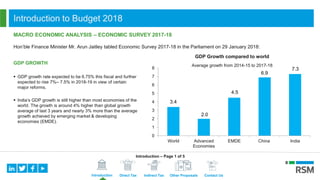
GDP GROWTH
 GDP growth rate expected to be 6.75% this fiscal and further
expected to rise 7%– 7.5% in 2018-19 in view of certain
major reforms.
 India’s GDP growth is still higher than most economies of the
world. The growth is around 4% higher than global growth
average of last 3 years and nearly 3% more than the average
growth achieved by emerging market & developing
economies (EMDE).
MACRO ECONOMIC ANALYSIS – ECONOMIC SURVEY 2017-18
Hon’ble Finance Minister Mr. Arun Jaitley tabled Economic Survey 2017-18 in the Parliament on 29 January 2018:
0
1
2
3
4
5
6
7
8
World Advanced
Economies
EMDE China India
3.4
2.0
4.5
6.9
7.3
GDP Growth compared to world
Introduction to Budget 2018
Average growth from 2014-15 to 2017-18
Introduction – Page 1 of 5
Introduction Direct Tax Indirect Tax Other Proposals Contact Us
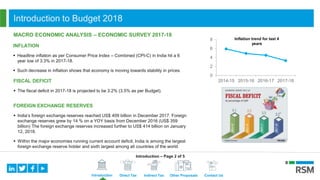
INFLATION
 Headline inflation as per Consumer Price Index – Combined (CPI-C) in India hit a 6
year low of 3.3% in 2017-18.
 Such decrease in inflation shows that economy is moving towards stability in prices.
0
2
4
6
8
2014-15 2015-16 2016-17 2017-18
Inflation trend for last 4
years
MACRO ECONOMIC ANALYSIS – ECONOMIC SURVEY 2017-18
FISCAL DEFICIT
 The fiscal deficit in 2017-18 is projected to be 3.2% (3.5% as per Budget).
FOREIGN EXCHANGE RESERVES
 India’s foreign exchange reserves reached US$ 409 billion in December 2017. Foreign
exchange reserves grew by 14 % on a YOY basis from December 2016 (US$ 359
billion) The foreign exchange reserves increased further to US$ 414 billion on January
12, 2018.
 Within the major economies running current account deficit, India is among the largest
foreign exchange reserve holder and sixth largest among all countries of the world.
Introduction to Budget 2018
Introduction – Page 2 of 5
Introduction Direct Tax Indirect Tax Other Proposals Contact Us
Introduction to Budget 2018
MACRO ECONOMIC ANALYSIS – ECONOMIC SURVEY 2017-18
MAJOR INDIRECT TAX REFORM - GST
 FY 2017-18 was a breakthrough year because of implementation of GST which has subsumed most of the central and state level indirect taxes
(except customs duty and stamp duty) paving way for uniform indirect tax regime across India.
 GST has been sluggish in terms of collection due to transitional issues. This though is expected to settle down in the near term and would be a
major revenue booster considering that it would cover organized as well as unorganized sector within its purview.
 One of the major benefits of GST has been that, there has been 50% increase in the number of unique indirect taxpayers.
EASE OF DOING BUSINESS – NEXT FRONTIER: TIMELY JUSTICE
 The government’s efforts to make business and commerce easy have been widely acknowledged. The next frontier on the ease of doing
business is addressing pendency, delays and backlogs in the appellate and judicial arenas.
 The tax department’s petition rate is high, even though its success rate in litigation is low and declining (well below 30 %).
− Only 0.2 % of cases accounted for 56 % of the value at stake; whereas
− About 66 % of pending cases (each less than Rs. 10 lakhs) accounted for only 1.8 % of the value at stake
Introduction – Page 3 of 5
Introduction Direct Tax Indirect Tax Other Proposals Contact Us
Introduction to Budget 2018
MACRO ECONOMIC ANALYSIS – ECONOMIC SURVEY 2017-18
ROAD AHEAD
 The agenda for the next year consequently remains stabilizing the GST, completing the twin balance sheet (TBS) actions, thrust to agriculture
and infrastructure and staving off threats to macro-economic stability.
 The TBS actions, noteworthy for cracking the long-standing “exit” problem, need complementary reforms to shrink unviable banks and allow
greater private sector participation.
 Over the medium term, three areas of policy focus stand out:
Employment: Finding good jobs for the young and burgeoning workforce, especially for women.
Education: Creating an educated and healthy labor force.
Agriculture: Raising farm productivity while strengthening agricultural resilience.
Introduction – Page 4 of 5
Introduction Direct Tax Indirect Tax Other Proposals Contact Us
Introduction to Budget 2018
In the backdrop of the economic survey, the Hon’ble Finance Minister presented the Budget 2018 on 1 February 2018. He emphasized
on the fact that India is a US$ 2.5 trillion economy - 7th largest economy in the world. It is expected that India will become 5th largest
economy of the world in 2018. The growth rate of direct taxes in the financial years 2016-17 and 2017-18 has been significant - 12.6%
and 18.7% (estimated) respectively.
The tax proposals for amendments are organized under the following heads:
1. Rates of income-tax
2. Widening and deepening of tax base
3. Measures for promoting equity
4. Tax incentives
5. Facilitating insolvency resolution
6. Improving effectiveness of tax administration
7. Rationalisation Measures
8. Miscellaneous
The said proposals will be effective after the Finance Bill, 2018 receives the assent of the Hon’ble President of India.
Introduction – Page 5 of 5
Introduction Direct Tax Indirect Tax Other Proposals Contact Us
Direct Taxes
RATES OF INCOME-TAX
• Personal Tax - No change in slab rates and deduction under
section 80C.
• Corporate Tax – Tax rates for the companies having total
turnover or gross receipts up to Rs. 250 Crores in FY 2016-17
reduced to 25%. Tax rates for other companies / LLPs / Firms /
other entities remain unchanged.
• No change in Surcharge.
• Education Cess and Secondary Higher Education Cess of 3%
(of tax and surcharge) discontinued. Health and Education
Cess introduced at the rate of 4% (of tax and surcharge).
WIDENING AND DEEPENING OF TAX BASE
• Exemption from long term capital gains arising from transfer of
equity share, unit of equity oriented fund or a unit of business
trust under section 10(38) withdrawn. Effective 1 April 2018, tax
would be levied at the rate of 10% on capital gains exceeding
Rs. 1,00,000. Indexation benefit not available. Cost of
acquisition for computing capital gains would be higher of the
following
– actual cost; and
– fair market value as on 31 January 2018 or sale
consideration, whichever is lower
• The above capital gains tax would also apply to FIIs; however,
clarity would be required for Cost of acquisition in hands of FIIs.
• Scope of accumulated profits in case of amalgamated
companies widened to include accumulated profits of
amalgamating companies for the purpose of calculation of
deemed dividend chargeable to dividend distribution tax (DDT).
Direct Tax – Page 1 of 8
Introduction Direct Tax Indirect Tax Other Proposals Contact Us
Direct Taxes
WIDENING AND DEEPENING OF TAX BASE
• Provisions of section 115-O relating to DDT extended to deemed
dividend under section 2(22)(e) which deems payment made by
way of advance / loan to specified shareholders as dividend. DDT
shall be applicable at the rate of 30% (without grossing up).
• Scope of DDT extended to distribution of income by equity
oriented mutual funds. DDT applicable at 10% of income so
distributed.
• Restriction on payment of cash exceeding Rs. 10,000 under
section 40A(3) & 40A(3A) and disallowance of expenditure under
section 40(a)(ia) for non-compliance with TDS provisions
applicable to specified entities claiming exemption under section
10(23C) and section 11 of IT Act, 1961 (registered charitable
entities).
• Scope of dependent agent PE under section 9(1)(i) widened to
include agent playing principal role in concluding the contracts on
behalf of non-resident. This is in line with Multi-lateral Convention
related to Tax Treaty matters.
• Section 9(1)(i) amended to provide that ‘significant economic
presence’ in India shall also constitute ‘business connection’.
• Compensation received or receivable, whether revenue or capital
in connection with termination or modifications of terms of
business contract or employment contract included within the
scope of business income or other income respectively.
• Section 44AE relating to presumptive income for good carriages
amended to provide in the case of heavy goods vehicle (more
than 12MT gross vehicle weight), the income would deemed to
be an amount equal to Rs. 1,000 per ton of gross vehicle weight
or unladen weight, as the case may be, per month or part of a
month for each goods vehicle or the amount claimed to be
actually earned by the assessee, whichever is higher.
Direct Tax – Page 2 of 8
Introduction Direct Tax Indirect Tax Other Proposals Contact Us
Direct Taxes
MEASURES FOR PROMOTING EQUITY
• It is proposed to amend section 80D so as to raise this monetary
limit of deduction from Rs. 30,000 to Rs. 50,000 in respect of
payments towards annual premium on health insurance policy, or
preventive health check-up, of a senior citizen, or medical
expenditure in respect of very senior citizen.
• Further, in case of single premium health insurance policies
having cover of more than one year, it is proposed that the
deduction shall be allowed on proportionate basis for the number
of years for which health insurance cover is provided subject to
the specified monetary limit.
• It is proposed to amend the provisions of section 80DDB so as to
raise the monetary limit of deduction to Rs. 1,00,000 for both
senior citizens and very senior citizens (from existing Rs. 60,000
for senior citizens and Rs. 80,000 for very senior citizens) with
regards amount paid for medical treatment of specified diseases.
• Section 80TTB inserted to provide deduction of Rs. 50,000 in
respect of interest income from deposits held by senior citizens.
Section 80TTA not to apply in said cases. Consequential
amendment also proposed in section 194A to increase the
threshold limit in such case to Rs. 50,000 for deduction of tax.
• Standard deduction of Rs. 40,000 introduced for salaried
individuals. Consequently the present exemption in respect of
transport allowance (except in case of differently abled persons)
and reimbursement of medical expenses withdrawn.
Direct Tax – Page 3 of 8
Introduction Direct Tax Indirect Tax Other Proposals Contact Us
Direct Taxes
TAX INCENTIVES
• The scope of section 80P which provides for 100% profit
deduction, extended to Farm Producer Companies (FPC)
providing assistance to its members engaged in primary
agricultural activities and having a turnover up to Rs. 100 Crores.
The benefit shall be available for the period of 5 years from AY
2019-20.
• Section 80-IAC which provides 100% profit deduction for 3
consecutive years out of 7 years proposed to be amended as
under:
a) Benefit to be available to start ups incorporated on or after the
1 April 2019 but before the 1 April, 2021;
b) Requirement of turnover not exceeding Rs. 25 Crores for 7
FYs commencing from date of incorporation inserted
c) Definition of eligible business expanded to include business of
innovation, development or improvement of products or
processes or services, or a scalable business model with a
high potential of employment generation or wealth creation.
 Section 47 to be amended to provide that transactions by a
non-resident on a recognised stock exchange located in
International Financial Service Center in specified bond or
Global Depository Receipt, rupee denominated bonds of an
Indian company or derivative shall not be regarded as transfer,
if the consideration is paid or payable in foreign currency.
Section 115JC to be amended to provide that AMT at the rate
of 9% would be applicable in case of a unit located in an
International Financial Service Center
 Minimum period of employment under section 80JJAA (which
provides for deduction in respect of employment of new
employees) relaxed to 150 days for footwear and leather
industry. Further, the employment period condition rationalized
by allowing the benefit for a new employee who is employed for
less than the minimum period during the first year but
continues to remain employed for the minimum period in
subsequent year.
Direct Tax – Page 4 of 8
Introduction Direct Tax Indirect Tax Other Proposals Contact Us
Direct Taxes
FACILITATING INSOLVENCY RESOLUTION
• It is proposed to amend section 115JB to provide that the
aggregate amount of unabsorbed depreciation and loss
brought forward (excluding unabsorbed depreciation) shall be
allowed to be reduced from the book profit, if a company’s
application for corporate insolvency resolution process under
the Insolvency and Bankruptcy Code, 2016 has been admitted
by the Adjudicating Authority.
• Section 79 relating to carry forward and set-off of losses in case
of change in shareholding would not apply to a company where
a change in the shareholding takes place pursuant to a
resolution plan approved under the Insolvency and Bankruptcy
Code, 2016. Section 140 amended to provide that the return
shall be verified by an insolvency professional appointed by the
adjudicating Authority under the Insolvency and Bankruptcy
Code, 2016.
IMPROVING EFFECTIVENESS OF TAX ADMINISTRATION
• To improve transparency and accountability by eliminating
interface between Income tax officers and taxpayer, a new
scheme for scrutiny assessments shall be introduced by way of
a notification.
Direct Tax – Page 5 of 8
Introduction Direct Tax Indirect Tax Other Proposals Contact Us
Direct Taxes
RATIONALISATION MEASURES
• ‘Options in commodity futures’ would now be subject to
commodities transaction tax.
• Relief from prosecution for failure to furnish return that was
available for taxpayers whose tax liability determined under
regular assessment did not exceed Rs. 3,000 would not be
applicable to companies.
• No adjustments would be made while processing of return of
income on account of mismatch of income appearing in Form
26AS or Form 16 or Form 16A and return of income from AY
2018-19 onwards.
• For new manufacturing start ups who have the option to be taxed
at 25%, income which are applicable to scheduler tax, shall be
taxed at such scheduler tax rate.
• The present benefit of tax free withdrawal from NPS which is
available to employee subscribers proposed to be extended to
non-employee subscribers to the extent of 40%.
• No deduction under heading “C-Deductions in respect of certain
incomes” of Chapter VIA would be admissible if return of income
is not filed within prescribed due-date.
• No adjustments shall be made under section 50C, 43CA or 56 in
case of immovable property if the difference in stamp duty value
and sale consideration does not exceed 5% of the sale
consideration.
• Conversion of stock into capital asset shall be charged to tax as
business income by considering fair market value of stock on the
date of conversion as sales consideration. Further, for the
purpose of capital gains, cost shall be the fair market value on
date of conversion and period of holding shall be reckoned from
the date of conversion.
• Benefit of section 54EC to be available only in respect of capital
gains arising from transfer of long term capital assets being land
or building or both and not for other assets. Lock-in period of the
investment is increased from 3 years to 5 years.
Direct Tax – Page 6 of 8
Introduction Direct Tax Indirect Tax Other Proposals Contact Us
Direct Taxes
RATIONALISATION MEASURES
• Transfer of capital asset by wholly owned subsidiaries to their
Indian Holding company and by Holding company to Wholly
owned Indian subsidiaries proposed to be excluded from
implications of section 56(2)(x) relating to transfer of assets for
inadequate consideration or no consideration.
• Restriction of deduction or set off of loss against unexplained
income or investments to be extended to even cover such
unexplained income or investments determined by the assessing
officer.
• In light of recent judicial pronouncement and to provide certainty
on treatment of certain expenses and income, new provisions
proposed to be inserted to align the IT Act with ICDS provisions
with regards:
a) MTM Losses
b) Foreign currency gain / loss
c) Revenue recognition from construction contract
d) Inventory valuation; etc.
The amendments would be effective retrospectively from AY
2017-18 onwards.
Direct Tax – Page 7 of 8
Introduction Direct Tax Indirect Tax Other Proposals Contact Us
Direct Taxes
OTHER SIGNIFICANT TAX PROPOSALS
• Clarificatory amendment to be introduced to provide that MAT
provisions not applicable to foreign company offering income
under deemed income provisions of section 44B, section 44BB,
section 44BBA or section 44BBB of the IT Act.
• Penalty for non-furnishing of statement of financial transaction or
reportable account increased.
• Order passed by Commissioner (Appeals) in respect of furnishing
incorrect information by accountant, merchant banker and
registered valuer made appealable to Appellate Tribunal.
• Based on model legislation of Action Plan 13 of Base Erosion and
Profit Shifting of the Organisation for Economic Co-operation and
Development and others, certain amendments proposed relating
to Country-by-Country Report so as to improve effectiveness and
reduce compliance burden of such reporting.
• Section 43(5) to be amended to provide that transaction in respect
of trading of agricultural commodity derivatives, which is not
chargeable to CTT, over a registered stock exchange or
registered association, will be treated as non-speculative
transaction.
• It is proposed that every person, not being an individual, which
enters into a financial transaction of an amount aggregating to Rs.
2,50,000 or more in a financial year shall be required to obtain
PAN. Even persons competent to act on behalf of such entities
shall have to apply for PAN.
Direct Tax – Page 8 of 8
Introduction Direct Tax Indirect Tax Other Proposals Contact Us
Indirect Taxes – GST & Service Tax
• No proposed changes in Central GST Act, 2017.
• No proposed changes in Integrated GST Act, 2017.
• It is proposed to provide exemption from service tax to life
insurance services provided by the Naval Group Insurance Fund
to personnel of Coast Guard, retrospectively, during the period
from the 10 September 2004 up to the 30 June 2017.
• It is proposed to provide retrospective exemption from service tax
to services provided by the Goods and Services Tax Network
(GSTN) to the Central Government / State Governments / Union
territory during the period from the 28 March 2013 to the 30 June
2017.
• It is proposed to provide retrospective exemption from service tax
to consideration paid to Government in the form of Government’s
share of profit petroleum in respect of services provided by
Government by way of grant of license or lease to explore or mine
petroleum crude or natural gas or both, during the period from the
1 April 2016 to the 30 June 2017.
Indirect Tax – Page 1 of 3
Introduction Direct Tax Indirect Tax Other Proposals Contact Us
Indirect Taxes – Excise Duty
Item Duty rates applicable upto 1 February 2018
(Rs. Per Litre)
Duty rates applicable on or after 2 February 2018
(Rs. Per Litre)
Product Basic
Excise
Duty
(BED)
Additional
Excise Duty
(AED –
Road Cess)
Special
Additional
Excise
Duty
(SAED)
Total
Excise
Duty
Basic
Excise
Duty
(BED)
Road &
Infrastructure
Cess
(RIC)
Special
Additional
Excise
Duty
(SAED)
Total
Excise
Duty
Petrol
(Unbranded)
6.48 6 7 19.48 4.48 8 7 19.48
Petrol (Branded) 7.66 6 7 20.66 5.66 8 7 20.66
Diesel
(Unbranded)
8.33 6 7 15.33 6.33 8 1 15.33
Diesel (Branded) 10.69 6 7 17.69 8.69 8 1 17.69
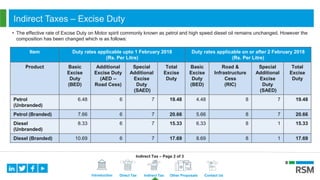
• The effective rate of Excise Duty on Motor spirit commonly known as petrol and high speed diesel oil remains unchanged. However the
composition has been changed which is as follows:
Indirect Tax – Page 2 of 3
Introduction Direct Tax Indirect Tax Other Proposals Contact Us
Indirect Taxes – Customs
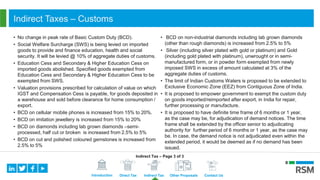
• No change in peak rate of Basic Custom Duty (BCD).
• Social Welfare Surcharge (SWS) is being levied on imported
goods to provide and finance education, health and social
security. It will be levied @ 10% of aggregate duties of customs.
• Education Cess and Secondary & Higher Education Cess on
imported goods abolished. Specified goods exempted from
Education Cess and Secondary & Higher Education Cess to be
exempted from SWS.
• Valuation provisions prescribed for calculation of value on which
IGST and Compensation Cess is payable, for goods deposited in
a warehouse and sold before clearance for home consumption /
export.
• BCD on cellular mobile phones is increased from 15% to 20%.
• BCD on imitation jewellery is increased from 15% to 20%
• BCD on diamonds including lab grown diamonds –semi-
processed, half cut or broken is increased from 2.5% to 5%
• BCD on cut and polished coloured gemstones is increased from
2.5% to 5%
• BCD on non-industrial diamonds including lab grown diamonds
(other than rough diamonds) is increased from 2.5% to 5%
• Silver (including silver plated with gold or platinum) and Gold
(including gold plated with platinum), unwrought or in semi-
manufactured form, or in powder form exempted from newly
imposed SWS in excess of amount calculated at 3% of the
aggregate duties of customs.
• The limit of Indian Customs Waters is proposed to be extended to
Exclusive Economic Zone (EEZ) from Contiguous Zone of India.
• It is proposed to empower government to exempt the custom duty
on goods imported/reimported after export, in India for repair,
further processing or manufacture.
• It is proposed to have definite time frame of 6 months or 1 year,
as the case may be, for adjudication of demand notices. The time
frame shall be extended by the officer senior to adjudicating
authority for further period of 6 months or 1 year, as the case may
be. In case, the demand notice is not adjudicated even within the
extended period, it would be deemed as if no demand has been
issued.
Indirect Tax – Page 3 of 3
Introduction Direct Tax Indirect Tax Other Proposals Contact Us
Other Proposals
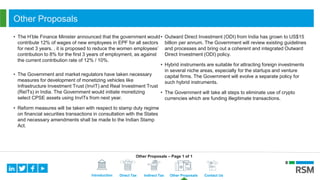
• The H’ble Finance Minister announced that the government would
contribute 12% of wages of new employees in EPF for all sectors
for next 3 years. , it is proposed to reduce the women employees’
contribution to 8% for the first 3 years of employment, as against
the current contribution rate of 12% / 10%.
• The Government and market regulators have taken necessary
measures for development of monetizing vehicles like
Infrastructure Investment Trust (InvIT) and Real Investment Trust
(ReITs) in India. The Government would initiate monetizing
select CPSE assets using InvITs from next year.
• Reform measures will be taken with respect to stamp duty regime
on financial securities transactions in consultation with the States
and necessary amendments shall be made to the Indian Stamp
Act.
• Outward Direct Investment (ODI) from India has grown to US$15
billion per annum. The Government will review existing guidelines
and processes and bring out a coherent and integrated Outward
Direct Investment (ODI) policy.
• Hybrid instruments are suitable for attracting foreign investments
in several niche areas, especially for the startups and venture
capital firms. The Government will evolve a separate policy for
such hybrid instruments.
• The Government will take all steps to eliminate use of crypto
currencies which are funding illegitimate transactions.
Other Proposals – Page 1 of 1
Introduction Direct Tax Indirect Tax Other Proposals Contact Us
Contact Us
For further information please contact:
RSM Astute Consulting Pvt. Ltd.
13th Floor, Bakhtawar, 229, Nariman Point, Mumbai - 400 021.
T: (91-22) 6108 5555 / 6121 4444
F: (91-22) 2287 5771
E: emails@rsmindia.in
W: www.rsmindia.in
Offices: Mumbai, New Delhi - NCR, Chennai, Kolkata, Bengaluru, Surat, Hyderabad, Ahmedabad, Pune, Gandhidham and Jaipur.
facebook.com/RSMinIndia
twitter.com/RSM_India
linkedin.com/company/rsm-india
RSM Astute Consulting Pvt. Ltd. (Including its affiliates) is a member of the RSM network and trades as RSM. RSM is the trading name used by the members of the RSM network.
Each member of the RSM network is an independent accounting and consulting firm each of which practices in its own right. The RSM network is not itself a separate legal entity of any description in any jurisdiction.
The RSM network is administered by RSM International Limited, a company registered in England and Wales (company number 4040598) whose registered office is at 50 Cannon Street, London EC4N 6JJ .
The brand and trademark RSM and other intellectual property rights used by members of the network are owned by RSM International Association, an association governed by article 60 et seq of the Civil Code of Switzerland whose seat is in Zug.
This publication is general in nature. In this publication, we have endeavoured to highlight certain significant aspects of the Union Budget 2018, presented by the Honourable Finance Minister of India, Shri Arun Jaitley on 1 February 2018. The
effective dates of budget proposals would vary. It may be noted that nothing contained in this publication should be regarded as our opinion and facts of each case will need to be analyzed to ascertain applicability or otherwise of the topics covered
in this publication. Appropriate professional advice should be sought for applicability of legal provisions based on specific facts. We are not responsible for any liability arising from any statements or errors contained in this publication.
1 February 2018
© RSM International Association, 2018

Rsm india budget_2018_key_aspects_in_a_nutshell

  • 1.
    INDIA BUDGET 2018 KeyAspects in a Nutshell Key Highlights – India Budget 2018
  • 2.
    Introduction Direct TaxIndirect Tax Other Proposals Contact Us GDP GROWTH  GDP growth rate expected to be 6.75% this fiscal and further expected to rise 7%– 7.5% in 2018-19 in view of certain major reforms.  India’s GDP growth is still higher than most economies of the world. The growth is around 4% higher than global growth average of last 3 years and nearly 3% more than the average growth achieved by emerging market & developing economies (EMDE). MACRO ECONOMIC ANALYSIS – ECONOMIC SURVEY 2017-18 Hon’ble Finance Minister Mr. Arun Jaitley tabled Economic Survey 2017-18 in the Parliament on 29 January 2018: 0 1 2 3 4 5 6 7 8 World Advanced Economies EMDE China India 3.4 2.0 4.5 6.9 7.3 GDP Growth compared to world Introduction to Budget 2018 Average growth from 2014-15 to 2017-18 Introduction – Page 1 of 5
  • 3.
    Introduction Direct TaxIndirect Tax Other Proposals Contact Us INFLATION  Headline inflation as per Consumer Price Index – Combined (CPI-C) in India hit a 6 year low of 3.3% in 2017-18.  Such decrease in inflation shows that economy is moving towards stability in prices. 0 2 4 6 8 2014-15 2015-16 2016-17 2017-18 Inflation trend for last 4 years MACRO ECONOMIC ANALYSIS – ECONOMIC SURVEY 2017-18 FISCAL DEFICIT  The fiscal deficit in 2017-18 is projected to be 3.2% (3.5% as per Budget). FOREIGN EXCHANGE RESERVES  India’s foreign exchange reserves reached US$ 409 billion in December 2017. Foreign exchange reserves grew by 14 % on a YOY basis from December 2016 (US$ 359 billion) The foreign exchange reserves increased further to US$ 414 billion on January 12, 2018.  Within the major economies running current account deficit, India is among the largest foreign exchange reserve holder and sixth largest among all countries of the world. Introduction to Budget 2018 Introduction – Page 2 of 5
  • 4.
    Introduction Direct TaxIndirect Tax Other Proposals Contact Us Introduction to Budget 2018 MACRO ECONOMIC ANALYSIS – ECONOMIC SURVEY 2017-18 MAJOR INDIRECT TAX REFORM - GST  FY 2017-18 was a breakthrough year because of implementation of GST which has subsumed most of the central and state level indirect taxes (except customs duty and stamp duty) paving way for uniform indirect tax regime across India.  GST has been sluggish in terms of collection due to transitional issues. This though is expected to settle down in the near term and would be a major revenue booster considering that it would cover organized as well as unorganized sector within its purview.  One of the major benefits of GST has been that, there has been 50% increase in the number of unique indirect taxpayers. EASE OF DOING BUSINESS – NEXT FRONTIER: TIMELY JUSTICE  The government’s efforts to make business and commerce easy have been widely acknowledged. The next frontier on the ease of doing business is addressing pendency, delays and backlogs in the appellate and judicial arenas.  The tax department’s petition rate is high, even though its success rate in litigation is low and declining (well below 30 %). − Only 0.2 % of cases accounted for 56 % of the value at stake; whereas − About 66 % of pending cases (each less than Rs. 10 lakhs) accounted for only 1.8 % of the value at stake Introduction – Page 3 of 5
  • 5.
    Introduction Direct TaxIndirect Tax Other Proposals Contact Us Introduction to Budget 2018 MACRO ECONOMIC ANALYSIS – ECONOMIC SURVEY 2017-18 ROAD AHEAD  The agenda for the next year consequently remains stabilizing the GST, completing the twin balance sheet (TBS) actions, thrust to agriculture and infrastructure and staving off threats to macro-economic stability.  The TBS actions, noteworthy for cracking the long-standing “exit” problem, need complementary reforms to shrink unviable banks and allow greater private sector participation.  Over the medium term, three areas of policy focus stand out: Employment: Finding good jobs for the young and burgeoning workforce, especially for women. Education: Creating an educated and healthy labor force. Agriculture: Raising farm productivity while strengthening agricultural resilience. Introduction – Page 4 of 5
  • 6.
    Introduction Direct TaxIndirect Tax Other Proposals Contact Us Introduction to Budget 2018 In the backdrop of the economic survey, the Hon’ble Finance Minister presented the Budget 2018 on 1 February 2018. He emphasized on the fact that India is a US$ 2.5 trillion economy - 7th largest economy in the world. It is expected that India will become 5th largest economy of the world in 2018. The growth rate of direct taxes in the financial years 2016-17 and 2017-18 has been significant - 12.6% and 18.7% (estimated) respectively. The tax proposals for amendments are organized under the following heads: 1. Rates of income-tax 2. Widening and deepening of tax base 3. Measures for promoting equity 4. Tax incentives 5. Facilitating insolvency resolution 6. Improving effectiveness of tax administration 7. Rationalisation Measures 8. Miscellaneous The said proposals will be effective after the Finance Bill, 2018 receives the assent of the Hon’ble President of India. Introduction – Page 5 of 5
  • 7.
    Introduction Direct TaxIndirect Tax Other Proposals Contact Us Direct Taxes RATES OF INCOME-TAX • Personal Tax - No change in slab rates and deduction under section 80C. • Corporate Tax – Tax rates for the companies having total turnover or gross receipts up to Rs. 250 Crores in FY 2016-17 reduced to 25%. Tax rates for other companies / LLPs / Firms / other entities remain unchanged. • No change in Surcharge. • Education Cess and Secondary Higher Education Cess of 3% (of tax and surcharge) discontinued. Health and Education Cess introduced at the rate of 4% (of tax and surcharge). WIDENING AND DEEPENING OF TAX BASE • Exemption from long term capital gains arising from transfer of equity share, unit of equity oriented fund or a unit of business trust under section 10(38) withdrawn. Effective 1 April 2018, tax would be levied at the rate of 10% on capital gains exceeding Rs. 1,00,000. Indexation benefit not available. Cost of acquisition for computing capital gains would be higher of the following – actual cost; and – fair market value as on 31 January 2018 or sale consideration, whichever is lower • The above capital gains tax would also apply to FIIs; however, clarity would be required for Cost of acquisition in hands of FIIs. • Scope of accumulated profits in case of amalgamated companies widened to include accumulated profits of amalgamating companies for the purpose of calculation of deemed dividend chargeable to dividend distribution tax (DDT). Direct Tax – Page 1 of 8
  • 8.
    Introduction Direct TaxIndirect Tax Other Proposals Contact Us Direct Taxes WIDENING AND DEEPENING OF TAX BASE • Provisions of section 115-O relating to DDT extended to deemed dividend under section 2(22)(e) which deems payment made by way of advance / loan to specified shareholders as dividend. DDT shall be applicable at the rate of 30% (without grossing up). • Scope of DDT extended to distribution of income by equity oriented mutual funds. DDT applicable at 10% of income so distributed. • Restriction on payment of cash exceeding Rs. 10,000 under section 40A(3) & 40A(3A) and disallowance of expenditure under section 40(a)(ia) for non-compliance with TDS provisions applicable to specified entities claiming exemption under section 10(23C) and section 11 of IT Act, 1961 (registered charitable entities). • Scope of dependent agent PE under section 9(1)(i) widened to include agent playing principal role in concluding the contracts on behalf of non-resident. This is in line with Multi-lateral Convention related to Tax Treaty matters. • Section 9(1)(i) amended to provide that ‘significant economic presence’ in India shall also constitute ‘business connection’. • Compensation received or receivable, whether revenue or capital in connection with termination or modifications of terms of business contract or employment contract included within the scope of business income or other income respectively. • Section 44AE relating to presumptive income for good carriages amended to provide in the case of heavy goods vehicle (more than 12MT gross vehicle weight), the income would deemed to be an amount equal to Rs. 1,000 per ton of gross vehicle weight or unladen weight, as the case may be, per month or part of a month for each goods vehicle or the amount claimed to be actually earned by the assessee, whichever is higher. Direct Tax – Page 2 of 8
  • 9.
    Introduction Direct TaxIndirect Tax Other Proposals Contact Us Direct Taxes MEASURES FOR PROMOTING EQUITY • It is proposed to amend section 80D so as to raise this monetary limit of deduction from Rs. 30,000 to Rs. 50,000 in respect of payments towards annual premium on health insurance policy, or preventive health check-up, of a senior citizen, or medical expenditure in respect of very senior citizen. • Further, in case of single premium health insurance policies having cover of more than one year, it is proposed that the deduction shall be allowed on proportionate basis for the number of years for which health insurance cover is provided subject to the specified monetary limit. • It is proposed to amend the provisions of section 80DDB so as to raise the monetary limit of deduction to Rs. 1,00,000 for both senior citizens and very senior citizens (from existing Rs. 60,000 for senior citizens and Rs. 80,000 for very senior citizens) with regards amount paid for medical treatment of specified diseases. • Section 80TTB inserted to provide deduction of Rs. 50,000 in respect of interest income from deposits held by senior citizens. Section 80TTA not to apply in said cases. Consequential amendment also proposed in section 194A to increase the threshold limit in such case to Rs. 50,000 for deduction of tax. • Standard deduction of Rs. 40,000 introduced for salaried individuals. Consequently the present exemption in respect of transport allowance (except in case of differently abled persons) and reimbursement of medical expenses withdrawn. Direct Tax – Page 3 of 8
  • 10.
    Introduction Direct TaxIndirect Tax Other Proposals Contact Us Direct Taxes TAX INCENTIVES • The scope of section 80P which provides for 100% profit deduction, extended to Farm Producer Companies (FPC) providing assistance to its members engaged in primary agricultural activities and having a turnover up to Rs. 100 Crores. The benefit shall be available for the period of 5 years from AY 2019-20. • Section 80-IAC which provides 100% profit deduction for 3 consecutive years out of 7 years proposed to be amended as under: a) Benefit to be available to start ups incorporated on or after the 1 April 2019 but before the 1 April, 2021; b) Requirement of turnover not exceeding Rs. 25 Crores for 7 FYs commencing from date of incorporation inserted c) Definition of eligible business expanded to include business of innovation, development or improvement of products or processes or services, or a scalable business model with a high potential of employment generation or wealth creation.  Section 47 to be amended to provide that transactions by a non-resident on a recognised stock exchange located in International Financial Service Center in specified bond or Global Depository Receipt, rupee denominated bonds of an Indian company or derivative shall not be regarded as transfer, if the consideration is paid or payable in foreign currency. Section 115JC to be amended to provide that AMT at the rate of 9% would be applicable in case of a unit located in an International Financial Service Center  Minimum period of employment under section 80JJAA (which provides for deduction in respect of employment of new employees) relaxed to 150 days for footwear and leather industry. Further, the employment period condition rationalized by allowing the benefit for a new employee who is employed for less than the minimum period during the first year but continues to remain employed for the minimum period in subsequent year. Direct Tax – Page 4 of 8
  • 11.
    Introduction Direct TaxIndirect Tax Other Proposals Contact Us Direct Taxes FACILITATING INSOLVENCY RESOLUTION • It is proposed to amend section 115JB to provide that the aggregate amount of unabsorbed depreciation and loss brought forward (excluding unabsorbed depreciation) shall be allowed to be reduced from the book profit, if a company’s application for corporate insolvency resolution process under the Insolvency and Bankruptcy Code, 2016 has been admitted by the Adjudicating Authority. • Section 79 relating to carry forward and set-off of losses in case of change in shareholding would not apply to a company where a change in the shareholding takes place pursuant to a resolution plan approved under the Insolvency and Bankruptcy Code, 2016. Section 140 amended to provide that the return shall be verified by an insolvency professional appointed by the adjudicating Authority under the Insolvency and Bankruptcy Code, 2016. IMPROVING EFFECTIVENESS OF TAX ADMINISTRATION • To improve transparency and accountability by eliminating interface between Income tax officers and taxpayer, a new scheme for scrutiny assessments shall be introduced by way of a notification. Direct Tax – Page 5 of 8
  • 12.
    Introduction Direct TaxIndirect Tax Other Proposals Contact Us Direct Taxes RATIONALISATION MEASURES • ‘Options in commodity futures’ would now be subject to commodities transaction tax. • Relief from prosecution for failure to furnish return that was available for taxpayers whose tax liability determined under regular assessment did not exceed Rs. 3,000 would not be applicable to companies. • No adjustments would be made while processing of return of income on account of mismatch of income appearing in Form 26AS or Form 16 or Form 16A and return of income from AY 2018-19 onwards. • For new manufacturing start ups who have the option to be taxed at 25%, income which are applicable to scheduler tax, shall be taxed at such scheduler tax rate. • The present benefit of tax free withdrawal from NPS which is available to employee subscribers proposed to be extended to non-employee subscribers to the extent of 40%. • No deduction under heading “C-Deductions in respect of certain incomes” of Chapter VIA would be admissible if return of income is not filed within prescribed due-date. • No adjustments shall be made under section 50C, 43CA or 56 in case of immovable property if the difference in stamp duty value and sale consideration does not exceed 5% of the sale consideration. • Conversion of stock into capital asset shall be charged to tax as business income by considering fair market value of stock on the date of conversion as sales consideration. Further, for the purpose of capital gains, cost shall be the fair market value on date of conversion and period of holding shall be reckoned from the date of conversion. • Benefit of section 54EC to be available only in respect of capital gains arising from transfer of long term capital assets being land or building or both and not for other assets. Lock-in period of the investment is increased from 3 years to 5 years. Direct Tax – Page 6 of 8
  • 13.
    Introduction Direct TaxIndirect Tax Other Proposals Contact Us Direct Taxes RATIONALISATION MEASURES • Transfer of capital asset by wholly owned subsidiaries to their Indian Holding company and by Holding company to Wholly owned Indian subsidiaries proposed to be excluded from implications of section 56(2)(x) relating to transfer of assets for inadequate consideration or no consideration. • Restriction of deduction or set off of loss against unexplained income or investments to be extended to even cover such unexplained income or investments determined by the assessing officer. • In light of recent judicial pronouncement and to provide certainty on treatment of certain expenses and income, new provisions proposed to be inserted to align the IT Act with ICDS provisions with regards: a) MTM Losses b) Foreign currency gain / loss c) Revenue recognition from construction contract d) Inventory valuation; etc. The amendments would be effective retrospectively from AY 2017-18 onwards. Direct Tax – Page 7 of 8
  • 14.
    Introduction Direct TaxIndirect Tax Other Proposals Contact Us Direct Taxes OTHER SIGNIFICANT TAX PROPOSALS • Clarificatory amendment to be introduced to provide that MAT provisions not applicable to foreign company offering income under deemed income provisions of section 44B, section 44BB, section 44BBA or section 44BBB of the IT Act. • Penalty for non-furnishing of statement of financial transaction or reportable account increased. • Order passed by Commissioner (Appeals) in respect of furnishing incorrect information by accountant, merchant banker and registered valuer made appealable to Appellate Tribunal. • Based on model legislation of Action Plan 13 of Base Erosion and Profit Shifting of the Organisation for Economic Co-operation and Development and others, certain amendments proposed relating to Country-by-Country Report so as to improve effectiveness and reduce compliance burden of such reporting. • Section 43(5) to be amended to provide that transaction in respect of trading of agricultural commodity derivatives, which is not chargeable to CTT, over a registered stock exchange or registered association, will be treated as non-speculative transaction. • It is proposed that every person, not being an individual, which enters into a financial transaction of an amount aggregating to Rs. 2,50,000 or more in a financial year shall be required to obtain PAN. Even persons competent to act on behalf of such entities shall have to apply for PAN. Direct Tax – Page 8 of 8
  • 15.
    Introduction Direct TaxIndirect Tax Other Proposals Contact Us Indirect Taxes – GST & Service Tax • No proposed changes in Central GST Act, 2017. • No proposed changes in Integrated GST Act, 2017. • It is proposed to provide exemption from service tax to life insurance services provided by the Naval Group Insurance Fund to personnel of Coast Guard, retrospectively, during the period from the 10 September 2004 up to the 30 June 2017. • It is proposed to provide retrospective exemption from service tax to services provided by the Goods and Services Tax Network (GSTN) to the Central Government / State Governments / Union territory during the period from the 28 March 2013 to the 30 June 2017. • It is proposed to provide retrospective exemption from service tax to consideration paid to Government in the form of Government’s share of profit petroleum in respect of services provided by Government by way of grant of license or lease to explore or mine petroleum crude or natural gas or both, during the period from the 1 April 2016 to the 30 June 2017. Indirect Tax – Page 1 of 3
  • 16.
    Introduction Direct TaxIndirect Tax Other Proposals Contact Us Indirect Taxes – Excise Duty Item Duty rates applicable upto 1 February 2018 (Rs. Per Litre) Duty rates applicable on or after 2 February 2018 (Rs. Per Litre) Product Basic Excise Duty (BED) Additional Excise Duty (AED – Road Cess) Special Additional Excise Duty (SAED) Total Excise Duty Basic Excise Duty (BED) Road & Infrastructure Cess (RIC) Special Additional Excise Duty (SAED) Total Excise Duty Petrol (Unbranded) 6.48 6 7 19.48 4.48 8 7 19.48 Petrol (Branded) 7.66 6 7 20.66 5.66 8 7 20.66 Diesel (Unbranded) 8.33 6 7 15.33 6.33 8 1 15.33 Diesel (Branded) 10.69 6 7 17.69 8.69 8 1 17.69 • The effective rate of Excise Duty on Motor spirit commonly known as petrol and high speed diesel oil remains unchanged. However the composition has been changed which is as follows: Indirect Tax – Page 2 of 3
  • 17.
    Introduction Direct TaxIndirect Tax Other Proposals Contact Us Indirect Taxes – Customs • No change in peak rate of Basic Custom Duty (BCD). • Social Welfare Surcharge (SWS) is being levied on imported goods to provide and finance education, health and social security. It will be levied @ 10% of aggregate duties of customs. • Education Cess and Secondary & Higher Education Cess on imported goods abolished. Specified goods exempted from Education Cess and Secondary & Higher Education Cess to be exempted from SWS. • Valuation provisions prescribed for calculation of value on which IGST and Compensation Cess is payable, for goods deposited in a warehouse and sold before clearance for home consumption / export. • BCD on cellular mobile phones is increased from 15% to 20%. • BCD on imitation jewellery is increased from 15% to 20% • BCD on diamonds including lab grown diamonds –semi- processed, half cut or broken is increased from 2.5% to 5% • BCD on cut and polished coloured gemstones is increased from 2.5% to 5% • BCD on non-industrial diamonds including lab grown diamonds (other than rough diamonds) is increased from 2.5% to 5% • Silver (including silver plated with gold or platinum) and Gold (including gold plated with platinum), unwrought or in semi- manufactured form, or in powder form exempted from newly imposed SWS in excess of amount calculated at 3% of the aggregate duties of customs. • The limit of Indian Customs Waters is proposed to be extended to Exclusive Economic Zone (EEZ) from Contiguous Zone of India. • It is proposed to empower government to exempt the custom duty on goods imported/reimported after export, in India for repair, further processing or manufacture. • It is proposed to have definite time frame of 6 months or 1 year, as the case may be, for adjudication of demand notices. The time frame shall be extended by the officer senior to adjudicating authority for further period of 6 months or 1 year, as the case may be. In case, the demand notice is not adjudicated even within the extended period, it would be deemed as if no demand has been issued. Indirect Tax – Page 3 of 3
  • 18.
    Introduction Direct TaxIndirect Tax Other Proposals Contact Us Other Proposals • The H’ble Finance Minister announced that the government would contribute 12% of wages of new employees in EPF for all sectors for next 3 years. , it is proposed to reduce the women employees’ contribution to 8% for the first 3 years of employment, as against the current contribution rate of 12% / 10%. • The Government and market regulators have taken necessary measures for development of monetizing vehicles like Infrastructure Investment Trust (InvIT) and Real Investment Trust (ReITs) in India. The Government would initiate monetizing select CPSE assets using InvITs from next year. • Reform measures will be taken with respect to stamp duty regime on financial securities transactions in consultation with the States and necessary amendments shall be made to the Indian Stamp Act. • Outward Direct Investment (ODI) from India has grown to US$15 billion per annum. The Government will review existing guidelines and processes and bring out a coherent and integrated Outward Direct Investment (ODI) policy. • Hybrid instruments are suitable for attracting foreign investments in several niche areas, especially for the startups and venture capital firms. The Government will evolve a separate policy for such hybrid instruments. • The Government will take all steps to eliminate use of crypto currencies which are funding illegitimate transactions. Other Proposals – Page 1 of 1
  • 19.
    Introduction Direct TaxIndirect Tax Other Proposals Contact Us Contact Us For further information please contact: RSM Astute Consulting Pvt. Ltd. 13th Floor, Bakhtawar, 229, Nariman Point, Mumbai - 400 021. T: (91-22) 6108 5555 / 6121 4444 F: (91-22) 2287 5771 E: emails@rsmindia.in W: www.rsmindia.in Offices: Mumbai, New Delhi - NCR, Chennai, Kolkata, Bengaluru, Surat, Hyderabad, Ahmedabad, Pune, Gandhidham and Jaipur. facebook.com/RSMinIndia twitter.com/RSM_India linkedin.com/company/rsm-india RSM Astute Consulting Pvt. Ltd. (Including its affiliates) is a member of the RSM network and trades as RSM. RSM is the trading name used by the members of the RSM network. Each member of the RSM network is an independent accounting and consulting firm each of which practices in its own right. The RSM network is not itself a separate legal entity of any description in any jurisdiction. The RSM network is administered by RSM International Limited, a company registered in England and Wales (company number 4040598) whose registered office is at 50 Cannon Street, London EC4N 6JJ . The brand and trademark RSM and other intellectual property rights used by members of the network are owned by RSM International Association, an association governed by article 60 et seq of the Civil Code of Switzerland whose seat is in Zug. This publication is general in nature. In this publication, we have endeavoured to highlight certain significant aspects of the Union Budget 2018, presented by the Honourable Finance Minister of India, Shri Arun Jaitley on 1 February 2018. The effective dates of budget proposals would vary. It may be noted that nothing contained in this publication should be regarded as our opinion and facts of each case will need to be analyzed to ascertain applicability or otherwise of the topics covered in this publication. Appropriate professional advice should be sought for applicability of legal provisions based on specific facts. We are not responsible for any liability arising from any statements or errors contained in this publication. 1 February 2018 © RSM International Association, 2018