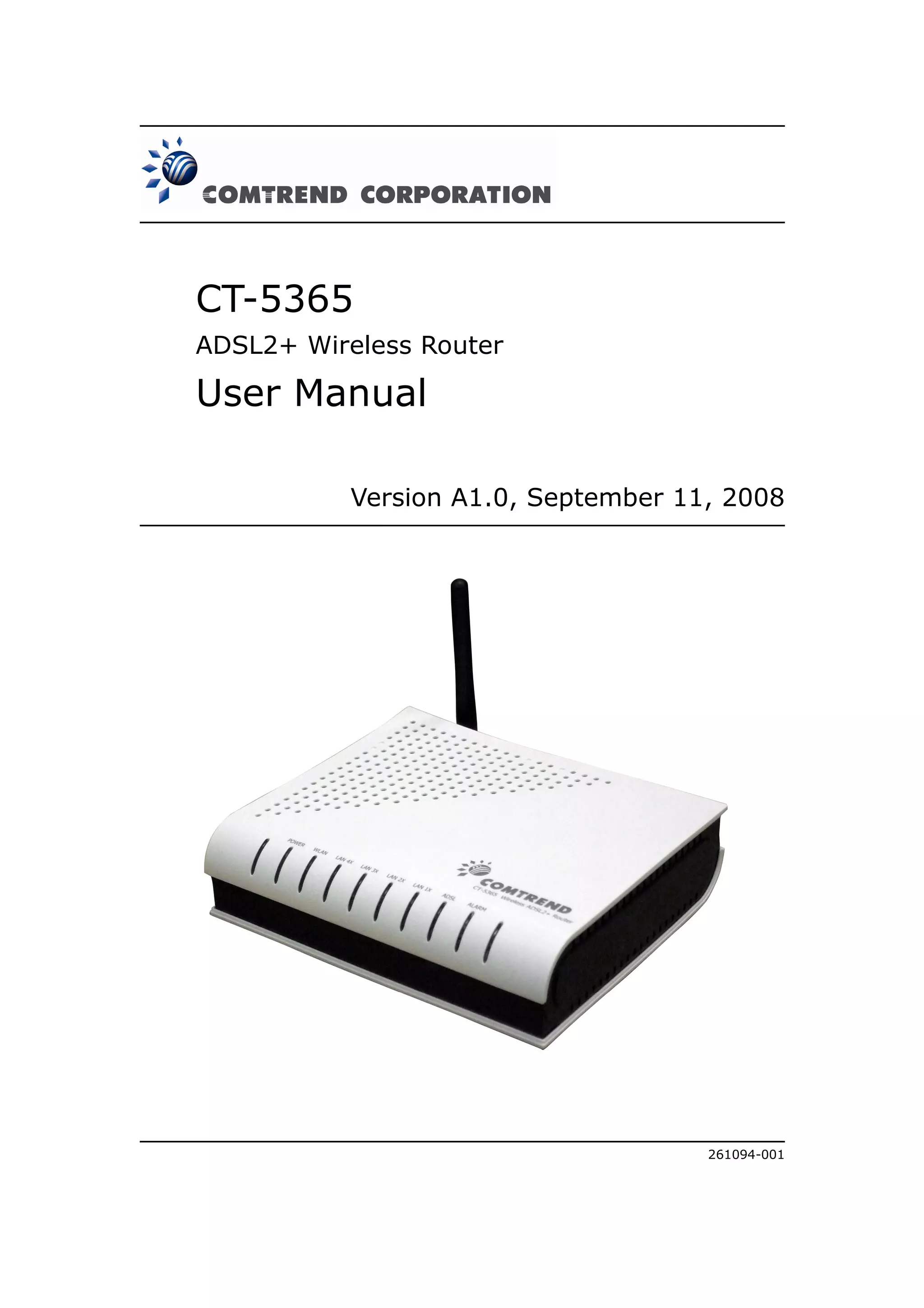
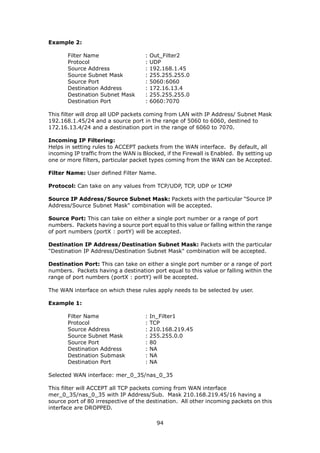
CT-5365
ADSL2+ Wireless Router

User Manual

           Version A1.0, September 11, 2008


                                     261094-001
Preface

This manual provides information related to the installation, operation, and
application of this device. The individual reading this manual is presumed to have a
basic understanding of telecommunications terminology and concepts.

If you find the product to be inoperable or malfunctioning, please contact technical
support for immediate service by email at INT-support@comtrend.com

For product update, new product release, manual revision, or software upgrades,
please visit our website at http://www.comtrend.com

Important Safety Instructions

With reference to unpacking, installation, use, and maintenance of your electronic
device, the following basic guidelines are recommended:

•   Do not use or install this product near water, to avoid fire or shock hazard. For
    example, near a bathtub, kitchen sink or laundry tub, or near a swimming pool.
    Also, do not expose the equipment to rain or damp areas (e.g. a wet basement).
•   Do not connect the power supply cord on elevated surfaces. Allow it to lie freely.
    There should be no obstructions in its path and no heavy items should be placed
    on the cord. In addition, do not walk on, step on, or mistreat the cord.
•   Use only the power cord and adapter that are shipped with this device.
•   To safeguard the equipment against overheating, make sure that all openings in
    the unit that offer exposure to air are not blocked.
•   Avoid using a telephone (other than a cordless type) during an electrical storm.
    There may be a remote risk of electric shock from lightening. Also, do not use
    the telephone to report a gas leak in the vicinity of the leak.
•   Never install telephone wiring during stormy weather conditions.

CAUTION:
•   To reduce the risk of fire, use only No. 26 AWG or larger telecommunication line
    cord.
•   Always disconnect all telephone lines from the wall outlet before servicing or
    disassembling this equipment.


     WARNING

          Disconnect the power line from the device before servicing.
          Power supply specifications are clearly stated in Appendix C.

Copyright

Copyright©2008 Comtrend Corporation. All rights reserved. The information
contained herein is proprietary to Comtrend Corporation. No part of this document
may be translated, transcribed, reproduced, in any form, or by any means without
prior written consent of Comtrend Corporation.

NOTE:          This document is subject to change without notice.


                                          1
Protect Our Environment


          This symbol indicates that when the equipment has reached the end of its
          useful life, it must be taken to a recycling centre and processed separate
          from domestic waste.

The cardboard box, the plastic contained in the packaging, and the parts that make
up this router can be recycled in accordance with regionally established regulations.
Never dispose of this electronic equipment along with your household waste. You
may be subject to penalties or sanctions under the law. Instead, ask for disposal
instructions from your municipal government.


                                         2
Table of Contents
CHAPTER 1 SUMMARY .....................................................................................................................5
 1.1 FEATURES ........................................................................................................................................5
 1.2 APPLICATION ...................................................................................................................................5
 1.3 LED INDICATORS.............................................................................................................................6
CHAPTER 2 INSTALLATION.............................................................................................................7
 2.1 HARDWARE INSTALLATION ..............................................................................................................7
CHAPTER 3 WEB USER INTERFACE..............................................................................................8
 3.1 DEFAULT SETTINGS .........................................................................................................................8
 3.2 IP CONFIGURATION ..........................................................................................................................8
 3.3 LOGIN PROCEDURE........................................................................................................................10
CHAPTER 4 QUICK SETUP.........................................................................................................12
 4.1 AUTO QUICK SETUP.......................................................................................................................12
 4.2 MANUAL QUICK SETUP .................................................................................................................13
    4.2.1   PPP over ATM (PPPoA) and PPP over Ethernet (PPPoE)............................................15
    4.2.2   MAC Encapsulation Routing (MER) ..............................................................................19
    4.2.3   IP Over ATM...................................................................................................................23
    4.2.4   Bridging..........................................................................................................................26
CHAPTER 5 DEVICE INFORMATION ......................................................................................28
 5.1 WAN .............................................................................................................................................29
 5.2 STATISTICS .....................................................................................................................................30
    5.2.1      LAN Statistics..................................................................................................................30
    5.2.2      WAN Statistics................................................................................................................. 31
    5.2.3      ATM statistics ................................................................................................................. 32
    5.2.4      ADSL Statistics ...............................................................................................................34
 5.3 ROUTE ...........................................................................................................................................37
 5.4 ARP...............................................................................................................................................38
 5.5 DHCP............................................................................................................................................38
CHAPTER 6 ADVANCED SETUP.....................................................................................................39
 6.1 WAN .............................................................................................................................................39
 6.2 LAN ..............................................................................................................................................40
 6.3 NAT ..............................................................................................................................................41
    6.3.1      Virtual Servers ................................................................................................................ 41
    6.3.2      Port Triggering ...............................................................................................................43
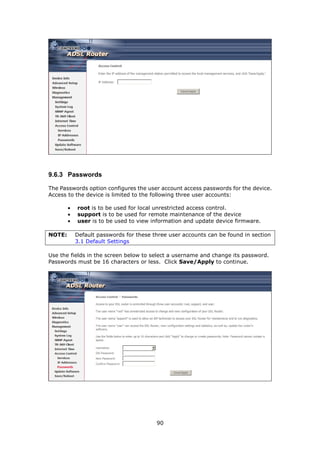
    6.3.3      DMZ Host ....................................................................................................................... 44
    6.3.4      ALG.................................................................................................................................45
 6.4 SECURITY ......................................................................................................................................45
    6.4.1      MAC Filtering.................................................................................................................45
    6.4.2      IP Filtering .....................................................................................................................47
    6.4.3      Parental Control .............................................................................................................50
 6.5 QUALITY OF SERVICE ....................................................................................................................51
 6.6 ROUTING .......................................................................................................................................54
    6.6.1      Default Gateway .............................................................................................................54
    6.6.2      Static Route.....................................................................................................................55
    6.6.3       RIP.................................................................................................................................56
 6.7 DNS ..............................................................................................................................................57
    6.7.1      DNS Server ..................................................................................................................... 57
    6.7.2      Dynamic DNS .................................................................................................................57
 6.8 DSL...............................................................................................................................................59
 6.9 PORT MAPPING ..............................................................................................................................60
 6.10 CERTIFICATE ................................................................................................................................62
    6.10.1 Local ...............................................................................................................................62
    6.10.2 Trusted CA ......................................................................................................................64
CHAPTER 7 WIRELESS....................................................................................................................65
 7.1 BASIC ............................................................................................................................................65
 7.2 SECURITY ......................................................................................................................................66

                                                                           3
7.3 MAC FILTER .................................................................................................................................74
   7.4 WIRELESS BRIDGE .........................................................................................................................75
   7.5 ADVANCED ....................................................................................................................................76
   7.6 QUALITY OF SERVICE ....................................................................................................................78
   7.7 STATION INFO ................................................................................................................................79
CHAPTER 8 DIAGNOSTICS.............................................................................................................80
CHAPTER 9 MANAGEMENT ..........................................................................................................82
 9.1 SETTINGS .......................................................................................................................................82
    9.1.1   Backup ............................................................................................................................82
    9.1.2   Update Settings...............................................................................................................83
    9.1.3   Restore Default ...............................................................................................................83
 9.2 SYSTEM LOG .................................................................................................................................84
 9.3 SNMP AGENT ............................................................................................................................... 86
 9.4 TR-069 CLIENT .............................................................................................................................87
 9.5 INTERNET TIME .............................................................................................................................88
 9.6 ACCESS CONTROL .........................................................................................................................88
    9.6.1   Services...........................................................................................................................88
    9.6.2   IP Addresses ...................................................................................................................89
    9.6.3   Passwords .......................................................................................................................90
 9.7 UPDATE SOFTWARE .......................................................................................................................91
 9.8 SAVE AND REBOOT ........................................................................................................................92
APPENDIX A: SECURITY.................................................................................................................93
APPENDIX B: PIN ASSIGNMENTS.................................................................................................97
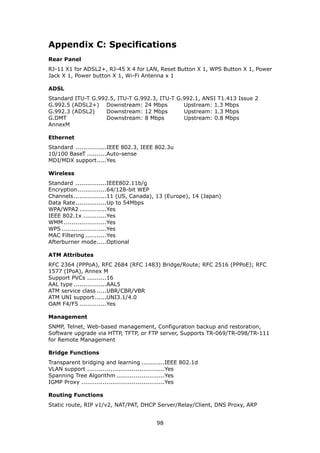
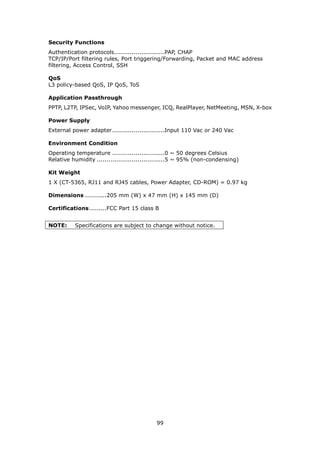
APPENDIX C: SPECIFICATIONS....................................................................................................98
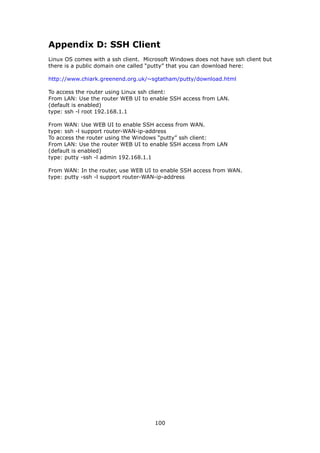
APPENDIX D: SSH CLIENT ...........................................................................................................100


                                                                          4
Chapter 1 Summary
Comtrend’s CT-5365 is an 802.11g (54Mbps) Wireless and Wired ADSL2+ Router. It
comes equipped with four 10/100 Base-T Ethernet ports and an ADSL2+ port for
wired connectivity. An integrated 802.11g WLAN Access Point (AP) with Wi-Fi
Protected Setup (WPS) provides wireless coverage.

The CT-5365 contains state of the art security features, such as WPA data
encryption, Firewall and VPN pass through. This model supports up to 16
contiguous virtual connections allowing for multiple simultaneous Internet
connections. The front and back panels are TR-068 compliant, which means they
are color-coded for easy installation and use. These features make the CT-5365
especially suited to a home or small business environment.


1.1 Features
   •   Dynamic IP assignment                 • Auto PVC configuration
   •   Up to 16 VCs                          • NAT/PAT
   •   IGMP Proxy                            • IP QoS & WMM
   •   Per-VC packet level QoS               • Static and RIP v1/v2 Routing
   •   MAC address and IP filtering          • DNS Proxy
   •   UPnP                                  • FTP/TFTP server
   •   RADIUS client                         • Web-based management
   •   Embedded SNMP agent                   • Firmware upgrade and configuration
   •   TR-069/TR-098/TR-111                  • DHCP Server/Relay/Client
   •   Remote administration                 • Backward compatible with 802.11b
   •   Configuration backup and restoration • Wi-Fi Protected Setup (WPS)
   •   Integrated 802.11g AP                 • WPA/WPA2 and 802.1x security
   •   Optional Turbo mode in wireless (After burner)


1.2 Application
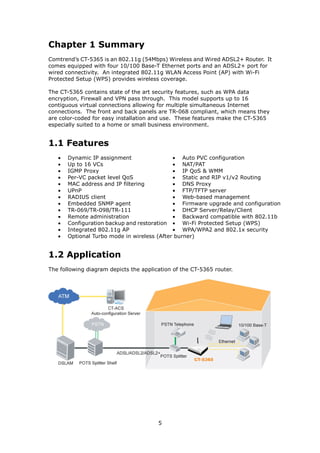
The following diagram depicts the application of the CT-5365 router.


                                        5
1.3 LED Indicators
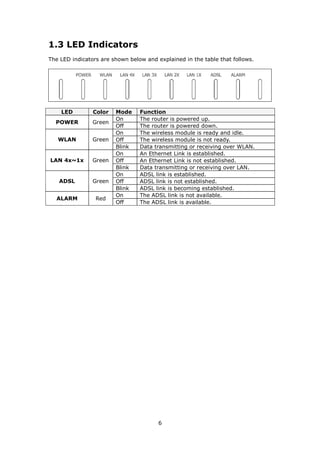
The LED indicators are shown below and explained in the table that follows.


    LED         Color   Mode     Function
                        On       The router is powered up.
  POWER         Green
                        Off      The router is powered down.
                        On       The wireless module is ready and idle.
   WLAN         Green   Off      The wireless module is not ready.
                        Blink    Data transmitting or receiving over WLAN.
                        On       An Ethernet Link is established.
LAN 4x~1x       Green   Off      An Ethernet Link is not established.
                        Blink    Data transmitting or receiving over LAN.
                        On       ADSL link is established.
   ADSL         Green   Off      ADSL link is not established.
                        Blink    ADSL link is becoming established.
                        On       The ADSL link is not available.
  ALARM          Red
                        Off      The ADSL link is available.


                                        6
Chapter 2 Installation

2.1 Hardware Installation
Follow the instructions below to complete the hardware installation.

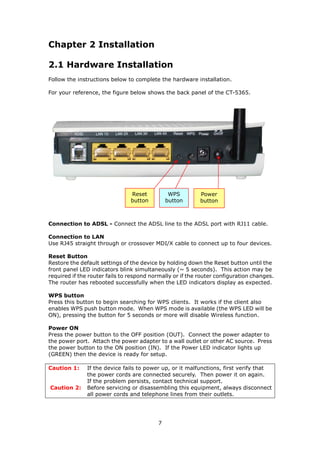
For your reference, the figure below shows the back panel of the CT-5365.


                                Reset          WPS         Power
                                button        button       button


Connection to ADSL - Connect the ADSL line to the ADSL port with RJ11 cable.

Connection to LAN
Use RJ45 straight through or crossover MDI/X cable to connect up to four devices.

Reset Button
Restore the default settings of the device by holding down the Reset button until the
front panel LED indicators blink simultaneously (~ 5 seconds). This action may be
required if the router fails to respond normally or if the router configuration changes.
The router has rebooted successfully when the LED indicators display as expected.

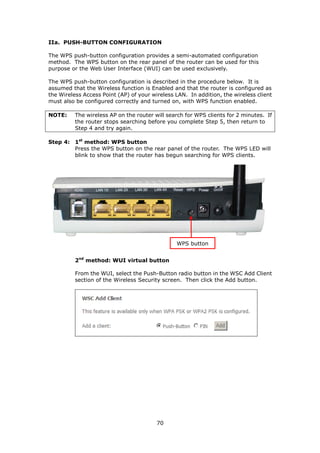
WPS button
Press this button to begin searching for WPS clients. It works if the client also
enables WPS push button mode. When WPS mode is available (the WPS LED will be
ON), pressing the button for 5 seconds or more will disable Wireless function.

Power ON
Press the power button to the OFF position (OUT). Connect the power adapter to
the power port. Attach the power adapter to a wall outlet or other AC source. Press
the power button to the ON position (IN). If the Power LED indicator lights up
(GREEN) then the device is ready for setup.

Caution 1:     If the device fails to power up, or it malfunctions, first verify that
               the power cords are connected securely. Then power it on again.
               If the problem persists, contact technical support.
Caution 2:     Before servicing or disassembling this equipment, always disconnect
               all power cords and telephone lines from their outlets.


                                          7
Chapter 3 Web User Interface
This section describes how to access the device via the web user interface using an
Internet browser such as Microsoft Internet Explorer (version 5.0 and later).


3.1 Default Settings
The following are the default settings for the device.

        •   Local (LAN) access (username: root , password: 12345)
        •   Remote (WAN) access (username: support, password: support)
        •   User access (username: user, password: user)
        •   LAN IP address: 192.168.1.1 - Subnet Mask: 255.255.255.0
        •   WAN IP address: none
        •   Remote WAN access: disabled (except for ICMP)
        •   NAT and Firewall: enabled for PPPoE/A, disabled for Bridge/MER/IPoA
        •   DHCP server on LAN interface: enabled
        •   Wireless Access enabled
        •   SSID: Comtrend
        •   Wireless authentication open (no authentication)

This device supports the following connection types.

        •   PPP over Ethernet (PPPoE)
        •   PPP over ATM (PPPoA)
        •   MAC Encapsulated Routing (MER)
        •   IP over ATM (IPoA)
        •   Bridging

Technical Note:
During power on, the device initializes all settings to default values. It will then read
the configuration profile from the permanent storage section of flash memory. The
default attributes are overwritten when identical attributes with different values are
configured. The configuration profile in permanent storage can be created via the
web user interface, telnet user interface, or other management protocols. The
factory default configuration can be restored either by pushing the reset button for
more than five seconds or by clicking the Restore Default Configuration button on
the Restore Settings screen of the web user interface.


3.2 IP Configuration
The following instructions describe how to set the IP configuration of the Ethernet
connection so that a computer can connect to the CT-5365. Once this connection is
established you will be able to access product features or manage the device using
the web user interface described herein, or by other methods (e.g. FTP/TFTP).

NOTE:       These instructions are written for a computer running Microsoft Windows
            XP SP2. For other operating systems (e.g. Windows Vista, Linux, etc.),
            the specific steps may vary but the general procedure is the same. Check
            the instructions provided with your operating system for further guidance.


                                           8
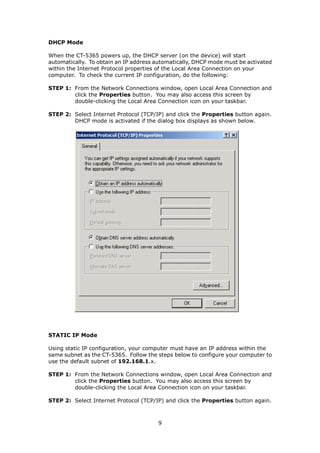
DHCP Mode

When the CT-5365 powers up, the DHCP server (on the device) will start
automatically. To obtain an IP address automatically, DHCP mode must be activated
within the Internet Protocol properties of the Local Area Connection on your
computer. To check the current IP configuration, do the following:

STEP 1: From the Network Connections window, open Local Area Connection and
        click the Properties button. You may also access this screen by
        double-clicking the Local Area Connection icon on your taskbar.

STEP 2: Select Internet Protocol (TCP/IP) and click the Properties button again.
        DHCP mode is activated if the dialog box displays as shown below.


STATIC IP Mode

Using static IP configuration, your computer must have an IP address within the
same subnet as the CT-5365. Follow the steps below to configure your computer to
use the default subnet of 192.168.1.x.

STEP 1: From the Network Connections window, open Local Area Connection and
        click the Properties button. You may also access this screen by
        double-clicking the Local Area Connection icon on your taskbar.

STEP 2: Select Internet Protocol (TCP/IP) and click the Properties button again.


                                       9
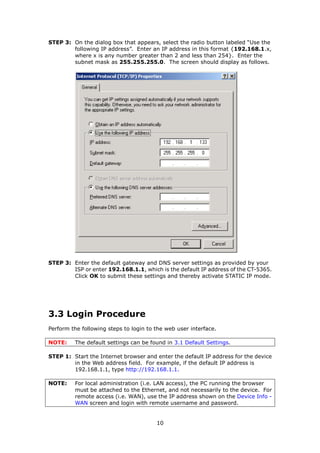
STEP 3: On the dialog box that appears, select the radio button labeled “Use the
        following IP address”. Enter an IP address in this format {192.168.1.x,
        where x is any number greater than 2 and less than 254}. Enter the
        subnet mask as 255.255.255.0. The screen should display as follows.


STEP 3: Enter the default gateway and DNS server settings as provided by your
        ISP or enter 192.168.1.1, which is the default IP address of the CT-5365.
        Click OK to submit these settings and thereby activate STATIC IP mode.


3.3 Login Procedure
Perform the following steps to login to the web user interface.

NOTE:    The default settings can be found in 3.1 Default Settings.

STEP 1: Start the Internet browser and enter the default IP address for the device
        in the Web address field. For example, if the default IP address is
        192.168.1.1, type http://192.168.1.1.

NOTE:    For local administration (i.e. LAN access), the PC running the browser
         must be attached to the Ethernet, and not necessarily to the device. For
         remote access (i.e. WAN), use the IP address shown on the Device Info -
         WAN screen and login with remote username and password.


                                        10
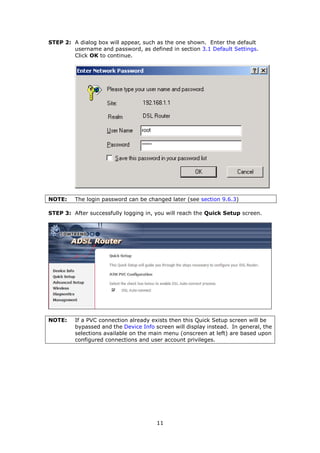
STEP 2: A dialog box will appear, such as the one shown. Enter the default
        username and password, as defined in section 3.1 Default Settings.
        Click OK to continue.


NOTE:    The login password can be changed later (see section 9.6.3)

STEP 3: After successfully logging in, you will reach the Quick Setup screen.


NOTE:    If a PVC connection already exists then this Quick Setup screen will be
         bypassed and the Device Info screen will display instead. In general, the
         selections available on the main menu (onscreen at left) are based upon
         configured connections and user account privileges.


                                       11
Chapter 4            Quick Setup
After login, the Quick Setup screen will appear. It is the default screen when no
connections exist. It allows for the configuration of DSL and IP settings.


4.1 Auto Quick Setup
This function provides an automated process to quickly setup a WAN connection.
The device will auto-detect the best PVC profile available, provided that the ADSL
link is up. For manual setup, please go to 4.2 Manual Quick Setup.

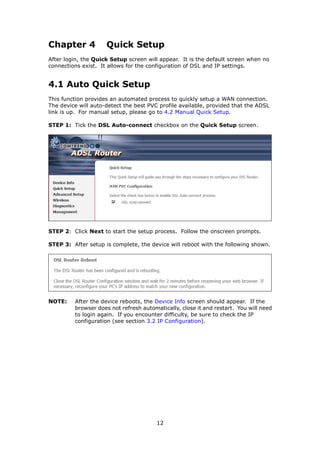
STEP 1: Tick the DSL Auto-connect checkbox on the Quick Setup screen.


STEP 2: Click Next to start the setup process. Follow the onscreen prompts.

STEP 3: After setup is complete, the device will reboot with the following shown.


NOTE:    After the device reboots, the Device Info screen should appear. If the
         browser does not refresh automatically, close it and restart. You will need
         to login again. If you encounter difficulty, be sure to check the IP
         configuration (see section 3.2 IP Configuration).


                                        12
4.2 Manual Quick Setup
To setup the router manually follow these instructions.

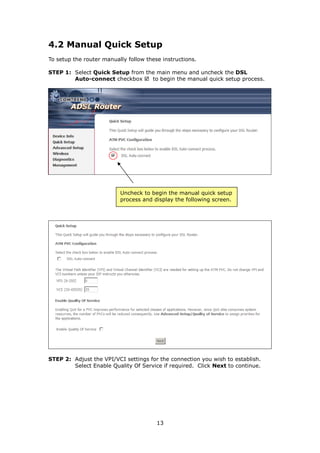
STEP 1: Select Quick Setup from the main menu and uncheck the DSL
        Auto-connect checkbox     to begin the manual quick setup process.


                          Uncheck to begin the manual quick setup
                          process and display the following screen.


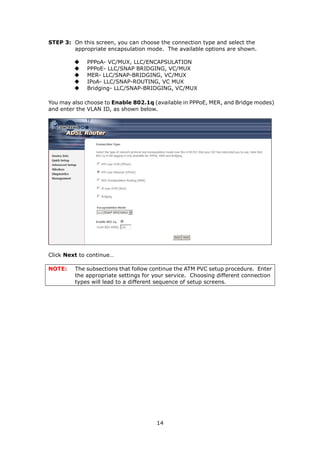
STEP 2: Adjust the VPI/VCI settings for the connection you wish to establish.
        Select Enable Quality Of Service if required. Click Next to continue.


                                        13
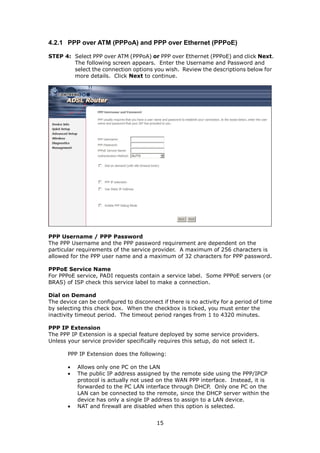
STEP 3: On this screen, you can choose the connection type and select the
        appropriate encapsulation mode. The available options are shown.

             PPPoA- VC/MUX, LLC/ENCAPSULATION
             PPPoE- LLC/SNAP BRIDGING, VC/MUX
             MER- LLC/SNAP-BRIDGING, VC/MUX
             IPoA- LLC/SNAP-ROUTING, VC MUX
             Bridging- LLC/SNAP-BRIDGING, VC/MUX

You may also choose to Enable 802.1q (available in PPPoE, MER, and Bridge modes)
and enter the VLAN ID, as shown below.


Click Next to continue…

NOTE:    The subsections that follow continue the ATM PVC setup procedure. Enter
         the appropriate settings for your service. Choosing different connection
         types will lead to a different sequence of setup screens.


                                      14
4.2.1 PPP over ATM (PPPoA) and PPP over Ethernet (PPPoE)

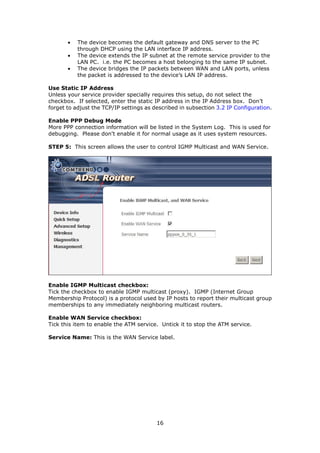
STEP 4: Select PPP over ATM (PPPoA) or PPP over Ethernet (PPPoE) and click Next.
        The following screen appears. Enter the Username and Password and
        select the connection options you wish. Review the descriptions below for
        more details. Click Next to continue.


PPP Username / PPP Password
The PPP Username and the PPP password requirement are dependent on the
particular requirements of the service provider. A maximum of 256 characters is
allowed for the PPP user name and a maximum of 32 characters for PPP password.

PPPoE Service Name
For PPPoE service, PADI requests contain a service label. Some PPPoE servers (or
BRAS) of ISP check this service label to make a connection.

Dial on Demand
The device can be configured to disconnect if there is no activity for a period of time
by selecting this check box. When the checkbox is ticked, you must enter the
inactivity timeout period. The timeout period ranges from 1 to 4320 minutes.

PPP IP Extension
The PPP IP Extension is a special feature deployed by some service providers.
Unless your service provider specifically requires this setup, do not select it.

       PPP IP Extension does the following:

       •   Allows only one PC on the LAN
       •   The public IP address assigned by the remote side using the PPP/IPCP
           protocol is actually not used on the WAN PPP interface. Instead, it is
           forwarded to the PC LAN interface through DHCP. Only one PC on the
           LAN can be connected to the remote, since the DHCP server within the
           device has only a single IP address to assign to a LAN device.
       •   NAT and firewall are disabled when this option is selected.


                                          15
•   The device becomes the default gateway and DNS server to the PC
           through DHCP using the LAN interface IP address.
       •   The device extends the IP subnet at the remote service provider to the
           LAN PC. i.e. the PC becomes a host belonging to the same IP subnet.
       •   The device bridges the IP packets between WAN and LAN ports, unless
           the packet is addressed to the device’s LAN IP address.

Use Static IP Address
Unless your service provider specially requires this setup, do not select the
checkbox. If selected, enter the static IP address in the IP Address box. Don’t
forget to adjust the TCP/IP settings as described in subsection 3.2 IP Configuration.

Enable PPP Debug Mode
More PPP connection information will be listed in the System Log. This is used for
debugging. Please don't enable it for normal usage as it uses system resources.

STEP 5: This screen allows the user to control IGMP Multicast and WAN Service.


Enable IGMP Multicast checkbox:
Tick the checkbox to enable IGMP multicast (proxy). IGMP (Internet Group
Membership Protocol) is a protocol used by IP hosts to report their multicast group
memberships to any immediately neighboring multicast routers.

Enable WAN Service checkbox:
Tick this item to enable the ATM service. Untick it to stop the ATM service.

Service Name: This is the WAN Service label.


                                         16
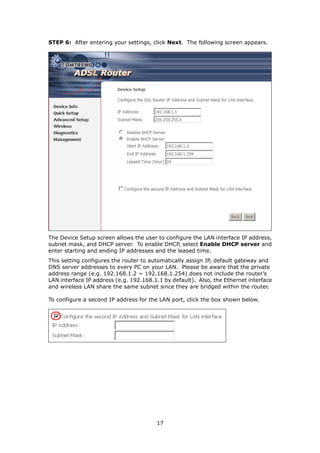
STEP 6: After entering your settings, click Next. The following screen appears.


The Device Setup screen allows the user to configure the LAN interface IP address,
subnet mask, and DHCP server. To enable DHCP, select Enable DHCP server and
enter starting and ending IP addresses and the leased time.
This setting configures the router to automatically assign IP, default gateway and
DNS server addresses to every PC on your LAN. Please be aware that the private
address range (e.g. 192.168.1.2 ~ 192.168.1.254) does not include the router’s
LAN interface IP address (e.g. 192.168.1.1 by default). Also, the Ethernet interface
and wireless LAN share the same subnet since they are bridged within the router.

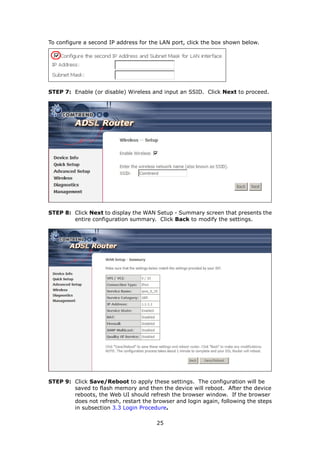
To configure a second IP address for the LAN port, click the box shown below.


                                        17
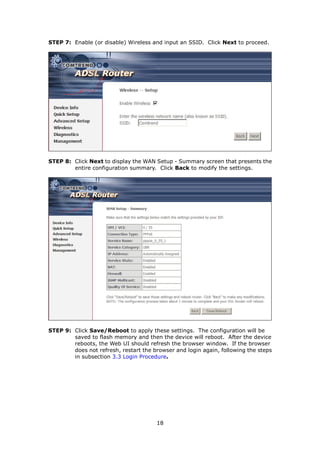
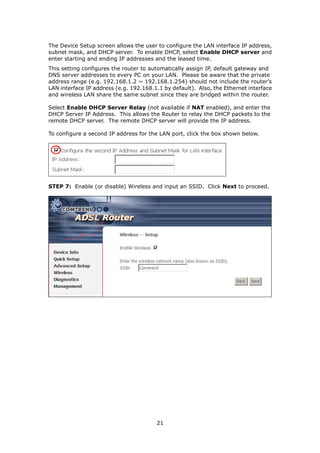
STEP 7: Enable (or disable) Wireless and input an SSID. Click Next to proceed.


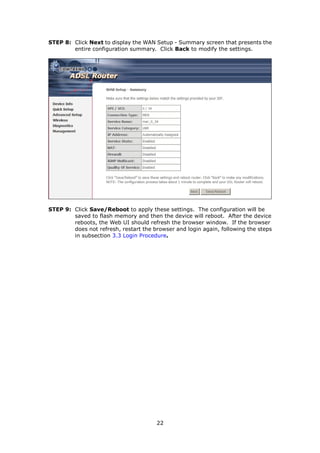
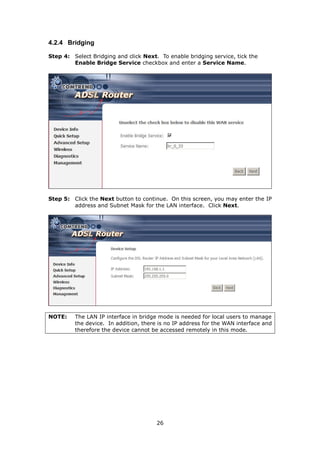
STEP 8: Click Next to display the WAN Setup - Summary screen that presents the
        entire configuration summary. Click Back to modify the settings.


STEP 9: Click Save/Reboot to apply these settings. The configuration will be
        saved to flash memory and then the device will reboot. After the device
        reboots, the Web UI should refresh the browser window. If the browser
        does not refresh, restart the browser and login again, following the steps
        in subsection 3.3 Login Procedure.


                                       18
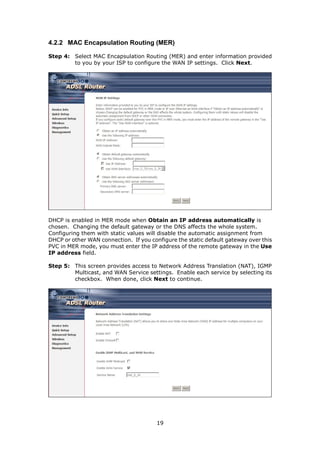
4.2.2 MAC Encapsulation Routing (MER)

Step 4: Select MAC Encapsulation Routing (MER) and enter information provided
        to you by your ISP to configure the WAN IP settings. Click Next.


DHCP is enabled in MER mode when Obtain an IP address automatically is
chosen. Changing the default gateway or the DNS affects the whole system.
Configuring them with static values will disable the automatic assignment from
DHCP or other WAN connection. If you configure the static default gateway over this
PVC in MER mode, you must enter the IP address of the remote gateway in the Use
IP address field.

Step 5: This screen provides access to Network Address Translation (NAT), IGMP
        Multicast, and WAN Service settings. Enable each service by selecting its
        checkbox. When done, click Next to continue.


                                        19
Enable NAT
If the LAN is configured with a private IP address, the user should select this
checkbox. The NAT submenu will display after the next reboot. The user can then
configure NAT-related features. If a private IP address is not used on the LAN side,
this checkbox should not be selected so as to free up system resources.

Enable Firewall
If the firewall checkbox is selected, the Security submenu will display after the next
reboot. The user can then configure firewall features. If the firewall is not used, this
checkbox should not be selected so as to free up system resources.

Enable IGMP Multicast (Proxy): Tick the checkbox to enable IGMP multicast.
IGMP (Internet Group Membership Protocol) is a protocol used by IP hosts to report
their multicast group memberships to any immediately neighboring multicast
routers.

Enable WAN Service: Tick the checkbox to enable WAN service.

Service Name: This is the WAN Service label.

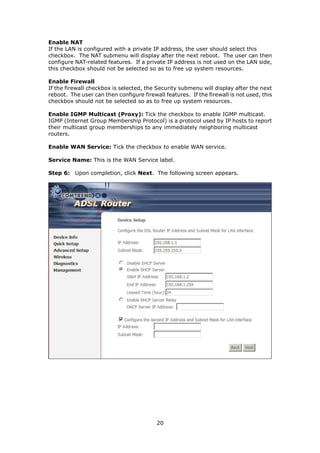
Step 6: Upon completion, click Next. The following screen appears.


                                          20
The Device Setup screen allows the user to configure the LAN interface IP address,
subnet mask, and DHCP server. To enable DHCP, select Enable DHCP server and
enter starting and ending IP addresses and the leased time.
This setting configures the router to automatically assign IP, default gateway and
DNS server addresses to every PC on your LAN. Please be aware that the private
address range (e.g. 192.168.1.2 ~ 192.168.1.254) should not include the router’s
LAN interface IP address (e.g. 192.168.1.1 by default). Also, the Ethernet interface
and wireless LAN share the same subnet since they are bridged within the router.

Select Enable DHCP Server Relay (not available if NAT enabled), and enter the
DHCP Server IP Address. This allows the Router to relay the DHCP packets to the
remote DHCP server. The remote DHCP server will provide the IP address.

To configure a second IP address for the LAN port, click the box shown below.


STEP 7: Enable (or disable) Wireless and input an SSID. Click Next to proceed.


                                        21
STEP 8: Click Next to display the WAN Setup - Summary screen that presents the
        entire configuration summary. Click Back to modify the settings.


STEP 9: Click Save/Reboot to apply these settings. The configuration will be
        saved to flash memory and then the device will reboot. After the device
        reboots, the Web UI should refresh the browser window. If the browser
        does not refresh, restart the browser and login again, following the steps
        in subsection 3.3 Login Procedure.


                                       22
4.2.3 IP Over ATM

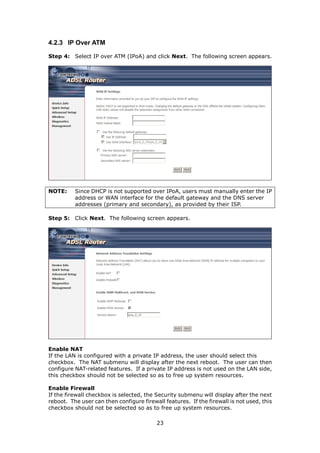
Step 4: Select IP over ATM (IPoA) and click Next. The following screen appears.


NOTE:     Since DHCP is not supported over IPoA, users must manually enter the IP
          address or WAN interface for the default gateway and the DNS server
          addresses (primary and secondary), as provided by their ISP.

Step 5: Click Next. The following screen appears.


Enable NAT
If the LAN is configured with a private IP address, the user should select this
checkbox. The NAT submenu will display after the next reboot. The user can then
configure NAT-related features. If a private IP address is not used on the LAN side,
this checkbox should not be selected so as to free up system resources.

Enable Firewall
If the firewall checkbox is selected, the Security submenu will display after the next
reboot. The user can then configure firewall features. If the firewall is not used, this
checkbox should not be selected so as to free up system resources.

                                          23
Enable IGMP Multicast (Proxy): Tick the checkbox to enable IGMP multicast.
IGMP (Internet Group Membership Protocol) is a protocol used by IP hosts to report
their multicast group memberships to any immediately neighboring multicast
routers.

Enable WAN Service: Tick the checkbox to enable WAN service.

Service Name: This is the WAN Service label.

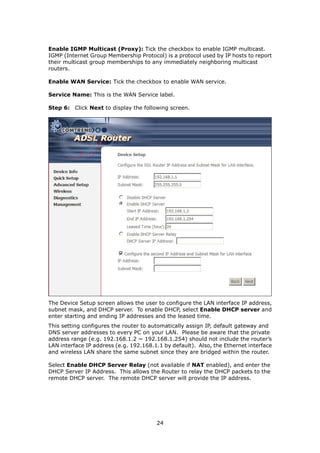
Step 6: Click Next to display the following screen.


The Device Setup screen allows the user to configure the LAN interface IP address,
subnet mask, and DHCP server. To enable DHCP, select Enable DHCP server and
enter starting and ending IP addresses and the leased time.
This setting configures the router to automatically assign IP, default gateway and
DNS server addresses to every PC on your LAN. Please be aware that the private
address range (e.g. 192.168.1.2 ~ 192.168.1.254) should not include the router’s
LAN interface IP address (e.g. 192.168.1.1 by default). Also, the Ethernet interface
and wireless LAN share the same subnet since they are bridged within the router.

Select Enable DHCP Server Relay (not available if NAT enabled), and enter the
DHCP Server IP Address. This allows the Router to relay the DHCP packets to the
remote DHCP server. The remote DHCP server will provide the IP address.


                                        24
To configure a second IP address for the LAN port, click the box shown below.


STEP 7: Enable (or disable) Wireless and input an SSID. Click Next to proceed.


STEP 8: Click Next to display the WAN Setup - Summary screen that presents the
        entire configuration summary. Click Back to modify the settings.


STEP 9: Click Save/Reboot to apply these settings. The configuration will be
        saved to flash memory and then the device will reboot. After the device
        reboots, the Web UI should refresh the browser window. If the browser
        does not refresh, restart the browser and login again, following the steps
        in subsection 3.3 Login Procedure.

                                       25
4.2.4 Bridging

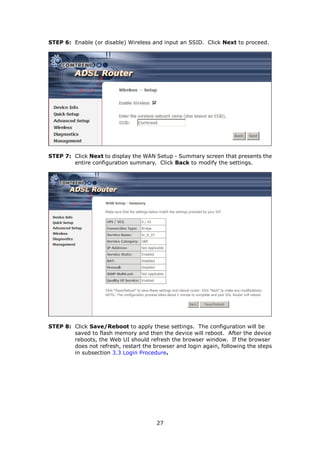
Step 4: Select Bridging and click Next. To enable bridging service, tick the
        Enable Bridge Service checkbox and enter a Service Name.


Step 5: Click the Next button to continue. On this screen, you may enter the IP
        address and Subnet Mask for the LAN interface. Click Next.


NOTE:    The LAN IP interface in bridge mode is needed for local users to manage
         the device. In addition, there is no IP address for the WAN interface and
         therefore the device cannot be accessed remotely in this mode.


                                       26
STEP 6: Enable (or disable) Wireless and input an SSID. Click Next to proceed.


STEP 7: Click Next to display the WAN Setup - Summary screen that presents the
        entire configuration summary. Click Back to modify the settings.


STEP 8: Click Save/Reboot to apply these settings. The configuration will be
        saved to flash memory and then the device will reboot. After the device
        reboots, the Web UI should refresh the browser window. If the browser
        does not refresh, restart the browser and login again, following the steps
        in subsection 3.3 Login Procedure.


                                       27
Chapter 5             Device Information
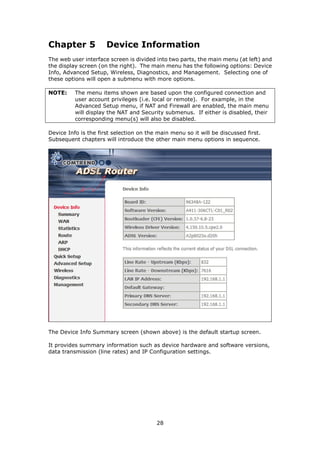
The web user interface screen is divided into two parts, the main menu (at left) and
the display screen (on the right). The main menu has the following options: Device
Info, Advanced Setup, Wireless, Diagnostics, and Management. Selecting one of
these options will open a submenu with more options.

NOTE:     The menu items shown are based upon the configured connection and
          user account privileges (i.e. local or remote). For example, in the
          Advanced Setup menu, if NAT and Firewall are enabled, the main menu
          will display the NAT and Security submenus. If either is disabled, their
          corresponding menu(s) will also be disabled.

Device Info is the first selection on the main menu so it will be discussed first.
Subsequent chapters will introduce the other main menu options in sequence.


The Device Info Summary screen (shown above) is the default startup screen.

It provides summary information such as device hardware and software versions,
data transmission (line rates) and IP Configuration settings.


                                         28
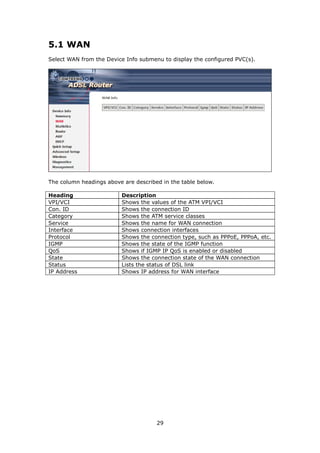
5.1 WAN
Select WAN from the Device Info submenu to display the configured PVC(s).


The column headings above are described in the table below.

Heading                   Description
VPI/VCI                   Shows the values of the ATM VPI/VCI
Con. ID                   Shows the connection ID
Category                  Shows the ATM service classes
Service                   Shows the name for WAN connection
Interface                 Shows connection interfaces
Protocol                  Shows the connection type, such as PPPoE, PPPoA, etc.
IGMP                      Shows the state of the IGMP function
QoS                       Shows if IGMP IP QoS is enabled or disabled
State                     Shows the connection state of the WAN connection
Status                    Lists the status of DSL link
IP Address                Shows IP address for WAN interface


                                      29
5.2 Statistics
The Statistics submenu provides detailed information for LAN and WAN interfaces.

NOTE:    These statistics refresh every 15 seconds.


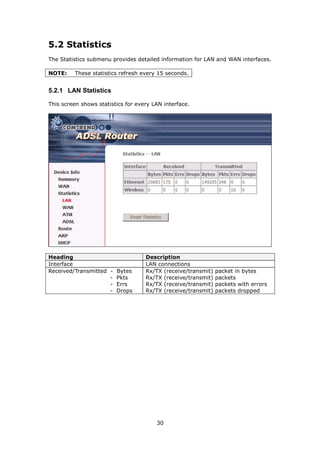
5.2.1 LAN Statistics

This screen shows statistics for every LAN interface.


Heading                             Description
Interface                           LAN connections
Received/Transmitted -   Bytes      Rx/TX (receive/transmit)   packet in bytes
                     -   Pkts       Rx/TX (receive/transmit)   packets
                     -   Errs       Rx/TX (receive/transmit)   packets with errors
                     -   Drops      Rx/TX (receive/transmit)   packets dropped


                                        30
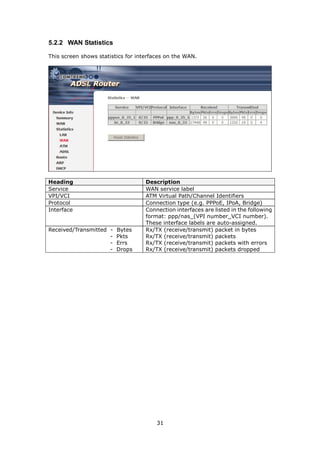
5.2.2 WAN Statistics

This screen shows statistics for interfaces on the WAN.


Heading                             Description
Service                             WAN service label
VPI/VCI                             ATM Virtual Path/Channel Identifiers
Protocol                            Connection type (e.g. PPPoE, IPoA, Bridge)
Interface                           Connection interfaces are listed in the following
                                    format: ppp/nas_(VPI number_VCI number).
                                    These interface labels are auto-assigned.
Received/Transmitted -   Bytes      Rx/TX (receive/transmit) packet in bytes
                     -   Pkts       Rx/TX (receive/transmit) packets
                     -   Errs       Rx/TX (receive/transmit) packets with errors
                     -   Drops      Rx/TX (receive/transmit) packets dropped


                                        31
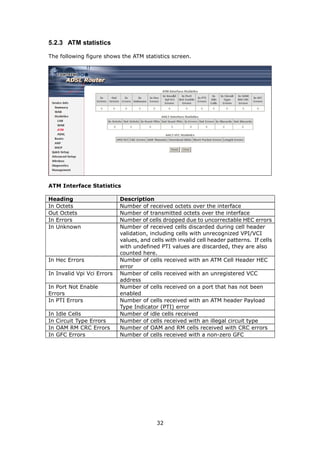
5.2.3 ATM statistics

The following figure shows the ATM statistics screen.


ATM Interface Statistics

Heading                     Description
In Octets                   Number of received octets over the interface
Out Octets                  Number of transmitted octets over the interface
In Errors                   Number of cells dropped due to uncorrectable HEC errors
In Unknown                  Number of received cells discarded during cell header
                            validation, including cells with unrecognized VPI/VCI
                            values, and cells with invalid cell header patterns. If cells
                            with undefined PTI values are discarded, they are also
                            counted here.
In Hec Errors               Number of cells received with an ATM Cell Header HEC
                            error
In Invalid Vpi Vci Errors   Number of cells received with an unregistered VCC
                            address
In Port Not Enable          Number of cells received on a port that has not been
Errors                      enabled
In PTI Errors               Number of cells received with an ATM header Payload
                            Type Indicator (PTI) error
In   Idle Cells             Number of idle cells received
In   Circuit Type Errors    Number of cells received with an illegal circuit type
In   OAM RM CRC Errors      Number of OAM and RM cells received with CRC errors
In   GFC Errors             Number of cells received with a non-zero GFC


                                          32
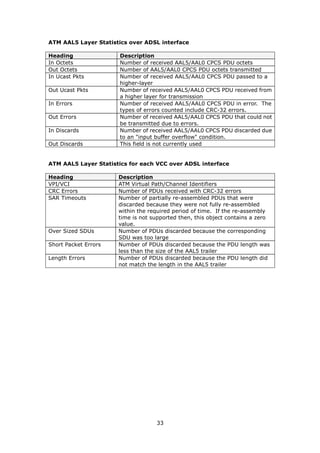
ATM AAL5 Layer Statistics over ADSL interface

Heading               Description
In Octets             Number of received AAL5/AAL0 CPCS PDU octets
Out Octets            Number of AAL5/AAL0 CPCS PDU octets transmitted
In Ucast Pkts         Number of received AAL5/AAL0 CPCS PDU passed to a
                      higher-layer
Out Ucast Pkts        Number of received AAL5/AAL0 CPCS PDU received from
                      a higher layer for transmission
In Errors             Number of received AAL5/AAL0 CPCS PDU in error. The
                      types of errors counted include CRC-32 errors.
Out Errors            Number of received AAL5/AAL0 CPCS PDU that could not
                      be transmitted due to errors.
In Discards           Number of received AAL5/AAL0 CPCS PDU discarded due
                      to an "input buffer overflow" condition.
Out Discards          This field is not currently used


ATM AAL5 Layer Statistics for each VCC over ADSL interface

Heading               Description
VPI/VCI               ATM Virtual Path/Channel Identifiers
CRC Errors            Number of PDUs received with CRC-32 errors
SAR Timeouts          Number of partially re-assembled PDUs that were
                      discarded because they were not fully re-assembled
                      within the required period of time. If the re-assembly
                      time is not supported then, this object contains a zero
                      value.
Over Sized SDUs       Number of PDUs discarded because the corresponding
                      SDU was too large
Short Packet Errors   Number of PDUs discarded because the PDU length was
                      less than the size of the AAL5 trailer
Length Errors         Number of PDUs discarded because the PDU length did
                      not match the length in the AAL5 trailer


                                   33
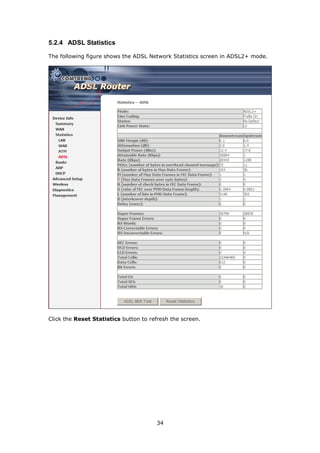
5.2.4 ADSL Statistics

The following figure shows the ADSL Network Statistics screen in ADSL2+ mode.


Click the Reset Statistics button to refresh the screen.


                                       34
Heading                   Description
Mode                      T1.413, G.lite, G.DMT, ADSL2/2+ or Re-ADSL
Type                      Channel type Interleave or Fast (not shown in all
                          modes)
Line Coding               Line Coding format, that can be selected G.dmt, G.lite,
                          T1.413, ADSL2, Annex L and Annex M
Status                    Lists the status of the DSL link
Link Power State          Link output power state.

SNR Margin (dB)           Signal to Noise Ratio (SNR) margin
Attenuation (dB)          Estimate of average loop attenuation in the
                          downstream direction.
Output Power (dBm)        Total upstream output power
Attainable Rate (Kbps)    The sync rate you would obtain.
Rate (Kbps)               Current sync rate.

In G.DMT mode, the following section is inserted.
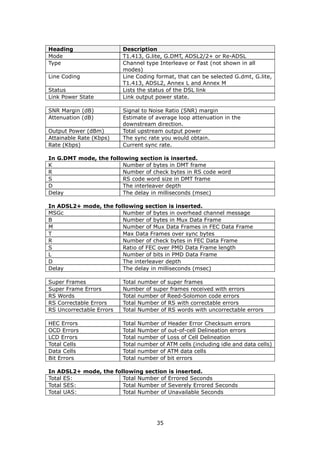
K                       Number of bytes in DMT frame
R                       Number of check bytes in RS code word
S                       RS code word size in DMT frame
D                       The interleaver depth
Delay                   The delay in milliseconds (msec)

In ADSL2+ mode, the following section is inserted.
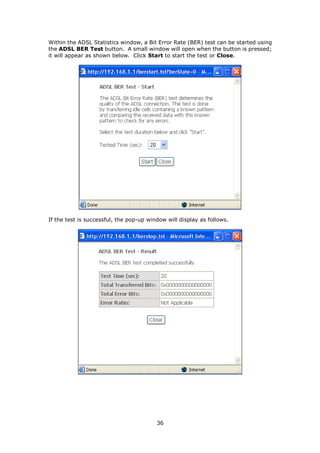
MSGc                   Number of bytes in overhead channel message
B                      Number of bytes in Mux Data Frame
M                      Number of Mux Data Frames in FEC Data Frame
T                      Max Data Frames over sync bytes
R                      Number of check bytes in FEC Data Frame
S                      Ratio of FEC over PMD Data Frame length
L                      Number of bits in PMD Data Frame
D                      The interleaver depth
Delay                  The delay in milliseconds (msec)

Super Frames              Total number of super frames
Super Frame Errors        Number of super frames received with errors
RS Words                  Total number of Reed-Solomon code errors
RS Correctable Errors     Total Number of RS with correctable errors
RS Uncorrectable Errors   Total Number of RS words with uncorrectable errors

HEC Errors                Total   Number of Header Error Checksum errors
OCD Errors                Total   Number of out-of-cell Delineation errors
LCD Errors                Total   number of Loss of Cell Delineation
Total Cells               Total   number of ATM cells (including idle and data cells)
Data Cells                Total   number of ATM data cells
Bit Errors                Total   number of bit errors

In ADSL2+ mode, the following section is inserted.
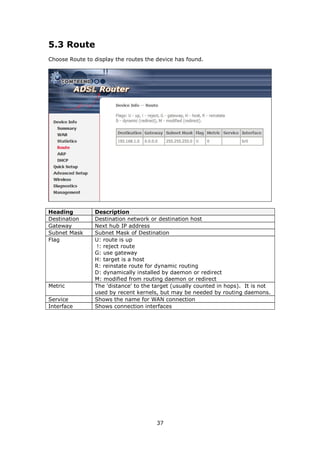
Total ES:              Total Number of Errored Seconds
Total SES:             Total Number of Severely Errored Seconds
Total UAS:             Total Number of Unavailable Seconds


                                         35
Within the ADSL Statistics window, a Bit Error Rate (BER) test can be started using
the ADSL BER Test button. A small window will open when the button is pressed;
it will appear as shown below. Click Start to start the test or Close.


If the test is successful, the pop-up window will display as follows.


                                         36
5.3 Route
Choose Route to display the routes the device has found.


Heading         Description
Destination     Destination network or destination host
Gateway         Next hub IP address
Subnet Mask     Subnet Mask of Destination
Flag            U: route is up
                 !: reject route
                G: use gateway
                H: target is a host
                R: reinstate route for dynamic routing
                D: dynamically installed by daemon or redirect
                M: modified from routing daemon or redirect
Metric          The 'distance' to the target (usually counted in hops). It is not
                used by recent kernels, but may be needed by routing daemons.
Service         Shows the name for WAN connection
Interface       Shows connection interfaces


                                       37
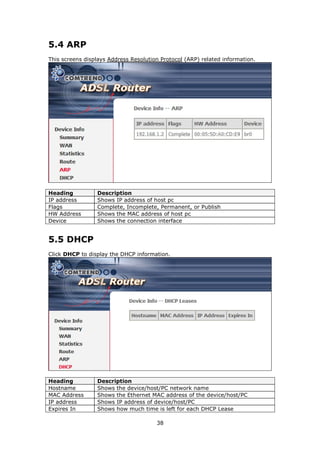
5.4 ARP
This screens displays Address Resolution Protocol (ARP) related information.


Heading          Description
IP address       Shows IP address of host pc
Flags            Complete, Incomplete, Permanent, or Publish
HW Address       Shows the MAC address of host pc
Device           Shows the connection interface


5.5 DHCP
Click DHCP to display the DHCP information.


Heading          Description
Hostname         Shows the device/host/PC network name
MAC Address      Shows the Ethernet MAC address of the device/host/PC
IP address       Shows IP address of device/host/PC
Expires In       Shows how much time is left for each DHCP Lease

                                       38
Chapter 6 Advanced Setup
This chapter explains the following advanced setup screens:


                   6.1 WAN                  6.6 Routing
                   6.2 LAN                  6.7 DNS
                   6.3 NAT                  6.8 DSL
                   6.4 Security             6.9 Port Mapping
                   6.5 Quality of Service   6.10 Certificate


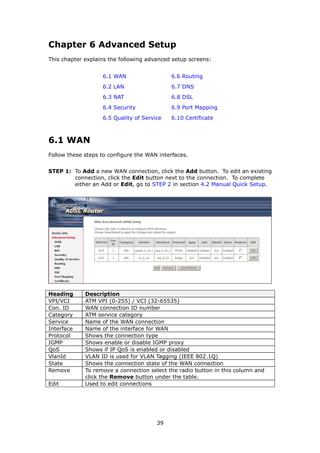
6.1 WAN
Follow these steps to configure the WAN interfaces.


STEP 1: To Add a new WAN connection, click the Add button. To edit an existing
        connection, click the Edit button next to the connection. To complete
        either an Add or Edit, go to STEP 2 in section 4.2 Manual Quick Setup.


Heading      Description
VPI/VCI      ATM VPI (0-255) / VCI (32-65535)
Con. ID      WAN connection ID number
Category     ATM service category
Service      Name of the WAN connection
Interface    Name of the interface for WAN
Protocol     Shows the connection type
IGMP         Shows enable or disable IGMP proxy
QoS          Shows if IP QoS is enabled or disabled
VlanId       VLAN ID is used for VLAN Tagging (IEEE 802.1Q)
State        Shows the connection state of the WAN connection
Remove       To remove a connection select the radio button in this column and
             click the Remove button under the table.
Edit         Used to edit connections


                                       39
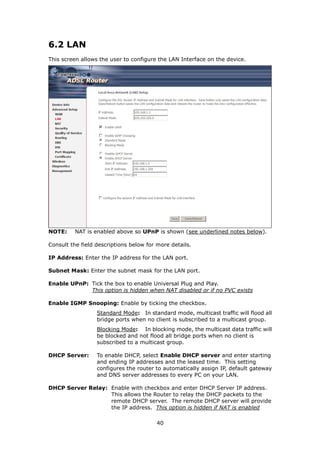
6.2 LAN
This screen allows the user to configure the LAN Interface on the device.


NOTE:     NAT is enabled above so UPnP is shown (see underlined notes below).

Consult the field descriptions below for more details.

IP Address: Enter the IP address for the LAN port.

Subnet Mask: Enter the subnet mask for the LAN port.

Enable UPnP: Tick the box to enable Universal Plug and Play.
             This option is hidden when NAT disabled or if no PVC exists

Enable IGMP Snooping: Enable by ticking the checkbox.
                  Standard Mode: In standard mode, multicast traffic will flood all
                  bridge ports when no client is subscribed to a multicast group.
                  Blocking Mode: In blocking mode, the multicast data traffic will
                  be blocked and not flood all bridge ports when no client is
                  subscribed to a multicast group.

DHCP Server:      To enable DHCP, select Enable DHCP server and enter starting
                  and ending IP addresses and the leased time. This setting
                  configures the router to automatically assign IP, default gateway
                  and DNS server addresses to every PC on your LAN.

DHCP Server Relay: Enable with checkbox and enter DHCP Server IP address.
                   This allows the Router to relay the DHCP packets to the
                   remote DHCP server. The remote DHCP server will provide
                   the IP address. This option is hidden if NAT is enabled

                                        40
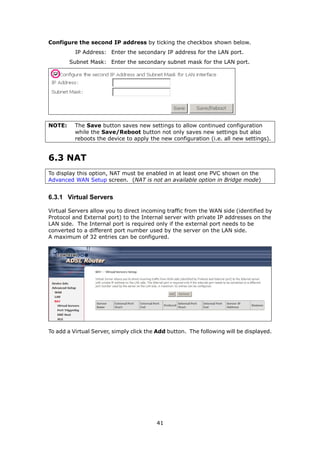
Configure the second IP address by ticking the checkbox shown below.
          IP Address: Enter the secondary IP address for the LAN port.
        Subnet Mask: Enter the secondary subnet mask for the LAN port.


NOTE:     The Save button saves new settings to allow continued configuration
          while the Save/Reboot button not only saves new settings but also
          reboots the device to apply the new configuration (i.e. all new settings).


6.3 NAT
To display this option, NAT must be enabled in at least one PVC shown on the
Advanced WAN Setup screen. (NAT is not an available option in Bridge mode)


6.3.1 Virtual Servers

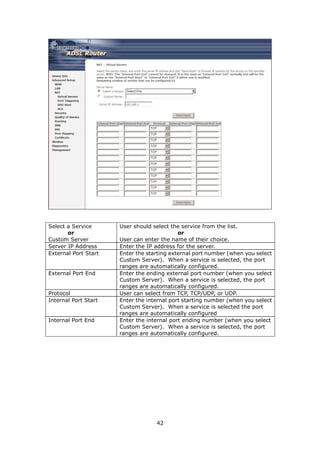
Virtual Servers allow you to direct incoming traffic from the WAN side (identified by
Protocol and External port) to the Internal server with private IP addresses on the
LAN side. The Internal port is required only if the external port needs to be
converted to a different port number used by the server on the LAN side.
A maximum of 32 entries can be configured.


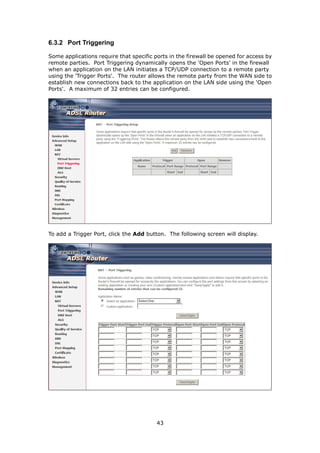
To add a Virtual Server, simply click the Add button. The following will be displayed.


                                         41
Select a Service      User should select the service from the list.
       or                                   or
Custom Server         User can enter the name of their choice.
Server IP Address     Enter the IP address for the server.
External Port Start   Enter the starting external port number (when you select
                      Custom Server). When a service is selected, the port
                      ranges are automatically configured.
External Port End     Enter the ending external port number (when you select
                      Custom Server). When a service is selected, the port
                      ranges are automatically configured.
Protocol              User can select from TCP, TCP/UDP, or UDP.
Internal Port Start   Enter the internal port starting number (when you select
                      Custom Server). When a service is selected the port
                      ranges are automatically configured
Internal Port End     Enter the internal port ending number (when you select
                      Custom Server). When a service is selected, the port
                      ranges are automatically configured.


                                   42
6.3.2 Port Triggering

Some applications require that specific ports in the firewall be opened for access by
remote parties. Port Triggering dynamically opens the 'Open Ports' in the firewall
when an application on the LAN initiates a TCP/UDP connection to a remote party
using the 'Trigger Ports'. The router allows the remote party from the WAN side to
establish new connections back to the application on the LAN side using the 'Open
Ports'. A maximum of 32 entries can be configured.


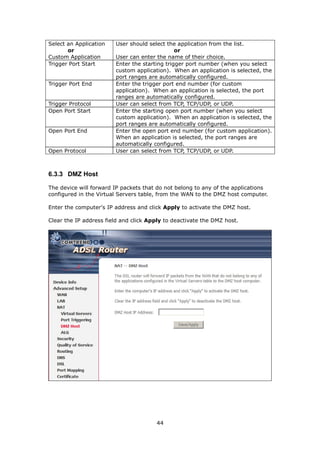
To add a Trigger Port, click the Add button. The following screen will display.


                                         43
Select an Application   User should select the application from the list.
       or                                      or
Custom Application      User can enter the name of their choice.
Trigger Port Start      Enter the starting trigger port number (when you select
                        custom application). When an application is selected, the
                        port ranges are automatically configured.
Trigger Port End        Enter the trigger port end number (for custom
                        application). When an application is selected, the port
                        ranges are automatically configured.
Trigger Protocol        User can select from TCP, TCP/UDP, or UDP.
Open Port Start         Enter the starting open port number (when you select
                        custom application). When an application is selected, the
                        port ranges are automatically configured.
Open Port End           Enter the open port end number (for custom application).
                        When an application is selected, the port ranges are
                        automatically configured.
Open Protocol           User can select from TCP, TCP/UDP, or UDP.


6.3.3 DMZ Host

The device will forward IP packets that do not belong to any of the applications
configured in the Virtual Servers table, from the WAN to the DMZ host computer.

Enter the computer's IP address and click Apply to activate the DMZ host.

Clear the IP address field and click Apply to deactivate the DMZ host.


                                       44
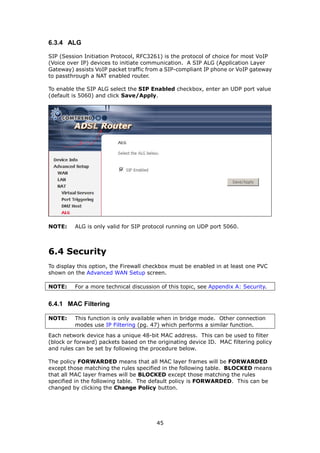
6.3.4 ALG

SIP (Session Initiation Protocol, RFC3261) is the protocol of choice for most VoIP
(Voice over IP) devices to initiate communication. A SIP ALG (Application Layer
Gateway) assists VoIP packet traffic from a SIP-compliant IP phone or VoIP gateway
to passthrough a NAT enabled router.

To enable the SIP ALG select the SIP Enabled checkbox, enter an UDP port value
(default is 5060) and click Save/Apply.


NOTE:    ALG is only valid for SIP protocol running on UDP port 5060.


6.4 Security
To display this option, the Firewall checkbox must be enabled in at least one PVC
shown on the Advanced WAN Setup screen.

NOTE:    For a more technical discussion of this topic, see Appendix A: Security.


6.4.1 MAC Filtering

NOTE:    This function is only available when in bridge mode. Other connection
         modes use IP Filtering (pg. 47) which performs a similar function.
Each network device has a unique 48-bit MAC address. This can be used to filter
(block or forward) packets based on the originating device ID. MAC filtering policy
and rules can be set by following the procedure below.

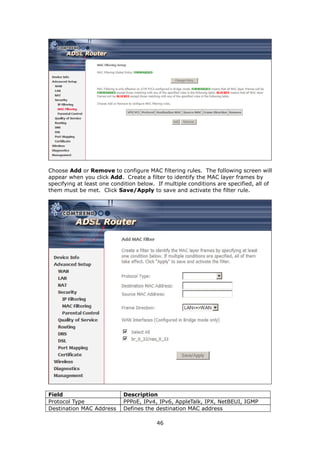
The policy FORWARDED means that all MAC layer frames will be FORWARDED
except those matching the rules specified in the following table. BLOCKED means
that all MAC layer frames will be BLOCKED except those matching the rules
specified in the following table. The default policy is FORWARDED. This can be
changed by clicking the Change Policy button.


                                        45
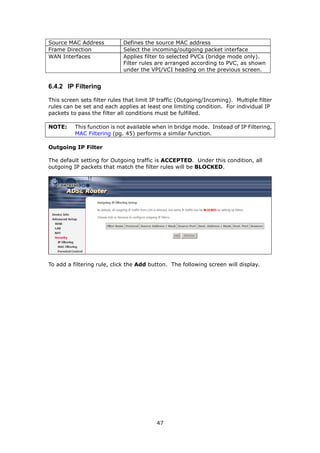
Choose Add or Remove to configure MAC filtering rules. The following screen will
appear when you click Add. Create a filter to identify the MAC layer frames by
specifying at least one condition below. If multiple conditions are specified, all of
them must be met. Click Save/Apply to save and activate the filter rule.


Field                       Description
Protocol Type               PPPoE, IPv4, IPv6, AppleTalk, IPX, NetBEUI, IGMP
Destination MAC Address     Defines the destination MAC address

                                         46
Source MAC Address           Defines the source MAC address
Frame Direction              Select the incoming/outgoing packet interface
WAN Interfaces               Applies filter to selected PVCs (bridge mode only).
                             Filter rules are arranged according to PVC, as shown
                             under the VPI/VCI heading on the previous screen.


6.4.2 IP Filtering

This screen sets filter rules that limit IP traffic (Outgoing/Incoming). Multiple filter
rules can be set and each applies at least one limiting condition. For individual IP
packets to pass the filter all conditions must be fulfilled.

NOTE:     This function is not available when in bridge mode. Instead of IP Filtering,
          MAC Filtering (pg. 45) performs a similar function.

Outgoing IP Filter

The default setting for Outgoing traffic is ACCEPTED. Under this condition, all
outgoing IP packets that match the filter rules will be BLOCKED.


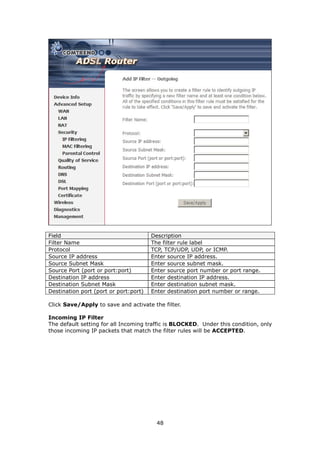
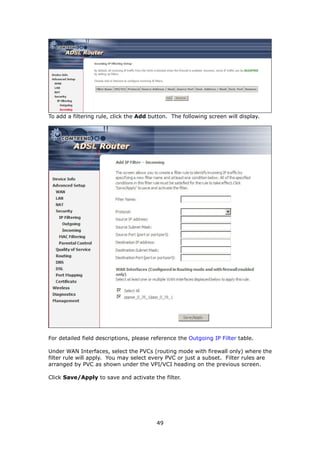
To add a filtering rule, click the Add button. The following screen will display.


                                          47
Field                                  Description
Filter Name                            The filter rule label
Protocol                               TCP, TCP/UDP, UDP, or ICMP.
Source IP address                      Enter source IP address.
Source Subnet Mask                     Enter source subnet mask.
Source Port (port or port:port)        Enter source port number or port range.
Destination IP address                 Enter destination IP address.
Destination Subnet Mask                Enter destination subnet mask.
Destination port (port or port:port)   Enter destination port number or range.

Click Save/Apply to save and activate the filter.

Incoming IP Filter
The default setting for all Incoming traffic is BLOCKED. Under this condition, only
those incoming IP packets that match the filter rules will be ACCEPTED.


                                         48
To add a filtering rule, click the Add button. The following screen will display.


For detailed field descriptions, please reference the Outgoing IP Filter table.

Under WAN Interfaces, select the PVCs (routing mode with firewall only) where the
filter rule will apply. You may select every PVC or just a subset. Filter rules are
arranged by PVC as shown under the VPI/VCI heading on the previous screen.

Click Save/Apply to save and activate the filter.


                                         49
6.4.3 Parental Control

This feature restricts access from a LAN device to an outside network through the
device on selected days at certain times. Make sure to activate the Internet Time
server synchronization as described in section 9.5 Internet Time, so that the
scheduled times match your local time.


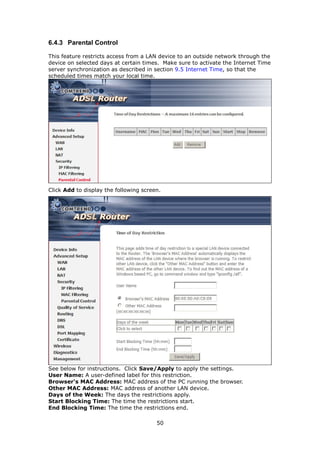
Click Add to display the following screen.


See below for instructions. Click Save/Apply to apply the settings.
User Name: A user-defined label for this restriction.
Browser's MAC Address: MAC address of the PC running the browser.
Other MAC Address: MAC address of another LAN device.
Days of the Week: The days the restrictions apply.
Start Blocking Time: The time the restrictions start.
End Blocking Time: The time the restrictions end.

                                        50
6.5 Quality of Service
NOTE:     QoS must be enabled in at least one PVC to display this option.
          (see Advanced WAN Setup for detailed PVC setup instructions).


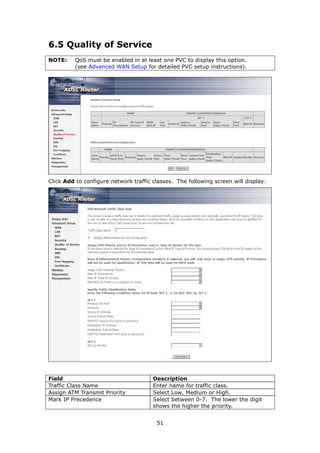
Click Add to configure network traffic classes. The following screen will display:


Field                                  Description
Traffic Class Name                     Enter name for traffic class.
Assign ATM Transmit Priority           Select Low, Medium or High.
Mark IP Precedence                     Select between 0-7. The lower the digit
                                       shows the higher the priority.


                                        51
Mark IP Type Of Service                Select either: Normal Service, Minimize
                                       Cost, Maximize Reliability, Maximize
                                       Throughput, Minimize Delay
Mark 802.1p if 802.1q is enabled on    Select between 0-7. The lower the digit
 WAN                                   shows the higher the priority.
SET-1
Physical LAN Port                      Select between eth0, Wireless and
                                       Wireless_Guest.
Protocol                               TCP, TCP/UDP, UDP, or ICMP.
Source IP Address                      Enter the source IP address.
Source Subnet Mask                     Enter the subnet mask for the source IP
                                       address.
Source Port (port or port:port)        Enter source port number or port range.
Destination IP address                 Enter destination IP address.
Destination Subnet Mask                Enter destination subnet mask.
Destination Port (port or port:port)   Enter destination port number or port range.
SET-2
802.1p Priority                        Select between 0-7. The lower the digit
                                       shows the higher the priority


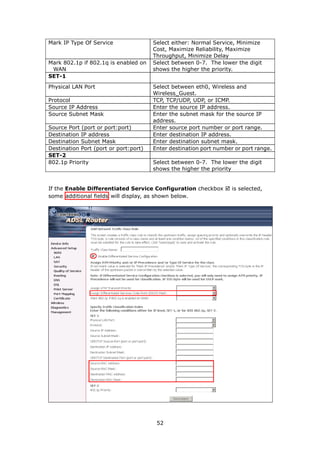
If the Enable Differentiated Service Configuration checkbox         is selected,
some additional fields will display, as shown below.


                                        52
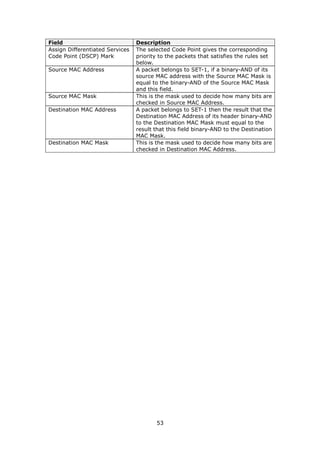
Field                            Description
Assign Differentiated Services   The selected Code Point gives the corresponding
Code Point (DSCP) Mark           priority to the packets that satisfies the rules set
                                 below.
Source MAC Address               A packet belongs to SET-1, if a binary-AND of its
                                 source MAC address with the Source MAC Mask is
                                 equal to the binary-AND of the Source MAC Mask
                                 and this field.
Source MAC Mask                  This is the mask used to decide how many bits are
                                 checked in Source MAC Address.
Destination MAC Address          A packet belongs to SET-1 then the result that the
                                 Destination MAC Address of its header binary-AND
                                 to the Destination MAC Mask must equal to the
                                 result that this field binary-AND to the Destination
                                 MAC Mask.
Destination MAC Mask             This is the mask used to decide how many bits are
                                 checked in Destination MAC Address.


                                        53
6.6 Routing
This option allows for Default Gateway, Static Route, and RIP configuration.

NOTE:    In bridge mode, the RIP screen is hidden while the Default Gateway and
         Static Route configuration screens are shown but ineffective.


6.6.1 Default Gateway

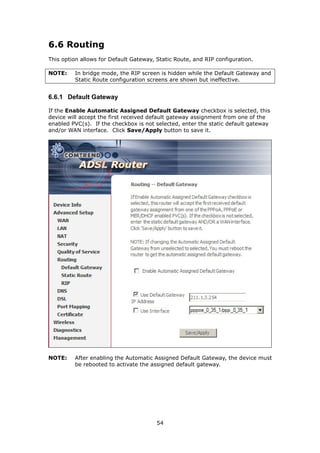
If the Enable Automatic Assigned Default Gateway checkbox is selected, this
device will accept the first received default gateway assignment from one of the
enabled PVC(s). If the checkbox is not selected, enter the static default gateway
and/or WAN interface. Click Save/Apply button to save it.


NOTE:    After enabling the Automatic Assigned Default Gateway, the device must
         be rebooted to activate the assigned default gateway.


                                        54
6.6.2 Static Route

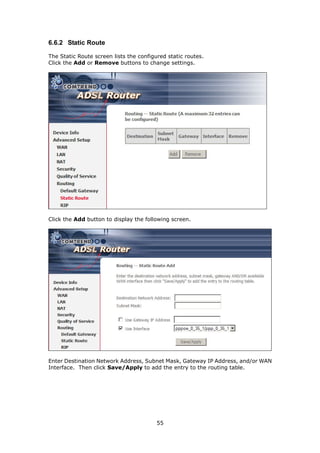
The Static Route screen lists the configured static routes.
Click the Add or Remove buttons to change settings.


Click the Add button to display the following screen.


Enter Destination Network Address, Subnet Mask, Gateway IP Address, and/or WAN
Interface. Then click Save/Apply to add the entry to the routing table.


                                         55
6.6.3   RIP

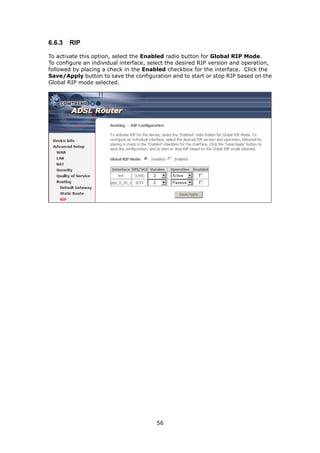
To activate this option, select the Enabled radio button for Global RIP Mode.
To configure an individual interface, select the desired RIP version and operation,
followed by placing a check in the Enabled checkbox for the interface. Click the
Save/Apply button to save the configuration and to start or stop RIP based on the
Global RIP mode selected.


                                        56
6.7 DNS

6.7.1 DNS Server

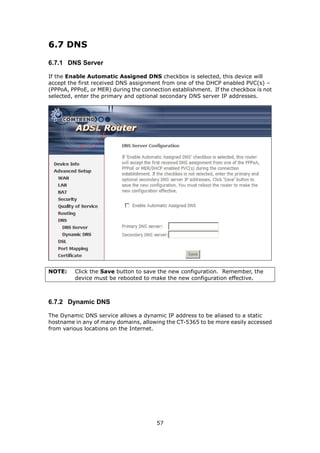
If the Enable Automatic Assigned DNS checkbox is selected, this device will
accept the first received DNS assignment from one of the DHCP enabled PVC(s) –
(PPPoA, PPPoE, or MER) during the connection establishment. If the checkbox is not
selected, enter the primary and optional secondary DNS server IP addresses.


NOTE:    Click the Save button to save the new configuration. Remember, the
         device must be rebooted to make the new configuration effective.


6.7.2 Dynamic DNS

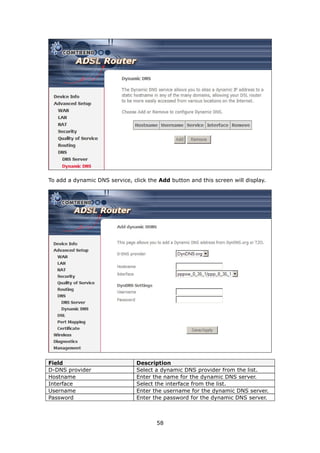
The Dynamic DNS service allows a dynamic IP address to be aliased to a static
hostname in any of many domains, allowing the CT-5365 to be more easily accessed
from various locations on the Internet.


                                       57
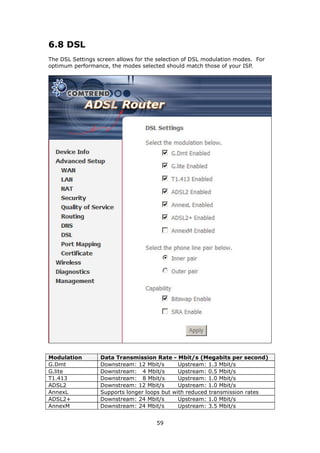
To add a dynamic DNS service, click the Add button and this screen will display.


Field                           Description
D-DNS provider                  Select a dynamic DNS provider from the list.
Hostname                        Enter the name for the dynamic DNS server.
Interface                       Select the interface from the list.
Username                        Enter the username for the dynamic DNS server.
Password                        Enter the password for the dynamic DNS server.


                                       58
6.8 DSL
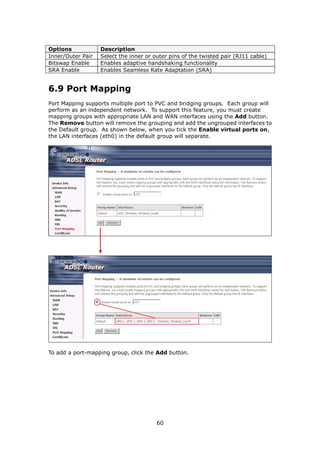
The DSL Settings screen allows for the selection of DSL modulation modes. For
optimum performance, the modes selected should match those of your ISP.


Modulation        Data Transmission Rate - Mbit/s (Megabits per second)
G.Dmt             Downstream: 12 Mbit/s       Upstream: 1.3 Mbit/s
G.lite            Downstream: 4 Mbit/s        Upstream: 0.5 Mbit/s
T1.413            Downstream: 8 Mbit/s        Upstream: 1.0 Mbit/s
ADSL2             Downstream: 12 Mbit/s       Upstream: 1.0 Mbit/s
AnnexL            Supports longer loops but with reduced transmission rates
ADSL2+            Downstream: 24 Mbit/s       Upstream: 1.0 Mbit/s
AnnexM            Downstream: 24 Mbit/s       Upstream: 3.5 Mbit/s


                                      59
Options            Description
Inner/Outer Pair   Select the inner or outer pins of the twisted pair (RJ11 cable)
Bitswap Enable     Enables adaptive handshaking functionality
SRA Enable         Enables Seamless Rate Adaptation (SRA)


6.9 Port Mapping
Port Mapping supports multiple port to PVC and bridging groups. Each group will
perform as an independent network. To support this feature, you must create
mapping groups with appropriate LAN and WAN interfaces using the Add button.
The Remove button will remove the grouping and add the ungrouped interfaces to
the Default group. As shown below, when you tick the Enable virtual ports on,
the LAN interfaces (eth0) in the default group will separate.


To add a port-mapping group, click the Add button.


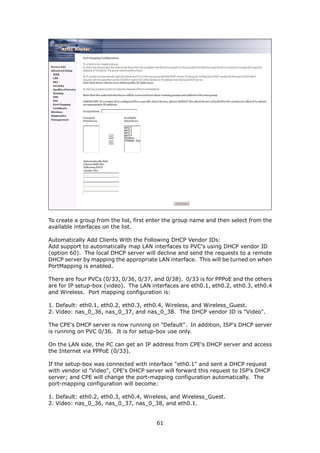
                                        60
To create a group from the list, first enter the group name and then select from the
available interfaces on the list.

Automatically Add Clients With the Following DHCP Vendor IDs:
Add support to automatically map LAN interfaces to PVC's using DHCP vendor ID
(option 60). The local DHCP server will decline and send the requests to a remote
DHCP server by mapping the appropriate LAN interface. This will be turned on when
PortMapping is enabled.

There are four PVCs (0/33, 0/36, 0/37, and 0/38). 0/33 is for PPPoE and the others
are for IP setup-box (video). The LAN interfaces are eth0.1, eth0.2, eth0.3, eth0.4
and Wireless. Port mapping configuration is:

1. Default: eth0.1, eth0.2, eth0.3, eth0.4, Wireless, and Wireless_Guest.
2. Video: nas_0_36, nas_0_37, and nas_0_38. The DHCP vendor ID is "Video".

The CPE's DHCP server is now running on "Default". In addition, ISP's DHCP server
is running on PVC 0/36. It is for setup-box use only.

On the LAN side, the PC can get an IP address from CPE's DHCP server and access
the Internet via PPPoE (0/33).

If the setup-box was connected with interface "eth0.1" and sent a DHCP request
with vendor id "Video", CPE's DHCP server will forward this request to ISP's DHCP
server; and CPE will change the port-mapping configuration automatically. The
port-mapping configuration will become:

1. Default: eth0.2, eth0.3, eth0.4, Wireless, and Wireless_Guest.
2. Video: nas_0_36, nas_0_37, nas_0_38, and eth0.1.


                                        61
6.10 Certificate
A certificate is a public key, attached with its owner’s information (company name,
server name, personal real name, contact e-mail, postal address, etc) and digital
signatures. There will be one or more digital signatures attached to the certificate,
indicating that these entities have verified that this certificate is valid.


6.10.1 Local


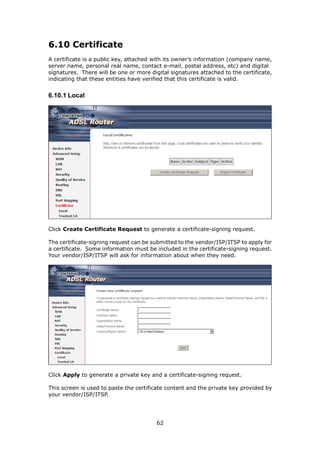
Click Create Certificate Request to generate a certificate-signing request.

The certificate-signing request can be submitted to the vendor/ISP/ITSP to apply for
a certificate. Some information must be included in the certificate-signing request.
Your vendor/ISP/ITSP will ask for information about when they need.


Click Apply to generate a private key and a certificate-signing request.

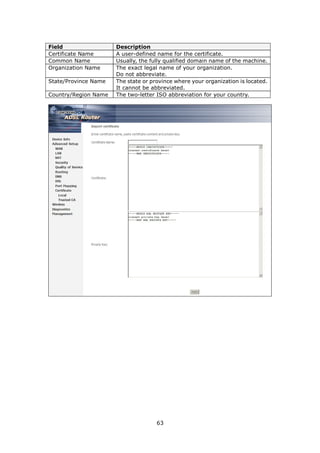
This screen is used to paste the certificate content and the private key provided by
your vendor/ISP/ITSP.


                                         62
Field                 Description
Certificate Name      A user-defined name for the certificate.
Common Name           Usually, the fully qualified domain name of the machine.
Organization Name     The exact legal name of your organization.
                      Do not abbreviate.
State/Province Name   The state or province where your organization is located.
                      It cannot be abbreviated.
Country/Region Name   The two-letter ISO abbreviation for your country.


                                     63
6.10.2 Trusted CA

CA is the abbreviation for Certificate Authority. CA is a part of the X.509 system. It
is itself a certificate, attached with the owner information of this certificate authority;
but its purpose is not to do encryption/decryption. Its purpose is to sign and issue
certificates in order to prove that the certificate is valid.


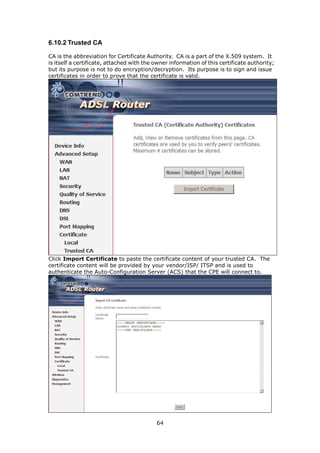
Click Import Certificate to paste the certificate content of your trusted CA. The
certificate content will be provided by your vendor/ISP/ ITSP and is used to
authenticate the Auto-Configuration Server (ACS) that the CPE will connect to.


                                           64
Chapter 7 Wireless
The Wireless submenu provides access to WLAN configuration settings including
wireless network name, channel restrictions (based on country), security, and
quality of services features, access point or bridging behavior and station info.


7.1 Basic
The Basic option allows you to configure basic features of the wireless LAN interface.
You can enable or disable the wireless LAN interface, hide the network from active
scans, set the wireless network name (also known as SSID) and restrict the channel
set based on country requirements.
Click Save/Apply to configure the basic wireless options.


Field               Description
Enable Wireless     A checkbox that enables (default) or disables the wireless
                    LAN interface. When selected, the Web UI displays Hide
                    Access point, SSID, BSSID and Country settings.
Hide Access Point   Select Hide Access Point to protect the access point from
                    detection by wireless active scans. To check AP status in
                    Windows XP, open Network Connections from the start
                    Menu and select View Available Network Connections.
                    If the access point is hidden, it will not be listed there. To
                    connect a client to a hidden access point, the station must
                    add the access point manually to its wireless configuration.
SSID                Sets the wireless network name. SSID stands for Service Set
                    Identifier. All stations must be configured with the correct
[1-32 characters]   SSID to access the WLAN. If the SSID does not match, that
                    user will not be granted access.
BSSID               The BSSID is a 48-bit identity used to identify a particular
                    BSS (Basic Service Set) within an area. In Infrastructure BSS
                    networks, the BSSID is the MAC (Media Access Control)
                    address of the AP (Access Point); and in Independent BSS or
                    ad hoc networks, the BSSID is generated randomly.


                                         65
Country             A drop-down menu that permits worldwide and specific
                    national settings. Each country listed below enforces specific
                    regulations limiting channel range:
                    • US= worldwide
                    • Japan=1-14
                    • Jordan= 10-13
                    • Israel= 1-13
Wireless            The Guest SSID (Virtual Access Point) can be enabled by
Guest               selecting the Enable Wireless Guest Network checkbox.
Network             Rename the Wireless Guest Network as you wish.
                    NOTE: Remote wireless hosts cannot scan Guest SSIDs.


7.2 Security
WIRELESS SECURITY

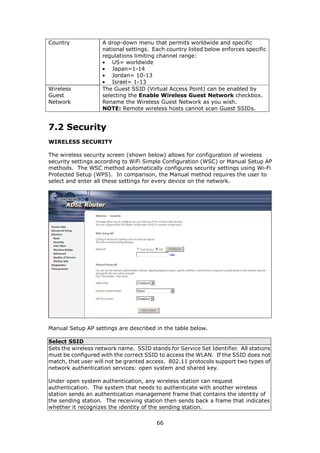
The wireless security screen (shown below) allows for configuration of wireless
security settings according to WiFi Simple Configuration (WSC) or Manual Setup AP
methods. The WSC method automatically configures security settings using Wi-Fi
Protected Setup (WPS). In comparison, the Manual method requires the user to
select and enter all these settings for every device on the network.


Manual Setup AP settings are described in the table below.

Select SSID
Sets the wireless network name. SSID stands for Service Set Identifier. All stations
must be configured with the correct SSID to access the WLAN. If the SSID does not
match, that user will not be granted access. 802.11 protocols support two types of
network authentication services: open system and shared key.

Under open system authentication, any wireless station can request
authentication. The system that needs to authenticate with another wireless
station sends an authentication management frame that contains the identity of
the sending station. The receiving station then sends back a frame that indicates
whether it recognizes the identity of the sending station.

                                        66
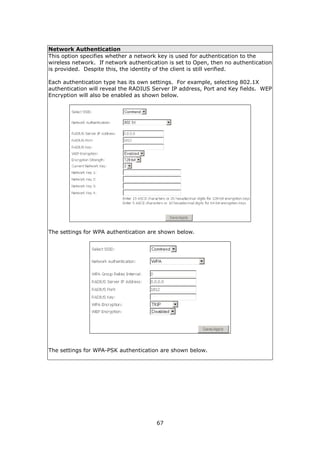
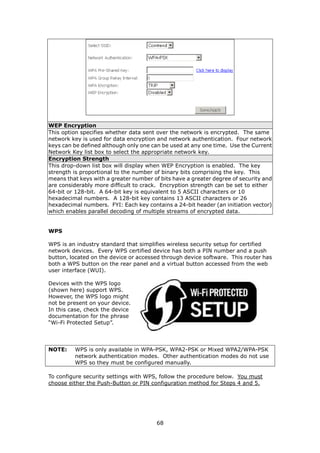
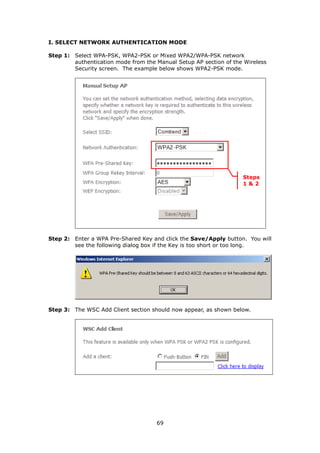
Network Authentication
This option specifies whether a network key is used for authentication to the
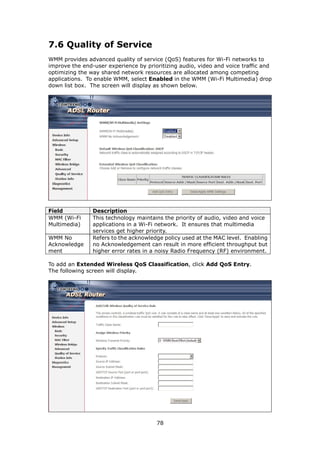
wireless network. If network authentication is set to Open, then no authentication
is provided. Despite this, the identity of the client is still verified.

Each authentication type has its own settings. For example, selecting 802.1X
authentication will reveal the RADIUS Server IP address, Port and Key fields. WEP
Encryption will also be enabled as shown below.


The settings for WPA authentication are shown below.


The settings for WPA-PSK authentication are shown below.


                                       67
WEP Encryption
This option specifies whether data sent over the network is encrypted. The same
network key is used for data encryption and network authentication. Four network
keys can be defined although only one can be used at any one time. Use the Current
Network Key list box to select the appropriate network key.
Encryption Strength
This drop-down list box will display when WEP Encryption is enabled. The key
strength is proportional to the number of binary bits comprising the key. This
means that keys with a greater number of bits have a greater degree of security and
are considerably more difficult to crack. Encryption strength can be set to either
64-bit or 128-bit. A 64-bit key is equivalent to 5 ASCII characters or 10
hexadecimal numbers. A 128-bit key contains 13 ASCII characters or 26
hexadecimal numbers. FYI: Each key contains a 24-bit header (an initiation vector)
which enables parallel decoding of multiple streams of encrypted data.


WPS

WPS is an industry standard that simplifies wireless security setup for certified
network devices. Every WPS certified device has both a PIN number and a push
button, located on the device or accessed through device software. This router has
both a WPS button on the rear panel and a virtual button accessed from the web
user interface (WUI).

Devices with the WPS logo
(shown here) support WPS.
However, the WPS logo might
not be present on your device.
In this case, check the device
documentation for the phrase
“Wi-Fi Protected Setup”.


NOTE:    WPS is only available in WPA-PSK, WPA2-PSK or Mixed WPA2/WPA-PSK
         network authentication modes. Other authentication modes do not use
         WPS so they must be configured manually.

To configure security settings with WPS, follow the procedure below. You must
choose either the Push-Button or PIN configuration method for Steps 4 and 5.


                                        68
I. SELECT NETWORK AUTHENTICATION MODE

Step 1: Select WPA-PSK, WPA2-PSK or Mixed WPA2/WPA-PSK network
        authentication mode from the Manual Setup AP section of the Wireless
        Security screen. The example below shows WPA2-PSK mode.


                                                                   Steps
                                                                   1&2


Step 2: Enter a WPA Pre-Shared Key and click the Save/Apply button. You will
        see the following dialog box if the Key is too short or too long.


Step 3: The WSC Add Client section should now appear, as shown below.


                                     69
IIa. PUSH-BUTTON CONFIGURATION

The WPS push-button configuration provides a semi-automated configuration
method. The WPS button on the rear panel of the router can be used for this
purpose or the Web User Interface (WUI) can be used exclusively.

The WPS push-button configuration is described in the procedure below. It is
assumed that the Wireless function is Enabled and that the router is configured as
the Wireless Access Point (AP) of your wireless LAN. In addition, the wireless client
must also be configured correctly and turned on, with WPS function enabled.

NOTE:     The wireless AP on the router will search for WPS clients for 2 minutes. If
          the router stops searching before you complete Step 5, then return to
          Step 4 and try again.

Step 4: 1st method: WPS button
        Press the WPS button on the rear panel of the router. The WPS LED will
        blink to show that the router has begun searching for WPS clients.


                                                WPS button


          2nd method: WUI virtual button

          From the WUI, select the Push-Button radio button in the WSC Add Client
          section of the Wireless Security screen. Then click the Add button.


                                         70
Step 5: Go to your WPS wireless client and activate the push-button function. A
        screenshot of typical WPS client software is given below as an example.


         You can now proceed to Step 6 to check your connection.


                                      71
IIb. WPS – PIN CONFIGURATION

Using this method, a client is configured by the router AP using a personal
identification number (PIN). The PIN can be found on the device itself or within the
client software. The PIN may be generated randomly in the latter case. To obtain a
PIN number for your client, check device documentation for specific instructions.

The WPS PIN configuration is described in the procedure below. It is assumed that
the Wireless function is Enabled and that the router is configured as the Wireless
Access Point (AP) of your wireless LAN. In addition, the wireless client must also be
configured correctly and turned on, with WPS function enabled.

NOTE:     The wireless AP on the router will search for WPS clients for 2 minutes. If
          the router stops searching before you complete Step 5, then return to
          Step 4 and try again.

Step 4: Select the PIN radio button in the WSC Add Client section of the Wireless
        Security screen. Enter the client PIN in the box provided and click Add.


Step 4: Go to your WPS certified client device and activate the PIN function. A
        screenshot of typical WPS client software is given below as an example.


          You can now proceed to Step 6 to check your connection.


                                         72
III. CHECK CONNECTION

Step 6: If the WPS setup method was successful, you will be able access the
        wireless AP from the client. The client software should show the status.
        The example below shows that the connection established successfully.


         Double-click the Wireless Network Connection icon from the Network
         Connections window (or the system tray) to confirm the new connection.
         It should appear as shown in the dialog-box below.


                                       73
7.3 MAC Filter
This option allows access to the router to be restricted based upon MAC addresses.
Every network device has a unique 48-bit MAC address. When MAC address filtering
is enabled, it restricts the devices that can connect to your access point.

To add a MAC Address filter, click the Add button shown below.
To delete a filter, select it from the table below and click the Remove button.


Option     Description
 MAC       Off – Disables MAC filtering
Restrict   Allow – Permits access for the specified MAC addresses
 Mode      Deny – Rejects access for the specified MAC addresses
 MAC       Lists the MAC addresses subject to the MAC Restrict Mode. The Add
Address    button prompts an entry field that requires you type in a MAC address in
           a two-character, 6-byte convention: xx:xx:xx:xx:xx:xx where xx are
           hexadecimal numbers. A maximum of 60 MAC addresses can be added.
Enter the MAC address on the screen below and click Save/Apply.


                                         74
7.4 Wireless Bridge
This screen allows for the configuration of wireless bridge features of the WLAN
interface. See the table beneath for detailed explanations of the various options.
Click Save/Apply to implement new configuration settings.


AP Mode           Description
Access Point      Selecting Wireless Bridge (aka Wireless Distribution System)
                  disables Access Point (AP) functionality, while selecting Access
                  Point enables AP functionality. In Access Point mode, wireless
                  bridge functionality will still be available and wireless stations
                  will be able to associate to the AP.
Bridge Restrict   Selecting Disabled in Bridge Restrict disables wireless bridge
                  restriction, which means that any wireless bridge will be granted
                  access. Selecting Enabled or Enabled (Scan) enables wireless
                  bridge restriction. Only those bridges selected in Remote
                  Bridges will be granted access. Click Refresh to update the
                  station list when Bridge Restrict is enabled.


                                         75
7.5 Advanced
The Advanced page allows you to configure advanced features of the WLAN
interface. Among other things, you can select a particular channel on which to
operate, force the transmission rate to a particular speed, set the fragmentation
threshold, set the RTS threshold, set the wakeup interval for clients in power-save
mode, set the beacon interval for the access point, set XPress mode and set whether
short or long preambles are used.
Click Save/Apply to set new advanced wireless options.


Field             Description
AP Isolation      Select On or Off. By enabling this feature, wireless
                  clients associated with the Access Point can be linked.
Band              The new amendment allows IEEE 802.11g units to fall back to
                  speeds of 11 Mbps, so IEEE 802.11b and IEEE 802.11g devices
                  can coexist in the same network. The two standards apply to
                  the 2.4 GHz frequency band. IEEE 802.11g creates data-rate
                  parity at 2.4 GHz with the IEEE 802.11a standard, which has a
                  54 Mbps rate at 5 GHz. (IEEE 802.11a has other differences
                  compared to IEEE 802.11b or g, such as offering more
                  channels.)
Channel           Allows selection of a specific channel (1-11) or Auto mode.
                  Current channel shown to the right.
Auto Channel      Auto channel scan timer in minutes (0 to disable).
Timer (min)
54g Rate          Specifies a data transmission rate. In Auto mode (default) it
                  uses the maximum rate if possible but drops to lower rates
                  when necessary. The appropriate setting is dependent on signal
                  strength. Other rates are discrete values between 1 to 54 Mbps.
Multicast Rate    Setting for multicast packet transmission rate. (1-54 Mbps)
Basic Rate        Setting basic transmission rate.


                                        76
Fragmentation     A threshold, specified in bytes, that determines whether
Threshold         packets will be fragmented and at what size. On an 802.11
                  WLAN, packets that exceed the fragmentation threshold are
                  split into smaller units suitable for the circuit size. Packets
                  smaller than the specified fragmentation threshold value are
                  not fragmented.

                  Values between 256 and 2346 can be entered. The value should
                  remain at its default setting of 2346, if possible, since setting
                  the Fragmentation Threshold too low may result in poor
                  performance. If you experience a high packet error rate, try to
                  slightly increase the Fragmentation Threshold.
RTS Threshold     Request to Send, set in bytes, specifies the packet size beyond
                  which the WLAN Card invokes its RTS/CTS mechanism. Packets
                  that exceed the specified RTS threshold trigger the RTS/CTS
                  mechanism. Smaller packets are sent without using RTS/CTS.
                  The default setting of 2347 (maximum length) disables RTS
                  Threshold altogether.
DTIM Interval     Delivery Traffic Indication Message (DTIM) is also known as
                  Beacon Rate. The entry range is a value between 1 and 65535.
                  A DTIM is a countdown variable that informs clients of the next
                  window for listening to broadcast and multicast messages.
                  When the AP has buffered broadcast or multicast messages for
                  associated clients, it sends the next DTIM with a DTIM Interval
                  value. AP Clients hear the beacons and awaken to receive the
                  broadcast and multicast messages. The default is 1.
Beacon Interval   The amount of time between beacon transmissions in
                  milliseconds. The default is 100 ms and the acceptable range is
                  1 – 65535. The beacon transmissions identify the presence of
                  an access point. By default, network devices passively scan all
                  RF channels listening for beacons coming from access points.
                  Before a station enters power save mode, the station needs the
                  beacon interval to know when to wake up to receive the beacon
                  (and learn whether there are buffered frames at the access
                  point).
Maximum           The maximum number of clients allowed to connect to the
Associated        router.
Clients
Xpress TM         Xpress Technology is compliant with draft specifications of two
Technology        planned wireless industry standards. Default is disabled.
54g TM Mode       Select Auto mode for greatest compatibility. Select
                  Performance mode for the fastest performance among 54g
                  certified equipment. Select LRS mode if you are experiencing
                  difficulty with legacy 802.11b equipment. If this does not work,
                  you may also try 802.11b only mode.
54g Protection    In Auto mode, the router will use RTS/CTS to improve 802.11g
                  performance in mixed 802.11g/802.11b networks. Turning
                  protection Off will maximize 802.11g throughput under most
                  conditions.
Preamble Type     Short preamble is intended for applications where maximum
                  throughput is desired but it does not work with legacy
                  equipment. Long preamble works with the current 1 and 2
                  Mbit/s DSSS specification as described in IEEE Std 802.11-1999
Transmit Power    Set the power output (by percentage) as desired.


                                        77
7.6 Quality of Service
WMM provides advanced quality of service (QoS) features for Wi-Fi networks to
improve the end-user experience by prioritizing audio, video and voice traffic and
optimizing the way shared network resources are allocated among competing
applications. To enable WMM, select Enabled in the WMM (Wi-Fi Multimedia) drop
down list box. The screen will display as shown below.


Field           Description
WMM (Wi-Fi      This technology maintains the priority of audio, video and voice
Multimedia)     applications in a Wi-Fi network. It ensures that multimedia
                services get higher priority.
WMM No          Refers to the acknowledge policy used at the MAC level. Enabling
Acknowledge     no Acknowledgement can result in more efficient throughput but
ment            higher error rates in a noisy Radio Frequency (RF) environment.

To add an Extended Wireless QoS Classification, click Add QoS Entry.
The following screen will display.


                                       78
Enter a Traffic Class Name and assign the Wireless Transmit Priority from the
drop-down list box. Specify Traffic Classification Rules by choosing the desired
parameters under this heading. Click Save/Apply to add the Wireless QoS rule.

When finished adding rules, click Save/Apply WME Settings on the main screen.


7.7 Station Info
This page shows authenticated wireless stations and their status. Click the Refresh
button to update the list of stations in the WLAN.


Field                Description
BSSID                The BSSID is a 48-bit identity used to identify a particular
                     BSS (Basic Service Set) within an area. In Infrastructure
                     BSS networks, the BSSID is the MAC (Media Access Control)
                     address of the AP (Access Point); and in Independent BSS or
                     ad hoc networks, the BSSID is generated randomly.
Associated           Lists all the stations that are associated with the Access
                     Point, along with the amount of time since packets were
                     transferred to and from each station. If a station is idle for
                     too long, it is removed from this list.
Authorized           Lists those devices with authorized access.


                                        79
Chapter 8 Diagnostics
The Diagnostics menu provides feedback on the connection status of the device.
The individual tests are listed below. If a test displays a fail status, click Rerun
Diagnostic Tests at the bottom of the screen to retest and confirm the error. If the
test continues to fail, click Help and follow the troubleshooting procedures.


The figure above shows the Diagnostics screen in bridge mode.


The figure above shows the Diagnostics screen in PPPoE mode.

Consult the table below for field descriptions.


                                         80
Test                      Condition
ENET Connection           Pass: Indicates that the Ethernet interface on your
                          computer is connected to the LAN port of this device.
                          Fail: Indicates that the device does not detect the
                          Ethernet interface on your computer.
Wireless connection       Pass: Indicates the wireless card on the device is ON.
                          Down: Indicates that the wireless card is OFF.
ADSL Synchronization      Pass: Indicates that the DSL modem has detected a DSL
                          signal from the telephone company. A solid ADSL LED on
                          the device also indicates the detection of a DSL signal
                          from the telephone company
                          Fail: Indicates that the DSL modem does not detect a
                          signal from the telephone company’s DSL network. The
                          ADSL LED will turn off.
Ping Default Gateway      Pass: Indicates that the device can communicate with
                          the first entry point to the network. It is usually the IP
                          address of the ISP local router.
                          Fail: Indicates that the device was unable to
                          communicate with the first entry point on the network.
                          It may not have an effect on your Internet connectivity.
                          Therefore, if this test fails but you are still able to access
                          the Internet, there is no need to troubleshoot this issue.
Ping Primary Domain       Pass: Indicates that the device can communicate with
Name Server               the primary Domain Name Server (DNS).
                          Fail: Indicates that the device was unable to
                          communicate with the primary Domain Name Server
                          (DNS). It may not have an effect on your Internet
                          connectivity. Therefore, if this test fails but you are still
                          able to access the Internet, there is no need to
                          troubleshoot this issue.

NOTE:    This table describes the basic test set (i.e. no PVC configured). For help
         with other tests click on the Help link next to each test condition.


                                        81
Chapter 9 Management
The Management menu has the following maintenance functions and processes:


                    9.1 Settings          9.5 Internet Time
                    9.2 System Log        9.6 Access Control
                    9.3 SNMP Agent        9.7 Update Software
                    9.4 TR-069 Client     9.8 Save and Reboot


9.1 Settings
The Settings screen allows for the backup, retrieval, and restoration of settings.


9.1.1 Backup

Select Backup from the Settings submenu to access the screen shown below.
Click the Backup Settings button to save the current configuration settings.
You will be prompted to define the location of a backup file to save to your PC.


                                        82
9.1.2 Update Settings

Select Update from the Settings submenu to access the screen shown below.
Enter a previously saved configuration backup file in the Settings File Name field
and click the Update Settings button to load it. If you forget the filename and path,
you can search your PC by clicking on the Browse button.


9.1.3 Restore Default

Select Restore Default from the Settings submenu to access the screen shown
below. Click the Restore Default Settings button to restore the device to the
default firmware settings. Restoring system settings require a device reboot.


NOTE:     The default settings can be found in section 3.1 Default Settings.

                                        83
After the Restore Default Configuration button is selected, the following screen
appears. Close the device Configuration window and wait for 2 minutes before
reopening the browser. If necessary, reconfigure your PC IP address to match your
new configuration (see section 3.2 IP Configuration for details).


After a successful reboot, the browser will return to the Device Info screen. If the
browser does not refresh to the default screen, close and restart the browser.

NOTE:     The Restore Default function has the same effect as the reset button. The
          device board hardware and the boot loader support the reset to default
          button. If the reset button is continuously pushed for more than 5
          seconds (and not more than 12 seconds), the boot loader will erase the
          configuration settings saved on flash memory.


9.2 System Log
The System Log option under Management allows for the viewing of system
events and configuration of related options. The default setting for the System Log
is enabled. Follow the steps below to enable and view the System Log.

STEP 1: Click Configure System Log to begin.


Step 2: Select the system log options (see table below) and click Save/Apply.


                                        84
Field           Description
Log             Indicates whether the system is currently recording
                events. The user can enable or disable event logging. By
                default, it is disabled.
Log level       Allows you to configure the event level and filter out
                unwanted events below this level. The events ranging
                from the highest critical level “Emergency” down to this
                configured level will be recorded to the log buffer. When
                the log buffer is full, the newer event will wrap up to the
                top of the log buffer and overwrite the old event. By
                default, the log level is “Debugging” which is the lowest
                critical level. The log levels are defined as follows:

                •   Emergency = system is unusable
                •   Alert = action must be taken immediately
                •   Critical = critical conditions
                •   Error = Error conditions
                •   Warning = normal but significant condition
                •   Notice= normal but insignificant condition
                •   Informational= provides information for reference
                •   Debugging = debug-level messages

                Emergency is the most serious event level, whereas
                Debugging is the least important. For instance, if the log
                level is set to Debugging, all the events from the lowest
                Debugging level to the most critical level Emergency level
                will be recorded. If the log level is set to Error, only Error
                and the level above will be logged.
Display Level   Allows the user to select the logged events and displays
                on the View System Log window for events of this level
                and above to the highest Emergency level.
Mode            Allows you to specify whether events should be stored in
                the local memory, or be sent to a remote syslog server or
                both simultaneously.
                If remote mode is selected, view system log will not be
                able to display events saved in the remote syslog server.
                When either Remote mode or Both modes are configured,
                the WEB UI will prompt the user to enter the Server IP
                address and Server UDP port.

                               85
3. Click View System Log. The results are displayed as follows.


9.3 SNMP Agent
Simple Network Management Protocol (SNMP) allows a management application to
retrieve statistics and status from the SNMP agent in this device. Select the Enable
radio button, configure options, and click Save/Apply to activate SNMP.


                                        86
9.4 TR-069 Client
WAN Management Protocol (TR-069) allows an Auto-Configuration Server (ACS) to
perform auto-configuration, provision, collection, and diagnostics to this router.


Option     Description
Inform     Disable/Enable TR-069 client on the CPE.
Inform     The duration in seconds of the interval for which the CPE MUST
Interval   attempt to connect with the ACS and call the Inform method.
ACS URL    URL for the CPE to connect to the ACS using the CPE WAN
           Management Protocol. This parameter MUST be in the form of a valid
           HTTP or HTTPS URL. An HTTPS URL indicates that the ACS supports
           SSL. The “host” portion of this URL is used by the CPE for validating
           the certificate from the ACS when using certificate-based
           authentication.
ACS User   Username used to authenticate the CPE when making a connection to
Name       the ACS using the CPE WAN Management Protocol. This username is
           used only for HTTP-based authentication of the CPE.
ACS        Password used to authenticate the CPE when making a connection to
Password   the ACS using the CPE WAN Management Protocol. This password is
           used only for HTTP-based authentication of the CPE.
Connection Request
User Name        Username used to authenticate an ACS making a Connection
                 Request to the CPE.
Password         Password used to authenticate an ACS making a Connection
                 Request to the CPE.

The Get RPC Methods button forces the CPE to establish an immediate connection
to the ACS. This may be used to discover the set of methods supported by the ACS
or CPE. This list may include both standard TR-069 methods (those defined in this
specification or a subsequent version) and vendor-specific methods. The receiver of
the response MUST ignore any unrecognized methods.


                                        87
9.5 Internet Time
The Internet Time option under the Management submenu configures the time
settings of the device. To automatically synchronize with Internet timeservers, tick
the corresponding box displayed on this screen shown below.


First NTP timeserver:  Select the required server.
Second NTP timeserver: Select second timeserver, if required.
Time zone offset:      Select the local time zone.
Configure these options and then click Save/Apply to activate.
NOTE:    Internet Time must be activated to use Parental Control (page 50).
         In addition, this menu item is not displayed when in bridge mode since the
         router would not be able to connect to the NTP timeserver.


9.6 Access Control
The Access Control option under the Management menu bar configures access
related parameters in three areas: Services, IP Addresses, and Passwords. Use
Access Control to control local and remote management settings for the device.


9.6.1 Services

The Services option limits or opens the access services over the LAN or WAN. These
access services are available: FTP, HTTP, ICMP, SNMP, SSH, TELNET and TFTP.
Enable a service by ticking its checkbox. Click Save/Apply to activate.


                                        88
NOTE:    The WAN column is present if the WAN interface is active. Only the LAN
         side will be displayed if the WAN interface is down. Also, Appendix D: SSH
         Client contains a quick introduction to SSH clients.


9.6.2 IP Addresses

The IP Addresses option limits local access by IP address. When the Access
Control Mode is enabled, only the IP addresses listed here can access the device.
Before enabling Access Control Mode, add IP addresses with the Add button.


On this screen, enter the IP address, subnet mask, and interface to which you wish
to give management permissions. Click Save/Apply to continue.


                                       89
9.6.3 Passwords

The Passwords option configures the user account access passwords for the device.
Access to the device is limited to the following three user accounts:

        •   root is to be used for local unrestricted access control.
        •   support is to be used for remote maintenance of the device
        •   user is to be used to view information and update device firmware.

NOTE:       Default passwords for these three user accounts can be found in section
            3.1 Default Settings

Use the fields in the screen below to select a username and change its password.
Passwords must be 16 characters or less. Click Save/Apply to continue.


                                         90
9.7 Update Software
The Update Software screen allows for firmware updates. Manual device
upgrades from a locally stored file can be performed using the following screen.


Step 1: Obtain an updated software image file from your ISP.
Step 2: Enter the path and filename of the firmware image file in the Software
        File Name field or click the Browse button to locate the image file.
Step 3: Click the Update Software button once to upload and install the file.

NOTE 1: The update process will take about 2 minutes to complete. The device will
        reboot and the browser window will refresh to the default screen upon
        successful installation.

         It is recommended that you compare the Software Version at the top of
         the Device Info Summary screen (see graphic below) with the firmware
         version installed, to confirm the installation was successful.


                                        91
9.8 Save and Reboot
This function saves the current configuration settings and reboots the device.


NOTE:    You may need to reconfigure the TCP/IP settings after rebooting. For
         example, if the DHCP server is disabled Static IP settings must be
         configured. See section 3.2 IP Configuration for detailed instructions.

NOTE:    If you lose all access to the web user interface (WUI), you may need to
         close the browser, wait for two minutes, and then restart the WUI.
         If this does not work, then press the reset button on the rear panel of the
         device for 5-7 seconds to restore to default settings.


                                        92
Appendix A: Security
Stateful Packet Inspection
Refers to an architecture, where the firewall keeps track of packets on each
connection traversing all its interfaces and makes sure they are valid. This is in
contrast to static packet filtering which only examines a packet based on the
information in the packet header.

Denial of Service Attack
Is an incident in which a user or organization is deprived of the services of a
resource they would normally expect to have. Various DoS attacks the device can
withstand are ARP Attack, Ping Attack, Ping of Death, Land, SYN Attack, Smurf
Attack, and Tear Drop.

TCP/IP/Port/Interface Filter
These rules help in the filtering of traffic at the Network layer i.e. Layer 3.
When a Routing interface is created, Enable Firewall must be checked.
Navigate to Advanced Setup -> Security -> IP Filtering.

Outgoing IP Filter
Helps in setting rules to DROP packets from the LAN interface. By default if Firewall
is Enabled all IP traffic from LAN is allowed. By setting up one or more filters,
particular packet types coming from the LAN can be dropped.

Filter Name: User defined Filter Name.

Protocol: Can take on any values from: TCP/UDP, TCP, UDP or ICMP

Source IP Address/Source Subnet Mask: Packets with the particular “Source IP
Address/Source Subnet Mask" combination will be dropped.

Source Port: This can take on either a single port number or a range of port
numbers. Packets having a source port equal to this value or falling within the range
of port numbers (portX : portY) will be dropped.

Destination IP Address/Destination Subnet Mask: Packets with the particular
"Destination IP Address/Destination Subnet Mask" combination will be dropped.

Destination Port: This can take on either a single port number or a range of port
numbers. Packets having a destination port equal to this value or falling within the
range of port numbers (portX : portY) will be dropped.

Example 1:

       Filter Name                    :   Out_Filter1
       Protocol                       :   TCP
       Source Address                 :   192.168.1.45
       Source Subnet Mask             :   255.255.255.0
       Source Port                    :   80
       Destination Address            :   NA
       Destination Subnet Mask        :   NA
       Destination Port               :   NA

This filter will Drop all TCP packets coming from LAN with IP Address/Sub. Mask
192.168.1.45/24 having a source port of 80 irrespective of the destination. All
other packets will be Accepted.


                                            93
Example 2:

       Filter Name                   :   Out_Filter2
       Protocol                      :   UDP
       Source Address                :   192.168.1.45
       Source Subnet Mask            :   255.255.255.0
       Source Port                   :   5060:6060
       Destination Address           :   172.16.13.4
       Destination Subnet Mask       :   255.255.255.0
       Destination Port              :   6060:7070

This filter will drop all UDP packets coming from LAN with IP Address/ Subnet Mask
192.168.1.45/24 and a source port in the range of 5060 to 6060, destined to
172.16.13.4/24 and a destination port in the range of 6060 to 7070.

Incoming IP Filtering:
Helps in setting rules to ACCEPT packets from the WAN interface. By default, all
incoming IP traffic from the WAN is Blocked, if the Firewall is Enabled. By setting up
one or more filters, particular packet types coming from the WAN can be Accepted.

Filter Name: User defined Filter Name.

Protocol: Can take on any values from TCP/UDP, TCP, UDP or ICMP

Source IP Address/Source Subnet Mask: Packets with the particular "Source IP
Address/Source Subnet Mask" combination will be accepted.

Source Port: This can take on either a single port number or a range of port
numbers. Packets having a source port equal to this value or falling within the range
of port numbers (portX : portY) will be accepted.

Destination IP Address/Destination Subnet Mask: Packets with the particular
"Destination IP Address/Destination Subnet Mask" combination will be accepted.

Destination Port: This can take on either a single port number or a range of port
numbers. Packets having a destination port equal to this value or falling within the
range of port numbers (portX : portY) will be accepted.

The WAN interface on which these rules apply needs to be selected by user.

Example 1:

       Filter Name                   :   In_Filter1
       Protocol                      :   TCP
       Source Address                :   210.168.219.45
       Source Subnet Mask            :   255.255.0.0
       Source Port                   :   80
       Destination Address           :   NA
       Destination Submask           :   NA
       Destination Port              :   NA

Selected WAN interface: mer_0_35/nas_0_35

This filter will ACCEPT all TCP packets coming from WAN interface
mer_0_35/nas_0_35 with IP Address/Sub. Mask 210.168.219.45/16 having a
source port of 80 irrespective of the destination. All other incoming packets on this
interface are DROPPED.

                                           94
Example 2:

       Filter Name                  :   In_Filter2
       Protocol                     :   UDP
       Source Address               :   210.168.219.45
       Source Subnet Mask           :   255.255.0.0
       Source Port                  :   5060:6060
       Destination Address          :   192.168.1.45
       Destination Subnet Mask      :   255.255.255.0
       Destination Port             :   6060:7070

This rule will ACCEPT all UDP packets coming from WAN interface
mer_0_35/nas_0_35 with IP Address/Subnet Mask 210.168.219.45/16 and a
source port in the range of 5060 to 6060, destined to 192.168.1.45/24 and a
destination port in the range of 6060 to 7070. All other incoming packets on this
interface are DROPPED.

MAC Layer Filtering: These rules help in the filtering of traffic at the Layer 2. MAC
Filtering is only effective on ATM PVCs configured in Bridge mode. After a Bridge
mode PVC is created, navigate to Advanced Setup - Security - MAC Filtering.

Global Policy: When set to Forwarded the default filter behavior is to Forward all
MAC layer frames except those explicitly stated in the rules. Setting it to Blocked
changes the default filter behavior to Drop all MAC layer frames except those
explicitly stated in the rules.

Protocol Type: Either PPPoE, IPv4, IPv6, AppleTalk, IPX, NetBEUI, IGMP.

Destination MAC Address: Of the form, XX:XX:XX:XX:XX:XX. Frames with this
particular destination address will be Forwarded/Dropped depending on whether
the Global Policy is Blocked/Forwarded.

Source MAC Address: Of the form, XX:XX:XX:XX:XX:XX. Frames with this
particular source address will be Forwarded/Dropped depending on whether the
Global Policy is Blocked/Forwarded.

Frame Direction: (User must select interface on which this rule is applied)

LAN <=> WAN --> All Frames coming/going to/from LAN or to/from WAN.
WAN => LAN --> All Frames coming from WAN destined to LAN.
LAN => WAN --> All Frames coming from LAN destined to WAN

Example 1:

Global Policy: Forwarded
Protocol Type: PPPoE
Destination MAC Address: 00:12:34:56:78:90
Source MAC Address: NA
Frame Direction: LAN => WAN
WAN Interface Selected: br_0_34/nas_0_34

Addition of this rule drops all PPPoE frames going from LAN-side to WAN-side with a
Destination MAC Address of 00:12:34:56:78:90 irrespective of its Source MAC
Address on the br_0_34 WAN interface. All other frames on this interface are
forwarded.


                                          95
Example 2:

Global Policy: Blocked
Protocol Type: PPPoE
Destination MAC Addr: 00:12:34:56:78:90
Source MAC Addr: 00:34:12:78:90:56
Frame Direction: WAN => LAN
WAN Interface Selected: br_0_34/nas_0_34

Addition of this rule forwards all PPPoE frames going from WAN-side to LAN-side
with a Destination MAC Address of 00:12:34:56:78 and Source MAC Address of
00:34:12:78:90:56 on the br_0_34 WAN interface. All other frames on this
interface are dropped.


Daytime Parental Control
This feature restricts access of a selected LAN device to an outside Network through
the device, as per chosen days of the week and the chosen times.

User Name: Name of the Filter.

Browser MAC Address: Displays MAC address of the LAN device on which the
browser is running.

Other MAC Address: If restrictions are to be applied to a device other than the one
on which the browser is running, the MAC address of that LAN device is entered.

Days of the Week: Days of the week, when the restrictions are applied.

Start Blocking Time: The time when restrictions on the LAN device begin.

End Blocking Time: The time when LAN device restrictions are lifted.

Example:

User Name: FilterJohn
Browser's MAC Address: 00:25:46:78:63:21
Days of the Week: Mon, Wed, Fri
Start Blocking Time: 14:00
End Blocking Time: 18:00

When this rule i.e. FilterJohn is entered, a LAN device with MAC Address of
00:25:46:78:63:21 will be restricted access to the outside network on Mondays,
Wednesdays, and Fridays, from 2pm to 6pm. On all other days and time, this device
will have access to the outside Network.


                                        96
Appendix B: Pin Assignments


                     Line Port (RJ11)

       Pin    Definition           Pin    Definition
        1         -                 4     ADSL_TIP
        2         -                 5         -
        3     ADSL_RING             6         -


                     LAN Port (RJ45)

       Pin     Definition          Pin    Definition
        1    Transmit data+         5         NC
        2    Transmit data-         6    Receive data-
        3    Receive data+          7         NC
        4         NC                8         NC


                              97
Appendix C: Specifications
Rear Panel
RJ-11 X1 for ADSL2+, RJ-45 X 4 for LAN, Reset Button X 1, WPS Button X 1, Power
Jack X 1, Power button X 1, Wi-Fi Antenna x 1

ADSL
Standard ITU-T G.992.5, ITU-T G.992.3, ITU-T G.992.1, ANSI T1.413 Issue 2
G.992.5 (ADSL2+) Downstream: 24 Mbps           Upstream: 1.3 Mbps
G.992.3 (ADSL2)     Downstream: 12 Mbps        Upstream: 1.3 Mbps
G.DMT               Downstream: 8 Mbps         Upstream: 0.8 Mbps
AnnexM

Ethernet
Standard ................IEEE 802.3, IEEE 802.3u
10/100 BaseT ..........Auto-sense
MDI/MDX support.....Yes

Wireless
Standard ................IEEE802.11b/g
Encryption...............64/128-bit WEP
Channels.................11 (US, Canada), 13 (Europe), 14 (Japan)
Data Rate................Up to 54Mbps
WPA/WPA2 ..............Yes
IEEE 802.1x ............Yes
WMM ......................Yes
WPS .......................Yes
MAC Filtering ...........Yes
Afterburner mode.....Optional

ATM Attributes
RFC 2364 (PPPoA), RFC 2684 (RFC 1483) Bridge/Route; RFC 2516 (PPPoE); RFC
1577 (IPoA), Annex M
Support PVCs ..........16
AAL type .................AAL5
ATM service class .....UBR/CBR/VBR
ATM UNI support ......UNI3.1/4.0
OAM F4/F5 ..............Yes

Management
SNMP, Telnet, Web-based management, Configuration backup and restoration,
Software upgrade via HTTP, TFTP, or FTP server, Supports TR-069/TR-098/TR-111
for Remote Management

Bridge Functions
Transparent bridging and learning ............IEEE 802.1d
VLAN support ........................................Yes
Spanning Tree Algorithm .........................Yes
IGMP Proxy ...........................................Yes

Routing Functions
Static route, RIP v1/v2, NAT/PAT, DHCP Server/Relay/Client, DNS Proxy, ARP


                                         98
Security Functions
Authentication protocols..........................PAP, CHAP
TCP/IP/Port filtering rules, Port triggering/Forwarding, Packet and MAC address
filtering, Access Control, SSH

QoS
L3 policy-based QoS, IP QoS, ToS

Application Passthrough
PPTP, L2TP, IPSec, VoIP, Yahoo messenger, ICQ, RealPlayer, NetMeeting, MSN, X-box

Power Supply
External power adapter ...........................Input 110 Vac or 240 Vac

Environment Condition
Operating temperature ...........................0 ~ 50 degrees Celsius
Relative humidity ...................................5 ~ 95% (non-condensing)

Kit Weight
1 X (CT-5365, RJ11 and RJ45 cables, Power Adapter, CD-ROM) = 0.97 kg

Dimensions ...........205 mm (W) x 47 mm (H) x 145 mm (D)

Certifications.........FCC Part 15 class B


NOTE:     Specifications are subject to change without notice.


                                           99
Appendix D: SSH Client
Linux OS comes with a ssh client. Microsoft Windows does not have ssh client but
there is a public domain one called “putty” that you can download here:

http://www.chiark.greenend.org.uk/~sgtatham/putty/download.html

To access the router using Linux ssh client:
From LAN: Use the router WEB UI to enable SSH access from LAN.
(default is enabled)
type: ssh -l root 192.168.1.1

From WAN: Use WEB UI to enable SSH access from WAN.
type: ssh -l support router-WAN-ip-address
To access the router using the Windows “putty” ssh client:
From LAN: Use the router WEB UI to enable SSH access from LAN
(default is enabled)
type: putty -ssh -l admin 192.168.1.1

From WAN: In the router, use WEB UI to enable SSH access from WAN.
type: putty -ssh -l support router-WAN-ip-address


                                      100

Router telefonica ct 5365 a1.0

  • 1.
    CT-5365 ADSL2+ Wireless Router UserManual Version A1.0, September 11, 2008 261094-001
  • 2.
    Preface This manual providesinformation related to the installation, operation, and application of this device. The individual reading this manual is presumed to have a basic understanding of telecommunications terminology and concepts. If you find the product to be inoperable or malfunctioning, please contact technical support for immediate service by email at INT-support@comtrend.com For product update, new product release, manual revision, or software upgrades, please visit our website at http://www.comtrend.com Important Safety Instructions With reference to unpacking, installation, use, and maintenance of your electronic device, the following basic guidelines are recommended: • Do not use or install this product near water, to avoid fire or shock hazard. For example, near a bathtub, kitchen sink or laundry tub, or near a swimming pool. Also, do not expose the equipment to rain or damp areas (e.g. a wet basement). • Do not connect the power supply cord on elevated surfaces. Allow it to lie freely. There should be no obstructions in its path and no heavy items should be placed on the cord. In addition, do not walk on, step on, or mistreat the cord. • Use only the power cord and adapter that are shipped with this device. • To safeguard the equipment against overheating, make sure that all openings in the unit that offer exposure to air are not blocked. • Avoid using a telephone (other than a cordless type) during an electrical storm. There may be a remote risk of electric shock from lightening. Also, do not use the telephone to report a gas leak in the vicinity of the leak. • Never install telephone wiring during stormy weather conditions. CAUTION: • To reduce the risk of fire, use only No. 26 AWG or larger telecommunication line cord. • Always disconnect all telephone lines from the wall outlet before servicing or disassembling this equipment. WARNING Disconnect the power line from the device before servicing. Power supply specifications are clearly stated in Appendix C. Copyright Copyright©2008 Comtrend Corporation. All rights reserved. The information contained herein is proprietary to Comtrend Corporation. No part of this document may be translated, transcribed, reproduced, in any form, or by any means without prior written consent of Comtrend Corporation. NOTE: This document is subject to change without notice. 1
  • 3.
    Protect Our Environment This symbol indicates that when the equipment has reached the end of its useful life, it must be taken to a recycling centre and processed separate from domestic waste. The cardboard box, the plastic contained in the packaging, and the parts that make up this router can be recycled in accordance with regionally established regulations. Never dispose of this electronic equipment along with your household waste. You may be subject to penalties or sanctions under the law. Instead, ask for disposal instructions from your municipal government. 2
  • 4.
    Table of Contents CHAPTER1 SUMMARY .....................................................................................................................5 1.1 FEATURES ........................................................................................................................................5 1.2 APPLICATION ...................................................................................................................................5 1.3 LED INDICATORS.............................................................................................................................6 CHAPTER 2 INSTALLATION.............................................................................................................7 2.1 HARDWARE INSTALLATION ..............................................................................................................7 CHAPTER 3 WEB USER INTERFACE..............................................................................................8 3.1 DEFAULT SETTINGS .........................................................................................................................8 3.2 IP CONFIGURATION ..........................................................................................................................8 3.3 LOGIN PROCEDURE........................................................................................................................10 CHAPTER 4 QUICK SETUP.........................................................................................................12 4.1 AUTO QUICK SETUP.......................................................................................................................12 4.2 MANUAL QUICK SETUP .................................................................................................................13 4.2.1 PPP over ATM (PPPoA) and PPP over Ethernet (PPPoE)............................................15 4.2.2 MAC Encapsulation Routing (MER) ..............................................................................19 4.2.3 IP Over ATM...................................................................................................................23 4.2.4 Bridging..........................................................................................................................26 CHAPTER 5 DEVICE INFORMATION ......................................................................................28 5.1 WAN .............................................................................................................................................29 5.2 STATISTICS .....................................................................................................................................30 5.2.1 LAN Statistics..................................................................................................................30 5.2.2 WAN Statistics................................................................................................................. 31 5.2.3 ATM statistics ................................................................................................................. 32 5.2.4 ADSL Statistics ...............................................................................................................34 5.3 ROUTE ...........................................................................................................................................37 5.4 ARP...............................................................................................................................................38 5.5 DHCP............................................................................................................................................38 CHAPTER 6 ADVANCED SETUP.....................................................................................................39 6.1 WAN .............................................................................................................................................39 6.2 LAN ..............................................................................................................................................40 6.3 NAT ..............................................................................................................................................41 6.3.1 Virtual Servers ................................................................................................................ 41 6.3.2 Port Triggering ...............................................................................................................43 6.3.3 DMZ Host ....................................................................................................................... 44 6.3.4 ALG.................................................................................................................................45 6.4 SECURITY ......................................................................................................................................45 6.4.1 MAC Filtering.................................................................................................................45 6.4.2 IP Filtering .....................................................................................................................47 6.4.3 Parental Control .............................................................................................................50 6.5 QUALITY OF SERVICE ....................................................................................................................51 6.6 ROUTING .......................................................................................................................................54 6.6.1 Default Gateway .............................................................................................................54 6.6.2 Static Route.....................................................................................................................55 6.6.3 RIP.................................................................................................................................56 6.7 DNS ..............................................................................................................................................57 6.7.1 DNS Server ..................................................................................................................... 57 6.7.2 Dynamic DNS .................................................................................................................57 6.8 DSL...............................................................................................................................................59 6.9 PORT MAPPING ..............................................................................................................................60 6.10 CERTIFICATE ................................................................................................................................62 6.10.1 Local ...............................................................................................................................62 6.10.2 Trusted CA ......................................................................................................................64 CHAPTER 7 WIRELESS....................................................................................................................65 7.1 BASIC ............................................................................................................................................65 7.2 SECURITY ......................................................................................................................................66 3
  • 5.
    7.3 MAC FILTER.................................................................................................................................74 7.4 WIRELESS BRIDGE .........................................................................................................................75 7.5 ADVANCED ....................................................................................................................................76 7.6 QUALITY OF SERVICE ....................................................................................................................78 7.7 STATION INFO ................................................................................................................................79 CHAPTER 8 DIAGNOSTICS.............................................................................................................80 CHAPTER 9 MANAGEMENT ..........................................................................................................82 9.1 SETTINGS .......................................................................................................................................82 9.1.1 Backup ............................................................................................................................82 9.1.2 Update Settings...............................................................................................................83 9.1.3 Restore Default ...............................................................................................................83 9.2 SYSTEM LOG .................................................................................................................................84 9.3 SNMP AGENT ............................................................................................................................... 86 9.4 TR-069 CLIENT .............................................................................................................................87 9.5 INTERNET TIME .............................................................................................................................88 9.6 ACCESS CONTROL .........................................................................................................................88 9.6.1 Services...........................................................................................................................88 9.6.2 IP Addresses ...................................................................................................................89 9.6.3 Passwords .......................................................................................................................90 9.7 UPDATE SOFTWARE .......................................................................................................................91 9.8 SAVE AND REBOOT ........................................................................................................................92 APPENDIX A: SECURITY.................................................................................................................93 APPENDIX B: PIN ASSIGNMENTS.................................................................................................97 APPENDIX C: SPECIFICATIONS....................................................................................................98 APPENDIX D: SSH CLIENT ...........................................................................................................100 4
  • 6.
    Chapter 1 Summary Comtrend’sCT-5365 is an 802.11g (54Mbps) Wireless and Wired ADSL2+ Router. It comes equipped with four 10/100 Base-T Ethernet ports and an ADSL2+ port for wired connectivity. An integrated 802.11g WLAN Access Point (AP) with Wi-Fi Protected Setup (WPS) provides wireless coverage. The CT-5365 contains state of the art security features, such as WPA data encryption, Firewall and VPN pass through. This model supports up to 16 contiguous virtual connections allowing for multiple simultaneous Internet connections. The front and back panels are TR-068 compliant, which means they are color-coded for easy installation and use. These features make the CT-5365 especially suited to a home or small business environment. 1.1 Features • Dynamic IP assignment • Auto PVC configuration • Up to 16 VCs • NAT/PAT • IGMP Proxy • IP QoS & WMM • Per-VC packet level QoS • Static and RIP v1/v2 Routing • MAC address and IP filtering • DNS Proxy • UPnP • FTP/TFTP server • RADIUS client • Web-based management • Embedded SNMP agent • Firmware upgrade and configuration • TR-069/TR-098/TR-111 • DHCP Server/Relay/Client • Remote administration • Backward compatible with 802.11b • Configuration backup and restoration • Wi-Fi Protected Setup (WPS) • Integrated 802.11g AP • WPA/WPA2 and 802.1x security • Optional Turbo mode in wireless (After burner) 1.2 Application The following diagram depicts the application of the CT-5365 router. 5
  • 7.
    1.3 LED Indicators TheLED indicators are shown below and explained in the table that follows. LED Color Mode Function On The router is powered up. POWER Green Off The router is powered down. On The wireless module is ready and idle. WLAN Green Off The wireless module is not ready. Blink Data transmitting or receiving over WLAN. On An Ethernet Link is established. LAN 4x~1x Green Off An Ethernet Link is not established. Blink Data transmitting or receiving over LAN. On ADSL link is established. ADSL Green Off ADSL link is not established. Blink ADSL link is becoming established. On The ADSL link is not available. ALARM Red Off The ADSL link is available. 6
  • 8.
    Chapter 2 Installation 2.1Hardware Installation Follow the instructions below to complete the hardware installation. For your reference, the figure below shows the back panel of the CT-5365. Reset WPS Power button button button Connection to ADSL - Connect the ADSL line to the ADSL port with RJ11 cable. Connection to LAN Use RJ45 straight through or crossover MDI/X cable to connect up to four devices. Reset Button Restore the default settings of the device by holding down the Reset button until the front panel LED indicators blink simultaneously (~ 5 seconds). This action may be required if the router fails to respond normally or if the router configuration changes. The router has rebooted successfully when the LED indicators display as expected. WPS button Press this button to begin searching for WPS clients. It works if the client also enables WPS push button mode. When WPS mode is available (the WPS LED will be ON), pressing the button for 5 seconds or more will disable Wireless function. Power ON Press the power button to the OFF position (OUT). Connect the power adapter to the power port. Attach the power adapter to a wall outlet or other AC source. Press the power button to the ON position (IN). If the Power LED indicator lights up (GREEN) then the device is ready for setup. Caution 1: If the device fails to power up, or it malfunctions, first verify that the power cords are connected securely. Then power it on again. If the problem persists, contact technical support. Caution 2: Before servicing or disassembling this equipment, always disconnect all power cords and telephone lines from their outlets. 7
  • 9.
    Chapter 3 WebUser Interface This section describes how to access the device via the web user interface using an Internet browser such as Microsoft Internet Explorer (version 5.0 and later). 3.1 Default Settings The following are the default settings for the device. • Local (LAN) access (username: root , password: 12345) • Remote (WAN) access (username: support, password: support) • User access (username: user, password: user) • LAN IP address: 192.168.1.1 - Subnet Mask: 255.255.255.0 • WAN IP address: none • Remote WAN access: disabled (except for ICMP) • NAT and Firewall: enabled for PPPoE/A, disabled for Bridge/MER/IPoA • DHCP server on LAN interface: enabled • Wireless Access enabled • SSID: Comtrend • Wireless authentication open (no authentication) This device supports the following connection types. • PPP over Ethernet (PPPoE) • PPP over ATM (PPPoA) • MAC Encapsulated Routing (MER) • IP over ATM (IPoA) • Bridging Technical Note: During power on, the device initializes all settings to default values. It will then read the configuration profile from the permanent storage section of flash memory. The default attributes are overwritten when identical attributes with different values are configured. The configuration profile in permanent storage can be created via the web user interface, telnet user interface, or other management protocols. The factory default configuration can be restored either by pushing the reset button for more than five seconds or by clicking the Restore Default Configuration button on the Restore Settings screen of the web user interface. 3.2 IP Configuration The following instructions describe how to set the IP configuration of the Ethernet connection so that a computer can connect to the CT-5365. Once this connection is established you will be able to access product features or manage the device using the web user interface described herein, or by other methods (e.g. FTP/TFTP). NOTE: These instructions are written for a computer running Microsoft Windows XP SP2. For other operating systems (e.g. Windows Vista, Linux, etc.), the specific steps may vary but the general procedure is the same. Check the instructions provided with your operating system for further guidance. 8
  • 10.
    DHCP Mode When theCT-5365 powers up, the DHCP server (on the device) will start automatically. To obtain an IP address automatically, DHCP mode must be activated within the Internet Protocol properties of the Local Area Connection on your computer. To check the current IP configuration, do the following: STEP 1: From the Network Connections window, open Local Area Connection and click the Properties button. You may also access this screen by double-clicking the Local Area Connection icon on your taskbar. STEP 2: Select Internet Protocol (TCP/IP) and click the Properties button again. DHCP mode is activated if the dialog box displays as shown below. STATIC IP Mode Using static IP configuration, your computer must have an IP address within the same subnet as the CT-5365. Follow the steps below to configure your computer to use the default subnet of 192.168.1.x. STEP 1: From the Network Connections window, open Local Area Connection and click the Properties button. You may also access this screen by double-clicking the Local Area Connection icon on your taskbar. STEP 2: Select Internet Protocol (TCP/IP) and click the Properties button again. 9
  • 11.
    STEP 3: Onthe dialog box that appears, select the radio button labeled “Use the following IP address”. Enter an IP address in this format {192.168.1.x, where x is any number greater than 2 and less than 254}. Enter the subnet mask as 255.255.255.0. The screen should display as follows. STEP 3: Enter the default gateway and DNS server settings as provided by your ISP or enter 192.168.1.1, which is the default IP address of the CT-5365. Click OK to submit these settings and thereby activate STATIC IP mode. 3.3 Login Procedure Perform the following steps to login to the web user interface. NOTE: The default settings can be found in 3.1 Default Settings. STEP 1: Start the Internet browser and enter the default IP address for the device in the Web address field. For example, if the default IP address is 192.168.1.1, type http://192.168.1.1. NOTE: For local administration (i.e. LAN access), the PC running the browser must be attached to the Ethernet, and not necessarily to the device. For remote access (i.e. WAN), use the IP address shown on the Device Info - WAN screen and login with remote username and password. 10
  • 12.
    STEP 2: Adialog box will appear, such as the one shown. Enter the default username and password, as defined in section 3.1 Default Settings. Click OK to continue. NOTE: The login password can be changed later (see section 9.6.3) STEP 3: After successfully logging in, you will reach the Quick Setup screen. NOTE: If a PVC connection already exists then this Quick Setup screen will be bypassed and the Device Info screen will display instead. In general, the selections available on the main menu (onscreen at left) are based upon configured connections and user account privileges. 11
  • 13.
    Chapter 4 Quick Setup After login, the Quick Setup screen will appear. It is the default screen when no connections exist. It allows for the configuration of DSL and IP settings. 4.1 Auto Quick Setup This function provides an automated process to quickly setup a WAN connection. The device will auto-detect the best PVC profile available, provided that the ADSL link is up. For manual setup, please go to 4.2 Manual Quick Setup. STEP 1: Tick the DSL Auto-connect checkbox on the Quick Setup screen. STEP 2: Click Next to start the setup process. Follow the onscreen prompts. STEP 3: After setup is complete, the device will reboot with the following shown. NOTE: After the device reboots, the Device Info screen should appear. If the browser does not refresh automatically, close it and restart. You will need to login again. If you encounter difficulty, be sure to check the IP configuration (see section 3.2 IP Configuration). 12
  • 14.
    4.2 Manual QuickSetup To setup the router manually follow these instructions. STEP 1: Select Quick Setup from the main menu and uncheck the DSL Auto-connect checkbox to begin the manual quick setup process. Uncheck to begin the manual quick setup process and display the following screen. STEP 2: Adjust the VPI/VCI settings for the connection you wish to establish. Select Enable Quality Of Service if required. Click Next to continue. 13
  • 15.
    STEP 3: Onthis screen, you can choose the connection type and select the appropriate encapsulation mode. The available options are shown. PPPoA- VC/MUX, LLC/ENCAPSULATION PPPoE- LLC/SNAP BRIDGING, VC/MUX MER- LLC/SNAP-BRIDGING, VC/MUX IPoA- LLC/SNAP-ROUTING, VC MUX Bridging- LLC/SNAP-BRIDGING, VC/MUX You may also choose to Enable 802.1q (available in PPPoE, MER, and Bridge modes) and enter the VLAN ID, as shown below. Click Next to continue… NOTE: The subsections that follow continue the ATM PVC setup procedure. Enter the appropriate settings for your service. Choosing different connection types will lead to a different sequence of setup screens. 14
  • 16.
    4.2.1 PPP overATM (PPPoA) and PPP over Ethernet (PPPoE) STEP 4: Select PPP over ATM (PPPoA) or PPP over Ethernet (PPPoE) and click Next. The following screen appears. Enter the Username and Password and select the connection options you wish. Review the descriptions below for more details. Click Next to continue. PPP Username / PPP Password The PPP Username and the PPP password requirement are dependent on the particular requirements of the service provider. A maximum of 256 characters is allowed for the PPP user name and a maximum of 32 characters for PPP password. PPPoE Service Name For PPPoE service, PADI requests contain a service label. Some PPPoE servers (or BRAS) of ISP check this service label to make a connection. Dial on Demand The device can be configured to disconnect if there is no activity for a period of time by selecting this check box. When the checkbox is ticked, you must enter the inactivity timeout period. The timeout period ranges from 1 to 4320 minutes. PPP IP Extension The PPP IP Extension is a special feature deployed by some service providers. Unless your service provider specifically requires this setup, do not select it. PPP IP Extension does the following: • Allows only one PC on the LAN • The public IP address assigned by the remote side using the PPP/IPCP protocol is actually not used on the WAN PPP interface. Instead, it is forwarded to the PC LAN interface through DHCP. Only one PC on the LAN can be connected to the remote, since the DHCP server within the device has only a single IP address to assign to a LAN device. • NAT and firewall are disabled when this option is selected. 15
  • 17.
    The device becomes the default gateway and DNS server to the PC through DHCP using the LAN interface IP address. • The device extends the IP subnet at the remote service provider to the LAN PC. i.e. the PC becomes a host belonging to the same IP subnet. • The device bridges the IP packets between WAN and LAN ports, unless the packet is addressed to the device’s LAN IP address. Use Static IP Address Unless your service provider specially requires this setup, do not select the checkbox. If selected, enter the static IP address in the IP Address box. Don’t forget to adjust the TCP/IP settings as described in subsection 3.2 IP Configuration. Enable PPP Debug Mode More PPP connection information will be listed in the System Log. This is used for debugging. Please don't enable it for normal usage as it uses system resources. STEP 5: This screen allows the user to control IGMP Multicast and WAN Service. Enable IGMP Multicast checkbox: Tick the checkbox to enable IGMP multicast (proxy). IGMP (Internet Group Membership Protocol) is a protocol used by IP hosts to report their multicast group memberships to any immediately neighboring multicast routers. Enable WAN Service checkbox: Tick this item to enable the ATM service. Untick it to stop the ATM service. Service Name: This is the WAN Service label. 16
  • 18.
    STEP 6: Afterentering your settings, click Next. The following screen appears. The Device Setup screen allows the user to configure the LAN interface IP address, subnet mask, and DHCP server. To enable DHCP, select Enable DHCP server and enter starting and ending IP addresses and the leased time. This setting configures the router to automatically assign IP, default gateway and DNS server addresses to every PC on your LAN. Please be aware that the private address range (e.g. 192.168.1.2 ~ 192.168.1.254) does not include the router’s LAN interface IP address (e.g. 192.168.1.1 by default). Also, the Ethernet interface and wireless LAN share the same subnet since they are bridged within the router. To configure a second IP address for the LAN port, click the box shown below. 17
  • 19.
    STEP 7: Enable(or disable) Wireless and input an SSID. Click Next to proceed. STEP 8: Click Next to display the WAN Setup - Summary screen that presents the entire configuration summary. Click Back to modify the settings. STEP 9: Click Save/Reboot to apply these settings. The configuration will be saved to flash memory and then the device will reboot. After the device reboots, the Web UI should refresh the browser window. If the browser does not refresh, restart the browser and login again, following the steps in subsection 3.3 Login Procedure. 18
  • 20.
    4.2.2 MAC EncapsulationRouting (MER) Step 4: Select MAC Encapsulation Routing (MER) and enter information provided to you by your ISP to configure the WAN IP settings. Click Next. DHCP is enabled in MER mode when Obtain an IP address automatically is chosen. Changing the default gateway or the DNS affects the whole system. Configuring them with static values will disable the automatic assignment from DHCP or other WAN connection. If you configure the static default gateway over this PVC in MER mode, you must enter the IP address of the remote gateway in the Use IP address field. Step 5: This screen provides access to Network Address Translation (NAT), IGMP Multicast, and WAN Service settings. Enable each service by selecting its checkbox. When done, click Next to continue. 19
  • 21.
    Enable NAT If theLAN is configured with a private IP address, the user should select this checkbox. The NAT submenu will display after the next reboot. The user can then configure NAT-related features. If a private IP address is not used on the LAN side, this checkbox should not be selected so as to free up system resources. Enable Firewall If the firewall checkbox is selected, the Security submenu will display after the next reboot. The user can then configure firewall features. If the firewall is not used, this checkbox should not be selected so as to free up system resources. Enable IGMP Multicast (Proxy): Tick the checkbox to enable IGMP multicast. IGMP (Internet Group Membership Protocol) is a protocol used by IP hosts to report their multicast group memberships to any immediately neighboring multicast routers. Enable WAN Service: Tick the checkbox to enable WAN service. Service Name: This is the WAN Service label. Step 6: Upon completion, click Next. The following screen appears. 20
  • 22.
    The Device Setupscreen allows the user to configure the LAN interface IP address, subnet mask, and DHCP server. To enable DHCP, select Enable DHCP server and enter starting and ending IP addresses and the leased time. This setting configures the router to automatically assign IP, default gateway and DNS server addresses to every PC on your LAN. Please be aware that the private address range (e.g. 192.168.1.2 ~ 192.168.1.254) should not include the router’s LAN interface IP address (e.g. 192.168.1.1 by default). Also, the Ethernet interface and wireless LAN share the same subnet since they are bridged within the router. Select Enable DHCP Server Relay (not available if NAT enabled), and enter the DHCP Server IP Address. This allows the Router to relay the DHCP packets to the remote DHCP server. The remote DHCP server will provide the IP address. To configure a second IP address for the LAN port, click the box shown below. STEP 7: Enable (or disable) Wireless and input an SSID. Click Next to proceed. 21
  • 23.
    STEP 8: ClickNext to display the WAN Setup - Summary screen that presents the entire configuration summary. Click Back to modify the settings. STEP 9: Click Save/Reboot to apply these settings. The configuration will be saved to flash memory and then the device will reboot. After the device reboots, the Web UI should refresh the browser window. If the browser does not refresh, restart the browser and login again, following the steps in subsection 3.3 Login Procedure. 22
  • 24.
    4.2.3 IP OverATM Step 4: Select IP over ATM (IPoA) and click Next. The following screen appears. NOTE: Since DHCP is not supported over IPoA, users must manually enter the IP address or WAN interface for the default gateway and the DNS server addresses (primary and secondary), as provided by their ISP. Step 5: Click Next. The following screen appears. Enable NAT If the LAN is configured with a private IP address, the user should select this checkbox. The NAT submenu will display after the next reboot. The user can then configure NAT-related features. If a private IP address is not used on the LAN side, this checkbox should not be selected so as to free up system resources. Enable Firewall If the firewall checkbox is selected, the Security submenu will display after the next reboot. The user can then configure firewall features. If the firewall is not used, this checkbox should not be selected so as to free up system resources. 23
  • 25.
    Enable IGMP Multicast(Proxy): Tick the checkbox to enable IGMP multicast. IGMP (Internet Group Membership Protocol) is a protocol used by IP hosts to report their multicast group memberships to any immediately neighboring multicast routers. Enable WAN Service: Tick the checkbox to enable WAN service. Service Name: This is the WAN Service label. Step 6: Click Next to display the following screen. The Device Setup screen allows the user to configure the LAN interface IP address, subnet mask, and DHCP server. To enable DHCP, select Enable DHCP server and enter starting and ending IP addresses and the leased time. This setting configures the router to automatically assign IP, default gateway and DNS server addresses to every PC on your LAN. Please be aware that the private address range (e.g. 192.168.1.2 ~ 192.168.1.254) should not include the router’s LAN interface IP address (e.g. 192.168.1.1 by default). Also, the Ethernet interface and wireless LAN share the same subnet since they are bridged within the router. Select Enable DHCP Server Relay (not available if NAT enabled), and enter the DHCP Server IP Address. This allows the Router to relay the DHCP packets to the remote DHCP server. The remote DHCP server will provide the IP address. 24
  • 26.
    To configure asecond IP address for the LAN port, click the box shown below. STEP 7: Enable (or disable) Wireless and input an SSID. Click Next to proceed. STEP 8: Click Next to display the WAN Setup - Summary screen that presents the entire configuration summary. Click Back to modify the settings. STEP 9: Click Save/Reboot to apply these settings. The configuration will be saved to flash memory and then the device will reboot. After the device reboots, the Web UI should refresh the browser window. If the browser does not refresh, restart the browser and login again, following the steps in subsection 3.3 Login Procedure. 25
  • 27.
    4.2.4 Bridging Step 4:Select Bridging and click Next. To enable bridging service, tick the Enable Bridge Service checkbox and enter a Service Name. Step 5: Click the Next button to continue. On this screen, you may enter the IP address and Subnet Mask for the LAN interface. Click Next. NOTE: The LAN IP interface in bridge mode is needed for local users to manage the device. In addition, there is no IP address for the WAN interface and therefore the device cannot be accessed remotely in this mode. 26
  • 28.
    STEP 6: Enable(or disable) Wireless and input an SSID. Click Next to proceed. STEP 7: Click Next to display the WAN Setup - Summary screen that presents the entire configuration summary. Click Back to modify the settings. STEP 8: Click Save/Reboot to apply these settings. The configuration will be saved to flash memory and then the device will reboot. After the device reboots, the Web UI should refresh the browser window. If the browser does not refresh, restart the browser and login again, following the steps in subsection 3.3 Login Procedure. 27
  • 29.
    Chapter 5 Device Information The web user interface screen is divided into two parts, the main menu (at left) and the display screen (on the right). The main menu has the following options: Device Info, Advanced Setup, Wireless, Diagnostics, and Management. Selecting one of these options will open a submenu with more options. NOTE: The menu items shown are based upon the configured connection and user account privileges (i.e. local or remote). For example, in the Advanced Setup menu, if NAT and Firewall are enabled, the main menu will display the NAT and Security submenus. If either is disabled, their corresponding menu(s) will also be disabled. Device Info is the first selection on the main menu so it will be discussed first. Subsequent chapters will introduce the other main menu options in sequence. The Device Info Summary screen (shown above) is the default startup screen. It provides summary information such as device hardware and software versions, data transmission (line rates) and IP Configuration settings. 28
  • 30.
    5.1 WAN Select WANfrom the Device Info submenu to display the configured PVC(s). The column headings above are described in the table below. Heading Description VPI/VCI Shows the values of the ATM VPI/VCI Con. ID Shows the connection ID Category Shows the ATM service classes Service Shows the name for WAN connection Interface Shows connection interfaces Protocol Shows the connection type, such as PPPoE, PPPoA, etc. IGMP Shows the state of the IGMP function QoS Shows if IGMP IP QoS is enabled or disabled State Shows the connection state of the WAN connection Status Lists the status of DSL link IP Address Shows IP address for WAN interface 29
  • 31.
    5.2 Statistics The Statisticssubmenu provides detailed information for LAN and WAN interfaces. NOTE: These statistics refresh every 15 seconds. 5.2.1 LAN Statistics This screen shows statistics for every LAN interface. Heading Description Interface LAN connections Received/Transmitted - Bytes Rx/TX (receive/transmit) packet in bytes - Pkts Rx/TX (receive/transmit) packets - Errs Rx/TX (receive/transmit) packets with errors - Drops Rx/TX (receive/transmit) packets dropped 30
  • 32.
    5.2.2 WAN Statistics Thisscreen shows statistics for interfaces on the WAN. Heading Description Service WAN service label VPI/VCI ATM Virtual Path/Channel Identifiers Protocol Connection type (e.g. PPPoE, IPoA, Bridge) Interface Connection interfaces are listed in the following format: ppp/nas_(VPI number_VCI number). These interface labels are auto-assigned. Received/Transmitted - Bytes Rx/TX (receive/transmit) packet in bytes - Pkts Rx/TX (receive/transmit) packets - Errs Rx/TX (receive/transmit) packets with errors - Drops Rx/TX (receive/transmit) packets dropped 31
  • 33.
    5.2.3 ATM statistics Thefollowing figure shows the ATM statistics screen. ATM Interface Statistics Heading Description In Octets Number of received octets over the interface Out Octets Number of transmitted octets over the interface In Errors Number of cells dropped due to uncorrectable HEC errors In Unknown Number of received cells discarded during cell header validation, including cells with unrecognized VPI/VCI values, and cells with invalid cell header patterns. If cells with undefined PTI values are discarded, they are also counted here. In Hec Errors Number of cells received with an ATM Cell Header HEC error In Invalid Vpi Vci Errors Number of cells received with an unregistered VCC address In Port Not Enable Number of cells received on a port that has not been Errors enabled In PTI Errors Number of cells received with an ATM header Payload Type Indicator (PTI) error In Idle Cells Number of idle cells received In Circuit Type Errors Number of cells received with an illegal circuit type In OAM RM CRC Errors Number of OAM and RM cells received with CRC errors In GFC Errors Number of cells received with a non-zero GFC 32
  • 34.
    ATM AAL5 LayerStatistics over ADSL interface Heading Description In Octets Number of received AAL5/AAL0 CPCS PDU octets Out Octets Number of AAL5/AAL0 CPCS PDU octets transmitted In Ucast Pkts Number of received AAL5/AAL0 CPCS PDU passed to a higher-layer Out Ucast Pkts Number of received AAL5/AAL0 CPCS PDU received from a higher layer for transmission In Errors Number of received AAL5/AAL0 CPCS PDU in error. The types of errors counted include CRC-32 errors. Out Errors Number of received AAL5/AAL0 CPCS PDU that could not be transmitted due to errors. In Discards Number of received AAL5/AAL0 CPCS PDU discarded due to an "input buffer overflow" condition. Out Discards This field is not currently used ATM AAL5 Layer Statistics for each VCC over ADSL interface Heading Description VPI/VCI ATM Virtual Path/Channel Identifiers CRC Errors Number of PDUs received with CRC-32 errors SAR Timeouts Number of partially re-assembled PDUs that were discarded because they were not fully re-assembled within the required period of time. If the re-assembly time is not supported then, this object contains a zero value. Over Sized SDUs Number of PDUs discarded because the corresponding SDU was too large Short Packet Errors Number of PDUs discarded because the PDU length was less than the size of the AAL5 trailer Length Errors Number of PDUs discarded because the PDU length did not match the length in the AAL5 trailer 33
  • 35.
    5.2.4 ADSL Statistics Thefollowing figure shows the ADSL Network Statistics screen in ADSL2+ mode. Click the Reset Statistics button to refresh the screen. 34
  • 36.
    Heading Description Mode T1.413, G.lite, G.DMT, ADSL2/2+ or Re-ADSL Type Channel type Interleave or Fast (not shown in all modes) Line Coding Line Coding format, that can be selected G.dmt, G.lite, T1.413, ADSL2, Annex L and Annex M Status Lists the status of the DSL link Link Power State Link output power state. SNR Margin (dB) Signal to Noise Ratio (SNR) margin Attenuation (dB) Estimate of average loop attenuation in the downstream direction. Output Power (dBm) Total upstream output power Attainable Rate (Kbps) The sync rate you would obtain. Rate (Kbps) Current sync rate. In G.DMT mode, the following section is inserted. K Number of bytes in DMT frame R Number of check bytes in RS code word S RS code word size in DMT frame D The interleaver depth Delay The delay in milliseconds (msec) In ADSL2+ mode, the following section is inserted. MSGc Number of bytes in overhead channel message B Number of bytes in Mux Data Frame M Number of Mux Data Frames in FEC Data Frame T Max Data Frames over sync bytes R Number of check bytes in FEC Data Frame S Ratio of FEC over PMD Data Frame length L Number of bits in PMD Data Frame D The interleaver depth Delay The delay in milliseconds (msec) Super Frames Total number of super frames Super Frame Errors Number of super frames received with errors RS Words Total number of Reed-Solomon code errors RS Correctable Errors Total Number of RS with correctable errors RS Uncorrectable Errors Total Number of RS words with uncorrectable errors HEC Errors Total Number of Header Error Checksum errors OCD Errors Total Number of out-of-cell Delineation errors LCD Errors Total number of Loss of Cell Delineation Total Cells Total number of ATM cells (including idle and data cells) Data Cells Total number of ATM data cells Bit Errors Total number of bit errors In ADSL2+ mode, the following section is inserted. Total ES: Total Number of Errored Seconds Total SES: Total Number of Severely Errored Seconds Total UAS: Total Number of Unavailable Seconds 35
  • 37.
    Within the ADSLStatistics window, a Bit Error Rate (BER) test can be started using the ADSL BER Test button. A small window will open when the button is pressed; it will appear as shown below. Click Start to start the test or Close. If the test is successful, the pop-up window will display as follows. 36
  • 38.
    5.3 Route Choose Routeto display the routes the device has found. Heading Description Destination Destination network or destination host Gateway Next hub IP address Subnet Mask Subnet Mask of Destination Flag U: route is up !: reject route G: use gateway H: target is a host R: reinstate route for dynamic routing D: dynamically installed by daemon or redirect M: modified from routing daemon or redirect Metric The 'distance' to the target (usually counted in hops). It is not used by recent kernels, but may be needed by routing daemons. Service Shows the name for WAN connection Interface Shows connection interfaces 37
  • 39.
    5.4 ARP This screensdisplays Address Resolution Protocol (ARP) related information. Heading Description IP address Shows IP address of host pc Flags Complete, Incomplete, Permanent, or Publish HW Address Shows the MAC address of host pc Device Shows the connection interface 5.5 DHCP Click DHCP to display the DHCP information. Heading Description Hostname Shows the device/host/PC network name MAC Address Shows the Ethernet MAC address of the device/host/PC IP address Shows IP address of device/host/PC Expires In Shows how much time is left for each DHCP Lease 38
  • 40.
    Chapter 6 AdvancedSetup This chapter explains the following advanced setup screens: 6.1 WAN 6.6 Routing 6.2 LAN 6.7 DNS 6.3 NAT 6.8 DSL 6.4 Security 6.9 Port Mapping 6.5 Quality of Service 6.10 Certificate 6.1 WAN Follow these steps to configure the WAN interfaces. STEP 1: To Add a new WAN connection, click the Add button. To edit an existing connection, click the Edit button next to the connection. To complete either an Add or Edit, go to STEP 2 in section 4.2 Manual Quick Setup. Heading Description VPI/VCI ATM VPI (0-255) / VCI (32-65535) Con. ID WAN connection ID number Category ATM service category Service Name of the WAN connection Interface Name of the interface for WAN Protocol Shows the connection type IGMP Shows enable or disable IGMP proxy QoS Shows if IP QoS is enabled or disabled VlanId VLAN ID is used for VLAN Tagging (IEEE 802.1Q) State Shows the connection state of the WAN connection Remove To remove a connection select the radio button in this column and click the Remove button under the table. Edit Used to edit connections 39
  • 41.
    6.2 LAN This screenallows the user to configure the LAN Interface on the device. NOTE: NAT is enabled above so UPnP is shown (see underlined notes below). Consult the field descriptions below for more details. IP Address: Enter the IP address for the LAN port. Subnet Mask: Enter the subnet mask for the LAN port. Enable UPnP: Tick the box to enable Universal Plug and Play. This option is hidden when NAT disabled or if no PVC exists Enable IGMP Snooping: Enable by ticking the checkbox. Standard Mode: In standard mode, multicast traffic will flood all bridge ports when no client is subscribed to a multicast group. Blocking Mode: In blocking mode, the multicast data traffic will be blocked and not flood all bridge ports when no client is subscribed to a multicast group. DHCP Server: To enable DHCP, select Enable DHCP server and enter starting and ending IP addresses and the leased time. This setting configures the router to automatically assign IP, default gateway and DNS server addresses to every PC on your LAN. DHCP Server Relay: Enable with checkbox and enter DHCP Server IP address. This allows the Router to relay the DHCP packets to the remote DHCP server. The remote DHCP server will provide the IP address. This option is hidden if NAT is enabled 40
  • 42.
    Configure the secondIP address by ticking the checkbox shown below. IP Address: Enter the secondary IP address for the LAN port. Subnet Mask: Enter the secondary subnet mask for the LAN port. NOTE: The Save button saves new settings to allow continued configuration while the Save/Reboot button not only saves new settings but also reboots the device to apply the new configuration (i.e. all new settings). 6.3 NAT To display this option, NAT must be enabled in at least one PVC shown on the Advanced WAN Setup screen. (NAT is not an available option in Bridge mode) 6.3.1 Virtual Servers Virtual Servers allow you to direct incoming traffic from the WAN side (identified by Protocol and External port) to the Internal server with private IP addresses on the LAN side. The Internal port is required only if the external port needs to be converted to a different port number used by the server on the LAN side. A maximum of 32 entries can be configured. To add a Virtual Server, simply click the Add button. The following will be displayed. 41
  • 43.
    Select a Service User should select the service from the list. or or Custom Server User can enter the name of their choice. Server IP Address Enter the IP address for the server. External Port Start Enter the starting external port number (when you select Custom Server). When a service is selected, the port ranges are automatically configured. External Port End Enter the ending external port number (when you select Custom Server). When a service is selected, the port ranges are automatically configured. Protocol User can select from TCP, TCP/UDP, or UDP. Internal Port Start Enter the internal port starting number (when you select Custom Server). When a service is selected the port ranges are automatically configured Internal Port End Enter the internal port ending number (when you select Custom Server). When a service is selected, the port ranges are automatically configured. 42
  • 44.
    6.3.2 Port Triggering Someapplications require that specific ports in the firewall be opened for access by remote parties. Port Triggering dynamically opens the 'Open Ports' in the firewall when an application on the LAN initiates a TCP/UDP connection to a remote party using the 'Trigger Ports'. The router allows the remote party from the WAN side to establish new connections back to the application on the LAN side using the 'Open Ports'. A maximum of 32 entries can be configured. To add a Trigger Port, click the Add button. The following screen will display. 43
  • 45.
    Select an Application User should select the application from the list. or or Custom Application User can enter the name of their choice. Trigger Port Start Enter the starting trigger port number (when you select custom application). When an application is selected, the port ranges are automatically configured. Trigger Port End Enter the trigger port end number (for custom application). When an application is selected, the port ranges are automatically configured. Trigger Protocol User can select from TCP, TCP/UDP, or UDP. Open Port Start Enter the starting open port number (when you select custom application). When an application is selected, the port ranges are automatically configured. Open Port End Enter the open port end number (for custom application). When an application is selected, the port ranges are automatically configured. Open Protocol User can select from TCP, TCP/UDP, or UDP. 6.3.3 DMZ Host The device will forward IP packets that do not belong to any of the applications configured in the Virtual Servers table, from the WAN to the DMZ host computer. Enter the computer's IP address and click Apply to activate the DMZ host. Clear the IP address field and click Apply to deactivate the DMZ host. 44
  • 46.
    6.3.4 ALG SIP (SessionInitiation Protocol, RFC3261) is the protocol of choice for most VoIP (Voice over IP) devices to initiate communication. A SIP ALG (Application Layer Gateway) assists VoIP packet traffic from a SIP-compliant IP phone or VoIP gateway to passthrough a NAT enabled router. To enable the SIP ALG select the SIP Enabled checkbox, enter an UDP port value (default is 5060) and click Save/Apply. NOTE: ALG is only valid for SIP protocol running on UDP port 5060. 6.4 Security To display this option, the Firewall checkbox must be enabled in at least one PVC shown on the Advanced WAN Setup screen. NOTE: For a more technical discussion of this topic, see Appendix A: Security. 6.4.1 MAC Filtering NOTE: This function is only available when in bridge mode. Other connection modes use IP Filtering (pg. 47) which performs a similar function. Each network device has a unique 48-bit MAC address. This can be used to filter (block or forward) packets based on the originating device ID. MAC filtering policy and rules can be set by following the procedure below. The policy FORWARDED means that all MAC layer frames will be FORWARDED except those matching the rules specified in the following table. BLOCKED means that all MAC layer frames will be BLOCKED except those matching the rules specified in the following table. The default policy is FORWARDED. This can be changed by clicking the Change Policy button. 45
  • 47.
    Choose Add orRemove to configure MAC filtering rules. The following screen will appear when you click Add. Create a filter to identify the MAC layer frames by specifying at least one condition below. If multiple conditions are specified, all of them must be met. Click Save/Apply to save and activate the filter rule. Field Description Protocol Type PPPoE, IPv4, IPv6, AppleTalk, IPX, NetBEUI, IGMP Destination MAC Address Defines the destination MAC address 46
  • 48.
    Source MAC Address Defines the source MAC address Frame Direction Select the incoming/outgoing packet interface WAN Interfaces Applies filter to selected PVCs (bridge mode only). Filter rules are arranged according to PVC, as shown under the VPI/VCI heading on the previous screen. 6.4.2 IP Filtering This screen sets filter rules that limit IP traffic (Outgoing/Incoming). Multiple filter rules can be set and each applies at least one limiting condition. For individual IP packets to pass the filter all conditions must be fulfilled. NOTE: This function is not available when in bridge mode. Instead of IP Filtering, MAC Filtering (pg. 45) performs a similar function. Outgoing IP Filter The default setting for Outgoing traffic is ACCEPTED. Under this condition, all outgoing IP packets that match the filter rules will be BLOCKED. To add a filtering rule, click the Add button. The following screen will display. 47
  • 49.
    Field Description Filter Name The filter rule label Protocol TCP, TCP/UDP, UDP, or ICMP. Source IP address Enter source IP address. Source Subnet Mask Enter source subnet mask. Source Port (port or port:port) Enter source port number or port range. Destination IP address Enter destination IP address. Destination Subnet Mask Enter destination subnet mask. Destination port (port or port:port) Enter destination port number or range. Click Save/Apply to save and activate the filter. Incoming IP Filter The default setting for all Incoming traffic is BLOCKED. Under this condition, only those incoming IP packets that match the filter rules will be ACCEPTED. 48
  • 50.
    To add afiltering rule, click the Add button. The following screen will display. For detailed field descriptions, please reference the Outgoing IP Filter table. Under WAN Interfaces, select the PVCs (routing mode with firewall only) where the filter rule will apply. You may select every PVC or just a subset. Filter rules are arranged by PVC as shown under the VPI/VCI heading on the previous screen. Click Save/Apply to save and activate the filter. 49
  • 51.
    6.4.3 Parental Control Thisfeature restricts access from a LAN device to an outside network through the device on selected days at certain times. Make sure to activate the Internet Time server synchronization as described in section 9.5 Internet Time, so that the scheduled times match your local time. Click Add to display the following screen. See below for instructions. Click Save/Apply to apply the settings. User Name: A user-defined label for this restriction. Browser's MAC Address: MAC address of the PC running the browser. Other MAC Address: MAC address of another LAN device. Days of the Week: The days the restrictions apply. Start Blocking Time: The time the restrictions start. End Blocking Time: The time the restrictions end. 50
  • 52.
    6.5 Quality ofService NOTE: QoS must be enabled in at least one PVC to display this option. (see Advanced WAN Setup for detailed PVC setup instructions). Click Add to configure network traffic classes. The following screen will display: Field Description Traffic Class Name Enter name for traffic class. Assign ATM Transmit Priority Select Low, Medium or High. Mark IP Precedence Select between 0-7. The lower the digit shows the higher the priority. 51
  • 53.
    Mark IP TypeOf Service Select either: Normal Service, Minimize Cost, Maximize Reliability, Maximize Throughput, Minimize Delay Mark 802.1p if 802.1q is enabled on Select between 0-7. The lower the digit WAN shows the higher the priority. SET-1 Physical LAN Port Select between eth0, Wireless and Wireless_Guest. Protocol TCP, TCP/UDP, UDP, or ICMP. Source IP Address Enter the source IP address. Source Subnet Mask Enter the subnet mask for the source IP address. Source Port (port or port:port) Enter source port number or port range. Destination IP address Enter destination IP address. Destination Subnet Mask Enter destination subnet mask. Destination Port (port or port:port) Enter destination port number or port range. SET-2 802.1p Priority Select between 0-7. The lower the digit shows the higher the priority If the Enable Differentiated Service Configuration checkbox is selected, some additional fields will display, as shown below. 52
  • 54.
    Field Description Assign Differentiated Services The selected Code Point gives the corresponding Code Point (DSCP) Mark priority to the packets that satisfies the rules set below. Source MAC Address A packet belongs to SET-1, if a binary-AND of its source MAC address with the Source MAC Mask is equal to the binary-AND of the Source MAC Mask and this field. Source MAC Mask This is the mask used to decide how many bits are checked in Source MAC Address. Destination MAC Address A packet belongs to SET-1 then the result that the Destination MAC Address of its header binary-AND to the Destination MAC Mask must equal to the result that this field binary-AND to the Destination MAC Mask. Destination MAC Mask This is the mask used to decide how many bits are checked in Destination MAC Address. 53
  • 55.
    6.6 Routing This optionallows for Default Gateway, Static Route, and RIP configuration. NOTE: In bridge mode, the RIP screen is hidden while the Default Gateway and Static Route configuration screens are shown but ineffective. 6.6.1 Default Gateway If the Enable Automatic Assigned Default Gateway checkbox is selected, this device will accept the first received default gateway assignment from one of the enabled PVC(s). If the checkbox is not selected, enter the static default gateway and/or WAN interface. Click Save/Apply button to save it. NOTE: After enabling the Automatic Assigned Default Gateway, the device must be rebooted to activate the assigned default gateway. 54
  • 56.
    6.6.2 Static Route TheStatic Route screen lists the configured static routes. Click the Add or Remove buttons to change settings. Click the Add button to display the following screen. Enter Destination Network Address, Subnet Mask, Gateway IP Address, and/or WAN Interface. Then click Save/Apply to add the entry to the routing table. 55
  • 57.
    6.6.3 RIP To activate this option, select the Enabled radio button for Global RIP Mode. To configure an individual interface, select the desired RIP version and operation, followed by placing a check in the Enabled checkbox for the interface. Click the Save/Apply button to save the configuration and to start or stop RIP based on the Global RIP mode selected. 56
  • 58.
    6.7 DNS 6.7.1 DNSServer If the Enable Automatic Assigned DNS checkbox is selected, this device will accept the first received DNS assignment from one of the DHCP enabled PVC(s) – (PPPoA, PPPoE, or MER) during the connection establishment. If the checkbox is not selected, enter the primary and optional secondary DNS server IP addresses. NOTE: Click the Save button to save the new configuration. Remember, the device must be rebooted to make the new configuration effective. 6.7.2 Dynamic DNS The Dynamic DNS service allows a dynamic IP address to be aliased to a static hostname in any of many domains, allowing the CT-5365 to be more easily accessed from various locations on the Internet. 57
  • 59.
    To add adynamic DNS service, click the Add button and this screen will display. Field Description D-DNS provider Select a dynamic DNS provider from the list. Hostname Enter the name for the dynamic DNS server. Interface Select the interface from the list. Username Enter the username for the dynamic DNS server. Password Enter the password for the dynamic DNS server. 58
  • 60.
    6.8 DSL The DSLSettings screen allows for the selection of DSL modulation modes. For optimum performance, the modes selected should match those of your ISP. Modulation Data Transmission Rate - Mbit/s (Megabits per second) G.Dmt Downstream: 12 Mbit/s Upstream: 1.3 Mbit/s G.lite Downstream: 4 Mbit/s Upstream: 0.5 Mbit/s T1.413 Downstream: 8 Mbit/s Upstream: 1.0 Mbit/s ADSL2 Downstream: 12 Mbit/s Upstream: 1.0 Mbit/s AnnexL Supports longer loops but with reduced transmission rates ADSL2+ Downstream: 24 Mbit/s Upstream: 1.0 Mbit/s AnnexM Downstream: 24 Mbit/s Upstream: 3.5 Mbit/s 59
  • 61.
    Options Description Inner/Outer Pair Select the inner or outer pins of the twisted pair (RJ11 cable) Bitswap Enable Enables adaptive handshaking functionality SRA Enable Enables Seamless Rate Adaptation (SRA) 6.9 Port Mapping Port Mapping supports multiple port to PVC and bridging groups. Each group will perform as an independent network. To support this feature, you must create mapping groups with appropriate LAN and WAN interfaces using the Add button. The Remove button will remove the grouping and add the ungrouped interfaces to the Default group. As shown below, when you tick the Enable virtual ports on, the LAN interfaces (eth0) in the default group will separate. To add a port-mapping group, click the Add button. 60
  • 62.
    To create agroup from the list, first enter the group name and then select from the available interfaces on the list. Automatically Add Clients With the Following DHCP Vendor IDs: Add support to automatically map LAN interfaces to PVC's using DHCP vendor ID (option 60). The local DHCP server will decline and send the requests to a remote DHCP server by mapping the appropriate LAN interface. This will be turned on when PortMapping is enabled. There are four PVCs (0/33, 0/36, 0/37, and 0/38). 0/33 is for PPPoE and the others are for IP setup-box (video). The LAN interfaces are eth0.1, eth0.2, eth0.3, eth0.4 and Wireless. Port mapping configuration is: 1. Default: eth0.1, eth0.2, eth0.3, eth0.4, Wireless, and Wireless_Guest. 2. Video: nas_0_36, nas_0_37, and nas_0_38. The DHCP vendor ID is "Video". The CPE's DHCP server is now running on "Default". In addition, ISP's DHCP server is running on PVC 0/36. It is for setup-box use only. On the LAN side, the PC can get an IP address from CPE's DHCP server and access the Internet via PPPoE (0/33). If the setup-box was connected with interface "eth0.1" and sent a DHCP request with vendor id "Video", CPE's DHCP server will forward this request to ISP's DHCP server; and CPE will change the port-mapping configuration automatically. The port-mapping configuration will become: 1. Default: eth0.2, eth0.3, eth0.4, Wireless, and Wireless_Guest. 2. Video: nas_0_36, nas_0_37, nas_0_38, and eth0.1. 61
  • 63.
    6.10 Certificate A certificateis a public key, attached with its owner’s information (company name, server name, personal real name, contact e-mail, postal address, etc) and digital signatures. There will be one or more digital signatures attached to the certificate, indicating that these entities have verified that this certificate is valid. 6.10.1 Local Click Create Certificate Request to generate a certificate-signing request. The certificate-signing request can be submitted to the vendor/ISP/ITSP to apply for a certificate. Some information must be included in the certificate-signing request. Your vendor/ISP/ITSP will ask for information about when they need. Click Apply to generate a private key and a certificate-signing request. This screen is used to paste the certificate content and the private key provided by your vendor/ISP/ITSP. 62
  • 64.
    Field Description Certificate Name A user-defined name for the certificate. Common Name Usually, the fully qualified domain name of the machine. Organization Name The exact legal name of your organization. Do not abbreviate. State/Province Name The state or province where your organization is located. It cannot be abbreviated. Country/Region Name The two-letter ISO abbreviation for your country. 63
  • 65.
    6.10.2 Trusted CA CAis the abbreviation for Certificate Authority. CA is a part of the X.509 system. It is itself a certificate, attached with the owner information of this certificate authority; but its purpose is not to do encryption/decryption. Its purpose is to sign and issue certificates in order to prove that the certificate is valid. Click Import Certificate to paste the certificate content of your trusted CA. The certificate content will be provided by your vendor/ISP/ ITSP and is used to authenticate the Auto-Configuration Server (ACS) that the CPE will connect to. 64
  • 66.
    Chapter 7 Wireless TheWireless submenu provides access to WLAN configuration settings including wireless network name, channel restrictions (based on country), security, and quality of services features, access point or bridging behavior and station info. 7.1 Basic The Basic option allows you to configure basic features of the wireless LAN interface. You can enable or disable the wireless LAN interface, hide the network from active scans, set the wireless network name (also known as SSID) and restrict the channel set based on country requirements. Click Save/Apply to configure the basic wireless options. Field Description Enable Wireless A checkbox that enables (default) or disables the wireless LAN interface. When selected, the Web UI displays Hide Access point, SSID, BSSID and Country settings. Hide Access Point Select Hide Access Point to protect the access point from detection by wireless active scans. To check AP status in Windows XP, open Network Connections from the start Menu and select View Available Network Connections. If the access point is hidden, it will not be listed there. To connect a client to a hidden access point, the station must add the access point manually to its wireless configuration. SSID Sets the wireless network name. SSID stands for Service Set Identifier. All stations must be configured with the correct [1-32 characters] SSID to access the WLAN. If the SSID does not match, that user will not be granted access. BSSID The BSSID is a 48-bit identity used to identify a particular BSS (Basic Service Set) within an area. In Infrastructure BSS networks, the BSSID is the MAC (Media Access Control) address of the AP (Access Point); and in Independent BSS or ad hoc networks, the BSSID is generated randomly. 65
  • 67.
    Country A drop-down menu that permits worldwide and specific national settings. Each country listed below enforces specific regulations limiting channel range: • US= worldwide • Japan=1-14 • Jordan= 10-13 • Israel= 1-13 Wireless The Guest SSID (Virtual Access Point) can be enabled by Guest selecting the Enable Wireless Guest Network checkbox. Network Rename the Wireless Guest Network as you wish. NOTE: Remote wireless hosts cannot scan Guest SSIDs. 7.2 Security WIRELESS SECURITY The wireless security screen (shown below) allows for configuration of wireless security settings according to WiFi Simple Configuration (WSC) or Manual Setup AP methods. The WSC method automatically configures security settings using Wi-Fi Protected Setup (WPS). In comparison, the Manual method requires the user to select and enter all these settings for every device on the network. Manual Setup AP settings are described in the table below. Select SSID Sets the wireless network name. SSID stands for Service Set Identifier. All stations must be configured with the correct SSID to access the WLAN. If the SSID does not match, that user will not be granted access. 802.11 protocols support two types of network authentication services: open system and shared key. Under open system authentication, any wireless station can request authentication. The system that needs to authenticate with another wireless station sends an authentication management frame that contains the identity of the sending station. The receiving station then sends back a frame that indicates whether it recognizes the identity of the sending station. 66
  • 68.
    Network Authentication This optionspecifies whether a network key is used for authentication to the wireless network. If network authentication is set to Open, then no authentication is provided. Despite this, the identity of the client is still verified. Each authentication type has its own settings. For example, selecting 802.1X authentication will reveal the RADIUS Server IP address, Port and Key fields. WEP Encryption will also be enabled as shown below. The settings for WPA authentication are shown below. The settings for WPA-PSK authentication are shown below. 67
  • 69.
    WEP Encryption This optionspecifies whether data sent over the network is encrypted. The same network key is used for data encryption and network authentication. Four network keys can be defined although only one can be used at any one time. Use the Current Network Key list box to select the appropriate network key. Encryption Strength This drop-down list box will display when WEP Encryption is enabled. The key strength is proportional to the number of binary bits comprising the key. This means that keys with a greater number of bits have a greater degree of security and are considerably more difficult to crack. Encryption strength can be set to either 64-bit or 128-bit. A 64-bit key is equivalent to 5 ASCII characters or 10 hexadecimal numbers. A 128-bit key contains 13 ASCII characters or 26 hexadecimal numbers. FYI: Each key contains a 24-bit header (an initiation vector) which enables parallel decoding of multiple streams of encrypted data. WPS WPS is an industry standard that simplifies wireless security setup for certified network devices. Every WPS certified device has both a PIN number and a push button, located on the device or accessed through device software. This router has both a WPS button on the rear panel and a virtual button accessed from the web user interface (WUI). Devices with the WPS logo (shown here) support WPS. However, the WPS logo might not be present on your device. In this case, check the device documentation for the phrase “Wi-Fi Protected Setup”. NOTE: WPS is only available in WPA-PSK, WPA2-PSK or Mixed WPA2/WPA-PSK network authentication modes. Other authentication modes do not use WPS so they must be configured manually. To configure security settings with WPS, follow the procedure below. You must choose either the Push-Button or PIN configuration method for Steps 4 and 5. 68
  • 70.
    I. SELECT NETWORKAUTHENTICATION MODE Step 1: Select WPA-PSK, WPA2-PSK or Mixed WPA2/WPA-PSK network authentication mode from the Manual Setup AP section of the Wireless Security screen. The example below shows WPA2-PSK mode. Steps 1&2 Step 2: Enter a WPA Pre-Shared Key and click the Save/Apply button. You will see the following dialog box if the Key is too short or too long. Step 3: The WSC Add Client section should now appear, as shown below. 69
  • 71.
    IIa. PUSH-BUTTON CONFIGURATION TheWPS push-button configuration provides a semi-automated configuration method. The WPS button on the rear panel of the router can be used for this purpose or the Web User Interface (WUI) can be used exclusively. The WPS push-button configuration is described in the procedure below. It is assumed that the Wireless function is Enabled and that the router is configured as the Wireless Access Point (AP) of your wireless LAN. In addition, the wireless client must also be configured correctly and turned on, with WPS function enabled. NOTE: The wireless AP on the router will search for WPS clients for 2 minutes. If the router stops searching before you complete Step 5, then return to Step 4 and try again. Step 4: 1st method: WPS button Press the WPS button on the rear panel of the router. The WPS LED will blink to show that the router has begun searching for WPS clients. WPS button 2nd method: WUI virtual button From the WUI, select the Push-Button radio button in the WSC Add Client section of the Wireless Security screen. Then click the Add button. 70
  • 72.
    Step 5: Goto your WPS wireless client and activate the push-button function. A screenshot of typical WPS client software is given below as an example. You can now proceed to Step 6 to check your connection. 71
  • 73.
    IIb. WPS –PIN CONFIGURATION Using this method, a client is configured by the router AP using a personal identification number (PIN). The PIN can be found on the device itself or within the client software. The PIN may be generated randomly in the latter case. To obtain a PIN number for your client, check device documentation for specific instructions. The WPS PIN configuration is described in the procedure below. It is assumed that the Wireless function is Enabled and that the router is configured as the Wireless Access Point (AP) of your wireless LAN. In addition, the wireless client must also be configured correctly and turned on, with WPS function enabled. NOTE: The wireless AP on the router will search for WPS clients for 2 minutes. If the router stops searching before you complete Step 5, then return to Step 4 and try again. Step 4: Select the PIN radio button in the WSC Add Client section of the Wireless Security screen. Enter the client PIN in the box provided and click Add. Step 4: Go to your WPS certified client device and activate the PIN function. A screenshot of typical WPS client software is given below as an example. You can now proceed to Step 6 to check your connection. 72
  • 74.
    III. CHECK CONNECTION Step6: If the WPS setup method was successful, you will be able access the wireless AP from the client. The client software should show the status. The example below shows that the connection established successfully. Double-click the Wireless Network Connection icon from the Network Connections window (or the system tray) to confirm the new connection. It should appear as shown in the dialog-box below. 73
  • 75.
    7.3 MAC Filter Thisoption allows access to the router to be restricted based upon MAC addresses. Every network device has a unique 48-bit MAC address. When MAC address filtering is enabled, it restricts the devices that can connect to your access point. To add a MAC Address filter, click the Add button shown below. To delete a filter, select it from the table below and click the Remove button. Option Description MAC Off – Disables MAC filtering Restrict Allow – Permits access for the specified MAC addresses Mode Deny – Rejects access for the specified MAC addresses MAC Lists the MAC addresses subject to the MAC Restrict Mode. The Add Address button prompts an entry field that requires you type in a MAC address in a two-character, 6-byte convention: xx:xx:xx:xx:xx:xx where xx are hexadecimal numbers. A maximum of 60 MAC addresses can be added. Enter the MAC address on the screen below and click Save/Apply. 74
  • 76.
    7.4 Wireless Bridge Thisscreen allows for the configuration of wireless bridge features of the WLAN interface. See the table beneath for detailed explanations of the various options. Click Save/Apply to implement new configuration settings. AP Mode Description Access Point Selecting Wireless Bridge (aka Wireless Distribution System) disables Access Point (AP) functionality, while selecting Access Point enables AP functionality. In Access Point mode, wireless bridge functionality will still be available and wireless stations will be able to associate to the AP. Bridge Restrict Selecting Disabled in Bridge Restrict disables wireless bridge restriction, which means that any wireless bridge will be granted access. Selecting Enabled or Enabled (Scan) enables wireless bridge restriction. Only those bridges selected in Remote Bridges will be granted access. Click Refresh to update the station list when Bridge Restrict is enabled. 75
  • 77.
    7.5 Advanced The Advancedpage allows you to configure advanced features of the WLAN interface. Among other things, you can select a particular channel on which to operate, force the transmission rate to a particular speed, set the fragmentation threshold, set the RTS threshold, set the wakeup interval for clients in power-save mode, set the beacon interval for the access point, set XPress mode and set whether short or long preambles are used. Click Save/Apply to set new advanced wireless options. Field Description AP Isolation Select On or Off. By enabling this feature, wireless clients associated with the Access Point can be linked. Band The new amendment allows IEEE 802.11g units to fall back to speeds of 11 Mbps, so IEEE 802.11b and IEEE 802.11g devices can coexist in the same network. The two standards apply to the 2.4 GHz frequency band. IEEE 802.11g creates data-rate parity at 2.4 GHz with the IEEE 802.11a standard, which has a 54 Mbps rate at 5 GHz. (IEEE 802.11a has other differences compared to IEEE 802.11b or g, such as offering more channels.) Channel Allows selection of a specific channel (1-11) or Auto mode. Current channel shown to the right. Auto Channel Auto channel scan timer in minutes (0 to disable). Timer (min) 54g Rate Specifies a data transmission rate. In Auto mode (default) it uses the maximum rate if possible but drops to lower rates when necessary. The appropriate setting is dependent on signal strength. Other rates are discrete values between 1 to 54 Mbps. Multicast Rate Setting for multicast packet transmission rate. (1-54 Mbps) Basic Rate Setting basic transmission rate. 76
  • 78.
    Fragmentation A threshold, specified in bytes, that determines whether Threshold packets will be fragmented and at what size. On an 802.11 WLAN, packets that exceed the fragmentation threshold are split into smaller units suitable for the circuit size. Packets smaller than the specified fragmentation threshold value are not fragmented. Values between 256 and 2346 can be entered. The value should remain at its default setting of 2346, if possible, since setting the Fragmentation Threshold too low may result in poor performance. If you experience a high packet error rate, try to slightly increase the Fragmentation Threshold. RTS Threshold Request to Send, set in bytes, specifies the packet size beyond which the WLAN Card invokes its RTS/CTS mechanism. Packets that exceed the specified RTS threshold trigger the RTS/CTS mechanism. Smaller packets are sent without using RTS/CTS. The default setting of 2347 (maximum length) disables RTS Threshold altogether. DTIM Interval Delivery Traffic Indication Message (DTIM) is also known as Beacon Rate. The entry range is a value between 1 and 65535. A DTIM is a countdown variable that informs clients of the next window for listening to broadcast and multicast messages. When the AP has buffered broadcast or multicast messages for associated clients, it sends the next DTIM with a DTIM Interval value. AP Clients hear the beacons and awaken to receive the broadcast and multicast messages. The default is 1. Beacon Interval The amount of time between beacon transmissions in milliseconds. The default is 100 ms and the acceptable range is 1 – 65535. The beacon transmissions identify the presence of an access point. By default, network devices passively scan all RF channels listening for beacons coming from access points. Before a station enters power save mode, the station needs the beacon interval to know when to wake up to receive the beacon (and learn whether there are buffered frames at the access point). Maximum The maximum number of clients allowed to connect to the Associated router. Clients Xpress TM Xpress Technology is compliant with draft specifications of two Technology planned wireless industry standards. Default is disabled. 54g TM Mode Select Auto mode for greatest compatibility. Select Performance mode for the fastest performance among 54g certified equipment. Select LRS mode if you are experiencing difficulty with legacy 802.11b equipment. If this does not work, you may also try 802.11b only mode. 54g Protection In Auto mode, the router will use RTS/CTS to improve 802.11g performance in mixed 802.11g/802.11b networks. Turning protection Off will maximize 802.11g throughput under most conditions. Preamble Type Short preamble is intended for applications where maximum throughput is desired but it does not work with legacy equipment. Long preamble works with the current 1 and 2 Mbit/s DSSS specification as described in IEEE Std 802.11-1999 Transmit Power Set the power output (by percentage) as desired. 77
  • 79.
    7.6 Quality ofService WMM provides advanced quality of service (QoS) features for Wi-Fi networks to improve the end-user experience by prioritizing audio, video and voice traffic and optimizing the way shared network resources are allocated among competing applications. To enable WMM, select Enabled in the WMM (Wi-Fi Multimedia) drop down list box. The screen will display as shown below. Field Description WMM (Wi-Fi This technology maintains the priority of audio, video and voice Multimedia) applications in a Wi-Fi network. It ensures that multimedia services get higher priority. WMM No Refers to the acknowledge policy used at the MAC level. Enabling Acknowledge no Acknowledgement can result in more efficient throughput but ment higher error rates in a noisy Radio Frequency (RF) environment. To add an Extended Wireless QoS Classification, click Add QoS Entry. The following screen will display. 78
  • 80.
    Enter a TrafficClass Name and assign the Wireless Transmit Priority from the drop-down list box. Specify Traffic Classification Rules by choosing the desired parameters under this heading. Click Save/Apply to add the Wireless QoS rule. When finished adding rules, click Save/Apply WME Settings on the main screen. 7.7 Station Info This page shows authenticated wireless stations and their status. Click the Refresh button to update the list of stations in the WLAN. Field Description BSSID The BSSID is a 48-bit identity used to identify a particular BSS (Basic Service Set) within an area. In Infrastructure BSS networks, the BSSID is the MAC (Media Access Control) address of the AP (Access Point); and in Independent BSS or ad hoc networks, the BSSID is generated randomly. Associated Lists all the stations that are associated with the Access Point, along with the amount of time since packets were transferred to and from each station. If a station is idle for too long, it is removed from this list. Authorized Lists those devices with authorized access. 79
  • 81.
    Chapter 8 Diagnostics TheDiagnostics menu provides feedback on the connection status of the device. The individual tests are listed below. If a test displays a fail status, click Rerun Diagnostic Tests at the bottom of the screen to retest and confirm the error. If the test continues to fail, click Help and follow the troubleshooting procedures. The figure above shows the Diagnostics screen in bridge mode. The figure above shows the Diagnostics screen in PPPoE mode. Consult the table below for field descriptions. 80
  • 82.
    Test Condition ENET Connection Pass: Indicates that the Ethernet interface on your computer is connected to the LAN port of this device. Fail: Indicates that the device does not detect the Ethernet interface on your computer. Wireless connection Pass: Indicates the wireless card on the device is ON. Down: Indicates that the wireless card is OFF. ADSL Synchronization Pass: Indicates that the DSL modem has detected a DSL signal from the telephone company. A solid ADSL LED on the device also indicates the detection of a DSL signal from the telephone company Fail: Indicates that the DSL modem does not detect a signal from the telephone company’s DSL network. The ADSL LED will turn off. Ping Default Gateway Pass: Indicates that the device can communicate with the first entry point to the network. It is usually the IP address of the ISP local router. Fail: Indicates that the device was unable to communicate with the first entry point on the network. It may not have an effect on your Internet connectivity. Therefore, if this test fails but you are still able to access the Internet, there is no need to troubleshoot this issue. Ping Primary Domain Pass: Indicates that the device can communicate with Name Server the primary Domain Name Server (DNS). Fail: Indicates that the device was unable to communicate with the primary Domain Name Server (DNS). It may not have an effect on your Internet connectivity. Therefore, if this test fails but you are still able to access the Internet, there is no need to troubleshoot this issue. NOTE: This table describes the basic test set (i.e. no PVC configured). For help with other tests click on the Help link next to each test condition. 81
  • 83.
    Chapter 9 Management TheManagement menu has the following maintenance functions and processes: 9.1 Settings 9.5 Internet Time 9.2 System Log 9.6 Access Control 9.3 SNMP Agent 9.7 Update Software 9.4 TR-069 Client 9.8 Save and Reboot 9.1 Settings The Settings screen allows for the backup, retrieval, and restoration of settings. 9.1.1 Backup Select Backup from the Settings submenu to access the screen shown below. Click the Backup Settings button to save the current configuration settings. You will be prompted to define the location of a backup file to save to your PC. 82
  • 84.
    9.1.2 Update Settings SelectUpdate from the Settings submenu to access the screen shown below. Enter a previously saved configuration backup file in the Settings File Name field and click the Update Settings button to load it. If you forget the filename and path, you can search your PC by clicking on the Browse button. 9.1.3 Restore Default Select Restore Default from the Settings submenu to access the screen shown below. Click the Restore Default Settings button to restore the device to the default firmware settings. Restoring system settings require a device reboot. NOTE: The default settings can be found in section 3.1 Default Settings. 83
  • 85.
    After the RestoreDefault Configuration button is selected, the following screen appears. Close the device Configuration window and wait for 2 minutes before reopening the browser. If necessary, reconfigure your PC IP address to match your new configuration (see section 3.2 IP Configuration for details). After a successful reboot, the browser will return to the Device Info screen. If the browser does not refresh to the default screen, close and restart the browser. NOTE: The Restore Default function has the same effect as the reset button. The device board hardware and the boot loader support the reset to default button. If the reset button is continuously pushed for more than 5 seconds (and not more than 12 seconds), the boot loader will erase the configuration settings saved on flash memory. 9.2 System Log The System Log option under Management allows for the viewing of system events and configuration of related options. The default setting for the System Log is enabled. Follow the steps below to enable and view the System Log. STEP 1: Click Configure System Log to begin. Step 2: Select the system log options (see table below) and click Save/Apply. 84
  • 86.
    Field Description Log Indicates whether the system is currently recording events. The user can enable or disable event logging. By default, it is disabled. Log level Allows you to configure the event level and filter out unwanted events below this level. The events ranging from the highest critical level “Emergency” down to this configured level will be recorded to the log buffer. When the log buffer is full, the newer event will wrap up to the top of the log buffer and overwrite the old event. By default, the log level is “Debugging” which is the lowest critical level. The log levels are defined as follows: • Emergency = system is unusable • Alert = action must be taken immediately • Critical = critical conditions • Error = Error conditions • Warning = normal but significant condition • Notice= normal but insignificant condition • Informational= provides information for reference • Debugging = debug-level messages Emergency is the most serious event level, whereas Debugging is the least important. For instance, if the log level is set to Debugging, all the events from the lowest Debugging level to the most critical level Emergency level will be recorded. If the log level is set to Error, only Error and the level above will be logged. Display Level Allows the user to select the logged events and displays on the View System Log window for events of this level and above to the highest Emergency level. Mode Allows you to specify whether events should be stored in the local memory, or be sent to a remote syslog server or both simultaneously. If remote mode is selected, view system log will not be able to display events saved in the remote syslog server. When either Remote mode or Both modes are configured, the WEB UI will prompt the user to enter the Server IP address and Server UDP port. 85
  • 87.
    3. Click ViewSystem Log. The results are displayed as follows. 9.3 SNMP Agent Simple Network Management Protocol (SNMP) allows a management application to retrieve statistics and status from the SNMP agent in this device. Select the Enable radio button, configure options, and click Save/Apply to activate SNMP. 86
  • 88.
    9.4 TR-069 Client WANManagement Protocol (TR-069) allows an Auto-Configuration Server (ACS) to perform auto-configuration, provision, collection, and diagnostics to this router. Option Description Inform Disable/Enable TR-069 client on the CPE. Inform The duration in seconds of the interval for which the CPE MUST Interval attempt to connect with the ACS and call the Inform method. ACS URL URL for the CPE to connect to the ACS using the CPE WAN Management Protocol. This parameter MUST be in the form of a valid HTTP or HTTPS URL. An HTTPS URL indicates that the ACS supports SSL. The “host” portion of this URL is used by the CPE for validating the certificate from the ACS when using certificate-based authentication. ACS User Username used to authenticate the CPE when making a connection to Name the ACS using the CPE WAN Management Protocol. This username is used only for HTTP-based authentication of the CPE. ACS Password used to authenticate the CPE when making a connection to Password the ACS using the CPE WAN Management Protocol. This password is used only for HTTP-based authentication of the CPE. Connection Request User Name Username used to authenticate an ACS making a Connection Request to the CPE. Password Password used to authenticate an ACS making a Connection Request to the CPE. The Get RPC Methods button forces the CPE to establish an immediate connection to the ACS. This may be used to discover the set of methods supported by the ACS or CPE. This list may include both standard TR-069 methods (those defined in this specification or a subsequent version) and vendor-specific methods. The receiver of the response MUST ignore any unrecognized methods. 87
  • 89.
    9.5 Internet Time TheInternet Time option under the Management submenu configures the time settings of the device. To automatically synchronize with Internet timeservers, tick the corresponding box displayed on this screen shown below. First NTP timeserver: Select the required server. Second NTP timeserver: Select second timeserver, if required. Time zone offset: Select the local time zone. Configure these options and then click Save/Apply to activate. NOTE: Internet Time must be activated to use Parental Control (page 50). In addition, this menu item is not displayed when in bridge mode since the router would not be able to connect to the NTP timeserver. 9.6 Access Control The Access Control option under the Management menu bar configures access related parameters in three areas: Services, IP Addresses, and Passwords. Use Access Control to control local and remote management settings for the device. 9.6.1 Services The Services option limits or opens the access services over the LAN or WAN. These access services are available: FTP, HTTP, ICMP, SNMP, SSH, TELNET and TFTP. Enable a service by ticking its checkbox. Click Save/Apply to activate. 88
  • 90.
    NOTE: The WAN column is present if the WAN interface is active. Only the LAN side will be displayed if the WAN interface is down. Also, Appendix D: SSH Client contains a quick introduction to SSH clients. 9.6.2 IP Addresses The IP Addresses option limits local access by IP address. When the Access Control Mode is enabled, only the IP addresses listed here can access the device. Before enabling Access Control Mode, add IP addresses with the Add button. On this screen, enter the IP address, subnet mask, and interface to which you wish to give management permissions. Click Save/Apply to continue. 89
  • 91.
    9.6.3 Passwords The Passwordsoption configures the user account access passwords for the device. Access to the device is limited to the following three user accounts: • root is to be used for local unrestricted access control. • support is to be used for remote maintenance of the device • user is to be used to view information and update device firmware. NOTE: Default passwords for these three user accounts can be found in section 3.1 Default Settings Use the fields in the screen below to select a username and change its password. Passwords must be 16 characters or less. Click Save/Apply to continue. 90
  • 92.
    9.7 Update Software TheUpdate Software screen allows for firmware updates. Manual device upgrades from a locally stored file can be performed using the following screen. Step 1: Obtain an updated software image file from your ISP. Step 2: Enter the path and filename of the firmware image file in the Software File Name field or click the Browse button to locate the image file. Step 3: Click the Update Software button once to upload and install the file. NOTE 1: The update process will take about 2 minutes to complete. The device will reboot and the browser window will refresh to the default screen upon successful installation. It is recommended that you compare the Software Version at the top of the Device Info Summary screen (see graphic below) with the firmware version installed, to confirm the installation was successful. 91
  • 93.
    9.8 Save andReboot This function saves the current configuration settings and reboots the device. NOTE: You may need to reconfigure the TCP/IP settings after rebooting. For example, if the DHCP server is disabled Static IP settings must be configured. See section 3.2 IP Configuration for detailed instructions. NOTE: If you lose all access to the web user interface (WUI), you may need to close the browser, wait for two minutes, and then restart the WUI. If this does not work, then press the reset button on the rear panel of the device for 5-7 seconds to restore to default settings. 92
  • 94.
    Appendix A: Security StatefulPacket Inspection Refers to an architecture, where the firewall keeps track of packets on each connection traversing all its interfaces and makes sure they are valid. This is in contrast to static packet filtering which only examines a packet based on the information in the packet header. Denial of Service Attack Is an incident in which a user or organization is deprived of the services of a resource they would normally expect to have. Various DoS attacks the device can withstand are ARP Attack, Ping Attack, Ping of Death, Land, SYN Attack, Smurf Attack, and Tear Drop. TCP/IP/Port/Interface Filter These rules help in the filtering of traffic at the Network layer i.e. Layer 3. When a Routing interface is created, Enable Firewall must be checked. Navigate to Advanced Setup -> Security -> IP Filtering. Outgoing IP Filter Helps in setting rules to DROP packets from the LAN interface. By default if Firewall is Enabled all IP traffic from LAN is allowed. By setting up one or more filters, particular packet types coming from the LAN can be dropped. Filter Name: User defined Filter Name. Protocol: Can take on any values from: TCP/UDP, TCP, UDP or ICMP Source IP Address/Source Subnet Mask: Packets with the particular “Source IP Address/Source Subnet Mask" combination will be dropped. Source Port: This can take on either a single port number or a range of port numbers. Packets having a source port equal to this value or falling within the range of port numbers (portX : portY) will be dropped. Destination IP Address/Destination Subnet Mask: Packets with the particular "Destination IP Address/Destination Subnet Mask" combination will be dropped. Destination Port: This can take on either a single port number or a range of port numbers. Packets having a destination port equal to this value or falling within the range of port numbers (portX : portY) will be dropped. Example 1: Filter Name : Out_Filter1 Protocol : TCP Source Address : 192.168.1.45 Source Subnet Mask : 255.255.255.0 Source Port : 80 Destination Address : NA Destination Subnet Mask : NA Destination Port : NA This filter will Drop all TCP packets coming from LAN with IP Address/Sub. Mask 192.168.1.45/24 having a source port of 80 irrespective of the destination. All other packets will be Accepted. 93
  • 95.
    Example 2: Filter Name : Out_Filter2 Protocol : UDP Source Address : 192.168.1.45 Source Subnet Mask : 255.255.255.0 Source Port : 5060:6060 Destination Address : 172.16.13.4 Destination Subnet Mask : 255.255.255.0 Destination Port : 6060:7070 This filter will drop all UDP packets coming from LAN with IP Address/ Subnet Mask 192.168.1.45/24 and a source port in the range of 5060 to 6060, destined to 172.16.13.4/24 and a destination port in the range of 6060 to 7070. Incoming IP Filtering: Helps in setting rules to ACCEPT packets from the WAN interface. By default, all incoming IP traffic from the WAN is Blocked, if the Firewall is Enabled. By setting up one or more filters, particular packet types coming from the WAN can be Accepted. Filter Name: User defined Filter Name. Protocol: Can take on any values from TCP/UDP, TCP, UDP or ICMP Source IP Address/Source Subnet Mask: Packets with the particular "Source IP Address/Source Subnet Mask" combination will be accepted. Source Port: This can take on either a single port number or a range of port numbers. Packets having a source port equal to this value or falling within the range of port numbers (portX : portY) will be accepted. Destination IP Address/Destination Subnet Mask: Packets with the particular "Destination IP Address/Destination Subnet Mask" combination will be accepted. Destination Port: This can take on either a single port number or a range of port numbers. Packets having a destination port equal to this value or falling within the range of port numbers (portX : portY) will be accepted. The WAN interface on which these rules apply needs to be selected by user. Example 1: Filter Name : In_Filter1 Protocol : TCP Source Address : 210.168.219.45 Source Subnet Mask : 255.255.0.0 Source Port : 80 Destination Address : NA Destination Submask : NA Destination Port : NA Selected WAN interface: mer_0_35/nas_0_35 This filter will ACCEPT all TCP packets coming from WAN interface mer_0_35/nas_0_35 with IP Address/Sub. Mask 210.168.219.45/16 having a source port of 80 irrespective of the destination. All other incoming packets on this interface are DROPPED. 94
  • 96.
    Example 2: Filter Name : In_Filter2 Protocol : UDP Source Address : 210.168.219.45 Source Subnet Mask : 255.255.0.0 Source Port : 5060:6060 Destination Address : 192.168.1.45 Destination Subnet Mask : 255.255.255.0 Destination Port : 6060:7070 This rule will ACCEPT all UDP packets coming from WAN interface mer_0_35/nas_0_35 with IP Address/Subnet Mask 210.168.219.45/16 and a source port in the range of 5060 to 6060, destined to 192.168.1.45/24 and a destination port in the range of 6060 to 7070. All other incoming packets on this interface are DROPPED. MAC Layer Filtering: These rules help in the filtering of traffic at the Layer 2. MAC Filtering is only effective on ATM PVCs configured in Bridge mode. After a Bridge mode PVC is created, navigate to Advanced Setup - Security - MAC Filtering. Global Policy: When set to Forwarded the default filter behavior is to Forward all MAC layer frames except those explicitly stated in the rules. Setting it to Blocked changes the default filter behavior to Drop all MAC layer frames except those explicitly stated in the rules. Protocol Type: Either PPPoE, IPv4, IPv6, AppleTalk, IPX, NetBEUI, IGMP. Destination MAC Address: Of the form, XX:XX:XX:XX:XX:XX. Frames with this particular destination address will be Forwarded/Dropped depending on whether the Global Policy is Blocked/Forwarded. Source MAC Address: Of the form, XX:XX:XX:XX:XX:XX. Frames with this particular source address will be Forwarded/Dropped depending on whether the Global Policy is Blocked/Forwarded. Frame Direction: (User must select interface on which this rule is applied) LAN <=> WAN --> All Frames coming/going to/from LAN or to/from WAN. WAN => LAN --> All Frames coming from WAN destined to LAN. LAN => WAN --> All Frames coming from LAN destined to WAN Example 1: Global Policy: Forwarded Protocol Type: PPPoE Destination MAC Address: 00:12:34:56:78:90 Source MAC Address: NA Frame Direction: LAN => WAN WAN Interface Selected: br_0_34/nas_0_34 Addition of this rule drops all PPPoE frames going from LAN-side to WAN-side with a Destination MAC Address of 00:12:34:56:78:90 irrespective of its Source MAC Address on the br_0_34 WAN interface. All other frames on this interface are forwarded. 95
  • 97.
    Example 2: Global Policy:Blocked Protocol Type: PPPoE Destination MAC Addr: 00:12:34:56:78:90 Source MAC Addr: 00:34:12:78:90:56 Frame Direction: WAN => LAN WAN Interface Selected: br_0_34/nas_0_34 Addition of this rule forwards all PPPoE frames going from WAN-side to LAN-side with a Destination MAC Address of 00:12:34:56:78 and Source MAC Address of 00:34:12:78:90:56 on the br_0_34 WAN interface. All other frames on this interface are dropped. Daytime Parental Control This feature restricts access of a selected LAN device to an outside Network through the device, as per chosen days of the week and the chosen times. User Name: Name of the Filter. Browser MAC Address: Displays MAC address of the LAN device on which the browser is running. Other MAC Address: If restrictions are to be applied to a device other than the one on which the browser is running, the MAC address of that LAN device is entered. Days of the Week: Days of the week, when the restrictions are applied. Start Blocking Time: The time when restrictions on the LAN device begin. End Blocking Time: The time when LAN device restrictions are lifted. Example: User Name: FilterJohn Browser's MAC Address: 00:25:46:78:63:21 Days of the Week: Mon, Wed, Fri Start Blocking Time: 14:00 End Blocking Time: 18:00 When this rule i.e. FilterJohn is entered, a LAN device with MAC Address of 00:25:46:78:63:21 will be restricted access to the outside network on Mondays, Wednesdays, and Fridays, from 2pm to 6pm. On all other days and time, this device will have access to the outside Network. 96
  • 98.
    Appendix B: PinAssignments Line Port (RJ11) Pin Definition Pin Definition 1 - 4 ADSL_TIP 2 - 5 - 3 ADSL_RING 6 - LAN Port (RJ45) Pin Definition Pin Definition 1 Transmit data+ 5 NC 2 Transmit data- 6 Receive data- 3 Receive data+ 7 NC 4 NC 8 NC 97
  • 99.
    Appendix C: Specifications RearPanel RJ-11 X1 for ADSL2+, RJ-45 X 4 for LAN, Reset Button X 1, WPS Button X 1, Power Jack X 1, Power button X 1, Wi-Fi Antenna x 1 ADSL Standard ITU-T G.992.5, ITU-T G.992.3, ITU-T G.992.1, ANSI T1.413 Issue 2 G.992.5 (ADSL2+) Downstream: 24 Mbps Upstream: 1.3 Mbps G.992.3 (ADSL2) Downstream: 12 Mbps Upstream: 1.3 Mbps G.DMT Downstream: 8 Mbps Upstream: 0.8 Mbps AnnexM Ethernet Standard ................IEEE 802.3, IEEE 802.3u 10/100 BaseT ..........Auto-sense MDI/MDX support.....Yes Wireless Standard ................IEEE802.11b/g Encryption...............64/128-bit WEP Channels.................11 (US, Canada), 13 (Europe), 14 (Japan) Data Rate................Up to 54Mbps WPA/WPA2 ..............Yes IEEE 802.1x ............Yes WMM ......................Yes WPS .......................Yes MAC Filtering ...........Yes Afterburner mode.....Optional ATM Attributes RFC 2364 (PPPoA), RFC 2684 (RFC 1483) Bridge/Route; RFC 2516 (PPPoE); RFC 1577 (IPoA), Annex M Support PVCs ..........16 AAL type .................AAL5 ATM service class .....UBR/CBR/VBR ATM UNI support ......UNI3.1/4.0 OAM F4/F5 ..............Yes Management SNMP, Telnet, Web-based management, Configuration backup and restoration, Software upgrade via HTTP, TFTP, or FTP server, Supports TR-069/TR-098/TR-111 for Remote Management Bridge Functions Transparent bridging and learning ............IEEE 802.1d VLAN support ........................................Yes Spanning Tree Algorithm .........................Yes IGMP Proxy ...........................................Yes Routing Functions Static route, RIP v1/v2, NAT/PAT, DHCP Server/Relay/Client, DNS Proxy, ARP 98
  • 100.
    Security Functions Authentication protocols..........................PAP,CHAP TCP/IP/Port filtering rules, Port triggering/Forwarding, Packet and MAC address filtering, Access Control, SSH QoS L3 policy-based QoS, IP QoS, ToS Application Passthrough PPTP, L2TP, IPSec, VoIP, Yahoo messenger, ICQ, RealPlayer, NetMeeting, MSN, X-box Power Supply External power adapter ...........................Input 110 Vac or 240 Vac Environment Condition Operating temperature ...........................0 ~ 50 degrees Celsius Relative humidity ...................................5 ~ 95% (non-condensing) Kit Weight 1 X (CT-5365, RJ11 and RJ45 cables, Power Adapter, CD-ROM) = 0.97 kg Dimensions ...........205 mm (W) x 47 mm (H) x 145 mm (D) Certifications.........FCC Part 15 class B NOTE: Specifications are subject to change without notice. 99
  • 101.
    Appendix D: SSHClient Linux OS comes with a ssh client. Microsoft Windows does not have ssh client but there is a public domain one called “putty” that you can download here: http://www.chiark.greenend.org.uk/~sgtatham/putty/download.html To access the router using Linux ssh client: From LAN: Use the router WEB UI to enable SSH access from LAN. (default is enabled) type: ssh -l root 192.168.1.1 From WAN: Use WEB UI to enable SSH access from WAN. type: ssh -l support router-WAN-ip-address To access the router using the Windows “putty” ssh client: From LAN: Use the router WEB UI to enable SSH access from LAN (default is enabled) type: putty -ssh -l admin 192.168.1.1 From WAN: In the router, use WEB UI to enable SSH access from WAN. type: putty -ssh -l support router-WAN-ip-address 100