The Role ofConstitutionalism in
Fostering Democratic Governance
• With focus on Features, Types, and Federal
Structures
• Presented by: [Your Name]
• Date: [Insert Date]
2.
Introduction
• • Constitutionalism:A system of governance
guided and limited by a constitution.
• • Ensures accountability, separation of
powers, rule of law, and citizens' rights.
3.
Constitutionalism & Democratic
Governance
•• Promotes rule of law and legal limits on
government
• • Empowers institutions like Parliament,
Judiciary, Election Commission
• • Safeguards civil liberties and fundamental
rights
• • Ensures checks and balances
• • Encourages participation, equality, and
accountability
4.
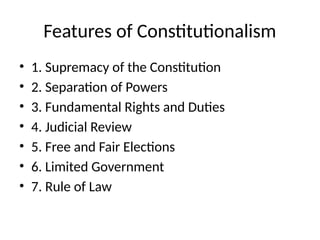
Features of Constitutionalism
•1. Supremacy of the Constitution
• 2. Separation of Powers
• 3. Fundamental Rights and Duties
• 4. Judicial Review
• 5. Free and Fair Elections
• 6. Limited Government
• 7. Rule of Law
5.
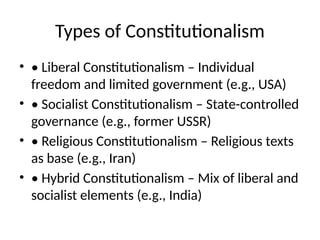
Types of Constitutionalism
•• Liberal Constitutionalism – Individual
freedom and limited government (e.g., USA)
• • Socialist Constitutionalism – State-controlled
governance (e.g., former USSR)
• • Religious Constitutionalism – Religious texts
as base (e.g., Iran)
• • Hybrid Constitutionalism – Mix of liberal and
socialist elements (e.g., India)
6.
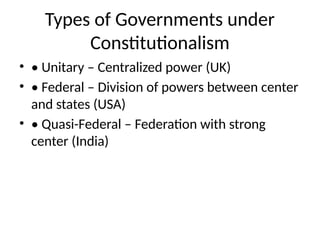
Types of Governmentsunder
Constitutionalism
• • Unitary – Centralized power (UK)
• • Federal – Division of powers between center
and states (USA)
• • Quasi-Federal – Federation with strong
center (India)
7.
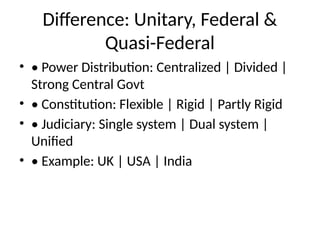
Difference: Unitary, Federal&
Quasi-Federal
• • Power Distribution: Centralized | Divided |
Strong Central Govt
• • Constitution: Flexible | Rigid | Partly Rigid
• • Judiciary: Single system | Dual system |
Unified
• • Example: UK | USA | India
8.
India as aQuasi-Federal State
• • Federal in structure, unitary in spirit
• • Article 1: India as a Union of States
• • Centre stronger in emergencies (Articles
352-360)
• • States not indestructible
• • Affirmed in Keshavananda Bharati and S.R.
Bommai Cases
9.
Power to AlterState Names &
Boundaries
• • Article 3: Parliament's authority
• • Procedure:
• 1. Presidential reference to state legislature
• 2. State view not binding
• 3. Bill introduced with Presidential
recommendation
• 4. Passed by simple majority
• 5. Presidential assent
10.
Examples of Reorganization
•• 1956: Linguistic basis - States Reorganisation
Act
• • 2000: Jharkhand, Chhattisgarh, Uttarakhand
• • 2014: Telangana
• • 2020: J&K into UTs
11.
Significance of Constitutionalism
•• Prevents authoritarianism
• • Promotes transparency and accountability
• • Protects minority rights
• • Encourages decentralization
• • Facilitates peaceful power transition
12.
Conclusion
• • Constitutionalismis the backbone of
democracy
• • Balances power and upholds rights
• • Indian model: flexible, quasi-federal
ensuring unity
13.
References
• • IndianConstitution – Bare Act
• • D.D. Basu – Introduction to the Constitution
of India
• • M.P. Jain – Indian Constitutional Law
• • Supreme Court Judgments
• • Ministry of Law and Justice
![The Role of Constitutionalism in
Fostering Democratic Governance
• With focus on Features, Types, and Federal
Structures
• Presented by: [Your Name]
• Date: [Insert Date]](https://image.slidesharecdn.com/roleofconstitutionalismindemocraticgovernance-250825031158-2c42c7bb/85/Role_of_Constitutionalism_in_Democratic_Governance-pptx-1-320.jpg)
![The Role of Constitutionalism in
Fostering Democratic Governance
• With focus on Features, Types, and Federal
Structures
• Presented by: [Your Name]
• Date: [Insert Date]](https://image.slidesharecdn.com/roleofconstitutionalismindemocraticgovernance-250825031158-2c42c7bb/75/Role_of_Constitutionalism_in_Democratic_Governance-pptx-1-2048.jpg)