A MOOC Course Report
on
PROGRAMMING,
DATA STRUCTURES AND
ALGORITHMS IN PYTHON
Submitted by
Rohan Sharma [RA2011003030052]
under the guidance of
Mr. Lalit Sagar
Under the governing ( NPTEL /COURSEERA/SEMINAR/ INDUSTRIAL TRAINING) body
of
BACHELOR OF TECHNOLOGY
in
COMPUTER SCIENCE & ENGINEERING
of
FACULTY OF ENGINEERING AND TECHNOLOGY
SRM INSTITUTE OF SCIENCE & TECHNOLOGY,NCR CAMPUS
NOV 2022
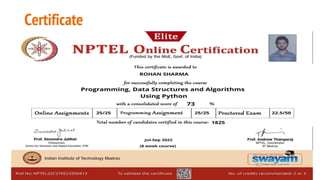
Certificate
●Add the image of the certificate
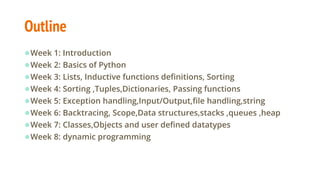
Outline
●Week 1: Introduction
●Week 2: Basics of Python
●Week 3: Lists, Inductive functions definitions, Sorting
●Week 4: Sorting ,Tuples,Dictionaries, Passing functions
●Week 5: Exception handling,Input/Output,file handling,string
●Week 6: Backtracing, Scope,Data structures,stacks ,queues ,heap
●Week 7: Classes,Objects and user defined datatypes
●Week 8: dynamic programming
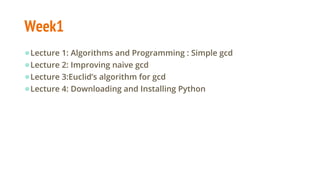
Week1
●Lecture 1: Algorithms and Programming : Simple gcd
●Lecture 2: Improving naive gcd
●Lecture 3:Euclid’s algorithm for gcd
●Lecture 4: Downloading and Installing Python
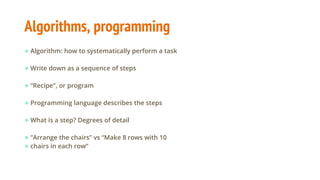
Algorithms, programming
● Algorithm: how to systematically perform a task
● Write down as a sequence of steps
● “Recipe”, or program
● Programming language describes the steps
● What is a step? Degrees of detail
● “Arrange the chairs” vs “Make 8 rows with 10
● chairs in each row”
Computing gcd(m,n)
●List out factors of m
●List out factors of n
●Report the largest number that appears on both lists
●Is this a valid algorithm?
●Finite presentation of the “recipe”
●Terminates after a finite number of steps
Python program
● def gcd(m,n):
● fm = []
● for i in range(1,m+1):
● if (m%i) == 0:
● fm.append(i)
● fn = []
● for j in range(1,n+1):
● If (n%j) == 0:
● fn.append(j)
● cf = []
● for f in fm:
● if f in fn:
● cf.append(f)
● return(cf[-1])
Week2
●Lecture 1: Assignment statement, basic types- int ,float,bool
●Lecture 2: Strings
●Lecture 3: Lists
●Lecture 4:Control Flow
●Lecture 5:Functions
Assignment statement
●Assign a value to a name
●i = 5
●j = 2*i
●j = j + 5
●Left hand side is a name
●Right hand side is an expression
●Operations in expression depend on type of value
int vs float
● Why are these different types?
● Internally, a value is stored as a finite sequence of
● 0’s and 1’s (binary digits, or bits)
● For an int, this sequence is read off as a binary
● number
● For a float, this sequence breaks up into a
● mantissa and exponent
● Like “scientific” notation: 0.602 x 1024
Strings —type str
●Text values — type str, sequence of characters
●Single character is string of length 1
●Extract individual characters by position
●Slices extract substrings
●+ glues strings together
●Cannot update strings directly — immutable
Lists
●Lists are sequences of values
●Values need not be of uniform type
●Lists may be nested
●Can access value at a position, or a slice
●Lists are mutable, can update in place
●Assignment does not copy the value
●Use full slice to make a copy of a list
Control flow
●Normally, statements are executed top to bottom,
●in sequence
●Can alter the control flow
●if ... elif ... else — conditional execution
●for i in ... — repeat a fixed number of times
●while ... — repeat based on a condition
Week3
●Lecture 1: More about range()
●Lecture 2: Manipulating lists
●Lecture 3: Breaking out of a loop
●Lecture 4: Arrays vs lists, binary search
●Lecture 5: Efficiency
●Lecture 6: Selection Sort
●Lecture 7: Insertion Sort
●Lecture 8: Recursion
More about range()
●range(n) has is implicitly from 0 to n-1
●range(i,j,k) produces sequence in steps of k
●Negative k counts down
●Sequence produced by range() is not a list
●Use list(range(..)) to get a list
Lists
●To extend lists in place, use l.append(),
●l.extend()
●Can also assign new value, in place, to a slice
●Many built in functions for lists — see
●documentation
●Don’t forget to assign a value to a name before it
●is first used
Loops revisited
●Can exit prematurely from loop using break
●Applies to both for and while
●Loop also has an else: clause
●Special action for normal termination
●Are built in lists in Python lists or arrays?
●Documentation suggests they are lists
●Allow efficient expansion, contraction
●However, positional indexing allows us to treat
●them as arrays
●In this course, we will “pretend” they are arrays
●Will later see explicit implementation of lists
Efficiency
●Theoretically T(n) = O(nk) is considered efficient
●Polynomial time
●In practice even T(n) = O(n2) has very limited
●effective range
●Inputs larger than size 5000 take very long
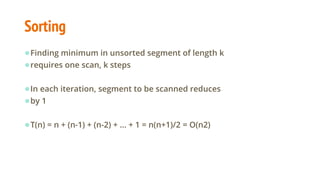
Sorting
●Finding minimum in unsorted segment of length k
●requires one scan, k steps
●In each iteration, segment to be scanned reduces
●by 1
●T(n) = n + (n-1) + (n-2) + ... + 1 = n(n+1)/2 = O(n2)
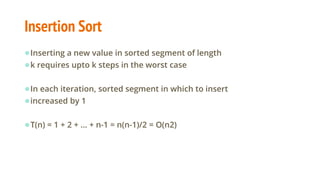
Insertion Sort
●Inserting a new value in sorted segment of length
●k requires upto k steps in the worst case
●In each iteration, sorted segment in which to insert
●increased by 1
●T(n) = 1 + 2 + ... + n-1 = n(n-1)/2 = O(n2)
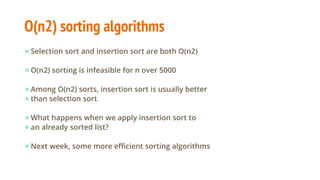
O(n2) sorting algorithms
●Selection sort and insertion sort are both O(n2)
●O(n2) sorting is infeasible for n over 5000
●Among O(n2) sorts, insertion sort is usually better
●than selection sort
●What happens when we apply insertion sort to
●an already sorted list?
●Next week, some more efficient sorting algorithms
Week4
●Lecture 1: Merge Sort
●Lecture 2: Mergesort , analysis
●Lecture 3: Quicksort
●Lecture 4: Quicksort analysis
●Lecture 5: Tuples and Dictionaries
●Lecture 6: Functions Definitions
●Lecture 7: List Comprehension
Merge Sort
● def mergesort(A,left,right):
● # Sort the slice A[left:right]
● if right - left <= 1: # Base case
● return(A[left:right])
● if right - left > 1: # Recursive call
● mid = (left+right)//2
● L = mergesort(A,left,mid)
● R = mergesort(A,mid,right)
● return(merge(L,R))
Quicksort
●Quicksort, as described, is not stable
●Swap operation during partitioning disturbs
●original order
●Merge sort is stable if we merge carefully
●Do not allow elements from right to overtake
●elements from left
●Favour left list when breaking ties
Tuples and Dictionaries
● Dictionaries allow a flexible association of values to
● keys
● Keys must be immutable values
● Structure of dictionary is internally optimized for key-
● based lookup
● Use sorted(d.keys()) to retrieve keys in
● predictable order
● Extremely useful for manipulating information from
● text files, tables ... — use column headings as keys
Function definitions
●Function definitions behave like other assignments
●of values to names
●Can reassign a new definition, define conditionally
●Can pass function names to other functions
Week5
●Lecture 1: Exception Handling
●Lecture 2: Standard input and output
●Lecture 3: Handling files
●Lecture 4: String Functions
●Lecture 5: Formatting printed output
●Lecture 6: pass, del() and None
Exception handling
●Exception handling allows us to gracefully deal
●with run time errors
●Can check type of error and take appropriate
●action based on type
●Can change coding style to exploit exception
●handling
●When dealing with files and input/output,
●exception handling becomes very important
● Read from keyboard using input()
● Can also display a message
● Print to screen using print()
● Caveat: In Python 2, () is optional for print
● Can control format of print() output
● Optional arguments end="...", sep="..."
● More precise control later
●Use pass for an empty block
●Use del() to remove elements from a list or
●dictionary
●Use the special value None to check if a name has
●been assigned a valid value
Week6
●Lecture 1: Backtracking, N queens
●Lecture 2: Global scope , nested function
●Lecture 3: Generating permutations
●Lecture 4: Sets , Stacks , queues
●Lecture 5: Priority queues and heaps
●Python names are looked up inside-out from
●within functions
●Updating a name with immutable value creates a
●local copy of that name
●Can update global names with mutable values
●Use global definition to update immutable values
●Can nest helper function — hidden to the outside
Data structures
●Data structures are ways of organising information
●that allow efficient processing in certain contexts
●Python has a built-in implementation of sets
●Stacks are useful to keep track of recursive
●computations
●Queues are useful for breadth-first exploration
● Heaps are a tree implementation of priority queues
● insert( ) and delete_max( ) are both O(log N)
● heapify( ) builds a heap in O(N)
● Tree can be manipulated easily using an array
● Can invert the heap condition
● Each node is smaller than its children
● Min-heap, for insert( ), delete_min( )
Week7
●Lecture 1: Abstract datatypes,classes and objects
●Lecture 2: Classes and Objects in Python
●Lecture 3: User defined lists
●Lecture 4: Search trees
Abstract datatype
●An abstract data type is a black box description
●Public interface — update/query the data type
●Private implementation — change does not
●affect functionality
●Classes and objects can be used for this
Classes and objects
●Class
● Template for a data type
● How data is stored
● How public functions manipulate data
●Object
● Concrete instance of template
Complexity
●All operations on search trees walk down a single
●path
●Worst-case: height of the tree
●Balanced trees: height is O(log n) for n nodes
●Tree can be balanced using rotations — look up
●AVL trees
Week8
●Lecture 1: Memoization and dynamic programming
●Lecture 2:Grid paths
●Lecture 3: longest common subsequence
●Lecture 4: matrix multiplication
●Lecture 5: Wrap-Up
Dynamic programming
● Memoization
● Store values of subproblems in a table
● Look up the table before making a recursive call
● Dynamic programming:
● Solve subproblems in order of dependency
● Dependencies must be acyclic
● Iterative evaluation
Wrap-Up
●No programming language is “universally” the best
●Otherwise why are there so many?
●Python’s simplicity makes it attractive to learn
●But also results in some limitations
●Use the language that suits your task best
●Learn programming, not programming languages!

Rohan Sharma MOOC Course Report (1).pptx

  • 1.
    A MOOC CourseReport on PROGRAMMING, DATA STRUCTURES AND ALGORITHMS IN PYTHON Submitted by Rohan Sharma [RA2011003030052] under the guidance of Mr. Lalit Sagar Under the governing ( NPTEL /COURSEERA/SEMINAR/ INDUSTRIAL TRAINING) body of BACHELOR OF TECHNOLOGY in COMPUTER SCIENCE & ENGINEERING of FACULTY OF ENGINEERING AND TECHNOLOGY SRM INSTITUTE OF SCIENCE & TECHNOLOGY,NCR CAMPUS NOV 2022
  • 2.
    Certificate ●Add the imageof the certificate
  • 3.
    Outline ●Week 1: Introduction ●Week2: Basics of Python ●Week 3: Lists, Inductive functions definitions, Sorting ●Week 4: Sorting ,Tuples,Dictionaries, Passing functions ●Week 5: Exception handling,Input/Output,file handling,string ●Week 6: Backtracing, Scope,Data structures,stacks ,queues ,heap ●Week 7: Classes,Objects and user defined datatypes ●Week 8: dynamic programming
  • 4.
    Week1 ●Lecture 1: Algorithmsand Programming : Simple gcd ●Lecture 2: Improving naive gcd ●Lecture 3:Euclid’s algorithm for gcd ●Lecture 4: Downloading and Installing Python
  • 5.
    Algorithms, programming ● Algorithm:how to systematically perform a task ● Write down as a sequence of steps ● “Recipe”, or program ● Programming language describes the steps ● What is a step? Degrees of detail ● “Arrange the chairs” vs “Make 8 rows with 10 ● chairs in each row”
  • 6.
    Computing gcd(m,n) ●List outfactors of m ●List out factors of n ●Report the largest number that appears on both lists ●Is this a valid algorithm? ●Finite presentation of the “recipe” ●Terminates after a finite number of steps
  • 7.
    Python program ● defgcd(m,n): ● fm = [] ● for i in range(1,m+1): ● if (m%i) == 0: ● fm.append(i) ● fn = [] ● for j in range(1,n+1): ● If (n%j) == 0: ● fn.append(j) ● cf = [] ● for f in fm: ● if f in fn: ● cf.append(f) ● return(cf[-1])
  • 8.
    Week2 ●Lecture 1: Assignmentstatement, basic types- int ,float,bool ●Lecture 2: Strings ●Lecture 3: Lists ●Lecture 4:Control Flow ●Lecture 5:Functions
  • 9.
    Assignment statement ●Assign avalue to a name ●i = 5 ●j = 2*i ●j = j + 5 ●Left hand side is a name ●Right hand side is an expression ●Operations in expression depend on type of value
  • 10.
    int vs float ●Why are these different types? ● Internally, a value is stored as a finite sequence of ● 0’s and 1’s (binary digits, or bits) ● For an int, this sequence is read off as a binary ● number ● For a float, this sequence breaks up into a ● mantissa and exponent ● Like “scientific” notation: 0.602 x 1024
  • 11.
    Strings —type str ●Textvalues — type str, sequence of characters ●Single character is string of length 1 ●Extract individual characters by position ●Slices extract substrings ●+ glues strings together ●Cannot update strings directly — immutable
  • 12.
    Lists ●Lists are sequencesof values ●Values need not be of uniform type ●Lists may be nested ●Can access value at a position, or a slice ●Lists are mutable, can update in place ●Assignment does not copy the value ●Use full slice to make a copy of a list
  • 13.
    Control flow ●Normally, statementsare executed top to bottom, ●in sequence ●Can alter the control flow ●if ... elif ... else — conditional execution ●for i in ... — repeat a fixed number of times ●while ... — repeat based on a condition
  • 14.
    Week3 ●Lecture 1: Moreabout range() ●Lecture 2: Manipulating lists ●Lecture 3: Breaking out of a loop ●Lecture 4: Arrays vs lists, binary search ●Lecture 5: Efficiency ●Lecture 6: Selection Sort ●Lecture 7: Insertion Sort ●Lecture 8: Recursion
  • 15.
    More about range() ●range(n)has is implicitly from 0 to n-1 ●range(i,j,k) produces sequence in steps of k ●Negative k counts down ●Sequence produced by range() is not a list ●Use list(range(..)) to get a list
  • 16.
    Lists ●To extend listsin place, use l.append(), ●l.extend() ●Can also assign new value, in place, to a slice ●Many built in functions for lists — see ●documentation ●Don’t forget to assign a value to a name before it ●is first used
  • 17.
    Loops revisited ●Can exitprematurely from loop using break ●Applies to both for and while ●Loop also has an else: clause ●Special action for normal termination
  • 18.
    ●Are built inlists in Python lists or arrays? ●Documentation suggests they are lists ●Allow efficient expansion, contraction ●However, positional indexing allows us to treat ●them as arrays ●In this course, we will “pretend” they are arrays ●Will later see explicit implementation of lists
  • 19.
    Efficiency ●Theoretically T(n) =O(nk) is considered efficient ●Polynomial time ●In practice even T(n) = O(n2) has very limited ●effective range ●Inputs larger than size 5000 take very long
  • 20.
    Sorting ●Finding minimum inunsorted segment of length k ●requires one scan, k steps ●In each iteration, segment to be scanned reduces ●by 1 ●T(n) = n + (n-1) + (n-2) + ... + 1 = n(n+1)/2 = O(n2)
  • 21.
    Insertion Sort ●Inserting anew value in sorted segment of length ●k requires upto k steps in the worst case ●In each iteration, sorted segment in which to insert ●increased by 1 ●T(n) = 1 + 2 + ... + n-1 = n(n-1)/2 = O(n2)
  • 22.
    O(n2) sorting algorithms ●Selectionsort and insertion sort are both O(n2) ●O(n2) sorting is infeasible for n over 5000 ●Among O(n2) sorts, insertion sort is usually better ●than selection sort ●What happens when we apply insertion sort to ●an already sorted list? ●Next week, some more efficient sorting algorithms
  • 23.
    Week4 ●Lecture 1: MergeSort ●Lecture 2: Mergesort , analysis ●Lecture 3: Quicksort ●Lecture 4: Quicksort analysis ●Lecture 5: Tuples and Dictionaries ●Lecture 6: Functions Definitions ●Lecture 7: List Comprehension
  • 24.
    Merge Sort ● defmergesort(A,left,right): ● # Sort the slice A[left:right] ● if right - left <= 1: # Base case ● return(A[left:right]) ● if right - left > 1: # Recursive call ● mid = (left+right)//2 ● L = mergesort(A,left,mid) ● R = mergesort(A,mid,right) ● return(merge(L,R))
  • 25.
    Quicksort ●Quicksort, as described,is not stable ●Swap operation during partitioning disturbs ●original order ●Merge sort is stable if we merge carefully ●Do not allow elements from right to overtake ●elements from left ●Favour left list when breaking ties
  • 26.
    Tuples and Dictionaries ●Dictionaries allow a flexible association of values to ● keys ● Keys must be immutable values ● Structure of dictionary is internally optimized for key- ● based lookup ● Use sorted(d.keys()) to retrieve keys in ● predictable order ● Extremely useful for manipulating information from ● text files, tables ... — use column headings as keys
  • 27.
    Function definitions ●Function definitionsbehave like other assignments ●of values to names ●Can reassign a new definition, define conditionally ●Can pass function names to other functions
  • 28.
    Week5 ●Lecture 1: ExceptionHandling ●Lecture 2: Standard input and output ●Lecture 3: Handling files ●Lecture 4: String Functions ●Lecture 5: Formatting printed output ●Lecture 6: pass, del() and None
  • 29.
    Exception handling ●Exception handlingallows us to gracefully deal ●with run time errors ●Can check type of error and take appropriate ●action based on type ●Can change coding style to exploit exception ●handling ●When dealing with files and input/output, ●exception handling becomes very important
  • 30.
    ● Read fromkeyboard using input() ● Can also display a message ● Print to screen using print() ● Caveat: In Python 2, () is optional for print ● Can control format of print() output ● Optional arguments end="...", sep="..." ● More precise control later
  • 31.
    ●Use pass foran empty block ●Use del() to remove elements from a list or ●dictionary ●Use the special value None to check if a name has ●been assigned a valid value
  • 32.
    Week6 ●Lecture 1: Backtracking,N queens ●Lecture 2: Global scope , nested function ●Lecture 3: Generating permutations ●Lecture 4: Sets , Stacks , queues ●Lecture 5: Priority queues and heaps
  • 33.
    ●Python names arelooked up inside-out from ●within functions ●Updating a name with immutable value creates a ●local copy of that name ●Can update global names with mutable values ●Use global definition to update immutable values ●Can nest helper function — hidden to the outside
  • 34.
    Data structures ●Data structuresare ways of organising information ●that allow efficient processing in certain contexts ●Python has a built-in implementation of sets ●Stacks are useful to keep track of recursive ●computations ●Queues are useful for breadth-first exploration
  • 35.
    ● Heaps area tree implementation of priority queues ● insert( ) and delete_max( ) are both O(log N) ● heapify( ) builds a heap in O(N) ● Tree can be manipulated easily using an array ● Can invert the heap condition ● Each node is smaller than its children ● Min-heap, for insert( ), delete_min( )
  • 36.
    Week7 ●Lecture 1: Abstractdatatypes,classes and objects ●Lecture 2: Classes and Objects in Python ●Lecture 3: User defined lists ●Lecture 4: Search trees
  • 37.
    Abstract datatype ●An abstractdata type is a black box description ●Public interface — update/query the data type ●Private implementation — change does not ●affect functionality ●Classes and objects can be used for this
  • 38.
    Classes and objects ●Class ●Template for a data type ● How data is stored ● How public functions manipulate data ●Object ● Concrete instance of template
  • 39.
    Complexity ●All operations onsearch trees walk down a single ●path ●Worst-case: height of the tree ●Balanced trees: height is O(log n) for n nodes ●Tree can be balanced using rotations — look up ●AVL trees
  • 40.
    Week8 ●Lecture 1: Memoizationand dynamic programming ●Lecture 2:Grid paths ●Lecture 3: longest common subsequence ●Lecture 4: matrix multiplication ●Lecture 5: Wrap-Up
  • 41.
    Dynamic programming ● Memoization ●Store values of subproblems in a table ● Look up the table before making a recursive call ● Dynamic programming: ● Solve subproblems in order of dependency ● Dependencies must be acyclic ● Iterative evaluation
  • 42.
    Wrap-Up ●No programming languageis “universally” the best ●Otherwise why are there so many? ●Python’s simplicity makes it attractive to learn ●But also results in some limitations ●Use the language that suits your task best ●Learn programming, not programming languages!