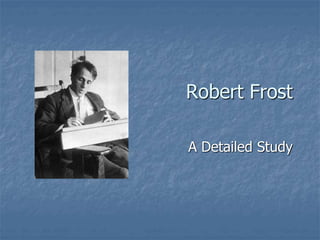
Robert Frost
A Detailed Study
Brief Biography
 Robert Lee Frost was born March 26, 1874 in San Francisco, CA
 Father Will Frost dies. Family returns to Lawrence, MA for burial.
Robert enters Lawrence H.S. 1888
 Publishes first poem “La Noche Triste in May, 1890
 Graduates co-valedictorian of Lawrence H.S. with Elinor White in
1892
 Enters Dartmouth College in 1892. Leaves before the end of the
term.
 1893-1895 – works in a mill, as a reporter, teacher
 Marries Elinor White, Dec. 19, 1895. First child Elliot born
9/25/96.
 Enters Harvard College 1897. Leaves 1899, returns to Lawrence.
Robert and Elinor have 5 more children 1899-1907.
Brief Bio. continued
DEATH
 First child Elliot dies at age 3 in 1900
 Mother, Isabelle, dies of cancer 4 months later
 Sixth child Elinor dies within days of birth, 1907
 Fifth child, Marjorie, dies during childbirth, 1937
 Wife, Elinor, dies of a heart attack, 1938
 Third child, son Carol, dies of suicide, 1940
(Some) Recognition
 Pulitzer Prizes for Poetry
 1923 – New Hampshire
 1931 – Collected Poems
 1937 – A Further Range
 1943 – A Witness Tree
 Gold Medal for Poetry, National Institute of Arts and
Letters, 1939
 Gold Medal, Poetry Society of America, 1941
 Award, Academy of American Poets, 1953
 Congressional Gold Medal, 1960
(presented by John F. Kennedy, 1962)
 Inaugural Poet for John F. Kennedy, 1961.
A Modest Ambition
It has been noted that Frost’s
ambition as a writer was to write
“a few poems that it would be
hard to get rid of.”
(R.H. Winnick)
Frost’s stylistic hallmarks
 Frost is often described as a pastoral poet
 a. Of or relating to the country or country life;
rural.
 b. Charmingly simple and serene; idyllic.
 c. Of, relating to, or being a literary or other
artistic work that portrays or evokes rural life,
usually in an idealized way.
Those who criticize Frost label him as “detached” from
modern society, content to sing of sweet nostalgia for
the good things of the past.
Look more closely
 Frost uses rural imagery to explore
something of larger symbolic or
metaphysical significance.
 Nature can be either or both the central
theme of a poem, or merely a backdrop or
physical setting for a very human
or even existential theme.
Some hallmarks of Frost’s poetry
SUBJECTS
 rural scenes and
landscapes
 farming and farmers
 the natural world
ALSO
 psychological struggle
 experience
 will
 purposefulness
 acceptance
Some themes
 Relationship to fellow man
 Tragedy
 Strong and sensitive feelings for the non-
human natural world
 Fate / death
 Trust in oneself, fellow man, the future
Sound
“I want them all to sound different. Listen
for the tune.” – Robert Frost
Be careful to examine the
possibilities of sound and
wordplay in the poems
Tone and Drama
“It’s the tone I’m in love with; that what poetry is,
tone.” – R.F.
“Literature is performance in words.” – R.F.
Frost uses drama and situation to vary the tones.
He employs distinctive human tonalities,
generally subdued and low key, ranging the
scale of human emotion.
Form
 Short to medium length poems, generally.
 Highly structured in terms of meter,
rhythm, and rhyme.
 Traditional stanzaic organization
“I would sooner write free verse as play
tennis with the net down.” – R.F.
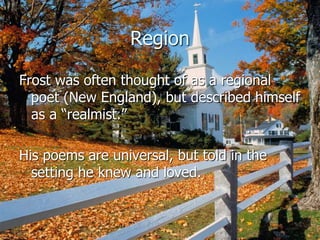
Region
Frost was often thought of as a regional
poet (New England), but described himself
as a “realmist.”
His poems are universal, but told in the
setting he knew and loved.

RobertFrost.ppt

  • 1.
  • 2.
    Brief Biography  RobertLee Frost was born March 26, 1874 in San Francisco, CA  Father Will Frost dies. Family returns to Lawrence, MA for burial. Robert enters Lawrence H.S. 1888  Publishes first poem “La Noche Triste in May, 1890  Graduates co-valedictorian of Lawrence H.S. with Elinor White in 1892  Enters Dartmouth College in 1892. Leaves before the end of the term.  1893-1895 – works in a mill, as a reporter, teacher  Marries Elinor White, Dec. 19, 1895. First child Elliot born 9/25/96.  Enters Harvard College 1897. Leaves 1899, returns to Lawrence. Robert and Elinor have 5 more children 1899-1907.
  • 3.
    Brief Bio. continued DEATH First child Elliot dies at age 3 in 1900  Mother, Isabelle, dies of cancer 4 months later  Sixth child Elinor dies within days of birth, 1907  Fifth child, Marjorie, dies during childbirth, 1937  Wife, Elinor, dies of a heart attack, 1938  Third child, son Carol, dies of suicide, 1940
  • 4.
    (Some) Recognition  PulitzerPrizes for Poetry  1923 – New Hampshire  1931 – Collected Poems  1937 – A Further Range  1943 – A Witness Tree  Gold Medal for Poetry, National Institute of Arts and Letters, 1939  Gold Medal, Poetry Society of America, 1941  Award, Academy of American Poets, 1953  Congressional Gold Medal, 1960 (presented by John F. Kennedy, 1962)  Inaugural Poet for John F. Kennedy, 1961.
  • 5.
    A Modest Ambition Ithas been noted that Frost’s ambition as a writer was to write “a few poems that it would be hard to get rid of.” (R.H. Winnick)
  • 6.
    Frost’s stylistic hallmarks Frost is often described as a pastoral poet  a. Of or relating to the country or country life; rural.  b. Charmingly simple and serene; idyllic.  c. Of, relating to, or being a literary or other artistic work that portrays or evokes rural life, usually in an idealized way. Those who criticize Frost label him as “detached” from modern society, content to sing of sweet nostalgia for the good things of the past.
  • 7.
    Look more closely Frost uses rural imagery to explore something of larger symbolic or metaphysical significance.  Nature can be either or both the central theme of a poem, or merely a backdrop or physical setting for a very human or even existential theme.
  • 8.
    Some hallmarks ofFrost’s poetry SUBJECTS  rural scenes and landscapes  farming and farmers  the natural world ALSO  psychological struggle  experience  will  purposefulness  acceptance
  • 9.
    Some themes  Relationshipto fellow man  Tragedy  Strong and sensitive feelings for the non- human natural world  Fate / death  Trust in oneself, fellow man, the future
  • 10.
    Sound “I want themall to sound different. Listen for the tune.” – Robert Frost Be careful to examine the possibilities of sound and wordplay in the poems
  • 11.
    Tone and Drama “It’sthe tone I’m in love with; that what poetry is, tone.” – R.F. “Literature is performance in words.” – R.F. Frost uses drama and situation to vary the tones. He employs distinctive human tonalities, generally subdued and low key, ranging the scale of human emotion.
  • 12.
    Form  Short tomedium length poems, generally.  Highly structured in terms of meter, rhythm, and rhyme.  Traditional stanzaic organization “I would sooner write free verse as play tennis with the net down.” – R.F.
  • 13.
    Region Frost was oftenthought of as a regional poet (New England), but described himself as a “realmist.” His poems are universal, but told in the setting he knew and loved.