The Deaf Elderly:
Inclusion, Participation and Social Care
Funded by
Inhalt
1. Initial Situation: Project SIGMA
– goals
– methods
– results
– consequences
2. Project GIA
– goals
– levels of action
Inhalt
University of Cologne
Faculty of Human Sciences
Department of Special Education and Rehabilitation
 Prof. Dr. Thomas Kaul
 Frank Menzel (†)
 Anne Gelhardt
 Nele Büchler
Project SIGMA:
Situation of Deaf Elderly People
2006 - 2009
Customer
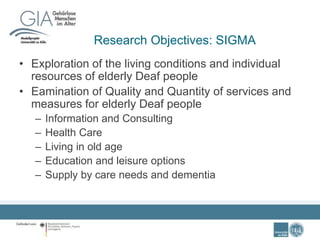
Research Objectives: SIGMA
• Exploration of the living conditions and individual
resources of elderly Deaf people
• Eamination of Quality and Quantity of services and
measures for elderly Deaf people
– Information and Consulting
– Health Care
– Living in old age
– Education and leisure options
– Supply by care needs and dementia
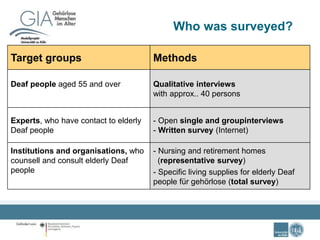
Who was surveyed?
Target groups Methods
Deaf people aged 55 and over Qualitative interviews
with approx.. 40 persons
Experts, who have contact to elderly
Deaf people
- Open single and groupinterviews
- Written survey (Internet)
Institutions and organisations, who
counsell and consult elderly Deaf
people
- Nursing and retirement homes
(representative survey)
- Specific living supplies for elderly Deaf
people für gehörlose (total survey)
Results: resources
• The family network is not highly meshed.
• The is a close network with the Deaf community.
• The Deaf community is active! (senior clubs, consulting,
information, volontary and honorary work,...)
• If mobility is reduced, the contact and access to the Deaf
community is very difficult or impossible.
• Elderly Deaf people are more isolated.
Results: Access to information
• Deaf people are not well informed about supply, offers
and legal claims and rights.
• General information are not accessible.
• Specific Information in sign language is rare.
Results: Knowledge in
institutions
• Healthcare professionals are not well informed about the
specific and communicative needs of elderly Deaf people.
• This lack of knowledge leads to a not appropriate care.
• Legal claims and rights will not be exercised.
Results: Healthcare
• There are only some specific offers and supply for elderly
Deaf people, which take the specific needs into account.
• In most cases there is no possibility to get a specific and
appropriate healthcare.
• Itis always hard for Deaf people to make decisions to stay
where they live – without specific support – or to go to
an institution (in another town) where they get an
appropriate supply
What must be done?
Recommanded actions
1. Structural development: Extension of
specific offers and networks
2. Information, explanation and awareness
3. Quality management: Qualification and
standardisation
Pilot project GIA: (The Eldery Deaf)
Competence Center for Elderly Deaf
People (with Dementia)
Auftraggeber
Goals
Improving the supply and support for eldery Deaf
People (with dementia)
• Better access to general offers for elderly peoply
• Expansion of the specific offers and supply for
elderly Deaf people
Content
• Design, testing and evaluation of two
competence centres
• Development of information material
• Creating recommendations of action
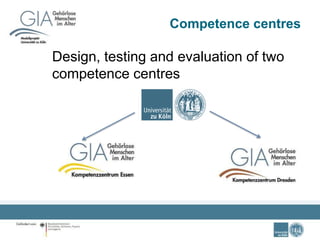
Competence centres
Design, testing and evaluation of two
competence centres
Competence Centres: Target Groupes
• Elderly Deaf people
• Relatives and other related persons of elderly Deaf
people
• Institutions, professionals und associations health
and nursing care
• Institutions, professionals und associations of the
Deaf
Kompetenzzentren: Leistungen
 Beratung und Vermittlung
 Information und Aufklärung
 Vernetzung und Entwicklung
Consulting
Examples:
•Support to find appropriate offers (i.e. healthcare, nursing, ....)
• Consulting of institution, which want to set up a specific offer for Deaf
people.
Information
Examples
• Organizing and performing of informatin events for elderly Deaf
people:
• How will I live in old age?
• What is a patient decee?
• What is dementia?
• Collectiong and developing of appropriate information material
Development and Networks
Support examples:
•Planning, design and implementation of trainings for Deaf volunteers
(i.e. accompainment of Deaf people with dementia)
•Planning, design and implementation of specific offers for elderly Deaf
people (i.e. sign language based).
Challenges
In times of resource shortages it is
very difficult to convince politicians
to support and - last but not least - to
finance necessary competence
centres.

RIWC_PARA_A155 deafness and aging

  • 1.
    The Deaf Elderly: Inclusion,Participation and Social Care Funded by
  • 2.
    Inhalt 1. Initial Situation:Project SIGMA – goals – methods – results – consequences 2. Project GIA – goals – levels of action
  • 3.
    Inhalt University of Cologne Facultyof Human Sciences Department of Special Education and Rehabilitation  Prof. Dr. Thomas Kaul  Frank Menzel (†)  Anne Gelhardt  Nele Büchler
  • 4.
    Project SIGMA: Situation ofDeaf Elderly People 2006 - 2009 Customer
  • 5.
    Research Objectives: SIGMA •Exploration of the living conditions and individual resources of elderly Deaf people • Eamination of Quality and Quantity of services and measures for elderly Deaf people – Information and Consulting – Health Care – Living in old age – Education and leisure options – Supply by care needs and dementia
  • 6.
    Who was surveyed? Targetgroups Methods Deaf people aged 55 and over Qualitative interviews with approx.. 40 persons Experts, who have contact to elderly Deaf people - Open single and groupinterviews - Written survey (Internet) Institutions and organisations, who counsell and consult elderly Deaf people - Nursing and retirement homes (representative survey) - Specific living supplies for elderly Deaf people für gehörlose (total survey)
  • 7.
    Results: resources • Thefamily network is not highly meshed. • The is a close network with the Deaf community. • The Deaf community is active! (senior clubs, consulting, information, volontary and honorary work,...) • If mobility is reduced, the contact and access to the Deaf community is very difficult or impossible. • Elderly Deaf people are more isolated.
  • 8.
    Results: Access toinformation • Deaf people are not well informed about supply, offers and legal claims and rights. • General information are not accessible. • Specific Information in sign language is rare.
  • 9.
    Results: Knowledge in institutions •Healthcare professionals are not well informed about the specific and communicative needs of elderly Deaf people. • This lack of knowledge leads to a not appropriate care. • Legal claims and rights will not be exercised.
  • 10.
    Results: Healthcare • Thereare only some specific offers and supply for elderly Deaf people, which take the specific needs into account. • In most cases there is no possibility to get a specific and appropriate healthcare. • Itis always hard for Deaf people to make decisions to stay where they live – without specific support – or to go to an institution (in another town) where they get an appropriate supply
  • 11.
  • 12.
    Recommanded actions 1. Structuraldevelopment: Extension of specific offers and networks 2. Information, explanation and awareness 3. Quality management: Qualification and standardisation
  • 13.
    Pilot project GIA:(The Eldery Deaf) Competence Center for Elderly Deaf People (with Dementia) Auftraggeber
  • 14.
    Goals Improving the supplyand support for eldery Deaf People (with dementia) • Better access to general offers for elderly peoply • Expansion of the specific offers and supply for elderly Deaf people
  • 15.
    Content • Design, testingand evaluation of two competence centres • Development of information material • Creating recommendations of action
  • 16.
    Competence centres Design, testingand evaluation of two competence centres
  • 17.
    Competence Centres: TargetGroupes • Elderly Deaf people • Relatives and other related persons of elderly Deaf people • Institutions, professionals und associations health and nursing care • Institutions, professionals und associations of the Deaf
  • 18.
    Kompetenzzentren: Leistungen  Beratungund Vermittlung  Information und Aufklärung  Vernetzung und Entwicklung
  • 19.
    Consulting Examples: •Support to findappropriate offers (i.e. healthcare, nursing, ....) • Consulting of institution, which want to set up a specific offer for Deaf people.
  • 20.
    Information Examples • Organizing andperforming of informatin events for elderly Deaf people: • How will I live in old age? • What is a patient decee? • What is dementia? • Collectiong and developing of appropriate information material
  • 21.
    Development and Networks Supportexamples: •Planning, design and implementation of trainings for Deaf volunteers (i.e. accompainment of Deaf people with dementia) •Planning, design and implementation of specific offers for elderly Deaf people (i.e. sign language based).
  • 22.
    Challenges In times ofresource shortages it is very difficult to convince politicians to support and - last but not least - to finance necessary competence centres.

Editor's Notes

  • #2 Zwischen 2006 und 2009 wurde an der Universität zu Köln die Situation gehörloser Menschen im Alter (Projekt SIGMA) untersucht. Die Ergebnisse belegen, dass gehörlose Menschen im Alter in verschiedenen Bereichen keine gleichberechtigten Chancen zur Teilhabe am gesellschaftlichen Leben haben. Um die Situation gehörloser Menschen im Alter, insbesondere von gehörlosen Menschen mit Demenz zu verbessern, muss ein Versorgungsangebot bereitgestellt werden, dass unter Berücksichtigung ihrer spezifischen kulturellen und kommunikativen Voraussetzungen einen selbstbestimmten, barrierefreien Zugang zu Versorgungsleistungen und Informationen ermöglicht. Im Rahmen des Vortrags wird ein Projekt vorgestellt, dass diese Zielsetzungen umsetzt.