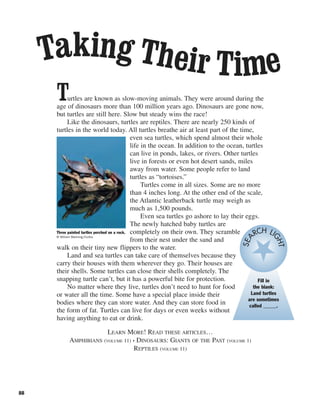
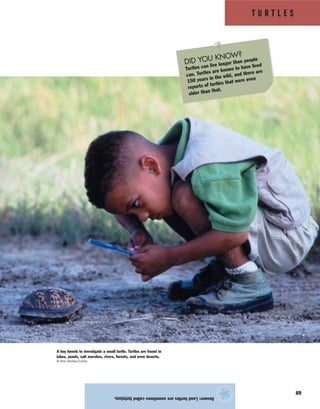
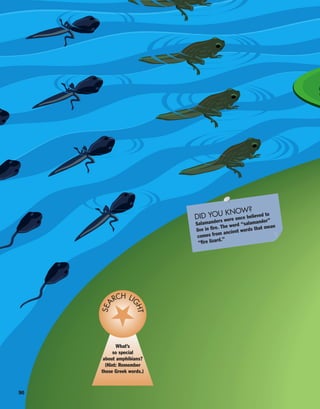
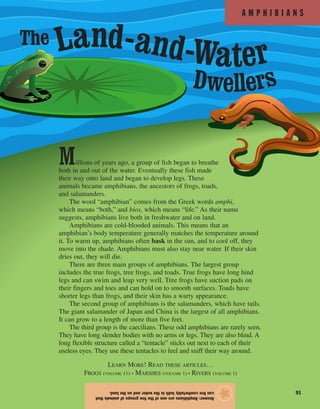
CHICAGO LONDON NEW DELHI PARIS SEOUL SYDNEY TAIPEI TOKYO
MY FIRST BRITANNICA
Birds, Insects, Reptiles,
and Aquatic Life
11
© 2008 by Encyclopædia Britannica, Inc.
International Standard Book Number: 978-1-59339-476-9 (set)
No part of this work may be reproduced or utilized in any form or by any means, electronic or mechanical,
including photocopying, recording, or by any information storage and retrieval system, without permission
in writing from the publisher.
My First Britannica:
Volume 11: Birds, Insects, Reptiles, and Aquatic Life 2008
Britannica.com may be accessed on the Internet at http://www.britannica.com.
Encyclopædia Britannica, Britannica, and the Thistle logo are registered trademarks of Encyclopædia Britannica, Inc.
Birds, Insects, Reptiles, and Aquatic Life
TABLE OF CONTENTS
INTRODUCTION. . . . . . . . . . . . . . . . . . . . . . . . . . . . . . . . 5
Birds
Birds: Birds of a Feather. . . . . . . . . . . . . . . . . . . . . . . . . . 6
Kingfishers: Laugh, Kookaburra! . . . . . . . . . . . . . . . . . . . 8
Parrots and Cockatoos:
Bright Colors and Brilliant Whites . . . . . . . . . . . . . . . . 10
Owls: The Nighttime Hunters. . . . . . . . . . . . . . . . . . . . . . 12
Eagles: Riders of the Wind . . . . . . . . . . . . . . . . . . . . . . . 14
Albatrosses: Forever Gliding . . . . . . . . . . . . . . . . . . . . . . 16
Gulls: The Ocean’s Cleanup Crew. . . . . . . . . . . . . . . . . . . 18
Ducks: Dabblers, Divers, and Perchers. . . . . . . . . . . . . . . 20
Geese: Fine-Feathered Travelers . . . . . . . . . . . . . . . . . . . 22
Swans: Birds of Beauty, Grace, and Speed . . . . . . . . . . . . 24
Penguins: Well-Dressed Swimmers . . . . . . . . . . . . . . . . . 26
Peacocks: Proud Birds. . . . . . . . . . . . . . . . . . . . . . . . . . . 28
Ostriches: The Biggest Birds in the World . . . . . . . . . . . . 30
Kiwis: New Zealand’s Feathered Favorites. . . . . . . . . . . . 32
Fish and Other Aquatic Life
Fish: Citizens of the Waters. . . . . . . . . . . . . . . . . . . . . . . 34
Carp: The Fishy Survivor. . . . . . . . . . . . . . . . . . . . . . . . . 36
Salmon: Leaping Up the Waterfall . . . . . . . . . . . . . . . . . . 38
Piranhas: Frightening Little Fish . . . . . . . . . . . . . . . . . . 40
Sharks: Predators of the Sea. . . . . . . . . . . . . . . . . . . . . . 42
Coral: Builders in the Sea . . . . . . . . . . . . . . . . . . . . . . . . 44
Sponges: Plant or Animal? . . . . . . . . . . . . . . . . . . . . . . . 46
Mollusks: Shell-Dwelling Animals. . . . . . . . . . . . . . . . . . 48
Octopuses: Eight-Armed Wonders . . . . . . . . . . . . . . . . . . 50
Jellyfish: Boneless Blobs of the Sea. . . . . . . . . . . . . . . . . 52
Deep-Sea Life: Flashing Lights!. . . . . . . . . . . . . . . . . . . . 54
Insects and Arachnids
Insects: The World’s Largest Population . . . . . . . . . . . . . 56
Ants: Insect Castle Builders . . . . . . . . . . . . . . . . . . . . . . 58
Bees: Inside the Hive. . . . . . . . . . . . . . . . . . . . . . . . . . . . 60
Butterflies and Moths: Fly by Day, Fly by Night . . . . . . . . 62
Cockroaches: Indestructible Insect . . . . . . . . . . . . . . . . . 64
Crickets: The Wing-Singers . . . . . . . . . . . . . . . . . . . . . . . 66
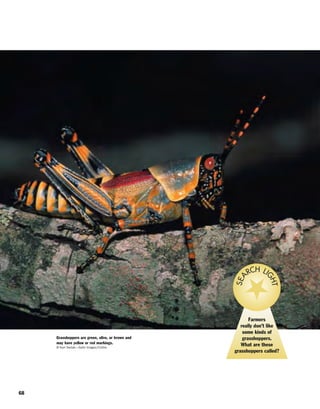
Grasshoppers: Garden-Variety Hoppers . . . . . . . . . . . . . . 68
Mosquitoes: An Itchy Situation . . . . . . . . . . . . . . . . . . . . 70
Spiders: The Silk Spinners . . . . . . . . . . . . . . . . . . . . . . . 72
Reptiles and Amphibians
Reptiles:
Snakes, Lizards, and Other Dry-Scaled Beasts. . . . . . . 74
Alligators and Crocodiles: Modern Dinosaurs. . . . . . . . . . 76
Snakes: Legless Wonders . . . . . . . . . . . . . . . . . . . . . . . . 78
Anacondas: A Tight Squeeze . . . . . . . . . . . . . . . . . . . . . . 80
King Cobras: Reptile Royalty . . . . . . . . . . . . . . . . . . . . . . 82
Lizards: Cousins of the Dinosaurs . . . . . . . . . . . . . . . . . . 84
Chameleons: The Color-Wizard Lizards . . . . . . . . . . . . . . 86
Turtles: Taking Their Time . . . . . . . . . . . . . . . . . . . . . . . 88
Amphibians: The Land-and-Water Dwellers. . . . . . . . . . . 90
Frogs: Amazing Changing Amphibians . . . . . . . . . . . . . . 92
GLOSSARY. . . . . . . . . . . . . . . . . . . . . . . . . . . . . . . . . . . 94
INDEX . . . . . . . . . . . . . . . . . . . . . . . . . . . . . . . . . . . . . . 95
Cover photos (top): great white shark, © Amos Nachoum/Corbis; (center): chameleon, © David Aubrey/Corbis; (bottom): scarlet macaw, © Craig Tuttle/Corbis
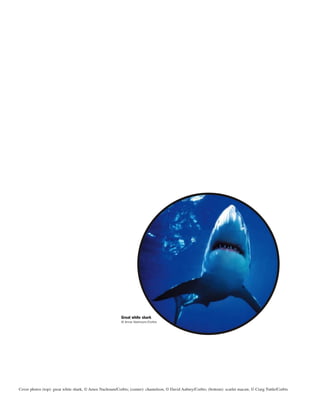
Great white shark
© Amos Nachoum/Corbis
Birds, Insects, Reptiles, and Aquatic Life
MY FIRST BRITANNICA
Have a great trip!
In Volume 11,
Birds,
Insects,
Reptiles, and
Aquatic Life,
you’ll discover answers to
these questions and many
more. Through pictures,
articles, and fun facts,
you’ll learn about the great
diversity of animal life
found around the world.
I N T R O D U C T I O N
How did the “dabbler duck” get its name?
Do snakes chew their food? What insect might survive a nuclear bomb blast?
Is a sponge a plant or an animal?
To help you on your journey, we’ve provided the following guideposts in
Birds, Insects, Reptiles, and Aquatic Life:
■ Subject Tabs—The colored box in the upper corner of each right-hand
page will quickly tell you the article subject.
■ Search Lights—Try these mini-quizzes before and after you read the
article and see how much—and how quickly—you can learn. You can even
make this a game with a reading partner. (Answers are upside down at the
bottom of one of the pages.)
■ Did You Know?—Check out these fun facts about the article subject.
With these surprising “factoids,” you can entertain your friends, impress
your teachers, and amaze your parents.
■ Picture Captions—Read the captions that go with the photos. They
provide useful information about the article subject.
■ Vocabulary—New or difficult words are in bold type. You’ll find
them explained in the Glossary at the back of this volume. And there’s a
complete listing of all Glossary terms in the set in the Reference Guide
and Index, Volume 13.
■ Learn More!—Follow these pointers to related articles throughout the set.
And don’t forget: If you’re not sure where to start, where you saw something
before, or where to go next, the Index at the back of this volume and the
Reference Guide and Index (Volume 13) will point the way.
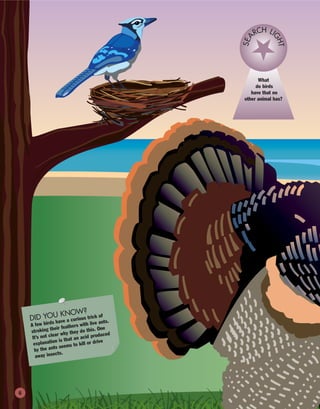
DID YOU KNOW?
A few birds have a curious trick of
stroking their feathers with live ants.
It’s not clear why they do this. One
explanation is that an acid produced
by the ants seems to kill or drive
away insects.
What
do birds
have that no
other animal has?
SEA
RCH LI
GHT
6
B I R D S
7
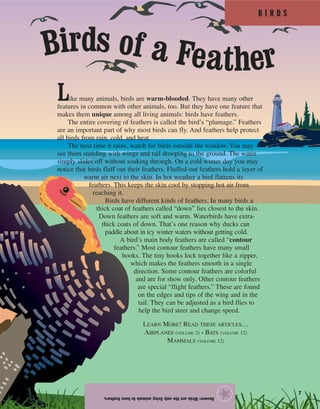
Like many animals, birds are warm-blooded. They have many other
features in common with other animals, too. But they have one feature that
makes them unique among all living animals: birds have feathers.
The entire covering of feathers is called the bird’s “plumage.” Feathers
are an important part of why most birds can fly. And feathers help protect
all birds from rain, cold, and heat.
The next time it rains, watch for birds outside the window. You may
see them standing with wings and tail drooping to the ground. The water
simply slides off without soaking through. On a cold winter day you may
notice that birds fluff out their feathers. Fluffed-out feathers hold a layer of
warm air next to the skin. In hot weather a bird flattens its
feathers. This keeps the skin cool by stopping hot air from
reaching it.
Birds have different kinds of feathers. In many birds a
thick coat of feathers called “down” lies closest to the skin.
Down feathers are soft and warm. Waterbirds have extra-
thick coats of down. That’s one reason why ducks can
paddle about in icy winter waters without getting cold.
A bird’s main body feathers are called “contour
feathers.” Most contour feathers have many small
hooks. The tiny hooks lock together like a zipper,
which makes the feathers smooth in a single
direction. Some contour feathers are colorful
and are for show only. Other contour feathers
are special “flight feathers.” These are found
on the edges and tips of the wing and in the
tail. They can be adjusted as a bird flies to
help the bird steer and change speed.
Answer:Birdsaretheonlylivinganimalstohavefeathers.
★
Birds of a Feather
LEARN MORE! READ THESE ARTICLES…
AIRPLANES (VOLUME 2) • BATS (VOLUME 12)
MAMMALS (VOLUME 12)
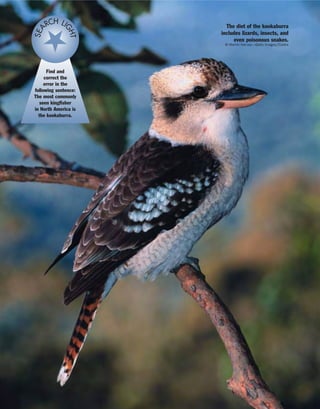
The diet of the kookaburra
includes lizards, insects, and
even poisonous snakes.
© Martin Harvey—Gallo Images/Corbis
Find and
correct the
error in the
following sentence:
The most commonly
seen kingfisher
in North America is
the kookaburra.
SEA
RCH LI
GHT
K I N G F I S H E R S
9
The birds known as kingfishers are found all over the world, but most
kinds live in tropical areas. Many kingfishers are brightly colored,
especially the ones found in Southeast Asia. All
are famous for their swift dives.
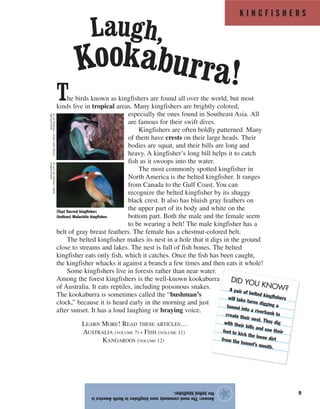
Kingfishers are often boldly patterned. Many
of them have crests on their large heads. Their
bodies are squat, and their bills are long and
heavy. A kingfisher’s long bill helps it to catch
fish as it swoops into the water.
The most commonly spotted kingfisher in
North America is the belted kingfisher. It ranges
from Canada to the Gulf Coast. You can
recognize the belted kingfisher by its shaggy
black crest. It also has bluish gray feathers on
the upper part of its body and white on the
bottom part. Both the male and the female seem
to be wearing a belt! The male kingfisher has a
belt of gray breast feathers. The female has a chestnut-colored belt.
The belted kingfisher makes its nest in a hole that it digs in the ground
close to streams and lakes. The nest is full of fish bones. The belted
kingfisher eats only fish, which it catches. Once the fish has been caught,
the kingfisher whacks it against a branch a few times and then eats it whole!
Some kingfishers live in forests rather than near water.
Among the forest kingfishers is the well-known kookaburra
of Australia. It eats reptiles, including poisonous snakes.
The kookaburra is sometimes called the “bushman’s
clock,” because it is heard early in the morning and just
after sunset. It has a loud laughing or braying voice.
LEARN MORE! READ THESE ARTICLES…
AUSTRALIA (VOLUME 7) • FISH (VOLUME 11)
KANGAROOS (VOLUME 12)
Answer:ThemostcommonlyseenkingfisherinNorthAmericais
thebeltedkingfisher.
★
Laugh,
Kookaburra!
(Top) Sacred kingfisher;
(bottom) Malachite kingfisher.
©LenRobinson—FrankLanePicture
Agency/Corbis
©LanzVonHorsten—Gallo
Images/Corbis
DID YOU KNOW?A pair of belted kingfisherswill take turns digging atunnel into a riverbank tocreate their nest. They digwith their bills and use theirfeet to kick the loose dirtfrom the tunnel’s mouth.
10
Parrots and cockatoos have long fascinated humans. These lively birds
not only are beautiful but they entertain us with their chatter and behavior
as well. Many parrots are brightly colored, with
green feathers and patches of red, orange, or blue.
Most cockatoos are white, and all have a patch of
long feathers called a “crest” on their head that
stands up straight when the bird is excited.
Parrots and cockatoos belong to the same family
as cockatiels, macaws, parakeets, and many other
colorful birds. The tiniest parrot is the pygmy parrot,
which is only 3 inches long. The largest member of
the family is a type of macaw that can be as much as
40 inches long.
All the birds in this family have strong hooked
bills that can crack open nuts. Their thick fleshy
tongues help them eat. Some birds have brush-tipped tongues that are
useful in sucking nectar from flowers and juice from fruits.
Parrots and cockatoos have unusual feet. Two toes point forward and
two point backward. This lets them climb trees swiftly and grasp their food
firmly as they eat it. The birds can also use their strong bills to help
them climb.
Parrots and cockatoos are found in most tropical regions of
the world, especially in rainforests. These birds can live for 30
to 50 years. Some have been known to live for 80 years!
Some parrots talk, sing, laugh, and whistle. They have a
sharp sense of hearing and can echo human sounds and speech.
Cockatoos can talk too. They are very impish and like to play
tricks—like figuring out how to escape from their cages!
LEARN MORE! READ THESE ARTICLES…
AMAZON: A CLOSE LOOK AT RIVER LIFE (VOLUME 9)
BIRDS (VOLUME 11) • RAINFORESTS (VOLUME 1)
Bright Colorsand Brilliant Whites
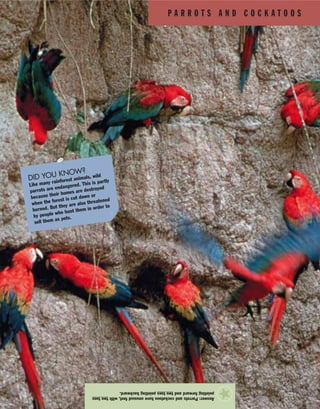
Macaws gather at Manu National Park in Peru to eat
clay. The clay adds minerals to the birds’ diet.
© Michael & Patricia Fogden/Corbis
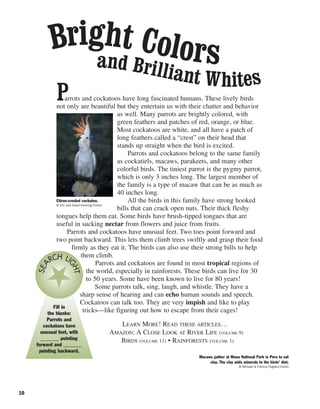
Citron-crested cockatoo.
© Eric and David Hosking/Corbis
Fill in
the blanks:
Parrots and
cockatoos have
unusual feet, with
_______ pointing
forward and _______
pointing backward.
SEA
RCH LI
GHT
P A R R O T S A N D C O C K A T O O S
Answer:Parrotsandcockatooshaveunusualfeet,withtwotoes
pointingforwardandtwotoespointingbackward.
★
DID YOU KNOW?
Like many rainforest animals, wild
parrots are endangered. This is partly
because their homes are destroyed
when the forest is cut down or
burned. But they are also threatened
by people who hunt them in order to
sell them as pets.
DID YOU KNOW?
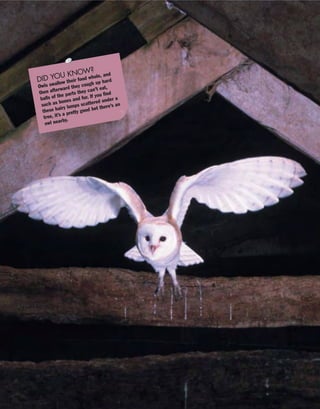
Owls swallow their food whole, and
then afterward they cough up hard
balls of the parts they can’t eat,
such as bones and fur. If you find
these hairy lumps scattered under a
tree, it’s a pretty good bet there’s an
owl nearby.
O W L S
13
Maybe it’s because they fly mostly at night that owls seem so
mysterious. Some superstitions connect them with scary things such as
witches. But owls aren’t that mysterious, and they aren’t scary. They are
simply nocturnal birds. And they are very helpful to people.
Owls are hunters. Some owls eat
insects or fish, but most eat rodents, such
as mice, gophers, and rats. Without owls,
there would be too many rodents, and
rodents are serious pests.
Owls can see better at night than most
animals. They have excellent hearing and
can detect the smallest scratchings of a
mouse. When it comes to locating prey,
their hearing helps them more than their
eyesight. Because of their soft feathers, owls fly silently and almost always
surprise their prey. Owls catch their prey in their long strong claws and
swallow it without chewing.
The only way an owl can look around is to turn its head. It can turn its
head almost all the way around, turning it so fast that you can hardly see it
move. Sometimes it looks as though the owl is turning its head all the way
around in a full circle!
Some people say owls are wise. That is because they were once
associated with Athena, the Greek goddess of wisdom.
Owls sleep during the day, hidden among tree branches. If
you were to see an owl, you’d probably mistake it for a piece of
bark. It would sit still, not moving a feather. It wouldn’t even
move its eyes. It couldn’t, because an owl’s eyes can’t move! This is
why owls seem to stare at you—if you’re lucky enough to see one!
LEARN MORE! READ THESE ARTICLES…
BATS (VOLUME 12) • BIRDS (VOLUME 11) • EAGLES (VOLUME 11)
Answer:Owlscanturntheirheadstotheleftortherightalmost
allthewayaround.It’sbecausetheheadsnapsbacksoquickly,
trulyintheblinkofaneye,thatpeoplethinkowlscanturntheir
headsallthewayaround.
★
Nighttime Hunters
The
Common barn owls live all over the world,
except in Antarctica and Micronesia.
© Eric and David Hosking/Corbis
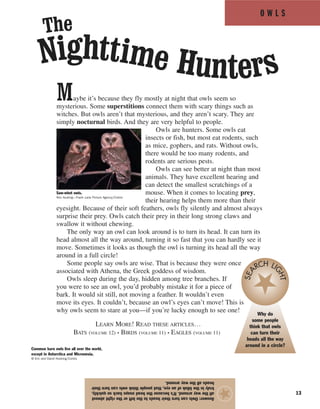
Saw-whet owls.
Ron Austing—Frank Lane Picture Agency/Corbis
Why do
some people
think that owls
can turn their
heads all the way
around in a circle?
SEA
RCH LI
GHT
14
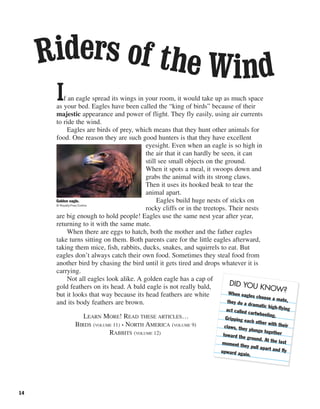
If an eagle spread its wings in your room, it would take up as much space
as your bed. Eagles have been called the “king of birds” because of their
majestic appearance and power of flight. They fly easily, using air currents
to ride the wind.
Eagles are birds of prey, which means that they hunt other animals for
food. One reason they are such good hunters is that they have excellent
eyesight. Even when an eagle is so high in
the air that it can hardly be seen, it can
still see small objects on the ground.
When it spots a meal, it swoops down and
grabs the animal with its strong claws.
Then it uses its hooked beak to tear the
animal apart.
Eagles build huge nests of sticks on
rocky cliffs or in the treetops. Their nests
are big enough to hold people! Eagles use the same nest year after year,
returning to it with the same mate.
When there are eggs to hatch, both the mother and the father eagles
take turns sitting on them. Both parents care for the little eagles afterward,
taking them mice, fish, rabbits, ducks, snakes, and squirrels to eat. But
eagles don’t always catch their own food. Sometimes they steal food from
another bird by chasing the bird until it gets tired and drops whatever it is
carrying.
Not all eagles look alike. A golden eagle has a cap of
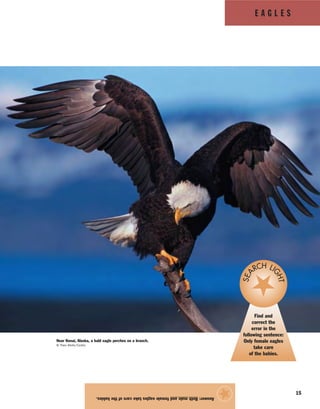
gold feathers on its head. A bald eagle is not really bald,
but it looks that way because its head feathers are white
and its body feathers are brown.
LEARN MORE! READ THESE ARTICLES…
BIRDS (VOLUME 11) • NORTH AMERICA (VOLUME 9)
RABBITS (VOLUME 12)
Riders of the Wind
Golden eagle.
© Royalty-Free/Corbis
DID YOU KNOW?When eagles choose a mate,they do a dramatic high-flyingact called cartwheeling.Gripping each other with theirclaws, they plunge togethertoward the ground. At the lastmoment they pull apart and flyupward again.
E A G L E S
15
Answer:Bothmaleandfemaleeaglestakecareofthebabies.
★
Near Kenai, Alaska, a bald eagle perches on a branch.
© Theo Allofs/Corbis
Find and
correct the
error in the
following sentence:
Only female eagles
take care
of the babies.
SEA
RCH LIGHT
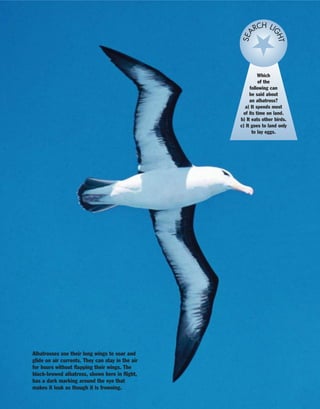
Albatrosses use their long wings to soar and
glide on air currents. They can stay in the air
for hours without flapping their wings. The
black-browed albatross, shown here in flight,
has a dark marking around the eye that
makes it look as though it is frowning.
Which
of the
following can
be said about
an albatross?
a) It spends most
of its time on land.
b) It eats other birds.
c) It goes to land only
to lay eggs.
SEA
RCH LI
GHT
A L B A T R O S S E S
17
The albatross is an amazing seabird. It spends most of its life soaring
above the water. The only time albatrosses ever go ashore is when they lay
eggs and raise their chicks. Groups (called “colonies”) of the birds build
nests on isolated Antarctic islands. A
single large white egg is laid in a
bowl-shaped nest built from plants and
soil. Sometimes the nest is just a patch
of bare ground.
A young albatross grows slowly. It
takes at least four months for it to
develop all the feathers it will need to
fly. Once it’s able to fly, the albatross
will spend the next five to ten years
out at sea. The albatross can glide for
hours at a time, without flapping its
long narrow wings. To stay in the air like this, it needs windy weather. In
calm weather the albatross has trouble keeping its heavy body in the air, so
it rests on the water and floats like a cork. It feeds on small squid and
fish. But it will also follow fishing boats and eat scraps that are
thrown overboard.
Some kinds of albatrosses are brown, but most of them are white
with some brown or black markings on their bodies or wings.
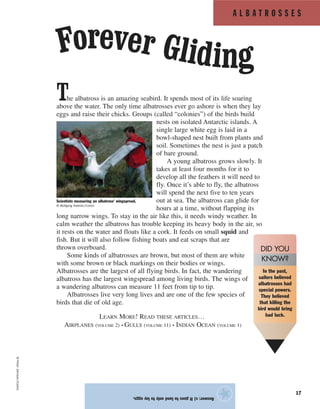
Albatrosses are the largest of all flying birds. In fact, the wandering
albatross has the largest wingspread among living birds. The wings of
a wandering albatross can measure 11 feet from tip to tip.
Albatrosses live very long lives and are one of the few species of
birds that die of old age.
LEARN MORE! READ THESE ARTICLES…
AIRPLANES (VOLUME 2) • GULLS (VOLUME 11) • INDIAN OCEAN (VOLUME 1)
Answer:c)Itgoestolandonlytolayeggs.
★
©PeterJohnson/Corbis
Forever Gliding
In the past,
sailors believed
albatrosses had
special powers.
They believed
that killing the
bird would bring
bad luck.
DID YOU
KNOW?
Scientists measuring an albatross’ wingspread.
© Wolfgang Kaehler/Corbis
18
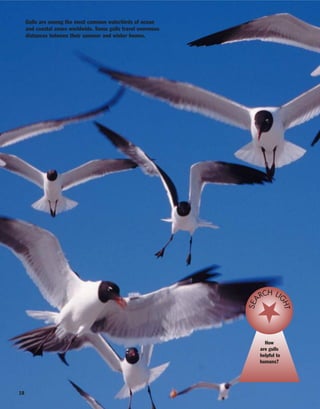
Gulls are among the most common waterbirds of ocean
and coastal zones worldwide. Some gulls travel enormous
distances between their summer and winter homes.
How
are gulls
helpful to
humans?
SEA
RCH LI
GHT
G U L L S
19
Afishing boat chugs back into the harbor with its day’s catch. The gulls
follow close behind. They know that the fishermen will be throwing
goodies overboard as they empty the bait bag and clean the deck. The gulls
dip into the waves to scoop up bits of food. They fill the air with their
excited cries. This often happens when they are
fighting over something good to eat.
Along the shore, gulls are helpful to the
people who clean beaches and harbors. They
swoop down to pick up messy things. Gulls eat
almost anything, from dead fish to potato chips
and scraps of hot dogs. And they clear away lots
of insects too.
Gulls eat all day long. They have to just to
stay alive. Gulls are big birds that fly great
distances. While flying, they use up a lot of
energy. Gulls can fly many miles without
stopping. They can fly from one end of a
country to the other. But all the time they’re up
there, they’re looking down to see if they can find something to eat.
Gulls are good swimmers too. Their feet are webbed.
The little stretches of skin between their toes
make their feet act as paddles.
Gulls are also floaters. They stay on top of the
water like a piece of wood does. On long trips over
the ocean, they drop down onto the water and float
while taking a nap.
LEARN MORE! READ THESE ARTICLES…
FISH (VOLUME 11) • OCEANS (VOLUME 1) • SHIPS (VOLUME 2)
Answer:Gullscleanupalotoffoodwastefrombeaches,harbors,
picnicareas,dumps,andparkinglotsthatwouldotherwisebeleft
behindastrash.
★
©ChrisJones/Corbis
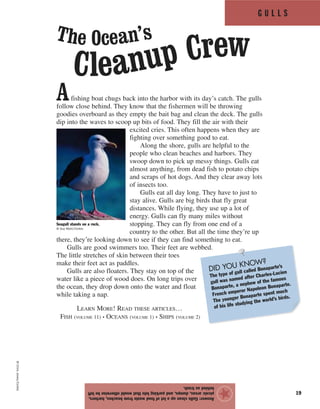
Seagull stands on a rock.
© Guy Motil/Corbis
DID YOU KNOW?
The type of gull called Bonaparte’s
gull was named after Charles-Lucien
Bonaparte, a nephew of the famous
French emperor Napoleon Bonaparte.
The younger Bonaparte spent much
of his life studying the world’s birds.
The Ocean’s
Cleanup Crew
20
DID YOU KNOW?
Ducks make their feathers waterproof
by rubbing oil on them. They get the
oil from special glands on their
chests and rub it on their feathers
with their bills.
Unscramble
these words
that have to do
with a duck.
wsmimre
nblbiadg
dlwaed
SEA
RCH LI
GHT
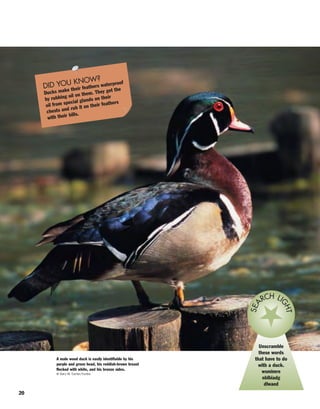
A male wood duck is easily identifiable by his
purple and green head, his reddish-brown breast
flecked with white, and his bronze sides.
© Gary W. Carter/Corbis
D U C K S
21
Ducks are champion swimmers and are at home almost anywhere near
water. Some feed and nest in streams and ponds. Others live near deep
wide lakes. Some make their homes on rocky cliffs by the ocean.
There are three kinds of ducks:
“Dabbling ducks” put their heads underwater to eat plants that grow
there. This way of feeding is called “dabbling.” They build their nests in
hollows near the water. There they also eat
plants and insects found near the shore.
Dabbling ducks can fly very fast.
“Diving ducks” dive deep down into the
water to find things to eat. They mostly eat fish.
They are very strong swimmers.
“Perching ducks” make nests in trees and
hold on to the branches with their long-clawed
toes. This is called perching. Some may perch on
the tall stalks that grow over marshy ponds.
All ducks are graceful fliers and swimmers.
But on the ground they waddle from side to side,
moving slowly in a funny, jerky way. You
usually don’t see a duck waddling too far away
from water.
In winter many ducks fly south, where the
water is warmer and there’s more to eat. But icy
cold water doesn’t bother them. A thick inner layer of soft fluffy feathers
called “down” keeps them warm. And their bigger outer feathers help too.
They’re waterproof. Feathers are a duck’s raincoat. Every year ducks lose
their old feathers, and new feathers grow in. This is called “molting.” Until
the new feathers grow, ducks can’t fly. So they hide in the grass or on the
water to keep safe from enemies.
LEARN MORE! READ THESE ARTICLES…
GEESE (VOLUME 11) • MARSHES (VOLUME 1) • OCEANS (VOLUME 1)
Answer:wsmimre=swimmer
nblbiadg=dabbling
dlwaed=waddle
★
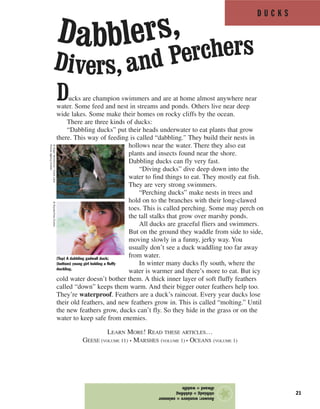
(Top) A dabbling gadwall duck;
(bottom) young girl holding a fluffy
duckling.
©RogerWilmshurst—FrankLane
PictureAgency/Corbis
©Royalty-Free/Corbis
Dabblers,
Divers, and Perchers
22
Geese are found virtually everywhere. There’s the wild Canada goose,
and halfway around the world is the snow goose of Siberia. There is the
pied goose, which lives “down under” in Australia. The rarely seen
Hawaiian goose lives out in the middle of the Pacific Ocean. The little
brant goose nests in very cold Arctic areas. The wild goose called the
greylag is found in Europe.
Geese spend a lot of time in the water. Like ducks, they have a coat of
oil on their feathers that keeps them from getting too wet. And the soft
feathers beneath, called “down,” keep them
warm even in the iciest of waters. Down is
so good at keeping things warm that people
often use it in winter coats and in
comforters. It’s also good in pillows
because it’s so soft.
Geese are fairly large birds, often
standing three feet tall despite their short
legs. Geese may look somewhat silly when
they waddle on land. But their sturdy legs
actually help them walk more steadily than
ducks or swans do.
Geese have webbed feet that make them
strong swimmers. They are also powerful
fliers. They can make especially long
flights during their annual migrations to
their winter feeding grounds. You may see
groups of geese traveling south in the fall in
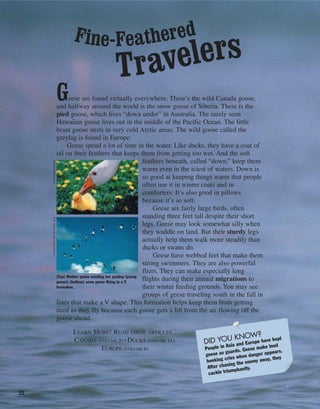
lines that make a V shape. This formation helps keep them from getting
tired as they fly because each goose gets a lift from the air flowing off the
goose ahead.
LEARN MORE! READ THESE ARTICLES…
CANADA (VOLUME 9) • DUCKS (VOLUME 11)
EUROPE (VOLUME 6)
(Top) Mother goose nuzzling her gosling (young
goose); (bottom) snow geese flying in a V
formation.
©JulieHabel/Corbis©D.Robert&LorriFranz/Corbis
DID YOU KNOW?
People in Asia and Europe have kept
geese as guards. Geese make loud
honking cries when danger appears.
After chasing the enemy away, they
cackle triumphantly.
Fine-Feathered
Travelers
G E E S E
23
Answer:Peopleusedowntostuffpillows,quilts,andcoats
becausethefeathersaresoftandverywarm.
★
How
do people
use
down feathers?
SEA
RCH LI
GHT
A Canada goose flies close to the water.
©GettyImages
Ducks, geese, and swans are the three main kinds of waterfowl. Swans
are the largest of the three, and they are also the fastest flyers and
swimmers. They have a stately and dignified appearance when swimming
on a pond.
Like the other waterfowl, swans have oily feathers that stay dry in the
water. Their webbed feet make them strong swimmers. Swans are heavy-
bodied birds that feed by dabbling—
dipping the long neck into shallow
water for plants. They don’t dive for
food. They have powerful wings for
flying long distances.
The whistling swan and the
trumpeter swan are found in North
America, while the mute swan lives
in Europe and Asia. These birds are
white. South America is the home of
the black-necked swan, while the beautiful black swan lives in Australia. It
is the state emblem of Western Australia.
Swans make a variety of sounds. Even the mute swan often hisses or
makes soft snoring sounds. It may even grunt sharply.
The male swan is called a “cob.” The female is called a “pen.” They
look alike. A pair of swans usually stays together for life. The female swan
lays about six pale eggs on a heap of plant material, while the male keeps
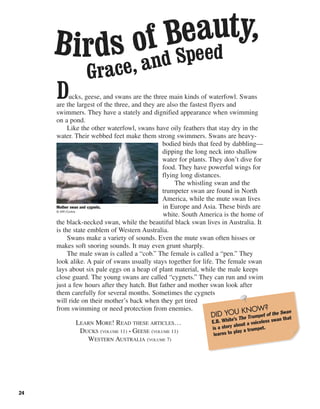
close guard. The young swans are called “cygnets.” They can run and swim
just a few hours after they hatch. But father and mother swan look after
them carefully for several months. Sometimes the cygnets
will ride on their mother’s back when they get tired
from swimming or need protection from enemies.
LEARN MORE! READ THESE ARTICLES…
DUCKS (VOLUME 11) • GEESE (VOLUME 11)
WESTERN AUSTRALIA (VOLUME 7)
24
Mother swan and cygnets.
© AFP/Corbis
DID YOU KNOW?
E.B. White’s The Trumpet of the Swan
is a story about a voiceless swan that
learns to play a trumpet.
Birds of Beauty,
Grace, and Speed
S W A N S
25
Answer:Bothducksandswansarewaterbirdswithoilyfeathers
andwebbedfeetforswimming.Butswansareconsiderablybigger
thanducks.Theyflyandswimfasterthanduckstoo.
★
A family of mute swans, with cygnets riding on
their mother’s back, swim along the water.
© Philip Perry—Frank Lane Picture Agency/Corbis
What’s
one way
that ducks and
swans are alike?
How are they
different?
SEA
RCH LI
GHT
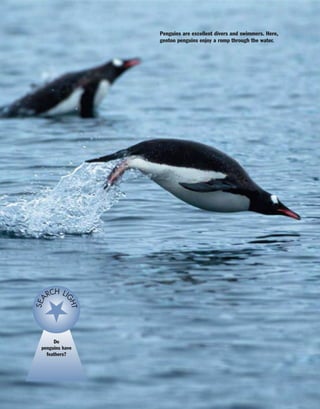
Penguins are excellent divers and swimmers. Here,
gentoo penguins enjoy a romp through the water.
Do
penguins have
feathers?
SEA
RCH LI
GHT
P E N G U I N S
27
When a penguin swims, its light-colored belly and dark-colored back
help hide it from enemies. From underneath, its light belly looks like the
sky. This makes it hard for its enemy the leopard seal to see it. From
above, its dark back looks like the dark water,
which helps hide it from big hunting birds.
Penguins cannot fly, but they swim
extremely well. The shape of their bodies, sort
of like a submarine, lets them swim very fast.
They use their short flat wings like flippers and
practically fly through the water. In fact, they
often leap out of the water and look as if they
are trying to flap through the air.
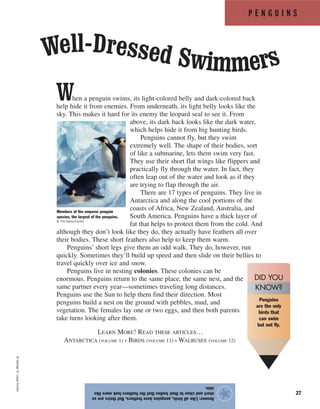
There are 17 types of penguins. They live in
Antarctica and along the cool portions of the
coasts of Africa, New Zealand, Australia, and
South America. Penguins have a thick layer of
fat that helps to protect them from the cold. And
although they don’t look like they do, they actually have feathers all over
their bodies. These short feathers also help to keep them warm.
Penguins’ short legs give them an odd walk. They do, however, run
quickly. Sometimes they’ll build up speed and then slide on their bellies to
travel quickly over ice and snow.
Penguins live in nesting colonies. These colonies can be
enormous. Penguins return to the same place, the same nest, and the
same partner every year—sometimes traveling long distances.
Penguins use the Sun to help them find their direction. Most
penguins build a nest on the ground with pebbles, mud, and
vegetation. The females lay one or two eggs, and then both parents
take turns looking after them.
LEARN MORE! READ THESE ARTICLES…
ANTARCTICA (VOLUME 1) • BIRDS (VOLUME 11) • WALRUSES (VOLUME 12)
Answer:Likeallbirds,penguinshavefeathers.Buttheirsareso
shortandclosetotheirbodiesthatthefeatherslookmorelike
skin.
★
©GeorgeD.Lepp/Corbis
Well-Dressed Swimmers
Penguins
are the only
birds that
can swim
but not fly.
DID YOU
KNOW?
Members of the emperor penguin
species, the largest of the penguins.
© Tim Davis/Corbis
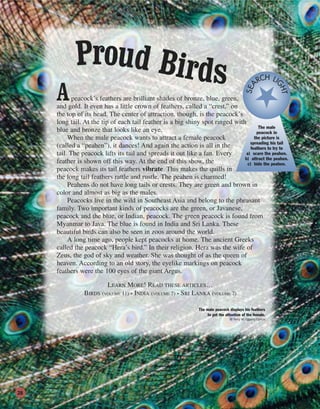
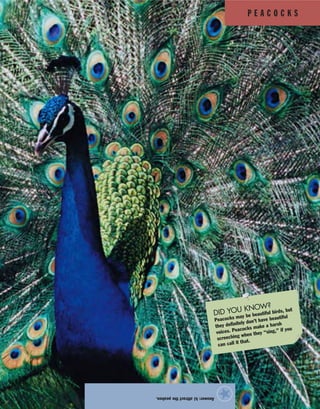
Apeacock’s feathers are brilliant shades of bronze, blue, green,
and gold. It even has a little crown of feathers, called a “crest,” on
the top of its head. The center of attraction, though, is the peacock’s
long tail. At the tip of each tail feather is a big shiny spot ringed with
blue and bronze that looks like an eye.
When the male peacock wants to attract a female peacock
(called a “peahen”), it dances! And again the action is all in the
tail. The peacock lifts its tail and spreads it out like a fan. Every
feather is shown off this way. At the end of this show, the
peacock makes its tail feathers vibrate. This makes the quills in
the long tail feathers rattle and rustle. The peahen is charmed!
Peahens do not have long tails or crests. They are green and brown in
color and almost as big as the males.
Peacocks live in the wild in Southeast Asia and belong to the pheasant
family. Two important kinds of peacocks are the green, or Javanese,
peacock and the blue, or Indian, peacock. The green peacock is found from
Myanmar to Java. The blue is found in India and Sri Lanka. These
beautiful birds can also be seen in zoos around the world.
A long time ago, people kept peacocks at home. The ancient Greeks
called the peacock “Hera’s bird.” In their religion, Hera was the wife of
Zeus, the god of sky and weather. She was thought of as the queen of
heaven. According to an old story, the eyelike markings on peacock
feathers were the 100 eyes of the giant Argus.
LEARN MORE! READ THESE ARTICLES…
BIRDS (VOLUME 11) • INDIA (VOLUME 7) • SRI LANKA (VOLUME 7)
The male
peacock in
the picture is
spreading his tail
feathers to try to
a) scare the peahen.
b) attract the peahen.
c) hide the peahen.
SEA
RCH LI
GHT
Proud Birds
The male peacock displays his feathers
to get the attention of the female.
© Terry W. Eggers/Corbis
28
P E A C O C K S
Answer:b)attractthepeahen.
★
DID YOU KNOW?
Peacocks may be beautiful birds, but
they definitely don’t have beautiful
voices. Peacocks make a harsh
screeching when they “sing,” if you
can call it that.
30
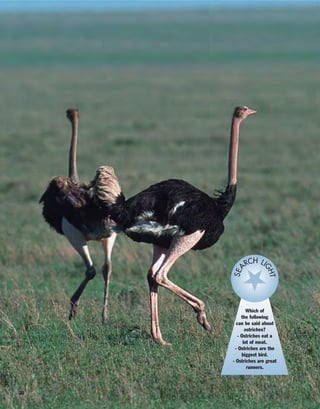
Which of
the following
can be said about
ostriches?
- Ostriches eat a
lot of meat.
- Ostriches are the
biggest bird.
- Ostriches are great
runners.
SEA
RCH LIGHT
O S T R I C H E S
31
Ostriches are the largest living birds in the world. They are about
8 feet tall and may weigh as much as 345 pounds. They have wings but
they can’t fly. The wings do help them move in a way, however, because
flapping their wings while they run helps the birds go faster on the ground.
Ostriches can run up to 40 miles an hour. This makes them not just the
biggest but also the fastest bird on the ground!
Ostriches don’t use their speed to catch food.
Instead, they run to keep away from their
enemies. But the first thing ostriches do when
they see an enemy is hide. To avoid being seen,
ostriches generally lie flat on the ground with
their necks outstretched. This makes them look
like just another bush. People sometimes say that
ostriches bury their heads in the sand when they
sense danger. But this isn’t true. You just can’t
see their heads when ostriches are lying down.
Ostriches don’t always hide or run away from
trouble. If their babies are in danger, ostriches
will fight. They use their beaks, and they kick with their very powerful
legs. An ostrich could easily kill a person with a few kicks of its feet.
Wild ostriches live in groups in Africa. Sometimes there are as many as
50 birds in a single group. Ostriches eat mostly plants, fruits, and berries,
but once in a while they’ll also eat small animals and insects.
A tame ostrich that’s been treated well may do a very special thing: it
can be trained to carry people on its back. In fact, in some parts of the
world people have ostrich races.
LEARN MORE! READ THESE ARTICLES…
AFRICA (VOLUME 8) • PEACOCKS (VOLUME 11)
PENGUINS (VOLUME 11)
Answer:Ostrichesarethebiggestbird.
Ostrichesaregreatrunners.
★
in the World
The Biggest Birds
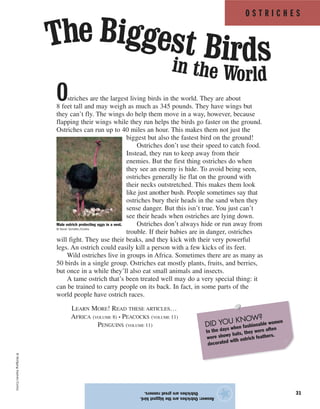
Male ostrich protecting eggs in a nest.
© Kevin Schafer/Corbis
DID YOU KNOW?
In the days when fashionable women
wore showy hats, they were often
decorated with ostrich feathers.
©WolfgangKaehler/Corbis
© Geoff Moon—Frank Lake Picture Agency/Corbis
32
Fill in
the blank:
The kiwi is an
unusual bird. Its
__________
are not fully formed,
so it does not fly.
SEA
RCH LI
GHT
K I W I S
33
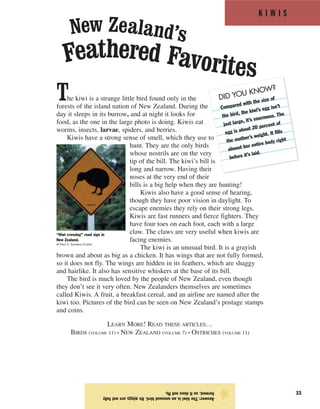
The kiwi is a strange little bird found only in the
forests of the island nation of New Zealand. During the
day it sleeps in its burrow, and at night it looks for
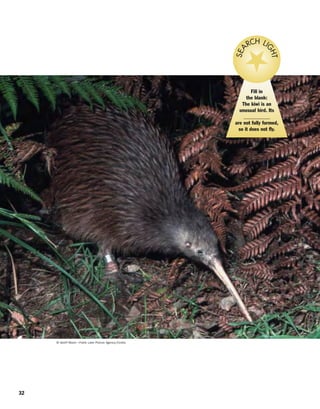
food, as the one in the large photo is doing. Kiwis eat
worms, insects, larvae, spiders, and berries.
Kiwis have a strong sense of smell, which they use to
hunt. They are the only birds
whose nostrils are on the very
tip of the bill. The kiwi’s bill is
long and narrow. Having their
noses at the very end of their
bills is a big help when they are hunting!
Kiwis also have a good sense of hearing,
though they have poor vision in daylight. To
escape enemies they rely on their strong legs.
Kiwis are fast runners and fierce fighters. They
have four toes on each foot, each with a large
claw. The claws are very useful when kiwis are
facing enemies.
The kiwi is an unusual bird. It is a grayish
brown and about as big as a chicken. It has wings that are not fully formed,
so it does not fly. The wings are hidden in its feathers, which are shaggy
and hairlike. It also has sensitive whiskers at the base of its bill.
The bird is much loved by the people of New Zealand, even though
they don’t see it very often. New Zealanders themselves are sometimes
called Kiwis. A fruit, a breakfast cereal, and an airline are named after the
kiwi too. Pictures of the bird can be seen on New Zealand’s postage stamps
and coins.
LEARN MORE! READ THESE ARTICLES…
BIRDS (VOLUME 11) • NEW ZEALAND (VOLUME 7) • OSTRICHES (VOLUME 11)
Answer:Thekiwiisanunusualbird.Itswingsarenotfully
formed,soitdoesnotfly.
★
Feathered Favorites
New Zealand’s
“Kiwi crossing” road sign in
New Zealand.
© Paul A. Souders/Corbis
DID YOU KNOW?
Compared with the size of
the bird, the kiwi’s egg isn’t
just large, it’s enormous. The
egg is about 20 percent of
the mother’s weight. It fills
almost her entire body right
before it’s laid.
34
Afish is a cold-blooded animal that has a backbone, lives in water,
and breathes by means of gills. It normally has two pairs of fins in place
of arms and legs, as well as several other fins. Most fish are covered
with scales.
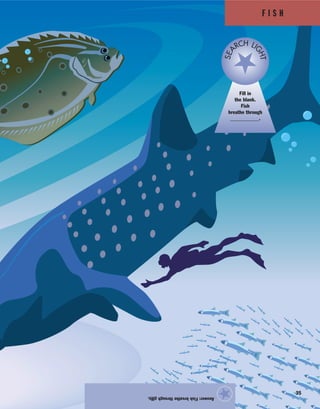
Fish are fascinating in their variety. The sea horse looks
something like a tiny horse standing on its tail. Flounders are as flat
as a dinner plate. The rabbitfish, a small relative of the shark, has a
head and teeth resembling those of a rabbit. Anglerfish carry their own
“fishing rod” to catch other fish. An extended part of the back fin has
wormlike pieces of flesh at the tip, which are the “bait.” Anglers of the
deep sea have bait that lights up to attract victims.
Size differs as much as shape. Some Philippine gobies reach an adult
size of less than half an inch. The whale shark, the largest of all fishes,
reaches 50 feet in length and weighs about 20 tons.
Fish swim mainly by sideways movements of the body and tail. The
fins are used for balancing, steering, and braking. To move quickly from a
resting position some fish shoot a stream of water out of the gills, which
causes them to lunge forward. The fastest swimmers, such as the
tuna, can travel 30 miles per hour.
Most fish continue to grow as long as they live. Fish that live
to an old age can become very large. Carp are among this group.
They may live 100 years!
LEARN MORE! READ THESE ARTICLES…
GREAT BARRIER REEF (VOLUME 7) • RIVERS (VOLUME 1)
SHARKS (VOLUME 11)
Citizens
of the Waters
DID YOU KNOW?
Fish called “mudskippers” can crawl
across mudflats and wet fields in
search of food. Lungfish can burrow
into mud when their pools dry up. They
lie there, for months if necessary, until
rain refills the pools.
F I S H
35
Answer:Fishbreathethroughgills.
★
Fill in
the blank.
Fish
breathe through
___________.
SEA
RCH LI
GHT
DID YOU KNOW?
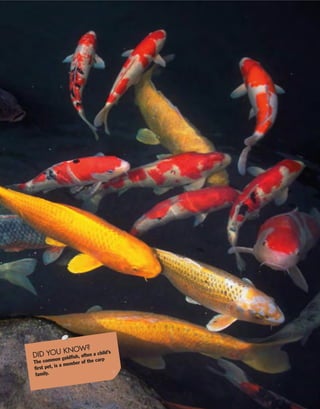
The common goldfish, often a child’s
first pet, is a member of the carp
family.
C A R P
37
The common carp is a fish that lives along the muddy bottoms of
ponds, lakes, and rivers. It swallows plants, insects, and anything
else it finds to eat. It was first found in Asia but was later taken into
Europe and North America. Some people like to eat carp.
Sometimes carp can live 100 years and grow to weigh 80 pounds
or more. But not all carp grow that old or that heavy. The fish that are
caught usually are under 10 years old and
do not weigh more than 10 pounds.
The carp has a blunt nose and a
small thick-lipped mouth. From its
upper lip dangle two pairs of feelers
that are called “barbels.”
There are three kinds of common carp.
The scale carp has large scales all over its
wide heavy body. Its back is olive green, its
sides are gold-colored, and its belly is bright
yellow. The mirror carp has only three or four
rows of huge scales along its sides. The
leather carp is almost without scales, but it
has a very thick skin.
In some ways the carp is a nuisance. In
hunting for food, the carp muddies the water.
This affects the life of many plants and animals. A carp sometimes pushes
more valuable fish away from their food and also eats their eggs. The carp
has a habit of pulling out plants from their roots. This keeps ducks away. It
is very difficult to get rid of carp. The fish can thrive even in dirty water
and can also survive in very warm and very cold water.
LEARN MORE! READ THESE ARTICLES…
FISH (VOLUME 11) • GREAT LAKES (VOLUME 9) • RIVERS (VOLUME 1)
Answer:FALSE.Theyliveinfreshwaterrivers,lakes,andponds.
★
Goldfish swimming in a bowl.
© Doug Wilson/Corbis
True
or false?
Carp
live in the
ocean.
SEA
RCH LI
GHT
Colorful carp swim in a pond outside a restaurant in Japan.
In Asia and Europe carp are often raised in ponds because
it is possible to grow many fish in a small amount of water.
© Wolfgang Kaehler/Corbis
The Fishy Survivor
DID YOU KNOW?Each generation of salmonreturns to the same river, tothe same spot, to lay theireggs every year. So a salmon’sparents, grandparents, andgreat-grandparents all chosethe same river.
S A L M O N
39
These fish aren’t going down a waterfall. They’re going up! Not
much can stop these big strong salmon—not even a waterfall. The
salmon are swimming up the river to return to the quiet
waters where they hatched. They’re returning in order to spawn—
that is, to lay their own eggs. They started their journey far out
in the ocean.
Somehow the salmon manage to find the river they are
looking for. Night and day they swim on. They eat nothing at
all after getting into their river.
Finally, they reach the waters where
they came from.
We don’t know how salmon can find
their way on this long trip up the river. But
we know what they do when they reach
the end. At the bottom of the stream, the
mother salmon digs a long hole with her
tail and snout. She fills the hole with
thousands of tiny eggs. She covers the
eggs with sand to keep them safe.
The eggs hatch. When the baby salmon are about as long as your
finger, they are big enough to start the swim to the ocean. They float
backward down the long river—tails first and heads last! They seem to
steer better that way.
Many of the babies never reach the ocean because there are too many
enemies. Birds, bears, and bigger fish along the way love to eat them.
The salmon that do reach the ocean will one day start the long hard trip
up the river.
LEARN MORE! READ THESE ARTICLES…
AMERICAN INDIANS (VOLUME 4) • FISH (VOLUME 11) • RIVERS (VOLUME 1)
Answer:TRUE.
★Male sockeye salmon.
© Natalie Fobes/Corbis
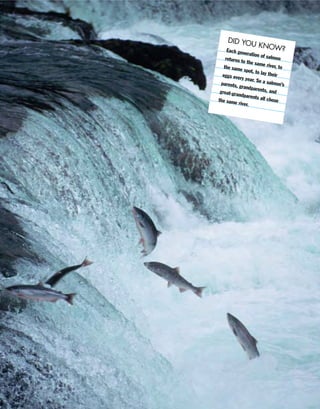
These Pacific salmon are trying to leap up a
waterfall of the Brooks River in Katmai
National Park, Alaska, to spawn upstream.
© Galen Rowell/Corbis
True
or false?
Salmon travel
upstream against
the river current
to lay their eggs.
SEA
RCH LI
GHT
Leaping Up the
Waterfall
40
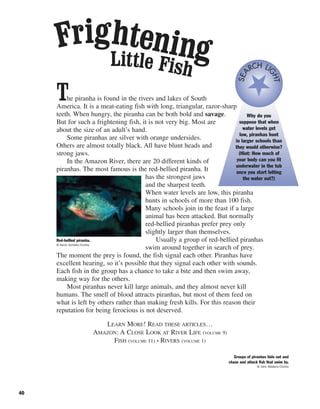
The piranha is found in the rivers and lakes of South
America. It is a meat-eating fish with long, triangular, razor-sharp
teeth. When hungry, the piranha can be both bold and savage.
But for such a frightening fish, it is not very big. Most are
about the size of an adult’s hand.
Some piranhas are silver with orange undersides.
Others are almost totally black. All have blunt heads and
strong jaws.
In the Amazon River, there are 20 different kinds of
piranhas. The most famous is the red-bellied piranha. It
has the strongest jaws
and the sharpest teeth.
When water levels are low, this piranha
hunts in schools of more than 100 fish.
Many schools join in the feast if a large
animal has been attacked. But normally
red-bellied piranhas prefer prey only
slightly larger than themselves.
Usually a group of red-bellied piranhas
swim around together in search of prey.
The moment the prey is found, the fish signal each other. Piranhas have
excellent hearing, so it’s possible that they signal each other with sounds.
Each fish in the group has a chance to take a bite and then swim away,
making way for the others.
Most piranhas never kill large animals, and they almost never kill
humans. The smell of blood attracts piranhas, but most of them feed on
what is left by others rather than making fresh kills. For this reason their
reputation for being ferocious is not deserved.
LEARN MORE! READ THESE ARTICLES…
AMAZON: A CLOSE LOOK AT RIVER LIFE (VOLUME 9)
FISH (VOLUME 11) • RIVERS (VOLUME 1)
Why do you
suppose that when
water levels get
low, piranhas hunt
in larger schools than
they would otherwise?
(Hint: How much of
your body can you fit
underwater in the tub
once you start letting
the water out?)
SEA
RCH LI
GHT
Red-bellied piranha.
© Kevin Schafer/Corbis
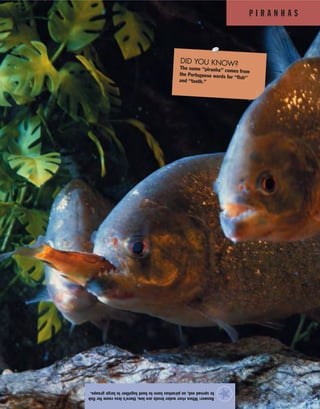
Groups of piranhas hide out and
chase and attack fish that swim by.
© John Madere/Corbis
Little Fish
Frightening
P I R A N H A S
Answer:Whenriverwaterlevelsarelow,there’slessroomforfish
tospreadout,sopiranhashavetohunttogetherinlargegroups.
★
DID YOU KNOW?The name “piranha” comes fromthe Portuguese words for “fish”
and “tooth.”
42
When the first dinosaurs walked on Earth, sharks were already
swimming in the sea. The dinosaurs are long gone, but sharks are still a
force to be reckoned with.
Great white sharks, in particular, are feared as man-eaters. It’s hard to
fight them, because they are so strong and fast in the water. Their tough
skin is protected by tiny toothlike scales. In
their big mouths are rows and rows of sharp
teeth that rip like the edge of a saw. Sharks
continue to grow teeth all their lives. A
great white can make a quick meal out of
almost anything!
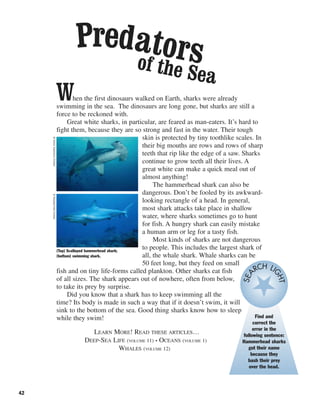
The hammerhead shark can also be
dangerous. Don’t be fooled by its awkward-
looking rectangle of a head. In general,
most shark attacks take place in shallow
water, where sharks sometimes go to hunt
for fish. A hungry shark can easily mistake
a human arm or leg for a tasty fish.
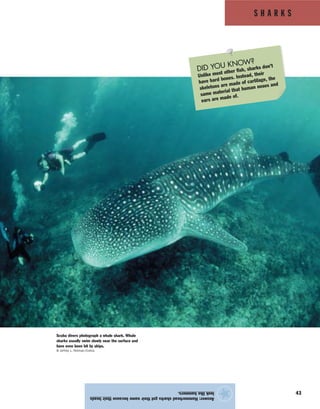
Most kinds of sharks are not dangerous
to people. This includes the largest shark of
all, the whale shark. Whale sharks can be
50 feet long, but they feed on small
fish and on tiny life-forms called plankton. Other sharks eat fish
of all sizes. The shark appears out of nowhere, often from below,
to take its prey by surprise.
Did you know that a shark has to keep swimming all the
time? Its body is made in such a way that if it doesn’t swim, it will
sink to the bottom of the sea. Good thing sharks know how to sleep
while they swim!
LEARN MORE! READ THESE ARTICLES…
DEEP-SEA LIFE (VOLUME 11) • OCEANS (VOLUME 1)
WHALES (VOLUME 12)
(Top) Scalloped hammerhead shark;
(bottom) swimming shark.
©AmosNachoum/Corbis©Royalty-Free/Corbis
Find and
correct the
error in the
following sentence:
Hammerhead sharks
got their name
because they
bash their prey
over the head.
SEA
RCH LIGHT
of the Sea
Predators
S H A R K S
43
Answer:Hammerheadsharksgottheirnamebecausetheirheads
looklikehammers.
★
Scuba divers photograph a whale shark. Whale
sharks usually swim slowly near the surface and
have even been hit by ships.
© Jeffrey L. Rotman/Corbis
DID YOU KNOW?
Unlike most other fish, sharks don’t
have hard bones. Instead, their
skeletons are made of cartilage, the
same material that human noses and
ears are made of.
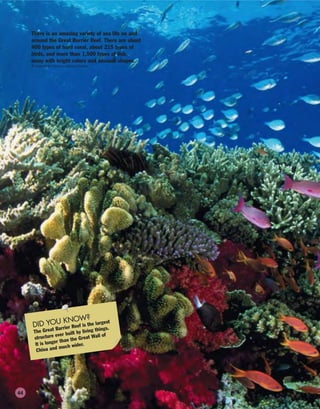
There is an amazing variety of sea life on and
around the Great Barrier Reef. There are about
400 types of hard coral, about 215 types of
birds, and more than 1,500 types of fish,
many with bright colors and unusual shapes.
© Australian Picture Library/Corbis
DID YOU KNOW?
The Great Barrier Reef is the largest
structure ever built by living things.
It is longer than the Great Wall of
China and much wider.
44
C O R A L
Answer:Coralreferstothesoftjellylikeanimallivinginsidethe
hardshell,aswellastotheshellitself.Peoplealsocallmanyof
theseshellsstucktogether“coral.”
★
Acoral is a soft little sea animal that looks like a bit of jelly. It
is no bigger than the end of your little finger. At one end it has a
mouth surrounded by little arms called “tentacles.” The tentacles
gather food. When they touch a tiny plant or animal floating nearby,
they pull these inside the mouth.
The baby coral swims through the water until it finds a place to
build its house, and then it never swims again. Using special glue
from inside its body, it sticks itself
to a rock or to another piece of
coral. Once it is stuck, it starts to
build itself a house with a juice
from its body that turns into a kind of
stone. The hard little shell houses are called
coral too.
In the ocean where the water is warm,
the coral grows in lovely ocean gardens. It
grows in just about every color and shape
you can think of. It may grow to look like
lace, a fan, a leaf, a brain, the horns of a
deer, or a ribbon.
One day a bud grows on the coral.
This bud grows into a new coral animal.
After many years there are so many coral
houses built on top of one another and next
to each other that they become a great wall called a “reef.”
Sometimes coral may grow together to form a reef a hundred miles
long. The largest coral reef in the world is the Great Barrier Reef near
Australia. It is more than 1,250 miles long.
LEARN MORE! READ THESE ARTICLES…
GREAT BARRIER REEF (VOLUME 7) • OCEANS (VOLUME 1)
THE GREAT WALL (VOLUME 7)
Builders in the Sea
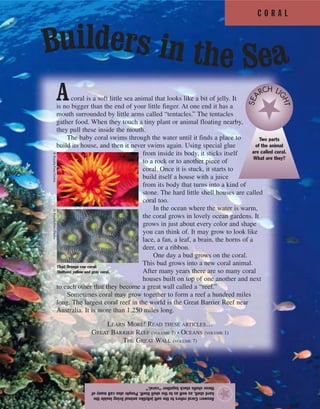
(Top) Orange cup coral;
(bottom) yellow and gray coral.
©Royalty-Free/Corbis©Royalty-Free/Corbis
Two parts
of the animal
are called coral.
What are they?
SEA
RCH LI
GHT
Which of
the following
statements are
true about sponges?
a) Sponges can
be found mainly in
the ocean.
b) Sponges eat by
straining the water
around them.
c) The sponges in your
house probably came
from the ocean.SEA
RCH LI
GHT
S P O N G E S
47
Sponges are strange animals. They don’t have the
body parts—inside or outside—that we expect an
animal to have. They don’t even move around. Instead,
they stay attached to an underwater rock or coral reef,
just like plants. For a long time, people thought
sponges were plants. Scientists decided that
sponges are animals only after watching them
eating food by drawing it into their bodies.
There are nearly 5,000 different kinds of
sponges. Most live in the ocean, but a few like
freshwater. Sponges may be flat like spreading
moss. Or they may look like trees with
branching arms. Some are as tiny as a bean,
while others are as tall as a person. Some are
smooth and mushy, while others are rough,
hard, and prickly. Some are dull and drab, while
others are brightly colored.
A sponge gets oxygen to breathe and food
particles to eat by straining water through its
body. Sometimes fish, shrimp, and other
creatures live inside a sponge. A few sponges
attach themselves to crab shells and go
wherever the crab goes.
People dive to collect sponges or pull them
up with hooks. Afterward the sponges are dried, cleaned, and trimmed. The
fleshy parts are thrown away, and only the “spongy” skeleton is used. The
ancient Greeks and Romans used sponges to pad their armor and helmets.
People still use sponges for scrubbing themselves clean, for painting, and
for making medicines. However, factory-made sponges have taken the
place of natural sponges in most homes.
LEARN MORE! READ THESE ARTICLES…
CORAL (VOLUME 11) • MOLLUSKS (VOLUME 11) • OCEANS (VOLUME 1)
Answer:a)Spongescanbefoundmainlyintheocean.
b)Spongeseatbystrainingthewateraroundthem.
★
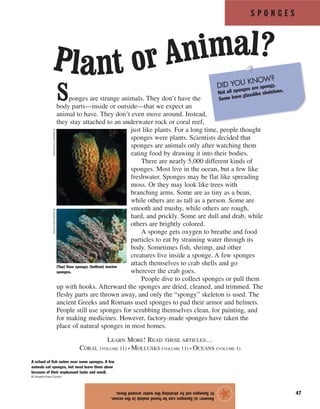
(Top) Vase sponge; (bottom) marine
sponges.
©StephenFrink/Corbis©Royalty-Free/Corbis
DID YOU KNOW?
Not all sponges are spongy.
Some have glasslike skeletons.
A school of fish swims near some sponges. A few
animals eat sponges, but most leave them alone
because of their unpleasant taste and smell.
© Royalty-Free/Corbis
Plant or Animal?
48
DID YOU KNOW?
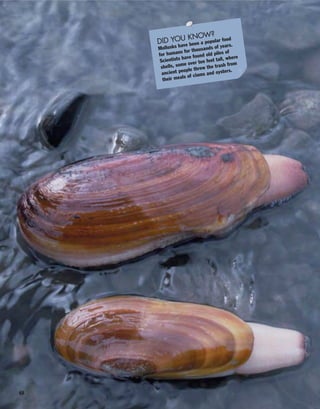
Mollusks have been a popular food
for humans for thousands of years.
Scientists have found old piles of
shells, some over ten feet tall, where
ancient people threw the trash from
their meals of clams and oysters.
M O L L U S K S
49
There are many different shelled animals. The smallest live in
shells as tiny as the letter “O.” The largest, such as the giant squid,
weigh more than 4,000 pounds! Some of these animals belong to a
group called “mollusks.” And you might be surprised to know that
there are about 100,000 kinds of them!
Most mollusks—such as snails, clams, oysters, and mussels—
have shells. But some, such as octopuses
and squid, have little or none at all. And
not all kinds of animals with shells are
mollusks. Crabs and lobsters have
shells, but they are not mollusks.
Although most mollusks live in
the water, some are found on land. Snails live in
forests and gardens.
Newborn mollusks are squishy and helpless.
They need protection from enemies that would eat
them. They get this protection from the shell they
build around themselves. Shells are really one-
room houses that mollusks build out of their own bodies. It’s as easy for
them to do this as it is for you to grow fingernails. Each shell has room for
just one animal.
Mollusks eat tiny bits of food that float with the moving water. They
also eat the algae that cover rocks. Part of this food is used to build their
bodies. The rest helps them build their shells. A mollusk and its shell keep
growing as long as the mollusk lives.
When a mollusk dies, it leaves behind its shell. That is why most of the
shells you find on the beach are empty. Mollusk shells can last for
thousands of years—a reminder of how long mollusks have been living on
the Earth.
LEARN MORE! READ THESE ARTICLES…
GREAT BARRIER REEF (VOLUME 7) • OCEANS (VOLUME 1) • OCTOPUSES (VOLUME 11)
Answer:Snails,oysters,andsquidareallmollusks.
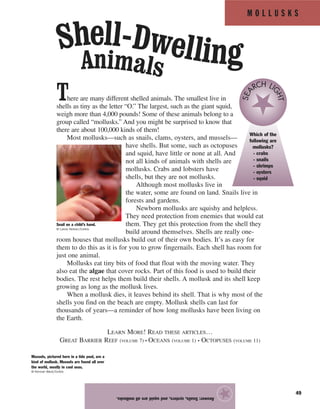
★Snail on a child’s hand.
© Lance Nelson/Corbis
Mussels, pictured here in a tide pool, are a
kind of mollusk. Mussels are found all over
the world, mostly in cool seas.
© Kennan Ward/Corbis
Which of the
following are
mollusks?
- crabs
- snails
- shrimps
- oysters
- squid
SEA
RCH LI
GHT
Shell-DwellingAnimals
What
are two ways
that an octopus
can escape
from an enemy?
SEA
RCH LI
GHT
O C T O P U S E S
Answer:Itcanchangecolorsandsquirtinkintothewater.
★
People used to tell scary stories about a deep-sea monster that wrapped
its many long arms around a ship and dragged it down to the bottom of the
ocean. They called the monster a “devilfish.”
Today we know that this wasn’t a monster at all. It was an octopus—an
animal with eight arms that lives in the ocean. Octopuses are members of
an animal group called mollusks, which includes
squid, clams, and oysters.
There are nearly 50 kinds of octopuses. Some
are only a few inches long. The largest is longer
than 30 feet and may weigh more than 150 pounds.
But no octopus grows large enough to attack a ship!
An octopus usually lives alone among the
rocks on the bottom of the ocean. Sometimes it
moves rocks with its long arms, or tentacles, to
make a little cave for itself. Underneath each
tentacle are many little round suckers, or suction
cups. These help the octopus climb over rocks and
hold on to things.
Octopuses like to eat shellfish such as crabs, lobsters, and mussels. An
octopus will crawl about on its rubbery tentacles as it looks for food. But it
can also swim very fast. An octopus sometimes hunts fish, chasing them
until they are too tired to swim anymore. Then the octopus tightly wraps its
arms around the fish and eats them.
But the octopus has enemies too. It usually tries to hide from them.
Many octopuses can hide by changing their colors to match the area around
them. If that doesn’t work, the octopus shoots black ink into the water. The
cloudy water confuses the enemy and helps the octopus get away.
LEARN MORE! READ THESE ARTICLES…
DEEP-SEA LIFE (VOLUME 11) • MOLLUSKS (VOLUME 11)
OCEANS (VOLUME 1)
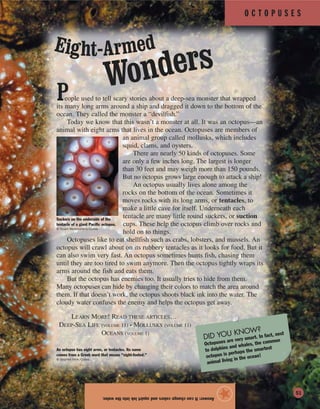
Suckers on the underside of the
tentacle of a giant Pacific octopus.
© Stuart Westmorland/Corbis
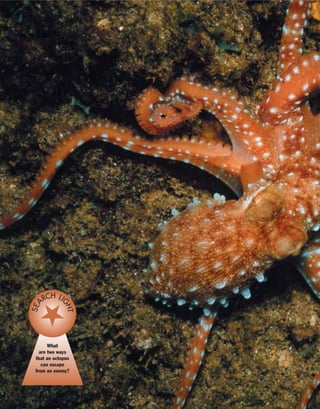
An octopus has eight arms, or tentacles. Its name
comes from a Greek word that means “eight-footed.”
© Stephen Frink/Corbis
DID YOU KNOW?
Octopuses are very smart. In fact, next
to dolphins and whales, the common
octopus is perhaps the smartest
animal living in the ocean!
Eight-Armed
Wonders
51
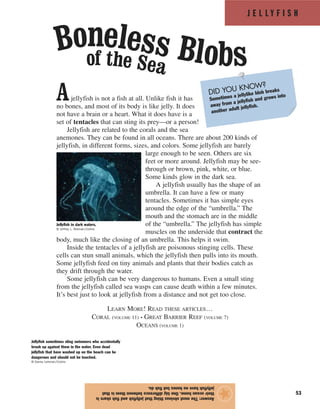
Can you
think of one
way that jellyfish
and fish are similar?
What’s one way that
they’re different?
SEA
RCH LI
GHT
J E L L Y F I S H
53
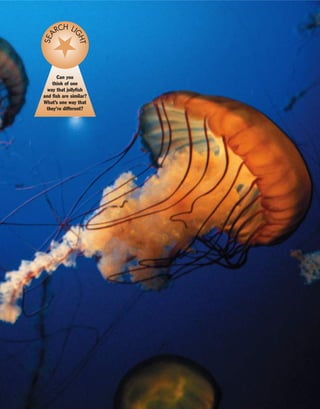
Ajellyfish is not a fish at all. Unlike fish it has
no bones, and most of its body is like jelly. It does
not have a brain or a heart. What it does have is a
set of tentacles that can sting its prey—or a person!
Jellyfish are related to the corals and the sea
anemones. They can be found in all oceans. There are about 200 kinds of
jellyfish, in different forms, sizes, and colors. Some jellyfish are barely
large enough to be seen. Others are six
feet or more around. Jellyfish may be see-
through or brown, pink, white, or blue.
Some kinds glow in the dark sea.
A jellyfish usually has the shape of an
umbrella. It can have a few or many
tentacles. Sometimes it has simple eyes
around the edge of the “umbrella.” The
mouth and the stomach are in the middle
of the “umbrella.” The jellyfish has simple
muscles on the underside that contract the
body, much like the closing of an umbrella. This helps it swim.
Inside the tentacles of a jellyfish are poisonous stinging cells. These
cells can stun small animals, which the jellyfish then pulls into its mouth.
Some jellyfish feed on tiny animals and plants that their bodies catch as
they drift through the water.
Some jellyfish can be very dangerous to humans. Even a small sting
from the jellyfish called sea wasps can cause death within a few minutes.
It’s best just to look at jellyfish from a distance and not get too close.
LEARN MORE! READ THESE ARTICLES…
CORAL (VOLUME 11) • GREAT BARRIER REEF (VOLUME 7)
OCEANS (VOLUME 1)
Answer:Themostobviousthingthatjellyfishandfishshareis
theiroceanhome.Onebigdifferencebetweenthemisthat
jellyfishhavenobonesbutfishdo.
★Jellyfish in dark waters.
© Jeffrey L. Rotman/Corbis
DID YOU KNOW?
Sometimes a jellylike blob breaks
away from a jellyfish and grows into
another adult jellyfish.
Jellyfish sometimes sting swimmers who accidentally
brush up against them in the water. Even dead
jellyfish that have washed up on the beach can be
dangerous and should not be touched.
© Danny Lehman/Corbis
of the Sea
Boneless Blobs
54
It is very dark deep below the surface of the oceans of the
world. This dark area is called the “abyssal zone.” It is a
black, soundless place where the water is very still. This zone
lies thousands of feet below the water’s surface.
You wouldn’t think it, but there are many kinds of living
things to be found in the abyss. For a very long time, people
believed that nothing could live down there because there
isn’t any light. But scientists who investigated the deep sea
found plenty of life!
Many forms of life were discovered near cracks on the ocean floor.
These are called “rift communities.” The huge cracks, or fissures, are
between two of the plates that make up
the Earth’s crust. These fissures are hot-
water vents that raise the temperature of
the water around them. The fissures are
rich in minerals.
Deep-sea animals include certain kinds
of squid, octopuses, worms, and fish.
Because it is difficult to study animals at
such levels, not much is known about their
behavior or surroundings. But it is known
that deep-sea animals have special features that allow them to live in
conditions in which other animals could not. These features are called
adaptations.
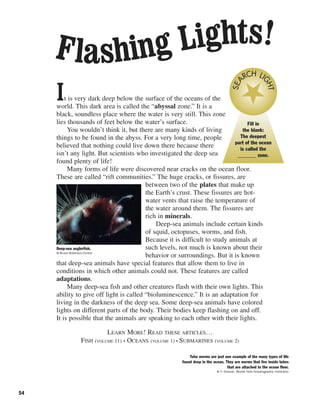
Many deep-sea fish and other creatures flash with their own lights. This
ability to give off light is called “bioluminescence.” It is an adaptation for
living in the darkness of the deep sea. Some deep-sea animals have colored
lights on different parts of the body. Their bodies keep flashing on and off.
It is possible that the animals are speaking to each other with their lights.
LEARN MORE! READ THESE ARTICLES…
FISH (VOLUME 11) • OCEANS (VOLUME 1) • SUBMARINES (VOLUME 2)
Deep-sea anglerfish.
© Bruce Robinson/Corbis
Fill in
the blank:
The deepest
part of the ocean
is called the
_______ zone.
SEA
RCH LI
GHT
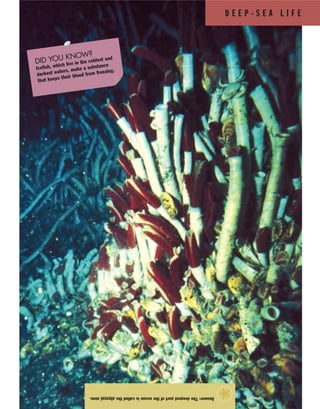
Tube worms are just one example of the many types of life
found deep in the ocean. They are worms that live inside tubes
that are attached to the ocean floor.
© F. Grassle, Woods Hole Oceanographic Institution
Flashing Lights!
D E E P - S E A L I F E
Answer:Thedeepestpartoftheoceaniscalledtheabyssalzone.
★
DID YOU KNOW?
Icefish, which live in the coldest and
darkest waters, make a substance
that keeps their blood from freezing.
56
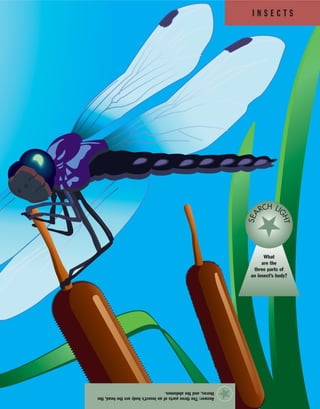
The Earth is home to more insects than any other kind of animal. Insects
are unique among all creatures because their bodies are divided into three
parts—the head, the thorax, and the abdomen. The head contains the
mouth, the eyes, and the antennas. Some insects use their antennas for
smelling. The thorax is similar to a person’s chest. If an insect has wings,
they are attached to the thorax. And some insects have ears on the thorax.
The abdomen contains a large part of the digestive system.
Instead of having bones, insects have an outer covering to support the
body. The muscles are attached to this covering. The outer layer of the
covering is waxy and waterproof.
All insects have six legs. Their legs, like their wings, are attached to the
thorax. Each leg has five different bending places. It’s like having five knees.
Each kind of insect has features that help it get along in the world. The
water strider has little cups on its feet so that it can walk on water.
Dragonflies can hover and turn in the air like little helicopters. They even
look like helicopters!
Some insects make sounds like music. Perhaps the most beautiful
music is made by the snowy tree cricket. This insect uses one of its front
wings as a fiddle and the other as a bow. Locusts have two tiny shell-like
drums close to their wings. When the wings flap, these drums sound like
fingers tapping on a tin lid. Grasshoppers make sounds by rubbing their
wings or their back legs together. In some places people keep crickets
or grasshoppers in cages to listen to their songs.
LEARN MORE! READ THESE ARTICLES…
AMPHIBIANS (VOLUME 11) • MAMMALS (VOLUME 12)
REPTILES (VOLUME 11)
DID YOU KNOW?
It may seem hard to believe, but out
in the country almost all the noises
you hear at night are made by insects
and frogs—even the ones that sound
like birds or people.
The World’s Largest
Population
I N S E C T S
Answer:Thethreepartsofaninsect’sbodyarethehead,the
thorax,andtheabdomen.
★
What
are the
three parts of
an insect’s body?
SEA
RCH LI
GHT
58
DID YOU KNOW?
One type of ant travels as an army.
Millions of army ants move in lines
that look like rivers of ants! These
ant armies weigh so much that
they can knock over trees and even
bring down large animals, which they
then eat.
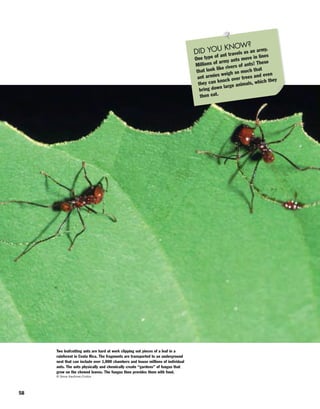
Two leafcutting ants are hard at work clipping out pieces of a leaf in a
rainforest in Costa Rica. The fragments are transported to an underground
nest that can include over 1,000 chambers and house millions of individual
ants. The ants physically and chemically create “gardens” of fungus that
grow on the chewed leaves. The fungus then provides them with food.
© Steve Kaufman/Corbis
A N T S
59
Answer:Antstouchwhentheymeetbecausethat’showthey
communicatewithoneanother.Theyalsousetheirfeelerstotell
ifanantisanenemyorafriend.
★
Most ants live in nests that they build in protected places. Many live
underground, sometimes under a rock. Some ants live in trees or inside
wild plants. Others build their nests on the
ground, using tiny sticks, sand, mud, gravel, and
even leaves.
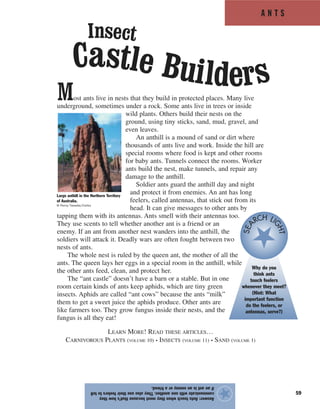
An anthill is a mound of sand or dirt where
thousands of ants live and work. Inside the hill are
special rooms where food is kept and other rooms
for baby ants. Tunnels connect the rooms. Worker
ants build the nest, make tunnels, and repair any
damage to the anthill.
Soldier ants guard the anthill day and night
and protect it from enemies. An ant has long
feelers, called antennas, that stick out from its
head. It can give messages to other ants by
tapping them with its antennas. Ants smell with their antennas too.
They use scents to tell whether another ant is a friend or an
enemy. If an ant from another nest wanders into the anthill, the
soldiers will attack it. Deadly wars are often fought between two
nests of ants.
The whole nest is ruled by the queen ant, the mother of all the
ants. The queen lays her eggs in a special room in the anthill, while
the other ants feed, clean, and protect her.
The “ant castle” doesn’t have a barn or a stable. But in one
room certain kinds of ants keep aphids, which are tiny green
insects. Aphids are called “ant cows” because the ants “milk”
them to get a sweet juice the aphids produce. Other ants are
like farmers too. They grow fungus inside their nests, and the
fungus is all they eat!
LEARN MORE! READ THESE ARTICLES…
CARNIVOROUS PLANTS (VOLUME 10) • INSECTS (VOLUME 11) • SAND (VOLUME 1)
Why do you
think ants
touch feelers
whenever they meet?
(Hint: What
important function
do the feelers, or
antennas, serve?)
SEA
RCH LI
GHT
Large anthill in the Northern Territory
of Australia.
© Penny Tweedie/Corbis
Insect
Castle Builders
True
or false?
Drones
have stingers.
SEA
RCH LI
GHT
B E E S
61
Inside a honeybee hive you’ll see bees. But you’ll also see hundreds of
little six-sided rooms, or “cells.” The bees build these cells with a wax—
beeswax—that they make inside their bodies.
The bees store many things in the wax cells, including honey, nectar,
and a food called “bee bread.” Bee bread is made of flower pollen mixed
with honey. The cells are also used to hold the
tiny eggs that will hatch into baby bees.
Most of the bees’ work is done in spring
and summer. That’s when the honey is made
and stored and when the queen bee lays most
of her eggs. The queen bee is the biggest bee
in the hive.
There are two other kinds of bees in the
hive: drones and workers. Drones are larger
than the workers and have no stingers. They
don’t do any work, but one drone mates with the queen and is the father of
all the hive’s workers.
Each of the worker bees has a special job.
Some build the cells in the hive, and others keep
the hive clean. Some workers are soldiers that
guard the hive and chase away any bees, wasps,
and other insects that might try to steal the hive’s
honey. Other worker bees fly out to visit flowers
and blossoms. They take pollen and nectar back to
the hive to make bee bread and honey. Some bees
even stay by the door of the hive and flap their
wings quickly to blow cool air through the hive.
LEARN MORE! READ THESE ARTICLES…
BATS (VOLUME 12) • HONEYSUCKLE (VOLUME 10) • INSECTS (VOLUME 11)
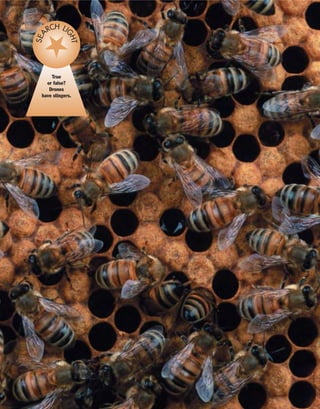
Answer:FALSE.Onlyworkerbeesandqueenshavestingers.
★
Inside the Hive
DID YOU KNOW?
Bees can tell if an intruder has
entered the hive because the intruder
smells different. But one kind of
moth has found a way to sneak into
hives. It fakes the smell of the hive
just long enough to get in and steal
some honey.
A bee pollinates a flower.
© George D. Lepp/Corbis
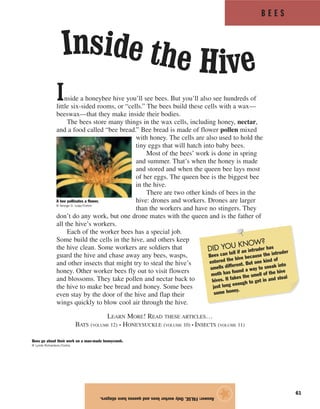
Bees go about their work on a man-made honeycomb.
© Lynda Richardson/Corbis
62
Butterflies and moths are found throughout the world, from deserts to
hot jungles to high up in snowy mountains. You can see them on every
continent except Antarctica.
Butterflies and moths are insects, and like all insects they have three
pairs of legs. Their bodies are divided into three sections: head, thorax,
and abdomen. On either side of the head is a
large special eye. These eyes are able to detect
the smallest movement. But they cannot see
faraway things very clearly.
The thorax, the middle section of the body,
has two pairs of wings. The wings in front are
usually larger. Dustlike scales cover the wings,
body, and legs. If you happen to touch a
butterfly or moth, these scales will come off in
your hand.
If you want to know whether you are
looking at a butterfly or a moth, you should
look at its antennas. Butterflies and moths
use their antennas to hear and smell. Butterfly antennas end in little round
knobs. Moth antennas may look like tiny feathers or threads.
The most striking thing about butterflies is their coloring. Most are
bright and beautiful. But most moths are dull colored, with thicker
bodies and smaller wings. Butterflies hold their wings straight
up over their backs when they rest. Moths rest with their
wings spread out. Butterflies are active during the day. But
moths usually fly around at night.
Many butterflies and moths seem to like sweet things.
Nectar from flowers is an important part of their diet. Some
will eat mosses and ferns. Others like cones, fruits, and seeds,
but some do not eat at all and live for only a short time!
LEARN MORE! READ THESE ARTICLES…
BATS (VOLUME 12) • HONEYSUCKLE (VOLUME 10)
INSECTS (VOLUME 11)
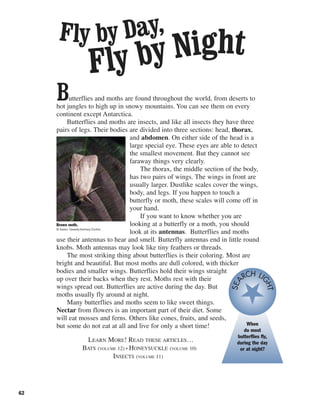
Brown moth.
© Karen Tweedy-Holmes/Corbis
When
do most
butterflies fly,
during the day
or at night?
SEA
RCH LI
GHT
Fly by Day,
Fly by Night
B U T T E R F L I E S A N D M O T H S
63
Answer:Mostbutterfliesflyduringtheday.
★
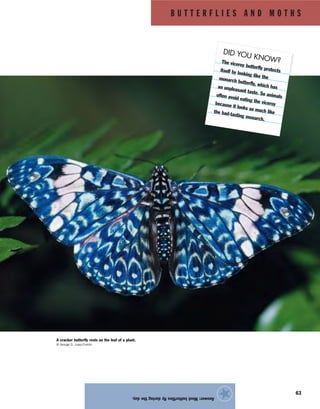
A cracker butterfly rests on the leaf of a plant.
© George D. Lepp/Corbis
DID YOU KNOW?The viceroy butterfly protectsitself by looking like themonarch butterfly, which hasan unpleasant taste. So animalsoften avoid eating the viceroybecause it looks so much likethe bad-tasting monarch.
64
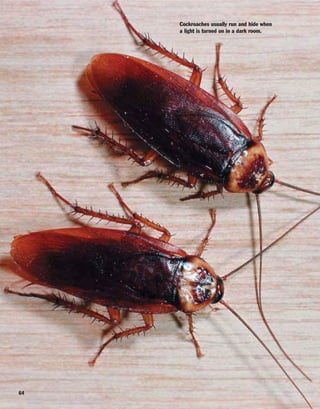
Cockroaches usually run and hide when
a light is turned on in a dark room.
C O C K R O A C H E S
65
Cockroaches have been around for many millions of years. This
means that cockroaches lived through times when many other
animals disappeared forever. They are very tough insects indeed.
One type, the Oriental cockroach, can live for a month without food!
Cockroaches are found nearly everywhere. Some kinds live
outside, but others live indoors alongside humans. These kinds are
pests. They like warm dark areas in homes, offices, ships, trains, and
even airplanes. Their broad flat bodies can squeeze through the
narrowest of cracks. Although cockroaches may look like beetles,
they are related to crickets. Like them, roaches use the long
antennas on their heads for feeling through dark places.
Cockroaches usually hide during the day and come out at
night to feed. They eat all sorts of plant and animal products, including
paper, clothing, books, and other insects. Some cockroaches even eat
other roaches.
Their feeding causes a lot of damage. And they have a nasty smell too.
They can also cause allergies and are thought to spread diseases to humans.
No wonder cockroaches are considered among the worst household pests.
Humans get rid of cockroaches with common poisons and traps. But
cockroaches have many other enemies besides humans. Spiders, frogs,
toads, lizards, and birds all feed on them.
There are more than 3,500 types of cockroaches. Some are small, while
others reach lengths of three inches. Many are colorful. Most have two
pairs of wings. Some, such as the American cockroach, can fly long
distances. Others, such as the Oriental cockroach, can’t fly at all. But all
roaches have long powerful legs and can run very fast.
Answer:FALSE.Cockroachesusuallyhideduringthedayand
comeoutatnighttofeed.
★
©GalloImages/Corbis
DID YOU KNOW?
Many scientists believe that
cockroaches are some of the few
animals that could survive a nuclear
bomb blast.
Insect
Indestructible
True
or false?
Most
cockroaches
hide at night and
come out during
the day.
SEA
RCH LI
GHT
LEARN MORE! READ THESE ARTICLES…
BATS (VOLUME 12)
CARNIVOROUS PLANTS (VOLUME 10)
MOSQUITOES (VOLUME 11)
66
True
or false?
Some crickets
can fly.
SEA
RCH LI
GHT
There are a number of myths about crickets. Some people
believe that harming a cricket will lead to bad luck.
© Cordaiy Photo Library Ltd./Corbis
C R I C K E T S
67
Answer:TRUE.
★
Acricket never opens its mouth to chirp. Instead, it raises its stiff
leathery front wings and rubs one over the other to make its high creaking
sound. It’s a loud noise for such a tiny fellow. Some crickets are as small
as your thumbnail.
Only male crickets have music-making
wings. The chirping lets female crickets
know where to find them, and it also keeps
other male crickets away. The smooth wings
of female crickets make no sound. Some
kinds of male and female crickets use their
back wings for flying. But most crickets
travel by hopping and jumping.
Some crickets eat only tiny insects.
Others will eat almost anything. If one gets into your closet, it may make
big holes in your clothes. Crickets have such strong jaws that they
can even bite through leather.
Like other insects, a cricket has six legs. On its feet there are tiny
claws that help it run along on a tree limb or ceiling. You’ll never
guess where a cricket’s ears are. They’re down near the joints of its
front legs!
You may see black field crickets more often than others. But you
may find green-brown, whitish, and straw-colored crickets too. There
are many different kinds of crickets. There are field crickets and
brown house crickets. Both chirp during the day and night. But white
and green tree crickets and bush crickets chirp only at night.
A special kind of cricket in North America is called a
“thermometer cricket.” Try counting how many times it chirps in 15
seconds and add 40 to it. Now you know the temperature in Fahrenheit
degrees! The crickets chirp faster as the weather gets warmer.
LEARN MORE! READ THESE ARTICLES…
GRASSHOPPERS (VOLUME 11) • INSECTS (VOLUME 11) • TEMPERATURES (VOLUME 2)
The Wing-Singers
Cricket on the head of a flower.
© Dennis Johnson—Papilio/Corbis
Crickets
are known to
be such good
“singers”
that they
were once
commonly kept
in Chinese
houses as pets.
DID YOU
KNOW?
68
Farmers
really don’t like
some kinds of
grasshoppers.
What are these
grasshoppers called?
SEA
RCH LI
GHT
Grasshoppers are green, olive, or brown and
may have yellow or red markings.
© Karl Switak—Gallo Images/Corbis
G R A S S H O P P E R S
69
Grasshoppers are insects that are found all over
the world. They live in all kinds of places but are
most common in grasslands and tropical forests.
One type spends most of its life on floating plants.
But you’re probably more familiar with the
grasshoppers that live in gardens. Their brown or
green coloring helps them blend in with the plants and dirt around them.
The reason grasshoppers are fond of
gardens is that they are vegetarians. And
people grow many things that
grasshoppers like to eat. In some parts of
the world, grasshoppers called “locusts”
travel in huge swarms that can destroy a
whole season’s worth of crops.
The grasshopper itself has to be
careful as well. Some of its relatives, such
as the mantises, will make a meal out of a
grasshopper. Many birds, frogs, and snakes also eat any grasshopper they
find. In certain parts of the world, even people eat grasshoppers. Whether
they are dried, fried, jellied, roasted, dipped in honey, or ground into meal,
they can be a good source of nutrients.
But grasshoppers have their ways of avoiding danger too. They can
smell and hear an enemy, and of course they can hop. A grasshopper can
hop so well because of its long hind legs. And though grasshoppers usually
hop or crawl to get around, most kinds can also fly.
Usually, male grasshoppers are the ones that chirp or sing. They rub
their wings together, or they rub their hind legs against their front wings.
The song is the male’s way of calling the female grasshopper.
LEARN MORE! READ THESE ARTICLES…
CRICKETS (VOLUME 11) • KANGAROOS (VOLUME 12) • WHEAT (VOLUME 10)
Answer:Farmersdon’tlikelocustsbecausetheydestroycrops.
★
Bladder grasshopper.
© Anthony Bannister—Gallo Images/Corbis
DID YOU KNOW?
In the story called “The Ant and the
Grasshopper,” the grasshopper spends
all of its time eating while the ant
stores up food for winter. Come winter,
the grasshopper is very hungry. Of
course, in real life grasshoppers don’t
act this way at all.
Garden-Variety
Hoppers
©RichardT.Nowitz/Corbis
70
M-m-m-m-m-m-s-s-z-z-sz-sz-n-n-z-z-zing-ing-ing!”
The humming sound you hear when a mosquito is near your
ear comes from the fast beat of the mosquito’s wings. Actually,
that’s the hum of the female mosquito. It is only the female
mosquito that bites and leaves those itchy lumps on your arms or
legs. The male mosquito seems to be satisfied with a meal of
nectar and other plant juices.
Mosquitoes are insects that are usually found wherever the
weather is damp or where there are rivers, lakes, or swamps.
That’s because mosquitoes must lay their eggs in water.
Otherwise, the eggs could not hatch. Mosquitoes sometimes
lay their eggs in ponds, and other times they lay them in
ditches. They will even lay them in tin cans partly filled with rainwater.
When the eggs hatch, the young mosquitoes look like little worms.
Sometimes mosquitoes fly so high up in the air that they even get in
through the open windows of tall
apartment buildings in big cities. In the far
north, near the North Pole, there are so
many mosquitoes in summer that when
they fly they look like black clouds.
Getting rid of mosquitoes is difficult.
One way is to drain all the water out of
ditches, swamps, and ponds where they
lay their eggs. To destroy full-grown
mosquitoes, different kinds of insecticides
are used. An insecticide is a powder or
liquid for killing harmful insects. Unfortunately, it can be dangerous for
animals and people too.
LEARN MORE! READ THESE ARTICLES…
BEES (VOLUME 11) • INSECTS (VOLUME 11) • SWAMPS (VOLUME 1)
“
Magnified image of young, newly
hatched mosquitoes.
© Science Pictures Limited/Corbis
Find
and correct
the errors
in the following
sentence:
Mosquitoes live
in dry places such
as deserts, because
they must lay their
eggs in sand.
SEA
RCH LI
GHT
An Itchy Situation
M O S Q U I T O E S
71
Answer:Mosquitoesliveindampplacesornearrivers,swamps,
andlakes,becausetheymustlaytheireggsinwater.
★
A female mosquito sucks blood from a human arm.
DID YOU KNOW?
Diseases such as malaria, which kills
thousands of people each year, are
spread to humans by mosquito bites.
This is the main reason that people
are so eager to kill mosquitoes.
72
Spiders belong to a large group of animals called “arthropods.”
This group also includes crabs, centipedes, and insects. Arthropods
have their skeletons on the outside of their bodies.
Though they’re part of the same larger group, spiders are not
insects. Insects have six legs, while spiders have eight. This makes
them part of a smaller group, the arachnids. Arachnids—
including scorpions and ticks—have eight walking legs. Many
spiders and other arachnids use venom to kill their prey.
Spiders also spin silk. In fact, the word “spider” comes
from an old English word that means “to spin.” Spiders have silk-making
organs called “spinnerets” near the back of their bodies. They spin silk
from a liquid made by special glands. It becomes solid thread after the
spider pushes it out of its body.
Spiders spin different types of silk for different uses. Some silk is
stronger than steel wire. Spiders use silk for webs to trap food, for lining
their nests, and to hold the eggs
they lay. When a spider has to
escape from an enemy, it may
quickly spin a getaway thread and
drop out of sight on it.
Not all spiders catch food
with a web. Some, such as the
jumping spider, pounce like a cat
to capture insects. Others spin
silk funnels, where they hide
during the day before going
hunting at night. The brightly colored crab spider hides between flower
petals and grabs insects looking for nectar. Pirate spiders creep inside the
webs spun by other spiders and then eat them up.
LEARN MORE! READ THESE ARTICLES…
AMAZON: A CLOSE LOOK AT RIVER LIFE (VOLUME 9) • INSECTS (VOLUME 11)
A STORY FROM GHANA: ANANSE AND THE WISDOM POT (VOLUME 5)
Silk SpinnersThe
Many spiders spin webs to trap food—most often
insects such as this unfortunate butterfly.
© Tecmap Corporation—Eric Curry/Corbis
Jumping spider ready to pounce.
© Robert Pickett/Corbis
How does
the pirate
spider
catch its food?
SEA
RCH LI
GHT
S P I D E R S
Answer:Apiratespidereatsotherspidersoutoftheirownwebs.
★
DID YOU KNOW?
Spiders live everywhere, even
underwater. Water spiders are called
“diving bells” because they build
bell-shaped webs underwater. The bell
webs trap air bubbles for the spider
to breathe.
74
Dry-Scaled Beasts
Snakes, Lizards, and Other
Long before there were any birds, and long
before mammals, there were reptiles. In fact,
scientists believe that the first reptiles appeared
on Earth more than 300 million years ago. The reptiles that exist today
include snakes, lizards, turtles, crocodiles, and alligators. Snakes and
lizards account for the greatest number of reptiles. Altogether there are
more than 5,500 different kinds
of snakes and lizards.
Which
came first,
birds,
mammals,
or reptiles?
SEA
RCH LI
GHT
R E P T I L E S
75
Answer:Reptilescamefirst,morethan300millionyearsago.
★
Unlike other animals with backbones, reptiles have
dry scales covering their bodies. These scales are
replaced throughout a reptile’s lifetime. Snakes shed all
of their scales at once. Lizards, crocodiles, and turtles
shed their scales bit by bit.
Birds and mammals evolved from reptiles millions of
years ago. But while birds and mammals are warm-blooded, meaning that
their temperature stays the same all the time, a reptile’s body temperature is
changed by the surrounding area’s temperature. Because of this, reptiles are
said to be “cold-blooded.” They warm or cool themselves by moving to
warmer or cooler locations. Most reptiles hibernate during the winter.
Today’s reptiles come in many sizes. Some tiny lizards are less than 2
inches long. Anacondas, the world’s largest snakes, grow to more than 30
feet long. The largest of the lizards is the Komodo dragon, which can reach
more than 10 feet long. And the leatherback sea turtle can be more than 6
feet long and weigh more than 1,500 pounds.
One of the most fascinating aspects of reptiles is how long many of them
can live. Many kinds of reptiles have lived for more than 20 years in zoos.
And some types of turtles have been known to live for more than 150 years!
LEARN MORE! READ THESE ARTICLES…
BIRDS (VOLUME 11) • CHARLES DARWIN (VOLUME 4) • MAMMALS (VOLUME 12)
DID YOU KNOW?
No modern reptile can truly fly, but
some snakes and lizards can flatten
their bodies and glide from tall trees.
Today, many alligators and crocodiles are in danger of becoming extinct. One reason is
that many are killed each year for sport or for their skins, which are used to make purses,
shoes, and belts. These crocodiles are lying in the grass near Moramanga, Madagascar.
© Wolfgang Kaehler/Corbis
True
or false?
Alligator is
another name
for a crocodile.
SEA
RCH LI
GHT
76
A L L I G A T O R S A N D C R O C O D I L E S
77
If you’re looking for reptiles that have been around since the days of the
dinosaurs, try alligators and crocodiles. These large lizardlike animals are
related to the giant reptiles of the past.
Alligators and crocodiles are closely related. They look a lot alike, but
alligators have a broad flat head with a rounded snout. Most crocodiles
have a narrow, pointed snout. When a
crocodile closes its mouth, the fourth tooth on
each side of its lower jaw sticks out.
Crocodiles are larger than alligators. They
range from 7 to more than 20 feet long, while
most alligators are about 6 to 8 feet long.
Alligators and most crocodiles live along
the edges of large bodies of freshwater such
as lakes, swamps, and rivers. They spend a lot
of time in the water, but they can also be
found on land near the water. Large adults can stay underwater for
over an hour without breathing.
Both animals have long snouts, powerful tails, and thick skin
with bony plates underneath. Their eyes, ears, and nostrils are
located on top of their long heads. Alligators and crocodiles often
float with only their eyes and noses showing.
Crocodiles can be found in tropical swamps and rivers in
Asia, Australia, Africa, and South America. Alligators are less
widespread. The American alligator lives in the southeastern
United States. In South America there are various alligators called
caimans. The Chinese alligator lives in the Yangtze River and is
smaller than the American alligator.
Adult alligators and crocodiles eat mostly fish, small
mammals, and birds. Sometimes they may kill deer or cattle.
Crocodiles are more likely than alligators to attack humans, though
alligators will attack if cornered.
LEARN MORE! READ THESE ARTICLES…
AMAZON: A CLOSE LOOK AT RIVER LIFE (VOLUME 9)
DINOSAURS: GIANTS OF THE PAST (VOLUME 1) • REPTILES (VOLUME 11)
Answer:FALSE.Thoughtheyarerelated,alligatorsandcrocodiles
aretwodifferentanimals.
★
Modern Dinosaurs
Alligators in the Okefenokee Swamp, Georgia.
© David Muench/Corbis
There are
saltwater
crocodiles living
in northern
Australia and
Southeast Asia.
Australians call
their crocodiles
“salties.”
DID YOU
KNOW?
Aside from worms, almost every animal you see on land has legs. But
snakes are different. They don’t have legs, or arms either. Most snakes
move around by pushing against the
ground, scraping it with their tough scales.
Snakes look slippery and slimy, but
they’re not. Their skin actually feels like
cool soft leather. As a snake gets bigger, its
skin gets tighter and tighter until the snake
wiggles right out of it, wearing a new skin.
A snake sheds its skin this way a few times
a year.
The smallest snakes are no larger than
worms. All snakes are hunters, though.
Small snakes eat insects. Larger snakes eat
rats or squirrels or rabbits. The huge
pythons and anacondas can swallow a deer.
Some snakes use poison called “venom”
to catch animals. They deliver their poison
with a bite. Others are constrictors,
which means that they wrap
themselves around their prey and suffocate it. Still other snakes
eat bird eggs. Snakes swallow their food whole, without chewing.
The jaws may be hinged so that the snake can eat something
larger than its own head. A snake that has just eaten may not
need another meal for days and days.
Snakes are eaten by big birds such as eagles, hawks, and owls.
The Indian mongoose (a mammal) kills cobras. Wild hogs stamp
on snakes to kill them. And, of course, many people kill snakes
on sight.
Most snakes avoid people and won’t hurt you if you don’t
bother them. Still, it’s a good idea to leave wild snakes alone.
LEARN MORE! READ THESE ARTICLES…
ANACONDAS (VOLUME 11) • KING COBRAS (VOLUME 11) • MONGOOSES (VOLUME 12)
78
Legless Wonders
(Top) Ghost corn snake; (bottom) woma python.
©DavidA.Northcott/Corbis©Michael&PatriciaFogden/Corbis
True
or false?
Snakes chew
their food.
SEA RCH LI
GHT
S N A K E S
79
Answer:FALSE.Snakesswallowtheirfoodwhole.
★
The sea snake has a flat tail that it can use like
an oar to move itself through the water.
© Brandon D. Cole/Corbis
DID YOU KNOW?
During cold winters, thousands of
snakes may sleep together in a hole
underground to keep each other
warm. This is called a “snake pit.”
80
Find
and correct
the error in
the following
sentence:
Anacondas kill
their prey with a
poisonous bite.
SEA
RCH LI
GHT
A N A C O N D A S
81
The giant anaconda is one of the longest and heaviest snakes in the
world. But this South American animal is not poisonous. The anaconda
kills its prey by squeezing it so hard that it cannot breathe.
The anaconda spends most of its time in water. When an animal goes
to a river to drink, the anaconda grabs it. If the prey is large, the snake
wraps itself around the animal and can
choke it. The anaconda then drags the
body into the water to keep it away from
jaguars and biting ants that would be
attracted to the carcass. When an
anaconda eats a large animal, it gets so
stuffed that it lies still for weeks to digest
its meal!
There are two types of anacondas. The
yellow anaconda is the smaller of the two.
It is tan or greenish yellow with large black markings across its back and
black blotches along its sides. Yellow anacondas are found in the southern
Amazon River area. The giant anaconda is twice as big as the yellow
anaconda. It’s olive green with black spots. The giant anaconda lives in the
South American tropics east of the Andes Mountains and on the Caribbean
island of Trinidad. Giant anacondas can measure over 33 feet long.
Despite its size, a giant anaconda is not really violent. Scientists can
simply pick up an anaconda and carry it off. But it may take several of
them to lift the snake, especially if it just ate!
Answer:Anacondaskilltheirpreybysqueezingit.
★
A Tight Squeeze
Giant anaconda.
© Z. Leszczynski/Animals Animals
A yellow anaconda lies on a log at the edge of the water. Although
the anaconda spends much of its time in water, it may also crawl
on land and even climb into trees to catch birds.
© Joe McDonald/Corbis
DID YOU KNOW?
Like most snakes, anacondas swallow
their food whole. They can open their
mouths wide enough to fit around an
entire goat.
LEARN MORE! READ THESE ARTICLES…
AMAZON: A CLOSE LOOK AT RIVER LIFE (VOLUME 9)
REPTILES (VOLUME 11) • SNAKES (VOLUME 11)
82
The king cobra is the world’s largest poisonous snake. It
may grow to twice the length of a Ping-Pong table. Its venom
is so powerful that elephants have died within three hours of a
bite on the toe or trunk.
King cobras are yellow-olive to brownish black, sometimes
with lighter bands across the back. Like other cobras, the king
cobra is known for its unique “threat display.” When it is
angered or disturbed, it raises its head and flares its narrow,
unmarked hood. This shows its yellow or red throat, which
often is striped.
The king cobra can raise its head to a third of its entire
length and may even move forward while upright. It is very
curious by nature and often sits upright to see farther. It
may be the most intelligent of all snakes.
The king cobra prowls in forests, fields, and villages. It mostly eats
other snakes and normally does not bite humans. In captivity it is
aggressive to strangers but recognizes its keeper and knows when it’s
mealtime. However, it can become dangerous during the mating season or
when cornered or startled.
The female cobra builds a nest for egg laying. Using a loop of her body
as an arm, she pulls leaves, soil, and ground litter into a mound. In this
nest she lays 20 to 40 eggs. She coils above or near the eggs for about two
months and fiercely defends them.
The king cobra is found in parts of Asia from southern China to the
Philippines, Indonesia, and India.
Reptile Royalty
People are
afraid of cobras
and as a result
often kill the snakes.
Why do you think
people are scared of
cobras? (Hint: What
would you worry about
if you came face to
face with a cobra?)
SEA
RCH LI
GHT
DID YOU KNOW?The king cobra has an unusual
hiss that is much lower than other
snakes’—more like a growl than
a hiss.
LEARN MORE! READ THESE ARTICLES…
INDIA (VOLUME 7) • REPTILES (VOLUME 11)
SNAKES (VOLUME 11)
K I N G C O B R A S
83
Answer:Becausecobrasarepoisonousandhaveoccasionally
killedpeoplewiththeirbite,manyconsiderthesnakeadangerto
humans.Cobrasalsohaveaflaring“hood”thatmakesthemlook
threatening.Actually,farmoresnakesareinjuredandkilledby
peopleeachyearthantheotherwayaround.
★
The king cobra (like other cobras) performs the famous
“threat display” by pulling the ribs of the neck sideways
and forward. This flattens the neck into a hood.
© E. Hanumantha Rao/NHPA
©BuddyMays/Corbis
84
When scientists first found remains of dinosaurs they thought they had
found giant lizards. They later realized that dinosaurs and lizards are
different types of animals, but they are
related. Both are types of reptiles.
There are many kinds of lizards. They
may be green, gray, red, brown, blue,
yellow, black, or almost any color! Some
are longer than a man, and some are so tiny
you could hold them between your fingers.
The smallest lizards in the world belong to
the skink and gecko families. The largest is
the Komodo dragon of Southeast Asia.
Most lizards have a long tail, dry scaly
skin, strong short legs, and long toes. They
also have sharp claws. Some have spiny
scales under their toes, which help them
cling to rocks or branches.
Draco lizards are also called the
“flying lizards.” They can’t fly the
way a bird does, but they have a tough skin that can spread out.
They can jump from a tree and sail a long way through the air.
A little lizard called the “American chameleon” is pretty and
friendly. These tiny creatures are helpful to humans because they eat
harmful insects. They seem to be able to change color when they
want to. They can’t really do that, but their skins do change from
brown to green when there are changes in light and temperature.
The Gila monster is one of the few lizards that are
dangerous. It is black and pink or orange, which makes it easy
to see. And that’s a good thing because the Gila has a
poisonous bite.
LEARN MORE! READ THESE ARTICLES…
CHAMELEONS (VOLUME 11) • DINOSAURS: GIANTS OF THE PAST (VOLUME 1)
REPTILES (VOLUME 11)
(Top) Komodo dragon; (bottom) gecko.
©NormanOwenTomalin/BruceColemanInc.©KimTaylor/BruceColemanInc.
True
or false?
The flying
lizard doesn’t
really fly.
SEA
RCH LI
GHT
Cousins of the
Dinosaurs
L I Z A R D S
85
Answer:TRUE.Itjumpsandglidesthroughtheair.
★
The five-lined skink is very small. It usually grows to
be only about five to eight inches long.
DID YOU KNOW?
If another animal tries to eat the
glass lizard by grabbing its tail,
the tail comes off. The other animal
may then think it has caught the
whole lizard.
What’s wrong
with the
following
statement:
Chameleons can
make their skin
color change in
order to match their
surroundings.
SEA
RCH LI
GHT
C H A M E L E O N S
87
Many people believe that the lizards known as “chameleons”
can make their color change to match their surroundings. It’s true
that the color of a chameleon’s skin can change, but not because the
chameleon decides to. The color change may help the chameleon
avoid its enemies. The color change is a form of camouflage, a
disguise that lets something blend in with its surroundings.
Chameleon skin contains color-causing substances called
“pigments” that change under certain conditions. For instance, on
a day when there is no bright
sunlight, chameleons appear gray
or green. Bright sunlight causes the
skin to darken. On cool nights the
color fades to a creamy color. The
skin also changes color when
chameleons are excited, angry, or afraid.
There are many types of chameleons.
About half are found only in the African
island of Madagascar. The others occur
mostly south of Africa’s Sahara desert, with another few in western Asia
and southern Europe. The “false chameleon,” or anole, is often sold in pet
stores. This lizard of the Americas changes color, but not as dramatically as
a true chameleon.
Chameleons live in trees, where they usually eat insects. They catch
their prey with the help of their long and slender tongue. They shoot the
tongue out, grab the prey on the sticky end, and then draw the tongue back
into the mouth. Very large chameleons may even use their sticky tongues to
catch birds.
Another unusual thing about chameleons is that each eye can move
independently of the other, so they can see in different directions at once.
This makes it very hard to sneak up on a chameleon.
LEARN MORE! READ THESE ARTICLES…
AFRICA (VOLUME 8) • LIZARDS (VOLUME 11) • MADAGASCAR (VOLUME 8)
Answer:Chameleons’skincolordoeschange.Buttheydon’t
decidetochangeit,anditdoesn’talwayschangeinorderto
matchtheirsurroundings.
★
The Color-Wizard
Lizards
The Parson’s chameleon, from Madagascar,
is one of the largest of its family.
© Royalty-Free/Corbis
Chameleon of South Africa.
© Erice Reisinger–Gallo Images/Corbis
Some say that
the chameleon’s
eyes helped
inspire the
invention of the
military turret, a
revolving tower.
You can see
turrets today on
the tops of
tanks.
DID YOU
KNOW?
Turtles are known as slow-moving animals. They were around during the
age of dinosaurs more than 100 million years ago. Dinosaurs are gone now,
but turtles are still here. Slow but steady wins the race!
Like the dinosaurs, turtles are reptiles. There are nearly 250 kinds of
turtles in the world today. All turtles breathe air at least part of the time,
even sea turtles, which spend almost their whole
life in the ocean. In addition to the ocean, turtles
can live in ponds, lakes, or rivers. Other turtles
live in forests or even hot desert sands, miles
away from water. Some people refer to land
turtles as “tortoises.”
Turtles come in all sizes. Some are no more
than 4 inches long. At the other end of the scale,
the Atlantic leatherback turtle may weigh as
much as 1,500 pounds.
Even sea turtles go ashore to lay their eggs.
The newly hatched baby turtles are
completely on their own. They scramble
from their nest under the sand and
walk on their tiny new flippers to the water.
Land and sea turtles can take care of themselves because they
carry their houses with them wherever they go. Their houses are
their shells. Some turtles can close their shells completely. The
snapping turtle can’t, but it has a powerful bite for protection.
No matter where they live, turtles don’t need to hunt for food
or water all the time. Some have a special place inside their
bodies where they can store water. And they can store food in
the form of fat. Turtles can live for days or even weeks without
having anything to eat or drink.
LEARN MORE! READ THESE ARTICLES…
AMPHIBIANS (VOLUME 11) • DINOSAURS: GIANTS OF THE PAST (VOLUME 1)
REPTILES (VOLUME 11)
88
Taking Their Time
Three painted turtles perched on a rock.
© William Manning/Corbis
Fill in
the blank:
Land turtles
are sometimes
called _____.
SEA
RCH LI
GHT
T U R T L E S
89
Answer:Landturtlesaresometimescalledtortoises.
★
A boy kneels to investigate a small turtle. Turtles are found in
lakes, ponds, salt marshes, rivers, forests, and even deserts.
© Ariel Skelley/Corbis
DID YOU KNOW?
Turtles can live longer than people
can. Turtles are known to have lived
150 years in the wild, and there are
reports of turtles that were even
older than that.
90
What’s
so special
about amphibians?
(Hint: Remember
those Greek words.)
SEA
RCH LI
GHT
DID YOU KNOW?
Salamanders were once believed to
live in fire. The word “salamander”
comes from ancient words that mean
“fire lizard.”
A M P H I B I A N S
91
Answer:Amphibiansareoneofthefewgroupsofanimalsthat
canlivecomfortablybothinthewaterandontheland.
★
Millions of years ago, a group of fish began to breathe
both in and out of the water. Eventually these fish made
their way onto land and began to develop legs. These
animals became amphibians, the ancestors of frogs, toads,
and salamanders.
The word “amphibian” comes from the Greek words amphi,
which means “both,” and bios, which means “life.” As their name
suggests, amphibians live both in freshwater and on land.
Amphibians are cold-blooded animals. This means that an
amphibian’s body temperature generally matches the temperature around
it. To warm up, amphibians often bask in the sun, and to cool off, they
move into the shade. Amphibians must also stay near water. If their skin
dries out, they will die.
There are three main groups of amphibians. The largest group
includes the true frogs, tree frogs, and toads. True frogs have long hind
legs and can swim and leap very well. Tree frogs have suction pads on
their fingers and toes and can hold on to smooth surfaces. Toads have
shorter legs than frogs, and their skin has a warty appearance.
The second group of amphibians is the salamanders, which have tails.
The giant salamander of Japan and China is the largest of all amphibians.
It can grow to a length of more than five feet.
The third group is the caecilians. These odd amphibians are rarely seen.
They have long slender bodies with no arms or legs. They are also blind. A
long flexible structure called a “tentacle” sticks out next to each of their
useless eyes. They use these tentacles to feel and sniff their way around.
LEARN MORE! READ THESE ARTICLES…
FROGS (VOLUME 11) • MARSHES (VOLUME 1) • RIVERS (VOLUME 1)
The
Dwellers
Land-and-Water
92
F R O G S
93
Frogs are amphibians. This means they can
live both in water and on land. And they have a
life cycle that takes place in both environments.
A mother frog lays her eggs in the water. In a
few days tiny tadpoles, or pollywogs, wriggle out
of the eggs. The tadpoles don’t look like frogs at
all. They have long tails for swimming and slits called gills for breathing.
As a tadpole grows into a frog, it changes in many ways. Its tail gets
shorter and shorter until it disappears. At
the same time, the frog grows front and
hind legs. The hind feet have long toes
with webs between them to help in
swimming and leaping. Plus, the gills
disappear and lungs develop. Once these
changes are complete, the creature is ready
to live on land as well as in the water. It’s
now a frog. For some kinds of frogs, this
process of change takes just two months.
For others, it may take as long as three years.
A frog has smooth moist skin. Its eyes are so big that they seem about
to pop out of its head. These eyes help it find food. Its hind legs are
more than twice as long as its front ones. The frog travels in
great leaps on these long strong legs.
Frogs are closely related to toads. What’s the difference
between a frog and a toad? Well, a toad’s skin is dry and
bumpy. Its legs are short, so it can only hop, not leap. And
toads spend more of their time on land than frogs do.
LEARN MORE! READ THESE ARTICLES…
AMPHIBIANS (VOLUME 11) • MARSHES (VOLUME 1)
SWAMPS (VOLUME 1)
Answer:daploet=tadpole
sligl=gills
traew=water
★Red-eyed leaf frog tadpoles.
© Michael & Patricia Fogden/Corbis
The tree frog has long legs and sticky
suckerlike disks on its feet for climbing.
© Darren Maybury—Eye Ubiquitous/Corbis
DID YOU KNOW?
The Goliath frog of West Africa is
nearly 12 inches long!
Unscramble
the following
words that relate
to frogs.
daploet
sligl
traew
SEA
RCH LI
GHT
Amphibians
Amazing Changing
94
abdomen the end portion of an
insect’s body that is behind the
head and thorax (middle section)
abyssal having to do with an area
of the ocean that is thousands of
feet below the surface of the water
adaptation change in an organism
or its parts that allows the organism
to survive better in its environment
algae (singular: alga) of organisms
that are similar to plants and live
mostly in the water
antenna (plural: antennas) long
slender organ on the head of an
insect that allows it to sense its
environment
bask to lie or relax in a warm place
bray to make a sound like the
loud harsh call of a donkey
bushman in Australia, a person
who lives in the bush (wilderness)
camouflage colors and patterns
that allow a person, animal, or
thing to blend in with the
surroundings
captivity taken and held in a cage
or as a prisoner
carcass dead body or leftover parts
of an animal
colony in biology, a group of
similar organisms that live together
in a particular place
contour the outline of a figure,
body, or surface
contract (verb) to make smaller by
tightening or squeezing together
crest standing clump of fur or
feathers, usually on an animal’s
head
digestive system parts of the body
that work together to break down
food into simpler forms that can be
used by the body
echo (verb) to repeat or imitate a
sound
evolve to change, especially over
time
flare (verb) to fan out or expand
gills pair of breathing organs
found in fish and some other water-
dwelling animals
gland structure in animals that
produces special substances, such
as sweat or oil or milk
hatch to come forth from an egg
or other protective covering during
development
hibernate to pass the winter in a
sleeping or resting state
impish playfully naughty
larva (plural: larvae) wingless,
often wormlike stage of many
insects
lung organ that helps some animals
breathe air
majestic grand or splendid
meal coarsely ground substance
migration movement from one
country or place to another
mineral substance that is not
animal or plant and is an important
nutrient for living things
nectar sweet liquid produced by
plants and used by bees in making
honey
nocturnal active at night
nuisance annoying or troublesome
person, thing, or event
nutrient substance that a living
thing needs in order to stay healthy
and grow
pied (adjective) having blotches of
two or more colors
plate in the Earth sciences, a large
segment of the Earth’s crust (outer
layer) that is constantly in motion
pollen very fine dusty substance
that comes from flowers; it is
important in the reproduction of
plants
prey animal eaten by another
animal
savage extremely violent
scale one of the small stiff flat
plates that form an outer covering
on the body of some animals,
especially fishes and reptiles
scorpion animal of the arachnid
class (which includes spiders) that
has a long body and a narrow
sectioned tail with a poisonous
stinger at the tip
snout long projecting nose, like
that of a pig; also, the long front
part of the head of some animals,
such as alligators
squid sea mollusk that has a long
thin body with eight short arms and
two usually longer tentacles
sturdy physically strong and
healthy
suction holding onto something by
sucking
superstition unproven belief
usually based on a mistaken idea of
how something is caused
tentacle long armlike structure on
certain animals, usually found
sticking out near the head or mouth
and used especially for feeling or
grasping
thorax the middle of the three
main divisions of the body of an
insect
tropical having to do with the
Earth’s warmest and most humid
(moist) climates
unique very unusual or one-of-a-
kind
vegetarian person or animal that
does not eat meat
venom poison that comes from
animals
vibrate to move rapidly back and
forth or from side to side
warm-blooded having a body
temperature that stays mostly
unchanged and is not affected by
the surrounding environment
waterproof not affected by water
G L O S S A R Y
95
I N D E X
albatrosses (birds) page 17
alligators and crocodiles page 77
amphibians (animals) page 91
LEARN MORE look under frogs
anacondas (snakes) page 81
anglerfish (fish)
deep-sea life photograph page 54
fish page 35
anoles, also called false chameleons
(lizards)
chameleons page 87
antennae, also called antennas
ants page 59
anthills
ants page 59
ants page 59
Did you know? page 6
aphids (animals)
ants page 59
aquatic animals: look under alligators
and crocodiles; ducks; fish; geese;
penguins; swans
arachnids (animals)
spiders page 72
army ants (animals)
Did you know? page 58
arthropods (animals)
spiders page 72
bald eagles (birds)
eagles page 14, photograph page 15
barn owls (birds)
owls photograph page 12
bee bread
bees page 61
beehives
bees page 61
bees (insects) page 61
bioluminescence (light)
deep-sea life page 54
birds (animals) page 7
LEARN MORE look under albatrosses;
ducks; eagles; geese; gulls;
kingfishers; kiwis; ostriches; owls;
parrots and cockatoos; peacocks;
penguins; swans
butterflies and moths (insects) page 63
Did you know? page 61
spiders photograph page 73
caecilians (animals)
amphibians page 91
caimans (reptiles)
alligators and crocodiles page 77
camouflage
chameleons page 87
carp (fish) page 37
chameleons (lizards) page 87
lizards page 85
cobras (snakes): look under king cobras
cockatoos (birds): look under parrots
and cockatoos
cockroaches (insects) page 65
cold-blooded animals
amphibians page 91
LEARN MORE look under reptiles
color
chameleons page 87
coral (ocean animals) page 45
crab spiders
spiders page 72
crickets (insects) page 67
insects page 57
LEARN MORE look under grasshoppers
crocodiles (reptiles): look under
alligators and crocodiles
cygnets (birds)
swans page 24, photograph page 24,
photograph page 25
dabbling ducks (birds)
ducks page 21
deep-sea life page 54
diving ducks (birds)
ducks page 21
down (feathers)
geese page 22
LEARN MORE look under feathers
draco lizards
lizards page 85
dragonflies (insects)
insects page 57, illustration page 57
drones (insects)
bees page 61
ducks page 21
eagles (birds) page 14
eggs
Did you know? page 33
ostriches photograph page 31
emperor penguins (birds)
penguins photograph page 27
eyes
owls page 13
false chameleons (lizards): look under
anoles
feathers
birds page 7
Did you know? page 20
LEARN MORE look under down
fish page 35
amphibians page 91
LEARN MORE look under carp; deep-sea
life; piranhas; salmon; sharks
frogs (animals) page 93
amphibians page 91, illustration
page 90
Did you know? page 56
fungi
ants page 59
geckos (reptiles)
lizards photograph page 85
geese, also called goose page 22
Gila monsters (reptiles)
lizards page 85
glass lizards (reptiles)
Did you know? page 85
golden eagles (birds)
eagles page 14, photograph page 14
goldfish
Did you know? page 36
Goliath frogs (animals)
Did you know? page 93
96
goose: look under geese
grasshoppers (insects) page 69
insects page 57
LEARN MORE look under crickets
great white sharks
sharks page 42
gulls (birds) page 19
hammerhead sharks
sharks page 42, photograph page 42
honey
bees page 61
honeycombs
bees photograph page 60
insecticide
mosquitoes page 71
insects page 57
LEARN MORE look under ants; bees;
butterflies and moths; cockroaches;
crickets; grasshoppers; mosquitoes;
and related animals: spiders
jellyfish (ocean animals) page 53
jumping spiders
spiders page 72, photograph page 72
king cobras (snakes) page 82
kingfishers (birds) page 9
kiwis (birds) page 33
LEARN MORE look under ostriches
Komodo dragons (lizards)
lizards page 85, photograph page 85
kookaburras (birds)
kingfishers page 9, photograph page 8
land turtles (animals): look under
tortoises
leather carp (fish)
carp page 37
leatherback turtles (turtles)
reptiles page 75
lizards page 85
reptiles page 75
LEARN MORE look under chameleons
locusts (insects)
insects page 57
lungfish
Did you know? page 34
macaws (birds)
parrots and cockatoos page 11,
photograph page 11
malaria (disease)
Did you know? page 71
marine animals: look under
albatrosses; coral; deep-sea life; fish;
gulls; jellyfish; mollusks; octopuses;
penguins; salmon; sharks; sponges
mollusks (animals) page 49
monarch butterflies (insects)
Did you know? page 63
mosquitoes (insects) page 71
moths (insects): look under butterflies
and moths
mudskippers (fish)
Did you know? page 34
mussels (animals)
mollusks photograph page 48
octopuses (ocean animals) page 51
Oriental cockroaches (insects)
cockroaches page 65
ostriches (birds) page 31
LEARN MORE look under kiwis
owls (birds) page 13
painted turtles (animals)
turtles photograph page 88
parrots and cockatoos (birds) page 11
peacocks (birds) page 28
penguins (birds) page 27
piranhas (fish) page 41
pirate spiders
spiders page 72
polliwogs (animals): look under tadpoles
pond skaters (insects)
insects page 57
pygmy parrots (birds)
parrots and cockatoos page 11
pythons (animals)
snakes photograph page 78
rabbitfish
fish page 35
reptiles (animals) page 74
LEARN MORE look under alligators and
crocodiles; lizards; snakes; turtles
salamanders (animals)
amphibians page 91
salmon (fish) page 39
salties (animals)
Did you know? page 77
sea horses (fish)
fish page 35
sea snakes (animals)
snakes photograph page 79
sea turtles (animals)
turtles page 88
sharks page 42
shells
mollusks page 49
turtles page 88
skinks (reptiles)
lizards photograph page 85
snails (animals)
mollusks photograph page 49
snakes (animals) page 78
LEARN MORE look under anacondas;
king cobras
snow geese (birds)
geese page 22, photograph page 22
spiders page 72
sponges (animals) page 47
swans page 24
tadpoles, also called polliwogs
(animals)
frogs page 93, photograph page 93
tadpole becoming frog illustration
page 90
tentacles
jellyfish page 53
octopuses page 51
toads (animals)
amphibians page 91
frogs page 93
tortoises, also called land turtles
(reptiles)
turtles page 88
tree frogs (animals)
amphibians page 91
frogs photograph page 92
tube worms
deep-sea life photograph page 55
turtles (animals) page 88
viceroy butterflies (insects)
Did you know? page 63
whale sharks (fish)
fish page 35
sharks page 42, photograph page 43
worker bees
bees page 61

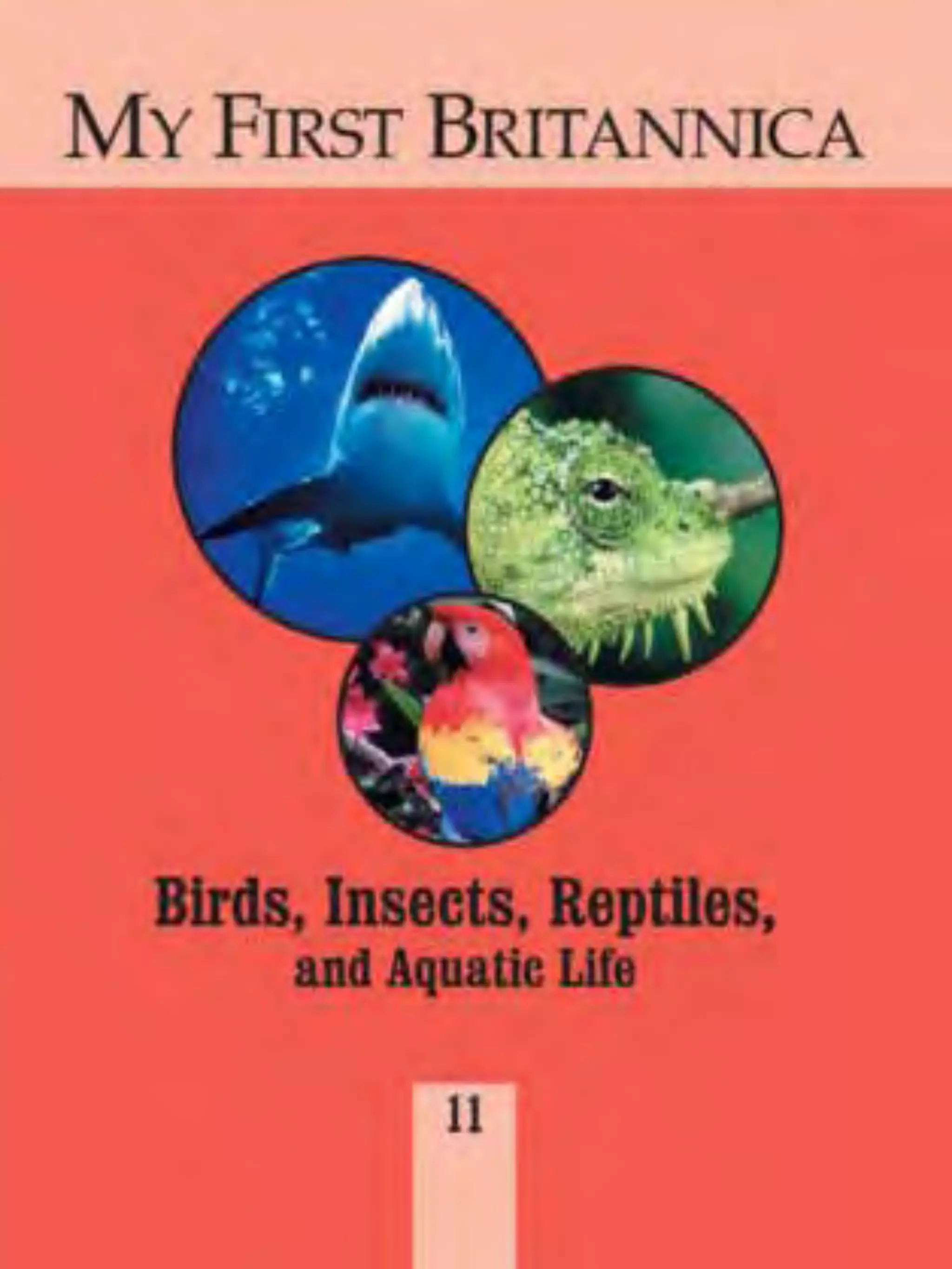
Mfb 11

  • 2.
    CHICAGO LONDON NEWDELHI PARIS SEOUL SYDNEY TAIPEI TOKYO MY FIRST BRITANNICA Birds, Insects, Reptiles, and Aquatic Life 11
  • 3.
    © 2008 byEncyclopædia Britannica, Inc. International Standard Book Number: 978-1-59339-476-9 (set) No part of this work may be reproduced or utilized in any form or by any means, electronic or mechanical, including photocopying, recording, or by any information storage and retrieval system, without permission in writing from the publisher. My First Britannica: Volume 11: Birds, Insects, Reptiles, and Aquatic Life 2008 Britannica.com may be accessed on the Internet at http://www.britannica.com. Encyclopædia Britannica, Britannica, and the Thistle logo are registered trademarks of Encyclopædia Britannica, Inc.
  • 4.
    Birds, Insects, Reptiles,and Aquatic Life TABLE OF CONTENTS INTRODUCTION. . . . . . . . . . . . . . . . . . . . . . . . . . . . . . . . 5 Birds Birds: Birds of a Feather. . . . . . . . . . . . . . . . . . . . . . . . . . 6 Kingfishers: Laugh, Kookaburra! . . . . . . . . . . . . . . . . . . . 8 Parrots and Cockatoos: Bright Colors and Brilliant Whites . . . . . . . . . . . . . . . . 10 Owls: The Nighttime Hunters. . . . . . . . . . . . . . . . . . . . . . 12 Eagles: Riders of the Wind . . . . . . . . . . . . . . . . . . . . . . . 14 Albatrosses: Forever Gliding . . . . . . . . . . . . . . . . . . . . . . 16 Gulls: The Ocean’s Cleanup Crew. . . . . . . . . . . . . . . . . . . 18 Ducks: Dabblers, Divers, and Perchers. . . . . . . . . . . . . . . 20 Geese: Fine-Feathered Travelers . . . . . . . . . . . . . . . . . . . 22 Swans: Birds of Beauty, Grace, and Speed . . . . . . . . . . . . 24 Penguins: Well-Dressed Swimmers . . . . . . . . . . . . . . . . . 26 Peacocks: Proud Birds. . . . . . . . . . . . . . . . . . . . . . . . . . . 28 Ostriches: The Biggest Birds in the World . . . . . . . . . . . . 30 Kiwis: New Zealand’s Feathered Favorites. . . . . . . . . . . . 32 Fish and Other Aquatic Life Fish: Citizens of the Waters. . . . . . . . . . . . . . . . . . . . . . . 34 Carp: The Fishy Survivor. . . . . . . . . . . . . . . . . . . . . . . . . 36 Salmon: Leaping Up the Waterfall . . . . . . . . . . . . . . . . . . 38 Piranhas: Frightening Little Fish . . . . . . . . . . . . . . . . . . 40 Sharks: Predators of the Sea. . . . . . . . . . . . . . . . . . . . . . 42 Coral: Builders in the Sea . . . . . . . . . . . . . . . . . . . . . . . . 44 Sponges: Plant or Animal? . . . . . . . . . . . . . . . . . . . . . . . 46 Mollusks: Shell-Dwelling Animals. . . . . . . . . . . . . . . . . . 48 Octopuses: Eight-Armed Wonders . . . . . . . . . . . . . . . . . . 50 Jellyfish: Boneless Blobs of the Sea. . . . . . . . . . . . . . . . . 52 Deep-Sea Life: Flashing Lights!. . . . . . . . . . . . . . . . . . . . 54 Insects and Arachnids Insects: The World’s Largest Population . . . . . . . . . . . . . 56 Ants: Insect Castle Builders . . . . . . . . . . . . . . . . . . . . . . 58 Bees: Inside the Hive. . . . . . . . . . . . . . . . . . . . . . . . . . . . 60 Butterflies and Moths: Fly by Day, Fly by Night . . . . . . . . 62 Cockroaches: Indestructible Insect . . . . . . . . . . . . . . . . . 64 Crickets: The Wing-Singers . . . . . . . . . . . . . . . . . . . . . . . 66 Grasshoppers: Garden-Variety Hoppers . . . . . . . . . . . . . . 68 Mosquitoes: An Itchy Situation . . . . . . . . . . . . . . . . . . . . 70 Spiders: The Silk Spinners . . . . . . . . . . . . . . . . . . . . . . . 72 Reptiles and Amphibians Reptiles: Snakes, Lizards, and Other Dry-Scaled Beasts. . . . . . . 74 Alligators and Crocodiles: Modern Dinosaurs. . . . . . . . . . 76 Snakes: Legless Wonders . . . . . . . . . . . . . . . . . . . . . . . . 78 Anacondas: A Tight Squeeze . . . . . . . . . . . . . . . . . . . . . . 80 King Cobras: Reptile Royalty . . . . . . . . . . . . . . . . . . . . . . 82 Lizards: Cousins of the Dinosaurs . . . . . . . . . . . . . . . . . . 84 Chameleons: The Color-Wizard Lizards . . . . . . . . . . . . . . 86 Turtles: Taking Their Time . . . . . . . . . . . . . . . . . . . . . . . 88 Amphibians: The Land-and-Water Dwellers. . . . . . . . . . . 90 Frogs: Amazing Changing Amphibians . . . . . . . . . . . . . . 92 GLOSSARY. . . . . . . . . . . . . . . . . . . . . . . . . . . . . . . . . . . 94 INDEX . . . . . . . . . . . . . . . . . . . . . . . . . . . . . . . . . . . . . . 95
  • 5.
    Cover photos (top):great white shark, © Amos Nachoum/Corbis; (center): chameleon, © David Aubrey/Corbis; (bottom): scarlet macaw, © Craig Tuttle/Corbis Great white shark © Amos Nachoum/Corbis
  • 6.
    Birds, Insects, Reptiles,and Aquatic Life MY FIRST BRITANNICA Have a great trip! In Volume 11, Birds, Insects, Reptiles, and Aquatic Life, you’ll discover answers to these questions and many more. Through pictures, articles, and fun facts, you’ll learn about the great diversity of animal life found around the world. I N T R O D U C T I O N How did the “dabbler duck” get its name? Do snakes chew their food? What insect might survive a nuclear bomb blast? Is a sponge a plant or an animal? To help you on your journey, we’ve provided the following guideposts in Birds, Insects, Reptiles, and Aquatic Life: ■ Subject Tabs—The colored box in the upper corner of each right-hand page will quickly tell you the article subject. ■ Search Lights—Try these mini-quizzes before and after you read the article and see how much—and how quickly—you can learn. You can even make this a game with a reading partner. (Answers are upside down at the bottom of one of the pages.) ■ Did You Know?—Check out these fun facts about the article subject. With these surprising “factoids,” you can entertain your friends, impress your teachers, and amaze your parents. ■ Picture Captions—Read the captions that go with the photos. They provide useful information about the article subject. ■ Vocabulary—New or difficult words are in bold type. You’ll find them explained in the Glossary at the back of this volume. And there’s a complete listing of all Glossary terms in the set in the Reference Guide and Index, Volume 13. ■ Learn More!—Follow these pointers to related articles throughout the set. And don’t forget: If you’re not sure where to start, where you saw something before, or where to go next, the Index at the back of this volume and the Reference Guide and Index (Volume 13) will point the way.
  • 7.
    DID YOU KNOW? Afew birds have a curious trick of stroking their feathers with live ants. It’s not clear why they do this. One explanation is that an acid produced by the ants seems to kill or drive away insects. What do birds have that no other animal has? SEA RCH LI GHT 6
  • 8.
    B I RD S 7 Like many animals, birds are warm-blooded. They have many other features in common with other animals, too. But they have one feature that makes them unique among all living animals: birds have feathers. The entire covering of feathers is called the bird’s “plumage.” Feathers are an important part of why most birds can fly. And feathers help protect all birds from rain, cold, and heat. The next time it rains, watch for birds outside the window. You may see them standing with wings and tail drooping to the ground. The water simply slides off without soaking through. On a cold winter day you may notice that birds fluff out their feathers. Fluffed-out feathers hold a layer of warm air next to the skin. In hot weather a bird flattens its feathers. This keeps the skin cool by stopping hot air from reaching it. Birds have different kinds of feathers. In many birds a thick coat of feathers called “down” lies closest to the skin. Down feathers are soft and warm. Waterbirds have extra- thick coats of down. That’s one reason why ducks can paddle about in icy winter waters without getting cold. A bird’s main body feathers are called “contour feathers.” Most contour feathers have many small hooks. The tiny hooks lock together like a zipper, which makes the feathers smooth in a single direction. Some contour feathers are colorful and are for show only. Other contour feathers are special “flight feathers.” These are found on the edges and tips of the wing and in the tail. They can be adjusted as a bird flies to help the bird steer and change speed. Answer:Birdsaretheonlylivinganimalstohavefeathers. ★ Birds of a Feather LEARN MORE! READ THESE ARTICLES… AIRPLANES (VOLUME 2) • BATS (VOLUME 12) MAMMALS (VOLUME 12)
  • 9.
    The diet ofthe kookaburra includes lizards, insects, and even poisonous snakes. © Martin Harvey—Gallo Images/Corbis Find and correct the error in the following sentence: The most commonly seen kingfisher in North America is the kookaburra. SEA RCH LI GHT
  • 10.
    K I NG F I S H E R S 9 The birds known as kingfishers are found all over the world, but most kinds live in tropical areas. Many kingfishers are brightly colored, especially the ones found in Southeast Asia. All are famous for their swift dives. Kingfishers are often boldly patterned. Many of them have crests on their large heads. Their bodies are squat, and their bills are long and heavy. A kingfisher’s long bill helps it to catch fish as it swoops into the water. The most commonly spotted kingfisher in North America is the belted kingfisher. It ranges from Canada to the Gulf Coast. You can recognize the belted kingfisher by its shaggy black crest. It also has bluish gray feathers on the upper part of its body and white on the bottom part. Both the male and the female seem to be wearing a belt! The male kingfisher has a belt of gray breast feathers. The female has a chestnut-colored belt. The belted kingfisher makes its nest in a hole that it digs in the ground close to streams and lakes. The nest is full of fish bones. The belted kingfisher eats only fish, which it catches. Once the fish has been caught, the kingfisher whacks it against a branch a few times and then eats it whole! Some kingfishers live in forests rather than near water. Among the forest kingfishers is the well-known kookaburra of Australia. It eats reptiles, including poisonous snakes. The kookaburra is sometimes called the “bushman’s clock,” because it is heard early in the morning and just after sunset. It has a loud laughing or braying voice. LEARN MORE! READ THESE ARTICLES… AUSTRALIA (VOLUME 7) • FISH (VOLUME 11) KANGAROOS (VOLUME 12) Answer:ThemostcommonlyseenkingfisherinNorthAmericais thebeltedkingfisher. ★ Laugh, Kookaburra! (Top) Sacred kingfisher; (bottom) Malachite kingfisher. ©LenRobinson—FrankLanePicture Agency/Corbis ©LanzVonHorsten—Gallo Images/Corbis DID YOU KNOW?A pair of belted kingfisherswill take turns digging atunnel into a riverbank tocreate their nest. They digwith their bills and use theirfeet to kick the loose dirtfrom the tunnel’s mouth.
  • 11.
    10 Parrots and cockatooshave long fascinated humans. These lively birds not only are beautiful but they entertain us with their chatter and behavior as well. Many parrots are brightly colored, with green feathers and patches of red, orange, or blue. Most cockatoos are white, and all have a patch of long feathers called a “crest” on their head that stands up straight when the bird is excited. Parrots and cockatoos belong to the same family as cockatiels, macaws, parakeets, and many other colorful birds. The tiniest parrot is the pygmy parrot, which is only 3 inches long. The largest member of the family is a type of macaw that can be as much as 40 inches long. All the birds in this family have strong hooked bills that can crack open nuts. Their thick fleshy tongues help them eat. Some birds have brush-tipped tongues that are useful in sucking nectar from flowers and juice from fruits. Parrots and cockatoos have unusual feet. Two toes point forward and two point backward. This lets them climb trees swiftly and grasp their food firmly as they eat it. The birds can also use their strong bills to help them climb. Parrots and cockatoos are found in most tropical regions of the world, especially in rainforests. These birds can live for 30 to 50 years. Some have been known to live for 80 years! Some parrots talk, sing, laugh, and whistle. They have a sharp sense of hearing and can echo human sounds and speech. Cockatoos can talk too. They are very impish and like to play tricks—like figuring out how to escape from their cages! LEARN MORE! READ THESE ARTICLES… AMAZON: A CLOSE LOOK AT RIVER LIFE (VOLUME 9) BIRDS (VOLUME 11) • RAINFORESTS (VOLUME 1) Bright Colorsand Brilliant Whites Macaws gather at Manu National Park in Peru to eat clay. The clay adds minerals to the birds’ diet. © Michael & Patricia Fogden/Corbis Citron-crested cockatoo. © Eric and David Hosking/Corbis Fill in the blanks: Parrots and cockatoos have unusual feet, with _______ pointing forward and _______ pointing backward. SEA RCH LI GHT
  • 12.
    P A RR O T S A N D C O C K A T O O S Answer:Parrotsandcockatooshaveunusualfeet,withtwotoes pointingforwardandtwotoespointingbackward. ★ DID YOU KNOW? Like many rainforest animals, wild parrots are endangered. This is partly because their homes are destroyed when the forest is cut down or burned. But they are also threatened by people who hunt them in order to sell them as pets.
  • 13.
    DID YOU KNOW? Owlsswallow their food whole, and then afterward they cough up hard balls of the parts they can’t eat, such as bones and fur. If you find these hairy lumps scattered under a tree, it’s a pretty good bet there’s an owl nearby.
  • 14.
    O W LS 13 Maybe it’s because they fly mostly at night that owls seem so mysterious. Some superstitions connect them with scary things such as witches. But owls aren’t that mysterious, and they aren’t scary. They are simply nocturnal birds. And they are very helpful to people. Owls are hunters. Some owls eat insects or fish, but most eat rodents, such as mice, gophers, and rats. Without owls, there would be too many rodents, and rodents are serious pests. Owls can see better at night than most animals. They have excellent hearing and can detect the smallest scratchings of a mouse. When it comes to locating prey, their hearing helps them more than their eyesight. Because of their soft feathers, owls fly silently and almost always surprise their prey. Owls catch their prey in their long strong claws and swallow it without chewing. The only way an owl can look around is to turn its head. It can turn its head almost all the way around, turning it so fast that you can hardly see it move. Sometimes it looks as though the owl is turning its head all the way around in a full circle! Some people say owls are wise. That is because they were once associated with Athena, the Greek goddess of wisdom. Owls sleep during the day, hidden among tree branches. If you were to see an owl, you’d probably mistake it for a piece of bark. It would sit still, not moving a feather. It wouldn’t even move its eyes. It couldn’t, because an owl’s eyes can’t move! This is why owls seem to stare at you—if you’re lucky enough to see one! LEARN MORE! READ THESE ARTICLES… BATS (VOLUME 12) • BIRDS (VOLUME 11) • EAGLES (VOLUME 11) Answer:Owlscanturntheirheadstotheleftortherightalmost allthewayaround.It’sbecausetheheadsnapsbacksoquickly, trulyintheblinkofaneye,thatpeoplethinkowlscanturntheir headsallthewayaround. ★ Nighttime Hunters The Common barn owls live all over the world, except in Antarctica and Micronesia. © Eric and David Hosking/Corbis Saw-whet owls. Ron Austing—Frank Lane Picture Agency/Corbis Why do some people think that owls can turn their heads all the way around in a circle? SEA RCH LI GHT
  • 15.
    14 If an eaglespread its wings in your room, it would take up as much space as your bed. Eagles have been called the “king of birds” because of their majestic appearance and power of flight. They fly easily, using air currents to ride the wind. Eagles are birds of prey, which means that they hunt other animals for food. One reason they are such good hunters is that they have excellent eyesight. Even when an eagle is so high in the air that it can hardly be seen, it can still see small objects on the ground. When it spots a meal, it swoops down and grabs the animal with its strong claws. Then it uses its hooked beak to tear the animal apart. Eagles build huge nests of sticks on rocky cliffs or in the treetops. Their nests are big enough to hold people! Eagles use the same nest year after year, returning to it with the same mate. When there are eggs to hatch, both the mother and the father eagles take turns sitting on them. Both parents care for the little eagles afterward, taking them mice, fish, rabbits, ducks, snakes, and squirrels to eat. But eagles don’t always catch their own food. Sometimes they steal food from another bird by chasing the bird until it gets tired and drops whatever it is carrying. Not all eagles look alike. A golden eagle has a cap of gold feathers on its head. A bald eagle is not really bald, but it looks that way because its head feathers are white and its body feathers are brown. LEARN MORE! READ THESE ARTICLES… BIRDS (VOLUME 11) • NORTH AMERICA (VOLUME 9) RABBITS (VOLUME 12) Riders of the Wind Golden eagle. © Royalty-Free/Corbis DID YOU KNOW?When eagles choose a mate,they do a dramatic high-flyingact called cartwheeling.Gripping each other with theirclaws, they plunge togethertoward the ground. At the lastmoment they pull apart and flyupward again.
  • 16.
    E A GL E S 15 Answer:Bothmaleandfemaleeaglestakecareofthebabies. ★ Near Kenai, Alaska, a bald eagle perches on a branch. © Theo Allofs/Corbis Find and correct the error in the following sentence: Only female eagles take care of the babies. SEA RCH LIGHT
  • 17.
    Albatrosses use theirlong wings to soar and glide on air currents. They can stay in the air for hours without flapping their wings. The black-browed albatross, shown here in flight, has a dark marking around the eye that makes it look as though it is frowning. Which of the following can be said about an albatross? a) It spends most of its time on land. b) It eats other birds. c) It goes to land only to lay eggs. SEA RCH LI GHT
  • 18.
    A L BA T R O S S E S 17 The albatross is an amazing seabird. It spends most of its life soaring above the water. The only time albatrosses ever go ashore is when they lay eggs and raise their chicks. Groups (called “colonies”) of the birds build nests on isolated Antarctic islands. A single large white egg is laid in a bowl-shaped nest built from plants and soil. Sometimes the nest is just a patch of bare ground. A young albatross grows slowly. It takes at least four months for it to develop all the feathers it will need to fly. Once it’s able to fly, the albatross will spend the next five to ten years out at sea. The albatross can glide for hours at a time, without flapping its long narrow wings. To stay in the air like this, it needs windy weather. In calm weather the albatross has trouble keeping its heavy body in the air, so it rests on the water and floats like a cork. It feeds on small squid and fish. But it will also follow fishing boats and eat scraps that are thrown overboard. Some kinds of albatrosses are brown, but most of them are white with some brown or black markings on their bodies or wings. Albatrosses are the largest of all flying birds. In fact, the wandering albatross has the largest wingspread among living birds. The wings of a wandering albatross can measure 11 feet from tip to tip. Albatrosses live very long lives and are one of the few species of birds that die of old age. LEARN MORE! READ THESE ARTICLES… AIRPLANES (VOLUME 2) • GULLS (VOLUME 11) • INDIAN OCEAN (VOLUME 1) Answer:c)Itgoestolandonlytolayeggs. ★ ©PeterJohnson/Corbis Forever Gliding In the past, sailors believed albatrosses had special powers. They believed that killing the bird would bring bad luck. DID YOU KNOW? Scientists measuring an albatross’ wingspread. © Wolfgang Kaehler/Corbis
  • 19.
    18 Gulls are amongthe most common waterbirds of ocean and coastal zones worldwide. Some gulls travel enormous distances between their summer and winter homes. How are gulls helpful to humans? SEA RCH LI GHT
  • 20.
    G U LL S 19 Afishing boat chugs back into the harbor with its day’s catch. The gulls follow close behind. They know that the fishermen will be throwing goodies overboard as they empty the bait bag and clean the deck. The gulls dip into the waves to scoop up bits of food. They fill the air with their excited cries. This often happens when they are fighting over something good to eat. Along the shore, gulls are helpful to the people who clean beaches and harbors. They swoop down to pick up messy things. Gulls eat almost anything, from dead fish to potato chips and scraps of hot dogs. And they clear away lots of insects too. Gulls eat all day long. They have to just to stay alive. Gulls are big birds that fly great distances. While flying, they use up a lot of energy. Gulls can fly many miles without stopping. They can fly from one end of a country to the other. But all the time they’re up there, they’re looking down to see if they can find something to eat. Gulls are good swimmers too. Their feet are webbed. The little stretches of skin between their toes make their feet act as paddles. Gulls are also floaters. They stay on top of the water like a piece of wood does. On long trips over the ocean, they drop down onto the water and float while taking a nap. LEARN MORE! READ THESE ARTICLES… FISH (VOLUME 11) • OCEANS (VOLUME 1) • SHIPS (VOLUME 2) Answer:Gullscleanupalotoffoodwastefrombeaches,harbors, picnicareas,dumps,andparkinglotsthatwouldotherwisebeleft behindastrash. ★ ©ChrisJones/Corbis Seagull stands on a rock. © Guy Motil/Corbis DID YOU KNOW? The type of gull called Bonaparte’s gull was named after Charles-Lucien Bonaparte, a nephew of the famous French emperor Napoleon Bonaparte. The younger Bonaparte spent much of his life studying the world’s birds. The Ocean’s Cleanup Crew
  • 21.
    20 DID YOU KNOW? Ducksmake their feathers waterproof by rubbing oil on them. They get the oil from special glands on their chests and rub it on their feathers with their bills. Unscramble these words that have to do with a duck. wsmimre nblbiadg dlwaed SEA RCH LI GHT A male wood duck is easily identifiable by his purple and green head, his reddish-brown breast flecked with white, and his bronze sides. © Gary W. Carter/Corbis
  • 22.
    D U CK S 21 Ducks are champion swimmers and are at home almost anywhere near water. Some feed and nest in streams and ponds. Others live near deep wide lakes. Some make their homes on rocky cliffs by the ocean. There are three kinds of ducks: “Dabbling ducks” put their heads underwater to eat plants that grow there. This way of feeding is called “dabbling.” They build their nests in hollows near the water. There they also eat plants and insects found near the shore. Dabbling ducks can fly very fast. “Diving ducks” dive deep down into the water to find things to eat. They mostly eat fish. They are very strong swimmers. “Perching ducks” make nests in trees and hold on to the branches with their long-clawed toes. This is called perching. Some may perch on the tall stalks that grow over marshy ponds. All ducks are graceful fliers and swimmers. But on the ground they waddle from side to side, moving slowly in a funny, jerky way. You usually don’t see a duck waddling too far away from water. In winter many ducks fly south, where the water is warmer and there’s more to eat. But icy cold water doesn’t bother them. A thick inner layer of soft fluffy feathers called “down” keeps them warm. And their bigger outer feathers help too. They’re waterproof. Feathers are a duck’s raincoat. Every year ducks lose their old feathers, and new feathers grow in. This is called “molting.” Until the new feathers grow, ducks can’t fly. So they hide in the grass or on the water to keep safe from enemies. LEARN MORE! READ THESE ARTICLES… GEESE (VOLUME 11) • MARSHES (VOLUME 1) • OCEANS (VOLUME 1) Answer:wsmimre=swimmer nblbiadg=dabbling dlwaed=waddle ★ (Top) A dabbling gadwall duck; (bottom) young girl holding a fluffy duckling. ©RogerWilmshurst—FrankLane PictureAgency/Corbis ©Royalty-Free/Corbis Dabblers, Divers, and Perchers
  • 23.
    22 Geese are foundvirtually everywhere. There’s the wild Canada goose, and halfway around the world is the snow goose of Siberia. There is the pied goose, which lives “down under” in Australia. The rarely seen Hawaiian goose lives out in the middle of the Pacific Ocean. The little brant goose nests in very cold Arctic areas. The wild goose called the greylag is found in Europe. Geese spend a lot of time in the water. Like ducks, they have a coat of oil on their feathers that keeps them from getting too wet. And the soft feathers beneath, called “down,” keep them warm even in the iciest of waters. Down is so good at keeping things warm that people often use it in winter coats and in comforters. It’s also good in pillows because it’s so soft. Geese are fairly large birds, often standing three feet tall despite their short legs. Geese may look somewhat silly when they waddle on land. But their sturdy legs actually help them walk more steadily than ducks or swans do. Geese have webbed feet that make them strong swimmers. They are also powerful fliers. They can make especially long flights during their annual migrations to their winter feeding grounds. You may see groups of geese traveling south in the fall in lines that make a V shape. This formation helps keep them from getting tired as they fly because each goose gets a lift from the air flowing off the goose ahead. LEARN MORE! READ THESE ARTICLES… CANADA (VOLUME 9) • DUCKS (VOLUME 11) EUROPE (VOLUME 6) (Top) Mother goose nuzzling her gosling (young goose); (bottom) snow geese flying in a V formation. ©JulieHabel/Corbis©D.Robert&LorriFranz/Corbis DID YOU KNOW? People in Asia and Europe have kept geese as guards. Geese make loud honking cries when danger appears. After chasing the enemy away, they cackle triumphantly. Fine-Feathered Travelers
  • 24.
    G E ES E 23 Answer:Peopleusedowntostuffpillows,quilts,andcoats becausethefeathersaresoftandverywarm. ★ How do people use down feathers? SEA RCH LI GHT A Canada goose flies close to the water. ©GettyImages
  • 25.
    Ducks, geese, andswans are the three main kinds of waterfowl. Swans are the largest of the three, and they are also the fastest flyers and swimmers. They have a stately and dignified appearance when swimming on a pond. Like the other waterfowl, swans have oily feathers that stay dry in the water. Their webbed feet make them strong swimmers. Swans are heavy- bodied birds that feed by dabbling— dipping the long neck into shallow water for plants. They don’t dive for food. They have powerful wings for flying long distances. The whistling swan and the trumpeter swan are found in North America, while the mute swan lives in Europe and Asia. These birds are white. South America is the home of the black-necked swan, while the beautiful black swan lives in Australia. It is the state emblem of Western Australia. Swans make a variety of sounds. Even the mute swan often hisses or makes soft snoring sounds. It may even grunt sharply. The male swan is called a “cob.” The female is called a “pen.” They look alike. A pair of swans usually stays together for life. The female swan lays about six pale eggs on a heap of plant material, while the male keeps close guard. The young swans are called “cygnets.” They can run and swim just a few hours after they hatch. But father and mother swan look after them carefully for several months. Sometimes the cygnets will ride on their mother’s back when they get tired from swimming or need protection from enemies. LEARN MORE! READ THESE ARTICLES… DUCKS (VOLUME 11) • GEESE (VOLUME 11) WESTERN AUSTRALIA (VOLUME 7) 24 Mother swan and cygnets. © AFP/Corbis DID YOU KNOW? E.B. White’s The Trumpet of the Swan is a story about a voiceless swan that learns to play a trumpet. Birds of Beauty, Grace, and Speed
  • 26.
    S W AN S 25 Answer:Bothducksandswansarewaterbirdswithoilyfeathers andwebbedfeetforswimming.Butswansareconsiderablybigger thanducks.Theyflyandswimfasterthanduckstoo. ★ A family of mute swans, with cygnets riding on their mother’s back, swim along the water. © Philip Perry—Frank Lane Picture Agency/Corbis What’s one way that ducks and swans are alike? How are they different? SEA RCH LI GHT
  • 27.
    Penguins are excellentdivers and swimmers. Here, gentoo penguins enjoy a romp through the water. Do penguins have feathers? SEA RCH LI GHT
  • 28.
    P E NG U I N S 27 When a penguin swims, its light-colored belly and dark-colored back help hide it from enemies. From underneath, its light belly looks like the sky. This makes it hard for its enemy the leopard seal to see it. From above, its dark back looks like the dark water, which helps hide it from big hunting birds. Penguins cannot fly, but they swim extremely well. The shape of their bodies, sort of like a submarine, lets them swim very fast. They use their short flat wings like flippers and practically fly through the water. In fact, they often leap out of the water and look as if they are trying to flap through the air. There are 17 types of penguins. They live in Antarctica and along the cool portions of the coasts of Africa, New Zealand, Australia, and South America. Penguins have a thick layer of fat that helps to protect them from the cold. And although they don’t look like they do, they actually have feathers all over their bodies. These short feathers also help to keep them warm. Penguins’ short legs give them an odd walk. They do, however, run quickly. Sometimes they’ll build up speed and then slide on their bellies to travel quickly over ice and snow. Penguins live in nesting colonies. These colonies can be enormous. Penguins return to the same place, the same nest, and the same partner every year—sometimes traveling long distances. Penguins use the Sun to help them find their direction. Most penguins build a nest on the ground with pebbles, mud, and vegetation. The females lay one or two eggs, and then both parents take turns looking after them. LEARN MORE! READ THESE ARTICLES… ANTARCTICA (VOLUME 1) • BIRDS (VOLUME 11) • WALRUSES (VOLUME 12) Answer:Likeallbirds,penguinshavefeathers.Buttheirsareso shortandclosetotheirbodiesthatthefeatherslookmorelike skin. ★ ©GeorgeD.Lepp/Corbis Well-Dressed Swimmers Penguins are the only birds that can swim but not fly. DID YOU KNOW? Members of the emperor penguin species, the largest of the penguins. © Tim Davis/Corbis
  • 29.
    Apeacock’s feathers arebrilliant shades of bronze, blue, green, and gold. It even has a little crown of feathers, called a “crest,” on the top of its head. The center of attraction, though, is the peacock’s long tail. At the tip of each tail feather is a big shiny spot ringed with blue and bronze that looks like an eye. When the male peacock wants to attract a female peacock (called a “peahen”), it dances! And again the action is all in the tail. The peacock lifts its tail and spreads it out like a fan. Every feather is shown off this way. At the end of this show, the peacock makes its tail feathers vibrate. This makes the quills in the long tail feathers rattle and rustle. The peahen is charmed! Peahens do not have long tails or crests. They are green and brown in color and almost as big as the males. Peacocks live in the wild in Southeast Asia and belong to the pheasant family. Two important kinds of peacocks are the green, or Javanese, peacock and the blue, or Indian, peacock. The green peacock is found from Myanmar to Java. The blue is found in India and Sri Lanka. These beautiful birds can also be seen in zoos around the world. A long time ago, people kept peacocks at home. The ancient Greeks called the peacock “Hera’s bird.” In their religion, Hera was the wife of Zeus, the god of sky and weather. She was thought of as the queen of heaven. According to an old story, the eyelike markings on peacock feathers were the 100 eyes of the giant Argus. LEARN MORE! READ THESE ARTICLES… BIRDS (VOLUME 11) • INDIA (VOLUME 7) • SRI LANKA (VOLUME 7) The male peacock in the picture is spreading his tail feathers to try to a) scare the peahen. b) attract the peahen. c) hide the peahen. SEA RCH LI GHT Proud Birds The male peacock displays his feathers to get the attention of the female. © Terry W. Eggers/Corbis 28
  • 30.
    P E AC O C K S Answer:b)attractthepeahen. ★ DID YOU KNOW? Peacocks may be beautiful birds, but they definitely don’t have beautiful voices. Peacocks make a harsh screeching when they “sing,” if you can call it that.
  • 31.
    30 Which of the following canbe said about ostriches? - Ostriches eat a lot of meat. - Ostriches are the biggest bird. - Ostriches are great runners. SEA RCH LIGHT
  • 32.
    O S TR I C H E S 31 Ostriches are the largest living birds in the world. They are about 8 feet tall and may weigh as much as 345 pounds. They have wings but they can’t fly. The wings do help them move in a way, however, because flapping their wings while they run helps the birds go faster on the ground. Ostriches can run up to 40 miles an hour. This makes them not just the biggest but also the fastest bird on the ground! Ostriches don’t use their speed to catch food. Instead, they run to keep away from their enemies. But the first thing ostriches do when they see an enemy is hide. To avoid being seen, ostriches generally lie flat on the ground with their necks outstretched. This makes them look like just another bush. People sometimes say that ostriches bury their heads in the sand when they sense danger. But this isn’t true. You just can’t see their heads when ostriches are lying down. Ostriches don’t always hide or run away from trouble. If their babies are in danger, ostriches will fight. They use their beaks, and they kick with their very powerful legs. An ostrich could easily kill a person with a few kicks of its feet. Wild ostriches live in groups in Africa. Sometimes there are as many as 50 birds in a single group. Ostriches eat mostly plants, fruits, and berries, but once in a while they’ll also eat small animals and insects. A tame ostrich that’s been treated well may do a very special thing: it can be trained to carry people on its back. In fact, in some parts of the world people have ostrich races. LEARN MORE! READ THESE ARTICLES… AFRICA (VOLUME 8) • PEACOCKS (VOLUME 11) PENGUINS (VOLUME 11) Answer:Ostrichesarethebiggestbird. Ostrichesaregreatrunners. ★ in the World The Biggest Birds Male ostrich protecting eggs in a nest. © Kevin Schafer/Corbis DID YOU KNOW? In the days when fashionable women wore showy hats, they were often decorated with ostrich feathers. ©WolfgangKaehler/Corbis
  • 33.
    © Geoff Moon—FrankLake Picture Agency/Corbis 32 Fill in the blank: The kiwi is an unusual bird. Its __________ are not fully formed, so it does not fly. SEA RCH LI GHT
  • 34.
    K I WI S 33 The kiwi is a strange little bird found only in the forests of the island nation of New Zealand. During the day it sleeps in its burrow, and at night it looks for food, as the one in the large photo is doing. Kiwis eat worms, insects, larvae, spiders, and berries. Kiwis have a strong sense of smell, which they use to hunt. They are the only birds whose nostrils are on the very tip of the bill. The kiwi’s bill is long and narrow. Having their noses at the very end of their bills is a big help when they are hunting! Kiwis also have a good sense of hearing, though they have poor vision in daylight. To escape enemies they rely on their strong legs. Kiwis are fast runners and fierce fighters. They have four toes on each foot, each with a large claw. The claws are very useful when kiwis are facing enemies. The kiwi is an unusual bird. It is a grayish brown and about as big as a chicken. It has wings that are not fully formed, so it does not fly. The wings are hidden in its feathers, which are shaggy and hairlike. It also has sensitive whiskers at the base of its bill. The bird is much loved by the people of New Zealand, even though they don’t see it very often. New Zealanders themselves are sometimes called Kiwis. A fruit, a breakfast cereal, and an airline are named after the kiwi too. Pictures of the bird can be seen on New Zealand’s postage stamps and coins. LEARN MORE! READ THESE ARTICLES… BIRDS (VOLUME 11) • NEW ZEALAND (VOLUME 7) • OSTRICHES (VOLUME 11) Answer:Thekiwiisanunusualbird.Itswingsarenotfully formed,soitdoesnotfly. ★ Feathered Favorites New Zealand’s “Kiwi crossing” road sign in New Zealand. © Paul A. Souders/Corbis DID YOU KNOW? Compared with the size of the bird, the kiwi’s egg isn’t just large, it’s enormous. The egg is about 20 percent of the mother’s weight. It fills almost her entire body right before it’s laid.
  • 35.
    34 Afish is acold-blooded animal that has a backbone, lives in water, and breathes by means of gills. It normally has two pairs of fins in place of arms and legs, as well as several other fins. Most fish are covered with scales. Fish are fascinating in their variety. The sea horse looks something like a tiny horse standing on its tail. Flounders are as flat as a dinner plate. The rabbitfish, a small relative of the shark, has a head and teeth resembling those of a rabbit. Anglerfish carry their own “fishing rod” to catch other fish. An extended part of the back fin has wormlike pieces of flesh at the tip, which are the “bait.” Anglers of the deep sea have bait that lights up to attract victims. Size differs as much as shape. Some Philippine gobies reach an adult size of less than half an inch. The whale shark, the largest of all fishes, reaches 50 feet in length and weighs about 20 tons. Fish swim mainly by sideways movements of the body and tail. The fins are used for balancing, steering, and braking. To move quickly from a resting position some fish shoot a stream of water out of the gills, which causes them to lunge forward. The fastest swimmers, such as the tuna, can travel 30 miles per hour. Most fish continue to grow as long as they live. Fish that live to an old age can become very large. Carp are among this group. They may live 100 years! LEARN MORE! READ THESE ARTICLES… GREAT BARRIER REEF (VOLUME 7) • RIVERS (VOLUME 1) SHARKS (VOLUME 11) Citizens of the Waters DID YOU KNOW? Fish called “mudskippers” can crawl across mudflats and wet fields in search of food. Lungfish can burrow into mud when their pools dry up. They lie there, for months if necessary, until rain refills the pools.
  • 36.
    F I SH 35 Answer:Fishbreathethroughgills. ★ Fill in the blank. Fish breathe through ___________. SEA RCH LI GHT
  • 37.
    DID YOU KNOW? Thecommon goldfish, often a child’s first pet, is a member of the carp family.
  • 38.
    C A RP 37 The common carp is a fish that lives along the muddy bottoms of ponds, lakes, and rivers. It swallows plants, insects, and anything else it finds to eat. It was first found in Asia but was later taken into Europe and North America. Some people like to eat carp. Sometimes carp can live 100 years and grow to weigh 80 pounds or more. But not all carp grow that old or that heavy. The fish that are caught usually are under 10 years old and do not weigh more than 10 pounds. The carp has a blunt nose and a small thick-lipped mouth. From its upper lip dangle two pairs of feelers that are called “barbels.” There are three kinds of common carp. The scale carp has large scales all over its wide heavy body. Its back is olive green, its sides are gold-colored, and its belly is bright yellow. The mirror carp has only three or four rows of huge scales along its sides. The leather carp is almost without scales, but it has a very thick skin. In some ways the carp is a nuisance. In hunting for food, the carp muddies the water. This affects the life of many plants and animals. A carp sometimes pushes more valuable fish away from their food and also eats their eggs. The carp has a habit of pulling out plants from their roots. This keeps ducks away. It is very difficult to get rid of carp. The fish can thrive even in dirty water and can also survive in very warm and very cold water. LEARN MORE! READ THESE ARTICLES… FISH (VOLUME 11) • GREAT LAKES (VOLUME 9) • RIVERS (VOLUME 1) Answer:FALSE.Theyliveinfreshwaterrivers,lakes,andponds. ★ Goldfish swimming in a bowl. © Doug Wilson/Corbis True or false? Carp live in the ocean. SEA RCH LI GHT Colorful carp swim in a pond outside a restaurant in Japan. In Asia and Europe carp are often raised in ponds because it is possible to grow many fish in a small amount of water. © Wolfgang Kaehler/Corbis The Fishy Survivor
  • 39.
    DID YOU KNOW?Eachgeneration of salmonreturns to the same river, tothe same spot, to lay theireggs every year. So a salmon’sparents, grandparents, andgreat-grandparents all chosethe same river.
  • 40.
    S A LM O N 39 These fish aren’t going down a waterfall. They’re going up! Not much can stop these big strong salmon—not even a waterfall. The salmon are swimming up the river to return to the quiet waters where they hatched. They’re returning in order to spawn— that is, to lay their own eggs. They started their journey far out in the ocean. Somehow the salmon manage to find the river they are looking for. Night and day they swim on. They eat nothing at all after getting into their river. Finally, they reach the waters where they came from. We don’t know how salmon can find their way on this long trip up the river. But we know what they do when they reach the end. At the bottom of the stream, the mother salmon digs a long hole with her tail and snout. She fills the hole with thousands of tiny eggs. She covers the eggs with sand to keep them safe. The eggs hatch. When the baby salmon are about as long as your finger, they are big enough to start the swim to the ocean. They float backward down the long river—tails first and heads last! They seem to steer better that way. Many of the babies never reach the ocean because there are too many enemies. Birds, bears, and bigger fish along the way love to eat them. The salmon that do reach the ocean will one day start the long hard trip up the river. LEARN MORE! READ THESE ARTICLES… AMERICAN INDIANS (VOLUME 4) • FISH (VOLUME 11) • RIVERS (VOLUME 1) Answer:TRUE. ★Male sockeye salmon. © Natalie Fobes/Corbis These Pacific salmon are trying to leap up a waterfall of the Brooks River in Katmai National Park, Alaska, to spawn upstream. © Galen Rowell/Corbis True or false? Salmon travel upstream against the river current to lay their eggs. SEA RCH LI GHT Leaping Up the Waterfall
  • 41.
    40 The piranha isfound in the rivers and lakes of South America. It is a meat-eating fish with long, triangular, razor-sharp teeth. When hungry, the piranha can be both bold and savage. But for such a frightening fish, it is not very big. Most are about the size of an adult’s hand. Some piranhas are silver with orange undersides. Others are almost totally black. All have blunt heads and strong jaws. In the Amazon River, there are 20 different kinds of piranhas. The most famous is the red-bellied piranha. It has the strongest jaws and the sharpest teeth. When water levels are low, this piranha hunts in schools of more than 100 fish. Many schools join in the feast if a large animal has been attacked. But normally red-bellied piranhas prefer prey only slightly larger than themselves. Usually a group of red-bellied piranhas swim around together in search of prey. The moment the prey is found, the fish signal each other. Piranhas have excellent hearing, so it’s possible that they signal each other with sounds. Each fish in the group has a chance to take a bite and then swim away, making way for the others. Most piranhas never kill large animals, and they almost never kill humans. The smell of blood attracts piranhas, but most of them feed on what is left by others rather than making fresh kills. For this reason their reputation for being ferocious is not deserved. LEARN MORE! READ THESE ARTICLES… AMAZON: A CLOSE LOOK AT RIVER LIFE (VOLUME 9) FISH (VOLUME 11) • RIVERS (VOLUME 1) Why do you suppose that when water levels get low, piranhas hunt in larger schools than they would otherwise? (Hint: How much of your body can you fit underwater in the tub once you start letting the water out?) SEA RCH LI GHT Red-bellied piranha. © Kevin Schafer/Corbis Groups of piranhas hide out and chase and attack fish that swim by. © John Madere/Corbis Little Fish Frightening
  • 42.
    P I RA N H A S Answer:Whenriverwaterlevelsarelow,there’slessroomforfish tospreadout,sopiranhashavetohunttogetherinlargegroups. ★ DID YOU KNOW?The name “piranha” comes fromthe Portuguese words for “fish” and “tooth.”
  • 43.
    42 When the firstdinosaurs walked on Earth, sharks were already swimming in the sea. The dinosaurs are long gone, but sharks are still a force to be reckoned with. Great white sharks, in particular, are feared as man-eaters. It’s hard to fight them, because they are so strong and fast in the water. Their tough skin is protected by tiny toothlike scales. In their big mouths are rows and rows of sharp teeth that rip like the edge of a saw. Sharks continue to grow teeth all their lives. A great white can make a quick meal out of almost anything! The hammerhead shark can also be dangerous. Don’t be fooled by its awkward- looking rectangle of a head. In general, most shark attacks take place in shallow water, where sharks sometimes go to hunt for fish. A hungry shark can easily mistake a human arm or leg for a tasty fish. Most kinds of sharks are not dangerous to people. This includes the largest shark of all, the whale shark. Whale sharks can be 50 feet long, but they feed on small fish and on tiny life-forms called plankton. Other sharks eat fish of all sizes. The shark appears out of nowhere, often from below, to take its prey by surprise. Did you know that a shark has to keep swimming all the time? Its body is made in such a way that if it doesn’t swim, it will sink to the bottom of the sea. Good thing sharks know how to sleep while they swim! LEARN MORE! READ THESE ARTICLES… DEEP-SEA LIFE (VOLUME 11) • OCEANS (VOLUME 1) WHALES (VOLUME 12) (Top) Scalloped hammerhead shark; (bottom) swimming shark. ©AmosNachoum/Corbis©Royalty-Free/Corbis Find and correct the error in the following sentence: Hammerhead sharks got their name because they bash their prey over the head. SEA RCH LIGHT of the Sea Predators
  • 44.
    S H AR K S 43 Answer:Hammerheadsharksgottheirnamebecausetheirheads looklikehammers. ★ Scuba divers photograph a whale shark. Whale sharks usually swim slowly near the surface and have even been hit by ships. © Jeffrey L. Rotman/Corbis DID YOU KNOW? Unlike most other fish, sharks don’t have hard bones. Instead, their skeletons are made of cartilage, the same material that human noses and ears are made of.
  • 45.
    There is anamazing variety of sea life on and around the Great Barrier Reef. There are about 400 types of hard coral, about 215 types of birds, and more than 1,500 types of fish, many with bright colors and unusual shapes. © Australian Picture Library/Corbis DID YOU KNOW? The Great Barrier Reef is the largest structure ever built by living things. It is longer than the Great Wall of China and much wider. 44
  • 46.
    C O RA L Answer:Coralreferstothesoftjellylikeanimallivinginsidethe hardshell,aswellastotheshellitself.Peoplealsocallmanyof theseshellsstucktogether“coral.” ★ Acoral is a soft little sea animal that looks like a bit of jelly. It is no bigger than the end of your little finger. At one end it has a mouth surrounded by little arms called “tentacles.” The tentacles gather food. When they touch a tiny plant or animal floating nearby, they pull these inside the mouth. The baby coral swims through the water until it finds a place to build its house, and then it never swims again. Using special glue from inside its body, it sticks itself to a rock or to another piece of coral. Once it is stuck, it starts to build itself a house with a juice from its body that turns into a kind of stone. The hard little shell houses are called coral too. In the ocean where the water is warm, the coral grows in lovely ocean gardens. It grows in just about every color and shape you can think of. It may grow to look like lace, a fan, a leaf, a brain, the horns of a deer, or a ribbon. One day a bud grows on the coral. This bud grows into a new coral animal. After many years there are so many coral houses built on top of one another and next to each other that they become a great wall called a “reef.” Sometimes coral may grow together to form a reef a hundred miles long. The largest coral reef in the world is the Great Barrier Reef near Australia. It is more than 1,250 miles long. LEARN MORE! READ THESE ARTICLES… GREAT BARRIER REEF (VOLUME 7) • OCEANS (VOLUME 1) THE GREAT WALL (VOLUME 7) Builders in the Sea (Top) Orange cup coral; (bottom) yellow and gray coral. ©Royalty-Free/Corbis©Royalty-Free/Corbis Two parts of the animal are called coral. What are they? SEA RCH LI GHT
  • 47.
    Which of the following statementsare true about sponges? a) Sponges can be found mainly in the ocean. b) Sponges eat by straining the water around them. c) The sponges in your house probably came from the ocean.SEA RCH LI GHT
  • 48.
    S P ON G E S 47 Sponges are strange animals. They don’t have the body parts—inside or outside—that we expect an animal to have. They don’t even move around. Instead, they stay attached to an underwater rock or coral reef, just like plants. For a long time, people thought sponges were plants. Scientists decided that sponges are animals only after watching them eating food by drawing it into their bodies. There are nearly 5,000 different kinds of sponges. Most live in the ocean, but a few like freshwater. Sponges may be flat like spreading moss. Or they may look like trees with branching arms. Some are as tiny as a bean, while others are as tall as a person. Some are smooth and mushy, while others are rough, hard, and prickly. Some are dull and drab, while others are brightly colored. A sponge gets oxygen to breathe and food particles to eat by straining water through its body. Sometimes fish, shrimp, and other creatures live inside a sponge. A few sponges attach themselves to crab shells and go wherever the crab goes. People dive to collect sponges or pull them up with hooks. Afterward the sponges are dried, cleaned, and trimmed. The fleshy parts are thrown away, and only the “spongy” skeleton is used. The ancient Greeks and Romans used sponges to pad their armor and helmets. People still use sponges for scrubbing themselves clean, for painting, and for making medicines. However, factory-made sponges have taken the place of natural sponges in most homes. LEARN MORE! READ THESE ARTICLES… CORAL (VOLUME 11) • MOLLUSKS (VOLUME 11) • OCEANS (VOLUME 1) Answer:a)Spongescanbefoundmainlyintheocean. b)Spongeseatbystrainingthewateraroundthem. ★ (Top) Vase sponge; (bottom) marine sponges. ©StephenFrink/Corbis©Royalty-Free/Corbis DID YOU KNOW? Not all sponges are spongy. Some have glasslike skeletons. A school of fish swims near some sponges. A few animals eat sponges, but most leave them alone because of their unpleasant taste and smell. © Royalty-Free/Corbis Plant or Animal?
  • 49.
    48 DID YOU KNOW? Molluskshave been a popular food for humans for thousands of years. Scientists have found old piles of shells, some over ten feet tall, where ancient people threw the trash from their meals of clams and oysters.
  • 50.
    M O LL U S K S 49 There are many different shelled animals. The smallest live in shells as tiny as the letter “O.” The largest, such as the giant squid, weigh more than 4,000 pounds! Some of these animals belong to a group called “mollusks.” And you might be surprised to know that there are about 100,000 kinds of them! Most mollusks—such as snails, clams, oysters, and mussels— have shells. But some, such as octopuses and squid, have little or none at all. And not all kinds of animals with shells are mollusks. Crabs and lobsters have shells, but they are not mollusks. Although most mollusks live in the water, some are found on land. Snails live in forests and gardens. Newborn mollusks are squishy and helpless. They need protection from enemies that would eat them. They get this protection from the shell they build around themselves. Shells are really one- room houses that mollusks build out of their own bodies. It’s as easy for them to do this as it is for you to grow fingernails. Each shell has room for just one animal. Mollusks eat tiny bits of food that float with the moving water. They also eat the algae that cover rocks. Part of this food is used to build their bodies. The rest helps them build their shells. A mollusk and its shell keep growing as long as the mollusk lives. When a mollusk dies, it leaves behind its shell. That is why most of the shells you find on the beach are empty. Mollusk shells can last for thousands of years—a reminder of how long mollusks have been living on the Earth. LEARN MORE! READ THESE ARTICLES… GREAT BARRIER REEF (VOLUME 7) • OCEANS (VOLUME 1) • OCTOPUSES (VOLUME 11) Answer:Snails,oysters,andsquidareallmollusks. ★Snail on a child’s hand. © Lance Nelson/Corbis Mussels, pictured here in a tide pool, are a kind of mollusk. Mussels are found all over the world, mostly in cool seas. © Kennan Ward/Corbis Which of the following are mollusks? - crabs - snails - shrimps - oysters - squid SEA RCH LI GHT Shell-DwellingAnimals
  • 51.
    What are two ways thatan octopus can escape from an enemy? SEA RCH LI GHT
  • 52.
    O C TO P U S E S Answer:Itcanchangecolorsandsquirtinkintothewater. ★ People used to tell scary stories about a deep-sea monster that wrapped its many long arms around a ship and dragged it down to the bottom of the ocean. They called the monster a “devilfish.” Today we know that this wasn’t a monster at all. It was an octopus—an animal with eight arms that lives in the ocean. Octopuses are members of an animal group called mollusks, which includes squid, clams, and oysters. There are nearly 50 kinds of octopuses. Some are only a few inches long. The largest is longer than 30 feet and may weigh more than 150 pounds. But no octopus grows large enough to attack a ship! An octopus usually lives alone among the rocks on the bottom of the ocean. Sometimes it moves rocks with its long arms, or tentacles, to make a little cave for itself. Underneath each tentacle are many little round suckers, or suction cups. These help the octopus climb over rocks and hold on to things. Octopuses like to eat shellfish such as crabs, lobsters, and mussels. An octopus will crawl about on its rubbery tentacles as it looks for food. But it can also swim very fast. An octopus sometimes hunts fish, chasing them until they are too tired to swim anymore. Then the octopus tightly wraps its arms around the fish and eats them. But the octopus has enemies too. It usually tries to hide from them. Many octopuses can hide by changing their colors to match the area around them. If that doesn’t work, the octopus shoots black ink into the water. The cloudy water confuses the enemy and helps the octopus get away. LEARN MORE! READ THESE ARTICLES… DEEP-SEA LIFE (VOLUME 11) • MOLLUSKS (VOLUME 11) OCEANS (VOLUME 1) Suckers on the underside of the tentacle of a giant Pacific octopus. © Stuart Westmorland/Corbis An octopus has eight arms, or tentacles. Its name comes from a Greek word that means “eight-footed.” © Stephen Frink/Corbis DID YOU KNOW? Octopuses are very smart. In fact, next to dolphins and whales, the common octopus is perhaps the smartest animal living in the ocean! Eight-Armed Wonders 51
  • 53.
    Can you think ofone way that jellyfish and fish are similar? What’s one way that they’re different? SEA RCH LI GHT
  • 54.
    J E LL Y F I S H 53 Ajellyfish is not a fish at all. Unlike fish it has no bones, and most of its body is like jelly. It does not have a brain or a heart. What it does have is a set of tentacles that can sting its prey—or a person! Jellyfish are related to the corals and the sea anemones. They can be found in all oceans. There are about 200 kinds of jellyfish, in different forms, sizes, and colors. Some jellyfish are barely large enough to be seen. Others are six feet or more around. Jellyfish may be see- through or brown, pink, white, or blue. Some kinds glow in the dark sea. A jellyfish usually has the shape of an umbrella. It can have a few or many tentacles. Sometimes it has simple eyes around the edge of the “umbrella.” The mouth and the stomach are in the middle of the “umbrella.” The jellyfish has simple muscles on the underside that contract the body, much like the closing of an umbrella. This helps it swim. Inside the tentacles of a jellyfish are poisonous stinging cells. These cells can stun small animals, which the jellyfish then pulls into its mouth. Some jellyfish feed on tiny animals and plants that their bodies catch as they drift through the water. Some jellyfish can be very dangerous to humans. Even a small sting from the jellyfish called sea wasps can cause death within a few minutes. It’s best just to look at jellyfish from a distance and not get too close. LEARN MORE! READ THESE ARTICLES… CORAL (VOLUME 11) • GREAT BARRIER REEF (VOLUME 7) OCEANS (VOLUME 1) Answer:Themostobviousthingthatjellyfishandfishshareis theiroceanhome.Onebigdifferencebetweenthemisthat jellyfishhavenobonesbutfishdo. ★Jellyfish in dark waters. © Jeffrey L. Rotman/Corbis DID YOU KNOW? Sometimes a jellylike blob breaks away from a jellyfish and grows into another adult jellyfish. Jellyfish sometimes sting swimmers who accidentally brush up against them in the water. Even dead jellyfish that have washed up on the beach can be dangerous and should not be touched. © Danny Lehman/Corbis of the Sea Boneless Blobs
  • 55.
    54 It is verydark deep below the surface of the oceans of the world. This dark area is called the “abyssal zone.” It is a black, soundless place where the water is very still. This zone lies thousands of feet below the water’s surface. You wouldn’t think it, but there are many kinds of living things to be found in the abyss. For a very long time, people believed that nothing could live down there because there isn’t any light. But scientists who investigated the deep sea found plenty of life! Many forms of life were discovered near cracks on the ocean floor. These are called “rift communities.” The huge cracks, or fissures, are between two of the plates that make up the Earth’s crust. These fissures are hot- water vents that raise the temperature of the water around them. The fissures are rich in minerals. Deep-sea animals include certain kinds of squid, octopuses, worms, and fish. Because it is difficult to study animals at such levels, not much is known about their behavior or surroundings. But it is known that deep-sea animals have special features that allow them to live in conditions in which other animals could not. These features are called adaptations. Many deep-sea fish and other creatures flash with their own lights. This ability to give off light is called “bioluminescence.” It is an adaptation for living in the darkness of the deep sea. Some deep-sea animals have colored lights on different parts of the body. Their bodies keep flashing on and off. It is possible that the animals are speaking to each other with their lights. LEARN MORE! READ THESE ARTICLES… FISH (VOLUME 11) • OCEANS (VOLUME 1) • SUBMARINES (VOLUME 2) Deep-sea anglerfish. © Bruce Robinson/Corbis Fill in the blank: The deepest part of the ocean is called the _______ zone. SEA RCH LI GHT Tube worms are just one example of the many types of life found deep in the ocean. They are worms that live inside tubes that are attached to the ocean floor. © F. Grassle, Woods Hole Oceanographic Institution Flashing Lights!
  • 56.
    D E EP - S E A L I F E Answer:Thedeepestpartoftheoceaniscalledtheabyssalzone. ★ DID YOU KNOW? Icefish, which live in the coldest and darkest waters, make a substance that keeps their blood from freezing.
  • 57.
    56 The Earth ishome to more insects than any other kind of animal. Insects are unique among all creatures because their bodies are divided into three parts—the head, the thorax, and the abdomen. The head contains the mouth, the eyes, and the antennas. Some insects use their antennas for smelling. The thorax is similar to a person’s chest. If an insect has wings, they are attached to the thorax. And some insects have ears on the thorax. The abdomen contains a large part of the digestive system. Instead of having bones, insects have an outer covering to support the body. The muscles are attached to this covering. The outer layer of the covering is waxy and waterproof. All insects have six legs. Their legs, like their wings, are attached to the thorax. Each leg has five different bending places. It’s like having five knees. Each kind of insect has features that help it get along in the world. The water strider has little cups on its feet so that it can walk on water. Dragonflies can hover and turn in the air like little helicopters. They even look like helicopters! Some insects make sounds like music. Perhaps the most beautiful music is made by the snowy tree cricket. This insect uses one of its front wings as a fiddle and the other as a bow. Locusts have two tiny shell-like drums close to their wings. When the wings flap, these drums sound like fingers tapping on a tin lid. Grasshoppers make sounds by rubbing their wings or their back legs together. In some places people keep crickets or grasshoppers in cages to listen to their songs. LEARN MORE! READ THESE ARTICLES… AMPHIBIANS (VOLUME 11) • MAMMALS (VOLUME 12) REPTILES (VOLUME 11) DID YOU KNOW? It may seem hard to believe, but out in the country almost all the noises you hear at night are made by insects and frogs—even the ones that sound like birds or people. The World’s Largest Population
  • 58.
    I N SE C T S Answer:Thethreepartsofaninsect’sbodyarethehead,the thorax,andtheabdomen. ★ What are the three parts of an insect’s body? SEA RCH LI GHT
  • 59.
    58 DID YOU KNOW? Onetype of ant travels as an army. Millions of army ants move in lines that look like rivers of ants! These ant armies weigh so much that they can knock over trees and even bring down large animals, which they then eat. Two leafcutting ants are hard at work clipping out pieces of a leaf in a rainforest in Costa Rica. The fragments are transported to an underground nest that can include over 1,000 chambers and house millions of individual ants. The ants physically and chemically create “gardens” of fungus that grow on the chewed leaves. The fungus then provides them with food. © Steve Kaufman/Corbis
  • 60.
    A N TS 59 Answer:Antstouchwhentheymeetbecausethat’showthey communicatewithoneanother.Theyalsousetheirfeelerstotell ifanantisanenemyorafriend. ★ Most ants live in nests that they build in protected places. Many live underground, sometimes under a rock. Some ants live in trees or inside wild plants. Others build their nests on the ground, using tiny sticks, sand, mud, gravel, and even leaves. An anthill is a mound of sand or dirt where thousands of ants live and work. Inside the hill are special rooms where food is kept and other rooms for baby ants. Tunnels connect the rooms. Worker ants build the nest, make tunnels, and repair any damage to the anthill. Soldier ants guard the anthill day and night and protect it from enemies. An ant has long feelers, called antennas, that stick out from its head. It can give messages to other ants by tapping them with its antennas. Ants smell with their antennas too. They use scents to tell whether another ant is a friend or an enemy. If an ant from another nest wanders into the anthill, the soldiers will attack it. Deadly wars are often fought between two nests of ants. The whole nest is ruled by the queen ant, the mother of all the ants. The queen lays her eggs in a special room in the anthill, while the other ants feed, clean, and protect her. The “ant castle” doesn’t have a barn or a stable. But in one room certain kinds of ants keep aphids, which are tiny green insects. Aphids are called “ant cows” because the ants “milk” them to get a sweet juice the aphids produce. Other ants are like farmers too. They grow fungus inside their nests, and the fungus is all they eat! LEARN MORE! READ THESE ARTICLES… CARNIVOROUS PLANTS (VOLUME 10) • INSECTS (VOLUME 11) • SAND (VOLUME 1) Why do you think ants touch feelers whenever they meet? (Hint: What important function do the feelers, or antennas, serve?) SEA RCH LI GHT Large anthill in the Northern Territory of Australia. © Penny Tweedie/Corbis Insect Castle Builders
  • 61.
  • 62.
    B E ES 61 Inside a honeybee hive you’ll see bees. But you’ll also see hundreds of little six-sided rooms, or “cells.” The bees build these cells with a wax— beeswax—that they make inside their bodies. The bees store many things in the wax cells, including honey, nectar, and a food called “bee bread.” Bee bread is made of flower pollen mixed with honey. The cells are also used to hold the tiny eggs that will hatch into baby bees. Most of the bees’ work is done in spring and summer. That’s when the honey is made and stored and when the queen bee lays most of her eggs. The queen bee is the biggest bee in the hive. There are two other kinds of bees in the hive: drones and workers. Drones are larger than the workers and have no stingers. They don’t do any work, but one drone mates with the queen and is the father of all the hive’s workers. Each of the worker bees has a special job. Some build the cells in the hive, and others keep the hive clean. Some workers are soldiers that guard the hive and chase away any bees, wasps, and other insects that might try to steal the hive’s honey. Other worker bees fly out to visit flowers and blossoms. They take pollen and nectar back to the hive to make bee bread and honey. Some bees even stay by the door of the hive and flap their wings quickly to blow cool air through the hive. LEARN MORE! READ THESE ARTICLES… BATS (VOLUME 12) • HONEYSUCKLE (VOLUME 10) • INSECTS (VOLUME 11) Answer:FALSE.Onlyworkerbeesandqueenshavestingers. ★ Inside the Hive DID YOU KNOW? Bees can tell if an intruder has entered the hive because the intruder smells different. But one kind of moth has found a way to sneak into hives. It fakes the smell of the hive just long enough to get in and steal some honey. A bee pollinates a flower. © George D. Lepp/Corbis Bees go about their work on a man-made honeycomb. © Lynda Richardson/Corbis
  • 63.
    62 Butterflies and mothsare found throughout the world, from deserts to hot jungles to high up in snowy mountains. You can see them on every continent except Antarctica. Butterflies and moths are insects, and like all insects they have three pairs of legs. Their bodies are divided into three sections: head, thorax, and abdomen. On either side of the head is a large special eye. These eyes are able to detect the smallest movement. But they cannot see faraway things very clearly. The thorax, the middle section of the body, has two pairs of wings. The wings in front are usually larger. Dustlike scales cover the wings, body, and legs. If you happen to touch a butterfly or moth, these scales will come off in your hand. If you want to know whether you are looking at a butterfly or a moth, you should look at its antennas. Butterflies and moths use their antennas to hear and smell. Butterfly antennas end in little round knobs. Moth antennas may look like tiny feathers or threads. The most striking thing about butterflies is their coloring. Most are bright and beautiful. But most moths are dull colored, with thicker bodies and smaller wings. Butterflies hold their wings straight up over their backs when they rest. Moths rest with their wings spread out. Butterflies are active during the day. But moths usually fly around at night. Many butterflies and moths seem to like sweet things. Nectar from flowers is an important part of their diet. Some will eat mosses and ferns. Others like cones, fruits, and seeds, but some do not eat at all and live for only a short time! LEARN MORE! READ THESE ARTICLES… BATS (VOLUME 12) • HONEYSUCKLE (VOLUME 10) INSECTS (VOLUME 11) Brown moth. © Karen Tweedy-Holmes/Corbis When do most butterflies fly, during the day or at night? SEA RCH LI GHT Fly by Day, Fly by Night
  • 64.
    B U TT E R F L I E S A N D M O T H S 63 Answer:Mostbutterfliesflyduringtheday. ★ A cracker butterfly rests on the leaf of a plant. © George D. Lepp/Corbis DID YOU KNOW?The viceroy butterfly protectsitself by looking like themonarch butterfly, which hasan unpleasant taste. So animalsoften avoid eating the viceroybecause it looks so much likethe bad-tasting monarch.
  • 65.
    64 Cockroaches usually runand hide when a light is turned on in a dark room.
  • 66.
    C O CK R O A C H E S 65 Cockroaches have been around for many millions of years. This means that cockroaches lived through times when many other animals disappeared forever. They are very tough insects indeed. One type, the Oriental cockroach, can live for a month without food! Cockroaches are found nearly everywhere. Some kinds live outside, but others live indoors alongside humans. These kinds are pests. They like warm dark areas in homes, offices, ships, trains, and even airplanes. Their broad flat bodies can squeeze through the narrowest of cracks. Although cockroaches may look like beetles, they are related to crickets. Like them, roaches use the long antennas on their heads for feeling through dark places. Cockroaches usually hide during the day and come out at night to feed. They eat all sorts of plant and animal products, including paper, clothing, books, and other insects. Some cockroaches even eat other roaches. Their feeding causes a lot of damage. And they have a nasty smell too. They can also cause allergies and are thought to spread diseases to humans. No wonder cockroaches are considered among the worst household pests. Humans get rid of cockroaches with common poisons and traps. But cockroaches have many other enemies besides humans. Spiders, frogs, toads, lizards, and birds all feed on them. There are more than 3,500 types of cockroaches. Some are small, while others reach lengths of three inches. Many are colorful. Most have two pairs of wings. Some, such as the American cockroach, can fly long distances. Others, such as the Oriental cockroach, can’t fly at all. But all roaches have long powerful legs and can run very fast. Answer:FALSE.Cockroachesusuallyhideduringthedayand comeoutatnighttofeed. ★ ©GalloImages/Corbis DID YOU KNOW? Many scientists believe that cockroaches are some of the few animals that could survive a nuclear bomb blast. Insect Indestructible True or false? Most cockroaches hide at night and come out during the day. SEA RCH LI GHT LEARN MORE! READ THESE ARTICLES… BATS (VOLUME 12) CARNIVOROUS PLANTS (VOLUME 10) MOSQUITOES (VOLUME 11)
  • 67.
    66 True or false? Some crickets canfly. SEA RCH LI GHT There are a number of myths about crickets. Some people believe that harming a cricket will lead to bad luck. © Cordaiy Photo Library Ltd./Corbis
  • 68.
    C R IC K E T S 67 Answer:TRUE. ★ Acricket never opens its mouth to chirp. Instead, it raises its stiff leathery front wings and rubs one over the other to make its high creaking sound. It’s a loud noise for such a tiny fellow. Some crickets are as small as your thumbnail. Only male crickets have music-making wings. The chirping lets female crickets know where to find them, and it also keeps other male crickets away. The smooth wings of female crickets make no sound. Some kinds of male and female crickets use their back wings for flying. But most crickets travel by hopping and jumping. Some crickets eat only tiny insects. Others will eat almost anything. If one gets into your closet, it may make big holes in your clothes. Crickets have such strong jaws that they can even bite through leather. Like other insects, a cricket has six legs. On its feet there are tiny claws that help it run along on a tree limb or ceiling. You’ll never guess where a cricket’s ears are. They’re down near the joints of its front legs! You may see black field crickets more often than others. But you may find green-brown, whitish, and straw-colored crickets too. There are many different kinds of crickets. There are field crickets and brown house crickets. Both chirp during the day and night. But white and green tree crickets and bush crickets chirp only at night. A special kind of cricket in North America is called a “thermometer cricket.” Try counting how many times it chirps in 15 seconds and add 40 to it. Now you know the temperature in Fahrenheit degrees! The crickets chirp faster as the weather gets warmer. LEARN MORE! READ THESE ARTICLES… GRASSHOPPERS (VOLUME 11) • INSECTS (VOLUME 11) • TEMPERATURES (VOLUME 2) The Wing-Singers Cricket on the head of a flower. © Dennis Johnson—Papilio/Corbis Crickets are known to be such good “singers” that they were once commonly kept in Chinese houses as pets. DID YOU KNOW?
  • 69.
    68 Farmers really don’t like somekinds of grasshoppers. What are these grasshoppers called? SEA RCH LI GHT Grasshoppers are green, olive, or brown and may have yellow or red markings. © Karl Switak—Gallo Images/Corbis
  • 70.
    G R AS S H O P P E R S 69 Grasshoppers are insects that are found all over the world. They live in all kinds of places but are most common in grasslands and tropical forests. One type spends most of its life on floating plants. But you’re probably more familiar with the grasshoppers that live in gardens. Their brown or green coloring helps them blend in with the plants and dirt around them. The reason grasshoppers are fond of gardens is that they are vegetarians. And people grow many things that grasshoppers like to eat. In some parts of the world, grasshoppers called “locusts” travel in huge swarms that can destroy a whole season’s worth of crops. The grasshopper itself has to be careful as well. Some of its relatives, such as the mantises, will make a meal out of a grasshopper. Many birds, frogs, and snakes also eat any grasshopper they find. In certain parts of the world, even people eat grasshoppers. Whether they are dried, fried, jellied, roasted, dipped in honey, or ground into meal, they can be a good source of nutrients. But grasshoppers have their ways of avoiding danger too. They can smell and hear an enemy, and of course they can hop. A grasshopper can hop so well because of its long hind legs. And though grasshoppers usually hop or crawl to get around, most kinds can also fly. Usually, male grasshoppers are the ones that chirp or sing. They rub their wings together, or they rub their hind legs against their front wings. The song is the male’s way of calling the female grasshopper. LEARN MORE! READ THESE ARTICLES… CRICKETS (VOLUME 11) • KANGAROOS (VOLUME 12) • WHEAT (VOLUME 10) Answer:Farmersdon’tlikelocustsbecausetheydestroycrops. ★ Bladder grasshopper. © Anthony Bannister—Gallo Images/Corbis DID YOU KNOW? In the story called “The Ant and the Grasshopper,” the grasshopper spends all of its time eating while the ant stores up food for winter. Come winter, the grasshopper is very hungry. Of course, in real life grasshoppers don’t act this way at all. Garden-Variety Hoppers
  • 71.
    ©RichardT.Nowitz/Corbis 70 M-m-m-m-m-m-s-s-z-z-sz-sz-n-n-z-z-zing-ing-ing!” The humming soundyou hear when a mosquito is near your ear comes from the fast beat of the mosquito’s wings. Actually, that’s the hum of the female mosquito. It is only the female mosquito that bites and leaves those itchy lumps on your arms or legs. The male mosquito seems to be satisfied with a meal of nectar and other plant juices. Mosquitoes are insects that are usually found wherever the weather is damp or where there are rivers, lakes, or swamps. That’s because mosquitoes must lay their eggs in water. Otherwise, the eggs could not hatch. Mosquitoes sometimes lay their eggs in ponds, and other times they lay them in ditches. They will even lay them in tin cans partly filled with rainwater. When the eggs hatch, the young mosquitoes look like little worms. Sometimes mosquitoes fly so high up in the air that they even get in through the open windows of tall apartment buildings in big cities. In the far north, near the North Pole, there are so many mosquitoes in summer that when they fly they look like black clouds. Getting rid of mosquitoes is difficult. One way is to drain all the water out of ditches, swamps, and ponds where they lay their eggs. To destroy full-grown mosquitoes, different kinds of insecticides are used. An insecticide is a powder or liquid for killing harmful insects. Unfortunately, it can be dangerous for animals and people too. LEARN MORE! READ THESE ARTICLES… BEES (VOLUME 11) • INSECTS (VOLUME 11) • SWAMPS (VOLUME 1) “ Magnified image of young, newly hatched mosquitoes. © Science Pictures Limited/Corbis Find and correct the errors in the following sentence: Mosquitoes live in dry places such as deserts, because they must lay their eggs in sand. SEA RCH LI GHT An Itchy Situation
  • 72.
    M O SQ U I T O E S 71 Answer:Mosquitoesliveindampplacesornearrivers,swamps, andlakes,becausetheymustlaytheireggsinwater. ★ A female mosquito sucks blood from a human arm. DID YOU KNOW? Diseases such as malaria, which kills thousands of people each year, are spread to humans by mosquito bites. This is the main reason that people are so eager to kill mosquitoes.
  • 73.
    72 Spiders belong toa large group of animals called “arthropods.” This group also includes crabs, centipedes, and insects. Arthropods have their skeletons on the outside of their bodies. Though they’re part of the same larger group, spiders are not insects. Insects have six legs, while spiders have eight. This makes them part of a smaller group, the arachnids. Arachnids— including scorpions and ticks—have eight walking legs. Many spiders and other arachnids use venom to kill their prey. Spiders also spin silk. In fact, the word “spider” comes from an old English word that means “to spin.” Spiders have silk-making organs called “spinnerets” near the back of their bodies. They spin silk from a liquid made by special glands. It becomes solid thread after the spider pushes it out of its body. Spiders spin different types of silk for different uses. Some silk is stronger than steel wire. Spiders use silk for webs to trap food, for lining their nests, and to hold the eggs they lay. When a spider has to escape from an enemy, it may quickly spin a getaway thread and drop out of sight on it. Not all spiders catch food with a web. Some, such as the jumping spider, pounce like a cat to capture insects. Others spin silk funnels, where they hide during the day before going hunting at night. The brightly colored crab spider hides between flower petals and grabs insects looking for nectar. Pirate spiders creep inside the webs spun by other spiders and then eat them up. LEARN MORE! READ THESE ARTICLES… AMAZON: A CLOSE LOOK AT RIVER LIFE (VOLUME 9) • INSECTS (VOLUME 11) A STORY FROM GHANA: ANANSE AND THE WISDOM POT (VOLUME 5) Silk SpinnersThe Many spiders spin webs to trap food—most often insects such as this unfortunate butterfly. © Tecmap Corporation—Eric Curry/Corbis Jumping spider ready to pounce. © Robert Pickett/Corbis How does the pirate spider catch its food? SEA RCH LI GHT
  • 74.
    S P ID E R S Answer:Apiratespidereatsotherspidersoutoftheirownwebs. ★ DID YOU KNOW? Spiders live everywhere, even underwater. Water spiders are called “diving bells” because they build bell-shaped webs underwater. The bell webs trap air bubbles for the spider to breathe.
  • 75.
    74 Dry-Scaled Beasts Snakes, Lizards,and Other Long before there were any birds, and long before mammals, there were reptiles. In fact, scientists believe that the first reptiles appeared on Earth more than 300 million years ago. The reptiles that exist today include snakes, lizards, turtles, crocodiles, and alligators. Snakes and lizards account for the greatest number of reptiles. Altogether there are more than 5,500 different kinds of snakes and lizards. Which came first, birds, mammals, or reptiles? SEA RCH LI GHT
  • 76.
    R E PT I L E S 75 Answer:Reptilescamefirst,morethan300millionyearsago. ★ Unlike other animals with backbones, reptiles have dry scales covering their bodies. These scales are replaced throughout a reptile’s lifetime. Snakes shed all of their scales at once. Lizards, crocodiles, and turtles shed their scales bit by bit. Birds and mammals evolved from reptiles millions of years ago. But while birds and mammals are warm-blooded, meaning that their temperature stays the same all the time, a reptile’s body temperature is changed by the surrounding area’s temperature. Because of this, reptiles are said to be “cold-blooded.” They warm or cool themselves by moving to warmer or cooler locations. Most reptiles hibernate during the winter. Today’s reptiles come in many sizes. Some tiny lizards are less than 2 inches long. Anacondas, the world’s largest snakes, grow to more than 30 feet long. The largest of the lizards is the Komodo dragon, which can reach more than 10 feet long. And the leatherback sea turtle can be more than 6 feet long and weigh more than 1,500 pounds. One of the most fascinating aspects of reptiles is how long many of them can live. Many kinds of reptiles have lived for more than 20 years in zoos. And some types of turtles have been known to live for more than 150 years! LEARN MORE! READ THESE ARTICLES… BIRDS (VOLUME 11) • CHARLES DARWIN (VOLUME 4) • MAMMALS (VOLUME 12) DID YOU KNOW? No modern reptile can truly fly, but some snakes and lizards can flatten their bodies and glide from tall trees.
  • 77.
    Today, many alligatorsand crocodiles are in danger of becoming extinct. One reason is that many are killed each year for sport or for their skins, which are used to make purses, shoes, and belts. These crocodiles are lying in the grass near Moramanga, Madagascar. © Wolfgang Kaehler/Corbis True or false? Alligator is another name for a crocodile. SEA RCH LI GHT 76
  • 78.
    A L LI G A T O R S A N D C R O C O D I L E S 77 If you’re looking for reptiles that have been around since the days of the dinosaurs, try alligators and crocodiles. These large lizardlike animals are related to the giant reptiles of the past. Alligators and crocodiles are closely related. They look a lot alike, but alligators have a broad flat head with a rounded snout. Most crocodiles have a narrow, pointed snout. When a crocodile closes its mouth, the fourth tooth on each side of its lower jaw sticks out. Crocodiles are larger than alligators. They range from 7 to more than 20 feet long, while most alligators are about 6 to 8 feet long. Alligators and most crocodiles live along the edges of large bodies of freshwater such as lakes, swamps, and rivers. They spend a lot of time in the water, but they can also be found on land near the water. Large adults can stay underwater for over an hour without breathing. Both animals have long snouts, powerful tails, and thick skin with bony plates underneath. Their eyes, ears, and nostrils are located on top of their long heads. Alligators and crocodiles often float with only their eyes and noses showing. Crocodiles can be found in tropical swamps and rivers in Asia, Australia, Africa, and South America. Alligators are less widespread. The American alligator lives in the southeastern United States. In South America there are various alligators called caimans. The Chinese alligator lives in the Yangtze River and is smaller than the American alligator. Adult alligators and crocodiles eat mostly fish, small mammals, and birds. Sometimes they may kill deer or cattle. Crocodiles are more likely than alligators to attack humans, though alligators will attack if cornered. LEARN MORE! READ THESE ARTICLES… AMAZON: A CLOSE LOOK AT RIVER LIFE (VOLUME 9) DINOSAURS: GIANTS OF THE PAST (VOLUME 1) • REPTILES (VOLUME 11) Answer:FALSE.Thoughtheyarerelated,alligatorsandcrocodiles aretwodifferentanimals. ★ Modern Dinosaurs Alligators in the Okefenokee Swamp, Georgia. © David Muench/Corbis There are saltwater crocodiles living in northern Australia and Southeast Asia. Australians call their crocodiles “salties.” DID YOU KNOW?
  • 79.
    Aside from worms,almost every animal you see on land has legs. But snakes are different. They don’t have legs, or arms either. Most snakes move around by pushing against the ground, scraping it with their tough scales. Snakes look slippery and slimy, but they’re not. Their skin actually feels like cool soft leather. As a snake gets bigger, its skin gets tighter and tighter until the snake wiggles right out of it, wearing a new skin. A snake sheds its skin this way a few times a year. The smallest snakes are no larger than worms. All snakes are hunters, though. Small snakes eat insects. Larger snakes eat rats or squirrels or rabbits. The huge pythons and anacondas can swallow a deer. Some snakes use poison called “venom” to catch animals. They deliver their poison with a bite. Others are constrictors, which means that they wrap themselves around their prey and suffocate it. Still other snakes eat bird eggs. Snakes swallow their food whole, without chewing. The jaws may be hinged so that the snake can eat something larger than its own head. A snake that has just eaten may not need another meal for days and days. Snakes are eaten by big birds such as eagles, hawks, and owls. The Indian mongoose (a mammal) kills cobras. Wild hogs stamp on snakes to kill them. And, of course, many people kill snakes on sight. Most snakes avoid people and won’t hurt you if you don’t bother them. Still, it’s a good idea to leave wild snakes alone. LEARN MORE! READ THESE ARTICLES… ANACONDAS (VOLUME 11) • KING COBRAS (VOLUME 11) • MONGOOSES (VOLUME 12) 78 Legless Wonders (Top) Ghost corn snake; (bottom) woma python. ©DavidA.Northcott/Corbis©Michael&PatriciaFogden/Corbis True or false? Snakes chew their food. SEA RCH LI GHT
  • 80.
    S N AK E S 79 Answer:FALSE.Snakesswallowtheirfoodwhole. ★ The sea snake has a flat tail that it can use like an oar to move itself through the water. © Brandon D. Cole/Corbis DID YOU KNOW? During cold winters, thousands of snakes may sleep together in a hole underground to keep each other warm. This is called a “snake pit.”
  • 81.
    80 Find and correct the errorin the following sentence: Anacondas kill their prey with a poisonous bite. SEA RCH LI GHT
  • 82.
    A N AC O N D A S 81 The giant anaconda is one of the longest and heaviest snakes in the world. But this South American animal is not poisonous. The anaconda kills its prey by squeezing it so hard that it cannot breathe. The anaconda spends most of its time in water. When an animal goes to a river to drink, the anaconda grabs it. If the prey is large, the snake wraps itself around the animal and can choke it. The anaconda then drags the body into the water to keep it away from jaguars and biting ants that would be attracted to the carcass. When an anaconda eats a large animal, it gets so stuffed that it lies still for weeks to digest its meal! There are two types of anacondas. The yellow anaconda is the smaller of the two. It is tan or greenish yellow with large black markings across its back and black blotches along its sides. Yellow anacondas are found in the southern Amazon River area. The giant anaconda is twice as big as the yellow anaconda. It’s olive green with black spots. The giant anaconda lives in the South American tropics east of the Andes Mountains and on the Caribbean island of Trinidad. Giant anacondas can measure over 33 feet long. Despite its size, a giant anaconda is not really violent. Scientists can simply pick up an anaconda and carry it off. But it may take several of them to lift the snake, especially if it just ate! Answer:Anacondaskilltheirpreybysqueezingit. ★ A Tight Squeeze Giant anaconda. © Z. Leszczynski/Animals Animals A yellow anaconda lies on a log at the edge of the water. Although the anaconda spends much of its time in water, it may also crawl on land and even climb into trees to catch birds. © Joe McDonald/Corbis DID YOU KNOW? Like most snakes, anacondas swallow their food whole. They can open their mouths wide enough to fit around an entire goat. LEARN MORE! READ THESE ARTICLES… AMAZON: A CLOSE LOOK AT RIVER LIFE (VOLUME 9) REPTILES (VOLUME 11) • SNAKES (VOLUME 11)
  • 83.
    82 The king cobrais the world’s largest poisonous snake. It may grow to twice the length of a Ping-Pong table. Its venom is so powerful that elephants have died within three hours of a bite on the toe or trunk. King cobras are yellow-olive to brownish black, sometimes with lighter bands across the back. Like other cobras, the king cobra is known for its unique “threat display.” When it is angered or disturbed, it raises its head and flares its narrow, unmarked hood. This shows its yellow or red throat, which often is striped. The king cobra can raise its head to a third of its entire length and may even move forward while upright. It is very curious by nature and often sits upright to see farther. It may be the most intelligent of all snakes. The king cobra prowls in forests, fields, and villages. It mostly eats other snakes and normally does not bite humans. In captivity it is aggressive to strangers but recognizes its keeper and knows when it’s mealtime. However, it can become dangerous during the mating season or when cornered or startled. The female cobra builds a nest for egg laying. Using a loop of her body as an arm, she pulls leaves, soil, and ground litter into a mound. In this nest she lays 20 to 40 eggs. She coils above or near the eggs for about two months and fiercely defends them. The king cobra is found in parts of Asia from southern China to the Philippines, Indonesia, and India. Reptile Royalty People are afraid of cobras and as a result often kill the snakes. Why do you think people are scared of cobras? (Hint: What would you worry about if you came face to face with a cobra?) SEA RCH LI GHT DID YOU KNOW?The king cobra has an unusual hiss that is much lower than other snakes’—more like a growl than a hiss. LEARN MORE! READ THESE ARTICLES… INDIA (VOLUME 7) • REPTILES (VOLUME 11) SNAKES (VOLUME 11)
  • 84.
    K I NG C O B R A S 83 Answer:Becausecobrasarepoisonousandhaveoccasionally killedpeoplewiththeirbite,manyconsiderthesnakeadangerto humans.Cobrasalsohaveaflaring“hood”thatmakesthemlook threatening.Actually,farmoresnakesareinjuredandkilledby peopleeachyearthantheotherwayaround. ★ The king cobra (like other cobras) performs the famous “threat display” by pulling the ribs of the neck sideways and forward. This flattens the neck into a hood. © E. Hanumantha Rao/NHPA
  • 85.
    ©BuddyMays/Corbis 84 When scientists firstfound remains of dinosaurs they thought they had found giant lizards. They later realized that dinosaurs and lizards are different types of animals, but they are related. Both are types of reptiles. There are many kinds of lizards. They may be green, gray, red, brown, blue, yellow, black, or almost any color! Some are longer than a man, and some are so tiny you could hold them between your fingers. The smallest lizards in the world belong to the skink and gecko families. The largest is the Komodo dragon of Southeast Asia. Most lizards have a long tail, dry scaly skin, strong short legs, and long toes. They also have sharp claws. Some have spiny scales under their toes, which help them cling to rocks or branches. Draco lizards are also called the “flying lizards.” They can’t fly the way a bird does, but they have a tough skin that can spread out. They can jump from a tree and sail a long way through the air. A little lizard called the “American chameleon” is pretty and friendly. These tiny creatures are helpful to humans because they eat harmful insects. They seem to be able to change color when they want to. They can’t really do that, but their skins do change from brown to green when there are changes in light and temperature. The Gila monster is one of the few lizards that are dangerous. It is black and pink or orange, which makes it easy to see. And that’s a good thing because the Gila has a poisonous bite. LEARN MORE! READ THESE ARTICLES… CHAMELEONS (VOLUME 11) • DINOSAURS: GIANTS OF THE PAST (VOLUME 1) REPTILES (VOLUME 11) (Top) Komodo dragon; (bottom) gecko. ©NormanOwenTomalin/BruceColemanInc.©KimTaylor/BruceColemanInc. True or false? The flying lizard doesn’t really fly. SEA RCH LI GHT Cousins of the Dinosaurs
  • 86.
    L I ZA R D S 85 Answer:TRUE.Itjumpsandglidesthroughtheair. ★ The five-lined skink is very small. It usually grows to be only about five to eight inches long. DID YOU KNOW? If another animal tries to eat the glass lizard by grabbing its tail, the tail comes off. The other animal may then think it has caught the whole lizard.
  • 87.
    What’s wrong with the following statement: Chameleonscan make their skin color change in order to match their surroundings. SEA RCH LI GHT
  • 88.
    C H AM E L E O N S 87 Many people believe that the lizards known as “chameleons” can make their color change to match their surroundings. It’s true that the color of a chameleon’s skin can change, but not because the chameleon decides to. The color change may help the chameleon avoid its enemies. The color change is a form of camouflage, a disguise that lets something blend in with its surroundings. Chameleon skin contains color-causing substances called “pigments” that change under certain conditions. For instance, on a day when there is no bright sunlight, chameleons appear gray or green. Bright sunlight causes the skin to darken. On cool nights the color fades to a creamy color. The skin also changes color when chameleons are excited, angry, or afraid. There are many types of chameleons. About half are found only in the African island of Madagascar. The others occur mostly south of Africa’s Sahara desert, with another few in western Asia and southern Europe. The “false chameleon,” or anole, is often sold in pet stores. This lizard of the Americas changes color, but not as dramatically as a true chameleon. Chameleons live in trees, where they usually eat insects. They catch their prey with the help of their long and slender tongue. They shoot the tongue out, grab the prey on the sticky end, and then draw the tongue back into the mouth. Very large chameleons may even use their sticky tongues to catch birds. Another unusual thing about chameleons is that each eye can move independently of the other, so they can see in different directions at once. This makes it very hard to sneak up on a chameleon. LEARN MORE! READ THESE ARTICLES… AFRICA (VOLUME 8) • LIZARDS (VOLUME 11) • MADAGASCAR (VOLUME 8) Answer:Chameleons’skincolordoeschange.Buttheydon’t decidetochangeit,anditdoesn’talwayschangeinorderto matchtheirsurroundings. ★ The Color-Wizard Lizards The Parson’s chameleon, from Madagascar, is one of the largest of its family. © Royalty-Free/Corbis Chameleon of South Africa. © Erice Reisinger–Gallo Images/Corbis Some say that the chameleon’s eyes helped inspire the invention of the military turret, a revolving tower. You can see turrets today on the tops of tanks. DID YOU KNOW?
  • 89.
    Turtles are knownas slow-moving animals. They were around during the age of dinosaurs more than 100 million years ago. Dinosaurs are gone now, but turtles are still here. Slow but steady wins the race! Like the dinosaurs, turtles are reptiles. There are nearly 250 kinds of turtles in the world today. All turtles breathe air at least part of the time, even sea turtles, which spend almost their whole life in the ocean. In addition to the ocean, turtles can live in ponds, lakes, or rivers. Other turtles live in forests or even hot desert sands, miles away from water. Some people refer to land turtles as “tortoises.” Turtles come in all sizes. Some are no more than 4 inches long. At the other end of the scale, the Atlantic leatherback turtle may weigh as much as 1,500 pounds. Even sea turtles go ashore to lay their eggs. The newly hatched baby turtles are completely on their own. They scramble from their nest under the sand and walk on their tiny new flippers to the water. Land and sea turtles can take care of themselves because they carry their houses with them wherever they go. Their houses are their shells. Some turtles can close their shells completely. The snapping turtle can’t, but it has a powerful bite for protection. No matter where they live, turtles don’t need to hunt for food or water all the time. Some have a special place inside their bodies where they can store water. And they can store food in the form of fat. Turtles can live for days or even weeks without having anything to eat or drink. LEARN MORE! READ THESE ARTICLES… AMPHIBIANS (VOLUME 11) • DINOSAURS: GIANTS OF THE PAST (VOLUME 1) REPTILES (VOLUME 11) 88 Taking Their Time Three painted turtles perched on a rock. © William Manning/Corbis Fill in the blank: Land turtles are sometimes called _____. SEA RCH LI GHT
  • 90.
    T U RT L E S 89 Answer:Landturtlesaresometimescalledtortoises. ★ A boy kneels to investigate a small turtle. Turtles are found in lakes, ponds, salt marshes, rivers, forests, and even deserts. © Ariel Skelley/Corbis DID YOU KNOW? Turtles can live longer than people can. Turtles are known to have lived 150 years in the wild, and there are reports of turtles that were even older than that.
  • 91.
    90 What’s so special about amphibians? (Hint:Remember those Greek words.) SEA RCH LI GHT DID YOU KNOW? Salamanders were once believed to live in fire. The word “salamander” comes from ancient words that mean “fire lizard.”
  • 92.
    A M PH I B I A N S 91 Answer:Amphibiansareoneofthefewgroupsofanimalsthat canlivecomfortablybothinthewaterandontheland. ★ Millions of years ago, a group of fish began to breathe both in and out of the water. Eventually these fish made their way onto land and began to develop legs. These animals became amphibians, the ancestors of frogs, toads, and salamanders. The word “amphibian” comes from the Greek words amphi, which means “both,” and bios, which means “life.” As their name suggests, amphibians live both in freshwater and on land. Amphibians are cold-blooded animals. This means that an amphibian’s body temperature generally matches the temperature around it. To warm up, amphibians often bask in the sun, and to cool off, they move into the shade. Amphibians must also stay near water. If their skin dries out, they will die. There are three main groups of amphibians. The largest group includes the true frogs, tree frogs, and toads. True frogs have long hind legs and can swim and leap very well. Tree frogs have suction pads on their fingers and toes and can hold on to smooth surfaces. Toads have shorter legs than frogs, and their skin has a warty appearance. The second group of amphibians is the salamanders, which have tails. The giant salamander of Japan and China is the largest of all amphibians. It can grow to a length of more than five feet. The third group is the caecilians. These odd amphibians are rarely seen. They have long slender bodies with no arms or legs. They are also blind. A long flexible structure called a “tentacle” sticks out next to each of their useless eyes. They use these tentacles to feel and sniff their way around. LEARN MORE! READ THESE ARTICLES… FROGS (VOLUME 11) • MARSHES (VOLUME 1) • RIVERS (VOLUME 1) The Dwellers Land-and-Water
  • 93.
  • 94.
    F R OG S 93 Frogs are amphibians. This means they can live both in water and on land. And they have a life cycle that takes place in both environments. A mother frog lays her eggs in the water. In a few days tiny tadpoles, or pollywogs, wriggle out of the eggs. The tadpoles don’t look like frogs at all. They have long tails for swimming and slits called gills for breathing. As a tadpole grows into a frog, it changes in many ways. Its tail gets shorter and shorter until it disappears. At the same time, the frog grows front and hind legs. The hind feet have long toes with webs between them to help in swimming and leaping. Plus, the gills disappear and lungs develop. Once these changes are complete, the creature is ready to live on land as well as in the water. It’s now a frog. For some kinds of frogs, this process of change takes just two months. For others, it may take as long as three years. A frog has smooth moist skin. Its eyes are so big that they seem about to pop out of its head. These eyes help it find food. Its hind legs are more than twice as long as its front ones. The frog travels in great leaps on these long strong legs. Frogs are closely related to toads. What’s the difference between a frog and a toad? Well, a toad’s skin is dry and bumpy. Its legs are short, so it can only hop, not leap. And toads spend more of their time on land than frogs do. LEARN MORE! READ THESE ARTICLES… AMPHIBIANS (VOLUME 11) • MARSHES (VOLUME 1) SWAMPS (VOLUME 1) Answer:daploet=tadpole sligl=gills traew=water ★Red-eyed leaf frog tadpoles. © Michael & Patricia Fogden/Corbis The tree frog has long legs and sticky suckerlike disks on its feet for climbing. © Darren Maybury—Eye Ubiquitous/Corbis DID YOU KNOW? The Goliath frog of West Africa is nearly 12 inches long! Unscramble the following words that relate to frogs. daploet sligl traew SEA RCH LI GHT Amphibians Amazing Changing
  • 95.
    94 abdomen the endportion of an insect’s body that is behind the head and thorax (middle section) abyssal having to do with an area of the ocean that is thousands of feet below the surface of the water adaptation change in an organism or its parts that allows the organism to survive better in its environment algae (singular: alga) of organisms that are similar to plants and live mostly in the water antenna (plural: antennas) long slender organ on the head of an insect that allows it to sense its environment bask to lie or relax in a warm place bray to make a sound like the loud harsh call of a donkey bushman in Australia, a person who lives in the bush (wilderness) camouflage colors and patterns that allow a person, animal, or thing to blend in with the surroundings captivity taken and held in a cage or as a prisoner carcass dead body or leftover parts of an animal colony in biology, a group of similar organisms that live together in a particular place contour the outline of a figure, body, or surface contract (verb) to make smaller by tightening or squeezing together crest standing clump of fur or feathers, usually on an animal’s head digestive system parts of the body that work together to break down food into simpler forms that can be used by the body echo (verb) to repeat or imitate a sound evolve to change, especially over time flare (verb) to fan out or expand gills pair of breathing organs found in fish and some other water- dwelling animals gland structure in animals that produces special substances, such as sweat or oil or milk hatch to come forth from an egg or other protective covering during development hibernate to pass the winter in a sleeping or resting state impish playfully naughty larva (plural: larvae) wingless, often wormlike stage of many insects lung organ that helps some animals breathe air majestic grand or splendid meal coarsely ground substance migration movement from one country or place to another mineral substance that is not animal or plant and is an important nutrient for living things nectar sweet liquid produced by plants and used by bees in making honey nocturnal active at night nuisance annoying or troublesome person, thing, or event nutrient substance that a living thing needs in order to stay healthy and grow pied (adjective) having blotches of two or more colors plate in the Earth sciences, a large segment of the Earth’s crust (outer layer) that is constantly in motion pollen very fine dusty substance that comes from flowers; it is important in the reproduction of plants prey animal eaten by another animal savage extremely violent scale one of the small stiff flat plates that form an outer covering on the body of some animals, especially fishes and reptiles scorpion animal of the arachnid class (which includes spiders) that has a long body and a narrow sectioned tail with a poisonous stinger at the tip snout long projecting nose, like that of a pig; also, the long front part of the head of some animals, such as alligators squid sea mollusk that has a long thin body with eight short arms and two usually longer tentacles sturdy physically strong and healthy suction holding onto something by sucking superstition unproven belief usually based on a mistaken idea of how something is caused tentacle long armlike structure on certain animals, usually found sticking out near the head or mouth and used especially for feeling or grasping thorax the middle of the three main divisions of the body of an insect tropical having to do with the Earth’s warmest and most humid (moist) climates unique very unusual or one-of-a- kind vegetarian person or animal that does not eat meat venom poison that comes from animals vibrate to move rapidly back and forth or from side to side warm-blooded having a body temperature that stays mostly unchanged and is not affected by the surrounding environment waterproof not affected by water G L O S S A R Y
  • 96.
    95 I N DE X albatrosses (birds) page 17 alligators and crocodiles page 77 amphibians (animals) page 91 LEARN MORE look under frogs anacondas (snakes) page 81 anglerfish (fish) deep-sea life photograph page 54 fish page 35 anoles, also called false chameleons (lizards) chameleons page 87 antennae, also called antennas ants page 59 anthills ants page 59 ants page 59 Did you know? page 6 aphids (animals) ants page 59 aquatic animals: look under alligators and crocodiles; ducks; fish; geese; penguins; swans arachnids (animals) spiders page 72 army ants (animals) Did you know? page 58 arthropods (animals) spiders page 72 bald eagles (birds) eagles page 14, photograph page 15 barn owls (birds) owls photograph page 12 bee bread bees page 61 beehives bees page 61 bees (insects) page 61 bioluminescence (light) deep-sea life page 54 birds (animals) page 7 LEARN MORE look under albatrosses; ducks; eagles; geese; gulls; kingfishers; kiwis; ostriches; owls; parrots and cockatoos; peacocks; penguins; swans butterflies and moths (insects) page 63 Did you know? page 61 spiders photograph page 73 caecilians (animals) amphibians page 91 caimans (reptiles) alligators and crocodiles page 77 camouflage chameleons page 87 carp (fish) page 37 chameleons (lizards) page 87 lizards page 85 cobras (snakes): look under king cobras cockatoos (birds): look under parrots and cockatoos cockroaches (insects) page 65 cold-blooded animals amphibians page 91 LEARN MORE look under reptiles color chameleons page 87 coral (ocean animals) page 45 crab spiders spiders page 72 crickets (insects) page 67 insects page 57 LEARN MORE look under grasshoppers crocodiles (reptiles): look under alligators and crocodiles cygnets (birds) swans page 24, photograph page 24, photograph page 25 dabbling ducks (birds) ducks page 21 deep-sea life page 54 diving ducks (birds) ducks page 21 down (feathers) geese page 22 LEARN MORE look under feathers draco lizards lizards page 85 dragonflies (insects) insects page 57, illustration page 57 drones (insects) bees page 61 ducks page 21 eagles (birds) page 14 eggs Did you know? page 33 ostriches photograph page 31 emperor penguins (birds) penguins photograph page 27 eyes owls page 13 false chameleons (lizards): look under anoles feathers birds page 7 Did you know? page 20 LEARN MORE look under down fish page 35 amphibians page 91 LEARN MORE look under carp; deep-sea life; piranhas; salmon; sharks frogs (animals) page 93 amphibians page 91, illustration page 90 Did you know? page 56 fungi ants page 59 geckos (reptiles) lizards photograph page 85 geese, also called goose page 22 Gila monsters (reptiles) lizards page 85 glass lizards (reptiles) Did you know? page 85 golden eagles (birds) eagles page 14, photograph page 14 goldfish Did you know? page 36 Goliath frogs (animals) Did you know? page 93
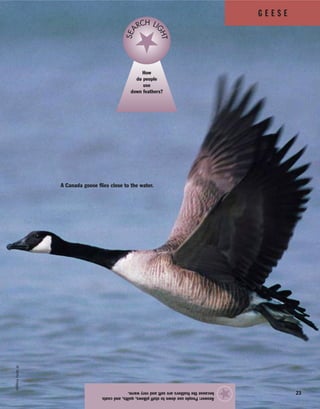
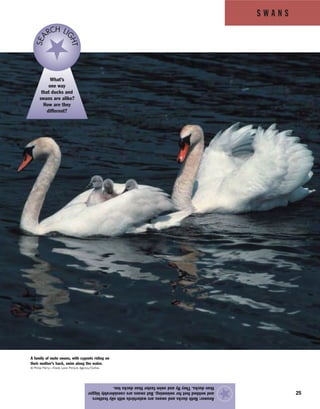
  • 97.
    96 goose: look undergeese grasshoppers (insects) page 69 insects page 57 LEARN MORE look under crickets great white sharks sharks page 42 gulls (birds) page 19 hammerhead sharks sharks page 42, photograph page 42 honey bees page 61 honeycombs bees photograph page 60 insecticide mosquitoes page 71 insects page 57 LEARN MORE look under ants; bees; butterflies and moths; cockroaches; crickets; grasshoppers; mosquitoes; and related animals: spiders jellyfish (ocean animals) page 53 jumping spiders spiders page 72, photograph page 72 king cobras (snakes) page 82 kingfishers (birds) page 9 kiwis (birds) page 33 LEARN MORE look under ostriches Komodo dragons (lizards) lizards page 85, photograph page 85 kookaburras (birds) kingfishers page 9, photograph page 8 land turtles (animals): look under tortoises leather carp (fish) carp page 37 leatherback turtles (turtles) reptiles page 75 lizards page 85 reptiles page 75 LEARN MORE look under chameleons locusts (insects) insects page 57 lungfish Did you know? page 34 macaws (birds) parrots and cockatoos page 11, photograph page 11 malaria (disease) Did you know? page 71 marine animals: look under albatrosses; coral; deep-sea life; fish; gulls; jellyfish; mollusks; octopuses; penguins; salmon; sharks; sponges mollusks (animals) page 49 monarch butterflies (insects) Did you know? page 63 mosquitoes (insects) page 71 moths (insects): look under butterflies and moths mudskippers (fish) Did you know? page 34 mussels (animals) mollusks photograph page 48 octopuses (ocean animals) page 51 Oriental cockroaches (insects) cockroaches page 65 ostriches (birds) page 31 LEARN MORE look under kiwis owls (birds) page 13 painted turtles (animals) turtles photograph page 88 parrots and cockatoos (birds) page 11 peacocks (birds) page 28 penguins (birds) page 27 piranhas (fish) page 41 pirate spiders spiders page 72 polliwogs (animals): look under tadpoles pond skaters (insects) insects page 57 pygmy parrots (birds) parrots and cockatoos page 11 pythons (animals) snakes photograph page 78 rabbitfish fish page 35 reptiles (animals) page 74 LEARN MORE look under alligators and crocodiles; lizards; snakes; turtles salamanders (animals) amphibians page 91 salmon (fish) page 39 salties (animals) Did you know? page 77 sea horses (fish) fish page 35 sea snakes (animals) snakes photograph page 79 sea turtles (animals) turtles page 88 sharks page 42 shells mollusks page 49 turtles page 88 skinks (reptiles) lizards photograph page 85 snails (animals) mollusks photograph page 49 snakes (animals) page 78 LEARN MORE look under anacondas; king cobras snow geese (birds) geese page 22, photograph page 22 spiders page 72 sponges (animals) page 47 swans page 24 tadpoles, also called polliwogs (animals) frogs page 93, photograph page 93 tadpole becoming frog illustration page 90 tentacles jellyfish page 53 octopuses page 51 toads (animals) amphibians page 91 frogs page 93 tortoises, also called land turtles (reptiles) turtles page 88 tree frogs (animals) amphibians page 91 frogs photograph page 92 tube worms deep-sea life photograph page 55 turtles (animals) page 88 viceroy butterflies (insects) Did you know? page 63 whale sharks (fish) fish page 35 sharks page 42, photograph page 43 worker bees bees page 61