RISKMAP REPORT
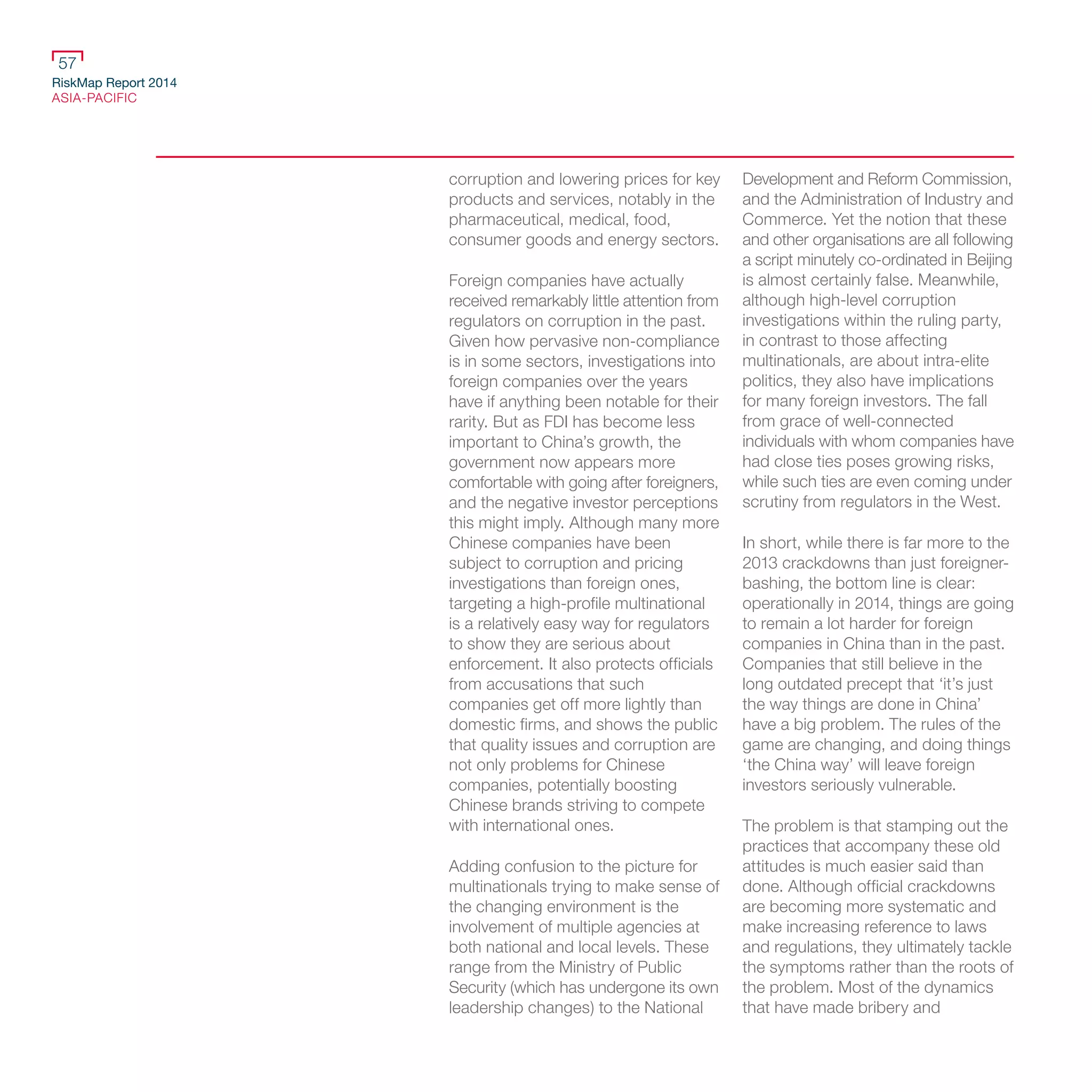
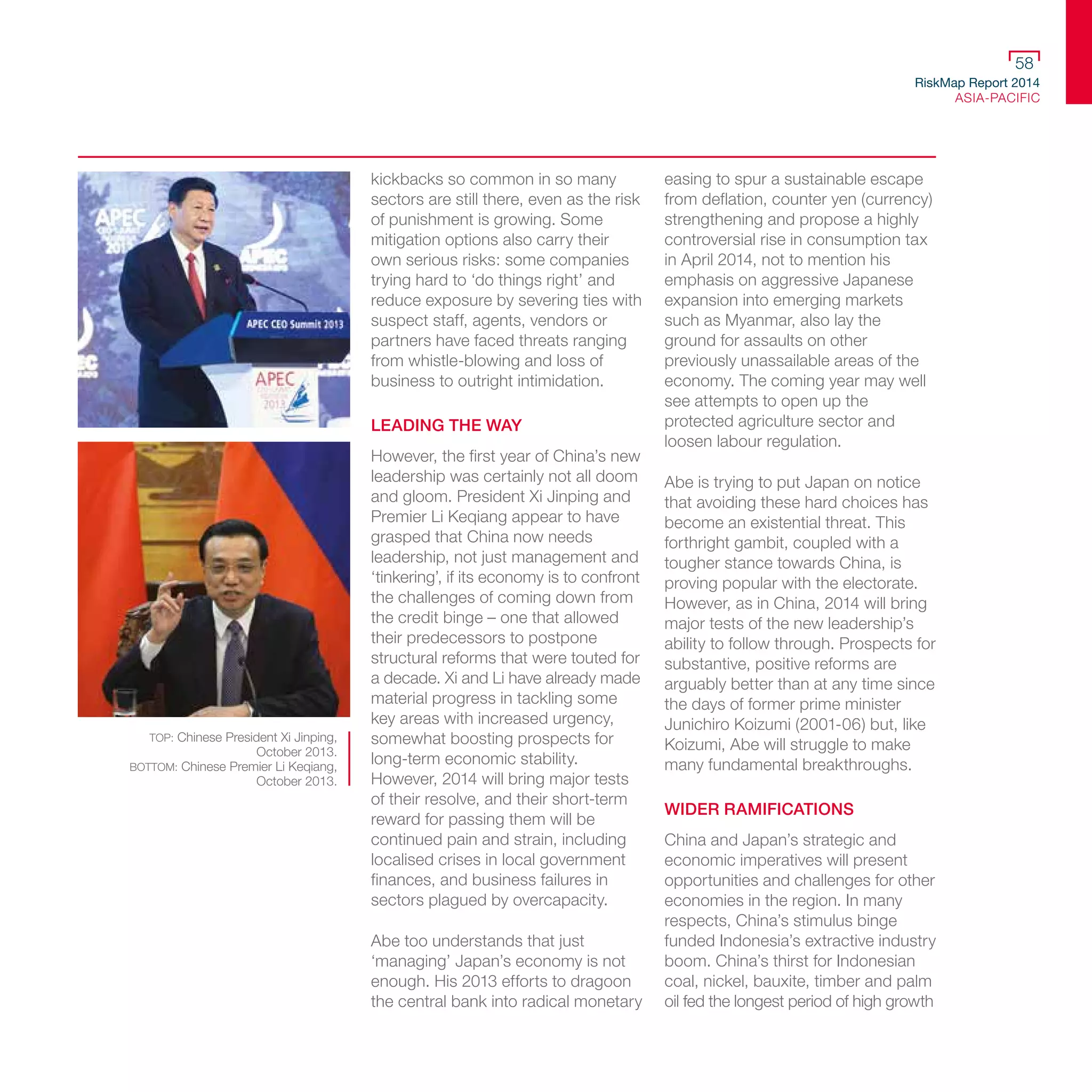
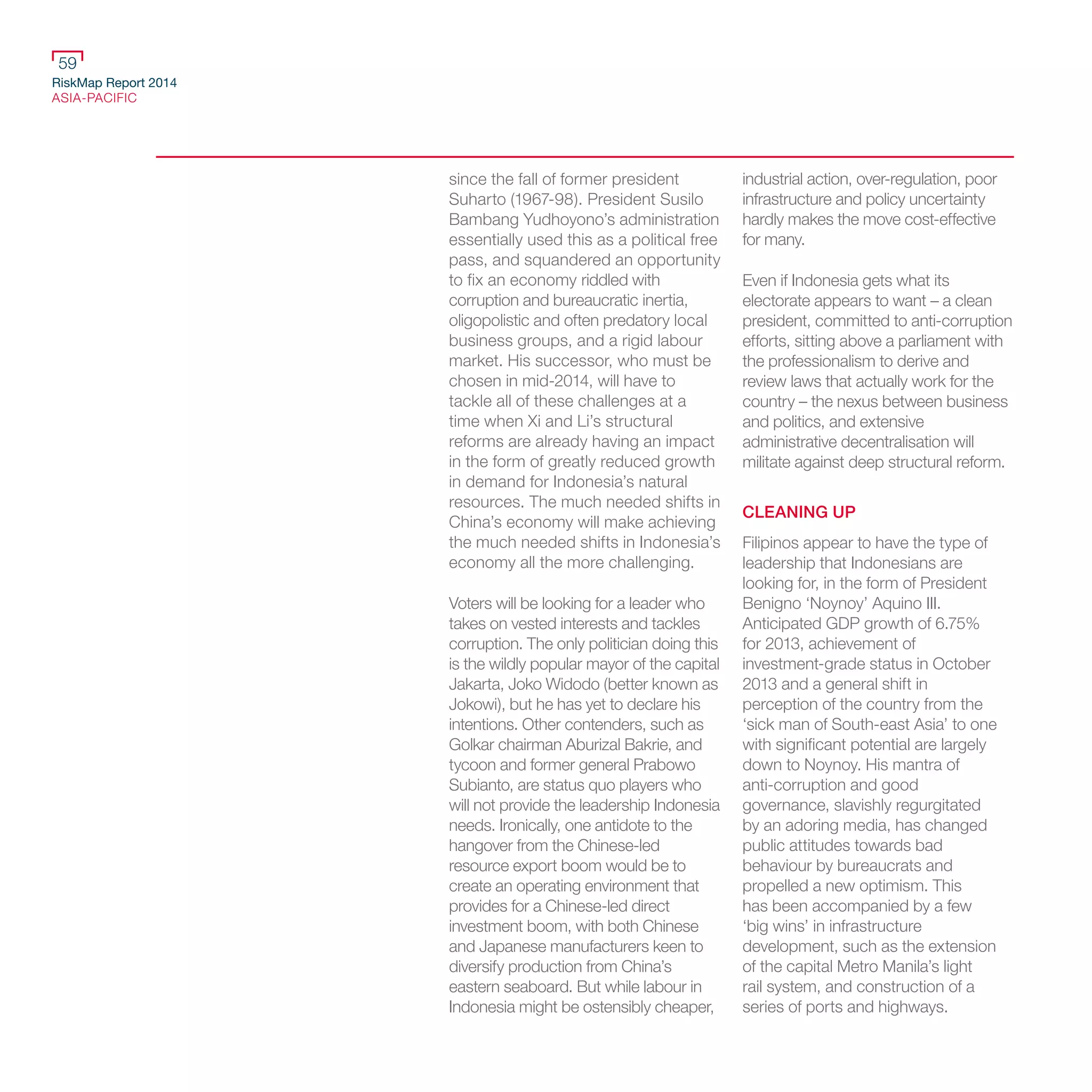
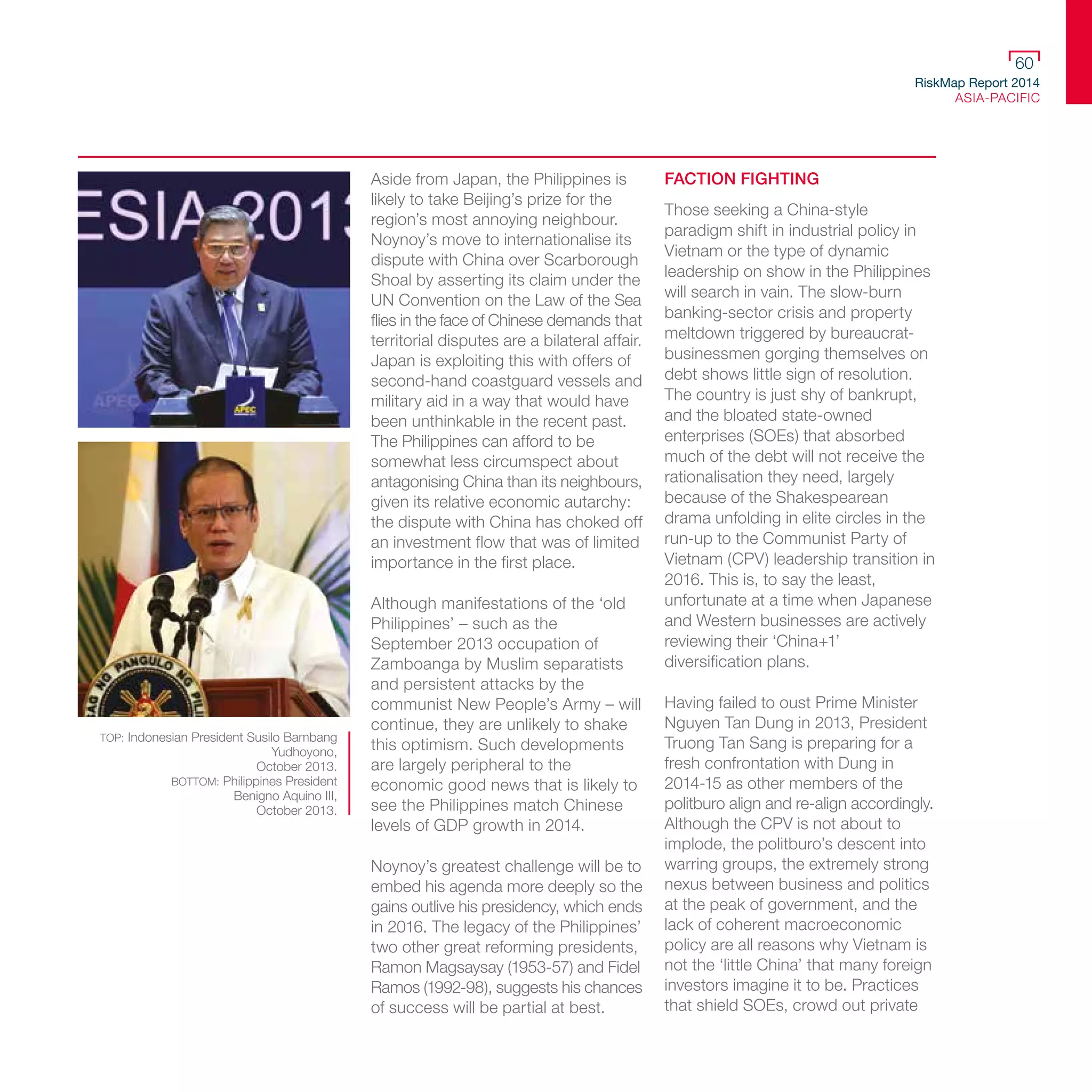
2014
Published by Control Risks, Cottons Centre, Cottons Lane, London SE 1 2QG. Control Risks Group Limited (‘the Company’) endeavours to ensure the accuracy of all information supplied. Advice
and opinions given represent the best judgement of the Company, but subject to Section 2 (1) Unfair Contract Terms Act 1977, where applicable, the Company shall in no case be liable for any
claims, or special, incidental or consequential damages, whether caused by the Company’s negligence (or that of any member of its staff) or in any other way.
Copyright: Control Risks Group Limited 2013. All rights reserved. Reproduction in whole or in part prohibited without the prior consent of the Company.
Photos on pages: 6 (top/bottom), 14 (top/bottom), 16 (bottom), 23 (top/bottom), 25 (top/bottom), 27 (top/bottom), 30 (bottom), 34 (top/bottom), 40 (top/bottom), 41 (top/bottom), 44 (top/bottom),
50 (top/bottom), 54 (top/bottom), 56 (bottom), 58 (top/bottom), 60 (top/bottom), 61 (top/bottom), 66 (top/bottom), 69 (top/bottom), 72 (top/bottom), 74 (bottom), 79 (top), 84 (top/bottom),
87 (bottom), 90 (top/bottom), 92 (top/bottom) and 100 (top/bottom) © Press Association. All other images are from Shutterstock except those credited in the publication to Control Risks’ employees.
Control Risks is an independent, global risk consultancy specialising in
political, integrity and security risk. We help some of the most influential
organisations in the world to understand and manage the risks and
opportunities of operating in complex or hostile environments.
We support clients by providing strategic consultancy, expert analysis
and in-depth investigations, handling sensitive political issues and
providing practical, on-the-ground protection and support.
Our unique combination of services, geographical reach and the trust
our clients place in us ensure we can help them to effectively solve
their problems and realise new opportunities across the world. Working
across five continents and with 34 offices worldwide, we provide a
broad range of services to help our clients to manage risk.
RISKMAP REPORT
2014
Control Risks is delighted to launch RiskMap 2014, our
authoritative guide to business risk in the year ahead. Drawing
upon expertise from across our organisation worldwide, we
forecast the major challenges and opportunities of doing
business in the world’s most complex environments next year.
Any publication entitled ‘RiskMap’ is inevitably going to focus
on risk, and as we look ahead we see no shortage of traps to
snare the unwary. But we also see an abundance of opportunity
delivered in part by the most extraordinary advances in living
standards and public health. With the media headlines as ever
dominated by risk and peril, that is well worth remembering.
– Richard Fenning, CEO, Control Risks
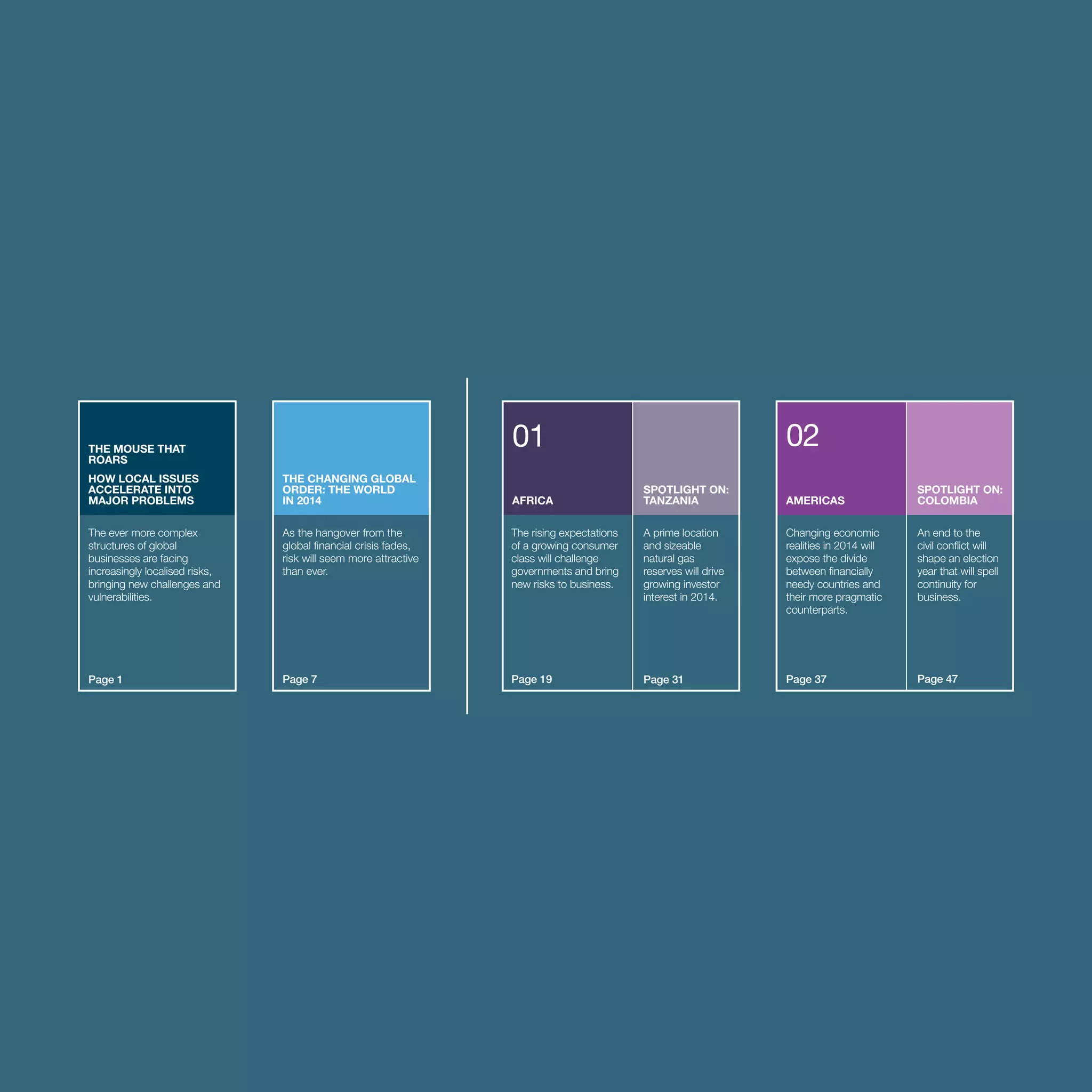
The rising expectations
of a growing consumer
class will challenge
governments and bring
new risks to business.
Page 19
Changing economic
realities in 2014 will
expose the divide
between financially
needy countries and
their more pragmatic
counterparts.
Page 37
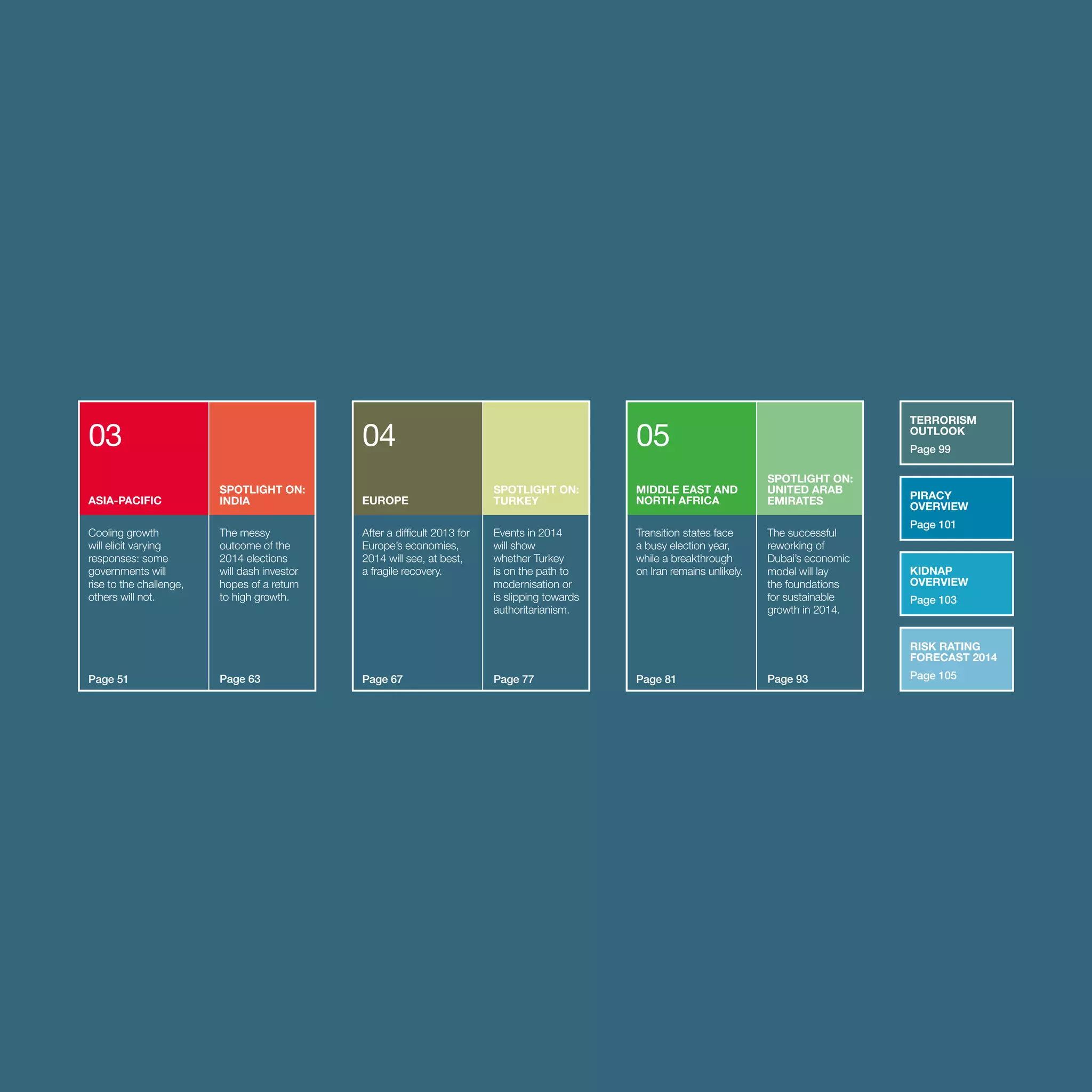
01
AFRICA
02
AMERICAS
A prime location
and sizeable
natural gas
reserves will drive
growing investor
interest in 2014.
Page 31
An end to the
civil conflict will
shape an election
year that will spell
continuity for
business.
Page 47
SPOTLIGHT ON:
TANZANIA
SPOTLIGHT ON:
COLOMBIA
The ever more complex
structures of global
businesses are facing
increasingly localised risks,
bringing new challenges and
vulnerabilities.
Page 1
As the hangover from the
global financial crisis fades,
risk will seem more attractive
than ever.
Page 7
THE MOUSE THAT
ROARS
HOW LOCAL ISSUES
ACCELERATE INTO
MAJOR PROBLEMS
THE CHANGING GLOBAL
ORDER: THE WORLD
IN 2014
Cooling growth
will elicit varying
responses: some
governments will
rise to the challenge,
others will not.
Page 51
After a difficult 2013 for
Europe’s economies,
2014 will see, at best,
a fragile recovery.
Page 67
Transition states face
a busy election year,
while a breakthrough
on Iran remains unlikely.
Page 81
03
ASIA-PACIFIC
04
EUROPE
The messy
outcome of the
2014 elections
will dash investor
hopes of a return
to high growth.
Page 63
Events in 2014
will show
whether Turkey
is on the path to
modernisation or
is slipping towards
authoritarianism.
Page 77
The successful
reworking of
Dubai’s economic
model will lay
the foundations
for sustainable
growth in 2014.
Page 93
SPOTLIGHT ON:
INDIA
SPOTLIGHT ON:
TURKEY
SPOTLIGHT ON:
UNITED ARAB
EMIRATES
MIDDLE EAST AND
NORTH AFRICA
05
RISK RATING
FORECAST 2014
Page 105
KIDNAP
OVERVIEW
Page 103
PIRACY
OVERVIEW
Page 101
TERRORISM
OUTLOOK
Page 99
Photographs taken by
Control Risks’ employees
RiskMap Report 2014
THE MOUSE THAT ROARS
2
When 32 heavily armed terrorists entered the remote In Amenas
gas plant in Algeria in the early hours of 16 January 2013, more than
130 foreign workers from nearly 30 countries were on site, representing
a multitude of operators, contractors and sub-contractors drawn from
nearly 50 companies based around the world.
As events unfolded, my colleagues
assisted companies on four
continents and speaking six
languages, helping to co-ordinate a
multinational response to the crisis.
The attack was also vividly and at
times tragically recorded through
social media as hundreds of workers
hiding in the plant were able to relay
events direct to their families and
loved ones around the world in real
time. Despite its remoteness, the In
Amenas attack was inherently a
global incident, affecting people,
organisations, markets and
perceptions worldwide.
The number of different nationalities
caught up in the In Amenas attack
surprised many. But the geographic
diversity of the workforce and its
employment by companies ranging
from major multinationals to small
suppliers were not unusual in our
globalised world. The oil and gas
industry, often in the vanguard of
international operations, has long
embodied a complex kaleidoscope of
inter-connecting contractual
relationships. Major oil and gas
projects bundle their skills and
technologies like Rubik’s Cubes,
forming and re-forming into
bewildering combinations to suit the
specific needs of individual projects.
Other sectors have adapted this flexible
model and – as we mentioned in last
year’s RiskMap – hardly any countries
are now off-limits to shape-shifting
multinational companies.
Companies increasingly need to
pursue elaborate, interlocking
operational structures to grasp the
opportunities on offer in a near-global
marketplace. For instance, I am writing
this having just left a meeting with a
senior executive of a Japanese
conglomerate that has a major stake
in a US-listed Latin American mining
company, which is investing billions of
dollars in southern Africa with Russian
and Indian co-investors to sell to
Chinese customers. And this is a
relatively straightforward proposition
compared with some of the byzantine
structures we encounter.
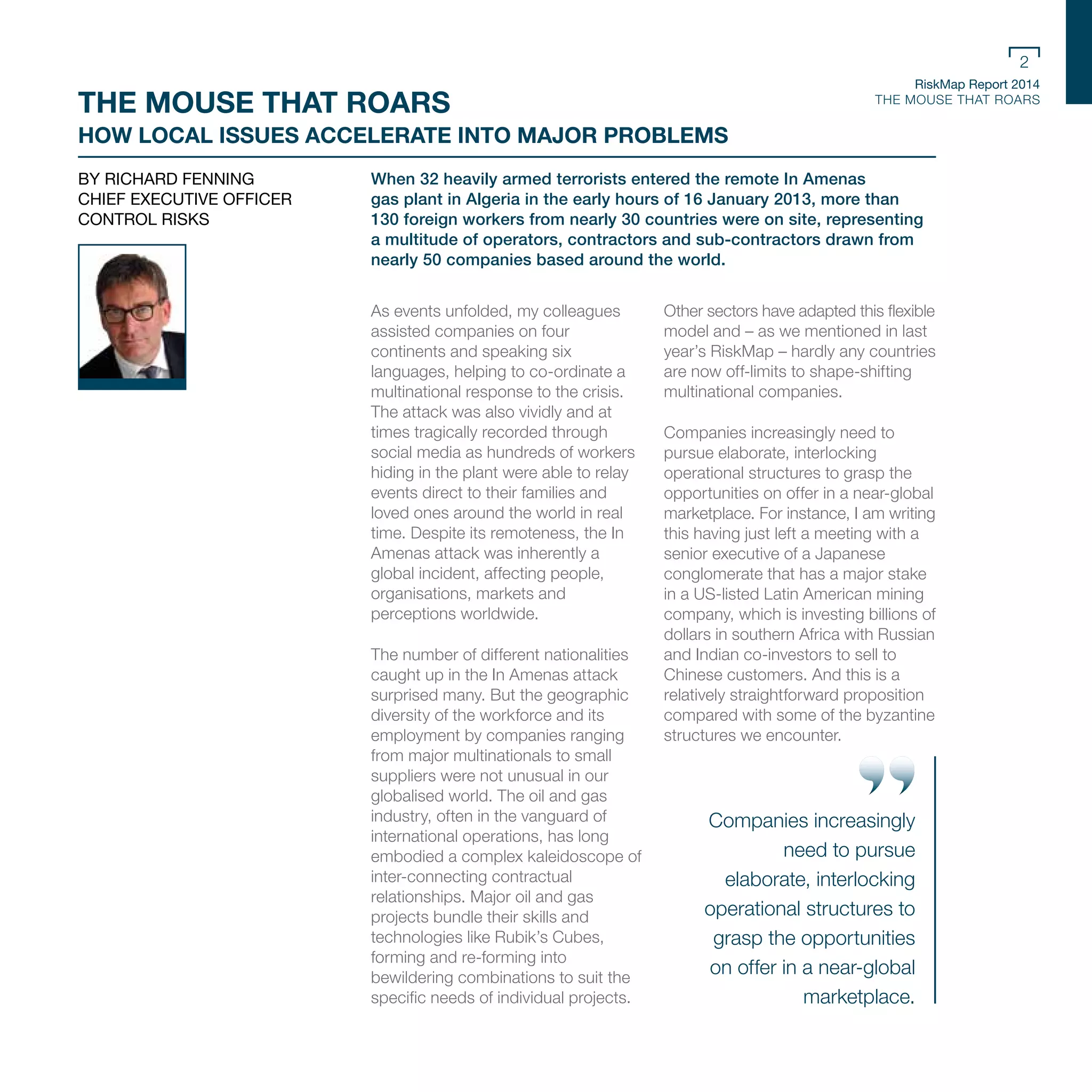
BY RICHARD FENNING
CHIEF EXECUTIVE OFFICER
CONTROL RISKS
THE MOUSE THAT ROARS
HOW LOCAL ISSUES ACCELERATE INTO MAJOR PROBLEMS
Companies increasingly
need to pursue
elaborate, interlocking
operational structures to
grasp the opportunities
on offer in a near-global
marketplace.
RiskMap Report 2014
THE MOUSE THAT ROARS
3
Organisations clearly cannot take
advantage of such opportunities on
their own. But new interdependencies
create new vulnerabilities, from the
liabilities of local partner organisations
to the often harsh realities of novel
operating climates. As organisations
leverage their global reach into ever
more convoluted combinations, they
leave an ever greater digital footprint
– with the attendant risks of a breach
of their cyber security. For those
mapping growth strategies at
multinational and global HQs, this
presents a daunting risk management
challenge: as business has become
global, political, security and integrity
risk have become more local. This is
one of the key themes we explore in
this year’s RiskMap.
The competing gravities of localised
politics and globalised economics
generate friction that plays out in
unexpected ways and places. As we
saw in the In Amenas attack, the
complex local dynamics of terrorism
and criminality in the Sahara – amplified
by post-Gadhafi anarchy leaching
over the border from Libya – have
reverberated globally through energy
markets, international relations and
corporate strategy.
This is not just an issue in unstable
post-revolutionary contexts. In the
US, a grassroots political crusade
against ‘big government’ has repeatedly
threatened to crash the global economy
by forcing an unprecedented sovereign
default; it seems bent on more of the
same in 2014. Growing US
isolationism after a decade of
entanglement in Middle Eastern wars,
meanwhile, has compromised global
security management, leaving – for
example – no coherent strategy to
contain and curtail the Syria conflict.
Across the Atlantic, localised (often
fringe) political positions have
obtained national prominence in the
wake of the financial, sovereign and
austerity crises, strengthening
centrifugal forces that for the last few
years have threatened to blow the
European project off course.
As challenging as this period has
been for industrialised nations, the
year ahead may prove particularly
challenging in the emerging world.
Even though the timing remains at
issue, 2014 will probably bring to an
end the era of quantitative easing
that has sent capital flooding into
BRICs, MISTs and other economies
still in search of an acronym to join.
The ensuing reversal of capital flows
– previewed in late summer 2013,
when emerging-market currencies
dropped precipitously against the US
dollar on rumours of US Federal
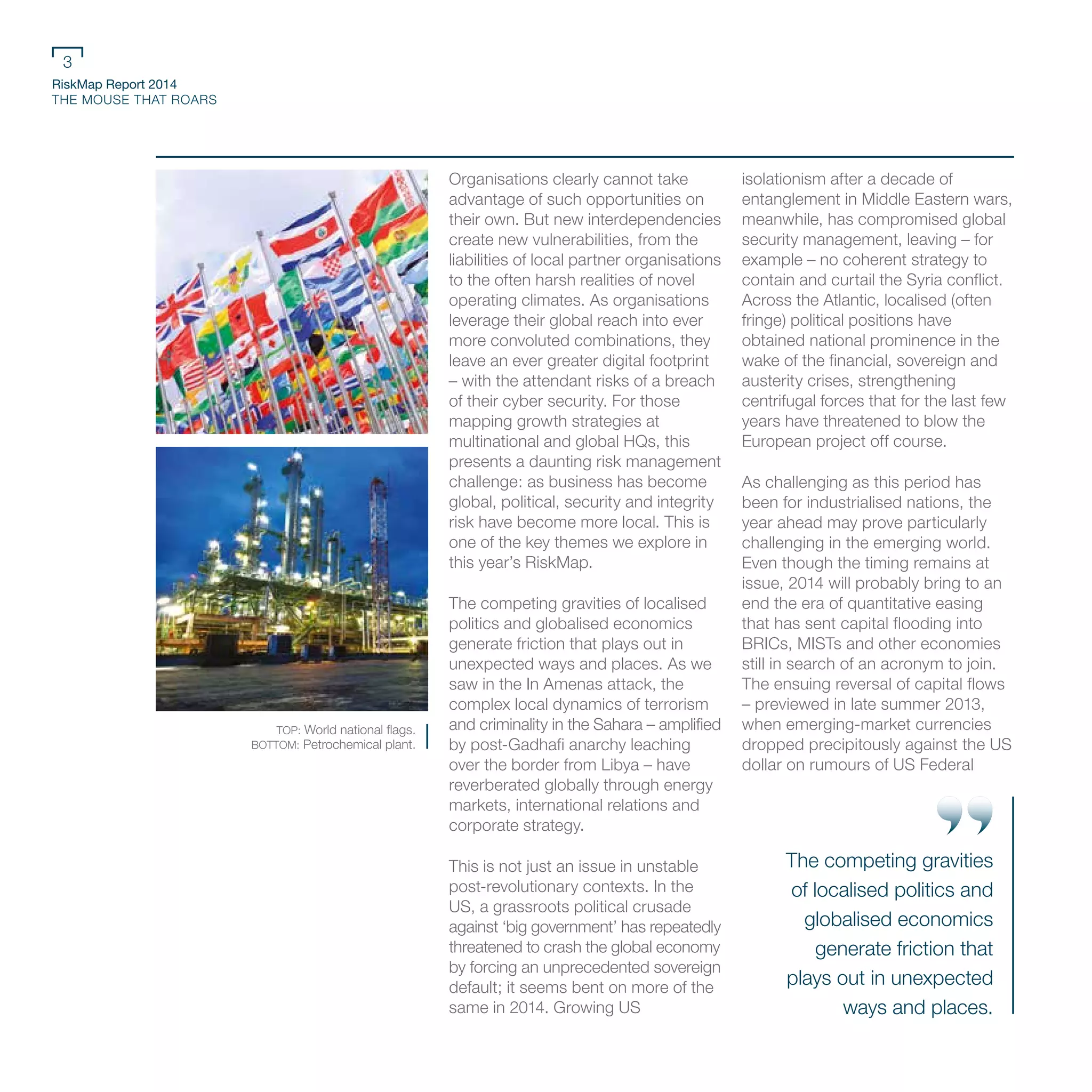
TOP: World national flags.
BOTTOM: Petrochemical plant.
The competing gravities
of localised politics and
globalised economics
generate friction that
plays out in unexpected
ways and places.
RiskMap Report 2014
THE MOUSE THAT ROARS
4
Reserve ‘tapering’ – will put
enormous strain on economies that
failed to make the most of the salad
years. Inefficiencies masked by
abundant capital may stoke popular
unrest and will almost certainly
undercut the lifestyles to which many
have grown accustomed, especially
new graduates to the burgeoning
global middle class. A spike in
corruption and extortion risk seems
likely to result.
Not even the largest emerging-market
economies will prove immune. In
China, the government is attempting
far-reaching changes to the economy
by tackling some of the vested
political interests that dominate
certain industrial sectors. Already, the
risk of being caught up inadvertently
in an anti-corruption campaign or an
attempt to influence pricing models
has substantially increased. The
complexities of local politics, hard to
read even at close quarters and in
good times, will grow more opaque
and often distorted when viewed
from foreign HQs.
China’s challenges will play out
against the backdrop of lower, but still
robust, GDP growth (the IMF
currently projects 7.25% in 2014,
down from consistent double-digit
performance in recent decades).
Other large emerging economies face
even rougher seas. The tapering
mini-panic hit India, Turkey and Brazil
particularly hard; the latter two
suffered significant unrest, largely
driven by discontented urban middle
classes. Among recent high-fliers,
only Mexico appears better placed
for solid growth next year, and even
there the war between drug cartels
and the state continues to
disproportionately colour the
country’s reputation.
Then, of course, there are outright
conflict zones. The list is led by the
civil war in Syria, with Iran and Russia
backing President Bashar al-Assad’s
regime, and the Gulf Arab
monarchies, Turkey and a lukewarm
West backing the rebels. Syria’s local
political trends present no cause for
optimism. A stalemate has developed
whereby the rebels lack the firepower
and unity to overthrow the regime,
while the regime has demonstrated it
has genuine grassroots appeal within
the minority Alawite and Christian
communities, and enough outside
support from Iran and Hizbullah to
hold on for the time being. The
US-Russia agreement to mount an
international effort to remove the
Assad regime’s chemical weapons
may be a universal good, but its
practical effect is to forestall any
decision by the US or other powers to
intervene on humanitarian grounds.
This will encourage both sides in
Syria to dig in and perpetuate the
risks stalking neighbouring countries
harbouring millions of refugees and
being drawn, voluntarily or not, into
the conflict. As usual, the risks are
particularly acute in Lebanon, where
Christian and Sunni factions strongly
support the rebels, while the
country’s most powerful faction,
RiskMap Report 2014
THE MOUSE THAT ROARS
5
Hizbullah, is deeply engaged on
behalf of Assad.
Egypt, meanwhile, has taken a step
back from democracy. The
re-imposition of military rule once
again tested companies doing
business in the Middle East’s largest
economy, raising anew complex
issues of business continuity, market
resilience and, at the most basic level,
the safety of local staff. 2014 will not
see the return to normality that
investors crave.
In the Sahel and Yemen, al-Qaida,
whose demise was only recently
being talked of as a given in some
Western capitals, has proved resilient.
Indeed, if lawless areas of Iraq, Syria,
Pakistan, Somalia and Afghanistan
are included, al-Qaida-aligned groups
are spread over as much territory as
ever before. The centralised entity
that perpetrated the 9/11 attack may
be in terminal decline thanks to
relentless drone strikes, but a shift
in the centre of institutional gravity to
al-Qaida in the Arabian Peninsula
(AQAP), al-Qaida in the Islamic
Maghreb (AQIM) and al-Qaida in Iraq
(AQI) – among other affiliates – will
preserve the network’s lethal
ambitions for the foreseeable future.
One potential bright spot: progress in
mid-late 2013 in talks between the
US and Iran over the latter’s nuclear
ambitions holds out some hope that
the diplomatic logjam may shift. The
chances are slim, and these moves
may turn out to be no more than a
change of tactics rather than strategy
on Tehran’s part. As an ancillary boon
to the global economy and major
importers, progress in these
negotiations could pare the
geopolitical risk premium underlying
oil prices, combining with bumper
unconventional production to bring
prices down below the $100 per
barrel threshold.
Outside the Middle East, elections in
Indonesia, India and Brazil will
command significant attention. In
Brazil, slowing growth rates have
forced new burdens on the
government of President Dilma
Rousseff. Although the country will
put on a good show hosting the
2014 World Cup and 2016 Olympics,
doing business may grow even more
complex as the government pushes
for more state intervention to boost
the economy and the rising costs of
doing business continue to erode
profit margins – and Brazil’s
attractiveness more broadly.
In India and Indonesia, corruption and
lowered growth expectations will
dominate political debate, providing
openings for a change in government
in Indonesia after a decade of
relatively consistent rule by one party.
2014 will not see the
return to normality that
investors crave.
RiskMap Report 2014
THE MOUSE THAT ROARS
6
In both countries, business risk could
emanate from the disruption to
vested interests that political change
can precipitate. In India, elections will
result in another weak central
government, portending continued
glacial progress on reforms that
would revive growth and improve the
operating environment.
For investors, shifting power – both
economic and political – needs to be
monitored closely to avoid unwanted
entanglement. RiskMap explores how
this phenomenon of spikes in risk
triggered by changes in the
distribution of economic power is
repeated in many different markets.
As growth slows in many of the
recent high-growth economies,
political legitimacy is tested and
unwary investors may find themselves
in suddenly unfamiliar territory.
On one level, this is nothing new:
globally ambitious companies have
always risked becoming embroiled in
other people’s problems a long way
from home. But what is new is the
scale with which this is now
happening. RiskMap highlights how
many of the drivers of growth –
urbanisation, the growth of the middle
classes, improvements in public
health, increased access to natural
resources – transcend national
boundaries and encourage investors
to enter new markets. In 2014, this
tension between opportunity and risk
will become more acute as the era of
high-growth emerging markets
fuelling global GDP growth comes to
a close and the complexities of local
political tensions impinge more
assertively on global operations.
Any publication entitled ‘RiskMap’ is
inevitably going to focus on risk, and
as we look ahead we see no
shortage of traps to snare the
unwary. But we also see an
abundance of opportunity delivered
in part by the most extraordinary
advances in living standards and
public health. With the media
headlines as ever dominated by risk
and peril, that is well worth
remembering.
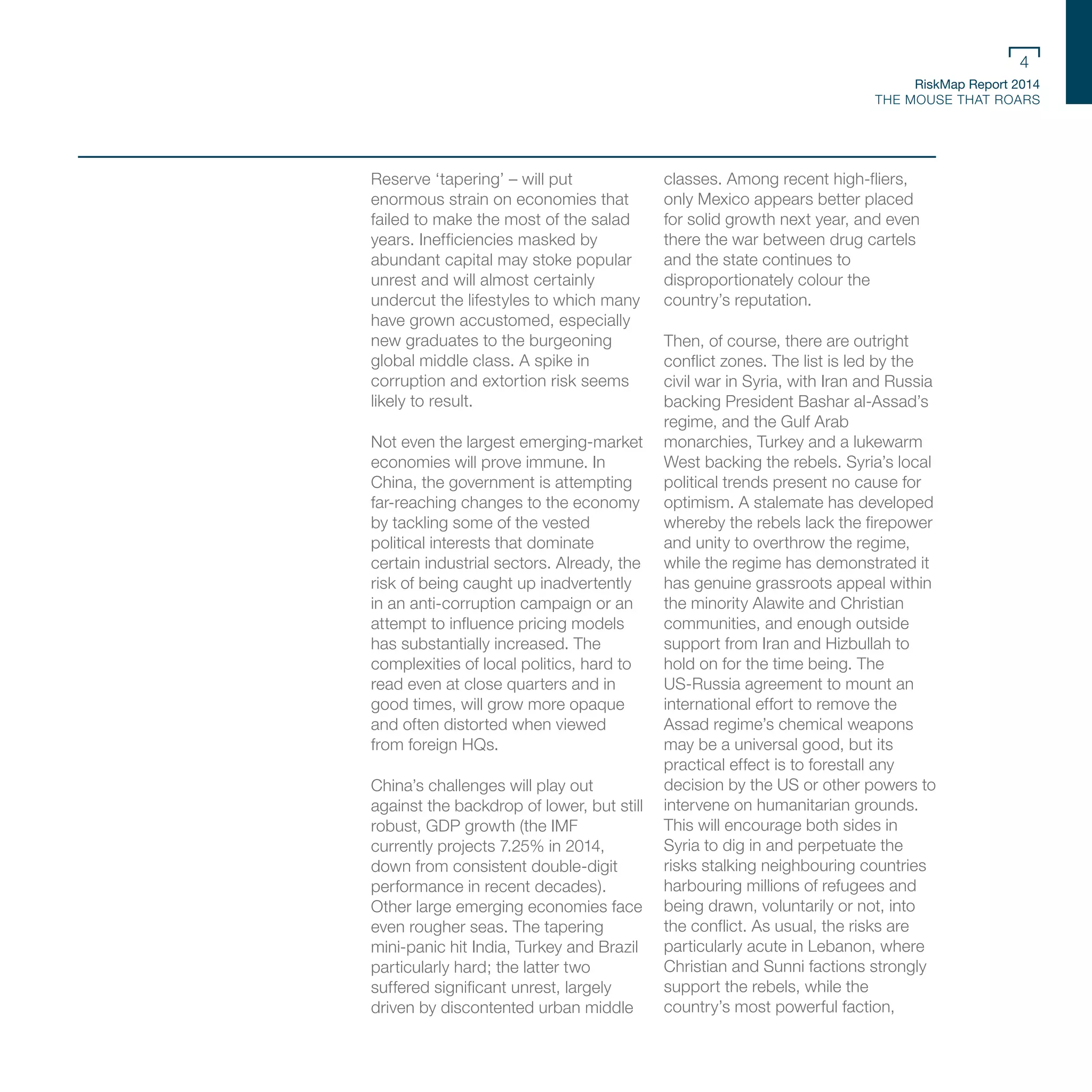
TOP: Protester in Istanbul, Turkey,
September 2013.
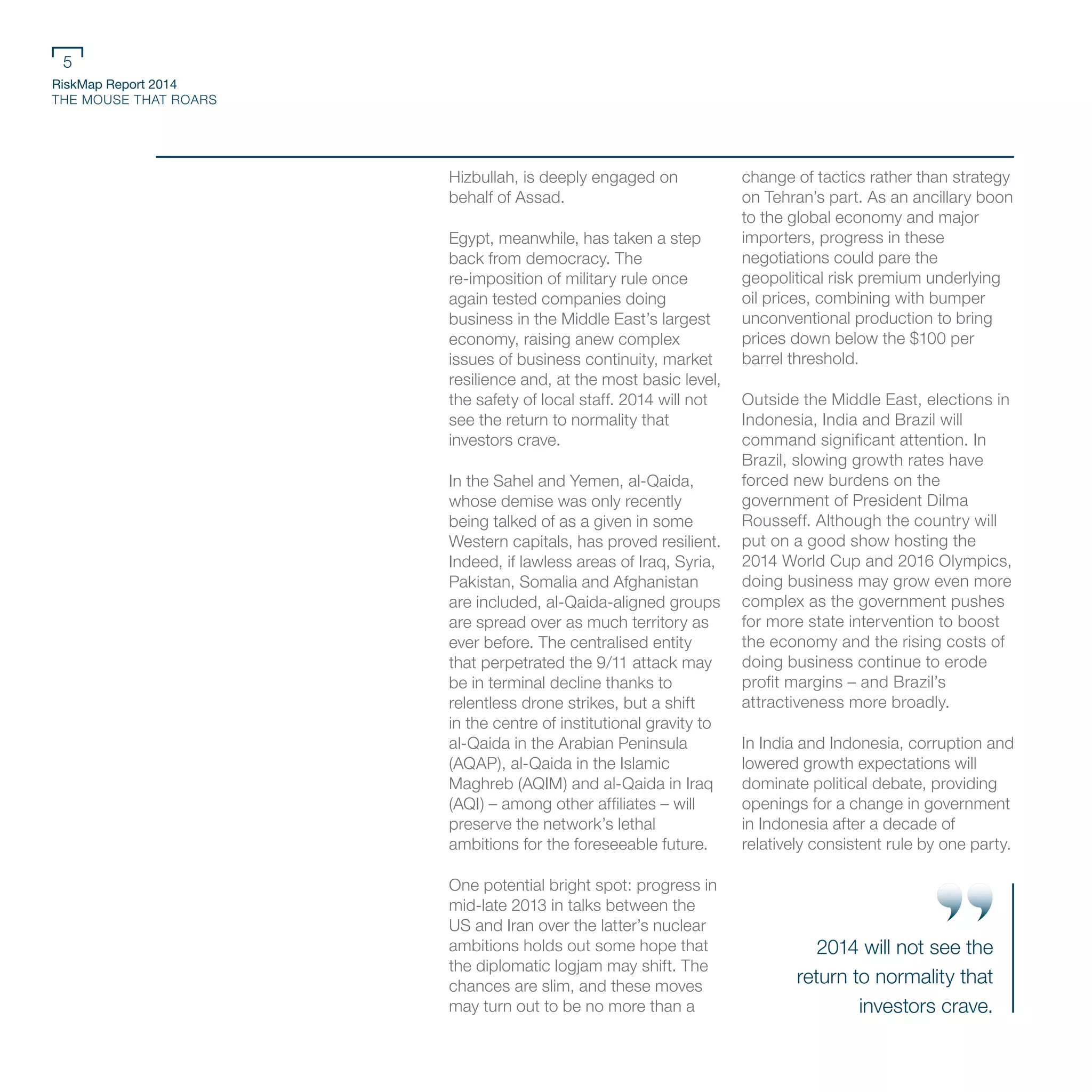
BOTTOM: Hundreds of protesters
clashed with police in
Rio de Janeiro, Brazil,
October 2013.
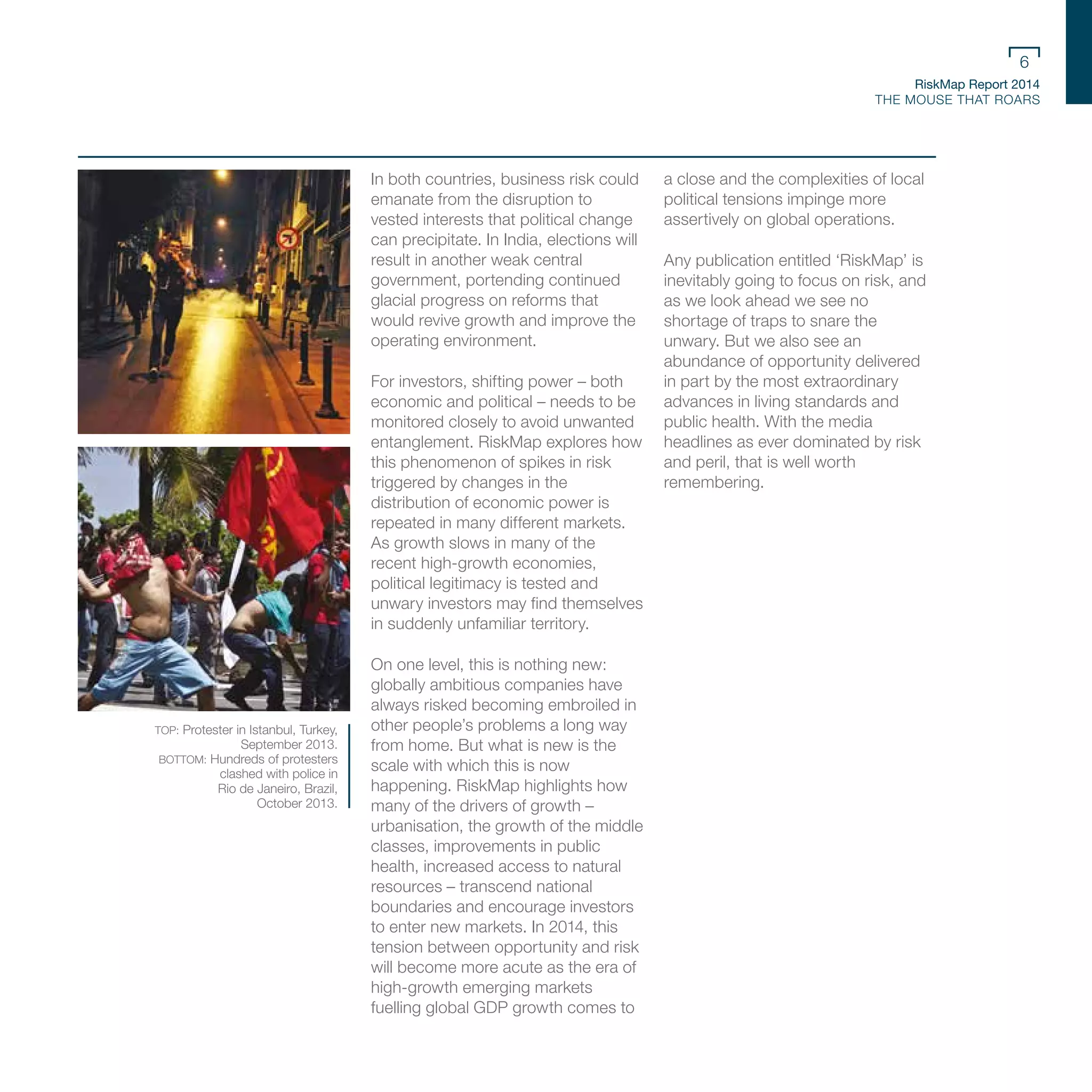
Kabul, Afghanistan
by Edward Smith
Control Risks
RiskMap Report 2014
THE CHANGING GLOBAL ORDER
8
All good forecasts, particularly in the complex realm of global political
and security risk, have a solid historical foundation and learn from past
outcomes. In building our RiskMap 2014 outlook, we have drawn on a
decade of risk analysis to identify underlying trends and assess how they
are likely to evolve.
LOOKING BACK: 2003-13
The ten years from 2003 to 2013
were bracketed by the invasion of
Iraq and US withdrawal from
Afghanistan, enlargement of the EU
and the eurozone crisis, SARS in East
Asia and a similar outbreak in the
Middle East, the relinquishment of
chemical weapons by Libya and their
use in Syria, and the decision to build
a nuclear bomb in North Korea and
renewed negotiations to preclude the
possibility in Iran. Along the way, the
subprime mortgage collapse nearly
destroyed global finance, the Arab
spring upended decades of political
stagnation in North Africa, BRIC
became the watchword of the global
economy, the urban population
exceeded the rural population for the
first time in history, fracking
transformed energy geopolitics, and
social media technologies
revolutionised global communications
and laid bare the secret workings of
the West’s intelligence agencies.
It was a decade of unprecedented
opportunity and historic shifts of
capital from the advanced to the
developing world, tempered by
rapidly evolving threats, a new
emphasis on transparency and
accountability, and rising concern
about the sustainability of the post-war
liberal democratic world order. With
these shifts introducing
unprecedented complexity and
uncertainty into global affairs,
managing security and political risks
became more directly relevant to how
companies do business.
Developments in the Middle East and
North Africa dominated global
THE CHANGING GLOBAL ORDER: THE WORLD IN 2014
JONATHAN WOOD
ASSOCIATE DIRECTOR,
GLOBAL RISK ANALYSIS
CONTROL RISKS
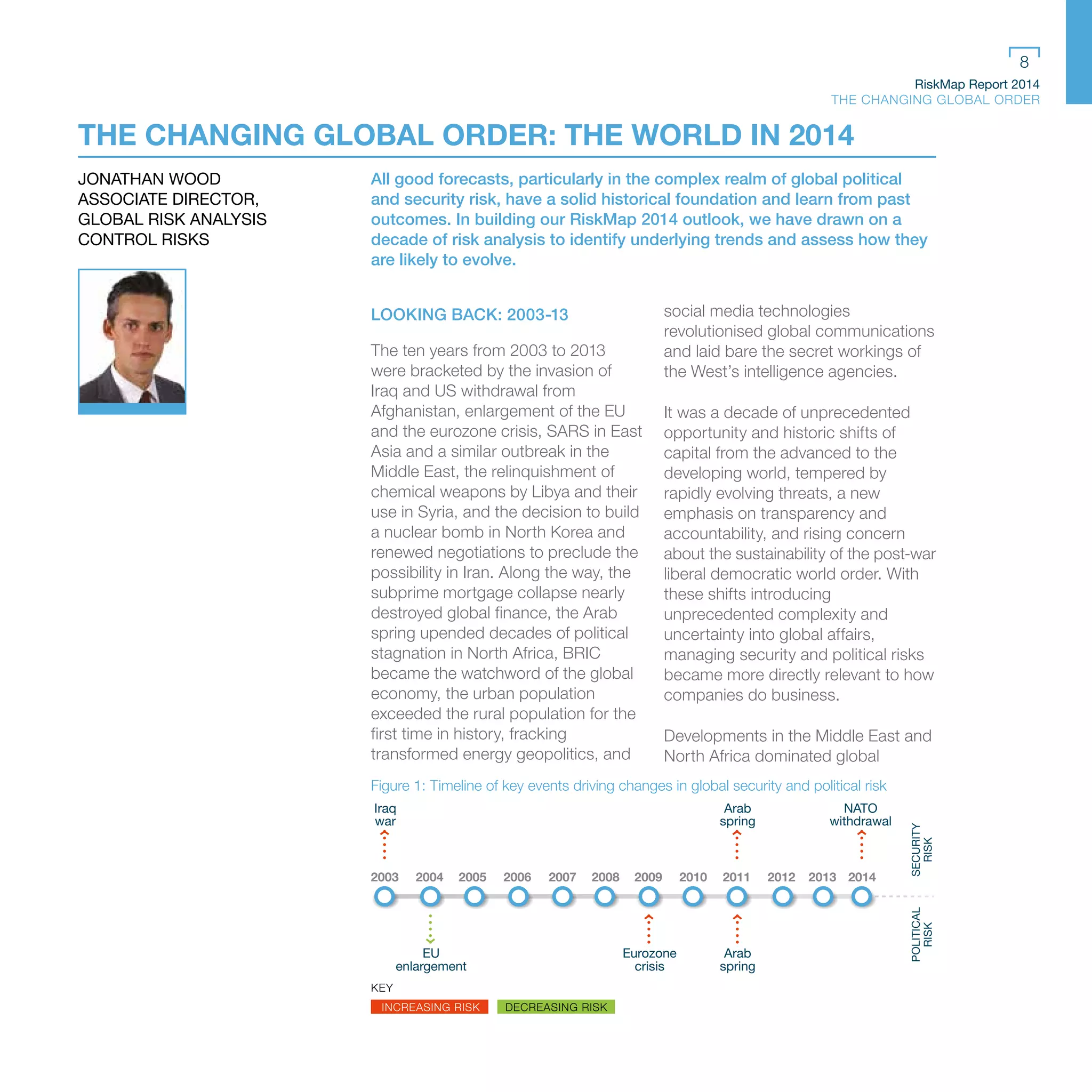
Figure 1: Timeline of key events driving changes in global security and political risk
2004 2005 2006 2007 2008 2009 2010 2011 2012 2013 20142003
Arab
spring
Eurozone
crisis
EU
enlargement
NATO
withdrawal
Arab
spring
Iraq
war
SECURITY
RISK
POLITICAL
RISK
KEY
INCREASING RISK DECREASING RISK
RiskMap Report 2014
THE CHANGING GLOBAL ORDER
9
security risk over the last ten years.
The launch of the Iraq war in 2003
spawned increased security risks
throughout the Gulf region,
influencing evolving terrorist threats in
Algeria, Iraq, Saudi Arabia and
beyond. The gradual increase in
tensions over Iran’s nuclear
programme after 2009 added a new
layer of strategic security risk – most
strongly felt in global oil markets – while
the Arab spring revolutions in early
2011 radically altered security
environments in North Africa and the
Levant, with regional and global spillover
impacts. Nuclear sabre-rattling in
North Korea, by contrast, had no
sustained impact on global security
risk, though it remained a sporadic
source of regional crisis.
The Iraq war and Arab spring also
strongly affected global political
risk, but resurgent leftism in Latin
America, lingering state fragility
across Central and West Africa, and
the fallout from the global financial
crisis – especially in Europe – were
equally important. An underlying
driver of each of these was the
onset of the so-called ‘commodities
super-cycle’ in 2003, driven by both
increased security threats to oil
supply and voracious Chinese
demand, which fuelled populism in
key energy and mineral exporters
and economic stress and
occasional unrest in importers.
Meanwhile, the political benefits of
EU enlargement in 2004 (following
the adoption of the euro currency in
2002) were swiftly belied by the
acute sovereign risks that emerged
during the financial crisis.
Despite the fluid security and political
environment of the last ten years,
business thrived as opportunities
appeared in fast-growing emerging
and developing economies. Since
2003, emerging and developing
countries’ share of nominal global
output has doubled, from 20% to
40%. Nominal output in emerging
Asia alone, powered by China, has
increased by 700%, surpassing that
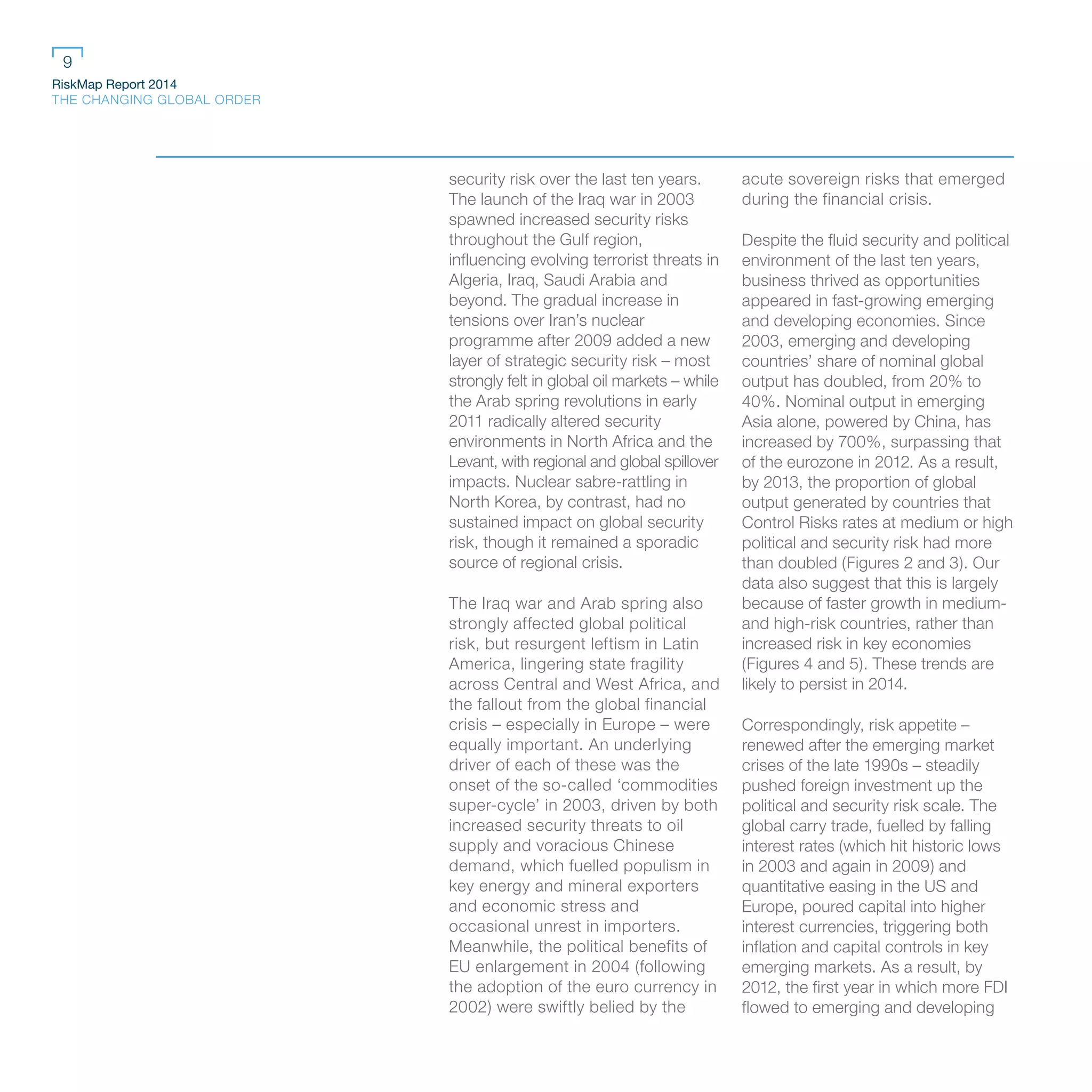
of the eurozone in 2012. As a result,
by 2013, the proportion of global
output generated by countries that
Control Risks rates at medium or high
political and security risk had more
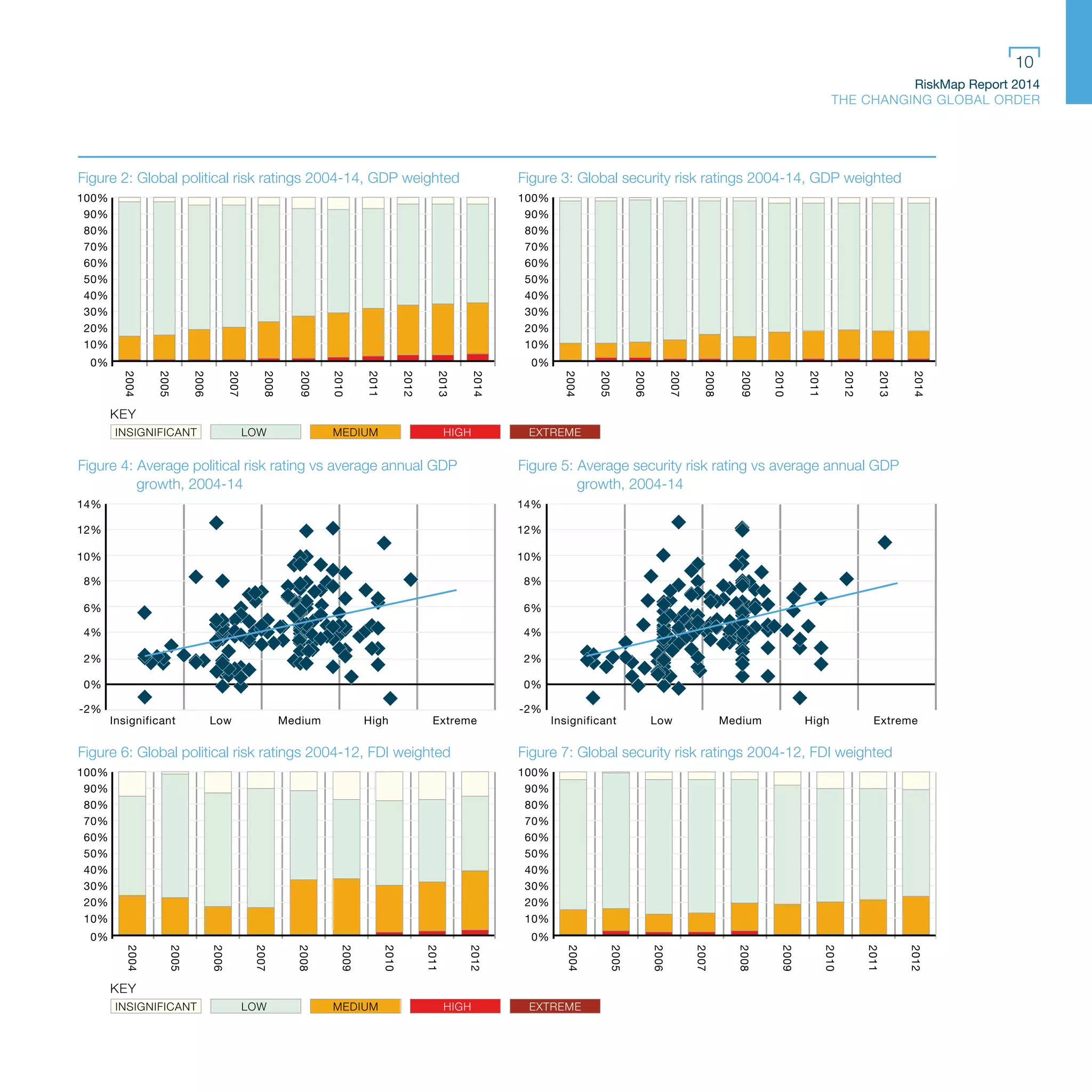
than doubled (Figures 2 and 3). Our
data also suggest that this is largely
because of faster growth in medium-
and high-risk countries, rather than
increased risk in key economies
(Figures 4 and 5). These trends are
likely to persist in 2014.
Correspondingly, risk appetite –
renewed after the emerging market
crises of the late 1990s – steadily
pushed foreign investment up the
political and security risk scale. The
global carry trade, fuelled by falling
interest rates (which hit historic lows
in 2003 and again in 2009) and
quantitative easing in the US and
Europe, poured capital into higher
interest currencies, triggering both
inflation and capital controls in key
emerging markets. As a result, by
2012, the first year in which more FDI
flowed to emerging and developing
RiskMap Report 2014
THE CHANGING GLOBAL ORDER
10
Figure 2: Global political risk ratings 2004-14, GDP weighted
KEY
INSIGNIFICANT LOW MEDIUM HIGH EXTREME
2004
2005
2006
2007
2008
2009
2010
2011
2012
2013
2014
Figure 3: Global security risk ratings 2004-14, GDP weighted
100%
90%
80%
70%
60%
50%
40%
30%
20%
10%
0%
100%
90%
80%
70%
60%
50%
40%
30%
20%
10%
0%
2004
2005
2006
2007
2008
2009
2010
2011
2012
2013
2014
Figure 4: Average political risk rating vs average annual GDP
14%
12%
10%
8%
6%
4%
2%
0%
-2%
Low HighInsignificant Medium Extreme
14%
12%
10%
8%
6%
4%
2%
0%
-2%
Low HighInsignificant Medium Extreme
Figure 5: Average security risk rating vs average annual GDP
growth, 2004-14growth, 2004-14
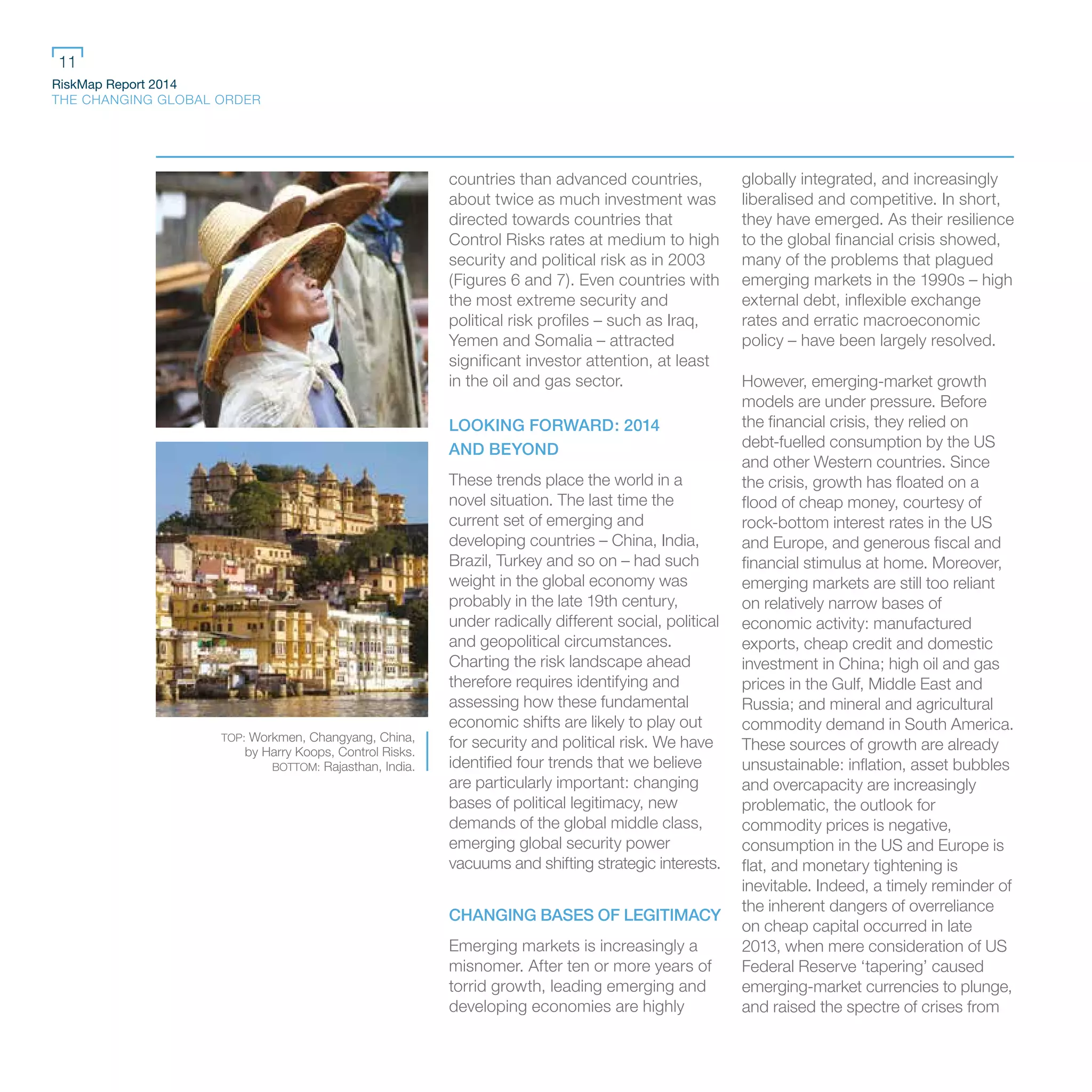
Figure 6: Global political risk ratings 2004-12, FDI weighted
KEY
INSIGNIFICANT LOW MEDIUM HIGH EXTREME
2004
2005
2006
2007
2008
2009
2010
2011
2012
2004
2005
2006
2007
2008
2009
2010
2011
2012
Figure 7: Global security risk ratings 2004-12, FDI weighted
100%
90%
80%
70%
60%
50%
40%
30%
20%
10%
0%
100%
90%
80%
70%
60%
50%
40%
30%
20%
10%
0%
RiskMap Report 2014
THE CHANGING GLOBAL ORDER
11
countries than advanced countries,
about twice as much investment was
directed towards countries that
Control Risks rates at medium to high
security and political risk as in 2003
(Figures 6 and 7). Even countries with
the most extreme security and
political risk profiles – such as Iraq,
Yemen and Somalia – attracted
significant investor attention, at least
in the oil and gas sector.
LOOKING FORWARD: 2014
AND BEYOND
These trends place the world in a
novel situation. The last time the
current set of emerging and
developing countries – China, India,
Brazil, Turkey and so on – had such
weight in the global economy was
probably in the late 19th century,
under radically different social, political
and geopolitical circumstances.
Charting the risk landscape ahead
therefore requires identifying and
assessing how these fundamental
economic shifts are likely to play out
for security and political risk. We have
identified four trends that we believe
are particularly important: changing
bases of political legitimacy, new
demands of the global middle class,
emerging global security power
vacuums and shifting strategic interests.
CHANGING BASES OF LEGITIMACY
Emerging markets is increasingly a
misnomer. After ten or more years of
torrid growth, leading emerging and
developing economies are highly
globally integrated, and increasingly
liberalised and competitive. In short,
they have emerged. As their resilience
to the global financial crisis showed,
many of the problems that plagued
emerging markets in the 1990s – high
external debt, inflexible exchange
rates and erratic macroeconomic
policy – have been largely resolved.
However, emerging-market growth
models are under pressure. Before
the financial crisis, they relied on
debt-fuelled consumption by the US
and other Western countries. Since
the crisis, growth has floated on a
flood of cheap money, courtesy of
rock-bottom interest rates in the US
and Europe, and generous fiscal and
financial stimulus at home. Moreover,
emerging markets are still too reliant
on relatively narrow bases of
economic activity: manufactured
exports, cheap credit and domestic
investment in China; high oil and gas
prices in the Gulf, Middle East and
Russia; and mineral and agricultural
commodity demand in South America.
These sources of growth are already
unsustainable: inflation, asset bubbles
and overcapacity are increasingly
problematic, the outlook for
commodity prices is negative,
consumption in the US and Europe is
flat, and monetary tightening is
inevitable. Indeed, a timely reminder of
the inherent dangers of overreliance
on cheap capital occurred in late
2013, when mere consideration of US
Federal Reserve ‘tapering’ caused
emerging-market currencies to plunge,
and raised the spectre of crises from
TOP: Workmen, Changyang, China,
by Harry Koops, Control Risks.
BOTTOM: Rajasthan, India.
RiskMap Report 2014
THE CHANGING GLOBAL ORDER
12
India to Indonesia to Brazil. That was a
dress rehearsal: tapering will be a
reality by the end of 2014.
With the pillars of rapid emerging-
market growth eroding, political
settlements founded on so-called
‘performance legitimacy’ – based
on delivering rapid growth and
achieving concrete policy objectives
– are increasingly brittle. For the last
ten years, ruling parties and leaders
in major emerging markets have all
managed to stay in power thanks in
large part to rapid growth. But
growth has fallen sharply since 2011
in most major emerging markets
and is expected to remain below
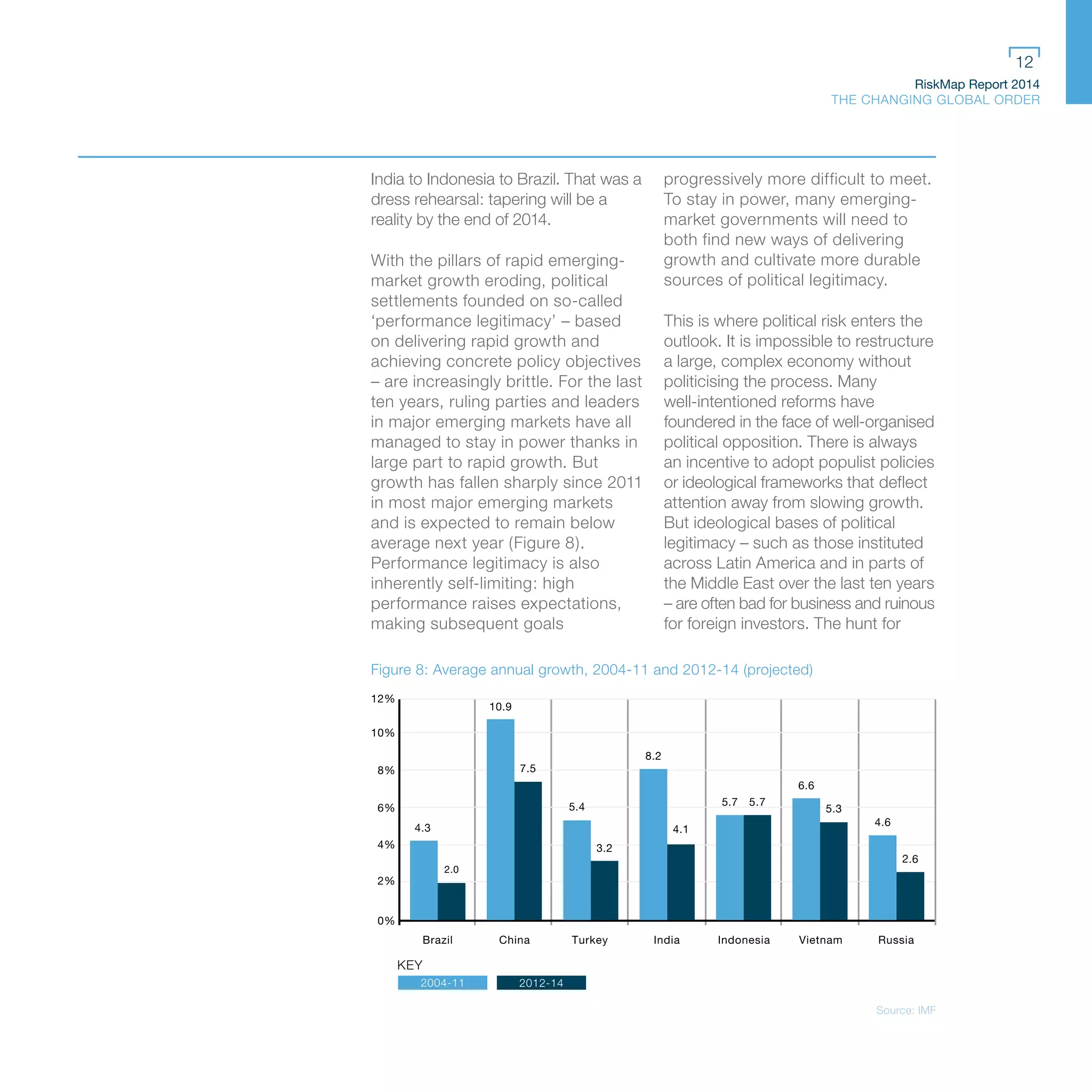
average next year (Figure 8).
Performance legitimacy is also
inherently self-limiting: high
performance raises expectations,
making subsequent goals
progressively more difficult to meet.
To stay in power, many emerging-
market governments will need to
both find new ways of delivering
growth and cultivate more durable
sources of political legitimacy.
This is where political risk enters the
outlook. It is impossible to restructure
a large, complex economy without
politicising the process. Many
well-intentioned reforms have
foundered in the face of well-organised
political opposition. There is always
an incentive to adopt populist policies
or ideological frameworks that deflect
attention away from slowing growth.
But ideological bases of political
legitimacy – such as those instituted
across Latin America and in parts of
the Middle East over the last ten years
– are often bad for business and ruinous
for foreign investors. The hunt for
Figure 8: Average annual growth, 2004-11 and 2012-14 (projected)
Brazil China Turkey India Indonesia Vietnam Russia
KEY
2012-14
12%
10%
8%
6%
4%
2%
0%
4.3
10.9
6.6
2004-11
8.2
4.1
4.6
2.6
2.0
5.4
7.5
3.2
5.3
5.75.7
Source: IMF
RiskMap Report 2014
THE CHANGING GLOBAL ORDER
13
growth, meanwhile, has provoked a
new wave of trade protectionism and
beggar-thy-neighbour policies. In the
year ahead, how countries choose to
deal with slowing growth will be a
critical variable of the political risk
landscape for business.
RISING MIDDLE CLASSES
Emerging-market governments are also
facing different kinds of political
demands. One of the historic effects
of emerging-market growth is the rise
of the global middle class – those
with annual incomes above $4,000 in
purchasing power parity (PPP) terms.
The middle class grew to more than
2bn people in the last ten years and is
projected to expand to more than 3bn
in the next ten. With sheer economic
income moving comfortably above
poverty levels, emerging middle
classes are beginning to focus on a
wider range of issues linked to
personal freedom, economic
opportunity and good governance.
These demands invariably clash with
entrenched political systems and
vested economic interests. Indeed,
the mass social protests since 2011
– including the Arab spring, Occupy
and Indignados movements, and
anti-government unrest in Turkey,
Brazil and Bulgaria – reflect how
economic change has greatly
outpaced political change during the
emerging-market era. Rising middle
classes, armed with the trappings
and ambitions of technological
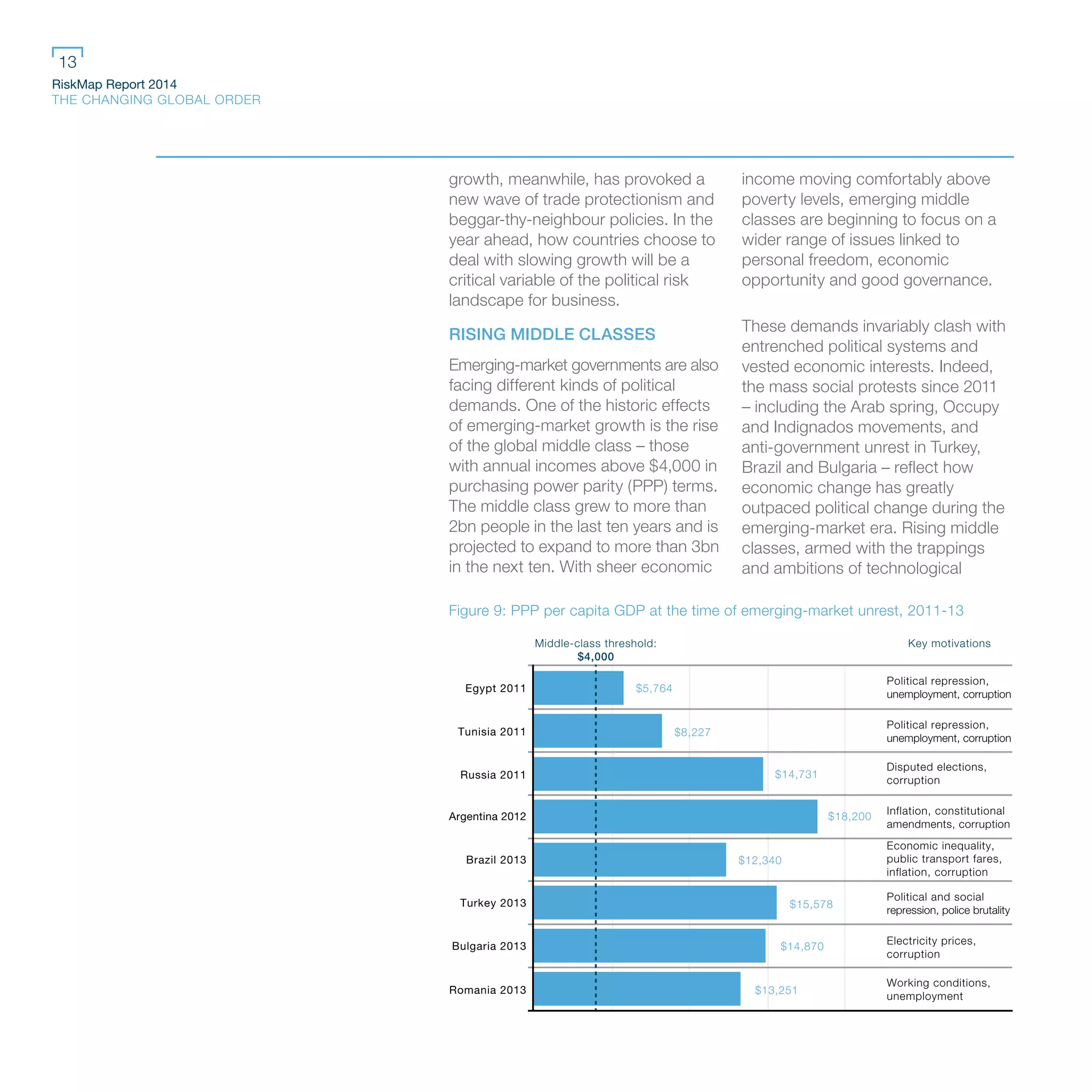
Figure 9: PPP per capita GDP at the time of emerging-market unrest, 2011-13
Bulgaria 2013
Romania 2013
Turkey 2013
Brazil 2013
Argentina 2012
Russia 2011
Tunisia 2011
Egypt 2011 $5,764
$8,227
$14,731
$12,340
$15,578
$14,870
$13,251
$18,200
Political repression,
unemployment, corruption
Political repression,
unemployment, corruption
Disputed elections,
corruption
Inflation, constitutional
amendments, corruption
Economic inequality,
public transport fares,
inflation, corruption
Political and social
repression, police brutality
Electricity prices,
corruption
Working conditions,
unemployment
Middle-class threshold:
$4,000
Key motivations
RiskMap Report 2014
THE CHANGING GLOBAL ORDER
14
modernity, remain saddled with
antiquated, opaque, inefficient and
frequently corrupt governments and
bureaucracies (Figure 9). Rather than
simply plaudits from international
financial institutions, they expect rapid
growth to generate new and better
opportunities for them, their families
and their communities. The gulf
between economic and political change
is also replicated in the volatile distance
between aspirational middle classes
demonstrating in city centres and
regimes rooted in conservative rural
constituencies. And it is not just
government that is targeted: business
is also under middle-class scrutiny, on
environmental, indigenous rights,
workplace safety and economic
justice grounds.
The risks embedded in the rising
global middle class are primarily
political: people with tangible assets
to lose are unlikely to promote violent
insurrection, given the potential for
collateral damage. Such social protest
movements also rarely topple
governments, but often provoke
short-term accommodation, from
rolling back economic liberalisation to
beefing up public spending. Over the
longer term, of course, rising middle
classes have often been agents of
broader – even systemic – political
change. Urbanisation itself often
provides the anvil on which multilingual,
multi-ethnic societies are ultimately
forged, removing levers of division
that elites have manipulated to hold
on to power. What’s more, small
entrepreneurs flourish and gain
political influence in more densely
populated settings as populations
must manufacture solutions to the
logistical and infrastructure problems
that governments fail to deal with.
This implies that governments that do
not address urban middle-class
concerns are increasingly living on
borrowed time.
POWER VACUUMS
Where social unrest led to durable
conflict and political instability – namely
in Egypt and Syria – it exposed the
dysfunction of the current global
governance architecture. While
growing economic heft has made
leading emerging markets
indispensable to global governance,
formalised by the inauguration of the
Group of 20 (G20) leaders’ summit
during the financial crisis, it has not
yet compensated for the relative
decline of the US and Europe, both of
which remain consumed with domestic
political and economic challenges. Put
another way, rising powers may be able
to veto the global agenda – on climate
change, intervention in Syria or trade
liberalisation, to name a few – but still
lack the domestic stability, diplomatic
maturity, hard power resources and
soft power attraction to offer and
enforce an alternate agenda. Stable
platforms for strategic co-operation
are currently few and far between.
This has left global governance –
especially global security
management – at the mercy of
bilateral negotiation and ad hoc
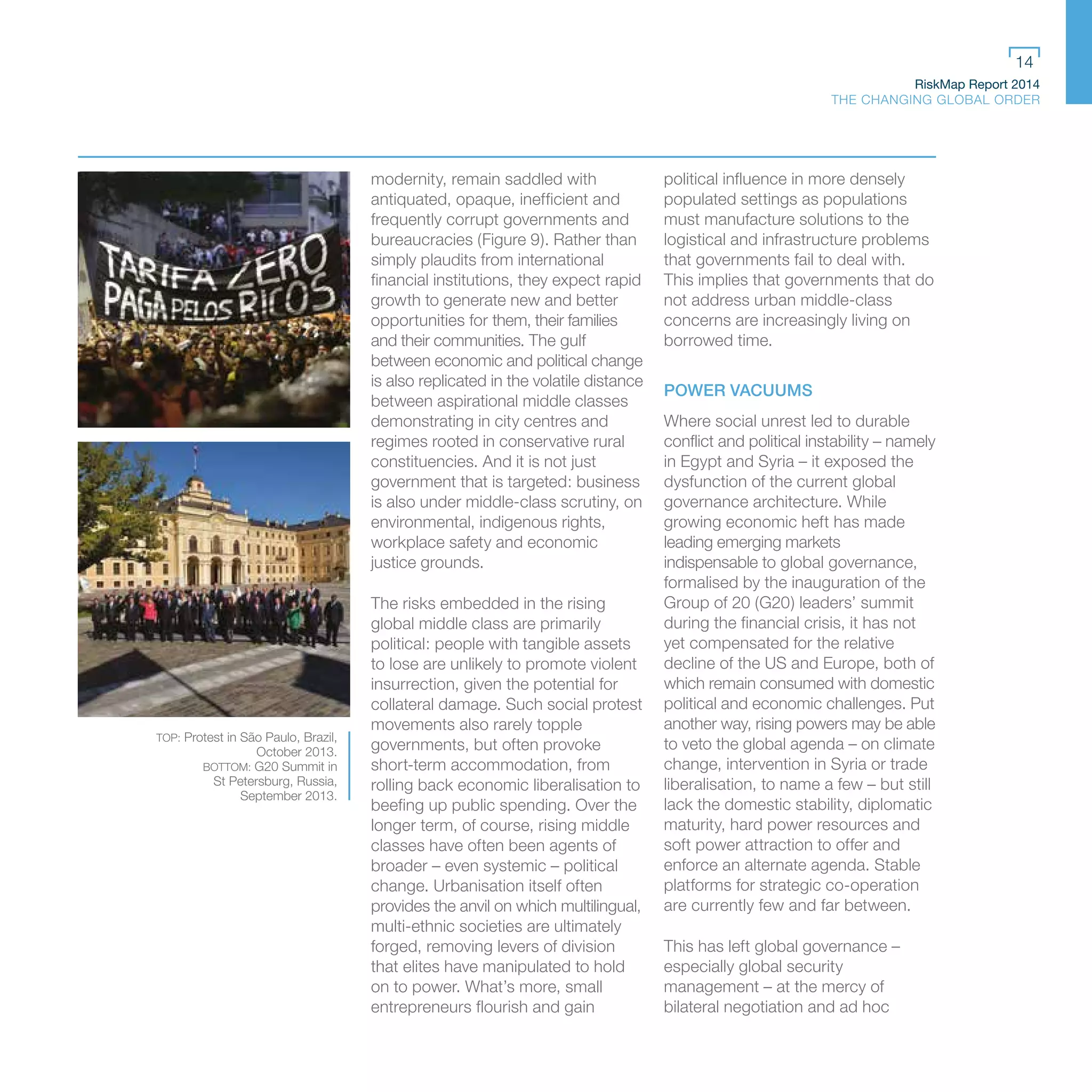
TOP: Protest in São Paulo, Brazil,
October 2013.
BOTTOM: G20 Summit in
St Petersburg, Russia,
September 2013.
RiskMap Report 2014
THE CHANGING GLOBAL ORDER
15
interventions, while making it more
prone to disruptive tensions and
strategic blunders. The unexpected
deal over Syria’s chemical weapons
programme – in the absence of any
coherent strategy for managing the
conflict’s spillover impacts – and
sporadic flare-ups along the Line of
Control in recent years in disputed
Kashmir are cases in point.
Meanwhile, the US expects Europe
(grappling with the strategic fallout of
the Arab spring) and the Gulf Arab
states (vying with Iran for regional
clout) to assume the mantle, and
costs, of their own security. We
expect these conditions to develop
further in 2014 as the departure of
most NATO military forces from
Afghanistan more or less completes
the strategic withdrawal of the
administration of US President
Barack Obama from the Muslim
world. Much hinges on the ability of
the US and China to see past a
legacy of distrust and co-operate
pragmatically on shared interests,
such as nuclear non-proliferation and
the containment of militancy in the
Middle East and Central Asia.
A global power vacuum poses both
security and political risks to business.
The security risks are perhaps more
obvious, given that the diminishing
war on terrorism – which requires
collaboration and information sharing
to function – will remit fewer resources
and less training to countries already
struggling to contain militancy.
Pakistan, in particular, is about to get
rather less strategic for the US in the
absence of the need to sustain a large
footprint in Afghanistan, while persistent
capacity deficits in East Africa and the
Sahel region continue to create
permissive operating environments for
militants. A primary concern is that
militant groups – whether linked to
jihadist ideology, organised crime, or
both – will avail themselves of any
breathing room to regroup, recruit
and potentially reorient.
Political risks, meanwhile, will continue
to manifest primarily in trade and
investment. The vaunted US ‘pivot’ to
Asia, for example, incorporates a trade
agreement – the Trans-Pacific
Partnership, slated for completion in
2014 – that pointedly excludes China,
the world’s second-largest trading
nation. This may, in the short term,
increase the threat of politicised
tit-for-tat trade disruptions in certain
sectors, and in some quarters is
perceived as an assault on the global
trading system itself. However, if it
spurs a new wave of trade liberalisation
outside the WTO’s moribund Doha
round – tackling the thorniest non-tariff
barriers, such as import quotas and
export subsidies – opportunities for
business could flourish, even without a
truly global deal.
SHIFTING INTERESTS
Geopolitical uncertainty owes, in part,
to rapid but fundamental shifts in
strategic interests. Shale fracking has
already dramatically reduced oil
imports to the US from West Africa,
and will gradually change US incentives
RiskMap Report 2014
THE CHANGING GLOBAL ORDER
16
in the Middle East over the next decade.
Simultaneously, China’s ravenous
energy and mineral consumption
over the last ten years has bestowed
strong strategic imperatives in
sub-Saharan Africa, as have the
burgeoning food needs of water-scarce
but cash-rich Gulf emirates. Moreover,
further strategic change is queued up
for 2014 and beyond, as cargo volumes
increase along newly ice-free Arctic
shipping routes and liquefied natural
gas (LNG) export projects come online
in Australia and – eventually – the US
and East Africa.
Many of these shifts have only
materialised over the last five years,
and countries are still trying to identify
and determine how to manage their
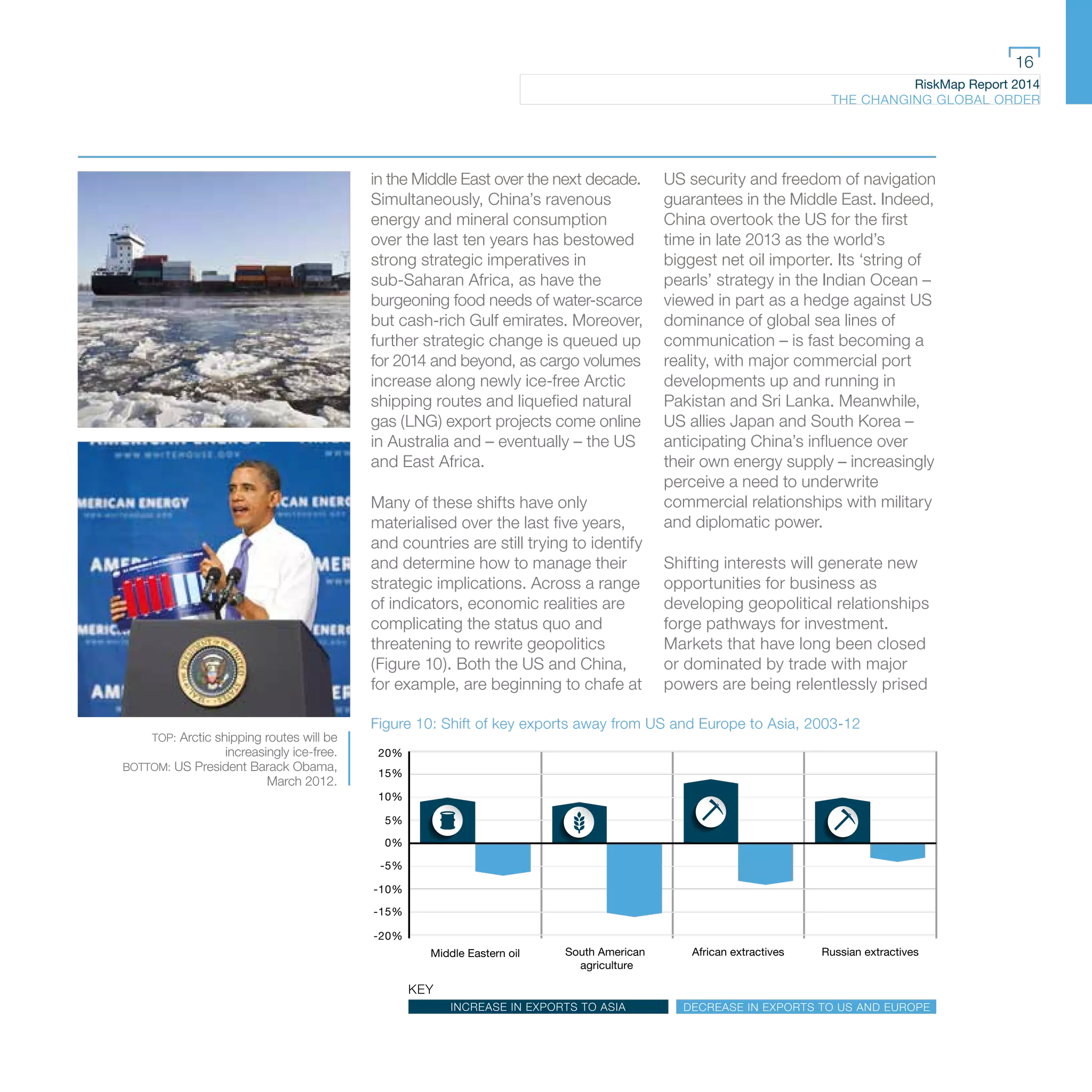
strategic implications. Across a range
of indicators, economic realities are
complicating the status quo and
threatening to rewrite geopolitics
(Figure 10). Both the US and China,
for example, are beginning to chafe at
US security and freedom of navigation
guarantees in the Middle East. Indeed,
China overtook the US for the first
time in late 2013 as the world’s
biggest net oil importer. Its ‘string of
pearls’ strategy in the Indian Ocean –
viewed in part as a hedge against US
dominance of global sea lines of
communication – is fast becoming a
reality, with major commercial port
developments up and running in
Pakistan and Sri Lanka. Meanwhile,
US allies Japan and South Korea –
anticipating China’s influence over
their own energy supply – increasingly
perceive a need to underwrite
commercial relationships with military
and diplomatic power.
Shifting interests will generate new
opportunities for business as
developing geopolitical relationships
forge pathways for investment.
Markets that have long been closed
or dominated by trade with major
powers are being relentlessly prised
Figure 10: Shift of key exports away from US and Europe to Asia, 2003-12
20%
15%
10%
5%
0%
-5%
-10%
-15%
-20%
Middle Eastern oil South American
agriculture
African extractives Russian extractives
KEY
DECREASE IN EXPORTS TO US AND EUROPEINCREASE IN EXPORTS TO ASIA
TOP: Arctic shipping routes will be
increasingly ice-free.
BOTTOM: US President Barack Obama,
March 2012.
RiskMap Report 2014
THE CHANGING GLOBAL ORDER
17
open by geopolitical competition
– as true for some advanced
countries such as Canada as for
emerging markets such as Ukraine
and Nigeria. But they will also be
attended by collateral political risks,
given the institutional and regulatory
immaturity of many frontier
investment destinations and the
plausible assumption that
diplomatic attention should bring
commercial benefits. Company
nationality has always been a factor,
but is likely to play an increasing role
in political risk.
A similar condition can be applied to
security risks, in cases where local
communities reject an influx of foreign
capital, foreign workers or both. The
security profile of established firms can
also change in line with geopolitical
realities, as US and European
companies have experienced in North
Africa since the Arab spring.
LOOKING AHEAD
Over the last ten years the global
economy has shifted up the political
and security risk scales, changing the
types of threats companies are likely
to face today and in the future. A
decade of rapid growth in the
emerging world has fundamentally
altered social arrangements and is
beginning to put pressure on political
systems, particularly in terms of how
governments justify their authority. In
certain regions, such as the Middle
East and North Africa, this has
provoked change that the current
global power balance is ill-equipped to
manage, introducing security threats
that will cast a shadow over the
coming year. These developments are
coinciding with fundamental and long-
term shifts in strategic incentives,
often linked to resources, that are
likely to rewrite the global distribution
of power as much as economic
change has revised the global balance
of power. These factors put upward
pressure on both global political and
security risks in 2014.
But this comes at a time when
opportunities for business are diverse
and improving in some fundamental
ways. Ten years ago, HIV/AIDS
threatened economic and social
coherence in much of the developing
world. Today, access to treatment
has expanded exponentially and
annual new infections have fallen by
25%. Over the same timeframe,
extreme poverty fell by more than
400m people, even as the global
population rose by nearly 1bn,
sending poverty rates to historic lows.
Meanwhile, over the next year more
people in developing countries will
access broadband on mobile devices
than there were global internet users
in 2003, and more children will have
access to education than ever before.
The hangover of the global financial
crisis is fading, even in the US and
Europe, Japan is at its most bullish in
20 years, and emerging markets in
general are much better equipped to
face economic challenges than
during the 1990s. In this light, risk
seems more attractive than ever.
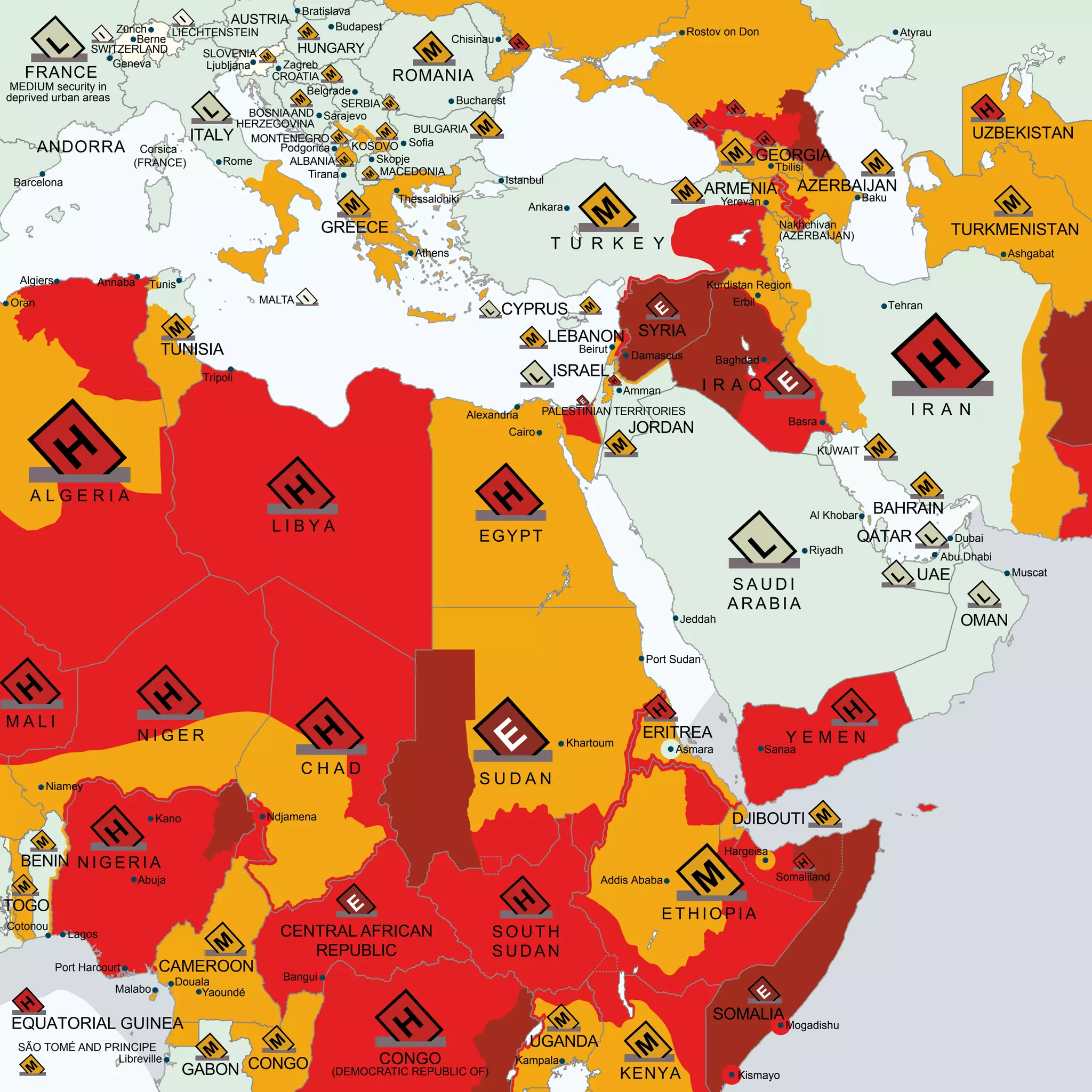
REGIONAL OVERVIEWS
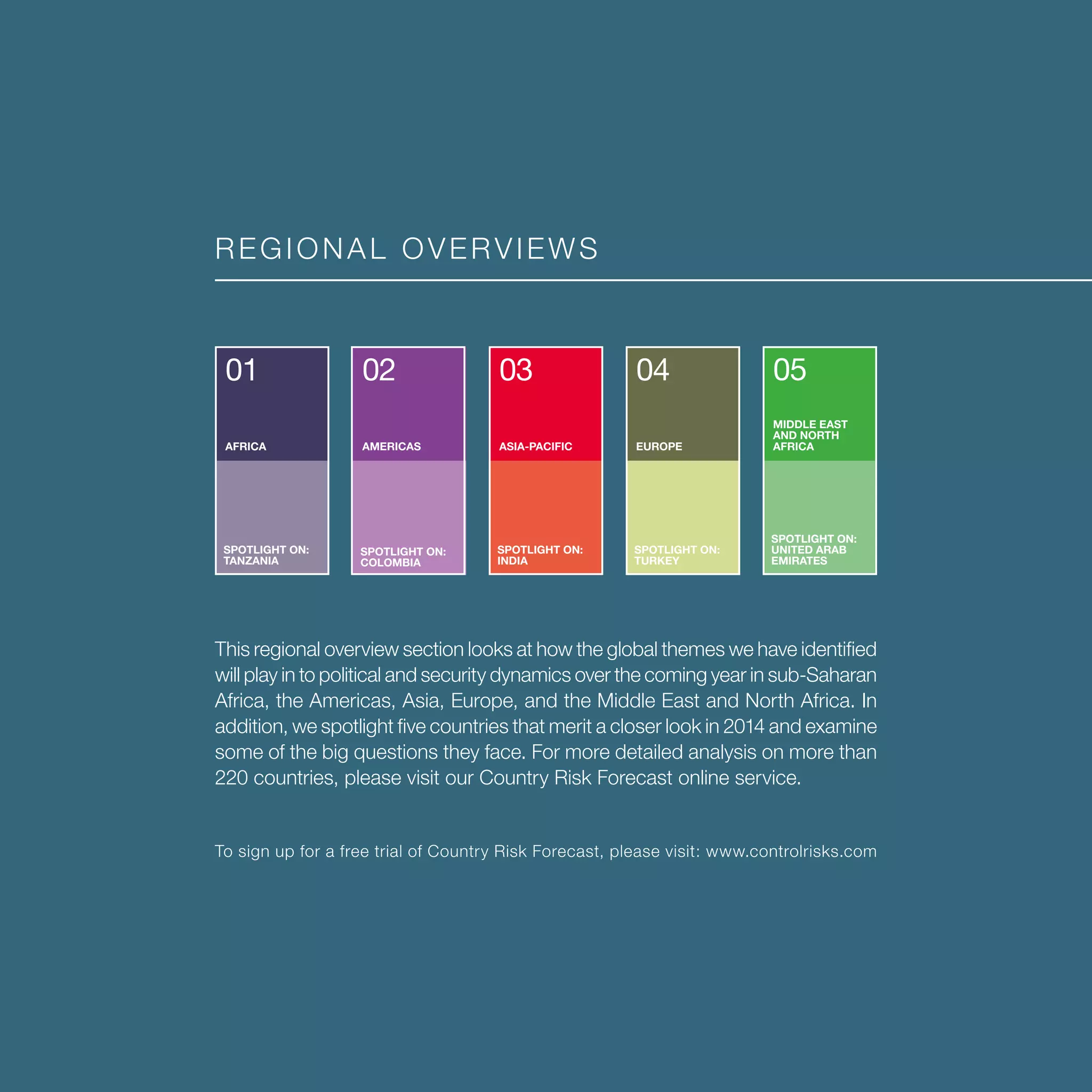
This regional overview section looks at how the global themes we have identified
will play in to political and security dynamics over the coming year in sub-Saharan
Africa, the Americas, Asia, Europe, and the Middle East and North Africa. In
addition, we spotlight five countries that merit a closer look in 2014 and examine
some of the big questions they face. For more detailed analysis on more than
220 countries, please visit our Country Risk Forecast online service.
To sign up for a free trial of Country Risk Forecast, please visit: www.controlrisks.com
01
AFRICA
SPOTLIGHT ON:
TANZANIA
02
AMERICAS
SPOTLIGHT ON:
COLOMBIA
03
ASIA-PACIFIC
SPOTLIGHT ON:
INDIA
04
EUROPE
SPOTLIGHT ON:
TURKEY
MIDDLE EAST
AND NORTH
AFRICA
SPOTLIGHT ON:
UNITED ARAB
EMIRATES
05
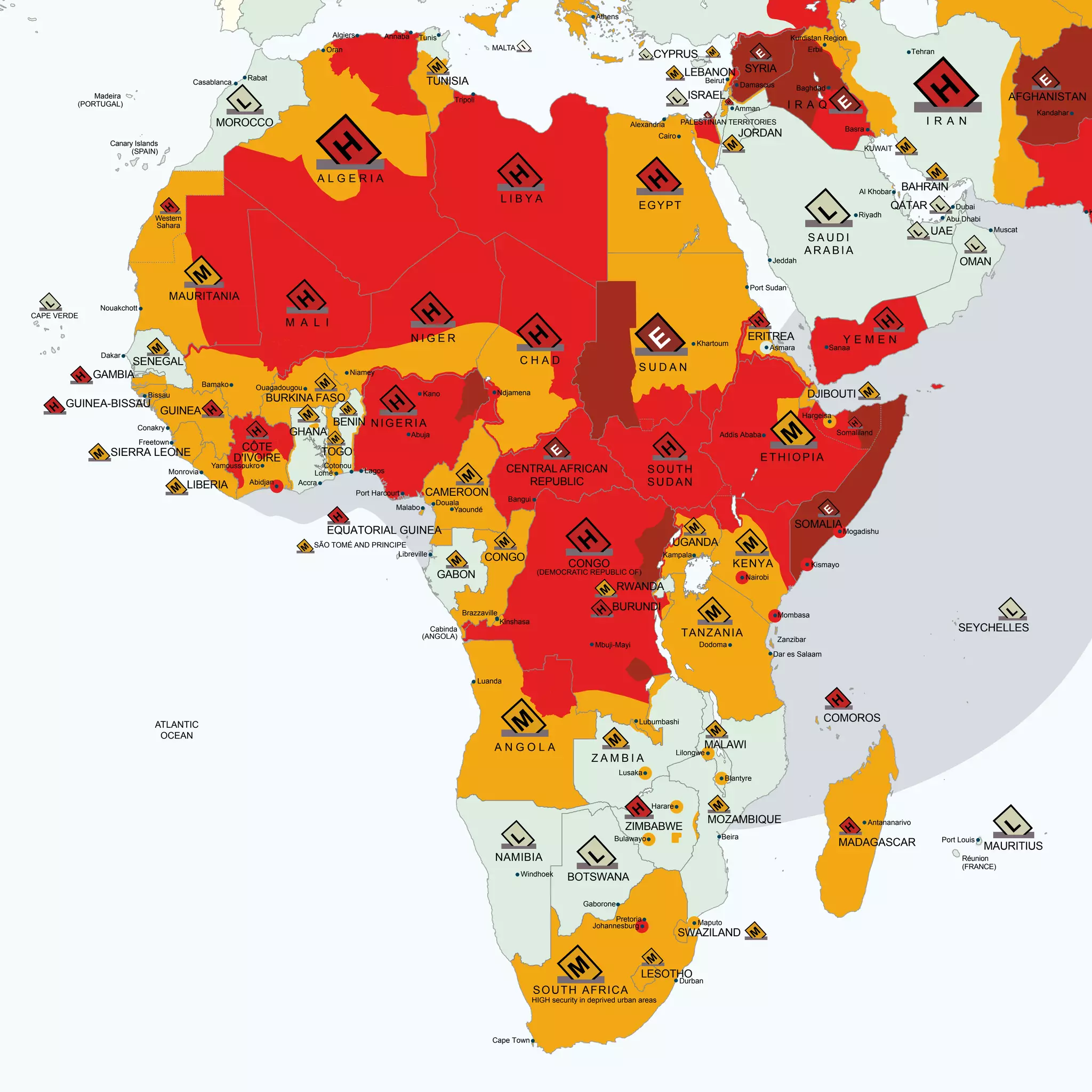
MALTA
CYPRUS
SYRIALEBANON
JORDAN
ISRAEL
PALESTINIAN TERRITORIES
EGYPT
L I B Y A
TUNISIA
A L G E R I A
MOROCCO
Western
Sahara
MAURITANIA
Canary Islands
(SPAIN)
Madeira
(PORTUGAL)
CAPE VERDE
SENEGAL
GAMBIA
GUINEA-BISSAU
GUINEA
SIERRA LEONE
LIBERIA
CÔTE
D'IVOIRE
GHANA
TOGO
BENIN
BURKINA FASO
M A L I
N I G E R
N I G E R I A
C H A D
S U D A N
SOU TH
SU D AN
CENTRAL AFRICAN
REPUBLIC
CAMEROON
EQUATORIAL GUINEA
SÃO TOMÉ AND PRINCIPE
GABON
CONGO
CONGO
(DEMOCRATIC REPUBLIC OF)
RWANDA
BURUNDI
UGANDA
TANZANIA
KENYA
A N G O L A
Z A M B I A
MALAWI
MOZAMBIQUE
ZIMBABWE
BOTSWANA
NAMIBIA
SOUTH AFRICA
HIGH security in deprived urban areas
LESOTHO
SWAZILAND
ERITREA
E T H I O P I A
DJIBOUTI
Somaliland
SOMALIA
Y E M E N
S A U D I
A R A B I A
OMAN
UAE
QATAR
BAHRAIN
KUWAIT
MADAGASCAR
COMOROS
SEYCHELLES
MAURITIUS
Réunion
(FRANCE)
I R A Q
I R A N
Zanzibar
Cabinda
(ANGOLA)
ATLANTIC
OCEAN
Athens
Kandahar
K
Tehran
Baghdad
Basra
Erbil
Amman
Cairo
Alexandria
Tripoli
TunisAlgiers Annaba
Oran
Rabat
Casablanca
Muscat
Abu Dhabi
Dubai
Al Khobar
Riyadh
Jeddah
Port Sudan
SanaaAsmara
Hargeisa
Khartoum
Addis Ababa
NdjamenaKano
Lagos
Port Harcourt
Niamey
OuagadougouBamako
Nouakchott
Dakar
Bissau
Conakry
Freetown
Monrovia
Yamoussoukro
Abidjan Accra
Cotonou
Lomé
Malabo
Douala
Yaoundé
Libreville
Bangui
Kampala
Nairobi
Mogadishu
Kismayo
Mombasa
Dar es Salaam
Dodoma
Lilongwe
Blantyre
Mbuji-Mayi
Lubumbashi
Lusaka
Luanda
Kinshasa
Brazzaville
Windhoek
Harare
Bulawayo Beira
Gaborone
Pretoria
Johannesburg Maputo
Durban
Cape Town
Antananarivo
Port Louis
Damascus
Beirut
Abuja
Kurdistan Region
AFGHANISTAN
RiskMap Report 2014
AFRICA
20
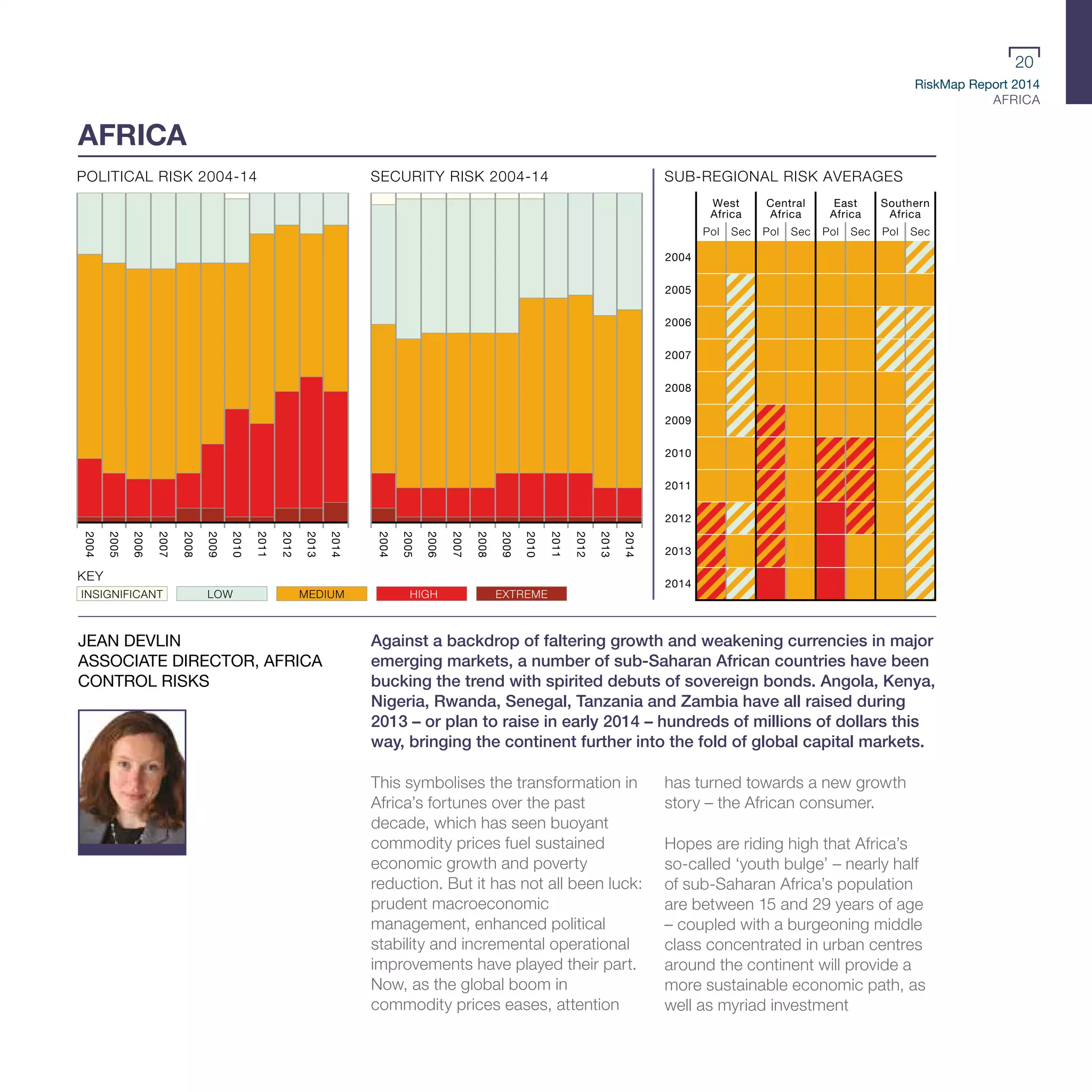
POLITICAL RISK 2004-14
2004
2005
2006
2007
2008
2009
2010
2011
2012
2013
2014
KEY
INSIGNIFICANT LOW MEDIUM HIGH EXTREME
SECURITY RISK 2004-14
2004
2005
2006
2007
2008
2009
2010
2011
2012
2013
2014
AFRICA
Against a backdrop of faltering growth and weakening currencies in major
emerging markets, a number of sub-Saharan African countries have been
bucking the trend with spirited debuts of sovereign bonds. Angola, Kenya,
Nigeria, Rwanda, Senegal, Tanzania and Zambia have all raised during
2013 – or plan to raise in early 2014 – hundreds of millions of dollars this
way, bringing the continent further into the fold of global capital markets.
This symbolises the transformation in
Africa’s fortunes over the past
decade, which has seen buoyant
commodity prices fuel sustained
economic growth and poverty
reduction. But it has not all been luck:
prudent macroeconomic
management, enhanced political
stability and incremental operational
improvements have played their part.
Now, as the global boom in
commodity prices eases, attention
has turned towards a new growth
story – the African consumer.
Hopes are riding high that Africa’s
so-called ‘youth bulge’ – nearly half
of sub-Saharan Africa’s population
are between 15 and 29 years of age
– coupled with a burgeoning middle
class concentrated in urban centres
around the continent will provide a
more sustainable economic path, as
well as myriad investment
JEAN DEVLIN
ASSOCIATE DIRECTOR, AFRICA
CONTROL RISKS
SUB-REGIONAL RISK AVERAGES
Southern
Africa
Central
Africa
West
Africa
Pol Sec Pol Sec Pol Sec Pol Sec
East
Africa
2004
2005
2006
2007
2008
2009
2010
2011
2012
2013
2014
K
RiskMap Report 2014
AFRICA
21
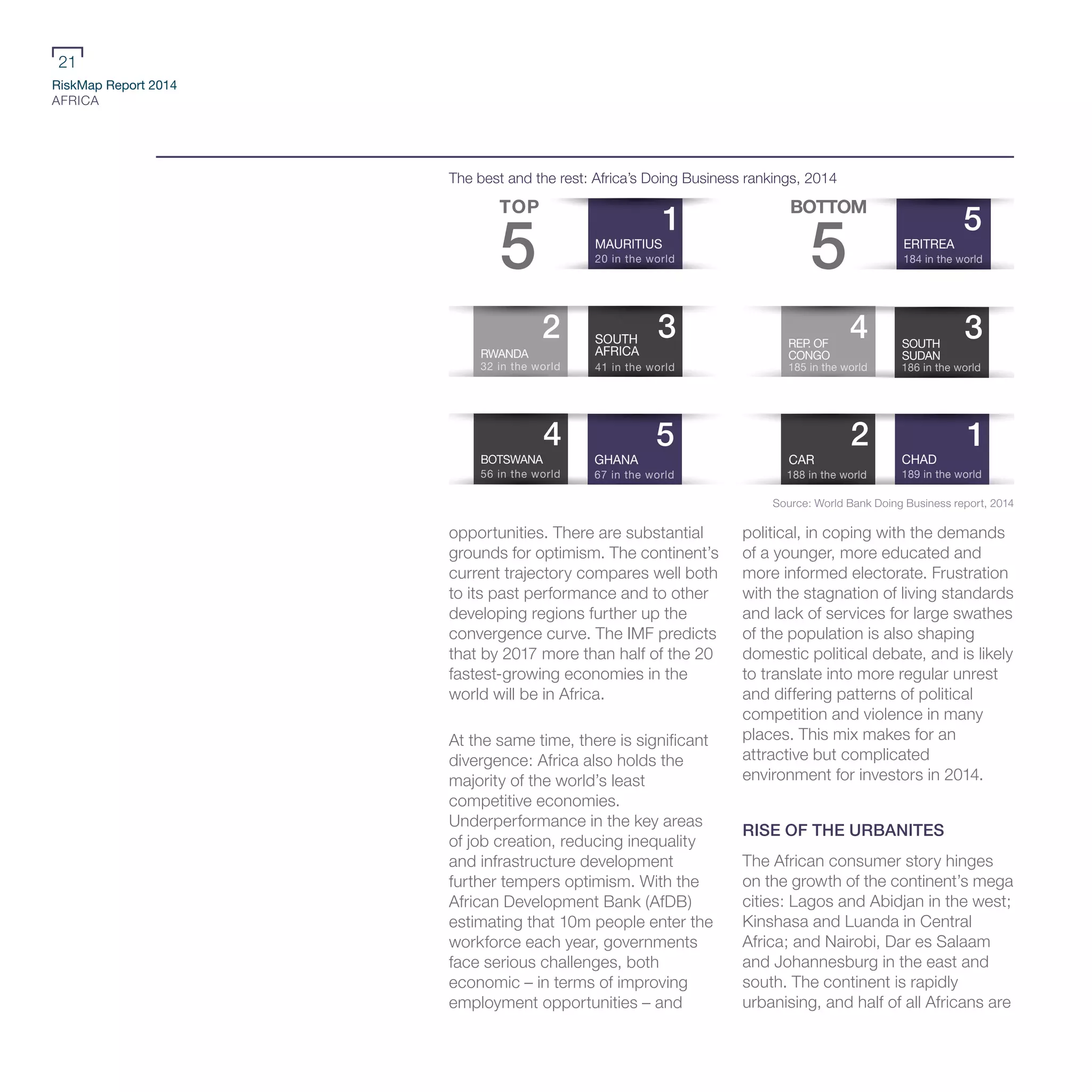
opportunities. There are substantial
grounds for optimism. The continent’s
current trajectory compares well both
to its past performance and to other
developing regions further up the
convergence curve. The IMF predicts
that by 2017 more than half of the 20
fastest-growing economies in the
world will be in Africa.
At the same time, there is significant
divergence: Africa also holds the
majority of the world’s least
competitive economies.
Underperformance in the key areas
of job creation, reducing inequality
and infrastructure development
further tempers optimism. With the
African Development Bank (AfDB)
estimating that 10m people enter the
workforce each year, governments
face serious challenges, both
economic – in terms of improving
employment opportunities – and
political, in coping with the demands
of a younger, more educated and
more informed electorate. Frustration
with the stagnation of living standards
and lack of services for large swathes
of the population is also shaping
domestic political debate, and is likely
to translate into more regular unrest
and differing patterns of political
competition and violence in many
places. This mix makes for an
attractive but complicated
environment for investors in 2014.
RISE OF THE URBANITES
The African consumer story hinges
on the growth of the continent’s mega
cities: Lagos and Abidjan in the west;
Kinshasa and Luanda in Central
Africa; and Nairobi, Dar es Salaam
and Johannesburg in the east and
south. The continent is rapidly
urbanising, and half of all Africans are
Source: World Bank Doing Business report, 2014
TOP
5
BOTTOM
5
5
3
RWANDA
52 in the world
67 in the world
GHANA
2 1
1
MAURITIUS
20 in the world
2 3
RWANDA
32 in the world
4
BOTSWANA
56 in the world
5
ERITREA
184 in the world
4
185 in the world
REP. OF
CONGO
3SOUTH
SUDAN
186 in the world
2
41 in the world
SOUTH
AFRICA
188 in the world
CAR CHAD
189 in the world
The best and the rest: Africa’s Doing Business rankings, 2014
RiskMap Report 2014
AFRICA
22
TOP: Lagos, Nigeria.
BOTTOM: Nairobi, Kenya.
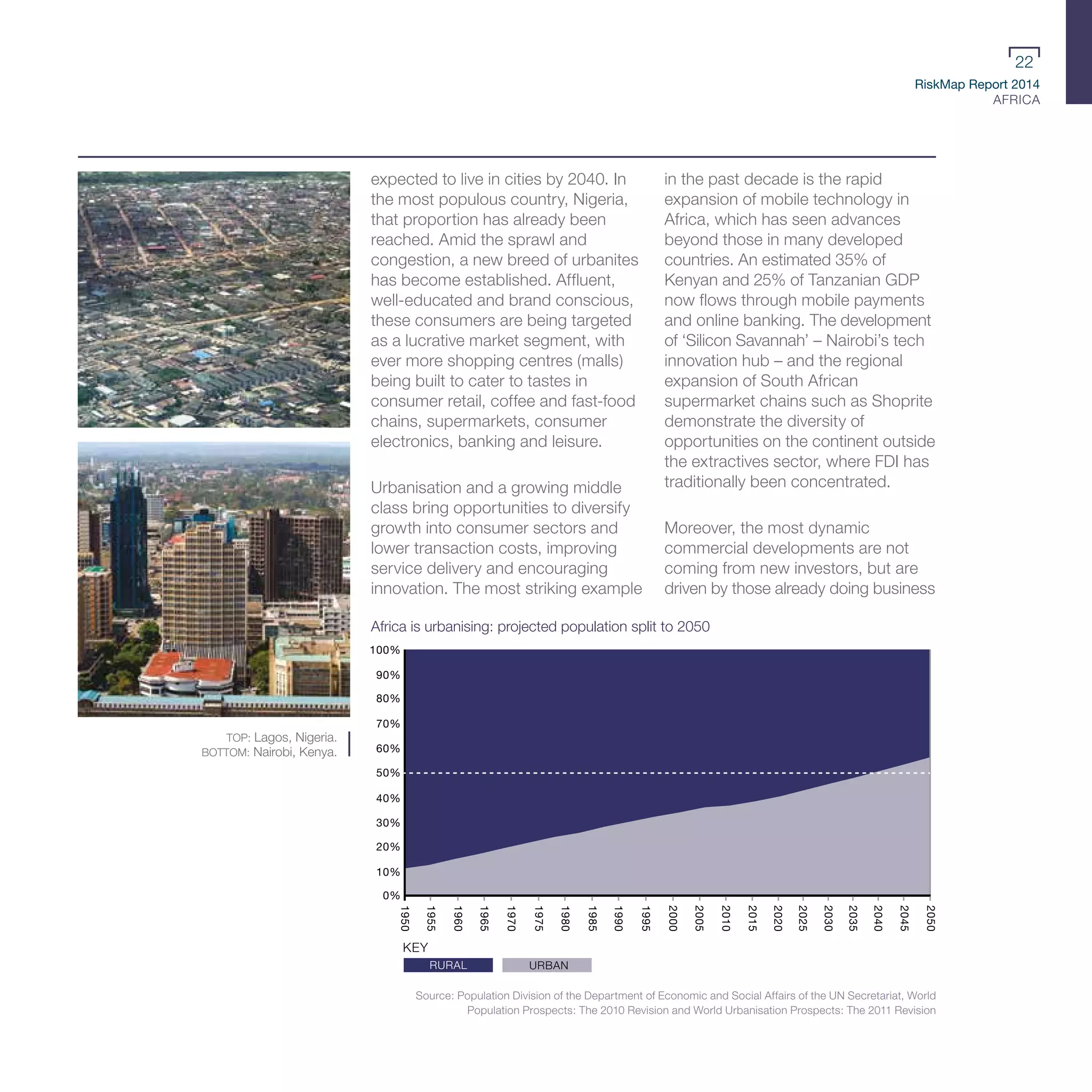
expected to live in cities by 2040. In
the most populous country, Nigeria,
that proportion has already been
reached. Amid the sprawl and
congestion, a new breed of urbanites
has become established. Affluent,
well-educated and brand conscious,
these consumers are being targeted
as a lucrative market segment, with
ever more shopping centres (malls)
being built to cater to tastes in
consumer retail, coffee and fast-food
chains, supermarkets, consumer
electronics, banking and leisure.
Urbanisation and a growing middle
class bring opportunities to diversify
growth into consumer sectors and
lower transaction costs, improving
service delivery and encouraging
innovation. The most striking example
in the past decade is the rapid
expansion of mobile technology in
Africa, which has seen advances
beyond those in many developed
countries. An estimated 35% of
Kenyan and 25% of Tanzanian GDP
now flows through mobile payments
and online banking. The development
of ‘Silicon Savannah’ – Nairobi’s tech
innovation hub – and the regional
expansion of South African
supermarket chains such as Shoprite
demonstrate the diversity of
opportunities on the continent outside
the extractives sector, where FDI has
traditionally been concentrated.
Moreover, the most dynamic
commercial developments are not
coming from new investors, but are
driven by those already doing business
Source: Population Division of the Department of Economic and Social Affairs of the UN Secretariat, World
Population Prospects: The 2010 Revision and World Urbanisation Prospects: The 2011 Revision
Africa is urbanising: projected population split to 2050
1950
1955
1960
1965
1970
1975
1980
1985
1990
1995
2000
2005
2010
2015
2020
2025
2030
2035
2040
2045
2050
KEY
URBAN
60%
50%
40%
30%
100%
90%
80%
70%
20%
10%
0%
RURAL
RiskMap Report 2014
AFRICA
23
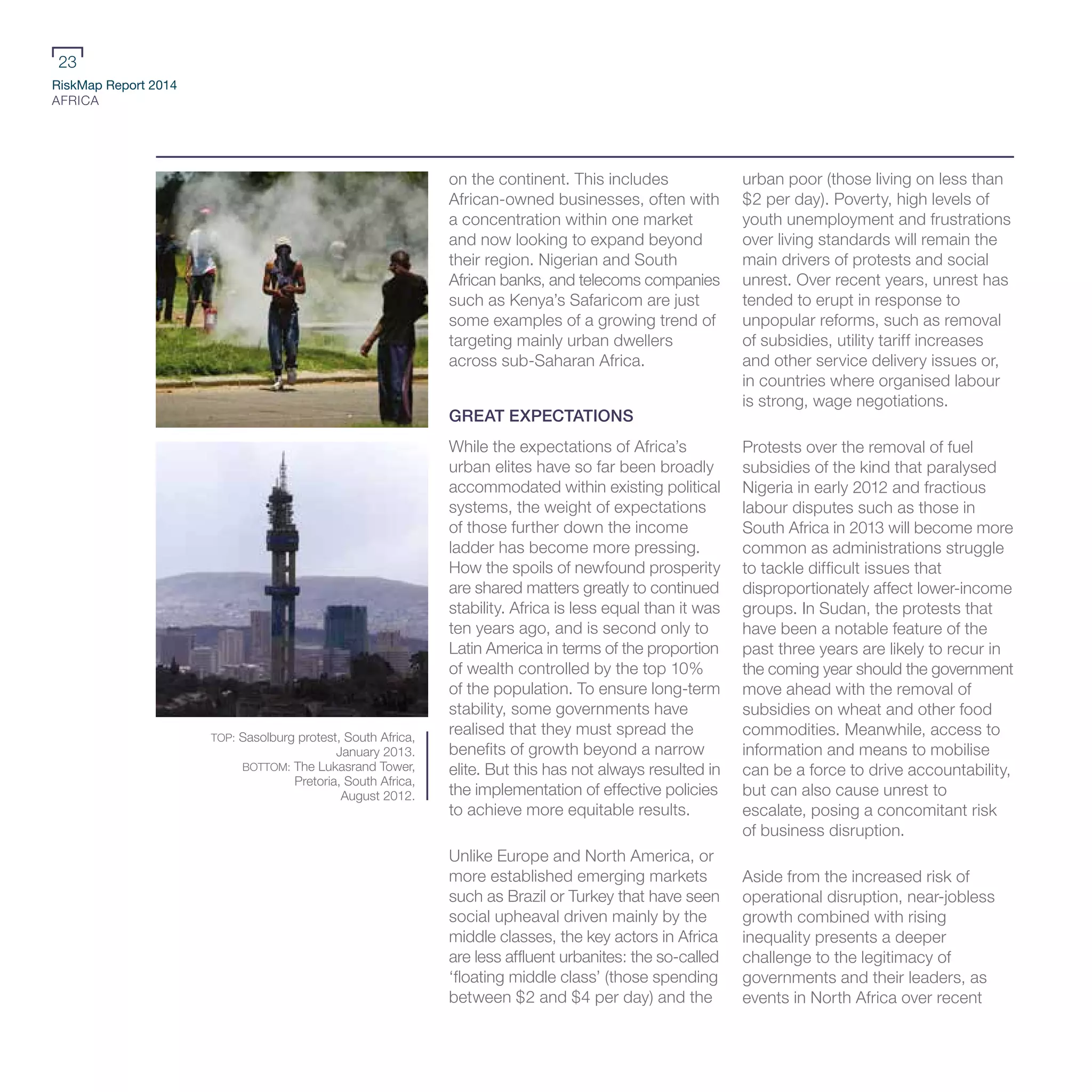
on the continent. This includes
African-owned businesses, often with
a concentration within one market
and now looking to expand beyond
their region. Nigerian and South
African banks, and telecoms companies
such as Kenya’s Safaricom are just
some examples of a growing trend of
targeting mainly urban dwellers
across sub-Saharan Africa.
GREAT EXPECTATIONS
While the expectations of Africa’s
urban elites have so far been broadly
accommodated within existing political
systems, the weight of expectations
of those further down the income
ladder has become more pressing.
How the spoils of newfound prosperity
are shared matters greatly to continued
stability. Africa is less equal than it was
ten years ago, and is second only to
Latin America in terms of the proportion
of wealth controlled by the top 10%
of the population. To ensure long-term
stability, some governments have
realised that they must spread the
benefits of growth beyond a narrow
elite. But this has not always resulted in
the implementation of effective policies
to achieve more equitable results.
Unlike Europe and North America, or
more established emerging markets
such as Brazil or Turkey that have seen
social upheaval driven mainly by the
middle classes, the key actors in Africa
are less affluent urbanites: the so-called
‘floating middle class’ (those spending
between $2 and $4 per day) and the
urban poor (those living on less than
$2 per day). Poverty, high levels of
youth unemployment and frustrations
over living standards will remain the
main drivers of protests and social
unrest. Over recent years, unrest has
tended to erupt in response to
unpopular reforms, such as removal
of subsidies, utility tariff increases
and other service delivery issues or,
in countries where organised labour
is strong, wage negotiations.
Protests over the removal of fuel
subsidies of the kind that paralysed
Nigeria in early 2012 and fractious
labour disputes such as those in
South Africa in 2013 will become more
common as administrations struggle
to tackle difficult issues that
disproportionately affect lower-income
groups. In Sudan, the protests that
have been a notable feature of the
past three years are likely to recur in
the coming year should the government
move ahead with the removal of
subsidies on wheat and other food
commodities. Meanwhile, access to
information and means to mobilise
can be a force to drive accountability,
but can also cause unrest to
escalate, posing a concomitant risk
of business disruption.
Aside from the increased risk of
operational disruption, near-jobless
growth combined with rising
inequality presents a deeper
challenge to the legitimacy of
governments and their leaders, as
events in North Africa over recent
TOP: Sasolburg protest, South Africa,
January 2013.
BOTTOM: The Lukasrand Tower,
Pretoria, South Africa,
August 2012.
RiskMap Report 2014
AFRICA
24
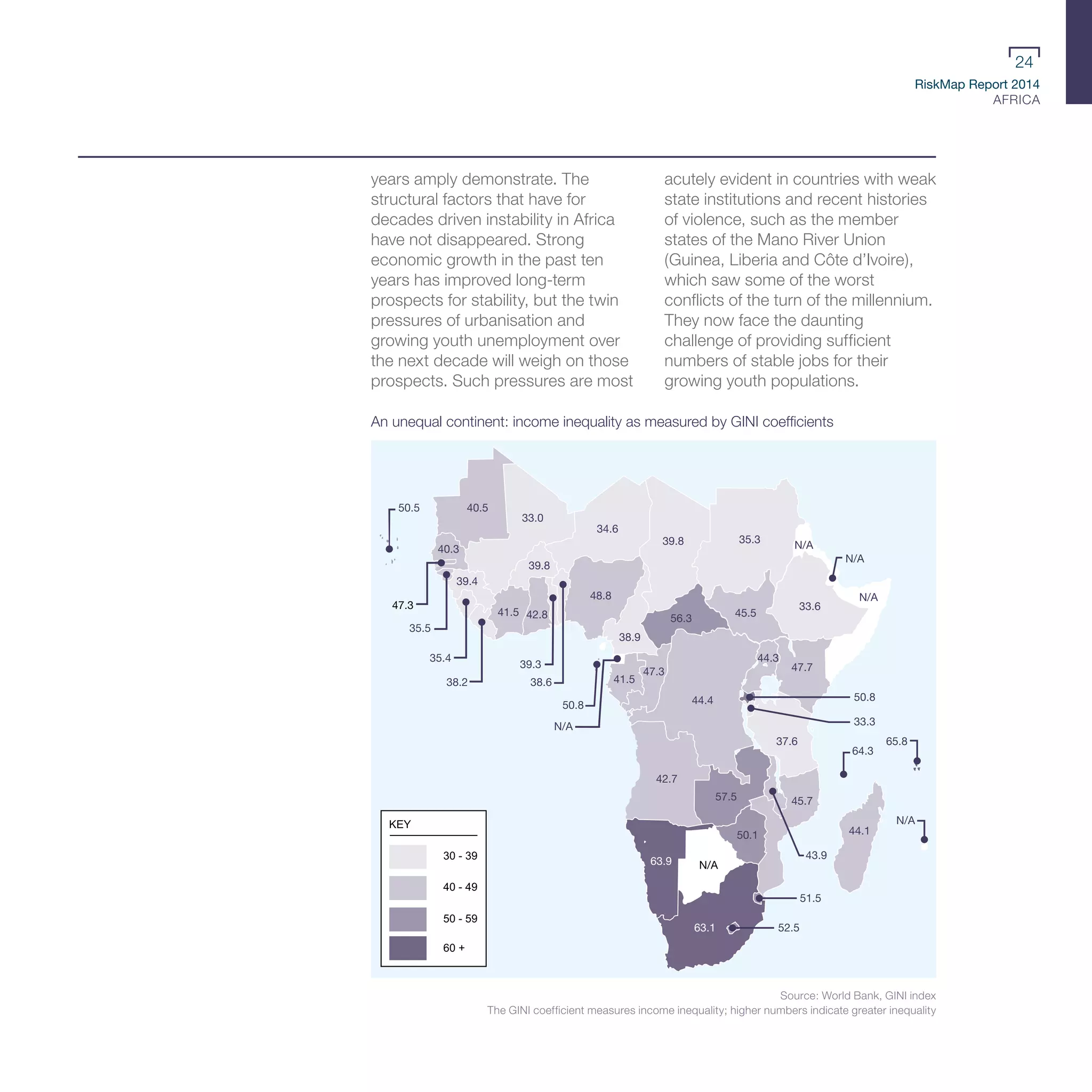
years amply demonstrate. The
structural factors that have for
decades driven instability in Africa
have not disappeared. Strong
economic growth in the past ten
years has improved long-term
prospects for stability, but the twin
pressures of urbanisation and
growing youth unemployment over
the next decade will weigh on those
prospects. Such pressures are most
acutely evident in countries with weak
state institutions and recent histories
of violence, such as the member
states of the Mano River Union
(Guinea, Liberia and Côte d’Ivoire),
which saw some of the worst
conflicts of the turn of the millennium.
They now face the daunting
challenge of providing sufficient
numbers of stable jobs for their
growing youth populations.
Source: World Bank, GINI index
The GINI coefficient measures income inequality; higher numbers indicate greater inequality
63.9
63.1
57.5
56.3
52.5
51.5
50.8
50.8
50.5
50.1
48.8
47.7
47.3
47.3
45.7
45.5
44.4
44.3
44.1
43.9
42.8
65.8
41.5
41.5
40.5
40.3
39.8
39.8
39.4
39.3
38.9
38.638.2
37.6
35.5
35.4
35.3
34.6
33.6
33.3
33.0
42.7
64.3
N/A
N/A
N/A
N/A
N/A
N/A
30 - 39
50 - 59
60 +
40 - 49
KEY
An unequal continent: income inequality as measured by GINI coefficients
RiskMap Report 2014
AFRICA
25
POWER TO THE PEOPLE
Many governments have put
development of infrastructure, and in
particular power, at the top of the
agenda, both to provide a boon to
business and to respond to popular
demands for improved standards of
living. Much of the financing raised
through bond issuances has been
earmarked for projects in these
areas. Even Nigeria, which has long
suffered from debilitating power
shortages stemming from its
notoriously inefficient power sector, in
2013 finalised its drawn-out
privatisation of the sector, paving the
way for long-term improvements.
Meanwhile, US President Barack
Obama in July 2013 made the
announcement of a $7bn ‘Power
Africa’ initiative to improve access to
electricity over the next five years in
East Africa the cornerstone of his trip
to the region.
However, operational barriers such as
dilapidated power transmission grids,
outdated regulatory frameworks and
vested interests clinging to the
dysfunctional status quo will mean
that improvements to the business
environment stemming from new
investment and reforms such as
those in the energy sector will remain
slow and patchy. One of the biggest
infrastructure projects on the
continent, the $80bn Grand Inga
dam in Congo (DRC), which would
supply more than 500m people with
renewable energy, is unlikely to be
operational before the 2030s,
hampered by financing constraints
and uncertainty about the government’s
commitment to the project.
Job creation is a second area of
focus, underlined by a growing
emphasis, at least at the policy level,
on economic diversification, fiscal
incentives for labour-intensive
industries and a reinvigorated agenda
on agricultural development.
However, as with infrastructure,
effects on living standards will only be
felt in the long term.
ACCOUNTABILITY FOR SOME…
Frustrations over difficult reforms and
stagnant living standards are feeding
into a wider campaign for
accountability in Africa. As in other
emerging markets such as India,
corruption has become a rallying
point for civil society to demand
greater accountability and
transparency from governments.
This has also been on the agenda of
international donors, which maintain
significant, if declining, influence in
Africa. Debt relief and budgetary
support over the past decade have
had ‘performance indicators’
attached, including greater
accountability of governments to their
citizens. Failure to meet these has
been backed up by the withdrawal of
assistance, such as the removal of
donor funding in Zambia in 2011
following high-level corruption
scandals, or blacklisting of the worst
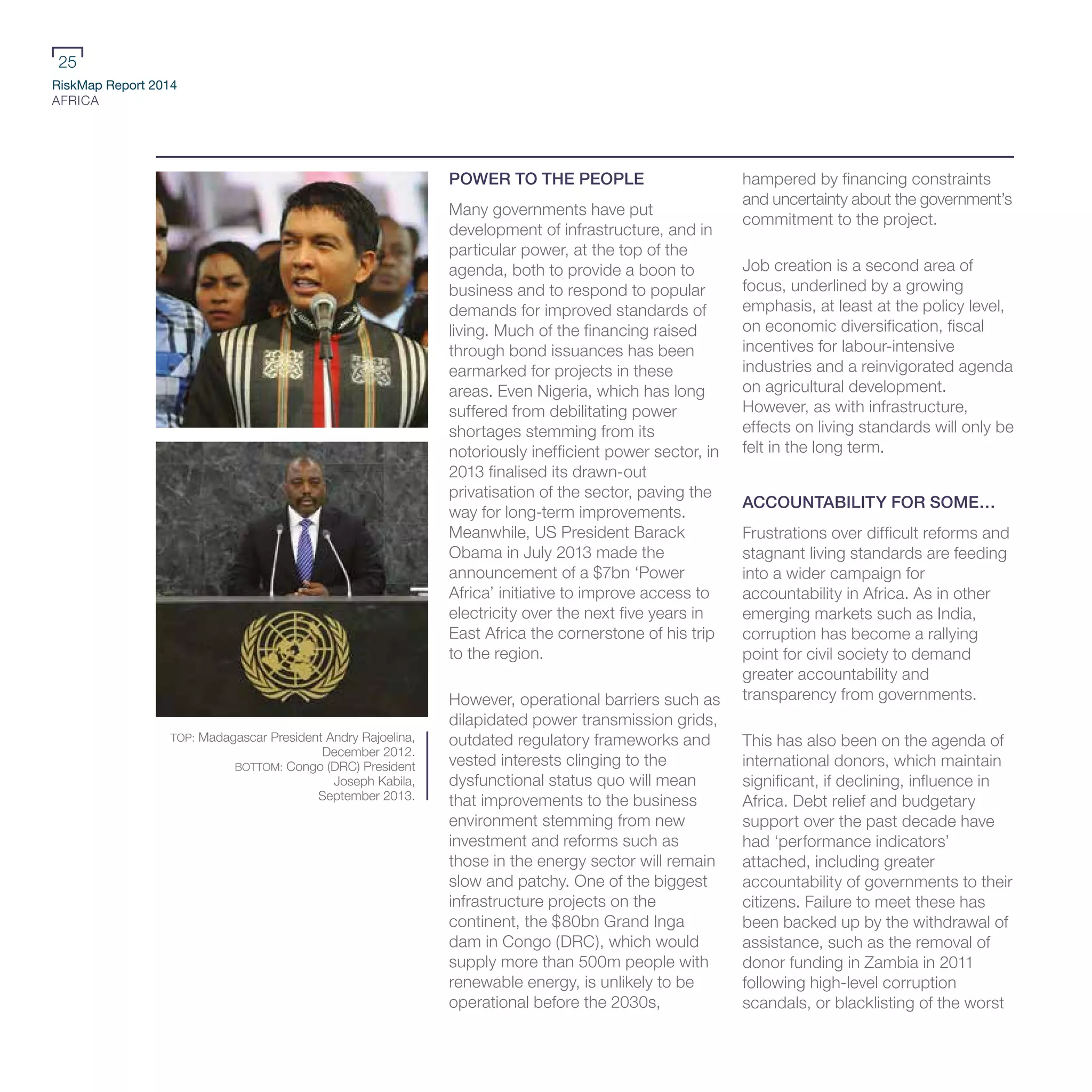
TOP: Madagascar President Andry Rajoelina,
December 2012.
BOTTOM: Congo (DRC) President
Joseph Kabila,
September 2013.
RiskMap Report 2014
AFRICA
26
offenders, such as Madagascar’s
Andry Rajoelina or Guinea-Bissau’s
Gen Antonio Indjai, the leader of an
April 2012 coup. In Congo (DRC),
although donors turned a blind eye to
the questionable circumstances
surrounding President Joseph
Kabila’s re-election in 2011, the IMF in
late 2012 suspended $240m in
planned loans over the government’s
failure to publish dubious mining
contracts. The financial impact of the
decision appears to have prompted
some improvements in transparency
in the country’s mining sector, as it
tries to win back compliant member
status of the Extractive Industries
Transparency Initiative (EITI).
Nonetheless, as leading donors –
largely in Europe and North America
– reorient towards a model of
‘economic diplomacy’ to defend
their commercial interests on the
continent against the inflow of
money and interest from rising
powers such as Brazil, China, India
and Turkey, their leverage to
influence African governments is
likely to decline. These new partners,
with different historical ties and
objectives informing their
engagement, take their own unique
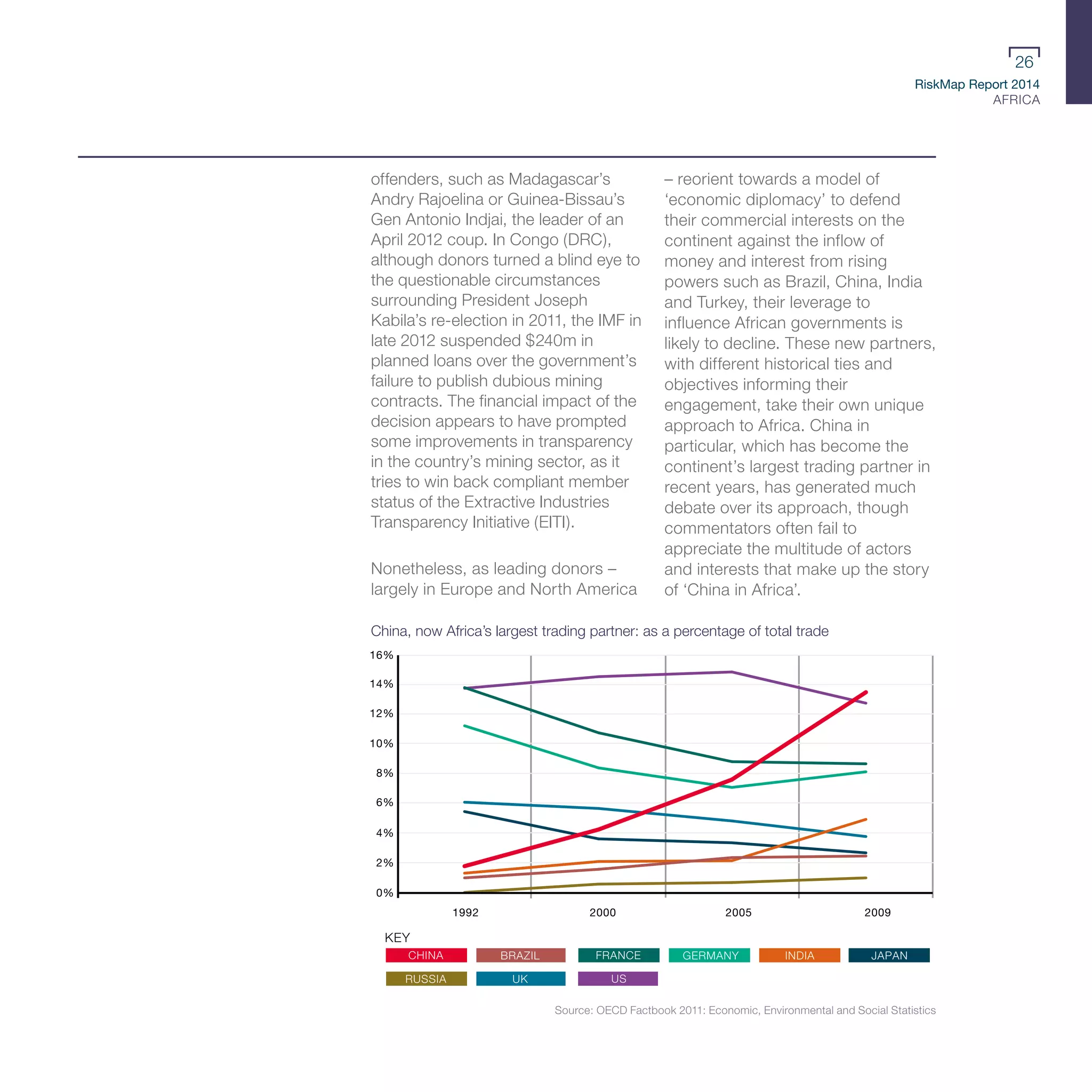
approach to Africa. China in
particular, which has become the
continent’s largest trading partner in
recent years, has generated much
debate over its approach, though
commentators often fail to
appreciate the multitude of actors
and interests that make up the story
of ‘China in Africa’.
Source: OECD Factbook 2011: Economic, Environmental and Social Statistics
China, now Africa’s largest trading partner: as a percentage of total trade
1992 2000 2005 2009
KEY
GERMANY
16%
14%
12%
10%
8%
6%
4%
2%
0%
CHINA
UKRUSSIA
BRAZIL
US
INDIAFRANCE JAPAN
RiskMap Report 2014
AFRICA
27
The main result of these shifts is that
civil society organisations and local
media will gain a more prominent role
as advocates for better governance.
Local civil society and vibrant local
media in many countries are
furthering the momentum of
international accountability
campaigns. Liberia’s President Ellen
Johnson-Sirleaf, long a darling of the
country’s international partners, has
faced mounting domestic criticism of
public appointments favouring family
connections, likely contributing to the
September 2013 resignation of her
son as head of the National Oil
Company of Liberia.
…BUT NOT FOR OTHERS
Nonetheless, progress in the area of
accountability will remain slow.
Countries with entrenched
leaderships, though not immune to
the momentum generated over the
past decade, will take longest to
change. A steadfast contingent of
ageing presidents continues to cling
to power, from the continent’s record
holder, Equatorial Guinea’s Teodoro
Obiang, to Angola’s José Eduardo
dos Santos, Robert Mugabe in
Zimbabwe, Paul Biya in Cameroon
and Uganda’s Yoweri Museveni.
While such gerontocrats will eventually
cede power to new generations, the
continued dominance of former
liberation movements in southern
Africa in particular is likely to remain
strong. These have a superficially
stabilising but ultimately corrosive
effect on governance in what is the
continent’s youngest region in terms
of independence. Angola remains
one of the continent’s most unequal
societies, with a poor reputation for
tackling corruption, though it provides
relatively high levels of predictability,
particularly for the offshore oil sector.
Similarly, in Mozambique the ruling
Frelimo party presents the country as
a stable and attractive investment
destination, though discontent continues
to bubble up regularly, driven by dashed
hopes of socio-economic development.
Weak bureaucracies and pervasive
corruption across African countries
will continue to blight the business
environment. Moreover, sudden or
fundamental shocks in systems lacking
accountability can prompt stability to
quickly dissolve, as seen in North Africa.
INCREASED CONTESTATION
Nonetheless, outright conflict has
become less of a headline risk for
business in Africa than at the turn of
the millennium. Outside Somalia and
Central Africa, sustained large-scale
armed opposition has largely
disappeared from the political
landscape. Politicians and parties
have become more likely to appeal
against unfavourable results or
mobilise protests than to launch an
armed campaign against the
government, particularly in countries
with large urban populations well
connected through social media.
Threats since mid-2013 by
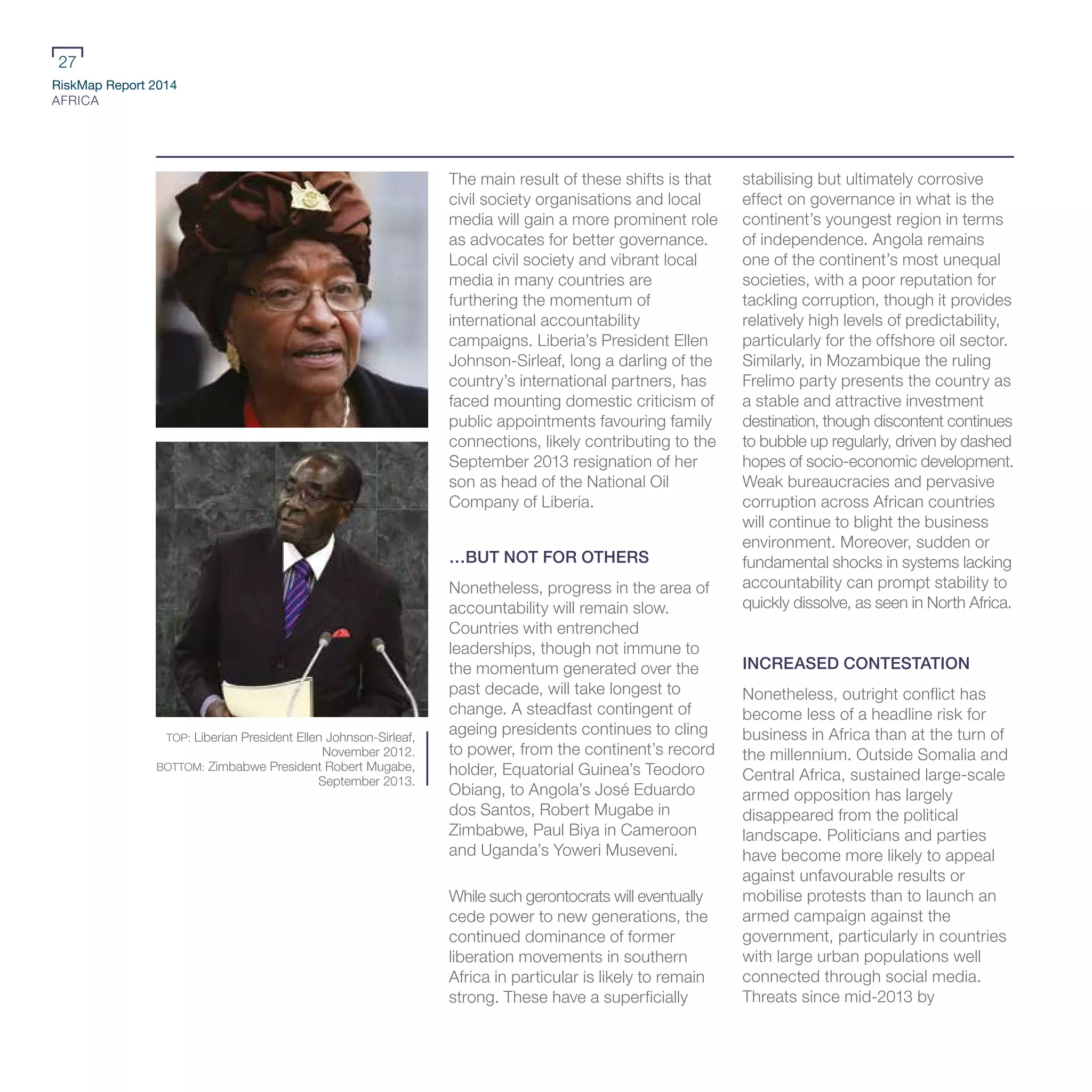
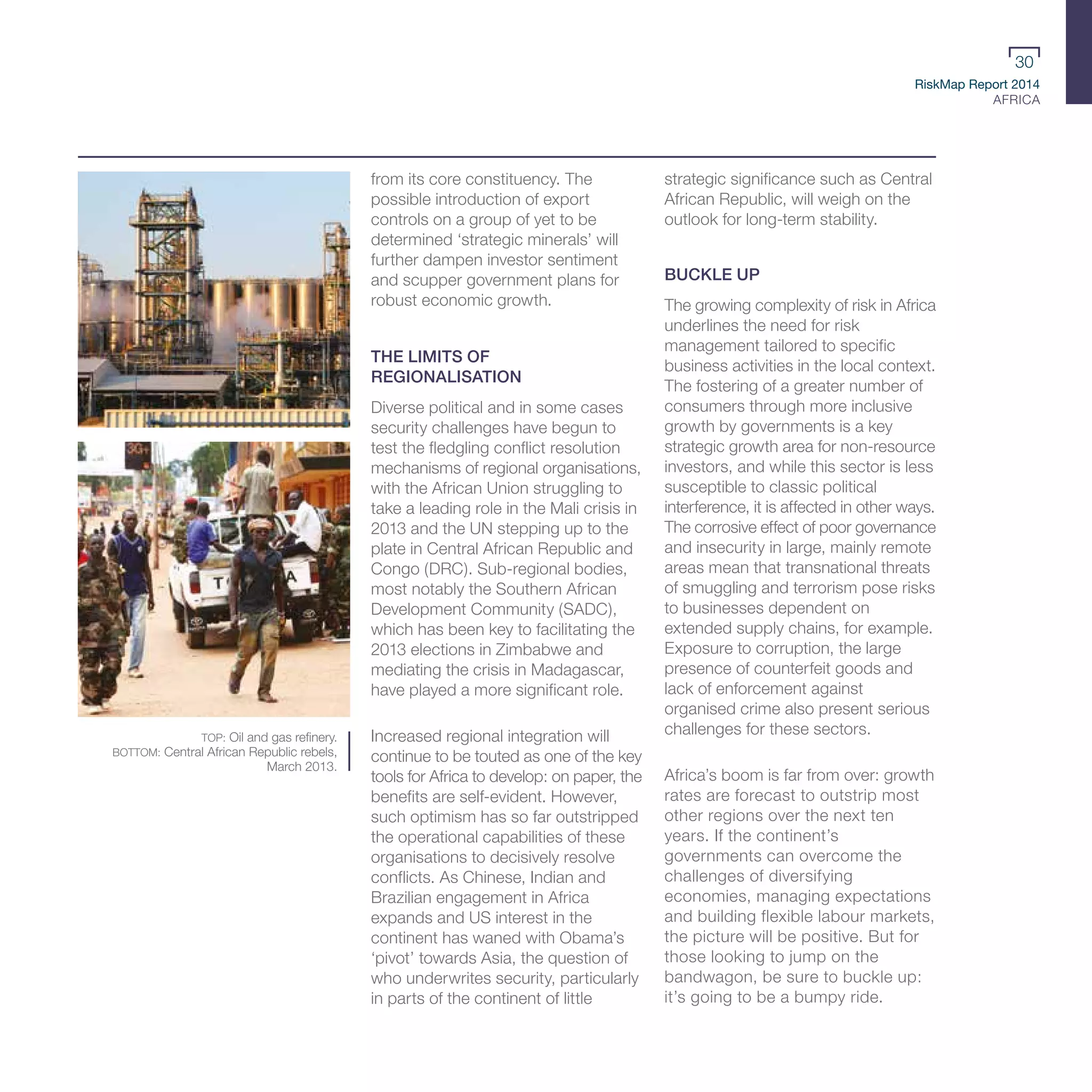
TOP: Liberian President Ellen Johnson-Sirleaf,
November 2012.
BOTTOM: Zimbabwe President Robert Mugabe,
September 2013.
RiskMap Report 2014
AFRICA
28
opposition party and former rebel
movement Renamo to trigger a
renewed civil war in Mozambique are
an exception, but serve primarily to
underline its desperation to remain
relevant in a post-conflict
environment dominated by Frelimo.
This is not to say that political
violence is fading as a risk to
business. Rather, it will present more
nuanced and manageable risks
across different geographies.
As competition at the ballot box has
increased, so too has the potential
for unrest, with upsurges in electoral
violence likely to become increasingly
common. 2013 saw violence around
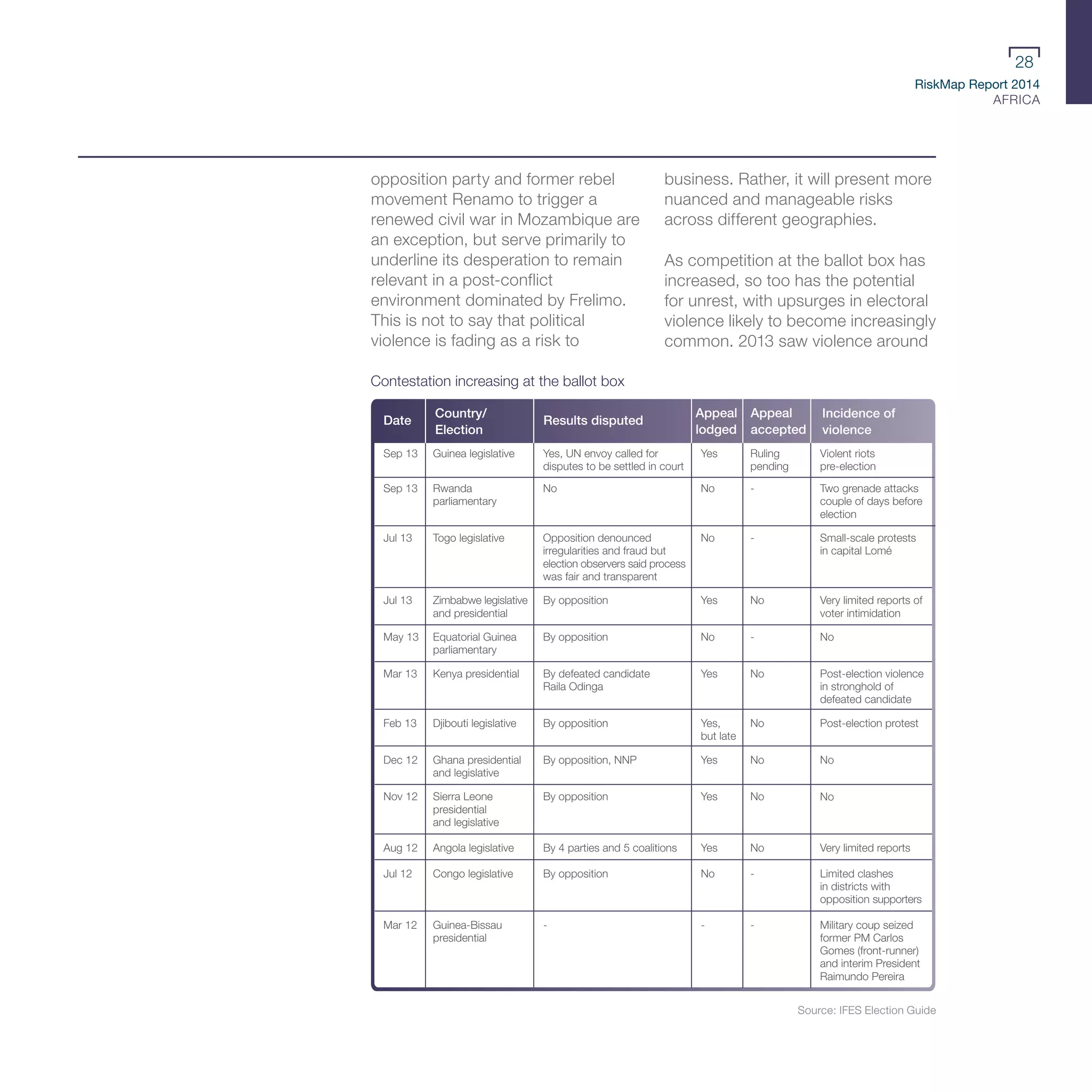
Contestation increasing at the ballot box
Sep 13 Guinea legislative Yes, UN envoy called for
disputes to be settled in court
Violent riots
pre-election
Feb 13 Djibouti legislative By opposition Yes,
but late
Post-election protestNo
Mar 12 Guinea-Bissau
presidential
Military coup seized
former PM Carlos
Gomes (front-runner)
and interim President
Raimundo Pereira
Jul 12 Congo legislative Limited clashes
in districts with
opposition supporters
Aug 12 Angola legislative By 4 parties and 5 coalitions Yes
No
Nov 12 Sierra Leone
presidential
and legislative
By opposition
By opposition
- - -
-
-
-
-
Yes
Dec 12 Ghana presidential
and legislative
By opposition, NNP Yes No
No
No
Mar 13 Kenya presidential By defeated candidate
Raila Odinga
Yes Post-election violence
in stronghold of
defeated candidate
No
Jul 13 Zimbabwe legislative
and presidential
By opposition Yes
Yes Ruling
pending
Very limited reports of
voter intimidation
No
No
No
No
Very limited reports
May 13 Equatorial Guinea
parliamentary
By opposition No
Sep 13 Rwanda
parliamentary
No Two grenade attacks
couple of days before
election
Small-scale protests
in capital Lomé
Jul 13 Togo legislative Opposition denounced
irregularities and fraud but
election observers said process
was fair and transparent
Date
Appeal
accepted
Appeal
lodged
Results disputed
Country/
Election
Incidence of
violence
No
No
Source: IFES Election Guide
RiskMap Report 2014
AFRICA
29
legislative elections in Guinea, while
despite the relatively peaceful polls in
Kenya and Zimbabwe, both retain an
explosive mix of ingredients that will
complicate future elections. 2014
should be comparatively quiet, with
voters in Namibia, Mozambique and
South Africa going to the polls.
However, 2015 holds greater
prospects for unrest as voters turn
out in traditionally more volatile
Guinea, Nigeria and South Sudan.
Meanwhile, political friction will
increase in Tanzania ahead of a
constitutional referendum in 2014
and general elections in 2015.
Politics is also becoming more
factionalised, with different groups
competing for political influence to
promote their own agendas and favour
their own members, whether on ethnic
or other grounds. The extent and nature
of such factions varies across the
continent. In Kenya, for example,
political parties are more akin to highly
personalised vehicles created solely
for election purposes and with a narrow
focus on promoting the specific
interests of their respective leader’s
ethnic group. Even in de facto one-
party states such as South Sudan,
deep rifts between competing ethnic
groups and political alliances within
the ruling elite are becoming more
visible. This is detrimental to building a
common agenda and, as is clear from
the factional struggles that have
divided Nigeria’s ruling People’s
Democratic Party (PDP) in 2013,
complicates policymaking to the
point where essential reforms to
improve competitiveness are
continually deferred.
POLITICAL GAMES
Resource nationalism, which has
garnered significant investor attention
amid a slew of contract reviews, new
legislation and regulatory changes
across the continent, should be
viewed in the light of these shifting
political dynamics. Provisions for
greater local content are often a
slightly awkward government response
to popular expectations that ordinary
citizens are entitled to the proceeds
of the commodity boom. Higher royalty
payments, more stringent tax regimes
and local content legislation all
featured in reviews of legal and
regulatory frameworks for mining and
oil and gas from Côte d’Ivoire to
Equatorial Guinea in 2013. Meanwhile,
public concerns over environmental
degradation and destruction of local
livelihoods are gaining traction with
governments under growing popular
pressure. Governments aim to
manage public expectations in these
areas without unduly compromising
relations with investors.
Although South Africa’s ruling African
National Congress will base its
campaign for the April 2014 elections
on a long-term economic development
plan, the party is expected to push
through reforms to the mining code
ahead of the polls in a bid to placate
calls for economic transformation
RiskMap Report 2014
AFRICA
30
from its core constituency. The
possible introduction of export
controls on a group of yet to be
determined ‘strategic minerals’ will
further dampen investor sentiment
and scupper government plans for
robust economic growth.
THE LIMITS OF
REGIONALISATION
Diverse political and in some cases
security challenges have begun to
test the fledgling conflict resolution
mechanisms of regional organisations,
with the African Union struggling to
take a leading role in the Mali crisis in
2013 and the UN stepping up to the
plate in Central African Republic and
Congo (DRC). Sub-regional bodies,
most notably the Southern African
Development Community (SADC),
which has been key to facilitating the
2013 elections in Zimbabwe and
mediating the crisis in Madagascar,
have played a more significant role.
Increased regional integration will
continue to be touted as one of the key
tools for Africa to develop: on paper, the
benefits are self-evident. However,
such optimism has so far outstripped
the operational capabilities of these
organisations to decisively resolve
conflicts. As Chinese, Indian and
Brazilian engagement in Africa
expands and US interest in the
continent has waned with Obama’s
‘pivot’ towards Asia, the question of
who underwrites security, particularly
in parts of the continent of little
strategic significance such as Central
African Republic, will weigh on the
outlook for long-term stability.
BUCKLE UP
The growing complexity of risk in Africa
underlines the need for risk
management tailored to specific
business activities in the local context.
The fostering of a greater number of
consumers through more inclusive
growth by governments is a key
strategic growth area for non-resource
investors, and while this sector is less
susceptible to classic political
interference, it is affected in other ways.
The corrosive effect of poor governance
and insecurity in large, mainly remote
areas mean that transnational threats
of smuggling and terrorism pose risks
to businesses dependent on
extended supply chains, for example.
Exposure to corruption, the large
presence of counterfeit goods and
lack of enforcement against
organised crime also present serious
challenges for these sectors.
Africa’s boom is far from over: growth
rates are forecast to outstrip most
other regions over the next ten
years. If the continent’s
governments can overcome the
challenges of diversifying
economies, managing expectations
and building flexible labour markets,
the picture will be positive. But for
those looking to jump on the
bandwagon, be sure to buckle up:
it’s going to be a bumpy ride.
TOP: Oil and gas refinery.
BOTTOM: Central African Republic rebels,
March 2013.
Dar es Salaam
Tanzania
RiskMap Report 2014
SPOTLIGHT ON: TANZANIA
32
RiskMap Report 2014
SPOTLIGHT ON: TANZANIA
32
RWANDA
BURUNDI
TANZANIA
KENYA
Zanzibar
Kampala
Nairobi
Kismayo
Mombasa
Dar es Salaam
DodomaMbuji-Mayi
Lubumbashi
SPOTLIGHT ON: TANZANIA
LOOKING AHEAD
Buoyed by its sizeable
natural gas reserves,
strategic location, and
relatively benign security
and political environment,
Tanzania’s international
profile will continue to rise
in 2014. A constitutional
referendum should pass off
peacefully, while planned
infrastructure developments
will start to bear fruit in the
coming years, enabling the
country to maximise its
investment potential.
Nonetheless, corruption
and unrest stemming from
rising popular expectations
will continue to temper
investor optimism.
Tanzania will attract more investor interest in 2014 – and with good
reason. Although its 40 trillion cubic feet (tcf) of proven natural gas
reserves are its prime attraction, the country also offers a relatively benign
political and security environment (by regional standards), and a strategic
location. Growth of 7% is forecast for 2014 on the back of anticipated
expansion in the energy and mining sectors. Meanwhile, international
investors are likely to respond positively to the finance ministry’s August
2013 request for a syndicated loan of up to $700m, and the government’s
plans to issue a $1bn sovereign bond in 2014.
Nigeria, South Africa and Kenya have
been the traditional entry points and
operational bases for investors in
Africa. However, each has its
drawbacks: political tensions and
challenging industrial relations in
South Africa, and high-profile
security threats in Kenya and
Nigeria – given added prominence
by the September 2013 attack by
Somali extremist group al-Shabab
on the Westgate shopping centre
SIMISO VELEMPINI
ANALYST, AFRICA
CONTROL RISKS
RiskMap Report 2014
SPOTLIGHT ON: TANZANIA
33
(mall) in the Kenyan capital Nairobi.
Risk-averse investors will increasingly
look to more stable, peripheral
countries that can provide similar
advantages at lower risk.
In a nod to its rising international
profile in 2013, Tanzania welcomed
both Chinese President Xi Jinping
and US President Barack Obama.
During Xi’s first visit to Africa as an
elected official, he unveiled an
$800m infrastructure development
package. Meanwhile, Obama
announced that the country will be
one of the first beneficiaries of the
US government’s $7bn Power Africa
initiative to reform the continent’s
energy sector.
FINAL FRONTIER
Compared with the three African
powerhouses, Tanzania is a frontier
market with a rapidly urbanising
population. Its overlapping
membership of two regional
organisations – the East African
Community (EAC) and the Southern
African Development Community
(SADC) – means that it is well
positioned to give investors access to
a high-growth market with roughly
400m residents. EAC moves towards
harmonising investment incentives
and the SADC’s removal of almost all
tariff barriers underscore both
regions’ commitment to leveraging
their natural resources and human
Projected GDP growth in selected African markets, 2012-16
6%
5%
4%
3%
10%
9%
8%
7%
2%
1%
0%
2012 2013 2015 2016
KEY
KENYAGHANATANZANIA
ZAMBIA
NIGERIA SOUTH AFRICA
2014
Source: IMF
RiskMap Report 2014
SPOTLIGHT ON: TANZANIA
34
TOP: Dar es Salaam port.
BOTTOM: President Jakaya Kikwete and
Chinese President Xi Jinping,
March 2013.
capital to ensure collective
sustainable growth.
Increased global interest in
gas-to-power projects and demand
from South-east Asian countries
seeking to diversify their energy
sources will drive development of
Tanzania’s nascent gas sector.
Japan’s Sumitomo Corporation in
May 2013 signed a $414m deal with
the government to build a 240MW
natural gas-fired power plant,
signalling strong Asian interest in
Africa’s aspiring entrant into the
continent’s select group of gas
exporters. Regional power deficits
will give the government further
impetus to meet its target of
exporting gas to other African
countries by 2015.
Elsewhere, a move from subsistence
to commercial agriculture provides
opportunities for export to
neighbouring countries. The
Southern Africa Growth Corridor of
Tanzania initiative aims to equip
subsistence farmers seeking to
make the transition to commercial
farming. However, land rights remain
a contentious issue, while
bureaucratic bottlenecks and
multiple land claims from locals will
delay both agriculture and mining
projects. Although it will continue to
attempt to attract investment in the
aforementioned areas, the
government is also likely to
concentrate its efforts on boosting
investment in tourism, FMCG,
construction and pharmaceuticals.
GREAT EXPECTATIONS
Inadequate infrastructure will remain
one of the primary challenges facing
investors in the coming years. The
government is highly likely to allocate
a significant proportion of the
proceeds of the $1bn sovereign bond
to improving power and transport
infrastructure. Various initiatives
outlined in the government’s ‘Vision
2025’ development plan underline its
commitment to facilitating
infrastructure investment to unlock
Tanzania’s economic potential. The
government plans to complete a
$211m upgrade to bring Dar es
Salaam’s port up to the standard of
that in Mombasa (Kenya) by 2015,
galvanised by World Bank estimates
that inefficiencies at the port cost
Tanzania $1.8bn in revenue annually.
A planned upgrade of the TAZARA
railway line – the infrastructural
backbone of the EAC and SADC – is
also slated for completion by 2015.
Public-sector corruption and weak
institutional capacity will undermine
the government’s ability to effectively
manage the country’s resources. But
tentative moves towards improving
transparency are encouraging. The
draft Natural Gas Policy – likely to be
enacted in late 2014 – takes a strong
line on transparency, and is likely to
lead to a long-term reduction in
corruption in the sector. However,
the deep systemic reforms needed
to plug revenue leakages and
ensure the efficient deployment
and use of capital across line
RiskMap Report 2014
SPOTLIGHT ON: TANZANIA
35
ministries will not be forthcoming in
2014, given the distraction of the
general elections looming in 2015.
Nonetheless, sustained progress is
likely thereafter.
Meanwhile, socio-economic
pressures are rising in tandem with
development of the gas sector. The
majority of the population lacks
access to electricity and running
water. Public expectations of the
government’s ability to create new
jobs and improve access to basic
services are high at a time when it
has limited means of addressing
them. These issues will exacerbate
latent sectarian tensions and drive
localised unrest, primarily directed at
the government, in the medium term.
CONTINUITY NOT CHANGE
A constitutional referendum set for
April 2014, and presidential and
legislative elections in 2015 will cause
limited political upheaval. The
referendum has contributed to an
escalation in sectarian violence since
early 2013 both in Zanzibar and on the
mainland. Zanzibari demands for
greater autonomy stem from the
prospective economic impact of the
development of offshore gas reserves.
Planned infrastructure projects, 2013-18
Improvement of
TAZARA line
Construction of
freight station
Mbeya
Kapri Mposhi
Isaka
Kigali
Mtwara
Tanga
Bagamoyo
Dar es Salaam
KENYA
CONGO
(DRC)
ZAMBIA MOZAMBIQUE
MALAWI
BURUNDI
RWANDA
KEY
Port under
construction
Port upgrade
Railway under
construction
Railway
Construction
of natural
gas pipeline
Terminal under
construction
Airport under
construction
Source: Tanzania Five Year Development Plan 2011/12 - 2015/16, President’s Office, Planning Commission
RiskMap Report 2014
SPOTLIGHT ON: TANZANIA
36
Nonetheless, the demands of a small
but vocal separatist group for a
dissolution of the union and the
creation of an independent Zanzibari
state are unlikely to be realised.
Instead, with an eye towards the 2015
polls, the ruling Chama Cha Mapinduzi
(CCM) party is likely to agree to a
revised revenue-sharing deal that will
pave the way for more offshore
exploration off the coast of Zanzibar.
The overall impact of the various
ballots on the broader security
environment will be limited, with
violence on the scale of that seen
around the elections in Kenya in
2007-08 highly unlikely. Meanwhile,
the likely victory of the CCM and its
presidential candidate in 2015 will
also ensure broader policy continuity
and stability in the longer term.
COMING IN FROM THE COLD
Kenya and Mozambique have
grabbed international headlines
and stoked investor interest in East
Africa in recent years, relegating
Tanzania to third place. However, as
the operational environment
becomes increasingly complex in
neighbouring countries, Tanzania’s
stable outlook, strategic location and
pro-investment climate will become
ever more appealing.
Proven natural gas reserves and reported discoveries in East Africa, 2013
0.88
ETHIOPIA
KENYA
TANZANIA
MOZAMBIQUE
UGANDA
0
0.5
0.23
4.5
Ogaden basin: 2.7 tcf in
Calub and 1.3 tcf in Halila
Discovery of gas in Mbawa 1
block L8 but no proven reserve
32-65 tcf of recoverable gas
in Area 1, 87 tcf in Area 4
10-13 tcf in block 2; 11-21
tcf in blocks 1,3 and 4
Albertine Region
KEY
0.0 - 0.4
1.0 +
0.5 - 0.9
Proven reserves (tcf)
Source: US Energy Information Administration (May 2013) and UK Trade & Investment
U N I T E D S T A T E S O F A M E R I C A
M E X I C O
BELIZE
GUATEMALA
EL SALVADOR
HONDURAS
NICARAGUA
COSTA RICA
PANAMA
CAYMAN ISLANDS
(UK)
JAMAICA
CUBA
BAHAMAS
TURKS AND
CAICOS
BERMUDA (UK)
HAITI
DOMINICAN
REPUBLIC
PUERTO RICO
BRITISH VIRGIN
ISLANDS
ANGUILLA (UK)
SINT MAARTEN
DOMINICA
US VIRGIN ISLANDS
ARUBA CURAÇAO
BONAIRE
ANTIGUA AND BARBUDA
GUADELOUPE
MARTINIQUE (FRANCE)
BARBADOS
ST VINCENT AND
GRENADINES
GRENADA
ST LUCIA
ST KITTS-NEVIS
TRINIDAD AND TOBAGO
FRENCH GUIANA
SURINAME
CHILE
A R G E N T I N A
PARAGUAY
URUGUAY
B R A Z I L
GUYANA
COLOMBIA
ECUADOR
P E R U
B O L I V I A
VENEZUELA
CAPE VERDE
PACIFIC
OCEAN
ATLANTIC
OCEAN
Córdoba
Vancouver
Seattle
San Francisco
Los Angeles
Tijuana
Phoenix
Minneapolis
Chicago
Detroit
Toronto
Montréal
Ottawa
Quebec
New York
Philadelphia
Washington (DC)
St Louis
Atlanta
Houston
Dallas
Hermosillo
Monterrey
Tampico
Guadalajara
Mexico City
Acapulco
Cancún
Miami
Havana
Kingston
Port-au-Prince
Santo Domingo
Belmopan
Guatemala City
San Salvador
San Pedro Sula
Tegucigalpa
Managua
San José
Panama City
Colón
Cali
Bogotá
Medellín
Caracas
Georgetown
Paramaribo
Cayenne
Belém
Guayaquil
Manta
Quito
Lima
Arequipa La Paz
Santa Cruz
Asunción
Santiago
Buenos Aires
Montevideo
Recife
Belo Horizonte
São Paulo
Rio de Janeiro
Brasília
Salvador da Bahia
Boston
New Orleans
RiskMap Report 2014
AMERICAS
38
2014 will see the effects of the likely tapering of quantitative easing in the
US take hold across Latin America. The region’s assets have been
magnets for capital in recent years, and logic has it that an eventual US
stimulus withdrawal will increase US bond yields and prompt a reversal in
the flow of funds – out of Latin America. That will weaken local currencies,
cause interest rates to rise and threaten countries such as Brazil that have
heftier financing needs. To paraphrase Warren Buffett, only when the tide
goes out do you discover who’s been swimming naked.
2014 will expose the divide between
these countries and their more
pragmatic cousins, led by the likes
of Chile, whose more solid
economic fundamentals will better
insulate them from market volatility.
These countries enjoy the
protection afforded by low current
account deficits, higher reserve
levels and less dollar-denominated
debt. They also have more margin
for currency depreciation.
TAPER TANTRUM
The panicked reaction to the US
Federal Reserve’s initial tapering
announcement in May 2013 means
that the withdrawal of stimulus is
likely to be modest in its initial stages.
NICHOLAS WATSON
HEAD OF ANALYSIS, AMERICAS
CONTROL RISKS
AMERICAS
POLITICAL RISK 2004-14
2004
2005
2006
2007
2008
2009
2010
2011
2012
2013
2014
KEY
INSIGNIFICANT LOW MEDIUM HIGH EXTREME
SECURITY RISK 2004-14
2004
2005
2006
2007
2008
2009
2010
2011
2012
2013
2014
SUB-REGIONAL RISK AVERAGES
South
America
Central
America
North
America
Pol Sec Pol Sec Pol Sec Pol Sec
Caribbean
2004
2005
2006
2007
2008
2009
2010
2011
2012
2013
2014
RiskMap Report 2014
AMERICAS
39
We do not expect a repeat of 1994’s
so-called ‘Tequila crisis’, when
sudden Fed tightening caused a
sharp devaluation of the peso in
Mexico, with impacts across the
region. If tapering advances, it would
signify that a sustainable recovery is
under way in the US. Although China
is now the leading trade partner for
the likes of Brazil, Chile and Peru,
the US remains Latin America’s
pre-eminent trade partner. For
Mexico, which sends more than 80%
of its exports to its northern neighbour,
measured tapering should be seen
as a boon, not a blow, because it
represents a vote of confidence in the
US’s economic recovery.
But the economic climate will be less
benign for Latin America than it has
been for many years. Prices for
commodities, on which many
countries relied in the boom years,
are on a downward trend as China’s
growth slows and in all likelihood
enters a new phase of development
– a steady clip of 7% rather than the
9% gallop of the last decade. Studies
show that for every percentage point
the Chinese economy slows, the
Latin American countries with the
closest ties to China decelerate by
1.2%. Nobody is saying Latin America
will catch a cold because China
sneezes, but the likes of Brazil and
Peru may have a case of the sniffles
in 2014. Nonetheless, the picture is
far from uniform. Mexico is more of a
competitor in manufactured goods
markets than a supplier of commodities,
and its labour cost advantage is likely
to continue in 2014 as near-shoring
comes back into vogue.
Annual GDP growth, selected Latin American markets and China, 2010-14
6%
4%
12%
10%
8%
2%
0%
2010 2011 2013 2014
KEY
CHILEBRAZIL MEXICO PERU CHINA
2012
Source: IMF
RiskMap Report 2014
AMERICAS
40
TOP: A member of YoSoy132,
Mexico City, June 2012.
BOTTOM: Oil workers’ protest,
Rio de Janeiro, Brazil,
October 2013.
GOVERNING GETS HARDER
While the Mexico-Brazil reversal of
fortunes will not be as pronounced as
the markets sometimes make out,
Brazil’s problems point to a failure to
address key issues during the boom
years. Faced with a cooling of both
domestic and international markets,
Brazil will struggle to switch swiftly to
an investment-led growth model
because of the failure of recent
governments to tackle the infamous
‘Brazil cost’ – the umbrella term for
the burdens of doing business there,
covering poor infrastructure, high
borrowing costs, a complex tax
regime and archaic labour legislation,
among others. President Dilma
Rousseff’s record of state intervention
limits reasons for optimism, and
suggests she is more likely to address
the symptoms of Brazil’s declining
competitiveness than the causes. To
top it off, Brazil faces a presidential
election in October 2014 that will limit
the scope for much-needed reforms,
including a tax overhaul and an
update of the labour code.
Brazil is not the only country where
trickier economic conditions will
make governing more difficult and
reduce the political appetite for
reform. Approval ratings for Peruvian
President Ollanta Humala are likely to
remain low in 2014, though this does
not presage a political crisis: his
predecessor but one, Alejandro
Toledo (2001-06), governed with
single-digit approval ratings for much
of his presidency. Possible routes to
overcome tougher economic
conditions will not always be
exploited. Peru’s massive Conga
mining project is likely to remain
hostage to regional elections in 2014,
and will therefore remain stalled.
In neighbouring Argentina, dwindling
support for President Cristina
Fernández following a setback in the
2013 legislative elections is unlikely to
herald any U-turn on state
intervention in the economy or a
concerted effort to tackle inflation.
The economy is therefore likely to
remain weak. Nonetheless,
Fernández will continue to defer
dealing with problems beyond 2014.
LATIN SPRING?
The 2013 protests in Brazil prompted
concern that Latin America may be
vulnerable to further outbursts of
middle-class unrest. After all, the
inequality, corruption and poor public
services that triggered the Brazilian
protests are problems across much
of Latin America. But this does not
necessarily herald the onset of a
wider ‘Latin spring’, despite the
economic frailties and public
frustration evident in some countries.
Latin America has long endured high
levels of unrest, and it would be
wrong to see every strike and protest
as foreshadowing the eruption of
major social upheaval. Not only were
Brazil’s newly prosperous middle
classes frustrated with crushing
commutes, but gathering inflation,
insipid economic performance and,
RiskMap Report 2014
AMERICAS
41
most significantly, conspicuous
expenditure ahead of the 2014
football World Cup created the
conditions for mass protests. The
Brazilian middle class – and
expectations of its rights and dues – has
grown more significantly than that of
any other country in the region in
recent years, while public spending
ahead of the 2014 World Cup and 2016
Olympics is a unique double-barrelled
catalyst for unrest.
The phenomenon of middle-class
frustration certainly exists beyond
Brazil. A decade of growth across
most of the region has forged new
social demands that those in
government have not always kept up
with. In Chile, frustration has
crystallised around the costs and
unfairness of the education system.
In Mexico, the YoSoy132 movement,
mainly comprising middle-class
students, has denounced what it
sees as President Enrique Peña
Nieto’s too-cosy relationship with the
mainstream media. The Mexican
middle class will also continue to
grumble about tax rises – especially
the 16% value-added tax on home
mortgages that Peña Nieto hopes to
levy from 2014 – and the opacity of
government spending. Both here and
in Chile, urban middle classes
increasingly compare their countries
to far-flung peers in the OECD, to
which they both belong, rather than
their immediate neighbours. But this
does not portend mass protests that
transcend class or sector interests.
Mexican teachers will remain restive
in 2014 and the left’s losing
presidential candidate in 2006 and
2012, Andrés Manuel López Obrador,
will whip up opposition to energy
reform, but neither of these
movements will rock Mexico’s
political foundations.
Similarly, a steady background hum
of protest will be evident in Venezuela
as frustration simmers at government
mismanagement of the economy,
crime and shortages of basic goods.
But this is unlikely to coalesce into a
national movement or social
explosion in 2014, barring a
significant drop in the price of oil.
Venezuela will instead remain acutely
polarised amid economic confusion,
not crisis.
The new demands of emerging and
emerged middle classes, and the
disconnect between their aspirations
and the ‘old’ way of doing politics, will
not bring sudden or dramatic political
change. The ‘old’ politics is less
sclerotic than it is sometimes given
credit for, and most demands centre
on the problems of daily life, not a
desire for revolutionary change. If she
runs, anti-establishment presidential
candidate Marina Silva in Brazil – who
might be expected to pick up a
sizeable protest vote – would be likely
to win fewer votes in 2014 than she did
in 2010. Rousseff will win re-election,
even though a self-serving Congress
will dilute a political reform expressly
designed to appease the
disillusioned. In Colombia, where
major protests took place across the
TOP: Brazil’s Marina Silva,
February 2013.
BOTTOM: Mexican President
Enrique Peña Nieto,
October 2013.
RiskMap Report 2014
AMERICAS
42
country in August 2013, the
establishment incumbent – or
possibly his protégé – will win the
2014 presidential election.
In Chile, independent Marco
Enríquez-Ominami’s political high-water
mark is likely to have been 2010, not
2013, and former president Michelle
Bachelet (2006-10) will return to
power at the beginning of 2014.
Bachelet’s pledge to undertake
constitutional reform reflects the need
for an update of the social contract,
which in turn reflects the changes
wrought on society by economic
growth. Ironically, the need to tweak
the underlying settlement between
people and politicians will generate
outbursts of social strife as Bachelet
challenges social conservatives. She
will also face pressures on her left
Source: IMF
GREENLAND
PERU
COLOMBIA
GUYANA
VENEZUELA
JAMAICA
CUBA
BOLIVIA
CHILE
5.7%
4.2%
5.8%
1.7%
5%
4.5%
PANAMA
6.9%
EL SALVADOR
1.6%
1.2%
2.8%
HONDURAS
2.8%
KEY
Booming markets
Bypassed markets
Booming and bypassed markets, projected growth rates 2014
RiskMap Report 2014
AMERICAS
43
flank: she is likely to enact some kind
of education reform in 2014, but it will
be a watered down measure that will
not end protests.
Where discontent translates into
protest in the region, it will not always
be led by the middle classes, still less
by the tech-savvy or urban
‘Twitterati’. Latin America may now
be more urban than rural, but
traditional sectors with long-standing
grievances remain potent actors. In
many cases, protests will not
represent the phenomenon of the
‘emerged market’, but rather the
enduring reality of the ‘bypassed
market’: the swathe of Latin America
that believes the benefits of stellar
growth have not trickled down to
them. So mining projects in Peru will
remain entangled in locally driven
protests amid rising frustration that
Humala is failing to deliver socially
inclusive growth. In Colombia,
concerns over the impact of free
trade on local agriculture and the
poor state of infrastructure will remain
sore points outside the cities. And in
Mexico, protests against energy
reform will attract NEETS (not in
education, employment or training)
and retired government employees.
LOCAL VACUUMS
For decades Latin America
complained about the overweening
presence of the US in its affairs. In
the early 2000s, as US foreign policy
turned overwhelmingly to the Middle
East and elsewhere, the tables turned
and some regional policymakers
grumbled about US ‘neglect’ in the
face of a leftist tide across Latin
America. They would argue that
Latin America has suffered the
effects of a power vacuum for years
already. Others seized the
opportunity to diversify their trade
relations, embracing China as a
voracious new consumer of the
region’s raw materials. Those
countries – led by Brazil, Peru and
Chile – must now adjust to a slower
rate of Chinese growth, which, if far
from representing a vacuum, poses
challenges to the commodity
export-led model.
Overall, the most significant power
vacuums across the region will be
local, and none more so than that
triggered by Venezuela’s slow-burn
diplomatic and economic retreat
following the death in 2013 of its
larger-than-life former president Hugo
Chávez (1999-2013). The parlous
state of the economy – held aloft
largely by the price of oil – means
Venezuela can no longer afford to
punch above its weight on the
regional (or world) stage. Most
significantly, the retrenchment of
Venezuela’s regional oil subsidies is
likely to gather pace in 2014, with the
Caribbean beneficiaries – apart from
Cuba – most likely to face interest
rate rises and stiffer conditions from
state oil company PDVSA.
The likely curtailing of Venezuelan
largesse in the Caribbean highlights
the region’s most unreported and
RiskMap Report 2014
AMERICAS
44
disconcerting vacuum, where high
debt levels, weak external demand
and financial-sector vulnerabilities will
persist in 2014. The economies of
Belize, St Kitts and Nevis, and
Jamaica are in particularly poor
shape, with the last remaining under
IMF tutelage.
In Cuba, the risk of vacuum has
become permanent. Putative
presidential successor Miguel Díaz-
Canel will quietly continue his
apprenticeship to Raúl Castro, but
were the latter to die in 2014 (he will
be 83), Díaz-Canel would preside
over a transition marked by deep
uncertainty. Frustration over the
government’s cautious approach to
economic reform will be ever present,
though social control will remain tight,
and emigration as ever will provide a
neat escape valve. Honduras
represents a more immediately
worrying case: political tensions will
remain high and the fiscal situation
precarious, hindering the fight against
rampant crime and the penetration of
drug trafficking into the country’s
institutional fabric.
While there is no power vacuum in
Brazil, 2014 is likely to throw into relief
the gulf between the country’s
projected image and reality. The
sporting prowess and cultural vitality
highlighted by the World Cup will
underline Brazil’s already well-
established soft power credentials.
But failure to make headway on
political reform, the lag in realising oil
projects and continued corruption
– which will remain under intense
scrutiny – point to the limitations that
continue to hold back Brazil’s global
power pretensions. Brazil’s quest for
the elusive UN Security Council seat
will therefore remain unfulfilled in
2014, even if its relationship with the
US is likely to recover after the bumps
of late 2013.
REJECTION OF DEFECTION
The broad-brush division between
left-leaning governments and more
pragmatic centrists will persist in
2014. There will be no ‘defections’
from one group to another, though
the political momentum in Argentina
will continue its drift away from
Fernández’s heterodox model, even if
this will not culminate until 2015. El
Salvador – already highly pragmatic
under President Mauricio Funes – is
likely to switch to the right in the
March 2014 election. Venezuelan
leadership of the Bolivarian Alliance
for the Peoples of Our Americas
(ALBA) will remain muted as
domestic woes and economic
imbalances limit its ability to shell out
oil dollars as liberally as it did under
Chávez. Ecuador’s President Rafael
Correa will continue to hustle and
bustle on the world stage as
Chávez’s would-be heir, but his
impact will remain limited.
One of the most significant
developments in 2014 will be the
continuing evolution of the Pacific
Alliance – comprising Mexico,
Colombia, Peru and Chile, which
TOP: Chile’s Michelle Bachelet,
October 2013.
BOTTOM: Venezuelan President Nicolas Maduro
and a framed image of deceased
former president Hugo Chavez,
October 2013.
RiskMap Report 2014
AMERICAS
45
together account for 35% of Latin
American GDP – not just as a
counterpoint to the ALBA, but as an
enhanced platform for increased
engagement outside the region. With
little fanfare, 2014 could feasibly see
the Pacific Alliance ripen into a far
more effective alternative to the
Southern Common Market
(Mercosur) trade bloc, which will
continue down the path of gradual
obsolescence. The business
environments in the Pacific Alliance
countries are among the most
attractive in the region, with
predictable policy frameworks,
fewer protectionist tendencies,
independent central banks and
higher productivity levels.
The cementing and expansion of the
Pacific Alliance will consolidate Latin
BRAZIL
VENEZUELA
MEXICO
COLOMBIA
PERU
CHILE
URUGUAY
PARAGUAY
ARGENTINA
KEY
Mercosur
Pacific Alliance
Members of Mercosur and the Pacific Alliance
RiskMap Report 2014
AMERICAS
46
America’s growing links with the
Asia-Pacific region outside China.
For example, the reinvigoration of
free-trade talks between Mexico and
South Korea is likely in 2014. Outside
the alliance, the consolidation of
Venezuelan oil flows to India will
continue and Trans-Pacific
Partnership negotiations will
conclude, benefiting Mexico, Peru
and Chile. Colombia already has a
free-trade agreement with South Korea,
but is struggling to fully exploit it while
its own Pacific region remains retarded
by years of government neglect and
conflict. A peace agreement should
mark the beginning of a regeneration
process in the area, even if tangible
improvements in port and road
infrastructure will only materialise after
2014. Oil pipelines to Colombia’s
Pacific coast from Venezuela will have
to wait until after 2014, though with
Asia set to account for most of the
expected growth in oil consumption in
coming years, the stage is set for further
geopolitical shifts affecting the region.
China will remain a key player, even if
its growth rates drop down a gear,
remaining a prime creditor for
Ecuador and continuing to take 80%
of Chile’s copper. China will be a
growing oil buyer for Venezuela as
the latter continues to decouple
commercially from the US. If
Venezuela is to maintain Chinese
trust, President Nicolás Maduro
needs to deliver on oil deals – proof, if
ever it was needed, that Chinese
interest in Latin America is not
ideological but highly practical.
China’s interest in Latin America will
not detract from the fact that the
region’s geostrategic relations will
continue to hinge largely on the US,
which will retain strong economic and
security interests in the region in 2014.
NO HARD LANDING
Latin America faces more challenging
conditions in 2014 amid reduced
global liquidity and increased market
volatility. But the risk of a hard landing
is lower than in the past thanks to the
trade diversification and reforms put
in place across much of the region in
recent years. Where reform has been
lacklustre, vulnerabilities will be more
pronounced, but those most affected
will in all likelihood muddle through
and avoid painful adjustments. Social
protests stemming from historic
problems and newer challenges that
have arisen from growth and
economic success will persist, but
are highly unlikely to coalesce into
movements that threaten stability.
Bogotá
Colombia
RiskMap Report 2014
SPOTLIGHT ON: COLOMBIA
48
RiskMap Report 2014
SPOTLIGHT ON: COLOMBIA
48
NICARAGUA
PANAMA
ARUBA CURAÇAO
BONAIRE
ST VINCENT AND
GRENADINES
SURIN
GUYANA
COLOMBIA
ECUADOR
VENEZUELA
San José
Panama City
Colón
Cali
Bogotá
Medellín
Caracas
Guayaquil
Manta
Quito
BRAZIL
SPOTLIGHT ON: COLOMBIA
LOOKING AHEAD
With an end to the
long-running civil conflict
in sight, long-term
improvements to the
security environment are
on the cards. However,
security in rural areas will
see a short-term dip, while
the challenges of
implementing any peace
agreement will use up much
of the political capital of
the new government
elected in 2014. Incumbent
President Juan Manuel
Santos is likely to be at the
head of that government,
spelling policy continuity
for investors.
2014 will be a decisive year for Colombia. With an end to more than
50 years of internal armed conflict finally in sight, it has never looked so
attractive to investors. Already offering one of the most stable political
environments in the region, the government is working hard to improve
the country’s global competitiveness and deepen economic links with
countries in Europe, North America and Asia.
The largest-ever investments by a
Colombian government in infrastructure,
ambitious programmes to stimulate
industrial productivity and growth,
and burgeoning domestic demand
will make the country an increasingly
attractive market for industries
ranging from extractives to construction
and consumer goods.
PEACE DIVIDENDS
Talks between the government and
leftist guerrilla groups are likely to
succeed in reaching a peace
agreement in 2014, bringing with it
the prospect of an end to much of
the violence that has haunted the
country for decades. Such a deal
OLIVER WACK
ANALYST, AMERICAS
CONTROL RISKS
RiskMap Report 2014
SPOTLIGHT ON: COLOMBIA
49
would bring about significant long-term
improvements in the overall security
environment. However, in the short
term it would see security in rural areas
deteriorate as various groups seek to fill
the power vacuum left by the cessation
of guerrilla activity. Regions bordering
Ecuador and Venezuela, which have
long been strategic areas for illegal
activity, will remain beset by conflict
as the economic attractiveness of drug
trafficking, illegal mining and extortion
prompts the emergence of new
groups to replace guerrilla forces.
Nonetheless, continuing pressure by
the security forces will mean that
such criminal activities will not
undermine overall stability, and their
impact on foreign investments is likely
to be limited. A gradual cessation of
ideologically motivated guerrilla
attacks on infrastructure, particularly
in the energy sector, will allow
companies to make considerable
savings in security spending.
MUDDLING THROUGH
The complex challenges of
implementing any peace agreement
will be at the top of the in tray for the
government that emerges from the
2014 legislative and presidential
elections. It will have to oversee the
demobilisation of up to 8,000 guerrilla
fighters, and ensure their reintegration
into civilian life. Curbing the drugs trade
and promoting rural development as
a means of creating alternate livelihoods
for former guerrillas will also be
daunting tasks.
President Juan Manuel Santos
remains the likeliest victor at the
presidential poll. The most formidable
rival candidate, his former housing
minister German Vargas Lleras,
comes from within his own political
movement, and would be likely to
refrain from running if Santos decides
to stand. Viable opposition candidates
are unlikely to emerge either on the
political right or left. Broad policy
Colombia’s shifting security risk landscape
2011 2012 2013 2014
Medellín
Cali
Bogotá
COLOMBIA
Cali
Bogotá
Medellín
COLOMBIA COLOMBIA
Cali
Bogotá
Medellín
Medellín
Cali
Bogotá
COLOMBIA
RiskMap Report 2014
SPOTLIGHT ON: COLOMBIA
50
TOP: President Juan Manuel Santos,
September 2013.
BOTTOM: Agricultural protest, Bogotá,
August 2013.
continuity is therefore likely after the
elections, and the current positive
attitude towards the private sector and
foreign investment will be maintained.
Nonetheless, a general continuation of
the government’s policies will also mean
that many of the challenges facing
investors, such as inefficient
bureaucratic procedures, remain
unresolved. The government is unlikely
to attempt major reforms ahead of the
elections for fear of alienating its
supporters and giving political
ammunition to opponents, while
implementing a peace agreement will
tie up much of the next government’s
political capital. The government will
muddle through 2014 without tackling
significant problems, in particular those
facing the extractives industry, such as
lack of clarity in the legislative framework
for mining operations, and uncertainty
over environmental protection
standards and investment limits.
RELATIONSHIP MANAGEMENT
Santos’s government has succeeded
in addressing some of the main social
issues facing the country, and has
created more than 2m jobs in the last
three years. Although levels of inequality
remain high, poverty has declined
significantly and the middle class has
more than doubled in size over the past
decade, creating considerable potential
for further growth in the consumer
market. Continued FDI-driven
expansion of the retail sector is likely
to be a major contributor to overall
GDP growth in 2014.
However, social tensions persist, and
managing relations with local
communities will remain one of the
main challenges facing foreign
companies in 2014. Companies with
operations in rural areas can expect
to see further community protests in
the run-up to the elections. A
successful peace agreement and the
subsequent strengthening of the
political left would be likely to provide
further momentum to social and
environmental campaigns, and
protest movements.
Meanwhile, inadequate
infrastructure, in particular transport
networks, will continue to prevent
growth levels from reaching their full
potential. The government’s
ambitious $24bn plan to improve the
connectivity and quality of roads will
improve matters, but it is unclear
when the first contracts will be
assigned or when construction will
begin. Given that heavy goods
vehicle traffic is increasing, the
situation is likely to become worse
before it gets better.
WATERSHED YEAR
2014 will mark a watershed for
Colombia, with the long-hoped for
end to the internal armed conflict
likely to buoy recent slow but steady
improvements in the investment
environment. While complex challenges
for business will persist, companies
prepared to tackle them stand to
reap the benefits offered by one of
the region’s most attractive markets.
MYANMAR
Guam
N. Mariana Is.
MALDIVES
SRI LANKA
PAKISTAN
AFGHANISTAN
UZBEKISTAN
TAJIKISTAN
KYRGYZSTAN
I N D I A
NEPAL
BHUTAN
BANGLADESH
THAILAND
LAOS
CAMBODIA
VIETNAM
M A L A Y S I A
BRUNEI
I N D O N E S I A
PHILIPPINES
EAST TIMOR
Papua
PAPUA
NEW
GUINEA
A U S T R A L I A
C H I N A
Taiwan
J A P A N
SOUTH KOREA
NORTH KOREA
M O N G O L I A
SINGAPORE
Aceh
Sumatra
Java
Sulawesi
Maluku
Kalimantan
Sulu
archipelago
INDIAN
OCEAN
PACIFIC
OCEAN
Kashmir
Ashgabat
Tashkent
Bishkek
Almaty
Dushanbe
Kabul
Kandahar
Islamabad
Lahore
Karachi
Delhi
Ahmedabad
Mumbai
Hyderabad
Bangalore Chennai
Jaffna
Colombo
Kolkata Chittagong
Dhaka
Kathmandu
Yangon
Vientiane
Hanoi
Kunming
Bangkok
Phnom Penh
Ho Chi Minh City
Kuala Lumpur
Penang
Jakarta
Surabaya
Manila
Cebu
Darwin
Cairns
Brisbane
Port Moresby
Lae
Guangzhou
Taipei
Fuzhou
Shanghai
Wuhan
Chongqing
Chengdu
Xi’an
Zhengzhou
Tianjin
Beijing
Dalian
Changchun
Harbin
Vladivostok Sapporo
Tokyo
NagoyaOsaka
Fukuoka
Seoul
Pyongyang
Hangzhou
Shenyang
Urumqi
Muscat
Hong Kong
Shenzhen
TURKMENISTAN
KAZAKHSTAN
RiskMap Report 2014
ASIA-PACIFIC
52
The Thilawa Special Economic Zone is an interesting place. Located 16
miles (25km) south of Yangon, the former capital of Myanmar, it currently
comprises 2,000 hectares of scrapings and foundations. But when
finished it will be the country’s largest industrial estate, with a power
plant, adjacent deep water port and capacity to host high-tech assembly
plants, textile factories and other labour-intensive industries.
It’s a Japanese thing. Mitsubishi,
Marubeni and Sumitomo are building
Thilawa, the Japan International
Co-operation Agency (JICA) is providing
soft loans for much of the infrastructure
and the majority of its tenants will be
Japanese. Japanese Prime Minister
Shinzo Abe in May 2013 felt the project
was sufficiently symbolic for him to
attend the ground-breaking ceremony,
becoming the first Japanese prime
minister to visit Myanmar in 35 years.
Thilawa symbolises Japan Inc.’s
decision to dominate Myanmar’s
return to the global economy after
decades of sanctions and isolation.
Japan is advising Myanmar on the
reform of its central bank and currency
regime, the restructuring of its
commercial banking sector and the
development of its equity market. It is
also building most of Myanmar’s key
infrastructure requirements, which are
legion in a country with sub-Saharan
ASIA-PACIFIC
POLITICAL RISK 2004-14
2004
2005
2006
2007
2008
2009
2010
2011
2012
2013
2014
KEY
INSIGNIFICANT LOW MEDIUM HIGH EXTREME
SECURITY RISK 2004-14
2004
2005
2006
2007
2008
2009
2010
2011
2012
2013
2014
SUB-REGIONAL RISK AVERAGES
Pacific
Southeast
Asia
South
Asia
Pol Sec Pol Sec Pol Sec Pol Sec
East
Asia
2004
2005
2006
2007
2008
2009
2010
2011
2012
2013
2014
STEVE WILFORD
DIRECTOR, ASIA
CONTROL RISKS
ANDREW GILHOLM
HEAD OF ANALYSIS, ASIA
CONTROL RISKS
RiskMap Report 2014
ASIA-PACIFIC
53
levels of human development. Yes,
the cash-rich trading companies and
manufacturers of Tokyo, Osaka and
Nagoya believe there is a commercial
opportunity, but their government is
also prodding them very hard to steal
a strategic march on China.
Until 2011, the Chinese built most big
things in Myanmar, mainly because
Myanmar’s status as an international
pariah precluded anyone else from
doing so. Then, in September of that
year, Myanmar’s President Thein Sein
halted construction of the giant,
Chinese-invested Myitsone dam.
Ostensibly taken on environmental
grounds, the decision was also intended
to defuse increasingly vociferous
popular criticism of the government’s
cosy and corrupt relationship with
Chinese business, and a widespread
sense that Myanmar was ceding
sovereignty to its dominant neighbour.
The decision rapidly, and quite
unexpectedly, was followed by
freedom for Aung San Suu Kyi,
engagement with the US and a
stampede of interested investors.
Japan has become a central part of
this story, while China is scrambling
to reset its image and role in the country.
CHINA
NORTH KOREA
SOUTH KOREA
JAPAN
Longjing/Asunaro
Tianwaitian/Kashi
Location of
Diaoyu/Senkaku
Islands Duanqiao/Kusunoki
Chunxiao/Shirabaka
RUSSIA
EEZ border claimed
by Japan
EEZ border claimed
by China
Oil and gas fields
(Chinese name in
black, Japanese
name in white)
Disputed area
KEY
Territorial disputes, East China Sea
RiskMap Report 2014
ASIA-PACIFIC
54
TOP: Japanese Prime Minister Shinzo Abe and
Myanmar President Thein Sein, May 2013.
BOTTOM: Japan’s coastguard warning
activists away from Diaoyu/Senkaku
Islands, August 2013.
TAKING ATOLL
If Sino-Japanese rivalry is an indirect,
low-key affair in Myanmar, in the East
China Sea it is anything but. Beijing’s
dispute with Tokyo over a set of islets
there, known as Diaoyu in China and
Senkaku in Japan, will remain an
open sore in bilateral relations. With
both sides continuing to send vessels
and aircraft into disputed areas with
unprecedented frequency, and the
blogosphere on both sides of the
East China Sea full of nationalistic
vitriol that leaves leaders little room
for concessions, there is substantial
scope for miscalculation and virtually
no prospect of resolution.
It has long been assumed that
sparring over atolls or fighting for the
hearts and minds of the region’s
emerging economies were
CHINA
LAOS
VIETNAM
MALAYSIA
CAMBODIA
PHILIPPINES
Scarborough Shoal
Spratly Islands
Macclesfield Bank
Paracel Islands
Diaoyu/Senkaku Islands
KEY
UNCLOS’s
200 nautical mile EEZ
China’s ‘nine dotted
lines’ claims
Hotspots
Maritime disputes, South China Sea
RiskMap Report 2014
ASIA-PACIFIC
55
disconnected from China’s and
Japan’s more serious business of
being two of the world’s largest direct
trading partners. But for many
Japanese manufacturers, the fallout
from their country’s geopolitical
rivalry with China is giving pause for
thought when it comes to investment
decisions. The 2012 anti-Japan
protests in China over Tokyo’s
‘nationalisation’ of the Senkakus saw
vandalism of Japanese retail outlets,
disruption at manufacturing facilities,
government harassment including
customs delays, and a material
impact on bilateral trade and sales by
some Japanese companies in China.
According to provisional figures from
the Japanese Ministry of Finance,
Japanese FDI in China fell by 31%
year-on-year in the first half of 2013, a
trend that probably reflects more than
just China’s rising cost base and
slowing growth.
It is not just Japan that is struggling
to deal with Beijing. China’s seizure of
effective control over Scarborough
Shoal, 125 miles (200km) off the
coast of Luzon, may not have
involved any direct military force,
but was one of the most striking
indications yet of China’s intent.
Vietnam’s dispute with China over the
Paracel Islands will remain another
potential trigger of volatility in
relations in 2014. Although most
countries are less directly affected,
the problem nonetheless vexes most
of China’s neighbours, which are
uneasy about Beijing’s increased
willingness to subjugate its declared
emphasis on stable, win-win relations
to its pursuit – backed by economic
and military clout – of poorly defined
territorial claims. Having long been
little more than a talking point in think
tanks, these issues now have
profound influence on several
governments’ strategic thinking, and
have the potential to significantly
affect intra-regional trade and
investment.
FOREIGN INVESTORS UNDER
PRESSURE
As if all that wasn’t bad enough,
domestically China has greatly
stepped up regulatory scrutiny of
major foreign businesses operating in
the country. High-profile corruption
probes, raids and the detention of
foreign executives in 2013 have
particularly targeted the
pharmaceutical sector, but numerous
industries are affected. This is not, as
most commentators tend to suggest,
a national campaign to hound
foreigners out of crowded sectors of
the economy (even if some local
players would cheer such a move).
Those analysts who like to posit a
unified theory of growing Chinese
bellicosity towards foreigners at
home and abroad are, for the most
part, grossly over simplifying. The
complex and opaque combination of
factors behind recent developments
includes economic nationalist
considerations, but probably a more
important driver is determination by
China’s new leaders to address major
public grievances by tackling
RiskMap Report 2014
ASIA-PACIFIC
56
BRIBERY INVESTIGATIONS IN CHINA’S PHARMACEUTICAL AND
MEDICAL SECTOR, 2013
•	 Sep: Chinese state television alleged that Dumex, Danone’s baby
nutrition unit, had bribed 116 medical workers at 85 hospitals and
health agencies to promote its infant formula milk. Tianjin municipal
government launched an investigation and disciplined 13 hospital
employees for accepting bribes. Dumex announced that it would
take full responsibility and disciplinary action against the employees
involved. Danone’s advanced medical nutrition unit, Nutricia, started
an internal investigation after state media alleged that it had bribed
more than 100 doctors at 14 hospitals in Beijing to increase sales.
•	 Sep: Swiss pharmaceutical company Novartis opened an internal
inquiry after Chinese media accused its Alcon eye care division of
using a middleman to bribe doctors at more than 200 hospitals in
China. Novartis stated that it would take swift corrective measures if
any inappropriate behaviour was identified.
•	 Aug: Chinese health authorities began to investigate French
pharmaceutical company Sanofi for allegedly paying bribes totalling
around RMB 1.69m ($276,000) to 503 doctors at 79 hospitals in the
country. Sanofi said that it would co-operate with a review of its
business in China.
•	 Jun: Chinese police authorities launched an investigation into
pharmaceutical multinational GlaxoSmithKline for allegedly bribing
government officials and doctors. Several senior executives and
sales employees were detained during the probe. GlaxoSmithKline
announced that it would co-operate and dismissed more than 100
Chinese sales representatives.
TOP: Shanghai, China.
BOTTOM: Anti-Japan protests,
Beijing, China,
September 2012.
RiskMap Report 2014
ASIA-PACIFIC
57
corruption and lowering prices for key
products and services, notably in the
pharmaceutical, medical, food,
consumer goods and energy sectors.
Foreign companies have actually
received remarkably little attention from
regulators on corruption in the past.
Given how pervasive non-compliance
is in some sectors, investigations into
foreign companies over the years
have if anything been notable for their
rarity. But as FDI has become less
important to China’s growth, the
government now appears more
comfortable with going after foreigners,
and the negative investor perceptions
this might imply. Although many more
Chinese companies have been
subject to corruption and pricing
investigations than foreign ones,
targeting a high-profile multinational
is a relatively easy way for regulators
to show they are serious about
enforcement. It also protects officials
from accusations that such
companies get off more lightly than
domestic firms, and shows the public
that quality issues and corruption are
not only problems for Chinese
companies, potentially boosting
Chinese brands striving to compete
with international ones.
Adding confusion to the picture for
multinationals trying to make sense of
the changing environment is the
involvement of multiple agencies at
both national and local levels. These
range from the Ministry of Public
Security (which has undergone its own
leadership changes) to the National
Development and Reform Commission,
and the Administration of Industry and
Commerce. Yet the notion that these
and other organisations are all following
a script minutely co-ordinated in Beijing
is almost certainly false. Meanwhile,
although high-level corruption
investigations within the ruling party,
in contrast to those affecting
multinationals, are about intra-elite
politics, they also have implications
for many foreign investors. The fall
from grace of well-connected
individuals with whom companies have
had close ties poses growing risks,
while such ties are even coming under
scrutiny from regulators in the West.
In short, while there is far more to the
2013 crackdowns than just foreigner-
bashing, the bottom line is clear:
operationally in 2014, things are going
to remain a lot harder for foreign
companies in China than in the past.
Companies that still believe in the
long outdated precept that ‘it’s just
the way things are done in China’
have a big problem. The rules of the
game are changing, and doing things
‘the China way’ will leave foreign
investors seriously vulnerable.
The problem is that stamping out the
practices that accompany these old
attitudes is much easier said than
done. Although official crackdowns
are becoming more systematic and
make increasing reference to laws
and regulations, they ultimately tackle
the symptoms rather than the roots of
the problem. Most of the dynamics
that have made bribery and
RiskMap Report 2014
ASIA-PACIFIC
58
kickbacks so common in so many
sectors are still there, even as the risk
of punishment is growing. Some
mitigation options also carry their
own serious risks: some companies
trying hard to ‘do things right’ and
reduce exposure by severing ties with
suspect staff, agents, vendors or
partners have faced threats ranging
from whistle-blowing and loss of
business to outright intimidation.
LEADING THE WAY
However, the first year of China’s new
leadership was certainly not all doom
and gloom. President Xi Jinping and
Premier Li Keqiang appear to have
grasped that China now needs
leadership, not just management and
‘tinkering’, if its economy is to confront
the challenges of coming down from
the credit binge – one that allowed
their predecessors to postpone
structural reforms that were touted for
a decade. Xi and Li have already made
material progress in tackling some
key areas with increased urgency,
somewhat boosting prospects for
long-term economic stability.
However, 2014 will bring major tests
of their resolve, and their short-term
reward for passing them will be
continued pain and strain, including
localised crises in local government
finances, and business failures in
sectors plagued by overcapacity.
Abe too understands that just
‘managing’ Japan’s economy is not
enough. His 2013 efforts to dragoon
the central bank into radical monetary
easing to spur a sustainable escape
from deflation, counter yen (currency)
strengthening and propose a highly
controversial rise in consumption tax
in April 2014, not to mention his
emphasis on aggressive Japanese
expansion into emerging markets
such as Myanmar, also lay the
ground for assaults on other
previously unassailable areas of the
economy. The coming year may well
see attempts to open up the
protected agriculture sector and
loosen labour regulation.
Abe is trying to put Japan on notice
that avoiding these hard choices has
become an existential threat. This
forthright gambit, coupled with a
tougher stance towards China, is
proving popular with the electorate.
However, as in China, 2014 will bring
major tests of the new leadership’s
ability to follow through. Prospects for
substantive, positive reforms are
arguably better than at any time since
the days of former prime minister
Junichiro Koizumi (2001-06) but, like
Koizumi, Abe will struggle to make
many fundamental breakthroughs.
WIDER RAMIFICATIONS
China and Japan’s strategic and
economic imperatives will present
opportunities and challenges for other
economies in the region. In many
respects, China’s stimulus binge
funded Indonesia’s extractive industry
boom. China’s thirst for Indonesian
coal, nickel, bauxite, timber and palm
oil fed the longest period of high growth
TOP: Chinese President Xi Jinping,
October 2013.
BOTTOM: Chinese Premier Li Keqiang,
October 2013.
RiskMap Report 2014
ASIA-PACIFIC
59
since the fall of former president
Suharto (1967-98). President Susilo
Bambang Yudhoyono’s administration
essentially used this as a political free
pass, and squandered an opportunity
to fix an economy riddled with
corruption and bureaucratic inertia,
oligopolistic and often predatory local
business groups, and a rigid labour
market. His successor, who must be
chosen in mid-2014, will have to
tackle all of these challenges at a
time when Xi and Li’s structural
reforms are already having an impact
in the form of greatly reduced growth
in demand for Indonesia’s natural
resources. The much needed shifts in
China’s economy will make achieving
the much needed shifts in Indonesia’s
economy all the more challenging.
Voters will be looking for a leader who
takes on vested interests and tackles
corruption. The only politician doing this
is the wildly popular mayor of the capital
Jakarta, Joko Widodo (better known as
Jokowi), but he has yet to declare his
intentions. Other contenders, such as
Golkar chairman Aburizal Bakrie, and
tycoon and former general Prabowo
Subianto, are status quo players who
will not provide the leadership Indonesia
needs. Ironically, one antidote to the
hangover from the Chinese-led
resource export boom would be to
create an operating environment that
provides for a Chinese-led direct
investment boom, with both Chinese
and Japanese manufacturers keen to
diversify production from China’s
eastern seaboard. But while labour in
Indonesia might be ostensibly cheaper,
industrial action, over-regulation, poor
infrastructure and policy uncertainty
hardly makes the move cost-effective
for many.
Even if Indonesia gets what its
electorate appears to want – a clean
president, committed to anti-corruption
efforts, sitting above a parliament with
the professionalism to derive and
review laws that actually work for the
country – the nexus between business
and politics, and extensive
administrative decentralisation will
militate against deep structural reform.
CLEANING UP
Filipinos appear to have the type of
leadership that Indonesians are
looking for, in the form of President
Benigno ‘Noynoy’ Aquino III.
Anticipated GDP growth of 6.75%
for 2013, achievement of
investment-grade status in October
2013 and a general shift in
perception of the country from the
‘sick man of South-east Asia’ to one
with significant potential are largely
down to Noynoy. His mantra of
anti-corruption and good
governance, slavishly regurgitated
by an adoring media, has changed
public attitudes towards bad
behaviour by bureaucrats and
propelled a new optimism. This
has been accompanied by a few
‘big wins’ in infrastructure
development, such as the extension
of the capital Metro Manila’s light
rail system, and construction of a
series of ports and highways.
RiskMap Report 2014
ASIA-PACIFIC
60
Aside from Japan, the Philippines is
likely to take Beijing’s prize for the
region’s most annoying neighbour.
Noynoy’s move to internationalise its
dispute with China over Scarborough
Shoal by asserting its claim under the
UN Convention on the Law of the Sea
flies in the face of Chinese demands that
territorial disputes are a bilateral affair.
Japan is exploiting this with offers of
second-hand coastguard vessels and
military aid in a way that would have
been unthinkable in the recent past.
The Philippines can afford to be
somewhat less circumspect about
antagonising China than its neighbours,
given its relative economic autarchy:
the dispute with China has choked off
an investment flow that was of limited
importance in the first place.
Although manifestations of the ‘old
Philippines’ – such as the
September 2013 occupation of
Zamboanga by Muslim separatists
and persistent attacks by the
communist New People’s Army – will
continue, they are unlikely to shake
this optimism. Such developments
are largely peripheral to the
economic good news that is likely to
see the Philippines match Chinese
levels of GDP growth in 2014.
Noynoy’s greatest challenge will be to
embed his agenda more deeply so the
gains outlive his presidency, which ends
in 2016. The legacy of the Philippines’
two other great reforming presidents,
Ramon Magsaysay (1953-57) and Fidel
Ramos (1992-98), suggests his chances
of success will be partial at best.
FACTION FIGHTING
Those seeking a China-style
paradigm shift in industrial policy in
Vietnam or the type of dynamic
leadership on show in the Philippines
will search in vain. The slow-burn
banking-sector crisis and property
meltdown triggered by bureaucrat-
businessmen gorging themselves on
debt shows little sign of resolution.
The country is just shy of bankrupt,
and the bloated state-owned
enterprises (SOEs) that absorbed
much of the debt will not receive the
rationalisation they need, largely
because of the Shakespearean
drama unfolding in elite circles in the
run-up to the Communist Party of
Vietnam (CPV) leadership transition in
2016. This is, to say the least,
unfortunate at a time when Japanese
and Western businesses are actively
reviewing their ‘China+1’
diversification plans.
Having failed to oust Prime Minister
Nguyen Tan Dung in 2013, President
Truong Tan Sang is preparing for a
fresh confrontation with Dung in
2014-15 as other members of the
politburo align and re-align accordingly.
Although the CPV is not about to
implode, the politburo’s descent into
warring groups, the extremely strong
nexus between business and politics
at the peak of government, and the
lack of coherent macroeconomic
policy are all reasons why Vietnam is
not the ‘little China’ that many foreign
investors imagine it to be. Practices
that shield SOEs, crowd out private
TOP: Indonesian President Susilo Bambang
Yudhoyono,
October 2013.
BOTTOM: Philippines President
Benigno Aquino III,
October 2013.
RiskMap Report 2014
ASIA-PACIFIC
61
and foreign investment, and create
the economic imbalances that trigger
high inflation will persist.
LOOKING INWARD
Malaysia’s Prime Minister Najib
Razak will govern as a diminished
leader after the opposition coalition
almost took power in 2013 from the
United Malays National
Organisation (UMNO)-led Barisan
Nasional government. The
charitable will say his abandonment
of pre-election promises to
untangle the web of preferential
treatment for the ethnic-Malay
majority stems from the narrowness
of his victory and a reassertion of
power by UMNO’s conservative
wing. The cynical will assert that it
was all just an election stunt.
But if the parties did not change in
2013, the electoral calculus did, and
in ways that will affect the country far
beyond Najib’s current term. The
ethnic-Chinese and -Indian political
arms of ‘the Barisan’ were shattered at
the polls, exposing the pretence that
UMNO governs as part of a tri-racial
coalition/consensus. With its latest
round of preferential treatment for its
Malay vote bank, and worrying signs
of racism in social and religious
policy, racial politics are becoming
ever more polarised. These will
provide a canvas for repeated mass
protests, particularly by a middle
class frustrated by rising crime and
perceptions of growing government
corruption. Malaysia’s growing
fractiousness is now ‘a factor’ in
foreign investment decisions in a way
it has arguably never been before.
DEEP DIVIDES
Japanese and Chinese economic
policymaking will loom large over
Thailand in 2014: the two respectively
consumed 10% and 12% of all Thai
exports in 2012-13. Their demand for
Thai vehicles, electronics, electrical
equipment and rice will flatten in the
year ahead, producing probably the
weakest growth among the region’s
industrialising economies. Economic
stress can quickly transform into
mass protests, and Thailand’s unique
social tensions exacerbate the threat.
‘Yellow shirts’ (royalist, conservative)
and ‘red shirts’ (supporters of former
prime minister Thaksin Shinawatra
(2001-06)) have caused bouts of
sometimes violent disruption to the
capital since Thaksin was deposed in
a 2006 coup. The tensions reflect a
conflict between a direct, populist
political modus operandi that
circumvents traditional elite groups,
and one that respects the traditional
highly conservative social order that
its yellow-shirt supporters see, along
with Buddhism, as the essence of
being Thai.
Despite the faltering economy, Prime
Minister Yingluck Shinawatra is
proving to be more than simply
Thaksin’s little sister. She will continue
to take a highly cautious approach to
everything from constitutional change
TOP: Thai Prime Minister
Yingluck Shinawatra,
February 2013.
BOTTOM: Malaysian Prime Minister
Najib Razak,
October 2013.
RiskMap Report 2014
ASIA-PACIFIC
62
and military reshuffles to the return of
her exiled brother. Meanwhile, the
very real possibility that the 84-year-
old king could pass away in 2014 has
prompted speculation around
scenarios as extreme as this
triggering descent into civil war. It
would not. Far more likely would be a
period of self-reflection and a fading
of palace and military from the
political foreground.
THE REWARDS OF NEGLIGENCE
One thing is certain in the coming
year: resting on your laurels and hoping
the good times will continue to roll is
not an option. China’s self-imposed
cooling alone has made sure of that.
Some Asian leaders will grasp this
and make it an imperative (the
Philippines and Japan). Others will
recognise the need but attempt to
defer the pain, constrained by vested
interests keen to maintain the status
quo (Malaysia and Thailand). Some
laggards will miss the importance of
the regional and global changes afoot
altogether, and pursue a parochial
agenda (Vietnam and probably India).
Ironically, the state that has managed
to put off key structural changes the
longest is likely to see the most
profound progress in 2014. After
opening the Thilawa industrial estate,
Abe announced the cancellation of
Myanmar’s $1.8bn debt to Japan ‘to
support the country’s new
commitment to reform’. No doubt
money well spent if it keeps Japan at
the forefront of foreign business in
‘the new Myanmar’.
Destinations for Thai exports, Jan-Aug 2013
REST OF THE WORLD
56%
CHINA
12%
US
10%
JAPAN
10%
MALAYSIA
6%
HONG KONG
6%
Source: Thai Ministry of Commerce
Jodhpur, India
by Andrew Pickford
Control Risks
RiskMap Report 2014
SPOTLIGHT ON: INDIA
64
RiskMap Report 2014
SPOTLIGHT ON: INDIA
64
MYANMAR
OMAN
UAE
SRI LANKA
PAKISTAN
AFGHANISTAN
I N D I A
NEPAL
BHUTAN
BANGLADESH
D
LAOS
CAMBODIA
V
C H I N A
Kashmir
Ashgabat
Kabul
Kandahar
Islamabad
Lahore
Karachi
Delhi
Ahmedabad
Mumbai
Hyderabad
Bangalore Chennai
Jaffna
Kolkata Chittagong
Dhaka
Kathmandu
Yangon
Vientiane
Hanoi
Kunming
Ho C
Chon
Chengdu
Muscat
Abu Dhabi
Dubai
I R A N
SPOTLIGHT ON: INDIA
LOOKING AHEAD
Fiercely contested general
elections in 2014 will not
return the decisive
government that investors
have been hoping for.
Although the opposition
Bharatiya Janata Party
(BJP) should improve on
its lacklustre performance
in 2009, the growing
strength of region-based
parties will ensure that
neither of the main parties
achieves a majority.
Convoluted and piecemeal
policymaking will prevail as
key pieces of legislation
continue to fall victim to
centre/state squabbles.
India may seem to offer many opportunities, but investors are not
convinced: FDI inflows fell by 21% in 2012-13 compared with the previous
year. The fall underlines the government’s lacklustre performance in
attracting FDI in recent years, in large part a consequence of its haphazard
policymaking. Investors will hope that general elections in May 2014 will
herald the return of a more decisive, pro-investment government that can
return the economy to higher growth. Such hopes look set to be disappointed.
ONLY THE VOTERS DECIDE
The elections will not produce a strong
and decisive government. Neither the
Indian National Congress (Congress),
which leads the governing United
Progressive Alliance (UPA) coalition,
nor the main opposition Bharatiya
Janata Party (BJP) will even come
close to securing a simple majority.
The BJP will, to some extent, benefit
from the UPA’s numerous governance
faux pas, and will be boosted by the
popularity of its prime ministerial
candidate, the controversial chief
JAN ZALEWSKI
ANALYST, SOUTH ASIA
CONTROL RISKS
RiskMap Report 2014
SPOTLIGHT ON: INDIA
65
minister of the western state of Gujarat,
Narendra Modi. But although it is likely
to capitalise on an underwhelming
electoral performance by Congress
to improve on its showing at the 2009
polls, this alone will not directly translate
into success. As Indian voters become
increasingly disenchanted with the two
main national parties, so region-based
parties – the Trinamool Congress in
West Bengal, the Samajwadi and
Bahujan Samaj Parties in Uttar Pradesh,
to name but a few – have increasingly
become a political force to be reckoned
with. Such parties are often perceived
as better able to respond to local
demands. But their policy stances
often contradict those of the main
parties, including an often more critical
approach to foreign investment. This
paralyses the ability of the big two to
implement their party programmes.
The growing popularity of region-based
parties will be on prominent display in
2014. Regional parties will make a
particularly strong showing in Uttar
Pradesh, Tamil Nadu, West Bengal and
Bihar, which together account for 201
of the 543 seats in the Lok Sabha
(lower house).
IN A STATE
A direct consequence of the rise of
regional parties and the waning
importance of federal politics has
been constant fierce bargaining over
legislation, particularly on
investment-related matters. The
tortuous passage of the UPA’s FDI
policy on multi-brand retail in 2011-12
is a case in point. The cabinet
passed the policy before withdrawing
it amid widespread opposition. It was
Productive time in the Lok Sabha (% of scheduled time)
8th LS
(1985-89)
9th LS
(1989-91)
10th LS
(1991-96)
11th LS
(1996-97)
12th LS
(1998-99)
13th LS
(1999-04)
14th LS
(2004-09)
15th LS
(2009-12*)
120%
140%
100%
80%
60%
40%
20%
0%
111%
115%
100%
108% 109%
91%
87%
70%
Source: PRS Legislative Research* ongoing
RiskMap Report 2014
SPOTLIGHT ON: INDIA
66
finally passed in heavily watered
down form. Such uncertainty in
policymaking will remain a constant
under any new government.
A government led by either Congress
or the BJP would continue to seek
increases in FDI, but would face
sometimes hostile opposition,
including by region-based coalition
partners. Lengthy negotiations that
delay and dilute legislative processes
and policymaking are highly likely.
Government initiatives to raise FDI
ceilings will continue to evoke strong
opposition from regional parties,
particularly in sectors such as retail,
where such moves would be
perceived to infringe on local livelihoods.
Numerous pieces of draft legislation
pending before parliament are likely
to fall victim to the detrimental effect
of centre/state tussles. These
include most prominently a bill
aimed at implementing a new
Goods and Services Tax (GST) to
simplify India’s complex web of
central, state and local taxes. The
bill will continue to face significant
opposition from states that fear the
resultant revenue losses.
FRUSTRATE AND PREVARICATE
The piecemeal policymaking that has
characterised recent years is
therefore likely to continue. This is not
to say that there will be no windows
of opportunity. The UPA has shown
that even weak administrations can at
times get their act together to pass
useful laws and regulations. Despite
the retail policy debacle, the policy
formed part of a larger array of
reforms that subsequently saw FDI
ceilings raised without significant
opposition, including in civil aviation.
The government in August 2013 also
passed the Companies Act,
strengthening corporate regulation.
Yet such successes are only as good
as the government’s ability to
implement them. And this boils down
to the intrinsic difficulties that Indian
governments face in satisfying
demands for improved governance
while safeguarding stability by
protecting old power structures.
Decisive attempts to address the key
challenges facing investors –
inadequate infrastructure, difficulties
in acquiring land and obtaining
environmental clearances, and
corruption – would tread on the toes
of many vested interests, and
constitute a tall order even for a
strong government.
India will therefore continue to
frustrate investor expectations over
the coming year and beyond. The
elections will not produce a
government strong enough to tackle
the issues undermining growth
prospects. Policy flip-flops are most
likely in controversial sectors that
evoke nationalist sentiment: multi-
brand retail, but also sectors such as
pharmaceuticals and defence, where
changes to FDI ceilings are mooted.
Whether or not the government
changes in 2014, little else will.
TOP: BJP prime ministerial candidate
Narendra Modi,
September 2013.
BOTTOM: Trinamool Congress
meeting, Delhi,
October 2012.
ANDORRA
Faeroe Islands
(DENMARK)
Northern
Ireland
(UK)
IRELAND
NORWAY
FINLAND
DENMARK
PORTUGAL
SPAIN
FRANCE
Corsica
(FRANCE)
SWITZERLAND
LIECHTENSTEIN
NETHERLANDS
BELGIUM
LUXEMBOURG
GERMANY
MALTA
ITALY
GREECE
ALBANIA
MACEDONIA
KOSOVO
MONTENEGRO
BOSNIAAND
HERZEGOVINA BULGARIA
CROATIA
SLOVENIA
SERBIA
AUSTRIA
HUNGARY
CZECH REP.
SLOVAKIA
P O L A N D
ROMANIA
MOLDOVA
U K R A I N E
BELARUS
LITHUANIA
LATVIA
ESTONIA
T U R K E Y
GEORGIA
ARMENIA AZERBAIJAN
Nakhchivan
(AZERBAIJAN)
CYPRUS
SYRIALEBANON
ISRAEL
PALESTINIAN TERRITORIES
TUNISIA
MOROCCO
I R A Q
SWEDEN
UNITED
KINGDOM
MEDIUM security in
deprived urban areas
Zürich
Dublin
London
Amsterdam
Brussels
Berlin
Oslo
Gothenburg
Aarhus
Copenhagen
Stockholm
Helsinki
Tallinn
Riga
VilniusKaliningrad
(RUSSIA)
Minsk
Warsaw
St Petersburg
Prague
Bratislava
Vienna
Berne
Geneva
Paris
Barcelona
Madrid
Lisbon
Rome
Budapest
Ljubljana Zagreb
Sarajevo
Podgorica
Tirana
Athens
Thessaloniki
Istanbul
Ankara
Kiev
Tbilisi
Yerevan Baku
Rostov on Don Atyrau
Samara
Moscow
Nizhniy Novgorod
Tehran
Baghdad
Basra
Erbil
Amman
Cairo
Alexandria
Tripoli
TunisAlgiers Annaba
Oran
Rabat
Casablanca
Belgrade
Bucharest
Skopje
Sofia
Chisinau
Damascus
Beirut
Kurdistan Region
ALGERIA
R U S S I A N
F E D E R A T I O N
RiskMap Report 2014
EUROPE
68
European economies experienced another difficult year in 2013. Both
emerging and developed markets faced headwinds that threatened to
blow their nascent recoveries from the global financial crisis off course.
Nowhere was this more evident than
in Turkey. Anticipated growth of just
under 4% in 2013 may have been an
improvement on the three-year low of
2.1% in 2012, but is a far cry from the
stellar years of 2010-11, when GDP
expanded by an annual average of
around 9%. Turkey’s economy has
long been driven by large capital
inflows, themselves partly supported
by the programme of quantitative
easing in the US. But the US
announcement in mid-2013 that
tapering of quantitative easing was
on the cards had a negative impact
on capital flows and the lira
(currency), and brought the
questionable sustainability of Turkey’s
model into stark relief.
The US’s decision in September 2013
to delay tapering offered momentary
respite, but a fundamental
rebalancing of Turkey’s economy
away from risky capital inflows and
towards more sustainable sources of
growth will be essential if it is to
weather the eventual withdrawal of
monetary stimulus in the US. This is
unlikely in 2014. Neither of the regions
ANNA WALKER
HEAD OF ANALYSIS, EUROPE
CONTROL RISKS
EUROPE
POLITICAL RISK 2004-14
2004
2005
2006
2007
2008
2009
2010
2011
2012
2013
2014
KEY
INSIGNIFICANT LOW MEDIUM HIGH EXTREME
SECURITY RISK 2004-14
2004
2005
2006
2007
2008
2009
2010
2011
2012
2013
2014
SUB-REGIONAL RISK AVERAGES
Central
Asia
Western
Europe
Northern
Europe
Pol Sec Pol Sec Pol Sec Pol Sec
Central &
Eastern
Europe
2004
2005
2006
2007
2008
2009
2010
2011
2012
2013
2014
T
RiskMap Report 2014
EUROPE
69
TOP: German Chancellor Angela Merkel,
October 2013.
BOTTOM: Former Italian prime minister
Silvio Berlusconi,
October 2013.
on Turkey’s borders – the EU and the
Middle East – are likely to buy enough
Turkish exports to support growth in
2014, while domestic investment and
consumption are unlikely to prove
major catalysts.
COMMODITY CRUNCH
Weaker commodity prices, driven
partly by slower growth in China, will
continue to hit economies across
Europe, particularly resource-
dependent emerging markets in the
east. Russia is experiencing
increasing difficulty sustaining the
rapid growth of the pre-crisis years,
partly because of its lack of progress
in diversifying away from oil and gas
into non-resource sectors. Growth is
unlikely to accelerate significantly in
2014 from below 2% in 2013, while
the longer-term economic trajectory
of 3%-4% annual growth is notably
slower than the 7% average
registered in the run-up to the crisis
year of 2009. Although eurozone
countries would happily trade their
bailouts for growth this rapid, for
Russia this marks a new reality.
Kazakhstan, another resource-
dependent economy, is also seeing
much slower growth than pre-2008,
at around 5%, down from an average
of 10% in the previous seven years.
In both countries, economic
diversification and industrial innovation
have long been buzzwords. However,
concrete progress in achieving these
goals has been limited and is likely to
remain so while deficiencies in the
business environment – ranging from
corruption and red tape to unattractive
tax regimes – remain unaddressed,
deterring investment.
TWILIGHT ZONE
The eurozone is in no position to offer
much comfort or stimulus to emerging
markets. The eurozone crisis has
bottomed out, but 2014 will not mark the
start of a more dynamic recovery, with
stagnation or sluggish growth across
the region the best-case scenario.
The run-up to the German
parliamentary elections in September
2013 saw the eurozone’s problems
slide down the agenda. Although the
strong result for Chancellor Angela
Merkel – her party narrowly missed
securing an outright majority – has
greatly enhanced her personal
political authority, the resultant
coalition government will not have any
quick fixes to the eurozone’s troubles.
On the contrary, Germany is likely to
remain wary of assuming the role of
eurozone leader if this means further
financial support for – in the eyes of
German taxpayers – profligate
eurozone members that have already
benefited far too much from the
country’s largesse. Support for
bailouts will remain contingent on the
maintenance of austerity measures.
Talk of new bailouts (Greece, Portugal,
Slovenia) or the revision of existing
packages (Cyprus) will continue to
dominate the headlines in 2014.
Meanwhile, the combination of a Greek
RiskMap Report 2014
EUROPE
70
and Italian presidency of the EU Council
in the first and second half of the year
respectively is unlikely to foster much
confidence in the EU’s capacity to
address its internal problems or
provide the political space for strong
leadership in tackling the region’s
economic sclerosis.
Italy in September 2013 narrowly
avoided yet another political crisis when
former prime minister Silvio Berlusconi
(1994-95, 2001-06, 2008-11) failed to
persuade his party to withdraw from
the coalition government in protest at
moves by the Senate (upper house)
to ban him from holding public office.
However, Berlusconi has demonstrated
on countless occasions that he is easily
capable of rebounding from such
setbacks: further antics are likely in 2014,
perpetuating the risk of instability.
Yet despite the eurozone’s unresolved
financial and economic issues, Latvia’s
adoption of the single currency in
January 2014 demonstrates the
euro’s continued appeal to smaller
countries in the region. Although
accession to the eurozone is a
condition of membership for all new
entrants to the EU, countries in
Central and Eastern Europe have
exhibited varying degrees of
enthusiasm for swapping their
currencies for the euro, depending
on the size of their economies.
Latvia’s small, open economy lends
itself to the euro anchor more easily
GDP growth, selected eurozone countries, 2008-14
6%
4%
2%
0%
-2%
-4%
-6%
-8%
-10%
2008 2009 2010 2011 2012 2013 2014
KEY
FRANCE GERMANY ITALY SPAINGREECE IRELAND
Source: IMF, World Economic Outlook, October 2013
RiskMap Report 2014
EUROPE
71
than that of Poland, for example. In the
latter, euro adoption is unlikely before
2020 because of the government’s
lack of public support and hence
absence of a mandate to push through
the required constitutional changes.
Lithuania, in contrast, looks set to
follow Latvia by adopting the euro in
2015, having narrowly failed to meet
the inflation convergence criteria
during its previous attempt in 2007.
Adoption of the euro and the push for
convergence will continue to drive
structural and economic reforms
across Central and Eastern Europe,
increasing policy predictability and
stability for investors.
MIDDLE-CLASS AMBITIONS –
AND FEARS
While the smaller countries in the region
have hastened to anchor themselves
to the euro, appetite for EU membership
in Europe’s third-largest country by
population, Turkey, is looking decidedly
weak – as is the desire of many already
sceptical EU members to admit Turkey
into the union. As well as the difficulties
discussed above, a weakening of
investor sentiment following large
protests in Istanbul and other cities in
mid-2013 compounded Turkey’s
economic woes. Sparked off in May
by government plans to develop a
park in central Istanbul, the protests
swiftly gathered momentum, uniting
thousands of mainly young, middle-
class demonstrators expressing a
range of political and social
grievances against Prime Minister
Recep Tayyip Erdogan.
The violence used to disperse the
protests tarnished Erdogan’s image
as a democratic reformer. A
package of reforms to enhance the
rights of religious conservatives and
ethnic minorities announced in
September 2013 can be seen as an
attempt to re-burnish that image.
More pragmatically, the
democratisation package is aimed
at consolidating Erdogan’s position
ahead of local, presidential and
possibly parliamentary elections in
2014, and furthering his goal of
becoming president. Achieving the
latter will become increasingly
challenging as the conflict in
neighbouring Syria persists, and as
pressure grows to increase political
and social freedoms for Turkey’s
ethnic Kurdish population – whose
support is essential to Erdogan’s
presidential ambitions – in the face
of nationalist opposition.
Further east, middle-class
ambitions to add political freedom
to the economic opportunities they
increasingly enjoy remain
circumscribed, as do protests
aimed at furthering these ambitions.
Their most significant manifestation
came in Russia in 2012, when
members of the urban middle
classes staged protests in the wake
of the flawed December 2011
parliamentary elections. These lost
momentum in 2013, but the
underlying political grievances
remain unaddressed and are likely
to resurface during the Moscow city
elections in 2014.
RiskMap Report 2014
EUROPE
72
More generally across the
Commonwealth of Independent
States (CIS, the members of the
former Soviet Union bar the Baltic
states and Georgia), a recognisable
middle class remains a largely urban
phenomenon, usually small in
number, and limited to the capital and
main cities. In some areas,
development appears to have jumped
the middle-income stage, with
boutique shops selling luxury brands
to a tiny segment of the population
situated a stone’s throw from small
kiosks selling cheap cigarettes,
chewing gum and the ‘yellow’ press.
Protests are rare across the region.
Those that take place are poorly
attended and tend to express local
grievances rather than being directed
at the central authorities. The
unprecedentedly large-scale labour
unrest seen at several state-owned
oil companies in western Kazakhstan
in 2011 has not been repeated, partly
because of pressure from the
government on companies to ensure
that workers’ grievances are
addressed before they escalate.
In the west, falling real wages and
household incomes have
accompanied economic woes.
Expressing empathy for ‘the
squeezed middle’ has become a
popular political mantra in the UK,
where the opposition Labour Party
has used the slogan to connect with
the frustrated segment of the
electorate that the party under
former leader and prime minister
Tony Blair (1997-2007) successfully
wooed away from the Conservatives
in the early 2000s. In Spain,
allegations of high-level corruption
related to political party funding and
opposition to the government’s
austerity measures have fuelled
public protests.
Job insecurity, rising taxes and
warnings that the younger generation
will be the first in decades that has
lower living standards than their
parents are common refrains across
the EU, with most countries in the
region entering their sixth consecutive
year of austerity in 2014. A lurch in
support to the political far right, with
its focus on curbing immigration as
the main lever for addressing
unemployment, has not yet
materialised, though far-right parties
have campaigned on this issue and
made political gains in countries such
as Austria, Norway, Sweden and the
Netherlands. Elections to the
European Parliament in May 2014 are
likely to reflect this trend.
SOFT AND HARD POWER
The eurozone’s problems will leave it
inward-looking in 2014, focused on
resolving economic imbalances. But
EU membership remains an attractive
goal for those countries in South-
Eastern Europe that are not part of
the club, ensuring that enlargement
will remain the union’s most
important tool of ‘soft’ power. Even
countries as far from Brussels’
political reach as Georgia hold on to
the prospect of joining one day.
TOP: Demonstrators outside the Hall of
Justice, Ankara, Turkey,
October 2013.
BOTTOM: Russian President Vladimir Putin,
October 2013.
RiskMap Report 2014
EUROPE
73
In the Balkans, EU membership will
continue to act as a powerful anchor
for governments, guiding decisions
and policies to ensure that legislation
conforms to the 35 broad policy
chapters of the acquis
communautaire – the body of EU
laws, regulations and other decisions
to which all members must sign up
before they are admitted. Croatia
became the 28th member of the EU
in July 2013 and, provided that the
process of normalising ties with
Kosovo remains on track, Serbia is
likely to be invited to start EU
accession negotiations in January
2014, with Montenegro likely to follow
suit. Nonetheless, transposing EU
legislation on to domestic statute
books and then implementing it are
major challenges. The benefits for
investors in terms of more
transparent and open business
environments remain some way off.
Closer political and economic ties
with the EU remain a potent attraction
even further east. Initiatives aimed at
bringing more far-flung countries into
a closer political and economic
relationship had until recent years
made only hesitant progress, partly
because these programmes have not
held out the carrot of full
membership. The EU has gained
more traction over the past year, with
the conclusion in November 2013 of
free-trade and association
agreements with Moldova and
Georgia. Even if full membership
remains distant, the formalisation of
closer institutional ties with these
countries is irreversible and helps to
provide a concrete framework for a
westward political trajectory.
Yet despite EU soft power, Russia-led
initiatives in what the country views
as its sphere of influence hold ever
greater sway. Ukraine in November
2013 announced that it no longer
intended to conclude free-trade and
association agreements with the EU,
just one week before it was due to do
so. Two months earlier Armenia
performed a similar about-turn, when
it announced that it intended to join
the Customs Union between Russia,
Kazakhstan and Belarus instead of
consolidating its EU integration
process by signing free-trade and
association agreements.
Although neither Ukraine nor Armenia
directly cited Russian opposition to
their plans to integrate more closely
with the EU as the reason for their
abrupt change of course, Russian
economic pressure undoubtedly
played a direct role. Tactics included
moves to increase gas export prices
(in the case of Armenia) and
wide-reaching trade and credit
restrictions (in the case of Ukraine).
These proved instrumental in reversing
hard-fought progress towards EU
integration virtually overnight.
SHIFTING INTERESTS
Russia is also rebuilding its position
in Central Asia, where it continues to
emphasise its capacity to lead the
region’s response to external
RiskMap Report 2014
EUROPE
74
security threats, real or perceived.
This is likely to become even more
apparent in 2014 and beyond, with
the withdrawal of US and
international forces from
Afghanistan. US policy in former
Soviet Central Asia shifted some
years ago from promoting
democracy to a closer focus on
‘hard’ security issues, with the
Department of Defense displacing
the State Department as the driver
of policy.
The withdrawal of international forces
from Afghanistan in 2014 will mark
the end of Central Asia’s role at the
front line of the war on terror, and is
just one example of how shifting
global strategic interests will affect
this easternmost part of Europe. The
decision by Central Asian
governments in September 2001 to
open up their airspaces, and in some
cases land-based facilities, to the US
military began a period of
unprecedented co-operation with the
US and Russia (whose permission
was essential for US engagement
with Central Asia). Countries across
Central Asia and the South
Caucasus, and as far north and west
as those on the Baltic and the Black
Seas, have also participated in the
Northern Distribution Network, which
has provided an alternative supply
route for non-military goods being
shipped to Afghanistan, particularly
when routes through Pakistan were
blocked. This further cemented their
importance to the US military and
peacekeeping efforts in Afghanistan.
Kyrgyzstan has played a pivotal role
in this relationship, and for more than
a decade has been the only country
in the world to host both a Russian
and a US military base, with their
respective facilities at Kant and Manas
just a few miles apart. Thousands of
US troops have passed through Manas
each month on their way to and from
Afghanistan. Yet the base – renamed
a ‘transit centre’ in 2009 – will revert
to civilian use in 2014, when Kyrgyz
President Almazbek Atambayev makes
good on an election pledge to end the
US presence. The decision is popular
domestically, but the loss of rental
payments from mid-2014 will compound
an already difficult economic situation,
exacerbated by growing nationalism
in the mining sector, the country’s
main revenue earner.
As the troop withdrawal approaches,
the potential for instability to spill over
from Afghanistan into Central Asia has
risen to the top of the region’s security
agenda. Successive conferences
of regional bodies such as the
Collective Security Treaty Organisation
(CSTO, the security arm of the CIS)
and the Shanghai Co-operation
Organisation (SCO), of which China
is a founding member, have focused
on the security implications of
the withdrawal, though without
yet formulating a cohesive
region-wide response.
The potential for the spread of
Islamist militancy and intensification
of cross-border criminal activity have
long been the focus of security rhetoric
TOP: Moscow, by Steven Eke,
Control Risks.
BOTTOM: Kazakhstan President
Nursultan Nazarbayev,
April 2013.
RiskMap Report 2014
EUROPE
75
in the region, with leaderships citing
these threats as justification for their
harsh treatment of domestic
manifestations of dissent. This is not
to dismiss the threat entirely.
Kazakhstan in 2011 experienced its
first suicide attack, and other
incidents, predominantly targeting the
security forces, have followed. Youth
radicalisation remains a genuine
concern. But the withdrawal of
international forces alone appears
unlikely to precipitate a significant
deterioration in the security
environment. Internal issues such as
political legitimacy, corruption and
income inequalities will remain far
greater threats to stability over the
longer term.
NOT IN MY BACKYARD
Russia in 2013 added renewed global
geopolitical clout to its regional
successes, playing a leading role in
securing a deal on Syria’s chemical
weapons. Since returning to the
presidency in 2012, Vladimir Putin
has increasingly sought to position
Russia as an influential actor on the
global diplomatic stage as part of
broader efforts to reinstate the
KEY
Truck
Rail
Water
Air
Northern Distribution Network
RiskMap Report 2014
EUROPE
76
country’s ‘great power’ status and to
counter US influence. Russia fiercely
opposed growing Western pressure
for military strikes on Syria, on the
back of vocal opposition more
generally to the West’s response to
events in the Middle East. Its role in
securing the deal will reinforce
Russia’s belief that its ambitions to be
a heavyweight on the global
diplomatic stage are justified.
Nevertheless, as it reasserts itself
internationally, Russia will in 2014 face
growing competition in countries that
it still considers its own backyard from
an increasingly influential regional
player: China. China’s voracious
demand for natural resources and
proximity to Central Asia make it an
obvious export market for the region
and, importantly, a ready source of
investment for new projects. Chinese
President Xi Jinping in September 2013
announced more than $30bn in
investment during a visit to Central Asia.
China is now by far Turkmenistan’s
largest export market, displacing
Russia, and Chinese companies
account for an increasingly large
share (more than 20%) of
Kazakhstan’s oil production. This
represents a remarkable about-turn
from just a few years ago, when
Kazakhstan tried to limit China’s
participation, and reflects an
acceptance that China offers what
Western or even Russian companies
cannot: a direct export market,
investment and credit on soft terms,
and the promise of no interference in
domestic political affairs.
China is not only active in Central
Asia, but is also among the largest
sources of investment in other CIS
countries, notably Belarus and Ukraine.
It is also entering hitherto untrodden
– and controversial – territory. Turkey
in September 2013 announced that it
intended to develop a new missile
defence system with China. Although
Turkey’s NATO allies are likely to put
pressure on it to step back from the
proposed move, the fact that a
project of this nature was even
mooted reflects the shift in strategic
interests driven by China’s growing
global economic status.
OLD PROBLEMS, NEW
SOLUTIONS
The challenges facing Europe in 2014
are not new, but require new solutions
if swifter growth is to take hold. Leaders
across the region need to develop
more innovative ways to foster more
rapid economic expansion. In the
case of Western Europe, addressing
the root causes of the financial sector
crises remains paramount. Further
east, making good on long-standing
diversification and innovation
programmes to reduce dependence
on traditional, commodity-based
sources of growth will head the
agenda. However, progress across
the region will be slow.
Istanbul
Turkey
RiskMap Report 2014
SPOTLIGHT ON: TURKEY
78
RiskMap Report 2014
SPOTLIGHT ON: TURKEY
78
BULGARIA
T U R K E Y
GEORGIA
ARMENIA
AZERBAIJAN
Nakhchivan
(AZERBAIJAN)
CYPRUS
SYRIALEBANON
ISRAEL
PALESTINIAN TERRITORIES
I R A Q
Athens
Thessaloniki
Istanbul
Ankara
Tbilisi
Yerevan
Baghdad
Basra
Erbil
Amman
Cairo
Alexandria
Bucharest
Sofia
Damascus
Beirut
Kurdistan Region
.
SPOTLIGHT ON: TURKEY
LOOKING AHEAD
As Turkey prepares for its
first direct presidential
election in 2014, all eyes
will be on the ruling Justice
and Development Party
(AKP)’s choice of
candidates. Despite being
bruised by the Gezi Park
protests in mid-2013,
Prime Minister Recep
Tayyip Erdogan is likely to
realise his presidential
ambitions. Campaigning
will see protests recur, but
at a lower intensity.
Meanwhile, despite the
looming threat of US
‘tapering’, the government
will push on with
large-scale infrastructure
developments.
2013 was a year of emerging questions in Turkey. In 2014, the answers will
go a long way towards determining whether the Turkey of a generation
from now will have continued to modernise and liberalise, or taken an
authoritarian, inward turn.
ELECTION SEASON
The key question is the line-up with
which the governing Justice and
Development Party (AKP) intends to
contest the forthcoming ‘election
season’. A presidential poll, probably
in August 2014, will mark the first time
that the presidency is directly elected,
while parliamentary elections are
scheduled for June 2015. Prime
Minister Recep Tayyip Erdogan is
reaching the end of his third term in
parliament, and AKP rules prohibit
him from seeking a fourth. Erdogan
could change these rules, but has
refrained from doing so because he is
intent on moving into the president’s
office in 2014. While 2013 dashed his
hopes that a new constitution
providing for an executive presidency
would be enacted in time for the
DAVID LEA
SENIOR ANALYST, EUROPE
CONTROL RISKS
RiskMap Report 2014
SPOTLIGHT ON: TURKEY
79
election, he is very likely to win,
ensuring that he remains Turkey’s
pre-eminent political personality.
This prompts the question of who
takes over as prime minister. A
Russia-style ‘job swap’ is most likely,
with President Abdullah Gül moving
into Erdogan’s seat. However,
tensions between the two men and
their factions within the AKP
increased in 2013, and Erdogan may
prefer a less senior and more pliable
individual. A job swap would give the
impression of continuity, but the
tensions between Erdogan and Gül
would be likely to intensify, with clear
potential for Erdogan’s abrasive
personality to create sparks.
AFTER GEZI
That personality, and Erdogan’s
perceived authoritarian drift, were key
motivating factors in the protests that
drew the world’s attention to Istanbul’s
Taksim Square in May and June 2013.
The election campaign is likely to see
renewed protests by the young,
urban, Western-facing demographic
that defended Gezi Park, but these
will be neither as disruptive, nor as
persistent, as those in 2013.
Another question asked after Gezi was
whether a political force could emerge
from outside the AKP, able to challenge
Erdogan and his party. This one did get
an answer – a resounding no. The
opposition is too fragmented, and has
too little in common with the Gezi
protesters, for a credible new movement
to coalesce. The AKP’s strength in
Anatolia ensures that concerns over its
increasingly authoritarian and Islamist
direction in Istanbul and other large
cities in Turkey’s west are only likely to
translate into significant change at the
ballot box if the opposition can unite.
The most credible threat to the AKP’s
dominance is internal: the widening
split between Erdogan and the faction
of the party that follows the moderate
Islamist ideology of US-based imam
Fethullah Gülen, most of whom would
side with Gül in any head-to-head.
TURKEY AND TAPERING
Economic strength and stability have
been the major success of Erdogan’s
tenure, earning him the leeway that he
has enjoyed in other policy areas in
recent years. Although Turkey has
avoided a ‘hard landing’, it remains
vulnerable to internal and external
shocks. In particular, the ‘tapering’ of
the US Federal Reserve’s bond-buying
programme in 2014 would threaten
significant economic headwinds, in the
form of higher interest and inflation
rates, and a weaker lira (currency).
For that reason, 2014 will see Turkey
continue to make hay while the sun
shines. Large-scale investment in
infrastructure projects will continue,
particularly in the energy sector, with
construction activity at two planned
nuclear power stations set to
escalate, the Trans-Anatolian Gas
Pipeline (TANAP) breaking ground
and the oil pipeline from Iraq’s
Kurdistan Region opening.
TOP: Prime Minister Recep Tayyip Erdogan,
November 2013.
BOTTOM: Taksim Square, Istanbul.
RiskMap Report 2014
SPOTLIGHT ON: TURKEY
80
Meanwhile, coal, gas and renewable
infrastructure development will move
forward as the government seeks to
prevent a projected energy shortfall
from becoming a significant limiting
factor on the economy.
Outside the energy sector, major
projects including highways,
large-scale urban mixed use
developments, a new Bosphorus
bridge and Istanbul’s planned new
airport will all progress as the
government seeks to remedy the
infrastructure shortfalls that it
increasingly recognises have long
held Turkey back. The construction
arms of the country’s major
conglomerates – particularly those
that have consistently demonstrated
enthusiasm towards the AKP
government – will be in pole position
to benefit, but demand for expertise
will ensure continued opportunities
for international business. Domestic
companies with more rocky
relationships with Erdogan’s
administration may find themselves
out in the cold.
PROJECTING POWER
Turkey’s newfound economic strength
has been a major factor in its increasing
projection of power beyond its borders
as ambitions of EU membership
grow ever more distant. The conflict
in Syria, the potential gradual reopening
of Iran to international business and
Turkey’s developing symbiotic
relationship with Iraq’s Kurdistan
Region will create both threats and
opportunities. However, this power
abroad is likely to count for little if
Turkey cannot maintain improvements
to the security environment at home.
The tentative progress made in the
Kurdish peace process will be tested
significantly in 2014, with potential for
renewed terrorist action, particularly
in the south-east, if these advances
cannot be consolidated.
Turkey’s developing infrastructure - on the drawing board and on the ground
Ankara
Sinop
nuclear plant
Akkuyu
nuclear plant
Hydroelectric plant
Hydroelectric plant
Erzerum energy hub
Ceyhan energy hub
Istanbul new airport
TANAP pipeline
New KRG pipeline
Istanbul
IRAQSYRIA
GEORGIA
FRANCE
Corsica
(FRANCE)
SWITZERLAND
LIECHTENSTEIN
MALTA
ITALY
GREECE
ALBANIA
MACEDONIA
KOSOVO
MONTENEGRO
BOSNIAAND
HERZEGOVINA BULGARIA
CROATIA
SLOVENIA
SERBIA
AUSTRIA
HUNGARY
ROMANIA
T U R K E Y
GEORGIA
ARMENIA AZERBAIJAN
Nakhchivan
(AZERBAIJAN)
CYPRUS
SYRIALEBANON
JORDAN
ISRAEL
PALESTINIAN TERRITORIES
EGYPT
L I B Y A
TUNISIA
A L G E R I A
TOGO
BENIN
N I G E R
N I G E R I A
C H A D
S U D A N
SOUTH
SUDAN
CENTRAL AFRICAN
REPUBLIC
CAMEROON
EQUATORIAL GUINEA
SÃO TOMÉ AND PRINCIPE
GABON CONGO CONGO
(DEMOCRATIC REPUBLIC OF)
UGANDA
KENYA
ERITREA
E T H I O P I A
DJIBOUTI
Somaliland
SOMALIA
Y E M E N
S A U D I
A R A B I A
OMAN
UAE
QATAR
BAHRAIN
KUWAIT
I R A Q
I R A N
TURKMENISTAN
MEDIUM security in
deprived urban areas
Zürich
Bratislava
Berne
Geneva
Barcelona
Rome
Budapest
Ljubljana Zagreb
Sarajevo
Podgorica
Tirana
Athens
Thessaloniki
Istanbul
Ankara
Tbilisi
Yerevan Baku
Rostov on Don Atyrau
Ashgabat
Tehran
Baghdad
Basra
Erbil
Amman
Cairo
Alexandria
Tripoli
TunisAlgiers Annaba
Oran
Muscat
Abu Dhabi
Dubai
Al Khobar
Riyadh
Jeddah
Port Sudan
SanaaAsmara
Hargeisa
Khartoum
Addis Ababa
NdjamenaKano
Lagos
Port Harcourt
Niamey
Cotonou
Malabo
Douala
Yaoundé
Libreville
Bangui
Kampala
Mogadishu
Kismayo
Belgrade
Bucharest
Skopje
Sofia
Chisinau
Damascus
Beirut
Abuja
Kurdistan Region
UZBEKISTAN
ANDORRA
M A L I
RiskMap Report 2014
MIDDLE EAST AND NORTH AFRICA
82
2014 promises to be a notable year, even by Middle East standards.
The region’s festering conflicts and faltering transitions are familiar to
investors, but the next 12 months will be critical to many of their
outcomes. Several states are scheduled to undergo transfers of power
whose outcomes could decide whether transitions progress, regress or
collapse entirely.
The fate of the Egyptian military’s
roadmap, and the completion or
collapse of Tunisia’s transitional
phase are just some of the events
that will shape the region’s political
frameworks and security
environment for years to come.
Conflict in Syria will continue to
breed insecurity and uncertainty at
the heart of the region. But 2014 also
brings the intriguing prospect of a
permanent shift in relations between
the US and Iran that could open up
previously unthinkable diplomatic
possibilities. A peaceful solution to
the Syrian civil war is out of reach in
the next 12 months, but – in a
best-case scenario – progress in talks
with Iran would reduce the likelihood
of a broader regional conflagration
and enable Iran to play a constructive
role in bringing the conflict to a close
further down the line.
LUCY JONES
SENIOR ANALYST, MIDDLE EAST
AND NORTH AFRICA
CONTROL RISKS
MIDDLE EAST AND NORTH AFRICA
POLITICAL RISK 2004-14
2004
2005
2006
2007
2008
2009
2010
2011
2012
2013
2014
KEY
INSIGNIFICANT LOW MEDIUM HIGH EXTREME
SECURITY RISK 2004-14
2004
2005
2006
2007
2008
2009
2010
2011
2012
2013
2014
SUB-REGIONAL RISK AVERAGES
Arabian
Gulf
North
Africa
Pol Sec Pol Sec Pol Sec
Levant
2004
2005
2006
2007
2008
2009
2010
2011
2012
2013
2014
RiskMap Report 2014
MIDDLE EAST AND NORTH AFRICA
83
STRATEGIC RECALIBRATIONS
The resumption of talks on the Iranian
nuclear file offers the prospect of a
broader reconfiguration of regional
alliances that may bring greater
possibilities for co-operation and
flexibility. Simplistic categorisations of
Middle Eastern countries as
belonging to the ‘resistance’ camp
led by Iran or ‘conservative’ camp
dominated by Saudi Arabia were
always problematic, but may become
outdated. States do not deal with
their counterparts on this basis,
instead adjusting foreign policy to
reflect their interests in different
issues. There is growing acceptance
of the need for collaboration to
resolve regional crises. Although
regional forums will continue to have
limited success in resolving disputes,
the fact that states are talking to each
other will help to keep tensions in
check in 2014.
Likewise, pigeon-holing governments
as being in pro- or anti-US camps will
be even less helpful over the coming
year than it has been previously.
Political developments have
complicated relations between long-
time US allies and the administration
of US President Barack Obama.
Relations with the Egyptian military
have soured since the removal of
Islamist president Mohammed Morsi
(2012-13), while US criticism of the
July 2013 coup has further strained
ties with Saudi Arabia, which strongly
backed the military’s intervention. US
relations with both countries will
endure despite these disagreements,
but its ties in the region are in flux.
Youth unemployment rates, 2008-18
2008 2009 2010 2011 2012 2013 2014 2015 2016 2017 2018
KEY
MIDDLE EAST
35%
30%
25%
20%
15%
5%
10%
0%
WORLD NORTH AFRICA
Source: International Labour Organization
RiskMap Report 2014
MIDDLE EAST AND NORTH AFRICA
84
The US withdrawal from Afghanistan,
scheduled to be completed by the
end of 2014, will have limited direct
impact on the Middle East, with the
possible exception of insecurity
spilling over into Iran. But following its
exit from Iraq in December 2011 and
clear reluctance to intervene in Syria,
the drawdown contributes to a sense
that US penetration of the region is
receding, its ability to influence events
is greatly reduced and it is leaving a
power vacuum in its wake. The
absence of an alternative superpower
means states will continue to look to
the US for action on a host of issues,
but will find it far less willing to act. In
turn, this will put greater onus on
regional states to take more
responsibility for regional affairs.
IRAN-US THAW?
Bilateral talks between Iran and the US
can bring about a more constructive
role for Iran in the region. However, this
will require Iran and the international
community to convert the success of
their interim deal over Iran’s nuclear
programme into a permanent
agreement. The interim deal creates
space and opportunity for negotiations
over the first half of 2014, and is surely
an improvement over the distrust and
outright hostility that has characterised
Iran’s relations with the West for
decades. However, this is just the first
step in a lengthy process; a
permanent, comprehensive deal is
unlikely in 2014, but neither do we
see negotiations simply collapsing
when the interim deal expires. The
first half of 2014 will probably
demonstrate the practical and
political utility of further negotiations.
There is political will in the Iranian and
the US administrations for some
reconciliation. However, successfully
institutionalising the progress made in
late 2013 is not solely in the hands of
these administrations. The process is
vulnerable to a broad range of
obstacles. Political and security
crises in the Middle East, and political
developments in Iran or the US could
scupper the interim deal, let alone a
permanent agreement.
President Hassan Rowhani’s
outreach is not a one-man campaign;
it reflects a shift in strategic thinking
within the Iranian establishment,
including by Supreme Leader
Ayatollah Ali Khamenei. Khamenei is
known to occasionally loosen the
reins on the presidency to alleviate
domestic pressures. His support is
unlikely to represent acceptance of a
wholesale change in foreign policy: it
is more likely to be a tactical
concession, given the perceived
threat to Iran’s political system from
damage to both the economy and
the elite’s commercial interests.
There are important limits to Iranian
leaders’ room for manoeuvre. For
example, delays in bringing relief from
sanctions at a time when Iran’s
government is expected to make
further subsidy cuts could provoke a
popular backlash against the
authorities that would make it difficult
TOP: Iranian President Hassan Rowhani,
August 2013.
BOTTOM: US President Barack Obama,
October 2013.
RiskMap Report 2014
MIDDLE EAST AND NORTH AFRICA
85
to talk. Negotiations may also deepen
factional infighting if they are seen as
pushing Iran into making unjustified
and embarrassing concessions. In the
most extreme case, spoilers could
attempt to torpedo the talks by
engineering attacks on US interests in
the region that could be traced back
to Iran. Finally, the Israeli administration
and the US political right is deeply
opposed to the rapprochement and
will use their leverage in US politics to
try to undermine it.
The interim deal does not fundamentally
alter the politics of the region, but is
potentially a gateway to a range of
possibilities. First, it could help
restore official US-Iranian relations
that were severed in 1979, thereby
diversify US regional engagement,
potentially at the risk of unsettling
existing relationships. Second, it
would alleviate the geopolitical risk
premium added to regional investment
and oil prices for the past several years.
Finally, it could bring Iran into a more
constructive role on a range of regional
political and security challenges.
SYRIAN VORTEX
Nowhere is this possibility more
urgent than Syria, well into its third
year of grinding civil war. We expect
some overlap between the interests
of the US, Russia and Iran in 2014
that could allow less obstructive
discussions over the best way to
tackle the conflict. All three players
now believe the least worst outcome
is a transition in which parts of the
regime of Bashar al-Assad survive to
avoid the state’s total breakdown.
But while increased co-operation
between these players would be
positive, it would not end the fighting.
The primary drivers of Syria’s conflict
are domestic, while none of the
external parties involved have the
willingness, or in some cases the
ability, to significantly shift the
conflict’s trajectory. 2014 will see
conflict persist, a worsening of
infighting among rival opposition
groups and greater territorial
fragmentation. Despite having lost
control of much of the country, Assad
continues to lead the most cohesive
and best-armed bloc in the conflict.
Divisions within the opposition mean
he could do so for years to come.
Outside Syria, the most concrete
impact will be felt in neighbouring
countries. As in recent years,
Lebanon will feel the effects most
acutely. Clashes in border areas will
frequently spill over into Lebanese
villages, the troubled northern city of
Tripoli will remain a flashpoint and
Sunni militants will attempt periodic
attacks against Hizbullah targets that
foster the sense of a country on the
edge. The presence of hundreds of
thousands of refugees will place
additional strain on the struggling
economy, which had one of the
region’s lowest growth rates in 2013.
Yet while political violence will
escalate, Lebanon is unlikely to
descend into full-blown civil conflict in
TOP: Beirut, Lebanon.
BOTTOM: Aleppo, Syria.
RiskMap Report 2014
MIDDLE EAST AND NORTH AFRICA
86
2014. None of the main political
factions want this, and neither do
their external backers. But political
violence and paralysis – itself linked
to events in Syria – will prevent the
normalisation of the political
environment. This is likely to
cause further delays in completing
the regulatory framework for the
offshore gas industry and
preclude general reforms to the
investment environment.
Jordan and Iraq also face
heightened security threats and
political instability as a result of the
Syrian conflict. In Jordan, fighting
occasionally spills over the border,
refugee numbers are growing and
trade routes have been heavily
disrupted. But although these
pressures come on top of a steady
rise in opposition to the king in
recent years and continuing
subsidy cuts, we do not expect a
tipping point to be reached in 2014.
The Islamist opposition has been
alarmed by the Muslim
Brotherhood’s spectacular downfall
in Egypt and is unlikely to seek
confrontation with the palace in the
coming months. The Syrian conflict
has also exacerbated sectarian
tensions in neighbouring Iraq.
0% - 4%
10% +
5% - 9%
KEY
0.67%
TURKEY
SYRIA
IRAQ
JORDAN
EGYPT
LEBANON
0.59%
8.31%
0.16%
17.48%
Data compiled from UNHCR, UNDP
Number of registered refugees as percentage of population, 2013 (UNHCR)
RiskMap Report 2014
MIDDLE EAST AND NORTH AFRICA
87
The remobilisation of Shia militias
to join hostilities in Syria is a major
concern and could have a
significant impact on the Iraqi
security environment in 2014, in
the worst-case scenario igniting
Sunni-on-Shia militia violence.
More broadly, the conflict will
continue to affect investors’
perceptions of the region as a
whole. The reactions of stock
markets as far away as the UAE to
speculation that US strikes were
imminent in September 2013
underlined the extent to which
investors fear that Syria contagion
could infect the whole region, even
in countries where the likelihood of
physical security incidents related to
the conflict are low. Developments
on the diplomatic front have greatly
reduced the potential for an air
campaign by an international
coalition, but this remains feasible in
2014 in response to a range of
potential circumstances, including
Syria’s failure to uphold the
agreement to dismantle its chemical
weapons stockpile.
The likely media focus around Iran
and the Syrian war means that the
Israel/Palestine conflict may all but
disappear from the headlines.
However, this does not mean that
progress will not be made: low-profile
talks in many ways have better
prospects for success, providing
that the US has capacity to
maintain pressure on the parties
to keep talking.
TRANSITIONAL MILESTONES
A third theme will be a series of
milestones in the region’s complex
political transitions. The Middle East
has a busy electoral calendar in
2014, with presidential elections due
in Algeria, Egypt and even Syria.
Parliamentary polls are due in Egypt,
Iraq and Lebanon; Tunisia and
Yemen may also hold full spectrum
elections in 2014, depending on the
progress of political talks; and Libya
plans to move ahead with voting for a
constitutional committee.
Many of the polls are critical
junctures. All the transitions are
under threat in different ways.
Egypt is at risk of a return to
autocracy cheered on by
self-proclaimed liberals, Tunisia’s
‘success story’ is being held to
ransom by non-Islamist parties,
and Libya’s transition is being
stalled by post-conflict
state-building and an institutional
vacuum. Many of the elections
provide scope for genuine political
competition at a time when public
opinion is fluctuating at lightning
speed in sometimes surprising
directions. Electoral outcomes will
be unpredictable, but are almost
certain to produce fractured
assemblies requiring coalition
building. This will slow
decision-making and anger
populations that are impatient for
results, leaving significant scope
for further spikes in social unrest
and political violence.
TOP: Jibab, Syria.
BOTTOM: Anti-military protest,
Cairo, Egypt,
October 2013.
RiskMap Report 2014
MIDDLE EAST AND NORTH AFRICA
88
ROADMAP RUMBLES ON
Developments in Egypt will be
particularly important. They will affect
attitudes towards political
mobilisation, the calculations of
regional governments towards their
own populations and Islamist
attitudes towards peaceful politics.
The military will push through its
roadmap, bringing parliamentary and
then presidential elections by the middle
of 2014. The process is likely to be
heavily compromised by the constraints
placed on the former ruling Muslim
Brotherhood, with the polls
representing barely visible window
dressing over a return to autocracy.
Ironically this is likely to happen with
the enthusiastic backing of the public,
which may elect another military
strongman in sunglasses as president
before the year is out.
However, the new president’s
popularity will likely be short lived.
The political environment is more
polarised and less productive than it
has been at any point since the
overthrow of former president Hosni
Mubarak (1981-2011). The government
is less capable of channelling demands
and grievances than its predecessors,
and public opinion is likely to turn
against it once it becomes clear that
it does not have answers for any of
the failures of government that
resulted in the 2011 uprising.
TRANSITION TEETERS
The downfall of the Muslim
Brotherhood in Egypt has
contributed to the faltering of the
Arab spring’s most promising
democratic transition. Tunisia was
the first country to rise up against an
autocrat, and until mid-to-late 2013
Presidential
Parliamentary
Constitutional
Committee
Referendum on
new constitution
KEY
A busy election year ahead: countries going to the polls in 2014
RiskMap Report 2014
MIDDLE EAST AND NORTH AFRICA
89
had made remarkable progress
debating a new political framework
through consensus-building and
compromise. Non-Islamist parties
reacted opportunistically to the
clampdown against the Brotherhood
in Egypt, derailing the constitutional
drafting process just before it was
due to be completed. Political
factions are eventually likely to find a
path out of the crisis, but the
experience has deepened divisions
and mistrust, with negative
implications for governance and
policy in 2014. There may be some
movement on investment code
reforms, but overall the process of
stabilisation will be slow and subject
to frequent interruptions.
STILL IN TRANSIT
Libya and Yemen face perhaps the
most complex transitions of all the
Arab spring states. They must not
just deal with heavily contested
political processes, but must do so in
the absence of functioning institutions
or cohesive security forces.
The Libyan transition plan is being
threatened by a range of interest
groups, though it will proceed
gradually with minor adjustments.
A new licensing round in the energy
sector is unlikely, but construction
and infrastructure projects should
trickle back online. The security
environment will remain extremely
problematic, with none of the
drivers of insecurity likely to be
addressed in 2014.
The schedule for Yemen’s transitional
phase is very likely to be delayed,
with negotiations over federalism and
the status of the south set to be the
most dangerous sticking points.
Security threats to foreign companies
will remain acute.
SUCCESS(ION) STORY
The presidential election in Algeria
has great significance for longer-term
stability in a country facing many of
the same challenges as its North
African neighbours. The factional
struggles over the succession were
clear in 2013, with the president and
his rivals using corruption
investigations and security-sector
restructuring to attempt to cement
their influence. Such tried and tested
means of elite politicking will be the
public face of this competition in
2014. However, we believe that
behind-the-scenes negotiations to
find consensus over a successor to
President Abdelaziz Bouteflika will
succeed. A temporary extension to
the presidential mandate is less likely,
but would be the stopgap solution
should consensus not be reached.
Regardless, the identity of the next
president will be less important than
the fact that Bouteflika has been
replaced after 15 years at the helm.
A smooth transition should add
impetus to an easing of terms for
foreign investors and new
opportunities in the energy sector,
and continue the gradual
improvement in the security
RiskMap Report 2014
MIDDLE EAST AND NORTH AFRICA
90
environment that has prompted us
to reduce Algeria’s security risk
rating from high to medium this
year. Conditions in Libya will
influence security risks in the
south-east, but the lack of incidents
following the January 2013 terrorist
attack at In Amenas shows that
security will not be beholden to
conditions beyond Algeria’s
borders. The state has appeared
increasingly capable of handling the
domestic terrorism threat.
GULF STATES – SMOOTH SAILING
In contrast with the rest of the region,
the outlook for the Gulf Co-operation
Council (GCC) states suggests a
largely calm year ahead. Although
there are serious questions over the
sustainability of the region’s political
models in the longer term, Gulf
economies are likely to stay sufficiently
healthy in 2014 to allow spending on
areas that will minimise the potential
for unrest to escalate. In the longer
term, events in the transitional states
discussed above will have a bearing on
whether there are any successful
stories to emulate or cautionary tales
to avoid, but major political upheaval
of the type seen in other parts of the
region is unlikely in the next 12 months.
There is certainly scope for further
unrest in Bahrain, where communal
tensions continue to simmer,
hampering economic recovery and
denting investor confidence.
However, most protests are low-level
and directed at the security forces,
and we expect the government to
remain firmly in the saddle. Kuwait
may also see a return of popular
protest in 2014 if action is not taken
on economic reforms and
government accountability, though
this will not escalate into a mass
mobilisation against the government.
The UAE – and particularly Dubai – will
remain the region’s beating commercial
heart in 2014, especially as its
political and security environment
offers stability in a region fraught with
conflict and unrest. Meanwhile, after
Emir Hamad bin Khalifa al-Thani’s
handover to his son Tamim in 2013,
which was accompanied by a
reshuffle in the cabinet and key
state-owned entities, 2014 is likely to
be marked by greater continuity in
Qatar. Although Tamim may tread
more carefully on the foreign policy
front than his father, a far-reaching
shift in Qatar’s strategic interests is
unlikely. As a rising regional and global
power, Qatar is likely to continue to
have a hand in the Middle East’s
countries in transition.
In pursuing its foreign policy goals,
Qatar will continue to come up
against its regional rival, Saudi
Arabia. Both have significant
interests in shaping the Middle
Eastern political order, but these
often diverge. Indeed, the interest of
Gulf Arab states in regional
developments, particularly around
issues such as the trajectory of the
Syrian crisis and Iranian nuclear
talks, reflects the interconnection of
TOP: Algerian President Abdelaziz Bouteflika,
July 2013.
BOTTOM: Qatari Emir Sheikh Tamim Bin
Hamad al-Thani,
December 2012.
RiskMap Report 2014
MIDDLE EAST AND NORTH AFRICA
91
the Gulf with the rest of the region.
This is not just driven by concerns of
a spread of popular uprisings to the
Gulf, but also by intra-Gulf rivalries
and regional interests.
Saudi Arabia has historically been at
the centre of these rivalries. Although
its neighbours will continue to
challenge its seemingly natural
leadership position, its role in
maintaining global oil supply and the
sheer size of its economy (the biggest
in the Middle East) mean that the
kingdom will remain a force to be
reckoned with. Although the
perennial question of whether the
royal family can manage a
succession shock – the answer in
2014 is almost definitely ‘yes’ – will
continue to be the most talked about
issue in relation to political stability,
often neglected but equally important
questions relate to the kingdom’s
economic diversification policies;
ability to satisfy an ever expanding
‘middle class’; and capacity to further
increase non-oil private-sector
growth. The kingdom will not find
solutions to its long-term economic
challenges in 2014, but further
tightening of labour regulations and
investments into higher education will
tell us something about the path ahead.
RISK AND REALITY
The region’s festering conflicts and
security vacuums, shifting and
flexible alliances, and forthcoming
transitional milestones will create an
environment in which external
perceptions of risk will be
understandably high over 2014.
Nonetheless, parts of the region will
be attractive for investors, with such
perceptions – particularly on security
and terrorism issues – often
exceeding the reality. Among the
lessons that investors have learnt in
the past three years of turmoil are
that each jurisdiction and opportunity
should be judged on its own merits,
and that politics is the root cause of
some of the most significant
downside threats to return. The
Middle East and North Africa in 2014
promises to be no different.
RiskMap Report 2014
MIDDLE EAST AND NORTH AFRICA
92
THE MIDDLE EAST MIDDLE CLASS
The millions of people who participated in the Arab spring protests defy
neat categorisation. The diversity of the crowds in Cairo, Tunis and
elsewhere reflected the range of grievances against governments and their
failure to meet basic expectations. Nevertheless, the role of thwarted
middle-class ambitions stands out. Relatively well educated, arguably
middle-class youths motivated many of the initial protests, and have been
very visible in foreign media both at the time and since.
However, over the past two years it has become evident that the middle
class is stuck in a limiting trap. On the one hand, fear of the potential power
of the middle classes drives governments across the region to pursue
expensive and unsustainable economic spending plans. On the other, the
middle classes’ high expectations and dependence on the state limit their
willingness to push for change.
Indeed, the assumption that a growing middle class is good for both
economic growth and political development is skewed in the Middle East
because the middle class depends on the government for employment.
Graduates have historically prized jobs in the public sector, with education
systems geared accordingly. The Arab spring appears to have exacerbated
this trend: governments across the region have created more public-sector
posts to keep their populations happy. Many have granted pay rises and
other benefits to existing employees, likely perpetuating the dynamic in
which many members of the middle classes are more likely to protect
existing systems than to break them down.
But the story does not end there. Governments too have cornered
themselves by expanding the public sector. The slow pace of private-sector
job creation means that many younger people outside the public sector are
unable to find the kinds of jobs that would pull them up into the middle
class. No regional governments have articulated – let alone implemented –
workable policies to absorb this constituency into the political and economic
system. Although the demands of the middle class remain critical, it is the
future of the vulnerable and politically important youth that is of most
consequence to the region’s future stability. A common narrative of thwarted
ambitions and government inability to meet expectations runs through the
experience of both social groups, signalling further instability driven by
socio-economic frustrations in 2014.
TOP: Oil facility, Khurais, Saudi Arabia,
June 2008.
BOTTOM: Protest march, Tunis, Tunisia,
October 2013.
Dubai
United Arab Emirates
RiskMap Report 2014
SPOTLIGHT ON: UNITED ARAB EMIRATES
94
S A U D I
A R A B I A
OMAN
UAE
QATAR
BAHRAIN
KUWAIT
I R A N
Basra
Muscat
Abu Dhabi
Dubai
Al Khobar
Riyadh
SPOTLIGHT ON: UNITED ARAB EMIRATES
LOOKING AHEAD
The 2008-09 financial
crisis may have exposed
the flaws in Dubai’s
government-led free-market
model, but subsequent
improvements in
governance and
transparency will provide
the foundations for more
sustainable growth in 2014
and beyond. Despite a new
slew of mega-projects,
another bubble is unlikely.
The emirate’s interaction
with oil-rich Abu Dhabi will
be key to determining
growth prospects for the
wider UAE.
Dubai’s heady growth rates in the mid-2000s made its bold model of
government-led free-market capitalism seem the answer to the Gulf states’
big challenge: how to reform oil-dependent economies and ensure the
long-term satisfaction of their small but politically important populations.
But the global downturn exposed the fragility of a formula that was heavily
based on speculation and risk-taking. Dubai’s sudden fall sent a warning
around the region about the risks of unsound policymaking.
The crisis has had a silver lining,
triggering growing awareness among
Dubai’s political establishment of the
need to strengthen governance and
transparency. A successful reworking
of its economic model is now paving
the way for more tempered but more
sustainable growth in 2014.
GHOSTS FROM THE PAST
When the downturn hit in 2008,
Dubai was caught off guard. Inflated
real-estate prices that were propping
up ambitious construction projects
collapsed, and government-backed
investment companies were
COLINE SCHEP
ANALYST, MIDDLE EAST
AND NORTH AFRICA
CONTROL RISKS
RiskMap Report 2014
SPOTLIGHT ON: UNITED ARAB EMIRATES
95
UAE and regional growth rates, 2002-17
overextended. Many projects were
cancelled. Towards the end of 2009
the oil-rich emirate of Abu Dhabi
stepped in to help Dubai World, one
of the worst-affected government-
owned entities, and its property and
real-estate investment arm Nakheel
to restructure their debt and protect
them from default.
The IMF estimates that Dubai still has
$142bn of debt (102% of GDP),
$60bn of which is to be restructured
by 2017. The fund has pointed out
that further improvements to the legal
framework and transparency of
Dubai’s debt management remain
necessary, but the emirate appears
to be on track. While Dubai entities
may yet have some of their debts to
the UAE’s central bank and Abu
Dhabi government rolled over, the
risk of another debt crisis is low: the
political establishment has responded
to fears of another ‘bubble’ with
significant fiscal reforms, a closer
regulatory finger on the economy’s
pulse and prompter policy responses.
LESSONS LEARNT
The 2008-09 crisis has brought
sounder economic management, a
more cautious development strategy
and more modest government
spending, even if a fresh slew of
construction and infrastructure
mega-projects – alongside trade and
tourism – once again constitute one
of Dubai’s biggest draws.
KEY
UAE
2002
2003
2004
2005
2006
2007
2008
2009
2010
2012
2011
2013
2014
2015
2016
2017
14%
12%
10%
8%
6%
4%
2%
0%
-2%
-4%
MIDDLE EAST AND NORTH AFRICA
Source: Economist Intelligence Unit
RiskMap Report 2014
SPOTLIGHT ON: UNITED ARAB EMIRATES
96
In late 2009, ruler Mohammed bin
Rashid al-Maktoum reshuffled the
leadership of two of Dubai’s largest
holding companies, removing board
members suspected of being at the
helm of the debt-driven building
boom. In 2010 the government
restructured the higher levels of
‘Dubai Inc.’ by creating five
committees to oversee government
policy on the economy and
infrastructure, among other areas,
streamlining decision-making and
improving internal controls. The
regulatory environment, which
previously allowed significant opacity
and risk-taking, has been
strengthened since 2008, with
increased oversight and disclosure
obligations for government-related
entities and financial institutions. Data
availability still leaves something to be
desired, but government-related
entities have made progress in
supplying information about their
financial health. And where many
Levant: conflict affects
regional trade, but redirects
capital, business to UAE
Egypt: instability redirects
business, capital to UAE
Iran: sanctions affect
UAE trade
Iran: oil prices
increase at times of
heightened tension
Global economic shocks can
destabilise MENA economies
Bahrain: instability curbed the
rise of Bahrain as a finance hub
Qatar: gas wealth enables Qatar’s
rise as business, construction hub
Abu Dhabi: capital bolsters
UAE growth with hydrocarbons
and investments abroad
Dubai
IRAQ
EGYPT
SAUDI ARABIA
OMAN
UAE
YEMEN
IRAN
KEY
Positive effect
Negative effect
External influences on UAE economy
RiskMap Report 2014
SPOTLIGHT ON: UNITED ARAB EMIRATES
97
long-term government-backed
projects prior to 2008 relied on
short-term loans, recent years have
seen a shift in lending to longer-term
maturities, while government-linked
entities also face more layers of
approval before they can borrow.
The political establishment’s
responsiveness to investor fears and
market rumours has improved,
demonstrated in September 2013 by
the government’s doubling of the
registration fee levied on real-estate
transactions to curb speculation. This
came months after the IMF warned of
the danger of another property
bubble forming.
Investor confidence has steadily
picked up as past issues have been
rectified. Government forecasts
now estimate that Dubai’s annual
growth rate will reach 4.6% on
average between 2012 and 2015,
which is solid, if significantly slower
than the 10% average between
2000 and 2010. Dubai’s potential
win of EXPO 2020 would not only
help to propel the newly
self-confident emirate back on to
the world stage, but according
to official estimates would boost
its economy by another 0.5% in
the run-up to the event and by
2% in 2020 by generating tourism
and jobs.
Construction industry statistics – Dubai
16%
14%
12%
10%
8%
6%
4%
2%
0%
2007 2008 2009 2010 2011 2012
KEY
CONTRIBUTION TO GDP GROWTH RATE %
30%
20%
10%
0%
-10%
-20%
-30%
Source: Government of Dubai
RiskMap Report 2014
SPOTLIGHT ON: UNITED ARAB EMIRATES
98
THE BIGGER PICTURE
Dubai’s politics and economy cannot
be seen in isolation. The dynamic
between business-oriented Dubai
and oil-rich Abu Dhabi is a key
determinant of the emirates’ growth.
Dubai attracts trade, tourism and
real-estate investment, but the 2009
bailout was a stark demonstration
that Abu Dhabi’s 100bn barrels of
proven oil reserves and $800bn in
sovereign wealth assets provide
indispensable stability and clout both
in the wider region and within the
federation. And although Dubai will
remain the ambitious, progressive
sibling, Abu Dhabi is upping the ante
on its own diversification, with its
Economic Vision 2030 and the
creation of new free zones and
industrial areas, such as the Global
Marketplace Abu Dhabi (GMAD) and
Khalifa Industrial Zone Abu Dhabi
(KIZAD). This has helped the UAE’s
overall growth stay on track with that
of Dubai, at 3.9% in 2013.
The wider region’s current volatility is
having a complex effect on the
emirate’s investment climate. Conflict
and instability may temporarily deter
some investors from entering the
region as a whole, while sanctions on
Iran and Syria have curtailed
important sources of trade for Dubai.
However, Dubai’s stable political and
security environment has attracted an
influx of business and capital from
instability-hit countries such as Egypt,
Syria, Lebanon and, to a lesser
extent, Bahrain.
Dubai is facing more competition
from regional peers than during its
previous ‘golden era’ – thanks to
the rise of Qatar as a business
hub – but it remains the most
diversified, well-connected and
streamlined business environment in
the Gulf. Its relatively positive
economic outlook is enhancing its
regional reputation as a centre of
sound decision-making. As policy
advances have reduced the likelihood
of another bursting bubble (at least
for the foreseeable future), Dubai
and the wider UAE look set for a
sunny 2014.
TOP: Dubai.
BOTTOM: Abu Dhabi.
RiskMap Report 2014
TERRORISM OUTLOOK
99
The threat from al-Qaida will remain fractured but persistent in 2014.
Although the network may be better represented geographically than
ever before, this is not necessarily the sign of strength assumed in
some quarters: the ability of al-Qaida’s senior leadership to plan and
direct the deadly ‘spectaculars’ that were once seen as its hallmark is
now greatly constrained.
The mantle of carrying out such
strikes appears largely to have
passed to the group’s affiliates –
notably al-Qaida in the Arabian
Peninsula (AQAP) – though none has
yet succeeded. Most affiliates and
emerging associated factions are
likely to remain focused on domestic
or regional struggles in the coming
year, though security vacuums – in
many cases attributable to limited or
diminishing political resolve – will
ensure some enjoy considerable
room for manoeuvre.
SYRIA SPILLOVER
Although jihadists still represent a
small minority of the rebels in Syria,
groups associated with al-Qaida such
as the Islamic State of Iraq and al-Sham
(ISIS) and Jabhat al-Nusra have
established significant and growing
footholds in the country. Insecurity in
Syria will continue to drive escalating
terrorist threats to its neighbours. ISIS
claims to have encroached on the
Turkish border and exploited its
freedom of movement between Syria
and Iraq to push sectarian violence in
the latter to levels not seen since
2008. Meanwhile, Lebanese Shia
Muslim movement Hizbullah’s efforts
to bolster the regime of Syrian
President Bashar al-Assad have
placed Lebanon squarely on the
radar of Sunni jihadists. Levels of
violence in Iraq and Lebanon will
remain heightened for as long as the
Syrian conflict endures.
OLD STOMPING GROUNDS
As NATO forces prepare to withdraw
from Afghanistan, the stable
democracy pursued over a decade
of nation-building is highly unlikely
to materialise any time soon. But
neither will Afghanistan re-emerge as
a safe haven and operational launch
pad for al-Qaida. Rather, without the
gravitational pull of NATO forces as a
target for the ‘Afghan jihad’, militants
may well resume the pursuit of old
causes in other parts of South and
Central Asia, with Pakistan – and the
volatile Kashmir region – most likely
to bear the brunt.
MERGING THREAT
In both the Sahel and East Africa,
militant groups will remain a
persistent threat to stability and
security, having survived concerted
international offensives against them.
Al-Qaida-linked factions in northern
Mali have regrouped after being
disrupted by the French-led
intervention in early 2013. They will
TERRORISM OUTLOOK
JOHN NUGENT
ASSOCIATE ANALYST,
STRATEGIC ANALYSIS
CONTROL RISKS
RiskMap Report 2014
TERRORISM OUTLOOK
100
continue to pose a threat to assets
and personnel in Mali, Niger, Algeria,
Mauritania and Libya from their
desert redoubts, underlined by
near-simultaneous attacks in
mid-2013 on a uranium mine and
military base in Niger. The merger of
the militia led by Mokhtar Belmokhtar
– believed to have planned the
January 2013 attack on the In Amenas
gas facility in Algeria – with the
Movement for Unity and Jihad in
West Africa (MUJWA) in August 2013
to form al-Murabitun, poses a
particular threat, given the new
entity’s stated goal of targeting
Western, and especially French,
assets across the region. Equally, the
southern wing of al-Qaida in the Islamic
Maghreb (AQIM) will continue to pose
a kidnap threat to foreign nationals.
On the opposite side of the continent,
Somali Islamist group al-Shabab’s
lethal September 2013 assault on
the Westgate shopping centre (mall)
in Nairobi (Kenya) underscored the
persistent terrorism threat in East
Africa emanating from Somalia.
Further mass-casualty attacks in the
region – potentially seeking to replicate
the ‘Mumbai-style’ tactics and global
media coverage of the Westgate attack
– are plausible in 2014, with Kenya,
Tanzania and Uganda at greatest risk.
WESTERN FRONT
For Western countries, the twin
threats of radicalisation at home and
targeting abroad will persist. NATO’s
withdrawal from Afghanistan may
alleviate one inducement to
radicalisation, but drone strikes,
provocative films and cartoons, and
other foreign military interventions will
continue to fuel jihadist sentiment. As
in 2013, 2014 will see a handful of
successful, small-scale homegrown
attacks, as well as the thwarting of a
number of overly ambitious plots.
Overseas, Western assets, personnel
and interests will remain attractive
targets for jihadist and extremist
groups lacking the means to operate
transnationally, or simply looking to
make a name for themselves among
the broader jihadist community,
particularly in the fluid political and
security environments of North Africa
and the Middle East. A major
transnational spectacular against a
Western country remains a remote
possibility. Although the elevation in
2013 of AQAP leader Nasir al-Wuhayshi,
a clear proponent of attacks against
Western countries, to a more
prominent role within the global
al-Qaida network could galvanise the
atrophied transnational ambitions of
regional affiliates, these aspirations
are highly unlikely to be realised.
TOP: Weapons recovered
in northern Mali,
March 2013.
BOTTOM: NATO Secretary-General
Anders Fogh Rasmussen and
Afghan President Hamid Karzai,
June 2013.
RiskMap Report 2014
PIRACY OVERVIEW
101
Maritime piracy, kidnapping, armed robbery and theft are global threats. The chart below outlines significant
global trends since 2008. The map outlines developments in a key area of activity: the Gulf of Guinea.
Reported incidents of piracy, armed robbery and theft by region, Jan 2008 – mid-Nov 2013
300
350
250
200
150
100
50
0
KEY
2008 2009 2010 2011 2012 2013
East
Asia
South-east
Asia
South
Asia
East
Africa
West
Africa
Horn of
Africa
Gulf of
Guinea
Sub-Saharan
Africa
South
America
Central
America
Caribbean Middle
East
TOTAL
376
536
630
628
482
336
PIRACY OVERVIEW
HORN OF AFRICA
Somali piracy is at its lowest point in six years. Fewer attacks were registered in 2013 than during the same period in
2007, the year before the crime first began to grab international headlines. According to Control Risks’ statistics, the
number of incidents recorded between 1 January and 1 October 2013 represented a 90% reduction compared with the
corresponding period in 2012. The reduction can be attributed to a range of factors: adherence to best management
practices by crews and vessel operators; a significant naval presence offshore; and the continued use of armed security
on board vessels. Additional onshore factors, such as the development of local security forces, have also played a part.
The decline in incidents does not necessarily imply a reduction in the threat to vessels transiting through the Horn of
Africa in 2014. Although some of those involved in financing and leading pirate attacks have moved on to other ventures,
pirate groups remain operational. Suspicious approaches continue to be reported in the Arabian Sea, the Indian Ocean,
the southern Red Sea, the Gulf of Aden and the Gulf of Oman. Somali pirates retain the capability to target vessels at
great distance from the Somali coast, highlighting the importance of continued caution, not complacency. Activity in
2014 is likely to remain at a relatively low level, with periodic spikes. The crucial question will be whether naval forces can
maintain counter-piracy operations while the shipping industry maintains vigilance through this uncertain period.
RiskMap Report 2014
PIRACY OVERVIEW
102
GULF OF GUINEA
The threat of piracy in the Gulf of Guinea remained high in 2013, with more than 100 reported incidents between 1 January
and 1 October, a 30% increase from the same period in 2012. Vessels and crews operating in the region are exposed to a
wide range of threats, including kidnap-for-ransom, hijacking, robbery, and port and anchorage crime such as theft.
Under-reporting of incidents continues to be a critical issue in the region.
A worrying trend for maritime operators in 2013 has been the persistence of kidnapping-for-ransom off the Niger delta.
Attacks have been reported more than 100 nautical miles (185km) off the south-eastern coast of Nigeria, involving vessels
transiting between neighbouring states in the region. Abductors have targeted a wide range of commercial vessel types,
including tankers, oilfield supply vessels and general cargo vessels. Closer to the coast and on some internal waterways,
local passenger and fishing vessels have continued to experience attacks, with some fishing trawlers being used as mother
ships to support attacks on larger commercial vessels further offshore.
Groups involved in hijacking for cargo theft targeting product and chemical tankers also continued to expand their
operational range in 2013. Incidents were reported off Côte d’Ivoire, Togo and Nigeria, while groups also significantly
expanded their range south of Nigeria, moving to waters off Gabon for the first time.
Levels of activity in the Gulf of Guinea are likely to remain constant in 2014, despite the Nigerian maritime authorities taking a
more active role in curtailing domestic criminal syndicates. Across the region, anchorage crime will remain a persistent
threat, and product and chemical tankers will continue to be vulnerable to hijacking for cargo theft.
NIGERIA
GHANACÔTE D’IVOIRE
BENINTOGO
CAMEROON
EQ. GUINEA
SAO TOME AND PRINCIPE
Attempt
Hijack
Kidnap
Robbery
KEY
RiskMap Report 2014
KIDNAP OVERVIEW
103
Kidnapping-for-ransom is increasing in global scope (% share of global total by victim numbers, as at 30 September 2013)
KEY
60%
50%
40%
30%
20%
10%
0%
2004 2005 2006 2007 2008 2009 2010 2012 20132011
LATIN AMERICA MIDDLE EAST
AFRICA
ASIA AND THE PACIFIC EUROPE AND CIS
US, CANADA AND CARIBBEAN
Asia and the Pacific accounted for the majority of recorded kidnaps-for-ransom in 2013, rising from 31% of global
cases in 2012 to 35%. The region dominated the top ten high-risk kidnapping countries in 2013, with India, Pakistan,
Afghanistan and the Philippines all recording high numbers of kidnaps. While all four countries suffer from varying
degrees of militancy, criminal kidnap-for-ransom gangs also contribute to the trend.
The risk also continued to be substantial in Africa. Nigeria retained first place in the Africa kidnap risk ranking in 2013, with
the overwhelming majority of incidents taking place in the oil-producing Niger delta. Further north, Sahel-based
Islamist militant groups continued to constitute a significant threat, particularly to foreign nationals in Mali, Niger and
southern Algeria. Kenya also featured prominently in the rankings this year, with organised criminal gangs and the
Somali Islamist group al-Shabab targeting both foreign and local nationals.
The proportion of kidnaps recorded in Latin America has halved since 2005, representing 23% of global kidnaps in
2013. Nevertheless this decline does not represent a reduced threat; Mexico, Venezuela and Colombia still have
significant kidnapping problems. The highest number of kidnaps-for-ransom recorded worldwide was in Mexico.
A large number of cases continued to be reported in the Middle East, fuelled by the unstable security environment
created by the Syrian civil war. Kidnapping-for-ransom has become a common problem in Syria and Lebanon, with
Lebanon ranking sixth in Control Risks’ global top ten in 2013.
Few cases were registered in North America and the Caribbean, Europe and the Commonwealth of Independent
States (CIS), in line with previous trends.
KIDNAP OVERVIEW
RiskMap Report 2014
KIDNAP OVERVIEW
104
Top 20 countries for kidnap-for-ransom in absolute terms for 2013 (as at 30 September)
MEXICO
01
LEBANON
06
SYRIA
11
BRAZIL
16
INDIA
02
PHILIPPINES
07
GUATEMALA
12
KENYA
16
NIGERIA
03
AFGHANISTAN
08
YEMEN
13
NEPAL
18
PAKISTAN
04
COLOMBIA
09
LIBYA
14
MALAYSIA
19
VENEZUELA
05
IRAQ
10
EGYPT
15
SOUTH AFRICA
19
RiskMap Report 2014
RISK RATING FORECAST 2014
105
RISK RATING DEFINITIONS
RISK RATING FORECAST 2014
POLITICAL RISK
Political risk evaluates the likelihood
of state or non-state political actors
negatively affecting business
operations in a country through
regime instability or direct/indirect
interference, and also evaluates the
influence of societal and structural
factors on business. State actors can
include domestic and foreign
governments, parliament, the
judiciary, regulatory bodies, state and
local administrations and the security
forces. Non-state actors can include
insurgent groups, labour forces,
campaign groups, lobbies, other
companies, organised criminal
groups and international
organisations. Societal and structural
factors can include corruption,
infrastructure, ease of establishing
and maintaining a functioning
business, and bureaucratic and
business culture. The impact on
companies can include judicial
insecurity, corruption, reputational
damage, expropriation and
nationalisation, contract uncertainty,
international sanctions, bureaucratic
delay, partiality in contract and tender
awards, campaigns and protests.
Political risk may vary for companies
and investment projects according to
factors such as industry sector and
investor nationality.
INSIGNIFICANT
The environment for business is
benign. For example: political stability
is assured, investor-friendly policies
are entrenched, there is no threat of
contract renegotiation or repudiation,
and infrastructure for business is
excellent.
LOW
Political and operating conditions are
broadly positive. Occasional and/or
low-level challenges do not
significantly impede business. For
example: government policies are
investor-friendly with some
exceptions, contracts are generally
respected, non-state actors have little
adverse influence over government
decisions, infrastructure is generally
robust or there is little risk of
reputational damage.
MEDIUM
While the environment provides
generally sound conditions for
business, significant challenges can
and do emerge. For example: hostile
lobby groups exert disproportionate
influence over government policy,
political instability delays essential
reforms, contracts are subject to
uncertainty or occasional change,
elements of the infrastructure are
deficient, or the activities of unions or
protest groups impede operations.
HIGH
The political and operating
environment presents persistent and
serious challenges for business. For
example: there is a credible risk of
contract repudiation or renegotiation
by state actors, political instability
threatens fundamental alterations to
the nature of the state, government
policy is capricious or harmful to
business, corruption is endemic
across all levels of officialdom, or
regulations are onerous and their
implementation is capricious.
EXTREME
Conditions are hostile for business. For
example: direct intervention such as
nationalisation or expropriation of
assets is likely, systemic political
instability leads to the absence of rule
of law, the nature of the regime brings
severe reputational risks, government
structures are inadequate or
infrastructure is almost entirely deficient.
RiskMap Report 2014
RISK RATING FORECAST 2014
106
RISK RATING DEFINITIONS
SECURITY RISK
Security risk evaluates the likelihood
of state or non-state actors
engaging in actions that harm the
financial, physical and human assets
of a company, and the extent to
which the state is willing and able to
protect those assets. Actors that
may pose a security risk include
political extremists, direct action
groups, the security forces, foreign
armies, insurgents, petty and
organised criminals, protesters,
workforces, local communities,
indigenous groups, corrupt officials,
business partners, and in-country
company management and staff.
The impact of security risk on
companies can include war
damage, theft, injury, kidnap, death,
destruction of assets, information
theft, extortion, fraud, loss of control
over business, and disruption to
operations caused by damage or
denial of access to buildings or vital
infrastructure caused by terrorist
attacks, threats or official
responses. Security risk may vary
for companies and investment
projects according to factors such
as industry sector, investor
nationality and geographic location.
INSIGNIFICANT
The security environment for
business is benign. For example: the
authorities provide effective security,
there is virtually no political violence,
public disorder is rare and there are
no known active domestic groups or
issues likely to fuel terrorism.
LOW
Security conditions are broadly positive
and occasional and/or low-level
challenges do not significantly impede
business. For example: the authorities
provide adequate security, organised
crime only marginally affects business
and protest activity rarely escalates
into threatened or actual violence.
Rare but large-scale terrorist attacks
may pose indirect threats to
personnel or assets, or low-level
attacks do not target business and
are not aimed at causing casualties.
MEDIUM
Aspects of the security environment
pose challenges to business, some of
which may be serious. For example:
there are some deficiencies in state
protection, organised criminal groups
frequently target business through
fraud, theft and extortion, domestic
terrorist groups stage regular attacks
that cause disruption to (but do not
target) business or there are infrequent
large-scale attacks and/or opportunistic
small-scale attacks on foreign or
business assets and personnel.
HIGH
The security environment presents
persistent and serious challenges for
business; special measures are
required. For example: state
protection is very limited, insurgents
are engaged in a sustained campaign
affecting business, kidnap poses a
severe and persistent threat to
foreign personnel, terrorist groups
stage regular attacks against foreign
or business assets, or weak security
forces are incapable of dealing with
the terrorist activity.
EXTREME
Security conditions are hostile and
approaching a level where business
is untenable. For example: there is no
law and order, there is outright war or
civil war, personnel constantly face
the threat of targeted and potentially
life-endangering violence, a terrorist
group (or groups) is staging a
sustained, high-intensity campaign
that severely hinders business, or
terrorists frequently target foreign
personnel or business activity.
RiskMap Report 2014
RISK RATING FORECAST 2014
107
COUNTRY POLITICAL RISK SECURITY RISK
AFRICA
Angola M M; H in Lunda Sul, Lunda Norte provinces, north-east of
Cabinda exclave
Botswana L L
Cape Verde L L
Burundi H M; H in north-western provinces
Chad H M; H in Borkou-Ennedi-Tibesti (BET), Wadi Fira, Ouaddaï regions, on
CAR, Cameroon borders
Benin M L; M on Nigerian border
Burkina Faso M M; H in areas bordering northern Mali
Central African Republic E H
Cameroon M M; H in Bakassi peninsula, Extreme North region
Congo M M
Comoros H L; M in Anjouan, Moroni
Congo (DRC) H H; M in Kinshasa, southern Katanga; E in North Kivu, Ituri district,
central Katanga
Côte d'Ivoire H M; H in Abidjan, west, north
Ethiopia M M; H in Afar region (north of Semera), Somali region, areas bordering
Eritrea, Kenya, South Sudan, Sudan
Equatorial Guinea H M
Djibouti M M
Eritrea H M; L in Asmara; H on borders
Gabon M L
Gambia H L
Ghana M L; M on south-eastern border with Togo, border with Côte d'Ivoire,
areas around Gushiegu in Northern Region, Bawku in Upper
East Region
Guinea H M
RiskMap Report 2014
RISK RATING FORECAST 2014
108
COUNTRY POLITICAL RISK SECURITY RISK
Liberia M M
Madagascar H M
Malawi M L; M in major urban centres
Kenya M M; H in Nairobi, Mombasa, northern and eastern areas
Lesotho M M
Security risks will remain a primary concern for investors in 2014, driven by high crime rates in urban
centres, banditry and communal violence in remote areas, and the persistent terrorist threat stemming
from Islamist extremist group al-Shabab and its affiliates. Several factors will undermine the security
environment in the coastal city of Mombasa. Arbitrary arrests and extrajudicial killings by security forces
following the September 2013 attack on the Westgate shopping centre in the capital Nairobi are likely to
exacerbate already heightened tensions and trigger repeated localised unrest, posing incidental security
risks to assets and personnel.
Niger H M; H on Mali, Nigeria borders, Agadez region, northern half of
Tahoua region
Mauritius L L
Mali H M; H on border with Mauritania, Mopti, northern Ségou, Gao,
Kidal, Timbuktu
Mozambique M L; M in Maputo
Namibia L L
Nigeria H H; E in Borno
Rwanda M L; M on border with Congo (DRC)
São Tomé M L
Guinea-Bissau H M
Security rating for Mombasa up from M
Seychelles L L
Sierra Leone M M
Senegal M L; M in Casamance
Somalia E; H in Somaliland E; H in north-western regions of Somaliland, Mogadishu, Kismayo;
M in Hargeisa
South Africa M M; H in Johannesburg, deprived urban areas
RiskMap Report 2014
RISK RATING FORECAST 2014
109
COUNTRY POLITICAL RISK SECURITY RISK
AFRICA continued
AMERICAS
Zambia M L; M in Lusaka, parts of Copperbelt
Zimbabwe H L; M in Harare, Bulawayo, diamond-mining areas
Anguilla I I
Antigua and Barbuda L L
Argentina H L; M in Buenos Aires
Aruba L L
Bahamas I L
South Sudan H H
Swaziland M M
Sudan E M; H in South Kordofan, Blue Nile states; E in Darfur
Tanzania M M
Togo M M
Uganda M M; H in northern, north-eastern areas, border with Congo (DRC)
Security threats stemming from the precarious political environment will continue to dissipate in the
aftermath of the peaceful 2013 elections, at which President Robert Mugabe and his Zimbabwe African
National Union – Patriotic Front (ZANU-PF) secured a resounding victory. Opposition parties do not pose a
credible threat to the ruling party and the military remains closely aligned to ZANU-PF, reducing the threat
of a coup. The involvement of senior military officials in commercial dealings in the diamond sector and
documented instances of human rights abuses contribute to heightened security threats in these areas.
Security rating down from M
President Cristina Fernández’s defeat at the 2013 legislative elections ended her plans to run for a third
consecutive presidential term, but will not bring long-awaited policy changes to address systemic flaws such as
inflation and capital flight. State intervention is therefore likely to continue. Unpopular temporary policies such as
currency controls will become permanent as economic deterioration continues to limit the government’s room
for manoeuvre. Furthermore, the continuing judicial dispute in the US with bondholders excluded from the 2005
and 2010 debt-restructuring plans could trigger a technical default on approximately $24bn of debt.
Political rating raised from M
Barbados I L
RiskMap Report 2014
RISK RATING FORECAST 2014
110
COUNTRY POLITICAL RISK SECURITY RISK
El Salvador M M; H in San Salvador, La Libertad
French Guiana L L
Grenada L L
Belize L L; M in Belize City
Bermuda I I
Bolivia H M
Bonaire L L
Brazil M M
British Virgin Islands I I
Chile L L
Cayman Islands I L
Colombia M M; H in border areas with Venezuela and Ecuador, areas affected
by guerrilla activity
Canada L L
Costa Rica L L; M on Nicaraguan border, Limón
Cuba M L
Curaçao L L
Dominican Republic M M
Ecuador H M; H in Colombian border areas
Ratings unchanged
The nationwide protests in urban centres in June 2013 – which are likely to continue in 2014 – may not have
assumed an overtly anti-government stance, but they caused a political earthquake. An unexpected nosedive
in President Dilma Rousseff’s approval rating pointed to growing fatigue with the ruling Workers’ Party (PT).
Although Rousseff remains the narrow favourite to secure re-election at the October 2014 presidential poll, she
will face a strong challenge from two rivals, including a former coalition ally, and her victory will be hard fought.
e
Dominica I I
Guatemala M M; H in Guatemala, Zacapa, Petén, Chiquimula, Izabal departments
Guadeloupe I L
RiskMap Report 2014
RISK RATING FORECAST 2014
111
COUNTRY POLITICAL RISK SECURITY RISK
AMERICAS continued
Jamaica L M; H in West Kingston, Spanish Town
Mexico M M; H in Chihuahua, Coahuila, Nuevo León, Tamaulipas, Sinaloa,
Durango, Jalisco, Guerrero, Michoacán and Morelos states
Martinique I L
Panama L M; H in Darién province on Colombian border
Nicaragua H M
Peru M M; H in Ene, Apurímac and Mantaro valleys (VRAEM)
Paraguay M L; M in eastern border, tri-border area
Sint Maarten L L
Puerto Rico L M
St Lucia I L
St Kitts and Nevis I L
Suriname M L
St Vincent and Grenadines I L
Trinidad and Tobago L M; L in Tobago; H in Laventille, Beetham (Port of Spain)
Guyana L M
Haiti H H
Honduras M H
Security rating raised from M in Morelos
Unprecedented co-operation from the three major political parties in advancing President Enrique Peña
Nieto’s structural reform agenda saw major changes approved in 2013 in the labour market, and the
education, finance and telecom sectors. Energy and fiscal reforms will lay the groundwork for boosting
economic activity in 2014 and beyond. Security policy will remain focused on detaining organised crime
leaders, paired with a long-term prevention strategy focused on social spending programmes.
Nonetheless, the security environment will remain challenging, with a gradual reduction in the murder
rate offset by rising levels of extortion and kidnapping.
Turks and Caicos L I
United States L L
RiskMap Report 2014
RISK RATING FORECAST 2014
112
COUNTRY POLITICAL RISK SECURITY RISK
Venezuela H M; H in Caracas, major urban centres, Colombian border states
US Virgin Islands I L
ASIA-PACIFIC
Cambodia M M
China M; L in Hong Kong L; M in non-central districts of cities in Guangdong Province, remote
border areas, Xinjiang’s south-western prefectures
Bangladesh M M; H in Chittagong Hill Tracts
Bhutan L L
Brunei L L
East Timor M M
India M M; H in Assam, Kashmir, Manipur, Nagaland, Tripura, Bihar,
Jharkhand, Chhattisgarh, border districts of Orissa, northern
areas of Andhra Pradesh, western districts of West Bengal and
eastern districts of Maharashtra
Fiji M M
Afghanistan E; H in Kabul E
Australia L L
Indonesia M M; H in Papua, Maluku
Uruguay L L
Ratings unchanged
Ratings unchanged
The security environment is worsening. We expect a marked increase in violent opposition protests in
the run-up to general elections slated to be held by January 2014, while polling is unlikely to proceed
smoothly. The opposition is likely to claim fraud if the government continues to resist its demands to
reinstate a caretaker government system that has in the past overseen elections. There is a moderate
threat of a military coup if the law and order situation deteriorates significantly.
With President Susilo Bambang Yudhoyono due to step down after the 2014 elections, Indonesia is
preparing to transition to only its third democratically elected president since independence.
Although its democratic institutions are strong and appear resilient, it is unclear how well they will
withstand adverse influence from old-style ‘crony’ interests, particularly with an unappealing slate of
candidates and business moguls leading the presidential race. Even if led by a reformist, the new
administration will face significant challenges in embedding the hard-won gains of the last decade.
is
of
RiskMap Report 2014
RISK RATING FORECAST 2014
113
COUNTRY POLITICAL RISK SECURITY RISK
North Korea E L
ASIA-PACIFIC continued
Pakistan H H; E in FATA, Khyber-Pakhtunkhwa, north-east Baluchistan
Philippines M M; H in western, south-western Mindanao
Singapore I L
Solomon Islands M M
Papua New Guinea M H
South Korea L L
Taiwan L L
Sri Lanka M M; H in north, north-east
Thailand M M; H in southern three provinces
Tonga L L
Vanuatu L L
Vietnam M L
Malaysia L L; M in Sabah
Maldives M L
Mongolia M M
Nepal H M; H in south
Myanmar H M; H on borders, insurgency affected areas
New Caledonia L L
New Zealand I L
Ratings unchanged
The political crisis is likely to continue to prompt occasionally violent protests in the capital Malé, and to a lesser extent
in larger towns on other atolls. Democratic advances since the country’s first multi-party elections in 2008 are likely to
continue to be undermined. The judiciary and security forces are politicised, and will further fuel antagonism between
the opposition Maldivian Democratic Party (MDP) of former president Mohamed Nasheed (2008-12) and other parties.s..
Laos M L
Japan L L
RiskMap Report 2014
RISK RATING FORECAST 2014
114
COUNTRY POLITICAL RISK SECURITY RISK
Czech Republic LM
Denmark I I; L in Copenhagen, Aarhus
Estonia LL
Finland I I
Andorra I I
Armenia M M; H in Azerbaijani border areas
Austria L L
Belgium LL
Belarus H L
Bosnia and Herzegovina M L
Azerbaijan M M; H in Armenian border regions, Nagorno-Karabakh
Croatia LM
Cyprus L; M in TRNC L
Bulgaria M L
Security rating down from M
Belarus is a stable society ruled by an entrenched, authoritarian government. Security service
involvement in maintaining social order is ubiquitous. Although periodic political protests will continue,
these will not affect foreign business or the overall security environment, given overall low support for
the opposition, highly restrictive laws on rallies and demonstrations, and harsh security force
intervention. There are no domestic sources of terrorism and no extremist political or religious groups.
Political rating raised from L
Government instability increased during 2013, with the centre-right government led by the Civic
Democrats resigning in June over wiretapping and corruption scandals. The resulting political
instability was exacerbated by the weakness of the interim government, which failed to win a
confidence vote in parliament. Despite a new government taking office after snap elections in
October, the political situation is likely to remain unstable in 2014, delaying the implementation of
key austerity measures and necessary structural reforms.
France L; M in deprived urban areasL
Albania M L; M in north
EUROPE
RiskMap Report 2014
RISK RATING FORECAST 2014
115
COUNTRY POLITICAL RISK SECURITY RISK
Norway I I
Netherlands L L
Poland L L
Portugal L I
Greece MM
Georgia M; H in Abkhazia,
South Ossetia
M; H in Abkhazia, South Ossetia
Germany LL
Hungary LM
Iceland L I
Kosovo M L; M in Mitrovica, surrounding areas
Kyrgyzstan H H
Latvia L L
Kazakhstan M L
Liechtenstein I I
Lithuania L L
Ireland L L
Italy L L; M in southern regions
Luxembourg I I
Macedonia M L
Malta I I
Moldova M; H in Transnistria L; M in Transnistria
Monaco I I
Montenegro M L
EUROPE continued
Romania M L
RiskMap Report 2014
RISK RATING FORECAST 2014
116
COUNTRY POLITICAL RISK SECURITY RISK
San Marino I I
Russia M; H in North Caucasus M; E in Dagestan; H in rest of North Caucasus
Serbia M L; M in Sandžak, Preševo Valley
Slovakia M L
Slovenia M I
Spain L L
Tajikistan H H
Sweden I I; L in Stockholm and surroundings, Gothenburg, Malmö
Switzerland I I
Ukraine M M
Turkey M L; M in south-eastern cities; H on Syrian border, rural areas of
south-east
Turkmenistan M M
United Kingdom L L
Algeria H M; H in rural areas of north-central and north-eastern provinces,
non-oil- and gas-producing areas of southern provinces
MIDDLE EAST AND NORTH AFRICA
Istanbul security rating down from M; Syrian border up from M
Istanbul has not seen a major terrorist attack since 2003, while the security forces’ counter-terrorism
capabilities have increased. Although it will remain an attractive target for attacks, businesses are
unlikely to be directly affected. Security risks on the Syrian border are rising as spillover violence
from Syria combines with increased civil unrest risks stemming from large numbers of Syrian refugees.
Security rating down from H
The turmoil seen by its neighbours is unlikely to affect Algeria in 2014. However, uncertainty
about President Abdelaziz Bouteflika’s intentions and probable successor will build as the 2014
presidential election approaches. Elite interest groups have sufficient shared interests to
encourage consensus-building over whether Bouteflika stays or goes, but failure to manage the
process would be destabilising.
p
Bahrain M M
Egypt H M; H in North Sinai
RiskMap Report 2014
RISK RATING FORECAST 2014
117
COUNTRY POLITICAL RISK SECURITY RISK
MIDDLE EAST AND NORTH AFRICA continued
Political instability will rise around the 2014 elections, directly affecting the operating environment.
Sunni Arab and Kurdish factions are strongly opposed to Prime Minister Nuri al-Maliki, and other
Shia Arab leaders have also begun to mobilise against him. There is little chance of a smooth
transition of power, and another Maliki-led government would prompt growing unrest and calls
for devolution.
Iraq E E; M in Kurdistan Region; H in Kurdistan Region borders, south
Israel L L, M on Sinai, Syrian borders
Lebanon M M; H in Tripoli, Bekaa, northern border with Syria
Libya H H
Mauritania M M; H in eastern desert areas
Kuwait M L
Morocco L; H in Western Sahara L; M in Western Sahara
Jordan M L; M on Syrian border
Palestinian Territories H in West Bank; E in Gaza M in West Bank; E in Gaza
Saudi Arabia L L; M in Qatif
Qatar L L
Syria E E
Oman L L
Yemen H H
Tunisia M L; M in Sfax, Sidi Bouzid, Jendouba, Kasserine, Gafsa, Gabès,
Tozeur, Kebili, Medenine, Tataouine
United Arab Emirates L L
Iran H L; M in Sistan-e Baluchistan, Khuzestan, 100km from Turkish, Iraqi,
Afghan borders
Political rating raised from H
www.controlrisks.com
NEED DAILY UPDATES?
Scan QR Code or visit our website
to sign up for a free trial of our daily
Country Risk Forecast service
•	 Proven rating system for comparing political,
operational, security and terrorism risks.
•	 Provides actionable advice for dealing with
short- and long-term business risks.
•	 Compiled by experts. Delivered by a team
of 50 country analysts with extensive,
on-the-ground experience of the countries
they cover.
abudhabi@controlrisks.com
alkhobar@controlrisks.com
algiers@controlrisks.com
amsterdam@controlrisks.com
baghdad@controlrisks.com
basra@controlrisks.com
beijing@controlrisks.com
berlin@controlrisks.com
bogota@controlrisks.com
copenhagen@controlrisks.com
delhi@controlrisks.com
dubai@controlrisks.com
erbil@controlrisks.com
hongkong@controlrisks.com
houston@controlrisks.com
islamabad@controlrisks.com
jakarta@controlrisks.com
johannesburg@controlrisks.com
lagos@controlrisks.com
london@controlrisks.com
losangeles@controlrisks.com
mexicocity@controlrisks.com
moscow@controlrisks.com
mumbai@controlrisks.com
nairobi@controlrisks.com
newyork@controlrisks.com
panamacity@controlrisks.com
paris@controlrisks.com
saopaulo@controlrisks.com
shanghai@controlrisks.com
singapore@controlrisks.com
sydney@controlrisks.com
tokyo@controlrisks.com
washington@controlrisks.com
Control Risks’ offices
FREE TRIAL
Keep up to date with our thinking on the latest political, security, kidnap and
maritime developments.
Twitter:	 @Control_Risks
LinkedIn: www.linkedin.com/company/control-risks
YouTube: www.youtube.com/controlrisks

Risk Map 2014 - Contril Risk

  • 1.
  • 2.
    Published by ControlRisks, Cottons Centre, Cottons Lane, London SE 1 2QG. Control Risks Group Limited (‘the Company’) endeavours to ensure the accuracy of all information supplied. Advice and opinions given represent the best judgement of the Company, but subject to Section 2 (1) Unfair Contract Terms Act 1977, where applicable, the Company shall in no case be liable for any claims, or special, incidental or consequential damages, whether caused by the Company’s negligence (or that of any member of its staff) or in any other way. Copyright: Control Risks Group Limited 2013. All rights reserved. Reproduction in whole or in part prohibited without the prior consent of the Company. Photos on pages: 6 (top/bottom), 14 (top/bottom), 16 (bottom), 23 (top/bottom), 25 (top/bottom), 27 (top/bottom), 30 (bottom), 34 (top/bottom), 40 (top/bottom), 41 (top/bottom), 44 (top/bottom), 50 (top/bottom), 54 (top/bottom), 56 (bottom), 58 (top/bottom), 60 (top/bottom), 61 (top/bottom), 66 (top/bottom), 69 (top/bottom), 72 (top/bottom), 74 (bottom), 79 (top), 84 (top/bottom), 87 (bottom), 90 (top/bottom), 92 (top/bottom) and 100 (top/bottom) © Press Association. All other images are from Shutterstock except those credited in the publication to Control Risks’ employees. Control Risks is an independent, global risk consultancy specialising in political, integrity and security risk. We help some of the most influential organisations in the world to understand and manage the risks and opportunities of operating in complex or hostile environments. We support clients by providing strategic consultancy, expert analysis and in-depth investigations, handling sensitive political issues and providing practical, on-the-ground protection and support. Our unique combination of services, geographical reach and the trust our clients place in us ensure we can help them to effectively solve their problems and realise new opportunities across the world. Working across five continents and with 34 offices worldwide, we provide a broad range of services to help our clients to manage risk.
  • 3.
    RISKMAP REPORT 2014 Control Risksis delighted to launch RiskMap 2014, our authoritative guide to business risk in the year ahead. Drawing upon expertise from across our organisation worldwide, we forecast the major challenges and opportunities of doing business in the world’s most complex environments next year. Any publication entitled ‘RiskMap’ is inevitably going to focus on risk, and as we look ahead we see no shortage of traps to snare the unwary. But we also see an abundance of opportunity delivered in part by the most extraordinary advances in living standards and public health. With the media headlines as ever dominated by risk and peril, that is well worth remembering. – Richard Fenning, CEO, Control Risks
  • 4.
    The rising expectations ofa growing consumer class will challenge governments and bring new risks to business. Page 19 Changing economic realities in 2014 will expose the divide between financially needy countries and their more pragmatic counterparts. Page 37 01 AFRICA 02 AMERICAS A prime location and sizeable natural gas reserves will drive growing investor interest in 2014. Page 31 An end to the civil conflict will shape an election year that will spell continuity for business. Page 47 SPOTLIGHT ON: TANZANIA SPOTLIGHT ON: COLOMBIA The ever more complex structures of global businesses are facing increasingly localised risks, bringing new challenges and vulnerabilities. Page 1 As the hangover from the global financial crisis fades, risk will seem more attractive than ever. Page 7 THE MOUSE THAT ROARS HOW LOCAL ISSUES ACCELERATE INTO MAJOR PROBLEMS THE CHANGING GLOBAL ORDER: THE WORLD IN 2014
  • 5.
    Cooling growth will elicitvarying responses: some governments will rise to the challenge, others will not. Page 51 After a difficult 2013 for Europe’s economies, 2014 will see, at best, a fragile recovery. Page 67 Transition states face a busy election year, while a breakthrough on Iran remains unlikely. Page 81 03 ASIA-PACIFIC 04 EUROPE The messy outcome of the 2014 elections will dash investor hopes of a return to high growth. Page 63 Events in 2014 will show whether Turkey is on the path to modernisation or is slipping towards authoritarianism. Page 77 The successful reworking of Dubai’s economic model will lay the foundations for sustainable growth in 2014. Page 93 SPOTLIGHT ON: INDIA SPOTLIGHT ON: TURKEY SPOTLIGHT ON: UNITED ARAB EMIRATES MIDDLE EAST AND NORTH AFRICA 05 RISK RATING FORECAST 2014 Page 105 KIDNAP OVERVIEW Page 103 PIRACY OVERVIEW Page 101 TERRORISM OUTLOOK Page 99
  • 6.
    Photographs taken by ControlRisks’ employees
  • 7.
    RiskMap Report 2014 THEMOUSE THAT ROARS 2 When 32 heavily armed terrorists entered the remote In Amenas gas plant in Algeria in the early hours of 16 January 2013, more than 130 foreign workers from nearly 30 countries were on site, representing a multitude of operators, contractors and sub-contractors drawn from nearly 50 companies based around the world. As events unfolded, my colleagues assisted companies on four continents and speaking six languages, helping to co-ordinate a multinational response to the crisis. The attack was also vividly and at times tragically recorded through social media as hundreds of workers hiding in the plant were able to relay events direct to their families and loved ones around the world in real time. Despite its remoteness, the In Amenas attack was inherently a global incident, affecting people, organisations, markets and perceptions worldwide. The number of different nationalities caught up in the In Amenas attack surprised many. But the geographic diversity of the workforce and its employment by companies ranging from major multinationals to small suppliers were not unusual in our globalised world. The oil and gas industry, often in the vanguard of international operations, has long embodied a complex kaleidoscope of inter-connecting contractual relationships. Major oil and gas projects bundle their skills and technologies like Rubik’s Cubes, forming and re-forming into bewildering combinations to suit the specific needs of individual projects. Other sectors have adapted this flexible model and – as we mentioned in last year’s RiskMap – hardly any countries are now off-limits to shape-shifting multinational companies. Companies increasingly need to pursue elaborate, interlocking operational structures to grasp the opportunities on offer in a near-global marketplace. For instance, I am writing this having just left a meeting with a senior executive of a Japanese conglomerate that has a major stake in a US-listed Latin American mining company, which is investing billions of dollars in southern Africa with Russian and Indian co-investors to sell to Chinese customers. And this is a relatively straightforward proposition compared with some of the byzantine structures we encounter. BY RICHARD FENNING CHIEF EXECUTIVE OFFICER CONTROL RISKS THE MOUSE THAT ROARS HOW LOCAL ISSUES ACCELERATE INTO MAJOR PROBLEMS Companies increasingly need to pursue elaborate, interlocking operational structures to grasp the opportunities on offer in a near-global marketplace.
  • 8.
    RiskMap Report 2014 THEMOUSE THAT ROARS 3 Organisations clearly cannot take advantage of such opportunities on their own. But new interdependencies create new vulnerabilities, from the liabilities of local partner organisations to the often harsh realities of novel operating climates. As organisations leverage their global reach into ever more convoluted combinations, they leave an ever greater digital footprint – with the attendant risks of a breach of their cyber security. For those mapping growth strategies at multinational and global HQs, this presents a daunting risk management challenge: as business has become global, political, security and integrity risk have become more local. This is one of the key themes we explore in this year’s RiskMap. The competing gravities of localised politics and globalised economics generate friction that plays out in unexpected ways and places. As we saw in the In Amenas attack, the complex local dynamics of terrorism and criminality in the Sahara – amplified by post-Gadhafi anarchy leaching over the border from Libya – have reverberated globally through energy markets, international relations and corporate strategy. This is not just an issue in unstable post-revolutionary contexts. In the US, a grassroots political crusade against ‘big government’ has repeatedly threatened to crash the global economy by forcing an unprecedented sovereign default; it seems bent on more of the same in 2014. Growing US isolationism after a decade of entanglement in Middle Eastern wars, meanwhile, has compromised global security management, leaving – for example – no coherent strategy to contain and curtail the Syria conflict. Across the Atlantic, localised (often fringe) political positions have obtained national prominence in the wake of the financial, sovereign and austerity crises, strengthening centrifugal forces that for the last few years have threatened to blow the European project off course. As challenging as this period has been for industrialised nations, the year ahead may prove particularly challenging in the emerging world. Even though the timing remains at issue, 2014 will probably bring to an end the era of quantitative easing that has sent capital flooding into BRICs, MISTs and other economies still in search of an acronym to join. The ensuing reversal of capital flows – previewed in late summer 2013, when emerging-market currencies dropped precipitously against the US dollar on rumours of US Federal TOP: World national flags. BOTTOM: Petrochemical plant. The competing gravities of localised politics and globalised economics generate friction that plays out in unexpected ways and places.
  • 9.
    RiskMap Report 2014 THEMOUSE THAT ROARS 4 Reserve ‘tapering’ – will put enormous strain on economies that failed to make the most of the salad years. Inefficiencies masked by abundant capital may stoke popular unrest and will almost certainly undercut the lifestyles to which many have grown accustomed, especially new graduates to the burgeoning global middle class. A spike in corruption and extortion risk seems likely to result. Not even the largest emerging-market economies will prove immune. In China, the government is attempting far-reaching changes to the economy by tackling some of the vested political interests that dominate certain industrial sectors. Already, the risk of being caught up inadvertently in an anti-corruption campaign or an attempt to influence pricing models has substantially increased. The complexities of local politics, hard to read even at close quarters and in good times, will grow more opaque and often distorted when viewed from foreign HQs. China’s challenges will play out against the backdrop of lower, but still robust, GDP growth (the IMF currently projects 7.25% in 2014, down from consistent double-digit performance in recent decades). Other large emerging economies face even rougher seas. The tapering mini-panic hit India, Turkey and Brazil particularly hard; the latter two suffered significant unrest, largely driven by discontented urban middle classes. Among recent high-fliers, only Mexico appears better placed for solid growth next year, and even there the war between drug cartels and the state continues to disproportionately colour the country’s reputation. Then, of course, there are outright conflict zones. The list is led by the civil war in Syria, with Iran and Russia backing President Bashar al-Assad’s regime, and the Gulf Arab monarchies, Turkey and a lukewarm West backing the rebels. Syria’s local political trends present no cause for optimism. A stalemate has developed whereby the rebels lack the firepower and unity to overthrow the regime, while the regime has demonstrated it has genuine grassroots appeal within the minority Alawite and Christian communities, and enough outside support from Iran and Hizbullah to hold on for the time being. The US-Russia agreement to mount an international effort to remove the Assad regime’s chemical weapons may be a universal good, but its practical effect is to forestall any decision by the US or other powers to intervene on humanitarian grounds. This will encourage both sides in Syria to dig in and perpetuate the risks stalking neighbouring countries harbouring millions of refugees and being drawn, voluntarily or not, into the conflict. As usual, the risks are particularly acute in Lebanon, where Christian and Sunni factions strongly support the rebels, while the country’s most powerful faction,
  • 10.
    RiskMap Report 2014 THEMOUSE THAT ROARS 5 Hizbullah, is deeply engaged on behalf of Assad. Egypt, meanwhile, has taken a step back from democracy. The re-imposition of military rule once again tested companies doing business in the Middle East’s largest economy, raising anew complex issues of business continuity, market resilience and, at the most basic level, the safety of local staff. 2014 will not see the return to normality that investors crave. In the Sahel and Yemen, al-Qaida, whose demise was only recently being talked of as a given in some Western capitals, has proved resilient. Indeed, if lawless areas of Iraq, Syria, Pakistan, Somalia and Afghanistan are included, al-Qaida-aligned groups are spread over as much territory as ever before. The centralised entity that perpetrated the 9/11 attack may be in terminal decline thanks to relentless drone strikes, but a shift in the centre of institutional gravity to al-Qaida in the Arabian Peninsula (AQAP), al-Qaida in the Islamic Maghreb (AQIM) and al-Qaida in Iraq (AQI) – among other affiliates – will preserve the network’s lethal ambitions for the foreseeable future. One potential bright spot: progress in mid-late 2013 in talks between the US and Iran over the latter’s nuclear ambitions holds out some hope that the diplomatic logjam may shift. The chances are slim, and these moves may turn out to be no more than a change of tactics rather than strategy on Tehran’s part. As an ancillary boon to the global economy and major importers, progress in these negotiations could pare the geopolitical risk premium underlying oil prices, combining with bumper unconventional production to bring prices down below the $100 per barrel threshold. Outside the Middle East, elections in Indonesia, India and Brazil will command significant attention. In Brazil, slowing growth rates have forced new burdens on the government of President Dilma Rousseff. Although the country will put on a good show hosting the 2014 World Cup and 2016 Olympics, doing business may grow even more complex as the government pushes for more state intervention to boost the economy and the rising costs of doing business continue to erode profit margins – and Brazil’s attractiveness more broadly. In India and Indonesia, corruption and lowered growth expectations will dominate political debate, providing openings for a change in government in Indonesia after a decade of relatively consistent rule by one party. 2014 will not see the return to normality that investors crave.
  • 11.
    RiskMap Report 2014 THEMOUSE THAT ROARS 6 In both countries, business risk could emanate from the disruption to vested interests that political change can precipitate. In India, elections will result in another weak central government, portending continued glacial progress on reforms that would revive growth and improve the operating environment. For investors, shifting power – both economic and political – needs to be monitored closely to avoid unwanted entanglement. RiskMap explores how this phenomenon of spikes in risk triggered by changes in the distribution of economic power is repeated in many different markets. As growth slows in many of the recent high-growth economies, political legitimacy is tested and unwary investors may find themselves in suddenly unfamiliar territory. On one level, this is nothing new: globally ambitious companies have always risked becoming embroiled in other people’s problems a long way from home. But what is new is the scale with which this is now happening. RiskMap highlights how many of the drivers of growth – urbanisation, the growth of the middle classes, improvements in public health, increased access to natural resources – transcend national boundaries and encourage investors to enter new markets. In 2014, this tension between opportunity and risk will become more acute as the era of high-growth emerging markets fuelling global GDP growth comes to a close and the complexities of local political tensions impinge more assertively on global operations. Any publication entitled ‘RiskMap’ is inevitably going to focus on risk, and as we look ahead we see no shortage of traps to snare the unwary. But we also see an abundance of opportunity delivered in part by the most extraordinary advances in living standards and public health. With the media headlines as ever dominated by risk and peril, that is well worth remembering. TOP: Protester in Istanbul, Turkey, September 2013. BOTTOM: Hundreds of protesters clashed with police in Rio de Janeiro, Brazil, October 2013.
  • 12.
    Kabul, Afghanistan by EdwardSmith Control Risks
  • 13.
    RiskMap Report 2014 THECHANGING GLOBAL ORDER 8 All good forecasts, particularly in the complex realm of global political and security risk, have a solid historical foundation and learn from past outcomes. In building our RiskMap 2014 outlook, we have drawn on a decade of risk analysis to identify underlying trends and assess how they are likely to evolve. LOOKING BACK: 2003-13 The ten years from 2003 to 2013 were bracketed by the invasion of Iraq and US withdrawal from Afghanistan, enlargement of the EU and the eurozone crisis, SARS in East Asia and a similar outbreak in the Middle East, the relinquishment of chemical weapons by Libya and their use in Syria, and the decision to build a nuclear bomb in North Korea and renewed negotiations to preclude the possibility in Iran. Along the way, the subprime mortgage collapse nearly destroyed global finance, the Arab spring upended decades of political stagnation in North Africa, BRIC became the watchword of the global economy, the urban population exceeded the rural population for the first time in history, fracking transformed energy geopolitics, and social media technologies revolutionised global communications and laid bare the secret workings of the West’s intelligence agencies. It was a decade of unprecedented opportunity and historic shifts of capital from the advanced to the developing world, tempered by rapidly evolving threats, a new emphasis on transparency and accountability, and rising concern about the sustainability of the post-war liberal democratic world order. With these shifts introducing unprecedented complexity and uncertainty into global affairs, managing security and political risks became more directly relevant to how companies do business. Developments in the Middle East and North Africa dominated global THE CHANGING GLOBAL ORDER: THE WORLD IN 2014 JONATHAN WOOD ASSOCIATE DIRECTOR, GLOBAL RISK ANALYSIS CONTROL RISKS Figure 1: Timeline of key events driving changes in global security and political risk 2004 2005 2006 2007 2008 2009 2010 2011 2012 2013 20142003 Arab spring Eurozone crisis EU enlargement NATO withdrawal Arab spring Iraq war SECURITY RISK POLITICAL RISK KEY INCREASING RISK DECREASING RISK
  • 14.
    RiskMap Report 2014 THECHANGING GLOBAL ORDER 9 security risk over the last ten years. The launch of the Iraq war in 2003 spawned increased security risks throughout the Gulf region, influencing evolving terrorist threats in Algeria, Iraq, Saudi Arabia and beyond. The gradual increase in tensions over Iran’s nuclear programme after 2009 added a new layer of strategic security risk – most strongly felt in global oil markets – while the Arab spring revolutions in early 2011 radically altered security environments in North Africa and the Levant, with regional and global spillover impacts. Nuclear sabre-rattling in North Korea, by contrast, had no sustained impact on global security risk, though it remained a sporadic source of regional crisis. The Iraq war and Arab spring also strongly affected global political risk, but resurgent leftism in Latin America, lingering state fragility across Central and West Africa, and the fallout from the global financial crisis – especially in Europe – were equally important. An underlying driver of each of these was the onset of the so-called ‘commodities super-cycle’ in 2003, driven by both increased security threats to oil supply and voracious Chinese demand, which fuelled populism in key energy and mineral exporters and economic stress and occasional unrest in importers. Meanwhile, the political benefits of EU enlargement in 2004 (following the adoption of the euro currency in 2002) were swiftly belied by the acute sovereign risks that emerged during the financial crisis. Despite the fluid security and political environment of the last ten years, business thrived as opportunities appeared in fast-growing emerging and developing economies. Since 2003, emerging and developing countries’ share of nominal global output has doubled, from 20% to 40%. Nominal output in emerging Asia alone, powered by China, has increased by 700%, surpassing that of the eurozone in 2012. As a result, by 2013, the proportion of global output generated by countries that Control Risks rates at medium or high political and security risk had more than doubled (Figures 2 and 3). Our data also suggest that this is largely because of faster growth in medium- and high-risk countries, rather than increased risk in key economies (Figures 4 and 5). These trends are likely to persist in 2014. Correspondingly, risk appetite – renewed after the emerging market crises of the late 1990s – steadily pushed foreign investment up the political and security risk scale. The global carry trade, fuelled by falling interest rates (which hit historic lows in 2003 and again in 2009) and quantitative easing in the US and Europe, poured capital into higher interest currencies, triggering both inflation and capital controls in key emerging markets. As a result, by 2012, the first year in which more FDI flowed to emerging and developing
  • 15.
    RiskMap Report 2014 THECHANGING GLOBAL ORDER 10 Figure 2: Global political risk ratings 2004-14, GDP weighted KEY INSIGNIFICANT LOW MEDIUM HIGH EXTREME 2004 2005 2006 2007 2008 2009 2010 2011 2012 2013 2014 Figure 3: Global security risk ratings 2004-14, GDP weighted 100% 90% 80% 70% 60% 50% 40% 30% 20% 10% 0% 100% 90% 80% 70% 60% 50% 40% 30% 20% 10% 0% 2004 2005 2006 2007 2008 2009 2010 2011 2012 2013 2014 Figure 4: Average political risk rating vs average annual GDP 14% 12% 10% 8% 6% 4% 2% 0% -2% Low HighInsignificant Medium Extreme 14% 12% 10% 8% 6% 4% 2% 0% -2% Low HighInsignificant Medium Extreme Figure 5: Average security risk rating vs average annual GDP growth, 2004-14growth, 2004-14 Figure 6: Global political risk ratings 2004-12, FDI weighted KEY INSIGNIFICANT LOW MEDIUM HIGH EXTREME 2004 2005 2006 2007 2008 2009 2010 2011 2012 2004 2005 2006 2007 2008 2009 2010 2011 2012 Figure 7: Global security risk ratings 2004-12, FDI weighted 100% 90% 80% 70% 60% 50% 40% 30% 20% 10% 0% 100% 90% 80% 70% 60% 50% 40% 30% 20% 10% 0%
  • 16.
    RiskMap Report 2014 THECHANGING GLOBAL ORDER 11 countries than advanced countries, about twice as much investment was directed towards countries that Control Risks rates at medium to high security and political risk as in 2003 (Figures 6 and 7). Even countries with the most extreme security and political risk profiles – such as Iraq, Yemen and Somalia – attracted significant investor attention, at least in the oil and gas sector. LOOKING FORWARD: 2014 AND BEYOND These trends place the world in a novel situation. The last time the current set of emerging and developing countries – China, India, Brazil, Turkey and so on – had such weight in the global economy was probably in the late 19th century, under radically different social, political and geopolitical circumstances. Charting the risk landscape ahead therefore requires identifying and assessing how these fundamental economic shifts are likely to play out for security and political risk. We have identified four trends that we believe are particularly important: changing bases of political legitimacy, new demands of the global middle class, emerging global security power vacuums and shifting strategic interests. CHANGING BASES OF LEGITIMACY Emerging markets is increasingly a misnomer. After ten or more years of torrid growth, leading emerging and developing economies are highly globally integrated, and increasingly liberalised and competitive. In short, they have emerged. As their resilience to the global financial crisis showed, many of the problems that plagued emerging markets in the 1990s – high external debt, inflexible exchange rates and erratic macroeconomic policy – have been largely resolved. However, emerging-market growth models are under pressure. Before the financial crisis, they relied on debt-fuelled consumption by the US and other Western countries. Since the crisis, growth has floated on a flood of cheap money, courtesy of rock-bottom interest rates in the US and Europe, and generous fiscal and financial stimulus at home. Moreover, emerging markets are still too reliant on relatively narrow bases of economic activity: manufactured exports, cheap credit and domestic investment in China; high oil and gas prices in the Gulf, Middle East and Russia; and mineral and agricultural commodity demand in South America. These sources of growth are already unsustainable: inflation, asset bubbles and overcapacity are increasingly problematic, the outlook for commodity prices is negative, consumption in the US and Europe is flat, and monetary tightening is inevitable. Indeed, a timely reminder of the inherent dangers of overreliance on cheap capital occurred in late 2013, when mere consideration of US Federal Reserve ‘tapering’ caused emerging-market currencies to plunge, and raised the spectre of crises from TOP: Workmen, Changyang, China, by Harry Koops, Control Risks. BOTTOM: Rajasthan, India.
  • 17.
    RiskMap Report 2014 THECHANGING GLOBAL ORDER 12 India to Indonesia to Brazil. That was a dress rehearsal: tapering will be a reality by the end of 2014. With the pillars of rapid emerging- market growth eroding, political settlements founded on so-called ‘performance legitimacy’ – based on delivering rapid growth and achieving concrete policy objectives – are increasingly brittle. For the last ten years, ruling parties and leaders in major emerging markets have all managed to stay in power thanks in large part to rapid growth. But growth has fallen sharply since 2011 in most major emerging markets and is expected to remain below average next year (Figure 8). Performance legitimacy is also inherently self-limiting: high performance raises expectations, making subsequent goals progressively more difficult to meet. To stay in power, many emerging- market governments will need to both find new ways of delivering growth and cultivate more durable sources of political legitimacy. This is where political risk enters the outlook. It is impossible to restructure a large, complex economy without politicising the process. Many well-intentioned reforms have foundered in the face of well-organised political opposition. There is always an incentive to adopt populist policies or ideological frameworks that deflect attention away from slowing growth. But ideological bases of political legitimacy – such as those instituted across Latin America and in parts of the Middle East over the last ten years – are often bad for business and ruinous for foreign investors. The hunt for Figure 8: Average annual growth, 2004-11 and 2012-14 (projected) Brazil China Turkey India Indonesia Vietnam Russia KEY 2012-14 12% 10% 8% 6% 4% 2% 0% 4.3 10.9 6.6 2004-11 8.2 4.1 4.6 2.6 2.0 5.4 7.5 3.2 5.3 5.75.7 Source: IMF
  • 18.
    RiskMap Report 2014 THECHANGING GLOBAL ORDER 13 growth, meanwhile, has provoked a new wave of trade protectionism and beggar-thy-neighbour policies. In the year ahead, how countries choose to deal with slowing growth will be a critical variable of the political risk landscape for business. RISING MIDDLE CLASSES Emerging-market governments are also facing different kinds of political demands. One of the historic effects of emerging-market growth is the rise of the global middle class – those with annual incomes above $4,000 in purchasing power parity (PPP) terms. The middle class grew to more than 2bn people in the last ten years and is projected to expand to more than 3bn in the next ten. With sheer economic income moving comfortably above poverty levels, emerging middle classes are beginning to focus on a wider range of issues linked to personal freedom, economic opportunity and good governance. These demands invariably clash with entrenched political systems and vested economic interests. Indeed, the mass social protests since 2011 – including the Arab spring, Occupy and Indignados movements, and anti-government unrest in Turkey, Brazil and Bulgaria – reflect how economic change has greatly outpaced political change during the emerging-market era. Rising middle classes, armed with the trappings and ambitions of technological Figure 9: PPP per capita GDP at the time of emerging-market unrest, 2011-13 Bulgaria 2013 Romania 2013 Turkey 2013 Brazil 2013 Argentina 2012 Russia 2011 Tunisia 2011 Egypt 2011 $5,764 $8,227 $14,731 $12,340 $15,578 $14,870 $13,251 $18,200 Political repression, unemployment, corruption Political repression, unemployment, corruption Disputed elections, corruption Inflation, constitutional amendments, corruption Economic inequality, public transport fares, inflation, corruption Political and social repression, police brutality Electricity prices, corruption Working conditions, unemployment Middle-class threshold: $4,000 Key motivations
  • 19.
    RiskMap Report 2014 THECHANGING GLOBAL ORDER 14 modernity, remain saddled with antiquated, opaque, inefficient and frequently corrupt governments and bureaucracies (Figure 9). Rather than simply plaudits from international financial institutions, they expect rapid growth to generate new and better opportunities for them, their families and their communities. The gulf between economic and political change is also replicated in the volatile distance between aspirational middle classes demonstrating in city centres and regimes rooted in conservative rural constituencies. And it is not just government that is targeted: business is also under middle-class scrutiny, on environmental, indigenous rights, workplace safety and economic justice grounds. The risks embedded in the rising global middle class are primarily political: people with tangible assets to lose are unlikely to promote violent insurrection, given the potential for collateral damage. Such social protest movements also rarely topple governments, but often provoke short-term accommodation, from rolling back economic liberalisation to beefing up public spending. Over the longer term, of course, rising middle classes have often been agents of broader – even systemic – political change. Urbanisation itself often provides the anvil on which multilingual, multi-ethnic societies are ultimately forged, removing levers of division that elites have manipulated to hold on to power. What’s more, small entrepreneurs flourish and gain political influence in more densely populated settings as populations must manufacture solutions to the logistical and infrastructure problems that governments fail to deal with. This implies that governments that do not address urban middle-class concerns are increasingly living on borrowed time. POWER VACUUMS Where social unrest led to durable conflict and political instability – namely in Egypt and Syria – it exposed the dysfunction of the current global governance architecture. While growing economic heft has made leading emerging markets indispensable to global governance, formalised by the inauguration of the Group of 20 (G20) leaders’ summit during the financial crisis, it has not yet compensated for the relative decline of the US and Europe, both of which remain consumed with domestic political and economic challenges. Put another way, rising powers may be able to veto the global agenda – on climate change, intervention in Syria or trade liberalisation, to name a few – but still lack the domestic stability, diplomatic maturity, hard power resources and soft power attraction to offer and enforce an alternate agenda. Stable platforms for strategic co-operation are currently few and far between. This has left global governance – especially global security management – at the mercy of bilateral negotiation and ad hoc TOP: Protest in São Paulo, Brazil, October 2013. BOTTOM: G20 Summit in St Petersburg, Russia, September 2013.
  • 20.
    RiskMap Report 2014 THECHANGING GLOBAL ORDER 15 interventions, while making it more prone to disruptive tensions and strategic blunders. The unexpected deal over Syria’s chemical weapons programme – in the absence of any coherent strategy for managing the conflict’s spillover impacts – and sporadic flare-ups along the Line of Control in recent years in disputed Kashmir are cases in point. Meanwhile, the US expects Europe (grappling with the strategic fallout of the Arab spring) and the Gulf Arab states (vying with Iran for regional clout) to assume the mantle, and costs, of their own security. We expect these conditions to develop further in 2014 as the departure of most NATO military forces from Afghanistan more or less completes the strategic withdrawal of the administration of US President Barack Obama from the Muslim world. Much hinges on the ability of the US and China to see past a legacy of distrust and co-operate pragmatically on shared interests, such as nuclear non-proliferation and the containment of militancy in the Middle East and Central Asia. A global power vacuum poses both security and political risks to business. The security risks are perhaps more obvious, given that the diminishing war on terrorism – which requires collaboration and information sharing to function – will remit fewer resources and less training to countries already struggling to contain militancy. Pakistan, in particular, is about to get rather less strategic for the US in the absence of the need to sustain a large footprint in Afghanistan, while persistent capacity deficits in East Africa and the Sahel region continue to create permissive operating environments for militants. A primary concern is that militant groups – whether linked to jihadist ideology, organised crime, or both – will avail themselves of any breathing room to regroup, recruit and potentially reorient. Political risks, meanwhile, will continue to manifest primarily in trade and investment. The vaunted US ‘pivot’ to Asia, for example, incorporates a trade agreement – the Trans-Pacific Partnership, slated for completion in 2014 – that pointedly excludes China, the world’s second-largest trading nation. This may, in the short term, increase the threat of politicised tit-for-tat trade disruptions in certain sectors, and in some quarters is perceived as an assault on the global trading system itself. However, if it spurs a new wave of trade liberalisation outside the WTO’s moribund Doha round – tackling the thorniest non-tariff barriers, such as import quotas and export subsidies – opportunities for business could flourish, even without a truly global deal. SHIFTING INTERESTS Geopolitical uncertainty owes, in part, to rapid but fundamental shifts in strategic interests. Shale fracking has already dramatically reduced oil imports to the US from West Africa, and will gradually change US incentives
  • 21.
    RiskMap Report 2014 THECHANGING GLOBAL ORDER 16 in the Middle East over the next decade. Simultaneously, China’s ravenous energy and mineral consumption over the last ten years has bestowed strong strategic imperatives in sub-Saharan Africa, as have the burgeoning food needs of water-scarce but cash-rich Gulf emirates. Moreover, further strategic change is queued up for 2014 and beyond, as cargo volumes increase along newly ice-free Arctic shipping routes and liquefied natural gas (LNG) export projects come online in Australia and – eventually – the US and East Africa. Many of these shifts have only materialised over the last five years, and countries are still trying to identify and determine how to manage their strategic implications. Across a range of indicators, economic realities are complicating the status quo and threatening to rewrite geopolitics (Figure 10). Both the US and China, for example, are beginning to chafe at US security and freedom of navigation guarantees in the Middle East. Indeed, China overtook the US for the first time in late 2013 as the world’s biggest net oil importer. Its ‘string of pearls’ strategy in the Indian Ocean – viewed in part as a hedge against US dominance of global sea lines of communication – is fast becoming a reality, with major commercial port developments up and running in Pakistan and Sri Lanka. Meanwhile, US allies Japan and South Korea – anticipating China’s influence over their own energy supply – increasingly perceive a need to underwrite commercial relationships with military and diplomatic power. Shifting interests will generate new opportunities for business as developing geopolitical relationships forge pathways for investment. Markets that have long been closed or dominated by trade with major powers are being relentlessly prised Figure 10: Shift of key exports away from US and Europe to Asia, 2003-12 20% 15% 10% 5% 0% -5% -10% -15% -20% Middle Eastern oil South American agriculture African extractives Russian extractives KEY DECREASE IN EXPORTS TO US AND EUROPEINCREASE IN EXPORTS TO ASIA TOP: Arctic shipping routes will be increasingly ice-free. BOTTOM: US President Barack Obama, March 2012.
  • 22.
    RiskMap Report 2014 THECHANGING GLOBAL ORDER 17 open by geopolitical competition – as true for some advanced countries such as Canada as for emerging markets such as Ukraine and Nigeria. But they will also be attended by collateral political risks, given the institutional and regulatory immaturity of many frontier investment destinations and the plausible assumption that diplomatic attention should bring commercial benefits. Company nationality has always been a factor, but is likely to play an increasing role in political risk. A similar condition can be applied to security risks, in cases where local communities reject an influx of foreign capital, foreign workers or both. The security profile of established firms can also change in line with geopolitical realities, as US and European companies have experienced in North Africa since the Arab spring. LOOKING AHEAD Over the last ten years the global economy has shifted up the political and security risk scales, changing the types of threats companies are likely to face today and in the future. A decade of rapid growth in the emerging world has fundamentally altered social arrangements and is beginning to put pressure on political systems, particularly in terms of how governments justify their authority. In certain regions, such as the Middle East and North Africa, this has provoked change that the current global power balance is ill-equipped to manage, introducing security threats that will cast a shadow over the coming year. These developments are coinciding with fundamental and long- term shifts in strategic incentives, often linked to resources, that are likely to rewrite the global distribution of power as much as economic change has revised the global balance of power. These factors put upward pressure on both global political and security risks in 2014. But this comes at a time when opportunities for business are diverse and improving in some fundamental ways. Ten years ago, HIV/AIDS threatened economic and social coherence in much of the developing world. Today, access to treatment has expanded exponentially and annual new infections have fallen by 25%. Over the same timeframe, extreme poverty fell by more than 400m people, even as the global population rose by nearly 1bn, sending poverty rates to historic lows. Meanwhile, over the next year more people in developing countries will access broadband on mobile devices than there were global internet users in 2003, and more children will have access to education than ever before. The hangover of the global financial crisis is fading, even in the US and Europe, Japan is at its most bullish in 20 years, and emerging markets in general are much better equipped to face economic challenges than during the 1990s. In this light, risk seems more attractive than ever.
  • 23.
    REGIONAL OVERVIEWS This regionaloverview section looks at how the global themes we have identified will play in to political and security dynamics over the coming year in sub-Saharan Africa, the Americas, Asia, Europe, and the Middle East and North Africa. In addition, we spotlight five countries that merit a closer look in 2014 and examine some of the big questions they face. For more detailed analysis on more than 220 countries, please visit our Country Risk Forecast online service. To sign up for a free trial of Country Risk Forecast, please visit: www.controlrisks.com 01 AFRICA SPOTLIGHT ON: TANZANIA 02 AMERICAS SPOTLIGHT ON: COLOMBIA 03 ASIA-PACIFIC SPOTLIGHT ON: INDIA 04 EUROPE SPOTLIGHT ON: TURKEY MIDDLE EAST AND NORTH AFRICA SPOTLIGHT ON: UNITED ARAB EMIRATES 05
  • 24.
    MALTA CYPRUS SYRIALEBANON JORDAN ISRAEL PALESTINIAN TERRITORIES EGYPT L IB Y A TUNISIA A L G E R I A MOROCCO Western Sahara MAURITANIA Canary Islands (SPAIN) Madeira (PORTUGAL) CAPE VERDE SENEGAL GAMBIA GUINEA-BISSAU GUINEA SIERRA LEONE LIBERIA CÔTE D'IVOIRE GHANA TOGO BENIN BURKINA FASO M A L I N I G E R N I G E R I A C H A D S U D A N SOU TH SU D AN CENTRAL AFRICAN REPUBLIC CAMEROON EQUATORIAL GUINEA SÃO TOMÉ AND PRINCIPE GABON CONGO CONGO (DEMOCRATIC REPUBLIC OF) RWANDA BURUNDI UGANDA TANZANIA KENYA A N G O L A Z A M B I A MALAWI MOZAMBIQUE ZIMBABWE BOTSWANA NAMIBIA SOUTH AFRICA HIGH security in deprived urban areas LESOTHO SWAZILAND ERITREA E T H I O P I A DJIBOUTI Somaliland SOMALIA Y E M E N S A U D I A R A B I A OMAN UAE QATAR BAHRAIN KUWAIT MADAGASCAR COMOROS SEYCHELLES MAURITIUS Réunion (FRANCE) I R A Q I R A N Zanzibar Cabinda (ANGOLA) ATLANTIC OCEAN Athens Kandahar K Tehran Baghdad Basra Erbil Amman Cairo Alexandria Tripoli TunisAlgiers Annaba Oran Rabat Casablanca Muscat Abu Dhabi Dubai Al Khobar Riyadh Jeddah Port Sudan SanaaAsmara Hargeisa Khartoum Addis Ababa NdjamenaKano Lagos Port Harcourt Niamey OuagadougouBamako Nouakchott Dakar Bissau Conakry Freetown Monrovia Yamoussoukro Abidjan Accra Cotonou Lomé Malabo Douala Yaoundé Libreville Bangui Kampala Nairobi Mogadishu Kismayo Mombasa Dar es Salaam Dodoma Lilongwe Blantyre Mbuji-Mayi Lubumbashi Lusaka Luanda Kinshasa Brazzaville Windhoek Harare Bulawayo Beira Gaborone Pretoria Johannesburg Maputo Durban Cape Town Antananarivo Port Louis Damascus Beirut Abuja Kurdistan Region AFGHANISTAN
  • 25.
    RiskMap Report 2014 AFRICA 20 POLITICALRISK 2004-14 2004 2005 2006 2007 2008 2009 2010 2011 2012 2013 2014 KEY INSIGNIFICANT LOW MEDIUM HIGH EXTREME SECURITY RISK 2004-14 2004 2005 2006 2007 2008 2009 2010 2011 2012 2013 2014 AFRICA Against a backdrop of faltering growth and weakening currencies in major emerging markets, a number of sub-Saharan African countries have been bucking the trend with spirited debuts of sovereign bonds. Angola, Kenya, Nigeria, Rwanda, Senegal, Tanzania and Zambia have all raised during 2013 – or plan to raise in early 2014 – hundreds of millions of dollars this way, bringing the continent further into the fold of global capital markets. This symbolises the transformation in Africa’s fortunes over the past decade, which has seen buoyant commodity prices fuel sustained economic growth and poverty reduction. But it has not all been luck: prudent macroeconomic management, enhanced political stability and incremental operational improvements have played their part. Now, as the global boom in commodity prices eases, attention has turned towards a new growth story – the African consumer. Hopes are riding high that Africa’s so-called ‘youth bulge’ – nearly half of sub-Saharan Africa’s population are between 15 and 29 years of age – coupled with a burgeoning middle class concentrated in urban centres around the continent will provide a more sustainable economic path, as well as myriad investment JEAN DEVLIN ASSOCIATE DIRECTOR, AFRICA CONTROL RISKS SUB-REGIONAL RISK AVERAGES Southern Africa Central Africa West Africa Pol Sec Pol Sec Pol Sec Pol Sec East Africa 2004 2005 2006 2007 2008 2009 2010 2011 2012 2013 2014 K
  • 26.
    RiskMap Report 2014 AFRICA 21 opportunities.There are substantial grounds for optimism. The continent’s current trajectory compares well both to its past performance and to other developing regions further up the convergence curve. The IMF predicts that by 2017 more than half of the 20 fastest-growing economies in the world will be in Africa. At the same time, there is significant divergence: Africa also holds the majority of the world’s least competitive economies. Underperformance in the key areas of job creation, reducing inequality and infrastructure development further tempers optimism. With the African Development Bank (AfDB) estimating that 10m people enter the workforce each year, governments face serious challenges, both economic – in terms of improving employment opportunities – and political, in coping with the demands of a younger, more educated and more informed electorate. Frustration with the stagnation of living standards and lack of services for large swathes of the population is also shaping domestic political debate, and is likely to translate into more regular unrest and differing patterns of political competition and violence in many places. This mix makes for an attractive but complicated environment for investors in 2014. RISE OF THE URBANITES The African consumer story hinges on the growth of the continent’s mega cities: Lagos and Abidjan in the west; Kinshasa and Luanda in Central Africa; and Nairobi, Dar es Salaam and Johannesburg in the east and south. The continent is rapidly urbanising, and half of all Africans are Source: World Bank Doing Business report, 2014 TOP 5 BOTTOM 5 5 3 RWANDA 52 in the world 67 in the world GHANA 2 1 1 MAURITIUS 20 in the world 2 3 RWANDA 32 in the world 4 BOTSWANA 56 in the world 5 ERITREA 184 in the world 4 185 in the world REP. OF CONGO 3SOUTH SUDAN 186 in the world 2 41 in the world SOUTH AFRICA 188 in the world CAR CHAD 189 in the world The best and the rest: Africa’s Doing Business rankings, 2014
  • 27.
    RiskMap Report 2014 AFRICA 22 TOP:Lagos, Nigeria. BOTTOM: Nairobi, Kenya. expected to live in cities by 2040. In the most populous country, Nigeria, that proportion has already been reached. Amid the sprawl and congestion, a new breed of urbanites has become established. Affluent, well-educated and brand conscious, these consumers are being targeted as a lucrative market segment, with ever more shopping centres (malls) being built to cater to tastes in consumer retail, coffee and fast-food chains, supermarkets, consumer electronics, banking and leisure. Urbanisation and a growing middle class bring opportunities to diversify growth into consumer sectors and lower transaction costs, improving service delivery and encouraging innovation. The most striking example in the past decade is the rapid expansion of mobile technology in Africa, which has seen advances beyond those in many developed countries. An estimated 35% of Kenyan and 25% of Tanzanian GDP now flows through mobile payments and online banking. The development of ‘Silicon Savannah’ – Nairobi’s tech innovation hub – and the regional expansion of South African supermarket chains such as Shoprite demonstrate the diversity of opportunities on the continent outside the extractives sector, where FDI has traditionally been concentrated. Moreover, the most dynamic commercial developments are not coming from new investors, but are driven by those already doing business Source: Population Division of the Department of Economic and Social Affairs of the UN Secretariat, World Population Prospects: The 2010 Revision and World Urbanisation Prospects: The 2011 Revision Africa is urbanising: projected population split to 2050 1950 1955 1960 1965 1970 1975 1980 1985 1990 1995 2000 2005 2010 2015 2020 2025 2030 2035 2040 2045 2050 KEY URBAN 60% 50% 40% 30% 100% 90% 80% 70% 20% 10% 0% RURAL
  • 28.
    RiskMap Report 2014 AFRICA 23 onthe continent. This includes African-owned businesses, often with a concentration within one market and now looking to expand beyond their region. Nigerian and South African banks, and telecoms companies such as Kenya’s Safaricom are just some examples of a growing trend of targeting mainly urban dwellers across sub-Saharan Africa. GREAT EXPECTATIONS While the expectations of Africa’s urban elites have so far been broadly accommodated within existing political systems, the weight of expectations of those further down the income ladder has become more pressing. How the spoils of newfound prosperity are shared matters greatly to continued stability. Africa is less equal than it was ten years ago, and is second only to Latin America in terms of the proportion of wealth controlled by the top 10% of the population. To ensure long-term stability, some governments have realised that they must spread the benefits of growth beyond a narrow elite. But this has not always resulted in the implementation of effective policies to achieve more equitable results. Unlike Europe and North America, or more established emerging markets such as Brazil or Turkey that have seen social upheaval driven mainly by the middle classes, the key actors in Africa are less affluent urbanites: the so-called ‘floating middle class’ (those spending between $2 and $4 per day) and the urban poor (those living on less than $2 per day). Poverty, high levels of youth unemployment and frustrations over living standards will remain the main drivers of protests and social unrest. Over recent years, unrest has tended to erupt in response to unpopular reforms, such as removal of subsidies, utility tariff increases and other service delivery issues or, in countries where organised labour is strong, wage negotiations. Protests over the removal of fuel subsidies of the kind that paralysed Nigeria in early 2012 and fractious labour disputes such as those in South Africa in 2013 will become more common as administrations struggle to tackle difficult issues that disproportionately affect lower-income groups. In Sudan, the protests that have been a notable feature of the past three years are likely to recur in the coming year should the government move ahead with the removal of subsidies on wheat and other food commodities. Meanwhile, access to information and means to mobilise can be a force to drive accountability, but can also cause unrest to escalate, posing a concomitant risk of business disruption. Aside from the increased risk of operational disruption, near-jobless growth combined with rising inequality presents a deeper challenge to the legitimacy of governments and their leaders, as events in North Africa over recent TOP: Sasolburg protest, South Africa, January 2013. BOTTOM: The Lukasrand Tower, Pretoria, South Africa, August 2012.
  • 29.
    RiskMap Report 2014 AFRICA 24 yearsamply demonstrate. The structural factors that have for decades driven instability in Africa have not disappeared. Strong economic growth in the past ten years has improved long-term prospects for stability, but the twin pressures of urbanisation and growing youth unemployment over the next decade will weigh on those prospects. Such pressures are most acutely evident in countries with weak state institutions and recent histories of violence, such as the member states of the Mano River Union (Guinea, Liberia and Côte d’Ivoire), which saw some of the worst conflicts of the turn of the millennium. They now face the daunting challenge of providing sufficient numbers of stable jobs for their growing youth populations. Source: World Bank, GINI index The GINI coefficient measures income inequality; higher numbers indicate greater inequality 63.9 63.1 57.5 56.3 52.5 51.5 50.8 50.8 50.5 50.1 48.8 47.7 47.3 47.3 45.7 45.5 44.4 44.3 44.1 43.9 42.8 65.8 41.5 41.5 40.5 40.3 39.8 39.8 39.4 39.3 38.9 38.638.2 37.6 35.5 35.4 35.3 34.6 33.6 33.3 33.0 42.7 64.3 N/A N/A N/A N/A N/A N/A 30 - 39 50 - 59 60 + 40 - 49 KEY An unequal continent: income inequality as measured by GINI coefficients
  • 30.
    RiskMap Report 2014 AFRICA 25 POWERTO THE PEOPLE Many governments have put development of infrastructure, and in particular power, at the top of the agenda, both to provide a boon to business and to respond to popular demands for improved standards of living. Much of the financing raised through bond issuances has been earmarked for projects in these areas. Even Nigeria, which has long suffered from debilitating power shortages stemming from its notoriously inefficient power sector, in 2013 finalised its drawn-out privatisation of the sector, paving the way for long-term improvements. Meanwhile, US President Barack Obama in July 2013 made the announcement of a $7bn ‘Power Africa’ initiative to improve access to electricity over the next five years in East Africa the cornerstone of his trip to the region. However, operational barriers such as dilapidated power transmission grids, outdated regulatory frameworks and vested interests clinging to the dysfunctional status quo will mean that improvements to the business environment stemming from new investment and reforms such as those in the energy sector will remain slow and patchy. One of the biggest infrastructure projects on the continent, the $80bn Grand Inga dam in Congo (DRC), which would supply more than 500m people with renewable energy, is unlikely to be operational before the 2030s, hampered by financing constraints and uncertainty about the government’s commitment to the project. Job creation is a second area of focus, underlined by a growing emphasis, at least at the policy level, on economic diversification, fiscal incentives for labour-intensive industries and a reinvigorated agenda on agricultural development. However, as with infrastructure, effects on living standards will only be felt in the long term. ACCOUNTABILITY FOR SOME… Frustrations over difficult reforms and stagnant living standards are feeding into a wider campaign for accountability in Africa. As in other emerging markets such as India, corruption has become a rallying point for civil society to demand greater accountability and transparency from governments. This has also been on the agenda of international donors, which maintain significant, if declining, influence in Africa. Debt relief and budgetary support over the past decade have had ‘performance indicators’ attached, including greater accountability of governments to their citizens. Failure to meet these has been backed up by the withdrawal of assistance, such as the removal of donor funding in Zambia in 2011 following high-level corruption scandals, or blacklisting of the worst TOP: Madagascar President Andry Rajoelina, December 2012. BOTTOM: Congo (DRC) President Joseph Kabila, September 2013.
  • 31.
    RiskMap Report 2014 AFRICA 26 offenders,such as Madagascar’s Andry Rajoelina or Guinea-Bissau’s Gen Antonio Indjai, the leader of an April 2012 coup. In Congo (DRC), although donors turned a blind eye to the questionable circumstances surrounding President Joseph Kabila’s re-election in 2011, the IMF in late 2012 suspended $240m in planned loans over the government’s failure to publish dubious mining contracts. The financial impact of the decision appears to have prompted some improvements in transparency in the country’s mining sector, as it tries to win back compliant member status of the Extractive Industries Transparency Initiative (EITI). Nonetheless, as leading donors – largely in Europe and North America – reorient towards a model of ‘economic diplomacy’ to defend their commercial interests on the continent against the inflow of money and interest from rising powers such as Brazil, China, India and Turkey, their leverage to influence African governments is likely to decline. These new partners, with different historical ties and objectives informing their engagement, take their own unique approach to Africa. China in particular, which has become the continent’s largest trading partner in recent years, has generated much debate over its approach, though commentators often fail to appreciate the multitude of actors and interests that make up the story of ‘China in Africa’. Source: OECD Factbook 2011: Economic, Environmental and Social Statistics China, now Africa’s largest trading partner: as a percentage of total trade 1992 2000 2005 2009 KEY GERMANY 16% 14% 12% 10% 8% 6% 4% 2% 0% CHINA UKRUSSIA BRAZIL US INDIAFRANCE JAPAN
  • 32.
    RiskMap Report 2014 AFRICA 27 Themain result of these shifts is that civil society organisations and local media will gain a more prominent role as advocates for better governance. Local civil society and vibrant local media in many countries are furthering the momentum of international accountability campaigns. Liberia’s President Ellen Johnson-Sirleaf, long a darling of the country’s international partners, has faced mounting domestic criticism of public appointments favouring family connections, likely contributing to the September 2013 resignation of her son as head of the National Oil Company of Liberia. …BUT NOT FOR OTHERS Nonetheless, progress in the area of accountability will remain slow. Countries with entrenched leaderships, though not immune to the momentum generated over the past decade, will take longest to change. A steadfast contingent of ageing presidents continues to cling to power, from the continent’s record holder, Equatorial Guinea’s Teodoro Obiang, to Angola’s José Eduardo dos Santos, Robert Mugabe in Zimbabwe, Paul Biya in Cameroon and Uganda’s Yoweri Museveni. While such gerontocrats will eventually cede power to new generations, the continued dominance of former liberation movements in southern Africa in particular is likely to remain strong. These have a superficially stabilising but ultimately corrosive effect on governance in what is the continent’s youngest region in terms of independence. Angola remains one of the continent’s most unequal societies, with a poor reputation for tackling corruption, though it provides relatively high levels of predictability, particularly for the offshore oil sector. Similarly, in Mozambique the ruling Frelimo party presents the country as a stable and attractive investment destination, though discontent continues to bubble up regularly, driven by dashed hopes of socio-economic development. Weak bureaucracies and pervasive corruption across African countries will continue to blight the business environment. Moreover, sudden or fundamental shocks in systems lacking accountability can prompt stability to quickly dissolve, as seen in North Africa. INCREASED CONTESTATION Nonetheless, outright conflict has become less of a headline risk for business in Africa than at the turn of the millennium. Outside Somalia and Central Africa, sustained large-scale armed opposition has largely disappeared from the political landscape. Politicians and parties have become more likely to appeal against unfavourable results or mobilise protests than to launch an armed campaign against the government, particularly in countries with large urban populations well connected through social media. Threats since mid-2013 by TOP: Liberian President Ellen Johnson-Sirleaf, November 2012. BOTTOM: Zimbabwe President Robert Mugabe, September 2013.
  • 33.
    RiskMap Report 2014 AFRICA 28 oppositionparty and former rebel movement Renamo to trigger a renewed civil war in Mozambique are an exception, but serve primarily to underline its desperation to remain relevant in a post-conflict environment dominated by Frelimo. This is not to say that political violence is fading as a risk to business. Rather, it will present more nuanced and manageable risks across different geographies. As competition at the ballot box has increased, so too has the potential for unrest, with upsurges in electoral violence likely to become increasingly common. 2013 saw violence around Contestation increasing at the ballot box Sep 13 Guinea legislative Yes, UN envoy called for disputes to be settled in court Violent riots pre-election Feb 13 Djibouti legislative By opposition Yes, but late Post-election protestNo Mar 12 Guinea-Bissau presidential Military coup seized former PM Carlos Gomes (front-runner) and interim President Raimundo Pereira Jul 12 Congo legislative Limited clashes in districts with opposition supporters Aug 12 Angola legislative By 4 parties and 5 coalitions Yes No Nov 12 Sierra Leone presidential and legislative By opposition By opposition - - - - - - - Yes Dec 12 Ghana presidential and legislative By opposition, NNP Yes No No No Mar 13 Kenya presidential By defeated candidate Raila Odinga Yes Post-election violence in stronghold of defeated candidate No Jul 13 Zimbabwe legislative and presidential By opposition Yes Yes Ruling pending Very limited reports of voter intimidation No No No No Very limited reports May 13 Equatorial Guinea parliamentary By opposition No Sep 13 Rwanda parliamentary No Two grenade attacks couple of days before election Small-scale protests in capital Lomé Jul 13 Togo legislative Opposition denounced irregularities and fraud but election observers said process was fair and transparent Date Appeal accepted Appeal lodged Results disputed Country/ Election Incidence of violence No No Source: IFES Election Guide
  • 34.
    RiskMap Report 2014 AFRICA 29 legislativeelections in Guinea, while despite the relatively peaceful polls in Kenya and Zimbabwe, both retain an explosive mix of ingredients that will complicate future elections. 2014 should be comparatively quiet, with voters in Namibia, Mozambique and South Africa going to the polls. However, 2015 holds greater prospects for unrest as voters turn out in traditionally more volatile Guinea, Nigeria and South Sudan. Meanwhile, political friction will increase in Tanzania ahead of a constitutional referendum in 2014 and general elections in 2015. Politics is also becoming more factionalised, with different groups competing for political influence to promote their own agendas and favour their own members, whether on ethnic or other grounds. The extent and nature of such factions varies across the continent. In Kenya, for example, political parties are more akin to highly personalised vehicles created solely for election purposes and with a narrow focus on promoting the specific interests of their respective leader’s ethnic group. Even in de facto one- party states such as South Sudan, deep rifts between competing ethnic groups and political alliances within the ruling elite are becoming more visible. This is detrimental to building a common agenda and, as is clear from the factional struggles that have divided Nigeria’s ruling People’s Democratic Party (PDP) in 2013, complicates policymaking to the point where essential reforms to improve competitiveness are continually deferred. POLITICAL GAMES Resource nationalism, which has garnered significant investor attention amid a slew of contract reviews, new legislation and regulatory changes across the continent, should be viewed in the light of these shifting political dynamics. Provisions for greater local content are often a slightly awkward government response to popular expectations that ordinary citizens are entitled to the proceeds of the commodity boom. Higher royalty payments, more stringent tax regimes and local content legislation all featured in reviews of legal and regulatory frameworks for mining and oil and gas from Côte d’Ivoire to Equatorial Guinea in 2013. Meanwhile, public concerns over environmental degradation and destruction of local livelihoods are gaining traction with governments under growing popular pressure. Governments aim to manage public expectations in these areas without unduly compromising relations with investors. Although South Africa’s ruling African National Congress will base its campaign for the April 2014 elections on a long-term economic development plan, the party is expected to push through reforms to the mining code ahead of the polls in a bid to placate calls for economic transformation
  • 35.
    RiskMap Report 2014 AFRICA 30 fromits core constituency. The possible introduction of export controls on a group of yet to be determined ‘strategic minerals’ will further dampen investor sentiment and scupper government plans for robust economic growth. THE LIMITS OF REGIONALISATION Diverse political and in some cases security challenges have begun to test the fledgling conflict resolution mechanisms of regional organisations, with the African Union struggling to take a leading role in the Mali crisis in 2013 and the UN stepping up to the plate in Central African Republic and Congo (DRC). Sub-regional bodies, most notably the Southern African Development Community (SADC), which has been key to facilitating the 2013 elections in Zimbabwe and mediating the crisis in Madagascar, have played a more significant role. Increased regional integration will continue to be touted as one of the key tools for Africa to develop: on paper, the benefits are self-evident. However, such optimism has so far outstripped the operational capabilities of these organisations to decisively resolve conflicts. As Chinese, Indian and Brazilian engagement in Africa expands and US interest in the continent has waned with Obama’s ‘pivot’ towards Asia, the question of who underwrites security, particularly in parts of the continent of little strategic significance such as Central African Republic, will weigh on the outlook for long-term stability. BUCKLE UP The growing complexity of risk in Africa underlines the need for risk management tailored to specific business activities in the local context. The fostering of a greater number of consumers through more inclusive growth by governments is a key strategic growth area for non-resource investors, and while this sector is less susceptible to classic political interference, it is affected in other ways. The corrosive effect of poor governance and insecurity in large, mainly remote areas mean that transnational threats of smuggling and terrorism pose risks to businesses dependent on extended supply chains, for example. Exposure to corruption, the large presence of counterfeit goods and lack of enforcement against organised crime also present serious challenges for these sectors. Africa’s boom is far from over: growth rates are forecast to outstrip most other regions over the next ten years. If the continent’s governments can overcome the challenges of diversifying economies, managing expectations and building flexible labour markets, the picture will be positive. But for those looking to jump on the bandwagon, be sure to buckle up: it’s going to be a bumpy ride. TOP: Oil and gas refinery. BOTTOM: Central African Republic rebels, March 2013.
  • 36.
  • 37.
    RiskMap Report 2014 SPOTLIGHTON: TANZANIA 32 RiskMap Report 2014 SPOTLIGHT ON: TANZANIA 32 RWANDA BURUNDI TANZANIA KENYA Zanzibar Kampala Nairobi Kismayo Mombasa Dar es Salaam DodomaMbuji-Mayi Lubumbashi SPOTLIGHT ON: TANZANIA LOOKING AHEAD Buoyed by its sizeable natural gas reserves, strategic location, and relatively benign security and political environment, Tanzania’s international profile will continue to rise in 2014. A constitutional referendum should pass off peacefully, while planned infrastructure developments will start to bear fruit in the coming years, enabling the country to maximise its investment potential. Nonetheless, corruption and unrest stemming from rising popular expectations will continue to temper investor optimism. Tanzania will attract more investor interest in 2014 – and with good reason. Although its 40 trillion cubic feet (tcf) of proven natural gas reserves are its prime attraction, the country also offers a relatively benign political and security environment (by regional standards), and a strategic location. Growth of 7% is forecast for 2014 on the back of anticipated expansion in the energy and mining sectors. Meanwhile, international investors are likely to respond positively to the finance ministry’s August 2013 request for a syndicated loan of up to $700m, and the government’s plans to issue a $1bn sovereign bond in 2014. Nigeria, South Africa and Kenya have been the traditional entry points and operational bases for investors in Africa. However, each has its drawbacks: political tensions and challenging industrial relations in South Africa, and high-profile security threats in Kenya and Nigeria – given added prominence by the September 2013 attack by Somali extremist group al-Shabab on the Westgate shopping centre SIMISO VELEMPINI ANALYST, AFRICA CONTROL RISKS
  • 38.
    RiskMap Report 2014 SPOTLIGHTON: TANZANIA 33 (mall) in the Kenyan capital Nairobi. Risk-averse investors will increasingly look to more stable, peripheral countries that can provide similar advantages at lower risk. In a nod to its rising international profile in 2013, Tanzania welcomed both Chinese President Xi Jinping and US President Barack Obama. During Xi’s first visit to Africa as an elected official, he unveiled an $800m infrastructure development package. Meanwhile, Obama announced that the country will be one of the first beneficiaries of the US government’s $7bn Power Africa initiative to reform the continent’s energy sector. FINAL FRONTIER Compared with the three African powerhouses, Tanzania is a frontier market with a rapidly urbanising population. Its overlapping membership of two regional organisations – the East African Community (EAC) and the Southern African Development Community (SADC) – means that it is well positioned to give investors access to a high-growth market with roughly 400m residents. EAC moves towards harmonising investment incentives and the SADC’s removal of almost all tariff barriers underscore both regions’ commitment to leveraging their natural resources and human Projected GDP growth in selected African markets, 2012-16 6% 5% 4% 3% 10% 9% 8% 7% 2% 1% 0% 2012 2013 2015 2016 KEY KENYAGHANATANZANIA ZAMBIA NIGERIA SOUTH AFRICA 2014 Source: IMF
  • 39.
    RiskMap Report 2014 SPOTLIGHTON: TANZANIA 34 TOP: Dar es Salaam port. BOTTOM: President Jakaya Kikwete and Chinese President Xi Jinping, March 2013. capital to ensure collective sustainable growth. Increased global interest in gas-to-power projects and demand from South-east Asian countries seeking to diversify their energy sources will drive development of Tanzania’s nascent gas sector. Japan’s Sumitomo Corporation in May 2013 signed a $414m deal with the government to build a 240MW natural gas-fired power plant, signalling strong Asian interest in Africa’s aspiring entrant into the continent’s select group of gas exporters. Regional power deficits will give the government further impetus to meet its target of exporting gas to other African countries by 2015. Elsewhere, a move from subsistence to commercial agriculture provides opportunities for export to neighbouring countries. The Southern Africa Growth Corridor of Tanzania initiative aims to equip subsistence farmers seeking to make the transition to commercial farming. However, land rights remain a contentious issue, while bureaucratic bottlenecks and multiple land claims from locals will delay both agriculture and mining projects. Although it will continue to attempt to attract investment in the aforementioned areas, the government is also likely to concentrate its efforts on boosting investment in tourism, FMCG, construction and pharmaceuticals. GREAT EXPECTATIONS Inadequate infrastructure will remain one of the primary challenges facing investors in the coming years. The government is highly likely to allocate a significant proportion of the proceeds of the $1bn sovereign bond to improving power and transport infrastructure. Various initiatives outlined in the government’s ‘Vision 2025’ development plan underline its commitment to facilitating infrastructure investment to unlock Tanzania’s economic potential. The government plans to complete a $211m upgrade to bring Dar es Salaam’s port up to the standard of that in Mombasa (Kenya) by 2015, galvanised by World Bank estimates that inefficiencies at the port cost Tanzania $1.8bn in revenue annually. A planned upgrade of the TAZARA railway line – the infrastructural backbone of the EAC and SADC – is also slated for completion by 2015. Public-sector corruption and weak institutional capacity will undermine the government’s ability to effectively manage the country’s resources. But tentative moves towards improving transparency are encouraging. The draft Natural Gas Policy – likely to be enacted in late 2014 – takes a strong line on transparency, and is likely to lead to a long-term reduction in corruption in the sector. However, the deep systemic reforms needed to plug revenue leakages and ensure the efficient deployment and use of capital across line
  • 40.
    RiskMap Report 2014 SPOTLIGHTON: TANZANIA 35 ministries will not be forthcoming in 2014, given the distraction of the general elections looming in 2015. Nonetheless, sustained progress is likely thereafter. Meanwhile, socio-economic pressures are rising in tandem with development of the gas sector. The majority of the population lacks access to electricity and running water. Public expectations of the government’s ability to create new jobs and improve access to basic services are high at a time when it has limited means of addressing them. These issues will exacerbate latent sectarian tensions and drive localised unrest, primarily directed at the government, in the medium term. CONTINUITY NOT CHANGE A constitutional referendum set for April 2014, and presidential and legislative elections in 2015 will cause limited political upheaval. The referendum has contributed to an escalation in sectarian violence since early 2013 both in Zanzibar and on the mainland. Zanzibari demands for greater autonomy stem from the prospective economic impact of the development of offshore gas reserves. Planned infrastructure projects, 2013-18 Improvement of TAZARA line Construction of freight station Mbeya Kapri Mposhi Isaka Kigali Mtwara Tanga Bagamoyo Dar es Salaam KENYA CONGO (DRC) ZAMBIA MOZAMBIQUE MALAWI BURUNDI RWANDA KEY Port under construction Port upgrade Railway under construction Railway Construction of natural gas pipeline Terminal under construction Airport under construction Source: Tanzania Five Year Development Plan 2011/12 - 2015/16, President’s Office, Planning Commission
  • 41.
    RiskMap Report 2014 SPOTLIGHTON: TANZANIA 36 Nonetheless, the demands of a small but vocal separatist group for a dissolution of the union and the creation of an independent Zanzibari state are unlikely to be realised. Instead, with an eye towards the 2015 polls, the ruling Chama Cha Mapinduzi (CCM) party is likely to agree to a revised revenue-sharing deal that will pave the way for more offshore exploration off the coast of Zanzibar. The overall impact of the various ballots on the broader security environment will be limited, with violence on the scale of that seen around the elections in Kenya in 2007-08 highly unlikely. Meanwhile, the likely victory of the CCM and its presidential candidate in 2015 will also ensure broader policy continuity and stability in the longer term. COMING IN FROM THE COLD Kenya and Mozambique have grabbed international headlines and stoked investor interest in East Africa in recent years, relegating Tanzania to third place. However, as the operational environment becomes increasingly complex in neighbouring countries, Tanzania’s stable outlook, strategic location and pro-investment climate will become ever more appealing. Proven natural gas reserves and reported discoveries in East Africa, 2013 0.88 ETHIOPIA KENYA TANZANIA MOZAMBIQUE UGANDA 0 0.5 0.23 4.5 Ogaden basin: 2.7 tcf in Calub and 1.3 tcf in Halila Discovery of gas in Mbawa 1 block L8 but no proven reserve 32-65 tcf of recoverable gas in Area 1, 87 tcf in Area 4 10-13 tcf in block 2; 11-21 tcf in blocks 1,3 and 4 Albertine Region KEY 0.0 - 0.4 1.0 + 0.5 - 0.9 Proven reserves (tcf) Source: US Energy Information Administration (May 2013) and UK Trade & Investment
  • 42.
    U N IT E D S T A T E S O F A M E R I C A M E X I C O BELIZE GUATEMALA EL SALVADOR HONDURAS NICARAGUA COSTA RICA PANAMA CAYMAN ISLANDS (UK) JAMAICA CUBA BAHAMAS TURKS AND CAICOS BERMUDA (UK) HAITI DOMINICAN REPUBLIC PUERTO RICO BRITISH VIRGIN ISLANDS ANGUILLA (UK) SINT MAARTEN DOMINICA US VIRGIN ISLANDS ARUBA CURAÇAO BONAIRE ANTIGUA AND BARBUDA GUADELOUPE MARTINIQUE (FRANCE) BARBADOS ST VINCENT AND GRENADINES GRENADA ST LUCIA ST KITTS-NEVIS TRINIDAD AND TOBAGO FRENCH GUIANA SURINAME CHILE A R G E N T I N A PARAGUAY URUGUAY B R A Z I L GUYANA COLOMBIA ECUADOR P E R U B O L I V I A VENEZUELA CAPE VERDE PACIFIC OCEAN ATLANTIC OCEAN Córdoba Vancouver Seattle San Francisco Los Angeles Tijuana Phoenix Minneapolis Chicago Detroit Toronto Montréal Ottawa Quebec New York Philadelphia Washington (DC) St Louis Atlanta Houston Dallas Hermosillo Monterrey Tampico Guadalajara Mexico City Acapulco Cancún Miami Havana Kingston Port-au-Prince Santo Domingo Belmopan Guatemala City San Salvador San Pedro Sula Tegucigalpa Managua San José Panama City Colón Cali Bogotá Medellín Caracas Georgetown Paramaribo Cayenne Belém Guayaquil Manta Quito Lima Arequipa La Paz Santa Cruz Asunción Santiago Buenos Aires Montevideo Recife Belo Horizonte São Paulo Rio de Janeiro Brasília Salvador da Bahia Boston New Orleans
  • 43.
    RiskMap Report 2014 AMERICAS 38 2014will see the effects of the likely tapering of quantitative easing in the US take hold across Latin America. The region’s assets have been magnets for capital in recent years, and logic has it that an eventual US stimulus withdrawal will increase US bond yields and prompt a reversal in the flow of funds – out of Latin America. That will weaken local currencies, cause interest rates to rise and threaten countries such as Brazil that have heftier financing needs. To paraphrase Warren Buffett, only when the tide goes out do you discover who’s been swimming naked. 2014 will expose the divide between these countries and their more pragmatic cousins, led by the likes of Chile, whose more solid economic fundamentals will better insulate them from market volatility. These countries enjoy the protection afforded by low current account deficits, higher reserve levels and less dollar-denominated debt. They also have more margin for currency depreciation. TAPER TANTRUM The panicked reaction to the US Federal Reserve’s initial tapering announcement in May 2013 means that the withdrawal of stimulus is likely to be modest in its initial stages. NICHOLAS WATSON HEAD OF ANALYSIS, AMERICAS CONTROL RISKS AMERICAS POLITICAL RISK 2004-14 2004 2005 2006 2007 2008 2009 2010 2011 2012 2013 2014 KEY INSIGNIFICANT LOW MEDIUM HIGH EXTREME SECURITY RISK 2004-14 2004 2005 2006 2007 2008 2009 2010 2011 2012 2013 2014 SUB-REGIONAL RISK AVERAGES South America Central America North America Pol Sec Pol Sec Pol Sec Pol Sec Caribbean 2004 2005 2006 2007 2008 2009 2010 2011 2012 2013 2014
  • 44.
    RiskMap Report 2014 AMERICAS 39 Wedo not expect a repeat of 1994’s so-called ‘Tequila crisis’, when sudden Fed tightening caused a sharp devaluation of the peso in Mexico, with impacts across the region. If tapering advances, it would signify that a sustainable recovery is under way in the US. Although China is now the leading trade partner for the likes of Brazil, Chile and Peru, the US remains Latin America’s pre-eminent trade partner. For Mexico, which sends more than 80% of its exports to its northern neighbour, measured tapering should be seen as a boon, not a blow, because it represents a vote of confidence in the US’s economic recovery. But the economic climate will be less benign for Latin America than it has been for many years. Prices for commodities, on which many countries relied in the boom years, are on a downward trend as China’s growth slows and in all likelihood enters a new phase of development – a steady clip of 7% rather than the 9% gallop of the last decade. Studies show that for every percentage point the Chinese economy slows, the Latin American countries with the closest ties to China decelerate by 1.2%. Nobody is saying Latin America will catch a cold because China sneezes, but the likes of Brazil and Peru may have a case of the sniffles in 2014. Nonetheless, the picture is far from uniform. Mexico is more of a competitor in manufactured goods markets than a supplier of commodities, and its labour cost advantage is likely to continue in 2014 as near-shoring comes back into vogue. Annual GDP growth, selected Latin American markets and China, 2010-14 6% 4% 12% 10% 8% 2% 0% 2010 2011 2013 2014 KEY CHILEBRAZIL MEXICO PERU CHINA 2012 Source: IMF
  • 45.
    RiskMap Report 2014 AMERICAS 40 TOP:A member of YoSoy132, Mexico City, June 2012. BOTTOM: Oil workers’ protest, Rio de Janeiro, Brazil, October 2013. GOVERNING GETS HARDER While the Mexico-Brazil reversal of fortunes will not be as pronounced as the markets sometimes make out, Brazil’s problems point to a failure to address key issues during the boom years. Faced with a cooling of both domestic and international markets, Brazil will struggle to switch swiftly to an investment-led growth model because of the failure of recent governments to tackle the infamous ‘Brazil cost’ – the umbrella term for the burdens of doing business there, covering poor infrastructure, high borrowing costs, a complex tax regime and archaic labour legislation, among others. President Dilma Rousseff’s record of state intervention limits reasons for optimism, and suggests she is more likely to address the symptoms of Brazil’s declining competitiveness than the causes. To top it off, Brazil faces a presidential election in October 2014 that will limit the scope for much-needed reforms, including a tax overhaul and an update of the labour code. Brazil is not the only country where trickier economic conditions will make governing more difficult and reduce the political appetite for reform. Approval ratings for Peruvian President Ollanta Humala are likely to remain low in 2014, though this does not presage a political crisis: his predecessor but one, Alejandro Toledo (2001-06), governed with single-digit approval ratings for much of his presidency. Possible routes to overcome tougher economic conditions will not always be exploited. Peru’s massive Conga mining project is likely to remain hostage to regional elections in 2014, and will therefore remain stalled. In neighbouring Argentina, dwindling support for President Cristina Fernández following a setback in the 2013 legislative elections is unlikely to herald any U-turn on state intervention in the economy or a concerted effort to tackle inflation. The economy is therefore likely to remain weak. Nonetheless, Fernández will continue to defer dealing with problems beyond 2014. LATIN SPRING? The 2013 protests in Brazil prompted concern that Latin America may be vulnerable to further outbursts of middle-class unrest. After all, the inequality, corruption and poor public services that triggered the Brazilian protests are problems across much of Latin America. But this does not necessarily herald the onset of a wider ‘Latin spring’, despite the economic frailties and public frustration evident in some countries. Latin America has long endured high levels of unrest, and it would be wrong to see every strike and protest as foreshadowing the eruption of major social upheaval. Not only were Brazil’s newly prosperous middle classes frustrated with crushing commutes, but gathering inflation, insipid economic performance and,
  • 46.
    RiskMap Report 2014 AMERICAS 41 mostsignificantly, conspicuous expenditure ahead of the 2014 football World Cup created the conditions for mass protests. The Brazilian middle class – and expectations of its rights and dues – has grown more significantly than that of any other country in the region in recent years, while public spending ahead of the 2014 World Cup and 2016 Olympics is a unique double-barrelled catalyst for unrest. The phenomenon of middle-class frustration certainly exists beyond Brazil. A decade of growth across most of the region has forged new social demands that those in government have not always kept up with. In Chile, frustration has crystallised around the costs and unfairness of the education system. In Mexico, the YoSoy132 movement, mainly comprising middle-class students, has denounced what it sees as President Enrique Peña Nieto’s too-cosy relationship with the mainstream media. The Mexican middle class will also continue to grumble about tax rises – especially the 16% value-added tax on home mortgages that Peña Nieto hopes to levy from 2014 – and the opacity of government spending. Both here and in Chile, urban middle classes increasingly compare their countries to far-flung peers in the OECD, to which they both belong, rather than their immediate neighbours. But this does not portend mass protests that transcend class or sector interests. Mexican teachers will remain restive in 2014 and the left’s losing presidential candidate in 2006 and 2012, Andrés Manuel López Obrador, will whip up opposition to energy reform, but neither of these movements will rock Mexico’s political foundations. Similarly, a steady background hum of protest will be evident in Venezuela as frustration simmers at government mismanagement of the economy, crime and shortages of basic goods. But this is unlikely to coalesce into a national movement or social explosion in 2014, barring a significant drop in the price of oil. Venezuela will instead remain acutely polarised amid economic confusion, not crisis. The new demands of emerging and emerged middle classes, and the disconnect between their aspirations and the ‘old’ way of doing politics, will not bring sudden or dramatic political change. The ‘old’ politics is less sclerotic than it is sometimes given credit for, and most demands centre on the problems of daily life, not a desire for revolutionary change. If she runs, anti-establishment presidential candidate Marina Silva in Brazil – who might be expected to pick up a sizeable protest vote – would be likely to win fewer votes in 2014 than she did in 2010. Rousseff will win re-election, even though a self-serving Congress will dilute a political reform expressly designed to appease the disillusioned. In Colombia, where major protests took place across the TOP: Brazil’s Marina Silva, February 2013. BOTTOM: Mexican President Enrique Peña Nieto, October 2013.
  • 47.
    RiskMap Report 2014 AMERICAS 42 countryin August 2013, the establishment incumbent – or possibly his protégé – will win the 2014 presidential election. In Chile, independent Marco Enríquez-Ominami’s political high-water mark is likely to have been 2010, not 2013, and former president Michelle Bachelet (2006-10) will return to power at the beginning of 2014. Bachelet’s pledge to undertake constitutional reform reflects the need for an update of the social contract, which in turn reflects the changes wrought on society by economic growth. Ironically, the need to tweak the underlying settlement between people and politicians will generate outbursts of social strife as Bachelet challenges social conservatives. She will also face pressures on her left Source: IMF GREENLAND PERU COLOMBIA GUYANA VENEZUELA JAMAICA CUBA BOLIVIA CHILE 5.7% 4.2% 5.8% 1.7% 5% 4.5% PANAMA 6.9% EL SALVADOR 1.6% 1.2% 2.8% HONDURAS 2.8% KEY Booming markets Bypassed markets Booming and bypassed markets, projected growth rates 2014
  • 48.
    RiskMap Report 2014 AMERICAS 43 flank:she is likely to enact some kind of education reform in 2014, but it will be a watered down measure that will not end protests. Where discontent translates into protest in the region, it will not always be led by the middle classes, still less by the tech-savvy or urban ‘Twitterati’. Latin America may now be more urban than rural, but traditional sectors with long-standing grievances remain potent actors. In many cases, protests will not represent the phenomenon of the ‘emerged market’, but rather the enduring reality of the ‘bypassed market’: the swathe of Latin America that believes the benefits of stellar growth have not trickled down to them. So mining projects in Peru will remain entangled in locally driven protests amid rising frustration that Humala is failing to deliver socially inclusive growth. In Colombia, concerns over the impact of free trade on local agriculture and the poor state of infrastructure will remain sore points outside the cities. And in Mexico, protests against energy reform will attract NEETS (not in education, employment or training) and retired government employees. LOCAL VACUUMS For decades Latin America complained about the overweening presence of the US in its affairs. In the early 2000s, as US foreign policy turned overwhelmingly to the Middle East and elsewhere, the tables turned and some regional policymakers grumbled about US ‘neglect’ in the face of a leftist tide across Latin America. They would argue that Latin America has suffered the effects of a power vacuum for years already. Others seized the opportunity to diversify their trade relations, embracing China as a voracious new consumer of the region’s raw materials. Those countries – led by Brazil, Peru and Chile – must now adjust to a slower rate of Chinese growth, which, if far from representing a vacuum, poses challenges to the commodity export-led model. Overall, the most significant power vacuums across the region will be local, and none more so than that triggered by Venezuela’s slow-burn diplomatic and economic retreat following the death in 2013 of its larger-than-life former president Hugo Chávez (1999-2013). The parlous state of the economy – held aloft largely by the price of oil – means Venezuela can no longer afford to punch above its weight on the regional (or world) stage. Most significantly, the retrenchment of Venezuela’s regional oil subsidies is likely to gather pace in 2014, with the Caribbean beneficiaries – apart from Cuba – most likely to face interest rate rises and stiffer conditions from state oil company PDVSA. The likely curtailing of Venezuelan largesse in the Caribbean highlights the region’s most unreported and
  • 49.
    RiskMap Report 2014 AMERICAS 44 disconcertingvacuum, where high debt levels, weak external demand and financial-sector vulnerabilities will persist in 2014. The economies of Belize, St Kitts and Nevis, and Jamaica are in particularly poor shape, with the last remaining under IMF tutelage. In Cuba, the risk of vacuum has become permanent. Putative presidential successor Miguel Díaz- Canel will quietly continue his apprenticeship to Raúl Castro, but were the latter to die in 2014 (he will be 83), Díaz-Canel would preside over a transition marked by deep uncertainty. Frustration over the government’s cautious approach to economic reform will be ever present, though social control will remain tight, and emigration as ever will provide a neat escape valve. Honduras represents a more immediately worrying case: political tensions will remain high and the fiscal situation precarious, hindering the fight against rampant crime and the penetration of drug trafficking into the country’s institutional fabric. While there is no power vacuum in Brazil, 2014 is likely to throw into relief the gulf between the country’s projected image and reality. The sporting prowess and cultural vitality highlighted by the World Cup will underline Brazil’s already well- established soft power credentials. But failure to make headway on political reform, the lag in realising oil projects and continued corruption – which will remain under intense scrutiny – point to the limitations that continue to hold back Brazil’s global power pretensions. Brazil’s quest for the elusive UN Security Council seat will therefore remain unfulfilled in 2014, even if its relationship with the US is likely to recover after the bumps of late 2013. REJECTION OF DEFECTION The broad-brush division between left-leaning governments and more pragmatic centrists will persist in 2014. There will be no ‘defections’ from one group to another, though the political momentum in Argentina will continue its drift away from Fernández’s heterodox model, even if this will not culminate until 2015. El Salvador – already highly pragmatic under President Mauricio Funes – is likely to switch to the right in the March 2014 election. Venezuelan leadership of the Bolivarian Alliance for the Peoples of Our Americas (ALBA) will remain muted as domestic woes and economic imbalances limit its ability to shell out oil dollars as liberally as it did under Chávez. Ecuador’s President Rafael Correa will continue to hustle and bustle on the world stage as Chávez’s would-be heir, but his impact will remain limited. One of the most significant developments in 2014 will be the continuing evolution of the Pacific Alliance – comprising Mexico, Colombia, Peru and Chile, which TOP: Chile’s Michelle Bachelet, October 2013. BOTTOM: Venezuelan President Nicolas Maduro and a framed image of deceased former president Hugo Chavez, October 2013.
  • 50.
    RiskMap Report 2014 AMERICAS 45 togetheraccount for 35% of Latin American GDP – not just as a counterpoint to the ALBA, but as an enhanced platform for increased engagement outside the region. With little fanfare, 2014 could feasibly see the Pacific Alliance ripen into a far more effective alternative to the Southern Common Market (Mercosur) trade bloc, which will continue down the path of gradual obsolescence. The business environments in the Pacific Alliance countries are among the most attractive in the region, with predictable policy frameworks, fewer protectionist tendencies, independent central banks and higher productivity levels. The cementing and expansion of the Pacific Alliance will consolidate Latin BRAZIL VENEZUELA MEXICO COLOMBIA PERU CHILE URUGUAY PARAGUAY ARGENTINA KEY Mercosur Pacific Alliance Members of Mercosur and the Pacific Alliance
  • 51.
    RiskMap Report 2014 AMERICAS 46 America’sgrowing links with the Asia-Pacific region outside China. For example, the reinvigoration of free-trade talks between Mexico and South Korea is likely in 2014. Outside the alliance, the consolidation of Venezuelan oil flows to India will continue and Trans-Pacific Partnership negotiations will conclude, benefiting Mexico, Peru and Chile. Colombia already has a free-trade agreement with South Korea, but is struggling to fully exploit it while its own Pacific region remains retarded by years of government neglect and conflict. A peace agreement should mark the beginning of a regeneration process in the area, even if tangible improvements in port and road infrastructure will only materialise after 2014. Oil pipelines to Colombia’s Pacific coast from Venezuela will have to wait until after 2014, though with Asia set to account for most of the expected growth in oil consumption in coming years, the stage is set for further geopolitical shifts affecting the region. China will remain a key player, even if its growth rates drop down a gear, remaining a prime creditor for Ecuador and continuing to take 80% of Chile’s copper. China will be a growing oil buyer for Venezuela as the latter continues to decouple commercially from the US. If Venezuela is to maintain Chinese trust, President Nicolás Maduro needs to deliver on oil deals – proof, if ever it was needed, that Chinese interest in Latin America is not ideological but highly practical. China’s interest in Latin America will not detract from the fact that the region’s geostrategic relations will continue to hinge largely on the US, which will retain strong economic and security interests in the region in 2014. NO HARD LANDING Latin America faces more challenging conditions in 2014 amid reduced global liquidity and increased market volatility. But the risk of a hard landing is lower than in the past thanks to the trade diversification and reforms put in place across much of the region in recent years. Where reform has been lacklustre, vulnerabilities will be more pronounced, but those most affected will in all likelihood muddle through and avoid painful adjustments. Social protests stemming from historic problems and newer challenges that have arisen from growth and economic success will persist, but are highly unlikely to coalesce into movements that threaten stability.
  • 52.
  • 53.
    RiskMap Report 2014 SPOTLIGHTON: COLOMBIA 48 RiskMap Report 2014 SPOTLIGHT ON: COLOMBIA 48 NICARAGUA PANAMA ARUBA CURAÇAO BONAIRE ST VINCENT AND GRENADINES SURIN GUYANA COLOMBIA ECUADOR VENEZUELA San José Panama City Colón Cali Bogotá Medellín Caracas Guayaquil Manta Quito BRAZIL SPOTLIGHT ON: COLOMBIA LOOKING AHEAD With an end to the long-running civil conflict in sight, long-term improvements to the security environment are on the cards. However, security in rural areas will see a short-term dip, while the challenges of implementing any peace agreement will use up much of the political capital of the new government elected in 2014. Incumbent President Juan Manuel Santos is likely to be at the head of that government, spelling policy continuity for investors. 2014 will be a decisive year for Colombia. With an end to more than 50 years of internal armed conflict finally in sight, it has never looked so attractive to investors. Already offering one of the most stable political environments in the region, the government is working hard to improve the country’s global competitiveness and deepen economic links with countries in Europe, North America and Asia. The largest-ever investments by a Colombian government in infrastructure, ambitious programmes to stimulate industrial productivity and growth, and burgeoning domestic demand will make the country an increasingly attractive market for industries ranging from extractives to construction and consumer goods. PEACE DIVIDENDS Talks between the government and leftist guerrilla groups are likely to succeed in reaching a peace agreement in 2014, bringing with it the prospect of an end to much of the violence that has haunted the country for decades. Such a deal OLIVER WACK ANALYST, AMERICAS CONTROL RISKS
  • 54.
    RiskMap Report 2014 SPOTLIGHTON: COLOMBIA 49 would bring about significant long-term improvements in the overall security environment. However, in the short term it would see security in rural areas deteriorate as various groups seek to fill the power vacuum left by the cessation of guerrilla activity. Regions bordering Ecuador and Venezuela, which have long been strategic areas for illegal activity, will remain beset by conflict as the economic attractiveness of drug trafficking, illegal mining and extortion prompts the emergence of new groups to replace guerrilla forces. Nonetheless, continuing pressure by the security forces will mean that such criminal activities will not undermine overall stability, and their impact on foreign investments is likely to be limited. A gradual cessation of ideologically motivated guerrilla attacks on infrastructure, particularly in the energy sector, will allow companies to make considerable savings in security spending. MUDDLING THROUGH The complex challenges of implementing any peace agreement will be at the top of the in tray for the government that emerges from the 2014 legislative and presidential elections. It will have to oversee the demobilisation of up to 8,000 guerrilla fighters, and ensure their reintegration into civilian life. Curbing the drugs trade and promoting rural development as a means of creating alternate livelihoods for former guerrillas will also be daunting tasks. President Juan Manuel Santos remains the likeliest victor at the presidential poll. The most formidable rival candidate, his former housing minister German Vargas Lleras, comes from within his own political movement, and would be likely to refrain from running if Santos decides to stand. Viable opposition candidates are unlikely to emerge either on the political right or left. Broad policy Colombia’s shifting security risk landscape 2011 2012 2013 2014 Medellín Cali Bogotá COLOMBIA Cali Bogotá Medellín COLOMBIA COLOMBIA Cali Bogotá Medellín Medellín Cali Bogotá COLOMBIA
  • 55.
    RiskMap Report 2014 SPOTLIGHTON: COLOMBIA 50 TOP: President Juan Manuel Santos, September 2013. BOTTOM: Agricultural protest, Bogotá, August 2013. continuity is therefore likely after the elections, and the current positive attitude towards the private sector and foreign investment will be maintained. Nonetheless, a general continuation of the government’s policies will also mean that many of the challenges facing investors, such as inefficient bureaucratic procedures, remain unresolved. The government is unlikely to attempt major reforms ahead of the elections for fear of alienating its supporters and giving political ammunition to opponents, while implementing a peace agreement will tie up much of the next government’s political capital. The government will muddle through 2014 without tackling significant problems, in particular those facing the extractives industry, such as lack of clarity in the legislative framework for mining operations, and uncertainty over environmental protection standards and investment limits. RELATIONSHIP MANAGEMENT Santos’s government has succeeded in addressing some of the main social issues facing the country, and has created more than 2m jobs in the last three years. Although levels of inequality remain high, poverty has declined significantly and the middle class has more than doubled in size over the past decade, creating considerable potential for further growth in the consumer market. Continued FDI-driven expansion of the retail sector is likely to be a major contributor to overall GDP growth in 2014. However, social tensions persist, and managing relations with local communities will remain one of the main challenges facing foreign companies in 2014. Companies with operations in rural areas can expect to see further community protests in the run-up to the elections. A successful peace agreement and the subsequent strengthening of the political left would be likely to provide further momentum to social and environmental campaigns, and protest movements. Meanwhile, inadequate infrastructure, in particular transport networks, will continue to prevent growth levels from reaching their full potential. The government’s ambitious $24bn plan to improve the connectivity and quality of roads will improve matters, but it is unclear when the first contracts will be assigned or when construction will begin. Given that heavy goods vehicle traffic is increasing, the situation is likely to become worse before it gets better. WATERSHED YEAR 2014 will mark a watershed for Colombia, with the long-hoped for end to the internal armed conflict likely to buoy recent slow but steady improvements in the investment environment. While complex challenges for business will persist, companies prepared to tackle them stand to reap the benefits offered by one of the region’s most attractive markets.
  • 56.
    MYANMAR Guam N. Mariana Is. MALDIVES SRILANKA PAKISTAN AFGHANISTAN UZBEKISTAN TAJIKISTAN KYRGYZSTAN I N D I A NEPAL BHUTAN BANGLADESH THAILAND LAOS CAMBODIA VIETNAM M A L A Y S I A BRUNEI I N D O N E S I A PHILIPPINES EAST TIMOR Papua PAPUA NEW GUINEA A U S T R A L I A C H I N A Taiwan J A P A N SOUTH KOREA NORTH KOREA M O N G O L I A SINGAPORE Aceh Sumatra Java Sulawesi Maluku Kalimantan Sulu archipelago INDIAN OCEAN PACIFIC OCEAN Kashmir Ashgabat Tashkent Bishkek Almaty Dushanbe Kabul Kandahar Islamabad Lahore Karachi Delhi Ahmedabad Mumbai Hyderabad Bangalore Chennai Jaffna Colombo Kolkata Chittagong Dhaka Kathmandu Yangon Vientiane Hanoi Kunming Bangkok Phnom Penh Ho Chi Minh City Kuala Lumpur Penang Jakarta Surabaya Manila Cebu Darwin Cairns Brisbane Port Moresby Lae Guangzhou Taipei Fuzhou Shanghai Wuhan Chongqing Chengdu Xi’an Zhengzhou Tianjin Beijing Dalian Changchun Harbin Vladivostok Sapporo Tokyo NagoyaOsaka Fukuoka Seoul Pyongyang Hangzhou Shenyang Urumqi Muscat Hong Kong Shenzhen TURKMENISTAN KAZAKHSTAN
  • 57.
    RiskMap Report 2014 ASIA-PACIFIC 52 TheThilawa Special Economic Zone is an interesting place. Located 16 miles (25km) south of Yangon, the former capital of Myanmar, it currently comprises 2,000 hectares of scrapings and foundations. But when finished it will be the country’s largest industrial estate, with a power plant, adjacent deep water port and capacity to host high-tech assembly plants, textile factories and other labour-intensive industries. It’s a Japanese thing. Mitsubishi, Marubeni and Sumitomo are building Thilawa, the Japan International Co-operation Agency (JICA) is providing soft loans for much of the infrastructure and the majority of its tenants will be Japanese. Japanese Prime Minister Shinzo Abe in May 2013 felt the project was sufficiently symbolic for him to attend the ground-breaking ceremony, becoming the first Japanese prime minister to visit Myanmar in 35 years. Thilawa symbolises Japan Inc.’s decision to dominate Myanmar’s return to the global economy after decades of sanctions and isolation. Japan is advising Myanmar on the reform of its central bank and currency regime, the restructuring of its commercial banking sector and the development of its equity market. It is also building most of Myanmar’s key infrastructure requirements, which are legion in a country with sub-Saharan ASIA-PACIFIC POLITICAL RISK 2004-14 2004 2005 2006 2007 2008 2009 2010 2011 2012 2013 2014 KEY INSIGNIFICANT LOW MEDIUM HIGH EXTREME SECURITY RISK 2004-14 2004 2005 2006 2007 2008 2009 2010 2011 2012 2013 2014 SUB-REGIONAL RISK AVERAGES Pacific Southeast Asia South Asia Pol Sec Pol Sec Pol Sec Pol Sec East Asia 2004 2005 2006 2007 2008 2009 2010 2011 2012 2013 2014 STEVE WILFORD DIRECTOR, ASIA CONTROL RISKS ANDREW GILHOLM HEAD OF ANALYSIS, ASIA CONTROL RISKS
  • 58.
    RiskMap Report 2014 ASIA-PACIFIC 53 levelsof human development. Yes, the cash-rich trading companies and manufacturers of Tokyo, Osaka and Nagoya believe there is a commercial opportunity, but their government is also prodding them very hard to steal a strategic march on China. Until 2011, the Chinese built most big things in Myanmar, mainly because Myanmar’s status as an international pariah precluded anyone else from doing so. Then, in September of that year, Myanmar’s President Thein Sein halted construction of the giant, Chinese-invested Myitsone dam. Ostensibly taken on environmental grounds, the decision was also intended to defuse increasingly vociferous popular criticism of the government’s cosy and corrupt relationship with Chinese business, and a widespread sense that Myanmar was ceding sovereignty to its dominant neighbour. The decision rapidly, and quite unexpectedly, was followed by freedom for Aung San Suu Kyi, engagement with the US and a stampede of interested investors. Japan has become a central part of this story, while China is scrambling to reset its image and role in the country. CHINA NORTH KOREA SOUTH KOREA JAPAN Longjing/Asunaro Tianwaitian/Kashi Location of Diaoyu/Senkaku Islands Duanqiao/Kusunoki Chunxiao/Shirabaka RUSSIA EEZ border claimed by Japan EEZ border claimed by China Oil and gas fields (Chinese name in black, Japanese name in white) Disputed area KEY Territorial disputes, East China Sea
  • 59.
    RiskMap Report 2014 ASIA-PACIFIC 54 TOP:Japanese Prime Minister Shinzo Abe and Myanmar President Thein Sein, May 2013. BOTTOM: Japan’s coastguard warning activists away from Diaoyu/Senkaku Islands, August 2013. TAKING ATOLL If Sino-Japanese rivalry is an indirect, low-key affair in Myanmar, in the East China Sea it is anything but. Beijing’s dispute with Tokyo over a set of islets there, known as Diaoyu in China and Senkaku in Japan, will remain an open sore in bilateral relations. With both sides continuing to send vessels and aircraft into disputed areas with unprecedented frequency, and the blogosphere on both sides of the East China Sea full of nationalistic vitriol that leaves leaders little room for concessions, there is substantial scope for miscalculation and virtually no prospect of resolution. It has long been assumed that sparring over atolls or fighting for the hearts and minds of the region’s emerging economies were CHINA LAOS VIETNAM MALAYSIA CAMBODIA PHILIPPINES Scarborough Shoal Spratly Islands Macclesfield Bank Paracel Islands Diaoyu/Senkaku Islands KEY UNCLOS’s 200 nautical mile EEZ China’s ‘nine dotted lines’ claims Hotspots Maritime disputes, South China Sea
  • 60.
    RiskMap Report 2014 ASIA-PACIFIC 55 disconnectedfrom China’s and Japan’s more serious business of being two of the world’s largest direct trading partners. But for many Japanese manufacturers, the fallout from their country’s geopolitical rivalry with China is giving pause for thought when it comes to investment decisions. The 2012 anti-Japan protests in China over Tokyo’s ‘nationalisation’ of the Senkakus saw vandalism of Japanese retail outlets, disruption at manufacturing facilities, government harassment including customs delays, and a material impact on bilateral trade and sales by some Japanese companies in China. According to provisional figures from the Japanese Ministry of Finance, Japanese FDI in China fell by 31% year-on-year in the first half of 2013, a trend that probably reflects more than just China’s rising cost base and slowing growth. It is not just Japan that is struggling to deal with Beijing. China’s seizure of effective control over Scarborough Shoal, 125 miles (200km) off the coast of Luzon, may not have involved any direct military force, but was one of the most striking indications yet of China’s intent. Vietnam’s dispute with China over the Paracel Islands will remain another potential trigger of volatility in relations in 2014. Although most countries are less directly affected, the problem nonetheless vexes most of China’s neighbours, which are uneasy about Beijing’s increased willingness to subjugate its declared emphasis on stable, win-win relations to its pursuit – backed by economic and military clout – of poorly defined territorial claims. Having long been little more than a talking point in think tanks, these issues now have profound influence on several governments’ strategic thinking, and have the potential to significantly affect intra-regional trade and investment. FOREIGN INVESTORS UNDER PRESSURE As if all that wasn’t bad enough, domestically China has greatly stepped up regulatory scrutiny of major foreign businesses operating in the country. High-profile corruption probes, raids and the detention of foreign executives in 2013 have particularly targeted the pharmaceutical sector, but numerous industries are affected. This is not, as most commentators tend to suggest, a national campaign to hound foreigners out of crowded sectors of the economy (even if some local players would cheer such a move). Those analysts who like to posit a unified theory of growing Chinese bellicosity towards foreigners at home and abroad are, for the most part, grossly over simplifying. The complex and opaque combination of factors behind recent developments includes economic nationalist considerations, but probably a more important driver is determination by China’s new leaders to address major public grievances by tackling
  • 61.
    RiskMap Report 2014 ASIA-PACIFIC 56 BRIBERYINVESTIGATIONS IN CHINA’S PHARMACEUTICAL AND MEDICAL SECTOR, 2013 • Sep: Chinese state television alleged that Dumex, Danone’s baby nutrition unit, had bribed 116 medical workers at 85 hospitals and health agencies to promote its infant formula milk. Tianjin municipal government launched an investigation and disciplined 13 hospital employees for accepting bribes. Dumex announced that it would take full responsibility and disciplinary action against the employees involved. Danone’s advanced medical nutrition unit, Nutricia, started an internal investigation after state media alleged that it had bribed more than 100 doctors at 14 hospitals in Beijing to increase sales. • Sep: Swiss pharmaceutical company Novartis opened an internal inquiry after Chinese media accused its Alcon eye care division of using a middleman to bribe doctors at more than 200 hospitals in China. Novartis stated that it would take swift corrective measures if any inappropriate behaviour was identified. • Aug: Chinese health authorities began to investigate French pharmaceutical company Sanofi for allegedly paying bribes totalling around RMB 1.69m ($276,000) to 503 doctors at 79 hospitals in the country. Sanofi said that it would co-operate with a review of its business in China. • Jun: Chinese police authorities launched an investigation into pharmaceutical multinational GlaxoSmithKline for allegedly bribing government officials and doctors. Several senior executives and sales employees were detained during the probe. GlaxoSmithKline announced that it would co-operate and dismissed more than 100 Chinese sales representatives. TOP: Shanghai, China. BOTTOM: Anti-Japan protests, Beijing, China, September 2012.
  • 62.
    RiskMap Report 2014 ASIA-PACIFIC 57 corruptionand lowering prices for key products and services, notably in the pharmaceutical, medical, food, consumer goods and energy sectors. Foreign companies have actually received remarkably little attention from regulators on corruption in the past. Given how pervasive non-compliance is in some sectors, investigations into foreign companies over the years have if anything been notable for their rarity. But as FDI has become less important to China’s growth, the government now appears more comfortable with going after foreigners, and the negative investor perceptions this might imply. Although many more Chinese companies have been subject to corruption and pricing investigations than foreign ones, targeting a high-profile multinational is a relatively easy way for regulators to show they are serious about enforcement. It also protects officials from accusations that such companies get off more lightly than domestic firms, and shows the public that quality issues and corruption are not only problems for Chinese companies, potentially boosting Chinese brands striving to compete with international ones. Adding confusion to the picture for multinationals trying to make sense of the changing environment is the involvement of multiple agencies at both national and local levels. These range from the Ministry of Public Security (which has undergone its own leadership changes) to the National Development and Reform Commission, and the Administration of Industry and Commerce. Yet the notion that these and other organisations are all following a script minutely co-ordinated in Beijing is almost certainly false. Meanwhile, although high-level corruption investigations within the ruling party, in contrast to those affecting multinationals, are about intra-elite politics, they also have implications for many foreign investors. The fall from grace of well-connected individuals with whom companies have had close ties poses growing risks, while such ties are even coming under scrutiny from regulators in the West. In short, while there is far more to the 2013 crackdowns than just foreigner- bashing, the bottom line is clear: operationally in 2014, things are going to remain a lot harder for foreign companies in China than in the past. Companies that still believe in the long outdated precept that ‘it’s just the way things are done in China’ have a big problem. The rules of the game are changing, and doing things ‘the China way’ will leave foreign investors seriously vulnerable. The problem is that stamping out the practices that accompany these old attitudes is much easier said than done. Although official crackdowns are becoming more systematic and make increasing reference to laws and regulations, they ultimately tackle the symptoms rather than the roots of the problem. Most of the dynamics that have made bribery and
  • 63.
    RiskMap Report 2014 ASIA-PACIFIC 58 kickbacksso common in so many sectors are still there, even as the risk of punishment is growing. Some mitigation options also carry their own serious risks: some companies trying hard to ‘do things right’ and reduce exposure by severing ties with suspect staff, agents, vendors or partners have faced threats ranging from whistle-blowing and loss of business to outright intimidation. LEADING THE WAY However, the first year of China’s new leadership was certainly not all doom and gloom. President Xi Jinping and Premier Li Keqiang appear to have grasped that China now needs leadership, not just management and ‘tinkering’, if its economy is to confront the challenges of coming down from the credit binge – one that allowed their predecessors to postpone structural reforms that were touted for a decade. Xi and Li have already made material progress in tackling some key areas with increased urgency, somewhat boosting prospects for long-term economic stability. However, 2014 will bring major tests of their resolve, and their short-term reward for passing them will be continued pain and strain, including localised crises in local government finances, and business failures in sectors plagued by overcapacity. Abe too understands that just ‘managing’ Japan’s economy is not enough. His 2013 efforts to dragoon the central bank into radical monetary easing to spur a sustainable escape from deflation, counter yen (currency) strengthening and propose a highly controversial rise in consumption tax in April 2014, not to mention his emphasis on aggressive Japanese expansion into emerging markets such as Myanmar, also lay the ground for assaults on other previously unassailable areas of the economy. The coming year may well see attempts to open up the protected agriculture sector and loosen labour regulation. Abe is trying to put Japan on notice that avoiding these hard choices has become an existential threat. This forthright gambit, coupled with a tougher stance towards China, is proving popular with the electorate. However, as in China, 2014 will bring major tests of the new leadership’s ability to follow through. Prospects for substantive, positive reforms are arguably better than at any time since the days of former prime minister Junichiro Koizumi (2001-06) but, like Koizumi, Abe will struggle to make many fundamental breakthroughs. WIDER RAMIFICATIONS China and Japan’s strategic and economic imperatives will present opportunities and challenges for other economies in the region. In many respects, China’s stimulus binge funded Indonesia’s extractive industry boom. China’s thirst for Indonesian coal, nickel, bauxite, timber and palm oil fed the longest period of high growth TOP: Chinese President Xi Jinping, October 2013. BOTTOM: Chinese Premier Li Keqiang, October 2013.
  • 64.
    RiskMap Report 2014 ASIA-PACIFIC 59 sincethe fall of former president Suharto (1967-98). President Susilo Bambang Yudhoyono’s administration essentially used this as a political free pass, and squandered an opportunity to fix an economy riddled with corruption and bureaucratic inertia, oligopolistic and often predatory local business groups, and a rigid labour market. His successor, who must be chosen in mid-2014, will have to tackle all of these challenges at a time when Xi and Li’s structural reforms are already having an impact in the form of greatly reduced growth in demand for Indonesia’s natural resources. The much needed shifts in China’s economy will make achieving the much needed shifts in Indonesia’s economy all the more challenging. Voters will be looking for a leader who takes on vested interests and tackles corruption. The only politician doing this is the wildly popular mayor of the capital Jakarta, Joko Widodo (better known as Jokowi), but he has yet to declare his intentions. Other contenders, such as Golkar chairman Aburizal Bakrie, and tycoon and former general Prabowo Subianto, are status quo players who will not provide the leadership Indonesia needs. Ironically, one antidote to the hangover from the Chinese-led resource export boom would be to create an operating environment that provides for a Chinese-led direct investment boom, with both Chinese and Japanese manufacturers keen to diversify production from China’s eastern seaboard. But while labour in Indonesia might be ostensibly cheaper, industrial action, over-regulation, poor infrastructure and policy uncertainty hardly makes the move cost-effective for many. Even if Indonesia gets what its electorate appears to want – a clean president, committed to anti-corruption efforts, sitting above a parliament with the professionalism to derive and review laws that actually work for the country – the nexus between business and politics, and extensive administrative decentralisation will militate against deep structural reform. CLEANING UP Filipinos appear to have the type of leadership that Indonesians are looking for, in the form of President Benigno ‘Noynoy’ Aquino III. Anticipated GDP growth of 6.75% for 2013, achievement of investment-grade status in October 2013 and a general shift in perception of the country from the ‘sick man of South-east Asia’ to one with significant potential are largely down to Noynoy. His mantra of anti-corruption and good governance, slavishly regurgitated by an adoring media, has changed public attitudes towards bad behaviour by bureaucrats and propelled a new optimism. This has been accompanied by a few ‘big wins’ in infrastructure development, such as the extension of the capital Metro Manila’s light rail system, and construction of a series of ports and highways.
  • 65.
    RiskMap Report 2014 ASIA-PACIFIC 60 Asidefrom Japan, the Philippines is likely to take Beijing’s prize for the region’s most annoying neighbour. Noynoy’s move to internationalise its dispute with China over Scarborough Shoal by asserting its claim under the UN Convention on the Law of the Sea flies in the face of Chinese demands that territorial disputes are a bilateral affair. Japan is exploiting this with offers of second-hand coastguard vessels and military aid in a way that would have been unthinkable in the recent past. The Philippines can afford to be somewhat less circumspect about antagonising China than its neighbours, given its relative economic autarchy: the dispute with China has choked off an investment flow that was of limited importance in the first place. Although manifestations of the ‘old Philippines’ – such as the September 2013 occupation of Zamboanga by Muslim separatists and persistent attacks by the communist New People’s Army – will continue, they are unlikely to shake this optimism. Such developments are largely peripheral to the economic good news that is likely to see the Philippines match Chinese levels of GDP growth in 2014. Noynoy’s greatest challenge will be to embed his agenda more deeply so the gains outlive his presidency, which ends in 2016. The legacy of the Philippines’ two other great reforming presidents, Ramon Magsaysay (1953-57) and Fidel Ramos (1992-98), suggests his chances of success will be partial at best. FACTION FIGHTING Those seeking a China-style paradigm shift in industrial policy in Vietnam or the type of dynamic leadership on show in the Philippines will search in vain. The slow-burn banking-sector crisis and property meltdown triggered by bureaucrat- businessmen gorging themselves on debt shows little sign of resolution. The country is just shy of bankrupt, and the bloated state-owned enterprises (SOEs) that absorbed much of the debt will not receive the rationalisation they need, largely because of the Shakespearean drama unfolding in elite circles in the run-up to the Communist Party of Vietnam (CPV) leadership transition in 2016. This is, to say the least, unfortunate at a time when Japanese and Western businesses are actively reviewing their ‘China+1’ diversification plans. Having failed to oust Prime Minister Nguyen Tan Dung in 2013, President Truong Tan Sang is preparing for a fresh confrontation with Dung in 2014-15 as other members of the politburo align and re-align accordingly. Although the CPV is not about to implode, the politburo’s descent into warring groups, the extremely strong nexus between business and politics at the peak of government, and the lack of coherent macroeconomic policy are all reasons why Vietnam is not the ‘little China’ that many foreign investors imagine it to be. Practices that shield SOEs, crowd out private TOP: Indonesian President Susilo Bambang Yudhoyono, October 2013. BOTTOM: Philippines President Benigno Aquino III, October 2013.
  • 66.
    RiskMap Report 2014 ASIA-PACIFIC 61 andforeign investment, and create the economic imbalances that trigger high inflation will persist. LOOKING INWARD Malaysia’s Prime Minister Najib Razak will govern as a diminished leader after the opposition coalition almost took power in 2013 from the United Malays National Organisation (UMNO)-led Barisan Nasional government. The charitable will say his abandonment of pre-election promises to untangle the web of preferential treatment for the ethnic-Malay majority stems from the narrowness of his victory and a reassertion of power by UMNO’s conservative wing. The cynical will assert that it was all just an election stunt. But if the parties did not change in 2013, the electoral calculus did, and in ways that will affect the country far beyond Najib’s current term. The ethnic-Chinese and -Indian political arms of ‘the Barisan’ were shattered at the polls, exposing the pretence that UMNO governs as part of a tri-racial coalition/consensus. With its latest round of preferential treatment for its Malay vote bank, and worrying signs of racism in social and religious policy, racial politics are becoming ever more polarised. These will provide a canvas for repeated mass protests, particularly by a middle class frustrated by rising crime and perceptions of growing government corruption. Malaysia’s growing fractiousness is now ‘a factor’ in foreign investment decisions in a way it has arguably never been before. DEEP DIVIDES Japanese and Chinese economic policymaking will loom large over Thailand in 2014: the two respectively consumed 10% and 12% of all Thai exports in 2012-13. Their demand for Thai vehicles, electronics, electrical equipment and rice will flatten in the year ahead, producing probably the weakest growth among the region’s industrialising economies. Economic stress can quickly transform into mass protests, and Thailand’s unique social tensions exacerbate the threat. ‘Yellow shirts’ (royalist, conservative) and ‘red shirts’ (supporters of former prime minister Thaksin Shinawatra (2001-06)) have caused bouts of sometimes violent disruption to the capital since Thaksin was deposed in a 2006 coup. The tensions reflect a conflict between a direct, populist political modus operandi that circumvents traditional elite groups, and one that respects the traditional highly conservative social order that its yellow-shirt supporters see, along with Buddhism, as the essence of being Thai. Despite the faltering economy, Prime Minister Yingluck Shinawatra is proving to be more than simply Thaksin’s little sister. She will continue to take a highly cautious approach to everything from constitutional change TOP: Thai Prime Minister Yingluck Shinawatra, February 2013. BOTTOM: Malaysian Prime Minister Najib Razak, October 2013.
  • 67.
    RiskMap Report 2014 ASIA-PACIFIC 62 andmilitary reshuffles to the return of her exiled brother. Meanwhile, the very real possibility that the 84-year- old king could pass away in 2014 has prompted speculation around scenarios as extreme as this triggering descent into civil war. It would not. Far more likely would be a period of self-reflection and a fading of palace and military from the political foreground. THE REWARDS OF NEGLIGENCE One thing is certain in the coming year: resting on your laurels and hoping the good times will continue to roll is not an option. China’s self-imposed cooling alone has made sure of that. Some Asian leaders will grasp this and make it an imperative (the Philippines and Japan). Others will recognise the need but attempt to defer the pain, constrained by vested interests keen to maintain the status quo (Malaysia and Thailand). Some laggards will miss the importance of the regional and global changes afoot altogether, and pursue a parochial agenda (Vietnam and probably India). Ironically, the state that has managed to put off key structural changes the longest is likely to see the most profound progress in 2014. After opening the Thilawa industrial estate, Abe announced the cancellation of Myanmar’s $1.8bn debt to Japan ‘to support the country’s new commitment to reform’. No doubt money well spent if it keeps Japan at the forefront of foreign business in ‘the new Myanmar’. Destinations for Thai exports, Jan-Aug 2013 REST OF THE WORLD 56% CHINA 12% US 10% JAPAN 10% MALAYSIA 6% HONG KONG 6% Source: Thai Ministry of Commerce
  • 68.
    Jodhpur, India by AndrewPickford Control Risks
  • 69.
    RiskMap Report 2014 SPOTLIGHTON: INDIA 64 RiskMap Report 2014 SPOTLIGHT ON: INDIA 64 MYANMAR OMAN UAE SRI LANKA PAKISTAN AFGHANISTAN I N D I A NEPAL BHUTAN BANGLADESH D LAOS CAMBODIA V C H I N A Kashmir Ashgabat Kabul Kandahar Islamabad Lahore Karachi Delhi Ahmedabad Mumbai Hyderabad Bangalore Chennai Jaffna Kolkata Chittagong Dhaka Kathmandu Yangon Vientiane Hanoi Kunming Ho C Chon Chengdu Muscat Abu Dhabi Dubai I R A N SPOTLIGHT ON: INDIA LOOKING AHEAD Fiercely contested general elections in 2014 will not return the decisive government that investors have been hoping for. Although the opposition Bharatiya Janata Party (BJP) should improve on its lacklustre performance in 2009, the growing strength of region-based parties will ensure that neither of the main parties achieves a majority. Convoluted and piecemeal policymaking will prevail as key pieces of legislation continue to fall victim to centre/state squabbles. India may seem to offer many opportunities, but investors are not convinced: FDI inflows fell by 21% in 2012-13 compared with the previous year. The fall underlines the government’s lacklustre performance in attracting FDI in recent years, in large part a consequence of its haphazard policymaking. Investors will hope that general elections in May 2014 will herald the return of a more decisive, pro-investment government that can return the economy to higher growth. Such hopes look set to be disappointed. ONLY THE VOTERS DECIDE The elections will not produce a strong and decisive government. Neither the Indian National Congress (Congress), which leads the governing United Progressive Alliance (UPA) coalition, nor the main opposition Bharatiya Janata Party (BJP) will even come close to securing a simple majority. The BJP will, to some extent, benefit from the UPA’s numerous governance faux pas, and will be boosted by the popularity of its prime ministerial candidate, the controversial chief JAN ZALEWSKI ANALYST, SOUTH ASIA CONTROL RISKS
  • 70.
    RiskMap Report 2014 SPOTLIGHTON: INDIA 65 minister of the western state of Gujarat, Narendra Modi. But although it is likely to capitalise on an underwhelming electoral performance by Congress to improve on its showing at the 2009 polls, this alone will not directly translate into success. As Indian voters become increasingly disenchanted with the two main national parties, so region-based parties – the Trinamool Congress in West Bengal, the Samajwadi and Bahujan Samaj Parties in Uttar Pradesh, to name but a few – have increasingly become a political force to be reckoned with. Such parties are often perceived as better able to respond to local demands. But their policy stances often contradict those of the main parties, including an often more critical approach to foreign investment. This paralyses the ability of the big two to implement their party programmes. The growing popularity of region-based parties will be on prominent display in 2014. Regional parties will make a particularly strong showing in Uttar Pradesh, Tamil Nadu, West Bengal and Bihar, which together account for 201 of the 543 seats in the Lok Sabha (lower house). IN A STATE A direct consequence of the rise of regional parties and the waning importance of federal politics has been constant fierce bargaining over legislation, particularly on investment-related matters. The tortuous passage of the UPA’s FDI policy on multi-brand retail in 2011-12 is a case in point. The cabinet passed the policy before withdrawing it amid widespread opposition. It was Productive time in the Lok Sabha (% of scheduled time) 8th LS (1985-89) 9th LS (1989-91) 10th LS (1991-96) 11th LS (1996-97) 12th LS (1998-99) 13th LS (1999-04) 14th LS (2004-09) 15th LS (2009-12*) 120% 140% 100% 80% 60% 40% 20% 0% 111% 115% 100% 108% 109% 91% 87% 70% Source: PRS Legislative Research* ongoing
  • 71.
    RiskMap Report 2014 SPOTLIGHTON: INDIA 66 finally passed in heavily watered down form. Such uncertainty in policymaking will remain a constant under any new government. A government led by either Congress or the BJP would continue to seek increases in FDI, but would face sometimes hostile opposition, including by region-based coalition partners. Lengthy negotiations that delay and dilute legislative processes and policymaking are highly likely. Government initiatives to raise FDI ceilings will continue to evoke strong opposition from regional parties, particularly in sectors such as retail, where such moves would be perceived to infringe on local livelihoods. Numerous pieces of draft legislation pending before parliament are likely to fall victim to the detrimental effect of centre/state tussles. These include most prominently a bill aimed at implementing a new Goods and Services Tax (GST) to simplify India’s complex web of central, state and local taxes. The bill will continue to face significant opposition from states that fear the resultant revenue losses. FRUSTRATE AND PREVARICATE The piecemeal policymaking that has characterised recent years is therefore likely to continue. This is not to say that there will be no windows of opportunity. The UPA has shown that even weak administrations can at times get their act together to pass useful laws and regulations. Despite the retail policy debacle, the policy formed part of a larger array of reforms that subsequently saw FDI ceilings raised without significant opposition, including in civil aviation. The government in August 2013 also passed the Companies Act, strengthening corporate regulation. Yet such successes are only as good as the government’s ability to implement them. And this boils down to the intrinsic difficulties that Indian governments face in satisfying demands for improved governance while safeguarding stability by protecting old power structures. Decisive attempts to address the key challenges facing investors – inadequate infrastructure, difficulties in acquiring land and obtaining environmental clearances, and corruption – would tread on the toes of many vested interests, and constitute a tall order even for a strong government. India will therefore continue to frustrate investor expectations over the coming year and beyond. The elections will not produce a government strong enough to tackle the issues undermining growth prospects. Policy flip-flops are most likely in controversial sectors that evoke nationalist sentiment: multi- brand retail, but also sectors such as pharmaceuticals and defence, where changes to FDI ceilings are mooted. Whether or not the government changes in 2014, little else will. TOP: BJP prime ministerial candidate Narendra Modi, September 2013. BOTTOM: Trinamool Congress meeting, Delhi, October 2012.
  • 72.
    ANDORRA Faeroe Islands (DENMARK) Northern Ireland (UK) IRELAND NORWAY FINLAND DENMARK PORTUGAL SPAIN FRANCE Corsica (FRANCE) SWITZERLAND LIECHTENSTEIN NETHERLANDS BELGIUM LUXEMBOURG GERMANY MALTA ITALY GREECE ALBANIA MACEDONIA KOSOVO MONTENEGRO BOSNIAAND HERZEGOVINA BULGARIA CROATIA SLOVENIA SERBIA AUSTRIA HUNGARY CZECHREP. SLOVAKIA P O L A N D ROMANIA MOLDOVA U K R A I N E BELARUS LITHUANIA LATVIA ESTONIA T U R K E Y GEORGIA ARMENIA AZERBAIJAN Nakhchivan (AZERBAIJAN) CYPRUS SYRIALEBANON ISRAEL PALESTINIAN TERRITORIES TUNISIA MOROCCO I R A Q SWEDEN UNITED KINGDOM MEDIUM security in deprived urban areas Zürich Dublin London Amsterdam Brussels Berlin Oslo Gothenburg Aarhus Copenhagen Stockholm Helsinki Tallinn Riga VilniusKaliningrad (RUSSIA) Minsk Warsaw St Petersburg Prague Bratislava Vienna Berne Geneva Paris Barcelona Madrid Lisbon Rome Budapest Ljubljana Zagreb Sarajevo Podgorica Tirana Athens Thessaloniki Istanbul Ankara Kiev Tbilisi Yerevan Baku Rostov on Don Atyrau Samara Moscow Nizhniy Novgorod Tehran Baghdad Basra Erbil Amman Cairo Alexandria Tripoli TunisAlgiers Annaba Oran Rabat Casablanca Belgrade Bucharest Skopje Sofia Chisinau Damascus Beirut Kurdistan Region ALGERIA R U S S I A N F E D E R A T I O N
  • 73.
    RiskMap Report 2014 EUROPE 68 Europeaneconomies experienced another difficult year in 2013. Both emerging and developed markets faced headwinds that threatened to blow their nascent recoveries from the global financial crisis off course. Nowhere was this more evident than in Turkey. Anticipated growth of just under 4% in 2013 may have been an improvement on the three-year low of 2.1% in 2012, but is a far cry from the stellar years of 2010-11, when GDP expanded by an annual average of around 9%. Turkey’s economy has long been driven by large capital inflows, themselves partly supported by the programme of quantitative easing in the US. But the US announcement in mid-2013 that tapering of quantitative easing was on the cards had a negative impact on capital flows and the lira (currency), and brought the questionable sustainability of Turkey’s model into stark relief. The US’s decision in September 2013 to delay tapering offered momentary respite, but a fundamental rebalancing of Turkey’s economy away from risky capital inflows and towards more sustainable sources of growth will be essential if it is to weather the eventual withdrawal of monetary stimulus in the US. This is unlikely in 2014. Neither of the regions ANNA WALKER HEAD OF ANALYSIS, EUROPE CONTROL RISKS EUROPE POLITICAL RISK 2004-14 2004 2005 2006 2007 2008 2009 2010 2011 2012 2013 2014 KEY INSIGNIFICANT LOW MEDIUM HIGH EXTREME SECURITY RISK 2004-14 2004 2005 2006 2007 2008 2009 2010 2011 2012 2013 2014 SUB-REGIONAL RISK AVERAGES Central Asia Western Europe Northern Europe Pol Sec Pol Sec Pol Sec Pol Sec Central & Eastern Europe 2004 2005 2006 2007 2008 2009 2010 2011 2012 2013 2014 T
  • 74.
    RiskMap Report 2014 EUROPE 69 TOP:German Chancellor Angela Merkel, October 2013. BOTTOM: Former Italian prime minister Silvio Berlusconi, October 2013. on Turkey’s borders – the EU and the Middle East – are likely to buy enough Turkish exports to support growth in 2014, while domestic investment and consumption are unlikely to prove major catalysts. COMMODITY CRUNCH Weaker commodity prices, driven partly by slower growth in China, will continue to hit economies across Europe, particularly resource- dependent emerging markets in the east. Russia is experiencing increasing difficulty sustaining the rapid growth of the pre-crisis years, partly because of its lack of progress in diversifying away from oil and gas into non-resource sectors. Growth is unlikely to accelerate significantly in 2014 from below 2% in 2013, while the longer-term economic trajectory of 3%-4% annual growth is notably slower than the 7% average registered in the run-up to the crisis year of 2009. Although eurozone countries would happily trade their bailouts for growth this rapid, for Russia this marks a new reality. Kazakhstan, another resource- dependent economy, is also seeing much slower growth than pre-2008, at around 5%, down from an average of 10% in the previous seven years. In both countries, economic diversification and industrial innovation have long been buzzwords. However, concrete progress in achieving these goals has been limited and is likely to remain so while deficiencies in the business environment – ranging from corruption and red tape to unattractive tax regimes – remain unaddressed, deterring investment. TWILIGHT ZONE The eurozone is in no position to offer much comfort or stimulus to emerging markets. The eurozone crisis has bottomed out, but 2014 will not mark the start of a more dynamic recovery, with stagnation or sluggish growth across the region the best-case scenario. The run-up to the German parliamentary elections in September 2013 saw the eurozone’s problems slide down the agenda. Although the strong result for Chancellor Angela Merkel – her party narrowly missed securing an outright majority – has greatly enhanced her personal political authority, the resultant coalition government will not have any quick fixes to the eurozone’s troubles. On the contrary, Germany is likely to remain wary of assuming the role of eurozone leader if this means further financial support for – in the eyes of German taxpayers – profligate eurozone members that have already benefited far too much from the country’s largesse. Support for bailouts will remain contingent on the maintenance of austerity measures. Talk of new bailouts (Greece, Portugal, Slovenia) or the revision of existing packages (Cyprus) will continue to dominate the headlines in 2014. Meanwhile, the combination of a Greek
  • 75.
    RiskMap Report 2014 EUROPE 70 andItalian presidency of the EU Council in the first and second half of the year respectively is unlikely to foster much confidence in the EU’s capacity to address its internal problems or provide the political space for strong leadership in tackling the region’s economic sclerosis. Italy in September 2013 narrowly avoided yet another political crisis when former prime minister Silvio Berlusconi (1994-95, 2001-06, 2008-11) failed to persuade his party to withdraw from the coalition government in protest at moves by the Senate (upper house) to ban him from holding public office. However, Berlusconi has demonstrated on countless occasions that he is easily capable of rebounding from such setbacks: further antics are likely in 2014, perpetuating the risk of instability. Yet despite the eurozone’s unresolved financial and economic issues, Latvia’s adoption of the single currency in January 2014 demonstrates the euro’s continued appeal to smaller countries in the region. Although accession to the eurozone is a condition of membership for all new entrants to the EU, countries in Central and Eastern Europe have exhibited varying degrees of enthusiasm for swapping their currencies for the euro, depending on the size of their economies. Latvia’s small, open economy lends itself to the euro anchor more easily GDP growth, selected eurozone countries, 2008-14 6% 4% 2% 0% -2% -4% -6% -8% -10% 2008 2009 2010 2011 2012 2013 2014 KEY FRANCE GERMANY ITALY SPAINGREECE IRELAND Source: IMF, World Economic Outlook, October 2013
  • 76.
    RiskMap Report 2014 EUROPE 71 thanthat of Poland, for example. In the latter, euro adoption is unlikely before 2020 because of the government’s lack of public support and hence absence of a mandate to push through the required constitutional changes. Lithuania, in contrast, looks set to follow Latvia by adopting the euro in 2015, having narrowly failed to meet the inflation convergence criteria during its previous attempt in 2007. Adoption of the euro and the push for convergence will continue to drive structural and economic reforms across Central and Eastern Europe, increasing policy predictability and stability for investors. MIDDLE-CLASS AMBITIONS – AND FEARS While the smaller countries in the region have hastened to anchor themselves to the euro, appetite for EU membership in Europe’s third-largest country by population, Turkey, is looking decidedly weak – as is the desire of many already sceptical EU members to admit Turkey into the union. As well as the difficulties discussed above, a weakening of investor sentiment following large protests in Istanbul and other cities in mid-2013 compounded Turkey’s economic woes. Sparked off in May by government plans to develop a park in central Istanbul, the protests swiftly gathered momentum, uniting thousands of mainly young, middle- class demonstrators expressing a range of political and social grievances against Prime Minister Recep Tayyip Erdogan. The violence used to disperse the protests tarnished Erdogan’s image as a democratic reformer. A package of reforms to enhance the rights of religious conservatives and ethnic minorities announced in September 2013 can be seen as an attempt to re-burnish that image. More pragmatically, the democratisation package is aimed at consolidating Erdogan’s position ahead of local, presidential and possibly parliamentary elections in 2014, and furthering his goal of becoming president. Achieving the latter will become increasingly challenging as the conflict in neighbouring Syria persists, and as pressure grows to increase political and social freedoms for Turkey’s ethnic Kurdish population – whose support is essential to Erdogan’s presidential ambitions – in the face of nationalist opposition. Further east, middle-class ambitions to add political freedom to the economic opportunities they increasingly enjoy remain circumscribed, as do protests aimed at furthering these ambitions. Their most significant manifestation came in Russia in 2012, when members of the urban middle classes staged protests in the wake of the flawed December 2011 parliamentary elections. These lost momentum in 2013, but the underlying political grievances remain unaddressed and are likely to resurface during the Moscow city elections in 2014.
  • 77.
    RiskMap Report 2014 EUROPE 72 Moregenerally across the Commonwealth of Independent States (CIS, the members of the former Soviet Union bar the Baltic states and Georgia), a recognisable middle class remains a largely urban phenomenon, usually small in number, and limited to the capital and main cities. In some areas, development appears to have jumped the middle-income stage, with boutique shops selling luxury brands to a tiny segment of the population situated a stone’s throw from small kiosks selling cheap cigarettes, chewing gum and the ‘yellow’ press. Protests are rare across the region. Those that take place are poorly attended and tend to express local grievances rather than being directed at the central authorities. The unprecedentedly large-scale labour unrest seen at several state-owned oil companies in western Kazakhstan in 2011 has not been repeated, partly because of pressure from the government on companies to ensure that workers’ grievances are addressed before they escalate. In the west, falling real wages and household incomes have accompanied economic woes. Expressing empathy for ‘the squeezed middle’ has become a popular political mantra in the UK, where the opposition Labour Party has used the slogan to connect with the frustrated segment of the electorate that the party under former leader and prime minister Tony Blair (1997-2007) successfully wooed away from the Conservatives in the early 2000s. In Spain, allegations of high-level corruption related to political party funding and opposition to the government’s austerity measures have fuelled public protests. Job insecurity, rising taxes and warnings that the younger generation will be the first in decades that has lower living standards than their parents are common refrains across the EU, with most countries in the region entering their sixth consecutive year of austerity in 2014. A lurch in support to the political far right, with its focus on curbing immigration as the main lever for addressing unemployment, has not yet materialised, though far-right parties have campaigned on this issue and made political gains in countries such as Austria, Norway, Sweden and the Netherlands. Elections to the European Parliament in May 2014 are likely to reflect this trend. SOFT AND HARD POWER The eurozone’s problems will leave it inward-looking in 2014, focused on resolving economic imbalances. But EU membership remains an attractive goal for those countries in South- Eastern Europe that are not part of the club, ensuring that enlargement will remain the union’s most important tool of ‘soft’ power. Even countries as far from Brussels’ political reach as Georgia hold on to the prospect of joining one day. TOP: Demonstrators outside the Hall of Justice, Ankara, Turkey, October 2013. BOTTOM: Russian President Vladimir Putin, October 2013.
  • 78.
    RiskMap Report 2014 EUROPE 73 Inthe Balkans, EU membership will continue to act as a powerful anchor for governments, guiding decisions and policies to ensure that legislation conforms to the 35 broad policy chapters of the acquis communautaire – the body of EU laws, regulations and other decisions to which all members must sign up before they are admitted. Croatia became the 28th member of the EU in July 2013 and, provided that the process of normalising ties with Kosovo remains on track, Serbia is likely to be invited to start EU accession negotiations in January 2014, with Montenegro likely to follow suit. Nonetheless, transposing EU legislation on to domestic statute books and then implementing it are major challenges. The benefits for investors in terms of more transparent and open business environments remain some way off. Closer political and economic ties with the EU remain a potent attraction even further east. Initiatives aimed at bringing more far-flung countries into a closer political and economic relationship had until recent years made only hesitant progress, partly because these programmes have not held out the carrot of full membership. The EU has gained more traction over the past year, with the conclusion in November 2013 of free-trade and association agreements with Moldova and Georgia. Even if full membership remains distant, the formalisation of closer institutional ties with these countries is irreversible and helps to provide a concrete framework for a westward political trajectory. Yet despite EU soft power, Russia-led initiatives in what the country views as its sphere of influence hold ever greater sway. Ukraine in November 2013 announced that it no longer intended to conclude free-trade and association agreements with the EU, just one week before it was due to do so. Two months earlier Armenia performed a similar about-turn, when it announced that it intended to join the Customs Union between Russia, Kazakhstan and Belarus instead of consolidating its EU integration process by signing free-trade and association agreements. Although neither Ukraine nor Armenia directly cited Russian opposition to their plans to integrate more closely with the EU as the reason for their abrupt change of course, Russian economic pressure undoubtedly played a direct role. Tactics included moves to increase gas export prices (in the case of Armenia) and wide-reaching trade and credit restrictions (in the case of Ukraine). These proved instrumental in reversing hard-fought progress towards EU integration virtually overnight. SHIFTING INTERESTS Russia is also rebuilding its position in Central Asia, where it continues to emphasise its capacity to lead the region’s response to external
  • 79.
    RiskMap Report 2014 EUROPE 74 securitythreats, real or perceived. This is likely to become even more apparent in 2014 and beyond, with the withdrawal of US and international forces from Afghanistan. US policy in former Soviet Central Asia shifted some years ago from promoting democracy to a closer focus on ‘hard’ security issues, with the Department of Defense displacing the State Department as the driver of policy. The withdrawal of international forces from Afghanistan in 2014 will mark the end of Central Asia’s role at the front line of the war on terror, and is just one example of how shifting global strategic interests will affect this easternmost part of Europe. The decision by Central Asian governments in September 2001 to open up their airspaces, and in some cases land-based facilities, to the US military began a period of unprecedented co-operation with the US and Russia (whose permission was essential for US engagement with Central Asia). Countries across Central Asia and the South Caucasus, and as far north and west as those on the Baltic and the Black Seas, have also participated in the Northern Distribution Network, which has provided an alternative supply route for non-military goods being shipped to Afghanistan, particularly when routes through Pakistan were blocked. This further cemented their importance to the US military and peacekeeping efforts in Afghanistan. Kyrgyzstan has played a pivotal role in this relationship, and for more than a decade has been the only country in the world to host both a Russian and a US military base, with their respective facilities at Kant and Manas just a few miles apart. Thousands of US troops have passed through Manas each month on their way to and from Afghanistan. Yet the base – renamed a ‘transit centre’ in 2009 – will revert to civilian use in 2014, when Kyrgyz President Almazbek Atambayev makes good on an election pledge to end the US presence. The decision is popular domestically, but the loss of rental payments from mid-2014 will compound an already difficult economic situation, exacerbated by growing nationalism in the mining sector, the country’s main revenue earner. As the troop withdrawal approaches, the potential for instability to spill over from Afghanistan into Central Asia has risen to the top of the region’s security agenda. Successive conferences of regional bodies such as the Collective Security Treaty Organisation (CSTO, the security arm of the CIS) and the Shanghai Co-operation Organisation (SCO), of which China is a founding member, have focused on the security implications of the withdrawal, though without yet formulating a cohesive region-wide response. The potential for the spread of Islamist militancy and intensification of cross-border criminal activity have long been the focus of security rhetoric TOP: Moscow, by Steven Eke, Control Risks. BOTTOM: Kazakhstan President Nursultan Nazarbayev, April 2013.
  • 80.
    RiskMap Report 2014 EUROPE 75 inthe region, with leaderships citing these threats as justification for their harsh treatment of domestic manifestations of dissent. This is not to dismiss the threat entirely. Kazakhstan in 2011 experienced its first suicide attack, and other incidents, predominantly targeting the security forces, have followed. Youth radicalisation remains a genuine concern. But the withdrawal of international forces alone appears unlikely to precipitate a significant deterioration in the security environment. Internal issues such as political legitimacy, corruption and income inequalities will remain far greater threats to stability over the longer term. NOT IN MY BACKYARD Russia in 2013 added renewed global geopolitical clout to its regional successes, playing a leading role in securing a deal on Syria’s chemical weapons. Since returning to the presidency in 2012, Vladimir Putin has increasingly sought to position Russia as an influential actor on the global diplomatic stage as part of broader efforts to reinstate the KEY Truck Rail Water Air Northern Distribution Network
  • 81.
    RiskMap Report 2014 EUROPE 76 country’s‘great power’ status and to counter US influence. Russia fiercely opposed growing Western pressure for military strikes on Syria, on the back of vocal opposition more generally to the West’s response to events in the Middle East. Its role in securing the deal will reinforce Russia’s belief that its ambitions to be a heavyweight on the global diplomatic stage are justified. Nevertheless, as it reasserts itself internationally, Russia will in 2014 face growing competition in countries that it still considers its own backyard from an increasingly influential regional player: China. China’s voracious demand for natural resources and proximity to Central Asia make it an obvious export market for the region and, importantly, a ready source of investment for new projects. Chinese President Xi Jinping in September 2013 announced more than $30bn in investment during a visit to Central Asia. China is now by far Turkmenistan’s largest export market, displacing Russia, and Chinese companies account for an increasingly large share (more than 20%) of Kazakhstan’s oil production. This represents a remarkable about-turn from just a few years ago, when Kazakhstan tried to limit China’s participation, and reflects an acceptance that China offers what Western or even Russian companies cannot: a direct export market, investment and credit on soft terms, and the promise of no interference in domestic political affairs. China is not only active in Central Asia, but is also among the largest sources of investment in other CIS countries, notably Belarus and Ukraine. It is also entering hitherto untrodden – and controversial – territory. Turkey in September 2013 announced that it intended to develop a new missile defence system with China. Although Turkey’s NATO allies are likely to put pressure on it to step back from the proposed move, the fact that a project of this nature was even mooted reflects the shift in strategic interests driven by China’s growing global economic status. OLD PROBLEMS, NEW SOLUTIONS The challenges facing Europe in 2014 are not new, but require new solutions if swifter growth is to take hold. Leaders across the region need to develop more innovative ways to foster more rapid economic expansion. In the case of Western Europe, addressing the root causes of the financial sector crises remains paramount. Further east, making good on long-standing diversification and innovation programmes to reduce dependence on traditional, commodity-based sources of growth will head the agenda. However, progress across the region will be slow.
  • 82.
  • 83.
    RiskMap Report 2014 SPOTLIGHTON: TURKEY 78 RiskMap Report 2014 SPOTLIGHT ON: TURKEY 78 BULGARIA T U R K E Y GEORGIA ARMENIA AZERBAIJAN Nakhchivan (AZERBAIJAN) CYPRUS SYRIALEBANON ISRAEL PALESTINIAN TERRITORIES I R A Q Athens Thessaloniki Istanbul Ankara Tbilisi Yerevan Baghdad Basra Erbil Amman Cairo Alexandria Bucharest Sofia Damascus Beirut Kurdistan Region . SPOTLIGHT ON: TURKEY LOOKING AHEAD As Turkey prepares for its first direct presidential election in 2014, all eyes will be on the ruling Justice and Development Party (AKP)’s choice of candidates. Despite being bruised by the Gezi Park protests in mid-2013, Prime Minister Recep Tayyip Erdogan is likely to realise his presidential ambitions. Campaigning will see protests recur, but at a lower intensity. Meanwhile, despite the looming threat of US ‘tapering’, the government will push on with large-scale infrastructure developments. 2013 was a year of emerging questions in Turkey. In 2014, the answers will go a long way towards determining whether the Turkey of a generation from now will have continued to modernise and liberalise, or taken an authoritarian, inward turn. ELECTION SEASON The key question is the line-up with which the governing Justice and Development Party (AKP) intends to contest the forthcoming ‘election season’. A presidential poll, probably in August 2014, will mark the first time that the presidency is directly elected, while parliamentary elections are scheduled for June 2015. Prime Minister Recep Tayyip Erdogan is reaching the end of his third term in parliament, and AKP rules prohibit him from seeking a fourth. Erdogan could change these rules, but has refrained from doing so because he is intent on moving into the president’s office in 2014. While 2013 dashed his hopes that a new constitution providing for an executive presidency would be enacted in time for the DAVID LEA SENIOR ANALYST, EUROPE CONTROL RISKS
  • 84.
    RiskMap Report 2014 SPOTLIGHTON: TURKEY 79 election, he is very likely to win, ensuring that he remains Turkey’s pre-eminent political personality. This prompts the question of who takes over as prime minister. A Russia-style ‘job swap’ is most likely, with President Abdullah Gül moving into Erdogan’s seat. However, tensions between the two men and their factions within the AKP increased in 2013, and Erdogan may prefer a less senior and more pliable individual. A job swap would give the impression of continuity, but the tensions between Erdogan and Gül would be likely to intensify, with clear potential for Erdogan’s abrasive personality to create sparks. AFTER GEZI That personality, and Erdogan’s perceived authoritarian drift, were key motivating factors in the protests that drew the world’s attention to Istanbul’s Taksim Square in May and June 2013. The election campaign is likely to see renewed protests by the young, urban, Western-facing demographic that defended Gezi Park, but these will be neither as disruptive, nor as persistent, as those in 2013. Another question asked after Gezi was whether a political force could emerge from outside the AKP, able to challenge Erdogan and his party. This one did get an answer – a resounding no. The opposition is too fragmented, and has too little in common with the Gezi protesters, for a credible new movement to coalesce. The AKP’s strength in Anatolia ensures that concerns over its increasingly authoritarian and Islamist direction in Istanbul and other large cities in Turkey’s west are only likely to translate into significant change at the ballot box if the opposition can unite. The most credible threat to the AKP’s dominance is internal: the widening split between Erdogan and the faction of the party that follows the moderate Islamist ideology of US-based imam Fethullah Gülen, most of whom would side with Gül in any head-to-head. TURKEY AND TAPERING Economic strength and stability have been the major success of Erdogan’s tenure, earning him the leeway that he has enjoyed in other policy areas in recent years. Although Turkey has avoided a ‘hard landing’, it remains vulnerable to internal and external shocks. In particular, the ‘tapering’ of the US Federal Reserve’s bond-buying programme in 2014 would threaten significant economic headwinds, in the form of higher interest and inflation rates, and a weaker lira (currency). For that reason, 2014 will see Turkey continue to make hay while the sun shines. Large-scale investment in infrastructure projects will continue, particularly in the energy sector, with construction activity at two planned nuclear power stations set to escalate, the Trans-Anatolian Gas Pipeline (TANAP) breaking ground and the oil pipeline from Iraq’s Kurdistan Region opening. TOP: Prime Minister Recep Tayyip Erdogan, November 2013. BOTTOM: Taksim Square, Istanbul.
  • 85.
    RiskMap Report 2014 SPOTLIGHTON: TURKEY 80 Meanwhile, coal, gas and renewable infrastructure development will move forward as the government seeks to prevent a projected energy shortfall from becoming a significant limiting factor on the economy. Outside the energy sector, major projects including highways, large-scale urban mixed use developments, a new Bosphorus bridge and Istanbul’s planned new airport will all progress as the government seeks to remedy the infrastructure shortfalls that it increasingly recognises have long held Turkey back. The construction arms of the country’s major conglomerates – particularly those that have consistently demonstrated enthusiasm towards the AKP government – will be in pole position to benefit, but demand for expertise will ensure continued opportunities for international business. Domestic companies with more rocky relationships with Erdogan’s administration may find themselves out in the cold. PROJECTING POWER Turkey’s newfound economic strength has been a major factor in its increasing projection of power beyond its borders as ambitions of EU membership grow ever more distant. The conflict in Syria, the potential gradual reopening of Iran to international business and Turkey’s developing symbiotic relationship with Iraq’s Kurdistan Region will create both threats and opportunities. However, this power abroad is likely to count for little if Turkey cannot maintain improvements to the security environment at home. The tentative progress made in the Kurdish peace process will be tested significantly in 2014, with potential for renewed terrorist action, particularly in the south-east, if these advances cannot be consolidated. Turkey’s developing infrastructure - on the drawing board and on the ground Ankara Sinop nuclear plant Akkuyu nuclear plant Hydroelectric plant Hydroelectric plant Erzerum energy hub Ceyhan energy hub Istanbul new airport TANAP pipeline New KRG pipeline Istanbul IRAQSYRIA GEORGIA
  • 86.
    FRANCE Corsica (FRANCE) SWITZERLAND LIECHTENSTEIN MALTA ITALY GREECE ALBANIA MACEDONIA KOSOVO MONTENEGRO BOSNIAAND HERZEGOVINA BULGARIA CROATIA SLOVENIA SERBIA AUSTRIA HUNGARY ROMANIA T UR K E Y GEORGIA ARMENIA AZERBAIJAN Nakhchivan (AZERBAIJAN) CYPRUS SYRIALEBANON JORDAN ISRAEL PALESTINIAN TERRITORIES EGYPT L I B Y A TUNISIA A L G E R I A TOGO BENIN N I G E R N I G E R I A C H A D S U D A N SOUTH SUDAN CENTRAL AFRICAN REPUBLIC CAMEROON EQUATORIAL GUINEA SÃO TOMÉ AND PRINCIPE GABON CONGO CONGO (DEMOCRATIC REPUBLIC OF) UGANDA KENYA ERITREA E T H I O P I A DJIBOUTI Somaliland SOMALIA Y E M E N S A U D I A R A B I A OMAN UAE QATAR BAHRAIN KUWAIT I R A Q I R A N TURKMENISTAN MEDIUM security in deprived urban areas Zürich Bratislava Berne Geneva Barcelona Rome Budapest Ljubljana Zagreb Sarajevo Podgorica Tirana Athens Thessaloniki Istanbul Ankara Tbilisi Yerevan Baku Rostov on Don Atyrau Ashgabat Tehran Baghdad Basra Erbil Amman Cairo Alexandria Tripoli TunisAlgiers Annaba Oran Muscat Abu Dhabi Dubai Al Khobar Riyadh Jeddah Port Sudan SanaaAsmara Hargeisa Khartoum Addis Ababa NdjamenaKano Lagos Port Harcourt Niamey Cotonou Malabo Douala Yaoundé Libreville Bangui Kampala Mogadishu Kismayo Belgrade Bucharest Skopje Sofia Chisinau Damascus Beirut Abuja Kurdistan Region UZBEKISTAN ANDORRA M A L I
  • 87.
    RiskMap Report 2014 MIDDLEEAST AND NORTH AFRICA 82 2014 promises to be a notable year, even by Middle East standards. The region’s festering conflicts and faltering transitions are familiar to investors, but the next 12 months will be critical to many of their outcomes. Several states are scheduled to undergo transfers of power whose outcomes could decide whether transitions progress, regress or collapse entirely. The fate of the Egyptian military’s roadmap, and the completion or collapse of Tunisia’s transitional phase are just some of the events that will shape the region’s political frameworks and security environment for years to come. Conflict in Syria will continue to breed insecurity and uncertainty at the heart of the region. But 2014 also brings the intriguing prospect of a permanent shift in relations between the US and Iran that could open up previously unthinkable diplomatic possibilities. A peaceful solution to the Syrian civil war is out of reach in the next 12 months, but – in a best-case scenario – progress in talks with Iran would reduce the likelihood of a broader regional conflagration and enable Iran to play a constructive role in bringing the conflict to a close further down the line. LUCY JONES SENIOR ANALYST, MIDDLE EAST AND NORTH AFRICA CONTROL RISKS MIDDLE EAST AND NORTH AFRICA POLITICAL RISK 2004-14 2004 2005 2006 2007 2008 2009 2010 2011 2012 2013 2014 KEY INSIGNIFICANT LOW MEDIUM HIGH EXTREME SECURITY RISK 2004-14 2004 2005 2006 2007 2008 2009 2010 2011 2012 2013 2014 SUB-REGIONAL RISK AVERAGES Arabian Gulf North Africa Pol Sec Pol Sec Pol Sec Levant 2004 2005 2006 2007 2008 2009 2010 2011 2012 2013 2014
  • 88.
    RiskMap Report 2014 MIDDLEEAST AND NORTH AFRICA 83 STRATEGIC RECALIBRATIONS The resumption of talks on the Iranian nuclear file offers the prospect of a broader reconfiguration of regional alliances that may bring greater possibilities for co-operation and flexibility. Simplistic categorisations of Middle Eastern countries as belonging to the ‘resistance’ camp led by Iran or ‘conservative’ camp dominated by Saudi Arabia were always problematic, but may become outdated. States do not deal with their counterparts on this basis, instead adjusting foreign policy to reflect their interests in different issues. There is growing acceptance of the need for collaboration to resolve regional crises. Although regional forums will continue to have limited success in resolving disputes, the fact that states are talking to each other will help to keep tensions in check in 2014. Likewise, pigeon-holing governments as being in pro- or anti-US camps will be even less helpful over the coming year than it has been previously. Political developments have complicated relations between long- time US allies and the administration of US President Barack Obama. Relations with the Egyptian military have soured since the removal of Islamist president Mohammed Morsi (2012-13), while US criticism of the July 2013 coup has further strained ties with Saudi Arabia, which strongly backed the military’s intervention. US relations with both countries will endure despite these disagreements, but its ties in the region are in flux. Youth unemployment rates, 2008-18 2008 2009 2010 2011 2012 2013 2014 2015 2016 2017 2018 KEY MIDDLE EAST 35% 30% 25% 20% 15% 5% 10% 0% WORLD NORTH AFRICA Source: International Labour Organization
  • 89.
    RiskMap Report 2014 MIDDLEEAST AND NORTH AFRICA 84 The US withdrawal from Afghanistan, scheduled to be completed by the end of 2014, will have limited direct impact on the Middle East, with the possible exception of insecurity spilling over into Iran. But following its exit from Iraq in December 2011 and clear reluctance to intervene in Syria, the drawdown contributes to a sense that US penetration of the region is receding, its ability to influence events is greatly reduced and it is leaving a power vacuum in its wake. The absence of an alternative superpower means states will continue to look to the US for action on a host of issues, but will find it far less willing to act. In turn, this will put greater onus on regional states to take more responsibility for regional affairs. IRAN-US THAW? Bilateral talks between Iran and the US can bring about a more constructive role for Iran in the region. However, this will require Iran and the international community to convert the success of their interim deal over Iran’s nuclear programme into a permanent agreement. The interim deal creates space and opportunity for negotiations over the first half of 2014, and is surely an improvement over the distrust and outright hostility that has characterised Iran’s relations with the West for decades. However, this is just the first step in a lengthy process; a permanent, comprehensive deal is unlikely in 2014, but neither do we see negotiations simply collapsing when the interim deal expires. The first half of 2014 will probably demonstrate the practical and political utility of further negotiations. There is political will in the Iranian and the US administrations for some reconciliation. However, successfully institutionalising the progress made in late 2013 is not solely in the hands of these administrations. The process is vulnerable to a broad range of obstacles. Political and security crises in the Middle East, and political developments in Iran or the US could scupper the interim deal, let alone a permanent agreement. President Hassan Rowhani’s outreach is not a one-man campaign; it reflects a shift in strategic thinking within the Iranian establishment, including by Supreme Leader Ayatollah Ali Khamenei. Khamenei is known to occasionally loosen the reins on the presidency to alleviate domestic pressures. His support is unlikely to represent acceptance of a wholesale change in foreign policy: it is more likely to be a tactical concession, given the perceived threat to Iran’s political system from damage to both the economy and the elite’s commercial interests. There are important limits to Iranian leaders’ room for manoeuvre. For example, delays in bringing relief from sanctions at a time when Iran’s government is expected to make further subsidy cuts could provoke a popular backlash against the authorities that would make it difficult TOP: Iranian President Hassan Rowhani, August 2013. BOTTOM: US President Barack Obama, October 2013.
  • 90.
    RiskMap Report 2014 MIDDLEEAST AND NORTH AFRICA 85 to talk. Negotiations may also deepen factional infighting if they are seen as pushing Iran into making unjustified and embarrassing concessions. In the most extreme case, spoilers could attempt to torpedo the talks by engineering attacks on US interests in the region that could be traced back to Iran. Finally, the Israeli administration and the US political right is deeply opposed to the rapprochement and will use their leverage in US politics to try to undermine it. The interim deal does not fundamentally alter the politics of the region, but is potentially a gateway to a range of possibilities. First, it could help restore official US-Iranian relations that were severed in 1979, thereby diversify US regional engagement, potentially at the risk of unsettling existing relationships. Second, it would alleviate the geopolitical risk premium added to regional investment and oil prices for the past several years. Finally, it could bring Iran into a more constructive role on a range of regional political and security challenges. SYRIAN VORTEX Nowhere is this possibility more urgent than Syria, well into its third year of grinding civil war. We expect some overlap between the interests of the US, Russia and Iran in 2014 that could allow less obstructive discussions over the best way to tackle the conflict. All three players now believe the least worst outcome is a transition in which parts of the regime of Bashar al-Assad survive to avoid the state’s total breakdown. But while increased co-operation between these players would be positive, it would not end the fighting. The primary drivers of Syria’s conflict are domestic, while none of the external parties involved have the willingness, or in some cases the ability, to significantly shift the conflict’s trajectory. 2014 will see conflict persist, a worsening of infighting among rival opposition groups and greater territorial fragmentation. Despite having lost control of much of the country, Assad continues to lead the most cohesive and best-armed bloc in the conflict. Divisions within the opposition mean he could do so for years to come. Outside Syria, the most concrete impact will be felt in neighbouring countries. As in recent years, Lebanon will feel the effects most acutely. Clashes in border areas will frequently spill over into Lebanese villages, the troubled northern city of Tripoli will remain a flashpoint and Sunni militants will attempt periodic attacks against Hizbullah targets that foster the sense of a country on the edge. The presence of hundreds of thousands of refugees will place additional strain on the struggling economy, which had one of the region’s lowest growth rates in 2013. Yet while political violence will escalate, Lebanon is unlikely to descend into full-blown civil conflict in TOP: Beirut, Lebanon. BOTTOM: Aleppo, Syria.
  • 91.
    RiskMap Report 2014 MIDDLEEAST AND NORTH AFRICA 86 2014. None of the main political factions want this, and neither do their external backers. But political violence and paralysis – itself linked to events in Syria – will prevent the normalisation of the political environment. This is likely to cause further delays in completing the regulatory framework for the offshore gas industry and preclude general reforms to the investment environment. Jordan and Iraq also face heightened security threats and political instability as a result of the Syrian conflict. In Jordan, fighting occasionally spills over the border, refugee numbers are growing and trade routes have been heavily disrupted. But although these pressures come on top of a steady rise in opposition to the king in recent years and continuing subsidy cuts, we do not expect a tipping point to be reached in 2014. The Islamist opposition has been alarmed by the Muslim Brotherhood’s spectacular downfall in Egypt and is unlikely to seek confrontation with the palace in the coming months. The Syrian conflict has also exacerbated sectarian tensions in neighbouring Iraq. 0% - 4% 10% + 5% - 9% KEY 0.67% TURKEY SYRIA IRAQ JORDAN EGYPT LEBANON 0.59% 8.31% 0.16% 17.48% Data compiled from UNHCR, UNDP Number of registered refugees as percentage of population, 2013 (UNHCR)
  • 92.
    RiskMap Report 2014 MIDDLEEAST AND NORTH AFRICA 87 The remobilisation of Shia militias to join hostilities in Syria is a major concern and could have a significant impact on the Iraqi security environment in 2014, in the worst-case scenario igniting Sunni-on-Shia militia violence. More broadly, the conflict will continue to affect investors’ perceptions of the region as a whole. The reactions of stock markets as far away as the UAE to speculation that US strikes were imminent in September 2013 underlined the extent to which investors fear that Syria contagion could infect the whole region, even in countries where the likelihood of physical security incidents related to the conflict are low. Developments on the diplomatic front have greatly reduced the potential for an air campaign by an international coalition, but this remains feasible in 2014 in response to a range of potential circumstances, including Syria’s failure to uphold the agreement to dismantle its chemical weapons stockpile. The likely media focus around Iran and the Syrian war means that the Israel/Palestine conflict may all but disappear from the headlines. However, this does not mean that progress will not be made: low-profile talks in many ways have better prospects for success, providing that the US has capacity to maintain pressure on the parties to keep talking. TRANSITIONAL MILESTONES A third theme will be a series of milestones in the region’s complex political transitions. The Middle East has a busy electoral calendar in 2014, with presidential elections due in Algeria, Egypt and even Syria. Parliamentary polls are due in Egypt, Iraq and Lebanon; Tunisia and Yemen may also hold full spectrum elections in 2014, depending on the progress of political talks; and Libya plans to move ahead with voting for a constitutional committee. Many of the polls are critical junctures. All the transitions are under threat in different ways. Egypt is at risk of a return to autocracy cheered on by self-proclaimed liberals, Tunisia’s ‘success story’ is being held to ransom by non-Islamist parties, and Libya’s transition is being stalled by post-conflict state-building and an institutional vacuum. Many of the elections provide scope for genuine political competition at a time when public opinion is fluctuating at lightning speed in sometimes surprising directions. Electoral outcomes will be unpredictable, but are almost certain to produce fractured assemblies requiring coalition building. This will slow decision-making and anger populations that are impatient for results, leaving significant scope for further spikes in social unrest and political violence. TOP: Jibab, Syria. BOTTOM: Anti-military protest, Cairo, Egypt, October 2013.
  • 93.
    RiskMap Report 2014 MIDDLEEAST AND NORTH AFRICA 88 ROADMAP RUMBLES ON Developments in Egypt will be particularly important. They will affect attitudes towards political mobilisation, the calculations of regional governments towards their own populations and Islamist attitudes towards peaceful politics. The military will push through its roadmap, bringing parliamentary and then presidential elections by the middle of 2014. The process is likely to be heavily compromised by the constraints placed on the former ruling Muslim Brotherhood, with the polls representing barely visible window dressing over a return to autocracy. Ironically this is likely to happen with the enthusiastic backing of the public, which may elect another military strongman in sunglasses as president before the year is out. However, the new president’s popularity will likely be short lived. The political environment is more polarised and less productive than it has been at any point since the overthrow of former president Hosni Mubarak (1981-2011). The government is less capable of channelling demands and grievances than its predecessors, and public opinion is likely to turn against it once it becomes clear that it does not have answers for any of the failures of government that resulted in the 2011 uprising. TRANSITION TEETERS The downfall of the Muslim Brotherhood in Egypt has contributed to the faltering of the Arab spring’s most promising democratic transition. Tunisia was the first country to rise up against an autocrat, and until mid-to-late 2013 Presidential Parliamentary Constitutional Committee Referendum on new constitution KEY A busy election year ahead: countries going to the polls in 2014
  • 94.
    RiskMap Report 2014 MIDDLEEAST AND NORTH AFRICA 89 had made remarkable progress debating a new political framework through consensus-building and compromise. Non-Islamist parties reacted opportunistically to the clampdown against the Brotherhood in Egypt, derailing the constitutional drafting process just before it was due to be completed. Political factions are eventually likely to find a path out of the crisis, but the experience has deepened divisions and mistrust, with negative implications for governance and policy in 2014. There may be some movement on investment code reforms, but overall the process of stabilisation will be slow and subject to frequent interruptions. STILL IN TRANSIT Libya and Yemen face perhaps the most complex transitions of all the Arab spring states. They must not just deal with heavily contested political processes, but must do so in the absence of functioning institutions or cohesive security forces. The Libyan transition plan is being threatened by a range of interest groups, though it will proceed gradually with minor adjustments. A new licensing round in the energy sector is unlikely, but construction and infrastructure projects should trickle back online. The security environment will remain extremely problematic, with none of the drivers of insecurity likely to be addressed in 2014. The schedule for Yemen’s transitional phase is very likely to be delayed, with negotiations over federalism and the status of the south set to be the most dangerous sticking points. Security threats to foreign companies will remain acute. SUCCESS(ION) STORY The presidential election in Algeria has great significance for longer-term stability in a country facing many of the same challenges as its North African neighbours. The factional struggles over the succession were clear in 2013, with the president and his rivals using corruption investigations and security-sector restructuring to attempt to cement their influence. Such tried and tested means of elite politicking will be the public face of this competition in 2014. However, we believe that behind-the-scenes negotiations to find consensus over a successor to President Abdelaziz Bouteflika will succeed. A temporary extension to the presidential mandate is less likely, but would be the stopgap solution should consensus not be reached. Regardless, the identity of the next president will be less important than the fact that Bouteflika has been replaced after 15 years at the helm. A smooth transition should add impetus to an easing of terms for foreign investors and new opportunities in the energy sector, and continue the gradual improvement in the security
  • 95.
    RiskMap Report 2014 MIDDLEEAST AND NORTH AFRICA 90 environment that has prompted us to reduce Algeria’s security risk rating from high to medium this year. Conditions in Libya will influence security risks in the south-east, but the lack of incidents following the January 2013 terrorist attack at In Amenas shows that security will not be beholden to conditions beyond Algeria’s borders. The state has appeared increasingly capable of handling the domestic terrorism threat. GULF STATES – SMOOTH SAILING In contrast with the rest of the region, the outlook for the Gulf Co-operation Council (GCC) states suggests a largely calm year ahead. Although there are serious questions over the sustainability of the region’s political models in the longer term, Gulf economies are likely to stay sufficiently healthy in 2014 to allow spending on areas that will minimise the potential for unrest to escalate. In the longer term, events in the transitional states discussed above will have a bearing on whether there are any successful stories to emulate or cautionary tales to avoid, but major political upheaval of the type seen in other parts of the region is unlikely in the next 12 months. There is certainly scope for further unrest in Bahrain, where communal tensions continue to simmer, hampering economic recovery and denting investor confidence. However, most protests are low-level and directed at the security forces, and we expect the government to remain firmly in the saddle. Kuwait may also see a return of popular protest in 2014 if action is not taken on economic reforms and government accountability, though this will not escalate into a mass mobilisation against the government. The UAE – and particularly Dubai – will remain the region’s beating commercial heart in 2014, especially as its political and security environment offers stability in a region fraught with conflict and unrest. Meanwhile, after Emir Hamad bin Khalifa al-Thani’s handover to his son Tamim in 2013, which was accompanied by a reshuffle in the cabinet and key state-owned entities, 2014 is likely to be marked by greater continuity in Qatar. Although Tamim may tread more carefully on the foreign policy front than his father, a far-reaching shift in Qatar’s strategic interests is unlikely. As a rising regional and global power, Qatar is likely to continue to have a hand in the Middle East’s countries in transition. In pursuing its foreign policy goals, Qatar will continue to come up against its regional rival, Saudi Arabia. Both have significant interests in shaping the Middle Eastern political order, but these often diverge. Indeed, the interest of Gulf Arab states in regional developments, particularly around issues such as the trajectory of the Syrian crisis and Iranian nuclear talks, reflects the interconnection of TOP: Algerian President Abdelaziz Bouteflika, July 2013. BOTTOM: Qatari Emir Sheikh Tamim Bin Hamad al-Thani, December 2012.
  • 96.
    RiskMap Report 2014 MIDDLEEAST AND NORTH AFRICA 91 the Gulf with the rest of the region. This is not just driven by concerns of a spread of popular uprisings to the Gulf, but also by intra-Gulf rivalries and regional interests. Saudi Arabia has historically been at the centre of these rivalries. Although its neighbours will continue to challenge its seemingly natural leadership position, its role in maintaining global oil supply and the sheer size of its economy (the biggest in the Middle East) mean that the kingdom will remain a force to be reckoned with. Although the perennial question of whether the royal family can manage a succession shock – the answer in 2014 is almost definitely ‘yes’ – will continue to be the most talked about issue in relation to political stability, often neglected but equally important questions relate to the kingdom’s economic diversification policies; ability to satisfy an ever expanding ‘middle class’; and capacity to further increase non-oil private-sector growth. The kingdom will not find solutions to its long-term economic challenges in 2014, but further tightening of labour regulations and investments into higher education will tell us something about the path ahead. RISK AND REALITY The region’s festering conflicts and security vacuums, shifting and flexible alliances, and forthcoming transitional milestones will create an environment in which external perceptions of risk will be understandably high over 2014. Nonetheless, parts of the region will be attractive for investors, with such perceptions – particularly on security and terrorism issues – often exceeding the reality. Among the lessons that investors have learnt in the past three years of turmoil are that each jurisdiction and opportunity should be judged on its own merits, and that politics is the root cause of some of the most significant downside threats to return. The Middle East and North Africa in 2014 promises to be no different.
  • 97.
    RiskMap Report 2014 MIDDLEEAST AND NORTH AFRICA 92 THE MIDDLE EAST MIDDLE CLASS The millions of people who participated in the Arab spring protests defy neat categorisation. The diversity of the crowds in Cairo, Tunis and elsewhere reflected the range of grievances against governments and their failure to meet basic expectations. Nevertheless, the role of thwarted middle-class ambitions stands out. Relatively well educated, arguably middle-class youths motivated many of the initial protests, and have been very visible in foreign media both at the time and since. However, over the past two years it has become evident that the middle class is stuck in a limiting trap. On the one hand, fear of the potential power of the middle classes drives governments across the region to pursue expensive and unsustainable economic spending plans. On the other, the middle classes’ high expectations and dependence on the state limit their willingness to push for change. Indeed, the assumption that a growing middle class is good for both economic growth and political development is skewed in the Middle East because the middle class depends on the government for employment. Graduates have historically prized jobs in the public sector, with education systems geared accordingly. The Arab spring appears to have exacerbated this trend: governments across the region have created more public-sector posts to keep their populations happy. Many have granted pay rises and other benefits to existing employees, likely perpetuating the dynamic in which many members of the middle classes are more likely to protect existing systems than to break them down. But the story does not end there. Governments too have cornered themselves by expanding the public sector. The slow pace of private-sector job creation means that many younger people outside the public sector are unable to find the kinds of jobs that would pull them up into the middle class. No regional governments have articulated – let alone implemented – workable policies to absorb this constituency into the political and economic system. Although the demands of the middle class remain critical, it is the future of the vulnerable and politically important youth that is of most consequence to the region’s future stability. A common narrative of thwarted ambitions and government inability to meet expectations runs through the experience of both social groups, signalling further instability driven by socio-economic frustrations in 2014. TOP: Oil facility, Khurais, Saudi Arabia, June 2008. BOTTOM: Protest march, Tunis, Tunisia, October 2013.
  • 98.
  • 99.
    RiskMap Report 2014 SPOTLIGHTON: UNITED ARAB EMIRATES 94 S A U D I A R A B I A OMAN UAE QATAR BAHRAIN KUWAIT I R A N Basra Muscat Abu Dhabi Dubai Al Khobar Riyadh SPOTLIGHT ON: UNITED ARAB EMIRATES LOOKING AHEAD The 2008-09 financial crisis may have exposed the flaws in Dubai’s government-led free-market model, but subsequent improvements in governance and transparency will provide the foundations for more sustainable growth in 2014 and beyond. Despite a new slew of mega-projects, another bubble is unlikely. The emirate’s interaction with oil-rich Abu Dhabi will be key to determining growth prospects for the wider UAE. Dubai’s heady growth rates in the mid-2000s made its bold model of government-led free-market capitalism seem the answer to the Gulf states’ big challenge: how to reform oil-dependent economies and ensure the long-term satisfaction of their small but politically important populations. But the global downturn exposed the fragility of a formula that was heavily based on speculation and risk-taking. Dubai’s sudden fall sent a warning around the region about the risks of unsound policymaking. The crisis has had a silver lining, triggering growing awareness among Dubai’s political establishment of the need to strengthen governance and transparency. A successful reworking of its economic model is now paving the way for more tempered but more sustainable growth in 2014. GHOSTS FROM THE PAST When the downturn hit in 2008, Dubai was caught off guard. Inflated real-estate prices that were propping up ambitious construction projects collapsed, and government-backed investment companies were COLINE SCHEP ANALYST, MIDDLE EAST AND NORTH AFRICA CONTROL RISKS
  • 100.
    RiskMap Report 2014 SPOTLIGHTON: UNITED ARAB EMIRATES 95 UAE and regional growth rates, 2002-17 overextended. Many projects were cancelled. Towards the end of 2009 the oil-rich emirate of Abu Dhabi stepped in to help Dubai World, one of the worst-affected government- owned entities, and its property and real-estate investment arm Nakheel to restructure their debt and protect them from default. The IMF estimates that Dubai still has $142bn of debt (102% of GDP), $60bn of which is to be restructured by 2017. The fund has pointed out that further improvements to the legal framework and transparency of Dubai’s debt management remain necessary, but the emirate appears to be on track. While Dubai entities may yet have some of their debts to the UAE’s central bank and Abu Dhabi government rolled over, the risk of another debt crisis is low: the political establishment has responded to fears of another ‘bubble’ with significant fiscal reforms, a closer regulatory finger on the economy’s pulse and prompter policy responses. LESSONS LEARNT The 2008-09 crisis has brought sounder economic management, a more cautious development strategy and more modest government spending, even if a fresh slew of construction and infrastructure mega-projects – alongside trade and tourism – once again constitute one of Dubai’s biggest draws. KEY UAE 2002 2003 2004 2005 2006 2007 2008 2009 2010 2012 2011 2013 2014 2015 2016 2017 14% 12% 10% 8% 6% 4% 2% 0% -2% -4% MIDDLE EAST AND NORTH AFRICA Source: Economist Intelligence Unit
  • 101.
    RiskMap Report 2014 SPOTLIGHTON: UNITED ARAB EMIRATES 96 In late 2009, ruler Mohammed bin Rashid al-Maktoum reshuffled the leadership of two of Dubai’s largest holding companies, removing board members suspected of being at the helm of the debt-driven building boom. In 2010 the government restructured the higher levels of ‘Dubai Inc.’ by creating five committees to oversee government policy on the economy and infrastructure, among other areas, streamlining decision-making and improving internal controls. The regulatory environment, which previously allowed significant opacity and risk-taking, has been strengthened since 2008, with increased oversight and disclosure obligations for government-related entities and financial institutions. Data availability still leaves something to be desired, but government-related entities have made progress in supplying information about their financial health. And where many Levant: conflict affects regional trade, but redirects capital, business to UAE Egypt: instability redirects business, capital to UAE Iran: sanctions affect UAE trade Iran: oil prices increase at times of heightened tension Global economic shocks can destabilise MENA economies Bahrain: instability curbed the rise of Bahrain as a finance hub Qatar: gas wealth enables Qatar’s rise as business, construction hub Abu Dhabi: capital bolsters UAE growth with hydrocarbons and investments abroad Dubai IRAQ EGYPT SAUDI ARABIA OMAN UAE YEMEN IRAN KEY Positive effect Negative effect External influences on UAE economy
  • 102.
    RiskMap Report 2014 SPOTLIGHTON: UNITED ARAB EMIRATES 97 long-term government-backed projects prior to 2008 relied on short-term loans, recent years have seen a shift in lending to longer-term maturities, while government-linked entities also face more layers of approval before they can borrow. The political establishment’s responsiveness to investor fears and market rumours has improved, demonstrated in September 2013 by the government’s doubling of the registration fee levied on real-estate transactions to curb speculation. This came months after the IMF warned of the danger of another property bubble forming. Investor confidence has steadily picked up as past issues have been rectified. Government forecasts now estimate that Dubai’s annual growth rate will reach 4.6% on average between 2012 and 2015, which is solid, if significantly slower than the 10% average between 2000 and 2010. Dubai’s potential win of EXPO 2020 would not only help to propel the newly self-confident emirate back on to the world stage, but according to official estimates would boost its economy by another 0.5% in the run-up to the event and by 2% in 2020 by generating tourism and jobs. Construction industry statistics – Dubai 16% 14% 12% 10% 8% 6% 4% 2% 0% 2007 2008 2009 2010 2011 2012 KEY CONTRIBUTION TO GDP GROWTH RATE % 30% 20% 10% 0% -10% -20% -30% Source: Government of Dubai
  • 103.
    RiskMap Report 2014 SPOTLIGHTON: UNITED ARAB EMIRATES 98 THE BIGGER PICTURE Dubai’s politics and economy cannot be seen in isolation. The dynamic between business-oriented Dubai and oil-rich Abu Dhabi is a key determinant of the emirates’ growth. Dubai attracts trade, tourism and real-estate investment, but the 2009 bailout was a stark demonstration that Abu Dhabi’s 100bn barrels of proven oil reserves and $800bn in sovereign wealth assets provide indispensable stability and clout both in the wider region and within the federation. And although Dubai will remain the ambitious, progressive sibling, Abu Dhabi is upping the ante on its own diversification, with its Economic Vision 2030 and the creation of new free zones and industrial areas, such as the Global Marketplace Abu Dhabi (GMAD) and Khalifa Industrial Zone Abu Dhabi (KIZAD). This has helped the UAE’s overall growth stay on track with that of Dubai, at 3.9% in 2013. The wider region’s current volatility is having a complex effect on the emirate’s investment climate. Conflict and instability may temporarily deter some investors from entering the region as a whole, while sanctions on Iran and Syria have curtailed important sources of trade for Dubai. However, Dubai’s stable political and security environment has attracted an influx of business and capital from instability-hit countries such as Egypt, Syria, Lebanon and, to a lesser extent, Bahrain. Dubai is facing more competition from regional peers than during its previous ‘golden era’ – thanks to the rise of Qatar as a business hub – but it remains the most diversified, well-connected and streamlined business environment in the Gulf. Its relatively positive economic outlook is enhancing its regional reputation as a centre of sound decision-making. As policy advances have reduced the likelihood of another bursting bubble (at least for the foreseeable future), Dubai and the wider UAE look set for a sunny 2014. TOP: Dubai. BOTTOM: Abu Dhabi.
  • 104.
    RiskMap Report 2014 TERRORISMOUTLOOK 99 The threat from al-Qaida will remain fractured but persistent in 2014. Although the network may be better represented geographically than ever before, this is not necessarily the sign of strength assumed in some quarters: the ability of al-Qaida’s senior leadership to plan and direct the deadly ‘spectaculars’ that were once seen as its hallmark is now greatly constrained. The mantle of carrying out such strikes appears largely to have passed to the group’s affiliates – notably al-Qaida in the Arabian Peninsula (AQAP) – though none has yet succeeded. Most affiliates and emerging associated factions are likely to remain focused on domestic or regional struggles in the coming year, though security vacuums – in many cases attributable to limited or diminishing political resolve – will ensure some enjoy considerable room for manoeuvre. SYRIA SPILLOVER Although jihadists still represent a small minority of the rebels in Syria, groups associated with al-Qaida such as the Islamic State of Iraq and al-Sham (ISIS) and Jabhat al-Nusra have established significant and growing footholds in the country. Insecurity in Syria will continue to drive escalating terrorist threats to its neighbours. ISIS claims to have encroached on the Turkish border and exploited its freedom of movement between Syria and Iraq to push sectarian violence in the latter to levels not seen since 2008. Meanwhile, Lebanese Shia Muslim movement Hizbullah’s efforts to bolster the regime of Syrian President Bashar al-Assad have placed Lebanon squarely on the radar of Sunni jihadists. Levels of violence in Iraq and Lebanon will remain heightened for as long as the Syrian conflict endures. OLD STOMPING GROUNDS As NATO forces prepare to withdraw from Afghanistan, the stable democracy pursued over a decade of nation-building is highly unlikely to materialise any time soon. But neither will Afghanistan re-emerge as a safe haven and operational launch pad for al-Qaida. Rather, without the gravitational pull of NATO forces as a target for the ‘Afghan jihad’, militants may well resume the pursuit of old causes in other parts of South and Central Asia, with Pakistan – and the volatile Kashmir region – most likely to bear the brunt. MERGING THREAT In both the Sahel and East Africa, militant groups will remain a persistent threat to stability and security, having survived concerted international offensives against them. Al-Qaida-linked factions in northern Mali have regrouped after being disrupted by the French-led intervention in early 2013. They will TERRORISM OUTLOOK JOHN NUGENT ASSOCIATE ANALYST, STRATEGIC ANALYSIS CONTROL RISKS
  • 105.
    RiskMap Report 2014 TERRORISMOUTLOOK 100 continue to pose a threat to assets and personnel in Mali, Niger, Algeria, Mauritania and Libya from their desert redoubts, underlined by near-simultaneous attacks in mid-2013 on a uranium mine and military base in Niger. The merger of the militia led by Mokhtar Belmokhtar – believed to have planned the January 2013 attack on the In Amenas gas facility in Algeria – with the Movement for Unity and Jihad in West Africa (MUJWA) in August 2013 to form al-Murabitun, poses a particular threat, given the new entity’s stated goal of targeting Western, and especially French, assets across the region. Equally, the southern wing of al-Qaida in the Islamic Maghreb (AQIM) will continue to pose a kidnap threat to foreign nationals. On the opposite side of the continent, Somali Islamist group al-Shabab’s lethal September 2013 assault on the Westgate shopping centre (mall) in Nairobi (Kenya) underscored the persistent terrorism threat in East Africa emanating from Somalia. Further mass-casualty attacks in the region – potentially seeking to replicate the ‘Mumbai-style’ tactics and global media coverage of the Westgate attack – are plausible in 2014, with Kenya, Tanzania and Uganda at greatest risk. WESTERN FRONT For Western countries, the twin threats of radicalisation at home and targeting abroad will persist. NATO’s withdrawal from Afghanistan may alleviate one inducement to radicalisation, but drone strikes, provocative films and cartoons, and other foreign military interventions will continue to fuel jihadist sentiment. As in 2013, 2014 will see a handful of successful, small-scale homegrown attacks, as well as the thwarting of a number of overly ambitious plots. Overseas, Western assets, personnel and interests will remain attractive targets for jihadist and extremist groups lacking the means to operate transnationally, or simply looking to make a name for themselves among the broader jihadist community, particularly in the fluid political and security environments of North Africa and the Middle East. A major transnational spectacular against a Western country remains a remote possibility. Although the elevation in 2013 of AQAP leader Nasir al-Wuhayshi, a clear proponent of attacks against Western countries, to a more prominent role within the global al-Qaida network could galvanise the atrophied transnational ambitions of regional affiliates, these aspirations are highly unlikely to be realised. TOP: Weapons recovered in northern Mali, March 2013. BOTTOM: NATO Secretary-General Anders Fogh Rasmussen and Afghan President Hamid Karzai, June 2013.
  • 106.
    RiskMap Report 2014 PIRACYOVERVIEW 101 Maritime piracy, kidnapping, armed robbery and theft are global threats. The chart below outlines significant global trends since 2008. The map outlines developments in a key area of activity: the Gulf of Guinea. Reported incidents of piracy, armed robbery and theft by region, Jan 2008 – mid-Nov 2013 300 350 250 200 150 100 50 0 KEY 2008 2009 2010 2011 2012 2013 East Asia South-east Asia South Asia East Africa West Africa Horn of Africa Gulf of Guinea Sub-Saharan Africa South America Central America Caribbean Middle East TOTAL 376 536 630 628 482 336 PIRACY OVERVIEW HORN OF AFRICA Somali piracy is at its lowest point in six years. Fewer attacks were registered in 2013 than during the same period in 2007, the year before the crime first began to grab international headlines. According to Control Risks’ statistics, the number of incidents recorded between 1 January and 1 October 2013 represented a 90% reduction compared with the corresponding period in 2012. The reduction can be attributed to a range of factors: adherence to best management practices by crews and vessel operators; a significant naval presence offshore; and the continued use of armed security on board vessels. Additional onshore factors, such as the development of local security forces, have also played a part. The decline in incidents does not necessarily imply a reduction in the threat to vessels transiting through the Horn of Africa in 2014. Although some of those involved in financing and leading pirate attacks have moved on to other ventures, pirate groups remain operational. Suspicious approaches continue to be reported in the Arabian Sea, the Indian Ocean, the southern Red Sea, the Gulf of Aden and the Gulf of Oman. Somali pirates retain the capability to target vessels at great distance from the Somali coast, highlighting the importance of continued caution, not complacency. Activity in 2014 is likely to remain at a relatively low level, with periodic spikes. The crucial question will be whether naval forces can maintain counter-piracy operations while the shipping industry maintains vigilance through this uncertain period.
  • 107.
    RiskMap Report 2014 PIRACYOVERVIEW 102 GULF OF GUINEA The threat of piracy in the Gulf of Guinea remained high in 2013, with more than 100 reported incidents between 1 January and 1 October, a 30% increase from the same period in 2012. Vessels and crews operating in the region are exposed to a wide range of threats, including kidnap-for-ransom, hijacking, robbery, and port and anchorage crime such as theft. Under-reporting of incidents continues to be a critical issue in the region. A worrying trend for maritime operators in 2013 has been the persistence of kidnapping-for-ransom off the Niger delta. Attacks have been reported more than 100 nautical miles (185km) off the south-eastern coast of Nigeria, involving vessels transiting between neighbouring states in the region. Abductors have targeted a wide range of commercial vessel types, including tankers, oilfield supply vessels and general cargo vessels. Closer to the coast and on some internal waterways, local passenger and fishing vessels have continued to experience attacks, with some fishing trawlers being used as mother ships to support attacks on larger commercial vessels further offshore. Groups involved in hijacking for cargo theft targeting product and chemical tankers also continued to expand their operational range in 2013. Incidents were reported off Côte d’Ivoire, Togo and Nigeria, while groups also significantly expanded their range south of Nigeria, moving to waters off Gabon for the first time. Levels of activity in the Gulf of Guinea are likely to remain constant in 2014, despite the Nigerian maritime authorities taking a more active role in curtailing domestic criminal syndicates. Across the region, anchorage crime will remain a persistent threat, and product and chemical tankers will continue to be vulnerable to hijacking for cargo theft. NIGERIA GHANACÔTE D’IVOIRE BENINTOGO CAMEROON EQ. GUINEA SAO TOME AND PRINCIPE Attempt Hijack Kidnap Robbery KEY
  • 108.
    RiskMap Report 2014 KIDNAPOVERVIEW 103 Kidnapping-for-ransom is increasing in global scope (% share of global total by victim numbers, as at 30 September 2013) KEY 60% 50% 40% 30% 20% 10% 0% 2004 2005 2006 2007 2008 2009 2010 2012 20132011 LATIN AMERICA MIDDLE EAST AFRICA ASIA AND THE PACIFIC EUROPE AND CIS US, CANADA AND CARIBBEAN Asia and the Pacific accounted for the majority of recorded kidnaps-for-ransom in 2013, rising from 31% of global cases in 2012 to 35%. The region dominated the top ten high-risk kidnapping countries in 2013, with India, Pakistan, Afghanistan and the Philippines all recording high numbers of kidnaps. While all four countries suffer from varying degrees of militancy, criminal kidnap-for-ransom gangs also contribute to the trend. The risk also continued to be substantial in Africa. Nigeria retained first place in the Africa kidnap risk ranking in 2013, with the overwhelming majority of incidents taking place in the oil-producing Niger delta. Further north, Sahel-based Islamist militant groups continued to constitute a significant threat, particularly to foreign nationals in Mali, Niger and southern Algeria. Kenya also featured prominently in the rankings this year, with organised criminal gangs and the Somali Islamist group al-Shabab targeting both foreign and local nationals. The proportion of kidnaps recorded in Latin America has halved since 2005, representing 23% of global kidnaps in 2013. Nevertheless this decline does not represent a reduced threat; Mexico, Venezuela and Colombia still have significant kidnapping problems. The highest number of kidnaps-for-ransom recorded worldwide was in Mexico. A large number of cases continued to be reported in the Middle East, fuelled by the unstable security environment created by the Syrian civil war. Kidnapping-for-ransom has become a common problem in Syria and Lebanon, with Lebanon ranking sixth in Control Risks’ global top ten in 2013. Few cases were registered in North America and the Caribbean, Europe and the Commonwealth of Independent States (CIS), in line with previous trends. KIDNAP OVERVIEW
  • 109.
    RiskMap Report 2014 KIDNAPOVERVIEW 104 Top 20 countries for kidnap-for-ransom in absolute terms for 2013 (as at 30 September) MEXICO 01 LEBANON 06 SYRIA 11 BRAZIL 16 INDIA 02 PHILIPPINES 07 GUATEMALA 12 KENYA 16 NIGERIA 03 AFGHANISTAN 08 YEMEN 13 NEPAL 18 PAKISTAN 04 COLOMBIA 09 LIBYA 14 MALAYSIA 19 VENEZUELA 05 IRAQ 10 EGYPT 15 SOUTH AFRICA 19
  • 110.
    RiskMap Report 2014 RISKRATING FORECAST 2014 105 RISK RATING DEFINITIONS RISK RATING FORECAST 2014 POLITICAL RISK Political risk evaluates the likelihood of state or non-state political actors negatively affecting business operations in a country through regime instability or direct/indirect interference, and also evaluates the influence of societal and structural factors on business. State actors can include domestic and foreign governments, parliament, the judiciary, regulatory bodies, state and local administrations and the security forces. Non-state actors can include insurgent groups, labour forces, campaign groups, lobbies, other companies, organised criminal groups and international organisations. Societal and structural factors can include corruption, infrastructure, ease of establishing and maintaining a functioning business, and bureaucratic and business culture. The impact on companies can include judicial insecurity, corruption, reputational damage, expropriation and nationalisation, contract uncertainty, international sanctions, bureaucratic delay, partiality in contract and tender awards, campaigns and protests. Political risk may vary for companies and investment projects according to factors such as industry sector and investor nationality. INSIGNIFICANT The environment for business is benign. For example: political stability is assured, investor-friendly policies are entrenched, there is no threat of contract renegotiation or repudiation, and infrastructure for business is excellent. LOW Political and operating conditions are broadly positive. Occasional and/or low-level challenges do not significantly impede business. For example: government policies are investor-friendly with some exceptions, contracts are generally respected, non-state actors have little adverse influence over government decisions, infrastructure is generally robust or there is little risk of reputational damage. MEDIUM While the environment provides generally sound conditions for business, significant challenges can and do emerge. For example: hostile lobby groups exert disproportionate influence over government policy, political instability delays essential reforms, contracts are subject to uncertainty or occasional change, elements of the infrastructure are deficient, or the activities of unions or protest groups impede operations. HIGH The political and operating environment presents persistent and serious challenges for business. For example: there is a credible risk of contract repudiation or renegotiation by state actors, political instability threatens fundamental alterations to the nature of the state, government policy is capricious or harmful to business, corruption is endemic across all levels of officialdom, or regulations are onerous and their implementation is capricious. EXTREME Conditions are hostile for business. For example: direct intervention such as nationalisation or expropriation of assets is likely, systemic political instability leads to the absence of rule of law, the nature of the regime brings severe reputational risks, government structures are inadequate or infrastructure is almost entirely deficient.
  • 111.
    RiskMap Report 2014 RISKRATING FORECAST 2014 106 RISK RATING DEFINITIONS SECURITY RISK Security risk evaluates the likelihood of state or non-state actors engaging in actions that harm the financial, physical and human assets of a company, and the extent to which the state is willing and able to protect those assets. Actors that may pose a security risk include political extremists, direct action groups, the security forces, foreign armies, insurgents, petty and organised criminals, protesters, workforces, local communities, indigenous groups, corrupt officials, business partners, and in-country company management and staff. The impact of security risk on companies can include war damage, theft, injury, kidnap, death, destruction of assets, information theft, extortion, fraud, loss of control over business, and disruption to operations caused by damage or denial of access to buildings or vital infrastructure caused by terrorist attacks, threats or official responses. Security risk may vary for companies and investment projects according to factors such as industry sector, investor nationality and geographic location. INSIGNIFICANT The security environment for business is benign. For example: the authorities provide effective security, there is virtually no political violence, public disorder is rare and there are no known active domestic groups or issues likely to fuel terrorism. LOW Security conditions are broadly positive and occasional and/or low-level challenges do not significantly impede business. For example: the authorities provide adequate security, organised crime only marginally affects business and protest activity rarely escalates into threatened or actual violence. Rare but large-scale terrorist attacks may pose indirect threats to personnel or assets, or low-level attacks do not target business and are not aimed at causing casualties. MEDIUM Aspects of the security environment pose challenges to business, some of which may be serious. For example: there are some deficiencies in state protection, organised criminal groups frequently target business through fraud, theft and extortion, domestic terrorist groups stage regular attacks that cause disruption to (but do not target) business or there are infrequent large-scale attacks and/or opportunistic small-scale attacks on foreign or business assets and personnel. HIGH The security environment presents persistent and serious challenges for business; special measures are required. For example: state protection is very limited, insurgents are engaged in a sustained campaign affecting business, kidnap poses a severe and persistent threat to foreign personnel, terrorist groups stage regular attacks against foreign or business assets, or weak security forces are incapable of dealing with the terrorist activity. EXTREME Security conditions are hostile and approaching a level where business is untenable. For example: there is no law and order, there is outright war or civil war, personnel constantly face the threat of targeted and potentially life-endangering violence, a terrorist group (or groups) is staging a sustained, high-intensity campaign that severely hinders business, or terrorists frequently target foreign personnel or business activity.
  • 112.
    RiskMap Report 2014 RISKRATING FORECAST 2014 107 COUNTRY POLITICAL RISK SECURITY RISK AFRICA Angola M M; H in Lunda Sul, Lunda Norte provinces, north-east of Cabinda exclave Botswana L L Cape Verde L L Burundi H M; H in north-western provinces Chad H M; H in Borkou-Ennedi-Tibesti (BET), Wadi Fira, Ouaddaï regions, on CAR, Cameroon borders Benin M L; M on Nigerian border Burkina Faso M M; H in areas bordering northern Mali Central African Republic E H Cameroon M M; H in Bakassi peninsula, Extreme North region Congo M M Comoros H L; M in Anjouan, Moroni Congo (DRC) H H; M in Kinshasa, southern Katanga; E in North Kivu, Ituri district, central Katanga Côte d'Ivoire H M; H in Abidjan, west, north Ethiopia M M; H in Afar region (north of Semera), Somali region, areas bordering Eritrea, Kenya, South Sudan, Sudan Equatorial Guinea H M Djibouti M M Eritrea H M; L in Asmara; H on borders Gabon M L Gambia H L Ghana M L; M on south-eastern border with Togo, border with Côte d'Ivoire, areas around Gushiegu in Northern Region, Bawku in Upper East Region Guinea H M
  • 113.
    RiskMap Report 2014 RISKRATING FORECAST 2014 108 COUNTRY POLITICAL RISK SECURITY RISK Liberia M M Madagascar H M Malawi M L; M in major urban centres Kenya M M; H in Nairobi, Mombasa, northern and eastern areas Lesotho M M Security risks will remain a primary concern for investors in 2014, driven by high crime rates in urban centres, banditry and communal violence in remote areas, and the persistent terrorist threat stemming from Islamist extremist group al-Shabab and its affiliates. Several factors will undermine the security environment in the coastal city of Mombasa. Arbitrary arrests and extrajudicial killings by security forces following the September 2013 attack on the Westgate shopping centre in the capital Nairobi are likely to exacerbate already heightened tensions and trigger repeated localised unrest, posing incidental security risks to assets and personnel. Niger H M; H on Mali, Nigeria borders, Agadez region, northern half of Tahoua region Mauritius L L Mali H M; H on border with Mauritania, Mopti, northern Ségou, Gao, Kidal, Timbuktu Mozambique M L; M in Maputo Namibia L L Nigeria H H; E in Borno Rwanda M L; M on border with Congo (DRC) São Tomé M L Guinea-Bissau H M Security rating for Mombasa up from M Seychelles L L Sierra Leone M M Senegal M L; M in Casamance Somalia E; H in Somaliland E; H in north-western regions of Somaliland, Mogadishu, Kismayo; M in Hargeisa South Africa M M; H in Johannesburg, deprived urban areas
  • 114.
    RiskMap Report 2014 RISKRATING FORECAST 2014 109 COUNTRY POLITICAL RISK SECURITY RISK AFRICA continued AMERICAS Zambia M L; M in Lusaka, parts of Copperbelt Zimbabwe H L; M in Harare, Bulawayo, diamond-mining areas Anguilla I I Antigua and Barbuda L L Argentina H L; M in Buenos Aires Aruba L L Bahamas I L South Sudan H H Swaziland M M Sudan E M; H in South Kordofan, Blue Nile states; E in Darfur Tanzania M M Togo M M Uganda M M; H in northern, north-eastern areas, border with Congo (DRC) Security threats stemming from the precarious political environment will continue to dissipate in the aftermath of the peaceful 2013 elections, at which President Robert Mugabe and his Zimbabwe African National Union – Patriotic Front (ZANU-PF) secured a resounding victory. Opposition parties do not pose a credible threat to the ruling party and the military remains closely aligned to ZANU-PF, reducing the threat of a coup. The involvement of senior military officials in commercial dealings in the diamond sector and documented instances of human rights abuses contribute to heightened security threats in these areas. Security rating down from M President Cristina Fernández’s defeat at the 2013 legislative elections ended her plans to run for a third consecutive presidential term, but will not bring long-awaited policy changes to address systemic flaws such as inflation and capital flight. State intervention is therefore likely to continue. Unpopular temporary policies such as currency controls will become permanent as economic deterioration continues to limit the government’s room for manoeuvre. Furthermore, the continuing judicial dispute in the US with bondholders excluded from the 2005 and 2010 debt-restructuring plans could trigger a technical default on approximately $24bn of debt. Political rating raised from M Barbados I L
  • 115.
    RiskMap Report 2014 RISKRATING FORECAST 2014 110 COUNTRY POLITICAL RISK SECURITY RISK El Salvador M M; H in San Salvador, La Libertad French Guiana L L Grenada L L Belize L L; M in Belize City Bermuda I I Bolivia H M Bonaire L L Brazil M M British Virgin Islands I I Chile L L Cayman Islands I L Colombia M M; H in border areas with Venezuela and Ecuador, areas affected by guerrilla activity Canada L L Costa Rica L L; M on Nicaraguan border, Limón Cuba M L Curaçao L L Dominican Republic M M Ecuador H M; H in Colombian border areas Ratings unchanged The nationwide protests in urban centres in June 2013 – which are likely to continue in 2014 – may not have assumed an overtly anti-government stance, but they caused a political earthquake. An unexpected nosedive in President Dilma Rousseff’s approval rating pointed to growing fatigue with the ruling Workers’ Party (PT). Although Rousseff remains the narrow favourite to secure re-election at the October 2014 presidential poll, she will face a strong challenge from two rivals, including a former coalition ally, and her victory will be hard fought. e Dominica I I Guatemala M M; H in Guatemala, Zacapa, Petén, Chiquimula, Izabal departments Guadeloupe I L
  • 116.
    RiskMap Report 2014 RISKRATING FORECAST 2014 111 COUNTRY POLITICAL RISK SECURITY RISK AMERICAS continued Jamaica L M; H in West Kingston, Spanish Town Mexico M M; H in Chihuahua, Coahuila, Nuevo León, Tamaulipas, Sinaloa, Durango, Jalisco, Guerrero, Michoacán and Morelos states Martinique I L Panama L M; H in Darién province on Colombian border Nicaragua H M Peru M M; H in Ene, Apurímac and Mantaro valleys (VRAEM) Paraguay M L; M in eastern border, tri-border area Sint Maarten L L Puerto Rico L M St Lucia I L St Kitts and Nevis I L Suriname M L St Vincent and Grenadines I L Trinidad and Tobago L M; L in Tobago; H in Laventille, Beetham (Port of Spain) Guyana L M Haiti H H Honduras M H Security rating raised from M in Morelos Unprecedented co-operation from the three major political parties in advancing President Enrique Peña Nieto’s structural reform agenda saw major changes approved in 2013 in the labour market, and the education, finance and telecom sectors. Energy and fiscal reforms will lay the groundwork for boosting economic activity in 2014 and beyond. Security policy will remain focused on detaining organised crime leaders, paired with a long-term prevention strategy focused on social spending programmes. Nonetheless, the security environment will remain challenging, with a gradual reduction in the murder rate offset by rising levels of extortion and kidnapping. Turks and Caicos L I United States L L
  • 117.
    RiskMap Report 2014 RISKRATING FORECAST 2014 112 COUNTRY POLITICAL RISK SECURITY RISK Venezuela H M; H in Caracas, major urban centres, Colombian border states US Virgin Islands I L ASIA-PACIFIC Cambodia M M China M; L in Hong Kong L; M in non-central districts of cities in Guangdong Province, remote border areas, Xinjiang’s south-western prefectures Bangladesh M M; H in Chittagong Hill Tracts Bhutan L L Brunei L L East Timor M M India M M; H in Assam, Kashmir, Manipur, Nagaland, Tripura, Bihar, Jharkhand, Chhattisgarh, border districts of Orissa, northern areas of Andhra Pradesh, western districts of West Bengal and eastern districts of Maharashtra Fiji M M Afghanistan E; H in Kabul E Australia L L Indonesia M M; H in Papua, Maluku Uruguay L L Ratings unchanged Ratings unchanged The security environment is worsening. We expect a marked increase in violent opposition protests in the run-up to general elections slated to be held by January 2014, while polling is unlikely to proceed smoothly. The opposition is likely to claim fraud if the government continues to resist its demands to reinstate a caretaker government system that has in the past overseen elections. There is a moderate threat of a military coup if the law and order situation deteriorates significantly. With President Susilo Bambang Yudhoyono due to step down after the 2014 elections, Indonesia is preparing to transition to only its third democratically elected president since independence. Although its democratic institutions are strong and appear resilient, it is unclear how well they will withstand adverse influence from old-style ‘crony’ interests, particularly with an unappealing slate of candidates and business moguls leading the presidential race. Even if led by a reformist, the new administration will face significant challenges in embedding the hard-won gains of the last decade. is of
  • 118.
    RiskMap Report 2014 RISKRATING FORECAST 2014 113 COUNTRY POLITICAL RISK SECURITY RISK North Korea E L ASIA-PACIFIC continued Pakistan H H; E in FATA, Khyber-Pakhtunkhwa, north-east Baluchistan Philippines M M; H in western, south-western Mindanao Singapore I L Solomon Islands M M Papua New Guinea M H South Korea L L Taiwan L L Sri Lanka M M; H in north, north-east Thailand M M; H in southern three provinces Tonga L L Vanuatu L L Vietnam M L Malaysia L L; M in Sabah Maldives M L Mongolia M M Nepal H M; H in south Myanmar H M; H on borders, insurgency affected areas New Caledonia L L New Zealand I L Ratings unchanged The political crisis is likely to continue to prompt occasionally violent protests in the capital Malé, and to a lesser extent in larger towns on other atolls. Democratic advances since the country’s first multi-party elections in 2008 are likely to continue to be undermined. The judiciary and security forces are politicised, and will further fuel antagonism between the opposition Maldivian Democratic Party (MDP) of former president Mohamed Nasheed (2008-12) and other parties.s.. Laos M L Japan L L
  • 119.
    RiskMap Report 2014 RISKRATING FORECAST 2014 114 COUNTRY POLITICAL RISK SECURITY RISK Czech Republic LM Denmark I I; L in Copenhagen, Aarhus Estonia LL Finland I I Andorra I I Armenia M M; H in Azerbaijani border areas Austria L L Belgium LL Belarus H L Bosnia and Herzegovina M L Azerbaijan M M; H in Armenian border regions, Nagorno-Karabakh Croatia LM Cyprus L; M in TRNC L Bulgaria M L Security rating down from M Belarus is a stable society ruled by an entrenched, authoritarian government. Security service involvement in maintaining social order is ubiquitous. Although periodic political protests will continue, these will not affect foreign business or the overall security environment, given overall low support for the opposition, highly restrictive laws on rallies and demonstrations, and harsh security force intervention. There are no domestic sources of terrorism and no extremist political or religious groups. Political rating raised from L Government instability increased during 2013, with the centre-right government led by the Civic Democrats resigning in June over wiretapping and corruption scandals. The resulting political instability was exacerbated by the weakness of the interim government, which failed to win a confidence vote in parliament. Despite a new government taking office after snap elections in October, the political situation is likely to remain unstable in 2014, delaying the implementation of key austerity measures and necessary structural reforms. France L; M in deprived urban areasL Albania M L; M in north EUROPE
  • 120.
    RiskMap Report 2014 RISKRATING FORECAST 2014 115 COUNTRY POLITICAL RISK SECURITY RISK Norway I I Netherlands L L Poland L L Portugal L I Greece MM Georgia M; H in Abkhazia, South Ossetia M; H in Abkhazia, South Ossetia Germany LL Hungary LM Iceland L I Kosovo M L; M in Mitrovica, surrounding areas Kyrgyzstan H H Latvia L L Kazakhstan M L Liechtenstein I I Lithuania L L Ireland L L Italy L L; M in southern regions Luxembourg I I Macedonia M L Malta I I Moldova M; H in Transnistria L; M in Transnistria Monaco I I Montenegro M L EUROPE continued Romania M L
  • 121.
    RiskMap Report 2014 RISKRATING FORECAST 2014 116 COUNTRY POLITICAL RISK SECURITY RISK San Marino I I Russia M; H in North Caucasus M; E in Dagestan; H in rest of North Caucasus Serbia M L; M in Sandžak, Preševo Valley Slovakia M L Slovenia M I Spain L L Tajikistan H H Sweden I I; L in Stockholm and surroundings, Gothenburg, Malmö Switzerland I I Ukraine M M Turkey M L; M in south-eastern cities; H on Syrian border, rural areas of south-east Turkmenistan M M United Kingdom L L Algeria H M; H in rural areas of north-central and north-eastern provinces, non-oil- and gas-producing areas of southern provinces MIDDLE EAST AND NORTH AFRICA Istanbul security rating down from M; Syrian border up from M Istanbul has not seen a major terrorist attack since 2003, while the security forces’ counter-terrorism capabilities have increased. Although it will remain an attractive target for attacks, businesses are unlikely to be directly affected. Security risks on the Syrian border are rising as spillover violence from Syria combines with increased civil unrest risks stemming from large numbers of Syrian refugees. Security rating down from H The turmoil seen by its neighbours is unlikely to affect Algeria in 2014. However, uncertainty about President Abdelaziz Bouteflika’s intentions and probable successor will build as the 2014 presidential election approaches. Elite interest groups have sufficient shared interests to encourage consensus-building over whether Bouteflika stays or goes, but failure to manage the process would be destabilising. p Bahrain M M Egypt H M; H in North Sinai
  • 122.
    RiskMap Report 2014 RISKRATING FORECAST 2014 117 COUNTRY POLITICAL RISK SECURITY RISK MIDDLE EAST AND NORTH AFRICA continued Political instability will rise around the 2014 elections, directly affecting the operating environment. Sunni Arab and Kurdish factions are strongly opposed to Prime Minister Nuri al-Maliki, and other Shia Arab leaders have also begun to mobilise against him. There is little chance of a smooth transition of power, and another Maliki-led government would prompt growing unrest and calls for devolution. Iraq E E; M in Kurdistan Region; H in Kurdistan Region borders, south Israel L L, M on Sinai, Syrian borders Lebanon M M; H in Tripoli, Bekaa, northern border with Syria Libya H H Mauritania M M; H in eastern desert areas Kuwait M L Morocco L; H in Western Sahara L; M in Western Sahara Jordan M L; M on Syrian border Palestinian Territories H in West Bank; E in Gaza M in West Bank; E in Gaza Saudi Arabia L L; M in Qatif Qatar L L Syria E E Oman L L Yemen H H Tunisia M L; M in Sfax, Sidi Bouzid, Jendouba, Kasserine, Gafsa, Gabès, Tozeur, Kebili, Medenine, Tataouine United Arab Emirates L L Iran H L; M in Sistan-e Baluchistan, Khuzestan, 100km from Turkish, Iraqi, Afghan borders Political rating raised from H
  • 123.
    www.controlrisks.com NEED DAILY UPDATES? ScanQR Code or visit our website to sign up for a free trial of our daily Country Risk Forecast service • Proven rating system for comparing political, operational, security and terrorism risks. • Provides actionable advice for dealing with short- and long-term business risks. • Compiled by experts. Delivered by a team of 50 country analysts with extensive, on-the-ground experience of the countries they cover. abudhabi@controlrisks.com alkhobar@controlrisks.com algiers@controlrisks.com amsterdam@controlrisks.com baghdad@controlrisks.com basra@controlrisks.com beijing@controlrisks.com berlin@controlrisks.com bogota@controlrisks.com copenhagen@controlrisks.com delhi@controlrisks.com dubai@controlrisks.com erbil@controlrisks.com hongkong@controlrisks.com houston@controlrisks.com islamabad@controlrisks.com jakarta@controlrisks.com johannesburg@controlrisks.com lagos@controlrisks.com london@controlrisks.com losangeles@controlrisks.com mexicocity@controlrisks.com moscow@controlrisks.com mumbai@controlrisks.com nairobi@controlrisks.com newyork@controlrisks.com panamacity@controlrisks.com paris@controlrisks.com saopaulo@controlrisks.com shanghai@controlrisks.com singapore@controlrisks.com sydney@controlrisks.com tokyo@controlrisks.com washington@controlrisks.com Control Risks’ offices FREE TRIAL Keep up to date with our thinking on the latest political, security, kidnap and maritime developments. Twitter: @Control_Risks LinkedIn: www.linkedin.com/company/control-risks YouTube: www.youtube.com/controlrisks