Part 2:
The Rio+20 Process and Framework


                                   1
   § 5. Reiterates that the Commission on
    Sustainable Development is the high level body
    responsible for sustainable development within
    the United Nations system and serves as a forum
    for the consideration of issues related to the
    integration of the three dimensions of
    sustainable development,
   and underlines the need to further support the
    work of the Commission, taking into account its
    existing mandate and the decisions taken at its
    eleventh session;

                                                      2
   Established after Rio in 1992 UNCED) to
    follow up the political process on Agenda
    21 and sustainable development
   Was given a new and updated mandate
    at the World Summit on Sustainable
    Development, Johannesburg, 2002
   A standing committee under ECOSOC


                                                3
   Developed the modalities for its process
    based on the mandate given CSD by WSSD –
    the Worlds Summit on Sustainable
    Development, Johannesburg 2002, and gave
    the Major Groups their position in
    relationship to the official delegates and the
    UN system


                                                     4
A forum for a broad discussion
 on sustainable development issues
 on overarching or cross cutting issues
 on normative issues
 on issues that have direct relevance for
  work on local, national and regional
  level

                                             5
 The governments, delegations, civil
  servants
 The intergovernmental organisations,
  UN agencies
 Members of civil society, and as decided
  by UNCED in 1992, they are known as
  the 9 Major Groups
 Sometimes, Ministers
                                             6
A BIT OF HISTORY


                   7
   The UN Charter formally recognises only
    3 entities as accepted actors:

     official national delegations,
     intergovernmental organisations
     non-governmental organisations-NGOs.


                                              8
   The legal basis for NGO participation at the
    United Nations is Article 71 of the UN
    Charter. This allows ECOSOC to entertain
    consultative relationships with NGOs.
   It is the NGO committee within ECOSOC*
    that sets the rules of accreditation, and this
    body formally issues the letters of
    accreditation to NGOs.
    *ECOSOC, The Economic and Social Council, one of
    the 5 permanent UN bodies.

                                                       9
We are all invited to contribute


                                   10
   runs the process leading up to the conference,
    has been selected by the UN General Assembly
   The African Group: Egypt and Botswana;
   The Asian Group: Pakistan and South Korea;
   GRULAC (Latin American and Caribbean Group):
    Argentina and Barbuda;
   CEIT (Countries with Economies in Transition):
    Croatia and the Czech Republic;
   WEOG (Western European and Others Group):
    the US (first half of the period) Canada (second
    half of the period) and Italy;
   ex officio: Brazil.
                                                       11
   “all stakeholders, - governments,
    intergovernmental agencies and civil society
    including the major groups, to contribute to a
    working document which will be the basis for
    the outcome document of the upcoming UN
    Conference for Sustainable Development to
    be held in Rio in June 2012 called Rio + 20.”


                                                     12
   Now – in 2011-2012 - the major groups
    and civil society are written directly into
    the Rio plus 20 resolution


                                                  13
You have all been invited to contribute....


                                              14
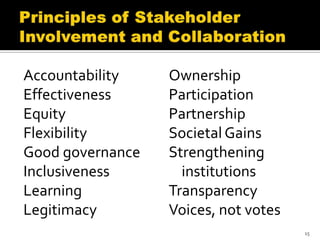
Accountability    Ownership
Effectiveness     Participation
Equity            Partnership
Flexibility       Societal Gains
Good governance   Strengthening
Inclusiveness       institutions
Learning          Transparency
Legitimacy        Voices, not votes
                                      15
   Dialogues
   Consensus-building
   Decision-making
   Implementation
   Monitoring & evaluation


                              16
   Discuss what can make a successful
    partnership, keeping the integrity of various
    stakeholders intact
   Identify good practices that could be
    replicated
   Identify policy practices impairing
    partnerships and processes from being
    developed
   Identify a framework for developing
    partnerships and processes
                                                    17
 Raise issues and bring them to the
  table, and thus help influence the
  agenda
 Keep the issues of
  participation, accountability and
  transparency alive and relevant


                                       18
There are a number of them.....


                                  19
The Secretariat is the permanent body that supports
the work of the convention between meetings and
does the logistical and secretariat work for the event
and during it. The Secretariat will have a role that
includes:
   Preparing the background papers
   Producing or updating a website for the meeting
   Analyzing the national reports
   Producing promotional material for the meeting
   Producing negotiating text arising from the discussions
   Making available all official documents

                                                              20
   Committee of the Whole (COW): the formal
    sessions governed by rules of procedure and
    are simultaneously translated in all of the six
    UN languages.
   Contact Groups: resolve a particular issue of
    disagreement. The members of the group are
    typically drawn from the governments who
    disagree.

                                                      21
   Friends of the Chair/President: – where the
    Chair invites a few prominent negotiators to
    form a group called Friends of the
    Chair/President to help informally in
    developing consensus.
   Informals: a subsidiary body of the working
    groups and are set up when there is a set of
    critical issues that needs to be addressed.

                                                   22
   Working Groups: are subsidiary bodies of
    the COW. At any one time, usually no more
    than two will be meeting. Joint Working
    Groups come together when there are cross
    cutting issues the two working groups can be
    brought together to deal with them.
   Ministerial Round Tables are when Ministers
    want to discuss an issue but are not yet ready
    to make a decision
                                                     23
And you’re off....


                     24
   To influence the text that will be negotiated;
   To build and cultivate alliances for future
    work;
   To showcase studies of successes that your
    organization has achieved;
   To learn about how intergovernmental
    negotiations work;
   To get to know your government
   To raise funds for your work
                                                     25
 Meet with key parliamentarians before leaving
  – initiated a debate in parliament
 Set up a rapid response mechanism in the
  capital in case you need it
 Try to get an NGO on delegation and to be
  allowed to attend pre inter-departmental
  meetings before the event


                                                  26
At the UN event, your organization should:
 have a photo booklet of key negotiators and UN
  staff so they are easy to find
 Designate point contacts for all key people e.g.,
  G77, EU, US, key countries, Bureau members, UN
  officials,
 Assign floor managers to each negotiation room
 Use coffee bar diplomacy, receptions
 Use any informal possibilities
  drinks/dinner/dancing
 Spending no more than 20% of your time with
  NGOs
                                                      27
   Get access to the floor as an NGO (working
    through NGO or stakeholder groupings)
   You might be able to “take the floor” as an
    individual accredited organisation on some
    occasions
   Have 200 copies of your intervention – give
    copies to the UN staff for the interpreters and
    to distribute
   Be focused and to the point

                                                      28
 You will have access to the brief of your country;
 You may be able to sit in on delegation meetings
  within blocks;
 You may be able to sit in on delegation meetings
  between blocks;
 You will be able to push for the NGO or
  stakeholder position during the appropriate
  meetings of the delegation;
 You can be asked to act as the intermediary
  between the NGOs and the government;

                                                       29
 You will be aware of where there is
  possible movement in a negotiation and
  may
 be asked to draft text for your
  delegation to put forward;
 You will be able to cultivate relationships
  with the delegation for future work.

                                                30
 If you join a government delegation you will lose some
  independence. Some governments require NGOs on a
  delegation to sign an official document saying they
  will not divulge what they have heard in delegation
  meetings;
 You will have limited time available for being with
  other NGOs if you are an active member of the
  delegation;
 You may be seen as the doorkeeper for NGOs with the
  delegation or you may be viewed as having ‘switched
  sides’ and joined the government team
 You may not be allowed to speak publicly on a
  position
                                                           31
This is where we are....


                           32
   November 28 – December 9, COP 17 (on
    climate) in Durban, South Africa
   December 1 – 2, the Regional Preparatory
    Meeting for the UN ECE
    region, Geneva, Switzerland, (Mandated)
   December 15 -16, the second intersessional
    for the Rio 2012 conference, discussions on
    the compiled inputs so far, including the
    structure of the outcome document, at
    UN, New York, (Mandated)
                                                  33
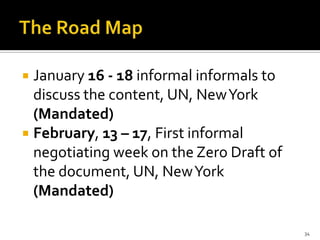
 January 16 - 18 informal informals to
  discuss the content, UN, New York
  (Mandated)
 February, 13 – 17, First informal
  negotiating week on the Zero Draft of
  the document, UN, New York
  (Mandated)

                                          34
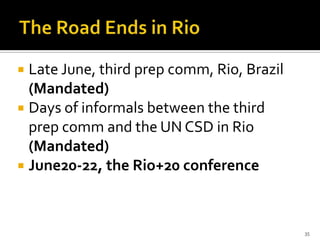
 Late June, third prep comm, Rio, Brazil
  (Mandated)
 Days of informals between the third
  prep comm and the UN CSD in Rio
  (Mandated)
 June20-22, the Rio+20 conference


                                            35
End of session 2


                   36

Rio+20 module, part 2 11.30.11 don

  • 1.
    Part 2: The Rio+20Process and Framework 1
  • 2.
    § 5. Reiterates that the Commission on Sustainable Development is the high level body responsible for sustainable development within the United Nations system and serves as a forum for the consideration of issues related to the integration of the three dimensions of sustainable development,  and underlines the need to further support the work of the Commission, taking into account its existing mandate and the decisions taken at its eleventh session; 2
  • 3.
    Established after Rio in 1992 UNCED) to follow up the political process on Agenda 21 and sustainable development  Was given a new and updated mandate at the World Summit on Sustainable Development, Johannesburg, 2002  A standing committee under ECOSOC 3
  • 4.
    Developed the modalities for its process based on the mandate given CSD by WSSD – the Worlds Summit on Sustainable Development, Johannesburg 2002, and gave the Major Groups their position in relationship to the official delegates and the UN system 4
  • 5.
    A forum fora broad discussion  on sustainable development issues  on overarching or cross cutting issues  on normative issues  on issues that have direct relevance for work on local, national and regional level 5
  • 6.
     The governments,delegations, civil servants  The intergovernmental organisations, UN agencies  Members of civil society, and as decided by UNCED in 1992, they are known as the 9 Major Groups  Sometimes, Ministers 6
  • 7.
    A BIT OFHISTORY 7
  • 8.
    The UN Charter formally recognises only 3 entities as accepted actors:  official national delegations,  intergovernmental organisations  non-governmental organisations-NGOs. 8
  • 9.
    The legal basis for NGO participation at the United Nations is Article 71 of the UN Charter. This allows ECOSOC to entertain consultative relationships with NGOs.  It is the NGO committee within ECOSOC* that sets the rules of accreditation, and this body formally issues the letters of accreditation to NGOs. *ECOSOC, The Economic and Social Council, one of the 5 permanent UN bodies. 9
  • 10.
    We are allinvited to contribute 10
  • 11.
    runs the process leading up to the conference,  has been selected by the UN General Assembly  The African Group: Egypt and Botswana;  The Asian Group: Pakistan and South Korea;  GRULAC (Latin American and Caribbean Group): Argentina and Barbuda;  CEIT (Countries with Economies in Transition): Croatia and the Czech Republic;  WEOG (Western European and Others Group): the US (first half of the period) Canada (second half of the period) and Italy;  ex officio: Brazil. 11
  • 12.
    “all stakeholders, - governments, intergovernmental agencies and civil society including the major groups, to contribute to a working document which will be the basis for the outcome document of the upcoming UN Conference for Sustainable Development to be held in Rio in June 2012 called Rio + 20.” 12
  • 13.
    Now – in 2011-2012 - the major groups and civil society are written directly into the Rio plus 20 resolution 13
  • 14.
    You have allbeen invited to contribute.... 14
  • 15.
    Accountability Ownership Effectiveness Participation Equity Partnership Flexibility Societal Gains Good governance Strengthening Inclusiveness institutions Learning Transparency Legitimacy Voices, not votes 15
  • 16.
    Dialogues  Consensus-building  Decision-making  Implementation  Monitoring & evaluation 16
  • 17.
    Discuss what can make a successful partnership, keeping the integrity of various stakeholders intact  Identify good practices that could be replicated  Identify policy practices impairing partnerships and processes from being developed  Identify a framework for developing partnerships and processes 17
  • 18.
     Raise issuesand bring them to the table, and thus help influence the agenda  Keep the issues of participation, accountability and transparency alive and relevant 18
  • 19.
    There are anumber of them..... 19
  • 20.
    The Secretariat isthe permanent body that supports the work of the convention between meetings and does the logistical and secretariat work for the event and during it. The Secretariat will have a role that includes:  Preparing the background papers  Producing or updating a website for the meeting  Analyzing the national reports  Producing promotional material for the meeting  Producing negotiating text arising from the discussions  Making available all official documents 20
  • 21.
    Committee of the Whole (COW): the formal sessions governed by rules of procedure and are simultaneously translated in all of the six UN languages.  Contact Groups: resolve a particular issue of disagreement. The members of the group are typically drawn from the governments who disagree. 21
  • 22.
    Friends of the Chair/President: – where the Chair invites a few prominent negotiators to form a group called Friends of the Chair/President to help informally in developing consensus.  Informals: a subsidiary body of the working groups and are set up when there is a set of critical issues that needs to be addressed. 22
  • 23.
    Working Groups: are subsidiary bodies of the COW. At any one time, usually no more than two will be meeting. Joint Working Groups come together when there are cross cutting issues the two working groups can be brought together to deal with them.  Ministerial Round Tables are when Ministers want to discuss an issue but are not yet ready to make a decision 23
  • 24.
  • 25.
    To influence the text that will be negotiated;  To build and cultivate alliances for future work;  To showcase studies of successes that your organization has achieved;  To learn about how intergovernmental negotiations work;  To get to know your government  To raise funds for your work 25
  • 26.
     Meet withkey parliamentarians before leaving – initiated a debate in parliament  Set up a rapid response mechanism in the capital in case you need it  Try to get an NGO on delegation and to be allowed to attend pre inter-departmental meetings before the event 26
  • 27.
    At the UNevent, your organization should:  have a photo booklet of key negotiators and UN staff so they are easy to find  Designate point contacts for all key people e.g., G77, EU, US, key countries, Bureau members, UN officials,  Assign floor managers to each negotiation room  Use coffee bar diplomacy, receptions  Use any informal possibilities drinks/dinner/dancing  Spending no more than 20% of your time with NGOs 27
  • 28.
    Get access to the floor as an NGO (working through NGO or stakeholder groupings)  You might be able to “take the floor” as an individual accredited organisation on some occasions  Have 200 copies of your intervention – give copies to the UN staff for the interpreters and to distribute  Be focused and to the point 28
  • 29.
     You willhave access to the brief of your country;  You may be able to sit in on delegation meetings within blocks;  You may be able to sit in on delegation meetings between blocks;  You will be able to push for the NGO or stakeholder position during the appropriate meetings of the delegation;  You can be asked to act as the intermediary between the NGOs and the government; 29
  • 30.
     You willbe aware of where there is possible movement in a negotiation and may  be asked to draft text for your delegation to put forward;  You will be able to cultivate relationships with the delegation for future work. 30
  • 31.
     If youjoin a government delegation you will lose some independence. Some governments require NGOs on a delegation to sign an official document saying they will not divulge what they have heard in delegation meetings;  You will have limited time available for being with other NGOs if you are an active member of the delegation;  You may be seen as the doorkeeper for NGOs with the delegation or you may be viewed as having ‘switched sides’ and joined the government team  You may not be allowed to speak publicly on a position 31
  • 32.
    This is wherewe are.... 32
  • 33.
    November 28 – December 9, COP 17 (on climate) in Durban, South Africa  December 1 – 2, the Regional Preparatory Meeting for the UN ECE region, Geneva, Switzerland, (Mandated)  December 15 -16, the second intersessional for the Rio 2012 conference, discussions on the compiled inputs so far, including the structure of the outcome document, at UN, New York, (Mandated) 33
  • 34.
     January 16- 18 informal informals to discuss the content, UN, New York (Mandated)  February, 13 – 17, First informal negotiating week on the Zero Draft of the document, UN, New York (Mandated) 34
  • 35.
     Late June,third prep comm, Rio, Brazil (Mandated)  Days of informals between the third prep comm and the UN CSD in Rio (Mandated)  June20-22, the Rio+20 conference 35
  • 36.

Editor's Notes

  • #10 By UN estimates, the number of international NGOs alone has grown forty-fold over the 1990s, to over 37 000 in 2000. Countless, thousands – possibly millions – more work regionally, nationally and locally.
  • #35 January: The Zero Draft of the document made available for all to read, early January 2012. A three day meeting