

Right To Information
RIGHT TO
INFORMATION
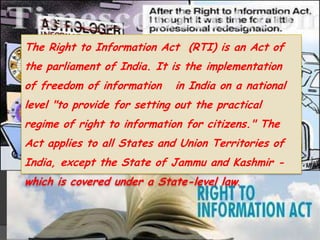
The Right to Information Act (RTI) is an Act of
the parliament of India. It is the implementation
of freedom of information in India on a national
level "to provide for setting out the practical
regime of right to information for citizens." The
Act applies to all States and Union Territories of
India, except the State of Jammu and Kashmir -
which is covered under a State-level law.
53% of public authorities do not share
any information at all.
37% departments published about
subsidies and beneficiaries.
Only 23% listed the projects they
undertake.
Certain facts
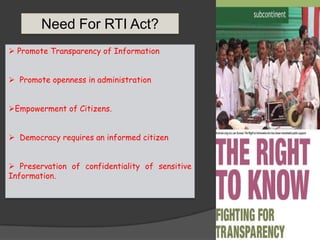
 Promote Transparency of Information
 Promote openness in administration
Empowerment of Citizens.
 Democracy requires an informed citizen
 Preservation of confidentiality of sensitive
Information.
Need For RTI Act?
RTI ACT--- Important sections
Section 2(j) a right to
(i) inspection of work, documents, records,
(ii) taking notes, extracts or certified copies of documents or records,
(iii) taking separate samples of material,
(iv) obtaining information in the form of Disk, floppies, video cassettes.
Section 4 duty of public authorities to maintain records for easy access and
to publish within 120 days the name of the officers who should give
information.
Section 6(2) talks that an applicant cannot be questioned why he is asking
for information.
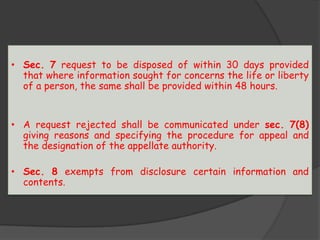
• Sec. 7 request to be disposed of within 30 days provided
that where information sought for concerns the life or liberty
of a person, the same shall be provided within 48 hours.
• A request rejected shall be communicated under sec. 7(8)
giving reasons and specifying the procedure for appeal and
the designation of the appellate authority.
• Sec. 8 exempts from disclosure certain information and
contents.
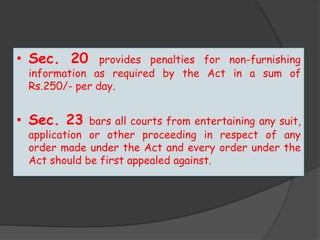
• Sec. 20 provides penalties for non-furnishing
information as required by the Act in a sum of
Rs.250/- per day.
• Sec. 23 bars all courts from entertaining any suit,
application or other proceeding in respect of any
order made under the Act and every order under the
Act should be first appealed against.
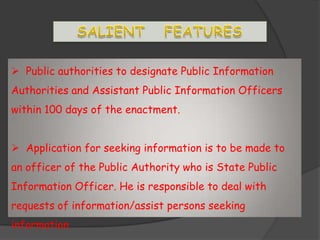
 Public authorities to designate Public Information
Authorities and Assistant Public Information Officers
within 100 days of the enactment.
 Application for seeking information is to be made to
an officer of the Public Authority who is State Public
Information Officer. He is responsible to deal with
requests of information/assist persons seeking
information.
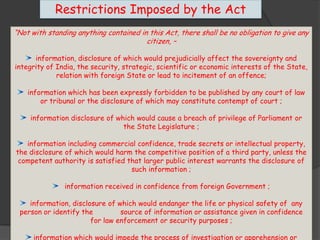
“Not with standing anything contained in this Act, there shall be no obligation to give any
citizen, –
information, disclosure of which would prejudicially affect the sovereignty and
integrity of India, the security, strategic, scientific or economic interests of the State,
relation with foreign State or lead to incitement of an offence;
information which has been expressly forbidden to be published by any court of law
or tribunal or the disclosure of which may constitute contempt of court ;
information disclosure of which would cause a breach of privilege of Parliament or
the State Legislature ;
information including commercial confidence, trade secrets or intellectual property,
the disclosure of which would harm the competitive position of a third party, unless the
competent authority is satisfied that larger public interest warrants the disclosure of
such information ;
information received in confidence from foreign Government ;
information, disclosure of which would endanger the life or physical safety of any
person or identify the source of information or assistance given in confidence
for law enforcement or security purposes ;
information which would impede the process of investigation or apprehension or
Restrictions Imposed by the Act
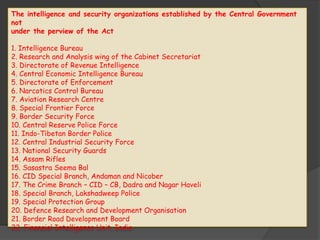
The intelligence and security organizations established by the Central Government
not
under the perview of the Act
1. Intelligence Bureau
2. Research and Analysis wing of the Cabinet Secretariat
3. Directorate of Revenue Intelligence
4. Central Economic Intelligence Bureau
5. Directorate of Enforcement
6. Narcotics Control Bureau
7. Aviation Research Centre
8. Special Frontier Force
9. Border Security Force
10. Central Reserve Police Force
11. Indo-Tibetan Border Police
12. Central Industrial Security Force
13. National Security Guards
14. Assam Rifles
15. Sasastra Seema Bal
16. CID Special Branch, Andaman and Nicober
17. The Crime Branch – CID – CB, Dadra and Nagar Haveli
18. Special Branch, Lakshadweep Police
19. Special Protection Group
20. Defence Research and Development Organisation
21. Border Road Development Board
22. Financial Intelligence Unit, India
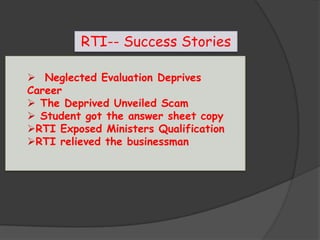
RTI-- Success Stories
 Neglected Evaluation Deprives
Career
 The Deprived Unveiled Scam
 Student got the answer sheet copy
RTI Exposed Ministers Qualification
RTI relieved the businessman
Right to information

Right to information

  • 1.
  • 2.
    The Right toInformation Act (RTI) is an Act of the parliament of India. It is the implementation of freedom of information in India on a national level "to provide for setting out the practical regime of right to information for citizens." The Act applies to all States and Union Territories of India, except the State of Jammu and Kashmir - which is covered under a State-level law.
  • 3.
    53% of publicauthorities do not share any information at all. 37% departments published about subsidies and beneficiaries. Only 23% listed the projects they undertake. Certain facts
  • 4.
     Promote Transparencyof Information  Promote openness in administration Empowerment of Citizens.  Democracy requires an informed citizen  Preservation of confidentiality of sensitive Information. Need For RTI Act?
  • 5.
    RTI ACT--- Importantsections Section 2(j) a right to (i) inspection of work, documents, records, (ii) taking notes, extracts or certified copies of documents or records, (iii) taking separate samples of material, (iv) obtaining information in the form of Disk, floppies, video cassettes. Section 4 duty of public authorities to maintain records for easy access and to publish within 120 days the name of the officers who should give information. Section 6(2) talks that an applicant cannot be questioned why he is asking for information.
  • 6.
    • Sec. 7request to be disposed of within 30 days provided that where information sought for concerns the life or liberty of a person, the same shall be provided within 48 hours. • A request rejected shall be communicated under sec. 7(8) giving reasons and specifying the procedure for appeal and the designation of the appellate authority. • Sec. 8 exempts from disclosure certain information and contents.
  • 7.
    • Sec. 20provides penalties for non-furnishing information as required by the Act in a sum of Rs.250/- per day. • Sec. 23 bars all courts from entertaining any suit, application or other proceeding in respect of any order made under the Act and every order under the Act should be first appealed against.
  • 8.
     Public authoritiesto designate Public Information Authorities and Assistant Public Information Officers within 100 days of the enactment.  Application for seeking information is to be made to an officer of the Public Authority who is State Public Information Officer. He is responsible to deal with requests of information/assist persons seeking information.
  • 9.
    “Not with standinganything contained in this Act, there shall be no obligation to give any citizen, – information, disclosure of which would prejudicially affect the sovereignty and integrity of India, the security, strategic, scientific or economic interests of the State, relation with foreign State or lead to incitement of an offence; information which has been expressly forbidden to be published by any court of law or tribunal or the disclosure of which may constitute contempt of court ; information disclosure of which would cause a breach of privilege of Parliament or the State Legislature ; information including commercial confidence, trade secrets or intellectual property, the disclosure of which would harm the competitive position of a third party, unless the competent authority is satisfied that larger public interest warrants the disclosure of such information ; information received in confidence from foreign Government ; information, disclosure of which would endanger the life or physical safety of any person or identify the source of information or assistance given in confidence for law enforcement or security purposes ; information which would impede the process of investigation or apprehension or Restrictions Imposed by the Act
  • 10.
    The intelligence andsecurity organizations established by the Central Government not under the perview of the Act 1. Intelligence Bureau 2. Research and Analysis wing of the Cabinet Secretariat 3. Directorate of Revenue Intelligence 4. Central Economic Intelligence Bureau 5. Directorate of Enforcement 6. Narcotics Control Bureau 7. Aviation Research Centre 8. Special Frontier Force 9. Border Security Force 10. Central Reserve Police Force 11. Indo-Tibetan Border Police 12. Central Industrial Security Force 13. National Security Guards 14. Assam Rifles 15. Sasastra Seema Bal 16. CID Special Branch, Andaman and Nicober 17. The Crime Branch – CID – CB, Dadra and Nagar Haveli 18. Special Branch, Lakshadweep Police 19. Special Protection Group 20. Defence Research and Development Organisation 21. Border Road Development Board 22. Financial Intelligence Unit, India
  • 11.
    RTI-- Success Stories Neglected Evaluation Deprives Career  The Deprived Unveiled Scam  Student got the answer sheet copy RTI Exposed Ministers Qualification RTI relieved the businessman

Editor's Notes