Elementary Stagecraft
Rigging Systems
Rigging Systems
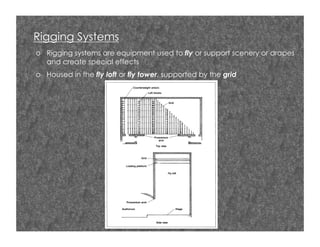
o  Rigging systems are equipment used to fly or support scenery or drapes
and create special effects
o  Housed in the fly loft or fly tower, supported by the grid
Hemp System
o  Also called a rope set, oldest rigging system, still in use today
o  All other systems build upon these basic principles:
•  traditionally uses natural fiber rope, typically ¾” Manila (not Hemp),
modern systems use synthetic rope
Hemp System
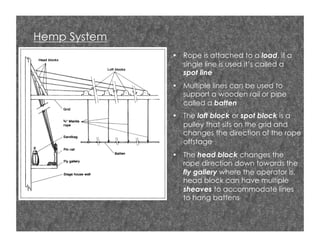
•  Rope is attached to a load, if a
single line is used it’s called a
spot line
•  Multiple lines can be used to
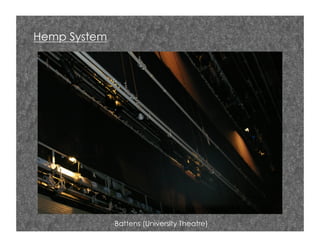
support a wooden rail or pipe
called a batten
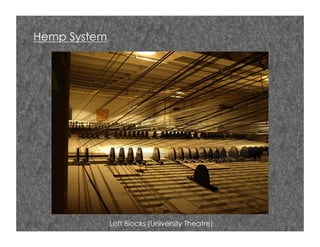
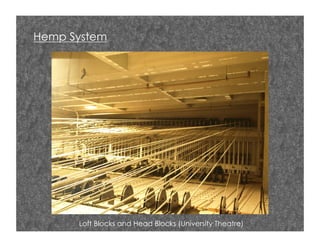
•  The loft block or spot block is a
pulley that sits on the grid and
changes the direction of the rope
offstage
•  The head block changes the
rope direction down towards the
fly gallery where the operator is,
head block can have multiple
sheaves to accommodate lines
to hang battens
Hemp System
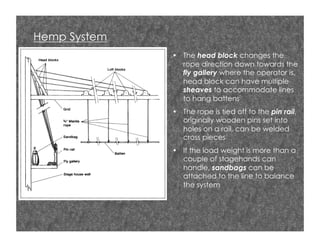
•  The head block changes the
rope direction down towards the
fly gallery where the operator is,
head block can have multiple
sheaves to accommodate lines
to hang battens
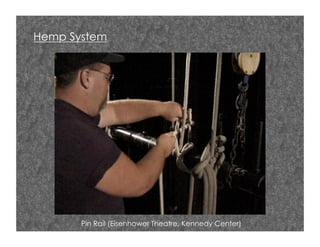
•  The rope is tied off to the pin rail,
originally wooden pins set into
holes on a rail, can be welded
cross pieces
•  If the load weight is more than a
couple of stagehands can
handle, sandbags can be
attached to the line to balance
the system
Hemp System

Battens (University Theatre)
Hemp System

Grided Battens (University Theatre)
Hemp System

Loft Blocks (University Theatre)
Hemp System

Loft Blocks and Head Blocks (University Theatre)
Hemp System

Pin Rail (Eisenhower Theatre, Kennedy Center)
Counterweight Systems
o  Works on the same principles as the rope set but much safer
o  Several different versions based on the size of the fly loft
•  Single Purchase Counterweight System – for fly lofts at least twice the
height of the proscenium (University Theatre)
•  Double Purchase Counterweight System – for smaller fly lofts less than
twice the proscenium height (Studio Theatre)
•  Motorized Fly System – replaces the operator with a motor, can be
computer controlled
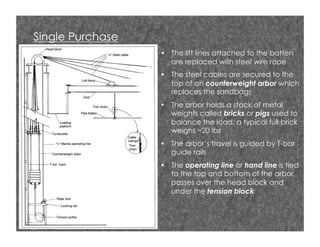
Single Purchase
•  The lift lines attached to the batten
are replaced with steel wire rope
•  The steel cables are secured to the
top of an counterweight arbor which
replaces the sandbags
•  The arbor holds a stack of metal
weights called bricks or pigs used to
balance the load, a typical full brick
weighs ~20 lbs
•  The arbor’s travel is guided by T-bar
guide rails
•  The operating line or hand line is tied
to the top and bottom of the arbor,
passes over the head block and
under the tension block
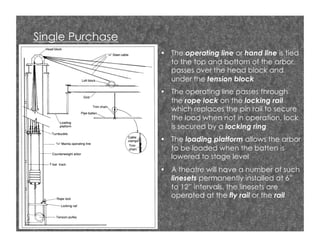
Single Purchase
•  The operating line or hand line is tied
to the top and bottom of the arbor,
passes over the head block and
under the tension block
•  The operating line passes through
the rope lock on the locking rail
which replaces the pin rail to secure
the load when not in operation, lock
is secured by a locking ring
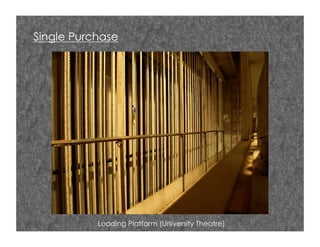
•  The loading platform allows the arbor
to be loaded when the batten is
lowered to stage level
•  A theatre will have a number of such
linesets permanently installed at 6”
to 12” intervals, the linesets are
operated at the fly rail or the rail
Single Purchase
•  A theatre will have a number of such
linesets permanently installed at 6”
to 12” intervals, the linesets are
operated at the fly rail or the rail
•  The rail may be a deck rail, or a mid
rail if it is located between the deck
and the loading platform, the mid
rail may also be a pin rail in addition
to the deck rail
•  Stagehands hired to operate the the
rail are called flymen
Single Purchase

Head Block (University Theatre)
Single Purchase

Top of an Arbor (not under load)
Single Purchase

Rope Lock (University Theatre)
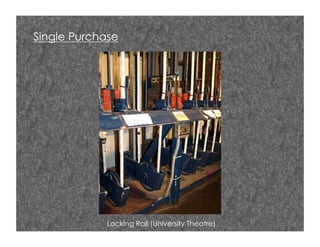
Single Purchase

Locking Rail (University Theatre)
Single Purchase

Loading Platform (University Theatre)
Single Purchase

Fly Rail (University Theatre)
Double Purchase
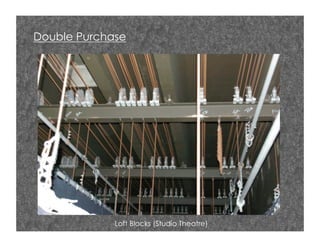
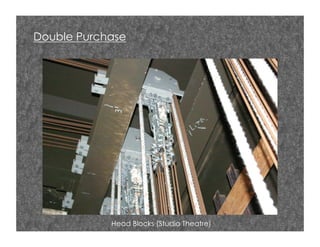
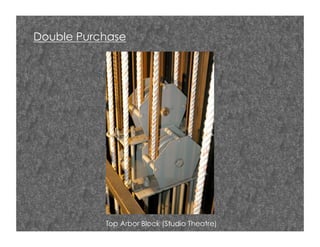
•  This system adds pulleys to the top
and bottom of the arbor, operating
line passes through these pulleys and
is fixed to the ground and just below
the head block
•  Creates a mechanical advantage of
2 to 1 where the batten travels twice
the distance that the arbor does,
however arbor must carry twice the
weight of the load
Double Purchase

Loft Blocks (Studio Theatre)
Double Purchase

Head Blocks (Studio Theatre)
Double Purchase

Top Arbor Block (Studio Theatre)
Double Purchase

Bottom Arbor Block (Studio Theatre)
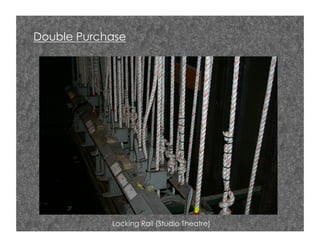
Double Purchase

Locking Rail (Studio Theatre)
Motorized Fly Systems
o  Two different types
•  Motor and winch can replace the operating line and pull the arbor,
still a counterweigh system, motor is called a mule
•  Motor and winch can pull the load directly,
called a Dead Lift System
Counterweight Fly Systems
o  OPERATION AND SAFETY (Handout available on Beachboard)
•  Balance Check
  Visual Check – arbor weight is equal to the batten weight
  Rope Tension Check – rope tension on both sides of the rope
lock should be equal
•  Warn everyone on stage that something will be moving
  Call out “LINESET COMING IN (OR GOING OUT)” and identify the
area that will be affects “LINESET COMING IN DOWNSTAGE”
  People onstage should exit the affected area and reply with
“THANK YOU”, do not proceed until you hear acknowledgement
•  Unlock Operating Lines
  Remove locking ring and SLOWLY release the rope lock
  If line moves on its own, quickly relock the line, if this doesn’t stop
movement, tie a snub line
  If lineset is totally out of control, scream a warning and exit the
stage quickly
Counterweight Fly Systems
o  OPERATION AND SAFETY
•  Unlock Operating Lines
  Remove locking ring and SLOWLY release the rope lock
  If line moves on its own, quickly relock the line, if this doesn’t stop
movement, tie a snub line
  If lineset is totally out of control, scream a warning and exit the
stage quickly.
•  Move the Lineset
  The batten moves in the same direction as the line closest to you
  Pull down on the front rope and the batten moves down, pull up
and the batten moves up
  Watch the batten and it’s load while moving the lineset
•  Relock
  Once the scenery has been moved, lock the rope lock and
replace the locking ring, never leave a lineset unlocked or
without a locking ring
Rigging systems

Rigging systems

  • 1.
  • 2.
    Rigging Systems o  Riggingsystems are equipment used to fly or support scenery or drapes and create special effects o  Housed in the fly loft or fly tower, supported by the grid
  • 3.
    Hemp System o  Alsocalled a rope set, oldest rigging system, still in use today o  All other systems build upon these basic principles: •  traditionally uses natural fiber rope, typically ¾” Manila (not Hemp), modern systems use synthetic rope
  • 4.
    Hemp System •  Ropeis attached to a load, if a single line is used it’s called a spot line •  Multiple lines can be used to support a wooden rail or pipe called a batten •  The loft block or spot block is a pulley that sits on the grid and changes the direction of the rope offstage •  The head block changes the rope direction down towards the fly gallery where the operator is, head block can have multiple sheaves to accommodate lines to hang battens
  • 5.
    Hemp System •  Thehead block changes the rope direction down towards the fly gallery where the operator is, head block can have multiple sheaves to accommodate lines to hang battens •  The rope is tied off to the pin rail, originally wooden pins set into holes on a rail, can be welded cross pieces •  If the load weight is more than a couple of stagehands can handle, sandbags can be attached to the line to balance the system
  • 6.
  • 7.
    Hemp System Grided Battens(University Theatre)
  • 8.
    Hemp System Loft Blocks(University Theatre)
  • 9.
    Hemp System Loft Blocksand Head Blocks (University Theatre)
  • 10.
    Hemp System Pin Rail(Eisenhower Theatre, Kennedy Center)
  • 11.
    Counterweight Systems o  Workson the same principles as the rope set but much safer o  Several different versions based on the size of the fly loft •  Single Purchase Counterweight System – for fly lofts at least twice the height of the proscenium (University Theatre) •  Double Purchase Counterweight System – for smaller fly lofts less than twice the proscenium height (Studio Theatre) •  Motorized Fly System – replaces the operator with a motor, can be computer controlled
  • 12.
    Single Purchase •  Thelift lines attached to the batten are replaced with steel wire rope •  The steel cables are secured to the top of an counterweight arbor which replaces the sandbags •  The arbor holds a stack of metal weights called bricks or pigs used to balance the load, a typical full brick weighs ~20 lbs •  The arbor’s travel is guided by T-bar guide rails •  The operating line or hand line is tied to the top and bottom of the arbor, passes over the head block and under the tension block
  • 13.
    Single Purchase •  Theoperating line or hand line is tied to the top and bottom of the arbor, passes over the head block and under the tension block •  The operating line passes through the rope lock on the locking rail which replaces the pin rail to secure the load when not in operation, lock is secured by a locking ring •  The loading platform allows the arbor to be loaded when the batten is lowered to stage level •  A theatre will have a number of such linesets permanently installed at 6” to 12” intervals, the linesets are operated at the fly rail or the rail
  • 14.
    Single Purchase •  Atheatre will have a number of such linesets permanently installed at 6” to 12” intervals, the linesets are operated at the fly rail or the rail •  The rail may be a deck rail, or a mid rail if it is located between the deck and the loading platform, the mid rail may also be a pin rail in addition to the deck rail •  Stagehands hired to operate the the rail are called flymen
  • 15.
    Single Purchase Head Block(University Theatre)
  • 16.
    Single Purchase Top ofan Arbor (not under load)
  • 17.
    Single Purchase Rope Lock(University Theatre)
  • 18.
    Single Purchase Locking Rail(University Theatre)
  • 19.
  • 20.
    Single Purchase Fly Rail(University Theatre)
  • 21.
    Double Purchase •  Thissystem adds pulleys to the top and bottom of the arbor, operating line passes through these pulleys and is fixed to the ground and just below the head block •  Creates a mechanical advantage of 2 to 1 where the batten travels twice the distance that the arbor does, however arbor must carry twice the weight of the load
  • 22.
  • 23.
  • 24.
    Double Purchase Top ArborBlock (Studio Theatre)
  • 25.
    Double Purchase Bottom ArborBlock (Studio Theatre)
  • 26.
  • 27.
    Motorized Fly Systems o Two different types •  Motor and winch can replace the operating line and pull the arbor, still a counterweigh system, motor is called a mule •  Motor and winch can pull the load directly, called a Dead Lift System
  • 28.
    Counterweight Fly Systems o OPERATION AND SAFETY (Handout available on Beachboard) •  Balance Check   Visual Check – arbor weight is equal to the batten weight   Rope Tension Check – rope tension on both sides of the rope lock should be equal •  Warn everyone on stage that something will be moving   Call out “LINESET COMING IN (OR GOING OUT)” and identify the area that will be affects “LINESET COMING IN DOWNSTAGE”   People onstage should exit the affected area and reply with “THANK YOU”, do not proceed until you hear acknowledgement •  Unlock Operating Lines   Remove locking ring and SLOWLY release the rope lock   If line moves on its own, quickly relock the line, if this doesn’t stop movement, tie a snub line   If lineset is totally out of control, scream a warning and exit the stage quickly
  • 29.
    Counterweight Fly Systems o OPERATION AND SAFETY •  Unlock Operating Lines   Remove locking ring and SLOWLY release the rope lock   If line moves on its own, quickly relock the line, if this doesn’t stop movement, tie a snub line   If lineset is totally out of control, scream a warning and exit the stage quickly. •  Move the Lineset   The batten moves in the same direction as the line closest to you   Pull down on the front rope and the batten moves down, pull up and the batten moves up   Watch the batten and it’s load while moving the lineset •  Relock   Once the scenery has been moved, lock the rope lock and replace the locking ring, never leave a lineset unlocked or without a locking ring