C O L L E G E - M B . G . P G C O L L E G E H A L D W A N I
Inquiry Training Model
Paper code-B103
Principle And Method Of Teaching Object
Submitted By-
Kaviraj Singh Dhami
Submitted To-
Dr Renu Rawat
SUCHMAN INQ UIRY MO DEL
Richard Suchman’s model supports the belief that students should become
autonomous,
self-directed learners. This inquiry strategy presents a puzzling problem
related to a
concept. Suchman calls this problem a “discrepant event.” Students are then
instructed that
they are to propose hypotheses and ideas that would explain the
phenomenon by asking
questions that the teacher can answer with "Yes," "No," or "Maybe."
The Suchman Inquiry Model facilitates students to think through an event or
problem
and ask questions to find a solution. Students take an active role and engage
P R O C E D U R E
1. Introduce a discrepant event, a puzzling situation that challenges students
to
provide a theory of explanation.
2. Have students ask questions to gather data. They can only ask the teacher
single questions that can be answered by a “yes” or “no” response.
3. The teacher responds to the questions to help students gather data and
also
guides students to clarify as needed.
4. The teacher asks student to formalize the data and formulate an
explanation.
Students solve the problem with the information they have collected.
5. Finally, the teacher guides students to analyze their thinking and
SYNTEX
There are five phases in this model
1. Presentation of problem or concept
2. Data gathering for verification
3. Data gathering experimentation
4. Problem solving and conclusion
5. Analysis
INQUIRY TRAINING MODEL
School Name- MB.G.PG COLLEGE HALDWANI
Name of Student Teacher- Kaviraj Singh Dhami Class-
MNO
Subject- Science Time-40Mins
Topic- Density and Buoyant Force.(floating sinking concept of an
object)
Objective- The aim of this model is to encourage students to ask
questions related to topic and to make them understand about the
property of density and up thrust force.
Principle- Having density lesser than water of any object makes it
float .
Important Equipment-We have various equipment like container, a
P R E S E N T A T I O N O F P R O B L E M / C O N C E P T
Once a king was strolling by the pond. He threw a
stone and a basket into the pond. The stone sank
but the basket remained floating. After that, when
he came to the palace, he did this experiment
again in which he threw a cork and an nail (of
same equal masses) in the container and he
observed that the nail sank.
Students will ask questions to collect facts and to
reach the conclusion.
* Data gathering for verification
• Student: Were both the nail and cork same size or equal masses ?
• Teacher: Yes.
• Student: Is container contains any magical water?
• Teacher: No
• Students: Is liquid in the container contains any impurities or differ from
normal water?
• Teacher: no
• Student: Do both experiences any downward force like gravitational?
• Teacher: Yes
• Student: Is there any up thrust force acting on both objects ?
• Teacher: yes
• Student: Is there variation in up thrust force on nail and cork?
• Teacher: yes
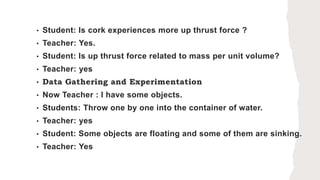
• Student: Is cork experiences more up thrust force ?
• Teacher: Yes.
• Student: Is up thrust force related to mass per unit volume?
• Teacher: yes
• Data Gathering and Experimentation
• Now Teacher : I have some objects.
• Students: Throw one by one into the container of water.
• Teacher: yes
• Student: Some objects are floating and some of them are sinking.
• Teacher: Yes
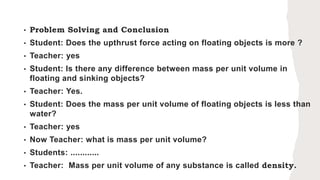
• Problem Solving and Conclusion
• Student: Does the upthrust force acting on floating objects is more ?
• Teacher: yes
• Student: Is there any difference between mass per unit volume in
floating and sinking objects?
• Teacher: Yes.
• Student: Does the mass per unit volume of floating objects is less than
water?
• Teacher: yes
• Now Teacher: what is mass per unit volume?
• Students: ............
• Teacher: Mass per unit volume of any substance is called density.
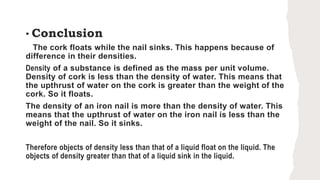
• Conclusion
The cork floats while the nail sinks. This happens because of
difference in their densities.
Density of a substance is defined as the mass per unit volume.
Density of cork is less than the density of water. This means that
the upthrust of water on the cork is greater than the weight of the
cork. So it floats.
The density of an iron nail is more than the density of water. This
means that the upthrust of water on the iron nail is less than the
weight of the nail. So it sinks.
Therefore objects of density less than that of a liquid float on the liquid. The
objects of density greater than that of a liquid sink in the liquid.

Richard Suchman's inquiry model KD, inquiry teaching training

  • 1.
    C O LL E G E - M B . G . P G C O L L E G E H A L D W A N I Inquiry Training Model Paper code-B103 Principle And Method Of Teaching Object Submitted By- Kaviraj Singh Dhami Submitted To- Dr Renu Rawat
  • 2.
    SUCHMAN INQ UIRYMO DEL Richard Suchman’s model supports the belief that students should become autonomous, self-directed learners. This inquiry strategy presents a puzzling problem related to a concept. Suchman calls this problem a “discrepant event.” Students are then instructed that they are to propose hypotheses and ideas that would explain the phenomenon by asking questions that the teacher can answer with "Yes," "No," or "Maybe." The Suchman Inquiry Model facilitates students to think through an event or problem and ask questions to find a solution. Students take an active role and engage
  • 3.
    P R OC E D U R E 1. Introduce a discrepant event, a puzzling situation that challenges students to provide a theory of explanation. 2. Have students ask questions to gather data. They can only ask the teacher single questions that can be answered by a “yes” or “no” response. 3. The teacher responds to the questions to help students gather data and also guides students to clarify as needed. 4. The teacher asks student to formalize the data and formulate an explanation. Students solve the problem with the information they have collected. 5. Finally, the teacher guides students to analyze their thinking and
  • 4.
    SYNTEX There are fivephases in this model 1. Presentation of problem or concept 2. Data gathering for verification 3. Data gathering experimentation 4. Problem solving and conclusion 5. Analysis
  • 5.
    INQUIRY TRAINING MODEL SchoolName- MB.G.PG COLLEGE HALDWANI Name of Student Teacher- Kaviraj Singh Dhami Class- MNO Subject- Science Time-40Mins Topic- Density and Buoyant Force.(floating sinking concept of an object) Objective- The aim of this model is to encourage students to ask questions related to topic and to make them understand about the property of density and up thrust force. Principle- Having density lesser than water of any object makes it float . Important Equipment-We have various equipment like container, a
  • 6.
    P R ES E N T A T I O N O F P R O B L E M / C O N C E P T Once a king was strolling by the pond. He threw a stone and a basket into the pond. The stone sank but the basket remained floating. After that, when he came to the palace, he did this experiment again in which he threw a cork and an nail (of same equal masses) in the container and he observed that the nail sank. Students will ask questions to collect facts and to reach the conclusion.
  • 7.
    * Data gatheringfor verification • Student: Were both the nail and cork same size or equal masses ? • Teacher: Yes. • Student: Is container contains any magical water? • Teacher: No • Students: Is liquid in the container contains any impurities or differ from normal water? • Teacher: no • Student: Do both experiences any downward force like gravitational? • Teacher: Yes • Student: Is there any up thrust force acting on both objects ? • Teacher: yes • Student: Is there variation in up thrust force on nail and cork? • Teacher: yes
  • 8.
    • Student: Iscork experiences more up thrust force ? • Teacher: Yes. • Student: Is up thrust force related to mass per unit volume? • Teacher: yes • Data Gathering and Experimentation • Now Teacher : I have some objects. • Students: Throw one by one into the container of water. • Teacher: yes • Student: Some objects are floating and some of them are sinking. • Teacher: Yes
  • 9.
    • Problem Solvingand Conclusion • Student: Does the upthrust force acting on floating objects is more ? • Teacher: yes • Student: Is there any difference between mass per unit volume in floating and sinking objects? • Teacher: Yes. • Student: Does the mass per unit volume of floating objects is less than water? • Teacher: yes • Now Teacher: what is mass per unit volume? • Students: ............ • Teacher: Mass per unit volume of any substance is called density.
  • 10.
    • Conclusion The corkfloats while the nail sinks. This happens because of difference in their densities. Density of a substance is defined as the mass per unit volume. Density of cork is less than the density of water. This means that the upthrust of water on the cork is greater than the weight of the cork. So it floats. The density of an iron nail is more than the density of water. This means that the upthrust of water on the iron nail is less than the weight of the nail. So it sinks. Therefore objects of density less than that of a liquid float on the liquid. The objects of density greater than that of a liquid sink in the liquid.