Revolutionizing Financial Trading:
Exploring Decentralized
Exchange Development
Welcome to our presentation on decentralized exchange development!
Decentralized exchanges (DEXs)area crucial part of the blockchain
ecosystem,enabling peer-to-peer trading without intermediaries.Join us as
we explore the world of DEXs.
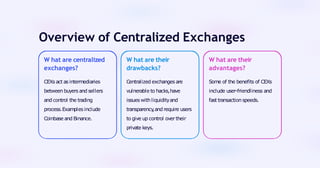
Overview of Centralized Exchanges
W hat are centralized
exchanges?
CEXs act as intermediaries
between buyers and sellers
and control the trading
process.Examples include
Coinbase and Binance.
W hat are their
drawbacks?
Centralized exchanges are
vulnerable to hacks,have
issueswith liquidityand
transparency
,and require users
to give up control over their
private keys.
W hat are their
advantages?
Some of the benefits of CEXs
include user-friendliness and
fast transactionspeeds.
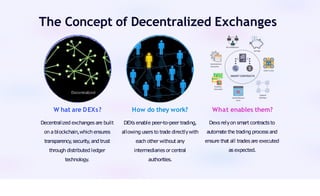
The Concept of Decentralized Exchanges
W hat are DEXs?
Decentralized exchanges are built
on ablockchain,which ensures
transparency,security,and trust
through distributed ledger
technology.
How do they work?
DEXs enable peer-to-peer trading,
allowing users to trade directlywith
each other without any
intermediaries or central
authorities.
What enables them?
Dexs relyon smart contractsto
automate the trading process and
ensure that all trades are executed
as expected.
Advantages of Decentralized Exchanges
Control Over Funds
💰
In aDEX,users have full
control over their funds and
private keys,reducing the
riskof hacks and theft.
1 2 Privacy & Anonymity
DEXs don't require users to
submit personal
information,making it a
great option for those who
value privacyand
anonymity
.
3 Lower Fees 💸
Since there are no
intermediaries,fees for
trading on DEXs are
generallylower than on
traditional exchanges.
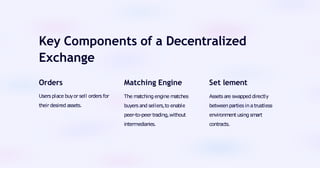
Key Components of a Decentralized
Exchange
Orders
Users place buyor sell orders for
their desired assets.
Matching Engine
The matching engine matches
buyers and sellers,to enable
peer-to-peer trading,without
intermediaries.
Set lement
Assetsare swapped directly
between parties in atrustless
environment using smart
contracts.
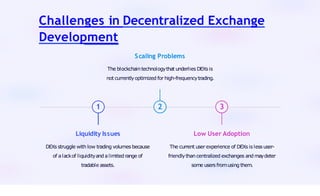
Challenges in Decentralized Exchange
Development
1
Liquidity Issues
DEXs struggle with low trading volumes because
of alackof liquidityand alimited range of
tradable assets.
2
Scaling Problems
The blockchaintechnologythat underlies DEXs is
not currentlyoptimized for high-frequencytrading.
3
Low User Adoption
The current user experience of DEXs is less user-
friendlythancentralized exchanges and maydeter
some users fromusing them.
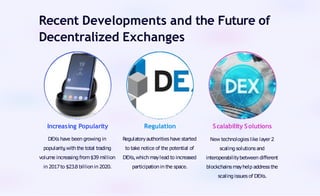
Recent Developments and the Future of
Decentralized Exchanges
Increasing Popularity
DEXs have been growing in
popularity
,with the total trading
volume increasing from$39 million
in 2017to $23.8 billionin 2020.
Regulation
Regulatoryauthorities have started
to take notice of the potential of
DEXs,whichmaylead to increased
participationin the space.
Scalability Solutions
New technologies like layer2
scalingsolutionsand
interoperabilitybetween different
blockchainsmayhelp address the
scalingissues of DEXs.

Revolutionizing Financial Trading: Exploring Decentralized Exchange Development

  • 1.
    Revolutionizing Financial Trading: ExploringDecentralized Exchange Development Welcome to our presentation on decentralized exchange development! Decentralized exchanges (DEXs)area crucial part of the blockchain ecosystem,enabling peer-to-peer trading without intermediaries.Join us as we explore the world of DEXs.
  • 2.
    Overview of CentralizedExchanges W hat are centralized exchanges? CEXs act as intermediaries between buyers and sellers and control the trading process.Examples include Coinbase and Binance. W hat are their drawbacks? Centralized exchanges are vulnerable to hacks,have issueswith liquidityand transparency ,and require users to give up control over their private keys. W hat are their advantages? Some of the benefits of CEXs include user-friendliness and fast transactionspeeds.
  • 3.
    The Concept ofDecentralized Exchanges W hat are DEXs? Decentralized exchanges are built on ablockchain,which ensures transparency,security,and trust through distributed ledger technology. How do they work? DEXs enable peer-to-peer trading, allowing users to trade directlywith each other without any intermediaries or central authorities. What enables them? Dexs relyon smart contractsto automate the trading process and ensure that all trades are executed as expected.
  • 4.
    Advantages of DecentralizedExchanges Control Over Funds 💰 In aDEX,users have full control over their funds and private keys,reducing the riskof hacks and theft. 1 2 Privacy & Anonymity DEXs don't require users to submit personal information,making it a great option for those who value privacyand anonymity . 3 Lower Fees 💸 Since there are no intermediaries,fees for trading on DEXs are generallylower than on traditional exchanges.
  • 5.
    Key Components ofa Decentralized Exchange Orders Users place buyor sell orders for their desired assets. Matching Engine The matching engine matches buyers and sellers,to enable peer-to-peer trading,without intermediaries. Set lement Assetsare swapped directly between parties in atrustless environment using smart contracts.
  • 6.
    Challenges in DecentralizedExchange Development 1 Liquidity Issues DEXs struggle with low trading volumes because of alackof liquidityand alimited range of tradable assets. 2 Scaling Problems The blockchaintechnologythat underlies DEXs is not currentlyoptimized for high-frequencytrading. 3 Low User Adoption The current user experience of DEXs is less user- friendlythancentralized exchanges and maydeter some users fromusing them.
  • 7.
    Recent Developments andthe Future of Decentralized Exchanges Increasing Popularity DEXs have been growing in popularity ,with the total trading volume increasing from$39 million in 2017to $23.8 billionin 2020. Regulation Regulatoryauthorities have started to take notice of the potential of DEXs,whichmaylead to increased participationin the space. Scalability Solutions New technologies like layer2 scalingsolutionsand interoperabilitybetween different blockchainsmayhelp address the scalingissues of DEXs.